
Article

A Systems Biology and Artificial Intelligence Approach to Unveil Brigatinib’s Pharmacological Mechanism in Brain Metastases in ALK+ Non-Small Cell Lung Cancer

1
Catalan Institute of Oncology (ICO), 08916 Badalona, Spain
2
B-ARGO Group, CARE Program, Germans Trias i Pujol Research Institute (IGTP), 08916 Badalona, Spain
3
Takeda Farmacéutica España, 28046 Madrid, Spain
4
Anaxomics Biotech, 08007 Barcelona, Spain
*
Author to whom correspondence should be addressed.
BioMedInformatics 2026, 6(1), 2; https://doi.org/10.3390/biomedinformatics6010002
Submission received: 9 October 2025 / Revised: 15 November 2025 / Accepted: 17 December 2025 / Published: 7 January 2026

Abstract

Background/Objectives: Brain metastases (BM) are a major challenge in the treatment of non-small cell lung cancer (NSCLC), particularly among patients with anaplastic lymphoma kinase rearrangements (ALK+ NSCLC), where incidence can reach up to 60% during the course of the disease. This study used in silico systems biology and artificial intelligence-based modeling to investigate the mechanistic effects of brigatinib, a second-generation ALK inhibitor, on metastatic processes in both primary tumors (PT) and established BM. Methods: We applied the Therapeutic Performance Mapping System (TPMS) technology, which integrates systems biology and artificial intelligence, to simulate the impact of brigatinib on metastasis-associated pathways in PT and BM of ALK+ NSCLC patients. Results: In these simulations, brigatinib was predicted to modulate a broad set of proteins implicated in metastasis in both PT and BM, acting mainly through IGF1R, EGFR, FLT3, and ROS1, in addition to its known target ALK. Conclusions: These results suggest brigatinib’s potential to impact key pathways involved in metastatic progression and intracranial disease control. Overall, this study provides insights into brigatinib’s multifaceted role in targeting metastatic processes in ALK+ NSCLC, underscoring its potential benefits in both PT and BM. Nonetheless, further experimental and clinical studies would confirm our results and the potential of in silico models reported here.

1. Introduction

Lung cancer remains one of the major challenges in oncology and is still the leading cause of cancer-related mortality worldwide, with approximately 1.6 million deaths per year [1,2,3,4,5]. Non-small cell lung cancer (NSCLC) accounts for about 85% of all lung cancer cases [3,6,7,8]. Traditionally, NSCLC has been associated with a poor prognosis, particularly in advanced stages [9]. Several oncogenic driver mutations have been identified in specific NSCLC subgroups, many of which are therapeutically targetable [9,10]. Active rearrangements of the anaplastic lymphoma kinase (ALK) gene (ALK+ NSCLC) occur in around 3–7% of cases and result in abnormal ALK-driven signaling that promotes neoplastic development [11,12]. On the other hand, brain metastasis (BM) is a common clinical feature in lung cancer patients [3,13,14,15]. Central nervous system (CNS) metastasis occurs in around 10% of NSCLC patients, an incidence rate that rises to 20–30% in ALK+ NSCLC patients at the time of diagnosis, reaching up to 64% incidence as the disease progresses [16,17,18]. According to reported data, up to 50–60% of patients with ALK+ NSCLC develop BMs during the course of their disease [19]. Therefore, BM remains an important cause of morbidity and mortality in lung cancer patients, especially in the ALK+ NSCLC population [14].
Overall prognosis and survival of NSCLC patients with BM is poor, with a reported overall survival of 7 months [20]. One reason is that the blood–brain barrier limits the effects of conventional cytotoxic chemotherapy [3,13], creating a reservoir for the cancer’s micrometastatic spread [14]. Radiation therapy serves as the cornerstone of treatment, with the choice between whole-brain radiotherapy or stereotactic radiation therapy contingent upon the number and size of metastases [21,22]. However, the survival gains achieved with conventional treatments remain modest and are frequently offset by a high rate of neurotoxic adverse events, including neurocognitive toxicities, which constitute a major limitation, particularly in patients with a long-expected survival, such as those with ALK+ NSCLC [3,13,14,23]. Nevertheless, thanks to ALK tyrosine kinase inhibitors (ALKi), the clinical management of advanced, metastatic ALK+ NSCLC patients has changed drastically over the recent years, achieving a more favorable prognosis, with higher overall response rates and longer progression-free intervals. Moreover, in the majority of patients, deferring the use of whole-brain therapy to later lines of treatment mitigates the associated cerebral radiation toxicity [3,13,14,23].
Crizotinib was the first ALKi approved by the US FDA; however, in patients treated with crizotinib, the CNS was often reported as the initial site of disease progression, suggesting that insufficient brain penetration is a major cause of crizotinib resistance [19,24]. Second- (alectinib, ceritinib, and brigatinib) and third-generation (lorlatinib) ALKi have subsequently shown encouraging results in terms of BM incidence in clinical trials [3,10,14], probably due to their improved CNS penetration and/or more potent inhibition of ALK, including on-target acquired resistance mutations [24,25,26]. These second- and third-generation ALKi are effective against multiple crizotinib-resistant ALK mutations and were initially introduced after crizotinib [10,26,27,28]. Based on phase 3 clinical trial data, they have now replaced crizotinib as a first-line treatment option in patients with ALK-rearranged NSCLC [29].
Brigatinib is an oral, potent, and selective second-generation ALKi approved for the treatment of adults with ALK+ NSCLC who have not previously received an ALKi [29,30]. It was designed to exert strong activity against a broad range of ALK-mutant tumors and to achieve high intracranial penetration [26,30]. In a phase III ALTA-1L study in ALKi-naïve patients with advanced metastatic ALK+ NSCLC, brigatinib demonstrated statistically superior efficacy compared with crizotinib, with longer median progression-free survival (PFS) and a clinically relevant hazard ratio (HR) [29]. Moreover, brigatinib showed compelling intracranial efficacy. Intracranial PFS, an endpoint endorsed by the RANO Guidelines [31] as a valid parameter to assess intracranial efficacy, showed a 56% reduction in the risk of intracranial progression or death from any cause in the overall population treated with brigatinib versus crizotinib (HR = 0.44), and a 71% reduction in patients with any brain metastases at baseline (HR = 0.29). In addition, the HR for overall survival (OS) with brigatinib compared with crizotinib in patients with BM was consistent with a survival advantage for those receiving brigatinib as first-line treatment. Intracranial responses were durable, with a median intracranial duration of response of 27.9 months in the brigatinib arm and 9.2 months in the crizotinib arm in patients with measurable brain metastases at baseline [29], assessed by a Blinded Independent Review Committee (BIRC). The positive outcomes of the primary endpoint in the ALTA-1L study supported its recommendation as front-line treatment for NSCLC advanced metastatic ALK+ patients [21,22,32,33].
Previous in silico work by Carcereny et al. [10] suggested that brigatinib may have a higher predicted intracranial efficacy than alectinib, with a broad mechanism of action mediated by targets that are expected to strongly influence most ALK+ NSCLC pathophysiological pathways, including those involved in CNS invasiveness. In addition to ALK, brigatinib has been reported to inhibit other tyrosine-protein kinase receptors, such as epidermal growth factor receptor (EGFR), receptor-type tyrosine-protein kinase FLT3 (FLT3), tyrosine-protein kinase FER (FER), proto-oncogene tyrosine-protein kinase ROS (ROS1), and insulin-like growth factor 1 receptor (IGF1R) [30,34,35,36,37,38,39]. These other brigatinib targets may have important therapeutic applications, mainly when used in combined treatments. In this sense, several case reports suggest the therapeutic value of brigatinib in treating patients with NSCLC harboring EGFR-triple mutation, indicating the potential of this combination regimen [40,41,42]. Moreover, the potential for brigatinib-based combination strategies offers a glimpse of future applications that may further improve current outcomes in terms of PFS, OS, and intracranial activity. In this context, a phase Ib clinical trial (NCT04227028) is evaluating the toxicity, tolerability, and maximum tolerated dose (MTD) of brigatinib in combination with bevacizumab in patients with locally advanced, metastatic, or recurrent ALK+ NSCLC who have experienced disease progression on prior ALK TKI therapy. In summary, the results from the ALTA-1L trial have shown that therapies with an impact on BM are essential in achieving significant benefits for ALK+ NSCLC patients [29]. Other phase 3 clinical trials comparing different ALKi versus crizotinib, such as alectinib [43] and lorlatinib [44], have also shown great intracranial efficacy. Current clinical guidelines [21,22,32,33] reflect the results of these trials.
However, the precise mechanisms through which these therapies could impact disease progression have not been fully elucidated to date. In silico tools are useful resources for predicting drugs’ biochemical and pathophysiological pathways implicated in a concrete disease and its specific treatments. The Therapeutic Performance Mapping System (TPMS) is an in silico technology based on system biology and machine learning that has already been applied to several therapeutic areas [45,46,47,48]. This technology has aided in the understanding of the pathophysiology of a variety of diseases, as well as mechanisms of actions (MoAs) underlying the therapeutic and side effects of drugs [49,50]. This method can be used to improve in vivo and in vitro models, refine experimental programs of clinical studies [51], and optimize lab work in the long run [52]. We consider that such an approach could shed some light on the pathophysiological MoA of the therapeutic effects of brigatinib, including those on the development of BM or the importance of intracranial protection. Further understanding of these mechanisms can provide useful target-related data for the development of more specific or selective drugs, as well as mechanistic keys for the improvement of treatment guidelines and patient monitoring. Accordingly, the aim of the present study was to develop in silico, systems biology-based mechanistic models to evaluate the potential effects of brigatinib on metastatic processes in both the primary tumor (PT) and established BM of patients with advanced metastatic ALK+ NSCLC.

2. Materials and Methods

2.1. Molecular Characterization of ALK+ NSCLC Pathophysiology and Brigatinib’s Mechanism of Action

In order to characterize the pathophysiology of ALK+ NSCLC, we performed an extensive and detailed review of relevant articles as an update of the previously published characterization [10], focusing on extending the molecular characterization of the BM of ALK+ NSCLC. To this end, the following search was performed in PubMed on the 15th of March, 2022: ((non-small cell lung carcinoma [Title/Abstract]) OR (non-small cell lung cancer [Title/Abstract]) OR (NSCLC [Title/Abstract])) AND ((metasta * [Title/Abstract]) OR (progress * [Title/Abstract]) OR (advanced [Title/Abstract])) AND (ALK [Title/Abstract]) AND ((brain [Title/Abstract]) OR (cerebral [Title/Abstract])). In addition, a more general search about metastasis in NSCLC, not limited to BM, was performed to gather more information on the metastatic process itself: ((non-small cell lung carcinoma [Title/Abstract]) OR (non-small cell lung cancer [Title/Abstract]) OR (NSCLC [Title/Abstract])) AND ((metasta * [Title/Abstract]) OR (progress * [Title/Abstract]) OR (advanced [Title/Abstract])) AND (ALK [Title/Abstract]). Given the large number of records retrieved, the search was refined by limiting the results to review articles only. These searches yielded 243 and 264 publications, respectively, and additional specific searches were performed during the characterization to curate specific interactions regarding brain metastasis. Evaluation of these publications was first carried out on an abstract level. In cases where molecular information describing the condition’s pathophysiology was found, a thorough revision of the full manuscript ensued.
Following this revision, the main pathophysiological processes (motives) described as being involved in ALK+ NSCLC were updated. With respect to our previous work [10], two new motives to differentiate metastatic states were created: one before metastasis occurs, which we named “primary tumor with metastatic capability”, and another one once metastasis has reached the brain, which we called “brain metastasis” (Supplementary Table S1). Subsequently, each motive was further functionally characterized at the protein level to determine its molecular effectors. As a result, a total of 296 proteins were identified (Supplementary Table S2). Although this effector set is necessarily finite, the TPMS models are constructed on the full human protein network (HPN). Thus, proteins not explicitly defined as effectors may still influence the simulations through their interactions with network neighbors, and additional candidates can be readily incorporated in future model updates as new evidence becomes available.
For the brigatinib protein target profile definition, a dedicated review of databases (DrugBank [53], STITCH [54], SuperTarget [55]) and of the scientific literature was performed (Supplementary Table S3).

2.2. Omics Data

We sought and reviewed high-throughput data from the public repositories Gene Expression Omnibus [56], ArrayExpress [57], and OmicsDI [58] with the aim of finding datasets that could help portray ALK+ PT with metastatic capabilities and/or NSCLC BM. The obtained studies were reviewed and manually curated in order to selectively include studies containing NSCLC samples. Candidate datasets were discarded if they did not contain proteomic or transcriptomic data (excluding miRNA/lncRNAs), no-NSCLC data, animal model samples (not xenografts), ALK-negative cell lines, or cell lines not portraying metastasis. Therefore, we considered all studies containing human or xenograft samples, cell lines with the potential to portray the ALK+ or metastatic phenotype, primary tumor samples from ALK+ to compare with other mutations as potentially useful, and retrieved the ALK+ signature to compare with brain metastasis to obtain brain metastasis-specific features. Low sample number, as defined by less than 5 samples in cohorts of interest, was avoided to obtain more statistically relevant results, but all studies were evaluated with regard to their potential to reinforce our findings. Overall, 23 studies were labeled as “potentially useful”.
Additionally, a search for high-throughput data containing patients with ALK+ NSCLC treated with brigatinib was performed on the aforementioned databases. The text string for the performed query was “(brigatinib) OR (AP26113) OR (alunbrig)”. This approach did not retrieve any studies involving ALK+ NSCLC patients treated with brigatinib. The use of high-throughput data is helpful, but it is not mandatory for the proper modeling of a drug’s mechanism of action. Hence, the lack of high-throughput data is not an obstacle for the correct modeling of brigatinib’s MoAs. In this context, the transcriptomic datasets comparing ALK+ versus ALK-NSCLC and primary tumor versus brain metastasis (see below) were used as surrogate molecular signatures of the ALK+ and brain metastasis conditions, rather than as brigatinib-induced expression profiles

2.3. Therapeutic Performance Mapping System Technology

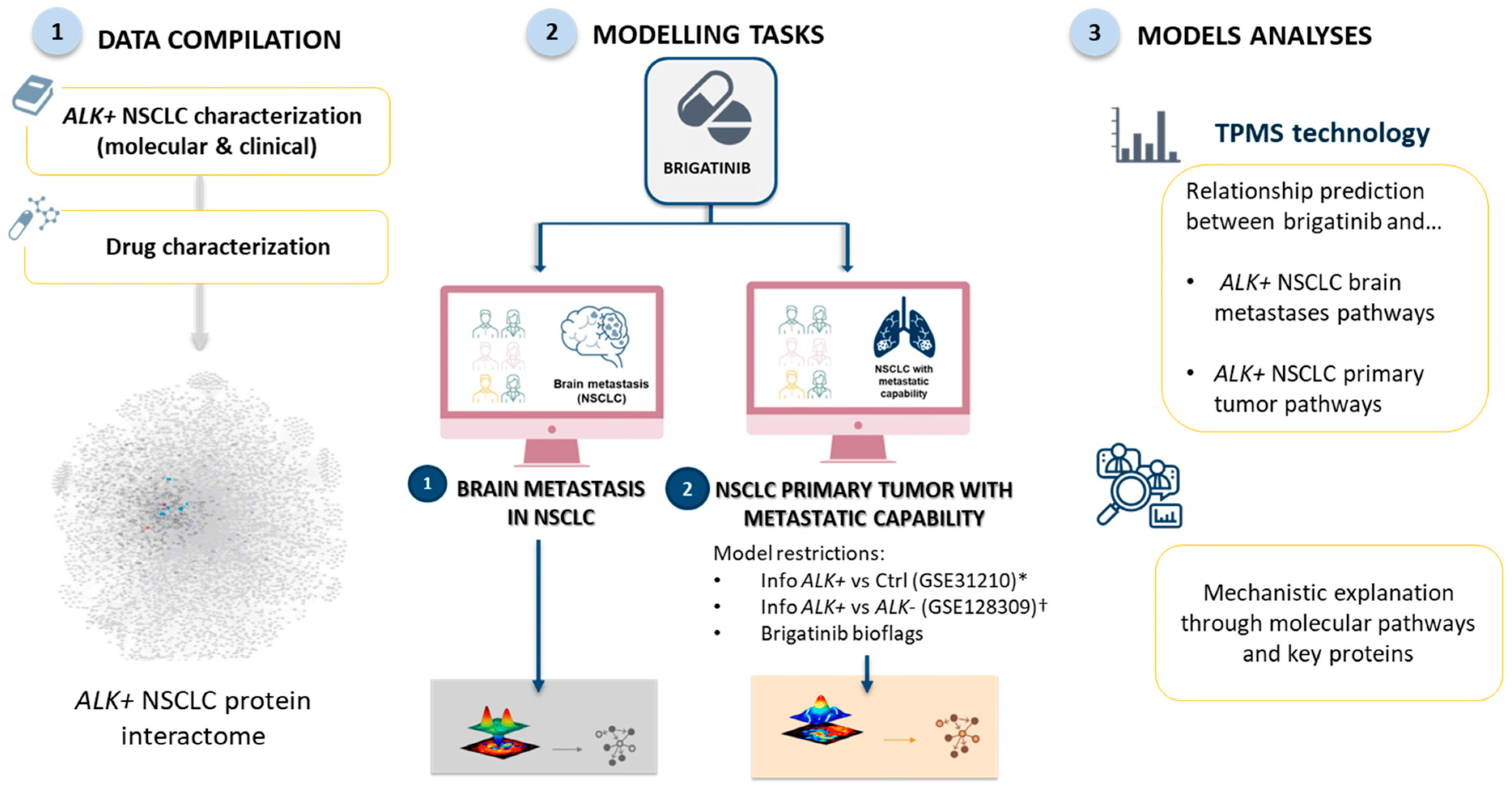
Therapeutic Performance Mapping System (TPMS; Anaxomics Biotech, Barcelona, Spain) is a top-down systems biology methodology based on artificial intelligence, pattern-recognition models, and machine learning, as previously described [10,47,50]. This approach integrates available biological, pharmacological, and medical information to build mathematical models that simulate drug mechanisms of action within a human pathophysiological context. The overall workflow and the key steps of the methodology are shown in Figure 1. TPMS models are constructed on a protein-based human biological network derived from the human protein network (HPN), as reported elsewhere [47]. This human protein–protein interaction network incorporates known relationships between proteins from a regularly updated in-house database compiled from public sources. The data used for model construction and for the training set are summarized in Supplementary Table S5.
To convert the static HPN into mathematical models capable of reproducing known information and predicting new relationships, we used a collection of established physiological input (drugs)–output (clinical conditions) relationships as training data, or “training set”. This training set was assembled from a compendium of biological, pharmacological, and clinical databases and from the literature, using text-mining techniques followed by manual curation to obtain curated, experimentally supported input–output relationships between drugs, targets, and clinical conditions [47,50]. The algorithm employed for TPMS model training is analogous to a Multilayer Perceptron of an Artificial Neural Network implemented over the HPN, where proteins act as neurons and the network edges transmit the information [47,50]. The parameters to be inferred are the weights associated with the links between each pair of nodes (ωx). These ωx parameters are obtained by optimization using a stochastic optimization method based on Simulated Annealing [59], which applies probabilistic measures derived from biological evidence to adjust both the type and the strength of network interactions. The integration of input signals at each node (protein) consists of summing all incoming values to that node; this aggregate signal is then passed through a sigmoid function to generate a normalized output in the range [−1,1] (hereinafter “Predicted protein activity”), which becomes the input signal for the next node in the network, weighted by the corresponding link weight ωx. The topology is initialized by random values for all the links in each of the initial models, and each model is evaluated against the training set for several optimization cycles, until it stabilizes [10,50]. Every mathematical model created must satisfy this training set, as previously detailed [47,50]. Thus, the models are optimized too, in addition to propagating the signal from the stimulus to the response, reproducing every rule contained in the training set; the accuracy is then calculated as the sum of all the rules complied with. The accuracy reflects the internal consistency of the model with established pharmacological and pathophysiological knowledge [47,50]. Given that the number of ω x parameters (i.e., protein–protein interactions) is bigger than the collection of input–output relationships in the training set, a variety of valid models, or solutions, are obtained [47]; thus, the final model is rather an “ensemble of models” that represents a universe of plausible solutions than a single, unique model. This diversity can be viewed as a reflection of natural interpatient molecular variability. The solutions with the highest accuracy against the training set are selected and considered for further analysis, considering valid only those solutions with accuracy above 90%.

2.4. Mechanisms of Action Models

To obtain the MoAs of brigatinib in PT with metastatic capability and in BM, drug-ALK+ NSCLC mathematical models were generated following the same methodology as described in Jorba et al., 2020 [47] and applied in previous studies [46,60,61]. As input, TPMS takes the activation (+1) and inactivation (−1) of the drug target proteins (Supplementary Table S3), and as output, the protein states of the pathology of interest (Supplementary Table S2). In this instance, two models were constructed using the molecular targets of brigatinib as inputs, and the molecular characterization of PT with metastatic capability and BM were used as outputs for each model, respectively. In addition to the information included in the TPMS training set (Supplementary Table S5), specific molecular information regarding patients and drugs was included in the model, as previously described [46,47].
Furthermore, additional restrictions derived from high-throughput data were included in the primary tumor model to simulate ALK+ specific NSCLC. These restrictions consisted of the DEGs obtained from comparing ALK+ vs. ALK− (GSE128309) at FDR < 0.05 and |logFC| > 2 that were also found in ALK+ vs. Control (GSE31210) at FDR < 0.05 [62,63] (Supplementary Table S6).
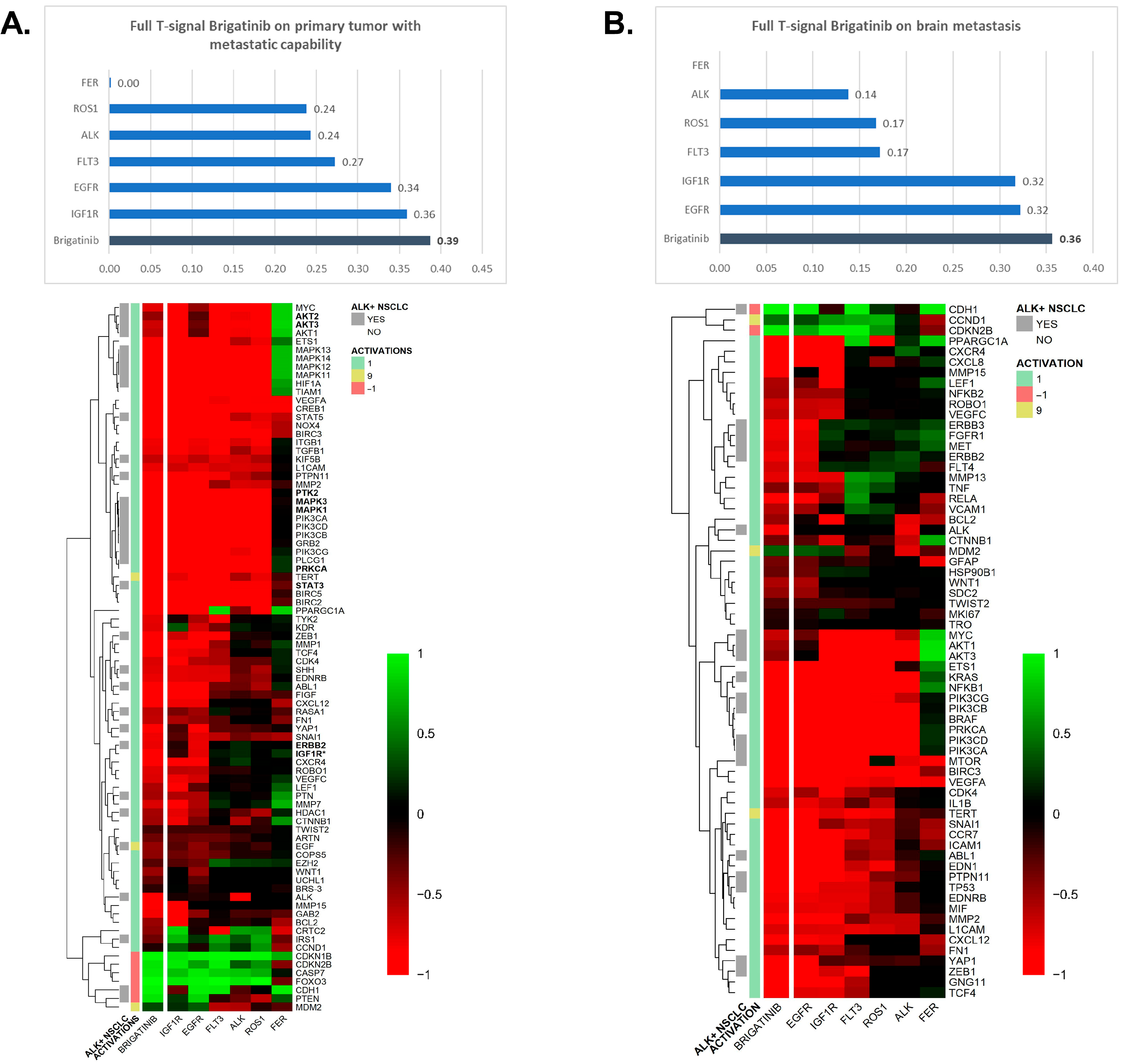
TPMS subsequently optimizes the connections between the two protein sets and calculates activation or inactivation values across the entire human interactome. The subset of proteins obtained in this process defines the drug’s MoA. The impact of brigatinib on the activity of disease effector proteins was quantified using the Full tsignal (fSignal), a component of the models that measures the mean signal value of all response proteins after stimulation of the model, as previously described [47]. This value is derived from the number of modulated proteins within the response set (n), each response protein (i), the sign assigned to response protein “i” according to the response set definition (wi), and the signal value reached by response protein “i” after system stimulation (oi):
f S i g n a l = 1 n i = 1 n w i o i   A D D I N
According to the TPMS methodology, a variance-based Sobol sensitivity analysis [64] is applied to quantify the contribution of individual model parameters to the overall TPMS output signal (considered as a function tSignal = TPMS(X), where X represents protein activity states). Monte Carlo simulations introduced controlled perturbations to the input across the model solutions. Variance decomposition of the resulting outputs enables the identification and quantitative ranking of key proteins and pathways driving the system’s mechanistic behavior.

2.5. Triggering Analyses

To explore the role of individual proteins in triggering the molecular definition of ALK+ NSCLC PT with metastatic capability and ALK+ NSCLC BM, the signal was propagated from each of the proteins under evaluation for each kind of tumor through the sampling-based methods models. For each model, we quantified the number of proteins that were stimulated with the sign assigned in the characterization at distances 1, 2, and 3, giving greater weight to proteins in closer proximity. In this context, distance is defined as the number of interactions in the protein–protein interaction network (distance = 1 when two proteins are directly connected; distance = 2 when they are connected through a third protein; and so forth). A mean value was then calculated across the universe of solutions. Results are reported after normalization to the maximum value obtained (source score), and relevance was defined as source score ≥ 0.75. Brigatinib MoA models were generated using the targets identified through the triggering analysis, with the identified targets used as stimuli and the triggered motives as responses, as previously described [47].

2.6. Software

All simulations described in this project were executed in Anaxomics’ cloud computing, which integrates more than 800 computational threads in machines with 64 Gigabytes of RAM. Software, databases, and tools are the property of Anaxomics Biotech. Heatmaps were constructed using the R (v4.2.2) package pheatmap (v1.0.12). Mechanism of action directed graphs were drawn in Graphviz [65]. Interactomes were generated with Cytoscape (v.3.7.0) [66]. For the identification of differentially expressed genes (DEGs), GEO2R (https://www.ncbi.nlm.nih.gov/geo/geo2r/, accessed on 16 December 2025) was used.

3. Results

3.1. Molecular Characterization of ALK+ NSCLC Pathophysiology and Brigatinib

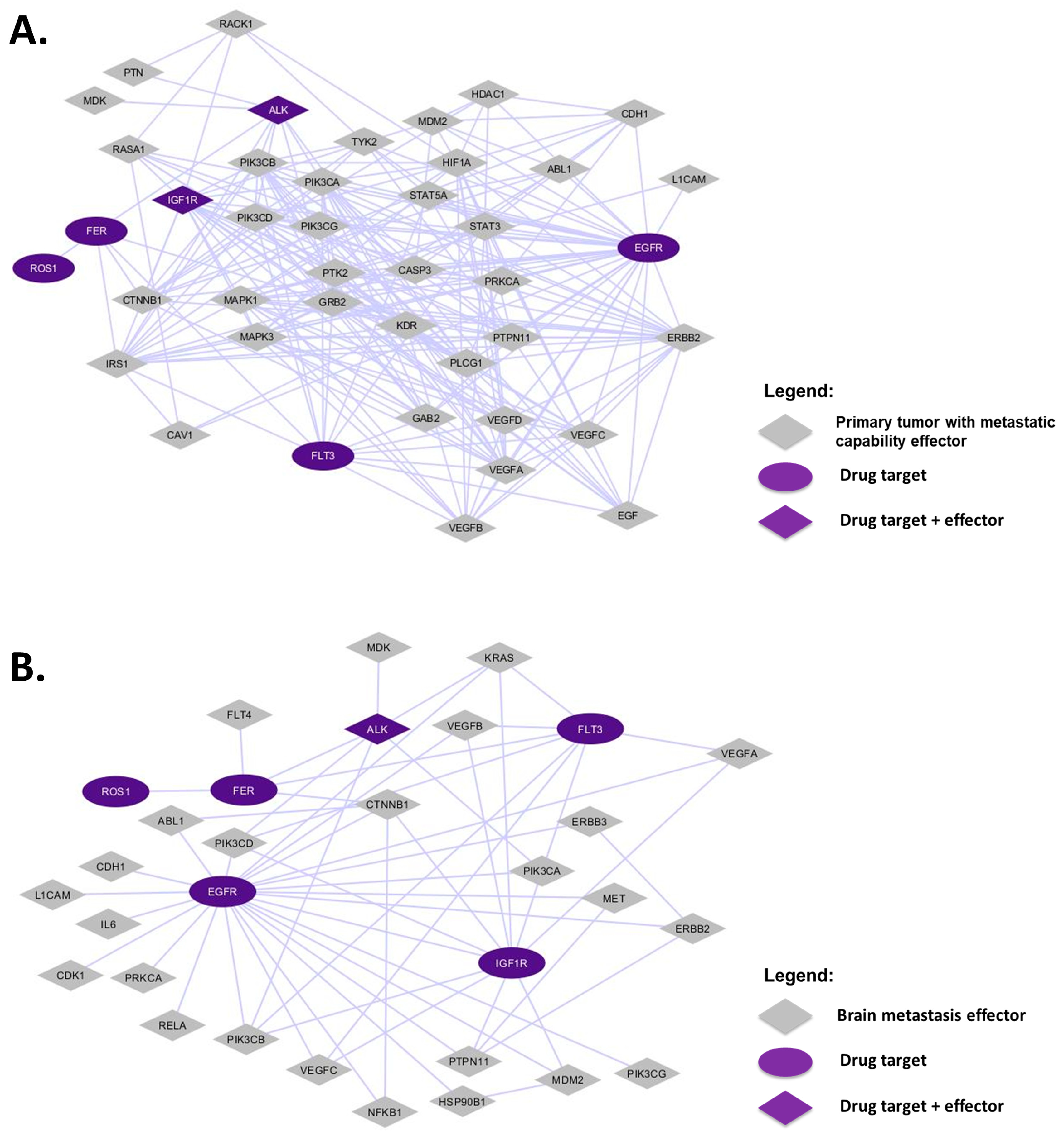
In our previous work, in silico analyses showed that both brigatinib and alectinib modulate cell growth, apoptosis, and immune evasion primarily through ALK inhibition. In contrast, brigatinib, but not alectinib, exhibited a pronounced effect on mechanisms related to invasiveness and CNS metastases, resulting in a more diverse downstream impact due to its broader spectrum of cancer-related kinase targets [10]. In that study, we defined five main pathophysiological processes, or “motives”, implicated in advanced metastatic ALK+ NSCLC: (1) “Cell growth proliferation”, (2) “Sustained angiogenesis”, (3) “Evading apoptosis”, (4) “Tissue invasion and metastasis”, and (5) “Immune evasion” [10]. In the present work, as an in-depth analysis aimed at gaining further insight into the potential role of brigatinib in preventing brain metastasis in patients with advanced metastatic ALK+ NSCLC, motive 4 was subdivided into two more specific sub-motives: (4.1) “Primary tumor with metastatic capability” and (4.2) “Brain metastasis” (see Supplementary Table S1). Each pathophysiological process was then functionally characterized at the protein level to identify its molecular effectors and to focus the analysis on ALK+ NSCLC within the context of a human biological network (see Section 2 and Supplementary Table S2). Sampling-based mechanistic systems biology models of brigatinib obtained with TPMS technology were constructed to evaluate its mechanism of action and potential treatment efficacy in ALK+ NSCLC primary tumors with metastatic capability and ALK+ NSCLC with brain metastasis (see Supplementary Table S1 for metastatic capability definition). As in the aforementioned publication [10], brigatinib protein target profiles were also carefully characterized and used in the analyses presented here. Results are depicted in Figure 2 and summarized in Supplementary Table S3. From the interactome shown in Figure 2, we derived that all brigatinib’s targets are related at distance 1 to at least one effector of BM and PT with metastatic capability, with the targets having the most interactions being IGF1R, EGFR, and FLT3. The highest affinity was shown for the EGFR L858R mutated form.

3.2. Predicted Brigatinib Mechanism of Action in ALK+ NSCLC PT with Metastatic Capability

By calculating the most plausible biological interactions between the stimuli caused by brigatinib and the molecular characterization of PT with metastatic capability, we elucidated the most probable MoA of brigatinib to treat ALK+ NSCLC PT with metastatic capability. The model presented a mean accuracy against the training set of 94.09%.
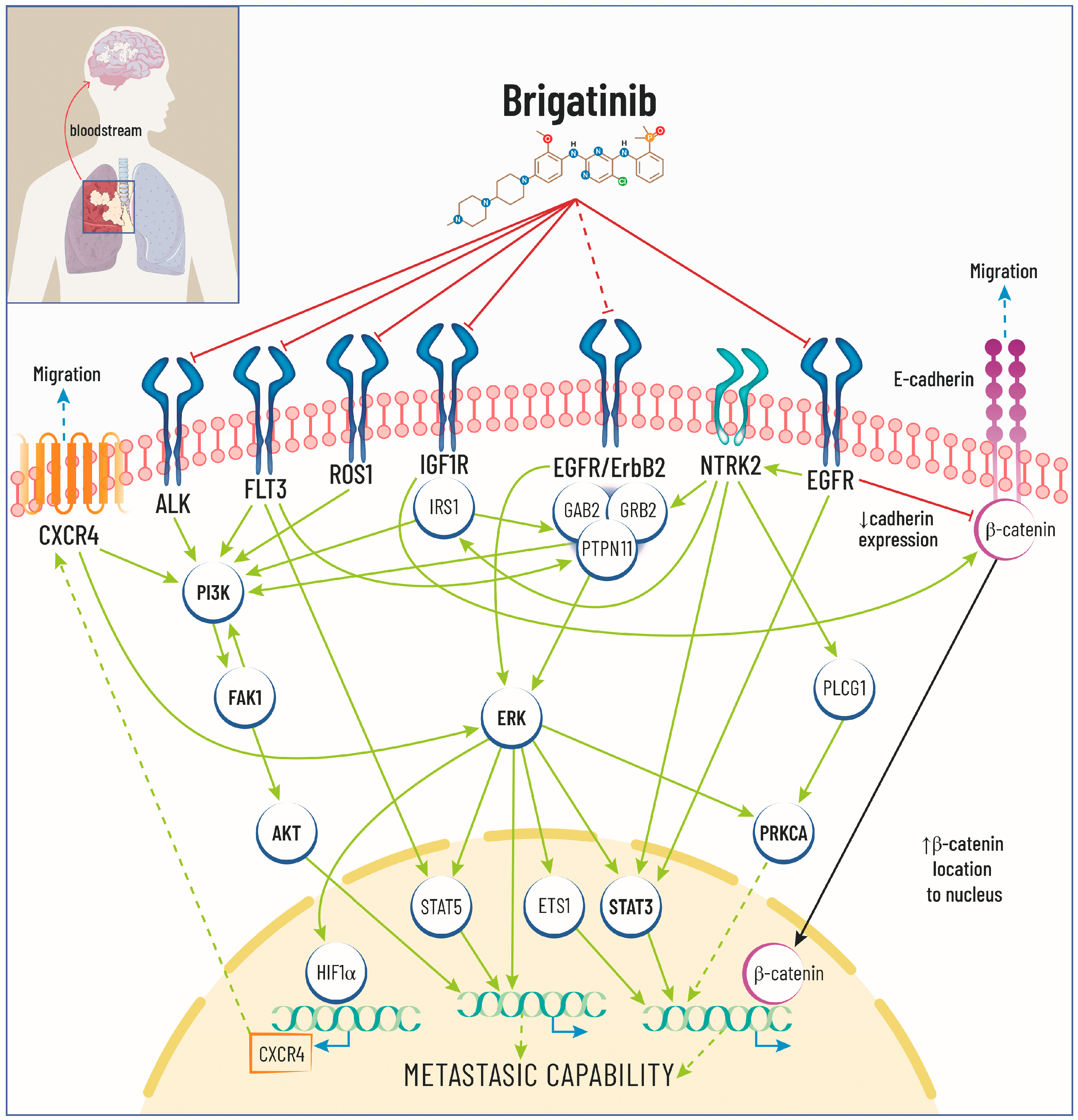
Trigger analyses over the obtained model show that IGF1R, ERBB2, FAK1, ERK, PRKCA, STAT3, and AKT act as triggering nodes for the rest of the effectors in PT with metastatic capability, meaning that their modulation contributes the most to the overall activation/inhibition of the other effector nodes, and brigatinib is capable of reverting their activity. A simplified representation of the obtained model showed that the effect of brigatinib on PT seemed to arise from a downregulation of STAT5/STAT3, CXCR4, ETS1, AKT3, CTNB1, and activation of CADH1 (Figure 3 and Figure S1).
According to our characterization, two out of six of brigatinib’s targets, namely ALK and IGF1R, are proteins directly involved in the metastatic potential of PT. Aside from targeting ALK, brigatinib’s effect on ALK+ NSCLC PT seemed primarily driven by the modulation of EGFR and IFG1R downstream pathways, the modulation of which leads to regulation of several migration-associated effector proteins. Interestingly, CXCR4 and ETS1, which are described as effectors of both PT and BM, have been observed to be upregulated in PT when compared to BM in patient samples from dataset GSE161116 (Supplementary Table S4).

3.3. Predicted Brigatinib Mechanism of Action in ALK+ NSCLC BM

In a similar fashion as above described, the most probable MoA of brigatinib to treat ALK+ NSCLC BM was elucidated by calculating the most biologically plausible solutions of interaction between brigatinib stimuli and the molecular characterization of ALK+ NSCLC BM. The model presented a mean accuracy against the training set of 94.23%.
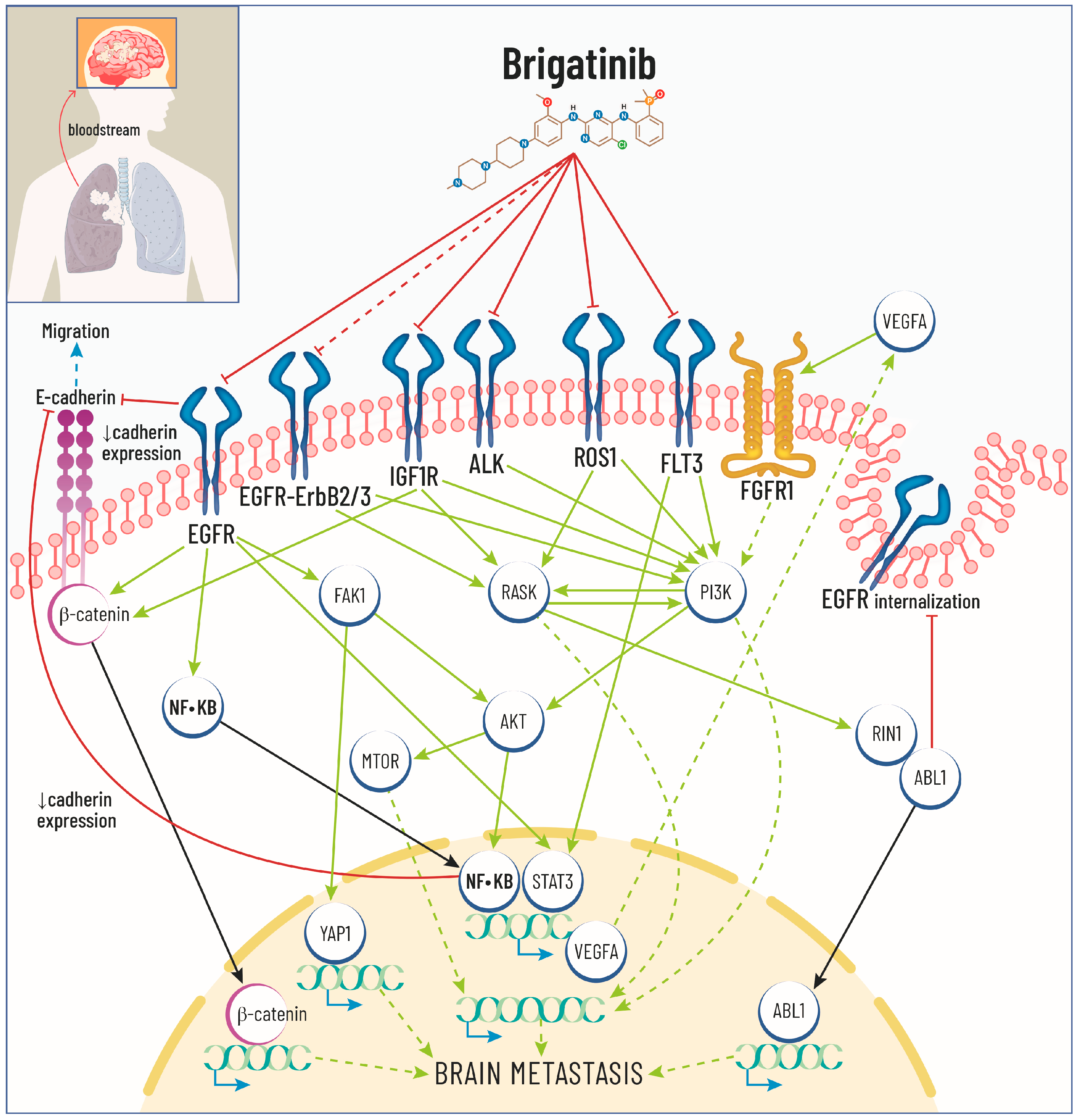
Triggering analyses revealed NFKB as a node with significant triggering potential, suggesting that its modulation may play an integral role in the regulation of the rest of the BM effectors, and brigatinib was able to revert its activity. Based on a simplified representation of the model, brigatinib modulation on the effectors of ALK+ NSCLC BM seemed to be derived from a downregulation of YAP1, FGFR1, ABL1, CTNB1, NFKB1, and PI3K/AKT/mTOR pathways (Figure 4 and Figure S2). According to the characterization based on the literature review, brigatinib’s main target, ALK, was also a protein effector in BM.

3.4. Drug Target Contribution of Mechanism of Action

The impact of brigatinib and each of its molecular targets on the molecular effectors of ALK+ NSCLC PT and BM has been individually evaluated by sampling methods, which allowed us to mechanistically explain those relationships. The impact of brigatinib treatment and the effect per individual target was quantified using the fSignal, which measures the signal values of all response proteins after stimulating the model, to prevent the pathophysiology at hand, and summarizes it as the mean value. This allows us to understand how much signal generated by stimulating the system with brigatinib is reaching the response set, which, in this case, is the metastasis effectors in PT and BM (Figure 4).
According to our analyses, brigatinib seemed to prevent the pathophysiological processes of interest in NSCLC and BM from occurring. This impact appeared to be mainly driven by five of the six brigatinib targets, namely IGF1R, EGFR, FLT3, ALK, and ROS1. By contrast, modulation of FER seemed to have a minor contribution to metastatic processes in both PT and BM. This observation is in line with the interactome shown in Figure 1, where the connectivity of FER with the remaining effector proteins is relatively limited.
Regarding the modulation of each effector by brigatinib (Figure 4), we observe that 59.3% of 145 and 59.6% of 114 effectors are reversed with activations greater than or equal to |0.1| in PT with metastatic capability and BM, respectively. When considering effectors previously labeled as ALK+ NSCLC-specific in PT, 80% of the 41 effectors are reversed with activations greater than or equal to |0.1|, whereas 80% of 26 of the ALK+ specific effectors are modulated with the same activations in BM. The patterns of modulation shown in Figure 5 reinforce the greater contribution to brigatinib’s effect by downstream modulation of IGF1R, EGFR, FLT3, ROS1, and ALK, as previously stated.

3.5. Model Corroboration: Impact of Brigatinib on Tumor Immune Microenvironment of PT and BM of NSCLC

In order to assess the robustness of the models presented here, we corroborated them by comparing their results with known bioflags and publicly available gene expression datasets. Specifically, we compared the modulations observed in our models with other modulatory patterns caused by brigatinib’s treatment, as observed by third parties. The high degree of coincidence achieved supported our model’s robustness. As presented in Table 1, correct modulation is achieved in both PT and BM models for the whole set of bioflags.
All of the yielded 89 differentially expressed genes (DEGs) were found to be upregulated in metastatic PT with regard to BM. According to the mathematical models, brigatinib was capable of significant modulation, defined as activations greater than |0.1|, 61 and 63 of the DEGs in PT and BM, respectively. From the 61 genes modulated in PT, ETS1, CXCR4, and VEGFC are effectors, while from those modulated in BM, ETS1, CXCR4, VEGFC, CCR7, VCAM1, IL1B, LCK, IL6, and CTLA4 are also effectors. Nonetheless, it should be considered that a comparison between tumor and healthy tissue would be necessary to be able to draw clear conclusions with regard to the potential effect of brigatinib in each of the affected tissues.

4. Discussion

The aim of the present study was to develop in silico systems biology and artificial intelligence-based models to characterize the effects of brigatinib on metastatic processes in both the primary tumor (PT) and established BM in ALK+ NSCLC. Our findings indicate that brigatinib may modulate a broad set of metastasis-related proteins in both PT and BM, acting predominantly through ALK, EGFR, FLT3, IGF1R, and ROS1. The clinical benefit and efficacy of brigatinib have been demonstrated in the phase 3 ALTA-1L trial in ALKi-naïve patients with advanced metastatic ALK+ NSCLC [29,67]. In that study, brigatinib showed statistically superior PFS versus crizotinib, as assessed by BIRC, with a 52% reduction in the risk of progression or death. A key feature of brigatinib’s profile in ALTA-1L was its marked intracranial activity: the risk of intracranial progression or death was reduced by 56% in the overall population (HR = 0.44, BIRC-assessed) and by 71% in patients with BM at baseline (HR = 0.29, BIRC-assessed) compared with crizotinib [29]. Prior to its adoption as a first-line option, brigatinib had already demonstrated efficacy as a second-line therapy against multiple crizotinib-resistant ALK mutations in patients with advanced metastatic ALK-rearranged NSCLC [26,27,29]. In addition, brigatinib has been reported to be effective and well-tolerated in real-world cohorts of advanced metastatic ALK+ NSCLC patients previously treated with chemotherapy and ALKi [68,69]. In the present work, we used in silico systems biology approaches to model the impact of brigatinib treatment with a specific focus on BM. Thus, the presented models provide valuable insights into the potential effects of brigatinib in preventing BM in ALK+ NSCLC patients and its potential effect on metastatic lesions that have already occurred. It is very important to consider the sustained intracranial efficacy in patients with baseline brain metastases reported with brigatinib. In fact, overall survival was statistically superior in patients with baseline brain metastases treated with brigatinib (HR = 0.43), despite the fact that the study allowed treatment crossover from the crizotinib arm to the brigatinib arm [70]. This addresses the importance of the intracranial protection offered by brigatinib and even its prevention capabilities.
Where most advanced metastatic ALK+ NSCLC patients derive clinical benefit from second- and third-generation ALKi treatment, acquired resistance invariably develops and leads to clinical relapse [71]. Approximately 50% of resistant alterations after second-generation ALKi treatment tend to be on-target [71,72]. Brigatinib is a second-generation ALK inhibitor with broad-spectrum activity against several acquired on-target resistance mutations that can emerge after treatment with other ALKis [26,30]. In our previous in silico study [10], brigatinib was predicted to have the potential to modulate proteins associated with metastasis in ALK+ NSCLC patients. In fact, our models suggested that brigatinib produces a varied downstream impact owing to its broad spectrum of cancer-related kinase targets, indicating that it might more effectively prevent the emergence of upstream bypass resistance mechanisms to ALKi than alectinib, which, in turn, could translate into a longer period of treatment without resistance [10]. In that TPMS analysis, brigatinib and alectinib were modeled side by side in ALK+ NSCLC, and brigatinib showed a broader and stronger predicted impact on metastasis-related pathways, consistent with its wider multi-kinase target profile. The present study builds on those mechanistic insights and focuses specifically on brigatinib in primary tumors with metastatic capability and in established brain metastases, rather than performing a new cross-drug transcriptomic comparison with other ALK inhibitors. In future work, this TPMS framework could be extended to systematically compare brigatinib with other next-generation ALK inhibitors, such as alectinib and lorlatinib, specifically in the brain metastasis setting. It has been described that brigatinib behaves as a multi-kinase inhibitor with broad-spectrum activity against ALK, FLT3, FER, ROS1, IGF1R, and EGFR [27,72]. This wide inhibitory profile makes brigatinib a suitable option for a broad range of advanced metastatic ALK+ NSCLC patients. Consistent with this, the ALTA-1L trial showed statistically superior efficacy of brigatinib versus crizotinib across multiple ALK variants [29]. Resistance to ALKi can arise through both ALK-dependent and ALK-independent mechanisms [29,72,73]. Brigatinib may, therefore, be able to overcome a wider range of ALKi resistance mechanisms than other ALKis, although additional studies are needed to better delineate its activity patterns. In this context, systems biology approaches could be particularly useful to further elucidate these mechanisms. Notably, several of the pathways highlighted by our TPMS models as central mediators of brigatinib’s beneficial effects in metastatic ALK+ NSCLC and brain metastasis (e.g., EGFR, IGF1R, PI3K/AKT/mTOR, NFKB1, YAP1, and CTNNB1) have also been implicated in ALK-independent bypass resistance and microenvironment-mediated survival in the CNS. This suggests that some of the same network structures that contribute to the antimetastatic activity of brigatinib may, under sustained therapeutic pressure, participate in adaptive resistance. However, the present work did not construct dedicated “resistant state” models (for example, incorporating specific resistance mutations or post-treatment omics signatures), and formal modeling of brigatinib resistance in brain metastases will require additional clinical and molecular data. For instance, according to the results in our study, brigatinib contains effectors of the metastatic process in either PT or BM in two of its target proteins, ALK and IGF1R. Modeling of brigatinib’s therapeutic effect on metastasis effectors, both in PT and BM, seems to arise from signaling primarily through IGF1R and EGFR, and also from FLT3, ROS1, and ALK. In support of our analysis, all these targets had been previously related to a greater or lesser extent to NSCLC development [41,74,75,76,77].
As ALK is a member of the insulin receptor superfamily, its tyrosine kinase domain is homologous to that of IGF-1R, and both receptors rely on partially overlapping growth signaling pathways. IGF1R has been described as a critical mediator in many cancer-associated processes, including migration and resistance to anticancer therapies, to an extent where it is even being evaluated as a promising target for many cancer types, NSCLC among them [78,79]. In a recent publication by Alfaro-Arnedo et al. [80], IGF1R was demonstrated to play a key part in metastasis initiation and progression in the lung microenvironment as observed in IGFR-deficient mice. Additionally, increased levels of IGF1R were observed both in the tissue and serum of NSCLC patients. Mechanistically, it has been proposed that IGF1R increases both the presence of known metastatic promoters in the form of associated macrophages and FOXP3+ tumor-infiltrating lymphocytes and the levels of IL10 and PD-1 [80]. Moreover, preclinical studies and case reports suggest a beneficial effect of brigatinib when used in combination] with EGFR-TKIs to treat EGFR mutants [36,81,82]. Beyond its role as a primary oncogenic driver, EGFR activation has been consistently linked to an increased incidence of brain metastases in NSCLC, particularly in EGFR-mutated tumors [83,84,85]. These observations support the view that EGFR-driven signaling contributes to CNS involvement, which is in line with our TPMS models, where EGFR emerges as one of the key kinases modulating metastasis-related effectors in the brain metastasis context. In addition to IGF1R and EGFR, FLT3, although it has been most extensively characterized in hematological malignancies, preclinical studies in hepatocellular carcinoma have shown that FLT3 signaling promotes tumor cell proliferation, migration, and invasion, and that its inhibition or knockdown reduces these aggressive phenotypes [86,87]. These data suggest that FLT3 can contribute to pro-metastatic cellular plasticity in solid tumors, consistent with its contribution to brigatinib’s predicted downstream impact on metastasis-related effectors in our TPMS models. Larger clinical studies are needed to confirm the therapeutic value of such combined treatment with brigatinib.
In PT, our models predict that brigatinib leads to a downregulation of STAT5/STAT3, CXCR4, ETS1, AKT3, CTNB1, ERBB2, and MAPK, together with activation of CADH1. The JAK–STAT pathway is one of the best-characterized signaling routes in cell biology and is involved in diverse physiological functions, including regulation of cell growth and differentiation and the immune response via cytokine signaling [88]. STAT signaling has been reported to mediate the oncogenic effects of deregulated ALK by promoting survival, proliferation, migration, and resistance to apoptosis [89,90,91,92]. STAT3, in particular, participates in cell cycle control, cytokine signaling, and apoptosis. Increased STAT3 protein levels and constitutive activation have been described in EML4-ALK+ NSCLC cell lines [89,90,91,92]. In addition, elevated nuclear levels of STAT3 and p-STAT3 have been associated with increased invasiveness and more advanced stages of cancer [93]. CXCR4 has been implicated, together with CXCL12, in promoting the migration, invasion, and adhesion of NSCLC cells through the activation of NFkB, Rac1, and matrix metalloproteinases [94]. Similarly, ETS1 has been linked with increased invasive potential via its upregulation by trophinin, which has also been observed to mediate other adhesion-related markers, such as integrin alpha-3 and metalloproteinases MMP-7 and MMP-9 [95,96]. In our study, brigatinib was predicted to trigger a downregulation of CXRC4 and ETS1 effectors, explaining its activity against the proliferation, migration, and invasion of NSCLC cells. AKT3 also appears to play a role in promoting migration capabilities through its activation of matrix metallopeptidases [97,98]. Finally, upregulation of β-catenin was described to enhance lung cancer migration and invasion, together with MMP-2, VEGF, and Twist [99]. Blocking EGFR and IGF1R pathways might also prevent β-catenin upregulation, accumulation in the nucleus, and transcription factor function [10]. Moreover, several mechanisms may coexist within a single patient [100].
Development of BM could be an argument for treatment selection [3]. The mechanistic analysis presented here suggests that brigatinib may be able to reverse the activation of a large proportion of metastasis effector proteins and, in particular, brain metastasis-related effectors in ALK+ NSCLC patients. According to our analysis, in the established BM, treatment with brigatinib triggers a downregulation of YAP1, FGFR1, ABL1, CTNB1, NFKB1, and the PI3K/AKT/mTOR pathway. These targets are implicated in cell proliferation, tissue invasion, and metastasis. YAP1 has been recently reported to be significantly elevated in BM [71], which is mechanistically linked to increased cell proliferation and the epithelial–mesenchymal transition. On a similar note, FGFR1 amplifications have been shown to be rare in primary lung tumors; however, significant amplification of FGFR1 in BM has also been reported [61]. FGFR1 is a membrane-bound receptor tyrosine kinase involved in the regulation of cell proliferation, differentiation, and angiogenesis through the PI3K and mitogen-activated protein kinase (MAPK) signaling pathways [61]. Inhibition of FGFR1 exerts distinct antineoplastic effects in FGFR1-amplified tumors [32]. Consequently, FGFR inhibitors have been highlighted as promising targeted drugs for therapy and delay of NSCLC BM [101]. ABL1 plays a key role in the metastasis of NSCLC, facilitating tumor extravasation, and its overexpression is negatively correlated with survival [102]. Regarding CTNB1, it has been reported that increased mutation rates are found in brain metastasis of lung cancer and that mutations in PT are rare in early stages of PT [103]. It has been proposed that activation of the NFKB pathway as a response to IFN and TNF produced by astrocytes contributes to the growth and chemoresistance of tumoral cells in the brain [96]. Finally, several studies have highlighted the relevance of the PI3K/AKT/mTOR pathway in the ability of fusion-driven NSCLC to develop BM [104,105]. Because the downstream signaling mediated by PI3K/AKT/mTOR contributes to tumor development and progression and may influence both response and resistance to standard treatments, this pathway has been proposed as an attractive therapeutic target in NSCLC [106]. In our analysis, brigatinib was predicted to trigger a downregulation of the PI3K/AKT/mTOR pathway, explaining its benefits for patients with ALK+ tumors who exhibit de novo resistance. It is important to note that NFKB1 and YAP1 are widely recognized oncogenic hubs involved in multiple tumor types and cancer hallmarks. In our models, their appearance should therefore not be interpreted as brigatinib-specific or novel targets, but rather as central convergence nodes through which perturbations of brigatinib’s target set (ALK, IGF1R, EGFR, FLT3, ROS1, and FER) propagate to modulate downstream metastasis-related effectors in the ALK+ NSCLC context.
In silico modeling approaches, such as the one reported here, can be used as mechanistic, hypothesis-generating tools. However, they are limited by the information available about drugs and diseases [10,47], and consequently, our TPMS-based models should be interpreted as providing biologically grounded mechanistic hypotheses about brigatinib’s action in ALK+ NSCLC and brain metastases, rather than as definitive proof of efficacy or as a substitute for experimental or clinical validation. Accordingly, the signaling pathways and network mechanisms identified by our TPMS models should be interpreted as in silico hypotheses rather than as experimentally demonstrated mechanisms of action, and will require confirmation in dedicated in vitro, in vivo, and clinical–translational studies. Unknown targets, or not yet described pathophysiological processes, might still play a role in brigatinib’s MoAs, and the models are also constrained by the completeness and quality of the publicly available interactome information. Systems biology-based TPMS models are built considering the whole human protein network and a wide range of drug–pathology relationships (either as indications or adverse events), not only limited to the studied diseases, which maximizes their applicability for rare settings such as the exploration of mechanisms behind adverse events. In this sense, there are not yet enough high-throughput data available on advanced metastatic ALK+ NSCLC patients treated with brigatinib to fully confirm our in silico models and all the possible downstream interactions or to perform direct patient-level biomarker–response correlations. Future work integrating high-throughput molecular data from brigatinib-treated ALK+ NSCLC patients would be highly valuable to enable more direct validation and refinement of these in silico predictions. At present, the lack of well-annotated cohorts of brigatinib-treated ALK+ NSCLC patients with matched molecular profiling and clinical outcome data precludes performing a direct, patient-level biomarker–response correlation for our TPMS predictions. As a result, the present results should be regarded as mechanistic, hypothesis-generating insights that complement, but do not substitute, future biomarker-driven clinical and translational studies. Nevertheless, our study showed that the generated models presented accuracies against the training set above 94%, reassuring the validity of our analysis. According to the mathematical models, brigatinib is capable of significantly modulating 89 DEGs, with 61 and 63 of these genes being PT and BM, respectively. It should be considered that a comparison between tumor and healthy tissue would be necessary to be able to draw a clear conclusion with regard to the potential effect of brigatinib in each of the affected tissues. Unfortunately, matched healthy controls were not included in the GSE161116 dataset (see Section 2). The information provided by the DEGs has been used to prioritize some of the effector proteins to display in the presented MoA representation of the PT. Our results would need to be further investigated to glean clinical impact.
The current study was designed to investigate the mechanistic impact of brigatinib in ALK+ NSCLC BM, both regarding the metastatic effectors in the PT as well as when metastasis to the brain has already occurred. In silico models have revealed that brigatinib is predicted to modulate a broad set of proteins implicated in metastasis, both in the PT and in established metastases, primarily through its actions through IGF1R and EGFR in addition to FLT3, ROS1, and ALK. Thus, further experimentation and validation of the signaling pathways presented here could enhance our understanding of metastatic processes and assist in the development of new strategies and approaches to tackle them.

5. Conclusions

In this study, we used in silico systems biology approaches to investigate how brigatinib may influence metastatic mechanisms in ALK+ NSCLC, considering (1) metastatic effectors in the PT and (2) the setting of already established brain metastases. Our models indicate that brigatinib is predicted to modulate a broad set of proteins implicated in metastasis in both contexts, acting mainly through IGF1R and EGFR, in addition to FLT3, ROS1, and ALK. Nevertheless, further experimental validation will be required in both PT and BM.

Supplementary Materials

The following supporting information can be downloaded at https://www.mdpi.com/article/10.3390/biomedinformatics6010002/s1, Figure S1. Graphical representation of the molecular mechanism of action (MoA) of brigatinib on primary tumor (PT) with metastatic capability; Figure S2. Graphical representation of the molecular mechanism of action (MoA) of brigatinib on brain metastasis (BM); Table S1. ALK+ NSCLC motives definition; Table S2. ALK+ NSCLC molecular characterization; Table S3. Brigatinib targets molecular characterization; Table S4. GSE161116 Differential Expression; Table S5. TPMS training set. Summary of data (number of entries in the database for each data type) used for model construction (network and training set); Table S6. Primary tumor with metastatic capability model restrictions; Table S7. Bibliographical validation of interactions on the predicted mechanisms of action between brigatinib and primary tumor with metastatic capability; Table S8. Bibliographical validation of interactions on the predicted mechanisms of action between brigatinib and ALK+ NSCLC brain metastasis.

Author Contributions

Conceptualization, A.L., A.M.-C. and E.C. contributed to setting up fundamental questions regarding ALK+ NSCLC treatment; methodology, E.C. and M.C. contributed to the study design; data curation, M.C.; formal analysis, M.C. contributed to data acquisition and data analysis; investigation, E.C. and A.M.-C. contributed to clinical interpretation of data; project administration, C.P.; supervision, A.L.; writing—original draft preparation, A.L., A.M.-C. and M.C. contributed to writing the manuscript; writing—review and editing, E.C., C.P., L.B. and M.C. contributed to the critical revision of the manuscript. All authors have read and agreed to the published version of the manuscript.

Funding

This research was funded by Takeda Farmacéutica España, S.A for contracted research; no grant number applies.

Institutional Review Board Statement

Not applicable.

Informed Consent Statement

Not applicable.

Data Availability Statement

The original contributions presented in this study are included in the article/supplementary material. Further inquiries can be directed to the corresponding author.

Acknowledgments

Under the direction of the authors, medical writing support and editorial assistance was provided by José Luis Ramírez and by Cristina Abuin Martínez (Anaxomics Biotech S.L., Spain). Medical writing was funded by Takeda Farmacéutica España.

Conflicts of Interest

E.C. has served as a speaker or advisory board member for Takeda, AstraZeneca, Boehringer Ingelheim, Bristol-Myers Squibb, MSD, Novartis, Roche, and Pfizer. E.C. has received a grant in support from Merk. E.C. has other conflicts of interest with Bristol-Myers Squibb, Pfizer, Roche, and Takeda. A.L. is a full-time employee of Takeda Farmacéutica España, S.A. M.C. was a full-time employee of Anaxomics Biotech, S.L. A.M.-C. does not have any conflicts of interest.

Abbreviations

The following abbreviations are used in this manuscript:
BMBrain metastases
NSCLCNon-small cell lung cancer
PTPrimary tumor
TPMSTherapeutic Performance Mapping Systems
CNSCentral nervous system
DEGsDifferentially expressed genes
MoAMechanism of action

References

  1. Barta, J.A.; Powell, C.A.; Wisnivesky, J.P. Global Epidemiology of Lung Cancer. Ann. Glob. Health 2019, 85, 8. [Google Scholar] [CrossRef]
  2. Global Burden of Disease Cancer Collaboration; Fitzmaurice, C.; Dicker, D.; Pain, A.; Hamavid, H.; Moradi-Lakeh, M.; MacIntyre, M.F.; Allen, C.; Hansen, G.; Woodbrook, R.; et al. The Global Burden of Cancer 2013. JAMA Oncol. 2015, 1, 505–527. [Google Scholar] [CrossRef]
  3. Griesinger, F.; Roeper, J.; Pottgen, C.; Willborn, K.C.; Eberhardt, W.E.E. Brain metastases in ALK-positive NSCLC—Time to adjust current treatment algorithms. Oncotarget 2018, 9, 35181–35194. [Google Scholar] [CrossRef]
  4. Torre, L.A.; Siegel, R.L.; Jemal, A. Lung Cancer Statistics. Adv. Exp. Med. Biol. 2016, 893, 1–19. [Google Scholar] [CrossRef] [PubMed]
  5. Wong, M.C.S.; Lao, X.Q.; Ho, K.F.; Goggins, W.B.; Tse, S.L.A. Incidence and mortality of lung cancer: Global trends and association with socioeconomic status. Sci. Rep. 2017, 7, 14300. [Google Scholar] [CrossRef]
  6. Bray, F.; Ferlay, J.; Soerjomataram, I.; Siegel, R.L.; Torre, L.A.; Jemal, A. Global cancer statistics 2018: GLOBOCAN estimates of incidence and mortality worldwide for 36 cancers in 185 countries. CA Cancer J. Clin. 2018, 68, 394–424. [Google Scholar] [CrossRef]
  7. Ganti, A.K.; Klein, A.B.; Cotarla, I.; Seal, B.; Chou, E. Update of Incidence, Prevalence, Survival, and Initial Treatment in Patients with Non-Small Cell Lung Cancer in the US. JAMA Oncol. 2021, 7, 1824–1832. [Google Scholar] [CrossRef] [PubMed]
  8. Griffin, R.; Ramirez, R.A. Molecular Targets in Non-Small Cell Lung Cancer. Ochsner J. 2017, 17, 388–392. [Google Scholar]
  9. Cetin, K.; Ettinger, D.S.; Hei, Y.J.; O’Malley, C.D. Survival by histologic subtype in stage IV nonsmall cell lung cancer based on data from the Surveillance, Epidemiology and End Results Program. Clin. Epidemiol. 2011, 3, 139–148. [Google Scholar] [CrossRef]
  10. Carcereny, E.; Fernandez-Nistal, A.; Lopez, A.; Montoto, C.; Naves, A.; Segu-Verges, C.; Coma, M.; Jorba, G.; Oliva, B.; Mas, J.M. Head to head evaluation of second generation ALK inhibitors brigatinib and alectinib as first-line treatment for ALK+ NSCLC using an in silico systems biology-based approach. Oncotarget 2021, 12, 316–332. [Google Scholar] [CrossRef] [PubMed]
  11. Morris, T.A.; Khoo, C.; Solomon, B.J. Targeting ROS1 Rearrangements in Non-small Cell Lung Cancer: Crizotinib and Newer Generation Tyrosine Kinase Inhibitors. Drugs 2019, 79, 1277–1286. [Google Scholar] [CrossRef]
  12. Rotow, J.; Bivona, T.G. Understanding and targeting resistance mechanisms in NSCLC. Nat. Rev. Cancer 2017, 17, 637–658. [Google Scholar] [CrossRef]
  13. Buriolla, S.; Pelizzari, G.; Corvaja, C.; Alberti, M.; Targato, G.; Bortolot, M.; Torresan, S.; Cortiula, F.; Fasola, G.; Follador, A. Immunotherapy in NSCLC Patients with Brain Metastases. Int. J. Mol. Sci. 2022, 23, 7068. [Google Scholar] [CrossRef] [PubMed]
  14. Jablonska, P.A.; Bosch-Barrera, J.; Serrano, D.; Valiente, M.; Calvo, A.; Aristu, J. Challenges and Novel Opportunities of Radiation Therapy for Brain Metastases in Non-Small Cell Lung Cancer. Cancers 2021, 13, 2141. [Google Scholar] [CrossRef]
  15. Nayak, L.; Lee, E.Q.; Wen, P.Y. Epidemiology of brain metastases. Curr. Oncol. Rep. 2012, 14, 48–54. [Google Scholar] [CrossRef] [PubMed]
  16. Camidge, D.R.; Bang, Y.J.; Kwak, E.L.; Iafrate, A.J.; Varella-Garcia, M.; Fox, S.B.; Riely, G.J.; Solomon, B.; Ou, S.H.; Kim, D.W.; et al. Activity and safety of crizotinib in patients with ALK-positive non-small-cell lung cancer: Updated results from a phase 1 study. Lancet Oncol. 2012, 13, 1011–1019. [Google Scholar] [CrossRef]
  17. Johung, K.L.; Yeh, N.; Desai, N.B.; Williams, T.M.; Lautenschlaeger, T.; Arvold, N.D.; Ning, M.S.; Attia, A.; Lovly, C.M.; Goldberg, S.; et al. Extended Survival and Prognostic Factors for Patients with ALK-Rearranged Non-Small-Cell Lung Cancer and Brain Metastasis. J. Clin. Oncol. 2016, 34, 123–129. [Google Scholar] [CrossRef]
  18. Yoshida, T.; Oya, Y.; Tanaka, K.; Shimizu, J.; Horio, Y.; Kuroda, H.; Sakao, Y.; Hida, T.; Yatabe, Y. Clinical impact of crizotinib on central nervous system progression in ALK-positive non-small lung cancer. Lung Cancer 2016, 97, 43–47. [Google Scholar] [CrossRef] [PubMed]
  19. Zhang, I.; Zaorsky, N.G.; Palmer, J.D.; Mehra, R.; Lu, B. Targeting brain metastases in ALK-rearranged non-small-cell lung cancer. Lancet Oncol. 2015, 16, e510–e521. [Google Scholar] [CrossRef]
  20. Sperduto, P.W.; Kased, N.; Roberge, D.; Xu, Z.; Shanley, R.; Luo, X.; Sneed, P.K.; Chao, S.T.; Weil, R.J.; Suh, J.; et al. Summary report on the graded prognostic assessment: An accurate and facile diagnosis-specific tool to estimate survival for patients with brain metastases. J. Clin. Oncol. 2012, 30, 419–425. [Google Scholar] [CrossRef]
  21. Ettinger, D.S.; Wood, D.E.; Aisner, D.L.; Akerley, W.; Bauman, J.R.; Bharat, A.; Bruno, D.S.; Chang, J.Y.; Chirieac, L.R.; DeCamp, M.; et al. NCCN Guidelines(R) Insights: Non-Small Cell Lung Cancer, Version 2.2023. J. Natl. Compr. Canc. Netw. 2023, 21, 340–350. [Google Scholar] [CrossRef]
  22. Le Rhun, E.; Guckenberger, M.; Smits, M.; Dummer, R.; Bachelot, T.; Sahm, F.; Galldiks, N.; de Azambuja, E.; Berghoff, A.S.; Metellus, P.; et al. EANO-ESMO Clinical Practice Guidelines for diagnosis, treatment and follow-up of patients with brain metastasis from solid tumours. Ann. Oncol. 2021, 32, 1332–1347. [Google Scholar] [CrossRef]
  23. Planchard, D.; Popat, S.; Kerr, K.; Novello, S.; Smit, E.F.; Faivre-Finn, C.; Mok, T.S.; Reck, M.; Van Schil, P.E.; Hellmann, M.D.; et al. Metastatic non-small cell lung cancer: ESMO Clinical Practice Guidelines for diagnosis, treatment and follow-up. Ann. Oncol. 2018, 29, iv192–iv237. [Google Scholar] [CrossRef] [PubMed]
  24. Solomon, B.J.; Cappuzzo, F.; Felip, E.; Blackhall, F.H.; Costa, D.B.; Kim, D.W.; Nakagawa, K.; Wu, Y.L.; Mekhail, T.; Paolini, J.; et al. Intracranial Efficacy of Crizotinib Versus Chemotherapy in Patients with Advanced ALK-Positive Non-Small-Cell Lung Cancer: Results From PROFILE 1014. J. Clin. Oncol. 2016, 34, 2858–2865. [Google Scholar] [CrossRef]
  25. Gadgeel, S.M.; Gandhi, L.; Riely, G.J.; Chiappori, A.A.; West, H.L.; Azada, M.C.; Morcos, P.N.; Lee, R.M.; Garcia, L.; Yu, L.; et al. Safety and activity of alectinib against systemic disease and brain metastases in patients with crizotinib-resistant ALK-rearranged non-small-cell lung cancer (AF-002JG): Results from the dose-finding portion of a phase 1/2 study. Lancet Oncol. 2014, 15, 1119–1128. [Google Scholar] [CrossRef]
  26. Zhang, S.; Anjum, R.; Squillace, R.; Nadworny, S.; Zhou, T.; Keats, J.; Ning, Y.; Wardwell, S.D.; Miller, D.; Song, Y.; et al. The Potent ALK Inhibitor Brigatinib (AP26113) Overcomes Mechanisms of Resistance to First- and Second-Generation ALK Inhibitors in Preclinical Models. Clin. Cancer Res. 2016, 22, 5527–5538. [Google Scholar] [CrossRef] [PubMed]
  27. Ali, R.; Arshad, J.; Palacio, S.; Mudad, R. Brigatinib for ALK-positive metastatic non-small-cell lung cancer: Design, development and place in therapy. Drug Des. Devel. Ther. 2019, 13, 569–580. [Google Scholar] [CrossRef] [PubMed]
  28. Vavala, T.; Novello, S. Alectinib in the treatment of ALK-positive non-small cell lung cancer: An update on its properties, efficacy, safety and place in therapy. Ther. Adv. Med. Oncol. 2018, 10, 1758835918789364. [Google Scholar] [CrossRef]
  29. Camidge, D.R.; Kim, H.R.; Ahn, M.J.; Yang, J.C.H.; Han, J.Y.; Hochmair, M.J.; Lee, K.H.; Delmonte, A.; Garcia Campelo, M.R.; Kim, D.W.; et al. Brigatinib Versus Crizotinib in ALK Inhibitor-Naive Advanced ALK-Positive NSCLC: Final Results of Phase 3 ALTA-1L Trial. J. Thorac. Oncol. 2021, 16, 2091–2108. [Google Scholar] [CrossRef] [PubMed]
  30. Huang, W.S.; Liu, S.; Zou, D.; Thomas, M.; Wang, Y.; Zhou, T.; Romero, J.; Kohlmann, A.; Li, F.; Qi, J.; et al. Discovery of Brigatinib (AP26113), a Phosphine Oxide-Containing, Potent, Orally Active Inhibitor of Anaplastic Lymphoma Kinase. J. Med. Chem. 2016, 59, 4948–4964. [Google Scholar] [CrossRef]
  31. Camidge, D.R.; Lee, E.Q.; Lin, N.U.; Margolin, K.; Ahluwalia, M.S.; Bendszus, M.; Chang, S.M.; Dancey, J.; de Vries, E.G.E.; Harris, G.J.; et al. Clinical trial design for systemic agents in patients with brain metastases from solid tumours: A guideline by the Response Assessment in Neuro-Oncology Brain Metastases working group. Lancet Oncol. 2018, 19, e20–e32. [Google Scholar] [CrossRef] [PubMed]
  32. Hendriks, L.E.; Kerr, K.M.; Menis, J.; Mok, T.S.; Nestle, U.; Passaro, A.; Peters, S.; Planchard, D.; Smit, E.F.; Solomon, B.J.; et al. Oncogene-addicted metastatic non-small-cell lung cancer: ESMO Clinical Practice Guideline for diagnosis, treatment and follow-up. Ann. Oncol. 2023, 34, 339–357. [Google Scholar] [CrossRef]
  33. Singh, N.; Temin, S.; Baker, S., Jr.; Blanchard, E.; Brahmer, J.R.; Celano, P.; Duma, N.; Ellis, P.M.; Elkins, I.B.; Haddad, R.Y.; et al. Therapy for Stage IV Non-Small-Cell Lung Cancer with Driver Alterations: ASCO Living Guideline. J. Clin. Oncol. 2022, 40, 3310–3322. [Google Scholar] [CrossRef]
  34. Amanam, I.; Gupta, R.; Mambetsariev, I.; Salgia, R. The brigatinib experience: A new generation of therapy for ALK-positive non-small-cell lung cancer. Future Oncol. 2018, 14, 1897–1908. [Google Scholar] [CrossRef]
  35. Jain, R.K.; Chen, H. Spotlight on brigatinib and its potential in the treatment of patients with metastatic ALK-positive non-small cell lung cancer who are resistant or intolerant to crizotinib. Lung Cancer 2017, 8, 169–177. [Google Scholar] [CrossRef]
  36. Mezquita, L.; Planchard, D. The role of brigatinib in crizotinib-resistant non-small cell lung cancer. Cancer Manag. Res. 2018, 10, 123–130. [Google Scholar] [CrossRef]
  37. Rashdan, S.; Gerber, D.E. A crowded, but still varied, space: Brigatinib in anaplastic lymphoma kinase-rearranged non-small cell lung cancer. Transl. Cancer Res. 2017, 6, S78–S82. [Google Scholar] [CrossRef]
  38. Stanicka, J.; Rieger, L.; O’Shea, S.; Cox, O.; Coleman, M.; O’Flanagan, C.; Addario, B.; McCabe, N.; Kennedy, R.; O’Connor, R. FES-related tyrosine kinase activates the insulin-like growth factor-1 receptor at sites of cell adhesion. Oncogene 2018, 37, 3131–3150. [Google Scholar] [CrossRef]
  39. Uchibori, K.; Inase, N.; Araki, M.; Kamada, M.; Sato, S.; Okuno, Y.; Fujita, N.; Katayama, R. Brigatinib combined with anti-EGFR antibody overcomes osimertinib resistance in EGFR-mutated non-small-cell lung cancer. Nat. Commun. 2017, 8, 14768. [Google Scholar] [CrossRef] [PubMed]
  40. Wang, X.; Zhou, L.; Yin, J.C.; Wu, X.; Shao, Y.W.; Gao, B. Lung Adenocarcinoma Harboring EGFR 19del/C797S/T790M Triple Mutations Responds to Brigatinib and Anti-EGFR Antibody Combination Therapy. J. Thorac. Oncol. 2019, 14, e85–e88. [Google Scholar] [CrossRef] [PubMed]
  41. Wang, Y.; Yang, N.; Zhang, Y.; Li, L.; Han, R.; Zhu, M.; Feng, M.; Chen, H.; Lizaso, A.; Qin, T.; et al. Effective Treatment of Lung Adenocarcinoma Harboring EGFR-Activating Mutation, T790M, and cis-C797S Triple Mutations by Brigatinib and Cetuximab Combination Therapy. J. Thorac. Oncol. 2020, 15, 1369–1375. [Google Scholar] [CrossRef]
  42. Zhao, J.; Zou, M.; Lv, J.; Han, Y.; Wang, G.; Wang, G. Effective treatment of pulmonary adenocarcinoma harboring triple EGFR mutations of L858R, T790M, and cis-C797S by osimertinib, bevacizumab, and brigatinib combination therapy: A case report. Onco Targets Ther. 2018, 11, 5545–5550. [Google Scholar] [CrossRef]
  43. Camidge, D.R.; Dziadziuszko, R.; Peters, S.; Mok, T.; Noe, J.; Nowicka, M.; Gadgeel, S.M.; Cheema, P.; Pavlakis, N.; de Marinis, F.; et al. Updated Efficacy and Safety Data and Impact of the EML4-ALK Fusion Variant on the Efficacy of Alectinib in Untreated ALK-Positive Advanced Non-Small Cell Lung Cancer in the Global Phase III ALEX Study. J. Thorac. Oncol. 2019, 14, 1233–1243. [Google Scholar] [CrossRef]
  44. Solomon, B.J.; Bauer, T.M.; Mok, T.S.K.; Liu, G.; Mazieres, J.; de Marinis, F.; Goto, Y.; Kim, D.W.; Wu, Y.L.; Jassem, J.; et al. Efficacy and safety of first-line lorlatinib versus crizotinib in patients with advanced, ALK-positive non-small-cell lung cancer: Updated analysis of data from the phase 3, randomised, open-label CROWN study. Lancet Respir. Med. 2023, 11, 354–366. [Google Scholar] [CrossRef]
  45. Gimenez, N.; Tripathi, R.; Giro, A.; Rosich, L.; Lopez-Guerra, M.; Lopez-Oreja, I.; Playa-Albinyana, H.; Arenas, F.; Mas, J.M.; Perez-Galan, P.; et al. Systems biology drug screening identifies statins as enhancers of current therapies in chronic lymphocytic leukemia. Sci. Rep. 2020, 10, 22153. [Google Scholar] [CrossRef]
  46. Iborra-Egea, O.; Galvez-Monton, C.; Roura, S.; Perea-Gil, I.; Prat-Vidal, C.; Soler-Botija, C.; Bayes-Genis, A. Mechanisms of action of sacubitril/valsartan on cardiac remodeling: A systems biology approach. NPJ Syst. Biol. Appl. 2017, 3, 12. [Google Scholar] [CrossRef]
  47. Jorba, G.; Aguirre-Plans, J.; Junet, V.; Segu-Verges, C.; Ruiz, J.L.; Pujol, A.; Fernandez-Fuentes, N.; Mas, J.M.; Oliva, B. In-silico simulated prototype-patients using TPMS technology to study a potential adverse effect of sacubitril and valsartan. PLoS ONE 2020, 15, e0228926. [Google Scholar] [CrossRef] [PubMed]
  48. Lozano, M.L.; Segu-Verges, C.; Coma, M.; Alvarez-Roman, M.T.; Gonzalez-Porras, J.R.; Gutierrez, L.; Valcarcel, D.; Butta, N. Elucidating the Mechanism of Action of the Attributed Immunomodulatory Role of Eltrombopag in Primary Immune Thrombocytopenia: An In Silico Approach. Int. J. Mol. Sci. 2021, 22, 6907. [Google Scholar] [CrossRef] [PubMed]
  49. Duran, I.; Castellano, D.; Puente, J.; Martin-Couce, L.; Bello, E.; Anido, U.; Mas, J.M.; Costa, L. Exploring the synergistic effects of cabozantinib and a programmed cell death protein 1 inhibitor in metastatic renal cell carcinoma with machine learning. Oncotarget 2022, 13, 237–256. [Google Scholar] [CrossRef] [PubMed]
  50. Segu-Verges, C.; Coma, M.; Kessel, C.; Smeets, S.; Foell, D.; Aldea, A. Application of systems biology-based in silico tools to optimize treatment strategy identification in Still’s disease. Arthritis Res. Ther. 2021, 23, 126. [Google Scholar] [CrossRef]
  51. Trisilowati; Mallet, D.G. In silico experimental modeling of cancer treatment. ISRN Oncol. 2012, 2012, 828701. [Google Scholar] [CrossRef]
  52. Jean-Quartier, C.; Jeanquartier, F.; Jurisica, I.; Holzinger, A. In silico cancer research towards 3R. BMC Cancer 2018, 18, 408. [Google Scholar] [CrossRef]
  53. Wishart, D.S.; Feunang, Y.D.; Guo, A.C.; Lo, E.J.; Marcu, A.; Grant, J.R.; Sajed, T.; Johnson, D.; Li, C.; Sayeeda, Z.; et al. DrugBank 5.0: A major update to the DrugBank database for 2018. Nucleic Acids Res. 2018, 46, D1074–D1082. [Google Scholar] [CrossRef] [PubMed]
  54. Szklarczyk, D.; Santos, A.; von Mering, C.; Jensen, L.J.; Bork, P.; Kuhn, M. STITCH 5: Augmenting protein-chemical interaction networks with tissue and affinity data. Nucleic Acids Res. 2016, 44, D380–D384. [Google Scholar] [CrossRef] [PubMed]
  55. Hecker, N.; Ahmed, J.; von Eichborn, J.; Dunkel, M.; Macha, K.; Eckert, A.; Gilson, M.K.; Bourne, P.E.; Preissner, R. SuperTarget goes quantitative: Update on drug-target interactions. Nucleic Acids Res. 2012, 40, D1113–D1117. [Google Scholar] [CrossRef]
  56. Edgar, R.; Domrachev, M.; Lash, A.E. Gene Expression Omnibus: NCBI gene expression and hybridization array data repository. Nucleic Acids Res. 2002, 30, 207–210. [Google Scholar] [CrossRef]
  57. Athar, A.; Fullgrabe, A.; George, N.; Iqbal, H.; Huerta, L.; Ali, A.; Snow, C.; Fonseca, N.A.; Petryszak, R.; Papatheodorou, I.; et al. ArrayExpress update—From bulk to single-cell expression data. Nucleic Acids Res. 2019, 47, D711–D715. [Google Scholar] [CrossRef] [PubMed]
  58. Perez-Riverol, Y.; Bai, M.; da Veiga Leprevost, F.; Squizzato, S.; Park, Y.M.; Haug, K.; Carroll, A.J.; Spalding, D.; Paschall, J.; Wang, M.; et al. Discovering and linking public omics data sets using the Omics Discovery Index. Nat. Biotechnol. 2017, 35, 406–409. [Google Scholar] [CrossRef]
  59. Collet, P.; Rennard, J.-P. Stochastic Optimization Algorithms. In Intelligent Information Technologies: Concepts, Methodologies, Tools, and Applications; IGI Global Scientific Publishing: Palmdale, PA, USA, 2008; pp. 1121–1137. [Google Scholar][Green Version]
  60. Loren, V.; Garcia-Jaraquemada, A.; Naves, J.E.; Carmona, X.; Manosa, M.; Aransay, A.M.; Lavin, J.L.; Sanchez, I.; Cabre, E.; Manye, J.; et al. ANP32E, a Protein Involved in Steroid-Refractoriness in Ulcerative Colitis, Identified by a Systems Biology Approach. J. Crohns Colitis 2019, 13, 351–361. [Google Scholar] [CrossRef]
  61. Preusser, M.; Berghoff, A.S.; Berger, W.; Ilhan-Mutlu, A.; Dinhof, C.; Widhalm, G.; Dieckmann, K.; Wohrer, A.; Hackl, M.; von Deimling, A.; et al. High rate of FGFR1 amplifications in brain metastases of squamous and non-squamous lung cancer. Lung Cancer 2014, 83, 83–89. [Google Scholar] [CrossRef]
  62. Okayama, H.; Kohno, T.; Ishii, Y.; Shimada, Y.; Shiraishi, K.; Iwakawa, R.; Furuta, K.; Tsuta, K.; Shibata, T.; Yamamoto, S.; et al. Identification of genes upregulated in ALK-positive and EGFR/KRAS/ALK-negative lung adenocarcinomas. Cancer Res. 2012, 72, 100–111. [Google Scholar] [CrossRef]
  63. Yamauchi, M.; Yamaguchi, R.; Nakata, A.; Kohno, T.; Nagasaki, M.; Shimamura, T.; Imoto, S.; Saito, A.; Ueno, K.; Hatanaka, Y.; et al. Epidermal growth factor receptor tyrosine kinase defines critical prognostic genes of stage I lung adenocarcinoma. PLoS ONE 2012, 7, e43923. [Google Scholar] [CrossRef]
  64. Zhang, X.Y.; Trame, M.N.; Lesko, L.J.; Schmidt, S. Sobol Sensitivity Analysis: A Tool to Guide the Development and Evaluation of Systems Pharmacology Models. CPT Pharmacomet. Syst. Pharmacol. 2015, 4, 69–79. [Google Scholar] [CrossRef] [PubMed]
  65. Ellson, J.; Gansner, E.R.; Koutsofios, E.; North, S.C.; Woodhull, G. Graphviz and Dynagraph—Static and Dynamic Graph Drawing Tools. In Graph Drawing Software; Jünger, M., Mutzel, P., Eds.; Springer: Berlin/Heidelberg, Germany, 2004; pp. 127–148. [Google Scholar]
  66. Shannon, P.; Markiel, A.; Ozier, O.; Baliga, N.S.; Wang, J.T.; Ramage, D.; Amin, N.; Schwikowski, B.; Ideker, T. Cytoscape: A software environment for integrated models of biomolecular interaction networks. Genome Res. 2003, 13, 2498–2504. [Google Scholar] [CrossRef] [PubMed]
  67. Ahn, M.J.; Kim, H.R.; Yang, J.C.H.; Han, J.Y.; Li, J.Y.; Hochmair, M.J.; Chang, G.C.; Delmonte, A.; Lee, K.H.; Campelo, R.G.; et al. Efficacy and Safety of Brigatinib Compared with Crizotinib in Asian vs. Non-Asian Patients with Locally Advanced or Metastatic ALK-Inhibitor-Naive ALK+ Non-Small Cell Lung Cancer: Final Results From the Phase III ALTA-1L Study. Clin. Lung Cancer 2022, 23, 720–730. [Google Scholar] [CrossRef] [PubMed]
  68. Jahanzeb, M.; Lin, H.M.; Wu, Y.; Zhang, P.; Gorritz, M.; McGuiness, C.B.; Huang, W.T.; Sun, K.; Chen, C.C.; Camidge, D.R. Real-World Efficacy and Tolerability of Brigatinib in Patients with Non-Small Cell Lung Cancer with Prior ALK-TKIs in the United States. Oncologist 2022, 27, 790–798. [Google Scholar] [CrossRef]
  69. Popat, S.; Brustugun, O.T.; Cadranel, J.; Felip, E.; Garassino, M.C.; Griesinger, F.; Helland, A.; Hochmair, M.; Perol, M.; Bent-Ennakhil, N.; et al. Real-world treatment outcomes with brigatinib in patients with pretreated ALK+ metastatic non-small cell lung cancer. Lung Cancer 2021, 157, 9–16. [Google Scholar] [CrossRef]
  70. Gettinger, S.N.; Huber, R.M.; Kim, D.W.; Bazhenova, L.; Hansen, K.H.; Tiseo, M.; Langer, C.J.; Paz-Ares Rodriguez, L.G.; West, H.L.; Reckamp, K.L.; et al. Long-Term Efficacy and Safety of Brigatinib in Crizotinib-Refractory ALK+ NSCLC: Final Results of the Phase 1/2 and Randomized Phase 2 (ALTA) Trials. JTO Clin. Res. Rep. 2022, 3, 100385. [Google Scholar] [CrossRef]
  71. Shaw, A.T.; Solomon, B.J.; Besse, B.; Bauer, T.M.; Lin, C.C.; Soo, R.A.; Riely, G.J.; Ou, S.I.; Clancy, J.S.; Li, S.; et al. ALK Resistance Mutations and Efficacy of Lorlatinib in Advanced Anaplastic Lymphoma Kinase-Positive Non-Small-Cell Lung Cancer. J. Clin. Oncol. 2019, 37, 1370–1379. [Google Scholar] [CrossRef]
  72. Gainor, J.F.; Dardaei, L.; Yoda, S.; Friboulet, L.; Leshchiner, I.; Katayama, R.; Dagogo-Jack, I.; Gadgeel, S.; Schultz, K.; Singh, M.; et al. Molecular Mechanisms of Resistance to First- and Second-Generation ALK Inhibitors in ALK-Rearranged Lung Cancer. Cancer Discov. 2016, 6, 1118–1133. [Google Scholar] [CrossRef]
  73. McCoach, C.E.; Le, A.T.; Gowan, K.; Jones, K.; Schubert, L.; Doak, A.; Estrada-Bernal, A.; Davies, K.D.; Merrick, D.T.; Bunn, P.A., Jr.; et al. Resistance Mechanisms to Targeted Therapies in ROS1(+) and ALK(+) Non-small Cell Lung Cancer. Clin. Cancer Res. 2018, 24, 3334–3347. [Google Scholar] [CrossRef]
  74. Bethune, G.; Bethune, D.; Ridgway, N.; Xu, Z. Epidermal growth factor receptor (EGFR) in lung cancer: An overview and update. J. Thorac. Dis. 2010, 2, 48–51. [Google Scholar]
  75. Lim, S.H.; Kim, S.Y.; Kim, K.; Jang, H.; Ahn, S.; Kim, K.M.; Kim, N.K.; Park, W.; Lee, S.J.; Kim, S.T.; et al. The implication of FLT3 amplification for FLT targeted therapeutics in solid tumors. Oncotarget 2017, 8, 3237–3245. [Google Scholar] [CrossRef] [PubMed]
  76. Takeuchi, K.; Soda, M.; Togashi, Y.; Suzuki, R.; Sakata, S.; Hatano, S.; Asaka, R.; Hamanaka, W.; Ninomiya, H.; Uehara, H.; et al. RET, ROS1 and ALK fusions in lung cancer. Nat. Med. 2012, 18, 378–381. [Google Scholar] [CrossRef]
  77. van der Veeken, J.; Oliveira, S.; Schiffelers, R.M.; Storm, G.; van Bergen En Henegouwen, P.M.; Roovers, R.C. Crosstalk between epidermal growth factor receptor- and insulin-like growth factor-1 receptor signaling: Implications for cancer therapy. Curr. Cancer Drug Targets 2009, 9, 748–760. [Google Scholar] [CrossRef] [PubMed]
  78. Iams, W.T.; Lovly, C.M. Molecular Pathways: Clinical Applications and Future Direction of Insulin-like Growth Factor-1 Receptor Pathway Blockade. Clin. Cancer Res. 2015, 21, 4270–4277. [Google Scholar] [CrossRef]
  79. Osher, E.; Macaulay, V.M. Therapeutic Targeting of the IGF Axis. Cells 2019, 8, 895. [Google Scholar] [CrossRef]
  80. Alfaro-Arnedo, E.; Lopez, I.P.; Pineiro-Hermida, S.; Canalejo, M.; Gotera, C.; Sola, J.J.; Roncero, A.; Peces-Barba, G.; Ruiz-Martinez, C.; Pichel, J.G. IGF1R acts as a cancer-promoting factor in the tumor microenvironment facilitating lung metastasis implantation and progression. Oncogene 2022, 41, 3625–3639. [Google Scholar] [CrossRef] [PubMed]
  81. Hidaka, N.; Iwama, E.; Kubo, N.; Harada, T.; Miyawaki, K.; Tanaka, K.; Okamoto, I.; Baba, E.; Akashi, K.; Sasaki, H.; et al. Most T790M mutations are present on the same EGFR allele as activating mutations in patients with non-small cell lung cancer. Lung Cancer 2017, 108, 75–82. [Google Scholar] [CrossRef]
  82. Niederst, M.J.; Hu, H.; Mulvey, H.E.; Lockerman, E.L.; Garcia, A.R.; Piotrowska, Z.; Sequist, L.V.; Engelman, J.A. The Allelic Context of the C797S Mutation Acquired upon Treatment with Third-Generation EGFR Inhibitors Impacts Sensitivity to Subsequent Treatment Strategies. Clin. Cancer Res. 2015, 21, 3924–3933. [Google Scholar] [CrossRef]
  83. Matsumoto, S.; Takahashi, K.; Iwakawa, R.; Matsuno, Y.; Nakanishi, Y.; Kohno, T.; Shimizu, E.; Yokota, J. Frequent EGFR mutations in brain metastases of lung adenocarcinoma. Int. J. Cancer 2006, 119, 1491–1494. [Google Scholar] [CrossRef]
  84. Ge, M.; Zhuang, Y.; Zhou, X.; Huang, R.; Liang, X.; Zhan, Q. High probability and frequency of EGFR mutations in non-small cell lung cancer with brain metastases. J. Neurooncol. 2017, 135, 413–418. [Google Scholar] [CrossRef]
  85. Zhao, W.; Zhou, W.; Rong, L.; Sun, M.; Lin, X.; Wang, L.; Wang, S.; Wang, Y.; Hui, Z. Epidermal growth factor receptor mutations and brain metastases in non-small cell lung cancer. Front. Oncol. 2022, 12, 912505. [Google Scholar] [CrossRef]
  86. Aydin, M.M.; Bayin, N.S.; Acun, T.; Yakicier, M.C.; Akcali, K.C. Role of FLT3 in the proliferation and aggressiveness of hepatocellular carcinoma. Turk. J. Med. Sci. 2016, 46, 572–581. [Google Scholar] [CrossRef]
  87. Lai, Y.L.; Wang, K.H.; Hsieh, H.P.; Yen, W.C. Novel FLT3/AURK multikinase inhibitor is efficacious against sorafenib-refractory and sorafenib-resistant hepatocellular carcinoma. J. Biomed. Sci. 2022, 29, 5. [Google Scholar] [CrossRef] [PubMed]
  88. Hammaren, H.M.; Virtanen, A.T.; Raivola, J.; Silvennoinen, O. The regulation of JAKs in cytokine signaling and its breakdown in disease. Cytokine 2019, 118, 48–63. [Google Scholar] [CrossRef] [PubMed]
  89. de Mello, R.A.; Neves, N.M.; Tadokoro, H.; Amaral, G.A.; Castelo-Branco, P.; Zia, V.A.A. New Target Therapies in Advanced Non-Small Cell Lung Cancer: A Review of the Literature and Future Perspectives. J. Clin. Med. 2020, 9, 3543. [Google Scholar] [CrossRef]
  90. Harada, D.; Takigawa, N.; Kiura, K. The Role of STAT3 in Non-Small Cell Lung Cancer. Cancers 2014, 6, 708–722. [Google Scholar] [CrossRef] [PubMed]
  91. Tsuyama, N.; Sakamoto, K.; Sakata, S.; Dobashi, A.; Takeuchi, K. Anaplastic large cell lymphoma: Pathology, genetics, and clinical aspects. J. Clin. Exp. Hematop. 2017, 57, 120–142. [Google Scholar] [CrossRef]
  92. Zheng, Q.; Dong, H.; Mo, J.; Zhang, Y.; Huang, J.; Ouyang, S.; Shi, S.; Zhu, K.; Qu, X.; Hu, W.; et al. A novel STAT3 inhibitor W2014-S regresses human non-small cell lung cancer xenografts and sensitizes EGFR-TKI acquired resistance. Theranostics 2021, 11, 824–840. [Google Scholar] [CrossRef]
  93. Hindupur, S.V.; Schmid, S.C.; Koch, J.A.; Youssef, A.; Baur, E.M.; Wang, D.; Horn, T.; Slotta-Huspenina, J.; Gschwend, J.E.; Holm, P.S.; et al. STAT3/5 Inhibitors Suppress Proliferation in Bladder Cancer and Enhance Oncolytic Adenovirus Therapy. Int. J. Mol. Sci. 2020, 21, 1106. [Google Scholar] [CrossRef]
  94. Cavallaro, S. CXCR4/CXCL12 in non-small-cell lung cancer metastasis to the brain. Int. J. Mol. Sci. 2013, 14, 1713–1727. [Google Scholar] [CrossRef] [PubMed]
  95. Chang, X.Z.; Yu, J.; Zhang, X.H.; Yin, J.; Wang, T.; Cao, X.C. Enhanced expression of trophinin promotes invasive and metastatic potential of human gallbladder cancer cells. J. Cancer Res. Clin. Oncol. 2009, 135, 581–590. [Google Scholar] [CrossRef]
  96. Chen, K.Y.; Lee, Y.C.; Lai, J.M.; Chang, Y.L.; Lee, Y.C.; Yu, C.J.; Huang, C.Y.; Yang, P.C. Identification of trophinin as an enhancer for cell invasion and a prognostic factor for early stage lung cancer. Eur. J. Cancer 2007, 43, 782–790. [Google Scholar] [CrossRef] [PubMed]
  97. Wei, C.; Dong, X.; Lu, H.; Tong, F.; Chen, L.; Zhang, R.; Dong, J.; Hu, Y.; Wu, G.; Dong, X. LPCAT1 promotes brain metastasis of lung adenocarcinoma by up-regulating PI3K/AKT/MYC pathway. J. Exp. Clin. Cancer Res. 2019, 38, 95. [Google Scholar] [CrossRef]
  98. Xu, L.J.; Wang, Y.C.; Lan, H.W.; Li, J.; Xia, T. Grb2-associated binder-2 gene promotes migration of non-small cell lung cancer cells via Akt signaling pathway. Am. J. Transl. Res. 2016, 8, 1208–1217. [Google Scholar]
  99. Popper, H.H. Progression and metastasis of lung cancer. Cancer Metastasis Rev. 2016, 35, 75–91. [Google Scholar] [CrossRef]
  100. Isozaki, H.; Takigawa, N.; Kiura, K. Mechanisms of Acquired Resistance to ALK Inhibitors and the Rationale for Treating ALK-positive Lung Cancer. Cancers 2015, 7, 763–783. [Google Scholar] [CrossRef] [PubMed]
  101. Lee, J.; Choi, S.R.; Cho, K.H. Network Dynamics Caused by Genomic Alteration Determine the Therapeutic Response to FGFR Inhibitors for Lung Cancer. Biomolecules 2022, 12, 1197. [Google Scholar] [CrossRef]
  102. Gu, J.J.; Rouse, C.; Xu, X.; Wang, J.; Onaitis, M.W.; Pendergast, A.M. Inactivation of ABL kinases suppresses non-small cell lung cancer metastasis. JCI Insight 2016, 1, e89647. [Google Scholar] [CrossRef][Green Version]
  103. Deng, Z.; Cui, L.; Li, P.; Ren, N.; Zhong, Z.; Tang, Z.; Wang, L.; Gong, J.; Cheng, H.; Guan, Y.; et al. Genomic comparison between cerebrospinal fluid and primary tumor revealed the genetic events associated with brain metastasis in lung adenocarcinoma. Cell Death Dis. 2021, 12, 935. [Google Scholar] [CrossRef]
  104. Peng, Y.; Wang, Y.; Zhou, C.; Mei, W.; Zeng, C. PI3K/Akt/mTOR Pathway and Its Role in Cancer Therapeutics: Are We Making Headway? Front. Oncol. 2022, 12, 819128. [Google Scholar] [CrossRef] [PubMed]
  105. Sanaei, M.J.; Razi, S.; Pourbagheri-Sigaroodi, A.; Bashash, D. The PI3K/Akt/mTOR pathway in lung cancer; oncogenic alterations, therapeutic opportunities, challenges, and a glance at the application of nanoparticles. Transl. Oncol. 2022, 18, 101364. [Google Scholar] [CrossRef] [PubMed]
  106. Tan, A.C. Targeting the PI3K/Akt/mTOR pathway in non-small cell lung cancer (NSCLC). Thorac. Cancer 2020, 11, 511–518. [Google Scholar] [CrossRef] [PubMed]
Figure 1. Summary of the workflow and key steps used to identify candidate pharmacological mechanisms of brigatinib in brain metastasis by applying machine learning-based technology, and the Therapeutic Performance Mapping System (TPMS) technology, as previously described [46,47]. * FDR < 0.05; † FDR < 0.05 and |logFC| > 2.
Biomedinformatics 06 00002 g001
Figure 2. Brain metastasis in NSCLC. Human protein networks around brain metastasis in NSCLC molecular pathophysiology, considering all disease effectors and their direct interactors. General overview of primary tumor with metastatic capability (A) and centered on brain metastasis (B). The relationship of the effectors to brigatinib targets is shown in purple (B). Image created with Cytoscape 3.7.0.
Biomedinformatics 06 00002 g002
Figure 3. Graphical representation of the molecular mechanism of action (MoA) of brigatinib on the primary tumor (PT) with metastatic capability. Detailed information on how to read the graphical representation is provided in the Supplementary Information. All the links were manually reviewed according to the scientific literature, and the references justifying each link according to its numeration in the Figure are included in Supplementary Table S7.
Biomedinformatics 06 00002 g003
Figure 4. Graphical representation of the molecular mechanism of action (MoA) of brigatinib on brain metastasis (BM). Detailed information on how to read the graphical representation is provided in the Supplementary Information. All the links were manually reviewed according to the scientific literature, and the references justifying each link according to its numeration in the Figure are included in Supplementary Table S8.
Biomedinformatics 06 00002 g004
Figure 5. Bar plots and heatmaps. Upper panels: bar plots showing the effect of brigatinib on (A) primary tumor with metastatic capability and (B) brain metastasis pathophysiology motive measured by Full tsignal (fSignal). Lower panels: heatmap illustrating the effect induced by brigatinib in each model solution over the effectors of the pathology in (A) primary tumor with metastatic capability and (B) brain metastasis pathophysiology motive. The vertical bars indicate whether the protein has been reported in ALK+ patients (gray if reported, and white if not described in the literature) and the pathological effect of the effectors (1 if activated in the pathology, −1 if inhibited in the pathology, and 9 if complex role).
Biomedinformatics 06 00002 g005
Table 1. Modulation of bioflags in primary tumor and brain metastasis modes.
UniProtGene NameEffectMoA Primary Tumor with Metastatic CapabilityMoA Brain Metastasis
P28482MAPK1−1−1.000−1.000
P42336PIK3CA−1−1.000−1.000
O00329PIK3CD−1−1.000−1.000
P42338PIK3CB−1−1.000−1.000
P27361MAPK3−1−1.000−1.000
P40763STAT3−1−1.000−1.000
P48736PIK3CG−1−1.000−1.000
P29353SHC1−1−1.000−1.000
P01116KRAS−1−0.992−1.000
P23458JAK1−1−0.974−1.000
P62753RPS6−1−0.957−0.948
O60674JAK2−1−0.948−1.000
P52333JAK3−1−0.955−0.999
Cells with a gray background and bold numbers represent bioflags that have also been labeled as effector proteins. (−1), inhibition; MoA, mechanism of action.
Disclaimer/Publisher’s Note: The statements, opinions and data contained in all publications are solely those of the individual author(s) and contributor(s) and not of MDPI and/or the editor(s). MDPI and/or the editor(s) disclaim responsibility for any injury to people or property resulting from any ideas, methods, instructions or products referred to in the content.