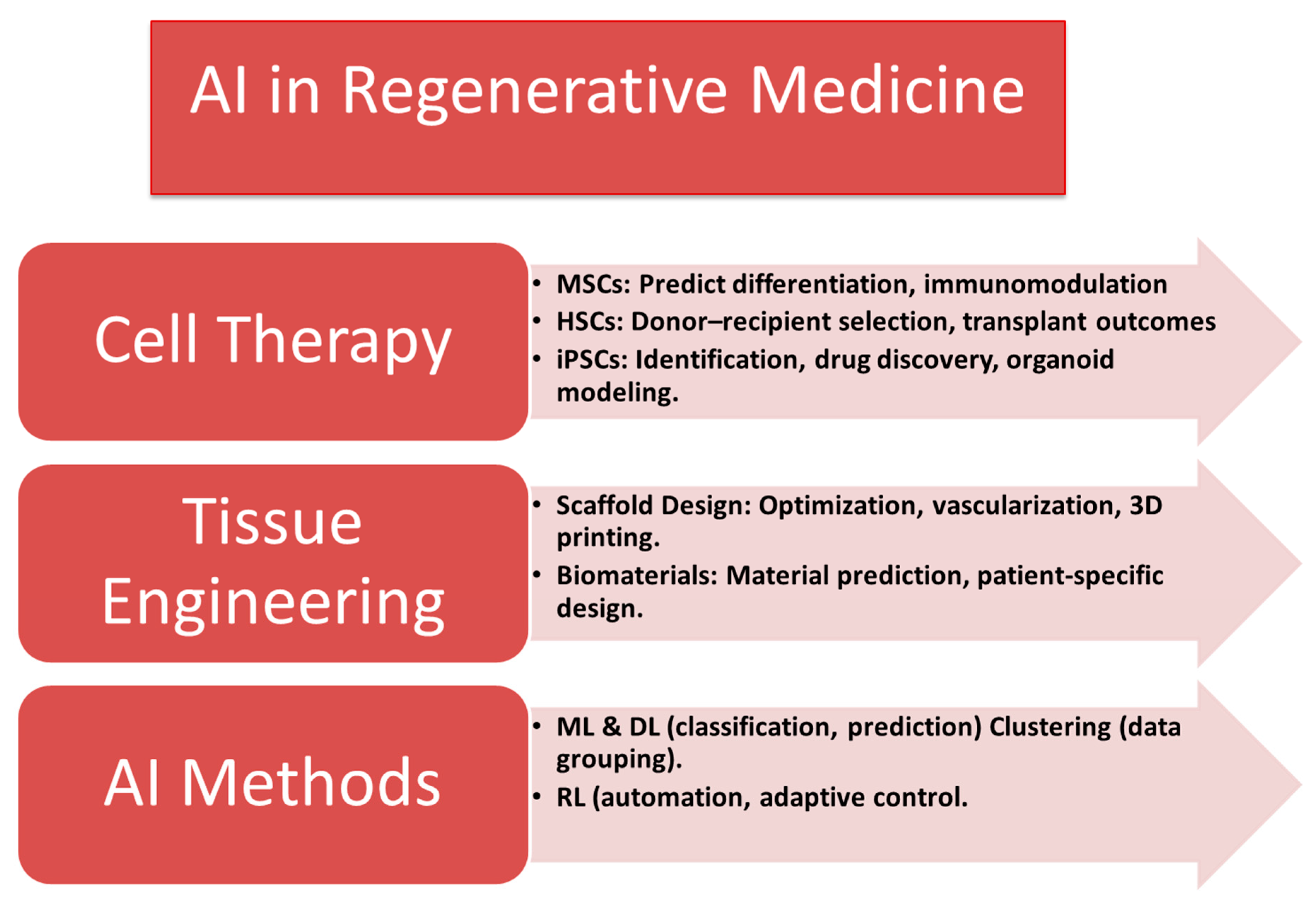

The Application of Artificial Intelligence (AI) in Regenerative Medicine: Current Insights and Challenges


Abstract
1. Literature Review
Main Algorithms in Machine Learning
2. Methodology
3. Application of AI in Regenerative Medicine
3.1. Application of AI in Cell Therapy
3.1.1. Mesenchymal Stem Cells (MSCs)
3.1.2. Hematopoietic Stem Cells (HSC)
3.1.3. Induced Pluripotent Stem Cells (iPSCs)
3.2. Tissue Engineering
3.2.1. Scaffold Design
3.2.2. Biomaterials
4. Challenges and Limitations
5. Conclusions
Author Contributions
Funding
Institutional Review Board Statement
Acknowledgments
Conflicts of Interest
References
- Hole, K.J.; Ahmad, S. Biologically driven artificial intelligence. Computer 2019, 52, 72–75. [Google Scholar] [CrossRef]
- Srinivasan, M.; Thangaraj, S.R.; Ramasubramanian, K.; Thangaraj, P.P.; Ramasubramanian, K.V. Exploring the current trends of artificial intelligence in stem cell therapy: A systematic review. Cureus 2021, 13, e20083. [Google Scholar] [CrossRef]
- Ahuja, A.S. The impact of artificial intelligence in medicine on the future role of the physician. PeerJ 2019, 7, e7702. [Google Scholar] [CrossRef]
- Kha, Q.H.; Le, V.H.; Hung, T.N.K.; Le, N.Q.K. Development and Validation of an Efficient MRI Radiomics Signature for Improving the Predictive Performance of 1p/19q Co-Deletion in Lower-Grade Gliomas. Cancers 2021, 13, 5398. [Google Scholar] [CrossRef]
- Holmes, J.; Sacchi, L.; Bellazzi, R. Artificial intelligence in medicine. Ann. R. Coll. Surg. Engl. 2004, 86, 334–338. [Google Scholar]
- Bays, H.E.; Fitch, A.; Cuda, S.; Gonsahn-Bollie, S.; Rickey, E.; Hablutzel, J.; Coy, R.; Censani, M. Artificial intelligence and obesity management: An obesity medicine association (OMA) clinical practice statement (CPS) 2023. Obes. Pillars 2023, 6, 100065. [Google Scholar] [CrossRef]
- Azuaje, F. Computational discrete models of tissue growth and regeneration. Brief. Bioinform. 2011, 12, 64–77. [Google Scholar] [CrossRef]
- Blasiak, A.; Khong, J.; Kee, T. CURATE. AI: Optimizing personalized medicine with artificial intelligence. SLAS Technol. Transl. Life Sci. Innov. 2020, 25, 95–105. [Google Scholar]
- Hesami, M.; Jones, A.M.P. Application of artificial intelligence models and optimization algorithms in plant cell and tissue culture. Appl. Microbiol. Biotechnol. 2020, 104, 9449–9485. [Google Scholar] [CrossRef] [PubMed]
- Kerner, J.; Dogan, A.; von Recum, H. Machine learning and big data provide crucial insight for future biomaterials discovery and research. Acta Biomater. 2021, 130, 54–65. [Google Scholar] [CrossRef] [PubMed]
- Bagherpour, R.; Bagherpour, G.; Mohammadi, P. Application of Artificial Intelligence in tissue engineering. Tissue Eng. Part B Rev. 2024, 31, 31–43. [Google Scholar] [CrossRef]
- Sarker, I.H. Machine learning: Algorithms, real-world applications and research directions. SN Comput. Sci. 2021, 2, 160. [Google Scholar] [CrossRef] [PubMed]
- Jiang, B.; Si, J.; Luo, H.; Le, L. Single-Cell Omics Reveal the Mechanisms of Traditional Chinese Medicines. Phytomedicine 2025, 147, 157204. [Google Scholar] [CrossRef] [PubMed]
- Rokach, L. A survey of clustering algorithms. In Data Mining and Knowledge Discovery Handbook; Springer: New York, NY, USA, 2010; pp. 269–298. [Google Scholar]
- Ketkar, N.; Santana, E. Deep Learning with Python; Springer: Berlin/Heidelberg, Germany, 2017. [Google Scholar]
- Sarker, I.H.; Kayes, A.S.M.; Badsha, S.; Alqahtani, H.; Watters, P.; Ng, A. Cybersecurity data science: An overview from machine learning perspective. J. Big Data 2020, 7, 41. [Google Scholar] [CrossRef]
- Yan, Y.; Chow, A.H.; Ho, C.P.; Kuo, Y.-H.; Wu, Q.; Ying, C. Reinforcement learning for logistics and supply chain management: Methodologies, state of the art, and future opportunities. Transp. Res. Part E Logist. Transp. Rev. 2022, 162, 102712. [Google Scholar] [CrossRef]
- Kotsiantis, S.B.; Zaharakis, I.; Pintelas, P. Supervised machine learning: A review of classification techniques. Emerg. Artif. Intell. Appl. Comput. Eng. 2007, 160, 3–24. [Google Scholar]
- Chagahi, M.H.; Dashtaki, S.M.; Moshiri, B.; Piran, J. Cardiovascular disease detection using a novel stack-based ensemble classifier with aggregation layer, DOWA operator, and feature transformation. Comput. Biol. Med. 2024, 173, 108345. [Google Scholar] [CrossRef] [PubMed]
- Sarabi, P.A.; Shabanpouremam, M.; Eghtedari, A.R.; Barat, M.; Moshiri, B.; Zarrabi, A.; Vosough, M. AI-Based solutions for current challenges in regenerative medicine. Eur. J. Pharmacol. 2024, 984, 177067. [Google Scholar] [CrossRef]
- Kim, G.; Jeon, J.H.; Park, K.; Kim, S.W.; Kim, D.H.; Lee, S. High throughput screening of mesenchymal stem cell lines using deep learning. Sci. Rep. 2022, 12, 17507. [Google Scholar] [CrossRef]
- Imboden, S.; Liu, X.; Lee, B.S.; Payne, M.C.; Hsieh, C.-J.; Lin, N.Y.C. Investigating heterogeneities of live mesenchymal stromal cells using AI-based label-free imaging. Sci. Rep. 2021, 11, 6728. [Google Scholar] [CrossRef]
- Xiang, J.; Shi, M.; Fiala, M.A.; Gao, F.; Rettig, M.P.; Uy, G.L.; Schroeder, M.A.; Weilbaecher, K.N.; Stockerl-Goldstein, K.E.; Mollah, S.; et al. Machine learning–based scoring models to predict hematopoietic stem cell mobilization in allogeneic donors. Blood Adv. 2022, 6, 1991–2000. [Google Scholar] [CrossRef] [PubMed]
- Riva, E. Study of the Immunological Landscape in Myelodysplastic Syndromes: A Multi-Omics Approach. Ph.D. Thesis, University of Milano-Bicocca, Milan, Italy, 2024. [Google Scholar]
- Fan, K.; Zhang, S.; Zhang, Y.; Lu, J.; Holcombe, M.; Zhang, X. A machine learning assisted, label-free, non-invasive approach for somatic reprogramming in induced pluripotent stem cell colony formation detection and prediction. Sci. Rep. 2017, 7, 13496. [Google Scholar] [CrossRef] [PubMed]
- Choudhery, M.S.; Arif, T.; Mahmood, R. Applications of artificial intelligence in stem cell therapy. World J. Stem Cells 2025, 17, 106086. [Google Scholar] [CrossRef] [PubMed]
- Pugliese, R.; Badini, S.; Frontoni, E.; Regondi, S. Generative Artificial Intelligence for Advancing Discovery and Design in Biomateriomics. Intell. Comput. 2025, 4, 0117. [Google Scholar] [CrossRef]
- Omigbodun, F.T.; Oladapo, B.I. AI-optimized lattice structures for biomechanics scaffold design. Biomimetics 2025, 10, 88. [Google Scholar] [CrossRef]
- Zhou, T.; Yuan, Z.; Weng, J.; Pei, D.; Du, X.; He, C.; Lai, P. Challenges and advances in clinical applications of mesenchymal stromal cells. J. Hematol. Oncol. 2021, 14, 24. [Google Scholar] [CrossRef] [PubMed]
- Weber, L.; Lee, B.S.; Imboden, S.; Hsieh, C.-J.; Lin, N.Y. Phenotyping senescent mesenchymal stromal cells using AI image translation. Curr. Res. Biotechnol. 2023, 5, 100120. [Google Scholar] [CrossRef] [PubMed]
- Muhsen, I.N.; Elhassan, T.; Hashmi, S.K. Artificial intelligence approaches in hematopoietic cell transplantation: A review of the current status and future directions. Turk. J. Hematol. 2018, 35, 152. [Google Scholar] [CrossRef] [PubMed]
- Matsumoto, R.; Yamamoto, T.; Takahashi, Y. Complex organ construction from human pluripotent stem cells for biological research and disease modeling with new emerging techniques. Int. J. Mol. Sci. 2021, 22, 10184. [Google Scholar] [CrossRef]
- Coronnello, C.; Francipane, M.G. Moving towards induced pluripotent stem cell-based therapies with artificial intelligence and machine learning. Stem Cell Rev. Rep. 2022, 18, 559–569. [Google Scholar] [CrossRef]
- Serghini, A.; Portelli, S.; Ascher, D.B. AI-Driven Enhancements in Drug Screening and Optimization. In Computational Drug Discovery and Design; Springer: Berlin/Heidelberg, Germany, 2023; pp. 269–294. [Google Scholar]
- Wang, X.; Liu, J.; Zhang, C.; Wang, S. SSGraphCPI: A novel model for predicting compound-protein interactions based on deep learning. Int. J. Mol. Sci. 2022, 23, 3780. [Google Scholar] [CrossRef]
- Lee, J.Y.; Kim, J.; Kim, Y.K.; Kim, J.; Nam, S. Deep Learning Predicts the Differentiation of Kidney Organoids Derived from Human-Induced Pluripotent Stem Cells: FR-PO354. J. Am. Soc. Nephrol. 2022, 33, 420. [Google Scholar] [CrossRef]
- Bermejillo Barrera, M.D.; Franco-Martínez, F.; Díaz Lantada, A. Artificial intelligence aided design of tissue engineering scaffolds employing virtual tomography and 3D convolutional neural networks. Materials 2021, 14, 5278. [Google Scholar] [CrossRef]
- Conev, A.; Litsa, E.E.; Perez, M.R.; Diba, M.; Mikos, A.G.; Kavraki, L.E. Machine learning-guided three-dimensional printing of tissue engineering scaffolds. Tissue Eng. Part A 2020, 26, 1359–1368. [Google Scholar] [CrossRef]
- Pugliese, R.; Regondi, S. Artificial intelligence-empowered 3D and 4D printing technologies toward smarter biomedical materials and approaches. Polymers 2022, 14, 2794. [Google Scholar] [CrossRef]
- Sujeeun, L.Y.; Goonoo, N.; Ramphul, H.; Chummun, I.; Gimié, F.; Baichoo, S.; Bhaw-Luximon, A. Correlating in vitro performance with physico-chemical characteristics of nanofibrous scaffolds for skin tissue engineering using supervised machine learning algorithms. R. Soc. Open Sci. 2020, 7, 201293. [Google Scholar] [CrossRef]
- Shin, J.; Lee, Y.; Li, Z.; Hu, J.; Park, S.S.; Kim, K. Optimized 3D bioprinting technology based on machine learning: A review of recent trends and advances. Micromachines 2022, 13, 363. [Google Scholar] [CrossRef] [PubMed]
- Suwardi, A.; Wang, F.; Xue, K.; Han, M.; Teo, P.; Wang, P.; Wang, S.; Liu, Y.; Ye, E.; Li, Z.; et al. Machine learning-driven biomaterials evolution. Adv. Mater. 2022, 34, 2102703. [Google Scholar] [CrossRef] [PubMed]
- Bai, L.; Xia, Z.; Triffitt, J.T.; Su, J. Generation artificial intelligence (GenAI) and biomaterials translational: Steering innovation without misdirection. Biomater. Transl. 2024, 5, 1. [Google Scholar]
- Kim, J.; McKee, J.A.; Fontenot, J.J.; Jung, J.P. Engineering tissue fabrication with machine intelligence: Generating a blueprint for regeneration. Front. Bioeng. Biotechnol. 2020, 7, 443. [Google Scholar] [CrossRef]
- Bai, L.; Su, J. Converging technologies in biomaterial translational research. Biomater. Transl. 2023, 4, 197. [Google Scholar]
- Kosuri, S.; Borca, C.H.; Mugnier, H.; Tamasi, M.; Patel, R.A.; Perez, I.; Kumar, S.; Finkel, Z.; Schloss, R.; Cai, L.; et al. Machine-assisted discovery of Chondroitinase ABC complexes toward sustained neural regeneration. Adv. Healthc. Mater. 2022, 11, 2102101. [Google Scholar] [CrossRef]
- Yu, K.; Gao, Q.; Mi, Y.; Yao, Y.; Lin, Z.; Zhu, M.; Zhang, P.; Sing, S.L.; Lu, L. Computational investigation of a 3D-printed osteochondral interface scaffold with comprehensive interfacial mechanical properties. Int. J. Bioprinting 2025, 11, 353–369. [Google Scholar] [CrossRef]
- Hakimi, O.; Gelpi, J.L.; Krallinger, M.; Curi, F.; Repchevsky, D.; Ginebra, M. The devices, experimental scaffolds, and biomaterials ontology (DEB): A tool for mapping, annotation, and analysis of biomaterials data. Adv. Funct. Mater. 2020, 30, 1909910. [Google Scholar] [CrossRef]
- Esmaeili, Y.; Bidram, E.; Bigham, A.; Atari, M.; Azadani, R.N.; Tavakoli, M.; Salehi, S.; Mirhaj, M.; Basiri, A.; Mirzavandi, Z.; et al. Exploring the evolution of tissue engineering strategies over the past decade: From cell-based strategies to gene-activated matrix. Alex. Eng. J. 2023, 81, 137–169. [Google Scholar] [CrossRef]
- Testi, M. Machine Learning Operations (MLOps) in Healthcare. Ph.D. Thesis, Università Campus Bio-Medico di Roma, Rome, Italy, 2024. [Google Scholar]
- US Food & Drug Administration (FDA). Proposed Regulatory Framework for Modifications to Artificial Intelligence. Machine Learning (AI/ML)-Based Software as a Medical Device (SaMD)—Discussion Paper and Request for Feedback; US Food & Drug Administration (FDA): Silver Spring, MA, USA, 2019. [Google Scholar]
- Silva, I.; Gabrielli, G.; Burgos, J.G.; Moulon, I.; Rojas, G.C.; Jaeger, U.; Giuliani, R. A decade of collaboration in medicines regulation: Healthcare professionals engaging with the European Medicines Agency. Front. Med. 2024, 11, 1399947. [Google Scholar] [CrossRef] [PubMed]
- Char, D.S.; Shah, N.H.; Magnus, D. Implementing machine learning in health care—Addressing ethical challenges. N. Engl. J. Med. 2018, 378, 981. [Google Scholar] [CrossRef] [PubMed]


| Algorithm Method | Applications in Regenerative Medicine | Strengths | Limitations | References |
|---|---|---|---|---|
| Logistic Regression (LR) | Predicts binary outcomes (e.g., patient stratification, stem cell differentiation potential); biomarker–outcome relationships | Simple, interpretable, and works well for linear relationships | Overfitting in high-dimensional omics data assumes linearity | [4,11,12,13] |
| Support Vector Machines (SVMs) | Predictive biomarkers, stem cell subtype classification, gene/proteomics analysis | Kernel functions enable nonlinear modeling, good for high-dimensional data | Reduced accuracy with overlapping classes; sensitive to noise | [11,12] |
| K-means Clustering | Reveals stem cell heterogeneity in single-cell RNA sequencing | Efficient, useful for grouping based on shared traits | Sensitive to outliers; limited biological interpretability | [11,14] |
| K-Nearest Neighbors (KNN) | Classifies tissue imaging data, predicts stem cell differentiation outcomes | Simple, noise-resistant, intuitive | Strongly data-dependent; performance drops with poor-quality data | [11] |
| Decision Trees/Random Forests/Gradient Boosting | Clinical outcome prediction (e.g., graft rejection); ranking genes/proteins for tissue repair | Decision trees = interpretable; Random Forest/Boosting = improved accuracy & feature selection | Can overfit; ensemble methods are less interpretable | [11,15] |
| Deep Learning (DL) | Automated histology, 3D scaffolds imaging, and complex biomedical data analysis | Scalable, powerful for image and omics data | Interpretability remains a challenge; it requires large datasets | [11,16] |
| Reinforcement Learning (RL) | Medicine dosage automation, bioreactor control, adaptive regenerative therapies | Optimizes decision-making from feedback; adaptable | Less suitable for simple tasks; requires complex environment modeling | [11,17] |
| Stem Cell Type | Biological Role | AI Contributions |
|---|---|---|
| Mesenchymal Stem Cells (MSCs) | Morphological characterization | DL models predict differentiation and immunomodulatory potential |
| Hematopoietic Stem Cells (HSCs) | ML aids donor-recipient matching | AI predicts transplantation outcomes |
| Induced Pluripotent Stem Cells (iPSCs) | CNNs identify iPSCs | DL improves reprogramming efficiency; AI used in drug discovery & organoid differentiation |
| Application | AI Method | Dataset Size | Performance Metric | Strengths/Limitations | Reference |
|---|---|---|---|---|---|
| MSC characterization | CNN vs. SVM | >10,000 cell images | CNN: 92% accuracy; SVM: ~80% | CNN: High accuracy, requires large data; SVM: Robust with small sets but less scalable | [20,21] |
| HSC donor matching | Multi-omics ML vs. HLA typing | Genomic + transcriptomic (n = 1200 donors) | AI model AUC = 0.87; HLA typing AUC = 0.72 | AI: Integrates multiple data layers; needs harmonized datasets | [22,23] |
| iPSC reprogramming | Random Forest vs. Logistic Regression | Transcriptomics (~2000 samples) | RF: 85–90% accuracy; LR: <75% | RF: Handles complex features; LR: Simpler but limited in nonlinear relationships | [24,25] |
| Scaffold design | GANs & Topology Optimization | In silico biomaterial datasets | Predicted designs validated with mechanical tests | AI: Generates novel architectures; requires experimental validation | [26,27] |
Disclaimer/Publisher’s Note: The statements, opinions and data contained in all publications are solely those of the individual author(s) and contributor(s) and not of MDPI and/or the editor(s). MDPI and/or the editor(s) disclaim responsibility for any injury to people or property resulting from any ideas, methods, instructions or products referred to in the content. |
© 2025 by the authors. Licensee MDPI, Basel, Switzerland. This article is an open access article distributed under the terms and conditions of the Creative Commons Attribution (CC BY) license (https://creativecommons.org/licenses/by/4.0/).
Share and Cite
Abuarqoub, D.; Mutahar, M. The Application of Artificial Intelligence (AI) in Regenerative Medicine: Current Insights and Challenges. BioMedInformatics 2025, 5, 69. https://doi.org/10.3390/biomedinformatics5040069
Abuarqoub D, Mutahar M. The Application of Artificial Intelligence (AI) in Regenerative Medicine: Current Insights and Challenges. BioMedInformatics. 2025; 5(4):69. https://doi.org/10.3390/biomedinformatics5040069
Chicago/Turabian StyleAbuarqoub, Duaa, and Mahdi Mutahar. 2025. "The Application of Artificial Intelligence (AI) in Regenerative Medicine: Current Insights and Challenges" BioMedInformatics 5, no. 4: 69. https://doi.org/10.3390/biomedinformatics5040069
APA StyleAbuarqoub, D., & Mutahar, M. (2025). The Application of Artificial Intelligence (AI) in Regenerative Medicine: Current Insights and Challenges. BioMedInformatics, 5(4), 69. https://doi.org/10.3390/biomedinformatics5040069