5.1. Comparison with Deep Learning Models
To evaluate the segmentation performance of AB-SAM against conventional deep-learning models, FCN [
39], U-Net [
22], and DeepLabV3+ [
40] were evaluated on the same fixed 112-image spatially disjoint Zixing test set. The quantitative results are reported in
Table 6. All metrics were computed only on the test set, which was not used for checkpoint selection.
As shown in
Table 6, AB-SAM achieved the highest value for every reported metric: 96.171% OA, 68.149% precision, 60.011% recall, 63.822% F1-score, 46.867% landslide-class IoU, and 71.452% mIoU. U-Net was the strongest conventional baseline in terms of F1-score, IoU, and mIoU. Relative to U-Net, AB-SAM improved F1-score by 6.271%, landslide-class IoU by 6.466%, and mIoU by 3.439%. AB-SAM also increased recall by 9.101% relative to U-Net while retaining the highest precision among the evaluated models. These results indicate that the proposed model provides a more balanced foreground-background discrimination on the spatially independent test data.
The deep learning-based dense segmentation models rely on limited annotated data from disaster areas to learn complex contexts, thereby restricting their blind-test generalization capabilities and edge segmentation precision. By comparison, AB-SAM effectively resolves the dilemma of mutually constrained precision and recall caused by deep downsampling in convolutional networks.
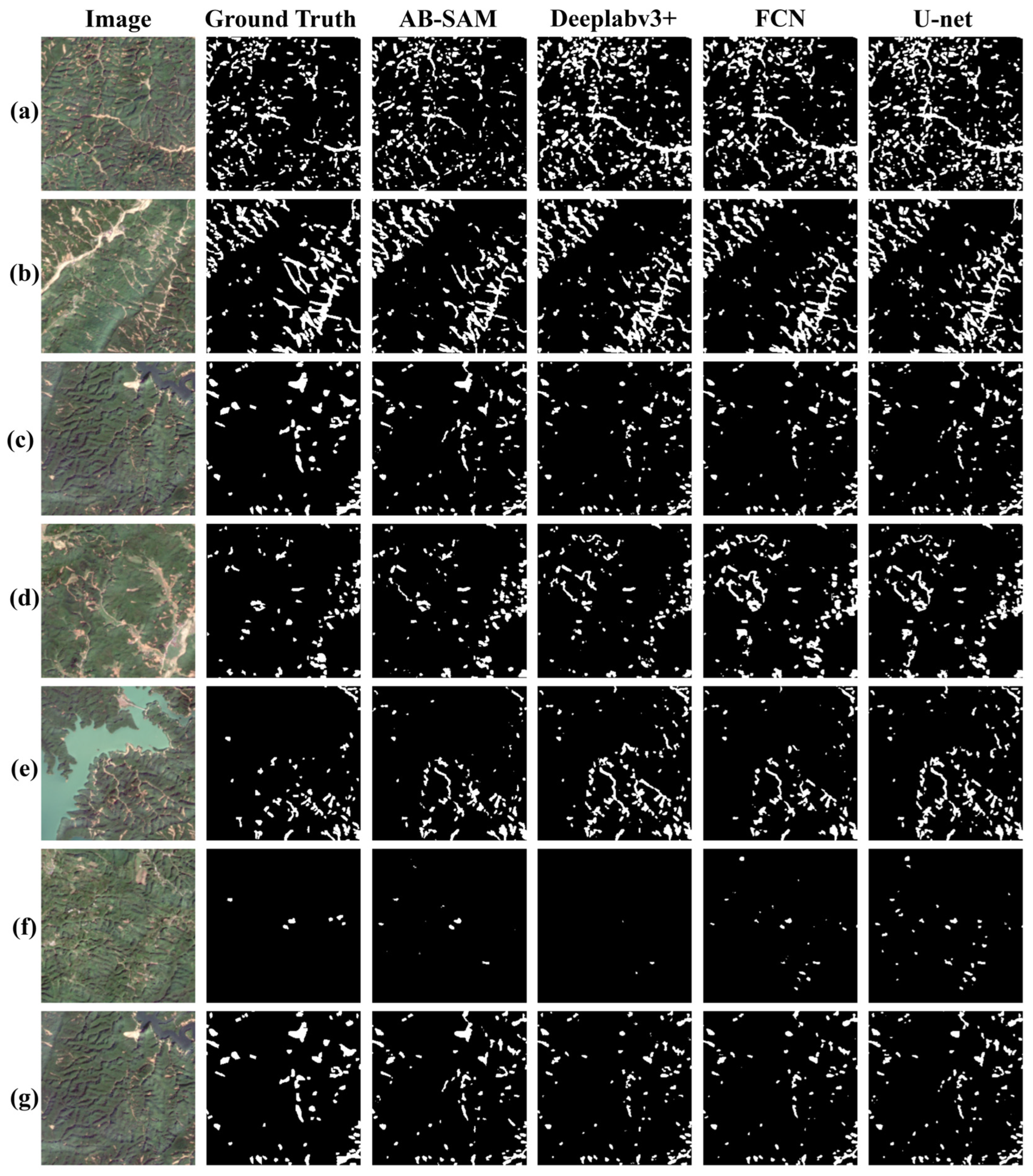
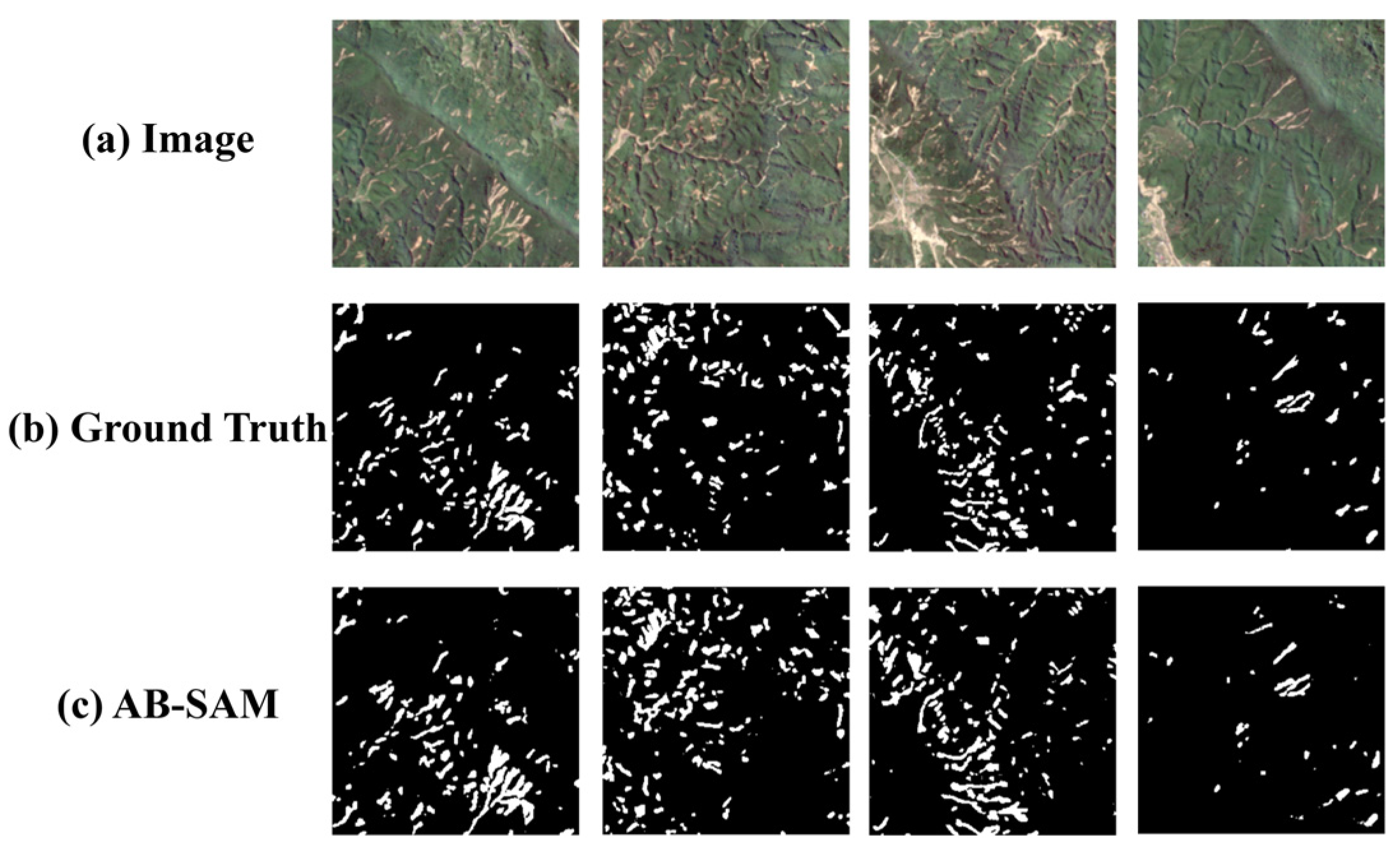
To intuitively evaluate the spatial segmentation performance of different models against complex geomorphological backgrounds, this study selects multiple typical scenarios of clustered landslides for visual comparison, as shown in
Figure 8.
As the comparison results reveal, the convolutional neural networks exhibit limitations when processing morphologically complex landslides. The prediction results of FCN and U-Net suffer from boundary over-smoothing and outward dilation (
Figure 8a,d). While DeepLabv3+ maintains better macroscopic spatial consistency, it still exhibits omission errors when delineating fragmented, minute landslide clusters (
Figure 8f). Furthermore, its morphological depiction of the irregular, sharp boundaries of landslides remain relatively coarse.
In contrast, the proposed AB-SAM demonstrates advantages in morphological restoration. Benefiting from the residual injection of high-frequency edge features by the BAMP module, AB-SAM not only precisely reconstructs the sliding trails of landslides but also filters out non-disaster regions within highly confusing, similar geomorphological backgrounds. This efficient capability to capture physical rupture boundaries provides visual evidence for the quantitative advantages it achieves in mIoU.
5.2. Comparison with Other LVMs
To compare AB-SAM with other large vision models (LVMs), vanilla SAM, PerSAM [
41], SegGPT [
42], and HQ-SAM [
43] were evaluated on the same fixed, spatially disjoint Zixing test set containing 112 image-mask pairs. The quantitative results are reported in
Table 7.
AB-SAM was evaluated by hint-free inference, without external point, box, or mask prompts. Vanilla SAM used a ViT-H image encoder and positive point prompts placed at the centroids of ground-truth 8-connected landslide components larger than 20 pixels. HQ-SAM used a ViT-L image encoder and the same ground-truth-derived oracle point protocol, producing 910 prompts over the 112 test images (8.125 prompts per image).
PerSAM was evaluated in its training-free one-shot setting with a ViT-L SAM backbone and one fixed reference image-mask pair (Prompt 3). SegGPT used three fixed reference image-mask pairs in semantic mode, as shown in
Figure 9; query images were resized to 448 × 448 pixels and converted to binary masks with a fixed foreground threshold of 128. Neither PerSAM nor SegGPT used test-label-derived prompts or test-set threshold optimization during inference.
As shown in
Table 7, AB-SAM achieved the highest OA (96.171%), F1-score (63.822%), landslide-class IoU (46.867%), and mIoU (71.452%). SegGPT obtained the highest precision (82.602%), whereas SAM and HQ-SAM produced the highest recall values (91.033% and 95.482%, respectively), consistent with the use of ground-truth-derived oracle point prompts. AB-SAM nevertheless provided a substantially more balanced precision-recall trade-off, with 68.149% precision and 60.011% recall.
Among the other models, HQ-SAM achieved the highest F1-score and landslide-class IoU, whereas SegGPT achieved the highest mIoU. Relative to SegGPT, AB-SAM improved the F1-score, landslide-class IoU, and mIoU by 47.557, 38.015, and 19.653%, respectively, while increasing OA by 1.398%. These results indicate that AB-SAM delivers a strong overall balance of pixel-level accuracy and landslide-region delineation under the fixed test protocol, while retaining a hint-free inference pathway.
5.4. Ablation Study
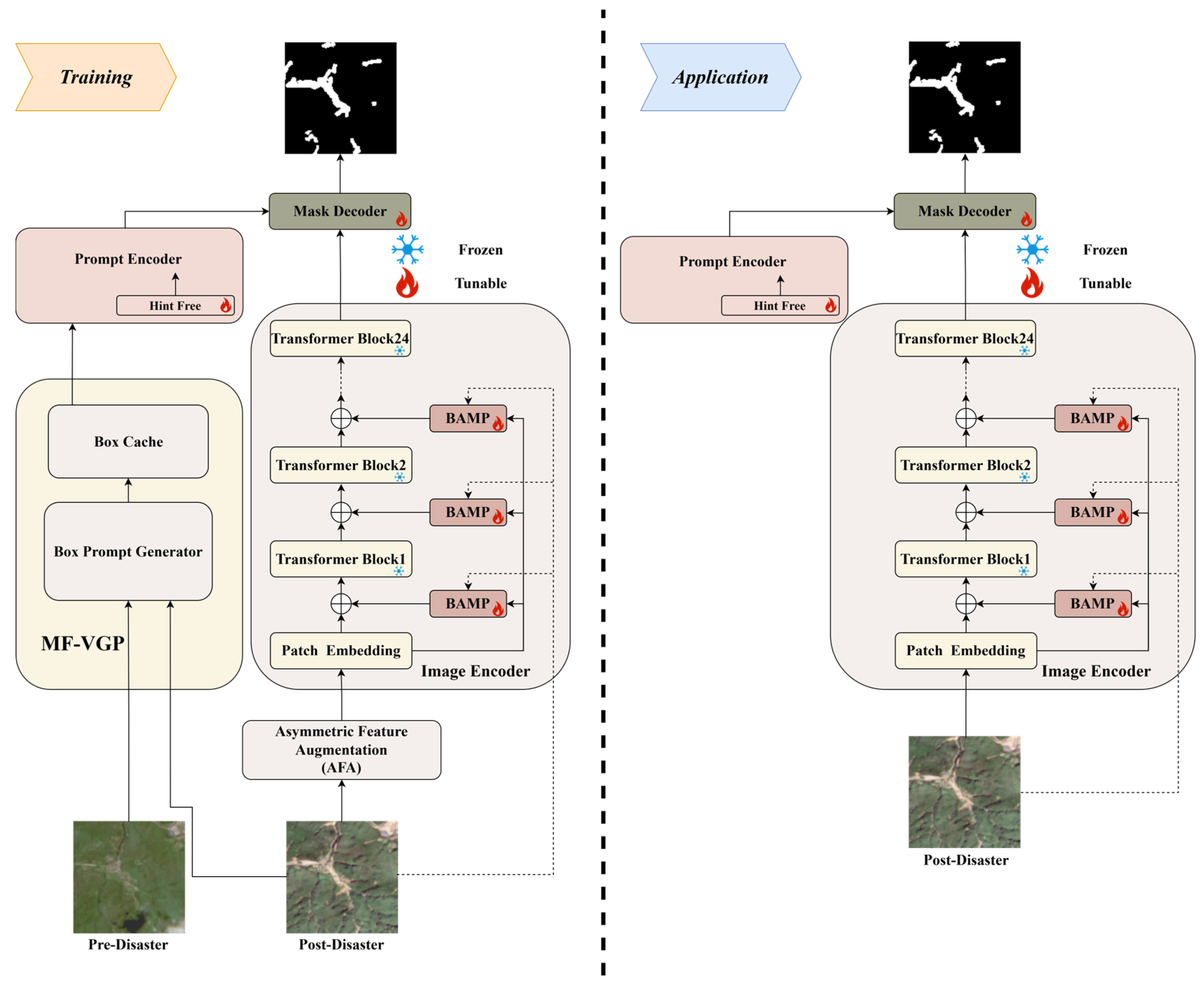
To isolate the contributions of the three task-specific components, we compared four configurations on the same fixed, spatially disjoint 112-image Zixing test set: BAMP, BAMP + MF-VGP, BAMP + AFA, and the complete AB-SAM. BAMP is the SAM image-encoder adaptation with boundary-aware morphological feature injection and serves as the baseline. MF-VGP supplies offline training-time box supervision, whereas AFA introduces asymmetric augmentation and dual-branch training strategy. All configurations followed the same training schedule and validation-based checkpoint selection; the test set was used only for the final evaluation.
The test-set results are reported in
Table 9. The BAMP baseline achieved 96.099% OA, 67.131% precision, 60.100% recall, 63.421% F1-score, 46.436% landslide-class IoU, and 71.199% mIoU. Adding MF-VGP increased recall to 68.626%, but reduced precision to 56.575% and mIoU to 70.015%. This trade-off indicates that training-time box supervision can increase foreground coverage while also introducing false positives when the generated boxes contain ambiguous change regions.
Adding AFA alone produced 96.070% OA, 67.135% precision, 59.086% recall, 62.854% F1-score, 45.830% IoU, and 70.883% mIoU, which was below the BAMP baseline in mIoU and IoU. In contrast, combining MF-VGP and AFA in the complete AB-SAM restored the balance between precision and recall: precision rose to 68.149%, while recall remained 60.011%. AB-SAM achieved the highest OA (96.171%), F1-score (63.822%), landslide-class IoU (46.867%), and mIoU (71.452%). Relative to BAMP, the complete model improved F1-score, IoU, and mIoU by 0.401, 0.431, and 0.253%, respectively.
Overall, the ablation results show that neither training-time box supervision nor asymmetric augmentation alone is sufficient to improve every metric. Their combination with the BAMP-enhanced encoder yields the strongest balanced test performance, particularly for precision, F1-score, landslide IoU, and mIoU. The result supports the role of MF-VGP and AFA as complementary training mechanisms.
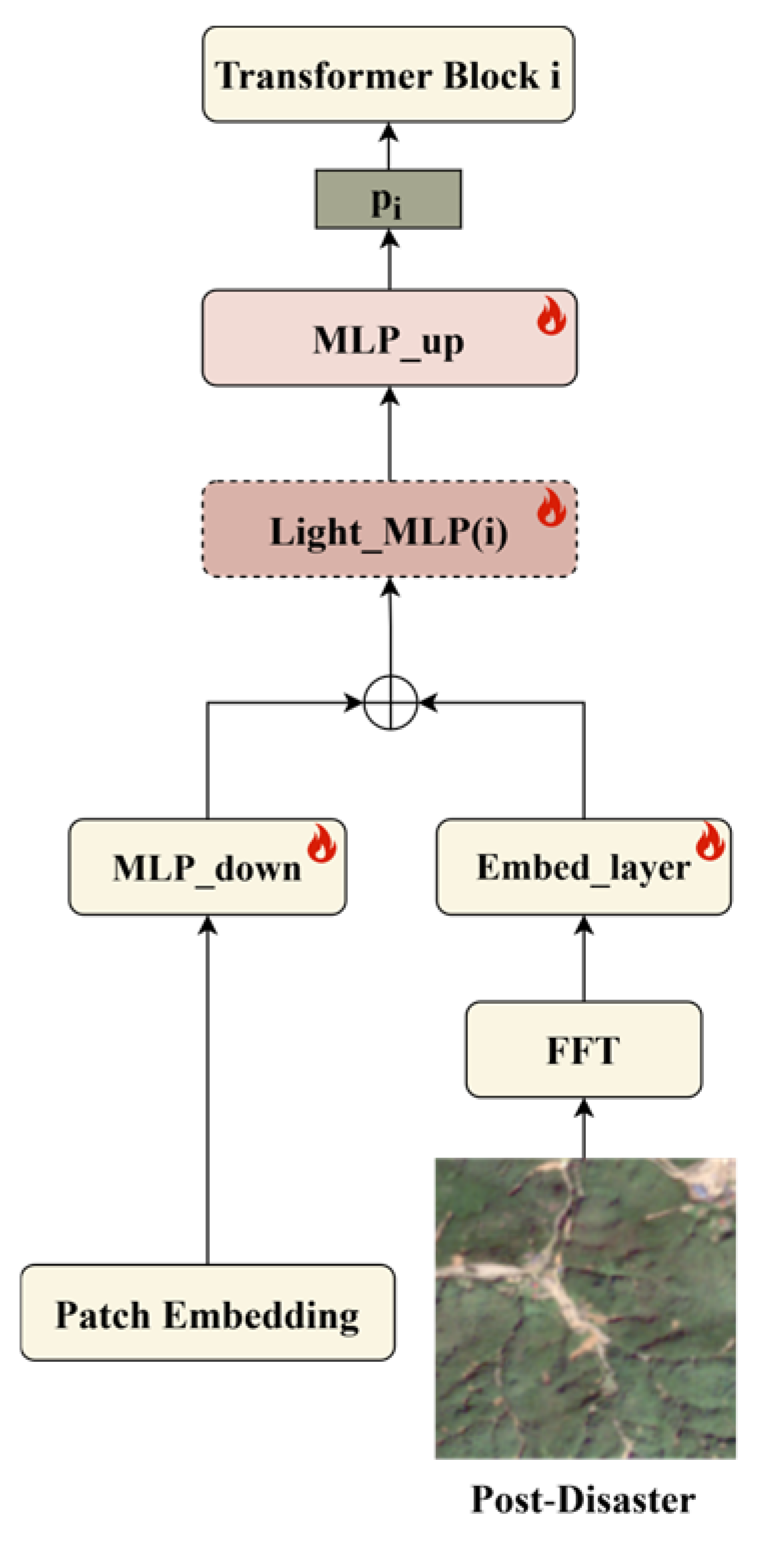
To assess whether the FFT-based boundary pathway contributes beyond the general embedding-derived prompt mechanism, we compared three boundary-operator settings: the proposed FFT-based BAMP, a learned 3 × 3 depthwise-convolution boundary operator, and a No FFT branch control that removes the handcrafted FFT pathway. All variants used the same spatially disjoint subsets, data augmentation, optimization settings, and 80-epoch training schedule. For each variant, the checkpoint with the highest validation mIoU was selected and evaluated once on the fixed 112-image Zixing test set using Hint-free inference.
The test-set comparison is reported in
Table 10. FFT-based BAMP obtained the highest OA (96.171%), precision (68.149%), F1-score (63.822%), landslide-class IoU (46.867%), and mIoU (71.452%) among the three settings. Relative to the learned-convolution alternative, it improved F1-score, IoU, and mIoU by 1.830, 1.948, and 1.291%, respectively. Relative to the No FFT branch, the corresponding gains were 0.127, 0.137, and 0.164%.
The recall of FFT-based BAMP (60.011%) was lower than that of the learned-convolution alternative (64.214%) and the No FFT branch (62.473%), revealing a precision-recall trade-off. These results support the contribution of the FFT pathway to the best overall test-set balance, while the modest gain over the No FFT branch indicates that FFT is a complementary design choice rather than the only viable boundary operator.
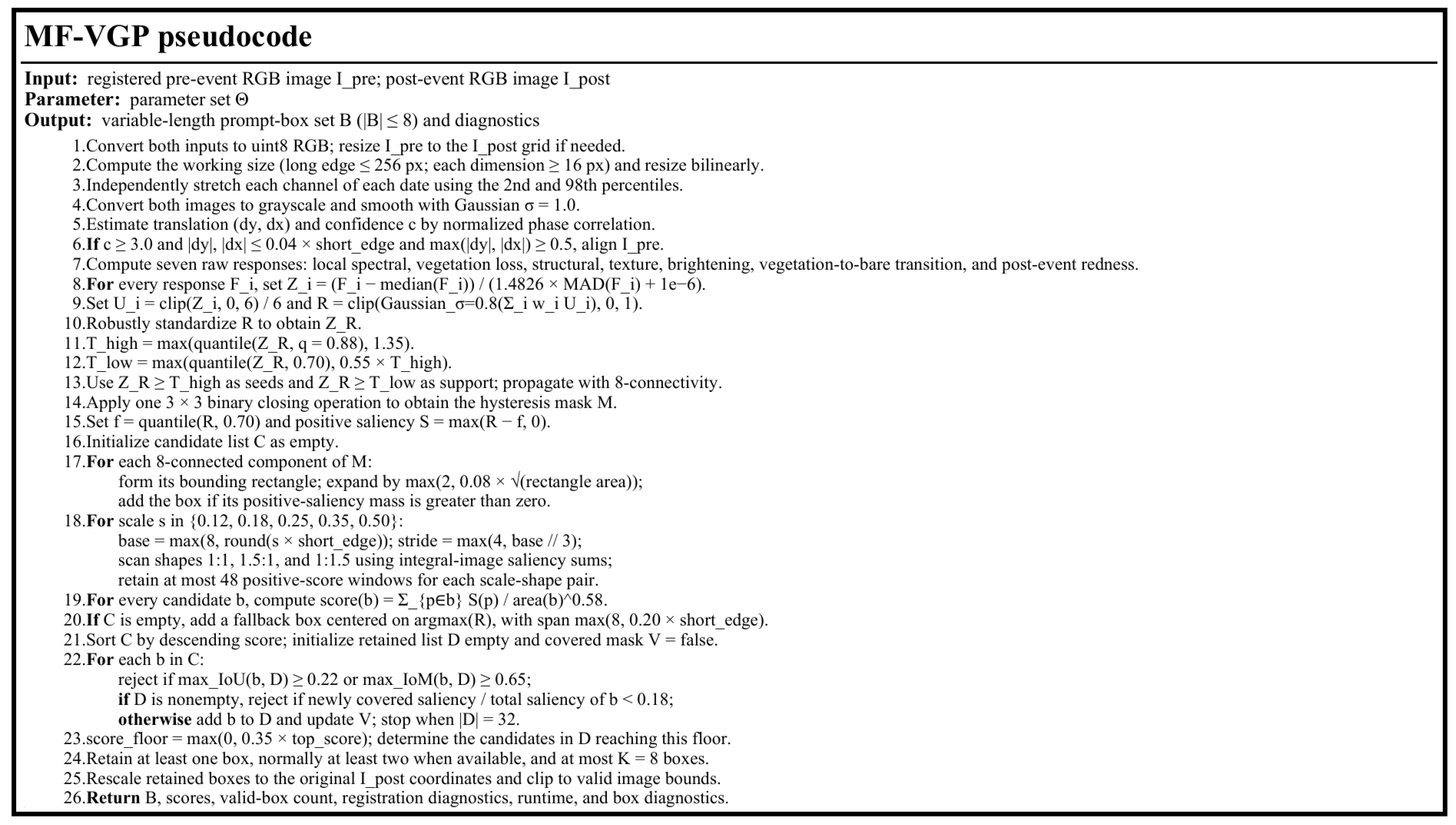
To directly assess the quality of the training-time boxes generated by MF-VGP, we measured the average number of retained boxes per image, ground-truth (GT) pixel coverage, Recall @ 50% coverage, image-level box-hit rate, false-prompt rate, and local CPU runtime on the training, validation, and test subsets. GT pixel coverage denotes the fraction of visible landslide pixels covered by the retained boxes. Recall @ 50% counts landslide instances for which at least 50% of their visible GT pixels are covered by one or more retained boxes. The box-hit rate is the fraction of images with at least one retained box overlapping a GT landslide, and the false-prompt rate is its complement. The prompt-generation results across the three fixed spatial subsets are reported in
Table 11.
We conducted a one-factor-at-a-time sensitivity analysis on the 121-image validation subset; the untouched test subset was not used for parameter selection. The baseline was q = 0.88, r = 0.55, alpha = 0.58, tau = 0.22, and K = 8. For each feature-weight variant, one of the seven baseline weights was multiplied by 0.8 or 1.2 and all weights were renormalized to sum to one.
Table 12 reports configuration-level changes relative to the baseline; coverage, recall, and hit-rate changes are expressed in %.
The results show low sensitivity to individual feature-weight perturbations and to the tested ranges of q, r, and tau. The area exponent alpha and the maximum number of boxes K had the strongest effects. Although alpha = 0.45 increased coverage and instance recall, its weaker area penalty favored broader boxes and reduced spatial specificity. Reducing K also caused large losses in coverage and recall. These findings support the stability of the default settings while identifying alpha and K as the parameters that require the most careful control.
We also separately evaluated instances touching the tile boundary to test whether prompt generation remains effective near crop edges. A boundary-touching instance was defined as an 8-connected landslide-mask component with at least one pixel on the outermost row or column of a 128 × 128 tile.
Table 13 reports GT pixel coverage and Recall @ 50% for boundary-touching and non-boundary-touching components in each subset.
MF-VGP retained high GT-pixel coverage for boundary-touching instances: 87.645%, 78.228%, and 86.812% on the training, validation, and test subsets, respectively. However, their Recall @ 50% was 8.555, 11.410, and 3.651% lower than that of non-boundary-touching instances. Thus, object truncation and reduced context at tile boundaries can still make complete instance coverage more difficult. When a landslide crosses a tile boundary, MF-VGP processes only the visible portion in the current tile, and all candidate boxes are clipped to the valid tile extent.
To evaluate the sensitivity of MF-VGP to image-quality variation, we conducted a controlled one-factor-at-a-time experiment on the spatially independent 121-image validation subset. The registered pre-event image was kept unchanged, while only the post-event image was perturbed. The tested conditions included brightness and contrast changes of +/−5%, Gaussian blur with a radius of 0.6 pixels, Gaussian noise with a standard deviation of 3/255 using random seed 2026, JPEG compression at quality 90, downsampling to 94% followed by restoration to the original size, and a one-pixel horizontal and vertical shift. All MF-VGP parameters, including the maximum of eight boxes, were fixed. Ground-truth masks were not used for prompt generation and were accessed only for post hoc evaluation. The prompt-quality results under these image perturbations are reported in
Table 14.
Across all perturbations, the maximum absolute changes relative to the baseline were 2.721% in GT pixel coverage, 3.618% in instance Recall @ 50%, and 0.091 boxes per image. Brightness and contrast changes produced only minor variations. Gaussian blur reduced coverage and recall by 1.433 and 0.724%, respectively. Under the one-pixel shift, the corresponding changes were only −0.022 and −0.482%, indicating that the bounded registration compensation retained most prompt coverage. Some smoothing-like perturbations increased coverage while reducing the box-hit rate, which reflects altered proposal selectivity rather than improved downstream segmentation. Overall, MF-VGP was stable under the evaluated mild quality variations.
To test whether the empirical MF-VGP feature weights were necessary, we directly compared the current normalized weights w_current = (0.05, 0.06, 0.09, 0.25, 0.17, 0.20, 0.18) with an equal-weight setting in which all seven response maps received a weight of 1/7. Both configurations were evaluated on the same 121-image validation subset, and every other MF-VGP parameter was held fixed. ROI purity is defined as the proportion of the union of generated box regions occupied by GT landslide pixels, whereas area redundancy is the summed area of all boxes divided by their union area. The direct comparison results are reported in
Table 15.
Equal weighting increased GT pixel coverage by 1.8% and instance Recall @ 50% by 2.267%. However, it reduced the box-hit rate by 1.010% and ROI purity by 0.477%, while slightly increasing area redundancy from 1.324 to 1.337. Thus, equal weighting was not uniformly superior: it favored coverage and recall, whereas the current weights retained slightly better prompt selectivity and lower redundancy. We therefore retained the current weights as a practical balance on the present data, without claiming that they are globally optimal across sensors, regions, or datasets.
To compare computational cost and inference speed, all models were evaluated on the fixed 112-image Zixing test set using a single NVIDIA A800 80 GB PCIe GPU with PyTorch 1.12.1 + cu116. Mean latency was calculated from synchronized wall-clock measurements over all test images. Disk I/O and metric calculation were excluded, whereas each model’s required image transformation, host-to-device transfer, and native inference path were included. Peak GPU memory was measured after model loading and includes the deployed model and inference activations. The computational cost and inference-speed results are reported in
Table 16.
AB-SAM updates 4.181 million task-specific parameters, corresponding to 1.338% of its 312.459 million deployed parameters, and processes one image in 263.85 ms (3.79 FPS) with a peak GPU memory allocation of 5151.97 MB. It is 1.68 times faster than SAM and 1.83 times faster than SegGPT. Its latency is comparable to PerSAM and HQ-SAM, with a difference in less than 2.5%. The conventional CNN baselines are substantially faster, requiring 22.96–42.70 ms per image (23.42–43.55 FPS), but their task-specific trainable parameter counts range from 3.51 to 31.04 million.
These results show that AB-SAM is not the fastest or most memory-efficient model in absolute deployment terms. Its main computational advantage is parameter-efficient adaptation: only a small fraction of the deployed parameters is updated, while inference does not require user-provided prompts or reference-image preparation. The zero task-specific trainable-parameter entries for SAM, SegGPT, PerSAM, and HQ-SAM indicate that they were evaluated without Zixing-specific fine-tuning, not that their deployed models contain no parameters.
5.5. Limitations, Failure Cases, and Future Directions
5.5.1. Error Sources in Spectrally Complex Terrain
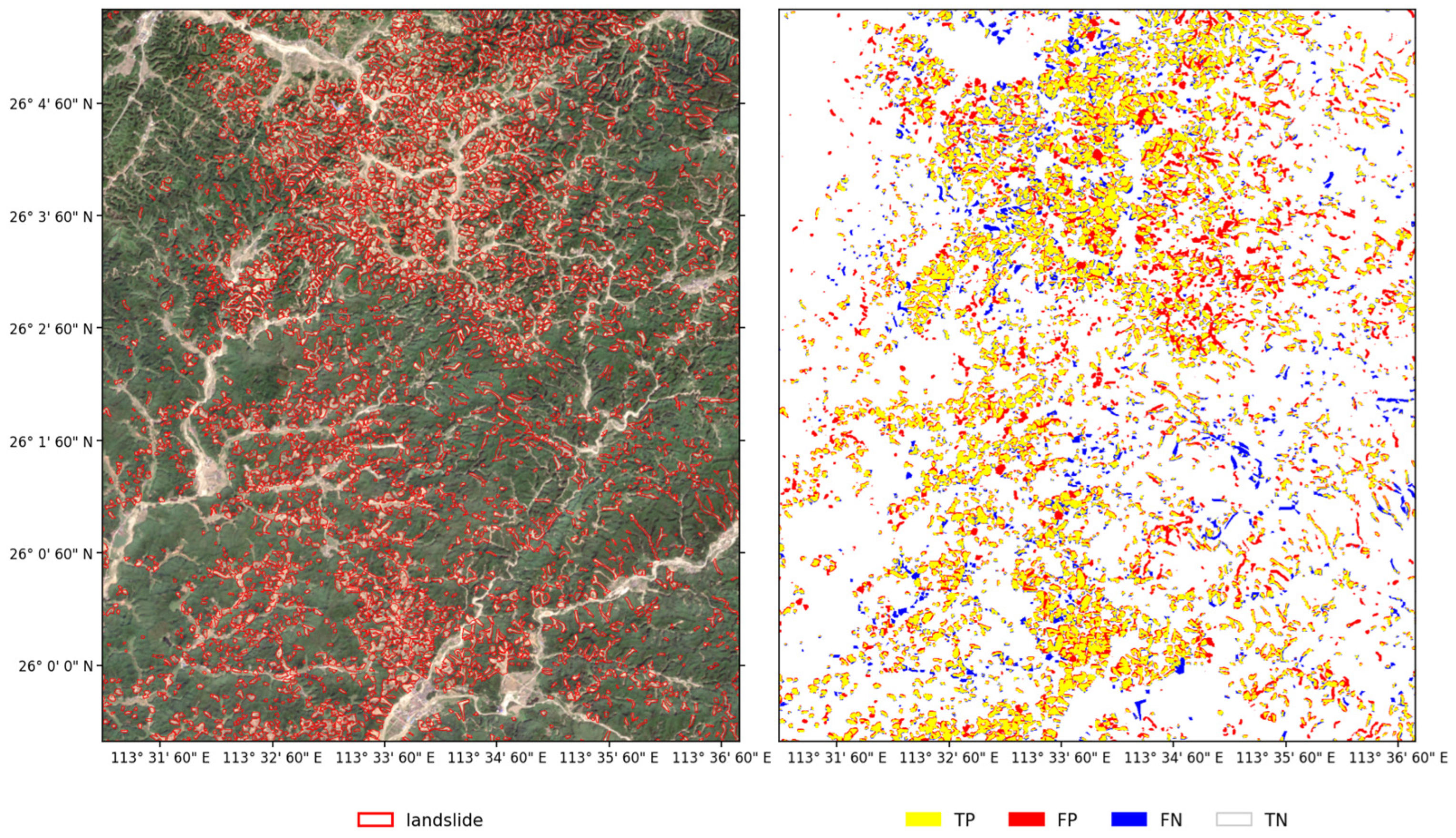
Pixel-level aggregate metrics do not fully explain the errors of AB-SAM in spectrally complex terrain. False positives are most likely where non-landslide surfaces resemble freshly exposed landslide material in color or texture, including bare soil, road cuts, riverbanks, construction surfaces, and sparsely vegetated slopes. Shadows, local illumination differences, and heterogeneous vegetation can further weaken contextual discrimination. False negatives are more likely for very small, narrow, low-contrast, partially vegetated, or shadowed landslides, as well as for targets truncated by tile boundaries. These errors reflect intrinsic ambiguities in post-event optical appearance.
The current training design mitigates these errors in several ways. Although every retained tile contains at least one landslide, most pixels in many tiles are non-landslide background and provide abundant within-tile negative supervision, including spectrally similar terrain. The primary Hint-free output is optimized using equally weighted binary cross-entropy and Dice losses: binary cross-entropy promotes pixel-wise foreground-background discrimination, whereas Dice loss reduces the effect of class imbalance and helps preserve small foreground regions. The MF-VGP box-guided branch is used only as an auxiliary training objective to emphasize bi-temporal change-related regions; validation and inference remain Hint-free. Nevertheless, these mechanisms cannot completely distinguish geomorphologically different surfaces with similar optical signatures.
Tile size may affect both false positives and false negatives, but the relationship is not monotonic. The present 128 x 128-pixel tiles represent a compromise between local detail and neighborhood context. Smaller tiles may show roads, bare soil, or riverbanks without sufficient surrounding context and also create more crop boundaries, increasing false positives and target truncation. Larger source tiles provide more context, but after resizing to the fixed network input, small landslides occupy a smaller proportion of the representation and foreground-background imbalance becomes stronger. The MF-VGP boundary analysis provides only indirect evidence: boundary-touching instances showed 3.651–11.410% lower Recall @ 50% than non-boundary-touching instances, despite relatively high pixel coverage.
Potential mitigation strategies include explicitly adding hard negative samples from roads, exposed bedrock, riverbanks, cultivated land, and other spectrally similar surfaces; incorporating topographic information such as slope or DEM-derived features, additional spectral bands, or longer multi-temporal observations; and using overlapping inference to reduce boundary truncation. Size-based post-processing should be applied cautiously because aggressive removal of small components may reduce false positives at the cost of missing the small landslides central to this study.
5.5.2. Learning Extensions
Semi-supervised and active learning are technically compatible with AB-SAM and represent important future directions. A semi-supervised extension could combine a teacher-student framework, confidence-filtered pseudo-masks, and consistency regularization to exploit unlabeled post-event images. When registered pre- and post-event pairs are available, label-free MF-VGP boxes could remain auxiliary training prompts without changing the Hint-free inference pathway. Active learning could prioritize tiles with high predictive uncertainty, model disagreement, ambiguous boundaries, or diverse geographic characteristics for expert annotation. These extensions may reduce pixel-level labeling effort.
5.5.3. Representative Failure Cases
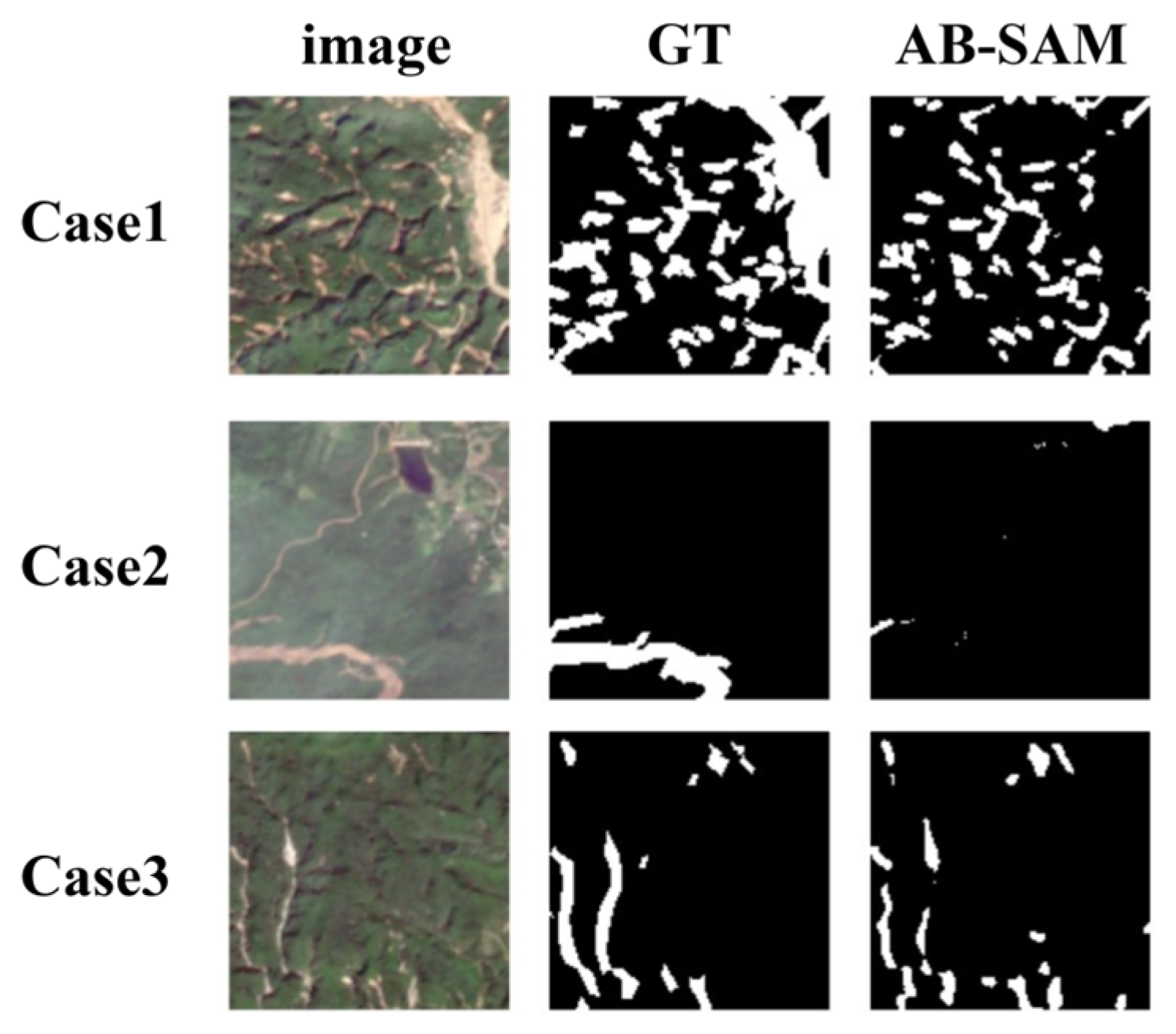
Figure 10 presents three representative failure cases in the order of post-event image, ground-truth mask, and AB-SAM prediction. These examples are qualitative diagnostics rather than a statistical evaluation and mainly illustrate omission of comparatively large landslide regions and discontinuous recovery of narrow, elongated landslides.
For comparatively large landslides or those with a broad spatial extent, the model may recover only part of the affected area and, in severe cases, miss a large portion. This behavior is consistent with the insufficient representation of large landslides in the current data: under the adopted area classification, the spatially independent training subset contains no large landslide instances, whereas the test subset contains only four. Consequently, the model lacks sufficient supervised examples for learning their complete morphology and internal heterogeneity.
Predictions for narrow and elongated landslides may also become fragmented, with interruptions in thin regions that remain continuous in the ground truth. When a target is narrow or surrounded by heterogeneous vegetation and shadows, local appearance and boundary cues may be insufficient to maintain long-range morphological connectivity. Improving these cases will require more than further adjustment of bounding-box prompt parameters.
Future work should expand the training data with a more balanced size distribution and include more large and elongated landslide samples. Multi-scale contextual modeling, overlapping spatial inference, and continuity- or topology-aware losses may improve broad and narrow structures. Additional topographic features, longer multi-temporal observations, and the semi-supervised or active-learning strategies discussed above may further improve difficult cases while reducing annotation cost.




 ,
,