Communication

Bridging Spectral Statistics and Machine Learning for Semantic Road Network Analysis

by
Abigail Kelly
1,†,
Ramchandra Rimal
2,*,† and
Arpan Man Sainju
3
1
Computational and Data Science PhD Program, Middle Tennessee State University, Murfreesboro, TN 37128, USA
2
Department of Mathematical Sciences, Middle Tennessee State University, Murfreesboro, TN 37128, USA
3
Department of Computer Science, Middle Tennessee State University, Murfreesboro, TN 37128, USA
*
Author to whom correspondence should be addressed.
These authors contributed equally to this work.
Geomatics 2026, 6(2), 35; https://doi.org/10.3390/geomatics6020035

Submission received: 27 January 2026 / Revised: 25 March 2026 / Accepted: 29 March 2026 / Published: 1 April 2026

Abstract

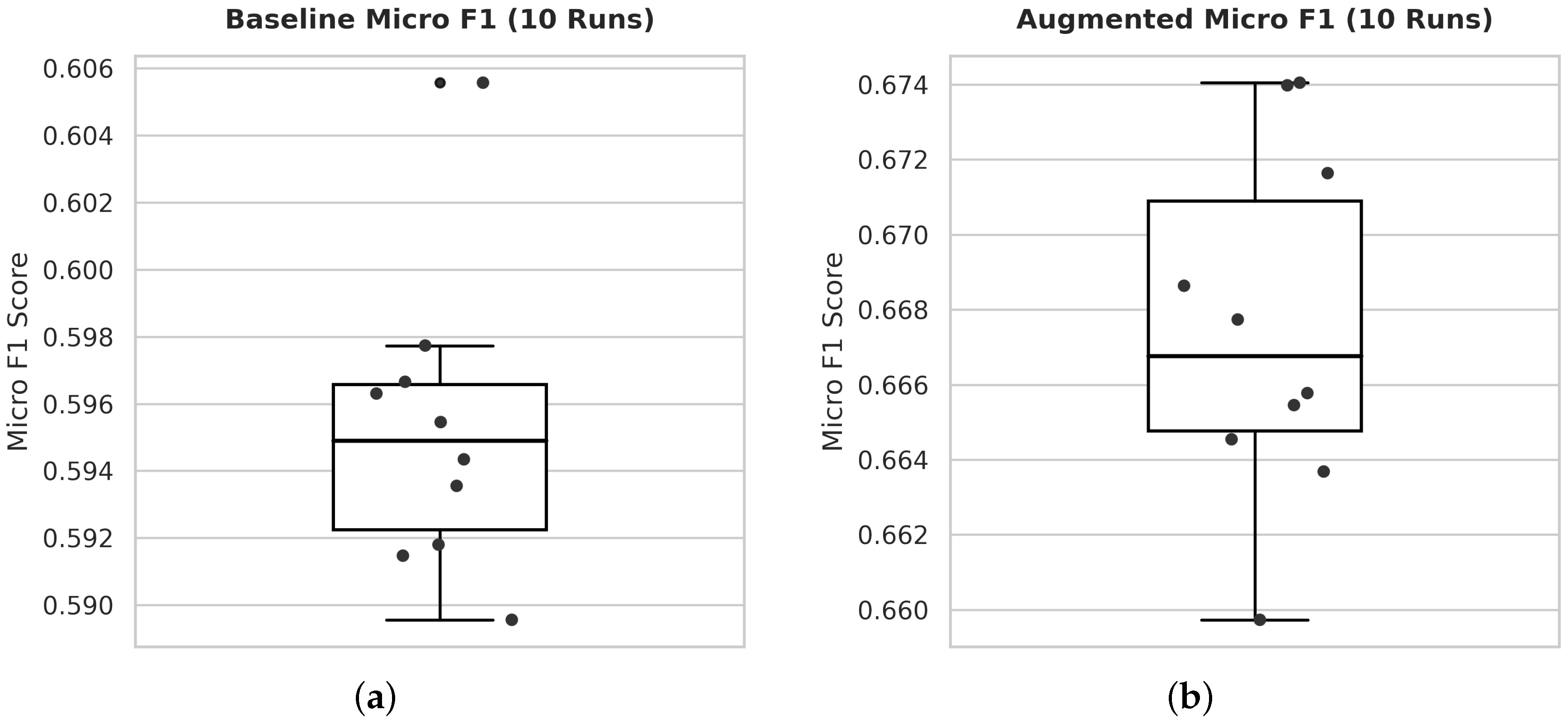
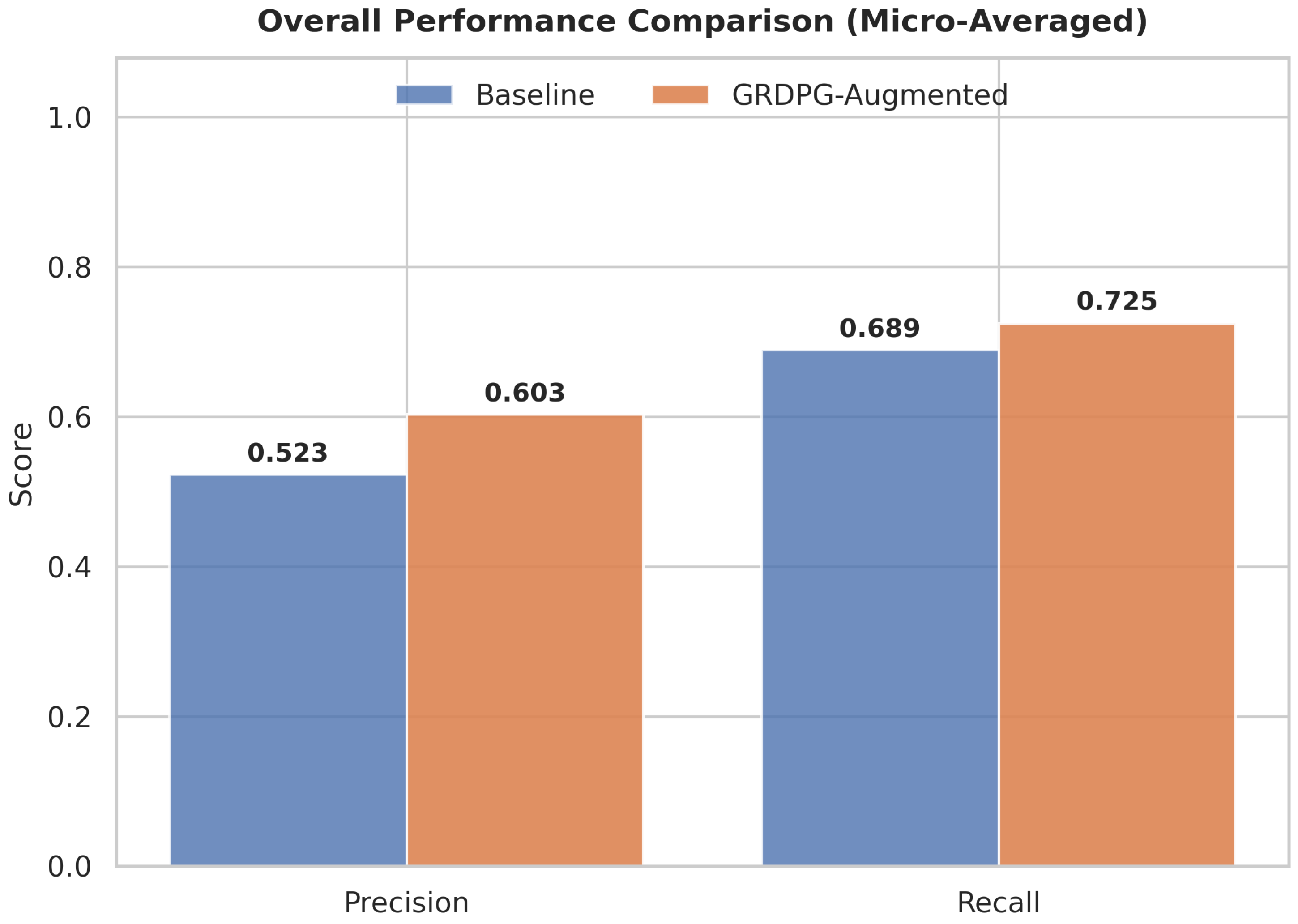
Accurate identification of road network intersections is essential for urban planning, autonomous navigation, and traffic safety analysis. However, standard approaches relying on local geometric attributes often overlook essential topological information. This limitation is particularly problematic for intersection types that are locally similar but topologically distinct. To address this, we propose a hybrid framework that augments intrinsic node attributes with Generalized Random Dot Product Graph embeddings and neighbor-aggregated features. We utilize tree-based ensemble classifiers, specifically Random Forest and Extreme Gradient Boosting, to process this enriched feature set. Unlike standard spectral methods that assume homophily, this approach explicitly models heterophilous connectivity to capture structural patterns where dissimilar nodes connect. Experiments on a real-world urban road network demonstrate that this topological augmentation yields consistent and robust improvements. The proposed integration with the Extreme Gradient Boosting model achieves a Macro ROC AUC of 0.8966 and a Micro F1 score of 0.7005, outperforming the baseline model (ROC AUC 0.8100, Micro F1 0.5919). Performance gains are most pronounced for topologically ambiguous intersection classes, confirming that local attributes alone fail to capture structural distinctions. These results demonstrate that latent structural context is a critical discriminator for granular road intersection classification.
Keywords: urban intersection classification; generalized random dot product graphs; topological embedding; network heterophily; multi-label learning urban intersection classification; generalized random dot product graphs; topological embedding; network heterophily; multi-label learning
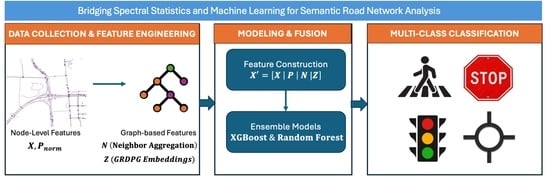
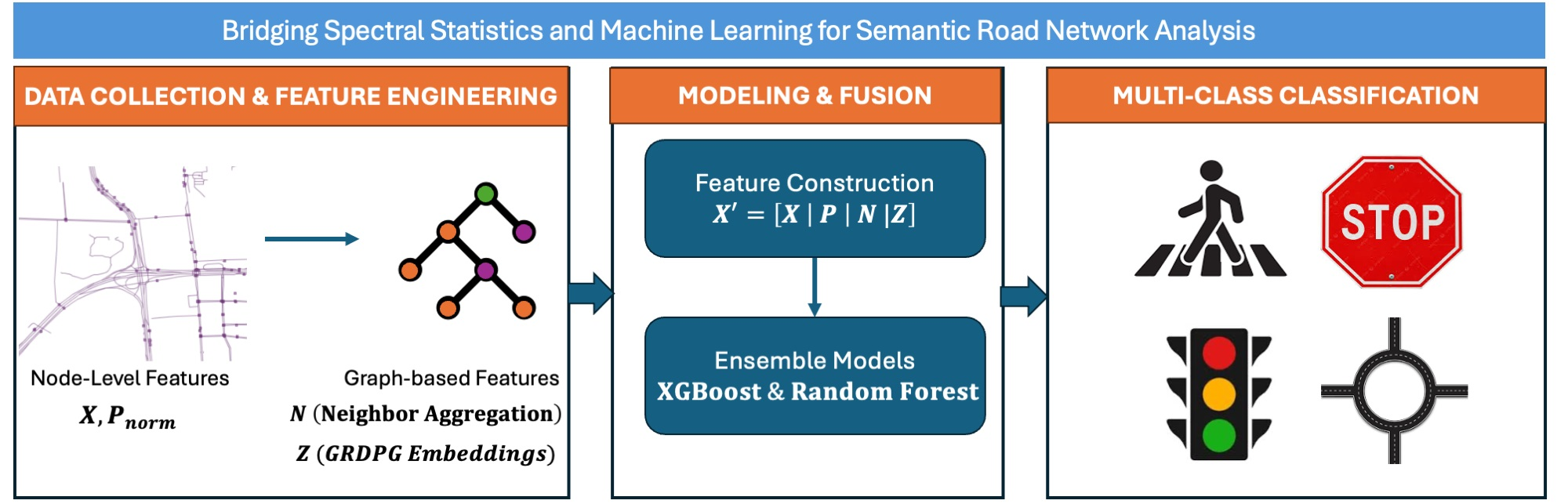
Graphical Abstract