Article

An Open-Access Remote Sensing and AHP–GIS Framework for Flood Susceptibility Assessment of Cultural Heritage


by
Kyriakos Michaelides
* and
Athos Agapiou
Department of Civil Engineering and Geomatics, Faculty of Engineering and Technology, Cyprus University of Technology, Saripolou 2-8, 3036 Limassol, Cyprus
*
Author to whom correspondence should be addressed.
Geomatics 2026, 6(2), 23; https://doi.org/10.3390/geomatics6020023
Submission received: 17 November 2025 / Revised: 27 December 2025 / Accepted: 9 January 2026 / Published: 28 February 2026

Abstract

Floods represent one of the most frequent and damaging natural hazards in Mediterranean mountain regions, where intense rainfall and complex topography amplify runoff and inundation risk. This study aims to delineate flood-susceptible zones in the Monti Lucretili area of central Italy, an environmentally sensitive and culturally significant landscape that hosts archeological remains and UNESCO listed dry-stone heritage using an integrated Analytical Hierarchy Process (AHP) and Geographic Information System (GIS) approach. Fifteen (15) conditioning factors, including elevation, slope, rainfall, soil, lithology, land use/land cover, drainage density, and proximity to rivers and roads, were derived from open-access satellite remote sensing and spatial datasets. The AHP model produced a flood susceptibility index ranging from 1.806 to 4.465, reclassified into five categories from very low to very high zones. The resulting map indicates that low- and moderate-susceptibility zones dominate the study area, while high and very high classes are primarily concentrated along valleys and drainage corridors. Model validation indicates strong regional-scale predictive performance, with 85.36% of modeled flood-prone areas located within high- to very-high-susceptibility zones and an AUC value of 0.82. Overall, the study highlights the potential of open-access AHP–GIS modeling as a practical screening tool for flood susceptibility assessment and heritage-aware spatial planning in Mediterranean environments.

1. Introduction

Flooding is one of the most frequent and destructive natural hazards worldwide, causing substantial loss of life, infrastructure damage, and environmental degradation each year [1,2]. In Europe, floods have intensified in both frequency and magnitude during recent decades due to the combined effects of climate variability, land-use change, and rapid urban expansion [3,4]. Mediterranean regions are particularly vulnerable, where steep terrain, short-duration convective rainfall, and limited infiltration capacity amplify flash flood susceptibility [5,6]. Effective assessment and mapping of flood susceptibility are therefore essential for sustainable watershed management, spatial planning, and disaster mitigation. Several regional studies have emphasized that mountainous Mediterranean basins are especially prone to rapid runoff generation and localized flooding due to their geomorphological and climatic characteristics [7].
Traditional flood hazard assessments rely on hydrodynamic or hydraulic modeling, which require extensive field data and detailed hydrometeorological records that are often unavailable in data-scarce regions [8]. To overcome these limitations, Geographic Information Systems (GIS) integrated with multi-criteria decision analysis (MCDA) techniques, such as the Analytical Hierarchy Process (AHP), have become widely adopted tools for flood susceptibility mapping [9,10]. The AHP method, developed by Saaty [11], provides a structured decision-making framework that incorporates both quantitative and qualitative factors through pairwise comparisons, enabling the estimation of relative weights for multiple criteria influencing flood generation. Its ability to integrate expert judgment with geospatial datasets makes it particularly suitable for regions characterized by complex geomorphological settings or limited hydrological measurements.
Recent studies have successfully implemented AHP–GIS models for flood susceptibility mapping across diverse landscapes. For instance, Tehrany et al. [12,13] applied the method in Malaysia, identifying rainfall, slope, and distance to rivers as dominant controlling factors. Rahmati et al. [14] and Kazakis et al. [15] demonstrated similar approaches in Iran and Greece, respectively, achieving high predictive accuracy and demonstrating the method’s flexibility. More recent studies have further confirmed the robustness and transferability of GIS-based susceptibility frameworks using machine learning and hybrid approaches in different geographic contexts [16,17]. These works consistently highlight the primary role of topographic, hydrological, and climatic variables in controlling flood-prone areas, particularly in Mediterranean and mountainous environments [18,19]. Comparative analyses have shown that MCDA-based approaches remain particularly effective for regional-scale screening where detailed hydrological inputs are unavailable [20]. In such contexts, the integration of open-access satellite data, including digital elevation models (DEMs), land-cover products, and vegetation indices, has significantly enhanced model applicability while reducing costs and dependence on in situ measurements [21].
Furthermore, Michaelides et al. [22] demonstrated the potential of open-access remote sensing datasets for monitoring and mitigating environmental threats to cultural heritage sites, underscoring the value of geospatial technologies in sustainable landscape management. In a similar vein, Agapiou et al. [23] highlighted the critical role of Earth Observation in safeguarding archeological and cultural assets across Mediterranean environments. Recent research increasingly emphasizes the need to integrate natural hazard susceptibility mapping with cultural heritage management frameworks to support preventive conservation strategies [24]. Understanding flood susceptibility within such contexts is therefore vital not only for environmental risk mitigation but also for the long-term preservation of cultural landscapes and heritage structures.
Unlike conventional flood risk assessments, which typically quantify risk as a function of hazard, exposure, and vulnerability, the present study focuses specifically on flood susceptibility (hazard) as a first-order screening tool for cultural heritage landscapes. In many heritage contexts, detailed vulnerability and exposure information at the site level is incomplete, heterogeneous, or unavailable, particularly at regional scales. Under such conditions, susceptibility mapping provides a practical and scientifically grounded approach for identifying flood-prone landscape units where cultural heritage may be exposed. The AHP–GIS framework is especially suitable for this purpose, as it enables the transparent integration of expert knowledge with heterogeneous geospatial datasets, allowing structured weighting of conditioning factors that influence flood occurrence in complex Mediterranean environments.
The application of an integrated AHP–GIS framework based on open-access remote sensing and spatial geo-datasets offers an opportunity to fill this gap, providing a reproducible and cost-efficient approach to flood susceptibility assessment. The use of open-access and freely distributed remote sensing datasets enables robust environmental and cultural heritage analyses in regions with limited financial resources.
The innovation of this study does not lie in proposing a new flood modeling technique but in the targeted application of a well-established AHP–GIS framework to the assessment of flood susceptibility in cultural heritage landscapes using exclusively open-access data. Unlike many flood susceptibility studies that focus on urban infrastructure or general land-use planning, this work explicitly considers the spatial characteristics of cultural heritage environments, where exposure is often linked to valley-bottom locations, historical land-use patterns, and long-term human landscape interactions. The selection of the fifteen (15) conditioning factors was guided by a synthesis of hydrological relevance, data availability, and their documented influence on flood processes in Mediterranean mountain settings, while also accounting for factors that affect the vulnerability and preservation context of heritage sites, such as land cover, proximity to drainage networks, and terrain stability.
Accordingly, this study aims to (i) develop a spatially explicit flood susceptibility model using the AHP–GIS framework based on open access and freely distributed data, (ii) validate the results using observed flood-prone areas and statistical metrics, including Hit Rate and ROC–AUC analysis, and (iii) identify, synthesize and evaluate the main physical and environmental factors influencing flood susceptibility in the Monti Lucretili area, in Italy. By integrating fifteen conditioning factors encompassing topographic, hydrological, geological, and land-cover characteristics, the model provides a comprehensive representation of flood susceptibility patterns, compared to the limited condition factors usually depicted in the relevant literature.
The proposed framework is intended as a regional-scale flood susceptibility screening tool for cultural heritage landscapes, rather than a site-specific risk assessment of individual heritage assets.
The findings of this research contribute to a broader understanding of flood dynamics in Mediterranean mountain environments and demonstrate how open-access data and geospatial decision-support tools can aid local authorities in flood hazard mitigation, land-use planning, and the protection of cultural heritage sites.

2. Materials and Methods

2.1. Study Area

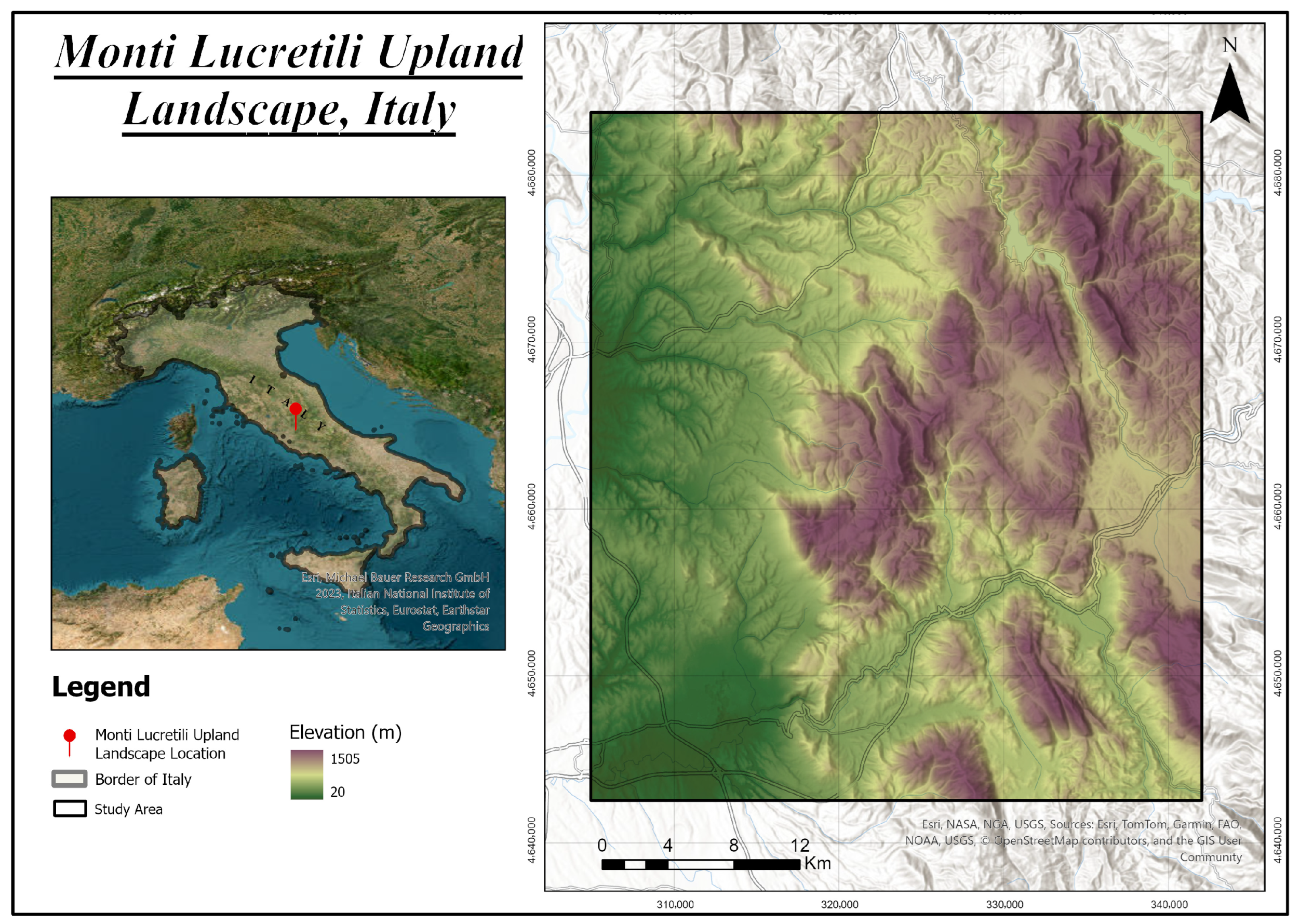
The Monti Lucretili (latitude 42.08983° N, longitude 12.87230° E, WGS 84) are located northeast of Tivoli, within the Metropolitan City of Rome, central Italy (Figure 1). The area forms the core of the Monti Lucretili Regional Natural Park, which spans approximately 1528.7 km2 and encompasses a diverse mountainous landscape with elevations reaching up to 1505 m a.s.l. [22]. The region is characterized by rugged carbonate ridges, narrow valleys, and extensive karst formations such as dolines and sinkholes that shape the surface and subsurface drainage network. The area hosts rich deciduous and evergreen forests, as well as significant archeological and cultural heritage sites, including the Roman Villa of Horace and traditional UNESCO-listed dry-stone walls, reflecting a long history of human–environment interaction.
The climate is Mediterranean with montane influences, featuring mild, wet winters and warm, dry summers. Mean annual precipitation typically ranges between 800 and 1200 mm, with the wettest months from October to April, while the driest period occurs in July and August [25,26]. Average temperatures vary from 4 to 7 °C in winter to 24–28 °C in summer, with pronounced altitudinal gradients influencing local hydrological regimes.
The lithology is dominated by limestone and dolomite, which favor karstic development and high infiltration capacity, although the steep slopes and shallow soils enhance surface runoff during intense rainfall. The interaction of these geomorphological and climatic factors contributes to occasional flash floods and debris flows in the lower valleys and drainage basins connected to the Aniene and Tiber River systems. Overall, the study area represents a hydro-geomorphologically complex environment, where topography, lithology, land cover, and rainfall intensity jointly control runoff generation and flood susceptibility in this sector of the central Apennines.

2.2. Data Sources

Flood susceptibility mapping in this study was based on open-access and freely distributed remote sensing products from publicly available geospatial datasets (Table 1). Spatial layers representing key flood-conditioning factors were prepared and analyzed in ArcGIS Pro 3.4.1 [27]. The selected datasets include topographic, hydrological, geological, environmental, and anthropogenic variables relevant to flood susceptibility assessment.
The datasets used in this study were obtained from authorized open-access geoportals, including Copernicus Hub [28], Copernicus Land Monitoring Service [29], European Geological Data Infrastructure [30], UCSB Climate Hazards Center [31], OpenStreetMap [32], ESA Copernicus Browser [33], European Soil Data Centre (ESDAC) [34] and the European Environment Agency [35].

2.3. Methodology

Flood susceptibility mapping requires the integration of diverse topographic, hydrological, geological, environmental, and anthropogenic factors that influence the occurrence and spatial distribution of flooding. In this study, the selection and classification of conditioning factors were guided by their established relevance in flood susceptibility research, data availability from open-access sources, and their ability to represent key physical processes controlling flood generation.
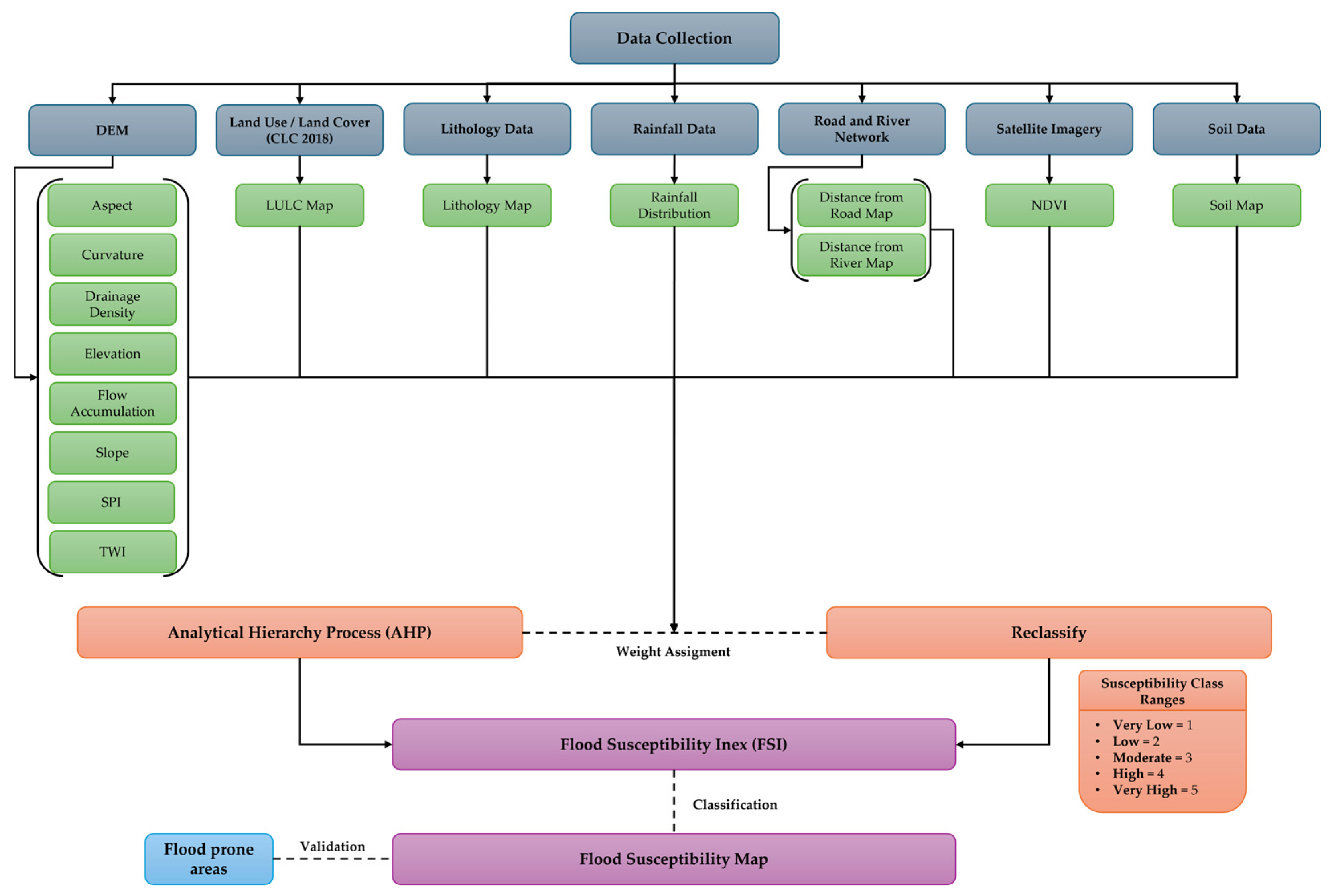
Accordingly, fifteen conditioning parameters were selected based on their relevance in flood susceptibility research and their frequent application in susceptibility modeling [12,14]. These include aspect, curvature, drainage density, elevation (DEM), flow accumulation, slope, Stream Power Index (SPI), Topographic Wetness Index (TWI), land use/land cover (LULC), lithology, rainfall distribution, distance from rivers, distance from roads, Normalized Difference Vegetation Index (NDVI) and soil (Figure 2).
All datasets were projected to a common coordinate reference system (WGS 84/UTM Zone 33N; EPSG:32633) prior to analysis. Subsequently, datasets were processed into raster format and resampled to a common spatial resolution of 5 m for integration within a GIS environment (ArcGIS Pro 3.4.1). Resampling methods were selected according to the nature of each dataset to preserve data integrity. Continuous raster variables (e.g., elevation, slope, curvature, flow accumulation, rainfall, and NDVI) were resampled using bilinear interpolation to ensure smooth transitions and avoid artificial discontinuities. Categorical and thematic datasets (e.g., land use/land cover, lithology, soil permeability classes, and flood reference layers) were resampled using the nearest neighbor method to preserve original class values and prevent category mixing. Vector-based layers (roads and river networks) were rasterized at the target resolution using nearest neighbor assignment prior to distance-based analysis. Among these factors, topographic variables derived from DEM (e.g., slope, aspect, curvature, flow accumulation, SPI, TWI, and drainage density) play a particularly critical role, as they directly and indirectly control runoff patterns, water accumulation, and floodplain dynamics [36,37]. The combination of vegetation indicator (NDVI), hydro-climatic inputs (rainfall), and anthropogenic factors (roads, land cover) ensure that both natural and human drivers of flooding are captured in the model.

2.3.1. DEM—Elevation

Elevation (EL) is one of the primary topographic parameters influencing flood susceptibility, as it governs runoff behavior, drainage direction, and the spatial concentration of surface water. In general, low-lying areas tend to accumulate runoff and are therefore more prone to inundation, while higher elevations facilitate faster water discharge and reduce flood potential [37].
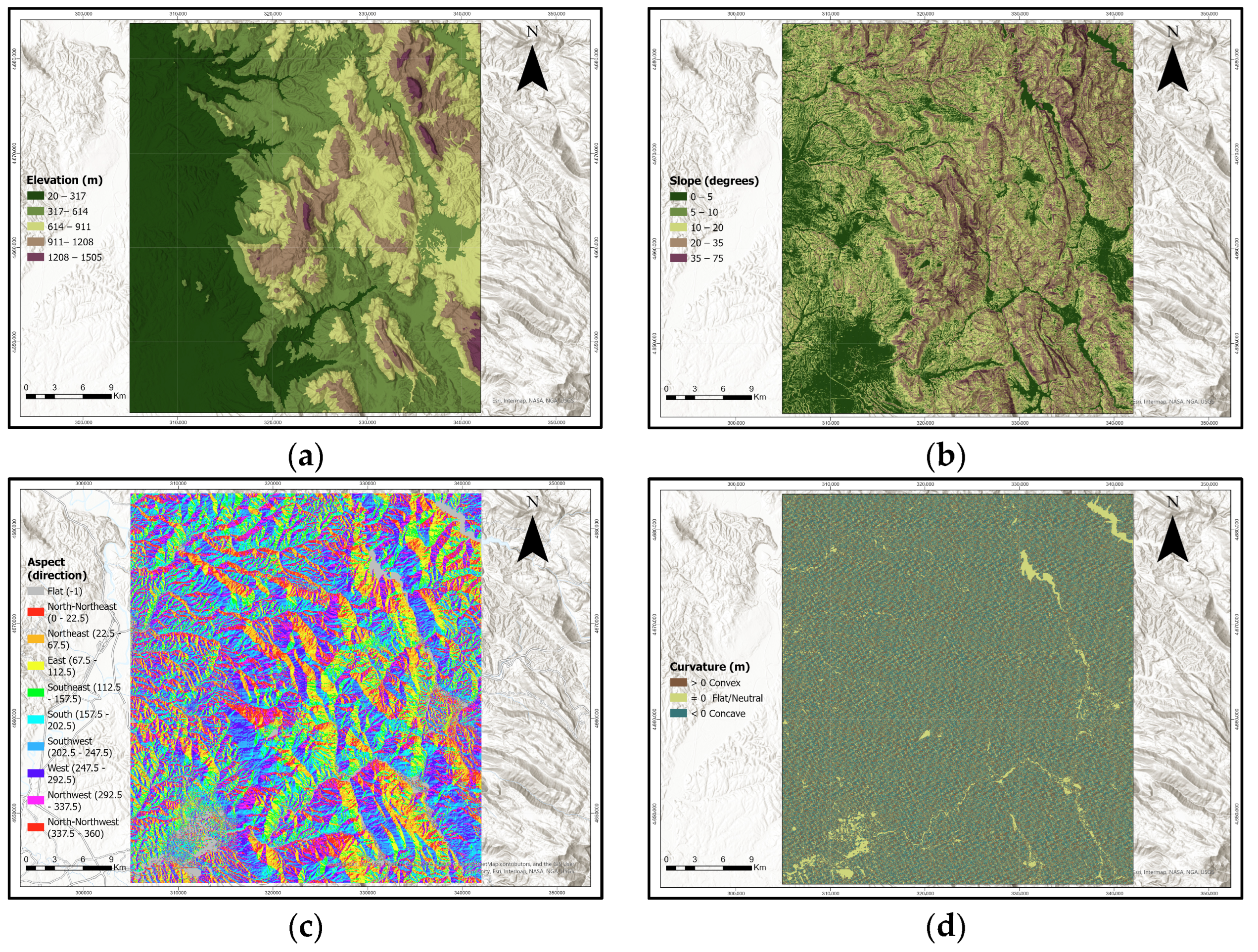
In the Monti Lucretili region, the digital elevation model (DEM) (Figure 3a) indicates an elevation range from approximately 20 m to 1505 m a.s.l., reflecting a highly variable mountainous landscape. The relief transitions from the low alluvial plains associated with the Aniene and Tiber River systems to steep carbonate ridges culminating at Monte Pellecchia, the highest peak in the area. Such a pronounced altitudinal gradient exerts a significant influence on hydrological processes: steep upper slopes promote rapid overland flow and limited infiltration, while mid-slope terraces and valley bottoms encourage runoff convergence, temporary water retention, and potential flooding.
The spatial variability of elevation across the study area provides essential baseline information for understanding surface hydrodynamics and integrating topographic control into the flood-susceptibility assessment framework. These findings are consistent with previous research highlighting the central role of elevation in digital terrain modeling and flood-hazard mapping [37].

2.3.2. Slope

Slope (SP) influences surface runoff and flood susceptibility by controlling flow velocity. Steeper slopes accelerate runoff, reducing water retention, while flatter areas tend to accumulate water, increasing flood susceptibility. In the study area, slope values in Figure 3b range from 0° to 75°, with a mean of 3.21° and a standard deviation of 1.18°, indicating predominantly gentle terrain. Most of the area consists of gentle to very gentle slopes, which are more prone to water accumulation and localized flooding, while a smaller portion of steep slopes occur in elevated areas where runoff is faster and the likelihood of flooding is considerably lower.

2.3.3. Aspect

Aspect (AS) was used to identify the compass direction of the downhill slope for each location in the study area. Slope orientation influences solar radiation, soil moisture, vegetation cover, and evapotranspiration, and therefore indirectly affects surface runoff generation and flood susceptibility. Shadier slopes, particularly those facing north, tend to retain higher moisture levels, which may enhance runoff accumulation under intense rainfall conditions.
Because aspect is a circular variable where angles close to 0° and 360° represent the same north-facing direction, it was not treated as a continuous or ordinal parameter. Instead, the aspect layer was reclassified into discrete directional categories following standard geomorphological conventions. The circular nature of aspect was explicitly considered during classification to avoid artificial discontinuities associated with angular measurements. This approach is consistent with common GIS-based terrain analysis practices, where aspect is treated as a categorical exposure variable rather than a progressively ordered angular variable, allowing differences in solar radiation and moisture conditions to be represented without introducing artificial numerical relationships.
Although some classes belong to the broader direction, for instance North–Northeast and North–Northwest sectors are facing North, these were evaluated separately to account for subtle microclimatic differences related to solar geometry and terrain configuration. In Mediterranean environments, slopes oriented toward the North receive higher morning solar irradiance, resulting in earlier daily warming and comparatively faster surface drying, whereas North–Northwest slopes tend to remain shaded for longer periods and may retain higher soil moisture and denser vegetation cover. These differences can influence vegetation persistence, soil moisture conditions, and localized runoff response. Similar interpretations of aspect related microclimatic variability have been reported in geomorphological and flood-susceptibility studies conducted in mountainous and Mediterranean environments [14,38]. Aspect classes were therefore evaluated as grouped exposure conditions influencing surface moisture persistence and runoff response, rather than as progressively ordered angular values.
The results (Figure 3c) indicate that most slopes in the study area are oriented toward the south and southwest, with additional northeast and west facing slopes, as well as small flat areas mainly located in valley bottoms. These configurations may promote runoff concentration and contribute to localized flood susceptibility.

2.3.4. Curvature

Curvature (CU) describes the concavity or convexity of the land surface and is an important topographic parameter in flood susceptibility analysis because it controls the way surface water converges or diverges across terrain. Concave (negative) curvature areas tend to accumulate runoff and are more prone to water pooling, while convex (positive) curvature promotes dispersion and drainage. In this study, curvature in Figure 3d, indicating predominantly mild terrain with localized flow concentration zones.

2.3.5. Flow Accumulation

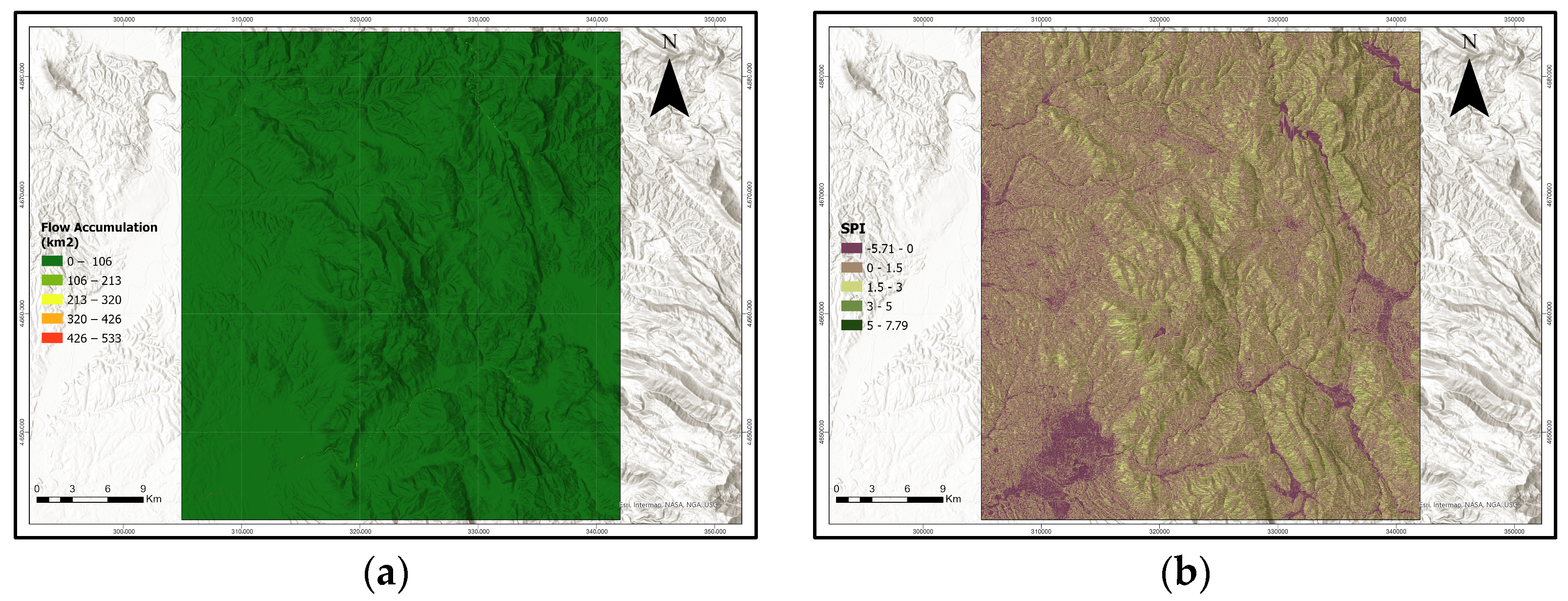
Flow accumulation (FA), one of the key factors in flood susceptibility analysis, represents the number of upslope cells contributing runoff to each location and is essential for identifying drainage patterns and potential flood-prone zones. Higher flow accumulation values indicate areas where water is likely to converge, increasing flood susceptibility, whereas low values are typically found on ridges and divides [39]. The flow accumulation map (Figure 4a) highlights the major drainage lines and converging zones across the basin that correspond to areas of potential overland flow concentration.

2.3.6. SPI—Stream Power Index

Stream Power Index (SPI) is an important indicator of erosive potential and flood susceptibility as it represents the erosive power of flowing water. It is derived from the relationship between the specific catchment area (As) and the local slope angle (β), calculated as:
S P I = A S tan β
where As is the upslope contributing area per unit contour length, and β is the slope expressed in radians [40]. Higher SPI values indicate greater stream energy, which can enhance channel erosion and sediment transport, while lower values are associated with low-gradient slopes and less concentrated flow. In the context of flood susceptibility, areas with high SPI are often more prone to rapid overland flow and potential channel instability (Figure 4b).

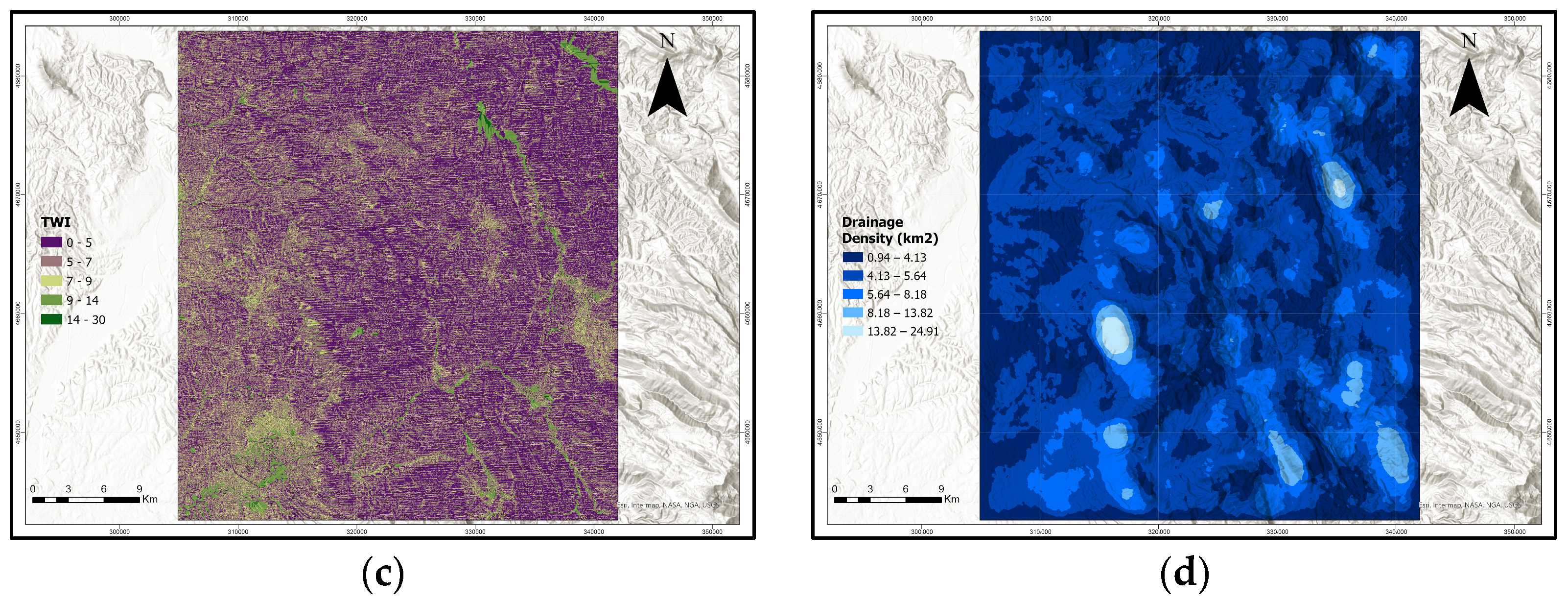
2.3.7. TWI—Topographic Wetness Index

Topographic Wetness Index (TWI) is an important hydrological parameter that represents the spatial distribution of soil moisture and water accumulation potential within a basin. It integrates slope and upslope contributing area to estimate areas prone to saturation and runoff generation. The TWI is calculated as:
T W I = ln A S tan β
where As is the specific catchment area (m2/m) and β is the local slope angle (radians). Higher TWI values indicate areas of increased soil moisture and potential saturation, which are strongly associated with flood susceptibility [41]. In the study area, TWI values range from 0 to 30, highlighting zones of potential water accumulation that may act as flood-prone areas (Figure 4c).

2.3.8. Drainage Density

Drainage density (DD) measures the total length of streams per unit area and indicates how efficiently a watershed can drain surface water. Higher values suggest a denser drainage network that promotes rapid runoff and limits infiltration, while lower values indicate fewer channels, which can enhance water accumulation in low-lying or flat terrain. In this study, drainage density values range from 0.94 to 24.91 m/km2, with a mean of 4.79 and a standard deviation of 1.61, reflecting a moderately to well-developed drainage network across the Monti Lucretili region (Figure 4d). Areas with higher drainage density are typically found in the steep upper catchments, where slope and lithology favor concentrated flow and limited infiltration, while zones with lower drainage density are in valley bottoms and depressions, where slower drainage can increase flood susceptibility.

2.3.9. Soil

Topsoil physical (SL) properties play a crucial role in the rainfall–runoff process, as soil type and texture directly control infiltration capacity and, consequently, flood susceptibility. In this study, the Topsoil physical properties for Europe dataset (500 m resolution) were used and reclassified into permeability classes: clayey soils, silty soils, loamy soils, and sandy soils. The reclassification reflects the influence of soil texture on water infiltration, where fine-textured soils such as clay restrict infiltration, resulting in higher surface runoff and increased flood susceptibility, whereas coarse-textured sandy soils enhance infiltration and reduce runoff generation [42,43].
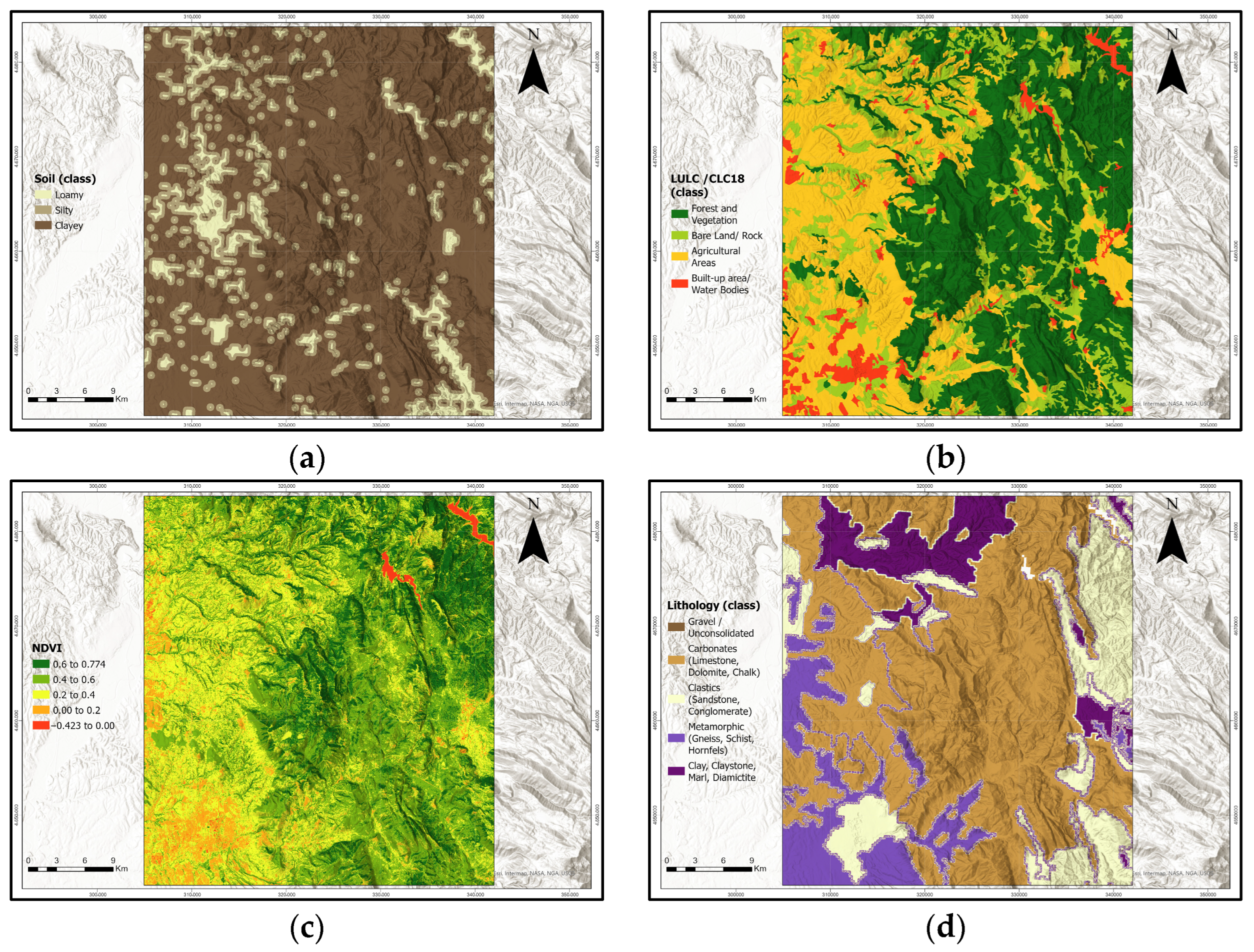
The soil texture map (Figure 5a) shows that most of the study area is dominated by loamy soils, which exhibit moderate flood susceptibility, followed by silty and silty–loam soils, which indicate high susceptibility due to their reduced permeability. Smaller patches of silty clay are observed in low-lying zones and are associated with very high flood susceptibility, while sandy soils occupy limited areas and correspond to the lowest susceptibility. This distribution suggests that large portions of the basin are characterized by restricted infiltration capacity and enhanced surface runoff, making them more prone to flood accumulation during intense rainfall events.

2.3.10. Land Use Land Cover (LULC)

Land use and land cover (LU) significantly affect flood susceptibility because surface characteristics determine infiltration capacity, runoff generation, and flow resistance [12,44]. In this study, LULC was derived from the CORINE Land Cover 2018 (CLC18) dataset and categorized into five main classes based on their relative flood potential: built-up areas and water bodies, agricultural land, bare land/rock, and forest/vegetation.
The results (Figure 5b) show that the area is predominantly covered by agricultural land and forest or vegetation, which occupy the largest portion of the landscape. Bare and rocky surfaces occur mainly in elevated zones, while built-up areas are limited and concentrated near the southern and central parts of the study area. Water bodies are scarce and correspond mainly to small reservoirs and stream networks.
This distribution suggests that while impervious urban surfaces represent localized high-risk flood zones, the predominance of vegetated and agricultural land contributes to moderate low flood susceptibility due to their higher infiltration capacity and roughness, which help reduce and delay surface runoff.

2.3.11. NDVI

Normalized Difference Vegetation Index (NDVI) represents an important conditioning factor influencing flood susceptibility, as it reduces surface runoff through interception, evapotranspiration, and enhancement of soil infiltration capacity. Areas with dense vegetation generally exhibit lower flood susceptibility, while sparsely vegetated or barren areas are more prone to rapid runoff and flooding [45]. The Normalized Difference Vegetation Index (NDVI) is widely used to quantify vegetation cover by contrasting near-infrared reflectance, which vegetation strongly reflects, with red reflectance, which it absorbs [46,47]. NDVI values range from −1 to +1, with higher values representing healthy vegetation that acts as a natural buffer against flooding. In flood susceptibility studies, NDVI is commonly used as an indirect indicator of vegetation density influencing interception capacity, surface roughness, and runoff response within multi-criteria modeling frameworks [48,49]. The index is expressed as follows:
N D V I = N I R R E D N I R + R E D =   B a n d   8 B a n d   4 B a n d   8 + B a n d   4  
where NIR: near-infrared (Sentinel 2, b.8); Red: red reflectance (Sentinel 2, b.4).
In this study, NDVI was derived from Sentinel-2C MSI Level-2A imagery (10 m resolution) obtained on 31 March 2025.The Sentinel-2 mission is operated by the European Space Agency (ESA, Paris, France) within the Copernicus Programme of the European Union, and the data were accessed via the ESA Copernicus Browser [50].
NDVI values are inherently dependent on both acquisition period and land cover characteristics; therefore, they were not interpreted as an absolute measure of vegetation activity across different surface types. The selected acquisition date corresponds to the late-wet to early-growing season in the Mediterranean environment, when vegetation development is close to its seasonal maximum, allowing a consistent regional representation of vegetation cover under comparable phenological conditions. This approach ensures that NDVI reflects relative spatial variability in vegetation conditions within the study area rather than absolute differences between heterogeneous land cover types.
Furthermore, NDVI values were interpreted primarily as a relative indicator of vegetation density within comparable land cover contexts, acknowledging that direct comparison between fundamentally different surface classes (e.g., dense forest, agricultural land, bare soil, or built-up areas) may introduce reflectance-related bias. In this study, NDVI was therefore used as an ancillary conditioning factor representing spatial variability in vegetation cover affecting interception capacity, surface roughness, and runoff response at the regional scale, rather than as a direct quantitative indicator of flood potential.
The resulting NDVI map (Figure 5c) shows that most of the area is characterized by moderate to low vegetation density, indicating a limited protective capacity against floods. Smaller areas with high NDVI values correspond to zones of dense forest and natural vegetation, while very low NDVI values are associated with sparsely vegetated or degraded surfaces such as rocky slopes and built-up zones. This spatial pattern highlights that vegetation plays only a moderate role in reducing flood susceptibility, with localized zones providing stronger mitigation due to denser canopy cover.

2.3.12. Lithology

Lithology (LI) is a critical factor influencing flood susceptibility, as variations in rock type and permeability affect infiltration and runoff behavior [12,14]. In this study, lithological data were obtained from the European Surface Lithology Map (250 m resolution) and reclassified into five permeability-based categories: very low, low, moderate, high, and very high.
The results indicate that most of the study area is dominated by low- to moderate-permeability lithologies, primarily carbonate and clastic sedimentary rocks such as limestone, dolomite, sandstone, and conglomerate. High-permeability lithologies, including igneous and metamorphic rocks (e.g., granite, gabbro, schist), occur in more limited zones, while very-high-susceptibility areas, represented by clay-rich units (claystone, marl, diamictite), are concentrated in specific valley and basin regions. Gravel and unconsolidated deposits, corresponding to the very-low-permeability class, occupy small patches mainly near drainage corridors (Figure 5d).
This composition suggests a generally moderate infiltration capacity, with localized low-permeability areas likely to enhance surface runoff and increase flood susceptibility, particularly where clay-rich and carbonate units dominate.

2.3.13. Distance from Road

Road infrastructure (RD) plays a significant role in flood susceptibility, as roads alter natural drainage patterns, increase impervious surfaces, and often act as barriers that intensify local runoff and water accumulation [51]. Proximity to roads can therefore influence the spatial distribution of flood hazards, with areas located near dense road networks being generally more vulnerable due to reduced infiltration capacity and increased surface sealing.
In this study, road infrastructure data were obtained from OpenStreetMap (OSM) [52], which provides openly accessible vector data on transportation networks. The infrastructure and hydrographic layers were used to perform proximity analysis to generate a distance-to-roads map for the study area. This layer was then reclassified into susceptibility zones, where areas closer to major roads were assigned higher susceptibility and areas farther away were assigned lower susceptibility.
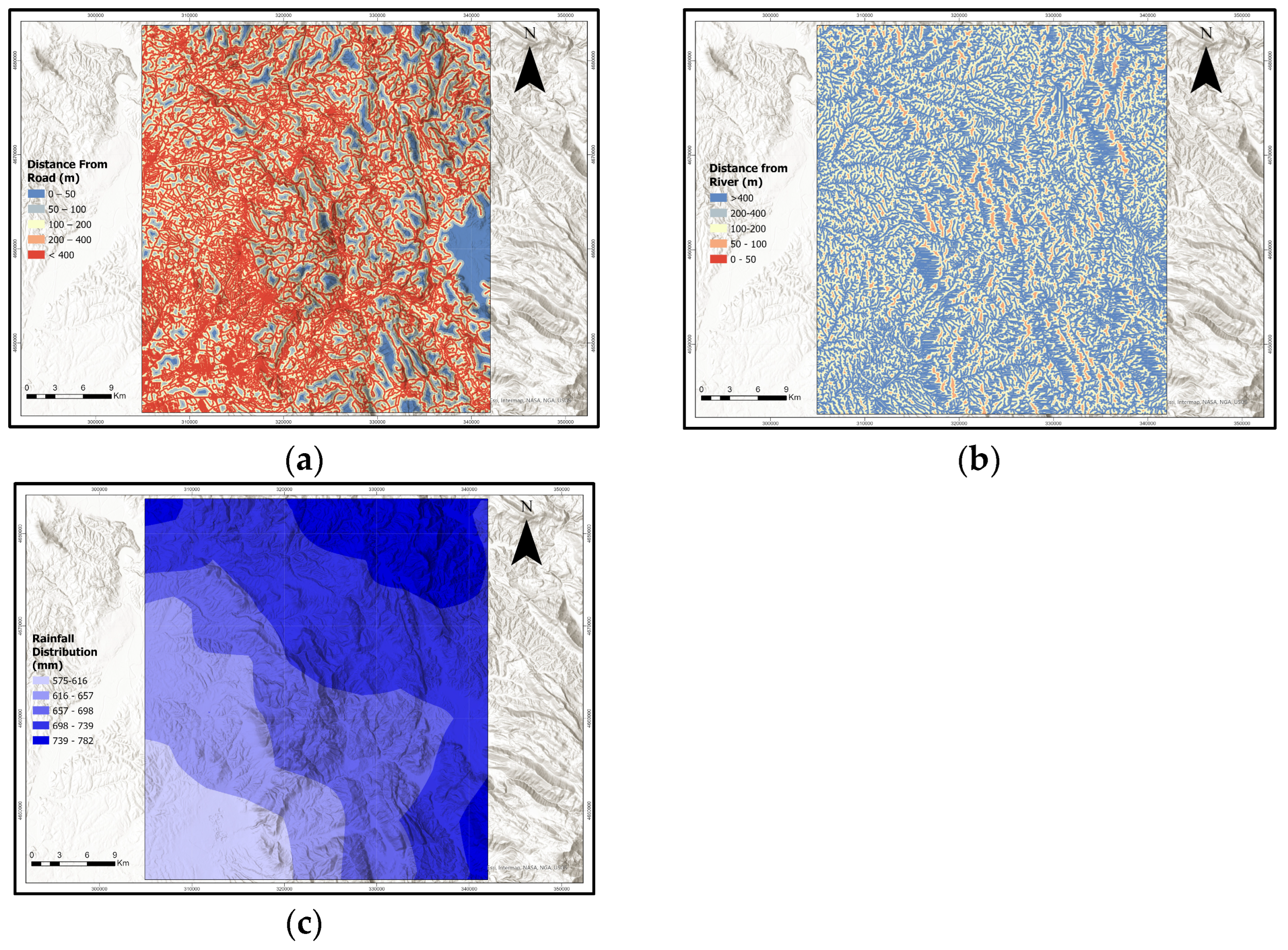
The resulting distance-from-roads map (Figure 6a) shows that settlements and agricultural lands adjacent to major road corridors fall within very-high- to high-susceptibility zones, indicating significant alteration of natural runoff pathways. Conversely, peripheral and mountainous regions located farther from transportation networks exhibit lower susceptibility. This spatial distribution underscores the critical influence of human infrastructure on modifying hydrological behavior and amplifying localized flood risks within the basin.

2.3.14. Distance from River

Distance to rivers (DR) is a critical factor in flood susceptibility assessment, as areas located closer to river channels are more exposed to inundation during periods of high discharge. Distance from rivers has been consistently identified as one of the most influential predictors in flood susceptibility mapping [53].
In this study, hydrographic data were obtained also from OpenStreetMap (OSM), which provides openly accessible vector data on rivers and streams. A proximity analysis was performed to generate a distance-to-rivers map of the study area. This layer was subsequently reclassified into susceptibility zones, with areas closest to rivers assigned the highest susceptibility and more distant areas classified as less susceptible.
The resulting map (Figure 6b) reveals that areas adjacent to major river corridors exhibit the highest flood susceptibility, particularly in valleys and low-lying floodplains. Susceptibility decreases progressively with increasing distance from river courses, reflecting reduced exposure to overbank flow and surface inundation. This spatial pattern emphasizes the dominant role of river proximity in controlling the distribution of flood-prone zones across the basin.

2.3.15. Rainfall Distribution

Rainfall (RF) is a primary driver of flooding, as high precipitation intensity and volume increase the potential for surface runoff and soil saturation. Spatial and temporal variations in rainfall directly influence flood susceptibility, with areas of higher precipitation generally being more prone to frequent or severe flooding [54,55].
For this study, rainfall data were obtained from the Climate Hazards Group InfraRed Precipitation with Station Data (CHIRPS v2.0) dataset (~5 km resolution). The average monthly rainfall for 2022 was first calculated, followed by the estimation of average annual rainfall, which ranged from 575 mm to 782 mm across the study area. To incorporate rainfall into the flood susceptibility analysis, the results were reclassified into five classes ranging from very low to very high.
The resulting rainfall distribution map (Figure 6c) shows that most of the study area lies within the moderate- to low-rainfall zones, particularly in the central and southern regions, whereas higher rainfall values occur in the northern and northeastern sectors. This spatial variability suggests that, although overall rainfall is moderate, localized high-precipitation zones play a crucial role in enhancing runoff and influencing flood susceptibility patterns across the basin.
The use of a single-year rainfall dataset (2022) reflects data availability and the objective of incorporating a representative spatial pattern of precipitation into the susceptibility framework, rather than modeling individual flood events. In susceptibility mapping, rainfall is commonly treated as a conditioning factor that modulates flood potential in combination with relatively stable terrain, soil, and drainage characteristics, rather than as a direct trigger of specific flood occurrences. Although multi-year climatological averages or rainfall intensity metrics could further refine hydrological characterization, their consistent spatial availability at the regional scale is often limited in data-scarce environments. Therefore, the 2022 CHIRPS rainfall layer was retained to capture broad spatial variability in precipitation across the study area and to support a regional-scale susceptibility assessment.

2.4. Analytical Hierarchy Process (AHP) Model

The Analytical Hierarchy Process (AHP), developed by Saaty [11], is a widely recognized multi-criteria decision-making (MCDM) technique used to quantify subjective assessments into objective weights. It provides a systematic framework for solving complex decision-making problems involving multiple criteria and sub-criteria. The AHP methodology has been extensively applied in environmental and geospatial studies, such as flood hazard mapping, groundwater potential evaluation, landslide susceptibility analysis, and cultural-heritage risk assessment, due to its ability to combine expert judgment with quantitative analysis [14,56,57,58,59,60].
In this study, AHP was employed to assign appropriate weights to the selected thematic parameters influencing flood susceptibility. The pairwise comparison matrix was developed through expert elicitation involving both domain specialists and local responsible stakeholders within the framework of the EU-funded ARGUS project (Grant Agreement No. 101132308) [61], which focuses on disaster risk assessment and the protection of cultural heritage using Earth Observation and geospatial technologies. The weighting process was informed by the collective judgment of domain experts affiliated with the ARGUS consortium, including researchers and practitioners with expertise in hydrology, geomorphology, remote sensing, GIS-based hazard modeling, and cultural heritage risk assessment, as well as stakeholders engaged in regional planning and heritage management. These experts contributed to the evaluation of the relative importance of the selected conditioning factors based on their professional experience and knowledge of flood processes in Mediterranean environments. A consensus-based approach was adopted to derive the final pairwise comparison scores, ensuring internal consistency and minimizing individual subjectivity. The resulting comparison matrix satisfied Saaty’s consistency requirements, as reflected by the low Consistency Ratio (CR = 0.060), indicating logical coherence and reliability of the assigned weights.
Prior to the application of the AHP weighting procedure, a correlation analysis was performed to examine potential redundancy and multicollinearity among the selected conditioning factors. Pearson correlation coefficients were calculated using 5000 randomly distributed sample points across the study area. The results in Table 2 indicate generally low to moderate correlations among the majority of variables, with most coefficients ranging between −0.30 and 0.50 in absolute value. Higher correlations were observed mainly between conceptually related DEM-derived parameters (e.g., slope, flow accumulation, SPI, and TWI), where correlation values locally reach approximately |r| = 0.50–0.63. These relationships are expected due to their shared geomorphological origin and do not indicate critical multicollinearity requiring dimensionality reduction. Since the objective of this study is to preserve the physical interpretability of individual flood-conditioning factors within the AHP framework, all variables were retained and evaluated independently during the weighting process.
The first step involves constructing a pairwise comparison matrix for all considered factors. Each pair of parameters is compared with respect to their relative influence on the study objective using the Saaty’s 1–9 scale, where a value of 1 indicates equal importance and 9 represents extreme importance of one factor over another (Table 3).

3. Results

3.1. Parameter Weighting and Consistency Evaluation

To evaluate the relative importance of the conditioning parameters, a pairwise comparison matrix of size n × n was constructed for all 15 parameters used in this study (Table 4). Each element a i j the matrix represents the relative importance of parameter i over parameter j, while the reciprocal property is maintained a j i = 1 / a i j . The diagonal elements are equal to 1, signifying equal importance when a parameter is compared to itself.
After the matrix construction, the normalized weights of each parameter were calculated by averaging the normalized values across each column. The relative weights represent the contribution of each factor toward overall susceptibility or suitability. The normalized weight (Wi) of each criterion was computed using Equation (4):
W i = P i P j
The derived normalized weights of each parameter and their respective ranks are presented in Table 5.
Each primary parameter was further subdivided into sub-criteria classes representing different degrees of influence on flood susceptibility (Table 6). Susceptibility class ratings were assigned on an ordinal scale, while normalized AHP weights were derived for each primary criterion through pairwise comparison and consistency verification. The final contribution of each sub-criterion to the Flood Susceptibility Index was calculated by multiplying the normalized criterion weight by the corresponding susceptibility class rating.
The consistency of the pairwise comparison matrix was verified to ensure that expert judgments were logically coherent. The Consistency Index (CI) and Consistency Ratio (CR) were computed using Equations (5) and (6):
C I = λ m a x n n 1
C R = C I R I
where λ max is the principal eigenvalue of the matrix, n is the total number of parameters, and RI denotes the Random Consistency Index, whose values are provided in Table 7. A consistency ratio (CR) ≤ 0.10 indicates that the matrix is acceptably consistent [62]. For the present study, the number of parameters used was n = 15, corresponding to an RI = 1.59 [11]. The computed Consistency Ratio (CR) was 0.060, which is well below the acceptable threshold of 0.10, indicating that the pairwise comparisons were logically consistent and the derived weights are reliable for further spatial analysis.
Once consistency was verified, the normalized weights were integrated within a GIS environment using a weighted linear combination (WLC) method to generate the final susceptibility or suitability map. The weighted overlay model was computed as follows:
F S = w i × X i
where FS is the = flood susceptibility index, w i the normalized weight of parameter i, and X i represents the reclassified score of sub-criteria under parameter i.
This integration of the AHP model with GIS ensures a transparent, repeatable, and scientifically grounded framework for evaluating spatial susceptibility, enhancing the precision and reliability of the final model output.

3.2. Flood Susceptibility Mapping

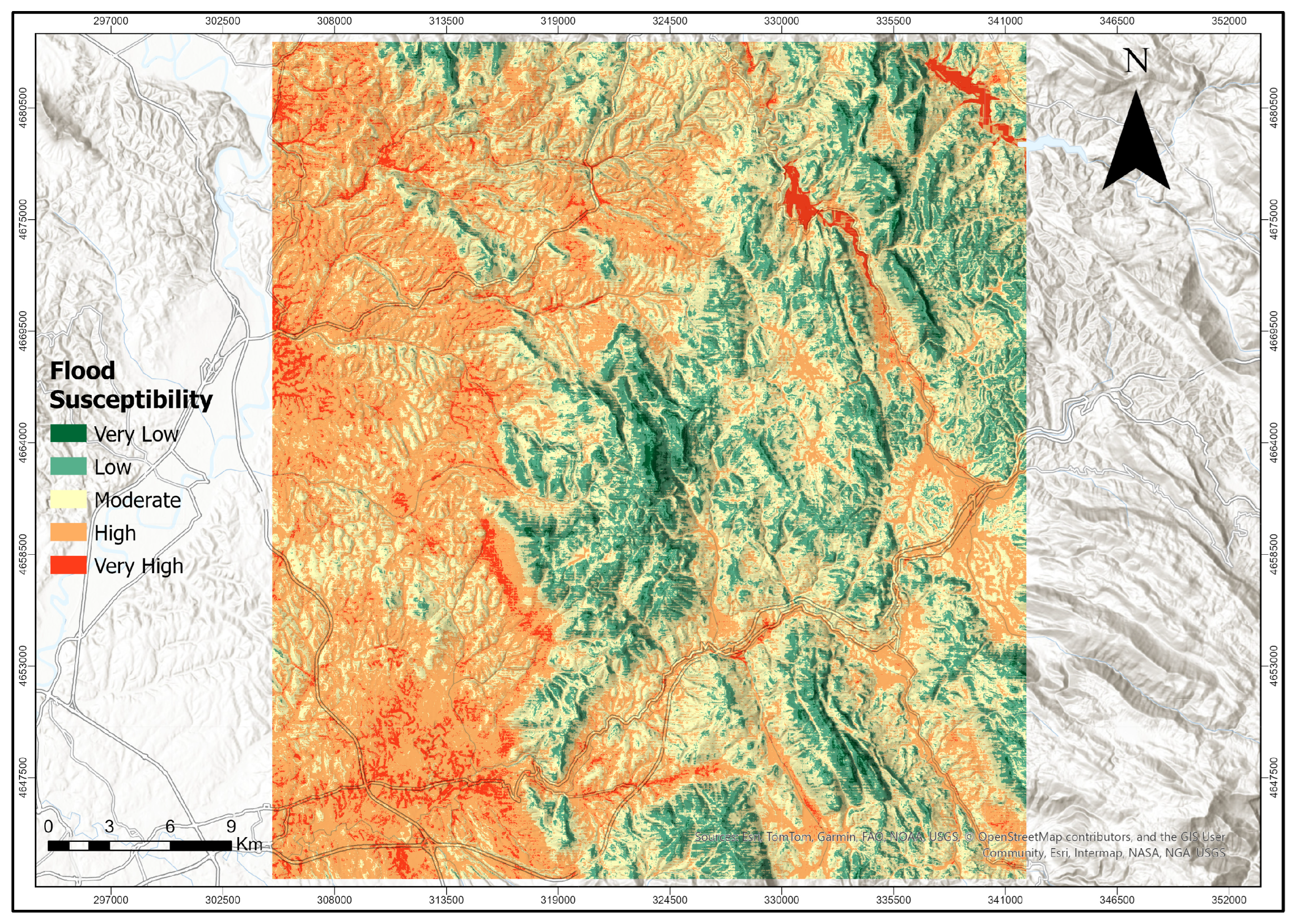
The flood susceptibility map of the study area was produced through the integration of fifteen conditioning factors using the Analytical Hierarchy Process and a GIS-based weighted overlay approach. The parameters considered included rainfall distribution, slope, elevation, drainage density, lithology, soil, land use/land cover (LULC), flow accumulation, curvature, aspect, distance from rivers, distance from roads, NDVI, Stream Power Index (SPI), and Topographic Wetness Index (TWI). The flood susceptibility index derived from the weighted overlay ranged from 1.806 to 4.465, representing the relative likelihood of flooding across the area. These continuous values were subsequently reclassified into five susceptibility categories—very low, low, moderate, high, and very high—using the equal interval classification method.
This approach divides the full range of FSI values into classes of identical numerical width, ensuring an objective and reproducible classification scheme. Equal interval classification was selected to preserve the relative magnitude of susceptibility values derived from the weighted linear combination and to avoid bias related to data distribution characteristics. While flood processes are complex and non-linear, this approach is commonly adopted in regional-scale susceptibility mapping, where the objective is to distinguish relative susceptibility levels rather than to delineate precise flood extents. The reclassified output was symbolized in a sequential color gradient from green (very low) to red (very high) to enhance visual interpretation of relative susceptibility levels.
The spatial pattern of flood susceptibility across the study area reveals a strong relationship with topography and hydrological characteristics. The high- and very-high-susceptibility zones are primarily concentrated along valleys, drainage networks, and low-lying plains, where gentle slopes, clayey soils, agricultural land, and proximity to rivers dominate. Conversely, low- and very-low-susceptibility areas are mainly distributed across upland and steeper terrain, where well-drained lithologies, vegetation cover, and greater elevation reduce runoff accumulation. This distribution underscores the influence of terrain morphology, soil permeability, and land use as key drivers of flood potential in the basin.
The AHP-derived weights emphasized the relative significance of each conditioning factor. Rainfall distribution (10.8%), elevation (15%), and slope (13%) emerged as the most influential contributors to flood susceptibility, followed by distance from rivers (12.8%), flow accumulation (14.8%), and drainage density (2.9%). Factors such as soil type, LULC, and NDVI exhibited moderate influence, while curvature, distance from roads, SPI, and TWI had lower relative weights. These results indicate that topographic and hydrological parameters exert a dominant role in determining flood-prone zones, consistent with the geomorphological setting of the area.
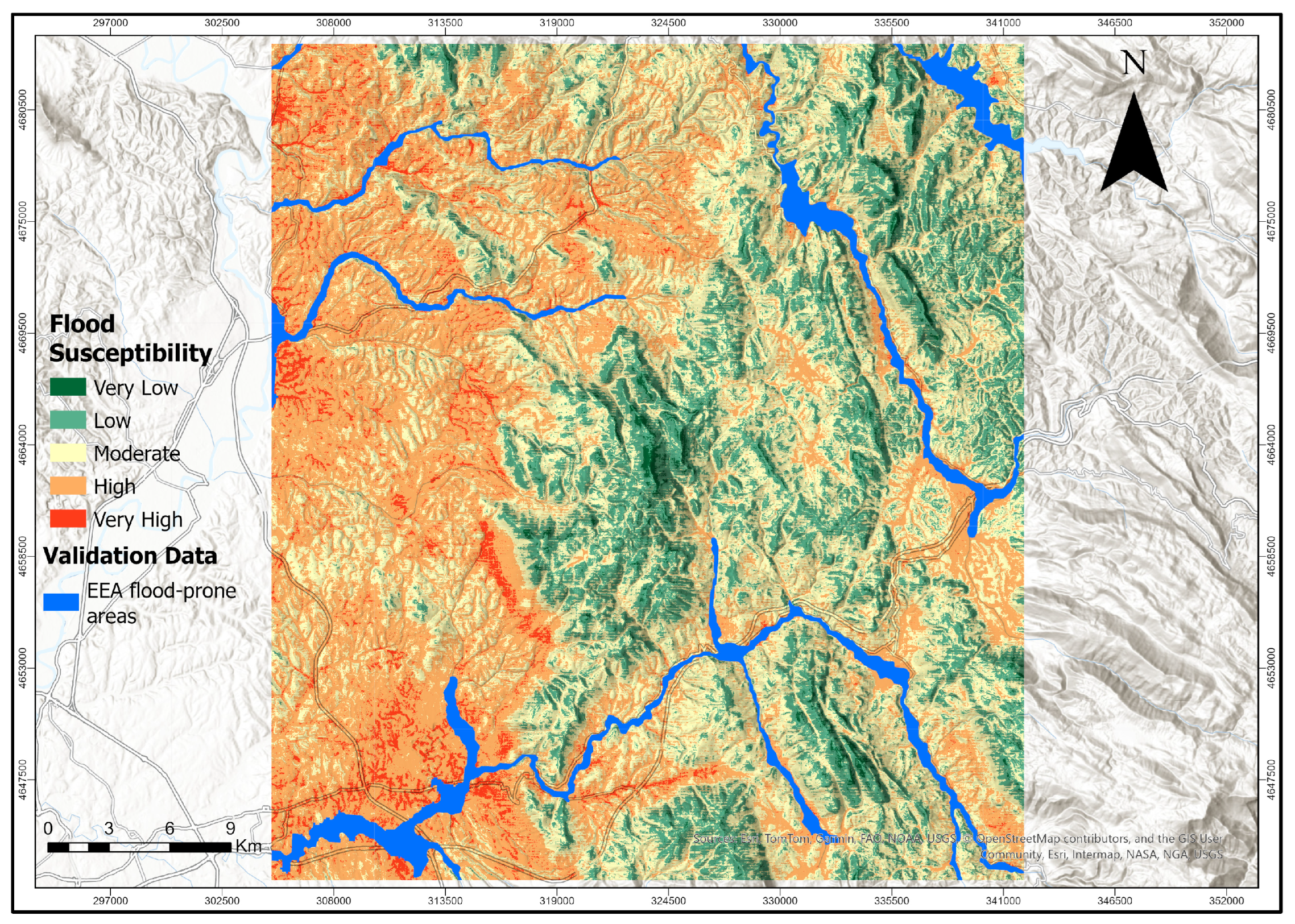
The final reclassified flood susceptibility map quantitatively demonstrates that the moderate susceptibility class occupies the largest portion of the study area, covering 622.67 km2 (40.85%). The high-susceptibility zone follows closely, covering 557.08 km2 (36.55%), while low-susceptibility areas account for 272.82 km2 (17.90%). Very high and very low zones occupy 60.13 km2 (3.94%) and 11.76 km2 (0.77%), respectively (Table 8).
Altogether, approximately 40% of the total area (high + very high classes) can be classified as flood-prone, highlighting zones that warrant priority attention for flood mitigation, infrastructure design, and land-use management. The predominance of moderate- to high-susceptibility classes indicates that much of the basin remains hydrologically sensitive, especially in regions where natural drainage coincides with anthropogenic development.
As illustrated in Figure 7, the flood susceptibility map effectively delineates the spatial variability of flood potential across the landscape. Red and orange zones, representing high-risk areas, align with major stream channels, low-slope valleys, and agricultural plains, whereas green and yellow areas correspond to well-drained uplands and forested terrain. This spatial coherence with terrain and drainage configuration validates the reliability of the AHP–GIS integrated model in assessing flood hazard potential.
Overall, the results demonstrate that the applied multi-criteria decision-making approach provides a scientifically sound and spatially coherent representation of flood susceptibility at the regional scale. The resulting map serves as a valuable decision-support tool for regional flood susceptibility assessment, land-use planning, and disaster management, particularly in Mediterranean basins characterized by complex topography and seasonal rainfall variability. Given that validation relied on modeled flood-prone areas rather than field-based observations, the results should be interpreted as indicative, and future work should incorporate empirical flood event data to further evaluate model performance.

4. Validation

Validation of the AHP–GIS flood susceptibility model was carried out using spatial and statistical performance metrics and an independent flood reference layer. All validation analyses, including spatial overlay, sampling, and statistical accuracy assessment (Hit Rate, IoU, Precision, and ROC–AUC), were performed using ArcGIS Pro 3.4.1 [27], with summary statistics and metric calculations completed in Microsoft Excel. Rather than observed flood extents, the EEA Potential Flood Prone Areas dataset was used as the reference, delineating river channels and floodplains expected to be inundated under a 1% annual exceedance probability (AEP) scenario (i.e., 1-in-100-year flood), assuming unrestricted flooding (no protection/defense effects). This dataset is derived from large-scale hydrological and hydraulic modeling and represents simulated flood-prone areas rather than direct observations of historical flood events. The product provides harmonized coverage for EEA38 member countries and the United Kingdom and is suitable for regional-scale benchmarking of susceptibility models [63]. Figure 8 illustrates the spatial correspondence between the modeled flood susceptibility classes and the EEA Potential Flood Prone Areas used as the independent validation dataset.
Using this layer, 85.36% of the EEA flood-prone areas fall within the model’s High–Very-High-susceptibility classes (Hit Rate), indicating a strong spatial correspondence between predicted susceptible zones and modeled flood-prone areas. The Intersection over Union (IoU) value of 9.29% and Precision of 9.44%, indicating a conservative and slightly over-predictive susceptibility pattern, which is appropriate for hazard assessment contexts where minimizing false negatives is prioritized [64,65].
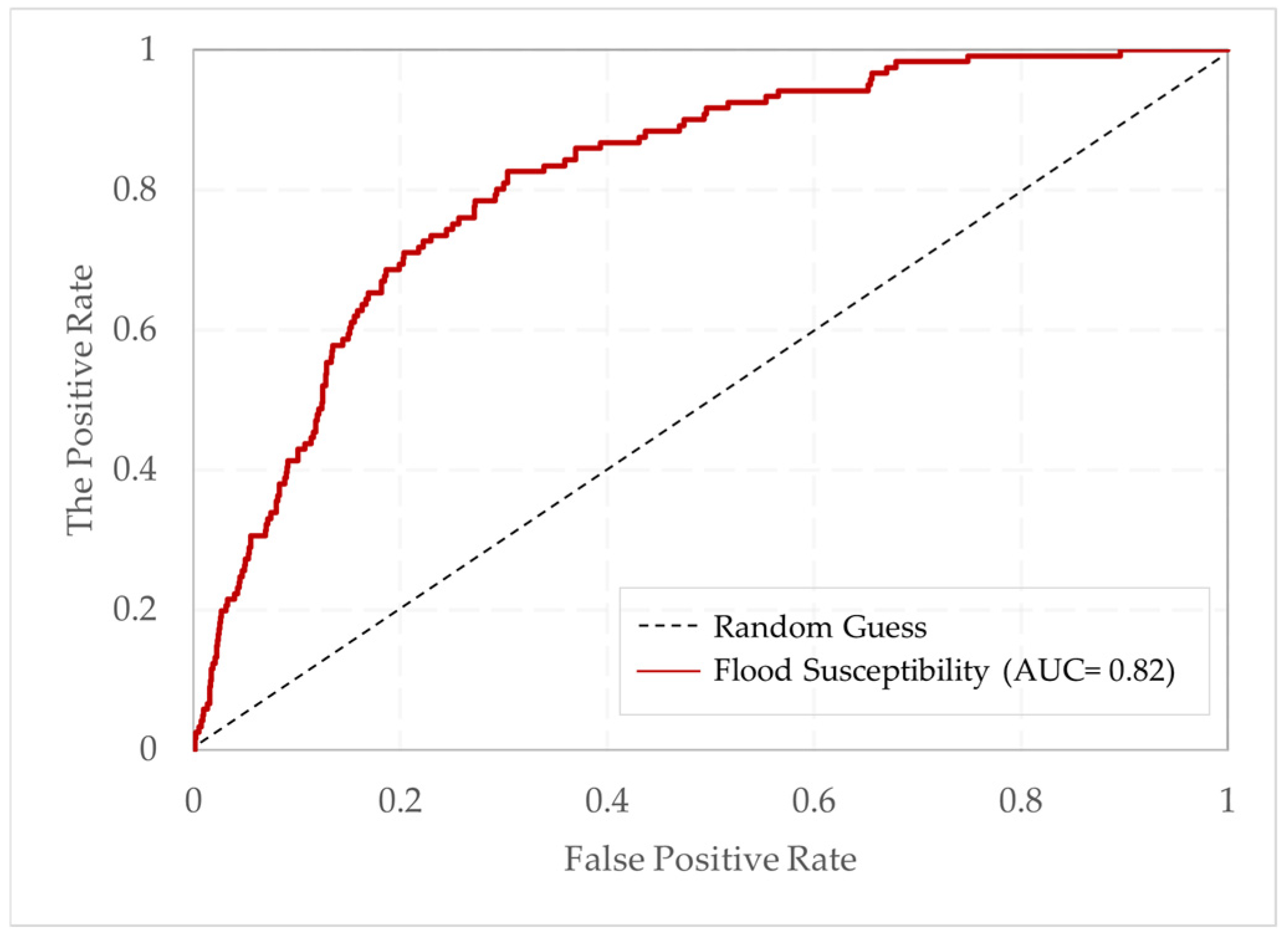
In addition, a Receiver Operating Characteristic (ROC)–Area Under the Curve (AUC) analysis was performed with 3000 stratified random points sampled from the continuous susceptibility raster (predictor) and the EEA binary flood-prone mask (reference). The resulting AUC of 0.82 (Figure 9) indicates very good discriminative performance according to Swets’ classification [66].
Beyond the quantitative validation, the spatial patterns of flood susceptibility were also reviewed within the framework of the EU-funded ARGUS project [61], involving consultations with domain experts and local stakeholders. This qualitative review compared areas classified as high- and very-high-susceptibility with locally recognized flood-prone zones and regional hydrological behavior, providing complementary contextual support for the model results at the regional scale.
Together, these results indicate that the AHP–GIS model provides a statistically reliable and spatially consistent delineation of flood-susceptible areas at the regional scale. The combination of a high Hit Rate and strong AUC demonstrates effective separation between flood-prone and non-flood-prone zones in Monti Lucretili, supporting applications in regional flood-risk assessment, land-use planning, and the protection of culturally significant landscapes.

5. Discussion

The integration of the Analytical Hierarchy Process (AHP) with GIS-based spatial modeling proved effective for delineating flood susceptibility zones in the Monti Lucretili area. The weighting scheme applied in the AHP model was derived through expert elicitation within the EU-funded ARGUS project, ensuring that the relative importance assigned to the conditioning factors reflects consolidated domain knowledge in hydrology, geomorphology, GIS-based hazard modeling, and cultural heritage risk assessment. The combination of fifteen conditioning factors enabled a comprehensive representation of the physical and environmental processes influencing flood generation.
The resulting flood susceptibility map indicates that most of the area falls within low- to moderate-susceptibility classes, while high and very high classes are concentrated along valleys and drainage networks, where gentle slopes, clayey soils, and agricultural land dominate. These findings align with the well-established relationships between topography, soil permeability, and hydrological response in Mediterranean basins [37]. Comparable spatial patterns have been reported in Mediterranean mountain regions affected by flash floods, where valley-bottom areas and low-gradient floodplains represent persistent susceptibility hotspots [3,4].
Although the set of conditioning factors adopted in this study is largely consistent with those used in conventional flood susceptibility assessments, their combined interpretation is specifically tailored to cultural heritage risk contexts. In heritage landscapes, flood susceptibility is not only controlled by hydrological processes. It is also influenced by long-term land-use patterns, landscape preservation constraints, and the spatial distribution of historical assets, which are frequently concentrated along river corridors and low-slope areas. In this sense, the present framework differs from generic flood-risk studies by emphasizing susceptibility mapping as a screening tool for heritage protection and cultural landscape management, rather than as an event-based prediction model.
Validation results, including a hit rate of 85.36% and an AUC value of 0.82, indicate strong regional-scale predictive performance of the AHP–GIS approach. According to standard classification thresholds, this level of accuracy represents strong model performance, consistent with previous studies across Mediterranean and European regions. For example, Kazakis et al. [15] and Tehrany et al. [12] reported comparable AUC values between 0.82 and 0.86, reaffirming the method’s transferability across diverse physiographic contexts. Comparable validation outcomes have also been reported in other regional flood susceptibility assessments using GIS-based multi-criteria and hybrid approaches, further supporting the applicability of such frameworks for large-scale planning purposes (Merz et al. [18]; Samela et al. [19]). The high hit rate and moderate intersection (IoU = 9.29%) and precision (9.44%) values obtained in this study suggest a conservative model tendency slightly overpredicting flood-prone area. Such overestimation is acceptable and even desirable in hazard mapping, where underprediction could result in significant socio-economic and cultural losses.
Among the evaluated factors, rainfall, elevation, slope, and distance from rivers emerged as the most influential contributors to flood susceptibility, consistent with findings by Rahmati et al. [14]. These parameters primarily govern runoff concentration, infiltration potential, and flow-path accumulation, which are key processes controlling flood generation in mountainous Mediterranean environments. In contrast, the vegetation indicator (NDVI) and aspect exhibited comparatively lower influence, reflecting their secondary role under the steep terrain and diverse lithological conditions of the study area. This finding confirms that in Mediterranean mountain environments flood susceptibility is predominantly controlled by topographic and hydrological parameters, while land cover and vegetation mainly act as local modifiers of surface response. Although factors such as the Stream Power Index (SPI) and Topographic Wetness Index (TWI) received comparatively lower weights within the AHP framework, they were retained as they represent complementary hydrological processes related to flow energy and spatial soil moisture distribution. Their reduced influence is inherently accounted for through expert-based weighting, while their inclusion contributes to a more comprehensive representation of flood-conditioning mechanisms and supports methodological transferability to other regions where factor importance may vary.
A key strength of this study lies in its reliance entirely on open-access satellite remote sensing and spatial datasets, including CHIRPS rainfall, CORINE land cover, and the Copernicus DEM. The integration of these freely available data sources demonstrates the feasibility of conducting accurate, reproducible flood susceptibility assessments in data-scarce regions. This approach aligns with current European directives promoting open geospatial data for disaster risk reduction and environmental monitoring [63].
From a broader perspective, the Monti Lucretili area represents a landscape where environmental risk intersects directly with cultural heritage conservation. The region hosts ancient rural settlements, Roman archeological remains, and UNESCO-listed dry-stone wall features that are increasingly threatened by hydro-geomorphological hazards. Accordingly, the flood susceptibility map developed in this study is intended to identify landscape units where cultural heritage assets may be exposed to elevated flood-prone conditions, providing strategic guidance for heritage-aware spatial planning rather than direct site-level risk quantification. The spatial coincidence of high-susceptibility zones with valley-bottom heritage sites highlights the importance of integrating flood susceptibility mapping into cultural landscape management and heritage preservation strategies. Similar applications of open-access Earth Observation data for heritage risk management have been demonstrated by Agapiou et al. [60] and Michaelides et al. [22].
Several limitations of the present study should be acknowledged. The rainfall factor was derived from CHIRPS data at an approximate spatial resolution of 5 km and represents average annual precipitation for a single year (2022). While this approach is suitable for capturing regional-scale precipitation patterns, it does not explicitly account for short-duration rainfall intensity or long-term climatic variability, which are known to influence flash flood generation in Mediterranean mountain regions. Furthermore, resampling coarse-resolution climatic data to a finer grid was performed solely to ensure spatial alignment with other conditioning factors and does not imply increased spatial precision. Consequently, the resulting susceptibility map should be interpreted at a regional planning scale rather than at the individual pixel level. Future research could incorporate multi-year rainfall statistics or intensity-based metrics to further refine susceptibility characterization. The use of single-year rainfall therefore represents a methodological compromise driven by data availability and the regional-scale screening objective of the study, rather than an attempt to model event-based flood dynamics.
Although the AHP–GIS framework provided reliable results, future improvements could involve integrating temporal rainfall variability, soil moisture indices, or hydrodynamic simulations to capture short-term flood behavior. Furthermore, coupling AHP with machine learning models such as Random Forest or Logistic Regression could enhance predictive precision and enable comparative benchmarking.
Overall, this study indicates that while the Monti Lucretili region exhibits predominantly moderate flood susceptibility, localized hotspots along drainage corridors pose heightened risks not only to ecosystems and infrastructure but also to cultural heritage assets. The proposed open-access AHP–GIS framework offers a transferable and cost-effective methodology for identifying and managing such risks across Mediterranean mountain landscapes, contributing to sustainable watershed management and heritage conservation.

6. Conclusions

The Analytical Hierarchy Process (AHP) combined with GIS-based spatial analysis was successfully applied to delineate flood-prone zones in the Monti Lucretili area of central Italy. Fifteen conditioning factors covering topographic, hydrological, geological, and land-use characteristics were integrated within a weighted overlay model to generate a flood susceptibility map. The methodology, built entirely on open-access satellite remote sensing and spatial datasets, demonstrates an efficient, transparent, and cost-effective approach for regional-scale flood susceptibility assessment.
The resulting flood susceptibility map revealed that the majority of the area falls within low- to moderate-susceptibility classes, accounting for approximately 272.82 km2 (17.90%) and 622.67 km2 (40.85%), respectively. Areas classified as high- and very-high-susceptibility cover 557.08 km2 (36.54%) and 60.13 km2 (3.94%), mainly distributed along valley bottoms and drainage corridors where gentle slopes, clayey soils, and agricultural land dominate. The very low class occupies only 11.76 km2 (0.77%), located primarily in elevated, forested terrain with greater infiltration capacity.
Validation results indicate a consistent regional-scale performance of the flood susceptibility model, with 85.36% of the modeled flood-prone areas coinciding with high- and very-high-susceptibility zones and an AUC value of 0.82. These results align with the well-established hydrological behavior of Mediterranean mountainous environments, where flood susceptibility is primarily controlled by terrain morphology, lithology, and precipitation patterns. Rather than introducing new flood-controlling criteria, this study confirms the relevance of established hydrological and morphological parameters when systematically integrated within an open-access AHP–GIS framework.
Beyond its hydrological implications, the study also underscores the importance of flood susceptibility assessment for cultural heritage preservation. The Monti Lucretili area hosts numerous archeological remains, traditional rural landscapes, and historical infrastructures that are increasingly threatened by hydro-geomorphological processes. Identifying areas of elevated susceptibility provides a scientific basis for safeguarding cultural assets through heritage-aware spatial planning and adaptive management strategies.
Overall, the approach adopted in this study illustrates how established flood susceptibility principles can be effectively operationalized using an open-access AHP–GIS framework to support regional-scale planning in data-limited Mediterranean mountain environments. The primary contribution of this work lies not in the selection of novel conditioning factors, but in their coherent integration using freely available geospatial datasets and their application within cultural-heritage-sensitive landscapes. This transferable framework offers practical decision-support for flood susceptibility screening, land-use planning, and the protection of culturally significant landscapes where detailed hydrological data or field observations are unavailable.

Author Contributions

Conceptualization, methodology, software, validation, formal analysis, investigation, resources, data curation, writing—original draft preparation, writing—review and editing, visualization, K.M. and A.A.; supervision, A.A.; funding acquisition, A.A. All authors have read and agreed to the published version of the manuscript.

Funding

This work has been supported by the ARGUS EU project (Grant Agreement No. 101132308), funded by the European Union. The views and opinions expressed are, however, those of the author(s) only and do not necessarily reflect those of the European Union or of the European Research Executive Agency (REA); neither the European Union nor the granting authority can be held responsible for them.

Data Availability Statement

The data supporting the findings of this study are openly available from public repositories. The digital elevation data were obtained from the Copernicus DEM30 (https://copernicus.eu, accessed on 8 July 2025). Land use and land cover information were derived from the CORINE Land Cover 2018 dataset provided by the Copernicus Land Monitoring Service (https://land.copernicus.eu, accessed on 10 July 2025). Rainfall data were sourced from the CHIRPS v2.0 dataset developed by the UCSB Climate Hazards Center (https://www.chc.ucsb.edu, accessed on 18 July 2025). Soil data were obtained from the European Soil Data Centre (ESDAC) (https://esdac.jrc.ec.europa.eu, accessed on 15 July 2025). River and road network data were extracted from OpenStreetMap (https://www.openstreetmap.org, accessed on 18 July 2025). Sentinel-2 imagery was acquired from the Copernicus Open Access Hub (https://scihub.copernicus.eu, accessed on 10 July 2025). The potential flood-prone areas used for model validation were obtained from the European Environment Agency (EEA) dataset “Potential Flood-Prone Areas Extent” (https://www.eea.europa.eu, accessed on 20 July 2025).

Acknowledgments

This research forms part of the thesis of K.M., conducted at the EOcult: Earth Observation Cultural Heritage Lab (https://web.cut.ac.cy/eocult/, accessed on 23 July 2025), Department of Civil Engineering and Geomatics, Cyprus University of Technology. The authors gratefully acknowledge the support provided by Roma Tre University, partners of the ARGUS project. Special thanks are extended to the European Union Copernicus Programme and the European Space Agency (ESA) for providing publicly available data free of charge and under an open license, supporting reproducible and transparent geospatial research. The authors also acknowledge the use of the CHIRPS rainfall dataset from the Climate Hazards Group and OpenStreetMap data, which is licensed under the Open Data Commons Open Database License (ODbL) by the OpenStreetMap Foundation (OSMF). The authors acknowledge the use of language-editing tools (Grammarly, 2025) and AI-based assistants (ChatGPT, version GPT-5 by OpenAI) for language polishing and improvement of clarity. All AI-generated suggestions were carefully reviewed and edited by the authors, who take full responsibility for the scientific content, interpretation, and conclusions presented in this manuscript.

Conflicts of Interest

The authors declare no conflicts of interest.

References

  1. Kundzewicz, Z.W.; Kanae, S.; Seneviratne, S.I.; Handmer, J.; Nicholls, N.; Peduzzi, P.; Mechler, R.; Bouwer, L.M.; Arnell, N.; Mach, K. Flood risk and climate change: Global and regional perspectives. Hydrol. Sci. J. 2014, 59, 1–28. [Google Scholar] [CrossRef]
  2. Ward, P.J.; Jongman, B.; Aerts, J.C.J.H.; Bates, P.; Botzen, W.J.W.; Diaz-Loaiza, A.; Hallegatte, S.; Kind, J.M.; Kwadijk, J.; Scussolini, P.; et al. A global framework for future costs and benefits of river-flood protection in urban areas. Nat. Clim. Change 2017, 7, 642–646. [Google Scholar] [CrossRef]
  3. Blöschl, G.; Hall, J.; Parajka, J.; Perdigão, R.A.P.; Merz, B.; Arheimer, B.; Aronica, G.T.; Bilibashi, A.; Bonacci, O.; Borga, M.; et al. Changing climate shifts timing of European floods. Science 2017, 357, 588–590. [Google Scholar] [CrossRef]
  4. Gaume, E.; Bain, V.; Bernardara, P.; Newinger, O.; Barbuc, M.; Bateman, A.; Blaškovičová, L.; Blöschl, G.; Borga, M.; Dumitrescu, A.; et al. A compilation of data on European flash floods. J. Hydrol. 2009, 367, 70–78. [Google Scholar] [CrossRef]
  5. Llasat, M.-C.; Barriendos, M.; Barrera, A.; Rigo, T. Floods in Catalonia (NE Spain) since the 14th century. Climatological and meteorological aspects from historical documentary sources and old instrumental records. J. Hydrol. 2005, 313, 32–47. [Google Scholar] [CrossRef]
  6. Di Baldassarre, G.; Schumann, G.; Bates, P.D. A technique for the calibration of hydraulic models using uncertain satellite observations of flood extent. J. Hydrol. 2009, 367, 276–282. [Google Scholar] [CrossRef]
  7. Gaume, E.; Borga, M.; Llasat, M.C.; Maouche, S.; Lang, M.; Diakakis, M. Sub-chapter 1.3.4. Mediterranean extreme floods and flash floods. In The Mediterranean Region under Climate Change; Thiébault, S., Moatti, J.-P., Eds.; IRD Éditions: Marseille, France, 2016; pp. 133–144. [Google Scholar] [CrossRef]
  8. Efstratiadis, A.; Dimas, P.; Pouliasis, G.; Tsoukalas, I.; Kossieris, P.; Bellos, V.; Sakki, G.-K.; Makropoulos, C.; Michas, S. Revisiting Flood Hazard Assessment Practices under a Hybrid Stochastic Simulation Framework. Water 2022, 14, 457. [Google Scholar] [CrossRef]
  9. Pradhan, B. Flood susceptible mapping and risk area delineation using logistic regression, GIS and remote sensing. J. Spat. Hydrol. 2010, 9, 4. Available online: https://scholarsarchive.byu.edu/josh/vol9/iss2/4 (accessed on 15 July 2025).
  10. Bui, D.T.; Pradhan, B.; Löfman, O.; Revhaug, I.; Dick, Ø. Spatial prediction of landslide hazards in Hoa Binh province (Vietnam): A comparative assessment of the efficacy of evidential belief functions and fuzzy logic models. Catena 2012, 96, 28–40. [Google Scholar] [CrossRef]
  11. Saaty, T.L. Decision making with the analytic hierarchy process. Int. J. Serv. Sci. 2008, 1, 83–98. [Google Scholar] [CrossRef]
  12. Tehrany, M.S.; Pradhan, B.; Jebur, M.N. Flood susceptibility mapping using a novel ensemble weights-of-evidence and support vector machine models in GIS. J. Hydrol. 2014, 512, 332–343. [Google Scholar] [CrossRef]
  13. Tehrany, M.S.; Shabani, F.; Jebur, M.N.; Hong, H.; Chen, W.; Xie, X. GIS-based spatial prediction of flood prone areas using standalone frequency ratio, logistic regression, weight of evidence and their ensemble techniques. Geomat. Nat. Hazards Risk 2017, 8, 1538–1561. [Google Scholar] [CrossRef]
  14. Rahmati, O.; Pourghasemi, H.R.; Zeinivand, H. Flood susceptibility mapping using frequency ratio and weights-of-evidence models in the Golastan Province, Iran. Geomat. Nat. Hazards Risk 2016, 7, 1000–1025. [Google Scholar] [CrossRef]
  15. Kazakis, N.; Kougias, I.; Patsialis, T. Assessment of flood hazard areas at a regional scale using an index-based approach and analytical hierarchy process: Application to Thessaly Region, Greece. Sci. Total Environ. 2015, 538, 555–563. [Google Scholar] [CrossRef]
  16. Ashfaq, S.; Tufail, M.; Niaz, A.; Muhammad, S.; Alzahrani, H.; Tariq, A. Flood susceptibility assessment and mapping using GIS-based analytical hierarchy process and frequency ratio models. Glob. Planet. Change 2025, 233, 104831. [Google Scholar] [CrossRef]
  17. Chen, X.; Chen, W. GIS-based landslide susceptibility assessment using optimized hybrid machine learning methods. Catena 2021, 196, 104833. [Google Scholar] [CrossRef]
  18. Merz, B.; Hall, J.; Disse, M.; Schumann, A. Fluvial flood risk management in a changing world. Nat. Hazards Earth Syst. Sci. 2010, 10, 509–527. [Google Scholar] [CrossRef]
  19. Samela, C.; Persiano, S.; Bagli, S.; Luzzi, V.; Mazzoli, P.; Humer, G.; Reithofer, A.; Essenfelder, A.; Amadio, M.; Mysiak, J.; et al. Safer_RAIN: A DEM-Based Hierarchical Filling-&-Spilling Algorithm for Pluvial Flood Hazard Assessment and Mapping across Large Urban Areas. Water 2020, 12, 1514. [Google Scholar] [CrossRef]
  20. Samela, C.; Albano, R.; Sole, A.; Manfreda, S. A GIS tool for cost-effective delineation of flood-prone areas. Comput. Environ. Urban Syst. 2018, 70, 43–52. [Google Scholar] [CrossRef]
  21. Ward, P.J.; de Moel, H.; Aerts, J.C.J.H. How are flood risk estimates affected by the choice of return periods? Nat. Hazards Earth Syst. Sci. 2011, 11, 3181–3195. [Google Scholar] [CrossRef]
  22. Michaelides, K.; Hadjipetrou, S.; Agapiou, A.; Sarris, A.; Klinkenberg, V.; Polidorou, M. Addressing Cultural Heritage Challenges: Applications of Open-Access Remote Sensing Datasets for Monitoring Threats. Int. Arch. Photogramm. Remote Sens. Spat. Inf. Sci. 2025, 48, 67–74. [Google Scholar] [CrossRef]
  23. Agapiou, A.; Lysandrou, V.; Hadjimitsis, D.G. Earth Observation Contribution to Cultural Heritage Disaster Risk Management: Case Study of Eastern Mediterranean Open Air Archaeological Monuments and Sites. Remote Sens. 2020, 12, 1330. [Google Scholar] [CrossRef]
  24. Fatorić, S.; Seekamp, E. Are cultural heritage and resources threatened by climate change. Clim. Change 2017, 142, 227–254. [Google Scholar] [CrossRef]
  25. ISPRA (Istituto Superiore per la Protezione e la Ricerca Ambientale). Rapporto Sullo Stato Dell’Ambiente 2022; ISPRA: Rome, Italy, 2022. Available online: https://www.isprambiente.gov.it (accessed on 20 August 2025).
  26. Pavan, V.; Antolini, G.; Barbiero, R.; Berni, N.; Brunier, F.; Cacciamani, C.; Cagnati, A.; Cazzuli, O.; Cicogna, A.; De Luigi, C.; et al. High resolution climate precipitation analysis for north-central Italy, 1961–2015. Clim. Dyn. 2019, 52, 3435–3453. [Google Scholar] [CrossRef]
  27. Esri. ArcGIS Pro, Version 3.4.1; Environmental Systems Research Institute: Redlands, CA, USA, 2024. Available online: https://pro.arcgis.com/en/pro-app/latest/get-started/get-started.htm (accessed on 1 June 2025).
  28. Copernicus/Sentinel Hub. Sentinel Hub EO Browser. 2025. Available online: https://apps.sentinel-hub.com/eo-browser/ (accessed on 8 July 2025).
  29. Copernicus Land Monitoring Service. Copernicus Land Monitoring Service Portal. 2025. Available online: https://land.copernicus.eu/en (accessed on 10 July 2025).
  30. Isik, S.; Minarik, R.; Hengl, T. Continental Europe Surface Lithology Based on EGDI/OneGeology Map at 1:1M Scale; Zenodo: Genève, Switzerland, 2024. [Google Scholar] [CrossRef]
  31. UCSB Climate Hazards Center. CHIRPS-2.0 Global 2-Monthly Data. 2025. Available online: https://data.chc.ucsb.edu/products/CHIRPS-2.0/global_2-monthly/tifs/ (accessed on 18 July 2025).
  32. OpenStreetMap. OpenStreetMap Data Extracts (Geofabrik). 2025. Available online: https://download.geofabrik.de/europe/spain.html (accessed on 18 July 2025).
  33. ESA Copernicus Browser. Copernicus Data Space Ecosystem Browser. 2025. Available online: https://browser.dataspace.copernicus.eu/ (accessed on 10 July 2025).
  34. European Soil Data Centre (ESDAC). Topsoil Physical Properties for Europe Based on LUCAS Topsoil Data. 2025. Available online: https://esdac.jrc.ec.europa.eu/content/topsoil-physical-properties-europe-based-lucas-topsoil-data (accessed on 15 July 2025).
  35. European Environment Agency (EEA). EEA Datahub Dataset. 2025. Available online: https://www.eea.europa.eu/en/datahub/datahubitem-view/254a8583-e34f-4324-bbdf-1fbda7a3d222 (accessed on 20 August 2025).
  36. Beven, K.J.; Kirkby, M.J. A physically based, variable contributing area model of basin hydrology. Hydrol. Sci. Bull. 1979, 24, 43–69. [Google Scholar] [CrossRef]
  37. Moore, I.D.; Grayson, R.B.; Ladson, A.R. Digital terrain modelling: A review of hydrological, geomorphological, and biological applications. Hydrol. Process. 1991, 5, 3–30. [Google Scholar] [CrossRef]
  38. M Amen, A.R.; Mustafa, A.; Kareem, D.A.; Hameed, H.M.; Mirza, A.A.; Szydłowski, M.; Saleem, B.K.M. Mapping of Flood-Prone Areas Utilizing GIS Techniques and Remote Sensing: A Case Study of Duhok, Kurdistan Region of Iraq. Remote Sens. 2023, 15, 1102. [Google Scholar] [CrossRef]
  39. Tarboton, D.G. A new method for the determination of flow directions and upslope areas in grid digital elevation models. Water Resour. Res. 1997, 33, 309–319. [Google Scholar] [CrossRef]
  40. Wu, L.; He, Y.; Ma, X. Can soil conservation practices reshape the relationship between sediment yield and slope gradient? Ecol. Eng. 2020, 142, 105630. [Google Scholar] [CrossRef]
  41. Abdel Hamid, H.; Wenlong, W.; Qiaomin, L. Environmental sensitivity of flash flood hazard using geospatial techniques. Glob. J. Environ. Sci. Manag. 2020, 6, 31–46. [Google Scholar] [CrossRef]
  42. Rawls, W.J.; Brakensiek, D.L.; Miller, N. Green-Ampt infiltration parameters from soils data. J. Hydraul. Eng. 1983, 109, 62–70. [Google Scholar] [CrossRef]
  43. FAO. Digital Soil Map of the World and Derived Soil Properties; Version 3.5; Food and Agriculture Organization of the United Nations: Rome, Italy, 2003; Available online: https://www.fao.org/soils-portal/data-hub/soil-maps-and-databases/faounesco-soil-map-of-the-world/en/ (accessed on 5 June 2025).
  44. Bui, D.T.; Tsangaratos, P.; Nguyen, V.-T.; Liem, N.V.; Trinh, P.T. Comparing the prediction performance of a deep learning neural network model with conventional machine learning models in landslide susceptibility assessment. Catena 2019, 188, 104426. [Google Scholar] [CrossRef]
  45. Pettorelli, N.; Vik, J.O.; Mysterud, A.; Gaillard, J.M.; Tucker, C.J.; Stenseth, N.C. Using the satellite-derived NDVI to assess ecological responses to environmental change. Trends Ecol. Evol. 2005, 20, 503–510. [Google Scholar] [CrossRef]
  46. Rouse, J.W., Jr.; Haas, R.H.; Schell, J.A.; Deering, D.W. Monitoring the Vernal Advancement and Retrogradation (Green Wave Effect) of Natural Vegetation (No. NASA-CR-132982). 1973. Available online: https://ntrs.nasa.gov/api/citations/19730017588/downloads/19730017588.pdf (accessed on 9 July 2025).
  47. Tucker, C.J. Red and photographic infrared linear combinations for monitoring vegetation. Remote Sens. Environ. 1979, 8, 127–150. [Google Scholar] [CrossRef]
  48. Negese, A.; Worku, D.; Shitaye, A.; Getnet, H. Potential flood-prone area identification and mapping using GIS-based multi-criteria decision-making and analytical hierarchy process in Dega Damot district, northwestern Ethiopia. Appl. Water Sci. 2022, 12, 255. [Google Scholar] [CrossRef]
  49. Ghosh, A.; Chatterjee, U.; Pal, S.C.; Towfiqul Islam, A.R.; Alam, E.; Islam, M.K. Flood hazard mapping using GIS-based statistical model in vulnerable riparian regions of sub-tropical environment. Geocarto Int. 2023, 38, 2285355. [Google Scholar] [CrossRef]
  50. ESA Copernicus. Sentinel-2 User Handbook; European Space Agency: Paris, France, 2015; Available online: https://sentinels.copernicus.eu/documents/247904/685211/Sentinel-2_User_Handbook (accessed on 28 August 2025).
  51. Kittipongvises, S.; Phetrak, A.; Rattanapun, P.; Brundiers, K.; Buizer, J.L.; Melnick, R. AHP-GIS analysis for flood hazard assessment of the communities nearby the world heritage site on Ayutthaya Island, Thailand. Int. J. Disaster Risk Reduct. 2020, 48, 101612. [Google Scholar] [CrossRef]
  52. OpenStreetMap Contributors. Planet Dump. 2025. Available online: https://www.openstreetmap.org (accessed on 28 August 2025).
  53. Shrestha, S.; Dahal, D.; Poudel, B.; Banjara, M.; Kalra, A. Flood susceptibility analysis with integrated geographic information system and analytical hierarchy process: A multi-criteria framework for risk assessment and mitigation. Water 2025, 17, 937. [Google Scholar] [CrossRef]
  54. Ward, P.J.; Jongman, B.; Weiland, F.S.; Bouwman, A.; van Beek, R.; Bierkens, M.F.P.; Ligtvoet, W.; Winsemius, H.C. Assessing flood risk at the global scale: Model setup, results, and sensitivity. Environ. Res. Lett. 2013, 8, 044019. [Google Scholar] [CrossRef]
  55. Dembélé, M.; Zwart, S.J. Evaluation and comparison of satellite-based rainfall products in Burkina Faso, West Africa. Int. J. Remote Sens. 2016, 37, 3995–4014. [Google Scholar] [CrossRef]
  56. Das, S.; Gupta, A. Multi-criteria decision based geospatial mapping of flood susceptibility and temporal hydro-geomorphic changes in the Subarnarekha basin, India. Geosci. Front. 2021, 12, 101206. [Google Scholar] [CrossRef]
  57. Mandal, B.; Mandal, S. Analytical hierarchy process (AHP) based landslide susceptibility mapping of Lish river basin of eastern Darjeeling Himalaya, India. Adv. Space Res. 2018, 62, 3114–3132. [Google Scholar] [CrossRef]
  58. Chakraborty, S.; Mukhopadhyay, S. Assessing flood risk using analytical hierarchy process (AHP) and geographical information system (GIS): Application in Coochbehar district of West Bengal, India. Nat. Hazards 2019, 99, 247–274. [Google Scholar] [CrossRef]
  59. Ouma, Y.O.; Tateishi, R. Urban Flood Vulnerability and Risk Mapping Using Integrated Multi-Parametric AHP and GIS: Methodological Overview and Case Study Assessment. Water 2014, 6, 1515–1545. [Google Scholar] [CrossRef]
  60. Agapiou, A.; Lysandrou, V.; Alexakis, D.; Themistocleous, K.; Cuca, B.; Argyriou, A.V.; Sarris, A.; Hadjimitsis, D.G. Cultural heritage management and monitoring using remote sensing data and GIS: The case study of Paphos area, Cyprus. Comput. Environ. Urban Syst. 2015, 54, 230–239. [Google Scholar] [CrossRef]
  61. ARGUS Project. ARGUS—Advanced Geospatial Solutions for Disaster Risk Assessment and Cultural Heritage Protection. EU Horizon Europe Programme, Grant Agreement No. 101132308. 2024. Available online: https://www.argus-project.eu (accessed on 8 July 2025).
  62. Saaty, T.L. Fundamentals of Decision Making and Priority Theory with the Analytic Hierarchy Process; RWS Publications: Pittsburgh, PA, USA, 1994. [Google Scholar]
  63. Copernicus Open Access Hub. Copernicus Data and Information Access Services (DIAS). 2024. Available online: https://browser.dataspace.copernicus.eu/ (accessed on 15 July 2025).
  64. Das, S.; Pardeshi, S. Integration of different influencing factors in GIS to delineate groundwater potential areas using IF and FR techniques: A study of Pravara basin, Maharashtra, India. Appl. Water Sci. 2018, 8, 197. [Google Scholar] [CrossRef]
  65. Ghosh, A.; Kar, S.K. Application of analytical hierarchy process (AHP) for flood risk assessment: A case study in Malda district of West Bengal, India. Nat. Hazards 2018, 94, 349–368. [Google Scholar] [CrossRef]
  66. Swets, J.A. Measuring the accuracy of diagnostic systems. Science 1988, 240, 1285–1293. [Google Scholar] [CrossRef]
Figure 1. Location of the Monti Lucretili study area in Italy (left) and its topographic characteristics (right). The map is projected in WGS 84/UTM zone 33N (EPSG:32633).
Geomatics 06 00023 g001
Figure 2. Methodological framework implemented in this study.
Geomatics 06 00023 g002
Figure 3. Flood conditioning factors: (a) Elevation; (b) Slope; (c) Aspect; (d) Curvature.
Geomatics 06 00023 g003
Figure 4. Flood conditioning factors: (a) Flow Accumulation; (b) SPI—Stream Power Index; (c) TWI—Topographic Wetness Index; (d) Drainage Density.
Geomatics 06 00023 g004aGeomatics 06 00023 g004b
Figure 5. Flood conditioning factors: (a) soil; (b) LULC/CLC18; (c) NDVI; (d) lithology.
Geomatics 06 00023 g005
Figure 6. Flood conditioning factors: (a) distance from road; (b) distance from river; (c) rainfall distribution.
Geomatics 06 00023 g006
Figure 7. Flood susceptibility map of the Monti Lucretili area.
Geomatics 06 00023 g007
Figure 8. Flood susceptibility map of the Monti Lucretili area derived from the AHP–GIS model, overlaid with EEA Potential Flood Prone Areas (1% annual exceedance probability) used for validation.
Geomatics 06 00023 g008
Figure 9. Receiver Operating Characteristic (ROC) curve of the AHP–GIS flood susceptibility model for the Monti Lucretili.
Geomatics 06 00023 g009
Table 1. Data sources and technical characteristics.
DatasetFormatMapped VariableSpatial ResolutionHorizontal Accuracy/Data QualityUpdate/Reference YearNative Reference System
Copernicus DEM GLO-30RasterElevation (m)30 m≤10 m (CE90); vertical accuracy RMSE ~4 m 14 January 2025WGS84
(EPSG:4326)/EGM2008
CORINE Land Cover (CLC 2018)RasterLand cover classes100 mMMU 25 ha; thematic accuracy ~85%2017–2018ETRS89/LAEA Europe (EPSG:3035)
European Surface LithologyRasterLithological units250 mScale dependent accuracy (~1:1,000,000)2024ETRS89/LAEA Europe (EPSG:3035)
CHIRPS v2.0 RainfallRasterPrecipitation (mm/month)~5 kmRainfall estimation uncertainty typically ±10–20% depending on gauge density2022WGS84
(EPSG:4326)
Road and River Network (OSM)VectorRoad and hydrographic network geometry~1 m *Positional accuracy typically 5–10 mJuly 2025WGS84
(EPSG:4326)
Sentinel-2 MSI Level-2ARasterSurface reflectance10 mGeolocation accuracy ≤12.5 m; radiometrically corrected Level-2A product31 March 2025WGS 84/UTM zone 33N (EPSG:32633)
ESDAC Topsoil PropertiesRasterSoil physical properties (e.g., texture, organic carbon)500 mModel-derived; variable uncertainty2015–2020ETRS89/LAEA Europe (EPSG:3035)
Flood Reference Layer (EEA)RasterFlood-prone areas (1% annual probability)100 mDerived from national datasets2011–2016ETRS89/LAEA Europe (EPSG:3035)
* based on digitization of high resolution images.
Table 2. Pearson correlation matrix of the fifteen flood susceptibility conditioning factors derived from raster layers using 5000 randomly distributed sample points.
SLLUNDVIELSPASFADRSPITWIDDCURDRFLI
SL1.000
LU−0.1381.000 Pearson Correlation
NDVI−0.0890.6361.000 −1.000−0.5000.0000.5001.000
EL−0.2570.6290.4861.000
SP−0.1080.5150.4740.4291.000
AS0.025−0.014−0.0120.034−0.0351.000
FA0.0080.0150.0120.0160.021−0.0261.000
DR−0.0240.062−0.0110.1410.096−0.0050.0141.000
SPI0.060−0.299−0.290−0.233−0.4780.0700.0630.0541.000
TWI−0.0650.2210.1920.1960.507−0.1250.0480.2120.1931.000
DD−0.0020.0080.0180.0570.010−0.007−0.0160.1070.0110.0721.000
CU0.002−0.046−0.023−0.029−0.0560.005−0.002−0.124−0.216−0.2800.0211.000
RD−0.0640.2720.2150.2770.155−0.0060.0030.016−0.0780.0340.053−0.0231.000
RF0.044−0.379−0.362−0.541−0.324−0.004−0.020−0.0370.174−0.1450.0140.013−0.1731.000
LI−0.0700.2520.1730.2930.2170.0270.0170.026−0.1530.076−0.017−0.0130.011−0.0811.000
Note: Cell colors represent the strength and direction of Pearson correlation coefficients between conditioning factors. Blue tones indicate negative correlations, white indicates weak or near-zero correlation, and red tones indicate positive correlations. Darker colors correspond to stronger correlations (|r| → 1).
Table 3. Saaty 1–9 fundamental scale for pairwise comparison in the AHP.
ScaleDefinitionReciprocal
1Equal importance1
3Moderate importance1/3
5Essential or strong importance1/5
7Very strong importance1/7
9Extreme importance1/9
2, 4, 6, 8Intermediate values between the two factors1/2, 1/4, 1/6, 1/8
Table 4. Pairwise comparison matrix.
FactorsSLLUNDVIELSPASFADRSPITWIDDCURDRFLI
SL1.0001.0003.0000.2500.2507.0000.3330.2508.0006.0003.0002.0002.0000.2505.000
LU1.0001.0003.0000.2500.2507.0000.3330.2508.0006.0003.0002.0002.0000.2505.000
NDVI0.3330.3331.0000.2000.2002.0000.2500.2003.0002.0001.5001.0001.5000.2002.000
EL4.0004.0005.0001.0002.0007.0000.5002.0008.0006.0005.0004.0004.0003.0005.000
SP4.0004.0005.0000.5001.0007.0000.5001.0008.0006.0005.0004.0004.0003.0005.000
AS0.1430.1430.5000.1430.1431.0000.2000.1432.0000.5000.5000.5000.5000.1430.500
FA3.0003.0004.0002.0002.0005.0001.0003.0006.0005.0004.0003.0003.0002.0004.000
DR4.0004.0005.0000.5001.0007.0000.3331.0008.0006.0005.0004.0004.0003.0005.000
SPI0.1250.1250.3330.1250.1250.5000.1670.1251.0000.3330.2500.2000.2000.1250.125
TWI0.1670.1670.5000.1670.1672.0000.2000.1673.0001.0000.5000.5000.5000.1670.500
DD0.3330.3330.6670.2000.2002.0000.2500.2004.0002.0001.0001.0001.0000.2001.500
CU0.5000.5001.0000.2500.2502.0000.3330.2505.0002.0001.0001.0001.5000.2501.500
RD0.5000.5000.6670.2500.2502.0000.3330.2505.0002.0001.0000.6671.0000.2501.500
RF4.0004.0005.0000.3330.3337.0000.5000.3338.0006.0005.0004.0004.0001.0005.000
LI0.2000.2000.5000.2000.2002.0000.2500.2008.0002.0000.6670.6670.6670.2001.000
SL = Soil; LU = Land Use/Land Cover; NDVI = Normalized Difference Vegetation Index; EL = Elevation; SP = Slope; AS = Aspect; FA = Flow Accumulation; DR = Distance from River; SPI = Stream Power Index; TWI = Topographic Wetness Index; DD = Drainage Density; CU = Curvature; RD = Distance from Road; RF = Rainfall; LI = Lithology.
Table 5. Normalized pairwise comparison matrix.
FactorsSLLUNDVIELSPASFADRSPITWIDDCURDRFLI
SL0.0430.0430.0850.0390.0300.1160.0610.0270.0940.1140.0820.0700.0670.0180.117
LU0.0430.0430.0850.0390.0300.1160.0610.0270.0940.1140.0820.0700.0670.0180.117
NDVI0.0140.0140.0280.0310.0240.0330.0460.0210.0350.0380.0410.0350.0500.0140.047
EL0.1720.1720.1420.1570.2390.1160.0910.2130.0940.1140.1370.1400.1340.2140.117
SP0.1720.1720.1420.0790.1200.1160.0910.1070.0940.1140.1370.1400.1340.2140.117
AS0.0060.0060.0140.0220.0170.0170.0360.0150.0240.0090.0140.0180.0170.0100.012
FA0.1290.1290.1140.3140.2390.0830.1820.3200.0710.0950.1100.1050.1000.1430.094
DR0.1720.1720.1420.0790.1200.1160.0610.1070.0940.1140.1370.1400.1340.2140.117
SPI0.0050.0050.0090.0200.0150.0080.0300.0130.0120.0060.0070.0070.0070.0090.003
TWI0.0070.0070.0140.0260.0200.0330.0360.0180.0350.0190.0140.0180.0170.0120.012
DD0.0140.0140.0190.0310.0240.0330.0460.0210.0470.0380.0270.0350.0330.0140.035
CU0.0210.0210.0280.0390.0300.0330.0610.0270.0590.0380.0270.0350.0500.0180.035
RD0.0210.0210.0190.0390.0300.0330.0610.0270.0590.0380.0270.0230.0330.0180.035
RF0.1720.1720.1420.0520.0400.1160.0910.0360.0940.1140.1370.1400.1340.0710.117
LI0.0090.0090.0140.0310.0240.0330.0460.0210.0940.0380.0180.0230.0220.0140.023
Table 6. Subcriteria of each parameter and their weights.
Flood-Causative
Criterion
UnitClassSusceptibility Class
Ranges and Ratings
Susceptibility
Class Ratings
WeightOverall
SoilclassClayeyVery High56.70433.521
SiltyHigh426.817
LoamyModerate320.113
SandyLow213.409
LULC/CLC18classBuilt-up area/Very High56.70433.521
Water BodiesVery High533.521
Agricultural AreasHigh426.817
Bare Land/RockModerate320.113
Forest and VegetationLow213.409
NDVILevel−0.423 to 0.00Very High53.15415.771
0.00 to 0.2High412.616
0.2 to 0.4Moderate39.462
0.4 to 0.6Low26.308
0.6 to 0.774Very Low13.154
Elevationm20–317.4Very High515.01475.071
317.4–614.35High460.057
614.35–911.3Moderate345.043
911.3–1208.25Low230.028
1208.25–1505.20Very Low115.014
Slopedegrees (°)0–5Very High512.98264.912
5–10High451.929
10–20Moderate338.947
20–35Low225.965
35–75.79Very Low112.982
AspectdirectionFlat (−1–0)Very low11.5811.581
North-Northeast (0–22.5)Very low11.581
Northeast (22.5–67.5)Low23.162
East (67.5–112.5)Low23.162
Southeast (112.5–157.5)Moderate34.743
South (157.5–202.5)Moderate34.743
Southwest (202.5–247.5)High46.324
West (247.5–292.5)High46.324
Northwest (292.5–337.5)Very High57.905
North-Northwest (337.5–360)Very High57.905
Flow
Accumulation
km2426.96–533.71Very High514.84474.221
320.22–426.96High459.377
213.48–320.22Moderate344.533
106.71–213.48Low229.688
0–106.71Very Low114.844
Distance from Riverm0–50Very High512.77963.896
50–100High451.117
100–200Moderate338.338
200–400Low225.559
>400Very Low112.779
SPILevel−6.17–0Very Low11.0491.049
0–1.5Low22.098
1.5–3Moderate33.146
3–5High44.195
5–7.97Very High55.244
TWILevel0–5Very Low11.9181.918
5–7Low23.837
7–9Moderate35.755
9–14High47.674
14–30.37Very High59.592
Drainage Densitykm20.94–4.13Very Low12.8882.888
4.13–5.64Low25.776
5.64–8.18Moderate38.664
8.18–13.82High411.552
13.82–24.91Very High514.440
Curvaturem>0 ConvexLow23.4896.979
=0 Flat/NeutralModerate310.468
<0 ConcaveHigh413.957
Distance From Roadm0–50Very High53.23716.184
50–100High412.947
100–200Moderate39.710
200–400Low26.473
<400Very Low13.237
Rainfall
Distribution
mm575–616Very Low110.85210.852
616–657Low221.705
657–698Moderate332.557
698–739High443.409
739–782Very High554.261
LithologyclassGravel/UnconsolidatedVery Low12.8032.803
Carbonates (Limestone, Dolomite, Chalk)Low25.605
Clastics (Sandstone, Conglomerate)Moderate38.408
Igneous (Granite, Gabbro, Dacite, Diorite)High411.211
Metamorphic (Gneiss, Schist, Hornfels)High411.211
Clay, Claystone, Marl, DiamictiteVery High514.014
Table 7. Random inconsistency indices.
n13691215
RI00.581.241.451.481.59
Table 8. Flood susceptibility area coverage and percentage.
ClassCategoryArea (km2)Area (%)
1Very Low11.760.77
2Low272.8217.90
3Moderate622.6740.85
4High557.0836.55
5Very High60.133.94
Total1524.46100
Disclaimer/Publisher’s Note: The statements, opinions and data contained in all publications are solely those of the individual author(s) and contributor(s) and not of MDPI and/or the editor(s). MDPI and/or the editor(s) disclaim responsibility for any injury to people or property resulting from any ideas, methods, instructions or products referred to in the content.