Article

Benchmarking YOLO and Transformer-Based Detectors for Olive Tree Crown Identification in UAV Imagery


Department of Geomatics Engineering, Faculty of Civil Engineering, Istanbul Technical University, Istanbul 34469, Türkiye
*
Author to whom correspondence should be addressed.
Geomatics 2026, 6(2), 22; https://doi.org/10.3390/geomatics6020022
Submission received: 23 December 2025 / Revised: 16 February 2026 / Accepted: 24 February 2026 / Published: 27 February 2026

Abstract

Olive groves are an important agricultural component in the Mediterranean region that offers various ecological benefits. The olive tree has tremendous cultural and economic value and is cultivated over a wide geographical range. It is essential to actively implement innovative agricultural practices to achieve efficient, sustainable olive cultivation. Automatic tree identification in olive groves is an essential tool for applications such as tree health monitoring and yield estimation. Deep learning-based approaches, which have recently gained prominence, hold significant potential for this purpose. However, the large amount of training data required by deep learning methods increases their time and effort costs. Data augmentation methods have been developed to solve this problem. In this study, olive tree detection and segmentation from unmanned aerial vehicle (UAV) images were performed using current You Only Look Once (YOLO) architectures (YOLOv8, YOLOv10, YOLOv11, YOLOv12) and transformer-based object detection algorithms (Real-Time DEtection TRansformer (RT-DETR) and Roboflow-DEtection Transformer (RF-DETR)). Two different datasets, one of which was a new dataset generated within the scope of this study, were used in this study. To investigate the effect of data augmentation on algorithm performance, both the original datasets and the augmented datasets were used. As a result of the study, 0.987 mAP was obtained with YOLOv11n, YOLOv11s, and YOLOv12s on the Olive Tree Detection (OTD) dataset, while 0.884 mAP was obtained with YOLOv8l and YOLOV8x on the Yalova dataset.

Graphical Abstract

1. Introduction

The olive tree is one of the oldest species in the Mediterranean region [1]. This tree species has spread throughout the region throughout history, shaping the Mediterranean landscape [2]. Its resistance to extreme climatic conditions and its ability to adapt to poor soils make the olive tree stand out for its social, ecological, and economic benefits. The sustainability and conservation of olive trees are important across various areas, including industry, forest fire prevention, and tourism. Olives are of high agricultural importance as a significant part of the economy in countries such as Türkiye, Spain, Italy, and Greece [3].
Food production has become strategically important due to global warming, rapid population growth, and the depletion of natural resources. This has created an urgent need to ensure food security and develop efficient, sustainable practices [4]. The sector plays a vital role not only in food production but also in driving economic development, protecting ecosystems, and fostering social stability. Therefore, increasing productivity, optimizing resource use, and addressing the challenges of climate change require integrating innovative technologies and forward-thinking strategies. Many countries are adopting smart farming and precision agriculture approaches to increase productivity, reduce costs, and achieve the United Nations’ Sustainable Development Goals set for 2030 [5]. Beyond their contribution to productivity, trees play a vital role in maintaining ecological balance, supporting the water cycle, improving air quality, and enhancing biodiversity.
In orchard management, determining the status of trees, tracking them, and estimating their density requires constant monitoring. Proper monitoring of trees and the timely acquisition of structural information about them are crucial for the scientific management and conservation of resources. The accurate identification and segmentation of trees using appropriate spatial data and analyses directly affect the reliability of measurements of tree structural parameters, such as crown area calculation [6]. Recent advancements in image processing and the increasing availability of very-high-resolution (VHR) imagery have enabled the development of automated detection and counting systems to fulfill the objectives outlined previously [7]. The high spatial resolution of unmanned aerial vehicle (UAV) imagery, combined with sophisticated computer vision algorithms, has enabled significant advancements across fields such as forestry, agriculture, geology, surveillance, traffic monitoring, and cultural heritage documentation [8,9,10,11]. Applications of UAV-based photogrammetry offer higher resolution, appropriate payload, and greater flexibility in selecting suitable spatial and temporal resolutions compared to satellite-based remote sensing methods [12]. The use of UAV-based orthomosaics and high-resolution digital elevation models provides accurate mapping of geomorphological features [13]. Despite these advantages, detecting and segmenting olive trees from UAV imagery remains technically challenging due to overlapping tree crowns, scale differences, and visual ambiguities caused by shadows.
Manually counting and identifying trees in large forested or agricultural areas is time-consuming. With recent advances in image processing, it is possible to automate this time-consuming process and identify trees much more quickly. The automatic detection of trees from high-resolution RGB images presents substantial economic, ecological, and social benefits. However, identifying and evaluating olive trees remains a complex challenge for researchers. Basic image preprocessing techniques, such as image segmentation [14] and template matching [15], have been developed to improve the accuracy of remote sensing. Furthermore, advanced artificial intelligence (AI)-supported methods [14] and classification-based systems [16] are recommended for achieving reliable detection outcomes. Considering recent advances in object detection methods, single-stage methods, in particular, stand out in terms of both detection success and utility in real-time applications. You Only Look Once (YOLO) is a popular and constantly updated single-stage object detection algorithm. It is also widely used in tree detection studies. The YOLO framework has demonstrated an outstanding performance in crown detection [17] and segmentation [18]. YOLO architectures were chosen due to their single-stage design, multi-scale feature representation, and real-time inference capability for detecting trees in dense orchards. YOLO models may struggle to handle these challenges, potentially reducing success rates in tree crown detection and segmentation tasks. On the other hand, an important development in recent times is the transformer revolution. Transformer-based object detection algorithms significantly outperform traditional convolutional neural networks (CNNs), especially for detecting objects that are structurally irregular, have unclear boundaries, and exhibit high natural variation, such as trees. Transformer-based object detection approaches, thanks to their global attention mechanisms that encompass the entire scene, can model long-range spatial relationships and provide stronger contextual representations in complex scenes with dense object clusters [19]. This feature provides a significant advantage, especially in distinguishing closely located olive trees. Modern transformer-based models, such as Real-Time Detection Transformer (RT-DETR), can successfully separate overlapping or poorly contoured tree crown regions using object queries and multi-scale attention mechanisms.
This study investigates current deep learning methods for solving challenging tasks such as detecting and segmenting olive trees from UAV-based RGB imagery. This study includes an empirical analysis of the dataset-dependent behavior of CNNs and transformer-based detectors in UAV orchard imagery. Also, the study findings extend existing knowledge on deep learning-based object detection in agricultural remote sensing and provide theoretical and practical guidance for future system design. The olive tree detection performance of both current YOLO methods and the transformer-based algorithms RT-DETR and RF-DETR was investigated using UAV images. Additionally, as an original contribution of the study, a new dataset of UAV images was created to address the limited olive tree dataset problem in the literature. For the analyses, in addition to the Yalova dataset produced for this study, the existing open-source Olive Tree Detection (OTD) dataset in the literature was also used. Deep learning methods require large training datasets to produce successful results. However, labeling is often a time-consuming task because it is mostly manual. Data augmentation approaches have been developed to overcome this problem. In this study, we investigate the impact of data augmentation on the performance of object detection algorithms using both the original and data-augmented versions of the dataset.

2. Related Works

Various methodologies for detecting trees are documented in the literature. Traditional methods tend to be labor-intensive, time-consuming, and costly, often leading to potential errors. Recent advancements in remote sensing platforms, including satellites, aircraft, and UAVs, have provided innovative alternatives to traditional methodologies [20,21]. Recently, detection techniques leveraging deep learning methodologies have gained significant attention and prominence. This research aims to develop an olive tree inventory using machine learning and computer vision to automatically detect trees in UAV imagery.
Over the years, traditional methods have been thoroughly examined to effectively address the issue of tree detection. Initially, satellite imagery served as the primary medium for conducting analyses. In 1990, Karantzalos and Argialas introduced a method based on blob detection to accurately identify olive trees in satellite images from QuickBird and IKONOS [22]. Subsequently, Gonzales et al. [15] developed a probabilistic model to count olive trees in images from the QuickBird satellite. This approach not only considered geometric features such as tree size, shape, and the angles between trees but also evaluated the likelihood of a tree being part of a grid. Moreno-Garcia et al. [23] utilized K-means clustering to segment and identify olive trees. Additionally, fuzzy logic approaches were employed using a k-nearest neighbor scheme. Peters et al. [16] introduced an object-based classification method for detecting olive trees in the French region. Khan et al. [24] introduced a computationally efficient method for detecting olive trees in Spanish soil. They employed fundamental image processing techniques, including non-sharp masking and threshold-based segmentation, to identify and quantify olive trees.
Recent years have seen notable progress in the exploration of machine learning and deep learning techniques for tree detection. Li et al. [25] employed a sliding window technique to detect palm trees, integrating it with a pre-trained AlexNet classifier to scan the input image for regions containing trees. Similarly, Jintasuttisak et al. [26] used deep learning-based object detection algorithms, such as YOLO, to identify date palm trees. Waleed et al. [3] introduced an automated method based on multi-step classification to detect and count olive trees. Their model takes an RGB image sourced from SIGPAC Viewer as input and performs segmentation using an enhanced K-means clustering algorithm. In Putra et al.’s research [27], methods for the automatic detection and counting of palm trees are investigated using a deep learning framework that utilizes very-high-resolution images obtained from satellites and UAVs, and the performance of the deep learning model across these data sources is evaluated. Chen et al. [28] aim to develop a lightweight YOLO-v4-based model for the automatic detection and counting of bayberry trees in large, mountainous orchard areas using UAV imagery. The aim of the Li et al. study [29] is to develop an optimized, lightweight YOLOv7-based model to improve the speed, accuracy, and counting capacity of bayberry detection for practical use. Additionally, Abozeid et al. [30] developed a deep learning approach to detect and count olive trees in VHR satellite images. Their proposed deep learning architecture resembles a U-Net, incorporating an encoder, decoder, and skip connections. Ye et al. [31] introduced a method for extracting olive tree crown (OTC) information using UAV RGB images and the U2-Net deep learning model, which outperformed HRNet, U-Net, and DeepLabv3+ in segmentation, achieving a root mean square error (RMSE) of 4.78. This approach demonstrates a high accuracy for monitoring and managing orchard trees. Ksibi et al. [32] present MobiRes-Net, a novel hybrid deep learning model that combines ResNet50 and MobileNet via deep feature concatenation for the early detection of three types of olive leaf diseases using UAV-captured imagery. Their contributions include creating a dedicated olive leaf dataset, integrating drone-based image acquisition with deep learning for efficient disease diagnosis, and a comparative evaluation showing that MobiResNet outperforms ResNet50 and MobileNet individually, achieving a classification accuracy of 97.08%. In the study by Şandric et al. [33], UAVs and deep learning techniques were employed to assess and evaluate the health of fruit trees. The Mask R-CNN model was used to measure tree height and crown width, while health assessments were based on indices derived from UAV camera footage. The results, tested across five tree species, indicated a strong performance for four species, with satisfactory results for olive trees. Mamalis et al. [34] employed the YOLOv5 model to detect Verticillium fungus in olive trees using aerial RGB images from UAVs. The study compared various architectures and found that YOLOv5 effectively detects olive trees and assesses their condition. Hnida et al. [35] propose a deep learning-based approach for detecting olive tree crowns in UAV imagery, utilizing a novel architecture that integrates the Cross Stage Partial Network (CSPNet), Feature Pyramid Network (FPN), Path Aggregation Network (PAN), and DropBlock regularization. The model effectively addresses challenges such as small object size, complex backgrounds, object rotation, and scale variation, achieving a high detection performance with a precision of 92.47%, recall of 91.40%, F1-score of 91.93%, mAP50-95 of 94.00%, and mAP50-95 of 87.00%.
After a thorough examination of relevant studies, it is clear that the two-stage detector approach has been used across a range of object detection applications. Zhao et al. [36] investigated the application of deep learning-based image segmentation to high-resolution UAV imagery for categorizing pomegranate tree canopies throughout the growing season. They trained and evaluated both U-Net and Mask R-CNN models, comparing their segmentation performance for potential use in precision agriculture applications. Safonova et al. [37] explored the use of deep convolutional neural networks to estimate the biovolume of olive trees from ultra-high-resolution UAV imagery by segmenting tree crowns and shadows, approximating crown areas, and inferring tree heights from shadow lengths. Abdallah et al. [38] proposed a method to segment high-resolution images of olive orchards to identify olive trees, their shadows, and the soil background using the Detectron2 framework, trained on a synthetic database generated by DART that includes variations in tree size, shape, and soil brightness. Alshammari and Shahin [39] aimed to demonstrate how deep CNNs can be used to assess the biovolume of olive trees from ultra-high-resolution images by identifying tree crowns and shadows, and then estimating crown area and tree height from shadow length. However, research on two-stage methods, such as Fast R-CNN for tree detection, is quite limited. Many studies in this area have focused on fine-tuning state-of-the-art object detectors for tree detection by adapting pre-trained models from established datasets to this task. Approaches that use deep learning for automatic tree detection are a relatively new and emerging field of research. Additionally, investigations have been conducted to assess the geometric properties of olive trees using low-cost sensors and aerial platforms. The findings were validated against ground measurements, demonstrating reliable results comparable to those achieved through more expensive and labor-intensive methods. Light Detection and Ranging (LiDAR) technology has also been employed to map olive trees and extract canopy characteristics [40]. Overall, a review of the literature reveals that the use of YOLO and transformer models for olive tree identification is limited.

3. Materials and Methods

3.1. Datasets

3.1.1. Olive Tree Detection (OTD) Dataset

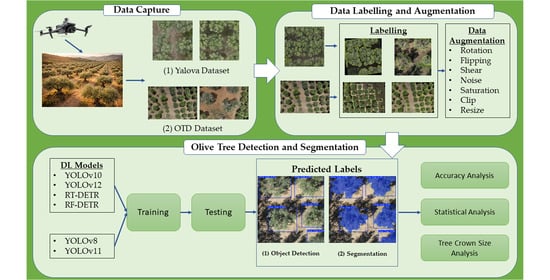
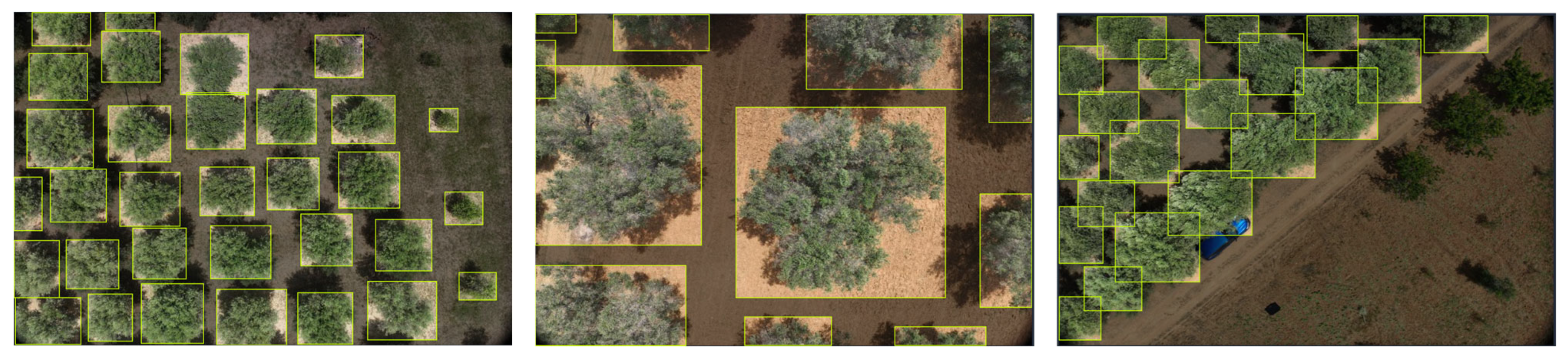
The Olive Tree Detection (OTD) dataset consists of publicly available aerial images of olive trees [41]. Aerial images captured by a DJI Mavic 3M drone (DJI Technology Co., Ltd., Shenzhen, China) were obtained in olive groves in Italy. Data augmentation was applied to the dataset using various geometric transformations. Both augmented and original datasets were used in the study. The original dataset includes 1338 training, 385 validation, and 202 test images. Operations such as rotation at various angles, center-cropping, and resizing were applied to create the augmented version of the dataset. These operations include horizontal and vertical flipping, which help the model learn invariance to mirrored object appearances, as well as affine rotations at fixed angles (±90° and 180°) to account for variations in image orientation. Moderate random rotations within the ranges of 15–20° and −20–−15° are implemented. The augmented dataset consists of 9513 training, 385 validation, and 202 test images. To use this dataset, created for object detection, in segmentation, the Segment Anything Model (SAM) was applied, and the boundaries of the trees within the building boxes were defined. Tree boundaries were checked via Roboflow platform, and irregularities were manually corrected. Deficiencies or distortions, particularly those appearing at the crown boundaries, have been edited out. The sample aerial images from the OTD dataset are presented in Figure 1.

3.1.2. Yalova Dataset

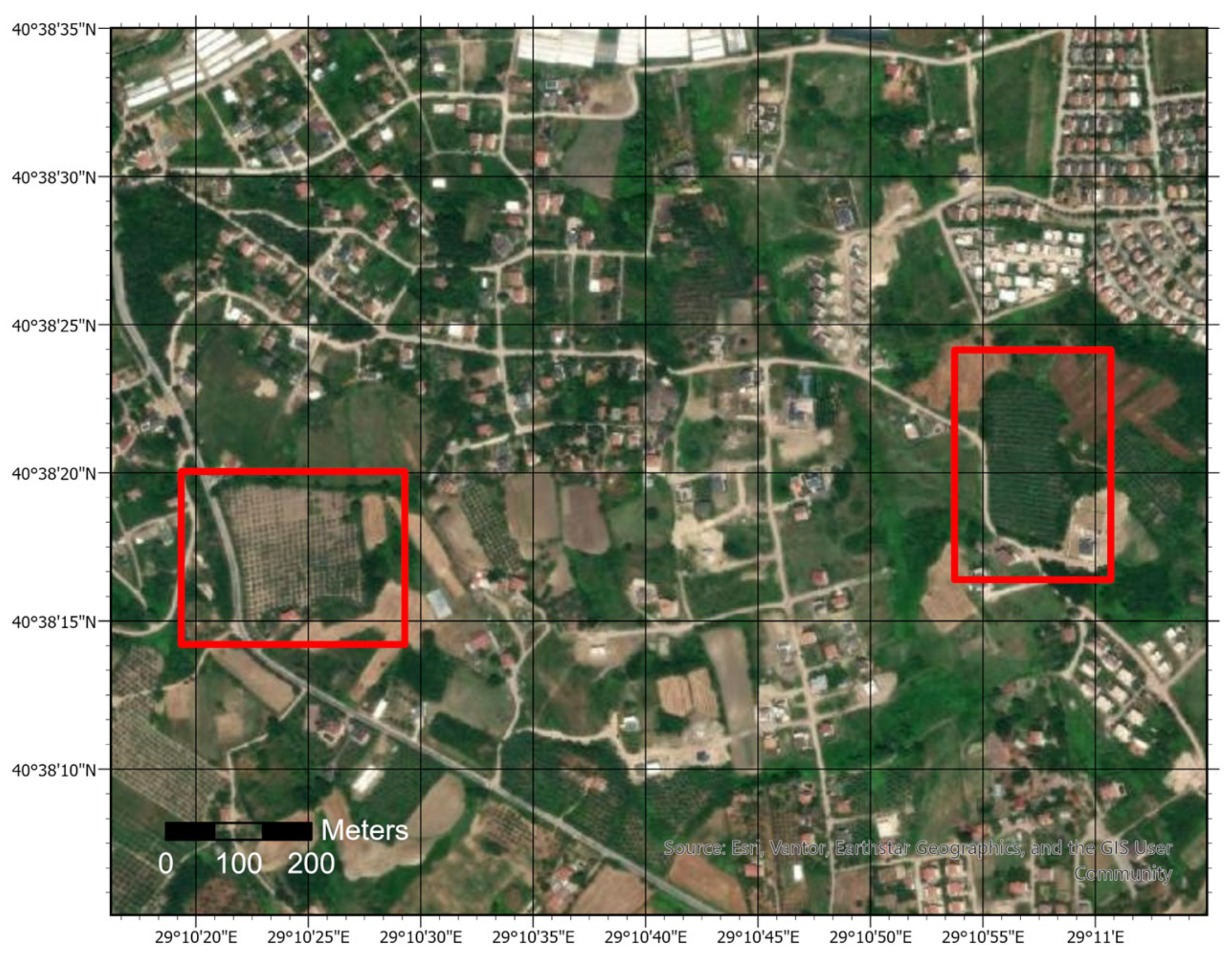
As part of this study, the dataset was obtained from a flight over a nine-acre olive grove located in the village of Akköy, Termal District of Yalova Province, in the Marmara Region of Türkiye (Figure 2). The aerial images were captured via a DJI Mavic 3M UAV. These aerial images were then photogrammetrically evaluated to produce an orthophoto.
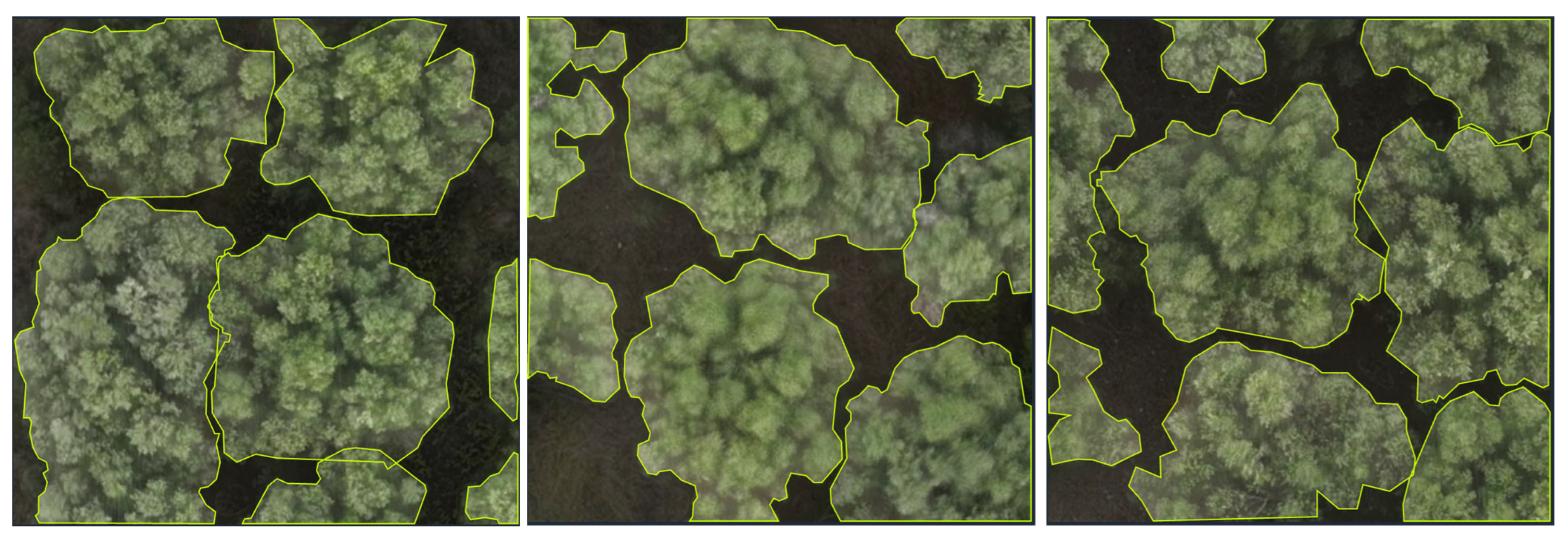
The resulting high-spatial-resolution orthophoto was divided into 640 × 640 pixel images and labeled. The amount of data was also increased by applying data augmentation methods such as flipping, shearing, saturation, and Gaussian noise. The applied augmentation techniques are horizontal/vertical flips, ±10° horizontal and ±10° vertical shears, saturation between −30% and +30%, and noise up to 0.7% of the pixels. The amount of data was increased by applying data augmentation methods, such as rotation, Gaussian noise, and reflection, to the dataset. The original dataset contains 250 training, 36 validation, and 69 test images. The augmented dataset has 750 training, 36 validation, and 69 test images. The sample labeled aerial images of the Yalova dataset are shown in Figure 3.
The DJI Mavic 3M’s lens features a FOV of 84°, an equivalent focal length of 24 mm, an aperture range of f/2.8 to f/11, and a focus range of 1 m to ∞. The UAV collected images at an altitude of 50 m above the take-off point. Flight parameters were determined to be 80% overlap and 70% sidelap. The ground sampling distance (GSD) was approximately 2 cm/pixel. The images were acquired from nadir angles. The dataset statistics are presented in Table 1.

3.2. You Only Look Once (YOLO)

YOLO is an open-source object detection algorithm that uses convolutional neural networks [42]. Known for its speed, it operates with a single-stage detection architecture and was introduced by Redmon et al. [43]. The YOLO framework treats object detection as a regression task, estimating the probability of objects within designated regions, known as bounding boxes. By eliminating the necessity for a secondary classification stage, it achieves a high level of accuracy more efficiently. YOLO evaluates the model on the image at various positions and sizes. Areas of the image with high scores are identified as objects. YOLO exhibits several parallels with R-CNN. Each grid cell identifies potential bounding boxes and assesses these boxes by leveraging convolutional features.
Early YOLO algorithms had a low accuracy and poor precision for small objects. However, later versions of YOLO achieved a higher accuracy in detecting small and complex objects [44]. Continuous improvements have enhanced both detection accuracy and speed, making the YOLO series effective for real-time applications with high precision, especially for small targets [45]. The YOLO series of algorithms is recognized for its strong performance and is widely adopted across various applications.
YOLO models utilize non-maximum suppression (NMS) during the post-processing phase, which contributes to the delay in inference [46]. In this study, the current YOLO versions, YOLOv8, YOLOv10, YOLOv11, and YOLOv12 variants, were used.
YOLOv8, developed by Ultralytics and launched on 10 January 2023, provides effective object detection and image classification [47]. Ultralytics has advanced YOLOv8, improving its capabilities and user experience over YOLOv5. Key features include a modified backbone network, an anchor-free detection head, and a new loss function, along with built-in support for image classification tasks. The YOLOv10 algorithm enhances model architecture and performance with dual assignments for NMS-free training, improving results and reducing inference latency. YOLOv11 improves YOLOv8 by introducing new architectural features and optimizing parameters for improved detection performance. It keeps the Spatial Pyramid Pooling—Fast (SPPF) block and adds a new Cross Stage Partial with Spatial Attention (C2PSA) block right after it. The YOLOv12 framework is an innovative attention-centric model that achieves processing speeds comparable to those of earlier CNN-based systems while effectively leveraging the benefits of attention mechanisms [48]. YOLOv8 features five versions, YOLOv8n (nano), YOLOv8s (small), YOLOv8m (medium), YOLOv8l (large), and YOLOv8x (extra-large), and supports tasks like object detection, segmentation, and classification [49]. YOLOv10 has six variants, n, s, m, b (balanced), l, and x, while YOLOv11 and YOLOv12 each have five variants: n, s, m, l, and x [50].

3.3. Real-Time DEtection TRansformer (RT-DETR)

RT-DETR represents the initial real-time, end-to-end object detection model based on transformers [51]. It is a comprehensive model designed for target detection. To address the real-time challenges of the DETR model, the RT-DETR variant has been introduced, demonstrating enhanced detection accuracy and speed compared to the latest YOLO models [52]. RT-DETR consists of a lightweight CNN backbone, an efficient hybrid encoder for feature fusion, and a transformer decoder with supplementary prediction heads, while employing an uncertainty-minimal query selection strategy to prioritize reliable object queries [53]. These queries are refined through successive decoder layers, with final predictions generated by MLP heads. Training optimization is guided by Hungarian matching to enforce one-to-one assignment. The goal is to bypass the non-maximum suppression (NMS) step in the traditional target detection workflow. The model’s mechanism is refined by RT-DETR, which improves both detection speed and efficiency [54].
RT-DETR surpasses the YOLO model in detection accuracy and reduces computational complexity. Its strong performance on benchmark datasets has sparked interest in real-world applications [55]. However, it struggles to detect small objects, handle occlusions, and deal with motion blur. Improvements to multi-level feature fusion and processing are needed to achieve better performances in complex scenarios.

3.4. Roboflow-DEtection Transformer (RF-DETR)

RF-DETR is an advanced method based on neural architecture search (NAS) that focuses on fine-tuning specialized end-to-end object detectors for specific datasets and hardware configurations [56]. RF-DETR offers a substantial enhancement over previous leading real-time techniques on the COCO and Roboflow100-VL datasets.
RF-DETR employs a pre-trained Vision Transformer (ViT) backbone to derive multiscale features from the input image. Windowed and non-windowed attention blocks are interleaved to balance accuracy and latency. Both the deformable cross-attention layer and the segmentation head bilinearly interpolate the projector’s output to maintain consistent feature organization. It works in real-time applications such as surveillance and autonomous driving. RF-DETR uses deformable attention and a DINOv2 backbone to achieve efficient spatial focus and visual understanding [57]. It offers faster convergence and higher accuracy than DETR, Faster R-CNN, and YOLO, while removing the need for non-maximum suppression (NMS). The architecture is designed for high-speed edge deployment and adaptability across domains and is available in two configurations: RF-DETR-Base (29 million parameters) and RF-DETR-Large (128 million parameters) [58]. However, it faces challenges with its large size, small object detection, and domain-specific fine-tuning in low-data scenarios.

3.5. Experimental Details

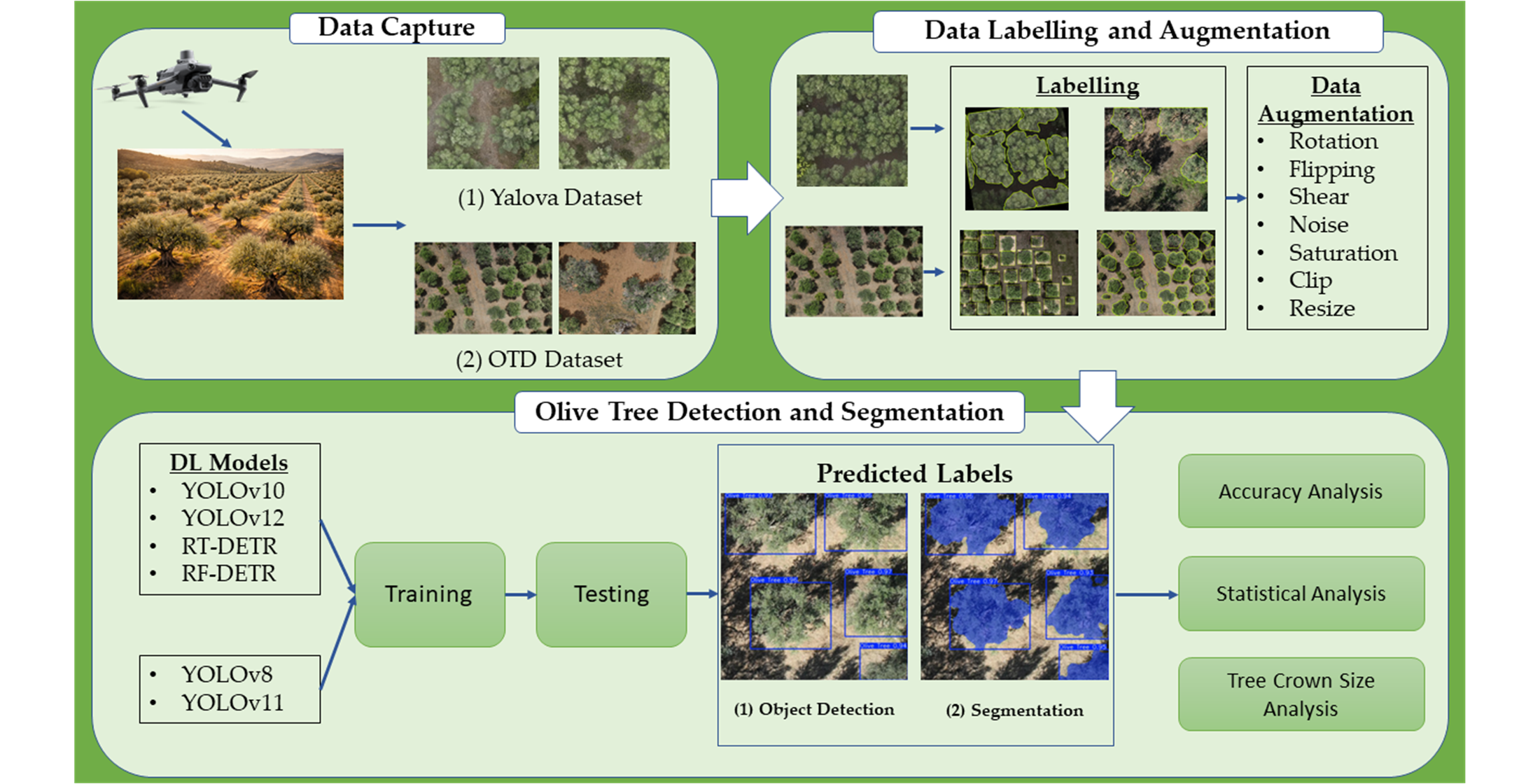
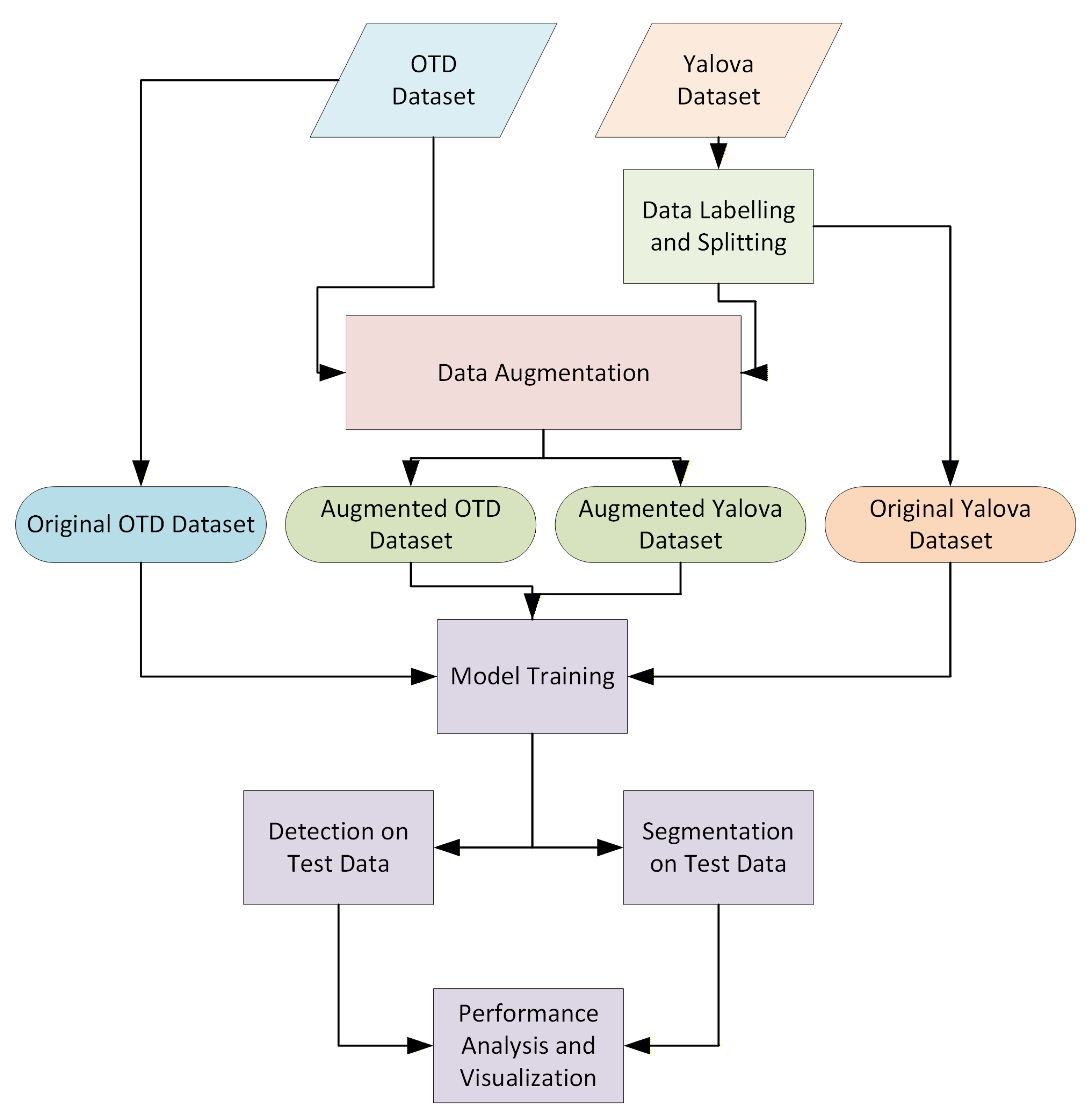
This study comparatively analyzed current versions of YOLO and two transformer-based object detection algorithms for the automatic detection and segmentation of olive trees from UAV imagery. A new Yalova dataset of UAV imagery is also presented. The selected YOLO versions are YOLOv8 (with five variants), YOLOv10 (with six variants), YOLOv11 (with five variants), and YOLOv12 (with five variants). The transformer-based object detection algorithms are Real-Time Detection Transformer (RT-DETR) and Roboflow-DEtection Transformer (RF-DETR). Deep learning algorithms have high data collection and labeling costs. Accurate detection requires a large amount of training data. To overcome this problem, data augmentation methods such as rotation, scaling, brightness variation, and noise addition generate different variations in the training data. In this study, the Yalova dataset, which includes UAV imagery, was created along with the open-source Olive Tree Detection (OTD) dataset. Data-augmented and no-augmented versions of both datasets were used. This enabled us to investigate the impact of data augmentation on various detection algorithms in olive tree detection. For training parameters, the epoch number was selected as 100, and the learning rate was 0.001 for all algorithms. The Adam optimizer was chosen to adjust training parameters. It usually reaches optimum levels quickly, which is why it is preferred for problems such as object detection. Batch sizes were differentiated based on hardware specifications. For this, 16 batch sizes were chosen for nano, small, and medium models, while 8 batch sizes were preferred for large and xlarge models. For the transformer models, the batch size was set at 4. When testing was applied, the batch size was set to 4 for all models. For the experiments, an i9-13900K, 3.20 GHz processor (Intel, Santa Clara, CA, USA), GTX 4080 graphics card (Palit Microsystems Ltd, Taipei, Taiwan), and 64 GB RAM (Kingston Technology Corporation, Fountain Valley, CA, USA) hardware were used. All experiments were done using Jupyter Notebook (version 7.2.2) using the Python (version 3.9) programming language. The Ultralytics library was used for YOLO and transformer-based detection models. Figure 4 provides an overview of the workflow followed throughout the study.
Precision, recall, mean average precision (mAP), and mAP50-95 metrics were used to evaluate the study results. Precision indicates how many of the model’s positive predictions are actually correct. Recall indicates how many of the actual labels are predicted by the model. mAP is the average of the AP values calculated for all classes. mAP50 is the mAP value calculated when the IoU threshold is 0.50. mAP50-95 is known as the COCO criterion. AP is calculated for every 0.05 increment between the IoU thresholds.
Precision   = T P T P + F P  
Recall   = T P T P + F N
F 1 s c o r e = 2 × P r e c i s i o n × R e c a l l P r e c i s i o n + R e c a l l
m A P = 1 N i = 1 N   A P i ;   A P = 0 1   P ( R ) d R
m A P 50 95 = 1 10 t = 0 9   A P ( 0.50 + 0.05 t )
A true positive (TP) refers to the quantity of instances that share identical labels in both the predicted results and the ground truth. A false positive (FP) denotes the quantity of instances projected as positive when their true category is negative. A false negative (FN) denotes the quantity of instances predicted as negative when their true category is positive [59].

4. Results

4.1. Olive Tree Detection in OTD Dataset

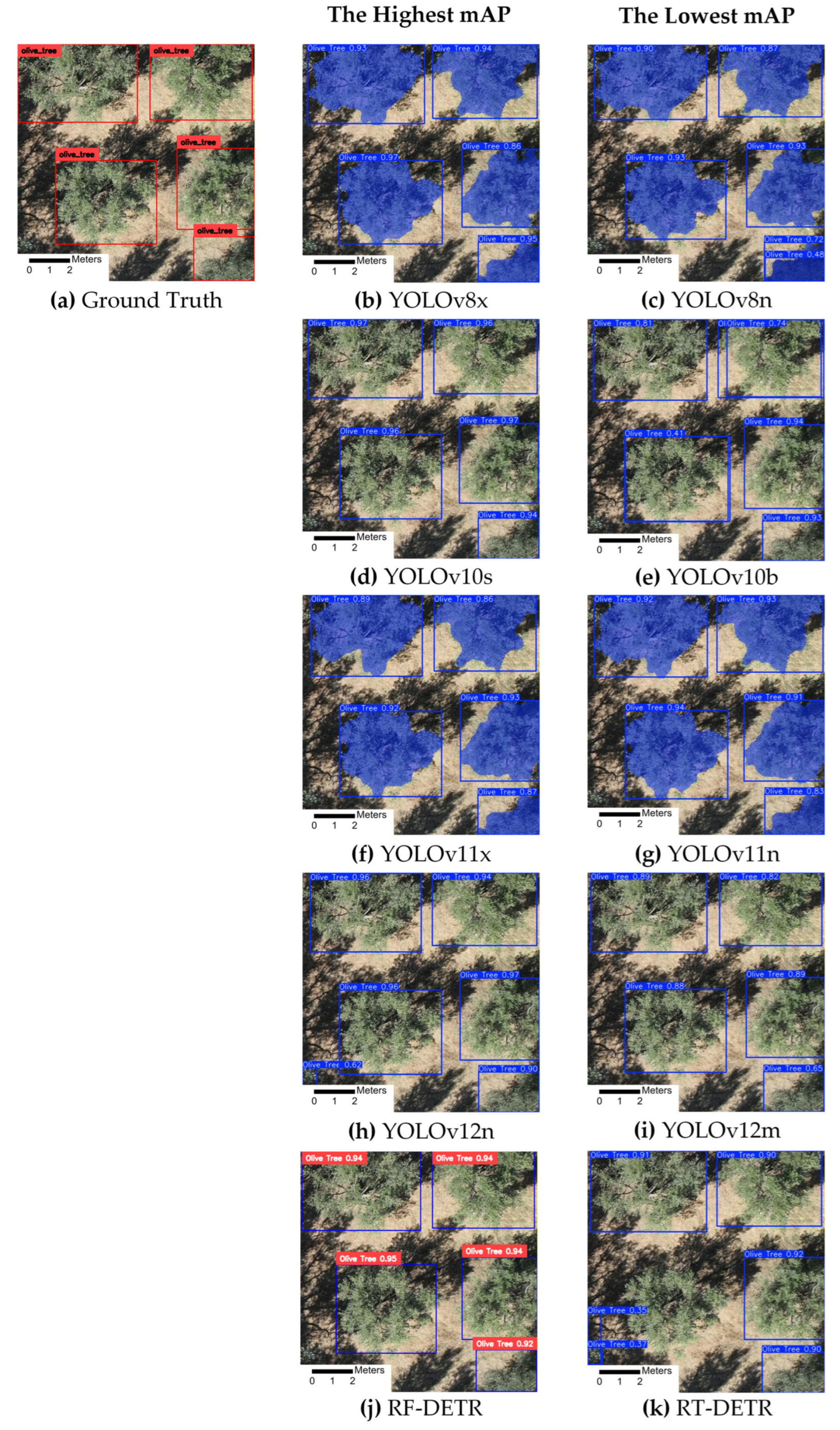
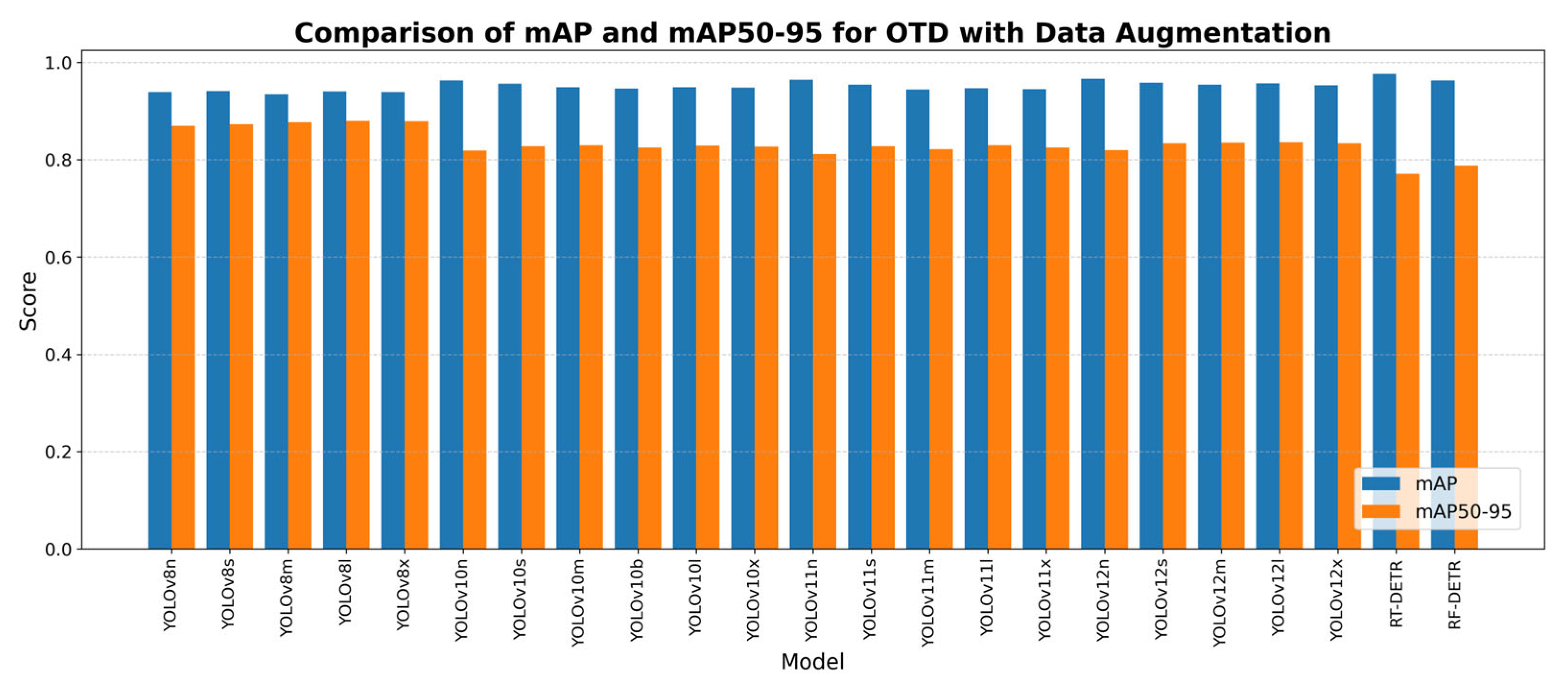
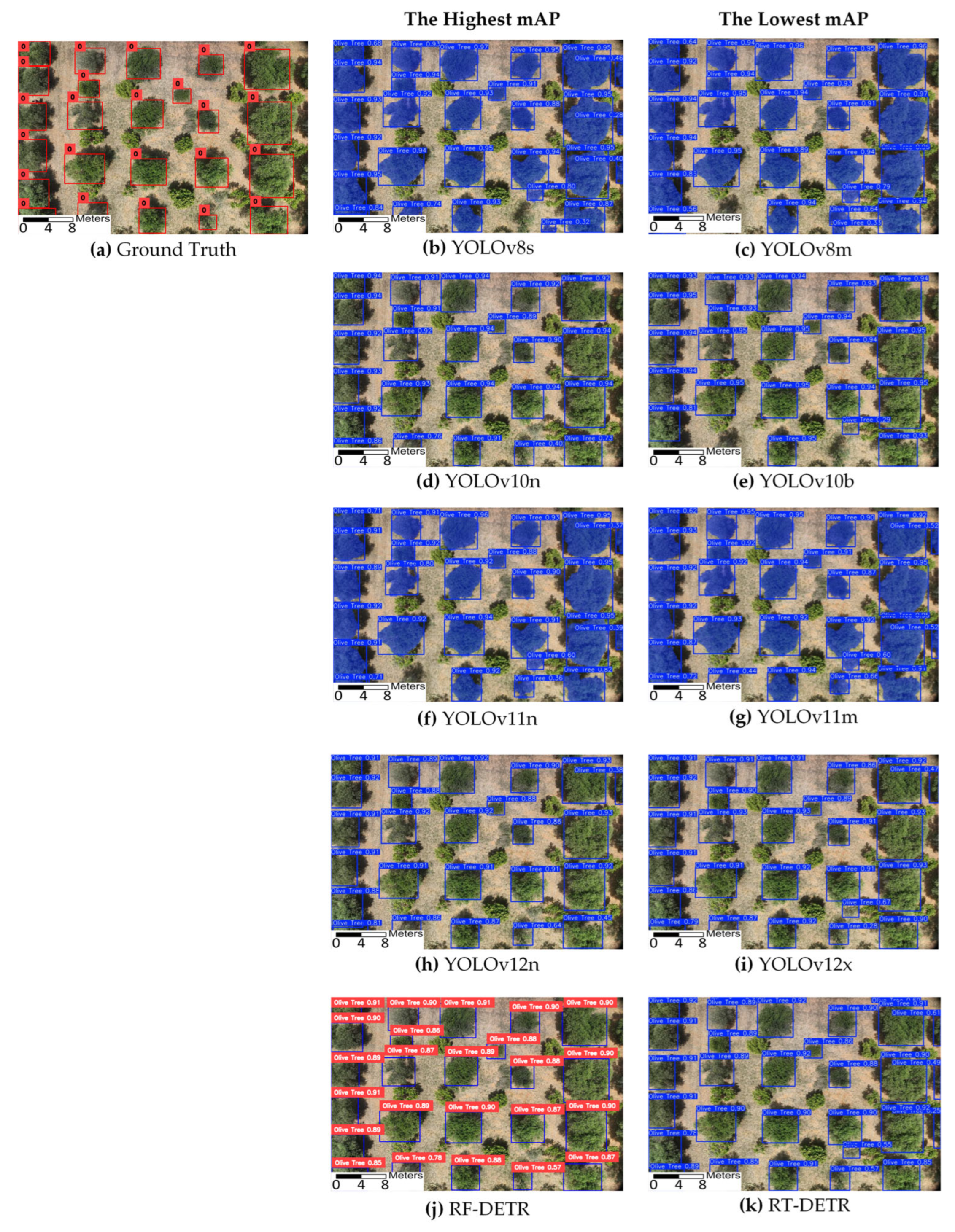
This study compared the performance of 23 state-of-the-art object detectors, including YOLOv8, YOLOv10, YOLOv11, YOLOv12, and Detection Transformer models. It is essential to analyze the speed and efficiency of the latest iterations of constantly evolving YOLO models for tree identification. Table 2 shows the performance of 21 pre-trained YOLO models and two DETR models across different metrics for olive trees on the OTD dataset. YOLOv12x produced a precision of 0.967, RT-DETR had a recall of 0.915 and mAP of 0.976, and YOLOv12l achieved a mAP50-95 of 0.836. Although YOLOv10n is a nano model, it stands out with its high accuracy. In RT-DETR, although mAP is high, the mAP50-95 value drops to 0.771 (Figure 5). This model roughly captures the object, but cannot draw the boundaries that well. While RF-DETR similarly has a value of 0.963 mAP, it shows a dramatic decrease in mAP50-95. Additionally, RT-DETR and RF-DETR detected olive trees with visible parts at the image edges more successfully than YOLO. YOLOv12x reduces false positives the most. YOLOv12 models are generally more balanced in terms of both accuracy and precision. The model predictions are presented in Figure 6.
Model inference performance and dimensions were evaluated using frames per second (FPS), floating-point operations (FLOPs), and the number of learnable parameters. YOLOv10n demonstrated by far the highest operating speed, reaching 769.23 FPS with 6.5 GFLOPs and only 2.27 million parameters. Similarly, YOLOv11n and YOLOv12n stand out as strong candidates for real-time applications, providing high accuracy at low computational cost with speeds of 588.23 FPS and 307.37 FPS, respectively. YOLOv8x (71.7 M parameters, 327.9 GFLOPs) only produces 60.98 FPS, while YOLOv12x (59.0 M parameters, 198.5 GFLOPs) has 97.09 FPS. When transformer-based models were examined, RT-DETR (103.4 GFLOPs, 32.0 M parameters) produced 106.39 FPS, which is in the YOLOv8l–m range. RF-DETR, despite having a similar number of parameters (31.9 M), had a lower computational cost (76.3 GFLOPs) and was more limited in terms of speed, with 66.21 FPS.
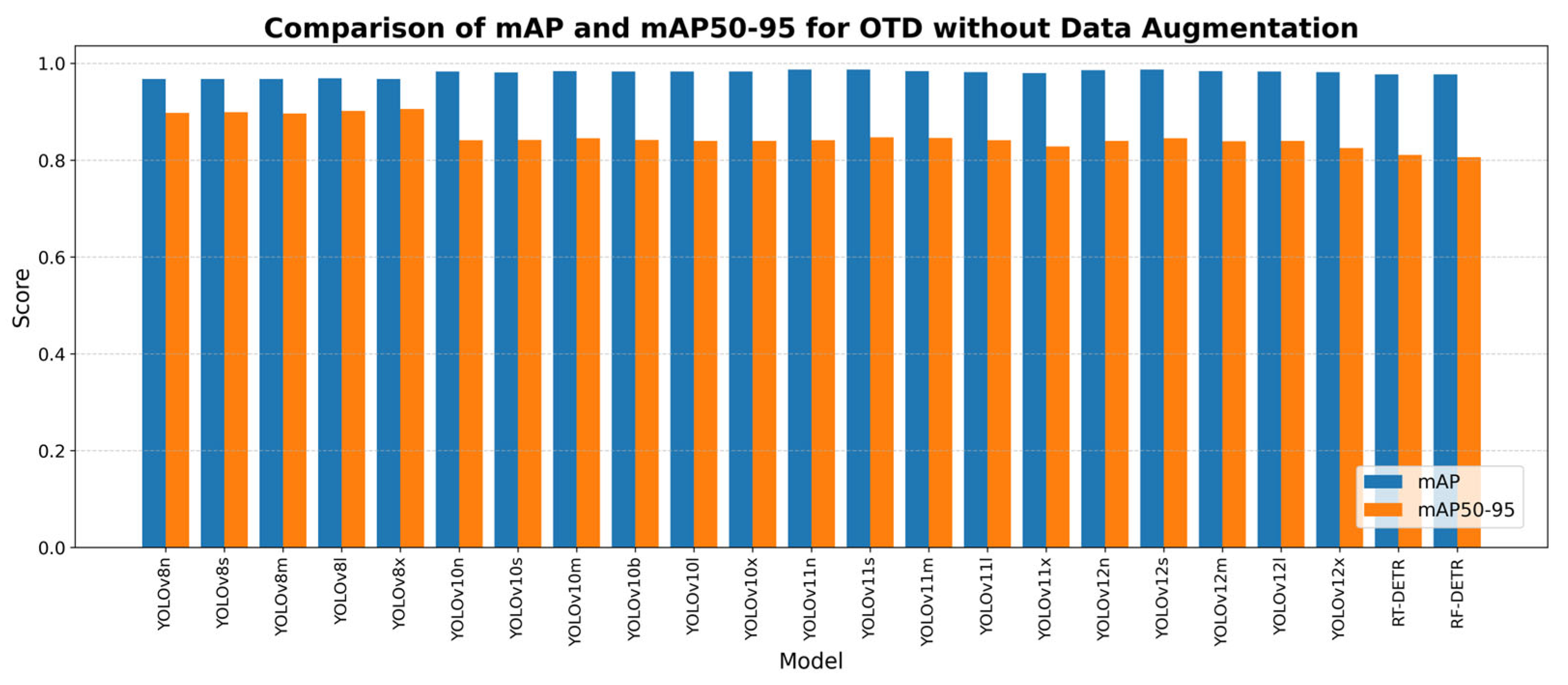
All models generally achieved a very high accuracy (precision > 0.93) and recall (recall > 0.93 except RF-DETR) values (Figure 7). Overall, all models have achieved a very high accuracy, with mAP values concentrated in the 0.968–0.987 range. The YOLOv11 variants achieved the best results, yielding high-accuracy detections even without data augmentation on the OTD dataset (Table 3). In the YOLOv10 models, especially YOLOv10m, the best-balanced results were achieved with 0.984 mAP and 0.845 mAP50-95. The highest performance was observed in the YOLOv11 series; while the YOLOv11n model stood out with 0.960 precision and 0.987 mAP, the YOLOv11s model achieved the highest values with 0.965 recall and 0.847 mAP50-95. In the YOLOv12 series, although recall values are quite high, a slight decrease in mAP50-95 is observed, indicating that the model is strong at detecting objects but slightly weaker at boundary detection. Although transformer-based RT-DETR and RF-DETR models achieved competitive results with mAP = 0.977, their mAP50-95 values of 0.811 and 0.806, respectively, indicate that they may be limited in scenarios requiring high-precision positioning (Figure 8).
In terms of computational efficiency, the YOLOv10n (6.5 GFLOPs, 2.27 M parameters) and YOLOv11n (6.3 GFLOPs, 2.58 M parameters) models stand out as the fastest solutions by far, with values of 769.23 FPS and 588.23 FPS, respectively. It has been observed that FPS values decrease significantly as the number of parameters and GFLOPs increase. YOLOv8x (71.7 M parameters, 343.7 GFLOPs) produces only 62.5 FPS, while YOLOv12x (59.0 M parameters, 198.5 GFLOPs) remains at 97.09 FPS. Transformer-based RT-DETR (103.4 GFLOPs, 106.39 FPS) and RF-DETR (76.3 GFLOPs, 66.21 FPS) models have lower speeds compared to YOLO-based approaches. The prediction results for the models on OTD without data augmentation are presented in Figure 8.

4.2. Segmentation Results in OTD Dataset

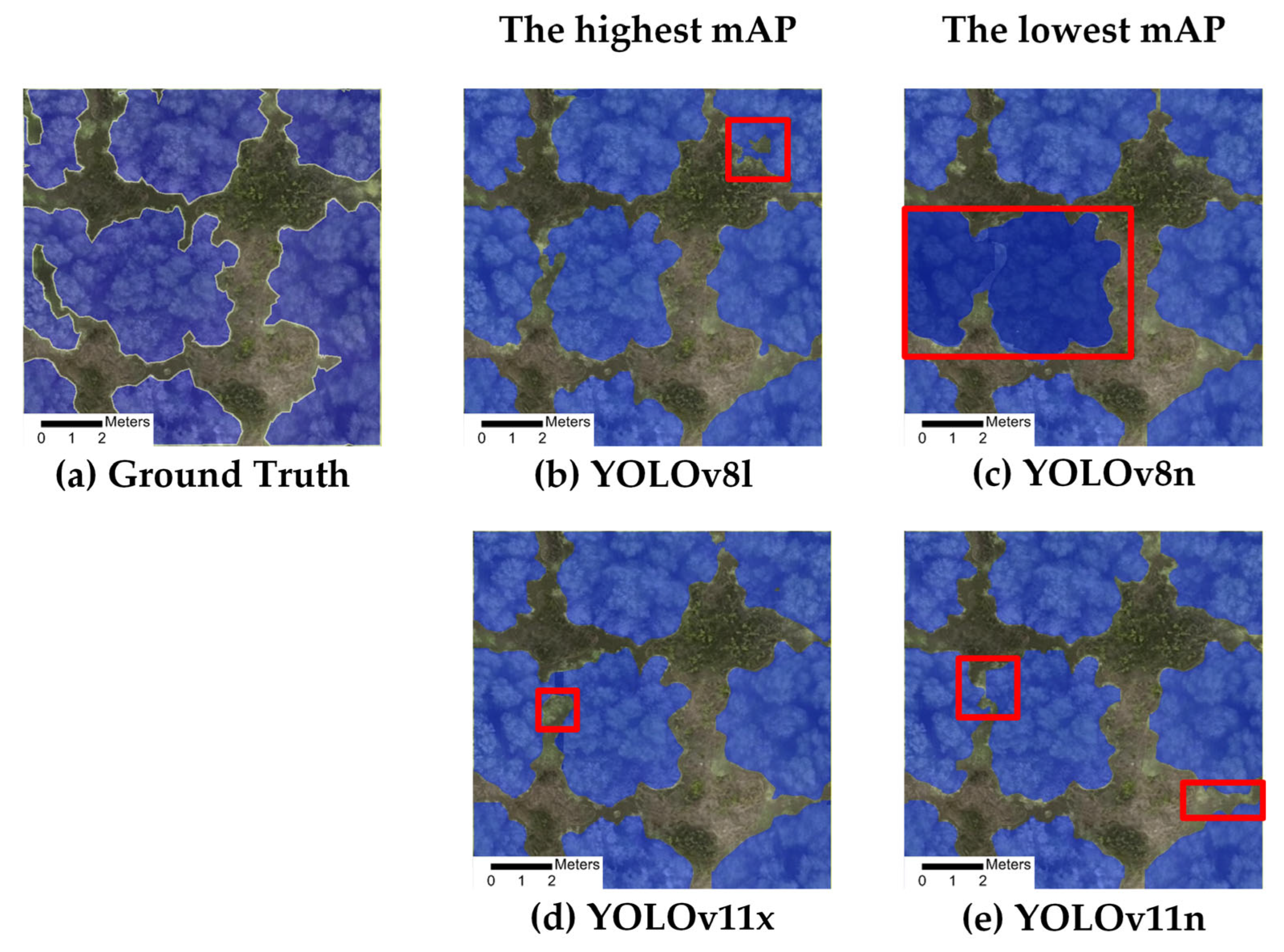
In this study, a segmentation task was added alongside the detection task. This task is beneficial for calculating tree canopy areas. Since published weights for YOLOv8 and YOLOv11 exist for the segmentation task, these two methods were analyzed. There is no significant difference between the methods in the mAP metric in the OTD dataset. Furthermore, applying augmentation did not improve the accuracy of segmentation. Without augmentation, YOLOv8n achieved 0.956 mAP, while with augmentation, YOLOv11l reached 0.924 mAP. In all methods, precision values are significantly higher than recall values. The segmentation results for the OTD dataset are presented in Table 4. The segmentation predictions for the OTD dataset are illustrated in Figure 9 and Figure 10.
The YOLOv8 and YOLOv11 models perform tree detection as well as object boundary identification through segmentation. In this study, the segmentation performance of the algorithms was compared with the traditional object-based image analysis (OBIA) approach. OBIA is used to produce image objects suitable for classifications in terms of spatial properties and context [60]. Within the scope of OBIA, test images from both datasets were segmented using the Simple Linear Iterative Clustering (SLIC) algorithm. The SLIC superpixel algorithm is a crosstalk-based algorithm that uses the positional information of a pixel located at the x,y position on an image, along with its value in the CIELab space [61]. The generated segments were labeled as olive tree and other for classification. Training and test datasets were created and the Random Forest [62] algorithm was used for classification. In the OTD dataset, the Random Forest parameters were defined as n_estimators = 800, random_state = 64, and min_samples_split = 2. The SLIC parameters were applied as n_segment = 600 and compactness = 12.
In the OTD test dataset, deep learning-based YOLO models demonstrated significantly superior performances compared to the traditional OBIA approach. According to Table A1, the OBIA approach (F1-score = 0.869) produced an F1-score approximately 6–7% lower compared to deep learning models. Both Precision (0.880) and Recall (0.859) values were significantly lower compared to YOLO models.

4.3. Olive Tree Detection in Yalova Dataset

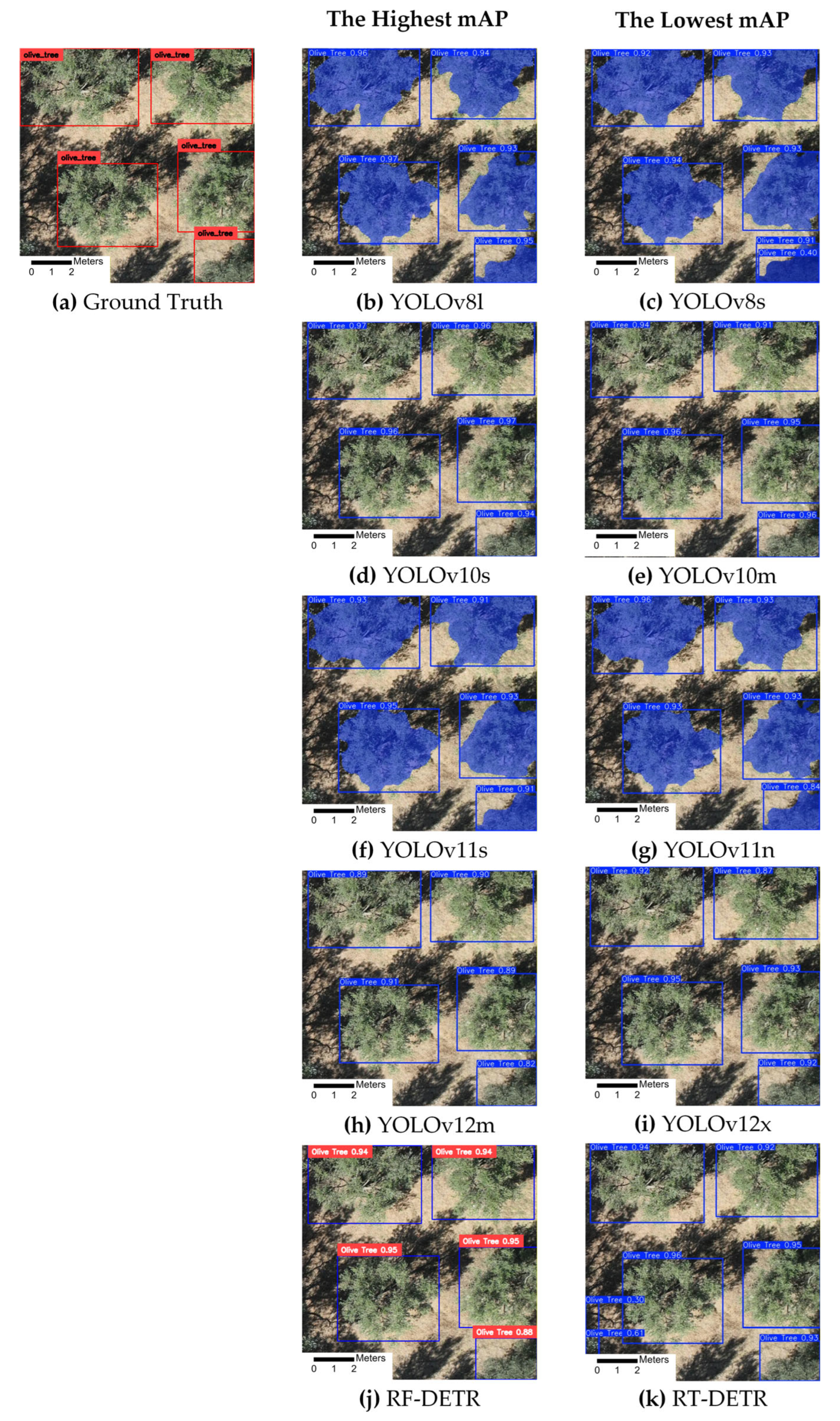
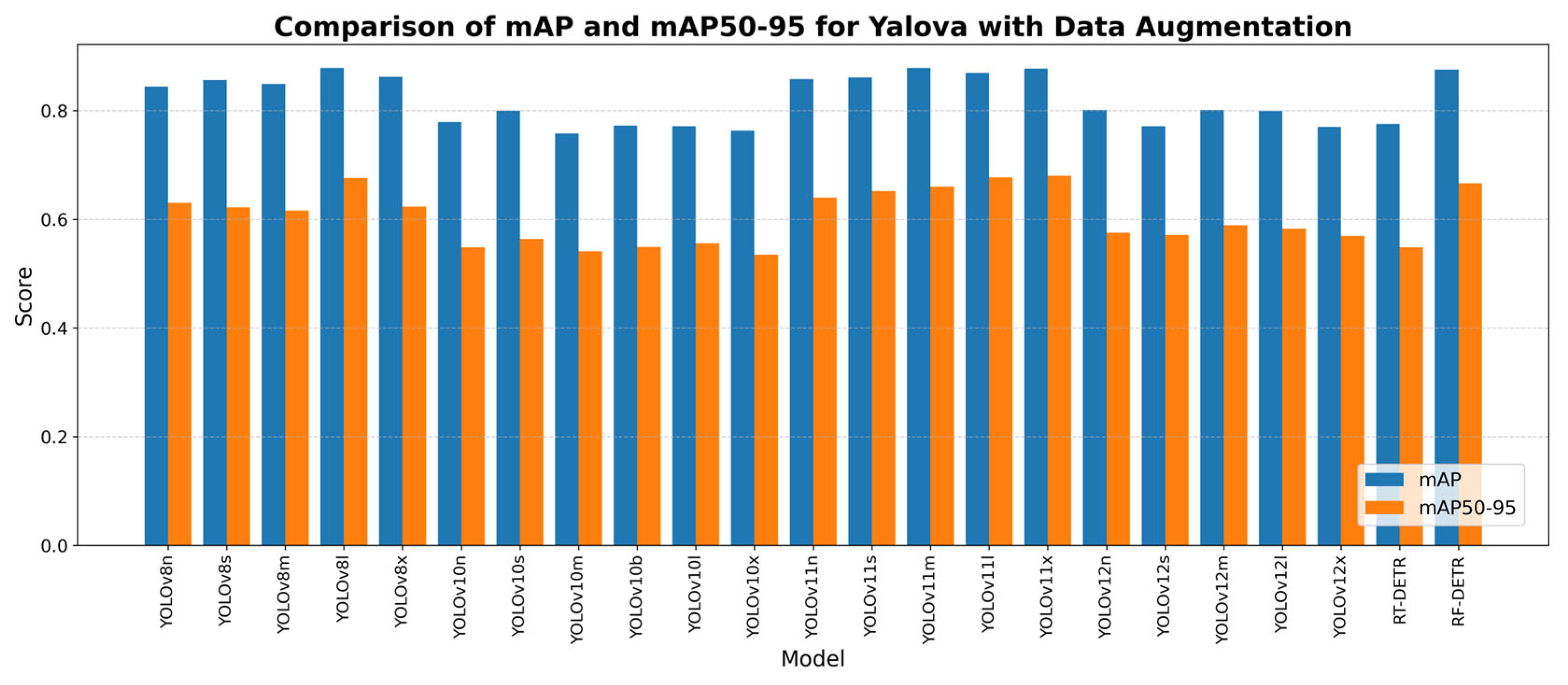
The Yalova dataset contains fewer images than the OTD dataset. In the Yalova dataset, the mAP values of all models remained in the range of 0.758–0.878. According to Table 5, the highest precision values are achieved by YOLOv11n (0.864) and YOLOv8n (0.858). The highest overall detection performance was achieved by YOLOv8l with 0.878 mAP, YOLOv11m with 0.878 mAP, and YOLOv11x with 0.877 mAP. Notably, the YOLOv11 family demonstrated a consistent performance with balanced precision–recall values across all variants. YOLOv11x achieved the best positioning accuracy in the Yalova dataset, reaching the highest mAP50-95 (0.680). Among the transformer-based models, RT-DETR lagged behind YOLOv11 and YOLOv8l/x with 0.775 mAP and 0.548 mAP50-95, while the RF-DETR model produced high mAP (0.875) and mAP50-95 (0.666) values (Figure 11).
When computing efficiency was examined, YOLOv10n offered the highest speeds with a value of 357.14 FPS, and YOLOv11n offered the highest speeds with a value of 294.12 FPS. As the model scale increased, sharp drops in FPS values were observed. YOLOv8x only had 35.67 FPS, while YOLOv11x remained at 46.73 FPS. Figure 12 presents representative model predictions for the Yalova dataset with data augmentation.
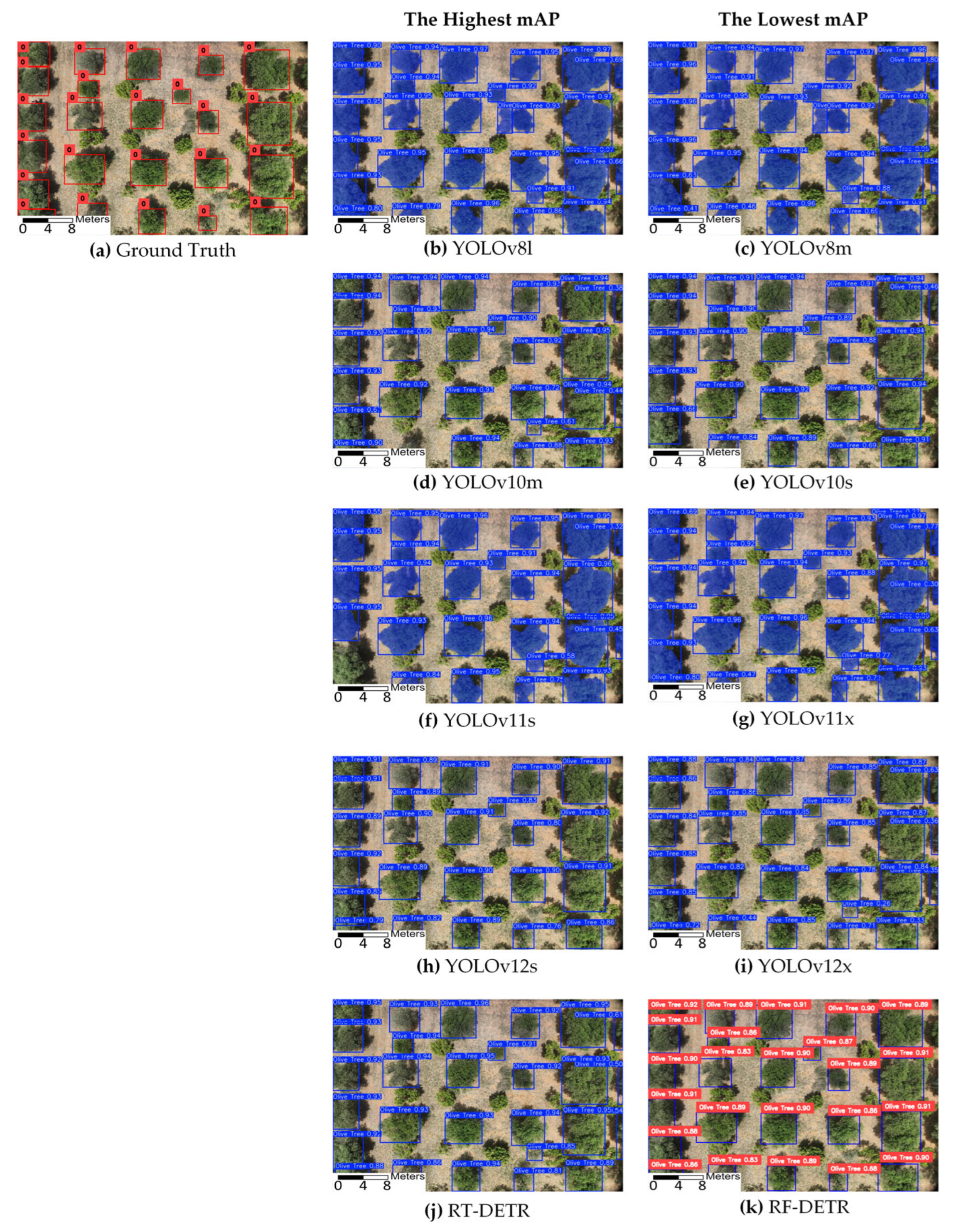
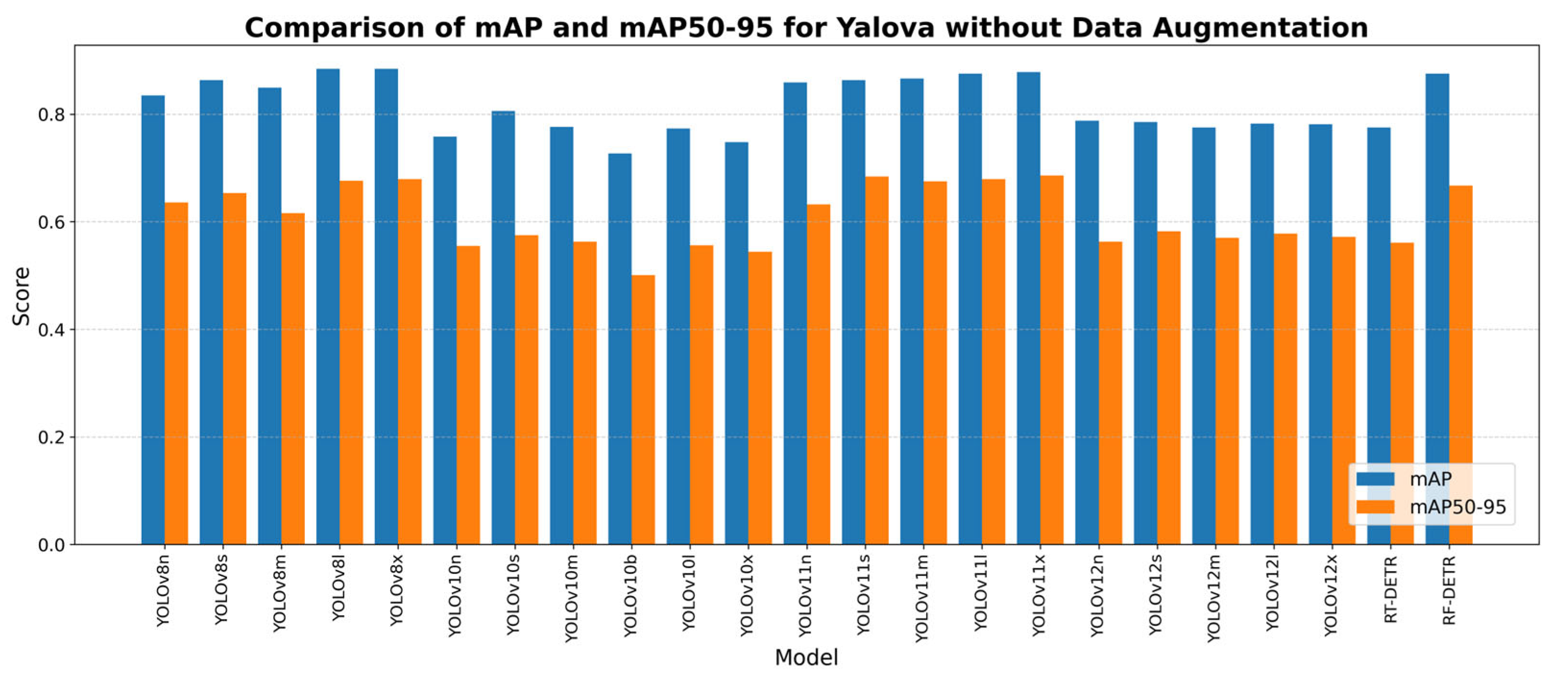
Table 6 presents a comprehensive comparison of object detection performances on the Yalova dataset using various YOLOv8, YOLOv10, YOLOv11, YOLOv12, RT-DETR, and RF-DETR models without applying data augmentation techniques. Metrics cluster around mAP ≈ 0.727–0.884 and mAP50-95 ≈ 0.501–0.686 (Figure 13). The relatively lower mAP50-95 indicates that localization tightness is the main challenge without augmentation. Particularly, the highest mAP was obtained by the YOLOv8l and YOLOv8x methods. The YOLOv10 series showed a more limited performance on the Yalova dataset without data augmentation, with mAP values remaining between 0.727 and 0.806. The YOLOv12 series, with 0.770–0.801 mAP values, is more successful than the YOLOv10 but has a lower performance than the YOLOv11. When transformer-based approaches were examined, the RT-DETR model exhibited a moderate performance with values of 0.775 mAP and 0.561 mAP50-95, while the RF-DETR model achieved a competitive result with the YOLOv11l and YOLOv8l/x models with values of 0.875 mAP and 0.667 mAP50-95. The predictions are shown in Figure 14.
In terms of computational efficiency, the YOLOv10n and YOLOv11n models stand out. The YOLOv10n produced 312.50 FPS with only 6.5 GFLOPs and 2.27 million parameters, but its mAP and mAP50-95 values were relatively low at 0.758 and 0.555, respectively.

4.4. Segmentation Results in the Yalova Dataset

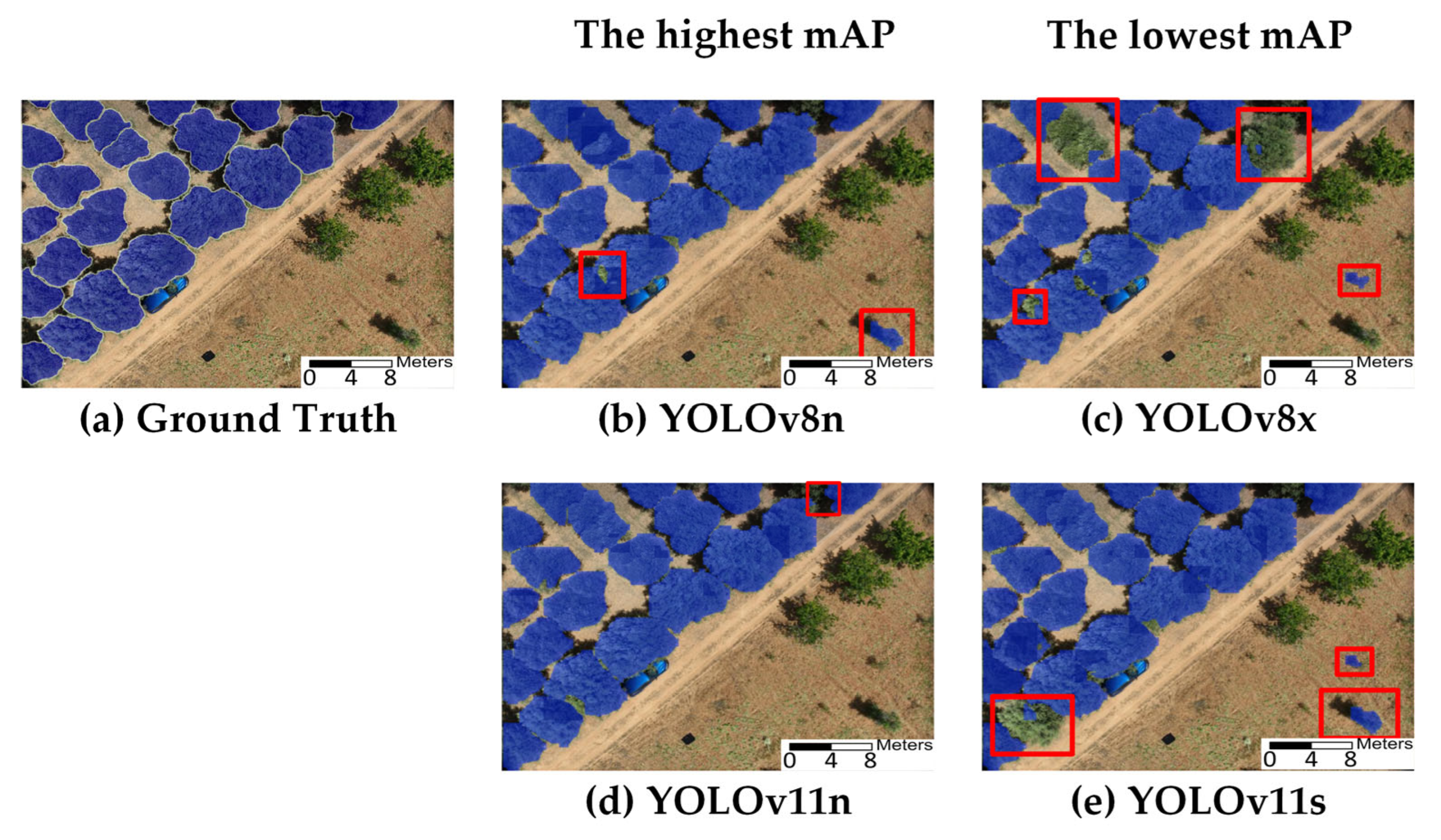
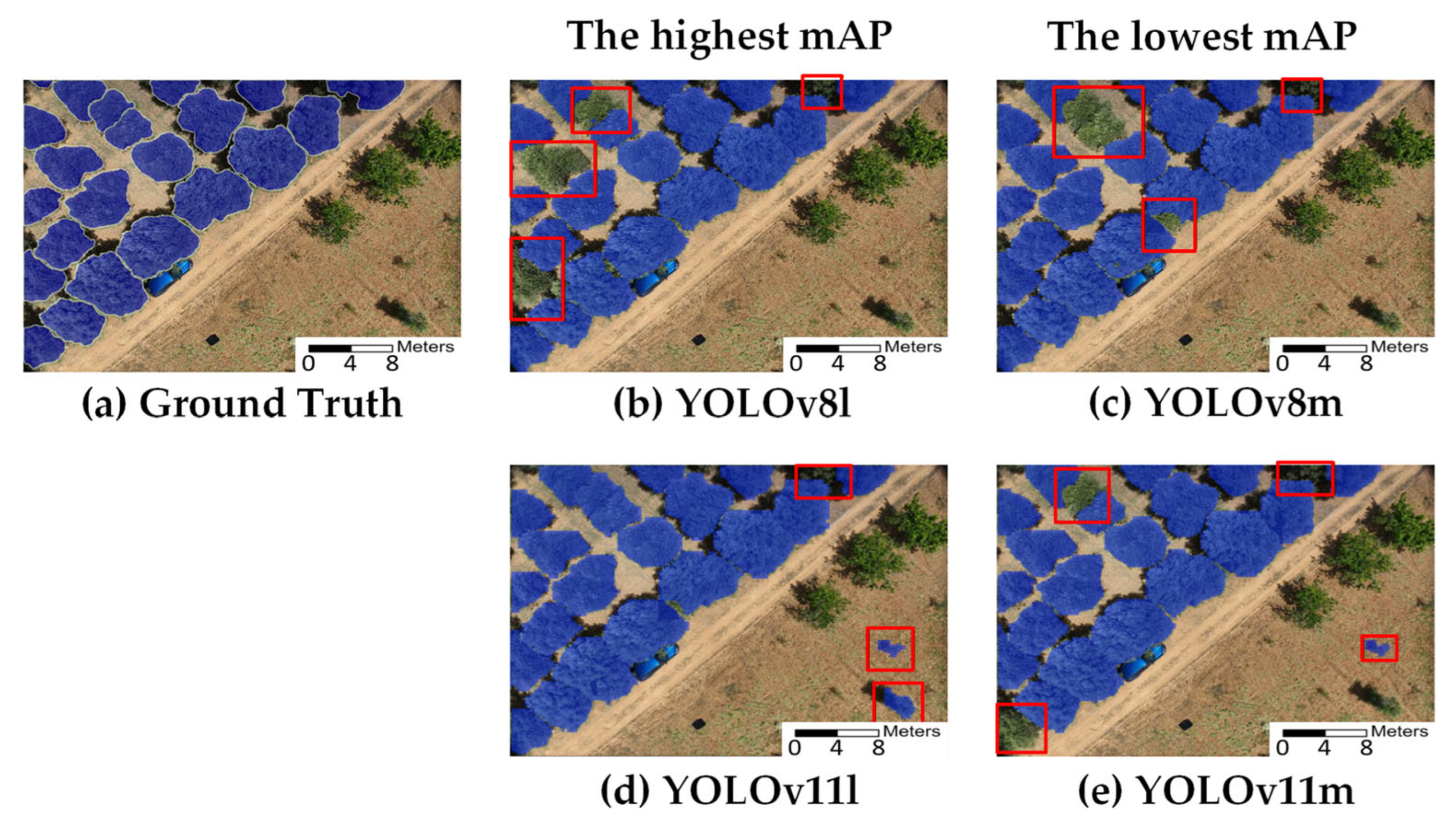
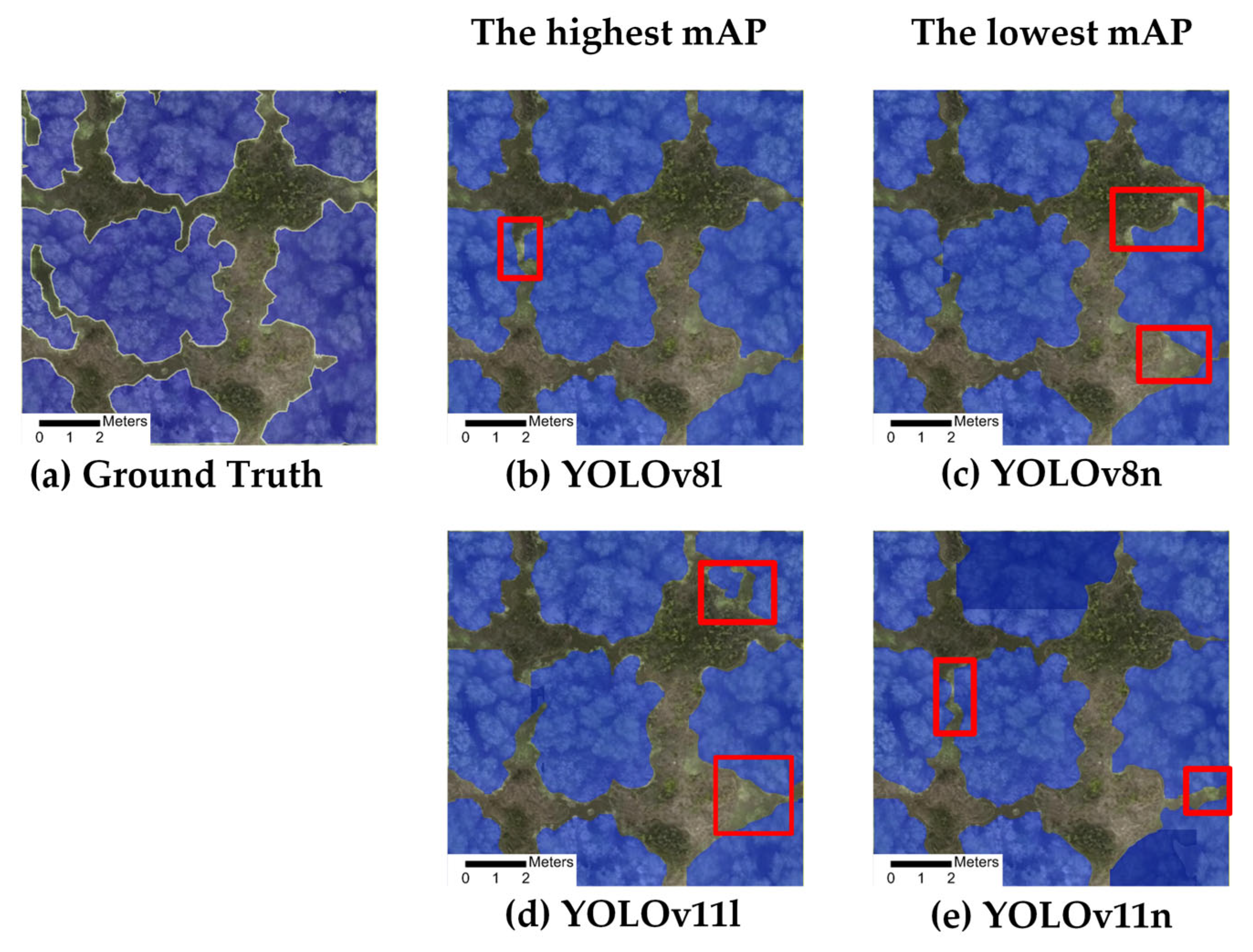
Table 7 compares the performance results obtained before and after data augmentation for different model scales of the YOLOv8 and YOLOv11 architectures on the Yalova dataset. The augmentation effect in the Yalova dataset differs from that in the OTD dataset. Data augmentation in the Yalova dataset improved the predictive performance of some models. It did not provide a consistent improvement in mAP and especially mAP50-95 metrics, and in most cases led to a performance decrease. The precision metric increases after augmentation, especially in nano, small, and medium models. It was determined that the augmentation effect was relatively limited in YOLOv11 architectures, yielding only a marginal performance increase in the YOLOv11m model. The segmentation results are illustrated in Figure 15 and Figure 16.
In the Yalova dataset, the Random Forest parameters were defined as n_estimators = 500, random_state = 42, and min_samples_split = 2. The SLIC parameters were applied as n_segment = 600 and compactness = 10. The OBIA approach demonstrated a performance quite close to deep learning models in the Yalova dataset. The YOLOv8l model offers approximately a 2% F1-score advantage over the OBIA. A comparison of YOLO and OBIA in the Yalova dataset is presented in Table A2.

4.5. Tree Crown Size Analysis

Beyond checking the tree detection performance of the algorithms, their accuracy in estimating the crown area of trees at the square meter level was also analyzed. Root mean square error (RMSE) analysis aims to measure whether algorithms truly make a meaningful contribution to real-world problems by revealing how accurately the model represents spatial quantities. The crown areas of all trees in the OTD and Yalova test datasets that could be detected by the algorithms were calculated and compared with ground truth. In both datasets, models that used augmentation had significantly lower RMSE values. When the predictions of the YOLOv8n model in the OTD dataset are examined, it is seen that the RMSE is obtained as 0.478 m2 when augmentation is applied, while it almost doubles to 0.915 m2 RMSE when no augmentation is applied. For the YOLOv11x model, data augmentation improves the crown area error by four. In the Yalova dataset, all models predict the crown area with a lower RMSE when augmentation is applied. YOLOv11 models produced lower RMSE values than YOLOv8 models at all scales. For YOLOv8 and YOLOv11, as the model size increases (n → s → m → l → x), the RMSE decreases regularly. Examining the results in Table 8, the YOLOv11x model produces the most successful crown area predictions when augmentation is applied among all models.

5. Discussion

5.1. Evaluation of Tree Detection and Segmentation Performance

While YOLO models excel on the Yalova dataset, transformer models achieve competitive performances on the larger OTD dataset. RT-DETR and RF-DETR models generally require a sufficiently large and diverse dataset to demonstrate their full potential. Because the YOLOv10 model is optimized for speed and lightweight deployment rather than feature richness, it has limitations with complex or variable datasets, such as Yalova and OTD, which include objects of different sizes and backgrounds. The modest improvement in YOLOv10 metrics after data augmentation suggests that image diversity can reduce overfitting, but the model’s structural constraints limit its ability to fully exploit the enriched features. The mAP value (0.976) obtained by RT-DETR indicates that transformer-based architectures’ abilities to model global context offers a decisive advantage on the OTD dataset (Table 2). In the OTD dataset with data augmentation, the YOLOv12 series and the YOLOv11 family stand out for their overall balance of performance and efficiency. At the same time, RT-DETR achieves the highest mAP but is less accurate than YOLO-based models in localization. RT-DETR and RF-DETR, as transformer-based models, are effective at modeling global context, which increases overall mAP by accurately detecting object presence. Transformer backbones generally operate on lower-resolution feature representations than CNN-based feature pyramids, which limit boundary accuracy in images containing detailed, dense objects, such as drone footage. Transformer models can lag behind CNNs in localization accuracy [63].
Without data augmentation, all YOLO models achieved a slightly higher mAP and mAP50-95 values with the OTD dataset. This indicates that the OTD dataset is highly representative and provides a sufficiently heterogeneous visual distribution. Relative to the no-augmentation results, augmentation generally improves mAP and modestly lifts or maintains mAP50-95. This means that data augmentation improves detection coverage and reduces overfitting for all models. YOLOv8 variations can learn object boundaries more reliably due to their deeper layer structure. YOLOv11n/s demonstrated the highest performance results on the OTD dataset. It is concluded that nano and small variants of the YOLOv11 architecture are particularly suitable for aerial or geospatial imagery enriched with synthetic variability. Transformer-based RT-DETR maintained a competitive precision and recall but showed limited sensitivity to data augmentation in terms of mAP. Overall, data augmentation contributed to a measurable enhancement of performance consistency, especially for convolutional-based architectures. Data augmentation significantly improved performance consistency, particularly in convolutional architectures in the OTD dataset.
The findings show that (Table 4), unlike object detection, segmentation performance on the OTD dataset is less sensitive to data augmentation and can already benefit from sufficient spatial variability in the original training data. In all models and experimental settings, sensitivity consistently exceeds recall. This indicates that the segmentation models produce fewer false positives, although they occasionally miss parts of the tree crowns. This behavior is particularly important in dense orchard scenes where tree crowns can overlap and exhibit complex boundary structures. The high sensitivity also demonstrates that the predicted segmentation masks are spatially accurate, which is crucial for reliable tree crown area estimation. Although small boundary errors remain in dense forest areas, overall qualitative results confirm the quantitative findings, and higher mAP values correspond to more complete and spatially consistent tree cover segmentation.
The results in Table 5 and Table 6 clearly show that the Yalova dataset presents a more challenging detection scenario compared to OTD. Tree complexity and shade challenges are particularly prominent in this dataset. Nevertheless, the models generally overcame these challenges. Significant performance degradation was observed at mAP50-95 values. This indicates that factors such as more irregular tree crowns, overlap, shadow effects, and background complexity make localization more difficult in the Yalova dataset. In particular, YOLOv8l and YOLOv8x stood out in the Yalova dataset with high mAP50-95 values despite high GFLOPs and parameter numbers. This indicates that the YOLOv8 architecture has stronger feature extraction and multi-scale representation capabilities. However, this advantage comes at a high cost in terms of computational performance. Transformer-based approaches have emerged as the strongest alternative for the Yalova dataset, underscoring the importance of contextual learning for irregular natural objects such as olive trees. In the Yalova dataset, without data augmentation, architectures that are more sensitive to deeper and contextual information are seen to offer advantages for high accuracy and precise localization. In particular, YOLOv11 models, YOLOv8 major variants, and RF-DETR stand out as the best solutions under these conditions. According to the results, data augmentation leads to a decrease in mAP50-95, particularly for the Yalova dataset. This indicates that augmentation improves object presence recognition but reduces boundary tightness. When strong geometric data enhancements such as ±10° tilt, rotation, and reflection are applied, the models learn spatial patterns that do not exactly correspond to the actual acquisition conditions, negatively impacting the localization expressed by mAP50-95. Conversely, in the larger OTD dataset, data scale increases the localization of more stable results.
The segmentation results from the Yalova dataset enable an examination of the effects of scene complexity and tree canopy morphology (Table 7). YOLOv8l, the model that performs best without data augmentation, demonstrates that deeper convolutional backbones with wider receptive fields are better suited to capturing the irregular and partially overlapping olive tree crowns found in the Yalova dataset. YOLOv11l maintains a similar high-IoU performance across both settings, indicating improved robustness in boundary localization. However, the segmentation performance of YOLOv8 and YOLOv11 is identical. Therefore, dataset characteristics, not just architectural differences, significantly influence algorithm performance with the Yalova dataset. All models were found to have successful results in challenging situations, such as shadowing, and were able to distinguish tree crowns. However, glare in the border regions of the tree crowns, along with shade and leaf sparseness, results in missed areas, especially during the segmentation process (Figure 15 and Figure 16). Nevertheless, high mAP values were obtained in detection and segmentation experiments.
The fully automated approach presented in this study also addresses the segmentation problem, which has been overlooked in similar studies [64,65]. Transformer models were also included in this research. The results show that YOLO architectures perform more robustly on the smaller, more heterogeneous Yalova dataset. In contrast, transformer-based models (especially RT-DETR) achieve their strongest performance on the larger, more diverse OTD dataset (Table 2). Transformer architectures leverage richer training distributions through their global attention mechanisms, while CNNs are more efficient in scenarios with limited data. In the segmentation task, the methods showed less sensitivity to data augmentation, indicating that the spatial variability in the original dataset is already sufficient. Data augmentation provides fundamentally limited new information for pixel-level learning. While the traditional OBIA approach produces competitive results compared to deep learning in segmentation, it does not offer the ability to uniquely identify trees, particularly in object detection. Furthermore, the need for an operator to create and classify segments, and the reliance on image-based parameters, constitute disadvantages for use in fully automated systems.
The analysis of olive tree canopy area allows for the evaluation of artificial intelligence models not merely as “higher-scoring systems,” but as measurement tools that numerically represent the physical world. According to Table 8, data augmentation significantly improves the generalization ability of the model, especially in regression-based outputs such as area estimation. Considering the augmentation effect, it becomes clear that data diversity is as important as model architecture in geometric measurements such as tree crown area. The significant reduction in error values, especially in large-scale models, indicates that the increased model capacity allows for more successful learning of complex crown boundaries and irregular morphological structures. Higher RMSE values were generally obtained in the Yalova dataset. Compared to OTD, it has more complex crown overlaps and challenges in terms of shade/lighting. Separating trees with thin branches and trunks from the shadows is one of the prominent challenges in the Yalova dataset, and this makes boundary estimation difficult.

5.2. Statistical Analysis for mAP Values

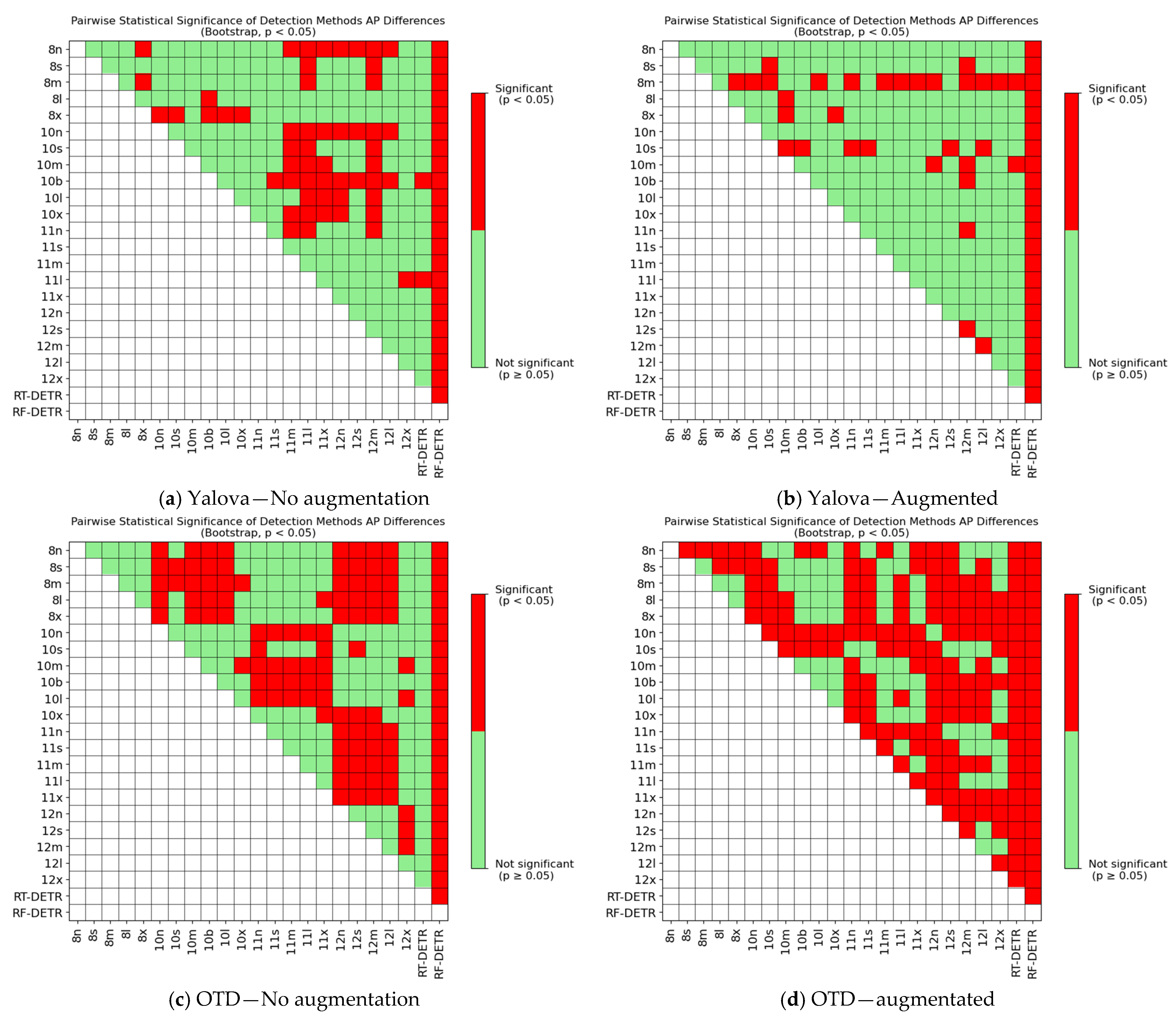
In this study, average precision (AP) values calculated per image for the test datasets were used to evaluate whether performance differences between YOLO-based object detection models were statistically significant. Inter-model comparisons were performed using a paired bootstrap resampling approach [66]; the distribution of AP differences for each pair of models was obtained. It does not require assuming a parametric distribution and is suitable for complex metrics such as mAP.
Δ A P ( b ) = 1 N i I b   ( A P i ( A ) A P i ( B ) ) , b = 1 , , B
where A P i ( A ) and A P i ( B ) refer to the AP values of the ith image of the two YOLO models. N represents the number of test images, I b is the bootstrap index set selected using substitution sampling, and B   is the number of bootstrap repetitions. Statistical significance was determined based on the obtained p-values (p < 0.05), and the results were visualized with binary (significant/not significant) color coding. X shows the pairwise statistical significance of performance differences according to a paired bootstrap test (p < 0.05). Red cells indicate statistically significant differences, while green cells represent non-significant comparisons.
In the Yalova dataset, without augmentation, significant differences are infrequent and scattered. Without data augmentation, the models’ performance is largely similar. Increasing architectural complexity does not provide a statistically consistent advantage. When data augmentation is applied to the Yalova dataset, the significant differences between the models decrease somewhat. Some pairs of models become statistically indistinguishable. Green areas are preserved, particularly among mid-level models. In the OTD without augmentation dataset, significant differences are found, particularly between higher-level models (l, x) and lower-level models. There are noticeable differences between transformers and YOLOs. In the OTD dataset, augmentation clearly increases statistical reliability. The statistical significance analysis reveals that data augmentation plays a critical role in revealing actual performance differences among detection architectures, with this effect being more pronounced with structurally diverse datasets (Figure 17).

6. Conclusions

In this study, convolutional neural networks (CNNs) and transformer-based deep learning models were evaluated from a broad perspective for the purpose of identifying olive trees. This study’s findings reveal that the performance of object detectors varies significantly depending on the model variant, dataset size, and study region.
The results of this study have practical implications for the automation of olive cultivation. Automatic detection, tracking, and analysis of olive trees are possible, especially thanks to the high spatial resolution of UAV images and artificial intelligence techniques. The proposed AI-based automation is expected to provide advantages such as reduced orchard operating costs and reduced crop losses for growers. The results of this study are expected to provide significant insights into precision agriculture practices in olive cultivation and to open avenues for research on orchard productivity, sustainability, smart agricultural practices, and infrastructure systems.
A new olive tree detection dataset containing UAV images is also presented within the scope of this study. This makes a significant contribution to the literature by offering data diversity to enhance methodological studies in this field.
For real-world applications, nano and small models stand out for their speed. However, these larger models delivered higher mAP and mAP50-95 values, providing a clear example of the trade-off between accuracy and speed. Lightweight models achieved near-state-of-the-art accuracy while offering significantly lower inference time and memory consumption, making them more suitable for real-time UAV applications than larger architectures. Crown area estimation is a crucial parameter in biomass and carbon stock studies. Relatively small differences in RMSE can lead to significant errors when scaled to larger areas. Therefore, in practical terms, the fact that the YOLOv11x model produces the lowest RMSE values in both datasets indicates that it is a preferable option in forestry and agricultural monitoring applications requiring a high accuracy.
A further limitation of our study is the exclusion of spatial information. Specifically, inferences about tree dimensions can be made using precise positioning techniques. However, since the main objective of our study was a detailed comparison of object detection methods in precision agriculture applications, the results are consistent with our expectations.
In future studies, multispectral UAV images are planned to be used for object detection and classification. On the other hand, future studies will focus on controlled data enhancement experiments using the same policies specific to datasets to isolate the impact of each transformation. We also aim to use various vegetation indices to monitor plant health status alongside detection.

Author Contributions

Conceptualization, M.E.A. and M.A.; methodology, M.E.A. and M.A.; software, M.E.A.; validation, M.E.A.; formal analysis, M.E.A.; investigation, M.A.; resources, M.E.A. and M.A.; data curation, M.A.; writing—original draft preparation, M.E.A. and M.A.; writing—review and editing, M.E.A.; visualization, M.E.A. and M.A.; supervision, M.E.A.; project administration, M.E.A.; funding acquisition, M.E.A. All authors have read and agreed to the published version of the manuscript.

Funding

This research was funded by the Istanbul Technical University Scientific Research Projects Office (BAP), grant number MGA-2024-45734.

Institutional Review Board Statement

Not applicable.

Data Availability Statement

The original data presented in the study are openly available at https://app.roboflow.com/tugeomatics/yalova_dataset_olive_tree/ (accessed on 15 February 2026).

Conflicts of Interest

The authors declare no conflicts of interest.

Abbreviations

The following abbreviations are used in this manuscript:
YOLO You Only Look Once
UAVUnmanned Aerial Vehicle
RT-DETRReal-Time Detection Transformer
RF-DETRRoboflow-Detection Transformer
OTDOlive Tree Detection
VHRVery High Resolution
RGB Red, Green, Blue
SAMSegment Anything Model
AIArtificial Intelligence
CNNConvolutional Neural Network
RMSERoot Mean Square Error
OTCOlive Tree Crown
CSPNetCross Stage Partial Network
FPNFeature Pyramid Network
PANPath Aggregation Network
NASNeural Architecture Search
LiDAR Light Detection and Ranging
ViTVision Transformer
FOVField of View
GSDGround Sampling Distance
NMSNon-Maximum Suppression
SPPFSpatial Pyramid Pooling—Fast
C2PSACross Stage Partial with Spatial Attention
mAPMean Average Precision
APAverage Precision
TPTrue Positive
FPFalse Positive
FNFalse Negative
COCOCommon Objects in Context
SLICSimple Linear Iterative Clustering
OBIAObject-Based Image Analysis
IoUIntersection over Union

Appendix A

Appendix A.1

Table A1. Algorithm results for the OTD test dataset. YOLO algorithms are listed according to their highest F1-scores. The metrics of the OBIA approach are calculated independently of data augmentation, using only the test data. The highest values are marked in bold.
ModelPrecisionRecallF1-Score
YOLOv8n0.9470.9070.927
YOLOv8s0.9480.9080.927
YOLOv8m0.9430.9170.930
YOLOv8l0.9430.9100.926
YOLOv8x0.9510.8980.924
YOLOv11n0.9560.9020.928
YOLOv11s0.9410.9040.922
YOLOv11m0.9350.9130.924
YOLOv11l0.9360.9150.925
YOLOv11x0.9450.9060.925
OBIA0.8800.8590.869

Appendix A.2

Table A2. Algorithm results for the Yalova test dataset. YOLO algorithms are listed according to their highest F1-scores. The metrics of the OBIA approach are calculated independently of data augmentation, using only the test data. The highest valsues are marked in bold.
ModelPrecisionRecallF1-Score
YOLOv8n0.8470.7710.807
YOLOv8s0.8660.7480.802
YOLOv8m0.8300.7740.801
YOLOv8l0.8680.7950.830
YOLOv8x0.8630.7920.826
YOLOv11n0.8500.7480.796
YOLOv11s0.8270.8120.820
YOLOv11m0.8510.7860.817
YOLOv11l0.7860.8420.813
YOLOv11x0.8350.8090.822
OBIA0.8370.7930.814

References

  1. Besnard, G.; Hernández, P.; Khadari, B.; Dorado, G.; Savolainen, V. Genomic Profiling of Plastid DNA Variation in the Mediterranean Olive Tree. BMC Plant Biol. 2011, 11, 80. [Google Scholar] [CrossRef]
  2. Šiljeg, A.; Marinović, R.; Domazetović, F.; Jurišić, M.; Marić, I.; Panđa, L.; Radočaj, D.; Milošević, R. GEOBIA and Vegetation Indices in Extracting Olive Tree Canopies Based on Very High-Resolution UAV Multispectral Imagery. Appl. Sci. 2023, 13, 739. [Google Scholar] [CrossRef]
  3. Waleed, M.; Um, T.-W.; Khan, A.; Khan, U. Automatic Detection System of Olive Trees Using Improved K-Means Algorithm. Remote Sens. 2020, 12, 760. [Google Scholar] [CrossRef]
  4. Araújo, R.G.; Chavez-Santoscoy, R.A.; Parra-Saldívar, R.; Melchor-Martínez, E.M.; Iqbal, H.M.N. Agro-Food Systems and Environment: Sustaining the Unsustainable. Curr. Opin. Environ. Sci. Health 2023, 31, 100413. [Google Scholar] [CrossRef]
  5. Atapattu, A.J.; Ranasinghe, C.; Nuwarapaksha, T.D.; Udumann, S.S.; Dissanayaka, N.S. Sustainable Agriculture and Sustainable Development Goals (SDGs). In Emerging Technologies and Marketing Strategies for Sustainable Agriculture; IGI Global Scientific Publishing: Hershey, PA, USA, 2024; pp. 1–27. [Google Scholar]
  6. Li, S.; Brandt, M.; Fensholt, R.; Kariryaa, A.; Igel, C.; Gieseke, F.; Nord-Larsen, T.; Oehmcke, S.; Carlsen, A.H.; Junttila, S.; et al. Deep Learning Enables Image-Based Tree Counting, Crown Segmentation, and Height Prediction at National Scale. PNAS Nexus 2023, 2, pgad076. [Google Scholar] [CrossRef]
  7. Srestasathiern, P.; Rakwatin, P. Oil Palm Tree Detection with High Resolution Multi-Spectral Satellite Imagery. Remote Sens. 2014, 6, 9749–9774. [Google Scholar] [CrossRef]
  8. Jemaa, H.; Bouachir, W.; Leblon, B.; LaRocque, A.; Haddadi, A.; Bouguila, N. UAV-Based Computer Vision System for Orchard Apple Tree Detection and Health Assessment. Remote Sens. 2023, 15, 3558. [Google Scholar] [CrossRef]
  9. Biyik, M.Y.; Atik, M.E.; Duran, Z. Deep Learning-Based Vehicle Detection from Orthophoto and Spatial Accuracy Analysis. Int. J. Eng. Geosci. 2023, 8, 138–145. [Google Scholar] [CrossRef]
  10. Arkali, M.; Biyik, M.Y.; Atik, M.E. Comparative Analysis of Machine Learning Algorithms for Classification of UAV-Based Photogrammetric Cultural Heritage Point Clouds. Int. Arch. Photogramm. Remote Sens. Spat. Inf. Sci. 2025, 48, 17–22. [Google Scholar] [CrossRef]
  11. Atik, Ş. Classification of Urban Vegetation Utilizing Spectral Indices and DEM with Ensemble Machine Learning Methods. Int. J. Environ. Geoinform. 2025, 12, 43–53. [Google Scholar] [CrossRef]
  12. Minařík, R.; Langhammer, J. Use of a Multispectral UAV Photogrammetry for Detection and Tracking of Forest Disturbance Dynamics. Int. Arch. Photogramm. Remote Sens. Spat. Inf. Sci. 2016, 41, 711–718. [Google Scholar] [CrossRef]
  13. Atik, M.E.; Arkali, M.; Atik, S.O. Impact of UAV-Derived RTK/PPK Products on Geometric Correction of VHR Satellite Imagery. Drones 2025, 9, 291. [Google Scholar] [CrossRef]
  14. Moreno-Garcia, J.; Jimenez, L.; Rodriguez-Benitez, L.; Solana-Cipres, C.J. Fuzzy Logic Applied to Detect Olive Trees in High Resolution Images. In Proceedings of the International Conference on Fuzzy Systems, Barcelona, Spain, 18–23 July 2010; pp. 1–7. [Google Scholar]
  15. González, J.; Galindo, C.; Arevalo, V.; Ambrosio, G. Applying Image Analysis and Probabilistic Techniques for Counting Olive Trees in High-Resolution Satellite Images. In Proceedings of the Advanced Concepts for Intelligent Vision Systems; Blanc-Talon, J., Philips, W., Popescu, D., Scheunders, P., Eds.; Springer: Berlin/Heidelberg, Germany, 2007; pp. 920–931. [Google Scholar]
  16. Peters, J.; Van Coillie, F.; Westra, T.; De Wulf, R. Synergy of Very High Resolution Optical and Radar Data for Object-Based Olive Grove Mapping. Int. J. Geogr. Inf. Sci. 2011, 25, 971–989. [Google Scholar] [CrossRef]
  17. Li, H.; Huang, J.; Gu, Z.; He, D.; Huang, J.; Wang, C. Positioning of Mango Picking Point Using an Improved YOLOv8 Architecture with Object Detection and Instance Segmentation. Biosyst. Eng. 2024, 247, 202–220. [Google Scholar] [CrossRef]
  18. Sun, C.; Huang, C.; Zhang, H.; Chen, B.; An, F.; Wang, L.; Yun, T. Individual Tree Crown Segmentation and Crown Width Extraction from a Heightmap Derived from Aerial Laser Scanning Data Using a Deep Learning Framework. Front. Plant Sci. 2022, 13, 914974. [Google Scholar] [CrossRef] [PubMed]
  19. Shehzadi, T.; Hashmi, K.A.; Liwicki, M.; Stricker, D.; Afzal, M.Z. Object Detection with Transformers: A Review. Sensors 2025, 25, 6025. [Google Scholar] [CrossRef] [PubMed]
  20. Kim, J.; Kim, S.; Ju, C.; Son, H.I. Unmanned Aerial Vehicles in Agriculture: A Review of Perspective of Platform, Control, and Applications. IEEE Access 2019, 7, 105100–105115. [Google Scholar] [CrossRef]
  21. Barbedo, J.G.A. A Review on the Use of Unmanned Aerial Vehicles and Imaging Sensors for Monitoring and Assessing Plant Stresses. Drones 2019, 3, 40. [Google Scholar] [CrossRef]
  22. Chemin, Y.H.; Beck, P.S.A. A Method to Count Olive Trees in Heterogenous Plantations from Aerial Photographs. Preprints 2017, 2017100170. [Google Scholar] [CrossRef]
  23. Moreno-Garcia, J.; Linares, L.J.; Rodriguez-Benitez, L.; Solana-Cipres, C. Olive Trees Detection in Very High Resolution Images. In International Conference on Information Processing and Management of Uncertainty in Knowledge-Based Systems; Springer: Berlin/Heidelberg, Germany, 2010. [Google Scholar]
  24. Khan, A.; Khan, U.; Waleed, M.; Khan, A.; Kamal, T.; Marwat, S.N.K.; Maqsood, M.; Aadil, F. Remote Sensing: An Automated Methodology for Olive Tree Detection and Counting in Satellite Images. IEEE Access 2018, 6, 77816–77828. [Google Scholar] [CrossRef]
  25. Li, W.; Fu, H.; Yu, L. Deep Convolutional Neural Network Based Large-Scale Oil Palm Tree Detection for High-Resolution Remote Sensing Images. In Proceedings of the 2017 IEEE International Geoscience and Remote Sensing Symposium (IGARSS), Fort Worth, TX, USA, 23–28 July 2017; pp. 846–849. [Google Scholar]
  26. Jintasuttisak, T.; Edirisinghe, E.; Elbattay, A. Deep Neural Network Based Date Palm Tree Detection in Drone Imagery. Comput. Electron. Agric. 2022, 192, 106560. [Google Scholar] [CrossRef]
  27. Putra, Y.C.; Wijayanto, A.W. Automatic Detection and Counting of Oil Palm Trees Using Remote Sensing and Object-Based Deep Learning. Remote Sens. Appl. Soc. Environ. 2023, 29, 100914. [Google Scholar] [CrossRef]
  28. Chen, Y.; Xu, H.; Zhang, X.; Gao, P.; Xu, Z.; Huang, X. An Object Detection Method for Bayberry Trees Based on an Improved YOLO Algorithm. Int. J. Digit. Earth 2023, 16, 781–805. [Google Scholar] [CrossRef]
  29. Li, S.; Tao, T.; Zhang, Y.; Li, M.; Qu, H. YOLO V7-CS: A YOLO v7-Based Model for Lightweight Bayberry Target Detection Count. Agronomy 2023, 13, 2952. [Google Scholar] [CrossRef]
  30. Abozeid, A.; Alanazi, R.; Elhadad, A.; Taloba, A.I.; Abd El-Aziz, R.M. A Large-Scale Dataset and Deep Learning Model for Detecting and Counting Olive Trees in Satellite Imagery. Comput. Intell. Neurosci. 2022, 2022, 1549842. [Google Scholar] [CrossRef]
  31. Ye, Z.; Wei, J.; Lin, Y.; Guo, Q.; Zhang, J.; Zhang, H.; Deng, H.; Yang, K. Extraction of Olive Crown Based on UAV Visible Images and the U2-Net Deep Learning Model. Remote Sens. 2022, 14, 1523. [Google Scholar] [CrossRef]
  32. Ksibi, A.; Ayadi, M.; Soufiene, B.O.; Jamjoom, M.M.; Ullah, Z. MobiRes-Net: A Hybrid Deep Learning Model for Detecting and Classifying Olive Leaf Diseases. Appl. Sci. 2022, 12, 10278. [Google Scholar] [CrossRef]
  33. Șandric, I.; Irimia, R.; Petropoulos, G.P.; Anand, A.; Srivastava, P.K.; Pleșoianu, A.; Faraslis, I.; Stateras, D.; Kalivas, D. Tree’s Detection & Health’s Assessment from Ultra-High Resolution UAV Imagery and Deep Learning. Geocarto Int. 2022, 37, 10459–10479. [Google Scholar] [CrossRef]
  34. Mamalis, M.; Kalampokis, E.; Kalfas, I.; Tarabanis, K. Deep Learning for Detecting Verticillium Fungus in Olive Trees: Using YOLO in UAV Imagery. Algorithms 2023, 16, 343. [Google Scholar] [CrossRef]
  35. Hnida, Y.; Mahraz, M.A.; Yahyaouy, A.; Achebour, A.; Riffi, J.; Tairi, H. Enhanced Multi-Scale Detection of Olive Tree Crowns in UAV Orthophotos Using a Deep Learning Architecture. Smart Agric. Technol. 2025, 12, 101126. [Google Scholar] [CrossRef]
  36. Zhao, T.; Yang, Y.; Niu, H.; Wang, D.; Chen, Y. Comparing U-Net Convolutional Network with Mask R-CNN in the Performances of Pomegranate Tree Canopy Segmentation. In Proceedings of the Multispectral, Hyperspectral, and Ultraspectral Remote Sensing Technology, Techniques, and Applications VII; SPIE: Bellingham, WA, USA, 2018; Volume 10780, pp. 210–218. [Google Scholar]
  37. Safonova, A.; Guirado, E.; Maglinets, Y.; Alcaraz-Segura, D.; Tabik, S. Olive Tree Biovolume from UAV Multi-Resolution Image Segmentation with Mask R-CNN. Sensors 2021, 21, 1617. [Google Scholar] [CrossRef] [PubMed]
  38. Abdallah, A.B.; Kallel, A.; Dammak, M.; Ali, A.B. Olive Tree and Shadow Instance Segmentation Based on Detectron2. In Proceedings of the 2022 6th International Conference on Advanced Technologies for Signal and Image Processing (ATSIP), Moncton, NB, Canada, 24–27 May 2022; pp. 1–5. [Google Scholar]
  39. Alshammari, H.H.; Shahin, O.R. An Efficient Deep Learning Mechanism for the Recognition of Olive Trees in Jouf Region. Comput. Intell. Neurosci. 2022, 2022, 9249530. [Google Scholar] [CrossRef]
  40. Berni, J.A.J.; Zarco-Tejada, P.J.; Sepulcre-Cantó, G.; Fereres, E.; Villalobos, F. Mapping Canopy Conductance and CWSI in Olive Orchards Using High Resolution Thermal Remote Sensing Imagery. Remote Sens. Environ. 2009, 113, 2380–2388. [Google Scholar] [CrossRef]
  41. Taal, S.r.l. Tree Detected. 2024. Available online: https://zenodo.org/records/13121962 (accessed on 15 February 2026).
  42. Atik, M.E.; Duran, Z.; Özgünlük, R. Comparison of YOLO Versions for Object Detection from Aerial Images. Int. J. Environ. Geoinform. 2022, 9, 87–93. [Google Scholar] [CrossRef]
  43. Redmon, J.; Divvala, S.; Girshick, R.; Farhadi, A. You Only Look Once: Unified, Real-Time Object Detection. In Proceedings of the 2016 IEEE Conference on Computer Vision and Pattern Recognition (CVPR); IEEE: Las Vegas, NV, USA, 2016; pp. 779–788. [Google Scholar]
  44. Murat, A.A.; Kiran, M.S. A Comprehensive Review on YOLO Versions for Object Detection. Eng. Sci. Technol. Int. J. 2025, 70, 102161. [Google Scholar] [CrossRef]
  45. Kang, S.; Hu, Z.; Liu, L.; Zhang, K.; Cao, Z. Object Detection YOLO Algorithms and Their Industrial Applications: Overview and Comparative Analysis. Electronics 2025, 14, 1104. [Google Scholar] [CrossRef]
  46. Ghahremani, A.; Adams, S.D.; Norton, M.; Khoo, S.Y.; Kouzani, A.Z. Detecting Defects in Solar Panels Using the YOLO V10 and V11 Algorithms. Electronics 2025, 14, 344. [Google Scholar] [CrossRef]
  47. Sohan, M.; Sai Ram, T.; Rami Reddy, C.V. A Review on YOLOv8 and Its Advancements. In Proceedings of the Data Intelligence and Cognitive Informatics; Jacob, I.J., Piramuthu, S., Falkowski-Gilski, P., Eds.; Springer Nature: Singapore, 2024; pp. 529–545. [Google Scholar]
  48. Tian, Y.; Ye, Q.; Doermann, D. YOLOv12: Attention-Centric Real-Time Object Detectors. arXiv 2025, arXiv:2502.12524. [Google Scholar]
  49. Terven, J.; Córdova-Esparza, D.-M.; Romero-González, J.-A. A Comprehensive Review of YOLO Architectures in Computer Vision: From YOLOv1 to YOLOv8 and YOLO-NAS. Mach. Learn. Knowl. Extr. 2023, 5, 1680–1716. [Google Scholar] [CrossRef]
  50. Adil Raja, M.; Loughran, R.; Mc Caffery, F. A Review of Performance of Recent YOLO Models on Cholecystectomy Tool Detection. Meas. Digit. 2025, 2–3, 100007. [Google Scholar] [CrossRef]
  51. Zhao, Y.; Lv, W.; Xu, S.; Wei, J.; Wang, G.; Dang, Q.; Liu, Y.; Chen, J. DETRs Beat YOLOs on Real-Time Object Detection. In Proceedings of the 2024 IEEE/CVF Conference on Computer Vision and Pattern Recognition (CVPR); IEEE: Seattle, WA, USA, 2024; pp. 16965–16974. [Google Scholar]
  52. Kong, Y.; Shang, X.; Jia, S. Drone-DETR: Efficient Small Object Detection for Remote Sensing Image Using Enhanced RT-DETR Model. Sensors 2024, 24, 5496. [Google Scholar] [CrossRef]
  53. Wang, S.; Xia, C.; Lv, F.; Shi, Y. RT-DETRv3: Real-Time End-to-End Object Detection with Hierarchical Dense Positive Supervision. In Proceedings of the 2025 IEEE/CVF Winter Conference on Applications of Computer Vision (WACV), Tucson, AZ, USA, 26 February–6 March 2025; pp. 1628–1636. [Google Scholar]
  54. Lv, Z.; Dong, S.; Xia, Z.; He, J.; Zhang, J. Enhanced Real-Time Detection Transformer (RT-DETR) for Robotic Inspection of Underwater Bridge Pier Cracks. Autom. Constr. 2025, 170, 105921. [Google Scholar] [CrossRef]
  55. Hu, J.; Zheng, J.; Wan, W.; Zhou, Y.; Huang, Z. RT-DETR-EVD: An Emergency Vehicle Detection Method Based on Improved RT-DETR. Sensors 2025, 25, 3327. [Google Scholar] [CrossRef]
  56. Robinson, I.; Robicheaux, P.; Popov, M.; Ramanan, D.; Peri, N. RF-DETR: Neural Architecture Search for Real-Time Detection Transformers. arXiv 2025, arXiv:2511.09554. [Google Scholar]
  57. Dahiya, N.; Prakash, D.; Kundu, S.; Kuttan, S.R.; Suwalka, I.; Ayadi, M.; Dubale, M.; Hashmi, A. Optimised RFO Tuned RF-DETR Model for Precision Urine Microscopy for Renal and Systemic Disease Diagnosis. Sci. Rep. 2025, 15, 25842. [Google Scholar] [CrossRef]
  58. Sapkota, R.; Cheppally, R.H.; Sharda, A.; Karkee, M. RF-DETR Object Detection vs YOLOv12: A Study of Transformer-Based and CNN-Based Architectures for Single-Class and Multi-Class Greenfruit Detection in Complex Orchard Environments Under Label Ambiguity. arXiv 2025, arXiv:2504.13099. [Google Scholar]
  59. Cepni, S.; Atik, M.E.; Duran, Z. Vehicle Detection Using Different Deep Learning Algorithms from Image Sequence. BJMC 2020, 8, 347–358. [Google Scholar] [CrossRef]
  60. Isiler, M.; Yanalak, M.; Atik, M.E.; Atik, S.O.; Duran, Z. A Semi-Automated Two-Step Building Stock Monitoring Methodology for Supporting Immediate Solutions in Urban Issues. Sustainability 2023, 15, 8979. [Google Scholar] [CrossRef]
  61. Achanta, R.; Shaji, A.; Smith, K.; Lucchi, A.; Fua, P.; Süsstrunk, S. SLIC Superpixels Compared to State-of-the-Art Superpixel Methods. IEEE Trans. Pattern Anal. Mach. Intell. 2012, 34, 2274–2282. [Google Scholar] [CrossRef]
  62. Breiman, L. Random Forests. Mach. Learn. 2001, 45, 5–32. [Google Scholar] [CrossRef]
  63. Carion, N.; Massa, F.; Synnaeve, G.; Usunier, N.; Kirillov, A.; Zagoruyko, S. End-to-End Object Detection with Transformers. In Proceedings of the Computer Vision—ECCV 2020; Vedaldi, A., Bischof, H., Brox, T., Frahm, J.-M., Eds.; Springer International Publishing: Cham, Switzerland, 2020; pp. 213–229. [Google Scholar]
  64. Weinstein, B.G.; Marconi, S.; Bohlman, S.; Zare, A.; White, E. Individual Tree-Crown Detection in RGB Imagery Using Semi-Supervised Deep Learning Neural Networks. Remote Sens. 2019, 11, 1309. [Google Scholar] [CrossRef]
  65. Pantaleo, E.; Giannico, V.; Cilli, R.; Camposeo, S.; Elia, M.; Lafortezza, R.; Monaco, A.; Sanesi, G.; Tangaro, S.; Bellotti, R.; et al. Automated Olive Grove Classification and Tree Counting in Very High Resolution Aerial Imagery Using Deep Learning. Smart Agric. Technol. 2025, 12, 101551. [Google Scholar] [CrossRef]
  66. Efron, B.; Tibshirani, R. An Introduction to the Bootstrap; Monographs on Statistics and Applied Probability; Chapman & Hall: Boca Raton, FL, USA, 1998. [Google Scholar]
Figure 1. Sample images from the OTD dataset.
Geomatics 06 00022 g001
Figure 2. Data collection areas (Yalova, Türkiye). Olive groves are marked with red rectangles.
Geomatics 06 00022 g002
Figure 3. Sample images from the Yalova dataset.
Geomatics 06 00022 g003
Figure 4. The workflow of the study.
Geomatics 06 00022 g004
Figure 5. Benchmark charts of mAP and mAP50-95 for OTD with data augmentation.
Geomatics 06 00022 g005
Figure 6. Illustration of model predictions for the OTD dataset with data augmentation.
Geomatics 06 00022 g006
Figure 7. Benchmark charts of mAP and mAP50-95 for OTD without data augmentation.
Geomatics 06 00022 g007
Figure 8. Illustration of model predictions for the OTD dataset without data augmentation.
Geomatics 06 00022 g008
Figure 9. Illustration of segmentation results for the OTD dataset without data augmentation. Incorrect estimations and missed parts are marked with red rectangles.
Geomatics 06 00022 g009
Figure 10. Illustration of segmentation results for the OTD dataset with data augmentation. Incorrect estimations and missed parts are marked with red rectangles.
Geomatics 06 00022 g010
Figure 11. Benchmark charts of mAP and mAP50-95 for Yalova with data augmentation.
Geomatics 06 00022 g011
Figure 12. Illustration of model predictions for the Yalova dataset with data augmentation.
Geomatics 06 00022 g012
Figure 13. Benchmark charts of mAP and mAP50-95 for Yalova without data augmentation.
Geomatics 06 00022 g013
Figure 14. Illustration of model predictions for the Yalova dataset without data augmentation.
Geomatics 06 00022 g014
Figure 15. Illustration of segmentation results for the Yalova dataset without data augmentation. Incorrect estimations and missed parts are marked with red rectangles.
Geomatics 06 00022 g015
Figure 16. Illustration of segmentation results for the Yalova dataset with data augmentation. Incorrect estimations and missed parts are marked with red rectangles.
Geomatics 06 00022 g016
Figure 17. Statistical analysis of mAP differences between methods.
Geomatics 06 00022 g017
Table 1. Explanations and statistics for the datasets used in this study.
ParametersOTD DatasetYalova Dataset
Data sourcePublic datasetGenerated for this study
UAV platformDJI Mavic 3MDJI Mavic 3M
Image typeAerial RGB imagesOrthophoto tiles
Spatial resolution~2 cm/pixel~3 cm/pixel
Image size960 × 640 pixels640 × 640 pixels
Annotation type (original)Bounding box + segmentSegment
Augmentation techniquesFlip, ±90° and 180° rotation, ±15–20° rotation, crop, resizeFlip, ±10° shear, saturation (−30% to +30%), Gaussian noise (≤0.7%), rotation, reflection
Training images (original)1338250
Training images (augmented)9513750
Validation images 38536
Test images20269
Table 2. Object detection metrics for the OTD dataset with data augmentation. The highest values are marked in bold.
ModelFPSGFLOPsParametersPrecisionRecallmAPmAP50-95
YOLOv8n120.4811.33,258,2590.9460.8700.9390.870
YOLOv8s135.1339.911,779,9870.9390.8790.9410.873
YOLOv8m120.48104.327,222,9630.9470.8590.9340.877
YOLOv8l90.91210.145,912,6590.9570.8620.9400.880
YOLOv8x60.98327.971,721,6190.9350.8600.9390.879
YOLOv10n769.236.52,265,3630.9580.8880.9630.819
YOLOv10s500.0021.47,218,3870.9560.8890.9560.828
YOLOv10m277.7858.915,313,7470.9640.8760.9490.83
YOLOv10b243.9091.619,004,8830.9540.8800.9460.825
YOLOv10l204.08120.024,310,0990.9530.8860.9490.829
YOLOv10x147.06160.029,397,4910.9590.8820.9480.827
YOLOv11n588.236.32,582,3470.9430.9000.9640.812
YOLOv11s370.3721.39,413,1870.9480.8950.9540.828
YOLOv11m243.9067.620,030,8030.9570.8830.9440.822
YOLOv11l222.2286.625,280,0830.9610.890.9470.83
YOLOv11x217.39194.456,828,1790.9580.8840.9450.825
YOLOv12n307.376.32,556,9230.9520.8960.9660.82
YOLOv12s294.1221.29,231,2670.9630.8920.9580.834
YOLOv12m204.0867.120,105,6830.9590.8960.9540.835
YOLOv12l163.9388.526,339,8430.950.8990.9570.836
YOLOv12x97.09198.559,044,4990.9670.8860.9530.834
RT-DETR106.39103.431,985,7950.9430.9150.9760.771
RF-DETR66.2176.331,854,3080.9450.7390.9630.788
Table 3. Object detection metrics for the OTD dataset without data augmentation. The highest values are marked in bold.
ModelFPSGFLOPsParametersPrecisionRecallmAPmAP50-95
YOLOv8n666.6612.03,258,2690.9490.9200.9680.898
YOLOv8s286.7142.411,779,9870.9510.9190.9680.899
YOLOv8m163.93110.027,222,9630.9510.9290.9680.896
YOLOv8l111.11220.145,912,6590.9540.9230.9690.902
YOLOv8x62.5343.771,721,6190.9440.9210.9680.906
YOLOv10n769.236.52,265,3630.9590.9360.9830.841
YOLOv10s500.0021.47,218,3870.9520.9400.9810.842
YOLOv10m277.7858.915,313,7470.9440.9530.9840.845
YOLOv10b243.9091.619,004,8830.9550.9370.9830.842
YOLOv10l204.08120.024,310,0990.9510.9400.9830.840
YOLOv10x147.06160.029,397,4910.9510.9400.9830.840
YOLOv11n588.236.32,582,3470.9600.9530.9870.841
YOLOv11s370.3721.39,413,1870.9510.9650.9870.847
YOLOv11m243.9067.620,030,8030.9550.9500.9840.846
YOLOv11l222.2286.625,280,0830.9570.9420.9820.841
YOLOv11x217.39194.456,828,1790.9330.9550.9800.828
YOLOv12n307.376.32,556,9230.9390.9650.9860.840
YOLOv12s294.1221.29,231,2670.9490.9610.9870.845
YOLOv12m204.0867.120,105,6830.9380.9620.9840.839
YOLOv12l163.9388.526,339,8430.9520.9490.9830.840
YOLOv12x97.09198.559,044,4990.9380.9540.9820.825
RT-DETR106.39103.431,985,7950.9390.9450.9770.811
RF-DETR66.2176.331,854,3080.9130.7240.9770.806
Table 4. Segmentation metrics for YOLOv8 and YOLOv11 in OTD dataset. The highest values are marked in bold.
OTD Dataset Without AugmentationOTD Dataset with Augmentation
ModelPrecisionRecallmAPmAP50-95PrecisionRecallmAPmAP50-95
YOLOv8n0.9470.9070.9560.8330.9240.8500.9160.793
YOLOv8s0.9480.9080.9550.8300.9210.8570.9190.796
YOLOv8m0.9430.9170.9550.8320.9280.8390.9140.807
YOLOv8l0.9430.9100.9540.8350.9360.8440.9210.806
YOLOv8x0.9510.8980.9530.8420.9240.8350.9170.806
YOLOv11n0.9560.9020.9550.8150.9170.8450.9220.796
YOLOv11s0.9410.9040.9490.8240.9360.8430.9230.812
YOLOv11m0.9350.9130.9540.8310.9230.8500.9190.805
YOLOv11l0.9360.9150.9540.8410.9450.8360.9240.790
YOLOv11x0.9450.9060.9540.8360.9210.8430.9190.789
Table 5. Object detection metrics for the Yalova dataset with data augmentation. The highest values are marked in bold.
ModelFPSGFLOPsParametersPrecisionRecallmAPmAP50-95
YOLOv8n312.5012.03,258,2690.8580.7800.8440.630
YOLOv8s192.3142.411,779,9870.8350.7890.8560.622
YOLOv8m103.09110.027,222,9630.8570.7390.8490.616
YOLOv8l56.82220.145,912,6590.8180.8280.8780.676
YOLOv8x35.67343.771,721,6190.8380.8360.8620.623
YOLOv10n357.146.52,265,3630.7580.7610.7790.548
YOLOv10s294.1221.47,218,3870.8530.7270.8000.564
YOLOv10m185.1958.915,313,7470.8220.7030.7580.541
YOLOv10b120.4891.619,004,8830.7860.7180.7720.549
YOLOv10l95.24120.024,310,0990.8280.7050.7710.556
YOLOv10x68.97160.029,397,4910.7920.7110.7630.535
YOLOv11n294.126.32,582,3470.8640.7620.8580.640
YOLOv11s200.0021.39,413,1870.8380.8040.8610.652
YOLOv11m100.0067.620,030,8030.8550.7980.8780.660
YOLOv11l89.2986.625,280,0830.8470.7970.8690.677
YOLOv11x46.73194.456,828,1790.8490.8240.8770.680
YOLOv12n250.006.32,556,9230.8210.7360.8010.575
YOLOv12s208.3321.29,231,2670.8010.7170.7710.571
YOLOv12m137.0067.120,105,6830.8160.7540.8010.589
YOLOv12l94.3488.526,339,8430.7740.7280.7990.583
YOLOv12x51.81198.559,044,4990.7690.7490.7700.569
RT-DETR102.04103.431,985,7950.8120.7180.7750.548
RF-DETR74.1376.331,854,3080.7830.7930.8750.666
Table 6. Object detection metrics for the Yalova dataset without data augmentation. The highest values are marked in bold.
ModelFPSGFLOPsParametersPrecisionRecallmAPmAP50-95
YOLOv8n285.7112.03,258,2690.8450.7510.8350.636
YOLOv8s181.8242.411,779,9870.8510.7800.8630.653
YOLOv8m100.00110.027,222,9630.8570.7390.8490.616
YOLOv8l58.83220.145,912,6590.8810.7980.8840.676
YOLOv8x37.73343.771,721,6190.8750.8030.8840.679
YOLOv10n312.506.52,265,3630.7280.7280.7580.555
YOLOv10s416.6721.47,218,3870.7660.7630.8060.575
YOLOv10m208.3358.915,313,7470.7650.7030.7760.563
YOLOv10b121.9591.619,004,8830.7170.7100.7270.501
YOLOv10l94.34120.024,310,0990.7720.7430.7730.556
YOLOv10x69.44160.029,397,4910.7500.7190.7480.544
YOLOv11n333.336.32,582,3470.8150.7980.8590.632
YOLOv11s238.0521.39,413,1870.8240.8230.8630.684
YOLOv11m144.9367.620,030,8030.8530.7850.8660.675
YOLOv11l125.0086.625,280,0830.7890.8450.8750.679
YOLOv11x46.51194.456,828,1790.8920.7720.8780.686
YOLOv12n270.276.32,556,9230.7390.7850.7880.563
YOLOv12s200.0021.29,231,2670.7500.7600.7850.582
YOLOv12m125.0067.120,105,6830.7940.7310.7750.570
YOLOv12l92.5988.526,339,8430.7650.7250.7820.578
YOLOv12x52.08198.559,044,4990.7890.7130.7810.572
RT-DETR104.67103.431,985,7950.7720.7250.7750.561
RF-DETR74.7076.331,854,3080.8190.7940.8750.667
Table 7. Segmentation metrics for YOLOv8 and YOLOv11 in the Yalova dataset. The highest values are marked in bold.
Yalova Dataset Without AugmentationYalova Dataset with Augmentation
ModelPrecisionRecallmAPmAP50-95PrecisionRecallmAPmAP50-95
YOLOv8n0.8430.7450.8270.5890.8470.7710.8240.584
YOLOv8s0.8400.7680.8430.5880.8660.7480.8370.591
YOLOv8m0.8300.7740.8540.5990.8450.7360.8280.571
YOLOv8l0.8680.7950.8740.6080.8150.8150.8630.620
YOLOv8x0.8630.7920.8700.6220.8080.8120.8270.568
YOLOv11n0.8040.7860.8410.5780.8500.7480.8360.574
YOLOv11s0.8270.8120.8560.6210.8400.7890.8490.581
YOLOv11m0.8510.7860.8550.6190.8510.7800.8570.611
YOLOv11l0.7860.8420.8670.6230.8310.7810.8490.624
YOLOv11x0.8840.7540.8630.6140.8350.8090.8600.618
Table 8. RMSE metrics (m2) for YOLOv8 and YOLOv11 in both datasets.
OTD DatasetYalova Dataset
ModelWith
Augmentation (m2)
Without
Augmentation (m2)
With
Augmentation (m2)
Without
Augmentation (m2)
YOLOv8n±0.478±0.915±0.556±0.624
YOLOv8s±0.395±0.842±0.473±0.519
YOLOv8m±0.312±0.785±0.419±0.462
YOLOv8l±0.288±0.714±0.386±0.418
YOLOv8x±0.245±0.672±0.342±0.371
YOLOv11n±0.210±0.745±0.315±0.348
YOLOv11s±0.192±0.688±0.287±0.312
YOLOv11m±0.165±0.610±0.251±0.273
YOLOv11l±0.148±0.552±0.228±0.245
YOLOv11x±0.131±0.514±0.204±0.221
Disclaimer/Publisher’s Note: The statements, opinions and data contained in all publications are solely those of the individual author(s) and contributor(s) and not of MDPI and/or the editor(s). MDPI and/or the editor(s) disclaim responsibility for any injury to people or property resulting from any ideas, methods, instructions or products referred to in the content.