Urban Land Cover Mapping Enhanced with LiDAR Canopy Height Data to Quantify Urbanisation in an Arctic City: A Case Study of the City of Tromsø, Norway, 1984–2024




Highlights
- LiDAR-derived canopy height information provides the largest and most consistent accuracy gains for LULC mapping in small Arctic cities, particularly when using Landsat.
- Landsat augmented with canopy height achieves practical equivalence to spectral-only PlanetScope in the overlap years, enabling more consistent long-term monitoring.
- Long-term, district-scale LULC monitoring in small Arctic cities can be achieved with reduced reliance on continuous high-resolution commercial imagery.
- The proposed workflow offers a reproducible basis for identifying green-to-artificial conversion hotspots to support evidence-led urban planning.
Abstract
1. Introduction
2. Materials and Methods
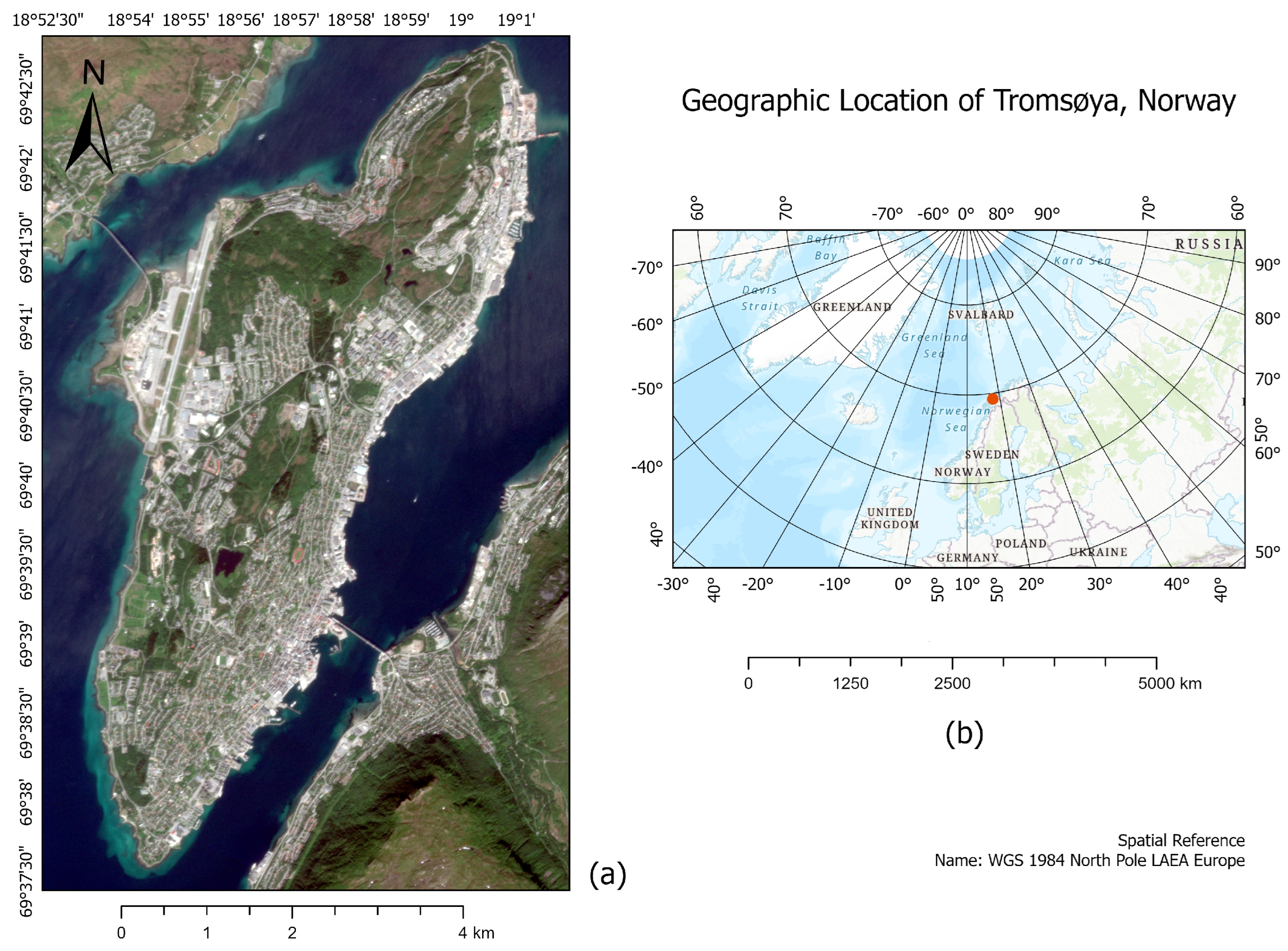
2.1. Study Area
2.2. Data
2.2.1. Multispectral Imagery Features
2.2.2. Structural Height and Building Footprint Features
2.3. Land-Use/Land-Cover Classification
2.4. Population Change Analysis
3. Results
3.1. Effect of Height and Building Footprint Features on Land-Use/Land-Cover Classification Accuracy
3.1.1. Overall Performance Across Sensors and Years
3.1.2. Class-Level Gains
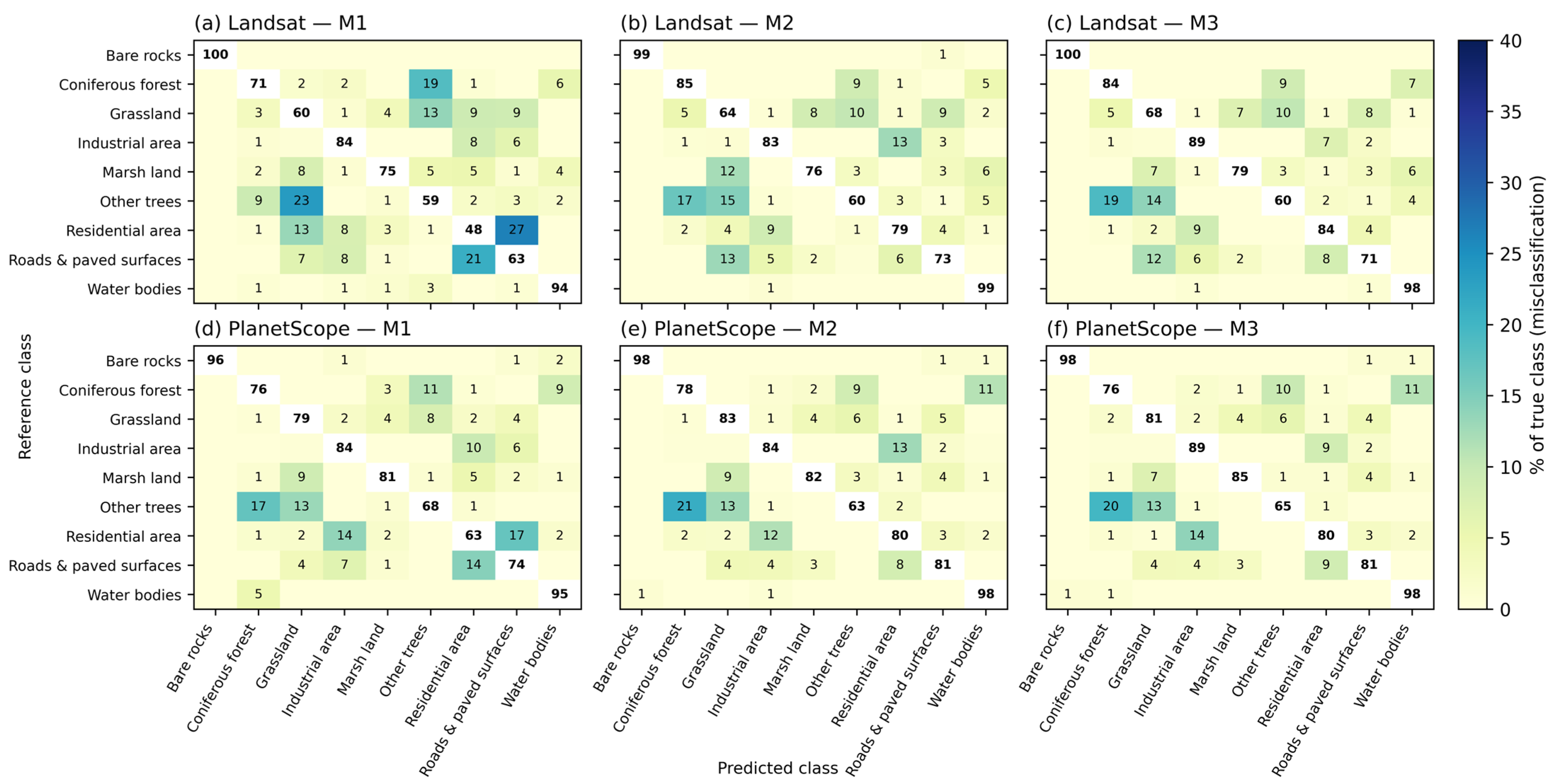
3.1.3. Models’ Behaviour Through Class-Specific Errors and Visual Validation
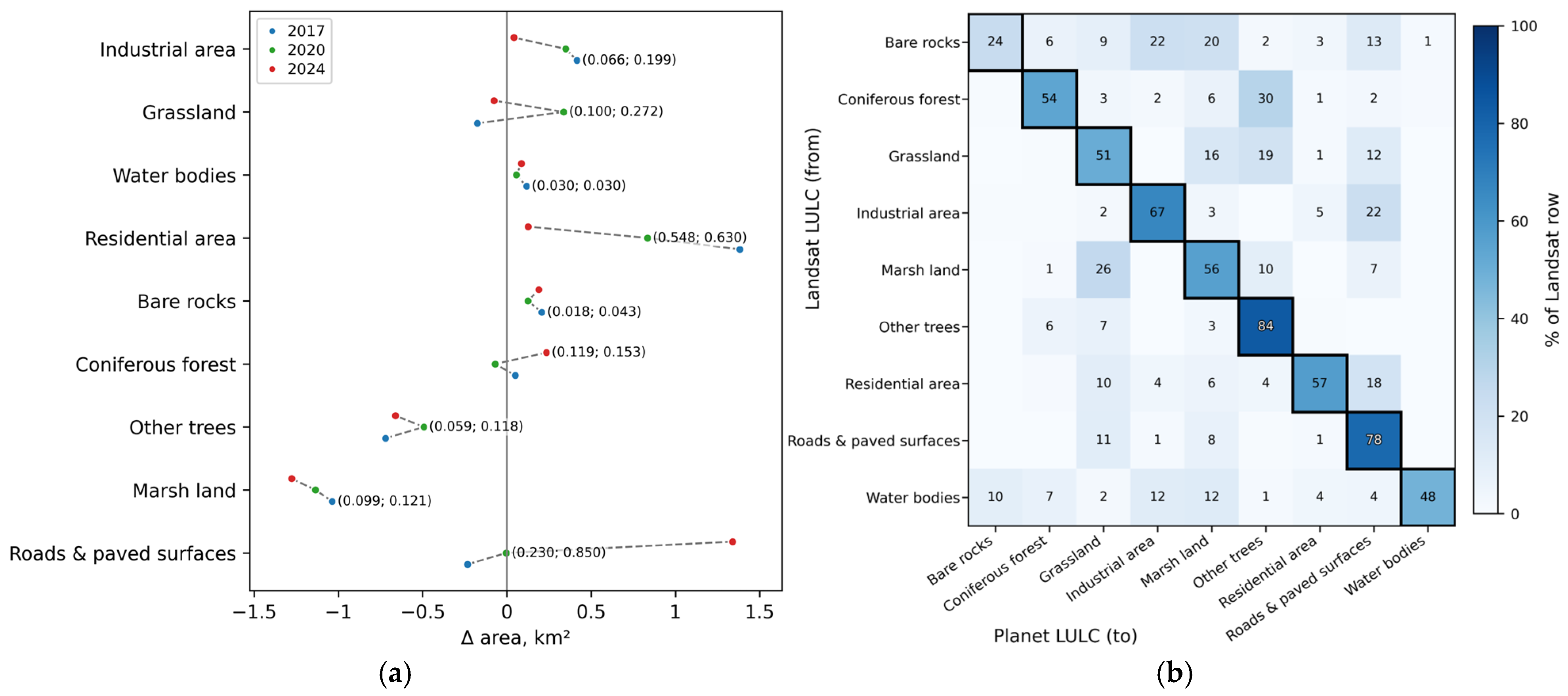
3.1.4. Cross-Sensors Agreement in Class Areas
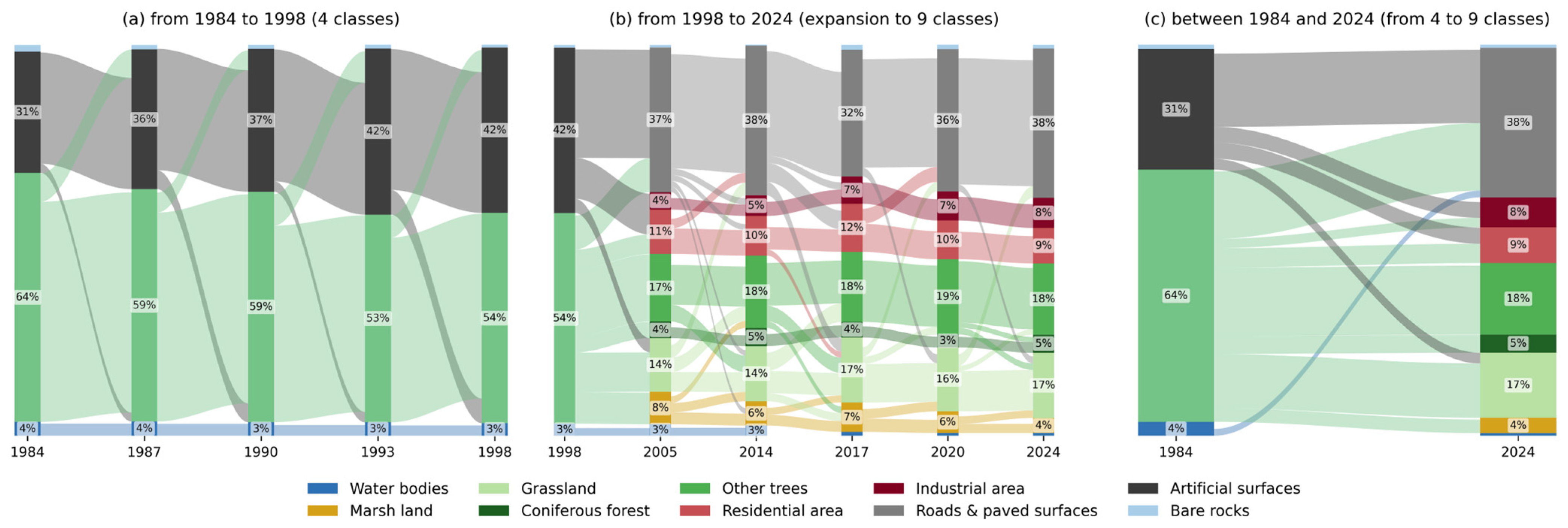
3.2. Quantitative Analysis of Long-Term Land-Use/Land-Cover Changes in Tromsø from 1984 to 2024
3.3. Population Patterns in Relation to Land-Cover Change
4. Discussion
4.1. Classification Uncertainties and Their Influence on the Results
4.2. Comparison with Other Similar Studies
4.3. Population Redistribution and the Shift from Green-to-Artificial Surfaces
5. Conclusions
Supplementary Materials
Author Contributions
Funding
Institutional Review Board Statement
Informed Consent Statement
Data Availability Statement
Acknowledgments
Conflicts of Interest
References
- Dybbroe, S.; Dahl, J.; Müller-Wille, L. Dynamics of Arctic Urbanization. Acta Boreal. 2010, 27, 120–124. [Google Scholar] [CrossRef]
- Laruelle, M. The three waves of Arctic urbanisation. Drivers, evolutions, prospects. Polar Rec. 2019, 55, 1–12. [Google Scholar] [CrossRef]
- Miles, V.; Esau, I.; Miles, M.W. The urban climate of the largest cities of the European Arctic. Urban Clim. 2023, 48, 101423. [Google Scholar] [CrossRef]
- Meredith, M.; Sommerkorn, M.; Cassotta, S.; Derksen, C.; Ekaykin, A.; Hollowed, A.; Kofinas, G.; Mackintosh, A.; Melbourne-Thomas, J.; Muelbert, M.M.C.; et al. Polar Regions. In IPCC Special Report on the Ocean and Cryosphere in a Changing Climate; Po, H.-O., Roberts, D.C., Masson-Delmotte, V., Zhai, P., Tignor, M., Poloczanska, E., Mintenbeck, K., Alegri, A., Nicolai, M., Okem, A., et al., Eds.; Cambridge University Press: Cambridge, UK; New York, NY, USA, 2019; pp. 203–320. [Google Scholar] [CrossRef]
- Heleniak, T. The future of the Arctic populations. Polar Geogr. 2020, 44, 136–152. [Google Scholar] [CrossRef]
- Wehrmann, D.; Luszczuk, M.; Radzik-Maruszak, K.; Götze, J.; Riedel, A. Sustainable Urban Development in the European Arctic; Routledge: London, UK, 2025. [Google Scholar] [CrossRef]
- Soroudi, A.; Rizzo, A.; Ma, J. Urban Sustainability in Arctic Cities: Challenges and Opportunities of Implementing the Sustainable Development Goals. Urban Plan. 2024, 9, 8349. [Google Scholar] [CrossRef]
- Soroudi, A.; Aboagye, P.D.; Ma, J.; Sharifi, A.; Rizzo, A. Downscaling the sustainable development goals for the Arctic cities. npj Urban Sustain. 2025, 5, 16. [Google Scholar] [CrossRef]
- López-Blanco, E.; Topp-Jørgensen, E.; Christensen, T.R.; Rasch, M.; Skov, H.; Arndal, M.F.; Bret-Harte, M.S.; Callaghan, T.V.; Schmidt, N.M. Towards an increasingly biased view on Arctic change. Nat. Clim. Change 2024, 14, 152–155. [Google Scholar] [CrossRef]
- Hebryn-Baidy, L.; Rees, G. Evaluating Urban Heat Island Dynamics and Land Use/Land Cover Changes in Tromsø, Norway. In Proceedings of the International Conference of Young Professionals “GeoTerrace 2024”, Lviv, Ukraine, 7–9 October 2024; Volume 2024, pp. 1–5. [Google Scholar] [CrossRef]
- Rees, G.; Hebryn-Baidy, L.; Good, C. Estimating the Potential for Rooftop Generation of Solar Energy in an Urban Context Using High-Resolution Open Access Geospatial Data: A Case Study of the City of Tromsø, Norway. ISPRS Int. J. Geo-Inf. 2025, 14, 123. [Google Scholar] [CrossRef]
- Yu, D.; Fang, C. Urban Remote Sensing with Spatial Big Data: A Review and Renewed Perspective of Urban Studies in Recent Decades. Remote Sens. 2023, 15, 1307. [Google Scholar] [CrossRef]
- Morsy, S.; Shaker, A.; El-Rabbany, A. Multispectral LiDAR Data for Land Cover Classification of Urban Areas. Sensors 2017, 17, 958. [Google Scholar] [CrossRef]
- Schultz, M.; Voss, J.; Auer, M.; Carter, S.; Zipf, A. Open land cover from OpenStreetMap and remote sensing. Int. J. Appl. Earth Obs. Geoinf. 2017, 63, 206–213. [Google Scholar] [CrossRef]
- Michael, S.; Li, H.; Wu, Z.; Wiell, D.; Auer, M.; Zipf, A. OpenStreetMap Land Use for Europe “Research Data”; heiDATA, Heidelberg University: Heidelberg, Germany, 2024. [Google Scholar] [CrossRef]
- Zanaga, D.; Van De Kerchove, R.; De Keersmaecker, W.; Souverijns, N.; Brockmann, C.; Quast, R.; Wevers, J.; Grosu, A.; Paccini, A.; Vergnaud, S.; et al. ESA WorldCover 10 m 2020 v100; Zenodo: Geneva, Switzerland, 2021. [Google Scholar] [CrossRef]
- Zanaga, D.; Van De Kerchove, R.; Daems, D.; De Keersmaecker, W.; Brockmann, C.; Kirches, G.; Wevers, J.; Cartus, O.; Santoro, M.; Fritz, S.; et al. ESA WorldCover 10 m 2021 v200; Zenodo: Geneva, Switzerland, 2022. [Google Scholar] [CrossRef]
- Kontgis, C.; Karra, K.; Cai, L.; Weaver, D.; Mocko, D.; Johnson, D.M.; Gerlt, S.; West, T.; Phillips, J.; Lay, M. Global land use/land cover with Sentinel-2 and deep learning. In IGARSS 2021-2021 IEEE International Geoscience and Remote Sensing Symposium; IEEE: Brussels, Belgium, 2021; Available online: https://livingatlas.arcgis.com/landcover/ (accessed on 11 June 2025).
- European Union’s Copernicus Land Monitoring Service Information. Available online: https://land.copernicus.eu/en/products/corine-land-cover (accessed on 11 June 2025).
- Liu, C.; Xu, X.; Feng, X.; Cheng, X.; Liu, C.; Huang, H. CALC-2020: A new baseline land cover map at 10 m resolution for the circumpolar Arctic. Earth Syst. Sci. Data 2023, 15, 133–153. [Google Scholar] [CrossRef]
- Xu, X.; Liu, C.; Liu, C.; Hui, F.; Cheng, X.; Huang, H. Circumpolar Arctic Land Cover for Circa 2020 (CALC-2020); Science Data Bank: Beijing, China, 2022. [Google Scholar] [CrossRef]
- Dermosinoglou, K.; Detsikas, S.E.; Petropoulos, G.P.; Fratsea, L.M.; Papadopoulos, A.G. Chapter 17—Multi-temporal monitoring of impervious surface areas (ISA) changes in an Arctic setting, using ML, remote sensing data, and GEE. In Earth Observation, Google Earth Engine and Artificial Intelligence for Earth Observation; Elsevier: Amsterdam, The Netherlands, 2025; pp. 321–348. [Google Scholar] [CrossRef]
- Planet Documentation. Available online: https://docs.planet.com/data/imagery/arps/techspec/ (accessed on 16 March 2025).
- Acharki, S. PlanetScope contributions compared to Sentinel-2, and Landsat-8 for LULC mapping. Remote Sens. Appl. Soc. Environ. 2022, 27, 100774. [Google Scholar] [CrossRef]
- Szostak, M.; Likus-Cieślik, J.; Pietrzykowski, M. PlanetScope Imageries and LiDAR Point Clouds Processing for Automation Land Cover Mapping and Vegetation Assessment of a Reclaimed Sulfur Mine. Remote Sens. 2021, 13, 2717. [Google Scholar] [CrossRef]
- Earth Resources Observation and Science (EROS) Center. Landsat 8–9 Operational Land Imager/Thermal Infrared Sensor Level-2, Collection 2; U.S. Geological Survey: Reston, VA, USA, 2020. [Google Scholar] [CrossRef]
- Earth Resources Observation and Science (EROS) Center. Landsat 4–5 Thematic Mapper Level-2, Collection 2; U.S. Geological Survey: Reston, VA, USA, 2020. [Google Scholar] [CrossRef]
- Dong, P.; Ramesh, S.; Nepali, A. Evaluation of small-area population estimation using LiDAR, Landsat TM and parcel data. Int. J. Remote Sens. 2010, 31, 5571–5586. [Google Scholar] [CrossRef]
- Vizzari, M.; Antonielli, F.; Bonciarelli, L.; Grohmann, D.; Menconi, M. Urban greenery mapping using object-based classification and multi-sensor data fusion in Google Earth Engine. Urban For. Urban Green. 2025, 105, 128697. [Google Scholar] [CrossRef]
- Shimizu, K.; Ota, T.; Mizoue, N.; Saito, H. Comparison of Multi-Temporal PlanetScope Data with Landsat 8 and Sentinel-2 Data for Estimating Airborne LiDAR Derived Canopy Height in Temperate Forests. Remote Sens. 2020, 12, 1876. [Google Scholar] [CrossRef]
- Chi, D.; Yan, J.; Yu, K.; Morsdorf, F.; Somers, B. Planting contexts affect urban tree species classification using airborne hyperspectral and LiDAR imagery. Landsc. Urban Plan. 2025, 257, 105316. [Google Scholar] [CrossRef]
- Yao, Y.; Wang, X.; Qin, H.; Wang, W.; Zhou, W. Mapping Urban Tree Species by Integrating Canopy Height Model with Multi-Temporal Sentinel-2 Data. Remote Sens. 2025, 17, 790. [Google Scholar] [CrossRef]
- Kumaraperumal, R.; Raj, M.N.; Pazhanivelan, S.; Jagadesh, M.; Selvi, D.; Muthumanickam, D.; Jagadeeswaran, R.; Karthikkumar, A.; Kanna, S.K. Data mining techniques for LULC analysis using sparse labels and multisource data integration for the hilly terrain of Nilgiris district, Tamil Nadu, India. Earth Sci. Inf. 2025, 18, 13. [Google Scholar] [CrossRef]
- Tolentino, F.M.; Galo, M. Selecting features for LULC simultaneous classification of ambiguous classes by artificial neural network. Remote Sens. Appl. Soc. Environ. 2021, 24, 100616. [Google Scholar] [CrossRef]
- Mahoney, M.J.; Johnson, L.K.; Guinan, A.Z.; Beier, C.M. Classification and mapping of low-statured shrubland cover types in post-agricultural landscapes of the US Northeast. Int. J. Remote Sens. 2022, 43, 7117–7138. [Google Scholar] [CrossRef]
- Lin, C.; Doyog, N.D. Challenges of Retrieving LULC Information in Rural-Forest Mosaic Landscapes Using Random Forest Technique. Forests 2023, 14, 816. [Google Scholar] [CrossRef]
- Nordkvist, K.; Granholm, A.H.; Holmgren, J.; Olsson, H.; Nilsson, M. Combining optical satellite data and airborne laser scanner data for vegetation classification. Remote Sens. Lett. 2011, 3, 393–401. [Google Scholar] [CrossRef]
- Lin, M.H.; Lin, Y.T.; Tsai, M.L.; Chen, Y.-C.; Wang, H.-C.; Wang, C.-K. Mapping land-use and land-cover changes through the integration of satellite and airborne remote sensing data. Env. Monit Assess 2024, 196, 246. [Google Scholar] [CrossRef] [PubMed]
- Biljecki, F.; Chow, Y.S.; Lee, K. Quality of crowdsourced geospatial building information: A global assessment of OpenStreetMap attributes. Build. Environ. 2023, 237, 110295. [Google Scholar] [CrossRef]
- Jin, H.; Mountrakis, G. Fusion of optical, radar and waveform LiDAR observations for land cover classification. ISPRS J. Photogramm. Remote Sens. 2022, 187, 171–190. [Google Scholar] [CrossRef]
- Neto, B.H.Z.; Schimalski, M.B.; Liesenberg, V.; Sothe, C.; Martins-Neto, R.P.; Floriani, M.M.P. Combining LiDAR and Spaceborne Multispectral Data for Mapping Successional Forest Stages in Subtropical Forests. Remote Sens. 2024, 16, 1523. [Google Scholar] [CrossRef]
- Zabeo, C.; Laurin, G.V.; Tesfamariam, B.G.; Giuliarelli, D.; Valentini, R.; Barbati, A. A multi-source approach to mapping habitat diversity: Combination of multi-date multispectral satellite imagery and comparison with single-date hyperspectral results in a Mediterranean Natural Reserve. Ecol. Inform. 2024, 84, 102867. [Google Scholar] [CrossRef]
- Maung, W.S.; Tsuyuki, S.; Guo, Z. Improving Land Use and Land Cover Information of Wunbaik Mangrove Area in Myanmar Using U-Net Model with Multisource Remote Sensing Datasets. Remote Sens. 2024, 16, 76. [Google Scholar] [CrossRef]
- Sivertsen, B.; Friborg, O.; Pallesen, S.; Vedaa, Ø.; Hopstock, L.A. Sleep in the Land of the Midnight Sun and Polar Night: The Tromsø Study. Chronobiol. Int. 2021, 38, 334–342. [Google Scholar] [CrossRef]
- Statistisk Norway. Regional Population Projections. Population in the Municipalities January. 2024. Available online: https://www.ssb.no/en/befolkning/befolkningsframskrivinger/statistikk/regionale-befolkningsframskrivinger (accessed on 9 August 2025).
- Statistisk Norway. 09280: Area of Land and Fresh Water, by Municipality 2007–2025. Area of Land and Fresh Water. Available online: https://www.ssb.no/en/statbank/table/09280/ (accessed on 9 August 2025).
- Jacobsen, B.K.; Eggen, A.E.; Mathiesen, E.B.; Wilsgaard, T.; Njolstad, I. Cohort Profile: The Tromso Study. Int. J. Epidemiol. 2012, 41, 961–967. [Google Scholar] [CrossRef]
- Toumasi, P.; Petropoulos, G.P.; Detsikas, S.E.; Kalogeropoulos, K.; Tselos, N.G. Coastal Vulnerability Impact Assessment under Climate Change in the Arctic Coasts of Tromsø, Norway. Earth 2024, 5, 640–653. [Google Scholar] [CrossRef]
- Kairanov, B.; Escalona, A.; Norton, I.; Abrahamson, P. Early Cretaceous Evolution of the Tromsø Basin, SW Barents Sea, Norway. Mar. Pet. Geol. 2021, 123, 104714. [Google Scholar] [CrossRef]
- Kartverket. Hoydedata. Available online: https://hoydedata.no/LaserInnsyn2/ (accessed on 2 March 2025).
- Kartverket. Historiske Kart. Available online: https://www.kartverket.no/en/about-kartverket/historie/historiske-kart (accessed on 17 May 2025).
- Gülci, S.; Wing, M.; Akay, A.E. Land Use and Land Cover (LULC) Mapping Accuracy Using Single-Date Sentinel-2 MSI Imagery with Random Forest and Classification and Regression Tree Classifiers. Geomatics 2025, 5, 29. [Google Scholar] [CrossRef]
- Breiman, L. Random forests. Mach. Learn. 2001, 45, 5–32. [Google Scholar] [CrossRef]
- Louppe, G.; Wehenkel, L.; Sutera, A.; Geurts, P. Understanding variable importances in forests of randomized trees. Adv. Neural Inf. Process. Syst. 2013. Available online: https://proceedings.neurips.cc/paper_files/paper/2013/file/e3796ae838835da0b6f6ea37bcf8bcb7-Paper.pdf (accessed on 11 June 2025).
- Farhadpour, S.; Warner, T.A.; Maxwell, A.E. Selecting and Interpreting Multiclass Loss and Accuracy Assessment Metrics for Classifications with Class Imbalance: Guidance and Best Practices. Remote Sens. 2024, 16, 533. [Google Scholar] [CrossRef]
- Performance Metrics: Confusion Matrix, Precision, Recall, and F1 Score. Available online: https://towardsdatascience.com/performance-metrics-confusion-matrix-precision-recall-and-f1-score-a8fe076a2262/ (accessed on 11 June 2025).
- Congalton, R.G.; Green, K. Assessing the Accuracy of Remotely Sensed Data: Principles and Practices, 3rd ed.; CRC Press: Boca Raton, FL, USA, 2019. [Google Scholar] [CrossRef]
- Stehman, S.V. Selecting and Interpreting Measures of Thematic Classification Accuracy. Remote Sens. Environ. 1997, 62, 77–89. [Google Scholar] [CrossRef]
- ArcGIS Pro 3.6. Tool Reference. Intersect (Analysis). Available online: https://pro.arcgis.com/en/pro-app/3.4/tool-reference/analysis/intersect.htm?utm_source=chatgpt.com (accessed on 11 June 2025).
- Basheer, S.; Wang, X.; Farooque, A.A.; Nawaz, R.A.; Liu, K.; Adekanmbi, T.; Liu, S. Comparison of Land Use Land Cover Classifiers Using Different Satellite Imagery and Machine Learning Techniques. Remote Sens. 2022, 14, 4978. [Google Scholar] [CrossRef]
- ArcGIS Pro 3.6. Tool Reference. Zonal Statistics as Table (Spatial Analyst). Available online: https://pro.arcgis.com/en/pro-app/3.4/tool-reference/spatial-analyst/zonal-statistics-as-table.htm (accessed on 11 June 2025).
- Schiavina, M.; Freire, S.; Carioli, A.; MacManus, K. GHS-POP R2023A—GHS Population Grid Multitemporal (1975–2030); European Commission, Joint Research Centre (JRC): Brussels, Belgium, 2023. [Google Scholar] [CrossRef]
- Pesaresi, M.; Schiavina, M.; Politis, P.; Freire, S.; Krasnodębska, K.; Uhl, J.H.; Carioli, A.; Corbane, C.; Dijkstra, L.; Florio, P.; et al. Advances on the Global Human Settlement Layer by joint assessment of Earth Observation and population survey data. Int. J. Digit. Earth 2024, 17, 2390454. [Google Scholar] [CrossRef]





| ΔOSM | ΔCHM | BA, % | Sensor | Year | ||
|---|---|---|---|---|---|---|
| M3 | M2 | M1 | ||||
| +1.22 | +8.52 | 81.96 | 80.74 | 72.22 | Landsat | 2024 |
| +1.15 | +3.32 | 85.43 | 84.28 | 80.96 | Planet | |
| +1.8 | +6.47 | 79.56 | 77.76 | 71.29 | Landsat | 2020 |
| +0.94 | +2.86 | 82.05 | 81.11 | 78.25 | Planet | |
| +1.16 | +3.77 | 78.33 | 77.17 | 73.4 | Landsat | 2017 |
| +0.02 | +4.15 | 82.15 | 82.13 | 77.98 | Planet | |
| +6.99 | 75.81 | 68.82 | Landsat | 2014 | ||
| +6.48 | 72.89 | 66.41 | Landsat | 2005/2006 | ||
Disclaimer/Publisher’s Note: The statements, opinions and data contained in all publications are solely those of the individual author(s) and contributor(s) and not of MDPI and/or the editor(s). MDPI and/or the editor(s) disclaim responsibility for any injury to people or property resulting from any ideas, methods, instructions or products referred to in the content. |
© 2026 by the authors. Licensee MDPI, Basel, Switzerland. This article is an open access article distributed under the terms and conditions of the Creative Commons Attribution (CC BY) license.
Share and Cite
Hebryn-Baidy, L.; Rees, G.; Weeks, S.; Belenok, V. Urban Land Cover Mapping Enhanced with LiDAR Canopy Height Data to Quantify Urbanisation in an Arctic City: A Case Study of the City of Tromsø, Norway, 1984–2024. Geomatics 2026, 6, 11. https://doi.org/10.3390/geomatics6010011
Hebryn-Baidy L, Rees G, Weeks S, Belenok V. Urban Land Cover Mapping Enhanced with LiDAR Canopy Height Data to Quantify Urbanisation in an Arctic City: A Case Study of the City of Tromsø, Norway, 1984–2024. Geomatics. 2026; 6(1):11. https://doi.org/10.3390/geomatics6010011
Chicago/Turabian StyleHebryn-Baidy, Liliia, Gareth Rees, Sophie Weeks, and Vadym Belenok. 2026. "Urban Land Cover Mapping Enhanced with LiDAR Canopy Height Data to Quantify Urbanisation in an Arctic City: A Case Study of the City of Tromsø, Norway, 1984–2024" Geomatics 6, no. 1: 11. https://doi.org/10.3390/geomatics6010011
APA StyleHebryn-Baidy, L., Rees, G., Weeks, S., & Belenok, V. (2026). Urban Land Cover Mapping Enhanced with LiDAR Canopy Height Data to Quantify Urbanisation in an Arctic City: A Case Study of the City of Tromsø, Norway, 1984–2024. Geomatics, 6(1), 11. https://doi.org/10.3390/geomatics6010011