
The Experience and Use of Power Mobility by Children with Complex Non-Ambulant Cerebral Palsy: A Scoping Review

 , , and
Abstract
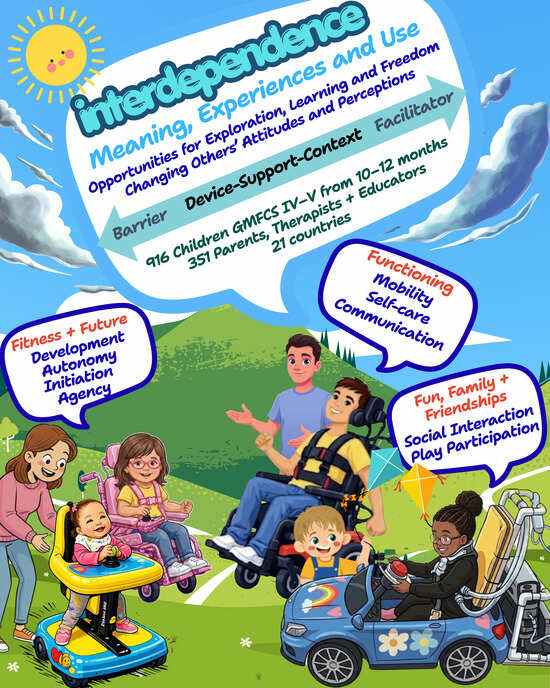
1. Introduction
- What is known about the meaning, experience, use, perceived benefits, and outcomes of power mobility in childhood for individuals with cerebral palsy, classified in GMFCS level IV and V who have limited manual abilities and/or other associated impairments?
- How do the experiences of relevant parties compare or differ, e.g., children, parents, caregivers, teachers, therapists, etc.?
- Are there data to indicate rates of power mobility use and associations between GMFCS and MACS levels, control methods (joystick, switch, or other), and devices?
- How do different methods of introduction or intervention compare or contrast, and do these differ for different age groups, GMFCS or MACS levels, control methods, or devices?
- Are different experiences or outcomes reported for different age groups, GMFCS or MACS levels, control methods, or devices?
2. Materials and Methods
2.1. Eligibility Criteria
2.2. Data Extraction and Mapping
3. Results
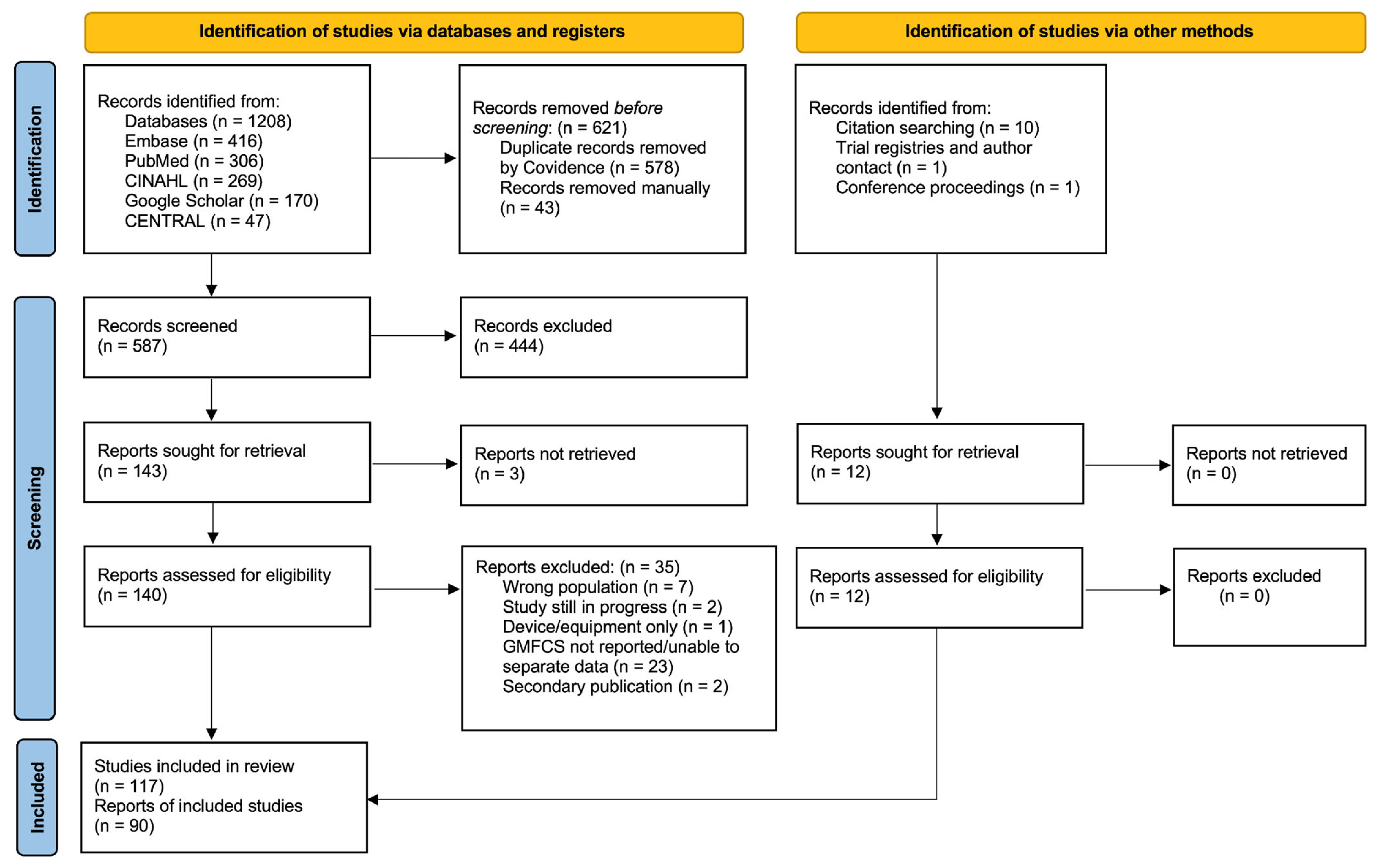
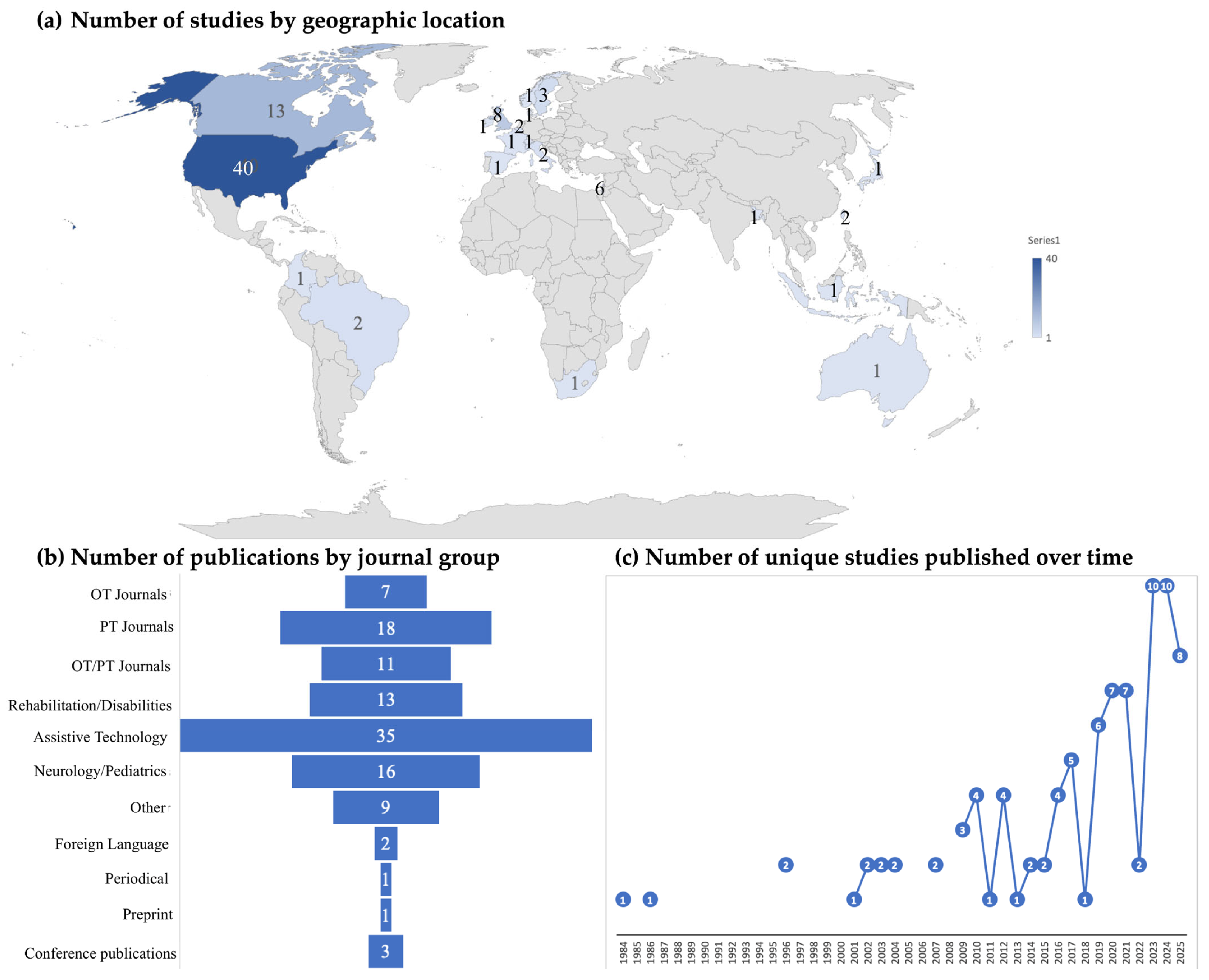
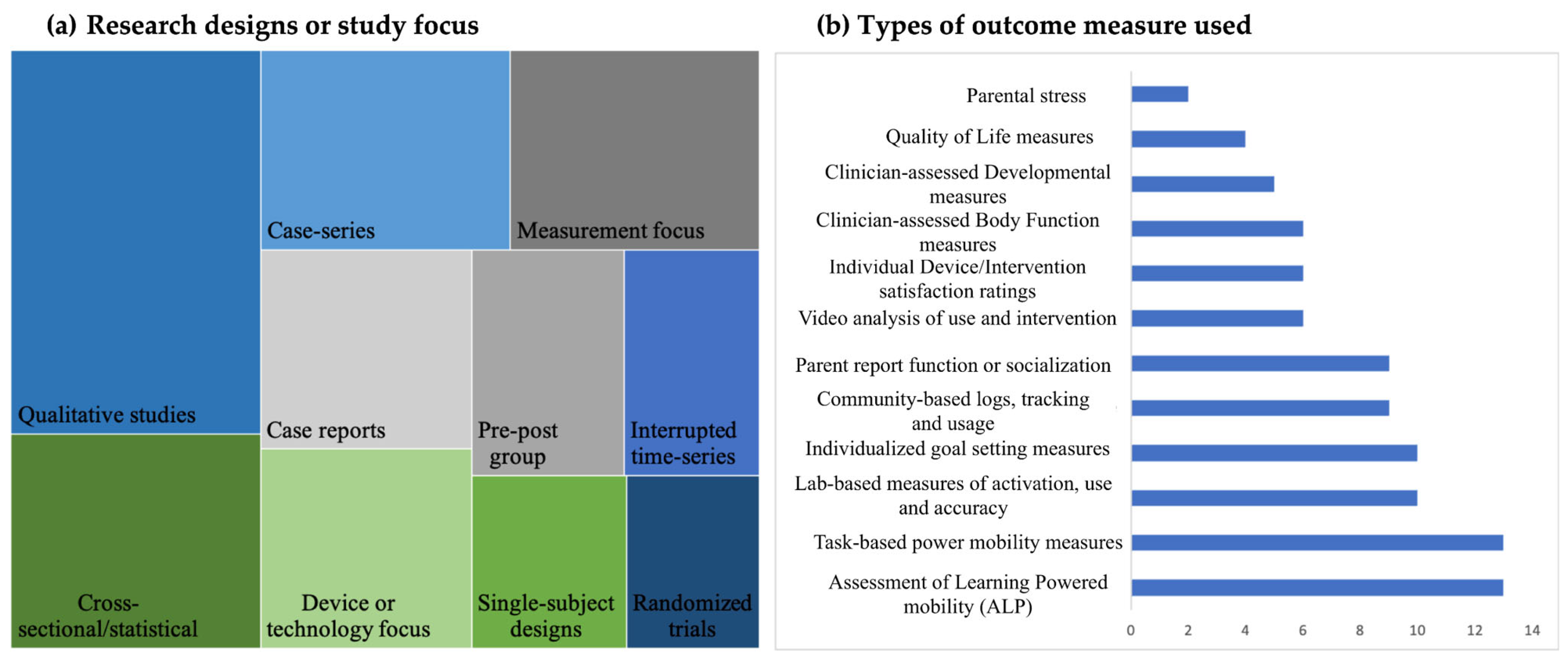
3.1. Included Studies and Designs
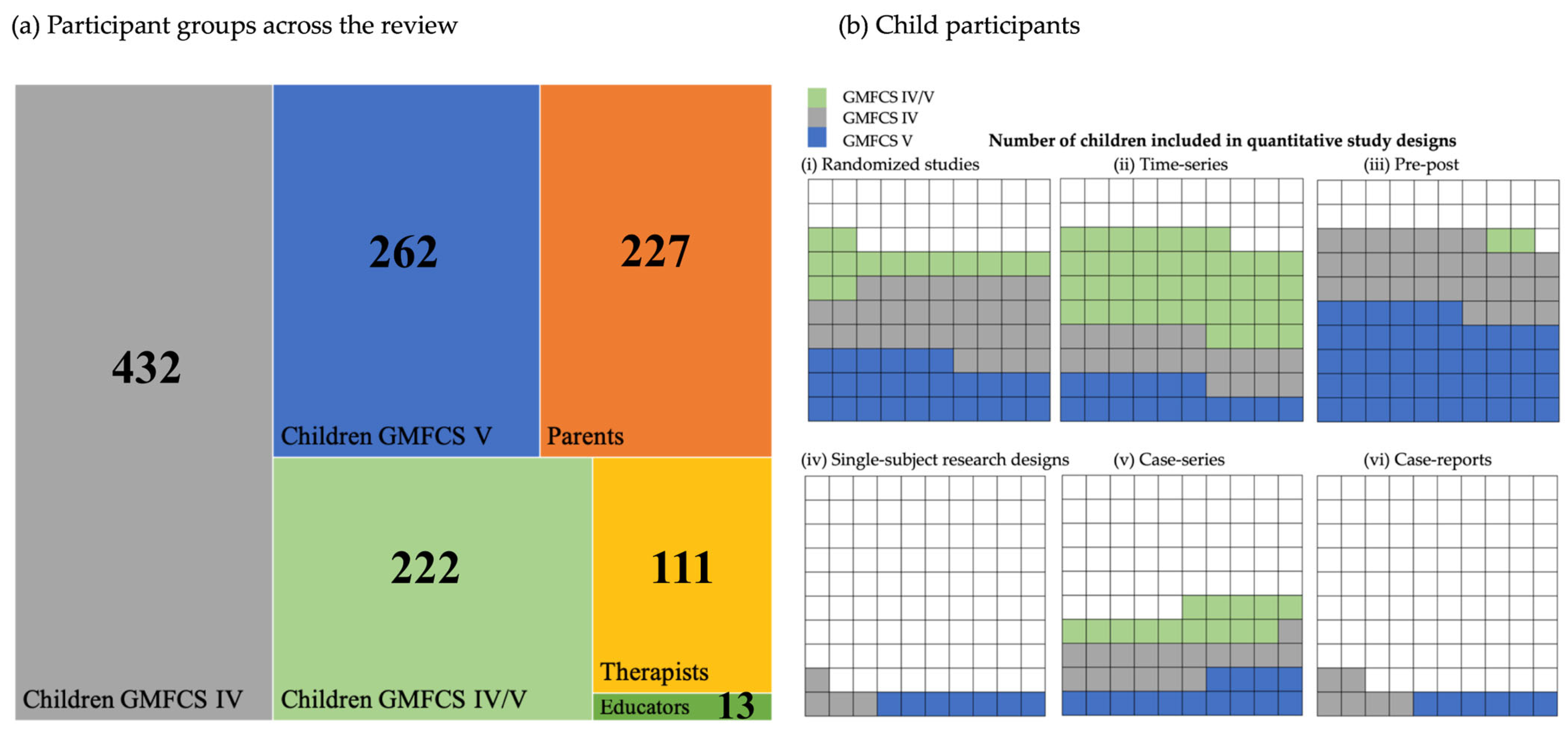
3.2. Population Characteristics
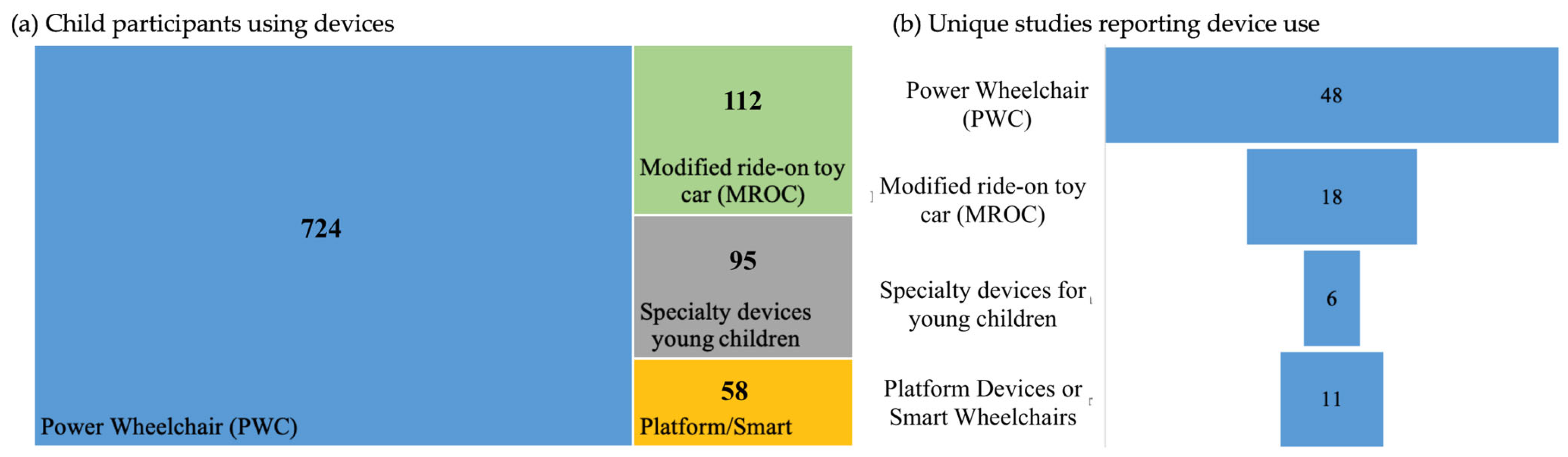
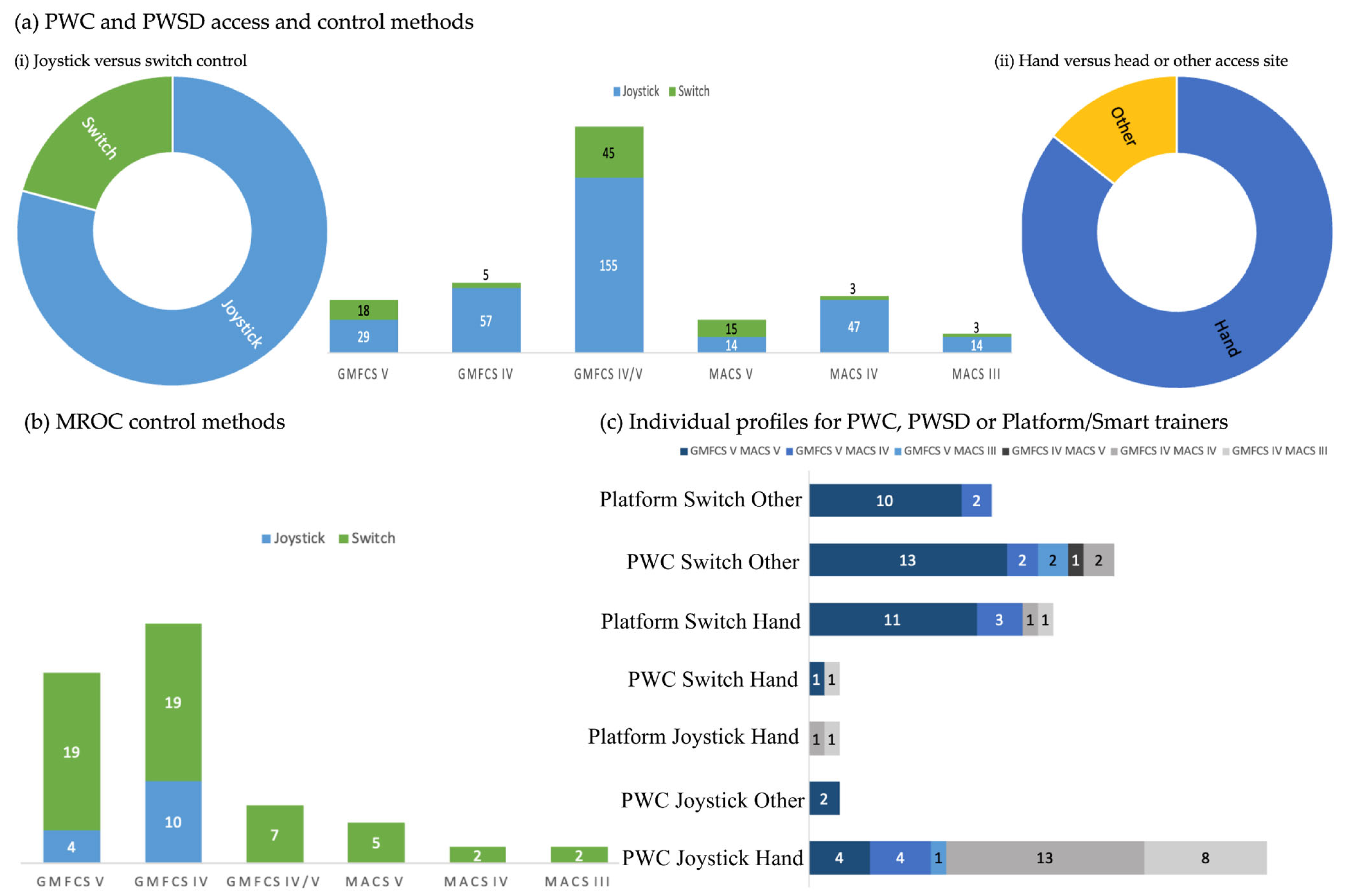
3.3. Device and Access Characteristics
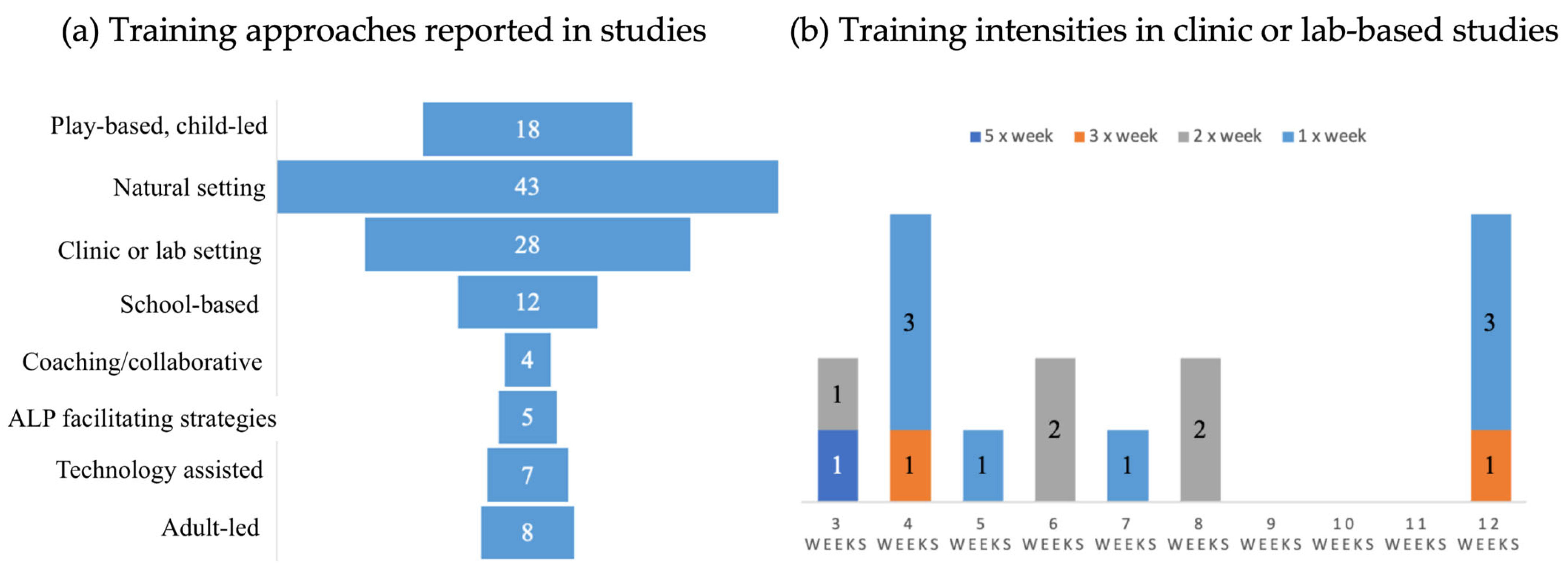
3.4. Training and Intervention Characteristics
3.5. Outcomes and Lived Experience
3.5.1. Quantitative Outcomes
3.5.2. Qualitative and Lived-Experience Findings
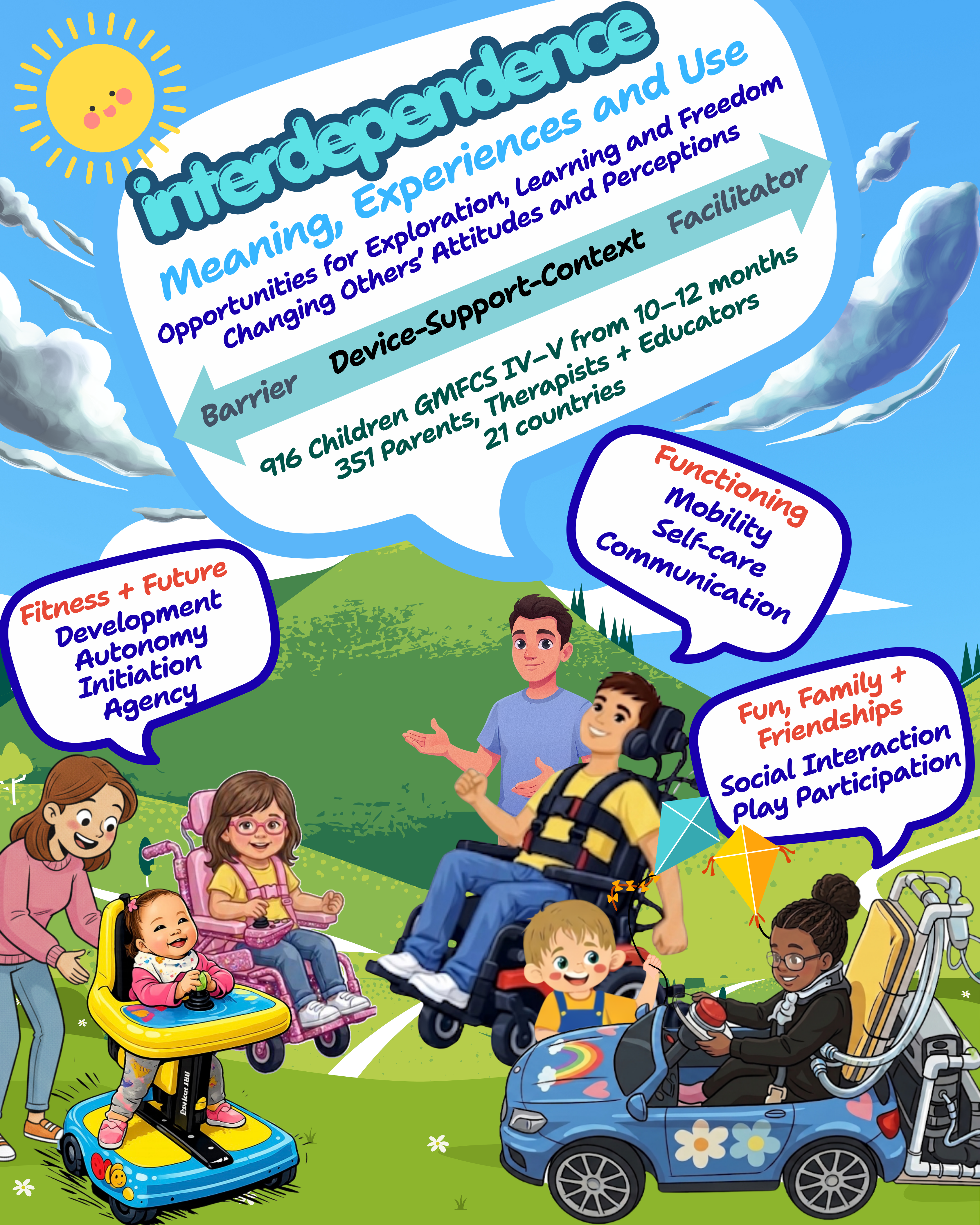
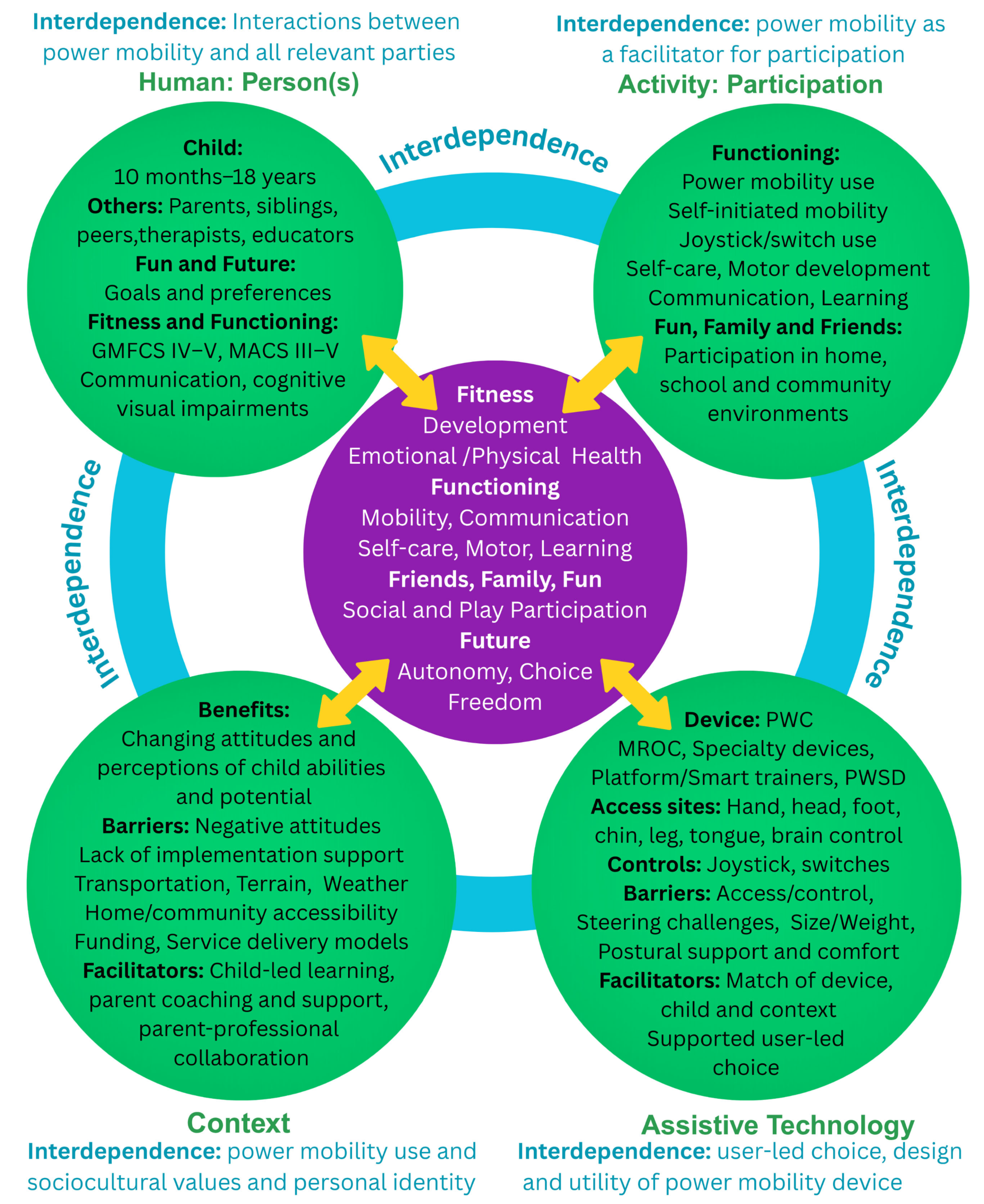
3.6. IHAAT Framework Mapping: Figure 10

4. Discussion
- Experiences and meaning of power mobility for different relevant parties: In this review, we identified findings from children, siblings, parents, or caregivers, therapists, and educators. These experiences are compared and contrasted in Section 4.1, followed by a lived-experience narrative from our parent contributor (DC).
- Rates of use: Our ability to determine associations with GMFCS and MACS levels was limited since few studies reported MACS levels, and for many older studies, GMFCS level was estimated by study or review authors as IV/V. Rates of switch versus joystick use could only be determined for 42% of children using PWCs, and associations between GMFCS, MACS, and access/control methods could only be determined for 11% of children using PWC, PWSD, and platform or smart training devices. These limited and preliminary observations are discussed in Section 4.2.
- Methods of introduction and training: For most children, these were not defined or described. For those studies that did define training characteristics, a distinction between play-based, child-led, facilitating approaches and skills training was noted, based on age and/or developmental level, as discussed in Section 4.3.
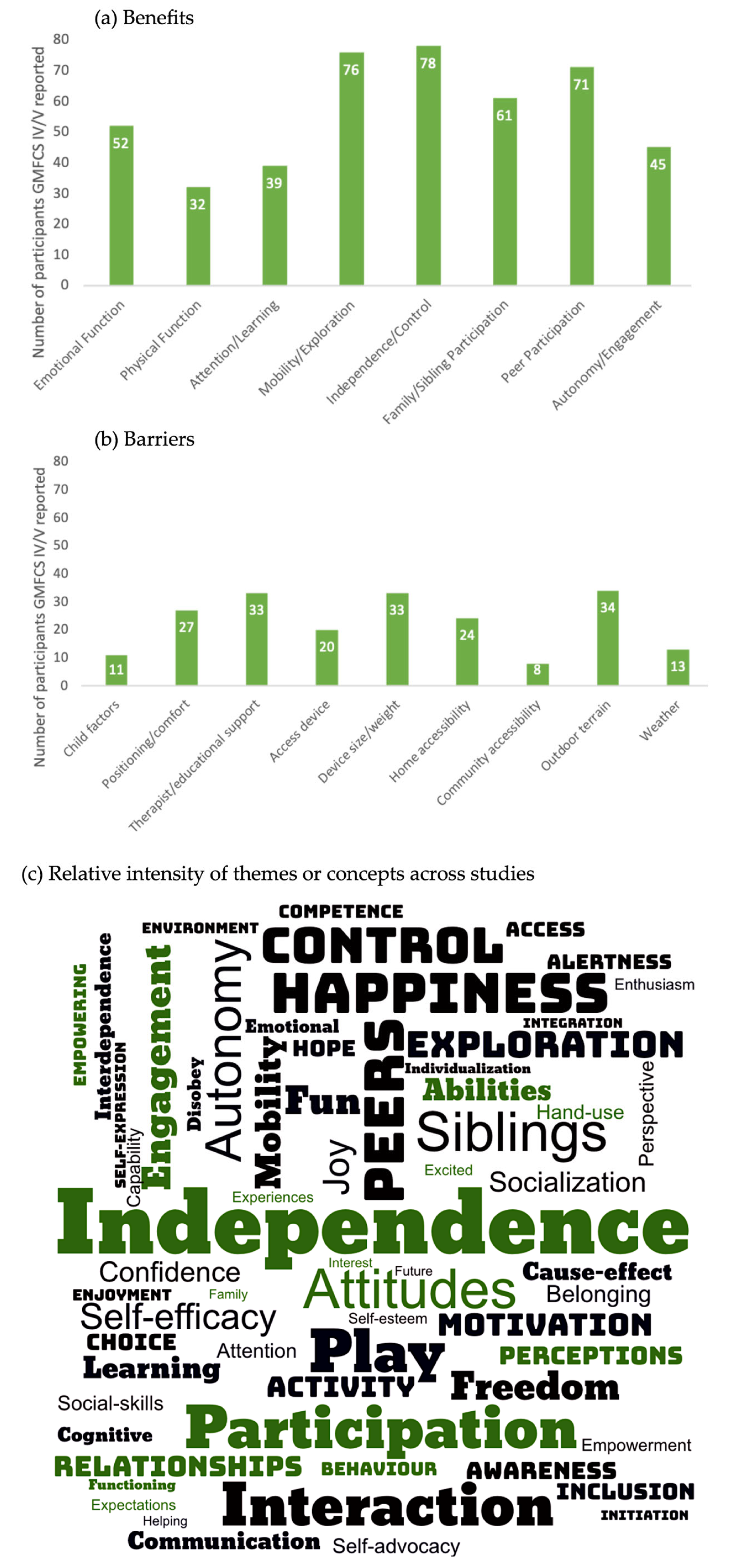
- Outcomes and findings: Other than developmental change, which was measured for young children, perceived benefits, and measured outcomes, as well as barriers and challenges, were surprisingly similar across all age groups, devices, and locations. Clarity of reporting was insufficient to identify subgroups based on functional classifications, access or control methods, or devices. This topic is further discussed in Section 4.4.
4.1. Meaning and Experience of Power Mobility for Children and Other Relevant Parties
Débora’s Lived Experience as a Parent
4.2. Power Mobility Device and Control Use
4.2.1. Device Use According to Age
4.2.2. Use, Access and Control Methods, and Relationships with Functional Classifications
4.3. Power Mobility Learning and Training
4.4. Power Mobility Outcomes and Findings
4.5. Interdependence and the F-Words
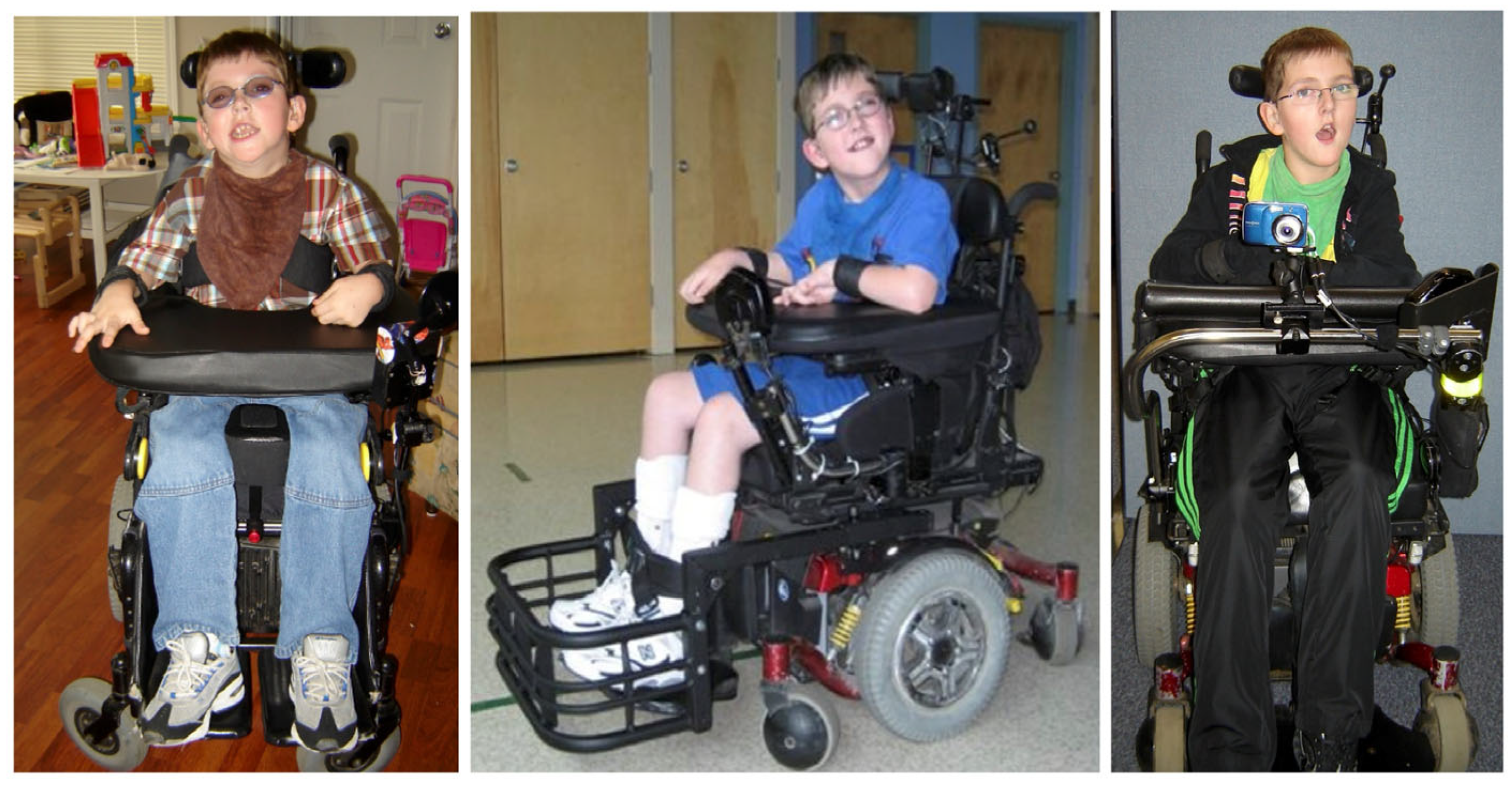
Ben’s Lived Experience of Interdependence and the F-Words
4.6. Suggestions for Research
4.7. Limitations
5. Conclusions
Supplementary Materials
Author Contributions
Funding
Institutional Review Board Statement
Informed Consent Statement
Data Availability Statement
Acknowledgments
Reflexivity Statement
Disability Language/Terminology Positionality Statement
Conflicts of Interest
Abbreviations
| ALP | Assessment of Learning Powered mobility use |
| BCI | Brain Control Interface |
| BSF | Body Structure and Function |
| COPM | Canadian Occupational Performance Measure |
| EM | Explorer Mini |
| GAS | Goal Attainment Scaling |
| GMFCS | Gross Motor Function Classification System |
| ICF | International Classification of Functioning, Disability, and Health |
| iHAAT | Interdependence Human Activity Assistive Technology model |
| LMIC | Low- and Middle-Income Countries |
| MACS | Manual Abilities Classification System |
| MROC | Modified Ride-On toys or Cars |
| PEDI | Pediatric Evaluation of Disability Inventory |
| PEDI-CAT | PEDI–Computer Adaptive Test |
| PMP | Power Mobility Program |
| PMTT | Power Mobility Training Program |
| PWC | Power Wheelchair |
| PWSD | Power Wheelchair Standing Device |
| RCT | Randomized Controlled Trial |
| WhOM-YP | Wheelchair Outcome Measure for Young People |
| WSC | Wheelchair Skills Checklist |
| WST | Wheelchair Skills Test |
References
- MacLennan, A.H.; Lewis, S.; Moreno-De-Luca, A.; Fahey, M.; Leventer, R.J.; McIntyre, S.; Ben-Pazi, H.; Corbett, M.; Wang, X.; Baynam, G.; et al. Genetic or other causation should not change the clinical diagnosis of cerebral palsy. J. Child. Neurol. 2019, 34, 472–476. [Google Scholar] [CrossRef] [PubMed]
- McIntyre, S.; Goldsmith, S.; Webb, A.; Ehlinger, V.; Hollung, S.J.; McConnell, K.; Arnaud, C.; Smithers-Sheedy, H.; Oskoui, M.; Khandaker, G.; et al. Global prevalence of cerebral palsy: A systematic analysis. Dev. Med. Child. Neurol. 2022, 64, 1494–1506. [Google Scholar] [CrossRef] [PubMed]
- Palisano, R.J.; Rosenbaum, P.; Bartlett, D.; Livingston, M.H. Content validity of the expanded and revised Gross Motor Function Classification System. Dev. Med. Child. Neurol. 2008, 50, 744–750. [Google Scholar] [CrossRef] [PubMed]
- Eliasson, A.C.; Krumlinde-Sundholm, L.; Rösblad, B.; Beckung, E.; Arner, M.; Öhrvall, A.-M.; Rosenbaum, P. The Manual Ability Classification System (MACS) for children with cerebral palsy: Scale development and evidence of validity and reliability. Dev. Med. Child. Neurol. 2006, 48, 549–554. [Google Scholar] [CrossRef] [PubMed]
- Carnahan, K.D.; Arner, M.; Hägglund, G. Association between gross motor function (GMFCS) and manual ability (MACS) in children with cerebral palsy. A population-based study of 359 children. BMC Musculoskelet. Disord. 2007, 8, 50. [Google Scholar] [CrossRef] [PubMed]
- Compagnone, E.; Maniglio, J.; Camposeo, S.; Vespino, C.; Losito, L.; De Rinaldis, M.; Gennaro, L.; Trabacca, A. Functional classifications for cerebral palsy: Correlations between the gross motor function classification system (GMFCS), the manual ability classification system (MACS) and the communication function classification system (CFCS). Res. Dev. Disabil. 2014, 35, 2651–2657. [Google Scholar] [CrossRef] [PubMed]
- Arner, M.; Eliasson, A.C.; Nicklasson, S.; Sommerstein, K.; Hägglund, G. Hand Function in Cerebral Palsy. Report of 367 Children in a Population-Based Longitudinal Health Care Program. J. Hand Surg. 2008, 33, 1337–1347. [Google Scholar] [CrossRef] [PubMed]
- Stadskleiv, K. Cognitive functioning in children with cerebral palsy. Dev. Med. Child. Neurol. 2020, 62, 283–289. [Google Scholar] [CrossRef] [PubMed]
- Khuc, T.H.H.; Karim, T.; Nguyen, V.A.T.; Giang, N.T.H.; Dũng, T.Q.; Dosseter, R.; Cao Minh, C.; Van Bang, N.; Badawi, N.; Khandaker, G.; et al. Associated impairments among children with cerebral palsy: Findings from a cross-sectional hospital-based study in Vietnam. BMJ Open 2024, 14, e075820. [Google Scholar] [CrossRef] [PubMed]
- Rauchenzauner, M.; Schiller, K.; Honold, M.; Baldissera, I.; Biedermann, R.; Tschiderer, B.; Albrecht, U.; Arnold, C.; Rostasy, K. Visual Impairment and Functional Classification in Children with Cerebral Palsy. Neuropediatrics 2021, 52, 383–389. [Google Scholar] [CrossRef] [PubMed]
- Ghasia, F.; Brunstrom, J.; Gordon, M.; Tychsen, L. Frequency and severity of visual sensory and motor Deficits in children with cerebral palsy: Gross motor function classification scale. Investig. Ophthalmol. Vis. Sci. 2008, 49, 572–580. [Google Scholar] [CrossRef] [PubMed]
- Novak, I.; Smithers-Sheedy, H.; Morgan, C. Predicting equipment needs of children with cerebral palsy using the Gross Motor Function Classification System: A cross-sectional study. Disabil. Rehabil. Assist. Technol. 2012, 7, 30–36. [Google Scholar] [CrossRef] [PubMed]
- Paleg, G.S.; Williams, S.A.; Livingstone, R.W. Supported standing and supported stepping devices for children with non-ambulant cerebral palsy: An interdependence and F-Words focus. Int. J. Environ. Res. Public Health 2024, 21, 669. [Google Scholar] [CrossRef] [PubMed]
- Anderson, D.; Campos, J.; Witherington, D.; Dahl, A.; Rivera, M.; He, M.; Uchiyama, I.; Barbu-Roth, M. The role of locomotion in psychological development. Front. Psychol. 2013, 4, 440. [Google Scholar] [CrossRef] [PubMed]
- Sabet, A.; Feldner, H.; Tucker, J.; Logan, S.W.; Galloway, J.C. ON Time Mobility: Advocating for Mobility Equity. Pediatr. Phys. Ther. 2022, 34, 546–550. [Google Scholar] [CrossRef] [PubMed]
- Huang, H.H. Perspectives on early power mobility training, motivation, and social participation in young children with motor disabilities. Front. Psychol. 2018, 8, 2330. [Google Scholar] [CrossRef] [PubMed]
- Rosenberg, L.; Cohen, R.; Maeir, A.; Gilboa, Y. Effects of a powered mobility summer camp as perceived by school staff: A qualitative study. Disabil. Rehabil. Assist. Technol. 2023, 18, 783–790. [Google Scholar] [CrossRef] [PubMed]
- Livingstone, R.; Paleg, G. Practice considerations for the introduction and use of power mobility for children. Dev. Med. Child Neurol. 2014, 56, 210–221. [Google Scholar] [CrossRef] [PubMed]
- Livingstone, R.; Field, D. The child and family experience of power mobility: A qualitative synthesis. Dev. Med. Child Neurol. 2015, 57, 317–327. [Google Scholar] [CrossRef] [PubMed]
- Livingstone, R.; Field, D. Systematic review of power mobility outcomes for infants, children and adolescents with mobility limitations. Clin. Rehabil. 2014, 28, 954–964. [Google Scholar] [CrossRef] [PubMed]
- Feldner, H.A.; Logan, S.W.; Galloway, J.C. Why the time is right for a radical paradigm shift in early powered mobility: The role of powered mobility technology devices, policy and stakeholders. Disabil. Rehabil. Assist. Technol. 2016, 11, 89–102. [Google Scholar] [CrossRef] [PubMed]
- Fehr, L.; Langbein, W.E.; Skaar, S.B. Adequacy of power wheelchair control interfaces for persons with severe disabilities: A clinical survey. Development 2000, 37, 353–360. [Google Scholar]
- Montbaliu, E. White Paper Evidence Based Development CoMoveIT Smart; KU-Leuven: Brugge, Belgium, 2024; Available online: https://www.comoveit.com/en/contact-2 (accessed on 22 May 2026).
- Hammond, L.; Rowley, D.; Tuck, C.; Floreani, E.D.; Wieler, A.; Kim, V.S.-H.; Bahari, H.; Andersen, J.; Kirton, A.; Kinney-Lang, E. BCI move: Exploring pediatric BCI-controlled power mobility. Front. Hum. Neurosci. 2025, 19, 1456692. [Google Scholar] [CrossRef] [PubMed]
- Field, D. Powered mobility: A literature review illustrating the importance of a multifaceted approach. Assist. Technol. 1999, 11, 10–33. [Google Scholar] [CrossRef]
- Bekteshi, S.; Nica, I.G.; Gakopoulos, S.; Konings, M.; Maes, R.; Cuyvers, B.; Aerts, J.-M.; Hallez, H.; Monbaliu, E. Exercise load and physical activity intensity in relation to dystonia and choreoathetosis during powered wheelchair mobility in children and youth with dyskinetic cerebral palsy. Disabil. Rehabil. 2022, 44, 4794–4805. [Google Scholar] [CrossRef] [PubMed]
- Giesbrecht, E. Application of the Human Activity Assistive Technology model for occupational therapy research. Aust. Occup. Ther. J. 2013, 60, 230–240. [Google Scholar] [CrossRef] [PubMed]
- Lee, F.N.; Balcazar, F.; Hsieh, K.; Sposato Bonfiglio, B.; Parker Harris, S.; Feldner, H.A. Factors impacting community living outcomes among former long-term nursing home residents using the interdependence-Human Activity Assistive Technology (i-HAAT) model. Assist. Technol. 2025, 37, 322–331. [Google Scholar] [CrossRef] [PubMed]
- Rosenbaum, P.; Gorter, J.W. The “F-words” in childhood disability: I swear this is how we should think! Child Care Health Dev. 2012, 38, 457–463. [Google Scholar] [CrossRef] [PubMed]
- Rosenbaum, P. The F-words for child development: Functioning, family, fitness, fun, friends and future. Dev. Med. Child Neurol. 2022, 64, 141–142. [Google Scholar] [CrossRef] [PubMed]
- World Health Organization. International Classification of Functioning, Disability & Health (ICF); World Health Organization: Geneva, Switzerland, 2001. [Google Scholar]
- Bray, N.; Kolehmainen, N.; McAnuff, J.; Tanner, L.; Tuersley, L.; Beyer, F.; Grayston, A.; Wilson, D.; Tudor Edwards, R.; Noyes, J.; et al. Powered mobility interventions for very young children with mobility limitations to aid participation and positive development: The EMPoWER evidence synthesis. Health Technol. Assess. 2020, 24, 24500. [Google Scholar] [CrossRef] [PubMed]
- Cheung, W.C.; Meadan, H.; Yang, H.W. Effects of powered mobility device interventions on social skills for children with disabilities: A systematic review. J. Dev. Phys. Disabil. 2020, 32, 855–876. [Google Scholar] [CrossRef]
- James, D.; Pfaff, J.; Jeffries, L.M. Modified Ride-on Cars as Early Mobility for Children with Mobility Limitations: A Scoping Review. Phys. Occup. Ther. Pediatr. 2019, 39, 525–542. [Google Scholar] [CrossRef] [PubMed]
- Hospodar, C.M.; Feldner, H.A.; Logan, S.W. Active mobility, active participation: A systematic review of modified ride-on car use by children with disabilities. Disabil. Rehabil. Assist. Technol. 2023, 18, 974–988. [Google Scholar] [CrossRef] [PubMed]
- Naaris, M.; Bekteshi, S.; Aufheimer, M.; Gerling, K.; Hallez, H.; Ortibus, E.; Konings, M.; Monbaliu, E. Effectiveness of wheeled mobility skill interventions in children and young people with cerebral palsy: A systematic review. Dev. Med. Child Neurol. 2023, 65, 1436–1450. [Google Scholar] [CrossRef] [PubMed]
- Peters, M.D.J.; Marnie, C.; Tricco, A.C.; Pollock, D.; Munn, Z.; Alexander, L.; McInery, P.; Godfrey, C.M.; Khalil, H. Updated methodological guidance for the conduct of scoping reviews. JBI Evid. Synth. 2020, 18, 2119–2126. [Google Scholar] [CrossRef] [PubMed]
- Arksey, H.; O’Malley, L. Scoping studies: Towards a methodological framework. Int. J. Soc. Res. Methodol. Theory Pract. 2005, 8, 19–32. [Google Scholar] [CrossRef]
- Levac, D.; Colquhoun, H.; O’Brien, K.K. Scoping studies: Advancing the methodology. Implement. Sci. 2010, 5, 69. [Google Scholar] [CrossRef] [PubMed]
- O’Brien, K.K.; Colquhoun, H.; Levac, D.; Baxter, L.; Tricco, A.C.; Straus, S.; Wickerson, L.; Nayar, A.; Moher, D.; O’Malley, L. Advancing scoping study methodology: A web-based survey and consultation of perceptions on terminology, definition and methodological steps. BMC Health Serv. Res. 2016, 16, 305. [Google Scholar] [CrossRef] [PubMed]
- Tricco, A.C.; Lillie, E.; Zarin, W.; O’Brien, K.K.; Colquhoun, H.; Levac, D.; Moher, D.; Peters, M.D.J.; Horsley, T.; Weeks, L.; et al. PRISMA extension for scoping reviews (PRISMA-ScR): Checklist and explanation. Ann. Intern. Med. 2018, 169, 467–473. [Google Scholar] [CrossRef] [PubMed]
- Longo, E.; Monteiro, R.; Hidalgo-Robles, A.; Paleg, G.; Shrader, C.; de Campos, A.C. Intervention ingredients and F-words in early intervention for children with cerebral palsy functioning at GMFCS IV and V: A scoping review protocol. Front. Rehabil. Sci. 2023, 4, 1110552. [Google Scholar] [CrossRef] [PubMed]
- Lindström, M.; Bäckström, A.C.; Henje, C.; Stenberg, G. ‘When I use the electric wheelchair, I can be myself’–real-life stories about occupational identity construction. Scand. J. Occup. Ther. 2023, 30, 1368–1382. [Google Scholar] [CrossRef] [PubMed]
- Logan, S.W.; Hospodar, C.M.; Feldner, H.A.; Huang, H.H.; Galloway, J.C. Modified Ride-On Car Use by Young Children with Disabilities. Pediatr. Phys. Ther. 2018, 30, 50–56. [Google Scholar] [CrossRef] [PubMed]
- Ragonesi, C.; Chen, X.; Agrawal, S.; Galloway, J. Power mobility and socialization in preschool: Follow-up case study of a child with cerebral palsy. Pediatr. Phys. Ther. 2011, 23, 399–406. [Google Scholar] [CrossRef] [PubMed]
- Ragonesi, C.; Chen, X.; Agrawal, S.; Galloway, J. Power mobility and socialization in preschool: A case study of a child with cerebral palsy. Pediatr. Phys. Ther. 2010, 22, 322–329. [Google Scholar] [CrossRef] [PubMed]
- Spain, H.; Kraft, S.; Anson, C.; Wagor, C.; Futrell, N.; Coker-Bolt, P. The Effects of Low-Cost, Adapted Ride-on-Toys: A Case Series with Toddlers with Neuromuscular Disorders. Am. J. Occup. Ther. 2016, 69, 6911515166p1. [Google Scholar] [CrossRef]
- Zeng, Q.; Burdet, E.; Teo, C.L. Evaluation of a collaborative wheelchair system in cerebral palsy and traumatic brain injury users. Neurorehabil. Neural Repair 2009, 23, 494–504. [Google Scholar] [CrossRef] [PubMed]
- Zeng, Q.; Teo, C.L.; Rebsamen, B.; Burdet, E. Collaborative path planning for a robotic wheelchair. Disabil. Rehabil. Assist. Technol. 2008, 3, 315–324. [Google Scholar] [CrossRef] [PubMed]
- Secoli, R.; Zondervan, D.; Reinkensmeyer, D. Using a smart wheelchair as a gaming device for floor-projected games: A mixed-reality environment for training powered-wheelchair driving skills. Stud. Health Technol. Inform. 2012, 19, 450–457. [Google Scholar] [CrossRef]
- Sridhar, M. Ride-on Toy Cars to Advance Mobility and Development in Infants with Cerebral Palsy in the Home Setting: A Pilot Study. Bachelor’s Thesis, University of Delaware, Newark, DE, USA, 2012. [Google Scholar]
- Chung, K. A Qualitative Analysis of Perceived Barriers for the Explorer Mini and Modified Ride-On Toy Car and Recommended Modifications. Bachelor’s Thesis, Oregon State University, Portland, OR, USA, 2023. [Google Scholar]
- Drisdelle, S.; Power, L.; Thieu, S.; Sheriko, J. Developing an Immersive Virtual Reality Training System for Novel Pediatric Power Wheelchair Users: Protocol for a Feasibility Study. JMIR Res. Protoc. 2022, 11, 39140. [Google Scholar] [CrossRef] [PubMed]
- Kenyon, L.K.; Farris, J.P.; Otieno, S. Empowering Functional Independence for Children with Severe Cerebral Palsy: A Randomized Controlled Trial Study Protocol. Pediatr. Phys. Ther. 2025, 37, 288–297. [Google Scholar] [CrossRef] [PubMed]
- Allegretti, A.; Barnes, K.; Berndt, A. Impact of use of a ride-on toy car by children with mobility impairment. Am. J. Occup. Ther. 2018, 72, 02729490p1. [Google Scholar] [CrossRef]
- Butler, C.; Okamoto, G.; McKay, T. Powered mobility for very young disabled children. Dev. Med. Child Neurol. 1983, 25, 472–474. [Google Scholar] [CrossRef] [PubMed]
- Butler, C.; Okamoto, G.; McKay, T. Motorized wheelchair driving by disabled children. Arch. Phys. Med. Rehabil. 1984, 65, 95–97. [Google Scholar] [PubMed]
- Cooper, R.; Tolerico, M.; Kaminski, B.; Spaeth, D.; Ding, D.; Cooper, R. Quantifying wheelchair activity of children: A pilot study. Am. J. Phys. Med. Rehabil. 2008, 87, 977–983. [Google Scholar] [CrossRef] [PubMed]
- Gudjonsdottir, B.; Gudmundsdottir, S.B. Mobility devices for children with physical disabilities: Use, satisfaction and impact on participation. Disabil. Rehabil. Assist. Technol. 2021, 18, 722–729. [Google Scholar] [CrossRef] [PubMed]
- Hasdai, A.; Jessel, A.; Weiss, P. Use of a computer simulator for training children with disabilities in the operation of a powered wheelchair. Am. J. Nurs. 1998, 52, 215–220. [Google Scholar] [CrossRef]
- Hideshima, Y.; Asami, T.; Ichiba, M.; Matsuo, K.; Murata, T. A study on the effectiveness of training in the operation of an electric mobility aid in severely mentally and physically handicapped children. Jpn. J. Compr. Rehabil. Sci. 2024, 15, 8–16. [Google Scholar] [CrossRef] [PubMed]
- Horne, A.; Ham, R. Provision of powered mobility equipment to young children: The Whizz-Kidz experience. Int. J. Ther. Rehabil. 2003, 10, 511–517. [Google Scholar] [CrossRef]
- Huang, H.; Chang, C.; Tsai, W.; Chu, Y.; Lin, M.; Chen, C. Ride-On Cars with Different Postures and Motivation in Children with Disabilities: A Randomized Controlled Trial. Am. J. Occup. Ther. 2022, 76, 7603205030. [Google Scholar] [CrossRef] [PubMed]
- Huang, H.H.; Chen, C.L. The use of modified ride-on cars to maximize mobility and improve socialization-a group design. Res. Dev. Disabil. 2017, 61, 172–180. [Google Scholar] [CrossRef] [PubMed]
- Huang, H.H.; Chen, Y.M.; Huang, H.W. Ride-On Car Training for Behavioral Changes in Mobility and Socialization Among Young Children with Disabilities. Pediatr. Phys. Ther. 2017, 29, 207–213. [Google Scholar] [CrossRef] [PubMed]
- Huang, H.H.; Chen, Y.M.; Huang, H.W.; Shih, M.K.; Hsieh, Y.H.; Chen, C.L. Modified Ride-On Cars and Young Children with Disabilities: Effects of Combining Mobility and Social Training. Front. Pediatr. 2018, 5, 299. [Google Scholar] [CrossRef] [PubMed]
- Huang, H.H.; Huang, H.W.; Chen, Y.M.; Hsieh, Y.H.; Shih, M.K.; Chen, C.L. Modified ride-on cars and mastery motivation in young children with disabilities: Effects of environmental modifications. Res. Dev. Disabil. 2018, 83, 37–46. [Google Scholar] [CrossRef] [PubMed]
- Huang, H.H.; Hsieh, Y.H.; Chang, C.H.; Tsai, W.Y.; Huang, C.K.; Chen, C.L. Ride-on car training using sitting and standing postures for mobility and socialization in young children with motor delays: A randomized controlled trial. Disabil. Rehabil. 2023, 45, 1453–1460. [Google Scholar] [CrossRef] [PubMed]
- Huang, H.H.; Lee, Y.T.; Lai, C.L.; Lin, M.C. On-time power mobility and physical activity in toddlers with motor delays: A randomized controlled trial using body-worn sensors. Assist. Technol. 2025, 37, 111–119. [Google Scholar] [CrossRef] [PubMed]
- Huang, H.H.; Tsai, W.Y.; Lin, Y.N.; Hung, C.Y.; Chan, A.T. Caregivers’ Perceptions of Ride-On Cars and Behavioral Changes for Young Children with Motor Delays. Pediatr. Phys. Ther. 2024, 36, 42–51. [Google Scholar] [CrossRef] [PubMed]
- Huang, H.H.; Chu, Y.W.; Chan, A.T.; Chen, C.L. A pilot randomised controlled trial of ride-on cars and postural combinations of standing and sitting for mobility and social function in toddlers with motor delays. Disabil. Rehabil. Assist. Technol. 2025, 20, 53–63. [Google Scholar] [CrossRef] [PubMed]
- Jonasson, M. The AKKA-board—Performing mobility, disability and innovation. Disabil. Soc. 2014, 29, 477–490. [Google Scholar] [CrossRef]
- Logan, S.W.; Feldner, H.A.; Bogart, K.R.; Catena, M.A.; Hospodar, C.M.; Raja Vora, J.; Smart, W.D.; Massey, W.V. Perceived Barriers Before and After a 3-Month Period of Modified Ride-On Car Use. Pediatr. Phys. Ther. 2020, 32, 243–248. [Google Scholar] [CrossRef] [PubMed]
- Ross, S.M.; Catena, M.; Twardzik, E.; Hospodar, C.; Cook, E.; Ayyagari, A.; Inskeep, K.; Sloane, B.; MacDonald, M.; Logan, S.W. Feasibility of a modified ride-on car intervention on play behaviors during an inclusive playgroup. Phys. Occup. Ther. Pediatr. 2017, 38, 493–509. [Google Scholar] [CrossRef] [PubMed]
- Torkia, C.; Ryan, S.E.; Reid, D.; Boissy, P.; Lemay, M.; Routhier, F.; Contardo, R.; Woodhouse, J.; Archambault, P.S. Virtual community centre for power wheelchair training: Experience of children and clinicians. Disabil. Rehabil. Assist. Technol. 2019, 14, 46–55. [Google Scholar] [CrossRef] [PubMed]
- Uyama, S.; Anaki, K.H. Current status of the utilization of powered wheelchair in preschool children with locomotive disability in Japan. Phys. Ther. Res. 2016, 19, 13–23. [Google Scholar] [CrossRef] [PubMed]
- Zondervan, D.K.; Secoli, R.; Darling, A.M.; Farris, J.; Furumasu, J.; Reinkensmeyer, D.J. Design and Evaluation of the Kinect-Wheelchair Interface Controlled (KWIC) Smart Wheelchair for Pediatric Powered Mobility Training. Assist. Technol. 2015, 27, 183–192. [Google Scholar] [CrossRef] [PubMed]
- Jones, M.; McEwen, I.; Neas, B. Effects of power wheelchairs on the development and function of young children with severe motor impairments. Pediatr. Phys. Ther. 2012, 24, 131–140. [Google Scholar] [CrossRef] [PubMed]
- Jones, M. Effects of Power Mobility on Young Children with Severe Motor Impairments. Available online: https://www.clinicaltrials.gov/study/NCT01028833?cond=Children&term=poweredwheelchair&rank=6 (accessed on 2 March 2026).
- Mockler, S.R.; McEwen, I.R.; Jones, M.A. Retrospective analysis of predictors of proficient power mobility in young children with severe motor impairments. Arch. Phys. Med. Rehabil. 2017, 98, 2034–2041. [Google Scholar] [CrossRef] [PubMed]
- Currier, B.A.; Jones, M.A.; DeGrace, B.W. Experiences of families with young power wheelchair users. J. Early Interv. 2019, 41, 125–140. [Google Scholar] [CrossRef]
- Molina-Cantero, A.J.; Biscarri-Triviño, F.; Gallardo-Soto, A.; Jaramillo-Pareja, J.M.; Monlina-Criado, S.; Díaz-Rodríguez, A.; Sierra-Martín, L. A Single-Button Mobility Platform for Cause–Effect Learning in Children with Cerebral Palsy: A Pilot Study. Children 2025, 12, 1077. [Google Scholar] [CrossRef] [PubMed]
- Feldner, H.; Logan, S.; Otieno, S.; Fragomeni, A.; Kono, C.; Riordan, K.; Sloane, B.; Kenyon, L.K. Short-Term Powered Mobility Intervention is Associated with Improvements in Development and Participation for Young Children with Cerebral Palsy: A Randomized Clinical Trial. Phys. Ther. 2025, 105, pzae152. [Google Scholar] [CrossRef] [PubMed]
- Logan, S.W.; Sloane, B.M.; Kenyon, L.K.; Feldner, H.A. Powered Mobility Device Use and Developmental Change of Young Children with Cerebral Palsy. Behav. Sci. 2023, 13, 399. [Google Scholar] [CrossRef] [PubMed]
- Sloane, B.M.; Kenyon, L.K.; Logan, S.W.; Feldner, H.A. Caregiver perspectives on powered mobility devices and participation for children with cerebral palsy in Gross Motor Function Classification System level V. Dev. Med. Child Neurol. 2024, 66, 333–343. [Google Scholar] [CrossRef] [PubMed]
- Kenyon, L.K.; Sloane, B.M.; Beers, L.N.; Chung, K.J.; Doty, J.; Erlenbeck, A.R.; Herrenkohl, M.; Logan, S.W.; Feldner, H.A. Tiny drivers, big decisions: Parental perceptions and experiences of power mobility device trials for young children with cerebral palsy. Disabil. Rehabil. Assist. Technol. 2025, 20, 1566–1573. [Google Scholar] [CrossRef] [PubMed]
- Aldrich, N.J.; Kenyon, L.K.; Lambert, R.; Marsman, K.; Vasseur, M.; Sloane, B.; Logan, S.W.; Feldner, H.A. Quantifying Parental Perceptions of Their Experiences with Their Young Children’s Use of Power Mobility Devices. Pediatr. Phys. Ther. 2025, 37, 46–55. [Google Scholar] [CrossRef] [PubMed]
- Sloane, B.M.; Hoffman, M.; Logan, S.W.; Kenyon, L.K.; Steele, K.M.; Feldner, H.A. Comparison of three tracking methods to assess usage of two pediatric powered mobility devices for young children with cerebral palsy. Assist. Technol. 2025; Early online. [CrossRef]
- Gefen, N.; Archambault, P.S.; Rigbi, A.; Weiss, P.L. Pediatric powered mobility training: Powered wheelchair versus simulator-based practice. Assist. Technol. 2023, 35, 389–398. [Google Scholar] [CrossRef] [PubMed]
- Gefen, N.; Rigbi, A.; Weiss, P.L. Reliability and validity of pediatric powered mobility outcome measures. Disabil. Rehabil. Assist. Technol. 2020, 17, 882–887. [Google Scholar] [CrossRef] [PubMed]
- Rosenberg, L.; Maeir, A.; Gilboa, Y. Feasibility study of a therapeutic mobility summer camp for children with severe cerebral palsy: Power Fun. Phys. Occup. Ther. Pediatr. 2020, 40, 395–409. [Google Scholar] [CrossRef] [PubMed]
- Rosenberg, L.; Maeir, A.; Gilboa, Y. Evaluating a therapeutic powered mobility camp for children with severe cerebral palsy. Can. J. Occup. Ther. 2021, 88, 294–305. [Google Scholar] [CrossRef] [PubMed]
- Bottos, M.; Bolcati, C.; Sciuto, L.; Ruggeri, C.; Feliciangeli, A. Powered wheelchairs and independence in young children with tetraplegia. Dev. Med. Child Neurol. 2001, 43, 769–777. [Google Scholar] [CrossRef] [PubMed]
- Guerette, P.; Furumasu, J.; Tefft, D. The positive effects of early powered mobility on children’s psychosocial and play skills. Assist. Technol. 2013, 25, 39–48. [Google Scholar] [CrossRef] [PubMed]
- Tefft, D.; Guerette, P.; Furumasu, J. The impact of early powered mobility on parental stress, negative emotions, and family social interactions. Phys. Occup. Ther. Pediatr. 2011, 31, 4–15. [Google Scholar] [CrossRef] [PubMed]
- Field, D.A.; Borisoff, J.; Chan, F.H.N.; Livingstone, R.W.; Miller, W.C. Standing power wheelchairs and their use by children and youth with mobility limitations: An interrupted time series. Disabil. Rehabil. Assist. Technol. 2024, 19, 454–464. [Google Scholar] [CrossRef] [PubMed]
- Kirby, R.L.; Miller, W.C.; Routhier, F.; Demers, L.; Mihailidis, A.; Polgar, J.M.; Rushton, P.W.; Titus, L.; Smith, C.; McAllister, M.; et al. Effectiveness of a Wheelchair Skills Training Program for Powered Wheelchair Users: A Randomized Controlled Trial. Arch. Phys. Med. Rehabil. 2015, 96, 2017–2026.e3. [Google Scholar] [CrossRef] [PubMed]
- Naaris, M.; Konings, M.; Ortibus, E.; Monbaliu, E. Wheelchair skills training improves power mobility and participation in young people with cerebral palsy. Dev. Med. Child Neurol. 2024, 66, 1653–1663. [Google Scholar] [CrossRef] [PubMed]
- Rushton, P.W.; Kirby, R.L.; Routhier, F.; Smith, C. Measurement properties of the Wheelchair Skills Test—Questionnaire for powered wheelchair users. Disabil. Rehabil. Assist. Technol. 2016, 11, 400–406. [Google Scholar] [CrossRef] [PubMed]
- Naaris, M.; Konings, M.; Vanmechelen, I.; Ravers, D.; Ortibus, E.; Monbaliu, E. Psychometric Properties of the Wheelchair Skills Test and the Wheelchair Skills Test-Questionnaire: Validity, Reliability, and Responsiveness in Children and Young Adults with Cerebral Palsy—Exploratory Study. Phys. Occup. Ther. Pediatr. 2026, 46, 115–131. [Google Scholar] [CrossRef] [PubMed]
- Ziegler, K.; Da Silva, C.P.; Mitchell, K.; Baxter, M.F.; Bickley, C. The impact of modified ride-on car use on trunk control and development in children with disabilities: A feasibility study. Assist. Technol. 2025; Early online. [CrossRef] [PubMed]
- Ziegler, K.; Da Silva, C.P.; Mitchell, K.; Baxter, M.F.; Bickley, C. Caregiver and child satisfaction with modified ride-on car use in young children with disabilities: A qualitative study. Disabil. Rehabil. Assist. Technol. 2025; Early online. [CrossRef] [PubMed]
- Arps, K.; Darr, N.; Katz, J. Effect of adapted motorized ride-on toy use on developmental skills, quality of life, and driving competency in nonambulatory children age 9–60 months. Assist. Technol. 2023, 35, 83–93. [Google Scholar] [CrossRef] [PubMed]
- Aceros, J.; Lundy, M. The Effects of Power Mobility on Self-Care, Mobility, and Social Function in Very Young Children with Severe Multiple Developmental Impairments. Front. Rehabil. Sci. 2025, 6, 1551536. [Google Scholar] [CrossRef] [PubMed]
- Floreani, E.D.; Rowley, D.; Kelly, D.; Kinney-Lang, E.; Kirton, A. On the feasibility of simple brain-computer interface systems for enabling children with severe physical disabilities to explore independent movement. Front. Hum. Neurosci. 2022, 16, 1007199. [Google Scholar] [CrossRef] [PubMed]
- Floreani, E.D.; Rowley, D.; Khan, N.; Kelly, D.; Robu, I.; Kirton, A.; Kinney-Lang, E. Unlocking Independence: Exploring Movement with Brain-Computer Interface for Children with Severe Physical Disabilities. In Proceedings of the Annual International Conference of the IEEE Engineering in Medicine and Biology Society, EMBS, Virtual, 31 October–4 November 2021. [Google Scholar] [CrossRef] [PubMed]
- Felix, J.B.; de Campos, A.C.; Logan, S.W.; Machado, J.; Souza Monteiro, K.; Longo, E. Go Zika Go: Feasibility study with modified motorized ride-on cars for the mobility of children with Congenital Zika Syndrome (CZS). Disabil. Rehabil. Assist. Technol. 2024, 19, 2665–2678. [Google Scholar] [CrossRef] [PubMed]
- Barreto, A.S.; Felix, J.B.; Feldner, H.; Figueiredo, M.T.; Maceo, G.K.; Coutinho, D.N.; Gadelha, M.d.S.; Monteiro, K.; Longo, E. Experiences of children with congenital Zika syndrome while using motorized mobility: A qualitative study using the photovoice method. Disabil. Rehabil. Assist. Technol. 2024, 19, 3089–3099. [Google Scholar] [CrossRef] [PubMed]
- Livingstone, R.; Field, D. Exploring young children’s activity and participation change following six months’ power mobility experience. Br. J. Occup. Ther. 2021, 84, 713–722. [Google Scholar] [CrossRef]
- Livingstone, R.W.; Field, D.A. Exploring change in young children’ s power mobility skill following several months’ experience. Disabil. Rehabil. Assist. Technol. 2023, 18, 285–294. [Google Scholar] [CrossRef] [PubMed]
- Livingstone, R.W.; Field, D.A.; Sanderson, C.; Pineau, N.; Zwicker, J.G. Beginning Power Mobility: Parent and therapist perspectives. Disabil. Rehabil. 2022, 44, 2832–2841. [Google Scholar] [CrossRef] [PubMed]
- Livingstone, R.; Bone, J.; Field, D. Beginning Power Mobility: An exploration of factors associated with child use of early power mobility devices and parent device preference. J. Rehabil. Assist. Technol. Eng. 2020, 7, 1–12. [Google Scholar] [CrossRef] [PubMed]
- Field, D.A.; Livingstone, R.W. Parents’ and therapists’ satisfaction with four early childhood power mobility devices. Can. J. Occup. Ther. 2022, 89, 364–375. [Google Scholar] [CrossRef] [PubMed]
- Kenyon, L.K.; Farris, J.P.; Veety, L.; Kleikamp, B.; Harrington, K.; Jenkinson, J.; Montgomery, A.; Otieno, S.; Russell, I.M.; Zondervan, D.K. The IndieTrainer system: A small-scale trial exploring a new approach to support powered mobility skill acquisition in children. Disabil. Rehabil. Assist. Technol. 2024, 19, 2953–2961. [Google Scholar] [CrossRef] [PubMed]
- Aldrich, N.J.; Vanderest, D.; Slowik, K.; Farris, J.P.; Zondervan, D.K.; Kenyon, L.K. Parental perceptions and gender as predictors of changes in children’s understanding of how to use a power wheelchair. Disabil. Rehabil. Assist. Technol. 2025, 20, 2750–2765. [Google Scholar] [CrossRef] [PubMed]
- Sloane, B.M.; Logan, S.W.; Sy, J.R.T.; Brombach, R.K.; Stevens-Rose, A.; Dietch, J.R. Effect of a Power Mobility Intervention on the Sleep Health of Toddlers with Cerebral Palsy. Phys. Occup. Ther. Pediatr. 2025; Early online. [CrossRef] [PubMed]
- Nisbet, P.; Craig, J.; Odor, P.; Aitken, S. “Smart” wheelchairs for mobility training. Technol. Disabil. 1996, 5, 49–62. [Google Scholar] [CrossRef]
- Nisbet, P. Assessment and training of children for powered mobility in the UK. Technol. Disabil. 2002, 14, 173–182. [Google Scholar] [CrossRef]
- Kenyon, L.K.; Massingill, B.; Farris, J.P. Using a child’s power mobility learner group to tailor power mobility interventions: A case series. Disabil. Rehabil. Assist. Technol. 2023, 18, 791–797. [Google Scholar] [CrossRef] [PubMed]
- Kenyon, L.K.; Farris, J.P.; Gallagher, C.; Hammond, L.; Webster, L.M.; Aldrich, N.J. Power Mobility Training for Young Children with Multiple, Severe Impairments: A Case Series. Phys. Occup. Ther. Pediatr. 2017, 37, 19–34. [Google Scholar] [CrossRef] [PubMed]
- McCourt, E.; Casey, J. Electrically powered indoor/outdoor chair performance for children aged 7 to 9 years. Br. J. Occup. Ther. 2016, 79, 584–590. [Google Scholar] [CrossRef]
- McGarry, S.; Moir, L.; Girdler, S. The Smart Wheelchair: Is it an appropriate mobility training tool for children with physical disabilities? Disabil. Rehabil. Assist. Technol. 2012, 7, 372–380. [Google Scholar] [CrossRef] [PubMed]
- Sloane, B.M.; Case, F.; Quinn, E.; Sanford-Keller, H.; Logan, S.W. Modified Ride-on Car Intervention for Children with Profound Intellectual and Multiple Disabilities: A Case Series. Pediatr. Phys. Ther. 2023, 35, 277–283. [Google Scholar] [CrossRef] [PubMed]
- Ingraham, K.A.; Zaino, N.L.; Feddema, C.; Hoffman, M.E.; Gijbels, L.; Sinclair, A.; Meltzoff, A.N.; Kuhl, P.K.; Feldner, H.A.; Steele, K.M. Quantifying Joystick Interactions and Movement Patterns of Toddlers with Disabilities Using Powered Mobility with an Instrumented Explorer Mini. IEEE Trans. Neural Syst. Rehabil. Eng. 2025, 33, 431–440. [Google Scholar] [CrossRef] [PubMed]
- Zaino, N.L.; Ingraham, K.A.; Hoffman, M.E.; Feldner, H.A.; Steele, K.M. Quantifying toddler exploration in different postures with powered mobility. Assist. Technol. 2025, 37, 93–101. [Google Scholar] [CrossRef] [PubMed]
- Gohlke, J.H.; Kenyon, L.K. Exploring powered wheelchair standing device use in children and adults: A longitudinal case series. Disabil. Rehabil. Assist. Technol. 2022, 19, 699–711. [Google Scholar] [CrossRef] [PubMed]
- Pritchard-Wiart, L.; Bragg, E.; Thompson-Hodgetts, S. The Young Movers Project: A Case Series Describing Modified Toy Car Use as an Early Movement Option for Young Children with Mobility Limitations. Phys. Occup. Ther. Pediatr. 2019, 39, 598–613. [Google Scholar] [CrossRef] [PubMed]
- Logan, S.W.; Feldner, H.A.; Galloway, J.C.; Huang, H.H. Modified Ride-on Car Use by Children with Complex Medical Needs. Pediatr. Phys. Ther. 2016, 28, 100–107. [Google Scholar] [CrossRef] [PubMed]
- Logan, S.W.; Hospodar, C.M.; Bogart, K.R.; Catena, M.A. Real world tracking of modified ride-on car usage in young children with disabilities. J. Mot. Learn. Dev. 2019, 7, 336–353. [Google Scholar] [CrossRef] [PubMed]
- Butler, C. Effects of powered mobility on self-initiated behaviors of very young children with locomotor disability. Dev. Med. Child. Neurol. 1986, 28, 325–332. [Google Scholar] [CrossRef] [PubMed]
- Deitz, J.; Swinth, Y.; White, O. Powered mobility and preschoolers with complex developmental delays. Am. J. Occup. Ther. 2002, 56, 86–96. [Google Scholar] [CrossRef] [PubMed]
- Gantschnig, B.; Rönnfeld, S.; Nilsson, L. Powered mobility training in young children with cerebral palsy. Orthop. Tech. 2020, 7, 42–49. [Google Scholar]
- Kenyon, L.K.; Farris, J.P.; Aldrich, N.J.; Rhodes, S. Does power mobility training impact a child’s mastery motivation and spectrum of EEG activity? An exploratory project. Disabil. Rehabil. Assist. Technol. 2018, 13, 665–673. [Google Scholar] [CrossRef] [PubMed]
- Kenyon, L.K.; Farris, J.P.; Aldrich, N.J.; Usoro, J.; Rhodes, S. Changes in Electroencephalography Activity in Response to Power Mobility Training: A Pilot Project. Physiother. Can. 2020, 72, 260–270. [Google Scholar] [CrossRef] [PubMed]
- Kenyon, L.K.; Aldrich, N.J.; Behl, S.L.; Bazany, S.G.; McDonagh, E.R.; Miller, W.C. Enabled to Stand: A Single-subject Research Design Study Exploring Pediatric Power Wheelchair Standing Device Use. Pediatr. Phys. Ther. 2024, 36, 316–327. [Google Scholar] [CrossRef] [PubMed]
- Kenyon, L.K.; Aldrich, N.J.; Farris, J.P.; Chesser, B.; Walenta, K. Exploring the Effects of Power Mobility Training on Parents of Exploratory Power Mobility Learners: A Multiple-Baseline Single-Subject Research Design Study. Physiother. Can. 2021, 73, 76–89. [Google Scholar] [CrossRef] [PubMed]
- Adelola, I.; Cox, S.; Rahman, A. Virtual environments for powered wheelchair learner drivers: Case studies. Technol. Disabil. 2009, 21, 97–106. [Google Scholar] [CrossRef]
- An, M.; Kim, J. Family-Professional Collaboration on Modified Ride-on Car Intervention for Young Children: Two Case Reports. Phys. Occup. Ther. Pediatr. 2024, 44, 198–215. [Google Scholar] [CrossRef] [PubMed]
- Bicalho Saraiva, B.; Facchin, A.C.E.; da Silva, R.R.A.; de Oliveira, D.R.; Brighenti, l.C.S.; Filgueras, F.A.; Lima, H.M.; Bastos, F.d.S.; Chaga, P.S.d.C. The use of adapted motorized vehicles with controlled acceleration: Focus on child’s acceptance. Assist. Technol. 2025; Early online. [CrossRef] [PubMed]
- Catena, M.A.; Sloane, B.M.; Feldner, H.A.; Kenyon, L.K.; Logan, S.W. Initial fidelity of a powered mobility intervention: A case report. Phys. Educ. Sport Pedagog. 2026, 31, 144–158. [Google Scholar] [CrossRef]
- Doherty, J. Single-Switch Driving. Mobility Management. Available online: https://mobilitymgmt.com/single-switch-driving/ (accessed on 2 March 2026).
- Huang, H.H.; Galloway, J.C. Modified ride-on toy cars for early power mobility: A technical report. Pediatr. Phys. Ther. 2012, 24, 149–154. [Google Scholar] [CrossRef] [PubMed]
- Huang, H.H.; Ragonesi, C.B.; Stoner, T.; Peffley, T.; Galloway, J.C. Modified toy cars for mobility and socialization: Case report of a child with cerebral palsy. Pediatr. Phys. Ther. 2014, 26, 76–84. [Google Scholar] [CrossRef] [PubMed]
- Huhn, K.; Guarrera-Bowlby, P.; Deutsch, J. The clinical decision-making process of prescribing power mobility for a child with cerebral palsy. Pediatr. Phys. Ther. 2007, 19, 254–260. [Google Scholar] [CrossRef] [PubMed]
- Kenyon, L.K.; Farris, J.; Brockway, K.; Hannum, N.; Proctor, K. Promoting Self-exploration and Function Through an Individualized Power Mobility Training Program. Pediatr. Phys. Ther. 2015, 27, 200–206. [Google Scholar] [CrossRef] [PubMed]
- Livingstone, R.W.; Chin, A.J.; Paleg, G.S. Power Mobility, Supported Standing and Stepping Device Use in the First Two Years of Life: A Case Report of Twins Functioning at GMFCS V. Disabilities 2023, 3, 507–524. [Google Scholar] [CrossRef]
- Ragonesi, C.; Galloway, J. Short-term, early intensive power mobility training. Pediatr. Phys. Ther. 2012, 24, 141–148. [Google Scholar] [CrossRef] [PubMed]
- Berry, E.; McLaurin, S.; Sparling, J. Parent/caregiver perspectives on the use of power wheelchairs. Pediatr. Phys. Ther. 1996, 8, 146–150. [Google Scholar] [CrossRef]
- Cerruti, M.; Biondi, R. Timely insertion of electronic wheelchair in overall rehabilitation plan for cerebral palsy in young children: Investigation on the opinion of parents. Sci. Riabil. 2010, 12, 14–23. [Google Scholar]
- Durkin, J. Discovering powered mobility skills with children: ‘responsive partners’ in learning. Int. J. Ther. Rehabil. 2009, 16, 331–342. [Google Scholar] [CrossRef]
- Evans, S.; Neophytou, C.; De Souza, L.; Frank, A. Young people’s experiences using electric powered indoor—Outdoor wheelchairs (EPIOCs): Potential for enhancing users’ development? Disabil. Rehabil. 2007, 29, 1281–1294. [Google Scholar] [CrossRef]
- Gudgeon, S.; Kirk, S. Living with a powered wheelchair: Exploring children’s and young people’s experiences. Disabil. Rehabil. Assist. Technol. 2015, 10, 118–125. [Google Scholar] [CrossRef] [PubMed]
- Kenyon, L.K.; Mortenson, W.B.; Miller, W.C. “Power in Mobility”: Parent and therapist perspectives of the experiences of children learning to use powered mobility. Dev. Med. Child Neurol. 2018, 60, 1012–1017. [Google Scholar] [CrossRef] [PubMed]
- Kenyon, L.K.; Blank, K.; Meengs, J.; Schultz, A.M. “Make it fun”: A qualitative study exploring key aspects of power mobility interventions for children. Disabil. Rehabil. Assist. Technol. 2023, 18, 304–312. [Google Scholar] [CrossRef] [PubMed]
- Kenyon, L.K.; Harrison, K.L.; Huettner, M.K.; Johnson, S.B.; Miller, W.C. Stakeholder perspectives of pediatric powered wheelchair standing devices: A qualitative study. Dev. Med. Child Neurol. 2021, 63, 969–975. [Google Scholar] [CrossRef] [PubMed]
- Nilsson, L.; Nyberg, P. Driving to learn: A new concept for training children with profound cognitive disabilities in a powered wheelchair. Am. J. Occup. Ther. 2003, 57, 229–233. [Google Scholar] [CrossRef] [PubMed]
- Pituch, E.; Rushton, P.W.; Ngo, M.; Heales, J.; Poulin Arguin, A. Powerful or Powerless? Children’s, Parents’, and Occupational Therapists’ Perceptions of Powered Mobility. Phys. Occup. Ther. Pediatr. 2018, 39, 276–291. [Google Scholar] [CrossRef] [PubMed]
- Wiart, L.; Darrah, J.; Hollis, V.; Cook, A.; May, L. Mothers’ perceptions of their children’s use of powered mobility. Phys. Occup. Ther. Pediatr. 2004, 24, 3–21. [Google Scholar] [CrossRef] [PubMed]
- Sonday, A.; Gretschel, P. Empowered to play: A case study describing the impact of powered mobility on the exploratory play of disabled children. Occup. Ther. Int. 2016, 23, 11–18. [Google Scholar] [CrossRef] [PubMed]
- Jahan, I.; Islam, S. Powered mobility in low- and middle-income countries: Caregivers’ perspective from Bangladesh. Dev. Med. Child Neurol. 2024, 66, 276–277. [Google Scholar] [CrossRef] [PubMed]
- Cheng, H.Y.K.; Hu, S.Y.; Ju, Y.Y.; Yu, Y.C. Exploring Growth-Stage Variations in Home Use of Positioning and Mobility Assistive Technology for Children with GMFCS IV Cerebral Palsy: Parental Insights and Challenges. Bioengineering 2025, 12, 241. [Google Scholar] [CrossRef] [PubMed]
- Feldner, H. Impacts of early powered mobility provision on disability identity: A case study. Rehabil. Psychol. 2019, 64, 130–145. [Google Scholar] [CrossRef] [PubMed]
- Feldner, H.A.; Logan, S.W.; Galloway, J.C. Mobility in pictures: A participatory photovoice narrative study exploring powered mobility provision for children and families. Disabil. Rehabil. Assist. Technol. 2019, 14, 301–311. [Google Scholar] [CrossRef] [PubMed]
- Abuatiq, R.A.; Feldner, H.A. Picture Me Moving: A Photovoice Study of Families and Children with Motor Disabilities Using Modified Ride-on Toy Cars. Pediatr. Phys. Ther. 2026, 38, 78–86. [Google Scholar] [CrossRef] [PubMed]
- Barchus, R.; Barroero, C.; Schnare, W.; Dean, S.M.; Feldner, H.A. “Kind of Empowered”: Perceptions of Socio-Emotional Development in Children Driving Ride-on Cars. Rehabil. Psychol. 2023, 68, 155–163. [Google Scholar] [CrossRef] [PubMed]
- Nesbitt, C.C.; Pace, A.; Feldner, H.A. Preliminary Data: Powered Mobility Intervention with Language Monitoring for Children with Cerebral Palsy. Perspect. ASHA Spec. Interest Groups 2023, 8, 825–833. [Google Scholar] [CrossRef]
- Hoffman, M.E.; Steele, K.M.; Froehlich, J.E.; Winfree, K.N.; Feldner, H.A. Off to the park: A geospatial investigation of adapted Ride-on car usage. Disabil. Rehabil. Assist. Technol. 2023, 19, 1890–1898. [Google Scholar] [CrossRef] [PubMed]
- Dean-Hergert, S.M.; Papazian, C.; Barchus, R.; Barroero, C.; Schnare, W.; Logan, S.W.; Feldner, H.A.; Winfree, K.N. Ready, Set, Move! Tracking Children’s Modified Ride-On Car Use with a Custom Data Logger. Pediatr. Phys. Ther. 2024, 36, 53–60. [Google Scholar] [CrossRef] [PubMed]
- Plummer, T.; Logan, S.W.; Morress, C. Explorer Mini: Infants’ Initial Experience with a Novel Pediatric Powered Mobility Device. Phys. Occup. Ther. Pediatr. 2020, 41, 192–208. [Google Scholar] [CrossRef] [PubMed]
- Wiart, L.; Darrah, J.; Cook, A.; Hollis, V.; May, L. Evaluation of powered mobility use in home and community environments. Phys. Occup. Ther. Pediatr. 2003, 23, 59–75. [Google Scholar] [CrossRef] [PubMed]
- Gefen, N.; Rigbi, A.; Weiss, P.L. Predictive model of proficiency in powered mobility of children and young adults with motor impairments. Dev. Med. Child Neurol. 2019, 61, 1416–1422. [Google Scholar] [CrossRef] [PubMed]
- Gefen, N.; Weiss, P.L.; Rigbi, A.; Rosenberg, L. Lessons learned from a pediatric powered mobility lending program. Disabil. Rehabil. Assist. Technol. 2024, 19, 2250–2259. [Google Scholar] [CrossRef] [PubMed]
- Frank, A.O.; De Souza, L.H. Problematic clinical features of children and adults with cerebral palsy who use electric powered indoor/outdoor wheelchairs: A cross-sectional study. Assist. Technol. 2016, 29, 68–75. [Google Scholar] [CrossRef] [PubMed]
- Frank, A.O.; De Souza, L.H. Recipients of electric-powered indoor/outdoor wheelchairs provided by a national health service: A cross-sectional study. Arch. Phys. Med. Rehabil. 2013, 94, 2403–2409. [Google Scholar] [CrossRef] [PubMed]
- Rodby-Bousquet, E.; Hägglund, G. Use of manual and powered wheelchair in children with cerebral palsy: A cross-sectional study. BMC Pediatr. 2010, 10, 59. [Google Scholar] [CrossRef] [PubMed]
- Rodby-Bousquet, E.; Paleg, G.; Casey, J.; Wizert, A.; Livingstone, R. Physical risk factors influencing wheeled mobility in children with cerebral palsy: A cross-sectional study. BMC Pediatr. 2016, 16, 165. [Google Scholar] [CrossRef] [PubMed]
- Palisano, R.J.; Tieman, B.L.; Walter, S.D.; Bartlett, D.J.; Rosenbaum, P.L.; Russell, D.; Hanna, S.E. Effect of environmental setting on mobility methods of children with cerebral palsy. Dev. Med. Child Neurol. 2003, 45, 113–120. [Google Scholar] [CrossRef] [PubMed]
- Kilde, A.; Evensen, K.A.I.; Kløve, N.; Rodby-bousquet, E.; Lydersen, S.; Klevberg, G.L. Early independent wheeled mobility in children with cerebral palsy: A Norwegian population-based registry study. J. Clin. Med. 2025, 14, 923. [Google Scholar] [CrossRef] [PubMed]
- Bekteshi, S.; Konings, M.; Nica, I.G.; Gakapoulos, S.; Aerts, J.M.; Hallez, H.; Monbaliu, E. Dystonia and choreoathetosis presence and severity in relation to powered wheelchair mobility performance in children and youth with dyskinetic cerebral palsy. Eur. J. Paediatr. Neurol. 2020, 29, 118–127. [Google Scholar] [CrossRef] [PubMed]
- Bekteshi, S.; Nica, I.G.; Cuyvers, B.; Gakapoulos, S.; Hallez, H.; Monbaliu, E.; Aerts, J.-M. Automated monitoring of movement disorders in dyskinetic cerebral palsy during powered mobility. medRxiv 2025. [Google Scholar] [CrossRef]
- Bekteshi, S.; Konings, M.; Nica, I.G.; Gakapoulos, S.; Vanmechelen, I.; Aerts, J.-M.; Hallez, H.; Monbaliu, E. Development of the Dyskinesia Impairment Mobility Scale to measure presence and severity of dystonia and choreoathetosis during powered mobility in dyskinetic cerebral palsy. Appl. Sci. 2019, 9, 3481. [Google Scholar] [CrossRef]
- Field, D.A.; Miller, W.C. The Wheelchair Outcome Measure for Young People (WhOM-YP): Modification and metrics for children and youth with mobility limitations. Disabil. Rehabil. Assist. Technol. 2022, 17, 192–200. [Google Scholar] [CrossRef] [PubMed]
- Furumasu, J.; Guerette, P.; Tefft, D. Relevance of the Pediatric Powered Wheelchair Screening Test for children with cerebral palsy. Dev. Med. Child Neurol. 2004, 46, 468–474. [Google Scholar] [CrossRef] [PubMed]
- Krasovsky, T.; Shammah, C.; Addes, A.; Brezner, A.; Barak, S. The Development and Evaluation of the Powered Mobility Function Scale (PMFS) for Children and Adolescents with Cerebral Palsy. Dev. Neurorehabil. 2021, 24, 338–347. [Google Scholar] [CrossRef] [PubMed]
- Liu, W.Y.; Chen, F.J.; Lin, Y.H.; Kuo, C.H.; Lien, H.Y.; Yu, Y.J. Postural alignment in children with bilateral spastic cerebral palsy using a bimanual interface for powered wheelchair control. J. Rehabil. Med. 2014, 46, 39–44. [Google Scholar] [CrossRef] [PubMed]
- Huggins, M.; Gallen, D. A training program for operation of a head-controlled electric wheelchair. Physiother. Can. 1984, 36, 204–207. [Google Scholar] [PubMed]
- Morère, Y.; Bourhis, G.; Cosnuau, K.; Guilmois, G.; Blangy, E.; Rumilly, E. ViEW: A wheelchair simulator for driving analysis. Assist. Technol. 2020, 32, 125–135. [Google Scholar] [CrossRef] [PubMed]
- Kakimoto, A.; Suzuki, S.; Sekiguchi, Y. Development of a cart for independent mobility assistance for non-ambulatory children. In Proceedings of the Annual International Conference of the IEEE Engineering in Medicine and Biology Society, Minneapolis, MN, USA, 2–6 September 2009. [Google Scholar] [CrossRef] [PubMed]
- Fradasari, F.E.; Arifin, A.; Hermawan, N. Electric Wheelchair Performance Testing with Joystick Control Command for Cerebral Palsy Subject. In Proceedings of the International Seminar on Intelligent Technology and Its Applications: Leveraging Intelligent Systems to Achieve Sustainable Development Goals, ISITIA, Surabaya, Indonesia, 26–27 July 2023. [Google Scholar] [CrossRef]
- Marchal-Crespo, L.; Furumasu, J.; Reinkensmeyer, D.J. A robotic wheelchair trainer: Design overview and a feasibility study. J. Neuroeng. Rehabil. 2010, 7, 40. [Google Scholar] [CrossRef] [PubMed]
- Aceros, J.; Lundy, M. Enhanced Steering and Drive Adaptations of Modified Ride-On Toy Cars for Improved Directional Control in Very Young Children with Severe Multiple Developmental Impairments. Front. Pediatr. 2020, 8, 567. [Google Scholar] [CrossRef] [PubMed]
- Restrepo, P.; Velásquez, J.; Múnera, S.; Quintero Valencia, C.A. Adapting ride-on toy cars as a tool to promote leisure: A feasibility study in Colombia. Assist. Technol. 2021, 33, 217–222. [Google Scholar] [CrossRef] [PubMed]
- Gefen, N.; Rigbi, A.; Archambault, P.S.; Weiss, P.L. Comparing children’s driving abilities in physical and virtual environments. Disabil. Rehabil. Assist. Technol. 2021, 16, 653–660. [Google Scholar] [CrossRef] [PubMed]
- Nilsson, L.; Durkin, J. Assessment of learning powered mobility use-Applying grounded theory to occupational performance. J. Rehabil. Res. Dev. 2014, 51, 963–974. [Google Scholar] [CrossRef] [PubMed]
- Furumasu, J.; Guerette, P.; Tefft, D. The development of a powered wheelchair mobility program for young children. Technol. Disabil. 1996, 5, 41–48. [Google Scholar] [CrossRef]
- Law, M.; Baptiste, S.; McColl, M.; Opzoomer, A.; Polatajko, H.; Pollock, N. The Canadian Occupational Performance Measure: An outcome measure for occupational therapy. Can. J. Occup. Ther. 1990, 57, 82–87. [Google Scholar] [CrossRef] [PubMed]
- Kiresuk, T.; Smith, A.; Cardillo, J. Goal Attainment Scaling: Application, Theory and Measurement; Lawrence Erlbaum Associates: Hillscale, NJ, USA, 1994. [Google Scholar]
- Haley, S.; Coster, W.; Ludlow, L. Pediatric Evaluation of Disability Inventory: Development, Standardization and Administration Manual; New England Medical Center Publications: Boston, MA, USA, 1992. [Google Scholar]
- Haley, S.M.; Coster, W.I.; Kao, Y.C.; Dumas, H.M.; Fragala-Pinkham, M.A.; Kramer, J.M.; Ludlow, L.H.; Moed, R. Lessons from use of the Pediatric Evaluation of Disability Inventory: Where do we go from here? Pediatr. Phys. Ther. 2010, 22, 69–75. [Google Scholar] [CrossRef] [PubMed]
- Nilsson, L.; Durkin, J. The ALP-instrument—Assessment of Learning Powered mobility use, version 2.0. J. Rehabil. Res. Design. 2014, 51, 963. [Google Scholar] [CrossRef]
- Kenyon, L.K.; Farris, J.; Veety, L.; Zondervan, D.K. The IndieTrainer system: A clinical trial protocol exploring use of a powered wheelchair training intervention for children with cerebral palsy. Disabil. Rehabil. Assist. Technol. 2024, 19, 1579–1589. [Google Scholar] [CrossRef] [PubMed]
- Kenyon, L.K.; Farris, J.P.; Cain, B.; King, E.; VandenBerg, A. Development and content validation of the Power Mobility Training Tool. Disabil. Rehabil. Assist. Technol. 2018, 13, 10–24. [Google Scholar] [CrossRef] [PubMed]
- Gibson, B.E.; Teachman, G.; Wright, V.; Fehlings, D.; Young, N.L.; McKeever, P. Children’s and parents’ beliefs regarding the value of walking: Rehabilitation implications for children with cerebral palsy. Child Care Health Dev. 2012, 38, 61–69. [Google Scholar] [CrossRef] [PubMed]
- Feldner, H.A. Supportive Mobility Across the Lifespan in Cerebral Palsy: A qualitative study. Dev. Med. Child Neurol. 2022, 64, 1392–1401. [Google Scholar] [CrossRef] [PubMed]
- Feldner, H.A.; Keithley, K.; Ingraham, K.A.; Fragomeni, A.; Zaino, N.; Gijbels, L.; Sinclair, A.; Meltzoff, A.N.; Kuhl, P.K.; Steele, K.M. Learning powered mobility: Caregiver perceptions of young children’s capabilities and device impact. Disabil. Rehabil. Assist. Technol. 2026; Early online. [CrossRef] [PubMed]
- Kenyon, L.K.; Jones, M.; Livingstone, R.; Breaux, B.; Tsotsoros, J.; Williams, K.M. Power mobility for children: A survey study of American and Canadian therapists’ perspectives and practices. Dev. Med. Child Neurol. 2018, 60, 1018–1025. [Google Scholar] [CrossRef] [PubMed]
- Kenyon, L.K.; Jones, M.; Breaux, B.; Tsotsoros, J.; Gardner, T.; Livingstone, R. American and Canadian therapists’ perspectives of age and cognitive skills for paediatric power mobility: A qualitative study. Disabil. Rehabil. Assist. Technol. 2020, 15, 692–700. [Google Scholar] [CrossRef] [PubMed]
- Evans, N.; Baines, R. Trends, goals and outcomes for children and families using early powered mobility in a charitable loan scheme. J. Enabling Technol. 2017, 11, 138–147. [Google Scholar] [CrossRef]
- Ródenas-Martínez, M.; de Andrés-Beltrán, B.; Plasencia-Robledo, M.; Coello-Villalón, M.; Díaz-López, C.I.; Palomo-Carrión, R. Power mobility in children with motor impairments: Adaptations in electric toy cars to improve handling in natural environments—A case series. Disabil. Rehabil. Assist. Technol. 2025, 20, 3014–3026. [Google Scholar] [CrossRef] [PubMed]
- Einspieler, C.; Bos, A.; Krieber-Tomantschger, M.; Alvarado, E.; Barbosa, V.M.; Bertoncelli, N.; Burger, M.; Chorna, O.; Del Secco, S.; DeRegnier, R.A.; et al. Cerebral Palsy: Early Markers of Clinical Phenotype and Functional Outcome. J. Clin. Med. 2019, 8, 1616. [Google Scholar] [CrossRef] [PubMed]
- Williams, S.A.; Alzaher, W.; Mackey, A.; Hogan, A.; Battin, M.; Sorhage, A.; Stott, S.N. “It Should Have Been Given Sooner, and We Should Not Have to Fight for It”: A Mixed-Methods Study of the Experience of Diagnosis and Early Management of Cerebral Palsy. J. Clin. Med. 2021, 10, 1398. [Google Scholar] [CrossRef] [PubMed]
- Hidalgo-Robles, Á.; Merino-Andrés, J.; Cisse, M.R.S.; Pacheco-Molero, M.; León-Estrada, I.; Gutiérrez-Ortega, M. The Pathway Is Clear but the Road Remains Unpaved: A Scoping Review of Implementation of Tools for Early Detection of Cerebral Palsy. Children 2025, 12, 941. [Google Scholar] [CrossRef] [PubMed]
- Honan, I.; Finch-Edmondson, M.; Imms, C.; Novak, I.; Hogan, A.; Clough, S.; Bonyhady, B.; McIntyre, S.; Elliot, C.; Wong, S.; et al. Is the search for cerebral palsy ‘cures’ a reasonable and appropriate goal in the 2020s? Dev. Med. Child Neurol. 2022, 64, 49–55. [Google Scholar] [CrossRef] [PubMed]
- Dahl, O.; Monrad, M. The tragedy of promising happiness through overcoming disability. Soc. Sci. Med. 2025, 367, 117769. [Google Scholar] [CrossRef] [PubMed]
- Dolan, M.J.; Henderson, G.I. Control devices for electrically powered wheelchairs: Prevalence, defining characteristics and user perspectives. Disabil. Rehabil. Assist. Technol. 2017, 12, 618–624. [Google Scholar] [CrossRef] [PubMed]
- Henderson, G.I.; Dolan, M.J.; Geggie, C.J. A review and appraisal of clinically prevalent control devices for electrically powered wheelchairs. Technol. Disabil. 2013, 25, 221–232. [Google Scholar] [CrossRef]
- Nilsson, L.; Eklund, M. Driving to learn: Powered wheelchair training for those with cognitive disabilities. Int. J. Ther. Rehabil. 2006, 13, 517–527. [Google Scholar] [CrossRef]
- Ingraham, K.A.; Feldner, H.A.; Steele, K.M. Forward first: Joystick interactions of toddlers during digital play. PLoS ONE 2024, 19, 0316097. [Google Scholar] [CrossRef] [PubMed]
- Dicianno, B.E.; Cooper, R.A.; Coltellaro, J. Joystick Control for Powered Mobility: Current State of Technology and Future Directions. Phys. Med. Rehabil. Clin. N. Am. 2010, 21, 79–86. [Google Scholar] [CrossRef] [PubMed]
- Ogata, Y.; Katsumura, M.; Yano, K.; Nakao, T.; Hamada, A.; Torii, K. Joystick grip for electric wheelchair for tension-athetosis-type cerebral palsy. In Proceedings of the 41st Annual International Conference of the IEEE Engineering in Medicine and Biology Society (EMBC), Berlin, Germany, 23–27 July 2019; IEEE: Piscataway, NJ, USA, 2019; pp. 1666–1669. [Google Scholar] [CrossRef] [PubMed]
- Lange, M. Power mobility: Alternate access methods. In Seating and Wheeled Mobility: A Clinical Resource Guide; Minkel, J., Lange, M., Eds.; Slack Incorporated: Thorofare, NJ, USA, 2018; pp. 179–198. [Google Scholar]
- Nilsson, L.; Nyberg, P.; Eklund, M. Training characteristics important for growing consciousness of joystick-use in people with profound cognitive disabilities. Int. J. Ther. Rehabil. 2010, 17, 588–595. [Google Scholar] [CrossRef]
- Ziegler, K.; Da Silva, C.P.; Mitchell, K.; Baxter, M.F.; Bickley, C. Descriptive Study of GoBabyGo Program Practices and Evaluation Processes. Pediatr. Phys. Ther. 2025, 37, 65–70. [Google Scholar] [CrossRef] [PubMed]
- Sloane, B.M.; Logan, S.W.; Sloane, B.M.; Logan, S.W. Fidelity of power mobility interventions for young children with disabilities: A systematic review. Disabil. Rehabil. Assist. Technol. 2026; Early online. [CrossRef] [PubMed]
- Nilsson, L.; Kenyon, L. Assessment and Intervention for Tool-Use in Learning Powered Mobility Intervention: A Focus on Tyro Learners. Disabilities 2022, 2, 304–316. [Google Scholar] [CrossRef]
- Kamaraj, D.C.; Dicianno, B.E.; Cooper, R.A. A participatory approach to develop the power mobility screening tool and the power mobility clinical driving assessment tool. Biomed. Res. Int. 2014, 2014, 541614. [Google Scholar] [CrossRef] [PubMed]
- Akhbari Ziegler, S.; Hadders-Algra, M. Coaching approaches in early intervention and paediatric rehabilitation. Dev. Med. Child Neurol. 2020, 62, 569–574. [Google Scholar] [CrossRef] [PubMed]
- Jesus, C.; Regalado, I.C.R.; Monteiro, K.S.; Magalhães, A.G.; Chagas, P.d.C.S.; Faria, D.C.M.; Córdova, V.G.; Álvarez-Aguado, I.; Namisango, E.; Morris, C.; et al. From theory to practice in training health researchers in patient and public involvement: A scoping review protocol. Syst. Rev. 2025, 14, 242. [Google Scholar] [CrossRef] [PubMed]
- Kenyon, L.K.; Hostnik, L.; McElroy, R.; Peterson, C.; Farris, J.P. Power mobility training methods for children: A systematic review. Pediatr. Phys. Ther. 2018, 30, 2–8. [Google Scholar] [CrossRef] [PubMed]
- Bennett, C.L.; Brady, E.; Branham, S.M. Interdependence as a frame for assistive technology research and design. In Proceedings of the 20th International ACM SIGACCESS Conference on Computers and Accessibility, Galway, Ireland, 22–24 October 2018; Association for Computing Machinery: New York, NY, USA, 2018; pp. 161–173. [Google Scholar] [CrossRef]
- White, G.W.; Simpson, J.L.; Gonda, C.; Ravesloot, C.; Coble, Z. Moving from independence to interdependence: A conceptual model for better understanding community participation of centers for independent living consumers. J. Disabil. Policy Stud. 2010, 20, 233–240. [Google Scholar] [CrossRef]
- Paulsson, K.; Christofferson, M. Psychosocial aspects on technical aids—How does independent mobility affect the psychosocial and intellectual development of children with physical disabilities? In Proceedings of the 2nd International Conference on Rehabilitation Engineering RESNA, Ottawa, ON, Canada, 17–22 June 1984; Rehabilitation Engineering Society of North America: Washington, DC, USA, 1984; pp. 282–286. [Google Scholar]
- El Bizanti, K. How can we improve access to early powered mobility? A review of completed Bugzi loans. Physiotherapy 2020, 107, e210–e211. [Google Scholar] [CrossRef]
- Fujita, H. Early Introduction of Power Mobility Devices for Children with Fukuyama Congenital Muscular Dystrophy and Its Psychological Impact on Caregivers: A Case Report. Pediatr. Rep. 2023, 15, 403–413. [Google Scholar] [CrossRef] [PubMed]
- Airoldi, M.J.; Vieira, B.S.; Teplicky, R.; Chalfun, D.; Bonfim, R.G.A.S.; Mancini, M.C.; Rosenbaum, P.; Brandão, M.B. Information and Empowerment of Families of Children with Cerebral Palsy in Brazil: The Knowledge Translation Role of Nossa Casa Institute. Front. Rehabilit. Sci. 2021, 2, 709983. [Google Scholar] [CrossRef] [PubMed]



| Outcome | Numbers of Each Study Design and Included Participants |
|---|---|
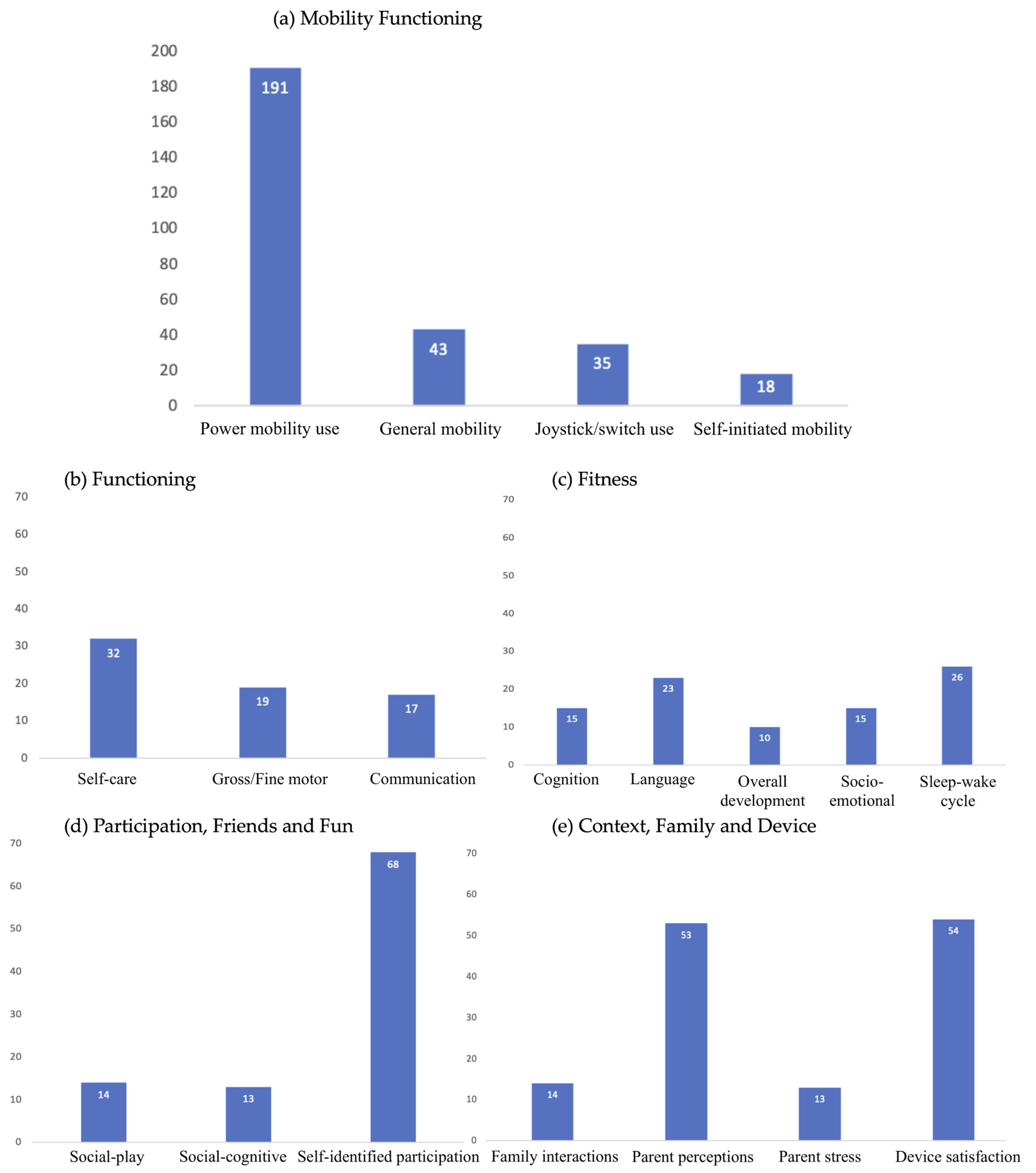
| Power mobility use | 2 RCT (n = 52); 3 time series (n = 58); 4 pre-post (n = 55): 15 SSRD/case series/reports (n = 26) |
| General mobility | 1 RCT (n = 8); 1 time series (n = 27); 1 pre-post (n = 3); 3 SSRD/case series/reports (n = 5) |
| Joystick/switch use | 1 RCT (n = 2); 2 pre-post (n = 11); 25 SSRD/case series/reports (n = 25) |
| Self-initiated mobility | 1 time series (n = 13); 4 SSRD/case series (n = 5) |
| Self-care | 1 RCT (n = 15); 2 SSRD/case series (n = 9) |
| Gross/Fine motor | 1 RCT (n = 15); 1 time series (n = 1); 3 case series/reports (n = 3) |
| Communication | 1 RCT (n = 15); 2 SSRD/case reports (n = 2) |
| Social play | 1 time series (n = 13); 1 SSRD (n = 1) |
| Social-cognitive | 1 SSRD (n = 1); 2 case series (n = 11); 1 case report (n = 1) |
| Self-identified participation | 3 time series (n = 35); 2 pre-post (n = 28); 2 SSRD (n = 2) |
| Cognition | 1 RCT (n = 15) |
| Language | 2 RCTs (n = 23) |
| Overall development | 1 RCT (n = 8); 1 pre-post (n = 2) |
| Socio-emotional | 1 RCT (n = 15) |
| Sleep-wake cycle | 1 time series (n = 13); 1 post (n = 12); 1 case series (n = 1) |
| Family interactions | 1 time series (n = 13); 1 case report (n = 1) |
| Parent beliefs/perceptions | 1 RCT (n = 15); 2 time series (n = 25) |
| Parent stress | 1 time series (n = 13) |
| Parent device satisfaction | 1 RCT (n = 15); 1 time series (n = 4); 1 pre-post (n = 2); 2 SSRD/case series/reports (n = 7) |
Disclaimer/Publisher’s Note: The statements, opinions and data contained in all publications are solely those of the individual author(s) and contributor(s) and not of MDPI and/or the editor(s). MDPI and/or the editor(s) disclaim responsibility for any injury to people or property resulting from any ideas, methods, instructions or products referred to in the content. |
© 2026 by the authors. Licensee MDPI, Basel, Switzerland. This article is an open access article distributed under the terms and conditions of the Creative Commons Attribution (CC BY) license.
Share and Cite
Livingstone, R.W.; Paleg, G.S.; Fullerton, B.W.; Claësson, D.; Govender, P.; Nilsson, L. The Experience and Use of Power Mobility by Children with Complex Non-Ambulant Cerebral Palsy: A Scoping Review. Disabilities 2026, 6, 64. https://doi.org/10.3390/disabilities6040064
Livingstone RW, Paleg GS, Fullerton BW, Claësson D, Govender P, Nilsson L. The Experience and Use of Power Mobility by Children with Complex Non-Ambulant Cerebral Palsy: A Scoping Review. Disabilities. 2026; 6(4):64. https://doi.org/10.3390/disabilities6040064
Chicago/Turabian StyleLivingstone, Roslyn W., Ginny S. Paleg, Benjamin W. Fullerton, Débora Claësson, Pragashnie Govender, and Lisbeth Nilsson. 2026. "The Experience and Use of Power Mobility by Children with Complex Non-Ambulant Cerebral Palsy: A Scoping Review" Disabilities 6, no. 4: 64. https://doi.org/10.3390/disabilities6040064
APA StyleLivingstone, R. W., Paleg, G. S., Fullerton, B. W., Claësson, D., Govender, P., & Nilsson, L. (2026). The Experience and Use of Power Mobility by Children with Complex Non-Ambulant Cerebral Palsy: A Scoping Review. Disabilities, 6(4), 64. https://doi.org/10.3390/disabilities6040064