
Neurodivergent-Focused Game Accessibility: A Systematic Literature Review

 ,
,  , , , , , , and
Abstract
1. Introduction
Gaming and Neurodiversity
- RQ2—What are the most common accessibility barriers faced by neurodivergent players in digital games?
- RQ3—Which game design features and adaptations are most frequently proposed or implemented to enhance accessibility for neurodivergent groups?
- RQ4—How do different game genres address the needs of neurodivergent players?
- RQ5—To what extent are neurodivergent players involved in the game design process?
- RQ6—What gaps exist in current research on accessible game design for these populations, and what future directions are suggested?
2. Notes on Language and Conceptual Framing
3. Methods
3.1. Eligibility Criteria
3.2. Information Sources
3.3. Search Strategy
3.4. Selection and Data Collection Process
3.5. Data Items and Synthesis
3.6. Study Risk of Bias Assessment
- Tier 1—Low relevance/weak methods: These studies were characterised by limited methodological transparency, theoretical or conceptual approaches without empirical grounding, or marginal relevance to neurodivergent accessibility in digital game design.
- Tier 2—Moderate methods/some relevance: These contributions displayed adequate but not rigorous methods, with partial attention to accessibility for neurodivergent populations. While informative, their findings were considered limited in terms of transferability or depth of evidence.
- Tier 3—Strong methods/clear accessibility framing: These studies demonstrated robust methodological approaches (qualitative, quantitative, or mixed), provided empirical data or detailed design evaluations, and framed accessibility explicitly in relation to neurodivergent populations.
4. Results
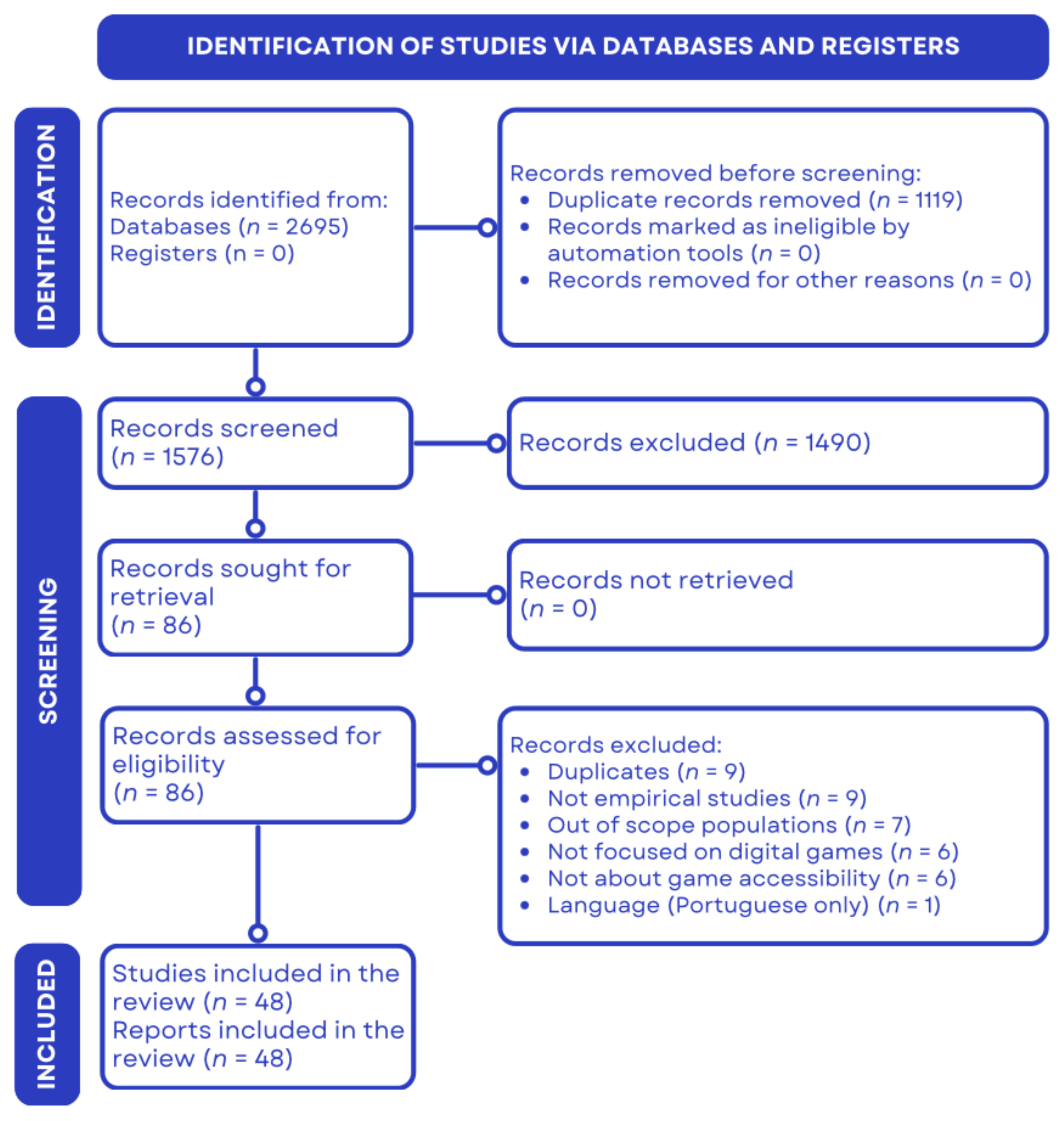
4.1. Study Selection
4.2. Study Characteristics
Aims of the Studies
4.3. Risk of Bias in Studies
4.4. Results of Syntheses
4.4.1. Views on Accessibility in the Sample of Studies
4.4.2. Accessibility for Neurodivergent Players
4.4.3. Implementing and Testing Accessibility
5. Discussion
5.1. How Has Accessible Game Design Been Studied and Implemented to Support Autistic Players and Individuals with Intellectual Disabilities? (RQ1)
5.2. What Are the Most Common Accessibility Barriers Faced by Autistic Players and Individuals with Intellectual Disabilities in Digital Games? (RQ2)
5.3. Which Game Design Features and Adaptations Are Most Frequently Proposed or Implemented to Enhance Accessibility for These Neurodivergent Groups? (RQ3)
5.4. How Do Different Game Genres Address the Needs of Autistic Players and Individuals with Intellectual Disabilities? (RQ4)
5.5. To What Extent Are Autistic Individuals and Those with Intellectual Disabilities Involved in the Game Design Process? (RQ5)
5.6. What Gaps Exist in Current Research on Accessible Game Design for These Populations, and What Future Directions Are Suggested? (RQ6)
6. Conclusions
6.1. Implications
6.2. Limitations and Future Directions
Author Contributions
Funding
Institutional Review Board Statement
Informed Consent Statement
Data Availability Statement
Conflicts of Interest
Disability Language/Terminology Positionality Statement
Abbreviations
| ADHD | Attention-Deficit/Hyperactivity Disorder |
| AR | Augmented Reality |
| PRISMA | Preferred Reporting Items for Systematic reviews and Meta-Analyses |
| RPG | Role Playing Game |
| RQ | Research Question |
| SLR | Systematic Literature Review |
| UI | User Interface |
| UN | United Nations |
| UNCRPD | United Nations Convention on the Rights of People with Disabilities |
| VR | Virtual Reality |
| W3C | World Wide Web Consortium |
References
- Chapman, R. Neurodiversity, disability, wellbeing. In Neurodiversity Studies; Routledge: London, UK, 2020; pp. 57–72. [Google Scholar]
- Walker, N. Neuroqueer Heresies: Notes on the Neurodiversity Paradigm, Autistic Empowerment, and Postnormal Possibilities; Autonomous Press: Fort Worth, TX, USA, 2021. [Google Scholar]
- Cheng, Y.; Tekola, B.; Balasubramanian, A.; Crane, L.; Leadbitter, K. Neurodiversity and community-led rights-based movements: Barriers and opportunities for global research partnerships. Autism 2023, 27, 573–577. [Google Scholar] [CrossRef] [Scilit]
- Santhanam, S.P. An interactive and neurodiversity-affirming approach to communication supports for autistic students through videogaming. Lang. Speech Hear. Serv. Sch. 2023, 54, 120–139. [Google Scholar] [CrossRef] [Scilit]
- Le, L. “I am human, just like you”: What intersectional, neurodivergent lived experiences bring to accessibility research. In Proceedings of the 26th International ACM SIGACCESS Conference on Computers and Accessibility, New York, NY, USA, 27–30 October 2024; pp. 1–20. [Google Scholar] [CrossRef] [Scilit]
- Spiel, K.; Gerling, K. The purpose of play: How HCI games research fails neurodivergent populations. ACM Trans. Comput.-Hum. Interact. 2021, 28, 1–40. [Google Scholar] [CrossRef] [Scilit]
- Leino, H.; Puumala, E. What can co-creation do for the citizens? Applying co-creation for the promotion of participation in cities. Environ. Plan. C 2021, 39, 781–799. [Google Scholar] [CrossRef] [Scilit]
- Harrison, M.; Rowlings, J.; Aivaliotis-Martinez, D. Supporting neurodivergent players. In Press B to Belong; Emerald Publishing: Bingley, UK, 2024; pp. 65–77. [Google Scholar]
- Heron, M.J. Cultural integration and the accessibility of gaming. Comput. Games J. 2016, 5, 91–94. [Google Scholar] [CrossRef] [Scilit]
- Office of the High Commissioner for Human Rights. Convention on the Rights of Persons with Disabilities. OHCHR, 2006. Available online: https://www.ohchr.org/en/instruments-mechanisms/instruments/convention-rights-persons-disabilities (accessed on 28 November 2025).
- Lee, M.; Yeomans, M.; Lansford, E.; Kuo, H.J. Benefits, barriers, and accessibility in video games: A focus group study of college students with disabilities. Disabil. Rehabil. Assist. Technol. 2025, 1–16. [Google Scholar] [CrossRef] [Scilit] [PubMed]
- Oliva-Zamora, M.Á.; Mangiron, C. How to create video games with cognitive accessibility features: A literature review of recommendations. Univers. Access Inf. Soc. 2025, 24, 2805–2818. [Google Scholar] [CrossRef] [Scilit]
- Best, K.L.; Mortenson, W.B.; Lauzière-Fitzgerald, Z.; Smith, E.M. Language matters! The long-standing debate between identity-first language and person-first language. Assist. Technol. 2022, 34, 127–128. [Google Scholar] [CrossRef] [Scilit]
- Sharif, A.; McCall, A.L.; Bolante, K.R. Should I say “disabled people” or “people with disabilities”? Language preferences of disabled people. In Proceedings of the 24th ACM SIGACCESS Conference on Computers and Accessibility, New York, NY, USA, 27–30 October 2022; Association for Computing Machinery: New York, NY, USA; pp. 1–18. [Google Scholar]
- Crocker, A.F.; Smith, S.N. Person-first language: Are we practicing what we preach? J. Multidiscip. Healthc. 2019, 12, 125–129. [Google Scholar] [CrossRef] [Scilit]
- Monk, R.; Whitehouse, A.J.O.; Waddington, H. The use of language in autism research. Trends Neurosci. 2022, 45, 791–793. [Google Scholar] [CrossRef] [Scilit]
- Janiszewski, C.; Friedel, E.; Skvarc, D.; Koller, D.; Grech, L.B. The relationship between disability identity and use of person-first and identity-first language. Rehabil. Psychol. 2025. Advance online publication. [Google Scholar] [CrossRef] [Scilit] [PubMed]
- Page, M.J.; McKenzie, J.E.; Bossuyt, P.M.; Boutron, I.; Hoffmann, T.C.; Mulrow, C.D.; Shamseer, L.; Tetzlaff, J.M.; Akl, E.A.; Brennan, S.E.; et al. The PRISMA 2020 statement: An updated guideline for reporting systematic reviews. BMJ 2021, 372, n71. [Google Scholar] [CrossRef] [Scilit] [PubMed]
- Utt, J.; Short, K.G. Critical content analysis: A flexible method for thinking with theory. Underst. Dismantling Privil. 2018, 8, 1–7. [Google Scholar]
- Pope, C.; Mays, N.; Popay, J. Synthesizing Qualitative and Quantitative Health Evidence: A Guide to Methods; Open University Press: Buckingham, UK, 2007. [Google Scholar]
- Vonthron, F.; Yuen, A.; Pellerin, H.; Cohen, D.; Grossard, C. A serious game to train rhythmic abilities in children with dyslexia: Feasibility and usability study. JMIR Serious Games 2024, 12, e42733. [Google Scholar] [CrossRef] [Scilit]
- Sancho Nascimento, L.; Zagalo, N.; Martins, L.B. Challenges of developing a mobile game for children with Down syndrome to test gestural interface. Information 2020, 11, 159. [Google Scholar] [CrossRef] [Scilit]
- Adochiei, F.-C.; Arghir, S.-N.; Adochiei, I.R.; Argatu, F.C.; Seritan, G.C.; Alexandrescu, B. The power of play: Strategies for enhancing development in children with autism spectrum disorders. Sensors 2024, 24, 6720. [Google Scholar] [CrossRef] [Scilit]
- Almeida, L.M.; Silva, D.P.; Theodório, D.P.; Silva, W.W.; Rodrigues, S.C.M.; Scardovelli, T.A.; Silva, A.P.; Bissaco, M.A.S. ALTRIRAS: A computer game for training children with autism spectrum disorder in the recognition of basic emotions. Int. J. Comput. Games Technol. 2019, 2019, 4384896. [Google Scholar] [CrossRef] [Scilit]
- Batista, B.G.; Rodrigues, A.F.D.; Miranda, D.M.; Ishitani, L.; Nobre, C.N. Developing an edutainment game, taboo!, for children with ADHD based on socially aware design and VCIA model. In Proceedings of the 21st Brazilian Symposium on Human Factors in Computing Systems; ACM: New York, NY, USA, 2022; pp. 1–11. [Google Scholar]
- Bondioli, M.; Buzzi, M.C.; Buzzi, M.; Chessa, S.; Jaccheri, L.; Senette, C.; Pelagatti, S. Guidelines for research and design of software for children with ASD in e-health. Univers. Access Inf. Soc. 2024, 23, 1909–1930. [Google Scholar] [CrossRef] [Scilit]
- Bonet-Codina, N.; Von Barnekow, A.; Tost, D. IntegraGame: A real-life inspired serious game for social and professional training of people with intellectual disability. In Proceedings of the ICTs for Improving Patients’ Rehabilitation Research Techniques, Lisbon, Portugal, 1–2 October 2015; pp. 10–13. [Google Scholar]
- Castelhano, N.; Roque, L. Lessons from designing a game to support playfulness in multisensory stimulation environments. In Proceedings of the CHI PLAY, Amsterdam, The Netherlands, 15 October 2017; pp. 57–68. [Google Scholar]
- Chang, C.-C.; Hwang, G.-J.; Ou, L.-S. Fostering the life skills of learners with intellectual disabilities using interactive technologies: A motivational model-based digital game training approach. J. Comput. Assist. Learn. 2025, 41, e70026. [Google Scholar] [CrossRef] [Scilit]
- Choi, Y.; Kim, J.; Park, C.W.; Kim, J.; Yi, J.H.; Hong, J.-H. We play and learn rhythmically: Gesture-based rhythm game for children with intellectual developmental disabilities to learn manual sign. In Proceedings of the CHI Conference on Human Factors in Computing Systems; ACM: New York, NY, USA, 2022; pp. 1–13. [Google Scholar] [CrossRef] [Scilit]
- Da Cruz Netto, O.L.; Rodrigues, S.C.M.; De Castro, M.V.; Da Silva, D.P.; Da Silva, R.R.; De Souza, R.R.B.; De Souza, A.A.F.; Bissaco, M.A.S. Memorization of daily routines by children with Down syndrome assisted by a playful virtual environment. Sci. Rep. 2020, 10, 3144. [Google Scholar] [CrossRef] [Scilit]
- Dandashi, A.; Karkar, A.G.; Saad, S.; Barhoumi, Z.; Al-Jaam, J.; El Saddik, A. Enhancing the cognitive and learning skills of children with intellectual disability through physical activity and edutainment games. Int. J. Distrib. Sens. Netw. 2015, 11, 165165. [Google Scholar] [CrossRef] [Scilit]
- Derks, S.; Willemen, A.M.; Wouda, M.; Meekel, M.; Sterkenburg, P.S. The co-creation design process of ’You & I’: A serious game to support mentalizing and stress-regulating abilities in adults with mild to borderline intellectual disabilities. Behav. Inf. Technol. 2022, 41, 2988–3000. [Google Scholar] [CrossRef] [Scilit]
- Pontual Falcão, T.; Machado, K.; Pinto Neto, Z.; Miranda, A.; Cavalcanti, A.P.; Rodrigues, P.; Pereira, C.; Nascimento, A. Should I use my imagination? Co-designing a game editor within an app for alternative communication with children with autism. In Proceedings of the XXIII Brazilian Symposium on Human Factors in Computing Systems, Brasília, Brazil, 7–11 October 2024; pp. 1–12. [Google Scholar] [CrossRef] [Scilit]
- Gerling, K.; Depoortere, A.; Wauters, J.; Spiel, K.; Alexandrovsky, D.; Danckaerts, M.; Baeyens, D.; Van Der Oord, S. Representation of invisible disability: Exploring the lived experience of teenagers with ADHD to inform game design. ACM Trans. Comput.-Hum. Interact. 2024, 31, 1–26. [Google Scholar] [CrossRef] [Scilit]
- Hymes, K.; Hammer, J.; Seyalioglu, H.; Dow-Richards, C.; Brown, D.; Hambridge, T.; Ventrice, J.; Baker, M.; Kim, Y.J.; Hutchings, T.; et al. Designing game-based rehabilitation experiences for people with aphasia. Proc. ACM Hum. Comput. Interact. 2021, 5, 1–31. [Google Scholar] [CrossRef] [Scilit]
- Jaramillo-Alcázar, A.; Venegas, E.; Criollo-C., S.; Luján-Mora, S. An approach to accessible serious games for people with dyslexia. Sustainability 2021, 13, 2507. [Google Scholar] [CrossRef] [Scilit]
- Jaramillo-Alcázar, A.; Arias, J.; Albornoz, I.; Alvarado, A.; Luján-Mora, S. Method for the development of accessible mobile serious games for children with autism spectrum disorder. Int. J. Environ. Res. Public Health 2022, 19, 3844. [Google Scholar] [CrossRef] [Scilit]
- Kim, B.; Kim, S.-I.; Park, S.; Yoo, H.J.; Hong, H.; Han, K. RoutineAid: Externalizing key design elements to support daily routines of individuals with autism. In Proceedings of the 2023 CHI Conference on Human Factors in Computing Systems, Hamburg, Germany, 23–28 April 2023; pp. 1–18. [Google Scholar] [CrossRef] [Scilit]
- Labrada, S.M.; Martinez, E.F.; Marquez-Barja, J.M. Requirement system for the interface design of applications for children with neurodevelopmental disorders. In Proceedings of the 2024 IEEE Global Engineering Education Conference (EDUCON), Kos Island, Greece, 8–11 May 2024; pp. 1–9. [Google Scholar] [CrossRef] [Scilit]
- Leharanger, M.; Martinez, E.R.; Balédent, O.; Vandromme, L. Familiarization with mixed reality for individuals with autism spectrum disorder: An eye-tracking study. Sensors 2023, 23, 6304. [Google Scholar] [CrossRef] [Scilit]
- Li, B.; Atyabi, A.; Kim, M.; Barney, E.; Ahn, A.Y.; Luo, Y.; Aubertine, M.; Corrigan, S.; St. John, T.; Wang, Q.; et al. Social influences on executive functioning in autism: Design of a mobile gaming platform. In Proceedings of the 2018 CHI Conference on Human Factors in Computing Systems, Montreal, QC, Canada, 21–26 April 2018; pp. 1–13. [Google Scholar] [CrossRef] [Scilit]
- Luo, J.; Li, F.; Wu, Y.; Liu, X.; Zheng, Q.; Qi, Y.; Huang, H.; Xu, G.; Liu, Z.; He, F.; et al. A mobile device-based game prototype for ADHD: Development and preliminary feasibility testing. Transl. Psychiatry 2024, 14, 251. [Google Scholar] [CrossRef] [Scilit]
- Lyu, Y.; An, P.; Xiao, Y.; Zhang, Z.; Zhang, H.; Katsuragawa, K.; Zhao, J. Eggly: Designing mobile augmented reality neurofeedback training games for children with autism spectrum disorder. Proc. ACM Interact. Mob. Wearable Ubiquitous Technol. 2023, 7, 1–29. [Google Scholar] [CrossRef] [Scilit]
- Moon, J.; Ke, F.; Sokolikj, Z. Game-based performance tasks for assessing representational flexibility of autistic adolescents in a virtual world. Technol. Knowl. Learn. 2025, 30, 539–560. [Google Scholar] [CrossRef] [Scilit]
- Muneeb, S.; Sitbon, L.; Ahmad, F. Opportunities for serious game technologies to engage children with autism in a Pakistani sociocultural and institutional context: An investigation of the design space for serious game technologies to enhance engagement of children with autism and to facilitate external support provided. In Proceedings of the 34th Australian Conference on Human-Computer Interaction, Canberra, ACT, Australia, 29 November 2022; ACM: New York, NY, USA, 2022; pp. 338–347. [Google Scholar] [CrossRef] [Scilit]
- Piedade, P.; Neto, I.; Pires, A.C.; Prada, R.; Nicolau, H. Inclusion as a process: Co-designing an inclusive robotic game with neurodiverse classrooms. In Proceedings of the 26th ACM SIGACCESS Conference on Computers and Accessibility, St. John’s, Newfoundland and Labrador, Australia, 27–30 October 2024; ACM: New York, NY, USA, 2024; pp. 1–15. [Google Scholar] [CrossRef] [Scilit]
- Rauschenberger, M.; Rello, L.; Baeza-Yates, R.; Bigham, J.P. Towards language independent detection of dyslexia with a web-based game. In Proceedings of the 15th International Web for All Conference; ACM: New York, NY, USA, 2018; pp. 1–10. [Google Scholar] [CrossRef] [Scilit]
- Rauschenberger, M.; Lins, C.; Rousselle, N.; Hein, A.; Fudickar, S. Designing a new puzzle app to target dyslexia screening in pre-readers. In Proceedings of the 5th EAI International Conference on Smart Objects and Technologies for Social Good, Valencia, Spain, 25–27 September 2019; pp. 155–159. [Google Scholar] [CrossRef] [Scilit]
- Rauschenberger, M.; Baeza-Yates, R.; Rello, L. Screening risk of dyslexia through a web-game using language-independent content and machine learning. In Proceedings of the 17th International Web for All Conference; ACM: New York, NY, USA, 2020; pp. 1–12. [Google Scholar] [CrossRef] [Scilit]
- Rauschenberger, M.; Rello, L.; Baeza-Yates, R.; Gomez, E.; Bigham, J.P. Towards the prediction of dyslexia by a web-based game with musical elements. In Proceedings of the 14th International Web for All Conference; ACM: New York, NY, USA, 2017; pp. 1–4. [Google Scholar] [CrossRef] [Scilit]
- Raygoza-Romero, J.; Gonzalez-Hernandez, A.; Bermudez, K.; Martinez-Garcia, A.I.; Caro, K. Move&Learn: An adaptive exergame to support visual-motor skills of children with neurodevelopmental disorders. In Proceedings of the Conference on Information Technology for Social Good; ACM: Rome, Italy, 2021; pp. 169–174. [Google Scholar] [CrossRef] [Scilit]
- Rello, L.; Bayarri, C.; Otal, Y.; Pielot, M. A computer-based method to improve the spelling of children with dyslexia. In Proceedings of the 16th International ACM SIGACCESS Conference on Computers & Accessibility, Rochester, NY, USA, 20–22 October 2014; pp. 153–160. [Google Scholar] [CrossRef] [Scilit]
- Santórum, M.; Carrión-Toro, M.; Morales-Martínez, D.; Maldonado-Garcés, V.; Araujo, E.; Acosta-Vargas, P. An accessible serious game-based platform for process learning of people with intellectual disabilities. Appl. Sci. 2023, 13, 7748. [Google Scholar] [CrossRef] [Scilit]
- Sergis, N.; Troussas, C.; Krouska, A.; Tzortzi, C.; Bardis, G.; Sgouropoulou, C. ADHD Dog: A virtual reality intervention incorporating behavioral and sociocultural theories with gamification. Computers 2024, 13, 46. [Google Scholar] [CrossRef] [Scilit]
- Shaban, A.; Pearson, E. Evaluation of user experience and cognitive load of a gamified cognitive training application for children with learning disabilities. In Proceedings of the 17th International Web for All Conference; ACM: New York, NY, USA, 2020; pp. 1–10. [Google Scholar] [CrossRef] [Scilit]
- Shohieb, S.M.; Doenyas, C.; Elhady, A.M. Dynamic difficulty adjustment technique-based mobile vocabulary learning game for children with autism spectrum disorder. Entertain. Comput. 2022, 42, 100495. [Google Scholar] [CrossRef] [Scilit]
- Sousa, C.; Neves, J.C.; Damásio, M.J. The pedagogical value of creating accessible games: A case study with higher education students. Multimodal Technol. Interact. 2022, 6, 10. [Google Scholar] [CrossRef] [Scilit]
- Sousa, C.; Neves, J.C.; Damásio, M.J. Empowerment and well-being through participatory action research and accessible gaming: A case study with adults with intellectual disability. Front. Educ. 2022, 7, 879626. [Google Scholar] [CrossRef] [Scilit]
- Sousa, C.; Neves, J.C.; Barros, J. Towards cognitive accessibility in digital game design: Evidence-based guidelines for adults with intellectual disability. In Proceedings of the 2023 IEEE Conference on Games (CoG), Boston, MA, USA, 21–24 August 2023; IEEE: New York, NY, USA, 2023; pp. 1–4. [Google Scholar] [CrossRef] [Scilit]
- Trigueiro, M.J.; Lopes, J.; Simões-Silva, V.; Vieira De Melo, B.B.; Simões De Almeida, R.; Marques, A. Impact of VR-based cognitive training on working memory and inhibitory control in IDD young adults. Healthcare 2024, 12, 1705. [Google Scholar] [CrossRef] [Scilit]
- Vidal, A.F.P.; Cervantes, J.-A.; Rumbo-Morales, J.Y.; Sorcia-Vázquez, F.D.J.; Ortiz-Torres, G.; Moncada, C.A.C.; Arias, I.D.L.T. Development of RelaxQuest: A Serious EEG-Controlled Game Designed to Promote Relaxation and Self-Regulation with a Potential Focus on ADHD Intervention. Appl. Sci. 2024, 14, 11173. [Google Scholar] [CrossRef] [Scilit]
- Wang, J.; Bao, M.; Li, W.; Wang, J.; Jiang, K.; Yao, L.; Wang, Y. A digital gaming intervention combining multitasking and alternating attention for ADHD: A preliminary study. In Human Brain and Artificial Intelligence; Springer: Singapore, 2023; pp. 208–219. [Google Scholar]
- Wasserman, B.; Prate, D.; Purnell, B.; Muse, A.; Abdo, K.; Day, K.; Boyd, L. vrSensory: Designing inclusive virtual games with neurodiverse children. In Proceedings of CHI PLAY Companion; ACM: New York, NY, USA, 2019; pp. 755–761. [Google Scholar] [CrossRef] [Scilit]
- Winoto, P.; Tang, T.Y.; Guan, A. I will help you pass the puzzle piece to your partner if this is what you want: Collaborative puzzle games to train Chinese children with autism spectrum disorder joint attention skills. In Proceedings of the 15th International Conference on Interaction Design and Children; ACM: New York, NY, USA, 2016; pp. 601–606. [Google Scholar] [CrossRef] [Scilit]
- Wu, Q.; Xu, R.; Liu, Y.; Lottridge, D.; Nanayakkara, S. Players and performance: Opportunities for social interaction with augmented tabletop games at centres for children with autism. Proc. ACM Hum. Comput. Interact. 2022, 6, 161–184. [Google Scholar] [CrossRef] [Scilit]
- Sin Wu, Y.; Chen, C.Y.; Teng-Chang; Pay Wuang, Y. Cool Guy’s Adventure: A sensory integration game for children with ADHD. In Proceedings of the AHFE 2024 International Conference on Human Factors and Ergonomics, Nice, France, 24–27 July 2024. [Google Scholar] [CrossRef] [Scilit]
- Žilak, M.; Car, Ž. A framework for improving accessibility of serious games in handheld augmented reality based on user interaction data. Appl. Sci. 2025, 15, 2161. [Google Scholar] [CrossRef] [Scilit]
- Iwarsson, S.; Ståhl, A. Accessibility, usability and universal design—positioning and definition of concepts describing person–environment relationships. Disabil. Rehabil. 2003, 25, 57–66. [Google Scholar] [CrossRef] [Scilit]
- Miesenberger, K.; Edler, C.; Heumader, P.; Petz, A. Tools and applications for cognitive accessibility. In Web Accessibility; Yesilada, Y., Harper, S., Eds.; Springer: London, UK, 2019; pp. 523–546. [Google Scholar] [CrossRef] [Scilit]
- Hernandez, H.A.; Ye, Z.; Graham, T.C.N.; Fehlings, D.; Switzer, L. Designing action-based exergames for children with cerebral palsy. In Proceedings of the SIGCHI Conference on Human Factors in Computing Systems; ACM: New York, NY, USA, 2013; pp. 1261–1270. [Google Scholar] [CrossRef] [Scilit]
- Benton, L.; Vasalou, A.; Khaled, R.; Johnson, H.; Gooch, D. Diversity for design: A framework for involving neurodiverse children in the technology design process. In Proceedings of the SIGCHI Conference on Human Factors in Computing Systems; ACM: New York, NY, USA, 2014; pp. 3747–3756. [Google Scholar] [CrossRef] [Scilit]
- Frauenberger, C.; Spiel, K.; Scheepmaker, L.; Posch, I. Nurturing constructive disagreement—agonistic design with neurodiverse children. In Proceedings of the 2019 CHI Conference on Human Factors in Computing Systems, Glasgow, Scotland, UK, 4–9 May 2019; pp. 1–11. [Google Scholar] [CrossRef] [Scilit]
- Frauenberger, C.; Kender, K.; Scheepmaker, L.; Werner, K.; Spiel, K. Designing social play things. In Proceedings of the 11th Nordic Conference on Human-Computer Interaction; ACM: New York, NY, USA, 2020; pp. 1–12. [Google Scholar] [CrossRef] [Scilit]
- Moffatt, K.; McGrenere, J.; Purves, B.; Klawe, M. The participatory design of a sound and image enhanced daily planner for people with aphasia. In Proceedings of the SIGCHI Conference on Human Factors in Computing Systems, Vienna, Austria, 24–29 April 2004; pp. 407–414. [Google Scholar] [CrossRef] [Scilit]
- Barlet, M.C.; Spohn, S.D. Includification: A Practical Guide to Game Accessibility; AbleGamers Foundation: Charles Town, WV, USA, 2012. [Google Scholar]
- Hardy, S.; Dutz, T.; Wiemeyer, J.; Göbel, S.; Steinmetz, R. Framework for personalized and adaptive game-based training programs in health sport. Multimed. Tools Appl. 2015, 74, 5289–5311. [Google Scholar] [CrossRef] [Scilit]
- Powell, L.; Parker, J.; Harpin, V.; Mawson, S. Guideline development for technological interventions for children and young people to self-manage ADHD: Realist evaluation. J. Med. Internet Res. 2019, 21, e12831. [Google Scholar] [CrossRef] [Scilit] [PubMed]
- Constain Moreno, G.E.; Collazos, C.A.; Bautista, S.; Moreira, F. Software design for users with autism using human-centred design and design thinking techniques. Sustainability 2023, 15, 16587. [Google Scholar] [CrossRef] [Scilit]
- Constain Moreno, G.E.; Collazos, C.A.; Bautista, S.; Moreira, F. FRIDA: A framework for software design, applied in the treatment of children with autistic disorder. Sustainability 2022, 14, 14560. [Google Scholar] [CrossRef] [Scilit]
- Oswal, S.K. The ethics of accessible design. In The Routledge Handbook of Ethics in Technical and Professional Communication; Routledge: London, UK, 2025; pp. 298–312. [Google Scholar]
- Sousa, C. Empowerment and ownership in intellectual disability gaming. Int. J. Film Media Arts 2020, 5, 14–23. [Google Scholar] [CrossRef] [Scilit]
- Hassan, L. Accessibility of games and game-based applications: A systematic literature review and mapping of future directions. New Media Soc. 2024, 26, 2336–2384. [Google Scholar] [CrossRef] [Scilit]
- Mangiron, C. Exploring new paths towards game accessibility. Approaches Transl. Stud. 2012, 36. [Google Scholar] [CrossRef] [Scilit]
- Cairns, P.; Power, C.; Barlet, M.; Haynes, G. Future design of accessibility in games: A design vocabulary. Int. J. Hum. Comput. Stud. 2019, 131, 64–71. [Google Scholar] [CrossRef] [Scilit]
- Macdonald, D.; Dew, A.; Fisher, K.R.; Boydell, K.M. Claiming space: Photovoice, identity, inclusion and the work of disability. Disabil. Soc. 2023, 38, 98–126. [Google Scholar] [CrossRef] [Scilit]
- Greenhalgh, T.; Jackson, C.; Shaw, S.; Janamian, T. Achieving research impact through co-creation in community-based health services: Literature review and case study. Milbank Q. 2016, 94, 392–429. [Google Scholar] [CrossRef] [Scilit]
- Brown, M.; Anderson, S.L. Designing for disability: Evaluating the state of accessibility design in video games. Games Cult. 2021, 16, 702–718. [Google Scholar] [CrossRef] [Scilit]
- Jones, D.R. Reclaiming disabled creativity: How cultural models make legible the creativity of people with disabilities. Cult. Psychol. 2022, 28, 491–505. [Google Scholar] [CrossRef] [Scilit]
- Sousa, C.; Luz, F.; Fonseca, M.; Neves, P.; Lopes, P.; Maratou, V.; Chaliampalias, R.; Kameas, A.; Abdullahi, Y.; Rye, S. An Accessible and Inclusive Future for Tabletop Games and Learning: Paradigms and Approaches. ICERI Proc. 2022, 8397–8406. [Google Scholar] [CrossRef] [Scilit]
- Chapman, R.; Botha, M. Neurodivergence-informed therapy. Dev. Med. Ch. Neur. 2022, 65, 310–317. [Google Scholar] [CrossRef] [Scilit]
- Keating, T.C.; Hickman, L.; Leung, J.; Monk, R.; Montgomery, A.; Heath, H.; Sowden, S. Autism-related language preferences of English-speaking individuals across the globe: A mixed methods investigation. Autism Res. 2023, 16, 406–428. [Google Scholar] [CrossRef] [Scilit]
- Lei, J.; Jones, L.; Brosnan, M. Exploring an e-learning community’s response to the language and terminology use in autism from two massive open online courses on autism education and technology use. Autism 2021, 25, 1349–1367. [Google Scholar] [CrossRef] [Scilit]


| Search String: |
|---|
| (“accessibility” OR “cognitive accessibility” OR “psychological accessibility”) |
| AND (“neurodivergent people” OR “neurodiverse people” OR “neurodiversity” OR “autism” OR “ADHD” OR “hyperactivity” OR “dyslexia” OR “dyspraxia” OR “Tourette’s syndrome” OR “OCD” OR “anxiety disorders” OR “bipolar disorder” OR “intellectual disability” OR “intellectual disabilities”) |
| AND (“digital game development” OR “video game development” OR “videogame development” OR “game development” OR “game design” OR “gaming industry”) |
| Search String: |
|---|
| (“accessibility” OR “cognitive accessibility” OR “psychological accessibility”) |
| AND (“neurodivergent people” OR “neurodiverse people” OR “neurodiversity” OR “autism” OR “ADHD” OR “hyperactivity” OR “dyslexia” OR “dyspraxia” OR “Tourette’s syndrome” OR “OCD” OR “anxiety disorde*” OR “bipolar disorde*” OR “intellectual disabilit*”) |
| AND (“digital game development” OR “video game development” OR “videogame development” OR “game dev*” OR “game design” OR “gaming industry”) |
| Study | Country | Type/Methodological Approach | Sample Size | Condition(s) |
|---|---|---|---|---|
| [23] | Several Countries | Empirical Study (Mixed Methods) | 60 | Autism |
| [24] | Brazil | Empirical Study (Quantitative) | 38 | Autism |
| [25] | Brazil | Empirical Study (Qualitative) | 18 | ADHD |
| [26] | Italy | Empirical Study (Mixed Methods) | 69 | Autism |
| [27] | Spain | Empirical Study (Mixed Methods) | 10 | Intellectual Disability |
| [28] | Portugal | Empirical Study (Quantitative) | 11 | Intellectual Disability |
| [29] | Taiwan | Empirical Study (Quantitative) | 40 | Intellectual Disability |
| [30] | South Korea | Empirical Study (Mixed Methods) | 8 | Intellectual Disability |
| [31] | Brazil | Empirical Study (Quantitative) | 37 | Intellectual Disability |
| [32] | Qatar | Empirical Study (Quantitative) | 77 | Intellectual Disability |
| [33] | The Netherlands | Conceptual Paper (Qualitative) | n/a | Multiple Conditions |
| [34] | Brazil | Design Case Study (Qualitative) | 17 | Autism |
| [35] | Belgium | Empirical Study (Qualitative) | 15 | ADHD |
| [36] | United States | Empirical Study (Qualitative) | 11 | Other |
| [37] | Ecuador | Design Case Study (Qualitative) | n/a | Dyslexia |
| [38] | Ecuador | Design Case Study (Qualitative) | n/a | Autism |
| [39] | South Korea | Empirical Study (Mixed Methods) | 27 | Autism |
| [40] | Belgium | Design Case Study (Qualitative) | 88 | Multiple Conditions |
| [41] | France | Empirical Study (Quantitative) | 70 | Autism |
| [42] | USA | Empirical Study (Mixed Methods) | 65 | Autism |
| [43] | China | Empirical Study (Quantitative) | 110 | ADHD |
| [44] | Canada | Empirical Study (Quantitative) | 5 | Autism |
| [45] | USA | Empirical Study (Mixed Methods) | 7 | Autism |
| [46] | Pakistan | Empirical Study (Qualitative) | 23 | Autism |
| [22] | Several Countries | Design Case Study (Qualitative) | 3 | Intellectual Disability |
| [47] | Portugal | Empirical Study (Qualitative) | 80 | Multiple Conditions |
| [48] | Several Countries | Empirical Study (Quantitative) | 178 | Dyslexia |
| [49] | Germany | Empirical Study (Qualitative) | 5 | Dyslexia |
| [50] | Several Countries | Empirical Study (Quantitative) | 313 | Dyslexia |
| [51] | Several Countries | Empirical Study (Qualitative) | 5 | Dyslexia |
| [52] | Mexico | Design Case Study (Qualitative) | 9 | Multiple Conditions |
| [53] | Several Countries | Empirical Study (Quantitative) | 43 | Dyslexia |
| [54] | Ecuador | Empirical Study (Mixed Methods) | 47 | Multiple Conditions |
| [55] | Greece | Empirical Study (Mixed Methods) | 120 | ADHD |
| [56] | UK | Empirical Study (Mixed Methods) | 12 | Intellectual Disability |
| [57] | Egypt | Empirical Study (Mixed Methods) | 7 | Autism |
| [58] | Portugal | Empirical Study (Mixed Methods) | 31 | Intellectual Disability |
| [59] | Portugal | Empirical Study (Mixed Methods) | 14 | Intellectual Disability |
| [60] | Portugal | Empirical Study (Quantitative) | 31 | Intellectual Disability |
| [61] | Portugal | Empirical Study (Quantitative) | 15 | Intellectual Disability |
| [62] | Mexico | Design Case Study (Quantitative) | 12 | ADHD |
| [21] | France | Empirical Study (Mixed Methods) | 623 | ADHD |
| [63] | China | Empirical Study (Quantitative) | 20 | ADHD |
| [64] | USA | Empirical Study (Qualitative) | 3 | Multiple Conditions |
| [65] | South Korea | Empirical Study (Mixed Methods) | 4 | Autism |
| [66] | China | Empirical Study (Qualitative) | 14 | Autism |
| [67] | Taiwan | Empirical Study (Qualitative) | 4 | ADHD |
| [68] | Croatia | Design Case Study (Qualitative) | n/a | Multiple Conditions |
| Strand | Number of Studies (%) | Included Studies |
|---|---|---|
| Assessment and screening | 10 (20.8%) | [21,39,41,42,45,48,49,50,51,68] |
| Co-design and participatory inquiry | 5 (10.4%) | [28,34,35,36,47] |
| Context and engagement (sociocultural) | 1 (2.1%) | [46] |
| Guidelines/methods/frameworks | 7 (14.6%) | [26,37,38,40,58,59,60] |
| Inclusive play and sensory design | 3 (6.3%) | [44,64,66] |
| Interventions/training development | 22 (45.8%) | [22,23,24,25,27,29,30,31,32,33,43,52,53,54,55,56,57,61,62,63,65,66] |
| Study | Definition of Accessibility |
|---|---|
| [37] | “Accessibility is the characteristics implemented to objects, systems or environments to allow for their use despite the disability or condition of a person.” |
| [60] | Both studies adopted a definition emerging from the work of [69], which defines accessibility as the “design of products, services, and environments that are usable and navigable by as many people as possible, including those with disabilities or other diverse needs”. |
| [59] | Same definition as [60]—see above. |
| [68] | “Accessibility is a measure of the extent to which a product, service, or environment is suitable for all users, including people with disabilities and the elderly.” |
| Games’ Framing | Puzzle (n; %) | Multiple Genres (n; %) | Simulation (n; %) | Action/ Adventure (n; %) | RPG (n; %) | Other/Not Specified (n; %) |
|---|---|---|---|---|---|---|
| Both approaches (n = 8) | 2 (25.0%) | 2 (25.0%) | 2 (25.0%) | 0 (0.0%) | 0 (0.0%) | 2 (25.0%) |
| Entertainment only (n = 5) | 0 (0.0%) | 3 (60.0%) | 0 (0.0%) | 0 (0.0%) | 0 (0.0%) | 2 (40.0%) |
| Serious purposes (n = 32) | 14 (43.8%) | 7 (21.9%) | 2 (6.3%) | 4 (12.5%) | 1 (3.1%) | 4 (12.5%) |
| Unclear/Not specified (n = 3) | 1 (33.3%) | 2 (66.7%) | 0 (0.0%) | 0 (0.0%) | 0 (0.0%) | 0 (0.0%) |
| Total (N = 48) | 17 (35.4%) | 14 (29.2%) | 4 (8.3%) | 4 (8.3%) | 1 (2.1%) | 8 (16.7%) |
| Category | Examples of Mechanics | Representative Studies |
|---|---|---|
| Memory, attention, and concentration training | Memory card/puzzle tasks; progressive sequences of colours/sounds; auditory/visual cues; inhibitory control games; rhythm-based tasks; repetition and reinforcement | [21,23,36,37,41,42,43,45,48,50,51,61] |
| Adaptive difficulty and personalisation | Dynamic difficulty adjustment; real-time adaptation to player performance; avatar customisation; tutorials and simplified instructions; configurable parameters (colour, contrast, speed, font, voice) | [21,26,34,52,56] |
| Multimodal and sensory interaction | Use of visual, auditory, and tactile cues; eye-blink selection; gesture-based control (tap, drag, pinch, air gestures); integration of EEG, VR, or AR sensors; multisensory feedback (sound, visuals, haptics) | [22,31,32,34,44,62,66] |
| Narrative and representation | Inclusive or relatable storylines (e.g., ADHD representation, The Little Prince, emotion-based narratives); role-play and empathy-building scenarios | [24,30,33,35,44] |
| Motivation, feedback, and rewards | Immediate feedback (positive/negative reinforcement); achievements and rewards to sustain engagement; playful challenges; clear guidance | [30,41,53,55] |
| Social and collaborative play | Cooperative mechanics (joint attention tasks; co-play roles; inclusive robotic play); communication tools (teleport, voice chat); multiplayer rhythm or performance patterns | [28,47,64,65] |
| Therapeutic and cognitive-behavioural grounding | Mechanics based on behavioural reinforcement; stress regulation and mentalisation; self-regulation tasks (e.g., closing eyes to trigger alpha waves); emotional recognition tasks | [24,33,55,62] |
| Predominant Accessibility Features Adapted, Implemented, or Analysed | n (%) |
|---|---|
| Customisation options (e.g., font, difficulty, pacing) | 17 (35.4%) |
| Feedback systems (visual, auditory, text-based) | 10 (20.8%) |
| Narrative or emotional content accommodations | 8 (16.7%) |
| Other | 7 (14.6%) |
| Navigation aids and UI simplifications | 6 (12.5%) |
| Research Question | Key Findings from the SLR | Identified Gaps and Future Directions |
|---|---|---|
| RQ1 | Accessibility is mainly framed as a functional or therapeutic adjustment neglecting a certain “right to playfulness” of neurodivergent individuals | Need for cultural, rights-based, and neurodiversity-affirming framings of accessibility |
| RQ2 | Cognitive, sensory, and emotional barriers are most frequently reported | Limited cross-condition and intersectional analyses of accessibility barriers |
| RQ3 | Customisation options and adaptive difficulty mechanisms are the most commonly implemented features | Lack of attention to narrative, representational, and expressive dimensions of accessibility |
| RQ4 | Puzzle and serious games dominate the literature | Underrepresentation of entertainment-oriented and mainstream game genres |
| RQ5 | Minimal involvement of neurodivergent players as co-designers or in other positions that allow them to participate in the creative processes | Need for participatory, co-creative, and emancipatory design methodologies |
| RQ6 | Conceptual approaches and methodological practices remain fragmented | Need for coherent frameworks and longitudinal, mixed-method research designs |
Disclaimer/Publisher’s Note: The statements, opinions and data contained in all publications are solely those of the individual author(s) and contributor(s) and not of MDPI and/or the editor(s). MDPI and/or the editor(s) disclaim responsibility for any injury to people or property resulting from any ideas, methods, instructions or products referred to in the content. |
© 2026 by the authors. Licensee MDPI, Basel, Switzerland. This article is an open access article distributed under the terms and conditions of the Creative Commons Attribution (CC BY) license.
Share and Cite
Sousa, C.; Neves, P.P.; Fernandes, P.M.; Freire, J.; Gouveia, P.; Rodrigues, M.; dos Santos, T.; Casimiro, C.; Luz, F. Neurodivergent-Focused Game Accessibility: A Systematic Literature Review. Disabilities 2026, 6, 18. https://doi.org/10.3390/disabilities6010018
Sousa C, Neves PP, Fernandes PM, Freire J, Gouveia P, Rodrigues M, dos Santos T, Casimiro C, Luz F. Neurodivergent-Focused Game Accessibility: A Systematic Literature Review. Disabilities. 2026; 6(1):18. https://doi.org/10.3390/disabilities6010018
Chicago/Turabian StyleSousa, Carla, Pedro P. Neves, Pedro M. Fernandes, João Freire, Pedro Gouveia, Mariana Rodrigues, Tiago dos Santos, Cátia Casimiro, and Filipe Luz. 2026. "Neurodivergent-Focused Game Accessibility: A Systematic Literature Review" Disabilities 6, no. 1: 18. https://doi.org/10.3390/disabilities6010018
APA StyleSousa, C., Neves, P. P., Fernandes, P. M., Freire, J., Gouveia, P., Rodrigues, M., dos Santos, T., Casimiro, C., & Luz, F. (2026). Neurodivergent-Focused Game Accessibility: A Systematic Literature Review. Disabilities, 6(1), 18. https://doi.org/10.3390/disabilities6010018