1. Introduction
Thermodynamics is a mature science that was present at the very beginning of the Industrial Revolution. For many decades, steam engines were the mainstream of technology with steamboats and railways. Nevertheless, over the years, other apparatuses such as internal combustion engines and gas turbines took the main role. While the thermodynamic cycles underlying these machines are based on four processes, this paper presents a first attempt at a new scheme of thermodynamic cycles based on a triangular configuration of stages.
The primary and fundamental objective of thermodynamics was to convert heat into mechanical energy. Heat was mainly generated by combustion, and there were two potential ways to manage it:
External heating (traditionally by combustion) of a working fluid, which was originally water, to turn it into steam, for instance, as was the case of early locomotives and steamboats. This option could be structured without a phase change, using non-condensable gas in the operating conditions of the machine. This line of development presented the advantage of very fast machine reaction, but it had the drawback of low efficiencies both from heat transfer and thermodynamic performance.
Internal combustion, in which the working fluid contains the oxygen taking place in the reaction (as in air or oxycombustion), which covers most of the applications for transportation, particularly in automobiles and aircrafts.
The external combustion line includes waste heat recovery from a wide variety of processes (e.g., residual heat from industries), as well as solar thermal concentrated solar power. In these cases, there is frequently a primary hot fluid coming from the heat source, which heats up the secondary fluid, which, in turn, is the working fluid of a thermodynamic cycle [
1].
The drive for sustainability has taken the shape of a circular economy and energy efficiency, among others, and has sparked an interest in waste heat recovery: using heat that would otherwise be wasted. It is estimated that more than 50% of global primary energy consumption is lost as waste heat from low-grade (<100 °C) to high-grade (>400 °C) sources [
2,
3]. In most cases, the temperatures at which waste heat becomes available are low in comparison to the ones used in traditional thermodynamic cycles for high power production [
4]. Thus, the choice of a thermal system to be applied to a source of energy or to a source of heat requires analyzing the coherence between the features of the source and the characteristics of the cycle [
5]. A traditional solution has been to use Rankine cycles with organic compounds as working fluids, i.e., ORCs [
6,
7].
The work presented here is centered on external combustion cycles (or external heating). In particular, the paper discusses a new thermodynamic cycle structured in three stages, instead of the typical four of the Rankine or Brayton cycles. In order to fix ideas and figures, it is worth remarking that a thermodynamic cycle is made of a number of consecutive stages that have to match properly. Let us briefly go over a generic Brayton cycle as an example of a four-stage cycle:
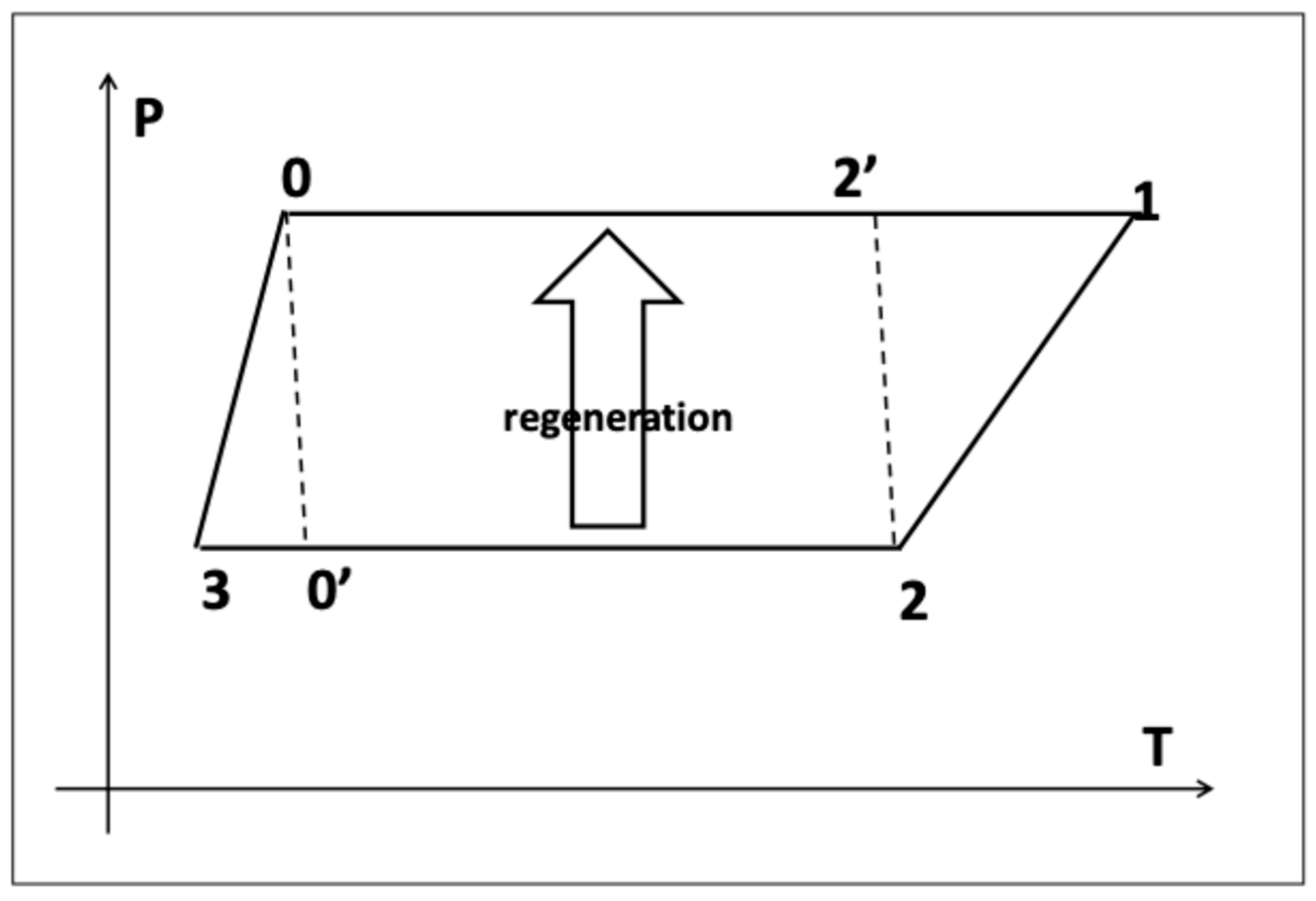
A Brayton–Joule modified gas cycle with regeneration is made up of classical four stages, as follows (
Figure 1):
Compression from the lower P level (P2, P3) to the upper (P0, P1).
Isobaric heating up to the maximum temperature achievable (T1). This stage has two parts. First, an intermediate heat exchanger with the flow exhausted from the turbine as the hot flow. The cold flow is the working fluid just after the compressor. The second part is not regenerative, and the heat comes from the external source.
Adiabatic expansion down to lower pressure (Pl).
Isobaric cooling up to the minimum temperature achievable (T0).
Heat regeneration can be considered mandatory in this cycle because the temperature in the exhaust of the turbine is hotter than that in the exit from the compressor (which can be made of several steps with intermediate cooling).
Now, let us describe the novel three-stage cycle presented here:
A new cycle, called the Vatricycle, which can be considered the simplest one, is made of three stages, starting from the thermodynamic point of minimum P and T, namely, P0 and T0. The stages are:
In the following, the thermodynamic fundamentals of the stages of these cycles will be analyzed, with emphasis on those of the Valtricycle. It must be remarked that the Valtricycle is based on isochoric heating, which is necessarily much slower than the compression stage of the Brayton cycle. Also, having no compressor implies that there exists little control of the intermediate states 0, 1 and 2. Moreso, if a non-adiabatic expansion is carried out between states 1 and 2, the last state will be determined by how heat transfer takes place during the expansion, also with little control. Because of this, in order for the cycle to work properly, the three stages must be calculated very carefully. Among other issues that will be developed in the following sections, it has to be borne in mind that the time required for a heat-based process is considerably longer than that for a pressure-driven one. Accordingly, two stages will be considered in detail, in which this phenomenon will appear:
Compression by isochoric heating (without any type of compressor). Isochoric heating is gathering interest for a number of applications, including engines [
8], though it is frequently associated to open systems [
9,
10].
Expansion embodying heating in the same stage. Non-adiabatic expansion has been studied theoretically and appears as a derived phenomenon in some processes [
11,
12]. The Valtricycle studies the possibility of actually provoking a controlled, non-adiabatic expansion.
Moreover, as pressure-driven mechanisms and thermal-driven phenomena do not convey the same time scales, energy conversion is more difficult. Fluid mechanics are governed by pressure gradients, which can accelerate fluids up to the speed of sound [
13]. Supersonic speeds can be attained in convergent/divergent nozzles and also with rocket engines. Those speeds are usually not needed for activating thermodynamic cycles, particularly for Joule–Brayton gas cycles, which dominate aircraft propulsion and electricity generation. These cycles are classified as internal combustion engines. An opposite case is featured by Stirling external heat addition. Those cycles have very modest efficiency, because heat must be transferred from outside to inside the operating piston. The difference between the heat transfer speed and the up and down velocity of the piston (in a reciprocating engine) does not allow for reaching a good performance [
14]. This is a hint to study the difference between pressure driving and temperature driving.
Pressure appears in the mechanical balance equation, while temperature does not act directly on that equation. Pressure gradients can be produced by temperature, but not directly (temperature does not appear directly in the mechanical equation): heat, by conduction, convection and radiation, must create density gradients that will evolve into pressure gradients.
Thermal diffusivity governs the speed of the thermal transients in the conduction case, causing temperature gradients.
Convection is governed by film coefficient and temperature differences.
Radiation is an extremely fast mechanism from one external surface to another, but it goes down to conduction, once the radiation flux is absorbed in the body showing its external face.
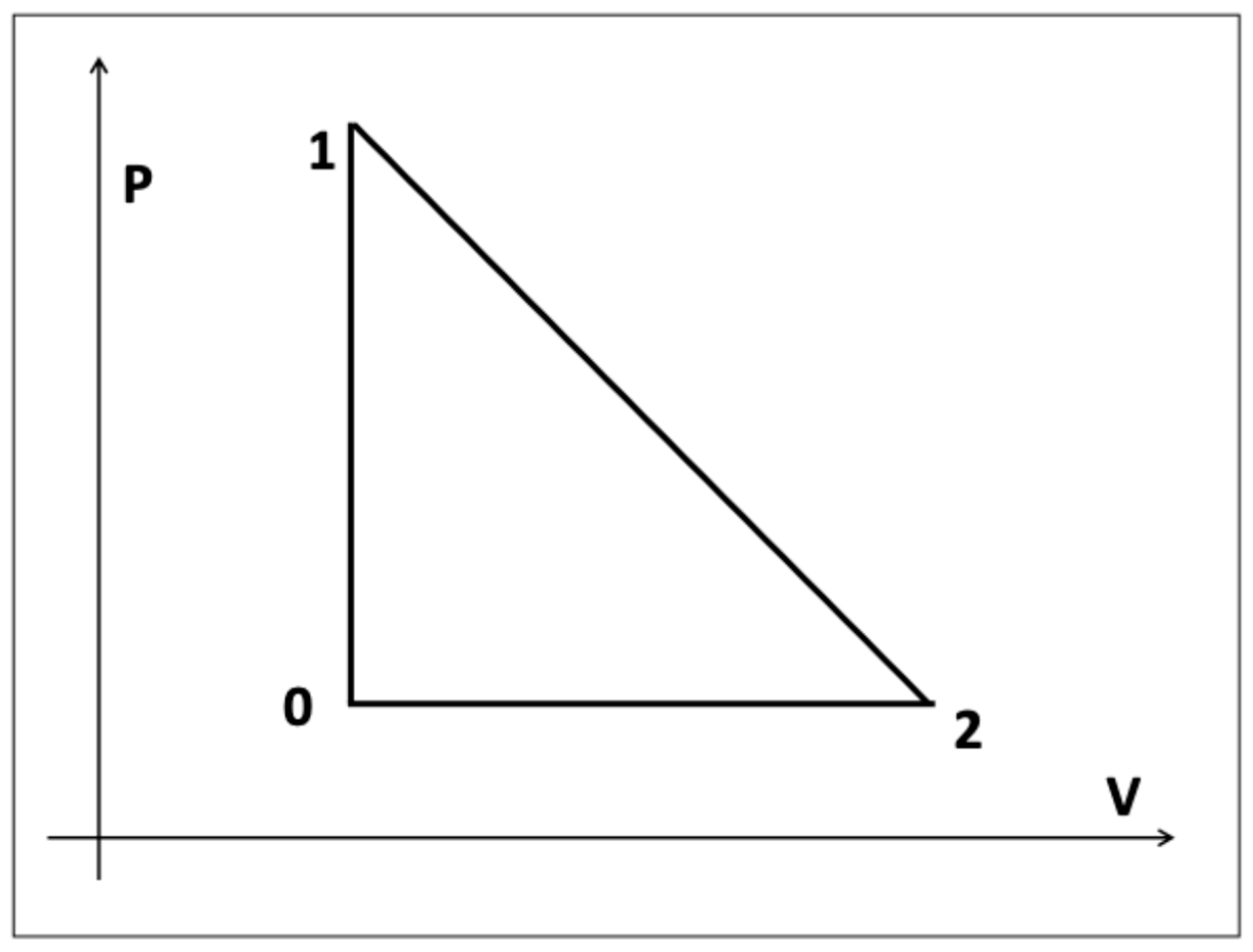
Let us return, under this light, to the aforementioned three stages of the proposed Valtricycle (see
Figure 2):
An isochoric heating phase, where heat is transferred from outside to inside a cylinder with fixed lateral walls.
An adiabatic (or non-adiabatic) expansion of the gas heated previously, down to the initial pressure of the first stage.
An isobaric cooling and compression, using an external cold flow, to close the cycle.
A very short time is needed for the adiabatic expansion as compared to the isochoric heating. This is a drawback that compromises the efficiency of this engine and increases its complexity, because, as it will be explained, it forces implementing mechanisms such as time multiplexing between several heaters to compensate for the duration difference.
It goes without saying that the heat of the isochoric heating comes in the system from outside, through a wall which acts as a heat exchanger. A certain mass of cold fluid—the working fluid of the cycle—will be heated and pressurized at the same time. It will be seen that the problem of the different time scales between some mechanisms driven by pressure and heat conduction will appear throughout.
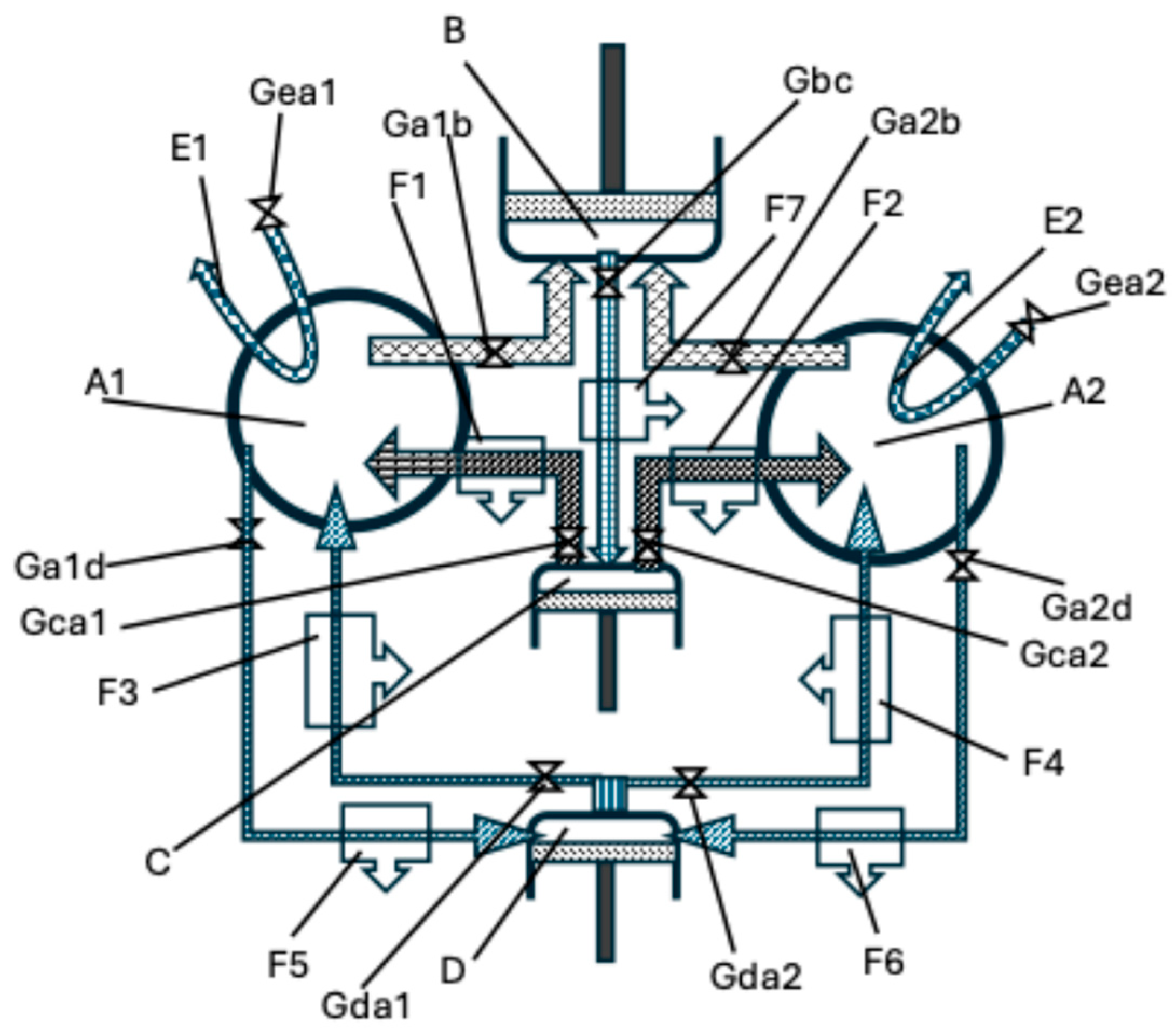
An engine design concept will be presented to implement the Valtricycle. Among other considerations, it will be necessary to take into account the counterpressure imposed by the mechanical part of the energy. Our approach considers that the speed of the enlargement of the volume of the piston can be adjusted to some extent according to the time needed for heat transfer. Theoretically, it can be done, but the machine becomes more complex. A practical solution to this problem relies on time multiplexing. A patent has already been granted on a family of devices able to work along these new cycles. It will be outlined after exposing the theoretical basis.
This paper is structured as follows:
Section 2 gives an overview of major considerations that need to be made to analyze the three-stage cycle.
Section 3 analyses compression by isochoric heating in detail.
Section 4 is entirely devoted to expansion, which is the stage that actually produces the work in a thermodynamic cycle. The behavior of gases in non-adiabatic expansions is characterized in detail, and several specificalities are analyzed with numerical examples.
Section 5 is dedicated to the closure of a three-stage cycle. The engine concept patent to implement the three-stage cycle is explained in
Section 6. Finally,
Section 7 summarizes the main conclusions of the work.
2. General Questions Around a Three-Stage Cycle
Two types of graphics are usually needed to characterize and calculate a thermodynamic cycle:
A thermodynamic chart: in general, volume (represented by V) as the abscissa and pressure (P) as the ordinate will be used.
A geometric depiction of the circuit containing all the elements that carry out the cycle: pipe-connected machines or reservoirs that drive the working fluid from one stage to another.
For each point, four variables need to be determined, with their corresponding units:
P, pressure (Pa).
V, specific volume (m3/kg). Its inverse value is the density, ρ.
T, temperature (Kelvin, or °C).
C, speed.
Four equations are used to determine those values, namely,
Continuity equation: mass conservation of the fluid. In the case of open circuits, they can be considered as being closed through the atmosphere.
Mechanical balance, which takes into account all forces pushing the fluid, which are equilibrated by the resistant forces along the circuit. If they are not in equilibrium, the fluid will be accelerated if the active forces are stronger than the resistant ones and will be retarded if they are weaker than them.
Energy balance.
Equation of state.
These equations need the corresponding boundary conditions, for instance, stating that a given expansion is adiabatic. However, such a declaration is not enough because we need to specify how such a condition is attained; a reason why expansions are adiabatic (approximately) is because they are very fast in comparison to any possible heat transfer process, on occasions with velocities close to the speed of sound, as when hot, pressurized gases are let out through a nozzle.
There are several ways in which boundary conditions can be set in thermodynamic cycles: some of them act on geometry, as diffusers, nozzles, and every part of the actual circuit where the flow is forced to modify its pathways; others act on pressure, such as compressors, fans and pressure dropping valves. A third family acts on temperature, through intermediate heat exchangers, either for cooling or for heating.
It is obvious that the end of a stage in a cycle must be the start of the next stage, which implies that the values of the variables provided by boundary conditions must match perfectly. Besides that, the cycle cannot have a unique regime of performance; it should operate within a range of the defining variables. To do it, regulation valves can be placed in proper points of the circuit.
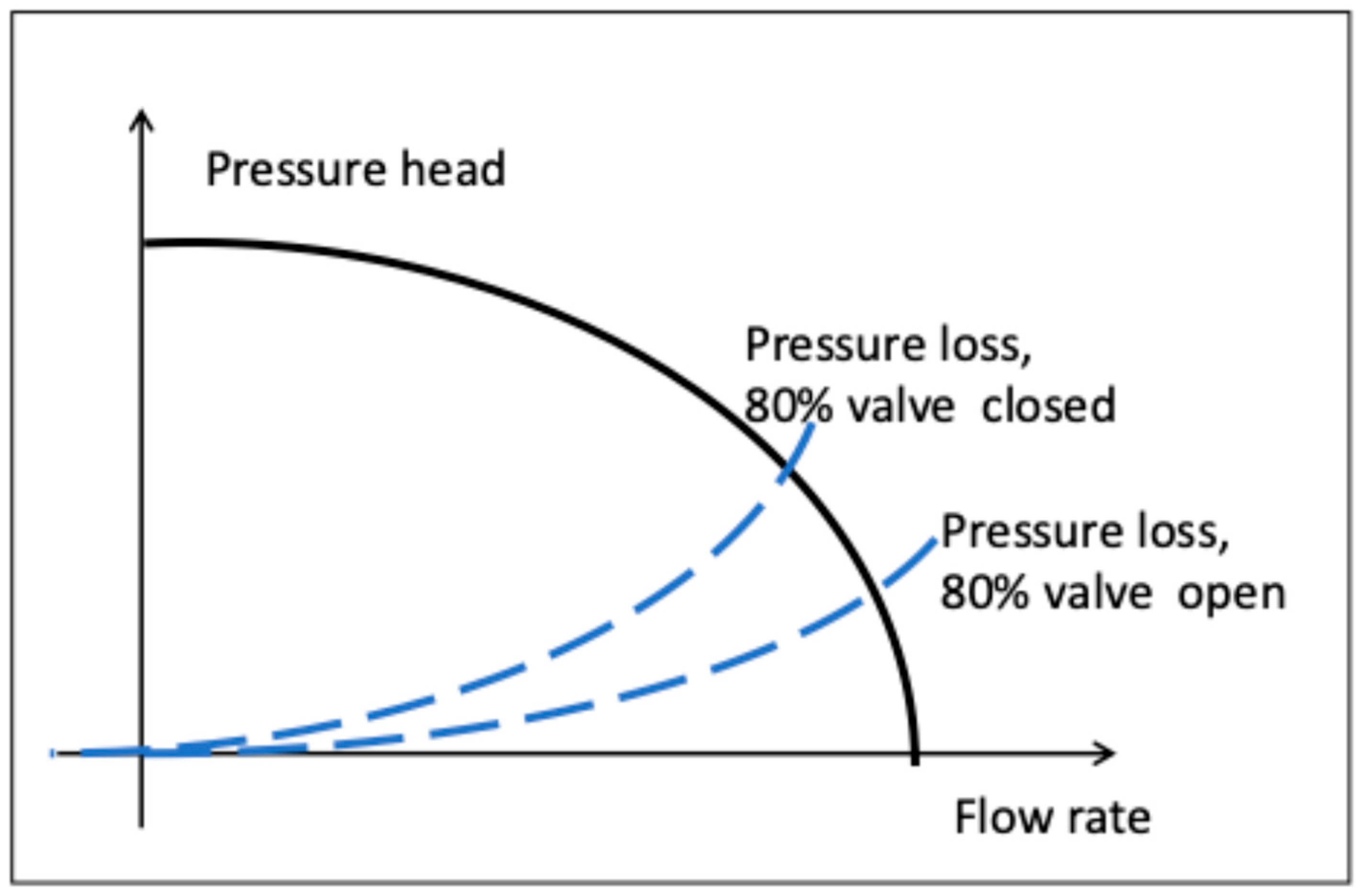
Figure 3 presents the operating principle of a regulation valve. The abscissa corresponds to the flow rate (F, in m
3/s) and the ordinate either stands for the pressure jump delivered by the compressor or the pressure drop along the complete cycle where the pressure jump is applied. The product of the abscissa times the ordinate is the power communicated to the working fluid.
As shown in
Figure 3, the working point in a given situation is the crossing of the line of the power jump (black) and the line of the pressure drop depending on the flow rate (dashed blue). This point is given by a compromise between mass flow rate and velve aperture. The flow rate can therefore be adjusted to match the end and start points of consecutive stages.
From the viewpoint of classical books on thermodynamics, the foregoing paragraphs are enough to describe how thermodynamic cycles work. However, there is still one pending problem that is not very much addressed in books and articles, but is very important for novel cycles: this problem stems from the different time scales in the different thermodynamic stages.
For heat conduction within a solid, the importance of time can be expressed in terms of the Fourier number,
Fo,
where α stands for the thermal diffusivity, t is time, and d is the characteristic distance, which depends on the internal geometry of the solid body.
In fact, this equation is also valid for a fluid that cannot move. This is the case of isochoric heaters, which are an essential part of the cycle that will be introduced in the next sections. Of course, isochoric heaters can be made with very different configurations, but some general ideas can be identified for a coarse analysis. First of all, isochoric heaters cannot be treated as intermediate heat exchangers, which are mainly based on convection currents separated by a solid wall. In isochoric heaters, the inner fluid (which is the working fluid) is at rest. Some internal small streams can be generated by small internal fans, but this is an additional complexity to the thermal engine we propose.
3. Compression by Isochoric Heating
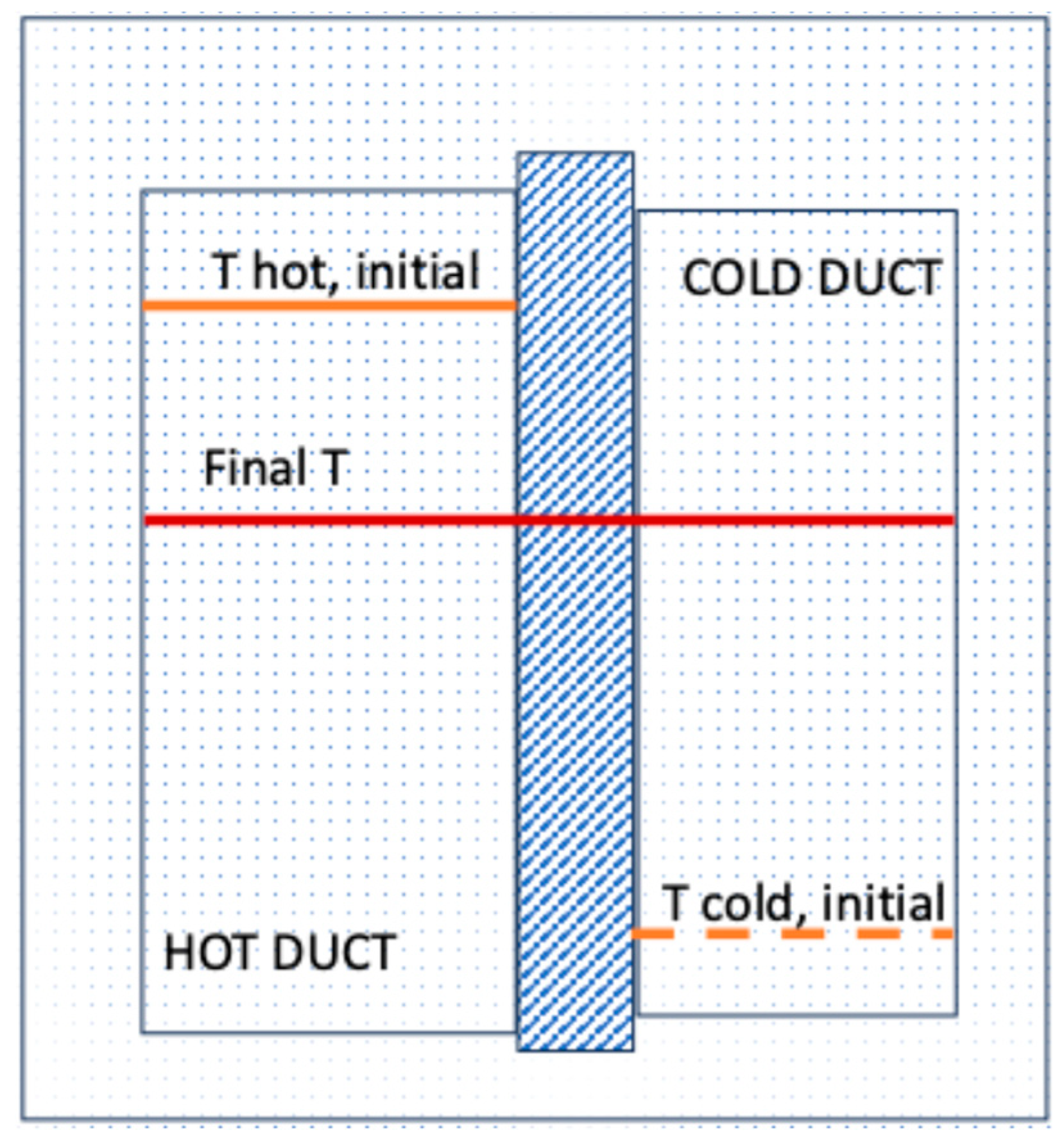
In the absence of micro-streams, we can consider that the thermal profile between the hot (external) fluid and the cold (internal) fluid is the one depicted in
Figure 4. The cold fluid is the thermal sink, which is the working fluid of the cycle. Its temperature profile is close to parabolic, and it is fitted to the temperature of the thin wall separating this fluid from the outer, hot fluid, which can come from different sources.
When the heating begins, the hot fluid is at its maximum temperature, and the cold fluid is at its minimum temperature. Once the heating begins, the evolution is governed by the difference in temperature, which decreases with time, as this system tends to uniform temperature.
In that period, a fundamental principle is keeping the thermal coherence between both fluids, and this criterion can be stated in terms of Fo, namely, requiring both fluids to have the same value at the end of the stage. Using subscript h to identify properties of the hot fluid and c for the cold one, the following equation can be written:
Thermal diffusivities α are physical properties of the fluids, while the characteristic lengths depend on the physical geometry of the heater. As a first choice, d can be equal to the mean chord of each volume containing hot or cold fluids. If those volumes have a lattice cell structure, the mean chord must be calculated for the lattice because heat transfer will take place at that level. In most cases, the following equation can be used
The most important facts of isochoric heater performance are the temperature reached in the cold fluid and the time needed to do that. Note that the evolution of both temperatures will tend to converge to a value (T
av) close to the average of the initial temperatures. Assigning m to the mass of each fluid in a lattice cell and C to the specific heat, it can be written
Solution of this equation can be expressed in terms of the mass ratio between both fluids, namely,
Two efficiencies are relevant in this context: first, the energy efficiency, which is the fraction of the incoming hot fluid energy that is transferred to the cold fluid. It is denoted by ε
Power. And second, the thermal efficiency, ε
T, which is the fraction between the temperature increase in the cold fluid divided by the difference between the initial temperatures in the hot and cold fluids. They can be written as
Unfortunately, efficiencies in recovering T and thermal energy are very modest and in opposition. One can heat the cold fluid up to temperatures close to the hottest one, but this implies that the flow mass rate of the cold fluid will vanish. It is easy to see that the optimum figure of the product εT εPower is obtained for f = 0.5, and, therefore, the maximum compound efficiency is 25%. At first, this seems too low for practical applications, but it is a way that deserves to be explored.
Note that the heat transfer efficiency can theoretically achieve 100% (asymptotically) in an intermediate heat exchanger working at counterflow and in equilibrium, i.e., both flows, hot being cooled, and cold being heated, have the same product of its mass flow rate times its specific heat. From this viewpoint, this approach has much better performance than the isochoric method that was formerly introduced. However, it must be taken into account that the intermediate heat exchanger at counterflow needs a mechanical compressor because the hot fluid will usually be at low pressure. This is why thermal regeneration is so important for standard cycles, as it conveys heat transfer from low pressure to high pressure.
A practical advantage of isochoric heating is that pressure evolves as temperature, and it is therefore possible to adjust both effects for starting a cycle. Particularly, the simplest cycle, made up of three consecutive stages. There will be a selected fluid acting as the working fluid, going through those stages. For reasons of statistical physics and material availability, argon was selected as the first option.
The starting point of the first stage will thus be a certain amount of Ar (for instance, 1 mol or 1 kg; any of these units can be used to feature the cycle, but all variables and parameters, notably R, will have to be in coherent units). The starting point will have a physical volume V0 that remains so during the isochoric heating.
The second stage will be an expansion from the final point of the isochoric compression, identified with subindex 1. In general, the expansion is considered to be adiabatic, but a polytropic analysis will provide a much wider and deeper understanding of physical problems. Adiabatic stages must comply with the requirement of neither receiving nor giving heat to the outer world. This case can be materialized and checked easily. Other transformations can only be kept in a coarse approximation.
4. An Expansion Stage in a Thermodynamic Cycle
The polytropic analysis of an expansion allows us to identify the physical trends that dominate the system and even determine the maximum achievable efficiency, always within a theoretical framework. Ideal flow conditions, without losses, can also be used, although this should be incorporated into the model in some way.
The classical selection for the expansion is the adiabatic one. However, some interesting characteristics of other types of expansions deserve more attention. This goal will be taken into account in the following development. In particular, two extreme cases will be analyzed in depth: each one aims at one of the two limiting situations: in the first one, the objective will be to maximize the kinetic energy of the thermodynamic fluid, and the second situation is to maximize the power devoted to expanding a piston.
The analysis performed is parametric, with the parameter (q) being the polytropic exponent:
Depending on the value of q, one transformation or another occurs. For example, for q = 1, there is an isotherm; for q = γ, an adiabatic transformation; and for q = 0, an isobaric transformation. An important property of the polytropic transformation is that its apparent or effective specific heat, Cq, remains constant, which is given by:
For q = γ, Cq is 0 because, being adiabatic, no heat is exchanged; for q = 1, it is infinite because, being isothermal, a temperature change is impossible by its very definition. However, a real transformation does not adopt the exponent q that we might want but rather the one that actually occurs, depending on the boundary thermal conditions and how these are applied, according to the laws of physics (thermotechnics and fluid mechanics).
There are some parametric relationships that should be explained, which will be used when appropriate. They are elementary, and some are simply by definition.
We will call r the pressure ratio between the initial thermodynamic state of the expansion, with subscript 0, and the final state, with subscript 1.
from which we can write:
From this expression, an important property is deduced: if q > 1, T evolves in the same direction as P. However, for q < 1, the evolution is opposite, and when P decreases, T increases. This also has repercussions on the value of Cq. When q < 1, Cq becomes positive, and, therefore, this transformation requires heat input. However, when 1 < q < γ, the value of Cq becomes negative, which means that in this expansion, the internal energy of the fluid itself is “consumed.”
What we are trying to do is transform the heat introduced into the expanding fluid into mechanical energy. This indicates that we must be in a thermodynamic domain where q < 1 (for practical reasons, we will call α the value of α = (1 − q)/q).
The limit of this analysis is marked by the isotherm, q = 1, where (theoretically) all the heat supplied would be transformed into kinetic energy. It is questionable whether this can actually occur, but it would represent a reversibility so extreme that it would require an infinite amount of time.
4.1. Fundamental Parameters and Relations, Efficiency
The system is thermodynamically defined by five equations:
The equation of state, PV = RT.
Mass continuity (in steady state), which means a constant flow rate (cA/V = ctn), where c is the velocity, A is the cross-sectional area, and V is the specific volume.
Linear impulse or momentum, which, for a fluid not affected by frictional manometric losses, can be written in a 1D approximation.
Energy, which can be written as the first law:
Both the momentum and energy equations can be simplified depending on the domain where the system works. This is particularly the case for the speed, c, which can attain very high values if the pressure gradients are very high and the density is very small. On the contrary, the speed will be much less important in the case of being interested in longer heat transfer periods. In any case, from the momentum equation, we have the following expressions:
Since it is stationary, the local partial time derivative vanishes, and only the convective derivative remains, which can be written as:
Integrally, between states 0 and 1, it can be expressed as:
Note that P0 is greater than P1 and that c1 will be greater than c0.
Is important to specify that in the case of looking for very high speeds, there will not be mechanical work done during the expansion (δW = 0) nor appreciable changes in height (dz = 0), so it can be simplified to:
On the contrary, when speed is negligible, it can be written as
It is also worth noting that
The last term represents the expansion work (E), and the previous one is the one that appears in the linear impulse equation (I). Both can be calculated for an expansion of exponent q, between states 0 and 1. Note that if there is indeed an expansion, E is positive, and I is negative, since dP is negative as P decays. We obtain:
where the previous definitions of r and α have been used. Similarly,
It is important to note that we obtain I = −qE, which has repercussions for the formulation of efficiency, as will be seen. To this end, an immediate step is to relate the energy equation to the momentum equation since, from the latter, we can write:
Returning to the first law of thermodynamics, we have:
In turn, it can be verified that:
Then, these two equations are related to the continuity equation, that is:
In this system, it is of interest to accelerate the flow as much as possible during the expansion, which is measured by multiplying the velocity:
This multiplication results from two effects: the geometric effect, which is the ratio of the cross-sectional areas, and the thermodynamic effect, which is created by the increase in specific volume. In this multiplication, a non-transcendent velocity limit appears, which depends on the polytropic exponent followed by the expansion. This exponent cannot be chosen arbitrarily, as it depends on how quickly heat is transferred to the working fluid, except in the most well-known and elementary case, the adiabatic one, in which the heat added to the fluid is zero. Strictly speaking, there will always be some heating due to friction, but this is omitted in many explanations. Assuming a perfectly adiabatic case, the velocity limit, which occurs at the duct notch, is found to be the speed of sound, so its square equals γRT.
Performing a similar analysis for the ideal isothermal case, which is possibly unrealizable but unambiguously defined, the square of the limiting velocity equals RT. In general, the rate limit in a polytropic expansion is that its square equals qRT (indeed, the exponent is γ for adiabatic expansions and 1 for isothermal expansions; the general proof is given later, as it appears in the flow of equations).
The problem is that these limits are very high in absolute rates, which makes the time periods available for heating that is primarily converted into kinetic energy very short.
For comparison with the conventional case of isobaric heating followed by an adiabatic expansion, it is useful to define the temperature ratio τ:
To study polytropic expansions, it is helpful to observe the relationships between parameters and use them according to the desired constraints. For example, if the pressure ratio r and the temperature ratio τ are fixed, the value of α is logically given by:
From this, we can derive the value that the exponent q would have in that case (since
). Another expression that relates the general parameters of the expansion comes from the continuity equation, in which, if we call
s the theoretical velocity multiplication and n the ratio of cross-sectional areas,
:
It is important to emphasize that this entire analysis is hypothetical since the conditions under which an expansion acquires a specific value for the exponent q have not been determined, except in the adiabatic case, which is based on ensuring that the fluid does not receive heat while expanding. But before attempting an approach to that problem, it is advisable to close this first part with the expression of the efficiency of this phase, in which heat is supplied and kinetic energy is obtained. The theoretical efficiency can be expressed as
from which it can be simplified to
This shows that theoretical efficiency only depends on the value of the polytropic exponent, q, and the type of gas involved, represented by γ. It is shown that monatomic gases, such as argon, yield the best results for a given q, as their γ value is the highest at 5/3, followed by diatomic gases, whose γ is 7/5. Triatomic gases lag considerably behind, with a value of 9/7.
For the isothermal case, a theoretical efficiency of 1 is always obtained (which is not for the complete cycle, only for the acceleration during expansion), but as already mentioned, isothermal heating would require an infinite amount of time.
For an average q value, for example, 0.5, monatomic gases would offer a theoretical efficiency of 2/7 (28%), while diatomic gases reach 2/9 (22%).
In reality, this q value can reach higher values, resulting in better efficiencies, which can exceed 50%. For example, with air, a q of 0.8 leads to an efficiency of 53%. To obtain such a high q (or higher, without reaching 1), it is necessary to follow certain heating and speed guidelines, which are discussed below, starting with the understanding that acceleration and heating regimes are incompatible.
4.2. Limitations on the Working Fluid Speed
In most of the closed cycles using centrifugal compressors and centripetal turbines, fluid speed plays a major role in the performance of the cycle. Note that in the compressor, the fluid is accelerated towards the periphery, and it goes out from the rotating central piece (rotor) at very high speed, which is immediately converted into static pressure in the diffuser, which is a duct with an increasing cross-section. In the turbine, the fluid reaches a very high specific enthalpy that must be converted into kinetic energy, with a very high fluid speed, for the interaction with the propeller of the turbine to be effective.
To analyze how to achieve a suitable q, we will see that during acceleration due to a negative pressure gradient in a tube with a decreasing cross-section, a sudden change in regime occurs due to an abrupt change in the sign of a derivative. This will be related to the speed limitations that can be reached. In the case of adiabatic expansion, recall that the terminal velocity coincides with the sonic velocity (but the adiabatic case falls outside our domain of interest, which ends at the isotherm, represented by q = 1).
Starting from the continuity equation for mass flow rate, we have:
Or, including the polytropic condition:
In turn, the linear impulse equation gives:
Combining the two, we obtain:
Here, it is convenient to include the speed of sound, cs, as a reference variable:
And using the Mach number, M, we get:
which can be expressed as:
from which we can obtain the Mach number. The Mach number that causes an abrupt change in sign, from positive to negative, in the relationship between the logarithmic derivatives of the cross-sectional area and the pressure. That value is
The penultimate equation relates the velocity (relative to the speed of sound) to the shape of the tube (variation in A along its length) and to the available pressure gradient, which is created by the compressor. The power consumption in the compressor will be less than the turbine’s output, provided its specific volume is smaller than that of the turbine, due to the fluid being cooler in the compressor. What matters now is that, upon reaching the Mach number from the last equation, the derivative of the cross-sectional area will remain negative since the tube’s geometry cannot be changed, and the derivative of the pressure will become positive, which will slow the fluid’s movement, causing it to stagnate at that Mach number. Moreover, in a physical–mathematical singularity, the logarithmic derivative of the pressure will become infinite since it will correspond to the quotient of the logarithmic derivative of the straight section divided by a coefficient that is 0 at that point.
This analysis is relevant when the objective of this expansion is to accelerate the working fluid to be sent to the turbine, but this is not the only way to convert heat into mechanical energy. The alternative is to produce the displacement of a piston, which is the working model of a reciprocating engine. In this paper, emphasis is put on the latter, and, therefore, the sonic blockage is not relevant. Anyway, the current option has to be finished.
On the other hand, a mathematical development similar to the one above can be performed, but without considering pressure (which will always appear as an internal boundary condition, imposed by the compressor). The equations that successively appear when combining the mass flow continuity equation with the linear impulse equation are:
The linear impulse equation provides:
Logically, the same velocity limit found previously is obtained:
Here, we see the importance of the variation in cross-sectional area. It is true that tubes of this configuration are not standard, but they are essential for achieving the desired results. The acceleration depends partly on thermodynamics, directly through pressure (P), and partly on the reduction in the cross-sectional area as the gas moves and accelerates.
This reduction is very important for gas acceleration, and there is a duct shape that provides a constant acceleration component, which is exponential in nature:
It is interesting to present this example as a combination of the mass continuity equation and the linear momentum (or Euler’s) equation. We write:
In turn, as seen,
and we arrive, for this geometry, at
This leads to the previously seen expression:
from which the pressure gradient can be deduced:
It should be noted that the gradient is negative, as it should be, until the Mach number reaches its limiting value. It is clear that the gradient, even in this case of the chosen A(x), is not uniform along the acceleration duct, in which a gas molecule has a very short transit time. Keep in mind that the average gas velocity in the tube will be greater than 100 m/s, and even 200 m/s, so in a 10 m long tube, it will be in transit for 0.1 s. This may seem insignificant, but it is important to consider that there will be a very large temperature difference between the external heat flow and the internal gas of the thermal system. This is because the gas does not need to be heated as much as in regeneration, since the temperature does not rise nearly as high as in classic isobaric heating. However, the issue of acceleration and deceleration in the various phases will need to be addressed rigorously and precisely in due course. We must still re-establish the continuity and momentum equations to find a primary relationship between the Mach numbers at the beginning and end, and the basic data of the expansion. We start with velocities at the inlet, subscript 0, and outlet, 1:
where n is the ratio of inlet to outlet cross-sectional areas and r is the ratio of pressures at 0 divided by that at the outlet, 1. Both n and r are greater than 1.
From the impulse equation and the polytropic condition of q (which is an unknown, but the hypothesis is that it exists), we obtain
which leads us to
which is rearranged, given
and remembering that
we arrive at
Note that n is a value given by design (or already built) and r is a function of the compressor operation. It will be limited to 1.5, as will be seen in the numerical analysis; therefore, the polytropic coefficient obtained in that case will have a value for the input Mach number (remember that α is a function of q).
To find the value of the outlet, the previously explained relationship between velocities is used, and furthermore, the square of the speed of sound at the outlet will be γRT1, with the temperature relationship being
4.3. The Fundamental Function: To Heat and Accelerate Simultaneously
The third equation to consider is that of energy, starting from external heating, which, in turn, is subject to the heat transfer equation. We will examine this last equation later, as it is part of another problem, while the energy equation (or Bernoulli equation, in this case, in the conservative mode, since we have not included losses) is essential to solving the problem we have already established.
First, and as an expression of the first law applied to this cycle and, in particular, to the expansion phase with acceleration, we have, between point 0 at the beginning of that phase and point 1 at its end, the following:
In its differential formulation, it is:
But the last two terms cancel each other out since the impulse -VdP is entirely dedicated to accelerating the gas. If the friction of the moving gas and the corresponding pressure loss were taken into account, part of the impulse would be used to overcome that friction. Alternatively, the equality PdV = −VdP/q can be used. This leads to
Using the equation for Cq, we arrive at the following, expressed as an integration:
which can be rewritten as:
We can therefore define an efficiency of the acceleration in expansion as:
This efficiency is 1 when q = 1, that is, on the isotherm, since effectively nothing is expended in heating. However, this expansion is not technically feasible due to its duration. Efficiency becomes zero when q = 0, that is, an isobaric expansion, which therefore would not be an expansion at all.
But the basic function of this energy equation is to govern the entire system, along with the other two, with which it must control the system’s evolution. Thus, the three equations will be reformulated, with one or another correct arrangement of elements, to reduce them to the most straightforward form that can be handled. In reality, the case will be more complex since the equations must then be integrated to reconcile the entire cycle. Although the system requires iterations, the solution can be done explicitly by expanding some power functions in a series, with small exponents, which simplifies the treatment and the solution, of which several numerical examples are given later.
First, from the drive equation, we have (using here the subscripts that will be used when dealing with the complete cycle, which requires differentiating between the stages or phases of its evolution).
and from the energy equation:
In this equation, enthalpy h has been used, derived from internal energy u, and the gas flow rate (kg/s), m, has been explicitly introduced, which must be constant throughout the cycle and time. However, there is a tendency to write the equations for m = 1, so that they are expressed in terms of specific energy. This has generally been omitted in this paper, but it must appear at least in the final discussion. Incorporating the momentum equation into the energy equation yields a purely thermodynamic equation, without kinetic terms:
Similarly, the continuity equation must be incorporated:
It is advisable to add other formulations of energy and related quantities, anticipating that logically all formulations should coincide, and that these coincidences of values serve to verify the calculation performed.
The polytropic expression is
which can be reformulated to separate the heat transfer from the impulse
Obviously, other expressions can be derived from algebra changes
In fact, it is useful to illustrate this problem of accelerated expansion by heating, considering it from a more general point of view, even going as far as the adiabatic case, which is the most common and best known. In this case, its polytropic exponent is γ, and its blocking occurs precisely when the speed of the expanding gas equals the speed of sound. Logically, being adiabatic, the heat transferred is zero, by definition, and this is what leads to the coefficient being γ (=Cp/Cv). Therefore, in the adiabatic case, q = γ, and the value of α would be negative, which is why the temperature decreases during the expansion. In fact, if we have an initial temperature T1 and there is a reduction in the factor r during the expansion (r = P1/P2), the outlet temperature is
4.4. Numerical Application: Relation Between Geometrical, Thermal and Process Parameters
From the numerical examples, a set of conclusions can be drawn that will serve to properly guide the planned experiments. Tables providing these guidelines are presented below.
Table 1 presents the results of velocity multiplication (s) along the acceleration tube by heating, varying the compression ratio r; it also gives the thermal load required for each case. The last column indicates whether the case has limitations due to exceeding the Mach number, specifying, if applicable, the valid domain, which is defined as the q value exceeding a certain threshold.
Table 2 is similar, but with a higher value of n, which indicates that, in this case, the tube narrows more. The greatest impact is on the velocity multiplication, s.
Table 3 compares two similar cases, varying n. The impact on s causes variations in Mach M1 and in the value of the speed c
1, which decreases as n increases, due to the larger s and similar values for c
2. However, strictly thermodynamic factors, such as T2 and Q, do not vary.
As further conclusions, it can be said that:
For fixed n and r, T2 increases as q decreases.
For fixed values of n and q, as r increases, T2, c1, M2, s, and Q increase.
When n increases, with r and q fixed, T2 and Q do not change, while s increases almost proportionally.
4.5. Numerical Application: Analyzing a Design Case
Finally, in this section dedicated to expansion with heating and acceleration, we present the most direct method we have found so far to solve a case specified by:
n, since it is a design value = 2;
T1 = 300 K;
r, which is provided by the compressor that must supply the system with the gas at pressure = 1.2;
Q, which is the total heat transferred from outside = 30 kJ/kg.
To avoid iterations due to the self-consistent nature of the equations, the series expansion of rα is used, in its first two terms:
We start from
where Cp = 1000 J/K·kg and R = 288 J/K·kg for air. From the two previous equations, we deduce
from which we obtain q = 0.8
In this step, the accuracy of the calculation can be checked, proceeding in two ways to determine T
2:
The difference of 0.5 K is acceptable with the degree of precision of this formulation. With this value of α = 0.26, M1 can be determined:
Therefore, M1 = 0.222, and since the speed of sound at 300 K is equal to 348 m/s, the inlet velocity of the gas in the tube will be 77 m/s. This is considerably high because the value of n = 2 is very small.
To calculate the exit velocity, we can use:
This represents a 52.5% heat capture efficiency for acceleration. From this, we can obtain c2, which is 193 m/s. This figure can also be checked since c2 can be obtained from:
which gives the same result, 193 m/s.
This example is perfectly balanced from the start because it was actually taken from the previous examples, which provided several tables depicting various system states that showed full agreement among the five equations: the three balance equations, the state equation, and one polytropic equation. In this sense, polytropic analysis is very powerful and useful, as it introduces a parameter, q, which simplifies the calculations and has a clear physical meaning. However, if the problem data is chosen without any prior guidance, the problem does not converge, and in a real-world scenario, it would be necessary to address the two most important boundary mechanisms: the compressor and the external heating flow.
4.6. Numerical Application: Convergence
To illustrate this non-convergence effect, we will continue with the last example, but using a thermal load of 60 kJ instead of 30. When calculating α using the equation
instead of 0.26, q changes from approximately 0.8 to 0.55. This causes the acceleration efficiency to drop from 53% to 26%.
The outlet temperature becomes
With the value of q, we can obtain
And if this polytropic heat is applied to the 48 °C temperature increase, we obtain 65 kJ (instead of 60). This small discrepancy seems like it could be eliminated by repeating the iteration, using the number 65 instead of 60, but what is achieved is that the heat flow increases to 70. That is, if the system is not balanced with the five equations, the equilibrium point does not seem to be reached by the system on its own; however, it must be taken into account that the second phase of the cycle can be used to remove the excess temperature of the gas.
In any case, overloading the system with excessive heat flow reduces acceleration efficiency. In fact, calculating the inlet and outlet velocities in each case, the first (already squared) yields 77 and 194 m/s, respectively; these decrease to 71 and 198 m/s when the thermal load is doubled (implying an efficiency of 26%).
However, if this load is applied to the same tube with n = 2, but increasing r to 1.4 (corresponding to a case of squared balances), the velocities obtained are 84 and 260 m/s, with an efficiency of 46%.
4.7. Expansion in a Reciprocating Piston
Gas velocities achieved by the working fluid at the end of free expansion (against very low external pressure) are very high. They can reach hundreds of meters per second, which implies that the gas goes through a nozzle (about 1 cm long) in less than 10 microseconds. This is a very short time span for heating the gas, and this is a clear indication to analyze reciprocating engines.
In internal combustion engines, the maximum linear speed of pistons is slightly higher than 10 m/s, and the average value is around 5 m/s. So, a piston 5 cm long is swept in one direction in 10−2 s.
In conventional thermodynamic closed cycles, the working gas follows four stages. One of them is devoted to heating the gas flow up to the highest temperature, followed by a sudden expansion to convert the internal energy of the gas into kinetic energy, as has been explained in the foregoing sections.
The objective of this paper was to look for alternatives both at the level of the complete cycle and individual stages. Because of this goal, we have selected a stage that includes both mechanical expansion and heating. A first appreciation of this thermodynamic transformation is that it goes so fast that there is little time to complete efficient heating, in the case of using a sudden expansion, as was done in the foregoing equations. This is why another topic was selected for investigation, namely, the reciprocating engine.
In this case, volume becomes the most relevant variable. In the previous analysis, the relevant variables were pressure and speed. Now, they are volume and another one, either temperature or pressure. Speed is not representative because it remains very small.
The governing equations are the same as before, but the boundary conditions change quite a lot: they are the physical volume of the cylinder of the piston, which has a minimum volume V1 and a maximum V2. Increasing volume from V1 to V2 will be done at a modest speed because of the counter-pressure the piston has to overcome. This fact gives us a degree of freedom that can be used to heat the gas contained inside the cylinder, as the piston is expanding against the corresponding arm of the spinning axis of the mechanical engine.
Our research approach will use the phase space domain contained between the adiabatic and the isothermal expansion. It is worth recalling that the latter has never been proven; however, we can use their governing equations [
15]. Indeed, the time needed to keep an expansion at constant temperature would require that all the heat incoming in the cylinder would go to produce the expansion; this means an efficiency of 100% in a thermal evolution, which goes against the basis of heat transfer.
We can call super-adiabats the type of transformations contained in that part of the thermodynamic diagram. From a given point on the diagram, the adiabat goes down with the maximum slope; the isothermal presents the lowest slope [
16]. If the polytropic approach is used to have a uniform formulation, this family of curves will follow the well-known equation [
17,
18]:
where the polytropic exponent is γ for the adiabat and 1 for the isothermal. Some equations from the foregoing sections are recovered now under the new assumptions. In particular, the apparent polytropic is defined as
For this approach to be sound, q has to keep an almost constant value along the expansion. Its overall value obviously is
where P
1 > P
2 and V
2 > V
1. As 1 < q < γ, Cq is negative. This property is very important for the physics of the problem and the distribution of the delivered heat into internal energy and mechanical work.
It is worth restating here some of the definitions and equations found before. Subscript 1 stands for the starting point of the expansion, and 2 for the end. It holds that
The total heat delivered to the gas contained in the cylinder along the expansion is
which has to be distributed according to the First Principle
Taking into account the relation between temperatures
In the last equation, we can easily identify the part within the bracket corresponding to internal energy, which is Cv, and the part going to mechanical work, (R/(1 − q)). The latter proceeds from the mechanical work in polytropic representation
Nevertheless, the most important variables characterizing the piston are the volumes at the beginning and the end of the expansion, and we can write
It must be noted that the polytropic expansion coefficient is defined by Q.
The average q value of the heated expansion can be determined in a simple way by
The ratio is a constant of the reciprocating piston. The ratio changes with the heat transferred to the expanding gas, as can be seen in the previous equations.