Review

Plant-Derived Photosensitizers in Antimicrobial Photodynamic Therapy: Mechanisms, Advances, and Emerging Applications


Department of Biological & Environmental Sciences, Walter Sisulu University, Mthatha 5117, South Africa
Photochem 2026, 6(2), 17; https://doi.org/10.3390/photochem6020017
Submission received: 12 March 2026 / Revised: 11 April 2026 / Accepted: 15 April 2026 / Published: 17 April 2026

Abstract

The increasing prevalence of antimicrobial resistance, together with recurring infectious disease outbreaks, has intensified the need for alternative strategies to control microbial infections beyond conventional antibiotic therapies. Antimicrobial photodynamic therapy has emerged as a promising non-antibiotic approach in which light-activated photosensitising compounds generate reactive oxygen species that induce oxidative damage to microbial cells. Plant-derived photosensitisers have attracted increasing attention due to their structural diversity, biocompatibility, natural abundance, and potential for sustainability. Natural compounds such as curcumin, hypericin, chlorophyll derivatives, flavonoids, anthraquinones, and riboflavin exhibit favourable photochemical properties that enable efficient production of reactive oxygen species upon irradiation with visible light. Through radical- and singlet-oxygen-mediated photochemical pathways, these molecules exhibit broad-spectrum antimicrobial activity against bacteria, fungi, viruses, and biofilm-associated microorganisms. This review examines the photophysical properties and mechanisms of reactive oxygen species generation associated with plant-derived photosensitisers, together with key factors influencing their antimicrobial performance. Recent advances in nanocarrier-based delivery systems, dual-wavelength activation strategies, and synergistic combination therapies are also discussed for their potential to improve photostability, enhance reactive oxygen species generation, and increase microbial inactivation efficiency. Finally, current progress, challenges, and future research directions for advancing plant-derived photosensitisers in antimicrobial photodynamic therapy are discussed.

1. Introduction

The emergence and global spread of antimicrobial resistance (AMR) pose a critical challenge in modern medicine. Conventional antibiotics are increasingly ineffective against multidrug-resistant pathogens, while biofilm-associated infections display heightened tolerance due to restricted drug penetration, metabolic heterogeneity, and adaptive stress responses [1,2]. The slow development of new antibiotics worsens this crisis and highlights the need for alternative antimicrobial strategies that act through different mechanisms.
Beyond antimicrobial resistance, recent infectious disease outbreaks have exposed persistent vulnerabilities in global public health systems [3,4,5,6,7,8]. At the same time, multidrug-resistant bacterial infections cause millions of deaths each year, showing the widespread danger posed by microbial pathogens [9]. These challenges affect rural and low-income communities the most, where limited access to disinfectants, sterilisation tools, and reliable healthcare makes infection control more difficult [10,11]. Such realities highlight the urgent need for low-cost, sustainable antimicrobial strategies suitable for resource-limited environments.
Antimicrobial photodynamic therapy (aPDT) has emerged as a promising alternative strategy for microbial control. The technique relies on the activation of a photosensitiser (PS) by light of an appropriate wavelength in the presence of oxygen, producing reactive oxygen species (ROS) that can damage microbial cells and lead to cell death [12]. Unlike conventional antibiotics, aPDT acts through multiple oxidative mechanisms, thereby reducing the likelihood of microbial resistance [13,14]. Despite these advantages, the clinical translation of aPDT remains limited by challenges associated with many conventional photosensitizers, including high production costs, potential toxicity, poor water solubility, limited biocompatibility, photobleaching, batch variability, and limited penetration in deep tissues [15]. In response to these limitations, increasing attention has been directed toward naturally derived PSs, particularly those obtained from plants. Plant-derived PSs possess diverse chemical structures, broad light absorption properties, and inherent biological activities that make them attractive candidates for photodynamic applications [16,17,18,19]. In addition, their natural abundance, potential biocompatibility, and sustainability offer advantages over many synthetic counterparts. These characteristics have stimulated growing interest in exploring plant-based compounds as alternative or complementary PSs for aPDT.
Given recurring epidemics, rising antimicrobial resistance, and global health inequalities, plant-derived aPDT offers both an alternative antimicrobial strategy and a more accessible, eco-friendly infection control solution. This review summarises plant-derived PSs used in aPDT, focusing on their photochemical mechanisms, antimicrobial activity against planktonic and biofilm pathogens, and factors affecting treatment efficiency. It also discusses recent advances in formulation strategies, such as nanoparticle-based delivery systems and hybrid photodynamic platforms, as well as future prospects for clinical and environmental applications.

2. Methodology of the Review

This review was conducted through a literature search using scientific databases: PubMed, Scopus, Web of Science, and Google Scholar. The search strategy incorporated specific keywords and phrases, such as “plant-derived photosensitizers”, “antimicrobial photodynamic therapy”, “natural photosensitizers”, “ROS generation”, and “biofilm photoinactivation. Only peer-reviewed articles, reports, and reviews published mostly between 2021 and 2026 were considered. Inclusion criteria focused on peer-reviewed studies reporting photophysical properties, antimicrobial activity, and mechanisms of plant-derived PSs. Both in vitro and in vivo studies were considered. Duplicate and non-English articles were excluded. Data were critically analysed and synthesised to identify trends, mechanisms, and research gaps. The search initially yielded 23,151 articles. Titles and abstracts were screened for relevance to the review scope, narrowing the selection to 140 full-text articles. These were thoroughly analyzed to extract detailed information aligned with the review’s core themes. The information collected was organized into a structured review, ensuring clarity, coherence, and an emphasis on high-quality journal sources.

3. Antimicrobial Mechanisms of Plant-Derived PSs in aPDT

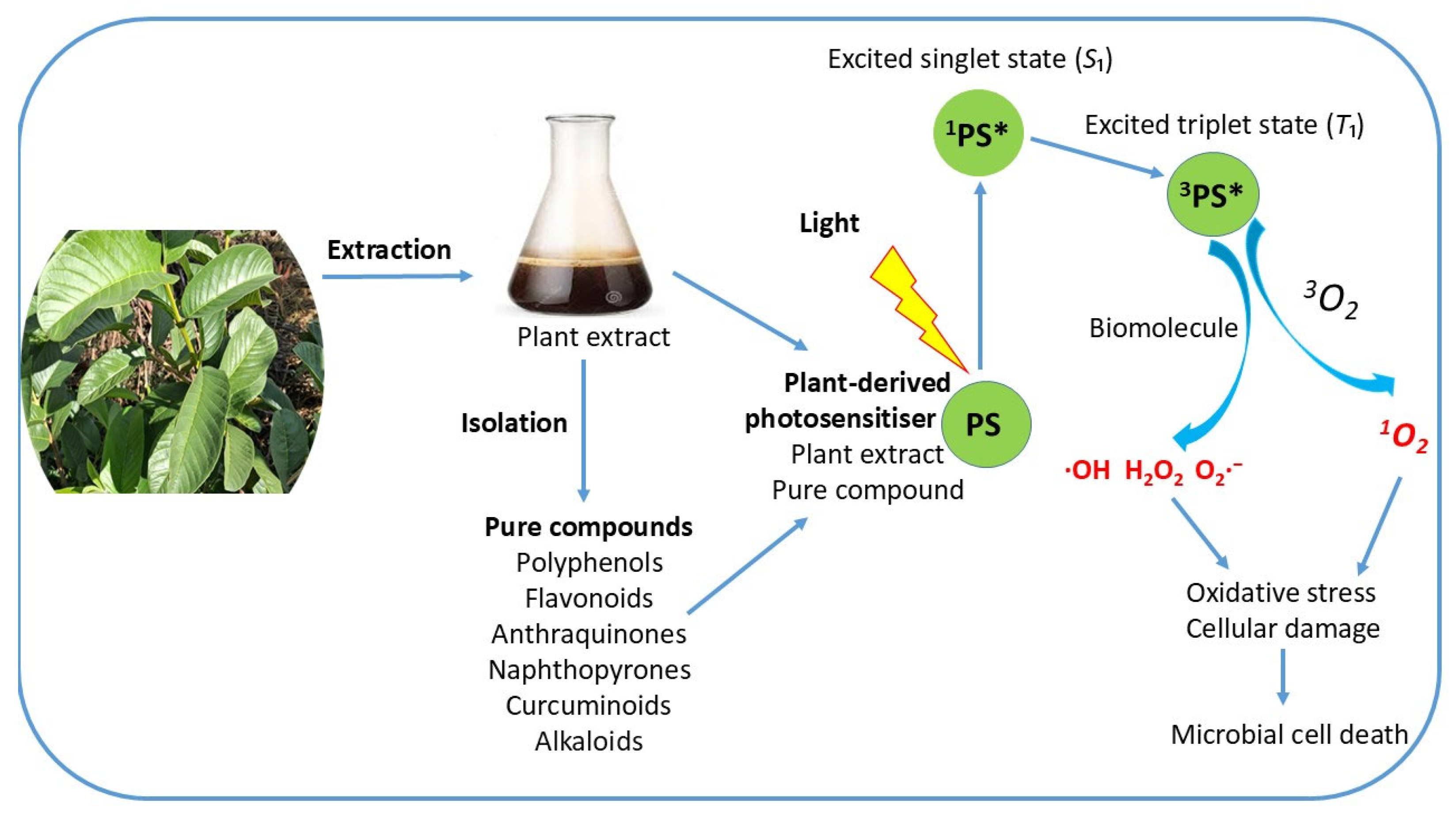
Plant-derived PSs are a diverse group of natural light-absorbing compounds, including polyphenols, flavonoids, anthraquinones, naphthopyrones, curcuminoids, and porphyrin-like pigments. These compounds have gained attention as effective mediators of aPDT. Their antimicrobial activity begins when they absorb light at specific wavelengths, initiating photophysical and photochemical reactions that generate cytotoxic ROS such as singlet oxygen (1O2), superoxide anion (O2), hydrogen peroxide (H2O2), and hydroxyl radicals (•OH), as illustrated in Figure 1 [20,21].
Upon irradiation, the PS transitions from the ground singlet state (S0) to an excited singlet state (S1) and then to a longer-lived triplet state (T1) through intersystem crossing (ISC). The triplet state is essential because it increases the chance of interactions with nearby biomolecules or molecular oxygen (3O2), ultimately leading to ROS formation and microbial cell death [19].
Two main photochemical mechanisms operate during aPDT: Type I and Type II pathways. In the Type I mechanism, the excited PS transfers electrons to surrounding molecules, producing radical species such as superoxide anion, hydrogen peroxide, and hydroxyl radicals. These radicals cause extensive oxidative damage to microbial cells [12]. Hydroxyl radicals are particularly destructive because they react rapidly with biological molecules. They initiate lipid peroxidation in cell membranes, disrupting membrane integrity and causing leakage of intracellular components. ROS also oxidise proteins, altering their structure and inactivating essential enzymes, while nucleic acids undergo oxidative damage, including strand breaks and base modifications that interfere with replication and transcription [13,22,23,24]. This multi-target oxidative stress ultimately results in irreversible microbial cell death [20,21].
Experimental evidence supports these mechanisms. Transmission electron microscopy studies have shown membrane disruption, cytoplasmic leakage, and structural collapse in photodynamically treated Escherichia coli [20]. Several plant-derived systems demonstrate strong Type I activity. Extracts from Senna splendida, S. alata, and S. macranthera, activated with blue LED light, generate high levels of hydroxyl radicals that correlate with strong antimicrobial activity against Candida albicans, Staphylococcus aureus, and Cutibacterium acnes [25]. Similarly, curcumin shows dominant Type I activity, as its antimicrobial effect persists even when singlet oxygen is quenched [22]. Other compounds, such as nano-resveratrol, aloe emodin, and emodin, also generate radical-mediated oxidative stress, leading to significant microbial inactivation [14,23,24].
In the Type II pathway, the excited PS transfers energy directly to molecular oxygen, producing singlet oxygen. This highly reactive species has a very short lifetime (<0.04 µs in biological environments) and limited diffusion distance (approximately 10–55 nm), but causes serious localised oxidative damage to biological targets [26]. Singlet oxygen reacts with unsaturated lipids, proteins, and nucleic acids, disrupting membrane integrity, inactivating enzymes, and damaging genetic material [27,28,29]. In eukaryotic pathogens, mitochondrial membranes are particularly sensitive to this oxidative stress, which can trigger apoptosis-like cell death [30]. Viral pathogens are also susceptible because oxidative damage to viral envelopes and capsid proteins interferes with viral entry and replication [31,32].
Some plant-derived PS systems primarily follow the Type II mechanism [22,33]. For example, Brazilian green propolis activated by blue LED light produces high levels of singlet oxygen, resulting in significant reductions in Streptococcus mutans and C. albicans biofilms [21]. Similarly, Passiflora cincinnata extracts and phycocyanin generate singlet oxygen-dependent antimicrobial effects, as their activity decreases when singlet oxygen is chemically quenched [22].
In many cases, both Type I and Type II pathways operate simultaneously, with their relative contributions influenced by environmental conditions such as oxygen availability, irradiation time, pH, metal ions, and the composition of microbial membranes or biofilms [18]. Plant extracts such as Chamaecyparis obtusa and Moringa oleifera initially generate singlet oxygen but gradually shift toward hydroxyl radical production during prolonged irradiation. Microscopy studies confirm severe membrane damage, pore formation, and cytoplasmic leakage after treatment [20].
Plant-derived PSs are also effective against microbial biofilms, which are typically resistant to conventional antimicrobials due to their protective extracellular polymeric substances and reduced metabolic activity. ROS generated during aPDT can degrade the biofilm matrix, increase oxygen diffusion, and damage dormant cells. Even under low-oxygen conditions where Type II reactions are limited, radical-mediated Type I pathways maintain antimicrobial activity [13,14]. Studies using curcumin, riboflavin, and phycocyanin have demonstrated significant reductions in multispecies biofilms of S. mutans, S. sanguinis, C. albicans, and C. glabrata, accompanied by structural collapse of the biofilm matrix [13].
Plant-derived PSs exert antimicrobial effects by generating light-activated ROS via Type I and/or Type II photochemical pathways, leading to oxidative damage to microbial membranes, proteins, nucleic acids, and metabolic systems. Their multi-target mode of action enables effective inactivation of planktonic microorganisms, biofilms, and viruses while reducing the likelihood of resistance development, highlighting their strong potential as versatile and sustainable agents for antimicrobial photodynamic therapy.

4. Factors Influencing the Effectiveness of Plant-Derived PSs

The antimicrobial efficacy of plant-derived PSs in aPDT depends on a complex interplay of photophysical, physicochemical, biological, and environmental factors that govern light absorption, excited-state formation, ROS generation, microbial targeting, and overall therapeutic outcome [34].

4.1. Spectral Matching and Light Absorption Efficiency

Efficient aPDT depends on the PS absorbing light effectively. Plant-derived PSs with high molar extinction coefficients (ε) can absorb sufficient photons even at low concentrations, improving photochemical efficiency [35]. Most natural PSs have characteristic absorption bands in the UV–visible range. For example, curcumin exhibits strong absorption in the blue region, with a maximum absorption (λ_max) around 420–430 nm [36], whereas porphyrin-like pigments display a strong Soret band in the blue region (~400–450 nm) and weaker Q-band absorptions in the red region (~600–700 nm), which are typically exploited for deeper tissue activation [37]. For optimal activation, the light source must closely match the PS absorption maximum. Good spectral alignment ensures efficient excitation from the ground singlet state (S0) to the excited singlet state (S1), initiating the photodynamic process. Although longer wavelengths (600–900 nm) penetrate tissues more effectively, therapeutic success primarily depends on strong spectral overlap [38]. For instance, curcumin has a λ_max at 418 nm, providing strong overlap with a 450 nm LED. This matching has been shown to enhance ROS generation and antifungal activity, achieving a 5-log reduction in C. tropicalis at 25 J/cm2. In contrast, a glycolic Curcuma longa extract with λ_max below 380 nm showed no activity under 450 nm light, highlighting the importance of spectral matching and adequate light dose [39].

4.2. Photophysical Efficiency and Triplet-State Dynamics

Effective PSs exhibit high ISC efficiency and long triplet-state lifetimes, which are essential for ROS production as discussed in Section 3. Molecular structure strongly influences ISC efficiency and triplet-state stability. Extended π-conjugation, as found in curcuminoids and anthraquinones, facilitates electron delocalisation and promotes spin–orbit coupling, favouring ISC [35,40,41]. Carbonyl groups in compounds such as aloe emodin and emodin act as n→π* chromophores, further enhancing triplet formation [42]. Porphyrin-like pigments and chlorophyll derivatives possess rigid macrocyclic structures with central metal ions, which stabilise the triplet state, improve spin–orbit coupling, and increase singlet oxygen yield [43,44].
Environmental conditions also play a crucial role in modulating photophysical performance. Adequate oxygen is essential for Type II singlet oxygen production, while solvent polarity can affect the singlet–triplet energy gap and ISC rates [45]. Viscosity influences molecular rotational freedom, with higher viscosity potentially prolonging triplet lifetimes by limiting nonradiative decay [46]. pH can modify PS protonation, altering absorption spectra and ROS yield. Additionally, metal ions such as Fe2+ or Cu2+ can participate in Fenton-like reactions to amplify radical generation, whereas quenchers like sodium azide or dimethyl sulfoxide selectively inhibit singlet oxygen or hydroxyl radicals, respectively [20].

4.3. Presence of Photoactive Pigments and Bioactive Phytochemicals

The chemical composition of plant extracts determines their photosensitising efficiency, as pigment type, concentration, and molecular interactions directly influence light absorption, triplet-state formation, and ROS generation [18,47]. Together, these factors regulate excitation quantum yield, ISC efficiency, and the relative contribution of Type I and Type II pathways.
Pigment structure largely dictates photochemical behaviour. Molecules with extended π-conjugated systems exhibit enhanced photoreactivity because delocalized electrons promote efficient photon absorption and facilitate ISC to long-lived triplet states [48]. Chlorophylls are effective intrinsic PSs, absorbing strongly in the blue and red regions and generating singlet oxygen via energy transfer to molecular oxygen, characteristic of the Type II mechanism [49]. Carotenoids, though primarily photoprotective and capable of quenching singlet oxygen, broaden spectral absorption and can modulate ROS production depending on concentration and microenvironment [50]. Accessory pigments such as anthocyanins further expand light absorption, enhancing photon capture when combined with chlorophyll [51].
Photodynamic efficiency is strongly influenced by pigment concentration. At optimal levels, pigments maximise ROS production, while excessive concentrations can cause aggregation, self-quenching, and shorter triplet lifetimes, reducing effectiveness [52,53]. Molecular interactions, such as π–π stacking or binding with phenolic compounds, can further affect redox behaviour and the stability of excited states [54]. Phenolic compounds, including flavonoids and tannins, often promote Type I radical formation and can enhance the activity of photo-generated ROS.

4.4. Oxygen Availability and Microenvironmental Conditions

Oxygen availability and local microenvironmental conditions are critical determinants of aPDT efficacy. Since aPDT relies on molecular oxygen to generate ROS, particularly singlet oxygen via the Type II pathway, hypoxic infection sites significantly reduce antimicrobial efficacy [36]. Infected sites exhibit substantially lower oxygen levels than healthy tissues, limiting ROS generation and leading to incomplete microbial inactivation and the potential survival of pathogens [55]. Moreover, the photodynamic process itself consumes oxygen, further aggravating hypoxia and reducing its therapeutic effectiveness [56].
Biofilm-associated infections are difficult to treat with aPDT because the dense extracellular polymeric substance (EPS) matrix limits PS penetration, reduces light diffusion, and restricts oxygen availability. These barriers reduce treatment efficiency and highlight the need for targeted delivery and oxygen-enhancing strategies [57]. The biofilm environment, often acidic and low in redox potential, can also affect PS activity and support anaerobic or facultative anaerobic pathogens [58]. Under these conditions, Type I photochemical mechanisms may be more effective than Type II pathways, although bacterial stress responses can still reduce susceptibility. For example, aPDT using Curcuma and Chlorella extracts reduced viable cells by only 11–25%, compared with 58% for the chemical control, Listerine. Confocal laser scanning microscopy (CLSM) confirmed incomplete biofilm removal, with persistent green fluorescence indicating surviving cells within the EPS matrix [59]. Improving aPDT efficacy requires strategies that overcome the EPS barrier, enhance oxygen availability, and counteract bacterial stress responses.

4.5. Cellular Uptake and Target Accessibility

Effective localisation of PSs near or within microbial cells is critical, as ROS have extremely short lifespans and limited diffusion. Upon light activation, ROS first attack the microbial cell envelope, inducing lipid peroxidation, increasing membrane permeability, and facilitating deeper PS penetration. Once internalised, PS-generated ROS targets intracellular proteins, nucleic acids, and metabolic components, leading to irreversible cellular dysfunction and reducing the likelihood of resistance [12]. Cellular uptake is influenced by PS properties, including size, charge, and hydrophobicity, with cationic PS showing enhanced binding to negatively charged microbial surfaces. Additionally, improved solubility, stability, and targeted delivery further enhance PS uptake and antimicrobial efficacy [60,61].
Optimising these factors is essential for maximising aPDT efficiency. Effective results require matching the PS’s absorption spectrum to the light source, selecting compounds with strong photophysical properties to efficiently generate ROS, and maintaining optimal pigment concentration. Adequate oxygen availability and favourable microenvironmental conditions are also crucial. Additionally, improving PS solubility, stability, and cellular uptake through suitable formulations enhances microbial targeting and overall pathogen inactivation efficiency.

5. Plant-Derived PSs in Antimicrobial Photodynamic Therapy

Plant-derived extracts have attracted considerable attention as natural PSs for aPDT due to their structural diversity, intrinsic bioactivity, biocompatibility, and cost-effectiveness [17]. Unlike synthetic PSs, plant-derived systems often contain multiple chromophores capable of absorbing across broad spectral regions, thereby enabling activation with commonly available light sources [35]. Both crude plant extracts and isolated natural compounds have been reported to exhibit aPDT activity against various pathogens. Plant extracts contain complex mixtures of bioactive phytochemicals that may act synergistically to enhance light absorption, ROS generation, and overall antimicrobial efficacy [62]. In contrast, isolated natural compounds are purified molecules with well-defined chemical structures and photophysical properties, enabling more precise characterisation of absorption maxima, photostability, and ROS-generating mechanisms. Table 1 summarises representative medicinal plant extracts investigated as PSs, highlighting their absorption characteristics, concentrations, irradiation parameters, and antimicrobial outcomes.
The reviewed studies (Table 1) show that antimicrobial efficacy is enhanced following light activation compared with corresponding dark controls. In the absence of irradiation, most plant extracts exhibited weak intrinsic antimicrobial activity; however, exposure to light at wavelengths overlapping their absorption spectra resulted in significant increases in microbial inactivation [20,21,25,31,47,64,65,66,67,68]. This strong light-dependent enhancement shows that the effects are driven by photodynamic mechanisms, specifically, photoexcitation of chromophoric constituents followed by ROS generation, rather than by the extract’s natural phytochemical toxicity alone. The distinction between dark and illuminated conditions therefore provides evidence that these extracts function as PSs, inducing oxidative damage upon activation.
Several plant-derived PSs achieved complete microbial inactivation (≥6 log10 CFU/mL reduction). Extracts of C. obtusa and M. oleifera demonstrated complete eradication of E. coli and S. aureus at a relatively low irradiance of 17 mW/cm2 within 80–100 min [20]. This indicates that high levels of microbial inactivation can be achieved without excessively high-power densities, supporting potential clinical applicability where thermal damage must be minimised. The rapid initial generation of singlet oxygen observed further corroborates the strong photochemical efficiency underlying their bactericidal performance. Similarly, extracts of H. sabdariffa and O. ficus-indica exhibited potent photodynamic activity under 532 nm laser irradiation, reducing bacterial loads from approximately 107 CFU/mL to undetectable levels. These reductions were accompanied by substantial decreases in minimum inhibitory concentrations (MICs) under illuminated conditions compared with dark controls, demonstrating that light activation significantly enhances antimicrobial potency [47]. The observed reduction in MIC values suggests that lower extract concentrations may be required when combined with appropriate light exposure, thereby improving therapeutic efficiency while potentially reducing cytotoxic risk. These observations show that plant-derived PSs can achieve clinically relevant log reductions in bacteria when appropriately activated. The clear difference between dark and light-treated groups confirms that microbial inactivation is mainly driven by ROS generated during photodynamic activation [19], supporting the effectiveness of plant extracts as PSs in aPDT.
Antifungal activity was also observed in several plant-derived PSs, especially when the light wavelength was properly matched to the absorption properties of the bioactive constituents [21,25,67]. Extra-virgin olive oil (EVOO) and hydrogen peroxide–activated EVOO (EVOO-H) showed no antifungal activity in the dark. Under light (480–3400 nm or 660 nm), both became active by producing reactive oxygen species, with hydrogen peroxide enhancing the effect. Candida glabrata showed the highest sensitivity, while Candida albicans responded only to EVOO-H, and Candida krusei remained resistant [66]. The enhanced activity under light suggests efficient excitation of chromophores in the extract, leading to ROS that can damage fungal membranes, mitochondrial structures, and nucleic acids [36]. The ability to inactivate biofilm-embedded fungal cells is also important, as biofilms exhibit increased resistance due to limited drug penetration, altered metabolic activity, and protective extracellular matrices [69]. The capacity of phytochemical PSs to target complex microbial communities was further demonstrated by Brazilian green propolis extracts. In both single- and dual-species biofilms composed of S. mutans and C. albicans, photodynamic treatment achieved reductions of up to 6 log10 CFU/mL, with sustained antimicrobial effects observed for up to 24 h [21]. This persistence suggests not only effective initial inactivation but also disruption of the biofilm matrix and suppression of regrowth. Given the cooperative resistance mechanisms characteristic of polymicrobial biofilms, these outcomes demonstrate the potential of plant-derived PSs to overcome biofilm-associated tolerance and extend the applicability of aPDT beyond simple planktonic infections.
Extracts derived from S. splendida, S. alata, and S. macranthera similarly demonstrated pronounced photodynamic activity. These species are rich in anthraquinones and flavonoids, with strong absorption in the 400–500 nm region, enabling efficient excitation under blue LED irradiation. Under these conditions, reductions exceeding 6 log10 CFU/mL were achieved against C. albicans, S. mutans, and S. aureus in planktonic systems, indicating near-complete microbial eradication. The high level of inactivation is attributed to the efficient generation of singlet oxygen and other ROS by photoexcited anthraquinones, leading to extensive oxidative damage to cellular membranes, proteins, and nucleic acids. In contrast, activity against C. acnes biofilms was comparatively limited, likely due to the protective biofilm architecture, reduced oxygen diffusion, and species-specific antioxidant defences that mitigate ROS-induced damage [25].
Beyond antibacterial and antifungal effects, plant-derived PSs have also demonstrated antiviral potential. H. perforatum extract exhibited dose-dependent virucidal activity against human coronavirus (HCoV-229E) under white light irradiation at 13.2 J/cm2. At a concentration of 2 µg/mL, the extract reduced the proportion of infected cells from approximately 37% to 15% [31], highlighting effective, light-dependent impairment of viral infectivity. This antiviral activity is probably mediated by photodynamically generated ROS, which can oxidatively damage viral envelopes, capsid proteins, and nucleic acids, thereby inhibiting viral entry and replication [70]. The effective concentrations required for viral photoinactivation were substantially lower than those typically needed for bacterial or fungal eradication, falling within the low microgram-per-millilitre range [31]. In contrast, bacterial inactivation generally required high microgram-per-millilitre to milligram-per-millilitre extract concentrations [20,67].
Light doses also varied widely across studies, ranging from as low as 9 J/cm2 to more than 130 J/cm2, with irradiances spanning 17–155 mW/cm2 [21,25,47]. This difference shows the importance of optimising light parameters, wavelength, intensity, and exposure time, alongside extract composition and concentration to achieve maximal photodynamic efficacy. Higher irradiance levels are generally associated with shorter exposure times required for effective microbial inactivation, reflecting greater photon flux and faster photosensitizer excitation [71]. In addition to continuous irradiation, fractionated or pulsed light strategies have been shown to enhance sustained ROS generation [38]. By allowing brief recovery intervals between light exposures, fractionated irradiation can reduce premature photobleaching, maintain higher ROS levels, and improve penetration into biofilm matrices, thereby enhancing antibiofilm efficacy [21]. These observations show the need to optimise the interplay between photosensitizer concentration, light dose, and irradiation timing to maximise efficacy while minimising collateral damage.
Most plant-derived extracts summarised in Table 1 exhibit absorption bands within the 400–670 nm region, aligning well with blue, green, red, and white LED systems commonly employed in aPDT. For example, B. vulgaris extract showed strong absorption in the 480–540 nm range due to betalain pigments; however, irradiation at 640 nm produced limited antimicrobial effects due to poor spectral overlap [63]. In contrast, extracts containing chlorophyll derivatives or hypericin exhibited broader absorption profiles. H. perforatum showed distinct absorption bands at approximately 400 nm, 550–590 nm, and 664–665 nm, enabling activation across multiple wavelengths and producing wavelength-dependent antimicrobial responses. Complete suppression of S. aureus was achieved under irradiation at 405, 590, and 660 nm, whereas P. aeruginosa was most susceptible at 405 nm [64], reflecting species-specific differences in photodynamic sensitivity. Similarly, combined extracts of Calendula officinalis, Chamomilla recutita, and Achillea millefolium exhibited Qₓ (500–600 nm) and Qᵧ (664–665 nm) absorption bands characteristic of porphyrin- or chlorophyll-like chromophores, along with a high singlet oxygen quantum yield (ΦΔ = 0.64 at 665 nm) [64]. The presence of Qᵧ-band absorption near 665 nm is particularly advantageous, as red light provides deeper tissue penetration and reduced scattering, enhancing clinical applicability [72].
Mechanistically, antimicrobial activity is primarily mediated by ROS generated as discussed in Section 3. Early stages of irradiation often favour Type II pathways, as demonstrated by the rapid generation of singlet oxygen in extracts of C. obtusa and M. oleifera. However, ROS quenching experiments revealed a substantial contribution from hydroxyl radicals during prolonged irradiation, indicating a temporal shift toward Type I mechanisms [20]. Such transitions may arise from partial photobleaching, oxygen depletion, or altered redox cycling under prolonged light exposure.
These findings show that plant-derived PSs operate through a dynamic interplay of Type I and Type II pathways. Their multimodal ROS generation enables oxidative damage across multiple cellular targets, reducing the likelihood of resistance development. The presence of diverse chromophores in crude extracts broadens the spectral absorption profile and promotes synergistic interactions, often resulting in superior performance compared with isolated fractions. Plant-derived extracts are effective, versatile PSs that can inactivate bacteria, fungi, viruses, and biofilm-associated pathogens when optimally paired with appropriate light sources.
Table 2 presents a diverse range of isolated natural PSs derived from plant sources, outlining their characteristic absorption wavelengths and reported aPDT activities against bacterial, fungal, viral, and biofilm-associated pathogens.
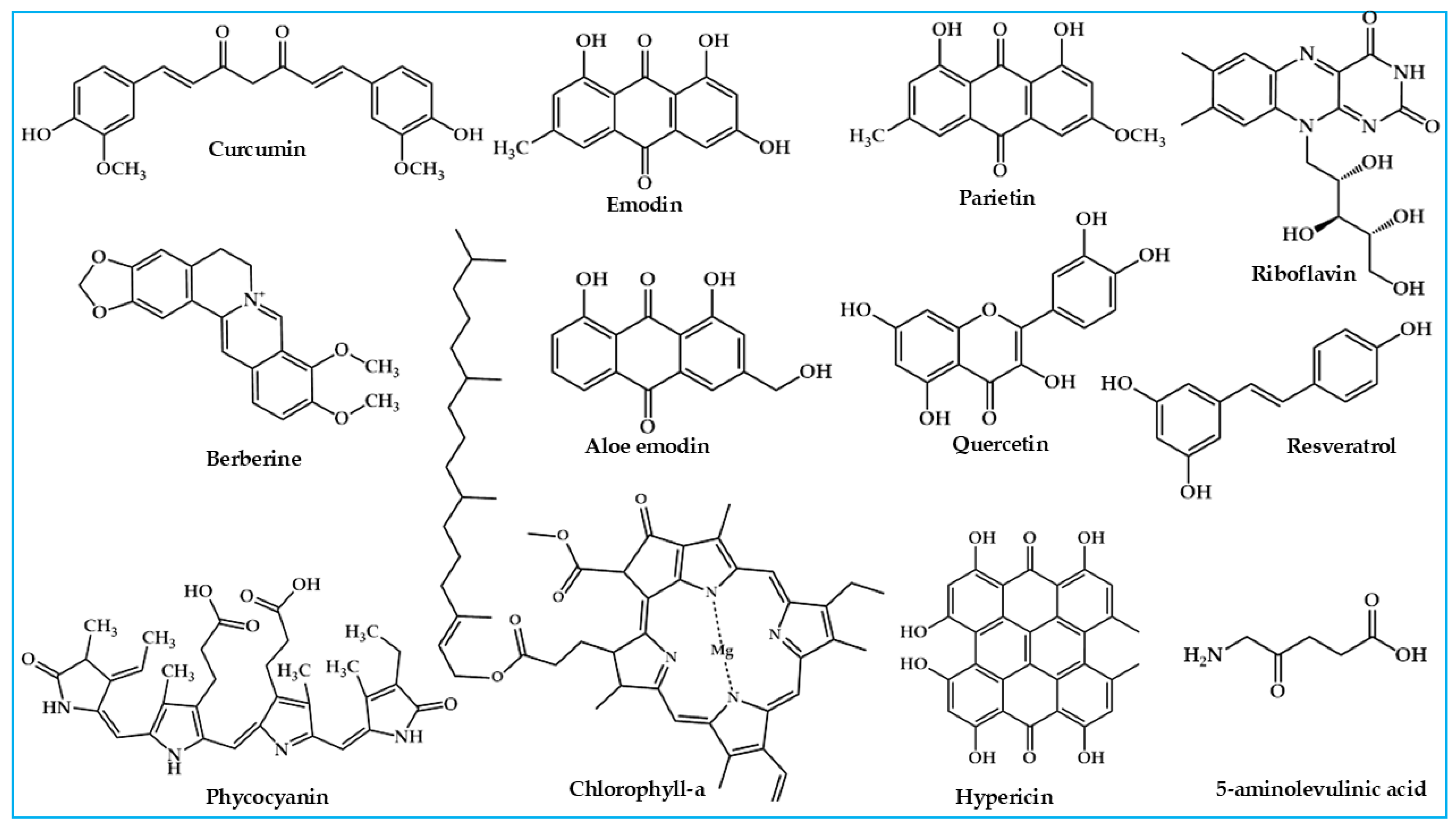
The data in Table 2 show the broad-spectrum antimicrobial potential of plant-derived chromophores when activated with light that appropriately overlaps their absorption spectra. Also shown is the functional versatility of natural PSs across multiple microbial targets and clinical contexts. Figure 2 presents the chemical structures of representative plant-derived PSs used in aPDT.
Most natural PSs absorb within the visible light region (400–700 nm). This range aligns closely with the emission profiles of commonly used LED and laser systems in aPDT, thereby facilitating practical implementation. Visible-light sources are widely available, relatively safe, and cost-effective, thereby enhancing translational feasibility [72]. For example, curcumin derived from C. longa exhibits strong absorption between 300–550 nm, with a maximum around 430 nm, making it highly responsive to blue-light activation. This favourable photophysical profile supports its broad antimicrobial spectrum, including activity against Gram-positive bacteria (S. aureus, L. monocytogenes), Gram-negative bacteria (E. coli, V. parahaemolyticus, P. fluorescens), fungi (B. cinerea, S. brasiliensis), and viruses such as human betacoronavirus HCoV-OC43 [36,73,74,75,76,77]. The wide range of susceptible organisms reflects efficient ROS generation and multi-target oxidative damage following photoactivation.
Similarly, quercetin (350–430 nm) [22,78,79,80,81], aloe-emodin (425–445 nm) [23,86,87,88,89,90], parietin (415–445 nm) [97,98], and riboflavin (≈445 nm) [13,102] exhibited optimal excitation within the blue-light region. Upon activation, these compounds demonstrated antimicrobial activity against clinically significant pathogens, including S. aureus, E. coli, C. albicans, and C. auris. Blue-light–activated systems are particularly advantageous for superficial infections, oral biofilms, dermatological conditions, and environmental decontamination, where limited tissue penetration is acceptable, and high ROS yields can be achieved efficiently [103].
PSs absorbing in the red region offer additional therapeutic advantages, including deeper tissue penetration and reduced scattering compared with shorter wavelengths. Compounds such as hypericin (≈ 598 nm) [33,92,93], chlorophyll-a (Q band at 663 nm) [82], phycocyanin (620–650 nm) [13,83,84,85], and 5-aminolevulinic acid–induced porphyrins (≈635 nm) [99,100,101] fall within this clinically favourable optical window. Hypericin-mediated aPDT significantly reduced the viability of S. aureus, E. coli, and P. acnes [33,92,93], suggesting applicability to both superficial and moderately deep infections. Phycocyanin demonstrated reductions in oral pathogens, including P. gingivalis and S. mutans, supporting its relevance in periodontal therapy [13,83,84,85]. While certain systems, such as chlorophyll-a, achieved moderate inhibition under specific conditions, others, particularly berberine and aloe-emodin, achieved complete bacterial eradication when irradiation parameters and PS concentrations were optimised [23,86,87,88,89,90,95,96], showing the importance of wavelength matching and parameter optimisation in maximising therapeutic outcomes.
Anthraquinone derivatives, including emodin and aloe-emodin, exhibited broad absorption spectra (approximately 380–780 nm), providing flexibility in selecting wavelengths and enabling dose-dependent microbial inactivation [23,24,86,87,88,89,90,91]. This wide spectral window enhances adaptability across diverse clinical and environmental settings. Resveratrol, activated around 450 ± 30 nm, exhibited pronounced antibiofilm activity against multispecies biofilms composed of C. albicans, S. aureus, and S. sobrinus [14,94]. The ability to disrupt complex microbial communities is particularly significant, as biofilms exhibit enhanced tolerance due to extracellular polymeric matrices, metabolic heterogeneity, and cooperative microbial interactions.
Beyond antibacterial and antifungal applications, antiviral potential is increasingly recognised. In silico analyses suggest that quercetin may function as a promising antiviral aPDT agent against Monkeypox virus by generating singlet oxygen predominantly via a Type II photochemical pathway and exhibiting strong binding affinity for the viral D8L attachment protein [104]. Similarly, molecular docking studies targeting the Severe Acute Respiratory Syndrome-Coronavirus-2 (SARS-CoV-2) main protease (MPro) revealed favourable binding interactions for emodin and resveratrol, supporting their potential as light-activated antiviral inhibitors [105]. Although further experimental validation is needed, these findings suggest that natural PS compounds could also be used for viral photoinactivation, which is especially important for emerging infectious diseases.
Also shown is the critical importance of photophysical compatibility between the PS and the light source. For instance, crude C. longa extract demonstrated limited aPDT efficacy under 450 nm irradiation due to insufficient absorption at that wavelength. In contrast, purified curcumin, with a strong absorption peak around 418–430 nm, achieved substantial log reductions in C. albicans and C. tropicalis [39]. This shows that photodynamic performance depends not only on intrinsic antimicrobial properties but also on efficient photon absorption, ISC to the triplet state, and subsequent ROS generation.
Table 2 shows that isolated natural PSs belong to several chemical groups, such as polyphenols, flavonoids, anthraquinones, porphyrins, vitamins, and other phenolic compounds, which are active against Gram-positive and Gram-negative bacteria, fungi, biofilms, and viruses. Their broad light absorption and ability to generate ROS through both Type I and Type II pathways enable them to produce effective antimicrobial activity, while their biocompatibility and relatively low cost make them promising alternatives or complements to conventional antimicrobial agents. When combined with suitable light sources and optimised irradiation conditions, these natural compounds provide a valuable platform for advancing aPDT in clinical, dental, agricultural, and environmental settings.
Plant-derived PSs, whether applied as crude extracts or isolated compounds, offer complementary advantages for aPDT. Crude extracts provide a rich mixture of bioactive phytochemicals that broaden spectral absorption, synergistically enhance ROS generation, and deliver multifunctional antimicrobial activity against bacteria, fungi, viruses, and biofilms. This complexity is particularly beneficial for broad-spectrum applications or when precise light tuning is not feasible, although variability in composition and photostability may limit reproducibility. In contrast, isolated compounds possess well-defined chemical structures and predictable photophysical properties, including absorption maxima, singlet–triplet ISC efficiency, and ROS production rates, allowing controlled, reproducible, and often higher photodynamic efficiency under optimised irradiation. The choice between extracts and isolated compounds thus depends on the intended application: extracts offer versatility and broad-spectrum efficacy, while isolated compounds facilitate mechanistic understanding and standardised performance. Together, plant-derived PSs represent a versatile and sustainable platform for advancing effective aPDT across clinical, dental, agricultural, and environmental contexts.

6. Advances in Plant-Derived aPDT

Recent advances in plant-derived aPDT have improved the effectiveness of natural PSs. Modern research focuses on identifying specific photoactive phytochemicals, enhancing their photophysical properties, and developing advanced delivery systems [106]. Plant-derived PSs are valued for their structural diversity, biocompatibility, and ability to generate ROS upon light exposure. However, issues such as poor solubility, aggregation, photobleaching, and limited cellular uptake have restricted their use. Emerging strategies, including nanotechnology-based carriers, optimised phytochemical discovery, and combination therapies, are overcoming these limitations, improving ROS generation, microbial targeting, and enabling broader clinical, environmental, and industrial applications [107,108].

6.1. Emerging Plant-Derived PSs

Recent research has increasingly highlighted plant-derived compounds and natural pigments as promising sources of PSs for aPDT due to their biocompatibility, environmental sustainability, and antimicrobial activity [16,25]. While many plant species remain largely unexplored, they represent a vast potential source of novel natural PSs. Recent studies identified species of the Passiflora genus, including P. edulis, P. alata, and P. cincinnata, as effective emerging PSs. Extracts from these species showed aPDT activity against methicillin-resistant Staphylococcus aureus (MRSA), with optimal absorption in the blue spectrum (~400 nm). None of the extracts exhibited cytotoxicity to eukaryotic cells, supporting their potential therapeutic use [109]. Yam pigment from Dioscorea opposita was shown to generate both Type I and Type II ROS under 450 nm light, allowing broad antimicrobial action against Gram-positive and Gram-negative bacteria while preserving food quality [110]. Green coffee (Coffea arabica L.) extract and oil also demonstrated aPDT activity, with chlorogenic acids as bioactive compounds that, upon blue light activation, significantly enhanced MRSA inactivation, particularly when delivered via nanostructured microemulsions. These findings collectively show that plants, many of which remain uninvestigated, offer a rich and largely untapped reservoir of novel, safe, and sustainable natural PS for aPDT [111].
Well-characterised PSs such as curcumin and hypericin continue to guide innovation. Curcumin, a polyphenol from Curcuma longa, exhibits strong photodynamic activity against both Gram-positive and Gram-negative bacteria, including S. aureus and Escherichia coli. Derivatives such as 3,3′-dihydroxycurcumin (DHC) exhibit improved chemical stability and antibiofilm activity, particularly in dental applications [112]. Hypericin, a naphthodianthrone from Hypericum perforatum, demonstrates potent 1O2 generation and is being explored for different applications, including skin infections [113]. These studies emphasise that plant-derived PSs, many of which remain unexplored, represent a rich and untapped source of safe, sustainable, and effective antimicrobial agents. Continued investigation of diverse plant species is crucial for identifying novel PSs with optimised photophysical properties and stability, thereby broadening the clinical and public health applications of aPDT.

6.2. Integration of Nanotechnology for Enhanced Photodynamic Activity

The integration of nanotechnology with natural PSs has emerged as a powerful strategy for improving the efficacy of aPDT. Although plant-derived PSs exhibit strong photoactive antimicrobial properties, their practical application is often limited by poor aqueous solubility, molecular aggregation, chemical instability, and inadequate accumulation at infection sites [108]. Nanotechnology addresses these challenges by encapsulating PS molecules within nanoscale carriers, such as liposomes, polymeric micelles, silica nanoparticles, and polymer-based matrices, thereby enhancing dispersibility, stability, and bioavailability in biological environments [107]. Encapsulation also protects PSs from premature degradation, preserves their photochemical activity, and prolongs their residence time at microbial infection sites [114]. Moreover, surface-functionalized nanoparticles can promote electrostatic interactions with negatively charged bacterial membranes and facilitate deeper penetration into protective biofilms, thereby increasing microbial susceptibility to photodynamic inactivation [115].
Nanostructured systems also enhance photodynamic efficiency by optimising the generation and delivery of ROS. Due to their high surface-to-volume ratio, nanoparticles enable efficient photogeneration of singlet oxygen 1O2 and other ROS [116]. Because singlet oxygen has a short lifetime and diffusion distance, positioning PS molecules within nanoscale carriers near microbial targets helps overcome diffusion constraints and enhances oxidative damage to bacterial cells [117]. For instance, Chlorophyll-loaded polystyrene nanoparticles have been shown to enhance photodynamic activity through efficient oxygen diffusion within the polymer matrix, enabling effective singlet oxygen release toward microbial targets. These nanoparticles exhibited strong antibacterial activity against Escherichia coli [118]. However, the short-lived nature of 1O2 requires precise nanocarrier design; if the PS is too deeply encapsulated, the ROS may degrade before reaching bacterial membranes. To overcome this, rational engineering strategies, such as surface functionalisation, stimuli-responsive release, and membrane targeting, are used to ensure PS localisation at the microbial interface [119]. By increasing local oxygen availability and PS accumulation, these systems effectively compensate for diffusion limits and maximise overall antimicrobial impact.
More advanced nanocarrier platforms further amplify photodynamic activity. Iron-based metal–organic frameworks (MOFs), offer highly porous structures capable of loading large amounts of plant-derived PSs such as hypocrellin B. These systems enable synergistic therapeutic mechanisms by combining photodynamic ROS generation with photothermal effects and chemodynamic reactions that produce highly reactive hydroxyl radicals via Fenton chemistry, thereby significantly amplifying oxidative stress in microbial cells [120]. Similarly, plant-derived exosome-like nanovesicles isolated from Hypericum perforatum have been shown to naturally encapsulate hypericin within stable nanostructures (~67 nm), improving solubility, cellular uptake, and ROS production through both Type I and Type II photodynamic pathways [121].
In addition to synthetic nanocarriers, sustainable materials are gaining attention. Lignin-based nanoparticles derived from plant biomass have been successfully used to encapsulate porphyrins and other PSs while preserving their photophysical properties [122]. These biodegradable carriers improve stability, reduce aggregation, and provide environmentally friendly and cost-effective delivery systems.
These nanotechnology-driven strategies have the potential to significantly enhance the stability, targeting capability, and ROS-generating efficiency of natural PSs, thereby expanding the therapeutic potential of aPDT for combating microbial infections and biofilm-associated diseases.

6.3. Combinatory and Synergistic Therapeutic Strategies

Another important development in plant-derived aPDT involves integrating synergistic therapeutic strategies to enhance antimicrobial efficacy. Because photodynamic therapy relies on ROS-mediated oxidative damage, combining PSs with complementary antimicrobial approaches can significantly enhance microbial inactivation [123].
One approach involves combining plant-derived PSs with conventional antibiotics [124,125]. Photodynamic treatment can disrupt microbial membranes and increase cell permeability, thereby enhancing antibiotic uptake and restoring the susceptibility of resistant pathogens. Such combinatory treatments have demonstrated improved activity against multidrug-resistant bacteria and biofilm-associated infections. For instance, poly-l-lysine-modified zeolite imidazole framework-8 nanoparticles enable ROS-responsive ciprofloxacin release and, when combined with curcumin-mediated photodynamic therapy, effectively inhibit methicillin-resistant S. aureus and biofilms [126]. Nano-curcumin with indocyanine green and metformin enhances anti-biofilm activity against Enterococcus faecalis [125], while nano-curcumin combined with nanosilver-colistin reduces biofilms and downregulates quorum-sensing genes in multidrug-resistant P. aeruginosa [124]. These curcumin–antibiotic aPDT formulations potentiate microbial inactivation and combat resistant infections.
Efflux pump inhibitors (EPIs) represent another promising strategy. Many bacterial pathogens possess efflux systems that actively expel antimicrobial agents, reducing treatment effectiveness. EPIs can enhance aPDT by preventing bacteria from expelling PS, increasing intracellular ROS generation and treatment efficacy [127,128]. For instance, plant-derived EPIs, such as piperine and berberine, improved Chlorin e6-aPDT against B. cereus and E. coli, increasing bactericidal activity by 273.9% and 227.7%, respectively. EPIs block transmembrane efflux pumps, thereby maintaining higher PS concentrations, as confirmed by confocal microscopy (elevated PS fluorescence) and digital holographic tomography (increased cellular refractive index, reflecting higher PS density) [127]. Increased intracellular ROS causes structural damage, including cell wall disruption and leakage of cytoplasmic contents. Using these natural EPIs at sub-inhibitory concentrations sensitises bacteria to aPDT without toxicity, offering a potent strategy to overcome resistance and enhance the effectiveness of plant-derived PSs.
In addition, dual-light or multi-wavelength activation strategies are increasingly being investigated to optimise excitation of PSs with different absorption spectra. Using multiple wavelengths can broaden PS activation, potentially enhancing ROS production and improving treatment of polymicrobial infections and biofilms [129,130]. Dual-wavelength irradiation protocols commonly combine blue, red, or infrared light to activate different PSs or multiple absorption bands. These approaches can also exploit complementary tissue penetration depths: shorter wavelengths target surface microbes, while longer wavelengths penetrate deeper tissues. Pre-irradiation at specific wavelengths may further disrupt bacterial protective pigments, increasing susceptibility to photodynamic damage [131]. For example, combining blue light (405 nm) with 810 nm photodynamic therapy using indocyanine green significantly improved the inactivation of S. mutans biofilms [129]. Similarly, studies with coproporphyrin III showed that irradiation at its absorption maximum (496 nm) produced the greatest reduction of C. acnes. Although dual-wavelength excitation (496 and 547 nm) improved activity compared with weaker wavelengths, excitation at the primary absorption peak remained the most effective for maximising ROS generation and antimicrobial efficacy [130]. These findings highlight that efficient excitation at the PS’s optimal absorption wavelength remains critical for maximising ROS generation and antimicrobial efficacy.
Beyond light-based enhancements, integrating aPDT with sonodynamic therapy, which uses ultrasound to activate sensitisers, has demonstrated synergistic antimicrobial effects, particularly in infections where light penetration is limited [132]. This combined approach, known as antimicrobial photo-sonodynamic therapy (aPSDT), enhances ROS generation and improves biofilm disruption. For example, nanoresveratrol-mediated aPSDT significantly reduced multispecies biofilms of C. albicans, S. aureus, S. sobrinus, and A. naeslundii, while downregulating inflammatory markers TNF-α and IL-6 in human gingival fibroblasts [14]. Similarly, hypericin nanoparticles combined with D-tryptophan showed synergistic activity against A. baumannii, achieving a 5.10 log10 CFU/mL reduction in bacterial viability, significant biofilm degradation, and downregulation of the quorum-sensing gene abaI [133]. In another study, curcumin-nisin poly(L-lactic acid) nanoparticles, when used in aPSDT, enhanced ROS generation, inhibited biofilm formation, and promoted wound healing in A. baumannii-infected burn models in mice, demonstrating therapeutic potential comparable to that of silver sulfadiazine [134].
These combinatory strategies highlight the potential of integrating natural compounds, advanced light modalities, and complementary therapies to enhance antimicrobial outcomes and combat resistance in challenging infections.

6.4. Expanded Therapeutic Applications

The therapeutic applications of natural PSs in aPDT have expanded beyond the treatment of superficial infections to address several emerging clinical and public health challenges. In viral infections, plant-derived PSs such as curcumin have demonstrated notable photodynamic antiviral activity, with reported potential against viruses including SARS-CoV-2 [135,136]. These findings highlight their possible role in viral inactivation strategies and infection control. Beyond viral pathogens, naturally occurring anthraquinones such as aloe-emodin and polyphenolic compounds such as resveratrol are being explored as photodynamic agents against Mycobacterium tuberculosis [137], including multidrug-resistant strains, suggesting their potential as adjuncts or alternatives to conventional antibiotic therapy. In oral healthcare, aPDT using chlorin-based PSs such as Photodithazine has shown promising efficacy in managing denture stomatitis, periodontal infections, and oral candidiasis [138].
These findings highlight the versatility and clinical potential of plant-derived PSs. Their integration into therapeutic strategies can enhance targeted antimicrobial activity, biofilm control, and broader infection management. Although plant-derived aPDT shows significant promise, many PSs and plant species remain unexplored, and challenges such as poor solubility, aggregation, photobleaching, and limited cellular uptake still limit efficacy. Emerging strategies, including nanocarrier delivery, dual-wavelength activation, and combinatory therapies, have improved ROS generation and microbial targeting, but further research is needed to optimise these approaches. Addressing these gaps will be essential to fully realise the antimicrobial potential of plant-derived PSs and expand their applications in clinical, environmental, and industrial contexts.

7. Applications of Plant-Derived PSs in Antimicrobial Therapy

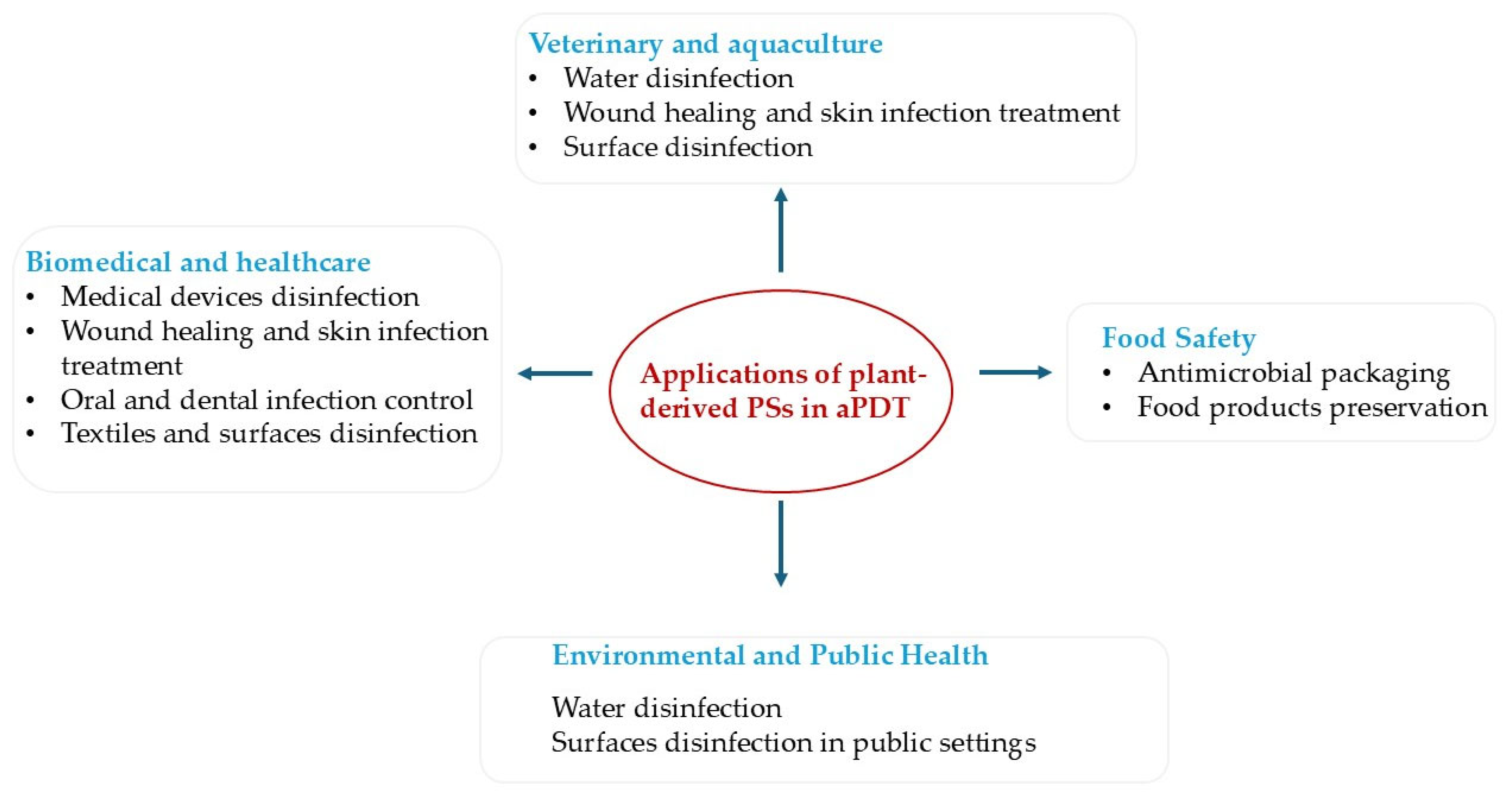
Plant-derived PSs are promising agents in aPDT. Their natural origin, biocompatibility, and broad-spectrum antimicrobial activity support diverse biomedical and environmental applications as illustrated in Figure 3.

7.1. Clinical and Biomedical Applications

Plant-derived PSs have strong potential for wound healing and infection management. Chronic wounds, including venous and diabetic foot ulcers, respond well to aPDT, which eradicates pathogens and promotes tissue regeneration [139,140]. The ROS generated by light-activated PSs inactivates bacteria, fungi, and viruses, while stimulating fibroblast proliferation, angiogenesis, collagen deposition, and tissue oxygenation, thereby enhancing wound repair. In P. aeruginosa–infected wounds, ALA activation reduces bacterial load from 21 × 106 to 2.1 × 10⁶ CFU/g within one day, with complete elimination by day 14 [140]. A pilot study of chronic leg ulcers utilising ALA as PS showed a reduction in wound area from 17.2 cm2 to 6.1 cm2; 40% of patients achieved complete remission, and another 40% showed a >50% reduction. Autofluorescence confirmed re-epithelialization with green fluorescence, indicating healthy tissue [141]. In dentistry, plant-derived PSs, including curcumin, chlorophyllin, riboflavin, and phycocyanin, effectively control oral pathogens, disinfect root canals infected with Enterococcus faecalis, and reduce S. mutans, often with fewer side effects than conventional disinfectants [63,142]. Plant-derived PSs are also incorporated into coatings for medical devices, where ROS generated upon light activation prevent biofilm formation.

7.2. Environmental and Public Health Applications

Plant-derived PSs are increasingly recognised for their potential in environmental and public health applications, particularly in water treatment and disinfection. When dissolved or immobilised in water and exposed to sunlight or visible light, these materials generate ROS that rapidly inactivate microorganisms [34]. These PSs have been shown to significantly enhance solar water disinfection (SODIS), a simple, low-cost method that uses sunlight to purify contaminated water in transparent containers [143]. For example, chlorophyll extracted from Medicago sativa (alfalfa) has been shown to increase ROS production under sunlight, thereby accelerating microbial inactivation and increasing the disinfection rate up to 180 times that of SODIS alone [144]. Plant extracts, such as M. oleifera and C. obtusa, have demonstrated the capacity to inactivate multidrug-resistant bacteria and total coliforms in wastewater effluents under light exposure, highlighting their potential for sustainable sanitation strategies. These phytoextracts generated ROS initially as singlet oxygen and later as hydroxyl radicals, achieving complete microbial inactivation and surpassing their intrinsic antibacterial effects [20]. Beyond water treatment, plant-derived PSs contribute to air purification, antifouling technologies, and infection control. When immobilised on surfaces or incorporated into filtration materials, these PSs generate ROS that deactivate airborne microorganisms and reduce microbial contamination in indoor environments [145,146]. Curcumin-based coatings/films have been investigated for preventing biofilm formation by pathogens such as S. aureus [147], offering promising antifouling solutions for water systems, medical devices, and aquaculture facilities. In public health, plant-derived PSs are also widely studied for aPDT on frequently touched surfaces, including hospital equipment and public transport handrails [12,148]. This approach provides an affordable, chemical-free strategy for infection control and may help reduce the spread of antimicrobial-resistant pathogens in healthcare and community settings, particularly in resource-limited communities.

7.3. Food Safety Applications

Plant-derived PSs are useful in aPDT to improve food safety. They can be applied to fresh fruits and vegetables to reduce microbial contamination by targeting foodborne pathogens such as E. coli, Salmonella enterica, and L. monocytogenes [149]. These compounds are also effective for surface decontamination of leafy greens, berries, tomatoes, and sprouts, and can help control spoilage microorganisms during post-harvest storage [150]. For example, curcumin activated by visible light can significantly reduce bacterial levels on fresh produce without affecting taste or nutritional quality [151]. In addition, plant-derived PSs can be incorporated into biopolymer films or coatings to create light-activated antimicrobial food packaging. Materials such as chitosan, pectin, starch-based films, and cellulose coatings containing PSs can inhibit microbial growth on packaged meat, dairy, and seafood products, thereby extending their shelf life [152]. Plant-derived PSs can also be used to sanitise food-processing environments by removing microbial biofilms from stainless steel equipment, cutting boards, and conveyor surfaces, offering a safer alternative to harsh chemical disinfectants [153]. Furthermore, these compounds may be applied directly to foods such as fish, poultry, meat, cheese, and liquid foods to reduce spoilage bacteria and fungi during storage, improving product stability without the use of synthetic preservatives [154,155,156]. Research has shown that curcumin-mediated aPDT effectively inactivates L. monocytogenes, reducing planktonic cells by about 6.4 log CFU/cm2 and damaging biofilms on surfaces such as stainless steel and polyethylene terephthalate, demonstrating strong potential for controlling foodborne pathogens in food-processing environments [157]. Similarly, Curcumin aPDT treatment with 430 nm LED light decreased L. monocytogenes and Salmonella on chicken skin [158]. Curcumin-mediated photodynamic treatment has also improved microbial safety and shelf life in fresh-cut Hami melon [159]. Plant-derived PSs offer an effective, natural, and environmentally friendly approach to controlling microorganisms in food systems.

7.4. Veterinary and Aquaculture Use

aPDT is increasingly exploring plant-derived PSs in veterinary medicine and aquaculture to control infections, improve animal health, and reduce reliance on antibiotics. In veterinary applications, plant-derived PSs can be used to treat bacterial infections in livestock, domesticated animals, and aquatic species [160,161]. They are particularly effective for managing skin and wound infections and for controlling bacterial diseases caused by pathogens such as S. aureus and P. aeruginosa [162,163].
In aquaculture, plant-derived PSs also show promise in controlling pathogens that threaten fish and shellfish production. They can inactivate fish pathogens such as Aeromonas hydrophila and V. harveyi, which cause significant disease outbreaks in aquaculture systems [34,164]. These PSs may be applied directly to infected fish or used to treat aquaculture water to reduce microbial contamination [34]. Additionally, plant-derived PSs can target fungal pathogens such as C. albicans and help manage parasitic infections. They may also be used to disinfect aquaculture facilities by disrupting microbial biofilms on tanks, pipes, and nets, thereby reducing pathogen transmission and improving overall aquatic health [161,165].
Although plant-derived PSs are generally regarded as biocompatible, certain compounds may exhibit cytotoxic, phototoxic, or allergenic effects under specific conditions. For instance, hypericin is known to cause phototoxic skin reactions [166,167]. While high concentrations of curcumin may be toxic to normal mammalian cells [168]. Additionally, variability in plant extract composition may lead to inconsistent biological responses. Some phytochemicals may also interact with host tissues or disrupt beneficial microbiota [169]. Therefore, careful dose optimisation, toxicity evaluation, and standardisation of plant extracts are essential for safe clinical translation.

8. Conclusions and Future Perspectives

8.1. Conclusions

Plant-derived PSs represent a promising and rapidly expanding class of antimicrobial agents for photodynamic therapy. Through light activation, these compounds generate ROS that induce multi-target oxidative damage to microbial membranes, proteins, and nucleic acids, enabling effective inactivation of bacteria, fungi, viruses, and biofilm-associated pathogens. The ability of these systems to act through both Type I and Type II photochemical pathways contributes to broad-spectrum antimicrobial activity while reducing the likelihood of resistance development.
The diversity of naturally occurring chromophores, including polyphenols, flavonoids, anthraquinones, and porphyrin-like pigments, provides a wide range of absorption profiles and photophysical properties that can be matched with accessible light sources. Numerous plant-derived compounds, such as curcumin, hypericin, aloe-emodin, riboflavin, and chlorophyll derivatives, have demonstrated strong aPDT activity across various experimental systems. In addition, crude plant extracts containing multiple photoactive components may exhibit synergistic interactions, broaden spectral absorption and enhance ROS generation.
Recent technological developments have further strengthened the potential of plant-derived aPDT. The integration of nanotechnology-based delivery systems, including liposomes, polymeric nanoparticles, metal–organic frameworks, and lignin-based nanocarriers, has significantly improved photosensitizer solubility, stability, and microbial targeting. Similarly, combinatory therapeutic strategies, including dual-light activation, efflux pump inhibition, and integration with conventional antibiotics, have enhanced antimicrobial efficacy against multidrug-resistant pathogens and resilient biofilms.
Beyond traditional antimicrobial applications, plant-derived PSs are increasingly being explored in diverse settings, including wound healing, oral healthcare, water disinfection, food preservation, aquaculture, and surface sterilisation. These expanding applications demonstrate the versatility and sustainability of plant-derived aPDT as a potential tool for infection control in healthcare, environmental management, and industrial systems.

8.2. Future Perspectives

Despite significant progress in plant-derived aPDT, several scientific and translational challenges remain. Many natural PSs exhibit limited aqueous solubility, photobleaching susceptibility, and tendencies to aggregate, which reduce photodynamic efficiency. In addition, oxygen dependence and limited light penetration restrict the effectiveness of aPDT in hypoxic tissues and dense biofilm environments. Addressing these limitations will be essential for the successful clinical translation of plant-derived PSs.
Future research should prioritise the systematic discovery and characterisation of new photoactive phytochemicals from medicinal plants, many of which remain largely unexplored. Advances in phytochemical screening, metabolomics, and computational photochemistry may facilitate the identification of compounds with improved absorption characteristics, enhanced ISC efficiency, and greater ROS generation potential.
Nanotechnology-based delivery systems are expected to play a central role in overcoming many current limitations. Nanocarriers such as polymeric nanoparticles, metal–organic frameworks, and biodegradable plant-derived nanomaterials can improve photosensitizer stability, prevent aggregation, enhance cellular uptake, and enable targeted delivery to microbial infection sites. Additionally, multifunctional nanoplatforms that combine photodynamic, photothermal, and chemodynamic effects may further enhance antimicrobial performance.
Another promising direction involves the integration of aPDT with complementary therapeutic approaches. Synergistic combinations with antibiotics, efflux pump inhibitors, sonodynamic therapy, and dual-wavelength irradiation strategies may significantly improve microbial eradication, particularly in resistant biofilms and chronic infections. Advances in light delivery technologies, including wearable light sources, fibre-optic systems, and solar-driven activation, may also broaden the accessibility of aPDT in clinical and resource-limited settings.
Greater emphasis on standardised extraction methods, reproducible photophysical characterisation, and well-designed in vivo and clinical studies will be essential for translating plant-derived PSs into practical antimicrobial therapies. With continued interdisciplinary collaboration across photochemistry, nanotechnology, microbiology, and clinical science, plant-derived aPDT has the potential to evolve into a sustainable and scalable platform for combating infectious diseases and antimicrobial resistance.

Funding

This research received no external funding.

Institutional Review Board Statement

Not applicable.

Informed Consent Statement

Not applicable.

Data Availability Statement

New data were not generated for this study.

Conflicts of Interest

The author declares no conflicts of interest.

References

  1. Nazir, A.; Nazir, A.; Zuhair, V.; Aman, S.; Sadiq, S.U.R.; Hasan, A.H.; Tariq, M.; Rehman, L.U.; Mustapha, M.J.; Bulimbe, D.B. The Global Challenge of Antimicrobial Resistance: Mechanisms, Case Studies, and Mitigation Approaches. Health Sci. Rep. 2025, 8, e71077. [Google Scholar] [CrossRef] [Scilit]
  2. Akunne, O.Z.; Emmanuel, B.N.; Saidu, U.F.; Akinnawo, A.S.; Adeyemi, N.A.; Egoh, L.C.; Muhammad, M.A.; Ade-adekunle, O.A.; Peter, D.A.; Freitas, A.A. Antibiotic Resistance: The Growing Threats and Potential Solutions. Am. J. Pharmacother. Pharm. Sci. 2025, 4, 13. [Google Scholar] [CrossRef] [Scilit]
  3. World Health Organisation (WHO). COVID-19 Weekly Epidemiological Update, 158th ed.; World Health Organisation: Geneva, Switzerland, 2023. Available online: https://iris.who.int/items/8a7c0b28-3d85-47b9-96e5-08613ef3829f (accessed on 20 February 2026).
  4. Wajdowicz, M.; Dobrowolska, K.; Brzdek, K.; Janczura, J.; Zarebska-Michaluk, D.; Supronowicz, Ł.; Rzymski, P.; Rogalska, M.; Czupryna, P.; Tomasiewicz, K.; et al. Predictors of Severe Outcomes in COVID-19: Evidence from Real-World Multicenter Retrospective Study (2020–2024). J. Clin. Med. 2026, 15, 1207. [Google Scholar] [CrossRef] [Scilit]
  5. World Health Organization (WHO). Ebola Virus Disease. Available online: https://www.who.int/health-topics/ebola (accessed on 20 February 2026).
  6. Yadav, R.; Chaudhary, A.A.; Srivastava, U.; Gupta, S.; Rustagi, S.; Rudayni, H.A.; Kashyap, V.K.; Kumar, S. Mpox 2022 to 2025 Update: A Comprehensive Review on Its Complications, Transmission, Diagnosis, and Treatment. Viruses 2025, 17, 753. [Google Scholar] [CrossRef] [Scilit]
  7. Okesanya, O.J.; Manirambona, E.; Olaleke, N.O.; Osumanu, H.A.; Faniyi, A.A.; Bouaddif, O.; Gbolahan, O.; Lasala, J.J.; Lucero-Prisno, D.E., III. Rise of Marburg Virus in Africa: A Call for Global Preparedness. Ann. Med. Surg. 2023, 85, 5285–5290. [Google Scholar] [CrossRef] [Scilit]
  8. Possas, C.; Marques, E.T.A.; Oliveira, A.; Schumacher, S.; Siqueira, M.M.; Mccauley, J.; Antunes, A.; Homma, A. Highly Pathogenic Avian Influenza: Pandemic Preparedness for a Scenario of High Lethality with No Vaccines. Front. Public Health 2025, 13, 1613869. [Google Scholar] [CrossRef] [Scilit] [PubMed]
  9. Naghavi, M.; Vollse, S.E.; Ikuta, K.S.; Swetschinski, L.R.; Gray, A.P.; Wool, E.E.; Aguilar, G.R.; Mestrovic, T.; Smith, G.; Han, C.; et al. Global Burden of Bacterial Antimicrobial Resistance 1990–2021: A Systematic Analysis with Forecasts to 2050. Lancet 2024, 404, 1199–1226. [Google Scholar] [CrossRef] [Scilit] [PubMed]
  10. Abbas, S. The Challenges of Implementing Infection Prevention and Antimicrobial Stewardship Programs in Resource-Constrained Settings. Antimicrob. Steward. Healthc. Epidemiol. 2024, 4, e45. [Google Scholar] [CrossRef] [Scilit] [PubMed]
  11. Pérez, G.P.G.; De Graaff, A.E.; Dekker, J.T.; Agyei, B.B.; Dada, I.; Milimo, E.; Ommeh, M.S.; Risha, P.; de Wit, T.F.R.; Spieker, N. Preparing Healthcare Facilities in Sub-Saharan Africa for Future Outbreaks: Insights from a Multi-Country Digital Self-Assessment of COVID-19 Preparedness. BMC Health Serv. Res. 2024, 24, 254. [Google Scholar] [CrossRef] [Scilit]
  12. Dube, E. Antimicrobial Photodynamic Therapy: Self-Disinfecting Surfaces for Controlling Microbial Infections. Microorganisms 2024, 12, 1573. [Google Scholar] [CrossRef] [Scilit]
  13. Ardakani, A.S.; Benedicenti, S.; Solimei, L.; Shahabi, S.; Afrasiabi, S. Reduction of Multispecies Biofilms on an Acrylic Denture Base Model by Antimicrobial Photodynamic Therapy Mediated by Natural Photosensitizers. Pharmaceuticals 2024, 17, 1232. [Google Scholar] [CrossRef] [Scilit] [PubMed]
  14. Pourhajibagher, M.; Bahrami, R.; Bazarjani, F.; Bahador, A. Anti-Multispecies Microbial Biofilms and Anti-Inflammatory Effects of Antimicrobial Photo-Sonodynamic Therapy Based on Acrylic Resin Containing Nano-Resveratrol. Photodiagn. Photodyn. Ther. 2023, 43, 103669. [Google Scholar] [CrossRef] [Scilit] [PubMed]
  15. Cai, Y.; Chai, T.; Nguyen, W.; Liu, J.; Xiao, E.; Ran, X.; Ran, Y.; Du, D.; Chen, W.; Chen, X. Phototherapy in Cancer Treatment: Strategies and Challenges. Signal Transduct. Target. Ther. 2025, 10, 115. [Google Scholar] [CrossRef] [Scilit]
  16. Wang, X.; Wang, L.; Fekrazad, R.; Zhang, L.; Jiang, X.; He, G.; Wen, X. Polyphenolic Natural Products as Photosensitizers for Antimicrobial Photodynamic Therapy: Recent Advances and Future Prospects. Front. Immunol. 2023, 14, 1275859. [Google Scholar] [CrossRef] [Scilit]
  17. Inglot, J.; Strzelczyk, J.; Inglot, J.; Bartusik-aebisher, D.; Aebisher, D. Isolation, Synthesis, and Use of Natural Photosensitizers in the Treatment of Central Nervous System Tumors. Chemistry 2025, 7, 148. [Google Scholar] [CrossRef] [Scilit]
  18. Gonçalves, P.L.C. Photophysical Properties and Therapeutic Use of Natural Photosensitizers. J. Photochem. Photobiol. 2021, 7, 100052. [Google Scholar] [CrossRef] [Scilit]
  19. Zhao, L.; Zhou, Y.; Yue, W.; Duan, D.; Liu, R.; Yang, L. Photodynamic Inactivation Using Natural Pigments: Dual-ROS Mechanisms, Delivery Strategies, and Applications in Food Preservation. LWT 2025, 235, 118617. [Google Scholar] [CrossRef] [Scilit]
  20. Sarker, M.A.R.; Ahn, Y.-H. Green Phytoextracts as Natural Photosensitizers in LED-Based Photodynamic Disinfection of Multidrug-Resistant Bacteria in Wastewater Effluent. Chemosphere 2022, 297, 134157. [Google Scholar] [CrossRef] [Scilit]
  21. de Oliveira, B.A.; Ferrisse, M.T.; França, G.G.; de Annunzio, S.R.; Kopp, W.; Fontana, C.R.; Brighenti, F.L. Potential Use of Brazilian Green Propolis Extracts as New Photosensitizers for Antimicrobial Photodynamic Therapy against Cariogenic Microorganisms. Pathogens 2023, 12, 155. [Google Scholar] [CrossRef] [Scilit] [PubMed]
  22. Pereira, C.C.S.; Novaes, A.K.S.; Silva, J.C.R.; Muniz, I.P.R.; Lima, P.M.; Oliveira, M.E.S.; Gonc, C.V.; Rodrigues, I.V.S.; Lopes, A.J.; Jesus, F.B.; et al. Characterization of the Oxidative Profile, Damage Pathways, and Synergism of Photosensitizers in Antimicrobial Photodynamic Therapy against Methicillin-Resistant Staphylococcus aureus. ACS Omega 2026, 11, 995–1011. [Google Scholar] [CrossRef] [Scilit]
  23. Xie, Y.; Li, J.; Liu, C.; Zhang, X.; Zhang, X.; Wang, Q.; Zhang, L.; Yang, S. Antimicrobial Efficacy of Aloe-Emodin Mediated Photodynamic Therapy against Antibiotic-Resistant Pseudomonas aeruginosa in Vitro. Biochem. Biophys. Res. Commun. 2024, 690, 149285. [Google Scholar] [CrossRef] [Scilit]
  24. Li, P.; Wen, F.; Yan, H.; Xu, Q.; Su, W. Antimicrobial Activity of Emodin in Combination with Visible Light against Escherichia coli and Staphylococcus aureus: Applications for Food Safety Technology. LWT—Food Sci. Technol. 2023, 181, 114750. [Google Scholar] [CrossRef] [Scilit]
  25. de Oliveira, A.B.; Ferrisse, T.M.; de Annunzio, S.R.; Franca, M.G.A.; de Silva, M.G.V.; Cavalheiro, A.J.; Fontana, C.R.; Brighenti, F.L. In Vitro Evaluation of Photodynamic Activity of Plant Extracts from Senna Species against Microorganisms of Medical and Dental Interest. Pharmaceutics 2023, 15, 181. [Google Scholar] [CrossRef] [Scilit] [PubMed]
  26. Przygoda, M.; Bartusik-Aebisher, D.; Dynarowicz, K.; Cieslar, G.; Kawczyk-Krupka, A.; Aebisher, D. Cellular Mechanisms of Singlet Oxygen in Photodynamic Therapy. Int. J. Mol. Sci. 2023, 24, 16890. [Google Scholar] [CrossRef] [Scilit] [PubMed]
  27. Bacellar, I.O.L.; Baptista, M.S. Mechanisms of Photosensitized Lipid Oxidation and Membrane Permeabilization. ACS Omega 2019, 4, 21636−21646. [Google Scholar] [CrossRef] [Scilit]
  28. Manoharan, R.R.; Prasad, A.; Pospisil, P.; Kzhyshkowska, J. ROS Signaling in Innate Immunity via Oxidative Protein Modifications. Front. Immunol. 2024, 15, 1359600. [Google Scholar] [CrossRef] [Scilit]
  29. Poetsch, A.R. The Genomics of Oxidative DNA Damage, Repair, and Resulting Mutagenesis. Comput. Struct. Biotechnol. J. 2020, 18, 207–219. [Google Scholar] [CrossRef] [Scilit]
  30. Xu, H.; Fang, C.; Shao, C.; Li, L.; Huang, Q. Study of the Synergistic Effect of Singlet Oxygen with Other Plasma-Generated ROS in Fungi Inactivation during Water Disinfection. Sci. Total Environ. 2022, 838, 156576. [Google Scholar] [CrossRef] [Scilit]
  31. Praena, B.; Mascaraque, M.; Andreu, S.; Bello-morales, R.; Abarca-Lachen, E.; Rapozzi, V.; Gilaberte, Y.; Gonzalez, S.; López-Guerrero, J.A.; Juarranz, Á. Potent Virucidal Activity In Vitro of Photodynamic Therapy with Hypericum Extract as Photosensitizer and White Light against Human Coronavirus HCoV-229E. Pharmaceutics 2022, 14, 2364. [Google Scholar] [CrossRef] [Scilit]
  32. Costa, L.; Faustino, M.A.F.; Neves, M.G.P.M.S.; Cunha, Â.; Almeida, A. Photodynamic Inactivation of Mammalian Viruses and Bacteriophages. Viruses 2012, 4, 1034–1074. [Google Scholar] [CrossRef] [Scilit]
  33. Priyadarshini, M.; Kanishka, S.; Thamaraiselvi, P.; Murugesan, S.; Vidhya, S.; Nayak, S.; Roopan, S.M.; Raj, N.A.N. Green Synthesis of Hypericin from Hypericum perforatum St. John’ s Wort) for Photodynamic Antibacterial Treatment against Staphylococcus aureus and Escherichia coli. Nat. Prod. Res. 2025, 1–8. [Google Scholar] [CrossRef] [Scilit]
  34. Moideen, S.K.; Anas, A.; Sobhanan, J.; Zhao, H.; Biju, V. Photoeradication of Aquatic Pathogens by Curcumin for Clean and Safe Drinking Water. J. Photochem. Photobiol. A Chem. 2022, 432, 114104. [Google Scholar] [CrossRef] [Scilit]
  35. Kubrak, T.P.; Kołodziej, P.; Sawicki, J.; Mazur, A.; Koziorowska, K.; Aebisher, D. Some Natural Photosensitizers and Their Medicinal Properties for Use in Photodynamic Therapy. Molecules 2022, 27, 1192. [Google Scholar] [CrossRef] [Scilit]
  36. Dube, E.; Okuthe, G.E. Nanocurcumin and Curcumin-Loaded Nanoparticles in Antimicrobial Photodynamic Therapy: Mechanisms and Emerging Applications. Micro 2025, 5, 39. [Google Scholar] [CrossRef] [Scilit]
  37. Dinache, A.; Nistorescu, S.; Tozar, T.; Smarandache, A.; Boni, M.; Prepelita, P.; Staicu, A. Spectroscopic Investigations of Porphyrin-TiO2 Nanoparticles Complexes. Molecules 2023, 28, 318. [Google Scholar] [CrossRef] [Scilit]
  38. Algorri, J.F.; López-Higuera, J.M.; Rodríguez-Cobo, L.; Cobo, A. Advanced Light Source Technologies for Photodynamic Therapy of Skin Cancer Lesions. Pharmaceutics 2023, 15, 2075. [Google Scholar] [CrossRef] [Scilit]
  39. Meccatti, V.M.; Moura, L.D.S.; Pinto, J.G.; Ferreira-strixino, J.; Hasna, A.A.; Figueiredo-godoi, M.A.; Junqueira, J.C.; Marcucci, M.C.; Ramos, L.D.P.; Carvalho, A.C.T.; et al. Curcuma longa L. Extract and Photodynamic Therapy are Effective against Candida spp. and Do Not Show Toxicity In Vivo. Int. J. Dent. 2022, 2022, 5837864. [Google Scholar] [CrossRef] [Scilit] [PubMed]
  40. Sadiq, F.; Wang, Z.; Hou, Y.; Zhao, J.; Elmali, A.; Escudero, D.; Karatay, A. Thienyl/Phenyl Bay-Substituted Perylenebisimides: Intersystem Crossing and Application as Heavy Atom-Free Triplet Photosensitizers. Dye. Pigment. 2021, 184, 108708. [Google Scholar] [CrossRef] [Scilit]
  41. Zhang, T.; Qu, X.; Shao, J.; Dong, X. Organic Photosensitizers: From Molecular Design to Phototheranostics. Chem. Soc. Rev. 2025, 54, 8406–8433. [Google Scholar] [CrossRef] [Scilit] [PubMed]
  42. Spiegel, M. On the Photosensitizing Properties of Aloe-Emodin in Photodynamic Therapy: Insights from the Molecular Modeling. J. Phys. Chem. B 2025, 129, 5683–5697. [Google Scholar] [CrossRef] [Scilit]
  43. Drzewiecka-Matuszek, A.; Skalna, A.; Karocki, A.; Stochel, G.; Fiedor, L. Effects of Heavy Central Metal on the Ground and Excited States of Chlorophyll. J. Biol. Inorg. Chem. 2005, 10, 453–462. [Google Scholar] [CrossRef] [Scilit]
  44. Boscencu, R.; Radulea, N.; Manda, G.; Machado, I.F.; Socoteanu, R.P.; Lupuliasa, D.; Burloiu, A.M.; Mihai, D.P.; Ferreira, V.F.L. Porphyrin Macrocycles: General Properties and Theranostic Potential. Molecules 2023, 28, 1149. [Google Scholar] [CrossRef] [Scilit]
  45. Guzmán-Méndez, Ó.; Reza, M.M.; Meza, B.; Jara-Cortés, J.; Peón, J. Solvent Effects on the Singlet–Triplet Couplings in Nitroaromatic Compounds. J. Phys. Chem. B 2023, 127, 5655–5667. [Google Scholar] [CrossRef] [Scilit]
  46. Liao, K.; Pan, Y.; Wu, Z.; Yao, W.; Miao, X.; Lu, X.; Fan, Q.; Hu, W. Viscosity Effects on Excited-State Dynamics of Indocyanine Green for Phototheranostic. Chem.—Asian J. 2022, 17, e202200112. [Google Scholar] [CrossRef] [Scilit]
  47. Aghaebrahimi, Z.; Sabaghzadeh, J.; Soudi, S.; Tanhayi, M.; Nabavi, S.H.; Ranjbaran, M. Simultaneous Effect of Medicinal Plants as Natural Photosensitizers and Low—Level Laser on Photodynamic Inactivation. Lasers Med. Sci. 2024, 39, 95. [Google Scholar] [CrossRef] [Scilit] [PubMed]
  48. Kuila, S.; Miranda-salinas, H.; Eng, J.; Li, C.; Bryce, M.R.; Penfold, T.J.; Monkman, A.P. Rigid and Planar π-Conjugated Molecules Leading to Long-Lived Intramolecular Charge-Transfer States Exhibiting Thermally Activated Delayed Fl Uorescence. Nat. Commun. 2024, 15, 9611. [Google Scholar] [CrossRef] [Scilit] [PubMed]
  49. Gao, Y.; Zhu, X.; Zhu, W.; Wu, D.; Chen, D.; Yan, Y.; Wu, X.; Shea, D.F.O.; Chen, Z. Synthesis and Evaluation of Novel Chlorophyll a Derivatives as Potent Photosensitizers for Photodynamic Therapy. Eur. J. Med. Chem. 2020, 187, 111959. [Google Scholar] [CrossRef] [Scilit] [PubMed]
  50. Ramel, F.; Birtic, S.; Cuine, S.; Triantaphylides, C.; Ravanat, J.; Havaux, M. Chemical Quenching of Singlet Oxygen by Carotenoids. Plant Physiol. 2012, 158, 1267–1278. [Google Scholar] [CrossRef] [Scilit]
  51. Klavins, L.; Zommere, A.; Gricenko, T.; Klavins, M. The Multifunctionality of Plant Pigments: Roles, Recovery from by-Products and Stability Challenges. J. Agric. Food Res. 2026, 26, 102748. [Google Scholar] [CrossRef] [Scilit]
  52. Yu, H.; Chen, B.; Huang, H.; He, Z.; Sun, J.; Wang, G.; Gu, X.; Tang, B.Z. AIE-Active Photosensitizers: Manipulation of Reactive Oxygen Species Generation and Applications in Photodynamic Therapy. Biosensors 2022, 12, 348. [Google Scholar] [CrossRef] [Scilit]
  53. Szewczyk, G.; Mokrzynski, K. Concentration-Dependent Photoproduction of Singlet Oxygen by Common Photosensitizers. Molecules 2025, 30, 1130. [Google Scholar] [CrossRef] [Scilit]
  54. Bolaños-Cardet, J.; Pepió-Tárrega, B.; Saiz-Poseu, J.; López-Moral, A.; Ullah, F.; Yuste, V.J.; Ruiz-Molina, D.; Suárez-García, S. The Redox Properties of Polyphenols and Their Role in ROS Generation for Biomedical Applications. Angew. Chem. Int. Ed. 2026, 65, e13698. [Google Scholar] [CrossRef] [Scilit] [PubMed]
  55. Coluccio, A.; Palomera, F.L.; Spero, M.A. Anaerobic Bacteria in Chronic Wounds: Roles in Disease, Infection and Treatment Failure. Wound Repair Regen. 2024, 32, 840–857. [Google Scholar] [CrossRef] [Scilit]
  56. Wan, Y.; Fu, L.; Li, C.; Lin, J.; Huang, P. Conquering the Hypoxia Limitation for Photodynamic Therapy. Adv. Mater. 2021, 33, 2103978. [Google Scholar] [CrossRef] [Scilit] [PubMed]
  57. Sun, Y.; Qin, H.; Yan, Z.; Zhao, C.; Ren, J. Combating Biofilm Associated Infection In Vivo: Integration of Quorum Sensing Inhibition and Photodynamic Treatment Based on Multidrug Delivered Hollow Carbon Nitride Sphere. Adv. Funct. Mater. 2019, 29, 1808222. [Google Scholar] [CrossRef] [Scilit]
  58. Xiu, W.; Wan, L.; Yang, K.; Li, X.; Yuwen, L.; Yang, D.; Wang, L. Potentiating Hypoxic Microenvironment for Antibiotic Activation by Photodynamic Therapy to Combat Bacterial Biofilm Infections. Nat. Commun. 2022, 13, 3875. [Google Scholar] [CrossRef] [Scilit] [PubMed]
  59. Hwang, H.; Lee, E.; Kang, S.; Chung, K.; Kim, B. Effect of Antimicrobial Photodynamic Therapy with Chlorella and Curcuma Extract on Streptococcus mutans Biofilms. Photodiagn. Photodyn. Ther. 2021, 35, 102411. [Google Scholar] [CrossRef] [Scilit] [PubMed]
  60. Pucelik, B.; Sułek, A.; Drozd, A.; Stochel, G.; Pereira, M.M.; Pinto, S.M.A.; Arnaut, L.G.; Dabrowski, J.M. Enhanced Cellular Uptake and Photodynamic Effect with Amphiphilic Fluorinated Porphyrins: The Role of Sulfoester Groups and the Nature of Reactive Oxygen Species. Int. J. Mol. Sci. 2020, 21, 2786. [Google Scholar] [CrossRef] [Scilit]
  61. Zhang, R.; Qin, X.; Kong, F.; Chen, P.; Pan, G. Improving Cellular Uptake of Therapeutic Entities through Interaction with Components of Cell Membrane. Drug Deliv. 2019, 26, 328–342. [Google Scholar] [CrossRef] [Scilit]
  62. Latif, R.; Nawaz, T. Medicinal Plants and Human Health: A Comprehensive Review of Bioactive Compounds, Therapeutic Effects, and Applications; Springer: Dordrecht, The Netherlands, 2025. [Google Scholar]
  63. Saba, S.S.; Ghivari, S.; Pujar, M.; Maggavi, U. Antibacterial Efficacy of Herbal Extracts as Photosensitizers in Photodynamic Root Canal Disinfection. J. Conserv. Dent. Endod. 2025, 28, 420–425. [Google Scholar] [CrossRef] [Scilit]
  64. Mikulich, A.V.; Plavskii, V.Y.; Tretyakova, A.I.; Nahorny, R.K.; Sobchuk, A.N.; Dudchik, N.V.; Emeliyanova, O.A.; Zhabrouskaya, A.I.; Plavskaya, L.G.; Ananich, T.S.; et al. Potential of Using Medicinal Plant Extracts as Photosensitizers for Antimicrobial Photodynamic Therapy. Photochem. Photobiol. 2024, 100, 1833–1847. [Google Scholar] [CrossRef] [Scilit] [PubMed]
  65. Diniz, L.A.; de Almeida Queiroz Ferreira, L.; de Brito Ribeiro, R.; DeJesus, S.L.G.; Anestino, T.A.; Caldeira, A.S.P.; Souto, G.R.; de Avelar, G.F.; Amaral, F.A.; Ferreira, M.V.L.; et al. Exploring the Association between a Standardized Extract of Pequi Peels (Caryocar brasiliense Cambess) and Blue Light as a Photodynamic Therapy for Treating Superficial Wounds. Photochem. Photobiol. 2024, 100, 712–724. [Google Scholar] [CrossRef] [Scilit]
  66. Casu, C.; Sinesi, A.; Butera, A.; Fais, S.; Chiesa, A.; Scribante, A.; Orru, G. Extra-Virgin Olive Oil as a Natural Photosensitizer in Photodynamic Therapy Against MDR Candida spp.: In Vitro Study. Optics 2026, 7, 10. [Google Scholar] [CrossRef] [Scilit]
  67. Bispo, A.S.; De Paula, G.; Silva, J.B.; Balbinot, R.B.; Nakamura, C.; Silva, R.C. Natural Disinfectant Emulgel Associated with Antimicrobial Photodynamic Therapy for Prevention Bovine Mastitis. Trop. Anim. Sci. J. 2026, 49, 47–53. [Google Scholar] [CrossRef] [Scilit]
  68. Borges, B.; Alencar, D.; Laura, M.; Ribeiro, F.; Melo, D.; Zuza, W.; Henrique, M.; Dias, F.; Cristina, C.; Medeiros, B.; et al. Red Light—Mediated Enhancement of the Antifungal Activity of Physalis angulata against Candida Species. J. Photochem. Photobiol. B Biol. 2026, 275, 113363. [Google Scholar] [CrossRef] [Scilit]
  69. Sharif, S.; Yadav, A.K. Bacterial Biofilm and Its Role in Antibiotic Resistance. Microbe 2025, 7, 100356. [Google Scholar] [CrossRef] [Scilit]
  70. Willis, J.A.; Cheburkanov, V.; Kassab, G.; Soares, J.M.; Blanco, K.C.; Bagnato, V.S.; Yakovlev, V.V. Photodynamic Viral Inactivation: Recent Advances and Potential Applications. Appl. Phys. Rev. 2021, 8, 021315. [Google Scholar] [CrossRef] [Scilit] [PubMed]
  71. Yamaguchi, Y.; Yoshii, D.; Katsuragi, H.; Shinkai, K. Effect of Laser Irradiation Modes and Photosensitizer Types on Antimicrobial Photodynamic Therapy (APDT) for Streptococcus sobrinus in the Crown Dentin of Bovine Teeth: An Experimental In Vitro Study. Dent. J. 2024, 12, 59. [Google Scholar] [CrossRef] [Scilit]
  72. Hernández-Bule, M.L.; Naharro-Rodríguez, J.; Bacci, S.; Fernández-Guarino, M. Unlocking the Power of Light on the Skin: A Comprehensive Review on Photobiomodulation. Int. J. Mol. Sci. 2024, 25, 4483. [Google Scholar] [CrossRef] [Scilit] [PubMed]
  73. Xu, F.; Hu, J.; Sriboonvorakul, N.; Lin, S. Evaluation of Antimicrobial Photodynamic Activity of CuminUP60®—A Commercially-Available High-Soluble Curcumin. LWT—Food Sci. Technol. 2024, 205, 116490. [Google Scholar] [CrossRef] [Scilit]
  74. Dang, Y.; Yang, R.; Jia, T.; Liu, C.; Geng, S. Curcumin-Mediated Antimicrobial Photodynamic Therapy for Inactivating Mycobacterium abscessus: A Promising Approach for Non-Tuberculous Mycobacterial Skin Infections. Lasers Med. Sci. 2025, 40, 9. [Google Scholar] [CrossRef] [Scilit] [PubMed]
  75. Enwemeka, C.S.; Bumah, V.V.; Castel, J.C.; Suess, S.L. Pulsed Blue Light, Saliva and Curcumin Significantly Inactivate Human Coronavirus. J. Photochem. Photobiol. B Biol. 2022, 227, 112378. [Google Scholar] [CrossRef] [Scilit] [PubMed]
  76. Seididamyeh, M.; Netzel, M.E.; Mereddy, R.; Harmer, J.R.; Sultanbawa, Y. Photodynamic Inactivation of Botrytis cinerea Spores by Curcumin—Effect of Treatment Factors and Characterization of Photo-Generated Reactive Oxygen Species. Food Bioprocess Technol. 2024, 17, 670–685. [Google Scholar] [CrossRef] [Scilit]
  77. Legabao, B.C.; Galinari, C.B.; dos Santos, R.S.; Bruschi, M.L.; Gremiao, I.D.F.; Boechat, J.S.; Pereira, S.A.; Malacarne, L.C.; Caetano, W.; Bonfim-Mendonça, P.S.; et al. In Vitro Antifungal Activity of Curcumin Mediated by Photodynamic Therapy on Sporothrix Brasiliensis. Photodiagn. Photodyn. Ther. 2023, 43, 103659. [Google Scholar] [CrossRef] [Scilit]
  78. Vollmannova, A.; Bojnanska, T.; Musilova, J.; Lidikova, J.; Cifrova, M. Quercetin as One of the Most Abundant Represented Biological Valuable Plant Components with Remarkable Chemoprotective Effects—A Review. Heliyon 2024, 10, e33342. [Google Scholar] [CrossRef] [Scilit]
  79. Pourhajibagher, M.; Javanmard, Z.; Bahador, A. In Vitro Antibacterial Activity of Photoactivated Flavonoid Glycosides against Acinetobacter baumannii. AMB Express 2024, 14, 119. [Google Scholar] [CrossRef] [Scilit]
  80. Pourhajibagher, M.; Alaeddini, M.; Moghadam, S.E.; Esboei, B.R.; Bahrami, R.; Mousavi, R.S.M.; Bahador, A. Quorum Quenching of Streptococcus mutans via the Nano—Quercetin-Based Antimicrobial Photodynamic Therapy as a Potential Target for Cariogenic Biofilm. BMC Microbiol. 2022, 22, 125. [Google Scholar] [CrossRef] [Scilit]
  81. Lee, I.; Kim, S.; Kang, D. Quercetin Mediated Antimicrobial Photodynamic Treatment Using Blue Light on Escherichia coli O157: H7 and Listeria monocytogenes. Curr. Res. Food Sci. 2023, 6, 100428. [Google Scholar] [CrossRef] [Scilit]
  82. Oktavia, L.; Mulyani, I.; Suendo, V. Investigation of Chlorophyl-a Derived Compounds as Photosensitizer for Photodynamic Inactivation. Bull. Chem. React. Eng. Catal. 2021, 16, 161–169. [Google Scholar] [CrossRef] [Scilit]
  83. Etemadi, A.; Azizi, A.; Pourhajibagher, M.; Chiniforush, N. In Vitro Efficacy of Antimicrobial Photodynamic Therapy With Phycocyanin and Diode Laser for the Reduction of Porphyromonas gingivalis. J. Lasers Med. Sci. 2022, 13, e55. [Google Scholar] [CrossRef] [Scilit]
  84. Hashemikamangar, S.S.; Alsaedi, R.J.F.; Chiniforush, N.; Motevaselian, F. Effect of Antimicrobial Photodynamic Therapy with Different Photosensitizers and Adhesion Protocol on the Bond Strength of Resin Composite to Sound Dentin. Clin. Oral Investig. 2022, 26, 4011–4019. [Google Scholar] [CrossRef] [Scilit]
  85. Abbasianfar, Z.; Seraj, B.; Afrasiabi, S.; Javad, M.; Fard, K. The Effect of Antimicrobial Photodynamic Therapy Using Different Concentrations of Phycocyanin against Streptococcus mutans. Photodiagn. Photodyn. Ther. 2024, 50, 104384. [Google Scholar] [CrossRef] [Scilit] [PubMed]
  86. Wang, Y.; Li, J.; Geng, S.; Wang, X.; Cui, Z.; Ma, W.; Yuan, M.; Liu, C.; Ji, Y. Aloe-Emodin-Mediated Antimicrobial Photodynamic Therapy against Multidrug-Resistant Acinetobacter baumannii: An in Vivo Study. Photodiagn. Photodyn. Ther. 2021, 34, 102311. [Google Scholar] [CrossRef] [Scilit] [PubMed]
  87. Wu, J.; Pang, Y.; Liu, D.; Sun, J.; Bai, W. Photodynamic Inactivation of Staphylococcus aureus Using Aloe-Emodin as Photosensitizer. Food Res. Int. 2024, 178, 113959. [Google Scholar] [CrossRef] [Scilit]
  88. Almutairi, B. Aloe-Emodin Activated by Photodynamic Therapy and Diode Laser on Carious Affected Dentin and Survival of S. mutans. An-Invitro SEM Assessment. Photodiagn. Photodyn. Ther. 2025, 53, 104611. [Google Scholar] [CrossRef] [Scilit]
  89. Ma, W.; Liu, C.; Li, J.; Hao, M.; Ji, Y.; Zeng, X. The Effects of Aloe Emodin-Mediated Antimicrobial Photodynamic Therapy on Drug-Sensitive and Resistant Candida albicans. Photochem. Photobiol. Sci. 2020, 19, 485–494. [Google Scholar] [CrossRef] [Scilit]
  90. Ma, W.; Zhang, M.; Cui, Z.; Wang, X.; Niu, X.; Zhu, Y.; Ye, F.; Geng, S.; Liu, C. Aloe-Emodin-Mediated Antimicrobial Photodynamic Therapy against Dermatophytosis Caused by Trichophyton rubrum. Microb. Biotechnol. 2022, 15, 499–512. [Google Scholar] [CrossRef] [Scilit]
  91. Pourhajibagher, M.; Bahador, A. Periodontal Ligament Stem Cell—Derived Exosome—Loaded Emodin Mediated Antimicrobial Photodynamic Therapy against Cariogenic Bacteria. BMC Oral Health 2024, 24, 311. [Google Scholar] [CrossRef] [Scilit]
  92. Jernej, L.; Gschwendtner, S.; Kubin, A.; Wightman, L.; Plaetzer, K. Hypericin-Mediated Photodynamic Inactivation Against the Plant Pathogen Clavibacter michiganensis: Preventative Seed Decontamination Enhanced by Potassium Iodide. Microorganisms 2025, 13, 2360. [Google Scholar] [CrossRef] [Scilit]
  93. Barroso, R.A.; Navarro, R.; Tim, C.R.; Ramos, L.D.P.; De Oliveira, L.D.; Araki, Â.T.; Fernandes, C.G.K.; Macedo, D.; Assis, L. Antimicrobial Photodynamic Therapy against Propionibacterium acnes Biofilms Using Hypericin (Hypericum perforatum) Photosensitizer: In Vitro Study. Lasers Med. Sci. 2021, 36, 1235–1240. [Google Scholar] [CrossRef] [Scilit] [PubMed]
  94. Palmito, D.; Patrick, D.; Lopes, S.; Costa, R.; Junior, D.M.; Gonçalves, C.V.; Rosa, L.P.; Cristina, F.; Amaro, R. Photoactivated Resveratrol against Staphylococcus aureus Infection in Mice. Photodiagn. Photodyn. Ther. 2019, 25, 227–236. [Google Scholar] [CrossRef] [Scilit]
  95. Gonçalves, A.S.C.; Leit, M.M.; Jos, M.; Pereira, C.; Simoes, M.; Borges, A. Photodynamic Activation of Phytochemical-Antibiotic Combinations for Combatting Staphylococcus aureus from Acute Wound Infections. J. Photochem. Photobiol. B Biol. 2024, 258, 112978. [Google Scholar] [CrossRef] [Scilit]
  96. Wimmer, A.; Glueck, M.; Liu, J.; Fefer, M.; Plaetzer, K. With Blue Light against Biofilms: Berberine as Natural Photosensitizer for Photodynamic Inactivation of Human Pathogens. Photonics 2024, 11, 647. [Google Scholar] [CrossRef] [Scilit]
  97. Fiala, J.; Roach, T.; Holzinger, A.; Husiev, Y.; Delueg, L.; Hammerle, F.; Sanchez, E.; Schöbel, H.; Bonnet, S.; Laffleur, F.; et al. The Light-Activated Effect of Natural Anthraquinone Parietin against Candida Auris and Other Fungal Priority Pathogens. Planta Med. 2024, 90, 588–594. [Google Scholar] [CrossRef] [Scilit] [PubMed]
  98. Marioni, J.; Romero, B.C.; Mugas, M.L.; Martinez, F.; Gómez, T.I.; Morales, J.M.N.; Konigheim, B.S.; Borsarelli, C.D.; Nuñez-montoya, S.C. The Natural Anthraquinone Parietin Inactivates Candida tropicalis Biofilm by Photodynamic Mechanisms. Pharmaceutics 2025, 17, 548. [Google Scholar] [CrossRef] [Scilit]
  99. Liao, Y.-C.; Lo, Y.-C.; Ho, N.H.E.; Lee, D.-J.; Ng, I.-S.; Chang, J.-S. Antibacterial Effects against Pathogens of Vibrio Genus Using 5-Aminolevu-Linic Acid Produced from Recombinant Escherichia coli. J. Taiwan Inst. Chem. Eng. 2024, 160, 105244. [Google Scholar] [CrossRef] [Scilit]
  100. Maliszewska, I.; Zdubek, A. Assessing 5-Aminolevulinic Acid as a Natural Biocide Precursor for Light-Activated Eradication of Pseudomonas spp. Int. J. Mol. Sci. 2025, 26, 7153. [Google Scholar] [CrossRef] [Scilit]
  101. Petrini, M.; Di Lodovico, S.; Iezzi, G.; Cellini, L.; Tripodi, D.; Piattelli, A.; Ercole, S.D. Photodynamic Antibiofilm and Antibacterial Activity of a New Gel with 5-Aminolevulinic Acid on Infected Titanium Surfaces. Biomedicines 2022, 10, 572. [Google Scholar] [CrossRef] [Scilit] [PubMed]
  102. María, L.; Martín, F.; Larran, S.; Lorente, C.; In, A. Riboflavin-Based Photodynamic Inactivation against Rhizopus (R. stolonifer) Fungus for Vegetables Preservation. Postharvest Biol. Technol. 2026, 231, 113945. [Google Scholar] [CrossRef] [Scilit]
  103. Haridas, D.; Atreya, C.D. The Microbicidal Potential of Visible Blue Light in Clinical Medicine and Public Health. Front. Med. 2022, 9, 905606. [Google Scholar] [CrossRef] [Scilit] [PubMed]
  104. Pourhajibagher, M.; Bahador, A. Natural Photosensitizers Potentiate the Targeted Antimicrobial Photodynamic Therapy as the Monkeypox Virus Entry Inhibitors: An In Silico Approach. Photodiagn. Photodyn. Ther. 2023, 43, 103656. [Google Scholar] [CrossRef] [Scilit] [PubMed]
  105. Pourhajibagher, M.; Bahador, A. Molecular Docking Study of Potential Antimicrobial Photodynamic Therapy as a Potent Inhibitor of SARS-CoV-2 Main Protease: An In Silico Insight. Infect. Disord.—Drug Targets 2023, 23, 46–55. [Google Scholar] [CrossRef] [Scilit]
  106. Amendola, G.; Di Luca, M.; Sgarbossa, A. Natural Biomolecules and Light: Antimicrobial Photodynamic Strategies in the Fight Against Antibiotic Resistance. Int. J. Mol. Sci. 2025, 26, 7993. [Google Scholar] [CrossRef] [Scilit]
  107. Nivedita; Sharma, S.; Krisnawati, D.I.; Cheng, T.-M.; Kuo, T.-R. Recent Advances in Nanoparticle-Mediated Antibacterial Photodynamic Therapy. Int. J. Mol. Sci. 2025, 26, 10949. [Google Scholar] [CrossRef] [Scilit]
  108. Shan, Y.; Aininie, N.; Lim, W.F.; Seng, C.; Zahid, N.I.; Azmi, I.D.M.; Madheswaran, T.; Lee, T.Y. Phytochemical-Based Nanosystems: Recent Advances and Emerging Application in Antiviral Photodynamic Therapy. Nanomedicine 2025, 20, 401–416. [Google Scholar] [CrossRef] [Scilit]
  109. Gonçalves, C.V.; Poliana, M.; Galantini, L.; Pereira, I.; Muniz, R.; Henrique, P.; Lima, B.; Ribeiro, I.S.; Eduarda, M.; De Oliveira, S.; et al. Illuminating New Frontiers: Exploring the Photosensitizing Potential of Passiflora Species in Combating Methicillin-Resistant Staphylococcus aureus (MRSA) and Their Infection in Senescent Mice. Adv. Biol. 2025, 9, e00254. [Google Scholar] [CrossRef] [Scilit]
  110. Zhao, L.; Zhao, Q.; Shang, G.; Jiang, W.; Shen, Q.; Ke, J.; Ma, Y.; Zhanga, L.; Biana, H. Natural Yam Pigment as a Dual-Type ROS Photosensitizer: Mechanism, Biosafety, and Application in Fresh-Cut Produce. J. Sci. Food Agric. 2025, 105, 8706–8716. [Google Scholar] [CrossRef] [Scilit]
  111. Lima, P.M.; Guimaraes, C.S.; Gonçalves, C.V.; Pereira, C.C.; Garcia, L.B.; dos Santos, I.D.; Oliveira, J.F.S.; Silva, M.S.C.; Leite, M.F.; Ruela, A.L.M.; et al. Synergistic Antimicrobial Effects of Coffee Green Extract and Oil Microemulsions Enhanced by Photodynamic Therapy: A Strategy against Antibiotic Resistance. J. Drug Deliv. Sci. Technol. 2025, 110, 107094. [Google Scholar] [CrossRef] [Scilit]
  112. Pereira, J.A.; Polaquini, R.C.; dos Santos, V.R.; Caiaffa, S.K.; Rabelo, L.R.; dos Theodoro, S.R.; Theodoro, H.L.; Regasini, O.L.; Duque, C. Antibiofilm and Cytotoxic Effect of 3, 3′-Dihydroxycurcumin (DHC) as Photosensitizer Agent in Antimicrobial Photodynamic Therapy for Endodontic Purposes. Photodiagn. Photodyn. Ther. 2021, 36, 102534. [Google Scholar] [CrossRef] [Scilit] [PubMed]
  113. Ma, H.; Zhang, X.; Li, R.; Qu, B.; Liu, Y.; Cui, Y.; Zhang, T.; Zhao, J. Hypericin as a Photodynamic Immunomodulator: A Natural Compound for Dermatological Therapy. Drug Des. Dev. Ther. 2026, 20, 558923. [Google Scholar] [CrossRef] [Scilit] [PubMed]
  114. Izquierdo, N.; Gamez, E.; Alejo, T.; Mendoza, G.; Arruebo, M. Antimicrobial Photodynamic Therapy Using Encapsulated Protoporphyrin IX for the Treatment of Bacterial Pathogens. Materials 2024, 17, 1717. [Google Scholar] [CrossRef] [Scilit]
  115. Wu, S.; Xu, C.; Zhu, Y.; Zheng, L.; Zhang, L.; Hu, Y.; Yu, B.; Wang, Y.; Xu, F.-J. Biofilm-Sensitive Photodynamic Nanoparticles for Enhanced Penetration and Antibacterial Efficiency. Adv. Funct. Mater. 2021, 31, 2103591. [Google Scholar] [CrossRef] [Scilit]
  116. Sun, G.; Huang, S.; Wang, S.; Li, Y. Nanomaterial-Based Drug-Delivery System as an Aid to Antimicrobial Photodynamic Therapy in Treating Oral Biofilm. Future Microbiol. 2024, 19, 741–759. [Google Scholar] [CrossRef] [Scilit]
  117. Cui, S.; Guo, X.; Wang, S.; Wei, Z.; Huang, D.; Zhang, X.; Zhu, T.C.; Huang, Z. Singlet Oxygen in Photodynamic Therapy. Pharmaceuticals 2024, 17, 1274. [Google Scholar] [CrossRef] [Scilit]
  118. Ludacka, P.; Kubat, P.; Bosakova, Z.; Mosinger, J. Antibacterial Nanoparticles with Natural Photosensitizers Extracted from Spinach Leaves. ACS Omega 2022, 7, 1505−1513. [Google Scholar] [CrossRef] [Scilit] [PubMed]
  119. Delcanale, P.; Abbruzzetti, S.; Viappiani, C. Photodynamic Treatment of Pathogens. Riv. Nuovo Cim. 2022, 45, 407–459. [Google Scholar] [CrossRef] [Scilit]
  120. Wu, Y.; Guo, Y.; Feng, K.; Li, M.; Li, H.; Wu, J.; Wang, P.; Yang, R.; He, X.; Yin, X.; et al. MOF-Based Hypocrellin Composite Nanomaterials as Advanced Plant-Derived Photosensitizers for Multimodal Therapy. Chem. Eng. J. 2025, 520, 166071. [Google Scholar] [CrossRef] [Scilit]
  121. Ma, X.; Chen, N.; Zeng, P.; He, Y.; Zhang, T.; Lu, Y.; Li, Z.; Xu, J.; You, J.; Zheng, Y.; et al. Hypericum perforatum-Derived Exosomes-Like Nanovesicles: A Novel Natural Photosensitizer for Effective Tumor Photodynamic Therapy. Int. J. Nanomed. 2025, 20, 1529–1541. [Google Scholar] [CrossRef] [Scilit]
  122. Maldonado-carmona, N.; Ouk, T.-S.; Villandier, N.; Calliste, C.A.; Calvete, M.J.F.; Pereira, M.M.; Leroy-lhez, S. Photophysical and Antibacterial Properties of Porphyrins Encapsulated inside Acetylated Lignin Nanoparticles. Antibiotics 2021, 10, 513. [Google Scholar] [CrossRef] [Scilit] [PubMed]
  123. Youf, R.; Müller, M.; Balasini, A.; Thétiot, F.; Müller, M.; Hascoët, A.; Jonas, U.; Schönherr, H.; Lemercier, G.; Montier, T.; et al. Antimicrobial Photodynamic Therapy: Latest Developments with a Focus on Combinatory Strategies. Pharmaceutics 2021, 13, 1995. [Google Scholar] [CrossRef] [Scilit] [PubMed]
  124. Azimzadeh, M.; Greco, G.; Farmani, A.; Pourhajibagher, M.; Taherkhani, A.; Alikhani, M.Y.; Bahador, A. Synergistic Effects of Nano Curcumin Mediated Photodynamic Inactivation and Nano-Silver@colistin against Pseudomonas aeruginosa Biofilms. Photodiagn. Photodyn. Ther. 2024, 45, 103971. [Google Scholar] [CrossRef] [Scilit]
  125. Pourhajibagher, M.; Plotino, G.; Chiniforush, N.; Bahador, A. Dual Wavelength Irradiation Antimicrobial Photodynamic Therapy Using Indocyanine Green and Metformin Doped with Nano-Curcumin as an Efficient Adjunctive Endodontic Treatment Modality. Photodiagn. Photodyn. Ther. 2020, 29, 101628. [Google Scholar] [CrossRef] [Scilit]
  126. Xiang, Y.L.; Tang, D.Y.; Yan, L.L.; Deng, L.L.; Wang, X.H.; Liu, X.Y.; Zhou, Q.H. Poly-L-Lysine Modified MOF Nanoparticles with PH/ROS Sensitive CIP Release and CUR Triggered Photodynamic Therapy against Drug-Resistant Bacterial Infection. Int. J. Biol. Macromol. 2024, 266, 131330. [Google Scholar] [CrossRef] [Scilit]
  127. Talarczyk, A.; Kublicka, A.; Matczuk, A.; Wieliczko, A.; Ulatowska-Jarza, A.; Buzalewicz, I. Plant-Derived Efflux Pump Inhibitors Potentiate Chlorin E6-Based Antimicrobial Photodynamic Therapy against Bacillus cereus and Escherichia coli. Biochem. Biophys. Res. Commun. 2026, 797, 153214. [Google Scholar] [CrossRef] [Scilit]
  128. da Cunha, I.V.; da Silva Oliveira, D.D.; Calefi, G.G.; Silva, N.B.S.; Martins, C.H.G.; de Oliveira Rezende Júnior, C.; Tsubone, T.M. Photosensitizer Associated with Efflux Pump Inhibitors as a Strategy for Photodynamic Therapy against Bacterial Resistance. Eur. J. Med. Chem. 2025, 284, 117197. [Google Scholar] [CrossRef] [Scilit]
  129. Nikinmaa, S.; Alapulli, H.; Auvinen, P.; Vaara, M.; Rantala, J.; Kankuri, E.; Sorsa, T.; Meurma, J.; Patila, T. Dual-Light Photodynamic Therapy Administered Daily Provides a Sustained Antibacterial Effect on Biofilm and Prevents Streptococcus mutans Adaptation. PLoS ONE 2020, 15, e0232775. [Google Scholar] [CrossRef] [Scilit] [PubMed]
  130. Haag, R.; Gurow, O.; Mack, M.; Moisel, J.; Hessling, M. Enhancement and Limitations of Green-Spectrum Dual-Wavelength Irradiation in Porphyrin-Based Antimicrobial Strategies Targeting Cutibacterium acnes subsp. elongatum. Pharmaceutics 2026, 18, 72. [Google Scholar] [CrossRef] [Scilit] [PubMed]
  131. Takeuchi, Y.; Aoki, A.; Hiratsuka, K.; Chui, C.; Ichinose, A.; Aung, N.; Kitanaka, Y.; Hayashi, S.; Toyoshima, K.; Iwata, T.; et al. Application of Different Wavelengths of LED Lights in Antimicrobial Photodynamic Therapy for the Treatment of Periodontal Disease. Antibiotics 2023, 12, 1676. [Google Scholar] [CrossRef] [Scilit]
  132. Javanmard, Z.; Pourhajibagher, M.; Bahador, A. New Strategies to Enhance Antimicrobial Photo—Sonodynamic Therapy Based on Nanosensitizers against Bacterial Infections. Folia Microbiol. 2024, 70, 55–70. [Google Scholar] [CrossRef] [Scilit]
  133. Pourhajibagher, M.; Hosseini, N.; Bahador, A. Antimicrobial Activity of D-Amino Acid in Combination with Photo-Sonoactivated Hypericin Nanoparticles against Acinetobacter baumannii. BMC Microbiol. 2023, 23, 23. [Google Scholar] [CrossRef] [Scilit] [PubMed]
  134. Pourhajibagher, M.; Pourakbari, B.; Bahador, A. Contribution of Antimicrobial Photo-Sonodynamic Therapy in Wound Healing: An In Vivo Effect of Curcumin-Nisin-Based Poly (L-Lactic Acid) Nanoparticle on Acinetobacter baumannii Biofilms. BMC Microbiol. 2022, 22, 28. [Google Scholar] [CrossRef] [Scilit] [PubMed]
  135. Law, S.K.; Wing, A.; Leung, N.; Xu, C. Photodynamic Action of Curcumin and Methylene Blue against Bacteria and SARS-CoV-2—A Review. Pharmaceuticals 2024, 17, 34. [Google Scholar] [CrossRef] [Scilit]
  136. Conrado, P.C.V.; Sakita, K.M.; Arita, G.S.; Galinari, C.B.; Gonçalves, R.S.; Lopes, L.D.G.; Lonardoni, M.V.C.; Teixeira, J.J.V.; Bonfim-Mendonça, P.S.; Kioshima, E.S. A Systematic Review of Photodynamic Therapy as an Antiviral Treatment: Potential Guidance for Dealing with SARS-CoV-2. Photodiagn. Photodyn. Ther. 2021, 34, 102221. [Google Scholar] [CrossRef] [Scilit] [PubMed]
  137. Virdi, V.; Singh, J.; Sharma, R.; Verma, K.D. Exploring the Application of Herbal Photosensitizers in Antimicrobial Photodynamic Therapy against Mycobacterium tuberculosis. 3 Biotech 2025, 15, 48. [Google Scholar] [CrossRef] [Scilit]
  138. Wiench, R.; Fiegler-Rudol, J.; Grzech-Leśniak, K.; Skaba, D.; Arnabat-Dominguez, J. Photodithazine-Mediated Antimicrobial Photodynamic Therapy: A Systematic Review of Efficacy and Applications. Int. J. Mol. Sci. 2025, 26, 8049. [Google Scholar] [CrossRef] [Scilit]
  139. Li, X.; Kou, H.; Zhao, C.; Zhu, F.; Yang, Y.; Lu, Y. Efficacy and Safety of ALA-PDT in Treatment of Diabetic Foot Ulcer with Infection. Photodiagn. Photodyn. Ther. 2022, 38, 102822. [Google Scholar] [CrossRef] [Scilit]
  140. Yang, T.; Tan, Y.; Zhang, W.; Yang, W.; Luo, J.; Chen, L.; Liu, H.; Yang, G.; Lei, X. Effects of ALA-PDT on the Healing of Mouse Skin Wounds Infected with Pseudomonas aeruginosa and Its Related Mechanisms Establishment of Infected Skin Wounds. Front. Cell Dev. Biol. 2020, 8, 585132. [Google Scholar] [CrossRef] [Scilit] [PubMed]
  141. Krupka, M.; Bozek, A.; Bartusik-aebisher, D.; Cieslar, G.; Kawczyk-Krupka, A. Photodynamic Therapy for the Treatment of Infected Leg Ulcers—A Pilot Study. Antibiotics 2021, 10, 506. [Google Scholar] [CrossRef] [Scilit]
  142. Soliman, N.B.; Sabra, S.A.; Rezk, S.; Mokhless, N.A.; Elbackly, R.M. Nanocurcumin Mediated Photodynamic Therapy as a Novel Approach for Root Canal Disinfection: Ex-Vivo Study. J. Dent. 2025, 162, 106075. [Google Scholar] [CrossRef] [Scilit] [PubMed]
  143. Alotaibi, M.; Al-khalaifah, H. Potential of Solar Water Disinfection (SODIS) for Pathogen Control during Water Scarcity Crisis. Front. Water 2026, 7, 1679793. [Google Scholar] [CrossRef] [Scilit]
  144. Ryberg, E.C.; Knight, J.; Kim, J.-H. Farm-to-Tap Water Treatment: Naturally-Sourced Photosensitizers for Enhanced Solar Disinfection of Drinking Water. ACS EST Eng. 2021, 1, 86–99. [Google Scholar] [CrossRef] [Scilit]
  145. Socha, K.; Gusev, I.; Mroczko, P.; Blacha-Grzechnik, A. Light-Activated Antimicrobial Coatings: The Great Potential of Organic Photosensitizers. RSC Adv. 2025, 15, 7905–7925. [Google Scholar] [CrossRef] [Scilit]
  146. Cuthbert, T.J.; Ennis, S.; Musolino, S.F.; Buckley, H.L.; Niikura, M.; Wulff, J.E.; Menon, C. Covalent Functionalization of Polypropylene Filters with Diazirine—Photosensitizer Conjugates Producing Visible Light Driven Virus Inactivating Materials. Sci. Rep. 2021, 11, 19029. [Google Scholar] [CrossRef] [Scilit]
  147. Nunes, G.; Ravagnani, R.; Paix, G.A.; Júnior, J.M.; Corr, T.Q.; De Aguiar, A.S.N.; Lima, A.R.; Bagnato, V.S.; Yoshioka, S.A.; Dias, L.D. Light-Activated Zein—Curcumin Films for the Photodynamic Inactivation of Bacterial Biofilms: Continuous vs. Intermittent Illumination. J. Photochem. Photobiol. B Biol. 2025, 272, 113270. [Google Scholar] [CrossRef] [Scilit]
  148. Madson, R.E.; Santos, P.V.M.; Branco, R.; Sousa, R.; Dias, C.; Serra, A.C.; Fernandes, J.R.; Magalhães, F.D.; Morais, P.V.; Coelho, J.F. Light-Activated Antimicrobial Surfaces Using Industrial Varnish Formulations to Mitigate the Incidence of Nosocomial Infections. ACS Appl. Mater. Interfaces 2021, 13, 7567–7579. [Google Scholar] [CrossRef] [Scilit] [PubMed]
  149. Cenit, A.; Liu, J.; Fefer, M.; Plaetzer, K. Photodynamic Decontamination of Food: Assessing Surface Challenges Against Listeria monocytogenes. Microorganisms 2026, 14, 59. [Google Scholar] [CrossRef] [Scilit]
  150. Sheng, L.; Li, X.; Wang, L. Photodynamic Inactivation in Food Systems: A Review of Its Application, Mechanisms, and Future Perspective. Trends Food Sci. Technol. 2022, 124, 167–181. [Google Scholar] [CrossRef] [Scilit]
  151. de Oliveira, E.F.; Tosati, J.V.; Tikekar, R.V.; Monteiro, A.R.; Nitin, N. Antimicrobial Activity of Curcumin in Combination with Light against Escherichia coli O157:H7 and Listeria innocua: Applications for Fresh Produce Sanitation. Postharvest Biol. Technol. 2018, 137, 86–94. [Google Scholar] [CrossRef] [Scilit]
  152. Lan, C.; Chen, J.; He, Y.; Ma, C.; Huang, R.; Nima, A.; Tanushree, G.; Wu, X. Synergistic Photodynamic Effect of Chitosan and Curcumin on the Inactivation of Foodborne Pathogens on Cherry Tomatoes. Food Sci. 2023, 44, 258–266. [Google Scholar] [CrossRef]
  153. Prasad, A.; Wynands, E.; Roche, S.M.; Romo-bernal, C.; Allan, N.; Olson, M.; Levengood, S.; Andersen, R.; Loebel, N.; Sabino, C.P.; et al. Photodynamic Inactivation of Foodborne Bacteria: Screening of 32 Potential Photosensitizers. Foods 2024, 13, 453. [Google Scholar] [CrossRef] [Scilit]
  154. Wang, D.; Kyere, E.; Sadiq, F.A. New Trends in Photodynamic Inactivation (PDI) Combating Biofilms in the Food Industry—A Review. Foods 2021, 10, 2587. [Google Scholar] [CrossRef] [Scilit] [PubMed]
  155. Yuan, Y.; Liu, Q.; Huang, Y.; Qi, M.; Yan, H.; Li, W.; Zhuang, H. Antibacterial Efficacy and Mechanisms of Curcumin-Based Photodynamic Treatment against Staphylococcus aureus and Its Application in Juices. Molecules 2022, 27, 7136. [Google Scholar] [CrossRef] [Scilit]
  156. Hyun, J.; Lee, S. Antibacterial Effect and Mechanisms of Action of 460–470 Nm Light-Emitting Diode against Listeria monocytogenes and Pseudomonas fluorescens on the Surface of Packaged Sliced Cheese. Food Microbiol. 2020, 86, 103314. [Google Scholar] [CrossRef] [Scilit]
  157. Ziminska, A.; Lipska, I.; Gajewska, J.; Draszanowska, A.; Simoes, M.; Olszewska, M.A. Antibacterial and Antibiofilm Effects of Photodynamic Treatment with Curcuma L. and Trans-Cinnamaldehyde against Listeria monocytogenes. Molecules 2024, 29, 685. [Google Scholar] [CrossRef] [Scilit] [PubMed]
  158. Gao, J.; Matthews, K.R. Effects of the Photosensitizer Curcumin in Inactivating Foodborne Pathogens on Chicken Skin. Food Control 2020, 109, 106959. [Google Scholar] [CrossRef] [Scilit]
  159. Lin, Y.; Hu, J.; Li, S.; Hamzah, S.S.; Jiang, H.; Zhou, A.; Zeng, S.; Lin, S. Curcumin-Based Photodynamic Sterilization for Preservation of Fresh-Cut Hami Melon. Molecules 2019, 24, 2374. [Google Scholar] [CrossRef] [Scilit]
  160. Urgesa, G.; Mukarim, A.; Kadir, A.; Lamina, S. Harnessing Light: Innovative Photodynamic Therapy for Controlling Aeromonas hydrophila in Aquaculture. Aquac. Int. 2025, 33, 211. [Google Scholar] [CrossRef] [Scilit]
  161. Dube, E.; Okuthe, G.E. Applications of Antimicrobial Photodynamic Therapy in Aquaculture: Effect on Fish Pathogenic Bacteria. Fishes 2024, 9, 99. [Google Scholar] [CrossRef] [Scilit]
  162. Valandro, P.; Massuda, M.B.; Rusch, E.; Birgel, D.B.; Pereira, P.P.L.; Sellera, F.P.; Ribeiro, M.S.; Pogliani, F.C.; Birgel, E.H. Antimicrobial Photodynamic Therapy Can Be an Effective Adjuvant for Surgical Wound Healing in Cattle. Photodiagn. Photodyn. Ther. 2021, 33, 102168. [Google Scholar] [CrossRef] [Scilit]
  163. Shiryaev, A.; Ivankov, M.; Voitova, A.; Kalyagina, N.; Efendiev, K.; Pisareva, T.; Zavodnov, S.; Reshetov, I.; Loschenov, V. Photodynamic Therapy under Diagnostic Control of Wounds with Antibiotic-Resistant Microflora. Photonics 2024, 11, 594. [Google Scholar] [CrossRef] [Scilit]
  164. Rafeeq, S.; Shiroodi, S.; Schwarz, M.H.; Nitin, N.; Ovissipour, R. Inactivation of Aeromonas hydrophila and Vibrio parahaemolyticus by Curcumin-Mediated Photosensitization and Nanobubble-Ultrasonication Approaches. Foods 2020, 9, 1306. [Google Scholar] [CrossRef] [Scilit] [PubMed]
  165. Foggiato, A.A.; Silva, D.F.; Castro, R.C.F.R. Effect of Photodynamic Therapy on Surface Decontamination in Clinical Orthodontic Instruments. Photodiagnosis Photodyn. Ther. 2018, 24, 123–128. [Google Scholar] [CrossRef] [Scilit]
  166. Giese, A.C. Hypericism. In Photochemical and Photobiological Reviews; Smith, K.C., Ed.; Springer: Boston, MA, USA, 1980; pp. 229–230. [Google Scholar]
  167. Wielgus, A.R.; Chignell, C.F.; Miller, D.S.; Van Houten, B.; Meyer, J.; Hu, N.; Roberts, J.E. Phototoxicity in Human Retinal Pigment Epithelial Cells Promoted by Hypericin, a Component of St. John’s Wort. Photochem. Photobiol. 2007, 83, 706–713. [Google Scholar] [CrossRef] [Scilit] [PubMed]
  168. Cianfruglia, L.; Minnelli, C.; Laudadio, E.; Scire, A.; Armeni, T. Side Effects of Curcumin: Epigenetic and Antiproliferative Implications for Normal Dermal Fibroblast and Breast Cancer Cells. Antioxidants 2019, 8, 382. [Google Scholar] [CrossRef] [Scilit] [PubMed]
  169. Khumalo, G.P.; Van Wyk, B.; Feng, Y.; Cock, I.E. Toxicity and Phytochemical Properties of Southern African Medicinal Plants Used Traditionally to Treat Pain and in Fl Ammatory Ailments. S. Afr. J. Bot. 2023, 160, 102–122. [Google Scholar] [CrossRef] [Scilit]
Figure 1. Illustration of aPDT using a plant-derived PS.
Photochem 06 00017 g001
Figure 2. Chemical structures of some plant-derived PS used for aPDT.
Photochem 06 00017 g002
Figure 3. Applications of plant-derived PSs in aPDT.
Photochem 06 00017 g003
Table 1. Photophysical characteristics and antimicrobial photodynamic activity of selected plant-derived extracts evaluated as natural PSs.
PS ExtractAbsorption Range/Peak (nm)ConcentrationLight Source and DoseaPDT EffectRef.
Beta vulgaris (beetroot)480–5400.5 mg/mL640 nm laser, 240 mW/cm2, 120 sReduced bacterial load to 114.75 CFU/mL; limited efficacy due to mismatch with light source.[63]
S. macranthera leaf400–5000.05 mg/mL and 0.50 mg/mLLED, 80–139 J/cm2, 151–155 mW/cm2, 18 min>6 log reduction in C. albicans, S. mutans, and S. aureus.[25]
S. splendida leafTotal microbial reduction for C. albicans, C. acnes, S. aureus, and S. mutans
S. alata branches/twigsTotal microbial reduction for C. albicans, C. acnes, and S. mutans. It reduced S. aureus by 1.06 to 2.24 log CFU/mL.
C. obtusa (Hinoki)430–6700.625 mg/mLLED, 17 mW/cm2, 80–100 minComplete inactivation: S. aureus (80 min), E. coli (100 min)[20]
M. oleifera1.25 mg/mLComplete inactivation of S. aureus and E. coli
Hibiscus sabdariffa extract5321562.5 µg/mLLaser, 9–30 J/cm2, 25 mW/cm2, 6–20 minMIC reduced from 6250 to 1562.5 µg/mL: complete eradication of S. aureus, A. baumannii[47]
Opuntia ficus-indica477–5333125–6250 µg/mLLaser, 9–30 J/cm2Complete elimination of both A. baumannii and S. aureus bacterial colonies
Hypericum perforatum (St. John’s wort)420–7001–2 µg/mLWhite light, 13.2 J/cm2, 90 mW/cm2Human coronavirus, HCoV-229E, infectivity reduced from 37% to 15%[31]
H. perforatum400, 550–590, 6641%30 J/cm2, 100 mW/cm2, 5 minComplete inactivation of Pseudomonas aeruginosa: >3.00 log10 at 405 nm; S. aureus: >4.15 log10 at all wavelengths[64]
Eucalyptus viminalis folia extract400, 607, 664-30 J/cm2Effective against Gram-positive and Gram-negative bacteria
Calendulae officinalis floridis,
Chamomillae recutitae floridis and
Achillea millefolii herbae combined
400, 500–600, 664–665-Blue light, 30 J/cm2, 100 mW/cm2, 5 min>3 log reduction for P. aeruginosa and >4 log reduction for S. aureus across the tested wavelengths
Pequi peels (Caryocar brasiliense Cambess) extract44510–90 µg/mLBlue light, 138 J/cm2Reduced S. mutans and modestly reduced S. aureus.[65]
Extra-Virgin Olive Oil from Coratina cultivar350–700100 µLPolarized Light 2.4 J/cm2 (40 mW/cm2)
Diode Laser 3.6 J/cm2 (60 mW/cm2)
Inhibited C. glabrata[66]
Brazilian green propolis extract from the Baccharis dracunculifolia plant4501%Blue LED 80 J/cm2, 151 mW/cm2, 18 minSingle- and dual-species biofilms were reduced by up to 6.0 log10 CFU/mL, with sustained antibiofilm efficacy against S. mutans and C. albicans for up to 24 h.[21]
Chlorella vulgaris665 nm12.5–100 mg/mLRed LED, 30 minInhibited S. aureus in milk[67]
- No information.
Table 2. Isolated natural PSs from plant sources and their absorption characteristics and aPDT effects.
Isolated PS Plant SourceAbsorption Range/Peak, nmaPDT EffectRef.
Curcumin C. longa L.300–550 (peak 430)Active against S. aureus, Listeria monocytogenes, Vibrio parahaemolyticus, Shewanella putrefaciens, P. fluorescens, E. coli, Lactobacillus casei, Mycobacterium abscessus, human betacoronavirus (HCoV-OC43), Botrytis cinerea and Sporothrix brasiliensis[36,73,74,75,76,77]
Quercetin Various fruits, vegetables, herbs, and other plants.350–430Active against S. aureus, Acinetobacter baumannii, S. mutans, E. coli and L. monocytogenes[22,78,79,80,81]
Chlorophyll-aSpinach (Amaranthus tricolor L.)400–800 (411 Soret, 663 Q band)30.1% inhibition activity against S. aureus when irradiated at 650 nm.[82]
Phycocyanin Spirulina platensis620–650aPDT with 125 µg/mL phycocyanin and 635-nm laser for 4 min reduced Porphyromonas gingivalis counts by 44.24%. S. mutans, S. sanguinis, C. albicans, and C. glabrata were also reduced.[13,83,84,85]
Aloe-emodin Aloe vera and Rheum palmatum425–445Complete inactivation of P. aeruginosa, A. baumannii, S. aureus, S. mutans, C. albicans and Trichophyton rubrum.[23,86,87,88,89,90]
EmodinRheum palmatum, Polygonum cuspidatum and Cassia occidentalis380–780Dose-dependent inactivation of E. coli, S. aureus, S. mutans and L. acidophilus.[24,91]
Hypericin H. perforatum (St. John’s Wort)598Inactivated Clavibacter michiganensis, S. aureus, E. coli, and Propionibacterium acnes.[33,92,93]
Resveratrol Grape (Vitis vinifera), peanuts, mulberries, blueberries, and strawberries420–480Significant antibiofilm activity against multispecies biofilms comprising C. albicans, S. aureus, S. sobrinus, and Actinomyces naeslundii.[14,94]
BerberineHydrastis canadensis, Berberis vulgaris, and Berberis aristata260, 340 and 420Complete inactivation of S. aureus, S. capitis, and E. coli[95,96]
Parietin Xanthoria parietina415 to 445Antifungal activity against C. auris, C. albicans, C. tropicalis and Cryptococcus neoformans[97,98]
5-aminolevulinic acid (ALA) Spinach, green pepper, and tomatoes635Effective against V. alginolyticus, V. damsela, V. parahaemolyticus, P. aeruginosa and S. oralis[99,100,101]
Riboflavin Mushrooms, spinach and soybeans270, 336, and 445Biofilm destruction in mixed oral culture (S. mutans, S. sanguinis, C. albicans, and C. glabrata); reduced Rhizopus stolonifera.[13,102]
Disclaimer/Publisher’s Note: The statements, opinions and data contained in all publications are solely those of the individual author(s) and contributor(s) and not of MDPI and/or the editor(s). MDPI and/or the editor(s) disclaim responsibility for any injury to people or property resulting from any ideas, methods, instructions or products referred to in the content.