
Review

Application of Photochemistry in Natural Product Synthesis: A Sustainable Frontier
Department of Chemistry and Geosciences, Valdosta State University, Valdosta, GA 31698, USA
Photochem 2025, 5(4), 39; https://doi.org/10.3390/photochem5040039
Submission received: 17 October 2025 / Revised: 21 November 2025 / Accepted: 28 November 2025 / Published: 5 December 2025
(This article belongs to the Special Issue Feature Review Papers in Photochemistry)

Abstract

Natural Product Synthesis (NPS) is a cornerstone of organic chemistry, historically rooted in the dual goals of structure elucidation and synthetic strategy development for bioactive compounds. Initially focused on identifying the structures of medicinally relevant natural products, NPS has evolved into a dynamic field with applications in drug discovery, immunotherapy, and smart materials. This evolution has been propelled by advances in reaction design, mechanistic insight, and the integration of green chemistry principles. A particularly promising development in NPS is the use of photochemistry, which harnesses light—a renewable energy source—to drive chemical transformations. Photochemical reactions offer unique excited-state reactivity, enabling synthetic pathways that are often inaccessible through thermal methods. Their precision and sustainability make them ideal for modern synthetic challenges. This review explores a wide range of photochemical reactions, from classical to contemporary, emphasizing their role in total synthesis. By showcasing their potential, the review aims to encourage broader adoption of photochemical strategies in the synthesis of complex natural products, promoting innovation at the intersection of molecular complexity, sustainability, and synthetic efficiency.

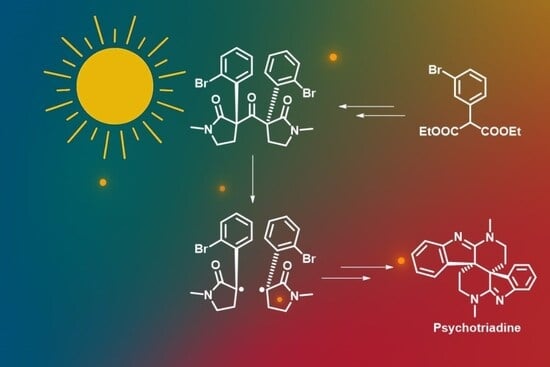
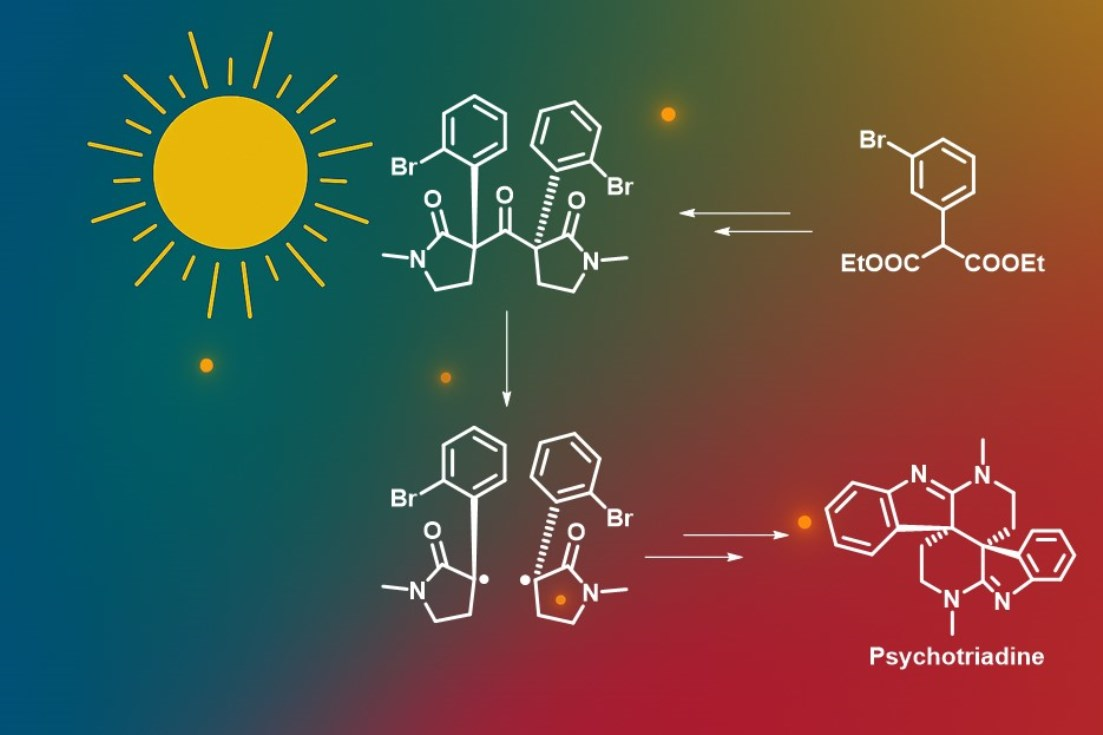
Graphical Abstract

1. Introduction

A significant part of the growth of human civilization comes from studying, learning from, and trying to mimic Nature. In the initial days of the development of organic chemistry, molecules derived from natural resources, commonly used for wellbeing, attracted the research interest of scientists. Target molecules were extracted, and various chemical strategies were applied to elucidate their molecular structure and study their chemical and medicinal properties. Later, with immense progress in the organic chemistry field, scientists took on the daunting task of chemically synthesizing these targeted natural products. The idea was to reduce the dependency on nature’s supply. These two research factors combined gave birth to the field of Natural Product Synthesis (NPS). Over time, the focus of NPS has evolved [1,2,3,4]. Initially centered on structure elucidation, the field now emphasizes practical applications in drug discovery. Traditional organic reactions have given way to modern methodologies, often guided by the principles of green chemistry. This shift reflects a broader transformation in scientific priorities—toward sustainability, efficiency, and interdisciplinary collaboration [5]. Numerous scientific advances have bolstered NPS, including, but not limited to, the discovery of new reactions and mechanistic insights, the development of host–guest and supramolecular chemistry, and the emergence of photochemistry as a powerful synthetic tool.
One of the earliest pioneers in this field was Giacomo Ciamician [6], who studied the effects of sunlight on plant-derived organic compounds. His work laid the foundation for photochemistry’s role in NPS. Photochemistry offers a precise and eco-friendly way to meet the energy requirements of a chemical reaction. Unlike thermal methods, it enables access to unique reaction pathways that are otherwise unattainable. Its use in NPS is especially compelling because it harnesses renewable energy (sunlight or artificial light), it aligns with sustainable practices and green chemistry tenets, and most importantly, it expands the synthetic toolbox for complex molecule construction [7,8].
Despite occasional skepticism about the relevance of NPS today, scientists affirm that the field is “as exciting as ever and here to stay” [9,10,11,12]. Recent successes in total synthesis underscore its vitality and growing importance in drug development [13,14,15,16,17,18,19,20,21,22].
This review highlights a wide spectrum of photochemical reactions applied to NPS. Still, there exist many classical photoreactions to newly developed photochemical strategies whose potentials in NPS have still not been tapped. This research gap presents an opportunity to adapt and integrate underutilized photochemical strategies into natural product synthesis. This review aims to catalog classical photochemical reactions applied to natural product synthesis. One important aspect covered here is the inclusion of general reaction schemes (in blue) for these photoreactions. Though many sources in the literature explain these photoreactions in great depth, there are few that have generated a general reaction scheme, making it easier and simpler for authors to identify which photoreaction to choose for their NP synthetic application. By bridging the gap between reaction discovery and synthetic application, this article aims to fuel the next wave of breakthroughs in chemistry and beyond.

2. Photochemical Reactions with Known/Studied NPS Applications

In this section, many classical and newer photochemical reactions have been covered with some illustrated examples. To enhance the flow of the information and ease of understanding, each photochemical reaction has been organized in its general form first and then examples of how it has been applied to NPS have been included.

2.1. [2+2] Photocycloaddition of Olefins

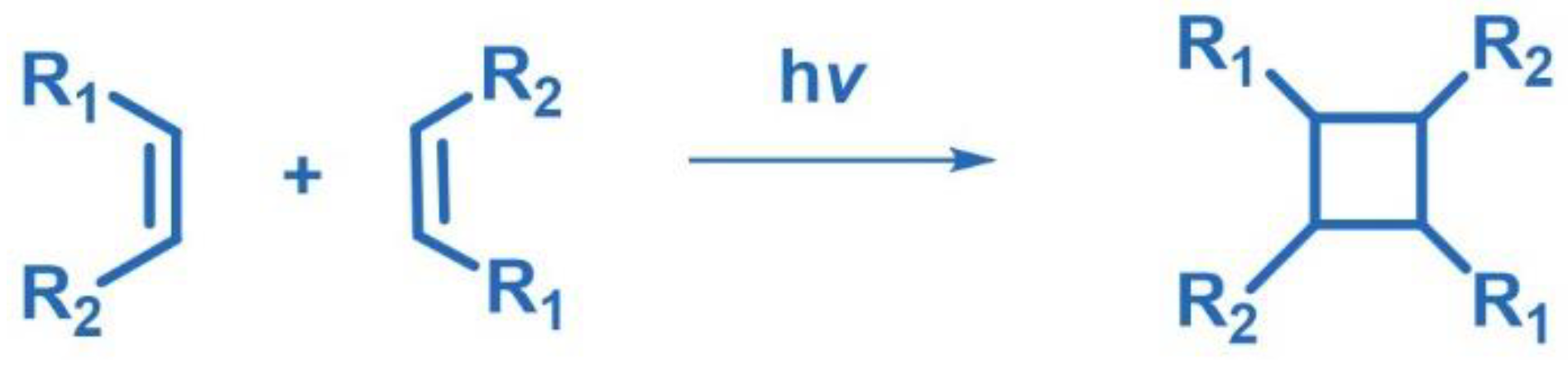
The [2+2] photocycloaddition reaction is one of the earliest and most widely studied reactions of photochemistry. This photocycloaddition reaction commonly happens between two olefins, resulting in the formation of a cyclobutane ring (Scheme 1). Formation of the cyclobutane ring is challenging because of the ring strain. Most times, the resultant product is thermodynamically stable, whereas sometimes, the cyclobutane ring opens and rearranges itself into a bigger ring. In both cases, this reaction becomes synthetically relevant, as it exerts good control over the regio- and stereochemical outcome of the reaction. As a result, this reaction has become a central strategy in the synthesis of diverse cyclic compounds and has played a crucial role in the total synthesis of many structurally intricate natural products. Numerous comprehensive studies have explored various facets of the [2+2] photocycloaddition and its applications in complex molecule construction. Some relevant examples have been included here.
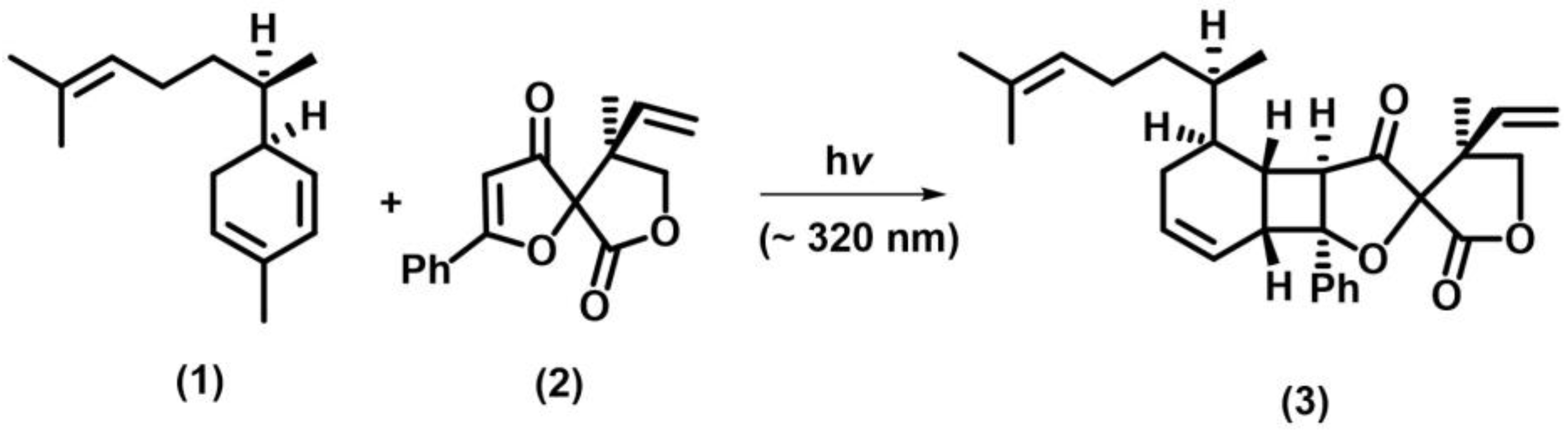
A [2+2] photocycloaddition reaction was applied in the synthesis of biyouyanagin A (3), using diene (1) and enone (2) (Scheme 2) [23]. The irradiation was carried out in a quartz cell, using 320 nm filter and with 2-acetonaphthone as a triplet sensitizer. The result was the formation of the target natural product constituting a cyclobutane ring with high regio and stereoselectivity.
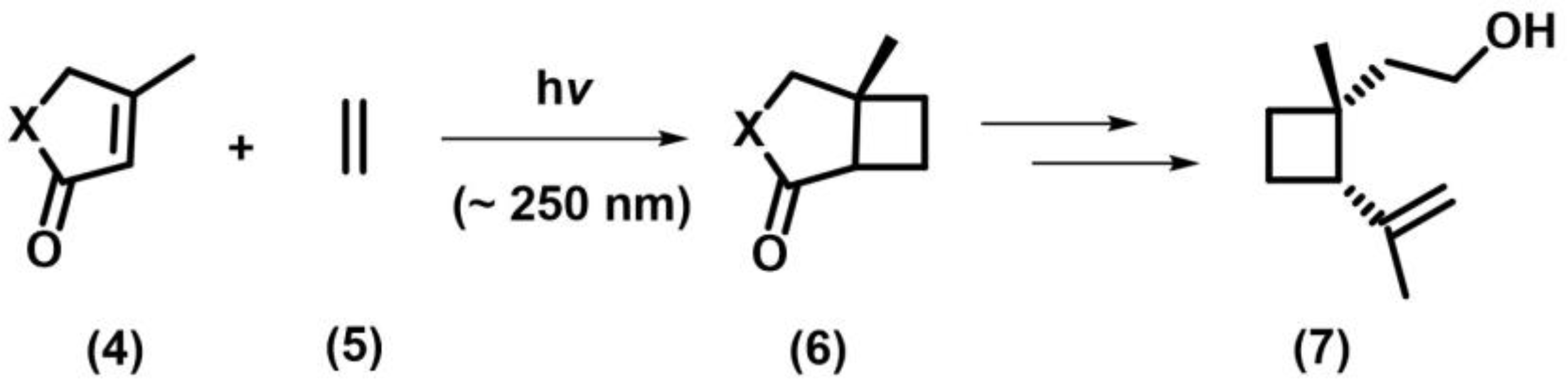
Another classic example of the use of [2+2] photocycloaddition reaction is the synthesis of (+)-grandisol (7) (Scheme 3). The naturally occurring form possesses the depicted absolute and relative configuration. The most common approach to the synthesis of grandisol involves the formation of the non-annulated cyclobutane via annulated intermediates, and this strategy has been known for a long time. Annulation of a 4-membered ring (6) through intermolecular photoaddition (using ~250 nm wavelength of light) of an alkene (5) to cyclic enones (4) is the key step in the synthesis of grandisol [24].
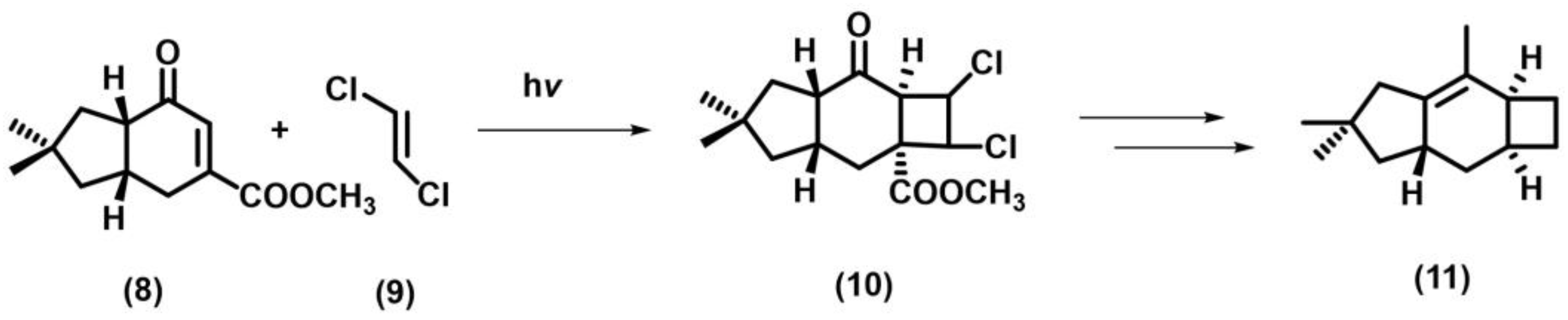
Another natural product that has been synthesized by [2+2] photocycloaddition reaction is sterpurene (11), where a cis-fused bicyclic enone (8) with a methoxycarbonyl group at the β-position of the enone double bond has been employed for photoaddition of E-1,2-dichloro ethylene (9) (Scheme 4) [25].
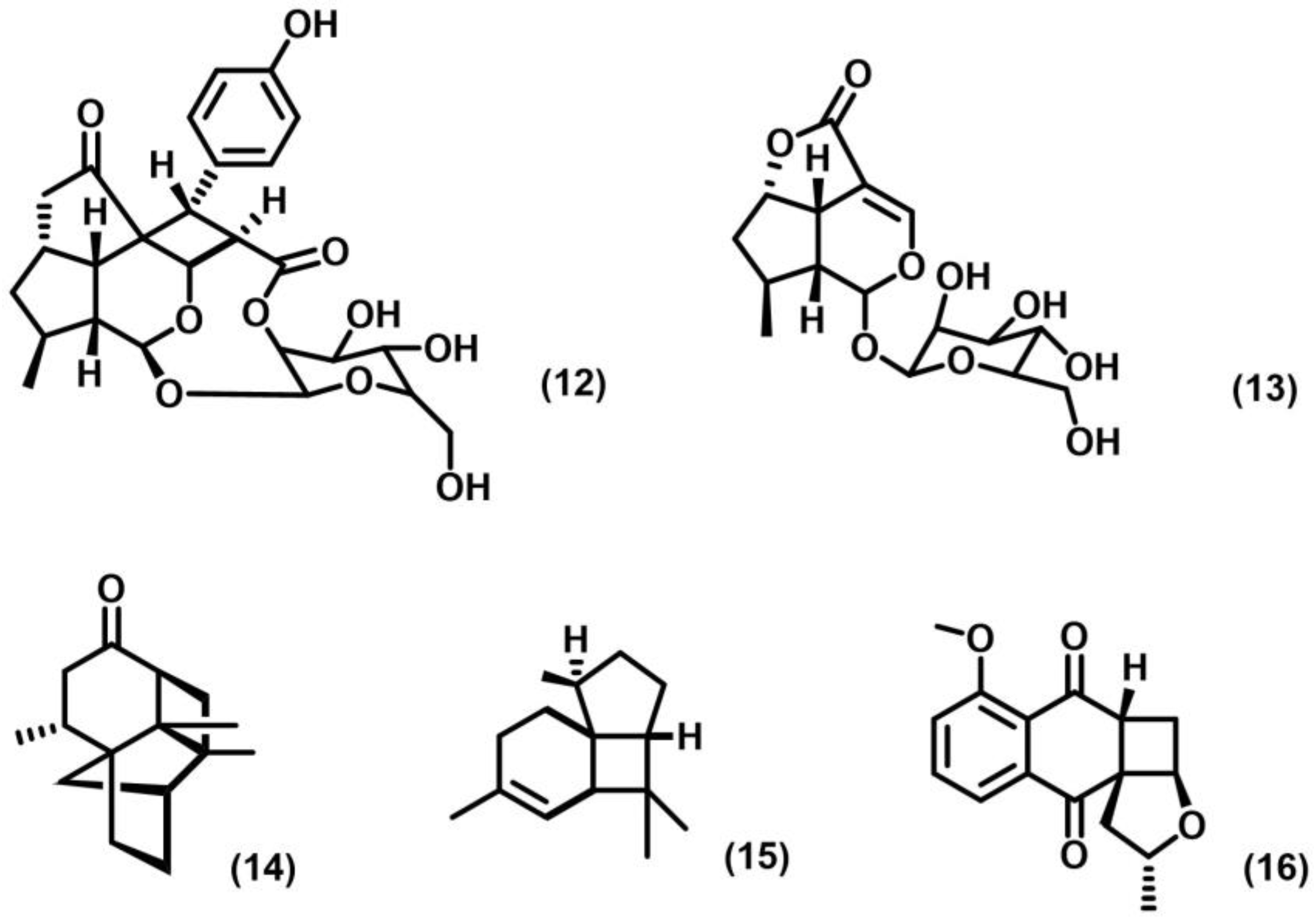
In another example of NPS employing [2+2] photocycloaddition reaction is the final step in the synthesis of brasoside (12) and littoralisone (13) [26]. Examples of the synthesis of some other target natural products, which utilize intramolecular [2+2] photocycloaddition reactions, given in Scheme 5 include (+)-solanascone (14) [27], (±)-italicene (15) [28], and (−)-elecanacin (16) [29].

2.2. [2+2] Photocycloaddition of Compounds Containing N

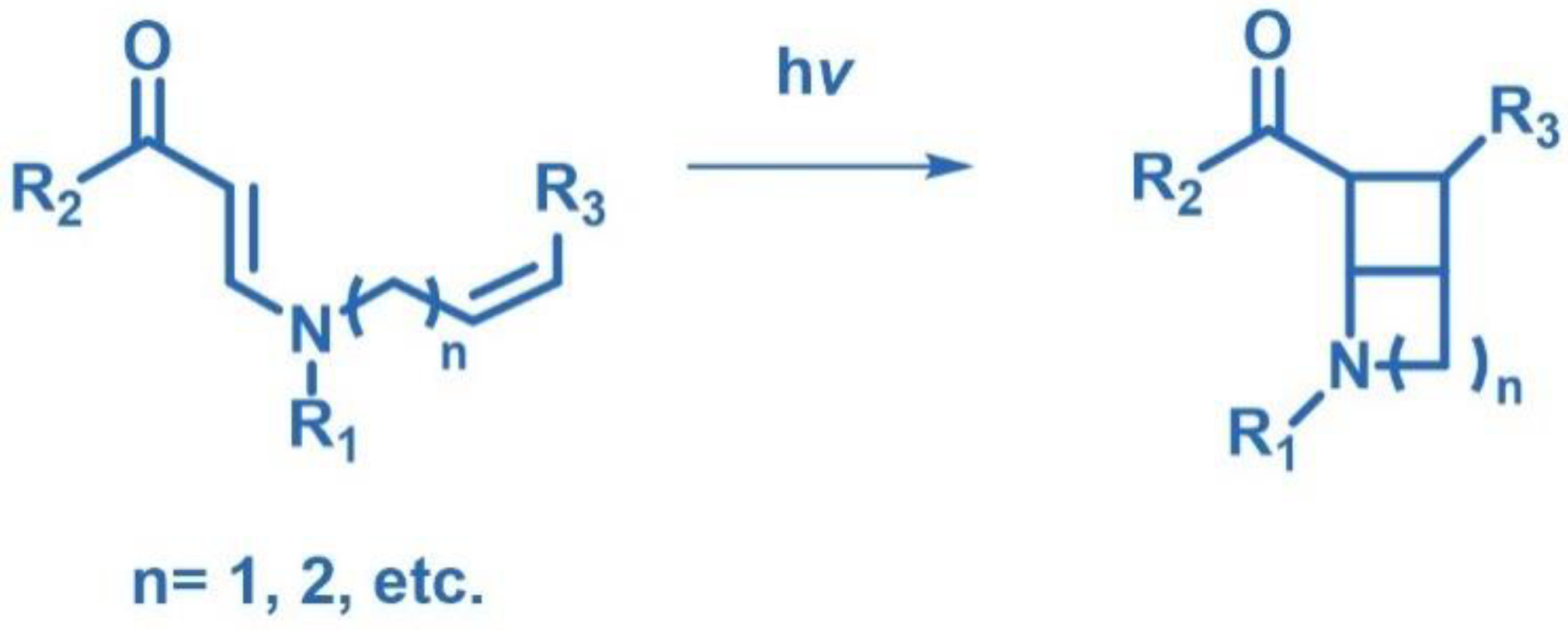
[2+2] photocycloaddition adducts of vinylogous amides (enaminones), also called retro-Mannich fragmentation sequence, are another important tool for the construction of nitrogen-containing ring systems. The general reaction scheme (Scheme 6) is shown below.
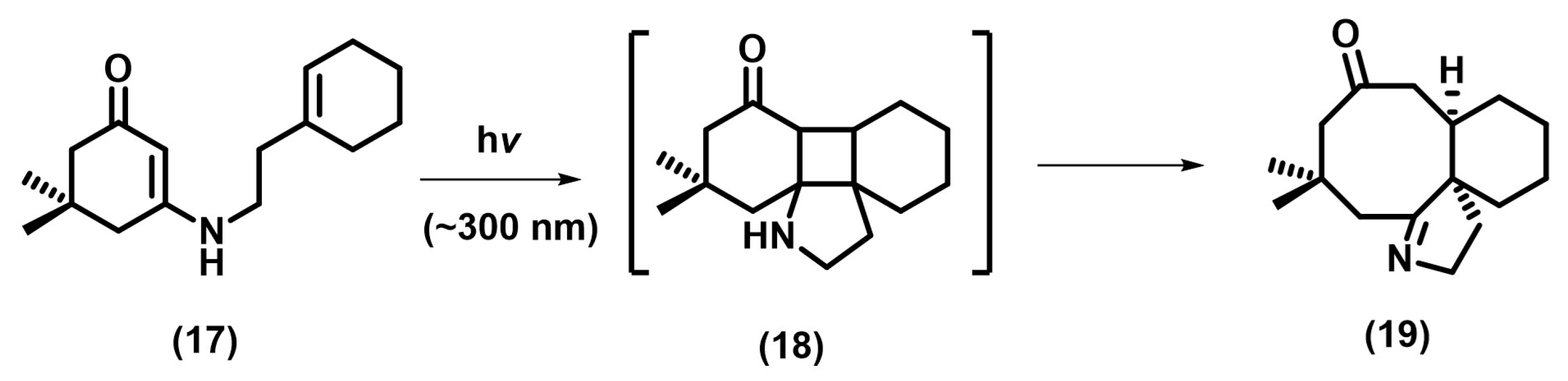
In the following example (Scheme 7), irradiation, using a 300 nm light source of secondary vinylogous amides (17) afforded ketoimine (19), via intermediate (18), which is presumably generated from the cyclobutane intermediate upon retro-Mannich fragmentation [30].
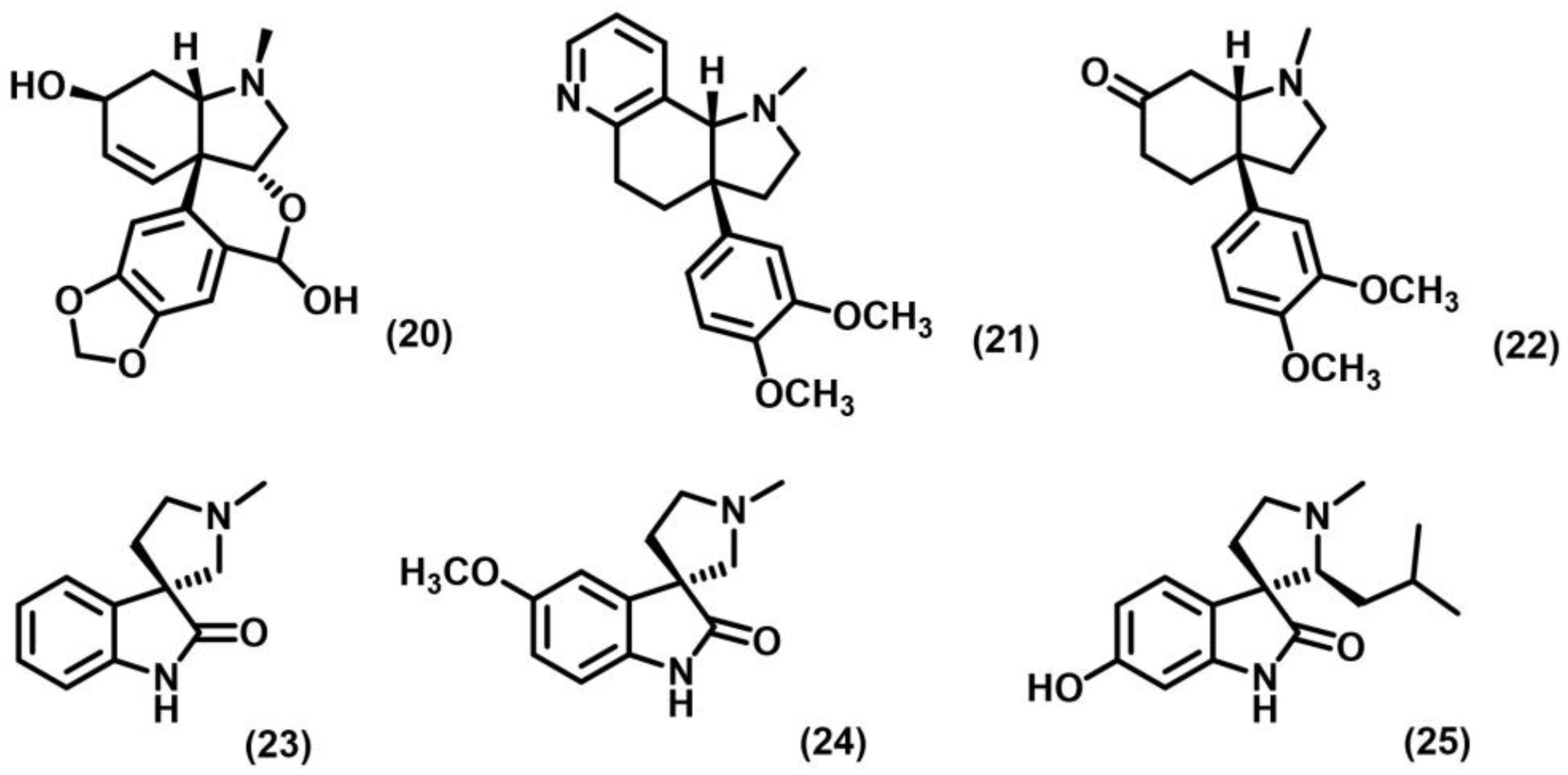
As shown in Scheme 8, the intramolecular retro-Mannich reaction has also been utilized in the synthesis of alkaloids pretazettine (20), sceletium A-4 (21), and mesembrine (22) [31], containing a five-membered ring with nitrogen. A [2+2] photocycloaddition/retro-Mannich fission approach for tryptamine-based vinylogous amides was also employed by White and co-workers in the total syntheses of (±)-coerulescine (23), (±)-horsfiline (24), and (±)-elacomine (25) [32].

2.3. Other Photocycloadditions ([3+2], [6+2])

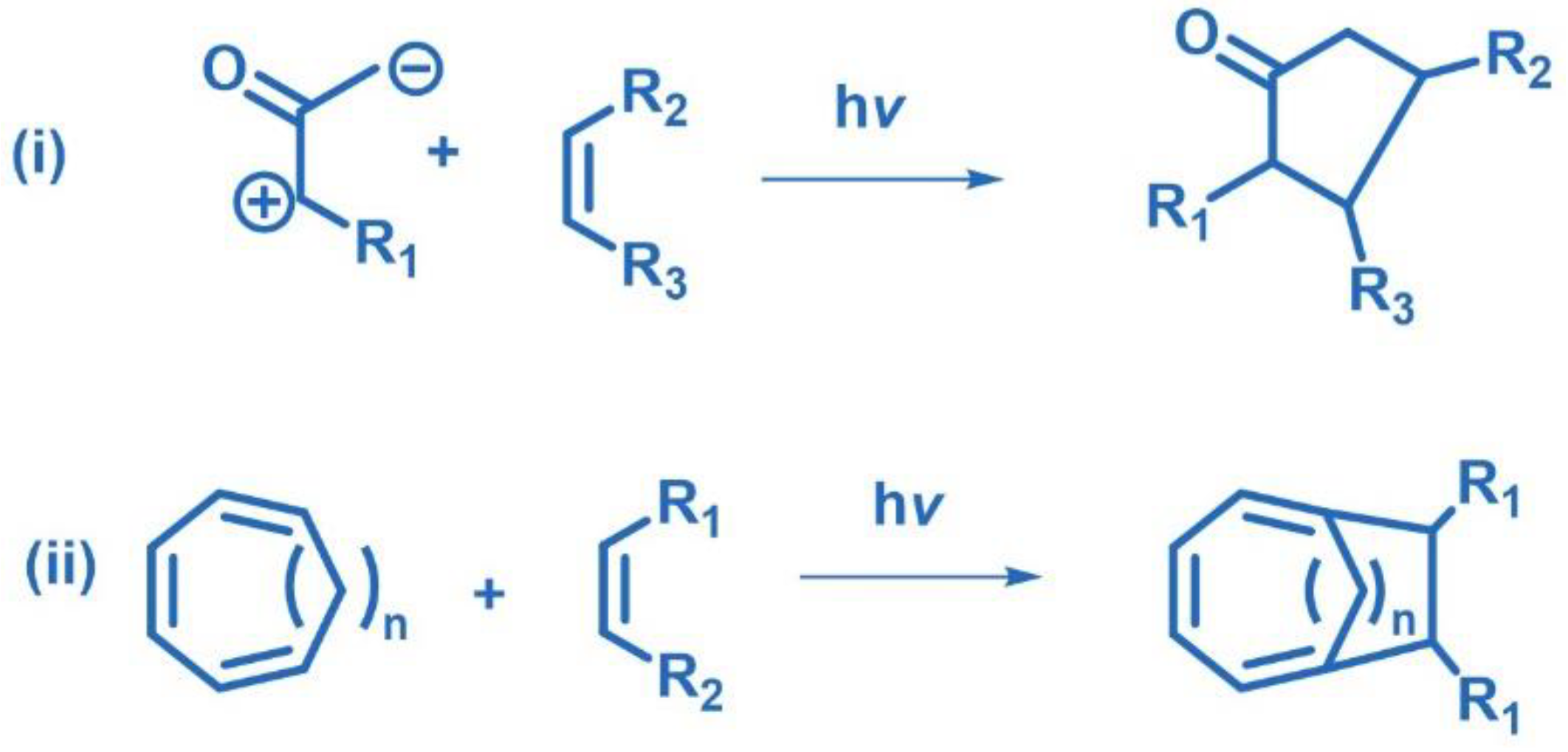
Though [2+2] photocycloaddition reactions are the most studied and utilized, there are other very useful photocycloaddition reactions, such as [3+2], [5+2], [6+2], etc. They acquire different reaction pathways, like proton transfer, to generate a reaction intermediate, α-cleavage related to Norrish type-I fragmentation, and a stepwise mechanism involving biradical intermediates, respectively. Two more commonly used photocycloaddition reactions are shown below in Scheme 9.
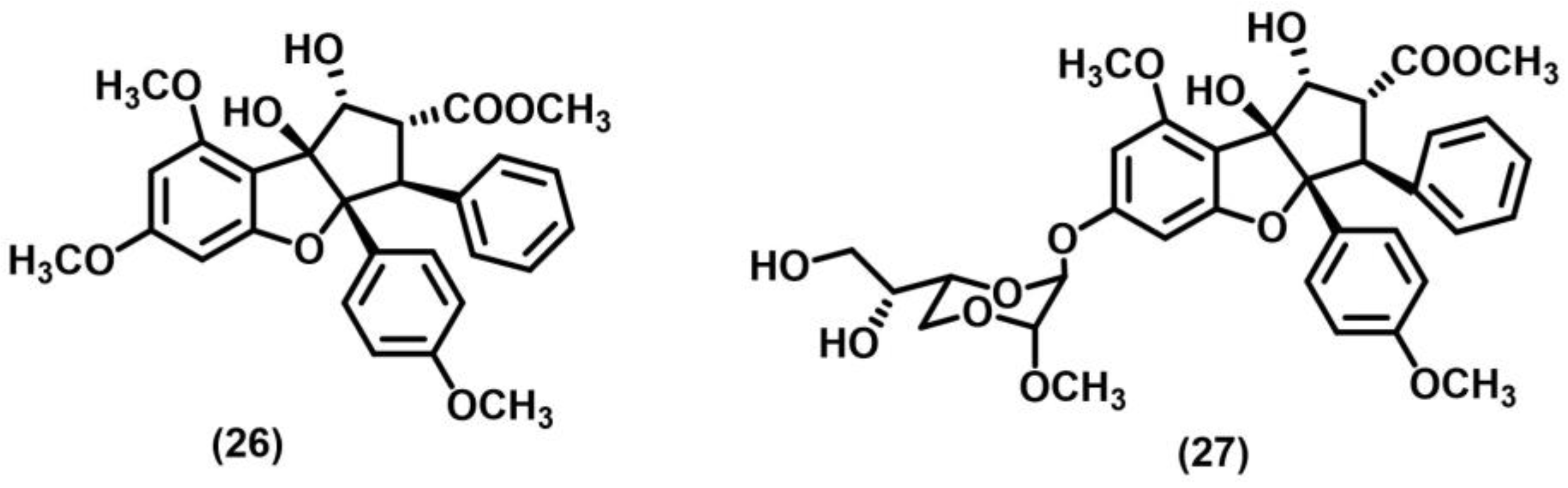
Below is an example (Scheme 10) where a photochemically induced [3+2] cycloaddition reaction leads to an adduct formation, which was then utilized as a starting material for the synthesis of (−)-methylrocaglate (26) and (−)-silvestrol (27) [33].
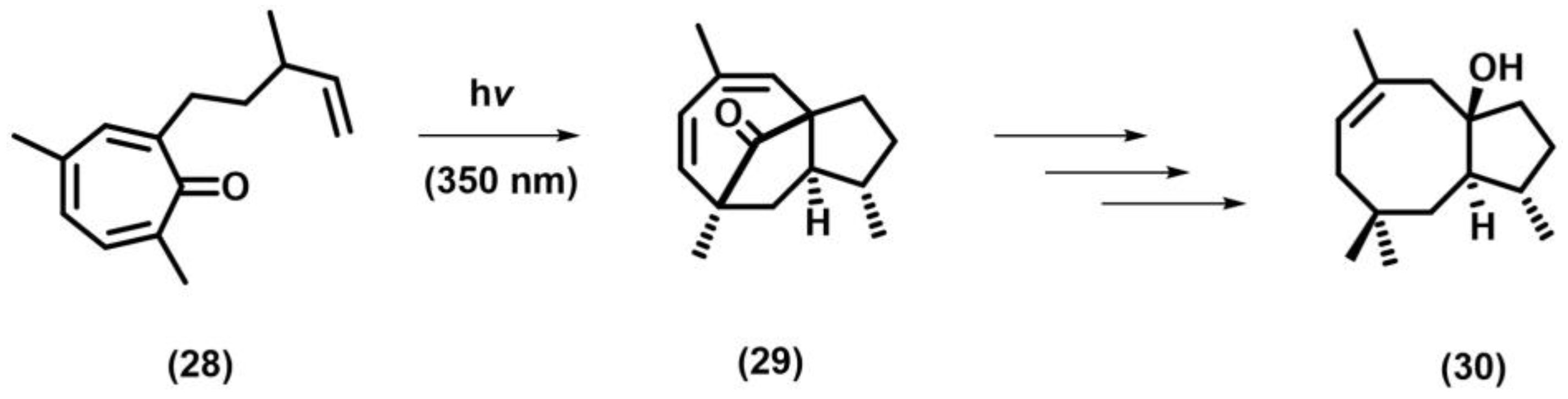
Synthesis of sesquiterpene (±)-dactylol (30) involved the formation of an eight-membered ring (29), starting from (28) (Scheme 11). This was accomplished by employing photoinduced [6+2] cycloaddition reaction, using a 350 nm light source. After five additional reactions, total synthesis of the target natural product was achieved [34,35].

2.4. Photocyclization Reaction

2.4.1. [6π] Photocyclization

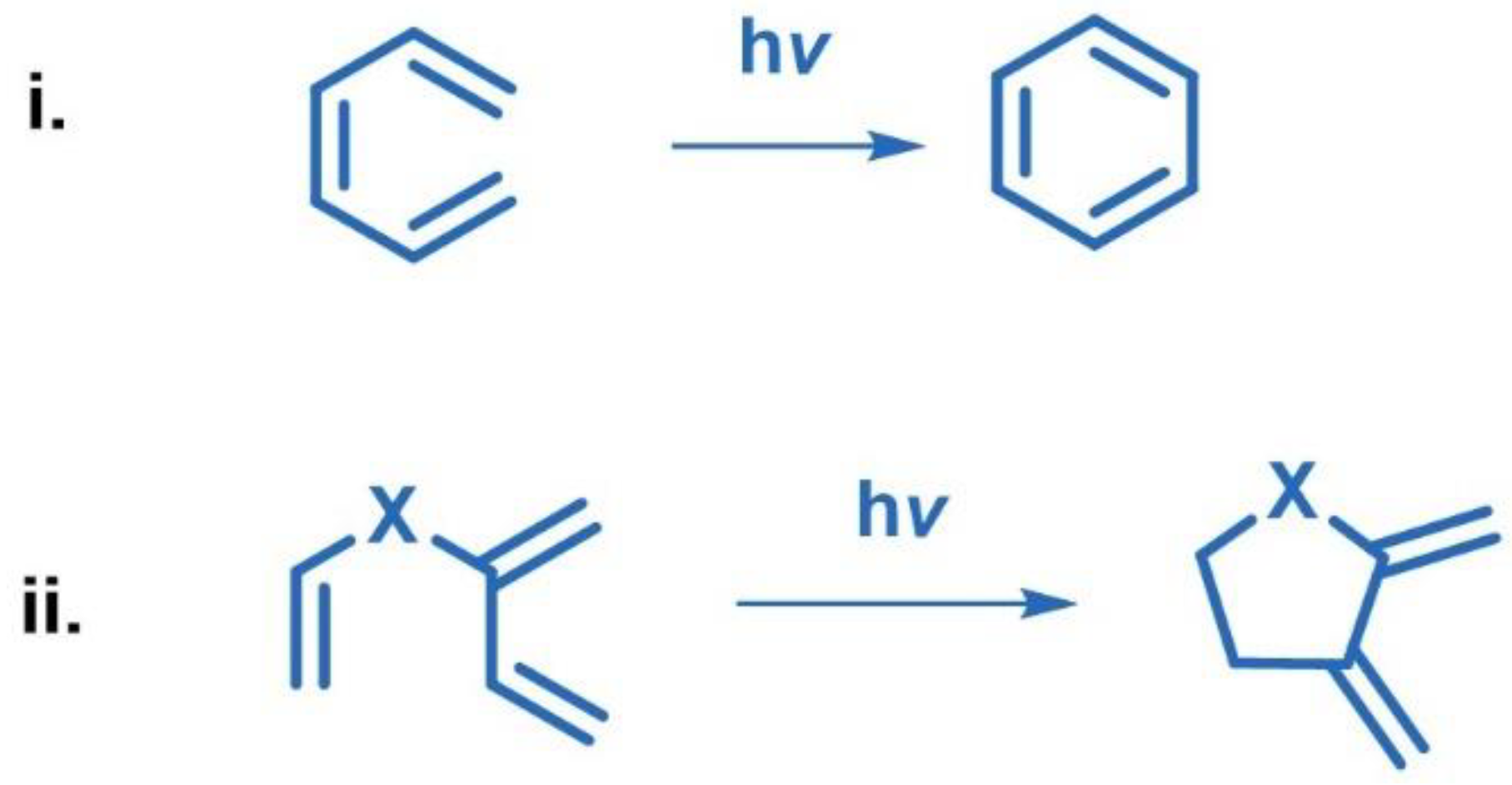
[6π] photocyclization reactions represent a significant class of photochemical transformations. The general reaction scheme (Scheme 12) is shown below. In this reaction, a conrotatory [6π] ring closure occurs upon photoexcitation, generating a zwitterionic intermediate. This intermediate subsequently undergoes a suprafacial 1,4-hydrogen shift to furnish the final product. Remarkably, irradiation with red (600–700 nm) light is sufficient to initiate the [6π] cyclization [36]. In many cases, the reaction also leads to aromatization, making it an indispensable tool in synthetic organic chemistry.
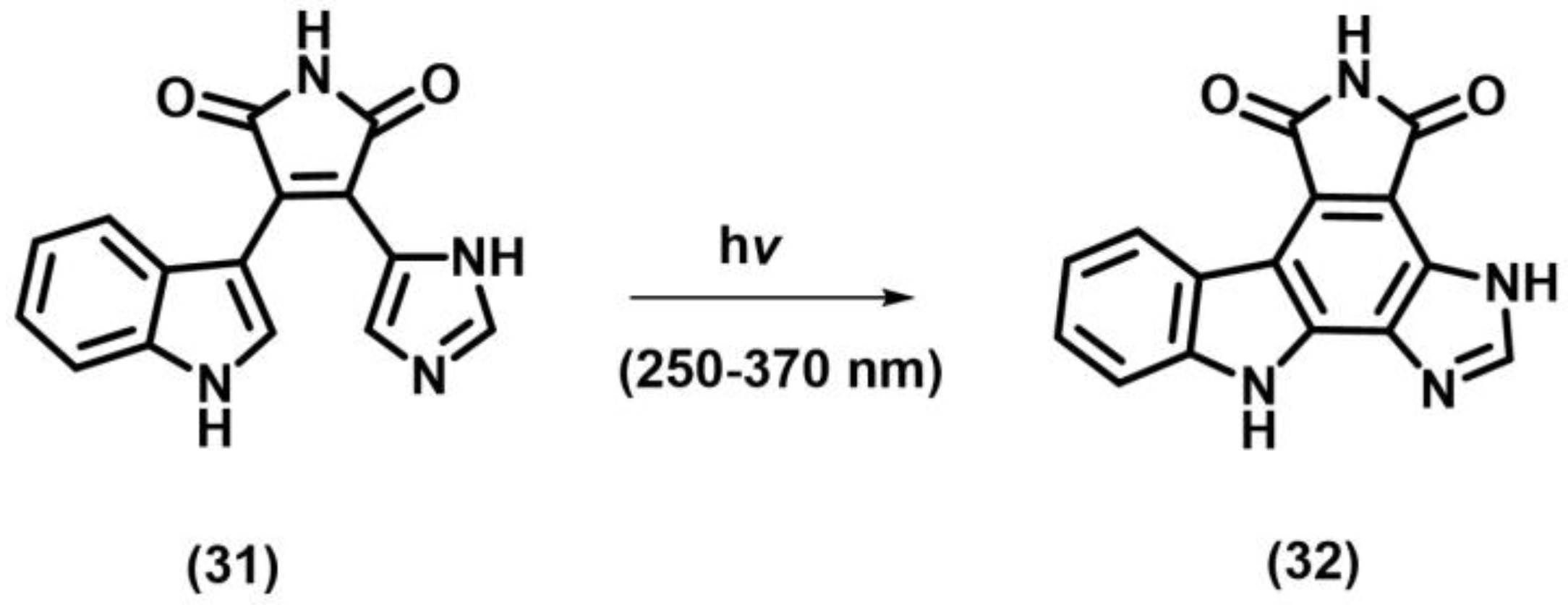
A notable example of the [6π] photocyclization reaction (Scheme 13) is the conversion of didemnimide (31) to granulatimide (32). In the laboratory, this transformation was performed using a medium-pressure mercury lamp (250–370 nm) in a quartz apparatus with catalytic amounts of Pd/C. Interestingly, the authors report that simple irradiation with sunlight, in the presence of atmospheric oxygen, also facilitates rapid ring closure followed by oxidation [37].
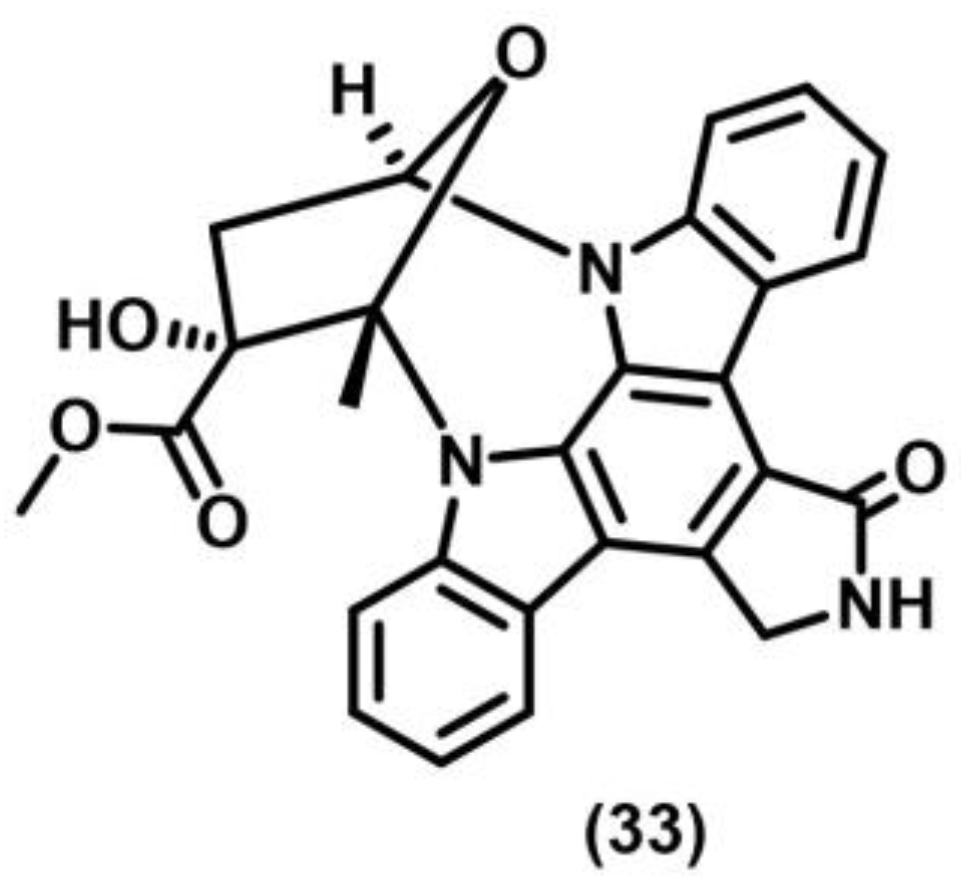
Certain photoreactions require deoxygenated conditions to proceed efficiently. In such cases, halogenated substrates can facilitate aromatization through elimination following the [6π] cyclization. A notable example is the synthesis of (+)-K252a (33) (Scheme 14), where dihydroindolocarbazole is generated from 2-bromoindole. The high yield observed in this transformation is attributed to the presence of bromine, which eliminates the need for degassing procedures [38].
The [6π] photocyclization of stilbenes provides one of the most concise and efficient routes to phenanthrenes, making it a key strategy in the synthesis of phenanthrene-based natural products. However, competing pathways, such as E/Z isomerization of the stilbene precursor and pericyclic ring opening, can reduce efficiency. To drive the equilibrium toward irreversible phenanthrene formation, oxidative conditions or halogenated substrates are commonly employed [36]. Some simple phenanthrene-based natural products that were made by means of a [6π] cyclization include the plectranthones, aristolochic acid [39], (±)-tylophorine [40], the phenanthrenes TaIV and TaVIII [41], and the diterpenoid quinone (±)-danshexinkun A [42].

2.4.2. [4π] Photocyclization

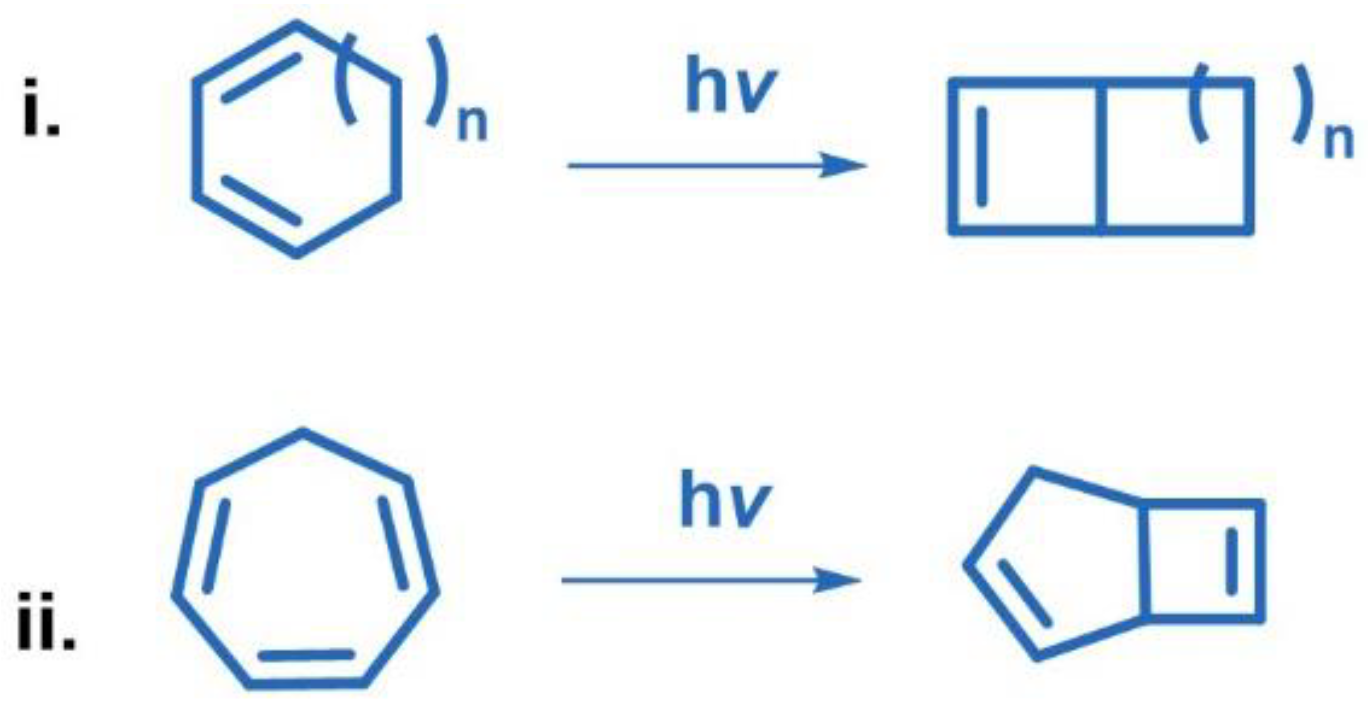
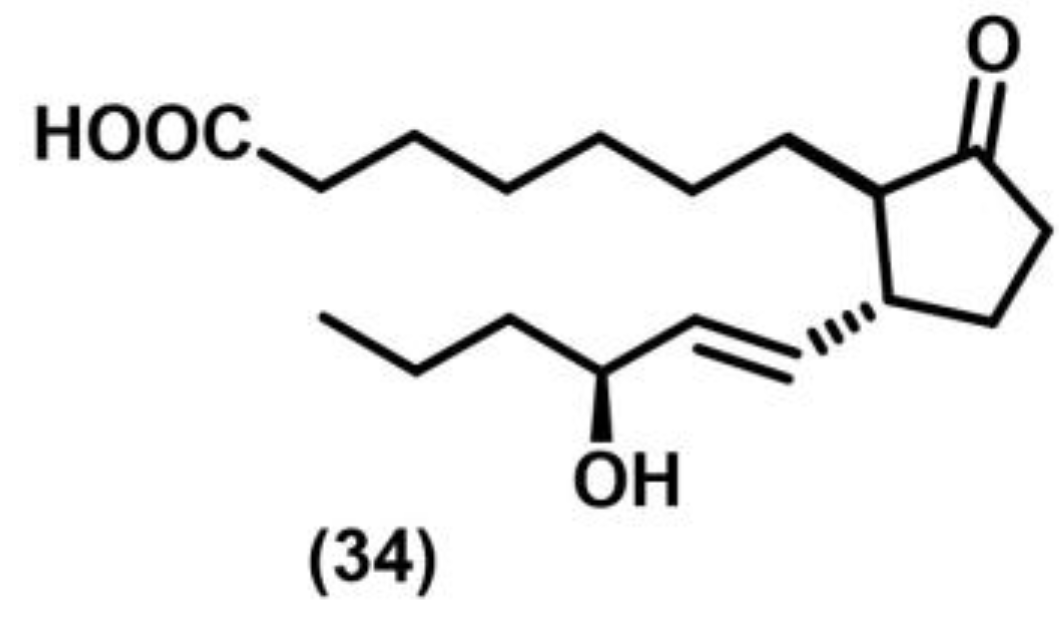
Another kind of electrocyclic photoreaction is [4π], sometimes also referred to as valence isomerization. In this reaction, 1,3-dienes photocyclize to give a cyclobutene ring. Just like many other photoreactions, although this reaction is possible thermally as well, and since the formation of a cyclobutene ring exerts a lot of ring strain, the thermal route becomes energetically less favorable. However, because conjugated dienes usually absorb longer-wavelength light than the cyclobutane products, it is possible to carry out 4-π-electrocyclizations under photochemical conditions by selecting a wavelength of light that is absorbed by the conjugated diene but not absorbed by the cyclobutene product [43]. The most common way to utilize this reaction in total synthesis is using 1,3,5-cycloheptatriene to cyclize intramolecularly, as shown in Scheme 15. The synthesis of 11-(±)-deoxyprostaglandin E1 (34) (Scheme 16) was achieved using readily available tropolone methyl ether as the starting material. The [4π] cyclization occurred regio-selectively, at the unsubstituted diene, and the resultant methoxycyclobutane was easily opened under oxidative conditions [44].

2.5. Norrish–Yang Cyclization

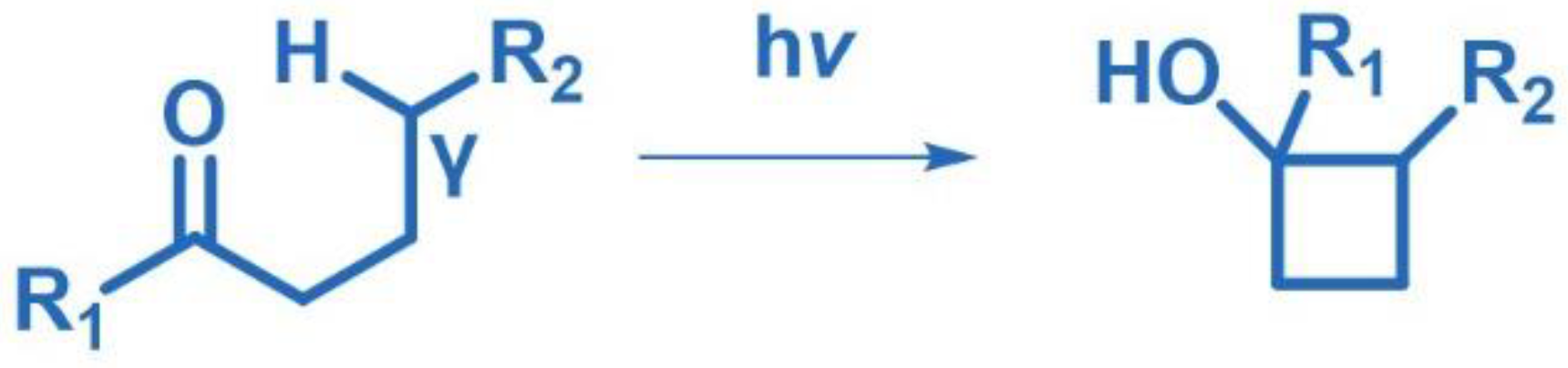
Out of the four distinct processes initiated by γ-hydrogen abstraction in excited carbonyl compounds, Norrish–Yang cyclization is unique since it results in a cyclobutanol ring formation. Depending upon the starting material, this photocyclization can also result in cyclobutane, oxetane, and azetidine formation. The general reaction scheme for Norrish–Yang cyclization is shown below (Scheme 17) [45].
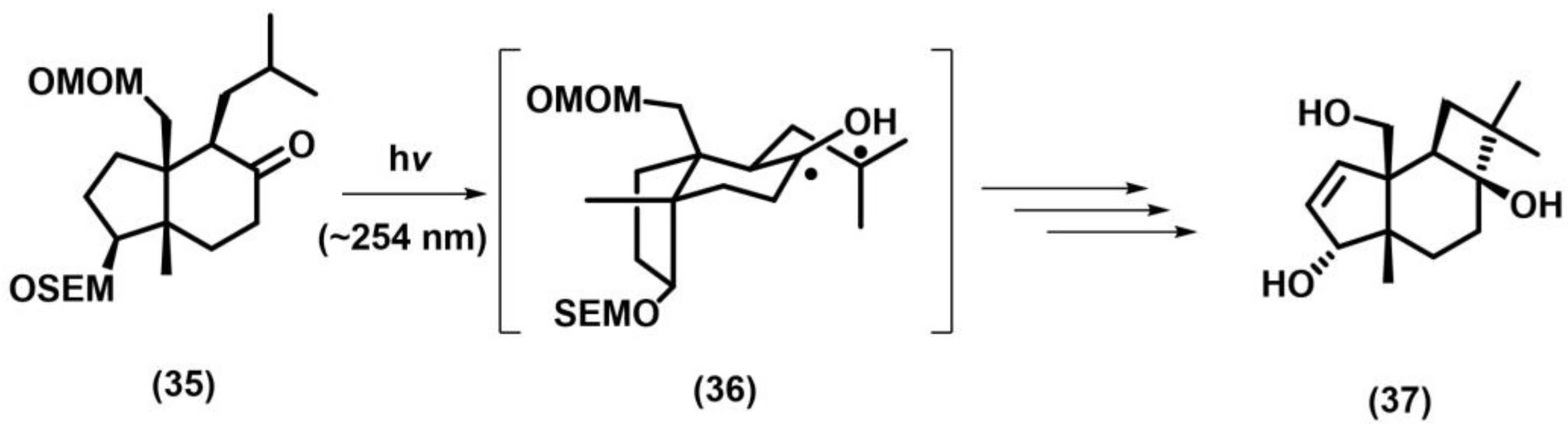
A classic example of how the Norrish–Yang reaction was employed in the total synthesis of a natural product is the synthesis of punctaporonin A (37). The reaction is shown in the following scheme (Scheme 18) [46]. In this example, abstraction of γ-hydrogen, employing UV C lamps (254 nm) in (35), leads to cyclobutanol ring formation, as shown in product (35), via 1,4-biradical intermediate (36).
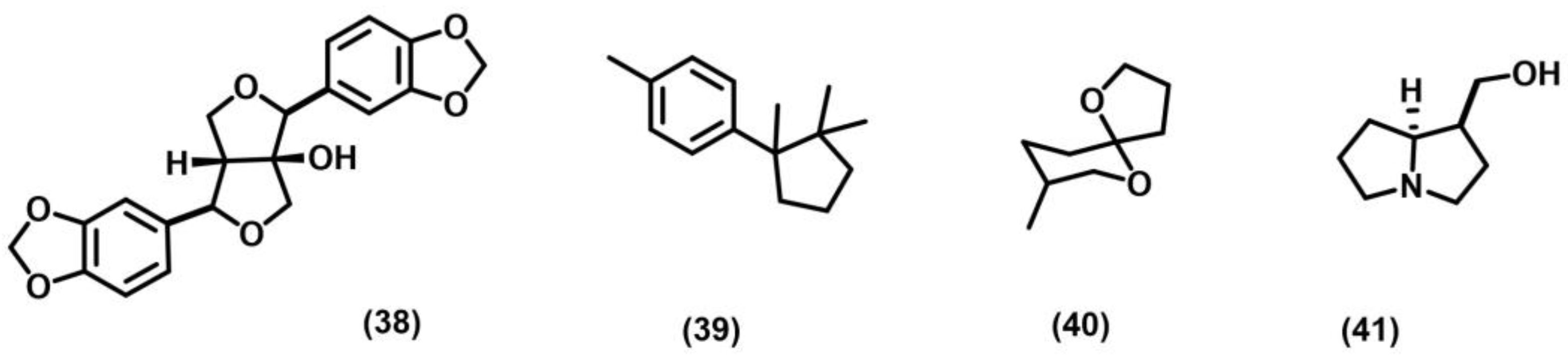
As shown in Scheme 19, there are many examples in the literature where this reaction was used to achieve the total synthesis of natural products. Some examples are synthesis of (±)-paulownin (38) [47], (±)-cuparene (39) [48], the racemic pheromone (40) [49], and (±)-isoretronecanol (41) [50].
The Norrish–Yang reaction was further manipulated to result in a five-membered ring in the following example (Scheme 20). In this example, after the initial γ-hydrogen abstraction in (42) leads to the loss of a good leaving group (mesylate), upon irradiation with the ~450 nm light source, a new 1,5-biradical (43) pair is formed, leading to the formation of a five-membered ring (44), during the synthesis of pterosines B (45) and C [51].

2.6. Paterno–Buchi Photoreaction

Paterno–Buchi photoreaction comprises a reaction between an excited-state carbonyl compound and an olefin to give a four-membered oxetane ring (Scheme 21). This reaction usually proceeds via a 1,4-diradical intermediate, which must undergo spin-flip (singlet–triplet intersystem crossing) before it cyclizes to an oxetane ring. Electron-rich olefins are ideal candidates for the Paterno–Buchi reaction.
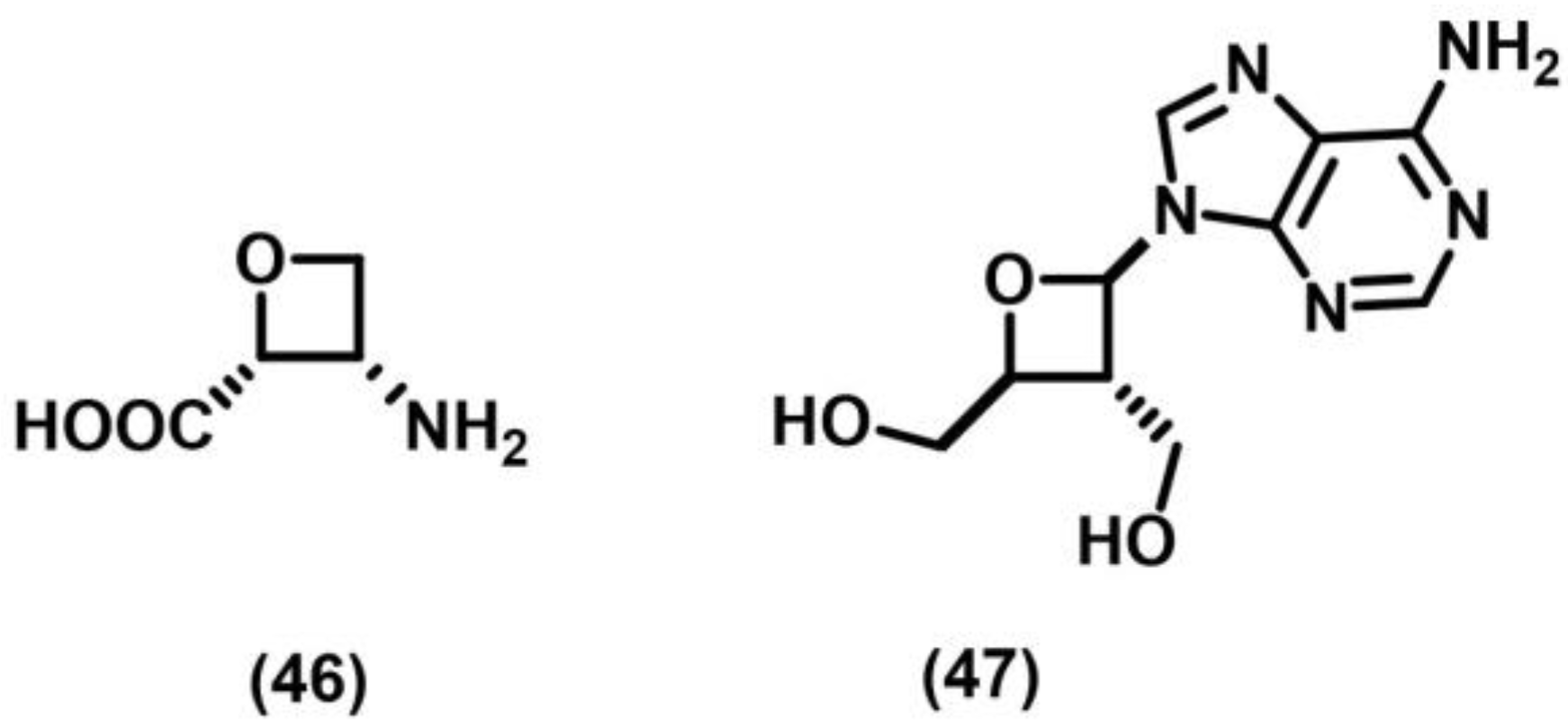
Among some examples of the utilization of the Paterno–Buchi reaction in natural product synthesis is the synthesis of (±)-oxetine (46) [52] and (±)-oxetanocin (47) (Scheme 22) [53].
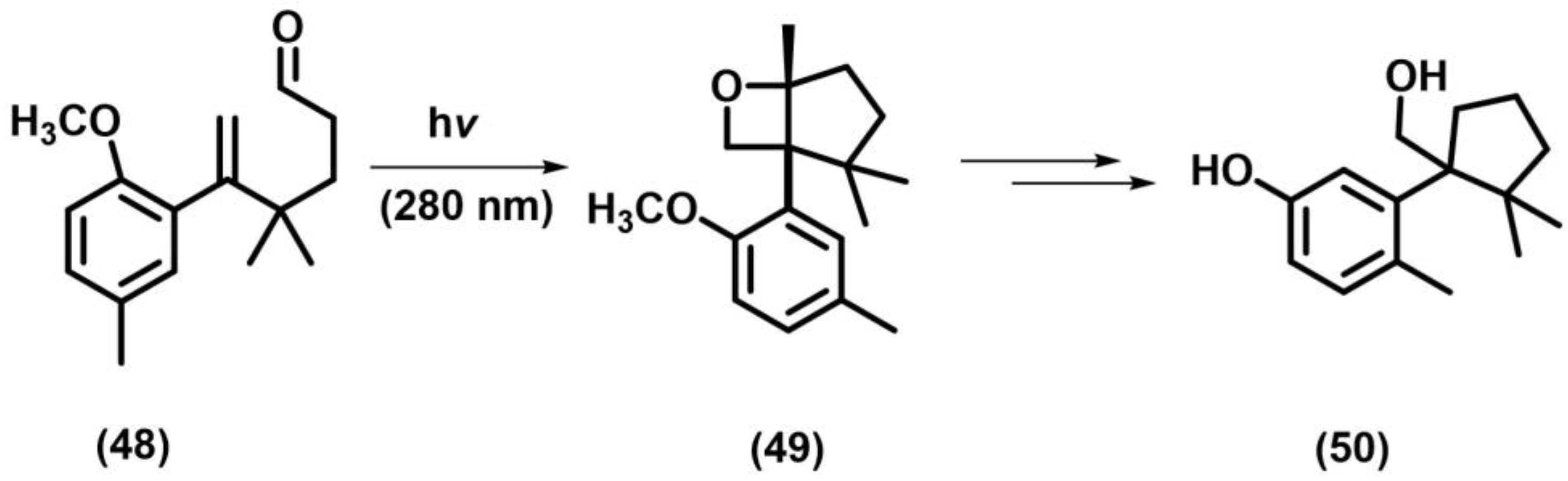
Another variant of the Paterno–Buchi reaction is the use of furan as a substrate. Synthesis of many natural products, like (±)-avenaciolide [54,55] and (±)-asteltoxin [54,56], have utilized this strategy. Intramolecular Paterno–Buchi reaction, another variant, has been shown to be of substantial use in the synthesis of (±)-herbertendiol (50) by irradiating (48) with a ~280 nm light source, generating an oxetane-containing intermediate (49), which, upon further chemical reactions, gives the product (50), in the following reaction scheme (Scheme 23) [57].

2.7. Norrish Type I/II Photoreactions

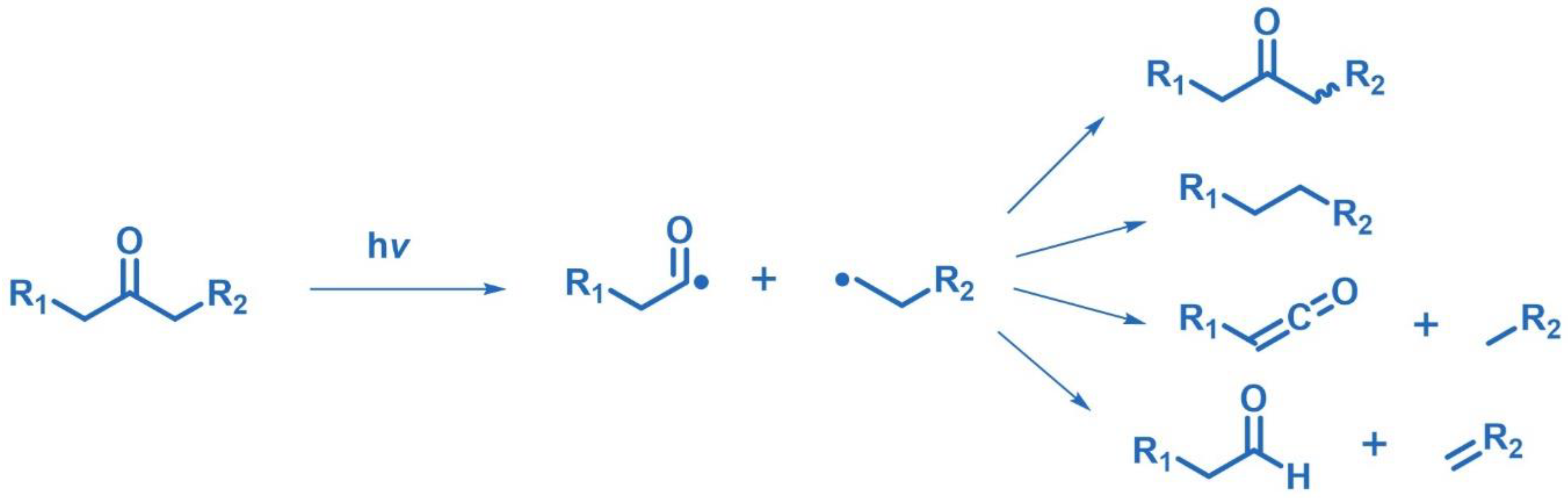
Norrish photoreactions, in general, are the photoreactions involving a carbonyl group, mostly in the form of a ketone or an aldehyde. In the Norrish Type I reaction, a homolysis reaction happens at the α-position, resulting in two free radicals, which is the first step. Now, there can be multiple options for the second step: simplest being, these two free radicals can recombine producing a racemic center, or the carbonyl group can be excluded as carbon monoxide, or the other fragment can abstract an α-H from the carbonyl segment, resulting in a ketene and an alkane or the carbonyl free radical can abstract a β-hydrogen from the other segment and make an aldehyde and an alkene, as shown in Scheme 24. Because of so many possibilities emanating from one single photochemical reaction, the Norrish Type-I reaction becomes a powerhouse of application in designing natural product synthesis.
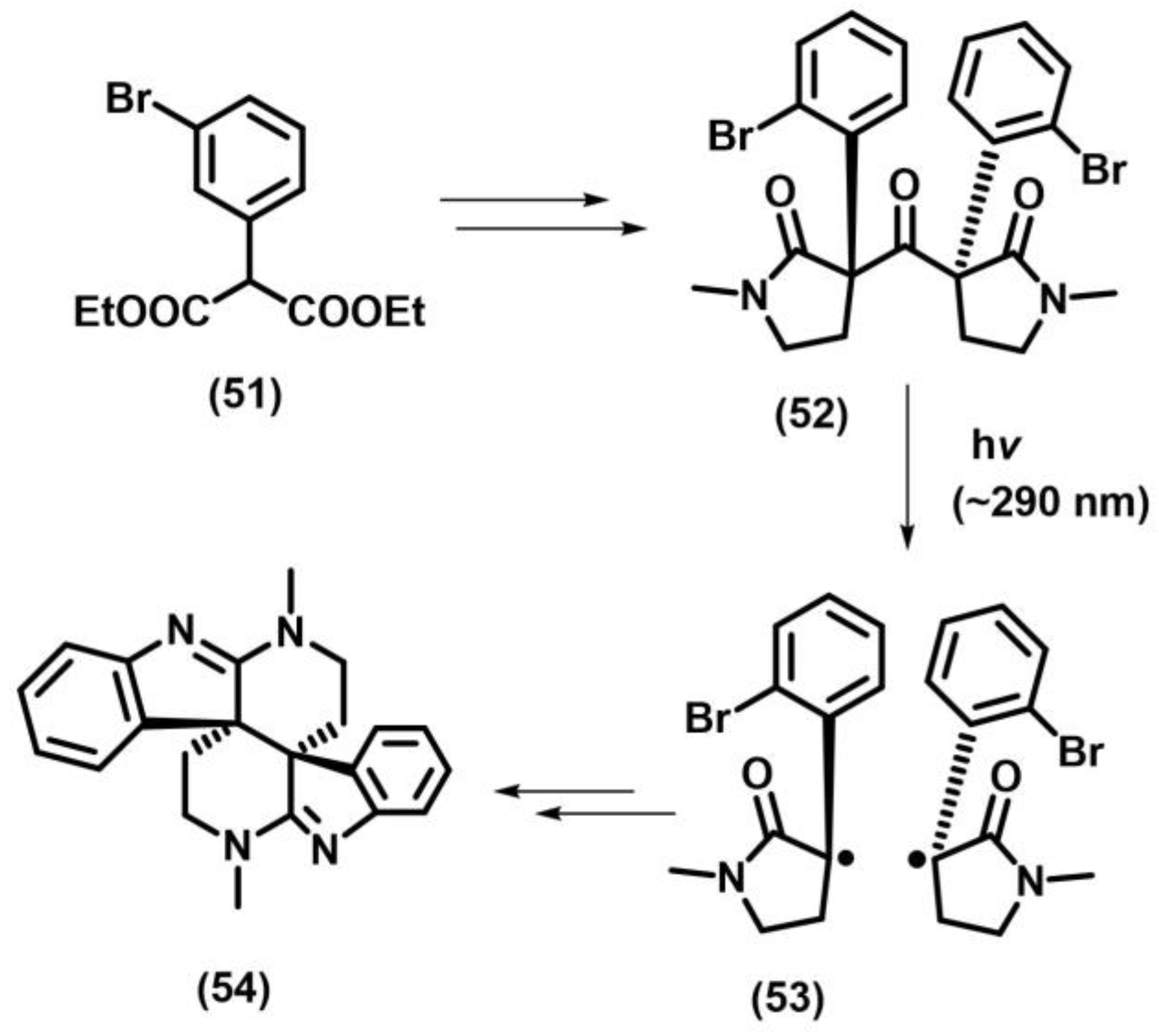
A more recent example (Scheme 25) of the application of Norrish type-I reaction is the total synthesis of the alkaloid, psychotriadine (54) [58]. After the generation of the biradical (53), upon irradiation of (52), with ~290 nm light, which in turn is derived from (51) after a few synthetic steps, the second possibility of the above general scheme kicks in, which is the decarbonylation, eventually leading to the formation of psychotriadine (54).
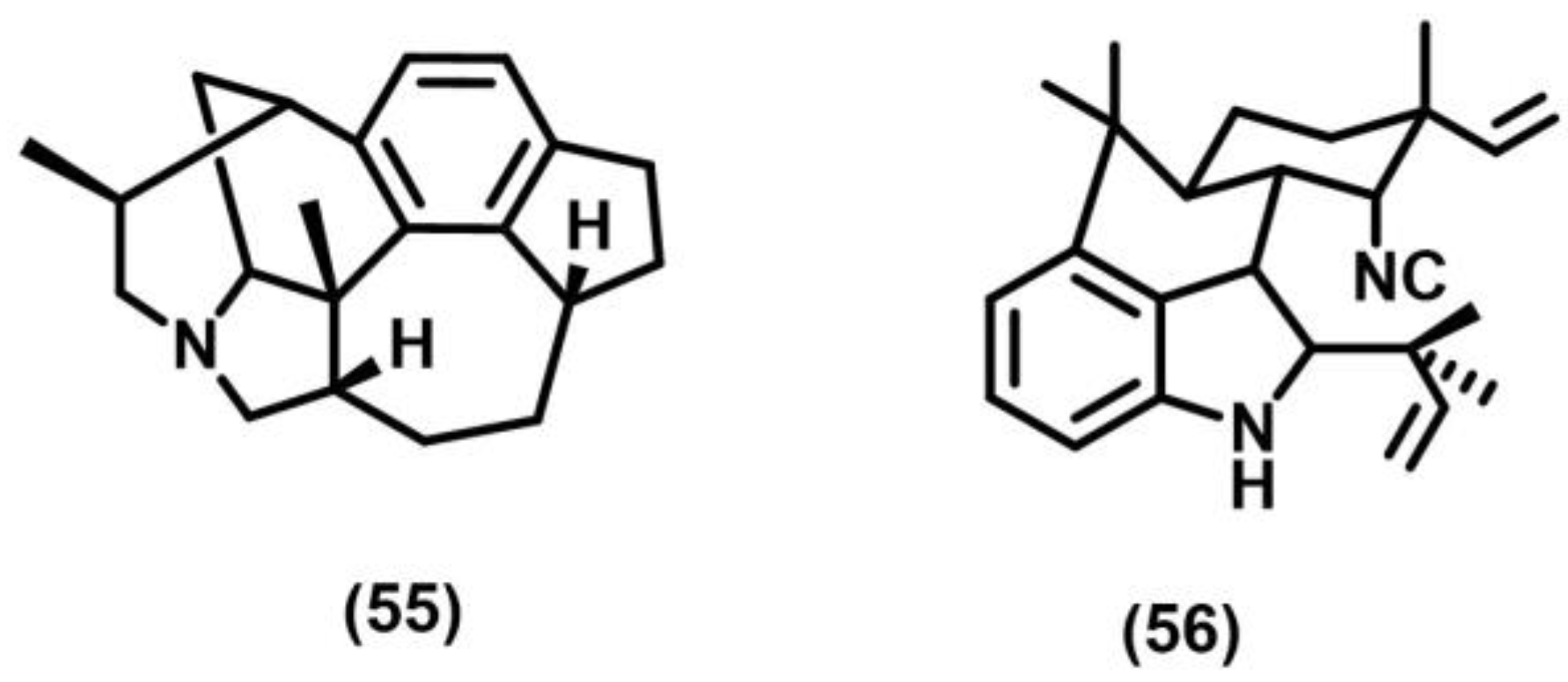
Other ambitious examples of the use of Norrish type I reaction in total synthesis are the formation of (+)-ambiguine H (55) [9] and daphenylline (56) (Scheme 26) [59].
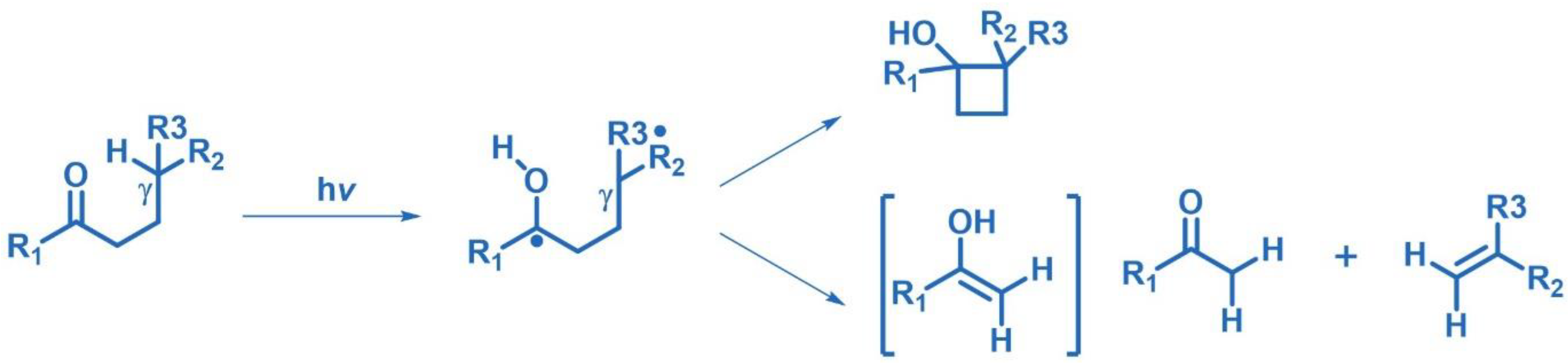
Norrish type II reaction is a specific kind of Norrish type I reaction, in the sense that after the free radical formation, the carbonyl fragment, abstracts γ-H within the segment. This again can have two further possibilities. In first case, it can simply lead to the formation of a cyclobutane ring with a hydroxyl substituent, or it can fragment into an enol (tautomerizing into a ketone/aldehyde) and an alkene (Scheme 27). Thus, this reaction also becomes a very useful photochemical tool for natural product synthesis.
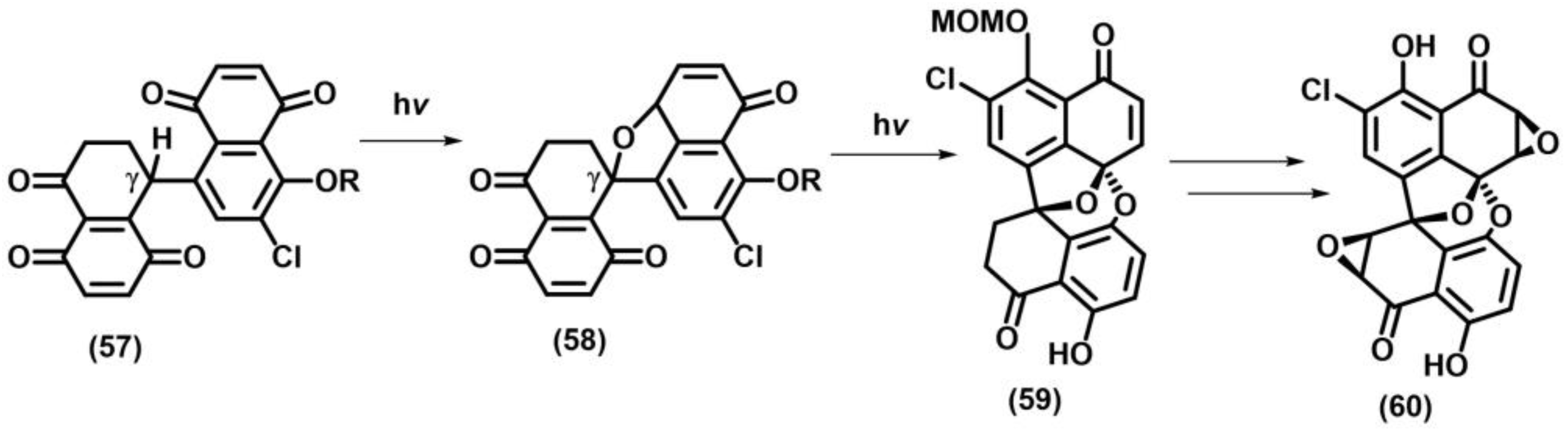
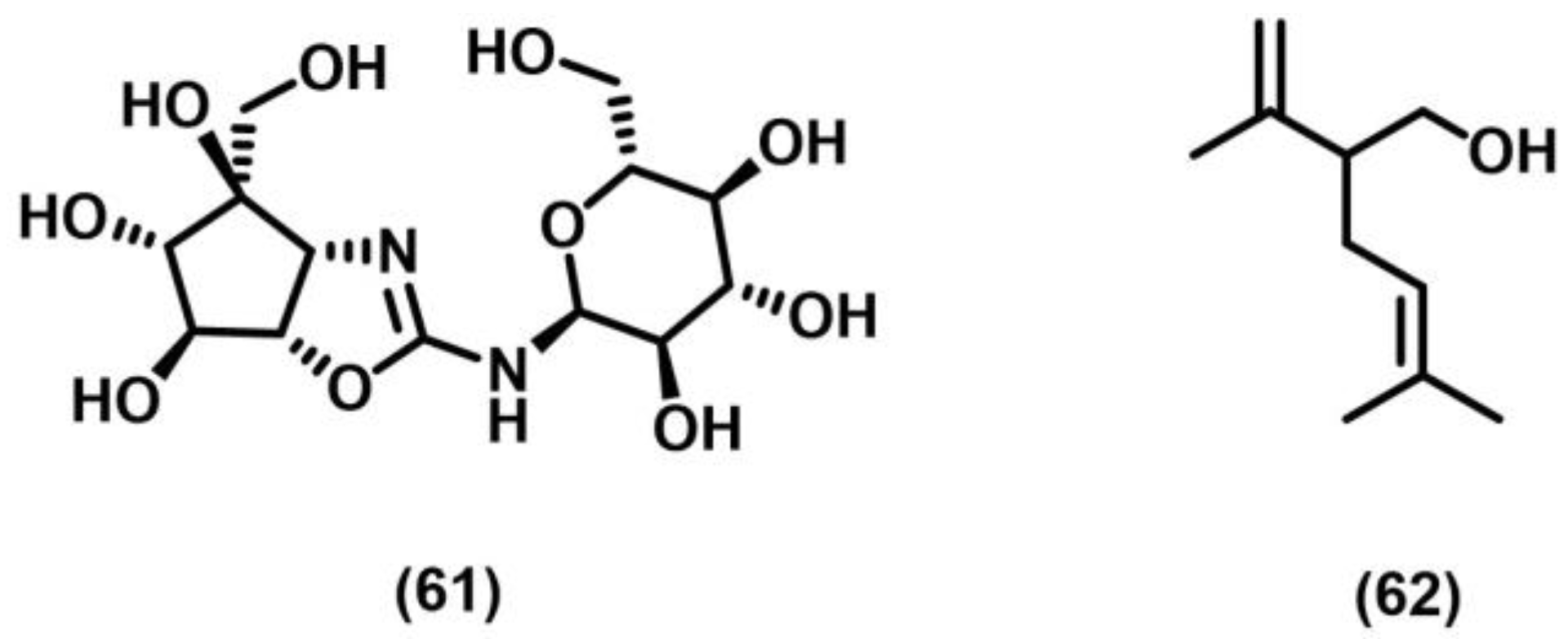
A good example of the application of Norrish type II photoreaction is the total synthesis of the antibiotic (−)-spiroxin (60), Scheme 28 [60]. In this synthesis, the Norrish-type II intramolecular 1,5-hydrogen shift is the most significant step. First, γ-H abstraction in (57) is succeeded by the second γ-H abstraction in (58), in two steps leading to the compound (59), which, after a few more chemical steps, makes (−)-spiroxin (60). Another example of the use of Norrish type-II reaction is the enantioselective synthesis of trehazolin (61) [61] and (R)-(−)-lavandulol (62) [62], Scheme 29.

2.8. De-Mayo Photoreaction

Paul De Mayo and coworkers in 1962 worked extensively on a special kind of [2+2] photocycloaddition reaction involving an alkene and a 1,3-diketone. This specific photoreaction came to be known by the name De Mayo reaction. In this reaction, the first step is the tautomerism of the 1,3-diketone to produce the corresponding enol, which, in turn, reacts with the alkene via [2+2] photo cycloaddition reaction. The result is the formation of the β-acyl cyclobutanol moiety (Scheme 30). Retro-aldol condensation of the formed cyclobutanols produces the 1,5-dicarbonyl species, which can be further transformed into cyclooctadiones and cyclohexenones [63,64,65].
A classic example of the use of the De Mayo reaction in NPS is the total synthesis of (±)-longifolene (66). Irradiation of benzyloxycarbonyl derivative, with a 280 nm light source (63), afforded cyclobutane (64) via intramolecular [2+2] photocycloaddition reaction followed by retro-Diels Alder reaction, leading to (65). Further reactions led to the synthesis of (±)-longifolene (66) (Scheme 31) [66,67].
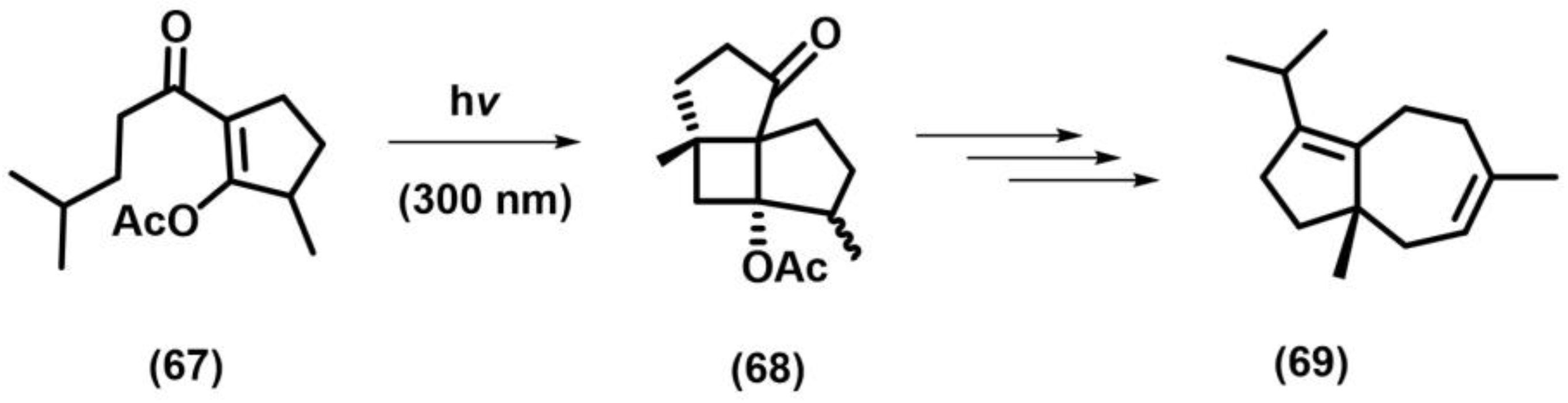
Another classic example of the application of De Mayo reaction to NPS was the synthesis of carotene-like terpene, called (±)-daucene (69) [68]. As depicted in Scheme 32, irradiation of enone (67) with a 300 nm light source resulted in efficient and regioselective photocyclization to afford photoproduct (68), containing a cyclobutane ring in 88% yield, which, upon further reaction, produced (±)-daucene (69).
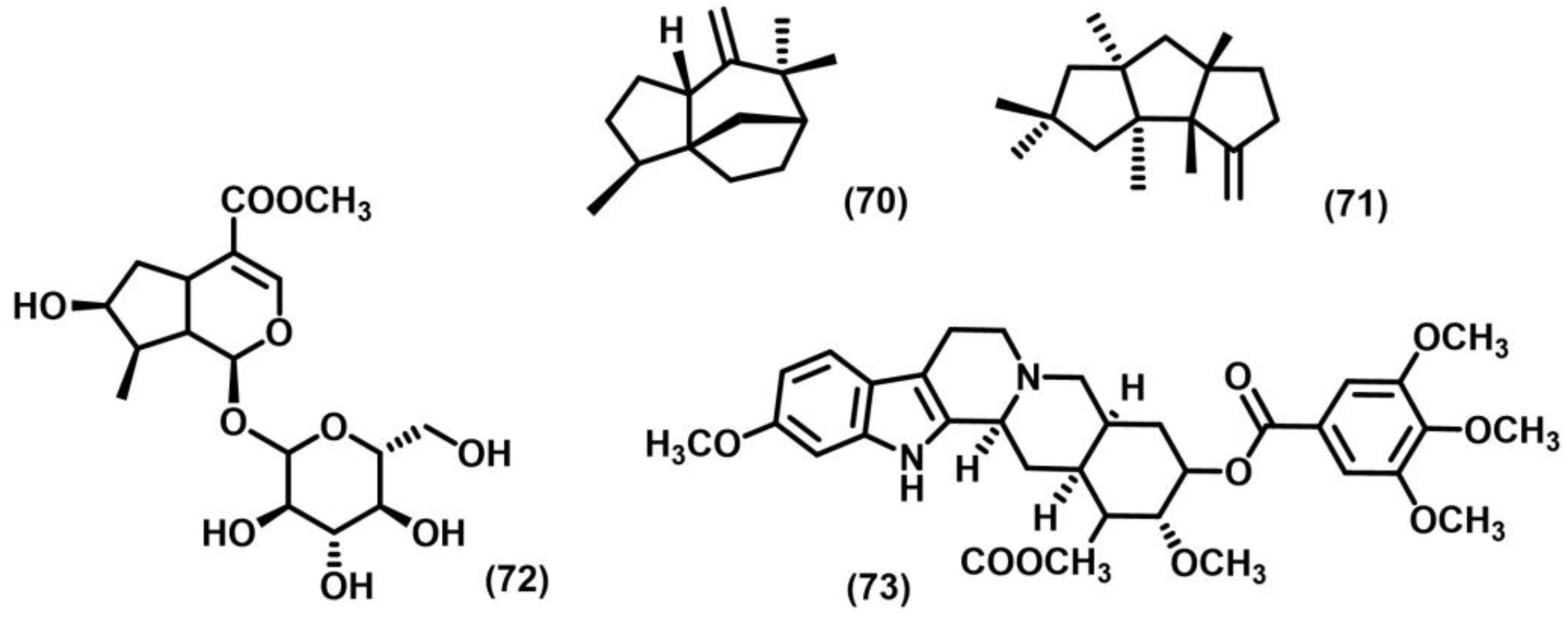
Out of the many other natural product syntheses employing the De Mayo reaction, some illustrious examples are the syntheses of hirsutene (70) [69], loganin (71) [70], reserpine (72) [71], and zizaene (73) [72], Scheme 33.

2.9. Homodimerization Photoreaction

Homodimerization reaction is a relatively simple photoreaction. In this reaction, two monomers come together to form a dimer upon irradiation (Scheme 34).
One classic example of homodimerization photoreaction is the synthesis of truxinates and truxillates (Scheme 35) [73]. Though the photoreaction itself is very simple, it is not enantioselective at the same time. Starting from (74), several enantiomeric products are possible (7577). This challenge is well exhibited in the synthesis of truxinates and truxillates, irradiating cinnamic acid with UV light (200–400 nm); several photoproducts with differing stereochemistry are formed, and from these, only three (7577) are truxillic acid, which are then converted to truxillates and truxinates.
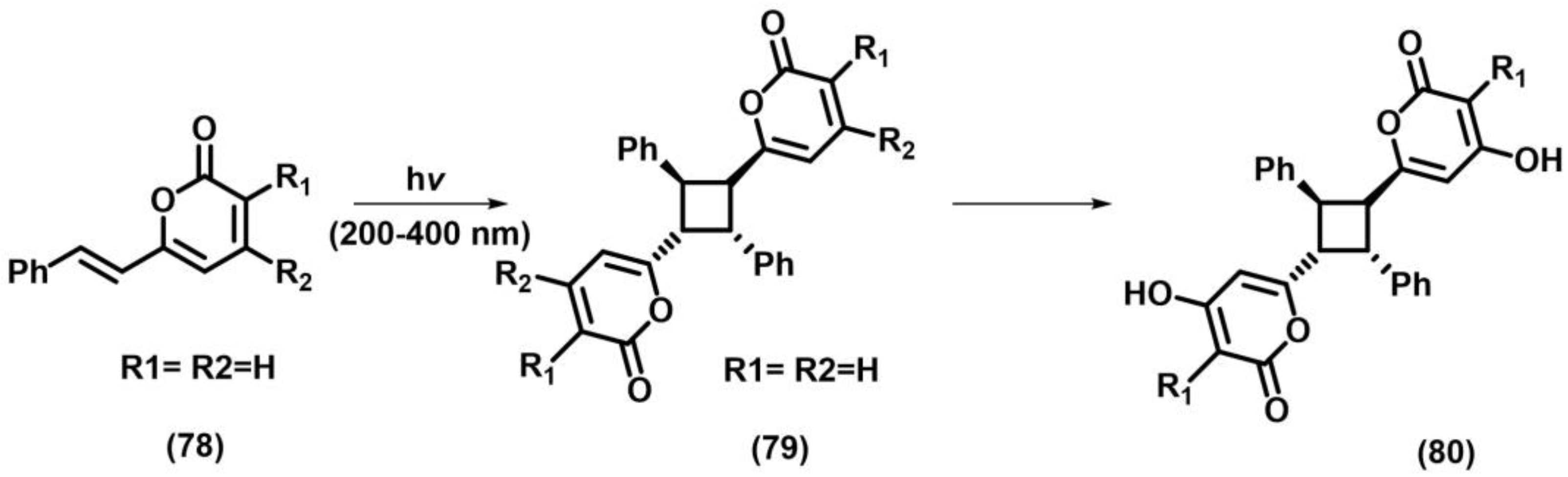
As shown in Scheme 36, following the same idea, total syntheses of goniotamirenone A (79) and (±)-katsumadain C (80) were achieved using homodimerization photoreaction (UV light, 200–400 nm) of styryl lactones (78) (Scheme 36). Laphookhieo reported that (78) dimerizes to form quantitative yields of (79), both when irradiated neat and as a slurry in water [74].

2.10. Photochemical Rearrangements

Photochemical rearrangement reactions are reactions where first a molecule is excited using a photon, then either fragments into a biradical or zwitterion or transfers a H atom to produce a molecule with a different structure in general. This category includes various reactions like di-π-methane, oxa-di-π-methane, photo-Fries, rearrangement including dienones and aliphatic enones, rearrangements involving cyclohexatrienes, etc. In this subsection, some of the commonly applied photo rearrangement reactions are discussed.

2.10.1. Rearrangement Involving Dienones and Aliphatic Enones

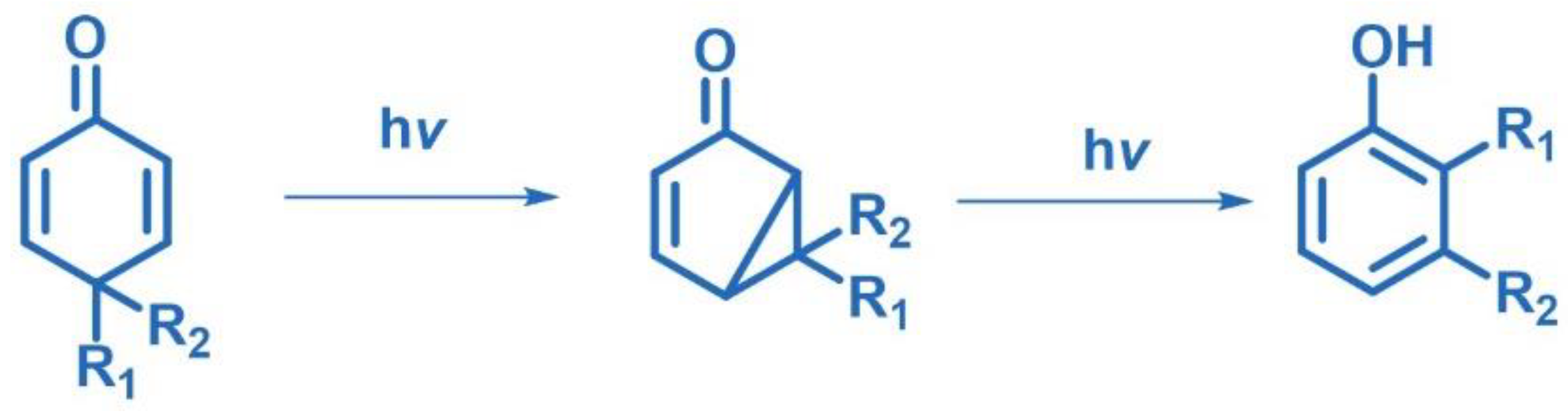
In this reaction (Scheme 37), first a biradical is generated upon the absorption of a photon. The carbon radical rearranges due to conjugation and forms a β, which abstracts another β to form a five-membered ring, the first photoproduct [75]. This can then undergo intersystem crossing to generate an α-radical, which then rearranges to give a phenol ring, the second photoproduct.
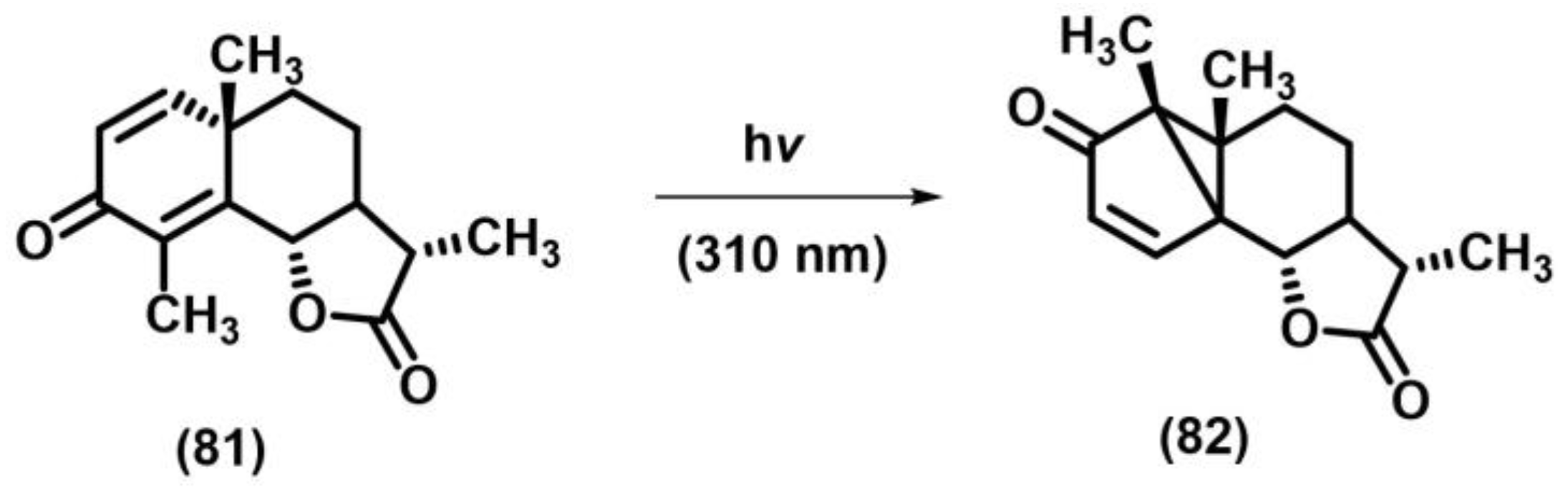
A classic example of the use of this rearrangement is the synthesis of Lumisantonin (82) [76]. The starting material (81) contains the dienone moiety (Scheme 38), which, as shown in the general scheme above, turns into a five-membered enone ring upon irradiation with ~310 nm light source.
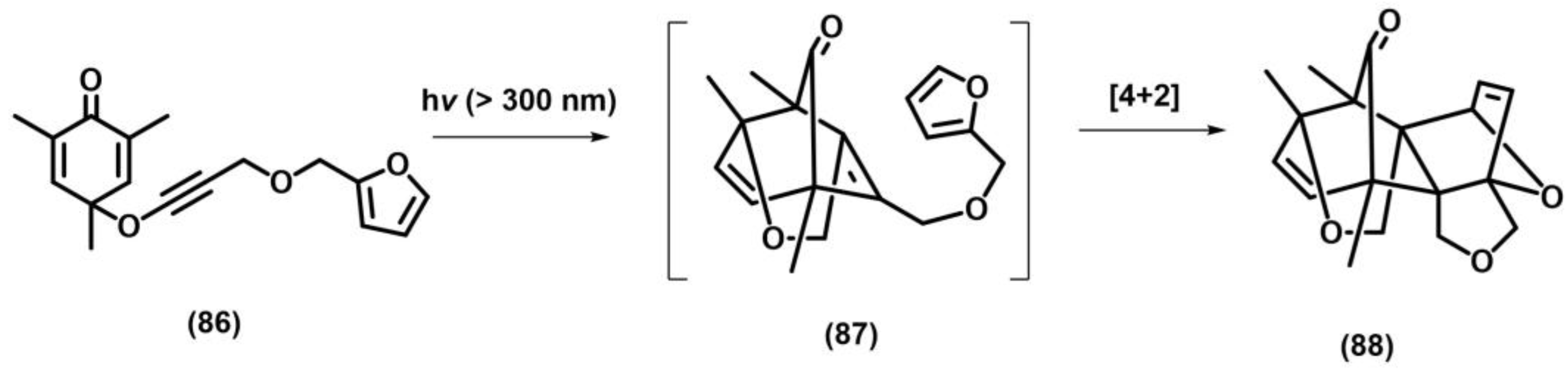
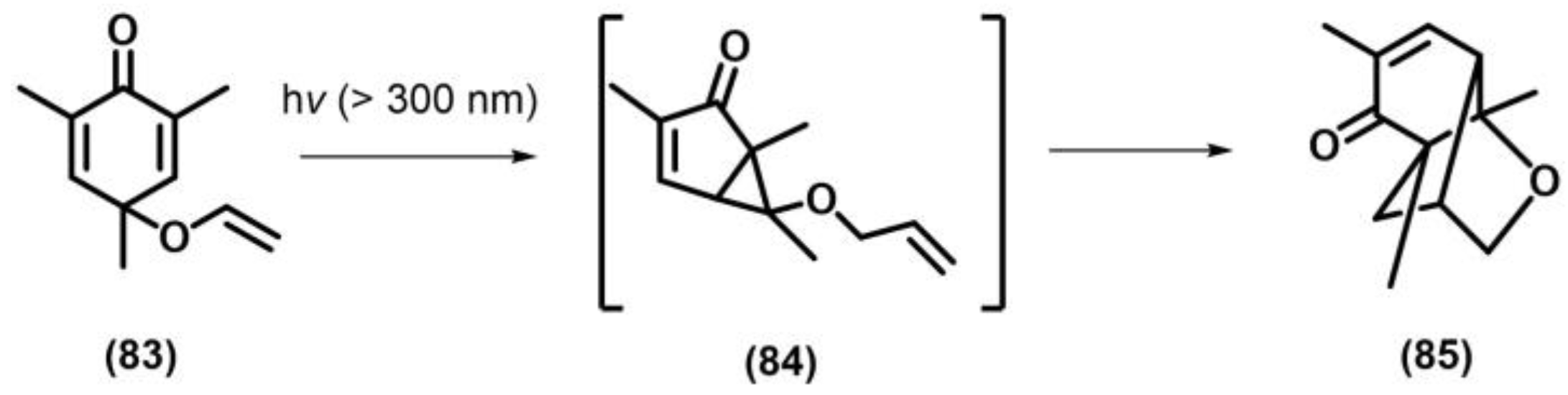
Some other examples [77] of the use of dienone photorearrangement reaction (>300 nm) include the synthesis of (85) by irradiating alkenyl ether-tethered cyclohexadienone (83) via a photo rearranged oxyallyl intermediate (84) (Scheme 39) [78]. Another example is the synthesis of (88) from cyclohexadienone (86) using the same strategy (Scheme 40) [78].

2.10.2. Photo-Fries Rearrangement

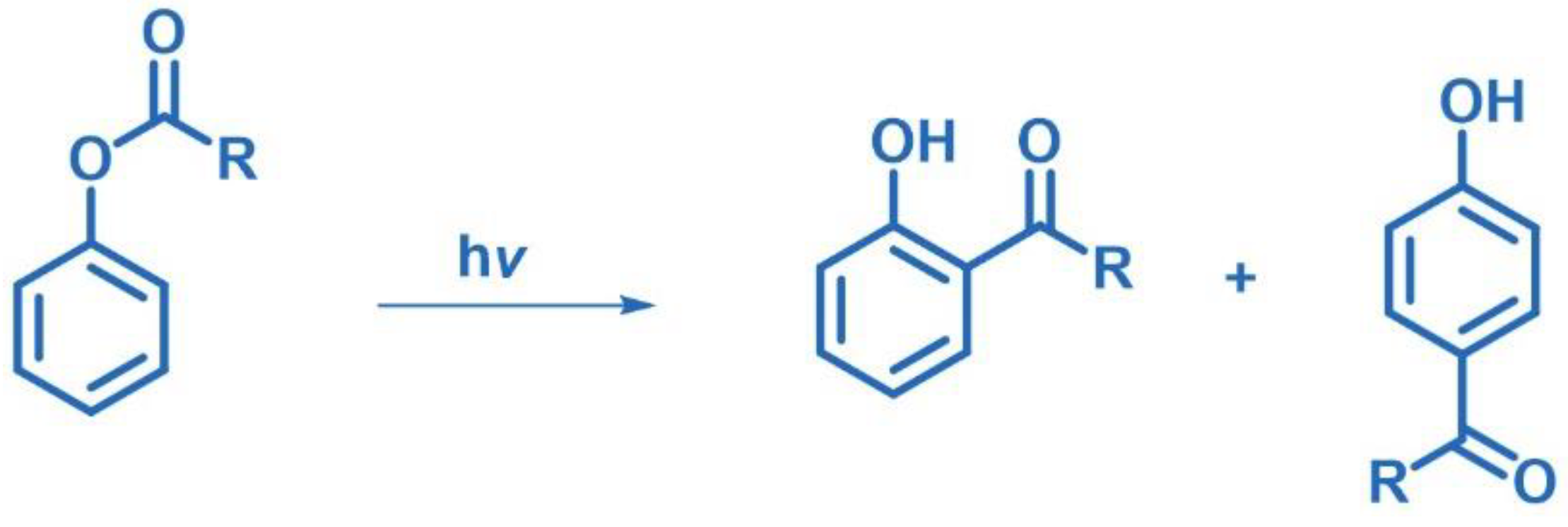
A Fries rearrangement usually refers to a reaction where a phenolic ester rearranges itself to a phenol and a ketone in ortho or para position. This rearrangement usually requires a strong Lewis acid like AlCl3, but in the case of the photo-Fries rearrangement, the use of light negates the use of a strong Lewis acid. Moreover, the substitution at strategic positions results in amazing regioselectivity in this reaction [79]. The general reaction scheme is shown below in Scheme 41.
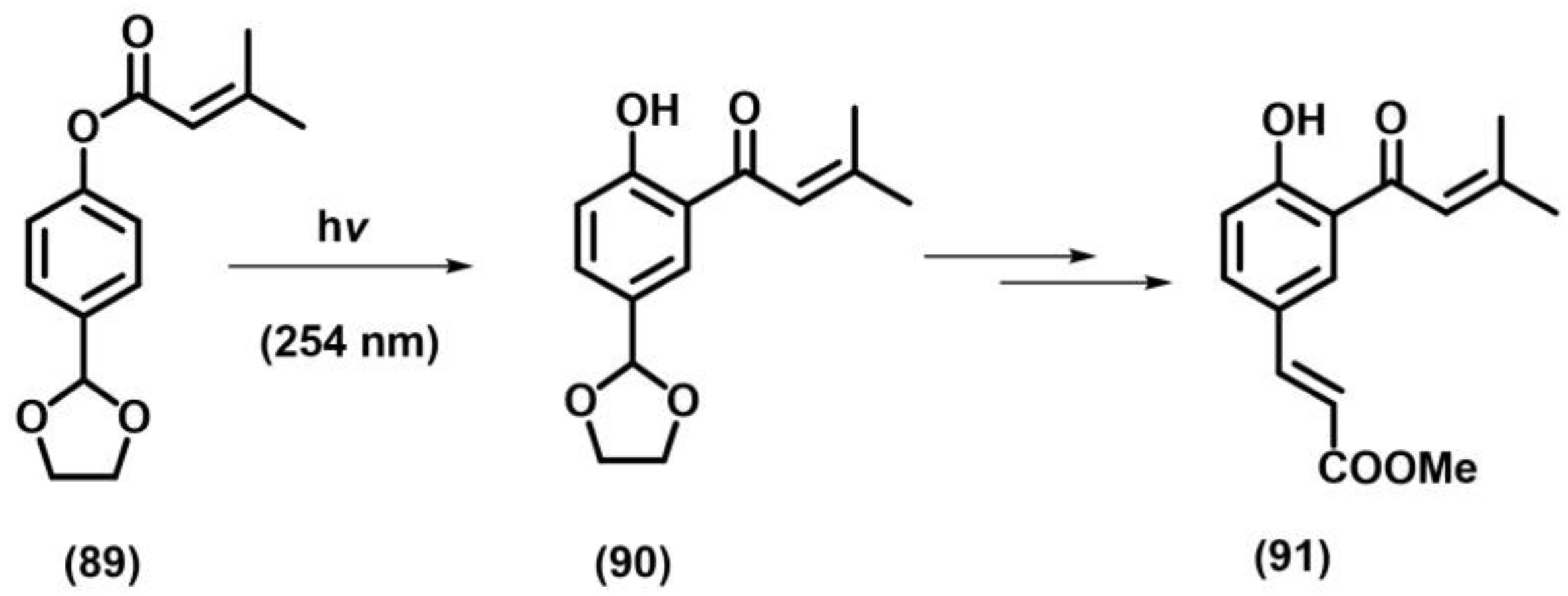
A classical use of the photo-Fries reaction, where the thermal Fries rearrangement reaction failed, was the synthesis of capillarol (91) (Scheme 42). Even upon using AlCl3, TiCl4, and poly phosphoric acid, the product was not formed, but upon irradiation with 254 nm light of the solution containing (89) using a high-pressure lamp, the reaction formed a photoproduct (90) in 49% yield, which upon further chemical reactions afforded (91).
The photo-Fries rearrangement has been used to synthesize polycyclic hydroxyquinones based on natural products, for example, (±)-griseofulvin [80], islandicin [81], bikaverin [82], and spinochrome A [83]. The photo-Fries rearrangement was used to synthesize natural products based on another class of compounds called benzopyran. Examples include the synthesis of natural products precocene I and II [84] as well as the alkaloids arizonine [85] and (±)-caseadine [85].

2.10.3. Oxa-di-π Methane Rearrangement

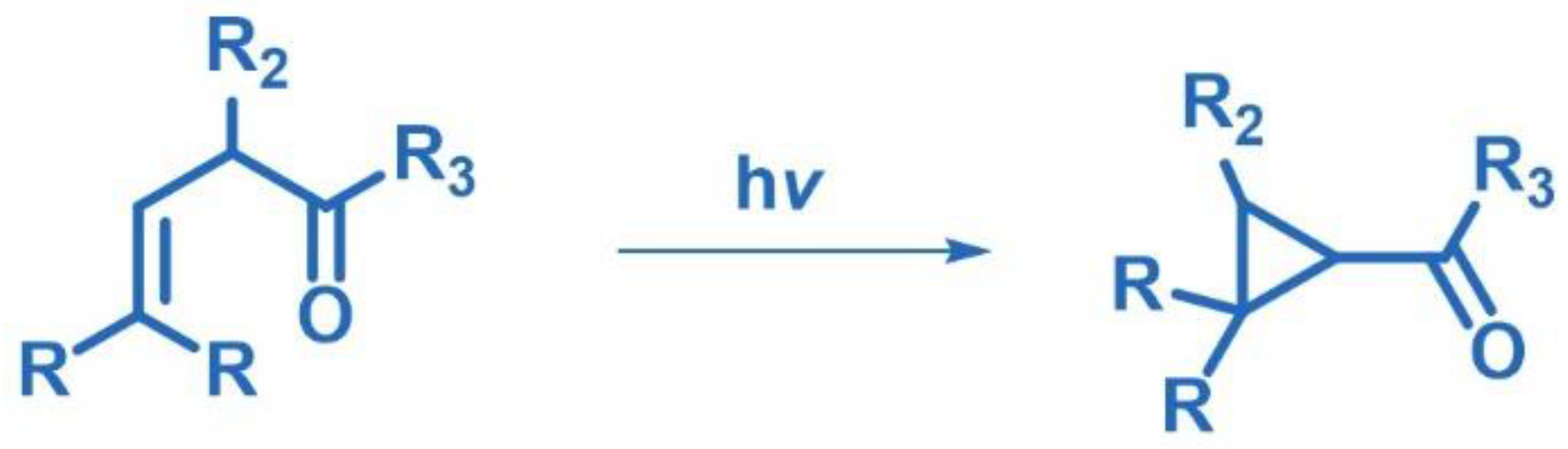
Oxa-di-π methane rearrangement is a 1,2-acyl migration. In this case, the bond in the α-position of the photoexcited carbonyl group is broken, and the acyl group migrates to the consecutive double bond (Scheme 43). This rearrangement reaction usually occurs through triplet state and hence requires a triplet sensitizer. The general reaction scheme for this rearrangement is shown below.
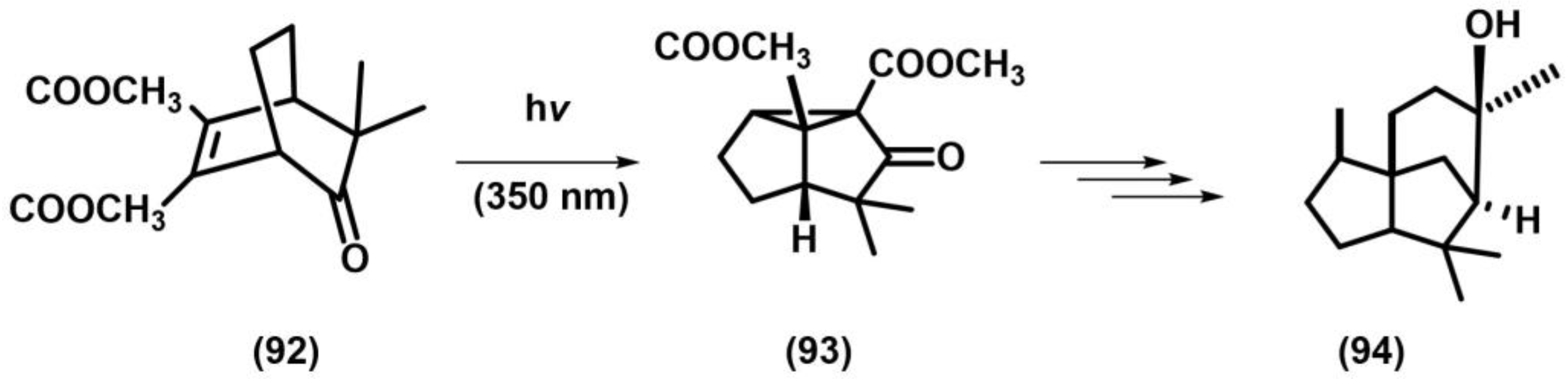
The earliest application of oxa-di-π-methane rearrangement in a total synthesis was the formal total synthesis of (±)-cedrol (94) (Scheme 44). The starting material (92), upon irradiation with a 350 nm light source, in the presence of acetophenone as a triplet sensitizer, underwent a 1,2-acyl shift, resulting in (93), which, after further steps, formed (±)-cedrol (94) [86].
Another exemplary use of the oxa-di-π methane rearrangement was the synthesis of (+)-loganin aglycon 6-acetate [87]. This study led to the further application of this rearrangement reaction for the synthesis of many natural products in recent times, like (±)-Δ9(12)-capnellene [88], (−)-phellodonic acid [89], (−)-hirsutene [90], and (−)-complicatic acid [91].

2.11. Meta Photocyclization

A meta photocyclization reaction is one photoreaction that defies the stability of a benzene ring and makes it react with an alkene in the excited state (Scheme 45). As a result, it creates three new sigma bonds and up to six stereocenters. The reaction is thought to proceed via either a zwitterionic or a biradical intermediate, in which the formation of the new sigma bond is a rate-determining step. Since it is quite an unusual reaction (would never happen thermally), this photoreaction can be utilized to achieve products that are impossible to achieve thermally. The general scheme of the meta photocyclization reaction is given below.
One important point to consider when applying this reaction for synthesis is that whenever the benzene ring is substituted with an electron donor substituent, then the donor substituent resides in the 1-position of the tricyclo [3.3.0.0]oct-3-ene moiety. This three-membered ring then fragments to give the final products.
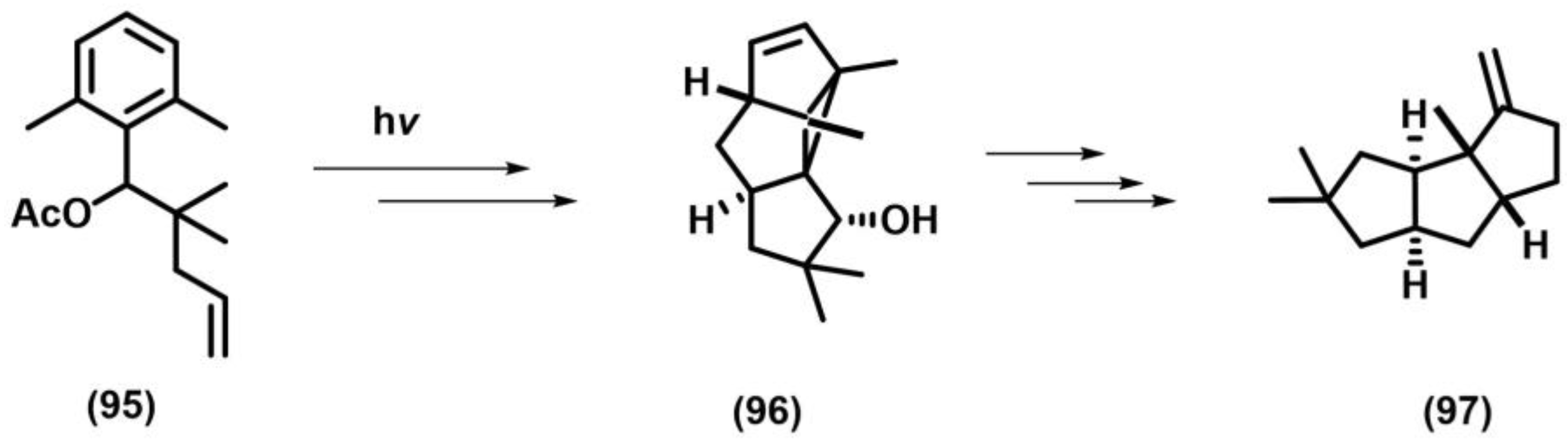
In the following example (Scheme 46), meta photocyclization reaction of the starting material (95) leads to the photoproduct (96), which is then used to synthesize (±)-hirsutene (97) after a few extra synthetic steps [92].
Some other linear triquinanes which have been synthesized by using similar strategies that involve meta-photocycloadditions include (±)-coriolin [93] and (±)-ceratopicanol [94]. There are many other examples of its use in total synthesis of natural products; one such application of the intermolecular meta-photocycloaddition can be found in the synthesis of (±)-isoiridomyrmecin [95].

3. Conclusions

Natural Product Synthesis (NPS) remains a vibrant and evolving field at the intersection of organic chemistry, biology, and sustainability. From its origins in structure elucidation and replication of nature’s molecular designs, NPS has matured into a discipline that not only enables access to complex bioactive compounds but also drives innovation in drug discovery and chemical biology. The integration of green chemistry principles has further elevated its relevance, aligning synthetic strategies with environmental stewardship.
Photochemistry, once a niche area, emerged as a powerful and sustainable tool within NPS. Its ability to harness light as a renewable energy source and unlock unique excited-state reactivity offers transformative potential for constructing complex molecular architectures. As demonstrated throughout this review, photochemical reactions have already contributed significantly to total synthesis efforts. Yet, a vast array of photochemical methodologies, both classical and modern, remain underutilized in the context of NPS.
By bridging the gap between photochemical innovation and natural product synthesis, researchers can design more efficient, selective, and environmentally conscious synthetic routes. As the demand for rare and structurally diverse natural products continues to grow, especially in pharmaceutical and interdisciplinary research, the strategic use of photochemistry will be instrumental in shaping the future of synthesis. This article aims to serve as a practical resource and a source of inspiration—empowering chemists to explore new frontiers in NPS through the lens of synthetic organic photochemistry.

Funding

This research received no external funding.

Data Availability Statement

No new data were created or analyzed in this study. Data sharing is not applicable to this article.

Acknowledgments

The author wants to acknowledge the use of ChemDraw Professional software, version 25.0.2, used to draw the structures included in the article, purchased from the VSU Experiential Learning seed grant received by the author in 2024.

Conflicts of Interest

The author declares no conflicts of interest.

Declaration Statement for the Use of AI

During the preparation of this work, the author used Co-Pilot (M365 version 4) to revise the language and increase the readability of the non-technical content. The author wrote the first draft of the non-technical sections and then fed them to Co-Pilot to refine the language. The first original drafts written by the author are available on request. After using this tool/service, the author reviewed and edited the content as needed and takes full responsibility for the content of the publication.

Abbreviations

The following abbreviations are used in this manuscript:
NPSNatural Product Synthesis

References

  1. Shenvi, R.A. Natural Product Synthesis in the 21st Century: Beyond the Mountain Top. ACS Cent. Sci. 2024, 10, 519–528. [Google Scholar] [CrossRef] [PubMed]
  2. Nicolaou, K.C.; Rigol, S. Total Synthesis in Search of Potent Antibody–Drug Conjugate Payloads. From the Fundamentals to the Translational. Acc. Chem. Res. 2019, 52, 127–139. [Google Scholar] [CrossRef]
  3. Kuttruff, C.A.; Eastgate, M.D.; Baran, P.S. Natural product synthesis in the age of scalability. Nat. Product. Rep. 2014, 31, 419–432. [Google Scholar] [CrossRef]
  4. Peters, D.S.; Pitts, C.R.; McClymont, K.S.; Stratton, T.P.; Bi, C.; Baran, P.S. Ideality in Context: Motivations for Total Synthesis. Acc. Chem. Res. 2021, 54, 605–617. [Google Scholar] [CrossRef]
  5. Khalid, S.; Bilal, M.; Rasool, N.; Imran, M. Photochemical reactions as synthetic tool for pharmaceutical industries. Chin. Chem. Lett. 2024, 35, 109498. [Google Scholar] [CrossRef]
  6. Ciamician, G.; Silber, P. Chemische Lichtwirkungen. Berichte Dtsch. Chem. Ges. 1908, 41, 1071–1080. [Google Scholar] [CrossRef]
  7. Albini, A.; Fagnoni, M. Green chemistry and photochemistry were born at the same time. Green Chem. 2004, 6, 1–6. [Google Scholar] [CrossRef]
  8. Shaw, M.H.; Twilton, J.; MacMillan, D.W.C. Photoredox Catalysis in Organic Chemistry. J. Org. Chem. 2016, 81, 6898–6926. [Google Scholar] [CrossRef] [PubMed]
  9. Baran, P.S.; Maimone, T.J.; Richter, J.M. Total synthesis of marine natural products without using protecting groups. Nature 2007, 446, 404–408. [Google Scholar] [CrossRef] [PubMed]
  10. Fay, N.; Kouklovsky, C.; de la Torre, A. Natural Product Synthesis: The Endless Quest for Unreachable Perfection. ACS Org. Inorg. Au 2023, 3, 350–363. [Google Scholar] [CrossRef]
  11. Reisman, S.E.; Maimone, T.J. Total Synthesis of Complex Natural Products: More Than a Race for Molecular Summits. Acc. Chem. Res. 2021, 54, 1815–1816. [Google Scholar] [CrossRef]
  12. Nay, B. Total synthesis: An enabling science. Beilstein J. Org. Chem. 2023, 19, 474–476. [Google Scholar] [CrossRef]
  13. Fay, N.; Blieck, R.; Kouklovsky, C.; de la Torre, A. Total synthesis of grayanane natural products. Beilstein J. Org. Chem. 2022, 18, 1707–1719. [Google Scholar] [CrossRef] [PubMed]
  14. Kong, L.; Yu, H.; Deng, M.; Wu, F.; Jiang, Z.; Luo, T. Enantioselective Total Syntheses of Grayanane Diterpenoids: (−)-Grayanotoxin III, (+)-Principinol E, and (−)-Rhodomollein XX. J. Am. Chem. Soc. 2022, 144, 5268–5273. [Google Scholar] [CrossRef] [PubMed]
  15. Sato, T. Synthesis of natural products and their derivatives using dynamic crystallization. Chem. Lett. 2024, 54, upae244. [Google Scholar] [CrossRef]
  16. Hamura, T.; Uekusa, Y.I.H.; Matsumoto, T.; Suzuki, K. Poly-oxygenated Tricyclobutabenzenes via Repeated [2+2] Cycloaddition of Benzyne and Ketene Silyl Acetal. J. Am. Chem. Soc. 2006, 11, 3534–3535. [Google Scholar] [CrossRef]
  17. Hatakeyama, S. Total Synthesis of Biologically Active Natural Products Based on Highly Selective Synthetic Methodologies. Chem. Pharm. Bull. 2014, 62, 1045–1061. [Google Scholar] [CrossRef] [PubMed]
  18. Hernandez, L.W.; Sarlah, D. Empowering Synthesis of Complex Natural Products. Chem. Eur. J. 2019, 25, 13248–13270. [Google Scholar] [CrossRef]
  19. Gerlinger, C.K.G.; Gaich, T. Structure-Pattern-Based Total Synthesis. Chem. Eur. J. 2019, 25, 10782–10791. [Google Scholar] [CrossRef]
  20. Li, J.; Zhang, W.; Zhang, F.; Chen, Y.; Li, A. Total Synthesis of Longeracinphyllin A. J. Am. Chem. Soc. 2017, 139, 14893–14896. [Google Scholar] [CrossRef]
  21. He, C.; Xuan, J.; Rao, P.; Xie, P.P.; Hong, X.; Lin, X.; Ding, H. Total Syntheses of (+)-Sarcophytin, (+)-Chatancin, (−)-3-Oxochatancin, and (−)-Pavidolide B: A Divergent Approach. Angew. Chem. Int. Ed. 2019, 58, 5100–5104. [Google Scholar] [CrossRef] [PubMed]
  22. Li, G.; Wang, Q.; Zhu, J. Unified divergent strategy towards the total synthesis of the three sub-classes of hasubanan alkaloids. Nat. Commun. 2021, 12, 36. [Google Scholar] [CrossRef]
  23. Nicolaou, K.C.; Sarlah, D.; Shaw, D.M. Total Synthesis and Revised Structure of Biyouyanagin A. Angew. Chem. Int. Ed. 2007, 46, 4708–4711. [Google Scholar] [CrossRef]
  24. Alibés, R.; Bourdelande, J.L.; Font, J.; Parella, T. Highly efficient and diastereoselective approaches to (+)- and (−)-grandisol. Tetrahedron 1996, 52, 1279–1292. [Google Scholar] [CrossRef]
  25. Mehta, G.; Sreenivas, K. A new synthesis of tricyclic sesquiterpene (±)-sterpurene. Tetrahedron Lett. 2002, 43, 703–706. [Google Scholar] [CrossRef]
  26. Mangion, I.K.; MacMillan, D.W.C. Total Synthesis of Brasoside and Littoralisone. J. Am. Chem. Soc. 2005, 127, 3696–3697. [Google Scholar] [CrossRef]
  27. Srikrishna, A.; Ramasastry, S.S.V. Enantiospecific total synthesis of phytoalexins, (+)-solanascone, (+)-dehydrosolanascone, and (+)-anhydro-β-rotunol. Tetrahedron Lett. 2005, 46, 7373–7376. [Google Scholar] [CrossRef]
  28. Leimner, J.; Marschall, H.; Meier, N.; Weyerstahl, P. Italicene and Isoitalicene, Novel Sesquiterpene Hydrocarbons from Helichrysum Oil. Chem. Lett. 1984, 13, 1769–1772. [Google Scholar] [CrossRef]
  29. Nielson, L.B.; Wege, D. The enantioselective synthesis of elecanacin through an intramolecular naphthoquinone-vinyl ether photochemical cycloaddition. Org. Biomol. Chem. 2006, 4, 868–876. [Google Scholar] [CrossRef] [PubMed]
  30. Schell, F.M.; Cook, P.M. Intramolecular photochemistry of a vinylogous amide and some transformations of the photoproduct. J. Org. Chem. 1984, 49, 4067–4070. [Google Scholar] [CrossRef]
  31. Winkler, J.D.; Muller, C.L.; Scott, R.D. A new method for the formation of nitrogen-containing ring systems via the intramolecular photocycloaddition of vinylogous amides. A synthesis of mesembrine. J. Am. Chem. Soc. 1988, 110, 4831–4832. [Google Scholar] [CrossRef]
  32. White, J.D.; Li, Y.; Ihle, D.C. Tandem Intramolecular Photocycloaddition−Retro-Mannich Fragmentation as a Route to Spiro[pyrrolidine-3,3′-oxindoles]. Total Synthesis of (±)-Coerulescine, (±)-Horsfiline, (±)-Elacomine, and (±)-6-Deoxyelacomine. J. Org. Chem. 2010, 75, 3569–3577. [Google Scholar] [CrossRef]
  33. Gerard, B.; Jones, G.; Porco, J.A. A Biomimetic Approach to the Rocaglamides Employing Photogeneration of Oxidopyryliums Derived from 3-Hydroxyflavones. J. Am. Chem. Soc. 2004, 126, 13620–13621. [Google Scholar] [CrossRef]
  34. Feldman, K.S.; Wu, M.J.; Rotella, D.P. Application of an intramolecular tropone-alkene photocyclization to the total synthesis of (.+-.)-dactylol. J. Am. Chem. Soc. 1989, 111, 6457–6458. [Google Scholar] [CrossRef]
  35. Feldman, K.S.; Wu, M.J.; Rotella, D.P. Total synthesis of (+-)-dactylol and related studies. J. Am. Chem. Soc. 1990, 112, 8490–8496. [Google Scholar] [CrossRef]
  36. Bach, T.; Hehn, J.P. Photochemical reactions as key steps in natural product synthesis. Angew. Chem. Int. Ed. Engl. 2011, 50, 1000–1045. [Google Scholar] [CrossRef] [PubMed]
  37. Eade, S.J.; Walter, M.W.; Byrne, C.; Odell, B.; Rodriguez, R.; Baldwin, J.E.; Adlington, R.M.; Moses, J.E. Biomimetic Synthesis of Pyrone-Derived Natural Products: Exploring Chemical Pathways from a Unique Polyketide Precursor. J. Org. Chem. 2008, 73, 4830–4839. [Google Scholar] [CrossRef]
  38. Miranda, E.C.; Brieskorn, C.H.; Blechert, S. Isolierung und Synthese des 5-Ethyl-2-methyl-11H-pyrido [3,4-a]-carbazolium-hydroxids, ein neuer Indolalkaloidtyp aus Aspidosperma gilbertii. Chem. Berichte 1980, 113, 3245–3248. [Google Scholar] [CrossRef]
  39. Kupchan, S.M.; Wormser, H.C. Tumor Inhibitors. X.1 Photochemical Synthesis of Phenanthrenes. Synthesis of Aristolochic Acid and Related Compounds2-4. J. Org. Chem. 1965, 30, 3792–3800. [Google Scholar] [CrossRef] [PubMed]
  40. Herbert, R.B.; Moody, C.J. A novel synthesis of (±)-tylophorine. J. Chem. Soc. D 1970, 121. [Google Scholar] [CrossRef]
  41. Letcher, R.M.; Wong, K.-M. Structure and synthesis of the phenanthrenes TaIV and TaVIII from Tamus communis. J. Chem. Soc. Perkin Trans. 1979, 1, 2449–2450. [Google Scholar] [CrossRef]
  42. Moghaddam, F.M.; Farimani, M.M. A simple and efficient total synthesis of (±)-danshexinkun A, a bioactive diterpenoid from Salvia miltiorrhiza. Tetrahedron Lett. 2010, 51, 540–542. [Google Scholar] [CrossRef]
  43. Coote, S.C. 4-π-Photocyclization: Scope and Synthetic Applications. Eur. J. Org. Chem. 2019, 2020, 1405–1423. [Google Scholar] [CrossRef]
  44. Greene, A.; Crabbé, P. A novel approach to the synthesis of prostanoids. Tetrahedron Lett. 1975, 16, 2215–2218. [Google Scholar] [CrossRef]
  45. CRC Handbook of Organic Photochemistry and Photobiology; Horspool, W.M.L.F., Ed.; CRC Press: Boca Raton, FL, USA, 2003. [Google Scholar]
  46. Anderson, J.R.; Briant, C.E.; Edwards, R.L.; Mabelis, R.P.; Poyser, J.P.; Spencer, H.; Whalley, A.J. Punctatin A (antibiotic M95464): X-ray crystal structure of a sesquiterpene alcohol with a new carbon skeleton from the fungus, Paronia punctata. J. Chem. Soc. Chem. Commun. 1984, 7, 405–406. [Google Scholar] [CrossRef]
  47. Kraus, G.A.; Chen, L. A total synthesis of racemic paulownin using a type II photocyclization reaction. J. Am. Chem. Soc. 1990, 112, 3464–3466. [Google Scholar] [CrossRef]
  48. De Mayo, P.; Suau, R. Photochemical synthesis. Part LVIII. A photochemical synthesis of (±)-cuparene. J. Chem. Soc. Perkin Trans. 1974, 1, 2559–2561. [Google Scholar] [CrossRef]
  49. Koźluk, T.; Cottier, L.; Descotes, G. Syntheses photochimiques de dioxa-1,6 spiro [4.5] decanes pheromones de Paravespula vulgaris L. Tetrahedron 1981, 37, 1875–1880. [Google Scholar]
  50. Gramain, J.C.; Remuson, R.; Vallee, D. Intramolecular photoreduction of .alpha.-keto esters. Total synthesis of (±)-isoretronecanol. J. Org. Chem. 1985, 50, 710–712. [Google Scholar] [CrossRef]
  51. Wessig, P.; Teubner, J. Total Synthesis of Pterosines B and C via a Photochemical Key Step. Synlett 2006, 2006, 1543–1546. [Google Scholar] [CrossRef]
  52. Bach, T.; Schröder, J. A Short Synthesis of (±)-Oxetin. Liebigs Ann. 1997, 1997, 2265–2267. [Google Scholar] [CrossRef]
  53. Hambalek, R.; Just, G. A short synthesis of (±)-oxetanocin. Tetrahedron Lett. 1990, 31, 5445–5448. [Google Scholar] [CrossRef]
  54. Schreiber, S.L. [2 + 2] Photocycloadditions in the Synthesis of Chiral Molecules. Science 1985, 227, 857–863. [Google Scholar] [CrossRef] [PubMed]
  55. Schreiber, S.L.; Hoveyda, A.H. Synthetic studies of the furan-carbonyl photocycloaddition reaction. A total synthesis of (±)-avenaciolide. J. Am. Chem. Soc. 1984, 106, 7200–7202. [Google Scholar] [CrossRef]
  56. Schreiber, S.L.; Satake, K. Total synthesis of (.+-.)-asteltoxin. J. Am. Chem. Soc. 1984, 106, 4186–4188. [Google Scholar] [CrossRef]
  57. Boxall, R.J.; Ferris, L.; Grainger, R.S. Synthesis of C-13 Oxidised Cuparene and Herbertane Sesquiterpenes via a Paternò-Büchi Photocyclisation-Oxetane Fragmentation Strategy: Total Synthesis of 1,13-Herbertenediol. Synlett 2004, 2004, 2379–2381. [Google Scholar]
  58. Dotson, J.J.; Bachman, J.L.; Garcia-Garibay, M.A.; Garg, N.K. Discovery and Total Synthesis of a Bis(cyclotryptamine) Alkaloid Bearing the Elusive Piperidinoindoline Scaffold. J. Am. Chem. Soc. 2020, 142, 11685–11690. [Google Scholar] [CrossRef]
  59. Lu, Z.; Li, Y.; Deng, J.; Li, A. Total synthesis of the Daphniphyllum alkaloid daphenylline. Nat. Chem. 2013, 5, 679–684. [Google Scholar] [CrossRef]
  60. Ando, Y.; Tanaka, D.; Sasaki, R.; Ohmori, K.; Suzuki, K. Stereochemical Dichotomy in Two Competing Cascade Processes: Total Syntheses of Both Enantiomers of Spiroxin A. Angew. Chem. Int. Ed. 2019, 58, 12507–12513. [Google Scholar] [CrossRef]
  61. Ledford, B.E.; Carreira, E.M. Total Synthesis of (+)-Trehazolin: Optically Active Spirocycloheptadienes as Useful Precursors for the Synthesis of Amino Cyclopentitols. J. Am. Chem. Soc. 1995, 117, 11811–11812. [Google Scholar] [CrossRef]
  62. Piva, O.; Caramelle, D. Asymmetric protonation of photodienols enantioselective synthesis of (R)-2-methyl alkanols. Tetrahedro Asymmetry 1995, 6, 831–832. [Google Scholar] [CrossRef]
  63. De Mayo, P.; Takeshita, H. Photochemical syntheses: 6. The formation of heptandiones from acetylacetone and alkenes. Can. J. Chem. 1963, 41, 440–449. [Google Scholar] [CrossRef]
  64. De Mayo, P.; Takeshita, H.; Sattar, A.B.M.A. The photochemical synthesis of 1,5-diketones and their cyclyzation: A new anuulation Process. Proc. Chem. Soc. 1962, 1962, 119. [Google Scholar]
  65. Hikino, H.; De Mayo, P. Photochemical Cycloaddition as a Device for General Annelation. J. Am. Chem. Soc. 1964, 86, 3582–3583. [Google Scholar] [CrossRef]
  66. Oppolzer, W.; Godel, T. A new and efficient total synthesis of (.+-.)-longifolene. J. Am. Chem. Soc. 1978, 100, 2583–2584. [Google Scholar] [CrossRef]
  67. Oppolzer, W.; Godel, T. Syntheses of (±)- and Enantiomerically Pure (+)-Longifolene and of (±)- and Enantiomerically Pure (+)-Sativene by an Intramolecular de Mayo Reaction. Helv. Chim. Acta 1984, 67, 1154–1167. [Google Scholar] [CrossRef]
  68. Seto, H.; Fujimoto, Y.; Tatsuno, T.; Yoshioka, H. Snthetic Studies on Carotane and Dolastane Type Terpenes: A New Entry to the Total Synthesis of (±)-Daucene Via Intramolecular [2 + 2] Photocycloaddition. Synth. Commun. 1985, 15, 1217–1224. [Google Scholar] [CrossRef]
  69. Disanayaka, B.W.; Weedon, A.C. A short synthesis of hirsutene using the de Mayo reaction. J. Chem. Soc. Chem. Commun. 1985, 19, 1282–1283. [Google Scholar] [CrossRef]
  70. Buechi, G.; Carlson, J.A.; Powell, J.E.; Tietze, L.F. Total synthesis of loganin. J. Am. Chem. Soc. 1970, 92, 2165–2167. [Google Scholar] [CrossRef]
  71. Pearlman, B.A. A method for effecting the equivalent of a de Mayo reaction with formyl acetic ester. J. Am. Chem. Soc. 1979, 101, 6398–6404. [Google Scholar] [CrossRef]
  72. Barker, A.J.; Pattenden, G. Zizaane sesquiterpenes. Synthesis of the coates-sowerby tricyclic ketone. Tetrahedron Lett. 1981, 22, 2599–2600. [Google Scholar] [CrossRef]
  73. Lewis, F.D.; Oxman, J.D.; Huffman, J.C. Photodimerization of Lewis acid complexes of cinnamate esters in solution and the solid state. J. Am. Chem. Soc. 1984, 106, 466–468. [Google Scholar] [CrossRef]
  74. Meesakul, P.; Jaidee, W.; Richardson, C.; Andersen, R.J.; Patrick, B.O.; Willis, A.C.; Muanprasat, C.; Wang, J.; Lei, X.; Hadsadee, S.; et al. Styryllactones from Goniothalamus tamirensis. Phytochemistry 2020, 171, 112248. [Google Scholar] [CrossRef] [PubMed]
  75. Zimmerman, H.E.; Schuster, D.I. A New Approach to Mechanistic Organic Photochemistry. IV. Photochemical Rearrangements of 4,4-Diphenylcyclohexadienone. J. Am. Chem. Soc. 1962, 84, 4527–4540. [Google Scholar] [CrossRef]
  76. Natarajan, A.; Tsai, C.K.; Khan, S.I.; McCarren, P.; Houk, K.N.; Garcia-Garibay, M.A. The photoarrangement of alpha-santonin is a single-crystal-to-single-crystal reaction: A long kept secret in solid-state organic chemistry revealed. J. Am. Chem. Soc. 2007, 129, 9846–9847. [Google Scholar] [CrossRef]
  77. Karkas, M.D.; Porco, J.A., Jr.; Stephenson, C.R. Photochemical Approaches to Complex Chemotypes: Applications in Natural Product Synthesis. Chem. Rev. 2016, 116, 9683–9747. [Google Scholar] [CrossRef] [PubMed]
  78. Bos, P.H.; Antalek, M.T.; Porco, J.A., Jr.; Stephenson, C.R. Tandem dienone photorearrangement-cycloaddition for the rapid generation of molecular complexity. J Am Chem Soc 2013, 135, 17978–17982. [Google Scholar] [CrossRef]
  79. Lochbrunner, S.; Zissler, M.; Piel, J.; Riedle, E.; Spiegel, A.; Bach, T. Real time observation of the photo-Fries rearrangement. J. Chem. Phys. 2004, 120, 11634–11639. [Google Scholar] [CrossRef]
  80. Taub, D.; Kuo, C.H.; Slates, H.L.; Wendler, N.L. A total synthesis of griseofulvin and its optical antipode. Tetrahedron 1963, 19, 1–17. [Google Scholar] [CrossRef]
  81. Kende, A.S.; Belletire, J.L.; Hume, E.L. Regiospecific synthesis of 1,4,5-trioxygenated anthraquinones. A total synthesis of islandicin. Tetrahedron Lett. 1973, 14, 2935–2938. [Google Scholar] [CrossRef]
  82. Kato, T.; Katagiri, N.; Nakano, J.; Kawamura, H. Total synthesis of bikaverin involving the novel rearrangement of an ortho-quinone to a para-quinone. J. Chem. Soc. Chem. Commun. 1977, 18, 645–646. [Google Scholar] [CrossRef]
  83. Farina, F.; Martinez-Utrilla, R.; Paredes, M.C. Polycyclic hydroxyquinones—VIII: Preparation of acetylhydroxynaphthazarins by photo-fries rearrangement. A convenient synthesis of spinochrome A. Tetrahedron 1982, 38, 1531–1537. [Google Scholar] [CrossRef]
  84. Miranda, M.A.; Primo, J.; Tormos, R. Studies on the Synthesis of Precocenes. The Photo-Fries Rearrangement of Esters of α,β-Unsaturated Carboxylic Acids and meta-Oxygenated Phenols. ChemInform 1988, 19, 673–681. [Google Scholar] [CrossRef]
  85. Suau, R.; Valpuesta, M.; Torres, G. Photochemical synthesis of 7,8-dioxygenated isoquinoline alkaloids. Tetrahedron Lett. 1995, 36, 1315–1318. [Google Scholar] [CrossRef]
  86. Stork, G.; Clarke, F.H., Jr. Cedrol: Stereochemistry and Total Synthesis. J. Am. Chem. Soc. 1961, 83, 3114–3125. [Google Scholar] [CrossRef]
  87. Demuth, M.; Hinsken, W. Extensions of the Tricyclooctanone Concept. A General Principle for the Synthesis of Linearly and Angularly Annelated Triquinanes. Angew. Chem. Int. Ed. Engl. 1985, 24, 973–975. [Google Scholar] [CrossRef]
  88. Hsu, D.S.; Chou, Y.Y.; Tung, Y.S.; Liao, C.C. Photochemistry of Tricyclo [5.2.2.02,6]undeca-4,10-dien-8-ones: An Efficient General Route to Substituted Linear Triquinanes from 2-Methoxyphenols. Total Synthesis of (±)-Δ9(12)-Capnellene. Chem. Eur. J. 2010, 16, 3121–3131. [Google Scholar] [CrossRef] [PubMed]
  89. Reekie, T.A.; Austin, K.A.; Banwell, M.G.; Willis, A.C. The Chemoenzymatic Total Synthesis of Phellodonic Acid, a Biologically Active and Highly Functionalized Hirsutane Derivative Isolated from the Tasmanian Fungus Phellodon melaleucus. Aust. J. Chem. 2008, 61, 94–106. [Google Scholar] [CrossRef]
  90. Banwell, M.G.; Edwards, A.J.; Harfoot, G.J.; Jolliffe, K.A. A chemoenzymatic synthesis of (−)-hirsutene from toluene. J. Chem. Soc. Perkin Trans. 2002, 22, 2439–2441. [Google Scholar] [CrossRef]
  91. Austin, K.A.; Banwell, M.G.; Harfoot, G.J.; Willis, A.C. Chemoenzymatic syntheses of the linear triquinane-type sesquiterpenes (+)-hirsutic acid and (−)-complicatic acid. Tetrahedron Lett. 2006, 47, 7381–7384. [Google Scholar] [CrossRef]
  92. Wender, P.A.; Howbert, J.J. Synthetic studies on arene-olefin cycloadditions-III-total synthesis of (±)-hirsutene. Tetrahedron Lett. 1982, 23, 3983–3986. [Google Scholar] [CrossRef]
  93. Wender, P.A.; Howbert, J.J. Synthetic studies on areneolefin cycloadditions-VI-two syntheses of (±)-coriolin. Tetrahedron Lett. 1983, 24, 5325–5328. [Google Scholar] [CrossRef]
  94. Baralotto, C.; Chanon, M.; Julliard, M. Total Synthesis of the Tricyclic Sesquiterpene (±)-Ceratopicanol. An Illustration of the Holosynthon Concept. J. Org. Chem. 1996, 61, 3576–3577. [Google Scholar] [CrossRef]
  95. Wender, P.A.; Dreyer, G.B. Synthetic studies on arene-olefin cycloadditions-V. total synthesis of (±)-isoiridomyrmecin. Tetrahedron Lett. 1983, 24, 4543–4546. [Google Scholar] [CrossRef]

Scheme 1. General reaction scheme for [2+2] photocycloaddition reaction of olefins.
Photochem 05 00039 sch001
Scheme 2. Synthesis of Biyouyanagin A (3) using [2+2] photocycloaddition reaction.
Photochem 05 00039 sch002

Scheme 3. [2+2] photocycloaddition used to form the cyclobutane ring in grandisol.
Photochem 05 00039 sch003
Scheme 4. Use of [2+2] photocycloaddition reaction in the synthesis of sterpurene (11).
Photochem 05 00039 sch004
Scheme 5. Other natural products synthesized using [2+2] photocycloaddition reaction.
Photochem 05 00039 sch005
Scheme 6. General reaction scheme depicting [2+2] photocycloaddition of compounds containing Nitrogen.
Photochem 05 00039 sch006
Scheme 7. Intramolecular retro-Mannich reaction resulting in the formation of the ketoimine product.
Photochem 05 00039 sch007
Scheme 8. Examples of natural products synthesized using [2+2] photocycloaddition reaction of compounds containing nitrogen.
Photochem 05 00039 sch008
Scheme 9. General reaction scheme for (i) [3+2] and (ii) [6+2] photocycloaddition reaction.
Photochem 05 00039 sch009
Scheme 10. Synthesis of methylrocaglate (26) and (−)-silvestrol (27) using [3+2] photocycloaddition reaction.
Photochem 05 00039 sch010
Scheme 11. [6+2] photocycloaddition reaction in (28) as the first step, generating (29), leading to the synthesis of sesquiterpene (±)-dactylol (30).
Photochem 05 00039 sch011
Scheme 12. General reaction scheme for [6π] photocyclization reaction, (i) [6π] photocyclization leading to aromatization and (ii) simple [6π] photocyclization.
Photochem 05 00039 sch012
Scheme 13. Synthesis of granulatimide (32) following 6-π photocyclization reaction.
Photochem 05 00039 sch013
Scheme 14. Structure of the compound (33), derived upon the [6π] cyclization.
Photochem 05 00039 sch014
Scheme 15. General reaction scheme for [4π] photocyclization reaction, (i,ii) refer to different examples of [4π] cyclizations.
Photochem 05 00039 sch015
Scheme 16. Synthesis of 11-(±)-deoxyprostaglandin E1 (34) using intramolecular [4π] photocyclization reaction.
Photochem 05 00039 sch016
Scheme 17. General reaction scheme for Norrish–Yang cyclization.
Photochem 05 00039 sch017
Scheme 18. Using Norrish–Yang cyclization as a relevant step in the synthesis of NP punctaporonins A (37).
Photochem 05 00039 sch018
Scheme 19. Examples of other NPs using Norrish–Yang cyclization as a crucial step.
Photochem 05 00039 sch019
Scheme 20. Use of Norrish–Yang cyclization reaction to form five-membered ring in total synthesis of pterosines B (45).
Photochem 05 00039 sch020
Scheme 21. General reaction scheme for Paterno–Buchi photreaction.
Photochem 05 00039 sch021
Scheme 22. Synthesis of (±)-oxetine (46) and (±)-oxetanocin (47), using Paterno–Buchi reaction.
Photochem 05 00039 sch022
Scheme 23. Application of the variant of Paterno–Buchi reaction for the total synthesis of (±)-herbertendiol (50).
Photochem 05 00039 sch023
Scheme 24. General scheme for Norrish Type-I reaction and various possible second steps.
Photochem 05 00039 sch024
Scheme 25. Synthesis of psychotriadine (54), using Norrish type-I reaction for decarbonylation.
Photochem 05 00039 sch025
Scheme 26. Synthesis of (+)-ambiguine H (55) and daphenylline (56) using Norrish type-I reaction.
Photochem 05 00039 sch026
Scheme 27. General scheme for Norrish Type-II reaction and the two possible second steps.
Photochem 05 00039 sch027
Scheme 28. Use of Norrish type-II reaction for the synthesis of (−)-spiroxin.
Photochem 05 00039 sch028
Scheme 29. Applying Norrish type-II reaction for the synthesis of trehazolin (61) and (R)-(−)-lavandulol (62).
Photochem 05 00039 sch029
Scheme 30. General reaction scheme for De Mayo reaction.
Photochem 05 00039 sch030
Scheme 31. Synthesis of (±)-longifolene (66), using De Mayo reaction.
Photochem 05 00039 sch031
Scheme 32. Synthesis of (±)-daucene (69), using De Mayo reaction.
Photochem 05 00039 sch032
Scheme 33. Application of De Mayo photoreaction in the synthesis of NPS (70, 71, 72, and 73).
Photochem 05 00039 sch033
Scheme 34. General reaction scheme for homodimerization photoreaction.
Photochem 05 00039 sch034
Scheme 35. Synthesis of various enantiomers of truxinic acid, using homodimerization reaction.
Photochem 05 00039 sch035
Scheme 36. Synthesis of (±)-katsumadain C (80), using photohomodimerization reaction.
Photochem 05 00039 sch036
Scheme 37. General scheme for dienone rearrangement.
Photochem 05 00039 sch037
Scheme 38. Synthesis of Lumisantonin (82) using rearrangement of dienone photoreaction.
Photochem 05 00039 sch038
Scheme 39. Synthesis of (85) using dienone photorearrangement reaction.
Photochem 05 00039 sch039
Scheme 40. Synthesis of (88) using dienone photorearrangement reaction.
Photochem 05 00039 sch040
Scheme 41. General reaction scheme for photo-Fries rearrangement.
Photochem 05 00039 sch041
Scheme 42. Application of photo-Fries reaction to form capillarol (91).
Photochem 05 00039 sch042
Scheme 43. General and simplified version of oxa-di-π-methane rearrangement.
Photochem 05 00039 sch043
Scheme 44. Oxa-di-π methane rearrangement applied to the synthesis of (±)-cedrol (94).
Photochem 05 00039 sch044
Scheme 45. General reaction scheme for meta photocycloaddition reaction.
Photochem 05 00039 sch045
Scheme 46. Synthesis of (±)-hirsutene using meta photocycloaddition reaction.
Photochem 05 00039 sch046
Disclaimer/Publisher’s Note: The statements, opinions and data contained in all publications are solely those of the individual author(s) and contributor(s) and not of MDPI and/or the editor(s). MDPI and/or the editor(s) disclaim responsibility for any injury to people or property resulting from any ideas, methods, instructions or products referred to in the content.