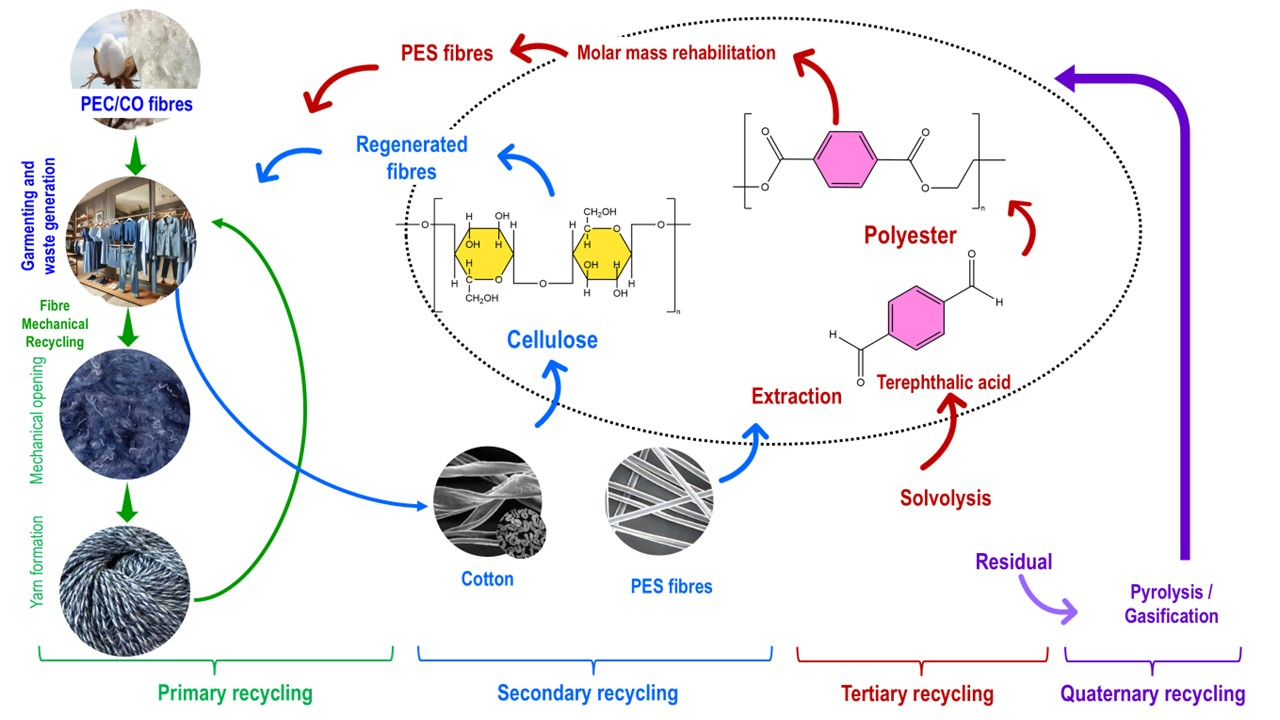

Recent Advances in Recycling Polyester–Cotton Blended Textiles: Review



Abstract
1. Introduction
2. Recent Advances in the Recycling of Polyester and Cotton Blends
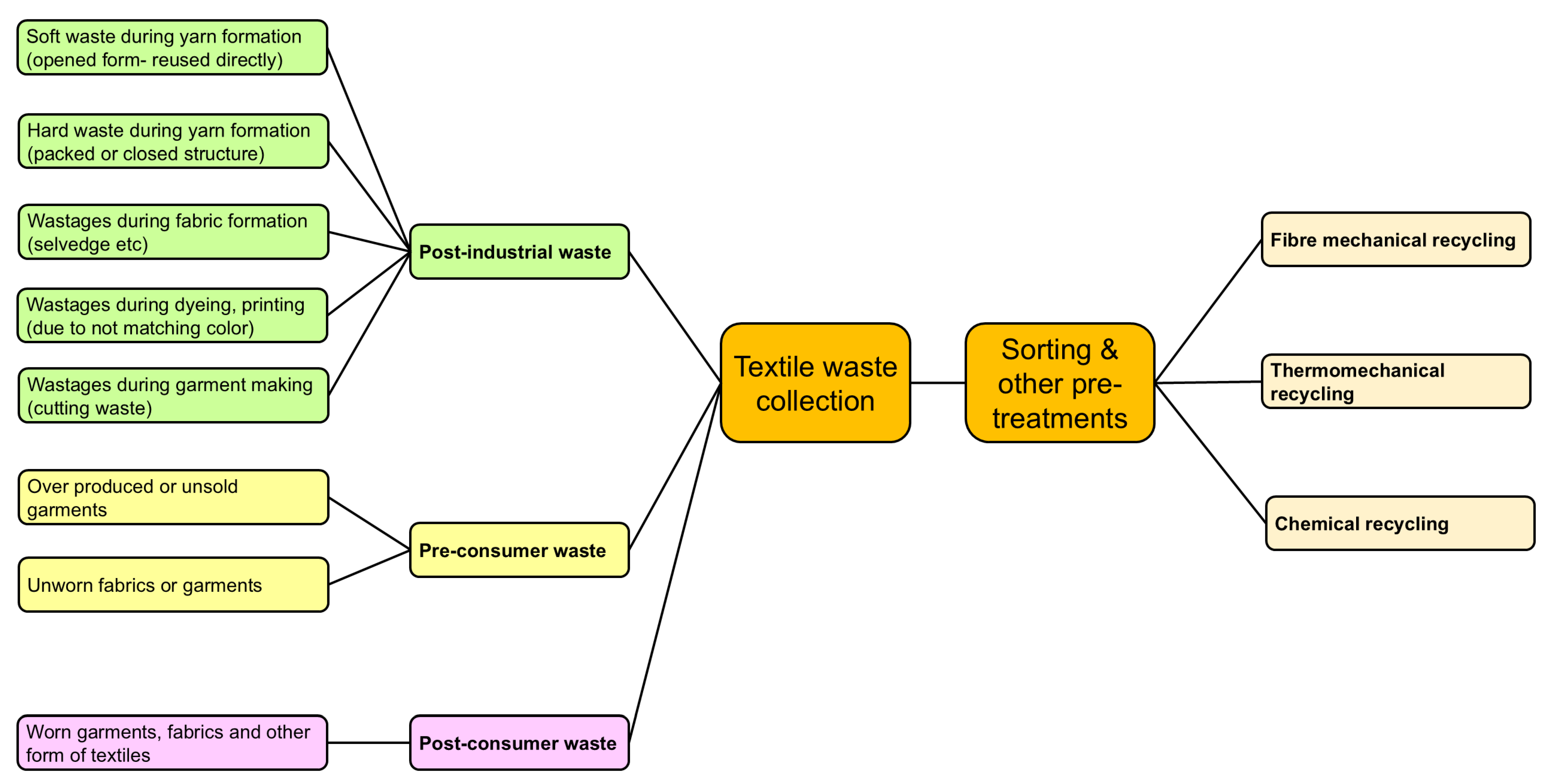
2.1. Sorting Textile Waste
2.2. Fibre Mechanical Recycling
2.3. Chemical Recycling of PES/CO Blends
2.3.1. Pre-Treatment of Textiles
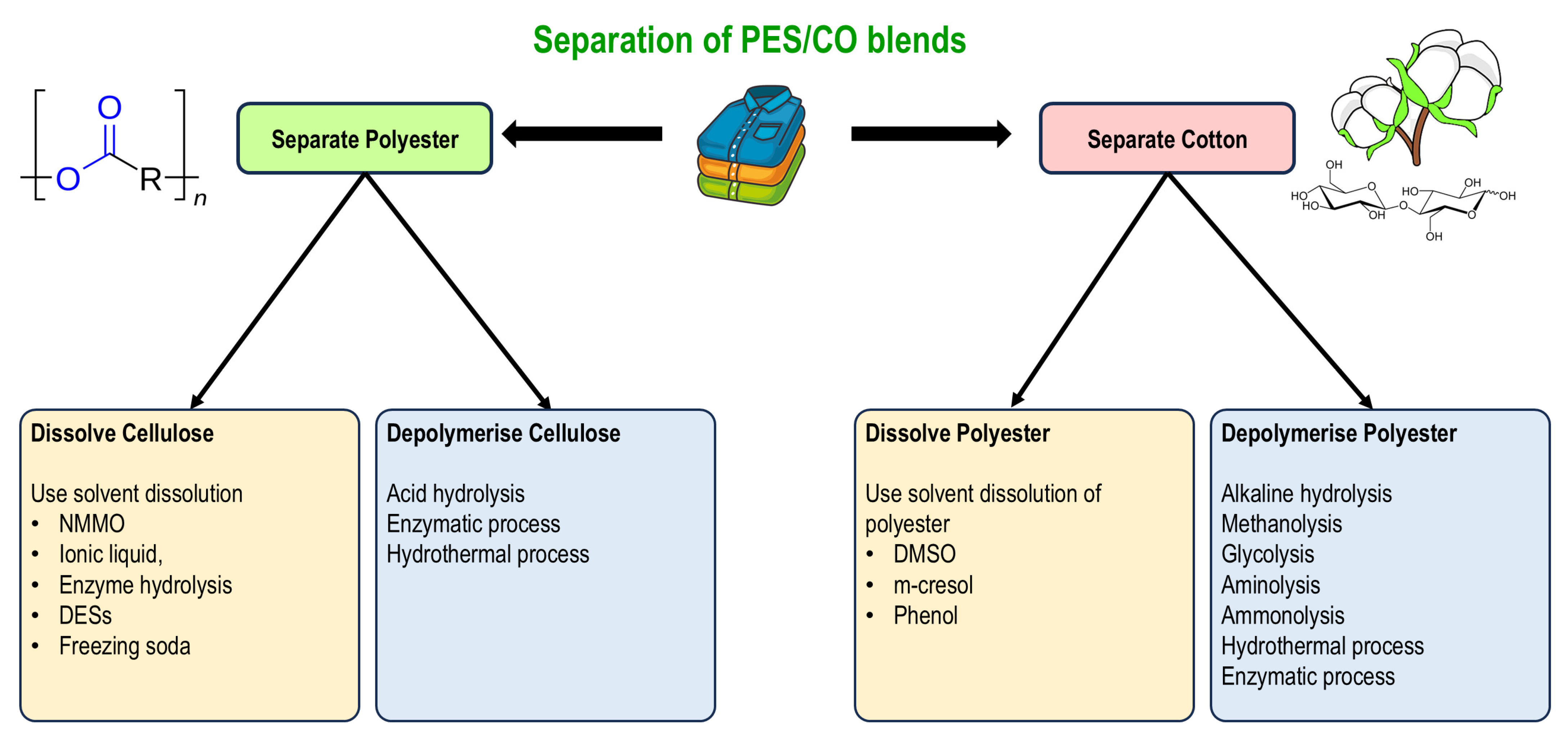
2.3.2. Polyester Dissolving and Degrading Methods to Separate Cotton

| Method | Conditions for the Cellulose Removal | Notes | Ref |
|---|---|---|---|
| PES dissolution in organic solvent | Inputs: PES/CO (60/40). PES/CO waste was dissolved in a solvent (e.g., 1,3-dimethylimidazolidinone, butyl benzoate, benzyl acetate, benzaldehyde, dipropylene glycol methyl ether acetate) that was heated to a temperature range of 70–110 °C for a duration of 1–2 h. Subsequently, the solvent was chilled to separate the dissolved polyester, using a liquid-to-solid ratio of 8–10. | The process of separating polycotton is straightforward, with minimal toxicity and energy usage. However, it requires a significant amount of chemicals for cleaning and recovery. Output: PES powder, yield 15–57%; solid cotton material, yield not given | [75] |
| PES dissolution in organic solvent | Inputs: PES/CO (50/50). PES/CO was subjected to a solvent (tetramethylene sulfone) treatment at a temperature of 150 °C for 90 min. Subsequently, the temperature was increased to 190 °C for 35 min, resulting in precipitation of the dissolved polyester in the coagulation bath. | It is important to ensure that the input material is completely dry to prevent PES degradation. Output: PES powder, yield not given; cotton as fabric, yield not given | [76] |
| PES dissolution in organic solvent | Inputs: PES/CO (50/50; 75/25; 25/75). The dissolution of the PES fraction of PES/CO was achieved by using a mixture of dichloromethane and trifluoroacetic acid at a liquid-to-solid ratio of 0.2. | This treatment was done at room temperature; perhaps it works and is most suitable for PES-rich blends. Output: PES and Cotton | [77] |
| PES dissolution in dimethylcyclohexylamine | Inputs: PES/CO (20/80; blue). PES fraction of a PES/CO mixture was dissolved using dimethylcyclohexylamine at a liquid-to-solid ratio of 40–120. The dissolution process was carried out at 50 °C for 8 h. | This process achieved the recycling process as maximum (i.e., 96%), included successful decolouration pretreatment Output: PES powder, yield 77%; cotton fibres, yield 100% | [79] |
| PES dissolution in triethylamine | Inputs: PES/CO. Use triethylamine at 50 °C for 20 min to deteriorate polyester and release cotton fibres from PES/CO combination. | Possible for the reduction of mechanical properties of extracted cotton fibres. Output: Cotton fibres and PES | [80] |
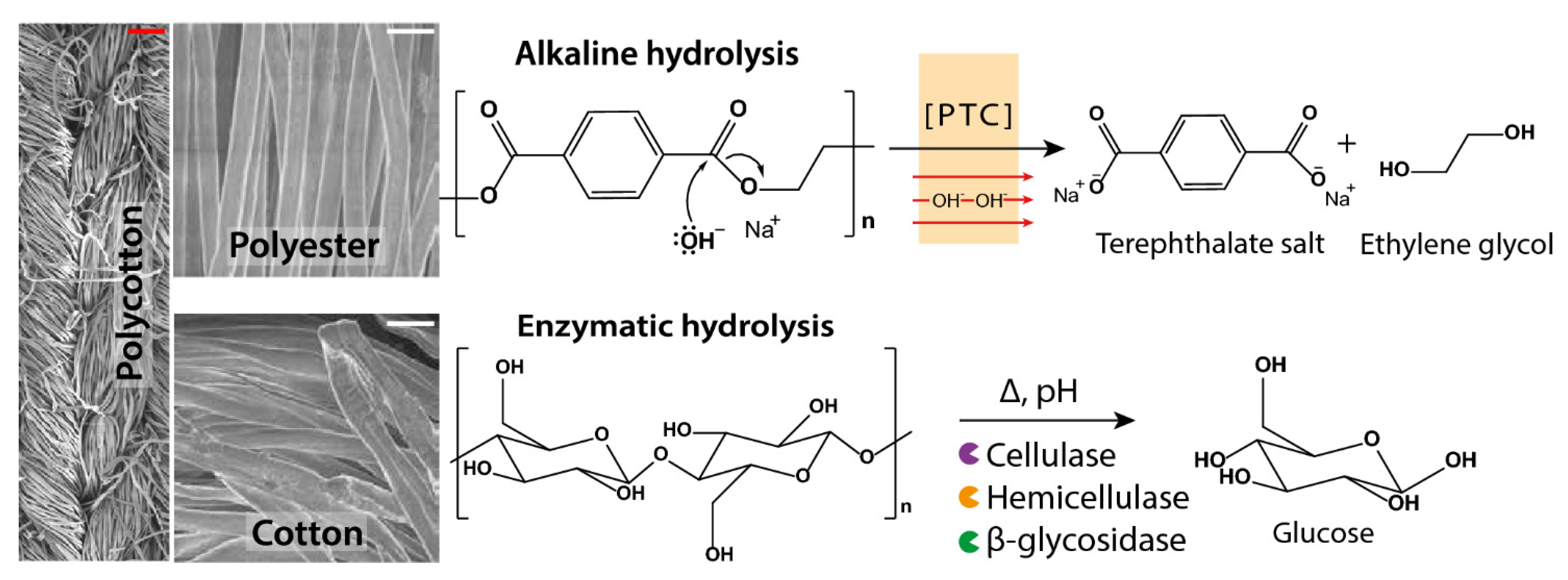
| Alkaline hydrolysis of PES | Inputs: PES/CO (52/48). Treat PES/CO with 10% NaOH at 90 °C in presence of benzyltributylammonium chloride for 15–240 min. | Neutralising alkali waste using strong acid may waste a lot of chemicals and water. Output: Cotton fibres and PES powder (TPA) | [56] |
| Alkaline hydrolysis of PES | Inputs: PES/Viscose (30/70). Treat PES/CO with 5% NaOH at 90 °C for 1–24 h. | The treatment reduces the molecular weight for the cellulose (Viscose) fraction. Also, oxygen free environment reduces the cellulose degradation. Output: TPA, EG, and Viscose | [58] |
| Enzymatic hydrolysis of PES | Inputs: PES/CO (65/35; 80/20). To hydrolyse PES part of a PES/CO mixture, use a commercial cutinase at 55 °C for 24 h. | Treatment does not react or affect the colourants and finishes in the PES/CO waste. Output: TPA and Glucose | [81] |
| Glycolysis of PES | Inputs: PES/CO Ethylene glycol at a liquid-to-solid ratio of 6 was heated to 196 °C in the presence of zinc acetate (0.1%) as the catalyst. | The recovered cellulose exhibits minimal degradation and maintains mechanical properties, making it suitable for spinning. Output: BHET and Cellulose | [82] |
| Glycolysis of PES | Inputs: PES/CO (50/50) Ethylene glycol at a liquid-to-solid ratio of 3.75 with the presence of BHET and sodium carbonate as catalyst with 200 °C for 5 h. | Processing recovered cellulose-to-cellulose acetate involves pulping and acetylation. Output: BHET, TPA, and Cellulose | [83] |
| Hydrothermal treatment of PES | Inputs: PES/CO (20/80) At specific temperature, pressure, and time, subcritical water reaction dissolves PES and weakens cellulose using a phase-transfer catalyst or co-solvent. | The method uses non-toxic, ecologically friendly, affordable, and green subcritical water instead of harsh chemicals. Hydrolysis may occur in the cellulose fraction. Output: TPA, EG, and Cellulose | [84] |
2.3.3. Cotton Dissolving/Degrading Methods to Separate Polyester
3. Challenges and Economic Environmental Potentials
4. Conclusions and Future Scope
Author Contributions
Funding
Institutional Review Board Statement
Data Availability Statement
Conflicts of Interest
References
- Wang, Y. Fiber and Textile Waste Utilization. Waste Biomass Valorization 2010, 1, 135–143. [Google Scholar] [CrossRef] [Scilit]
- Pensupa, N.; Leu, S.-Y.; Hu, Y.; Du, C.; Liu, H.; Jing, H.; Wang, H.; Lin, C.S.K. Chemistry and Chemical Technologies in Waste Valorization. In Recent Trends in Sustainable Textile Waste Recycling Methods: Current Situation and Future Prospects; Springer: Berlin/Heidelberg, Germany, 2017; pp. 189–228. [Google Scholar]
- Yalcin-Enis, I.; Kucukali-Ozturk, M.; Sezgin, H. Risks and Management of Textile Waste; Springer: Cham, Switzerland, 2019; pp. 29–53. [Google Scholar]
- Ahmad, S.; Miskon, S.; Alabdan, R.; Tlili, I. Towards Sustainable Textile and Apparel Industry: Exploring the Role of Business Intelligence Systems in the Era of Industry 4.0. Sustainability 2020, 12, 2632. [Google Scholar] [CrossRef] [Scilit]
- Stanescu, M.D. State of the Art of Post-Consumer Textile Waste Upcycling to Reach the Zero Waste Milestone. Environ. Sci. Pollut. Res. 2021, 28, 14253–14270. [Google Scholar] [CrossRef] [Scilit] [PubMed]
- Niinimäki, K.; Peters, G.; Dahlbo, H.; Perry, P.; Rissanen, T.; Gwilt, A. The Environmental Price of Fast Fashion. Nat. Rev. Earth Environ. 2020, 1, 189–200. [Google Scholar] [CrossRef] [Scilit]
- UN Helps Fashion Industry Shift to Low Carbon. Available online: https://unfccc.int/news/un-helps-fashion-industry-shift-to-low-carbon (accessed on 7 May 2026).
- Jacqueline Siffer Release: Fashion Industry Sees 7% Emissions Spike, Driven by Overproduction and Polyester Use. Available online: https://apparelimpact.org/resources/fashion-industry-sees-7-emissions-spike-driven-by-overproduction-and-polyester-use/ (accessed on 7 May 2026).
- Burkhardt, D. The Impact of Textile Production and Waste on the Environment (Infographics). Available online: https://www.europarl.europa.eu/news/en/headlines/society/20201208STO93327/the-impact-of-textile-production-and-waste-on-the-environment-infographics (accessed on 27 July 2023).
- Sandin, G.; Peters, G.M. Environmental Impact of Textile Reuse and Recycling–A Review. J. Clean. Prod. 2018, 184, 353–365. [Google Scholar] [CrossRef] [Scilit]
- Lindgren, C.; Henriksson, G.; Lindström, M. Recycling of Cellulosic Textiles. EU Patent EP3529282B1, 23 September 2020. [Google Scholar]
- Sandvik, I.M.; Stubbs, W. Circular Fashion Supply Chain through Textile-to-Textile Recycling. J. Fash. Mark. Manag. Int. J. 2019, 23, 366–381. [Google Scholar] [CrossRef] [Scilit]
- Youssef, Y.A.; Ahmed, N.S.E.; Mousa, A.A.; El-Shishtawy, R.M. Alkaline Dyeing of Polyester and Polyester/Cotton Blend Fabrics Using Sodium Edetate. J. Appl. Polym. Sci. 2008, 108, 342–350. [Google Scholar] [CrossRef] [Scilit]
- Kaitwade, N. Poly Cotton Market Snapshot (2023–2033); Future Market Insights: Newark, DE, USA, 2023. [Google Scholar]
- Toussaint, K. This Old-Fashioned Baking Ingredient Could Be the Key to Recycling Polyester. Available online: https://www.fastcompany.com/90934907/this-old-fashioned-baking-ingredient-could-be-the-key-to-recycling-polyester#:~:text=Though%20polyester%20and%20cotton%20can,reusable%3B%20it%20also%20releases%20pollution (accessed on 3 September 2023).
- Gholamzad, E.; Karimi, K.; Masoomi, M. Effective Conversion of Waste Polyester–Cotton Textile to Ethanol and Recovery of Polyester by Alkaline Pretreatment. Chem. Eng. J. 2014, 253, 40–45. [Google Scholar] [CrossRef] [Scilit]
- Juanga-Labayen, J.P.; Labayen, I.V.; Yuan, Q. A Review on Textile Recycling Practices and Challenges. Textiles 2022, 2, 174–188. [Google Scholar] [CrossRef] [Scilit]
- Periyasamy, A.P.; Tehrani-Bagha, A. A Review on Microplastic Emission from Textile Materials and Its Reduction Techniques. Polym. Degrad. Stab. 2022, 199, 109901. [Google Scholar] [CrossRef] [Scilit]
- Leenders, N.; Moerbeek, R.M.; Puijk, M.J.; Bronkhorst, R.J.A.; Bueno Morón, J.; van Klink, G.P.M.; Gruter, G.-J.M. Polycotton Waste Textile Recycling by Sequential Hydrolysis and Glycolysis. Nat. Commun. 2025, 16, 738. [Google Scholar] [CrossRef] [Scilit] [PubMed]
- Howlett, E. Textile Recycling: Closing the Loop on a Greener Apparel Industry. Available online: https://www.usitc.gov/publications/332/executive_briefings/ebot_howlett_textile_recycling_closing_the_loop.pdf (accessed on 22 July 2024).
- Matsumura, M.; Inagaki, J.; Yamada, R.; Tashiro, N.; Ito, K.; Sasaki, M. Material Separation from Polyester/Cotton Blended Fabrics Using Hydrothermal Treatment. ACS Omega 2024, 9, 13125–13133. [Google Scholar] [CrossRef] [Scilit] [PubMed]
- Duhoux, T.; Maes, E.; Hirschnitz-Garbers, M.; Peeters, K. Study on the Technical, Regulatory, Economic and Environmental Effectiveness of Textile Fibres Recycling; European Commission: Brussels, Belgium, 2021. [Google Scholar]
- Transforming Textile Waste into Sustainable Resources. Available online: https://www.purfiglobal.com/#technology (accessed on 10 February 2026).
- Helping the Planet Recover. Fiber by Fiber. Available online: https://rester.fi/en/ (accessed on 10 February 2026).
- Utexbel Utexbel. Available online: https://utexbel.com/ (accessed on 17 April 2026).
- Nucycl. Available online: https://www.evrnu.com/ (accessed on 10 February 2026).
- Marini, I.; Firgo, H.; Eibl, M. Lenzing Lyocell. Lenzing. Berichte 1994, 9, 53–56. [Google Scholar]
- Haslinger, S.; Hummel, M.; Sixta, H. Separation and Upcycling of Cellulose-Containing Blended Waste. U.S. Patent US20200079925A1, 9 November 2021. [Google Scholar] [CrossRef] [Scilit]
- Haslinger, S.; Hummel, M.; Anghelescu-Hakala, A.; Määttänen, M.; Sixta, H. Upcycling of Cotton Polyester Blended Textile Waste to New Man-Made Cellulose Fibers. Waste Manag. 2019, 97, 88–96. [Google Scholar] [CrossRef] [Scilit] [PubMed]
- Let’s Make Textile Circularity an Everyday Reality. Available online: https://infinitedfiber.com/ (accessed on 9 February 2026).
- Harlin, A.; Siren, S.; Mäkelä, J. Separation of Polycotton Blends. FI Patent FI130401B, 10 September 2021. [Google Scholar]
- Vehviläinen, M.; Maattanen, M.; Grönqvist, S.; Harlin, A. Sustainable Continuous Process for Cellulosic Regenerated Fibers. Chem. Fibers Int. 2020, 70, 120–130. [Google Scholar]
- Yousef, S.; Tatariants, M.; Tichonovas, M.; Sarwar, Z.; Jonuškienė, I.; Kliucininkas, L. A New Strategy for Using Textile Waste as a Sustainable Source of Recovered Cotton. Resour. Conserv. Recycl. 2019, 145, 359–369. [Google Scholar] [CrossRef] [Scilit]
- CuRe CuRe Polyester Recycling. Available online: https://curetechnology.com/researchlaboratory/ (accessed on 4 February 2026).
- Rewin Rewin. Available online: https://www.rewintextiles.com/our-solution (accessed on 1 March 2026).
- Barla, F.G.; Showalter, T.; Su, H.-C.; Jones, J.; Bobe, I. Methods for Recycling Cotton and Polyester Fibers from Waste Textiles. WO Patent WO2019140245A1, 18 July 2019. [Google Scholar]
- Circ. Available online: https://circ.earth/circ-france/ (accessed on 1 March 2026).
- Blocktexx Blocktexx. Available online: https://www.blocktexx.com/technology (accessed on 3 September 2024).
- Hkrita Green Machine: Post-Consumer Blended Textile Separation and Recycling by Hydrothermal Treatment Phase 2. Available online: https://www.hkrita.com/en/our-innovation-tech/projects/green-machine-phase-2 (accessed on 12 February 2026).
- Auranen, A.; Dahl, O.; Kähkönen, O.; Pelkonen, J.-P.; Youla, O.; Majoinen, J.; Vehviläinen, M.; Seppälä, H. PESCO-UP Upcycling Mixed Textile Waste into Clean Materials for the Next Use Cycle. In Proceedings of the 4th International Conference on a Circular Economy for Textiles and Plastics, Centexbel, Ostend, Belgium, 19–20 November 2024. [Google Scholar]
- Carbios. Carbios Unveils Major Innovation in Polyester Recycling with New Textile Preparation Line, in the Presence of Roland Lescure, French Minister of Industry. Available online: https://www.carbios.com/en/carbios-unveils-major-innovation-in-polyester-recycling-with-new-textile-preparation-line-in-the-presence-of-roland-lescure-french-minister-of-industry/ (accessed on 27 March 2026).
- Enzymes for a Circular Plastic Economy. Available online: https://www.evoralis.com/ (accessed on 27 March 2026).
- Catalysing Material Circularity for a Circular Future. Available online: https://www.samsaraeco.com/ (accessed on 27 March 2026).
- Sandin, G.; Lidfeldt, M. Does Large-Scale Textile Recycling in Europe Reduce Climate Impact? A Consequential Life Cycle Assessment; IVL Swedish Environmental Research Institute: Gothenburg, Sweden, 2023. [Google Scholar]
- Cura, K.; Rintala, N.; Kamppuri, T.; Saarimäki, E.; Heikkilä, P. Textile Recognition and Sorting for Recycling at an Automated Line Using Near Infrared Spectroscopy. Recycling 2021, 6, 11. [Google Scholar] [CrossRef] [Scilit]
- Raiskio, S.; Periyasamy, A.; Hummel, M.; Heikkilä, P. Transforming Mechanically Recycled Cotton and Linen from Post-Consumer Textiles into Quality Ring Yarns and Knitted Fabrics. Waste Manag. Bull. 2025, 3, 76–86. [Google Scholar] [CrossRef] [Scilit]
- Yılmaz, E.; Özgen Keleş, B. A Comparative Study of Cotton/PES Knitted Fabrics Produced from Recycled Fiber-Based and Virgin Yarns. Fibers Polym. 2024, 25, 4951–4963. [Google Scholar] [CrossRef] [Scilit]
- Määttänen, M.; Gunnarsson, M.; Wedin, H.; Stibing, S.; Olsson, C.; Köhnke, T.; Asikainen, S.; Vehviläinen, M.; Harlin, A. Pre-Treatments of Pre-Consumer Cotton-Based Textile Waste for Production of Textile Fibres in the Cold NaOH(Aq) and Cellulose Carbamate Processes. Cellulose 2021, 28, 3869–3886. [Google Scholar] [CrossRef] [Scilit]
- Our Recycling Process. Available online: https://www.sodra.com/en/global/about-us/innovation/oncemore/our-recycling-process/ (accessed on 25 February 2026).
- Circulose. Available online: https://www.circulose.com/ (accessed on 25 February 2026).
- Saxcell: Turning Textile Waste into High-Quality SaXcell® Regenerated Fibers. Available online: https://saxcell.com/ (accessed on 25 February 2026).
- Kahoush, M.; Kadi, N. Towards Sustainable Textile Sector: Fractionation and Separation of Cotton/Polyester Fibers from Blended Textile Waste. Sustain. Mater. Technol. 2022, 34, e00513. [Google Scholar] [CrossRef] [Scilit]
- Yoshida, S.; Hiraga, K.; Takehana, T.; Taniguchi, I.; Yamaji, H.; Maeda, Y.; Toyohara, K.; Miyamoto, K.; Kimura, Y.; Oda, K. A Bacterium That Degrades and Assimilates Poly(ethylene terephthalate). Science 2016, 351, 1196–1199. [Google Scholar] [CrossRef] [Scilit] [PubMed]
- Baker, P.J.; Poultney, C.; Liu, Z.; Gross, R.; Montclare, J.K. Identification and Comparison of Cutinases for Synthetic Polyester Degradation. Appl. Microbiol. Biotechnol. 2012, 93, 229–240. [Google Scholar] [CrossRef] [Scilit] [PubMed]
- Negulescu, L.; Hyojung, K.; Collier, B. Recycling Cotton from Cotton/Polyester Fabrics. Text. Chem. Color. 1998, 30, 31–35. [Google Scholar]
- Palme, A.; Peterson, A.; de la Motte, H.; Theliander, H.; Brelid, H. Development of an Efficient Route for Combined Recycling of PET and Cotton from Mixed Fabrics. Text. Cloth. Sustain. 2017, 3, 4. [Google Scholar] [CrossRef] [Scilit]
- Bengtsson, J.; Peterson, A.; Idström, A.; de la Motte, H.; Jedvert, K. Chemical Recycling of a Textile Blend from Polyester and Viscose, Part II: Mechanism and Reactivity during Alkaline Hydrolysis of Textile Polyester. Sustainability 2022, 14, 6911. [Google Scholar] [CrossRef] [Scilit]
- Peterson, A.; Wallinder, J.; Bengtsson, J.; Idström, A.; Bialik, M.; Jedvert, K.; de la Motte, H. Chemical Recycling of a Textile Blend from Polyester and Viscose, Part I: Process Description, Characterization, and Utilization of the Recycled Cellulose. Sustainability 2022, 14, 7272. [Google Scholar] [CrossRef] [Scilit]
- Villar, L.; Pita, M.; González, B.; Sánchez, P.B. Hydrolytic-Assisted Fractionation of Textile Waste Containing Cotton and Polyester. Fibers Polym. 2024, 25, 2763–2772. [Google Scholar] [CrossRef] [Scilit]
- Cho, E.J.; Lee, Y.G.; Song, Y.; Kim, H.Y.; Nguyen, D.-T.; Bae, H.-J. Converting Textile Waste into Value-Added Chemicals: An Integrated Bio-Refinery Process. Environ. Sci. Ecotechnology 2023, 15, 100238. [Google Scholar] [CrossRef] [Scilit] [PubMed]
- Park, S.H.; Kim, S.H. Poly (ethylene terephthalate) Recycling for High Value Added Textiles. Fash. Text. 2014, 1, 1. [Google Scholar] [CrossRef] [Scilit]
- Seppälä, H. The Hornification of Cellulose in Chemical Textile Recycling. Master’s Thesis, Aalto University, Espoo, Finland, 2023. [Google Scholar]
- Muangmeesri, S.; Baddigam, K.R.; Navare, K.; Apostolopoulou-Kalkavoura, V.; Witthayolankowit, K.; Håkansson, H.; Mathew, A.P.; Van Acker, K.; Samec, J.S.M. Recycling of Polyesters by Organocatalyzed Methanolysis Depolymerization: Environmental Sustainability Evaluated by Life Cycle Assessment. ACS Sustain. Chem. Eng. 2024, 12, 4114–4120. [Google Scholar] [CrossRef] [Scilit]
- Guo, Z.; Eriksson, M.; de la Mote, H.; Adolfsson, E. Circular Recycling of Polyester Textile Waste Using a Sustainable Catalyst. J. Clean. Prod. 2021, 283, 124579. [Google Scholar] [CrossRef] [Scilit]
- Andini, E.; Bhalode, P.; Gantert, E.; Sadula, S.; Vlachos, D.G. Chemical Recycling of Mixed Textile Waste. Sci. Adv. 2024, 10, eado6827. [Google Scholar] [CrossRef] [Scilit] [PubMed]
- Xu, C.; Guoping, Z. Continuous Production Line for Separating Polyester Cotton by Alcoholysis Method. CN Patent CN115140564A, 18 June 2024. [Google Scholar]
- Zi, D.; Kong, L.; Rui, Y. Method for Controllable Alcoholysis of Polyester Blended Fiber Solid Waste and Full Utilization of Product Thereof. CN Patent CN114736427A, 26 July 2024. [Google Scholar]
- Raheem, A.B.; Noor, Z.Z.; Hassan, A.; Abd Hamid, M.K.; Samsudin, S.A.; Sabeen, A.H. Current Developments in Chemical Recycling of Post-Consumer Polyethylene Terephthalate Wastes for New Materials Production: A Review. J. Clean. Prod. 2019, 225, 1052–1064. [Google Scholar] [CrossRef] [Scilit]
- Kazemi, M.; Faisal Kabir, S.; Fini, E.H. State of the Art in Recycling Waste Thermoplastics and Thermosets and Their Applications in Construction. Resour. Conserv. Recycl. 2021, 174, 105776. [Google Scholar] [CrossRef] [Scilit]
- Padhan, R.K.; Sreeram, A. Chemical Depolymerization of PET Bottles via Combined Chemolysis Methods. In Recycling of Polyethylene Terephthalate Bottles; Elsevier: Amsterdam, The Netherlands, 2019; pp. 135–147. [Google Scholar]
- Villar, L.; Schlapp-Hackl, I.; Sánchez, P.B.; Hummel, M. High-Quality Cellulosic Fibers Engineered from Cotton–Elastane Textile Waste. Biomacromolecules 2024, 25, 1942–1949. [Google Scholar] [CrossRef] [Scilit] [PubMed]
- Sinha, V.; Patel, M.R.; Patel, J.V. Pet Waste Management by Chemical Recycling: A Review. J. Polym. Environ. 2010, 18, 8–25. [Google Scholar] [CrossRef] [Scilit]
- Wang, Q.; Geng, Y.; Lu, X.; Zhang, S. First-Row Transition Metal-Containing Ionic Liquids as Highly Active Catalysts for the Glycolysis of Poly(ethylene terephthalate) (PET). ACS Sustain. Chem. Eng. 2015, 3, 340–348. [Google Scholar] [CrossRef] [Scilit]
- Mu, B.; Yu, X.; Shao, Y.; McBride, L.; Hidalgo, H.; Yang, Y. Complete Recycling of Polymers and Dyes from Polyester/Cotton Blended Textiles via Cost-Effective and Destruction-Minimized Dissolution, Swelling, Precipitation, and Separation. Resour. Conserv. Recycl. 2023, 199, 107275. [Google Scholar] [CrossRef] [Scilit]
- Walker, A. Process for Extracting Polyester from an Article. WO Patent WO2014045062A1, 27 March 2014. [Google Scholar] [CrossRef] [Scilit]
- Serad, S.L. Polyester Dissolution for Polyester/Cotton Blend Recycle. U.S. Patent US5342854A, 28 July 1993. [Google Scholar]
- Hones, B.; Barbour, C.; Eike, R. Procedural Development for Chemical Separation of Cotton/Polyester Blends for Textile Recycling. In International Textile and Apparel Association Annual Conference Proceedings; Pivoting for the Pandemic; Iowa State University Digital Press: Ames, IA, USA, 2020. [Google Scholar]
- Matayeva, A.; Biller, P. Hydrothermal Liquefaction of Post-Consumer Mixed Textile Waste for Recovery of Bio-Oil and Terephthalic Acid. Resour. Conserv. Recycl. 2022, 185, 106502. [Google Scholar] [CrossRef] [Scilit]
- Yousef, S.; Tatariants, M.; Tichonovas, M.; Kliucininkas, L.; Lukošiūtė, S.-I.; Yan, L. Sustainable Green Technology for Recovery of Cotton Fibers and Polyester from Textile Waste. J. Clean. Prod. 2020, 254, 120078. [Google Scholar] [CrossRef] [Scilit]
- Hossain, A.K.M.; Sela, S.K. Treatment of Fibrous (Textile) Waste Utilizing Green Technology And Recycling of Used Chemicals for Reutilization. SSRN Electron. J. 2022, preprint. [Google Scholar] [CrossRef] [Scilit]
- Kaabel, S.; Arciszewski, J.; Borchers, T.H.; Therien, J.P.D.; Friščić, T.; Auclair, K. Solid-State Enzymatic Hydrolysis of Mixed PET/Cotton Textiles**. ChemSusChem 2023, 16, e202201613. [Google Scholar] [CrossRef] [Scilit] [PubMed]
- Li, Z. Separation of Waste Cotton-Polyester Blended Fabric. IOP Conf. Ser. Mater. Sci. Eng. 2020, 768, 022062. [Google Scholar] [CrossRef] [Scilit]
- Oakley, E.O.; Gorman, F.J.; Mason, J.D. Process for Recycling Polyester/Cotton Blend. U.S. Patent US5236959A, 12 March 1992. [Google Scholar]
- Brinks, G.J.; Bouwhuis, G.H.; Agrwal, P.B.; Gooijer, H. Processing of Cotton-Polyester Waste Textile. EU Patent EP2922905A1, 18 July 2019. [Google Scholar]
- Gorbacheva, S.N.; Yadykova, A.Y.; Ilyin, S.O. A Novel Method for Producing Cellulose Nanoparticles and Their Possible Application as Thickeners for Biodegradable Low-Temperature Greases. Cellulose 2021, 28, 10203–10219. [Google Scholar] [CrossRef] [Scilit]
- Fink, H.-P.; Weigel, P.; Purz, H.J.; Ganster, J. Structure Formation of Regenerated Cellulose Materials from NMMO-Solutions. Prog. Polym. Sci. 2001, 26, 1473–1524. [Google Scholar] [CrossRef] [Scilit]
- Rosenau, T.; Hofinger, A.; Potthast, A.; Kosma, P. On the Conformation of the Cellulose Solvent N-Methylmorpholine-N-Oxide (NMMO) in Solution. Polymer 2003, 44, 6153–6158. [Google Scholar] [CrossRef] [Scilit]
- Haule, L.V.; Carr, C.M.; Rigout, M. Preparation and Physical Properties of Regenerated Cellulose Fibres from Cotton Waste Garments. J. Clean. Prod. 2016, 112, 4445–4451. [Google Scholar] [CrossRef] [Scilit]
- De Silva, R.; Byrne, N. Utilization of Cotton Waste for Regenerated Cellulose Fibres: Influence of Degree of Polymerization on Mechanical Properties. Carbohydr. Polym. 2017, 174, 89–94. [Google Scholar] [CrossRef] [Scilit] [PubMed]
- Deng, Z.; Zhou, G.; Fang, T.; Fang, K.; Liu, X. The Bidirectional Regulation Mechanism of NMMO Concentration Change on Cellulose Dissolution and Regeneration. Cellulose 2024, 31, 1205–1222. [Google Scholar] [CrossRef] [Scilit]
- Jeihanipour, A.; Karimi, K.; Niklasson, C.; Taherzadeh, M.J. A Novel Process for Ethanol or Biogas Production from Cellulose in Blended-Fibers Waste Textiles. Waste Manag. 2010, 30, 2504–2509. [Google Scholar] [CrossRef] [Scilit] [PubMed]
- Zhang, J.; Wu, J.; Yu, J.; Zhang, X.; He, J.; Zhang, J. Application of Ionic Liquids for Dissolving Cellulose and Fabricating Cellulose-Based Materials: State of the Art and Future Trends. Mater. Chem. Front. 2017, 1, 1273–1290. [Google Scholar] [CrossRef] [Scilit]
- Andanson, J.-M.; Bordes, E.; Devémy, J.; Leroux, F.; Pádua, A.A.H.; Gomes, M.F.C. Understanding the Role of Co-Solvents in the Dissolution of Cellulose in Ionic Liquids. Green Chem. 2014, 16, 2528. [Google Scholar] [CrossRef] [Scilit]
- Li, X.; Zhang, Y.; Tang, J.; Lan, A.; Yang, Y.; Gibril, M.; Yu, M. Efficient Preparation of High Concentration Cellulose Solution with Complex DMSO/ILs Solvent. J. Polym. Res. 2016, 23, 32. [Google Scholar] [CrossRef] [Scilit]
- Kuzmina, O.; Jankowski, S. Preswelling of Cellulose Pulp for Dissolution in Ionic Liquid. Cellul. Chem. Technol. 2014, 48, 45–54. [Google Scholar]
- Wu, H.; Wang, B.; Li, T.; Wu, Y.; Yang, R.; Gao, H.; Nie, Y. Efficient Recycle of Waste Poly-Cotton and Preparation of Cellulose and Polyester Fibers Using the System of Ionic Liquid and Dimethyl Sulfoxide. J. Mol. Liq. 2023, 388, 122757. [Google Scholar] [CrossRef] [Scilit]
- De Silva, R.; Wang, X.; Byrne, N. Recycling Textiles: The Use of Ionic Liquids in the Separation of Cotton Polyester Blends. RSC Adv. 2014, 4, 29094–29098. [Google Scholar] [CrossRef] [Scilit]
- Ma, Y.; Zeng, B.; Wang, X.; Byrne, N. Circular Textiles: Closed Loop Fiber to Fiber Wet Spun Process for Recycling Cotton from Denim. ACS Sustain. Chem. Eng. 2019, 7, 11937–11943. [Google Scholar] [CrossRef] [Scilit]
- Tenhunen, T.-M.; Lewandowska, A.E.; Orelma, H.; Johansson, L.-S.; Virtanen, T.; Harlin, A.; Österberg, M.; Eichhorn, S.J.; Tammelin, T. Understanding the Interactions of Cellulose Fibres and Deep Eutectic Solvent of Choline Chloride and Urea. Cellulose 2018, 25, 137–150. [Google Scholar] [CrossRef] [Scilit]
- Chen, Y.-L.; Zhang, X.; You, T.-T.; Xu, F. Deep Eutectic Solvents (DESs) for Cellulose Dissolution: A Mini-Review. Cellulose 2019, 26, 205–213. [Google Scholar] [CrossRef] [Scilit]
- Choi, S.; Choi, H.-M. Eco-Friendly, Expeditious Depolymerization of PET in the Blend Fabrics by Using a Bio-Based Deep Eutectic Solvent under Microwave Irradiation for Composition Identification. Fibers Polym. 2019, 20, 752–759. [Google Scholar] [CrossRef] [Scilit]
- Yang, K.; Wang, M.; Wang, X.; Shan, J.; Zhang, J.; Tian, G.; Yang, D.; Ma, J. Polyester/Cotton-Blended Textile Waste Fiber Separation and Regeneration via a Green Chemistry Approach. ACS Sustain. Chem. Eng. 2024, 12, 4530–4538. [Google Scholar] [CrossRef] [Scilit]
- Zhang, L.; Wang, T.; Wang, Y.; Ye, D.; Wang, Z. Efficient Separation of Polyester/Cotton Blends Using a Deep Eutectic Solvent–NaOH Hybrid System for Textile Recycling. Green Chem. 2025, 27, 13247–13258. [Google Scholar] [CrossRef] [Scilit]
- Depope, N.; Depope, A.; Archodoulaki, V.-M.; Ipsmiller, W.; Bartl, A. Deep Eutectic Solvent as a Solution for Polyester/Cotton Textile Recycling. Waste Manag. 2025, 208, 115177. [Google Scholar] [CrossRef] [Scilit] [PubMed]
- Henryk, S.; Danuta, C.; Dariusz, W.; Alojzy, U.; Krystyna, G.; Krystyna, W.-T. Method for the Manufacture of Fibres, Film and Other Products from Modified Soluble Cellulose. WO Patent WO2001096402A1, 20 December 2001. [Google Scholar] [PubMed]
- Vehviläinen, M.; Nousiainen, P.; Struszczyk, H.; Ciechañska, D.; Wawro, D.; East, G. CELSOL–Biotransformation of Cellulose for Fibre Spinning. In The Chemistry and Processing of Wood and Plant Fibrous Material; Elsevier: Amsterdam, The Netherlands, 1996; pp. 197–204. [Google Scholar]
- Rahkamo, L.; Siika-Aho, M.; Vehviläinen, M.; Dolk, M.; Viikari, L.; Nousiainen, P.; Buchert, J. Modification of Hardwood Dissolving Pulp with PurifiedTrichoderma Reesei Cellulases. Cellulose 1996, 3, 153–163. [Google Scholar] [CrossRef] [Scilit]
- Biocelsol Final Reports. Tampere. 2007. Available online: https://cordis.europa.eu/project/id/505567/reporting (accessed on 18 July 2026).
- Vehviläinen, M.; Määttänen, M.; Asikainen, S.; Laine, C.; Anghelescu-Hakala, A.; Immonen, K.; Harlin, A. Utilisation of Cellulose from Blended Textiles. In Proceedings of the 8th Workshop on Cellulose, Karlstad, Sweden, 13–14 November 2018. [Google Scholar]
- Bialik, M.; Jensen, A.; Kotilainen, O.; Kulander, I.; Lopes, M. NeoCel—A Novel Process to Produce Sustainable Cellulosic Textile Fibers. In Proceedings of the 7th Avancell Conference, Gothenburg, Sweden, 9–10 October 2019. [Google Scholar]
- Klemm, D.; Bertram, P. Comprehensive Cellulose Chemistry, Volume 2: Functionalization of Cellulose, 1st ed.; Wiley Publishers: London, UK, 2004. [Google Scholar]
- Huthmacher, K.; Most, D.; by Staff, U. Cyanuric Acid and Cyanuric Chloride. In Ullmann’s Encyclopedia of Industrial Chemistry; Wiley: Hoboken, NJ, USA, 2026; pp. 1–21. [Google Scholar]
- Turunen, O. Cellulose Dissolution. FI Patent FI793226, 29 January 1982. [Google Scholar]
- Fritz, L.; Eckehart, S.; Peter, W.; Hans-Peter, F.; Jürgen, G. Procede de Fabrication de Corps Moules a Base de Carbamate de Cellulose. EU Patent EP1506236, 24 May 2002. [Google Scholar]
- Karl, W. Screw-Threaded Connector for Tube and Pipe, Has Sleeve with Notch, Extending Radially, in Zone of Its End Rotated towards Connection Part, and Recess Extending from Notch until End of External Threading Rotated Opposite to Connection Part. EU Patent EP1462704A1, 29 September 2004. [Google Scholar]
- Griesser, H.; Jeszenszky, T.; Weinrotter, K.; Jurkowitsch, R. Process for Preparing Cellulose Carbamates. EU Patent EP0178292A2, 9 October 1984. [Google Scholar]
- Huttunen, J.I.; Turunen, O.; Mandel, L.; Eklund, V.; Ekman, K. Method of Producing Alkali-Soluble Cellulose Carbamate. EU Patent EP0057105B1, 27 January 1981. [Google Scholar]
- Hill, J.W.; Jacobson, R.A. Chemical Process. U.S. Patent US2134825A, 1 November 1938. [Google Scholar]
- Keunecke, G.; Arnold, A.; Butzke, S. Process for the Production of Cellulose Carbamate. International Patent WO1993012143A1, 24 June 1993. [Google Scholar] [CrossRef] [Scilit]
- Mandell, L.; Eklund, V.; Ekman, K.; Huttunen, J.I.; Turunen, O.T. Procedure for Precipitating Cellulose Carbamate. EU Patent EP0097685B1, 19 March 1986. [Google Scholar]
- Willberg-Keyriläinen, P.; Hiltunen, J.; Ropponen, J. Production of Cellulose Carbamate Using Urea-Based Deep Eutectic Solvents. Cellulose 2018, 25, 195–204. [Google Scholar] [CrossRef] [Scilit]
- Siren, S.; Veijola, E.; Nuopponen, M. Cellulosic Textile Fibre. International Patent WO2023131747A1, 13 July 2023. [Google Scholar] [CrossRef] [Scilit]
- Siren, S.; Malanin, E.; Veijola, E. Method of Producing Cellulose Carbamate Filaments or Fibres. International Patent WO2023131748A1, 13 July 2023. [Google Scholar]
- Boondaeng, A.; Keabpimai, J.; Srichola, P.; Vaithanomsat, P.; Trakunjae, C.; Niyomvong, N. Optimization of Textile Waste Blends of Cotton and PET by Enzymatic Hydrolysis with Reusable Chemical Pretreatment. Polymers 2023, 15, 1964. [Google Scholar] [CrossRef] [Scilit] [PubMed]
- Ma, J.; Yang, K.; Wang, M.; Shan, J.; Yang, D.; Tian, G. Advancements in Component Separation through Chemical Methods for Recycled Polyester/Cotton Blended Textiles. Cellulose 2024, 31, 9543–9563. [Google Scholar] [CrossRef] [Scilit]
- Rinaldi, R.; Schüth, F. Acid Hydrolysis of Cellulose as the Entry Point into Biorefinery Schemes. ChemSusChem 2009, 2, 1096–1107. [Google Scholar] [CrossRef] [Scilit] [PubMed]
- Soleimani, S.; Heydari, A.; Fattahi, M. Isolation and Characterization of Cellulose Nanocrystals from Waste Cotton Fibers Using Sulfuric Acid Hydrolysis. Starch-Stärke 2022, 74, 2200159. [Google Scholar] [CrossRef] [Scilit]
- Tomomichi, I.; Keiji, Y.; Yuichi, H.; Kanji, K.; Akihiro, S. Separation Method of Mixed Fiber, Production Method of First Fiber, Production Method of Decomposed Material of Second Fiber, and Production Method of Decomposed Material of Third Fiber. Japanese Patent JP2019035022A, 7 March 2019. [Google Scholar]
- Vuorinen, J. Chemical Recycling of Polycotton Textiles: Fractionation of Cotton by TEMPO-Mediated Oxidation. Master’s Thesis, Aalto University, Espoo, Finland, 2024. [Google Scholar]
- Toshikj, E.; Tarbuk, A.; Grgić, K.; Mangovska, B.; Jordanov, I. Influence of Different Oxidizing Systems on Cellulose Oxidation Level: Introduced Groups versus Degradation Model. Cellulose 2019, 26, 777–794. [Google Scholar] [CrossRef] [Scilit]
- Xia, G.; Han, W.; Xu, Z.; Zhang, J.; Kong, F.; Zhang, J.; Zhang, X.; Jia, F. Complete Recycling and Valorization of Waste Textiles for Value-Added Transparent Films via an Ionic Liquid. J. Environ. Chem. Eng. 2021, 9, 106182. [Google Scholar] [CrossRef] [Scilit]
- Sun, Y.Y.; Xia, Z.P.; Yang, A.P.; Li, J.X.; Wang, L.; Chen, H.; Zheng, X.; Liu, Y. Nanocellulose Extracted from Waste Polyester/Cotton Fabric by Chemical-Mechanical Separation Technology. J. Phys. Conf. Ser. 2021, 1790, 012074. [Google Scholar] [CrossRef] [Scilit]
- Sun, X.; Lu, C.; Zhang, W.; Tian, D.; Zhang, X. Acetone-Soluble Cellulose Acetate Extracted from Waste Blended Fabrics via Ionic Liquid Catalyzed Acetylation. Carbohydr. Polym. 2013, 98, 405–411. [Google Scholar] [CrossRef] [Scilit] [PubMed]
- Costa, C.; Viana, A.; Silva, C.; Marques, E.F.; Azoia, N.G. Recycling of Textile Wastes, by Acid Hydrolysis, into New Cellulosic Raw Materials. Waste Manag. 2022, 153, 99–109. [Google Scholar] [CrossRef] [Scilit] [PubMed]
- Ruiz-Caldas, M.-X.; Carlsson, J.; Sadiktsis, I.; Jaworski, A.; Nilsson, U.; Mathew, A.P. Cellulose Nanocrystals from Postconsumer Cotton and Blended Fabrics: A Study on Their Properties, Chemical Composition, and Process Efficiency. ACS Sustain. Chem. Eng. 2022, 10, 3787–3798. [Google Scholar] [CrossRef] [Scilit]
- Ouchi, A.; Toida, T.; Kumaresan, S.; Ando, W.; Kato, J. A New Methodology to Recycle Polyester from Fabric Blends with Cellulose. Cellulose 2010, 17, 215–222. [Google Scholar] [CrossRef] [Scilit]
- Ling, C.; Shi, S.; Hou, W.; Yan, Z. Separation of Waste Polyester/Cotton Blended Fabrics by Phosphotungstic Acid and Preparation of Terephthalic Acid. Polym. Degrad. Stab. 2019, 161, 157–165. [Google Scholar] [CrossRef] [Scilit]
- Hou, W.; Ling, C.; Shi, S.; Yan, Z.; Zhang, M.; Zhang, B.; Dai, J. Separation and Characterization of Waste Cotton/Polyester Blend Fabric with Hydrothermal Method. Fibers Polym. 2018, 19, 742–750. [Google Scholar] [CrossRef] [Scilit]
- Quartinello, F.; Vecchiato, S.; Weinberger, S.; Kremenser, K.; Skopek, L.; Pellis, A.; Guebitz, G. Highly Selective Enzymatic Recovery of Building Blocks from Wool-Cotton-Polyester Textile Waste Blends. Polymers 2018, 10, 1107. [Google Scholar] [CrossRef] [Scilit] [PubMed]
- Vasconcelos, A.; Cavaco-Paulo, A. Enzymatic Removal of Cellulose from Cotton/Polyester Fabric Blends. Cellulose 2006, 13, 611–618. [Google Scholar] [CrossRef] [Scilit]
- Harlin, A. Cellulose Carbamate: Production and Applications; VTT Technical Research Centre of Finland: Espoo, Finland, 2019. [Google Scholar]
- van Duijn, H.; Carrone, N.P.; Bakowska, O.; Huang, Q.; Akerboom, M.; Rademan, K.; Vellanki, D. Sorting for Circularity Europe: An Evaluation and Commercial Assessment of Textile Waste across Europe; Fashion for Good: Amsterdam, The Netherlands, 2022. [Google Scholar]
- Arun, C.M.; Panneerselvan, L.; Nachimuthu, G.; Conaty, M.; Palanisami, T. Eco-Innovative Approaches for Recycling Non-Polyester/Cotton Blended Textiles. Waste Manag. Bull. 2025, 3, 255–270. [Google Scholar] [CrossRef] [Scilit]
- Fois, F.; Terenzi, V.; Tratzi, P.; Serrecchia, S.; Bianconi, D.; Petracchini, F.; Paolini, V. Environmental Impacts of Cotton and Polyester Textile Management Strategies: Comparison of Separate Collection for Reusing and Textile Waste Recycling. Environ. Impact Assess. Rev. 2026, 116, 108088. [Google Scholar] [CrossRef] [Scilit]
- DesVeaux, J.S.; Uekert, T.; Curley, J.B.; Choi, H.; Liang, Y.; Singh, A.; Mante, O.D.; Beckham, G.T.; Jacobsen, A.J.; Knauer, K.M. Mixed Polyester Recycling Can Enable a Circular Plastic Economy with Environmental Benefits. One Earth 2024, 7, 2204–2222. [Google Scholar] [CrossRef] [Scilit]

| Recycling Technology | Feedstock | Output | Pros | Cons | Status | Challenges and Technology Maturity/Limitations | Commercial Players or Upscaling Recycling |
|---|---|---|---|---|---|---|---|
| Fibre mechanical recycling | Textile waste contains a high share of cotton or polyester [22]. | Fibres for yarn spinning and fibres for the production nonwoven textiles. | Simple process and requires relatively low investment. Mechanically opened carding has been well established for several decades. | Different tenacity of PES and CO causes breakage during the recycling, creating short fibres, uneven lengths, spinning issues, leads unpredictable quality. Recycling done without colour removal which causes less interest among consumers. Contaminants will be retained in the output materials. | Technology has currently reached the TRL of 9 | Material losses (due to harsh treatment), Shorter fibre length. | Soft mechanical recycling by Purfi [23] Rester Oy [24] Utexbel [25] |
| Chemical Recycling (cellulose recycling via dissolution method) | Waste textiles are mostly composed of cellulose fibres. The presence of other fibres as impurities depends on the technology. | Regenerated cellulose fibres for textile manufacturing. | High possibility of cellulose recovery | Dyes and other contaminants influence the process to some extent; purification as a pretreatment is required. | TRL for blends is 5–7 and for 100% CO is 9. | Controlling the process is challenging at large scale | Purification of cotton-based waste textiles & preparation of Lyocell fibres (EVRNU; NuCyclTM) [26] Recycling by dissolution in NMMO (Lenzing; REFIBRATM) [27] |
| TRL 4–6 | Difficult to achieve a feasible level of chemical recovery, chemicals are usually expensive | Recycling by dissolution by ionic liquid (Ioncell) [28,29] | |||||
| TRL7 | Acceptance of noncellulosic fibres ~12% | Recycling by the formation of cellulose carbamate and the dissolution of cellulose. Polyester removal by alkaline hydrolysis (Infinited Fiber Company: InfinnaTM) [30,31] | |||||
| TRL 5 | High loss of cellulose solution with PES/CO blends | Biocelsol: cellulose dissolution in cold alkali and separation of PES via filtering [32] | |||||
| Dissolution in DMSO: not feasible for safe in large-scale operations [33] | - | ||||||
| Chemical recycling of PES from PES/CO blends. Depolymerisation continued with repolymerisation | PES and its blends (i.e., cellulose, or other types) | Monomers, Oligomers | Recycled PES can be used for textiles as well as other applications (i.e., packaging, composites) | Contaminants and achieving homogeneity of output materials are challenging. | TRL for blends is 4–7 | Glycolysis: causes cellulose hornification, widely patented, high initial investment Alkaline hydrolysis: Slow compared to other degrading methods, may cause cellulose hornification Methanolysis: Causes cellulose hornification, high initial investment. Aminolysis: Toxic and expensive chemicals Ammonolysis: Harmful for cellulose solubility, not suitable for blended textiles | CuRe [34], (Glycolysis, PES) Rewin textiles (Glycolysis, PES) [35], Circ (Alkaline hydrolysis, PES/CO blends) [36,37] |
| Acid hydrolysis-based separation of PES and CO | Mostly PES/CO blends. | PES fibres/pellets, Cellulose fines or sugars | TRL 4 | PolyTexx® and CellTexx® by BlockTexx [38] HKRITA: GreenMachine [39] NBG [40] | |||
| Enzymatic hydrolysis | Fibre blends | Fibres, monomers, oligomers, and polymers | Target-specific polymer enzyme selectivity. Less polymer damage in milder reactions. | High water footprint. High consumption of chemicals Higher process cost due to enzyme expenses. | TRL of 5–6 | Efficiency is low and depends on many parameters, including material purity. The process is generally lengthy and complex. The literature provides very limited investigation of PES/CO blends. | Carbios [41] Evoralis [42] Samsara Eco [43] |
| Method | Conditions for the PES Removal | Notes | Refs |
|---|---|---|---|
| Dissolve CO in NMMO | Inputs: PES/CO (50/50, orange; 40/60 blue). NMMO + PES/CO waste treated for 2 h to dissolve cellulose, separate non-cellulosic fibres, and precipitate cellulose and use for ethanol and biogas production. | The cellulose recoveries from the blends ranged from 40% to 95%. Rotary evaporators are used for recycling NMMO with the same efficiency as fresh ones. Output: PES fibres, EtOH, and biogas. | [91] |
| Dissolve CO in Ionic liquid (AmimCl) | Inputs: PES/CO (30/70). AmimCl was combined 24:1 (L/S; g/g) with waste textile, heated at 80 °C for 3 h, then centrifuged to remove cellulose solution. | The technique yielded 55–65% cellulose and 92–96% PES. After disintegration and regeneration, cellulose I became cellulose II. Output: High purity of PES fibres (above 92%) was recovered, cellulose portion (above 55%) was dissolved completely, and regenerated cellulose films were made. | [131] |
| Dissolve CO in Ionic liquid (DBNH-OAc) | Inputs: PES/CO (50/50) fabrics; colour: White. DBNH-OAc is mixed with PES/CO waste to 5.7–6.7 (L/S; g/g) at 80 °C for 1 h. | DBNH-OAc dissolves without stabilisers and at lower temperatures than NMMO. Possible degradation of PES. Commercial Viscose and Tencel fibres are weaker than Ioncell fibres. Output: Regenerated cellulose fibres and PES | [28,29] |
| Dissolve CO in Ionic liquid (BmimCl and MmimDMP) | Inputs: PES/CO (50/50); colour: red and black. PES/CO waste treated with BmimCl/MmimDMP at a 20:1 L/S ratio with 130 °C for 3–10 h. | Process recovers cellulose from cellulose I to cellulose II. Output: nanocellulose recovered from separated cotton fibre. Polyester fibres also separated. No information on the efficiency and purity on both PES and CO. | [132] |
| Cellulose extraction by acetylation | Inputs: PES/CO (65/35). Stirring pulverised PES/CO waste with (CH3CO)2O and [Hmim]HSO4 at 100 °C for 12 h acetylated the cellulose. The solid comprising cellulose acetate and PES underwent extraction using of acetone or DMF. | Recovered PES was 96.2%, and cellulose was 84.5% from the PES/CO waste. Chances of PES degradations. Output: Cellulose acetate and PES | [133] |
| Cellulose extraction by acid hydrolysis (HNO3 and HCl) | Inputs: PES/CO (50/50); colour: white and colour. For the white PES/CO waste, 1 M HCl, and for the coloured ones, HNO3, with the refluxed conditions for 7 h at 90 °C. | Generally difficult to separate cellulose from fibre blends because part of the fibre remained bound to polyester, which reduced yield and diminished quality. But chemical processes can transform it into cellulose derivatives like CMC an CA. Output: Powder form of CMC and CA, PES. | [134] |
| Cellulose extraction by acid hydrolysis (H2SO4) | Inputs: PES/CO (60/40 and 55/45); colour: red and undyed. The waste textile was hydrolysed with 64 wt% H2SO4 at 50 °C for 90 min. The reaction was quenched with water, and the mixture was filtered to separate synthetic fibres from CNCs. | Properties of CNCs derived from PES/CO waste were comparable to those obtained from pure cotton. Certain 85% cellulose recovery. Output: CNC and PES cloth. | [135,136] |
| Cellulose extraction by acid hydrolysis (H3PW12O40) | Inputs: PES/CO (65/35); colour: red and black. PES/CO waste was hydrolysed for 6 h at 140 °C with an acid concentration of 3.47 M and a bath ratio of 1:20. | Diethyl ether makes easy to remove and recycle acids 98% without degradation of PES and MCC yields, and it keeps working even after several reuses. Output: Polyester, TPA, and MCC. | [137] |
| Cellulose extraction by hydrothermal treatment | Inputs: PES/CO (35/65); Colour: blue. Filtration of solid residues followed hydrothermal treatment of the waste textile at 150 °C in a 1.5 wt% HCl solution for 3 h at 60% consistency. | It yielded 49.3% cellulose powder, converting 84.5% of PES/CO waste into cellulose, 48.21% into MCC, and 15.57% glucose, while over 96% of PES was recovered. Output: Cellulose, MCC, Glucose, and PES. | [138] |
| Cellulose extraction by enzyme hydrolysis treatment | Inputs: PES/CO/wool. Waste textile underwent enzymatic treatment using a cellulase mixture in a sodium citrate buffer at temperatures 50 °C (i.e., 400 rpm) for a duration of 5 days. Subsequently, the treated textile was filtered to recover PES. | With most of the cellulose removed, the yeast fermentation process yielded ethanol from the recovered glucose, and the recovered PES exhibited purities over 90%. Output: Glucose, EtOH, and PES. | [139] |
| Cellulose extraction by enzyme hydrolysis (mechanical agitation) | Inputs: PES/CO. The waste textile was hydrolysed in 0.1 M acetate buffer with an enzyme dosage of 200 mg/g, pH 5.0, and 50 °C for 9 h. | Possibility for the cellulose degradations up to 45%. Output: MFC and PES fabric. | [140] |
| DES | Inputs: PES/CO; waste was treated with choline chloride–organic acid or choline chloride–urea) at moderate temperatures (≈60–120 °C). | DES selectively dissolves or depolymerises cellulose, while PES remains largely insoluble and can be separated mechanically. Considered a greener alternative to ionic liquids due to low volatility, lower toxicity, and ease of preparation. Effective for cellulose dissolution or controlled degradation under mild conditions. Output: Solubilised or partially depolymerised cellulose (recoverable as pulp, oligomers, or sugars after precipitation); solid PES fibres recovered. | [101,125] |
| Cellulose carbamate (CCA) technology | Inputs: PES/CO; PES/CO textiles treated with urea-based systems at elevated temperatures (typically 130–150 °C). Cellulose carbamate is soluble in alkaline aqueous media, enabling separation from PES fibres. | Outputs: Industrially relevant and aligned with viscose-type processing routes. PES fibres remain largely unaffected and can be mechanically recovered. Carbamate cellulose can be regenerated into fibres or films. | [141] |
| Oxidation | Inputs: PES/CO blended textiles treated under aqueous conditions using oxidative systems (e.g., peroxide-based or TEMPO-mediated oxidation). | Operates under relatively mild temperatures and avoids extreme alkaline or acidic environments. Outputs: Cellulose is converted into oxidised or depolymerised fractions suitable for further valorisation, while PES fibres remain largely intact with limited molecular-weight loss. | [129] |
| Polyester-Removing | Cellulose-Removing | |
|---|---|---|
| Operating conditions & energy | Often high temperature processing. Organic solvent dissolution typically requires 70 °C to 190 °C for 1–8 h. Glycolysis and chemical hydrolysis operate at high temperatures (90 °C to 200 °C). Enzymatic and some solvent mixes under room temperature [77,80] offer mild exceptions. | Highly diverse; mild to severe temperature. Ionic liquids and DES operate under mild temperature (50 °C to 130 °C), and acid and hydrothermal extractions run at 50 °C to 150 °C for up to 12 h. On the other hand, enzymatic methods require low temperatures (50 °C) but suffer from extremely long processing times (~5 days). |
| Chemical recovery & sustainability | High chemical consumption, organic solvent dissolution ([75]), and alkaline hydrolysis demand significant chemical volumes for washing, neutralisation, and solvent recovery. Hydrothermal offers a green, non-toxic alternative but demands specialised high-pressure equipment. | High potential for circularity. Ionic liquids, DES, and NMMO are highly recyclable, making them ecologically attractive. Strong acid hydrolysis (e.g., H2SO4, HCl) poses waste disposal challenges, though inorganic acids like H3PW12O40 allow up to 98% recovery. |
| Effect on recovered cellulose | Preserves cellulose structure. Because polyester is targeted for dissolution or degradation, the solid cellulose fraction is generally recovered with minimal degradation and without degradation of the structure ([82]), making it highly suitable for spinning (i.e., solution spinning) back into textiles. | Transforms or degrades cellulose. Cellulose is deliberately dissolved and regenerated into new forms (e.g., cellulose acetate, Ioncell, CMC, CNC, or microfibrillated cellulose). Enzymatic routes purposefully hydrolyse cellulose completely into glucose for biofuel (ethanol/biogas) production. |
| Effect on recovered PES | Degrades or powderises PES. Methods like glycolysis, alkaline hydrolysis, and enzymatic treatment break PES down into its chemical building blocks (TPA, EG, BHET) or powder form, requiring chemical repolymerisation to spin new fibres. | Preserves PES fibres. Because the cellulose is dissolved or hydrolysed away, high-purity, structural PES fibres (often >90–96% purity) are recovered mechanically, largely retaining their original textile properties. |
| TRL | Medium–high (glycolysis, hydrolysis) | Low–medium (IL/DES); medium (acid routes) |
| Major bottlenecks | Solvent cost, PES repolymerisation, corrosion | Cost of the solvent (i.e., Ionic liquids), long enzymatic process (i.e., 5 days), cellulose regeneration steps |
| Product quality | High grade cellulose; degraded PES monomers | High-purity PES fibres; regenerated cellulose |
Disclaimer/Publisher’s Note: The statements, opinions and data contained in all publications are solely those of the individual author(s) and contributor(s) and not of MDPI and/or the editor(s). MDPI and/or the editor(s) disclaim responsibility for any injury to people or property resulting from any ideas, methods, instructions or products referred to in the content. |
© 2026 by the authors. Licensee MDPI, Basel, Switzerland. This article is an open access article distributed under the terms and conditions of the Creative Commons Attribution (CC BY) license.
Share and Cite
Periyasamy, A.P.; Seppälä, H.; Määttänen, M.; Harlin, A. Recent Advances in Recycling Polyester–Cotton Blended Textiles: Review. Textiles 2026, 6, 92. https://doi.org/10.3390/textiles6030092
Periyasamy AP, Seppälä H, Määttänen M, Harlin A. Recent Advances in Recycling Polyester–Cotton Blended Textiles: Review. Textiles. 2026; 6(3):92. https://doi.org/10.3390/textiles6030092
Chicago/Turabian StylePeriyasamy, Aravin Prince, Hertta Seppälä, Marjo Määttänen, and Ali Harlin. 2026. "Recent Advances in Recycling Polyester–Cotton Blended Textiles: Review" Textiles 6, no. 3: 92. https://doi.org/10.3390/textiles6030092
APA StylePeriyasamy, A. P., Seppälä, H., Määttänen, M., & Harlin, A. (2026). Recent Advances in Recycling Polyester–Cotton Blended Textiles: Review. Textiles, 6(3), 92. https://doi.org/10.3390/textiles6030092