1. Introduction
Denim remains one of the most widely used apparel fabrics worldwide, yet its conventional dependence on cotton and resource-intensive wet processing continues to raise sustainability concerns. For this reason, increasing attention has been directed towards alternative fibre blends and yarn engineering strategies that can improve both environmental performance and wearer comfort. Among these, hemp has emerged as a promising natural fibre because of its lower agricultural input requirements and favourable moisture-related characteristics, while regenerated cellulosic fibres such as lyocell have also gained importance in sustainable denim development. Studies on sustainable woven fabrics have shown that comfort performance depends not only on the use of alternative fibres but also on how these fibres are integrated into yarn and fabric structures [
1,
2,
3]. In parallel, current reviews have highlighted hemp as a versatile low-input raw material with strong potential for textile applications, while earlier denim research based on regenerated cellulose fibres demonstrated that cellulosic alternatives can also be used to improve comfort-oriented denim design, particularly for warm-climate clothing contexts [
4,
5,
6].
From a comfort perspective, denim performance is governed not only by fibre composition but also by fabric structure, yarn design and finishing history. In particular, air permeability and water vapour transmission are key transport-related indicators of clothing comfort because they directly influence breathability and moisture transport during wear. Previous studies on denim fabrics have shown that fabric weight, sett and finishing route can substantially modify both air and moisture transfer, even when nominal fibre composition remains similar [
7,
8]. Sustainable regenerated fibres can alter both air permeability and water vapour behaviour, depending on fibre choice, elastane use and dyeing route [
9]. Comparable evidence has also been reported in prior studies on regenerated cellulosic fibre blends, where breathability, moisture management and thermal comfort changed significantly with fibre selection and blend design [
10]. Comfort-oriented interpretation should include not only permeability but also handle-, surface- and thermo-related descriptors, since weave structure and raw material content jointly affect air permeability, thermal resistance, moisture management and bending-related behaviour [
11].
Hemp-blended denim fabrics have attracted growing research interest in recent years. Studies on cotton/hemp and cotton/flax denim fabrics have reported that bast-fibre incorporation may improve selected comfort-related properties, including breathability and moisture handling, although the magnitude and even the direction of these effects depend strongly on constructional parameters and washing conditions [
2,
8]. This indicates that hemp should not be evaluated in isolation, but rather together with structural variables such as yarn count, yarn architecture and fabric density. Beyond denim-specific studies, recent work on hemp-containing textile systems has likewise confirmed that hemp content can affect moisture management capacity, air permeability and water vapour-related comfort, although the final response remains strongly structure-dependent [
12].
Alongside fibre selection, advanced weft yarn architectures have become increasingly important in comfort-oriented denim design. In stretch denim, dual-core yarns combining elastane with additional filaments such as PET/PTT T400
® have been developed to improve stretch, recovery and dimensional stability while retaining acceptable fabric comfort. Previous research has shown that dual-core and core-spun yarn composition can significantly affect denim fabric properties, including air permeability, dimensional and mechanical performance, with the final outcome depending on both yarn construction and fabric setting [
13,
14,
15,
16,
17,
18]. Porosity-based analyses of denim fabrics produced from core-spun yarn systems have further demonstrated that yarn linear density, filament fineness and fabric porosity are strong predictors of air permeability performance [
19].
Water vapour transport is likewise sensitive to structural design in stretch and blended denim fabrics. Gravimetric methods based on ASTM E96 remain widely used to evaluate water vapour transport behaviour, but the resulting values are known to depend on both test conditions and fabric structure. In denim fabrics containing elastane or engineered core-spun yarns, vapour transport may either decrease or remain stable depending on mass per unit area, compactness and yarn composition, making simultaneous evaluation with air permeability particularly important. Related denim studies have also shown that the elastane level and finishing route can substantially modify comfort-related transport behaviour, reinforcing the need to interpret vapour transfer results together with fabric structure [
7,
20]. This multivariable behaviour is also supported by denim studies showing that wicking, drying and water vapour permeability are significantly influenced by elastane content and finishing treatments [
21]. The importance of liquid moisture management alongside air and vapour permeability has also been highlighted, with double-face denim structures reported to provide a superior overall moisture management performance together with improved breathability [
22].
Although previous studies have examined hemp-blended denim fabrics and dual-core denim constructions separately, fewer investigations have considered their combined influence within a single experimental framework, particularly from a transport-related comfort perspective. More importantly, textile comfort research has emphasised that thermophysiological comfort should not be interpreted only through air permeability and water vapour transmission, but rather in relation to a set of comfort descriptors, including liquid moisture management, thermal resistance, thermal absorptivity, drying response, tactile response and movement-related comfort [
23,
24]. In denim fabrics specifically, studies on hemp-blended single- and dual-core systems have shown that hemp addition may influence not only air and vapour transport but also water absorbency, vertical and transfer wicking, drying efficiency, thermal trend and tactile comfort, with the final outcome depending strongly on yarn architecture and finishing condition [
25].
Accordingly, the present study focuses on air permeability and comparative wet-cup water vapour transmission as the principal measured transport indicators, while interpreting these properties within a denim comfort framework. The novelty of the work lies in analysing eleven industrially relevant denim variants in which the hemp blend ratio, weft count and rigid/single-core/dual-core weft architecture vary simultaneously, thereby enabling a structure-focused comparison of hemp-containing denim systems. Rather than treating fibre substitution as an isolated design variable, this study evaluates the comfort-related transport response as the combined outcome of fibre composition, yarn design, sett and fabric mass.
To the authors’ knowledge, no previous study has jointly varied the hemp blend ratio, weft yarn count and rigid/single-core/dual-core weft architecture within a single set of industrially produced denim fabrics while evaluating air permeability and comparative wet-cup water vapour transmission together; prior work has instead addressed hemp-blended denim comfort [
2,
8] and dual-core denim structural performance [
13,
14,
15,
16,
17,
18,
19] as separate research strands. The present study addresses this gap by treating the three design variables as a coupled system rather than testing them independently.
Therefore, the aim of this study is to comparatively examine the combined influence of the hemp blend ratio, weft count and dual-core weft architecture on the transport-related comfort profile of hemp-blended denim fabrics. In addition to reporting air permeability and comparative WVPf results, the discussion positions these findings within the wider context of denim comfort research reported in the literature, relating the measured transport indicators to movement-related comfort (
Section 3.4) while referring to liquid moisture management and thermophysiological performance only as literature-based comparators, since these properties were not directly measured in the present dataset.
2. Materials and Methods
2.1. Materials and Sample Description
Eleven 3/1 twill denim fabrics, coded TYPE 1–11, were produced using two warp families and several weft yarn constructions. The warp yarns were either 100% cotton or cotton/hemp (69/31), both at 8.6/1 Ne. The weft yarns included rigid cotton, rigid cotton/hemp, single-core elastane yarn and dual-core yarns containing elastane and PET/PTT T400
® with a lyocell/cotton/hemp sheath. The fabrics therefore differed in hemp content, weft count and weft architecture, while remaining within an industrially relevant denim construction range. The structural and material details of all samples are given in
Table 1.
The sample set was designed to comparatively examine the combined influence of (i) warp fibre composition, (ii) rigid, single-core and dual-core weft constructions, and (iii) weft count variation across otherwise comparable denim fabrics. Across the sample set, ends/cm ranged from 24.0 to 28.0, picks/cm ranged from 16.8 to 18.8, and dry fabric mass ranged from 265 to 345 g/m2.
2.2. Test Methods
Air permeability was measured according to ASTM D737-04 [
7,
26]. The tests were carried out using a specimen holder area of 38 cm
2 and a pressure differential of 200 Pa. For each fabric type, three specimens were tested, and the mean value was reported in mm/s. This test configuration is consistent with the original laboratory procedure used for the denim sample set.
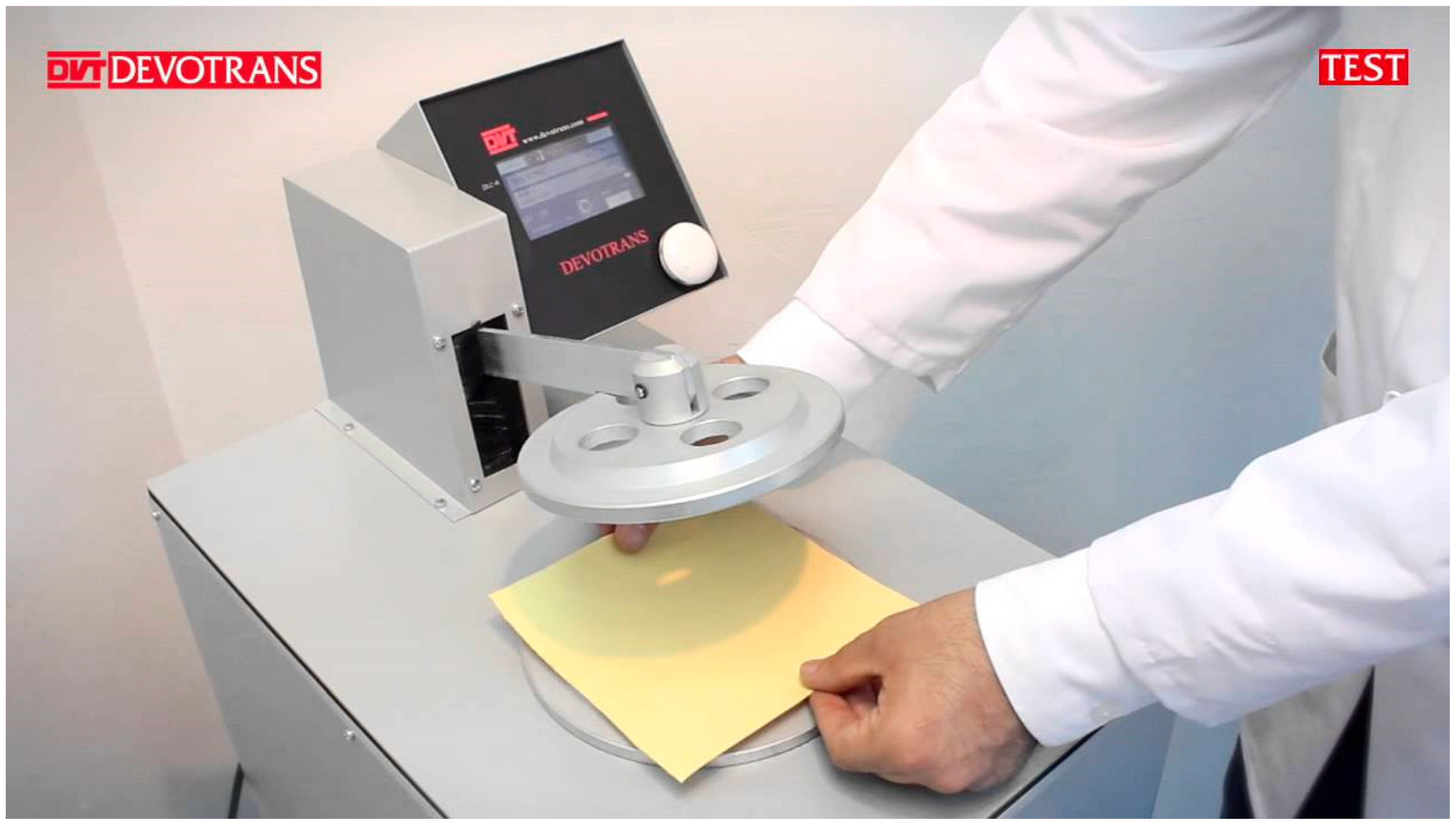
Testing was carried out using a Devotrans HG DLC air permeability tester (Devotrans, Istanbul, Türkiye) in accordance with ASTM D737-04. A photograph of the instrument is provided as
Figure 1.
Water vapour transmission behaviour was evaluated using a wet-cup gravimetric procedure based on ASTM E96 [
27]. In this procedure, Petri dishes with a depth of 20 mm were filled with equal amounts of pure water at 23 °C and then covered with the fabric specimens. The prepared cups were kept for 24 h at 22 °C and 65% relative humidity, and the assembly mass was monitored hourly during the test period, while the WVPf values reported in this study were calculated from the initial and 24 h mass measurements. At the end of the 24 h period, final masses were recorded and used for comparative evaluation of vapour transport. For each fabric type, three replicate measurements were carried out.
The wet-cup configuration was selected in preference to the complementary dry-cup procedure because the fabrics under evaluation are intended for warm-weather, perspiration-exposed apparel use, where the transport of vapour away from a liquid-water boundary (skin/sweat side) is the practically relevant comfort mechanism; the wet-cup arrangement more closely reproduces this boundary condition than the dry-cup method, which instead characterises vapour transport driven by an external humidity gradient. This choice is consistent with prior denim comfort studies that adopted wet-cup or equivalent gravimetric configurations to evaluate moisture-vapour transport under simulated wear conditions.
The water vapour transmission factor (WVPf) was calculated from the gravimetric mass loss over the 24 h test period according to the original laboratory calculation procedure. The Petri dishes had an external diameter of 9.0 cm, while the circular fabric area exposed to vapour transfer had a diameter of 8.4 cm. For each replicate, WVPf was calculated as WVPf = (m0 − m24)/0.054, where m0 is the initial mass of the cup–water–fabric assembly (g), m24 is the mass of the same assembly after 24 h (g), and 0.054 is the fixed calculation constant used in the laboratory procedure for all fabric and reference membrane measurements. The archived laboratory records documented the consistent use of this calculation constant but did not include its original derivation. Therefore, the reported WVPf values are treated as comparative wet-cup indices within the same test configuration and are not presented as absolute water vapour transmission rates or fabric-intrinsic permeability constants.
Two methodological limitations should be acknowledged when interpreting the air permeability and WVPf results. First, unintended stretching of the fabric during specimen mounting cannot be fully excluded, particularly for the single- and dual-core weft constructions, which contain elastane; localised tensioning during clamping could locally increase the effective pore area and thereby inflate air permeability and, to a lesser extent, WVPf measurements. Second, the WVPf values may additionally be influenced by swelling of the hydrophilic fibre components (cotton, hemp, lyocell) on contact with the water reservoir, and by the depth of the air gap between the fabric and the water surface in the wet-cup assembly, both of which are known to modify gravimetric vapour transfer results independently of the intrinsic fabric structure. Because these effects were not instrumented separately in the present test series, the reported values should be interpreted as comparative wet-cup indices under a fixed, standardised mounting and cup assembly protocol rather than as fabric-intrinsic permeability constants; this caveat is now made explicit rather than implicit in the interpretation that follows.
The present dataset does not include liquid moisture management measurements (e.g., AATCC 195). While such data would usefully complement the air permeability and WVPf results reported here, generating them requires additional laboratory testing that falls outside the scope of the present industrial sample set and is identified explicitly as a direction for future work in
Section 4, rather than being inferred indirectly from the transport data already available.
The paired evaluation of air permeability and water vapour transmission was adopted because both properties represent complementary but non-identical aspects of transport-related clothing comfort. Air permeability reflects the ease of airflow through the fabric structure, whereas wet-cup vapour transmission reflects the profile of moisture diffusion and evaporation under controlled boundary conditions. These variables should be interpreted together with structural descriptors such as fabric mass, sett, yarn count and fabric compactness, since the governing mechanisms for airflow and vapour transport are related but not identical [
7,
23,
24].
Movement- and handle-related comfort descriptors reported in
Section 3.4 were obtained as follows. Elasticity, elastic growth and stiffness were all recorded within a single test according to ASTM D3107 [
28] (Standard Test Methods for Stretch Properties of Fabrics Woven from Stretch Yarns), using the 1.36 kg (3 lb) tension option applicable to woven stretch fabrics; the resistance-to-extension value reported in kg was recorded within the same stretch-and-growth procedure and was not obtained from a separate bending stiffness test. Dimensional stability (shrinkage) was determined as the percentage change in warp- and weft-direction specimen dimensions (35 cm × 35 cm original specimens) after a single standardised domestic laundering cycle following TS EN ISO 105-C06 [
29]. These measurements were included as movement- and handle-related comfort descriptors complementary to the air permeability and WVPf transport indicators, rather than as primary outcome variables of the present study.
2.3. Data Analysis
The experimental results were evaluated using descriptive statistics based on three replicate measurements per fabric type for both air permeability and WVPf, and the results were reported as mean ± standard deviation. Relationships among air permeability, WVPf, fabric mass and sett parameters were examined using correlation analysis. Principal component analysis (PCA) was used as an exploratory multivariate method to visualise the combined influence of structural variables and transport-related comfort properties across the eleven denim fabrics. Rigid and dual-core fabric groups were initially compared using an independent-samples Welch’s t-test. Because the subgroup sizes were small and unbalanced and normality could not be assumed, the Mann–Whitney U test was additionally applied as a non-parametric robustness check. Because the present dataset represents an industrial sample set with deliberately unbalanced subgroup sizes, the inferential comparisons are interpreted as exploratory rather than confirmatory. The statistical outputs are therefore used to support structure–property interpretation rather than to claim a fully balanced factorial cause–effect hierarchy.
Because only one single-core fabric was available in the present industrial sample set, the statistical comparisons were interpreted primarily between rigid and dual-core constructions, while the single-core sample was retained for descriptive comparison only. Accordingly, the inferential comparisons reported in the
Section 3 should be interpreted as exploratory rather than confirmatory, especially because the industrial sample set does not provide balanced group sizes across all weft architectures.
It is also emphasised that, because warp composition, weft yarn count, ends/cm, picks/cm, fabric mass and weft architecture vary jointly across the eleven fabrics rather than being manipulated as independent factors, the statistical comparisons reported below cannot isolate the individual contribution of hemp content, yarn count or fabric density in a causal sense. Statements linking observed transport behaviour to hemp content or to dual-core architecture specifically are therefore presented as associations consistent with the data, not as demonstrations of an isolated causal mechanism.
All statistical analyses (descriptive statistics, correlation analysis, PCA and multiple linear regression) were performed in Python 3 (Python Software Foundation, Wilmington, DE, USA) using the SciPy, statsmodels and scikit-learn libraries.
3. Results and Discussion
The results were evaluated to determine how the hemp blend ratio, weft count and weft architecture influenced the comfort performance of the denim fabrics. Air permeability and water vapour transmission were selected as the principal transport-related indicators of denim comfort, and their relationship with structural parameters was considered throughout the discussion.
3.1. Air Permeability and Water Vapour Transmission
The air permeability and WVPf results of the eleven denim fabrics are summarised in
Table 2. Air permeability ranged from 96.68 mm/s for TYPE 2 to 252.96 mm/s for TYPE 8, indicating a substantial effect of fabric construction on breathability. Mean WVPf values ranged from 102.89 for TYPE 11 to 204.28 for TYPE 10, showing that the ranking of fabrics in terms of vapour transport did not fully mirror their air permeability performance.
Among the cotton-warp fabrics, the dual-core samples (TYPE 3–5) showed markedly higher air permeability than the rigid reference fabrics (TYPE 1–2). Within this subgroup, the finest dual-core weft construction, TYPE 5, combined relatively high air permeability with one of the highest WVPf values, suggesting that a lower mass and a modified yarn architecture may favour improved transport-related comfort behaviour within this sample set.
A similar tendency was observed in the cotton/hemp warp subgroup. TYPE 8, TYPE 9 and TYPE 10, all containing dual-core wefts, exhibited higher air permeability than the rigid and single-core alternatives. In particular, TYPE 8 produced the highest air permeability of the entire sample set. However, the highest WVPf values in this subgroup were obtained for TYPE 9 and TYPE 10 rather than TYPE 8, indicating that maximum breathability did not necessarily coincide with maximum vapour transfer performance. A comparable separation between air permeability and vapour-related comfort rankings has also been reported in sustainable denim studies containing regenerated fibres and elastane, where the fabrics with the highest breathability were not always those with the highest overall transport-related comfort performance [
9].
These findings show that air permeability and water vapour transmission should not be interpreted as interchangeable comfort indicators. While both are influenced by fabric openness, their response to yarn architecture and structural compactness is not identical. This is consistent with previous denim studies showing that fabric structure and mass can outweigh fibre composition when transport properties are considered [
7,
20].
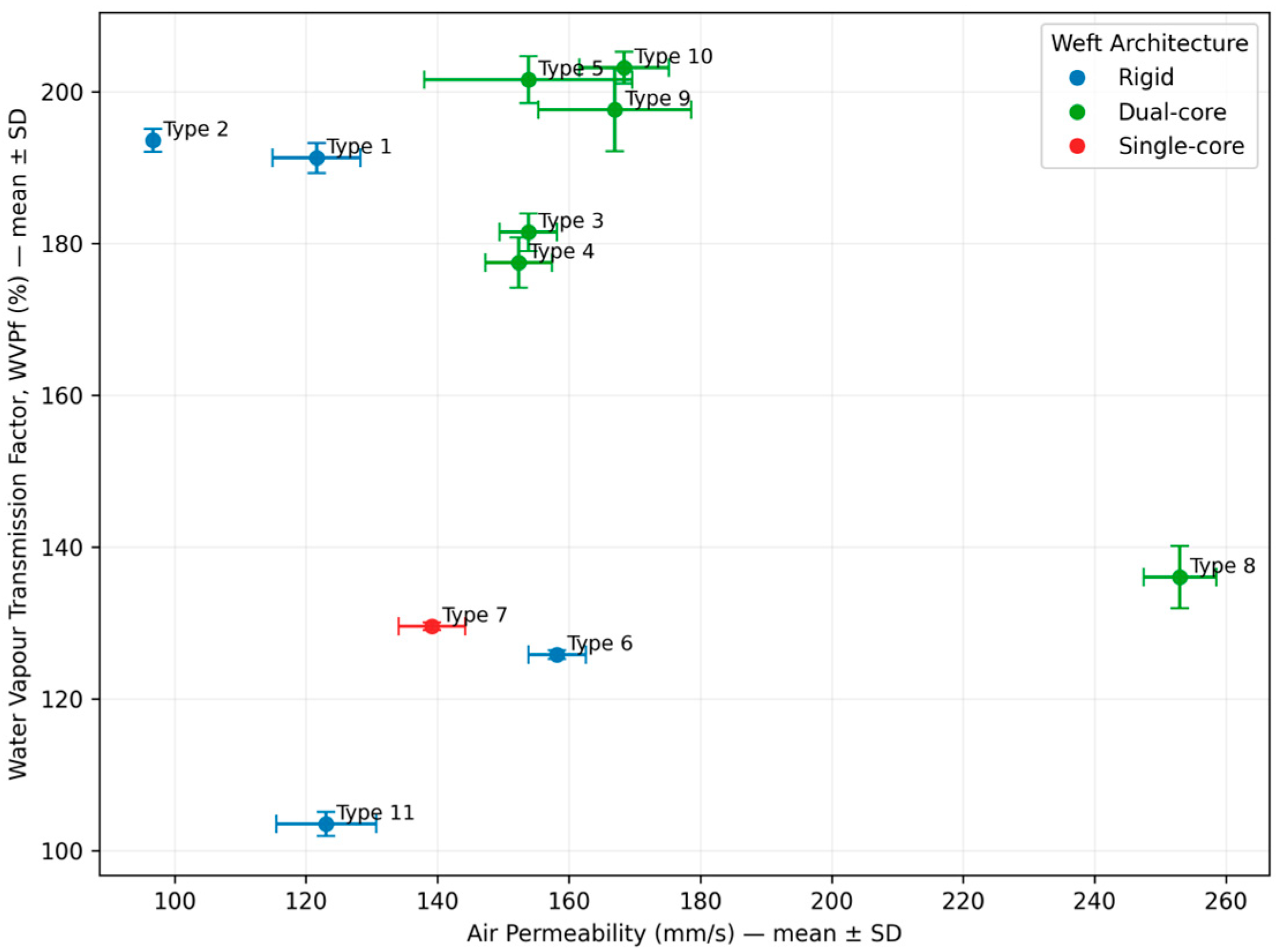
This distinction is also visible in
Figure 2, where the relationship between air permeability and WVPf does not indicate a simple one-to-one increase across all samples. TYPE 8 appears as the most breathable structure in terms of airflow, whereas TYPE 10 provides the highest wet-cup WVPf, confirming that the two transport properties capture related but not identical aspects of denim comfort behaviour. Across the whole sample set, the correlation between air permeability and WVPf was weak and negative (r = −0.135,
p = 0.692), confirming that these two transport indicators did not vary in parallel. Air permeability also showed a negative tendency with fabric mass that did not reach statistical significance (r = −0.496,
p = 0.121), while the relationship between WVPf and fabric mass showed a similarly non-significant negative tendency (r = −0.459,
p = 0.156). These results support the interpretation that breathability and vapour transfer behaviour respond differently to the combined influence of yarn architecture and fabric compactness.
From a comfort perspective, this divergence between airflow and vapour transfer rankings is important. Denim comfort cannot be reduced to a single transport descriptor, because structures favouring airflow may differ from those favouring water absorbency, vertical and transfer wicking, drying efficiency or thermal response [
25]. Likewise, denim-comfort studies have demonstrated that elastane-containing or engineered-yarn denim fabrics may exhibit favourable movement comfort or fit retention while simultaneously showing lower air or water vapour permeability than less compact constructions [
9,
30]. Accordingly, the present results should be interpreted as showing that transport-related denim comfort is multi-dimensional: TYPE 8 appears to maximise airflow-related breathability, whereas TYPE 10 yields the highest WVPf response under the test conditions applied here. The broad spread of the data points in
Figure 2 further supports the view that airflow-related breathability and comparative vapour transfer behaviour are only partially coupled in this denim set.
3.2. Effect of Fabric Structure and Weft Architecture
When the findings are considered together with structural variables, fabric architecture appears more strongly associated with transport behaviour than fibre composition alone. In general, dual-core weft constructions were associated with higher air permeability than rigid constructions. This functional outcome can be attributed to the combined effect of lower fabric mass, modified yarn geometry and differences in sett, all of which influence the effective porosity of the fabric. Earlier studies on dual-core denim fabrics likewise reported that yarn construction and fabric setting jointly control the resulting permeability behaviour [
14,
15,
17,
18,
19]. This interpretation is further supported by porosity-oriented denim studies, which demonstrated that variations in core-spun yarn design, filament fineness and yarn linear density strongly influence the air permeability response through changes in effective fabric porosity [
19]. When the fabrics were grouped by weft architecture—rigid constructions (TYPE 1, 2, 6, 11;
n = 4) versus dual-core constructions (TYPE 3, 4, 5, 8, 9, 10;
n = 6), with the single-core fabric (TYPE 7) excluded from this pairwise comparison, as noted in
Section 2.3—the dual-core constructions showed higher mean air permeability than the rigid constructions (174.72 vs. 124.88 mm/s, a 39.9% relative difference), while WVPf was likewise higher in the dual-core group (184.05 vs. 153.38 g/m
2/24 h, a 20.0% relative difference). Given the small and unbalanced group sizes, normality cannot be assumed, so both an independent-samples Welch’s
t-test and its non-parametric counterpart, the Mann–Whitney U test, were applied. The air permeability difference was significant under Welch’s
t-test (
p = 0.040) but fell short of conventional significance under the Mann–Whitney U test (
p = 0.069); the WVPf difference was non-significant under both (
t-test
p = 0.289; Mann–Whitney
p = 0.257). Given the magnitude of both relative differences and the high inter-fabric variability characteristic of this industrial sample set, we interpret the air permeability result as a robust trend rather than a confirmed effect, and the WVPf result as a weaker but directionally consistent trend, rather than treating either as a definitive confirmatory finding. These results suggest that, within the present sample set, dual-core design was associated with a stronger and more consistent airflow-related trend than with vapour transfer behaviour. As before, these comparisons remain exploratory because the available industrial design did not provide fully balanced subgroups, particularly for the single-core category. Comparable behaviour has also been reported in comparative denim studies, where rigid, core-spun and dual-core weft constructions produced distinct comfort and mechanical performance profiles depending on the yarn type and blending ratio [
31].
The role of hemp was more complex. Hemp-containing fabrics did not show a uniform increase or decrease in air permeability or WVPf across all samples. Instead, their performance depended on the way hemp was incorporated into the fabric system. This suggests that the effect of hemp should not be interpreted independently of the accompanying changes in yarn count, mass and fabric sett. Similar observations have been reported in previous studies on hemp- and flax-blended denim fabrics, where the effect of bast fibres on comfort was strongly conditioned by constructional variables and finishing treatments [
2,
8]. Work on hemp-blended single- and dual-core denim fabrics has likewise shown that hemp can improve moisture management, air permeability and relative water vapour behaviour, but that these gains remain strongly dependent on yarn architecture and treatment condition [
25].
The comparison between TYPE 1 and TYPE 11, which both contained rigid 100% cotton wefts but differed in warp composition, also supports this interpretation. Although these two samples were similar in weft type, their transport behaviour differed substantially, indicating that warp composition and the resulting structural balance of the fabric also contributed to comfort performance.
A comparison between warp families further showed that cotton/hemp warp fabrics tended to give higher mean air permeability than the cotton warp group (168.13 vs. 135.65 mm/s, p = 0.173), whereas the cotton-warp group tended to exhibit higher WVPf values (189.06 vs. 150.37 g/m2/24 h, p = 0.079). Although these differences did not reach conventional statistical significance, they indicate that the warp composition may contribute to comfort-related transport behaviour through its interaction with overall fabric structure.
The practical implication of this finding is that dual-core design may contribute to comfort in more than one way. In addition to influencing breathability through yarn geometry and effective porosity, such yarns are also associated in the literature with improved movement comfort, elastic recovery and dimensional stability, all of which affect wearer comfort during repeated use [
17,
30]. Hemp-blended denim research has further shown that the comfort advantages of hemp become more visible when transport, thermal and tactile descriptors are interpreted together rather than through air permeability alone [
25]. For this reason, the present AP and WVPf results are best understood as central components of a comfort profile rather than as isolated decision criteria.
3.3. Correlation and Multivariate Interpretation
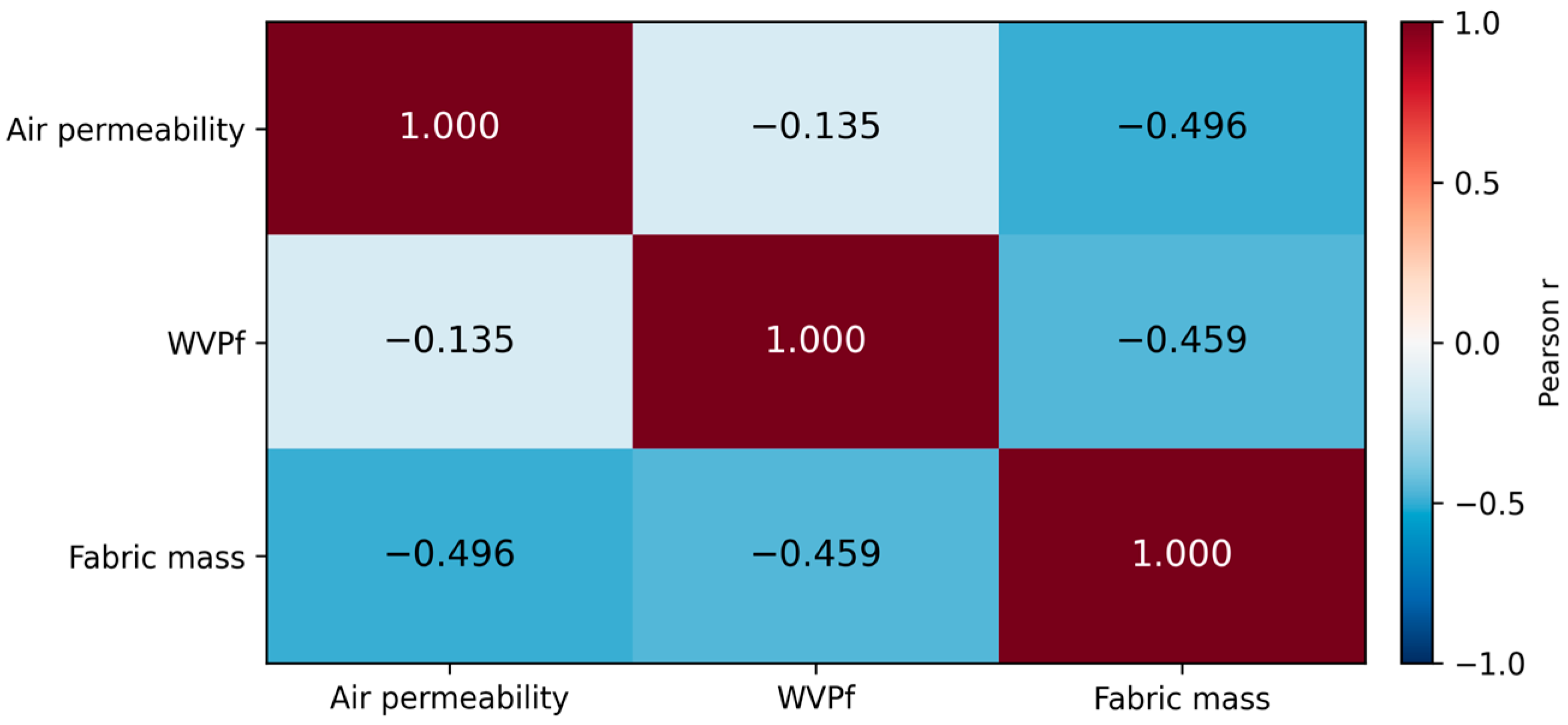
The overall relationships among the main variables are summarised in
Figure 3. The correlation matrix is consistent with the numerical analysis, which showed that air permeability was not strongly aligned with WVPf across the sample set (r = −0.135,
p = 0.692). This weak coupling is consistent with the two properties being governed by physically distinct transport mechanisms. Air permeability under ASTM D737 [
26] reflects bulk convective airflow driven by a fixed pressure differential, and is therefore dominated by the macro-scale geometry of inter-yarn and inter-fibre pores—a pathway highly sensitive to yarn packing density, sheath architecture and effective porosity, all of which differ markedly between rigid and dual-core constructions (
Section 3.2). WVPf, by contrast, reflects diffusive and sorptive vapour transport across a liquid-water boundary, a mechanism governed less by macro-pore connectivity than by the hygroscopicity and moisture-uptake behaviour of the constituent fibres (cotton, hemp, lyocell) and by boundary-layer effects at the fabric–water interface (
Section 2.2 and
Section 2.3). A fabric can therefore combine an open, high-porosity structure that favours bulk airflow with a fibre blend that is only moderately hygroscopic, yielding high air permeability but only moderate WVPf, or conversely combine a more compact structure with highly hygroscopic fibre content, yielding the opposite pattern. This mechanistic distinction—convective, geometry-dominated transport for air permeability versus diffusive, fibre-chemistry-dominated transport for WVPf—is the most plausible explanation for the limited correlation observed here, and is consistent with the broader comfort science literature distinguishing airflow-driven and moisture-driven comfort pathways [
7,
23,
24]. Air permeability showed a non-significant negative tendency with increasing fabric mass (r = −0.496,
p = 0.121), whereas WVPf showed a comparable non-significant negative tendency with mass (r = −0.459,
p = 0.156); given
p > 0.10 in both cases, these should be read as tendencies rather than established relationships. From a design perspective, this means that breathable denim development cannot rely on fibre substitution alone, but instead requires simultaneous control of yarn design and fabric structure. This interpretation agrees with reviews indicating that air permeability generally decreases with increasing fabric density and weight, whereas water vapour transmission is more strongly shaped by thickness, material type and blend composition than by any single structural variable in isolation [
24].
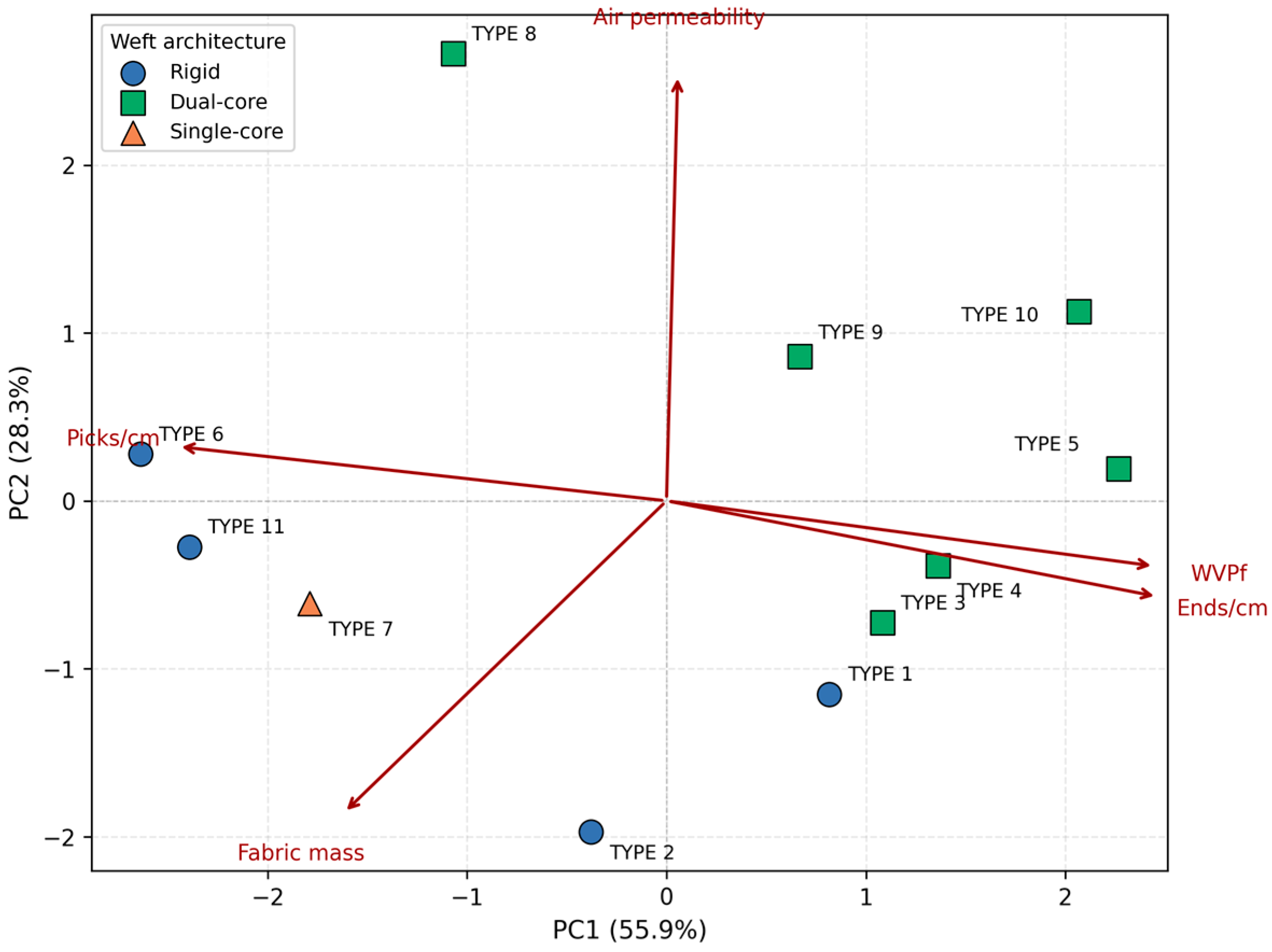
The multivariate distribution of the samples is presented in
Figure 4. PCA showed that the first two principal components explained 55.9% and 28.3% of the total variance, respectively. PC1 was mainly associated with higher WVPf and ends/cm and with lower picks/cm, whereas PC2 primarily contrasted air permeability against fabric mass. In this multivariate space, the dual-core fabrics generally occupied positions associated with higher air permeability, whereas WVPf remained more selectively distributed depending on the combined effect of weft fineness and structural compactness. This interpretation is consistent with previous denim studies showing that the yarn packing density, core-spun/dual-core design and constructional parameters jointly determine denim performance rather than acting independently [
13,
14,
15,
17,
18]. Within this interpretation, PC1 may be read primarily as a structure-governed vapour response axis, whereas PC2 may be read as a breathability-versus-mass contrast axis.
Multiple Regression Analysis
Because PCA does not partition variance among individual predictors, multiple linear regression was additionally used to relate air permeability and WVPf to hemp content in the weft, weft yarn count, ends/cm, picks/cm and fabric mass. A model including all five structural predictors simultaneously left only five residual degrees of freedom for 11 fabrics and did not reach significance for either response variable (AP: R
2 = 0.49, adjusted R
2 = −0.02,
p = 0.52; WVPf: R
2 = 0.75, adjusted R
2 = 0.49,
p = 0.13), with a high condition number indicating collinearity among the predictors—the same confounding of structural variables noted in
Section 2.3. A best-subset search restricted to two predictors, appropriate for the available sample size, identified fabric mass as the strongest available predictor of air permeability, but the corresponding model remained non-significant (AP ~ weft count + mass: adjusted R
2 = 0.29,
p = 0.11; AP ~ mass alone: adjusted R
2 = 0.16,
p = 0.12), confirming that, within this dataset, air permeability cannot be reliably attributed to any single structural variable or small variable combination. For WVPf, the best two-predictor model combined weft hemp content and picks/cm and reached significance (WVPf = 885.2 + 1.49 × hemp content (%) − 41.9 × picks/cm; adjusted R
2 = 0.61, F(2, 8) = 8.89,
p = 0.009), with picks/cm as a significant negative predictor (
p = 0.004) and hemp content as a positive but non-significant predictor (
p = 0.066). This result indicates that, of the variables examined, weft sett (picks/cm) exerted the more robust statistical influence on WVPf, while hemp content contributed a smaller, less certain positive effect—consistent with the qualitative observation in
Section 3.2 that hemp’s contribution to comfort-related transport is conditional on the accompanying structural parameters rather than acting as an independent driver. Given the sample size, these regression results should be read as descriptive of this dataset rather than as generalisable predictive models.
Taken together,
Figure 2,
Figure 3 and
Figure 4 indicate that the comfort behaviour of hemp-blended denim fabrics is governed by a coupled material–structure relationship rather than by fibre substitution alone. Hemp contributes to the sustainable and moisture-responsive potential of the fabric system, but the final comfort outcome depends on how the fibre blend is translated into yarn architecture, sett, fabric mass and effective porosity. This reading is consistent with textile comfort frameworks, which emphasise that thermophysiological comfort emerges from the interaction of transport, thermal and sensorial variables rather than from any single index in isolation [
23,
24]. A similarly non-parallel response between airflow-related and vapour-related comfort response has also been observed in recycled multi-layer denim systems, where the addition of a semi-permeable layer reduced air permeability but enhanced water vapour-related performance and dynamic cooling response [
32]. In denim-specific studies, this multi-parameter behaviour has likewise been observed when objective hand, thermal properties, moisture management and dimensional response were evaluated together with air and vapour permeability [
9,
25]. Therefore, the present findings strengthen the view that the design of hemp-blended denim should be approached through a coupled fibre–yarn–fabric comfort framework.
3.4. Broader Comfort Implications: Movement-Related and Handle-Related Descriptors
Although the present study is centred on transport-related comfort indicators, the broader comfort implications of the observed fabric architectures should also be considered. In denim applications, wearer comfort is influenced not only by air and vapour transport but also by movement-related behaviour such as stretchability and elastic growth, as well as handle-related descriptors associated with stiffness and tactile response. Studies on core-spun and dual-core denim fabrics have shown that these properties are closely linked to the yarn architecture and may alter the practical comfort perception of fabrics even when transport indicators alone suggest a different ranking [
17,
25,
30].
To further contextualise the transport-related findings, selected movement- and handle-related comfort descriptors derived from the same experimental dataset are summarised in
Table 3. Elasticity and elastic growth provide insight into movement comfort and fit retention, while stiffness and dimensional change reflect handle-related and wear-related comfort behaviour. Previous denim studies have shown that such parameters are strongly influenced by weft architecture and yarn design, particularly in fabrics containing elastane and dual-core structures [
17,
30].
Within the present sample set, movement- and handle-related descriptors varied noticeably across architectures. Elasticity and elastic growth were measured only for the seven elastane-containing constructions (TYPE 3–5 and TYPE 7–10); the remaining rigid, elastane-free fabrics (TYPE 1, 2, 6, 11) were not applicable for these two descriptors. Among the elastane-containing fabrics, the highest elasticity values were observed for TYPE 4 and TYPE 5 (37.2% and 33.8%, respectively), whereas the lowest value was recorded for TYPE 8 (16.4%). Elastic growth ranged from 7.68% (TYPE 8) to 15.52% (TYPE 5), indicating that greater extensibility was not always associated with better shape retention: TYPE 8 combined the lowest elasticity with the lowest elastic growth, whereas TYPE 5 combined high elasticity with the highest elastic growth. Stiffness, measured across all eleven fabrics, ranged from 0.84 kg (TYPE 11) to 1.36 kg (TYPE 7) and did not decrease uniformly in stretch-containing fabrics, suggesting that handle-related response depended on the specific yarn architecture rather than on stretch content alone. These results reinforce the interpretation that denim comfort is multi-dimensional and cannot be inferred from air permeability or vapour transmission alone.
In particular, the single-core TYPE 7 combined moderate elasticity and elastic growth with the highest stiffness value in the sample set, whereas TYPE 8—a fine dual-core construction that also produced the highest air permeability (
Section 3.2)—showed the lowest elasticity and elastic growth alongside a comparatively low stiffness value. This contrast suggests that movement comfort, fit retention and handle do not necessarily evolve in the same direction across engineered denim structures, and that the same fine dual-core geometry that favours breathability (TYPE 8) does not also favour stretch-related comfort [
33,
34]. From a design recommendation standpoint, the combined transport, movement- and handle-related results point to TYPE 8-type fine dual-core constructions (10/1 Ne dual-core weft, cotton warp) as the most suitable architecture where maximum breathability is the priority, whereas TYPE 9/TYPE 10-type dual-core constructions on a cotton/hemp warp are preferable where vapour transfer performance is prioritised over peak airflow; single-core constructions such as TYPE 7 combine moderate elasticity and elastic growth with the highest fabric stiffness among the elastane-containing constructions, whereas the finer dual-core constructions on a cotton warp (TYPE 4, TYPE 5) achieved the highest elasticity (37.2% and 33.8%) and, for TYPE 5, the highest elastic growth (15.5%) in the sample set, offering an alternative design route where stretch-related movement comfort is prioritised over peak breathability. For denim manufacturers seeking to improve breathability specifically, the present results suggest that reducing fabric mass and adopting finer, dual-core weft yarns should be prioritised ahead of increasing the hemp content, since the hemp content alone was not a statistically robust predictor of either transport property in the multiple regression analysis; hemp is better positioned in design terms as a contributor to sustainability-related fibre sourcing and to WVPf performance specifically when combined with an appropriately open weft sett, rather than as a general-purpose breathability lever.
From a comfort engineering perspective, drying-related behaviour should also be considered in future denim studies, since fabric weight, thickness, moisture management capacity and air flow conditions jointly determine practical drying comfort during wear [
35]. Notably, the movement-related and handle-related descriptors did not rank the fabrics in the same way as the transport-related indicators, further confirming the multidimensional nature of denim comfort.
4. Conclusions
This study provides the first joint evaluation, within a single set of industrially produced denim fabrics, of how the hemp blend ratio, weft yarn count and rigid/single-core/dual-core weft architecture together shape air permeability and the comparative water vapour transmission factor (WVPf). The main scientific contribution is the demonstration that these two transport indicators are only weakly and non-significantly coupled (r = −0.135, p = 0.692) and respond to different combinations of structural variables: dual-core architecture was the more consistent driver of air permeability, whereas WVPf was more robustly associated with the weft sett (picks/cm) and, to a lesser but statistically non-significant extent, the hemp content in the weft (multiple regression analysis). The hemp content on its own was not a statistically reliable predictor of either transport property once the yarn count, sett and fabric mass were accounted for, indicating that hemp’s comfort-related contribution in denim is conditional on the surrounding yarn and fabric design rather than an independent effect.
For denim design and manufacturing, the practical implication is that breathability targets should be pursued primarily through weft architecture (dual-core construction) and mass reduction, while vapour transfer targets benefit more from control of weft sett; hemp inclusion should be regarded as a sustainability- and moisture response-oriented design choice rather than a general breathability lever (
Section 3.4). The findings also confirm that transport-related, movement-related and handle-related comfort descriptors do not rank the same fabrics consistently, reinforcing that denim comfort optimisation requires a multi-descriptor design approach rather than reliance on any single test result.
This work has several limitations that should guide its interpretation and future research. The industrial sample set varies warp composition, weft count, sett, fabric mass and yarn architecture simultaneously rather than through a balanced factorial design, so the statistical associations reported here cannot be read as isolated causal effects of the hemp content or of the dual-core architecture (
Section 2.3). The air permeability and WVPf measurements are also subject to possible confounding from specimen-mounting tension in elastane-containing constructions and, for WVPf, from hydrophilic fibre swelling and air gap effects in the wet-cup assembly (
Section 2.2 and
Section 2.3). Liquid moisture management (e.g., AATCC 195), thermal resistance, drying behaviour and tactile properties were not measured in the present dataset and are recommended as priorities for follow-up testing on the same sample set, together with a more balanced factorial design—particularly a larger single-core subgroup—to allow confirmatory rather than exploratory statistical treatment of the hemp, yarn count and architecture effects identified here.