Article

Enhancing High-Performance Mechanical Properties of Lignin/PVA-Based Fiber: How Purity, Morphology, and Spinnability Play a Role


1
Materials Science and Engineering Research Group, Faculty of Mechanical and Aerospace, Institute Teknologi Bandung, Jl. Ganesa 10, Bandung 40132, Indonesia
2
Solid Mechanics and Lightweight Structures Research Group, Faculty of Mechanical and Aerospace, Institute Teknologi Bandung, Jl. Ganesa 10, Bandung 40132, Indonesia
*
Author to whom correspondence should be addressed.
Textiles 2026, 6(2), 49; https://doi.org/10.3390/textiles6020049
Submission received: 17 February 2026 / Revised: 10 April 2026 / Accepted: 13 April 2026 / Published: 17 April 2026

Abstract

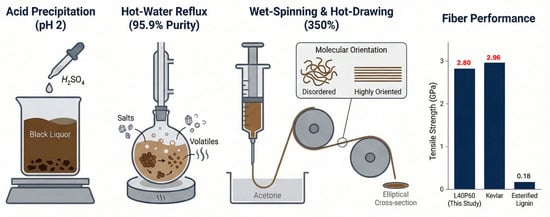
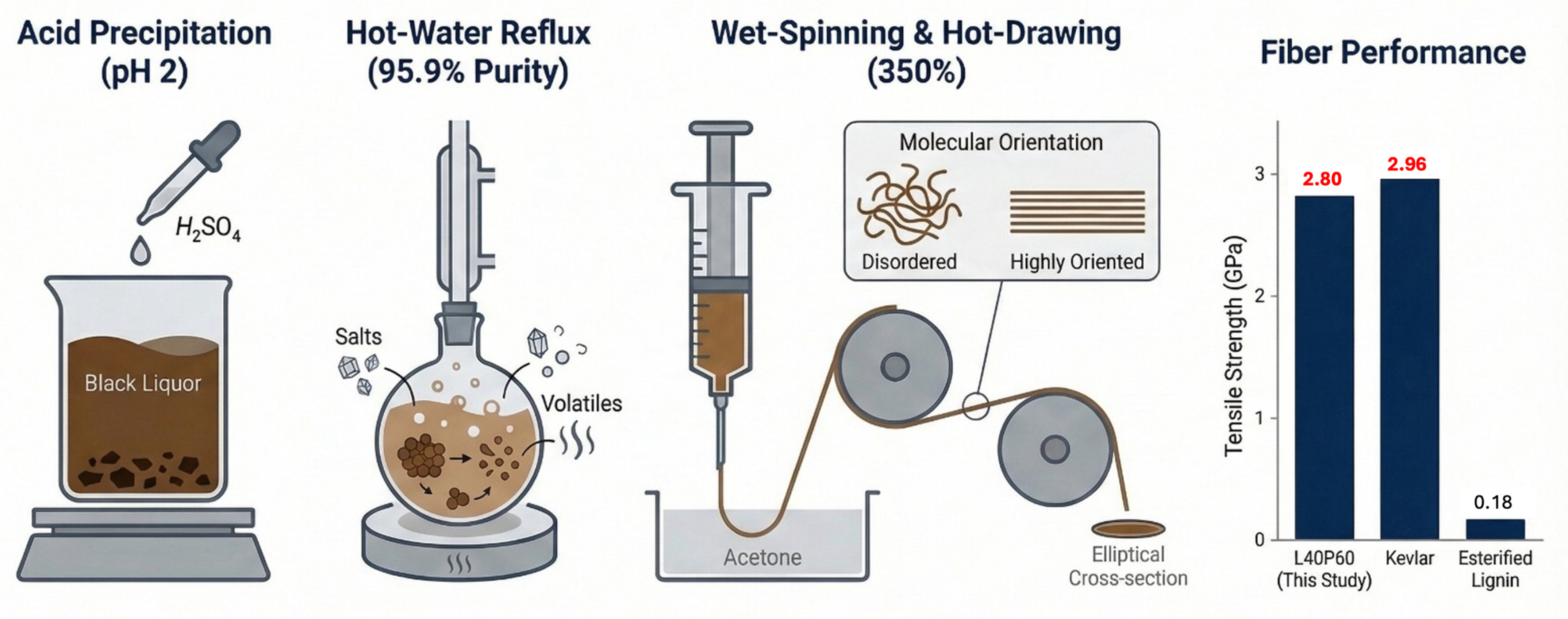
Lignin is an abundant aromatic biopolymer, but its conversion into high-performance fibers remains challenging due to intrinsically poor spinnability, structural heterogeneity, and inefficient stress transfer in lignin-rich systems. In this study, a processing and structure strategy is demonstrated to overcome these limitations by transforming industrial black-liquor kraft lignin into a spinnable and load-bearing fiber component. Kraft lignin recovered from black-liquor waste was extracted and subsequently purified using a hot-water treatment to remove inorganic impurities and thermally unstable fractions, increasing lignin purity to 95.9% through extensive deionized water purification using a water-to-lignin ratio of 300:1. The purified lignin was then blended with poly(vinyl alcohol) (PVA), wet-spun into continuous filaments, and subjected to post-spinning hot drawing to induce molecular orientation. This sequential extraction, purification, blending, spinning, and drawing approach enables stable wet spinning and the continuous formation of lignin-rich lignin/PVA filaments without filament breakage, directly addressing the primary processing bottleneck of lignin-based fibers. Molecular-level miscibility between lignin and PVA is confirmed by the presence of a single glass transition temperature at 88.3 °C, indicating the formation of a homogeneous amorphous phase. SEM observations reveal composition-dependent surface roughness and non-circular cross-sectional morphologies arising from differential coagulation and shrinkage, demonstrating that lignin actively participates in the load-bearing fiber network rather than acting as a passive filler. As a result of purification-enabled spinnability, true blend miscibility, and post-spinning hot drawing, fibers with a lignin-to-PVA composition of 40:60 achieve a maximum tensile strength of 2.8 GPa, approaching the performance range of commercial high-strength polymer fibers. This work establishes a clear relationship between material structure, processing strategy, and resulting properties, highlighting the potential of industrial lignin waste as a sustainable precursor for advanced fiber applications.

Graphical Abstract

1. Introduction

The global demand for high-performance fibers has increased significantly due to their critical roles in a wide range of structural and functional applications, including technical textiles (e.g., protective fabrics and geotextiles) [1,2], lightweight composites (e.g., aerospace and automotive components) [1,3], and industrial components (e.g., high-strength ropes and reinforced belts) that require exceptional strength-to-weight ratios [1,2,3]. Conventional petroleum-derived synthetic fibers, such as aramid [4,5,6], para-aramid [4,5,6], ultra-high-molecular-weight polyethylene (UHMWPE) [2,5], and polyacrylonitrile (PAN)-based carbon fibers [2,7] dominate the market due to their superior mechanical properties. However, their production processes are energy-intensive and heavily dependent on fossil-based feedstocks, raising concerns regarding long-term sustainability, carbon footprint, and environmental impact [7,8,9]. Consequently, these challenges underscore an urgent need to identify alternative fiber precursors that are more sustainable, economically viable, and environmentally responsible [10].
Lignin, the second most abundant aromatic biopolymer on Earth, is a promising renewable precursor for high-performance fibers due to its rigid aromatic structure and thermal stability [11,12,13,14,15,16,17,18,19,20]. It is abundantly available as a byproduct of the pulp and biorefinery industries, particularly in black liquor from the kraft process, although it is still largely underutilized and mainly burned for low-value energy recovery [21,22,23,24,25,26,27,28,29,30]. However, lignin purity is a key factor governing fiber performance. Compared to unpurified lignin, high-purity lignin (ash < 1%, carbohydrates < 3%) produces fibers with more uniform diameters (<5% variation), lower porosity, and significantly higher tensile strength (30–60% improvement) [12,22,30,31]. In contrast, impurities such as ash and residual polysaccharides reduce thermal stability, disrupt rheological behavior, and induce defects such as pores and aggregates, ultimately limiting spinnability and molecular orientation during processing [31,32,33,34,35,36]. Therefore, purified lignin derived from black liquor is essential not only for improving fiber quality but also for enabling the sustainable and value-added utilization of this abundant resource. Nevertheless, achieving high-performance lignin-based fibers requires addressing additional inherent material limitations beyond purity alone.
Despite its promising potential, the development of native (non-carbonized) lignin fibers faces several intrinsic challenges [32,37]. The highly heterogeneous molecular architecture of lignin, its broad molecular weight distribution, and its predominantly amorphous nature constrain the extent of chain orientation during fiber spinning processes [38]. These inherent limitations often lead to suboptimal fiber quality, manifested as difficult-to-control dope viscosity, microstructural defects such as pores, aggregates, and diameter fluctuations, and properties that remain inferior to those of conventional synthetic fibers [39,40,41,42]. Several studies have further reported markedly reduced spinnability when the lignin fraction in the spinning dope is increased beyond certain thresholds, posing additional challenges for the processing and scalability of high-lignin-content formulations [12,43,44]. Collectively, these issues represent critical bottlenecks that must be addressed through appropriate material design and processing strategist before lignin can be advanced as a commercially viable precursor for high-performance fiber applications.
To address these limitations, blending lignin with polyvinyl alcohol (PVA) has been widely adopted as an effective strategy [15,45,46,47]. PVA, a hydrophilic semi-crystalline polymer, enhances chain entanglement, rheological stability, and intermolecular interactions through hydrogen bonding with lignin, resulting in improved spinnability and fiber uniformity [36,45,48]. This interaction promotes a more homogeneous structure and facilitates molecular orientation during drawing, reducing defects during wet spinning [45,49]. Consequently, lignin/PVA fibers exhibit significantly enhanced mechanical properties, with tensile strengths typically ranging from 120 to 350 MPa, compared to below 100 MPa for pure lignin fibers [45,50,51]. These improvements are attributed to better chain alignment and the presence of semi-crystalline PVA domains that enable efficient stress transfer within the fiber structure, with further enhancement achievable through post-drawing treatments [37,39]. However, despite these advances, studies on native lignin fibers remain limited, particularly regarding the combined effects of wet spinning and hot drawing. Therefore, this study develops lignin/PVA fibers via these processes to enhance molecular alignment and establish a clear structure–property relationship for high-performance sustainable fibers.
This approach offers a significant and novel contribution to the existing literature: rather than positioning lignin solely as a carbon-fiber precursor, the present work advances both the understanding and practical application potential of native lignin fibers as a sustainable alternative to conventional textile and polymer–based fiber composites. This is achieved through an integrated approach combining chemical design (blending), controlled processing conditions (wet spinning and drawing), and comprehensive chemical, and mechanical characterization. Accordingly, this study aims to bridge the knowledge gap between lignin’s bio-based potential and its practical implementation as a high-performance fiber, thereby opening new pathways for sustainable materials within both textile and polymer composite industries.

2. Materials and Methods

2.1. Material

Kraft black liquor waste used in this study was obtained from a pulp and paper manufacturing facility in Indonesia. Analytical-grade sulfuric acid (H2SO4) (95–97%; Smart Lab Indonesia Inc., South Tangerang, Banten, Indonesia) was employed in the acid precipitation and purification steps. Analytical-grade polyvinyl alcohol (PVA) flakes (Merck, Darmstadt, Germany) were used as the blending polymer. Acetone (98%, technical grade; Justus Kimiaraya Inc., Bandung, West Java, Indonesia) was used as the fractionation and coagulation agent during the wet-spinning process. Sodium hydroxide flakes (technical grade; Central Kimia Inc., Bandung, West Java, Indonesia) were purchased for the dissolution step. Demineralized water (DM water) and deionized water (DI water), both produced using a water purification system (EVOQUA Labostar Pro TWF UV; Evoqua Water Technologies GmbH, Barsbüttel, Deutschland, Germany), were used in this study. DM water was used to dilute the black liquor, while DI water was used during the lignin purification process.

2.2. Extraction and Purification Lignin from Kraft Black Liquor

Lignin was extracted from Kraft black liquor through an acid precipitation method. Initially, the black liquor was diluted with demineralized (DM) water at a weight ratio of 1:12 to reduce viscosity and ensure homogeneous mixing. Sulfuric acid (H2SO4, 6 M) was then added dropwise to the diluted solution until the pH reached approximately 2, inducing lignin precipitation. The resulting precipitate was separated by filtration using qualitative filter paper and subsequently washed with deionized (DI) water until the filtrate reached a neutral pH, indicating the removal of residual inorganic salts and excess acid. The washed lignin was dried in an oven at 90 °C and weighed periodically until a constant mass was obtained.
To further improve purity, the dried lignin was subjected to a reflux purification step. The lignin was dispersed in deionized (DI) water at weight ratios of 1:100, 1:150, 1:200, 1:300, and 1:400 in a reflux flask and heated at boiling temperature for 2 h. After refluxing, the lignin suspensions were filtered and dried, and the solids were again weighed periodically until a constant weight was achieved. The corresponding sample codes assigned to the purified lignin obtained from each DI-water treatment are summarized in Table 1.

2.3. Preparation of Lignin/PVA Fiber

Lignin was initially dispersed in acetone at a weight ratio of 1:50 (lignin:acetone) and stirred at 300 rpm for 30 min. The mixture was filtered using Whatman No. 41 filter paper, and the residue was air-dried at ambient conditions with forced air. A portion of the dried, acetone-insoluble lignin (0.5 g) was dissolved in 4.5 g of 5 wt% NaOH solution and stirred at 300 rpm for 30 min to promote complete dissolution. The resulting lignin solution was subjected to dialysis using regenerated cellulose dialysis tubing with a molecular weight cut-off (MWCO) of 12,000–14,000 Da. Dialysis was carried out against deionized (DI) water at a sample-to-solvent ratio of 1:100 (v/v), with the external solution refreshed every 1 h for 12 consecutive cycles. The process was continued until the pH of the dialysate reached neutral conditions. A 15 wt% PVA aqueous solution was subsequently added to the lignin solution to obtain lignin concentrations ranging from 0 to 100 wt%. Each mixture was stirred until a homogeneous and spinnable dope was obtained. Wet-spinning experiments were performed using a 5 mL syringe equipped with a stainless-steel needle (18-gauge, inner diameter of 0.85 mm, OneMed; Jayamas Medica Industri, Inc., Sidoarjo, East Java, Indonesia). The spinning dope was extruded using a syringe at a controlled flow rate of 0.15 mL/min into an acetone coagulation bath (35 cm in length) maintained at room temperature (≈25 °C) under static conditions. The residence time of the extruded filaments in the coagulation bath was approximately 60 s before being collected on a rotating drum collector (diameter of 5 cm). The fibers were collected at a rotational speed of 2.5 rpm, corresponding to a wind-up speed of approximately 35 cm/min. Following coagulation, the as-spun filaments were subjected to a hot-drawing process and stretched to 350% of their original length to induce molecular orientation.
The corresponding sample codes for the prepared fibers are presented in Table 2.

2.4. Testing and Characterization

2.4.1. Determination of Lignin Purity

Lignin purity was evaluated using the Klason lignin method in accordance with TAPPI T-222 om-02 [52,53,54]. Briefly, 1 g of dry lignin sample was mixed with 15 mL of 72% (w/w) sulfuric acid and stirred at 250 rpm for 2 h to ensure complete dissolution. The mixture was subsequently diluted to an acid concentration of 3% (w/w) and boiled for 4 h. The sample was filtered using Whatman No. 42 filter paper, washed with deionized water until neutral pH (pH 7) achieved, and then dried and weighed periodically until a constant mass was obtained. The measurement was conducted in triplicate for each sample, and the lignin purity was determined using Equation (1).
Lignin   purity = b a   ×   100 %
where a is the initial mass of the dry lignin sample and b is the mass of the acid-insoluble lignin residue after dissolution.

2.4.2. Determination of Ash Content

Ash content was determined following the TAPPI T-211 procedure [54,55,56]. Approximately 1 g of dry lignin sample was placed in a pre-weighed porcelain crucible and calcined in a muffle furnace at 700 °C for 6 h. After calcination, the crucible was cooled to room temperature in a desiccator, and the mass of the remaining inorganic residue was recorded. All measurements were conducted in triplicate for each sample, and the ash content was calculated using Equation (2).
Ash   content = b a   ×   100 %
where a is the initial mass of the dry lignin sample and b is the mass of the remaining inorganic residue after calcination.

2.4.3. Determination of Volatile Content

Volatile matter content was determined by heating approximately 1 g of lignin sample in a crucible and thermally treated at 220 °C for 6 h. After the heating process, the crucible was cooled to room temperature and the remaining mass was measured. The corresponding mass loss was then determined using Equation (3). Each sample was analyzed in triplicate for every formulation.
Volatile   content = ( a b ) a   ×   100 %
where a is the initial mass of the dry lignin sample and b is the mass of the remaining sample after heating.

2.4.4. Fourier Transform Infrared (FTIR) Spectroscopy

FTIR spectroscopy was performed to identify and compare the functional groups in both the black liquor–derived lignin and the fabricated lignin/PVA fibers. The analysis was conducted using a Shimadzu Prestige 21 spectrometer, Shimadzu, Kyoto, Japan. Infrared spectra were recorded in absorbance mode over the range of 4000–400 cm−1 with a spectral resolution of 4 cm−1. All samples were prepared using the KBr pellet technique prior to scanning to analysis.

2.4.5. Differential Scanning Calorimetry (DSC)

Thermal transitions of the lignin/PVA fibers were characterized using Differential Scanning Calorimetry (DSC; NETZSCH DSC214 Polyma, Selb, Germany) in accordance with ASTM D3418 [45,46,57]. Samples (approximately 10 mg) were sealed in aluminum pans and heated from −50 to 200 °C at a constant heating rate of 10 °C/min under a nitrogen purge (20 mL/min). A single heating cycle was employed, and the glass transition temperature (Tg) was determined from the midpoint of the heat capacity step change in the thermogram. The resulting Tg values were used to assess the amorphous phase behavior and to infer the degree of molecular-level miscibility within the lignin/PVA system.

2.4.6. Scanning Electron Microscopy (SEM)

The surface morphology and cross-sectional structure of the lignin/PVA fibers were examined using a scanning electron microscope (SEM; Hitachi SU3500, Hitachi, Tokyo, Japan). Prior to imaging, the samples were sputter-coated with a thin layer of gold to enhance electrical conductivity and minimize surface charging. Imaging was performed under high vacuum at an accelerating voltage of 15 kV and a working distance of 12 mm.

2.4.7. Fiber Diameter Measurement

Fiber diameters were determined from SEM micrographs using ImageJ software version 1.54d. Prior to measurement, images were calibrated based on the SEM scale bar. For each sample, at least 50 measurements were taken at randomly selected locations along multiple fibers to ensure statistical representativeness. The fiber diameter was defined as the transverse dimension measured perpendicular to the fiber axis. The reported values correspond to the average diameter along with the standard deviation.

2.4.8. Tensile Test

Tensile characterization of the lignin/PVA fibers was carried out in accordance with ASTM D3822 [58]. All measurements were performed using Textechno Single-Fiber Tester Favigraph, Mönchengladbach, Germany. Prior to testing, the fibers were conditioned at 21 ± 1 °C and 65 ± 2% relative humidity for 24 h to ensure consistent moisture content. The tests were conducted with a gauge length of 10 mm and a crosshead speed of 1 mm/min. For each sample formulation, at least twenty individual fibers were tested to obtain statistically reliable results. The tensile strength and elongation-at-break were calculated directly from the force–displacement curves.

3. Results

3.1. Influence of Water-to-Lignin Ratio on Purity and Impurity Removal

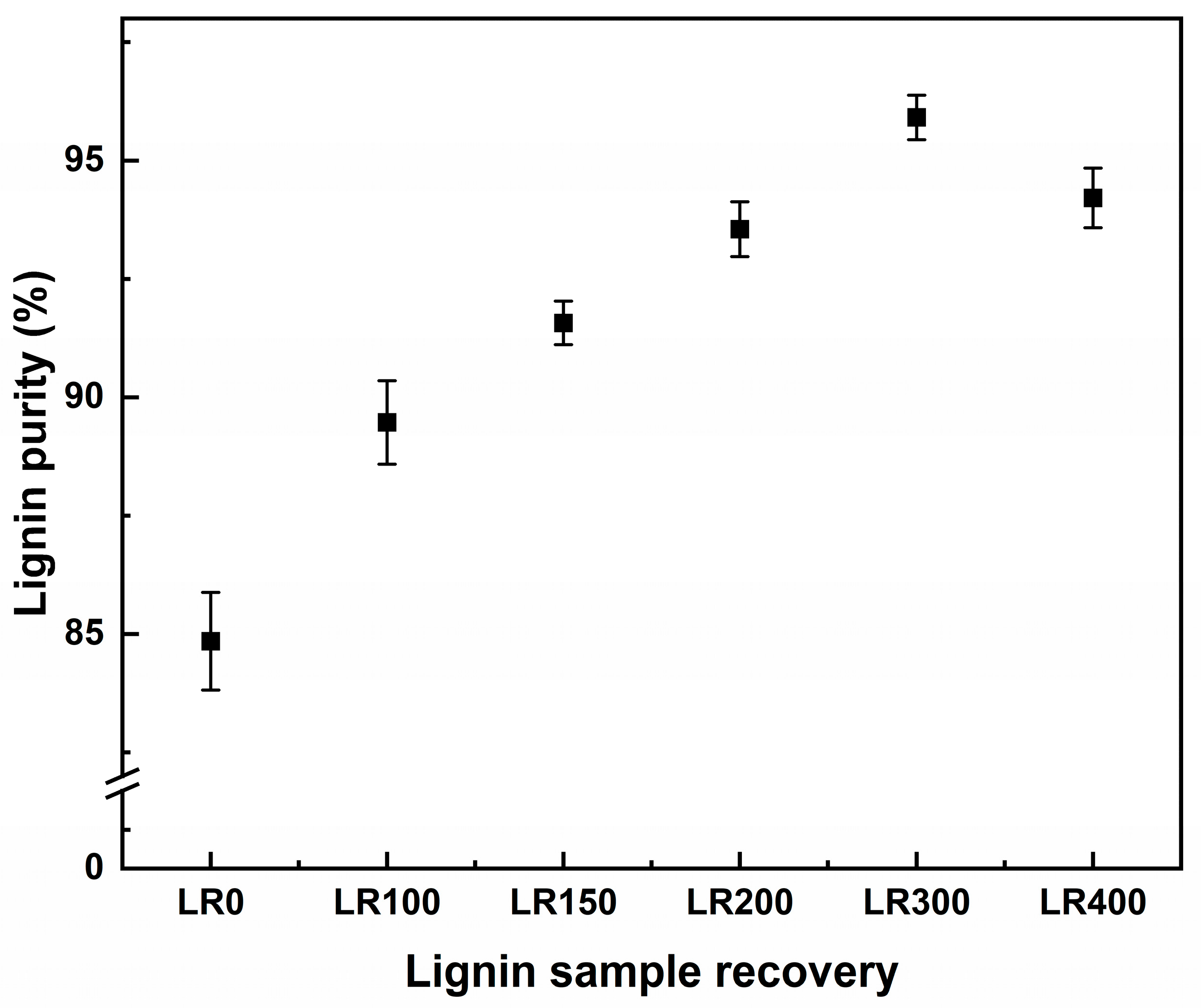
The purity of the extracted lignin increased progressively from LR0 to LR300 during the hot-water purification process using deionized water (DI water), followed by a slight decrease at LR400, although the purity remained marginally higher than that of LR200 (Figure 1).
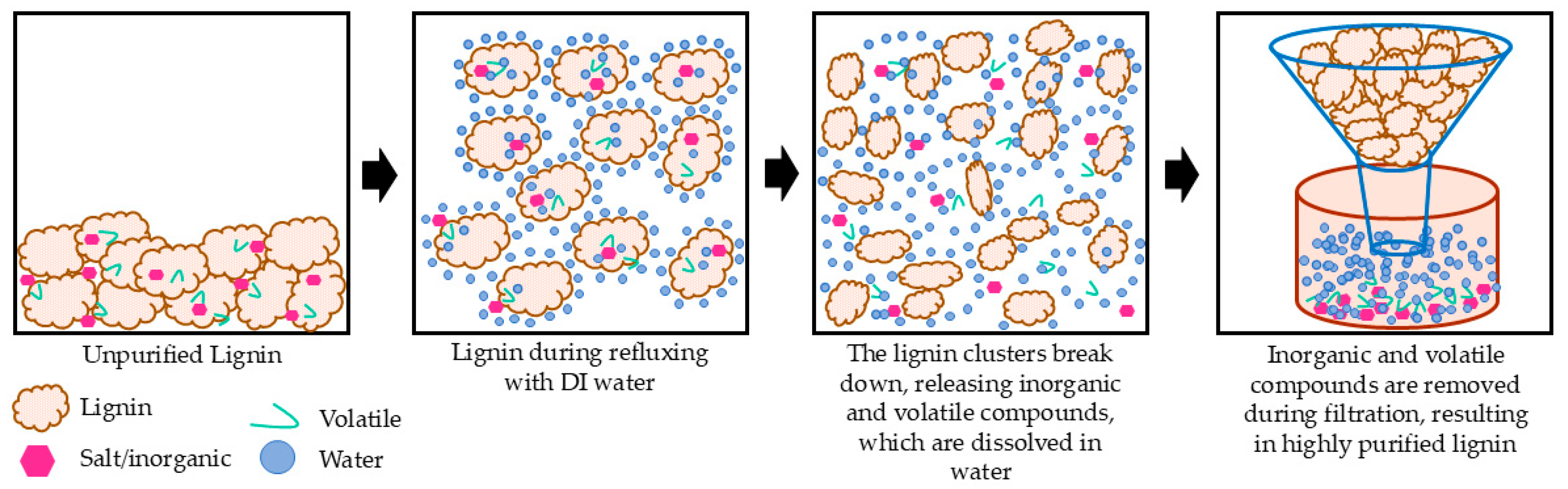
The highest purity was obtained for the sample refluxed with DI water at 300 times the lignin mass (LR300), reaching 95.91%. This improvement is attributed to two mechanisms: (i) the breakdown of lignin clusters, allowing trapped inorganic salts and volatile components to dissolve into the water, and (ii) hydrolytic cleavage of less stable internal linkages, particularly β–O–4′ ether bonds, during the purification process [59,60]. An illustration of the proposed cluster-breakdown mechanism is shown in Figure 2.
During the hot-water treatment, lignin clusters partially disaggregate. This disaggregation facilitates the release of entrapped impurities, such as inorganic salts and volatile components, which subsequently diffuse into the aqueous phase. In addition, the elevated temperature promotes hydrolytic cleavage of less stable linkages within the lignin structure—particularly the β–O–4′ ether bonds—further facilitating the removal of contaminants originally embedded within the lignin clusters. A molecular-level depiction of the β–O–4′ linkages and their hydrolytic cleavage is provided in Figure S1. This visualization aids in understanding how these structural motifs influence lignin’s reactivity and its interaction within composite fiber systems. However, for LR400, excessive water appears to intensify lignin hydrolysis, reducing molecular weight. During Klason analysis, these low-molecular-weight fragments are more easily solubilized in 72% sulfuric acid and lost during filtration, resulting in a lower measured purity.
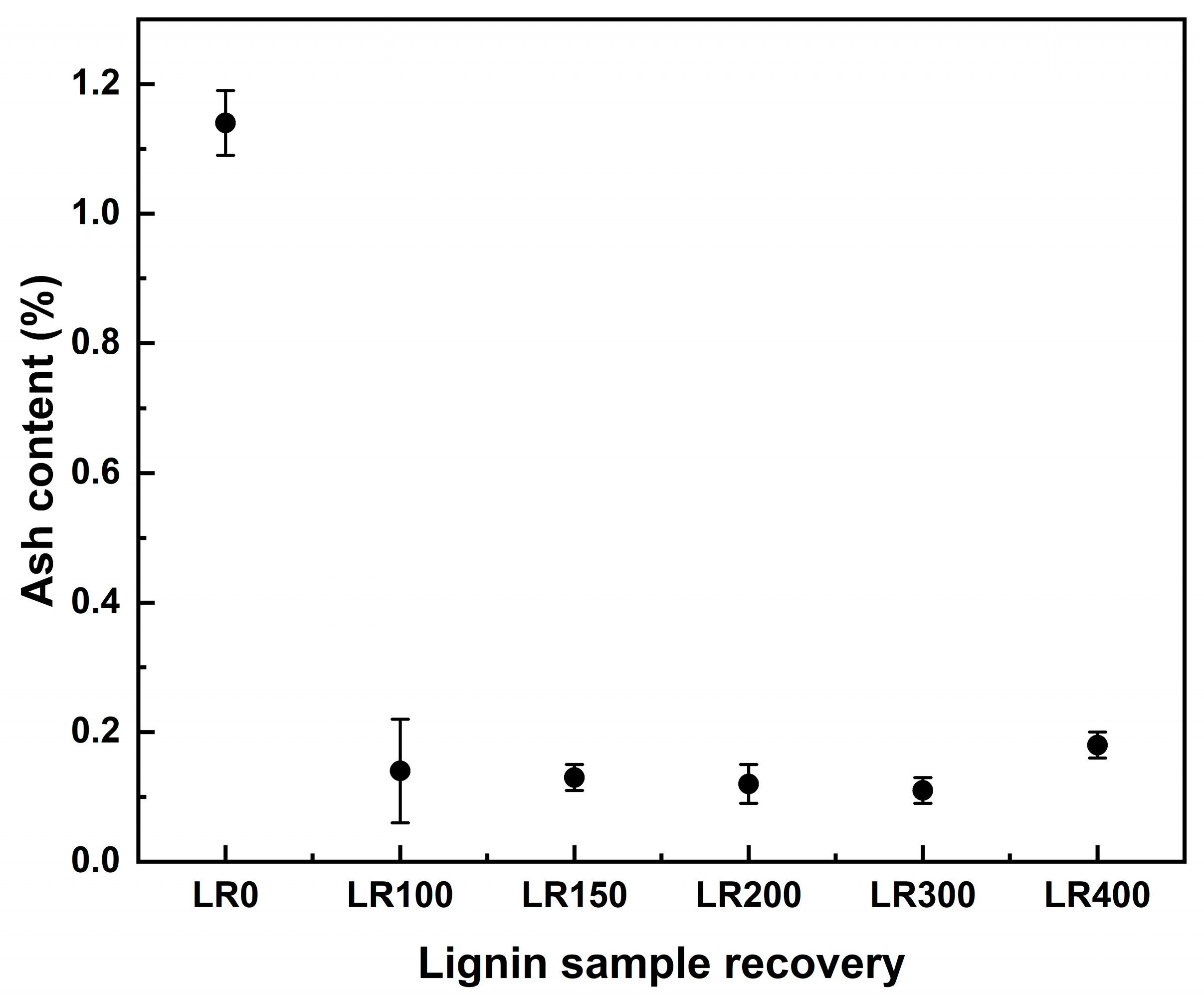
The dissolution and removal of inorganic salts during the hot-water purification process were confirmed by the substantial reduction in ash content, as presented in Figure 3. The ash content decreased by approximately 88% after purification, indicating that a large portion of mineral impurities was successfully separated. The concurrent increase in lignin purity together with the pronounced decrease in ash content demonstrates that DI-water hot-water treatment is an effective method for removing inorganic contaminants from kraft lignin.
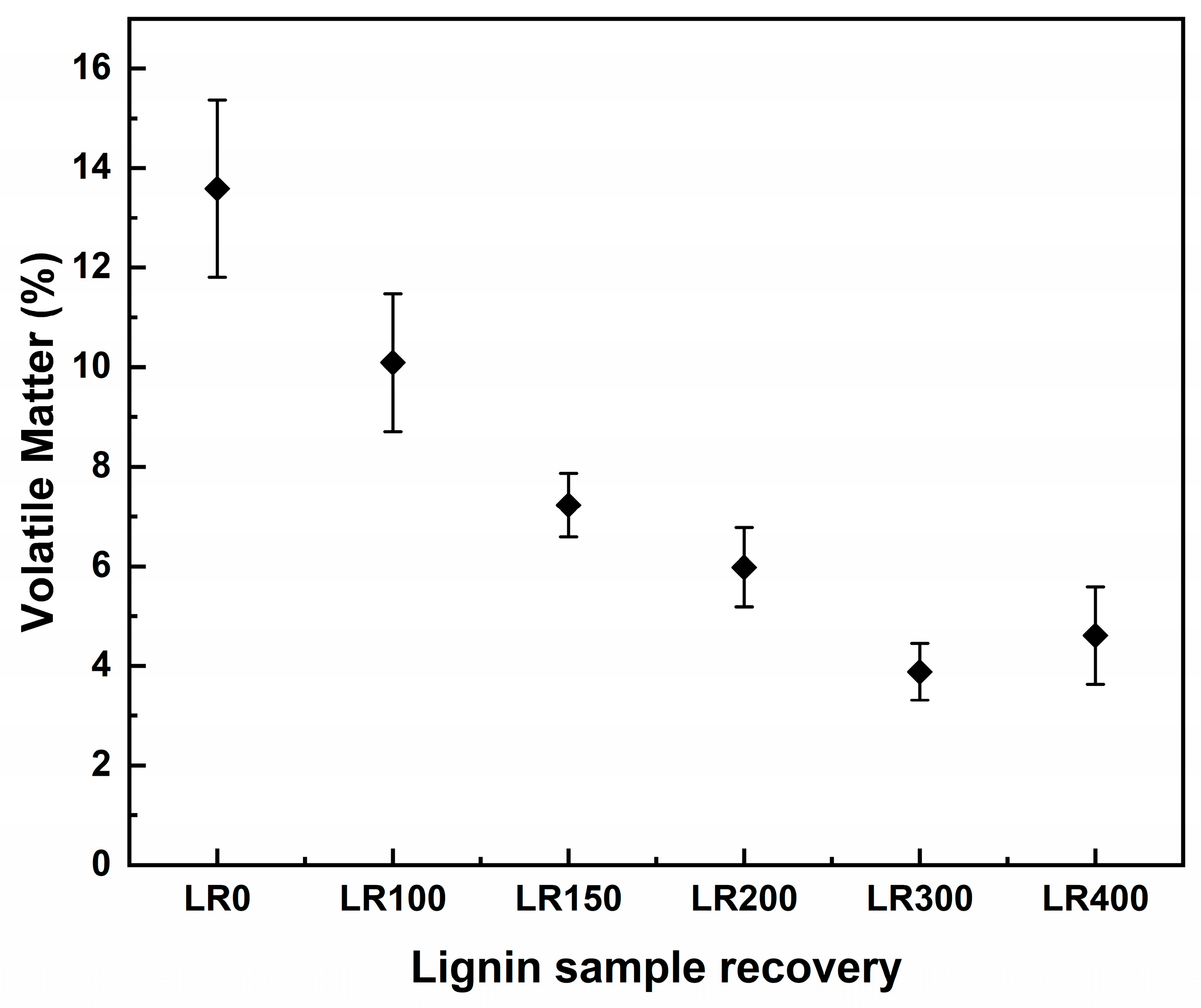
In addition to the reduction in ash, a significant decrease in volatile matter was also observed following purification, as shown in Figure 4. This reduction is attributed to the release and dissolution of volatile components into the water phase during the purification process. Such volatile species typically include gases trapped within the lignin structure, such as H2S, CO, CO2, N2, and moisture in the form of water vapor [61].
Considering the observed trends in lignin purity, ash content, and volatile matter collectively, LR400 exhibited lower purity and higher impurity levels compared with LR300. This suggests that treating lignin with an excessively large amount of DI water (400 times lignin mass) does not enhance purification efficiency. Instead, the treatment appears to leave behind more contaminants, likely caused by excessive hydrolysis and the loss of low-molecular-weight lignin fragments during Klason analysis. Based on these results, LR300 was selected as the optimal lignin for preparing high-performance lignin-based fibers, owing to its balance between high purity and retention of functional molecular structure, which is critical for downstream fiber processing and performance.

3.2. Role of PVA in Spinnability and Fiber Diameter of Lignin-Based Fibers

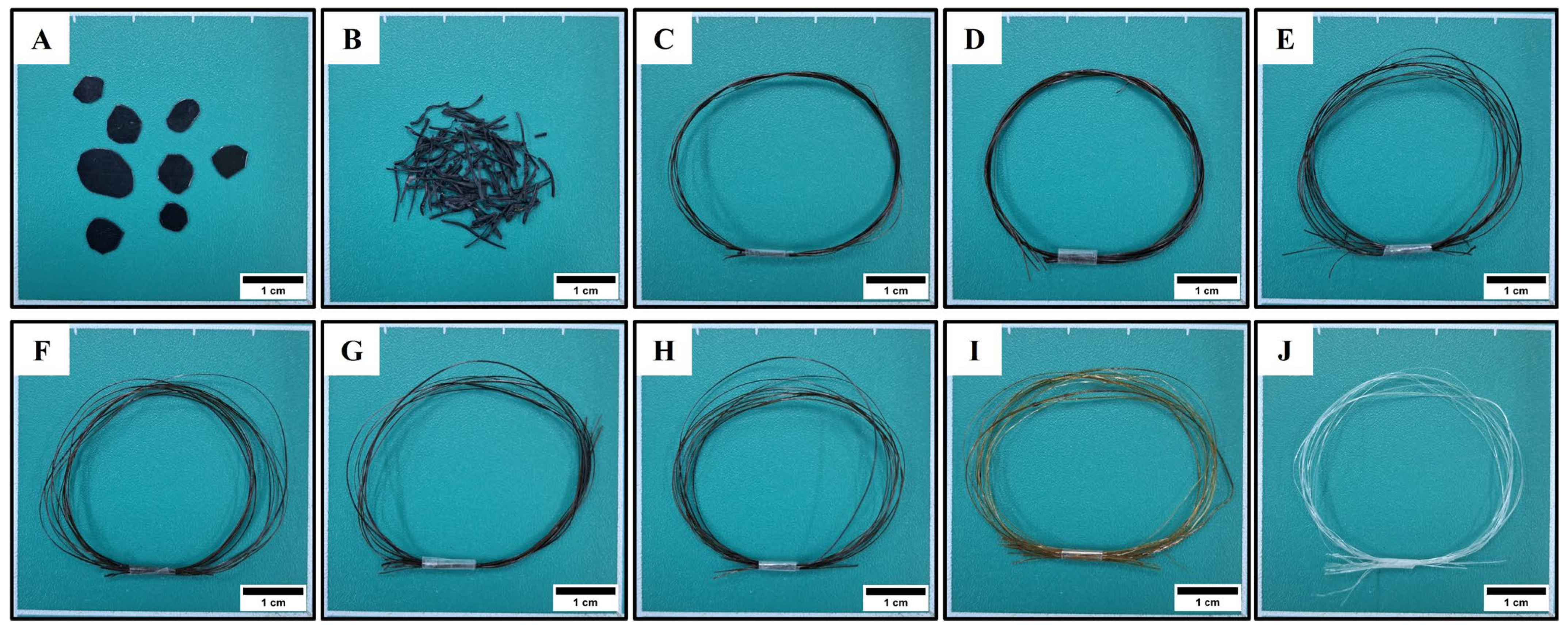
In this study, spinnability is defined as the ability of lignin to form continuous filaments through the wet-spinning process. A composition is considered to exhibit good spinnability when it can produce uninterrupted fibers during extrusion and coagulation. The spinnability of the lignin/PVA blends, along with their visual appearance after wet spinning, is presented in Figure 5.
As shown in Figure 5, fiber formation was achieved only when the lignin was blended with at least 30 wt% PVA, extending up to 100 wt% PVA. This observation confirms that PVA acts as an effective carrier polymer, that significantly enhances the spinnability of lignin. The images also reveal that lignin imparts a characteristic dark coloration to the fibers, with higher lignin content resulting in a progressively darker fiber coloration.
The average diameters of the lignin/PVA fibers obtained from each composition are summarized in Table 3. The results show that the fiber diameter increases with increasing lignin content. This trend is attributed to the rigid aromatic structure of lignin, which restricts the mobility and alignment of PVA chains during fiber formation, thereby reducing shrinkage during coagulation and drying. Consequently, fibers with higher lignin content exhibit larger diameters and slightly less uniformity. These observations demonstrate that PVA not only enhances spinnability but also allows for finer fiber formation, which is critical for optimizing mechanical performance in lignin/PVA fibers.

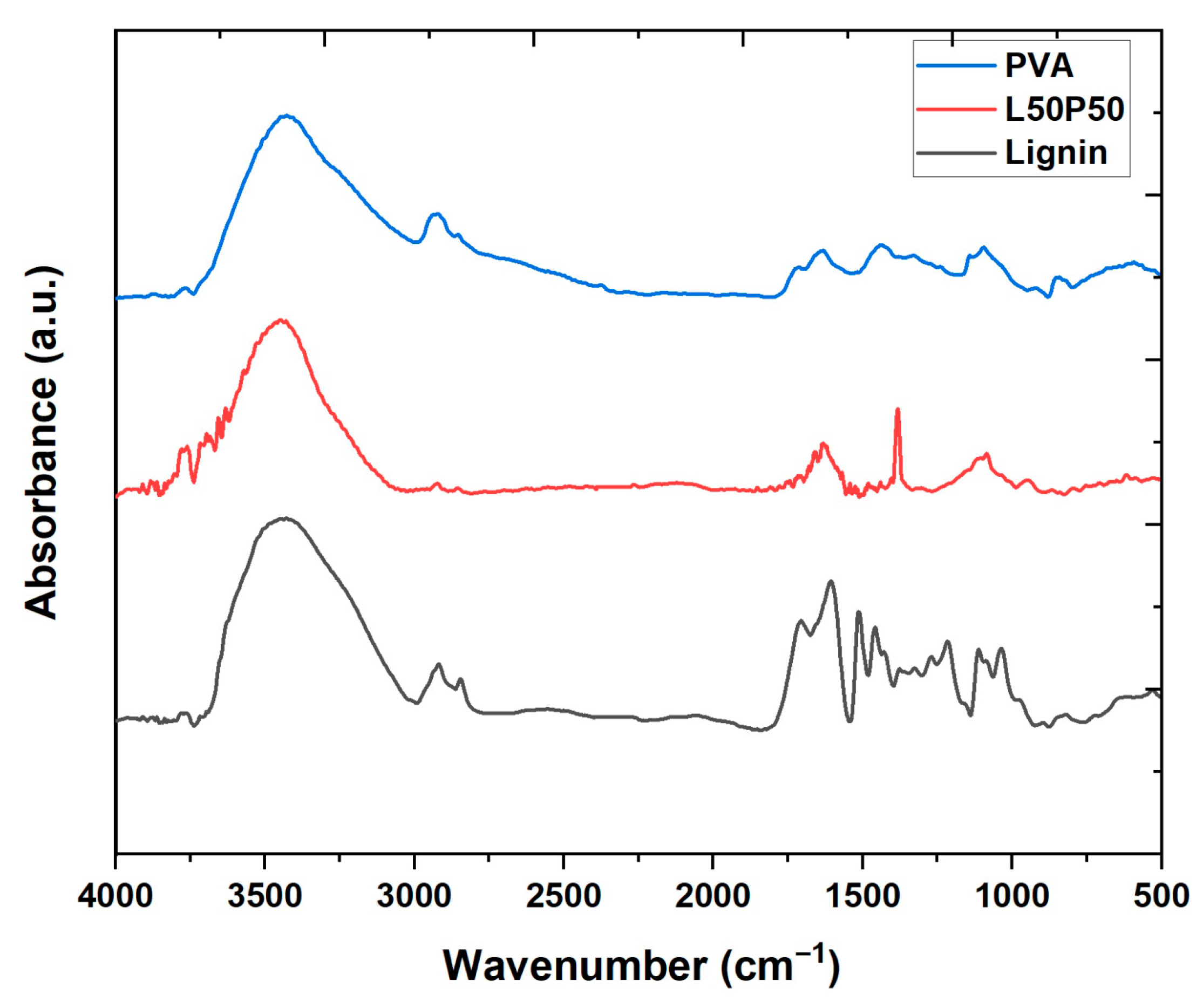
3.3. FTIR Characterization of a Lignin/PVA Fibers

The FTIR spectra of PVA, lignin, and the lignin/PVA fibers are shown in Figure 6. Lignin exhibits characteristic functional groups, including aromatic rings, phenolic and aliphatic hydroxyls, methoxyl substituents, and various aliphatic moieties [62,63,64,65,66]. In contrast, polyvinyl alcohol (PVA) is dominated by aliphatic C–H stretching, abundant hydroxyl groups, and residual acetyl groups originating from the incomplete hydrolysis of polyvinyl acetate [67,68].
The broad absorption band at approximately 3400 cm−1 is attributed to O–H stretching vibrations, indicating the presence of extensive hydrogen bonding within the system. The characteristic aromatic skeletal vibrations of lignin (~1600 and 1510 cm−1) are retained in the L50P50 blend, confirming the successful incorporation of lignin into the fiber structure. A pronounced absorption peak at 1382 cm−1, corresponding to C–H bending vibrations, is also observed. This feature is primarily associated with the PVA backbone and side groups, which possess sufficient conformational flexibility to undergo bending motions. In the 1000–1200 cm−1 region, associated with C–O and C–O–C stretching vibrations, the blend spectrum exhibits noticeable broadening, indicating overlapping contributions from both components and enhanced intermolecular interactions.
Notably, the characteristic C–O stretching band of lignin at 1217 cm−1 is not observed in the lignin/PVA fibers. This disappearance is attributed to strong intermolecular hydrogen bonding between the hydroxyl groups of PVA and the phenolic or aliphatic hydroxyl groups of lignin, as illustrated in Figure S2.
Overall, these spectral changes provide clear evidence of strong intermolecular interactions between lignin and PVA, highlighting the active role of lignin in forming hydrogen-bonded networks within the blend. These interactions improve the compatibility between the two components and contribute to the formation of a more integrated fiber structure.

3.4. Miscibility Analysis of Lignin/PVA Fibers

The DSC thermogram of the lignin/PVA fiber containing 50 wt% lignin (L50P50) is presented in Figure S3. The thermogram focuses on the blended system, while the thermal characteristics of the individual components are considered based on commonly reported values in the literature [45,46]. The glass transition temperature (Tg) of polyvinyl alcohol (PVA) is typically around 80 °C, whereas lignin exhibits a broader Tg range (approximately 50–108 °C) due to its heterogeneous and polydisperse structure [45].
The L50P50 sample exhibits a single Tg at 88.3 °C, positioned between the Tg values of its constituent polymers. The presence of a single, well-defined transition indicates the formation of a homogeneous amorphous phase, suggesting that lignin and PVA are miscible at the molecular level. In contrast, immiscible systems would generally display multiple Tg values or a significantly broadened transition region due to phase separation.
Furthermore, lignin/PVA blends with comparable compositions have been reported to show Tg values within the range of approximately 85–92 °C, with lignin and PVA Tg values around 89.9 °C and 80 °C, respectively [46]. The Tg observed in this study (88.3 °C) falls within this range, indicating consistent thermal behavior. This shift toward a higher temperature relative to neat PVA can be attributed to intermolecular hydrogen bonding between hydroxyl groups in lignin and PVA, which restricts chain mobility and promotes cooperative segmental dynamics. Overall, these results confirm the formation of a miscible blend with favorable intermolecular interactions.

3.5. Morphological Analysis of Lignin/PVA Fibers

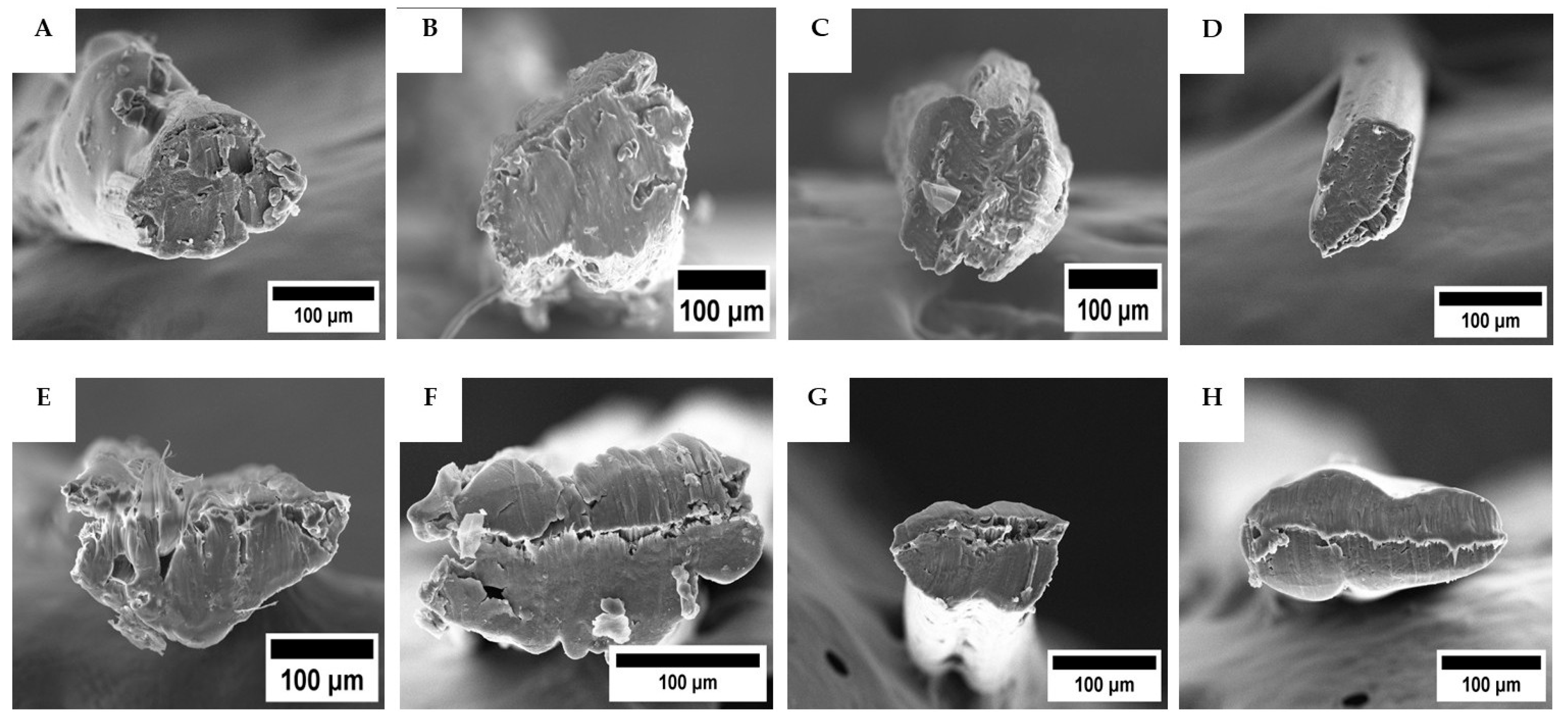
The morphology of the lignin/PVA fibers was examined using SEM to observe both the surface features and cross-sectional structures. Representative SEM images are presented in Figure 7. The SEM results show that fiber surface roughness depends varies depending on the lignin/PVA composition, reflecting the influence of composition on both external and internal morphology. This behavior is attributed to differences in shrinkage between lignin and PVA during drying. PVA undergoes greater shrinkage compared with lignin, leading to the formation of surface wrinkles or irregularities. Consequently, fibers with higher PVA content exhibit rougher surface textures in the SEM images.
The cross-sectional morphology further reveals that the fibers do not retain a perfectly circular geometry. During extrusion through the spinneret in the wet-spinning process, the dope experiences high shear rates, under which lignin exhibits shear-thickening tendencies that help maintain a circular filament profile. However, upon entering the coagulation bath, the shear forces drop to zero, causing the shear-thickening effect to diminish. Without sufficient structural rigidity at this stage, the filament is unable to sustain its circular cross-sectional shape.
Additionally, the freshly extruded dope is subject to gravitational force complete solidification. At this stage, the weak dope deforms under gravity to redistribute the load, leading to elliptical or non-circular cross sections, as illustrated schematically in Figure S4. These morphological features may influence fiber uniformity and mechanical performance, emphasizing the importance of optimizing both lignin/PVA composition and spinning conditions.

3.6. Tensile Behavior of Lignin/PVA Fibers

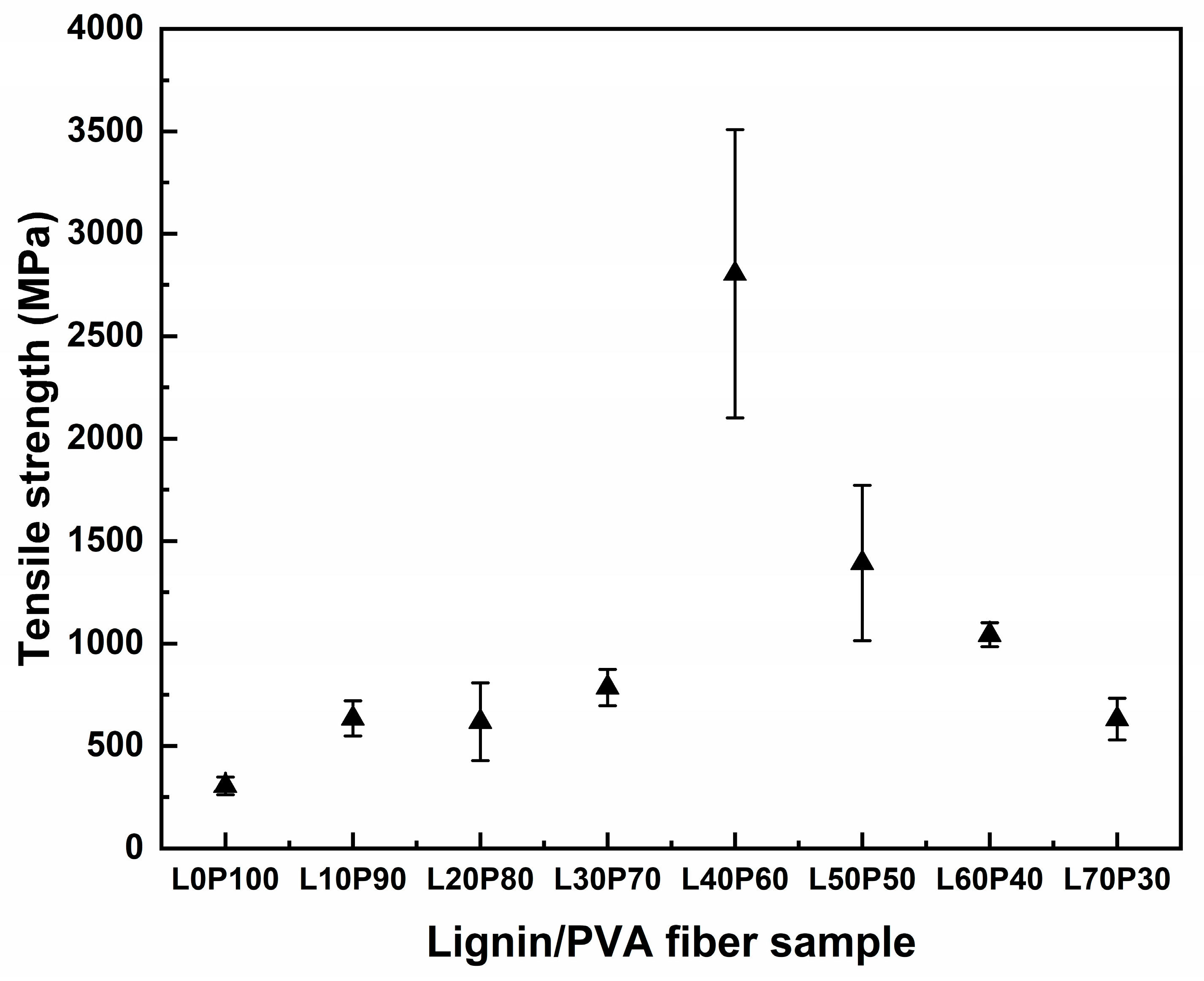
The tensile properties of lignin/PVA fibers with various lignin compositions are presented in Figure 8. The highest tensile strength obtained in this study was 2.8 GPa, achieved by the fiber containing 40 wt% lignin (L40P60).
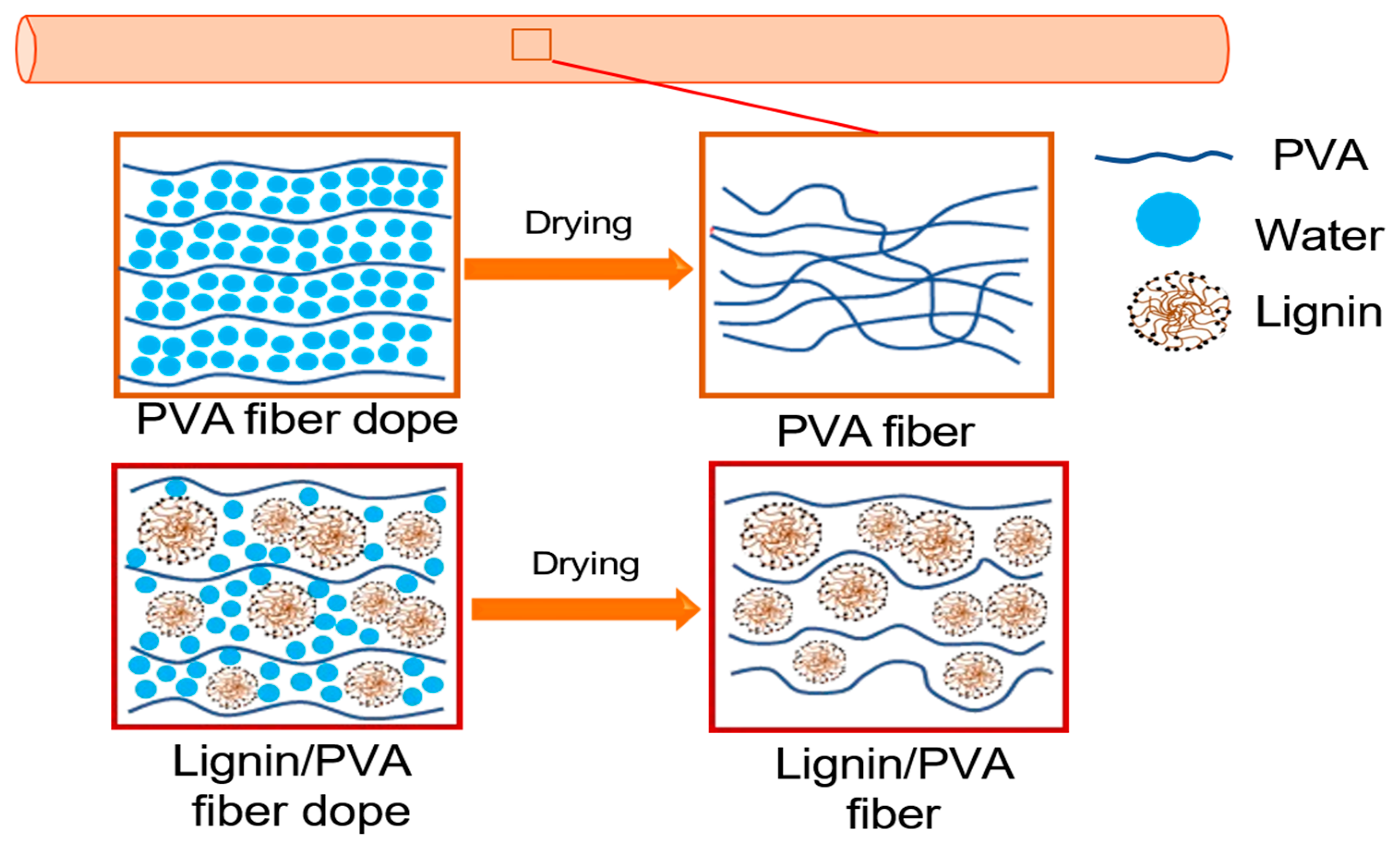
As shown in Figure 8, within the composition range of 0–40 wt% lignin, the tensile strength increases progressively with increasing lignin content. This enhancement is attributed to the role of lignin in promoting chain orientation within the PVA matrix, as illustrated in Figure 9. The dried PVA dope exhibits a disordered chain arrangement; however, the structure of the lignin/PVA dope after drying demonstrates a more oriented PVA chain alignment. Increasing lignin content further enhances this orientation effect.
The improved orientation arises from the formation of secondary interactions—primarily hydrogen bonds—between lignin and PVA. These interactions restrict chain mobility and contribute to a more compact and aligned fiber structure. Moreover, lignin contains bulky aromatic groups that inherently limit molecular motion due to steric hindrance, further increasing the resistance to chain displacement. As a result, the fibers become stiffer and capable of sustaining higher tensile loads.
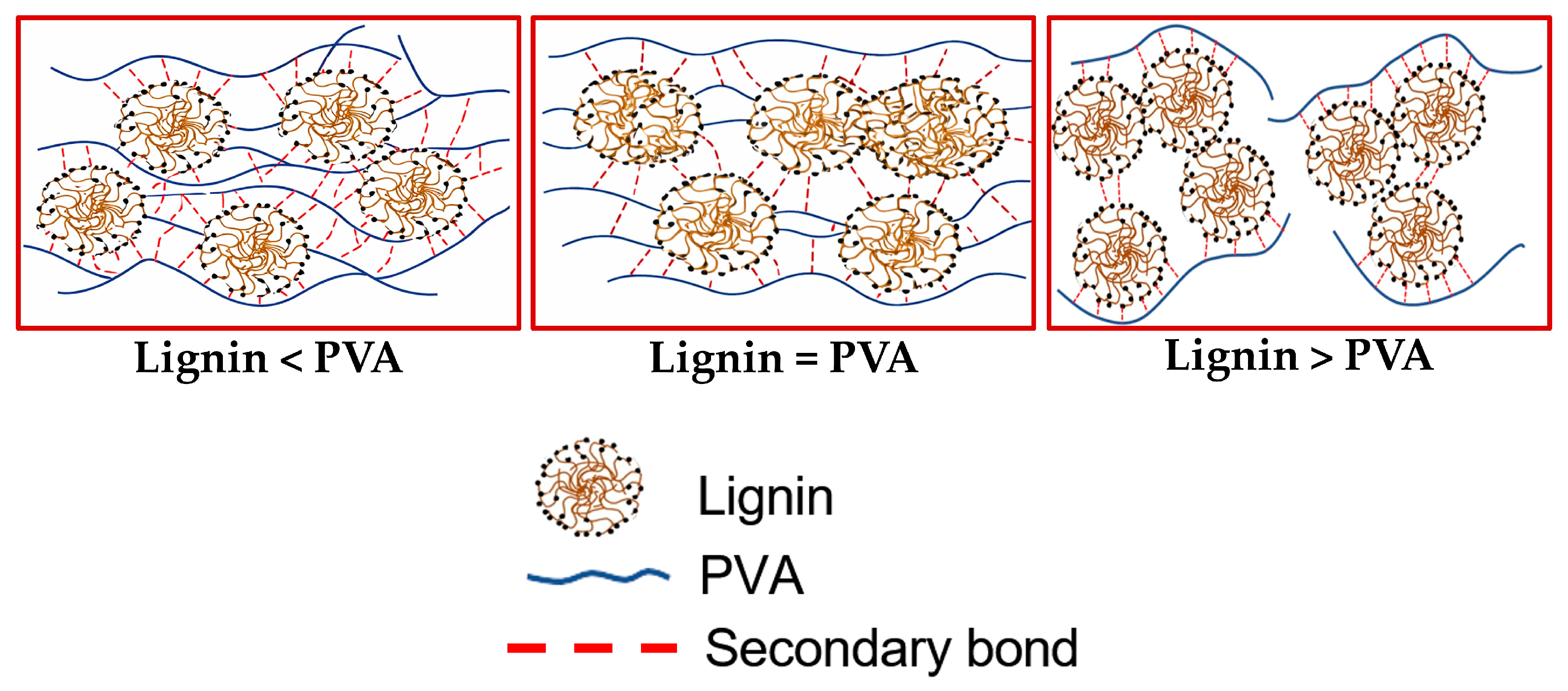
Within the composition range of 40–70 wt% lignin, the lignin/PVA blend shows micro-composite-like behavior, where lignin acts as a reinforcing phase and PVA serves as the continuous matrix. This behavior is closely related to changes in the microstructure as the lignin content increases, particularly the balance between chain entanglement, intermolecular interactions, and lignin aggregation, as illustrated in Figure 10. The presence of lignin promotes interactions with PVA and contributes to load transfer within the system, with optimum performance observed at the L40P60 composition.
To better understand this behavior, the system can be viewed across different composition ranges. At 0 wt% lignin (pure PVA), the structure is mainly governed by chain entanglement and intermolecular interactions between PVA chains. Because PVA is flexible, it forms a highly entangled network that provides basic mechanical integrity. However, without a rigid phase to support the structure, the overall performance remains limited, resulting in relatively low tensile strength.
At low lignin content (0–40 wt%; lignin < PVA), the system is still dominated by PVA. The addition of lignin begins to interfere with PVA–PVA entanglement while also introducing new interactions between lignin and PVA. These rigid lignin molecules can act as physical constraints within the matrix. As a result, even though the number of entanglements decreases slightly, the overall structure becomes more resistant to deformation, leading to an increase in tensile strength.
When the composition reaches around 50 wt% lignin, the reduction in PVA becomes more noticeable. Fewer polymer chains are available to form entanglements, and lignin molecules are closer to each other, which can initiate small agglomerates, although still limited, as shown in Figure 10. The interactions remain present but are no longer evenly distributed throughout the system. This less uniform structure leads to a slight decrease in tensile strength.
At higher lignin contents (60–70 wt%; lignin > PVA), the structure becomes increasingly dominated by lignin. The PVA network is no longer sufficient to maintain strong entanglement, and lignin agglomeration becomes more evident. This agglomeration reduces the interactions between lignin and PVA while promoting interactions among lignin molecules themselves. However, lignin–lignin interactions are weaker and less effective in reinforcing the system compared to lignin–PVA or PVA–PVA interactions. As a result, the overall bonding within the system is reduced, leading to a lower energy required for deformation and ultimately resulting in a further decrease in tensile strength.
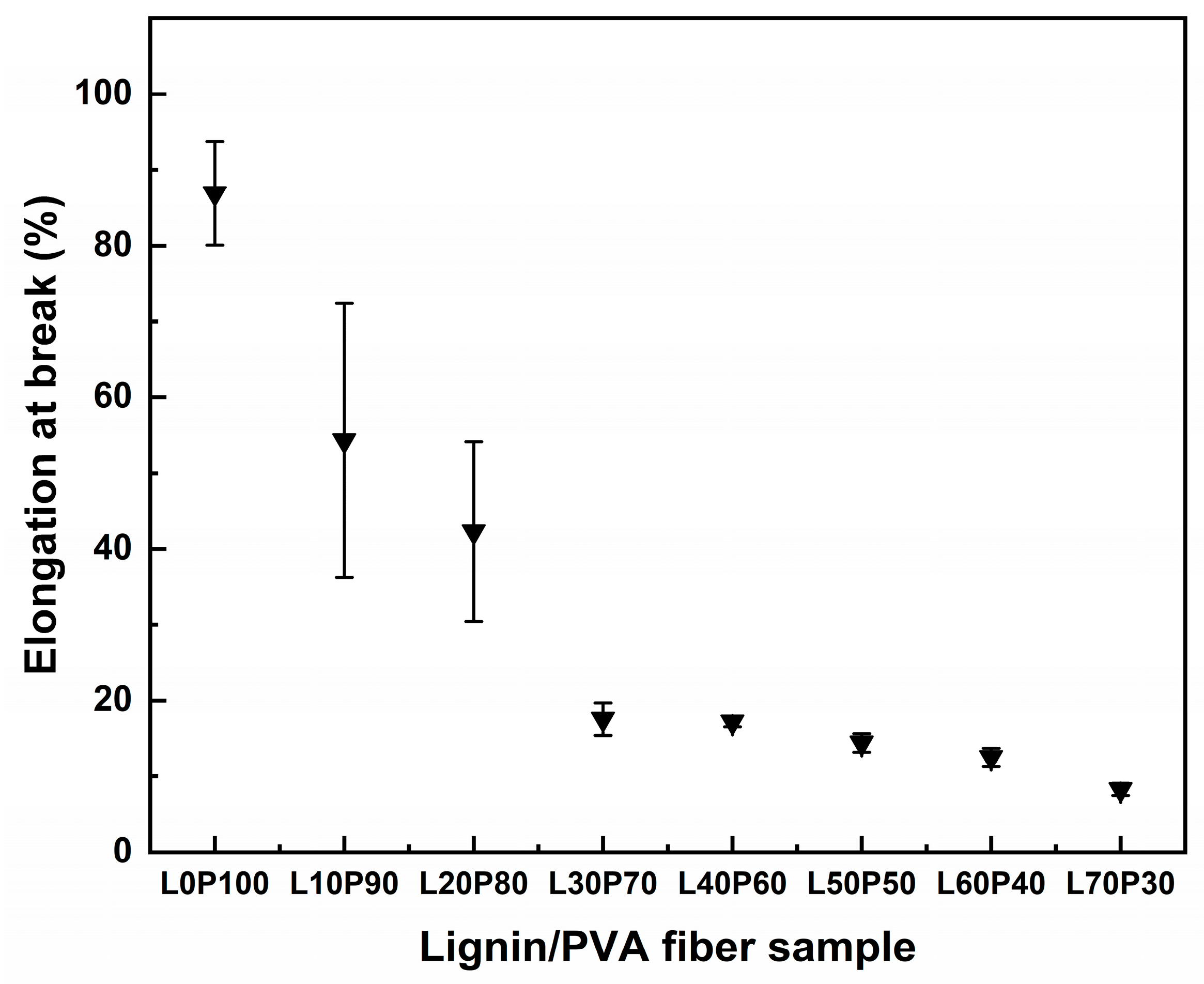
The strain–extension behavior of the lignin/PVA fibers under tensile loading is shown in Figure 11. In general, increasing PVA content leads to greater elongation at break. For compositions containing 70–100 wt% PVA, the elongation behavior is dominated by PVA, whose flexible aliphatic chains allow easier molecular deformation. Conversely, in the composition range of 30–70 wt% lignin, the elongation decreases with increasing lignin content. As previously mentioned, the rigid and bulky aromatic groups present in lignin restrict molecular mobility, resulting in lower strain at break as lignin concentration increases.
Building on this structure–property relationship, the tensile performance of the synthesized lignin/PVA fibers was benchmarked against representative polymer-based and lignin-derived fibers reported in the literature. A detailed comparison of tensile properties is provided in Table 4. The lignin/PVA fibers developed in this study exhibited a maximum tensile strength of 2.8 GPa at the L40P60 composition, placing their performance within the range of commercial aramid fibers, such as Kevlar 29 and Kevlar 49 (2.965 GPa), Heracron (2.800 GPa), and Technora (3.000 GPa). This tensile strength is substantially higher than those reported for most lignin-based fiber systems, including esterified polycaprolactone (PCL)–lignin (0.184 GPa), esterified PVA–lignin (0.048 GPa), and depolymerized organosolv lignin (DOL)–epoxy lignin (0.100 GPa).
This pronounced enhancement in tensile strength can be attributed to the synergistic effects of high lignin purity, molecular-level compatibility with PVA, and post-spinning hot drawing, which collectively promote efficient stress transfer and enhanced molecular orientation within the fiber structure. Compared to previously reported lignin/PVA fibers, the fibers produced in this study show an improvement approaching an order of magnitude. These results reinforce the conclusion that lignin/PVA fibers can surpass the conventional performance limits of lignin-based materials and represent a viable class of high-strength, sustainable fibers derived from industrial lignin waste.

4. Conclusions

In this study, purified Kraft lignin recovered from black-liquor waste was successfully blended with PVA to produce continuous lignin/PVA fibers via wet spinning. The results demonstrate that lignin purity, blend miscibility, and strong hydrogen-bonding interactions play critical roles in governing fiber formation, morphology, and mechanical performance. A single Tg confirmed the miscibility of the system, enabling the fibers to achieve an optimal tensile strength of 2.8 GPa at the L40P60 composition. Furthermore, this study establishes a clear structure–property relationship, highlighting how lignin purity, intermolecular interactions, and post-spinning hot-drawing collectively enhance molecular orientation and tensile performance. The ability to convert an abundant industrial byproduct into high-performance fibers underscores the sustainability potential of lignin/PVA systems as bio-based alternatives to petroleum-derived materials. Overall, these findings position lignin/PVA fibers as promising candidates for next-generation sustainable material technologies. Future work may focus on optimizing spinning conditions, tailoring dope rheology, and extending this approach toward carbon-fiber precursors or advanced functional textile applications.

Supplementary Materials

The following supporting information can be downloaded at: https://www.mdpi.com/article/10.3390/textiles6020049/s1, Figure S1: Schematic representation of lignin structure; Figure S2: Schematic representation of hydrogen bonding interactions between lignin and PVA functional groups; Figure S3: DSC thermogram of the L50P50 lignin/PVA fiber blend; Figure S4: Illustration of the formation mechanism of a flattened fiber cross section.

Author Contributions

Conceptualization, S.M.S., Y.M., A.B., V.A.D., H.A., S.P.S. and S.S.; methodology, S.M.S., Y.M., A.B., S.P.S. and S.S.; validation, Y.M., A.B., H.A., S.P.S. and S.S.; formal analysis, S.M.S., Y.M. and S.S.; investigation, S.M.S. and S.S.; resources, Y.M., A.B., H.A. and S.P.S.; data curation, S.M.S. and V.A.D.; writing—original draft preparation, S.M.S. and V.A.D.; writing—review and editing, S.M.S., Y.M., V.A.D. and S.S.; visualization, S.M.S. and V.A.D.; supervision, Y.M., A.B., H.A. and S.P.S. All authors have read and agreed to the published version of the manuscript.

Funding

This research received no external funding.

Data Availability Statement

The data that support the findings of this study are available from the corresponding author upon reasonable request.

Acknowledgments

This work was conducted with the support of the ITB Research Fund 2025. The authors gratefully acknowledge Institute Teknologi Bandung for facilitating the research activities. All acknowledged contributors have concerted to their inclusion in this section.

Conflicts of Interest

The authors declare no conflicts of interest.

References

  1. Wadhwa, R.; Arora, A.; Rana, S.; Yadav, K.K. Overview of advanced fiber materials. In Fiber Materials: Design, Fabrication, and Applications, 1st ed.; Aslam, J., Verma, C., Eds.; De Gruyter: Berlin, Germany, 2023; pp. 1–16. [Google Scholar]
  2. Avci, H.; Hassanin, A.H.; Hamouda, T.; Kılıç, A. High performance fibers: A review on current state of art and future challenges. J. ESOGU Eng. Arc. Fac. 2019, 27, 130–155. [Google Scholar] [CrossRef] [Scilit]
  3. Zhang, J.; Lin, G.; Vaidya, U.; Wang, H. Past, present and future prospective of global carbon fibre composite developments and applications. Compos. Part B Eng. 2022, 250, 110463. [Google Scholar] [CrossRef] [Scilit]
  4. Forgie, J.R.P.; Leclinche, F.; Dréan, E.; Dolez, P.I. Electrospinning of high-performance nanofibres: State of the art and insights into the path forward. Appl. Sci. 2023, 13, 12476. [Google Scholar] [CrossRef] [Scilit]
  5. Czech, K.; Oliwa, R.; Krajewski, D.; Bulanda, K.; Oleksy, M.; Budzik, G.; Mazurkow, A. Hybrid polymer composites used in the arms industry: A review. Materials 2021, 14, 3047. [Google Scholar] [CrossRef] [Scilit]
  6. He, A.; Xing, T.; Liang, Z.; Luo, Y.; Zhang, Y.; Wang, M.; Huang, Z.; Bai, J.; Wu, L.; Shi, Z.; et al. Advanced aramid fibrous materials: Fundamentals, advances, and beyond. Adv. Fiber Mater. 2023, 6, 3–35. [Google Scholar] [CrossRef] [Scilit]
  7. Tanaka, F. Pioneering the carbon fiber frontier: A half-century of industry leadership and the road ahead. Compos. Part B Eng. 2024, 281, 111515. [Google Scholar] [CrossRef] [Scilit]
  8. Islam, M.T.; Howlader, M.S.; Shuvo, D.M.; Uddin, M.K. Carbon fiber from biomass sources: A comprehensive review. Non-Met. Mater. Sci. 2023, 5, 14–26. [Google Scholar] [CrossRef] [Scilit]
  9. Wang, S.; Zhang, Y.; Gao, H.; Jin, K.; Ao, C.O.; Tian, L.; He, Q.; Yi, B.; Ai, P.; Cao, W.; et al. Replacing polyacrylonitrile with Kraft lignin for sustainable carbon fiber manufacturing mitigates carbon emissions. Green Chem. 2024, 27, 1031–1043. [Google Scholar] [CrossRef] [Scilit]
  10. Groetsch, T.; Maghe, M.; Creighton, C.; Varley, R.J. Economic and environmental effects of precursor variation in a continuous carbon fibre manufacturing process. J. Ind. Eng. Chem. 2023, 127, 554–566. [Google Scholar] [CrossRef] [Scilit]
  11. Jin, Y.; Jing, Y.; Hu, W.; Lin, J.; Cheng, Y.; Yang, X.; Zhang, K.; Lu, C. Regulation mechanism of graphene oxide on the structure and mechanical properties of bio-based gel-spun lignin/poly (vinyl alcohol) fibers. Cellulose 2021, 28, 4745–4760. [Google Scholar] [CrossRef] [Scilit]
  12. Jin, Y.; Lin, J.; Cheng, Y.; Lu, C. Lignin-based high-performance fibers by textile spinning techniques. Materials 2021, 14, 3378. [Google Scholar] [CrossRef] [Scilit] [PubMed]
  13. Khan, R.J.; Lau, C.Y.J.; Guan, J.; Lam, J.C.; Zhao, J.; Ji, Y.; Wang, H.; Xu, J.; Lee, D.; Leu, S. Recent advances of lignin valorization techniques toward sustainable aromatics and potential benchmarks to fossil refinery products. Bioresour. Technol. 2022, 346, 126419. [Google Scholar] [CrossRef] [Scilit] [PubMed]
  14. Moretti, C.; Corona, B.; Hoefnagels, R.; Gürsel, I.V.; Gosselink, R.J.A.; Junginger, M. Review of life cycle assessments of lignin and derived products: Lessons learned. Sci. Total Environ. 2021, 770, 144656. [Google Scholar] [CrossRef] [Scilit] [PubMed]
  15. Rahmani, A.; Abdulkhani, A.; Ashori, A.; Hosseinzadeh, J. Development of high-performance biocomposites through lignin modification and fiber reinforcement. Sci. Rep. 2024, 14, 28932. [Google Scholar] [CrossRef] [Scilit]
  16. Sethupathy, S.; Morales, G.M.; Gao, L.; Wang, H.; Yang, B.; Jiang, J.; Sun, J.; Zhu, D. Lignin valorization: Status, challenges and opportunities. Bioresour. Technol. 2022, 347, 126696. [Google Scholar] [CrossRef] [Scilit]
  17. Ali, S.; Rani, A.; Dar, M.A.; Qaisrani, M.M.; Noman, M.; Kamaraj, Y.; Asad, M.; Berhanu, A.; Barwant, M.M.; Zhu, D. Recent advances in characterization and valorization of lignin and its value- added products: Challenges and future perspectives. Biomass 2024, 4, 947–977. [Google Scholar] [CrossRef] [Scilit]
  18. Wang, S.; Bai, J.; Innocent, M.T.; Wang, Q.; Xiang, H.; Tang, J.; Zhu, M. Lignin-based carbon fibers: Formation, modification and potential applications. Green Energy Environ. 2021, 7, 578–605. [Google Scholar] [CrossRef] [Scilit]
  19. Wang, Y.; Meng, X.; Pu, Y.; Ragauskas, A.J. Recent advances in the application of functionalized lignin in value-added polymeric materials. Polymers 2020, 12, 2277. [Google Scholar] [CrossRef] [Scilit]
  20. Xie, J.; Sun, H.; Yang, Y.; Liang, J.; Li, Y.; Hou, D.; Lin, X.; Zhang, J.; Shi, Z.; Liu, C. Preparation of high-toughness lignin phenolic resin biomaterials based via polybutylene succinate molecular intercalation. Int. J. Mol. Sci. 2023, 24, 6418. [Google Scholar] [CrossRef] [Scilit]
  21. Patel, R.K.; Dhar, P.; Babaei-Ghazvini, A.; Dafchahi, M.N.; Acharya, B. Transforming lignin into renewable fuels, chemicals, and materials: A review. Bioresour. Technol. Rep. 2023, 22, 101463. [Google Scholar] [CrossRef] [Scilit]
  22. Shorey, R.; Salaghi, A.; Fatehi, P.; Mekonnen, T.H. Valorization of lignin for advanced material applications: A review. RSC Sustain. 2024, 2, 804–831. [Google Scholar] [CrossRef] [Scilit]
  23. Jiju, P.S.; Patel, A.K.; Shruthy, N.S.; Shalu, S.; Nguyen, T.-B.; Singhania, R.R. Sustainability through lignin valorization: Recent innovations and applications driving industrial transformation. Bioresour. Bioprocess. 2025, 12, 88. [Google Scholar] [CrossRef] [Scilit] [PubMed]
  24. Martins, M.; Carvalheiro, F.; Gírio, F. An overview of lignin pathways of valorization: From isolation to refining and conversion into value-added products. Biomass Convers. Biorefin. 2022, 14, 3183–3207. [Google Scholar] [CrossRef] [Scilit]
  25. Zhao, J.; Zhu, M.; Jin, W.; Zhang, J.; Fan, G.; Feng, Y.; Li, Z.; Wang, S.; Lee, J.S.; Luan, G.; et al. A comprehensive review of unlocking the potential of lignin-derived biomaterials: From lignin structure to biomedical application. J. Nanobiotechnol. 2025, 23, 538. [Google Scholar] [CrossRef] [Scilit] [PubMed]
  26. Argyropoulos, D.S.; Crestini, C.; Dahlstrand, C.; Furusjö, E.; Gioia, C.; Jedvert, K.; Henriksson, G.; Hulteberg, C.; Lawoko, M.; Pierrou, C.; et al. Kraft lignin: A valuable, sustainable resource, opportunities and challenges. ChemSusChem 2023, 16, e202300492. [Google Scholar] [CrossRef] [Scilit]
  27. Sharma, M.P.; Alves, P.; Gando-Ferreira, L.M. Lignin recovery from black liquor using integrated uf/nf processes and economic analysis. Membranes 2023, 13, 237. [Google Scholar] [CrossRef] [Scilit]
  28. Yen, L.K.; Yasim-Anuar, T.A.T.; Ujang, F.A.; Husin, H.; Ariffin, H.; Tahir, P.M.; Li, P.; Yusof, M.T. Reactivity enhancement of lignin extracted from preconditioning refiner chemical-recycle bleached mechanized pulp (PRC-RBMP) black liquor by phenolation. Pertanika J. Sci. Technol. 2023, 31, 2577–2599. [Google Scholar] [CrossRef] [Scilit]
  29. Alfred, J.; Mun, J.S.; Mun, S.P. Thermal characterization of kraft lignin prepared from mixed hardwoods. BioResources 2023, 18, 926–936. [Google Scholar]
  30. Ramadhan, M.H.; Nurrahman, A.; Steven, S.; Mardiyati, Y. Enhancing mechanical properties, degradation rate, and water resistance of bioplastic lignin/polyvinyl alcohol (PVA) by fractionation of lignin. Emergent Mater. 2024, 8, 2231–2240. [Google Scholar] [CrossRef] [Scilit]
  31. Fazeli, M.; Mukherjee, S.; Baniasadi, H.; Abidnejad, R.; Mujtaba, M.; Lipponen, J.; Seppälä, J.; Rojas, O.J. Lignin beyond the status quo: Recent and emerging composite applications. Green Chem. 2024, 26, 593–630. [Google Scholar] [CrossRef] [Scilit]
  32. Huerta, E.R.; Muddasar, M.; Collins, M.N. Enzymatic hydrolysis lignin and kraft lignin from birch wood: A source of functional bio-based materials. Wood Sci. Technol. 2024, 58, 423–440. [Google Scholar] [CrossRef] [Scilit]
  33. Braun, J.L.; Holtman, K.M.; Kadla, J.F. Lignin-based carbon fibers: Oxidative thermostabilization of kraft lignin. Carbon 2005, 43, 385–394. [Google Scholar] [CrossRef] [Scilit]
  34. Tarrés, Q.; Aguado, R.; Domínguez-Robles, J.; Larrañeta, E.; Delgado-Aguilar, M. Valorization of kraft lignin from black liquor in the production of composite materials with poly(caprolactone) and natural stone groundwood fibers. Polymers 2022, 14, 5178. [Google Scholar] [CrossRef] [Scilit] [PubMed]
  35. Brown, K.R.; Love-Baker, C.; Xue, Z.; Li, X. Ultra-high molecular weight polyethylene micro-ribbon fibers gel spun using orange terpenes. Polym. Eng. Sci. 2024, 64, 1743–1755. [Google Scholar] [CrossRef] [Scilit]
  36. Elsayed, S.; Viard, B.; Guizani, C.; Hellstén, S.; Witos, J.; Sixta, H. Limitations of cellulose dissolution and fiber spinning in the lyocell process using [mTBDH][OAc] and [DBNH][OAc] solvents. Ind. Eng. Chem. Res. 2020, 59, 20211–20220. [Google Scholar] [CrossRef] [Scilit]
  37. Luo, Y.; Razzaq, M.E.A.; Qu, W.; Mohammed, A.A.B.A.; Aui, A.; Zobeiri, H.; Wright, M.M.; Wang, X.; Bai, X. Introducing thermo-mechanochemistry of lignin enabled the production of high- quality low-cost carbon fiber. Green Chem. 2024, 26, 3281–3300. [Google Scholar] [CrossRef] [Scilit]
  38. Hubbe, M.A.; Trovagunta, R.; Zambrano, F.; Tiller, P.; Jardim, J.M. Self-assembly fundamentals in the reconstruction of lignocellulosic materials: A review. BioResources 2023, 18, 4262–4331. [Google Scholar] [CrossRef] [Scilit]
  39. Eom, W.; Lee, E.; Lee, S.H.; Sung, T.H.; Clancy, A.J.; Lee, W.J.; Han, T.H. Carbon nanotube-reduced graphene oxide fiber with high torsional strength from rheological hierarchy control. Nat. Commun. 2021, 12, 396. [Google Scholar] [CrossRef] [Scilit]
  40. Guo, H.; Dong, C.; Han, Q.; Jiang, H.; Sun, H.; Sun, X.; Zhang, S.; Peng, H. Advancing carbon nanotube fibers: Addressing challenges from production to application. ACS Cent. Sci. 2025, 11, 855–867. [Google Scholar] [CrossRef] [Scilit]
  41. Hufenus, R.; Yan, Y.; Dauner, M.; Kikutani, T. Melt-spun fibers for textile applications. Materials 2020, 13, 4298. [Google Scholar] [CrossRef] [Scilit]
  42. Subeshan, B.; Atayo, A.; Asmatulu, E. Machine learning applications for electrospun nanofibers: A review. J. Mater. Sci. 2024, 59, 14095–14140. [Google Scholar] [CrossRef] [Scilit]
  43. Bengtsson, J.; Jedvert, K.; Hedlund, A.; Köhnke, T.; Theliander, H. Mass transport and yield during spinning of lignin-cellulose carbon fiber precursors. Holzforschung 2019, 73, 509–516. [Google Scholar] [CrossRef] [Scilit]
  44. Bengtsson, J.; Jedvert, K.; Köhnke, T.; Theliander, H. The challenge of predicting spinnability: Investigating benefits of adding lignin to cellulose solutions in air-gap spinning. J. Appl. Polym. Sci. 2021, 138, 50629. [Google Scholar] [CrossRef] [Scilit]
  45. Föllmer, M. Lignin Fibres Prepared by Coagulation: A Promising Precursor for Carbon Fibres. Ph.D. Thesis, Universite de Bordeaux, Talence, France, 15 November 2018. [Google Scholar]
  46. Zou, S.; Xiao, L.; Yin, W.-Z.; Gui, T.; Sun, R. Fabrication of biodegradable polyvinyl alcohol-based plastics toward technical lignin valorization. Int. J. Biol. Macromol. 2025, 284, 138123. [Google Scholar] [PubMed]
  47. Zou, S.; Xiao, L.; Yin, W.-Z.; Gui, T.; Sun, R. Sustainable and environmentally friendly lignin-based degradable composites. Res. Sq. 2023. preprint. [Google Scholar] [CrossRef] [Scilit]
  48. Abdelrehim, M.; Desouky, F.G.E.; Mohram, M.E. Multifunctional biodegradable polyvinyl alcohol/nanolignin composite films of optical, photoluminescence, antimicrobial properties and enhanced fruit preservation ability. Sci. Rep. 2025, 15, 39367. [Google Scholar] [CrossRef] [Scilit]
  49. Pham, D.H.; Kumar, B.; Kim, J. Environment-friendly, high-performance lignin-derived and polyvinyl alcohol blended resin for all-green natural fiber-reinforced composite. Int. J. Precis. Eng. Manuf. Green Technol. 2025, 12, 607–619. [Google Scholar] [CrossRef] [Scilit]
  50. Tran, E.; Ng, P.F.; Diéval, L.; Rouzière, S.; Launois, P.; Shaffer, M.S.P.; Brandt-Talbot, A. Hot-drawing ionic liquid-spun lignin–poly(vinyl alcohol) fibres increases strength and polymer alignment. Faraday Discuss. 2026, 263, 426–444. [Google Scholar]
  51. Vincent, S.R.; Prado, R.; Kuzmina, O.; Potter, K.; Bhardwaj, J.; Wanasekara, N.D.; Harniman, R.L.; Koutsomitopoulou, A.F.; Eichhorn, S.J.; Welton, T.; et al. Regenerated cellulose and willow lignin blends as potential renewable precursors for carbon fibers. ACS Sustain. Chem. Eng. 2018, 6, 5903–5910. [Google Scholar] [CrossRef] [Scilit]
  52. Maceda, A.; Soto-Hernndez, M.; Pena-Valdivia, C.B.; Trejo, C.; Terrazas, T. Characterization of lignocellulose of Opuntia (Cactaceae) species using FTIR spectroscopy: Possible candidates for renewable raw material. Biomass Convers. Bior. 2022, 12, 5165–5174. [Google Scholar]
  53. Mazri, S.; Benotmane, B.; Hachemi, M.; Pranovich, A.; Willför, S.; Smeds, A. Chemical characterization of sapwood and heartwood of Fraxinus angustifolia growing in Algeria. J. Wood Chem. Technol. 2022, 42, 26–36. [Google Scholar] [CrossRef] [Scilit]
  54. TAPPI T-222 om-02; Ash in Wood, Pulp, Paper and Paperboard: Combustion at 525 °C. Technical Association of the Pulp and Paper Industry (TAPPI): Atlanta, GA, USA, 2007.
  55. Hilmi, E.; Sari, L.K.; Cahyo, T.N.; Kusmana, C.; Suhendang, E. Carbon sequestration of mangrove ecosystem in Segara Anakan Lagoon, Indonesia. Biotropia 2019, 26, 181–190. [Google Scholar] [CrossRef] [Scilit]
  56. TAPPI T-211; Acid-Insoluble Lignin in Wood and Pulp. Technical Association of the Pulp and Paper Industry (TAPPI): Atlanta, GA, USA, 2006.
  57. ASTM D3418-21; Standard Test Method for Transition Temperatures and Enthalpies of Fusion and Crystallization of Polymers by Differential Scanning Calorimetry. ASTM International: West Conshohocken, PA, USA, 2021.
  58. ASTM D3822; Standard Test Method for Tensile Properties of Single Textile Fibers. ASTM International: West Conshohocken, PA, USA, 2020.
  59. Weidener, D.; Dama, M.; Dietrich, S.; Ohrem, B.; Pauly, M.; Leitner, W.; María, P.D.; Grande, P.M.; Klose, H. Multiscale analysis of lignocellulose recalcitrance towards OrganoCat pretreatment and fractionation. Biotechnol. Biofuels 2020, 13, 155. [Google Scholar] [CrossRef] [Scilit] [PubMed]
  60. Zijlstra, D.S.; Korte, J.; Vries, E.P.C.; Hameleers, L.; Wilbers, E.; Jurak, E.; Deuss, P.J. Highly efficient semi-continuous extraction and in-line purification of high β-o-4 butanosolv lignin. Front. Chem. 2021, 9, 655983. [Google Scholar] [CrossRef] [Scilit]
  61. Khazraie, T.; Zhang, Y.; Tarasov, D.; Gao, W.; Price, J.T.; DeMartini, N.; Hupa, L.; Fatehi, P. A process for producing lignin and volatile compounds from hydrolysis liquor. Biotechnol. Biofuels 2017, 10, 47. [Google Scholar] [CrossRef] [Scilit] [PubMed]
  62. Zhou, Y.; Essawy, H.; Ai, L.; Yang, C.; Hou, D.; Zhou, X.; Du, G.; Zhang, J. Preparation of film based on polyvinyl alcohol modified by alkaline starch and lignin fiber. J. Renew. Mater. 2023, 11, 837–852. [Google Scholar] [CrossRef] [Scilit]
  63. Blindheim, F.H.; Ruwoldt, J. The effect of sample preparation techniques on lignin fourier transform infrared spectroscopy. Polymers 2023, 15, 2901. [Google Scholar] [CrossRef] [Scilit]
  64. Muddasar, M.; Menéndez, N.; Quero, Á.; Nasiri, M.A.; Cantarero, A.; García-Cañadas, J.; Gómez, C.M.; Collins, M.N.; Culebras, M. Highly-efficient sustainable ionic thermoelectric materials using lignin-derived hydrogels. Adv. Compos. Hybrid Mater. 2024, 7, 47. [Google Scholar] [CrossRef] [Scilit]
  65. Tian, D.; Hu, J.; Bao, J.; Chandra, R.P.; Saddler, J.; Lu, C. Lignin valorization: Lignin nanoparticles as high-value bio-additive for multifunctional nanocomposites. Biotechnol. Biofuels 2017, 10, 192. [Google Scholar] [CrossRef] [Scilit]
  66. Castro, D.P.; Kieffer, V.Z.; Santana, R.M.C. Incorporation of organic acids in the crosslinking of polyvinyl alcohol hydrogels. Polimeros 2023, 33, e20230035. [Google Scholar] [CrossRef] [Scilit]
  67. Yahia, R.; Owda, M.E.; Abouzeid, R.; Abdelhai, F.; El-Gamil, H.Y.; Abdo, A.M.; Ali, A.A. Biodegradable, UV absorber and thermal stable bioplastic films from waxy corn starch/polyvinyl alcohol blends. Biomass Convers. Biorefin. 2023, 14, 27989–28006. [Google Scholar] [CrossRef] [Scilit]
  68. Zhuo, H.; Dong, X.; Liu, Q.; Hong, L.; Zhang, Z.; Long, S.; Zhai, W. Bamboo-inspired ultra-strong nanofiber-reinforced composite hydrogels. Nat. Commun. 2025, 16, 980. [Google Scholar] [CrossRef] [Scilit]
  69. Agumba, D.O.; Kumar, B.; Latif, M.; Panicker, P.S.; Pham, H.D.; Kim, H.C.; Kim, J. High-performance esterified-poly(vinyl alcohol)-citric acid-lignin resin and its application to wet-spun nanocellulose filament-reinforced polymer composite. Compos. Part A Appl. Sci. Manuf. 2022, 153, 106735. [Google Scholar] [CrossRef] [Scilit]
  70. Garcia, J.M.; Garcia, F.C.; Serna, F.; Pena, J.L. High-performance aromatic polyamides. Prog. Polym. Sci. 2010, 35, 623–686. [Google Scholar] [CrossRef] [Scilit]
  71. Stojanovic, D.B.; Obradovic, V.; Bajic, D.; Uskokovic, P.S. A new generation of aramid fibers/poly (vinyl butyral) composites for ballistic protection: Recent development and advances. J. Eng. Fibers Fabr. 2024, 19, 15589250241309084. [Google Scholar] [CrossRef] [Scilit]
Figure 1. Lignin purity measured before and after the hot-water purification process.
Textiles 06 00049 g001
Figure 2. Illustration of the proposed lignin cluster-breakdown mechanism during hot-water purification.
Textiles 06 00049 g002
Figure 3. Ash content measured before and after the hot-water purification process.
Textiles 06 00049 g003
Figure 4. Volatile matter measured before and after the hot-water purification process.
Textiles 06 00049 g004
Figure 5. Visual appearance of wet-spun lignin/PVA fibers at different blend compositions: (A) L90P10, (B) L80P20, (C) L70P30, (D) L60P40, (E) L50P50, (F) L40P60, (G) L30P70, (H) L20P80, (I) L10P90, and (J) L0P100.
Textiles 06 00049 g005
Figure 6. FTIR spectra of PVA, lignin, and lignin/PVA fibers.
Textiles 06 00049 g006
Figure 7. SEM morphology of lignin/PVA fibers at different blend compositions: (A) L70P30, (B) L60P40, (C) L50P50, (D) L40P60, (E) L30P70, (F) L20P80, (G) L10P90, and (H) L0P100.
Textiles 06 00049 g007
Figure 8. Tensile strength of lignin/PVA fibers as a function of lignin concentration.
Textiles 06 00049 g008
Figure 9. Illustration of enhanced PVA chain orientation induced by lignin in the blended fiber system.
Textiles 06 00049 g009
Figure 10. Schematic representation of increased lignin–PVA secondary interactions with rising PVA content.
Textiles 06 00049 g010
Figure 11. Elongation at break of lignin/PVA fibers at different lignin concentrations.
Textiles 06 00049 g011
Table 1. Sample codes of lignin purified using DI water.
Sample CodeLignin and DI Water Ratio (w/w)
LigninDI Water
LR010
LR1001100
LR1501150
LR2001200
LR3001300
LR4001400
The code ‘LR’ denotes lignin that has undergone the reflux purification step, and the accompanying number indicates the mass ratio of DI water used during the purification process. For instance, the sample code LR300 refers to lignin purified by refluxing in DI water at a ratio of 1:300 (lignin:DI water).
Table 2. Sample codes of the fabricated lignin/PVA fibers.
Sample CodeFiber Composition (%)
LigninPVA
L100P01000
L90P109010
L80P208020
L70P307030
L60P406040
L50P505050
L40P604060
L30P703070
L20P802080
L10P901090
L0P1000100
In the sample notation, the letter ‘L’ represents lignin and ‘P’ represents PVA, while the accompanying numbers indicate their respective weight percentages in the fiber formulation. For example, L60P40 corresponds to a fiber containing 60 wt% lignin and 40 wt% PVA.
Table 3. Variation in lignin/PVA fiber diameter across different blend compositions.
SampleFiber Diameter (µm)
L70P30145 ± 6.5
L60P40138 ± 5.5
L50P50130 ± 6.0
L40P60120 ± 7.5
L30P70117 ± 5.5
L20P80114 ± 7.0
L10P90107 ± 8.5
L0P10098 ± 6.5
Table 4. Comparative tensile strength of lignin-based and synthetic fibers.
MaterialsTensile Strength (GPa)Elongation at Break (%)Ref
Esterified PCL-Lignin0.1849.85[69]
Esterified PVA-Lignin0.0482.7[70]
Depolymerized Organosolv Lignin-Epoxy0.100-[69]
Poly(m-phylene isophtalamide)
PMPI
0.590–0.86020–45[70]
Poly(p-phylene terephtalamide)
PPPT
2.900–3.0002.4–3.6[70]
Co-poly-(p-phylene/3,4′-oxydiphenylene terephtalamide)
ODA/PPPT
3.4004.6[70]
Technora3.000-[71]
Heracron2.800-[71]
Kevlar 292.965-[71]
Kevlar 492.965-[71]
PVA-Lignin2.80018This work
Disclaimer/Publisher’s Note: The statements, opinions and data contained in all publications are solely those of the individual author(s) and contributor(s) and not of MDPI and/or the editor(s). MDPI and/or the editor(s) disclaim responsibility for any injury to people or property resulting from any ideas, methods, instructions or products referred to in the content.