Article

The Effect of Tow Stretch Breaking Process Parameters on High-Bulk Acrylic Yarn Properties

1
Department of Polymer Materials Engineering, Bursa Technical University, Yıldırım, Bursa 16310, Turkey
2
Ormo R&D Center, Ormo Yün İplik San. ve Tic. A.Ş., Orhangazi, Bursa 16800, Turkey
*
Author to whom correspondence should be addressed.
Textiles 2026, 6(2), 43; https://doi.org/10.3390/textiles6020043
Submission received: 15 December 2025 / Revised: 24 February 2026 / Accepted: 17 March 2026 / Published: 7 April 2026

Abstract

This study represents the first comprehensive investigation examining how oven temperature and drawing ratios, two key tow stretch-breaking parameters, influence the properties of high-bulk acrylic yarns. Only the tow parameters were altered, while all other production parameters involved in converting from tow to yarn remained constant. Two experimental sets were conducted. In the first, oven temperatures (100 °C, 120 °C, 130 °C, 150 °C, and 170 °C) and the ratios (1.3, 1.47, 1.59, and 1.64) in the drawing zone (E1) were altered. In the second, oven temperatures (130 °C and 150 °C) and the ratios (1.3, 1.35, 1.49, 1.54, 1.62, 1.66, 1.70, 1.81, and 1.90) in the break-draw zone (E5) were altered. The samples, produced on industrial-scale machines, were evaluated for shrinkage of fiber slivers in water steam, yarn hairiness, unevenness, tensile strength and strain, and hand-feel rating of yarn balls. The highest shrinkage was obtained at 130 °C and 150 °C with the drawing ratio of 1.47, while the lowest occurred at 130 °C with the drawing ratio of 1.3. The lowest tensile strength and strain were obtained at 150 °C, while the highest values were obtained at 130 °C with 1.59. The yarn hairiness and unevenness were lowest at 130 °C and increased at both lower and higher temperatures.

Graphical Abstract

1. Introduction

A tow consisting of approximately 300.000 continuous synthetic fiber filaments is a bundle in which the fibers are arranged in a parallel and untwisted manner [1,2,3]. To convert the tow into a usable sliver form, the individual filaments within it must be collectively cut or broken into staple fibers of a specific length [2,3]. Through the tow breaking process, continuous filaments are converted into staple fibers similar to natural fibers. This allows them to be blended with natural fibers and spun into yarn using machines designed for processing natural fibers [4]. Although acrylic fibers can also be produced in filament and tow forms, they are predominantly used in staple fiber form in textile applications. The main reason for this preference is that staple fibers can be processed using conventional spinning systems, can be easily blended with natural fibers, and provide greater bulkiness and fullness in the yarn structure. In particular, in high-bulk acrylic yarns, fibers with different shrinkage characteristics in water steam (relax and unrelax) are blended, and after the fixation process, a significant increase in yarn bulk is achieved, resulting in wool-like handling properties [4,5].
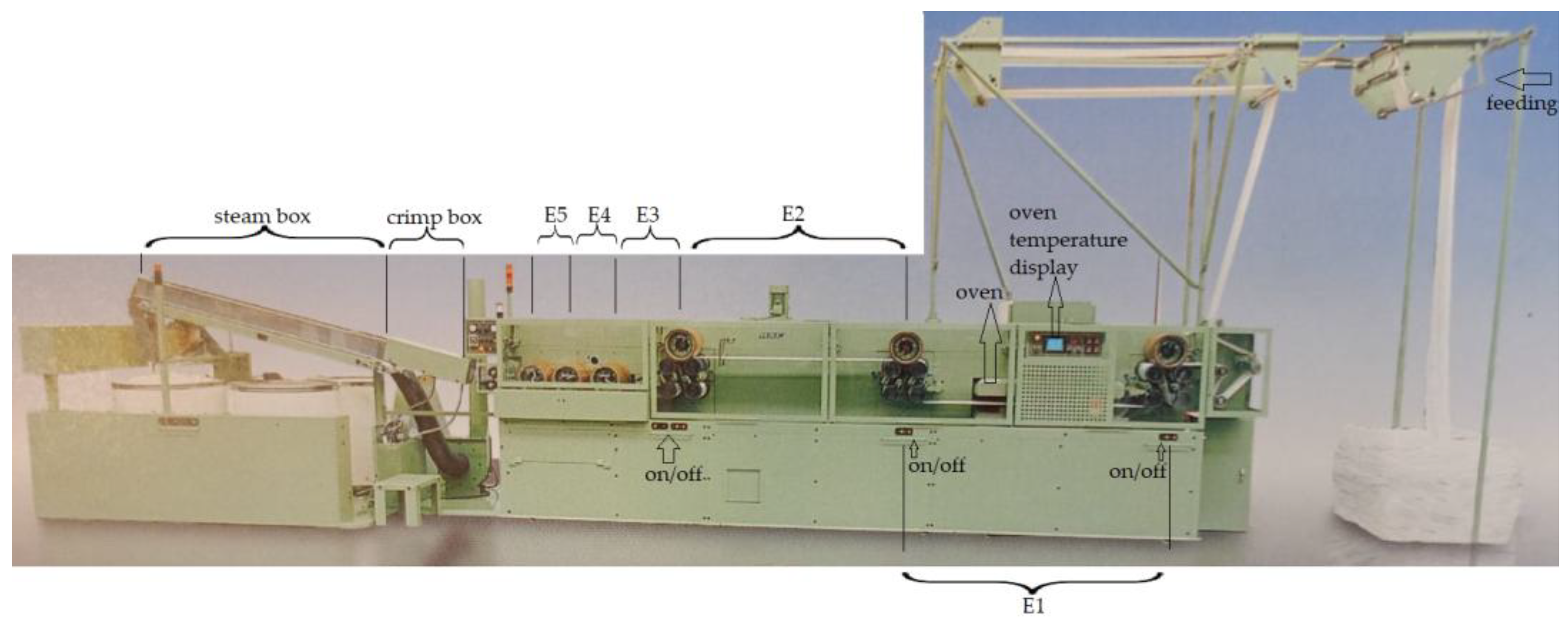
The force required to break a filament tow is quite high; therefore, the machine used to perform the stretch-breaking process must be extremely robust. Modern stretch-breaking machines used to convert tow into staple fibers have certain limitations in terms of the linear density of the tow they can process [1,3]. Traditionally, the staple fibers obtained by cutting or breaking the tow to the desired fiber length are subsequently subjected to preliminary processes such as opening, blending, and carding [5]. The tow-to-top conversion method is therefore widely used, especially in worsted and semi-worsted yarn production. This method is particularly preferred for various types of synthetic fibers, especially viscose, polyester, and acrylic. The stretch-breaking technique is based on the principle of drawing or stretching synthetic filaments in a controlled manner until they reach the breaking tension. The most commonly used raw materials in this method are polyester and acrylic tows. When heat treatment is applied to the filaments, the stretch-broken fibers shrink and gain volume; thus, the production of high-bulk yarns becomes possible [1,3,5]. This process is especially widely preferred during the material preparation stage in the production of high-bulk acrylic yarns. The first patent for a breaking machine was filed in 1929, and the first commercial machine, the Turbo Stapler, began to be used in the 1950s. Over time, with the development of breaking machines, fact-based breaking machines, as we understand them today, were introduced to the market in the 1970s and 80s [5]. The stretch-breaking method consists of a feed section, a pre-heating (oven) zone, five main drawing zones (E1, E2, E3, E4, E5), a crimp box zone, and a fixation (steam box) zone (Figure 1) [1,2].
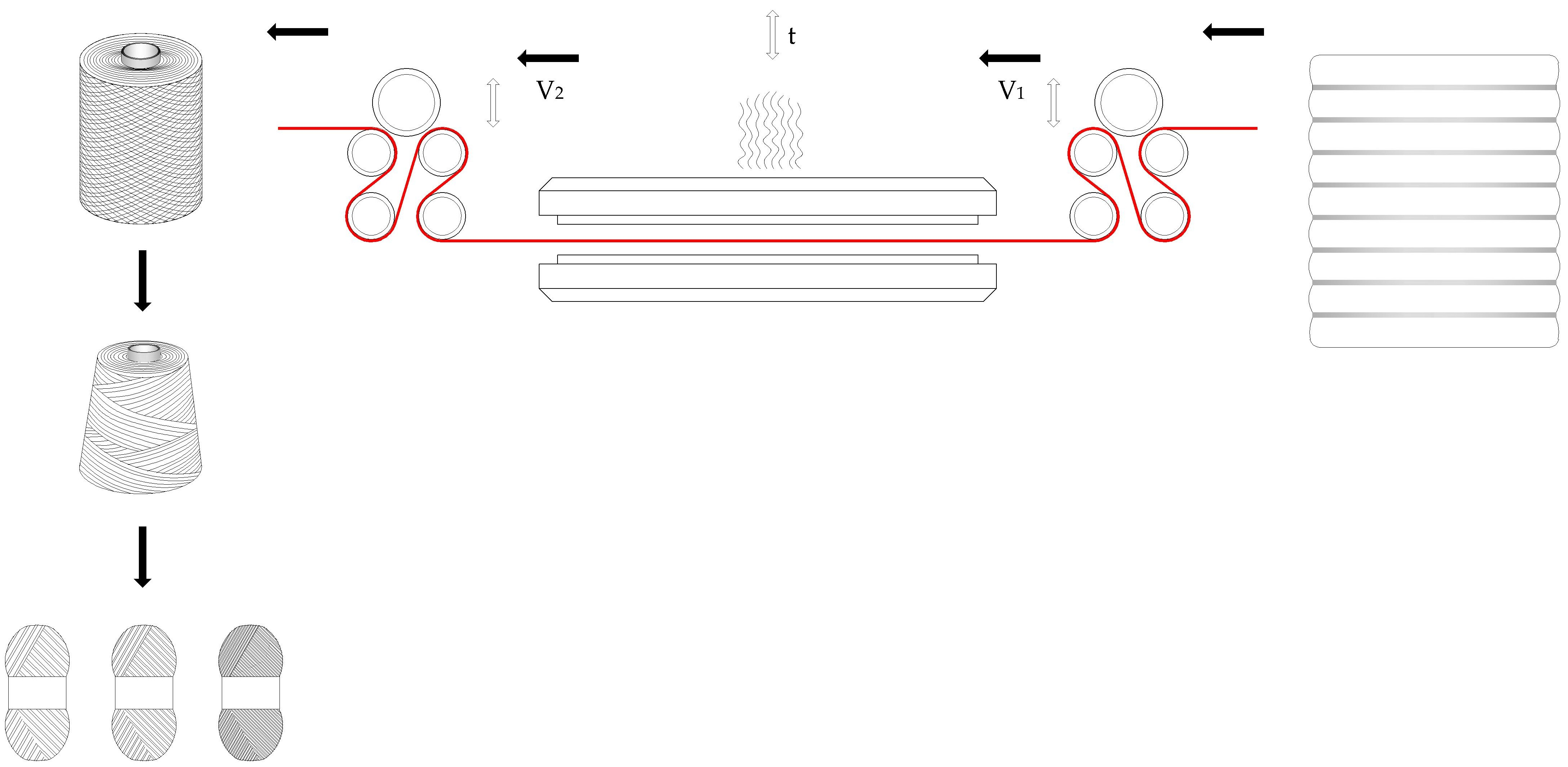
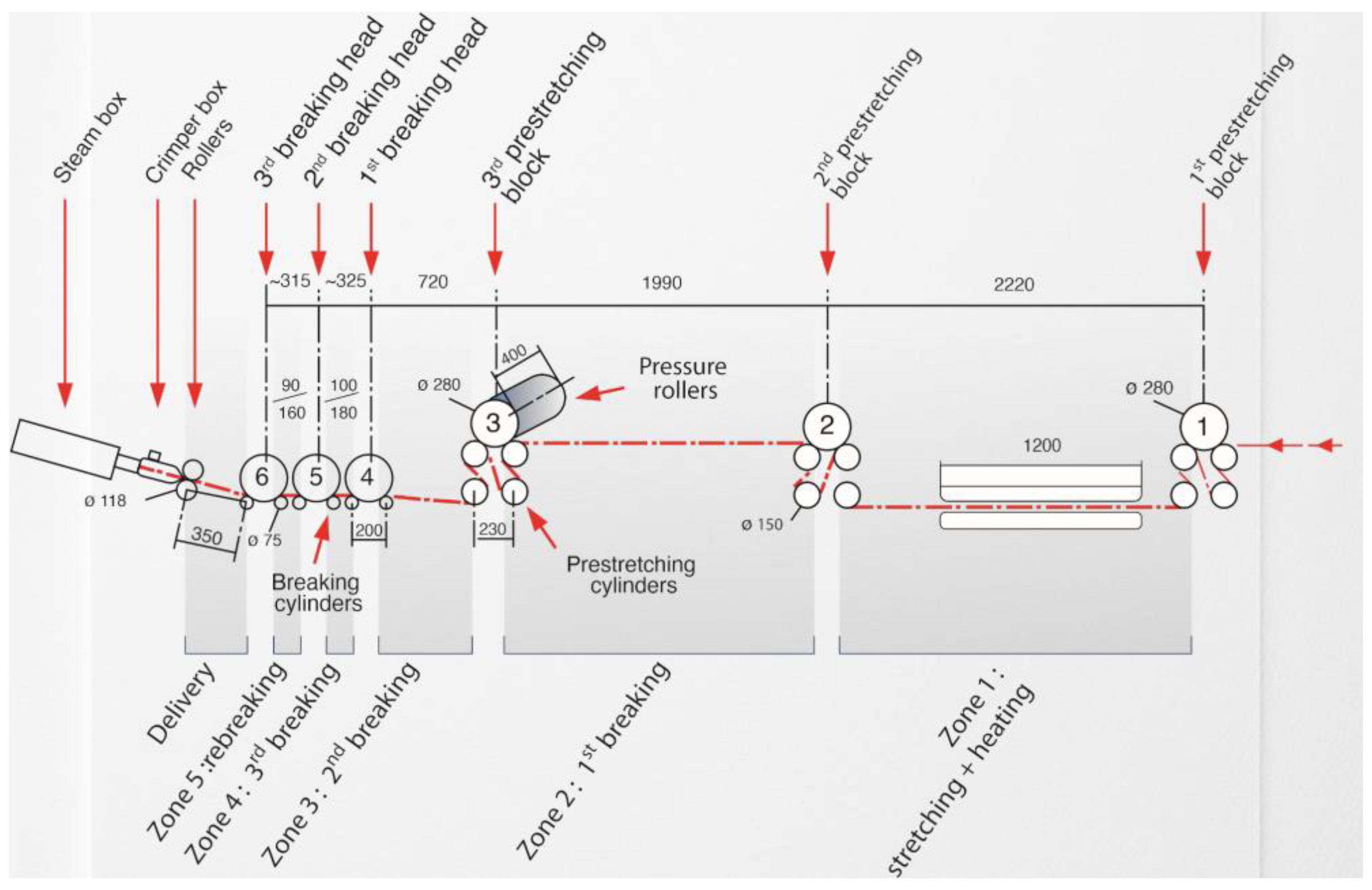
The tow is fed under controlled tension. This tension is generated by the difference in linear speed between the rollers. The initial controlled drawing of the tow is carried out in the pre-drawing stage, where heat is applied to the tow in zone E1. The tension in this zone results from the linear speed difference between R1 and R2 rollers. As the pre-drawing ratio in zone E1 increases, the drawing ratio of the fiber in the steam also increases. The pre-drawing applied in this zone must be at a lower ratio than the filament’s tensile strain ratio, which is 30–40%. The pre-heating (oven) process in zone E1 can be performed within a temperature range of 100–190 °C, depending on the type of filament to be processed (acrylic, polyester, etc.) and the desired level of bulkiness. As the temperature increases, the drawing ratio of the fiber in the steam also rises. The drawing process of the tow in zone E2 is achieved by the linear speed difference between R2 and R3 rollers, while the drawing process in zone E3 results from the linear speed difference between R3 and R4 rollers. However, during the drawing process in zone E3, partial uncontrolled breaks can occur in the filaments within the tow. While filaments are only drawn in E1 and E2, drawing continues and filament breakage begins in E3 zone. The breaking process is primarily carried out in the E4 and E5 drawing zones. The drawing in zone E4 is achieved by the linear speed difference between R4 and R5 rollers, while the drawing in zone E5 results from the linear speed difference between R5 and R6 rollers [1,2]. During the tow breaking process, the surface temperature of the godets in the breaking zone increases due to contact with the filaments and friction occurring at high speeds. In order to control this heating, effective heat dissipation is achieved by circulating cooling water through ceramic rollers positioned beneath the godets [4,6]. If the tow is moist, it may wrap around the godets in the breaking zone, stopping the process. This situation can cause unwanted downtime and quality losses in the production line [4,5,6,7].
Due to the variety of fiber types and breaking machines, it is not possible to recommend standard machine settings for all fibers and breaking machines. Although many fiber manufacturers offer some basic settings for their own produced fibers, in most cases, these settings need to be optimized according to specific application and process requirements [5].
Acrylic tows, due to their relative tow breaking strength, can be processed at higher speeds in breaking machines compared to polyester and polyamide [5,8].
Polyacrylonitrile fibers are synthetic fibers that have a heat-retention ability close to that of wool, dry quickly, have low specific gravity and good wrinkle resistance, and are easier to care for compared to wool [9]. Acrylic fibers exhibit both high strain and elastic recovery due to their excellent resilience, making them similar to wool fibers. These properties make acrylics and wool compatible fibers that produce fabrics with a soft hand feel. The tensile strength of acrylic is significantly lower than that of other synthetics, but higher than that of wool fibers [10].
Acrylic fibers are widely used in the textile industry due to their low density, high bulkiness, good thermal insulation properties, high strength, wool-like soft hand, and lower cost compared to wool. Thanks to their potential to develop volume after finishing, they provide a wool-like bulk and hand-feel, and are therefore often described as ‘wool substitute fibers’, especially in knitwear and outerwear products [9,10,11].
Acrylic fibers, by weight, consist of at least 85% acrylonitrile monomers [10]. Acrylic fiber has become the fourth most widely used synthetic fiber in the world today. In our country, Türkiye, it is the second most used fiber after polyester. This rapid increase is directly related both to the expanding applications of acrylic fibers and to the rise in wool prices [11].
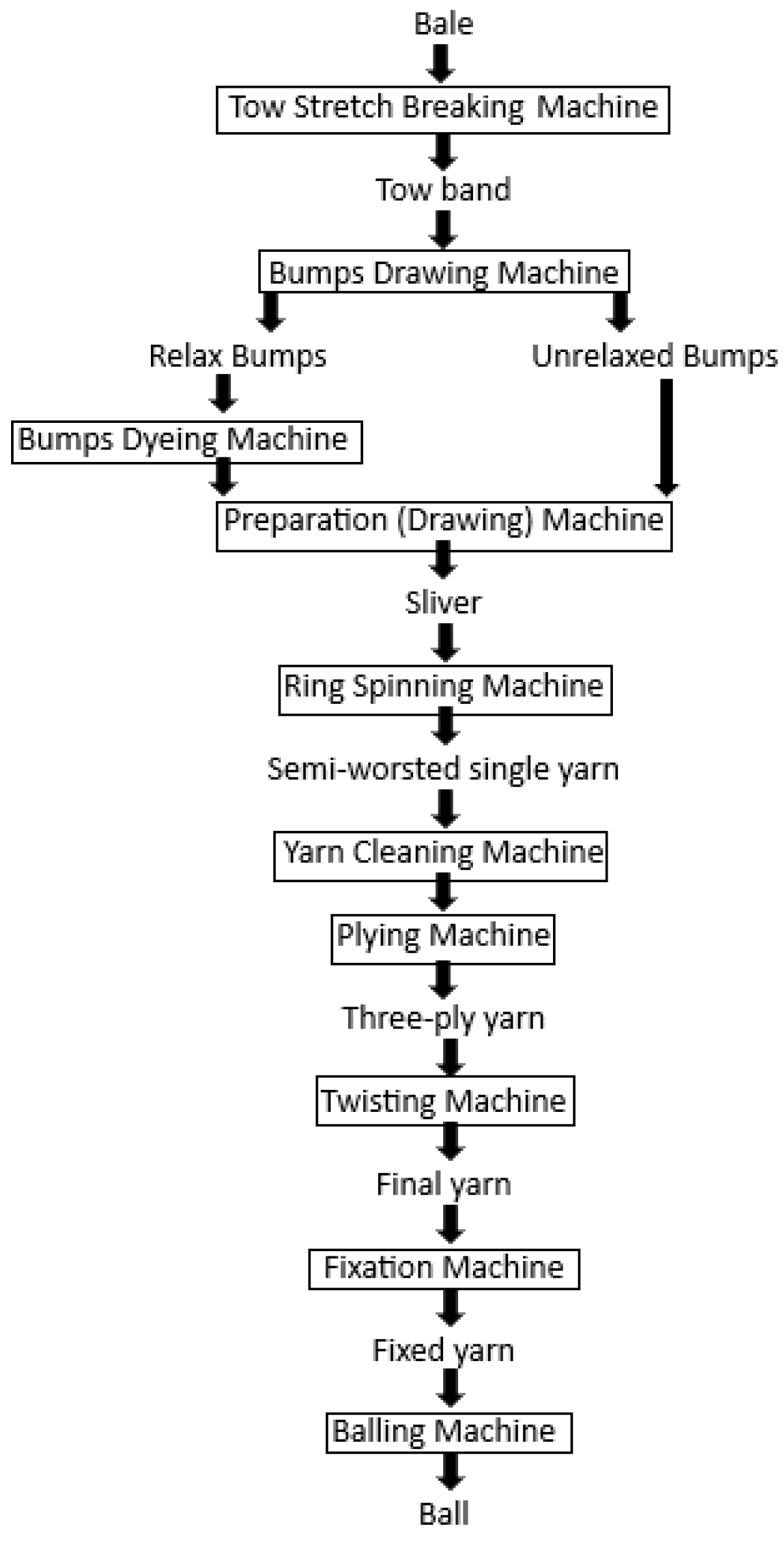
In order to convert acrylic fiber (tow in continuous form) produced by dry or wet spinning methods into yarn, it must first be converted into a discontinuous (staple) form [4,5,6,7]. The continuously produced acrylic tow is fed into the tow breaking machine in bale form. In this process, depending on the type of production, the tow undergoes a series of treatments in the following order: pre-heating (optional, used in the production of unrelaxed acrylic fiber), stretching, breaking, crimping, and fixation (optional, used in the production of relaxed acrylic fiber). As a result of these processes, the tow is converted into a staple tow form [1,3,4,5,6,8,9,10]. The staple acrylic fiber produced in the tow breaking machine is processed through the drawing process to obtain the bumps form. During the drawing process, doubling and drawing operations are applied to the bumps; at this stage, unrelaxed and relaxed fibers are blended. Additionally, fiber blends with materials such as wool, polyester, and polyamide are also carried out during this process. Finally, the drawn slivers are converted into acrylic yarn using the semi-worsted technique [4,5,6,8,9,10].
In the literature, it is stated that narrowing the spacing of the breaking rollers and increasing the gripping force make the breaking force more consistent by applying tension; thus, the variation in force decreases, and the force becomes more stable [12,13,14].
During the tow breaking process, a thicker filament bundle entering the break zone under tension supports itself to some extent due to friction between the fibers. Therefore, more breakages occur near the faster-moving rollers, where the filament bundle is thinner, and mutual support is reduced. Furthermore, the tensile properties of the filaments entering the break zone under tension vary not only among individual fibers but also along the length of each fiber, contributing to the non-random distribution of breakages [12,15].
The tow-to-yarn direct spinning method, developed by Bowden in 1948, is a technique that enables the direct conversion of tow into yarn by breaking it during the yarn production process. This spinning technique is carried out by performing the sliver breaking, drawing, and twisting processes in a single step. It is considered the most straightforward and most logical method for spinning oxidized fibers, and it differs from conventional staple fiber spinning methods [12,16]. Su et al., in their study with 12k PAN-based oxidized tow, developed a method based on sliver breaking force analysis to determine the optimal drawing conditions for achieving the best yarn quality in the direct spinning process. To reveal the relationship between tow breaking force and yarn quality, oxidized direct-spun yarns were spun using a modified laboratory spinning setup designed for one-step conversion from tow to yarn. By establishing a relationship between the coefficient of variation (CV%) of tow breaking force and the quality of oxidized direct-spun yarn, the drawing ratio and roller spacing (gauge) that yield lower unevenness (CV%) in the direct spinning process were identified as optimal drawing conditions. The results obtained from the study demonstrated that the tow breaking force technique is effective in determining the optimal drawing conditions in the direct tow-to-yarn spinning process [12].
This study was conducted to determine the optimal tow breaking conditions aimed at improving the quality of acrylic yarn during the tow breaking process. Although there are many studies in the literature on the principles of the tow breaking technique, no academic research has focused on the effects of parameters such as oven (pre-heating) temperature, drawing ratio, and the drawing ratio in the breaking zone on yarn properties. This study produced data related to the current lack of research in the literature regarding this issue. The effects of parameter variations in the tow breaking process on yarn properties were investigated.

2. Materials and Methods

2.1. Sample Production

In this study, samples were produced in the form of unrelaxed fiber, single-ply yarn, multi-ply final yarn, and ball. From each form, 38 different samples were prepared, resulting in a total of 152 samples. The unrelaxed fiber samples were produced using a tow stretch breaking machine. Following the tow stretch breaking process, both unrelaxed and relaxed fibers were converted into yarn after the drawing process on industrial-scale machines.
The samples produced in the single-ply yarn form were prepared with a Z-twist of 184 turns/m and a linear density of 12 Nm. The multi-ply final yarn samples were produced by plying three single yarns together and applying an S-twist of 120 turns/m. In the final stage, the final yarn samples were fixed and converted into balls. This entire process flow is explained in detail below.
Since the tow stretch breaking process was carried out in two stages, the tow breaking process parameters of the 38 unrelaxed acrylic fiber samples are presented in Table 1 and Table 2. Therefore, the samples are shown in two separate tables. It should be particularly noted that, apart from the parameters varied during the tow stretch breaking process, all parameters were kept constant at every stage from fiber to yarn and ball production. In addition, the samples produced under standard conditions were subjected to testing in accordance with the relevant standards. A schematic view of the tow stretch breaking machine is presented in Figure 2, showing the drawing zones (E1–E5).
During the production of unrelaxed acrylic fiber samples listed in Table 1, only the drawing ratio in the drawing zone (E1) was altered, while the drawing ratios in the other drawing zones were kept constant. The drawing ratios were 1.15 in the E2 zone, 1.46 in the E3 zone, 1.32 in the E4 zone, and 1.47 in the E5 zone, respectively. In the production of the samples listed in Table 1, five different temperatures—100 °C, 120 °C, 130 °C, 150 °C and 170 °C—were used. The zone where heat is applied is the oven zone in the tow stretch breaking machine, which is also the E1 drawing zone. For the E1 drawing zone, four different drawing ratios of 1.30, 1.47, 1.59 and 1.64 were applied.
During the production of the unrelaxed acrylic fiber samples listed in Table 2, only the drawing ratio in the E5 break-draw zone was altered, while the drawing ratios in the other zones were kept constant. The drawing ratios were 1.47 in the E1 zone, 1.15 in the E2 zone, 1.46 in the E3 zone, and 1.32 in the E4 zone, respectively. In the production of the samples given in Table 2, two different temperatures (130 °C and 150 °C) were used. The zone where heat is applied is the oven zone in the tow stretch breaking machine, which is also the E1 drawing zone. For the E5 break-draw zone, nine different drawing ratios of 1.30, 1.35, 1.49, 1.54, 1.62, 1.66, 1.70, 1.81, and 1.90 were applied.
After the tow stretch-breaking process, a draw sliver was produced by blending 14% unrelaxed fiber (5-denier filament, 120 ktex tow linear density, AK700 coded, bright tow produced by AKSA, Ali Raif Dinçkök Caddesi, No:2, Taşköprü, Çiftlikköy, 77602, Yalova, Türkiye) with 86% relaxed fiber. The relaxed fiber was produced from both tow and staple fiber. The tow used for the relaxed fiber consisted of 5-denier filaments with a 120 ktex tow linear density, AK700-coded, bright, and produced by AKSA-Türkiye. The staple fiber had a fineness of 5 denier, was AK700-coded, had a fiber length of 150 mm, and was also bright and produced by AKSA-Türkiye. The production conditions of the relaxed fiber were kept constant, and temperature was not applied during the tow stretch-breaking process. The drawing ratios were applied as follows: 1.30 in zone E1, 1.27 in E2, 1.46 in E3, 1.32 in E4, and 1.47 in E5. The change in the tow stretch-break condition was applied only during the production of the unrelaxed fiber.
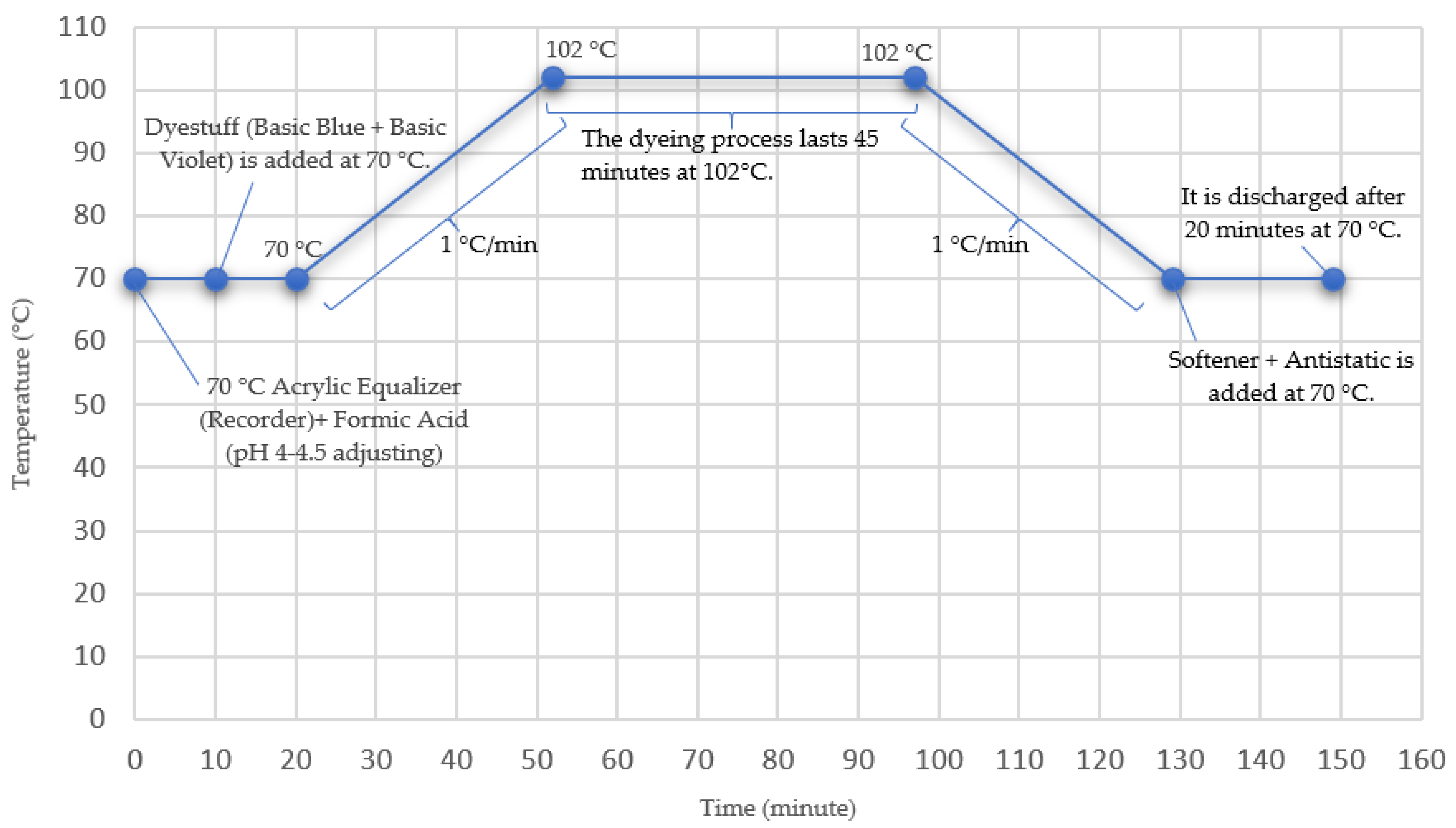
Dyeing was performed only on the relaxed fiber, while the unrelaxed fiber remained undyed. The condition for dyeing relaxed acrylic fiber is shown in Figure 3. The dyeing process was carried out using a bumps dyeing machine, model 2003, H. Krantz Marchinenbau based in Aachen, Germany.
The blending of dyed relaxed and undyed unrelaxed fibers was carried out and converted into drawing sliver form using a GC 30 NSC N, Schlumberger brand, with a fiber-to-yarn principle drawing machine, model 2015. The drawing process was carried out in four passages.
The drawn and blended slivers were spun into semi-worsted single yarns with a linear density of 12 Nm and a Z-directional twist of 184 turns using a 1992 model HDB (Houget Duesberg Bosson) brand ring spinning machine manufactured in Belgium.
The production single-ply yarns were plied into three-ply yarns using a 2021 model HMX 132 Hemaks Co. (Gaziantep, Türkiye) Textile Machinery brand automatic plying machine.
After the plying process, the twisting process was carried out using a Volkmann brand multi-ply twisting machine, model 2002, with 120 turns in the S-direction.
The produced yarns were subjected to a fixation process by steam using a Superba brand 2000 model fixation machine.
Then, the fixed yarns were wound into 100 g balls by a 3 X normal winding; motion of the three-directional machine using a 2023 model GW brand balling machine manufactured by Gokhan Machine.
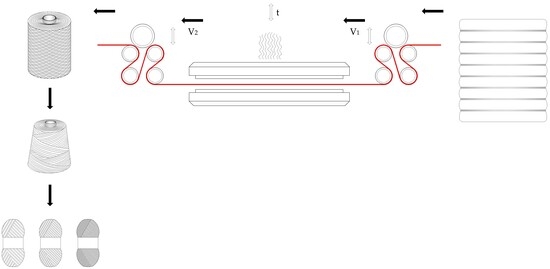
The processes described above, from tow band to yarn ball, are briefly illustrated in the diagram in Figure 4.

2.2. Unrelaxed Fiber Sliver Shrinkage

The shrinkage in water steam was measured on the unrelaxed fiber sliver immediately after the tow stretch breaking process. Five measurements were taken from each of the 38 different samples.

2.3. Yarn Tensile Strength and Strain

The tensile strength and tensile strain at break were measured on single-ply yarns. The tensile strength test was conducted at the Ormo R&D Center using an I.V. Calderara brand strength tester, model 2001. Measurements were performed according to the TS EN ISO 2062 standard, employing the Constant Rate of Extension (CRE) principle [17]. For each of the 38 different yarn samples, 10 measurements were taken to determine the tensile strength and strain values.

2.4. Yarn Hairiness and Unevenness

The yarn hairiness and yarn unevenness values were measured on single-ply yarns. Yarn hairiness and unevenness tests were carried out using a Premier Evolvics IQ5 2024 device available at the Ormo factory. The yarn unevenness of the 38 different yarn samples produced was measured according to the ASTM D 1425 standard, and the yarn hairiness was measured according to the ASTM D 5647 standard [18,19]. Three test specimens of specific lengths were used for each sample.

2.5. Yarn Ball Hand

The handle was measured on three-ply yarns. The handle measurement was performed on the yarn balls by experts. For the handle test, four ball samples were produced for each of 38 different yarn samples, resulting in a total of 152 ball samples. These samples were evaluated by three experienced experts in the field using real numbers on a 1–5 scale (1 = poorest, 5 = best). Although the experts worked under the same conditions regarding the evaluation criteria, each carried out the assessment independently. This approach ensured comparable results that are free from subjective influences.
Statistical analysis was conducted using IBM SPSS Statistics 27.0. The data were analyzed using a univariate general linear model with a 95% confidence interval.

3. Results

The results of this research were presented in two groups. One group belongs to the samples given in Table 1, and the other group belongs to the samples given in Table 2.

3.1. Results of the Samples Given in Table 1

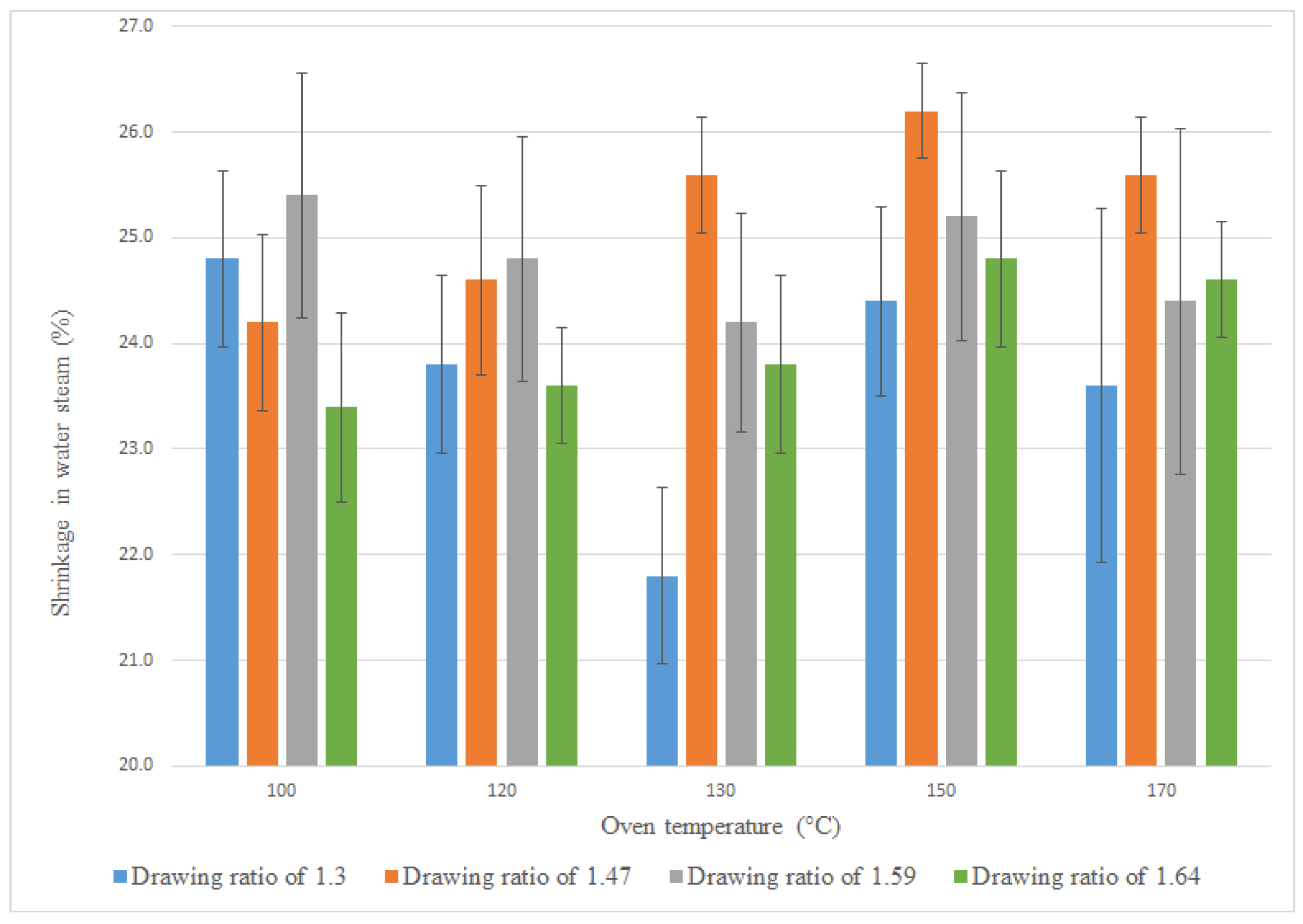
The shrinkage of the fiber sliver in water steam was affected by both oven temperature and drawing ratio (E1), as seen in Figure 5. According to the univariate variance analysis, both oven temperature and drawing ratio influenced the shrinkage of the fiber sliver in water steam (Table 3, Table 4 and Table 5). The lowest shrinkage occurred at 130 °C, while the highest shrinkage was obtained at 150 °C. There was no noticeable difference between 120 °C and 100 °C, and the shrinkage of the slivers produced at these temperatures was higher than that of the sliver produced at an oven temperature of 170 °C. The sliver shrinkage was highest at a drawing ratio of 1.47 and lowest at a drawing ratio of 1.30. There was no noticeable difference between the drawing ratios of 1.30 and 1.64, similar to the difference between 1.59 and 1.47. The lowest shrinkage occurred at the process parameters of 130 °C and a drawing ratio of 1.30, while the highest shrinkage was observed at an oven temperature of 150 °C and a drawing ratio of 1.47.
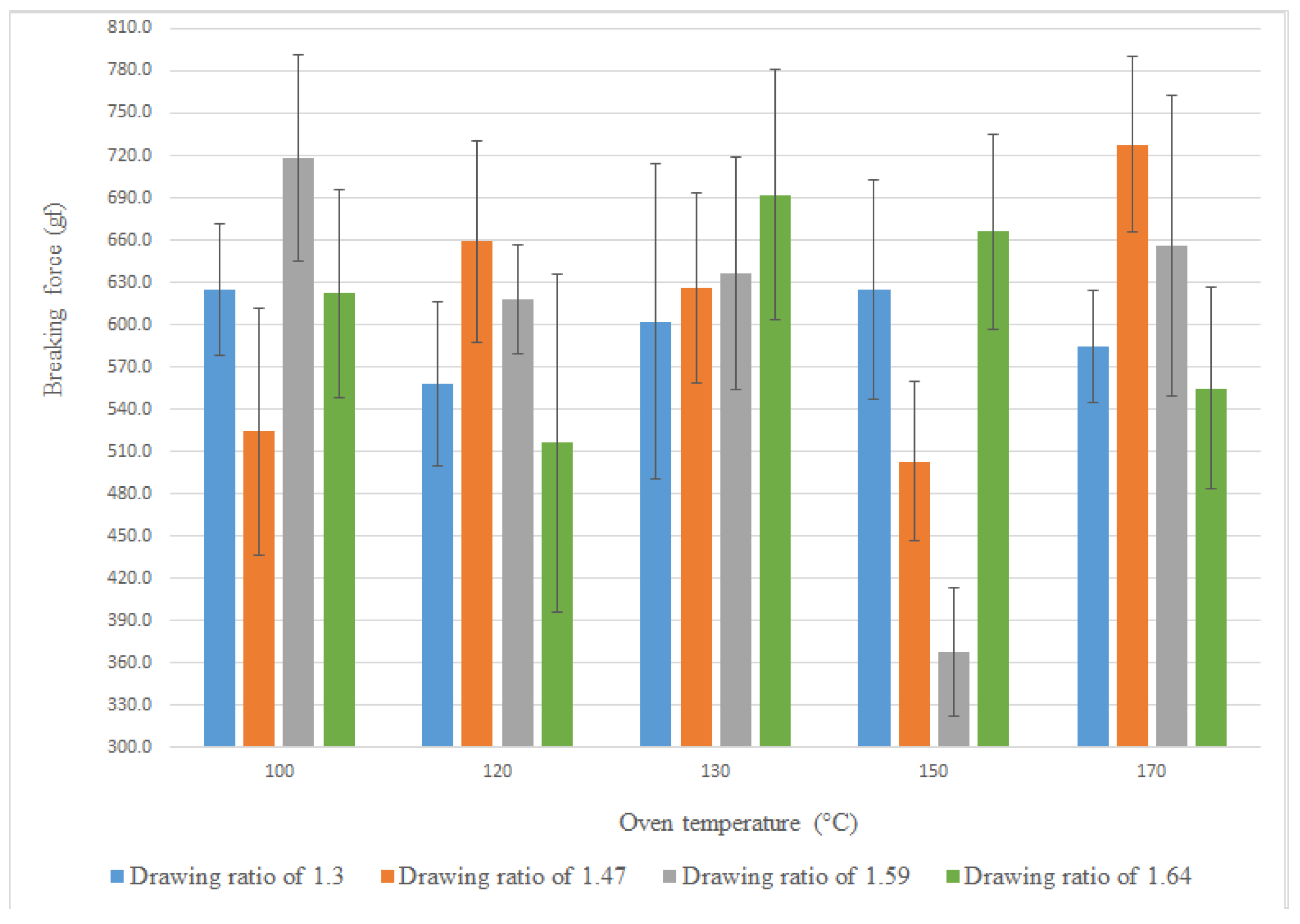
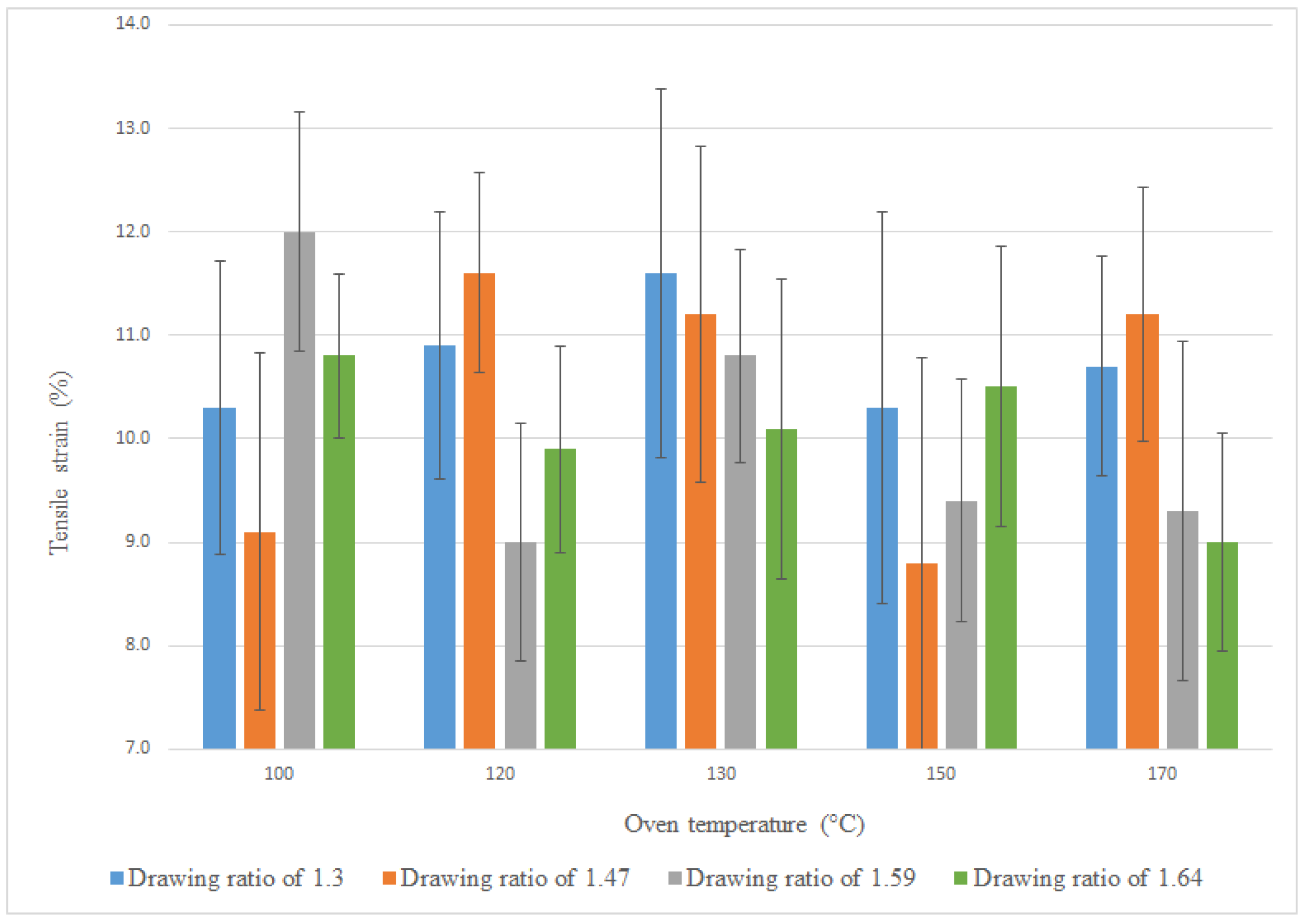
The tensile properties of the high-bulk acrylic yarns were also affected by the tow stretch-breaking process parameters, especially the oven temperature. Although high-bulk acrylic yarns involve 14% unrelaxed fiber, the tensile properties of the yarn changed significantly, as seen in Figure 6 and Figure 7. The drawing ratio of the tow stretch-breaking process parameter had no statistically significant effect on the tensile properties of the acrylic yarn, but the oven temperature had a significant effect on both tensile strength and strain (Table 6, Table 7, Table 8, Table 9, Table 10 and Table 11). However, the graphical presentation showed that a noticeable change in the tensile strength of the acrylic yarns occurred with changes in the drawing ratio, especially at an oven temperature of 150 °C (Figure 6). The lowest tensile strength and strain were obtained at 150 °C, while the highest values were obtained at 130 °C. Statistically, the oven temperature had no effect on the tensile strength at 100 °C, 130 °C and 170 °C. The tensile strength of acrylic yarns produced at these temperatures was similar under 95% confidence intervals. The tensile strength of the acrylic yarn produced at 120 °C was higher than that of the yarn produced at 150 °C. In terms of tensile strain, the samples were ranked in ascending order as follows: produced at 150 °C, 170 °C, 120 °C, 100 °C and 130 °C. There was no significant difference between the tensile strains of the yarns produced at 130 °C, 120 °C and 100 °C. The differences in the tensile strain among yarns produced at 170 °C, 150 °C and 120 °C were also not remarkable.
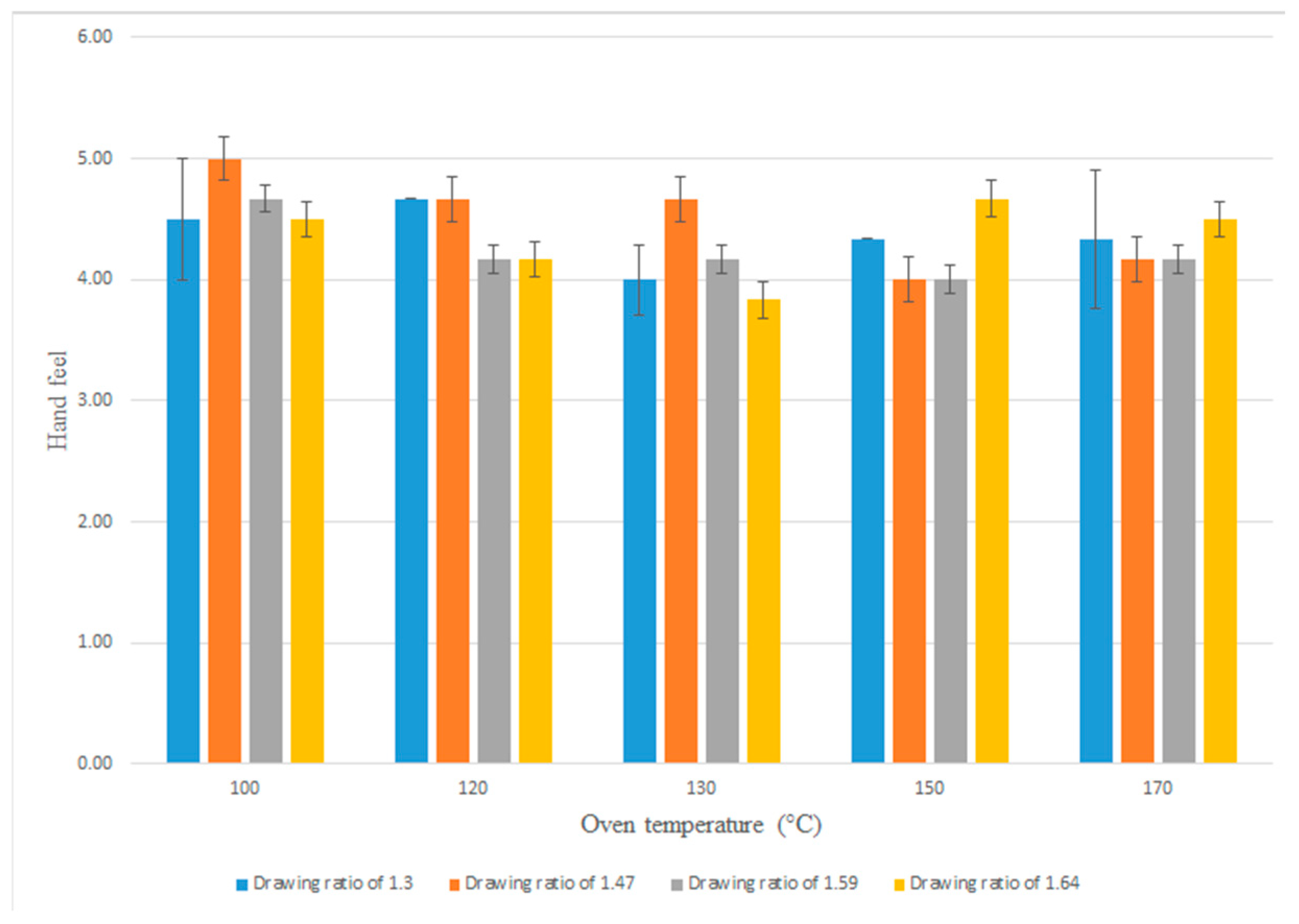
According to the statistical analysis results, the tow stretch-break process parameters had no effect on the hand-feel properties of the acrylic yarn at the 95% confidence interval (Table 12, Table 13 and Table 14). The worst hand-feel value was obtained at an oven temperature of 130 °C, while the best value occurred at 100 °C. The ascending order was as follows: the samples produced at 150 °C, 170 °C and 120 °C. The worst hand-feel value was obtained at a drawing ratio of 1.59, while the best value was obtained at a drawing ratio of 1.47. The hand feel of the yarn produced at a drawing ratio of 1.64 was better than that of the yarn produced at a drawing ratio of 1.30 (Figure 8).
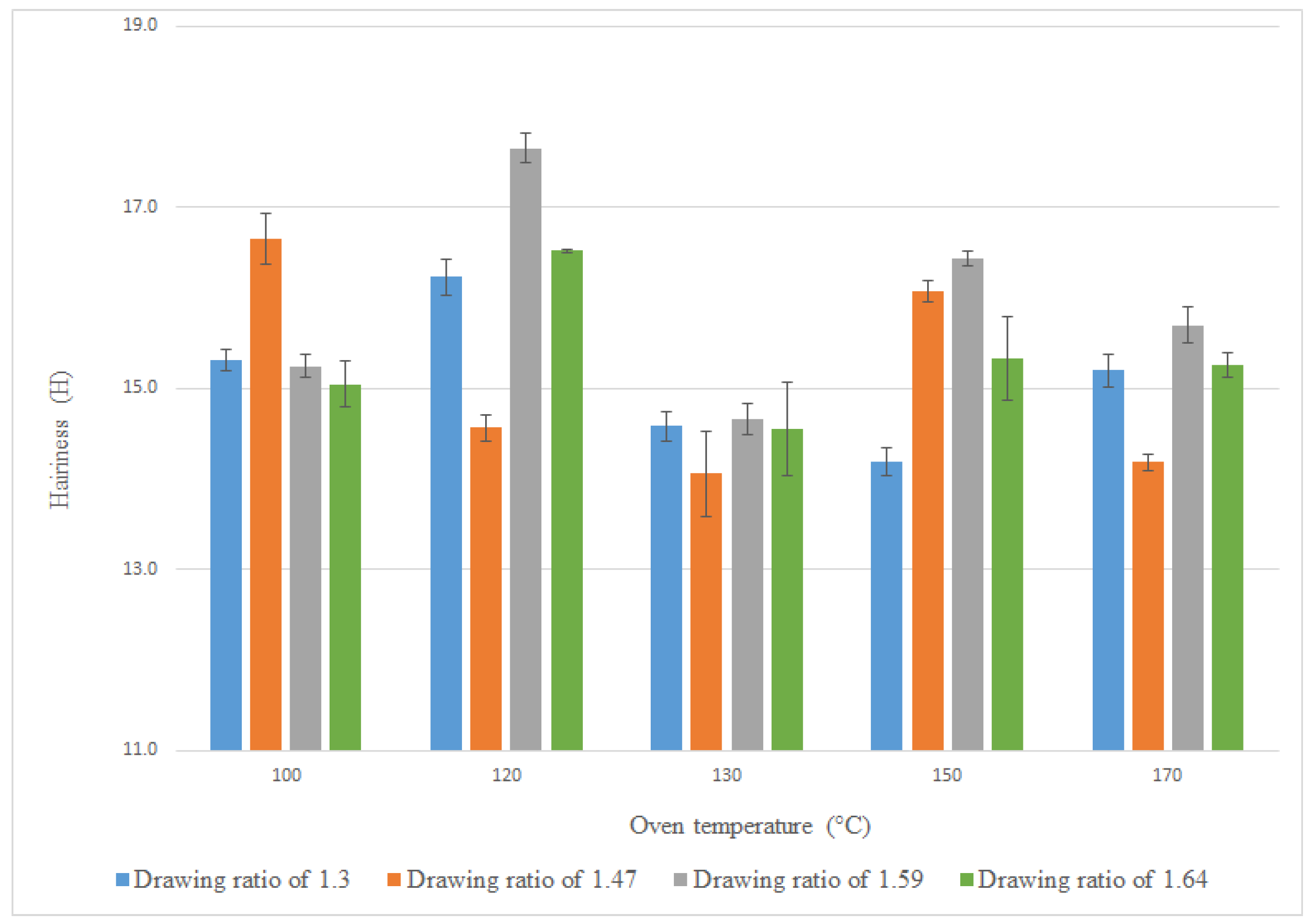
The oven temperature and drawing ratio tow stretch process parameters had a remarkable influence on the hairiness of acrylic yarn (Figure 9, Table 15, Table 16 and Table 17). The lowest hairiness was observed at 130 °C, whereas the highest hairiness occurred at 120 °C. The hairiness of the yarn samples produced at 150 °C and 100 °C was similar to each other and higher than that of yarn produced at 170 °C. The hairiness of the yarn produced at drawing ratios of 1.30 and 1.47 was similar and lower than that of the yarn produced at a drawing ratio of 1.64. The highest hairiness was obtained at a drawing ratio of 1.59.
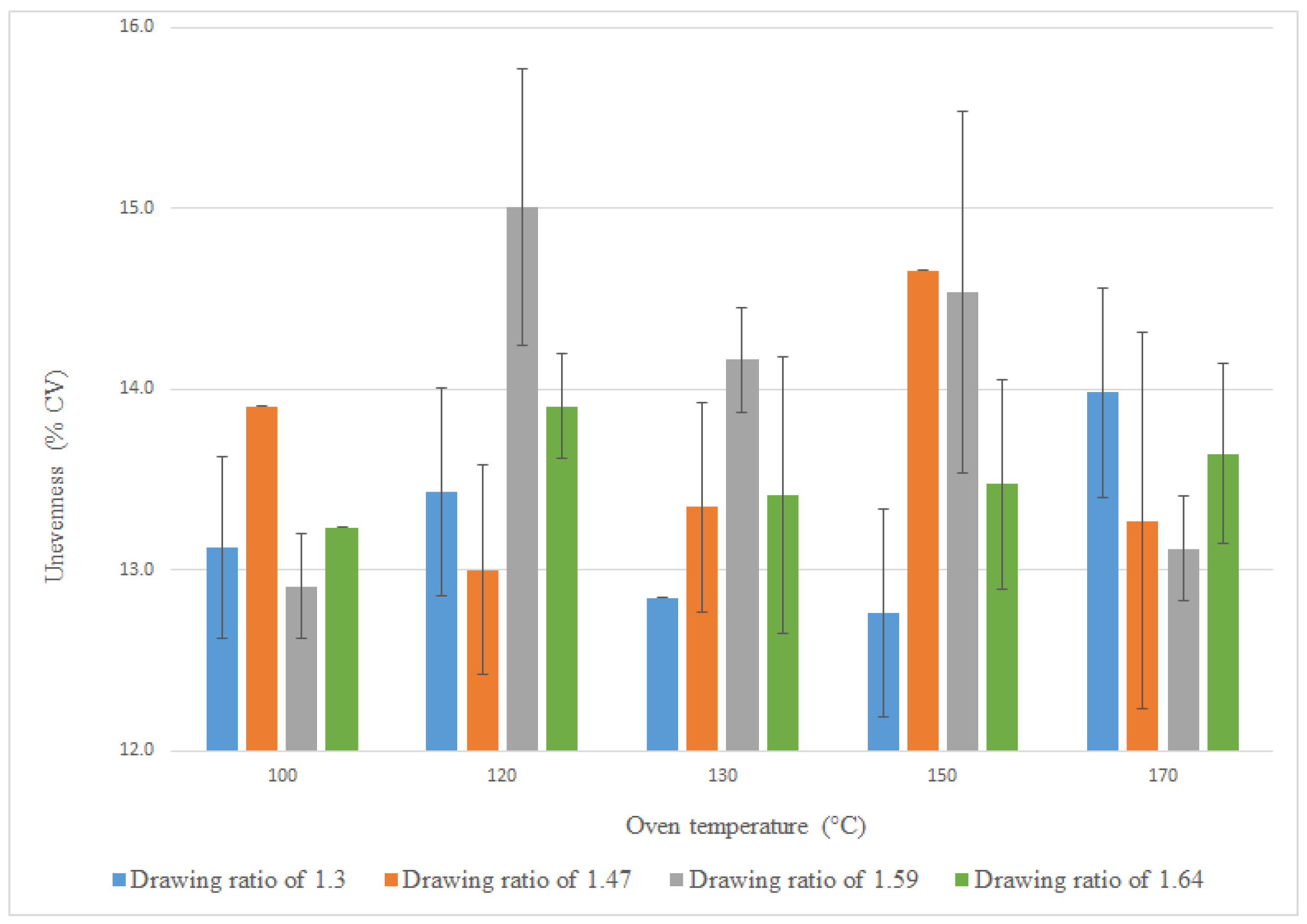
Yarn unevenness was mainly affected by the drawing ratio rather than the oven temperature during the tow stretch-break process (Figure 10, Table 18, Table 19 and Table 20). The unevenness of the yarn samples produced at 100 °C, 130 °C and 170 °C was more or less similar and lower than that of the samples produced at 120 °C and 150 °C. The unevenness of the yarn produced at 120 °C and 150 °C was approximately similar. The lowest unevenness was obtained at a drawing ratio of 1.30, while the highest unevenness occurred at a drawing ratio of 1.59. The unevenness of the yarns produced at drawing ratios of 1.47 and 1.64 was approximately similar and lower than that of the samples produced at 1.59.

3.2. Results of the Samples as Given in Table 2

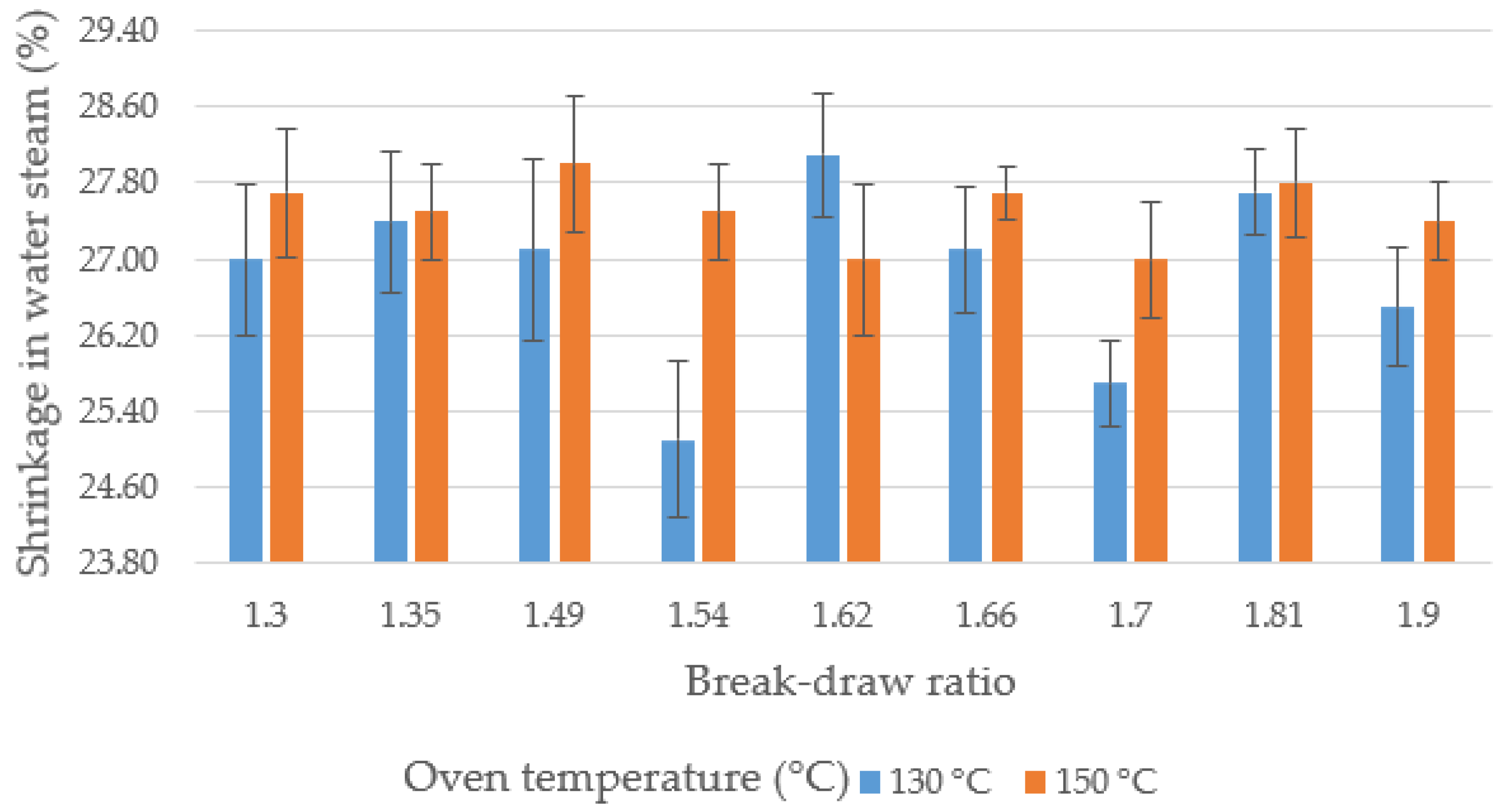
The shrinkage of the fiber slivers in water steam was slightly affected by the break-draw ratio (E5), as shown in Figure 11. According to the univariate variance analysis, the break-draw ratio influenced the shrinkage of the fiber sliver under two oven temperatures (Table 21 and Table 22). The effect of the break-draw ratio was more pronounced at 130 °C than at 150 °C. The lowest shrinkage occurred at a break-draw ratio of 1.54, while the highest shrinkage was observed at 1.81. There was no noticeable difference between the samples produced at break-draw ratios of 1.70, 1.90 and 1.54. The shrinkage of the samples produced at break-draw ratios of 1.30, 1.35, 1.49, 1.62, 1.66 and 1.81 was approximately the same.
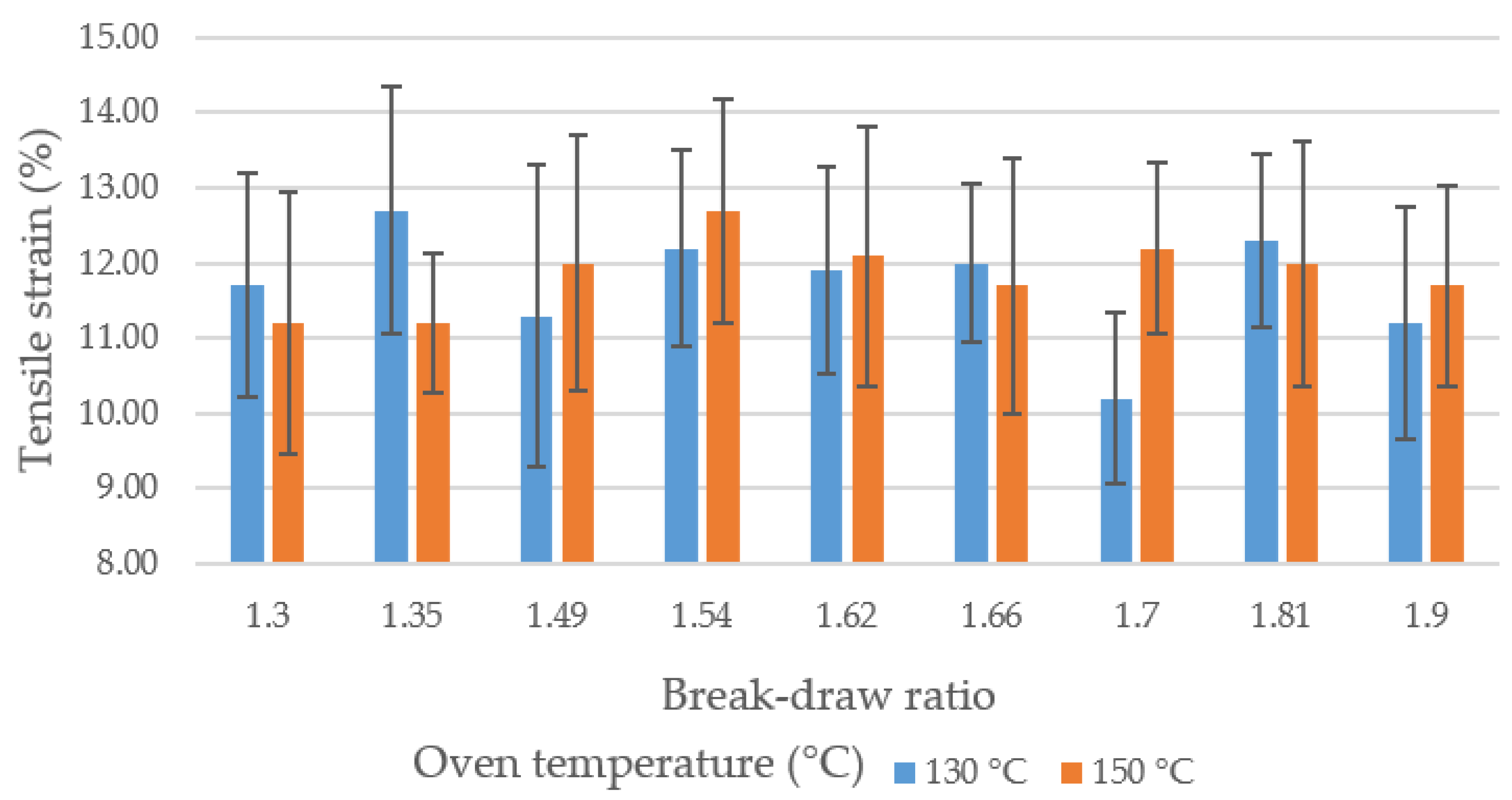
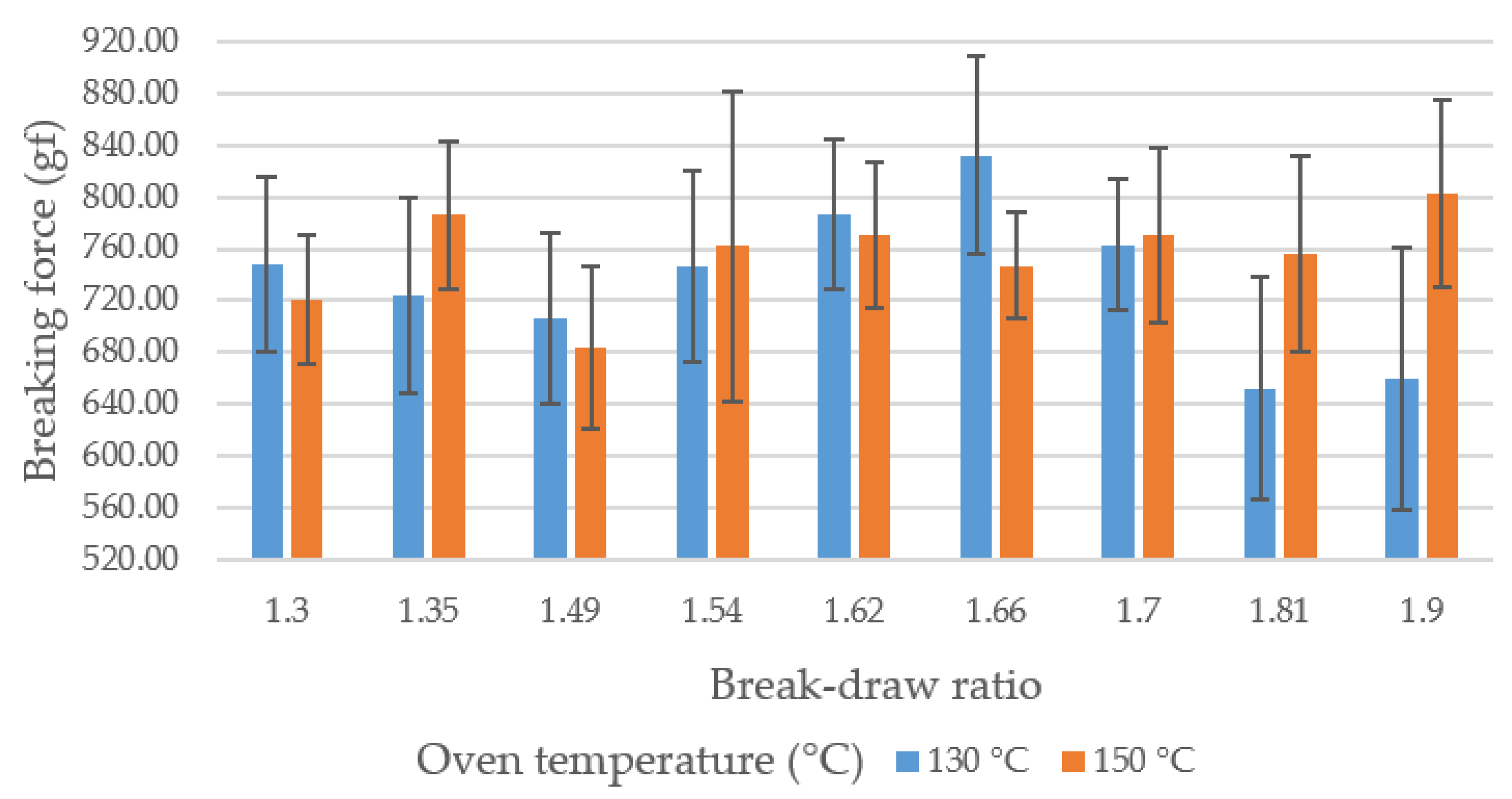
According to variance analysis, the break-draw ratio and oven temperature influenced the tensile strength properties of the high-bulk acrylic yarns (Table 23, Table 24, Table 25 and Table 26). The graphical presentation showed that the tensile strength of the acrylic yarns changed noticeably with varying break-draw ratio, especially at an oven temperature of 130 °C (Figure 12). Although the lowest tensile strength occurred at a break-draw ratio of 1.49 and the highest at 1.66, the lowest tensile strain was measured at 1.70 and the highest at 1.54 (Figure 13). Despite these differences, the tensile strain values were approximately similar. The tensile strength of the samples produced at break-draw ratios of 1.30, 1.35, 1.54, 1.70 and 1.90 was more or less similar and higher than that of the samples produced at 1.49. The tensile strength values at 1.62 and 1.66 were also close to each other. The tensile strength of the acrylic yarn produced at 1.81 was lower than that of the yarns produced at 1.66.
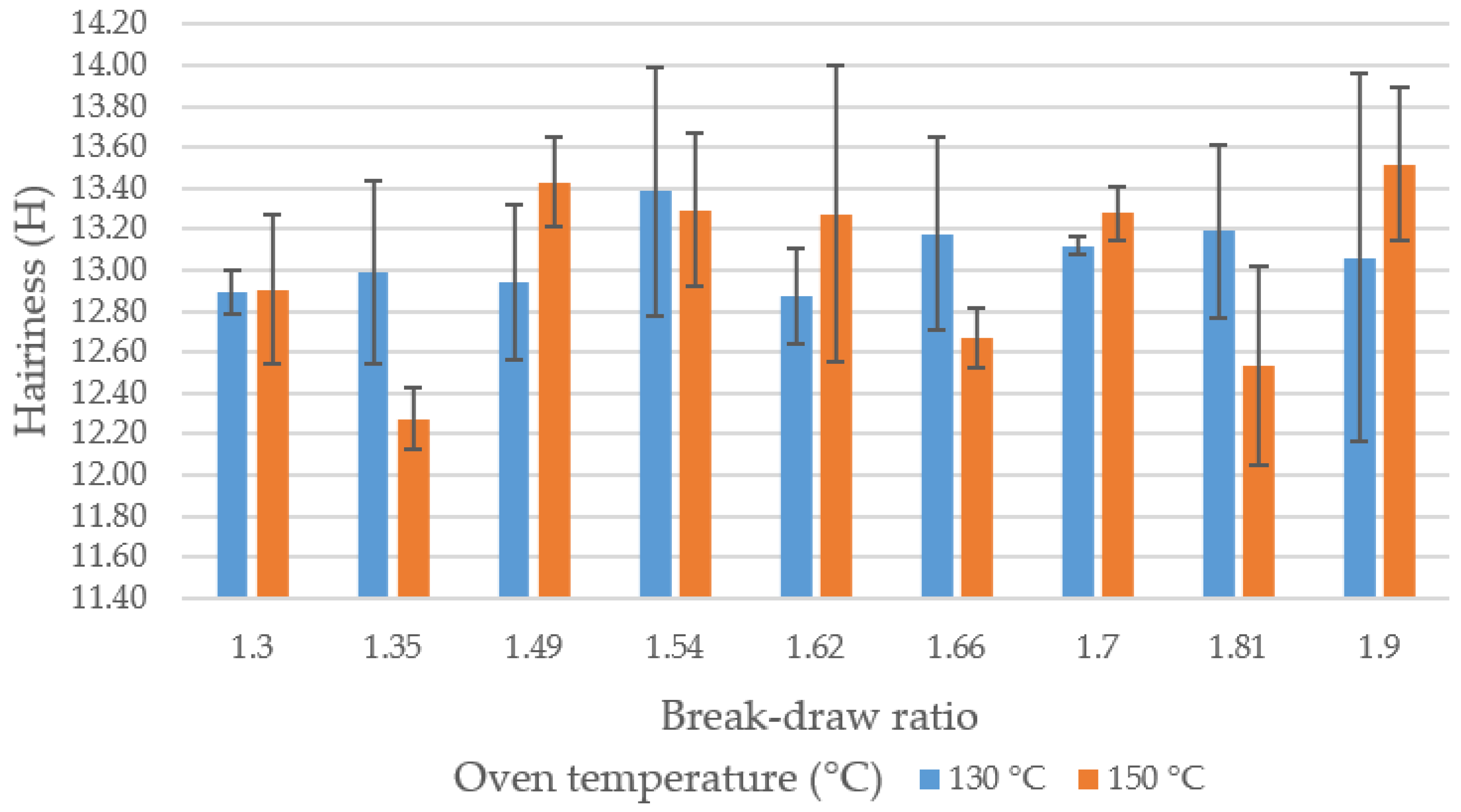
Yarn hairiness was not affected by the break-draw ratio at either temperature (Figure 14). Statistically, the break-draw ratio had no effect on the yarn unevenness properties at a 95% confidence interval (Table 27 and Table 28). The lowest yarn hairiness was observed at break-draw ratios of 1.35 and 1.81 and an oven temperature of 150 °C, while the highest yarn hairiness was observed at a break-draw ratio of 1.54 and 130 °C.
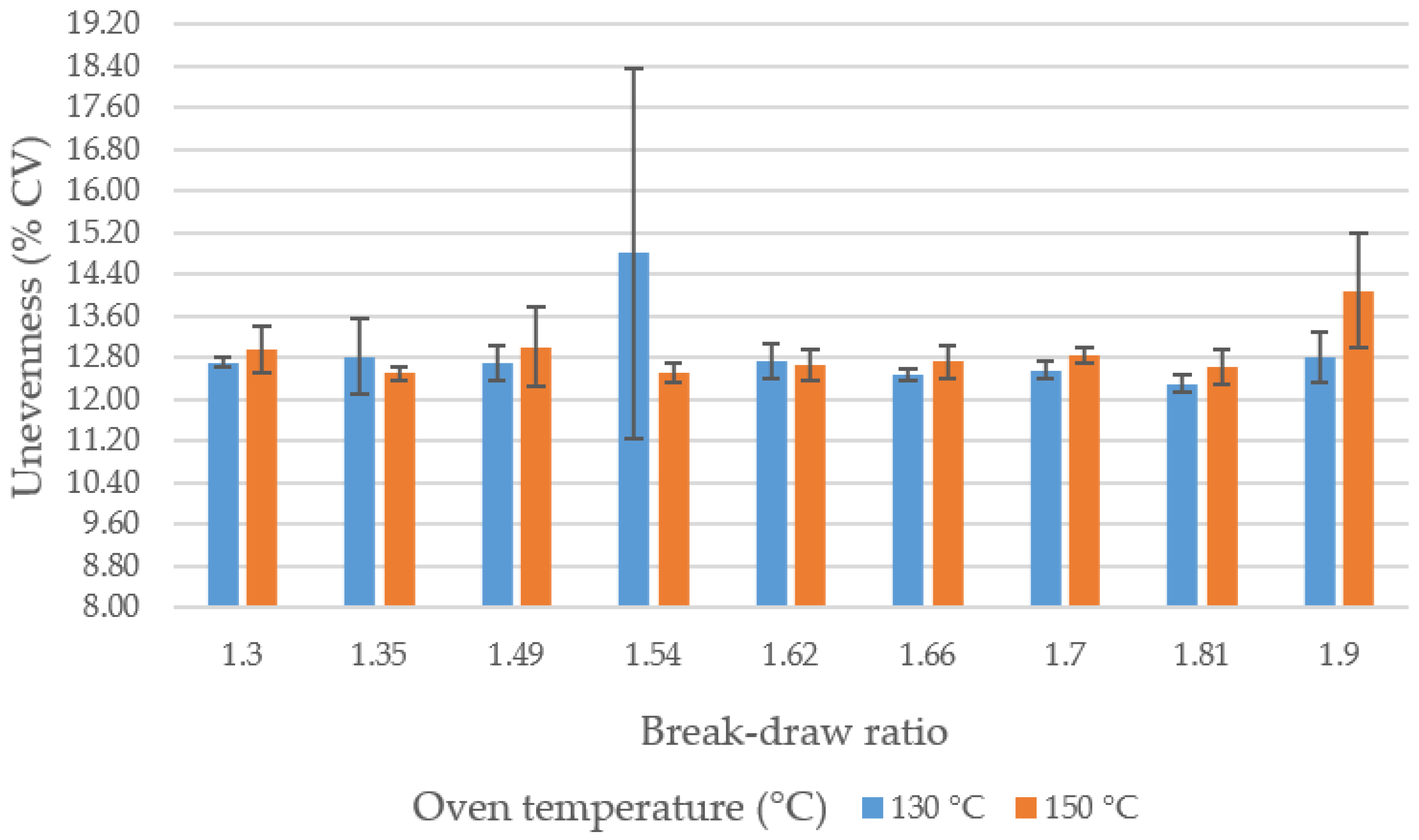
Yarn unevenness was not affected by the break-draw ratio under either of the two temperature conditions (Figure 15). Statistically, the break-draw ratio had no effect on the yarn unevenness properties at the 95% confidence interval (Table 29 and Table 30). The lowest yarn unevenness was observed at a break-draw ratio of 1.81 at an oven temperature of 130 °C, while the highest yarn unevenness was observed at a break-draw ratio of 1.54 at the same temperature.

4. Discussion

It was observed that the effect of the drawing ratio on the shrinkage behavior of acrylic draw slivers was limited at oven temperatures of 100 °C and 120 °C. In contrast, at oven temperatures of 130 °C and 150 °C, except for at a drawing ratio of 1.3, shrinkage values decreased as the drawing ratio increased. The shrinkage behavior observed at 170 °C was also consistent with trends at 130 °C and 150 °C, with an increase in shrinkage occurring only at a drawing ratio of 1.64. The low shrinkage values at a drawing ratio of 1.3 at 130 °C and 150 °C are thought to be related to the structure of the amorphous region in acrylic fiber morphology. Under these low drawing ratio conditions (i.e., at a drawing ratio of 1.3), the macromolecules in the ‘‘spaghetti-like’’ form within the amorphous region cannot achieve sufficient orientation, resulting in the lowest shrinkage at 130 °C. The higher shrinkage of the sample produced at the same drawing ratio at 150 °C compared to 130 °C is attributed to the higher thermal energy at 150 °C, which causes more breakage of intermolecular forces between macromolecules in a spaghetti-like form, resulting in partial orientation. The fact that shrinkage reaches its maximum at a drawing ratio of 1.47 at both 130 °C and 150 °C is explained by the higher degree of orientation of the spaghetti-like macromolecules in the amorphous region. The decrease in shrinkage values at drawing ratios higher than 1.47 is associated with the breakage of intermolecular forces between the already-oriented macromolecules in the amorphous region. This finding is also supported by the shrinkage changes observed at 130 °C and 150 °C. The two-phase amorphous region model explains this decrease. This can also be explained as follows: At high drawing ratios, the bonds between oriented macromolecules predicted in the two-phase model are broken, leading to a reduction in fiber shrinkage [20]. The limited effect of drawing ratio on shrinkage at lower temperatures can be attributed to the applied temperatures being below or only slightly above the glass transition temperature of acrylic fibers, resulting in restricted mobility of the macromolecules in the amorphous region. These assessments are also supported by the findings presented in the following references [20,21,22,23,24,25].
The most consistent change in tensile strength and tensile strain was observed at 130 °C. However, the changes at the other temperatures exhibited more irregular behaviors. At 130 °C, as the drawing ratio increased, the yarn tensile strength increased while the strain decreased. The main reason for this is that, as the drawing ratio increases, the spaghetti-like structure in the amorphous region becomes more oriented. Since breakage in the fiber occurs in the amorphous region, the orientation of macromolecules in this region increases tensile strength while reducing tensile strain. The tensile strength and strain values obtained at 150 °C and 170 °C were found to be lower compared to the samples produced at 130 °C. This is thought to be due to the partial breaking of the bonds between the oriented macromolecules as a result of the high energy provided by the high temperatures.
The lowest yarn hairiness value was obtained at 130 °C. The highest hairiness was observed at lower temperatures, such as 100 °C and 120 °C. It was determined that hairiness showed an increasing trend at temperatures both below and above 130 °C. As stated in the literature, one of the main factors increasing yarn hairiness is fiber stiffness; as fibers lose their flexibility, it becomes more difficult for fiber ends to be trapped by curling within the yarn, while fiber ends show a tendency to position themselves perpendicular to the yarn cross-section. This leads to an increase in yarn hairiness [26]. The increase in hairiness at lower temperatures is thought to be due to the insufficient breaking of intermolecular forces in the amorphous region, which prevents sufficient orientation and consequently leads to fiber stiffening. The increase in yarn hairiness observed at higher temperatures is considered to result from the disruption of the crystalline structure of the acrylic polymer. This finding is supported by the observation that hairiness also increases as the drawing ratio increases at 150 °C.
Yarn unevenness, like yarn hairiness, remained relatively low at 130 °C, and the lowest unevenness value was obtained at 100 °C. The changes observed at 130 °C and 150 °C showed a more consistent trend, while those at 100 °C and 120 °C were inconsistent. Except at 130 °C and at a drawing ratio of 1.64, yarn unevenness generally increased with increasing drawing ratio. In contrast, at 170 °C, unevenness values decreased as the drawing ratio increased. The worsening of both yarn unevenness and yarn hairiness at 150 °C and 170 °C is thought to result from the tendency of fibers to align parallel to the yarn axis during the yarn production process, due to stiffened fibers with increased bending rigidity at high temperatures. This tendency prevents the fibers from being sufficiently dispersed within the yarn structure, negatively affecting both unevenness and hairiness properties.

5. Conclusions

With this study, the effects of the parameters in the tow breaking process on yarn properties were investigated for the first time worldwide through a systematic research and development study. This is the first study conducted in this field; therefore, it is entirely original and will serve as a reference for future studies.
The effect of the tow stretch breaking process parameters on the high-bulk acrylic yarn properties was determined. Since the effects of the production parameters were known in advance, preliminary trial studies were eliminated, enabling correct production in a single trial; therefore, solid waste rates were reduced, and consequently, carbon emissions were decreased. By enabling more efficient production of acrylic yarns with different bulk levels, production costs can be reduced, environmental and sustainable manufacturing can be supported, and competitiveness in the international market can be increased. The ability to produce standard-quality yarn on different tow breaking machines increases inter-machine flexibility in the production process.
Through statistical analysis, particularly focusing on the high-bulk ratio, the relationship between yarn properties and production parameters was determined using analysis of variance (ANOVA) and nonlinear regression analysis. Using the analysis data, a mathematical model expressing this relationship was developed. However, since the relationships between tow breaking process parameters and yarn properties are variable, the predictive performance of the equations obtained from this model was found to be low. Therefore, it was determined that selecting the closest tow breaking parameters for the desired acrylic yarn properties by using the graphs created from the data would be more appropriate.
After performing the breaking process using the recommended values and completing the necessary production steps, it was observed that the same effect was achieved during the fixation stage, even on the basis of color. In the previous system, even when the same parameters were used in the tow breaking process, bulk differences occurred between different colors; however, when the recommended parameters were applied at the initial stage of yarn production, identical bulk values were obtained regardless of color differences.
While the company had previously been operating at a fixed oven temperature of 170 °C and a drawing ratio of 1.47, it internalized the findings of this study, revised its routine machine settings, and modified the tow breaking process according to the machine parameters obtained from the research.
In this study, the parameters of the tow stretch breaking process were examined comprehensively. The analyses revealed that applying the tow breaking process at oven temperatures of 130 °C and 150 °C with a drawing ratio of 1.47 enhances the high-bulk property of acrylic yarn. Additionally, among all drawing ratios, the yarns produced at 130 °C exhibited the lowest hairiness and unevenness values. Based on these findings, it is recommended that the tow breaking process be carried out at 130 °C and 150 °C with a drawing ratio of 1.47 in order to achieve high yarn quality and improved high-bulk characteristics.

Author Contributions

Conceptualization, K.Y.; methodology, K.Y.; literature review, T.B.B.; production, İ.S.; testing and analysis, İ.S., T.B.B., E.K.; data curation, K.Y., F.G. All authors have read and agreed to the published version of the manuscript.

Funding

This research was funded by TUBITAK through the TEYDEB 1505 program, project code 5240040.

Institutional Review Board Statement

Not applicable.

Data Availability Statement

The data supporting the findings of this study are not publicly available at this time, as the project is ongoing.

Acknowledgments

The authors would like to thank ORMO for the use of all necessary equipment and testing devices, and AKSA for providing raw materials. The authors would also like to thank the Project Support Office at Bursa Technical University for their valuable assistance in proofreading the English language of this article.

Conflicts of Interest

Authors Ferhan GEBES, Ilter SEVILEN, Tugce Begum BILIR and Emel KUCUKOGLU were employed by the company Ormo Yün İplik San. Tic. A.Ş. The remaining authors declare that the research was conducted in the absence of any commercial or financial relationships that could be construed as a potential conflict of interest. The authors declare that this study received the use of all necessary equipment and testing devices from ORMO and raw materials from AKSA. The companies were not involved in the design of the study; in the collection, analyses, or interpretation of data; in the writing of the manuscript; or in the decision to publish the results.

References

  1. McKenna, H.A.; Hearle, J.W.S.; O’Hear, N. Handbook of Fibre Rope Technology; Woodhead Publishing: Cambridge, UK, 2004; pp. 1–34, 185–214. [Google Scholar]
  2. Lawrence, C.A. Fundamentals of Spun Yarn Technology; CRC Press: Boca Raton, FL, USA, 2003; pp. 259–262. [Google Scholar]
  3. Lord, P.R. Textile Products and Fiber Production. In Handbook of Yarn Production: Technology, Science and Economics; Woodhead Publishing: Cambridge, UK, 2003; pp. 18–55. [Google Scholar]
  4. Bahadır, F. Yarı Kamgarn Sisteminde Üretilen Akrilik İpliklerde Büküm-Mukavemet İlişkisi. Master’s Thesis, Marmara Üniversitesi, İstanbul, Türkiye, 1989. [Google Scholar]
  5. İridağ, Y. Akrilik Mikroliflerin Uzun Lif Eğirme Sisteminde İşlenebilirliğinin Geliştirilmesi. Ph.D. Thesis, İstanbul Teknik Üniversitesi Fen Bilimleri Enstitüsü, İstanbul, Türkiye, 2020. [Google Scholar]
  6. Koparma Makinesi Özellikleri. Published on 4 October 2018. Available online: http://tekstilbilgi.net/koparma-makinesi-ozellikleri.html (accessed on 20 January 2024).
  7. Mutlu, A. Akrilik Filament İpliğin Tekstüre Edilmesi. Ph.D. Thesis, İstanbul Teknik Üniversitesi, İstanbul, Türkiye, 2021. [Google Scholar]
  8. Turgut, E.; Değirmenci, Z.; Aktaş, M.İ. Akrilik örme kumaşlarda renk değişimi ve desen değişiminin performans ve ısıl özelliklerine etkisinin incelenmesi. Afyon Kocatepe Üniversitesi Uluslararası Mühendislik Teknol. Ve Uygulamalı Bilim. Derg. 2023, 6, 14–24. [Google Scholar] [CrossRef]
  9. Çolak, S.S. Kesikli Akrilik Lif ve Karışımlı İpliklerin Üretim Parametrelerinin İplik ve Kumaş Özelliklerine Etkisi. Master’s Thesis, Bursa Uludağ Üniversitesi, Bursa, Türkiye, 2020. [Google Scholar]
  10. Dalgıç, D. High-Bulk ve Relax Akrilik İplikler ile Yün Karışımlı İpliklerin Kumaş Performansları. Master’s Thesis, Afyon Kocatepe Üniversitesi, Afyon, Türkiye, 2009. [Google Scholar]
  11. Gebeş, F. İplik Kompozisyonundaki Yün Lifi Oranının İplik Özellikleri Üzerine Etkilerinin Araştırılması. Master’s Thesis, Bursa Teknik Üniversitesi Polimer Malzeme Mühendisliği Anabilim Dalı, Bursa, Türkiye, 2024. [Google Scholar]
  12. Su, C.-I.; Huang, L.-Y.; Cheng, S.-P. Application of stretch-breaking force analysis on optimum drafting conditions in tow-to-yarn direct spinning. Text. Res. J. 2008, 78, 896–902. [Google Scholar] [CrossRef]
  13. Morton, W.E.; Hearle, M.A. Physical Properties of Textile Fibers, 2nd ed.; The Textile Institute and Butterworth & Co: London, UK, 1975; pp. 306–307. [Google Scholar]
  14. Peirce, F.T. 32-X-Tensile tests for cotton yarns, V. The weakest link, theorems on the strength of long and of composite specimens. J. Text. Inst. 1926, 17, T355–T368. [Google Scholar]
  15. Oxtoby, E. Spun Yarn Technology; Butterworth: London, UK, 1987; pp. 232–237. [Google Scholar]
  16. Bowden, C.M. Direct spinner for tow produces fine, strong yarn. Text. World 1948, 5, 114–115. [Google Scholar]
  17. TS EN ISO 2062:2009; Textiles—Yarns from Packages—Determination of Single-End Breaking Force and Elongation at Break Using Constant Rate of Extension (CRE) Tester. Turkish Standards Institution: Ankara, Turkey, 2009.
  18. ASTM D1425-14:2020; Standard Test Method for Evenness of Textile Strands Using Capacitance Testing Equipment. ASTM International: West Conshohocken, PA, USA, 2020.
  19. ASTM D5647-07:2018; Standard Guide for Measuring Hairiness of Yarns by the Photo-Electric Apparatus. ASTM International: West Conshohocken, PA, USA, 2018.
  20. Yıldırım, K.; Ulcay, Y. An experimental study and model development of poly (ethylene terephthalate) yarn morphology. e-Polymers 2014, 14, 121–131. [Google Scholar] [CrossRef]
  21. Yıldırım, F.F.; Hiçyılmaz, A.S.; Yıldırım, K. The effects of the weathering methods on the properties of the ABS, ASA and PMMA polymers. Polym. Test. 2022, 107, 107484. [Google Scholar] [CrossRef]
  22. Yıldırım, K.; Köstem, A.M.; Aydın, N.; Tuna, H.; Cenan, A. Twist setting temperature and time effects on morphology of polyethylene terephthalate yarn. Tekst. Konfeksiyon 2014, 24, 186–194. [Google Scholar]
  23. Meredith, R. The structures and properties of fibres. Text. Prog. 1975, 7, 1–74. [Google Scholar] [CrossRef]
  24. Mitsuishi, Y.; Ikeda, M. Thermal retraction mechanism of highly oriented, amorphous polyethylene terephthalate filament. Kobunshi-Kagaku 1966, 23, 319. [Google Scholar] [CrossRef]
  25. Benedict, C.R.; Kohel, R.J.; Jividen, G.M. Crystalline cellulose and cotton fiber strength. Crop Sci. 1994, 34, 147–151. [Google Scholar] [CrossRef]
  26. Haleem, N.; Wang, X. Recent research and developments on yarn hairiness. Text. Res. J. 2015, 85, 211–224. [Google Scholar] [CrossRef]
Figure 1. General view of a tow stretch breaking machine.
Textiles 06 00043 g001
Figure 2. Schematic view of the tow stretch breaking machine (Textiles 06 00043 i001: fiber path, Textiles 06 00043 i002: the diameter of the relevant roller, Textiles 06 00043 i003: the distance, Textiles 06 00043 i004: the unit-indicating arrow, Textiles 06 00043 i005: indication of the relevant zone).
Textiles 06 00043 g002
Figure 3. The conditions for dyeing relaxed acrylic fiber [11].
Textiles 06 00043 g003
Figure 4. Acrylic yarn production diagram (Arrows of the same type have been used to show the flow of the material and the machines it passes through. Relevant machines are shown with a frame, while the material exiting the machine is shown without a frame).
Textiles 06 00043 g004
Figure 5. Effect of oven temperature and drawing ratio on the shrinkage of acrylic fiber slivers in water steam (Error bars represent standard deviation.).
Textiles 06 00043 g005
Figure 6. Effect of oven temperature and drawing ratio on the tensile strength of acrylic yarn (Error bars represent standard deviation).
Textiles 06 00043 g006
Figure 7. Effect of oven temperature and drawing ratio on the tensile strain of acrylic yarn (Error bars represent standard deviation).
Textiles 06 00043 g007
Figure 8. Effect of oven temperature and drawing ratio on the hand feel of acrylic yarn balls (Error bars represent standard deviation).
Textiles 06 00043 g008
Figure 9. Effect of oven temperature and drawing ratio on the hairiness of acrylic yarns (Error bars represent standard deviation).
Textiles 06 00043 g009
Figure 10. Effect of oven temperature and drawing ratio on the unevenness of acrylic yarns (Error bars represent standard deviation).
Textiles 06 00043 g010
Figure 11. Effect of oven temperature and break-draw ratio on the shrinkage of acrylic fiber slivers in water steam (Error bars represent standard deviation).
Textiles 06 00043 g011
Figure 12. Effect of oven temperature and break-draw ratio on the tensile strength of acrylic yarns (Error bars represent standard deviation).
Textiles 06 00043 g012
Figure 13. Effect of oven temperature and break-draw ratio on the tensile strain of acrylic yarns (Error bars represent standard deviation).
Textiles 06 00043 g013
Figure 14. Effect of oven temperature and break-draw ratio on the hairiness of acrylic yarns (Error bars represent standard deviation).
Textiles 06 00043 g014
Figure 15. Effect of oven temperature and break-draw ratio on the unevenness of acrylic yarns (Error bars represent standard deviation).
Textiles 06 00043 g015
Table 1. Sample codes and tow stretch breaking conditions (oven temperatures and draw ratios) applied in the E1 drawing zone.
Sample CodeTow Stretch Breaking Conditions
Oven Temperature (°C)Drawing Ratio in E1 Drawing Zone
T1100 °C1.30
T2100 °C1.47
T3100 °C1.59
T4100 °C1.64
T5120 °C 1.30
T6120 °C1.47
T7120 °C1.59
T8120 °C1.64
T9130 °C1.30
T10130 °C1.47
T11130 °C1.59
T12130 °C1.64
T13150 °C1.30
T14150 °C1.47
T15150 °C1.59
T16150 °C1.64
T17170 °C1.30
T18170 °C1.47
T19170 °C1.59
T20170 °C1.64
Table 2. Sample codes and tow stretch breaking conditions (oven temperatures and break-draw ratios) applied in the E5 break-draw zone.
Sample CodeTow Stretch Breaking Conditions
Oven Temperature (°C)Drawing Ratio in E5 Break-Draw Zone
T21130 °C1.30
T22130 °C1.35
T23130 °C1.49
T24130 °C1.54
T25130 °C1.62
T26130 °C1.66
T27130 °C1.70
T28130 °C1.81
T29130 °C1.90
T30150 °C1.30
T31150 °C1.35
T32150 °C1.49
T33150 °C1.54
T34150 °C1.62
T35150 °C1.66
T36150 °C1.70
T37150 °C1.81
T38150 °C1.90
Table 3. Analysis of variance (ANOVA) for the shrinkage of acrylic fiber slivers in water steam at different oven temperatures and drawing ratios.
SourceSum of SquaresdfMean SquareFp-Value
Oven Temperature18.444.67.10.000
Drawing Ratio37.7312.619.30.000
Oven Temperature × Drawing Ratio34.5122.94.40.000
Error52800.65
Total59,874100
Table 4. Student–Newman–Keuls (SNK) method for the shrinkage of acrylic fiber slivers in water steam at different oven temperatures.
Subset
Oven Temperature (°C)N123
1302023.9
1202024.224.2
1002024.524.5
17020 24.6
15020 25.2
Sig. 0.050.361.0
Table 5. Student–Newman–Keuls (SNK) method for the shrinkage of acrylic fiber slivers in water steam under different drawing ratios.
Subset
Drawing RatioN12
1.302523.7
1.642524.1
1.5925 24.9
1.4725 25.3
Sig. 0.120.06
Table 6. Analysis of variance (ANOVA) for the tensile strength of acrylic yarn under different oven temperatures and drawing ratios.
SourceSum of SquaresdfMean SquareFp-Value
Oven Temperature262,797.000465,699.25011.4370.000
Drawing Ratio5225.50031741.8330.3030.823
Oven Temperature × Drawing Ratio1,067,587.0001288,965.58315.4870.000
Error1,034,010.0001805744.500
Total75,344,900.000200
Table 7. Student–Newman–Keuls (SNK) method for the tensile strength of acrylic yarn under different oven temperatures.
Subset
Oven Temperature (°C)N123
15040540.5000
12040 587.7500
10040 622.2500
17040 630.7500
13040 639.0000
Sig. 1.0001.0000.585
Table 8. Student–Newman–Keuls (SNK) method for the tensile strength of acrylic yarn under different drawing ratios.
Subset
Drawing RatioN1
1.3050598.8000
1.5950599.2000
1.4750608.0000
1.6450610.2000
Sig. 0.876
Table 9. Analysis of variance (ANOVA) for the tensile strain of acrylic yarn under different oven temperatures and drawing ratios.
SourceSum of SquaresdfMean SquareFp-Value
Oven Temperature32.70048.1754.3060.002
Drawing Ratio15.65535.2182.7490.044
Oven Temperature × Drawing Ratio131.8201210.9855.7870.000
Error341.7001801.898
Total21,843.000200
Table 10. Student–Newman–Keuls (SNK) method for the tensile strain of acrylic yarn under different oven temperatures.
Subset
Oven Temperature (°C)N123
150409.7500
1704010.050010.0500
1204010.350010.350010.3500
10040 10.550010.5500
13040 10.9250
Sig. 0.1290.2390.152
Table 11. Student–Newman–Keuls (SNK) method for the tensile strain of acrylic yarn under different drawing ratio.
Subset
Drawing RatioN1
1.645010.0600
1.595010.1000
1.475010.3800
1.305010.7600
Sig. 0.057
Table 12. Analysis of variance (ANOVA) for the hand feel of acrylic yarn balls under different oven temperatures and drawing ratios.
SourceSum of SquaresdfMean SquareFp-Value
Oven Temperature1.81740.4541.4930.222
Drawing Ratio0.54630.1820.5980.620
Oven Temperature × Drawing Ratio3.017120.2510.8260.623
Error12.167400.304
Total1157.25060
Table 13. Student–Newman–Keuls (SNK) method for the hand feel of acrylic yarn balls under different oven temperatures.
Subset
Oven Temperature (°C)N1
130124.1667
150124.2500
170124.2917
120124.4167
100124.6667
Sig. 0.193
Table 14. Student–Newman–Keuls (SNK) method for the hand feel of acrylic yarn balls under different drawing ratio.
Subset
Drawing RatioN1
1.59154.2333
1.64154.3333
1.30154.3667
1.47154.5000
Sig. 0.553
Table 15. Analysis of variance (ANOVA) for the hairiness of acrylic yarns under different oven temperatures and drawing ratios.
SourceSum of SquaresdfMean SquareFp-Value
Oven Temperature20.66845.16788.8120.000
Drawing Ratio6.96332.32139.8930.000
Oven Temperature × Drawing Ratio25.769122.14736.9100.000
Error2.327400.058
Total14,230.55760
Table 16. Student–Newman–Keuls (SNK) method for the hairiness of acrylic yarns under different oven temperatures.
Subset
Oven Temperature (°C)N1234
1301214.4608
17012 15.0817
15012 15.5067
10012 15.5625
12012 16.2400
Sig. 1.0001.0000.5741.000
Table 17. Student–Newman–Keuls (SNK) method for the hairiness of acrylic yarns under different drawing ratios.
Subset
Drawing RatioN123
1.301515.1007
1.471515.1047
1.6415 15.3400
1.5915 15.9360
Sig. 0.9641.0001.000
Table 18. Analysis of variance (ANOVA) for the unevenness of acrylic yarns under different oven temperatures and drawing ratios.
SourceSum of SquaresdfMean SquareFp-Value
Oven Temperature2.99040.7474.3720.005
Drawing Ratio3.94231.3147.6870.000
Oven Temperature × Drawing Ratio15.767121.3147.6860.000
Error6.838400.171
Total11,104.30160
Table 19. Student–Newman–Keuls (SNK) method for the unevenness of acrylic yarns under different oven temperatures.
Subset
Oven Temperature (°C)N12
1001213.2933
1301213.441713.4417
1701213.502513.5025
12012 13.8358
15012 13.8567
Sig. 0.4380.082
Table 20. Student–Newman–Keuls (SNK) method for the unevenness of acrylic yarns under different drawing ratios.
Subset
Drawing RatioN123
1.301513.2280
1.6415 13.5347
1.4715 13.6353
1.5915 13.9460
Sig. 1.0000.5091.000
Table 21. Analysis of variance (ANOVA) for the shrinkage of acrylic fiber slivers in water steam under different oven temperatures and break-draw ratios.
SourceSum of SquaresdfMean SquareFp-Value
Oven Temperature9.66919.66923.4410.000
Break-Draw Ratio22.65082.8316.8640.000
Oven Temperature × Break-Draw Ratio18.20682.2765.5170.000
Error29.700720.413
Total66,584.25090
Table 22. Student–Newman–Keuls (SNK) method for the shrinkage of acrylic fiber slivers in water steam under different break-draw ratios.
Subset
Break-Draw RatioN12
1.541026.3000
1.701026.3500
1.901026.950026.9500
1.3010 27.3500
1.6610 27.4000
1.3510 27.4500
1.4910 27.5500
1.6210 27.5500
1.8110 27.7500
Sig. 0.93
Table 23. Analysis of variance (ANOVA) for the tensile strength of acrylic yarns under different oven temperatures and break-draw ratios.
SourceSum of SquaresdfMean SquareFp-Value
Oven Temperature18,000.000118,000.0003.4570.065
Break-Draw Ratio164,201.111820,525.1393.9420.000
Oven Temperature × Break-Draw Ratio201,390.000825,173.7504.8350.000
Error843,500.0001625206.790
Total101,191,200.000180
Table 24. Student–Newman–Keuls (SNK) method for the tensile strength of acrylic yarns under different break-draw ratios.
Subset
Break-Draw RatioN123
1.4920695.0000
1.7020704.0000704.0000
1.9020731.0000731.0000731.0000
1.3020734.0000734.0000734.0000
1.5420754.0000754.0000754.0000
1.3520755.0000755.0000755.0000
1.8120 766.5000766.5000
1.6220 778.0000
1.6620 789.5000
Sig. 0.0960.0730.144
Table 25. Analysis of variance (ANOVA) for the tensile strain of acrylic yarns under different oven temperatures and break-draw ratios.
SourceSum of SquaresdfMean SquareFp-Value
Oven Temperature0.93910.9390.4300.513
Break-Draw Ratio24.74483.0931.4150.194
Oven Temperature × Break-Draw Ratio37.61184.7012.1510.034
Error354.1001622.186
Total25,457.000180
Table 26. Student–Newman–Keuls (SNK) method for the tensile strain of acrylic yarns under different break-draw ratios.
Subset
Break-Draw RatioN1
1.702011.2000
1.902011.4500
1.302011.4500
1.492011.6500
1.662011.8500
1.352011.9500
1.622012.0000
1.812012.1500
1.542012.4500
Sig. 0.166
Table 27. Analysis of variance (ANOVA) for the hairiness of acrylic yarns under different oven temperatures and break-draw ratios.
SourceSum of SquaresdfMean SquareFp-Value
Oven Temperature0.03310.0330.1810.673
Break-Draw Ratio2.58680.3231.7840.113
Oven Temperature × Break-Draw Ratio2.72480.3401.8790.094
Error6.524360.181
Total9201.15654
Table 28. Student–Newman–Keuls (SNK) method for the hairiness of acrylic yarns under different break-draw ratios.
Subset
Break-Draw RatioN1
1.35612.6317
1.81612.8617
1.30612.9000
1.66612.9233
1.62613.0750
1.49613.1850
1.70613.2000
1.90613.2883
1.54613.3400
Sig. 0.127
Table 29. Analysis of variance (ANOVA) for the unevenness of acrylic yarns under different oven temperatures and break-draw ratios.
SourceSum of SquaresdfMean SquareFp-Value
Oven Temperature1.667 × 10−511.667 × 10−50.0000.997
Break-Draw Ratio7.79680.9751.0910.392
Oven Temperature × Break-Draw Ratio11.12481.3901.5570.173
Error32.155360.893
Total8997.26954
Table 30. Student–Newman–Keuls (SNK) method for the unevenness of acrylic yarns under different break-draw ratios.
Subset
Break-Draw RatioN1
1.81612.4583
1.66612.5850
1.35612.6500
1.62612.6900
1.70612.6950
1.30612.8217
1.49612.8500
1.90613.4433
1.54613.6483
Sig. 0.439
Disclaimer/Publisher’s Note: The statements, opinions and data contained in all publications are solely those of the individual author(s) and contributor(s) and not of MDPI and/or the editor(s). MDPI and/or the editor(s) disclaim responsibility for any injury to people or property resulting from any ideas, methods, instructions or products referred to in the content.