


Abstract
A methodology for predicting the thermal insulation of textiles based on their heat loss is described. The principle is based on measuring the electrical power input of a heating element and calculating the degree of insulation based on the real-time required to cool or heat the heating element by 1 °C and the cooling time, as determined by the semi-infinite layer cooling model. Heat loss is calculated based on the heat transfer inside the heating plate when the textile is placed directly on its surface, as well as in the case of an air gap between the heating plate and the textile. A model for predicting heat loss is proposed. The model considers the thermal difference and air flow velocity for various numbers of textile layers, as well as for different types of textile placement relative to the heating plate.
1. Introduction
Since the beginning of time, man, without knowing any physical laws of heat transfer, has tried to protect himself from the cold using various thermal insulating materials. For this reason, thermal insulating properties are one of the most important properties, especially for materials that are to be used to protect people from the cold. Over time, a lot of information has been obtained about the heat transfer and thermal insulating properties of textile materials. The effort in determining these properties is to get as close as possible to the real conditions for which the textiles are intended. In this way, for example, in textile materials for clothing, the aim is to achieve the best possible thermal comfort for the wearer in the given conditions [1,2].
The human body is a heat source that constantly generates heat in the range from 75 W during sleep to approximately 1000 W during extreme exertion. The amount of heat produced is therefore related to specific physical activities [2]. The decisive influence on the thermal state of a person is their heat balance, which expresses the relationship between the amount of heat produced and the amount of heat removed from the organism to the environment. In the case of thermal equilibrium, when there is no accumulation of heat in the organism, all the heat produced is transferred to the environment in the form of radiation (emission), flow, conduction, evaporation and respiration. Up to 30% of this heat is emitted by radiation through the skin in wavelengths related to the current skin temperature TS [3,4,5]. For a normal skin temperature of 35 °C, according to the Wiener radiation law, the maximum radiated energy is at a wavelength of λ = 2.898103/(273.15 + 35) = 9.4 μm (far IR region, hereinafter FIR). As skin temperature increases, the maximum radiated energy shifts very slightly to lower wavelengths.
The aim of this work is to study the possibilities of evaluating the thermal insulation properties of materials at different ambient temperatures and different ambient air flow speeds, thereby getting as close as possible to the conditions in which the given textiles are to be used. The new method, based on the measurement of heat transfer in a heating plate covered by contact (through an air gap) with an insulation layer (tested textile), is developed. This method is used for the prediction of the degree of total thermal insulation of the fabric. This method is practically used for the investigation of thermal insulation of multiple layers for special cotton fabrics.
2. Thermal Balance of the Human Body
The heat released by the human body with an internal temperature Tco is transferred to the skin surface and thus determines its temperature Ts. Depending on the ambient conditions and the person’s activity, liquid sweat can also be released from the body surface and evaporates, so that a water vapor pressure Ps is created at the skin surface. By flow and evaporation, heat and moisture are transferred either from the skin through the air gap to the inner surface of the textile or vice versa from the inner surface of the textile to the skin depending on the ambient conditions (air temperature Ta, partial water vapor pressure Pa, air flow velocity v and radiation temperature Tr), the cloth temperature Tcl and water vapor pressure Pc, on the outer surface of the textile and on the heat developed by metabolic processes (M) or the energy produced by human activities (W). Even for steady-state conditions, these are generally very complicated partial models. In dynamic conditions, the problem is, for example, the thermal inertia of clothing, which functions as an insulating layer limiting both the transfer of moisture and temperature from the human body to the environment and the transfer of moisture and heat from the environment to the surface of the human body. For the estimation of thermal sensations and thermal comfort, the Fanger model for evaluating the average thermal sensation of a representative group of people is used.
The body’s heat load L is defined as the difference between the internal heat produced by the body (metabolic rate) and the heat losses due to human activities and environmental conditions for a person in a comfortable state at a given activity level. It is valid that [1].
where M is the heat produced by metabolic processes, W is mechanical work and Z is the total heat loss (usually heat loss—by radiation R, convection C, evaporation E, sweating H and respiration D). All these quantities are actually expressed as power (i.e., energy or work per time) per unit area. To calculate them, it is necessary to determine the temperature of the textile, which can be calculated as
where Rcl [m2 K W−1] is the thermal resistance of the textile. An iterative procedure can be used to calculate Tcl [1,2].
For heat loss by radiation, the following is valid:
here Tr is the average radiation temperature and fcl is the relative clothing coverage, for which the following relationships can be used
where Rclo is the thermal resistance of the fabric in units of Clo. It is valid that 1 Clo = 0.155 m2 K W−1.
For heat loss by convection, the following relation is valid:
where kc is the heat transfer coefficient by convection, for which a number of different approximations can be used [5]. For the case of natural convection (at low air speeds of around 0.2 m s−1), it is approximately true that
If the air flow is more pronounced (increased wind), it is possible to use the formula
or
For heat loss through evaporation, the following is valid:
where Pa [Pa] is the partial pressure of water vapor in the air.
For heat loss through sweating, the following is valid:
The function maximum in Equation (11) ensures that when substituting the basal metabolic rate value of 46 W m−2, a negative value does not result.
For heat loss through respiration, the following is valid:
A certain disadvantage is that a number of the above equations were determined under conditions of a homogeneous and time-invariant environment. According to the ISO 7730 standard, these equations can be reliably used for: Rcl = 0–2 Clo (i.e., 0–0.31 m2 K W−1), Ta = 10–30 °C, Tr = 10–40 °C, v = 0–1 m s−1, Pa = 0–2700 Pa and M = 0.8–4 Met (46–232 W m−2). A program in the MATLAB ver. 6 language was compiled to calculate individual losses depending on the parameters of the body, textile, and environment, which also predicts the skin temperature TS.
3. Measurement of Heat Transfer in Textile Structures
Heat transfer is a very complex process. Many simplifications are often introduced, and heat transfer can then be described and evaluated using mathematical models. Heat passes through textile structures in three basic ways. The most common way of heat transfer is conduction, which is also most often monitored and evaluated in textile structures [6,7,8].
Materials with low thermal conductivity reduce heat transfer by conduction and improve thermal insulation. The chemical composition of the material and especially the microstructure (presence of air-filled pores) affect their thermal conductivity. When the amount of solid phase that conducts heat is reduced, higher porosity usually leads to lower thermal conductivity, because the air in the pores of the insulation has a much lower thermal conductivity than the solid matrix. Heat transfer occurs mainly by phonon conduction in the solid. Most thermal insulators rely on the interaction between these two phases, which reduces the effective thermal conductivity of the material [9,10,11,12].
Other mechanisms of heat transfer are convection and radiation, which should also not be neglected [13,14,15,16].
For materials that are highly porous or have low density, radiative heat transfer can significantly affect the overall heat transfer. The emissivity of the material is key here [17]. Emissivity measures how well the material radiates thermal radiation. Insulating materials with higher emissivity values often radiate more heat, which increases the effective thermal conductivity at elevated temperatures [15,16].
The main problem with measuring and evaluating the heat transfer of textile structures is their complex morphology. These structures are often composed of fine fibers (diameter about 5–25 µm) of finite length (about 3–10 cm) connected often by point contacts and fibrous assemblies as yarns (porosity about 50%) and planar structures as woven or knitted fabrics (macro porosity over 25%). The characteristics of heat transfer of the textile structures, such as thermal conductivity, are therefore mainly dependent on the amount of air (directly related to porosity), and the chemical nature of the fiber plays only a minor role.
Results of measurements are therefore not used for the characterization of materials, but are used as a tool for the characterization of thermal properties of structures. The second trouble is the rough surface of textiles, limiting the number of direct contacts with the measuring device. This number is dependent on the easy deformation of fabrics during heat transfer measurement. The majority of heat transfer measurement devices work well for foils and membranes, but not for more deformable textile structures. Currently, there are many devices and methods for measuring the thermal insulation properties of textiles, which differ in principle and applicability (in detail [8]).
Thermal conductivity is measured under stationary or non-stationary conditions, depending on whether the temperature remains the same or changes over time. Under stationary conditions, the method is used when the heat flow is constant. Under non-stationary conditions, the method is used when the heat flow is not constant. The method of measurement under stationary conditions is more often used in practice. Both of these methods are based on the principle that heat passes from a heated plate, cylinder, or sphere through the material under test to another cooler surface. The measurement then determines: the thickness of the measured material, both surface temperatures, and the amount of heat (which is often evaluated from the conversion of electrical energy required to heat the measuring device). The most important condition for these measurements is that all the heat input must pass only through the material under investigation without any other losses and at a steady state.
Measurement under stationary conditions is more time-consuming, regardless of the size and thickness of the measured material, due to reaching a steady state. However, the accuracy of this measurement is higher even when measuring the thermal conductivity of insulating materials, which are often of diverse structures.
To measure thermal conductivity at different temperatures, it is necessary to ensure temperature variability on both the heated and cooled surfaces of the material under investigation. When measuring at temperatures above 0 °C, no major complications arise during the measurement. Greater complications arise when measuring below 0 °C, when the sample begins to be covered by snow, as a result of taking moisture from the surrounding environment.
Air velocity plays an important role in simulating the influence of wind. The majority of devices used for characterizing heat transfer characteristics operate under standard conditions, which limits the prediction of their thermal behavior in extreme climatic conditions.
The change in ambient temperature can be simulated in a climatic chamber, where both summer outdoor temperatures and freezing winter outdoor temperatures can be simulated. There are several climatic chambers used to change ambient temperature, but the simulation of wind influence via regulation of the air flow rate can be best achieved by using a suitable fan, which is obviously placed in a measuring tunnel of reasonable size to fit into the climatic chamber. A suitable measuring tunnel in which it is possible to measure the heat losses of the textile layer by conduction, convection, and radiation in conditions of changing the ambient temperature and the speed of the ambient air flow can be used.
4. Determination of Heat Loss
When eliminating the problems associated with the rough surface of textiles, it is advantageous to create a methodology for measuring heat loss and the degree of insulation of the material, without using temperature sensors. In this case, the heat loss of the textile material is expressed using the power loss of the heat flux source (i.e., the heating plate—HP)
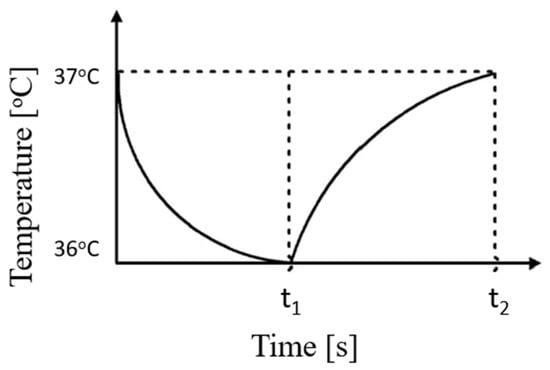
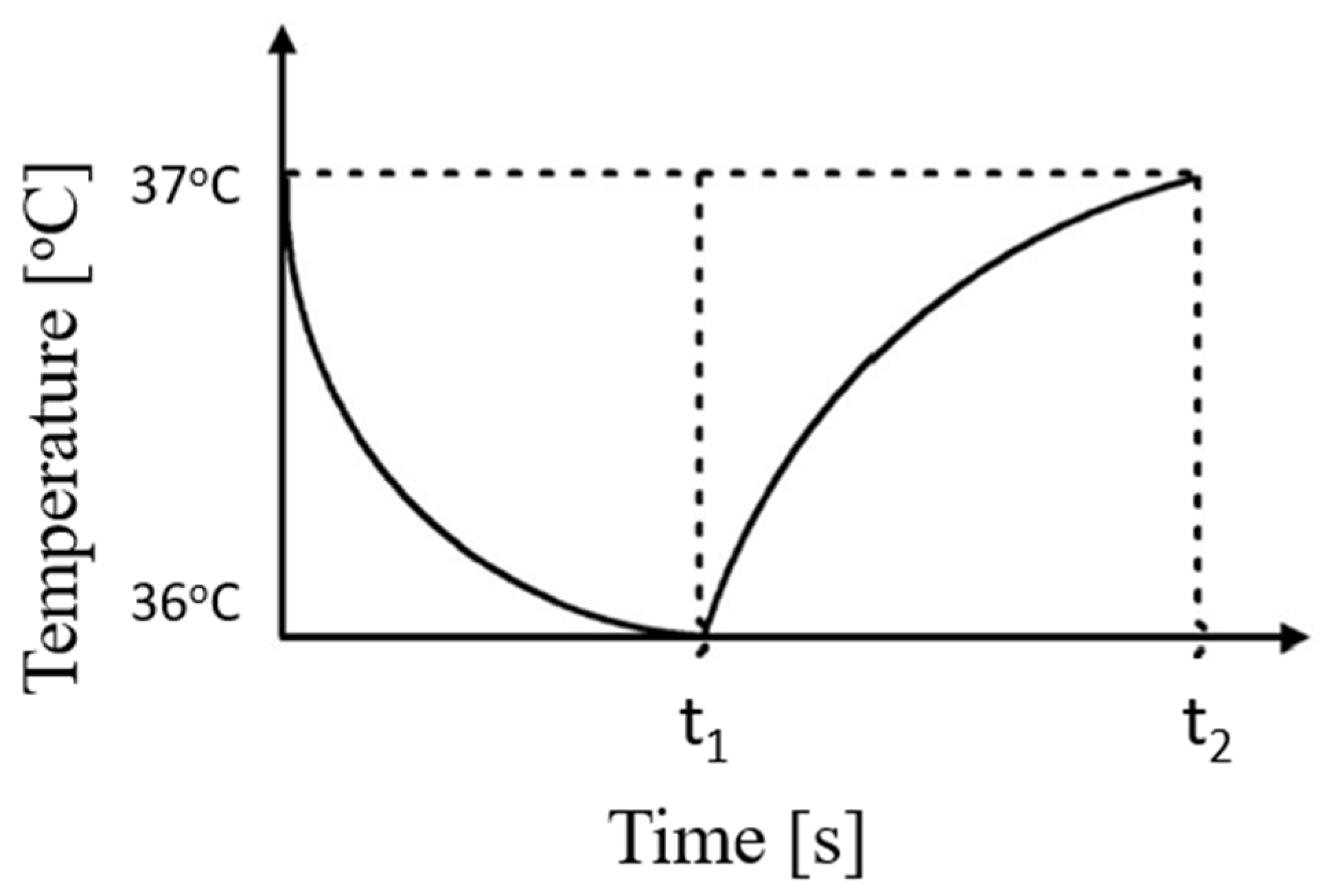
To determine the heat loss of textiles, it is possible to use the measurement of the time required for the temperature to decrease and then increase by 1 °C from the initial state of 37 °C of the heating plate (HP) under selected climatic conditions in a measuring tunnel (Figure 1).
Figure 1.
Cooling and heating of HP for determining the degree of insulation of textile materials and heat loss.
The heat flux source (HP) is heated to 37.0 °C at a given electrical power, which remains the same throughout the measurement time. A current of 2.6 A and a voltage of 4.8 V are selected for heating the copper plate. The size of these values was chosen so that at higher ambient temperatures the copper HP does not overheat and in the case of low ambient temperatures the HP is able to heat up to the given temperature. When the value of 37.0 °C is reached, the heating of the heat flux source is switched off and the time for the temperature of the heat flux source to drop to 36.0 °C is measured using a stopwatch. When the temperature of the heat flux source reaches 36.0 °C, the heating is switched on again and the time for the temperature to reach 37.0 °C again is measured using a stopwatch.
If the material on the surface of the heat flux source (HP) is ideally insulating, there will be no decrease in the temperature of this source; the time required for heating at the temperature sensor located at a distance of d [m] from the surface of HP will be t2 = 0, and no heat needs to be added. If the material does not insulate at all (the temperature at the surface of the heat flux source HP will be the same as the ambient temperature), there will be a rapid temperature decrease of 1 °C at the location of the temperature sensor, and the time required for cooling t1N will be small.
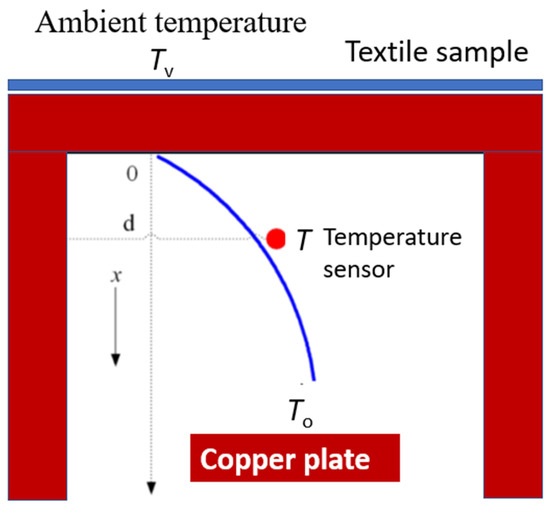
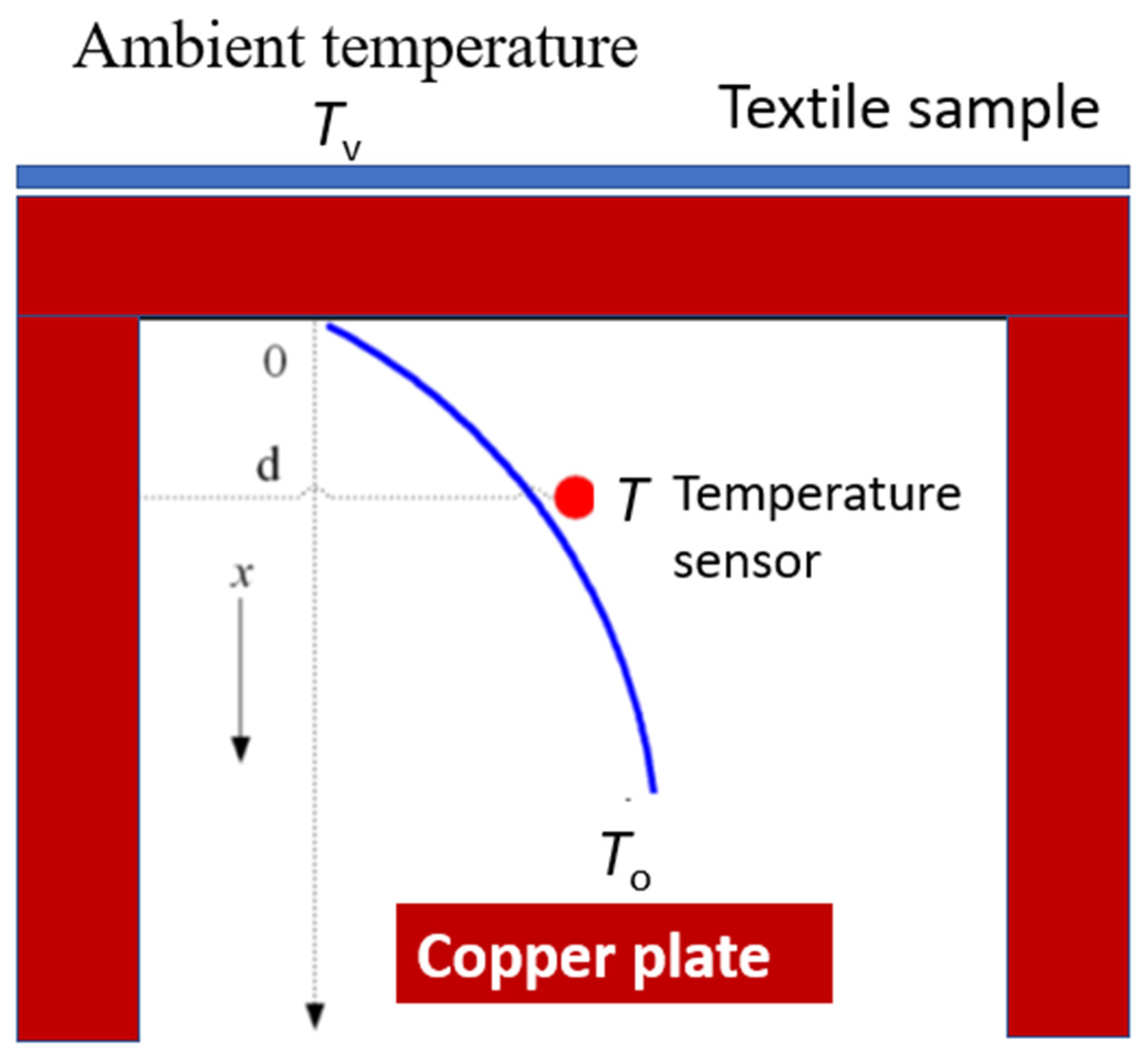
To estimate time t1N, the approximation based on the solution of the semi-infinite layer cooling, as described, for example, in the book [18], can be used. It is based on the idea that a metal layer of temperature T0 is suddenly inserted into a cooling environment where a constant temperature Tv is maintained. For simplicity, it is assumed that the surface of the metal layer has a temperature Tv equal to the ambient temperature and that there is no temperature difference in the surroundings (perfect mixing). The semi-infinite layer occupies the space from the surface (coordinate x = 0 (Figure 2)).
Figure 2.
Geometry of temperature distribution in a metal heating plate during cooling.
The purpose is to describe the time dependence of the temperature distribution in the layer T = T(x), assuming that far enough from the surface, the temperature of the layer is still T0. The initial and boundary conditions for heat transfer are:
At t = 0, for all x > 0 the temperature of sensor is T = T0
At x = 0, for all t > 0 the temperature of sensor is T = Tv
At x → ∞ the temperature is T∞ = T0 for all t > 0
Assume that the thermal conductivity k [J/(s m K)] of the copper HP is constant [19]. The differential equation for heat transfer by conduction has the form [20]
Here c [J/(m K)] is the specific heat at constant volume and ρ [kg/m3] is the density of the metal HP. By introducing dimensionless temperature:
and the parameter the differential Equation (14) takes the form:
The analytical solution of this differential equation has the form [20].
Here erf(x) is the error integral defined by the relation:
This function cannot be expressed in explicit form, but simple approximations of its inverse can be used [21]
From Equations (16) and (18) it is simple to calculate the time t*1N [s] for which will be at point d (sensor placement) the temperature T*, i.e.:
To estimate the time t*1N, it is necessary to select that T = 36 °C, T0 = 37 °C, Tv as the chosen ambient temperature and placement of sensor d = 0.005 m. The heating plate is made of copper with c = 390 J/(kg K), ρ = 8790 kg/m3 and thermal conductivity k = 386.013 W/(m K). In the real cases, the non-zero-time t2 [s] always comes out and the heat [J] required for heating the HP from 36 to 37 °C corresponds to the value calculated using the equation:
where U is the electrical voltage [V] and I is the electrical current [A] supplied by the HP (heat flux source). The degree of the total thermal insulation of the fabric w is then calculated from the equation:
where t1 is heating off time to reduce the temperature of the HP from 37.0 to 36.0 °C [s] and t2 is heating on time to increase the temperature of the HP from 36.0 to 37.0 °C [s].
The degree of insulation ranges from 0 for an ideally non-insulating material to 1 for an ideally insulating material.
The heat loss WS [W] is then calculated from the equation:
Values of Ws are one of the effective tools for the characterization of textile fabric thermal insulation, evaluated without considering their surface roughness changes.
The calculated values of temperatures T* from Equation (16) and times t*1N from Equation (19) for given ambient temperatures are given in Table 1 [21].
Table 1.
Calculated values of temperature T* and times t*1N for given ambient temperatures [21].
The calculated times t*1N are relatively small.
5. Experimental Part
For checking of this new measurement methodology, the material selected was cotton woven fabric with a combed surface and planar mass 134 g/m2. Microscopic images of fabric samples were prepared on a Vega Tescan scanning electron microscope. The fabric thickness was measured on a Schmidt thickness gauge at a pressure of 4.14 kP (ASTM D1777 2019). Air permeabilities at pressure drops of 50 Pa, 100 Pa, and 200 Pa were measured on the FX 3300 instrument. The samples were conditioned for 24 h under standard laboratory conditions, and measurements were made in a standard atmosphere. Thermal conductivity was measured using the Alambeta device at a pressure of 200 Pa.
The degree of the total thermal insulation of the fabric and heat loss is determined for different layers (from 1 to 5) of this material at selected ambient temperatures of 20, 10, 0, −10, and −20 °C and at ambient air flow speeds of 0.73, 1.7, and 2.1 m/s. The measurements in the condition of direct contact with the heat source and in the condition of the air gap between the textile and the heat flow source are realized.
A custom-made measuring tunnel composed of certified testing sensors with a heating plate (HP) to evaluate the degree of total thermal insulation of the fabric under different climatic conditions was created.
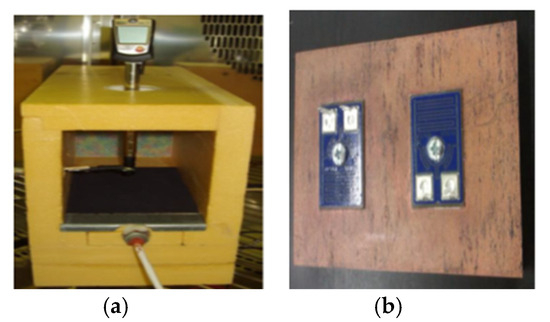
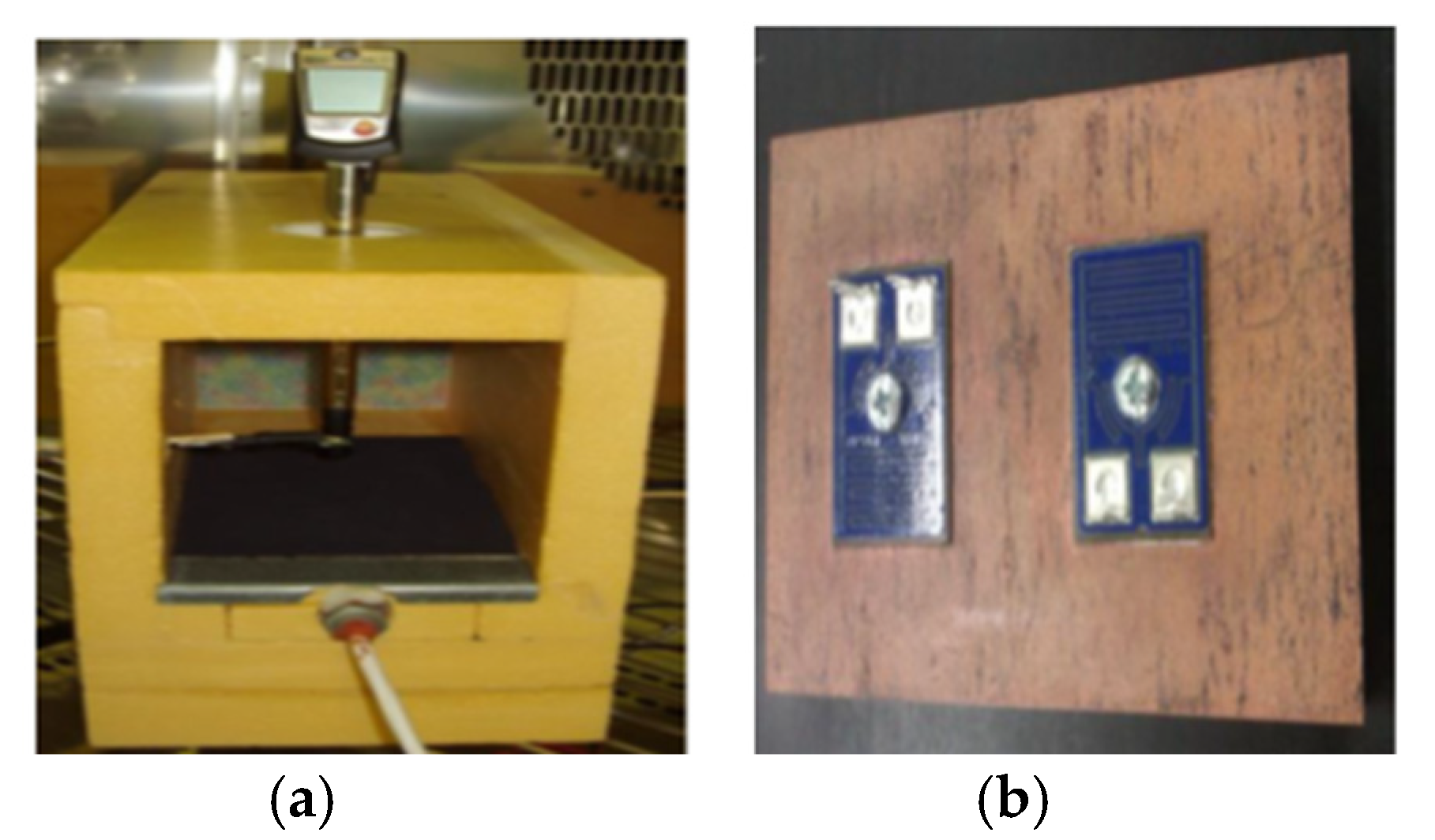
Construction made from expanded polystyrene (measured conductivity at 20 °C is 0.03359 W/(K m) and at −20 °C is 0.03122 W/(K m) is shown in Figure 3).
Figure 3.
Measuring tunnel (a) front view with air velocity sensor, (b) detail of copper heating plate with heating elements.
For the regulation of air speed, a Silverstone FM121 small fan (dimensions 120 × 120 × 25 mm) with 9 blades and a sensor Testo 405-V1 anemometer is used. This sensor is used for measuring air flow in a measuring tunnel from 0 to 5 m/s and temperature from −20 to 50 °C. The heat regulation is ensured by a suitable temperature controller with a temperature sensor placed in the heated plate (HP). A laboratory penetration thermometer, TFA 30.1033, is chosen to control the temperature of the heated plate. The heating plate is composed of a copper layer. For heating this copper plate, two flat TF73 heating elements are used (Figure 3b). Each element is powered by 12 V and provides a thermal output of 40 W, for which they require a current of approximately 3.3 A. The heating elements have dimensions of 26 × 37 × 1 mm. The elements can be used for operating temperatures from −40 to 200 °C.
Where heating off time t1 to reduce the temperature of the HP from 37.0 to 36.0 °C [s] and heating time t2 to increase the temperature of the HP from 36.0 to 37.0 °C [s] was measured by stopwatch.
6. Results and Discussion
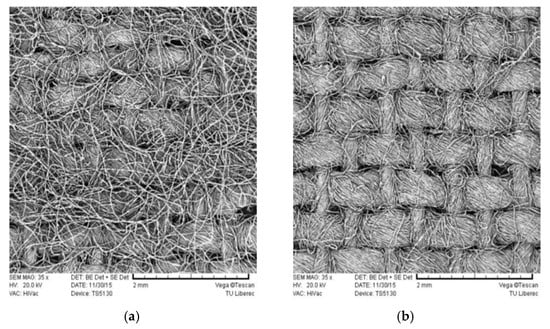
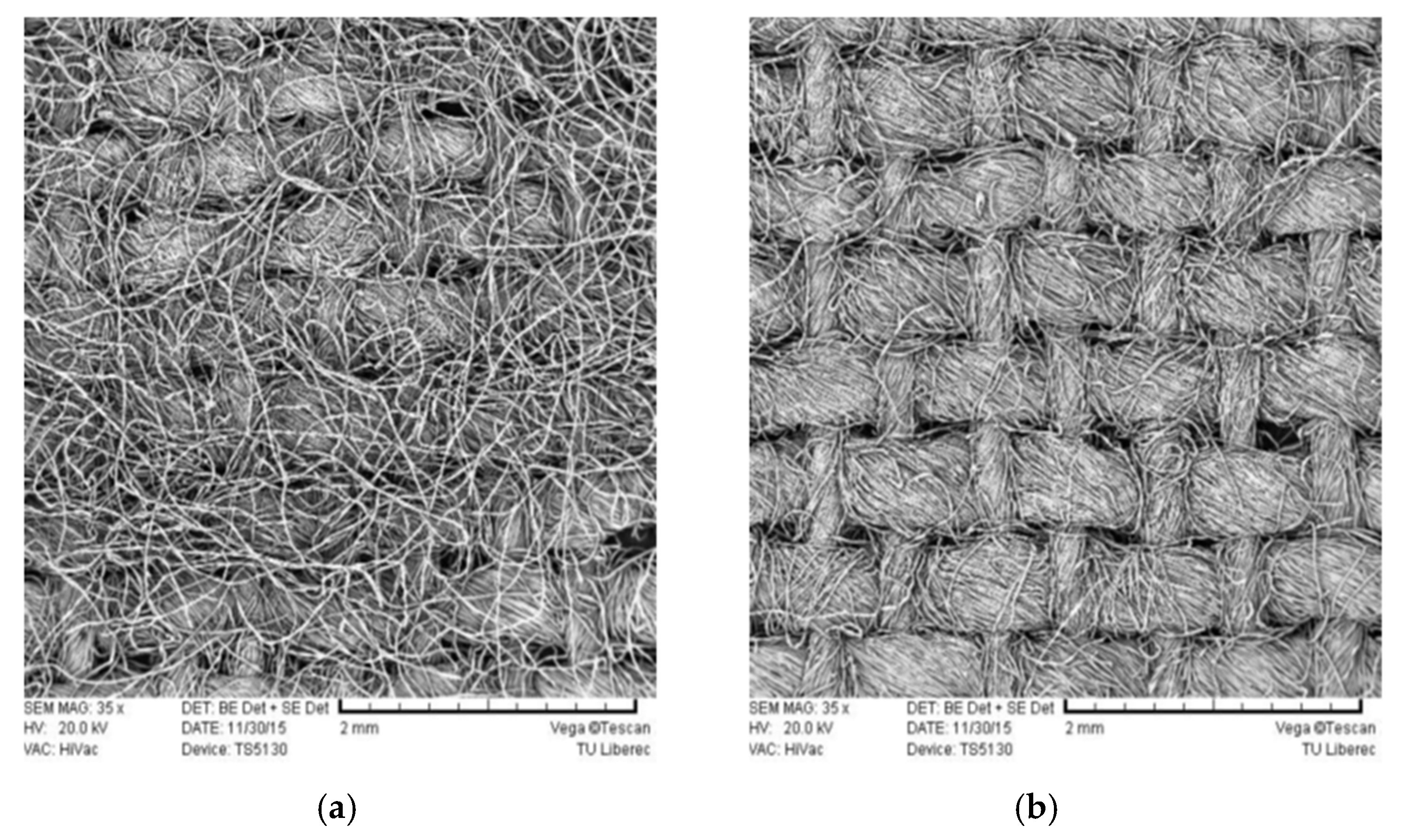
The morphology of cotton fabric with combed surface at magnification 35× is shown in Figure 4.
Figure 4.
Structure of surface combed cotton (a) front side, (b) back side.
The porous structure and high surface hairiness are clearly visible. The statistical characteristics of thickness are given in Table 2. Here, CI low is the lower limit of the 95% confidence interval of the population mean, and CI high is the upper limit of the 95% confidence interval of the population mean.
Table 2.
Thickness statistical characteristics.
Table 3 shows the calculated average values of measured air permeability at different pressure drops. The temperature in the laboratory during the measurement was 23.0 °C, and the air humidity was 58%.
Table 3.
Mean air permeabilities at different pressure drops.
Using the value of the planar weight measured by the Sartorius scales and the value of the material thickness the fabric density and volumetric porosity was calculated [8] (Table 4).
Table 4.
Fabric density and volume porosity.
The mean thermal conductivity measured by the device Alambeta at a pressure of 200 Pa was 0.041 W/(m K).
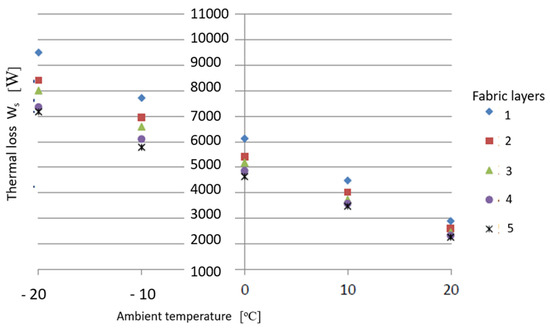
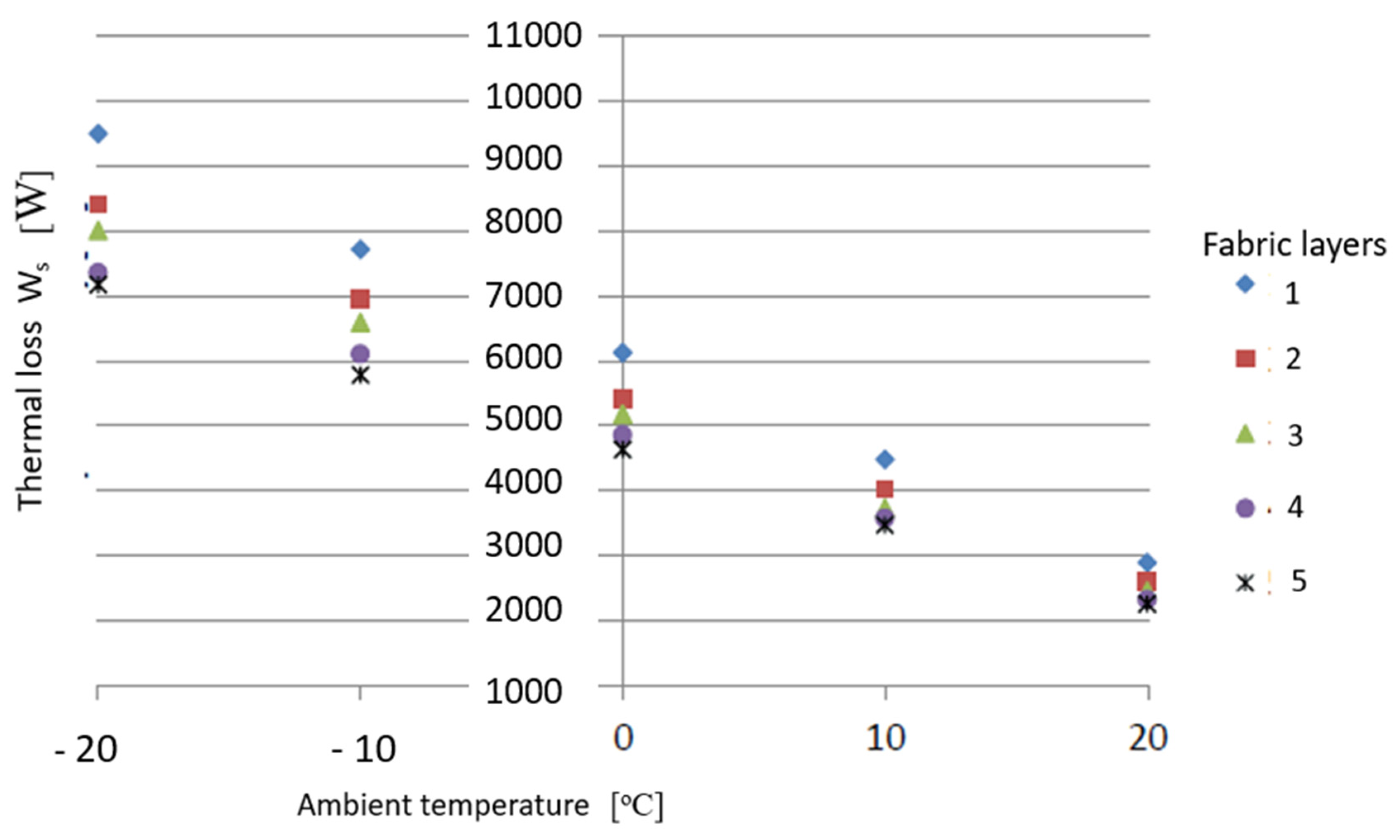
By using the measuring tunnel (Figure 3) and measured times t1 and t2, the characteristics of fabric thermal insulation were evaluated. As the ambient temperature decreased, the amount of heat that needed to be supplied to the heat flow source increased in order to heat it by 1 °C. The same is valid for increasing air flow velocity. On the contrary, with an increasing number of layers of fabric, the amount of heat required to heat the HP decreases.
The heat losses of the textile fabric at an ambient air flow velocity of 0.73 m/s and different ambient air temperatures, for individual layers of cotton, in the case of direct contact with the HP, are shown in Figure 5.
Figure 5.
Heat losses of the fabric at an ambient air velocity of 0.73 m/s and different ambient air temperatures, for individual layers of cotton, for direct contact with the HP.
The same linear trends were found for air velocities of 1.7 and 2.1 m/s.
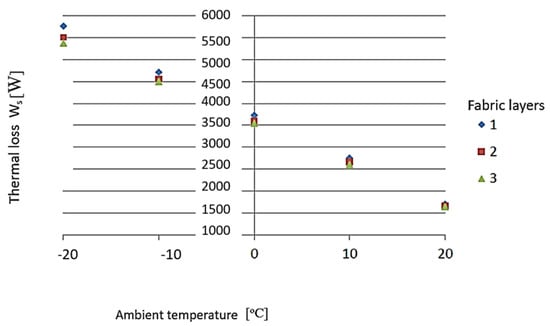
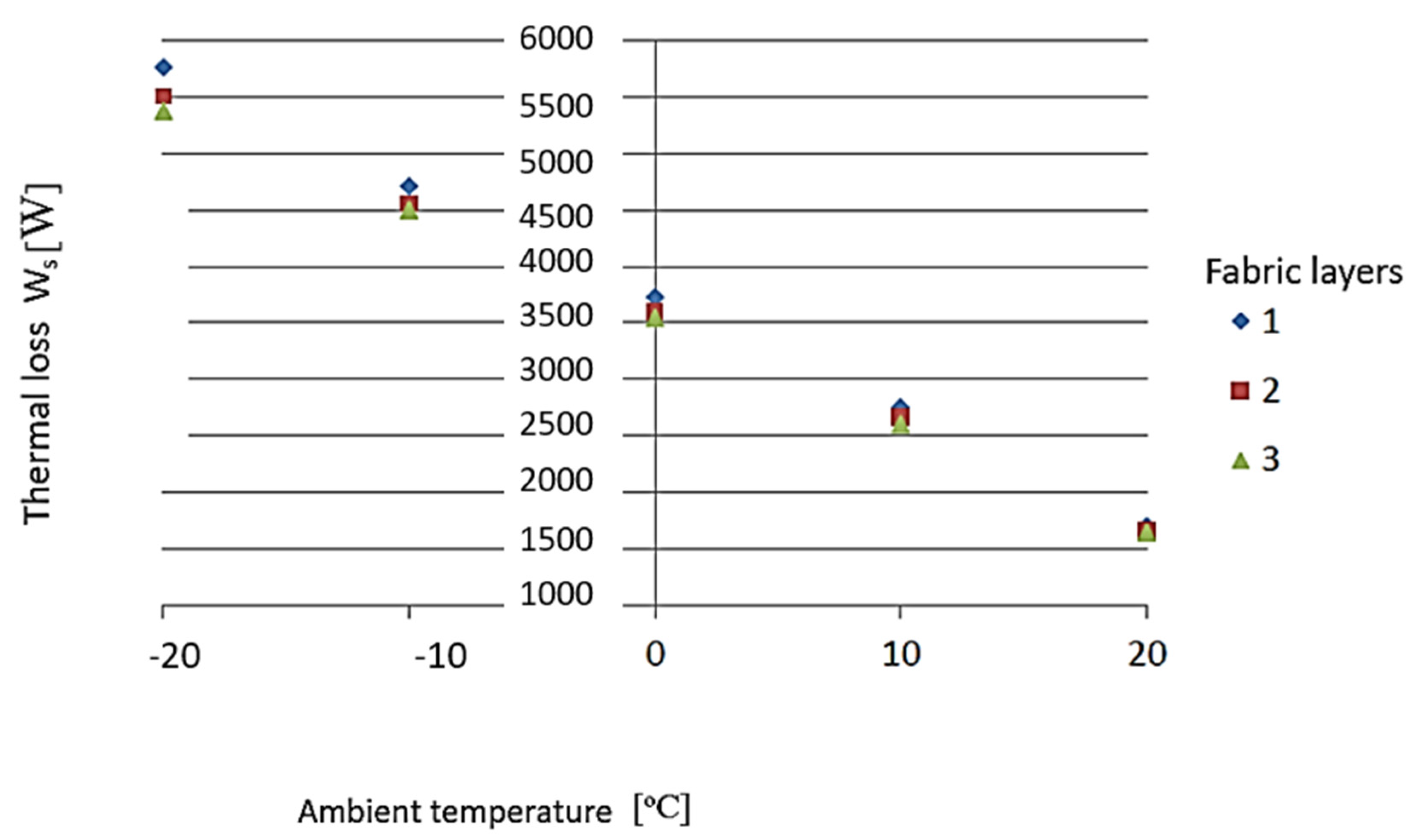
The heat losses of the textile fabric at an ambient air flow velocity of 0.73 m/s and different ambient air temperatures, for individual layers of cotton, in the case of an air gap between fabric and the HP, are shown in Figure 6.
Figure 6.
Heat losses of the fabric at an ambient air velocity of 0.73 m/s and different ambient air temperatures, for individual layers of cotton, for an air gap between the fabric and the HP.
The values of the degree of insulation (Equation (21)) of the fabric were calculated for individual layers in direct contact with the HP and the air gap between the fabric and the HP. From the calculated values, it can be seen that with an increasing number of fabric layers, the degree of insulation increases. On the contrary, with decreasing temperature, the degree of insulation also decreases, and the same is true for the flow velocity, where the degree of insulation of the fabric also decreases with increasing flow velocity.
The same linear trends were found for air velocities of 1.7 and 2.1 m/s.
A statistical model was proposed to calculate heat losses Ws for different layers of fabric (N) under given climatic conditions (ambient temperature To). This linear model with interaction for direct contact of the textile with a heat flux source has the form
The least squares method was used for parameter estimation, and the estimated parameters are presented in Table 5. In the case of parameter estimation, if the absolute value of the t-stat is greater than 2, the parameter is significantly different from zero [13].
Table 5.
Parameter estimates for the statistical model when the textile is in direct contact with HP.
After putting significant estimates from Table 5 into Equation (23) the model for prediction of Ws in the case of direct contact of the textile has the form
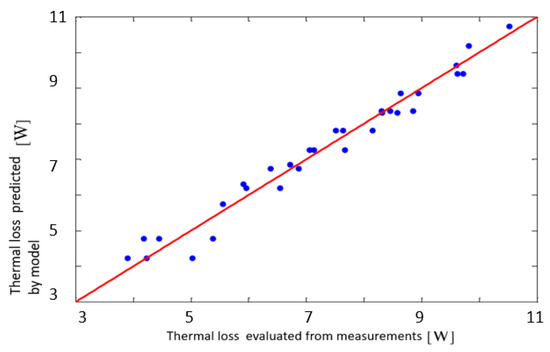
The relation between heat losses predicted by this model (Equation (24)) and evaluated experimentally is shown in Figure 7; the coefficient of determination was 97.288% and the average relative error was found to be 6.074%.
Figure 7.
Heat losses experimentally measured and predicted from a statistical model in the case of direct contact between the plate and the textile.
The same model form (Equation (23)) was used for the prediction of heat losses Ws for different layers of fabric (N) under given climatic conditions (ambient temperature To) in the case of an air gap between the textile fabric and HP. The estimated parameters are presented in Table 6.
Table 6.
Parameter estimates for the statistical model for the air gap between the fabric and the HP.
After putting significant estimates from Table 6 into Equation (23), the model for prediction of Ws in the case of an air gap between the textile fabric and the HP has the form
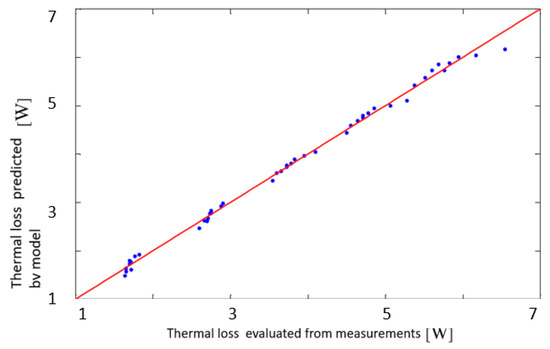
The relation between heat losses predicted by this model (Equation (25)) and evaluated experimentally for the case of an air gap is shown in the Figure 8. The coefficient of determination was 99.563% and the average relative error was found to be 2.298%.
Figure 8.
Heat losses are experimentally measured and predicted from a statistical model in the case where there is an air gap between the plate and the textile.
7. Conclusions
The described methodology appears to be easy and, of all the tested methodologies, the most suitable for determining the thermal insulation properties of textile materials in a measuring tunnel. In this case, in contrast to the previous methodologies, measured values of heating and cooling time of the heat source by 1 °C are used to calculate the thermal characteristics [22]. From a time perspective, this methodology appears to be demanding. An experiment was also tested using this methodology, where polyethylene foil was attached to the surface of 1, 3, and 5 layers of cotton in the event that the textile was in direct contact with the heat flow source. It turned out that when using polyethylene foil, heat losses in some cases also increase slightly. This is most likely due to the fact that the polyethylene foil on the surface compresses the individual layers more, and the air is forced out of the interlayers, which acts as an insulator. The measured and calculated values of this experiment were not ultimately used in this work. It turned out that the calculated time t*1N is relatively small in the case of a copper HP. It would certainly be interesting to try using another material with a different thermal conductivity and density instead of copper, and try to calculate the time t*1N and the heat losses.
Author Contributions
Conceptualization, J.M. and D.K.; Data curation, D.K. and T.K.; Formal analysis, J.M. and T.K.; Funding acquisition, M.V.; Investigation, J.M., T.K. and D.K.; Methodology, J.M., T.K. and D.K.; Project administration, M.V.; Resources, J.M., D.K. and M.V.; Software, D.K.; Supervision, D.K.; Validation, D.K. and M.V.; Visualization, J.M. and M.V.; Writing—original draft, J.M.; Writing—review & editing, M.V. All authors have read and agreed to the published version of the manuscript.
Funding
This work was also supported by the project ‘Advanced Structures for Thermal Insulation in Extreme Conditions’ (reg. no. 21-32510M) granted by the Czech Science Foundation (GACR).
Institutional Review Board Statement
Not applicable.
Data Availability Statement
The original contributions presented in this study are included in the article. Further inquiries can be directed to the corresponding author.
Acknowledgments
This work was also supported by the project ‘Advanced Structures for Thermal Insulation in Extreme Conditions’ (reg. no. 21-32510M) granted by the Czech Science Foundation (GACR).
Conflicts of Interest
The author, Tomáš Kubeček, was employed by the company Rubena s.r.o. Náchod. The remaining authors declare that the research was conducted in the absence of any commercial or financial relationships that could be construed as a potential conflict of interest.
References
- Parsons, R. ASHRAE Handbook Fundamentals, SI ed.; ASHRAE: Atlanta, GA, USA, 1997. [Google Scholar]
- Fanger, P.O. Thermal Comfort; McGraw-Hill: New York, NY, USA, 1970. [Google Scholar]
- Wilson, S.B.; Spence, V.A. A Tissue Heat Transfer Model for Relating Dynamic Skin Temperature Changes to Physiological Parameters. Phys. Med. Biol. 1988, 33, 895–912. [Google Scholar] [CrossRef] [Scilit] [PubMed]
- Xu, F.; Lu, T.J.; Seffen, K.A.; Ng, E.Y.K. Mathematical Modeling of Skin Bioheat Transfer. Trans. ASME Appl. Mech. Rev. 2009, 62, 1–33. [Google Scholar] [CrossRef] [Scilit]
- Parsons, K.C. Human Thermal Environments, 3rd ed.; CRC Press: Boca Raton, FL, USA, 2014. [Google Scholar]
- Yondea, M.; Kawabata, S. Analysis of Transient Heat Conduction and its Applications, Part 1. J. Text. Mach. Soc. Jpn. 1983, 29, 73–83. [Google Scholar]
- Yondea, M.; Kawabata, S. Analysis of Transient Heat Conduction and its Applications, Part 2. J. Text. Mach. Soc. Jpn. Trans. 1985, 34, T200–T208. [Google Scholar]
- Wang, D.; Hu, S.; Křemenáková, D.; Militký, J.; Zhu, G. Effect of Textile Structure on Heat Transfer Performance. In Advanced Multifunctional Materials from Fibrous Structures; Militký, J., Venkataraman, M., Eds.; Springer: Singapore, 2023. [Google Scholar] [CrossRef] [Scilit]
- Yang, F.W.; Meng, S. Effect of porous microstructure and fiber arrangement of thermal protection composites on effective thermal conductivity. Mech. Mater. 2024, 198, 105147. [Google Scholar] [CrossRef] [Scilit]
- Al-Homoud, M.S. Performance characteristics and practical applications of common building thermal insulation materials. Build. Environ. 2005, 40, 353–366. [Google Scholar] [CrossRef] [Scilit]
- Smith, D.S.; Alzina, A.; Bourret, J.; Nait-Ali, B.; Pennec, F.; Tessier-Doyen, N.; Otsu, K.; Matsubara, H.; Elser, P.; Gonzenbach, U.T. Thermal conductivity of porous materials. J. Mater. Res. 2013, 28, 2260–2272. [Google Scholar] [CrossRef] [Scilit]
- Zhao, J.-J.; Duan, Y.-Y.; Wang, X.-D.; Wang, B.-X. Effects of solid–gas coupling and pore and particle microstructures on the effective gaseous thermal conductivity in aerogels. J. Nanopart. Res. 2012, 14, 1024. [Google Scholar] [CrossRef] [Scilit]
- Lee, S.C. Effect of fiber orientation on thermal radiation in fibrous media. Int. J. Heat Mass Transf. 1989, 32, 311–319. [Google Scholar] [CrossRef] [Scilit]
- Venkataraman, M.; Sözcü, S.; Militký, J. Radiative Heat Transfer Properties of Fiber–Aerogel Composites for Thermal Insulation. Gels 2025, 11, 538. [Google Scholar] [CrossRef] [Scilit] [PubMed]
- Howell, J.R.; Mengüc, M.P.; Daun, K.; Siegel, R. Thermal Radiation Heat Transfer, 6th ed.; CRC Press: Boca Raton, FL, USA, 2015. [Google Scholar]
- Lee, S.W.; Lim, C.H.; Bin Salleh, E.I. Reflective thermal insulation systems in building: A review on radiant barrier and reflective insulation. Renew. Sustain. Energy Rev. 2016, 65, 643–661. [Google Scholar] [CrossRef] [Scilit]
- Wang, F.; Cheng, L.; Zhang, Q.; Zhang, L. Effects of heat treatment and coatings on the infrared emissivity properties of carbon fibers. J. Mater. Res. 2014, 29, 1162–1167. [Google Scholar] [CrossRef] [Scilit]
- Slattery, J.C. Advanced Transport Phenomena; Cambridge University Press: Cambridge, UK, 2005. [Google Scholar]
- Thermal Conductivity of Copper, Engineering Toolbox. Available online: https://www.engineeringtoolbox.com/copper-density-specific-heat-thermal-conductivity-vs-temperature-d_2223.html (accessed on 20 November 2025).
- Luikov, A.V. Analytical Heat Diffusion Theory; Academic Press: New York, NY, USA, 1968. [Google Scholar]
- Kubeček, T. The Effect of Temperature on Heat Loss of Textiles. Master’s Thesis, Technical University of Liberec, Studentská, Czech Republic, 2016. (In Czech) [Google Scholar]
- Meloun, M.; Militký, J. Statistical Data Analysis; Woodhead: Oxford, UK, 2011. [Google Scholar]

Disclaimer/Publisher’s Note: The statements, opinions and data contained in all publications are solely those of the individual author(s) and contributor(s) and not of MDPI and/or the editor(s). MDPI and/or the editor(s) disclaim responsibility for any injury to people or property resulting from any ideas, methods, instructions or products referred to in the content. |
© 2026 by the authors. Licensee MDPI, Basel, Switzerland. This article is an open access article distributed under the terms and conditions of the Creative Commons Attribution (CC BY) license.