Article

Effects of Yarn Composition and Knitted Macrostructure on the Functional Properties of Smart Textiles with Optical Functionalities


by
Radostina A. Angelova
1,2,3,*,
Elena Borisova
2,4 and
Daniela Sofronova
1,2
1
Department of Hydroaerodynamics and Hydraulic Machines, Technical University of Sofia, 1000 Sofia, Bulgaria
2
Miracle Centre of Competence Lab “Intelligent Mechatronic Solutions in Textiles and Clothing” (MeTex), Technical University of Sofia, 1000 Sofia, Bulgaria
3
Centre for Research and Design in Human Comfort, Energy and Environment (CERDECEN), Technical University of Sofia, 1000 Sofia, Bulgaria
4
Department of Energy and Mechanical Engineering, Technical College–Sofia, Technical University of Sofia, 1000 Sofia, Bulgaria
*
Author to whom correspondence should be addressed.
Textiles 2026, 6(1), 36; https://doi.org/10.3390/textiles6010036
Submission received: 14 January 2026 / Revised: 13 February 2026 / Accepted: 17 March 2026 / Published: 20 March 2026

Abstract

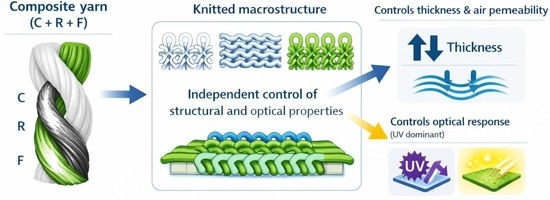
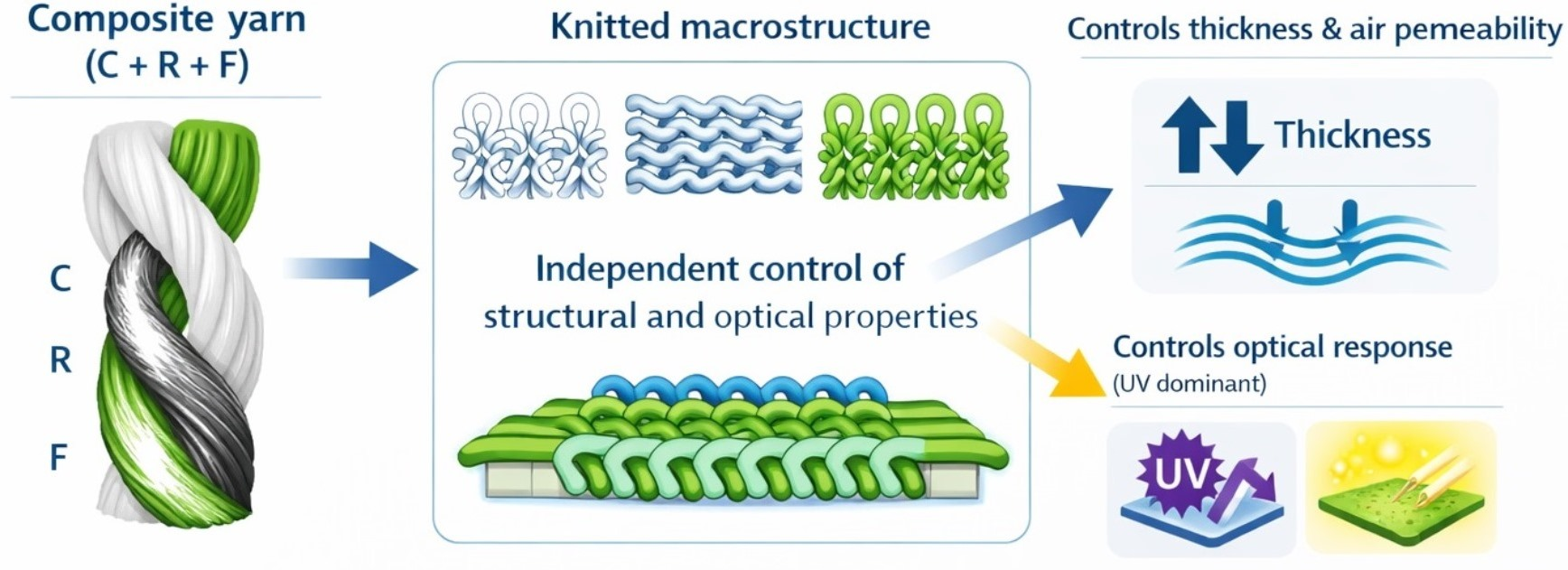
This study analyses the influence of yarn composition and knitted macrostructure on the structural and functional performance of passive smart knitted fabrics with optical functionalities. Twelve knitted macrostructures were produced using folded composite yarns combining cotton, reflective, and photoluminescent components and different stitch patterns. Thickness, air permeability, and reflectance under UV and visible illumination were experimentally evaluated. The results indicate that knitted macrostructure primarily controls thickness and air permeability, whereas optical response is governed by yarn composition. Variations in stitch pattern enable regulation of air permeability independent of optical behaviour, while UV-responsive yarn components dominate reflectance performance. The findings support independent optimisation of structural and optical properties through combined yarn and macrostructural design.

Graphical Abstract

1. Introduction

With the increasing demands for the functionality and safety of textile products, the development of smart fabrics is becoming increasingly important [1,2]. In nature, many organisms have developed mechanisms for adaptation and protection through changes in colour or reflective properties, making them more visible or less visible depending on the need [3]. Inspired by these natural strategies, modern textile technologies aim to integrate optical (e.g., light-emitting and light-reflecting) properties into textile materials to enhance their functionality in various applications [4,5,6].
Smart textile materials have a wide range of applications in personal safety, sportswear, the automotive industry, and fashion design. Fabrics with optical functionalities play a key role in ensuring visibility and safety in low-light conditions. In recent years, increasing attention has been paid not only to the properties of the functional yarns themselves, but also to the influence of textile structure on the resulting functional and optical performance of the fabric.
Light-emitting fibres (electroluminescent or photoluminescent) are progressively used in the textile industry as they combine functionality and aesthetics. The ability to integrate such fibres into protective clothing enhances user safety in night-time or low-light conditions [7]. Previous studies have highlighted the importance of comfort, showing that the use of flexible textile structures enables the development of innovative garments without compromising wearability [8]. The durability and resilience of light-emitting fibres can improve the longevity of garments when appropriately designed and integrated [9].
Electroluminescent textiles emit light only when an electric current passes through them, or an electric field is applied [10]. Photoluminescent textiles, particularly phosphorescent ones, absorb energy from UV light and emit light for a shorter or longer period after the light source is removed [11]. The absence of an external energy source (electricity) provides greater convenience in use but compromises the duration of emission [11,12]. Phosphorescent elements are applied to clothing, textile toys, accessories, and interior textiles [13,14]. The photoluminescent properties of smart textiles make them particularly useful for rescue teams, workers in hazardous environments, and nighttime sports activities [15,16].
Traditionally, reflective fabrics are created by adding microscopic glass spheres [17] or metallised layers [18]. However, these methods often compromise the softness and flexibility of the material. An optimal balance is sought between new functionality, mechanical stability of the coating, and garment comfort [19]. This challenge has stimulated interest in alternative textile structures that can integrate reflective elements without significantly affecting wearability.
Knitted fabrics are particularly suitable for smart textiles due to their flexibility, softness, and inherently open-looped structure, which enables enhanced air permeability compared to woven fabrics [20]. They adapt easily to the shape of the body, providing comfort and freedom of movement. These properties make them appropriate for clothing, accessories, and interior products, offering a reasonable combination of comfort and style [21,22].
Using a base cotton yarn, a reflective yarn, and a photoluminescent yarn in a single knit leads to the creation of an innovative macrostructure that combines strength, functionality, and aesthetic appeal in one product. Cotton is preferred for its breathable, hypoallergenic nature and pleasant tactile properties, while its strength and wear resistance ensure durability in daily use [23,24]. The simultaneous integration of three different yarn types within a single knitted structure enables the design of textiles with combined reflective and photoluminescent optical effects. This synergistic effect allows the integration of the best qualities of the component materials to produce a textile product with numerous applications—from personal safety and sportswear to fashion accessories and technical solutions [25]. Despite extensive research on functional yarns, the influence of knitted macrostructure on combined reflective and photoluminescent performance remains insufficiently explored.
This paper presents the design and analysis of knitted macrostructures integrating cotton, reflective, and photoluminescent yarns within a single textile structure. The knitted macrostructure is treated as a functional design parameter that governs both optical performance and comfort-related properties. A total of twelve knitted macrostructures were developed and analysed to investigate the influence of knitted geometry on reflectance behaviour and air permeability. The results demonstrate a clear structure–function relationship, showing that appropriate macrostructural design enables the development of flexible, breathable, and optically functional smart textiles with enhanced visibility under low-light and night-time conditions.

2. Materials and Methods

2.1. Materials: Yarns and Composite Yarn Design

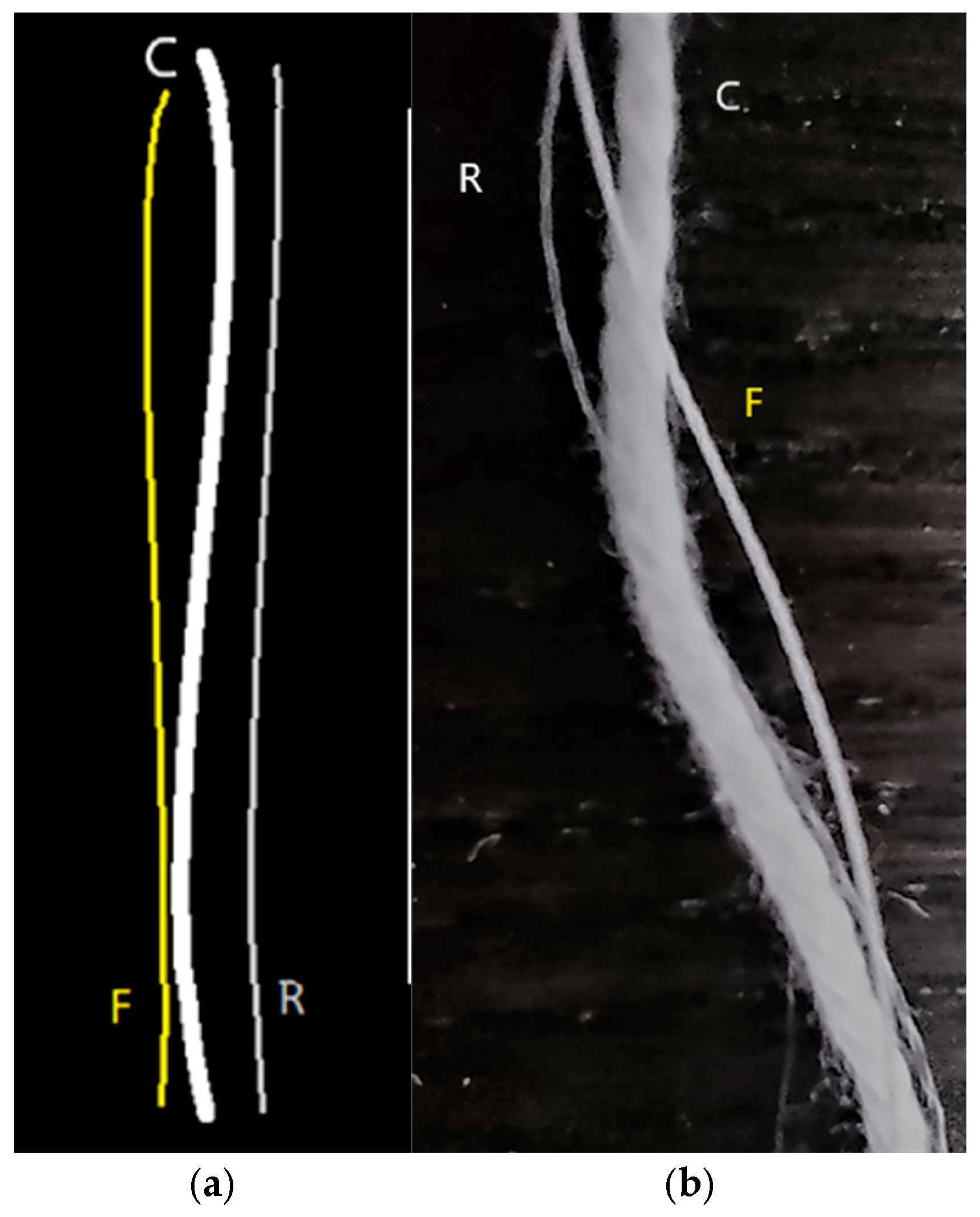
Folded yarns consisting of three parallel threads—cotton yarn (C), photoluminescent yarn (F), and reflective yarn (R)—were used in this study. The structure of the composite yarn is illustrated in Figure 1, showing both a schematic representation (Figure 1a) and a photograph of the actual yarn (Figure 1b).
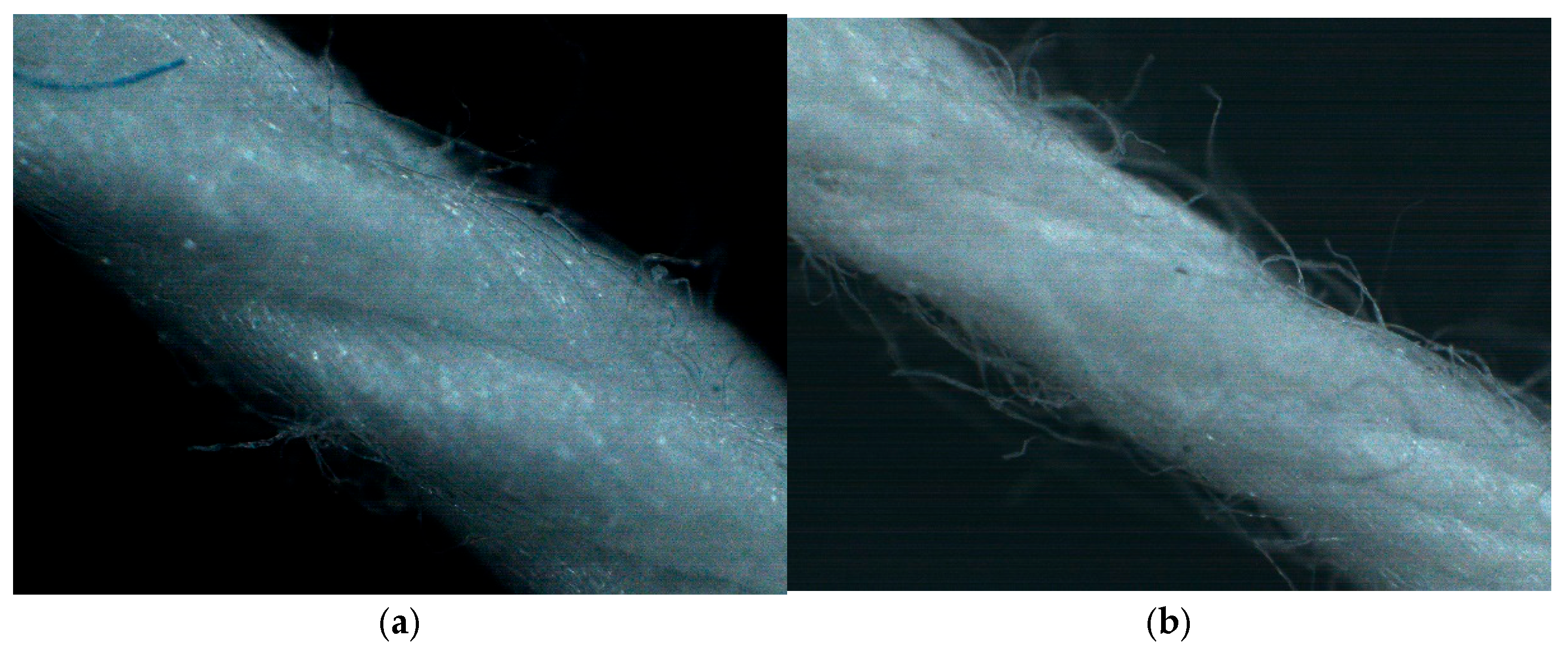
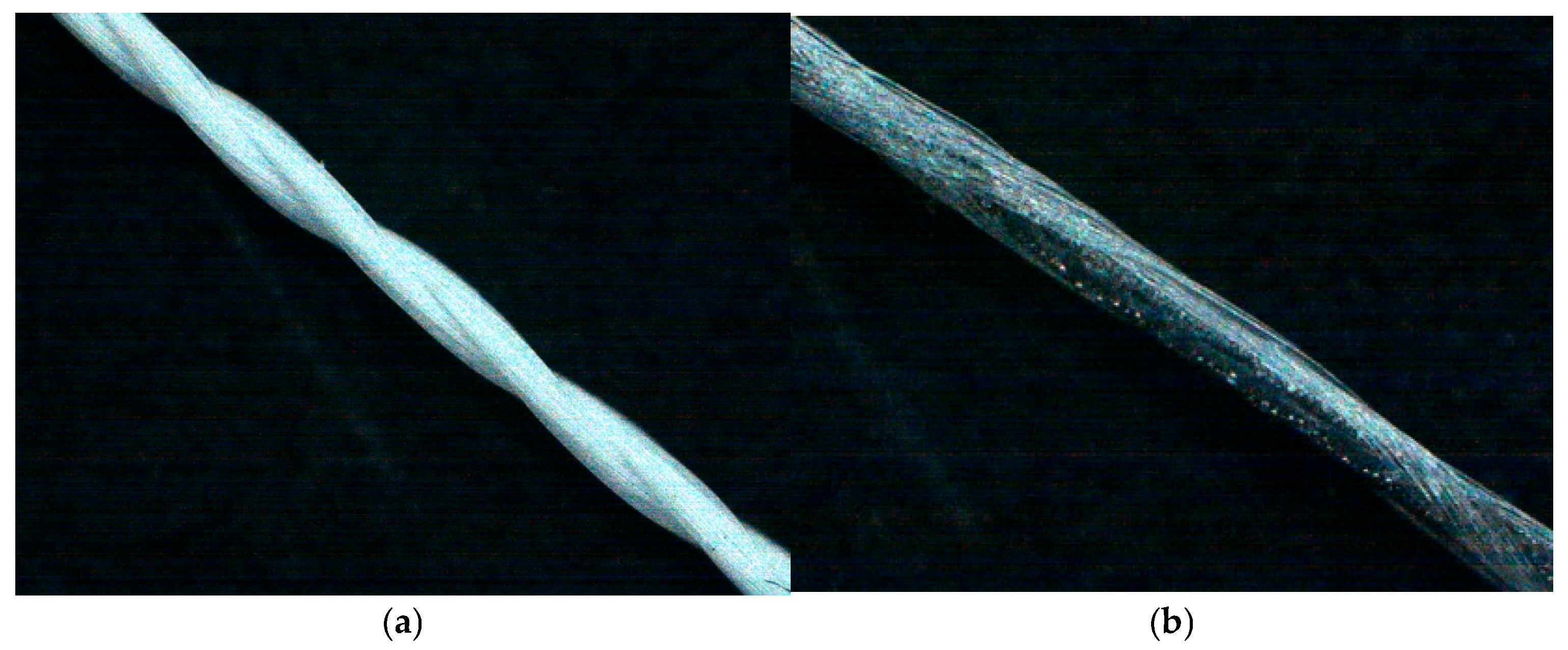
Two cotton yarns were selected as base components: C1, 264 tex (Figure 2a) and C2, 400 tex (Figure 2b). The photoluminescent yarn (F) is a continuous filament composed of polybutylene terephthalate (PBT) and polypropylene (PP), 150x2 dtex (Figure 3a), while the reflective yarn (R) consists of a polyamide core coated with glass beads, 175x2 tex (Figure 3b).
In addition, folded yarns containing only cotton yarn (C1) combined with the photoluminescent yarn (F) were used to produce single jersey samples without reflective components.
Cotton was selected as the primary yarn due to its softness, pleasant tactile properties, and breathability, which are essential when combined with stiffer functional yarns. From a structural perspective, the cotton yarn provides mechanical stability to the knitted macrostructure, facilitating the knitting process when combined with the more rigid and slippery photoluminescent and reflective threads. Its matte surface also enhances the visual contrast with the reflective and photoluminescent components, allowing clearer observation of their distribution and interaction within the knitted structure.
The difference in linear density between the thicker cotton yarns (264 tex and 400 tex) and the finer functional threads offers practical advantages. The cotton yarn acts as a structural backbone, distributing tension more evenly during knitting and preventing deformation of the thinner functional threads. This configuration improves the stability of the knitted samples and supports systematic analysis of the structure-function relationship. While thicker cotton yarns were chosen to ensure experimental stability and clarity, the use of finer cotton was applied to decrease the cotton share in the cross-section and increase the relative dominance of the F and R yarns.
Based on yarn composition, the folded composite yarns are designated as follows:
  • C1F: Cotton 264 tex, photoluminescent yarn 30 tex;
  • C1FR: Cotton 264 tex, photoluminescent yarn 30 tex, reflective yarn 35 tex;
  • C2FR: Cotton 400 tex, photoluminescent yarn 30 tex, reflective yarn 35 tex.
The composite yarns were formed by doubling the three component threads without twisting. This approach allows each thread to retain its intrinsic properties: the cotton yarn preserves its softness and breathability, the reflective yarn maintains its surface integrity and optical performance, and the photoluminescent yarn retains its light-emitting capability. The absence of twisting reduces internal stresses within the yarn assembly, resulting in increased flexibility and softness of the knitted macrostructure. In addition, untwisted doubling supports higher air permeability and contributes to a distinct visual texture, which is relevant for both functional and aesthetic textile applications.

2.2. Methods

Twelve knitted macrostructures were designed using different stitch patterns and manufactured on a Silver Reed SK 840 flat knitting machine (Silver Reed Ltd., Haverfordwest, UK). Due to the untwisted folded configuration, occasional partial engagement of individual components was observed during loop formation. However, no progressive separation or structural instability of the composite assembly was detected in the produced samples.
The graphical representations and 3D simulations of the knitted macrostructures were generated using Karl Mayer Stoll’s M1+ V7.5 software package (KARL MAYER STOLL Textilmaschinenfabrik GmbH, Obertshausen, Germany).
The thickness of the knitted samples (δ, mm) was determined according to ISO 5084 [26] using a digital thickness tester under a pressure of 0.1 kPa. The mass per unit area (Ms, g/m2) was calculated following ISO 3801:2017 [27]. The mass of each sample (m0, g) was measured using a digital balance, and the sample area (S, m2) was determined from its measured length and width.
Air permeability was measured according to ISO 9237:1995 [28] under a pressure differential of Δp = 100 Pa. Five measurements were performed on each knitted sample to account for structural variability. The tests were carried out using an FX-3340 MinAir air permeability tester (Textest AG, Schwerzenbach, Switzerland).
Reflectance measurements were conducted following a methodology previously developed by the present authors and described in [29]. The experimental setup was based on a light booth equipped with standard illuminants (UV, D65, TL84, Incandescent Illuminant A, and Department Store Light CWF), and a lux metre positioned at a fixed distance from the textile surface. Measurements were performed against a black background to minimise ambient reflections. Ten measurements were performed for each sample.
To quantify the optical response of the knitted samples, a reflectance ratio was employed as a relative parameter, defined as [30]:
R = E m E 0
where R is a dimensionless reflectance ratio, Em denotes the illuminance measured with the textile sample in place (lx), and E0 represents the corresponding illuminance measured without the sample (lx).
In the present study, the reflectance ratio is used to evaluate the influence of reflective and photoluminescent yarns incorporated into the knitted structures, enabling a comparative analysis of the optical behaviour of different knitted macrostructures.

3. Results

3.1. Design and Structural Characteristics of the Knitted Macrostructures

Twelve knitted samples were produced using five stitch patterns: single jersey, single jersey with float, double jersey, purl, and modified purl. Two samples served as reference materials and contained no reflective yarns. An overview of the samples, including yarn composition, stitch pattern, graphical representations of the knitted macrostructure, 3D simulations of the technical face and back, and photographs of the knitted samples, is provided in Table 1.
To enable a controlled experimental analysis, the knitted samples were organised into four comparison groups based on stitch pattern and yarn composition:
  • Group A (Samples 1, 3, 7): identical stitch pattern (single jersey) with three different composite yarns (C1F, C1FR, C2FR).
  • Group B (Samples 2, 4, 8): identical stitch pattern (single jersey with float) with the same three composite yarns (C1F, C1FR, C2FR).
  • Group C (Samples 3, 4, 5, 6): identical composite yarn (C1FR) combined with four different stitch patterns visible on the technical face (single jersey, purl, double jersey).
  • Group D (Samples 7–12): identical composite yarn (C2FR) combined with six different stitch patterns (single jersey, purl, double jersey, single jersey with float, and modified purl).
This grouping allows systematic evaluation of the isolated effects of yarn composition and knitted macrostructure on the structural and functional properties of the fabrics.
The stitch density of all samples, expressed as the number of wales and courses per 10 cm, is presented in Table 2. The results demonstrate clear variations in both wale and course density among the different knitted macrostructures. Structures based on single jersey generally exhibit higher and more uniform stitch density, whereas purl, modified purl, and double jersey structures show lower or more variable values, reflecting the increased complexity of loop intermeshing.
Additionally, differences in stitch density are observed between samples produced with different cotton yarn linear densities (C1 and C2). These variations indicate a combined influence of yarn linear density and stitch pattern on loop geometry and fabric compactness, providing a structural basis for the comparative analysis of physical and optical properties presented in the following sections.
These variations in stitch density contribute to the differences in thickness and mass per unit area, summarised in Table 3, reflecting the influence of stitch pattern, yarn arrangement and linear density on the overall fabric geometry.
The measured thickness values range from approximately 2.24 mm to 4.71 mm. Thinner macrostructures are associated with more compact knitted configurations, while thicker samples correspond to macrostructures with increased loop overlap and volumetric development. The observed differences in thickness indicate that the knitted macrostructure plays a dominant role in defining the spatial organisation of the yarns and the formation of air-containing layers within the fabric.
Similarly, the mass per unit area varies substantially, from about 445 g/m2 to over 1265 g/m2. Samples with higher mass per unit area generally exhibit denser or multi-layered configurations, whereas lighter samples are characterised by more open structures. The non-linear relationship between thickness and mass per unit area suggests that increased fabric thickness does not necessarily result from higher material content alone, but may also be attributed to structural features such as loop geometry and yarn distribution.
For all samples, the standard deviation values for both thickness and mass per unit area are relatively low, demonstrating good repeatability of the knitting process and structural stability of the produced macrostructures. This consistency enables reliable comparison of the physical characteristics across the different knitted configurations and provides a solid basis for further analysis of their functional properties.

3.2. Air Permeability as a Function of Knitted Macrostructure

The air permeability of the knitted samples is also presented in Table 3. The results demonstrate a clear dependence of air permeability on the knitted macrostructure, with substantial differences observed among the investigated samples.
The measured air permeability values range from approximately 0.12 m/s to 0.59 m/s. More compact and heavier knitted macrostructures generally exhibit lower air permeability, which can be attributed to increased loop density and reduced pore size within the fabric. In contrast, more open configurations allow enhanced air flow, even when functional yarns are incorporated into the structure.
A direct comparison with the structural parameters discussed in Section 3.1 indicates that air permeability is influenced not only by the overall thickness of the fabric, but also by the specific arrangement of loops and yarns within the knitted macrostructure. Samples with comparable thickness may display notably different air permeability values, highlighting the importance of macrostructural geometry over thickness alone in governing airflow movement.
The relatively low standard deviation values across all samples confirm the reliability and repeatability of the air permeability measurements. These results demonstrate that appropriate knitted macrostructure design allows controlled variation in air permeability, allowing the integration of reflective and photoluminescent yarns without necessarily compromising comfort-related properties.

3.3. Reflectance Behaviour of the Knitted Macrostructures

The reflectance behaviour of the knitted samples was evaluated under different standard illuminants, including UV, D65, TL84, Cool White Fluorescent (CWF) and Incandescent Illuminant A. The results are expressed in terms of reflectance ratio and are summarised in Table 4 as mean values with the corresponding standard deviations. The illuminants in Table 4 are ordered according to their spectral distribution, starting from UV radiation and progressing towards commonly used visible light sources (daylight and artificial indoor lighting), to enable systematic comparison of reflectance values.
Under UV light, all samples containing photoluminescent yarns exhibit a pronounced increase in reflectance ratio, with mean values ranging approximately from 1.75 to 2.56. Samples characterised by more open knitted macrostructures generally display higher reflectance ratios, indicating enhanced exposure and activation of the photoluminescent component. The associated standard deviation values are relatively low, confirming good repeatability of the measurements despite the increased optical response under UV illumination.
For visible light conditions (TL84, D65, Incandescent Illuminant A, and CWF), the reflectance ratios are lower than those observed under UV excitation but still show clear variation among the different knitted macrostructures. Across these illuminants, mean reflectance ratio values typically range between 1.25 and 1.61. Differences between samples reflect variations in stitch pattern, yarn arrangement, and surface exposure of the reflective threads within the knitted structures.
Daylight (D65) and store lighting conditions (TL84 and CWF) tend to produce slightly higher reflectance ratios than incandescent illumination. This behaviour is consistently observed across the majority of samples and is accompanied by low standard deviation values, indicating stable and reproducible optical responses under the applied lighting conditions.
The experimental results demonstrate that the reflectance behaviour of the knitted samples is influenced by both the type of illumination and the knitted macrostructure. The relatively low standard deviation values across all illuminants confirm the reliability of the applied measurement approach and support a consistent comparative analysis of the optical response of the investigated knitted macrostructures.

3.4. Evaluation of the Isolated Effects of Yarn Composition and Knitted Macrostructure on Fabric Structural and Functional Properties

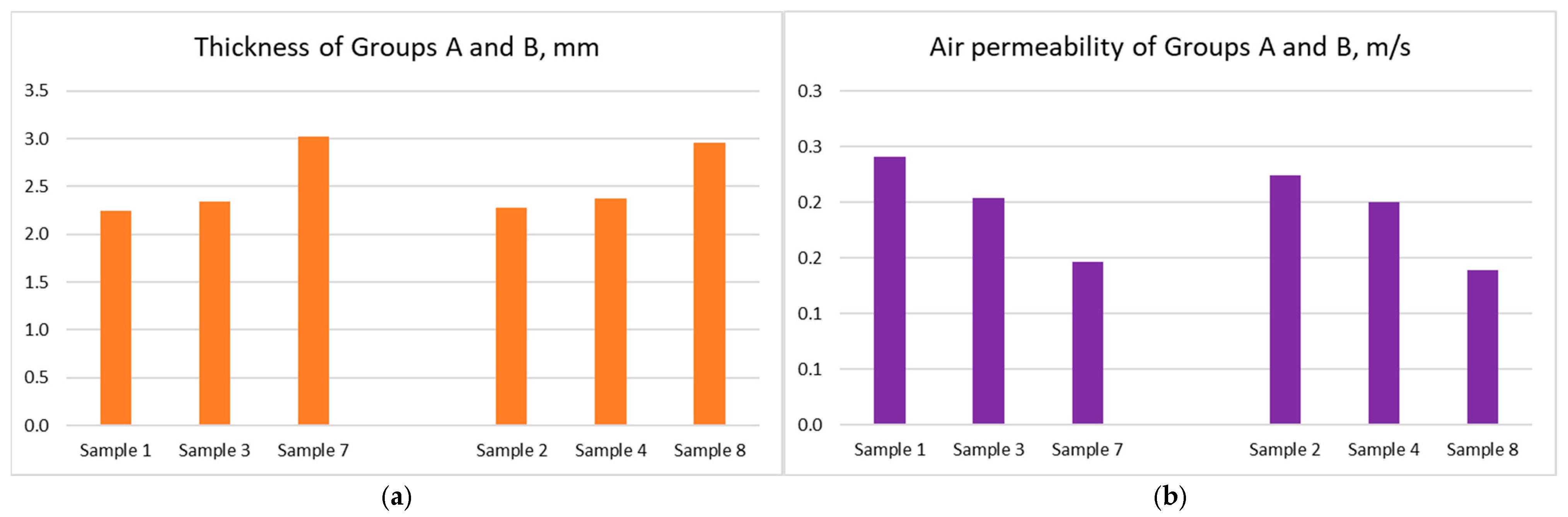
Figure 4 presents a comparative analysis of thickness (Figure 4a) and air permeability (Figure 4b) for Group A (Samples 1, 3, and 7) and Group B (Samples 2, 4, and 8), where the stitch pattern is kept constant, and the effect of yarn composition is isolated. Depicting thickness and air permeability within a single figure enables direct visual assessment of their coupled but opposing behaviour for identical knitted macrostructures.
In Group A (Figure 4a), a clear increase in fabric thickness is observed with the introduction of more complex composite yarns. Sample 7 (C2FR) exhibits the highest thickness, followed by Sample 3 (C1FR), while Sample 1 (C1F) shows the lowest value. In contrast, the air permeability of the samples (Figure 4b) demonstrates an inverse trend, decreasing progressively with increasing fabric thickness. Sample 1 shows the highest air permeability, whereas Sample 7 exhibits the lowest value, indicating a denser and less permeable structure.
A similar trend is observed in Group B. Fabric thickness (Figure 4a) increases from Sample 2 (C1F) to Sample 8 (C2FR), while air permeability (Figure 4b) decreases accordingly. Compared to Group A, the absolute thickness values in Group B are generally higher, which can be attributed to the different interconnection of the loops. Despite this structural difference, the relative influence of yarn composition on both thickness and air permeability remains consistent across both groups.
To verify whether the observed differences in thickness are statistically significant, one-way analysis of variance (ANOVA) was performed separately for Group A and Group B. For Group A (Samples 1, 3 and 7), the analysis revealed a highly statistically significant effect of yarn composition on thickness (F = 6725.85, p < 0.001). Similarly, for Group B (Samples 2, 4 and 8), statistically significant differences in thickness were confirmed (F = 665.75, p < 0.001). These results quantitatively support the visual trends observed in Figure 4 and confirm that the increase in thickness with increasing yarn linear density and structural complexity is not attributable to random measurement variability.
A similar analysis was performed for air permeability. For Group A, one-way ANOVA revealed a statistically significant effect of yarn composition on air permeability (F = 69.08, p < 0.001). For Group B, statistically significant differences were likewise confirmed (F = 42.96, p < 0.001). These findings quantitatively validate the inverse relationship between increasing yarn linear density and decreasing air permeability observed in Figure 4.
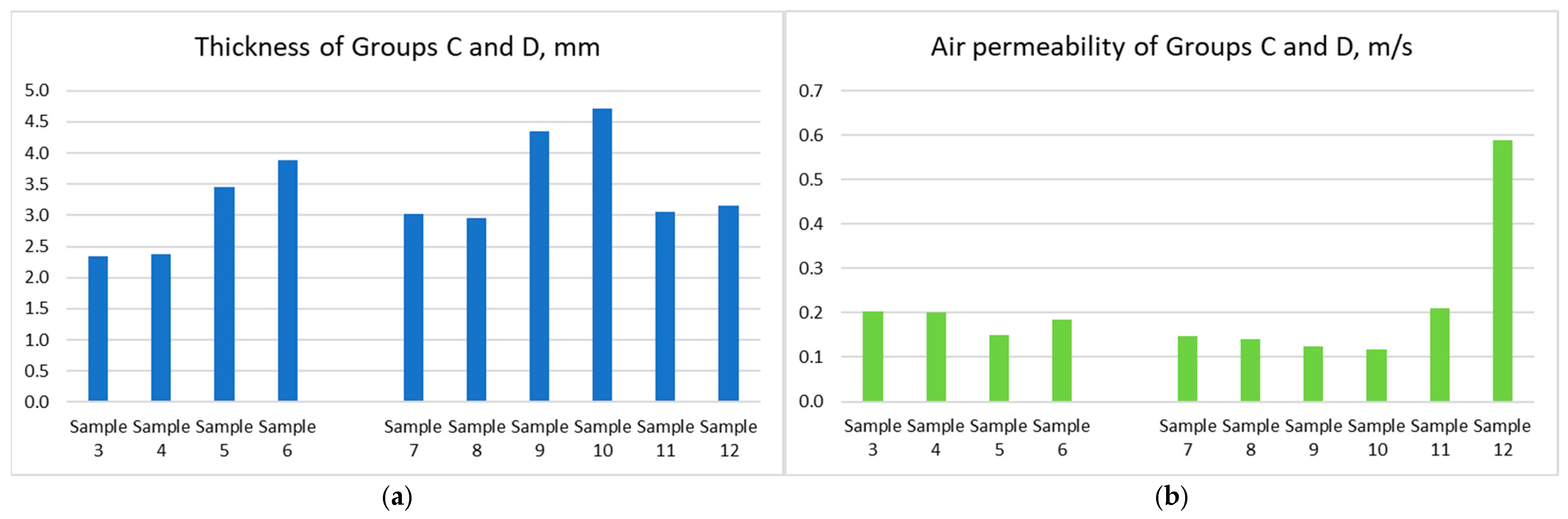
Figure 5 shows the variation in thickness (Figure 5a) and air permeability (Figure 5b) for Groups C (Samples 3–6, identical yarn C1FR) and D (Samples 7–12, identical yarn C2FR), where the yarn composition is kept constant, and the effect of knitted macrostructure is isolated.
Within Group C, clear differences in thickness are observed among the various stitch patterns (Figure 5a). Samples with more complex loop arrangements exhibit increased thickness compared to the single jersey structure. The purl and double jersey variants show higher thickness values, reflecting the increased number of intermeshed loops and yarn overlap within the fabric structure.
Air permeability in Group C (Figure 5b) varies inversely with thickness. Samples exhibiting higher thickness values generally show reduced air permeability, whereas thinner structures demonstrate higher permeability. Despite identical yarn composition, the stitch pattern significantly influences structural compactness and air flow behaviour.
Group D shows a wider range of thickness values compared to Group C, reflecting the broader variety of stitch patterns included in this group (Figure 5a). The thickest structures are observed for samples with double jersey and purl patterns, while single jersey-based structures exhibit lower thickness values.
Air permeability results in Group D demonstrate pronounced variation. While most samples follow the expected inverse relationship between thickness and permeability, Sample 12 exhibits substantially higher air permeability despite moderate thickness, thus indicating a distinctly more open macrostructural configuration.
To evaluate whether the differences in thickness observed within Groups C and D are statistically significant, one-way ANOVA was performed separately for each group. For Group C (Samples 3–6), the analysis revealed a highly statistically significant effect of stitch pattern on thickness (F = 6565.08, p < 0.001). For Group D (Samples 7–12), statistically significant differences were also confirmed (F = 1209.92, p < 0.001).
A corresponding statistical evaluation was conducted for air permeability. For Group C, one-way ANOVA confirmed statistically significant differences among the stitch patterns (F = 41.88, p < 0.001). For Group D, the effect of knitted macrostructure on air permeability was even more pronounced (F = 584.49, p < 0.001).
The results obtained confirm that, under constant yarn composition, the knitted macrostructure plays a dominant role in determining fabric thickness and air permeability. Variations in stitch pattern lead to substantial differences in functional performance, even when material parameters are kept unchanged.
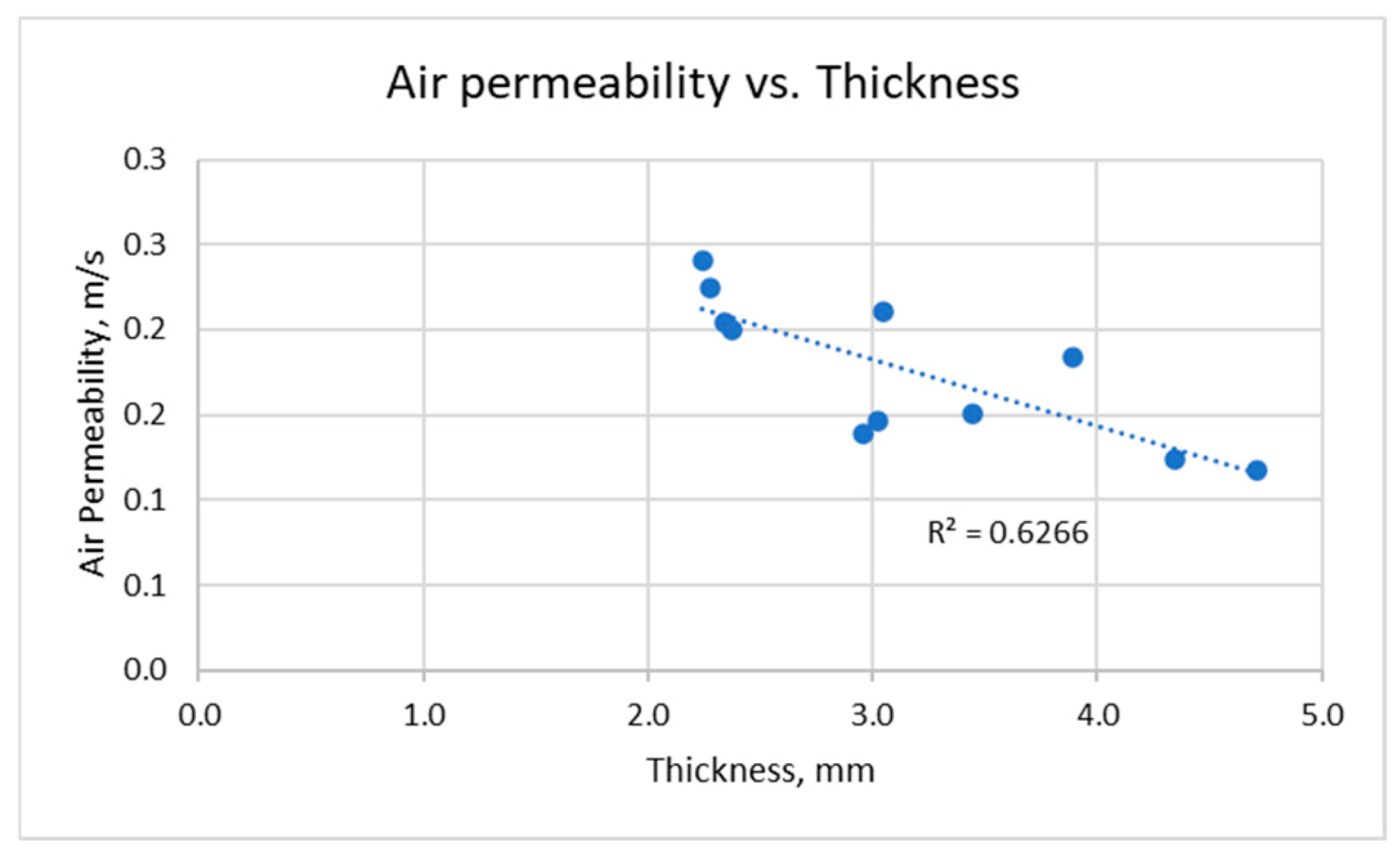
Figure 6 illustrates the relationship between fabric thickness and air permeability for the investigated knitted samples. Sample 12 was excluded from the regression analysis due to its exceptionally high air permeability (see Table 3), which would distort the general trend observed for the remaining knitted macrostructures.
The scatter plot highlights a general inverse trend, where increasing fabric thickness is associated with reduced air permeability across the studied macrostructures. Despite this overall tendency, the data points exhibit noticeable dispersion, indicating that air permeability is not determined by thickness alone. Samples with comparable thickness values may display different permeability levels, reflecting the influence of knitted macrostructure, loop geometry, and pore distribution. Therefore, Figure 6 provides an integrated overview of the combined effects observed in Figure 4 and Figure 5, while confirming that thickness represents an important but not exclusive factor governing air permeability in knitted fabrics.
Linear regression analysis yielded a coefficient of determination of R2 = 0.63, indicating that approximately 63% of the variation in air permeability can be explained by thickness alone. The remaining variance may be attributed to structural factors such as pore connectivity, loop geometry and local yarn distribution within the knitted macrostructure.
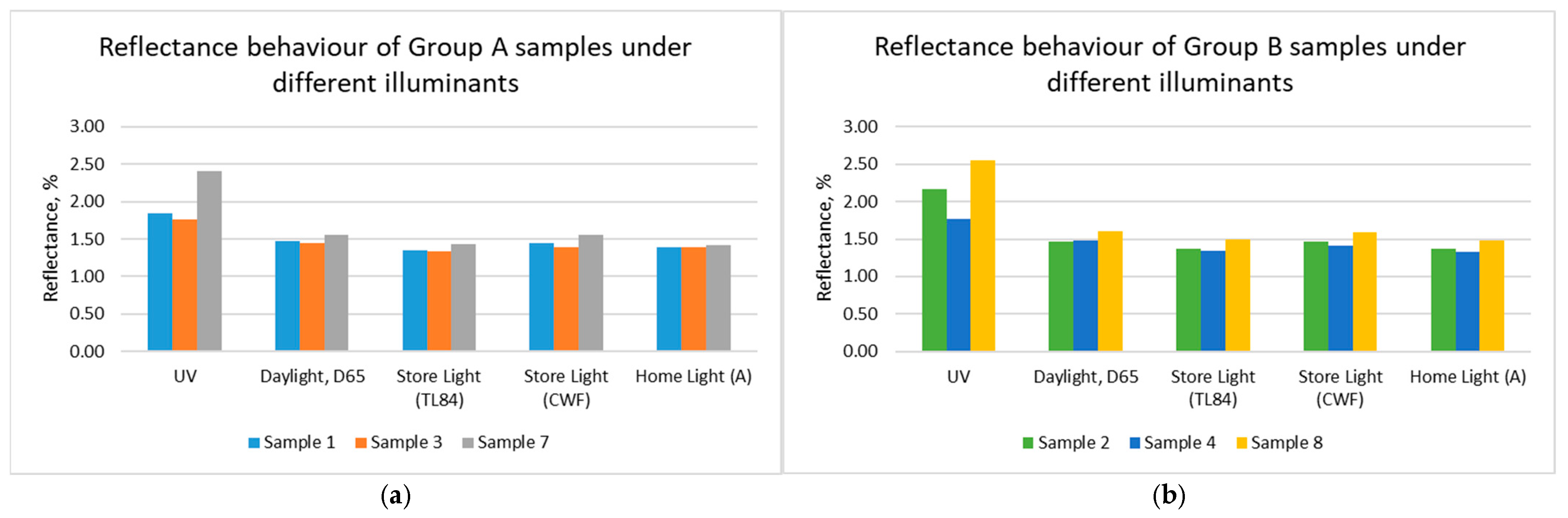
Figure 7 compares the reflectance behaviour of Group A (Samples 1, 3, and 7, Figure 7a) and Group B (Samples 2, 4, and 8, Figure 7b), under different illuminants. In these groups, where the stitch pattern is kept constant and the effect of yarn composition is isolated, the reflectance values follow similar tendencies across the investigated lighting conditions. The most pronounced differences are observed under UV illumination.
In Group A (Figure 7a), Sample 7 consistently exhibits the highest reflectance under all illuminants, followed by Samples 1 and 3. The differences between the samples are particularly evident under UV light, while under visible light sources (D65, TL84, CWF, and incandescent A), the reflectance values are lower and more closely grouped.
A comparable trend is observed in Group B (Figure 7b). Sample 8 shows the highest reflectance across all illuminants, whereas Samples 2 and 4 exhibit lower values. As in Group A, UV illumination results in the largest separation between the samples, indicating a stronger sensitivity of reflectance to yarn composition under short-wavelength radiation.
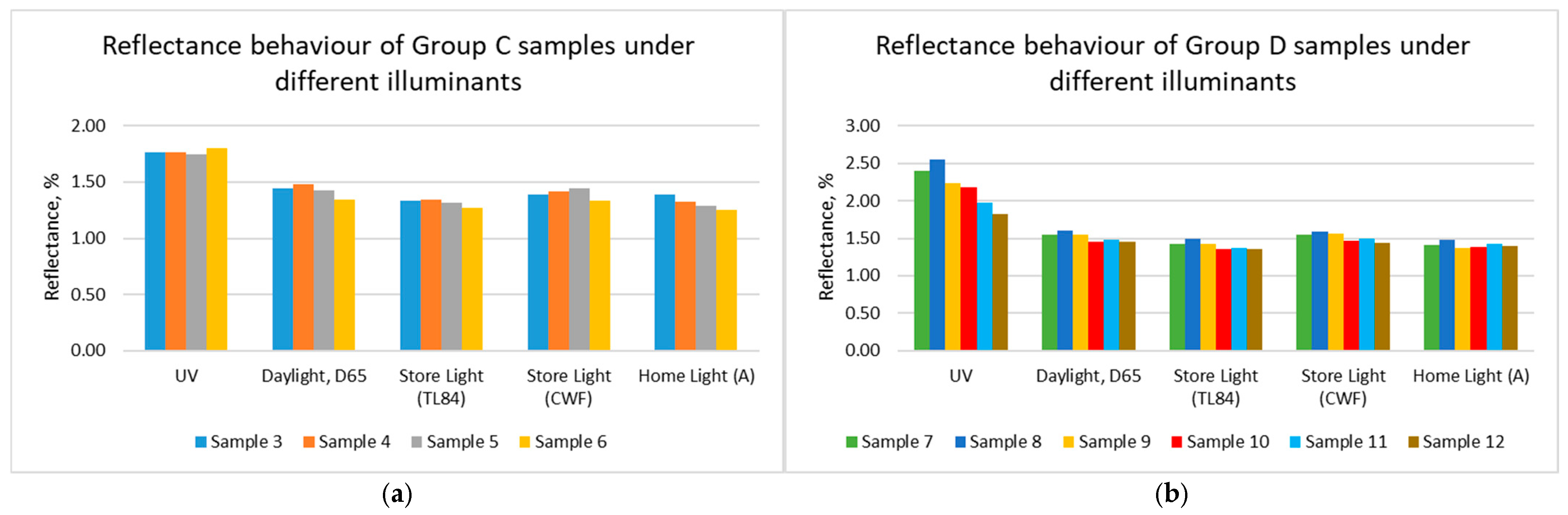
Figure 8 presents the reflectance behaviour of Groups C (Samples 3–6, identical yarn C1FR) and D (Samples 7–12, identical yarn C2FR), under different illuminants, where the yarn composition is kept constant, and the effect of knitted macrostructure is isolated.
In Group C (Figure 8a), relatively small but consistent differences in reflectance are observed among the investigated stitch patterns. Under all illuminants, the reflectance values remain within a narrow range, indicating that for the C1FR yarn, the influence of knitted macrostructure on reflectance is moderate. Slightly higher reflectance values are generally observed under UV illumination, while visible light sources result in more closely grouped values.
In contrast, Group D (Figure 8b) exhibits a wider variation in reflectance across the different stitch patterns. The highest reflectance values are observed under UV illumination, with pronounced differences between samples, particularly for more open and structurally complex macrostructures. Under daylight and artificial visible light sources, the reflectance values converge, although systematic differences between stitch patterns remain evident.
To assess whether the differences in reflectance ratio among samples within each group are statistically significant, one-way ANOVA was applied for each illuminant. The analysis confirmed statistically significant differences for most group–illuminant combinations (p < 0.05). Two non-significant cases were observed: Group C under UV (p = 0.116) and Group A under Incandescent A (p = 0.266), consistent with the relatively close mean values under these conditions.

4. Discussion

The results demonstrate that the structural and functional performance of the investigated knitted samples is governed by a combination of the complex yarn composition and knitted macrostructure, whose effects become evident when analysed in a controlled and isolated manner. By systematically grouping the samples, the present study distinguishes between the dominant influence of yarn composition on optical behaviour and the prevailing role of knitted macrostructure in determining thickness and air permeability.
When the stitch pattern is kept constant, variations in yarn composition lead to pronounced and systematic changes in fabric thickness, air permeability, and reflectance behaviour (Figure 4 and Figure 7). In contrast, under constant yarn composition, changes in stitch pattern primarily affect the spatial organisation of the fabric, resulting in substantial differences in thickness and air permeability, while exerting a more moderate influence on reflectance (Figure 5 and Figure 8). This distinction highlights the fundamentally different mechanisms through which material composition and macrostructural design contribute to the multifunctional performance of knitted fabrics.

4.1. Role of Knitted Macrostructure in Controlling Air Permeability

The results clearly indicate that air permeability in the investigated knitted fabrics is governed primarily by the knitted macrostructure rather than by thickness alone. This finding is particularly significant given that the applied yarns are complex composite structures incorporating functional components, which could be expected to influence fabric porosity and air flow behaviour. While an overall inverse relationship between thickness and air permeability is observed across the samples (Figure 6), substantial deviations from this general trend demonstrate that macrostructural design plays a decisive role in controlling air flow through the fabric. Similar observations have been reported in previous studies, where the air permeability of knitted fabrics was shown to depend strongly on loop geometry, pore distribution, and structural configuration rather than on thickness as a single parameter [31,32].
Under constant yarn composition, variations in stitch pattern lead to pronounced differences in air permeability, even for samples with comparable thickness values (Figure 5). This behaviour highlights the importance of loop geometry, intermeshing configuration, and pore distribution in defining the effective air pathways within the knitted macrostructure. More complex stitch patterns, such as purl and double jersey, tend to increase fabric thickness through enhanced loop overlap and multi-layered arrangements, while simultaneously reducing air permeability due to restricted pore connectivity.
The influence of macrostructure becomes particularly evident in the case of open and modified stitch designs. Sample 12, characterised by a highly porous modified purl structure, exhibits exceptionally high air permeability despite moderate thickness. This behaviour confirms that thickness alone is not a sufficient descriptor of air permeability, as open macrostructures can facilitate efficient air flow by creating continuous and interconnected pore networks within the macrostructure.
These findings demonstrate that knitted macrostructure provides an effective design parameter for tailoring air permeability independently of material composition. By the appropriate selection of stitch pattern, it is possible to achieve targeted breathability levels while maintaining the integration of functional yarns. This capability is particularly relevant for applications requiring a balance between comfort-related properties and additional functionalities, such as optical or sensing performance, without relying solely on changes in yarn linear density or fabric mass.

4.2. Optical Response and the Dominant Role of Yarn Composition

In contrast to air permeability, the optical response of the investigated knitted samples is governed primarily by yarn composition rather than by knitted macrostructure. This distinction becomes evident when reflectance performance is analysed under controlled grouping conditions, where either stitch pattern or yarn composition is kept constant (Figure 7 and Figure 8).
When the stitch pattern is fixed (Groups A and B), variations in yarn composition lead to systematic differences in reflectance across all investigated illuminants (Figure 7). Samples incorporating composite yarns with optically active components consistently exhibit higher reflectance values. The separation between samples is more apparent under UV illumination than under visible light sources, indicating that the optical response is closely related to the interaction between the composite yarn and the incident radiation, rather than to the geometric arrangement of the knitted structure.
Under constant yarn composition (Groups C and D), changes in stitch pattern result in comparatively smaller variations in reflectance (Figure 8). For Group C, reflectance values remain within a relatively narrow range across different stitch patterns, suggesting that for the C1FR yarn, the influence of macrostructural variation on optical response is moderate. In Group D, a wider dispersion of reflectance values is observed, particularly under UV illumination, where more open and structurally complex macrostructures exhibit higher reflectance. This behaviour can be attributed to increased surface exposure of the optically active yarn components, rather than to a fundamental change in material optical properties.
At the loop scale, local yarn reorientation may lead to variability in the surface-facing exposure of individual components of the folded composite yarn. Since all components are introduced simultaneously within each loop, no intentional positional control or selective placement is applied; however, their exact positioning relative to the fabric surface may vary locally due to knitting dynamics and structural relaxation. Optical measurements were therefore performed at the specimen level and repeated to capture the integrated macroscopic response of the fabric, where local exposure variations are statistically averaged across a large number of loops. The enhanced response under UV illumination is directly associated with the presence of a UV-responsive component within the composite yarn. Unlike visible light sources, UV radiation activates this functional element, leading to increased optical response of the knitted fabric. Under visible light conditions, where such activation does not occur, reflectance performance is governed mainly by surface geometry and yarn exposure within the knitted macrostructure.
The obtained results demonstrate that knitted macrostructure modulates reflectance through geometric effects, while the dominant contribution arises from the intentional design and composition of the yarn. This finding confirms that optical functionality can be effectively integrated into knitted fabrics via yarn engineering, without requiring substantial modification of the knitted macrostructure, thereby allowing independent optimisation of optical and comfort-related properties.

4.3. Design Implications and Functional Trade-Offs

The combined analysis of structural and optical properties highlights the distinct but complementary roles of knitted macrostructure and yarn composition in defining the performance of smart knitted fabrics. Knitted macrostructure primarily governs thickness and air permeability, whereas yarn composition predominantly determines optical response. This separation of influence provides design flexibility, allowing key performance parameters to be adjusted independently.
From a structural perspective, the results demonstrate that air permeability can be effectively adjusted through stitch pattern selection, independently of yarn composition. This finding is particularly relevant for smart textiles incorporating complex composite yarns, as it confirms that comfort-related properties such as breathability and fabric bulk can be controlled through macrostructural design rather than by modifying yarn linear density or material content. Consequently, the integration of functional components does not inherently impose limitations on air flow performance.
From an optical perspective, the results indicate that reflectance behaviour is primarily governed by the intentional design of the yarn, with knitted macrostructure acting as a secondary modulating factor through geometric exposure effects. This separation allows optical functionality to be embedded at the yarn level, while structural parameters remain available for independent optimisation. In practical terms, this means that enhanced optical response—particularly under UV illumination—can be achieved without major changes to stitch pattern or fabric architecture.
The observed trade-offs between structural compactness, air permeability, and optical response highlight the need for a holistic design approach for smart knitted fabrics. By combining yarn engineering and stitch pattern selection, optical functionality, breathability, and fabric thickness can be balanced within a targeted performance range.
These findings provide a framework for the rational design of knitted fabrics with integrated functional properties. By clearly distinguishing the roles of yarn composition and knitted macrostructure, the study offers practical guidelines for tailoring fabric performance to specific application requirements, ranging from wearable systems requiring comfort and visibility to technical textiles demanding controlled air flow and optical functionality.

5. Conclusions

This study presents a systematic evaluation of the effects of yarn composition and knitted macrostructure on the structural and functional properties of knitted fabrics incorporating optical functionalities. Using a controlled experimental design, the individual roles of these two key design parameters were clearly distinguished.
The results demonstrate that fabric thickness and air permeability are governed primarily by the knitted macrostructure, whereas optical response is predominantly controlled by the intentional design and composition of the composite yarn. In particular, the presence of a UV-responsive yarn component leads to enhanced optical response under UV illumination, while the influence of stitch pattern on reflectance remains secondary and mainly geometric in nature.
These findings confirm that structural and optical properties can be independently tailored through appropriate selection of stitch pattern and yarn composition, providing a flexible framework for the rational design of multifunctional knitted fabrics. Future work will focus on exploring combined structural–optical interactions using multivariate analysis to define design maps for advanced smart knitted textiles.

6. Patents

A utility model related to the composite yarn investigated in this study has been previously registered in Bulgaria. The present work focuses on the structural and functional behaviour within knitted fabrics.

Author Contributions

Conceptualization, R.A.A.; methodology, R.A.A. and E.B.; software, D.S.; validation, R.A.A., E.B. and D.S.; formal analysis, R.A.A.; investigation, R.A.A., E.B. and D.S.; resources, R.A.A.; data curation, R.A.A. and E.B.; writing—original draft preparation, R.A.A.; writing—review and editing, E.B. and D.S.; visualisation, R.A.A., E.B. and D.S.; supervision, R.A.A.; project administration, R.A.A.; funding acquisition, R.A.A. All authors have read and agreed to the published version of the manuscript.

Funding

This study and its publication are financed by the European Union—NextGenerationEU, through the National Recovery and Resilience Plan of the Republic of Bulgaria, project No BG-RRP-2.004-0005.

Institutional Review Board Statement

Not applicable.

Data Availability Statement

The original contributions presented in this study are included in the article. Further inquiries can be directed to the corresponding author.

Conflicts of Interest

The authors declare no conflicts of interest.

References

  1. Júnior, H.L.O.; Neves, R.M.; Monticeli, F.M.; Dall Agnol, L. Smart fabric textiles: Recent advances and challenges. Textiles 2022, 2, 582–605. [Google Scholar] [CrossRef]
  2. Bukreeva, T.; Barachevsky, V.; Venidiktova, O.; Krikunova, P.; Pallaeva, T. Recent development of photochromic polymer capsules for smart materials. Mater. Today Commun. 2024, 38, 107769. [Google Scholar] [CrossRef]
  3. Cuthill, I.C.; Allen, W.L.; Arbuckle, K.; Caspers, B.; Chaplin, G.; Hauber, M.E.; Hill, G.E.; Jablonski, N.G.; Jiggins, C.D.; Kelber, A.; et al. The biology of color. Science 2017, 357, eaan0221. [Google Scholar] [CrossRef] [PubMed]
  4. Xu, S.; Fan, X.; Chen, S.; Manshaii, F.; Yin, J.; Chen, J. Advances in luminescent fibers for interactive smart textiles. cMat 2024, 1, e33. [Google Scholar] [CrossRef]
  5. Önlü, N.; Halaçeli, H. Visual effects of stainless steel and retro-reflective yarns on woven fabrics. Res. J. Text. Appar. 2012, 16, 82–95. [Google Scholar] [CrossRef]
  6. Sharma, R.; Bairagi, N. Photoluminescent printed fabrics: An innovative solution to natural nightlight. In Functional Textiles and Clothing; Springer: Singapore, 2019; pp. 107–117. [Google Scholar]
  7. Chapman, R. Smart Textiles for Protection; CRC Press: Boca Raton, FL, USA, 2013. [Google Scholar]
  8. Shishoo, R. Functional Coatings for Textiles; Woodhead Publishing: Cambridge, UK, 2015. [Google Scholar]
  9. Dias, T. Handbook of Smart Textiles; Springer: Singapore, 2016. [Google Scholar]
  10. Li, G.; Sun, F.; Zhao, S.; Xu, R.; Wang, H.; Qu, L.; Tian, M. Autonomous Electroluminescent Textile for Visual Interaction and Environmental Warning. Nano Lett. 2023, 23, 8436–8444. [Google Scholar] [CrossRef]
  11. Cinquino, M.; Prontera, C.T.; Pugliese, M.; Giannuzzi, R.; Taurino, D.; Gigli, G.; Maiorano, V. Light-emitting textiles: Device architectures, working principles, and applications. Micromachines 2021, 12, 652. [Google Scholar] [CrossRef]
  12. Ding, Y.; Jiang, J.; Wu, Y.; Zhang, Y.; Zhou, J.; Zhang, Y.; Huang, Q.; Zheng, Z. Porous conductive textiles for wearable electronics. Chem. Rev. 2024, 124, 1535–1648. [Google Scholar] [CrossRef]
  13. Huo, S.; Li, Y. Phosphorescent Materials; American Chemical Society: Washington, DC, USA, 2023. [Google Scholar]
  14. Ahmed, E.; Maamoun, D.; Abdelrahman, M.S.; Hassan, T.M.; Khattab, T.A. Imparting cotton textiles glow-in-the-dark property along with other functional properties: Photochromism, flame-retardant, water-repellency, and antimicrobial activity. Cellulose 2023, 30, 4041–4055. [Google Scholar] [CrossRef]
  15. Hu, J.; Meng, H.; Li, G.; Ibekwe, S.I. A review of stimuli-responsive polymers for smart textile applications. Smart Mater. Struct. 2012, 21, 053001. [Google Scholar] [CrossRef]
  16. Abdollahi, A.; Roghani-Mamaqani, H.; Razavi, B.; Salami-Kalajahi, M. Photoluminescent and chromic nanomaterials for anticounterfeiting technologies: Recent advances and future challenges. ACS Nano 2020, 14, 14417–14492. [Google Scholar] [CrossRef]
  17. García, P.D.; Sapienza, R.; Blanco, Á.; López, C. Photonic glass: A novel random material for light. Adv. Mater. 2007, 19, 2597–2602. [Google Scholar] [CrossRef]
  18. Cai, L.; Song, A.Y.; Wu, P.; Hsu, P.C.; Peng, Y.; Chen, J.; Liu, C.; Catrysse, P.B.; Liu, Y.; Yang, A.; et al. Warming up human body by nanoporous metallized polyethylene textile. Nat. Commun. 2017, 8, 496. [Google Scholar] [CrossRef] [PubMed]
  19. Morrissey, M.P.; Rossi, R.M. The effect of metallisation, porosity and thickness on the thermal resistance of two-layer fabric assemblies. J. Ind. Text. 2015, 44, 912–923. [Google Scholar] [CrossRef]
  20. Angelova, R.A.; Sofronova, D. Applications of Mechatronics in Textiles and Clothing Industries. In Encyclopedia of Information Science and Technology, 6th ed.; IGI Global: Hershey, PA, USA, 2025; pp. 1–31. [Google Scholar]
  21. Shi, Q.; Sun, J.; Hou, C.; Li, Y.; Zhang, Q.; Wang, H. Advanced functional fiber and smart textile. Adv. Fiber Mater. 2019, 1, 3–31. [Google Scholar] [CrossRef]
  22. Li, B.; Wang, M.; Ao, S.; Lyu, K.; Su, X.; Sun, F. Knitting-stitching bifacial metafabrics with switchable thermal and moisture transmissibility for multimodal dynamic personal thermoregulation. Mater. Horiz. 2025, 12, 642–653. [Google Scholar] [CrossRef]
  23. Khanzada, H.; Khan, M.Q.; Kayani, S. Cotton based clothing. In Cotton Science and Processing Technology: Gene, Ginning, Garment and Green Recycling; Springer: Singapore, 2020; pp. 377–391. [Google Scholar]
  24. Annis, P.A. (Ed.) Understanding and Improving the Durability of Textiles; Elsevier: Amsterdam, The Netherlands, 2012. [Google Scholar]
  25. Yang, W.; Yuan, Y.; Ren, W.; Liu, J.; Scheirer, W.J.; Wang, Z.; Zhang, T.; Zhong, Q.; Xie, D.; Pu, S.; et al. Advancing image understanding in poor visibility environments: A collective benchmark study. IEEE Trans. Image Process. 2020, 29, 5737–5752. [Google Scholar] [CrossRef]
  26. ISO 5084:1996; Textiles—Determination of Thickness of Textiles and Textile Products. International Organization for Standardization: Geneva, Switzerland, 1996.
  27. ISO 3801:2017; Textiles—Woven Fabrics—Determination of Mass per Unit Area. International Organization for Standardization: Geneva, Switzerland, 2017.
  28. ISO 9237:1995; Textiles—Determination of the Permeability of Fabrics to Air. International Organization for Standardization: Geneva, Switzerland, 1995.
  29. Angelova, R.A.; Borisova, E.; Sofronova, D. Advancing Sustainable Textile Metrology: Reflectivity Measurement with Controlled Light Sources. Appl. Sci. 2025, 15, 5305. [Google Scholar] [CrossRef]
  30. Tominaga, S.; Wandell, B.A. Standard surface-reflectance model and illuminant estimation. J. Opt. Soc. Am. A 1989, 6, 576–584. [Google Scholar] [CrossRef]
  31. Havlová, M.; Špánková, J. Porosity of knitted fabrics in the aspect of air permeability-discussion of selected assumptions. Fibres Text. East. Eur. 2017, 3, 86–91. [Google Scholar] [CrossRef]
  32. Siddiqui, M.O.R.; Sun, D. Porosity prediction of plain weft knitted fabrics. Fibers 2014, 3, 1–11. [Google Scholar] [CrossRef]
Figure 1. Structure of the folded yarn, where C is the cotton thread, F is the photoluminescent thread, and R is the reflective thread: (a) schematic representation of the doubled yarn; (b) photograph of the actual yarn.
Textiles 06 00036 g001
Figure 2. The cotton yarns used: (a) C1, 264 tex; (b) C2, 400 tex.
Textiles 06 00036 g002
Figure 3. The photoluminescent (F) and reflective (R) threads: (a) F, 30 tex; (b) R, 35 tex.
Textiles 06 00036 g003
Figure 4. Comparison of thickness and air permeability of Group A and Group B knitted macrostructures: (a) Thickness; (b) Air permeability.
Textiles 06 00036 g004
Figure 5. Comparison of thickness and air permeability of Group C and Group D knitted macrostructures: (a) Thickness; (b) Air permeability.
Textiles 06 00036 g005
Figure 6. Relationship between fabric thickness and air permeability for the investigated knitted macrostructures.
Textiles 06 00036 g006
Figure 7. Reflectance behaviour of Groups A and B under different illuminants: (a) Group A; (b) Group B.
Textiles 06 00036 g007
Figure 8. Reflectance behaviour of Groups C and D under different illuminants: (a) Group C; (b) Group D.
Textiles 06 00036 g008
Table 1. Design of the knitted samples: patterns and threads used, graphical representation, 3D simulation and picture of the real sample.
SamplePattern/
Threads
Graphical Representation3D Simulation Technical Face3D Simulation Technical BackPicture
1Single jersey, C1FTextiles 06 00036 i001Textiles 06 00036 i002Textiles 06 00036 i003Textiles 06 00036 i004
2Single jersey, C1FTextiles 06 00036 i005Textiles 06 00036 i006Textiles 06 00036 i007Textiles 06 00036 i008
3Single jersey, C1FRTextiles 06 00036 i009Textiles 06 00036 i010Textiles 06 00036 i011Textiles 06 00036 i012
4Single jersey, C1FRTextiles 06 00036 i013Textiles 06 00036 i014Textiles 06 00036 i015Textiles 06 00036 i016
5Purl,
C1FR
Textiles 06 00036 i017Textiles 06 00036 i018Textiles 06 00036 i019Textiles 06 00036 i020
6Double jersey, C1FRTextiles 06 00036 i021Textiles 06 00036 i022Textiles 06 00036 i023Textiles 06 00036 i024
7Single jersey, C2FRTextiles 06 00036 i025Textiles 06 00036 i026Textiles 06 00036 i027Textiles 06 00036 i028
8Single jersey, C2FRTextiles 06 00036 i029Textiles 06 00036 i030Textiles 06 00036 i031Textiles 06 00036 i032
9Purl, C2FRTextiles 06 00036 i033Textiles 06 00036 i034Textiles 06 00036 i035Textiles 06 00036 i036
10Double jersey, C2FRTextiles 06 00036 i037Textiles 06 00036 i038Textiles 06 00036 i039Textiles 06 00036 i040
11Single jersey with float, C2FRTextiles 06 00036 i041Textiles 06 00036 i042Textiles 06 00036 i043Textiles 06 00036 i044
12Modified purl,
C2FR
Textiles 06 00036 i045Textiles 06 00036 i046Textiles 06 00036 i047Textiles 06 00036 i048
Table 2. Density of the samples.
Sample123456789101112
Wales/10 cm262630302719262626192226
Courses/10 cm414141412637373726303022
Table 3. Thickness, mass per unit area and air permeability of the knitted samples.
Sample123456789101112
Thickness (mm)mean2.2442.2762.3382.3783.4463.8883.0202.9564.3484.7103.0503.156
SD0.0140.0340.0100.0310.0160.0130.0060.0190.0730.0450.0510.040
Mass per unit area (g/m2)mean445.13445.16511.90542.38644.281265.95659.35659.35876.601018.31619.11489.64
SD0.02050.02050.02870.01700.01630.00470.00470.00470.09270.03400.01250.0082
Air permeability (m/s)mean0.2410.2240.2040.2000.1500.1840.1470.1390.1240.1180.2110.589
SD0.0250.0290.0130.0170.0060.0040.0080.0080.0100.0100.0200.049
Table 4. Reflectance ratio (mean and SD) of the knitted samples under different illuminants.
Sample123456789101112
Light Type
UVmean1.8402.1701.7641.7691.7471.8062.4052.5572.2302.1791.9811.823
SD0.0440.0680.0500.0650.0440.0550.0910.0800.0720.0650.0580.057
Daylight, D65mean1.4791.4691.4441.4781.4231.3411.5541.6071.5501.4571.4811.448
SD0.0360.0520.0390.0460.0410.0410.0360.0360.0360.0360.0360.036
OPT, Store Light TL84mean1.3531.3641.3311.3421.3171.2671.4261.4961.4201.3501.3701.349
SD0.0290.0470.0390.0360.0490.0420.0430.0430.0430.0430.0430.043
Store Light (Cool White Fluorescent)mean1.4441.4651.3871.4171.4451.3371.5491.5961.5671.4611.4901.435
SD0.0330.0490.0400.0510.0370.0410.0230.0230.0230.0230.0230.023
Home Light (Incandescent Illuminant A)mean1.3841.3731.3861.3291.2921.2481.4141.4801.3751.3801.4211.398
SD0.0410.0320.0410.0310.0370.0400.0520.0520.0520.0520.0520.052
Disclaimer/Publisher’s Note: The statements, opinions and data contained in all publications are solely those of the individual author(s) and contributor(s) and not of MDPI and/or the editor(s). MDPI and/or the editor(s) disclaim responsibility for any injury to people or property resulting from any ideas, methods, instructions or products referred to in the content.