
Exploring Textile Fibre Characterisation: A Review of Vibrational Spectroscopy and Chemometrics



Abstract
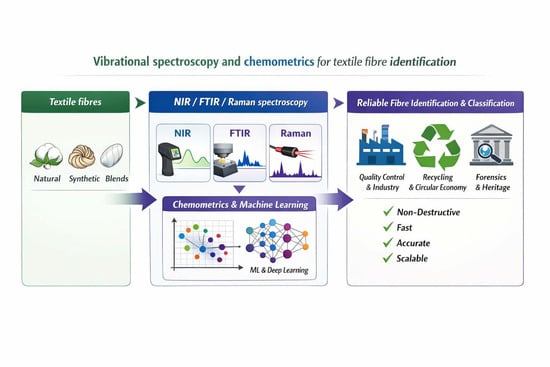
1. Introduction
2. Natural and Man-Made Fibre Classification
3. Vibrational Spectroscopy
3.1. Textile Fibre Analysis by Vibrational Spectroscopy
3.2. Complementarity of Vibrational Spectroscopy Techniques
3.3. Limitations of Vibrational Spectroscopy in Textile Fibre Analysis
4. Vibrational Spectroscopy and Chemometrics for Fibre Identification
4.1. Chemometric Model Development and Validation: Workflow
- (i)
- Building the model using reference samples of single fibres and/or blends with known compositions;
- (ii)
- Model validation with independent samples of known fibres or fabrics.
4.1.1. Fabric or Fibre Selection
4.1.2. Spectral Acquisition Using Vibrational Spectroscopy
4.1.3. Spectral Pre-Processing
4.1.4. Modelling

| Studied Fibre (Total Sample Count = n) * | Fibre | Spectroscopic Technique | Multivariate Analysis 1 and Performance Score | Aim of the Study | Year | Ref. | |
|---|---|---|---|---|---|---|---|
| Single | Blend | ||||||
| Natural Fibres | |||||||
| Natural llama fleeces of 7 colours (white, black, grey, brown, light brown, coffee, and beige) (n = 169) | ✓ | --- | NIR (700–2500 nm) | M-PLS regression; R2 = 0.67; SECV = 1.965; SEV = 2.235 and RPD = 1.91 | Predict mean fibre diameter | 2021 | [47] |
| Cotton, wool, and silk (n = 13). Unaged, naturally aged, artificially aged. Undyed, dyed with natural dyes, dyed with synthetic dyes | ✓ | --- | NIR (1000–1700 nm) and Raman | PCA-LDA e SIMCA | Compare PCA-LDA and SIMCA | 2022 | [3] |
| Sticky cotton (n = 457) | ✓ | --- | NIR (10,000–4000 cm−1) | SECV = 0.26; R2 = 0.96 | Analysis of the “stickiness” of the cotton prior fabric production | 2005 | [84] |
| Dyed wool threads (natural dyes) (n = n.d. 2) | ✓ | --- | FTIR (4000–400 cm−1, then 1800–950 cm−1); FT-Raman (Nd:YAG laser provided sample excitation at 1064 nm; 3500–100 cm−1, then 1750–450 cm−1) | n.a. | Identify dyes | 2011 | [69] |
| Alpaca fibre samples from mid-side of the animals (n = 291) | ✓ | --- | NIR (400–2498 nm) | PCA | Predict alpaca fibre quality for textile applicability | 2013 | [48] |
| Sheep cashmere, cashmere, rabbit, and camel fibres (n = 376) | ✓ | --- | NIR (10,000–4000 cm−1) | PCA-LDA e SIMCA | Identification of fibres | 2019 | [33] |
| Pure goat cashmere from different provinces, rabbit and camel hair, cashmere–rabbit hair blends, cashmere–acrylic–polyester blends, cashmere–acrylic–polyester–cotton blend, wool, natural silk, cotton (n = 463) | ✓ | ✓ | NIR (10,000–4000 cm−1) | Relief algorithm; new: data driven based class-modelling (DD-SIMCA) | Identification of cashmere in blends | 2019 | [80] |
| Wool and cashmere (n = 210) | --- | ✓ | NIR (1000–2500 nm) | LSSVM R2 = 0.9821, RMSE = 1.1263, and MAE = 0.6527 | Quantitative determination of wool and cashmere mixed fibre | 2024 | [86] |
| White and purple cashmere, domestic Xinjiang fine wool, and soil-type combed cotton wool (n = n.d.) | ✓ | ✓ | NIR (1400–2500 nm due to the colours) | PLS-DA and LDA | Non-destructive identification of cashmere and wool | 2025 | [88] |
| Wool and cotton (n = n.d.) | --- | ✓ | NIR (2250–2400 nm) | SIMCA | Identification of contamination of natural fibre yarns with polymeric fibrils | 1998 | [89] |
| Foreign fibres in cotton layers (n = 100) | --- | ✓ | NIR (780–2360 nm) | CNN and TCN | Identification of foreign fibres in cotton layers | 2023 | [90] |
| Wool and silk and blended fibres (n = 128) | ✓ | ✓ | ATR-FTIR (4000–650 cm−1) | n.a. | Identification of fibres in blended textiles | 2006 | [68] |
| Plant- and chemical-dyed cotton fabrics (n = 336) | ✓ | --- | FTIR (4000–500 cm−1) NIR (10,000–4000 cm−1) | PCA, SIMCA > 95%, PCR: R2 = 0.9937, RMSEE = 0.1332, PLS: R2 = 0.9978, RMSEE = 0.0779 | Identification of plant-dyed and chemical-dyed textiles | 2020 | [91] |
| Bamboo and flax (n = 25) | ✓ | --- | FT-NIR (12,000–4000 cm−1) | Ward’s algorithm and HCA = 100% | Identification of natural bamboo fibres and flax fibres with NIR | 2013 | [50] |
| Seed and lint cottons (n = 402) | ✓ | --- | FTIR (900–1200 cm−1) | Correlations to compare traditional method and FTIR, R2 = 0.89 | Discrimination of immature cottons from mature ones; determination of cotton maturity | 2011 | [51] |
| Cashmere (Chinese, Australian, Iranian), wool (Chinese, Australian), bison wool, qiviut from Muskox, vicuña and guard hairs (n = n.d.) | ✓ | --- | FTIR (4000–600 cm−1) | correlations, ANOVA | Differentiation of animal fibres from different origins | 2011 | [63] |
| Wool, analysis of dyes changes during process (n = n.d.) | ✓ | --- | FTIR (3080–940 cm−1) | n.a. | Evaluation of structural changes in wool fibre keratin treated with azo dyes | 2000 | [70] |
| Natural cellulose pulp samples (n = 92), including 30 cotton pulps, 44 wood pulps, 16 cotton–wood mixed pulps and 2 bamboo pulps | ✓ | --- | NIR (10,000–4000 cm−1) | PCA, PLS and SIMCA = 100% | Reactivity determination of natural cellulose pulp for viscose rayon by NIR. Natural cellulose (from cotton, wood and cotton-wood mixed pulps) reactivity for viscose rayon “reactivity of natural cellulose pulp is a key parameter in dissolving pulp in the viscose-fibre production process” | 2015 | [24] |
| Silk fibroin (n = n.d.) | ✓ | --- | FT-Raman (3500–500 cm−1; laser operating at 1064 nm); FTIR (1800–1100 cm−1) | n.a. | Analyse the structure of silk fibroin | 2005 | [83] |
| Linen/cotton blends (n = n.d.) | --- | ✓ | FT-NIR (10,000–4000 cm−1) | PLS, PCs, R2 = 0.994–0.998, RMSEC = 1.20–2.38, RMSECV = 1.54–4.73, RMSEP = 2.20–4.98 | Predict the linen % in linen/cotton blends | 2005 | [81] |
| Bamboo, jute, flax, bamboo pulp fibres (n = n.d.) | ✓ | --- | FTIR (4000–400 cm−1) | correlations | Identification of natural bamboo using FT-IR and 2D-IR correlation spectroscopy | 2025 | [45] |
| Pure cashmere textiles (n = 49), cashmere–wool blended textiles with wool contents ranging from 51.5 to 96.2% (w/w) (n= 51) and pure wool textiles (n = 20); samples (n = 120) | ✓ | ✓ | diffused reflectance NIR (portable NIR) (896–2115 nm) | SIMCA, SVM, and NRS | Identification and discrimination of pure cashmere and adulterated (wool) samples | 2019 | [76] |
| Cashmere (n = 100), wool (n = 120), rabbit hair (n = 95) and camel hair (n = 80); samples (n = 395) | ✓ | --- | NIR (4000–10,000 cm−1) | SVDD, KNNDD and GAUSS methods | Distinguishing cashmere from other animal fibres to avoid fraud | 2019 | [26] |
| Natural bamboo fibre, bamboo pulp fibres and ramie fibres (n = n.d.) | ✓ | --- | NIR | first derivatives and database building | Discrimination of bamboo fibre and ramie fibre by NIR | 2010 | [52] |
| Natural dyes (anthraquinones, flavonoids, neoflavonoids, biflavonoids and phenazone derivatives (orcein)) in wool fibres and ancient textiles (n = n.d.) | ✓ | ✓ | FT-surface-enhanced Raman (4000–200 cm−1) using for excitation the 1064 nm emission | n.a. | Identification of natural dyes in wool textiles and then in ancient textiles | 2014 | [73] |
| Silk, animal hair (wool, camel hair, yak hair), cotton, and bast (linen, ramie, hemp) (n = 13) | ✓ | --- | Portable spectroradiometer: visible and near-infrared (VNIR) (350–1000 nm), SWIR1 (1000–1850 nm) and SWIR2 (1850–2500 nm). | PCA, MANOVA | To further explore the potential of discriminating the fibre types using portable spectroradiometer | 2019 | [9] |
| Waste cotton from different countries (n = 350) | ✓ | --- | NIR (10,000–4000 cm−1) | SIMCA and PLS | Classification of waste cotton from different countries using NIR | 2023 | [87] |
| Wool and cashmere blends (0–100% each) (n = 22) | --- | ✓ | NIR (handheld acousto-optic tuneable filter near-infrared (AOTF-NIR)) (1100–2300 nm) | MANOVA, Multilinear Regression Model and Prediction Performance, two multilinear regression (MLR), R2 = 0.997, SEC = 2.668, and RMSEC = 2.836 (whole set) | Measuring of fibre contents of wool–cashmere blends | 2017 | [92] |
| Raw material of wool, cotton, and silk (n = n.d.) | --- | ✓ | NIR | not known (only abstract available) | Discrimination of natural fibre variety and detection of foreign fibre | 2008 | [8] |
| Wool (n = 20), white cashmere (n = 20), pigmented cashmere (n = 8), pigmented yak (n = 5), angora rabbit (n = 5) | ✓ | --- | Non-pigmented samples were tested by using FTIR. All contaminated or oxidised samples were excluded from NIR analysis. NIR (10,000–3700 cm−1) | SIMCA, 1 method for each fibre, R2 = 0.95 | Identification of wool, cashmere, yak, and angora rabbit fibres and quantitative determination of wool and cashmere in blend by NIR | 2013 | [78] |
| Synthetic fibres | |||||||
| Synthetic fibres (acrylic (n = 26), rayon (n = 12), nylon (n = 48), and polyester (n = 52) (n = 138) | --- | ✓ | FTIR (4000–400 cm−1) | PCA and SIMCA | Qualitative analysis on 138 synthetic fibres (nylon, polyester, acrylic, and rayon) using ATR–FTIR | 2022 | [82] |
| PE (polyethylene); PPTA (para-amid); PP (polypropylene); PES (polyester); PA (polyamide); AC (acrylic) (n = 49) | ✓ | ✓ | Hyperspectral imaging technology (900 to 2500 nm) | PCA-LDA = 100% | Discrimination of the chemical content of fibres in different colours and structures | 2017 | [93] |
| (i) Textile-grade acrylic fibre: -Wet spun-monocomponent -Dry spun-monocomponent // bicomponent (ii) Special acrylic fibre (n = 100) | ✓ | --- | Diffuse reflectance infrared Fourier transform (DRIFT) (4000–400 cm−1) and SEM | n.a. | Characterisation of various acrylic fibres by FTIR | 2003 | [94] |
| Black and dark coloured fleece garments. Almost all made of 100% pes (n = 201) | ✓ | --- | Microscopy (bright field, polarised light, fluorescence); Microspectrophotometry (MSP-visible range); FTIR and comparison microscopy | n.a. | Analysis of fleeces to further identification among other fibres | 2016 | [95] |
| Dyed cotton fabrics modified by silver nanowires (AgNWs) (n = n.d.) | ✓ | --- | Surface-enhanced Raman spectroscopy (SERS) (200–3200 cm−1) | n.a. | Analyse the potential of dispersive Raman spectroscopy and SERS phenomenon application in dyed cotton fabrics modified with silver nanowires | 2019 | [71] |
| Natural + synthetic fibres | |||||||
| End-of-life textiles (n = 36) | ✓ | ✓ | SWIR (1000–2500 nm) | PLS-DA, R2 = 0.977 | (1) recognition of the fibre origin (plant-derived, animal-derived, artificial textiles such as synthetic and/or man-made cellulosic fibres) and, (2) discrimination of fabrics according to the material classes (silk, cotton, wool, viscose, linen, jute, polyester and blends) | 2024 | [85] |
| Wool, PES, polyacrylonitrile, and nylon blends (one, two, three or the four fibres) (n = 64) | --- | ✓ | FT-NIR (4000–10,000 cm−1) | PLS; UVEPLS algorithm; RMSECV | Simultaneous determination of several fibres in blended textiles | 2019 | [54] |
| Mixtures of wool, polyester, polyacrylonitrile, and nylon (n = 64) | --- | ✓ | FT-NIR (4000–10,000 cm−1) | PLS and ELM (extreme learning machine), RMSEC = 0.065, RMSEP = 0.05, and RPD = 5.64 | Quantitative determination of fibre components | 2019 | [55] |
| Cotton (CO), polyester (PES), viscose (CV), silk (TS), wool (WO), polyacrylonitrile (PAN) and acetate (CA) and all combinations of two factor blends (n = 28) | ✓ | ✓ | NIR (1450–1850 nm, range not influenced by moisture) | n.a. | Develop NIR as a method for quantitative and qualitative identification of textiles, moisture measurements, textile coatings and process control | 2000 | [75] |
| Cotton, PES, viscose, cotton/elastane, PES/elastane, cotton/PES (n = 253) | ✓ | ✓ | FTIR (400–4000 nm), optical microscopy | n.a. | Textile recognition and sorting for recycling at an automated line using NIR | 2021 | [54] |
| Acetate, cotton, polyester, rayon, silk and wool (n = 758) | ✓ | --- | diffuse NIR (1000–2500 nm) | SIMCA | Identification of fibres | 2015 | [77] |
| Waste textiles: polyester, cotton, wool, silk, viscose, nylon, acrylic, polyester/cotton, polyester/wool, polyester/nylon, polyester/viscose, nylon/spandex and silk/cotton (n= 2764 to training and n = 526 to test) | ✓ | ✓ | NIR (901–2500 nm) | artificial intelligence, construction of models by CNN and Baidu deep learning platform PaddlePaddle > 95% | Identification of fibres in waste textiles for recycling | 2022 | [56] |
| Historical textiles and leather (cotton, hemp, viscose, silk, wool, leather, polyamide, acrylic, polyester) (n = 87) | --- | ✓ | ER-FTIR (7500–375 cm−1) | n.a. | ER-FTIR as non-invasive substitute of microscopic examination and ATR-FTIR | 2024 | [66] |
| Cellulosic materials from traditional Japanese samurai armour (n = 8). Reference materials: non-woven hemp thread, Kozo and Manila hemp fibres, aged flax | ✓ | ✓ | ATR-FTIR (4000–600 cm−1) and SEM | n.a. | To discuss the potential and limitations of ATR-FTIR spectroscopy for studying cellulosic fibres | 2022 | [67] |
| Cellulosic and cotton fabrics: cotton (bleached voile and muslin, boiled poplin), modal, viscose, linen, and dyed poplin-cotton (n = n.d.) | ✓ | --- | FTIR (4400–400 cm−1) | PCA, SIMCA | Discrimination of cellulosic fabrics by diffuse reflectance FTIR and chemometrics | 1995 | [49] |
| Cotton–polyester (0–100% cotton) (n = 214) | ✓ | ✓ | NIR (900–1700 cm−1) | LSSVM, PLS, SPA-LSSVM. LWA and RCA were also employed for effective wavelength selection. RMSEC = 0.77, RMSEP = 1.17 | NIR spectroscopy to quantify the composition of cotton-polyester textiles. | 2018 | [57] |
| To create the model: pure PES slash, pure PES normal, pure wool, pure cotton, PES/nylon, PES/wool, PES/cotton slash, PES/cotton, nylon (n = 263) | ✓ | ✓ | NIR (780–2526 nm) | CNN | Qualitative classification of waste textiles using NIR and the convolutional network | 2019 | [58] |
| Cotton, polyester, linen, viscose, elastane, polyamide (n = 84) | --- | ✓ | NIR (10,000–4000 cm-1) ATR-FTIR (4000–600 cm-1) | PCA, PLSDA e PLS All the prediction errors < 8% | Discrimination of cotton and polyester among textile fibres | 2024 | [31] |
| Wool, silk, cotton, linen, jute, sisal, viscose, cellulose acetate (acetate), Tencel™ (lyocell), fibreglass, polyester, polyamide, polyacrylic, elastane, polyethylene, and polypropylene (n = 61) | ✓ | --- | r-FTIR (600–4000 cm−1) ATR-FTIR (225–4000 cm−1) | PCA | Identification of fibres | 2019 | [59] |
| Cotton, silk, wool, linen, lyocell, viscose, PES, polyamide, polyacrylic, elastane and blends (n = 89) | ✓ | ✓ | ATR-FTIR (225–4000 cm−1) | PCA | Identification of fibres | 2017 | [65] |
| 200 natural fibres (50 cotton, 50 linen, 50 wool and 50 silk samples) and 150 samples from artificial and synthetic fibres (50 viscose, 50 polyamide and 50 polyester samples (n = 350) | ✓ | --- | ATR-FTIR (4000–400 cm−1) | PCA followed by CVA algorithm = 100% | Identification of fibres | 2020 | [25] |
| Cotton, polyester (0–100% each) (n = 318) | --- | ✓ | FT-NIR (3800–10,000 cm−1) | PLS, PCA, GA, RMSEC = 1.61–2.13, R2 = 0.994–0.998, RMSECV = 2.07–2.54, RMSEP = 2.30–2.93 | Quantitative analysis of cotton–polyester content in blend products | 2006 | [96] |
| Six types of fabrics made of cotton, linen, ramie, rayon, Cupra, and lyocell (n = 81) | ✓ | --- | ATR-FTIR (1700–800 cm−1) | PCA, FDOD (Fisher’s Discriminant analysis Orthogonal Decomposition) | Discrimination of fibres among natural fibres cotton, linen, ramie, and discrimination of fibres among synthetic fibres rayon, Cupra, lyocell | 2021 | [61] |
| Cotton (n = 28), wool (n = 15), terry wool (n = 30), synthetic fibre (n = 31) (n total = 104) | ✓ | --- | FTIR (4000–450 cm−1) | PCA and multiple algorithms = 100% | Identification of fibres | 2024 | [23] |
| Textiles containing foreign fibre: Single jersey knit fabric (85% micro modal and 15% silk) contaminated with foreign fibre; Yarn contaminated with foreign fibre; Yarn with the same expected composition as foreign fibre contaminating yarn (n = 3) | --- | ✓ | ATR-FTIR (400–4000 cm−1) | n.a. | Identification of a foreign polymer in textile matrix | 2011 | [97] |
| Cotton 100%, viscose 100%, acrylic 100%, polyamide 100%, polyester 100%, and blend of cotton–viscose 97%/3%. The fabrics were divided into training and prediction sets (60:60) for developing models and evaluating the classification abilities of the models (n = 120) | ✓ | ✓ | FT-NIR (10,000–4000 cm−1) | SIMCA, LSSVM, and ELM = 100% | Identification of fibres | 2016 | [98] |
| Cotton and polyester blend fabrics (n = 194) | --- | ✓ | FT-NIR (4000–12,493 cm−1) | MCUVE, SPA, PLS, and GA were performed comparatively to choose characteristic variables associated with cotton content distributions. R2 = 0.988, RMSEP = 2.100 | To measure cotton content in blend fabrics of cotton and polyester | 2016 | [99] |
| Cotton and viscose dyed fibres (n = n.d.) | ✓ | --- | Raman (200–1800 cm−1) | n.a. | Discrimination between cotton and viscose fibres, dyed with several dye classes | 2013 | [46] |
| Blends of polyester and cotton dyed fibres (n = 16) | --- | ✓ | Raman Spectroscopy (excitation sources: 514, 633, 785 nm) and Ultraviolet–Visible (UV-Vis); Microspectrophotometry (200–800 nm) | n.a. | Identification of dye mixtures in polyester and cotton fibres | 2015 | [100] |
| Cotton, flax, wool, silk and Tencel (40 each) (n = 200) | ✓ | --- | Vis/NIR | PCA and LSSVM | Identification of fibres | 2010 | [101] |
| Acrylic, wool/cashmere, cotton, elastane, Kevlar, Nomex, PA6/PA66, pet, silk (n = 72) | ✓ | --- | NIR (900–2606 nm) | PCA, SIMCA and Euclidian distances | Identification of fibres | 2018 | [102] |
| Wool, cashmere, terylene, polyamide, polyurethane, silk, flax. Linen, cotton, viscose, cotton–flax blending. Terylene–cotton blending, and wool–cashmere blending (n = 214) | ✓ | ✓ | NIR | SIMCA based on PCA | Identification of fibres | 2010 | [103] |
| 100% cotton, PES, and cotton, 5 different coloured cottons, textiles of different fibres (acrylic, cotton, nylon, polyester, and silk) (n = n.d.) | ✓ | ✓ | Raman imaging (3000–200 cm−1) | PCA, MANOVA and MCR | Identification of textile fibres and dyes | 2022 | [74] |
| Waste fabrics of polyester, polyamide, acrylic, silk, and wool (n = 186) | ✓ | --- | NIR (10,000–4000 cm−1) | SIMCA > 90% | Identification of fibres from waste fabrics | 2018 | [79] |
| Cotton, Tencel, wool, cashmere, polyethylene terephthalate (PET), polylactic acid (PLA), and polypropylene (PP) (n= 7) | ✓ | --- | NIR (1100–2300 nm) | PCA, LDA and SIMCA | Identification of fibres | 2018 | [104] |
4.1.5. Model Validation and Application
4.2. The Role of Chemometrics in Textile Fibre Discrimination
4.3. Classification Failures: Bridging Laboratory and Real-World Applications
5. Industrial Implementation Considerations
6. Conclusions
Author Contributions
Funding
Data Availability Statement
Conflicts of Interest
References
- LaFave, Q.; Etukuri, S.P.; Courtney, C.L.; Kothari, N.; Rife, T.W.; Saski, C.A. A Simplified Microscopy Technique to Rapidly Characterize Individual Fiber Traits in Cotton. Methods Protoc. 2023, 6, 92. [Google Scholar] [CrossRef]
- Corte Tedesco, M.; Anthony Browne, M. Identifying and measuring individual micrometre-sized fibres in environmental samples by light and confocal microscopies. Chem. Eng. J. 2021, 417, 129218. [Google Scholar] [CrossRef]
- Balbas, D.Q.; Lanterna, G.; Cirrincione, C.; Fontana, R.; Striova, J. Non-invasive identification of textile fibres using near-infrared fibre optics reflectance spectroscopy and multivariate classification techniques. Eur. Phys. J. Plus 2022, 137, 24. [Google Scholar]
- Causin, V.; Marega, C.; Schiavone, S.; Guardia, V.D.; Marigo, A. Forensic analysis of acrylic fibres by pyrolysis–gas chromatography/mass spectrometry. J. Anal. App. Pyr. 2006, 75, 43–48. [Google Scholar]
- Goodpaster, J.V.; Liszewski, E.A. Forensic analysis of dyed textile fibres. Anal. Bioanal. Chem. 2009, 394, 2009–2018. [Google Scholar] [CrossRef]
- Kerkhoff, K.; Cescutti, G.; Kruse, L.; Müssig, J. Development of a DNA-analytical Method for the Identification of Animal Hair Fibres in Textiles. Text. Res. J. 2009, 79, 69–75. [Google Scholar]
- Lang, P.L.; Katon, J.; O’Keefe, J.; Schiering, D.W. The identification of fibres by infrared and Raman microspectroscopy. Microchem. J. 1986, 34, 319–331. [Google Scholar] [CrossRef]
- Zhou, Y.; Xu, H.R.; Ying, Y.B. NIR Analysis of Textile Natural Raw Material. Spectrosc. Spec. Anal. 2008, 28, 2804–2807. [Google Scholar]
- Zhao, H.; Wang, Y.; Liu, S.; Li, K.; Gao, W. Spectral reflectance characterization and fiber type discrimination for common natural textile materials using a portable spectroradiometer. J. Archaeol. Sci. 2019, 111, 105026. [Google Scholar] [CrossRef]
- Richardson, E.; Martin, G.; Wyeth, P.; Zhang, X. State of the art: Non-invasive interrogation of textiles in museum collections. Microchim. Acta 2008, 162, 303–312. [Google Scholar] [CrossRef]
- Huang, F.; Song, H.; Guo, L.; Guang, P.; Yang, X.; Li, L.; Zhao, H.; Yang, M. Detection of adulteration in Chinese honey using NIR and ATR-FTIR spectral data fusion. Spectrochim. Acta A Mol. Biomol. Spectrosc. 2020, 235, 118297. [Google Scholar] [CrossRef]
- Cruz-Tirado, J.P.; Lucimar da Silva Medeiros, M.; Barbin, D.F. On-line monitoring of egg freshness using a portable NIR spectrometer in tandem with machine learning. J. Food Eng. 2021, 306, 110643. [Google Scholar] [CrossRef]
- Cayuela-Sánchez, J.A.; Palarea-Albaladejo, J.; Zira, T.P.; Moriana-Correro, E. Compositional method for measuring the nutritional label components of industrial pastries and biscuits based on Vis/NIR spectroscopy. J. Food Compos. Anal. 2020, 92, 103572. [Google Scholar] [CrossRef]
- Van Barneveld, R.; Graham, H.; Diffey, S. Predicting the nutritional quality of feed ingredients for pigs using near-infrared spectroscopy (NIRS) and chemical analysis. Anim. Prod. Sci. 2018, 58, 709–718. [Google Scholar] [CrossRef]
- Chen, H.; Lin, Z.; Wu, H.; Wang, L.; Wu, T.; Tan, C. Diagnosis of colorectal cancer by near-infrared optical fibre spectroscopy and random forest. Spectrochim. Acta A Mol. Biomol. Spectrosc. 2015, 135, 185–191. [Google Scholar] [CrossRef] [PubMed]
- Ishizawa, H.; Muro, A.; Takano, T.; Honda, K.; Kanai, H. Non-invasive Blood Glucose Measurement Based on ATR Infrared Spectroscopy. SICE Annu. Conf. 2008, 9, 321–324. [Google Scholar]
- Luypaert, J.; D.L. Massart, Y.; Vander Heyden. Near-infrared spectroscopy applications in pharmaceutical analysis. Talanta 2007, 72, 865–883. [Google Scholar] [CrossRef]
- Chu, X.-L.; Xu, Y.; Tian, S.; Wang, J.; Lu, W. Rapid identification and assay of crude oils based on moving-window correlation coefficient and near infrared spectral library. Chemometr Intell. Lab. Syst. 2011, 107, 44–49. [Google Scholar]
- Bachion de Santana, F.; Daly, K. A comparative study of MIR and NIR spectral models using ball-milled and sieved soil for the prediction of a range soil physical and chemical parameters. Spectrochim. Acta A Mol. Biomol. Spectrosc. 2022, 279, 121441. [Google Scholar]
- Ewing, A.V.; Kazarian, S.G. Infrared spectroscopy and spectroscopic imaging in forensic science. Analytcs 2017, 142, 257–272. [Google Scholar]
- Wenning, M.; Scherer, S. Identification of microorganisms by FTIR spectroscopy: Perspectives and limitations of the method. Appl. Microbiol. Biotechnol. 2013, 97, 7111–7120. [Google Scholar] [CrossRef]
- Matsushita, R.; Watanabe, S.; Iwai, T.; Nakanishi, T.; Takatsu, M.; Honda, S.; Funaki, K.; Ishikawa, T.; Seto, Y. Forensic discrimination of polyester fibres using gel permeation chromatography. Forensic Chem. 2022, 30, 100428. [Google Scholar] [CrossRef]
- Sharma, V.; Mahara, M.; Sharma, A. On the textile fibre’s analysis for forensics, utilizing FTIR spectroscopy and machine learning methods. Forensic Chem. 2024, 39, 100576. [Google Scholar] [CrossRef]
- Ren, J.; Fu, Y.H.; Feng, S.C.; Chun, J.; Yu, L.X.; Qi, D.J. Rapid determination of reactivity of natural cellulose pulp for viscose rayon by diffuse reflectance near infrared spectroscopy. J. Near Infrared Spectrosc. 2015, 23, 311–316. [Google Scholar] [CrossRef]
- Riba, J.-R.; Cantero, R.; Canals, T.; Puig, R. Circular economy of post-consumer textile waste: Classification through infrared spectroscopy. J. Clean. Prod. 2020, 272, 123011. [Google Scholar] [CrossRef]
- Tan, C.; Chen, H.; Lin, Z.; Wu, T. Category identification of textile fibres based on near-infrared spectroscopy combined with data description algorithms. Vib. Spectrosc. 2019, 100, 71–78. [Google Scholar] [CrossRef]
- OEKO-TEX® Standard 100. Available online: https://www.oeko-tex.com/en/ (accessed on 6 January 2026).
- Global Organic Textile Standard (GOTS). Available online: https://global-standard.org/ (accessed on 6 January 2026).
- Global Recycled Standard (GRS). Available online: https://textileexchange.org/recycled-claim-global-recycled-standard/ (accessed on 6 January 2026).
- Recycled Claim Standard (RCS). Available online: https://textileexchange.org/recycled-claim-global-recycled-standard/ (accessed on 6 January 2026).
- Paz, M.L.; Sousa, C. Discrimination and Quantification of Cotton and Polyester Textile Samples Using Near-Infrared and Mid-Infrared Spectroscopies. Molecules 2024, 29, 3667. [Google Scholar] [CrossRef]
- Groves, E.; Palenik, S.; Palenik, C.S. A Generalized Approach to Forensic Dye Identification: Development and Utility of Reference Libraries. J. AOAC Int. 2018, 101, 1385–1396. [Google Scholar] [CrossRef] [PubMed]
- Chen, H.; Lin, Z.; Tan, C. Classification of different animal fibres by near infrared spectroscopy and chemometric models. Microchem. J. 2019, 144, 489–494. [Google Scholar] [CrossRef]
- Kiron, M.I. Textile Fibres and Their Classification. 2021. Available online: https://textilelearner.net/classification-of-textile-fibers/ (accessed on 5 April 2025).
- Kozłowski, R.M.; Mackiewicz-Talarczyk, M. Introduction to Natural Textile Fibres, in Handbook of Natural Fibres; Kozłowski, R.M., Ed.; Woodhead Publishing: Sawston, UK, 2012; pp. 1–8. [Google Scholar]
- Meleiro, P.P.; García-Ruiz, C. Spectroscopic techniques for the forensic analysis of textile fibres. Appl. Spectrosc. Rev. 2016, 51, 278–301. [Google Scholar] [CrossRef]
- Statista. Production Volume of Chemical and Textile Fibres Worldwide from 1975–2022. Available online: https://www.statista.com/statistics/263154/worldwide-production-volume-of-textile-fibres-since-1975/ (accessed on 5 April 2025).
- Islam, S.; Parvin, F.; Urmy, Z.; Ahmed, S.; Arifuzzaman, M.; Yasmin, J.F.I. A study on the human health benefits, human comfort properties and ecological influences of natural sustainable textile fibres. Eur. J. Phys. Rehabil. Stud. 2020, 1, 1–25. [Google Scholar]
- Prado, K.d.S.d.; Spinacé, M.A.d.S. Characterization of Fibres from Pineapple’s Crown, Rice Husks and Cotton Textile Residues. Mater. Res. 2015, 18, 530–537. [Google Scholar] [CrossRef]
- Betené, A.D.O.; Betené, F.E.; Ngali, F.E.; Noah, P.M.A.; Ndiwé, B.; Soppie, A.G.; Atangana, A.; Moukené, R. Influence of sampling area and extraction method on the thermal, physical and mechanical properties of Cameroonian Ananas comosus leaf fibers. Heliyon 2022, 8, 10127. [Google Scholar] [CrossRef]
- Matchum, F.S.; Tagne, S.N.R.; Mejouyo, H.P.W.; Tiwa, T.S.; Wenga, B.; Njeugna, E.; Drean, J.; Bistac-Brogly, S.; Harzallah, O. Investigation of chemical, physical and morpho-mechanical properties of banana-plantain stalk fibers for ropes and woven fabrics used in composite and limited-lifespan geotextile. Heliyon 2024, 10, 29656. [Google Scholar] [CrossRef]
- Majumdar, A.; Gupta, D. Structure and properties of fibres extracted from Himalayan nettle (Girardinia diversifolia). Ind. Crop Prod. 2024, 222, 120091. [Google Scholar]
- Deepa, R.; Kumaresan, K.; Saravanan, K. Effect of Surface Chemical Treatment of Himalayan Nettle and Investigation of Surface, Physical and Mechanical Characteristics in Treated Nettle Fibre. Arch. Metall. Mater. 2023, 68, 571–578. [Google Scholar] [CrossRef]
- Bharathi, V.S.; Vinodhkumar, S.; Saravanan, M.M. Strength characteristics of banana and sisal fiber reinforced composites. IOP Conf. Ser. Mater. Sci. Eng. 2021, 1055, 012024. [Google Scholar] [CrossRef]
- Sun, B.; Huang, A.; Wang, Y.; Liu, J. Natural Bamboo (Neosinocalamus affinis Keng) Fibre Identification Using FT-IR and 2D-IR Correlation Spectroscopy. J. Nat. Fibers 2015, 12, 1–11. [Google Scholar] [CrossRef]
- Was-Gubala, J.; Machnowski, W. Application of Raman Spectroscopy for Differentiation Among Cotton and Viscose Fibres Dyed with Several Dye Classes. Spectrosc. Lett. 2014, 47, 527–535. [Google Scholar] [CrossRef]
- Amorena, J.I.; Álvarez, D.M.E.; Fernández-Ahumada, E. Development of Calibration Models to Predict Mean Fibre Diameter in Llama (Lama glama) Fleeces with Near Infrared Spectroscopy. Animal 2021, 11, 1998. [Google Scholar] [CrossRef] [PubMed]
- Canaza-Cayo, A.W.; Alomar, D.; Quispe, E. Prediction of alpaca fibre quality by near-infrared reflectance spectroscopy. Animal 2013, 7, 1219–1225. [Google Scholar] [CrossRef]
- Gilbert, C.; Kokot, S. Discrimination of cellulosic fabrics by diffuse reflectance infrared Fourier transform spectroscopy and chemometrics. Vib. Spectrosc. 1995, 9, 161–167. [Google Scholar] [CrossRef]
- Li, W.D.; Wang, X.H.; Peng, L.H. Identification of Natural Bamboo Fibres and Flax Fibres. In Proceedings of the 3rd International Conference on Textile Engineering and Materials (ICTEM 2013), Dalian, China, 24–25 August 2023. [Google Scholar]
- Liu, Y.L.; Thibodeaux, D.; Gamble, G. Development of Fourier transform infrared spectroscopy in direct, non-destructive, and rapid determination of cotton fibre maturity. Text. Res. J. 2011, 81, 1559–1567. [Google Scholar]
- Wang, G.; Huang, A.; Hu, X.; Chen, F. Discrimination of Bamboo Fibre and Ramie Fibre by Near Infrared Spectroscopy. Spectrosc. Spect. Anal. 2010, 30, 2365–2367. [Google Scholar]
- Cura, K.; Rintala, N.; Kamppuri, T.; Saarimäki, E.; Heikkilä, P. Textile Recognition and Sorting for Recycling at an Automated Line Using Near Infrared Spectroscopy. Recycling 2021, 6, 11. [Google Scholar] [CrossRef]
- Chen, H.; Lin, Z.; Tan, C. Simultaneous Determination of Several Fibre Contents in Blended Fabrics by Near-Infrared Spectroscopy and Multivariate Calibration. Int. J. Chem. Eng. 2019, 2019, 8256817. [Google Scholar] [CrossRef]
- Chen, H.; Tan, C.; Lin, Z. Quantitative Determination of the Fibre Components in Textiles by Near-Infrared Spectroscopy and Extreme Learning Machine. Anal. Lett. 2019, 53, 844–857. [Google Scholar] [CrossRef]
- Du, W.; Zheng, J.; Li, W.; Liu, Z.; Wang, H.; Han, X. Efficient Recognition and Automatic Sorting Technology of Waste Textiles Based on Online Near infrared Spectroscopy and Convolutional Neural Network. Resour. Conserv. Recycl. 2022, 180, 106157. [Google Scholar] [CrossRef]
- Liu, Y.; Zhou, S.; Liu, W.; Yang, X.; Luo, J. Least-squares support vector machine and successive projection algorithm for quantitative analysis of cotton-polyester textile by near infrared spectroscopy. J. Near Infrared Spectrosc. 2018, 26, 34–43. [Google Scholar] [CrossRef]
- Liu, Z.; Li, W.; Wei, Z. Qualitative classification of waste textiles based on near infrared spectroscopy and the convolutional network. Text. Res. J. 2020, 90, 1057–1066. [Google Scholar] [CrossRef]
- Peets, P.; Kaupmees, K.; Vahur, S.; Leito, I. Reflectance FT-IR spectroscopy as a viable option for textile fibre identification. Herit. Sci. 2019, 7, 93. [Google Scholar] [CrossRef]
- Mahltig, B. High-Performance Fibres—A Review of Properties and IR-Spectra. Tekstilec 2021, 64, 96–118. [Google Scholar] [CrossRef]
- Saito, K.; Yamagata, T.; Kanno, M.; Yoshimura, N.; Takayanagi, M. Discrimination of cellulose fabrics using infrared spectroscopy and newly developed discriminant analysis. Spectrochim. Acta A Mol. Biomol. Spectrosc. 2021, 257, 119772. [Google Scholar] [CrossRef]
- Berthomieu, C.; Hienerwadel, R. Fourier transform infrared (FTIR) spectroscopy. Photosynth. Res. 2009, 101, 157–170. [Google Scholar] [CrossRef]
- McGregor, B.A.; Liu, X.; Wang, X.G. Comparisons of the Fourier Transform Infrared Spectra of cashmere, guard hair, wool and other animal fibres. J. Text. Inst. 2018, 109, 813–822. [Google Scholar] [CrossRef]
- He, Z.-Q.; Liu, Y.-L. Fourier transform infrared spectroscopic analysis in applied cotton fibre and cottonseed research: A review. J. Cotton Sci. 2021, 25, 167–183. [Google Scholar] [CrossRef]
- Peets, P.; Leito, I.; Pelt, J.; Vahur, S. Identification and classification of textile fibres using ATR-FT-IR spectroscopy with chemometric methods. Spectrochim. Acta A Mol. Biomol. Spectrosc. 2017, 173, 175–181. [Google Scholar] [CrossRef]
- Geminiani, L.; Campione, F.P.; Corti, C.; Giussani, B.; Gorla, G.; Luraschi, M.; Recchia, S.; Rampazzi, L. Non-invasive identification of historical textiles and leather by means of external reflection FTIR spectroscopy. Spectrochim. Acta A Mol. Biomol. Spectrosc. 2025, 326, 125184. [Google Scholar] [CrossRef]
- Geminiani, L.; Campione, F.P.; Corti, C.; Luraschi, M.; Motella, S.; Recchia, S.; Rampazzi, L. Differentiating between Natural and Modified Cellulosic Fibres Using ATR-FTIR Spectroscopy. Heritage 2022, 5, 4114–4139. [Google Scholar] [CrossRef]
- Espinoza, E.; Przybyla, J.; Cox, R. Analysis of Fibre Blends Using Horizontal Attenuated Total Reflection Fourier Transform Infrared and Discriminant Analysis. Appl. Spectrosc. 2006, 60, 386–391. [Google Scholar] [CrossRef] [PubMed]
- Bruni, S.; Luca, E.D.; Guglielmi, V.; Pozzi, F. Identification of natural dyes on laboratory-dyed wool and ancient wool, silk, and cotton fibres using attenuated total reflection (ATR) Fourier transform infrared (FT-IR) spectroscopy and Fourier transform Raman spectroscopy. Appl. Spectrosc. 2011, 65, 1017–1023. [Google Scholar] [CrossRef]
- Pielesz, A.; Włochowicz, A.; Biniaś, W. The evaluation of structural changes in wool fibre keratin treated with azo dyes by Fourier Transform Infrared Spectroscopy. Spectrochim. Acta A Mol. Biomol. Spectrosc. 2000, 56, 1409–1420. [Google Scholar] [CrossRef] [PubMed]
- Puchowicz, D.; Giesz, P.; Kozanecki, M.; Cieślak, M. Surface-enhanced Raman spectroscopy (SERS) in cotton fabrics analysis. Talanta 2019, 195, 516–524. [Google Scholar] [CrossRef] [PubMed]
- Edwards, H.G.M.; Nikhassan, N.F.; Farwell, D.W.; Garside, P.; Wyeth, P. Raman spectroscopic analysis of a unique linen artefact: The HMS Victory Trafalgar sail. J. Raman Spectrosc. 2006, 37, 1193–1200. [Google Scholar] [CrossRef]
- Zaffino, C.; Bruni, S.; Guglielmi, V.; Luca, E.D. Fourier-transform surface-enhanced Raman spectroscopy (FT-SERS) applied to the identification of natural dyes in textile fibres: An extractionless approach to the analysis. J. Raman Spectrosc. 2014, 45, 211–218. [Google Scholar] [CrossRef]
- Zapata, F.; Ortega-Ojeda, F.E.; García-Ruiz, C. Forensic examination of textile fibres using Raman imaging and multivariate analysis. Spectrochim. Acta A Mol. Biomol. Spectrosc. 2022, 268, 120695. [Google Scholar]
- Cleve, E.; Bach, E.; Schollmeyer, E. Using chemometric methods and NIR spectrophotometry in the textile industry. Anal. Chim. Acta 2000, 420, 163–167. [Google Scholar] [CrossRef]
- Sun, X.; Yuan, H.; Song, C.; Li, X.; Hu, A.; Yu, S.; Ren, Z. A novel drying-free identification method of cashmere textiles by NIR spectroscopy combined with an adaptive representation learning classification method. Microchem. J. 2019, 149, 104018. [Google Scholar] [CrossRef]
- Davis, C.B.; Busch, K.W.; Rabbe, D.H.; Busch, M.A.; Lusk, J.R. Rapid, Non-Destructive, Textile Classification Using SIMCA on Diffuse Near-Infrared Reflectance Spectra. J. Mod. Phys. 2015, 6, 711–718. [Google Scholar] [CrossRef]
- Zoccola, M.; Lu, N.; Mossotti, R.; Innocenti, R.; Montarsolo, A. Identification of wool, cashmere, yak, and angora rabbit fibres and quantitative determination of wool and cashmere in blend: A near infrared spectroscopy study. Fib. Polym. 2013, 14, 1283–1289. [Google Scholar] [CrossRef]
- Zhou, C.; Han, G.; Via, B.K.; Song, Y.; Gao, S.; Jiang, W. Rapid identification of fibres from different waste fabrics using the near-infrared spectroscopy technique. Text. Res. J. 2019, 89, 3610–3616. [Google Scholar] [CrossRef]
- Chen, H.; Tan, C.; Lin, Z. The feasibility study of non-destructive detection of cashmere by near-infrared spectroscopy and data driven-based class-modelling. Vib. Spectrosc. 2019, 102, 57–62. [Google Scholar] [CrossRef]
- Sohn, M.; Himmelsbach, D.S.; Akin, D.E. Fourier Transform Near-infrared Spectroscopy for Determining Linen Content in Linen/Cotton Blend Products. Text. Res. J. 2005, 75, 583–590. [Google Scholar] [CrossRef]
- Aljannahi, A.; Alblooshi, R.A.; Alremeithi, R.H.; Karamitsos, I.; Ahli, N.A.; Askar, A.M.; Albastaki, I.M.; Ahli, M.M.; Modak, S. Forensic Analysis of Textile Synthetic Fibres Using a FT-IR Spectroscopy Approach. Molecules 2022, 27, 4281. [Google Scholar] [CrossRef]
- Shao, J.; Zheng, J.; Liu, J.; Carr, C.M. Fourier transform Raman and Fourier transform infrared spectroscopy studies of silk fibroin. J. Appl. Polym. Sci. 2005, 96, 1999–2004. [Google Scholar] [CrossRef]
- Barton, F.E.; Bargeron, J.D.; Gamble, G.R.; McAlister, D.L.; Hequet, E. Analysis of sticky cotton by near-infrared spectroscopy. Appl. Spectrosc. 2005, 59, 1388–1392. [Google Scholar] [CrossRef]
- Bonifazi, G.; Gasbarrone, R.; Palmieri, R.; Serranti, S. A Characterization Approach for End-of-Life Textile Recovery Based on Short-Wave Infrared Spectroscopy. Waste Biomass Valorization 2024, 15, 1725–1738. [Google Scholar] [CrossRef]
- Chen, J.; Men, Y.; Li, Y.; Zhu, Y.; Chen, X.; Tian, G.; Zhang, G. Quantitative analysis of wool and cashmere fibre mixtures using NIR spectroscopy. AUTEX Res. J. 2024, 24, 20240010. [Google Scholar] [CrossRef]
- Zhou, C.; Dong, J.; Zhang, S.; Zhang, Q.; Wang, M.; Zheng, L.; Han, G.; Jiang, W. Classification of waste cotton from different countries using the near-infrared technique. Text. Res. J. 2023, 93, 133–139. [Google Scholar] [CrossRef]
- Chen, X.; Wang, F.; Zhu, Y. Non-destructive identification of cashmere and wool fibres based on PLS-DA and LDA using NIR spectroscopy. Text. Res. J. 2025, 94, 3020–3032. [Google Scholar]
- Church, J.S.; O’Neill, J.A.; Woodhead, A.L. Detection of fibrilated polymeric contaminants in wool and cotton yarns. Appl. Spectrosc. 1998, 52, 1039–1046. [Google Scholar] [CrossRef]
- Du, Y.H.; Li, X.; Ren, W.; Zuo, H. Application of near-infrared spectroscopy and CNN-TCN for the identification of foreign fibres in cotton layers. J. Nat. Fibers. 2023, 20, 2172638. [Google Scholar] [CrossRef]
- Li, M.; Han, G.; Jiang, W.; Zhou, C.; Zhang, Y.; Wang, S.; Su, J.; Li, X. Rapid identification of plant- and chemical-dyed cotton fabrics using the near-infrared technique. Text. Res. J. 2020, 90, 2275–2283. [Google Scholar] [CrossRef]
- Zhou, J.; Wang, R.; Wu, X.; Xu, B. Fibre-Content Measurement of Wool—Cashmere Blends Using Near-Infrared Spectroscopy. Appl. Spectrosc. 2017, 71, 2367–2376. [Google Scholar] [CrossRef]
- Jin, X.K.; Memon, H.; Tian, W.; Yin, Q.; Zhan, X.; Zhu, C. Spectral characterization and discrimination of synthetic fibres with near-infrared hyperspectral imaging system. Appl. Opt. 2017, 56, 3570–3576. [Google Scholar] [CrossRef]
- Kumar, A.; Rao, K.V.; Pandey, G.C. Characterization of various acrylic fibres by infrared spectroscopy. Indian. J. Fibre Text. Res. 2003, 28, 71–75. [Google Scholar]
- Lunstroot, K.; Ziernicki, D.; Driessche, T.V. A study of black fleece garments: Can fleece fibres be recognized and how variable are they? Sci. Justice 2016, 56, 157–164. [Google Scholar] [CrossRef]
- Ruckebusch, C.; Orhan, F.; Durand, A.; Boubellouta, T.; Huvenne, J.P. Quantitative analysis of cotton-polyester textile blends from near-infrared spectra. Appl. Spectrosc. 2006, 60, 539–544. [Google Scholar] [CrossRef]
- Široká, B.; Široký, J.; Bechtold, T. Application of ATR-FT-IR Single-Fibre Analysis for the Identification of a Foreign Polymer in Textile Matrix. Int. J. Polym. Anal. Charact. 2011, 16, 259–268. [Google Scholar] [CrossRef]
- Sun, X.; Zhou, M.; Sun, Y. Classification of textile fabrics by use of spectroscopy-based pattern recognition methods. Spectrosc. Lett. 2016, 49, 96–102. [Google Scholar] [CrossRef]
- Sun, X.-D.; Zhou, M.-X.; Sun, Y.-Z. Variables selection for quantitative determination of cotton content in textile blends by near infrared spectroscopy. Infrared Phys. Technol. 2016, 77, 65–72. [Google Scholar] [CrossRef]
- Was-Gubala, J.; Starczak, R. Nondestructive Identification of Dye Mixtures in Polyester and Cotton Fibres Using Raman Spectroscopy and Ultraviolet–Visible (UV-Vis) Microspectrophotometry. Appl. Spectrosc. 2015, 69, 296–303. [Google Scholar] [CrossRef]
- Wu, G.F.; He, Y. Identification of Varieties of Textile Fibres by Using Vis/NIR Infrared Spectroscopy Technique. Spectrosc. Spectr. Anal. 2010, 30, 331–335. [Google Scholar]
- Yan, H.; Siesler, H.W. Identification of textiles by handheld near infrared spectroscopy: Protecting customers against product counterfeiting. J. Near Infrared Spectrosc. 2018, 26, 311–321. [Google Scholar] [CrossRef]
- Yuan, H.F.; Chang, R.X.; Tian, L.L.; Song, C.F.; Yuan, X.Q.; Li, X.Y. Study of Nondestructive and Fast Identification of Fabric Fibres Using Near Infrared Spectroscopy. Spectrosc. Spect. Anal. 2010, 30, 1229–1233. [Google Scholar]
- Zhou, J.F.; Yu, L.; Ding, Q.; Wang, R. Textile Fiber Identification Using Near-Infrared Spectroscopy and Pattern Recognition. AUTEX Res. J. 2019, 19, 201–209. [Google Scholar]
- Lee, L.C.; Liong, C.Y.; Jemain, A.A. Partial least squares-discriminant analysis (PLS-DA) for classification of high-dimensional (HD) data: A review of contemporary practice strategies and knowledge gaps. Analyst 2018, 143, 3526–3539. [Google Scholar] [CrossRef]
- Bylesjö, M.; Rantalainen, M.; Cloarec, O.; Nicholson, J.K.; Holmes, E.; Trygg, J. OPLS discriminant analysis: Combining the strengths of PLS-DA and SIMCA classification. J. Chemom. 2006, 20, 341–351. [Google Scholar] [CrossRef]
- Galtier, O.; Abbas, O.; Le Dréau, Y.; Rebufa, C.; Kister, J.; Artaud, J.; Dupuy, N. Comparison of PLS1-DA, PLS2-DA and SIMCA for classification by origin of crude petroleum oils by MIR and NIR for different spectral regions. Vib. Spectrosc. 2011, 55, 132–140. [Google Scholar] [CrossRef]
- Riba, J.R.; Cantero, R.; Canals, T.; Puig, R. Post-Consumer Textile Waste Classification through Near-Infrared Spectroscopy Using an Advanced Deep Learning Approach. Polymers 2022, 14, 2475. [Google Scholar] [CrossRef] [PubMed]
- Tsai, P.-F.; Yuan, S.-M. Using Infrared Raman Spectroscopy with Machine Learning and Deep Learning for High-Throughput Textile Fiber Classification. Sensors 2025, 25, 57. [Google Scholar]
- Faghih, F.; Saki, Z.; Moore, M. A Systematic Literature Review—AI-Enabled Textile Waste Sorting. Sustainability 2025, 17, 4264. [Google Scholar] [CrossRef]
- Westad, F.; Marini, F. Validation of chemometric models—A tutorial. Anal. Chim. Acta 2015, 893, 14–24. [Google Scholar] [CrossRef] [PubMed]
- Biancolillo, A.; Marini, F. Chemometric Methods for Spectroscopy-Based Pharmaceutical Analysis. Front. Chem. 2018, 6, 576. [Google Scholar] [CrossRef] [PubMed]
- Kainz, P.; Krondorfer, J.K.; Jaschik, M.; Jernej, M.; Ganster, H. Supervised and Unsupervised Textile Classification via Hyperspectral Near-Infrared Imaging and Deep Learning. arXiv 2025, arXiv:2505.03575. [Google Scholar]


| Characteristic | NIR | FTIR | Raman |
|---|---|---|---|
| Principle | Measures absorption of near-infrared radiation; sensitive to overtones and combination bands. | Measures absorption of infrared radiation by polar chemical bonds. | Measures inelastic scattering of light due to molecular vibrations. |
| Sensitivity to functional groups | Detects overtones and combination bands of molecular vibrations (O-H, N-H, C-H overtones and combinations). | High for polar groups (O-H, C≡O, C=O, C–O, N-H). | High for covalent bonds and crystalline structures. |
| Water interference | High; water absorption can interfere with measurements. | High; water strongly absorbs in the infrared region. | Low; minimal interference from water. |
| Dye/colour interference | Some interference from dyes; suitable for analysing dyed textiles. | Only dyes absorbing in the infrared region can interfere with measurements. | Only fluorescence from dyes can interfere on dyes differentiation, but using longer excitation wavelengths (e.g., 1064 nm) can mitigate this. |
| Best suited for | Rapid, non-destructive identification of fibre types and assessing overall chemical composition. | Identifying chemical composition of fibres and functional groups. | Analysing molecular structures and detecting specific dye-fibre interactions; identifying dyes (natural and synthetic) |
| Penetration depth | Deeper; can penetrate through thin fabrics. | Shallow; typically, a few µm. | Very shallow; surface-sensitive with penetration depths in the nm to µm range. |
| Ease of use | Minimal sample preparation; suitable for on-site and rapid assessments. | Minimal sample preparation. | The use of small samples requires more careful handling. Sensitive to fluorescence; requires careful selection of laser wavelength. |
| Method limitations | Strongly dependent on calibration models. Sensitive to physical sample variation. Low sensitivity to minor components. | Requires good contact between sample and ATR crystal. Functional groups often produce broad absorptions, limiting chemical specificity in complex mixtures. | Weak scattering efficiency. Sample heating and photodegradation. Limited applicability to highly absorbing materials. |
| Costs | Cheapest. | Moderate. | Most expensive. |
| Fibre Type | Key Functional Groups | Main Bands (cm−1) | Main Diagnostic Signals (cm−1) |
|---|---|---|---|
| Cotton * | –OH, C–O, C–O–C | 3330–3500 (O–H), 2900 (C–H), 1640 (H2O), 1425 (CH2), 1160 (C–O–C), 1050 (C–O), 895 (β-glycosidic) | 1160, 1050, 895 |
| Linen * | –OH, C–O, C–O–C | Same as cotton, with sharper 1425 and 895 bands | 1425, 895 |
| Viscose/Rayon * | –OH, C–O, C–O–C | Broader O-H band; weaker 1425/895; 2900 (C–H), 1160 (C–O–C), 1050 (C–O) | Broader 3330–3500, weak 895 |
| Wool | Amide I–III, –NH, –C=O, –C–S– | 3300 (N–H), 1650 (amide I), 1540 (amide II), 1230 (amide III), 700–600 (C–S) | 1650, 1540, 600–700 |
| Silk | Amide I–III, –NH, –C=O | 3300 (N–H), 1620–1640 (amide I), 1515 (amide II) | 1620–1640, 1515 |
| Polyester (PET) | Aromatic C=C, ester C=O, C–O | 1715–1730 (C=O), 1240–1260 (C–O), 1100 (C–O), 1600/1500 (aromatic), 720–870 (C–H bend) | 1715–1730, 1240–1260, 1600 |
| Polyamide (Nylon) | Amide I–III, –NH, C–N | 3300 (N–H), 1650 (amide I), 1530 (amide II), 1290 (amide III), 936–1030 (C–N) | 3300, 1650, 1530 |
| Polypropylene (PP) | CH3, C–H | 2950/2870 (CH3 stretch), 1455/1375 (CH3 bend), 1167/997/841 (tacticity) | 1455, 1375, 841 |
| Polyethylene (PE) | CH2, C–H | 2915/2849 (CH2 stretch), 1470/1460 (CH2 bend), 730/720 (rocking) | 1470, 720 |
| Acrylic (PAN) | C≡N, CH2 | 2240–2250 (C≡N), 1450–1350, 2900 (C–H) | 2240–2250 |
| Elastane (Spandex) | Urethane C=O, N–H, C–O–C | 1700–1730 (C=O), 3320–3400 (N–H), 1530 (N–H bend), 1220–1260 (C–O–C) | 1700–1730, 3320–3400 |
| Characteristic | Classical Chemometrics (PLS-DA, LDA, SIMCA) | Machine Learning (SVM, Random Forest, ELM) | Deep Learning (CNN, ANN) |
|---|---|---|---|
| Interpretability | High | Moderate | Low |
| Accuracy on simple datasets | High | High | High |
| Accuracy on complex datasets | Moderate | High | Very High |
| Training data requirements | Low–Moderate | Moderate | High |
| Computational resources | Low | Moderate | High |
| Regulatory acceptance | Established | Emerging | Limited |
| Best suited for | Quality control, forensics, regulatory compliance | Industrial screening, research | High-throughput sorting, recycling facilities |
| Factor | Description | Impact on Spectral Analysis |
|---|---|---|
| Sample heterogeneity | Variation in fibre diameter, crystallinity, and morphology within and between samples | Increased spectral variability |
| Dyes and pigments | Presence of colourants that absorb in IR/NIR regions or cause fluorescence in Raman | Spectral interference and band overlap |
| Finishing treatments | Softeners, water repellents, flame retardants, antimicrobial agents | Introduction of extraneous spectral features |
| Fibre blends | Intimate mixing of multiple fibre types in yarns or fabrics | Overlapping spectral signatures |
| Ageing and degradation | Chemical changes due to light exposure, washing, or wear | Altered functional group profiles |
| Environmental contaminants | Dirt, oils, sweat, and other residues from use | Additional spectral noise |
| Conventional Methods (Microscopy + Solubility) | NIR | FTIR | Raman | |
|---|---|---|---|---|
| Equipment cost * (€) | 5000–20,000 | 15,000–60,000 | 25,000–80,000 | 40,000–150,000 |
| Consumables per test | High (solvents, reagents) | Minimal | Minimal | Minimal |
| Operator training | Extensive | Moderate | Moderate | Moderate–High |
| Maintenance costs | Low | Low–Moderate | Low–Moderate | Moderate–High |
| Analysis time per sample | 15–30 min | 5–30 s | 30–120 s | 1–5 min |
| Estimated throughput (samples/hour) | 2–4 | 120–720 | 30–120 | 12–60 |
Disclaimer/Publisher’s Note: The statements, opinions and data contained in all publications are solely those of the individual author(s) and contributor(s) and not of MDPI and/or the editor(s). MDPI and/or the editor(s) disclaim responsibility for any injury to people or property resulting from any ideas, methods, instructions or products referred to in the content. |
© 2026 by the authors. Licensee MDPI, Basel, Switzerland. This article is an open access article distributed under the terms and conditions of the Creative Commons Attribution (CC BY) license.
Share and Cite
Santos, D.; Teixeira, A.M.; Sousa, M.L.; Marinho, A.; Sousa, C. Exploring Textile Fibre Characterisation: A Review of Vibrational Spectroscopy and Chemometrics. Textiles 2026, 6, 34. https://doi.org/10.3390/textiles6010034
Santos D, Teixeira AM, Sousa ML, Marinho A, Sousa C. Exploring Textile Fibre Characterisation: A Review of Vibrational Spectroscopy and Chemometrics. Textiles. 2026; 6(1):34. https://doi.org/10.3390/textiles6010034
Chicago/Turabian StyleSantos, Diva, A. Margarida Teixeira, M. Leonor Sousa, Andréa Marinho, and Clara Sousa. 2026. "Exploring Textile Fibre Characterisation: A Review of Vibrational Spectroscopy and Chemometrics" Textiles 6, no. 1: 34. https://doi.org/10.3390/textiles6010034
APA StyleSantos, D., Teixeira, A. M., Sousa, M. L., Marinho, A., & Sousa, C. (2026). Exploring Textile Fibre Characterisation: A Review of Vibrational Spectroscopy and Chemometrics. Textiles, 6(1), 34. https://doi.org/10.3390/textiles6010034