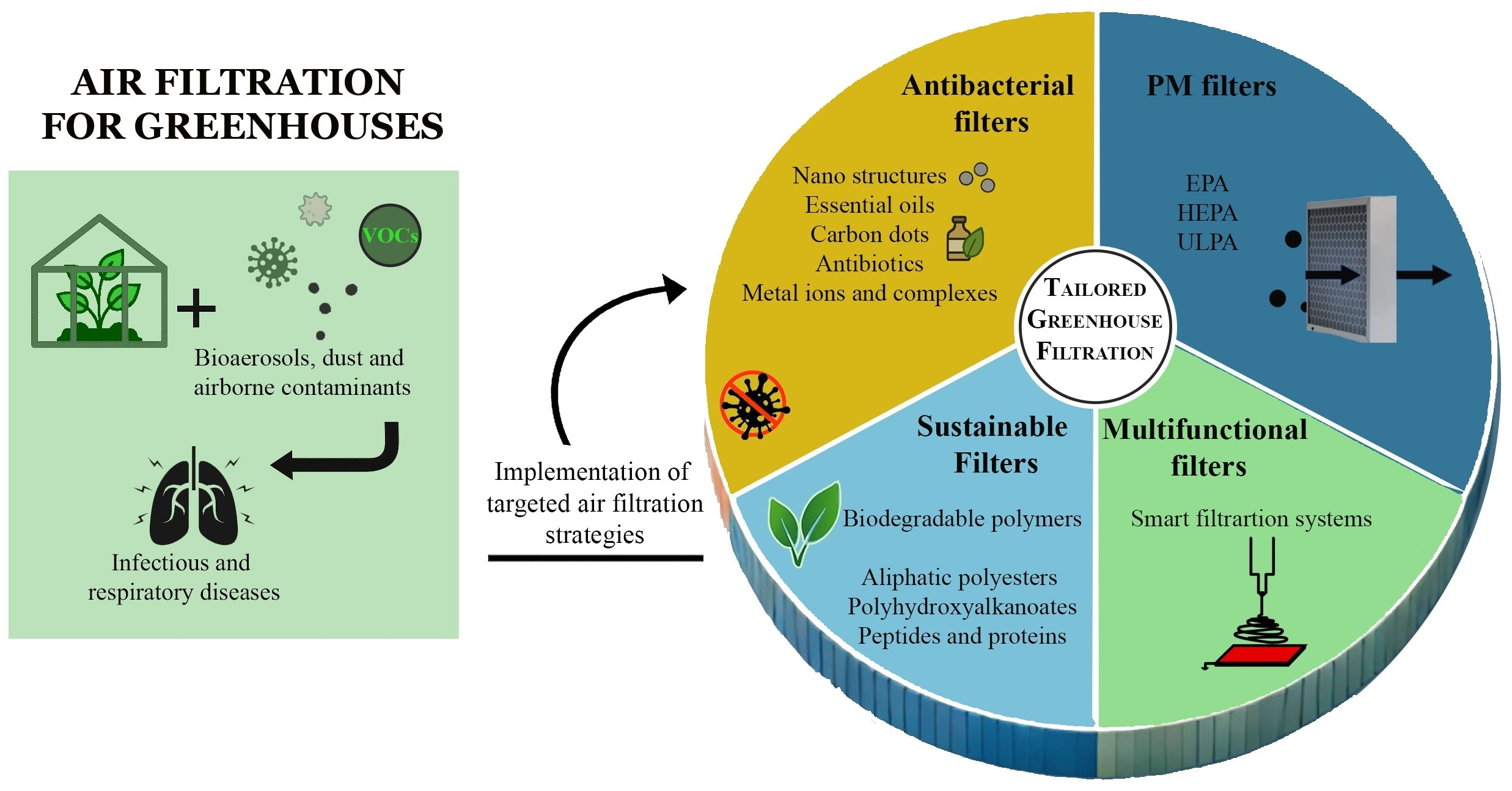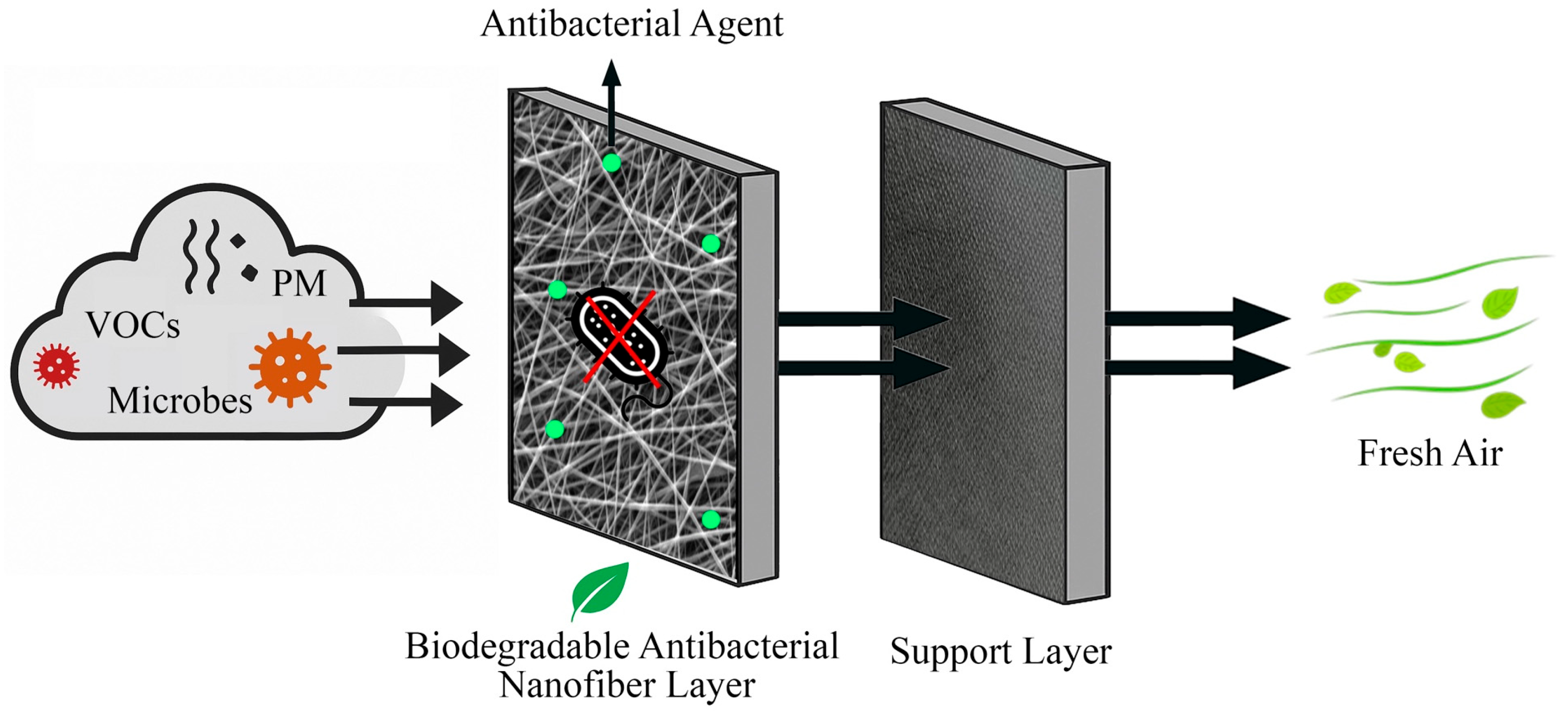

Advancing Greenhouse Air Filtration: Biodegradable Nanofiber Filters with Sustained Antimicrobial Performance




Abstract
1. Introduction
2. Filtration and Evaluation of Air Quality in Greenhouses
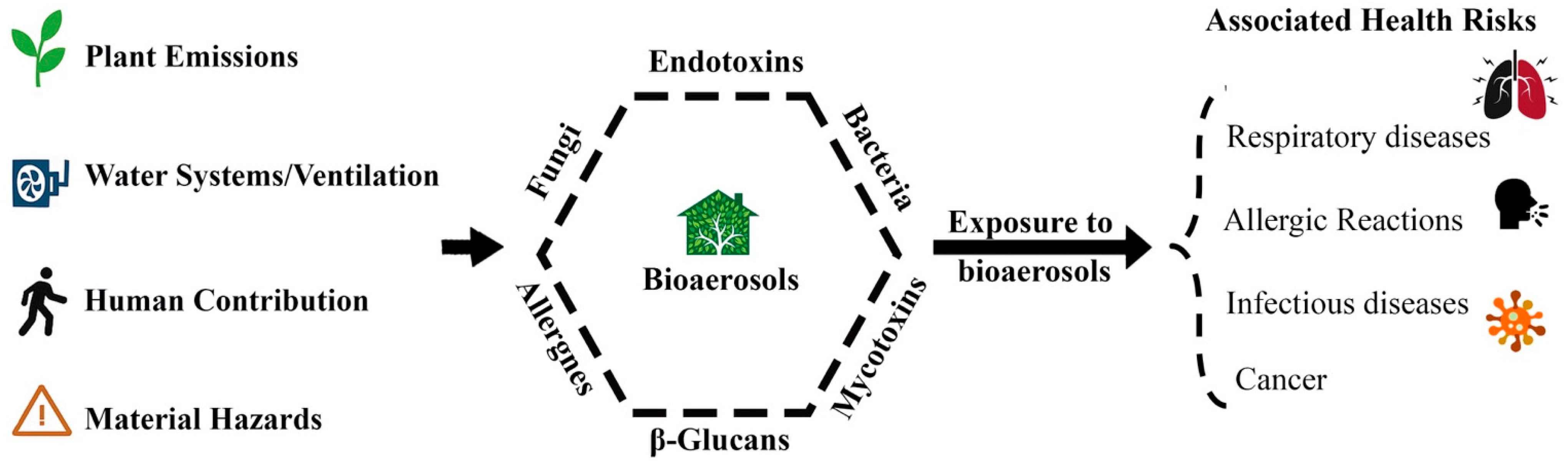
2.1. Potential Health Impacts of Bioaerosols
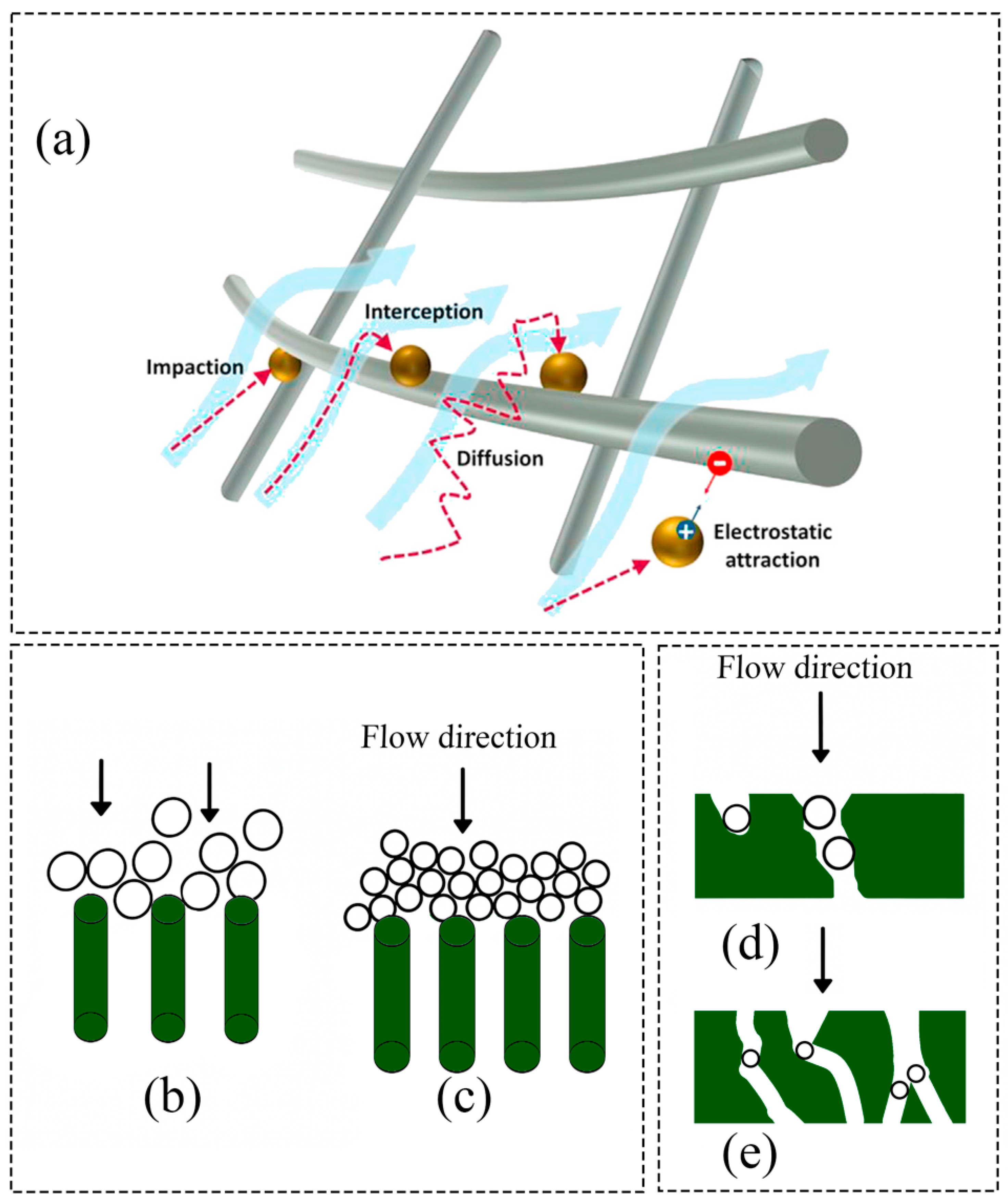
2.2. Principles of Filtration

2.3. Filtration Mechanisms in Fabric-Based Filters
2.3.1. Surface Filtration
2.3.2. Depth Filtration
2.4. Evaluation of the Filtration Performance
2.4.1. Pressure Drop
Drag Coefficient (CD)
2.4.2. Filtration Efficiency
2.4.3. Quality Factor
Kuwabara Model
2.5. Advanced Methods for Predicting Particle Capture
2.6. Air Filter Types and Their Fabrication Methods
2.7. Guidelines for Greenhouse Filtration
2.7.1. Optimal CO2 Concentration for Plant Growth
2.7.2. Worker Safety Standards
3. Key Technologies and Factors in Greenhouse Air Filtration
3.1. Air Quality Issues

3.2. Biological Contamination
3.3. Considerations in Sustainable Greenhouse Filtration Systems
3.4. Biocontainment Sampling Methods
3.5. Analysis Techniques
4. Polymeric Materials and Micro–Nanofiber Structures in Filtration Applications
4.1. Overview of Electrospinning for Air Filtration
4.2. Primary Techniques for Electrospinning
4.3. Advanced Electrospinning Techniques
4.4. Electrospinning Parameters and Process Optimization
4.5. Superior Characteristics of Electrospun Filters
4.5.1. High Surface Area
4.5.2. Low Pressure Drop
4.5.3. High Filtration Efficiency
5. Filters from Biodegradable Polymer Materials
6. Antibacterial Treatments in Micro- and Nanofiber-Based Filtration
6.1. Evaluation of the Antimicrobial Properties
6.2. Antimicrobial Agents
6.2.1. Carbon Dots (CDs)
6.2.2. Essential Oils
6.2.3. Nanoparticles
6.2.4. Peptide-Based Antibacterial Agents
6.2.5. Metal Ions and Complexes
6.2.6. Quaternary Ammonium Compounds (QACs)
6.2.7. Photocatalytic Agents
7. Effectiveness of Essential Oils as Antimicrobial Agents in Filtration Media
7.1. Essential Oil-Loaded Nanofibers
7.2. Release of Essential Oils
8. Conclusions
Author Contributions
Funding
Data Availability Statement
Acknowledgments
Conflicts of Interest
References
- Badji, A.; Benseddik, A.; Bensaha, H.; Boukhelifa, A.; Hasrane, I. Design, technology, and management of greenhouse: A review. J. Clean. Prod. 2022, 373, 133753. [Google Scholar] [CrossRef]
- Ehret, D.; Alsanius, B.; Wohanka, W.; Menzies, J.; Utkhede, R. Disinfestation of recirculating nutrient solutions in greenhouse horticulture. Agronomie 2001, 21, 323–339. [Google Scholar] [CrossRef]
- Vox, G.; Teitel, M.; Pardossi, A.; Minuto, A.; Tinivella, F.; Schettini, E. Sustainable greenhouse systems. Sustain. Agric. Technol. Plan. Manag. 2010, 14, 1–79. [Google Scholar]
- Deng, Y.; Lu, T.; Cui, J.; Samal, S.K.; Xiong, R.; Huang, C. Bio-based electrospun nanofiber as building blocks for a novel eco-friendly air filtration membrane: A review. Sep. Purif. Technol. 2021, 277, 119623. [Google Scholar] [CrossRef]
- Wang, A.; Lv, J.; Wang, J.; Shi, K. CO2 enrichment in greenhouse production: Towards a sustainable approach. Front. Plant Sci. 2022, 13, 1029901. [Google Scholar] [CrossRef] [PubMed]
- Ercilla-Montserrat, M.; Izquierdo, R.; Belmonte, J.; Montero, J.I.; Muñoz, P.; De Linares, C.; Rieradevall, J. Building-integrated agriculture: A first assessment of aerobiological air quality in rooftop greenhouses (i-RTGs). Sci. Total Environ. 2017, 598, 109–120. [Google Scholar] [CrossRef]
- Torahi, A.; Arzani, K.; Moallemi, N. Impact of Dust Deposition on Photosynthesis, Gas Exchange, and Yield of Date Palm (Phoenix dactylifera L.) cv.Sayer’. J. Agric. Sci. Technol. 2021, 23, 631–644. [Google Scholar]
- Kim, S.-Y. Factors influencing the emissions of aldehydes from plant species of the Korean peninsula. Asian J. Atmos. Environ. 2023, 17, 16. [Google Scholar] [CrossRef]
- Chen, S.; Liu, A.; Tang, F.; Hou, P.; Lu, Y.; Yuan, P. A Review of Environmental Control Strategies and Models for Modern Agricultural Greenhouses. Sensors 2025, 25, 1388. [Google Scholar] [CrossRef] [PubMed]
- Russo, F.; Castro-Muñoz, R.; Santoro, S.; Galiano, F.; Figoli, A. A review on electrospun membranes for potential air filtration application. J. Environ. Chem. Eng. 2022, 10, 108452. [Google Scholar] [CrossRef]
- Mohamadi, P.; Mohsenzadeh, E.; Cochrane, C.; Koncar, V. Highly Sensitive Electrospun Sensory Membrane for Low-Speed Air Flow Detection. IEEE Sens. J. 2023, 23, 24308–24315. [Google Scholar] [CrossRef]
- Zuo, F.; Zhang, S.; Liu, H.; Fong, H.; Yin, X.; Yu, J.; Ding, B. Free-standing polyurethane nanofiber/nets air filters for effective PM capture. Small 2017, 13, 1702139. [Google Scholar] [CrossRef] [PubMed]
- Keyvani, S.; Golbabaei, F.; Neisiany, R.E.; Das, O.; Pourmand, M.R.; Kalantary, S. Filtration Performance of Biodegradable Electrospun Nanofibrous Membrane for Sub-Micron Particles: A Systematic Review. Macromol. Mater. Eng. 2025, 310, 2400323. [Google Scholar] [CrossRef]
- Kozdrój, J.; Frączek, K.; Ropek, D. Assessment of bioaerosols in indoor air of glasshouses located in a botanical garden. Build. Environ. 2019, 166, 106436. [Google Scholar] [CrossRef]
- Manisalidis, I.; Stavropoulou, E.; Stavropoulos, A.; Bezirtzoglou, E. Environmental and health impacts of air pollution: A review. Front. Public Health 2020, 8, 14. [Google Scholar] [CrossRef] [PubMed]
- Soni, V.; Singh, P.; Shree, V.; Goel, V. Effects of VOCs on human health. In Air Pollution and Control; Springer: Berlin/Heidelberg, Germany, 2017; pp. 119–142. [Google Scholar]
- Simon-Nobbe, B.; Denk, U.; Pöll, V.; Rid, R.; Breitenbach, M. The Spectrum of Fungal Allergy. Int. Arch. Allergy Immunol. 2007, 145, 58–86. [Google Scholar] [CrossRef]
- Kim, K.-H.; Kabir, E.; Jahan, S.A. Airborne bioaerosols and their impact on human health. J. Environ. Sci. 2018, 67, 23–35. [Google Scholar] [CrossRef]
- Wei, D.-J.; Liu, W.-T.; Chin, H.-T.; Lin, C.-H.; Chen, I.-C.; Chang, Y.-T. An investigation of airborne bioaerosols and endotoxins present in indoor traditional wet markets before and after operation in Taiwan: A case study. Int. J. Environ. Res. Public Health 2021, 18, 2945. [Google Scholar] [CrossRef]
- Rastmanesh, A.; Boruah, J.S.; Lee, M.-S.; Park, S. On-site bioaerosol sampling and airborne microorganism detection technologies. Biosensors 2024, 14, 122. [Google Scholar] [CrossRef]
- Delanoë, A.; Heutte, N.; Gente, S.; Séguin, V.; Garon, D. Relationships between exposure to bioaerosols, moldy surface and symptoms in French mold-damaged homes. Atmosphere 2020, 11, 223. [Google Scholar] [CrossRef]
- Iqbal, M.A.; Siddiqua, S.A.; Faruk, M.O.; Islam, A.R.M.T.; Salam, M.A. Systematic review and meta-analysis of the potential threats to respiratory health from microbial Bioaerosol exposures. Environ. Pollut. 2024, 341, 122972. [Google Scholar] [CrossRef]
- Mbareche, H.; Morawska, L.; Duchaine, C. On the interpretation of bioaerosol exposure measurements and impacts on health. J. Air Waste Manag. Assoc. 2019, 69, 789–804. [Google Scholar] [CrossRef]
- Monsó, E.; Magarolas, R.; Badorrey, I.; Radon, K.; Nowak, D.; Morera, J. Occupational asthma in greenhouse flower and ornamental plant growers. Am. J. Respir. Crit. Care Med. 2002, 165, 954–960. [Google Scholar] [CrossRef]
- Kakde, U.B. Fungal bioaerosols: Global diversity, distribution and its impact on human beings and agricultural crops. Bionano Front. 2012, 5, 2–11. [Google Scholar]
- Kim, E.Y.; Han, J.; Lee, Y.-K.; Kim, W.; Lee, S.-J. Bioaerosol exposure by farm type in Korea. Ann. Agric. Environ. Med. 2022, 29, 38–43. [Google Scholar] [CrossRef]
- Suuronen, K.; Holtta, P.; Korva, M.; Koponen, M. Exposure to dust, endotoxins and microbes in Finnish vegetable greenhouses. Ann. Agric. Environ. Med. 2022, 29, 56–62. [Google Scholar] [CrossRef] [PubMed]
- Kumar, P.; Kausar, M.A.; Singh, A.; Singh, R. Biological contaminants in the indoor air environment and their impacts on human health. Air Qual. Atmos. Health 2021, 14, 1723–1736. [Google Scholar] [CrossRef]
- GSJ, S.; Ramakodi, M.P.; TVBPS, R. Review of bioaerosols from different sources and their health impacts. Environ. Monit. Assess. 2023, 195, 1321. [Google Scholar] [CrossRef]
- Thilsing, T.; Madsen, A.M.; Basinas, I.; Schlünssen, V.; Tendal, K.; Bælum, J. Dust, endotoxin, fungi, and bacteria exposure as determined by work task, season, and type of plant in a flower greenhouse. Ann. Occup. Hyg. 2015, 59, 142–157. [Google Scholar]
- Han, S.; Kim, J.; Ko, S. Advances in air filtration technologies: Structure-based and interaction-based approaches. Mater. Today Adv. 2021, 9, 100134. [Google Scholar] [CrossRef]
- Pierpaoli, M.; Giosuè, C.; Czerwińska, N.; Rycewicz, M.; Wieloszyńska, A.; Bogdanowicz, R.; Ruello, M.L. Characterization and filtration efficiency of sustainable PLA fibers obtained via a hybrid 3D-printed/electrospinning technique. Materials 2021, 14, 6766. [Google Scholar] [CrossRef] [PubMed]
- Shen, R.; Guo, Y.; Wang, S.; Tuerxun, A.; He, J.; Bian, Y. Biodegradable electrospun nanofiber membranes as promising candidates for the development of face masks. Int. J. Environ. Res. Public Health 2023, 20, 1306. [Google Scholar] [CrossRef]
- Zhou, Y.; Liu, Y.; Zhang, M.; Feng, Z.; Yu, D.-G.; Wang, K. Electrospun nanofiber membranes for air filtration: A review. Nanomaterials 2022, 12, 1077. [Google Scholar] [CrossRef]
- Liu, G.; Xiao, M.; Zhang, X.; Gal, C.; Chen, X.; Liu, L.; Pan, S.; Wu, J.; Tang, L.; Clements-Croome, D. A review of air filtration technologies for sustainable and healthy building ventilation. Sustain. Cities Soc. 2017, 32, 375–396. [Google Scholar] [CrossRef]
- Tan, W.K.; Araki, Y.; Yokoi, A.; Kawamura, G.; Matsuda, A.; Muto, H. Micro-and nano-assembly of composite particles by electrostatic adsorption. Nanoscale Res. Lett. 2019, 14, 297. [Google Scholar] [CrossRef]
- Rana, A.K.; Mostafavi, E.; Alsanie, W.F.; Siwal, S.S.; Thakur, V.K. Cellulose-based materials for air purification: A review. Ind. Crops Prod. 2023, 194, 116331. [Google Scholar] [CrossRef]
- Mukhopadhyay, A. Pulse-jet filtration: An effective way to control industrial pollution Part II: Process characterization and evaluation of filter media. Text. Prog. 2010, 42, 1–97. [Google Scholar] [CrossRef]
- Maduna, L.; Patnaik, A. Textiles in air filtration. Text. Prog. 2017, 49, 173–247. [Google Scholar] [CrossRef]
- Roche, R.; Yalcinkaya, F. Incorporation of PVDF nanofibre multilayers into functional structure for filtration applications. Nanomaterials 2018, 8, 771. [Google Scholar] [CrossRef]
- Zhao, T.; Xu, Y.; Wu, M.; Li, Y.; Ma, J.; Li, H.; Zheng, Y.; Zeng, Y. Highly efficient fabrication of biomimetic nanoscaled tendrils for high-performance PM0. 3 air filters. Nano Lett. 2024, 24, 1385–1391. [Google Scholar] [CrossRef]
- Borojeni, I.A.; Gajewski, G.; Riahi, R.A. Application of electrospun nonwoven fibers in air filters. Fibers 2022, 10, 15. [Google Scholar] [CrossRef]
- Liu, Y.; Li, S.; Lan, W.; Hossen, M.A.; Qin, W.; Lee, K. Electrospun antibacterial and antiviral poly (ε-caprolactone)/zein/Ag bead-on-string membranes and its application in air filtration. Mater. Today Adv. 2021, 12, 100173. [Google Scholar] [CrossRef]
- Chen, K.; Wu, J.; Yarin, A. Electrospun membranes filtering 100 nm particles from air flow by means of the van der Waals and Coulomb forces. J. Membr. Sci. 2022, 644, 120138. [Google Scholar] [CrossRef]
- Hsiao, T.-C.; Chen, D.-R. Modeling of the transitional pressure drop of fibrous filter media loaded with oil-coated particles. Aerosol Air Qual. Res. 2019, 19, 1625–1635. [Google Scholar] [CrossRef]
- Li, Y.; Yin, X.; Yu, J.; Ding, B. Electrospun nanofibers for high-performance air filtration. Compos. Commun. 2019, 15, 6–19. [Google Scholar] [CrossRef]
- Givehchi, R.; Li, Q.; Tan, Z. Quality factors of PVA nanofibrous filters for airborne particles in the size range of 10–125 nm. Fuel 2016, 181, 1273–1280. [Google Scholar] [CrossRef]
- Park, H.-S.; Park, Y.O. Filtration properties of electrospun ultrafine fiber webs. Korean J. Chem. Eng. 2005, 22, 165–172. [Google Scholar] [CrossRef]
- Yu, Z.; Fan, T.; Liu, Y.; Li, L.; Liu, J.; Yang, B.; Ramakrishna, S.; Long, Y.-Z. Efficient air filtration through advanced electrospinning techniques in nanofibrous Materials: A review. Sep. Purif. Technol. 2024, 349, 127773. [Google Scholar] [CrossRef]
- Berry, G.; Beckman, I.; Cho, H. A comprehensive review of particle loading models of fibrous air filters. J. Aerosol Sci. 2023, 167, 106078. [Google Scholar] [CrossRef]
- Henry, F.S.; Ariman, T. An evaluation of the Kuwabara model. Part. Sci. Technol. 1983, 1, 1–20. [Google Scholar] [CrossRef]
- Przekop, R. Estimation of filtration efficiency–from simple correlations to digital fluid dynamics. Chem. Process Eng. 2017, 38, 31–50. [Google Scholar] [CrossRef]
- Lee, S.; Bui-Vinh, D.; Baek, M.; Kwak, D.-B.; Lee, H. Modeling pressure drop values across ultra-thin nanofiber filters with various ranges of filtration parameters under an aerodynamic slip effect. Sci. Rep. 2023, 13, 5449. [Google Scholar] [CrossRef]
- Sohrabi, M.; Razbin, M. Hybrid modeling for optimizing electrospun polyurethane nanofibrous membranes in air filtration applications. Sci. Rep. 2025, 15, 27306. [Google Scholar] [CrossRef] [PubMed]
- EN 1822-1:2019; High Efficiency Air Filters (EPA, HEPA and ULPA)-Part 1: Classification, Performance Testing, Marking. European Committee for Standardization: Brussels, Belgium, 2019.
- de Almeida, D.S.; Martins, L.D.; Aguiar, M.L. Air pollution control for indoor environments using nanofiber filters: A brief review and post-pandemic perspectives. Chem. Eng. J. Adv. 2022, 11, 100330. [Google Scholar] [CrossRef]
- Liu, H.; Zhu, Y.; Zhang, C.; Zhou, Y.; Yu, D.-G. Electrospun nanofiber as building blocks for high-performance air filter: A review. Nano Today 2024, 55, 102161. [Google Scholar] [CrossRef]
- Zhang, H.; Liu, J.; Zhang, X.; Huang, C.; Jin, X. Design of electret polypropylene melt blown air filtration material containing nucleating agent for effective PM2. 5 capture. RSC Adv. 2018, 8, 7932–7941. [Google Scholar] [CrossRef]
- Zhang, X.; Wang, Y.; Liu, W.; Jin, X. Needle-punched electret air filters (NEAFs) with high filtration efficiency, low filtration resistance, and superior dust holding capacity. Sep. Purif. Technol. 2022, 282, 120146. [Google Scholar] [CrossRef]
- Park, J.B.; An, S.H.; Jung, J.W.; Lee, J.U. Three-dimensional printing of recycled polypropylene and activated carbon coatings for harmful gas adsorption and antibacterial properties. Polymers 2023, 15, 1173. [Google Scholar] [CrossRef] [PubMed]
- D’Aloia, M.; López, R.C.; Villata, S.; Vasile, N.S.; Campos, E.M.; Jiménez, L.M.; Pirri, C.F.; Frascella, F.; Bosch, P.; Roppolo, I. 3D-printed antibacterial filters obtained via digital light processing exploiting surface microwaves functionalization with natural amino acids. Appl. Mater. Today 2025, 44, 102779. [Google Scholar] [CrossRef]
- Ince Yardimci, A.; László, T.; Yardimci, C. Hybrid 3D printing and electrospinning technique for the production of air filter materials and the effect of different infill patterns on air permeability. Bull. Mater. Sci. 2024, 47, 49. [Google Scholar] [CrossRef]
- Ramakrishna, S. An Introduction to Electrospinning and Nanofibers; World Scientific: Singapore, 2005. [Google Scholar]
- Wanwong, S.; Sangkhun, W.; Jiamboonsri, P.; Butburee, T. Electrospun silk nanofiber loaded with Ag-doped TiO 2 with high-reactive facet as multifunctional air filter. RSC Adv. 2023, 13, 25729–25737. [Google Scholar] [CrossRef] [PubMed]
- Lin, X.; Lin, M.; Li, T.; Lu, H.; Qi, H.; Chen, T.; Wu, L.; Zhang, C. Preparation of self-curling melt-blown fibers with crimped masterbatch (CM) and its application for low-pressure air filtration. Polymers 2023, 15, 3365. [Google Scholar] [CrossRef]
- Souzandeh, H.; Wang, Y.; Netravali, A.N.; Zhong, W.-H. Towards sustainable and multifunctional air-filters: A review on biopolymer-based filtration materials. Polym. Rev. 2019, 59, 651–686. [Google Scholar] [CrossRef]
- Zhang, X.; Wargocki, P.; Lian, Z. Human responses to carbon dioxide, a follow-up study at recommended exposure limits in non-industrial environments. Build. Environ. 2016, 100, 162–171. [Google Scholar] [CrossRef]
- Heida, H.; Bartman, F.; van der Zee, S.C. Occupational exposure and indoor air quality monitoring in a composting facility. Am. Ind. Hyg. Assoc. J. 1995, 56, 39–43. [Google Scholar] [CrossRef]
- Bennett, D.H.; Moran, R.E.; Krakowiak, P.; Tancredi, D.J.; Kenyon, N.J.; Williams, J.; Fisk, W.J. Reductions in particulate matter concentrations resulting from air filtration: A randomized sham-controlled crossover study. Indoor Air 2022, 32, e12982. [Google Scholar] [CrossRef]
- Shipp, J.; Zhang, Y.; Hunt, D.; Ferguson, G. Influence of humidity and greenhouse microclimate on the efficacy of Beauveria bassiana (Balsamo) for control of greenhouse arthropod pests. Environ. Entomol. 2003, 32, 1154–1163. [Google Scholar] [CrossRef]
- Kim, G.T.; Ahn, Y.C.; Lee, J.K. Characteristics of Nylon 6 nanofilter for removing ultra fine particles. Korean J. Chem. Eng. 2008, 25, 368–372. [Google Scholar] [CrossRef]
- Islam, A.; Teo, S.H.; Ng, C.H.; Taufiq-Yap, Y.H.; Choong, S.Y.T.; Awual, M.R. Progress in recent sustainable materials for greenhouse gas (NOx and SOx) emission mitigation. Prog. Mater. Sci. 2023, 132, 101033. [Google Scholar] [CrossRef]
- Sim, K.M.; Park, H.-S.; Bae, G.-N.; Jung, J.H. Antimicrobial nanoparticle-coated electrostatic air filter with high filtration efficiency and low pressure drop. Sci. Total Environ. 2015, 533, 266–274. [Google Scholar] [CrossRef]
- Pourhassan, B.; Golbabaei, F.; Dehghan, S.F.; Pourmand, M.R.; Mousavi, T.; Masoorian, E. Preparation of Photocatalytic TiO2–Polyacrylonitrile Nanofibers for Filtration of Airborne Microorganisms. Iran. J. Public Health 2022, 51, 871. [Google Scholar] [CrossRef]
- van Mourik, S.; van Beveren, P.J.; López-Cruz, I.L.; van Henten, E.J. Improving climate monitoring in greenhouse cultivation via model based filtering. Biosyst. Eng. 2019, 181, 40–51. [Google Scholar] [CrossRef]
- Nie, J.; Liao, J.; Jiao, T.; Sun, B.; Zhang, M.; Yang, R.; Li, Y. A multi-layer antimicrobial cellulose filter with electrostatic adsorption properties prepared by coating cellulose with chitosan and CuO. Chem. Eng. J. 2024, 500, 156719. [Google Scholar] [CrossRef]
- Surat’man, N.E.B.; Quek, X.L.; Wang, N.; Ye, E.; Xu, J.; Li, Z.; Li, B. Sustainable nanofibrous membranes for air filtration, water purification and oil removal. Nanoscale 2025, 17, 6427–6447. [Google Scholar] [CrossRef] [PubMed]
- Madsen, A.M.; Tendal, K.; Frederiksen, M.W. Attempts to reduce exposure to fungi, β-glucan, bacteria, endotoxin and dust in vegetable greenhouses and a packaging unit. Sci. Total Environ. 2014, 468, 1112–1121. [Google Scholar] [CrossRef]
- Beckman, I.P.; Berry, G.; Cho, H.; Riveros, G. Alternative high-performance fibers for nonwoven HEPA filter media. Aerosol Sci. Eng. 2023, 7, 36–58. [Google Scholar] [CrossRef]
- Bian, Y.; Zhang, C.; Wang, H.; Cao, Q. Degradable nanofiber for eco-friendly air filtration: Progress and perspectives. Sep. Purif. Technol. 2023, 306, 122642. [Google Scholar] [CrossRef]
- Price, D.L.; Simmons, R.B.; Crow, S.A., Jr.; Ahearn, D.G. Mold colonization during use of preservative-treated and untreated air filters, including HEPA filters from hospitals and commercial locations over an 8-year period (1996–2003). J. Ind. Microbiol. Biotechnol. 2005, 32, 319–321. [Google Scholar] [CrossRef] [PubMed]
- Dedesko, S.; Siegel, J.A. Moisture parameters and fungal communities associated with gypsum drywall in buildings. Microbiome 2015, 3, 71. [Google Scholar] [CrossRef]
- Mandal, J.; Brandl, H. Bioaerosols in indoor environment-a review with special reference to residential and occupational locations. Open Environ. Biol. Monit. J. 2011, 2011, 83–96. [Google Scholar]
- Dillon, K.P.; Tignat-Perrier, R.; Joly, M.; Grogan, S.N.; Larose, C.; Amato, P.; Mainelis, G. Comparison of airborne bacterial populations determined by passive and active air sampling at puy de Dôme, France. Aerosol Air Qual. Res. 2023, 23, 220403. [Google Scholar] [CrossRef]
- Benis, K.; Reinhart, C.; Ferrão, P. Building-Integrated Agriculture (BIA) in urban contexts: Testing a simulation-based decision support workflow. In Proceedings of the Building Simulation 2017, San Francisco, CA, USA, 7–9 August 2017; IBPSA: Atlanta, GA, USA, 2017; Volume 15, pp. 1798–1807. [Google Scholar]
- Eduard, W. Fungal spores: A critical review of the toxicological and epidemiological evidence as a basis for occupational exposure limit setting. Crit. Rev. Toxicol. 2009, 39, 799–864. [Google Scholar] [CrossRef]
- Santilli, J.; Rockwell, W. Fungal contamination of elementary schools: A new environmental hazard. Ann. Allergy Asthma Immunol. 2003, 90, 203–208. [Google Scholar] [CrossRef] [PubMed]
- Ghosh, B.; Lal, H.; Srivastava, A. Review of bioaerosols in indoor environment with special reference to sampling, analysis and control mechanisms. Environ. Int. 2015, 85, 254–272. [Google Scholar] [CrossRef]
- Maraveas, C.; Bartzanas, T. Application of Internet of Things (IoT) for optimized greenhouse environments. AgriEngineering 2021, 3, 954–970. [Google Scholar] [CrossRef]
- Yang, W.; Li, L.; Wang, S.; Liu, J. Preparation of multifunctional AgNPs/PAN nanofiber membrane for air filtration by one-step process. Pigment Resin Technol. 2020, 49, 355–361. [Google Scholar] [CrossRef]
- Barhate, R.S.; Ramakrishna, S. Nanofibrous filtering media: Filtration problems and solutions from tiny materials. J. Membr. Sci. 2007, 296, 1–8. [Google Scholar] [CrossRef]
- Escriba Flores, A.A.; de Almeida, D.S.; Aguiar, M.L.; Cava, C.E. Enhanced Air Filtration Efficiency through Electrospun PVC/PVP/MWCNTs Nanofibers: Design, Optimization, and Performance Evaluation. ACS Omega 2024, 9, 37771–37779. [Google Scholar] [CrossRef]
- Son, B.C.; Park, C.H.; Kim, C.S. Fabrication of antimicrobial nanofiber air filter using activated carbon and cinnamon essential oil. J. Nanosci. Nanotechnol. 2020, 20, 4376–4380. [Google Scholar] [CrossRef]
- Seraji, A.A.; Bajgholi, A.A. Dual role of nanoclay in the improvement of the in-situ nanofibrillar morphology in polypropylene/polybutylene terephthalate nanocomposites. J. Ind. Text. 2022, 52, 15280837221133570. [Google Scholar] [CrossRef]
- Bian, Y.; Wang, R.; Wang, S.; Yao, C.; Ren, W.; Chen, C.; Zhang, L. Metal–organic framework-based nanofiber filters for effective indoor air quality control. J. Mater. Chem. A 2018, 6, 15807–15814. [Google Scholar] [CrossRef]
- Kadam, V.V.; Wang, L.; Padhye, R. Electrospun nanofibre materials to filter air pollutants—A review. J. Ind. Text. 2018, 47, 2253–2280. [Google Scholar] [CrossRef]
- Lyu, C.; Zhao, P.; Xie, J.; Dong, S.; Liu, J.; Rao, C.; Fu, J. Electrospinning of nanofibrous membrane and its applications in air filtration: A review. Nanomaterials 2021, 11, 1501. [Google Scholar] [CrossRef] [PubMed]
- Hutmacher, D.W.; Dalton, P.D. Melt electrospinning. Chem.—Asian J. 2011, 6, 44–56. [Google Scholar] [CrossRef] [PubMed]
- Niu, H.; Lin, T. Fiber generators in needleless electrospinning. J. Nanomater. 2012, 2012, 725950. [Google Scholar] [CrossRef]
- Li, Y.; Zhu, J.; Cheng, H.; Li, G.; Cho, H.; Jiang, M.; Gao, Q.; Zhang, X. Developments of advanced electrospinning techniques: A critical review. Adv. Mater. Technol. 2021, 6, 2100410. [Google Scholar] [CrossRef]
- Afshar, S.; Rashedi, S.; Nazockdast, H.; Ghazalian, M. Preparation and characterization of electrospun poly (lactic acid)-chitosan core-shell nanofibers with a new solvent system. Int. J. Biol. Macromol. 2019, 138, 1130–1137. [Google Scholar] [CrossRef]
- Ghazalian, M.; Afshar, S.; Rostami, A.; Rashedi, S.; Bahrami, S.H. Fabrication and characterization of chitosan-polycaprolactone core-shell nanofibers containing tetracycline hydrochloride. Colloids Surf. A Physicochem. Eng. Asp. 2022, 636, 128163. [Google Scholar] [CrossRef]
- Maliszewska, I.; Czapka, T. Electrospun polymer nanofibers with antimicrobial activity. Polymers 2022, 14, 1661. [Google Scholar] [CrossRef]
- Al-Abduljabbar, A.; Farooq, I. Electrospun polymer nanofibers: Processing, properties, and applications. Polymers 2022, 15, 65. [Google Scholar] [CrossRef]
- Zhang, J.; Gong, S.; Wang, C.; Jeong, D.Y.; Wang, Z.L.; Ren, K. Biodegradable electrospun poly (lactic acid) nanofibers for effective PM 2.5 removal. Macromol. Mater. Eng. 2019, 304, 1900259. [Google Scholar] [CrossRef]
- Wang, Z.; Zhao, C.; Pan, Z. Porous bead-on-string poly (lactic acid) fibrous membranes for air filtration. J. Colloid Interface Sci. 2015, 441, 121–129. [Google Scholar] [CrossRef]
- Zhang, S.; Liu, H.; Yin, X.; Yu, J.; Ding, B. Anti-deformed polyacrylonitrile/polysulfone composite membrane with binary structures for effective air filtration. ACS Appl. Mater. Interfaces 2016, 8, 8086–8095. [Google Scholar] [CrossRef]
- Xie, S.; Xu, B.; Yuan, L.; Zhao, Y.; Ma, N.; Wang, Y.; Liu, D.; Xiang, A.; Ouyang, Y.; Tian, H. Electrospun hydrophobic nanofiber films from biodegradable zein and curcumin with improved tensile strength for air filtration. J. Polym. Environ. 2023, 31, 287–296. [Google Scholar] [CrossRef]
- Yang, B.; Wang, J.; Kang, L.; Gao, X.; Zhao, K. Antibacterial, efficient and sustainable CS/PVA/GA electrospun nanofiber membrane for air filtration. Mater. Res. Express 2022, 9, 125002. [Google Scholar] [CrossRef]
- Lv, D.; Zhu, M.; Jiang, Z.; Jiang, S.; Zhang, Q.; Xiong, R.; Huang, C. Green electrospun nanofibers and their application in air filtration. Macromol. Mater. Eng. 2018, 303, 1800336. [Google Scholar] [CrossRef]
- Wang, L.; Gao, Y.; Xiong, J.; Shao, W.; Cui, C.; Sun, N.; Zhang, Y.; Chang, S.; Han, P.; Liu, F. Biodegradable and high-performance multiscale structured nanofiber membrane as mask filter media via poly (lactic acid) electrospinning. J. Colloid Interface Sci. 2022, 606, 961–970. [Google Scholar] [CrossRef] [PubMed]
- Zhang, Z.; Ji, D.; He, H.; Ramakrishna, S. Electrospun ultrafine fibers for advanced face masks. Mater. Sci. Eng. R Rep. 2021, 143, 100594. [Google Scholar] [CrossRef]
- Palmieri, S.; Pierpaoli, M.; Riderelli, L.; Qi, S.; Ruello, M.L. Preparation and characterization of an electrospun PLA-cyclodextrins composite for simultaneous high-efficiency PM and VOC removal. J. Compos. Sci. 2020, 4, 79. [Google Scholar] [CrossRef]
- Kai, D.; Liow, S.S.; Loh, X.J. Biodegradable polymers for electrospinning: Towards biomedical applications. Mater. Sci. Eng. C 2014, 45, 659–670. [Google Scholar] [CrossRef]
- Tomietto, P.; Russo, F.; Galiano, F.; Loulergue, P.; Salerno, S.; Paugam, L.; Audic, J.-L.; De Bartolo, L.; Figoli, A. Sustainable fabrication and pervaporation application of bio-based membranes: Combining a polyhydroxyalkanoate (PHA) as biopolymer and Cyrene™ as green solvent. J. Membr. Sci. 2022, 643, 120061. [Google Scholar] [CrossRef]
- Verma, D.; Nichakornpong, N.; Kraiwitwattana, U.; Okhawilai, M.; Kasemsiri, P.; Potiyaraj, P.; Rangkupan, R. High performance filtration membranes from electrospun poly (3-hydroxybutyrate)-based fiber membranes for fine particulate protection. Environ. Res. 2023, 231, 116144. [Google Scholar] [CrossRef]
- Zhang, Z.; Ortiz, O.; Goyal, R.; Kohn, J. Biodegradable polymers. Handb. Polym. Appl. Med. Med. Devices 2014, 303–335. [Google Scholar]
- Zhao, P.; Wang, R.; Xiang, J.; Zhang, J.; Wu, X.; Chen, C.; Liu, G. Antibacterial, antiviral, and biodegradable collagen network mask for effective particulate removal and wireless breath monitoring. J. Hazard. Mater. 2023, 456, 131654. [Google Scholar] [CrossRef]
- Heidari, M.; Bahrami, S.H.; Ranjbar-Mohammadi, M.; Milan, P.B. Smart electrospun nanofibers containing PCL/gelatin/graphene oxide for application in nerve tissue engineering. Mater. Sci. Eng. C 2019, 103, 109768. [Google Scholar] [CrossRef]
- Raza, Z.A.; Munim, S.; Ayub, A. Recent developments in polysaccharide-based electrospun nanofibers for environmental applications. Carbohydr. Res. 2021, 510, 108443. [Google Scholar] [CrossRef]
- Taokaew, S.; Chuenkaek, T. Developments of Core/Shell chitosan-based nanofibers by electrospinning techniques: A review. Fibers 2024, 12, 26. [Google Scholar] [CrossRef]
- Bikiaris, D.N. Nanocomposites of aliphatic polyesters: An overview of the effect of different nanofillers on enzymatic hydrolysis and biodegradation of polyesters. Polym. Degrad. Stab. 2013, 98, 1908–1928. [Google Scholar] [CrossRef]
- Choi, S.; Jeon, H.; Jang, M.; Kim, H.; Shin, G.; Koo, J.M.; Lee, M.; Sung, H.K.; Eom, Y.; Yang, H.S. Biodegradable, efficient, and breathable multi-use face mask filter. Adv. Sci. 2021, 8, 2003155. [Google Scholar] [CrossRef] [PubMed]
- Rizal, S.; Saharudin, N.; Olaiya, N.; Khalil, H.A.; Haafiz, M.M.; Ikramullah, I.; Muksin, U.; Olaiya, F.G.; Abdullah, C.; Yahya, E.B. Functional properties and molecular degradation of schizostachyum brachycladum bamboo cellulose nanofibre in PLA-chitosan bionanocomposites. Molecules 2021, 26, 2008. [Google Scholar] [CrossRef]
- Easton, Z.H.; Essink, M.A.; Rodriguez Comas, L.; Wurm, F.R.; Gojzewski, H. Acceleration of biodegradation using polymer blends and composites. Macromol. Chem. Phys. 2023, 224, 2200421. [Google Scholar] [CrossRef]
- Ke, L.; Yang, T.; Liang, C.; Guan, X.; Li, T.; Jiao, Y.; Tang, D.; Huang, D.; Li, S.; Zhang, S. Electroactive, antibacterial, and biodegradable poly (lactic acid) nanofibrous air filters for healthcare. ACS Appl. Mater. Interfaces 2023, 15, 32463–32474. [Google Scholar] [CrossRef]
- Liu, Y.; Liu, R.; Shi, J.; Zhang, R.; Tang, H.; Xie, C.; Wang, F.; Han, J.; Jiang, L. Chitosan/esterified chitin nanofibers nanocomposite films incorporated with rose essential oil: Structure, physicochemical characterization, antioxidant and antibacterial properties. Food Chem. X 2023, 18, 100714. [Google Scholar] [CrossRef]
- Wen, P.; Zhu, D.-H.; Wu, H.; Zong, M.-H.; Jing, Y.-R.; Han, S.-Y. Encapsulation of cinnamon essential oil in electrospun nanofibrous film for active food packaging. Food Control 2016, 59, 366–376. [Google Scholar] [CrossRef]
- Castañeda-Rodríguez, S.; González-Torres, M.; Ribas-Aparicio, R.M.; Del Prado-Audelo, M.L.; Leyva-Gómez, G.; Gürer, E.S.; Sharifi-Rad, J. Recent advances in modified poly (lactic acid) as tissue engineering materials. J. Biol. Eng. 2023, 17, 21. [Google Scholar] [CrossRef] [PubMed]
- Wang, X.; Yuan, Q.; Qian, Q.; Wang, J.; Zhang, C.; Qi, H. Electrospun PLA/DTAC Bicomponent Membranes for Low-Resistance and Antibacterial Air Filtration. Polymers 2025, 17, 767. [Google Scholar] [CrossRef]
- Hudzicki, J. Kirby-Bauer disk diffusion susceptibility test protocol. Am. Soc. Microbiol. 2009, 15, 1–23. [Google Scholar]
- Sohrabi, M.; Abbasi, M.; Sadighzadeh, A. Fabrication and evaluation of electrospun polyacrylonitrile/silver nanofiber membranes for air filtration and antibacterial activity. Polym. Bull. 2023, 80, 5481–5499. [Google Scholar] [CrossRef]
- Fiebelkorn, K.; Crawford, S.; McElmeel, M.; Jorgensen, J. Practical disk diffusion method for detection of inducible clindamycin resistance in Staphylococcus aureus and coagulase-negative staphylococci. J. Clin. Microbiol. 2003, 41, 4740–4744. [Google Scholar] [CrossRef] [PubMed]
- Wiegand, I.; Hilpert, K.; Hancock, R.E. Agar and broth dilution methods to determine the minimal inhibitory concentration (MIC) of antimicrobial substances. Nat. Protoc. 2008, 3, 163–175. [Google Scholar] [CrossRef] [PubMed]
- Canalli Bortolassi, A.C.; Guerra, V.G.; Aguiar, M.L.; Soussan, L.; Cornu, D.; Miele, P.; Bechelany, M. Composites based on nanoparticle and pan electrospun nanofiber membranes for air filtration and bacterial removal. Nanomaterials 2019, 9, 1740. [Google Scholar] [CrossRef] [PubMed]
- Hashmi, M.; Ullah, S.; Kim, I.S. Copper oxide (CuO) loaded polyacrylonitrile (PAN) nanofiber membranes for antimicrobial breath mask applications. Curr. Res. Biotechnol. 2019, 1, 1–10. [Google Scholar] [CrossRef]
- Reda, A.T.; Park, J.Y.; Park, Y.T. Zinc oxide-based nanomaterials for microbiostatic activities: A review. J. Funct. Biomater. 2024, 15, 103. [Google Scholar] [CrossRef] [PubMed]
- Wang, G.; Xu, Z.; Qi, Y.; Fang, Y.; Ning, G.; Ye, J. Electrospun nanofibrous membranes with antimicrobial activity for air filtration. Chin. Chem. Lett. 2024, 35, 109503. [Google Scholar] [CrossRef]
- Hoque, J.; Prakash, R.G.; Paramanandham, K.; Shome, B.R.; Haldar, J. Biocompatible injectable hydrogel with potent wound healing and antibacterial properties. Mol. Pharm. 2017, 14, 1218–1230. [Google Scholar] [CrossRef]
- Mele, E. Electrospinning of essential oils. Polymers 2020, 12, 908. [Google Scholar] [CrossRef]
- Cai, L.; Zhu, X.; Ruan, H.; Yang, J.; Wei, W.; Wu, Y.; Zhou, L.; Jiang, H.; Ji, M.; Chen, J. Curcumin-stabilized silver nanoparticles encapsulated in biocompatible electrospun nanofibrous scaffold for sustained eradication of drug-resistant bacteria. J. Hazard. Mater. 2023, 452, 131290. [Google Scholar] [CrossRef]
- Singh, S.; Shauloff, N.; Sharma, C.P.; Shimoni, R.; Arnusch, C.J.; Jelinek, R. Carbon dot-polymer nanoporous membrane for recyclable sunlight-sterilized facemasks. J. Colloid Interface Sci. 2021, 592, 342–348. [Google Scholar] [CrossRef]
- Bao, J.; Hu, Y.; Farag, M.A.; Huan, W.; Wu, J.; Yang, D.; Song, L. Carbon dots, cellulose nanofiber, and essential oil nanoemulsion from Torreya grandis aril added to fish scale gelatin film for tomato preservation. Int. J. Biol. Macromol. 2023, 245, 125482. [Google Scholar] [CrossRef]
- Saravanan, A.; Maruthapandi, M.; Das, P.; Luong, J.H.; Gedanken, A. Green synthesis of multifunctional carbon dots with antibacterial activities. Nanomaterials 2021, 11, 369. [Google Scholar] [CrossRef]
- Khan, M.J.; Karim, Z.; Pongchaikul, P.; Posoknistakul, P.; Intra, P.; Laosiripojana, N.; Wu, K.C.-W.; Sakdaronnarong, C. Nitrogen and sulfur doped carbon dots coupled cellulose nanofibers: A surface functionalized nanocellulose membranes for air filtration. J. Taiwan Inst. Chem. Eng. 2024, 160, 105324. [Google Scholar] [CrossRef]
- Yao, Z.; Xia, M.; Xiong, Z.; Wu, Y.; Cheng, P.; Cheng, Q.; Xu, J.; Wang, D.; Liu, K. A hierarchical structure of flower-like zinc oxide and poly (vinyl alcohol-co-ethylene) nanofiber hybrid membranes for high-performance air filters. ACS Omega 2022, 7, 3030–3036. [Google Scholar] [CrossRef]
- Bartošová, L.; Sedlaříková, J.; Peer, P.; Janalíková, M.; Pleva, P. Antibacterial and antifouling efficiency of essential oils-loaded electrospun polyvinylidene difluoride membranes. Int. J. Mol. Sci. 2022, 24, 423. [Google Scholar] [CrossRef]
- Zhu, M.; Han, J.; Wang, F.; Shao, W.; Xiong, R.; Zhang, Q.; Pan, H.; Yang, Y.; Samal, S.K.; Zhang, F. Electrospun nanofibers membranes for effective air filtration. Macromol. Mater. Eng. 2017, 302, 1600353. [Google Scholar] [CrossRef]
- Huang, Q.; Meng, C.; Liao, M.; Kou, T.; Zhou, F.; Lu, J.R.; Li, J.; Li, Y. Hierarchically porous, superhydrophobic plla/copper composite fibrous membranes for air filtration. ACS Appl. Polym. Mater. 2024, 6, 2381–2391. [Google Scholar] [CrossRef]
- Kim, K.S.; Lee, I.; Lee, J. Synergetic Chemo-Mechano Antimicrobial Puncturable Nanostructures for Efficient Bioaerosol Removal. BioChip J. 2024, 18, 439–452. [Google Scholar] [CrossRef]
- Reda, A.T.; Weldemhret, T.G.; Park, J.Y.; Lim, S.; Debele, N.T.; Choi, S.S.; Cho, C.; Park, Y.T. Synthesis and characterization of zinc basic salt–loaded PVA-PEI polymeric composite for antimicrobial activity and triboelectric nanogenerator applications. Sens. Actuators A Phys. 2024, 370, 115197. [Google Scholar] [CrossRef]
- Jiang, H.; Li, K.; Graham, D.E.; Hollander, A.; Paranthaman, M.P.; Muneeshwaran, M.; Liu, X.; Theodore, M.; Aytug, T.; An, K. Quaternary ammonium salt coated air filter for bioaerosol removal from building indoor air. Build. Environ. 2024, 250, 111158. [Google Scholar] [CrossRef]
- Nicosia, A.; Gieparda, W.; Foksowicz-Flaczyk, J.; Walentowska, J.; Wesołek, D.; Vazquez, B.; Prodi, F.; Belosi, F. Air filtration and antimicrobial capabilities of electrospun PLA/PHB containing ionic liquid. Sep. Purif. Technol. 2015, 154, 154–160. [Google Scholar] [CrossRef]
- de Almeida, D.S.; Scacchetti, F.A.; Santos, R.; Aguiar, M.L.; Beal, A.; Rudke, A.P.; Santana, M.H.d.S.; Lisboa, A.M.V.; Bezerra, F.M.; Martins, L.D. Evaluation of biocidal properties of biodegradable nanofiber filters and their use in face masks. Environ. Technol. 2023, 44, 686–694. [Google Scholar] [CrossRef] [PubMed]
- Prabhaharan, D.; Park, H.; Choi, O.; Abraham, A.; Sang, B.-I. Enhancing cellulose acetate biodegradability in cigarette filters: An in-depth analysis of thermal alkaline pretreatment, microbial dynamics, and breakdown pathway prediction. Microb. Cell Factories 2024, 23, 199. [Google Scholar] [CrossRef]
- Yan, G.; Yang, Z.; Zhang, X.; Li, H.; Wang, L.; Li, Z.; Chen, J.; Wu, Y. Antibacterial biodegradable nanofibrous membranes by hybrid needleless electrospinning for high-efficiency particulate matter removal. Chem. Eng. J. 2023, 461, 142137. [Google Scholar] [CrossRef]
- Zhang, L.; Li, L.; Wang, L.; Nie, J.; Ma, G. Multilayer electrospun nanofibrous membranes with antibacterial property for air filtration. Appl. Surf. Sci. 2020, 515, 145962. [Google Scholar] [CrossRef]
- Jiang, Z.; Zhang, H.; Zhu, M.; Lv, D.; Yao, J.; Xiong, R.; Huang, C. Electrospun soy-protein-based nanofibrous membranes for effective antimicrobial air filtration. J. Appl. Polym. Sci. 2018, 135, 45766. [Google Scholar] [CrossRef]
- Dou, Y.; Wang, N.; Zhang, S.; Sun, C.; Chen, J.; Qu, Z.; Cui, A.; Li, J. Electroactive nanofibrous membrane with antibacterial and deodorizing properties for air filtration. J. Hazard. Mater. 2024, 469, 134064. [Google Scholar] [CrossRef]
- Pollard, Z.A.; Karod, M.; Goldfarb, J.L. Metal leaching from antimicrobial cloth face masks intended to slow the spread of COVID-19. Sci. Rep. 2021, 11, 19216. [Google Scholar] [CrossRef]
- Pokhum, C.; Intasanta, V.; Yaipimai, W.; Subjalearndee, N.; Srisitthiratkul, C.; Pongsorrarith, V.; Phanomkate, N.; Chawengkijwanich, C. A facile and cost-effective method for removal of indoor airborne psychrotrophic bacterial and fungal flora based on silver and zinc oxide nanoparticles decorated on fibrous air filter. Atmos. Pollut. Res. 2018, 9, 172–177. [Google Scholar] [CrossRef]
- Mullen, D.C.; Wan, X.; Takala, T.M.; Saris, P.E.; Moreira, V.M. Precision design of antimicrobial surfaces. Front. Med. Technol. 2021, 3, 640929. [Google Scholar] [CrossRef]
- Han, Y.; Xu, Y.; Zhang, S.; Li, T.; Ramakrishna, S.; Liu, Y. Progress of improving mechanical strength of electrospun nanofibrous membranes. Macromol. Mater. Eng. 2020, 305, 2000230. [Google Scholar] [CrossRef]
- Wińska, K.; Mączka, W.; Łyczko, J.; Grabarczyk, M.; Czubaszek, A.; Szumny, A. Essential oils as antimicrobial agents—Myth or real alternative? Molecules 2019, 24, 2130. [Google Scholar] [CrossRef]
- Whiley, H.; Gaskin, S.; Schroder, T.; Ross, K. Antifungal properties of essential oils for improvement of indoor air quality: A review. Rev. Environ. Health 2018, 33, 63–76. [Google Scholar] [CrossRef]
- Rao, V.P.; Pandey, D. Extraction of Essential Oil and Its Applications. Bachelor’s Thesis, Department of Chemical Engineering National Institute of Technology, Rourkela, India, 2007. [Google Scholar]
- Schmidt, E. Production of essential oils. In Handbook of Essential Oils; CRC Press: Boca Raton, FL, USA, 2020; pp. 125–160. [Google Scholar]
- Rather, A.H.; Wani, T.U.; Khan, R.S.; Pant, B.; Park, M.; Sheikh, F.A. Prospects of polymeric nanofibers loaded with essential oils for biomedical and food-packaging applications. Int. J. Mol. Sci. 2021, 22, 4017. [Google Scholar] [CrossRef]
- Rather, A.H.; Khan, R.S.; Wani, T.U.; Rafiq, M.; Jadhav, A.H.; Srinivasappa, P.M.; Abdal-Hay, A.; Sultan, P.; Rather, S.-u.; Macossay, J. Polyurethane and cellulose acetate micro-nanofibers containing rosemary essential oil, and decorated with silver nanoparticles for wound healing application. Int. J. Biol. Macromol. 2023, 226, 690–705. [Google Scholar] [CrossRef] [PubMed]
- Sateriale, D.; Forgione, G.; De Cristofaro, G.A.; Continisio, L.; Pagliuca, C.; Colicchio, R.; Salvatore, P.; Paolucci, M.; Pagliarulo, C. Eco-Friendly Sanitization of Indoor Environments: Effectiveness of Thyme Essential Oil in Controlling Bioaerosol Levels and Disinfecting Surfaces. BioTech 2024, 13, 12. [Google Scholar] [CrossRef] [PubMed]
- Sahal, G.; Nasseri, B.; Ebrahimi, A.; Bilkay, I.S. Electrospun essential oil-polycaprolactone nanofibers as antibiofilm surfaces against clinical Candida tropicalis isolates. Biotechnol. Lett. 2019, 41, 511–522. [Google Scholar] [CrossRef]
- Aprotosoaie, A.C.; Gille, E.; Trifan, A.; Luca, V.S.; Miron, A. Essential oils of Lavandula genus: A systematic review of their chemistry. Phytochem. Rev. 2017, 16, 761–799. [Google Scholar] [CrossRef]
- Cui, H.; Zhang, C.; Li, C.; Lin, L. Antibacterial mechanism of oregano essential oil. Ind. Crops Prod. 2019, 139, 111498. [Google Scholar] [CrossRef]
- Celebioglu, A.; Lawson, C.W.; Hsiung, E.Z.; Chowdhury, R.; Altier, C.; Uyar, T. Antibacterial nanofibrous mat of pullulan/cinnamaldehyde-cyclodextrin inclusion complexes as a potential cloth mask layer with long-term storage stability and facile disposal property. ACS Sustain. Chem. Eng. 2023, 11, 11269–11280. [Google Scholar] [CrossRef]
- Shen, R.; Shao, Z.; Xie, J.; Li, H.; Zeng, Z.; Jiang, J.; Wang, X.; Li, W.; Liu, Y.; Guo, S. Biobased nanofibrous membrane via delayed-volatilizing green electrospinning for high-performance air filtration. ACS Appl. Polym. Mater. 2023, 5, 8559–8569. [Google Scholar] [CrossRef]
- Masyita, A.; Sari, R.M.; Astuti, A.D.; Yasir, B.; Rumata, N.R.; Emran, T.B.; Nainu, F.; Simal-Gandara, J. Terpenes and terpenoids as main bioactive compounds of essential oils, their roles in human health and potential application as natural food preservatives. Food Chem. X 2022, 13, 100217. [Google Scholar] [CrossRef]
- Byun, H.R.; Park, S.Y.; Hwang, E.T.; Sang, B.I.; Min, J.; Sung, D.; Choi, W.I.; Kim, S.; Lee, J.H. Antimicrobial air filter coating with plant extracts against airborne microbes. Appl. Sci. 2020, 10, 9120. [Google Scholar] [CrossRef]
- Salussoglia, A.I.P.; de Souza, C.W.O.; Tanabe, E.H.; Lopes Aguiar, M. Evaluation of filter media covered with spun fibres and containing thyme essential oil with antimicrobial properties. Environ. Technol. 2022, 43, 301–310. [Google Scholar] [CrossRef]
- Mishra, D.; Yadav, R.; Singh, R.P.; Taneja, A.; Tiwari, R.; Khare, P. The incorporation of lemongrass oil into chitosan-nanocellulose composite for bioaerosol reduction in indoor air. Environ. Pollut. 2021, 285, 117407. [Google Scholar] [CrossRef] [PubMed]
- Partheniadis, I.; Stathakis, G.; Tsalavouti, D.; Heinämäki, J.; Nikolakakis, I. Essential oil—Loaded nanofibers for pharmaceutical and biomedical applications: A systematic mini-review. Pharmaceutics 2022, 14, 1799. [Google Scholar] [CrossRef] [PubMed]
- Min, T.; Sun, X.; Yuan, Z.; Zhou, L.; Jiao, X.; Zha, J.; Zhu, Z.; Wen, Y. Novel antimicrobial packaging film based on porous poly (lactic acid) nanofiber and polymeric coating for humidity-controlled release of thyme essential oil. Lwt 2021, 135, 110034. [Google Scholar] [CrossRef]
- Kamrudi, N.; Akbari, S.; Haghighat Kish, M. Enhanced control release of thyme essential oils from electrospun nanofiber/polyamidoamine dendritic polymer for antibacterial platforms. Polym. Adv. Technol. 2020, 31, 1719–1731. [Google Scholar] [CrossRef]
- Rahman, M.M.; Kotturi, H.; Nikfarjam, S.; Bhargava, K.; Ahsan, N.; Khandaker, M. Antimicrobial activity of polycaprolactone nanofiber coated with lavender and neem oil nanoemulsions against airborne bacteria. Membranes 2024, 14, 36. [Google Scholar] [CrossRef]
- Angulo-Milhem, S.; Verriele, M.; Nicolas, M.; Thevenet, F. Indoor use of essential oils: Emission rates, exposure time and impact on air quality. Atmos. Environ. 2021, 244, 117863. [Google Scholar] [CrossRef]
- Isman, M.B.; Miresmailli, S.; Machial, C. Commercial opportunities for pesticides based on plant essential oils in agriculture, industry and consumer products. Phytochem. Rev. 2011, 10, 197–204. [Google Scholar] [CrossRef]
- Angulo Milhem, S.; Verriele, M.; Nicolas, M.; Thevenet, F. Does the ubiquitous use of essential oil-based products promote indoor air quality? A critical literature review. Environ. Sci. Pollut. Res. 2020, 27, 14365–14411. [Google Scholar] [CrossRef] [PubMed]
- Hu, X.; Huo, Z.; Yan, J.; He, A.; Wang, L.; Ha, E.; Wang, S.; Yang, W. Sustained-release of essential oils by polyvinyl alcohol-based nanofibers. Text. Res. J. 2024, 94, 2445–2456. [Google Scholar] [CrossRef]



| Component | Description | Common Sources | Associated Health Effects |
|---|---|---|---|
| Fungi | Common fungi like Aspergillus and Penicillium thrive in moist environments and are prevalent in indoor and outdoor air. Seasonal variations affect their concentrations. | Air conditioning units, water-damaged materials | Respiratory symptoms, allergic reactions |
| Bacteria | Bacteria such as Staphylococcus are found in indoor and outdoor air, especially in moist environments. | Air conditioning units, water-damaged materials | Infections, respiratory issues |
| Endotoxins | Toxic components of Gram-negative bacteria that cause inflammation and respiratory issues. They are often attached to dust and easily inhalable. | Agricultural settings, dust | Inflammation, respiratory issues |
| β-Glucans | Polysaccharides present in the cell walls of fungi, bacteria, and plants, capable of inducing immune responses and respiratory symptoms when inhaled. | Fungi, bacteria, plants | Immune responses, respiratory symptoms |
| Mycotoxins | Toxic secondary metabolites produced by fungi, leading to various health issues, including immune suppression and cancer, depending on exposure duration. | Fungi | Immune suppression, cancer, various other health issues |
| Allergens | Substances from fungi, plants, and animals that trigger allergic reactions and asthma. | Mold spores, pollen, dust mites | Allergic reactions, asthma |
| Category | Causative Organism | Approximate Size | Resulting Disease | Infection/Transmission |
|---|---|---|---|---|
| Bacteria | Mycobacterium tuberculosis | Length: 2–4 μm, Width: 0.2–0.5 μm | Tuberculosis (T.B.) | Person to person through the air |
| Legionella pneumophila | Length: 2 μm, Width: 0.3–0.9 μm | Legionnaires’ disease | Inhalation of a water aerosol containing the bacteria—hot water sources | |
| Y. pestis | length: 1.0–3.0 µm, Width: 0.5–0.8 µm | Plague Whooping cough | Direct contact or inhalation of airborne droplets—infected fleas | |
| Bacillus anthracis spore-B. anthracis | Length: 3–5 μm, Width: 1.0–1.2 μm | Anthrax | Contact with infected animals and flies and breathing air containing anthrax spores | |
| Bordetella pertussis | Length: 40–100 nm, Diameter: 2 nm | Whooping cough | Direct contact or inhalation of airborne droplets | |
| Vibrio cholerae | Length: 1.4–2.6 μm, Width: 0.5–0.8 μm | Cholera | Ingestion of contaminated food or water | |
| Salmonella Typhi | Length: 0.7–1.5 μm, Thickness: 28 μm | Typhoid | Through contaminated food or water and occasionally through direct contact with someone who is infected | |
| Fungi | Alternaria spp. | Length: 18–83 µm Width: 7–18 µm | Asthma, rhinitis | Outdoor air, damp surfaces |
| Histoplasma spp. | 2–4 µm for yeast form Width: 1 to 3 µm | Histoplasmosis | Bird droppings | |
| Aspergillus (aflatoxin) | Length: 2.5 –3.5 µm Width: 2.5–8 µm | Cancer | Damp surfaces | |
| Penicillium spp. | Length: 2.5–5.0 µm Width: 1.5–5.0 µm | Penicilliosis | Mold-contaminated building | |
| Microsporum Trichophyton | Length: 5–100 µm, Width: 3–8 µm | Ringworm | Direct or indirect contact with skin or scalp lesions of infected people, animals, or fomites | |
| Virus | Variola vera | Length: 220–450 nm, Width: 140–260 nm | Smallpox | Inhalation of variola virus, close contact with infected individuals or contaminated materials |
| Herpesviridae, HHV-3 | Diameter: 150–200 nm | Chickenpox and shingles | Direct contact with fluid from the rash blisters caused by shingles | |
| Morbillivirus (measles) | Length: 125–250 nm, Diameter: 21 nm | Measles, mumps, rubella | Bodily fluids: drops of saliva, mucus from the nose, coughing or sneezing, tears from the eyes, etc. | |
| Coronavirus (SARS-CoV-2) | 60–140 nm | Coronavirus disease | Human: respiratory droplets, close contact |
| Material | Fiber Diameter (nm) Optimum | Active Material (%) | Application | Antimicrobial/Antiviral Efficiency | Filtration Efficiency (%) | Pressure Drop (Pa) | Refs. |
|---|---|---|---|---|---|---|---|
| Polylactic acid (PLA) | 37 | - | Air filtration (Mask) | - | 99.996% for (PM0.3) | 104 | [111] |
| Poly(l-lactide) (PLLA) | 500 | - | Air filtration | - | 98.92 for (PM2.5) | 96 | [105] |
| Polylactic acid (PLA)/ Polyhydroxybutyrate (PHB) | 500 | ammonium-based ionic liquid (IL) | Air filtration | + | 95.7% for (PM0.3) | 40 ± 10 | [153] |
| Polylactic acid (PLA) | 264 | Zn-doped titanium dioxide (Zn-TIO) | Air filtration in healthcare settings | + 98.7% reduction in Escherichia coli and Staphylococcus epidermidis | 98.7% for (PM0.3) | – | [126] |
| Cellulose Acetate (CA) | – | cetylpyridinium bromide (CPB) | Surgical face masks, air filtration | + 100% bacterial reduction for E. coli and S. aureus | 63–77% (NaCl aerosol) | 115.13–207.73 | [154] |
| Cellulose Acetate (CA) | 239 (ranging from 113 to 398) | cetylpyridinium bromide (CPB) | Air filtration, mask filters | Potential antiviral protection | ~100% for NaCl aerosol (7–300 nm) | 1800 (1.6 cm/s) | [155] |
| Cellulose acetate/quaternary chitosan (CA/Q-CS) | – | quaternary chitosan (CA/Q-CS) | Air filters for PM and antibacterial protection | 98.27% for E. coli, 98.65% for S. aureus | 96.4% for (PM0.3), 99.9% for (PM1.0), 100% for (PM2.5) | 48 | [156] |
| Zein/Polyvinyl alcohol (PVA) | 750–1170 | Curcumin (1%) | Air Filtration | + | 98% for (PM0.5) | – | [108] |
| PVA (Polyvinyl Alcohol) | 100–250 | P(ADMH-NVF) (N-halamine-based antibacterial polymer) | Air filtration, antibacterial protection | Excellent for E. coli and S. aureus | 99.3% (NaCl), 99.4% (DEHS) | 183 (NaCl), 238 (DEHS) | [157] |
| Polycaprolactone (PCL)/Zein | 922 | AgNp (1%) | Air Filtration | + | 97.1% for (Pm0.3) | 290 | [43] |
| Soy Protein Isolate (SPI)/Polyamide-6 (PA6) | 450 | silver nanoparticles (AgNPs) | Air filtration, antibacterial protection | 99.99% for E. coli and B. subtilis | 95% for (PM0.3) | 233 | [158] |
| Polyacrylonitrile (PAN) | – | Zn-CB nanoparticles | Air filtration, personal protective masks | 99.99% bacterial interception rate | >99% for (PM0.3) | – | [159] |
| Silk | 129–194 | Ag-TiO2 (1%) | Air filter for PM2.5 | 99.999% antibacterial efficiency against S. aureus and E. coli | 99.04 ± 1.70 (PM2.5) | 34.3 | [64] |
Disclaimer/Publisher’s Note: The statements, opinions and data contained in all publications are solely those of the individual author(s) and contributor(s) and not of MDPI and/or the editor(s). MDPI and/or the editor(s) disclaim responsibility for any injury to people or property resulting from any ideas, methods, instructions or products referred to in the content. |
© 2026 by the authors. Licensee MDPI, Basel, Switzerland. This article is an open access article distributed under the terms and conditions of the Creative Commons Attribution (CC BY) license.
Share and Cite
Bajgholi, A.; Jafari, R.; Saidi, A. Advancing Greenhouse Air Filtration: Biodegradable Nanofiber Filters with Sustained Antimicrobial Performance. Textiles 2026, 6, 15. https://doi.org/10.3390/textiles6010015
Bajgholi A, Jafari R, Saidi A. Advancing Greenhouse Air Filtration: Biodegradable Nanofiber Filters with Sustained Antimicrobial Performance. Textiles. 2026; 6(1):15. https://doi.org/10.3390/textiles6010015
Chicago/Turabian StyleBajgholi, Amirali, Reza Jafari, and Alireza Saidi. 2026. "Advancing Greenhouse Air Filtration: Biodegradable Nanofiber Filters with Sustained Antimicrobial Performance" Textiles 6, no. 1: 15. https://doi.org/10.3390/textiles6010015
APA StyleBajgholi, A., Jafari, R., & Saidi, A. (2026). Advancing Greenhouse Air Filtration: Biodegradable Nanofiber Filters with Sustained Antimicrobial Performance. Textiles, 6(1), 15. https://doi.org/10.3390/textiles6010015