4.1. Friedman Parameter Analysis
In this chapter, the analysis of possible ionic interactions in the systems {
yKCl + (1 −
y)K
2HPO
4} (aq), {
yKBr + (1 −
y)K
2HPO
4} (aq), {
yKNO
3 + (1 −
y)K
2HPO
4} (aq), {
yK
2SO
4 + (1 −
y)K
2HPO
4} (aq), {
yKH
2PO
4 + (1 −
y)K
2HPO
4} (aq), {
yNa
2HPO
4 + (1 −
y)K
2HPO
4} (aq) is presented based on the calculated values of the Friedmann parameters
g0,
g1 and
g2 using Equations (21)–(23) and and the Scatchard model parameter values for these systems from
Table 1 at
T = 298.15 K. Pair interactions are the main contributors to the parameter
g0, triplet interactions are the main contributors to
g1, and quadruplet interactions are the main contributors to
g2.
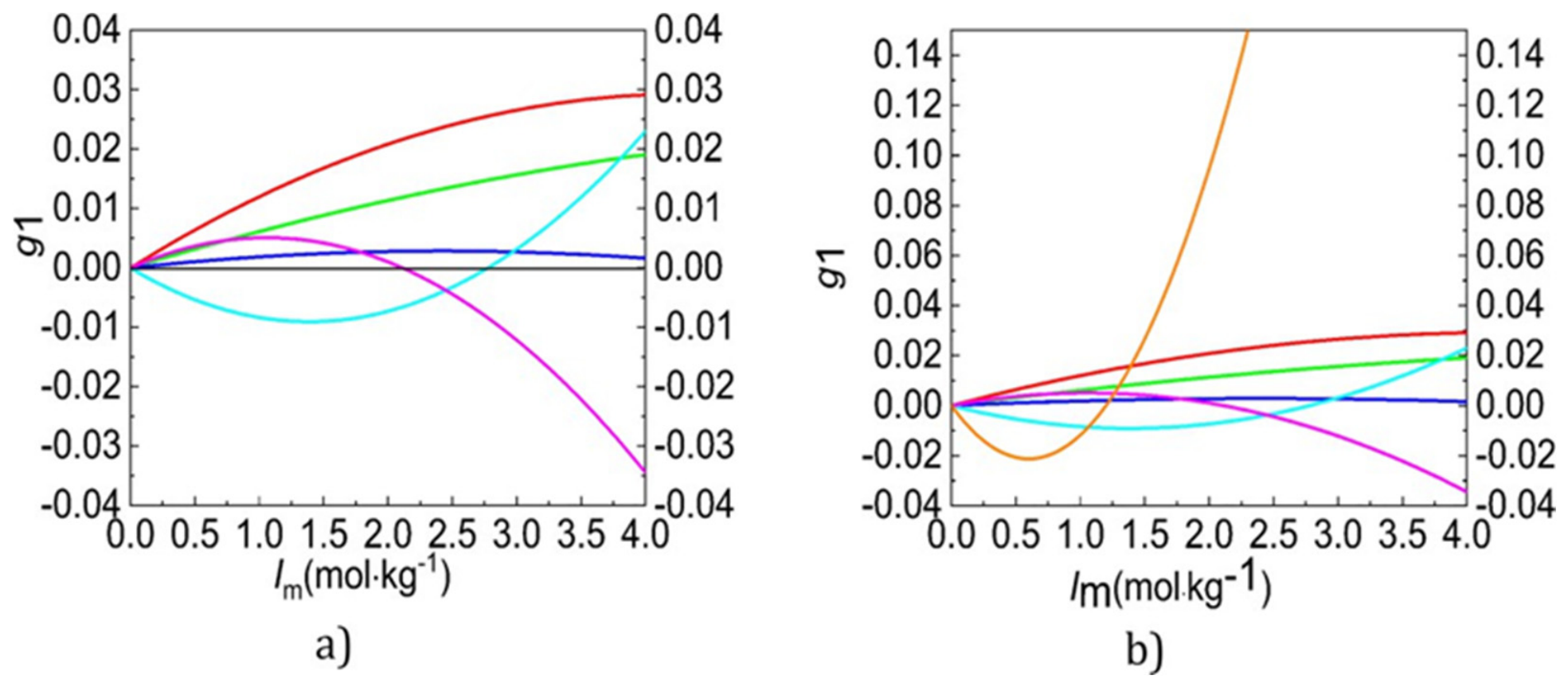
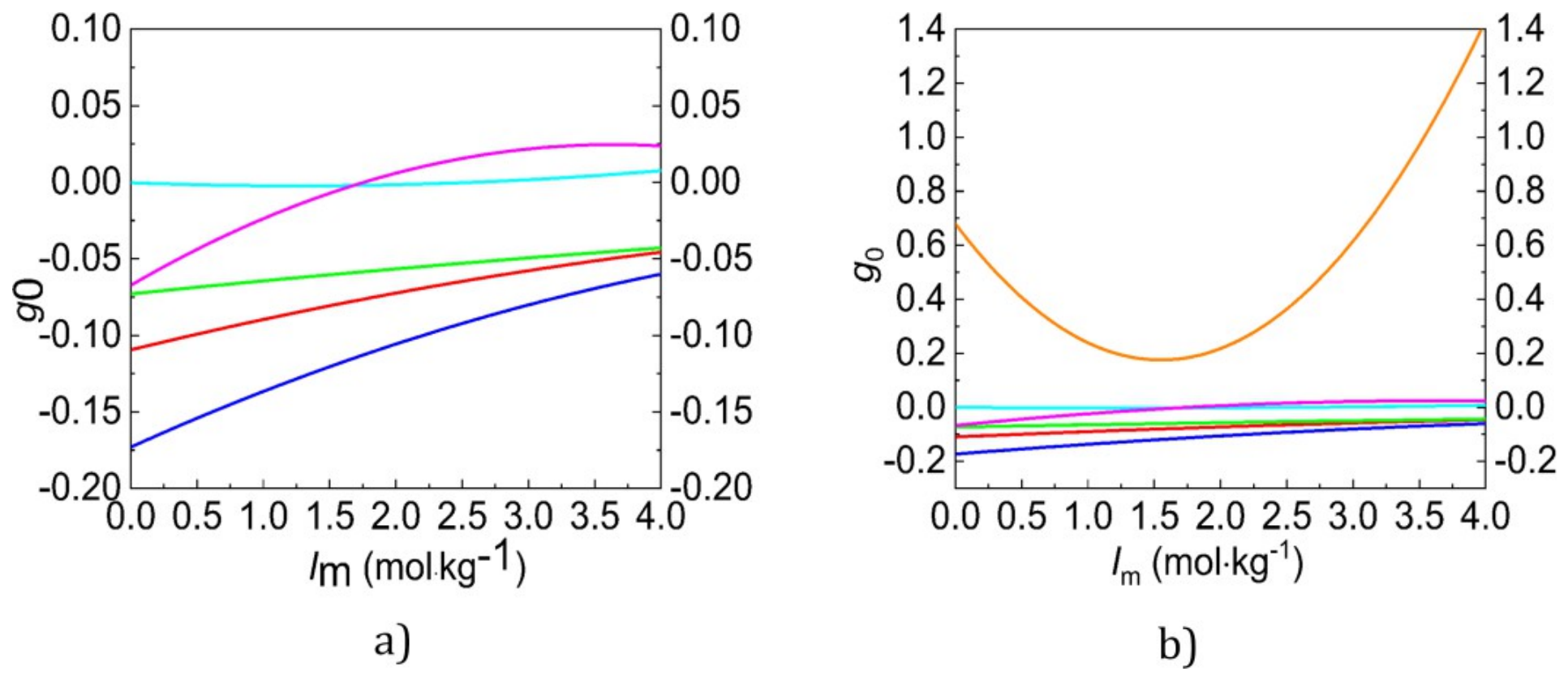
Figure 1a shows the dependence of the Friedman parameter
g0 on the ionic strength of aqueous solutions: {
yKCl + (1 −
y)K
2HPO
4} (aq), {
yKBr + (1 −
y)K
2HPO
4} (aq), {
yKNO
3 + (1 −
y)K
2HPO
4} (aq), {
yK
2SO
4 + (1 −
y)K
2HPO
4} (aq), {
yKH
2PO
4 + (1 −
y)K
2HPO
4} (aq).
Figure 1b also includes values of the Friedman parameter
g0 for the system {
yNa
2HPO
4 + (1 −
y)K
2HPO
4} (aq) at
T = 298.15 K.
From
Figure 1a,b, a varying influence of ion-pair interactions is observed across the investigated systems as a function of ionic strength. In the following systems, {
yKCl + (1 −
y)K
2HPO
4} (aq), {
yKBr + (1 −
y)K
2HPO
4} (aq), {
yKNO
3 + (1 −
y)K
2HPO
4} (aq) and {
yKH
2PO
4 + (1 −
y)K
2HPO
4} (aq), the
g0 parameter remains negative throughout the entire ionic strength range, suggesting that interactions between different ions of the same charge dominate over interactions between identical ions. For the K
2HPO
4 with KCl and KBr, the
g0 parameter shows similar variation, with the chloride ion being more hydrophilic than the bromide ion. The behavior changes significantly for phosphate solutions containing nitrate ions, as well as for mixtures of potassium hydrogen phosphate and potassium dihydrogen phosphate. The influence of ion pairing becomes more pronounced as ionic strength increases. The
g0 parameter increases much more prominently in the {
yKH
2PO
4 + (1 −
y)K
2HPO
4} (aq) system. In the {
yK
2SO
4 + (1 −
y)K
2HPO
4} (aq) system, there is almost no change in the Friedman
g0 parameter with increasing concentration, suggesting that ion-pair interactions are not pronounced in this system. In the {
yNa
2HPO
4 + (1 −
y)K
2HPO
4} (aq) system, the
g0 values are positive, indicating the dominance of interactions between different ions of the same charge.
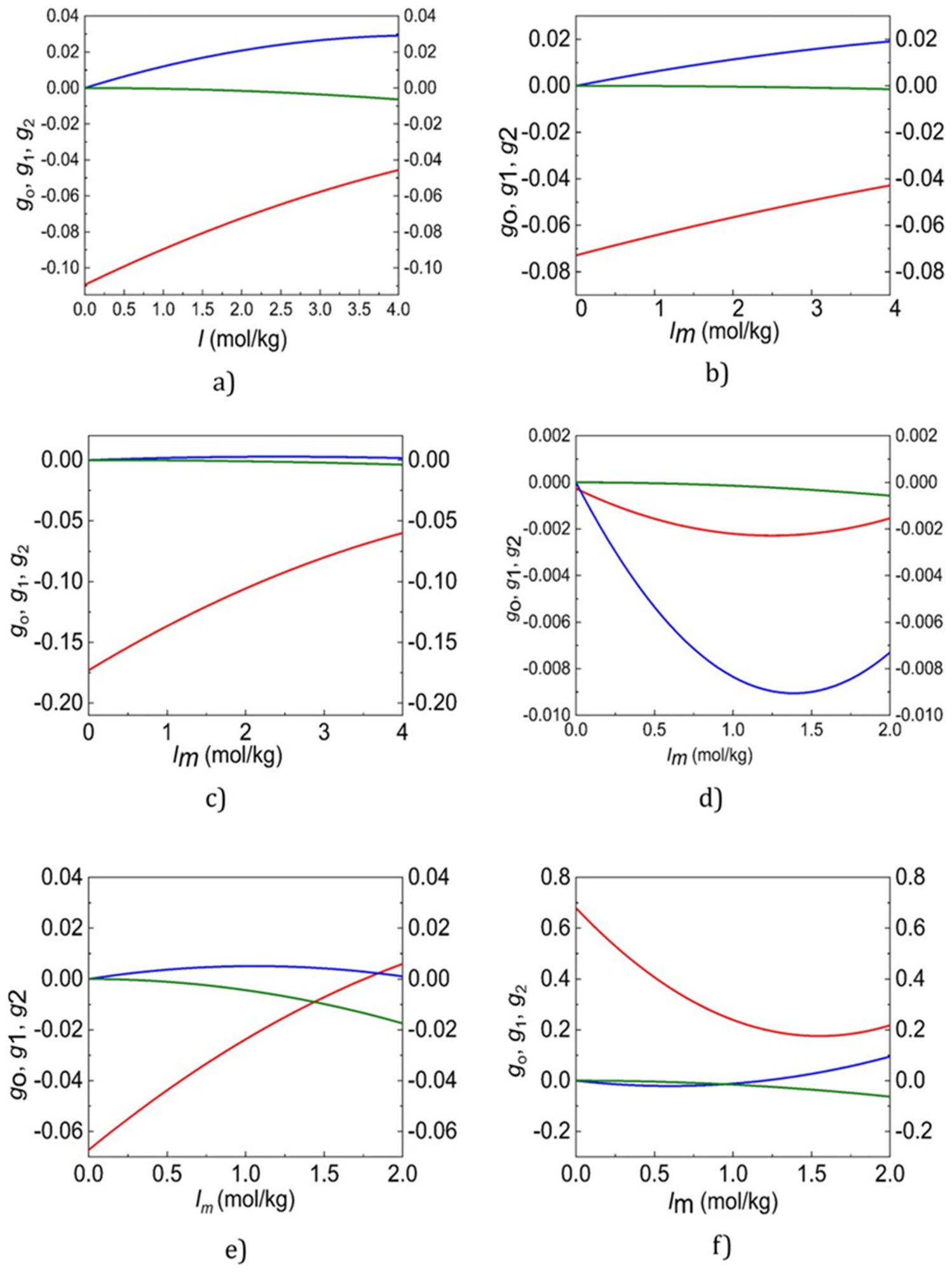
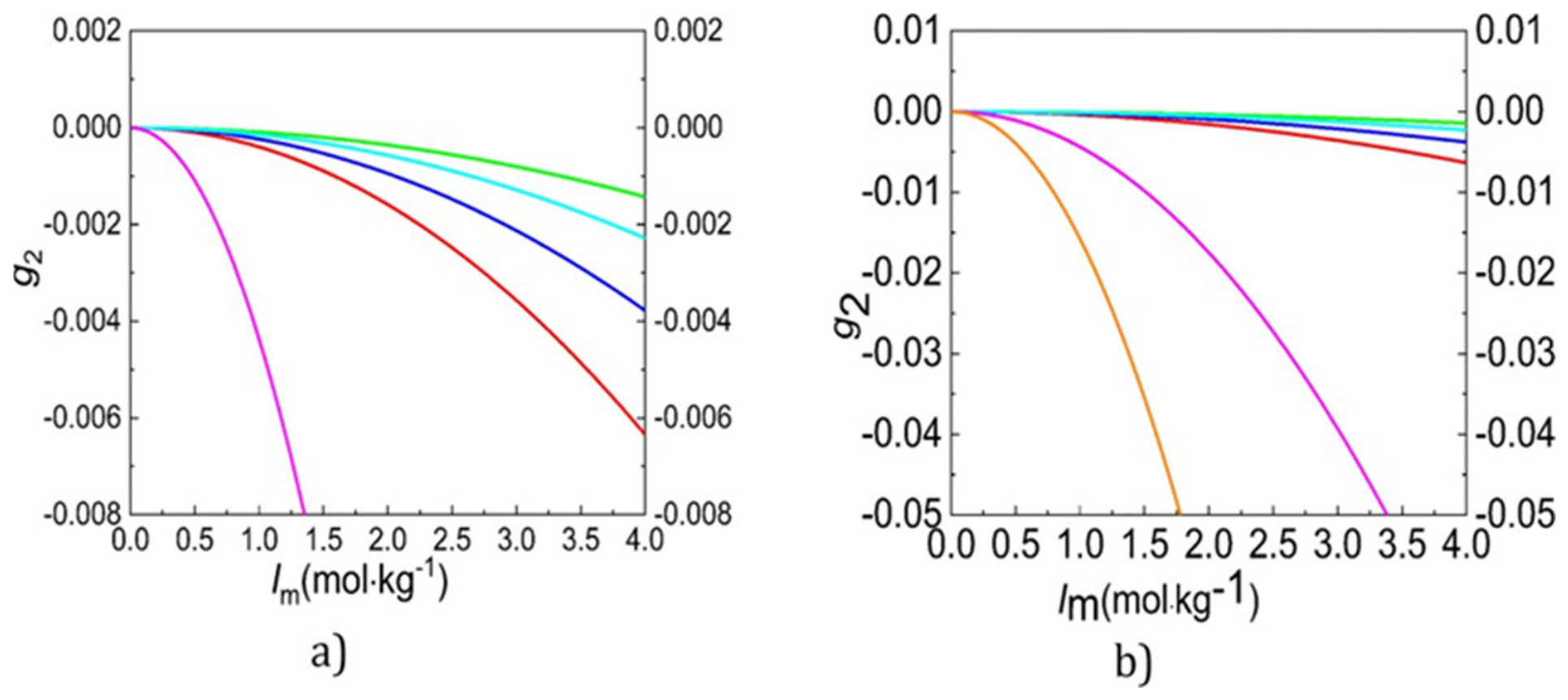
From
Figure 2a, the Friedman parameter
g1 is positive for the KCl, KBr, and KNO
3 systems, indicating negligible triplet effects on nonideality. The K
2SO
4 and KH
2PO
4 systems, however, are more complex:
g1 is negative for the sulfate system up to 3 mol·kg
−1, indicating dominant triplet interactions between different ionic species, and turns positive thereafter with increasing influence of triplets composed of ions of the same charge type SO
42−(aq)-H
2PO
4−(aq)-H
2PO
4−(aq). For the phosphate–phosphate system, positive
g1 near zero suggests ion pairs/dimers, while negative values signal phosphate triplet formation. In
Figure 2b, the Na
2HPO
4–K
2HPO
4 system shows negative
g1 up to 1.5 mol·kg
−1, consistent with mixed triplets Na
+(aq)-HPO
4−(aq)-K
+(aq), Na
+(aq)-Na
+(aq)-K
+(aq) or K
+(aq)-K
+(aq)-Na
+(aq), beyond which same-species phosphate trimers become more influential.
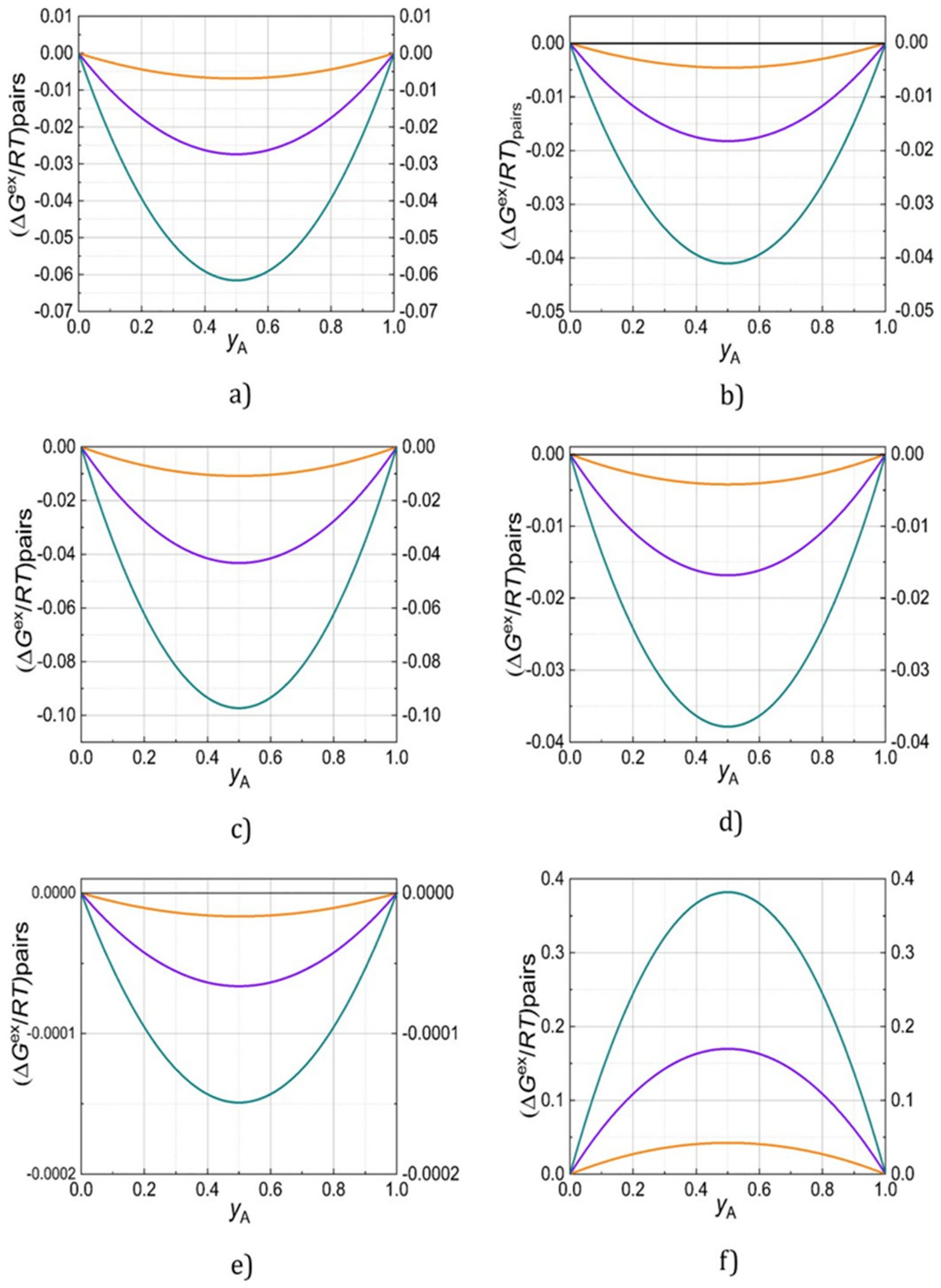
Figure 3a,b shows the dependence of the Friedman parameter
g2 on the ionic strength,
Im, in the three-component systems {
yKCl + (1 −
y)K
2HPO
4} (aq), {
yKBr + (1 −
y)K
2HPO
4} (aq), {
yKNO
3 + (1 −
y)K
2HPO
4} (aq), {
yK
2SO
4 + (1 −
y)K
2HPO
4} (aq), {
yKH
2PO
4 + (1 −
y)K
2HPO
4} (aq) and {
yNa
2HPO
4 + (1 −
y)K
2HPO
4} (aq) at
T = 298.15 K.
Figure 3a presents the Friedman parameter
g2 as a function of ionic strength for the systems containing KCl, KBr, KNO
3, K
2SO
4, and KH
2PO
4 with K
2HPO
4, while
Figure 3b shows the corresponding data for the Na
2HPO
4–K
2HPO
4 system. In all cases,
g2 values are negative and become more negative with increasing ionic strength, indicating that quadruplet interactions grow stronger as concentration rises. Negative
g2 values signify attraction between different anions, pointing to a thermodynamic preference for mixed quadruplets, which enhance stability through ion mixing. Because HPO
42− readily forms hydrogen bonds, these quadruplets are not purely electrostatic; they frequently incorporate water molecules from the hydration shell, which stabilize interionic bridges. In the chloride- and bromide-containing systems, the monovalent Cl
− and Br
− anions naturally repel the divalent HPO
42− ion. The negative
g2 values suggest that K
+ acts as a bridging cation, enabling Cl
− and Br
− to approach HPO
42− more closely than electrostatic repulsion would otherwise allow. The dominant quadruplet combinations are therefore [K
2Cl(HPO
4)]
− and [K
2Br(HPO
4)]
−. For the sulfate system, both SO
42− and HPO
42− are divalent, resulting in strong electrostatic repulsion. The negative
g2 values indicate that K
+ similarly links the two anions to form clusters such as [K
2SO
4(HPO
4)]
2−. In the phosphate–phosphate system, H
2PO
4− and HPO
42− share similar structures and form stable hydrogen-bonded aggregates; for example, [H
2PO
4·HPO
4]
3−. Owing to these strong hydrogen bonds, the dominant quadruplet is [K
2(H
2PO
4)(HPO
4)]
−. Finally, in the sodium–potassium phosphate system, negative
g2 values show that the mixed quadruplet is thermodynamically favored over the average of the pure sodium and potassium quadruplets. The dominant species is [NaK(HPO
4)
2]
2−, in which one Na
+ and one K
+ share two HPO
42− anions.
Figure 4a–f shows the dependence of Friedman’s parameters
g0,
g1 and
g2 on the ionic strength of the following solutions: {
yKCl + (1 −
y)K
2HPO
4} (aq), {
yKBr + (1 −
y)K
2HPO
4} (aq), {
yKNO
3 + (1 −
y)K
2HPO
4} (aq), {
yK
2SO
4 + (1 −
y)K
2HPO
4}(aq), {
yKH
2PO
4 + (1 −
y)K
2HPO
4} (aq) and {
yNa
2HPO
4 + (1 −
y)K
2HPO
4}(aq) at a temperature of
T = 298.15 K.
In the {
yKCl + (1 −
y)K
2HPO
4}(aq) and {
yKBr + (1 −
y)K
2HPO
4}(aq) systems in
Figure 4a,b,
g0 and
g1 both increase with concentration, reflecting growing ion pair and triplet contributions. Despite positive
g1 values, triplets remain significant because
g0 also captures triplet effects. Possible interactions include Cl
−(aq)–Cl
−(aq), Br
−(aq)–Br
−(aq), Cl
−(aq)–HPO
42−(aq), Br
−(aq)–HPO
42−(aq), phosphate–phosphate, and solvent-separated K
+(aq)–Cl
−(aq) or K
+(aq)–Br
−(aq) pairs; K
+(aq)–K
+(aq) contacts are unlikely, and triplet configurations such as K
+(aq)–HPO
42−(aq)–Cl
−(aq) and K
+(aq)–HPO
42−(aq)–Br
−(aq) may also occur. Because Cl
−(aq) is a stronger structure breaker than Br
−(aq), the {
yKBr + (1 −
y)K
2HPO
4}(aq) system exhibits weaker pair and triplet interactions, resulting in a lower absolute
g0. The
g2 parameter remains near zero, indicating negligible quadruplet effects.
From
Figure 4d, it can be observed that for the {
yK
2SO
4 + (1 −
y)K
2HPO
4}(aq) system, the Friedman parameters
g0,
g1 and
g2 all exhibit negative values. Although close to zero, the negative values of
g0 suggest the formation of ion pairs between different species, specifically interactions of the type SO
42−(aq)-HPO
42−(aq), as well as K
+(aq)-SO
42−(aq) and K
+(aq)-HPO
42−(aq). The distinct minima observed in the
g0 and
g1 functions indicate a potential shift in the type and distribution of the formed ion pairs and triplets between different species, occurring at an ionic strength of approximately 1.3 mol·kg
−1. The
g2 values remain negative and close to zero up to an ionic strength of about 1.25 mol·kg
−1.
Figure 4e shows that, for the {
yKH
2PO
4 + (1 −
y)K
2HPO
4}(aq) system, the
g0 parameter increases from −0.065 to 0.005. This trend indicates dominance of ion-pair interactions of the type HPO
42−(aq)–H
2PO
4−(aq). The shift from negative toward zero can also be attributed to the emergence of homocomplex dimers, specifically HPO
42−(aq)–HPO
42−(aq) and H
2PO
4−(aq)–H
2PO
4−(aq). The
g1 values are positive and remain close to zero. In contrast,
g2 values are negative and increase in absolute magnitude as ionic strength rises from 1 to 2 mol·kg
−1, suggesting that quadruplet interactions in this system become more pronounced than in any of the other investigated systems.
Figure 4f presents the {
yNa
2HPO
4 + (1 −
y)K
2HPO
4}(aq) system, where both
g0 and
g1 are positive. This indicates a predominance of interactions between like-charged ion pairs: Na
+(aq)–K
+(aq), Na
+(aq)–Na
+(aq), and K
+(aq)–K
+(aq). According to previous research, the probability of forming hydrophilic ion pairs such as Na
+(aq)–Na
+(aq) and K
+(aq)–K
+(aq), which experience mutual repulsion, is lower than the probability of phosphate ion dimerization and trimerization [
22]. The influence of these pairs on deviations from ideality is reflected in the positive
g0 values. As ionic strength increases, changes in solution structure and interionic interactions occur. When g
0 reaches its minimum at
Im = 1.5 mol·kg
−1, the
g1 function begins to increase moderately, indicating that triplet interactions, most likely involving phosphate ions, become more significant. The g
2 parameter remains negative across the entire ionic strength range (0 to 2 mol·kg
−1), indicating the existence of quadruplet interactions, which are particularly significant above 1.2 mol·kg
−1.
4.2. Gibbs Free Energy Analysis
The excess Gibbs energy of a solution, which is influenced by various interactions, can change significantly in both magnitude and sign as the solution concentration varies. This behavior is reflected in the values of the Friedman parameters (g0, g1 and g2). It is common for the curves showing the dependence of excess Gibbs energy on the ionic strength fraction to exhibit a maximum or minimum. These extrema may shift toward higher relative concentrations of one of the electrolytes as the total ionic strength of the solution increases, in accordance with Gurney’s theory. This shift indicates that the parameters g1 and g2 are nonzero and must be considered when analyzing interactions within the solution.
Figure 5a–f shows the functional dependence of the excess Gibbs energy for pairs of ions on the fraction of the ionic strength of component,
yA, where A is (KCl, KBr, KNO
3, K
2SO
4, KH
2PO
4) in the systems {
yKCl + (1 −
y)K
2HPO
4}(aq), {
yKBr + (1 −
y)K
2HPO
4}(aq), {
yKNO
3 + (1 −
y)K
2HPO
4}(aq), {
yK
2SO
4 + (1 −
y)K
2HPO
4}(aq) and {
yKH
2PO
4 + (1 −
y)K
2HPO
4}(aq), respectively, for total ionic strengths of the solution of
Im = 0.5; 1.0; and 1.5 mol·kg
−1 at a temperature of 298.15 K.
Figure 5a–f shows the excess Gibbs energy of mixing for ion pairs as a function of the ionic strength fraction
yA (from 0 to 1), where A represents KCl, KBr, KNO
3, K
2SO
4, KH
2PO
4, and Na
2HPO
4 in their respective systems with K
2HPO
4. The data are given at ionic strengths
Im = 0.5, 1.0, and 1.5 mol·kg
−1 and
T = 298.15 K. For the systems {yKCl + (1 −
y)K
2HPO
4}(aq), {yKBr + (1 −
y)K
2HPO
4}(aq), {yKNO
3 + (1 −
y)K
2HPO
4}(aq), {yK
2SO
4 + (1 −
y)K
2HPO
4}(aq), and {yKH
2PO
4 + (1 −
y)K
2HPO
4}(aq), the excess Gibbs energy values are negative. This indicates that ion-pair interactions between unlike ions of the same charge are dominant and more probable in these mixtures. The exception is the {
yNa
2HPO
4 + (1 −
y)K
2HPO
4}(aq) system, where the situation is reversed, in agreement with the conclusions from the previous chapter. In the five systems mentioned above in
Figure 5a–e, the most stable ion pairs are formed at a total ionic strength fraction
yA = 0.5 (where A refers to KCl, KBr, KNO
3, K
2SO
4, or KH
2PO
4) at 298.15 K. The excess Gibbs energy of ion pairs as a function of the ionic strength fraction of KNO
3 is shown in
Figure 5c and has the same shape as in the KCl and KBr systems. Based on the excess Gibbs energy values, it can be concluded that ion pairs in the nitrate system are more stable than those in the two previously considered systems. This is most evident when comparing the minimum values of
pairs at
yA = 0.5: in the nitrate system, the value is −0.1, while in the KCl and KBr systems, the values are −0.065 and −0.04, respectively.
The nitrate ion, much like Cl
−(aq) and Br
−(aq), is hydrophilic and acts as a structure-breaker (destabilizer) of the solution structure. What distinguishes the {
yKNO
3 + (1 −
y)K
2HPO
4}(aq) system is the slight decrease in excess Gibbs energy as the KNO
3 fraction increases. This suggests that triplets, although present at low concentrations, may become more stable at higher concentrations, a trend opposite to that observed in the chloride and bromide systems. The {
yKH
2PO
4 + (1 −
y)K
2HPO
4}(aq) system, containing two different phosphate anions, is highly specific. Given the negative values of the
g0 parameter, dominance of HPO
42−(aq)–H
2PO
4−(aq) pair interactions is expected. The HPO
42−(aq) ion is a structure-maker (stabilizer), whereas H
2PO
4−(aq) is a borderline ion; thus, their interactions depend heavily on the local environment and the presence of cations. Mutual interactions between such ions typically lead to a decrease in the Gibbs energy of the pairs. From
Figure 5e, we see that the excess Gibbs energy values for the pairs are negative in the system {
yK
2SO
4 + (1 −
y)K
2HPO
4}(aq), indicating that the dominant interactions are between different ions, SO
42−(aq)-HPO
42−(aq), K
+(aq)-SO
42−(aq) and K
+(aq)-HPO
42−(aq). In the system {
yNa
2HPO
4 + (1 −
y)K
2HPO
4}(aq) shown in
Figure 5f, the repulsion between ion pairs of the type Na
+(aq)-K
+(aq), which are hydrophilic, gives a positive contribution to the Gibbs free energy of the pairs. This contribution shows a clear maximum that becomes more pronounced as the ionic strength of the solution increases from
Im = 0.5 mol·kg
−1 to
Im = 1.5 mol·kg
−1.
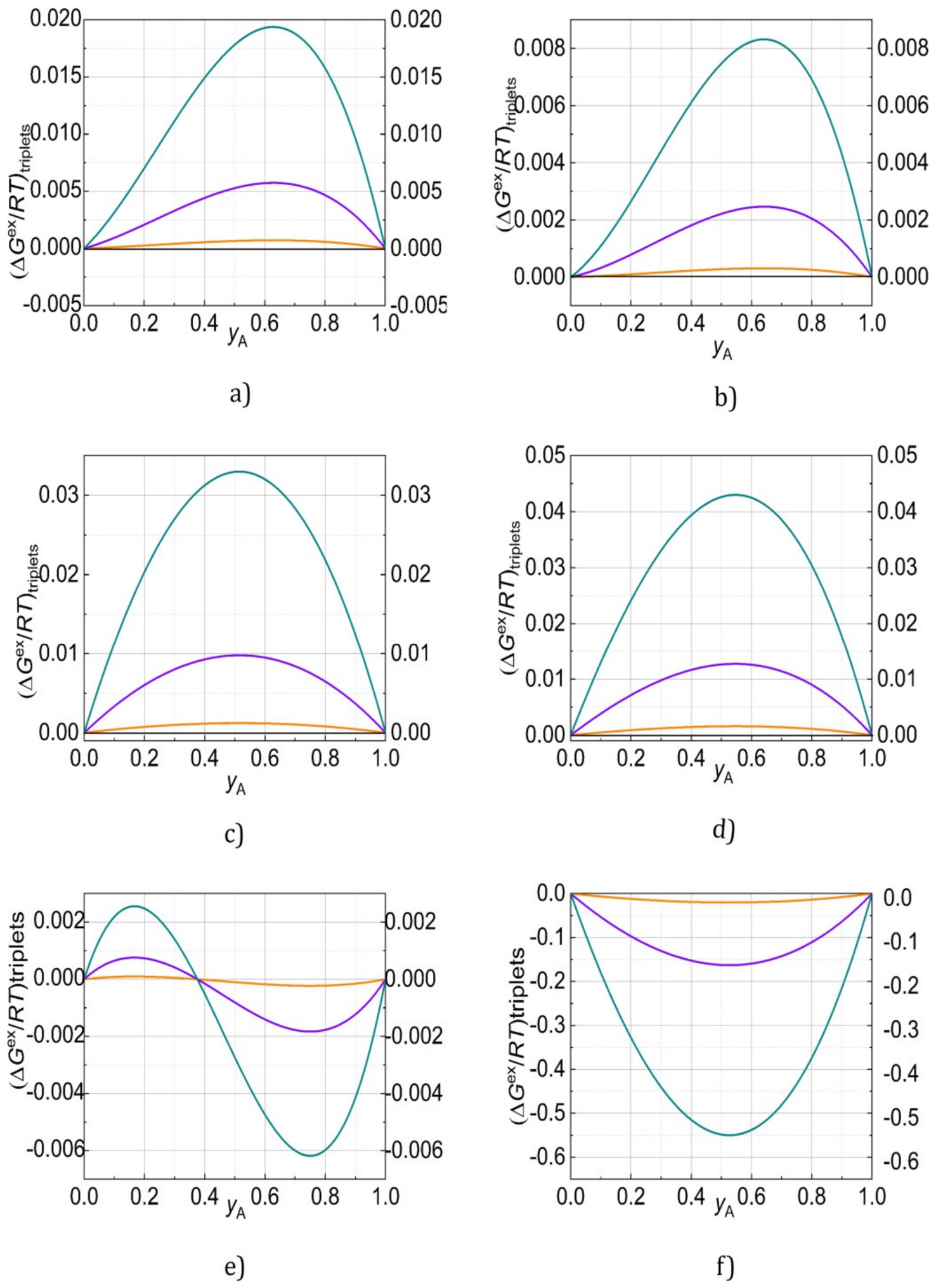
Figure 6a–f shows the functional dependence of the excess Gibbs energy for triplets of ions on the fraction of the ionic strength of component,
yA, where A is (KCl, KBr, KNO
3, K
2SO
4, KH
2PO
4) in the systems {
yKCl + (1 −
y)K
2HPO
4}(aq), {
yKBr + (1 −
y)K
2HPO
4}(aq), {
yKNO
3 + (1 −
y)K
2HPO
4}(aq), {
yK
2SO
4 + (1 −
y)K
2HPO
4}(aq) and {
yKH
2PO
4 + (1 −
y)K
2HPO
4}(aq), respectively, for total ionic strengths of the solution of
Im = 0.5; 1.0; and 1.5 mol·kg
−1 at a temperature of 298.15 K.
Figure 6a–d shows that the excess Gibbs energy of triplets is positive in the {
yKCl + (1 −
y)K
2HPO
4}(aq), {
yKBr+ (1 −
y)K
2HPO
4}(aq), {
yKNO
3+ (1 −
y)K
2HPO
4}(aq), and {
yK
2SO
4 + (1 −
y)K
2HPO
4}(aq) systems, indicating that ion-pair interactions are dominant. In contrast, in the {
yNa
2HPO
4 + (1 −
y)K
2HPO
4}(aq) system, the excess Gibbs energy of triplets is negative, suggesting that triplet interactions are the predominant form of association.
The {
yNa
2HPO
4 + (1 −
y)K
2HPO
4}(aq) system contains a common anion, the hydrogen phosphate ion, which is classified as a hydrophobic (structure-making) ion by Desnoyers [
23]. The composition dependence of the triplet excess Gibbs energy shows a pronounced minimum that becomes increasingly prominent as the total ionic strength rises from
Im = 0.5 mol·kg
−1 to
Im = 1.5 mol·kg
−1 and higher. This indicates that triplet interactions are most significant at a Na
2HPO
4 ionic strength fraction of
yA = 0.5. The dominant triplet species are Na
+(aq)–K
+(aq)–HPO
42−(aq), as well as triplets with two identical cations: Na
+(aq)–Na
+(aq)–HPO
42−(aq) and K
+(aq)–K
+(aq)–HPO
42−(aq). Among these, triplets involving more potassium ions are energetically more favorable, because the less hydrated K
+(aq) can more readily access the interionic space of the triplet than the highly hydrated Na
+(aq).
In the {yKH2PO4 + (1 − y)K2HPO4}(aq) system, the sign of the excess Gibbs energy function for triplets varies with composition. At ionic strengths of Im = 1.0 and 1.5 mol·kg−1, the function initially increases up to a KH2PO4 fraction of yA = 0.2, crosses zero at yA = 0.4, decreases until yA = 0.8, and returns to zero at the end of the range. In contrast, at Im = 0.5 mol·kg−1, the triplet excess Gibbs energy remains near zero throughout. For KH2PO4 fractions from yA = 0 to 0.4, the total triplet Gibbs energy values are positive at the higher ionic strengths 1.0 and 1.5 mol·kg−1, indicating that electrostatic repulsion between the two phosphate anions outweighs the stabilization provided by hydrogen bonding.
Conversely, for yA values between 0.4 and 1.0, the total triplet Gibbs energy values are negative. This results from chemical similarity and the emergence of specific attractive forces. The formation of strong intermolecular hydrogen bonds between H2PO4− and HPO42−, with K+ acting as a bridge, facilitates this stabilization. The anions tend to cluster, reducing electrostatic repulsion. Although both anions are negatively charged, the presence of the H+ proton allows them to approach each other more closely than, for example, two sulfate ions. The potassium cation further neutralizes the local negative charge, making the K+(aq)–H2PO4−(aq)–HPO42−(aq) triplet energetically highly favorable.
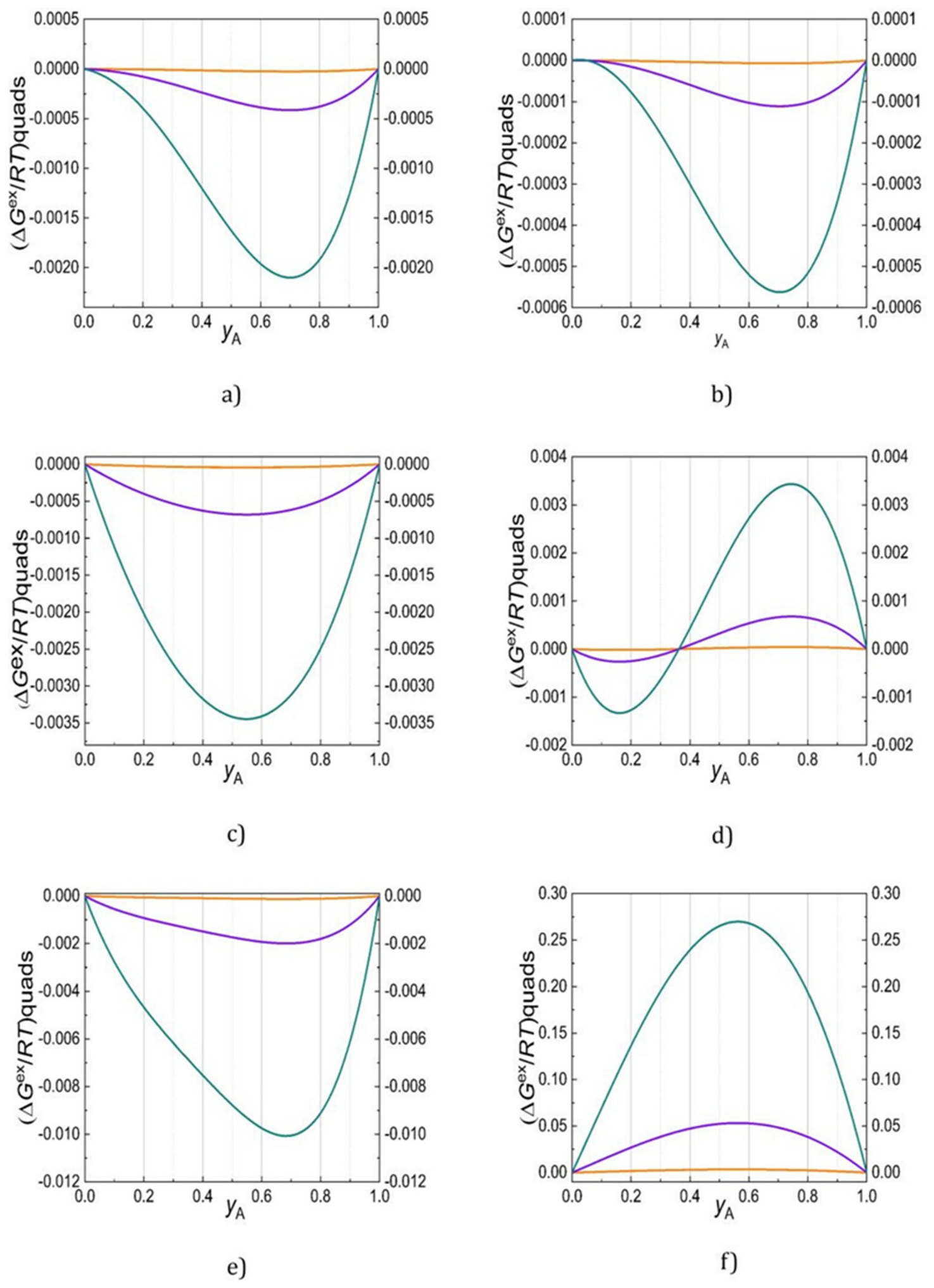
Figure 7a–f shows the functional dependence of the excess Gibbs energy for quadruplets of ions on the fraction of the ionic strength of component,
yA, where A is: (KCl, KBr, KNO
3, K
2SO
4, KH
2PO
4) in the systems {
yKCl + (1 −
y)K
2HPO
4}(aq), {
yKBr + (1 −
y)K
2HPO
4}(aq), {
yKNO
3 + (1 −
y)K
2HPO
4}(aq), {
yK
2SO
4 + (1 −
y)K
2HPO
4}(aq) and {
yKH
2PO
4 + (1 −
y)K
2HPO
4}(aq), respectively, for total ionic strengths of the solution of
Im = 0.5; 1.0; and 1.5 mol·kg
−1 at a temperature of 298.15 K.
Figure 7a–f illustrates the dependence of the quadruplet excess Gibbs energy, which takes negative values for the {
yKCl + (1 −
y)K
2HPO
4}(aq), {
yKBr + (1 −
y)K
2HPO
4}(aq), {
yKNO
3 + (1 −
y)K
2HPO
4}(aq), and {
yKH
2PO
4 + (1 −
y)K
2HPO
4}(aq) systems. Negative values indicate that quadruplet formation lowers the free energy of the system. The dominant quadruplet combinations are K
+(aq)–K
+(aq)–Cl
−(aq)–HPO
42−(aq), K
+(aq)–K
+(aq)–Br
−(aq)–HPO
42−(aq), K
+(aq)–K
+(aq)–NO
3−(aq)–HPO
42−(aq), and K
+(aq)–K
+(aq)–H
2PO
4−(aq)–HPO
42−(aq), in which two potassium cations effectively bridge two different anions. In the phosphate buffer system H
2PO
4−(aq)-HPO
42−(aq), this effect is further enhanced by hydrogen bonding, with the quadruplet forming a stable ionic structure that reduces the effective number of particles in the solution and thereby lowers activity coefficients. In the KCl, KBr, and KH
2PO
4 systems, the functions show a pronounced minimum at an ionic strength fraction of approximately
yA = 0.7, whereas for the KNO
3 system, this minimum occurs at
yA ≈ 0.5. In contrast, the {
yNa
2HPO
4 + (1 −
y)K
2HPO
4}(aq) system exhibits positive total quadruplet Gibbs energy values, indicating that these interactions are energetically unfavorable because this system involves the mixing of two different cations with a common anion. The positive value suggests that the presence of two different cations, Na
+(aq) and K
+(aq), within the same cluster around the phosphate anion creates a configurational mismatch. Because their hydration radii differ, these cations cannot optimally approach the HPO
42−(aq) ion simultaneously, resulting in an increase in the total Gibbs energy. The {
yK
2SO
4 + (1 −
y)K
2HPO
4}(aq) system undergoes a sign change in the function, making it the most complex of the systems studied, as the interaction character depends on composition. At lower sulfate fractions,
yA < 0.4, the quadruplet Gibbs energy values are negative, indicating that the K
+(aq)–K
+(aq)–SO
42−(aq)–HPO
42−(aq) quadruplet interaction stabilizes the solution. This is likely due to the formation of mixed clusters in which potassium successfully neutralizes the high negative charge of both divalent anions. One must also consider the ambiguous classification of the sulfate ion; while some authors categorize it as hydrophilic, others classify it as hydrophobic. If sulfate ions behave as hydrophobic (structure-making) species, SO
42−(aq)–SO
42−(aq) interactions, together with HPO
42−(aq)–HPO
42−(aq) interactions, could significantly contribute to the negative quadruplet excess Gibbs energy values. However, at sulfate fractions
yA > 0.4, the quadruplet Gibbs energy values become positive. As the sulfate fraction increases, the ionic atmosphere becomes saturated, and strong electrostatic repulsion between the two divalent anions, SO
42− and HPO
42−, dominates, which the potassium cations can no longer effectively screen within the quadruplet cluster. In summary, in systems with a common cation and monovalent anions, quadruplets act as stabilizing agents. In the presence of mixed cations, structural tension and positive energy arise. In systems featuring two divalent anions, SO
42−(aq) and HPO
42−(aq), the system balances between stabilization and strong electrostatic repulsion, leading to the observed sign reversal of the function.
4.3. Excess Gibbs Energy of Phosphate Solutions
In addition to analyzing the Friedman parameters and the excess Gibbs energy attributed to the formation of ion pairs, triplets, and quadruplets, it is essential to evaluate the total excess Gibbs energy of the solution as a function of the ionic strength fraction for various total ionic strengths of the phosphate systems. The total excess Gibbs energy values were calculated using the Scatchard model with six mixing parameters, as shown in
Table 1. Identical values for the excess Gibbs energy of mixing are obtained when using Equation (24), which defines the Gibbs energy as the sum of individual contributions from pairs, triplets, quadruplets, and higher-order multiplets.
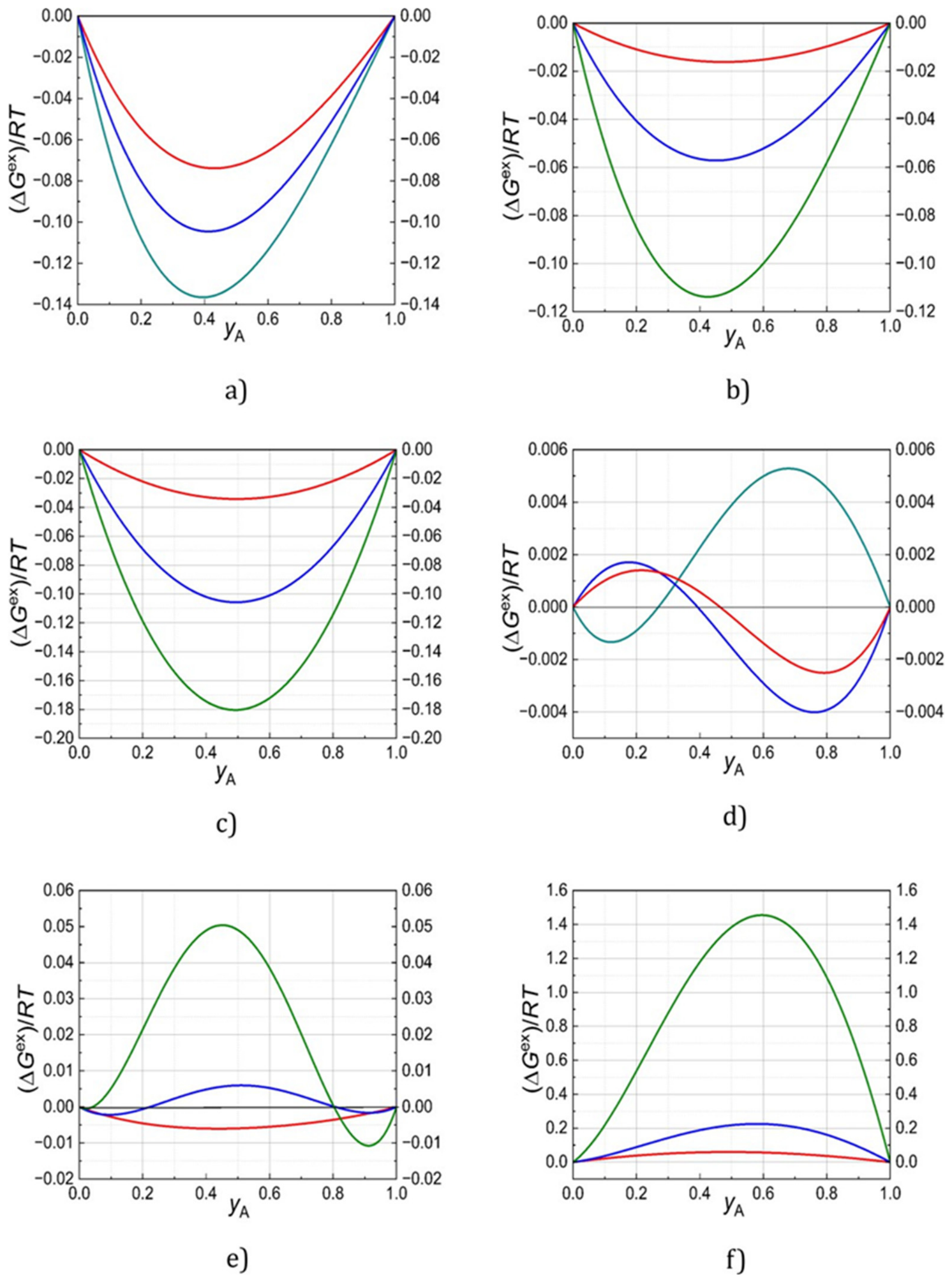
Figure 8a–f shows the functional dependence of the excess Gibbs energy on the ionic strength fraction
yA for different total ionic strengths
Im = (1.0; 2.0; 3.0) mol∙kg
−1 systems at
T = 298.15 K for all the investigated systems.
Figure 8a–c shows that for the {
yKCl + (1 −
y)K
2HPO
4}(aq), {
yKBr + (1 −
y)K
2HPO
4}(aq), and {
yKNO
3 + (1 −
y)K
2HPO
4}(aq) systems, the excess Gibbs energy remains negative over the entire investigated range, indicating thermodynamic stability. In contrast, for the {
yK
2SO
4 + (1 −
y)K
2HPO
4}(aq), {
yKH
2PO
4 + (1 −
y)K
2HPO
4}(aq), and {
yNa
2HPO
4 + (1 −
y)K
2HPO
4}(aq) systems, the composition-dependent curves vary significantly. At total ionic strengths of
Im = 1.0, 2.0, and 3.0 mol·kg
−1, these curves are asymmetric, confirming the presence of higher-order interactions in solution. The total excess Gibbs energy for the first three systems shows a consistent profile as a function of the ionic strength fraction
yA. For the KCl and KBr systems, a minimum appears at an ionic strength fraction slightly below
yA ≈ 0.4
Figure 8a,b. This pronounced minimum corresponds to a balanced influence of the KCl/KBr and K
2HPO
4 electrolytes, representing approximately equal anion concentrations in solution. The nitrate system differs slightly, as its minimum is shifted toward a higher fraction of KNO
3, occurring at
yA ≈ 0.5 in
Figure 8c. In all three systems, the total excess Gibbs energy remains negative across the entire composition range, and the minima become more pronounced as the total ionic strength increases from 1 to 3 mol·kg
−1. In these systems, interactions between different anions of the same charge dominate, specifically Cl
−(aq)–HPO
42−(aq), Br
−(aq)–HPO
42−(aq), and NO
3−(aq)–HPO
42−(aq). Ions such as Cl
−(aq), Br
−(aq), and particularly NO
3−(aq) are structurally weakly hydrated, whereas HPO
42−(aq) is highly charged and strongly hydrated. When these ions coexist, partial release of water molecules from their hydration spheres occurs, leading to the formation of stable dimers that lower the free energy of the system. Furthermore, stabilization through solvent-separated ion pairs of opposite charge, such as K
+(aq)–Cl
−(aq) or K
+(aq)–Br
−(aq), is also possible.
The structural changes and specific interactions influencing the total excess Gibbs energy in the {
yK
2SO
4 + (1 −
y)K
2HPO
4}(aq) system are uniquely distinctive because of the coexistence of both phosphate and sulfate ions, which have high charges and compete for water molecules. As shown in
Figure 8d, at ionic strengths of
Im = 1.0 and 2.0 mol·kg
−1, the total excess Gibbs energy initially increases up to a sulfate fraction of
yA ≈ 0.1. It then decreases, passes through zero at
yA ≈ 0.4, continues to decline until it reaches a minimum at
yA ≈ 0.8, and finally returns to zero at
yA = 1.0. When the sulfate fraction is low,
yA < 0.3, the total excess Gibbs energy is positive, indicating that the hydration of HPO
42−(aq) ions dominates. However, when
yA > 0.3, the increasing sulfate concentration disrupts the solution structure, causing the curve to enter the negative region. The resulting negative excess Gibbs energy values indicate that attractive interactions between oppositely charged hydrophilic ion pairs, such as K
+(aq)–SO
42−(aq), or like-charged hydrophilic anionic pairs, such as HPO
42−(aq)–HPO
42−(aq), begin to dominate. Notably, at an ionic strength of
Im = 3.0 mol·kg
−1, the function exhibits the opposite sign behavior. Up to a sulfate fraction of
yA ≈ 0.1, the function decreases to a total excess Gibbs energy value of
≈ −0.015. At this low sulfate fraction, the system stabilizes through the formation of mixed triplets, namely K
+(aq)–SO
42−(aq)–HPO
42−(aq), which lowers the Gibbs energy into the negative domain. Beyond this point, the total Gibbs energy values increase; the function passes through zero at
yA ≈ 0.25 and continues to rise until it reaches a maximum of
≈ 0.005 at
yA ≈ 0.7. With further addition of sulfate,
yA > 0.25, intense competition for the remaining water molecules ensues between SO
42−(aq) and HPO
42−(aq). Because there is insufficient water to sustain their individual hydration spheres, the system responds by forming large ionic clusters—quadruplets, as confirmed by the negative values of the g
2 parameter, as well as triplets of the SO
42−(aq)–HPO
42−(aq)–HPO
42−(aq) type. The positive sign of the
function in this region demonstrates that the mixing of these two ions under water-deficient conditions is thermodynamically highly unfavorable, causing the function to rise to positive values with a maximum at
yA ≈ 0.7. From this peak, the function decreases again, returning to zero at
yA = 1.0. The change in the sign of the function when transitioning from
Im = 2.0 to 3.0 mol·kg
−1 provides crucial evidence of a shift in the interaction mechanism. At
Im = 3.0 mol·kg
−1, there is virtually no free water left in the system, as all water molecules are fully engaged within the hydration spheres of the ions.
The existence of phosphate dimers in aqueous solutions remains a subject of debate in the literature. Certain electromotive force (EMF) measurements have failed to detect dimeric phosphate species, whereas other EMF studies confirm their presence [
24,
25,
26,
27,
28]. Additional thermodynamic support stems from the work of Childs et al. [
29,
30], who observed unusually high excess Gibbs energies of mixing for Na
+, K
+, Cl
−, H
2PO
4− salt combinations at 25 °C, pointing toward dimer formation. Similarly, Wood employed the isopiestic method on the NaH
2PO
4 and NaClO
4 system to establish that isopiestic data can effectively quantify dimerization between ions of the same charge sign [
31].
Figure 8e, which shows the composition dependence of the total excess Gibbs energy for the {
yKH
2PO
4 + (1 −
y)K
2HPO
4}(aq) system, clearly demonstrates that the behavior of the
function changes significantly with increasing total ionic strength,
Im. At an ionic strength of
Im = 1.0 mol·kg
−1, the total excess Gibbs energy is negative. In this moderately dilute solution, interactions between H
2PO
4−(aq) and HPO
42−(aq) ions predominate. Since H
2PO
4−(aq) is a borderline ion, it exhibits hydrophobic behavior in the presence of the more strongly hydrated HPO
42−(aq) ion, thereby stabilizing the solution structure. This results in attractive interactions and the formation of phosphate dimers and mixed triplets, which contribute negatively to the excess energy, which is consistent with Childs’ claims. For ionic strengths of
Im = 2.0 and 3.0 mol·kg
−1, the total excess Gibbs energy becomes positive, and the functional dependence of
on the ionic strength fraction shows a maximum at
yA ~ 0.6. As concentration increases, the situation changes markedly as the H
2PO
4−(aq) ion alters its character under the influence of the surrounding environment. Strong repulsive interactions between like-charged ions, K
+(aq)-K
+(aq), and specific hydrophilic–hydrophobic interactions between HPO
42-(aq)–K
+(aq) begin to dominate. Notably, at
Im = 3.0 mol·kg
−1 the values of the
g2 parameter are distinctly negative, indicating that the system is dominated by quadruplet interactions involving two cations and two anions. The formation of these complex associates consumes the remaining free water and induces thermodynamic strain within the mixture, causing the total excess Gibbs energy to reach high positive values.
Figure 8f shows the dependence of the total excess Gibbs energy on the fraction of the system {
yNa
2HPO
4+(1 −
y)K
2HPO
4}(aq). A pronounced maximum is observed for the highest ionic strength of
Im = 3.0 mol·kg
−1 at
yA ≈ 0.5. The total excess Gibbs energy values remain positive across the entire composition range from
yA = 0 to 1. The Na
+(aq) and K
+(aq) ions possess different ionic radii and charge densities, which translates to differing hydration capacities. The mixing of two cations with disparate hydration properties disrupts the local structure of water. Because the ions preferentially remain within their native hydration environments rather than undergoing mixing, a repulsive effect occurs in terms of free energy, resulting in positive
> 0 values. With an increase in ionic strength, this effect is drastically enhanced due to the severe depletion of free water molecules.
In the {yKCl + (1 − y)K2HPO4}(aq), {yKBr + (1 − y)K2HPO4}(aq), and {yKNO3 + (1 − y)K2HPO4}(aq) systems, the negative values of the total Gibbs energy within the components’ fraction range yA from 0 to 1 for KCl, KBr, and KNO3, which indicates that the mixing of KCl, KBr, and KNO3 salts with K2HPO4 in water is a spontaneous and thermodynamically favorable process. In the {yK2SO4 + (1 − y)K2HPO4}(aq) system, phosphate and sulfate ions are present, both bearing high charges and competing for water molecules. The negative values of the excess Gibbs energy indicate the dominance of attractive interactions. The positive sign of the function indicates that the mixing of H2PO4−(aq) and SO42−(aq) ions under water-deficient conditions is thermodynamically highly unfavorable. The change in the sign of the function at ionic strengths of Im = 2.0 and Im = 3.0 mol·kg−1 provides key evidence of a shift in the interaction mechanism. In the {yKH2PO4 + (1 − y)K2HPO4}(aq) system, at lower ionic strengths, the total Gibbs energy values are negative, dominated by interactions between H2PO4−(aq) and HPO42−(aq) ions, which favorably influence the stability of the system. At higher ionic strengths of Im = 2.0 and Im = 3.0 mol·kg−1, the total excess Gibbs energy becomes positive so that the system is dominated by quadruplet interactions.