Article

Structural Determinants for the Antidepressant Activity of St. John’s Wort (Hypericum perforatum): A Combined Theoretical and Experimental Study


by
Afrodite Tryfon
1,*,
George Petsis
1,
Panagiota Siafarika
1,
Evanthia Soubasi
2 and
Angelos G. Kalampounias
1,3,*
1
Department of Chemistry, University of Ioannina, GR-45110 Ioannina, Greece
2
Department of Psychiatry, University of Patras, GR-26504 Patras, Greece
3
Institute of Materials Science and Computing, University Research Center of Ioannina (URCI), GR-45110 Ioannina, Greece
*
Authors to whom correspondence should be addressed.
Physchem 2025, 5(4), 56; https://doi.org/10.3390/physchem5040056

Submission received: 15 September 2025 / Revised: 6 November 2025 / Accepted: 12 December 2025 / Published: 14 December 2025
(This article belongs to the Section Experimental and Computational Spectroscopy)

Abstract

This study presents a systematic investigation of the dynamic and structural characteristics of St. John’s wort (Hypericum perforatum) in alcoholic solutions using experimental and theoretical techniques. Ultrasonic relaxation spectroscopy was employed to investigate medium-range dynamic processes, while density functional theory (DFT) calculations were employed to explore the molecular structure and vibrational properties of the system. Theoretical calculations revealed two Hyperforin conformers, a keto derivative, and three protonated species. Acoustic spectra revealed three distinct Debye-type relaxation processes, corresponding to conformational changes in hyperforin, enol-to-keto tautomerization, and proton transfer mechanisms. In addition, St. John’s wort oil (Oleum Hyperici) was studied, using attenuated total reflection (ATR) infrared spectroscopy for several extraction intervals. These spectra were compared with the theoretical IR spectra of hypericin, hyperforin, and its derivatives, confirming the presence of hyperforin, keto, and two protonated species in the oil. Besides structural and dynamical evaluations, the study assessed the toxicity and biological activity of hyperforin and all species found in the solutions, offering information about potential pharmaceutical uses, suggesting that hyperforin and its keto form have the best antidepressant activity. This comprehensive analysis enhances the understanding of hyperforin’s molecular behavior and strengthens the therapeutic potential of St. John’s wort as a natural antidepressant agent.

1. Introduction

It is widely accepted that various phytochemicals are present in the extracts of the aerial parts of herbs. The same holds true for St. John’s wort (Hypericum perforatum) extracts, where numerous phytochemicals exhibit both individual and combined medicinal effects [1]. Furthermore, Hypericum extracts are marketed in several countries, due to their pharmaceutical activity, for the treatment of mild-to-moderate depression. For example, in Germany, these extracts are also licensed for the treatment of depression, anxiety, and sleep disorders. Depression, the so-called “disease of affluence”, has been revealed as a serious issue in modern era. The World Health Organization (WHO) reported only for the former decade that 1 in 20 people reported having episodes of depression [2]. The situation became even worse during the COVID-19 pandemic and post-COVID period. For the pharmacological treatment of this disorder, selective serotonin reuptake inhibitors (SSRIs) and anti-anxiolytic drugs are usually used, despite the fact that these substances exhibit adverse effects and considerable addiction problems. On the contrary, the alcohol-based Hypericum perforatum extracts demonstrate comparable efficacy to SSIRs without the undesired side effects and/or addiction problems and thus, may be used as a mild-to-moderate therapeutic agent for the treatment of depression episodes [3,4].
The pharmacologically active substances in St. John’s wort exhibit a great variety of effects including antidepressant, sedating, antiviral, antimicrobial, photosensitizing, antiphlogistic, antioxidant and even aromatic properties [1,5]. Specific plant parts (e.g., buds, flower parts, dark leaf glands, flowers, leaves, stems, etc.) exhibit more or less of these properties [6]. Furthermore, the extract of Hypericum increases the deep sleep duration in the total sleeping period [7].
From a chemistry point of view, Hypericum extracts contain naphthodianthrones, phloroglucinols, flavonoids, and biflavonoids that are only present in the flowering parts, hydrophilic procyanidins, essential oils, amino acids, phenylpropanes, and xanthons. Among the naphthodianthrones, hypericin and pseudohypericin are found [1,5]. Representative species of phloroglucinols are hyperforin and adhyperforin, with the latter being in minute amounts. Furthermore, the use of appropriate preparation methods leads to high hyperforin concentrations, despite its light and oxygen sensitivity [8]. In general, the efficiency of Hypericum extracts changes drastically by the plant material used as input in the method of extraction, the process itself, as well as the product manufacturing, formulation, and handling [1,5,6]. It has recently been proposed that, from the various phytochemicals present in the Hypericum extracts, hyperforin exhibits mainly antidepressant activity, acting as a reuptake inhibitor of numerous neurotransmitters: namely, serotonin, dopamine, norepinephrine, glutamic acid, etc. [9]. Hyperforin is the dominating bioactive compound (4%) that is found in the leaves and flowers of the dried herb [10,11]. In addition, the overall hypericin compound received by maceration of the aerial parts of the St. John’s wort is up to 0.12% [12,13].
In the context of this work, we received extracts from H. perforatum by using an alcoholic polar solvent (methanol). Subsequently, flowers and leaves surrounding the flowers of the St. John’s wort were isolated and transferred to a container with olive oil as the solvent for several time periods and under specific sunlight conditions, intending to extract the plant’s therapeutic compounds in the oleum. For the identification of hyperforin and/or hypericin, we used acoustic relaxation and vibrational spectroscopies combined with theoretical calculations. The study assessed the toxicity profiles and biological activity of the active components present in the extracts of Hypericum species, which is of high importance since they exhibit several pharmacological effects and are the main source of the antidepressant activity of the herb in therapy for depression.

2. Materials and Methods

2.1. Extraction

The plant harvesting site was in Dasochori, Grevena in Greece, and the precise geographical coordinates were latitude: 39°52′50.08″ N and longitude: 21°48′59.06″ E. To prepare the solutions, 2, 4, and 6 g of Hypericum dried material were added in 100 mL methanol at room temperature under continuous mechanical stirring for a period of 2 h. The samples were then filtered and the so-obtained solutions corresponding to 2, 4, and 6% w/v were kept in the dark and stored in the refrigerator until used. The spectrophotometric determination method has been performed for the standardization of the extracts of Hypericum. The contents of hypericins (hypericin and pseudohypericin) and hyperforin in the liquid samples were determined against the calibration curves from the maxima of the absorption bands of standard hypericin and hyperforin stock solutions with known concentrations. Except IR, the UV spectra of plant extracts and pure hypericin dissolved in methanol were recorded over the 200–700 nm range and the hypericin and pseudohypericin content was determined by means of the calibration curves. The UV determination is based on the maxima of the 590 nm absorption of several hypericin standards, with concentrations ranging from 5 to 25 μg/mL. No flavonoids were retrieved using methanol as a solvent, as revealed by LC-MS. Hyperforin was found to be in much higher amounts than hypericin in the extract at ambient temperature, in agreement with previous findings [14]. In general, the simple extraction procedure where the plant is soaked in, e.g., water, oil, or alcohol solvent under ambient conditions to dissolve active compounds is defined as maceration. The term extraction is a wider term which incorporates several techniques such as maceration, Soxhlet, ultrasonic, supercritical, etc., to isolate desired components from a plant by utilizing the appropriate solvents and specific temperature and pressure conditions. In this work, we used methanol and oil as solvents under ambient pressure without aiming to separate certain components of the plant matrix. The HPLC determination of major constituents revealed 2.41% of hyperforine and 0.01% of adhyperforin, while the amount of hypericin was 0.01%. The constituents of the extracts were identified by comparing the retention times of the HLPC and by coeluting authentic samples under the same conditions. On the other hand, the quantification was performed through calibration curves corresponding to standard compounds. Please note that different extraction methods and/or Hypericum plants collected in different localities may vary by the major constituents. In general, parameters such as heat, sunlight, air, and storage conditions may significantly affect hyperforin [15,16,17]. The use of alcoholic polar solvents at room temperature in the extraction procedure is the most efficient way to receive a homogenous drug product, avoiding degradation with all representative metabolites, including hypericins, hyperforins, and flavonoids [13].

2.2. Preparation of Oleum Hyperici

For the preparation of Oleum Hyperici (St. John’s wort oil), the plant Hypericum perforatum was harvested from the region of Dasochori, Grevena, Greece during its flowering period in late June. The flowers and the leaves surrounding the flowers were isolated from the plant, while the stem was not used. Washing the plant after harvesting is not recommended, as it may result in the extraction of certain compounds. Without further processing, the solid sample was transferred to a small glass container (~200 mL), olive oil was added until the entire sample was covered, and the container was sealed. In the extraction of the plant with olive oil to produce the so called “Oleum hypericin”, we used extra virgin olive oil, which is naturally clear, from olives of one crop year, obtained solely by mechanical means. The extraction of Hypericum using olive oil is a common and traditional method. The use of olive oil is not a crucial requirement; nevertheless, it is widely used for stability, safety, and traditional reasons. The container was placed in a spot that was exposed to the sunlight and remained there for several days, until the extraction of the plant’s therapeutic compounds was completed. During the extraction process, small amounts of oil were carefully collected, using a syringe to avoid solid residues. These samples were used to record infrared (IR) spectra as a function of the extraction time.

2.3. Ultrasonic Relaxation Spectroscopy

A pair of wide-band piezoelectric elements was utilized to measure sound absorption as a function of concentration, with an error of less than ±5%. The two crystals were positioned in parallel to a temperature-controlled cylindrical acoustic cell, with a fixed length of 1 cm. One element operated as the transmitter, while the other served as the receiver of the ultrasonic wave [18]. The solution was introduced into the cell at the desired temperature, maintained with an accuracy of ±0.1 °C. To ensure optimal contact and maximum sound transmission, standard ultrasonic medical gel was applied between the cell and the transducers. Ultrasonic velocity was measured using the overlapping pulse-echo technique, with an error of less than ±0.01% [19].

2.4. Infrared Spectroscopy

The infrared spectra of Oleum Hyperici were measured in the 400–4000 cm−1 mid-infrared region by using an Alpha spectrometer (Bruker, Billerica, MA, USA), equipped with a desiccated, sealed interferometer and a DTGS detector. The instrument featured a single-reflection ATR module with a detachable ZnSe crystal. The penetration depth reached up to 5 μm, with a fixed incidence angle of 45°. A background spectrum was recorded for the atmospheric vapor correction before any measurement. A few drops of each sample were applied to fully cover the ATR crystal surface, and the resolution was set at 2 cm−1 for all measurements [20].

2.5. Conformational Search and Clustering Procedures

The potential conformers of hyperforin were determined by using the GROMACS molecular dynamics package [21]. Calculations employed the OPLS force field, considering water as a solvent. The OPLS force field is a sensible choice for modeling hyperforin hydrophobic molecules in water or methanol, provided that partial charges, torsion parameters, long-range corrections, and adequate equilibration have been considered to obtain correct results. Long enough equilibration is crucial, especially in the case of methanol, where its shear viscosity differs. In addition, the appropriate thermostat and barostat should be used for the specific ensemble. It is widely accepted that OPLS can be used when the drug-like natural organic molecule is involved in its molecular structure, aromatics, aliphatic chains, ethers, esters, etc. The functional groups present in the hyperforin molecular structure are covered by OPLS atom types. Furthermore, the specific force field has TIP3P/TIP4P variants for water and explicit models for methanol, which means that OPLS has compatible solvent parameter sets, allowing the simulation of hyperforin in explicit water or methanol boxes despite the hydrophobic nature of hyperforin. The mixed torsional/low-mode sampling method was applied, permitting 100 steps for each rotatable bond, with an energy difference threshold of 5.02 kcal/mol between conformers [22]. By using this threshold, we ensured thorough sampling of the greatly flexible conformational space of hyperforin, thus permitting the detection of all relevant low-energy minima (conformers). At the same time, we avoided the early exclusion of potentially essential conformers. The analysis is physically substantial, under the condition that Boltzmann weighting was grounded only on the conformers corresponding to the lowest energy, which is between 2 and 3 kcal/mol. Conformers were filtered based on atomic distance deviations, with those having less than 0.5 Å distance between their atoms being considered identical. Furthermore, the conjugate gradient (CG) methodology was applied for energy minimization, with a maximum of 2500 iterations and a convergence threshold of 0.05 [23]. A total number of 192 conformers was generated by this protocol.
Following the conformational search, conformer clustering was conducted to categorize all possible conformers into two groups. This process utilized the root-mean-square deviation of the atomic positions (RMSD) matrix, with centroid-based clustering being employed as a linkage method. The Kelley index was applied as a criterion for determining the optimal number of clusters. Finally, in the resulting dendrogram, the Hyperforin “mean” 1 conformer appeared on the left side, while the Hyperforin “mean” 2 conformer was positioned on the right [23,24].

2.6. Theoretical Calculations

The molecular structures of hyperforin and hypericin were obtained as SDF digital files from the PubChem database. The vibrational spectroscopic properties of the two molecules were estimated by employing the density functional theory (DFT) methodology. Specifically, the B3LYP level of theory was combined with the 6-311++G(d,p) split-valence basis set to calculate the IR spectra [25]. All calculations were conducted in a vacuum environment, without potential interactions with the solvent, via the Gaussian 09 software [26]. We employed the B3LYP/6-311++G(d,p) level of theory after adding a dispersion correction, since it is a rational and a common choice for the optimization of molecular geometry and for the calculation of vibrational properties of organic molecules with medium size. This choice is fast, well tested, and it provides good equilibrium geometries and harmonic vibrational frequencies for neutral organic molecules. For medium-to-large systems such as hypericin, B3LYP preserves manageable computational time for full conformational scans and frequency calculations. Several recent studies of natural products used this level of theory [27,28].
To assess various important absorption, distribution, metabolism, excretion, toxicity (ADMET), and physicochemical properties for hyperforin and its protonated and deprotonated forms, the AdmetSar 3.0 cheminformatics software was utilized. These properties are related to potential drug-like behavior in pharmaceutical activity [29,30].

3. Results and Discussion

3.1. Structural Processes in Hyperforin Solutions

The molecular structure of hyperforin is presented in Figure 1. The structure is characterized by the presence of a variety of functional groups. Hyperforin, a polycyclic polyprenylated acylphloroglucinol, consists of a bicyclo [3.3.1] nonane with several isoprenoid side chains. This structure undergoes conformational changes, an enol-to-keto tautomerism and intra- and inter-molecular proton transfer.
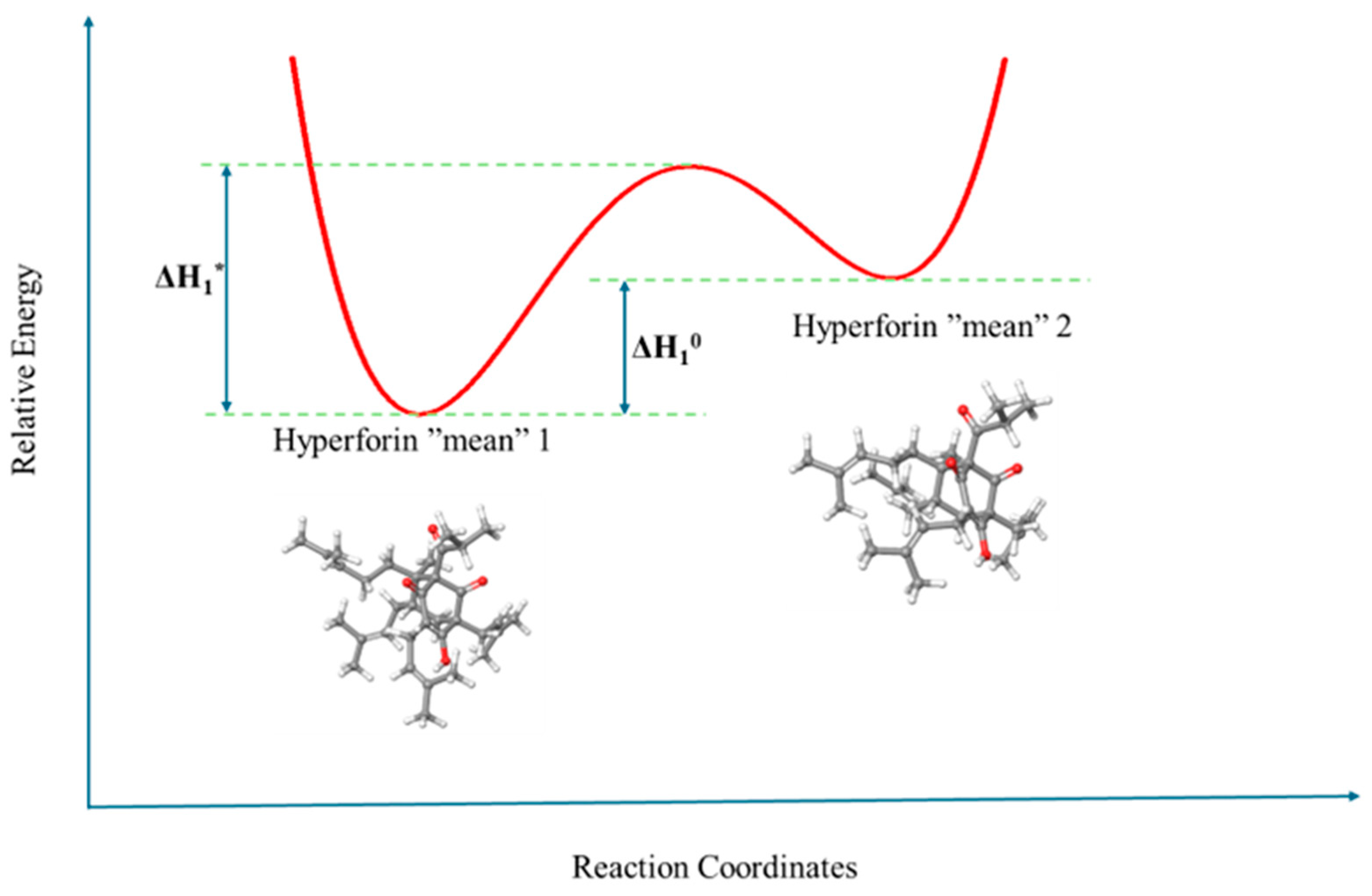
A variety of conformers, namely 192 poses, have been theoretically estimated for hyperforin. These conformers have been divided into two main classes after applying the clustering procedure described in the experimental section. These conformers are illustrated in Figure 1. The equilibrium between the two “mean” conformers can be written as follows:
( H y p ) H y p *
The equilibrium attributed to conformational change is presented in Figure 1 as a characteristic double-well potential. The two wells (minima) correspond to the two “mean” conformers, while the local maximum is related to the transition state (TS). The diagram describes the energetics of the system. The calculations revealed the Hyperforin “mean” 1 to be more stable than the Hyperforin “mean” 2 isomer and the energy difference between them is ΔH10 = 13.76 kcal/mol.
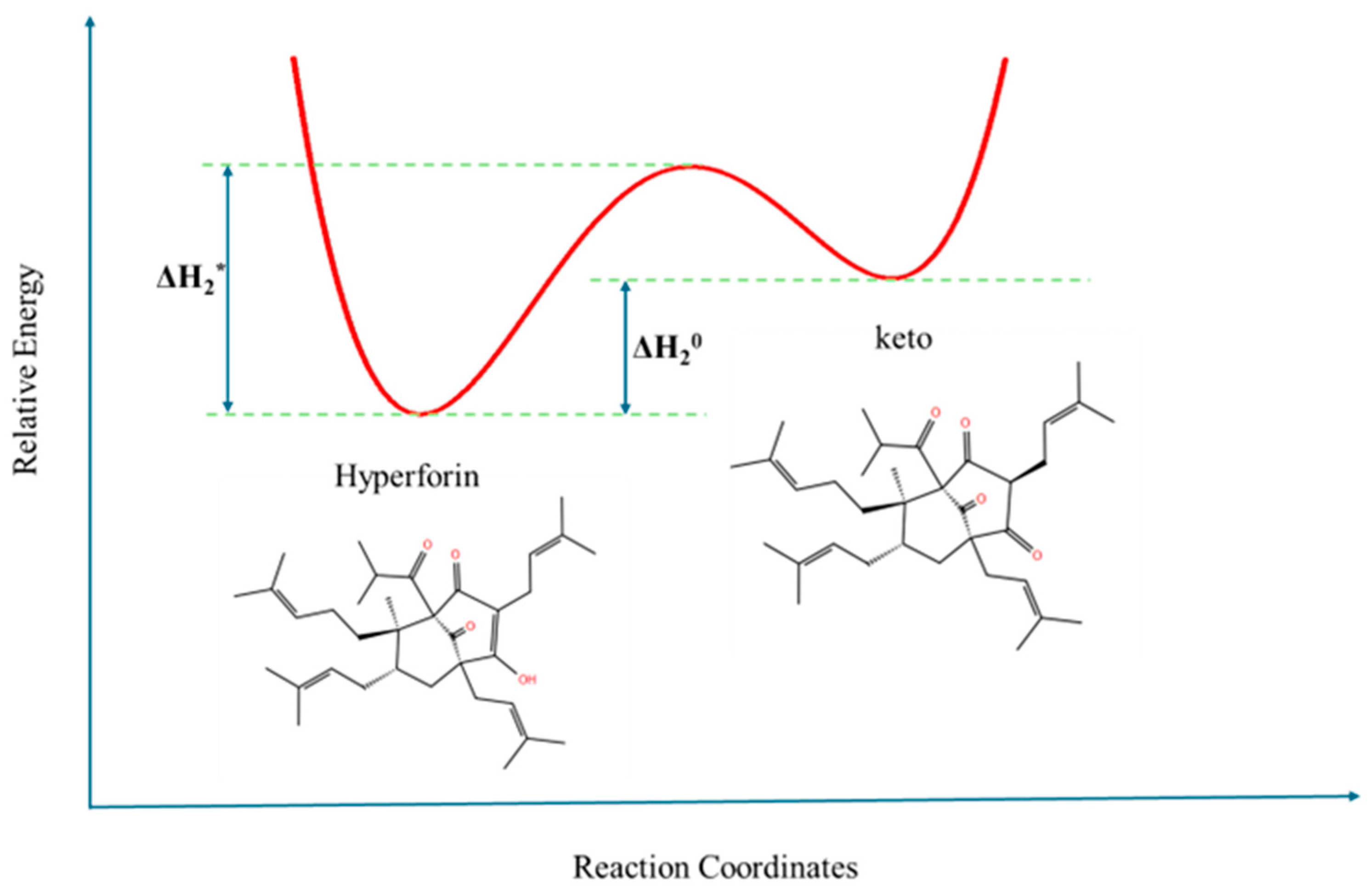
Furthermore, the core of the hyperforin molecule, which is the polyphenol phloroglucinol, reveals an enol-to-keto tautomerism and the tautomeric forms are shown in Figure 2 [31,32]. The enol-to-keto equilibrium/tautomerization is presented as a characteristic double-well potential. The two wells (minima) correspond to the two enol and keto tautomers, with the enolic form (Hyperforin) being more thermodynamically favored. The enol-to-keto equilibrium is affected by the presence of an acid or base that acts as catalyst. In the equilibrium state, the keto tautomer is favored and the energy difference between them is ΔH20 = 43.06 kcal/mol. The stability of the enol tautomer is increased by substitution, resonance, aromaticity, and hydrogen bonding, since intramolecular hydrogen bonding can stabilize the enol form. The increase in solvent polarity increases the enol content [33,34]. The general enol-to-keto tautomerism can be described as follows:
( H y p ) e n o l ( H y p ) k e t o
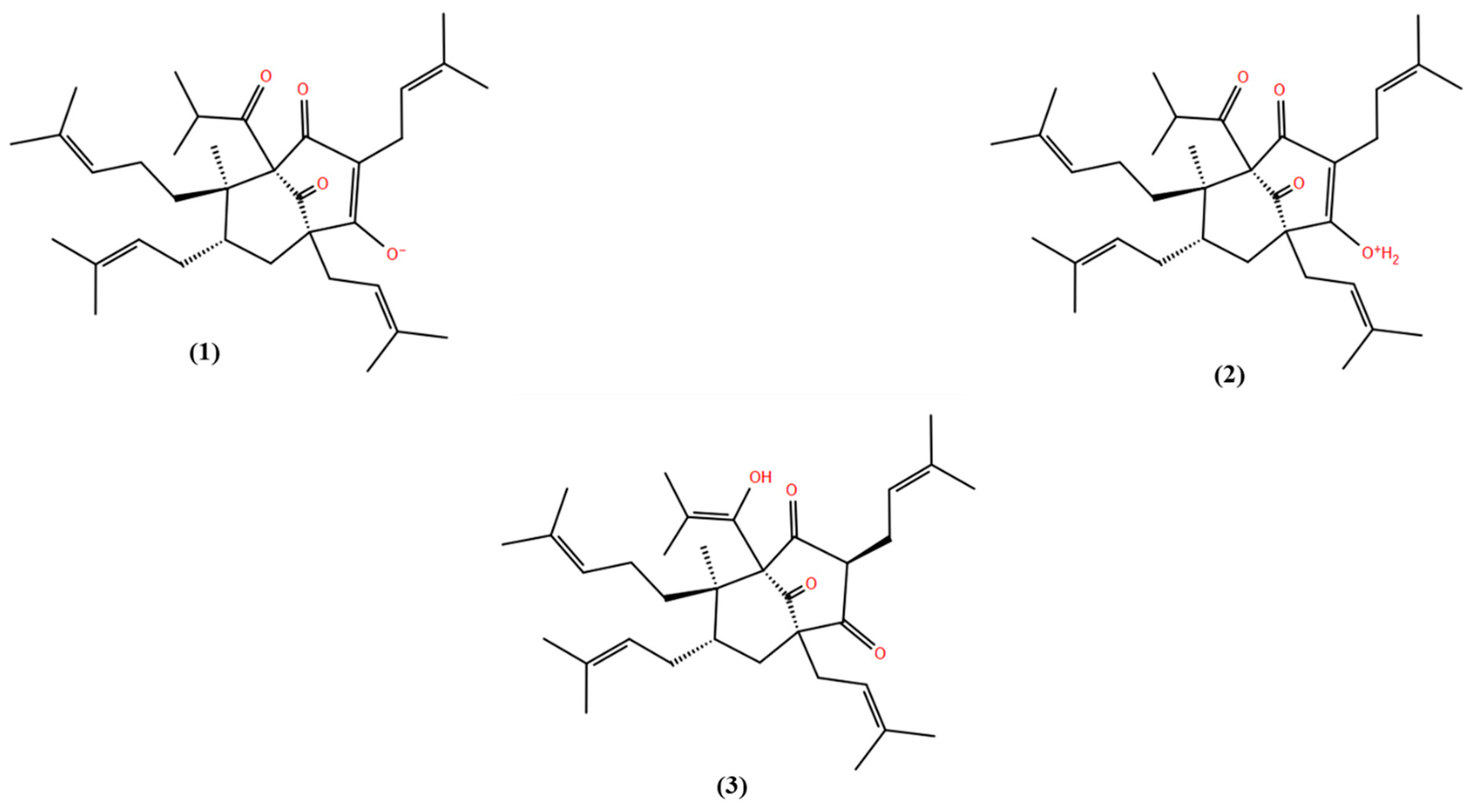
Finally, the inter-molecular and intra-molecular protonated and deprotonated species are presented in Figure 3. The inter-molecular proton transfer can be presented as follows:
H y p + z   H + H y p H z +
with z = −1, 1 the number of the transferred protons. On the other hand, the intra-molecular transfer of a single proton can be written as follows:
H y p H y p Δ
The gaseous atomic formation enthalpies of all hyperforin species involved in chemical reactions (1) to (4) are summarized in Table S2 of the Supplementary Material.

3.2. Ultrasonic Relaxation Spectroscopy—Concentration Effect on Relaxation Processes

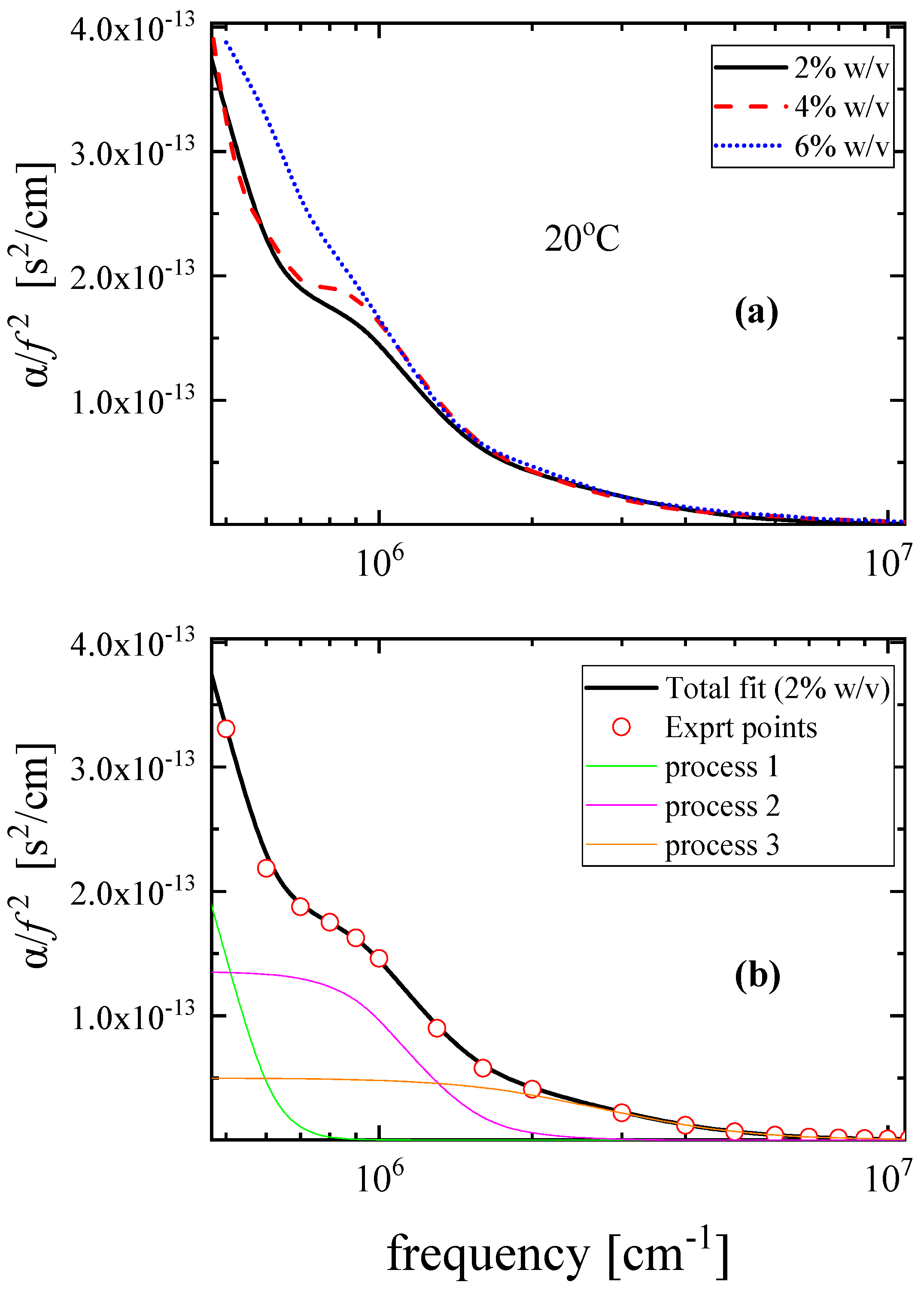
In Figure 4a, the experimental frequency-reduced sound absorption values are shown as a function of frequency for 2, 4, and 6% w/v at 20 °C. The Debye-type dispersion equation describes the relaxation processes, due to the propagation of the longitudinal wave in the viscoelastic medium, and is given by the following [35,36]:
a f 2 e x p e r i m e n t a l = A i 1 + f f r i 2 + B
where Ai denotes the amplitude of the i-th relaxation and B is related with the frequency-independent or non-relaxing part of the sound absorption coefficient [35,36]. Parameter B has contributions from visco-thermal absorption and vibrational relaxation and appears in Figure 4 as a constant background absorption in the high-frequency limit. The Debye-type relaxation equation appears as a sigmoidal function, with fr,i corresponding to the characteristic relaxation frequency of the i-th relaxation process. This characteristic frequency is determined as the frequency where the sagmatic point is detected.
When a chemical system does not reveal a specific relaxation process, then the classical sound absorption is directly analogous to the squared frequency and the plot of a/f2 versus frequency will be a straight line, since the a/f2 ratio is frequency independent. Any extra relaxation process exhibited by the system will be detected as an excess of sigmoidal shape in this plot. The spectra of Figure 4a evidently expose the presence of more than one relaxation process. More sagmatic points imply the presence of additional relaxation processes whose characteristic frequency and amplitude vary with increasing solution concentration. In Figure 4b, a representative fitting example is presented for a solution corresponding to 2% w/v. Three distinct Debye-type relaxation processes were resolved that correspond to relaxation curves after the fitting procedure. Three Debye-type dispersion curves are the minimum relaxations required to achieve an adequate goodness of fit.
In general, conformational changes are typically assigned to a relaxation process, as observed in the acoustic spectrum when α/f2 reveals a weak dependence on concentration variation, while the characteristic relaxation frequency fr remains almost constant with concentration. When proton transfer reactions take place, both α/f2 and fr on the acoustic spectrum are strongly concentration-dependent, due to shifts in the chemical equilibrium.
As already discussed, the concentration-dependent acoustic spectra of the system are expected to exhibit three different processes that are attributed to the enol-to-keto equilibrium, the conformational change between the two “mean” conformers, and the inter- and intra-molecular proton-transfer mechanisms. The first two processes are categorized, in general, as thermal processes, where the ultrasonic wave perturbs the intra-molecular enol-to-keto and rotational isomerism chemical equilibria. The third process is classified as structural, since it involves inter-molecular rearrangements and prevails in highly associated liquids through hydrogen bonding. In a proton transfer reaction, a proton can be moved between molecules or within a single molecule, leading to changes in the molecular structure through bond reorganization or even by creating a completely new chemical species. Structural relaxation is usually observed in the high-frequency region of the acoustic spectrum, while the thermal relaxations attributed to conformational changes are expected in lower frequencies [35,36].
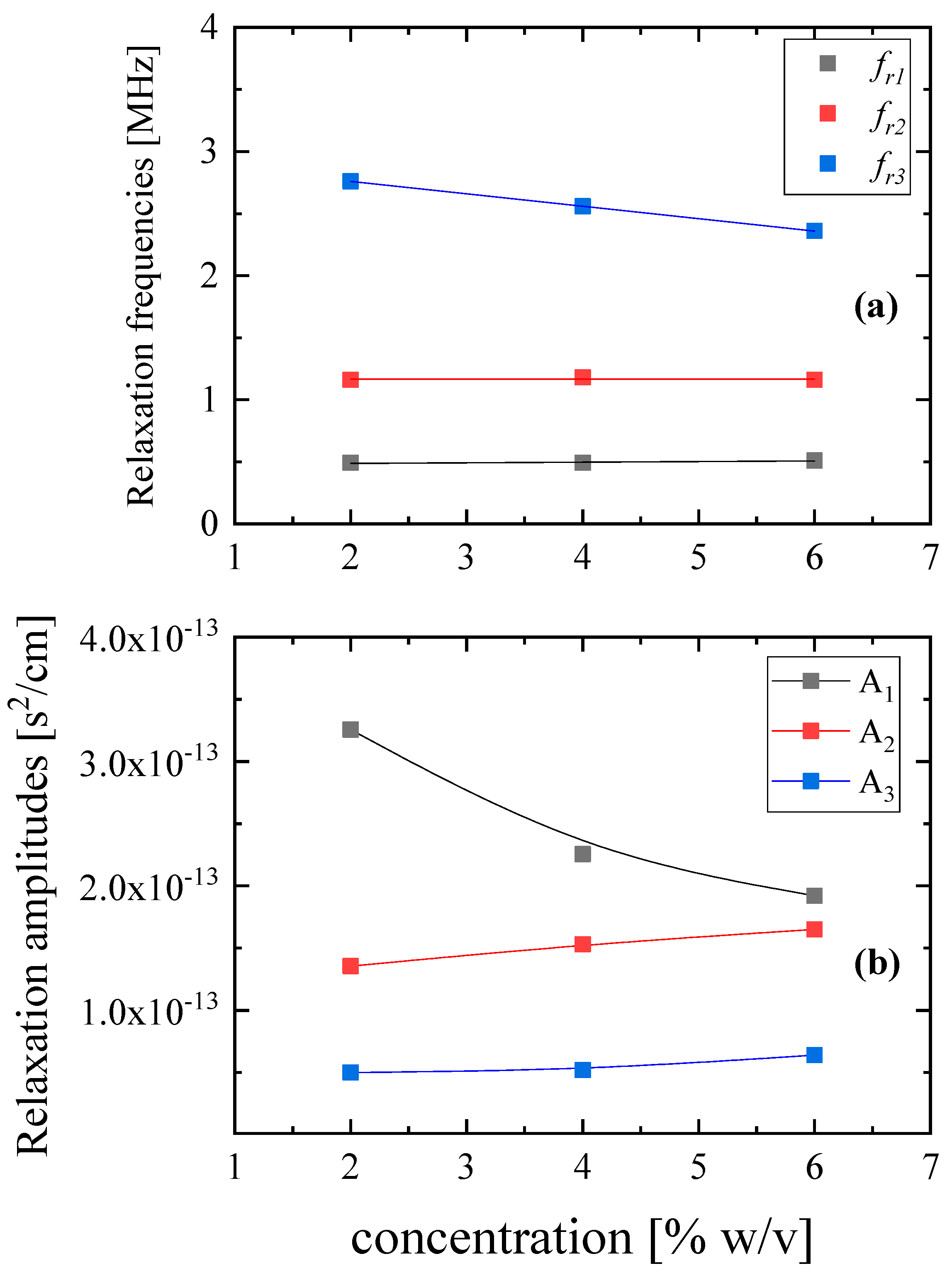
An isomerism equilibrium is manifested in the concentration-dependent acoustic spectra by a monotonous variation in the relaxation amplitude, while the characteristic relaxation frequency remains constant with concentration variation [37]. Considering that the relaxation frequencies fr1 and fr2 appear to be independent of concentration (Figure 5a), and the corresponding relaxation amplitudes exhibit a monotonous variation with concentration, although with different trends (Figure 5b), we assign these relaxations to rotational isomerism and enol-to-keto chemical equilibrium, respectively. The second relaxation is attributed to the enol-to-keto equilibrium, since the keto content increases with decreasing solution polarity. With increasing concentration, the solvent (methanol) content and the polarity of the solution reduce, and the relaxation amplitude of the corresponding mechanism is expected to increase. This behavior is observed in Figure 5b, only for A2, while A1 decreases continuously. Thus, the first relaxation in Figure 4b, detected in the lower frequency, is related to conformational changes and the second relaxation to enol-to-keto equilibrium.
An equilibrium perturbation related to the proton transfer reaction is presented in the acoustic spectra as a monotonous concentration dependence for both the relaxation frequency and amplitude [38]. In Figure 5a, a clear monotonous decrease when increasing the solution concentration is detected, only for the third process (fr3). The opposite behavior is exhibited in Figure 5b, with the corresponding relaxation amplitude A3 revealing a slight but monotonous increase. Thus, these monotonous dependencies support the assignment of the third ultrasonic relaxation to the proton transfer reaction.

3.3. Vibrational Spectroscopy—Degradation Effect

The Hypericum perforatum L. plant has been identified as a therapeutic herb for treating emotional disorders, including depression [39]. Oleum Hyperici, which is derived from the extraction of the flowering parts of the Hypericum perforatum plant in oil, is used as a topical analgesic for wounds, injuries, or ulcers, relieving symptoms and accelerating the healing process [40]. The two main components of the plant are hypericin, which belongs to the naphthodianthrones family, and hyperforin, a phloroglucinol. Both compounds have been reported to exhibit antibacterial activity against certain Gram-positive bacteria [41].
Hyperforin is the primary component of the plant contributing to its antidepressant action, as it helps to regulate the levels of certain neurotransmitters, including dopamine, norepinephrine, serotonin, and glutamic acid [9]. It is sensitive to light and air at high temperatures. As a result, hyperforin oxidizes into furohyperforin and furohyperforin hydroperoxide, thus losing some of its antibacterial activity [42].
In a study, extracts of the plant were prepared using various oils, such as olive oil, sunflower oil, and two unknown oils. Chemical analysis of the extracts showed the presence of four common substances in all samples. Hyperforin, furohyperforin, and two isomers of octadecadienoic acid were found in the samples, while hypericin was absent. Hyperforin would be expected to be absent from the oil extracts, due to its sensitivity to sunlight; however, there are possible reasons preventing its degradation. One of these is that terpenoids present in the oil act as sacrificial reducing agents for reactive oxygen species. Monoterpenes and sesquiterpenes are sacrificial reducing agents that protect hyperforin from photooxidative degradation. Additionally, other compounds in the oil can absorb the radiation that is necessary for the degradation reactions of the compound [43].
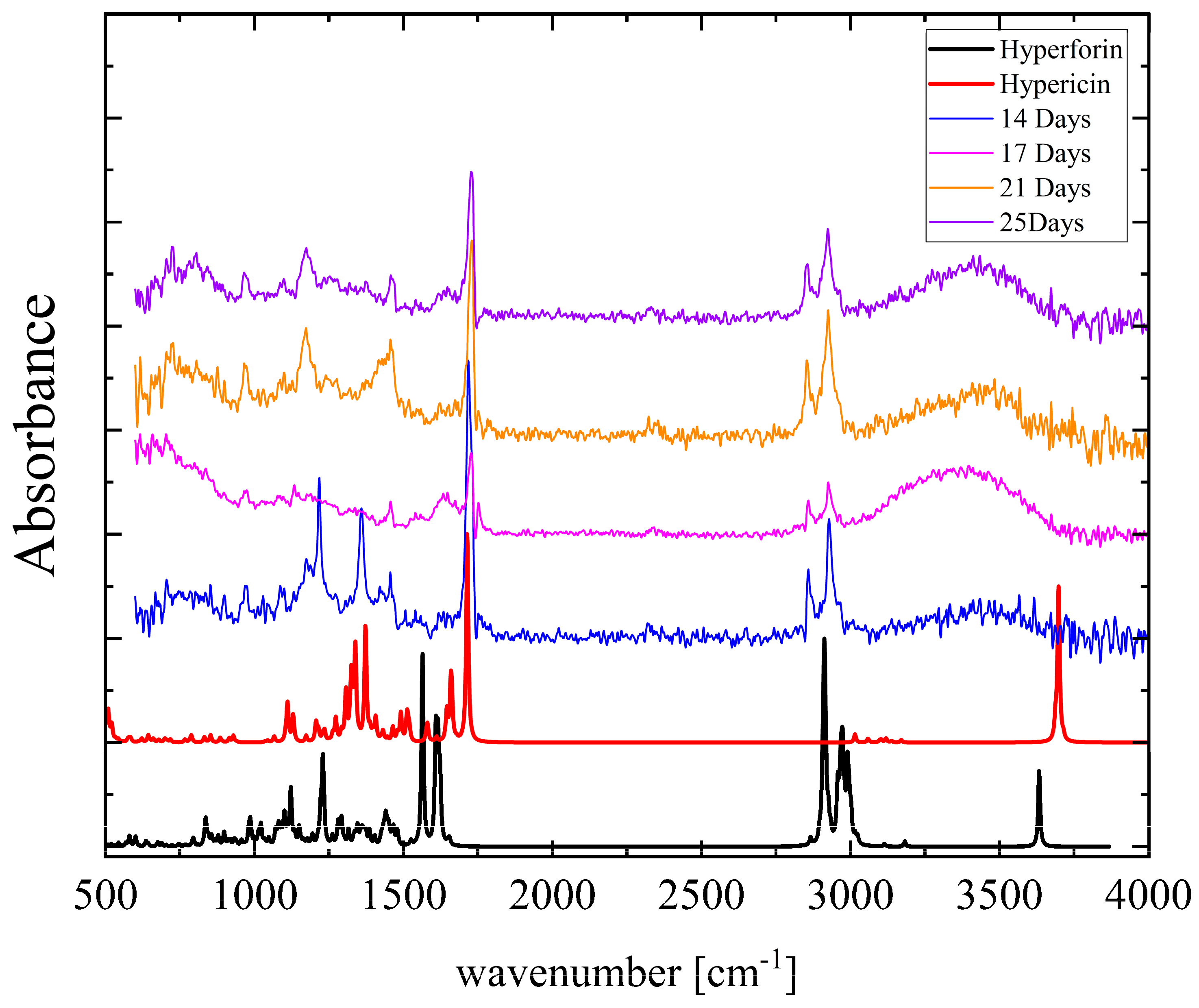
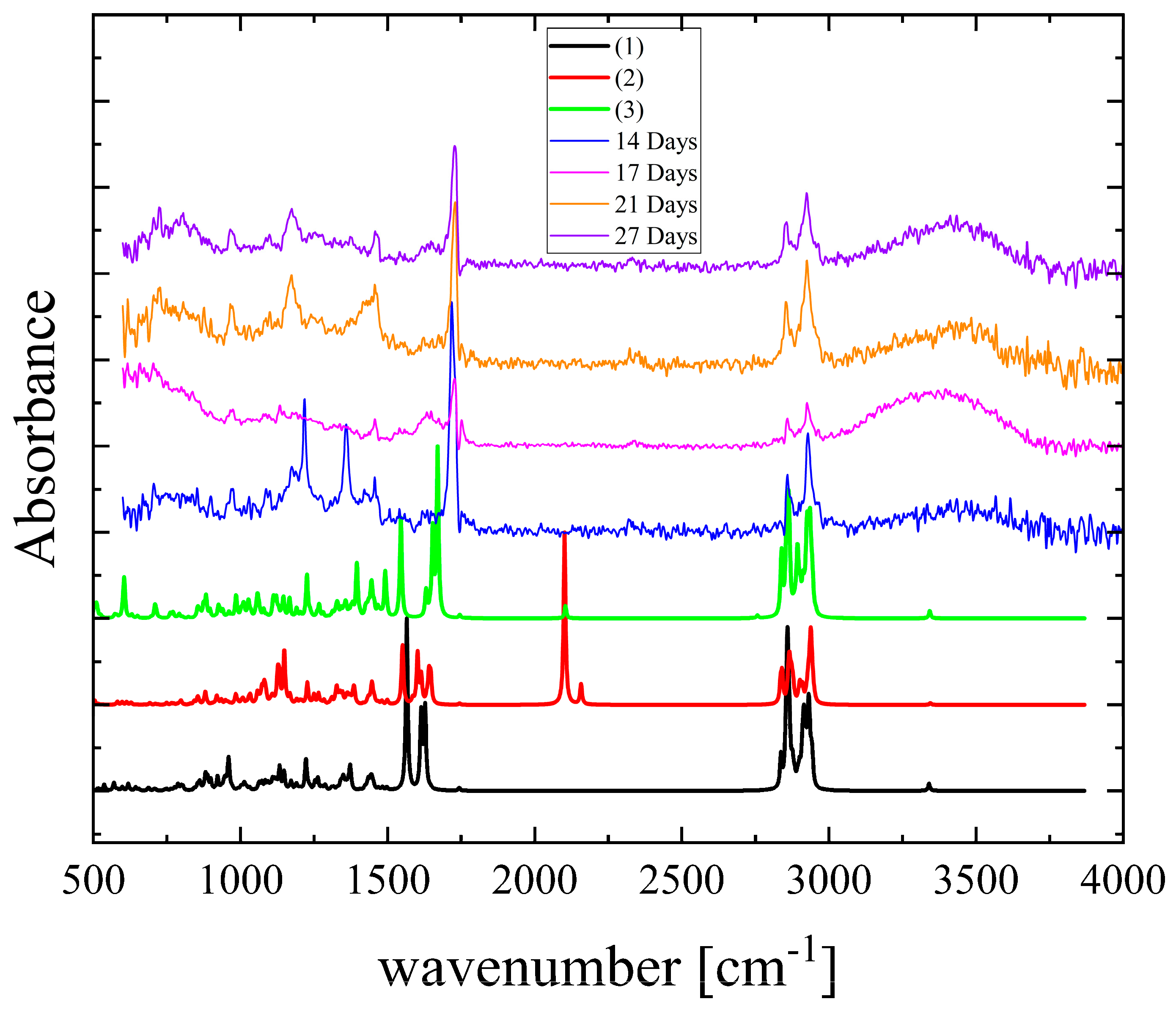
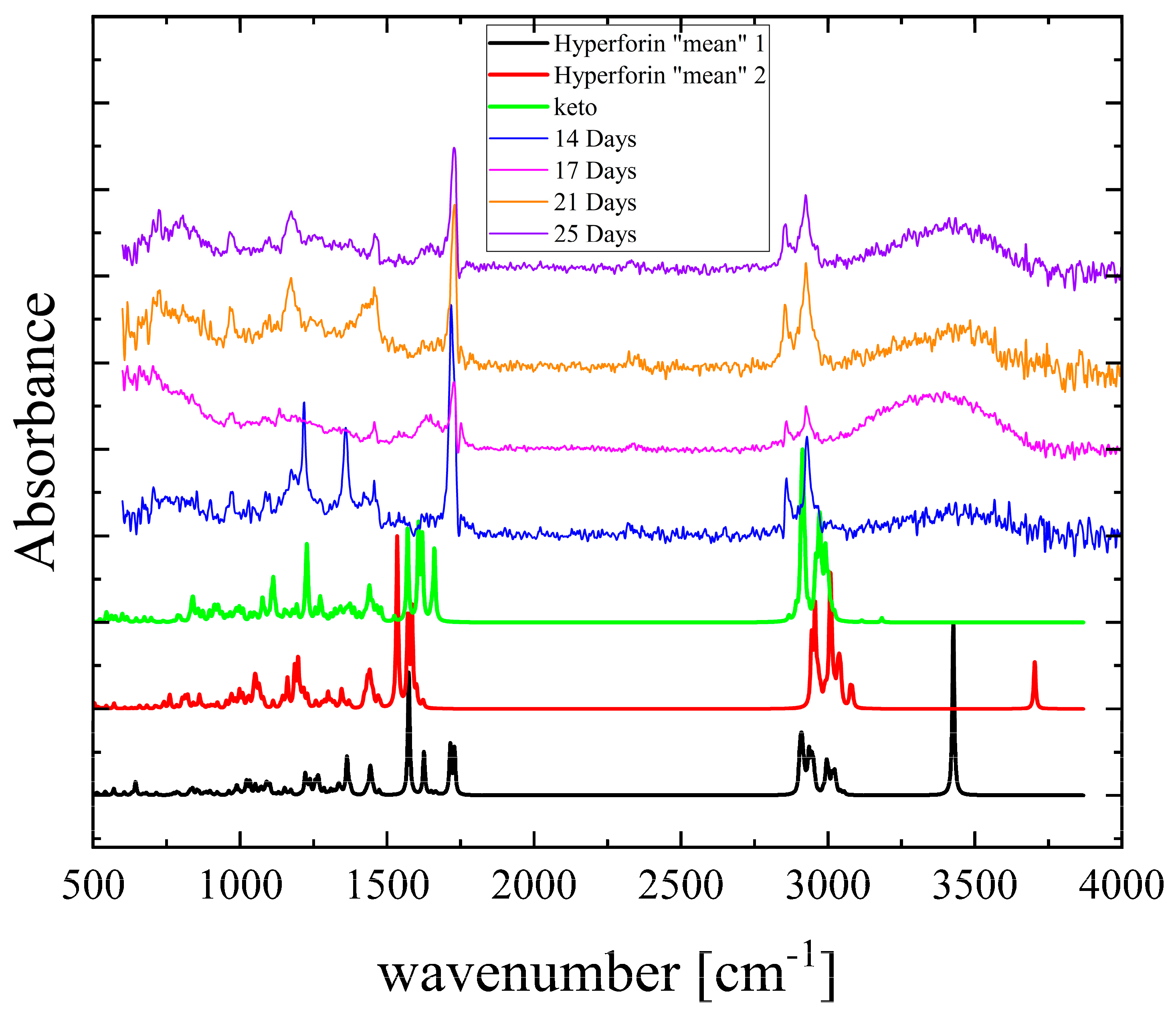
The ATR vibrational spectra of Oleum Hyperici for different intervals of extraction are presented in Figure 6. In the same figure, the theoretically predicted spectra of hypericin and hyperforin are also included. In Figure 7, the theoretical spectra of hyperforin “mean” 1, “mean” 2, and keto species are presented for direct comparison of the experimental IR absorbance spectra of Oleum Hyperici at different extraction durations. Finally, in Figure 8, we are shown the theoretical spectra of inter-molecular (structures 1 and 2) and intra-molecular (structure 3) protonated and deprotonated species of hyperforin. The experimental IR absorbance spectra of Oleum Hyperici at different extraction durations are also displayed for comparison in this plot. In Figure 6, Figure 7 and Figure 8, we compare theoretically calculated IR spectra corresponding to the free gas state with the experimental IR absorbance spectra of Oleum Hyperici at different extraction durations. The calculation of the gas phase spectrum provides a reference for the fundamental vibrational properties of the molecule without considering any dielectric effects and potential interaction with the solvent molecules. The direct comparison of this theoretical spectrum with the experimental spectra of solutions allows us to identify variations in vibrational frequency and/or intensity that are induced by the solvent and distinguish specific vibrational modes that are mostly perturbed by the solvent. Furthermore, the observed deviations highlight, except for solvation, additional possible effects, such as aggregation and polarization.
Starting from the high frequencies, the broad spectral envelope between 3250 and 3695 cm−1 is attributed to -OH and N-H stretching vibrations. The bands near ~2928 cm−1 are attributed to C-H stretching modes. In the mid-frequency region, the bands near ~1720 and ~1360 cm−1 are associated with C-H bending vibrations of aromatic compounds, while those near ~1610 cm−1 correspond to the stretching modes of C=C. Finally, bands that are near ~1334 cm−1 are assigned to the bending modes of -OH functional groups, whereas the peaks near ~1218 cm−1 are assigned to C-O stretching mode. A red shift is observed in the bands from ~2928 to 2924 cm−1 and from ~2859 to 2854 cm−1, while a blue shift occurs from ~1720 to 1730 cm−1 as the extraction progresses from 14 to 25 days. These shifts indicate a breakdown or a modification of the compounds in the Oleum Hyperici. The two peaks near ~1218 and ~1360 cm−1, which are present for 14 days, gradually disappear over time, indicating molecular degradation. There are significant similarities between the theoretically predicted IR and the experimental spectra. The peaks of hyperforin, keto, and species (1) and (3) near ~3012–3074 cm−1 align with the experimental peaks observed around 2928 and 2858 cm−1, while the experimental peak near ~1720 cm−1 closely coincides with the theoretical peak of hypericin, Hyperforin “mean” 1, keto, and species (3) near ~1714 cm−1. Moreover, the spectral region from ~1000 to ~1660 cm−1 in experimental data seems to be a combination of spectral features attributed to all species. The extent of the spectral similarities was quantitatively evaluated using correlation coefficients for the selected spectra. For the absorbance values at each wavenumber across several spectra, Pearson-type correlations were computed and are presented in Table S3 of the Supplementary Material. Each scatter matrix point corresponds to a distinct wavenumber on the IR spectrum. Correlations greater than 95% are shown by points inside the confidence ellipse. Strong spectral resemblance between the experimental and theoretical FT-IR spectra was highlighted by this approach, which showed that the majority of the points were inside the confidence ellipse. The overall agreement between the theoretical findings and the experimental IR spectra is adequate, with any observed differences probably resulting from the fact that all theoretical calculations were conducted in a vacuum, without considering any intermolecular interactions between molecules. This comparison, in combination with the calculated correlation coefficients, confirms the presence of hyperforin, keto, and (1) and (3) in Oleum Hyperici. The spectroscopic results reveal that the duration of the extraction does not promote the population of hyperforin over the other species and vice versa.

3.4. ADMET Properties

In Table 1, all the physicochemical properties of hyperforin and its derivatives are summarized and compared to evaluate their suitability for drug development. The higher lipophilicity revealed by hyperforin, species (1), and species (3) indicates low water solubility but good membrane permeability. Hyperforin and keto exhibit lower logP values, which is indicative of a better equilibrium between lipophilicity and hydrophilicity. All compounds demonstrate TPSA ≤ 140 Å, which implies a reliable absorption and BBB permeability. The keto derivate has slightly lower TPSA, suggesting improved passive diffusion.
Although the compounds have the same number of heteroatoms (nHet), rings (nRing), and hydrogen bond acceptors (HBA), there are key differences in the molecular weight (MW), number of hydrogen bond donors (HBD), number of atoms (nAtom), and rotatable bonds (nRot). Compound (3) has fewer rotatable bonds, and, thus, increased molecular rigidity, while compound (2) has a slightly lower MW and nAtom, indicating a potential improvement in both absorption and permeability. The keto derivative has zero HBD, correlating with better membrane permeability. Overall, the keto and compound (2) show a slight difference in physicochemical properties, indicating a better water solubility, absorption, and BBB permeability. Even though compounds (1) and (3) have comparable drawbacks to hyperforin, namely the high lipophilicity and limited drug-likeness, these characteristics designate them as being more appealing candidates for therapeutic development.
As mentioned above, hyperforin operates through several mechanisms that contribute to its antidepressant and neuroprotective properties. This process occurs indirectly through an increase in intracellular sodium levels that disrupts the activity of neurotransmitters. Hyperforin modulates the function of the transporter molecules by ionic balance, rather than directly interacting with specific binding sites at the molecules. This broad-spectrum reuptake inhibition is believed to be underlying its antidepressant activity [44,45].
Hyperforin also activates transient receptor potential canonical 6 (TRPC6) channels, which are non-selective cation channels that are critical for neuronal function. The activation of TRPC6 channels leads to increased intracellular calcium levels, supporting synaptic plasticity and neurogenesis. This mechanism complements its reuptake inhibition by enhancing neuronal connectivity and adaptability [46]. By inhibiting the synthesis of pro-inflammatory mediators such as COX-1, COX-2, TNF-α, and IL-6, hyperforin also demonstrates anti-inflammatory properties, which connects its therapeutic effects to the growing recognition of inflammation’s role in depressive disorders. By further shielding neurons from oxidative stress, its antioxidant action may help to prevent neurodegeneration [44,47].
Another key mechanism of hyperforin is its interaction with the pregnane X receptor (PXR): a nuclear receptor that regulates drug metabolism by inducing cytochrome P450 enzymes, notably CYP3A4. This PXP-mediated enzyme induction raises the potential for significant drug–drug interactions, especially when used with other medications metabolized by these enzymes [48,49,50]. These mechanisms demonstrate hyperforin’s unique pharmacological profile, making it a compelling candidate for treating mood disorders and associated conditions.
Caco-2 prediction is an estimation of the intestinal permeability of a compound across Caco-2 cell monolayers, helping to evaluate drug oral absorption. Human intestinal absorption (HIA) prediction determines the oral bioavailability of a substance in the human intestine and, subsequently, the interaction with Cytochrome P450 enzymes. The blood–brain barrier (BBB) is a selective semi-permeable membrane between the blood and the intersitium of the brain, protecting the central nervous system (CNS) by separating brain tissue from blood as part of absorption, and this prediction shows if a compound can act on CNS. Additionally, a crucial membrane protein that actively transports foreign substances out of cells is P-glycoprotein (P-gp). While P-gp inhibitors enhance drug absorption and bioavailability, substrates may have reduced bioavailability due to P-gp-mediated efflux. Many medications are transported through the circulation by plasma proteins. Predicting whether a compound will bind to plasma proteins, affecting the pharmacological activity and distribution, in known as plasma protein binding (PPB) prediction [51].
CYP3A4 is an essential enzyme in the body that is mainly found in the liver and in the intestine and oxidizes xenobiotics to enable their excretion from the body. While CYP3A4 substrates can interact with medications that inhibit or induce this enzyme, inhibition of CYP3A4 can lead to increased plasma levels of co-administered drugs metabolized by CYP3A4. Moreover, plasma clearance (CLp) measures the ability of the body to completely remove a drug by scaling the drug elimination rate by the corresponding plasma concentration level, while renal clearance (CLr) describes how quickly a compound is removed from the plasma by the kidneys. Elimination half-life (T 1/2) is the time required for the plasma concentration of a drug to reduce to half its initial value. Finally, mean residence time (MRT) is the average time that a molecule spends in the body before being eliminated after administration [51].
In Table 2, the absorption, distribution, and metabolism parameters of hyperforin and its derivatives are summarized. It is shown that all species are predicted to be well absorbed (HIA = 1), despite the negative Caco-2 permeability, suggesting the potential involvement of active transport mechanisms or solubility-enhancing effects in vivo. All compounds are predicted as being BBB-permeable, supporting the antidepressant and neuroprotective effects. In addition, all compounds inhibit P-gp, which could increase brain penetration and systemic drug levels, while are not effluxed by P-gp, meaning that their CNS penetration and oral bioavailability will not be significantly reduced by efflux transporters. PPB predictions show that the species can interact with the plasma protein, reducing free drug concentration and prolonging drug half-life, but may reduce immediate therapeutic effects. By not being a substrate or inhibiting CYP3A4, compounds are safe to co-administer with CYP3A4-metabolized drugs, reducing the risk of enzyme-related drug interactions. Furthermore, compounds are eliminated via hepatic metabolism, with a slightly shorter half-life for species (1), (2), and (3). Overall, the keto derivative shows slightly improved properties compared to hyperforin, as it reduces CYP interactions while maintaining similar pharmacokinetics.
Human Ether-à-go-go Related Gene (hERG) prediction refers to a drug’s ability to inhibit the hERG potassium channel, potentially leading to prolonged QT syndrome and increasing the risk of cardiac arrythmias. The two predictions have a different threshold to categorize a compound as cardiotoxic or not. Nephrotoxicity is defined as rapid deterioration in the kidney function, due to the toxic effect of drugs or chemicals. In addition, the prediction of nephrotoxicity facilitates avoiding renal failure. Skin corrosion is defined as irreversible damage to the skin, including tissue necrosis, while skin irritation indicates temporary, reversible damage, produced by skin exposure to chemicals. A complex cutaneous immune process caused by local contact of chemical allergens with sensitive skin is evaluated by skin sensitization prediction [51].
Acute dermal toxicity refers to the adverse effects occurring from a single dose of a drug that is applied to the skin, leading to poisoning or even death. Ames mutagenesis prediction is a test that evaluates the likelihood of a compound to cause genetic mutations in bacteria, indicating genotoxicity. Moreover, acute oral toxicity refers to the general adverse effects induced by a compound following the administration of single or multiple doses over a short period of time. Finally, FDA maximum recommended daily dose (FDAMDD) quantifies the risk for mutagenicity and developmental and reproductive toxicity based on FDA-defined endpoints [51].
In Table 3, it is shown that compound (3) inhibits hERG at both concentrations, indicating a potential risk for QT prolongation and arrhythmias. In contrast to hyperforin, compounds (1), (2), and (3) do not exhibit nephrotoxicity, suggesting a better renal safety profile. In addition, all compounds have dermal toxicity and the potential to irritate and sensitize the skin, which suggests a need for caution in topical application. Compounds (1), (2), and (3) have a slightly higher oral toxicity, which may limit their dosing. Additionally, because of their higher FDAMDD values, hyperforin and keto derivatives may allow for a greater daily dosage, and there is no genotoxic danger because none of the compounds exhibit mutagenicity. Overall, while compound (3) should be used with caution, keto and compound (1) exhibit better toxicity overall when compared to hyperforin, with lower nephrotoxicity and comparable safety profiles.
Although AdmetSar does not offer a direct parameter to predict antidepressant effect, certain pharmacokinetic and physicochemical characteristics are essential for determining a compound’s possible antidepressant activity. For hyperforin and its derivatives, the most important parameters are BBB permeability, Pgp interaction, and logP. Because logP affects CNS penetration, bioavailability, and possible toxicity, it is the main distinguishing factor among the five compounds, which are all BBB permeable, Pgp inhibitors, and non-Pgp substrates. Hyperforin and keto emerge as the best antidepressant candidates due to having the lowest logP values, indicating an optimal balance of BBB penetration, solubility, and bioavailability. It is important to note that the outcome of the performed ADMET analysis requires experimental validation. Nevertheless, this in silico analysis is based on robust machine-learning models trained on large experimental datasets predicting pharmacokinetic and toxicity profiles at a low experimental cost and time. Even without experimental validation, it provides an initial identification of potential liabilities and ranking of candidates for further testing for drug discovery roadmaps based on verified structure–activity links.
In this study, we did not perform dedicated stability and toxicity analysis of the solution and oils. In general grounds, solutions may remain stable if stored in a cold environment and protected from light right after preparation. Breakdown acceleration is accelerated with light and heating exposure to the solutions [52]. The traditional “Oleum hypericin” (oil), made by solar maceration, has red color taken from the products formed during sunlight exposure from lipophilic degradation. The oil and the methanol extracts are two completely different materials from a chemical point of view, with the former being relatively stable and widely used as topical oil. Additionally, the oil’s chemical composition is greatly affected by the preparation method used [53].
Hyperforin can produce metabolites that can generate [54]. Methanolic extracts with hypericin or hypericin derivative contents higher than 0.3% under UVA activation have been shown to have phototoxicity in vitro. Furthermore, when human tissue is exposed to a plant material that contains hypericin, then photosensitivity is induced, known as “hypericism” [43]. On the other hand, traditional “Oleum hypericin” oil, when used for topical use, exhibits low phototoxicity [53]. Nevertheless, irritation or allergy may be observed and by no means should one ingest the oil.

4. Conclusions

In this study, ultrasonic relaxation and ATR spectroscopy, combined with DFT theoretical calculations, were employed to describe the structure and dynamics of Hypericum perforatum solutions in a polar solvent and to elucidate the associated relaxation processes. Three distinct Debye-type relaxation processes are detected in the acoustic spectra. The process observed at the lower frequency is assigned to the conformational changes between the two hyperforin conformers, while the second relaxation process corresponds to the enol-to-keto tautomerization. The third process, appearing at higher frequencies, is associated with the inter- and intra-proton transfer mechanisms.
Molecular docking methods revealed the conformational change process, with 192 conformers clustering in two main groups: Hyperforin “mean” 1 and Hyperforin “mean” 2. In addition, three protonated species, (1), (2), and (3), along with the keto form of hyperforin, were identified. DFT calculations were utilized to optimize these structures, as well as the molecular structure of hypericin, and subsequently, to compute the theoretical IR spectra.
St. John’s wort was extracted, using olive oil as a solvent to isolate its therapeutic compounds. The experimental ATR spectra exhibited a red shift in the peaks near ~2928 and ~2859 cm−1 to 2924 and 2854 cm−1, respectively, and a blue shift in the band near ~1720 to 1730 cm−1 over different extraction days, indicating possible modification in the oleum. Moreover, the disappearance of bands near ~1218 and 1360 cm−1 after 14 days of extraction indicates molecular degradation over time. The comparison of the experimental with the corresponding theoretically calculated spectra revealed the presence of hyperforin, keto, species (1), and species (3) in the oleum.
Finally, ADMET analysis of hyperforin and its derivatives revealed that hyperforin and keto are the most promising candidates for antidepressant activity, exhibiting the lowest logP values, which suggest an optimal balance of BBB penetration, solubility, and bioavailability.

Supplementary Materials

The following supporting information can be downloaded at: https://www.mdpi.com/article/10.3390/physchem5040056/s1. Table S1. Number of conformers and their energies (kJ/mol) obtained from the conformational search. Table S2. Thermodynamic properties of all hyperforin species. All theoretical investigations were carried out using the Gaussian 09 software. E(Thermal) is in kcal/mol, Heat Capacity (Cv) and Entropy (S) are in cal/mol·K, while the rest parameters are in Hartrees. Table S3. Comparison of the Pearson coefficients of IR spectra after the correlation coefficient procedure. Figure S1. The experimental IR absorbance spectrum of extra virgin olive oil used in the extraction of the plant to produce the so called “Oleum hypericin”.

Author Contributions

Conceptualization, A.G.K.; methodology, G.P., P.S. and A.G.K.; theoretical calculations, G.P., P.S. and A.T.; validation, A.G.K.; investigation, G.P., A.T., P.S., E.S. and A.G.K.; writing—original draft preparation, A.T., E.S. and A.G.K.; writing—review and editing, G.P., A.T., P.S., E.S. and A.G.K.; supervision, A.G.K. All authors have read and agreed to the published version of the manuscript.

Funding

This research received no external funding.

Data Availability Statement

Data will be made available upon request.

Conflicts of Interest

The authors declare no conflicts of interest.

References

  1. Butterweck, V.; Schmidt, M. St. John’s wort: Role of active compounds for its mechanism of action and efficacy. Wien. Med. Wochenschr. 2007, 157, 356–361. [Google Scholar] [CrossRef]
  2. Woody, C.A.; Ferrari, A.J.; Sisking, D.J.; Whiteford, H.A.; Harris, M.G. A systematic review and meta-regression of the prevalence and incidence of perinatal depression. J. Affect. Disord. 2017, 219, 86–92. [Google Scholar] [CrossRef]
  3. Di Carlo, G.; Borrelli, F.; Ernst, E.; Izzo, A.A. St John’s wort: Prozac from the plant kingdom. Trends Pharmacol. Sci. 2001, 22, 292–297. [Google Scholar] [CrossRef]
  4. Newall, C.A.; Barnes, J.; Anderson, L.R. Herbal Medicines: A Guide for Healthcare Professionals; Pharmaceutical Press: London, UK, 2002. [Google Scholar]
  5. Linde, K. St. John’s wort—An overview. Forsch. Komplementmed. 2009, 16, 146–155. [Google Scholar] [CrossRef]
  6. Greeson, J.M.; Sanford, B.; Monti, D.A. St. John’s wort (Hypericum perforatum): A review of the current pharmacological, toxicological, and clinical literature. Psychopharmacology 2001, 153, 402–414. [Google Scholar] [CrossRef]
  7. Schulz, H.; Jobert, M. Effects of hypericum extract on the sleep EEG in older volunteers. J. Geriatr. Psychiatry Neurol. 1994, 7 (Suppl. S1), 39–43. [Google Scholar] [CrossRef]
  8. Beerhues, L. Hyperforin. Phytochemistry 2006, 67, 2201–2207. [Google Scholar] [CrossRef] [PubMed]
  9. Chatterjee, S.S.; Bhattacharya, S.K.; Wonnemann, M.; Singer, A.; Müller, W.E. Hyperforin as a possible antidepressant component of hypericum extracts. Life Sci. 1998, 63, 499–510. [Google Scholar] [CrossRef]
  10. Medina, M.A.; Martínez-Poveda, B.; Amores-Sánchez, M.I.; Quesada, A.R. Minireview. Hyperforin: More than an antidepressant bioactive compound? Life Sci. 2006, 79, 105–111. [Google Scholar] [CrossRef] [PubMed]
  11. Lang, F.; Biber, A.; Erdelmeier, C. Hyperforin in Johanniskraut-Droge, -Extrakten und -Präparaten. Pharm. Unserer Zeit 2002, 5, 512–514. [Google Scholar] [CrossRef]
  12. Eggelkraut-Gottanka, S.V.; Abu-Abed, S.; Müller, W.; Schmidt, P. Quantitative analysis of the active components and the by-products of eight dry extracts of Hypericum perforatum L. (St John’s wort). Phytochem. Anal. 2002, 13, 170–176. [Google Scholar] [CrossRef] [PubMed]
  13. Avato, P.; Guglielmi, G. Determination of Major Constituents in St. John’s Wort Under Different Extraction Conditions. Pharm. Biol. 2004, 42, 83–89. [Google Scholar] [CrossRef]
  14. Liu, F.F.; Ang, C.Y.W. Optimization of extraction conditions for active components in Hypericum perforatum using response surface methodology. J. Agric. Food Chem. 2000, 48, 3364–3371. [Google Scholar] [CrossRef] [PubMed]
  15. Chatterjee, S.S.; Noldner, M.; Koch, E.; Erdelmeier, C. Antidepressant activity of Hypericum perforatum and hyperforin: The neglected possibility. Pharmacopsychiatry 1998, 31 (Suppl. S1), 7–15. [Google Scholar] [CrossRef]
  16. Erdelmeier, C.A.J. Hyperforin, possibly the major nonnitrogenous secondary metabolite of Hypericum perforatum L. Pharmacopsychiatry 1998, 31 (Suppl. S1), 2–6. [Google Scholar] [CrossRef]
  17. Orth, H.C.; Rentel, C.; Schmidt, P.C. Isolation, purity analysis and stability of hyperforin as a standard material from Hypericum perforatum L. J. Pharm. Pharmacol. 1999, 51, 193–200. [Google Scholar] [CrossRef]
  18. Kouderis, C.; Tryfon, A.; Kabanos, T.A.; Kalampounias, A.G. The identification of Structural Changes in the Lithium Hexamethyldisilazide-Toluene System via Ultrasonic Relaxation Spectroscopy and Theoretical Calculations. Molecules 2024, 29, 813. [Google Scholar] [CrossRef]
  19. Siafarika, P.; Kouderis, C.; Kalampounias, A.G. Non-Debye segmental relaxation of poly-N-vinyl-carbazole in dilute solution. Mol. Phys. 2020, 119, e1802075. [Google Scholar] [CrossRef]
  20. Siafarika, P.; Papanikolaou, M.G.; Kabanos, T.A.; Kalampounias, A.G. Probing the equilibrium between mono- and di-nuclear nickel (II)-diamidate {[NiII(DQPD)]x, x = 1, 2} complexes in chloroform solutions by combining acoustic and vibrational spectroscopies and molecular orbital calculations. Chem. Phys. 2021, 549, 111279. [Google Scholar] [CrossRef]
  21. Van Der Spoel, D.; Lindahl, E.; Hess, B.; Groenhof, G.; Mark, A.E.; Berendsen, H.J.C. GROMACS: Fast, flexible, and free. J. Comput. Chem. 2005, 26, 1701–1718. [Google Scholar] [CrossRef]
  22. Gürsoy, O.; Smieško, M. Searching for bioactive conformations of drug-like ligands with current force fields: How good are we? J. Cheminform. 2017, 9, 29. [Google Scholar] [CrossRef] [PubMed]
  23. Tryfon, A.; Siafarika, P.; Kouderis, C.; Kalampounias, A.G. Insight into the Structural and Dynamical Processes of Peptides by Means of Vibrational and Ultrasonic Relaxation Spectroscopies, Molecular Docking, and Density Functional Theory Calculations. ChemEngineering 2024, 8, 21. [Google Scholar] [CrossRef]
  24. Shao, J.; Tanner, S.W.; Thompson, N.; Cheatham, T.E. Clustering Molecular Dynamics Trajectories: 1. Characterizing the Performance of Different Clustering Algorithms. J. Chem. Theory Comput. 2007, 3, 2312–2334. [Google Scholar] [CrossRef]
  25. Tirado-Rives, J.; Jorgensen, W.L. Performance of B3LYP Density Functional Methods for a Large Set of Organic Molecules. J. Chem. Theory 2008, 4, 297–306. [Google Scholar] [CrossRef]
  26. Frisch, M.J.; Trucks, G.W.; Schlegel, H.B.; Frisch, M.J.; Trucks, G.W.; Schlegel, H.B.; Scuseria, G.E.; Robb, M.A.; Cheeseman, J.R.; Scalmani, G.; et al. Gaussian 09, Revision A.02; Gaussian, Inc.: Wallingford, CT, USA, 2009. [Google Scholar]
  27. Milanović, Ž.B.; Dimić, D.S.; Avdović, E.H.; Milenković, D.A.; Marković, J.D.; Klisurić, O.R.; Trifunović, S.R.; Marković, Z.S. Synthesis and comprehensive spectroscopic (X-ray, NMR, FTIR, UV–Vis), quantum chemical and molecular docking investigation of 3-acetyl-4-hydroxy-2-oxo-2H-chromen-7-yl acetate. J. Mol. Struct. 2021, 1225, 129256. [Google Scholar] [CrossRef]
  28. Milanović, Ž. Structural properties of newly 4,7-dihydroxycoumarin derivatives as potential inhibitors of XIIa, Xa, IIa factors of coagulation. J. Mol. Struct. 2024, 1298, 137049. [Google Scholar] [CrossRef]
  29. Yang, H.; Lou, C.; Sun, L.; Li, J.; Cai, Y.; Wang, Z.; Li, W.; Liu, G.; Tang, Y. admetSAR 2.0: Web-service for prediction and optimization of chemical ADMET properties. Bioinformatics 2019, 15, 1067–1069. [Google Scholar] [CrossRef]
  30. Cheng, F.; Li, W.; Zhou, Y.; Shen, J.; Wu, Z.; Liu, G.; Lee, P.W.; Tang, Y. admetSAR: A comprehensive source and free tool for assessment of chemical ADMET properties. J. Chem. Inf. Model. 2012, 26, 3099–3105. [Google Scholar] [CrossRef]
  31. Oziminski, V.P.; Wojtowicz, A. New theoretical insights on tautomerism of hyperforin—A prenylated phloroglucinol derivative which may be responsible for St. John’s wort (Hypericum perforatum) antidepressant activity. Struc. Chem. 2020, 31, 657–666. [Google Scholar] [CrossRef]
  32. Abramova, I.; Rudshteyn, B.; Liebman, J.F.; Greer, A. Computed Regioselectivity and Conjectured Biological Activity of Ene Reactions of Singlet Oxygen with the Natural Product Hyperforin. Photochem. Photobiol. 2017, 93, 626–631. [Google Scholar] [CrossRef] [PubMed]
  33. Giussi, J.M.; Gastaca, B.; Lavecchia, M.J.; Schiavoni, M.; Cortizo, M.S.; Allegretti, P.E. Solvent effect in keto–enol tautomerism for a polymerizable β-ketonitrile monomer. Spectroscopy and theoretical study. J. Mol. Struct. 2015, 1081, 375–380. [Google Scholar] [CrossRef]
  34. Karvounis, I.G.; Siafarika, P.; Kalampounias, A.G. Vibrational and ultrasonic relaxation spectroscopic study of keto-to-enol tautomerism: The case of acetylacetone. J. Mol. Struct. 2023, 1286, 135592. [Google Scholar] [CrossRef]
  35. Blandamer, M.J. Introduction to Chemical Ultrasonics; Academic Press: New York, NY, USA, 1973. [Google Scholar]
  36. Herzfeld, K.F.; Litovitz, T.A. Absorption and Dispersion of Ultrasonic Waves; Academic Press: New York, NY, USA, 1959. [Google Scholar]
  37. Risva, M.; Siafarika, P.; Kalampounias, A.G. On the conformational equilibria between isobutyl halide (CH3)2CH–CH2X (X=Cl, Br and I) rotational isomers: A combined ultrasonic relaxation spectroscopic and computational study. Phys. B Condens. Matter 2022, 630, 413697. [Google Scholar] [CrossRef]
  38. Tsigoias, S.; Kouderis, C.; Mylona-Kosmas, A.; Boghosian, S.; Kalampounias, A.G. Proton-transfer in 1,1,3,3 tetramethyl guanidine by means of ultrasonic relaxation and Raman spectroscopies and molecular orbital calculations. Spectrochim. Acta A Mol. Biomol. Spectrosc. 2020, 229, 117958. [Google Scholar] [CrossRef]
  39. Ng, Q.X.; Venkatanarayanan, N.; Ho, C.Y.X. Clinical use of Hypericum perforatum (St John’s wort) in depression: A meta-analysis. J. Affect. Disord. 2017, 210, 211. [Google Scholar] [CrossRef] [PubMed]
  40. Süntar, I.P.; Akkol, E.K.; Yilmazer, D.; Baykal, T.; Kirmizibekmez, H.; Alper, M.; Yesilada, E. Investigations on the in vivo wound healing potential of Hypericum perforatum L. J. Ethnopharmacol. 2010, 127, 468–477. [Google Scholar] [CrossRef]
  41. Schempp, C.M.; Pelz, K.; Wittmer, A.; Schöpf, E.; Simon, J.C. Antibacterial activity of hyperforin from St John’s wort, against multiresistant Staphylococcus aureus and gram-positive bacteria. Lancet 1999, 353, 2129. [Google Scholar] [CrossRef]
  42. Fuzzati, N.; Gabetta, B.; Strepponi, I.; Villa, F. High-performance liquid chromatography–electrospray ionization mass spectrometry and multiple mass spectrometry studies of hyperforin degradation products. J. Chromatogr. A 2001, 926, 187–198. [Google Scholar] [CrossRef]
  43. Lyles, J.T.; Kim, A.; Nelson, K.; Bullard-Roberts, A.L.; Hajdari, A.; Mustafa, B.; Quave, C.L. The Chemical and Antibacterial Evaluation of St. John’s Wort Oil Macerates Used in Kosovar Traditional Medicine. Front. Microbiol. 2017, 8, 1639. [Google Scholar] [CrossRef] [PubMed]
  44. Zanoli, P. Role of Hyperforin in the Pharmacological Activities of St. John’s Wort. CNS Drug Rev. 2004, 10, 203–218. [Google Scholar] [CrossRef] [PubMed]
  45. Treiber, K.; Singer, A.; Henke, B.; Müller, W.E. Hyperforin activates nonselective cation channels (NSCCs). Br. J. Pharmacol. 2005, 145, 75–83. [Google Scholar] [CrossRef] [PubMed]
  46. Zeng, C.; Tian, F.; Xiao, B. TRPC Channels: Prominent Candidates of Underlying Mechanism in Neuropsychiatric Diseases. Mol. Neurobiol. 2016, 53, 631–647. [Google Scholar] [CrossRef]
  47. Albert, D.; Zündorf, I.; Dingermann, T.; Müller, W.E.; Steinhilber, D.; Werz, O. Hyperforin is a dual inhibitor of cyclooxygenase-1 and 5-lipoxygenase. Biochem. Pharmacol. 2002, 64, 1767–1775. [Google Scholar] [CrossRef]
  48. Wurglics, M.; Schubert-Zsilavecz, M. Hypericum perforatum: A ‘modern’ herbal antidepressant: Pharmacokinetics of active ingredients. Clin. Pharmacokinet. 2006, 45, 449–468. [Google Scholar] [CrossRef]
  49. Nicolussi, S.; Drewe, J.; Butterweck, V.; Meyer Zu Schwabedissen, H.E. Clinical relevance of St. John’s wort drug interactions revisited. Br. J. Pharmacol. 2020, 177, 1212–1226. [Google Scholar] [CrossRef] [PubMed]
  50. Moore, L.B.; Goodwin, B.; Jones, S.A.; Wisely, G.B.; Serabjit-Singh, C.J.; Wilson, T.M.; Collins, J.L.; Kliewer, S.A. St. John’s wort induces hepatic drug metabolism through activation of the pregnane X receptor. Proc. Natl. Acad. Sci. USA 2000, 97, 7500–7502. [Google Scholar] [CrossRef] [PubMed]
  51. Gu, Y.; Chaofeng, L.; Tang, Y. admetSAR—A valuable tool for assisting safety evaluation. In QSAR in Safety Evaluation and Risk Assessment; Academic Press: New York, NY, USA, 2023; pp. 187–201. [Google Scholar]
  52. Koyu, H.; Haznedaroglu, M.Z. Investigation of impact of storage conditions on Hypericum perforatum L. dried total extract. J. Food Drug Anal. 2015, 23, 545–551. [Google Scholar] [CrossRef]
  53. Maisenbacher, P.; Kovar, K.A. Analysis and stability of Hyperici oleum. Planta Med. 1992, 58, 351–354. [Google Scholar] [CrossRef]
  54. Iliev, I.; Georgieva, S.; Sotirova, Y.; Andonova, V. In silico study of the toxicity of hyperforin and its metabolites. Pharmacia 2023, 70, 435–447. [Google Scholar] [CrossRef]
Figure 1. The two “mean” conformational isomers of hyperforin.
Physchem 05 00056 g001
Figure 2. The enol and keto tautomeric forms of hyperforin.
Physchem 05 00056 g002
Figure 3. The inter-molecular (structures (1) and (2)) and intra-molecular (structure (3)) protonated and deprotonated species of hyperforin.
Physchem 05 00056 g003
Figure 4. (a) Ultrasonic absorption measurements in the a/f2 representation as a function of frequency for 2, 4, and 6% w/v at 20 °C. (b) Representative fitting example for a solution corresponding to 2% w/v. Three distinct Debye-type relaxation curves were resolved (thin solid lines) that correspond to specific relaxation processes after the fitting procedure. Open symbols represent experimental data, and thick solid lines correspond to the total fitting curve. See text for more details concerning the assignment of the relaxation processes.
Physchem 05 00056 g004
Figure 5. Relaxation frequencies (a) and amplitudes (b) as a function of solutions’ concentration.
Physchem 05 00056 g005
Figure 6. Experimental IR absorbance spectra of Oleum Hyperici at different extraction durations. “Noisy” lines represent the experimental “excess” spectra, while solid lines are the corresponding theoretical spectra of the hyperforin and hypericin species. The excess spectra were calculated by subtracting the spectrum of the solvent (olive oil) from the original spectra of the solutions. The spectra attributed to different extraction intervals cannot be compared to each other in terms of relative absorbance.
Physchem 05 00056 g006
Figure 7. Experimental IR absorbance spectra of Oleum Hyperici at different extraction durations. “Noisy” lines represent the experimental “excess” spectra, while solid lines the corresponding theoretical spectra of hyperforin “mean” 1, “mean” 2, and keto species. The excess spectra were calculated by subtracting the spectrum of the solvent (olive oil) from the original spectra of the solutions.
Physchem 05 00056 g007
Figure 8. Experimental IR absorbance spectra of Oleum Hyperici at different extraction durations. “Noisy” lines represent the experimental “excess” spectra, while solid lines are the corresponding theoretical spectra of inter-molecular (structures 1 and 2) and intra-molecular (structure 3) protonated and deprotonated species of hyperforin. The excess spectra were calculated by subtracting the spectrum of the solvent (olive oil) from the original spectra of the solutions.
Physchem 05 00056 g008
Table 1. Molecular properties of all species that are present in solutions.
ParameterHyperforinKeto(1)(2)(3)
Molecular Weight536.8536.8536.8522.77536.8
nAtom3939393839
nHet44444
nRing22222
nRot1111111110
HBA44444
HBD10111
TPSA71.4468.2871.4471.4471.44
logP6.766.767.487.368.14
Table 2. Absorption, distribution, and metabolism parameters of all species.
ParameterHyperforinKeto(1)(2)(3)
Caco-2−4.41−4.41−4.63−4.58−4.54
HIA11111
BBB11111
Pgp inhibitor11111
Pgp substrate00000
PPB11111
CYP3A4 inhibitor00000
CYP3A4 substrate00000
CLp11110
CLr00000
T ½−1.48−1.48−1.99−1.97−2.1
MRT−1.36−1.36−1.88−1.86−2.03
Table 3. Organ toxicity and toxicity endpoint parameters for all species.
ParameterHyperforinKeto(1)(2)(3)
hERG 10 uM00001
hERG 10–30 uM00011
Nephrotoxicity11000
Skin corrosion00000
Skin irritation11111
Skin sensitization11111
Acute dermal toxicity11111
Ames mutagenesis00000
Acute oral toxicity−2.08−2.08−2.74−2.55−2.66
FDAMDD2.02.021.561.81.7
Disclaimer/Publisher’s Note: The statements, opinions and data contained in all publications are solely those of the individual author(s) and contributor(s) and not of MDPI and/or the editor(s). MDPI and/or the editor(s) disclaim responsibility for any injury to people or property resulting from any ideas, methods, instructions or products referred to in the content.