
Article

Aerial Audiograms of Two Long-Nosed Fur Seals (Arctocephalus forsteri)

1
Centre for Marine Science and Technology, Curtin University, Bentley, WA 6102, Australia
2
Taronga Institute of Science and Learning, Taronga Conservation Society Australia, Mosman, NSW 2088, Australia
3
School of Natural Sciences, Macquarie University, Sydney, NSW 2109, Australia
*
Author to whom correspondence should be addressed.
Conservation 2026, 6(3), 99; https://doi.org/10.3390/conservation6030099
Submission received: 23 June 2026 / Revised: 7 August 2026 / Accepted: 13 August 2026 / Published: 14 August 2026

Abstract

Anthropogenic noise from Australia’s expanding Blue Economy, including shipping, fishing, and offshore renewable energy development, may impact pinnipeds on land and at sea, as they rely heavily on sound for communication, environmental sensing, and predator avoidance. Effective noise management requires species-specific hearing data. We present the first aerial audiograms of two Long-nosed fur seals (Arctocephalus forsteri) between 100 Hz and 20 kHz, following a conditioned-response paradigm. Hearing tests were conducted inside an anechoic chamber at Taronga Zoo, Sydney. Both seals showed peak sensitivity at 3.2 kHz, with thresholds of 7 and 12 dB re 20 µPa. The younger female exhibited greater high-frequency sensitivity, while overall audiogram shapes were comparable to those reported for other (Northern) fur seals. Audiograms were overlain with spectra of common terrestrial noises and detection ranges were discussed. This study provides essential baseline data for developing auditory weighting functions, assessing the potential impacts of noise, and informing environmental management of coastal and offshore developments.

1. Introduction

Across southern Australia (particularly the Great Australian Bight), the rapid expansion of the Blue Economy is transforming coastal and offshore environments. Established industries such as commercial fishing, shipping, and petroleum production [1,2] are now being joined by offshore renewable energies, with Bass Strait (which runs between Victoria and Tasmania) and southern New South Wales hosting several offshore windfarm leases [3].
While these industries of the Blue Economy harvest offshore resources, they all require coastal, shore-based development of infrastructure, such as ports for support vessels and transformer substations for offshore renewables [4,5]. As these Blue Economy projects move through the phases of exploration, construction, production, and finally, decommissioning, the environment from shore to offshore is subjected to numerous stressors, from physical alteration to pollution and noise.
Among these stressors, anthropogenic noise has emerged as a widespread (but comparatively understudied) threat because it propagates efficiently through air and water, potentially affecting animals in multiple life stages and functional behaviors over large spatial scales. Of particular concern are seals and sea lions, which divide their lives between land and sea. The Great Australian Bight and adjacent coasts provide habitat for three resident breeding populations of otariids: Australian fur seals (Arctocephalus pusillus doriferus), Australian sea lions (Neophoca cinerea), and Long-nosed fur seals (Arctocephalus forsteri) [6].
Hearing is fundamental to otariid ecology [7]. Like other pinnipeds, otariids produce sounds that support key life functions, such as courtship, competition, mother–pup recognition, and foraging [8]. They also listen to environmental sounds for navigation, prey detection, and predator avoidance [9,10]. Noise may thus interfere with otariid life functions by masking acoustic signals, disturbing behavior, or reducing hearing sensitivity [11].
At an Australian fur seal (Arctocephalus pusillus) breeding colony on Kanowna Island, Bass Strait, playback of motor boat noise elicited changes in posture, vigilance, aggression, spatial distribution, and vocalization, including increased barking and avoidance of the sound source [12]. Experimental vessel approaches at the same colony reduced resting behavior and, at close range, prompted the animals to enter the water, although the relative contributions of visual and acoustic disturbance were unclear [13]. Similar responses have been reported in other otariids, with aircraft, vehicle, construction, and boat noise disrupting behavior and reducing resting and nursing activities in Northern fur seals (Callorhinus ursinus) and Cape fur seals (Arctocephalus pusillus) [14,15,16]. Offshore, a marine seismic survey off New Zealand evoked behavioral changes in Long-nosed fur seals—visually or acoustically mediated [17]. Although some responses are short-lived, repeated disturbance may have cumulative consequences for energy intake and expenditure, thermoregulation, reproduction, and pup-rearing success [18].
For sustainable development of the Blue Economy in Australia, the effects of airborne and waterborne noise on animals must be understood and managed. To begin to understand what noises animals can hear, basic information on their auditory sensitivities is needed, such as an audiogram. An audiogram gives a subject’s hearing threshold as a function of sound frequency [19]. As such, hearing thresholds provide the foundation for predicting susceptibility to masking, disturbance, and hearing impairment, and underpin quantitative noise impact assessments. However, there is no audiometric data on Australian otariids.
The Long-nosed fur seal, also known as the New Zealand fur seal, is endemic to southern Australia and New Zealand [20]. Once hunted to near extinction following European settlement, the species has recovered across much of its range through legal protection and is now listed as Least Concern [20,21]. The species exhibits sexual dimorphism, with females growing to 1.5 m and 50 kg, compared to males which grow to 2 m and 130 kg [22]. Long-nosed fur seals forage during pelagic dives with females typically foraging on the continental shelf, while males dive longer and deeper, which allows them to forage beyond the shelf edge [21,23,24]. Their coastal to offshore distribution along the southern Australian and New Zealand coasts and offshore islands makes them susceptible to disturbance on land and at sea. As populations continue to expand into historical habitats, they increasingly overlap with regions of intensive human activity, exposing them to a growing range of anthropogenic disturbances. To be able to manage these risks, we need to fill current data gaps.
Here, we present the first aerial audiogram of one male and one female Long-nosed fur seal below 20 kHz, the frequency range in which most anthropogenic noise is expected [25]. We overlay the audiograms with published spectra of common noise sources to discuss what is audible. We compare the hearing thresholds to the only published audiogram of another fur seal species (for taxonomy, see [26])—the Northern fur seal [27,28]. These data provide a fundamental baseline for assessing noise exposure and supporting environmental management and evidence-based conservation of otariids in Australian waters.

2. Materials and Methods

An adult male (Bondi) and an adult female (Eve) Long-nosed fur seal were trained for hearing tests. Bondi was 14.5 years old; he had been born in the wild (~December 2011) and rescued from Bondi Beach, NSW, Australia, with severe shark bites, in July 2013. Eve was 2.5 years old, born at Taronga Zoo in December 2023. Bondi was her father.
Hearing tests were conducted in May and June 2026, in the foyer of the former aquarium building at Taronga Zoo, Sydney, NSW. The foyer was near the fur seal holding pools, facilitating the efficient transfer of animals to and from the testing area. To reduce external noise intrusion, doors and windows were lined with high-density, 50 mm thick acoustic absorption panels (CSR Martini, Ingleburn, NSW, Australia). A custom anechoic chamber was constructed inside the foyer using noise-control walls (2.258 m long × 2.0 m high; ControlHire, Seven Hills, NSW, Australia) arranged in a pentagonal configuration. One wall was mounted on wheels to allow access to the chamber. The ceiling comprised a layer of PVC acoustic barrier blankets (ControlHire) overlaid with acoustic absorption panels (CSR Martini).
Acoustic stimuli were generated from a laptop computer located in an adjacent office. They consisted of pure tones between 100 Hz and 20 kHz, lasting 1 s, and incorporating 20 ms rise and 20 ms fall times to minimize spectral splatter. Acoustic stimuli were projected through a KH 80 DSP loudspeaker (60–21,000 Hz frequency range; Neumann, Berlin, Germany). Seal behavior was monitored remotely via a DVR8-5580G closed-circuit television (CCTV) system (Swann Communications, Port Melbourne, VIC, Australia), which included a camera mounted above the loudspeaker and directed at the seal. Live video was transmitted to the experimenter in the office.
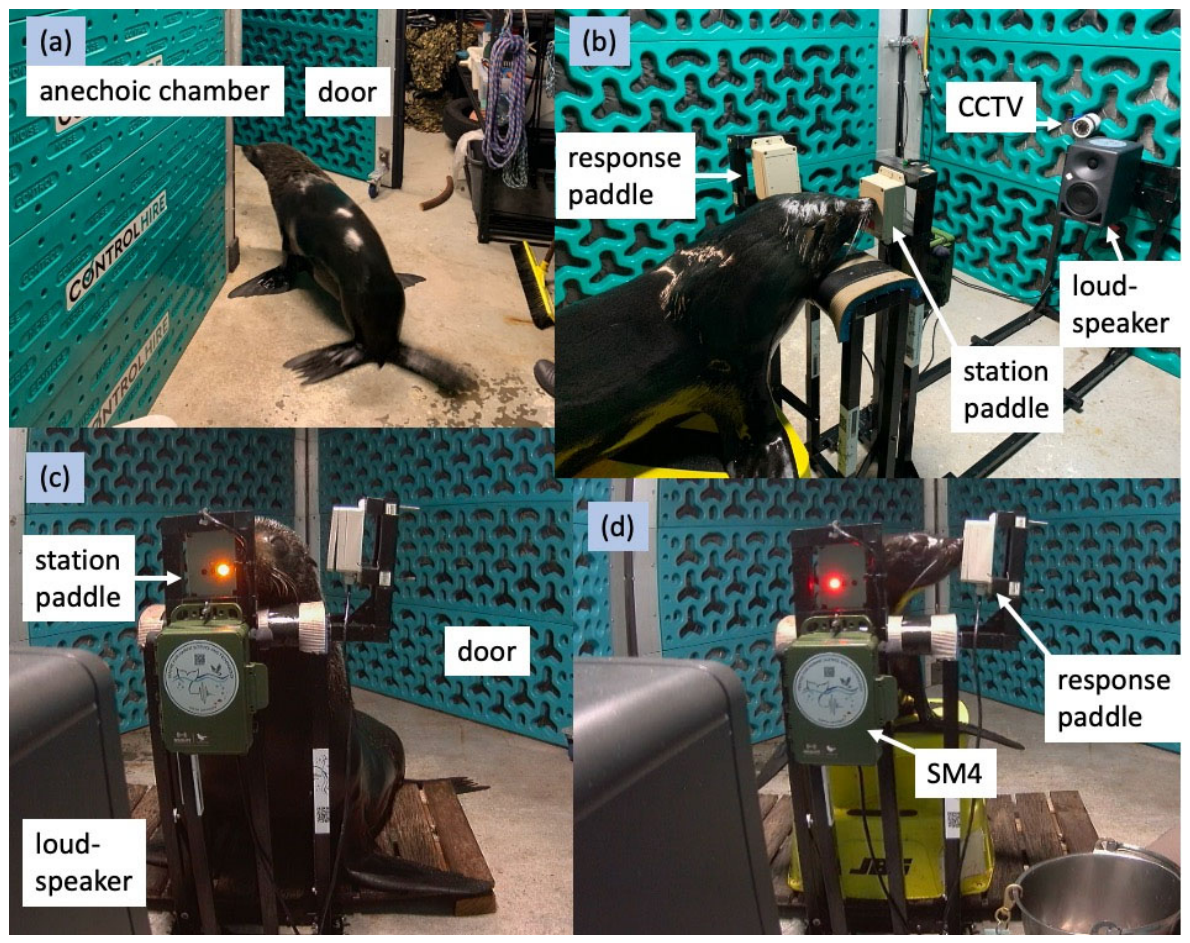
A custom frame constructed from Metal Mate modular aluminum tubing and polyethylene connectors (RCR, Cranbourne West, VIC, Australia) supported the loudspeaker, camera, chin rest, station paddle, and response paddle inside the anechoic chamber. The chin rest was positioned 1 m in front of the loudspeaker. Two custom-built paddles were mounted: a station paddle at the chin rest, aligned with the loudspeaker, and a response paddle laterally to the seal’s head. Color diodes at the rear of the station paddle, clearly visible by the CCTV camera, highlighted the seal’s behavior. Activation of the station paddle illuminated a yellow light, and activation of the response paddle illuminated a red light. A Song Meter SM4 acoustic recorder (Wildlife Acoustics, Maynard, MA, USA) was mounted beneath the chin station to record experimental sessions and verify relative levels. Sound pressure levels at the seals’ pinnae were calibrated using a B&K 2270 Sound Analyzer (ZF-weighting, 250 ms integration; Brüel & Kjær, Nærum, Denmark). Ambient noise levels were also measured at the seals’ ear positions. The experimental setup is shown in Figure 1.
For each trial, the seal rested its head on the chin rest and depressed the station paddle with its nose, signaling readiness to begin. The illuminated yellow indicator confirmed correct stationing to the experimenter. Within a 4 s interval, either a pure tone (signal trial) or no tone was presented (catch trial). Catch trials constituted ~30% of all trials, with a higher proportion towards the end of a session. If the seal detected the tone, it responded by pressing the response paddle; if no tone was detected, it maintained its position at the station for the full 4 s trial (go/no-go response). Only the experimenter knew what trial would come next and whether the animal gave a correct or false response. Upon a correct response (i.e., pressing the response paddle when a tone was played or holding station when no tone was played), the experimenter shouted ‘yes’ to a trainer in the chamber, upon which the trainer blew a whistle, upon which the animal turned towards the trainer for food reward. Upon a false response (i.e., missing a tone, breaking before a tone was played, or breaking on a catch trial), the experimenter shouted ‘no’, no whistle sounded, and the trainer restationed the animal for the next trial.
Each session tested a single frequency. Hearing thresholds were determined using a staircase procedure in which tone levels were decreased in 6 dB steps until the animal missed the tone, then increased in 6 dB steps until it responded again, and subsequently decreased and increased once more. Threshold estimates were calculated as the mean of the four reversal levels. Each frequency was tested in three separate sessions (hours or days apart) and the lowest threshold was reported.
Finally, we undertook a literature search for spectra of common anthropogenic noises in air. Most of the literature reports broadband levels integrated over frequency after A-weighting. These cannot be compared to animal audiograms to determine audibility. Instead, we collated the literature that reported spectra (either source spectra or received spectra at some distance from the source). If these spectra had been A-weighted, we converted them to unweighted spectra. We also interpolated or integrated them (depending on the resolution of the published spectra) into 1/3 octave bands as an upper estimate of otariid auditory filter width [27]. We applied a simple geometric spreading loss to illustrate how received levels decrease with increasing distance. We compared noise spectra to audiograms to discuss audibility.

3. Results

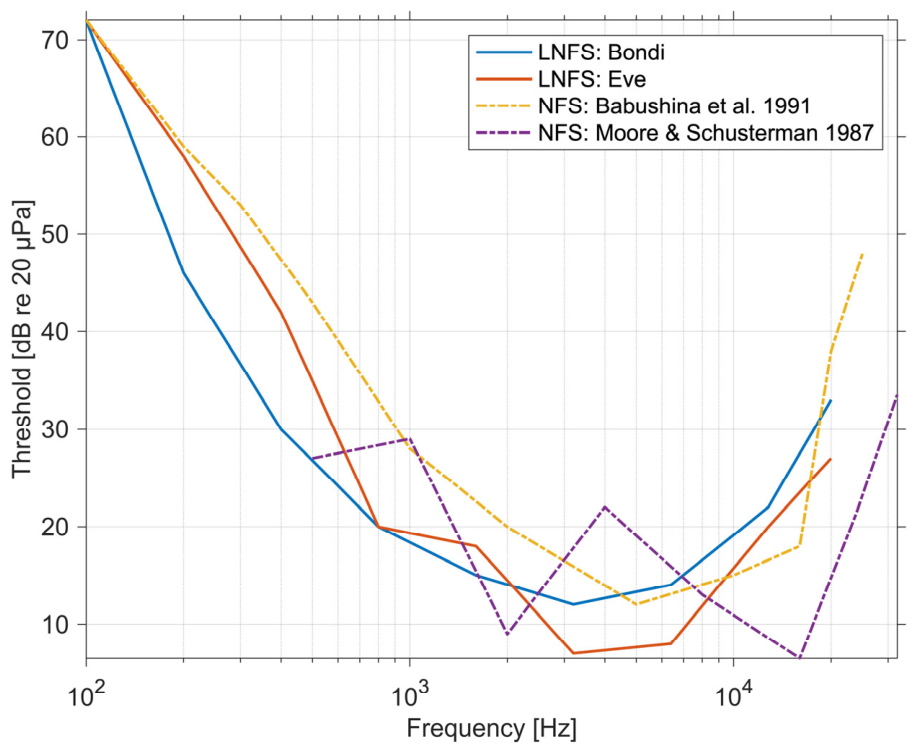
The two in-air audiograms are plotted in Figure 2, alongside previously published audiograms of Northern fur seals. The most sensitive frequency was 3.2 kHz for both Bondi and Eve, with a threshold of 12 and 7 dB re 20 µPa, respectively. The 20 dB bandwidth of best sensitivity ranged from 400 Hz to 20 kHz for Bondi and from 600 Hz to >20 kHz for Eve. Eve was more sensitive than Bondi from 3.2 to 20 kHz and somewhat less sensitive at 200 and 400 Hz. The maximum inter-individual difference was 12 dB (at both 200 and 400 Hz). The false alarm rates of both animals were low: ~10%.
Table 1 lists the measured thresholds compared to ambient noise in the anechoic chamber. Ambient noise levels at 3.2–20 kHz are an upper estimate as the spectrum analyzer reached its sensitivity limit.
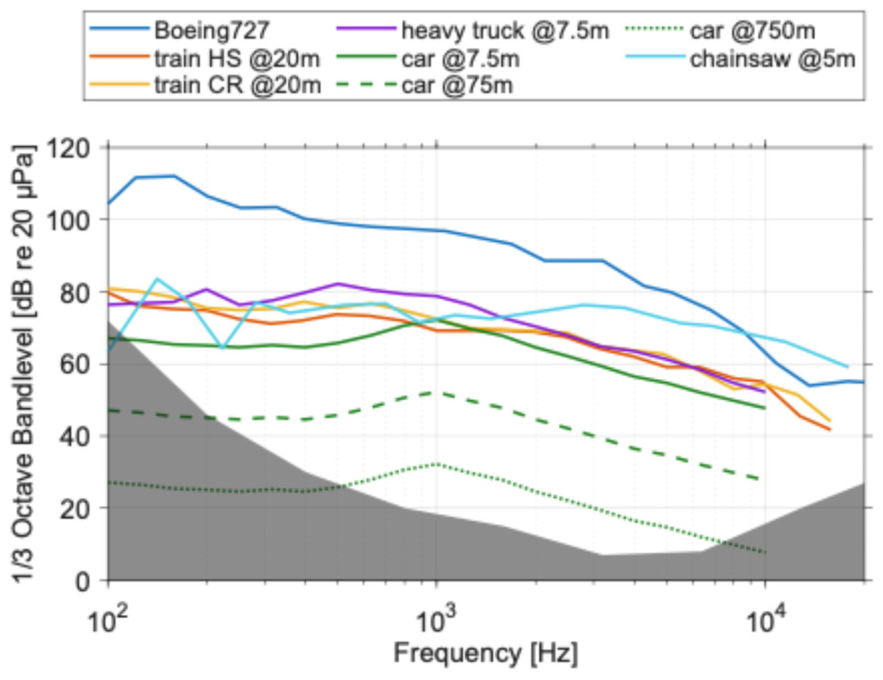
Figure 3 compares the lower threshold of the two individuals at each test frequency (gray shaded area) with measured 1/3 octave band levels of common noise sources in air. Levels above the audiogram are expected to be audible; those below are not. The Boeing 727 was recorded directly below the flight path at Sydney airport (altitude not given); its 1/3 octave band levels were 80 dB (sensation level) above the hearing threshold across much of the frequency range. Other aircraft had lower received levels and thus lower sensation levels, in decreasing order: Boeing 747, Fokker 28, Boeing 737, Boeing 767, and DH 8 [25]. High-speed (HS) trains and conventional railway (CR) trains recorded at a lateral range of 20 m only differed by <3 dB in received levels, which were up to 50 dB (sensation level) above threshold; the authors also provided recordings at ranges of 30, 50, 100, and 200 m, showing that received levels dropped by up to 22 dB at 200 m, which is close to spherical spreading [30]. Heavy trucks were 5–15 dB noisier than cars at 7.5 m from the road [31]. We also calculated and plotted the car spectrum at 75 m and 750 m distance from the road, under the assumption of spherical propagation loss, to illustrate how a farther-away sound source is audible over a narrower bandwidth. At 750 m, the car would only be audible between 500 and 7000 Hz, exceeding the audiogram by maximally 12 dB (sensation level). The chainsaw at a range of 5 m is predicted to be audible across the full bandwidth measured from 110 Hz to 20 kHz [32]. The authors also recorded the chainsaw at distances of 10, 20, 40, and 80 m, showing that the received level dropped by ~6 dB for every doubling of distance, in line with spherical spreading.
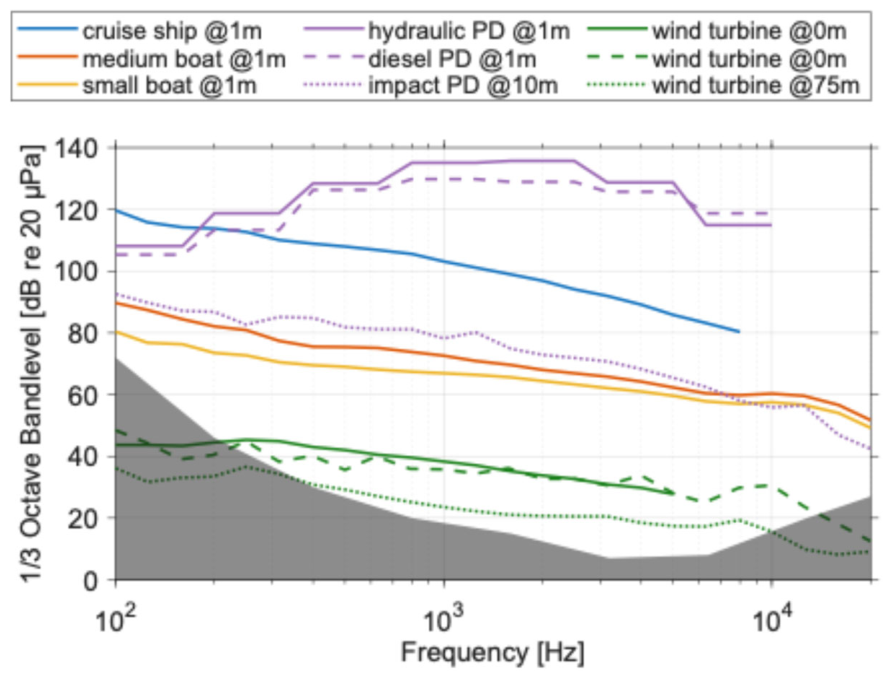
A 293 m long cruise ship docked in Venice, Italy, was recorded at several distances and azimuths, and a source spectrum was calculated placing a far-field equivalent point source at the top of the funnel [33]. The ship had its auxiliary engines running. Its maximum sensation level was 82 dB at 3.2 kHz. Small and mid-sized boats were recorded at a range of 7.5 m in the canals of Livorno, Italy [34]. Source levels were computed through back-propagation. At median speeds, the larger boats were maximally 10 dB noisier at the lower frequencies (100 Hz). Both boat classes were deemed audible over the full range from 100 Hz to 20 kHz. Pile driving (PD) was recorded at various ranges from a hydraulic and a diesel impact hammer during coastal terminal construction and back-propagated to source levels at a nominal range of 1 m [35]. Levels were lower in a different study, also during coastal wharf construction, with recordings made at a range of 10 m [36]. Finally, wind turbine noise from two measurement campaigns at multiple ranges showed sensation levels of 20 dB right beneath the turbine (0 m range) and 10 dB at a range of 75 m [37,38]. In a spherical-spreading model, the noise would drop below audibility at three times the range (225 m; another 10 dB loss), with its energy at 3.2 kHz being the last to become inaudible.

4. Discussion

We presented the first in-air audiograms of two Long-nosed fur seals, measured by behavioral audiometry. The frequency range of best sensitivity overlapped with the frequency ranges of this species’ communication calls (including male threat calls, guttural challenge calls, barks, growls, moans, mother-attraction calls, and pup-attraction calls), which have peak frequencies ranging from 500 to 3300 Hz [39,40,41,42,43,44].
Inter-individual differences were observed. Eve was only 2.5 years old, 12 years younger than Bondi. Better high-frequency sensitivity in younger and smaller pinnipeds has been reported elsewhere [45,46]. Furthermore, Bondi was wild-born, and therefore his early life history was unknown. Early exposure to strong environmental noise could have caused some loss of high-frequency sensitivity in the long term [47]. We acknowledge the small sample size of two individuals, which may not be representative of the species. Moreover, the two individuals were related, which could have caused bias. Nonetheless, the shape of the audiograms and the levels were comparable to those published for Northern fur seals, with differences of up to 20 dB, and the greatest difference occurring at 12.8 kHz.
Our findings are subject to several sources of uncertainty. First, the levels between the two ears differed by 0–1 dB at low frequencies (long wavelengths), increasing to 7 dB at the highest frequencies. While we used the mean value, the animal might have focused on one ear. Second, our step size of 6 dB was coarse compared to the 1 dB step size in the Northern fur seal study [29]. Third, we inserted more catch trials at lower signal levels, which could have biased the animals to give a more conservative response, yielding higher thresholds. The false alarm rates were low for both individuals, further supporting a conservative bias. Fourth, ambient noise inside the chamber might have masked lower tone levels at mid-frequencies, yielding higher thresholds. To assess the masking potential, information on auditory filter bandwidths is needed. While there is no information for Long-nosed fur seals, critical ratios in other otariids are smaller than 1/3 octave bandwidths (see reviews in [27,48]). Critical ratios give the ratio between a pure-tone mean square pressure and ambient noise power spectral density at the tone detection threshold; their unit is hertz. Critical ratios are commonly expressed as a level quantity in dB re 1 Hz [49,50]. Using 1/3 octave bandwidths as an upper estimate of critical ratios, at the frequencies where the ambient noise 1/3 octave band level fell below the hearing threshold, the latter was not masked. At 3.2 and 6.4 kHz, thresholds were below the sensitivity of the spectrum analyzer. Critical ratio levels in California sea lions (Zalophus californianus, the only otariid species for which they have been measured) are 20–25 dB re 1 Hz at these frequencies [51,52]. Adding these critical ratio levels to our upper estimates of ambient noise power spectral density level indicates that our levels were not masked; however, we cannot know whether the ambient noise was indeed flat within these 1/3 octave bands.
A literature review of common noise spectra demonstrated that our two Long-nosed fur seals when hauled-out will be able to hear cars and trucks [31], trains [30], airplanes [53,54], boats [34] and ships [33,55], machinery [32,56], construction activities [25,57,58,59], industrial plants [60], energy exploration and production operations [37,38,61,62], etc. These sounds are deemed audible across most of the frequency range of best sensitivity with high sensation levels at short ranges. To estimate how far from the source a sound may be audible, information on the hearing abilities of the receiver (including audiogram and critical ratios), on the sound propagation environment (terrain, vegetation, wind, and temperature), and on ambient noise is needed. Most of the noise literature reports levels in 1/3 octave bands, which are likely wider than the auditory filters of otariids [27,48], and thus lead to an overestimation of detection ranges. As sound spreads through an environment, it is reflected, refracted, scattered, and absorbed [63]. The simplest propagation model is spherical spreading, which assumes a homogeneous environment free from boundaries and scatterers, which is hardly ever the case. In situ levels can be more or less than predicted by spherical spreading. Ambient noise (e.g., from wind) may mask anthropogenic noise, reducing detection ranges.
Most of the anthropogenic sources we summarized are considered continuous, lasting from minutes to hours or longer. An exception is impact pile driving, which generates brief (millisecond) pulses every few seconds. To estimate the ranges over which this sound is audible, the sound propagation model needs to consider pulse spreading, and the hearing model needs to consider temporary integration times of the receiver [48].

5. Conclusions

Audiometric data of animals tell us which parts of the noise spectrum may be more harmful to animals and what type of impacts the noise may cause (e.g., whether a noise is barely detectable or strong enough to cause noise-induced hearing loss [64]). Audiograms are needed to derive auditory weighting functions, classify species into manageable hearing groups, and develop noise exposure criteria [65]. Audiograms thus inform environmental impact assessments of noise and ultimately enable the regulation and management of noise.
Unfortunately, hearing sensitivity remains uncharacterized for many species, limiting our understanding of species-specific vulnerability to noise. Future research should increase our sample size of Long-nosed fur seal individuals as well as measure hearing under water to be able to assess the potential impacts of underwater noise [11,66]. Noise footprints and impacts may then be mapped and overlaid with animal habitats to inform marine spatial planning [67]. The development of the Blue Economy needs to be sustainable to ensure responsible stewardship of our oceans.

Author Contributions

Conceptualization, C.E.; data curation, C.E.; formal analysis, C.E.; funding acquisition, C.E., D.S. and B.J.P.; investigation, C.E., A.v.G., E.K., B.M. and J.S.; methodology, C.E., A.v.G., E.K., B.M., J.S., L.G., M.P. and C.W.; project administration, C.E., D.S. and B.J.P.; resources, C.E., L.G., M.P., B.J.P., E.S. and D.S.; software, C.E. and E.S.; validation, C.E.; visualization, C.E.; writing—original draft preparation, C.E.; writing—review and editing, C.E., B.J.P. and C.W. All authors have read and agreed to the published version of the manuscript.

Funding

This research was funded by the Australian Government Department of Climate Change, Energy, the Environment and Water under the Renewables Environmental Research Initiative—Project 31.

Institutional Review Board Statement

This research was approved by the Animal Ethics Committee of the Taronga Conservation Society, Australia—Protocol 4a/08/25 on 14 August 2025. No incidents or harm occurred.

Data Availability Statement

All data outputs are presented in this article.

Acknowledgments

We thank Juan Carlos Azofeifa-Solano for helping with instrument calibration, preparation of the equipment manual, assembly, disassembly, and packing. We thank Dag Tollefsen for sourcing the calibration equipment, helping with equipment set-up, and sourcing noise absorbing walls.

Conflicts of Interest

The authors declare no conflicts of interest.

References

  1. Beckwith, R. Australia’s quiet success story: The riches of Bass Strait. J. Pet. Technol. 2011, 63, 42–45. [Google Scholar] [CrossRef] [Scilit]
  2. Evans, K.; McCauley, R.D.; Eveson, P.; Patterson, T. A summary of oil and gas exploration in the Great Australian Bight with particular reference to southern bluefin tuna. Deep.-Sea Res. II Top. Stud. Oceanogr. 2018, 157–158, 190–202. [Google Scholar] [CrossRef] [Scilit]
  3. Griffiths, L.L.; Goodman, C.; Voyer, M.; Stockbridge, J.; Lewis, A.; Croft, F.; Frid, C.L.J. Policy implications for offshore renewable energy in Australia: An MSP approach supporting the energy transition. Energy Policy 2025, 202, 114621. [Google Scholar] [CrossRef] [Scilit]
  4. Chen, P.S.-L.; Cahoon, S.; Fan, H.; Cooper, M.; Haward, M. Port strategy analysis for offshore wind farm construction in the Bass Strait region, Australia. In Proceedings of the ASME 2025 44th International Conference on Ocean, Offshore and Arctic Engineering, Vancouver, BC, Canada, 22–27 June 2025. [Google Scholar]
  5. Chen, P.S.-L.; Cahoon, S.; Fan, H. Navigating supply chain challenges: Port strategies for Australia’s offshore wind industry. In Proceedings of the Australian Centre for Offshore Wind Energy Technical Symposium, Gippsland, VIC, Australia, 11 September 2025; pp. 22–24. [Google Scholar]
  6. Kirkwood, R.; Goldsworthy, S. Seals in southern Australia. In Fur Seals and Sea Lions; CSIRO Publishing: Clayton, Australia, 2013; pp. 35–48. [Google Scholar]
  7. Hanke, F.D.; Reichmuth, C.; Cook, P. The sensory world of otariids. In Ethology and Behavioral Ecology of Otariids and the Odobenid; Campagna, C., Harcourt, R., Eds.; Springer: Cham, Switzerland, 2021; pp. 305–321. [Google Scholar]
  8. Parsons, S.K.; Erbe, C.; Marley, S.A.; Parsons, M.J. Pinniped sounds. In Marine Mammal Acoustics in a Noisy Ocean; Erbe, C., Houser, D., Bowles, A., Porter, M.B., Eds.; Springer: Cham, Switzerland, 2025; pp. 351–440. [Google Scholar]
  9. Deecke, V.B.; Slater, P.J.B.; Ford, J.K.B. Selective habituation shapes acoustic predator recognition in harbour seals. Nature 2002, 420, 171–173. [Google Scholar] [CrossRef] [Scilit] [PubMed]
  10. Chevallay, M.; Guinet, C.; Goulet-Tran, D.; Jeanniard du Dot, T. Sealing the deal–Antarctic fur seals’ active hunting tactics to capture small evasive prey revealed by miniature sonar tags. J. Exp. Biol. 2024, 227, jeb246937. [Google Scholar] [CrossRef] [Scilit] [PubMed]
  11. Erbe, C.; Bowles, A.; Houser, D.; Jolliffe, C.; Madhusudhana, S.; Marley, S.A.; Recalde Salas, A.; Salgado-Kent, C.; Schoeman, R.; Senigaglia, V.; et al. Behavioral responses to underwater noise. In Marine Mammal Acoustics in a Noisy Ocean; Erbe, C., Houser, D., Bowles, A., Porter, M.B., Eds.; Springer: Cham, Switzerland, 2025; pp. 611–698. [Google Scholar]
  12. Tripovich, J.S.; Hall-Aspland, S.; Charrier, I.; Arnould, J.P.Y. The behavioural response of Australian fur seals to motor boat noise. PLoS ONE 2012, 7, e37228. [Google Scholar] [CrossRef] [Scilit] [PubMed]
  13. Back, J.J.; Hoskins, A.J.; Kirkwood, R.; Arnould, J.P.Y. Behavioral responses of Australian fur seals to boat approaches at a breeding colony. Nat. Conserv. 2018, 31, 35–52. [Google Scholar] [CrossRef] [Scilit]
  14. Insley, S.J. Impact of airborne noise on northern fur seals in the Pribilof Islands, Alaska: A preliminary assessment. In Fur Seal Investigations. NOAA Technical Memorandum NMFS-AFSC-2; Kajimura, H., Sinclair, E., Eds.; Alaska Fisheries Science Centre: Seattle, WA, USA, 1990; pp. 27–47. [Google Scholar]
  15. Williams, M.T.S. The Impact of Aircraft Activity on the Behavior and Productivity of Northern Fur Seals (Callorhinus ursinus) on St. George Island, Alaska. Master’s Thesis, University of Alaska Fairbanks, Fairbanks, AK, USA, 1997. [Google Scholar]
  16. Martin, M.; Gridley, T.; Elwen, S.H.; Charrier, I. Assessment of the impact of anthropogenic airborne noise on the behaviour of Cape fur seals during the breeding season in Namibia. J. Exp. Mar. Biol. Ecol. 2022, 550, 151721. [Google Scholar] [CrossRef] [Scilit]
  17. Lalas, C.; McConnell, H. Effects of seismic surveys on New Zealand fur seals during daylight hours: Do fur seals respond to obstacles rather than airgun noise? Mar. Mamm. Sci. 2016, 32, 643–663. [Google Scholar] [CrossRef] [Scilit]
  18. Senigaglia, V.; Houser, D.; Jolliffe, C.; Erbe, C. Biological significance of responses to noise. In Marine Mammal Acoustics in a Noisy Ocean; Erbe, C., Houser, D., Bowles, A., Porter, M.B., Eds.; Springer: Cham, Switzerland, 2025; pp. 699–729. [Google Scholar]
  19. ANSI S3.20-2015, R 2020; Bioacoustical Terminology. American National Standards Institute, Acoustical Society of America: New York, NY, USA, 2015.
  20. Chilvers, B.L.; Goldsworthy, S.D. Arctocephalus forsteri. IUCN Red List Threat. Species 2015, e.T41664A45230026. [Google Scholar] [CrossRef] [Scilit]
  21. Salton, M.; Carr, M.; Tarjan, L.M.; Clarke, J.; Kirkwood, R.; Slip, D.; Harcourt, R. Protected area use by two sympatric marine predators repopulating their historical range. Endang. Species Res. 2021, 45, 181–194. [Google Scholar] [CrossRef] [Scilit]
  22. Dickie, G.; Dawson, S.M. Age, growth, and reproduction in New Zealand fur seals. Mar. Mamm. Sci. 2003, 19, 173–185. [Google Scholar] [CrossRef] [Scilit]
  23. Page, B.; McKenzie, J.; Goldsworthy, S.D. Inter-sexual differences in New Zealand fur seal diving behaviour. Mar. Ecol. Prog. Ser. 2005, 304, 249–264. [Google Scholar] [CrossRef] [Scilit]
  24. Page, B.; McKenzie, J.; Sumner, M.D.; Coyne, M.; Goldsworthy, S.D. Spatial separation of foraging habitats among New Zealand fur seals. Mar. Ecol. Prog. Ser. 2006, 323, 263–279. [Google Scholar] [CrossRef] [Scilit]
  25. Berglund, B.; Hassmén, P.; Job, R.F.S. Sources and effects of low-frequency noise. J. Acoust. Soc. Am. 1996, 99, 2985–3002. [Google Scholar] [CrossRef] [Scilit] [PubMed]
  26. Yonezawa, T.; Kohno, N.; Hasegawa, M. The monophyletic origin of sea lions and fur seals (Carnivora; Otariidae) in the Southern Hemisphere. Gene 2009, 441, 89–99. [Google Scholar] [CrossRef] [Scilit] [PubMed]
  27. Erbe, C.; Reichmuth, C.; Cunningham, K.C.; Lucke, K.; Dooling, R.J. Communication masking in marine mammals: A review and research strategy. Mar. Pollut. Bull. 2016, 103, 15–38. [Google Scholar] [CrossRef] [Scilit] [PubMed]
  28. Babushina, Y.S.; Zaslavskii, G.L.; Yurkevich, L.I. Air and underwater hearing characteristics of the northern fur seal: Audiograms, frequency and differential thresholds. Biophysics 1991, 39, 900–913. [Google Scholar]
  29. Moore, P.W.B.; Schusterman, R.J. Audiometric assessment of northern fur seals, Callorhinus ursinus. Mar. Mamm. Sci. 1987, 3, 31–53. [Google Scholar] [CrossRef] [Scilit]
  30. Di, G.-Q.; Lin, Q.-L.; Li, Z.-G.; Kang, J. Annoyance and activity disturbance induced by high-speed railway and conventional railway noise: A contrastive case study. Environ. Health 2014, 13, 12. [Google Scholar] [CrossRef] [Scilit] [PubMed]
  31. Rochat, J.L.; Read, D.R. Noise benefits of asphalt pavements—Trends at ages up to 52 months. Noise Control Eng. J. 2009, 57, 104–111. [Google Scholar] [CrossRef] [Scilit]
  32. Potočnik, I.; Poje, A. Noise pollution in forest environment due to forest operations. Croat. J. For. Eng. 2010, 32, 137–148. [Google Scholar]
  33. Di Bella, A.; Remigi, F. Prediction of noise of moored ships. Proc. Meet. Acoust. 2013, 19, 010053. [Google Scholar] [CrossRef] [Scilit]
  34. Bernardini, M.; Fredianelli, L.; Fidecaro, F.; Gagliardi, P.; Nastasi, M.; Licitra, G. Noise assessment of small vessels for action planning in canal cities. Environments 2019, 6, 31. [Google Scholar] [CrossRef] [Scilit]
  35. Morrill, L.; Jones, D.; Blackwell, D. Impact pile driving noise propagation. In Proceedings of the INTER-NOISE and NOISE-CON Congress and Conference Proceedings, New Orleans, LA, USA, 16–20 November 2020; pp. 625–634. [Google Scholar]
  36. Illingworth & Rodkin. Naval Base Kitsap at Bangor Trident Support Facilities Explosive Handling Wharf (EHW-2) Project Acoustic Monitoring Report; NAVY Strategic Systems Programs: Petaluma, CA, USA, 2013. [Google Scholar]
  37. Katinas, V.; Marčiukaitis, M.; Tamašauskienė, M. Analysis of the wind turbine noise emissions and impact on the environment. Renew. Sustain. Energy Rev. 2016, 58, 825–831. [Google Scholar] [CrossRef] [Scilit]
  38. Zhu, W.J.; Cao, J.; Barlas, E.; Shen, W.Z.; Zhang, L.; Sun, Z.; Yang, H.; Xu, H. An integrated numerical method for wind turbine flow simulation, sound generation and propagation. J. Phys. Conf. Ser. 2018, 1037, 022002. [Google Scholar] [CrossRef] [Scilit]
  39. Stirling, I. Observations on the behavior of the New Zealand fur seal (Arctocephalus forsteri). J. Mammal. 1970, 51, 766–778. [Google Scholar] [CrossRef] [Scilit]
  40. Stirling, I. Studies on the behaviour of the South Australian fur seal, Arctocephalus forsteri (Lesson). I. Annual cycle, postures and calls, and adult males during the breeding season. Aust. J. Zool. 1971, 19, 243–266. [Google Scholar] [CrossRef] [Scilit]
  41. Miller, E.H. Social and Thermoregulatory Behaviour of the New Zealand Fur Seal, Arctocephalus forsteri (Lesson, 1828). Master’s Thesis, University of Canterbury, Christchurch, New Zealand, 1971. [Google Scholar]
  42. Miller, E.H. Social behaviour between adult male and female New Zealand fur seals, Arctocephalus forsteri (Lesson) during the breeding season. Aust. J. Zool. 1974, 22, 155–173. [Google Scholar] [CrossRef] [Scilit] [PubMed]
  43. Crawley, M.C.; Wilson, G.J. The natural history and behaviour of the New Zealand fur seal (Arctocephalus forsteri). Tuatara 1976, 22, 1–29. [Google Scholar]
  44. Page, B.; Goldsworthy, S.D.; Hindell, M.A. Individual vocal traits of mother and pup fur seals. Bioacoustics 2002, 13, 121–143. [Google Scholar] [CrossRef] [Scilit]
  45. Reichmuth, C.; Mulsow, J.; Finneran, J.J.; Houser, D.S.; Supin, A.Y. Measurement and response characteristics of auditory brainstem responses in pinnipeds. Aquat. Mamm. 2007, 33, 132–150. [Google Scholar] [CrossRef] [Scilit]
  46. Lucke, K.; Hastie, G.D.; Ternes, K.; McConnell, B.; Moss, S.; Russell, D.J.F.; Weber, H.; Janik, V.M. Aerial low-frequency hearing in captive and free-ranging harbour seals (Phoca vitulina) measured using auditory brainstem responses. J. Comp. Physiol. 2016, 202, 859–868. [Google Scholar] [CrossRef] [Scilit] [PubMed]
  47. Reichmuth, C.; Sills, J.M.; Mulsow, J.; Ghoul, A. Long-term evidence of noise-induced permanent threshold shift in a harbor seal (Phoca vitulina). J. Acoust. Soc. Am. 2019, 146, 2552–2561. [Google Scholar] [CrossRef] [Scilit] [PubMed]
  48. Houser, D. Marine Mammal Hearing. In Marine Mammal Acoustics in a Noisy Ocean; Erbe, C., Houser, D., Bowles, A., Porter, M.B., Eds.; Springer: Cham, Switzerland, 2025; pp. 491–578. [Google Scholar]
  49. ANSI/ASA S3.20; American National Standard Bioacoustical Terminology. American National Standards Institute, Acoustical Society of America: New York, NY, USA, 2015.
  50. ISO 18405; Underwater Acoustics—Terminology. International Organization for Standardization: Geneva, Switzerland, 2017.
  51. Jones, R.A.; Sills, J.M.; Synnott, M.; Mulsow, J.; Williams, R.; Reichmuth, C. Auditory masking in odobenid and otariid carnivores. J. Acoust. Soc. Am. 2023, 154, 1746–1756. [Google Scholar] [CrossRef] [Scilit] [PubMed]
  52. Southall, B.L.; Schusterman, R.J.; Kastak, D. Auditory masking in three pinnipeds: Aerial critical ratios and direct critical bandwidth measurements. J. Acoust. Soc. Am. 2003, 114, 1660–1666. [Google Scholar] [CrossRef] [Scilit] [PubMed]
  53. Filippone, A.; Harwood, A. Flyover noise measurements and predictions of commercial airplanes. J. Aircr. 2015, 53, 396–405. [Google Scholar] [CrossRef] [Scilit]
  54. Simons, D.G.; Snellen, M.; Midden, B.v.; Arntzen, M.; Bergmans, D.H.T. Assessment of noise level variations of aircraft flyovers using acoustic arrays. J. Aircr. 2015, 52, 1625–1633. [Google Scholar] [CrossRef] [Scilit]
  55. Biot, M.; Borelli, D.; Gaggero, T.; Lembo, E.; Mocerino, L.; Rognoni, G.; Schenone, C.; Rizzuto, E.; Viscardi, M. Quantification of airborne noise emitted by ships based on class notation. Ocean Eng. 2024, 296, 117085. [Google Scholar] [CrossRef] [Scilit]
  56. Gulyas, K.; Pinte, G.; Augusztinovicz, F.; Desmet, W.; Sas, P. Active noise control in agricultural machines. In Proceedings of the Proceedings of the 2002 International Conference on Noise and Vibration Engineering, ISMA, Leuven, Belgium, 16–18 September 2002; pp. 16–18. [Google Scholar]
  57. Roberts, C. Construction noise and vibration impact on sensitive premises. In Proceedings of the ACOUSTICS, Adelaide, Australia, 23–25 November 2009; pp. 1–10. Available online: https://www.acoustics.asn.au/conference_proceedings/AAS2009/papers/p11.pdf (accessed on 22 June 2026).
  58. Greene, R.; Pirie, R.; Greene, M. Comparison of pile-driver noise and vibration from various pile-driving methods and pile types. In Proceedings of the International Congress and Exposition on Noise Control Engineering, Dearborn, MI, USA, 19–21 August 2002; pp. 327–332. [Google Scholar]
  59. Knauer, H.; Pedersen, S.; Reherman, C.N.; Rochat, J.L.; Thalheimer, E.S.; Lau, M.C.; Fleming, G.G.; Ferroni, M.; Corbisier, C. FHWA Highway Construction Noise Handbook; U.S. Department of Transportation, Federal Highway Administration, Office of Natural and Human Environment: Washington DC, USA, 2006.
  60. Onjefu, S.; Ejembi, E.; Onjefu, L. Measurement of noise pollution in northern industrial areas of Windhoek, Namibia. J. Environ. Prot. 2019, 10, 1144–1154. [Google Scholar] [CrossRef]
  61. Wagner, S.; Bareiß, R.; Guidati, G. Wind Turbine Noise; Springer Science & Business Media: New York, NY, USA, 2012. [Google Scholar]
  62. Deichmann, J.L.; Hernández-Serna, A.; Amanda, D.C.J.; Campos-Cerqueira, M.; Aide, T.M. Soundscape analysis and acoustic monitoring document impacts of natural gas exploration on biodiversity in a tropical forest. Ecol. Indic. 2017, 74, 39–48. [Google Scholar] [CrossRef] [Scilit]
  63. Larsen, O.N.; Gannon, W.L.; Erbe, C.; Pavan, G.; Thomas, J.A. Source-path-receiver model for airborne sounds. In Exploring Animal Behavior Through Sound: Volume 1: Methods; Erbe, C., Thomas, J.A., Eds.; Springer International Publishing: Cham, Switzerland, 2022; pp. 153–183. [Google Scholar]
  64. Houser, D. Physiological effects of sound on marine mammals. In Marine Mammal Acoustics in a Noisy Ocean; Erbe, C., Houser, D., Bowles, A., Porter, M.B., Eds.; Springer: Cham, Switzerland, 2025; pp. 579–609. [Google Scholar]
  65. Houser, D.S.; Yost, W.; Burkard, R.; Finneran, J.J.; Reichmuth, C.; Mulsow, J. A review of the history, development and application of auditory weighting functions in humans and marine mammals. J. Acoust. Soc. Am. 2017, 141, 1371–1413. [Google Scholar] [CrossRef] [Scilit] [PubMed]
  66. Erbe, C.; Duncan, A.J.; Gavrilov, A.; Landero, M.; McCauley, R.D.; Parnum, I.; Salgado-Kent, C.; Sidenko, E. Sources of underwater noise. In Marine Mammal Acoustics in a Noisy Ocean; Erbe, C., Houser, D., Bowles, A., Porter, M.B., Eds.; Springer: Cham, Switzerland, 2025; pp. 85–178. [Google Scholar]
  67. Bosi, S.; Ramieri, E.; Picciulin, M.; Menegon, S.; Ghezzo, M.; Petrizzo, A.; Folegot, T.; Madricardo, F.; Barbanti, A. Is maritime spatial planning a tool to mitigate the impacts of underwater noise? A review of adopted and upcoming maritime spatial plans in Europe. Mar. Policy 2023, 155, 105725. [Google Scholar] [CrossRef] [Scilit]
Figure 1. Photos of (a) Bondi racing into the anechoic chamber; (b) Eve stationing for a hearing test; (c) Bondi holding station (view from the CCTV; note the yellow diode); (d) Eve pressing the response paddle (view from the CCTV; note the red diode).
Conservation 06 00099 g001
Figure 2. In-air audiograms of Bondi and Eve, compared to those published for Northern fur seals [28,29].
Conservation 06 00099 g002
Figure 3. Spectra of common terrestrial noises shown as 1/3 octave band levels compared to the lower hearing threshold of the two Long-nosed fur seals (gray shaded area). Levels above the audiogram are deemed audible. (Top): Boeing 727 overflight [25]; high-speed (HS) and conventional rail (CR) trains at 20 m distance from the tracks [30]; heavy trucks and cars at 7.5 m distance from the road [31]; car spectrum predicted at greater distances based on spherical spreading; chainsaw at a range of 5 m [32]. (Bottom): Moored cruise ship with auxiliary engines running and source spectrum referenced to a range of 1 m from the funnel [33]; small and medium-sized boats at median speed referenced to a range of 1 m [34]; impact pile driving (PD) during coastal construction at a range of 1 m from two different hammers [35] and at a range of 10 m [36]; wind turbines at different distances from the monopile [37,38].
Conservation 06 00099 g003aConservation 06 00099 g003b
Table 1. Frequency of the pure tones tested, hearing thresholds of the two Long-nosed fur seals, ambient noise measured as 1/3 octave band levels (OBLs), and ambient noise power spectral density (PSD) computed from the OBLs under the assumption of a flat spectrum within each band. * Level extrapolated based on the 6 dB step size verified with the SM4 closer to the speaker. ** Sensitivity limit of the B&K analyzer.
Frequency [Hz]Bondi’s
Threshold
[dB re 20 µPa]
Eve’s
Threshold
[dB re 20 µPa]
Ambient Noise
1/3 OBL
[dB re 20 µPa]
Ambient Noise
PSD
[dB re (20 µPa)2/Hz]
10072723420
2004658269
400304218−2
800202015−8
1600151814−12
3200127 *≤11 **−18
6400148 *≤12 **−20
12,8002220≤12 **−23
20,0003327≤12 **−25
Disclaimer/Publisher’s Note: The statements, opinions and data contained in all publications are solely those of the individual author(s) and contributor(s) and not of MDPI and/or the editor(s). MDPI and/or the editor(s) disclaim responsibility for any injury to people or property resulting from any ideas, methods, instructions or products referred to in the content.