
Four Decades of Community-Based Conservation in Northeast India: Nature’s Beckon, Environmental Activism, and Transferable Lessons

 ,
,  ,
,  ,
,  , and
, and
Abstract
1. Introduction
1.1. Research Gap
1.2. Research Objectives
- To document the institutional history and conservation practice of Nature’s Beckon across 4 decades of work;
- To evaluate the conservation outcomes of the organisation’s principal campaigns through a synthesis of organisational records and peer-reviewed scientific data on protected-area effectiveness;
- To derive policy-relevant lessons for community-based conservation in postcolonial frontier regions;
- To situate the case within the international literature on community-based conservation, and to specify which elements of the model appear transferable to other regions and which do not.
1.3. Conceptual Framework: An Ecology of the Margins
2. Materials and Methods
2.1. Research Design
2.2. Data Sources
2.3. Analytical Framework
2.4. Limitations
2.5. Use of Generative AI
3. Nature’s Beckon in Practice: Institutional History and Campaign Analyses
3.1. Nature’s Beckon: Genesis, Mission, and Institutional Praxis
3.2. Soumyadeep Datta as Conservationist-Intellectual
3.3. Case Study 1: The Chakrashila Wildlife Sanctuary Movement (Early 1980s–1994)
3.4. Case Study 2: The Dihing Patkai Movement (1992–2021)
3.5. Case Study 3: Primate Conservation
3.6. Case Study 4: The Village Sanctuary Model and Eco-Education
3.7. Cross-Case Synthesis
4. Analysis: Outcomes, Framework, and Comparative Position
4.1. Long-Term Organisational Capacity
4.2. Vernacular Knowledge as Institutional Infrastructure
4.3. Community Legitimacy and Conservation Outcomes
4.4. The Ecology of the Margins: What the Framework Adds
4.5. Political Opportunity and State Negotiation
4.6. Comparison with Global Community-Conservation Literature
4.7. Transferable and Non-Transferable Elements
4.8. Limits of the Framework and of the Evidence
4.9. Policy Implications for Conservation Practice
5. Conclusions
Supplementary Materials
Author Contributions
Funding
Institutional Review Board Statement
Informed Consent Statement
Data Availability Statement
Acknowledgments
Conflicts of Interest
Appendix A

| Title (Romanised; English Gloss) | Subject | Publisher and Place | Year | ISBN | pp. |
|---|---|---|---|---|---|
| Aranyar Cha-Pohar [The Light and Shade of the Forest] | Forest travelogue | Students’ Stores, Guwahati; Banalata ed., Dibrugarh | 2003; 2015 | 978-93-82750-88-8 | 182 |
| Udgiran [Eruption] | Nature writing | Students’ Stores, Guwahati | 2005 | None assigned | 180 |
| Pratibad aru Pratyasha [Protest and Expectation] | Conservation essays | Malini Prakashan, Jorhat and Guwahati | 2006 | None assigned | 232 |
| Asomor Primate [Primates of Assam] | Species monograph | Nature’s Beckon, Dhubri | 2007 | None assigned | 280 |
| Aparupa Arunachal [Arunachal the Beautiful] | Forest travelogue | Bhabani Print & Publications, Guwahati | 2008; 2nd ed. 2010 | 978-81-904940-9-0 | 259 |
| Sanctuaries and National Parks of Assam (in English; edited by Datta, compiled by N. Sarma; a separate and earlier work from the 2023 Assamese volume below) | Protected-area reference | Nature’s Beckon, Dhubri | 2009 | None assigned | 135 |
| Aranyat Ekhoj-Dukhoj [A Step or Two into the Forest] | Literary essays on wildlife | Bhabani Print & Publications, Guwahati | 2010 | 978-93-80390-49-9 | 158 |
| Asomor Bonoriya Mekuri [Wild Cats of Assam] | Species monograph | Bhabani Print & Publications, Guwahati | 2010 | 978-93-80390-78-9 | 112 |
| Namchangar Anteshpur [The Inner Chamber of Namchang] | Account of a forest-preservation campaign | Banphool Prakashan, Guwahati; ed. S. Lahkar | 2010; 2nd ed. 2012 | 978-81-909523-6-1 | 416 |
| Asomor Charai Paryabekshanar Hatputhi [Handbook of Bird-Watching in Assam] | Field handbook | Banphool Prakashan, Guwahati; ed. S. Lahkar | 2011 | 978-81-909523-8-5 | 188 |
| Prakritir Sahagami Chinta aru Chetana [Thought and Awareness in Company with Nature] | Collected conservation articles | Kalyani Book Stall, Guwahati | 2011 | None assigned | 162 |
| Asomor Stanyapayi Banyajantu [Mammals of Assam] | Species monograph | Banphool Prakashan, Guwahati | 2012 | 978-93-81710-08-1 | 136 |
| Prakriti Sibir [Nature Camp] (edited) | Articles on conservation and nature camps | Nature’s Beckon, Dhubri | 2012 | None assigned | 146 |
| Bipanna Dharitri: Sankatat Banyaprani [Imperilled Earth: Wildlife in Crisis] | Nature and wildlife conservation | Jyoti Prakashan, Guwahati | 2012 | 978-93-81485-35-4 | 412 |
| Rainforests of Assam (in English; Datta as managing editor) | Rainforest ecology and conservation | Nature’s Beckon, Dhubri, with Bhabani Books, Guwahati | 2013 | 978-93-82624-71-4 | 156 |
| Aranyapathar Pothik [Traveller on the Forest Path] | Forest travelogue | Bhabani Books, Guwahati | 2013 | 978-93-82624-73-8 | 235 |
| Dihing Patkai Abhayaryana [Dihing Patkai Wildlife Sanctuary] | Protected-area monograph | Nature’s Beckon, Dhubri | 2014 | None assigned | 176 |
| Ecotourist | Eco-tourism | Nature’s Beckon with Bhabani Books, Guwahati | 2014; 2nd ed. 2014 | 978-93-82624-95-0 | 162 |
| Kaziranga Rastriya Udyan [Kaziranga National Park] | Protected-area monograph | Nature’s Beckon, Dhubri, and Bhabani Books, Guwahati | 2015 | 978-93-81139-72-1 | 172 |
| Aranyatur Bhramankatha [Travel Tales of One Who Longs for the Forest] | Forest travelogue | Banalata, Guwahati | 2015 | 978-93-82056-01-0 | 231 |
| Asomor Jalasar Corai [Water Birds of Assam] | Species monograph | Banalata, Dibrugarh | 2017 | 978-93-82056-41-6 | 196 |
| Amar Binandia Charai aru Tar Sangrakhyan [Our Lovely Birds and Their Conservation] | Species monograph and conservation | Nature’s Beckon, Dhubri | 2017 | None assigned | 144 |
| Asomor Sikari Charai [Birds of Prey of Assam] | Species monograph | Banalata, Dibrugarh | 2018 | 978-93-87956-08-7 | 196 |
| Lahul-Spiti aru Kinnar Upatyakat [In the Lahaul-Spiti and Kinnaur Valleys] | Mountain travelogue | Bhabani Books, Guwahati | 2018 | 978-93-87494-16-9 | 142 |
| Amar Apurugia Stanyapayi Banyaprani aru Tar Sangrakshan [Our Rare Wild Mammals and Their Conservation] | Species monograph and conservation | Creative Design, Dibrugarh, and Nature’s Beckon, Dhubri | 2019 | 978-93-6466-3-2 | 144 |
| Udbhaxito Mayabon [The Radiant Enchanted Forest] | Forest travelogue | Creative Design, Dibrugarh | 2021 | 978-93-89865-51-6 | 365 |
| Asomor Aranya, Abhayaranya aru Rastriya Udyan [Forests, Wildlife Sanctuaries and National Parks of Assam]; also cited as Sanctuary and National Parks of Assam | Protected-area reference | Banalata, Dibrugarh | 2023 | 978-93-5849-001-5 | 400 |
| Asomor Barxaranya Dihing Patkai Rastriya Udyan [Assam’s Rainforest: Dihing Patkai National Park] | Campaign history and protected-area monograph | Nature’s Beckon, Dhubri | 2024; 2nd ed. 2026 | 978-93-95252-11-9 | 192 |
References
- IPBES. Global Assessment Report on Biodiversity and Ecosystem Services of the Intergovernmental Science-Policy Platform on Biodiversity and Ecosystem Services; Brondízio, E.S., Settele, J., Díaz, S., Ngo, H.T., Eds.; IPBES Secretariat: Bonn, Germany, 2019. [Google Scholar] [CrossRef]
- Valiente-Banuet, A.; Aizen, M.A.; Alcántara, J.M.; Arroyo, J.; Cocucci, A.; Galetti, M.; García, M.B.; García, D.; Gómez, J.M.; Jordano, P.; et al. Beyond species loss: The extinction of ecological interactions in a changing world. Funct. Ecol. 2015, 29, 299–307. [Google Scholar] [CrossRef] [Scilit]
- Pillai, A.; Naskar, R. Community-Based Conservation Can Help Achieve 30 × 30 Biodiversity Target. Mongabay India Commentary, 20 December 2024. Available online: https://india.mongabay.com/2024/12/commentary-community-based-conservation-can-help-achieve-30x30-biodiversity-target/ (accessed on 25 April 2026).
- Wildlife Institute of India; National Wildlife Database Cell. Protected Areas of India; Wildlife Institute of India: Dehradun, Uttarakhand, India, 2023. Available online: https://wii.gov.in/nwdc_aboutus (accessed on 2 August 2026).
- Mittermeier, R.A.; Turner, W.R.; Larsen, F.W.; Brooks, T.M.; Gascon, C. Global biodiversity conservation: The critical role of hotspots. In Biodiversity Hotspots; Zachos, F.E., Habel, J.C., Eds.; Springer: Berlin/Heidelberg, Germany, 2011; pp. 3–22. [Google Scholar] [CrossRef] [Scilit]
- Myers, N.; Mittermeier, R.A.; Mittermeier, C.G.; da Fonseca, G.A.B.; Kent, J. Biodiversity hotspots for conservation priorities. Nature 2000, 403, 853–858. [Google Scholar] [CrossRef] [Scilit] [PubMed]
- Chatterjee, S. Biodiversity conservation issues of Northeast India. Int. For. Rev. 2008, 10, 315–324. [Google Scholar] [CrossRef] [Scilit]
- Sengupta, A.; Borgohain, S. Dehing Patkai National Park: Ecological nationalism and the politics of conservation. Econ. Political Wkly. 2023, 58, 23–28. [Google Scholar]
- Reddy, C.S.; Saranya, K.R.S.; Pasha, S.V.; Satish, K.V.; Jha, C.S.; Diwakar, P.G.; Dadhwal, V.K.; Rao, P.V.N.; Murthy, Y.V.N.K. Assessment and monitoring of deforestation and forest fragmentation in South Asia since the 1930s. Glob. Planet. Change 2018, 161, 132–148. [Google Scholar] [CrossRef] [Scilit]
- Chitale, V.S.; Behera, M.D.; Roy, P.S. Future of endemic flora of biodiversity hotspots in India. PLoS ONE 2014, 9, e115264. [Google Scholar] [CrossRef] [Scilit] [PubMed]
- Aiyadurai, A. Tigers Are Our Brothers: Anthropology of Wildlife Conservation in Northeast India; Oxford University Press: New Delhi, India, 2017. [Google Scholar]
- Lyngdoh, A.W.; Kumara, H.N.; Babu, S.; Karunakaran, P.V. Community Reserves: Their significance for the conservation of mammals in a mosaic of community-managed lands in Meghalaya, Northeast India. PLoS ONE 2023, 18, e0280994. [Google Scholar] [CrossRef] [Scilit] [PubMed]
- Rajkhowa, A.; Borah, P. Assamese nature writing and Soumyadeep Datta’s contribution. Educ. Adm. Theory Pract. 2024, 30, 2636–2639. [Google Scholar] [CrossRef] [Scilit]
- Pathak, A.R.; Bharadwaj, J. The Dehing Patkai Rainforest and Coal Mining in Northeastern India. Critical Asian Studies Commentary Board. 2020. Available online: https://criticalasianstudies.org/commentary/2020/6/19/20207-aditya-ranjan-pathak-and-jahnu-bharadwaj-the-dehing-patkai-rainforest-and-coal-mining-in-northeastern-india (accessed on 22 April 2026).
- Brooks, J.S.; Waylen, K.A.; Borgerhoff Mulder, M. How national context, project design, and local community characteristics influence success in community-based conservation projects. Proc. Natl. Acad. Sci. USA 2012, 109, 21265–21270. [Google Scholar] [CrossRef] [Scilit] [PubMed]
- Rajkhowa, A. (Ed.) Asamiya Prakriti-Sahitya aru Soumyadeep Datta [Assamese Nature-Literature and Soumyadeep Datta], 3rd ed.; North Lakhimpur College Publication: North Lakhimpur, Assam, India, 2024. (In Assamese) [Google Scholar]
- Borah, P. Ekabingsha Satikar Asamiya Sahityat Paribesh Chetana [Environmental Consciousness in Twenty-First-Century Assamese Literature]; Asam Sahitya Sabha: Guwahati, Assam, India, 2024. (In Assamese) [Google Scholar]
- Scheidel, A.; Del Bene, D.; Liu, J.; Navas, G.; Mingorría, S.; Demaria, F.; Avila, S.; Roy, B.; Ertör, I.; Temper, L.; et al. Environmental conflicts and defenders: A global overview. Glob. Environ. Change 2020, 63, 102104. [Google Scholar] [CrossRef] [Scilit] [PubMed]
- Porter-Bolland, L.; Ellis, E.A.; Guariguata, M.R.; Ruiz-Mallén, I.; Negrete-Yankelevich, S.; Reyes-García, V. Community managed forests and forest protected areas: An assessment of their conservation effectiveness across the tropics. For. Ecol. Manag. 2012, 268, 6–17. [Google Scholar] [CrossRef] [Scilit]
- Oldekop, J.A.; Holmes, G.; Harris, W.E.; Evans, K.L. A global assessment of the social and conservation outcomes of protected areas. Conserv. Biol. 2016, 30, 133–141. [Google Scholar] [CrossRef] [Scilit] [PubMed]
- Dawson, N.M.; Coolsaet, B.; Sterling, E.J.; Loveridge, R.; Gross-Camp, N.D.; Wongbusarakum, S.; Sangha, K.K.; Scherl, L.M.; Phuong Phan, H.; Zafra-Calvo, N.; et al. The role of Indigenous peoples and local communities in effective and equitable conservation. Ecol. Soc. 2021, 26, 19. [Google Scholar] [CrossRef] [Scilit]
- Sharma, S.; Pal, P. Ecology at the margins: Epistemic and environmental injustices in Rohan Chakravarty’s comics. J. Graph. Nov. Comics 2024, 16, 396–414. [Google Scholar] [CrossRef] [Scilit]
- Socialno Delo (Social Work); University of Ljubljana Faculty of Social Work: Ljubljana, Slovenia, 1998; Volume 37, Nos. 3–5; Available online: https://www.fsd.uni-lj.si/en/faculty/operational_units/sd_eng/archive/ (accessed on 5 July 2026).
- Nature’s Beckon. Activities and Achievements. Available online: https://naturesbeckon.org/activities-and-achievements (accessed on 22 April 2026).
- Nature’s Beckon. Axomar Boraxaranya Dihing Patkai Rashtriya Udyan: Unraveling the Unspoken Truth Behind the Declaration of the Dihing Patkai National Park. Available online: https://naturesbeckon.org/blog/axomar-boraxaranya-dihing-patkai-rashtriya-udyan (accessed on 22 April 2026).
- Bennett, N.J.; Roth, R.; Klain, S.C.; Chan, K.; Christie, P.; Clark, D.A.; Cullman, G.; Curran, D.; Durbin, T.J.; Epstein, G.; et al. Conservation social science: Understanding and integrating human dimensions to improve conservation. Biol. Conserv. 2017, 205, 93–108. [Google Scholar] [CrossRef] [Scilit]
- Buell, L. The Future of Environmental Criticism: Environmental Crisis and Literary Imagination; Blackwell: Oxford, UK, 2005. [Google Scholar]
- Garrard, G. Ecocriticism, 2nd ed.; Routledge: London, UK, 2012. [Google Scholar]
- Glotfelty, C.; Fromm, H. (Eds.) The Ecocriticism Reader: Landmarks in Literary Ecology; University of Georgia Press: Athens, GA, USA, 1996. [Google Scholar]
- Chamua, N.K. Axomat Xeuj Xonrokhyon Chetona aru Sahitya [Green-Conservation Consciousness and Literature in Assam]; Naksha Print & Publication: Dhemaji, Assam, India, 2017. (In Assamese) [Google Scholar]
- Wangchuk, T. Status and conservation of golden langur (Trachypithecus geei) in Bhutan and India. Primate Conserv. 2013, 27, 47–55. [Google Scholar] [CrossRef] [Scilit]
- Biswas, J.; Shil, J.; Sasi, R.; Ahmed, M.U.; Barman, K.; Das, N.; Basumatary, B.; Kumara, H.N. Ecological determinants of occupancy of golden langur Trachypithecus geei and its population characteristics in India. Glob. Ecol. Conserv. 2024, 53, e03003. [Google Scholar] [CrossRef] [Scilit]
- Sharma, N.; Madhusudan, M.D.; Sinha, A. Local and landscape correlates of primate distribution and persistence in the remnant lowland rainforests of the Upper Brahmaputra Valley, northeastern India. Conserv. Biol. 2014, 28, 95–106. [Google Scholar] [CrossRef] [Scilit] [PubMed]
- Government of Assam; Environment and Forest Department. Notification No. FRW-34/2003/pt/6, the 19th June 2004: Declaration of the Dihing-Patkai Wildlife Sanctuary under section 26-A(1)(b) of the Wild Life (Protection) Act, 1972. The Assam Gazette, 22 June 2004; pp. 883–887.
- Government of Assam; Environment and Forest Department. Notification No. FRW.5/2018/386, the 15th June 2021: Declaration of the Dihing Patkai National Park under section 35 of the Wild Life (Protection) Act, 1972. The Assam Gazette, 16 June 2021; pp. 1349–1359.
- Government of Assam; Kokrajhar District Administration. Chakrashila Wildlife Sanctuary. Available online: https://kokrajhar.assam.gov.in/index.php/tourist-place-detail/251 (accessed on 2 August 2026).
- Dutta, P.K. (Ed.) Prakriti-Sahitya aru Nature’s Beckon [Nature-Literature and Nature’s Beckon]; Nature’s Beckon: Dibrugarh, Assam, India, 2022. (In Assamese) [Google Scholar]
- Bora, P.; Gogoi, B.; Hazarika, S.; Chetia, C.; Barthakur, D. Interview with Soumyadeep Datta. Asam Sahitya Sabha Patrika 2026, 79, 137–152. (In Assamese) [Google Scholar]
- Sharma, N. Soumyadeep Datta: The Changemaker; Vistaar: Kolkata, West Bengal, India, 2025. [Google Scholar]
- Nature’s Beckon (Nature’s Beckon, Dhubri, Assam, India). Communication to the authors on the institutional history of the organisation, the Chakrashila movement and the Rainforest Conservation Movement of Assam. Personal communication, 2026. [Google Scholar]
- Guha, R. Radical American environmentalism and wilderness preservation: A third world critique. Environ. Ethics 1989, 11, 71–83. [Google Scholar] [CrossRef] [Scilit]
- Huggan, G.; Tiffin, H. Postcolonial Ecocriticism: Literature, Animals, Environment, 2nd ed.; Routledge: London, UK, 2015. [Google Scholar] [CrossRef] [Scilit]
- Berkes, F. Community-based conservation in a globalized world. Proc. Natl. Acad. Sci. USA 2007, 104, 15188–15193. [Google Scholar] [CrossRef] [Scilit] [PubMed]
- Ashoka Foundation. Soumyadeep Datta: Ashoka Fellow Profile. Available online: https://www.ashoka.org/en-us/fellow/soumyadeep-datta (accessed on 22 April 2026).
- Destoumieux-Garzón, D.; Mavingui, P.; Boetsch, G.; Boissier, J.; Darriet, F.; Duboz, P.; Fritsch, C.; Giraudoux, P.; Le Roux, F.; Morand, S.; et al. The One Health concept: 10 years old and a long road ahead. Front. Vet. Sci. 2018, 5, 14. [Google Scholar] [CrossRef] [Scilit] [PubMed]
- Datta, S. A report on the discovery of the golden langur at Chakrashila and its conservation. Tiger Pap. 1998, 25, 23–26. [Google Scholar]
- Chetry, D.; Chetry, R.; Ghosh, K.; Bhattacharjee, P.C. Status and conservation of golden langur in Chakrashila Wildlife Sanctuary, Assam, India. Primate Conserv. 2010, 25, 81–86. [Google Scholar] [CrossRef] [Scilit]
- Kalpavriksh. Chakrashila Village. Available online: https://kalpavriksh.org/chakrashila-village/ (accessed on 22 April 2026).
- Biswas, J.; Shil, J.; Ray, K.; Ahmed, M.U.; Ray, D.K.; Boro, A.; Muchahary, P.; Dorsey, B.; Kumara, H.N. Mitigating linear infrastructure: Artificial canopy bridges as a key mitigating tool to reduce golden langur (Trachypithecus geei) road accidents in Assam, India. J. Wildl. Sci. 2025, 2, 104–113. [Google Scholar] [CrossRef] [Scilit]
- Is Saleki Proposed Reserved Forest (PRF) Within Dehing Patkai WLS? The Sentinel, 21 May 2020. Available online: https://www.sentinelassam.com/topheadlines/is-saleki-proposed-reserved-forest-prf-within-dehing-patkai-wls-478097 (accessed on 2 August 2026).
- Datta, S. Asomor Barxaranya Dihing Patkai Rastriya Udyan [Assam’s Rainforest: Dihing Patkai National Park], 2nd ed.; Nature’s Beckon: Dhubri, Assam, India, 2026; 192p. (In Assamese) [Google Scholar]
- Government of Assam; Tinsukia District Administration. Dihing Patkai National Park. Available online: https://tinsukia.assam.gov.in/tourist-place-detail/276 (accessed on 2 August 2026).
- Government of Assam; Dibrugarh District Administration. Dihing Patkai National Park. Available online: https://dibrugarh.assam.gov.in/tourist-place-detail/218 (accessed on 2 August 2026).
- Saikia, P. Hoolock Gibbon’s Survival Threatened by Mining and Railway Electrification in Assam Sanctuary. Down to Earth, 8 February 2025. Available online: https://www.downtoearth.org.in/wildlife-biodiversity/threat-to-survival (accessed on 25 April 2026).
- Roberge, J.-M.; Angelstam, P. Usefulness of the umbrella species concept as a conservation tool. Conserv. Biol. 2004, 18, 76–85. [Google Scholar] [CrossRef] [Scilit]
- Down to Earth. The Ape in Our Stories: Living with the Western Hoolock Gibbon in Assam. Down to Earth, 17 January 2026. Available online: https://www.downtoearth.org.in/wildlife-biodiversity/the-ape-in-our-stories (accessed on 25 April 2026).
- Ostrom, E. Governing the Commons: The Evolution of Institutions for Collective Action; Cambridge University Press: Cambridge, UK, 1990. [Google Scholar] [CrossRef] [Scilit]
- Rout, S.; Yudik, A. Environmental movements in North-East India: Political opportunity structure and movement success. Rev. Dev. Change 2021, 26, 226–246. [Google Scholar] [CrossRef] [Scilit]
- Guha, R. Speaking with Nature: The Origins of Indian Environmentalism; Yale University Press: New Haven, CT, USA, 2024. [Google Scholar]

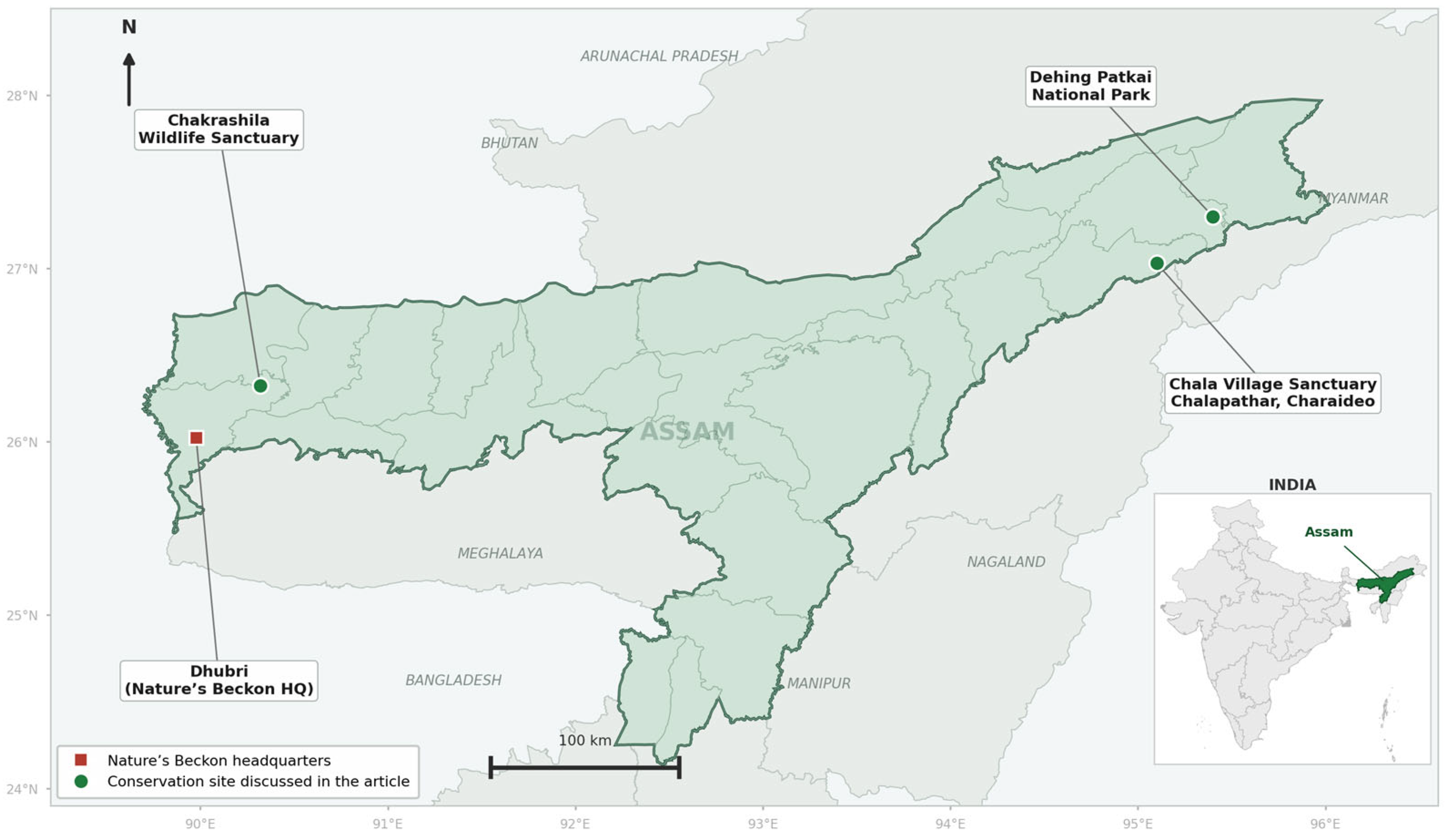
| Campaign | Period | Area/Location | Key Species | Documented Outcome | Refs. |
|---|---|---|---|---|---|
| Chakrashila | early 1980s–1994 | 45.568 km2; Dhubri and Kokrajhar | Trachypithecus geei | Wildlife Sanctuary gazetted 14 July 1994 | [31,48] |
| Dihing Patkai | 1992–2021 | 234.26 km2; Dibrugarh and Tinsukia | Rainforest assemblage; Hoolock hoolock | Wildlife Sanctuary 19 June 2004; National Park 15 June 2021 | [8,25] |
| Primate conservation | early 1980s–present | Multi-site | T. geei; H. hoolock | Species monographs; habitat advocacy | [13,32,33] |
| Village Sanctuary | 2010s–present | Chala Village Sanctuary, Chalapathar, Charaideo district; and other forest-fringe sites | Multi-species | Community-led conservation institution; ecological effectiveness requires further independent assessment | [24,57] |
| Case | Conservation Problem | Community Role | Scientific Evidence | Advocacy Method | State/Industry Engagement | Political Opportunity | Outcome | Limitation | Transferable Lesson |
|---|---|---|---|---|---|---|---|---|---|
| Chakrashila (early 1980s–1994) | Previously unrecorded golden langur habitat in a reserve forest under commercial and encroachment pressure | Rabha and Bodo forest-fringe villages; village-based campaign centre; food-plant planting, salt licks, weed clearance | Organisational species checklists; later peer-reviewed population survey [47], occupancy modelling [32] and road-mortality work [49] | Baseline survey, vernacular publication, sustained village mobilisation, press advocacy | Petitioning and technical dialogue with the Dhubri forest division and state forest department | None identified; outcome followed 12 years of accumulated local pressure | Wildlife Sanctuary of 45.568 km2 notified 14 July 1994 | Demographic data date from 2006–2009 only; trend and viability not established; highway mortality continues | Species documentation held locally can convert a reserve forest into a protected area without external funding |
| Dihing Patkai (1992–2021) | Contiguous lowland rainforest encumbered by coal and petroleum leases | Forest-fringe communities across three reserved forests; vernacular readership mobilised in 2020 | Organisational identification and survey of the rainforest; subsequent published accounts [8,14] | Monograph publication, three-decade campaign, own digital campaign (#CompleteDihingPatkaiWLS_500sqkm) | Reported direct discussion with North Eastern Coalfields and Oil India; sustained engagement with the forest department | Decisive: 2020 national visibility of the Saleki controversy, state political support, lease relinquishment | Wildlife Sanctuary 111.19 km2 (19 June 2004); National Park 234.26 km2 as notified (15 June 2021) | Target of 500 km2 not met; rat-hole mining continues in adjoining reserved forests; post-2021 governance undocumented | Accumulated standing can secure by negotiation what is elsewhere pursued through litigation |
| Primate conservation (early 1980s–present) | Fragmentation of habitat for golden langur and western hoolock gibbon by plantations, roads, railway and extraction | Community co-existence practice at forest-fringe villages; trained eco-emissaries | Organisational species monographs; peer-reviewed fragmentation and occupancy studies [32,33] | Species monographs in Assamese, school materials, umbrella-species argument for whole ecosystems | Advocacy against infrastructural fragmentation; partnership with research organisations | Not applicable; no discrete decision point | Documentation and public education; no measured change in abundance attributable to the organisation | Awareness and publication are inputs, not outcomes; population trend unmeasured | Charismatic species can be used to argue for ecosystems rather than for single-species programmes |
| Village Sanctuary (Chala, Chalapathar) | Forest adjoining a village with no statutory protection and a disrupted customary institution | Tai Khamyang community assumes protection and accepts limits on commercial use, retaining subsistence access | No independent ecological assessment published; comparators from tropical community-forestry literature [12,19,20,21] | Institution-building with the community; organisational documentation | Outside statutory categories; no formal state recognition | None; the arrangement does not depend on a political decision | Functioning community-managed forest institution; ecological effectiveness not independently assessed | No tenure security and no legal category; durability untested | Design features that predict success can be built where custom has broken down, not only inherited |
Disclaimer/Publisher’s Note: The statements, opinions and data contained in all publications are solely those of the individual author(s) and contributor(s) and not of MDPI and/or the editor(s). MDPI and/or the editor(s) disclaim responsibility for any injury to people or property resulting from any ideas, methods, instructions or products referred to in the content. |
© 2026 by the authors. Licensee MDPI, Basel, Switzerland. This article is an open access article distributed under the terms and conditions of the Creative Commons Attribution (CC BY) license.
Share and Cite
Rajkhowa, A.; Borah, P.; Chutia, C.J.; Dutta, M.; Sarmah, B.; Khanikar, P. Four Decades of Community-Based Conservation in Northeast India: Nature’s Beckon, Environmental Activism, and Transferable Lessons. Conservation 2026, 6, 103. https://doi.org/10.3390/conservation6030103
Rajkhowa A, Borah P, Chutia CJ, Dutta M, Sarmah B, Khanikar P. Four Decades of Community-Based Conservation in Northeast India: Nature’s Beckon, Environmental Activism, and Transferable Lessons. Conservation. 2026; 6(3):103. https://doi.org/10.3390/conservation6030103
Chicago/Turabian StyleRajkhowa, Arabinda, Pubali Borah, Chandan Jyoti Chutia, Munmi Dutta, Brojen Sarmah, and Paresh Khanikar. 2026. "Four Decades of Community-Based Conservation in Northeast India: Nature’s Beckon, Environmental Activism, and Transferable Lessons" Conservation 6, no. 3: 103. https://doi.org/10.3390/conservation6030103
APA StyleRajkhowa, A., Borah, P., Chutia, C. J., Dutta, M., Sarmah, B., & Khanikar, P. (2026). Four Decades of Community-Based Conservation in Northeast India: Nature’s Beckon, Environmental Activism, and Transferable Lessons. Conservation, 6(3), 103. https://doi.org/10.3390/conservation6030103