
Contrasting Climatic and Land-Use Scenarios Reveal Divergent Futures for the Mexican Narrow-Mouthed Toad, Amphibia, Microhylidae Hypopachus variolosus (Cope, 1866)

 ,
,  , , , , and
Abstract
1. Introduction
2. Materials and Methods
2.1. Study Site
2.2. Occurrence Data
2.3. Environmental Variables and Environmental Niche Modeling
2.4. Comparative Modeling Approaches
2.5. Model Calibration and Evaluation
2.6. Spatial Overlap and Centroid Shift Analysis
2.7. Land Cover and Climate Change Projections
2.8. Human Footprint Analysis
2.9. Tree Cover Loss Analysis
3. Results
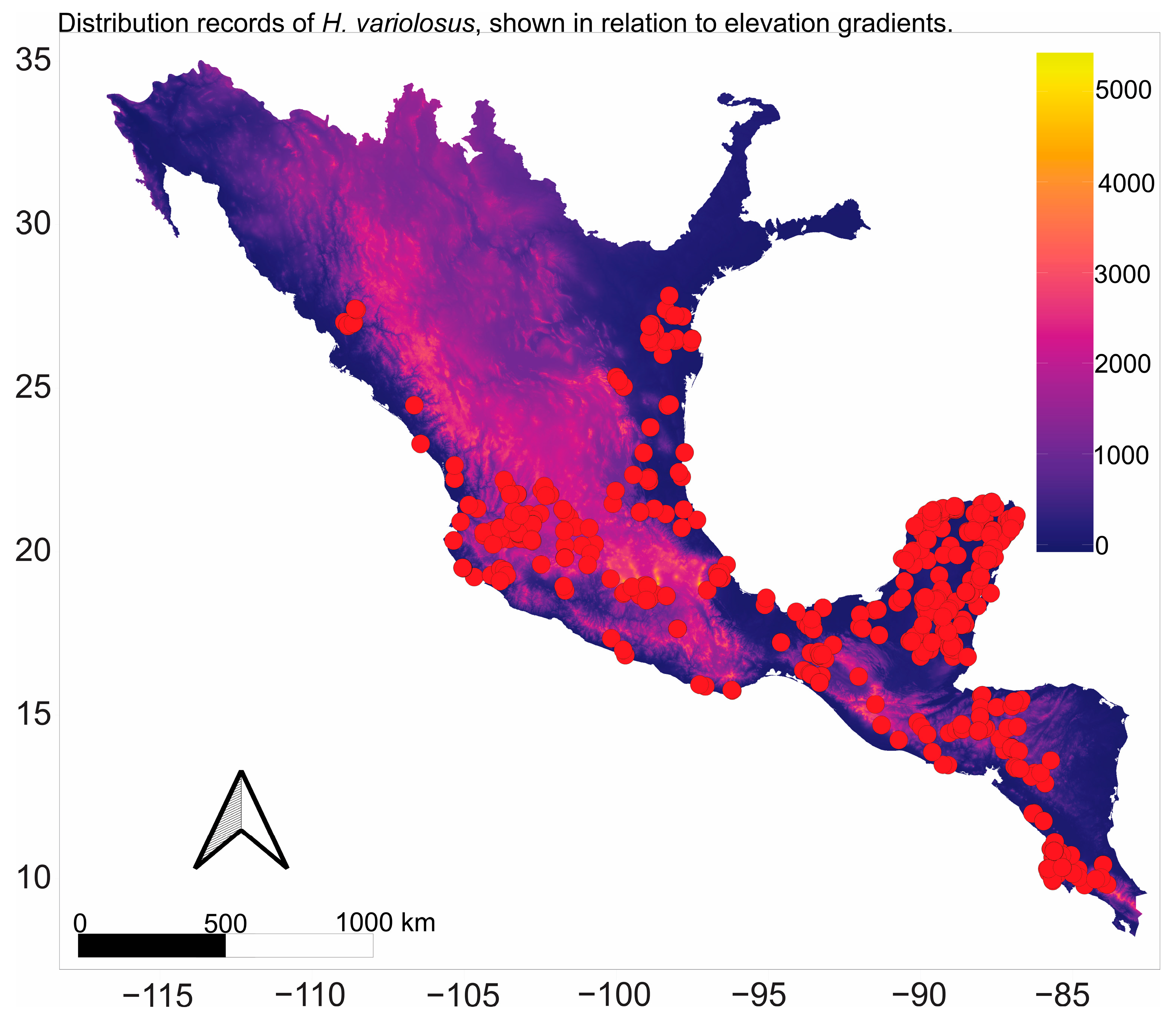
3.1. Occurrence Records
3.2. Model Performance
3.3. Environmental Predictors and Model Comparison
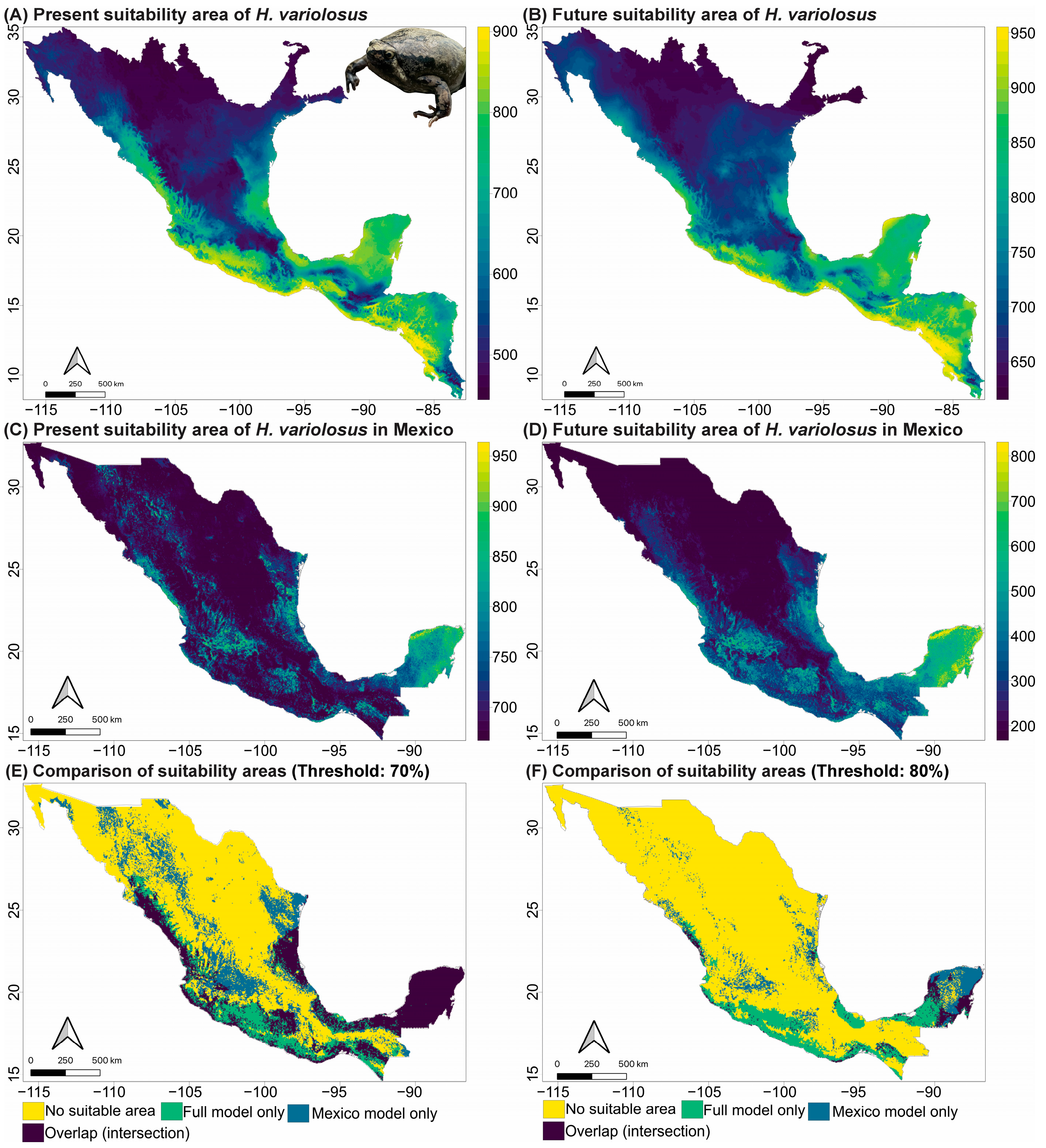
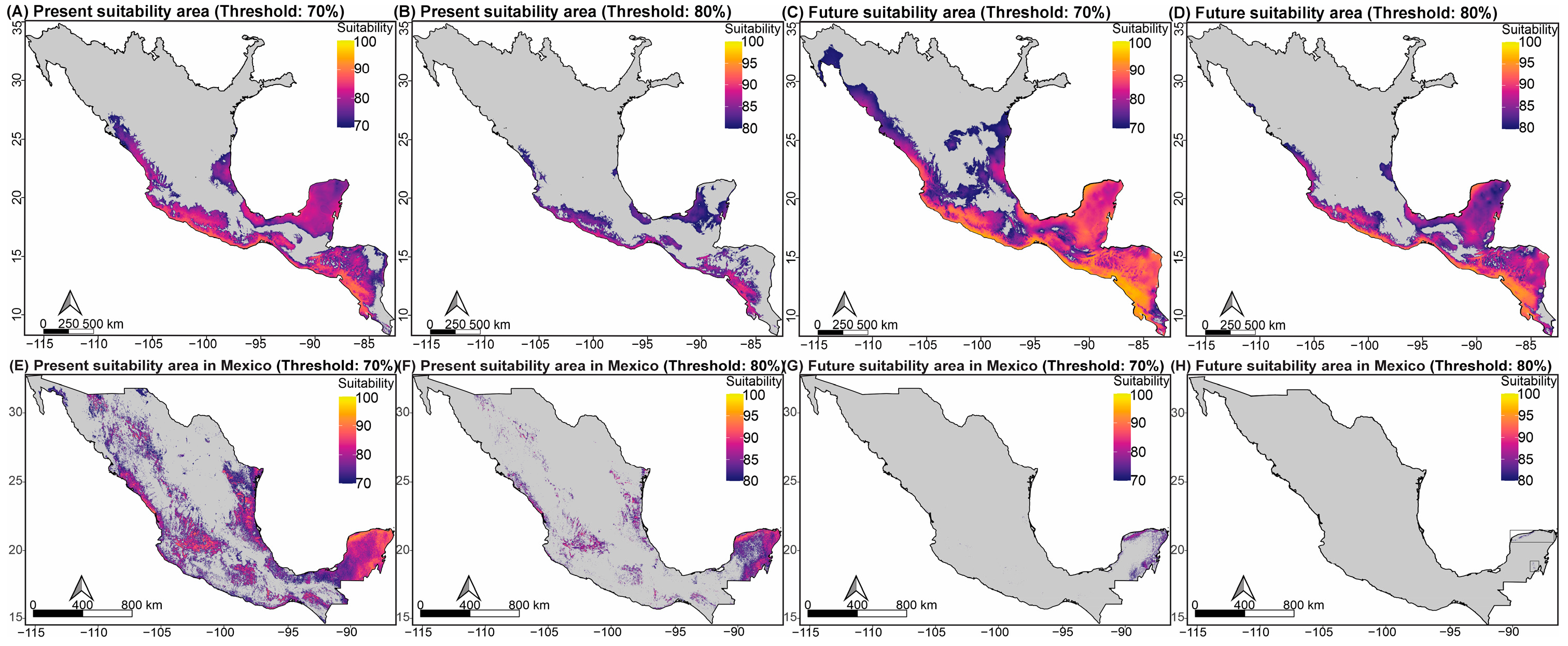
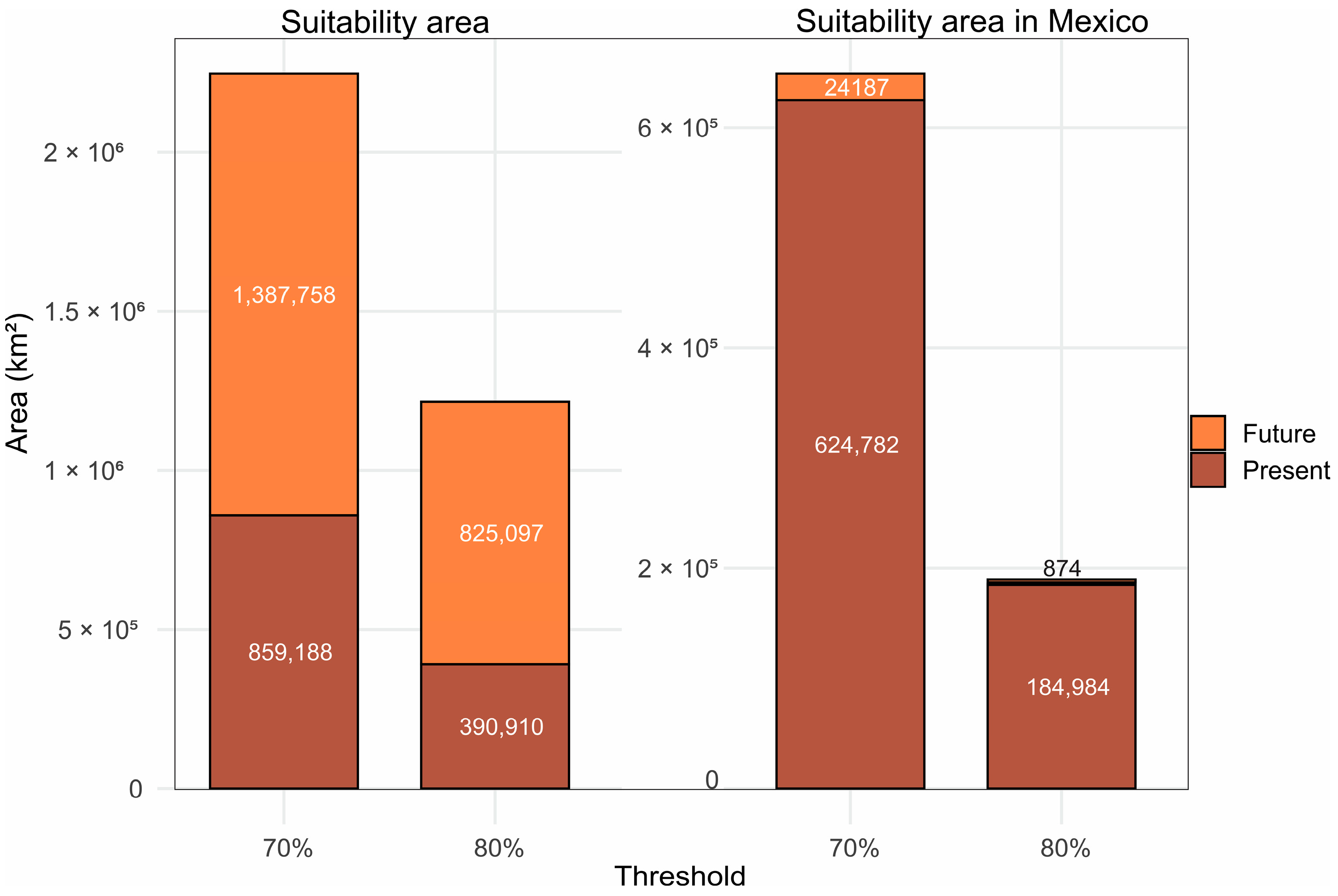
3.4. Predicted Distribution Under the Current Climate
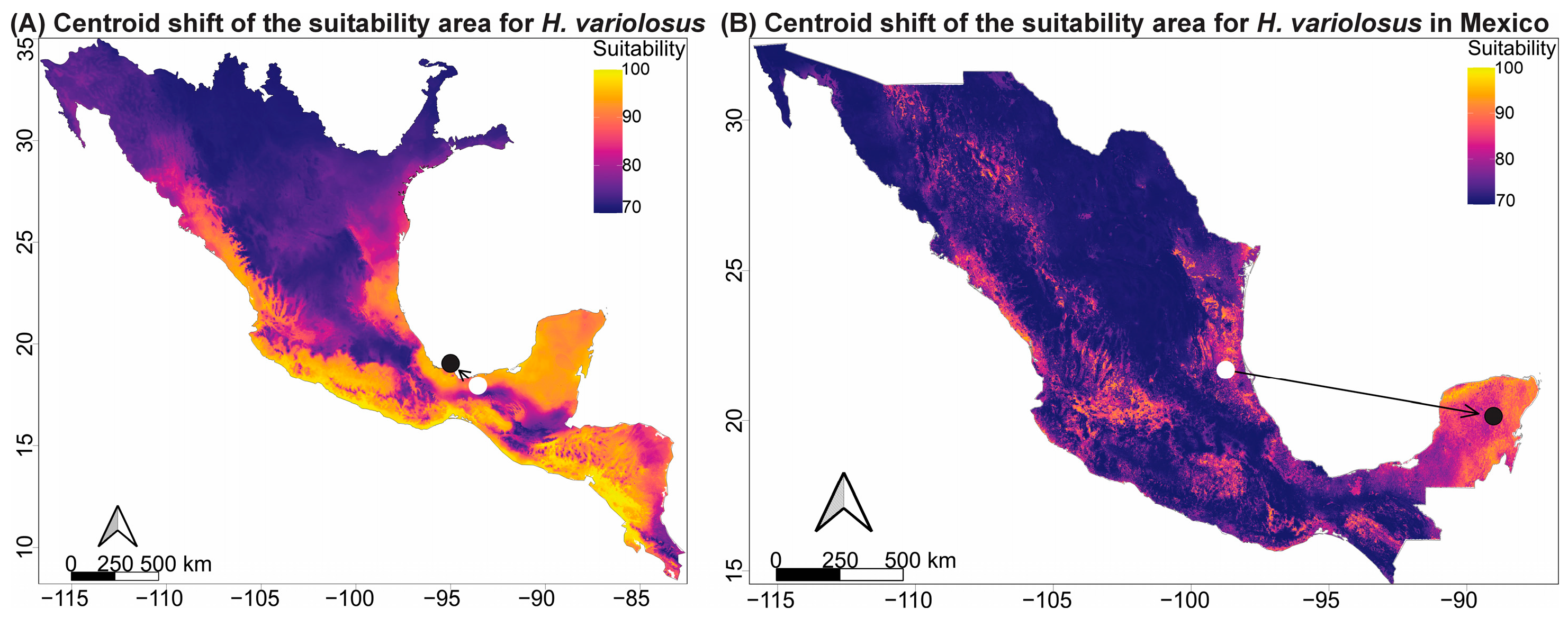
3.5. Model Comparison and Centroid Shift
3.6. Predicted Distribution Under the Future Climate (2050, MPI-ESM-LR, RCP 8.5)
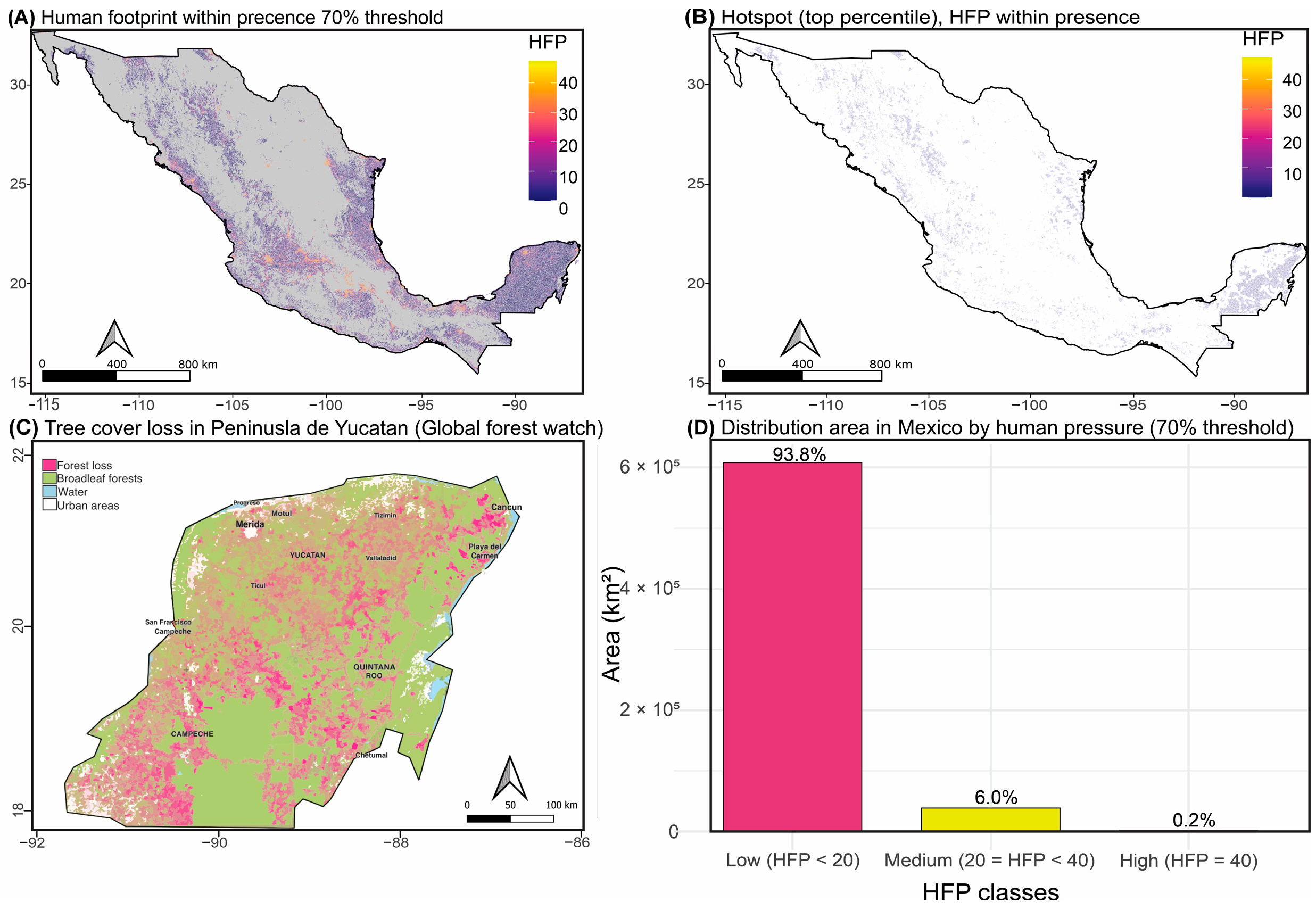
3.7. Human Footprint and Tree Cover Loss Analysis (Global Forest Watch)
4. Discussion
4.1. Climatic and Ecological Determinants of the Current Distribution
4.2. Divergent Projections Under Climatic Versus Land-Use Scenarios
4.3. Integrating Human Pressures: From Potential to Realized Vulnerability
4.4. Conservation Implications and Regional Priorities
4.5. Limitations and Future Directions
5. Conclusions
Supplementary Materials
Author Contributions
Funding
Institutional Review Board Statement
Informed Consent Statement
Data Availability Statement
Acknowledgments
Conflicts of Interest
Abbreviations
| AUC | Area Under the Curve |
| ANN | Artificial Neural Network |
| BIO5 | Maximum Temperature of Warmest Month |
| BIO6 | Minimum Temperature of Coldest Month |
| BIO13 | Precipitation of Wettest Month |
| BIO14 | Precipitation of Driest Month |
| CTA | Classification Tree Analysis |
| ENM | Ecological Niche Modeling |
| GAM | Generalized Additive Model |
| GBIF | Global Biodiversity Information Facility |
| GBM | Generalized Boosting Model |
| GCM | Global Circulation Model |
| GFW | Global Forest Watch |
| GLM | Generalized Linear Model |
| HFP | Human Footprint |
| INEGI | Instituto Nacional de Estadística y Geografía |
| LCM | Land Change Modeler |
| MARS | Multiple Adaptive Regression Splines |
| Maxent | Maximum Entropy Model |
| MPI-ESM-LR | Max Planck Institute Earth System Model Low Resolution |
| NPAs | Natural Protected Areas |
| RCP | Representative Concentration Pathway |
| RF | Random Forest |
| SRE | Surface Range Envelope |
| TSS | True Skill Statistic |
| TMVB | Trans-Mexican Volcanic Belt |
References
- Duellman, W.E. The hylid frogs of middle America: New and expanded edition. Herpetol. Rev. 2001, 32, 4. [Google Scholar]
- Lee, J.C. The Amphibians and Reptiles of the Yucatán Peninsula; Comstock Publishing Associates, Cornell University Press: Ithaca, NY, USA, 1996; p. 500. [Google Scholar]
- IUCN SSC Amphibian Specialist Group. Hypopachus variolosus. In The IUCN Red List of Threatened Species; IUCN: Gland, Switzerland, 2020; p. T57832A53969609. [Google Scholar]
- AmphibiaWeb. Hypopachus variolosus. In Information on Amphibian Biology and Conservation; AmphibiaWeb: Berkeley, CA, USA, 2014. [Google Scholar]
- Dodd, C.K., Jr. Frogs of the United States and Canada. Vols. I and II; The Johns Hopkins University Press: Baltimore, MD, USA, 2013; p. 982. [Google Scholar]
- Altig, R.; McDiarmid, R.W. Handbook of Larval Amphibians of the United States and Canada; Comstock Publishing Associates, Cornell University Press: Ithaca, NY, USA, 2015; p. 345. [Google Scholar]
- Luedtke, J.A.; Chanson, J.; Neam, K.; Hobin, L.; Maciel, A.O.; Catenazzi, A.; Borzée, A.; Hamidy, A.; Aowphol, A.; Jean, A.; et al. Ongoing declines for the world’s amphibians in the face of emerging threats. Nature 2023, 622, 308–314. [Google Scholar] [CrossRef] [PubMed]
- Lucas, P.M.; Di Marco, M.; Cazalis, V.; Luedtke, J.; Neam, K.; Brown, M.H.; Santini, L. Using comparative extinction risk analysis to prioritize the IUCN Red List reassessments of amphibians. Conserv. Biol. 2024, 38, e14316. [Google Scholar] [CrossRef]
- Pottier, P.; Kearney, M.R.; Wu, N.C.; Gunderson, A.R.; Rej, J.E.; Rivera-Villanueva, A.N.; Nakagawa, S. Vulnerability of amphibians to global warming. Nature 2025, 637, 954–961. [Google Scholar] [CrossRef]
- de Albuquerque, F.S.; Bateman, H.L.; Ryan, M.J.; Montgomery, B. Model transferability and predicted response of a dryland anuran to climate change in the Southwest United States. J. Biogeogr. 2024, 51, 120–130. [Google Scholar]
- Díaz-Paniagua, C.; Florencio, M.; de Felipe, M.; Ramírez-Soto, M.; Román, I.; Arribas, R. Groundwater decline has negatively affected the well-preserved amphibian community of Doñana National Park (SW Spain). Amphib. Reptil. 2024, 45, 205–217. [Google Scholar]
- Granda-Rodriguez, H.D.; Zarate-Tirado, H.A.; Robledo-Buitrago, D.; Urbina-Cardona, J.N. Edge effects on amphibians in transformed tropical dry forest landscapes: The relationship between functional and taxonomic diversity. Glob. Ecol. Conserv. 2025, 59, e03553. [Google Scholar] [CrossRef]
- Hartel, T.; Maloș, C.V.; Sevianu, E.; Pascu, I. Persistence of an Endangered Amphibian in a Fully Anthropogenic Forested Pondscape. Ecol. Evol. 2025, 15, e71608. [Google Scholar] [CrossRef]
- AmphibiaWeb; University of California: Berkeley, CA, USA, 2026.
- Pro, G.F.W.; Watcher, F.; Atlases, F. Global Forest Watch; World Resources Institute: Washington, DC, USA, 2023. [Google Scholar]
- Elverici, C.; Peterson, A.T.; Perktaş, U. Hotspots in transition: Mediterranean amphibian diversity under different climate scenarios. Biodivers. Conserv. 2025, 34, 589–604. [Google Scholar]
- Rivadeneira, C.D.; Meyer, A.S.; Bornschein, M.R.; Ribeiro, L.F.; Pie, M.R. Ecological Niche Modeling of Microendemic Species: Understanding the Distribution of Montane Frogs in the Southern Brazilian Atlantic Forest. Austral Ecol. 2025, 50, e70085. [Google Scholar] [CrossRef]
- Zamora-Maldonado, H.C.; Avila-Foucat, V.S.; Sánchez-Sotomayor, V.G. Modeling climate change impacts on the potential distribution of bighorn sheep in Mexico. Front. Clim. 2025, 7, 1386632. [Google Scholar] [CrossRef]
- Boria, R.A.; Olson, L.E.; Goodman, S.M.; Anderson, R.P. Spatial filtering to reduce sampling bias can improve the performance of ecological niche models. Ecol. Model. 2014, 275, 73–77. [Google Scholar] [CrossRef]
- Sunny, A.; Marmolejo, C.; Vidal-López, R.; Falconi-Briones, F.A.; Cuervo-Robayo, Á.P.; Bolom-Huet, R. EcoNicheS: Enhancing ecological niche modeling, niche overlap and connectivity analysis using the shiny dashboard and R package. PeerJ 2025, 13, e19136. [Google Scholar] [CrossRef]
- R Core Team. R: A Language and Environment for Statistical Computing; R Foundation for Statistical Computing: Vienna, Austria, 2024. [Google Scholar]
- Zizka, A.; Silvestro, D.; Andermann, T.; Azevedo, J.; Duarte Ritter, C.; Edler, D.; Antonelli, A. CoordinateCleaner: Standardized cleaning of occurrence records from biological collection databases. Methods Ecol. Evol. 2019, 10, 744–751. [Google Scholar] [CrossRef]
- Aiello-Lammens, M.E.; Boria, R.A.; Radosavljevic, A.; Vilela, B.; Anderson, R.P. spThin: An R package for spatial thinning of species occurrence records for use in ecological niche models. Ecography 2015, 38, 541–545. [Google Scholar] [CrossRef]
- Fick, S.E.; Hijmans, R.J. WorldClim 2: New 1-km spatial resolution climate surfaces for global land areas. Int. J. Climatol. 2017, 37, 4302–4315. [Google Scholar] [CrossRef]
- INEGI. Conjunto de Datos Vectoriales de Uso del Suelo y Vegetación. Series VI. Escala 1:250,000. (Capa Unión); INEGI: Aguascalientes, Mexico, 2017. [Google Scholar]
- Clark Labs. IDRISI TerrSet; Clark University: Worcester, MA, USA, 2020. [Google Scholar]
- Hijmans, R. terra: Spatial Data Analysis, R package version 1.8-60; Comprehensive R Archive Network (CRAN): Vienna, Austria, 2025.
- Dormann, C.F.; Elith, J.; Bacher, S.; Buchmann, C.; Carl, G.; Carré, G.; Marquéz, J.R.G.; Gruber, B.; Lafourcade, B.; Leitao, P.J.; et al. Collinearity: A review of methods to deal with it and a simulation study evaluating their performance. Ecography 2013, 36, 27–46. [Google Scholar] [CrossRef]
- Warren, D.L.; Glor, R.E.; Turelli, M. ENMTools: A toolbox for comparative studies of environmental niche models. Ecography 2010, 33, 607–611. [Google Scholar] [CrossRef]
- Vargas-Jaimes, J.; González-Fernández, A.; Torres-Romero, E.J.; Bolom-Huet, R.; Manjarrez, J.; Gopar-Merino, F.; Pacheco, X.P.; Garrido-Garduño, T.; Chávez, C.; Sunny, A. Impact of climate and land cover changes on the potential distribution of four endemic salamanders in Mexico. J. Nat. Conserv. 2021, 64, 126066. [Google Scholar] [CrossRef]
- Ruiz-Reyes, J.; Heredia-Bobadilla, R.L.; Ávila-Akerberg, V.; Tejocote-Perez, M.; Gómez-Ortiz, Y.; Domínguez-Vega, H.; Sunny, A. Assessing functional connectivity and anthropogenic impacts on Ambystoma altamirani populations in Bosque De Agua, Central Mexico. Eur. J. Wildl. Res. 2024, 70, 85. [Google Scholar] [CrossRef]
- Gonzalez-Fernandez, A.; Gonzalez-Salazar, C.; Sunny, A.; Ruiz-Gutierrez, F.; Chavez, C. Determination of priority areas for amphibian conservation in Guerrero (Mexico), through systematic conservation planning tools. J. Nat. Conserv. 2022, 68, 126235. [Google Scholar] [CrossRef]
- Thuiller, W.; Georges, D.; Gueguen, M.; Engler, R.; Breiner, F.; Lafourcade, B.; Patin, R. biomod2: Ensemble Platform for Species Distribution Modeling, R package version 4.2-2; Comprehensive R Archive Network (CRAN): Vienna, Austria, 2023.
- Linero, D.; Cuervo-Robayo, A.P.; Etter, A. Assessing the future conservation potential of the Amazon and Andes Protected Areas: Using the woolly monkey (Lagothrix lagothricha) as an umbrella species. J. Nat. Conserv. 2020, 58, 125926. [Google Scholar] [CrossRef]
- Metz, C.E. Basic principles of ROC analysis. Semin. Nucl. Med. 1978, 8, 283–298. [Google Scholar] [CrossRef]
- Phillips, S.J.; Anderson, R.P.; Schapire, R.E. Maximum entropy modeling of species geographic distributions. Ecol. Model. 2006, 190, 231–259. [Google Scholar] [CrossRef]
- Allouche, O.; Tsoar, A.; Kadmon, R. Assessing the accuracy of species distribution models: Prevalence, kappa and the true skill statistic (TSS). J. Appl. Ecol. 2006, 43, 1223–1232. [Google Scholar] [CrossRef]
- Vargas-Jaimes, J.; Manjarrez, J.; Ramírez-Corona, F.; Woolrich-Piña, G.A.; González-Pedroza, M.G.; Estrada-Zúñiga, M.E.; Sunny, A. Assessment of the vulnerability of Spiny Lizards in Central Mexico under anthropogenic pressure: Integrating habitat suitability, landscape connectivity, fragmentation and protected area coverage. Nat. Conserv. 2025, 59, 351–386. [Google Scholar] [CrossRef]
- INEGI. Conjunto de Datos Vectoriales de la Carta de Uso del Suelo y Vegetación. Escala 1:250,000. Series V (Continuo Nacional); INEGI: Aguascalientes, Mexico, 2011. [Google Scholar]
- Mas, J.F.; Kolb, M.; Paegelow, M.; Olmedo, M.C.; Houet, T. Modeling Land use/cover changes: A comparison of conceptual approaches and softwares. Environ. Model. Softw. 2014, 51, 94–111. [Google Scholar] [CrossRef]
- Ansari, A.; Golabi, M.H. Prediction of spatial land use changes based on LCM in a GIS environment for Desert Wetlands–A case study: Meighan Wetland, Iran. Int. Soil Water Conserv. Res. 2019, 7, 64–70. [Google Scholar]
- Mishra, V.N.; Rai, P.K.; Mohan, K. Prediction of land use changes based on land change modeler (LCM) using remote sensing: A case study of Muzaffarpur (Bihar), India. J. Geogr. Inst. Jovan Cvijic SASA 2014, 64, 111–127. [Google Scholar] [CrossRef]
- Gibson, L.; Münch, Z.; Palmer, A.; Mantel, S. Future land cover change scenarios in South African grasslands–implications of altered biophysical drivers on land management. Heliyon 2018, 4, e00693. [Google Scholar] [CrossRef] [PubMed]
- Hamer, A.J.; McDonnell, M.J. Amphibian Ecology and Conservation in the Urbanising World: A Review. Biol. Conserv. 2008, 141, 2432–2449. [Google Scholar] [CrossRef]
- Scheffers, B.R.; Paszkowski, C.A. The Effects of Urbanization on North American Amphibian Species: Identifying New Directions for Urban Conservation. Urban Ecosyst. 2012, 15, 133–147. [Google Scholar] [CrossRef]
- Hausfather, Z.; Peters, G.P. RCP8.5 is a problematic scenario for near-term emissions. Proc. Natl. Acad. Sci. USA 2020, 117, 27791–27792. [Google Scholar] [PubMed]
- Schwalm, C.R.; Glendon, S.; Duffy, P.B. RCP8.5 tracks cumulative CO2 emissions. Proc. Natl. Acad. Sci. USA 2020, 117, 19656–19657. [Google Scholar]
- Tokarska, K.B.; Stolpe, M.B.; Sippel, S.; Fischer, E.M.; Smith, C.J.; Lehner, F.; Knutti, R. Past warming trend constrains future warming in CMIP6 models. Sci. Adv. 2020, 6, eaaz9549. [Google Scholar] [CrossRef] [PubMed]
- Guillera-Arroita, G.; Lahoz-Monfort, J.J.; Elith, J.; Gordon, A.; Kujala, H.; Lentini, P.E.; Wintle, B.A. Is my species distribution model fit for purpose? Matching data and models to applications. Glob. Ecol. Biogeogr. 2015, 24, 276–292. [Google Scholar] [CrossRef]
- Liu, C.; White, M.; Newell, G. Selecting thresholds for the prediction of species occurrence with presence-only data. J. Biogeogr. 2013, 40, 778–789. [Google Scholar] [CrossRef]
- Venter, O.; Sanderson, E.; Magrach, A.; Allan, J.R.; Beher, J.; Jones, K.R.; Possingham, H.P.; Laurance, W.F.; Wood, P.; Fekete, B.M.; et al. Global terrestrial Human Footprint maps for 1993 and 2009. Sci. Data 2016, 3, 160067. [Google Scholar] [CrossRef]
- Ellis, E.A.; Montero, J.A.R.; Gómez, I.U.H.; Porter-Bolland, L.; Ellis, P.W. Private property and Mennonites are major drivers of forest cover loss in central Yucatan Peninsula, Mexico. Land Use Policy 2017, 69, 474–484. [Google Scholar] [CrossRef]
- Chavez, S.G.; Veneros, J.; Rojas-Briceño, N.B.; Oliva-Cruz, M.; Guadalupe, G.A.; García, L. Spatiotemporal modeling of rural agricultural land use change and area forecasts in historical time series after COVID-19 pandemic, using google earth engine in Peru. Sustainability 2024, 16, 7755. [Google Scholar] [CrossRef]
- Hansen, M.C.; Potapov, P.V.; Moore, R.; Hancher, M.; Turubanova, S.A.; Tyukavina, A.; Thau, D.; Stehman, S.V.; Goetz, S.J.; Loveland, T.R.; et al. High-Resolution Global Maps of 21st-Century Forest Cover Change. Science 2013, 342, 850–853. [Google Scholar]
- Thuiller, W. Patterns and uncertainties of species’ range shifts under climate change. Glob. Change Biol. 2004, 10, 2020–2027. [Google Scholar]
- Bellard, C.; Bertelsmeier, C.; Leadley, P.; Thuiller, W.; Courchamp, F. Impacts of climate change on the future of biodiversity. Ecol. Lett. 2012, 15, 365–377. [Google Scholar] [CrossRef]
- Santostasi, N.L.; Serafini, C.; Maiorano, L. Shaping the Future: The importance of land use when projecting the future distribution of Endangered Amphibians and Reptiles. bioRxiv. 2024. bioRxiv:2024.07.25.605069.
- Luoto, M.; Virkkala, R.; Heikkinen, R.K. The role of land cover in bioclimatic models depends on spatial resolution. Glob. Ecol. Biogeogr. 2007, 16, 34–42. [Google Scholar]
- Tingley, R.; Herman, T.B. Land-cover data improve bioclimatic models for anurans and turtles at a regional scale. J. Biogeogr. 2009, 36, 1656–1672. [Google Scholar]
- Rubenstein, M.A.; Weiskopf, S.R.; Bertrand, R.; Carter, S.L.; Comte, L.; Eaton, M.J.; Thompson, L.M. Climate change and the global redistribution of biodiversity: Substantial variation in empirical support for expected range shifts. Environ. Evid. 2023, 12, 7. [Google Scholar] [PubMed]
- Alves-Ferreira, G.; Heming, N.M.; Talora, D.; Keitt, T.H.; Solé, M.; Zamudio, K.R. Climate change is projected to shrink phylogenetic endemism of Neotropical frogs. Nat. Commun. 2025, 16, 3713. [Google Scholar] [CrossRef] [PubMed]
- Titeux, N.; Henle, K.; Mihoub, J.B.; Regos, A.; Geijzendorffer, I.R.; Cramer, W.; Brotons, L. Biodiversity scenarios neglect future land-use changes. Glob. Change Biol. 2016, 22, 2505–2515. [Google Scholar]
- Williams, J.J.; Freeman, R.; Spooner, F.; Newbold, T. Vertebrate population trends are influenced by interactions between land use, climatic position, habitat loss and climate change. Glob. Change Biol. 2022, 28, 797–815. [Google Scholar]
- Castillo-Peñarredonda, C.J.; Tovar-Márquez, J.; Diaz-Perez, J. Land-cover changes affect the diversity of amphibians and reptiles in a rural landscape of the Colombian Caribbean region. Acta Zoológica Mex. 2024, 40, e4012611. [Google Scholar]
- Sunny, A.; Martínez-Valerio, J.C.; Bolom-Huet, R.; Heredia-Bobadilla, R.L.; Alvarez-Lopeztello, J.; Gómez-Ortiz, Y.; Domínguez-Vega, H. Modeling the present and future distribution of Ambystoma altamirani in the Transmexican Volcanic Belt, Mexico. Nat. Conserv. 2024, 56, 275–293. [Google Scholar] [CrossRef]
- Sunny, A.; Ruiz-Reyes, J.; Domínguez-Vega, H.; Gómez-Ortiz, Y.; Heredia-Bobadilla, R.L.; Avila-Akerberg, V. Niche overlap by invasion of Oncorhynchus mykiss on the habitat of its amphibian prey in central Mexico. Biol. Invasions 2024, 26, 2183–2201. [Google Scholar] [CrossRef]
- Posse-Sarmiento, V.; Banks-Leite, C. The effects of edge influence on the microhabitat, diversity and life-history traits of amphibians in western Ecuador. J. Trop. Ecol. 2024, 40, e7. [Google Scholar] [CrossRef]
- Bonilla-Moheno, M.; Aide, T.M. Beyond deforestation: Land cover transitions in Mexico. Agric. Syst. 2020, 178, 102734. [Google Scholar] [CrossRef]
- Cho, K.; Goldstein, B.; Gounaridis, D.; Newell, J.P. Where does your guacamole come from? Detecting deforestation associated with the export of avocados from Mexico to the United States. J. Environ. Manag. 2021, 278, 111482. [Google Scholar] [CrossRef] [PubMed]
- Simmons, C.; Astier, M.; Walker, R.; Navia-Antezana, J.F.; Gao, Y.; Galván-Miyoshi, Y.; Klooster, D. Forest transition and fuzzy environments in neoliberal Mexico. Land 2023, 12, 840. [Google Scholar] [CrossRef]
- Graba-Landry, A.; Champion, C.; Twiname, S.; Wolfe, B.; Haddy, J.; Mossop, D.; Pecl, G.; Tracey, S. Citizen Science Aids the Quantification of the Distribution and Prediction of Present and Future Temporal Variation in Habitat Suitability at Species’ Range Edges. Front. Biogeogr. 2023, 15, e58207. [Google Scholar] [CrossRef]
- Rauscher, S.A.; Kucharski, F.; Enfield, D.B. The Role of Regional SST Warming Variations in the Drying of Meso-America in Future Climate Projections. J. Clim. 2011, 24, 2003–2016. [Google Scholar] [CrossRef]
- Ramirez-Beltran, N.D.; Gonzalez, J.E.; Castro, J.M.; Angeles, M.; Harmsen, E.W.; Salazar, C.M. Analysis of the heat index in the Mesoamerica and Caribbean region. J. Appl. Meteorol. Climatol. 2017, 56, 2905–2925. [Google Scholar]
- Ramírez-Barahona, S.; Cuervo-Robayo, A.P.; Feeley, K.J.; Ortiz-Rodríguez, A.E.; Vásquez-Aguilar, A.A.; Ornelas, J.F.; Rodríguez-Correa, H. Upslope plant species shifts in Mesoamerican cloud forests driven by climate and land use change. Science 2025, 387, 1058–1063. [Google Scholar] [CrossRef]
- Proios, K.; Michailidou, D.E.; Lazarina, M.; Tsianou, M.A.; Kallimanis, A.S. Climate and land use changes impact the future of European amphibian functional diversity. Land 2024, 13, 1206. [Google Scholar] [CrossRef]
- Rosenstock, T.; Lamanna, C.; Arslan, A.; Richards, M. What is the Scientific Basis for Climate-Smart Agriculture? Climate Change and Agricultural and Food Security: Copenhagen, Denmark, 2015. [Google Scholar]
- Zhang, P.; Dong, X.; Grenouillet, G.; Lek, S.; Zheng, Y.; Chang, J. Species range shifts in response to climate change and human pressure for the world’s largest amphibian. Sci. Total Environ. 2020, 735, 139543. [Google Scholar] [CrossRef]
- Sorte, C.J. Predicting persistence in a changing climate: Flow direction and limitations to redistribution. Oikos 2013, 122, 161–170. [Google Scholar] [CrossRef]
- Shen, W.; Shen, Z.; Xue, S.; Zhou, D. Population dynamics under climate change: Persistence criterion and effects of fluctuations. J. Math. Biol. 2022, 84, 30. [Google Scholar] [CrossRef]
- Brandon, K.; Gorenflo, L.J.; Rodrigues, A.S.; Waller, R.W. Reconciling biodiversity conservation, people, protected areas, and agricultural suitability in Mexico. World Dev. 2005, 33, 1403–1418. [Google Scholar] [CrossRef]
- Medina, R.G.; Lira-Noriega, A.; Aráoz, E.; Ponssa, M.L. Potential effects of climate change on a Neotropical frog genus: Changes in the spatial diversity patterns of Leptodactylus (Anura, Leptodactylidae) and implications for their conservation. Clim. Change 2020, 161, 535–553. [Google Scholar]
- Wang, H.; Zhou, X.; Wan, C.; Fu, H.; Zhang, F.; Ren, J. Eco-environmental degradation in the northeastern margin of the Qinghai–Tibetan Plateau and comprehensive ecological protection planning. Environ. Geol. 2008, 55, 1135–1147. [Google Scholar]
- Salvati, L. Toward a ‘Sustainable’ land degradation? Vulnerability degree and component balance in a rapidly changing environment. Environ. Dev. Sustain. 2014, 16, 239–254. [Google Scholar]
- Huang, J.; Yu, H.; Han, D.; Zhang, G.; Wei, Y.; Huang, J.; An, L.; Liu, X.; Ren, Y. Declines in global ecological security under climate change. Ecol. Indic. 2020, 117, 106651. [Google Scholar] [CrossRef]
- Sunny, A.; González-Fernández, A.; D’Addario, M. Potential distribution of the endemic imbricate alligator lizard (Barisia imbricata imbricata) in highlands of central Mexico. Amphib. Reptil. 2017, 38, 225–231. [Google Scholar]
- Harfoot, M.; Tittensor, D.P.; Newbold, T.; McInerny, G.; Smith, M.J.; Scharlemann, J.P.W. Integrated assessment models for ecologists. Glob. Ecol. Biogeogr. 2014, 23, 124–143. [Google Scholar]
- Zhao, Q.; Arnold, T.W.; Devries, J.H.; Howerter, D.W.; Clark, R.G.; Weegman, M.D. Using integrated population models to prioritize region-specific conservation strategies under global change. Biol. Conserv. 2020, 252, 108832. [Google Scholar] [CrossRef]
- Griffin, R.K.; Lewis, T.R.; Tzanopoulos, J.; Griffiths, R.A. Natural History Traits Influence Winners and Losers for Herpetological Communities in Disturbed Tropical Habitats. Oecologia 2025, 207, 52. [Google Scholar] [CrossRef] [PubMed]




Disclaimer/Publisher’s Note: The statements, opinions and data contained in all publications are solely those of the individual author(s) and contributor(s) and not of MDPI and/or the editor(s). MDPI and/or the editor(s) disclaim responsibility for any injury to people or property resulting from any ideas, methods, instructions or products referred to in the content. |
© 2026 by the authors. Licensee MDPI, Basel, Switzerland. This article is an open access article distributed under the terms and conditions of the Creative Commons Attribution (CC BY) license.
Share and Cite
Sunny, A.; Gilchrist, L.; Martínez-Alva, G.; Rojas-Velasco, I.Y.; Sánchez-Lara, A.J.; Solano-Gómez, A.; Gutierrez-Tovar, L.; Manjarrez, J.; Zepeda-Gómez, C.; Gómez-Ortiz, Y.; et al. Contrasting Climatic and Land-Use Scenarios Reveal Divergent Futures for the Mexican Narrow-Mouthed Toad, Amphibia, Microhylidae Hypopachus variolosus (Cope, 1866). Conservation 2026, 6, 73. https://doi.org/10.3390/conservation6020073
Sunny A, Gilchrist L, Martínez-Alva G, Rojas-Velasco IY, Sánchez-Lara AJ, Solano-Gómez A, Gutierrez-Tovar L, Manjarrez J, Zepeda-Gómez C, Gómez-Ortiz Y, et al. Contrasting Climatic and Land-Use Scenarios Reveal Divergent Futures for the Mexican Narrow-Mouthed Toad, Amphibia, Microhylidae Hypopachus variolosus (Cope, 1866). Conservation. 2026; 6(2):73. https://doi.org/10.3390/conservation6020073
Chicago/Turabian StyleSunny, Armando, Laura Gilchrist, Germán Martínez-Alva, Irving Yahan Rojas-Velasco, Alexis Josué Sánchez-Lara, Amanda Solano-Gómez, Liliana Gutierrez-Tovar, Javier Manjarrez, Carmen Zepeda-Gómez, Yuriana Gómez-Ortiz, and et al. 2026. "Contrasting Climatic and Land-Use Scenarios Reveal Divergent Futures for the Mexican Narrow-Mouthed Toad, Amphibia, Microhylidae Hypopachus variolosus (Cope, 1866)" Conservation 6, no. 2: 73. https://doi.org/10.3390/conservation6020073
APA StyleSunny, A., Gilchrist, L., Martínez-Alva, G., Rojas-Velasco, I. Y., Sánchez-Lara, A. J., Solano-Gómez, A., Gutierrez-Tovar, L., Manjarrez, J., Zepeda-Gómez, C., Gómez-Ortiz, Y., Domínguez-Vega, H., Soria-Díaz, L., Astudillo-Sánchez, C. C., Gopar-Merino, L. F., & Bolom-Huet, R. (2026). Contrasting Climatic and Land-Use Scenarios Reveal Divergent Futures for the Mexican Narrow-Mouthed Toad, Amphibia, Microhylidae Hypopachus variolosus (Cope, 1866). Conservation, 6(2), 73. https://doi.org/10.3390/conservation6020073