


Abstract
The critically endangered fan mussel Pinna nobilis is under strict protection in the Mediterranean waters and exhibited a documented fishing history in Greece dating back to 19th and early of 20th centuries. The present study examined historical documentary evidence from Greek archives, technical reports, and oral testimonies to reconstruct traditional fishing methods and their ecological implications. Historical records revealed the widespread use of specialized fishing tools called “pinologos”, a Y-shaped iron attached to a wooden poles, deployed primarily in shallow waters (2–7 m depth) across various Greek coastal regions in the Ionian and Aegean Seas. Two types of fishing gear existed, a simple Y-shaped tong and a scissor-type gear, both designed to encircle and extract individual fan mussels, through quarter-turn rotation. Fishers selectively targeted only large, established individuals of fan mussel, as small specimens with thin shells were unsuitable for this method. Historical fishing pressure on the species was spatially and size-limited, unlike current basin-wide mortality events. These findings demonstrate that structured populations persisted even under traditional exploitation, suggesting potential for recovery if contemporary threats are mitigated. Management strategies should reference historical population structures as restoration targets.
1. Introduction
Fan mussel Pinna nobilis (Linnaeus, 1758) has recently been classified as critically endangered on the IUCN Red List of threatened species and it is covered by the Mediterranean Specially Protected Areas protocol (95/96 SPA ANNEX II). It is under strict protection (92/43 EEC ANNEX IV, updated by EU Reg 1241/2019; AnnexAnnex I), with the catching, retention on board, transshipment, landing or selling of this species shall be prohibited for Union vessels. These protections reflect a growing recognition that P. nobilis, Europe’s largest native bivalve and a functionally important habitat forming species in Mediterranean coastal ecosystems, is now facing collapse at a scale and speed with few precedents among marine invertebrates. Since 2016, mass mortality events driven by the haplosporidian parasite Haplosporidium pinnae and the ciliate Zostericola spp. have caused mortality rates exceeding 80–100% across affected populations throughout Spain, Italy, and Greece [1,2], with some authors characterizing the ongoing epizootic as capable of driving the species toward functional extinction across much of the Mediterranean within years [3].
Historical exploitation of the fan mussel can be traced back to early Greek fishery (1920s) as the fishery of this species has been reported in coastal areas of Greece; Preveza, Hydra: [4]). After World War II fan mussel also reported as commonly found in Greek waters off the Peloponnesus peninsula, at Evoikos Gulf, in Lesvos and in Dodecanese Islands (Rhodes, Astypalaia, Yali) [5]. The problem in the species monitoring efforts gets more aggravating as fan mussel’s officially catches were not taxonomically disaggregated by other shellfish, to any official statistical bulletin neither during the first organized effort for the collection of Greek fisheries statistics (1928–1939: [6]) nor during the most recent monitoring of fish Greek landings that started in 1964 by the Hellenic Statistical Authority (ELSTAT). More specifically, ELSTAT recorded bivalve catches disaggregated into four species (i.e., Warty venus Venus verrucosa Linnaeus, 1758, Mediterranean mussel Mytilus galloprovincialis Lamarck, 1819, European flat oyster Ostrea edulis Linnaeus, 1758, and king scallop Pecten maximus (Linnaeus, 1758)) since 1982 [7].
In the present study, we gathered historical documentary evidence regarding the method used for fan mussel fishery. Incorporating historical anecdotal data can deepen understanding of past system dynamics, thereby enabling assessment of whether contemporary systems operate within the historical range of variability observed prior to significant anthropogenic impacts. Knowledge from earlier periods of fishery with limited pre-industrial fishing pressure [6] may serve as a valuable repository for re-evaluating management thresholds [8]. In this context, the integration of historical and previously overlooked scientific data with contemporary natural observations has increased significantly within the frameworks of Marine Historical Ecology and Marine Environmental History [9], encompassing a broad range of multidisciplinary scientific fields (e.g., [10]). The present effort is a part of a larger study over multiple years Pinna SOS project (http://pinnasos.gr/ (accessed on 25 January 2026)) targeting to the species protection. Such empirical studies, rooted in local experience and connecting the past and present, is particularly invaluable for understanding how traditional communities harvested fan mussel.
2. Materials and Methods
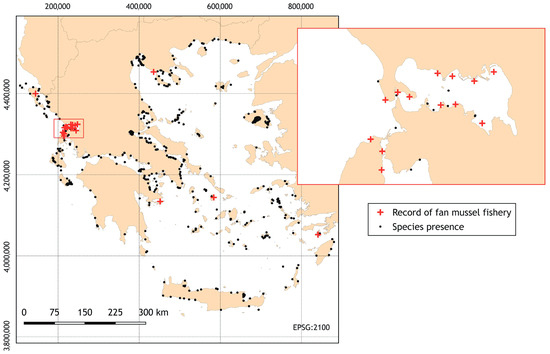
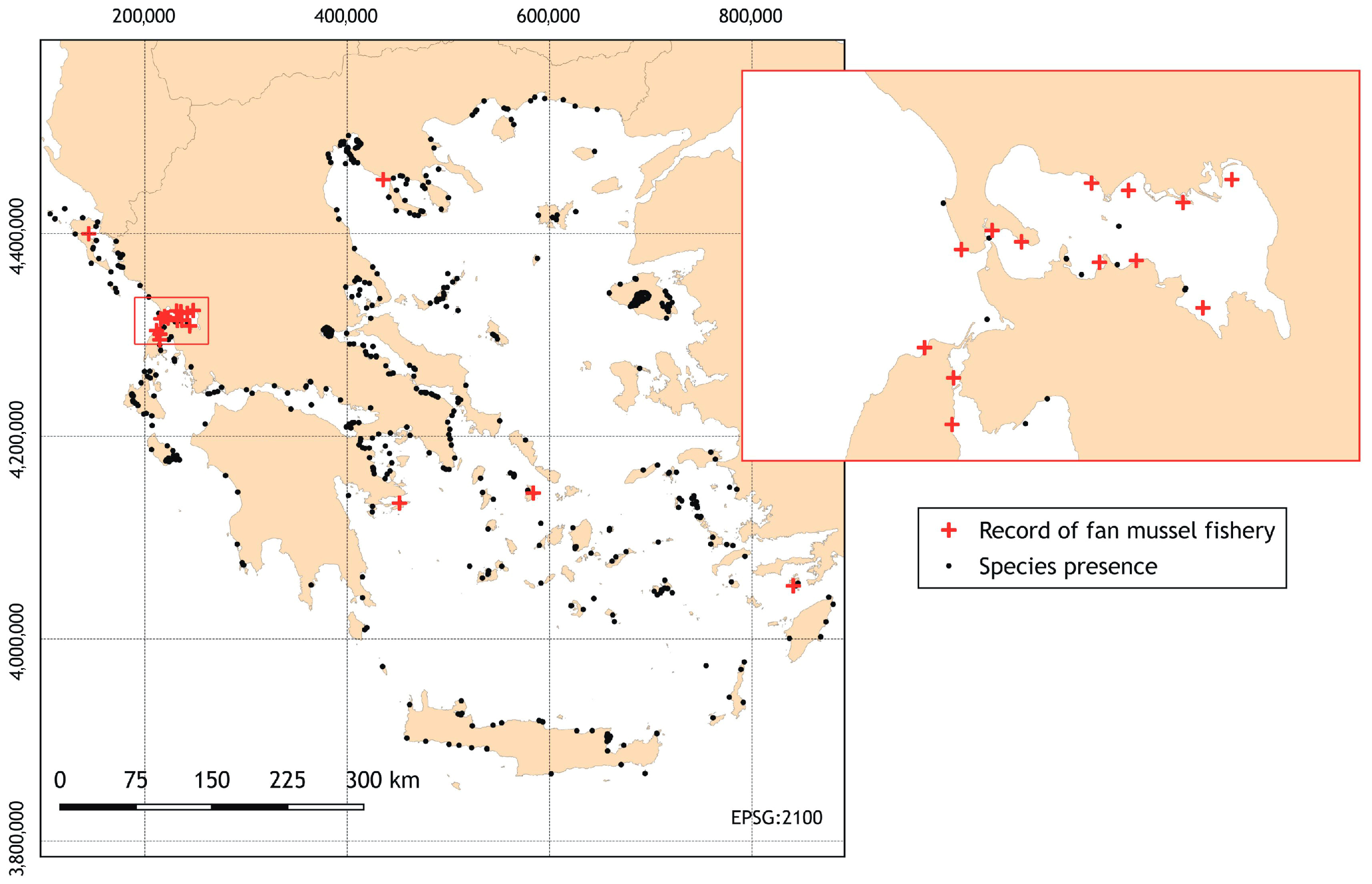
Greek fisheries officially started to get organized in 1911 and, up to the early 1980s, because species is issued as protected, shifting from an essentially pre-industrial stage toward the industrialization of fishing activities [6]. The present study dealt with research through Greek traditional and digital archives (i.e., newspapers, technical reports, and books) from the first establishment of the Greek nation (1832) to and up of the prohibition of fan mussel fishery (1992). Digitized archives were found at the National Library of Greece (http://efimeris.nlg.gr/ns/main.html?fbclid=IwAR0n_4AKJQ-ci7BFEwxCxZmu-90qQRZhlGhyMSmmcpkvB9gThXnwQmwi8E (accessed on 10 January 2026)) using as a keyword the terms “pinna”, “fan mussel”,and “pinologos” (Figure 1).
Figure 1.
Record of fan mussel fishery with pinologos tool and species presence (records taken from [11]) in the Greek waters. Small rectangle indicates Amvrakikos Gulf area.
Pinologos was recovered from the residence of a retired fisher in the Preveza region (Ionian Sea), selected through purposive sampling based on long-term professional experience targeting P. nobilis in the Amvrakikos Gulf. A semi-structured interview was conducted in November 2025, covering the tool’s physical characteristics, operational technique, fishing localities, and size-selectivity criteria. The fisher provided a detailed account of the fishery methodology employed with this implement. Furthermore, in 2025, a former president of the fisher’s association from Lefkada Island (Ionian Sea) verbally confirmed that this implement was utilized throughout the island with an identical design and operational technique.
3. Results and Discussion
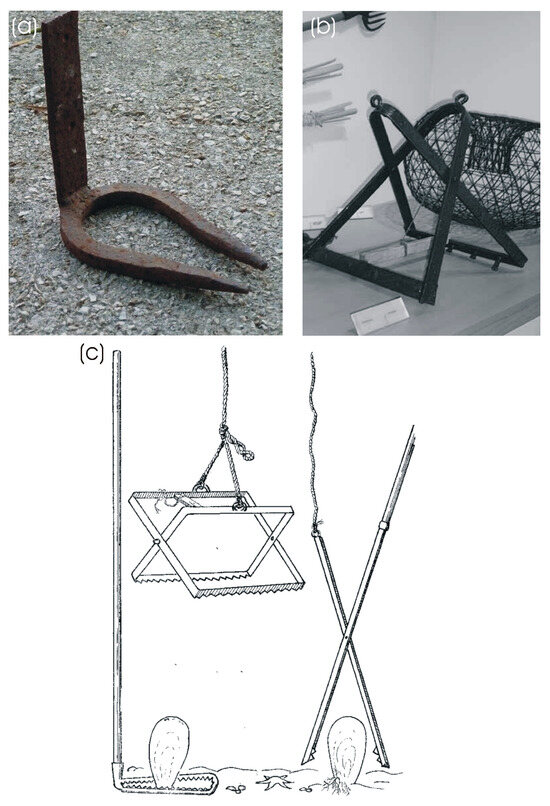
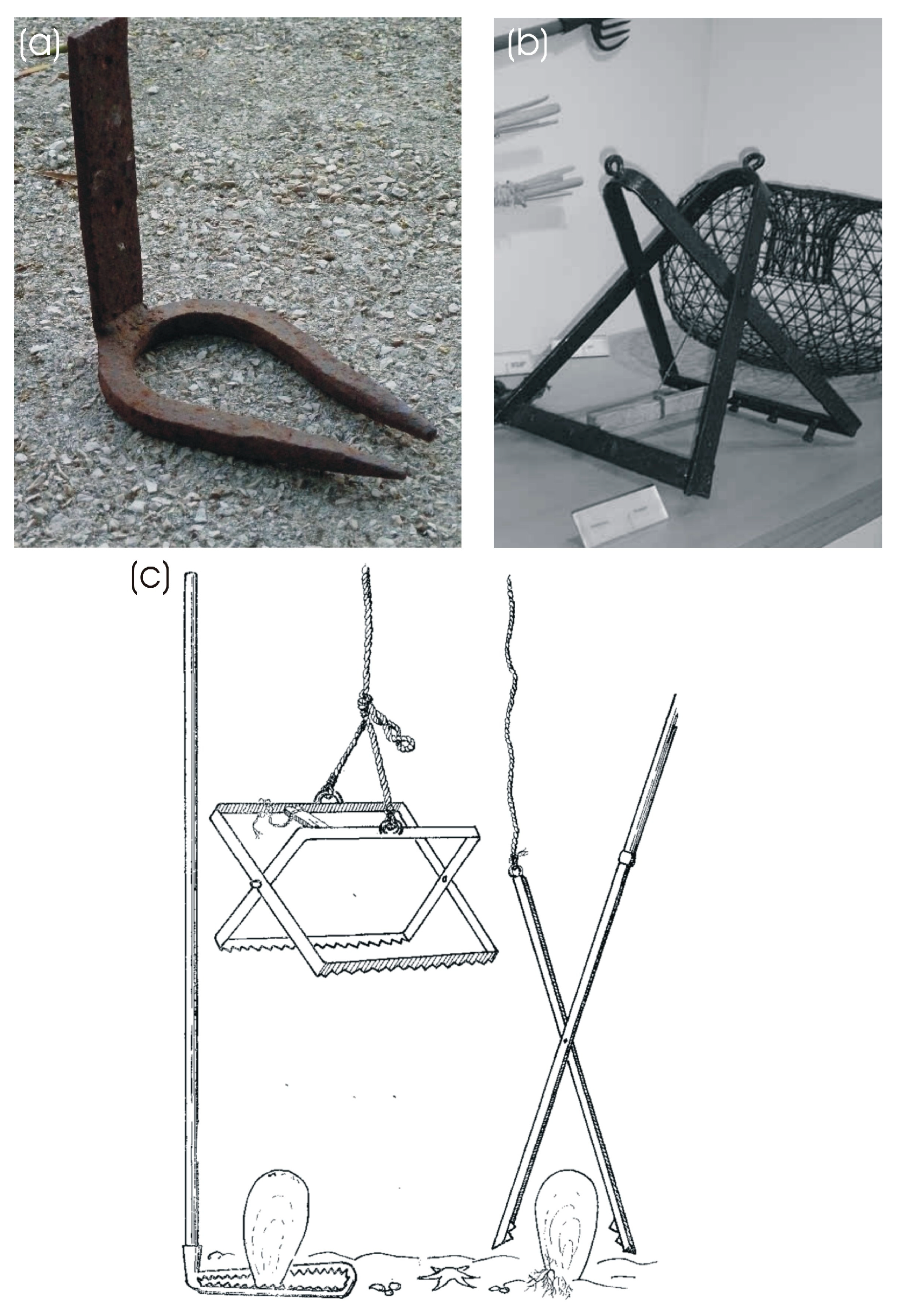
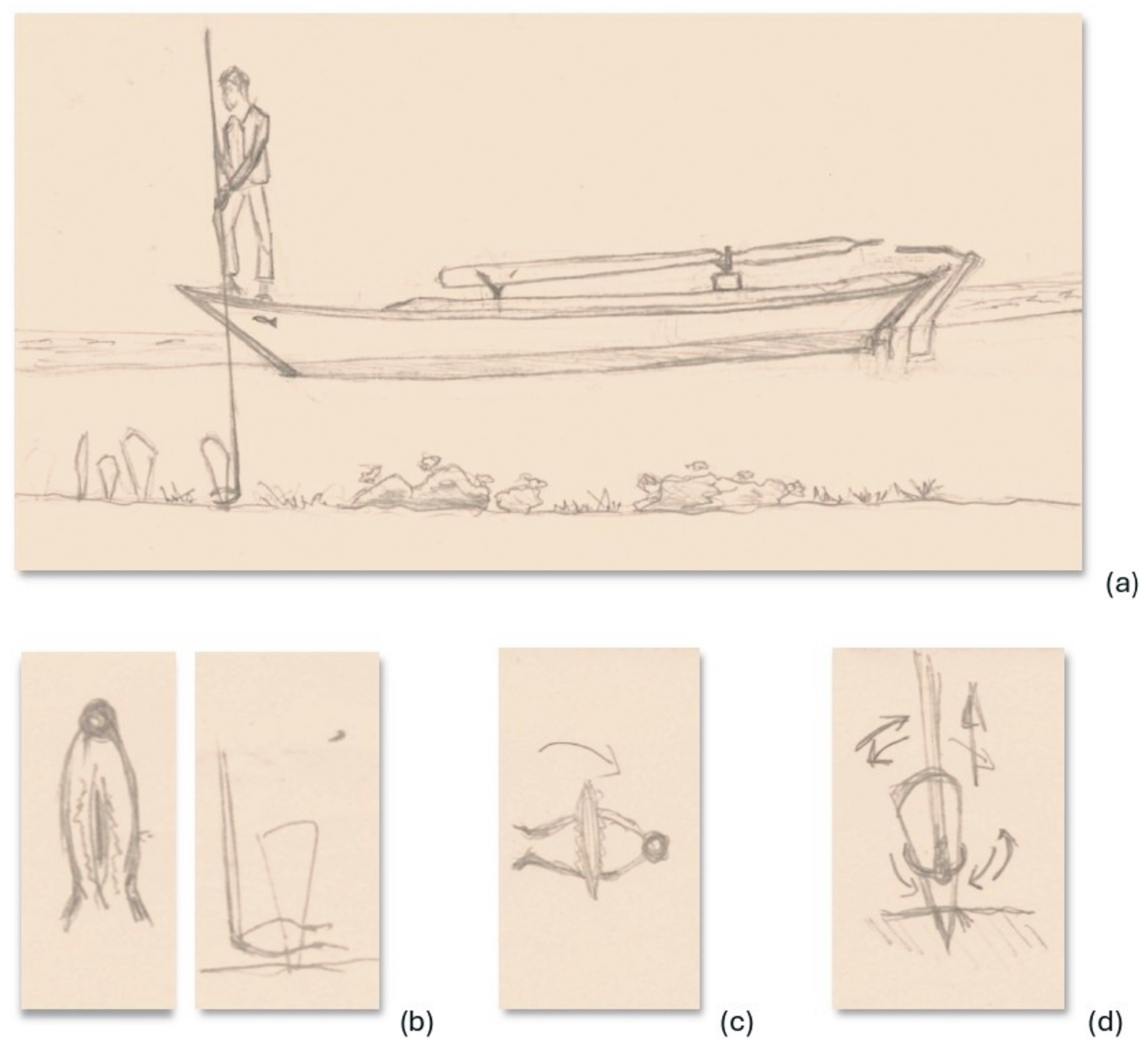
Pinologos, a specialized fishing tool, was first documented in a judicial confiscation record from Syros (1836), where it was listed among confiscated fishing equipment [12]. The corresponding fishing gear was also documented in an 1885 electoral register from Corfu Island, which provided a comprehensive catalogue of the professions listed on the island. During this period, P. nobilis was harvested in Greek waters using the pinologos at relatively shallow depths, yielding approximately 12 kg of catches per day and fisher [13]. The description of this fishing gear was in line with the description provided by [14], who documented the use of an elliptical iron fishing device for Pinna spp. (Figure 2a). Pinologos was also used during the interwar period (1925–1940), featured by a Y-shaped iron implement, with dimensions of 6 to 8 mm between rods, and a component securely fastened to the end of the pole (Figure 2a). The length from the loop of the pinologos to the tip of the pole measured approximately 25 centimeters, with a width of 7–8 cm. Another gear used for fan mussel, was the “pinologio”, as it showed from a photo taken at the Museum of Traditional Fisheries and Shells in Moudania (Chalkidiki, Greece) [15]. The operational technique involved positioning the pinologos around the fan mussel, upon a quarter-turn rotation, the specimen became secured within the constricted portion of the implement, and an upward pull detached it from the seabed (Figure 2c). Small-sized individuals were not harvested using this method, as their shells were thin and susceptible to abrasion [16]. The size of the threshold was estimated based on a rod width smaller than 25 cm.
Figure 2.
The two types of “Pinologos” tools: (a) the Y-form metal part of the base, (b) the scissored-type tool (image from [15]), and (c) the use of these gears in the water (schematic representation provided by [16]).
On Symi Island (South Aegean), (s)pinolo(g)os were also used for harvesting P. nobilis and two different types of gear existed [16]. The first type consisted of an iron ring constructed from approximately 7-mm rods, forming a Y-shaped implement 25 cm in length and 7–8 cm in width, with serrations on the inner edge. An iron cone is affixed to the narrower part, into which the pole is inserted. The fisher positions the gear around the species, and upon a quarter-turn rotation, the species is secured within the narrow section of the ring, whereupon an upward pull detaches it from the seabed (Figure 2c).
The second type of gear, which is like scissors, represents an ancient and simple iron implement (Figure 2c). A rope is attached to one arm while a pole is affixed to the other, with each terminal bearing two serrations. The fisher lowers the opened implement along the lateral surfaces of the fan mussel by slackening the rope, ensuring the serrations are positioned on the two narrow edges of the shell. Upon pulling the rope, the tongs close like scissors, securing the specimen, which is then hauled into the vessel. This type of pinologos demonstrates optimal efficiency at depths of 5–7 m, where the fisher can manipulate it using a single pole. Performance diminishes at greater depths, as a second pole must be joined to the first, complicating manipulation.
Moreover, also on Symi Island, fishers harvest P. nobilis in deep waters using a slightly different fishing gear, the “little chair” type of gear (Figure 2b). According to unpublished records, this fishing method originated from Syros Island in 1946 and transferred to Symi Island where fishers harvesting sponges with their glass-bottomed vessels and observe this fishing strategy [16]. This fishing tool consists of two square iron frames of unequal dimensions, with the smaller fitting inside the larger (which has sides of approximately 40 cm). The lower edge of both squares is serrated. The lateral edges are connected by two loosely fitted bolts. The upper edge of each square features a ring through which the fisher threads a thin rope to form a loop. A wooden rod measuring 30 cm in length is permanently attached to this upper edge. When deploying the “little chair”, the fisher positions the wooden rod between the two iron frames so that they descend at a distance from one another until the fan mussel is situated between them. Once the square frames contact the specimen, the fisher pulls the rope, causing the wooden rod to fall, the smaller square approaches the larger one, and the fan mussel becomes caught between the serrations of the two frames. The “little chair”, which was in use since 1946 can also capture rocks bearing shells (Figure 2c).
A similar construction has also been reported from the Ionian region (Lefkada Island and North Ionian), where the pinologos consisted of a rudimentary device featuring two-pronged iron tongs affixed to a wooden shaft. Nevertheless, the lack of large P. nobilis individuals in Parga waters precluded the utilization of this fishing implement in that locality [17].
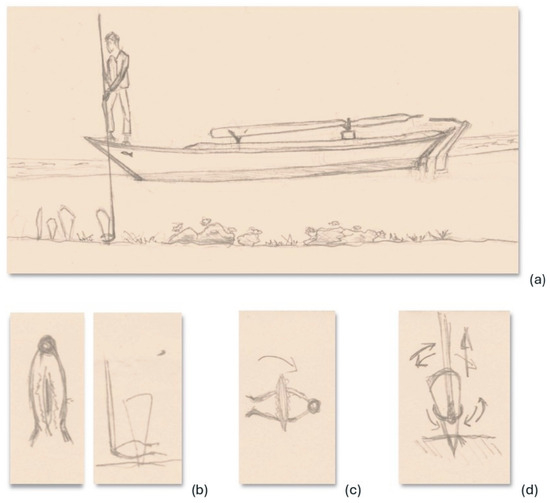
According to fishers from Preveza and Lefkada island, the “pinologos” fishing tool stages can be described as: when they were reaching places known for the presence of fan mussel’s populations, they place the tool on the seabed in such a manner that it effectively encircles the species from its broader lateral side. Subsequently, they execute a precise rotation of the tool by an angle of 90° and finally engage in a deliberate upward motion, thereby successfully ensnaring the P. nobilis catch within this tool (Figure 3).
Figure 3.
Fishing method with the “pinologos” tool; (a) fishing vessel approaches the area and places the tool, (b) the tool is based at the base of the fan mussel, (c) rotation by 90°, and (d) extraction.
The use of pinologos gear in shallow waters was in line with the observation in Lake Vouliagmeni, in which younger/smaller cohorts were is peaking in very shallow zones (1–3 m), while older/larger cohorts were peaking at deeper depths (11–13 m) [18]. In our historical records, the pinologos gear was not used in areas where large specimens were absent (e.g., North Ionian), implying that fishers targeted only established populations. In Northern Greece (Thermaikos Gulf) a mean density of 1.04 (SD: 0.17) individuals/m2 of P. nobilis concentrated at depths of 2–3 m, which was the highest reported in the Mediterranean at that time [19]. Likewise, at depths up to 2 m in Maliakos Gulf, [18] found P. nobilis with densities ranging from 19.1 to 48.9 individuals/100 m2. Having used pinologos mostly in shallow waters, size ranges of P. nobilis observed at these depths (up to 3 m) were marked around 33.7 cm (SD: 9.91 cm) [16] to 34.35 cm (SD: 11.78 cm) [20].
Our historical analysis of fan mussel’s fishing practices further indicated that coastal communities in Greece traditionally harvested fan mussels with specialized fishing tools as detailed above. In effect, historical fishing pressure was spatially and size limited, unlike today’s basin-wide mortality [21]. Historical data suggest that sustainably populations once persisted even in fished areas, implying there may be potential for recovery if critical threats are removed. Therefore, management strategies such as strict enforcement of no-take zones, ex-situ breeding for resistant strains, and restoration projects should be guided by the goal of recovering at least the population abundance of the “early fisheries” status.
Since 2016, P. nobilis populations across the Mediterranean have suffered epizootic events, driving P. nobilis toward functional extinction across much of its Mediterranean range within a timeframe of years and affecting individuals across the full bathymetric and distributional range of the species simultaneously [1,2,3]. The widespread degradation of Posidonia oceanica meadows through coastal development, illegal trawling, anchoring, and eutrophication has progressively eroded the species’ ecological habitats upon which population recovery depends [3]. The increasing trend in the Mediterranean Sea surface temperatures further exacerbate these pressures by facilitating pathogen proliferation and reducing the physiological tolerance of bivalve populations to compounding stressors [22].
The persistence of structured P. nobilis populations under historically restricted exploitation demonstrates that recovery is ecologically feasible, provided contemporary threats are effectively mitigated. The population structures documented in “early fisheries” period therefore constitute empirically grounded and realistic benchmarks for guiding current restoration initiatives.
Author Contributions
Conceptualization, J.A.T.; methodology, J.A.T. and D.K.M.; formal analysis, J.A.T., E.K., G.K. and D.K.M.; investigation, E.K., D.T. and D.K.M.; writing—review and editing, J.A.T., E.K., D.T., G.K. and D.K.M.; visualization, D.T.; supervision, J.A.T. All authors have read and agreed to the published version of the manuscript.
Funding
This study is part of the EU-Greece EMFF 2014–2020 program titled “Innovative actions for monitoring-recovery-assistance in recruiting the endangered species Pinna nobilis” with project code: 5052394 (PinnaSOS).
Institutional Review Board Statement
Not applicable.
Informed Consent Statement
Not applicable.
Data Availability Statement
The data collected in this study and published in this work are available upon request to the first author.
Conflicts of Interest
The authors declare no conflicts of interest.
References
- Catanese, G.; Grau, A.; Valencia, J.M.; Garcia-March, J.R.; Vázquez-Luis, M.; Alvarez, E.; Deudero, S.; Darriba, S.; Carballal, M.J.; Villalba, A. Haplosporidium pinnae sp. nov., a haplosporidan parasite associated with mass mortalities of the fan mussel, Pinna nobilis, in the Western Mediterranean Sea. J. Invertebr. Pathol. 2018, 157, 9–24. [Google Scholar] [CrossRef] [Scilit] [PubMed]
- Katsanevakis, S.; Tempera, F.; Teixeira, H. Mapping the impact of alien species on marine ecosystems: The Mediterranean Sea case study. Divers. Distrib. 2016, 22, 694–707. [Google Scholar] [CrossRef] [Scilit]
- Boulenger, A.; Chapeyroux, J.; Fullgrabe, L.; Marengo, M.; Gobert, S. Assessing Posidonia oceanica recolonisation dynamics for effective restoration designs in degraded anchoring sites. Mar. Pollut. Bull. 2025, 216, 117960. [Google Scholar] [CrossRef] [Scilit] [PubMed]
- Sperantsas, N.J. Bulletin de la Commission Thalassographique Hellenique; Ministère de l’ Economie Nationale: Athènes, Greece, 1929. [Google Scholar]
- Belloc, G. Appendix B: Catalogue of the resources of Greek waters. In Inventory of the Fishery Resources of Greek Waters; UNRRA—FAO: Athens, Greece, 1948; 213p. [Google Scholar]
- Moutopoulos, D.K.; Stergiou, K.I. The evolution of the Greek fisheries during the 1928–1939 period. Acta Adriat. 2011, 52, 183–200. [Google Scholar]
- ELSTAT (Hellenic Statistical Authority), 1966–2016. Results of Marine Fishing with Motorized Vessels (1964–2015), Athens, Greece. Available online: https://www.statistics.gr (accessed on 10 December 2025).
- Zeller, D.; Pauly, D. The ’presentist bias’ in time-series data: Implications for fisheries science and policy. Mar. Policy 2018, 90, 14. [Google Scholar] [CrossRef] [Scilit]
- Thurstan, R.H.; McCormick, H.; Preston, J.; Ashton, E.; Bennema, F.; Bratos Cetinic, A.; Brown, J.H.; Cameron, T.; da Costa, F.; Donnan, D.; et al. The world was our oyster: Records reveal the vast historical extent of European oyster reef ecosystems. Nat. Conserv. 2024, 7, 1719–1729. [Google Scholar] [CrossRef] [Scilit]
- Engelhard, G.H.; Thurstan, R.H.; MacKenzie, B.R.; Alleway, H.K.; Bannister, R.C.A.; Cardinale, M.; Clarke, M.W.; Lescrauwaet, A.-K. ICES meets marine historical ecology: Placing the history of fish and fisheries in current policy context. ICES J. Mar. Sci. 2016, 73, 1386–1403. [Google Scholar] [CrossRef] [Scilit]
- Tsolakos, K.; Theodorou, J.; Katselis, G. Estimation of Pinna nobilis L. ecosystem services in Greece. In Proceedings of the Hydromedit 2024—5th International Congress on Applied Ichthyology, Oceanography & Aquatic Environment; University of the Aegean: Mytilene, Greece, 2024; pp. 443–447. Available online: https://rimsi.imsi.bg.ac.rs/bitstream/id/8791/bitstream_8791.pdf (accessed on 25 January 2026).
- Alevizakis, N. Fishery and fisheries in Corfu (19th–early of 20th century): First approach. In Tetradia Ergasias, 33: Fishing in the Greek Seas. From Historical Evidence to the Present Day; Dimitropoulos, D., Olympitou, E., Eds.; ΙΝΕ/ΕΙΕ: Athens, Greece, 2010; pp. 125–137. [Google Scholar]
- Apostolidės, N.C. La Pêche en Grèce. Ichthyologie, Migrations, Engins et Manières de Pêche, Produits, 2nd ed.; Meissner, C., Kargadouris, N., Eds.; Imprimerie “Hestia”: Athens, Greece, 1907. [Google Scholar]
- Voultsiadou, E.; Koutsoubas, D.; Achparaki, M. Bivalve mollusk exploitation in Mediterranean coastal communities: An historical approach. J. Biol. Res.-Thessalon. 2010, 13, 35–45. [Google Scholar]
- Lefkaditis, G. The Fishery in the Greek Coastal Areas. Fishing Gears, Strategy and Fish Species; Hestia Press: Athens, Greece, 1941; Available online: https://anemi.lib.uoc.gr/metadata/e/1/3/metadata-199-0000048.tkl (accessed on 25 January 2026).
- Zaxariou-Mamalinga, E. Fishers of Symi Island. Economic, Social Cultural Approach. Ph.D. Thesis, University of Ioannina, Athens, Greece, 1986. Available online: https://www.didaktorika.gr/eadd/handle/10442/9890 (accessed on 25 January 2026).
- Tsakas, N.C. Parga, Sea. Laographic Study; Laographic Archive, Number of the Archive A.E. 2416. Edition; Ipirotiki Company of Athens: Athens, Greece, 1967. [Google Scholar]
- Katsanevakis, S. Population ecology of the endangered fan mussel Pinna nobilis in a marine lake. Endanger. Species Res. 2006, 1, 51–59. [Google Scholar] [CrossRef] [Scilit]
- Galinou-Mitsoudi, S.; Vlahavas, G.; Papoutsi, O. Population study of the protected bivalve Pinna nobilis (Linnaeus, 1758) in Thermaikos Gulf (North Aegean Sea). J. Biol. Res.-Thessalon. 2006, 5, 47–53. [Google Scholar]
- Theodorou, J.; James, R.; Tagalis, D.; Tzovenis, I.; Hellio, C.; Katselis, G. Density and size structure of the endangered fan mussel Pinna nobilis (Linnaeus 1758), in the shallow water zone of Maliakos Gulf, Greece. Acta Adriat. 2017, 58, 63–76. [Google Scholar] [CrossRef] [Scilit]
- Zotou, M.; Gkrantounis, P.; Karadimou, E.; Tsirintanis, K.; Sini, M.; Poursanidis, D.; Azzolin, M.; Dailianis, T.; Kytinou, E.; Issaris, Y.; et al. Pinna nobilis in the Greek seas (NE Mediterranean): On the brink of extinction? Mediterr. Mar. Sci. 2020, 21, 575–591. [Google Scholar] [CrossRef] [Scilit]
- Michaelidis, B.; Ouzounis, C.; Paleras, A.; Pörtner, H.O. Effects of long-term moderate hypercapnia on acid–base balance and growth rate in marine mussels Mytilus galloprovincialis. Mar. Ecol. Prog. Ser. 2025, 293, 109–118. [Google Scholar] [CrossRef] [Scilit]
Disclaimer/Publisher’s Note: The statements, opinions and data contained in all publications are solely those of the individual author(s) and contributor(s) and not of MDPI and/or the editor(s). MDPI and/or the editor(s) disclaim responsibility for any injury to people or property resulting from any ideas, methods, instructions or products referred to in the content. |
© 2026 by the authors. Licensee MDPI, Basel, Switzerland. This article is an open access article distributed under the terms and conditions of the Creative Commons Attribution (CC BY) license.