Article

Molecular Detection and Characterization of Chelonid Alphaherpesvirus 5 (Scutavirus chelonidalpha5) Associated with Fibropapillomatosis in Sea Turtles Rescued in Santa Marta, Colombia: Implications for Disease Surveillance and Marine Turtle Conservation


by
Angel Oviedo
1,
Edgar Zambrano
1,
Jean Posso-Avendaño
1,2,
Daniel B. Ramírez-Osorio
2,
Jose A. Usme-Ciro
2,* and
Lyda R. Castro
1,*
1
Centro de Genética y Biología Molecular, Grupo de Investigación Evolución, Sistemática y Ecología Molecular, Universidad del Magdalena, Calle 29H3 No 22–01, Santa Marta 470004, Magdalena, Colombia
2
CIST—Centro de Investigación en Salud para el Trópico, Facultad de Medicina, Universidad Cooperativa de Colombia, Santa Marta 470002, Magdalena, Colombia
*
Authors to whom correspondence should be addressed.
Conservation 2026, 6(2), 45; https://doi.org/10.3390/conservation6020045

Submission received: 24 February 2026 / Revised: 6 April 2026 / Accepted: 7 April 2026 / Published: 13 April 2026

Abstract

Fibropapillomatosis, a disease associated with Scutavirus chelonidalpha5, commonly known as Chelonid alphaherpesvirus 5 (ChHV5), manifests as benign tumors that impair the motor, visual, and physiological functions of affected sea turtles. In this study, blood and tissue samples were collected from turtles exhibiting fibropapilloma-like lesions as well as from clinically healthy individuals. A nested PCR approach was employed to amplify the viral UL30 and UL28 genes for the detection and characterization of the virus variants. The mitochondrial control region was used to assess the relationship between the turtle population and the viral variant. Among the 19 turtles analyzed, six tested positive for ChHV5, including both symptomatic and asymptomatic turtles. Phylogenetic analysis revealed that three positive samples belonged to the Western Atlantic/Caribbean clade, whereas the other three grouped within the Atlantic clade. New oligonucleotides and probes were designed for ChHV5 qPCR detection, accounting for the globally accumulated genetic variability. The qPCR test parameters demonstrated an optimized assay with an efficiency of 101.4% and a detection limit of 2.4 genome copy equivalents (GCE)/μL. This study confirms the presence of two ChHV5 viral variants in rescued turtles from the Caribbean region of Colombia, including both clinically affected and asymptomatic individuals. Therefore, these results support the association between ChHV5 and fibropapillomatosis. Furthermore, analysis of the mitochondrial control region supports the hypothesis of horizontal transmission of the virus. A novel qPCR protocol with a synthetic control is proposed to improve early diagnosis and strengthen conservation and prevention strategies.

1. Introduction

Sea turtles comprise 2 families and seven species [1]. In the Colombian Caribbean, three of these seven species have been reported: Chelonia mydas (green turtle), Eretmochelys imbricata (hawksbill turtle), and Caretta caretta (loggerhead turtle) [2,3]. The three species are considered vulnerable according to the Red Book of Reptiles of Colombia [4]. The conservation status of these species is affected by factors such as human exploitation, destruction of their habitat and nesting sites, marine pollution, climate change, and infectious diseases [5]. The concern for the conservation of these animals stems from their crucial ecological role in marine ecosystems, including seagrass meadows and coral reefs. Their presence is essential for maintaining the balance and overall health of these environments [6,7].
Pollution and anthropogenic activities exert pressure on marine ecosystems, leading to their degradation and facilitating the emergence of wildlife diseases [8]. Therefore, it is important to understand and describe the transmissible behavior of various diseases that can affect turtles and marine fauna and implement prevention and early detection measures to avoid the decline in biodiversity [9]. One of the infectious diseases that affect sea turtles is fibropapillomatosis (FP), which is distinguished by the development of fibropapillomas with sizes varying from 0.1 to approximately 30 cm. These tumors are usually found mainly on the skin, tissues of the ocular and cloacal cavity, and in the most severe cases, also on internal organs [10,11,12]. Although these tumors are histologically benign, they can impair locomotion, feeding, vision, and individual fitness; and, in the case of internal tumors, they can cause organ failure by compressing the organs, leading to the death of turtles [13]. The causal agent of this disease has not been clearly determined; however, recent research has provided consistent evidence suggesting a connection between tumors and the presence of the Chelonid alphaherpesvirus 5 (ChHV5) [14,15].
ChHV5 is a double-stranded DNA virus whose genome consists of approximately 132,233 bp [16]. This virus belongs to the family Orthoherpesviridae, subfamily Alphaherpesvirinae, genus Scutavirus, species Scutavirus chelonidalpha5 and it is recognized as Chelonid alphaherpesvirus 5 (ChHV5) [17,18]. Viruses grouped in the subfamily Alphaherpesvirinae primarily infect reptiles [19]. ChHV5 is phylogenetically classified based on the geographic regions where it has been reported. Globally, four clades of ChHV5 have been designated as the Eastern Pacific, Western Atlantic/Eastern Caribbean, Mid-Western Pacific, and Atlantic clade [15]. This genetic grouping suggests horizontal transmission of the virus at feeding and breeding sites, as infected epidermal cells released into the natural environment serve as a source of transmission [20]. However, the complex migratory routes of turtles and the presence of the virus in turtles without clinical signs and symptoms represent a challenge for the epidemiological monitoring of the virus [13,20]. For example, a study reported higher viral loads of ChHV5 in asymptomatic turtles than in tumor tissues of turtles affected by FP [21]. This finding complicates our understanding of the disease’s physiopathology. It has been suggested that symptom development may depend on factors such as the timing of infection [22], the latent behavior of herpesviruses [23], and the possibility that the presence of the virus alone is not sufficient to induce tumor development. Other contributing elements may include co-infection with additional pathogens [24,25], host-specific factors such as immune status, and external environmental influences [11,26].
In South America, in recent years, there has been an increase in studies related to ChHV5 due to the high prevalence of the virus in turtle populations. Rodenbusch et al. [27] detected and quantified ChHV5 in 153 samples of fibropapillomas collected from green turtles, where high viral loads were positively correlated with increased severity of FP in turtles sampled on the Brazilian coast and with turtles found dead in the states of Sao Paulo and Bahia. On the other hand, in Ecuador, the presence of ChHV5 was detected in two green turtles and one olive ridley turtle rescued by a rehabilitation center [28]. Similarly, the Atlantic variant of ChHV5 associated with fibropapillomas was detected in a green turtle found stranded on the western coast of the Río de la Plata, Argentina; corresponding to the southernmost recorded case for the Southwest Atlantic [29]. In Colombia, Castro et al. [30] made the first report of ChHV5 in tumors extracted from a Chelonia mydas turtle rescued in the Colombian Caribbean Sea. Therefore, continued monitoring and research aimed at improving detection methods and the molecular characterization of ChHV5 are a priority, not only to better understand its epidemiology and transmission dynamics but also to inform conservation strategies for affected turtle populations.

2. Materials and Methods

2.1. Sample Collection

Sample collection was conducted by the Autonomous Corporation of Magdalena (CORPAMAG) rescue center, located at the Rodadero Marine Wildlife Center in Santa Marta, Magdalena, Colombia. Nineteen samples of adult and juvenile turtles were obtained, distributed in 13 Chelonia mydas (12 adults and one intermediate juvenile), four Eretmochelys imbricata (adults), and two Caretta caretta (adults), which were recovered and seized by CORPAMAG from accidental catches in fishing nets or by fishermen and illegal wildlife traders. Four C. mydas (three adult and one intermediate juvenile) turtles had fibropapillomas; therefore, fibropapilloma tumor tissue was extracted through a biopsy performed with a scalpel and preserved in vials with phosphate-buffered saline (PBS). Additionally, blood samples were taken from all turtles, which were extracted from the dorsal cervical sinus (external jugular vein) of each turtle, positioning the animal at 45°, with the head lower than the rest of the body. 5 mL syringes with 21- to 25-gauge needles (depending on the size of the turtle) were used to collect 3–5 mL of blood, which was deposited in vacutainer tubes with 7.2 mg of K2 EDTA (lithium ethylene diamine tetraacetic acid). Sampling was approved by the research ethics committee (CEI) of the University of Magdalena.

2.2. DNA Extraction

Genetic material was extracted from fibropapilloma tumor tissue and blood samples obtained from turtles. To extract the tumor tissue, 50 mg of tumor were homogenized with lysis buffer and 20 µL of proteinase K (20 mg/mL). DNA extraction was performed using the E.Z.N.A Tissue DNA kit (Omega, Bio-tek, Norcross, GA, USA) following the manufacturer’s instructions. In the case of blood samples, DNA extraction was performed from 100 μL of sample using the E.Z.N.A Blood DNA mini kit (Omega, Biotek) following the manufacturer’s instructions. All DNA eluates obtained were visualized by 1% agarose gel electrophoresis with RedGel (Biotium, Fremont, CA, USA).

2.3. Detection and Characterization of ChHV5

ChHV5 was detected through partial amplification by nested PCR of the UL30 gene (DNA polymerase), which is a highly conserved genomic region. The amplification was performed using the primers implemented by Page-Karjian et al. [13], obtaining an amplicon of 364 bp. The UL28 gene (glycoprotein B) was partially amplified by nested PCR to characterize the viral variants. The UL28 gene encodes a surface glycoprotein of the virion that is subject to selective pressure from the host immune system, making it ideal for studying the genetic variability of the virus [31]. The amplification of the UL28 gene was performed using the primers described by Page-Karjian et al. [13], generating a 300-bp fragment. Additionally, a 960-bp fragment of the mtDNA D-loop control region was amplified to identify the genetic origin of the turtles with positive results for ChHV5 and associate the haplotype of the host with the phylogenetic group of the virus. For this purpose, the primers designed by Jones et al. [15] were used. All PCR products were verified by 2% agarose gel electrophoresis with RedGel (Biotium) and sequenced in both directions at the GenCore facility (Universidad de Los Andes, Bogota, Colombia).

2.4. Phylogenetic Analysis

The sequences were edited using BioEdit software v7.7.1 [32]. Subsequently, a similarity analysis was performed using sequences stored in GenBank using the NCBI BLAST tool (www.ncbi.nlm.nih.gov, accessed on 10 November 2024). A separate database was built for each gene (UL30, UL28, and D-loop), including sequences obtained from GenBank. For the sequences derived from coding genes (UL28 and UL30), the Geneious Prime program v2024.0 [33] was used to adjust the reading frames. Subsequently, alignment by codons was performed, followed by cleaning using Translator X [34]. For the non-coding gene (D-loop), a nucleotide alignment was performed and then cleaned using Gblocks v0.91 [35]. For the selection of the best substitution models, the BIC (Bayesian Information Criterion) was used in IQ-TREE v2.4.0 [36]. The maximum likelihood (ML) analysis was performed using the fast hill climbing algorithm and 10,000 Bootstrap pseudoreplicates. Finally, FigTree v1.4.4 [37] was used for the visualization and editing of the generated phylogenetic trees.

2.5. qPCR Test Design

2.5.1. Primers and Probe Design

Primers and probes were designed for the molecular diagnosis of ChHV5 infection using the UL30 gene. These new designs were developed to theoretically ensure maximum assay sensitivity, considering newly available nucleotide sequences representing recently reported viral variants that were not included in earlier assays. For this purpose, the UL30 gene corresponding to positions 84,473 to 87,928 of the ChHV5 reference genome (HQ878327) was selected. The primers and probe design were performed using the PrimerSelect tool of the Lasergene v7.1 suite (DNAStar, Inc., Madison, WI, USA). The primers were selected considering the best scores for the affinity of melting temperatures and the internal stability. Subsequently, the MAFFT algorithm [38] was used to generate a multiple sequence alignment (MSA) of 110 nucleotide sequences available in GenBank, selected for having a percentage of similarity greater than 94% to the reference sequence of the UL30 gene of the ChHV5 genome (NC_028891) and for including the sequence of the newly designed primers. The MSA allowed the visualization of genetic variability in the primers and probe hybridization regions and the identification of the open reading frame for the corresponding gene, enabling the correction of codon position at the 3′ end of primers and the incorporation of degenerate nucleotide positions according to the presence and frequency of genetic variability.

2.5.2. Construction of the Plasmid pMG-ChHV5-Control

For the in silico design of a plasmid control, the SeqBuilder module of the Lasergene v7.1 suite (DNAStar, Inc., Madison, WI, USA) was used. The hybridization regions of the primers for qPCR and probe designed in this study were included in the construct. A random spacer sequence of 257 bp generated using the random DNA sequence generator of the Sequence Manipulation Suite platform [39] was also included in the construct to produce an end-point PCR amplicon of 390 bp, which is easy to differentiate from the 293-bp amplicon of a positive sample in an agarose gel. In addition, the Bam HI and Eco RI recognition sites for restriction endonucleases were included at the 5′ end of the forward and reverse primers, respectively, to facilitate future modifications. The elaborated insert was cloned into the 2710 bp pMG-Amp plasmid vector (Macrogen, Inc., Seul, Korea), corroborated by Sanger sequencing through the Macrogen Inc. service (Seoul, Korea), and quantified with the dsDNA high sensitivity kit (Thermo Scientific, Waltham, MA, USA), in a Qubit 4 (Thermo Scientific Inc., Waltham, MA, USA), following the manufacturer instructions.

2.5.3. Validation of a New Real-Time PCR Assay for ChHV5

Serial dilutions of the plasmid control pMG-Amp-ChHV5 were made from 38.2 ng/µL in a 1:10 ratio, ranging from 10−5 to 10−10 with eight technical replicates for each dilution. A qPCR assay was conducted for the dilution series using the Luna Universal Probe qPCR Master Mix (New England BioLabs, Ipswich, MA, USA), following the manufacturer’s instructions, in the QuantStudio 3 Real-Time PCR System (Applied Biosystems, Foster City, CA, USA). Concentration of the primers and probe were 500 and 200 nM, respectively. A standard curve was generated using linear regression based on dilutions within the detection range, allowing the Ct values to be plotted against DNA concentrations. Additionally, the correlation coefficient (R2), slope, and efficiency percentage were calculated.
To measure the analytical sensitivity of the test, a detection limit (LoD) analysis was performed. Using the SPSS® Statistics v. 25 software (IBM, Armonk, NY, USA), a Probit regression was performed to estimate the minimum number of copies of the plasmid control that the test could detect with 95% confidence, applying the definition proposed by the MIQUE guidelines [40] and expressed as Genome Copy Equivalents (GCE)/µL. Only samples detected with a Ct value ≤ 38 were assumed to be positive.

2.5.4. ChHV5 Detection in Clinical Samples from Turtles Using qPCR

A total of four samples of previously purified DNA from neoplastic tissue and 19 samples of purified DNA from blood were used. The qPCR assay was performed following the conditions used in the validation of the primers and probe. Negative (molecular grade water) and positive (pMG-Amp-ChHV5) controls were included in the procedure to warrant the validity of the assay.

3. Results

3.1. Detection and Phylogenetic Characterization of ChHV5 Lineages and C. mydas Haplotypes

Of the 19 turtles analyzed, four individuals of the species C. mydas presented symptoms of FP, while the remaining individuals of the species C. mydas, E. imbricata, and C. caretta showed no symptoms associated with fibropapillomatosis. The amplification of the ChHV5 UL30 and UL28 genes resulted in six positive samples, four of them belonging to individuals presenting FP tumors and two of them from individuals without fibropapilloma tumors. The overall prevalence of the virus in the studied population was 31.6%. BLAST analysis of the UL30 gene sequences generated in this study revealed 99.69–100% nucleotide identity with ChHV5 sequences deposited in GenBank (e.g., HM348896, AY644454). Regarding the UL28 gene, the sequences obtained in this study showed 100% identity with sequences available in GenBank (e.g., JN625257, AY644454) (Table 1).
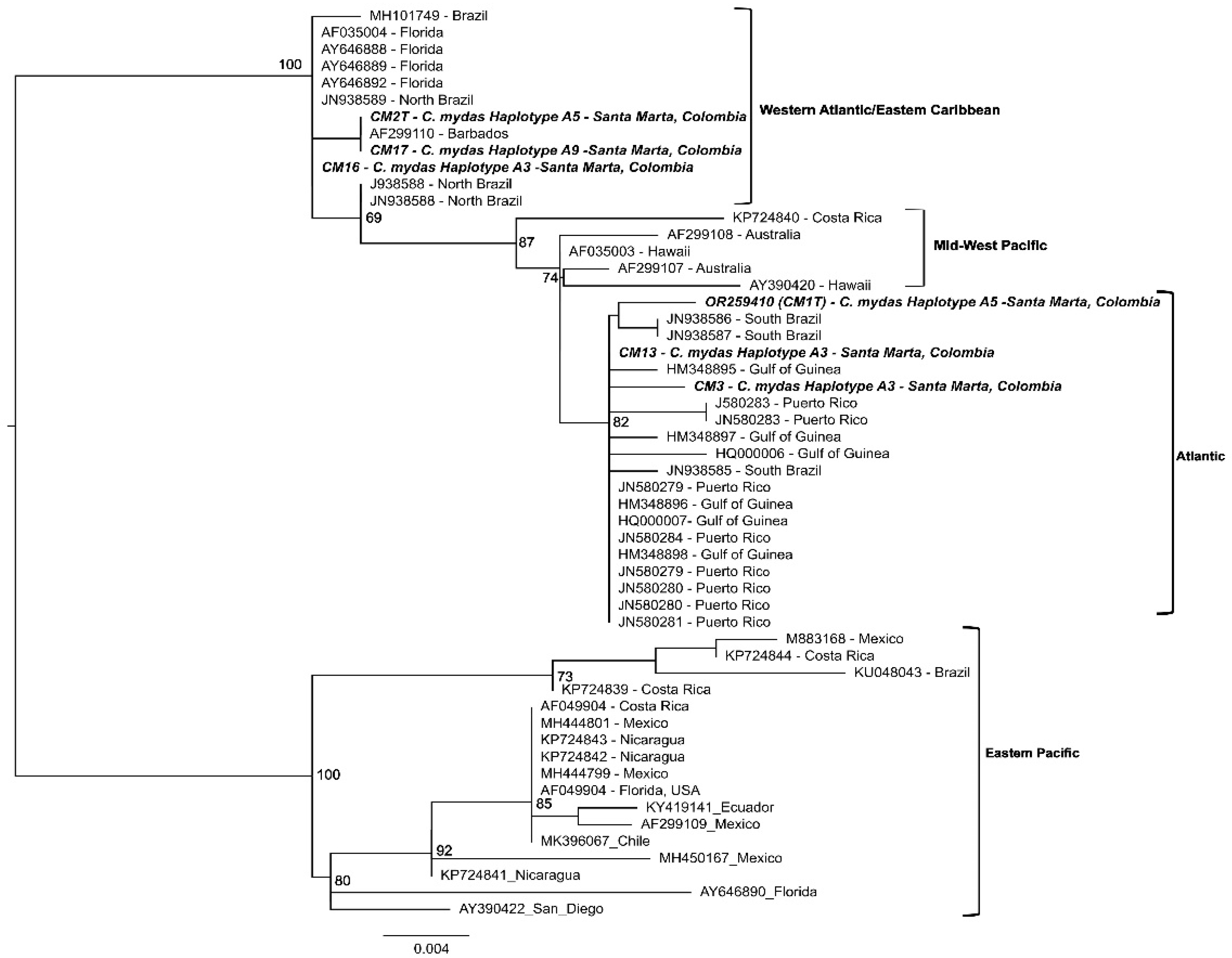
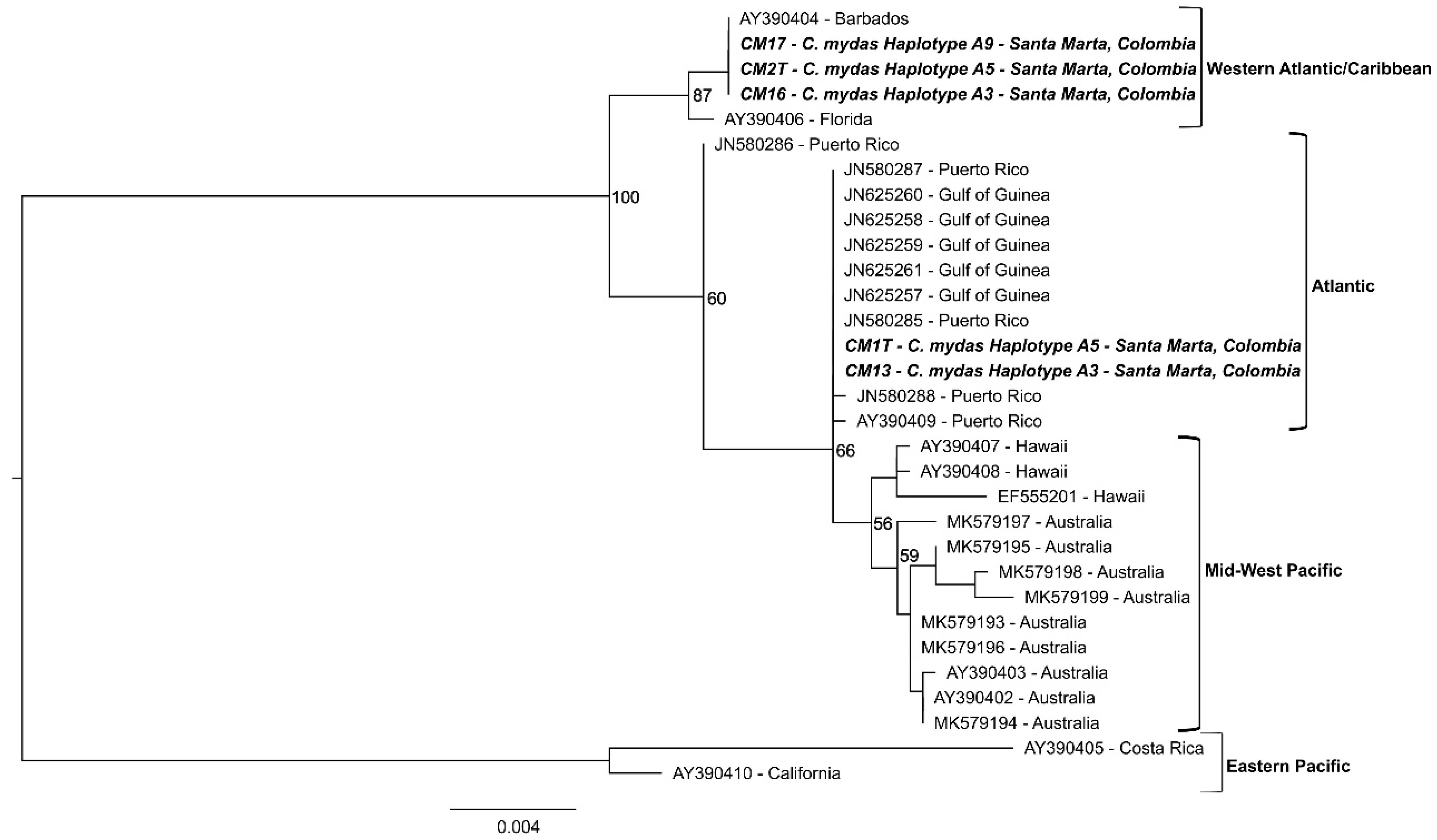
Maximum likelihood phylogenetic analysis for the UL30 gene showed that samples CM2T, CM17, and CM16 were closely related to sequences from Brazil (e.g., MH101749, JN938588), Florida (e.g., AY646888), and Barbados (AF299110), forming the paraphyletic group Western Atlantic/Eastern Caribbean (Figure 1). On the other hand, the virus detected in the samples CM13, CM1T, and CM3 was closely related to sequences from southern Brazil (JN938586, JN938587), Puerto Rico (e.g., JN580280), and the Gulf of Guinea (e.g., HM348896), which belong to the monophyletic group of the Atlantic (Figure 1). Regarding the UL28 gene, the CM3, CM2T, CM16, and CM17 sequences were closely related to sequences from Barbados (AY390404) and Florida (AY390406) (Figure 2), which belong to the monophyletic group representing the Western Atlantic and Eastern Caribbean geographic region. On the other hand, sequences from samples CM1T and CM13 showed a close phylogenetic relationship with several sequences of Puerto Rico (e.g., AY390409) and the Gulf of Guinea (e.g., JN625258), representing the Atlantic (Figure 2).
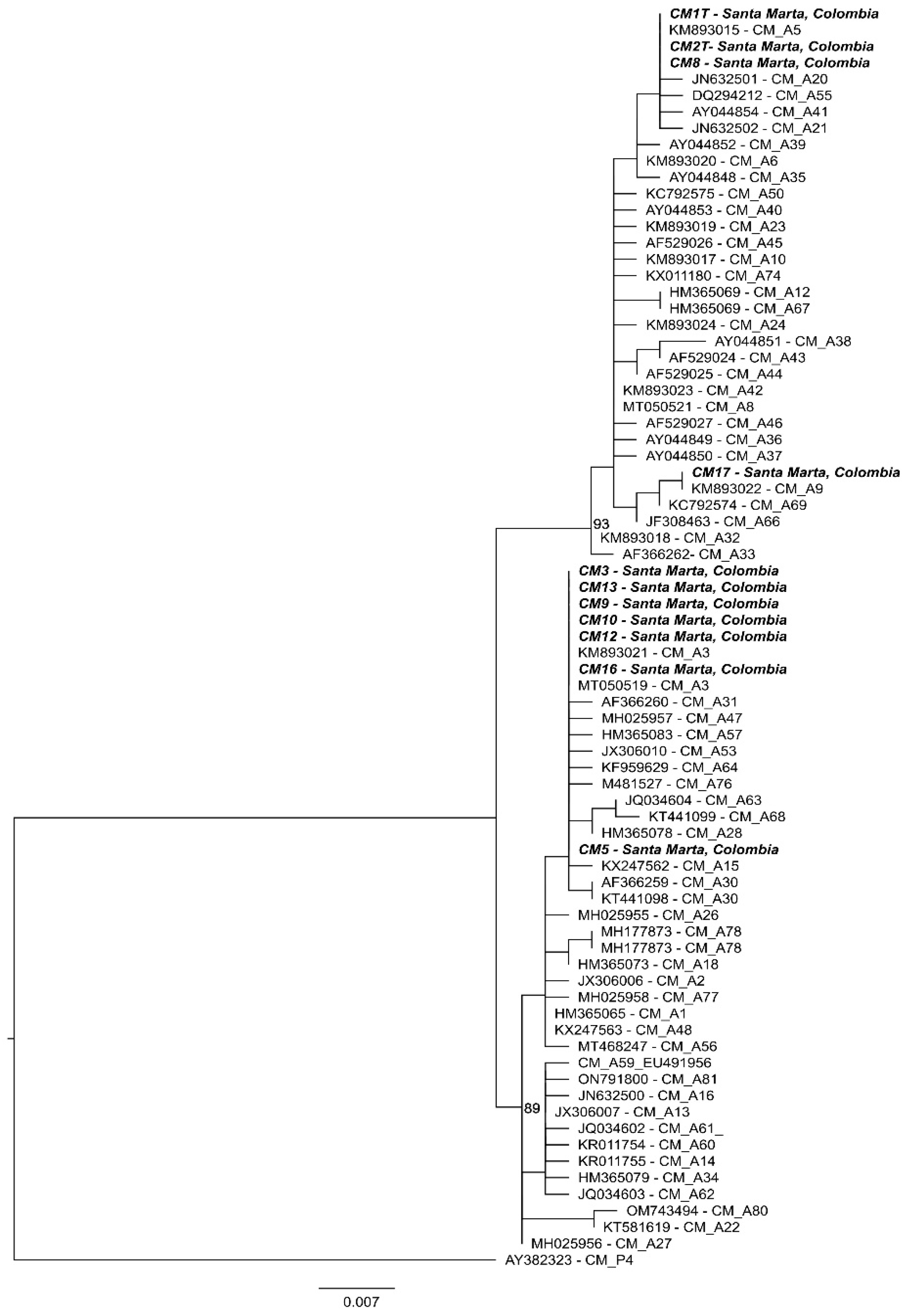
The analysis performed using the mitochondrial genome control region for the species C. mydas showed that the sequences generated in this study come from the Atlantic region. It was observed that samples CM3, CM5, CM9, CM10, CM12, CM13, and CM16 were closely related to haplotype A3 from Brazil (KM893021) and Colombia (MT050519), in addition to sequences from Florida and the Caribbean islands. On the other hand, samples CM1T, CM2T, and CM8 were phylogenetically related to haplotypes A5 (KM89301) from Brazil. Finally, sample CM17 was closely related to haplotype A9 (KM893022) from Brazil. The sequences of CM1T, CM2T, CM3, CM13, CM16, and CM17, which corresponded to samples of turtles positive for ChHV5, were mostly grouped with sequences representing Florida, Brazil, and Barbados (Figure 3).

3.2. Development and Validation of the qPCR Assay

A pair of primers (ChHV5_F_New and ChHV5_R_qPCR) and a probe (ChHV5_R_Probe) were designed for qPCR, achieving improved inclusiveness of the available genetic variability for ChHV5. Primers located at the UL30 gene between genomic positions 86,485 and 86,773, according to the ChHV5 reference genome HQ878327, generated 74-bp and 293-bp amplicons for qPCR and end-point PCR, respectively (Table 2).
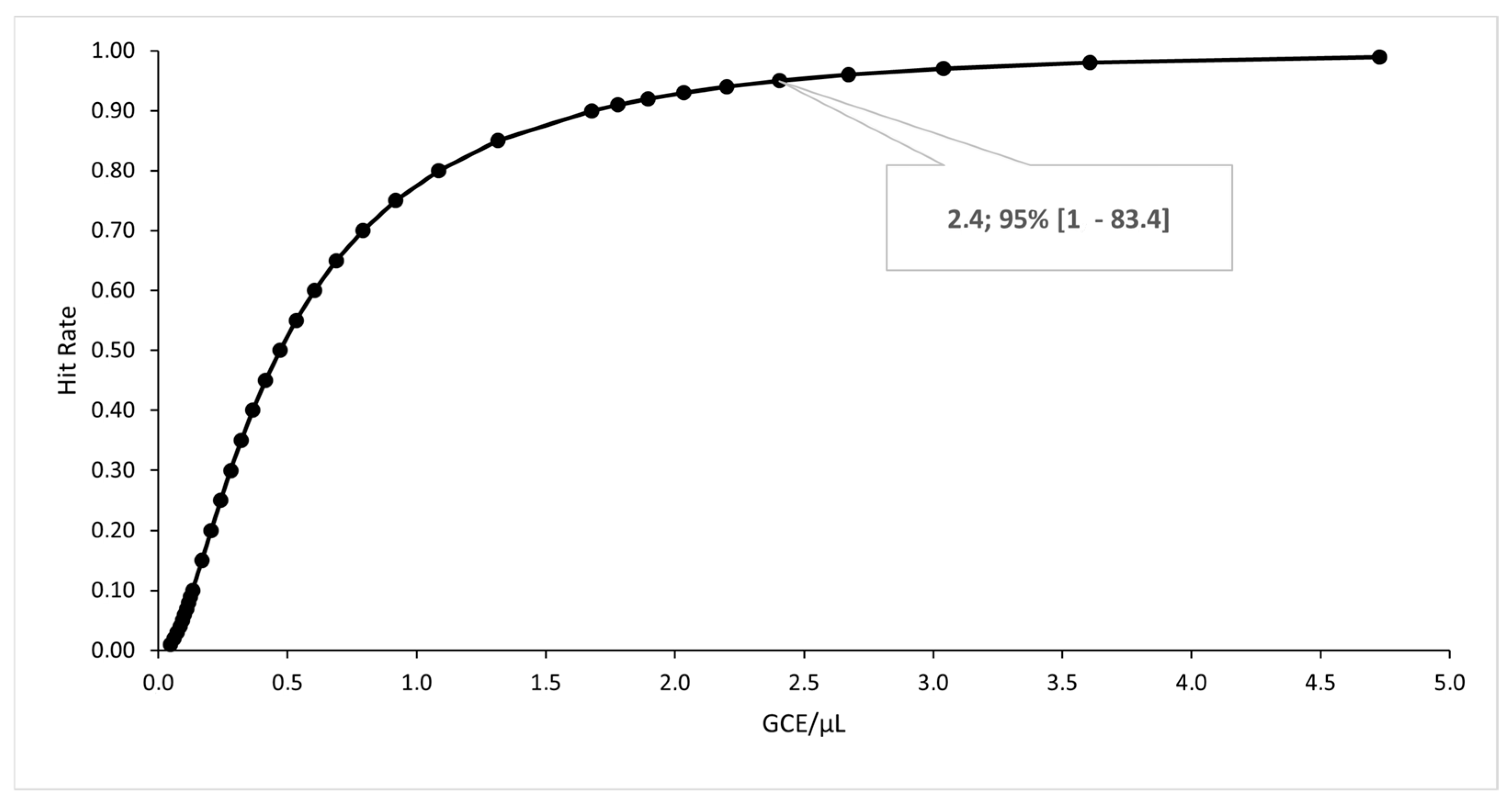
The standard curve constructed from the serial dilution test showed a strong linearity in a repeated manner, evidencing a correlation coefficient R2 = 0.986 and an approximate reaction efficiency of 101.4%. Furthermore, the qPCR assay demonstrated a wide detection range, being able to detect the presence of viral DNA in 87.5% of the technical replicates at 10−9 dilution (corresponding to 1.48 GCE/μL or 4.96−9 ng/µL). The LoD was expressed as LOD95% and corresponded to 2.4 GCE/μL (95% CI 1–83.4 GCE/μL) (Figure 4). The qPCR diagnostic test allowed the detection of ChHV5 viral DNA in DNA extracts from blood and external tumor tissues of four adult green turtles presenting symptoms (Table 1).

4. Discussion

ChHV5 was detected in six out of the 19 individuals analyzed, making this the second report of ChHV5 responsible for FP in sea turtles in Colombia [30]. Notably, only four of the positive turtles showed the characteristic symptoms of FP, while the other two were asymptomatic. Our results confirm that ChHV5 can be detected in turtles with and without clinical signs of FP, as previously reported [15], and suggest that comprehensive molecular surveillance of turtle populations enables accurate assessment of ChHV5 infection prevalence. Robben et al. [41], for example, identified the presence of the virus in 30 clinically healthy individuals, indicating that turtles can present the virus asymptomatically or latently in their system. Several hypotheses have been proposed to explain this phenomenon, the most widely accepted being the capacity of the herpesviruses to establish latent infection [13,42]. Molecular detection of latent infection requires highly sensitive assays, so the combination of multiple genes increases the probability of identifying the presence of the virus. On the other hand, according to Herbst et al. [43], the presence of ChHV5 in seemingly healthy turtles may indicate an early stage of infection, so detecting the virus could help identify turtles that are at risk of eventually developing tumors.
In this study, the initial detection of the virus was based on the amplification of two specific genes, UL30 and UL28. These genes have been previously linked to positive selection leading to the emergence of genetic variations in ChHV5, as documented in previous studies [44,45,46]. These findings further support the close association between ChHV5 and FP. Numerous studies, including this one, have demonstrated a causal relationship between the virus and the disease, with its presence consistently confirmed through PCR techniques [47,48,49].
We report a prevalence of 31.6%, which is considered a high value despite the small number of samples analyzed. Previous studies have reported prevalence values of 29% of 43 specimens of C. mydas sampled in the estuarine complex of Paraguana in Brazil [14]. Likewise, Robben et al. [41] evidenced an increase in the prevalence of ChHV5 in C. mydas in the Mabul Islands, reporting a prevalence of 42.9%, which is high in relation to a previous study for the same area where they had obtained a value of 17%. In contrast, the study by Page-Karjian et al. [11] analyzed the prevalence of ChHV5 in 113 C. mydas turtles by qPCR, obtaining a prevalence of 7.1%. The high prevalence values in turtles with tumors and asymptomatic turtles reported by several studies demonstrate the potential risk that ChHV5 represents for the biological fitness of green turtle populations and their conservation status. Although in our study the virus was detected only in individuals of the species C. mydas, there are reports of the disease and detection of ChHV5 in other species such as E. imbricata, L. olivacea, and C. caretta, in most cases at lower proportions than in C. mydas [21,50]. The lack of viral detection in E. imbricata and C. caretta should therefore be interpreted with caution, given the characteristics of our sampling design. Sampling was not conducted on a controlled population, resulting in an uneven representation of individuals among species and a relatively small sample size. Consequently, our data do not allow for interspecific comparisons or conclusions regarding species-specific susceptibility to ChHV5. Considering these limitations, molecular screening for ChHV5 should be expanded and strengthened across all sea turtle species.
Considering that our study was conducted using turtles rescued by environmental authorities due to stranding events or incidental capture, the reported prevalence could be interpreted as an indicator of the health status of sea turtle populations in the Colombian Caribbean; however, it does not represent the complete epidemiological landscape of Chelonid alphaherpesvirus 5 (ChHV5) in natural environments. Given the complexity of ChHV5-associated pathology, significant uncertainty remains regarding the virus’s infection dynamics. For example, the study conducted by Page-Karjian et al. [11] evaluated 179 turtles under rehabilitation and 46 free-ranging individuals, reporting a ChHV5 prevalence of 10.1% exclusively in rehabilitated turtles. This finding may be associated with the clinical stages and multifactorial drivers linked to ChHV5 infection, considering that immunosuppression caused by stressors such as stranding, capture, trauma, or recruitment processes facilitate viral replication and disease progression [51,52,53]. In contrast, other studies report high ChHV5 prevalence in clinically asymptomatic wild turtles, as detected by PCR and serological assays [27,41,54,55,56]. These findings reflect viral exposure in turtle populations and, in many cases, suggest latent infection states that remain undetectable in wild populations [11].
Based on its genetic variability, ChHV5 was categorized into two main clades: the Atlantic and the Pacific, according to Herbst et al. [43] and Greenblatt et al. [57]. However, Patrício et al. [31] proposed the existence of four distinct subclades, namely, the Eastern Pacific, the Mid-West Pacific, the Western Atlantic/Eastern Caribbean, and the Atlantic. In this study, phylogenetic analyses showed that the ChHV5 sequences obtained were distributed in the two Atlantic groups, with samples CM16 and CM2T, exhibiting genetic similarity with sequences from Florida, Barbados, and Brazil forming the Western Atlantic/Eastern Caribbean clade, and samples CM13, CM1T, and CM3, showing phylogenetic proximity to sequences from Puerto Rico, Gulf of Guinea, and South Brazil forming the Atlantic clade. This is consistent with the phylogenetic relationships obtained by Rodenbusch et al. [27] and Espinoza et al. [58].
To evaluate the origin of the turtles in relation to the virus, we sequenced the control region of the mt genome of C. mydas. Our analyses showed three haplotypes: A3, A5, and A9. Considering only the samples that tested positive for the ChHV5 virus, samples CM3, CM13, and CM16 were grouped with the A3 haplotype, which has been reported in Nicaragua, Florida (USA), North Carolina (USA), Bahamas, Barbados, Northwest Brazil, Southwest Brazil, Cape Verde, Mexico, Cuba, Costa Rica, Portugal, and the Bird Islands (Venezuela) [59,60,61]. On the other hand, samples CM1T and CM2T showed a close relationship with haplotype A5, previously reported in the same countries as A3, plus Argentina, Sao Tomé (Gulf of Guinea), French Guiana, and Suriname. Finally, sample CM17 was grouped with haplotype A9, that has been reported only for the southwest and northwest of Brazil, Guinea Bissau, Barbados, and Ascension Island [60,61,62]. Based on the above, the haplotype reports are consistent with the viral detections of ChHV5 belonging to the Atlantic phylogeographic clade. However, if analyzed at the subclade level, we found that the two viral variants (Western Atlantic/Caribbean and Atlantic) were detected in turtles belonging to the same haplotype. These findings are similar to those reported by Jones et al. [15], who did not identify a correlation between the geographical origin of the turtles and the viral variants, and instead proposed the hypothesis of horizontal transmission of the virus in feeding areas rather than vertical transmission. According to Bowen and Karl [1], feeding areas are frequented by individuals of diverse origins. Additionally, Chaves et al. [54] conducted a study evaluating the prevalence of the virus in both feeding and nesting areas, reporting a prevalence of 26% in turtles from feeding grounds, which was higher than that observed in nesting areas. Similarly, Zamana et al. [63] reported a high incidence of ChHV5 in turtles with and without fibropapillomatosis (93.9% prevalence) from a well-known feeding and refuge area on the northern coast of Brazil. Together, these studies suggest that close contact among turtles may play an important role in viral transmission; however, further studies are still required to better understand the transmission dynamics of ChHV5 in wild turtle populations. Although the results obtained in our study resemble those reported by Jones et al., they are not sufficient to support the proposed hypothesis, particularly given the limitations associated with the sampling design used and the lack of evaluation of individuals from different functional habitats.
On the other hand, a qPCR test with greater inclusivity was obtained. The test was carried out following the MIQE guidelines (Minimum information for the publication of quantitative real-time PCR experiments) for the design of qPCR tests. The test was optimized by performing the standard curve, yielding an efficiency of 101.4%. This value is within the permissible range to give robustness to the repeatability of the test, which is stipulated between 90% and 110% according to Taylor et al. [64]. Likewise, the value of the coefficient of determination (R2) was of 0.986, which also sits within the stipulated optimal range of 0.980 to 1.00 [40] and reinforces the reliability of the standard curve. In the LOD95% analysis, a value of 2.4 GCE/µL of sample was obtained, which is a high value for what is expected within a qPCR analysis. This value suggests a higher sensitivity in the diagnosis of ChHV5 in comparison to other assays, such as the one reported by Page-Karjian et al. [65], in which detections higher than 95% were obtained with 500 copies of the UL30 gene. Therefore, our results validate the capacity of the newly designed primers to detect the UL30 gene fragment of ChHV5 in a wide range of concentrations, in addition to a greater inclusivity in the face of the genetic variability of the ChHV5 reported up to date.
Detection of viral DNA in clinical samples from symptomatic and asymptomatic turtles was promising, achieving positive results in blood samples and 100% detection in tumor samples. In the trial with clinical samples, a Ct value ≤ 38 was stipulated as a positive result, considering that Ct values greater than 38 suggest that genetic material is present at very low levels, close to the detection limit, and may not reliably represent a positive result. Unfortunately, the limited number of clinical samples prevented a robust assessment of qPCR sensitivity in asymptomatic individuals. However, viral copy number was not quantified in this study, which limits our ability to correlate ChHV5 viral load with the clinical status of the turtles. Because a Ct threshold of ≤38 was used to define positive samples, individuals with Ct values above this threshold should not be considered virus-free; rather, they likely harbor low viral loads in blood and may remain asymptomatic. Additionally, epithelial tissues were not evaluated in asymptomatic turtles. This is relevant given the known biology of alphaherpesviruses, which exhibit epithelial tissue tropism [63,66], latency [21], and variability depending on the infection stage and host immune response [11], factors that contribute to low viral loads in asymptomatic individuals, particularly in blood. As a result, detecting viral DNA via qPCR in blood is challenging, while nested PCR, which targets two loci, demonstrated higher sensitivity and yielded results consistent with those reported by Lawrance et al. [67].
Similarly, Page-Karjian et al. [68] highlighted that viral latency in tissue-specific tropism may affect qPCR-based diagnostics, reporting that ChHV5 DNA was not detected in blood samples from turtles with fibropapillomas, despite being present in tumor tissue. This is supported by studies demonstrating high ChHV5 viral loads in tumor tissues [27] and in the skin of turtles without fibropapillomas [21]. However, low ChHV5 prevalence in blood has been reported using qPCR in turtles that tested positive by ELISA. Similarly, turtles that initially tested positive by qPCR subsequently yielded undetectable results using the same technique during later stages of rehabilitation, a pattern consistent with the known biology of herpesviruses [11]. Taken together, these findings highlight the importance of incorporating viral load analyses across different tissue types and clinical stages in future studies to better understand turtle health status and the relationship between viral load and tissue distribution.

5. Conclusions

This study represents the second report of FP associated with ChHV5 in the green turtle Chelonia mydas from Santa Marta, Colombia, expanding the current knowledge of the geographic distribution of this pathogen in the southern Caribbean. The detection of ChHV5 in asymptomatic turtles underscores the multifactorial etiology and broad clinical spectrum of FP, as well as the virus’ ability to establish latent or subclinical infections, an important factor contributing to its persistence in wild turtle populations. The identification of two distinct viral variants infecting turtles with different mitochondrial haplotypes provides insight into the genetic diversity of the virus within the studied turtle population. In addition, the development of an optimized qPCR assay targeting the UL30 gene enhances the sensitivity and reliability of ChHV5 detection, even in the context of ongoing viral genetic variation. Together, these findings provide valuable epidemiological and diagnostic advances that strengthen disease surveillance efforts and inform conservation strategies aimed at mitigating health-related threats to vulnerable marine turtle populations.

Author Contributions

Conceptualization, A.O., J.A.U.-C. and L.R.C.; methodology, A.O., E.Z., J.P.-A., D.B.R.-O. and J.A.U.-C.; validation, A.O., J.A.U.-C. and L.R.C.; formal analysis, A.O. and J.A.U.-C.; investigation, A.O., E.Z., J.P.-A., J.A.U.-C. and L.R.C.; resources, J.A.U.-C. and L.R.C.; writing—original draft preparation, A.O., E.Z. and J.P.-A.; writing—review and editing, D.B.R.-O., J.A.U.-C. and L.R.C.; visualization, A.O. and J.A.U.-C.; supervision J.A.U.-C. and L.R.C.; project administration, A.O. and L.R.C.; funding acquisition, A.O. and L.R.C. All authors have read and agreed to the published version of the manuscript.

Funding

This study was funded by Fonciencias, Universidad del Magdalena, grant number: VIN2021170.

Institutional Review Board Statement

The animal study protocol was approved by the The Research Ethics Committee (CEI) of the University of Magdalena (date of approval 30 September 2021). This research was approved in an ordinary virtual session held on the thirtieth (30) of September 2021 in compliance with the provisions of rectoral resolution 266 of 2021. In this session the CEI considered that this research proposal complies with the ethical aspects and is placed in the RESEARCH WITHOUT RISK category as established by the resolution 8430 of 1993.

Informed Consent Statement

Not applicable.

Data Availability Statement

The sequences generated in this study have been submitted to GenBank under accession numbers: PQ723661-PQ723682.

Acknowledgments

The authors would like to specially thank Julieth Prieto from CORPAMAG, Angela Davila and other members and voluntaries from the Rodadero Marine Wildlife Center and the Marine rescue center, who helped with the monitoring of the turtles and provided samples for this work. Also, thanks to Juan Pablo Madrid, Jasmith Sanchez, and Rosana Perez for their support in some laboratory procedures.

Conflicts of Interest

The authors declare no conflicts of interest.

Abbreviations

The following abbreviations are used in this manuscript:
FPFibropapillomatosis
ChHV5Chelonid alphaherpesvirus 5
CORPAMAGAutonomous Corporation of Magdalena
EDTALithium Ethylene Diamine Tetraacetic acid
PBSPhosphate-Buffered Saline
PCRPolymerase Chain Reaction

References

  1. Bowen, B.W.; Karl, S.A. Population genetics and phylogeography of sea turtles. Mol. Ecol. 2007, 16, 4886–4907. [Google Scholar] [CrossRef] [PubMed]
  2. Ceballos-Fonseca, C. Distribución de playas de anidación y áreas de alimentación de tortugas marinas y sus amenazas en el Caribe Colombiano. Bol. Investig. Mar. Cost. 2004, 33, 79–99. [Google Scholar]
  3. Franco Espinosa, C.; Hernández Fernández, J. Análisis de haplotipos de la tortuga cabezona Caretta caretta (Testudines: Cheloniidae) en dos playas del Caribe Colombiano. Rev. Lasallista Investig. 2017, 14, 121–131. [Google Scholar] [CrossRef]
  4. Morales-Betancourt, M.A.; Lasso, C.A.; Páez, V.P.; Bock, B.C. Libro Rojo de Reptiles de Colombi; Instituto de Investigación de Recursos Biológicos Alexander von Humboldt (IAvH), Universidad de Antioquia: Medellin, Colombia, 2015; ISBN 978-958-8889-80-1. [Google Scholar]
  5. Wallace, B.P.; DiMatteo, A.D.; Bolten, A.B.; Chaloupka, M.Y.; Hutchinson, B.J.; Abreu-Grobois, F.A.; Mortimer, J.A.; Seminoff, J.A.; Amorocho, D.; Bjorndal, K.A.; et al. Global conservation priorities for marine turtles. PLoS ONE 2011, 6, e24510. [Google Scholar] [CrossRef]
  6. Bjorndal, K.; Jackson, J. Roles of sea turtles in marine ecosystems: Reconstructing the past. In The Biology of Sea Turtles, Volume II; Lutz, P., Musick, J., Wyneken, J., Eds.; Marine Biology; CRC Press: Boca Raton, FL, USA, 2002; Volume 20024633, pp. 259–273. ISBN 978-0-8493-1123-9. [Google Scholar]
  7. León, Y.; Bjorndal, K. Selective feeding in the hawksbill turtle, an important predator in coral reef ecosystems. Mar. Ecol. Prog. Ser. 2002, 245, 249–258. [Google Scholar] [CrossRef]
  8. Azpir, G.S.; Maldonado, F.G.; González, G. La importancia del estudio de enfermedades en la conservación de fauna silvestre. Vet. México 2000, 31, 223–230. [Google Scholar]
  9. Thompson, R.C.A.; Lymbery, A.J.; Smith, A. Parasites, emerging disease and wildlife conservation. Int. J. Parasitol. 2010, 40, 1163–1170. [Google Scholar] [CrossRef]
  10. Jones, K.; Ariel, E.; Burgess, G.; Read, M. A review of fibropapillomatosis in green turtles (Chelonia mydas). Vet. J. 2016, 212, 48–57. [Google Scholar] [CrossRef]
  11. Page-Karjian, A.; Serrano, M.E.; Cartzendafner, J.; Morgan, A.; Ritchie, B.W.; Gregory, C.R.; McNeill, J.B.; Perrault, J.R.; Christiansen, E.F.; Harms, C.A. Molecular assessment of Chelonid alphaherpesvirus 5 infection in tumor-free green (Chelonia mydas) and loggerhead (Caretta caretta) sea turtles in North Carolina, USA, 2015–2019. Animals 2020, 10, 1964. [Google Scholar] [CrossRef]
  12. Reséndiz, E.; Fernández-Sanz, H.; Domínguez-Contreras, J.F.; Ramos-Díaz, A.H.; Mancini, A.; Zavala-Norzagaray, A.A.; Aguirre, A.A. Molecular characterization of Chelonid alphaherpesvirus 5 in a black turtle (Chelonia mydas) fibropapilloma from Baja California Sur, Mexico. Animals 2021, 11, 105. [Google Scholar] [CrossRef]
  13. Page-Karjian, A.; Torres, F.; Zhang, J.; Rivera, S.; Diez, C.; Moore, P.A.; Moore, D.; Brown, C. Presence of chelonid fibropapilloma-associated herpesvirus in tumored and non-tumored green turtles, as detected by polymerase chain reaction, in endemic and non-endemic aggregations, Puerto Rico. SpringerPlus 2012, 1, 35. [Google Scholar] [CrossRef]
  14. Domiciano, I.G.; Broadhurst, M.K.; Domit, C.; Flaiban, K.K.M.C.; Goldberg, D.W.; Fritzen, J.T.T.; Bracarense, A.P.F.R.L. Chelonid alphaherpesvirus 5 DNA in fibropapillomatosis-affected Chelonia mydas. EcoHealth 2019, 16, 248–259. [Google Scholar]
  15. Jones, K.; Burgess, G.; Budd, A.M.; Huerlimann, R.; Mashkour, N.; Ariel, E. Molecular evidence for horizontal transmission of Chelonid alphaherpesvirus 5 at green turtle (Chelonia mydas) foraging grounds in Queensland, Australia. PLoS ONE 2020, 15, e0227268. [Google Scholar] [CrossRef] [PubMed]
  16. Ackermann, M.; Koriabine, M.; Hartmann-Fritsch, F.; De Jong, P.J.; Lewis, T.D.; Schetle, N.; Work, T.M.; Dagenais, J.; Balazs, G.H.; Leong, J.-A.C. The genome of Chelonid herpesvirus 5 harbors atypical genes. PLoS ONE 2012, 7, e46623. [Google Scholar] [CrossRef]
  17. Walker, P.J.; Siddell, S.G.; Lefkowitz, E.J.; Mushegian, A.R.; Adriaenssens, E.M.; Alfenas-Zerbini, P.; Dempsey, D.M.; Dutilh, B.E.; García, M.L.; Curtis Hendrickson, R.; et al. Recent changes to virus taxonomy ratified by the international committee on taxonomy of viruses (2022). Arch. Virol. 2022, 167, 2429–2440. [Google Scholar] [CrossRef] [PubMed]
  18. Espinoza, J.; Gazol, E.; Rojas, M.; Reyes-López, M.A.; Alfaro-Núñez, A.; Reséndiz, E. First molecular report of the Chelonid alphaherpesvirus 5 (ChHV5 Scutavirus chelonidalpha5) in a green turtle (Chelonia mydas) with fibropapillomatosis in the Southwest gulf of Mexico. Eur. J. Wildl. Res. 2024, 70, 127. [Google Scholar] [CrossRef]
  19. McGeoch, D.J.; Gatherer, D. Integrating reptilian herpesviruses into the family Herpesviridae. J. Virol. 2005, 79, 725–731. [Google Scholar] [CrossRef]
  20. James, S.; Donato, D.; de Thoisy, B.; Lavergne, A.; Lacoste, V. Novel herpesviruses in neotropical bats and their relationship with other members of the herpesviridae family. Infect. Genet. Evol. 2020, 84, 104367. [Google Scholar] [CrossRef]
  21. Alfaro-Núñez, A.; Bojesen, A.M.; Bertelsen, M.F.; Wales, N.; Balazs, G.H.; Gilbert, M.T.P. Further evidence of Chelonid herpesvirus 5 (ChHV5) latency: High levels of ChHV5 DNA detected in clinically healthy marine turtles. PeerJ 2016, 4, e2274. [Google Scholar] [CrossRef]
  22. Quackenbush, S.L.; Casey, R.N.; Murcek, R.J.; Paul, T.A.; Work, T.M.; Limpus, C.J.; Chaves, A.; duToit, L.; Perez, J.V.; Aguirre, A.A.; et al. Quantitative analysis of herpesvirus sequences from normal tissue and fibropapillomas of marine turtles with Real-Time PCR. Virology 2001, 287, 105–111. [Google Scholar] [CrossRef][Green Version]
  23. Kramer, M.F.; Chen, S.-H.; Knipe, D.M.; Coen, D.M. Accumulation of viral transcripts and DNA during establishment of latency by herpes simplex virus. J. Virol. 1998, 72, 1177–1185. [Google Scholar] [CrossRef]
  24. Mashkour, N.; Jones, K.; Wirth, W.; Burgess, G.; Ariel, E. The concurrent detection of Chelonid alphaherpesvirus 5 and Chelonia mydas papillomavirus 1 in tumoured and non-tumoured green turtles. Animals 2021, 11, 697. [Google Scholar] [CrossRef]
  25. Quackenbush, S.L.; Work, T.M.; Balazs, G.H.; Casey, R.N.; Rovnak, J.; Chaves, A.; duToit, L.; Baines, J.D.; Parrish, C.R.; Bowser, P.R.; et al. Three closely related herpesviruses are associated with fibropapillomatosis in marine turtles. Virology 1998, 246, 392–399. [Google Scholar] [CrossRef] [PubMed]
  26. Herbst, L.H.; Lemaire, S.; Ene, A.R.; Heslin, D.J.; Ehrhart, L.M.; Bagley, D.A.; Klein, P.A.; Lenz, J. Use of baculovirus-expressed glycoprotein H in an enzyme-linked immunosorbent assay developed to assess exposure to chelonid fibropapillomatosis-associated herpesvirus and its relationship to the prevalence of fibropapillomatosis in sea turtles. Clin. Vaccine Immunol. 2008, 15, 843–851. [Google Scholar] [CrossRef]
  27. Rodenbusch, C.; Baptistotte, C.; Werneck, M.; Pires, T.; Melo, M.; de Ataíde, M.; dos Reis, K.; Testa, P.; Alieve, M.; Canal, C. Fibropapillomatosis in green turtles Chelonia mydas in Brazil: Characteristics of tumors and virus. Dis. Aquat. Org. 2014, 111, 207–217. [Google Scholar] [CrossRef] [PubMed]
  28. Cárdenas, D.M.; Cucalón, R.V.; Medina-Magües, L.G.; Jones, K.; Alemán, R.A.; Alfaro-Núñez, A.; Cárdenas, W.B. Fibropapillomatosis in a green sea turtle (Chelonia mydas) from the Southeastern Pacific. J. Wildl. Dis. 2019, 55, 169. [Google Scholar] [CrossRef] [PubMed]
  29. Origlia, J.A.; Loureiro, J.P.; Tizzano, M.A.; Maydup, F.; Alvarez, K.; Heredia, S.R.; Echeverría, M.G.; Sguazza, H. Fibropapillomatosis associated with Chelonid alphaherpesvirus 5 (ChHV5) in a green turtle Chelonia mydas in Argentine Waters. J. Wildl. Dis. 2023, 59, 363–366. [Google Scholar] [CrossRef]
  30. Castro, L.R.; Villalba-Viscaíno, V.; Oviedo, Á.; Zambrano, E.; Dávila, A.; Naranjo, G.; Oro-Genes, B.D.; Combatt, A.; Prieto-Rodríguez, J.; Ortiz, A.; et al. Case report: Diagnosis and autogenous vaccine treatment of herpesvirus in a green turtle (Chelonia mydas) in Santa Marta, Colombia. Front. Vet. Sci. 2024, 11, 1258209. [Google Scholar] [CrossRef]
  31. Patrício, A.R.; Herbst, L.H.; Duarte, A.; Vélez-Zuazo, X.; Santos Loureiro, N.; Pereira, N.; Tavares, L.; Toranzos, G.A. Global phylogeography and evolution of chelonid fibropapilloma-associated herpesvirus. J. Gen. Virol. 2012, 93, 1035–1045. [Google Scholar] [CrossRef]
  32. Hall, T.A. BioEdit: A user-friendly biological sequence alignment editor and analysis program for Windows 95/98/NT. Nucleic Acids Symp. Ser. 1999, 41, 95–98. [Google Scholar]
  33. Kearse, M.; Moir, R.; Wilson, A.; Stones-Havas, S.; Cheung, M.; Sturrock, S.; Buxton, S.; Cooper, A.; Markowitz, S.; Duran, C.; et al. Geneious basic: An integrated and extendable desktop software platform for the organization and analysis of sequence data. Bioinformatics 2012, 28, 1647–1649. [Google Scholar] [CrossRef]
  34. Abascal, F.; Zardoya, R.; Telford, M.J. TranslatorX: Multiple alignment of nucleotide sequences guided by amino acid translations. Nucleic Acids Res. 2010, 38, W7–W13. [Google Scholar] [CrossRef]
  35. Castresana, J. Gblocks, v. 0.91 b. Online Version 2002.
  36. Trifinopoulos, J.; Nguyen, L.-T.; von Haeseler, A.; Minh, B.Q. W-IQ-TREE: A fast online phylogenetic tool for maximum likelihood analysis. Nucleic Acids Res 2016, 44, W232–W235. [Google Scholar] [CrossRef]
  37. Rambaut, A. FigTree, v1.4.4; Institute of Evolutionary Biology: Edinburgh, UK, 2018.
  38. Katoh, K.; Misawa, K.; Kuma, K.; Miyata, T. MAFFT: A novel method for rapid multiple sequence alignment based on fast fourier transform. Nucleic Acids Res. 2002, 30, 3059–3066. [Google Scholar] [CrossRef]
  39. Stothard, P. The sequence manipulation suite: JavaScript programs for analyzing and formatting protein and DNA sequences. BioTechniques 2000, 28, 1102–1104. [Google Scholar] [CrossRef] [PubMed]
  40. Bustin, S.A.; Benes, V.; Garson, J.A.; Hellemans, J.; Huggett, J.; Kubista, M.; Mueller, R.; Nolan, T.; Pfaffl, M.W.; Shipley, G.L.; et al. The MIQE guidelines: Minimum information for publication of quantitative Real-Time PCR experiments. Clin. Chem. 2009, 55, 611–622. [Google Scholar] [CrossRef] [PubMed]
  41. Robben, D.M.; Palaniappan, P.; Loganathan, A.L.; Subbiah, V.K. Increased prevalence and new evidence of multi-species Chelonid herpesvirus 5 (ChHV5) infection in the sea turtles of Mabul Island, Borneo. Animals 2023, 13, 290. [Google Scholar] [CrossRef] [PubMed]
  42. Koyuncu, O.O.; MacGibeny, M.A.; Enquist, L.W. Latent versus productive infection: The Alpha herpesvirus switch. Future Virol. 2018, 13, 431–443. [Google Scholar] [CrossRef]
  43. Herbst, L.; Ene, A.; Su, M.; Desalle, R.; Lenz, J. Tumor outbreaks in marine turtles are not due to recent herpesvirus mutations. Curr. Biol. 2004, 14, R697–R699. [Google Scholar] [CrossRef]
  44. Levings, R.L.; Collins, J.K.; Patterson, P.A.; Roth, J.A. Virus, strain, and epitope specificities of neutralizing bovine monoclonal antibodies to Bovine Herpesvirus 1 glycoproteins gB, gC, and gD, with sequence and molecular model analysis. Vet. Immunol. Immunopathol. 2015, 164, 179–193. [Google Scholar] [CrossRef] [PubMed]
  45. Origgi, F.C.; Tecilla, M.; Pilo, P.; Aloisio, F.; Otten, P.; Aguilar-Bultet, L.; Sattler, U.; Roccabianca, P.; Romero, C.H.; Bloom, D.C.; et al. A Genomic approach to unravel host-pathogen interaction in chelonians: The example of Testudinid Herpesvirus 3. PLoS ONE 2015, 10, e0134897. [Google Scholar] [CrossRef] [PubMed]
  46. Spiesschaert, B.; Osterrieder, N.; Azab, W. Comparative analysis of Glycoprotein B (gB) of Equine herpesvirus Type 1 and Type 4 (EHV-1 and EHV-4) in cellular tropism and cell-to-cell transmission. Viruses 2015, 7, 522–542. [Google Scholar] [CrossRef]
  47. Li, T.-H.; Hsu, W.-L.; Lan, Y.-C.; Balazs, G.-H.; Work, T.M.; Tseng, C.-T.; Chang, C.-C. Identification of Chelonid herpesvirus 5 (ChHV5) in endangered green turtles (Chelonia mydas) with fibropapillomatosis in Asia. Bull. Mar. Sci. 2017, 93, 1011–1022. [Google Scholar] [CrossRef]
  48. Loganathan, A.L.; Palaniappan, P.; Subbiah, V.K. Evidence of Chelonid herpesvirus 5 (ChHV5) in green turtles (Chelonia mydas) from Sabah, Borneo. bioRxiv 2021. [Google Scholar] [CrossRef]
  49. Mejía-Radillo, R.; Zavala-Norzagaray, A.; Chávez-Medina, J.; Aguirre, A.; Escobedo-Bonilla, C. Presence of Chelonid herpesvirus 5 (ChHV5) in sea turtles in Northern Sinaloa, Mexico. Dis. Aquat. Org. 2019, 132, 99–108. [Google Scholar] [CrossRef] [PubMed]
  50. Da Silva-Júnior, E.S.; De Farias, D.S.D.; Da Costa Bomfim, A.; Da Boaviagem Freire, A.C.; Revorêdo, R.Â.; Rossi, S.; Matushima, E.R.; Hildebrand Grisi-Filho, J.H.; De Lima Silva, F.J.; Gavilan, S.A. Stranded marine turtles in Northeastern Brazil: Incidence and spatial–temporal distribution of fibropapillomatosis. Chelonian Conserv. Biol. 2019, 18, 249. [Google Scholar] [CrossRef]
  51. Cray, C.; Varella, R.; Bossart, G.D.; Lutz, P. Altered in vitro immune responses in green turtles (Chelonia mydas) with fibropapillomatosis. J. Zoo Wildl. Med. 2001, 32, 436–440. [Google Scholar] [CrossRef]
  52. Glaser, R.; Kiecolt-Glaser, J.K. Chronic stress modulates the virus-specific immune response to latent Herpes Simplex Virus Type 1. Ann. Behav. Med. 1997, 19, 78–82. [Google Scholar] [CrossRef]
  53. Perrault, J.R.; Levin, M.; Mott, C.R.; Bovery, C.M.; Bresette, M.J.; Chabot, R.M.; Gregory, C.R.; Guertin, J.R.; Hirsch, S.E.; Ritchie, B.W.; et al. Insights on Immune function in free-ranging green sea turtles (Chelonia mydas) with and without fibropapillomatosis. Animals 2021, 11, 861. [Google Scholar] [CrossRef]
  54. Chaves, A.; Aguirre, A.A.; Blanco-Peña, K.; Moreira-Soto, A.; Monge, O.; Torres, A.M.; Soto-Rivas, J.L.; Lu, Y.; Chacón, D.; Fonseca, L.; et al. Examining the role of transmission of Chelonid alphaherpesvirus 5. EcoHealth 2017, 14, 530–541. [Google Scholar] [CrossRef] [PubMed]
  55. Hirama, S.; Ehrhart, L.M. Description, prevalence and severity of green turtle fibropapillomatosis in three developmental habitats on the east coast of Florida. Fla. Sci. 2007, 70, 435–448. [Google Scholar]
  56. James, A.; Page-Karjian, A.; Charles, K.E.; Edwards, J.; Gregory, C.R.; Cheetham, S.; Buter, B.P.; Marancik, D.P. Chelonid alphaherpesvirus 5 prevalence and first confirmed case of sea turtle fibropapillomatosis in Grenada, West Indies. Animals 2021, 11, 1490. [Google Scholar] [CrossRef]
  57. Greenblatt, R.J.; Quackenbush, S.L.; Casey, R.N.; Rovnak, J.; Balazs, G.H.; Work, T.M.; Casey, J.W.; Sutton, C.A. Genomic variation of the fibropapilloma-associated marine turtle herpesvirus across seven geographic areas and three host species. J. Virol. 2005, 79, 1125–1132. [Google Scholar] [CrossRef]
  58. Espinoza, J.; Hernández, E.; Lara-Uc, M.M.; Reséndiz, E.; Alfaro-Núñez, A.; Hori-Oshima, S.; Medina-Basulto, G. Genetic analysis of Chelonid herpesvirus 5 in marine turtles from Baja California peninsula. EcoHealth 2020, 17, 258–263. [Google Scholar] [CrossRef]
  59. Encalada, S.E.; Lahanas, P.N.; Bjorndal, K.A.; Bolten, A.B.; Miyamoto, M.M.; Bowen, B.W. Phylogeography and population structure of the Atlantic and mediterranean green turtle Chelonia mydas: A mitochondrial DNA control region sequence assessment. Mol. Ecol. 1996, 5, 473–483. [Google Scholar] [CrossRef]
  60. Proietti, M.; Reisser, J.; Kinas, P.; Kerr, R.; Monteiro, D.; Marins, L.; Secchi, E. Green turtle Chelonia mydas mixed stocks in the western south Atlantic, as revealed by mtDNA haplotypes and drifter trajectories. Mar. Ecol. Prog. Ser. 2012, 447, 195–209. [Google Scholar] [CrossRef][Green Version]
  61. Savada, C.S.; Prosdocimi, L.; Domit, C.; Almeida, F.S.D. Multiple haplotypes of Chelonia mydas juveniles in a threatened hotspot area in Southern Brazil. Genet. Mol. Biol. 2021, 44, e20200410. [Google Scholar] [CrossRef]
  62. Costa Jordao, J.; Bondioli, A.C.V.; Almeida-Toledo, L.F.D.; Bilo, K.; Berzins, R.; Le Maho, Y.; Chevallier, D.; De Thoisy, B. Mixed-stock analysis in green turtles Chelonia mydas: mtDNA decipher current connections among West Atlantic populations. Mitochondrial DNA Part A 2017, 28, 197–207. [Google Scholar] [CrossRef]
  63. Zamana, R.R.; Gattamorta, M.A.; Cruz Ochoa, P.F.; Navas-Suárez, P.E.; Sacristán, C.; Rossi, S.; Grisi-Filho, J.H.H.; Silva, I.S.; Matushima, E.R. High occurrence of Chelonid alphaherpesvirus 5 (ChHV5) in green sea turtles Chelonia mydas with and without fibropapillomatosis in feeding areas of the São Paulo Coast, Brazil. J. Aquat. Anim. Health 2021, 33, 252–263. [Google Scholar] [CrossRef] [PubMed]
  64. Taylor, S.; Wakem, M.; Dijkman, G.; Alsarraj, M.; Nguyen, M. A Practical approach to RT-qPCR—Publishing data that conform to the MIQE guidelines. Methods 2010, 50, S1–S5. [Google Scholar] [CrossRef] [PubMed]
  65. Page-Karjian, A.; Norton, T.; Ritchie, B.; Brown, C.; Mancia, C.; Jackwood, M.; Gottdenker, N. Quantifying Chelonid herpesvirus 5 in symptomatic and asymptomatic rehabilitating green sea turtles. Endang. Species Res. 2015, 28, 135–146. [Google Scholar] [CrossRef]
  66. Work, T.M.; Dagenais, J.; Balazs, G.H.; Schettle, N.; Ackermann, M. Dynamics of virus shedding and in situ confirmation of Chelonid herpesvirus 5 in Hawaiian green turtles with fibropapillomatosis. Vet. Pathol. 2015, 52, 1195–1201. [Google Scholar] [CrossRef]
  67. Lawrance, M.F.; Mansfield, K.L.; Sutton, E.; Savage, A.E. Molecular evolution of fibropapilloma-associated herpesviruses infecting juvenile green and loggerhead sea turtles. Virology 2018, 521, 190–197. [Google Scholar] [CrossRef] [PubMed]
  68. Page-Karjian, A.; Whitmore, L.; Stacy, B.A.; Perrault, J.R.; Farrell, J.A.; Shaver, D.J.; Walker, J.S.; Frandsen, H.R.; Rantonen, E.; Harms, C.A.; et al. Fibropapillomatosis and Chelonid alphaherpesvirus 5 infection in Kemp’s ridley sea turtles (Lepidochelys kempii). Animals 2021, 11, 3076. [Google Scholar] [CrossRef] [PubMed]
Figure 1. Phylogenetic reconstruction of the UL30 gene using maximum likelihood, including our sequence (bold type) and sequences downloaded from GenBank of other variants of the ChHV5 virus. The best-fit evolutionary ML models for the gene dataset were K3P+FQ+I (position-1), K2P+FQ (position-2) and HKY+F+G4 (position-3). Numbers on nodes correspond to bootstrap values/the posterior probability.
Conservation 06 00045 g001
Figure 2. Phylogenetic reconstruction of the UL28 gene using maximum likelihood, including our sequence (bold type) and sequences downloaded from GenBank of other variants of the ChHV5 virus. The best-fit evolutionary ML models for the gene dataset were HKY+F (position-1), HKY+F+I (position-2) and K3Pu+F+G4 (position-3). Numbers on nodes correspond to bootstrap values/the posterior probability.
Conservation 06 00045 g002
Figure 3. Maximum likelihood phylogenetic reconstruction of the mitochondrial genome control region (D-loop) of Chelonia mydas using our sequences (in bold) and C. mydas haplotype sequences downloaded from GenBank. The best-fit evolutionary ML model for the gene dataset was HKY+F+G4. Node numbers correspond to bootstrap values/post likelihood.
Conservation 06 00045 g003
Figure 4. Probit analysis to determine the limit of detection (LoD) of the qPCR assay designed in this work, considering the minimum value of ChHV5 genome copies per microliter.
Conservation 06 00045 g004
Table 1. Information on the samples analyzed, accession numbers of the sequences obtained for the UL30, UL28, and mitochondrial control region genes, including nested PCR results and qPCR results for the UL30 gene. Sample IDs in bold indicate turtles positive for ChHV5.
Sample
ID
SpeciesNested-PCR Test
Result
(Tissue Source)
UL30UL28D-Loop Chelonia mydasqPCR Test Result
(Tissue Source)
Sequence Similarity GenBank ResultsNCBI Deposited Sequence IDSequence Similarity GenBank ResultsNCBI Deposited Sequence IDSequence Similarity GenBank ResultsNCBI Deposited Sequence ID
CM1TChelonia mydasPositive
(Blood)
--JN625257PQ723667JF308470PQ723672Positive (Tumor /Blood)
CM2TChelonia mydasPositive
(Blood)
AY644454PQ723663AY644454PQ723669JQ034420PQ723673Positive (Tumor /Blood)
CM1Eretmochelys imbricataNegative
(Blood)
------Negative
CM2Eretmochelys imbricataNegative
(Blood)
------Negative
CM3Chelonia mydasPositive
(Blood)
HM348896PQ723666--MF315093PQ723674Negative
CM4Chelonia mydasNegative
(Blood)
------Negative
CM5Chelonia mydasNegative
(Blood)
----MF315093PQ723675Negative
CM6Eretmochelys imbricataNegative
(Blood)
------Negative
CM7Caretta carettaNegative
(Blood)
------Negative
CM8Chelonia mydasNegative
(Blood)
----JF308470PQ723676Negative
CM9Chelonia mydasNegative
(Blood)
----MF315093PQ723677Negative
CM10Chelonia mydasNegative
(Blood)
----MF315093PQ723678Negative
CM11Caretta carettaNegative
(Blood)
------Negative
CM12Chelonia mydasNegative
(Blood)
----MF315093PQ723679Negative
CM13Chelonia mydasPositive
(Blood)
HM348896PQ723662JN625257PQ723668MF315093PQ723680Negative
CM14Eretmochelys imbricataNegative
(Blood)
------Negative
CM15Chelonia mydasNegative
(Blood)
------Negative
CM16Chelonia mydasPositive
(Tumor)
AY644454PQ723665AY644454PQ723671MF315093PQ723681Positive (Tumor
/Blood)
CM17Chelonia mydasPositive
(Tumor)
AY644454PQ723664AY644454PQ723670JF308475PQ723682Positive (Tumor
/Blood)
Table 2. Information on primers and probes designed for ChHV5 diagnosis by qPCR.
Primer NameTestSequence (5′–3′)LengthTmGenomic Positions (RefSeq HQ878327)
ChHV5_F_NewqPCRAGCTAAAAGCBGGYGAAGATTACG2461.186,481–86,504
ChHV5_R_ProbeqPCRFAM-GGACATGCCCTGAACYTTGAACTC-BHQ12464.586,529–86,506
ChHV5_R_qPCRqPCRGGCGCACGTGAGGCTTGAC1958.886,558–86,540
Disclaimer/Publisher’s Note: The statements, opinions and data contained in all publications are solely those of the individual author(s) and contributor(s) and not of MDPI and/or the editor(s). MDPI and/or the editor(s) disclaim responsibility for any injury to people or property resulting from any ideas, methods, instructions or products referred to in the content.