1. Introduction
The Round Goby,
Neogobius melanostomus, is thought to have invaded North American waters through the ballast tanks of trans-Atlantic Ocean freighters traveling from the Black Sea and the Baltic Sea [
1]. Although the Round Goby initially inhabited only the Laurentian Great Lakes and their associated tributaries, it has now invaded the French Creek Basin (Allegheny River Drainage) in northwest Pennsylvania [
2]. The Round Goby has been associated with the extirpation of the Mottled Sculpin,
Cottus bairdi, and the decline of the Johnny Darter,
Etheostoma nigrum [
2]. Studies in Lake Michigan have shown that the invasion of the Round Goby has severely reduced the recruitment of the Mottled Sculpin and caused local populations to decline rapidly [
3]. The study confirmed that Round Gobies interfered with nest-guarding males, seized spawning shelters of Mottled Sculpins, and fed extensively on juveniles and eggs, causing a near-total loss of the young-of-year [
3]. It appears likely that these behavioral aspects of the Round Goby are also the leading cause of decline in populations of the Johnny Darter,
Etheostoma nigrum, in North American waters [
4].
Additionally, Round Gobies prey upon mussels and have been found to contribute to the loss of indigenous unionid mussels in French Creek through direct predation [
5]. Moreover, Round Gobies indirectly affect mussel reproduction and recruitment by displacing and outcompeting native fishes that serve as hosts for larval mussels [
5]. Overall, when Round Gobies are present, native fish, macroinvertebrates, and mussel species are heavily preyed upon or outcompeted, with the potential to cause dramatic shifts to aquatic ecosystems in North America [
2,
5]. Finding ways to monitor and control the invasive Round Goby is crucial.
Efforts must be made to control the dispersal of the Round Goby and, if possible, eliminate it from areas where it has established viable populations. Toward that end, we must identify physical/chemical/biological parameters that will target the Round Goby but not have an adverse impact on native fishes. Temperature is a quantifiable parameter influencing both the behavior and survival of fishes. Fish are poikilotherms and use behavioral responses to regulate body temperature. Determining the thermal requirements and preferences of the Round Goby may be important for their effective management. Historically, the lethal effects of temperature on aquatic organisms were analyzed, and the direct effect of temperature changes on fish mortality has been extensively studied for over 50 years.
Elevated temperatures, caused by habitat alterations and industrial discharges, have caused significant concerns in both lentic and lotic systems [
6]. The lethal effect of temperature on fishes has been extensively studied for over 50 years (see Stauffer et al. [
7]). The fact that heat death is rarely observed in nature appears to contradict the fact that many organisms are killed at temperatures only slightly above those that they prefer. Death due to temperature intolerance may result from either exposure to cold or high temperatures. For the most part, exposure to cold temperatures is lethal to temperate fishes only when these organisms are acclimated to elevated temperatures and abruptly exposed to lower temperatures. This phenomenon has been termed cold shock and is usually associated with shutdowns of thermal outfalls during winter months.
Death due to exposure to high temperatures results in the ultimate breakdown in the organization of the individuals [
8]. Mayer [
9] suggested that at high temperatures there was insufficient oxygen to sustain increased metabolic activity. Gift [
10] defined the critical thermal maximum as the point at which a fish loses locomotor activity and can no longer escape conditions that will soon cause its death. Therefore, a thermal dose that induces the loss of equilibrium is just as important as one that causes immediate death [
11]. The preference for high temperatures is associated with the optimal temperatures for growth, swimming ability, and metabolism. For the most part, temperate fishes will avoid lethal temperatures [
7]. The observed preferred temperature increases with acclimation temperature, but differences between preferred temperature and acclimation temperature decrease as acclimation temperature increases [
7].
The final preferred temperature is a surrogate for many other physiological processes that may limit the ability of invasive species to establish viable populations [
7]. The objective of this study, therefore, was to determine the thermal preferences of the Round Goby,
N. melanostomus.
2. Materials and Methods
Thermal preference trials for all fishes were conducted in a trough (3.6 m × 0.203 m × 0.245 m) modeled after Stauffer et al. [
7]. The interior of the trough was painted with a non-toxic epoxy paint. The exterior bottom was coated with a temperature-resistant, flat, black paint to facilitate heating. A series of heat lamps were longitudinally placed underneath the trough and heated the water as it flowed. Cool water, 3–4 °C below the respective acclimation temperatures, was introduced at one end of the trough, thus creating a thermal gradient above and below the acclimation temperature. The temperature at the warm end of the trough was approximately 10 °C above the acclimation temperature for each trial. Overhead Vita-lites illuminated the test area. The sides of the trough were enclosed, and test fish were viewed with overhead mirrors. Twelve thermistors were used to determine the selected temperature throughout the trough. Eight fish at each acclimation temperature were individually placed in the unit at their acclimation temperature and allowed to orient for 20 min. Following the orientation period, the temperature at the location of the fish was recorded every 15 s for 10 min. Based on numerous previous studies, these time periods appear to be optimal [
7]. All procedures followed the methods approved by the Institutional Animal Care and Use Committee (IACUC) at The Pennsylvania State University (IACUC PROTO202302366).
Forty-five adult Round Gobies (7–10 cm SL) were collected from LeBoeuf Lake in Erie County, Pennsylvania, in August 2024. All fish were collected by benthic trawling conducted by the Pennsylvania Fish and Boat Commission and the Watershed Conservation Research Center at Allegheny College. A total of 45 fish, although a small sample size, was all that was available.
Following collection, all fish were transported to Rock Springs Fish Laboratory, which is a part of the Russell E. Larson Agricultural Research Center in State College, Pennsylvania. Upon arrival, Round Gobies were held at their original collection temperature of 15 °C. The gobies were then randomly sorted into five different tanks and acclimated to temperatures that were representative of natural temperatures in open waters that we observed in Pennsylvania over the past 40 years: 10°C, 15°C, 20C°, and 25 °C at a rate of 2 °C/day. All gobies in these tanks were held in freshwater (<0.05 ppt salinity). Once reaching these acclimation levels, the temperature in the tanks was held constant for one week (until the start of each experiment). Eight fish were tested at each acclimation temperature.
All fish tested at 10°C, 15°C, 20°C, and 25°C temperatures were used only at their respective acclimation temperatures. We later decided to test fish acclimated to 5 °C. Because of a lack of fish, we re-acclimated fish from 10 °C at 2 °C/day and held them at 5 °C for one week before testing. All of the fish re-acclimated were robust and did not lose weight or condition.
It is important to note that to align with the IACUC regulations, death was not an intentional endpoint in these studies. When fish exhibited a complete loss of equilibrium, they were removed from the trial. We defined loss of equilibrium as their inability to acquire an upright position after being gently prodded with a glass probe. Fish that needed to be removed from a trial due to complete loss of equilibrium were euthanized in a freshwater and clove oil mixture compliant with IACUC protocol. We euthanized these fish immediately because it was unlikely that individuals who lost equilibrium would recover. After all trials were completed, all individuals were euthanized in the freshwater and clove oil mixture prescribed by IACUC.
3. Results
Thermal preference increased with increasing acclimation temperature (
Figure 1). The relationship between preferred temperature and acclimation temperature was described by the equation p = (0.91a) + 4.2, where p represents preferred temperatures and a represents acclimation temperatures. Although we had a relatively small sample size, eight fish at each acclimation temperature, the R
2 showed 83% of the variation in preference temperature was explained by acclimation temperature. Fish acclimated to 25 °C consistently selected warmer water; however, when we attempted to acclimate individuals to temperatures of 30 °C, they immediately lost equilibrium. As a result, fish could not be successfully acclimated to 30 °C, and the final preferred temperature was estimated as the predicted value of 26.5 °C at an acclimation temperature of 25 °C.
The difference in preferred temperature and initial acclimation temperature of the Round Goby differed among trials. The lowest acclimation trial—5 °C—showed the biggest difference between acclimation temperature and preferred temperature with a difference of 5.1 °C. In contrast, the 10 °C trial shows the smallest difference between the preferred temperature and acclimation temperature, with a difference of 1.8 °C (
Figure 2). It is important to note that although the difference between preference temperature and acclimation temperature at 5 °C is noticeably larger than the differences in the other trials, the difference between preference temperature and acclimation temperature is similar among the four remaining trials—10 °C, 15 °C, 20 °C, and 25 °C—with the average preferred temperature ranging from 2 °C to 4 °C above the initial acclimation.
Notably, three Round Gobies acclimated to 25 °C swam into water temperatures above their critical thermal maximum (30 °C) and subsequently lost equilibrium. At acclimation temperatures above 5 °C, the difference between preferred temperature and acclimation temperature remained relatively constant (
Figure 2).
4. Discussion
Only 45 individuals were collected for this study. Nevertheless, we were able to test naïve fish at acclimation temperatures of 10, 15, 20, and 25 °C. Fish tested at 5 °C were reacclimated from those tested at 10 °C. The observed preferred temperature for fish re-acclimated at 5 °C was in line with the other acclimation temperatures as indicated by an R2 of 0.83.
The response of Round Goby to elevated temperatures differed markedly from other fishes previously examined using similar methods [
7]. In all other freshwater species tested, individuals preferred temperatures that would not result in loss of equilibrium or mortality [
7]. In contrast, three Round Gobies in the present study entered water temperatures exceeding their survival threshold when acclimated to 25 °C.
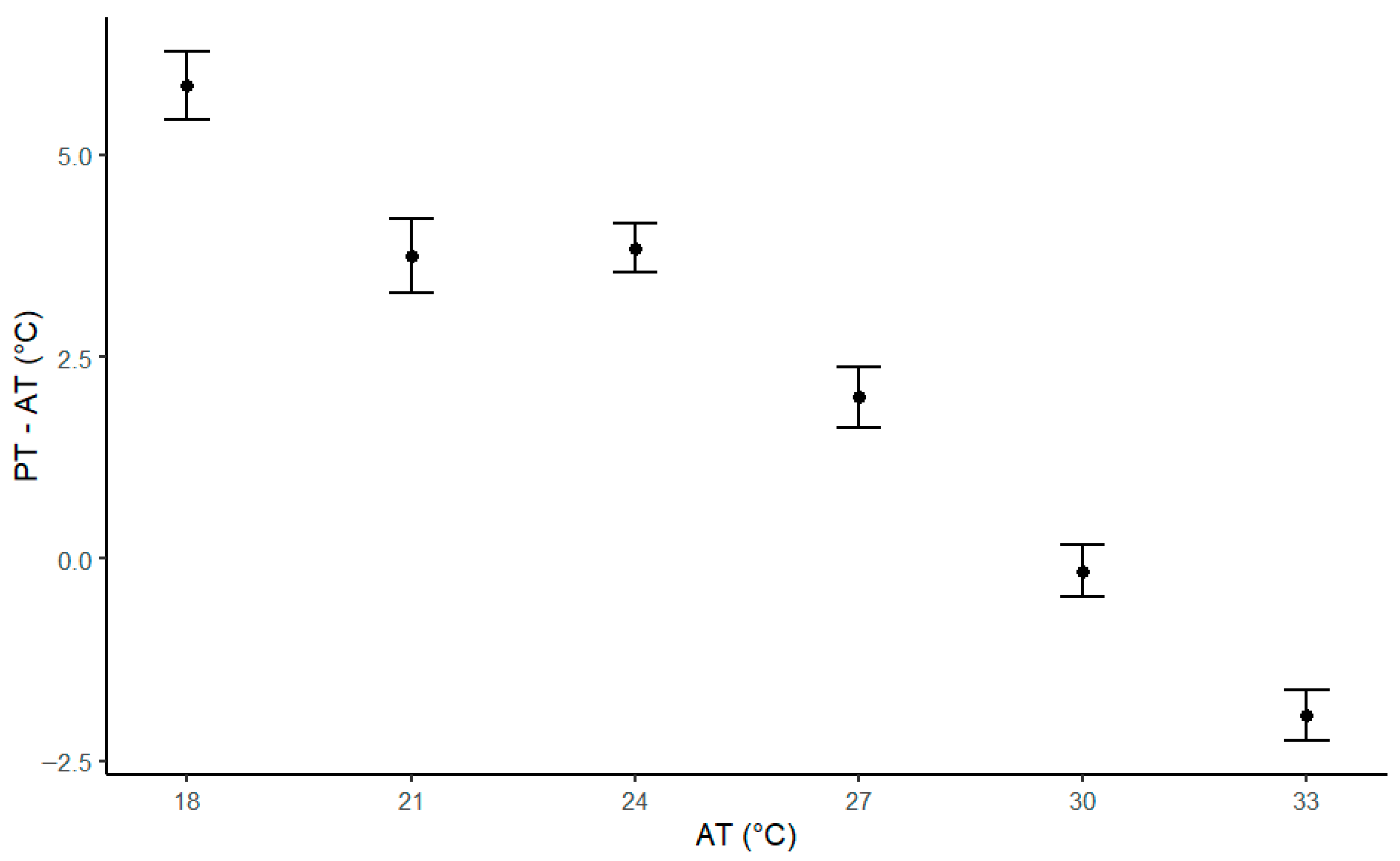
For example, this pattern contrasts sharply with that observed in Rock Bass (
Ambloplites rupestris), for which Stauffer et al. [
7] documented a negative and moderately linear relationship between the acclimation temperature and the difference between the preferred temperature and the acclimation temperature as acclimation temperature increased (
Figure 3). In that study, preferred temperatures converged with acclimation temperatures at higher acclimation levels, such that acclimation temperature equaled preference temperature during the fifth trial and preferred temperature was 1.5 °C lower than acclimation during the final trial at 32.7 °C (
Figure 3). These results indicated that for Rock Bass, the difference between preferred temperature and acclimation temperature decreased as acclimation temperature approached their upper thermal limits, thereby avoiding lethal exposure (
Figure 3).
In contrast, Round Gobies did not exhibit a similar narrowing of thermal preference at higher acclimation temperatures. Three individuals acclimated to 25 °C entered water at 30 °C and subsequently lost equilibrium. This behavior, in which individuals actively entered temperatures exceeding their functional tolerance rather than avoiding them, suggests a breakdown in behavioral thermoregulation rather than a purely physiological limitation.
Furthermore, Christensen et al. [
12] reported a critical thermal maximum of 34.0 °C for Round Gobies acclimated to 28 °C and noted that acclimation temperatures of 10 °C and 20 °C did not significantly alter the preferred temperature of 21.2 °C. Conversely, we observed a preferred temperature of 26.5 °C when we acclimated them to 25 °C. Christensen et al. [
13] argued that their observed preferred temperature of 21.2 °C enabled them to maintain a thermal safety margin so that abrupt changes in temperatures would enable them to survive. They [
12] further related this to the concept that “suboptimal is optimal”, as discussed by Martin and Huey [
14], when they discussed thermal preferences of ectotherms. These studies [
12,
13] reported higher critical thermal maximum temperatures for Round Goby than that temperature at which loss of equilibrium was observed in this study (30 °C). A loss of equilibrium would nonetheless render individuals highly vulnerable to predation. It is possible that differences between studies reflect population-level variation or acclimation history; however, the behavioral tendency to enter thermally stressful environments observed here suggests that Round Gobies may not maintain a thermal safety margin near their upper thermal limits.
5. Conclusions
Our results indicated that Round Gobies could tolerate and occupy a broad range of temperatures between 5 °C and 25 °C. Considerable variability in preferred temperature was observed both within and among acclimation trials, suggesting that the Round Goby did not exhibit a narrowly defined preferred temperature, such as observed with other studies [
13]. However, when acclimated to 25 °C, several individuals entered water at 30 °C and lost equilibrium, indicating that temperatures above 25 °C approached the upper limit of thermal tolerance for this species.
Optimal temperatures for many physiological processes, including metabolic activity [
14], growth [
8], swimming speed [
15], and others [
16], are at or near the final preferred temperature for many freshwater fishes. Thus, the final thermal preference of the Round Goby may provide insights into the required temperature for the above parameters and may be useful in developing management strategies for this invasive species.
Overall, our findings suggested that while Round Gobies are capable of occupying a wide thermal range, they may be vulnerable to abrupt exposure to high temperatures due to a lack of behavioral avoidance. The observed individual variation in thermal response further indicated that some populations or individuals may tolerate higher temperatures, suggesting the possibility for adaptive responses under continued thermal stress.
Author Contributions
Conceptualization: J.R.S.J.; methodology and investigation: J.R.S.J. and M.A.C.; analyses: all authors; funding acquisition: J.R.S.J. and E.W.B.; writing—original draft: J.R.S.J. and M.A.C.; writing—review and editing: E.W.B. and J.R.S.J. All authors have read and agreed to the published version of the manuscript.
Funding
This work was funded in part by the Department of Conservation and Natural Resources in Pennsylvania through their Wild Resource Conservation Program and the Penn State Agriculture Experiment project PEN5038 (JRS) and McIntire-Stennis Appropriations under project #PEN04889 (EWB).
Institutional Review Board Statement
The animal study protocol was approved by Institutional Animal Care and Use Committee (IACUC) at The Pennsylvania State University (protocol code IACUC PROTO202302366 and date of approval date 14 February 2023).
Data Availability Statement
Data are available Jay Stauffer, Jr., Ph.D. — Directory — Department of Ecosystem Science and Management.
Conflicts of Interest
The authors declare no conflict of interest.
References
- Mueller, S.; Stauffer, J.R., Jr.; Wisor, J.; Bradshaw-Wilson, C. Expansion of the invasive Round Goby (Neogobius melanostomus) into Allegheny River tributaries: LeBoeuf and French Creeks in Pennsylvania. J. Pa. Acad. Sci. 2017, 91, 105–111. [Google Scholar] [CrossRef]
- Stauffer, J.R., Jr.; Criswell, R.W.; Fischer, D.P. The Fishes of Pennsylvania; Cichlid Press: El Paso, TX, USA, 2016. [Google Scholar]
- Janssen, J.; Jude, D. Recruitment Failure of Mottled Sculpin Cottus bairdi in Calumet Harbor, Southern Lake Michigan, Induced by the Newly Introduced Round Goby Neogobius melanostomus. J. Great Lakes Res. 2001, 27, 319–328. [Google Scholar] [CrossRef]
- Lauer, T.E.; Allen, P.J.; McComish, T.S. Changes in Mottled Sculpin and Johnny Darter Trawl Catches after the Appearance of Round Gobies in the Indiana Waters of Lake Michigan. Trans. Am. Fish. Soc. 2011, 133, 185–189. [Google Scholar] [CrossRef]
- Clark, K.H.; Iwanowicz, D.D.; Iwanowicz, L.R.; Mueller, S.J.; Wisor, J.M.; Bradshaw-Wilson, C.; Schill, W.B.; Stauffer, J.R.; Boyer, E.W. Freshwater unionid mussels threatened by predation of Round Goby (Neogobius melanostomus). Sci. Rep. 2022, 12, 12859. [Google Scholar] [CrossRef]
- Heidari, N.; Aksel, M.; Yagci, O.; Erbisim, M.; Cokgor, S.; Valyrakis, M. Morphodynamical controls on thermal plume dispersion at river mouths: Insights from field data and numerical modeling. Water 2025, 17, 2721. [Google Scholar] [CrossRef]
- Stauffer, J.R., Jr.; Dickson, K.L.; Cairns, J.; Cherry, D.S. The potential and realized influences of temperature on the distribution of fishes in the New River, Glen Lyn, Virginia. Wildl. Monogr. 1976, 50, 1–40. [Google Scholar]
- Brett, J.R. Some principles in the thermal requirements of fishes. Quart. Rev. Biol. 1956, 31, 75–87. [Google Scholar] [CrossRef]
- Mayer, A.G. The effects of temperature upon tropical marine animals. Pap. Torugas Lab. 1914, 6, 1–24. [Google Scholar]
- Gift, J.J. Responses of Some Estuarine Fishes to Increasing Thermal Gradients. Ph.D. Dissertation, Rutgers University, New Brunswick, NJ, USA, 1970. [Google Scholar]
- Becker, C.D. Columbia River thermal effects study, reactor effluent problems. J. Wat. Poll. Contr. Fed. 1973, 45, 850–869. [Google Scholar]
- Christensen, E.A.F.; Norin, T.; Tabak, I.; Nan Deurs, M.; Behrens, J.W. effects of temperature on physiological performance and behavioral thermoregulation in an invasive fish the round goby. J. Exp. Biol. 2021, 224, jeb237669. [Google Scholar] [CrossRef]
- Cross, E.E.; Rawding, R.S. Acute thermal tolerance in the round goby, Apollonia melanostoma (Neogobius melanostomus). J. Therm. Biol. 2009, 34, 85–92. [Google Scholar] [CrossRef]
- Martin, T.L.; Huey, R.B. Why “suboptimal” is optimal: Jensen’s inequality and ectotherm thermal preferences. Amer. Nat. 2008, 171, E102–E118. [Google Scholar] [CrossRef] [PubMed]
- Fry, F.E.J.; Hart, J.S. Cruising speed of goldfish in relation to water temperature. J. Fish. Res. Board Can. 1948, 7, 746–749. [Google Scholar] [CrossRef]
- Brett, J.R. Energetic responses of salmon to temperature. A study of some thermal relations in the physiology and freshwater ecology of sockeye salmon (Oncorhynchus nerka). Am. Zool. 1971, 11, 99–113. [Google Scholar] [CrossRef]
| Disclaimer/Publisher’s Note: The statements, opinions and data contained in all publications are solely those of the individual author(s) and contributor(s) and not of MDPI and/or the editor(s). MDPI and/or the editor(s) disclaim responsibility for any injury to people or property resulting from any ideas, methods, instructions or products referred to in the content. |