
Article

Mediterranean Monk Seal Recent Findings and New Insights from Lebanese Coastal Waters

1
Palm Islands Nature Reserve, El Mina, Tripoli 1301, Lebanon
2
Department of Biology, Tyre Coast Nature Reserve, Blv. Nabih Berri, Tyre 1700, Lebanon
3
Special Protected Areas Regional Activity Centre (SPA/RAC), Blv. Yasser Arafat-B.P.337, Tunis Cedex 1080, Tunisia
4
Centre Oceanographic Vigo (IEO-CSIC), Sub. Radio Faro 50, Cabo Estai, 36390 Vigo, Spain
5
Archipelagos-ambiente e sviluppo, Italia, Sant’Elena, 30132 Venice, Italy
6
Department of Philosophy and Cultural Heritage, Ca’ Foscari University of Venice, Dorsoduro 3484/D, 30123 Venice, Italy
*
Author to whom correspondence should be addressed.
Conservation 2026, 6(1), 28; https://doi.org/10.3390/conservation6010028
Submission received: 13 January 2026 / Revised: 6 February 2026 / Accepted: 25 February 2026 / Published: 2 March 2026

Abstract

Mediterranean monk seal (Monachus monachus) sightings along the Lebanese coast were recorded between 2020 and 2025. This study aims to provide insights into the consistency of monk seal presence, their habitat use, and their feeding behaviour in the studied area. The research relied on photographic and video materials gathered from social media reports, as well as contributions from local fishers and divers. A total of 43 sightings were recorded, with photo-identification possible for 34 of these. The study confirmed the presence of at least three distinct individuals, including one adult female frequently utilizing marine caves in Amchit and Rawsheh. Video recordings of feeding behaviour revealed prey species such as grey mullet and octopus, which are also targeted by local fisheries, suggesting potential conflicts between the seals and the fishing sector. This study emphasizes the need for a more systematic, long-term monitoring approach, including the use of infrared cameras, to identify suitable habitats and more accurately assess seal presence. The research further recommends a region-wide effort to understand monk seal movements within the Levantine Basin and to support broader conservation initiatives for the species.

1. Introduction

The Mediterranean monk seal (Monachus monachus) is the only pinniped species endemic to the Mediterranean Sea. Historically, its distribution encompassed the Mediterranean and Black Seas and extended into the Atlantic Ocean, from the Azores southward to Senegal and Gambia, including the Macaronesian archipelagos and the northwestern coast of Africa. Currently, with an estimated population of fewer than 1000 individuals—roughly half of which inhabit the Mediterranean basin—the species is considered among the world’s most threatened marine mammals and is classified in the Red List of Endangered Species of IUCN as Vulnerable [1,2]. Presently, reproductive subpopulations in the Mediterranean are confined to the coasts of Greece, Türkiye, and Cyprus. Encouraging recent signs of population recovery [2], along with increasing sporadic sightings and hints of presence across a broader geographic range [3,4], highlight the urgent need for a region-wide conservation strategy rather than fragmented, country-specific efforts [3,5,6].
The Levantine region is characterized by the presence of a known and studied reproducing sub-population of the species along the northern coasts—i.e., southern Türkiye and Cyprus [7,8,9]—and reported sightings from all the other countries on the southern coasts, including Lebanon [3,10,11]. To date, habitat availability studies beyond these reproductive areas have so far been limited to parts of the southern Levantine region [11,12,13]. Recent initiatives led by the Specially Protected Areas Regional Activity Centre (SPA-RAC) are expanding these efforts to also include the Lebanese coastline.
The Mediterranean monk seal was once a familiar sight along the Lebanese coast, with documented encounters up until the 1960s–70s, particularly around Beirut, Jbeil (and specifically the Amchit area), and Tripoli (Palm Islands) [14,15,16,17,18,19,20]. However, historical records regarding their use of coastal habitats for resting and pupping remain unclear, with only confirmed references to the Rawsheh Cave, Beirut, until at least the 1960s–70s [15,18,21].
During the Lebanese Civil War (1975–1990), as expected, no data on monk seal presence were available. The first post-war sighting was recorded on 17 May 1997, near the Palm Islands Nature Reserve [21]. Since then, approximately 41 sightings have been reported between 2000 and April 2020 [20,22,23,24,25].
This manuscript presents updated data on Mediterranean monk seal encounters since the last reported findings in 2020. It explores the presence of individuals along the Lebanese coast, their interactions with the habitats, and observations of their feeding behaviour, contributing to a broader understanding of the species’ status in the Levantine region and underscoring the importance of including Lebanon in regional conservation efforts.

2. Materials and Methods

2.1. Study Area

The coast of Lebanon extends for ~370 Km from Arida (33°05′45.6″ N, 35°06′10.8″ E) in the north to Ras El-Nakoura (34°38′45.6″ N, 35°58′37.2″ E) in the south ([26,27,28,29]; Figure 1). The Lebanese coastline features an alternating pattern of rocky shores and sandy or pebbly beaches, with the northern coast consisting of approximately 49% rocky shoreline and 51% sandy or pebbly stretches [26,30]. Overall, the coastline is relatively linear and uniform, with notable exceptions such as the peninsulas of Ras El-Mina (Tripoli), Ras Chekka, Ras Beirut, and Tyre. Coastal cliffs are generally rare, occurring primarily in specific areas such as the Ras Chekka promontory, located 7 km north of Batroun, and Ras Beirut [30,31,32]. In the Beirut region, the Rawsheh area is distinguished by a prominent 50 m high limestone formation, which features a complex system of littoral caves and tunnels [31]. Further south, the Nakoura region consists of two distinct geomorphological formations: the limestone cliffs of Ras El Bayada near Mansouri and the sandstone-dominated coastline of Nakoura [27,31].
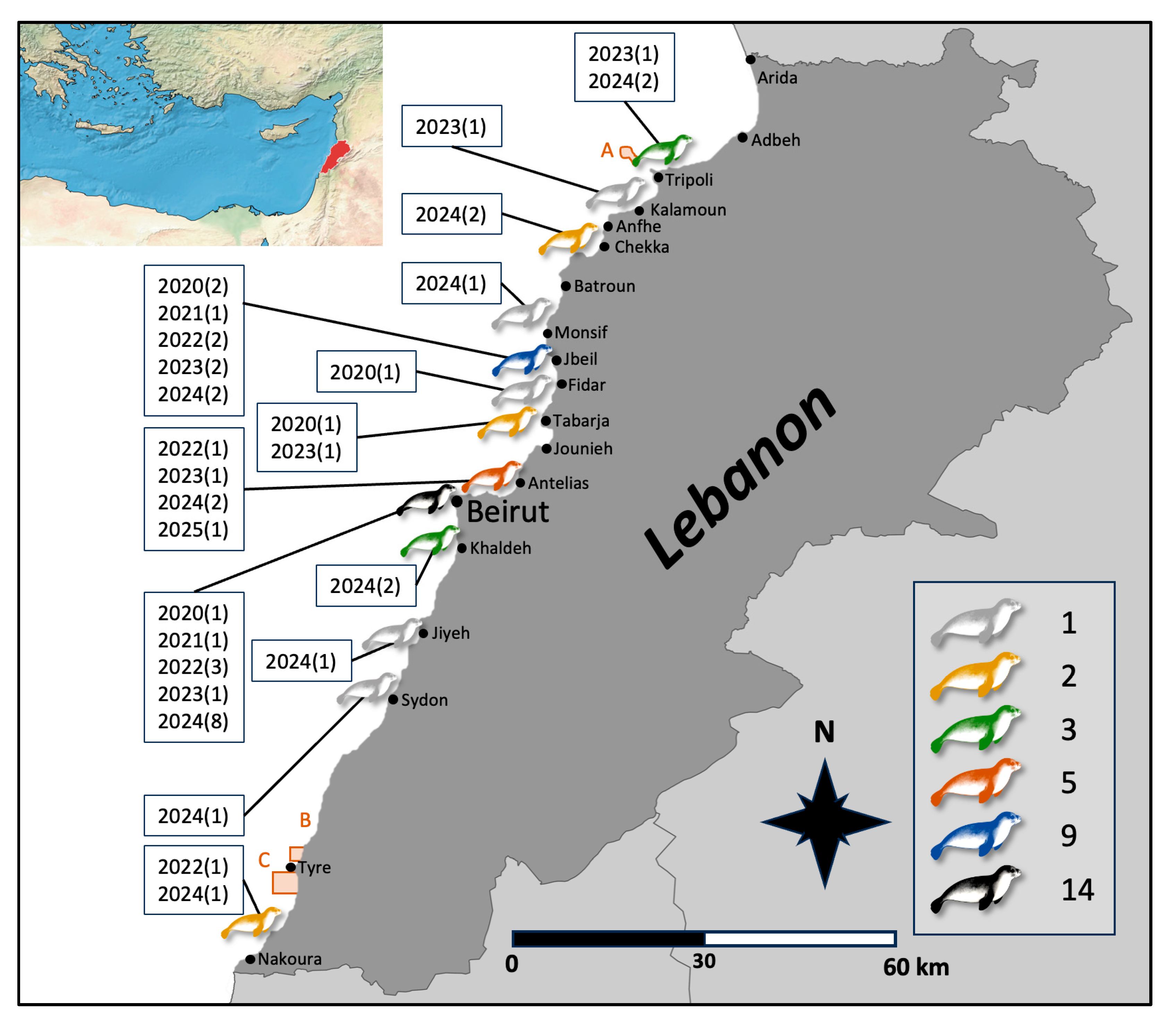
Figure 1. Map of the study area (Lebanon). The coloured seal icons indicate the main locations where sightings were documented between 15 June 2020 and 10 January 2025. Ranking from 1 sighting (grey) to 14 (black). All sightings involved single individuals, except for one in 2024 in the Beirut area, which included two individuals (see Table 1 for details). Along with the location, the years when the sighting was recorded are shown, and in brackets, the number of sightings recorded within that year is shown. In the map, the Palm Islands Nature Reserve (A), the Abbassieh Nature Reserve (B), and the Tyre Coast Nature Reserve (C) are also highlighted.
Conservation 06 00028 g001
Table 1. Records of sightings along the Lebanese coast between 2020 and 2025.
R.DateSiteLocationCoordinatesC.U.ID
115/06/2020 Fidar34°06′00″ N, 35°38′48″ EN1PIAF
221/07/2020Amchit caveJbeil34°08′13″ N, 35°38′11″ EY1IAF
325/08/2020 Tabarja34°01′50″ N, 35°37′32″ EN1IAF
412/12/2020 Beirut33°49′45″ N, 35°28′31″ EN1IAF
503/02/2021ByelBeirut33°54′32″ N, 35°30′44″ EN1IAF
608/09/2021Amchit caveJbeil34°08′13″ N, 35°38′11″ EY1IAF
719/02/2022Ain el MraysseBeirut33°54′16″ N, 35°28′34″ EN1PIAF
822/02/2022DbayeAntelias33°55′48″ N, 35°34′51″ EN1IAF
931/03/2022Ain el MraysseBeirut33°54′12″ N, 35°28′57″ EN1J1
1010/04/2022Rawsheh areaBeirut33°53′21″ N, 35°28′08″ EN1IAF
1111/04/2022JiyehJiyeh33°40′21″ N, 35°24′57″ EN1NI
1226/05/2022Amchit caveJbeil34°08′13″ N, 35°38′11″ EY1IAF
1325/09/2022Amchit caveJbeil34°08′13″ N, 35°38′11″ EY1IAF
1405/10/2022Ras-Al BayadaNakoura33°09′52″ N, 35°10′03″ EN1IAF
1508/01/2023ByelBeirut33°54′32″ N, 35°30′44″ EN1IAF
1608/04/2023Dbayeh marinaAntelias33°55′51″ N, 35°35′04″ EN1NI
1725/04/2023Mina PortTripoli34°28′17″ N, 35°49′59″ EN1PIAF
1815/08/2023 Tabarja34°01′58″ N, 35°37′23″ EN1NI
1922/08/2023Amchit caveJbeil34°08′13″ N, 35°38′11″ EY1IAF
2018/09/2023Amchit caveJbeil34°08′13″ N, 35°38′11″ EY1IAF
2127/09/2023KalamounKalamoun34°23′27″ N, 35°46’06″ EN1PIAF
2222/02/2024BeirutBeirut33°54’09″ N, 35°29’17″ EN1J2
2327/02/2024KhaldehKhaldeh33°47’13″ N, 35°28’10″ EN1IAF
2405/03/2024KhaldehKhaldeh33°46’38″ N, 35°27’56″ EN1NI
2526/03/2024Rocca marinaChekka34°18’33″ N, 35°41’54″ EN1IAF
2628/03/2024Palm IslandsTripoli34°29’30″ N, 35°45’49″ EN1IAF
2702/04/2024Dbaye marinaAntelias33°56’00″ N, 35°35’01″ EN1IAF
2825/04/2024HamatChekka34°18′05″ N, 35°40′14″ EN1IAF
2926/04/2024MonsifMonsif34°11′05″ N, 35°37′59″ EN1IAF
3002/05/2024DbayeAntelias33°55′48″ N, 35°34′51″ EN1IAF
3106/05/2024Ramlet al BaidaBeirut33°52′53″ N, 35°28′31″ EN1IAF
3218/05/2024Rawsheh caveBeirut33°53′23″ N, 35°28′12″ EY1PIAF
3321/05/2024Off BeirutBeirut33°55′41″ N, 35°28′00″ EN1IAF
3415/06/2024Rawsheh caveBeirut33°53′23″ N, 35°28′12″ EY1IAF
3520/06/2024El ZirehSidon33°34′30″ N, 35°22′05″ EN1IAF
3606/08/2024Ras-Al-BayadaNakoura33°09′51″ N, 35°10′15″ EN1IAF
3724/08/2024Amchit caveJbeil34°08′13″N, 35°38′11″ EY1IAF
3831/08/2024MinaTripoli34°27′19″ N, 35°48′14″EN1NI
3910/10/2024Amchit caveJbeil34°08′13″ N, 35°38′11″ EY1IAF
4006/11/2024Rawsheh areaBeirut33°53′26″ N, 35°28′15″ EN1IAF
4117/11/2024Al DawraBeirut33°54′58″ N, 35°33′15″ EN1IAF
4217/11/2024Rawsheh areaBeirut33°53′22″ N, 35°28′07″ EN2IAF, NI
4310/01/2025DbayeAntelias33°56′42″ N, 35°34′59″ EN1IAF
R.: record number; Date: dd/mm/yy; C.U.: cave use (sightings of a seal inside a marine cave), Y: yes, N: no; N°: number of individuals; ID: identification of the individuals, IAF: identified adult female; PIAF: possibly identified adult female, J: juvenile, NI: not identifiable.
Lebanon’s coastline includes several islands and islets, the most significant in the north being the Palm Islands [31,33,34]. The coastal region, which accounts for approximately 8% of the country’s total land area, serves as the focal point for Lebanon’s economic and social activities [26,27]. It is also subject to considerable anthropogenic pressures, accommodating around 2.6 million residents—roughly 70% of Lebanon’s total population—concentrated in major urban centres such as Tripoli, Jbeil, Jounieh, Beirut, Sidon, and Tyre [27,29,33]. The region also supports extensive industrial and commercial activity, including four commercial ports, 15 fishing ports, 12 oil pipelines, and three fuel-powered power stations [27,28,33]. However, coastal development—particularly the construction of tourist resorts and industrial infrastructure—has often been unregulated and haphazard, especially during the Lebanese Civil War [26].
The Lebanese small-scale (artisanal fishery) fishing fleet is operated by approximately 3000 fishing vessels, with around 36% registered in Tripoli, which hosts the largest fishing community in the country [35,36,37,38].
Three marine protected areas (MPAs) have been established along the Lebanese coast: the Palm Islands Nature Reserve (PINR), the Tyre Coast Nature Reserve (TCNR), and Abbassieh Nature Reserve (ANR).
The PINR was established by Law No. 121 on 9 March 1992 and covers an area of 4.18 km2. It consists of three flat limestone islands—Palm (Nakhel or Araneb), Sanani, and Ramkine (Fanar)—located approximately 5.5 km northwest of the city of El-Mina, Tripoli, between coordinates 34°29′ N, 35°44′30″ E and 34°30′33″ N, 35°47′ E. The TCNR, situated south of the city of Tyre, was established by Law No. 708 on 5 November 1998. It covers a total area of 126.98 km2, comprising both marine and terrestrial zones. The reserve extends approximately between 33°15′02.8″ N, 35°12′45.9″ E and 33°17′ N, 35°12′ E. The ANR, the most recently declared MPA, was established by Law No. 170 on 8 May 2020. It encompasses a total area of 54.29 km2, including both land and sea components [22,27,31,39,40,41,42,43].

2.2. Records of Sightings

Records of Mediterranean monk seal sightings were collected from 2020 up to 2025 from various sources: (a) social media platforms (e.g., Facebook, TikTok), (b) a network of fishers, and (c) a network of divers and recreational/sport fishers. Whenever possible, eyewitnesses were directly contacted to gather additional details and verify the accuracy of the reported data.
Reports lacking documented evidence (photos or videos) were omitted to avoid erroneous estimates and address the likelihood of misidentifying other pinniped species in the Mediterranean.
The Fisher Network was initially established in 2012 by the Lebanese NGO Développement Sans Frontières and has since expanded with the support and collaboration of the PINR (North Lebanon) and the TCNR (South Lebanon). This network includes local fishing communities from Al Arida, Adbeh, Mina (Tripoli), Kalamoun, Chekka, Batroun, Beirut, Sidon, Tyre, and Nakoura. While originally created to document marine biodiversity, the network has also proven valuable for collecting data on monk seals.
Since 2018, diving, recreational, and sport fishing groups have also been engaged in contributing to data collection. The following clubs from across Lebanon participated: Aqua Sport, Freediving & Spearfishing Skills, Lebanese Spearfishing and Ocean Gravity Technical Scuba Diving School and Club (North Lebanon), as well as Sidon Diving Academy and Lebanon Diving Center (South Lebanon).
In 2019, a stranding network for sea turtles and cetaceans was established along the Lebanese coast, including within the TCNR [44]. This network has since contributed to the systematic documentation of marine biodiversity, including records of monk seal presence.
In 2023, within the framework of the SPA/RAC-funded project Engagement of Local Communities in Marine Life Protection, the Palm Islands Nature Reserve Committee introduced the Environmental Friend Label certification. This recognition was awarded to the aforementioned clubs in acknowledgment of their participation in workshops and training sessions on marine conservation. The certified clubs have committed to adhering to specific conservation guidelines and best practices, further strengthening the information network.

2.3. Analysis of Photographic and Video Materials and Insights into Habitat Use

A comprehensive effort was made to quantitatively and qualitatively assess the presence of Mediterranean monk seals along the Lebanese coast. All available photographic and, mainly, video materials were carefully analysed using individual morphological features and scar patterns to identify seals, following the updated methodologies proposed by Bundone et al. 2019b [45] and Bundone & Panou 2022 [46] and 2023 [47].
Photographic and video materials provided useful information on the species’ habitat use in some cases.

2.4. Insights into Feeding Ecology

Video recordings documenting Mediterranean monk seal feeding behaviour, along with additional information provided by eyewitnesses, were reviewed to gain insights into the species’ trophic ecology in the area.

3. Results

3.1. Records of Sightings and Analysis of Photographic and Video Materials

A total of 43 Mediterranean monk seal sightings were documented along the Lebanese coast between 15 June 2020 and 10 January 2025 (see Figure 1 and Table 1).
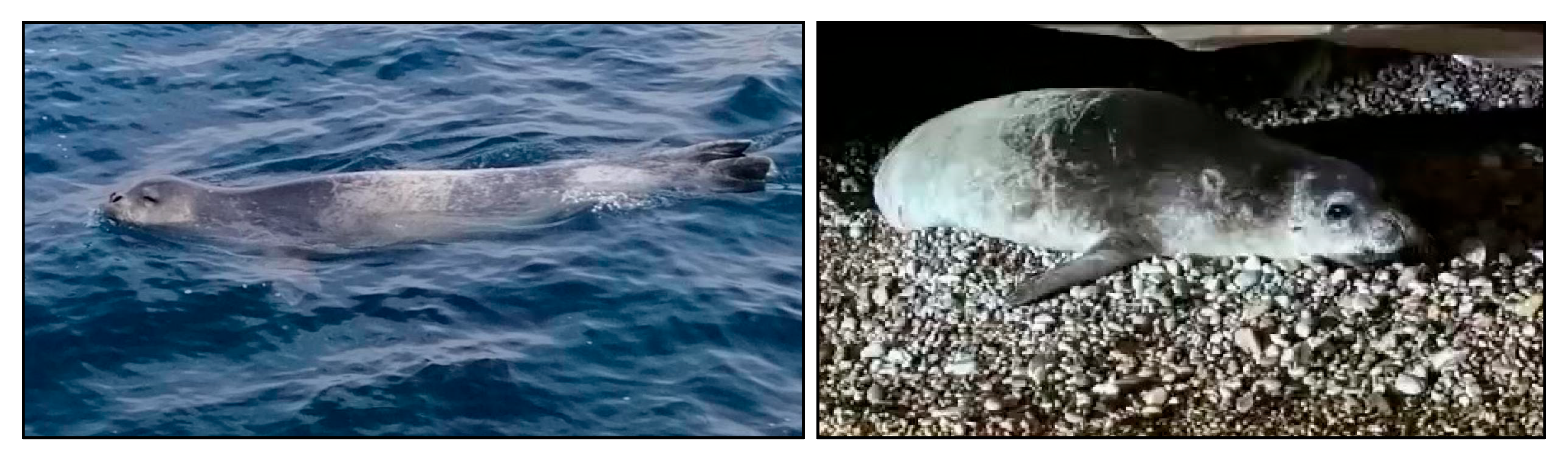
Photo-identification was possible for 34 of these sightings, with the vast majority depicting the same individual (see Figure 2)—an adult female Mediterranean monk seal previously identified along the southern Levantine coast [10]. In six additional cases, although the quality of the photographic and video material did not allow for proper identification, the images appeared to depict the same identified adult female. However, two videos recorded on 31 March 2022 and 22 February 2024, both from the Beirut area, clearly captured different individuals. In both cases, the animals appeared to be juveniles, as their fur lacked distinctive scars. While the image quality did not permit direct comparison, the temporal gap between the recordings suggests these were different individuals.
The presence of multiple Mediterranean monk seal individuals along the Lebanese coast was further confirmed on 17 November 2024, when two seals were filmed together slightly north of Beirut. One of these individuals was identified as the previously described adult female.
Interestingly, in some instances, the collected visual material provided insights into the Mediterranean monk seal’s habitat use. The identified female was observed resting on the beach inside Amchit Cave (Amchit, Jbeil District, 36 km north of Beirut) on multiple occasions: 21 July 2020; 8 September 2021; 26 May and 25 September 2022; 22 August and 18 September 2023; and 24 August and 10 October 2024. The same individual was also recorded resting on the beach inside Rawsheh Cave (Beirut) on 15 June 2024 and near the cave on 6 November 2024. Additionally, on 18 May 2024, a Mediterranean monk seal was recorded sleeping on the beach inside the cave; however, due to the poor quality of the footage, it was not possible to confirm whether it was the same individual.

3.2. Visual Analysis of Feeding Ecology

Three videos documenting the feeding habits of Mediterranean monk seals were recorded within the study area.
The first video, recorded on 5 March 2024, showed an individual exhibiting playful behaviour with its prey before ingestion. The prey was identified as a silvery, elongated fish, likely a grey mullet (Mugilidae) or a sea bass (Dicentrarchus labrax), with estimated dimensions of 20–30 cm in length.
The second video, taken by a fisherman on 17 November 2024, did not allow for accurate prey identification. However, it was possible to observe that the prey was small in size, approximately 10–20 cm in length. The fisherman who recorded the video indicated that the prey was a Mullus species.
The third video, recorded on 10 January 2025, clearly showed a seal feeding on an octopus (Octopus spp.). This individual was identified as the adult female previously described (approximately 2.3–2.4 m in length [48]). The octopus appeared to have a dorsal mantle length (DML) of around 20–23 cm.

4. Discussion

The presence and frequency of Mediterranean monk seals along the Lebanese coast remain a subject of ongoing discussion. So far, neither qualitative nor quantitative analyses of sightings have been possible. While based on opportunistic and sporadic observations, the present study aims to shed light on the current status of the species in Lebanese waters. It is important to acknowledge that these sightings often reflect more about the witness than the subject of the encounter itself. Indeed, a sighting is typically a chance event where a human, often engaged in unrelated daily activities, unexpectedly encounters a seal. In most cases, with a few exceptions, crucial contextual information regarding the animal’s origin, destination, or behaviour is lacking.
Only a systematic, long-term survey focused on the identification and monitoring of potentially suitable habitats—such as marine caves—can provide reliable answers regarding the consistency of individual seals frequenting a specific area. This becomes even more critical in countries classified as Group B (areas characterized by repeated Mediterranean monk seal sightings and possibly hosting critical habitat for the species) as defined in the “Regional Strategy for the Conservation of the Monk Seal in the Mediterranean” by SPA/RAC, as is the case with the Lebanese coast. For these areas, the implementation of a “coastal habitat assessment study” and a “long-term cave monitoring program” becomes essential [5].
This study confirms that more than one Mediterranean monk seal individual has frequented the coast of Lebanon, with three distinct individuals identified between 2022 and 2024. Additionally, video footage showing two individuals together further supports this finding. It is also worth mentioning that on 4 April 2015, a pregnant monk seal with a fully developed foetus (approximately 60 cm in length) was found dead in the Rawsheh Cave [25]. Furthermore, the adult female identified in this study was documented on several previous occasions: on 22 April 2015 in Dalieh (33.888633° N, 35.467800° E, Beirut); on 25 July 2015 in Tabarja (35.467800° N, 35.621217° E); on 8 April 2020 in Dabyeh (Antelias); and on 27 June 2017 in Rawsheh Cave, as reported in previous studies [24,25]. Several other monk seal sightings were reported between 2000 and 2020 [22,23,24,25]. However, the reliability of some of these reports, with a few exceptions, could not be verified.
In the current study, only sightings supported by photographic or video documentation were considered. Additionally, as mentioned, unverified accounts were excluded to avoid overestimation and account for the possibility of occasional sightings of other pinniped species in the Mediterranean [3,49], such as the sea lion observed between Tyre and Nakoura over a 20-day period in 2014, or the hooded seal recorded at the Palm Islands Reserve in February 2016 [20]. Therefore, the actual presence of Mediterranean monk seals in Lebanon may be higher than reported. Three sightings were additionally reported on 5 April 2025 and another on 19 April 2025, both from the Rawsheh area, and a third on 22 April 2025 from the Anfhe area, North Lebanon.
The habitat use analysis in this study confirmed that Mediterranean monk seals in Lebanon currently frequent two marine caves: Amchit and Rawsheh. These caves appear to be regularly used, at least by the identified adult female.
The visual analysis of recorded feeding behaviour of the Mediterranean monk seal in this study revealed prey species previously documented in foraging ecology studies (e.g., [50]). These species are also targeted by fisheries, suggesting potential interactions with the fishing sector.
Further research is required to assess the availability and suitability of critical habitats and prey species for the Mediterranean monk seal along the Lebanese coast. Systematic surveys aimed at identifying and monitoring suitable habitats—particularly marine caves—are essential for accurately estimating the number of individuals frequenting the area. The use of tools such as infrared cameras can enhance monitoring efforts in these environments. Additionally, assessing the extent and nature of potential negative interactions, particularly with the fishing sector, is crucial for developing effective conservation and management strategies.
Understanding risks to species survival and conservation requires addressing contextual complexity through detailed analysis of threat pressures and the underlying threats. Conceptual models and assessment frameworks provide practical approaches for anticipating social, economic, environmental, and political contexts, providing a baseline for effective and adaptive conservation and management strategies [51,52,53,54,55].
These efforts should be integrated into a basin-wide framework to better understand individual movements and population connectivity within the Levantine region. Such an approach will provide an ecological context for local observations and contribute to broader regional initiatives for the conservation and recovery of the species.

Author Contributions

Conceptualization, L.B., G.H.-M., G.P., S.F., and A.B.; methodology, L.B., G.H.-M., and G.P.; validation, L.B., G.H.-M., S.F., and A.B.; formal analysis, L.B. and G.H.-M.; investigation (field work), S.F., M.H., and A.B.; resources, S.F. and A.B.; data curation, L.B., G.H.-M., G.P., S.F., and A.B.; writing—original draft preparation, L.B.; writing—review and editing, L.B., G.H.-M., G.P., S.F., A.B., M.H., and L.B.-N.; visualization, L.B.; supervision, L.B., G.H.-M., and G.P.; project administration, L.B., S.F., and A.B.; funding acquisition, L.B.-N. All authors have read and agreed to the published version of the manuscript.

Funding

This research was partially funded by the United Nations Environment Programme/Mediterranean Action Plan–Specially Protected Areas/Regional Activity Centre (UNEP/MAP-SPA/RAC), under Memorandum of Understanding No. 64/2023_SPA/RAC. The support was provided to implement the Primary Standardised Monitoring Programme for Mediterranean monk seals (Monachus monachus) and their habitats in Lebanon, thanks to the French Voluntary Contribution (FVC) from the Ministry for Europe and Foreign Affairs of France, pursuant to the Bilateral Agreement signed between UNEP and the Ministry on 15 July 2022 to support activities under the UNEP/MAP Programme of Work for the 2022–2023 biennium.

Institutional Review Board Statement

The study was conducted in accordance with the ethical principles of the Declaration of Helsinki (1975, revised 2013). In accordance with Lebanese national legislation governing patients’ rights and research participation (Law No. 574/2004), anonymous, voluntary interviews that do not involve the collection of identifiable personal data and pose minimal risk to participants do not require formal review or approval by an institutional ethics committee. As the present study met these criteria, formal ethical approval was not required.

Informed Consent Statement

Verbal informed consent was obtained from the participants. Verbal consent was obtained rather than written because of the anonymous and minimal-risk nature of the study. No identifiable personal data were collected, and obtaining written consent would have unnecessarily introduced identifying information, thereby reducing participant anonymity.

Data Availability Statement

No data were deposited in an official repository. All data and pictures included in the manuscript and related to a specific location of the habitat use of the Mediterranean monk seals cannot be shared in accordance with the confidentiality related to conservation issues. Data are available upon request.

Acknowledgments

We would like to express our gratitude to the IUCN Mediterranean Office, and especially to Mercedes Muñoz-Cañas, for her valuable support of Mediterranean monk seal conservation efforts in the Eastern Mediterranean, and for the fruitful comments provided by the anonymous reviewers. We also extend special thanks to M.R.-E. for his unwavering support in contributing sighting data shared on Facebook. Additionally, we are very grateful to the Monk Seal Alliance (MSA) for their valuable support in strengthening the capacities of the national team responsible for monitoring and conserving the Mediterranean monk seal in Lebanon.

Conflicts of Interest

The authors declare no conflicts of interest. The funders had no role in the design of the study; in the collection, analyses, or interpretation of data; in the writing of the manuscript; or in the decision to publish the results.

Abbreviations

The following abbreviations are used in this manuscript:
SPA/RACSpecially Protected Areas Regional Activity Centre
MPAMarine Protected Area
PINRPalm Islands Nature Reserve
TCNRTyre Coast Nature Reserve
ANRAbbassieh Nature Reserve
DMLDorsal Mantle Length

References

  1. Karamanlidis, A.A.; Dendrinos, P.; Fernandez de Larrinoa, P.; Kıraç, C.O.; Nicolaou, H.; Pires, R. Monachus monachus. The IUCN Red List of Threatened Species. 2023; e.T13653A238637039. Available online: https://www.iucnredlist.org/species/13653/238637039 (accessed on 4 February 2026).
  2. Karamanlidis, A.A. Current status, biology, threats and conservation priorities of the Vulnerable Mediterranean monk seal. Endanger. Species Res. 2024, 53, 341–361. [Google Scholar] [CrossRef]
  3. Bundone, L.; Panou, A.; Molinaroli, E. On sightings of (vagrant?) monk seals, Monachus monachus, in the Mediterranean Basin and their importance for the conservation of the species. Aquat. Conserv. Mar. Freshw. Ecosyst. 2019, 29, 554–563. [Google Scholar] [CrossRef]
  4. Valsecchi, E.; Tavecchia, G.; Boldrocchi, G.; Coppola, E.; Ramella, D.; Conte, L.; Blasi, M.; Bruno, A.; Galli, P. Playing “hide and seek” with the Mediterranean monk seal: A citizen science dataset reveals its distribution from molecular traces (eDNA). Sci. Rep. 2023, 13, 2610. [Google Scholar] [CrossRef] [PubMed]
  5. UNEP/MAP-SPA/RAC (Ed.) Regional Strategy for the Conservation of Monk Seal in the Mediterranean; SPA/RAC: Tunis, Tunisia, 2019; p. 23. [Google Scholar]
  6. Panou, A.; Giannoulaki, M.; Varda, D.; Lazaj, L.; Pojana, G.; Bundone, L. Towards a strategy for the recovering of the Mediterranean monk seal in the Adriatic-Ionian Basin. Front. Mar. Sci. 2023, 10, 1034124. [Google Scholar] [CrossRef]
  7. Kurt, M.; Ok, M.; Güçü, A.C. Recent status and fate of the north-eastern Mediterranean monk seal populations. In Proceedings of the World Marine Mammal Conference, Barcelona, Spain, 7–12 December 2019; p. 109. [Google Scholar]
  8. Beton, D.; Broderick, A.C.; Godley, B.J.; Kolaç, E.; Ok, M.; Snape, R.T.E. New monitoring confirms regular breeding of the Mediterranean monk seal in Northern Cyprus. Oryx 2021, 55, 522–525. [Google Scholar] [CrossRef]
  9. Nicolaou, H.; Dendrinos, P.; Marcou, M.; Michaelides, S.; Karamanlidis, A.A. Re-establishment of the Mediterranean monk seal Monachus monachus in Cyprus: Priorities for conservation. Oryx 2021, 55, 526–528. [Google Scholar] [CrossRef]
  10. Roditi-Elasar, M.; Bundone, L.; Goffman, O.; Scheinin, A.P.; Kerem, D.H. Mediterranean monk seal (Monachus monachus) sightings in Israel 2009-2020: Extralimital records or signs of population expansion? Mar. Mamm. Sci. 2021, 37, 344–351. [Google Scholar] [CrossRef]
  11. Ibrahim, A.; Hussein, C.; Alshawy, F.; Ahmad, A.A. Distribution and habitats of the Mediterranean monk seal (Monachus monachus) in the Syrian coast (Eastern Mediterranean). Species 2024, 25, e2s1624. [Google Scholar] [CrossRef]
  12. Bundone, L.; Roditi-Elasar, M.; Goffman, O.; Sheinin, A.P.; Kerem, D. Monk seal sightings, identification and habitat survey in Israel. In Proceedings of the 30th Annual Conference of the European Cetacean Society, Madeira, Portugal, 14–16 March 2016; p. 222. [Google Scholar]
  13. Roditi-Elasar, M.; Bundone, L.; Scheinin, A. Potential Suitable Habitats for the Mediterranean Monk Seal, Monachus monachus, Along the Israeli Coast; Report to the Monk Seal Alliance Within the Project “Monk Seal Protection at the Eastern Mediterranean”, in Collaboration with the Israeli Nature and Parks Authority and Rosh Hanikra Touristic Site; Delphis Association and Israel Nature and Parks Authority: Tel Aviv, Israel, 2023; p. 19. [Google Scholar]
  14. Gruvel, A. Les États de Syrie. Richesses Marines et Fluviales. Exploitation Actuelle; Avenir Société d’Editions Géographie, Maritimes et Coloniales: Paris, France, 1931; p. 453. [Google Scholar]
  15. Kumerloeve, H. Zum Vorkommen der Mönchsrobbe, Monachus m. monachus (Hermann, 1779), im libanesischen Küstengebiet. Säugetierkd. Mitt. 1966, 14, 114–118. [Google Scholar]
  16. Kumerloeve, H. Die Säugetiere (Mammalia) der Türkei. Die Säugetiere (Mammalia) Syriens und des Libanon. Veröff. Zool. Staatssamml. München 1975, 18, 69–225. [Google Scholar]
  17. Lewis, R.E.; Lewis, J.H.; Atallah, S.I. A review of Lebanese mammals. Carnivora, Pinnipedia, Hyracoidea and Artiodactyla. J. Zool. 1968, 154, 517–531. [Google Scholar] [CrossRef]
  18. Marchessaux, D. Distribution et statut des populations du phoque moine Monachus monachus (Hemann, 1779). Mammalia 1989, 53, 621–642. [Google Scholar] [CrossRef]
  19. Khouzami, M.; Hayek, A.; Bassil, M.; Fortunat, L. Biological Diversity of Lebanon; Project GF/6105-92-72; The Ministry of Agriculture of Lebanon and MOA/UNEP/GEF: Beirut, Lebanon, 1996; p. 255. [Google Scholar]
  20. UNEP/MAP-SPA/RAC. National Monitoring Programme for Marine Biodiversity in Lebanon; Bitar, G., Ramadan Jaradi, G., Hraoui-Bloquet, S., Lteif, M., Eds.; SPA/RAC EcAp Med II Project: Tunis, Tunisia; UNEP/MAP-SPA/RAC: Tunis, Tunisia, 2018; p. 111. [Google Scholar]
  21. Ramadan-Jaradi, G. Meeting of experts on the implementation of the Action Plans for marine mammals (monk seal and cetaceans) adopted within MAP/Report of Lebanon. In Report of the Meeting of Experts on the Implementation of the Action Plans for Marine Mammals (Monk Seal and Cetaceans) Adopted Within MAP, Annex V. Arta, Greece, 29–31 October 1998; UNEP(OCA)MED WG.146/5; UNEP/MAP: Athens, Greece, 1998; pp. 59–61. [Google Scholar]
  22. Tohmé, G.; Ramadan-Jaradi, G.; Mneimneh, A. Biodiversity Assessment and Monitoring in the Protected Áreas/Lebanon/Leb/95/G31: Palm Islands Nature Reserve; Final Report to the Ministry of Environment; Lebanese University, Faculty of Science: Beirut, Lebanon, 2004; p. 114. [Google Scholar]
  23. Anonymous. Seal sightings in Lebanon. TMG 2010, 13, 13–14. [Google Scholar]
  24. Bariche, M.; Crocetta, F. Status of the Mediterranean monk seal Monachus monachus in Lebanon: Form extinct (1968) to regular sightings (2003–2016). 4.11 in New Mediterranean Biodiversity Records (November, 2016). Medit. Mar. Sci. 2016, 17, 814–815. [Google Scholar]
  25. SPA/RAC-UNEP/MAP. On the Occurrence of the Mediterranean Monk Seal Monachus monachus (Hermann, 1779) in the Lebanese Waters (Eastern Mediterranean Sea); Badreddine, A., Limam, A., Ben-Nakhla, L., Eds.; UNEP/MAP-SPA/RAC: Tunis, Tunisia, 2020; p. 12. [Google Scholar]
  26. Abou-Dagher, M.; Nader, M.; El Indary, S. Evolution of the Coast of North Lebanon from 1962–2007; Mapping changes for the identification of hotspots and for future management interventions. In Proceedings of the IV Symposium: Monitoring of Mediterranean Coastal Areas, Livorno, Italy, 12–14 June 2012; Firenze University Press: Florence, Italy, 2012; pp. 171–180. [Google Scholar]
  27. Badreddine, A. Coastal Ecosystems of the Lebanese Coast: Ecological Status, Conservation, Evolution. Ecosystems. Ph.D. Thesis, COMUE Université Côte d’Azur (2015–2019), Nice, France, 2018. [Google Scholar]
  28. Badreddine, A.; Abboud-Abi Saab, M.; Gianni, F.; Ballestros, E. First assessment of the ecological status in the Levant Basin: Application of the CARLIT index along the Lebanese coastline. Ecol. Indic. 2018, 85, 37–47. [Google Scholar] [CrossRef]
  29. Nader, M.; Bou Nassar, M.; El Indary, S.; Abou Dagher, M. Impact of Climate Change on the Coast of Lebanon: An Awareness Handbook; IUCN: Gland, Switzerland; Ministry of Environment: Beirut, Lebanon, 2021. [Google Scholar]
  30. UNEP/MAP; UNESCO/IHP; CNRS Lebanon. Impact of Climate Change on Water Resources of the Coastal Wetlands in Lebanon, Strategic Partnership for the Mediterranean Sea Large Marine Ecosystem (MedPartnership); UNESCO: Paris, France, 2015; p. 56. [Google Scholar]
  31. UNEP/MAP-SPA/RAC. Ecological Characterization of Sites of Interest for Conservation in Lebanon: Enfeh Peninsula, Ras Chekka Cliffs, Raoucheh, Saida, Tyre and Nakoura; Ramos-Esplá, A.A., Bitar, G., Khalaf, G., El Shaer, H., Forcada, A., Limam, A., Ocaña, O., Sghaier, Y.R., Valle, C., Eds.; RAC/SPA—MedMPAnet Project; UNEP/MAP-SPA/RAC: Tunis, Tunisia, 2014; p. 146. [Google Scholar]
  32. Sanlaville, P.; Prieur, A. Asia, Middle East, coastal ecology and morphology. In Encyclopedia of Coastal Science; Flinkl, C., Markowski, C., Eds.; Encyclopedia of Earth Science Sereis; Springer: Cham, Switzerland, 2018; pp. 111–128. [Google Scholar]
  33. El Shaer, H.; Samaha, L.; Ramadan-Jaradi, G.; de Grissac, A.J.; Kanj, R. Lebanon’s Marine Protected Area Strategy: Supporting the Management of Important Marine Habitats and Species in Lebanon; The Lebanese Ministry of Environment/IUCN: Beirut, Lebanon; The Lebanese Ministry of Environment/IUCN: Gland, Switzerland; The Lebanese Ministry of Environment/IUCN: Malaga, Spain, 2012; p. 64. [Google Scholar]
  34. UNEP/MAP-SPA/RAC. Ecological Characterization of Potential New Marine Protected Areas in Lebanon: Batroun, Medfoun and Byblos; Ramos-Esplá, A.A., Bitar, G., Forcada, A., Valle, C., Ocaña, O., Sghaier, Y.R., Samaha, Z., Kheriji, A., Limam, A., Eds.; MedMPA Network Project: Tunis, Tunisia; UNEP/MAP-SPA/RAC: Tunis, Tunisia, 2017; p. 93. [Google Scholar]
  35. Majdalani, S. Census of Lebanese Fishing Vessels and Fishing Facilities; Lebanese Republic, Ministry of Agriculture, Directorate of Rural Development & Natural Resources, Department of Fisheries & Wildlife: Beirut, Lebanon, 2005; p. 144. [Google Scholar]
  36. Sacchi, J.; Dimech, M. Report of the FAO EastMed Assessment of the Fishing Gears in Lebanon; GCP/INT/041/EC—GRE—ITA/TD-09; Food and Agriculture Organization of the United Nations (FAO): Rome, Italy, 2011; p. 47. [Google Scholar]
  37. Nader, M.; El Indary, S.; Stamatopoulos, C. Assessment of the comercial fish species of the coast of North Lebanon 2006–2011. In Proceedings of the INOC-CNRS, International Conference on “Land-Sea Interactions in the Coastal Zone”, Jounieh, Lebanon, 6–8 November 2012; Lebanon Publication: Beirut, Lebanon, 2012; pp. 478–484. [Google Scholar]
  38. Pinello, D.; Dimech, M. Socio-Economic Analysis of the Lebanese Fishing Fleet; GCP/INT/041/EC—GRE—ITA/TD-16; Food and Agriculture Organization of the United Nations (FAO): Rome, Italy, 2013; p. 72. [Google Scholar]
  39. UNEP/MAP-SPA/RAC. Proposal for inclusion in the SPAMI list: Tyre Coast Nature Reserve. In Proceedings of the Tenth Meeting of the Focal Points for SPAs, Marseille, France, 17–20 May 2011; UNEP/MAP-SPA/RAC: Tunis, Tunisia, 2011; p. 48. [Google Scholar]
  40. SPA/RAC; MedPAN. The Legal Framework for Marine Protected Areas in Lebanon: Factsheets; Emmanouilidou, P., Seddik, W., Webster, C., El Asmi, S., Kheriji, A., Eds.; SPA/RAC. MedMPA Network Project: Tunis, Tunisia; SPA/RAC: Tunis, Tunisia, 2019; p. 11. [Google Scholar]
  41. IUCN-ROWA/LCESD. Updated Protected Area Management Plan for Palm Islands Nature Reserve; Ramadan-Jaradi, G., Abou Arrage, J., Badreddine, A., Halwani, J., Eds.; IUCN-ROWA/LCESD: Beirut, Lebanon, 2021; p. 130. [Google Scholar]
  42. SPA/RAC-UNEP/MAP. Management Plan of Tyre Coast Nature Reserve (TCNR)—Phase 1: Assessment Diagnosis; Khoury, R., Badreddine, A., Safi, S., Abdallah, P., Samaha, L., Samaha, Z., Husseini, M., Limam, A., Eds.; SPA/RAC. IMAP/MPA Project; SPA/RAC-UNEP/MAP: Tunis, Tunisia, 2022; p. 100. [Google Scholar]
  43. SPA/RAC-UN Environment/MAP. Management Plan of Tyre Coast Nature Reserve (2023–2028); Khoury, R., Badreddine, A., Harmouche Safi, S., Abdallah, P., Samaha, L., Limam, A., Eds.; SPA/RAC. IMAP/MPA Project: Tunis, Tunisia; SPA/RAC: Tunis, Tunisia, 2023; p. 122. [Google Scholar]
  44. SPA/RAC-UNEP/MAP. A Stranding Network for Sea Turtles and Cetaceans & A Protocol for Monitoring the Interaction between Marine Litter and Marine Turtles in Lebanon; Badreddine, A., Samaha, L., Joumaa, F., Abderrahim, M., Limam, A., Ben-Nakhla, L., Eds.; SPA/RAC. Marine Litter MED project; SPA/RAC-UNEP/MAP: Tunis, Tunisia, 2020; p. 19. [Google Scholar]
  45. Bundone, L.; Panou, A.; Aravantinos, P.; Muñoz-Cañas, M. Photo-identification of the Mediterranean monk seal sub-population in the central Ionian Sea, Greece. In Proceedings of the World Marine Mammal Conference, Barcelona, Spain, 7–12 December 2019; p. 106. [Google Scholar]
  46. Bundone, L.; Panou, A. Improvement of knowledge on the Mediterranean monk seal sub-population in the Central Ionian Sea, Greece, using photo-identification. In Proceedings of the 33rd Conference of the European Cetacean Society, Ashdod, Israel, 5–7 April 2022; p. 106. [Google Scholar]
  47. Bundone, L.; Panou, A. Photo-identification catalogue for Mediterranean monk seal—A functional methodology. In Proceedings of the 34th Conference of the European Cetacean Society, O’Grove, Spain, 18–20 April 2023; p. 316. [Google Scholar]
  48. Samaranch, R.; González, L.M. Changes in morphology with age in Mediterranean monk seals (Monachus monachus). Mar. Mamm. Sci. 2000, 16, 141–157. [Google Scholar] [CrossRef]
  49. Notarbartolo di Sciara, G. Marine mammals in the Mediterranean Sea: An overview. Adv. Mar. Biol. 2018, 75, 1–36. [Google Scholar]
  50. Pierce, G.J.; Hernandez-Milian, G.; Santos, B.M.; Edridge, A.; Dendrinos, P.; Psaradelli, M.; Tounta, E.; Androukaki, E.; Edridge, A. Diet of the monk seals (Monachus monachus) in greek waters. Aquat. Mamm. 2011, 37, 284–297. [Google Scholar] [CrossRef]
  51. Salafsky, N.; Margoulis, R. Threat reduction assessment: A practical and cost-effective approach to evaluating conservation and development projects. Conserv. Biol. 1999, 13, 830–841. [Google Scholar] [CrossRef]
  52. Margoulis, R.; Stem, C.; Salafsky, N.; Brown, M. Using conceptual models as a planning and evaluation tool in conservation. Eval. Program. Plann. 2009, 32, 138–147. [Google Scholar] [CrossRef]
  53. Bauer, H.; Dickman, A.; Chapron, G.; Oriol-Cotterill, A.; Nicholson, S.K.; Sillero-Zubiri, C.; Hunter, L.; Lindsay, P.; Macdonald, D.W. Threat analysis for more effective lion conservation. Oryx 2022, 56, 108–115. [Google Scholar] [CrossRef]
  54. Luiselli, L.; Le Duc, O.; Pham Van, T.; Xuan, T.N.; Dang, P.B.; Kuchling, G.; Leprince, B.; Shi, H.T.; McCaskill, L.; Giovacchini, P.; et al. A threat analysis for the wold’s most threatened turtle (Rafetrus swinhoei). J. Nat. Conserv. 2024, 78, 126577. [Google Scholar] [CrossRef]
  55. Battisti, C.; Testi, A.; Fanelli, G.; Rastrelli, M.; Giovacchini, P.; Marsili, L. A synthetic framework to match concepts and approaches when managing anthropogenic threats. Conservation 2024, 4, 395–401. [Google Scholar] [CrossRef]
Figure 2. The adult female monk seal repeatedly sighted along the Lebanese coast on 21 February 2021 (left) and on 10 October 2024 (right).
Conservation 06 00028 g002
Disclaimer/Publisher’s Note: The statements, opinions and data contained in all publications are solely those of the individual author(s) and contributor(s) and not of MDPI and/or the editor(s). MDPI and/or the editor(s) disclaim responsibility for any injury to people or property resulting from any ideas, methods, instructions or products referred to in the content.