Abstract
The eastern Baltic region is rich in hemiboreal forests, which are both commercially important and provide habitats for rare and/or endangered forest-dwelling species, which are sensitive to accelerating climatic changes. Under the intensifying climatic disturbances that are stressing forests worldwide, sanitary logging is a widely used harvesting technique for the mitigation of commercial losses. The effects of salvage logging on the biodiversity of forests remain ambiguous due to the larger scale and higher intensity of timber harvesting, which can alter the recovery of stands and succession of their vegetation. Furthermore, EU legislation is increasingly emphasizing conservation/restoration and mandating its implementation. The recovery of ecosystems, and hence the biodiversity of disturbed managed forests, can take several decades to centuries, depending on the site conditions. Long-term (~60 years, four remeasurements) changes in the composition and structure of vegetation, as an indicator of overall health and nutrient cycling, were studied in conventionally managed hemiboreal forests. Potential forest transformation (paludification) risks associated with large-scale logging were assessed in mixed coniferous stands in the Baltics, Latvia. Following logging, the stands were conventionally managed, including artificial regeneration. According to ground cover vegetation, 50 years was the period for the disturbance effects to start subsiding, as a dynamic equilibrium was reached and the canopies of regenerating trees were closing. A gradual decrease in moisture levels in the middle parts of salvage-logged areas, and later at their edges, indicated that the stands have escaped paludification, likely as the climate has been warming. Distance from the edge of the salvage-logged areas had a secondary effect on ground cover vegetation recovery after storms, alleviating concerns about the explicit negative impact of the scale of harvesting. Thus, in managed seminatural forest landscapes with a historically small to moderate scale of anthropogenic disturbance, salvage logging at a scale locally deemed as large had a transient effect in the Baltics. This indicates successful regeneration of the forest ecosystem over a timeframe shorter than the conventional rotation period, suggesting overall conservation efficiency of conventionally managed forests. Accordingly, salvage logging can be sustainable in terms of biodiversity and forest continuity in the long run under traditional management, as environmental changes accelerate.
1. Introduction
During recent decades, European forests have suffered several climatic extremes [1,2], which have increased the scale and intensity of sanitary fellings and salvage logging areas [3,4]. Interacting negative effects of natural disturbance and subsequent sanitary felling or salvage logging are presumed to affect the sustainability of forests in a managed landscape by altering succession and reducing connectivity [2,3,5,6,7]. At the regional and national levels, sanitary felling can exceed 100% of the planned harvest [3]; thus, the frequency, amount, and area of sanitary fellings might be considered as a proxy for forest health [8]. Such intense harvesting can temporarily deplete the woody biomass needed for forest-dwelling species, including rare and specialist species [9]. These effects appear to be intensified by the increasing heterogeneity of meteorological conditions, highlighting the necessity for agile adjustments in conservation approaches [10]. In light of the EU Nature Restoration Law, these issues are becoming principal for forest management, as the primary function of forests seems to be shifting from timber production to nature conservation/restoration [11].
Intensifying climatic extremes can cause catastrophic damage to forest ecosystems, often necessitating salvaging timber across vast areas, which can be devastating to ground cover [12]. Mostly, these effects are considered comparable to those of clear-cuts, although concerns regarding long-term conservation have been raised [13,14,15]. To reduce the adverse effects of biomass and/or timber removal on biodiversity in managed landscapes, the area of cuttings in Europe is restricted [11]. For example, in Latvia, which is an important timber source for regional markets [16], the area of cuttings is restricted to 2–5 ha [17]. However, sanitary felling or salvage logging may affect notably larger areas, disrupting the continuity and structural diversity of stands and potentially undermining the natural recovery and diversity of forests [18,19]. Hence, such management is open for re-evaluation, regarding the recent EU legislation [11]. Additionally, the area of a felled stand is considered a key indicator of the conservation and sustainability of forests, particularly for late succession species and connectivity [20]. Compared to clear-cutting, salvage logging after climatic disturbances like windstorms can have stronger effects on soil, thus altering further succession of vegetation [21], which could hinder conservation of the forest in its previous state. Changes in environmental conditions after disturbances are often studied via ground cover vegetation due to its responsiveness [22,23,24], and hence indicative properties [21,25].
Tree biomass removal impacts the diversity and composition of understory vegetation, including the shrub, herb, and moss layers, which are vital for biodiversity and nutrient cycling in forest ecosystems [26]. In response to selective tree removal and/or small-scale natural disturbances, gap openings are usually colonized by early-successional light-demanding, competitive, nitrophilous plants, which are then gradually replaced by late-successional, shade-tolerant species [27,28,29,30]. This is considered to closely mimic natural processes, and can therefore considered conservative under the current legislative framework [31]. However, post-disturbance salvage logging can create considerably wider canopy openings [32], thus providing a gateway for ruderal and invasive species [33,34]. Although harvesting (clear-cutting) mostly results in a temporary increase in richness and diversity of understory due to early-successional species [33,34], such effect normally subsides within 15 years, as tree canopies close [4,35]. Meanwhile, shade- and moisture-demanding late-successional species, typical of old-growth forests, can be particularly vulnerable to harvesting [36,37,38]. The return to the pre-disturbance state can take up to several decades, during which the degree of “naturalness” can be ambiguous [4,27,29,39,40,41].
Large-scale disturbances can cause irreversible changes in environmental conditions, permanently disrupting forest ecosystems and causing transformations to non-forest land [23,42]. In the eastern Baltic region, where the climate is moist continental [43] and fresh sites are abundant, large-scale timber harvests are considered to bear high paludification risks [44,45]. To assess such a possibility and assess ecosystem recovery trajectories, ground cover vegetation has been used [25]. Although mid-term successional patterns after various felling methods are broadly studied, long-term results are still scarce, particularly in hemiboreal forests [9,13,46]. However, such information is particularly topical under current EU legislation, and it can be decisive in policy-making aimed at conserving and restoring the naturalness of forests. Considering that succession varies according to site conditions, and forest transformation is a long-term process, local long-term studies are highly anticipated. Sanitary clear-cuts and clear-cuts are the prevalent methods of harvesting in the Eastern Baltic region (accounting for approximately 27 and 34% of all cuttings, respectively [47]), yet the area of catastrophic natural disturbances and hence salvage logging can be large. Hence, elucidation of the effects of salvage logging on the course of succession is needed. This study aimed to examine the long-term (~60 years) changes in vegetation composition and structure, as well as to evaluate forest transformation/paludification after large-scale salvage logging (after windstorm) in mixed coniferous stands in Latvia under conventional (traditional) management.
2. Materials and Methods
2.1. Study Area
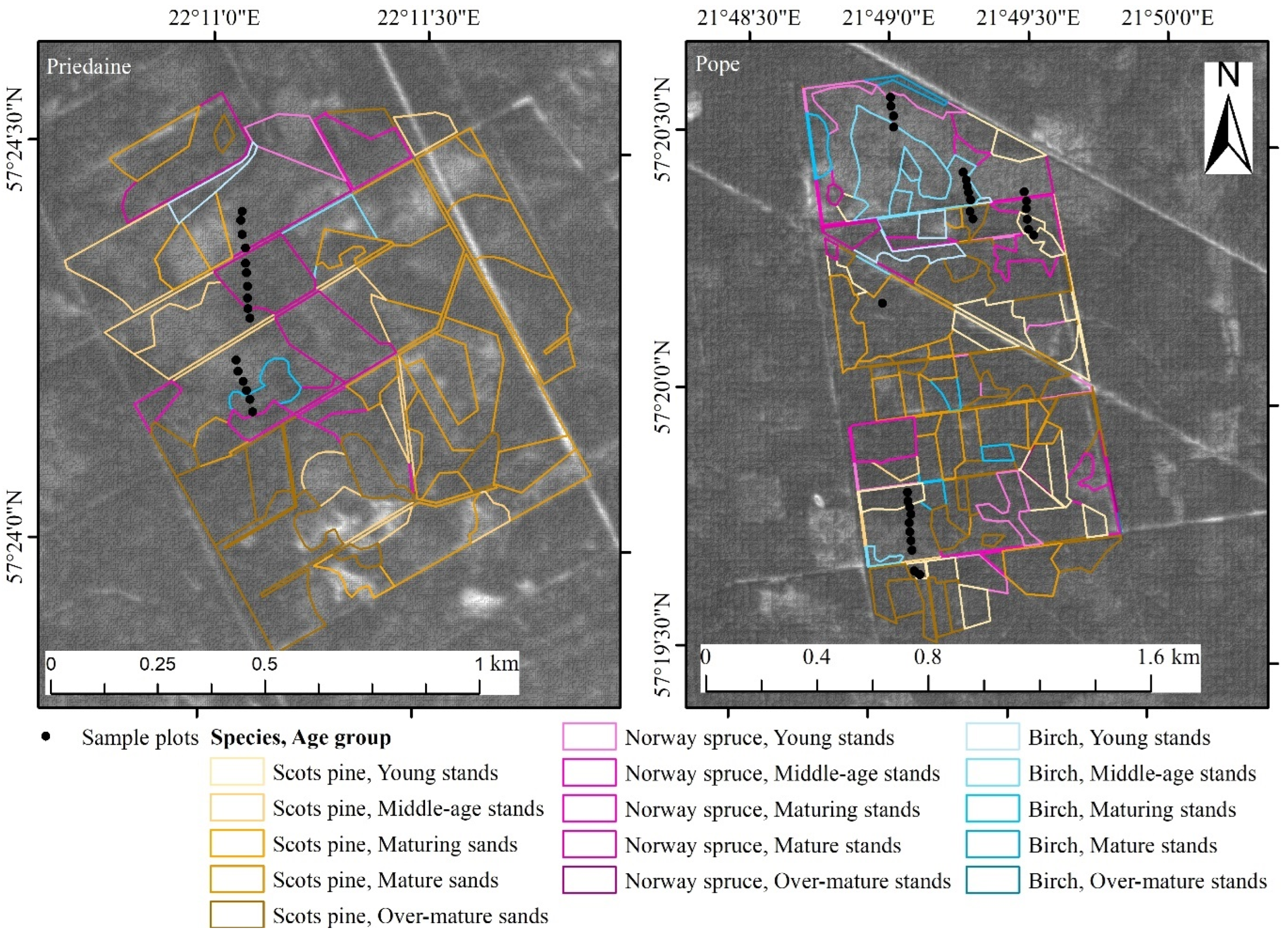
This study was conducted in two forest landscapes (sites) in the western part of Latvia (Pope and Priedaine; Figure 1), where large-scale salvage logging was implemented after the windstorm of 1967, creating clear-cuts 200–400 m wide and up to a kilometer long. All woody biomass was removed during the salvage logging. The studied stands were subsequently conventionally managed (planting, thinning). Before the windstorm and salvage logging, the Priedaine site was predominantly formed by young and middle-aged birch and pine stands, corresponding to the Myrtilloso-sphagnosa forest type [48]. The Pope site was formed by mature, maturing, and young pine–spruce stands with birch admixture, corresponding to the Myrtilloso-sphagnosa or Vaccinioso-sphagnosa forest types [48]. Both sites were located on mesic automorphos and drained mineral and organic soils.
Figure 1.
Satellite imagery from 1970 (three years after salvage logging) with sample plot (initially established in 1977) locations marked by dots. The districts are color-coded to indicate dominant species and age classes as of 2025. Transects were established in sites where salvage logging was carried out and which currently correspond to young or middle-aged stands.
Latvia is located in the hemiboreal forest zone, where forests cover approximately 52% (3.36 Mha) of the territory. The climatic conditions are moist continental [43]. According to the Latvian Environment, Geology and Meteorology Centre data for 1991–2020, the mean annual temperature was +6.8 °C, with February being the coldest and July the warmest month (mean monthly temperatures of −3.1 °C and 17.8 °C, respectively). The mean annual precipitation was 686 mm, and the highest monthly precipitation fell during the vegetation period (July–August; ~76 mm per month).
After salvage logging at the Pope site, initially unsuccessful (due to highly intensive insect attacks and ungulate browsing) artificial regeneration attempts by Scots pine were carried out regardless of precommercial thinning and tending in 1977. This initially undermined the success of stand regeneration, as well as the conservation of the previous state of the forest, which necessitated restoration. Despite the area being considered less suitable for spruce, it was planted, while the naturally regenerating spruce and birch were maintained. However, 30 years after the windstorm, the regeneration density was still low for closed canopy stands. Forest patches were distinguished based on the dominant species even though the site was previously considered homogeneous, indicating diversification. The forest management processes could have affected the establishment of ground cover vegetation after the disturbances. In Pope, the studied stands underwent precommercial thinning, with one of the two transects suffering higher-intensity tree removal (particularly of Norway spruce) due to pest (including browsing) damage in 2020, thus introducing an additional disturbance.
At the Priedaine site, artificial regeneration by planting pine and spruce was successful, which, in combination with tending of naturally regenerating birch, resulted in stands that met the quality requirements for conventionally managed forests by the age of 30 years (in the 1990s). Thus, regeneration was much more successful regarding the restoration of the pre-storm state of the forest. Stands crossed by the northern transect were conventionally thinned, but those crossed by the southern transect underwent higher-intensity thinning due to biotic damage to Norway spruce in 2014, thus causing some disturbance.
2.2. Vegetation Assessment
Ten years after the windthrow in 1977 at the Priedaine and Pope sites, two (150 and 270 m) and four (from 90 to 270 m) transects, respectively, were established perpendicular to the boundaries of the 1967 salvage logging strips. On the transects, permanent survey stations were established at 30 m intervals. The first two stations were established in adjacent forests that were not salvage logged and hence were considered as the control. In the analysis, the control and the next one or two stations (~50 m in the cutting) were considered the “edge”. Other stations located in the center part of the clearing formed by salvage logging were considered the “middle”.
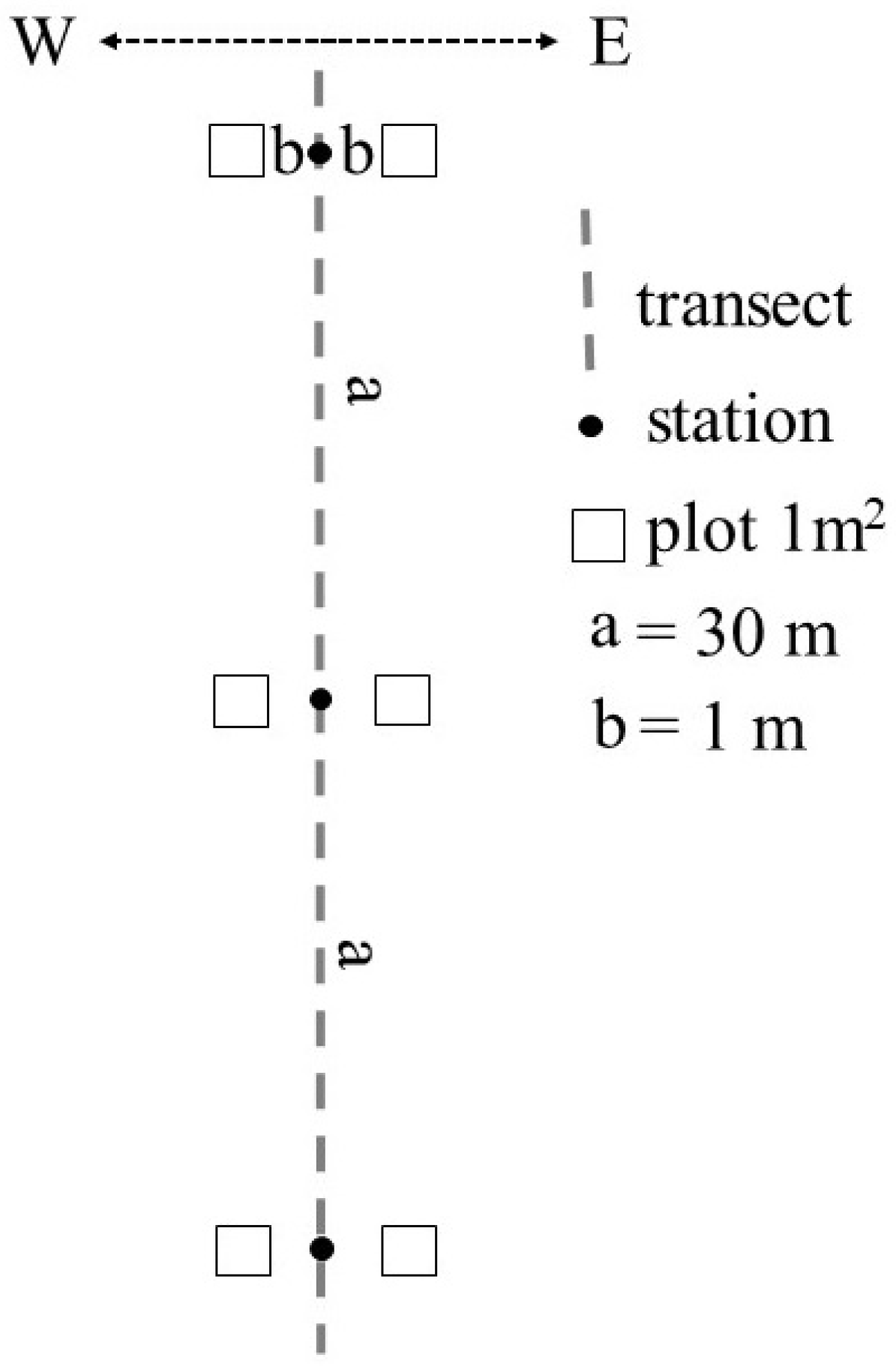
For vegetation surveys at each station, two 1 × 1 m sample plots at one m from the station were established (Figure 2). Within each plot, the relative projective cover of ground cover vegetation species was recorded in 2015 and 2025 for the layers of vascular and woody plants (at the herbaceous layer), as well as bryophytes. Projective cover was then averaged for the stations by pooling the three layers; thus, the total projective cover was allowed to exceed 100%. In total, 39 stations (78 plots) were surveyed during July and August. Previously, all plots had been surveyed in 1977 and 1997; however, only the species lists of vascular plants were recorded then.
Figure 2.
The scheme of the sample plots of ground vegetation in the studied large-scale salvage clear-cuttings.
2.3. Data Analysis
For the 1977 and 1997 surveys, the distribution of ecological groups for vascular plants (according to moisture requirements), aggregated based on the relative projective cover, was retrieved [45]. Additionally, aggregated ecological indicator values according to Ellenberg et al. (1991) [49] for the “edge” and “middle” plots were available for 1997 [45]. Due to the lack of species cover data for 1977 and 1997, the quantitative analysis was based on 2015 and 2025.
For the assessment of ground cover vegetation structure, species richness, total cover, occurrence, and ecological indicator values, according to Ellenberg et al. (1991) [49] for vascular plants and Düll indicator values for bryophytes [50], were recorded, and the Shannon–Wiener diversity indices (H’) were calculated for each station. The overall similarity of ground cover vegetation (total and by layers) among the plots was assessed by analysis of similarity (ANOSIM; [51]). Jaccard dissimilarity over 5000 permutations was evaluated.
Detrended correspondence analysis (DCA) (detrending with 26 segments and downweighing rare species; [52]) was used to assess the main environmental gradients affecting ground cover vegetation in the studied forests. The DCA was supplemented with a matrix of site properties (15 variables in total: species richness and cover, ecological indicator values, Shannon–Wiener diversity index, distance from the edge) to test their correlations with the principal gradients in ground cover vegetation.
The relationships of the principal environmental drivers (as indicated by the correlations) with the first two estimated ground cover vegetation gradients were estimated using a multiple linear mixed regression. The dependencies in the data arising from the sampling design were considered by inclusion of the plot as the random effect. The χ2 test was used to assess the differences in the relative distribution of vascular plants according to the ecological groups (based on moisture requirements; [45]; Table S1) and location (edge, middle). The changes in Ellenberg’s ecological indicator values were assessed based on surveys of 1997, 2015, and 2025. Data analysis was conducted at the significance level α = 0.05 in the program R v. 4.5.2 [53] using the packages “lme4” [54] and “vegan” [55].
3. Results
3.1. Ground Cover Composition and Diversity
At the first survey ten years after the salvage logging (in 1977), 78 vascular species were recorded (Table S1). In the following survey, 20 years after the salvage logging (in 1997), the number of vascular species decreased to 58 (Table S1), yet a recovery of ground cover was evidenced, with 128 undergrowth species recorded in 2015, of which 81 were vascular plants (Table S1), 44 were bryophytes, and 3 were woody plants. At the last inventory (in 2025), the species richness dropped, as 88 species were identified, among which 47 were vascular plants (Table S1), 31 were bryophytes, and 10 were woody plants. The total ground cover vegetation species richness, as well as the richness of vascular plants, was similar in 2015 and 2025 (p-value = 0.07 and p-value = 0.23; Table 1); however, the richness of bryophytes had decreased (p-value = 0.03, Table 1). The overall mean total projective cover of ground cover vegetation in 2015 was 41%; however, it exceeded 100%, indicating an increasing abundance and overlapping of the layers in 2025. The cover of vascular plants increased threefold (from 19 to 55%), while for mosses it doubled (from 22 to 44%). The occurrence of woody plants (including seedlings of trees) increased sharply, as in 2015 they were scarce, but in 2025, saplings/seedlings of Picea abies were abundant (Table 2), indicating a self-regeneration pulse of the tree stand, and hence restoration of its multilayered structure. The evenness of ground cover species distribution (overall and for vascular plants and bryophytes) had remained similar, as indicated by the lack of differences in the Shannon diversity index (p-value > 0.06). The Shannon diversity index calculated based on all layers combined was intermediate (H’ = 1.59 ± 0.23 and 1.87 ± 0.19 in 2015 and 2025, respectively; Table 1), indicating a lack of species dominance.
Table 1.
General description of ground cover vegetation in the studied old salvage clear-cuttings. SE—standard error.
Table 2.
Occurrence (% of plots) and mean projective cover (% of area) of the most common species in old salvage clear-cuttings in 2015 and 2025.
Changes in the vascular plant flora occurred between the four observations, as the succession advanced and efforts for reestablishment of the tree stand were implemented (Table S1). Grasses and ruderal herbaceous species were mostly found 10 years after salvage logging (1977) when the tree stand had not yet established, but species replacement had occurred throughout the studied period, indicating continuous succession. This was supported by the list of unique species recorded exclusively during one of the observation years. In 1977, 1997, 2015, and 2025, 26, 7, 23, and 4 vascular species unique for the survey were recorded, whereas 23 and 10 bryophyte unique species were recorded in 2015 and 2025. However, some species, e.g., Calamagrostis arundinacea, Calamagrostis epigeios, Dryopteris carthusiana, Filipendula ulmaria, Galium palustre, Luzula pilosa, Lysimachia vulgaris, Maianthemum bifolium, Melampyrum pratense, Rubus idaeus, and Vaccinium vitis-idaea, were permanent (Table S1). During the last 10 years, generalist species, e.g., Pleurozium schreberi, Hylocomium splendens, and Vaccinium myrtillus, were the most common, with high occurrence and projective cover (Table 2). The composition of ground cover vegetation has changed over the course of the last 10 years, as significant differences between the 2015 and 2025 were estimated by ANOSIM (R = 0.32; p-value = 0.001). The composition of vascular plants showed stronger differences (R = 0.38; p-value = 0.001), but for bryophytes, the composition showed higher similarity (R = 0.15; p = 0.001), indicating a temporal equilibrium.
3.2. Main Drivers of Ground Cover Vegetation
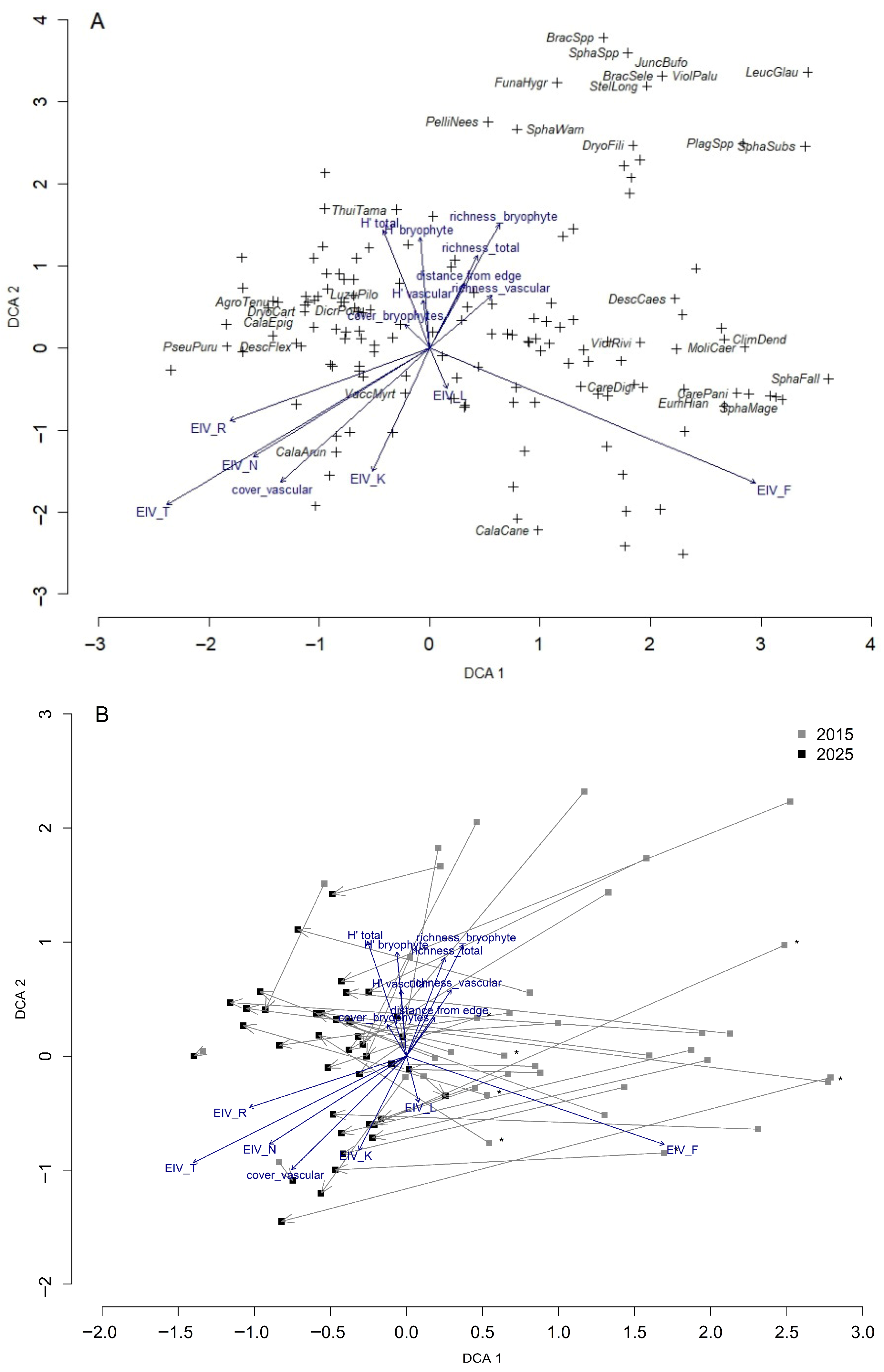
Based on the projective cover of ground cover vegetation surveyed in 2015 and 2025, two continuous principal gradients were estimated by the DCA, indicating systematic environmental effects on the ground cover of the studied stands (Figure 3A,B). The primary gradient represented by the first axis of DCA was apparently related to the ecological indicator value of moisture (EIV_F), temperature (EIV_T), and soil reaction (EIV_R) (Figure 3A,B; Table 3). The effects of these environmental properties were also supported by the species ordinations (Figure 3A). Moisture-demanding species typical of swamps and wet forests, such as Carex paniculata, Viola palustris, Sphagnum magellanicum, Sphagnum fallax, and Sphagnum subsecundum, were related to the high moisture part of the gradient (Figure 3A). The high moisture part of the gradient was associated with a small part of ground flora, and hence with lower species richness and diversity (total and by layers; Figure 3A). This indicated some negative effects of paludification of forest land regarding the conservation of forest-dwelling species. Still, most of the species were associated with medium or low moisture conditions, indicating generally dry conditions with local overmoist depressions. There were no species related to the high temperature part of the gradient; most of the species corresponded to medium-high to low temperature conditions, which represented shady conditions, thus indicating recovery of the closed canopy vegetation. Still, light did not show a significant correlation, indicating uniform crown closure. Small set of species was related to nitrogen-rich and nitrogen-poor conditions, with the majority of species corresponding to moderate conditions.
Figure 3.
DCA ordination of ground cover vegetation species (A) and sample plots/stations (B) according to their projective (relative) cover in 2015 and 2025. In (A), acronyms are shown for species with a correlation > 0.24. The successional changes in species composition among the observations are indicated by the grey vectors (B). Species acronyms (eight letters) were used according to Heinken et al. (2022) [56] and Table S1. EIV—ecological indicator value according to Ellenberg et al. (1991) [49] and Düll (2001) [50]. Abbreviations of vector names: L—light, T—temperature, K—continentality, F—moisture, R—reaction, N—nitrogen, H’ total—Shannon–Wiener diversity index of all species, H’ vascular—Shannon–Wiener diversity index of vascular species, H’ moss—Shannon–Wiener diversity index of bryophytes, richness_total—richness of all species, richness_vascular—richness of vascular species, richness__bryophytes—richness of bryophytes. Asterisks indicate stations, which underwent locally intensive thinning in response to biotic damages in 2020.
Table 3.
The relationships between the first two gradients of ground cover vegetation in the studied salvage clear-cuttings.
The scale of salvage logging, however, had a secondary effect on ground cover vegetation, as indicated by the correlation between the second gradient and the distance of the plot from the edge in 2015 and 2025 (Figure 3A,B; Table 3). Species growing near the edge were more hygrophilous, contradicting the expected paludification in the middle of the salvage logged areas, indicating restoration of the pre-disturbance state. Higher species richness was related to medium or low distances from the edge of the salvage logged areas, indicating positive effects of ecotone. The second gradient, reflected in the vascular plant cover, showed that in the nitrogen-rich sites with increased temperature, some species, such as ruderal Calamagrostis arundinacea, were still outcompeting others.
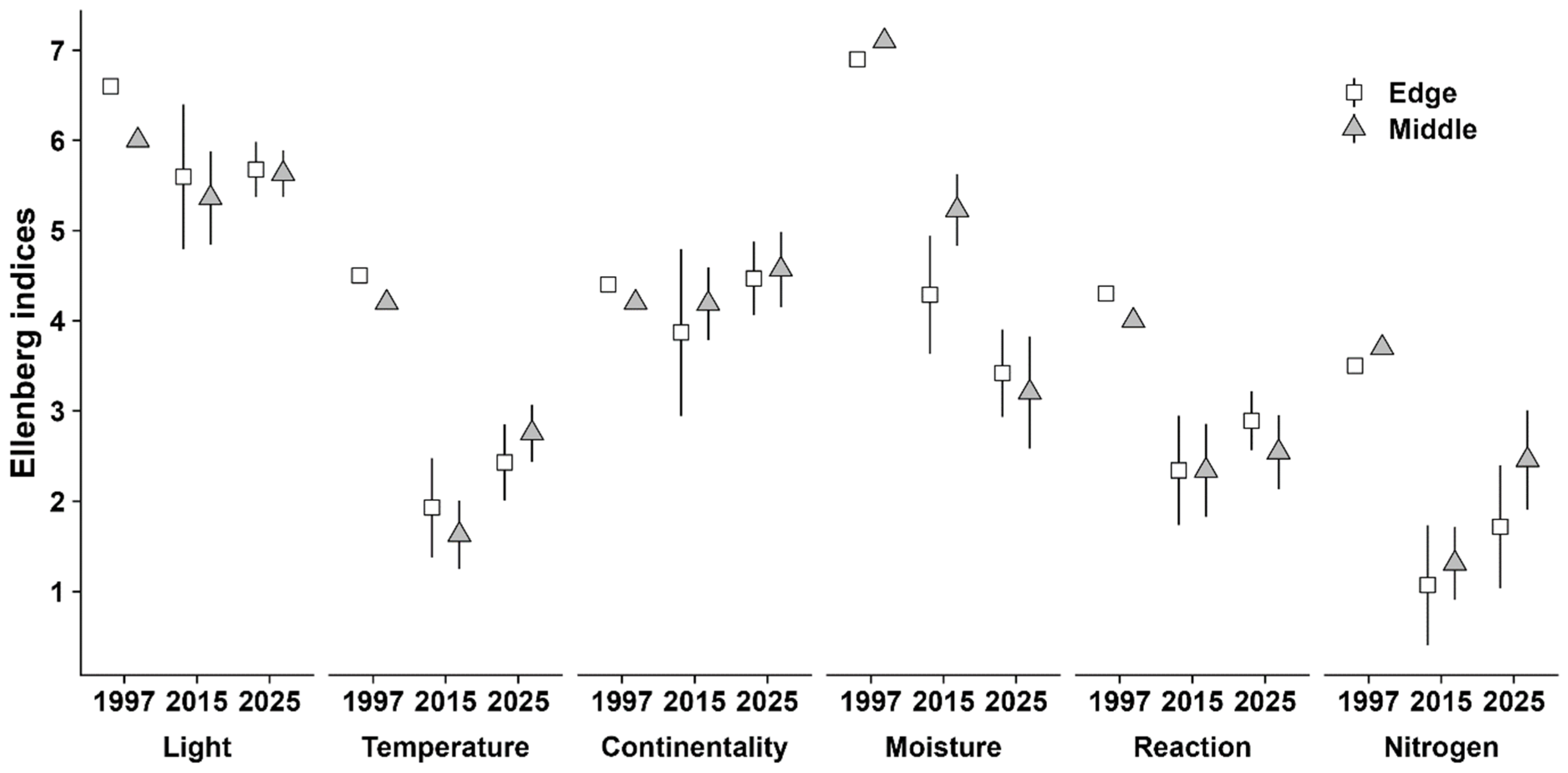
The successional changes reflected by the DCA ordination of plots showed that only three plots maintained highly similar ground cover vegetation throughout the period (short vectors; Figure 3B). These were the control plots outside the salvage logged areas, where C. arundinacea, Deschampsia flexuosa, and Pseudoscleropodium purum were the dominant species. Other plots exhibited a wide range of changes along the first two gradients, indicating temporal diversity of site conditions and varying successional changes. All plots (except one) shifted towards the communities favoring lower moisture conditions, thus avoiding paludification. Most of the plots tended to show an increase in the share of thermophilic, nitrogen-demanding, and basic reaction-demanding communities (Figure 3). The ecological indicator values, except for continentality and light, showed a sharp decrease during 1997–2015. Still, for temperature, reaction, and nitrogen, the decrease during 1997–2015 (Figure 4) was followed by a slight increase during 2015–2025, particularly for the plots in the middle of the salvage logging areas (Figure 4). The differences in moisture were the most pronounced, with the estimates decreasing from 7 (species occurring in constantly moist but not wet soils) to 3 (dry and average water content soils), indicating aridification (Figure 4). Plant group distribution according to the edaphic conditions indicated constant moisture conditions during the first 48 years after the salvage logging in the control plots, as well as at the edge. However, in the middle of the salvage logged areas, the proportion of drought-tolerant plants increased significantly immediately after the salvage logging (p-value < 0.001; Table 3). According to Ellenberg’s indices, the highest edge-to-middle differences in moisture were observed in 2015, when moisture-demanding species were the most abundant in the middle plots. However, such a situation was only temporary, and during the following 10 years, it changed to the opposite, with the edge-to-middle differences decreasing (Figure 4). For other ecological indicator values, these effects were weaker (Figure 4).
Figure 4.
Ecological indicator value (according to Ellenberg et al. (1991) [49] and Düll, 2001 [50]) on the forest edge and in the middle of old salvage clear-cut stands in three study years. For 2015, only vascular plants were included, but for 2015 and 2025, woody plants and bryophytes were also included. Forest edge corresponds to control plots in the uncut stand and ~50 m from the remaining stands.
4. Discussion
4.1. Ground Cover Vegetation Diversity
The compositional differences in ground cover vegetation between the observations highlighted the succession of forest ground cover vegetation over 58 years after salvage logging. Nevertheless, the effects of disturbance were still detectable, yet secondary in 2025. The initial stage after salvage logging, when the re-establishment of the tree stand was attempted, led to an increase in overall plant diversity [21,57]. The increased richness of vascular plants ten years after the salvage logging (1977; Table S1) was likely related to the persistence of species from the pre-disturbance stand, as well as the emergence of species of open habitats, as facilitated by soil disturbances due to windthrow, harvesting, and the reestablishment efforts [58,59], thus adhering to natural recovery.
Similar to previous studies [4,60], at the early stages after the salvage logging, a higher abundance of grasses, e.g., Agrostis spp., Festuca spp., Poa spp., and other ruderal species was observed (1977; Table S1), the establishment of which depends on soil disturbance and canopy openings [33,34]. Similar to clear-cuts, vascular plant richness increased immediately after salvage logging and peaked 5–10 years after, while remaining high in the mid-successional stage [4,25,60,61]. Such a state of succession is valuable for pollinators and their conservation, as the abundance of flowering plants is higher than in late-successional close-canopy forest [62].
4.2. Successional Change and Recovery
Even though at the Pope site, initial re-establishment of the tree stand was unsuccessful, the decrease in species richness 30 years after the salvage logging (1997, Table S1) indicated the cessation of early-successional species, including colonists, stress-tolerant perennials, and pioneers as the canopies were closing [63]. In the mid-successional stage, the reduction in species diversity can be related to the re-establishment of forest-dwelling species [46], as facilitated by the recovery of the tree stand (Table 2, Figure 3). However, quantification of the changes in abundance was difficult, as only the species lists were available from the first two surveys. The increase in species richness with the emergence of typical forest species, like V. myrtillus, V. vitis-idaea, M. bifolium, and P. schreberi, as well as other mid- and late-successional species (e.g., competitive perennials), 48 years after the salvage logging (Table 1), indicated successful recovery of ground cover vegetation [63]. This also suggested recovery of the conservation value of the sites, as their naturalness increased.
Apparently, 50 years was the period when disturbance effects began subsiding, as ground cover vegetation entered a dynamic equilibrium [64], which is of conservational value and provides temporal ecotones [62]. The appearance of typical species, e.g., dwarf shrubs, indicates the restoration of forest-specific structures [65,66]. Although the colonization of bryophytes was expected to occur after the subsidence of vascular plants [36,67], such a relationship was not evident, as both continued to recover simultaneously (Table 1). Due to the limitations of earlier surveys, it can only be speculated that the moss layer recovered gradually after the intensive wood harvesting [68,69]. This was supported by an increase in abundance of two generalist species, P. schreberi and H. splendens, which are explicitly affected by clear-cutting [70]. These species start to recover in the mid-term [71], signifying regeneration of the stand and recovery of its pre-disturbance state.
4.3. Principal Drivers of Ground Cover Vegetation
Despite the existence of a drainage system, under the hydroclimatic conditions characteristic of the hemiboreal zone (Latvia), the probability of paludification after large-scale clear-cuttings has been considered high [44,45], which could necessitate extensive restoration efforts. During the first two surveys, the distribution of ecological groups of ground cover vegetation (Table 4 and Table S1) highlighted such risks (Table 4), likely as the tree stand was only starting to recover. However, 30 years after the salvage logging, growing conditions in the middle of the salvage logged areas aridified earlier compared to the edge (visible since 2015 (~38 years); Figure 4, Table 4).
Table 4.
Distribution of ecological plant groups (according to moisture requirements) based on the relative projective cover of ground cover vegetation in old salvage clear-cuttings in four study years.
Moisture was the main driver of ground cover vegetation, as explicitly indicated by the sample plot and species ordination (EIV_F, Figure 3A,B). Moisture-demanding species (e.g., Sphagnum spp., Carex paniculata, Viola palustris) related to the high-moisture part of the gradient formed locally monodominant communities, as indicated by the correlation with species richness and diversity gradients (Figure 3A). Most of the species typical for swamps and moist forests, such as Sphagnum spp., which were present in 2015, were no longer listed in 2025 (Table 2 and Table S1), supporting aridification as the trees grew [42]. In contrast, 48–58 years after the salvage logging, most of the species were associated with medium or low moisture conditions (psyhrophytes and mesophytes, Table 4, Figure 3A). Still, the vegetation in the initial phase of recovery, when the moisture-demanding species were abundant, can be considered of value for temporal conservation of wetland elements, which are considered threatened and restorable in Europe’s temperate zone [11,72]. Even though forests on drained soils are evolutionary novel habitats, they can still host considerable biodiversity, if the re-establishment of the tree stand follows a natural course [73,74].
Changes in microclimate affecting ground cover vegetation after clear-cutting are mostly associated with increased light conditions [4]; however, 30 years after the salvage logging, light was not significant for ground cover communities (EIV_L; Figure 3, Table 3). This is explained by canopy closing, which also influenced the increase in species adapted to cooler conditions [23]. Circumstances promoting the increase in nitrogen-demanding and more basic reaction-demanding communities (Figure 3) indicated an opposite effect to the expected soil degradation after large-scale clear-cutting [44], contributing to the recovery and conservation of the forests.
The long-term study showed that edge-related differences in site conditions after large-scale salvage logging were transitory, initially having a greater impact on light conditions, but later causing changes in moisture and nitrogen availability as the tree stand regenerated (Figure 4). Still, abundance data for the earlier surveys were not available, which might have introduced some uncertainties/artefacts due to aggregation. However, the latter could also be related to recent disturbances due to management (thinning and salvage logging) that took place during 2017–2022. This was suggested by the increase in cover and occurrence of typical pioneer species like D. flexuosa, which benefit from light and mineralization [13,27,61]. Still, the intensity of the recent management apparently had a negligible effect on the succession of ground cover vegetation, as indicated by the similarity of changes estimated for the plots (Figure 3).
The stabilization of the ecological indicator values (Figure 4) and uniformity of species communities (Figure 3B) indicated subsidence of the disturbance (salvage logging and reestablishment of tree stand) effects [39,40], irrespective of recent thinning. Still, the impact of salvage logging on vascular plants is considered to be more transient compared to other taxa [4]. Hence, the observed subsidence of the effects of salvage logging imply that hemiboreal forest ecosystems in seminatural managed landscapes show high recovery potential under accelerating environmental changes. This suggests that the main conservation efforts should be dedicated to endangered species rather than the entire species complex. Nevertheless, larger-scale salvage logging, following the outlines of disturbed sites, provides wider openings that allow for more diverse early successional processes to occur in managed forest landscapes, which currently appears beneficial for some components of biodiversity (e.g., pollinators and wetland species).
5. Conclusions
The repeated long-term inventories of ground cover vegetation after salvage logging in drained sites subjected to conventional management showed a gradual decrease in moisture levels in the middle of salvage logged areas and later also at the edge, indicating a release from paludification. Distance from the edge of the salvage logging had a secondary effect on the recovering ground cover, dismissing concerns about the negative impact of stand size. Thus, in the managed seminatural forest landscapes in the Baltics, salvage logging at scales locally deemed as large has an apparently transient effect. This presumes successful regeneration of the forest ecosystem over a timeframe shorter than the conventional rotation period. In contrast, the wider openings of the salvage logging areas might be considered a source of early successional ecosystem services and habitats for wetland species, advantageous for dynamic conservation of landscape diversity, if the ecological network is maintained for late-successional species.
Supplementary Materials
The following supporting information can be downloaded at: https://www.mdpi.com/article/10.3390/conservation6010023/s1, Table S1. Vascular plant species list of large-scale salvage clear-cut stands in Latvia in 1977 (10 years since logging), 1998, 2015, and 2025.
Author Contributions
Conceptualization, I.M.; methodology, I.M., D.J. and A.A.L.; software, I.M., validation, I.M.; formal analysis, I.M.; investigation, D.J. and A.A.L.; resources, I.M., data curation, I.M., D.J. and A.A.L.; writing—original draft, preparation, I.M. and R.M.; writing—review and editing, I.M.; visualization, I.M. and R.M.; supervision, I.M.; project administration, I.M.; funding acquisition, I.M. All authors have read and agreed to the published version of the manuscript.
Funding
This study was supported by the JSC Latvia’s State Forests project “Effect of climate change on forestry and associated risks” No. 5-5.9.1_007p_101_21_78.
Institutional Review Board Statement
Not applicable.
Informed Consent Statement
Not applicable.
Data Availability Statement
The data presented in this study are available on request from the corresponding author.
Conflicts of Interest
The authors declare no conflict of interest. The authors declare that the funder was not involved in the study design, collection, analysis, interpretation of data, the writing of this article or the decision to submit it for publication.
References
- Patacca, M.; Lindner, M.; Lucas-Borja, M.E.; Cordonnier, T.; Fidej, G.; Gardiner, B.; Hauf, Y.; Jasinevičius, G.; Labonne, S.; Linkevičius, E.; et al. Significant increase in natural disturbance impacts on European forests since 1950. Glob. Change Biol. 2023, 29, 1359–1376. [Google Scholar] [CrossRef]
- Seidl, R.; Schelhaas, M.J.; Lexer, M.J. Unraveling the drivers of intensifying forest disturbance regimes in Europe. Glob. Change Biol. 2011, 17, 2842–2852. [Google Scholar] [CrossRef]
- Đuka, A.; Franjević, M.; Tomljanović, K.; Popović, M.; Ugarković, D.; Teslak, K.; Barčić, D.; Žagar, K.; Palatinuš, K.; Papa, I. A Decade of Sanitary Fellings Followed by Climate Extremes in Croatian Managed Forests. Land 2025, 14, 766. [Google Scholar] [CrossRef]
- Lunde, L.F.; Birkemoe, T.; Sverdrup-Thygeson, A.; Asplund, J.; Halvorsen, R.; Kjønaas, O.J.; Nordén, J.; Maurice, S.; Skrede, I.; Nybakken, L.; et al. Towards repeated clear-cutting of boreal forests—A tipping point for biodiversity? Biol. Rev. 2025, 100, 1181–1205. [Google Scholar] [CrossRef]
- Enderle, R.; Stenlid, J.; Vasaitis, R. An overview of ash (Fraxinus spp.) and the ash dieback disease in Europe. CABI Rev. 2019, 14, 1–12. [Google Scholar] [CrossRef]
- Hlásny, T.; König, L.; Krokene, P.; Lindner, M.; Montagné-Huck, C.; Müller, J.; Qin, H.; Raffa, K.F.; Schelhaas, M.J.; Svoboda, M.; et al. Bark beetle outbreaks in Europe: State of knowledge and ways forward for management. Curr. For. Rep. 2021, 7, 138–165. [Google Scholar] [CrossRef]
- Seidl, R.; Schelhaas, M.J.; Rammer, W.; Verkerk, P.J. Increasing forest disturbances in Europe and their impact on carbon storage. Nat. Clim. Change 2014, 4, 806–810. [Google Scholar] [CrossRef]
- Morissette, J.L.; Cobb, T.P.; Brigham, R.M.; James, P.C. The response of boreal forest songbird communities to fire and post-fire harvesting. Can. J. For. Res. 2002, 32, 2169–2183. [Google Scholar] [CrossRef]
- Koivula, M.; Vanha-Majamaa, I. Experimental evidence on biodiversity impacts of variable retention forestry, prescribed burning, and deadwood manipulation in Fennoscandia. Ecol. Processes 2020, 9, 11. [Google Scholar] [CrossRef]
- Petrokas, R.; Ibanga, D.A.; Manton, M. Deep ecology, biodiversity and assisted natural regeneration of European hemiboreal forests. Diversity 2022, 14, 892. [Google Scholar] [CrossRef]
- Erdozain, M.; Alberdi, I.; Aszalós, R.; Bollmann, K.; Detsis, V.; Diaci, J.; Đodan, M.; Efthimiou, G.; Gálhidy, L.; Haase, M.; et al. The evolution of forest restoration in Europe: A synthesis for a step forward based on national expert knowledge. Curr. For. Rep. 2024, 11, 4. [Google Scholar] [CrossRef]
- Nagel, T.A.; Firm, D.; Rozenbergar, D.; Kobal, M. Patterns and drivers of ice storm damage in temperate forests of Central Europe. Eur. J. For. Res. 2016, 135, 519–530. [Google Scholar] [CrossRef]
- Bråkenhielm, S.; Liu, Q. Long-term effects of clear-felling on vegetation dynamics and species diversity in a boreal pine forest. Biodivers. Conserv. 1998, 7, 207–220. [Google Scholar] [CrossRef]
- Česonienė, L.; Daubaras, R.; Tamutis, V.; Kaškonienė, V.; Kaškonas, P.; Stakėnas, V.; Zych, M. Effect of Clear-Cutting on the Understory Vegetation, Soil and Diversity of Litter Beetles in Scots Pine-Dominated Forest. J. Sustain. For. 2019, 38, 791–808. [Google Scholar] [CrossRef]
- Dieler, J.; Uhl, E.; Biber, P. Effect of Forest Stand Management on Species Composition, Structural Diversity, and Productivity in the Temperate Zone of Europe. Eur. J. For. Res. 2017, 391, 364–374. [Google Scholar] [CrossRef]
- Pudzis, E.; Kundziņa, A.; Druķis, P. The Role and Potential of Timber in Construction for Achieving Climate Neutrality Objectives in Latvia. Sustainability 2025, 17, 8247. [Google Scholar] [CrossRef]
- Regs on Tree felling in Forest Lands. 2012. Available online: https://likumi.lv/ta/id/253760-noteikumi-par-koku-cirsanu-meza (accessed on 20 October 2025). (In Latvian)
- Dobrowolska, D. Forest Regeneration in Northeastern Poland Following a Catastrophic Blowdown. Can. J. For. Res. 2015, 45, 1172–1182. [Google Scholar] [CrossRef]
- Franklin, J.F.; Lindenmayer, D.; Macmahon, J.A.; Mckee, A.; Perry, D.A.; Waide, R.; Foster, D. Threads of Continuity: Ecosystem Disturbance, Recovery, and the Theory of Biological Legacies. Conserv. Pract. 2000, 1, 8–17. [Google Scholar] [CrossRef]
- Pawson, S.M.; Brockerhoff, E.G.; Norton, D.A.; Didham, R.K. Clear-fell harvest impacts on biodiversity: Past research and the search for harvest size thresholds. Can. J. For. Res. 2006, 36, 1035–1046. [Google Scholar] [CrossRef]
- Orczewska, A.; Czortek, P.; Jaroszewicz, B. The impact of salvage logging on herb layer species composition and plant community recovery in Białowieża Forest. Biodivers. Conserv. 2019, 28, 3407–3428. [Google Scholar] [CrossRef]
- Gilliam, F.S.; Roberts, M.R. The Herbaceous Layer in Forests of Eastern North America; Oxford University Press: New York, NY, USA, 2003; pp. 1–408. [Google Scholar]
- Keenan, R.J.; Kimmins, J.P. The ecological effects of clear-cutting. Environ. Rev. 1993, 1, 121–144. [Google Scholar] [CrossRef]
- Mayer, P.; Abs, C.; Fischer, A. Colonisation by vascular plants after soil disturbance in the Bavarian Forest—Key factors and relevance for forest dynamics. For. Ecol. Manag. 2004, 188, 279–289. [Google Scholar] [CrossRef]
- Gustienė, D.; Varnagirytė-Kabašinskienė, I.; Stakėnas, V. Ground Vegetation, Forest Floor and Mineral Topsoil in a Clear-Cutting and Reforested Scots Pine Stands of Different Ages: A Case Study. J. For. Res. 2022, 33, 1247–1257. [Google Scholar] [CrossRef]
- Gilliam, F.S. The Ecological Significance of the Herbaceous Layer in Temperate Forest Ecosystems. Bioscience 2007, 57, 845–858. [Google Scholar] [CrossRef]
- Bergstedt, J.; Hagner, M.; Milberg, P. Effects on Vegetation Composition of a Modified Forest Harvesting and Propagation Method Compared with Clear-Cutting, Scarification, and Planting. Applied Vegetation Science 2008, 11, 159–168. [Google Scholar] [CrossRef]
- Faliński, J.B. Vegetation Dynamics in Temperate Lowland Primeval Forest: Ecological Studies in Białowieża Forest; Geobotany; Springer: Dordrecht, The Netherlands, 1986; Volume 8, pp. 1–357. [Google Scholar]
- Nelson, C.R.; Halpern, C.B. Short-Term Effects of Timber Harvest and Forest Edges on Ground-Layer Mosses and Liverworts. Can. J. Bot. 2005, 83, 610–620. [Google Scholar] [CrossRef]
- Peterson, C.J.; Pickett, S.T.A. Forest Reorganization: A Case Study in an Old-Growth Forest Catastrophic Blowdown. Ecology 1995, 76, 763–774. [Google Scholar] [CrossRef]
- Trouwborst, A. Rewilding and the EU Nature Restoration Law: Plotting the Course of Ecosystem Restoration in Europe. J. Eur. Environ. Plan. Law 2025, 22, 364–384. [Google Scholar] [CrossRef]
- Mikusiński, G.; Bubnicki, J.W.; Churski, M.; Czeszczewik, D.; Walankiewicz, W.; Kuijper, D.P.J. Is the impact of loggings in the last primeval lowland forest in Europe underestimated? The conservation issues of Białowieża Forest. Biol. Conserv. 2018, 227, 266–274. [Google Scholar] [CrossRef]
- Kusumoto, B.; Shiono, T.; Miyoshi, M.; Maeshiro, R.; Fujii, S.; Kuuluvainen, T.; Kubota, Y. Functional response of plant communities to clearcutting: Management impacts differ between forest vegetation zones. J. Appl. Ecol. 2015, 52, 171–180. [Google Scholar] [CrossRef]
- Rumbaitis-del Rio, C. Changes in understory composition following catastrophic windthrow and salvage logging in a subalpine forest ecosystem. Can. J. For. Res. 2006, 36, 2943–2954. [Google Scholar] [CrossRef]
- Duguid, M.C.; Ashton, M.S. A meta-analysis of the effect of forest management for timber on understory plant species diversity in temperate forests. For. Ecol. Manag. 2013, 303, 81–90. [Google Scholar] [CrossRef]
- Hannerz, M.; Hånell, B. Effects on the flora in Norway spruce forests following clearcutting and shelterwood cutting. For. Ecol. Manag. 1997, 90, 29–49. [Google Scholar] [CrossRef]
- Jonášová, M.; Prach, K. The influence of bark beetles outbreak vs. salvage logging on ground layer vegetation in Central European spruce forests. Biol. Conserv. 2008, 141, 1525–1535. [Google Scholar] [CrossRef]
- Moola, F.M.; Vasseur, L. The maintenance of understory residual flora with even-aged forest management: A review of temperate forests in northeastern North America. Environ. Rev. 2008, 16, 141–155. [Google Scholar] [CrossRef]
- Likhanova, I.A.; Genrikh, E.A.; Perminova, E.M.; Zheleznova, G.V.; Kholopov, Y.V.; Lapteva, E.M. Влияние сплoшнoлесoсечных рубoк на биoразнooбразие среднетаёжных ельникoв черничных Северo-Вoстoка еврoпейскoй части Рoссии [The effects of clear cutting on the biodiversity of middle taiga blueberry spruce forests in the North-East of European Russia]. Theor. Appl. Ecol. 2023, 2, 56–65. [Google Scholar] [CrossRef]
- Økland, T.; Rydgren, K.; Økland, R.H.; Storaunet, K.O.; Rolstad, J. Variation in environmental conditions, understorey species number, abundance and composition among natural and managed Picea abies forest stands. For. Ecol. Manag. 2003, 177, 17–37. [Google Scholar] [CrossRef]
- Taylor, A.R.; MacLean, D.A.; McPhee, D.; Dracup, E.; Keys, K. Salvaging has minimal impacts on vegetation regeneration 10 years after severe windthrow. For. Ecol. Manag. 2017, 406, 19–27. [Google Scholar] [CrossRef]
- Asada, T.; Warner, B.G.; Banner, A. Sphagnum invasion after clear-cutting and excavator mounding in a hypermaritime forest of British Columbia. Can. J. For. Res. 2004, 34, 1730–1746. [Google Scholar] [CrossRef]
- Kottek, M.; Grieser, J.; Beck, C.; Rudolf, B.; Rubel, F. World Map of the Köppen-Geiger Climate Classification Updated. Meteorol. Z. 2006, 15, 259–263. [Google Scholar] [CrossRef]
- Zālītis, P. Forestry Preconditions [Mežkopības priekšnosacījumi]; SIA et Cetera: Rıga, Latvija, 2018; 218p. (In Latvian) [Google Scholar]
- Zalitis, P.; Jansons, J. The transformation of forest ecosystems on cutovers in Latvia. Balt. For. 1998, 4, 2–6. [Google Scholar]
- Jalonen, J.; Vanha-Majamaa, I. Immediate effects of four different felling methods on mature boreal spruce forest understorey vegetation in southern Finland. For. Ecol. Manag. 2001, 146, 25–34. [Google Scholar] [CrossRef]
- Ministry of Agriculture. Latvian Forest Sector in Facts & Figures 2024; Ministry of Agriculture Republic of Latvia: Rīga, Latvia, 2025; 45p. [Google Scholar]
- Bušs, K. Forest Ecosystem Classification in Latvia. Proc. Latv. Acad. Sci. 1997, 51, 204–218. [Google Scholar]
- Ellenberg, H.; Weber, H.E.; Düll, R.; Wirth, V.; Werner, W. Zeigerwerte von Pflanzen in Mitteleuropa [Indicator values of vascular plants in Central Europe]. Scr. Geobot. 1991, 18, 1–248. [Google Scholar]
- Düll, R. Indicator values of mosses and liverworts (German). In Indicator Values of Plants in Central Europe (German); Ellenberg, H., Weber, H.E., Düll, R., Wirth, V., Werner, W., Eds.; Erich Goltze: Göttingen, Germany, 2001; pp. 175–220. [Google Scholar]
- Clarck, K.R. Non-parametric multivariate analyses of changes in community structure. Aust. J. Ecol. 1993, 18, 117–143. [Google Scholar] [CrossRef]
- Correa-Metrio, A.; Dechnik, Y.; Lozano-García, S.; Caballero, M. Detrended correspondence analysis: A useful tool to quantify ecological changes from fossil data sets. Boletín Soc. Geológica Mex. 2014, 66, 135–143. [Google Scholar] [CrossRef]
- R Core Team. R: A Language and Environment for Statistical Computing; R Foundation for Statistical Computing: Vienna, Austria, 2025; Available online: https://www.R-project.org/ (accessed on 16 September 2025).
- Bates, D.; Maechler, M.; Bolker, B.; Walker, S. Fitting Linear Mixed-Effects Models Using lme4. J. Stat. Softw. 2015, 67, 1–48. [Google Scholar] [CrossRef]
- Oksanen, J.; Simpson, G.; Blanchet, F.; Kindt, R.; Legendre, P.; Minchi, P.R.; O’Hara, R.B.; Solymos, P.; Stevens, M.H.H.; Szoecs, E.; et al. Vegan: Community Ecology Package R Package_. Version 2.6-4. 2022. Available online: https://CRAN.Rproject.org/package=vegan (accessed on 17 September 2025).
- Heinken, T.; Diekmann, M.; Liira, J.; Orczewska, A.; Schmidt, M.; Brunet, J.; Chytrý, M.; Chabrerie, O.; Decocq, G.; De Frenne, P.; et al. The European forest plant species list (EuForPlant): Concept and applications. J. Veg. Sci. 2022, 33, e13132. [Google Scholar] [CrossRef]
- Hannerz, M.; Hånell, B. Changes in the Vascular Plant Vegetation after Different Cutting Regimes on a Productive Peatland Site in Central Sweden. Scand. J. For. Res. 2008, 23, 37–41. [Google Scholar] [CrossRef]
- Heinrichs, S.; Schmidt, W. Short-Term Effects of Selection and Clear Cutting on the Shrub and Herb Layer Vegetation during the Conversion of Even-Aged Norway Spruce Stands into Mixed Stands. For. Ecol. Manag. 2009, 258, 667–678. [Google Scholar] [CrossRef]
- Zobel, M. Secondary Forest Succession in Jarvselja, Southern Estonia: Changes in Field Layer Vegetation. Ann. Bot. Fenn. 1989, 26, 171–182. [Google Scholar]
- Hart, S.A.; Chen, H.Y. Understory vegetation dynamics of North American boreal forests. Crit. Rev. Plant Sci. 2006, 25, 381–397. [Google Scholar] [CrossRef]
- Genikova, N.; Mamontov, V. Decade-Long Dynamics of the Ground Vegetation in an Ecotone between Coniferous Forest and Clear-Cut Site. Environ. Sci. Proc. 2022, 22, 15. [Google Scholar] [CrossRef]
- Rodríguez, A.; Kouki, J. Disturbance-mediated heterogeneity drives pollinator diversity in boreal managed forest ecosystems. Ecol. Appl. 2017, 27, 589–602. [Google Scholar] [CrossRef]
- Tefańska-Krzaczek, E.S.; Staniaszek-Kik, M. Positive Aspects of Clear-Cut Logging? Ground Bryophyte Diversity along the Age Gradient of Managed Pinus Sylvestris Stands. Cryptogam. Bryol. 2016, 37, 181–197. [Google Scholar] [CrossRef]
- Petersson, L.; Holmström, E.; Lindbladh, M.; Felton, A. Tree species impact on understory vegetation: Vascular plant communities of Scots pine and Norway spruce managed stands in northern Europe. For. Ecol. Manag. 2019, 448, 330–345. [Google Scholar] [CrossRef]
- Kellomäki, S.; Hari, P.; Väisänen, E. Annual Production of Some Forest Mosses as a Function of Light Available for Photosynthesis. Silva Fenn. 1977, 11, 81–86. [Google Scholar] [CrossRef]
- Lõhmus, A.; Remm, L. Disentangling the Effects of Seminatural Forestry on an Ecosystem Good: Bilberry (Vaccinium myrtillus) in Estonia. For. Ecol. Manag. 2017, 404, 75–83. [Google Scholar] [CrossRef]
- Saetre, P. Spatial Patterns of Ground Vegetation, Soil Microbial Biomass and Activity in a Mixed Spruce-Birch Stand. Ecography 1999, 22, 183–192. [Google Scholar] [CrossRef]
- Jansone, D.; Liepiņa, A.A.; Elferts, D.; Jansons, Ā. Vegetation Species Diversity and Dominance After Large-Scale Clear-Cutting: Case Study from Latvia. Sustainability 2025, 17, 2849. [Google Scholar] [CrossRef]
- Marozas, V. Early Succession of Ground Vegetation After Clear-Cuttings in Spruce Forests in a Boreonemoral Zone, Lithuania. Acta Biol. Univ. Daugavp. 2005, 5, 127–136. [Google Scholar]
- Mäkipää, R.; Heikkinen, J. Large-Scale Changes in Abundance of Terricolous Bryophytes and Macrolichens in Finland. J. Veg. Sci. 2003, 14, 497–508. [Google Scholar] [CrossRef]
- Palviainen, M.; Finér, L.; Mannerkoski, H.; Piirainen, S.; Starr, M. Responses of Ground Vegetation Species to Clear-Cutting in a Boreal Forest: Aboveground Biomass and Nutrient Contents during the First 7 Years. Ecol. Res. 2005, 20, 652–660. [Google Scholar] [CrossRef]
- Verhoeven, J.T. Wetlands in Europe: Perspectives for restoration of a lost paradise. Ecol. Eng. 2014, 66, 6–9. [Google Scholar] [CrossRef]
- Laudon, H.; Hasselquist, E.M. Applying continuous-cover forestry on drained boreal peatlands; water regulation, biodiversity, climate benefits and remaining uncertainties. Trees For. People 2023, 11, 100363. [Google Scholar] [CrossRef]
- Remm, L.; Lõhmus, P.; Leis, M.; Lõhmus, A. Long-term impacts of forest ditching on non-aquatic biodiversity: Conservation perspectives for a novel ecosystem. PLoS ONE 2013, 8, e63086. [Google Scholar] [CrossRef]
Disclaimer/Publisher’s Note: The statements, opinions and data contained in all publications are solely those of the individual author(s) and contributor(s) and not of MDPI and/or the editor(s). MDPI and/or the editor(s) disclaim responsibility for any injury to people or property resulting from any ideas, methods, instructions or products referred to in the content. |
© 2026 by the authors. Licensee MDPI, Basel, Switzerland. This article is an open access article distributed under the terms and conditions of the Creative Commons Attribution (CC BY) license.