Article

Acoustic Niche Partitioning and Overlap in an Anuran Community of a Threatened Brazilian Atlantic Forest Remnant at Caparao National Park


1
School of Biological and Environmental Sciences, Liverpool John Moores University, Liverpool L3 5AH, UK
2
School of Animal, Agriculture and Veterinary Sciences, Hartpury University, Gloucester GL19 3BE, UK
3
Instituto Nacional da Mata Atlântica, Santa Teresa 29650-000, Brazil
*
Author to whom correspondence should be addressed.
Conservation 2026, 6(1), 24; https://doi.org/10.3390/conservation6010024
Submission received: 7 June 2025 / Revised: 15 August 2025 / Accepted: 20 January 2026 / Published: 10 February 2026

Abstract

Anurans are among the most threatened vertebrates worldwide, yet their acoustic ecology in fragmented habitats remains understudied. This research investigated acoustic overlaps and resource partitioning among amphibian species inhabiting Maceira Pond in Caparaó National Park, Brazil using bioacoustic methods. Six hours of recordings were analysed to determine key acoustic parameters and identify the resident species. A principal component analysis was used to assess acoustic parameters, whilst a cluster analysis examined acoustic similarities. Twelve species from four families were detected, of which eight were identified and five remained unidentified. Four species showed over 90% acoustic overlap, while two had less than 50%, with one at about 17%. Central frequency, peak frequency, duration, bandwidth, and pace significantly contributed to call differentiation. The R-value confirmed clustering patterns, indicating likely low acoustic interference due to few sympatric species. This study provides the first acoustic niche assessment for this community and highlights the need for further research on spatial and temporal partitioning in these threatened amphibian assemblages.

1. Introduction

Anurans exemplify current-day biodiversity loss, as they are considered the vertebrate group most impacted by increasing extinction rates due to anthropogenic activities. Countless species from diverse environments are declining on a vast scale [1,2]. However, despite more than 100 new frog species being described annually worldwide, limited information exists about their natural history [3]. Key details regarding previously described species have only recently become available [4]. Monitoring species interactions with their environment and interspecific interactions is essential for conservation action plans, particularly for highly threatened taxa [4,5]. The study of anuran vocalisations can provide information about a species’ habitat use, intraspecific communication, and niche overlap and partitioning with interspecific species [6,7].
The role and importance of anuran vocalizations have received relatively limited attention [8]. Variation in call propagation distance and attenuation across environments is still poorly understood, which complicates assessments of reproductive success and acoustic interference in species-rich choruses [8]. Monitoring anuran communication within their acoustic and ecological contexts is crucial for conservation planning, particularly for highly threatened taxa [6]. Studying vocalizations can produce insights into habitat use, intraspecific signaling, and acoustic niche partitioning among sympatric species [7].
Niche theory predicts that the number of species with similar niches within a community is evolutionarily and ecologically constrained [9]. This constraint arises because species using the same resource types in high-diversity communities with limited resources become more vulnerable to competition [10]. Interspecific competition is considered a limiting factor for species coexistence, with resource partitioning along habitat dimensions being more significant than partitioning along food type or temporal dimensions [11]. Tropical anurans are particularly valuable for examining stochastic niche theory predictions due to their high species richness and strong dependence on rainfall, which can lead to spatial and temporal competition [12]. Anurans exhibit diel, spatial, and seasonal resource partitioning related to advertisement call properties, oviposition sites, and diel calling activity, enabling species with similar fundamental niches to coexist [12]. Frogs are an ideal group for studying acoustic niche partitioning because successful breeding often relies on females detecting and locating conspecific advertisement calls [13]. Their shared dependence on environmental conditions for breeding can limit temporal and spatial avoidance [13,14]. Furthermore, the potential for acoustic niche partitioning through signal divergence may be constrained by the strong correlation between body size and call frequency [15]. Consequently, competition for acoustic space is expected in frog habitats, particularly in species-rich environments, suggesting that acoustic space partitioning would be advantageous.
The Atlantic Forest (AF) has an incredible diversity of anurans with approximately 600 species inhabiting the region, of which 75% are considered endemic, and numerous species are yet to be discovered [16,17]. The levels of humidity, large amounts of vegetation, and altitudinal variation contribute to such anuran diversity [18]. Several mountainous areas throughout the Atlantic Forest are conventional hotspots of endemism due to climatic deviation, biogeographic history, and elevation [19]. As limited studies have taken place assessing the use of acoustic space by anuran species in the AF, this study aims to determine the vocalisation variation in an amphibian community at Maceira Pond in Caparaó National Park (CNP), Brazil, and examine evidence of acoustic overlaps and acoustic partitioning between species onsite. Given the high species diversity of the AF, we anticipated significant niche partitioning among the observed species.

2. Materials and Methods

2.1. Study Site and Data Collection

The study area is located within the CNP, typically consisting of grasslands, dense ombrophilous forest, semi-deciduous forest, alpine meadows, and rupicolous vegetation [20]. The CNP is classified as a site of special biological importance as it is rich in biodiversity and provides species with significant areas of protected, yet fragmented, forest [21]. The CNP is a tropical environment, with annual temperature levels varying from 19–22 °C and yearly rainfall levels reaching between 1000–1500 mm, with approximately 35–50% of rainfall falling between November and January and June-August remaining relatively dry [22].
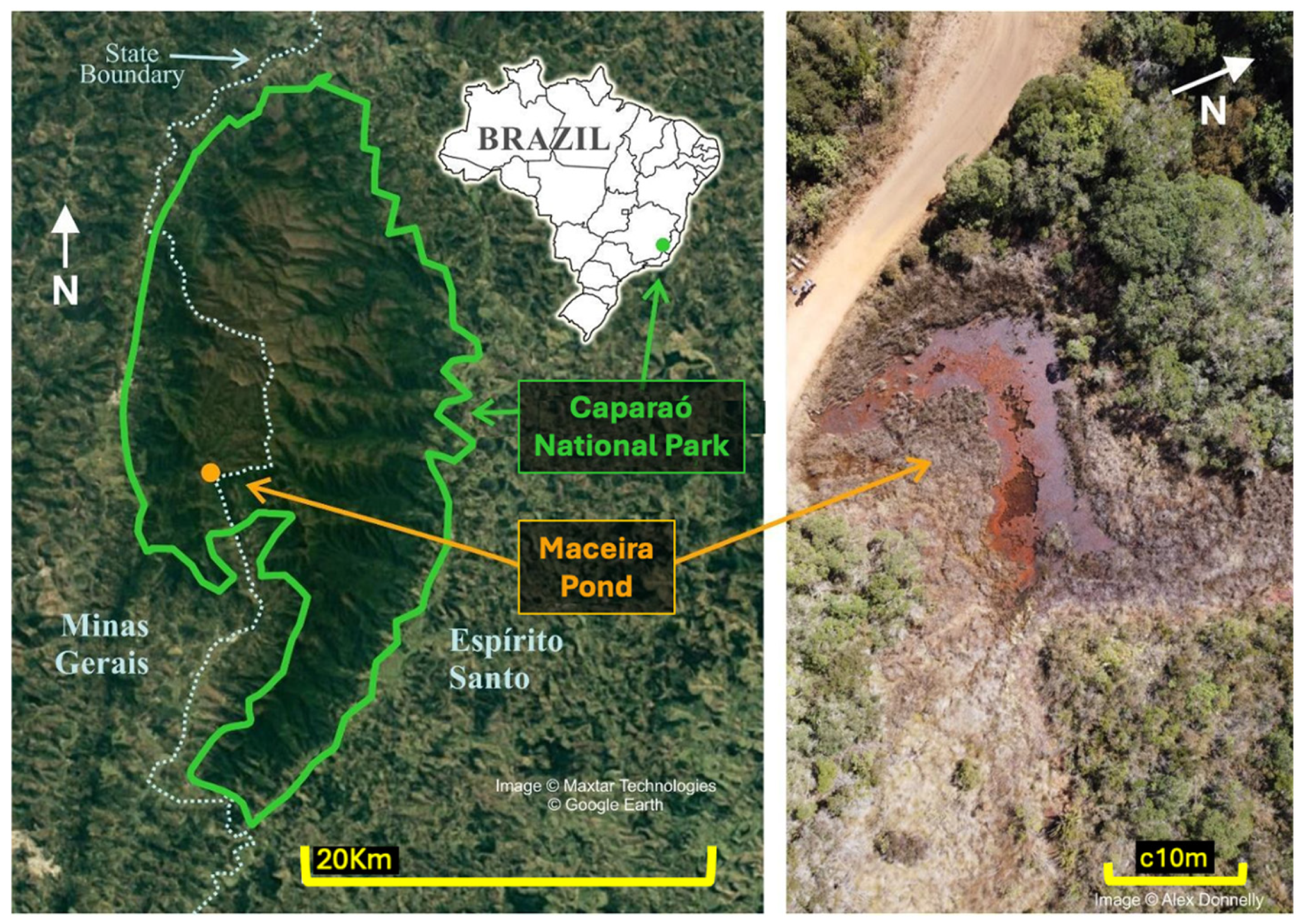
The study area is a perpetual ponded habitat located in the Maceira region (20°28′51″ S, 41°49′42.7″ W) of the CNP (Figure 1). The automatic recording unit (SongMeter 4 (SM4)) was deployed at the pond site on the 18 December 2020 whilst the CNP was closed to the public due to COVID-19 restrictions. A total of six continuous hours from 16:00 to 22:00 were monitored during this study. The SM4 comprised two cabled SMM-A2 microphones that were utilised to identify the sounds for stereo recordings. SMM-A2 microphones were positioned within close range of the pond edge, located approximately 4 m away from the SM4. The recording device was set to record in the format WAV over 1 h segments at a sampling rate of 44.1 kHz and 16 bits per second.
Data for this project was collected under License granted by the Brazilian Ministry of Environment/SISBIO (ICMBio/SISBIO No. 49062).
Sound files were filtered through Audacity (R) v2.0.5 software using noise reduction on selected background sounds to remove any environmental and anthropogenic noise that may have been restricting the visibility of amphibian calls. Six hours of recordings were analysed in Raven Pro 1.6.5 [23]. Vocalisations of amphibians were identified and key measurements extracted through the drawing of selection boxes around individual notes and entire calls. Only clearly visible calls on spectrograms were analysed to minimise observer bias. Anuran identification was undertaken using the Museum of Biological Diversity (MDBio) UNICAMP Audio-visual Collections, in addition to consulting local amphibian specialists to increase species identification accuracy. For each vocalisation, eight key parameters were taken: low frequency, high frequency, peak frequency, central frequency, bandwidth, number of notes (individual units within a call), duration, and pace (notes/second). Additional harmonics were observed through the increased amplitude when individuals vocalised closer to the microphone. Therefore, for consistency, only the loudest harmonic was included in selection boxes to avoid drastically impacting average acoustic measurements [22]. An average vocalisation measurement dataset was compiled for each species identified throughout the six hours of recordings, and any that consisted of less than two vocalisations were removed to reduce any effect from variations in individual calls.

2.2. Data Analyses

The species’ means compiled from acoustic data were used to perform a principal component analysis (PCA) at Maceira Pond to discover which acoustic parameters of those evaluated were most responsible for the differentiation of amphibian calls. Prior to analysis, data were normalised to unit size using the R stats package ‘prcomp’ function to avoid bias [22]. Using Horn’s parallel analysis (‘paran’ R package) [24], the first three principal components were assessed [25]. To interpret the axes of variation significance, principal component correlation matrices were generated. A Shapiro-Wilks test was then used to determine a random distribution against the 3D distributions of amphibian calls in PCA space. To analyse acoustic overlaps and partitioning, the R-value used by [26] was produced via the following calculation:
R = Mean   acoustic   distance   ( observed ) Mean   acoustic   distance   ( random )
The similarities in acoustic parameters used by species were examined with a cluster analysis using Euclidean distance and the simple aggregation technique [7]. Pairwise Euclidean distances between species were calculated as:
d i j = k = 1 8 x i k x j k 2
where x i k represents the value of acoustic parameter k for species i. Hierarchical clustering was performed using single linkage method, where the distance between clusters A and B is defined as:
D A , B = min i A , j B d i j

3. Results

Within this study, 8089 notes were detected from 839 calls from 12 distinct amphibian species (Table 1). The first hour contained the highest number of notes (3108) and calls (357) with almost double that of the next highest hour (hour 4: 1584 notes from 151 calls). The second hour had the least number of notes (593) and calls (40), with eight times less calls detected than the first hour.
Of the twelve detected species, five species were unidentifiable via MDBio Audio-visual Collections (Table 2). Local amphibian specialists were consulted to support species identification; however, some species remained unconfirmed and were ruled out as variations in the identified species. Vitreorana eurygnatha vocalised the most during this study, with 253 calls detected and occurring across four hours in total (most occurrences over any other species). Whereas two unidentified species (2 and 3) had the fewest calls throughout, with only two detected from both species, each occurring within 1 h segments only. Three other species had more than 100 calls recorded, including Ischnocnema lactea, unidentified species 1, and Dendropsophus minutus, with 121, 100, and 228 calls, respectively. Also, seven species only occurred within a 1 h segment within this study.
Unidentified Species 5 exhibited the highest average low frequency at 11,837.30 Hz, whereas I. lactea displayed the weakest at 975.80 Hz and the greatest bandwidth at 22,191.76 Hz. D. minutus had the longest call duration, measuring 0.32 s. In contrast, Aplastodiscus marmorata had the shortest at 0.01 s. Unidentified Species 1 produced the most notes per call at 19.57, and A. marmorata produced the fewest at 3. Regarding average pace, measured in notes per second, D. minutus showed the lowest at 5.58, while A. marmorata presented the highest at 93.45, notably greater than the second highest recorded by I. spanios at 28.49. The lowest average high frequency, as well as the lowest peak frequency and center frequency overall, was recorded by Unidentified Species 4 at 5474.56 Hz, 4183.50 Hz, and 4169.25 Hz, respectively. Conversely, Unidentified Species 5 demonstrated the greatest peak frequency and center frequency, registering 15,623.36 Hz and 16,827.21 Hz, respectively. Lastly, Unidentified Species 3 had the lowest average bandwidth, which was 345.70 Hz, with an average low frequency of 5262.87 Hz and a high frequency of 6494.76 Hz (Table 3).
The calls of V. eurygnatha were found to temporally overlap with five species, with the most overlaps of this species occurring with I. lactea (10 temporal overlaps in total) (Table 4). V. eurygnatha and I. lactea vocalisations occurred at similar peak frequencies with a difference of only 145.60 Hz. The highest number of temporal overlaps occurred between Unidentified Species 1 and D. minutus, with 13 overlaps recorded throughout, and both had differing peak frequencies (with a 779.10 Hz difference between peak frequencies). Considering the 12 distinct amphibian species identified in this study, there were 66 possible temporal overlap scenarios (calculated as the number of unique pairs from 12 species). Despite this potential for widespread overlap, only 10 actual instances of temporal call overlap were detected. D. minutus calls temporally overlapped with four other species, and in total had 27 overlaps with those species (the highest number of overlaps overall when compared to other species). Unidentified Species 2, Unidentified Species 3, and A. marmorata had no temporally overlapping calls in this study with any other species. Unidentified Species 4 and D. minutus had nine overlapping calls within this study. There was also a large gap between mean peak frequencies, with a difference of 910.98 Hz between these species.
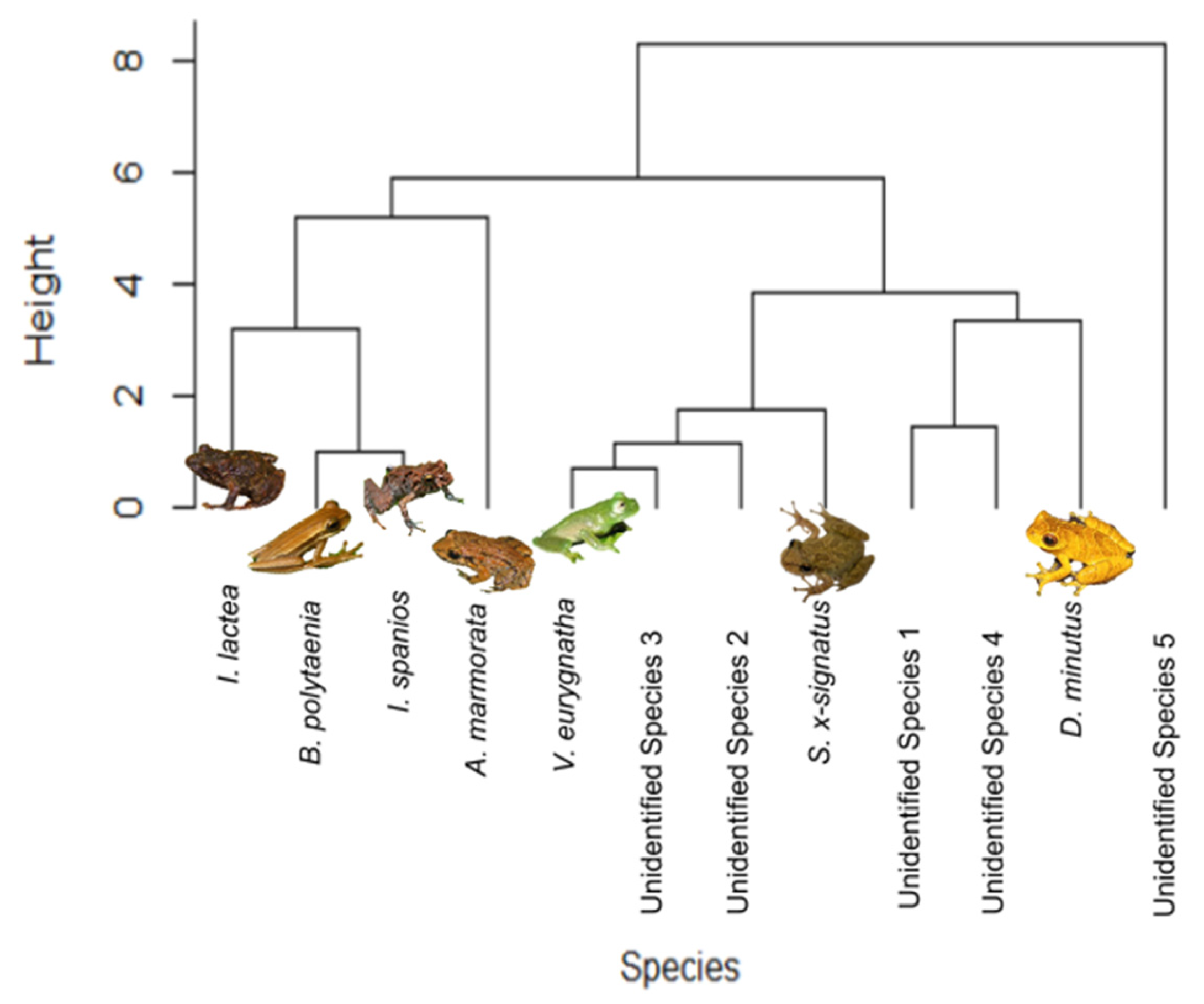
Four recorded species had an acoustic overlap exceeding 90% (B. polytaenia, I. spanios, V. eurygnatha, and Unidentified Species 3) (Figure 2). V. eurygnatha and Unidentified Species 3 vocalisations were the most acoustically similar, followed by B. polytaenia and I. spanios. Ten species had more than 50% acoustic overlap with other species. A. marmorata and Unidentified Species 5 had less than 50% acoustic overlap; Unidentified Species 5 had the lowest overall overlap, showing only slight similarities (~17%). The calls of V. eurygnatha and Unidentified Species 3 are also closely related to Unidentified Species 2 and S. x-signatus. Overall, all species had acoustic similarities to varying degrees. I. lactea and I. spanios, belonging to the family Brachycephalidae and the genus Ischnocnema, had an acoustic overlap of approximately 67%. Three species from the Hylidae family (S. x-signatus, B. polytaenia, and D. minutus) had an overall overlap of ~42%. However, S. x-signatus and D. minutus had a greater acoustic overlap of approximately 60%. The strongest acoustic overlap between identified species occurred between those from differing families (B. polytaenia from the Hylidae family and I. spanios from the Brachycephalidae family). Of those identified at the species level, A. marmorata from the Leptodactylidae family had the smallest acoustic overlap, at 48%, with Brachycephalidae and Hylidae species. V. eurygnatha from the Centrolenidae family had the strongest acoustic overlap with unidentifiable species; a strong overlap was also observed with a Hylidae species (S. x-signatus) at 85%
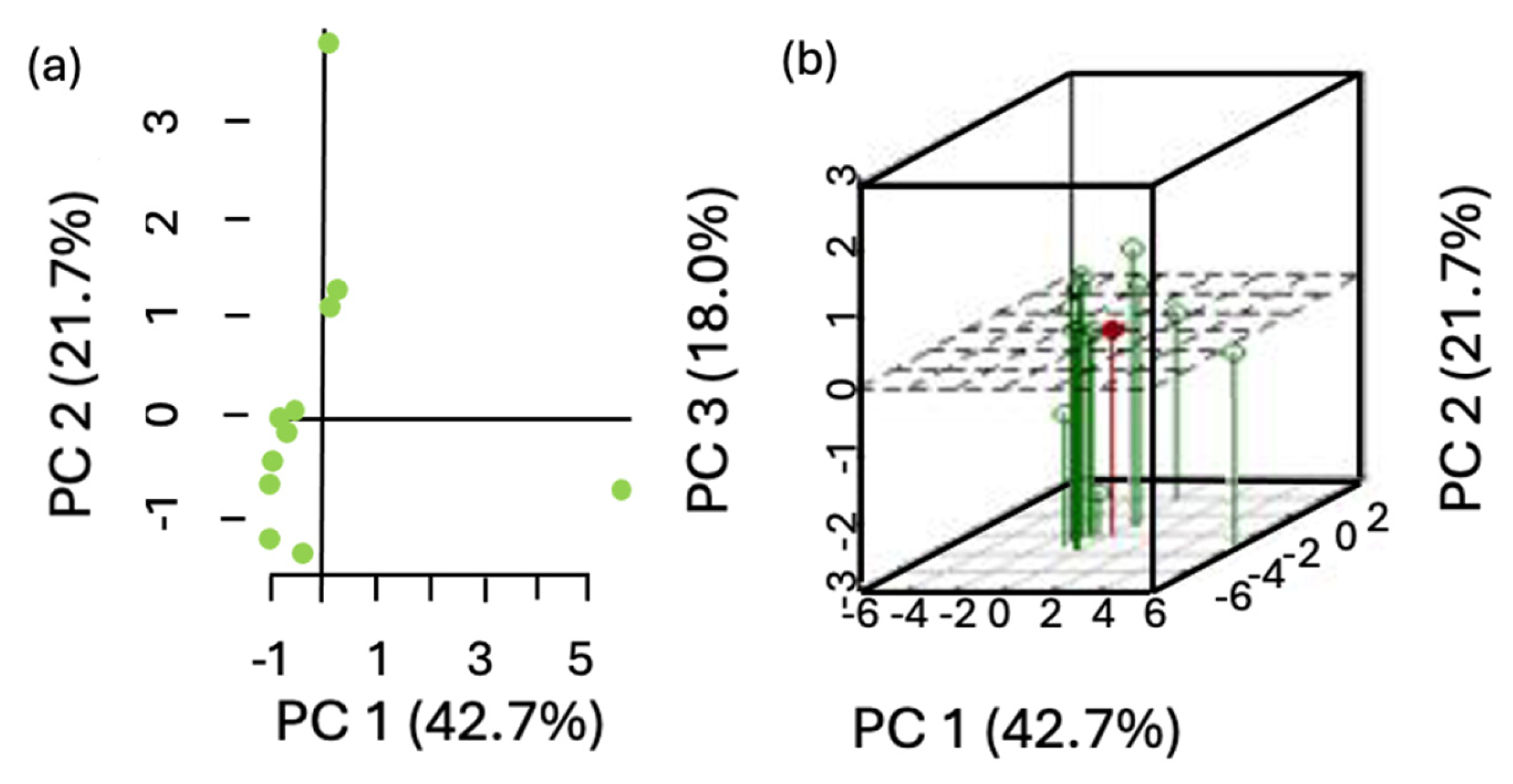
A two-dimensional PCA plot revealed greater clustering along the PC1 axis of variation (Figure 3a), with secondary differentiation along PC2 providing additional acoustic separation. Combined PC1 and PC2 explained 64.4% of the acoustic variance. Notable acoustic outliers included species positioned at the extremes of the PC1 and PC2 axes, indicating unique frequency characteristics relative to the study assemblage. Notable acoustic outliers included species positioned at the extremes of the PC1 and PC2 axis, indicating unique frequency characteristics relative to the study assemblage. The PCA found that the 1st component (PC1) explains 42.7% of the overall variation, the 2nd component explains 21.7% (PC2), and the 3rd component explains 18.0% (PC3) (Figure 3b). Therefore, overall, the first three principal components of Maceira Pond accounted for 82.4% of the variation in amphibian vocalisations.
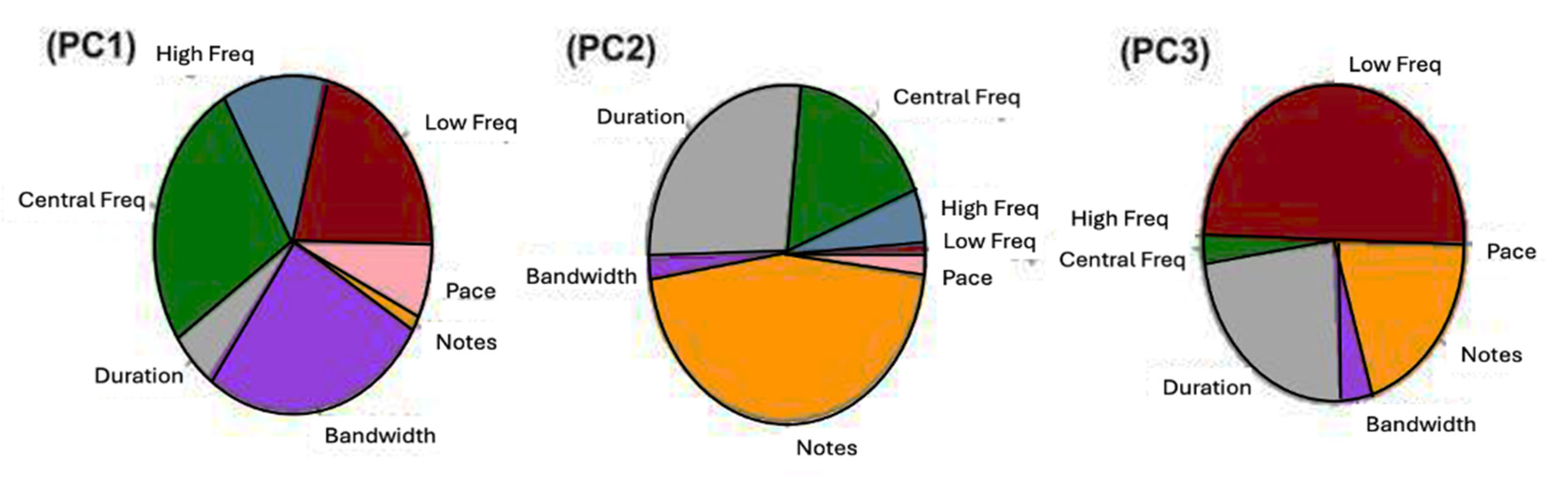
PCA charts illustrate that the dominant variables of principal components 1, 2, and 3 are: bandwidth, central frequency, and low frequency; notes and duration; and low frequency and duration, respectively (Figure 4). Correlation matrices of the first three principal components were generated to interpret the significance of the variation axes. The first component (PC1) correlated most with central and peak frequencies, the second (PC2) correlated with duration and bandwidth, whilst the third (PC3) correlated mostly with pace (number of notes/second) (Table 5).
Amphibian vocalisation distribution in acoustic space at Maceira Pond was significantly different to a random 3D scatter (Shapiro–Wilk: WM = 0.62, p = <0.001). As employed by [26], the R-value was calculated and confirmed clustering patterns (RM = 0.31).

4. Discussion

The acoustic niche theory posits that mechanisms reducing acoustic interference and ensuring successful communication are likely selected by evolution [27]. In the context of interspecific competition, anuran species employ various strategies to prevent acoustic niche overlap, which can be spatial (e.g., calling microhabitats), temporal (e.g., vocalisation activity at specific times, call length, or antiphony), or spectral (e.g., vocalising in dissimilar frequencies) [18,28], frog species can partition acoustic spaces in ways not always evident from acoustic recordings alone [14]. Within-site spatial segregation, where anuran species utilise specific microhabitats within breeding locations, can permit coexisting anurans with similar vocalisations to decrease acoustic intrusion [29]. However, it is important to note that spatial segregation may reflect broader ecological conditions rather than being solely driven by acoustic interference avoidance.
This study provides novel insights into the acoustic ecology of anurans within a vital fragment of the Brazilian Atlantic Forest. The identification of twelve species, including several that remain unidentifiable, underscores the region’s significant amphibian diversity and highlights the continued necessity for taxonomic and ecological investigations in these environments. Our R-value analysis confirmed complex clustering patterns, indicating that most species in this study exhibited varying degrees of acoustic overlap rather than clear acoustic partitioning. This shows a complex system of acoustic resource use and potential interspecific competition within this community.
The seven identifiable species belonged to four distinct anuran families: Brachycephalidae (2 species), Centrolenidae (1 species), Leptodactylidae (1 species), and Hylidae (3 species). All identified species are categorised as “Least Concern” on the IUCN Red List of Endangered Species, except for Ischnocnema spanios, which is designated as “Data Deficient.” Central frequency, peak frequency, duration, bandwidth, and pace were the primary determinants of acoustic differences between species.
Our findings revealed substantial acoustic overlaps among several species, with some demonstrating overlaps exceeding 90%. While high levels of acoustic overlap typically suggest a significant risk of acoustic interference and miscommunication [6], our observations align with research showing comparable trends in diverse communities, particularly those with moderate species richness. For instance, acoustic overlaps exceeding 90% were similarly observed in six species from Hylidae and Leptodactylidae [7], attributing limited acoustic interference to the relatively low number of sympatric species [16]. This indicates a permissible overlap, where species coexist despite shared resources, possibly due to resource partitioning, different spatial or temporal niches, or other buffering factors. Given that our study identified only 12 species, a relaxed selection pressure for strict acoustic partitioning due to reduced interspecific competition could explain these high overlaps. This implies that despite shared acoustic space, these species might employ other, more subtle mechanisms for signal differentiation, such as fine-scale temporal segregation of calling activity, the use of distinct microhabitats, or reliance on non-acoustic cues for species recognition [30].
In this study, Vitreorana eurygnatha exhibited the greatest overall acoustic overlap among all species, notably with an unidentifiable species. This specific overlap limits a full assessment of potential niche partitioning along other axes, like spatial segregation, until definitive identification of the unknown species is confirmed. Nevertheless, V. eurygnatha demonstrated significant acoustic overlap (exceeding 60%) with six other species, including hylids such as S. x-signatus and D. minutus. While Vitreorana species from southeastern Brazil are typically associated with forest streams within the Atlantic Forest biome, often laying eggs on leaves or rocks at water edges [31], more recent observations have also documented glass frog species inhabiting rocky areas and riparian forests within the Cerrado biome [29]. Our findings suggest that V. eurygnatha at Maceira Pond may occupy a spatial environment distinct from typical forest stream habitats, potentially utilising the pond’s unique features. Given the high acoustic overlap observed, particularly with species from the Hylidae family known for their overlapping acoustic niches, we hypothesise that the spatial environment at Maceira Pond might present reduced competitive pressure within the anuran community, thereby relaxing the need for strict acoustic partitioning for V. eurygnatha. This could allow for greater flexibility in acoustic signalling without leading to significant interspecific interference.
I. lactea and I. spanios belong to the Ischnocnema genus, which consists of small (<2.5 cm), diurnal toadlets primarily found in the leaf litter of montane forests in southern and southeastern Brazil [32]. This family, Brachycephalidae, is characterised by a high degree of microendemism, with many species restricted to specific mountaintops [32]. In the present study, I. lactea and I. spanios exhibited a substantial acoustic overlap of 67%, alongside similar mean peak frequencies (5257.9 kHz and 5564.9 kHz, respectively) and identical note rates (27.4 and 28.5 notes per second). This suggests that these species not only share spatial niches within the leaf litter but also experience considerable acoustic competition for signalling space. However, their bandwidths differed significantly: I. lactea displayed a broader bandwidth (22,191.8 kHz) compared to I. spanios (13,551 kHz). Furthermore, only three temporal overlaps in calls were recorded between these two species, indicating they may avoid direct acoustic interference by utilising different times and frequency ranges for communication. Given the limited prior knowledge on acoustic space use within Brachycephalidae, this study provides one of the first comparisons of vocalisations between species in this family, offering valuable baseline data.
Adenomera marmorata primarily utilises leaf litter on the forest floor as its microhabitat, with some use of wood and rock [33]. This microhabitat is known to support high anuran species richness, providing crucial habitat diversity, refuge [34], and abundant food sources [35]. In our study, A. marmorata, an opportunistic hunter, was observed with a spatial niche similar to that of the Ischnocnema species, which are also characteristic inhabitants of the forest floor’s leaf litter. This shared spatial environment is particularly significant as A. marmorata exhibited nearly 50% acoustic overlap with both Ischnocnema species identified in this study. Given their co-occurrence in a shared microhabitat, this considerable acoustic and spatial overlap suggests a high potential for interspecific competition for signalling space [6]. However, current knowledge regarding the temporal space use of Ischnocnema species is limited, preventing a clear assessment of whether their vocalisations coincide with A. marmorata’s in a way that might mitigate this apparent niche overlap.
In the current study, D. minutus exhibited an acoustic overlap of more than 50% with four unidentifiable species, as well as with Vitreorana eurygnatha and Scinax x-signatus. This substantial overlap, particularly with the unidentified species, suggests the potential presence of cryptic diversity within the D. minutus complex or closely related, undescribed taxa in our study area, a phenomenon widely recognised for this nominal species across its extensive range [36]. Both D. minutus and S. x-signatus belong to the Hylidae family, in which species are known to exhibit acoustic niche overlap [7,14] commonly. While such overlaps typically present challenges for effective signal transmission and species recognition [6], studies on hylids suggest that mechanisms beyond broad spectral overlap, such as subtle differences in dominant frequency, modulation patterns, or temporal partitioning of calling activity, can mitigate acoustic interference [7,37]. Therefore, the strong acoustic overlaps observed in this study could potentially be explained by the shared phylogenetic history leading to similarities in advertisement calls within this family, combined with the employment of more fine-scale acoustic partitioning or other sensory modalities to maintain species-specific communication [30].
This study provides the first acoustic niche assessment of various anuran species found at Maceira Pond within the study region. However, as fine-scale spatial and temporal niches were not explored here, our understanding of their ecological requirements and interspecific interactions remains incomplete. The literature reveals significant gaps in knowledge regarding the integrated use of acoustic, spatial, and temporal space by anurans, with many species having entirely unexplored niches [38].
Therefore, further investigation into the fine-scale temporal activity patterns and spatial distributions of all detected species is crucial to fully understand the observed acoustic overlaps and how species manage communication. Long-term monitoring, ideally on a larger temporal scale and employing a multi-microphone array, is crucial for addressing the identified knowledge gaps regarding anuran acoustic ecology. Specifically, for Ischnocnema lactea and I. spanios, longer-term monitoring is needed to fully understand how these two species partition their acoustic and temporal niches. For the Dendropsophus minutus complex and Vitreorana eurygnatha, comprehensive identification of the unidentifiable species, alongside more detailed spatial observations and fine-scale analysis of call parameters (e.g., pulse rate, modulation, temporal fine structure), would be essential. Ultimately, increasing our knowledge of the ecological requirements of anuran species will aid in their conservation efforts, particularly given that many are highly threatened by extinction in biomes like the Atlantic Forest. Increased knowledge of the ecological requirements of anuran species is essential for their effective conservation, especially in highly threatened biomes such as the Atlantic Forest. By identifying the specific factors that impact their persistence within a habitat, including the presence of invasive species or competitive pressures, we can develop and implement more targeted and effective management and protection strategies to safeguard these vulnerable amphibian populations.

Author Contributions

Conceptualization, A.D., L.F.P. and M.C.K.; methodology, A.D. and L.F.P.; formal analysis, A.D., L.F.P. and I.S.; investigation, A.D., L.F.P. and M.C.K.; data curation, A.D., L.F.P., M.C.K. and I.S.; writing—original draft preparation, A.D., L.F.P. and I.S.; writing—review and editing, A.D., L.F.P., M.C.K. and I.S.; supervision, L.F.P., M.C.K. and I.S.; project administration, L.F.P. and M.C.K. All authors have read and agreed to the published version of the manuscript.

Funding

This research received no external funding.

Institutional Review Board Statement

Not applicable.

Informed Consent Statement

Not applicable.

Data Availability Statement

The original data presented in the study are openly available in Mendeley Data at doi: 10.17632/bxw2rvmsz6.1.

Acknowledgments

The authors thank MMA/SISBIO for authorising research in Caparaó National Park and the park managers for their logistical support. Further thanks are given to the specialist assistance provided for some of the species’ identification.

Conflicts of Interest

The authors declare no conflicts of interest.

Abbreviations

The following abbreviations are used in this manuscript:
AFAtlantic Forest
CNPCaparao National Park
MDBioMuseum of Biological Diversity
SM4SongMeter 4
WAVWaveform Audio File Format
kHzKilohertz
PCAPrincipal component analysis
Hzhertz

References

  1. Beebee, T.J.; Griffiths, R.A. The amphibian decline crisis: A watershed for conservation biology? Biol. Conserv. 2005, 1, 271–285. [Google Scholar] [CrossRef]
  2. Brühl, C.A.; Schmidt, T.; Pieper, S.; Alscher, A. Terrestrial pesticide exposure of amphibians: An underestimated cause of global decline? Sci. Rep. 2013, 3, 1135. [Google Scholar] [CrossRef] [PubMed]
  3. Womack, M.C.; Steigerwald, E.; Blackburn, D.C.; Cannatella, D.C.; Catenazzi, A.; Che, J.; Koo, M.S.; McGuire, J.A.; Ron, S.R.; Spencer, C.L.; et al. State of the Amphibia 2020: A review of five years of amphibian research (2016–2020). Ichthyol. Herpetol. 2022, 110, 638–661. [Google Scholar] [CrossRef]
  4. Lantyer-Silva, A.S.F.; Solé, M.; Zina, J. Reproductive biology of a bromeligenous frog endemic to the Atlantic Forest: Aparasphenodon arapapa Pimenta, Napoli and Haddad, 2009 (Anura: Hylidae). An. Acad. Bras. Ciênc. 2014, 86, 867–880. [Google Scholar] [CrossRef]
  5. Campbell Grant, E.H.; Amburgey, S.M.; Gratwicke, B.; Acosta Chaves, V.; Belasen, A.M.; Bickford, D.; Brühl, C.A.; Calatayud, N.E.; Clemann, N.; Clulow, S.; et al. Priority research needs to inform amphibian conservation in the Anthropocene. Conserv. Sci. Pract. 2023, 5, e12988. [Google Scholar] [CrossRef]
  6. Gerhard, H.C.; Huber, F. Acoustic Communication in Insects and Anurans: Common Problems and Diverse Solutions. J. Acoust. Soc. Am. 2003, 16, 589–591. [Google Scholar] [CrossRef]
  7. Lima, M.S.C.S.; Pederassi, J.; Pineschi, R.B.; Barbosa, D.B.S. Acoustic niche partitioning in an anuran community from the municipality of Floriano, Piauí, Brazil. Braz. J. Biol. 2019, 79, 566–576. [Google Scholar] [CrossRef]
  8. Penna, M.; Solís, R. Frog call intensities and sound propagation in the South American temperate forest. Behav. Ecol. Sociobiol. 1998, 42, 371–381. [Google Scholar] [CrossRef]
  9. Holt, R.D. Bringing the Hutchinsonian niche into the 21st century: Ecological and evolutionary perspectives. Proc. Natl. Acad. Sci. USA 2009, 10, 19659–19665. [Google Scholar] [CrossRef]
  10. Ricklefs, R.E. Evolutionary diversification, coevolution between populations and their antagonists, and the filling of niche space. Proc. Natl. Acad. Sci. USA 2010, 10, 1265–1272. [Google Scholar] [CrossRef]
  11. Schoener, T. Resource partitioning in ecological communities. Science 1974, 185, 27–39. [Google Scholar] [CrossRef] [PubMed]
  12. Sinsch, U.; Lümkemann, K.; Rosar, K.; Schwarz, C.; Dehling, M. Acoustic niche partitioning in an anuran community inhabiting an Afromontane wetland (Butare, Rwanda). Afr. Zool. 2012, 47, 60–73. [Google Scholar] [CrossRef]
  13. Ryan, M.J. Amphibians: Biology of Amphibians. Science 1986, 232, 271–272. [Google Scholar] [CrossRef] [PubMed]
  14. Allen-Ankins, S.; Schwarzkopf, L. Using citizen science to test for acoustic niche partitioning in frogs. Sci. Rep. 2022, 12, 1–7. [Google Scholar] [CrossRef]
  15. Gerhardt, H.C. The Evolution of Vocalization in Frogs and Toads. Annu. Rev. Ecol. Syst. 1994, 25, 293–324. [Google Scholar] [CrossRef]
  16. De Rossa-Feres, D.C.; Garey, M.V. Amphibians of Mata Atlantica: Species List, Historical Studies, Biological and Conservation. Ph.D. Dissertation, Universidade Federal do Paraná, Parana, Brazil, 2018. [Google Scholar]
  17. Gomes, F.R.; Madelaire, C.B.; Moretti, E.H.; Titon, S.C.M.; Assis, V.R. Immunoendocrinology and Ecoimmunology in Brazilian Anurans. Integr. Comp. Biol. 2022, 62, 1654–1670. [Google Scholar] [CrossRef]
  18. Vasconcelos, T.S.; Prado, V.H.M.; da Silva, F.R.; Haddad, C.F.B. Biogeographic distribution patterns and their correlates in the diverse frog fauna of the atlantic forest hotspot. PLoS ONE 2014, 9, e104130. [Google Scholar] [CrossRef]
  19. Guarnizo, C.E.; Cannatella, D.C. Genetic divergence within frog species is greater in topographically more complex regions. J. Zool. Syst. Evol. Res. 2013, 51, 333–340. [Google Scholar] [CrossRef]
  20. Oliveira, F.; Scolforo, J.R.; Oliveira, A.D.; Carvalho, L.M.T. Definição e Delimitação de Domínios e Subdomínios das Paisagens Naturais do Estado de Minas Gerais. In Mapeamento e Inventário da Flora e dos Reflorestamentos de Minas Gerais; Universidade Federal de Lavras: Lavras, Brazil, 2006; pp. 21–35. [Google Scholar]
  21. Drummond, G.M.; Martins, C.G.; Machado, A.B.M.; Sebaio, F.O.; Antonini, Y. Biodiversidade em Minas Gerais: Um Atlas Para Sua Conservação, 2nd ed.; Fundação Biodiversitas: Belo Horizonte, Brazil, 2001. [Google Scholar]
  22. Kleyn, T.; da Cruz Kaizer, M.; Passos, L.F. Sharing sound: Avian acoustic niches in the Brazilian Atlantic Forest. Biotropica 2021, 53, 658–670. [Google Scholar] [CrossRef]
  23. Yang, K.L. Raven Sound Analysis, version 1.6.5. Center for Conservation Bioacoustics at the Cornell Lab of Ornithology. The Cornell Lab of Ornithology: Ithaca, NY, USA, 2024. Available online: https://www.ravensoundsoftware.com/ (accessed on 23 August 2024).
  24. Dinno, A. Paran: Horn’s Test of Principal Components/Factors, version 1.5.4; Comprehensive R Archive Network (CRAN): Vienna, Austria, 2024. Available online: https://CRAN.R-project.org/package=paran (accessed on 23 August 2024).
  25. Horn, J.L. A rationale and test for the number of factors in factor analysis. Psychometrika 1965, 30, 179–185. [Google Scholar] [CrossRef]
  26. Clark, P.; Evans, F.C. Distance to nearest neighbour as a measure of spatial relationships in populations. Ecology 1954, 35, 445–453. [Google Scholar] [CrossRef]
  27. Krause, B. The Niche Hypothesis: A virtual symphony of animal sounds, the origins of musical expression and the health of habitats. Soundscape Newsl. 1993, 12, 6–10. [Google Scholar]
  28. Zornosa-Torres, C.; Augusto-Alves, G.; Lyra, M.L.; da Silva Júnior, J.C.; Garcia, P.C.A.; Leite, F.; Verdade, V.; Rodrigues, M.T.; Gasparini, J.L.; Haddad, C.F.; et al. Anurans of the Caparaó National Park and surroundings, Southeast Brazil. Biota Neotrop 2020, 20, e20190882. [Google Scholar] [CrossRef]
  29. Santana, D.J.; Barros, A.B.; Pontes, R.; Feio, R.N. A New Species of Glassfrog Genus Vitreorana (Anura, Centrolenidae) from the Cerrado Domain, Southeastern Brazil. Herpetologica 2015, 71, 289–298. [Google Scholar] [CrossRef]
  30. Preininger, D.; Boeckle, M.; Freudmann, A.; Starberger, I.; Sztatecsny, M.; Hodl, W. Multimodal signalling in the Small Torrent Frog (Micrixalus saxicola) in a complex acoustic environment. Behav. Ecol. Sociobiol. 2013, 9, 1449–1456. [Google Scholar] [CrossRef]
  31. Alegre, P. Reproductive Biology and Phylogenetic Relationships of Vitreorana baliomma (anura: Centrolenidae). Master’s Thesis, Pontifícia Universidade Católica do Rio Grande do Sul, Porto Alegre, Brazil, 2020; pp. 1–75. [Google Scholar]
  32. Bornschein, M.R.; Firkowski, C.R.; Belmonte-Lopes, R.; Corrêa, L.; Ribeiro, L.F.; Morato, S.A.A.; Antoniazzi, R.L.; Reinert, B.L.; Meyer, A.L.S.; Cini, F.A.; et al. Geographical and altitudinal distribution of Brachycephalus (Anura: Brachycephalidae) endemic to the Brazilian Atlantic Rainforest. PeerJ 2016, 10, e2490. [Google Scholar] [CrossRef]
  33. Maia-Carneiro, T.; Dorigo, T.A.; Kiefer, M.C.; van Sluys, M.; Duarte Rocha, C.F. Feeding Habits, Microhabitat Use, and Daily Activity Cycle of Adenomera marmorata (Anura, Leptodactylidae) in Two Brazilian Atlantic Forest Remnants. S. Am. J. Herpetol. 2021, 20, 100–105. [Google Scholar] [CrossRef]
  34. Van Sluys, M.; Vrcibradic, D.; Alves, M.A.S.; Bergallo, H.G.; Rocha, C.F.D. Ecological parameters of the leaf-litter frog community of an Atlantic Rainforest area at Ilha Grande, Rio de Janeiro state, Brazil. Austral Ecol. 2007, 32, 254–260. [Google Scholar] [CrossRef]
  35. Fauth, J.E.; Crother, B.I.; Slowinski, J.B. Elevational Patterns of Species Richness, Evenness, and Abundance of the Costa Rican Leaf-Litter Herpetofauna. Biotropica 1989, 21, 178–185. [Google Scholar] [CrossRef]
  36. Gehara, M.; Crawford, A.J.; Orrico, V.G.D.; Rodríguez, A.; Lötters, S.; Fouquet, A.; Barrientos, L.S.; Brusquetti, F.; de La Riva, I.; Ernst, R.; et al. High levels of diversity uncovered in a widespread nominal taxon: Continental phylogeography of the neotropical tree frog Dendropsophus minutus. PLoS ONE 2014, 9, e103958. [Google Scholar] [CrossRef]
  37. Gupta, S.; Alluri, R.K.; Rose, G.J.; Bee, M.A. Neural basis of acoustic species recognition in a cryptic species complex. J. Exp. Biol. 2021, 224, 23. [Google Scholar] [CrossRef]
  38. Amézquita, A.; Flechas, S.V.; Lima, A.P.; Gasser, H.; Hödl, W. Acoustic interference and recognition space within a complex assemblage of dendrobatid frogs. Proc. Natl. Acad. Sci. USA 2011, 108, 17058–17063. [Google Scholar] [CrossRef]
Figure 1. Outline of Caparaó National Park (Brazil) is marked in green, with the study site highlighted in orange.
Conservation 06 00024 g001
Figure 2. Dendrogram illustrating the acoustic similarities among the 12 amphibian species recorded at Maceira Pond, Caparaó National Park. The height of the branches indicates the level of dissimilarity in acoustic parameters between species or clusters.
Conservation 06 00024 g002
Figure 3. Distribution of amphibian vocalizations in (a) two-dimensional and (b) three-dimensional Principal Component Analysis (PCA) space, illustrating acoustic differentiation among species at Maceira Pond, Caparaó National Park.
Conservation 06 00024 g003
Figure 4. PCA charts showing the distribution of key acoustics parameters within the three key principal components.
Conservation 06 00024 g004
Table 1. Number of amphibian notes and calls occurring within each 6 h of recordings and the overall total detected within this study.
HourNumber of NotesNumber of CallsNumber of Species
Hour 131083575
Hour 2593401
Hour 3680446
Hour 415841513
Hour 512001313
Hour 69241373
Total808983912
Table 2. All species detected, along with the number of calls per species and the number of hourly occurrences within this study.
SpeciesNumber of Calls DetectedNumber of Hourly Occurrences
Vitreorana eurygnatha2534
Dendropsophus minutus2283
Ischnocnema lactea1211
Unidentified Species 11003
Scinax x-signatus522
Boana polytaenia322
Unidentified Species 4271
Ischnocnema spanios121
Unidentified Species 561
Adenomera marmorata41
Unidentified Species 221
Unidentified Species 321
Table 3. Average (St Dev) call measurements overall per species, including low frequency (Hz), high frequency (Hz), peak frequency (Hz), centre frequency (Hz), bandwidth (Hz), duration (s), number of notes per call, and pace (notes per second).
SpeciesLow Freq. (Hz)High Freq. (Hz)Peak Freq. (Hz)Centre Freq. (Hz)Bandwidth (Hz)Duration (s)NotesPace (Notes/s)
Ischnocnema lactea975.84
(901.38)
23,167.60
(2837.65)
5257.93
(135.52)
5257.93
(113.20)
22,191.76
(3086.37)
0.27
(0.51)
7.33
(12.2)
27.36
(24.1)
Vitreorana eurygnatha4706.23
(411.87)
6315.27
(1087.62)
5403.56
(261.29)
5396.78
(270.88)
1460.29
(1193.81)
0.09
(0.22)
10.14
(6.85)
19.00
(9.73
Scinax x-signatus4479.51
(1035.2)
6937.766
(3379.34)
5524.73
(386.68)
5509.53
(382.06)
1853.24
(3393.58)
0.17
0.20)
4.17
(3.02)
9.42
(5.3)
Boana polytaenia4866.94
(377.64)
17,619.79
(6688.34)
5538.32
(260.95)
5561.91
(240.87)
12,648.99
(7235.13)
0.08
(0.23)
11.76
(4.23)
14.80
(4.04)
Ischnocnema spanios4548.55
(578.69)
18,099.75
(6146.46)
5564.85
(181.23)
5581.66
(158.03)
13,551.20
(6239.14)
0.13
(0.22)
8.25
(7.52)
28.49
(24.36)
Unidentified Species 13543.81
(289.66)
14,381.09
(5929.70)
4315.43
(56.10)
4261.14
(155.25)
439.38
(455.13)
0.13
(0.59)
19.57
(13.3)
10.89
(2.93)
Unidentified Species 25185.66
(365.55)
7074.91
(107.75)
6375.00
(59.29)
6328.12
(51.35)
656.25
(118.59)
0.02
(0.00)
6.0010.71
Unidentified Species 35262.87
(234.08)
6494.76
(315.85)
5752.23
(237.17)
5736.32
(252.07)
345.70
(126.79)
0.07
(0.17)
7.00
(1.41)
14.13
(4.97)
Adenomera marmorata1977.5012,494.404687.504687.502437.500.013.0093.45
Dendropsophus minutus2039.30
(739.15)
9330.19
(5566.88)
5094.48
(535.22)
4727.87
(715.11)
2557.67
(1780.55)
0.32
(0.45)
6.68
(6.08)
5.58
(4.05)
Unidentified Species 43329.66
(209.03)
5474.56
(1689.73)
4183.50
(254.01)
4169.25
(223.13)
635.62
(1083.84)
0.14
(0.55)
17.55
(9.14)
10.39
(6.89)
Unidentified Species 511,837.30
(234.08)
21,878.44
(315.85)
15,623.3
(237.17)
16,827.2
(1948.94)
10,102.46
(3797.29)
0.20
(0.29)
18.00
(16.5)
21.38
(17.03)
Table 4. Species with temporally overlapping calls throughout this study, the species’ mean peak frequencies, and the number of temporal overlaps that occurred between species.
Species 1Mean Peak FrequencySpecies 2Mean Peak FrequencyNo. of Call Overlaps Between Species
I. Spanios5564.85I. Lactea5257.933
I. lactea5257.93V. eurygnatha5403.5610
V. eurygnatha5403.56B. polytaenia5538.322
S. x-signatus5524.73V. eurygnatha5403.561
I. lactea5257.93B. polytaenia5538.321
Unidentified Species 14315.43D. minutus5094.4813
V. eurygnatha5403.56D. minutus5094.481
D. minutus5094.48Unidentified Species 44183.509
V. eurygnatha5403.56Unidentified Species 515,623.361
D. minutus5094.48V. eurygnatha5403.564
Table 5. Correlation matrix between the eight key acoustic parameters used in this study and the three principal components.
MaceiraPC1PC2PC3
Eigenvalue3.5061.9871.780
Proportion of variance0.3890.2200.197
Low Frequency0.854−0.4220.215
High Frequency0.6320.526−0.492
Peak Frequency0.947−0.1460.0509
Bandwidth0.4130.682−0.502
Central Frequency0.951−0.1530.0390
Duration0.2210.8140.337
Number of Notes0.4930.0080.464
Pace (notes/second)−0.1178−0.189−0.819
Bold values indicate strong correlations (|r| ≥ 0.6) between acoustic variables and principal components.
Disclaimer/Publisher’s Note: The statements, opinions and data contained in all publications are solely those of the individual author(s) and contributor(s) and not of MDPI and/or the editor(s). MDPI and/or the editor(s) disclaim responsibility for any injury to people or property resulting from any ideas, methods, instructions or products referred to in the content.