
Article

Modeling Free Proline Accumulation in Four Mediterranean Geophytes: A Comparative Analysis of Pancratium maritimum, Sternbergia lutea, Iris germanica, and Cyclamen graecum


1
Laboratory of Molecular Microbiology and Immunology, Department of Biomedical Sciences, University of West Attica, 12243 Athens, Greece
2
Department of Civil Engineering, University of West Attica, 12243 Athens, Greece
*
Author to whom correspondence should be addressed.
Stresses 2026, 6(3), 51; https://doi.org/10.3390/stresses6030051
Submission received: 10 May 2026 / Revised: 14 July 2026 / Accepted: 17 July 2026 / Published: 21 July 2026
(This article belongs to the Section Plant and Photoautotrophic Stresses)

Abstract

Free proline accumulation is an important physiological trait frequently associated with plant responses to changing environmental conditions. This study investigated seasonal patterns of free proline concentration in the underground organs of four Mediterranean geophytes—Pancratium maritimum, Sternbergia lutea, Iris germanica, and Cyclamen graecum—under natural environmental conditions. Monthly temperature and precipitation data were incorporated to examine the influence of environmental factors on proline dynamics. The results revealed clear species-specific and seasonal variation in proline accumulation. Sternbergia lutea exhibited the highest proline concentrations and the greatest seasonal variability, whereas Iris germanica maintained comparatively low and stable levels. To evaluate descriptive performance, both a linear seasonal regression model and a Random Forest regression model were applied. The linear model showed moderate predictive performance (R2 = 0.488), slightly outperforming the Random Forest model (R2 = 0.350). Overall, the findings demonstrate clear species-specific differences in seasonal proline accumulation that are consistent with differing physiological responses among the studied geophytes. The pronounced interspecific differences observed in this study suggest that proline accumulation is a species-specific physiological trait rather than a universal response among Mediterranean geophytes. The integration of physiological measurements with statistical and machine learning approaches provides an exploratory framework for examining seasonal variation in proline accumulation and evaluating statistical approaches for describing species-specific patterns.

1. Introduction

1.1. Plant Stress Physiology and the Role of Proline

Plants are continually exposed to a variety of abiotic stresses, including drought, salinity, extreme temperatures, and high irradiance, which can disrupt cellular homeostasis and reduce growth and productivity [1]. One of the key mechanisms by which plants respond to such stresses is the accumulation of compatible osmolytes—small organic molecules that help maintain cell turgor and protect macromolecules. Among these compounds, free proline is one of the most extensively studied compatible osmolytes and is frequently associated with plant responses to environmental stress. The linear seasonal regression model explained a moderate proportion of the variance. Proline is a multifunctional amino acid that accumulates in plant tissues in response to environmental stress [2]. Its functions are diverse: it acts as an osmoprotectant, stabilizing subcellular structures such as membranes and proteins; it serves as a reactive oxygen species (ROS) scavenger, mitigating oxidative damage; and it acts as a reservoir of carbon and nitrogen that can be mobilized when stress subsides [3,4]. The biosynthesis of proline is primarily regulated through the glutamate pathway [5], and its accumulation is often used as a physiological marker of stress tolerance. Moreover, proline dynamics vary among species and are influenced by both the type and duration of stress. In many Mediterranean plants, which are naturally adapted to seasonal drought and high light intensity, proline accumulation is a crucial adaptive response that enhances survival under fluctuating environmental conditions. Understanding these mechanisms is therefore essential not only for plant physiology research but also for ecological and agricultural applications, particularly in the context of climate change and increasing environmental variability.

1.2. Ecological Importance of Mediterranean Geophytes

Mediterranean geophytes—plants with underground storage organs such as bulbs, corms, or tubers—are a distinctive component of the Mediterranean flora, exhibiting remarkable adaptations to seasonal drought and nutrient-poor soils [6]. These species have evolved life strategies that allow them to complete their life cycles during favorable periods, typically in autumn or spring, while surviving the harsh summer conditions in a dormant state. The ecological significance of these geophytes extends beyond their survival strategies. They contribute to the stability and resilience of Mediterranean ecosystems by providing early-season resources for pollinators, influencing soil structure through their underground organs, and participating in nutrient cycling. Moreover, their phenological patterns often serve as bioindicators of environmental changes, such as shifts in rainfall regimes or temperature fluctuations. In addition, Mediterranean geophytes exhibit species-specific physiological and biochemical adaptations that reflect their ecological niches. For instance, coastal species like Pancratium maritimum demonstrate tolerance to salinity and sand burial [7], while woodland species like Cyclamen graecum are adapted to shaded, nutrient-limited soils [8]. These adaptations often include the modulation of osmolytes, antioxidants, and other stress-related metabolites, with proline accumulation being a key feature in their stress physiology. Studying these mechanisms provides insights into both evolutionary ecology and potential applications in conservation and climate-resilient agriculture.

1.3. Research Objectives and Hypotheses

Previous studies have documented the seasonal dynamics of free proline accumulation in Pancratium maritimum, Sternbergia lutea, and Cyclamen graecum under natural Mediterranean conditions. However, these investigations were conducted independently and focused on species-specific physiological responses. In contrast, the present study integrates these previously published datasets with new data from Iris germanica to establish a comparative framework encompassing four Mediterranean geophytes with distinct ecological preferences and adaptive strategies.
The novelty of the present study lies in the integration of four independent species datasets into a unified comparative analytical framework that enables direct interspecific comparisons under common statistical procedures. Although three of the datasets have been published previously and the Iris germanica dataset is presented here for the first time, no previous study has examined seasonal proline accumulation across these Mediterranean geophytes within a single comparative framework. The study further explores whether statistical and machine-learning approaches can describe species-specific seasonal patterns and the relative contribution of environmental variables to the observed variation. Accordingly, the objective of this work is not to establish a universal predictive model of plant stress but to provide an exploratory comparative analysis of seasonal proline dynamics across representative Mediterranean geophytes.
The primary objectives of this study are to (i) compare seasonal patterns of free proline accumulation among four Mediterranean geophytes (Pancratium maritimum, Sternbergia lutea, Iris germanica, and Cyclamen graecum); (ii) examine relationships between proline concentration and environmental factors; and (iii) evaluate the ability of predictive models to describe and forecast proline dynamics across species.
This study is guided by the following hypotheses:
  • Species-specific proline accumulation: Each geophyte exhibits a distinct seasonal proline accumulation profile reflecting its ecological niche and adaptive strategy.
  • Correlation with environmental tolerance: Species adapted to harsher or more variable environments may exhibit greater proline accumulation than species from less variable habitats.
  • Predictive modeling of proline dynamics: Seasonal proline dynamics can be reliably predicted using environmental variables, particularly temperature and precipitation, providing an exploratory assessment of seasonal variation in proline accumulation under changing climatic conditions. In addition, because physiological responses to environmental variability may involve complex and potentially non-linear interactions among climatic and biological factors, a machine learning approach was employed to evaluate whether such relationships could improve the description of proline dynamics relative to a conventional linear model.
By addressing these hypotheses, the study advances our understanding of observed physiological differences in Mediterranean geophytes through a comparative and predictive perspective. The findings contribute to plant stress ecology by identifying patterns that may not be evident from single-species investigations and by demonstrating the potential of modeling approaches for interpreting and forecasting plant responses to environmental variability. The present study should be viewed primarily as a comparative synthesis of seasonal free proline datasets obtained from four Mediterranean geophytes. Although three of these datasets have been published previously, and the Iris germanica dataset is presented here for the first time, their integration into a unified analytical framework enables direct interspecific comparisons that were not possible in the original studies. The complementary statistical and machine learning analyses are intended as exploratory tools for describing seasonal patterns and identifying the relative contributions of species identity and environmental variables, rather than as definitive predictive models of plant physiological resilience.

2. Results

2.1. Variation in Free Proline Concentration Among Species

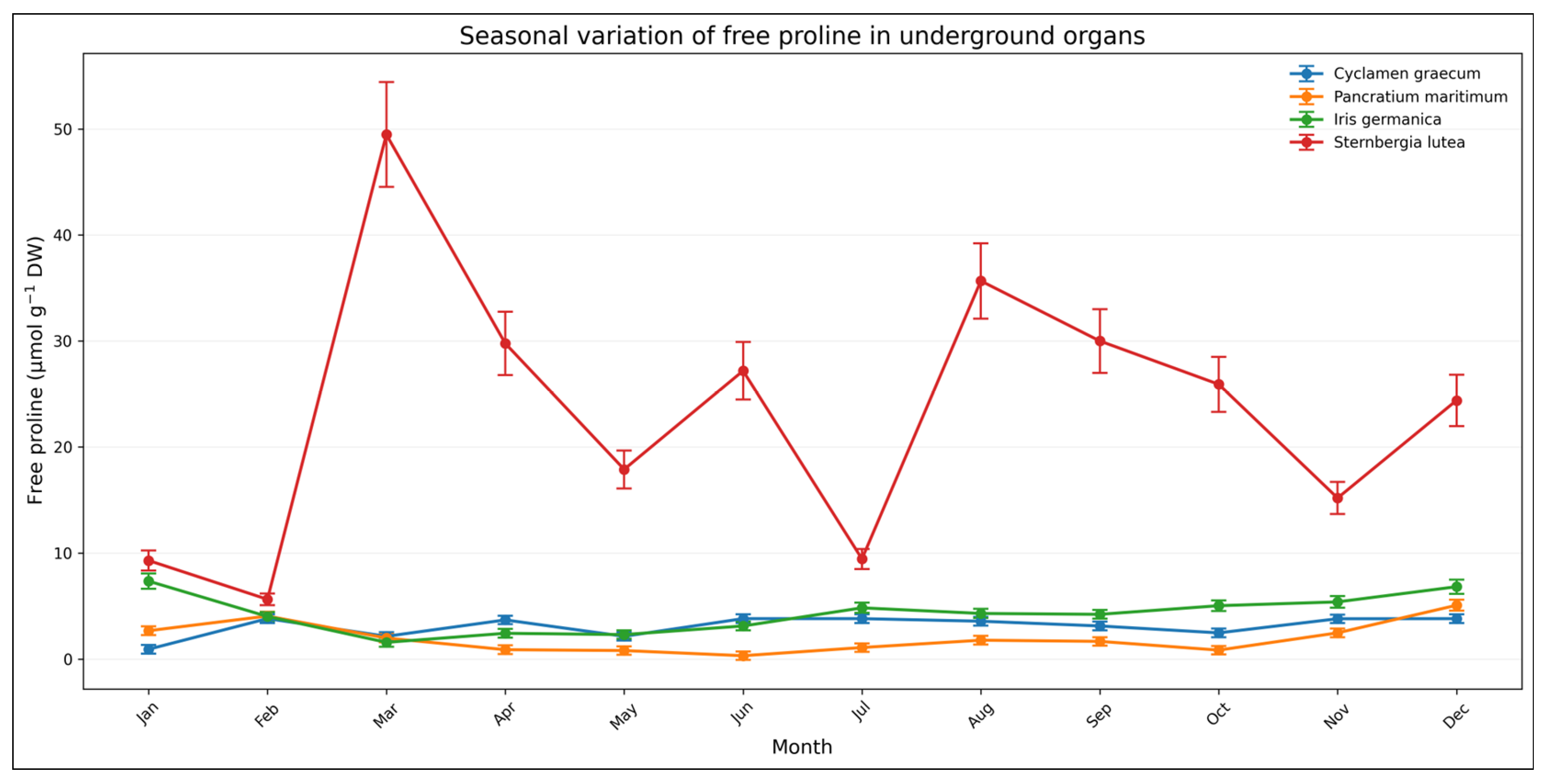
Free proline concentration in the underground organs exhibited pronounced variation both among species and across months (Figure 1). All four geophytes showed clear seasonal patterns, although the magnitude and timing of peak accumulation differed substantially. Cyclamen graecum displayed relatively moderate proline levels, with a gradual increase during the winter months and a peak in late winter. In contrast, Iris germanica exhibited lower overall proline concentrations, with less pronounced seasonal fluctuations. Pancratium maritimum showed intermediate values, with noticeable increases during specific seasonal periods characterized by variation in temperature and precipitation. Notably, Sternbergia lutea exhibited markedly higher proline concentrations compared to the other species, indicating a distinct physiological response pattern. Overall, the results demonstrate strong interspecific variation in proline accumulation, suggesting species-specific strategies for osmotic adjustment and stress tolerance. One-way ANOVA revealed significant differences in free proline concentration among species (F = 30.02, p < 0.001). Tukey’s HSD post hoc analysis indicated that Sternbergia lutea exhibited significantly higher proline concentrations compared to all other species (p < 0.001), whereas no significant differences were detected among Cyclamen graecum, Iris germanica, and Pancratium maritimum.

2.2. Comparative Analysis of Species-Specific Patterns

A comparative analysis revealed distinct temporal patterns of proline accumulation among the four geophytes. Seasonal trends indicated that proline levels were generally higher during periods characterized by lower temperatures and reduced precipitation. The cyclic nature of proline variation was evident across all species; however, the amplitude of fluctuation differed. Sternbergia lutea showed the highest variability, with sharp increases during specific months, while Iris germanica maintained relatively stable levels throughout the year. Cyclamen graecum and Pancratium maritimum exhibited intermediate patterns, characterized by gradual increases and decreases aligned with seasonal transitions. These findings highlight the importance of species-specific phenological and ecological adaptations in shaping biochemical responses. These seasonal patterns were subsequently incorporated into the predictive models by representing month as a cyclic variable using sine and cosine transformations.

2.3. Model Performance and Comparative Evaluation

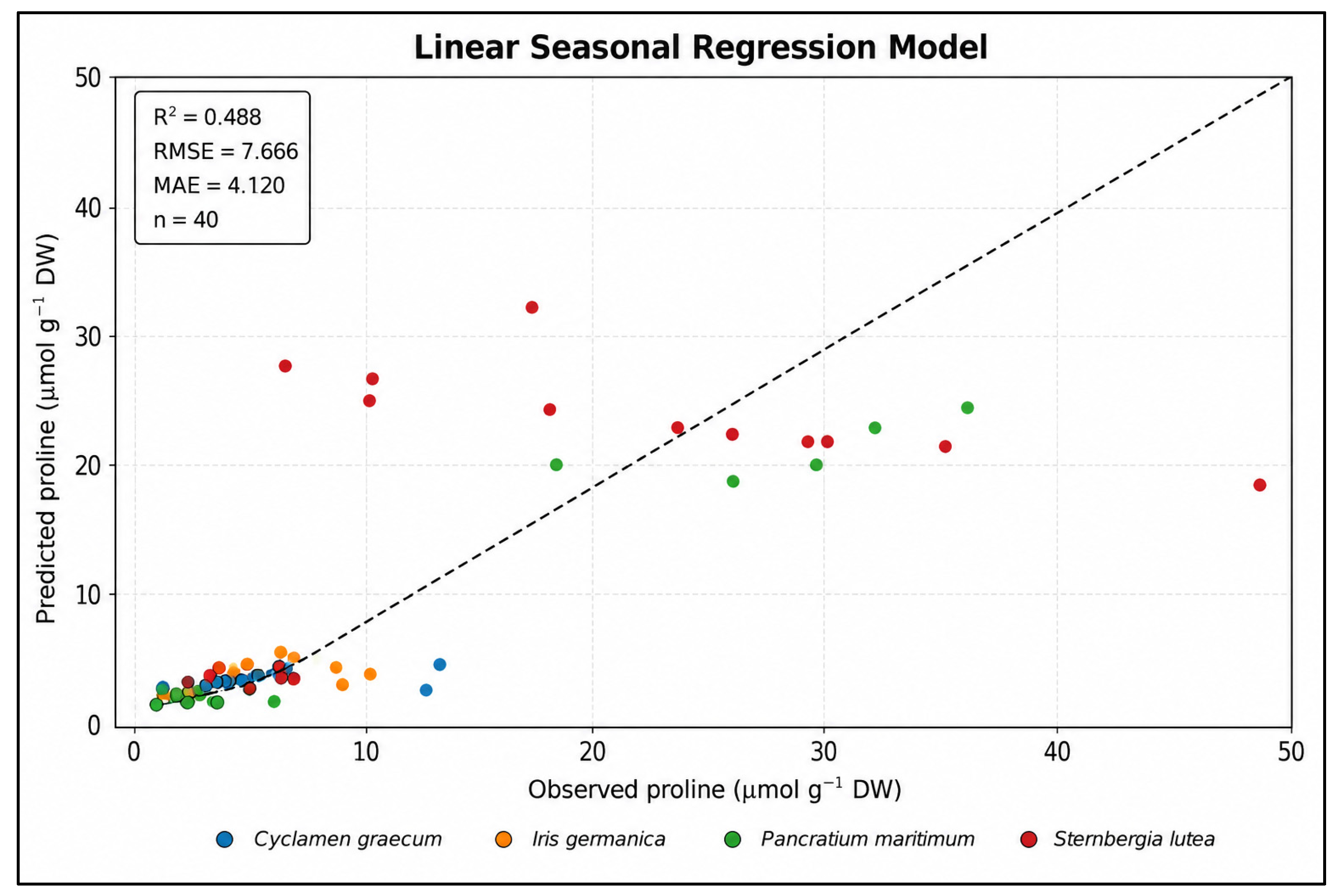
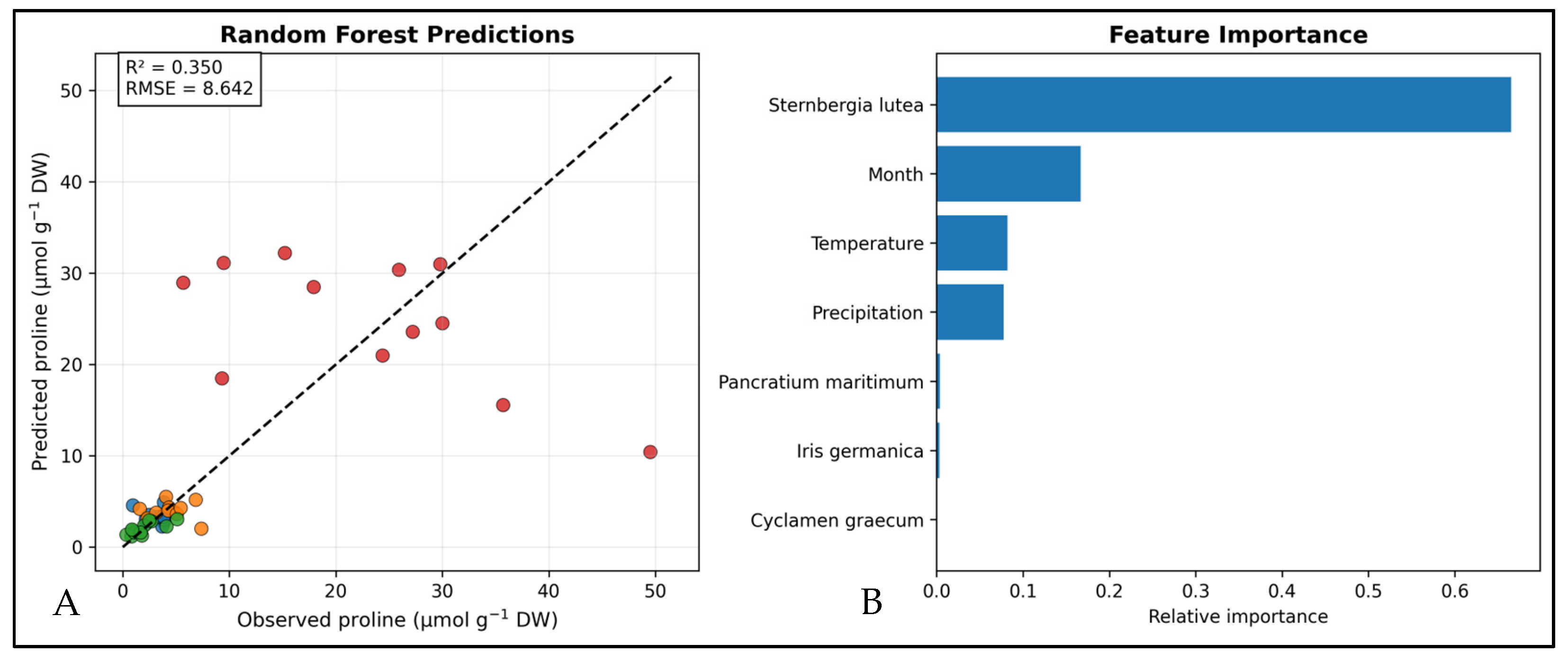
The predictive performance of the statistical and machine learning models was evaluated using leave-one-out cross-validation (LOOCV), as summarized in Table 1. The linear seasonal regression model explained a moderate proportion of the variance in proline concentration (R2 = 0.488), indicating moderate descriptive performance (Figure 2). The corresponding RMSE and MAE values were 7.666 and 4.120, respectively. The Random Forest model (Figure 3) showed slightly lower explanatory power (R2 = 0.350), with RMSE and MAE values of 8.642 and 4.091, respectively. Despite its ability to capture non-linear relationships, its performance was limited by the relatively small dataset, the strong confounding between species and habitat, and the restricted number of predictor variables. Consequently, the Random Forest analysis should be interpreted primarily as an exploratory comparison with the linear model rather than as a robust predictive approach. Overall, the linear model (Figure 2) demonstrated slightly better performance within the studied dataset, explaining approximately 49% of the observed variation in proline concentration. Although the explanatory power was moderate, such values are not uncommon in ecological datasets characterized by substantial biological and environmental complexity.

2.4. Identification of Key Predictors

Both modeling approaches identified species identity as the strongest predictor within the available dataset. However, because species identity is partially confounded with habitat and sampling location, this variable should be interpreted as representing both biological and environmental differences among the studied systems. Seasonality, represented by the cyclic transformation of the month variable, also played a significant role, confirming that proline accumulation follows a strong seasonal pattern. Temperature was identified as an influential predictor within the modeling framework, although its effect should be interpreted in conjunction with the strong seasonal structure of the data. Precipitation showed a comparatively weaker influence, suggesting that, within the studied environmental context, temperature and intrinsic species traits appeared to be more influential predictors than precipitation within the present dataset. The combined analysis indicates that proline accumulation in Mediterranean geophytes is primarily governed by species-specific physiological strategies and seasonal environmental variation, with temperature acting as a key external factor.

3. Discussion

3.1. Physiological Strategies of Mediterranean Geophytes

The observed patterns of free proline accumulation among the studied geophytes reflect distinct physiological strategies for coping with the pronounced seasonality of the Mediterranean environment. Geophytes are characterized by their ability to survive unfavorable periods through underground storage organs, which function as both reservoirs of resources and centers of metabolic regulation [9]. The accumulation of proline in underground organs appears to be associated with seasonal environmental variation, particularly during periods characterized by lower temperatures and transitions between dormancy and active growth. Proline likely contributes to osmotic adjustment, stabilization of cellular structures, and protection against oxidative stress, thereby enhancing the resilience of these species [10,11]. The strong seasonal signal detected in all species supports the view that proline metabolism is tightly regulated in response to environmental cues, forming part of an integrated strategy that includes carbohydrate storage and water balance regulation. This coordinated response is essential for maintaining cellular integrity during periods of stress and for supporting rapid growth during favorable conditions.
The contrast between Sternbergia lutea and Iris germanica may also reflect differences in the balance between biochemical and structural adaptation mechanisms. The elevated proline concentrations observed in S. lutea may reflect a greater reliance on biochemical regulation through osmolyte accumulation; however, this interpretation remains speculative because complementary physiological and biochemical measurements were not performed. The comparatively low and stable proline concentrations observed in I. germanica could be associated with alternative physiological or morphological characteristics, although these potential mechanisms were not examined in the present study. Such characteristics could reduce dependence on rapid biochemical adjustments and contribute to the relatively low and stable proline concentrations observed throughout the year. Although these mechanisms were not directly evaluated in the present study, they offer a plausible ecological and physiological explanation for the contrasting proline accumulation patterns exhibited by the two species. These interpretations should therefore be regarded as working hypotheses that warrant experimental verification through integrated physiological, biochemical, and anatomical studies.
The present study should be viewed primarily as a comparative synthesis of seasonal proline datasets obtained from four Mediterranean geophytes. While three of these datasets have been reported previously, their integration into a common analytical framework enables direct interspecific comparisons and provides an opportunity to evaluate whether common seasonal patterns emerge across taxa. This comparative perspective represents the principal contribution of the present work.
Although the Random Forest algorithm can capture complex non-linear relationships, its performance in the present study was limited by the relatively small dataset and the restricted number of explanatory variables. Therefore, the Random Forest analysis should be regarded as an exploratory, complementary approach rather than a fully optimized predictive model.

3.2. Interpretation of Interspecific Differences

The pronounced differences in proline accumulation among the four geophytes indicate distinct seasonal patterns among the studied taxa. However, because each species was sampled from a different natural habitat, these differences likely reflect the combined influence of intrinsic physiological characteristics and site-specific environmental conditions. In particular, the significantly higher proline levels observed in Sternbergia lutea suggest a more pronounced biochemical response to seasonal environmental variation, possibly reflecting species-specific physiological responses associated with drier or more variable habitats. In contrast, Iris germanica exhibited relatively low and stable proline concentrations, indicating a potentially different strategy for the observed physiological differences that may rely less on osmolyte accumulation and more on structural or morphological adaptations. One possible physiological explanation for the contrasting responses observed among species relates to the metabolic costs associated with proline synthesis and accumulation. Proline biosynthesis requires substantial investment of carbon, nitrogen, and reducing power, making large-scale accumulation a potentially costly adaptive strategy. The exceptionally high proline concentrations observed in Sternbergia lutea may therefore reflect a strategy based on rapid biochemical adjustment to seasonal environmental variation, whereby resources are allocated toward osmolyte production and cellular protection. In contrast, the comparatively low and stable proline concentrations recorded in Iris germanica may indicate greater reliance on alternative adaptive mechanisms, such as morphological traits, phenological timing, resource storage dynamics, or other physiological buffering processes that reduce the need for extensive osmolyte accumulation. Although these mechanisms were not directly examined in the present study, they provide a plausible explanation for the observed interspecific differences and highlight the diversity of adaptive strategies among Mediterranean geophytes.
Intermediate responses observed in Cyclamen graecum and Pancratium maritimum suggest a balance between metabolic flexibility and environmental buffering, consistent with their ecological distribution and phenological behavior. These interspecific differences underscore that proline accumulation is not a universal indicator of stress tolerance but rather part of a broader, species-dependent adaptive framework. The results support the existence of species-specific differences in seasonal proline accumulation; however, additional physiological and biochemical measurements are required before these differences can be attributed to specific stress-response mechanisms or adaptive strategies.
The results provide only partial support for Hypothesis 2, which predicted that species inhabiting harsher or more environmentally variable habitats would exhibit higher proline accumulation. Although Sternbergia lutea showed markedly elevated proline concentrations, Pancratium maritimum, a species adapted to coastal dune systems characterized by salinity, drought, and sand burial, exhibited only intermediate values and did not differ significantly from Cyclamen graecum or Iris germanica. These findings indicate that habitat harshness alone does not explain the observed variation in proline concentration. Instead, species-specific physiological regulation appears to play a dominant role in shaping proline dynamics, suggesting that the relationship between environmental conditions and osmolyte accumulation is more complex than originally hypothesized.
Although free proline is widely recognized as an informative biochemical indicator of plant responses to environmental variation, it represents only one component of the complex physiological network underlying stress responses. Consequently, the present findings should be interpreted as describing seasonal patterns of proline accumulation rather than providing a comprehensive assessment of plant stress physiology or resilience. Future studies integrating additional physiological, biochemical, and environmental measurements will be necessary to establish mechanistic relationships.

3.3. Limitations of Predictive Modeling with Limited Taxa

While the applied modeling approaches provided valuable insights into the drivers of proline accumulation, certain limitations should be acknowledged. The relatively small dataset (four species and monthly observations) constrains the predictive power of both statistical and machine learning models. The moderate explanatory capacity of the models (R2 ≈ 0.35–0.49) reflects the complexity of plant physiological responses, which are influenced by multiple interacting factors not fully captured in the present study. In particular, variables such as soil properties, microhabitat variability, plant age, and internal metabolic regulation were not explicitly included. Furthermore, the strong influence of species identity indicates that interspecific variability dominates over environmental predictors, limiting the generalizability of the models beyond the studied taxa. This limitation reflects a common challenge in ecological modeling, where the relatively small number of studied species may not fully capture the biological variability associated with complex and heterogeneous environmental conditions. Despite these limitations, the use of leave-one-out cross-validation ensured robust evaluation of model performance and avoided overfitting, providing a reliable assessment of descriptive performance within the available dataset.
An important limitation of the present study is that direct indicators of plant physiological status were not measured. Parameters such as relative water content, tissue and soil water potential, soil moisture, salinity, oxidative stress markers (e.g., malondialdehyde and hydrogen peroxide), membrane stability, antioxidant enzyme activities (SOD, CAT, POD, APX, and GPX), soluble sugars, chlorophyll concentration, chlorophyll fluorescence, growth performance, biomass production, and ion balance were not included in the present investigation. Consequently, the observed variation in free proline concentration should not be interpreted as direct evidence of stress tolerance, ecological resilience, or specific physiological mechanisms. Instead, the results describe seasonal and species-specific patterns of proline accumulation that may reflect the combined influence of environmental conditions, phenological stage, developmental processes, and intrinsic species characteristics. Future studies integrating these complementary physiological and biochemical measurements will be essential for establishing the mechanistic basis of the observed patterns and for improving the explanatory and predictive power of comparative analyses.
A further limitation arises from the relatively small number of species included in the analysis. Because species identity accounted for a substantial proportion of the explained variance, the predictive models primarily captured differences among taxa rather than establishing broadly generalizable environment–proline relationships. Consequently, the models should be interpreted as descriptive and exploratory tools that identify major sources of variation within the studied system. Expanding future analyses to include additional species and environmental gradients would provide a more robust framework for evaluating the generality of these relationships.
The omission of direct measurements of soil water status and soil physicochemical properties may also have contributed to the moderate predictive performance of the models. Soil water potential, soil moisture content, salinity, organic matter content, and nutrient availability can strongly influence plant water relations and metabolic responses, including proline accumulation. Consequently, a portion of the unexplained variance in the present dataset may reflect environmental heterogeneity that was not captured by the available predictors. Although temperature and precipitation provide useful descriptors of broad-scale environmental conditions, they do not fully represent the soil-level conditions experienced by plant roots and underground storage organs. Incorporating such variables into future modeling efforts could improve predictive accuracy and help disentangle the relative contributions of climatic, edaphic, and species-specific factors to proline dynamics.
Although free proline is widely recognized as an important biochemical indicator associated with plant responses to environmental variation, it represents only one component of a complex physiological network. Proline accumulation may be influenced not only by abiotic stress but also by developmental stage, phenological status, tissue age, metabolic regulation, nitrogen metabolism, and species-specific physiological characteristics. Consequently, the patterns observed in the present study should be interpreted as describing seasonal variation in free proline accumulation rather than providing direct evidence of stress tolerance, ecological resilience, or adaptive superiority. Future studies integrating additional physiological, biochemical, and environmental measurements will be required to establish the mechanistic basis of these species-specific differences.
An additional limitation of the present study is that species identity was not independent of sampling site or habitat type. Each geophyte was sampled from its natural environment, and consequently, species-specific differences are partially confounded with local environmental conditions, including soil characteristics, salinity, moisture availability, nutrient status, light environment, and microclimatic conditions. Because these variables were not measured, the observed differences in proline accumulation cannot be attributed solely to intrinsic physiological characteristics. Rather, the results likely reflect the combined influence of species identity and site-specific environmental conditions. Future studies employing common-garden experiments, reciprocal transplant approaches, or more comprehensive environmental characterization would help disentangle these effects and provide a more robust assessment of species-specific physiological responses.
Future studies should also expand taxonomic sampling beyond geophytic species to include shrubs, annuals, and other functional groups characteristic of Mediterranean ecosystems. Such broader comparisons would help determine whether the strong species-specific patterns observed in the present study represent a general feature of plant proline metabolism or are associated with the unique ecological and life-history characteristics of geophytes. Expanding taxonomic coverage would also improve the development of more broadly applicable predictive models and facilitate a deeper understanding of plant physiological resilience under changing climatic conditions.
Furthermore, because the dataset consisted of seasonal observations from a limited number of species, the validation procedure was based on leave-one-out cross-validation. Although this approach is commonly adopted for small datasets, alternative validation strategies, including blocked or grouped cross-validation, should be considered in future studies incorporating larger datasets and broader environmental gradients.

3.4. Implications for Plant Stress Ecology

The findings of this study have broader implications for understanding plant responses to abiotic stress in Mediterranean ecosystems. The clear association between proline accumulation, seasonality, and species identity suggests that osmolyte dynamics can provide useful insights into plant physiological responses and environmental responsiveness. However, the results also emphasize that proline should not be considered in isolation. Its role must be interpreted within the context of integrated physiological responses, including carbohydrate metabolism and water relations. This integrative perspective is particularly relevant in Mediterranean environments, where plants experience simultaneous stresses such as drought, high temperature, and nutrient limitation. From an ecological standpoint, species-specific differences in proline dynamics may reflect differences in physiological behavior among the studied taxa; however, additional physiological measurements would be required to establish their ecological consequences [12]. As climate change is expected to intensify environmental stress in Mediterranean regions, understanding these physiological mechanisms becomes increasingly important [13]. Finally, the combination of empirical measurements and modeling approaches offers a useful framework for exploring the relative contributions of species identity, seasonality, and environmental variables to physiological variation.
Beyond its physiological implications, the present study suggests the potential value of integrating plant physiological measurements with machine learning approaches to investigate ecological resilience. Although the predictive performance of the current models was moderate, the framework provides a foundation for future studies incorporating larger datasets and additional environmental variables. Such approaches may ultimately contribute to describing seasonal patterns, species-specific responses to climate change, and identifying plant taxa with enhanced resilience to increasing environmental variability. Accordingly, the models should not be viewed as precise forecasting tools but rather as exploratory frameworks for identifying the principal factors associated with variation in proline accumulation.

4. Materials and Methods

4.1. Plant Material and Species Description

The study was conducted on four native Mediterranean geophytes: Cyclamen graecum Link (Primulaceae), Iris germanica L. (Iridaceae), Pancratium maritimum L. (Amaryllidaceae), and Sternbergia lutea (L.) Ker Gawl. ex Schult.f. (Amaryllidaceae). These species were selected based on their ecological distribution, life cycle characteristics, and adaptation to Mediterranean environmental conditions (Table 2). Plant material was collected from natural populations in different geographical regions of Greece. Pancratium maritimum was collected from the east side of Euboea Island (38°32′52.0″ N 24°11′37.5″ E), Iris germanica from central Euboea (38°53′94.5″ N 24°06′0.4″ E), and Cyclamen graecum (37°57′58.3″ N 23°47′14.4″ E) and Sternbergia lutea (37°57′45.0″ N 23°47′51.2″ E) from Kaisariani Forest in Athens. The collected material included underground storage organs, specifically tubers (C. graecum), bulbs (P. maritimum and S. lutea), and rhizomes (I. germanica). Geophytes are perennial plants characterized by underground storage organs that enable survival during unfavorable environmental conditions, particularly summer drought. Their growth cycle alternates between active vegetative phases and periods of dormancy, reflecting strong seasonal adaptation to the Mediterranean climate [14]. The datasets for P. maritimum, S. lutea, and C. graecum were derived from previously published studies [6,7,8], whereas the I. germanica dataset is presented here for the first time.

4.2. Study Design and Environmental Conditions

The experimental design was based on long-term field sampling combined with seasonal monitoring of physiological parameters. Monthly collections of plant material were conducted over a period extending from February 2013 to June 2016, allowing the assessment of seasonal variation in biochemical traits. Sampling was performed under natural environmental conditions, reflecting the typical Mediterranean climate characterized by hot, dry summers and mild, wet winters. Climatic data, including mean monthly temperature and precipitation, were used to characterize environmental conditions and to examine their relationship with seasonal variation in proline accumulation. For the Kaisariani forest site, climatic records were obtained from a meteorological enclosure operated by the National Observatory of Greece. For the eastern and central Euboea sites, monthly temperature and precipitation data were obtained from the nearest meteorological station. Site-specific climatic records were matched to the corresponding monthly biological observations and subsequently incorporated into the statistical and predictive modeling analyses. Temperature and precipitation were used as environmental predictors in the modeling analyses and not as direct measurements of physiological stress.

4.3. Sampling of Underground Organs

For each species and monthly sampling period, measurements obtained from the 4–5 biological replicates were averaged to generate a single representative value. These monthly species-level means were subsequently used in all statistical analyses and predictive modeling procedures. Therefore, the unit of analysis in the modeling dataset was the species-month observation rather than the individual plant. Underground organs were sampled on a monthly basis to capture seasonal variation in physiological and biochemical parameters. Following collection, plant tissues were carefully separated into distinct organs, with particular emphasis on underground storage structures (tubers, bulbs, and rhizomes), which represent the primary sites of metabolite accumulation. The collected samples were cleaned to remove soil residues and subsequently processed for biochemical analyses. Plant material was dried and homogenized prior to analysis, ensuring consistency and reproducibility in measurements. This sampling approach enabled the investigation of temporal dynamics in metabolite accumulation, particularly those associated with osmotic adjustment and stress tolerance, such as free proline. The biological replicates collected during each monthly sampling event consisted of different individuals. Because the underground organs were harvested and processed destructively for biochemical analyses, the same plants could not be repeatedly sampled across successive months. Consequently, each monthly observation represents an independent set of biological replicates rather than a repeated measurement of the same individuals.

4.4. Determination of Free Proline Content

Free proline content was determined using a colorimetric method based on the reaction with acid ninhydrin, following established protocols for plant stress physiology studies. Dried and homogenized plant material was extracted using sulfosalicylic acid (3% w/v). The extract was then reacted with acid ninhydrin solution, prepared by dissolving ninhydrin in glacial acetic acid and phosphoric acid. The reaction mixture was heated to facilitate chromophore development, and the resulting solution was extracted with toluene. The absorbance of the chromophore was measured spectrophotometrically, and proline concentration was calculated using a standard curve constructed with known concentrations of L-proline. Proline concentration was expressed as μmol g−1 dry weight (DW). This method allows reliable quantification of free proline [15].

4.5. Statistical and Modeling Approaches

All statistical analyses and modeling procedures were performed using Python (version 3.10 or later) and the scikit-learn library. Descriptive statistics were initially used to explore seasonal trends in free proline accumulation across the four studied geophytes. To account for the seasonal nature of the data, the month variable was treated as a cyclic predictor. Specifically, month values were transformed into sine and cosine components to capture periodicity and avoid artificial discontinuities between December and January. A multiple linear regression model was developed to evaluate the relationship between free proline content (response variable) and environmental as well as categorical predictors. The model included mean monthly temperature and precipitation as continuous variables and species identity as a categorical factor (encoded using one-hot encoding). The cyclic representation of month (sine and cosine terms) was incorporated to model seasonal variation. This approach allowed both the interpretation of individual predictor effects and the assessment of species-specific differences in proline accumulation. In addition to the linear regression model, a Random Forest regression model was implemented using the RandomForestRegressor algorithm available in the scikit-learn library to explore potential non-linear relationships between free proline concentration and the explanatory variables. Species identity was encoded using one-hot encoding, while month (numeric), mean monthly temperature, and precipitation were included as predictor variables. The Random Forest model consisted of 300 decision trees (n_estimators = 300), with a minimum leaf size of two observations (min_samples_leaf = 2) and a fixed random seed (random_state = 42) to ensure reproducibility. Model performance was evaluated using leave-one-out cross-validation (LOOCV). This validation strategy was selected because of the relatively small number of observations, allowing each sample to be evaluated independently while maximizing the amount of data available for model training. Although alternative validation strategies, such as blocked or grouped cross-validation, may be appropriate for larger ecological datasets with stronger temporal or spatial dependence, the present study should be regarded as an exploratory comparative analysis rather than the development of a generalizable predictive model. The predictive performance of both models was evaluated using the coefficient of determination (R2), root mean square error (RMSE), and mean absolute error (MAE). The Random Forest analysis was included as a complementary exploratory approach to investigate potential non-linear relationships rather than as a fully optimized predictive model. The combination of an interpretable statistical model and a non-linear machine learning approach provided complementary insights into the drivers of proline accumulation and allowed for robust evaluation of predictive performance across species and environmental conditions. Differences in free proline concentration among species were further evaluated using one-way analysis of variance (ANOVA), followed by Tukey’s honestly significant difference (HSD) post hoc test for pairwise comparisons. Statistical significance was considered at p < 0.05. The dataset used for statistical analyses and predictive modeling consisted of monthly observations derived from the sampled individuals of each species. The modeling dataset consisted of monthly species-level observations derived from the mean values of the biological replicates collected during each sampling period. This aggregation approach was adopted to focus on seasonal species-specific patterns while reducing within-month variation among individual plants. Model comparison was based on leave-one-out cross-validation (LOOCV) and predictive performance metrics (R2, RMSE, and MAE). Information-theoretic criteria such as the Akaike Information Criterion (AIC) and Bayesian Information Criterion (BIC) were not used for direct comparison because the Random Forest algorithm is a non-parametric model that does not possess a conventional likelihood function. The complete Python workflow used for the statistical analyses and predictive modeling is provided in Supplementary File S1.

5. Conclusions

This study integrates previously independent datasets together with newly generated data for Iris germanica into a unified comparative framework, allowing direct evaluation of seasonal proline dynamics across four Mediterranean geophytes. The results demonstrate that proline dynamics are strongly influenced by both intrinsic physiological traits and external factors, particularly temperature and seasonal variation. Within the present dataset, species identity accounted for a substantial proportion of the explained variation. However, because species and habitat were not independent, this effect should be interpreted as reflecting the combined influence of biological and environmental differences rather than intrinsic species characteristics alone. The linear seasonal model proved useful for describing the principal patterns and drivers of proline accumulation, while the machine learning approach provided complementary insights into non-linear relationships. Importantly, the findings highlight that proline accumulation is not a uniform response among Mediterranean geophytes, but rather reflects diverse adaptive strategies shaped by ecological niche and life-history traits. This variability underscores the need to consider species-specific responses when evaluating plant stress physiology. Overall, the integration of empirical data and modeling contributes to a better understanding of osmotic adjustment mechanisms in Mediterranean plants and provides an initial framework for future studies that incorporate additional physiological and environmental variables to better understand seasonal proline dynamics. Given the increasing frequency and intensity of climatic extremes in Mediterranean ecosystems, these findings have potential applications beyond plant physiological research. Furthermore, the integration of physiological measurements with predictive modeling provides a framework that can support climate-resilient conservation strategies, including the prioritization of vulnerable species, the selection of suitable taxa for ecological restoration, and the development of adaptive management plans for Mediterranean ecosystems under future climate change scenarios. Future studies should integrate free proline measurements with complementary physiological and biochemical indicators, such as relative water content, antioxidant enzyme activity, oxidative stress markers, chlorophyll-related traits, soluble sugars, and growth parameters, as demonstrated in recent comprehensive plant stress physiology studies [16,17]. Such integrative approaches would enable a more mechanistic understanding of seasonal physiological responses in Mediterranean geophytes.

Supplementary Materials

The following supporting information can be downloaded at https://www.mdpi.com/article/10.3390/stresses6030051/s1, Supplementary File S1: Python workflow used for statistical analyses and predictive modeling.

Author Contributions

Conceptualization, J.P.; methodology, J.P. and A.P.; software, A.P.; validation, J.P.; formal analysis, J.P.; investigation, J.P.; resources, J.P.; data curation, J.P. and A.P.; writing—original draft preparation, J.P.; writing—review and editing, J.P., C.S. and A.P.; visualization, J.P.; supervision, J.P.; project administration, J.P. All authors have read and agreed to the published version of the manuscript.

Funding

This research received no external funding.

Institutional Review Board Statement

Not applicable.

Informed Consent Statement

Not applicable.

Data Availability Statement

The dataset and Python scripts used for statistical analyses and predictive modeling are publicly available through Zenodo at https://doi.org/10.5281/zenodo.20713939. The Python workflow is also provided as Supplementary File S1.

Acknowledgments

The authors would like to thank all contributors and collaborators involved in field sampling and laboratory analyses.

Conflicts of Interest

The authors declare no conflicts of interest.

Abbreviations

The following abbreviations are used in this manuscript:
LOOCVleave-one-out cross-validation
RMSERoot mean square error
MAEMean absolute error
ROSReactive oxygen species

References

  1. Zhang, H.; Zhu, J.; Gong, Z.; Zhu, J. Abiotic stress responses in plants. Nat. Rev. Genet. 2021, 23, 104–119. [Google Scholar] [CrossRef]
  2. Ghosh, U.; Islam, M.; Siddiqui, M.; Cao, X.; Khan, M. Proline, a multifaceted signalling molecule in plant responses to abiotic stress: Understanding the physiological mechanisms. Plant Biol. 2021, 24, 227–239. [Google Scholar] [CrossRef] [PubMed]
  3. Meena, M.; Divyanshu, K.; Kumar, S.; Swapnil, P.; Zehra, A.; Shukla, V.; Yadav, M.; Upadhyay, R. Regulation of L-proline biosynthesis, signal transduction, transport, accumulation and its vital role in plants during variable environmental conditions. Heliyon 2019, 5, e02952. [Google Scholar] [CrossRef] [PubMed]
  4. Shafi, A.; Zahoor, I.; Mushtaq, U. Proline Accumulation and Oxidative Stress: Diverse Roles and Mechanism of Tolerance and Adaptation Under Salinity Stress. In Salt Stress, Microbes, and Plant Interactions: Mechanisms and Molecular Approaches; Springer: Singapore, 2019. [Google Scholar] [CrossRef]
  5. Zarattini, M.; Forlani, G. Toward Unveiling the Mechanisms for Transcriptional Regulation of Proline Biosynthesis in the Plant Cell Response to Biotic and Abiotic Stress Conditions. Front. Plant Sci. 2017, 8, 927. [Google Scholar] [CrossRef] [PubMed]
  6. Pouris, J.; Tampiziva, E.; Rhizopoulou, S. Unraveling Seasonal Allocation of Soluble Sugars, Starch and Proline in Sternbergia lutea. Plants 2023, 12, 3043. [Google Scholar] [CrossRef] [PubMed]
  7. Pouris, J.; Meletiou-Christou, M.S.; Chimona, C.; Rhizopoulou, S. Seasonal functional partitioning of carbohydrates and proline among plant parts of the sand daffodil. Agronomy 2020, 10, 539. [Google Scholar] [CrossRef]
  8. Pouris, J.; Levizou, E.; Karatassiou, M.; Meletiou-Christou, M.S.; Rhizopoulou, S. The influence of the partitioning of sugars, starch, and free proline in various organs of Cyclamen graecum on the biology of the species and its resistance to abiotic stressors. Plants 2022, 11, 1254. [Google Scholar] [CrossRef] [PubMed]
  9. Zhao, Y.; Liu, C.; Sui, J.; Liang, J.; Ge, J.; Li, J.; Pan, W.; Yi, M.; Du, Y.; Wu, J. A weak-up call: Signaling in regulating ornamental geophytes dormancy. Ornam. Plant Res. 2022, 2, 1–10. [Google Scholar] [CrossRef]
  10. Spormann, S.; Nadais, P.; Sousa, F.; Pinto, M.; Martins, M.; Sousa, B.; Fidalgo, F.; Soares, C. Accumulation of Proline in Plants under Contaminated Soils—Are We on the Same Page? Antioxidants 2023, 12, 666. [Google Scholar] [CrossRef] [PubMed]
  11. Renzetti, M.; Funck, D.; Trovato, M. Proline and ROS: A Unified Mechanism in Plant Development and Stress Response? Plants 2024, 14, 2. [Google Scholar] [CrossRef] [PubMed]
  12. Bhaskara, G.; Yang, T.; Verslues, P. Dynamic proline metabolism: Importance and regulation in water limited environments. Front. Plant Sci. 2015, 6, 484. [Google Scholar] [CrossRef] [PubMed]
  13. Cramer, W.; Guiot, J.; Fader, M.; Garrabou, J.; Gattuso, J.; Iglesias, A.; Lange, M.; Lionello, P.; Llasat, M.; Paz, S.; et al. Climate change and interconnected risks to sustainable development in the Mediterranean. Nat. Clim. Change 2018, 8, 972–980. [Google Scholar] [CrossRef]
  14. Dafni, A.; Cohen, D.; Noy-Mier, I. Life-Cycle Variation in Geophytes. Ann. Mo. Bot. Gard. 1981, 68, 652–660. [Google Scholar] [CrossRef]
  15. Diamantoglou, S.; Rhizopoulou, S. Free proline accumulation in sapwood, bark and leaves of three evergreen sclerophylls and a comparison with an evergreen conifer. J. Plant Physiol. 1992, 140, 361–365. [Google Scholar] [CrossRef]
  16. Patanè, C.; Cosentino, S.L.; Romano, D.; Toscano, S. Relative water content, proline, and antioxidant enzymes in leaves of long shelf-life tomatoes under drought stress and rewatering. Plants 2022, 11, 3045. [Google Scholar] [CrossRef] [PubMed]
  17. Karagüzel, Ü.Ö. Integrative osmotic–antioxidant mechanisms in salinity-stressed Gerbera jamesonii treated with proline–IAA and PGPR. Front. Plant Sci. 2025, 16, 1733697. [Google Scholar] [PubMed]
Figure 1. Seasonal variation in free proline concentration in the underground organs of Cyclamen graecum, Iris germanica, Pancratium maritimum, and Sternbergia lutea throughout the annual cycle. Proline concentration is expressed as μmol g−1 dry weight (DW). Distinct species-specific patterns and seasonal fluctuations were observed, with Sternbergia lutea exhibiting markedly higher proline accumulation compared to the other studied geophytes. Values are presented with corresponding error bars.
Stresses 06 00051 g001
Figure 2. Relationship between observed and predicted free proline concentrations in the underground organs of the studied Mediterranean geophytes using the linear seasonal regression model. Points are color-coded according to species identity (Cyclamen graecum, Iris germanica, Pancratium maritimum, and Sternbergia lutea). The dashed diagonal line represents the theoretical 1:1 relationship corresponding to perfect agreement between observed and predicted values. The model explained a moderate proportion of the variance in proline concentration (R2 = 0.488; RMSE = 7.666), capturing the general seasonal and interspecific trends in proline accumulation. Proline concentration is expressed as μmol g−1 dry weight (DW).
Stresses 06 00051 g002
Figure 3. Predictive performance and feature importance analysis of the Random Forest regression model applied to free proline accumulation in Mediterranean geophytes: (A) Relationship between observed and predicted proline concentrations, with points color-coded according to species identity. The dashed diagonal line indicates the theoretical 1:1 relationship corresponding to perfect prediction accuracy. The Random Forest model showed moderate predictive performance (R2 = 0.350; RMSE = 8.642; MAE = 4.091), with larger deviations observed at higher proline concentrations. (B) Relative importance of predictor variables in the Random Forest model, highlighting the dominant influence of species identity and seasonality on proline dynamics. Proline concentration is expressed as μmol g−1 dry weight (DW).
Stresses 06 00051 g003
Table 1. Predictive performance metrics of the linear seasonal regression and Random Forest models for estimating free proline concentration in the underground organs of Mediterranean geophytes.
ModelR2RMSEMAE
Linear seasonal regression0.4887.6664.120
Random Forest regression0.3508.6424.091
Table 2. Ecological characteristics, underground storage organs, and sampling locations of the studied Mediterranean geophytes.
SpeciesFamilyUnderground OrganHabitat TypeSampling Location
Cyclamen graecumPrimulaceaeTuberWoodland/shaded habitatsKaisariani Forest, Athens
Iris germanicaIridaceaeRhizomeMediterranean shrublands and disturbed habitatsCentral Euboea
Pancratium maritimumAmaryllidaceaeBulbCoastal sandy dunesEastern Euboea
Sternbergia luteaAmaryllidaceaeBulbDry Mediterranean grasslands and open woodlandsKaisariani Forest, Athens
Disclaimer/Publisher’s Note: The statements, opinions and data contained in all publications are solely those of the individual author(s) and contributor(s) and not of MDPI and/or the editor(s). MDPI and/or the editor(s) disclaim responsibility for any injury to people or property resulting from any ideas, methods, instructions or products referred to in the content.