Review

The Rise of the Grocerant: Reviewing Consumer, Strategic, and Operational Perspectives

by
Almudena Recio-Román
1,
Manuel Recio-Menéndez
2,* and
María Victoria Román-González
2
1
SEJ-324 Research Group, Department of Economics and Business, University of Almería, Carretera de Sacramento s/n, 04120 Almería, Spain
2
Faculty of Economics and Business, University of Almería, Carretera de Sacramento s/n, 04120 Almería, Spain
*
Author to whom correspondence should be addressed.
Businesses 2026, 6(2), 34; https://doi.org/10.3390/businesses6020034 (registering DOI)
Submission received: 29 April 2026 / Revised: 5 June 2026 / Accepted: 9 June 2026 / Published: 13 June 2026

Abstract

The grocerant represents an emerging hybrid retail–foodservice format integrating grocery shopping, prepared meals, and in-store dining. Although practically significant, the academic literature remains limited and dispersed. This PRISMA-informed semi-systematic review synthesizes 16 studies—including direct grocerant research and adjacent work on retail innovation, prepared foods, and digital food retail—to clarify the current state of knowledge. The review followed structured database searches, citation tracking, title/abstract screening, and full-text eligibility assessment. Three main perspectives emerged. First, consumer-focused studies emphasize customer experience, food healthiness, multidimensional perceived value (functional, hedonic, social, and financial), brand prestige, in-store dining behavior, and loyalty. Second, strategic research positions grocerants within retail format innovation and competitive convergence between grocery and restaurant sectors. Third, operational perspectives link grocerants to prepared-food systems, retail food environments, and omnichannel transformation. Major gaps include limited operational and comparative research, geographic concentration, and weak digital integration. The review suggests that grocerants function as evolving systems where convenience, experience, branding, and digital transformation converge.

1. Introduction

In recent years, the boundaries between the food retail trade and gastronomy have increasingly blurred. This has led to the emergence of hybrid concepts, which connect the sale of food, the offering of ready meals, and the consumption on-site with one another. Perhaps the most prominent example of these new operating forms is the grocerant (a portmanteau of grocery and restaurant). The existing literature indicates this format allows consumers to complete everyday purchases while simultaneously buying freshly prepared dishes (US Foods, n.d.; Yoo et al., 2020). This development reflects far-reaching changes in food consumption and in the competitive environment of the retail trade, as well as in the expectations of the consumers. In particular, the rising demand for convenience, immediate availability, variety, and experience during the daily food purchase plays a central role.
The rise of the grocerant is closely linked with more comprehensive changes in modern consumption behavior. Consumers today increasingly search for catering options that shorten their shopping time, simplify meal planning, and bundle multiple needs into a single shopping trip. The foundational theory on retail formats has long stated that consumers prefer business models that enable time saving and so-called “one-stop-shopping” (Messinger & Narasimhan, 1997). In this respect, the grocerant allows itself to be viewed as a logical further development of the convenience-oriented retail trade: it allows the clientele not only to acquire ingredients for later meals, but through the offering of ready-to-eat dishes and gastronomic facilities on-site, also to satisfy their immediate hunger. Nevertheless, the grocerant must not be reduced to a purely utilitarian reaction to general time pressure. Current studies point out that these formats, through factors such as atmosphere, food presentation, social interaction, and the perceived uniqueness of the products, also create a considerable experience-oriented added value (Ham et al., 2021; Lang & Hooker, 2013).
Although the academic interest in grocerants is growing, the specialist literature on this topic is still fragmented and relatively manageable. The best-known direct studies concentrate predominantly on consumer-related results, in particular on the customer experience, the health aspects of the dishes, the perceived added value, the revisit intention, the behavior during consumption in the store, and the brand experience, as well as the customer engagement (Ham et al., 2021; Yoo et al., 2020; Yu et al., 2022). These works make an important contribution, as they show that grocerants are far more than just an extension of the delicatessen and fresh counters of conventional supermarkets. Rather, they function as hybrid service environments, in which the logics of retail trade and hospitality interlock. At the same time, adjacent research fields—for instance, on experience-oriented food retail, on the shopping experience in the supermarket, on format innovations in retail, and on competition-driven convergence—suggest that grocerants should also be investigated as part of a more comprehensive structural change in food markets (Aranda et al., 2018; Reynolds et al., 2007; Terblanche, 2018).
From a strategic perspective, the grocerant is of great importance, as it illustrates a fundamental change of the competitive landscape. Food retailers increasingly no longer limit themselves to the pure supply of goods, but regarding the so-called eating opportunities (“meal occasions”), step into direct competition with classic restaurants, cafes, and convenience stores. The literature on innovation and convergence in retail shows that new hybrid formats often arise when industry boundaries soften and companies integrate functions that were historically assigned to other economic sectors (Aranda et al., 2018; Reynolds et al., 2007). Grocerants fit exactly into this pattern: they are one part supermarket, to one part gastronomy business, and to one part an experience-oriented destination. Their growth therefore raises not only important questions about consumer behavior, but also about differentiation, about brand management, about operative processes, and about the future shaping of the competition in the food retail trade.
Furthermore, grocerants exhibit an operative dimension that has so far been treated only insufficiently in the direct specialist literature. Their success depends significantly on offering prepared and ready-to-consume dishes that are perceived by the consumers as an attractive alternative to a restaurant visit. Adjacent studies on consumption behavior with ready meals show that different lifestyles significantly shape the reaction of consumers to convenient meal solutions (Bae et al., 2010). In addition, more broadly conceived investigations on the food retail environment underscore how business models and customer interactions influence the nutrition-related results (Winkler et al., 2020). Additionally, digital innovation in the food retail trade changes, at a rapid pace, the way and manner in which consumers interact with retail formats. This points towards future grocerant models in which the consumption in the store merges seamlessly with delivery services, app-based orders, and digital platform ecosystems (Wang & Coe, 2021). These developments make it clear that the grocerant must not merely be analyzed as a phenomenon of the customer experience, but must also be understood as a constantly changing operative and strategic construct.
Against this background, a comprehensive review of the research on the topic of the grocerant is both timely as well as urgently required. Although the existing literature offers valuable insights, it is scattered across diverse disciplines such as hospitality, retail trade, brand management, nutrition behavior, and innovation research. A structured inventory can bundle the current state of knowledge, identify dominating thematic fields, and uncover the greatest research gaps (blind spots). Accordingly, this article illuminates the rise of the grocerant from three overarching perspectives: the consumer perspective, which places aspects such as experience, value creation, health awareness, and loyalty into the foreground; the strategic perspective, which focuses itself on format innovations, industry convergence, and differentiation in the retail trade; and the operative perspective, which encompasses prepared dishes, nutrition environments, and digital integration. Through the synthesis of these research strands, the present review aims to position the grocerant as a relevant topic within contemporary retail and gastronomy research and to point out directional guidance for future scientific works.

2. Materials and Methods

This research adopts a semi-systematic literature review design aligned with the PRISMA guidelines. The aim is to synthesize the emerging body of research on the “Grocerant” with the relevant adjacent literature to interpret this business model more comprehensively. A semi-systematic approach is appropriate because the academic literature on grocerants remains relatively limited in volume and conceptually dispersed across multiple domains, including food retailing, hospitality, brand building, consumption of prepared meals, retail innovation, and digital food sales. Accordingly, this review is not restricted to studies that address the “Grocerant” explicitly; it also incorporates closely related research streams that help clarify the grocerant’s nature as a hybrid model integrating retail and food service. This broad inclusion is justified by the fact that the directly identified literature to date is concentrated in a small set of studies focusing on customer experience, in-store eating behavior, brand outcomes, and perceived value (Ham et al., 2021; Messinger & Narasimhan, 1997; US Foods, n.d.; Yoo et al., 2020).

2.1. Review Design

This review balances the rigor of a systematic search with the flexibility of an interpretative synthesis. Because the academic literature directly addressing the grocerant phenomenon is still in its nascent stages, restricting this analysis exclusively to papers that explicitly use the term grocerant would severely limit the theoretical foundation of the study. Many critical dynamics underlying the grocerant—such as experience-based food retail, in-store dining, hybrid retail models, and sector convergence—are investigated in the broader retail and foodservice literature without necessarily using the specific grocerant terminology. To avoid circular logic and ensure clear boundaries, this review is structured across two distinct analytical layers.
The first layer focuses on the direct grocerant literature. This includes studies that explicitly examine the grocerant as a specific business model or consumption context. Throughout this paper, findings from these studies are explicitly identified to distinguish what is currently known specifically about grocerants.
The second layer incorporates the adjacent interpretative literature. To prevent boundary creep, the adjacent literature was strictly limited to studies that address the explicit intersection of grocery retail and foodservice (e.g., prepared foods in supermarkets, hybrid food retail, and digital omnichannel food environments). Findings drawn from this layer are clearly framed as theoretical inferences or contextual background, ensuring readers can differentiate between proven grocerant outcomes and extrapolated retail trends (Aranda et al., 2018; Bae et al., 2010; Lang & Hooker, 2013; Reynolds et al., 2007; Terblanche, 2018; Wang & Coe, 2021; Winkler et al., 2020).

2.2. Search Strategy

The process of searching the literature was structured around the main academic databases commonly used in the fields of retailing, hospitality, and consumer research. The search strategy was designed to include sources such as Scopus, Web of Science, Google Scholar, ScienceDirect, Emerald Insight, SpringerLink, Wiley Online Library, and ABI/INFORM.
To ensure coverage of both the most recent studies on the “Grocerant” concept and the earlier foundational works related to the hybridization of the retail sector and the market for ready-to-eat or ready-to-prepare meals, the temporal scope of the review was defined broadly. Although the “Grocerant” is considered a modern concept, widening the timeframe is methodologically beneficial because many of its underlying ideas—such as one-stop shopping, retail format innovation, and convenience-driven food consumption—have deep roots in the literature.
The search chains were developed iteratively (i.e., in successive rounds), and the core search terms included the following:
  • Grocerant;
  • “grocery restaurant hybrid”;
  • “supermarket restaurant”;
  • “retail restaurant hybrid”;
  • “in-store dining” grocery;
  • “prepared foods” retail;
  • “ready-to-eat” supermarket;
  • “customer experience” grocerant;
  • “brand experience” grocerant;
  • “retail format innovation” grocery;
  • “competitive convergence” retail;
  • “digital food retailing” grocery.
These terms were combined using Boolean operators to retrieve both direct and adjacent studies. For example, grocerant-related terms were combined with consumer behavior terms such as value, loyalty, revisit intention, and satisfaction, as well as with strategic terms such as innovation, convergence, and hybrid retail. Additional citation chaining was used to locate relevant studies cited by core articles and to identify publications that referenced them.

2.3. Inclusion and Exclusion Criteria

To ensure conceptual consistency, the review applied explicit inclusion and exclusion criteria. Studies were included if they met one or more of the following conditions:
  • They directly examined grocerants in a retail or consumer context;
  • They addressed grocery–foodservice hybridity, including in-store dining or hybrid retail formats;
  • They investigated consumer experience, value, branding, or behavior in food retail settings in ways clearly relevant to grocerants;
  • They provided foundational theoretical insight into retail format innovation, one-stop shopping, convenience, or competitive convergence;
  • They offered strong adjacent relevance in areas such as prepared foods, retail food environments, or digital food retailing.
The review prioritized peer-reviewed journal articles and high-relevance conceptual papers. Industry articles and practitioner sources were not treated as core scholarly evidence, but were retained selectively for definitional or contextual background where useful.
Studies were excluded if they:
  • Focused exclusively on restaurant settings with no retail connection;
  • Addressed grocery retail with no prepared-food, dining, or hybrid-format dimension;
  • Lacked sufficient conceptual relevance to grocerants;
  • Were purely promotional, journalistic, or non-analytical;
  • Were duplicate records across search platforms.
The review protocol, including the database selection, search terms, time boundaries, and inclusion/exclusion criteria, is summarized in Table 1.
These criteria guided the identification, screening, and thematic selection of studies included in the review.

2.4. Screening Process

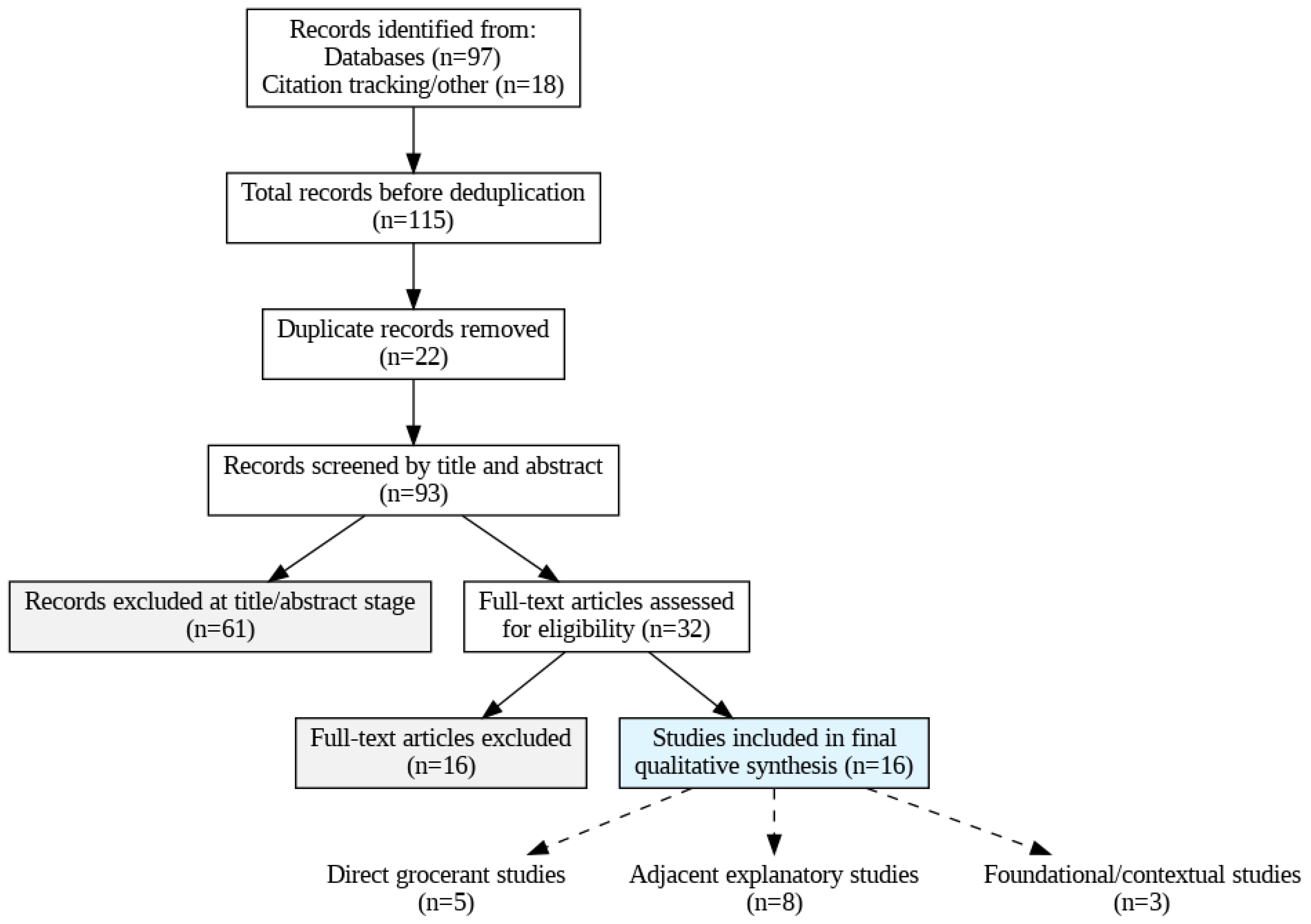
The screening process followed four main stages, identification, deduplication, eligibility assessment, and thematic inclusion, as detailed in Figure 1. During the initial identification stage, a total of 115 records were collected (97 from databases and 18 from citation tracking). After removing 22 duplicate records, 93 unique articles remained. The next step involved screening these 93 titles and abstracts to determine relevance, which led to the exclusion of 61 records. Subsequently, 32 full-text articles were assessed for eligibility. At this stage, 16 articles were excluded for failing to meet the inclusion criteria (e.g., focusing exclusively on restaurant settings without a retail connection). Finally, 16 studies were included in the qualitative synthesis. These comprised 5 direct grocerant studies, 8 adjacent explanatory studies, and 3 foundational/contextual studies.
While a final sample of 16 articles may appear modest for a comprehensive review covering consumer behavior, strategy, and operations, it accurately reflects the nascent state of academic research explicitly addressing the grocerant phenomenon. The goal of this PRISMA-informed review is not to conduct a meta-analysis of a mature field, but rather to map the contours of a rapidly emerging hybrid format where industry practice currently outpaces the academic literature. By anchoring the review in these 16 core articles—and carefully integrating them with strictly defined adjacent theoretical frameworks—this study provides the necessary theoretical scaffolding to define the grocerant concept, identify critical knowledge gaps, and structure a future research agenda.

2.5. Data Extraction and Coding

Each selected study was coded using a structured review matrix. The coding categories included:
  • Author(s) and year;
  • Article title;
  • Journal/source;
  • Country or context;
  • Literature type (direct grocerant, adjacent, or foundational);
  • Theoretical lens;
  • Research method;
  • Key constructs or variables;
  • Principal findings;
  • Relevance to grocerants;
  • Limitations and identified gaps.
After extraction, the studies were grouped into thematic clusters. These clusters were not imposed in advance as rigid categories, but emerged through repeated reading and comparison of the literature. Four broad themes became especially prominent:
  • Customer experience and in-store dining;
  • Perceived value, healthiness, and behavioral outcomes;
  • Branding, loyalty, and trust;
  • Retail innovation, convergence, and operational extension through prepared foods and digitalization.
This thematic approach was chosen because it best reflects the actual structure of the literature currently available. Direct grocerant research is concentrated in consumer-facing themes, whereas adjacent studies contribute more strongly to the strategic and operational interpretation of the format.

2.6. Methodological Limitations of the Review

As with any literature review, this study has limitations. First, the relatively small number of direct grocerant studies means that the review necessarily depends in part on the adjacent literature. This is a strength in terms of conceptual breadth, but it also means that not all included studies examine grocerants explicitly. Second, some publications were more accessible through abstracts, summaries, or indexed records than through complete full-text retrieval, which may limit the level of methodological detail available for certain studies. Third, because grocerants are an emerging topic, the terminology across studies is not standardized; related work may appear under labels such as hybrid retail, experiential food retail, prepared-food retail, or in-store dining. This creates a risk that some relevant studies may remain outside conventional search strings.
Even so, the review approach selected fits well with the current maturity of the field. By integrating the limited number of direct grocerant studies with conceptually relevant contributions from the adjacent literature, the review is able to reflect both the present state of explicit research on grocerants and the broader theoretical groundwork needed to interpret the development of this hybrid format.

3. Conceptualizing the Grocerant

A necessary starting point for any literature review on grocerants is conceptual clarification. Although the term has become increasingly visible in industry and practitioner discourse, its meaning is not always applied consistently. In some contexts, the grocerant is described simply as a grocery store with an expanded prepared-food section; in others, it refers to a more developed hybrid environment that integrates grocery retail, restaurant-style meal provision, and experiential in-store consumption (Yoo et al., 2020). This lack of uniformity makes conceptualization especially important, because how grocerants are defined affects the scope of the literature, the relevant theoretical lenses, and the criteria for distinguishing grocerants from adjacent retail and foodservice formats.

3.1. Defining the Grocerant

At its broadest, the grocerant can be understood as a hybrid retail–foodservice format that combines conventional grocery shopping with prepared meal offerings and, in many cases, on-site dining or restaurant-like service elements (Yoo et al., 2020). This definition captures three core elements.
First, the grocerant retains a grocery retail base. Unlike a restaurant, its identity remains anchored in food retailing, product assortment, and shopping behavior. Consumers visit not only to eat, but also to purchase groceries, ingredients, and packaged goods.
Second, the grocerant incorporates a meaningful foodservice component. This component goes beyond basic convenience foods or deli counters by offering meal solutions that are immediate, visible, and often positioned as substitutes for restaurant dining. In the direct grocerant literature, this foodservice dimension is central to understanding why consumers perceive value and choose to revisit these formats (US Foods, n.d.; Yoo et al., 2020).
Third, the grocerant often includes an experiential or social dimension. Research on grocerant in-store dining behavior suggests that consumers are influenced not merely by product availability, but also by product experience, uniqueness motives, and satisfaction (US Foods, n.d.). This indicates that the grocerant is not simply a transaction space for meal purchase; it is also an environment in which consumers may dine, linger, and engage with the retailer in more immersive ways.
Taken together, these features suggest that the grocerant is best conceptualized not as a minor extension of supermarket merchandising, but as a hybrid service format positioned between grocery retail and restaurant consumption.

3.2. Distinguishing Grocerants from Related Formats

Conceptual clarity also requires distinguishing grocerants from several adjacent food and retail formats. Although these formats overlap with grocerants in some respects, they are not identical.

3.2.1. Grocerants Versus Supermarket Deli or Prepared-Food Counters

A supermarket deli or prepared-food counter offers ready-to-eat items within a conventional grocery environment, but it does not necessarily constitute a grocerant. The distinction lies in the degree of integration between grocery retail and meal consumption. A deli counter may function as a supplementary department within the store, whereas a grocerant implies a stronger strategic and experiential integration of meal provision into the overall retail concept. The grocerant literature emphasizes customer experience, perceived value, dining behavior, and brand outcomes in ways that imply a more developed hybrid model than a simple add-on prepared-food offer (US Foods, n.d.; Yoo et al., 2020).

3.2.2. Grocerants Versus Restaurants

Grocerants differ from restaurants because their primary institutional base remains retail rather than hospitality. Restaurants are designed primarily around meal production, service, and dining occasions. By contrast, grocerants serve consumers whose visit may include both shopping and immediate consumption. This dual-purpose nature matters theoretically because it links grocerants to one-stop shopping and time-economizing behavior (Messinger & Narasimhan, 1997). Consumers may choose grocerants not only for meal quality or atmosphere, but because the format reduces the need for separate shopping and dining trips.

3.2.3. Grocerants Versus Convenience-Store Foodservice

Convenience stores increasingly sell fresh foods, hot meals, and ready-to-consume products, making them relevant comparison formats. Research on hybrid convenience stores demonstrates how retailers can expand traditional format boundaries by integrating new service roles (Ming-Sung Cheng et al., 2009). However, convenience-store foodservice is usually associated with speed, small-format access, and immediate utility, whereas grocerants typically operate within larger grocery environments and may offer a more extensive assortment, stronger freshness cues, and a more developed in-store experience. In this sense, grocerants represent a broader hybridization of shopping and dining than convenience-store meal retail.

3.2.4. Grocerants Versus Food Halls and Specialty Food Markets

Food halls and specialty food markets also combine food retail and consumption, but they often differ in governance structure, scale, and market positioning. Food halls typically aggregate multiple vendors in a curated consumption space, while grocerants are embedded within a grocery retailer’s integrated business model. This distinction matters because grocerants are not merely curated eating destinations; they are strategic transformations of the grocery store itself.

3.3. Grocerants as Hybrid Formats

The notion of hybridity is central to understanding the grocerant. Grocerants combine logics that were historically separated: the retail logic of assortment, self-service, and household provisioning, and the foodservice logic of prepared meals, immediacy, and dining experience. The literature on retail format innovation helps explain how such hybrids emerge. New retail formats develop as firms adapt to changing consumer needs and market conditions, often by recombining existing elements into new value propositions (Reynolds et al., 2007). The grocerant fits this pattern well, since it merges grocery retail infrastructure with restaurant-like consumption opportunities.
This hybrid nature is also visible through the lens of competitive convergence. Retail convergence occurs when firms from different sectors begin to overlap in functions, offerings, and customer relationships (Aranda et al., 2018). In the case of grocerants, grocery retailers move closer to restaurants by offering chef-prepared or ready-to-eat meals, dine-in spaces, and branded culinary experiences. At the same time, restaurants face growing competition from food retailers that can leverage location, assortment breadth, and grocery foot traffic to capture meal occasions. The grocerant is therefore not merely an innovative format; it is also an expression of structural convergence in food markets.

3.4. Functional and Experiential Dimensions of the Concept

A useful way to conceptualize grocerants is to recognize that they operate simultaneously in the functional and experiential dimensions.
On the functional side, grocerants address consumer demand for convenience, speed, and efficiency. Foundational work on retail formats argues that consumers often prefer formats that economize on shopping time and consolidate tasks (Messinger & Narasimhan, 1997). Grocerants serve this need by allowing consumers to purchase groceries and obtain meal solutions in a single visit. The adjacent literature on ready-to-eat foods further supports the idea that changing lifestyles increase the demand for convenient meal options (Bae et al., 2010).
On the experiential side, grocerants are shaped by the same kinds of variables that drive customer response in food retail and service settings more broadly. Research on experiential shopping in food retailing suggests that grocery shopping can be satisfying not only for utilitarian reasons but also because of sensory, affective, and environmental qualities (Lang & Hooker, 2013). Similarly, supermarket experience research identifies the assortment, staff interaction, and store environment as important drivers of the shopping experience (Terblanche, 2018). In grocerants, these experiential elements are intensified by the foodservice component, since customers may evaluate the space not only as shoppers but also as diners.
This duality is analytically important. If grocerants are seen only as convenience formats, their experiential and branding functions are underestimated. If they are seen only as restaurant substitutes, their retail embeddedness and operational distinctiveness are obscured. A more accurate conceptualization recognizes them as formats where convenience and experience coexist.

3.5. Grocerants as Brand and Relationship Spaces

The available literature also suggests that grocerants should be understood as brand-mediated environments. Research on brand experience and consumer-based brand equity in grocerants indicates that the format can influence loyalty through experience-based interactions (Jeon & Yoo, 2021). Likewise, research on organic grocerants shows that emotional and social value can promote engagement through trust (Yu et al., 2022). These findings imply that grocerants are not just channels for selling prepared foods; they are spaces in which retailers can build deeper customer relationships.
This perspective extends the concept beyond physical format design. A grocerant can be seen as a strategic interface where consumers encounter the retailer’s promise of freshness, convenience, healthiness, and lifestyle alignment. In this respect, the grocerant may function as a platform for differentiation in crowded food markets, especially where traditional grocery retail is under pressure from price competition and online alternatives.

3.6. A Working Definition for This Review

Given the diversity of related formats and the still-emerging nature of the literature, this review adopts the following working definition.
A grocerant is a hybrid grocery-retail and foodservice format in which a grocery-based retailer integrates prepared meal offerings and/or in-store dining into the shopping environment in ways that create both functional convenience and experiential value.
This definition is intentionally broader than a narrow focus on dine-in grocery stores, but narrower than any supermarket selling convenience food. It includes formats where the prepared-food and consumption dimension is significant enough to shape the customer experience, behavioral outcomes, and strategic positioning. It also aligns with the literature reviewed so far, which emphasizes the interaction of convenience, customer experience, perceived value, and hybrid retail innovation (Messinger & Narasimhan, 1997; Reynolds et al., 2007; US Foods, n.d.; Yoo et al., 2020).

3.7. Implications of the Concept

Conceptualizing the grocerant in this way has three implications for the remainder of the review. First, it justifies examining the format through consumer perspectives, since experience, healthiness, value, and loyalty are central to how grocerants are currently studied (Jeon & Yoo, 2021; Yoo et al., 2020). Second, it supports a strategic perspective, because grocerants are clearly part of the wider processes of retail innovation and convergence (Aranda et al., 2018; Reynolds et al., 2007). Third, it requires attention to operational and environmental perspectives, since prepared foods, retail food environments, and digital integration all shape how grocerants function in practice (Bae et al., 2010; Wang & Coe, 2021; Winkler et al., 2020).
In short, the grocerant should be conceptualized as more than a trend label. It represents a meaningful shift in the organization of food retail and consumption, one that requires analysis across consumer, strategic, and operational dimensions.
To provide an overview of the evidence base underlying the thematic analysis, Table 2 summarizes the principal studies included in this review, including direct grocerant research and adjacent foundational contributions.
As Table 2 shows, the literature is concentrated in consumer-oriented studies of experience, value, and behavioral outcomes, while strategic, operational, and digital perspectives are less extensively developed.

4. Customer Experience and In-Store Dining

Among the available streams of grocerant research, the most developed concern the customer experience and in-store dining behavior. This emphasis is unsurprising, since grocerants differ from conventional grocery retail not only through their assortment of prepared foods, but also through the way they transform the customer encounter. In a traditional supermarket, the customer journey is largely organized around product search, selection, and purchase. In a grocerant, by contrast, the customer may also browse meal options, evaluate freshness and presentation, engage with service staff, remain on-site to eat, and interpret the store as both a retail and consumption environment. As a result, the grocerant experience is more layered than ordinary grocery shopping.

4.1. Customer Experience as a Core Explanatory Lens

Direct grocerant scholarship strongly suggests that customer experience is one of the main drivers of grocerant outcomes. The study on customer experience, food healthiness, and revisit intention in grocerants explicitly places experiential factors at the center of its explanatory model, arguing that customer experience helps shape perceived value and subsequent intention to return (Yoo et al., 2020). This is conceptually important because it indicates that grocerants are not merely judged on the basis of product availability or price competitiveness. Instead, customers respond to the broader experiential environment in which the food is encountered and consumed.
This perspective aligns with wider research in food retailing, which shows that shopping experiences can affect customer satisfaction even in contexts traditionally regarded as utilitarian. The work on experiential shopping in food retailing demonstrates that food retail can generate consumer satisfaction through experiential dimensions rather than solely through functional efficiency (Lang & Hooker, 2013). Applied to grocerants, this means that a shopper’s evaluation may depend on sensory stimulation, atmosphere, novelty, convenience, and feelings associated with the act of combining shopping and eating in one place. The grocerant therefore appears to operate as an experience-rich retail setting, not simply as a distribution channel for prepared meals.

4.2. The Transformation of Grocery Retail into a Dining Environment

A defining feature of the grocerant is its transformation of the grocery store from a place of purchase into a place of consumption. This shift has important implications for how customer behavior is understood. The study on the rise of the grocerant examines patrons’ in-store dining experiences and consumption behaviors at grocery retail stores and shows that product experience and related psychological factors shape in-store dining behavior (Ham et al., 2021). The significance of this finding lies in the fact that grocery retail is no longer treated merely as a pre-consumption stage of meal preparation at home. Instead, the store itself becomes part of the dining occasion.
This transformation alters the temporal and spatial logic of grocery shopping. Consumers do not necessarily visit only to provision for later household use; they may also seek immediate gratification, social interaction, or an alternative to restaurant dining. In practical terms, this means that the grocery environment must support behaviors more commonly associated with foodservice, such as browsing menu-like meal offerings, making on-the-spot meal decisions, and evaluating whether the store is a pleasant or socially acceptable place to eat. The grocerant thus repositions the supermarket as an active site of meal consumption.

4.3. Product Experience, Uniqueness, and Hedonic Motivations

The grocerant literature also suggests that in-store dining cannot be explained solely by convenience. In the study of grocerant patrons, the product experience and need for uniqueness are highlighted as important components of consumption behavior (Ham et al., 2021). This implies that grocerant visits may be motivated not only by efficiency, but also by hedonic and identity-related considerations. Customers may value a grocerant because it offers something distinctive from ordinary grocery shopping and, at the same time, something more casual or flexible than restaurant dining.
This interpretation is reinforced by broader experiential shopping research. If food retailing can produce satisfaction through experiential qualities (Lang & Hooker, 2013), then grocerants may be especially well positioned to capture consumers seeking novelty, variety, and a hybrid consumption experience. Ready-to-eat meals displayed in attractive formats, open kitchens, food sampling, chef-prepared counters, or themed eating spaces can all contribute to a sense that the grocerant offers a different type of retail encounter. These features may help explain why some customers choose grocerants not just as convenient options, but as appealing and memorable destinations.

4.4. The Role of the Store Environment and Service Encountered

Customer experience in grocerants is also likely shaped by the physical and interpersonal environment of the store. Although direct grocerant studies have focused primarily on experience, satisfaction, and intention, adjacent supermarket research helps identify the environmental variables most relevant to the format. Terblanche’s work on the supermarket in-store customer shopping experience points to merchandise assortment, staff interaction, and the internal store environment as important determinants of customer response (Terblanche, 2018). These variables are highly relevant to grocerants because the hybrid format intensifies the importance of layout, service, cleanliness, seating, food presentation, and overall ambiance.
In a grocerant, assortment matters not only in the traditional retail sense of product variety, but also in terms of meal choice architecture. Consumers may evaluate the breadth and attractiveness of prepared foods much as they would evaluate a restaurant menu. Staff interaction may also take on greater significance because the prepared-food component often involves more visible service contact than standard grocery shopping. Likewise, the internal environment of the store—the lighting, aroma, noise, seating arrangements, and the organization of dining zones—may influence whether customers perceive the space as suitable for lingering and eating, rather than only purchasing and leaving.
From this perspective, grocerants create a more complex service environment than conventional grocery stores. They require retailers to manage both retail efficiency and hospitality-like experience cues at the same time. This dual challenge is one reason customer experience becomes such a central theme in the literature.

4.5. Functional Convenience and Experiential Value as Interacting Forces

An important insight emerging from the literature is that the grocerant experience is shaped by the interaction of functional convenience and experiential value. On the functional side, grocerants respond to consumers’ desire to economize on time and solve multiple food-related needs in one trip. Foundational retail theory emphasizes that formats appealing to time-constrained consumers often succeed by combining tasks and reducing effort (Messinger & Narasimhan, 1997). Grocerants clearly fit this logic by allowing consumers to shop for groceries and obtain immediate meals in a single setting.
However, the direct grocerant studies suggest that convenience alone is not enough to explain outcomes such as satisfaction, revisit intention, and in-store dining behavior (Ham et al., 2021). Customers also respond to how the grocerant makes them feel, how distinctive the products appear, and whether the environment creates value beyond simple utility. The adjacent retail literature on experiential shopping (Lang & Hooker, 2013) implies that in such settings, convenience and experience operate as mutually reinforcing dimensions. Theoretical inferences suggest a grocerant may succeed precisely because it packages convenience in an environment that feels fresher or more socially engaging than a conventional supermarket.

4.6. In-Store Dining as a Behavioral Outcome

The growth of in-store dining is one of the clearest indicators that the grocerant format differs from standard grocery retail. In-store dining represents more than a point-of-sale decision; it reflects a willingness to treat the grocery store as a legitimate site of meal consumption. The literature on grocerant patrons indicates that this behavior is associated with product experience and satisfaction (Ham et al., 2021). This suggests that customers must perceive sufficient quality, distinctiveness, and situational appropriateness before deciding to consume food on-site.
In-store dining also has broader strategic significance. When customers remain in the store to eat, the retailer potentially increases dwell time, deepens engagement, and creates additional opportunities for cross-purchase. Although this business-side effect is still underexplored in the grocerant literature, the customer side is already clear: in-store dining turns the grocery trip into a richer experience, blending shopping, eating, and, potentially, leisure. It thereby changes the role of the retail environment in everyday food consumption.

4.7. Implications of the Customer Experience Literature

The current literature supports several broader conclusions about the customer experience in grocerants. First, grocerants should be treated as hybrid service environments in which customers evaluate both retail and dining attributes. Second, customer responses are shaped not only by convenience, but also by sensory, affective, and symbolic factors (Ham et al., 2021; Lang & Hooker, 2013; Yoo et al., 2020). Third, the environmental and interpersonal components of the store—the assortment, staff interaction, atmosphere, and internal layout—are likely central to whether grocerants can sustain customer interest and repeat patronage (Terblanche, 2018).
At the same time, this literature remains incomplete. Most studies focus on customer perceptions and intentions rather than on observed behavior, store-level performance, or comparisons across different grocerant designs. Nonetheless, the existing evidence clearly establishes customer experience and in-store dining as foundational themes in grocerant research. They provide the basis for the next major question in the literature: how these experiences translate into perceived value, health-related judgments, and behavioral intentions such as satisfaction, loyalty, and revisit intention.

5. Perceived Value, Food Healthiness, and Behavioral Intentions

A second major theme in the grocerant literature concerns the relationship between the customer experience and a set of downstream evaluative and behavioral outcomes, especially perceived value, food healthiness, satisfaction, revisit intention, and broader forms of customer engagement. If the previous section established that grocerants operate as hybrid experiential environments, this section examines how consumers interpret those experiences and translate them into judgments about whether the format is worthwhile, trustworthy, and worth returning to. This theme is particularly important because the success of grocerants depends not only on attracting trial visits, but also on convincing consumers that grocery-based meal consumption offers meaningful value relative to restaurants, convenience stores, and home meal preparation.

5.1. Perceived Value as a Central Outcome

Perceived value appears to occupy a central position in the current grocerant literature. In the most visible direct study on the topic, customer experience and food healthiness are explicitly linked to value creation and revisit intention in the grocerant context (Yoo et al., 2020). This framing suggests that grocerant success cannot be understood solely through operational inputs such as product availability or prepared-food assortment. Rather, what matters is how consumers interpret the total offering and whether they perceive a favorable balance between benefits and costs.
In a grocerant, value is likely multidimensional. Functional benefits may include convenience, speed, one-stop access, meal immediacy, and the possibility of combining grocery shopping with dining. Experiential benefits may include freshness cues, ambiance, product presentation, novelty, and the pleasure of browsing or eating in a nontraditional setting. Symbolic or psychological benefits may also be present, especially where the format signals quality, health consciousness, modernity, or lifestyle alignment. The available literature strongly implies that grocerant value is not reducible to price alone; it emerges from a combination of utilitarian and hedonic factors (Ham et al., 2021; Yoo et al., 2020).
This interpretation is also consistent with the adjacent retail literature. If food retail experiences can shape satisfaction through experiential mechanisms (Lang & Hooker, 2013), then grocerants are likely to generate value by making everyday food acquisition feel more attractive, efficient, and rewarding. In this sense, perceived value functions as a bridge between the design of the grocerant environment and customers’ willingness to continue engaging with the format. The literature further indicates that value in grocerants encompasses multiple dimensions—including functional, hedonic, social, and financial components—suggesting that customers evaluate the format through layered criteria rather than single-attribute judgments (Kim et al., 2019).

5.2. Food Healthiness as a Distinguishing Evaluative Dimension

One of the more distinctive contributions of grocerant research is its attention to food healthiness. Unlike many studies of convenience-oriented food consumption, grocerant scholarship suggests that consumers evaluate these formats not only in terms of speed and experience, but also in terms of whether the food appears healthy or aligned with wellness-oriented preferences (Yoo et al., 2020). This dimension is especially significant because it may differentiate grocerants from some traditional restaurant and fast-food alternatives.
The association between food healthiness and perceived value implies that consumers do not treat all convenient meal options equally. Grocery retailers may benefit from the perception that their prepared foods are fresher, more natural, or more nutritionally acceptable than other out-of-home food sources. This is important in theoretical terms because it complicates the assumption that convenience necessarily trades off against quality or health. In the grocerant setting, convenience may be strengthened rather than undermined by a health-oriented image.
The importance of health-related value is further extended in work on organic grocerants, where perceived organic value is linked to customer engagement through brand trust (Yu et al., 2022). Although organic grocerants represent a more specialized context, the findings suggest that health and sustainability cues can deepen the customer response beyond immediate purchase decisions. Where consumers perceive that the grocerant aligns with their broader beliefs about healthy or responsible consumption, value becomes not only functional but also moral- and identity-related.

5.3. Satisfaction and Revisit Intention

Another major concern of the literature is how value perceptions influence revisit intention. The existing grocerant studies consistently suggest that positive evaluations of the experience and offering increase the likelihood that customers will return (Ham et al., 2021; Yoo et al., 2020). Revisit intention is especially relevant in this context because grocerants depend on repeat usage to become embedded in consumers’ everyday routines. Unlike destination dining, which may rely on occasional visits, grocerants are positioned to capture recurring meal occasions and routine food purchases.
The literature implies that revisit intention is driven by a chain of relationships. First, the customer encounters the grocerant environment and offering. Second, the customer forms judgments about the experience, food quality, and value. Third, these evaluations influence satisfaction and the intention to revisit. This logic is visible in the direct work on customer experience and value (Yoo et al., 2020) and is reinforced by the study of in-store dining experiences and consumption behavior, where satisfaction appears as an important determinant of behavioral response (Ham et al., 2021).
This pattern also helps explain why grocerants should not be treated as mere convenience mechanisms. If revisit intention depends on satisfaction and perceived value rather than on convenience alone, then the format’s long-term viability depends on delivering a consistently attractive and credible consumption experience. Consumers may try a grocerant because it is convenient, but they return because it is satisfying, trustworthy, and relevant to their preferences.

5.4. Emotional, Social, and Symbolic Dimensions of Value

The current literature also suggests that grocerant value includes more than practical utility. Research indicates that emotional and social value are important drivers of the customer response in grocerants, alongside functional and financial considerations (Kim et al., 2019; Yu et al., 2022). This indicates that customer responses may be shaped by how the grocerant makes them feel, what it communicates about their identity, and how it positions them socially. Such dimensions are particularly relevant in food consumption, where eating choices often carry cultural and symbolic meaning.
This broader view of value is useful because it helps explain why consumers may choose grocerants even when lower-cost or faster alternatives exist. A grocerant may offer a sense of modernity, urban convenience, health consciousness, or culinary discovery. It may also provide a more socially comfortable middle ground between formal restaurant dining and purely functional takeaway consumption. In this respect, perceived value should be seen as a layered construct that captures emotional gratification, social meaning, and lifestyle fit as well as convenience.
This finding also has implications for how grocerants compete. If their value proposition includes emotional and symbolic dimensions, then they are competing not only on price and accessibility, but also on image, trust, and experiential differentiation. That dynamic is especially important in markets where grocery retail is otherwise vulnerable to commoditization.

5.5. Customer Engagement Beyond Repeat Patronage

While revisit intention remains a central behavioral indicator, some of the newer literature expands the discussion toward customer engagement. The organic grocerant study shows that perceived value can influence engagement behavior through brand trust (Yu et al., 2022). This is a notable extension because it shifts the literature from simple behavioral repetition to a richer relational perspective. Engagement implies not just returning to the grocerant, but forming a more active and meaningful connection with it.
In practical terms, engaged customers may be more likely to advocate for the brand, participate in co-creation, respond positively to innovation, or incorporate the grocerant into their identity and routines. For retailers, this is strategically significant: if grocerants can generate engagement rather than merely transactions, they may support stronger customer relationships than traditional grocery formats. For scholars, the engagement perspective broadens the research agenda by linking grocerants to contemporary work on brand communities, trust, and relationship marketing.

5.6. The Interaction Between Healthiness, Trust, and Loyalty

The literature also points toward an important interaction among healthiness, trust, and loyalty-related outcomes. Research on brand experience and consumer-based brand equity in grocerants suggests that the format can influence loyalty through experience-based mechanisms, with staged experiences contributing to brand prestige and strengthening customer attachment (Jeon & Yoo, 2021; Kim et al., 2019). When this is considered alongside findings on healthiness and organic value (Yoo et al., 2020; Yu et al., 2022), a more integrated picture emerges: consumers may develop stronger attachment to grocerants when they perceive the format as offering not only enjoyable and convenient meals, but also credible and health-supportive food choices.
Trust is crucial here. Grocery retailers may possess an advantage over some restaurant competitors because they are associated with freshness, visible ingredients, and household provisioning. If the grocerant format successfully transfers that trust into the prepared-food category, it may gain a distinctive position in consumers’ minds. In turn, this can reinforce loyalty and revisit intention. Although the current literature does not yet provide a full causal model across all these variables, it strongly suggests that healthiness is not merely a peripheral attribute; it may be a central pathway through which grocerants build durable consumer relationships.

5.7. Tensions in the Value Proposition

Despite the generally positive orientation of the literature, the grocerant value proposition may also contain internal tensions that deserve attention. For example, a grocerant must simultaneously signal convenience and quality, immediacy and freshness, accessibility and distinctiveness. If the offering becomes too utilitarian, it risks being perceived as little more than a supermarket takeaway counter. If it becomes too experience-focused or premium, it may lose the convenience advantage that originally justifies the format. Similarly, if healthiness claims are not matched by consumers’ actual perceptions of the ingredients, preparation, or transparency, the value proposition may weaken.
These tensions are not yet fully explored in the direct literature, but they are implicit in the variables already studied. The need to balance convenience, experiential appeal, healthiness, and trust suggests that grocerants occupy a delicate middle ground between grocery retail and restaurant dining. Future research will need to clarify how consumers navigate these trade-offs and which dimensions matter most under different market conditions.

5.8. Implications of the Behavioral-Outcome Literature

Overall, the current evidence indicates that grocerants generate behavioral outcomes through a complex value-formation process. Customer experience contributes to perceived value; perceived healthiness strengthens that value; and satisfaction and trust help convert positive evaluations into revisit intention, loyalty, and engagement (Ham et al., 2021; Jeon & Yoo, 2021; Yoo et al., 2020; Yu et al., 2022). This means that grocerants should be analyzed as integrated value systems rather than as isolated prepared-food offers.
For the broader literature review, this theme has two major implications. First, it confirms that grocerants are deeply tied to consumer behavior, especially in relation to how customers evaluate convenience, quality, and experience together. Second, it points toward branding and relational outcomes as the next logical area of inquiry. If value and healthiness shape satisfaction and revisit intention, then the next question is how grocerants cultivate stronger forms of attachment, trust, and loyalty over time. That issue is taken up in the following section.

6. Branding, Trust, and Loyalty

While the grocerant literature has been most explicit on experience, value, and revisit intention, an increasingly important line of inquiry concerns branding, trust, and loyalty-related outcomes. This perspective is significant because it moves analysis beyond immediate transaction-based behavior and toward the longer-term relational role that grocerants may play within retail strategy. If grocerants are understood only as convenient prepared-food offers, their strategic importance is understated. By contrast, if they are seen as spaces where retailers build emotional connection, trust, and differentiated brand meaning, then they become much more central to competitive positioning in food retail.

6.1. Grocerants as Brand Experience Environments

The most direct contribution in this area is the study examining the relationship between brand experience and consumer-based brand equity in grocerants (Jeon & Yoo, 2021). Its importance lies in the way it reframes the grocerant: not simply as a hybrid service format, but as a brand-mediated environment in which consumers encounter the retailer through sensory, affective, and behavioral cues. This shifts the analytical focus from product assortment alone to the broader question of how the grocerant shapes what the retailer means to consumers.
In a traditional supermarket context, brand equity may be built through price image, assortment breadth, location convenience, or perceived product quality. In a grocerant, however, the brand can also be experienced through food presentation, meal quality, ambiance, service interaction, and in-store consumption. These additional touchpoints allow the retailer to create more immersive and memorable encounters. Consequently, the grocerant may function as a more emotionally resonant brand channel than ordinary grocery shopping.
This interpretation is consistent with the broader experiential food-retail literature. If shopping experiences influence satisfaction and consumer response in food retailing (Lang & Hooker, 2013), then it follows that a hybrid format like the grocerant should have even greater capacity to shape brand associations. By integrating retail and dining, grocerants increase the number and intensity of moments through which consumers interpret the retailer’s identity.

6.2. From Transactional Satisfaction to Relational Loyalty

A key theoretical implication of the branding literature is that grocerants may help move customer relationships from transactional satisfaction toward relational loyalty. Earlier sections showed that experience and value influence satisfaction and revisit intention (Ham et al., 2021; Yoo et al., 2020). The branding perspective extends this by asking whether repeated positive grocerant experiences strengthen attachment to the retailer itself.
Consumer-based brand equity is relevant here because it reflects how strongly and positively consumers respond to a brand in ways that can sustain future preference. In the grocerant context, this suggests that prepared meals and in-store dining are not merely ancillary services; they may become part of the retailer’s identity in the minds of consumers (Jeon & Yoo, 2021). A grocery retailer that successfully delivers enjoyable grocerant experiences may cultivate loyalty not only to its meals, but also to the broader store brand.
This is strategically important because grocery retail has often been characterized by intense competition and low differentiation. If grocerants enable retailers to create richer emotional and experiential bonds with customers, they may become a valuable mechanism for reducing commoditization. In that sense, loyalty in grocerants should be viewed not just as the repeat buying of food items, but as a deeper brand preference anchored in hybrid consumption experiences.

6.3. The Role of Trust in Grocerant Relationships

Alongside branding, trust emerges as a critical mechanism in grocerant research. The organic grocerant study shows that perceived value affects customer engagement behavior through brand trust (Yu et al., 2022). This finding is especially useful because it clarifies how value perceptions may be converted into longer-term relational outcomes. Consumers do not necessarily become loyal simply because a format is convenient or novel; loyalty is more likely when those benefits are interpreted through a lens of reliability, credibility, and alignment with consumer expectations.
Trust may be especially important in the grocerant context for several reasons. First, food purchase involves direct concerns with freshness, safety, quality, and health. Second, grocerants blur the boundary between grocery provisioning and ready-to-eat consumption, which means consumers must decide whether they trust the retailer not only as a seller of ingredients, but also as a provider of meals. Third, grocerants often position themselves around qualities such as freshness, wholesomeness, or healthiness, making the credibility of those claims central to the consumer response (Yoo et al., 2020; Yu et al., 2022).
In this respect, grocerants may benefit from a pre-existing reservoir of trust associated with grocery retail. Compared with some restaurant or fast-food formats, grocery retailers may be perceived as closer to the source of food, more transparent in ingredient presentation, or more credible in claims related to freshness and quality. If effectively leveraged, this trust can become a strategic asset in building loyalty to grocerant offerings.

6.4. Emotional and Social Pathways to Loyalty

The grocerant literature also indicates that trust and loyalty are not formed only through functional performance. The organic grocerant study emphasizes the role of emotional and social value in shaping engagement (Yu et al., 2022). This suggests that grocerants may generate stronger customer ties when they resonate with consumers’ feelings, identities, and social self-understandings.
From this standpoint, loyalty is not just a repeated behavioral response to convenience or satisfaction. It may also reflect identification with what the grocerant stands for—such as freshness, modernity, health consciousness, sustainability, or a certain urban lifestyle. Consumers may come to regard the grocerant as a place that fits who they are or who they wish to be. Such symbolic alignment can deepen attachment in ways that are difficult for purely utilitarian retail formats to replicate.
This insight is especially relevant in markets where consumers are increasingly attentive to the ethical, health, or lifestyle dimensions of food. Grocerants that successfully communicate these values may create not only customer retention but also advocacy and positive word-of-mouth. Although the current literature has only begun to address these mechanisms, it points toward a more relational understanding of grocerant success.

6.5. Brand Experience as Strategic Differentiation

The grocerant’s branding function is also important from a strategic viewpoint because it can support differentiation in highly competitive food markets. Retailers traditionally compete on factors such as price, location, assortment, and promotions. Grocerants add another layer by allowing differentiation through atmosphere, culinary positioning, in-store service, and experience-based branding. The literature on retail innovation and convergence suggests that hybrid formats emerge partly because firms seek new ways to distinguish themselves in changing competitive environments (Aranda et al., 2018; Reynolds et al., 2007).
In this setting, grocerants can become more than service extensions; they can become symbols of innovation and brand modernization. A retailer with a successful grocerant concept may signal that it understands contemporary lifestyles, offers higher-quality meal solutions, and provides a more engaging shopping environment than traditional supermarkets. This is especially valuable in contexts where standard grocery retail risks being perceived as undifferentiated.
Thus, brand experience in grocerants should be understood not merely as a consumer-psychology variable, but as a strategic mechanism through which retailers reposition themselves. The format can help move the retailer from a purely provision-based identity toward that of a lifestyle-oriented food destination.

6.6. Interconnections Among Experience, Value, Trust, and Loyalty

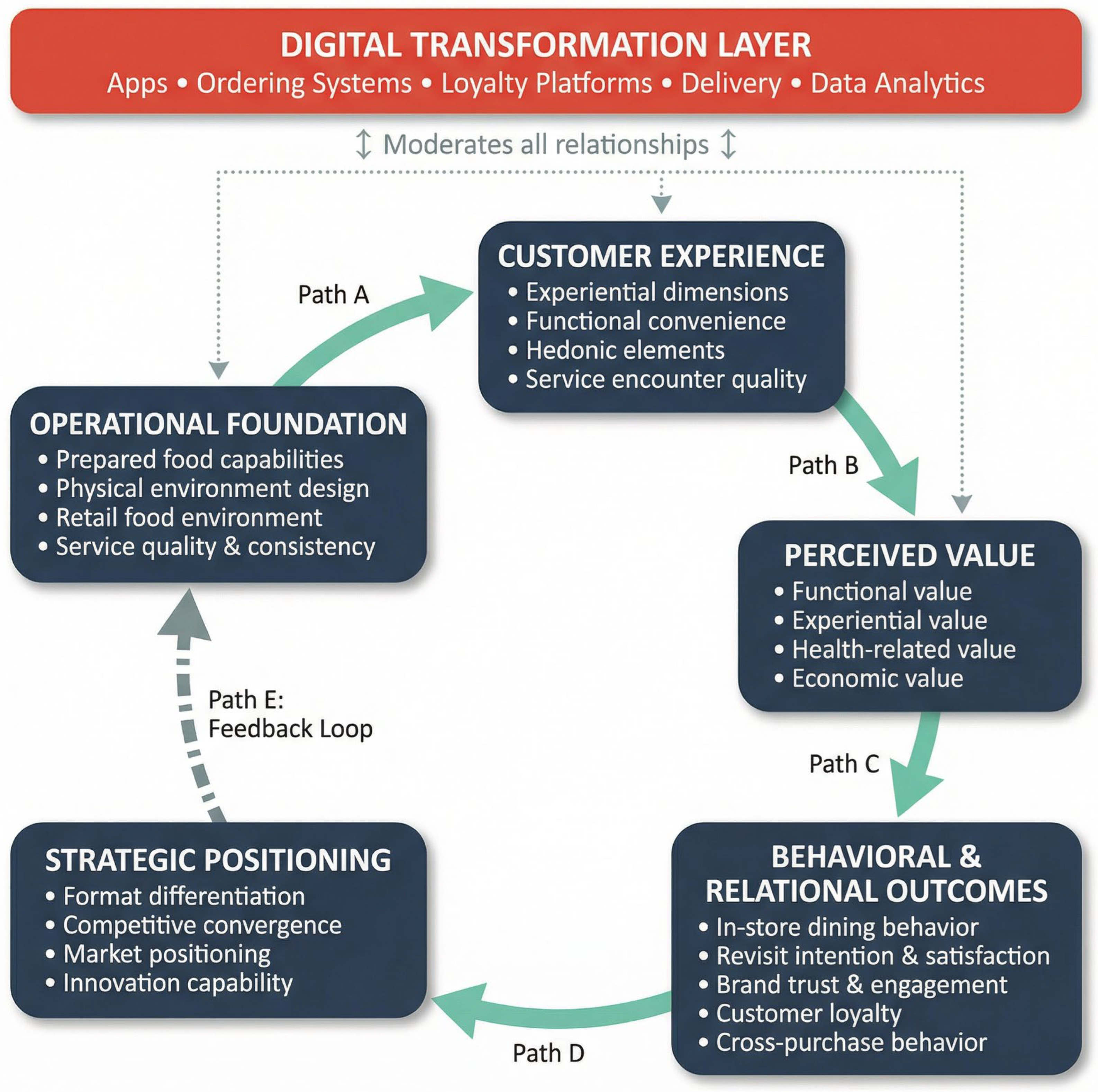
One of the most useful contributions of the current literature is that it allows an emerging relational chain to be inferred. Customer experience shapes perceived value; perceived value and healthiness support trust; and trust contributes to engagement, brand equity, and ultimately loyalty-related outcomes (Jeon & Yoo, 2021; Yoo et al., 2020; Yu et al., 2022). Although not all these links have been tested together in a single grocerant model, the cumulative evidence suggests that they are mutually connected.
This matters because it shows that grocerant loyalty is unlikely to be based on one factor alone. A customer may be attracted by convenience, persuaded by freshness and healthiness, satisfied by the experience, and retained through trust and brand attachment. That layered process helps explain why grocerants deserve attention as relationship platforms rather than merely transactional retail innovations.
It also indicates why poor execution can be particularly damaging. If the experience disappoints, the perceived value falls; if the health or quality cues are inconsistent, trust weakens; if trust weakens, brand loyalty and engagement become harder to sustain. The grocerant value proposition is therefore relationally rich but also vulnerable to inconsistency across multiple dimensions.

6.7. Limits of the Current Branding Literature

Despite its promise, the literature on branding, trust, and loyalty in grocerants remains underdeveloped. The most visible direct studies establish the importance of brand experience and trust-related mechanisms (Jeon & Yoo, 2021; Yu et al., 2022), but several important questions remain unanswered.
First, there is limited comparative evidence showing whether grocerants generate stronger loyalty than other food retail or restaurant formats. Second, most studies focus on attitudinal outcomes rather than actual long-term purchasing behavior. Third, little is known about how branding effects vary across different grocerant models—for example, premium organic grocerants, mass-market grocery chains, or digitally integrated meal-retail concepts. Fourth, the operational foundations of trust remain insufficiently explored. Consumers may trust a grocerant because of freshness, transparency, hygiene, consistency, or service, but the literature has not yet disentangled these mechanisms fully.
These limitations suggest that branding research on grocerants is still at an early stage. Even so, the existing work already makes an important contribution by demonstrating that grocerants are not only formats for selling meals, but also environments for building brand meaning and customer relationships.

6.8. Implications for Understanding Grocerants

Overall, the literature reviewed in this section shows that grocerants have the potential to function as relationship-building spaces where retailers cultivate trust, loyalty, and differentiated brand equity. Experience-based encounters appear to strengthen consumers’ evaluations of the retailer; perceived value and health-related cues help establish trust; and trust, in turn, supports engagement and loyalty-related outcomes (Jeon & Yoo, 2021; Yoo et al., 2020; Yu et al., 2022). This expands the understanding of grocerants from a convenience or prepared-food phenomenon to a strategically meaningful branding mechanism.
For the broader argument of this article, the branding perspective reinforces the claim that grocerants must be studied not only through consumer behavior, but also through strategic and operational lenses. If grocerants build loyalty and brand equity, then they are clearly implicated in retail transformation and competitive positioning. The next section therefore turns to that wider strategic context by examining grocerants as a form of retail format innovation and competitive convergence.

7. Grocerants as Retail Format Innovation and Competitive Convergence

Beyond their consumer-facing effects, grocerants must also be understood as a strategic response to structural change in retailing. The grocerant is not simply a merchandising addition or a prepared-food department with seating; it is better interpreted as a retail format innovation that reflects changing consumer expectations, intensifying competition for food expenditure, and the gradual erosion of traditional boundaries between grocery retail and restaurant foodservice. This broader perspective is important because it situates grocerants within long-term transformations in retail organization rather than treating them as an isolated trend.

7.1. Retail Format Innovation as a Theoretical Lens

The literature on retail format innovation provides a useful foundation for analyzing grocerants. Research in this tradition argues that retail formats evolve as firms adapt their business models, service configurations, and value propositions to new market conditions (Reynolds et al., 2007). Retail innovation is therefore not limited to technological change; it also includes the recombination of existing elements into new customer propositions. In this sense, the grocerant can be viewed as an innovative recombination of two historically distinct logics: grocery provisioning and restaurant-style meal consumption.
This framing is analytically valuable because it emphasizes that grocerants appear to be deliberate attempts by retailers to redesign the store’s role in consumers’ lives. Instead of functioning only as sites for household provisioning, grocery stores increasingly seek to become destinations for immediate meal solutions, on-site consumption, and a more immersive customer experience. The grocerant is thus a manifestation of format evolution in response to new competitive realities.
The broader literature on the evolution of retail formats also supports this view by suggesting that formats develop over time in relation to customer needs, operational capabilities, and competitive pressures (Gauri et al., 2021). From that perspective, grocerants can be interpreted as part of a wider movement toward customer-centric, multifunctional formats in which efficiency, experience, and service integration are combined.

7.2. One-Stop Shopping and Shopping-Time Economizing

A central driver of retail format innovation is the consumer demand for convenience. Foundational work by Messinger and Narasimhan argues that retail formats gain appeal when they enable consumers to economize on shopping time and consolidate tasks within a single trip (Messinger & Narasimhan, 1997). This framework is especially relevant to grocerants. By combining grocery shopping with prepared meal purchase and, in some cases, dine-in consumption, grocerants reduce the need for separate visits to grocery stores, restaurants, or takeaway outlets.
This convenience logic helps explain why grocerants fit contemporary food consumption patterns. Consumers facing time pressure may prefer formats that allow them to solve multiple needs at once: buying ingredients for later use, purchasing an immediate meal, and perhaps dining on-site or taking food away. In this sense, the grocerant extends the one-stop shopping principle into the domain of meal occasions. It competes not only as a retailer of groceries, but also as a provider of convenience in the broader management of everyday eating.
However, the grocerant is more than a time-saving device. As the earlier sections showed, consumer experience, value, and brand effects are central to the format (Ham et al., 2021; Jeon & Yoo, 2021; Yoo et al., 2020). This suggests that the grocerant should be understood as a format in which convenience and experience are strategically bundled. Its innovation lies not only in consolidating functions, but in doing so in a way that promises freshness, quality, and a more engaging encounter than purely utilitarian retail.

7.3. Competitive Convergence Between Grocery Retail and Restaurants

A second major strategic lens is competitive convergence. Research on convergence in retailing shows that hybrid formats emerge when sectors once viewed as distinct begin to overlap in their products, services, and customer propositions (Aranda et al., 2018). The grocerant is a clear expression of this process. Grocery retailers increasingly incorporate restaurant-like features such as chef-prepared meals, dine-in areas, visible foodservice operations, and experience-oriented consumption zones. At the same time, restaurants face competition from grocery operators that can provide ready-to-eat meals under conditions of high foot traffic, broad assortment, and existing consumer trust in food retail.
The literature on retail format evolution suggests this convergence has the potential to change how competition is structured in food markets. While grocery retailers and restaurants historically served distinct needs, direct grocerant studies imply that these formats blur this distinction. Theoretically, this enables retailers to compete for a larger share of consumers’ total food budget, especially the growing portion devoted to convenient, ready-to-eat meal solutions.
From a strategic standpoint, convergence also implies a redefinition of competitive advantage. Grocery retailers may leverage capabilities that restaurants do not possess at the same scale, including strong supply chains, established food purchasing trust, a wide product range, and the ability to capture impulse meal decisions during routine shopping visits. Conversely, they must also develop competencies more typical of foodservice, such as meal quality management, ambiance creation, and customer service around prepared foods. The grocerant therefore represents both an opportunity and a capability challenge.

7.4. Hybridization as Response to Market Pressure

The rise of grocerants can also be understood as a response to several forms of market pressure. First, grocery retailing in many contexts is marked by high competition and limited differentiation. In such settings, grocerants offer a way to create distinctiveness beyond price and assortment. Second, food-away-from-home consumption has expanded, creating pressure on retailers to capture meal occasions rather than only ingredient purchases. Third, consumers increasingly expect seamless transitions between shopping, eating, takeaway, and digital ordering. The grocerant allows retailers to respond to all three pressures simultaneously.
The retail innovation literature suggests that such recombination is typical when established formats face environmental disruption (Reynolds et al., 2007). Rather than defending the old model of grocery retail, firms experiment with hybridization to remain relevant. In this sense, grocerants should be seen as part of a broader adaptive strategy in which stores become more multifunctional, service-intensive, and customer-experience-oriented.
This hybridization also has symbolic importance. It signals that the retailer is modern, flexible, and responsive to contemporary food habits. Therefore, the grocerant is not only operationally innovative; it is also a visible statement of strategic repositioning.

7.5. Comparisons with Analogous Hybrid Formats

Although direct grocerant scholarship is still limited, adjacent research on hybrid convenience formats strengthens the argument that grocerants belong to a wider family of retail hybrids. The study on hybrid convenience stores in Taiwan shows how traditional formats evolve by absorbing additional roles and services in response to changing consumer needs (Ming-Sung Cheng et al., 2009). While convenience stores differ from supermarkets in scale and usage patterns, the comparison is useful because it demonstrates that hybridization is not an anomaly; it is a recurrent strategic response in retailing.
The logic is similar across formats: consumers seek convenience, multifunctionality, and relevance to fast-paced lifestyles, while retailers seek differentiation and new revenue streams. What distinguishes grocerants is that they hybridize not only retail functions, but also the meanings associated with shopping and dining. They bring restaurant logic into a grocery environment without fully becoming restaurants. This intermediate position is precisely what makes them strategically interesting.
Analogous evidence from broader hybrid food retail and retail convergence discussions further supports this interpretation (Aranda et al., 2018; Gauri et al., 2021). Grocerants thus appear not as isolated cases, but as part of a long-term reconfiguration of retail boundaries.

7.6. Strategic Implications for Grocery Retailers

Understanding grocerants as retail innovation highlights several strategic implications. First, grocerants offer a pathway to differentiation. In markets where grocery products are otherwise similar across chains, prepared meals, atmosphere, and dining experiences can create distinctive value propositions. Second, grocerants may increase the retailer’s ability to capture multiple consumption occasions—routine grocery trips, impulse meal purchases, dine-in occasions, and takeaway consumption—within the same physical format. Third, they may deepen customer relationships by linking operational convenience to experiential and brand-related benefits, as discussed in earlier sections (Jeon & Yoo, 2021; Yu et al., 2022).
At the same time, the strategic appeal of grocerants also depends on the execution. Retailers must integrate foodservice capabilities into a grocery business without undermining the efficiency or clarity of their positioning. If the grocerant offer is too marginal, consumers may not perceive it as meaningfully different from standard supermarket prepared-food sections. If it is too detached from the grocery identity, it may lose the hybrid advantage that makes the format distinctive. The strategic challenge, therefore, lies in balancing integration and differentiation.

7.7. Operational Implications Embedded in Strategic Innovation

Although this section focuses on strategic innovation, it is important to note that retail format innovation is inseparable from operational capability. A grocerant strategy requires reliable prepared-food production, effective assortment management, high standards of freshness and hygiene, appropriate layout design, and often some degree of hospitality-oriented service execution. The adjacent literature on prepared foods and ready-to-eat consumption suggests that the market opportunity is real (Bae et al., 2010; Park, 1998), but translating that opportunity into a coherent format requires operational coordination that the direct grocerant literature has not yet fully analyzed.
This reveals a productive tension in current scholarship. The strategic logic of grocerants is increasingly clear—hybridization, differentiation, convergence, and convenience—but the operational conditions under which this logic succeeds remain underexplored. That gap becomes even more pronounced when digital retail transformation is considered.

7.8. Grocerants and the Future of Retail Transformation

The grocerant can also be seen as part of a broader trajectory in which retail formats become more integrated across physical and digital channels. Research on platform ecosystems and digital innovation in food retailing shows how food retailers are increasingly combining the store-based experience with online ordering, delivery, data systems, and platform coordination (Wang & Coe, 2021). Although this literature is not explicitly about grocerants, it suggests that future grocerants may operate not just as in-store hybrids, but as omnichannel systems linking dining, shopping, delivery, and loyalty platforms.
This has important strategic implications. If the grocerant is a format innovation today, it may become a platform-enabled service ecosystem tomorrow. In that case, the boundaries between grocery store, restaurant, meal-delivery service, and digital retail platform may blur even further. The strategic significance of grocerants would then extend beyond physical store transformation into the redesign of food retail business models more generally.
Overall, the literature supports interpreting the grocerant as a meaningful case of retail format innovation and competitive convergence. Foundational retail theory explains the appeal of combining tasks and saving shopping time (Messinger & Narasimhan, 1997), while innovation and convergence research explains why firms create hybrid formats in response to changing customer expectations and competitive pressures (Aranda et al., 2018; Reynolds et al., 2007). Grocerants embody both dynamics. They are convenience-enhancing formats, but also strategic attempts by grocery retailers to reposition themselves within a food market where the boundaries among shopping, dining, takeaway, and digital fulfillment are increasingly porous.
This perspective strengthens the overall argument of the review: grocerants should not be viewed merely as grocery stores with better prepared foods, but as evolving hybrid formats through which consumer experience, strategic differentiation, and operational reorganization intersect. The next section builds on this insight by examining the adjacent operational domains—prepared foods, food environments, and digitalization—that help explain how grocerants function in practice.

8. Prepared Foods, Food Environments, and Digitalization

Although the direct grocerant literature has focused mainly on consumer experience, value, and brand-related outcomes, a fuller understanding of the format also requires attention to its operational foundations. Grocerants do not exist in isolation; they depend on broader developments in prepared-food retail, changing food environments, and the digital transformation of grocery and meal provision. These adjacent domains are especially important because they help explain how grocerants become viable in practice. If previous sections established grocerants as hybrid experiential and strategic formats, this section examines the infrastructural and contextual conditions that support their emergence.

8.1. Prepared Foods as the Operational Foundation of Grocerants

At the most basic level, grocerants are built on the retailer’s ability to offer attractive prepared and ready-to-eat foods. Without a credible prepared-food proposition, the grocerant cannot function as a bridge between grocery shopping and restaurant-style consumption. In this sense, prepared foods are not merely one category within the format; they are its operational core.
Adjacent research on ready-to-eat food behavior supports this interpretation. The study of consumer behavior toward ready-to-eat foods in Korea shows that lifestyle differences shape the demand for convenient meal solutions (Bae et al., 2010). This finding is important because it suggests that the grocerant format is rooted in broader shifts in everyday food consumption. Consumers increasingly seek meals that reduce preparation time while still meeting expectations around quality, freshness, and suitability to personal routines. Grocerants respond directly to this demand by positioning prepared foods as legitimate alternatives to restaurant dining or home cooking.
Prepared-food research also points to the operational complexity underlying this market. Work on fresh prepared foods emphasizes retail practices and system-wide implications in the development of prepared-food businesses (Park, 1998). This is highly relevant to grocerants, since the format depends on more than consumer demand alone. It requires coordination of sourcing, preparation, display, storage, quality assurance, and replenishment under conditions where freshness and perceived quality are central to consumer acceptance. The grocerant thus rests on an operational base that is far more demanding than conventional packaged-food retail.

8.2. Freshness, Quality, and the Credibility of Meal Substitution

A critical question for grocerants is whether consumers see grocery-based prepared meals as credible substitutes for restaurant meals. The direct literature suggests that value, experience, and healthiness are central to that judgment (Ham et al., 2021; Yoo et al., 2020). However, from an operational standpoint, those perceptions must be supported by visible cues of freshness, quality, and consistency.
In grocery retail, fresh departments have historically served as important signals of store quality. Grocerants extend that logic into the prepared-meal domain. Consumers encountering ready-to-eat foods in a grocery setting may interpret visible ingredients, open preparation areas, or proximity to fresh produce as indicators of quality and trustworthiness. This may help explain why grocerants can compete with restaurant offerings even when they do not replicate full-service dining. Their comparative advantage may lie in the combination of immediacy and retail-associated freshness.
At the same time, this creates operational pressure. Prepared foods are perishable, quality-sensitive, and labor-intensive. The grocerant must maintain credibility across repeated visits if it is to generate satisfaction, trust, and loyalty. This suggests that the consumer-side outcomes discussed in earlier sections depend heavily on operational consistency, even though the literature has not yet explored this relationship in depth.

8.3. Grocerants Within the Retail Food Environment

Another useful way to understand grocerants is through the literature on the retail food environment. The proposed model of the retail food environment and customer interactions emphasizes that food-related outcomes are shaped not only by products themselves, but by retail sources, business models, actors, and customer interactions (Winkler et al., 2020). This perspective is valuable because it situates grocerants within a broader ecology of food access and food choice.
From this viewpoint, the grocerant is not merely a retailer innovation; it is also an environment that shapes how consumers encounter food in everyday life. By combining grocery shopping with meal provision, the grocerant potentially alters when, where, and how consumers make food decisions. It may encourage more impulse meal consumption, blur distinctions between food-at-home and food-away-from-home, and normalize the purchase of ready-to-eat meals in retail settings. This means grocerants may have implications not only for firm strategy but also for dietary patterns, meal routines, and the broader organization of food consumption.
The retail food environment approach also highlights the social and institutional dimensions of grocerants. The format is embedded in larger systems involving supply chains, labor, store design, marketing, and consumer interaction. As such, grocerants should be analyzed not only at the level of individual consumer perception, but also as business models that shape the material and behavioral conditions of food choice.

8.4. Health, Sustainability, and the Food Environment Dimension

The food environment perspective also opens a path to questions of health and sustainability, both of which remain underdeveloped in the direct grocerant literature. Existing grocerant studies acknowledge the importance of food healthiness and organic value (Yoo et al., 2020; Yu et al., 2022), but they do so mainly as consumer perception variables rather than as broader environmental or societal issues.
This distinction matters. A grocerant may be perceived as healthy because it appears fresh, organic, or grocery-based, but that does not automatically reveal its actual nutritional implications, sourcing practices, packaging profile, or waste generation. The retail food environment framework suggests that future research should examine grocerants not only as perceived healthy options, but as components of systems that can either support or undermine healthier and more sustainable eating patterns (Winkler et al., 2020).
Similarly, the operational demands of prepared-food retailing raise sustainability questions related to perishability, packaging, and food waste. Because grocerants rely heavily on ready-to-eat offerings, they may generate tensions between convenience and environmental responsibility. These issues are highly relevant to contemporary food retailing, yet they remain largely absent from the direct grocerant scholarship.

8.5. Digitalization and the Evolution of the Grocerant Model

A major emerging issue in this field is digital transformation. Food retail is increasingly shaped by online ordering, mobile apps, loyalty platforms, click-and-collect systems, and last-mile delivery. Research on platform ecosystems and digital innovation in food retailing, especially through the case of Hema in China, shows how food retailers are reconfiguring the relationship between physical stores, digital systems, and customer interfaces (Wang & Coe, 2021). This literature is not explicitly about grocerants, but it is highly relevant because it points toward the next stage in grocerant development.
Traditionally, the grocerant has been understood as a physical hybrid format: a grocery store with prepared foods and possible dine-in space. Digitalization expands that model. A grocerant can now be connected to app-based ordering, digital menu browsing, delivery fulfillment, and personalized promotions. In such a system, the customer may interact with the grocerant without necessarily dining in-store. The format thus evolves from a place-based hybrid into a multichannel meal platform.
This shift is important conceptually. If grocerants are treated only as in-store experiences, then an increasingly large part of their future development may be missed. Digital tools can reshape how consumers discover meals, evaluate quality, redeem loyalty, and integrate grocery shopping with meal consumption. They may also help grocerants extend their reach beyond physical store traffic and compete more directly with restaurant delivery platforms.

8.6. Omnichannel Grocerants and Operational Integration

The rise of digital food retail suggests the possibility of the omnichannel grocerant. In this model, the same retailer may provide multiple pathways to consumption: in-store grocery shopping, in-store dining, takeaway prepared meals, pre-order pickup, and home delivery. This expands the strategic logic of the grocerant while also intensifying its operational complexity.
An omnichannel grocerant requires coordination across inventory systems, food preparation timing, temperature control, interface design, and customer communication. It must deliver consistent quality whether the consumer eats in-store, takes the meal away, or orders through an app. This means digitalization does not replace the operational core of the grocerant; rather, it makes the need for integration even greater.
Research on digital food retail ecosystems suggests that these capabilities can become important sources of innovation and competitive advantage (Wang & Coe, 2021). For grocerants, this implies that future success may depend not only on store ambiance or prepared-food variety, but also on how effectively physical and digital channels are combined. The grocerant of the future may therefore be less a static format than a coordinated service system spanning store, kitchen, platform, and delivery interface.

8.7. Operational Blind Spots in the Current Literature

Despite the relevance of prepared foods, food environments, and digitalization, these operational dimensions remain relatively underdeveloped in the grocerant literature. The current direct studies explain how consumers perceive and respond to grocerants, but they provide limited insight into the behind-the-scenes systems that make the format possible (Ham et al., 2021; Jeon & Yoo, 2021; Yoo et al., 2020). Questions such as labor requirements, supply-chain coordination, waste management, cold-chain integrity, assortment planning, and delivery integration are still largely unanswered.
This gap is important because grocerants cannot be understood fully through customer perception alone. A format may be attractive to consumers but difficult to sustain economically or operationally. Conversely, operational capability may itself shape customer experience by influencing freshness, availability, service speed, and trust. Future research should therefore connect operational design more explicitly with the consumer and branding outcomes already identified in the literature.
The literature reviewed in this section shows that grocerants are grounded in three closely connected operational domains: prepared foods, retail food environments, and digital transformation. Prepared foods provide the core product logic of the format (Bae et al., 2010; Park, 1998), and the retail food environment perspective situates grocerants within the wider systems of food access, interaction, and behavioral influence (Winkler et al., 2020). Digital food retail research points toward the emergence of more integrated, omnichannel grocerant models that combine in-store and platform-based consumption pathways (Wang & Coe, 2021).
Together, these strands reinforce the broader argument of this review: grocerants are not simply grocery stores with enhanced meal sections. They are evolving hybrid systems where operational infrastructure, food environments, and digital capabilities intersect with consumer experience and strategic retail transformation. This also reveals the limits of the existing literature and points toward the need for a more explicit assessment of its dominant theories, methods, and unresolved questions. The next section addresses that issue directly by examining the main theoretical lenses and methodological trends in grocerant research.

9. Theoretical Lenses and Methodological Trends in Grocerant Research

As the preceding sections have shown, the grocerant literature is emerging through the intersection of multiple research traditions rather than through a single, unified theoretical paradigm. This is both a strength and a limitation. It is a strength because the topic benefits from insights drawn from retailing, hospitality, consumer behavior, branding, food environment research, and innovation studies. It is a limitation because the field remains conceptually fragmented and methodologically uneven. A clearer understanding of the dominant theoretical lenses and methodological tendencies in existing research is therefore necessary in order to assess the maturity of the field and identify directions for future development.

9.1. Dominant Theoretical Lenses in Grocerant Research

To understand the grocerant systematically, the disparate theoretical lenses used in the literature can be hierarchically organized into micro-level frameworks (explaining individual consumer interactions) and macro-level frameworks (explaining strategic and structural market shifts).

9.1.1. Micro-Level (Consumer-Centric) Frameworks

The first and most visible theoretical stream in grocerant research is the experience-based perspective. The direct studies on grocerants strongly emphasize customer experience as a core explanatory mechanism, with some explicitly drawing on experience economy theory to link staged experiences to brand prestige, multidimensional perceived value (functional, hedonic, social, and financial), and loyalty outcomes (Ham et al., 2021; Kim et al., 2019; Yoo et al., 2020). This suggests that the format is being understood through a lens similar to experiential marketing and experience economy approaches, where consumers respond not only to functional utility but also to sensory, affective, and cognitive aspects of the encounter. In this perspective, the grocerant is an environment that stages value through food presentation, atmosphere, and a hybrid shopping–dining experience.
A second major lens is consumer value theory. Existing grocerant studies repeatedly focus on how consumers judge value in relation to convenience, food healthiness, brand meaning, and emotional or social benefits (Yoo et al., 2020; Yu et al., 2022). This literature suggests that value in grocerants is multidimensional, incorporating both utilitarian and hedonic dimensions. Rather than treating consumers as purely rational evaluators of price and convenience, these studies imply that customers interpret grocerants through broader frameworks of self-relevance, lifestyle alignment, and perceived benefit bundles.
A third important lens is brand and relationship theory. The study on brand experience and consumer-based brand equity in grocerants extends the field beyond satisfaction and revisit intention by examining how hybrid retail–foodservice experiences shape brand outcomes (Jeon & Yoo, 2021). Similarly, work on organic grocerants introduces brand trust and customer engagement as mediating or downstream concepts (Yu et al., 2022). This relational orientation indicates that grocerants can be interpreted not only as points of purchase, but also as brand-building interfaces where the retailer deepens its relationship with the customer.

9.1.2. Macro-Level (Strategic and Environmental) Frameworks

Beyond the direct grocerant studies, retail format innovation provides a broader theoretical lens. Research on retail innovation argues that formats evolve in response to shifting consumer needs, strategic experimentation, and market transformation (Reynolds et al., 2007). This perspective is especially useful because it places the grocerant within a longer history of retail adaptation. Rather than viewing the format as a narrowly foodservice-related novelty, it can be seen as a case of institutional and strategic innovation within the retail sector.
Related to this is the lens of competitive convergence. Studies on convergence in retailing suggest that hybrid formats emerge when sectoral boundaries become increasingly porous (Aranda et al., 2018). In grocerant research, this framework is particularly helpful in explaining why grocery stores increasingly take on restaurant-like roles and why competition for meal occasions now extends beyond conventional foodservice firms. Convergence theory therefore broadens the analytical frame from customer-level behavior to the structural reorganization of food markets.
Another foundational lens relevant to grocerants is convenience and shopping-time economizing theory. The work of Messinger and Narasimhan shows that retail formats are shaped by consumers’ desire to reduce the time and effort associated with shopping (Messinger & Narasimhan, 1997). This theory remains highly useful for explaining why grocerants have strategic appeal. However, on its own it is not sufficient, because the grocerant literature indicates that experience, value, trust, and branding matter alongside convenience (Ham et al., 2021; Jeon & Yoo, 2021). Thus, convenience theory explains part of the grocerant phenomenon, but not its full richness.
Finally, the adjacent literature introduces broader frameworks such as the retail food environment and digital ecosystem perspectives. The retail food environment model draws attention to how business models, retail actors, and customer interactions shape food-related outcomes (Winkler et al., 2020), while digital food retail research highlights the role of platform ecosystems and omnichannel integration (Wang & Coe, 2021). These frameworks are not yet central in direct grocerant studies, but they are likely to become increasingly important as the field matures.

9.2. Theoretical Fragmentation and Conceptual Immaturity

Although multiple useful lenses are present, the literature as a whole remains theoretically fragmented. Most studies apply concepts such as customer experience, perceived value, or brand trust to specific grocerant outcomes, but there is not yet a well-developed integrative framework that explains how grocerants operate simultaneously as consumer experiences, strategic formats, operational systems, and food environments. In other words, the literature contains promising theoretical pieces, but not yet a coherent theoretical architecture.
This fragmentation reflects the developmental stage of the topic. Grocerants have only recently begun to attract direct academic attention, and the studies identified so far are concentrated on a limited set of issues, particularly experience, intention, and brand effects (Ham et al., 2021; Jeon & Yoo, 2021; Yoo et al., 2020; Yu et al., 2022). As a result, theory is often applied in a relatively narrow or outcome-specific way rather than used to construct a broader model of the phenomenon.
One implication of this is that future research would benefit from more integrative theorizing. For example, service ecosystem theory could help explain how grocerants connect actors, technologies, and value creation processes. Capability-based perspectives could illuminate how retailers develop the operational competencies needed to support grocerant strategies. Omnichannel and platform theories could explain how grocerants evolve beyond purely physical formats. Institutional theory might also help explain why certain markets are more conducive to grocerant emergence than others. At present, such broader theoretical development remains limited.

9.3. Methodological Dominance of Consumer-Focused Empirical Studies

Methodologically, the grocerant literature is dominated by empirical consumer studies, especially those examining customer perceptions, attitudes, and intentions. The most visible direct studies investigate customer experience, revisit intention, in-store dining behavior, brand experience, and engagement (Ham et al., 2021; Jeon & Yoo, 2021; Yoo et al., 2020; Yu et al., 2022). This suggests that the field has largely developed through survey-based, perception-oriented research designs.
This methodological pattern is understandable in an early-stage field. When a new format emerges, researchers often begin by asking how consumers perceive it, what variables influence satisfaction, and whether behavioral intentions can be predicted. Such studies are valuable because they help establish the relevance of the phenomenon and identify core constructs. In the grocerant case, they have been especially important in demonstrating that customer experience, food healthiness, value, and trust matter in shaping outcomes.
However, the dominance of perception-based studies also creates limitations. When most evidence is based on self-reported evaluations and intentions, the literature may overstate attitudinal findings while underrepresenting actual behavior, organizational capabilities, and market performance. For instance, there is still limited evidence on whether the consumers who report positive grocerant intentions actually become repeat diners or loyal long-term customers. Likewise, there is limited evidence on how store design, assortment strategy, or operational execution affect observed outcomes in practice.

9.4. Underrepresentation of Strategic and Operational Methods

A second methodological feature of the literature is the relative absence of organizational, operational, and comparative research methods. Despite the strategic importance of grocerants as hybrid formats, there is little evidence from case studies, longitudinal fieldwork, retailer interviews, supply-chain analysis, or comparative market analysis. The literature says much more about what customers feel than about how grocerants are designed, managed, and economically sustained.
This is a significant weakness because grocerants are not only consumer phenomena; they are also business models. Research on prepared foods, retail innovation, and digital food retail provides some adjacent insight into operational and structural issues (Park, 1998; Reynolds et al., 2007; Wang & Coe, 2021), but these perspectives have not yet been fully integrated into direct grocerant studies. As a result, there is a methodological imbalance: the field is relatively rich in survey-based intention studies, but poor in store-level, organizational, and systems-level research.
This gap limits the ability of the literature to answer practical questions such as:
  • Which grocerant models are most operationally sustainable?
  • How do grocerants affect basket size, cross-selling, and profitability?
  • What labor and supply-chain capabilities are required?
  • How does performance differ across retail formats or national markets?
Without methods capable of addressing these questions, the literature remains skewed toward consumer psychology at the expense of managerial and structural explanation.

9.5. Limited Comparative and Cross-Context Research

Another notable methodological limitation is the relatively narrow geographic and contextual concentration of the literature. Much of the direct grocerant evidence is situated in specific Asian (e.g., Korea and China) and US contexts (Bae et al., 2010; Wang & Coe, 2021; Yoo et al., 2020). Consequently, the findings and generalizations discussed in this review cannot be assumed to apply uniformly across all global markets. Countries, consumption cultures, and retail systems differ significantly in their regulatory environments, urban densities, and traditions regarding food-away-from-home. Consumer expectations surrounding grocery shopping, freshness, and in-store dining vary substantially, emphasizing the urgent need for cross-cultural and cross-market comparative research to validate these trends globally.
In addition, there is relatively little comparative work across formats. Very few studies directly compare grocerants with restaurants, convenience-store meal formats, food halls, or digital delivery platforms. This makes it difficult to isolate what is distinctive about the grocerant and to determine under what conditions it provides unique value. Comparative designs would be especially useful in testing whether the grocerant’s appeal stems from hybridization itself or from broader trends affecting multiple food-retail formats.

9.6. Need for Mixed-Methods and Longitudinal Designs

The current state of the field suggests a strong need for methodological diversification. Mixed-methods research could combine customer surveys with retailer interviews, store observations, sales analysis, or ethnographic work on in-store dining behavior. Longitudinal studies could examine whether grocerant loyalty persists over time or whether novelty effects fade. Experimental studies could test how consumers respond to different combinations of health cues, seating layouts, service levels, or digital ordering options. Comparative case studies could reveal how grocerants vary across markets, retail chains, and strategic positioning.
Such approaches would strengthen the field in two ways. First, they would allow researchers to connect attitudinal outcomes with actual organizational and behavioral dynamics. Second, they would support stronger theory-building by revealing mechanisms that are difficult to capture through cross-sectional survey research alone. At present, the literature has established important variables, but it has not yet fully explained how those variables interact over time and across contexts.

9.7. Implications for the Development of the Field

Theoretical and methodological trends in grocerant research point to a field that is promising but still developing. On the theoretical side, the literature already benefits from several strong lenses—experience, value, branding, convenience, innovation, and convergence—but lacks a unifying framework. On the methodological side, the literature has successfully identified key consumer constructs, but remains heavily concentrated in survey-based perception studies (Ham et al., 2021; Jeon & Yoo, 2021; Yoo et al., 2020).
This combination has produced an informative first generation of grocerant scholarship, but it is unlikely to be sufficient for the next stage of development. As grocerants become more strategically and operationally important, the field will need broader theoretical integration and more diverse research designs. In particular, future work should connect customer experience and brand outcomes with operational systems, digital infrastructures, competitive positioning, and food-environment effects.
The preceding sections have demonstrated that grocerant research draws on multiple theoretical traditions—experience economy, consumer value theory, retail innovation theory, and food environment frameworks—yet these perspectives remain largely siloed in the existing literature. To address this fragmentation and provide a coherent theoretical foundation for future research, the next section develops an integrative framework that synthesizes these perspectives and reveals their dynamic interconnections.

10. An Integrative Framework and Research Agenda

10.1. Introduction: The Need for Theoretical Integration

The preceding sections have synthesized a substantial body of literature examining grocerants from the consumer, strategic, and operational perspectives. This review has shown that grocerants are studied through multiple theoretical lenses—including experience economy approaches, consumer value theory, retail format innovation frameworks, competitive convergence models, and food environment perspectives—each contributing important insights into how these hybrid formats function and why they matter. However, the current literature remains theoretically fragmented. Consumer-focused studies examine experience, value, and behavioral intentions largely in isolation from operational realities. Strategic analyses of format innovation and convergence rarely connect to customer-level outcomes. Operational discussions of prepared foods and digital integration seldom link explicitly to brand-building or competitive positioning. This fragmentation is understandable given the nascent state of grocerant scholarship, but it limits theoretical progress and practical application.
A more integrated understanding is needed—one that recognizes grocerants not as simple extensions of grocery retail, but as complex hybrid systems in which operational capabilities, customer experiences, value perceptions, behavioral outcomes, and strategic positioning continuously interact and mutually reinforce one another. Such integration is essential for three reasons. First, it reflects the reality that grocerants succeed or fail based on systemic alignment, not isolated excellence in any single dimension. Second, it reveals causal mechanisms and feedback loops that remain invisible when perspectives are studied separately. Third, it provides a coherent foundation for identifying research gaps and prioritizing future investigations in ways that advance both theory and practice.
This section addresses this need by proposing an integrative framework that synthesizes the review’s findings into a dynamic, multi-level model of grocerant functioning. The framework positions the operational foundation, customer experience, perceived value, behavioral and relational outcomes, and strategic positioning as interconnected components within a system increasingly moderated by digital transformation. After presenting the framework and its theoretical contributions, the section uses this integrative model to systematically identify research gaps and articulate a structured agenda for future grocerant scholarship.

10.2. Core Components of the Integrative Framework

The proposed framework (Figure 2) comprises five interrelated components that together define the grocerant as a hybrid retail–foodservice system.

10.2.1. Component 1: Operational Foundation

The operational foundation represents the infrastructural and executional capabilities that enable grocerant functioning. This component includes:
  • Prepared food capabilities: This include sourcing strategies, in-store or centralized preparation systems, menu development, quality standards, freshness management, and food safety protocols.
  • Physical environment design: This includes the store layout, spatial allocation between grocery and foodservice zones, seating arrangements, visual merchandising, lighting, temperature, and sensory atmosphere.
  • Retail food environment characteristics: This includes the product assortment breadth and depth, accessibility, choice architecture, point-of-purchase information, and interaction design
  • Service quality and consistency: This includes labor models, staff training, service protocols, operational reliability, and execution standards across time and locations.
The operational foundation is not merely a background factor; it is the material and organizational infrastructure through which the customer experience is constructed and delivered. As the review demonstrated in Section 8, grocerants depend critically on operational capabilities that exceed those of conventional grocery retail—requiring coordination of perishable food preparation, real-time quality control, and hybrid service delivery that integrates retail efficiency with foodservice credibility.

10.2.2. Component 2: Customer Experience Layer

The customer experience layer captures how consumers encounter, interpret, and respond to the grocerant environment. Drawing on the findings in Section 4 and Section 5, this component encompasses:
  • Experiential dimensions: This includes sensory engagement (sight, smell, taste, sound, and touch), affective responses (pleasure, arousal, and emotional connection), cognitive interpretation (meaning-making and categorization), and behavioral immersion (exploration, interaction, and participation).
  • Functional convenience: This includes time-saving efficiency, one-stop shopping utility, task consolidation, immediacy of meal access, and reduction of the meal-planning burden.
  • Hedonic elements: This includes novelty and variety-seeking satisfaction, aesthetic appreciation of the food presentation and environment, social interaction opportunities, and the perceived uniqueness of the offering.
  • Service encounter quality: This includes staff expertise and helpfulness, responsiveness to customer needs, the personalization of interaction, and the trustworthiness of service delivery.
The customer experience layer represents the phenomenological reality of the grocerant visit—the lived encounter through which operational capabilities are translated into customer perceptions and feelings. The literature consistently shows that this experience is multidimensional, combining utilitarian convenience with hedonic enjoyment and relational trust in ways that distinguish grocerants from both conventional grocery stores and traditional restaurants.

10.2.3. Component 3: Value Formation Mechanisms

Value formation captures how customer experiences are cognitively and affectively processed into judgments of worth, benefit, and desirability. As demonstrated in Section 5, grocerant value is multidimensional rather than unitary:
  • Perceived functional value: This includes convenience benefits, time savings, effort reduction, task integration (grocery plus meal), accessibility, and instrumental utility in solving food-related problems.
  • Perceived experiential value: This includes the enjoyment and pleasure derived from the visit, atmospheric quality, aesthetic appeal, social engagement, and the overall attractiveness of the consumption experience.
  • Perceived health value: This includes healthiness perceptions based on freshness cues, ingredient visibility, organic or natural positioning, nutritional transparency, and trust in food sourcing and preparation practices.
  • Perceived economic value: This includes price-quality ratio assessment, value-for-money judgments, cost savings relative to restaurant dining, and overall affordability relative to alternative meal solutions.
Value formation is the cognitive-affective mechanism through which the customer experience translates into purchase justification, satisfaction, and willingness to return. The grocerant literature suggests that successful formats create value across multiple dimensions simultaneously—offering not just convenience or experience or health value, but an integrated bundle that feels superior to competing meal-acquisition options.

10.2.4. Component 4: Behavioral and Relational Outcomes

Behavioral and relational outcomes represent the observable and measurable responses that emerge from value judgments. These outcomes aggregate into the market-level performance that determines grocerant viability:
  • In-store dining behavior: This includes the willingness to consume prepared meals within the retail environment rather than taking them home, including the frequency, duration, and social context of in-store consumption.
  • Revisit intention and actual return behavior: This includes the likelihood and frequency of repeat patronage, habitual incorporation into meal routines, and resistance to competitive alternatives.
  • Brand trust and engagement: This includes confidence in the retailer’s food quality, authenticity, and reliability, and active engagement with the grocerant brand through participation, co-creation, and advocacy.
  • Customer loyalty: This includes attitudinal commitment to the format, behavioral consistency across occasions, resistance to switching, and share-of-wallet allocation to the grocerant.
  • Cross-purchase behavior: This includes the tendency to combine grocery shopping with prepared meal purchase in single trips, and the increasing basket size and retailer revenue per visit.
These outcomes are critical because they translate individual-level value perceptions into aggregate market success. As shown in Section 6, outcomes such as brand trust and engagement create relational bonds that extend beyond transactional convenience, potentially generating sustainable competitive advantages.

10.2.5. Component 5: Strategic Positioning and Competitive Effects

The strategic positioning component captures how accumulated behavioral outcomes shape the grocerant’s market role and competitive standing:
  • Format differentiation: This includes the grocerant’s distinctiveness relative to conventional supermarkets, its hybrid identity that combines retail and foodservice logics, and its ability to occupy a unique position in consumers’ cognitive maps.
  • Competitive convergence dynamics: This includes the grocerant’s role in blurring traditional boundaries between grocery retail, restaurants, convenience stores, and meal delivery platforms; its competitive threat to established foodservice formats; and its vulnerability to competitive response.
  • Market positioning strength: This includes the grocerant’s ability to capture specific meal occasions, its attractiveness to target consumer segments, and its defensibility against imitation or substitution.
  • Innovation capability and strategic renewal: This includes the capacity to evolve the format through operational improvement, digital integration, assortment innovation, and experiential enhancement.
Strategic positioning reflects the macro-level consequences of micro-level customer responses. As discussed in Section 7, grocerants represent strategic innovations through which grocery retailers reposition themselves within food markets, competing not only with other grocers but increasingly with restaurants and foodservice platforms for everyday meal occasions.

10.3. Dynamic Relationships Within the Framework

The framework’s theoretical power derives not from its components alone, but from the hypothesized relationships and feedback loops that connect them. It is crucial to emphasize that, given the current limitations of the empirical grocerant literature, these causal paths are theoretical propositions rather than fully validated empirical facts. They represent an integrated research agenda derived from the adjacent literature, highlighting where future empirical testing is most needed. Five primary proposed pathways structure the model.

10.3.1. Path A: Operational Capabilities → Customer Experience

Theoretical mechanism: The operational foundation serves as the enabling infrastructure for the customer experience. Grocerant experiences do not emerge spontaneously; they are constructed through deliberate operational design and consistent execution. The prepared food quality and variety shape the product experience and meal substitution credibility. Physical environment design influences the atmosphere, comfort, and the suitability of the space for both shopping and dining activities. Service quality and staff interaction affect encounter satisfaction and trust development.
Evidence from the literature: Studies on in-store dining behavior demonstrate that the product experience significantly influences consumption decisions and satisfaction. Research on supermarket customer experience shows that the store atmosphere, merchandise assortment, and service quality shape customer responses and revisit intentions. Although operational antecedents remain underexplored in direct grocerant studies, the adjacent retail literature strongly supports this pathway.
Theoretical implications: This relationship aligns with servicescapes theory and service environment frameworks, which position physical and social environments as antecedents to customer perceptions and behaviors. For grocerants, operational capability is not merely a back-office concern but a strategic asset that directly shapes differentiation potential. Inconsistency in food quality, inadequate seating, a confusing layout, or service failures undermine the hybrid value proposition by creating experiences inconsistent with customer expectations formed at the operational-experience interface.
Moderating factors: The strength of this relationship likely varies by consumer segment (e.g., experience-seekers may be more sensitive to atmosphere; time-pressed shoppers to efficiency), competitive intensity (operational excellence matters more in saturated markets), and grocerant type (premium formats may require higher operational standards than value-oriented concepts).

10.3.2. Path B: Customer Experience → Perceived Value

Theoretical mechanism: Customer experience translates into multidimensional value perceptions through both cognitive evaluation and affective processing. Experiential quality generates hedonic and symbolic value by creating feelings of enjoyment, distinctiveness, and social appropriateness. Functional convenience creates utilitarian value by solving time and effort problems efficiently. Service quality builds relational value through trust and personalized connection. Perceived healthiness (influenced by freshness cues, ingredient visibility, and preparation transparency) contributes to health-related value, which is increasingly important to contemporary consumers.
Evidence from the literature: Direct grocerant research consistently demonstrates that customer experience influences perceived value, which in turn affects revisit intention and satisfaction. Studies show that value formation is multidimensional, incorporating convenience, health, experience, and economic dimensions rather than collapsing into simple price–quality trade-offs. The organic grocerant literature further demonstrates that the health-related value can mediate relationships between brand attributes and customer engagement.
Theoretical implications: This pathway reflects consumer value theory, which distinguishes the utilitarian, hedonic, and symbolic value dimensions and shows that consumers evaluate offerings across multiple value facets simultaneously. For grocerants, value creation is inherently integrative—combining convenience that grocers traditionally provide with experiences that restaurants deliver and health signals that neither format reliably offers. This integration may explain why grocerants can command price premiums relative to conventional supermarket prepared foods while remaining competitive with restaurant pricing.
Moderating factors: Value formation likely depends on reference standards (what consumers compare grocerants to), individual differences (health consciousness, time pressure, and experience orientation), and situational factors (meal occasion, social context, and time of day). Future research should examine these contingencies.

10.3.3. Path C: Perceived Value → Behavioral Outcomes

Theoretical mechanism: Value perceptions drive behavioral responses through expectancy–value processes and satisfaction–loyalty mechanisms. When consumers perceive favorable multidimensional value, they experience satisfaction that reinforces repeat patronage. High perceived value legitimizes in-store dining by making the grocerant a credible meal destination rather than merely a shopping venue. Value perceptions strengthen brand trust and engagement by confirming that the retailer delivers on its hybrid promise. Cross-purchase behavior increases because consumers perceive synergistic value in combining grocery and meal acquisition within a single trip.
Evidence from the literature: Grocerant studies demonstrate clear links between value perceptions and revisit intention, satisfaction, and in-store dining behavior. Research shows that when value expectations are met or exceeded, customers develop loyalty and incorporate the format into routine food-acquisition patterns. The brand experience literature further demonstrates that value perceptions mediate between experiential quality and relational outcomes such as trust and engagement.
Theoretical implications: This pathway aligns with satisfaction–loyalty frameworks and customer relationship theory. It suggests that grocerant success depends critically on delivering value consistently across multiple dimensions—not merely convenience or experience alone, but a reinforcing bundle that feels superior to available alternatives. The hybrid nature intensifies this challenge because grocerants must meet value expectations derived from both grocery retail and foodservice contexts simultaneously.
Moderating factors: The value-to-behavior link likely strengthens with repeated positive experiences (learning effects), competitive availability (fewer alternatives increase stickiness), and individual loyalty proneness. Conversely, service failures or inconsistent value delivery may disproportionately damage behavioral outcomes in hybrid formats where expectations span multiple domains.

10.3.4. Path D: Behavioral Outcomes → Strategic Positioning

Theoretical mechanism: Individual-level behavioral responses aggregate into market-level outcomes that shape strategic positioning. Repeat patronage and loyalty enable grocerants to compete for routine meal occasions rather than remaining occasional alternatives. In-store dining and increased dwell time differentiate the format from conventional grocery stores, signaling a distinct market identity. Cross-purchase patterns justify the hybrid business model economically by increasing transaction value and visit frequency. Brand engagement and advocacy strengthen competitive positioning by reducing customer acquisition costs and creating barriers to imitation through relationship-based switching costs.
Evidence from the literature: While direct grocerant studies have not empirically tested this pathway, the strategic literature on retail format innovation and competitive convergence suggests that new formats succeed when they create sustainable competitive advantages through accumulated customer behavioral change. Grocerants achieve differentiation not merely through operational design but through established patterns of customer usage that redefine what grocery retail can encompass.
Theoretical implications: This relationship connects micro-level consumer behavior to macro-level competitive dynamics. It demonstrates that strategic positioning is not purely a managerial decision but emerges from aggregated customer responses over time. When grocerants successfully build loyalty and routine in-store dining, they fundamentally alter competitive boundaries between grocery retail and foodservice, potentially triggering strategic responses from both traditional grocers (adding foodservice elements) and restaurants (adding retail components).
Moderating factors: The behavioral-to-strategic pathway likely depends on market context (urban density and competitive intensity), retailer capabilities (ability to scale successful models), and regulatory environment (food safety rules and licensing requirements for in-store consumption). Cultural factors may also moderate this relationship, as the acceptability of eating in retail environments varies across societies.

10.3.5. Path E: Strategic Positioning → Operational Investment (Feedback Loop)

Theoretical mechanism: Strategic success creates resources and motivation for operational reinvestment, establishing a virtuous cycle. Market differentiation and competitive strength justify investment in prepared food capabilities (better ingredients, skilled culinary staff, and expanded menus), superior environment design (comfortable seating and attractive ambiance), and enhanced service quality. Competitive pressure from restaurants and delivery platforms drives operational upgrading to maintain differentiation. Strong brand positioning attracts talent and supplier partnerships that further strengthen operational capabilities.
Evidence from the literature: This feedback loop is not directly tested in the reviewed grocerant studies but receives strong theoretical support from the dynamic capabilities literature and retail format evolution research. Successful retail innovations typically evolve through iterative improvement cycles where market success funds capability development, which in turn strengthens market position. Observational evidence from premium grocerants (e.g., Whole Foods, Eataly, and Wegmans) suggests that operational investment intensifies as the strategic positioning strengthens.
Theoretical implications: This pathway represents dynamic capability development and strategic renewal processes. It suggests that grocerants are not static formats but evolving systems that improve through accumulated learning and reinvestment. The feedback loop may explain why some grocerants sustain competitive advantages while others struggle—early operational excellence and positive customer responses trigger reinforcing cycles that create increasing returns to scale and scope.
Moderating factors: The feedback intensity likely depends on financial performance (profitability enables reinvestment), managerial commitment (leadership conviction in the format’s potential), and competitive dynamics (imitation pressure accelerates or decelerates innovation). The loop may also be moderated by organizational capabilities for learning and adaptation.

10.4. The Moderating Role of Digital Transformation

Digital transformation does not fit neatly as a single component within the linear framework; rather, it functions as a moderating and amplifying layer that increasingly reshapes all five components and their interconnections.

10.4.1. Digital Infrastructure Moderates Operational Capabilities

Digital systems enable app-based meal ordering that reduces service time and friction, real-time inventory visibility that improves freshness management and waste reduction, delivery and pickup integration that extends the grocerant beyond physical store boundaries, and data analytics that inform assortment optimization, demand forecasting, and personalized recommendations. Research on platform ecosystems in food retailing, particularly the Hema case in China, demonstrates how digital infrastructure can transform physical retail stores into nodes within integrated service networks.

10.4.2. Digital Touchpoints Enhance Customer Experience

Digital channels add convenience dimensions (pre-ordering, skip-the-line pickup, and contactless payment) that complement in-store experiences, provide information transparency (nutritional data, ingredient sourcing, and preparation methods) that builds trust and supports health value perceptions, enable gamification and loyalty rewards that deepen engagement, and facilitate social connection through ratings, reviews, and community features. These digital enhancements may intensify experiential differentiation by making grocerant interactions more personalized, frictionless, and memorable than purely analog alternatives.

10.4.3. Digital Data Strengthens Value Delivery

Customer data and predictive analytics enable the personalization of meal recommendations based on purchase history and preferences, dynamic pricing and promotions that enhance economic value perceptions, targeted communication about new offerings aligned with individual tastes, and continuous feedback loops that allow rapid operational adjustment to shifting preferences. This data-driven value optimization may allow grocerants to deliver superior perceived value relative to competitors with less sophisticated digital capabilities.

10.4.4. Omnichannel Integration Extends Strategic Reach

Digital platforms enable grocerants to serve customers who never enter the physical store (delivery-only users), combine physical and digital touchpoints fluidly (browse in-store and order for delivery; or order online and dine in-store), compete directly with restaurant delivery platforms and meal kit services through integrated fulfillment, and build platform-based network effects that strengthen competitive positioning. This evolution shifts grocerants from place-based formats to platform-enabled ecosystems, fundamentally expanding their strategic scope.

10.4.5. Theoretical Implications of Digital Moderation

Digital transformation represents both an opportunity and a challenge for grocerant research and practice. On one hand, it amplifies the framework’s reinforcing dynamics—better digital integration strengthens operational capability, enhances experience, increases value, drives behavioral outcomes, and fortifies strategic position. On the other hand, it introduces new sources of complexity, vulnerability, and competition. Grocerants must now compete not only with physical restaurants and stores but with digitally native meal platforms that may offer superior technological sophistication without the asset burden of physical locations.
The moderating role of digitalization also suggests that future grocerant models may diverge significantly from current conceptions. If digital integration becomes sufficiently advanced, the distinction between “grocerant” and “grocery-based meal platform” may blur, potentially requiring reconceptualization of the format itself. This represents a critical frontier for future research.

10.5. Theoretical Contributions of the Framework

The integrative framework makes four primary theoretical contributions to grocerant scholarship and retail innovation research more broadly.

10.5.1. Contribution 1: Hybrid Format Logic

The framework demonstrates that grocerants succeed not by excelling in either retail OR foodservice independently, but by integrating both logics into a mutually reinforcing system. Operational retail capabilities (assortment management, supply chain efficiency, and store design) enable foodservice credibility (meal quality, freshness, and immediacy). Foodservice experiences (dining atmosphere, culinary expertise, and menu variety) drive grocery loyalty and basket expansion. This hybrid logic differs fundamentally from simple format extension (adding prepared foods to existing supermarkets) or format combination (placing a restaurant inside a grocery store). Instead, it represents systemic integration where retail and foodservice elements co-create value impossible to achieve through either format alone.
This contribution extends retail format theory by showing that format innovation increasingly involves boundary-crossing integration rather than within-category refinement. It also informs competitive strategy by suggesting that a sustainable advantage in hybrid markets derives from systemic alignment across formerly separate business logics rather than from discrete operational or experiential superiority.

10.5.2. Contribution 2: Multi-Level Value Creation

The framework reveals that grocerant value emerges at three distinct but interconnected levels: (1) operational design creates potential value through capabilities that enable attractive experiences; (2) customer experience realizes perceived value through the translation of operational inputs into subjective judgments of worth; (3) behavioral responses aggregate into strategic value reflected in market position, competitive advantage, and financial performance.
This multi-level structure clarifies why grocerants cannot be understood through any single analytical perspective. Consumer studies that ignore operational foundations miss why some grocerants deliver superior experiences consistently while others fail. Strategic analyses that overlook customer value formation misunderstand the mechanisms through which differentiation is achieved. Operational research disconnected from customer outcomes cannot explain which capabilities truly matter for competitive success.
By specifying these levels and their connections, the framework provides a theoretical foundation for future research that integrates operational, experiential, and strategic dimensions systematically rather than studying them in isolation.

10.5.3. Contribution 3: Dynamic Evolution and Feedback Loops

The framework positions grocerants as dynamic evolving systems rather than static format innovations. Success reinforces operational investment (Path E feedback), which strengthens experience quality, which increases value delivery, which drives behavioral outcomes, which further consolidates strategic position—creating virtuous cycles of improvement and differentiation. Conversely, failure at any point can trigger vicious cycles where poor operations undermine experience, reducing value perceptions, weakening behavioral commitment, eroding strategic position, and constraining resources for operational improvement.
This dynamic perspective has important implications. It suggests that grocerant success is path-dependent—early operational excellence and positive customer response create momentum that becomes increasingly difficult for late entrants or weak operators to replicate. It also implies that grocerant evolution is non-linear—small operational improvements can trigger cascading effects across the system, while seemingly minor service failures can disproportionately damage strategic positioning if they break trust or value perceptions at critical moments.

10.5.4. Contribution 4: Digital Transformation as a Systemic Moderator

Rather than treating digitalization as a separate phenomenon or incremental add-on, the framework positions it as a systemic moderator that reshapes all components and relationships simultaneously. This reconceptualization has significant theoretical implications. It suggests that digital transformation in retail is not merely about adding online channels or mobile apps, but about fundamentally reconfiguring how operational capabilities, customer experiences, value perceptions, and strategic positioning are constructed and delivered.
For grocerants specifically, the framework implies that digital integration will increasingly determine competitive viability. Grocerants that successfully embed digital capabilities across all framework components may achieve reinforcing advantages, while those treating digitalization as peripheral risk falling behind both digitally sophisticated grocers and platform-based meal delivery services.

10.6. Research Gaps Revealed by the Framework

The integrative framework provides a systematic foundation for identifying research gaps across all major dimensions of grocerant scholarship. By organizing gaps according to framework components and pathways, this section reveals where knowledge is most limited and where future research can make the greatest contribution.

10.6.1. Operational Foundation Gaps

As noted throughout this review, much of the current understanding of grocerant operations is theoretically derived from the adjacent foodservice and retail literature rather than proven by direct, grocerant-specific empirical evidence. Consequently, there is an urgent need for primary operational research to validate these concepts. Specific gaps include.
Prepared food operations: Despite their centrality to the grocerant concept, prepared food operations remain severely underexplored. We lack research on: optimal sourcing strategies (in-house preparation vs. commissary vs. third-party suppliers); labor models and skill requirements (culinary expertise vs. retail training); quality control systems for perishable products across varying demand; menu development processes (standardization vs. localization; chef-driven vs. data-driven); waste management and sustainability practices in prepared food production; and cost structures and profitability of prepared food versus packaged grocery.
Physical environment design: Current research provides almost no guidance on: spatial allocation trade-offs between grocery and dining areas; seating design and capacity planning (how much is optimal?); layout configurations that facilitate smooth transitions between shopping and dining; atmospheric elements (lighting, music, and temperature) that support both retail and foodservice functions; and zoning strategies that separate or integrate grocery browsing and meal consumption.
Service models: The grocerant literature has not examined: the comparative effectiveness of full-service vs. self-service vs. hybrid models; staff allocation between grocery operations and foodservice functions; training requirements for employees handling both retail and prepared food roles; service recovery practices when quality problems arise; and customer interaction design at the grocery–foodservice interface.
Sustainability and waste: A critical gap exists regarding the environmental impact, including: food waste generation rates in grocerant prepared food operations; packaging waste from ready-to-eat offerings; energy consumption for in-store food preparation and hot/cold holding; comparative life-cycle assessment relative to home cooking and restaurant dining; and circular economy practices (composting, donation, and upcycling). Furthermore, as highlighted by the recent literature on sustainability policy (Watkins et al., 2016), there is a pressing need to investigate policy mixes that can decouple the economic expansion of grocerant formats from their environmental impacts, particularly concerning food and packaging waste (Watkins et al., 2016).

10.6.2. Customer Experience Gaps

Behavioral vs. stated intentions: Current studies rely overwhelmingly on cross-sectional surveys measuring stated intentions rather than observed behavior. We need: longitudinal tracking of actual grocerant usage over time; observational studies of in-store behavior (traffic patterns, dwell time, and decision sequences); diary studies capturing grocerant visits in context of overall meal patterns; and experimental or quasi-experimental designs testing specific experience interventions.
Experience dynamics and variation: Existing research treats experience largely as static, missing: how grocerant experiences evolve with repeated exposure (habituation or deepening appreciation?); variability in experience quality across visits (consistency is assumed, not tested); differences in experience across dayparts (breakfast vs. lunch vs. dinner visits); and seasonal or temporal patterns in grocerant engagement.
Negative experiences and failures: The literature focuses almost exclusively on positive experiences, ignoring: service failure experiences and their impact on trust and loyalty; how grocerants handle quality problems or complaints; tipping points where grocerant experience becomes unacceptable (crowding and wait time?); and recovery strategies when expectations are violated.
Experience segmentation: We lack understanding of: how grocerant experiences differ across demographic groups (age, income, and household composition); psychographic segments (health-conscious, time-pressed, and experience-seekers); and cultural contexts (urban vs. suburban; different national markets).

10.6.3. Value Formation Gaps

Health value accuracy: A striking gap exists between the perceived and actual health value. Studies measure health perceptions but rarely validate them: Do grocerant prepared foods actually offer superior nutrition compared to restaurants or packaged alternatives? How accurate are consumer inferences about healthiness based on presentation cues? What is the gap between perceived organic/natural attributes and actual ingredient composition? How transparent are grocerants about nutritional content, and does transparency affect value perceptions?
Value trade-offs and hierarchies: We do not know the following: Which value dimensions (functional, experiential, health, and economic) matter most for different consumer segments? How do consumers resolve trade-offs when value dimensions conflict (e.g., expensive but healthy vs. cheap but less nutritious)? Do value hierarchies shift across contexts or over time? How does the value calculus differ between planned and impulse grocerant visits?
Economic value calculation: Research has not rigorously assessed: actual cost comparisons between grocerant meals, home-cooked meals, and restaurant dining accounting for time costs; consumer willingness-to-pay premiums for grocerant convenience and experience; the price elasticity of demand for prepared foods in grocerant contexts; and whether economic value perceptions align with objective cost–benefit analyses.
Value evolution and learning: Current studies are static, missing: how value perceptions change as consumers gain grocerant experience; whether initial experiences create value expectations that subsequent visits confirm or violate; how value benchmarks shift as grocerant usage becomes habitual; and intergenerational differences in value formation (digital natives vs. older cohorts).

10.6.4. Behavioral and Relational Outcome Gaps

In-store dining behavior: Despite being definitional to grocerants, in-store dining remains underexamined: What proportion of grocerant visitors actually dine in-store vs. taking meals away? What factors predict in-store dining decisions (time of day, social context, and meal type)? How does in-store dining affect basket size and product mix? What is the experience quality of in-store dining (cramped tables, a noisy environment, or a pleasant social atmosphere)?
Cross-purchase patterns: A major empirical gap concerns grocery-meal purchase integration: Do grocerant visitors typically combine grocery shopping with meal purchase, or do these represent separate trip purposes? How does the trip mission (stock-up grocery vs. fill-in vs. meal-focused) affect prepared food purchase? Does prepared food purchase stimulate additional grocery buying or vice versa? What is the incrementality of prepared food revenue—are grocerants capturing new occasions or cannibalizing other grocery categories?
Loyalty mechanisms: Current research measures loyalty intentions but rarely examines: the actual share-of-wallet allocation to grocerants over time; switching patterns between grocerants and competing meal sources; loyalty program effectiveness in grocerant contexts; and whether grocerant loyalty differs from conventional grocery loyalty in formation, stability, or consequences.
Brand relationships: Beyond trust and engagement measures, we need: deeper exploration of brand meaning and identity construction around grocerants; consumer co-creation and participation in grocerant brand evolution; brand community formation and social dimensions of grocerant patronage; and how grocerant brands relate to parent grocery retailer brands (reinforcement, cannibalization, or independence?).

10.6.5. Strategic Positioning Gaps

Competitive dynamics: A critical gap exists in understanding actual competitive effects: Do grocerants capture share from restaurants, other grocers, convenience stores, meal kits, or home cooking—and in what proportions? How have restaurants and delivery platforms responded strategically to grocerant emergence? What defensive moves have conventional grocers made? Are grocerants creating new meal occasions or redistributing existing ones?
Format typology and variation: The literature treats “grocerant” largely as a monolithic category, missing: systematic typologies distinguishing grocerant varieties (premium vs. value; urban vs. suburban; and small-format vs. hypermarket-embedded); performance comparisons across grocerant types; and identification of successful vs. struggling archetypes and their distinguishing characteristics.
Geographic and cultural variation: Research has not examined: how grocerant appeal varies across urban density levels and market contexts; cultural differences in grocerant adoption and usage (e.g., Asian hypermarkets with food courts vs. Western grocery–restaurant hybrids); regulatory differences affecting grocerant viability (food safety laws and licensing for in-store consumption); and market maturity effects (early vs. late adoption markets).
Financial performance: Perhaps the most glaring gap concerns economic viability: What are typical financial returns for grocerant operations? How does the profitability compare to conventional grocery and restaurant formats? What are the investment requirements and payback periods? Which cost structures (labor, waste, and real estate) most constrain profitability? Under what conditions are grocerants economically sustainable?

10.6.6. Digital Integration Gaps

Omnichannel grocerant models: Despite rapid digital evolution, research has not explored: how prepared food offerings translate to delivery and pickup channels; quality maintenance challenges for grocerant meals in delivery contexts; integration of digital ordering with in-store preparation workflows; and consumer preferences for in-store dining vs. takeaway vs. delivery of grocerant meals.
Digital experience enhancement: We lack understanding of: how apps and loyalty platforms shape grocerant engagement; the effectiveness of digital personalization in meal recommendations; the role of social features (ratings, reviews, and sharing) in grocerant adoption; and whether digital augmentation strengthens or weakens in-store experience quality.
Platform competition: A crucial emerging question concerns: how grocerants compete with digitally native meal platforms (DoorDash, Uber Eats partnering with restaurants); whether grocery-based meal platforms can achieve network effects comparable to restaurant aggregators; the role of proprietary vs. third-party delivery partnerships; and whether physical store assets become advantages or liabilities in platform-mediated competition.
Data and analytics: Research has not examined: how grocerants use customer data to optimize assortment and operations; privacy concerns and trust implications of data collection; competitive advantages from superior analytics capabilities; and ethical considerations in algorithmic meal recommendation and targeting.

10.6.7. Cross-Cutting and Methodological Gaps

Pathway testing: The framework proposes specific causal pathways, but almost none have been rigorously tested: Is the operational → experience → value → behavior → strategic sequence empirically supported? What are the relative effect sizes across paths? Do the feedback loops actually operate as theorized? Under what conditions do the pathways strengthen or weaken?
Longitudinal dynamics: The literature is dominated by cross-sectional snapshots, missing: grocerant adoption and usage trajectories over time; format evolution and lifecycle patterns; consumer learning and adaptation processes; and long-term competitive effects and market restructuring.
Comparative research: We lack systematic comparisons across: grocerant types and formats; geographic markets and cultural contexts; different competitive environments; and alternative hybrid retail innovations (e.g., restaurant-retail hybrids from the foodservice side).
Methodological diversity: Current research relies heavily on surveys; future work should incorporate: ethnographic observation and immersive methods; mixed-methods designs combining quantitative and qualitative data; experimental and quasi-experimental causal identification; secondary data analysis (transaction data and loyalty program records); and computational methods (text mining of reviews, social media analysis, and agent-based modeling).

10.7. Future Research Agenda: Priority Questions and Approaches

Building on the integrative framework and the identified gaps, future research should move beyond descriptive, cross-sectional consumer studies. To advance the field, we propose four high-priority research directions:
  • Quantitative Format Differentiation and Taxonomy: As noted, the current literature struggles to empirically distinguish grocerants from adjacent formats like supermarket delis, food halls, and in-store cafes. Future research must develop quantitative taxonomic models based on operational metrics (e.g., floor space allocation, labor ratios, and SKU counts) and consumer usage data to statistically differentiate these formats and track their respective life cycles.
  • Empirical Validation of Hypothesized Systemic Pathways: The integrative framework proposes theoretical links between operational inputs, customer experience, perceived value, and strategic positioning. Future studies should employ longitudinal, quasi-experimental, or mixed-methods designs to empirically test these propositions. Crucially, research must validate whether stated revisit intentions actually translate into share-of-wallet and long-term behavioral loyalty.
  • Operational Sustainability and Financial Performance: The operational dimension remains the most critical blind spot. Future research must rigorously investigate the economic viability of grocerant models. Priority areas include analyzing cost structures (labor, waste management, and supply chain logistics), calculating actual profitability compared to traditional grocery formats, and assessing the environmental footprint of these perishable-heavy operations.
  • Cross-Market and Cross-Cultural Generalizability: Given the current concentration of evidence in specific Asian and US markets, research must expand globally. Comparative studies should examine how cultural norms regarding food-away-from-home, urban density, and differing regulatory environments moderate grocerant adoption, success, and strategic implementation across diverse national contexts.
To adequately address these four priority areas, the field must also undergo a methodological maturation. The current over-reliance on cross-sectional, self-reported survey data is insufficient to capture the systemic complexity of the grocerant. Future research must therefore shift toward more robust and diverse research designs. This includes transitioning to longitudinal and panel studies to track consumer learning and format evolution over time, as well as testing causal mechanisms through experimental or quasi-experimental approaches.
Furthermore, researchers should increasingly leverage objective behavioral data—such as transaction records and digital traces—and triangulate these with qualitative insights through mixed-methods designs (e.g., ethnography and observational studies). Finally, unpacking the grocerant phenomenon will require systematic comparative research and interdisciplinary perspectives that integrate insights from retailing, hospitality, operations, and public health to identify true boundary conditions and contextual moderators.

10.8. From Fragmentation to Integration

This section has presented an integrative framework that synthesizes the grocerant literature across consumer, strategic, and operational perspectives into a dynamic, multi-level system model. The framework positions operational capabilities, customer experience, perceived value, behavioral outcomes, and strategic positioning as interconnected components within a system increasingly moderated by digital transformation. By specifying causal pathways, feedback loops, and moderating mechanisms, the framework provides theoretical foundation for understanding how grocerants function, why some succeed while others struggle, and where scholarly knowledge remains most limited.
The systematic identification of research gaps reveals that despite growing interest in grocerants, fundamental questions remain unanswered across all framework dimensions. Operational foundations are severely underexplored. Customer experience research relies too heavily on stated intentions rather than observed behavior. Value formation mechanisms are assumed rather than tested. Behavioral outcomes focus narrowly on revisit intention, neglecting broader patterns of usage integration, cross-purchase, and loyalty evolution. Strategic dynamics lack empirical grounding in actual competitive effects and financial performance. Digital integration—perhaps the most consequential moderator—remains largely speculative.
The proposed research agenda offers a structured path forward, organized around framework pathways and highlighting priority questions where progress would most advance theory and practice. By moving from fragmented investigation of isolated phenomena toward integrated examination of systemic dynamics, future research can build cumulative knowledge about grocerants as hybrid formats and retail innovations more generally.
Ultimately, this framework and agenda serve a dual purpose: to consolidate what is currently known about grocerants into a coherent theoretical model, and to provide a roadmap for the next generation of research that will determine whether grocerants represent a durable transformation of food retailing or a transitional phenomenon in an ongoing evolution toward yet-unimagined hybrid formats.

11. Managerial Implications

The integrative framework presented in Section 10 provides a systematic foundation for translating research insights into managerial guidance. By understanding how operational capabilities, customer experience, value perceptions, behavioral outcomes, and strategic positioning interact dynamically—increasingly moderated by digital transformation—managers can make more informed decisions about grocerant design, execution, and evolution. The following subsections apply the framework to key managerial domains.

11.1. Implications for Grocery Retailers

For grocery retailers, the first implication is that the grocerant should be managed as a strategic format, not simply as a prepared-food department. The consumer literature shows that the customer response depends on experience, healthiness, value, and satisfaction rather than on convenience alone (Ham et al., 2021; Yoo et al., 2020). This means retailers should avoid treating grocerants as purely operational add-ons. Instead, they should design them as integrated propositions where food quality, store environment, meal presentation, and service interaction work together to create a differentiated customer experience.
Second, retailers should recognize that experience design matters. Adjacent research on food retail and supermarket experience indicates that assortment, internal environment, and staff interaction are major drivers of customer evaluation (Lang & Hooker, 2013; Terblanche, 2018). In practical terms, this suggests that grocerant success depends on decisions about layout, seating, the visibility of prepared foods, cleanliness, ambiance, signage, and service style. A grocerant that offers high-quality prepared food in a poorly designed environment may fail to capture the experiential benefits that distinguish the format from ordinary supermarket meal counters.
Third, retailers should pay close attention to health and freshness cues. The existing grocerant literature indicates that food healthiness contributes to perceived value and revisit intention (Yoo et al., 2020), while related work on organic grocerants suggests that value and trust can deepen engagement (Yu et al., 2022). Managers should therefore consider how ingredient transparency, nutritional communication, freshness displays, and visible food preparation can strengthen the credibility of the grocerant offer. In a crowded meal market, health-related trust may be one of the retailer’s key competitive assets.

11.2. Implications for Brand Strategy

The literature also suggests that grocerants can serve as brand-building platforms. Research linking brand experience to consumer-based brand equity in grocerants indicates that the format can shape loyalty and broader brand outcomes (Jeon & Yoo, 2021). For managers, this means that grocerants should not be evaluated only on short-term meal sales. They may also generate strategic value by strengthening customer attachment to the retailer’s brand.
This has several implications. Retailers should align the grocerant concept with the broader store identity rather than presenting it as an isolated sub-unit. If the retailer’s brand promises freshness, local sourcing, healthfulness, premium quality, or family convenience, the grocerant should embody those values visibly and consistently. In this way, the grocerant becomes a high-contact touchpoint where consumers experience the retailer’s positioning more intensely than they do in routine shelf-based shopping.
Brand managers should also note that grocerants may be particularly effective in reducing the commoditization often associated with grocery retail. Where consumers typically compare retailers on price and convenience, grocerants add a richer layer of emotional and experiential meaning. This can help the retailer move from being perceived as a functional store to being perceived as a lifestyle-relevant food destination (Jeon & Yoo, 2021; Yu et al., 2022).

11.3. Implications for Competitive Strategy

From a competitive standpoint, grocerants allow grocery retailers to compete more directly for meal occasions traditionally captured by restaurants, cafés, takeaway outlets, and convenience formats. The literature on retail innovation and convergence suggests that hybrid formats emerge precisely because firms seek to reposition themselves in changing markets (Aranda et al., 2018; Reynolds et al., 2007). For grocery managers, this means the grocerant should be understood as part of a broader competitive strategy rather than as a niche foodservice experiment.
A key implication is that grocerants can help retailers capture multiple forms of demand within one visit: grocery provisioning, immediate consumption, impulse meal purchase, and possibly dine-in or takeaway behavior. This creates opportunities for higher dwell time, cross-selling, and stronger customer lock-in. However, it also means the retailer must be clear about the grocerant’s target role. Is it meant to reinforce premium positioning? Capture lunchtime traffic? Increase evening prepared-food sales? Build a health-oriented brand image? Different strategic aims may require different menu designs, layout choices, and service levels.
The literature also implies that grocerants may be most effective when they combine convenience with distinction. Foundational retail theory shows the importance of shopping-time economizing (Messinger & Narasimhan, 1997), but direct grocerant research shows that customer experience and perceived value are equally important (Ham et al., 2021; Yoo et al., 2020). Managers should therefore avoid competing on speed alone. If the grocerant offer is too similar to basic takeaway food, it loses the hybrid advantage that makes it strategically interesting.

11.4. Implications for Operations Management

Although operational issues remain underexplored in the direct literature, the review makes clear that grocerants depend on strong execution in prepared-food systems, freshness management, and service coordination (Bae et al., 2010; Park, 1998). For managers, this means that grocerant strategy must be supported by operational investment.
Several practical priorities follow from this:
  • Prepared-food assortment discipline: Meal offerings should reflect local demand, daypart patterns, and perceived freshness.
  • Quality consistency: Repeat patronage depends on reliability in taste, appearance, and availability.
  • Waste management: Prepared foods create spoilage risk and require better forecasting than shelf-stable groceries.
  • Labor capability: Grocerants may require employees with foodservice, merchandising, and customer-interaction skills.
  • Layout integration: The transition between shopping and dining zones should feel seamless rather than awkward or disconnected.
Managers should therefore view the grocerant as a hybrid operating model that combines grocery logistics with foodservice execution. Poor coordination between these domains can quickly undermine the customer trust and brand value that the format is meant to build.

11.5. Implications for Digital Strategy

The emerging literature on digital food retail suggests that grocerants are likely to become increasingly omnichannel (Wang & Coe, 2021). For managers, this means that the grocerant should not be designed only as an in-store dining format. It should also be evaluated as a node within a wider digital ecosystem involving apps, online ordering, click-and-collect, loyalty platforms, and delivery.
This implies that retailers should think strategically about how the grocerant extends across channels. For example, digital pre-ordering may reduce the waiting time for prepared meals; loyalty apps may personalize meal recommendations; and delivery integration may expand the grocerant’s reach beyond store visitors. However, omnichannel grocerants also create operational complexity. The quality of meals must remain consistent across dine-in, takeaway, pickup, and delivery. Managers who fail to integrate these channels may weaken rather than strengthen the customer experience.

11.6. Implications for Foodservice Operators

The literature also has implications for restaurant and foodservice firms. If grocery retailers can increasingly offer meals that are convenient, trusted, and experience-rich, then they become more serious competitors for everyday meal occasions (Aranda et al., 2018; Ham et al., 2021). Restaurant managers may need to respond by differentiating more strongly on service depth, culinary specialization, atmosphere, or digital convenience. In this sense, the grocerant is not only a retail innovation; it is a competitive signal to the broader foodservice sector.

11.7. Implications for Public Health and Policy

Finally, grocerants may have implications beyond firm performance. Because they sit within the retail food environment, they may influence how consumers access and evaluate meal options in everyday life (Winkler et al., 2020).
For policymakers and public-health stakeholders, this raises questions about nutritional quality, transparency, food accessibility, packaging, and waste. If grocerants become more prominent, they may shape food choices in ways that are socially beneficial or problematic depending on how the format is designed.
Managers should therefore anticipate growing scrutiny regarding health claims, sustainability practices, and food-environment impact.
Additionally, policymakers must consider how the economic structures and organized pressure groups within the retail sector shape the regulatory environment for these new hybrid food formats (Challoumis et al., 2025). Future policy frameworks will need to adapt to ensure fair competition and public welfare as the boundaries between retail and foodservice continue to blur.

12. Conclusions

This review set out to examine the rise of the grocerant as an emerging hybrid format at the intersection of grocery retail and foodservice. The literature indicates that grocerants are more than grocery stores with expanded prepared-food departments. Rather, they represent a broader reconfiguration of food retail in which convenience, dining, branding, and operational innovation increasingly converge (Reynolds et al., 2007; US Foods, n.d.; Yoo et al., 2020). Although the direct academic literature remains relatively limited, the available evidence—combined with adjacent work on experiential food retail, retail format innovation, prepared foods, food environments, and digital food retail—makes it possible to identify a coherent and increasingly important research domain (Aranda et al., 2018; Lang & Hooker, 2013; Wang & Coe, 2021; Winkler et al., 2020).
The review first indicated that the grocerant is frequently conceptualized as a retail–foodservice format integrating grocery shopping with prepared meals and, in many cases, in-store dining (US Foods, n.d.; Yoo et al., 2020). The reviewed literature suggests this integration is significant because it expands the function of the grocery store from a place of provisioning to a site of immediate consumption and experience. In this sense, grocerants blur the distinctions between shopping and dining, food-at-home and food-away-from-home, and retail service and hospitality.
A central contribution of this review is the development of an integrative framework (Section 10, Figure 2) that positions the grocerant as a dynamic hybrid system rather than a simple format extension. The framework demonstrates that grocerant success depends on achieving alignment and mutual reinforcement across five interrelated components—operational foundation, customer experience, perceived value, behavioral outcomes, and strategic positioning—with digital transformation increasingly moderating all relationships. This framework not only synthesizes the existing research but also reveals systematic gaps and provides a structured agenda for future investigation.
A central finding of the review is that the current literature is dominated by a consumer perspective. Existing studies emphasize the customer experience, in-store dining behavior, food healthiness, perceived value, brand prestige, revisit intention, brand experience, loyalty, trust, and engagement (Ham et al., 2021; Jeon & Yoo, 2021; Kim et al., 2019; Yoo et al., 2020; Yu et al., 2022). This body of work establishes that grocerants are not judged solely on convenience. Instead, they create value through a combination of experiential, functional, emotional, and symbolic dimensions. Consumers appear to respond not only to meal immediacy and one-stop access, but also to freshness cues, atmosphere, distinctiveness, and trust in the retailer.
The review also demonstrated that grocerants should be interpreted through a strategic lens. Foundational theories of shopping-time economizing and one-stop shopping help explain why hybrid formats appeal to time-constrained consumers (Messinger & Narasimhan, 1997). At the same time, the literature on retail innovation and competitive convergence shows that grocerants emerge because retailers are adapting to shifting market conditions and increasingly overlapping with restaurant-style foodservice (Aranda et al., 2018; Reynolds et al., 2007). From this perspective, the grocerant is not a short-term merchandising trend, but part of a larger transformation in how food markets are organized and contested.
At the operational level, the review highlighted the foundational role of prepared foods, the relevance of the retail food environment, and the growing importance of digital transformation. Grocerants depend on the credibility of ready-to-eat offerings, the management of freshness and quality, and the ability to function within broader systems of food access and consumer interaction (Bae et al., 2010; Park, 1998; Winkler et al., 2020). Emerging digital food retail research further suggests that the next stage of grocerant development may be increasingly omnichannel, combining in-store dining, takeaway, app-based ordering, delivery, and loyalty platforms into a more integrated service ecosystem (Wang & Coe, 2021).
At the same time, the review identified clear limitations in the current state of scholarship. The field remains small, theoretically fragmented, and methodologically concentrated in consumer perception studies. There is still limited work on operational design, financial performance, labor models, comparative formats, sustainability outcomes, and cross-national variation (US Foods, n.d.; Wang & Coe, 2021; Winkler et al., 2020; Yoo et al., 2020). As a result, much of what is currently known about grocerants concerns how consumers interpret them, rather than how retailers execute and sustain them in competitive markets.
For future research, the review argues that grocerants should be studied as multi-level systems. Progress in the field will require stronger integration of consumer behavior, retail strategy, operational capability, digital infrastructure, and food-environment perspectives. More comparative, longitudinal, and mixed-methods research is needed to clarify how grocerants function across different contexts and under what conditions they create durable value. In particular, future studies should examine how grocerants perform relative to restaurants, convenience stores, and digital meal platforms; how they influence nutrition, waste, and sustainability; and how digitalization reshapes the hybrid retail–foodservice model.
In conclusion, the grocerant represents a meaningful development in contemporary food retailing because it captures a wider shift in how food is marketed, purchased, and consumed. It is a format through which grocery retail increasingly moves beyond household provisioning toward meal provision, experiential differentiation, and platform-based service integration. The rise of the grocerant therefore deserves sustained scholarly attention—not only as a niche retail concept, but as a window into the broader transformation of food consumption and retail strategy in modern markets.

Author Contributions

Conceptualization, A.R.-R., M.R.-M. and M.V.R.-G.; methodology, A.R.-R., M.R.-M., and M.V.R.-G.; literature review, A.R.-R.; software, A.R.-R.; validation, A.R.-R.; formal analysis, A.R.-R.; investigation, A.R.-R.; data curation, A.R.-R.; writing the original draft, A.R.-R.; reviewing and editing the manuscript, M.R.-M. and M.V.R.-G.; supervision, M.R.-M. and M.V.R.-G. All authors have read and agreed to the published version of the manuscript.

Funding

This research received no external funding.

Data Availability Statement

No new data were created or analyzed in this study.

Conflicts of Interest

The authors declare no conflict of interest.

References

  1. Aranda, E., Martín, V. J., & Santos, J. (2018). Competitive convergence in retailing. Economic Research-Ekonomska Istraživanja, 31(1), 206–227. [Google Scholar] [CrossRef]
  2. Bae, H.-J., Chae, M.-J., & Ryu, K. (2010). Consumer behaviors towards ready-to-eat foods based on food-related lifestyles in Korea. Nutrition Research and Practice, 4(4), 332. [Google Scholar] [CrossRef] [PubMed]
  3. Challoumis, C., Eriotis, N., & Vasiliou, D. (2025). The role of pressure groups in Greek economic structure. World, 6(4), 150. [Google Scholar] [CrossRef]
  4. Gauri, D. K., Jindal, R. P., Ratchford, B., Fox, E., Bhatnagar, A., Pandey, A., Navallo, J. R., Fogarty, J., Carr, S., & Howerton, E. (2021). Evolution of retail formats: Past, present, and future. Journal of Retailing, 97(1), 42–61. [Google Scholar] [CrossRef]
  5. Ham, S., Lee, K.-S., Koo, B., Kim, S., Moon, H., & Han, H. (2021). The rise of the grocerant: Patrons’ in-store dining experiences and consumption behaviors at grocery retail stores. Journal of Retailing and Consumer Services, 62, 102614. [Google Scholar] [CrossRef]
  6. Jeon, H. M., & Yoo, S. R. (2021). The relationship between brand experience and consumer-based brand equity in grocerants. Service Business, 15(2), 369–389. [Google Scholar] [CrossRef]
  7. Kim, S., Ham, S., Moon, H., Chua, B.-L., & Han, H. (2019). Experience, brand prestige, perceived value (functional, hedonic, social, and financial), and loyalty among GROCERANT customers. International Journal of Hospitality Management, 77, 169–177. [Google Scholar] [CrossRef]
  8. Lang, M., & Hooker, N. H. (2013). An empirical test of experiential shopping in food retailing. British Food Journal, 115(5), 639–652. [Google Scholar] [CrossRef]
  9. Messinger, P. R., & Narasimhan, C. (1997). A model of retail formats based on consumers’ economizing on shopping time. Marketing Science, 16(1), 1–23. [Google Scholar] [CrossRef]
  10. Ming-Sung Cheng, J., Blankson, C., Sutikno, B., & Wang, M. C.-H. (2009). Hybrid convenience stores–the changing role of convenience stores in Taiwan. Asia Pacific Journal of Marketing and Logistics, 21(3), 417–432. [Google Scholar] [CrossRef]
  11. Park, J. L. (1998). The proposition of fresh prepared foods: Retail practices and systemwide implications. Applied Economic Perspectives and Policy, 20(2), 435–447. [Google Scholar] [CrossRef]
  12. Reynolds, J., Howard, E., Cuthbertson, C., & Hristov, L. (2007). Perspectives on retail format innovation: Relating theory and practice. International Journal of Retail & Distribution Management, 35(8), 647–660. [Google Scholar] [CrossRef]
  13. Terblanche, N. S. (2018). Revisiting the supermarket in-store customer shopping experience. Journal of Retailing and Consumer Services, 40, 48–59. [Google Scholar] [CrossRef]
  14. US Foods. (n.d.). The rise of the grocerant: How restaurant grocery store hybrids are changing the food service industry. Available online: https://www.usfoods.com/tools-tips-and-ideas/articles-and-publications/articles/meet-the-mash-up-of-a-grocery-and-restaurant (accessed on 13 April 2026).
  15. Wang, Y., & Coe, N. M. (2021). Platform ecosystems and digital innovation in food retailing: Exploring the rise of Hema in China. Geoforum, 126, 310–321. [Google Scholar] [CrossRef]
  16. Watkins, E., Ten Brink, P., Schweitzer, J.-P., Rogissart, L., & Nesbit, M. (2016). Policy mixes to achieve absolute decoupling: An ex ante assessment. Sustainability, 8(6), 528. [Google Scholar] [CrossRef]
  17. Winkler, M. R., Zenk, S. N., Baquero, B., Steeves, E. A., Fleischhacker, S. E., Gittelsohn, J., Leone, L. A., & Racine, E. F. (2020). A model depicting the retail food environment and customer interactions: Components, outcomes, and future directions. International Journal of Environmental Research and Public Health, 17(20), 7591. [Google Scholar] [CrossRef] [PubMed]
  18. Yoo, S. R., Lee, S. W., & Jeon, H. M. (2020). The role of customer experience, food healthiness, and value for revisit intention in GROCERANT. Sustainability, 12(6), 2359. [Google Scholar] [CrossRef]
  19. Yu, W., He, M., Han, X., & Zhou, J. (2022). Value acquisition, value co-creation: The impact of perceived organic grocerant value on customer engagement behavior through brand trust. Frontiers in Psychology, 13, 990545. [Google Scholar] [CrossRef] [PubMed]
Figure 1. PRISMA-informed flow of study selection.
Businesses 06 00034 g001
Figure 2. An integrative framework of grocerant dynamics.
Businesses 06 00034 g002
Table 1. Search strategy and inclusion/exclusion criteria.
ComponentSpecification
Review objectiveTo identify, screen, and synthesize the academic literature on grocerants and closely related hybrid retail–foodservice formats, with emphasis on consumer, strategic, and operational perspectives.
Review designPRISMA-informed semi-systematic literature review.
Databases searchedScopus; Web of Science; Google Scholar; ScienceDirect; Emerald Insight; SpringerLink; Wiley Online Library; ABI/INFORM.
Supplementary search techniquesBackward citation tracking; forward citation tracking; reference-list screening of key articles; targeted search of the adjacent literature on food retailing, prepared foods, retail innovation, and digital food retail.
Core search terms“grocerant”; “grocery restaurant hybrid”; “supermarket restaurant”; “retail restaurant hybrid”.
Consumer-focused search terms“customer experience”; “revisit intention”; satisfaction; loyalty; “brand experience”; “brand equity”; “perceived value”; trust; engagement.
Operational/food-related search terms“prepared foods”; “ready-to-eat”; “fresh prepared foods”; “in-store dining”; “food healthiness”; “retail food environment”.
Strategic search terms“retail format innovation”; “competitive convergence”; “one-stop shopping”; convenience; hybridization.
Digital search terms“digital food retailing”; omnichannel; “platform ecosystems”; delivery integration; click-and-collect.
Example Boolean combinations(grocerant OR “grocery restaurant hybrid” OR “supermarket restaurant”) AND (“customer experience” OR satisfaction OR loyalty OR “revisit intention”); (“prepared foods” OR “ready-to-eat”) AND grocery AND retail; (“retail format innovation” OR “competitive convergence”) AND grocery.
Time period covered2000–2026.
LanguageEnglish.
Document types includedPeer-reviewed journal articles; relevant conceptual papers; high-relevance review articles; selected foundational studies from the adjacent literature.
Document types excludedNews stories; blogs; trade articles; promotional materials; magazine pieces; non-analytical commentary; inaccessible records with insufficient bibliographic information.
Inclusion criterion 1Studies directly examining grocerants as a retail or consumer context.
Inclusion criterion 2Studies on grocery–foodservice hybridization, including in-store dining, prepared-food retail, or related hybrid formats.
Inclusion criterion 3Studies addressing customer experience, value, branding, trust, or behavioral outcomes in food retail settings with clear relevance to grocerants.
Inclusion criterion 4Foundational studies on retail format innovation, convenience, one-stop shopping, or competitive convergence that help explain grocerants conceptually.
Inclusion criterion 5Studies on prepared foods, retail food environments, and digital food retail where the relevance to grocerants is explicit and analytically useful.
Exclusion criterion 1Restaurant-only studies with no grocery-retail or hybrid-format relevance.
Exclusion criterion 2Grocery retail studies with no prepared-food, dining, or hybrid-service dimension.
Exclusion criterion 3Articles lacking clear conceptual or empirical relevance to grocerants.
Exclusion criterion 4Duplicate records retrieved across databases.
Exclusion criterion 5Non-peer-reviewed practitioner content used only for background context rather than core analysis.
Screening stagesIdentification; deduplication; title screening; abstract screening; full-text eligibility assessment; final thematic inclusion.
Selection logicPriority was given to direct grocerant studies; where the direct literature was limited, the adjacent literature was included if it made a clear theoretical, empirical, or contextual contribution to understanding grocerants.
Final analytical focusConsumer perspectives; strategic/format innovation perspectives; operational/prepared-food and digitalization perspectives.
Table 2. Main studies included in this review.
Author (Year)StudyContextMain FocusMethod/DesignMain Contribution to Grocerant LiteratureLiterature Type
Yoo et al. (2020)The Role of Customer Experience, Food Healthiness, and Value for Revisit Intention in GROCERANTKorea/grocerant consumersCustomer experience, food healthiness, value, revisit intentionEmpirical consumer studyEstablishes experience and food healthiness as major drivers of value and revisit intention in grocerantsDirect grocerant
Ham et al. (2021)The rise of the grocerant: Patrons’ in-store dining experiences and consumption behaviors at grocery retail storesGrocery retail dining settingIn-store dining, product experience, satisfaction, uniqueness-related motivesEmpirical consumer studyShows how product experience and satisfaction shape in-store dining behavior at grocery retail storesDirect grocerant
Jeon and Yoo (2021)The relationship between brand experience and consumer-based brand equity in grocerantGrocerant contextBrand experience, brand equity, loyaltyEmpirical branding studyExtends grocerant research into branding and loyalty outcomesDirect grocerant
Kim et al. (2019)Experience, brand prestige, perceived value (functional, hedonic, social, and financial), and loyalty among GROCERANT customersGrocerant consumersExperience economy, brand prestige, multidimensional perceived value, loyaltyEmpirical consumer studyApplies experience economy theory to grocerants; links staged experiences to brand prestige and four value dimensions (functional, hedonic, social, financial)Direct grocerant
Yu et al. (2022)Value acquisition, value co-creation: The impact of perceived organic grocerant value on customer engagement behavior through brand trustOrganic grocerant contextOrganic value, emotional value, social value, trust, engagementEmpirical consumer studyHighlights the role of trust and emotional/social value in shaping customer engagementDirect grocerant extension
Lang and Hooker (2013)An empirical test of experiential shopping in food retailingFood retailingExperiential shopping, satisfactionEmpirical studyProvides theoretical support for treating grocerants as experiential food-retail environmentsAdjacent
Terblanche (2018)Revisiting the supermarket in-store customer shopping experienceSupermarket retailStore environment, assortment, staff interactionEmpirical retail studyIdentifies in-store variables relevant to grocerant atmosphere and service designAdjacent
Messinger and Narasimhan (1997)A model of retail formats based on consumers’ economizing on shopping timeGeneral retail formatsConvenience, one-stop shopping, shopping-time economizingTheoretical modelProvides a foundational explanation for the convenience logic underlying grocerantsFoundational
Reynolds et al. (2007)Perspectives on retail format innovation: Relating theory and practiceRetail innovation literatureRetail format innovationConceptual paperFrames grocerants as a case of retail format innovationFoundational
Aranda et al. (2018)Competitive convergence in retailingRetail distributionSector convergence, hybrid formatsAnalytical/conceptual retail studySupports the interpretation of grocerants as products of grocery–restaurant convergenceAdjacent strategic
Ming-Sung Cheng et al. (2009)Hybrid convenience stores: The changing role of convenience stores in TaiwanTaiwan/convenience-store retailHybrid retail acceptanceEmpirical studyOffers comparative evidence on hybrid retail evolution and consumer acceptanceAnalogous hybrid format
Bae et al. (2010)Consumer behaviors towards ready-to-eat foods based on food-related lifestyles in KoreaKorea/ready-to-eat foodsLifestyle and ready-to-eat food behaviorConsumer studyProvides background for the prepared-food demand that supports grocerant developmentAdjacent operational/consumer
Winkler et al. (2020)A model depicting the retail food environment and customer interactionsRetail food environmentRetail actors, business models, customer interactionConceptual modelBroadens grocerants into food-environment and public-health discussionAdjacent environmental
Wang and Coe (2021)Platform ecosystems and digital innovation in food retailing: Exploring the rise of Hema in ChinaChina/digital food retailPlatform ecosystems, digital innovation, online–offline integrationCase studyProvides a basis for understanding future omnichannel grocerant developmentAdjacent digital
Park (1998)“The Proposition of Fresh Prepared Foods: Retail Practices and Systemwide Implications”Fresh prepared-food retailPrepared-food systems, retail practicesReview/conceptual sourceDraws attention to the operational infrastructure needed for prepared-food retail formatsAdjacent operational
US Foods (n.d.)The Grocerant: A Restaurant Grocery Store HybridIndustry definitionDefinition and market framingIndustry sourceUseful for practical definition of the grocerant conceptContextual/non-core
Source: Own elaboration.
Disclaimer/Publisher’s Note: The statements, opinions and data contained in all publications are solely those of the individual author(s) and contributor(s) and not of MDPI and/or the editor(s). MDPI and/or the editor(s) disclaim responsibility for any injury to people or property resulting from any ideas, methods, instructions or products referred to in the content.