1. Introduction
Within a competitive and dynamic market environment, competitor orientation is a well-known component of market orientation that enhances firm competitiveness and performance (
Ferreira & Coelho, 2020). Competitor orientation refers to gathering competitor information and developing strategies to enhance a firm’s competitiveness (
Ogundare & van der Merwe, 2024). From a behavioural perspective,
Kohli and Jaworski (
1990) conceptualise competitor orientation as encompassing three interrelated activities: the generation of competitor intelligence, the dissemination of such intelligence across organisational units, and the formulation of responsive actions based on that intelligence. It enables business organisations to discover opportunities for differentiation and makes it possible for them to gain a competitive advantage through the creation of new products as well as novel business models that are better than their rivals’ (
Ogundare & van der Merwe, 2024).
The performance of Small and Medium Enterprises (SMEs) has become an area of interest around the world because they play an important role in sustainability and viability of economic development (
Endris & Kassegn, 2022). Approximately 90 percent of businesses worldwide are SMEs, serving as a source of 50–60% of jobs (
United Nations, 2023). This is also the case in Tanzania, where over 95% of the country’s enterprises are SMEs. They provide employment to approximately four million employees and contribute nearly 35% of the country’s gross domestic product (
Tonya & Samwel, 2024;
Lubawa et al., 2024). SMEs have the potential to create many jobs and promote industrialisation, innovation, social inclusion, and rural-urban linkage (
Kazungu, 2023). In the SME context, furniture making represents a significant labour-intensive sector, constituting nearly 30% of SMEs and employing about 6% of the country’s manufacturing workforce (
Nkwabi, 2020;
Kumburu et al., 2019).
The demand for commercial and residential furniture continues to rise owing to urbanisation and increasing standards of living, leading to market growth on one side and the mushrooming of furniture businesses on the other (
Frank Theodory & Julius Mbigili, 2025). Market forecasts indicate a promising trajectory for Tanzania’s furniture sector, with expectations of market value reaching USD 606.03 million by 2025. An annual growth rate of 1.37% is expected from 2025 to 2029 (
Statista, 2024).
Despite the growth potential of the furniture market, SMEs in the furniture sector have not performed as expected (
Mwagike, 2024;
Israel, 2022). Fierce competition and ever-changing consumer preferences are some of the challenges impeding the performance of furniture manufacturing SMEs (FM-SMEs) (
Kumburu & Kessy, 2021;
Mwagike, 2024). By relying on outdated production techniques, limited resources, and a small customer base, FM-SMEs are handicapped in competing with larger domestic producers and importers (
Mwagike, 2024).
The importation of foreign-produced furniture has been on the rise (
Kumburu & Kessy, 2021;
Mwagike, 2024). For example, in 2023, Tanzania imported about USD 24 million worth of furniture, with China’s share being around 52 percent of those imports (
TrendEconomy, 2024). There is also increasing concern that consumers prefer imported furniture over domestic furniture. This is due to the belief that foreign furniture is superior in design and quality and cheaper than locally made furniture (
Kumburu & Kessy, 2021;
Mwagike, 2024).
To withstand competitive pressures, FM-SMEs need adaptive strategic orientations to achieve higher performance and competitiveness (
Mwagike, 2024). Although the viability of competitor orientation as a strategic option is recognised (
Ogundare & van der Merwe, 2024), the extent to which SMEs could possibly exploit this approach like large enterprises remains uncertain (
Bamfo & Kraa, 2019). Furthermore, competitor orientation’s effect on SMEs’ performance in Tanzania remains inadequately researched. Previous studies have largely concentrated on large firms, especially in developed countries (
Hassen & Singh, 2020), hence creating a contextual gap that this study sought to fill. In particular, this study addresses the lack of empirical evidence on how individual dimensions of competitor orientation, rather than the aggregate construct, affect the performance of SMEs operating in resource-constrained, highly competitive developing-country markets.
Although the market orientation framework considers competitor orientation a unidimensional construct (
Sørensen, 2009), it is noteworthy that from a behavioural perspective, competitor orientation is a three-dimensional construct (
Kohli & Jaworski, 1990). It encompasses “competitor intelligence generation (CoIG), intelligence dissemination across departments, and responsiveness to competitor intelligence (RCoI)” (
Kohli & Jaworski, 1990). Recently, it has been advocated that the predictive power would be increased by examining the effects of these dimensions independently rather than considering competitor orientation as one aggregate construct (
Abdulsamad et al., 2021;
Alhakimi & Mahmoud, 2020). The logic behind this contention is that some dimensions may influence performance more strongly than others. However, owing to the small size and informal nature of most SMEs, which often lack departments, the dissemination of intelligence across departments is not relevant to this study. Hence, only two dimensions (CoIG and RCoI) were considered relevant.
Additionally, in an increasingly competitive environment where products are relatively homogeneous and customer preferences continuously change, competitor orientation may not fully translate into improved firm performance unless it results in a stable customer base (
Sampaio et al., 2020). This means that its effectiveness is contingent on a firm’s ability to cultivate customer loyalty (LOY) (
Rajagukguk et al., 2024;
Ismail, 2023). Loyal customers consistently choose and remain committed to a firm and its products by making repeat purchases, spreading positive word-of-mouth, and resisting switching to competitors (
Albarq, 2023), all of which boost sales and profitability (
Sampaio et al., 2020;
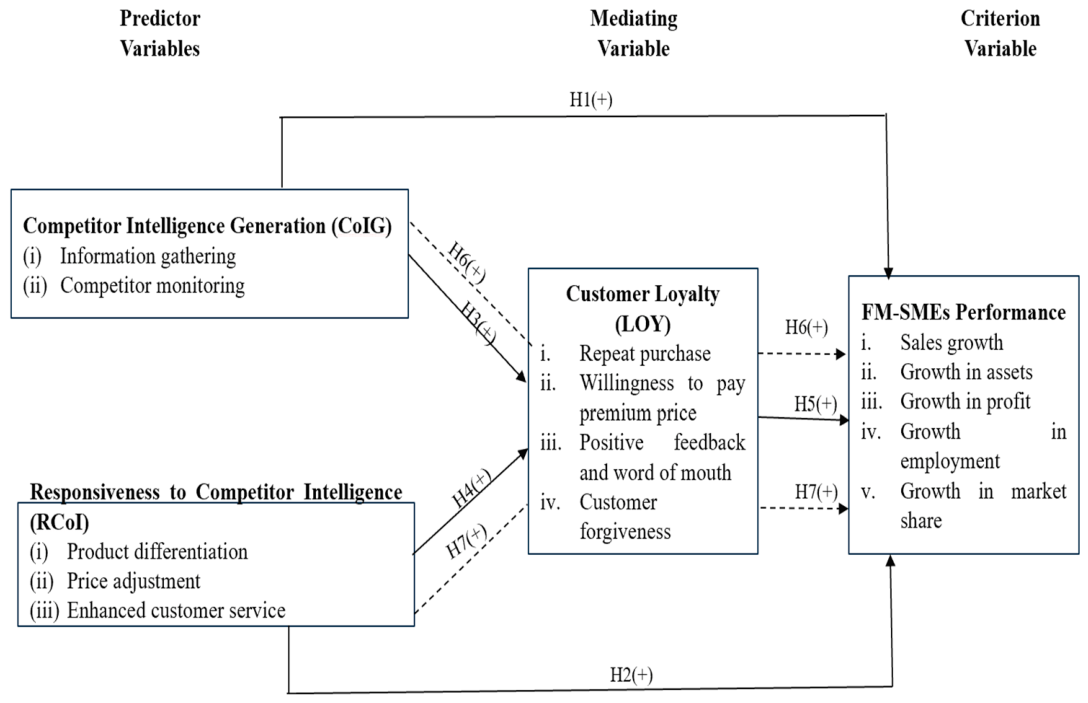
Boonmalert et al., 2020). Therefore, it is plausible that competitor orientation drives superior performance through LOY. However, empirical evidence from the Tanzanian context remains scarce, creating a contextual gap that this study sought to address. Therefore, this study examined the mediating role of LOY in the effect of competitor orientation on FM-SME performance in the Tanzanian context.
2. Theoretical Underpinnings
This study is grounded in the Dynamic Capabilities Theory (DCT) developed by
Teece et al. (
1997). DCT posits that “the performance of a firm is contingent upon the capability of a firm to respond to changes in business environment” (
Teece et al., 1997). “Dynamic capabilities allow firms to sense, seize and reconfigure their resources in response to opportunities and threats within their business environment” (
Teece et al., 1997).
In this study, competitor orientation is based on the extent to which FM-SMEs demonstrate their ability to sense and respond to competitive pressures. FM-SMEs can adjust their strategies based on market trends by actively tracking competitors’ moves, strengths, and weaknesses. In this case, CoIG represents the sensing capability, whereas RCoI represents the seizing capability.
Moreover, studies have established that dynamic capabilities are a significant determinant of LOY, which is a significant predictor of firm performance (
Ashill et al., 2022). Loyal customers not only provide a stable revenue stream but also serve as a driver of competitive advantage, helping firms withstand competitive pressures (
Mwang’amba & Matonya, 2023). Thus, FM-SMEs can enhance their performance by adapting their business practices to foster LOY in response to competitive pressure.
The effect of competitor orientation and SME performance through LOY draws attention in this study. It is anticipated that competitor-oriented firms are better positioned to leverage their capabilities to create a value proposition that drives LOY and superior performance. DCT offers a theoretical lens for examining the relationships among competitor orientation dimensions, LOY, and firm performance in the Tanzanian context.
6. Conclusions, Implications and Limitations
6.1. Conclusions
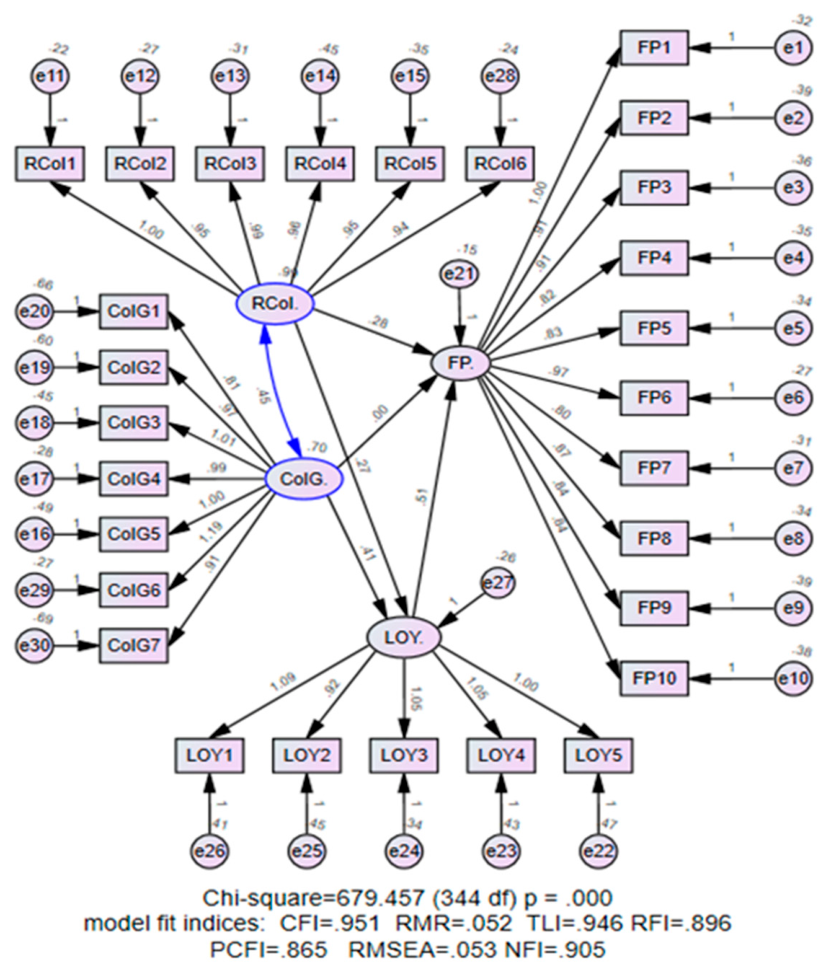
Taken together, it is concluded that the mere generation of competitor intelligence does not result in better performance unless firms deploy strategies to enhance LOY. This study highlights the significance of sensing and seizing competitive opportunities in the market.
6.2. Theoretical Contributions
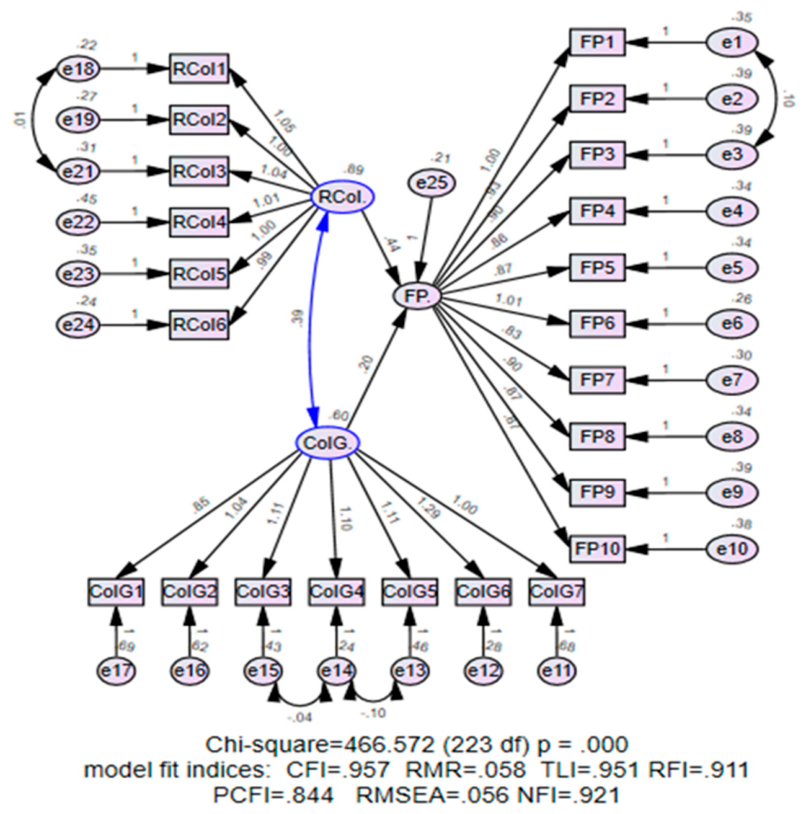
This study makes several theoretical contributions to the literature on competitor orientation and SME performance. First, by decomposing competitor orientation into its constituent dimensions (CoIG and RCoI) rather than treating it as a unidimensional construct, this study reveals differential effects that would otherwise be masked in an aggregate analysis. Specifically, the finding that CoIG has no significant direct effect on FM-SME performance while RCoI exerts a significant direct effect advances our understanding of how different facets of competitor orientation operate through distinct causal pathways. Second, this study extends the Dynamic Capabilities Theory by demonstrating that sensing capabilities (CoIG) require the complementary mechanism of customer loyalty to translate into performance outcomes, whereas seizing capabilities (RCoI) can influence performance both directly and indirectly. Third, by situating the investigation within the context of Tanzanian FM-SMEs, this study provides empirical evidence from a developing country, resource-constrained setting where competitive dynamics differ markedly from those in developed economies.
6.3. Practical Implications
The findings carry important practical implications for FM-SME owners, managers, and policymakers. First, FM-SMEs should not merely collect competitor intelligence but also translate it into customer-centric strategies that build and sustain loyalty. This means using competitive insights to improve product design and features, adjust pricing, and enhance customer service. Second, given the significant direct effect of RCoI on performance, FM-SMEs should develop responsive capabilities that enable them to act swiftly on competitor intelligence, for example, by adapting their product offerings, entering new market segments, or forming strategic partnerships. Third, FM-SMEs should invest in customer relationship management to foster repeat purchases, positive word-of-mouth, and customer forgiveness, which collectively strengthen loyalty and drive sustainable performance. Furthermore, FM-SMEs should engage in collaborative networks to share insights on market trends and coordinate resources to enhance customer satisfaction. The Ministry of Industry and Trade should support FM-SMEs by offering subsidies for technology adoption and facilitating workshops on competitor-oriented practices and customer relationship management.
6.4. Limitations and Future Research Directions
Several limitations should be acknowledged when interpreting these findings. First, the study employed a cross-sectional design, which precludes causal inferences regarding the relationship between competitor orientation, customer loyalty, and firm performance. Longitudinal studies would provide stronger evidence of causality and reveal how these relationships evolve over time. Second, all the constructs were measured using the self-reported perceptions of enterprise owners/managers, which may introduce common method bias. In particular, customer loyalty was assessed from the owner’s perspective rather than from actual customers, which may not fully capture the true extent of customer loyalty behaviour. Future research should collect customer loyalty data directly from customers to enhance construct validity. Third, the study relied on a 2015 sampling frame from the National Bureau of Statistics, which, despite field verification, may not perfectly reflect the current FM-SME population. Fourth, the study did not include control variables such as firm size, age, or financial leverage, which have been shown to influence SME performance (
Botta, 2019). Future studies should incorporate these variables to provide a more nuanced understanding of the relationships. Fifth, the findings are contextually bounded to furniture manufacturing SMEs in Dar es Salaam, Tanzania, and may not be generalisable to other sectors, regions, or countries. Future research should replicate this study in other industries and geographical contexts to enhance the findings’ external validity. Finally, future studies could examine additional mediating or moderating variables, such as innovation capability, digital technology adoption, and environmental dynamism, to further unpack the competitor orientation–performance nexus.