1. Introduction
SMEs are globally recognized as critical engines of employment, resilience, and inclusive growth, particularly in developing economies, where they disproportionately contribute to job creation and poverty reduction (
Abraha & Gebre, 2025). Small and Medium Enterprises (SMEs) are broadly acknowledged as fundamental pillars of economic systems worldwide, particularly in developing countries, where they drive economic growth, create jobs, and foster innovation. These enterprises are essential for addressing unemployment, alleviating poverty, and promoting economic diversification (
Gherghina et al., 2020;
Quaye & Mensah, 2019;
Wen et al., 2023). SMEs play a vital role in stimulating local economies by creating employment opportunities, especially for vulnerable groups such as youth and women, and by promoting innovation through rapid adaptation to changing market demands (
Surya et al., 2021). The importance of SMEs transcends their direct economic contributions; they also encourage regional development by reducing disparities between urban and rural areas and supporting the preservation of traditional industries (
Tshikovhi et al., 2023). However, SMEs in developing regions often face multi-layered barriers, including limited access to finance, inadequate government support, and weak enforcement of regulatory policies that hinder their sustainability (
Durrani et al., 2024). From an urban studies perspective, SMEs operate as core actors within local entrepreneurial ecosystems, shaping place-based resilience and socio-economic vitality, particularly in heritage and semi-urban settings. This study, therefore, frames SME barriers as urban development challenges, linking firm-level constraints to city-regional policy and planning debates (
Audretsch & Belitski, 2017;
Barca et al., 2012;
Rodríguez-Pose, 2018). Urban sustainability transitions often burden SMEs with the costs of adopting greener technologies; thus, targeted public incentives and technical training are needed to enable SMEs to adopt eco-materials and practices (
Hadibarata & Kristanti, 2025). Within cities, social enterprises simultaneously deliver social services and create economic value, positioning social entrepreneurship as a critical tool for urban sustainability (
Marshall & Jang, 2020). Entrepreneurial resilience refers to the capacity of actors (individuals, firms, and communities) to anticipate, absorb, adapt, and learn from adversity in ways that preserve or restore effective functioning. Prior work conceptualizes resilience across multiple levels, micro (individual), meso (firm), and macro (societal), and highlights both processual and capability-based dimensions of resilient response. These multilevel perspectives underscore that resilience involves proactive preparation, on-the-ground adaptive routines during shocks, and post-shock learning or transformation (
Raetze et al., 2022;
Williams et al., 2017).
Building on these conceptual foundations, entrepreneurship research has increasingly examined resilience but tends to emphasize either individual psychological endurance or macro-level system responses, with comparatively less meso-level work that identifies the concrete firm-level mechanisms and temporal sequencing through which SMEs in constrained institutional environments sustain operations over time. This paper therefore positions SMEs’ barriers not only as impediments but also as selection filters that shape which internal capabilities and routines (e.g., financial coping tactics, supplier pooling, product simplification, network brokering, minimalist digital pivots) become salient for continuity, an approach that connects the entrepreneurship literature on barriers with multilevel resilience frameworks and recent evidence on SMEs’ role in community-level resilience (
DiBella et al., 2023;
Korber & McNaughton, 2018;
Newman et al., 2022).
In many emerging Asian economies, traditional SMEs continue to function as the backbone of local economies amid volatile macroeconomic environments. Their roles extend beyond employment generation to foster regional resilience and innovation, especially in rural and semi-urban settings. Within developing nations like Iran, where large-scale industries face numerous limitations, SMEs are particularly valuable (
Sadeghi, 2018). In Iran, micro and small businesses constitute a vital segment of the economy, providing a wide range of products and services for both domestic consumption and export (
Haghighinasab et al., 2013;
Pournasir, 2013). They are especially vital in regions such as Kashan, where local industries, including carpet weaving, handicrafts, and agricultural production, are deeply intertwined with the area’s cultural heritage. These small businesses not only provide livelihoods for many but also serve a crucial function in maintaining local traditions and practices. SMEs in Kashan face various environmental challenges that hinder their establishment and growth. Although this study focuses empirically on one region, the challenges it investigates, such as constrained access to finance, bureaucratic licensing, and cultural inertia, reflect broader constraints shared by SMEs across various emerging Asian markets. We position our contribution as an analytic generalization to theory rather than a claim of statistical representativeness. Kashan is treated as a theoretically informative, heritage-based semi-urban economy that exhibits a configuration common to many emerging-market regions: inflationary pressure and credit rationing, licensing/bureaucratic frictions, and high sectoral dependence on craft-intensive production. Accordingly, the study’s insights are analytically transferable only to contexts that closely match the specific institutional and economic conditions observed in this case (
Flyvbjerg, 2006;
Yin, 2018). Accordingly, the study’s insights are intended as context-bound analytical generalizations rather than broad regional claims, and are applicable only to settings that closely match the specific institutional and economic conditions observed in this case.
Despite extensive national-level work on SMEs, little is known about how inflationary shocks and institutional frictions jointly shape firm-level adaptive routines in heritage-based, semi-urban settings. Accordingly, the study adopts an exploratory, case-based approach aimed at generating context-sensitive insights rather than testing predefined causal relationships. To address this gap, the paper adopts a mixed-methods approach, combining a quantitative survey with qualitative interviews, to both rank binding barriers and unpack the mechanisms that sustain firm continuity in such contexts. Findings from the Kashan case provide context-specific insights that may inform understanding of similar settings, rather than universally generalizable conclusions. Kashan exemplifies heritage-based semi-urban towns, characterized by clustered, family-run heritage SMEs, a mixed manufacturing-tourism economy, and exposure to national regulatory and macroeconomic shocks, making the mechanisms identified here relevant to comparable settings. The selection of Kashan as a case study is theoretically motivated, as it represents a critical and information-rich setting where heritage-based production systems intersect with institutional constraints and economic volatility. This makes it particularly suitable for exploring how SMEs adapt under conditions of structural pressure.
The city of Kashan, with its rich history and diverse industrial base (
Sayadi, 2021), offers a unique case study for exploring the environmental obstacles to SME development. Kashan’s economy relies heavily on traditional sectors such as textile production and herbal extract manufacturing, which have historically employed generations. Nevertheless, in recent years, these businesses have struggled to thrive within a swiftly evolving economic environment. Elements such as limited access to financial resources, outdated infrastructure, and a complex regulatory framework have created significant barriers for new and growing enterprises. These challenges are further compounded by broader economic instability in the country, making it difficult for SMEs to flourish. Kashan serves as a representative case for exploring long-standing traditional industries that face both modernization pressures and regulatory rigidity, struggling to adapt in the absence of enabling institutional frameworks. Such conditions are not unique to this city, but are mirrored in comparable heritage-based economies across South and West Asia (
Kapteyn & Wah, 2016). However, these similarities should be interpreted cautiously, as broader macro-level factors such as national sanctions, industrial policy regimes, and country-specific institutional configurations may significantly shape SME dynamics and limit cross-context comparability.
SMEs are recognized as critical drivers of innovation and economic development (
Prasanna et al., 2019;
Varga, 2023). Due to their size and flexibility, they can often adapt quickly to shifts in the market, creating new products and services tailored to local demands (
Abdul-Azeez et al., 2024). This innovation is not limited to technological advancements; it also includes innovative business processes, marketing strategies, and approaches to customer engagement. In many developing countries, SMEs are at the forefront of creating employment opportunities, stimulating entrepreneurship, and contributing to decentralizing economic activities (
Heenkenda et al., 2022;
Nazir et al., 2024). By supporting SMEs, countries can foster a more inclusive economy that benefits a broader population segment, including marginalized groups and rural communities.
Despite the evident advantages of SMEs, a substantial research gap exists in comprehending the particular challenges they face in regional contexts such as Kashan. While much research has been conducted on SMEs at the national level, there is limited literature on the environmental obstacles unique to smaller cities and rural areas. Kashan, with its reliance on traditional industries and its distinct socio-economic conditions, faces environmental challenges that differ from those encountered in larger urban centers. These challenges include inadequate infrastructure, complex regulatory requirements, and limited access to financial services, all of which can stifle SME growth. Moreover, government policies aimed at supporting SMEs often fail to address these localized barriers, leaving small businesses in regions like Kashan without effective solutions.
Theoretically, this study draws on the Resource-Based View (RBV) and Institutional Theory, aligning with recent evidence that systematic strategic planning mediates sustainable performance in SMEs (
Mehta et al., 2025). This research aims to address this gap by investigating the environmental obstacles that hinder the creation and growth of SMEs in Kashan. By focusing on both the establishment and growth phases of small businesses, this study aims to provide a comprehensive understanding of the challenges entrepreneurs face in the region. The findings will be particularly relevant for policymakers and local authorities, offering valuable insights into fostering a more enabling ecosystem for SMEs. By identifying and prioritizing the most significant obstacles, the research will contribute to advancing targeted interventions that cater to the unique requirements of small businesses in Kashan.
The importance of this study cannot be overstated. SMEs are not only vital for economic development but also for the preservation of local culture and traditions in regions like Kashan. Understanding the environmental factors that hinder their success is crucial for creating sustainable economic growth. This research will provide practical recommendations for overcoming these challenges, offering policymakers a roadmap for fostering entrepreneurship and supporting the growth of SMEs. This study contributes to theory by integrating the Resource-Based View (RBV) and the Institutional Theory to explain how firm-level adaptive routines emerge under structural constraints. In particular, the findings highlight a temporal sequencing of adaptive responses, whereby SMEs move from short-term coping mechanisms toward more coordinated and strategic adjustments as constraints persist. This sequencing reflects the interaction between internal resource constraints and external institutional pressures, providing a process-based explanation of resilience in heritage-based, semi-urban economies. By addressing the economic and regulatory barriers that SMEs face, the research will enhance the broader goal of creating a more dynamic and resilient economy in Iran.
In sum, this research addresses the following research question:
Which context-specific barriers influence the growth and sustainability of SMEs in heritage-based, semi-urban settings?
Grounded in the urban entrepreneurial ecosystem perspective and integrating RBV and institutional views, we outline the following lines of inquiry to guide the empirical analysis and structure the investigation of the research question:
While the study is primarily exploratory in nature, these propositions are treated as analytical lenses and lines of inquiry rather than formal hypotheses, helping to interpret empirical patterns in relation to the research question.
From a theoretical perspective, inflationary pressures may affect SMEs through multiple, potentially opposing mechanisms. On one hand, smaller firms often possess weaker bargaining power in input markets, limited access to formal credit, and reduced capacity to hedge against price volatility, which can amplify the adverse effects of inflation on working capital and production stability. On the other hand, SMEs may exhibit greater adaptive flexibility than larger firms, enabling them to adjust product mixes, pricing strategies, or sourcing arrangements more rapidly in response to cost shocks. Recent sustainability-oriented SME research highlights that resilience under economic stress depends not solely on firm size, but on the interaction between institutional constraints and adaptive routines embedded in local networks and resource configurations (
Heenkenda et al., 2022).
P1. Economic constraints, including inflationary pressure and credit limitations, are expected to be associated with SME growth outcomes in heritage/semi-urban settings, particularly where institutional constraints limit firms’ adaptive capacity.
P2. Regulatory and administrative inefficiencies are likely to be associated with variations in SME growth outcomes.
P3. Access to finance is expected to play an intervening role in shaping the relationship between regulatory inefficiencies and SME growth.
P4. Perceived institutional quality may influence how regulatory burdens are experienced by SMEs, potentially moderating their impact on growth outcomes.
P5. Cultural and environmental factors may have comparatively weaker immediate effects but become more salient over time as firms adapt to structural constraints.
These propositions are not tested in a strictly confirmatory sense but are used as analytical lenses to interpret the empirical patterns observed in both quantitative and qualitative data.
Through a case study approach, this study will provide an in-depth, comprehensive examination of the challenges SMEs encounter in this unique regional context. The insights gained from this research primarily contribute to understanding SME dynamics within the specific context of Kashan and may offer indicative lessons for regions with closely comparable institutional and economic conditions, rather than serving as a universally generalizable model. By shedding light on the specific environmental barriers that impact SMEs, this research will enrich the expanding body of knowledge on SME development and offer actionable recommendations for policymakers, entrepreneurs, and researchers. Furthermore, the study contributes to ongoing discussions in the Asian policy discourse about how to balance local industrial heritage with modern economic reforms, particularly in peripheral regions often overlooked in national development agendas.
2. Theoretical Background
Small and Medium Enterprises (SMEs) are integral to the economic advancement of nations worldwide, serving as engines of growth, innovation, and employment (
Veugelers, 2008). Defined variably across different regions (
Berisha & Pula, 2015;
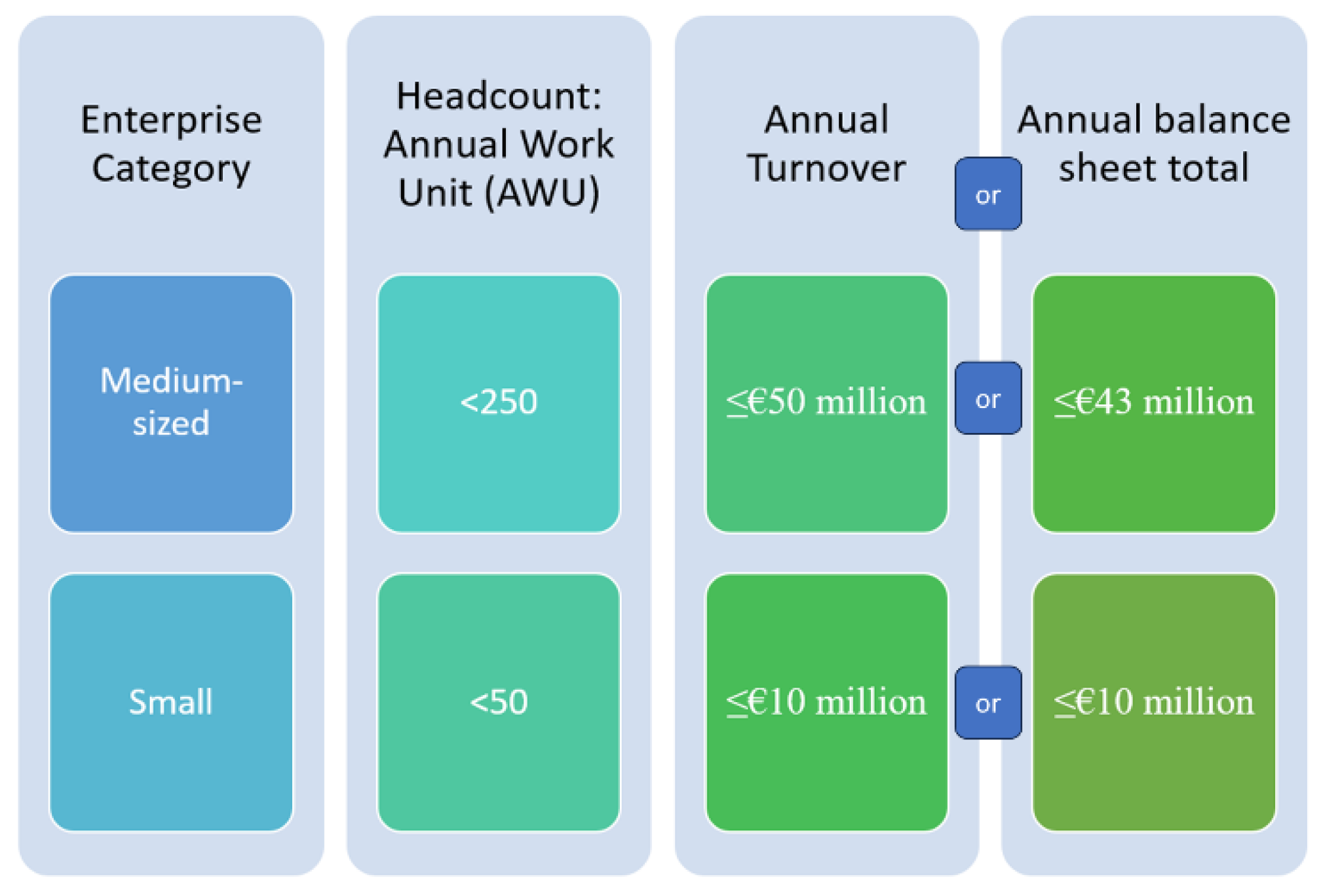
El Madani, 2018), SMEs generally encompass businesses that maintain a limited scale of operations, typically characterized by fewer employees and lower annual turnover than larger corporations. There are different definitions for SMEs based on employee counts and turnover in different countries and regions, but the European Commission has defined SMEs as follows (
Figure 1). These definitional variations reflect not only statistical thresholds, but also broader differences in how national and regional economies conceptualize the roles and priorities of SMEs. In emerging Asian contexts, localized definitions often align with informal sector dynamics, traditional industries, and non-digitized operations, making policy targeting and comparative research particularly challenging (
Berisha & Pula, 2015). In this study, the notion of “heritage-based economies” refers to local economic systems in which a significant share of productive activity is rooted in traditional industries, culturally embedded practices, and intergenerational knowledge transfer. These economies are typically characterized by craft-based production, strong ties to place-specific identity, and reliance on localized networks of suppliers, skills, and markets. Kashan represents a prototypical example of such an economy, where sectors such as carpet weaving, herbal extract production, and traditional crafts are deeply embedded in the socio-cultural and economic fabric of the region. In such contexts, SME dynamics cannot be fully understood without considering the interaction between cultural heritage, institutional constraints, and localized market structures. Cross-country comparisons confirm that SMEs’ definitions and roles are deeply shaped by institutional contexts, with implications for how their sustainability challenges are understood and addressed (
Abraha & Gebre, 2025).
Globally, small and medium-sized enterprises account for a large percentage of all jobs and contribute significantly to the Gross Domestic Product (GDP) (
Gherghina et al., 2020). In developing countries, their impact is even more pronounced, often constituting over half of the GDP and providing livelihoods to a substantial workforce (
Zafar & Mustafa, 2017). For instance, in Indonesia, Micro, Small, and Medium Enterprises (MSMEs) contributed to 61% of the GDP as of 2022 (
Anatan & Nur, 2023), while in Ghana, SMEs accounted for around 70% of the GDP (
Adjabeng & Osei, 2022). These enterprises are crucial in bridging the gap between formal and informal sectors, promoting inclusive economic development, alleviating poverty through job creation, and invigorating local economies. Nevertheless, limited access to finance continues to be reported as one of the most persistent constraints, shaping both firm survival and growth trajectories in emerging markets (
Durrani et al., 2024).
SMEs are instrumental in job creation, particularly in regions where large corporations are scarce. They absorb labor force entrants and provide avenues for entrepreneurial talent, mitigating unemployment and underemployment. Beyond job creation, SMEs are hotbeds of innovation (
Hasan et al., 2024). Their agility enables them to respond rapidly to shifts in the market, experiment with new ideas, and implement innovative solutions that lead to technological advancements and improved business processes. This innovative capacity is essential for economic diversification, enabling economies to reduce dependency on a narrow range of industries and enhancing resilience against economic shocks. By fostering a diverse industrial base, SMEs contribute to sustainable economic development and stability (
Ogunmuyiwa & Okunleye, 2019;
Ozturk et al., 2024;
Toromade & Chiekezie, 2024). Policy interventions that prioritize SMEs’ access to finance, technology, and export markets have been shown to substantially strengthen their contributions to sustainable development and resilience. Recent systematic evidence shows that embedding sustainability-oriented practices substantially enhances the resilience and long-term competitiveness of SMEs operating in volatile contexts (
Damiano & Valenza, 2025). However, much of the existing literature focuses on urban-based, high-growth sectors, with limited attention to SMEs embedded in traditional, resource-constrained environments. Small, craft-based towns with narrow sectoral structures experienced disproportionately large revenue and employment declines during the COVID-19 shock, suggesting that heritage-linked, semi-urban SMEs face acute vulnerability to demand and mobility disruptions (
Motoyama, 2020). Conversely, case evidence suggests that timely local policy support and stakeholder-led adaptive strategies, such as rapid coordination among actors, diversification of event/market formats, and strengthened buyer-supplier linkages, can materially improve small-firm resilience in place-based economies (
Ho & Sia, 2020). In particular, few studies have systematically examined how institutional voids, such as weak financial systems and unpredictable regulatory regimes, affect SME outcomes in semi-urban Asian regions (
Shen et al., 2020).
To better understand the multidimensional barriers affecting SMEs, this study draws upon a combination of theoretical perspectives that together provide a holistic view of internal capabilities and external constraints. Understanding the growth, sustainability, and challenges encountered by SMEs necessitates the application of various theoretical frameworks. The Resource-Based View (RBV) theory asserts that SMEs can achieve strategic advantage through the efficient deployment of their distinctive resources and capabilities, emphasizing internal strengths such as skilled labor, innovation capacity, and organizational culture (
Lockett et al., 2009;
Lubis, 2022;
Taher, 2012). Institutional Theory examines how external environmental factors, including regulatory policies, cultural norms, and market structures, influence SME behavior and performance, highlighting the importance of institutional support (
Fauzi & Sheng, 2022;
Korsakienė et al., 2015). Cross-sectoral comparisons further reveal that institutional and structural barriers vary widely across industries, rendering uniform policy approaches largely ineffective in addressing SME constraints (
Mbah, 2024). Recent studies also demonstrate that integrating RBV with institutional perspectives provides a stronger explanatory framework for understanding how SMEs balance internal resource deployment with external environmental challenges (
Mehta et al., 2025). Prior research systematizes entrepreneurial resilience across micro-, meso-, and macro-levels, clarifying how antecedents, processes, and outcomes interrelate under turbulence and offering a basis to link institutional constraints with firm-level adaptive routines (
Korber & McNaughton, 2018). The Entrepreneurial Ecosystem Framework focuses on the interconnected elements that support entrepreneurial activities, such as access to finance, mentorship, and networking opportunities, underscoring the need for a conducive ecosystem (
Audretsch & Belitski, 2017). Recent empirical evidence from Iran further supports the importance of contextual and institutional enablers in shaping entrepreneurial action. For instance, Shirzadi et al. (
Jahanbakht & Ahmadi, 2024) found that both technological and non-technological environmental changes significantly influenced new venture creation in the digital entrepreneurship sector. While their focus was on digital contexts, their findings underscore the critical role of regional and institutional dynamics, aligning with the framework adopted in this study. Additionally, the Stages of Growth Model outlines the phases SMEs undergo from startup to maturity, providing insights into the challenges and strategic decisions required at each stage (
Deakins & Freel, 1998). The Barriers to Entry Framework identifies obstacles such as access to capital, regulatory hurdles, and market competition, helping to understand impediments to SME success and the necessary interventions. Despite the diversity of these theoretical lenses, there remains a gap in applying them cohesively to low-resource, regulation-heavy contexts where SMEs operate under compounded pressures. Heritage-based economies provide a particularly relevant setting for examining these dynamics, as firms operate at the intersection of cultural continuity and economic adaptation, often facing unique constraints related to informality, limited scalability, and institutional rigidity. This study contributes by integrating these frameworks to analyze how structural barriers manifest in traditional economies across Asia. Scholars have argued that strengthening entrepreneurial orientation, strategic flexibility, and business model innovation within SMEs plays a critical role in sustaining firm performance in volatile environments (
Akbari & Beigi, 2023).
In Iran, SMEs constitute a significant segment of the economy, contributing substantially to GDP, employment, and innovation. The Iranian SME sector is diverse, encompassing key industries such as manufacturing, services, agriculture, and handicrafts. These enterprises are integral to economic diversification, reducing the country’s reliance on oil exports, and fostering resilience against external economic shocks (
Rastegar et al., 2023). Evidence shows that crisis contexts can catalyze opportunity creation and post-disaster venturing, underscoring how contextual shocks shape resilient entrepreneurial responses (
Monllor & Murphy, 2017). Their role is crucial in promoting regional development, particularly in less urbanized areas, thereby mitigating regional economic disparities. The manufacturing sector is a prominent area where SMEs thrive, producing a wide range of goods, from textiles and food products to machinery and electronics. The service sector, including retail, hospitality, and information technology, also hosts a significant number of SMEs, driving innovation and enhancing consumer choice (
Sadeghi, 2018;
Tajpour et al., 2023;
Yadollahi Farsi & Toghraee, 2014).
Despite their importance, Iranian SMEs encounter many challenges that hinder their development and long-term viability. Limited access to financing due to stringent banking regulations and high collateral requirements, bureaucratic inefficiencies, and regulatory hurdles complicate business operations. Evidence from China suggests that collateral-centric lending norms and weak informal finance channels remain severe obstacles to the expansion of micro and small enterprises (
Chan & Lin, 2013). Recent studies suggest that financial innovation mechanisms, such as digital financing platforms and fintech channels, can help overcome traditional credit access barriers, especially in emerging economies where formal financial infrastructure is weak (
Anggraini et al., 2024). Recent panel evidence shows that deeper financial systems significantly ease firm-level credit constraints and foster SME expansion across eight emerging Asian economies (
Shen et al., 2020). Additionally, inadequate infrastructure support, technological advancements, restricted access to global markets, and a deficit of skilled labor further constrain their development (
Lakhal et al., 2025). Inadequate electricity provision combined with underdeveloped credit markets jointly suppress SME survival in Myanmar, underscoring the cross-country relevance of finance–infrastructure constraints (
Kapteyn & Wah, 2016). Political instability and economic sanctions exacerbate these challenges, creating an uncertain business environment that stifles entrepreneurial initiatives and investment (
Ahadi & Kasraie, 2020;
Salamzadeh & Dana, 2021). Comparative evidence from Sub-Saharan Africa, South Asia, and the Middle East highlights that while macroeconomic instability manifests differently across regions, SMEs consistently report finance and governance as the most critical structural barriers (
Abraha & Gebre, 2025).
Globalization and export barriers further complicate the operational environment for SMEs. Challenges associated with globalization include managing diverse relationships, potential loss of autonomy, and opportunistic behaviors by partners, as noted by Zohoor (
Zahoor et al., 2020). These challenges are compounded by the inherent risks and the need for innovative thinking, as explored by other scholars (
Munteanu et al., 2023). Export barriers are categorized into internal and external factors. Internal barriers, such as limited managerial experience, insufficient financial resources, and inadequate marketing skills, inhibit SMEs’ ability to expand. External barriers, including regulatory challenges, political instability, high transaction costs, and trade restrictions, create further obstacles, as classified in previous research (
Morini et al., 2021). Another study corroborates these findings, emphasizing internal challenges (e.g., lack of resources, expertise, and managerial capabilities) and external barriers (e.g., trade regulations, infrastructure issues, and market conditions) (
Bertrand et al., 2022).
Technological challenges pose another significant barrier, as the rapid pace of technological advancement (
Tashakori & Sobhanifard, 2024) may outstrip the resources of SMEs to adopt and integrate new technologies, limiting their competitiveness and ability to innovate (
Tashakori & Sobhanifard, 2026). Market access and competition also present hurdles, with high entry costs, intense competition from established firms, and limited marketing capabilities restricting SMEs’ market presence and expansion potential. Human resource limitations, including difficulties attracting and retaining skilled employees, affect SMEs’ ability to innovate and manage operations efficiently (
Harney et al., 2022). Supply chain disruptions, driven by shifting customer demands, global conflicts, and pandemics, further impact SME operations by increasing costs and creating operational uncertainties (
Karmaker et al., 2023;
Tashakori & Sobhanifard, 2026). Additionally, cultural and social barriers, including societal attitudes toward entrepreneurship and gender biases, can influence SME establishment and growth by discouraging entrepreneurial endeavors or limiting access to networks and resources (
Rahman et al., 2017). The COVID-19 crisis exposed acute liquidity and supply-chain vulnerabilities in SMEs, but also catalyzed creative, innovation-driven responses that sustained their operations (
Tashakori et al., 2026;
Thukral, 2021).
Recent pandemic evidence from Asian MSMEs confirms that shocks exacerbate pre-existing liquidity shortages and amplify regulatory delays (
Takeda et al., 2022). Addressing these environmental barriers requires robust government policies and support mechanisms. Effective interventions can significantly enhance the establishment, growth, and sustainability of SMEs. Governments can provide financial support programs, such as subsidized loans, grants, and equity financing, tailored to the needs of SMEs, alleviating financing constraints and promoting investment. Regulatory reforms that streamline processes, reduce bureaucratic red tape, and simplify licensing procedures can enhance the ease of business, fostering a stable environment conducive to SME growth. Tax incentives, including breaks and exemptions, can reduce financial burdens and encourage reinvestment into business operations and innovation (
Abbasi et al., 2017;
Doh & Kim, 2014).
Creating networking and collaboration platforms enables SMEs to share knowledge, resources, and best practices, fostering partnerships and enhancing market intelligence (
Michaelides et al., 2013). Implementing these support mechanisms requires coordinated efforts between government agencies, financial institutions, industry associations, and the private sector to ensure that SMEs have adequate resources and support to surmount environmental challenges and attain sustainable development. In protected urban–regional destinations, tourism SMEs (often micro-enterprises) need state policy support and academic training to comply with environmental standards and advance sustainable practices (
Flórez et al., 2025).
In conclusion, SMEs are integral to fostering economic progress, particularly in fostering employment generation, innovation, and economic diversification. Their growth and sustainability are often hindered by many environmental barriers, including economic instability, regulatory challenges, limited access to finance, technological constraints, and supply chain disruptions. In Iran, SMEs serve as a cornerstone of the national economy but face unique challenges exacerbated by political and economic factors. Addressing these barriers through targeted government policies and implementing support mechanisms is vital to empowering SMEs to flourish and make a meaningful impact on economic growth. Understanding the theoretical frameworks that underpin SME development provides valuable insights into the strategies needed to foster a supportive environment, thereby enhancing the resilience and competitiveness of SMEs in both global and local contexts.
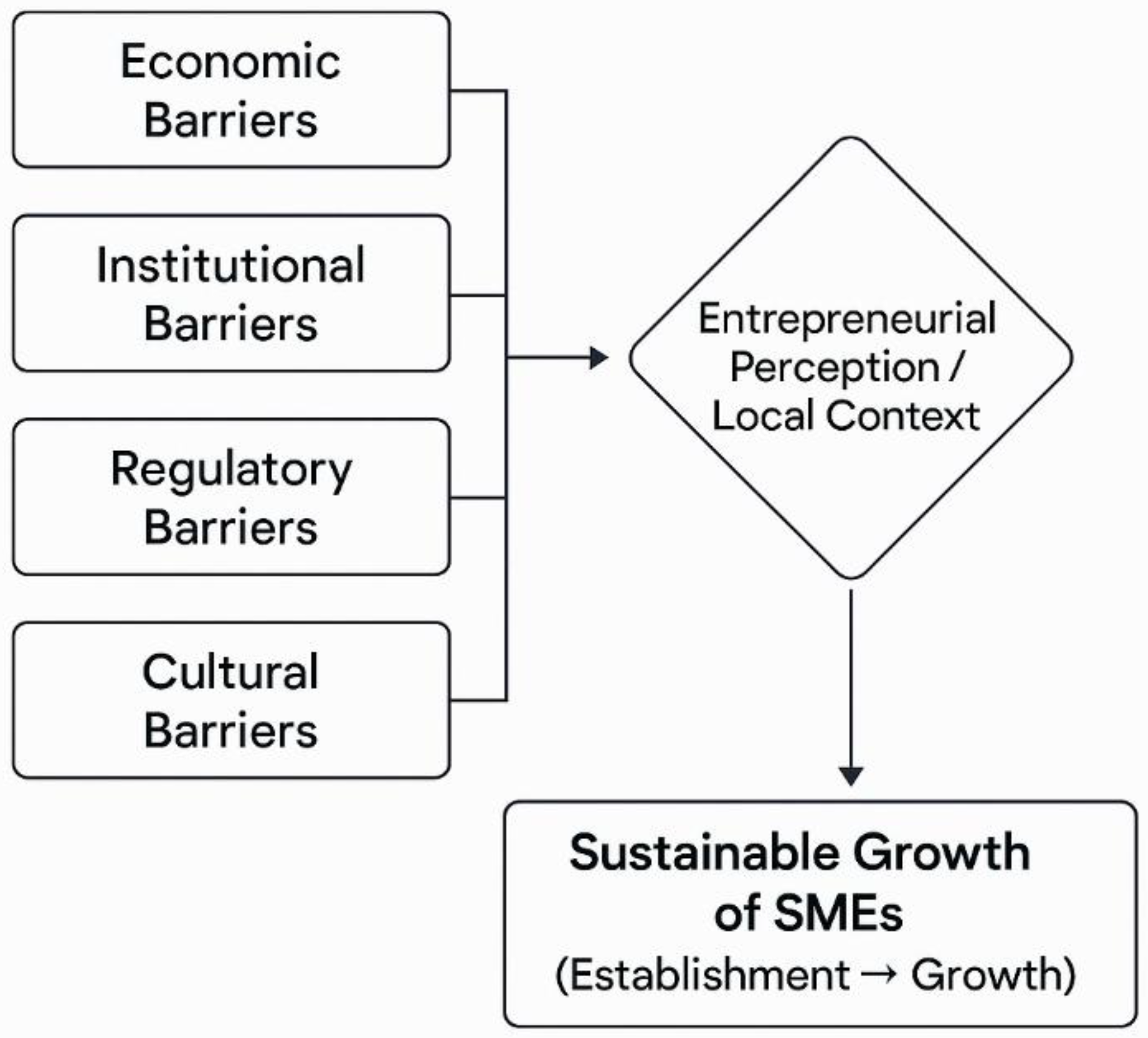
Based on the theoretical perspectives discussed above,
Figure 2 presents the conceptual framework guiding this study.
3. Materials and Methods
This study employed a mixed-methods approach, integrating both quantitative and qualitative research to explore the environmental obstacles hindering the establishment and growth of micro-businesses in Kashan. The research design was both descriptive and exploratory, aiming to provide practical insights to improve the local business environment through applied research. The mixed-methods design was deliberately chosen to triangulate findings, enhance validity, and provide both statistical generalizability and contextual depth (
Plano Clark, 2017). The choice of a mixed-methods case study design is aligned with the exploratory research objective, enabling the combination of pattern identification through quantitative data and in-depth contextual understanding through qualitative insights.
The study focused on the micro-business sector in Kashan, which includes a diverse range of enterprises, notably in traditional industries such as carpet weaving, herbal extract production, and handicrafts. Approximately 2000 such enterprises are operational in this region. Using Cochran’s formula to ensure statistical significance and representativeness across the broader population, a sample of 200 businesses was selected through random sampling (
Cochran, 1977). The sample size was calculated using Cochran’s formula assuming a 95% confidence level (Z = 1.96), a margin of error of 7%, and a conservative proportion estimate (
p = 0.5), which yielded a minimum required sample size of approximately 196 firms; this was rounded to 200 to enhance statistical robustness. Given the absence of a fully accessible and up-to-date sampling frame with reliable stratification across industry sectors and firm age categories, a simple random sampling approach was adopted. Although stratified sampling could have improved proportional representation across sectors, its implementation was constrained by the lack of detailed population-level data on firm distribution by industry and years of operation. To mitigate this limitation, efforts were made during data collection to ensure coverage of the major dominant sectors in the local economy (e.g., textiles, herbal products, tourism, and handicrafts). Case selection followed a theoretical sampling logic (
Eisenhardt, 1989;
Lincoln & Guba, 1985): Kashan represents a typical/critical heritage-based semi-urban setting where institutional frictions and inflationary shocks are salient. Such information-rich cases enable theoretical replication, i.e., testing whether predicted mechanisms (liquidity tactics, cooperative purchasing, product simplification, network brokerage, minimalist digitalization) appear under similar constraints elsewhere. Our random survey sample (
n = 200) within a known frame (~2000 firms) secures internal validity for local patterns; the qualitative layer provides thick description to support transferability beyond the city when boundary conditions hold.
However, we acknowledge that the sample distribution may not perfectly mirror the population structure in terms of sectoral composition and firm age, which may limit the external representativeness of the quantitative findings. Therefore, the results should be interpreted as indicative of dominant patterns rather than statistically generalizable estimates for the entire SME population.
Data were collected via structured surveys and semi-structured interviews to gather both quantitative and qualitative insights. Data were collected between March 2025 and May 2025. Because the survey data are cross-sectional, the quantitative component is intended to identify contemporaneous associations among barriers and SME outcomes rather than establish causal direction or dynamic time-series effects. Accordingly, the PLS-SEM results should be interpreted as theory-consistent relational evidence, not as definitive proof of causality. For interview participants, verbal informed consent was obtained and documented through audio recordings at the start of each session. For survey respondents, written consent was obtained within the questionnaire form, where participants explicitly indicated their agreement before proceeding. The survey instrument included both closed- and open-ended questions, targeting key barriers such as economic, regulatory, and cultural factors. The measurement items for the core constructs were adapted from established scales in prior literature on SMEs and entrepreneurial constraints, including studies on financial barriers, regulatory burden, and institutional quality. All items were modified to fit the context of heritage-based SMEs in a semi-urban Iranian setting. A translation and back-translation procedure was applied to ensure linguistic and conceptual equivalence between the original English items and the Persian survey instrument. Minor contextual adjustments were made to reflect local business practices and regulatory terminology. The instrument was pre-tested and refined to enhance clarity and relevance. The pre-test was conducted with a sample of 30 SME owners from the target population. Feedback from this stage led to minor revisions in item wording, removal of ambiguous questions, and improved alignment with local business conditions. Additionally, semi-structured interviews were conducted with selected business owners to delve deeper into specific challenges, providing a richer, contextual understanding of the obstacles faced (
Braun & Clarke, 2006).
Quantitative data analysis was performed using SPSS 30, with descriptive and inferential statistical techniques applied to identify key trends and relationships (
Tashakkori et al., 2023). The PLS-SEM analysis followed established guidelines, with reliability assessed through Cronbach’s alpha (>0.7), convergent validity confirmed by AVE (>0.5), and discriminant validity evaluated via the Fornell-Larcker criterion and HTMT ratio. During the measurement model assessment, items with factor loadings below 0.70 were considered for removal. As a result, three items were excluded from the final model to improve construct reliability and validity. The remaining items demonstrated satisfactory loadings, supporting the robustness of the measurement model. Following Hair et al., we report indicator reliability (standardized loadings ≥ 0.70), internal consistency (CR), and convergent validity (AVE ≥ 0.50). Discriminant validity was assessed via Fornell–Larcker and HTMT; HTMT values below 0.85 indicate satisfactory discriminant validity. We additionally provide cross-loadings and item-to-construct mappings to ensure transparency (
Fornell & Larcker, 1981;
Hair, 2014;
Henseler et al., 2015). Regression analysis helped evaluate the impact of various environmental factors on business success. In addition to direct effects, mediation and moderation analyses were conducted within the PLS-SEM framework to test indirect and interaction effects corresponding to the proposed hypotheses. To address common method bias (CMB), we conducted a full collinearity assessment, confirming VIF < 3.3 for all latent variables, which indicates the absence of CMB.
In addition to statistical controls, several procedural remedies were implemented during survey design to mitigate common method bias. These included ensuring respondent anonymity, reducing evaluation apprehension, and carefully structuring the questionnaire to separate predictor and criterion variables. Furthermore, items were presented in a randomized order where possible to minimize response pattern bias. Additionally, Harman’s single-factor test was conducted, and the first factor accounted for 34.2% of the total variance, which is below the critical threshold of 50%, suggesting that common method bias is unlikely to be a serious concern. While no marker variable was included, the combined use of procedural and multiple statistical remedies provides reasonable assurance that common method bias does not substantially distort the findings. We also verified inner VIF < 3.3 to preclude multicollinearity among predictors (
Kock, 2015). Model fit was evaluated using SRMR (target < 0.08) and NFI, alongside R
2, f
2, and Q
2 for predictive relevance, following current PLS-SEM recommendations (
Hair, 2014). We also recognize that, with cross-sectional observational data, reverse causality and endogeneity cannot be fully ruled out. Therefore, the structural paths are modeled on theoretical grounds (RBV and Institutional Theory) and are interpreted as directional hypotheses rather than causally identified effects; stronger causal inference would require longitudinal, panel, or quasi-experimental designs. Additional measurement and structural model details, including full indicator loadings, HTMT matrix values, and bootstrapped confidence intervals, are available upon request to enhance transparency and reproducibility. Qualitative data from interviews were analyzed using thematic analysis, revealing patterns and themes that illustrate business owners’ personal experiences. All data were anonymized prior to analysis. Personally identifiable information was neither collected nor retained. Survey and interview data were stored in encrypted files with restricted access, ensuring confidentiality was strictly maintained. To enhance trustworthiness in qualitative analysis, coding was conducted iteratively by two researchers, with discrepancies resolved through discussion to minimize subjective bias (
Braun & Clarke, 2006). We followed Braun & Clarke’s six-phase thematic analysis (familiarization, initial coding, searching/reviewing/defining themes, reporting). Two coders independently coded transcripts and reconciled discrepancies through discussion (
Braun & Clarke, 2006). A structured coding manual was developed prior to full analysis, including operational definitions of each code, inclusion and exclusion criteria, and illustrative examples. This coding framework was iteratively refined during the initial coding phase to ensure conceptual clarity and consistency across transcripts. Inter-rater reliability was assessed using Cohen’s Kappa coefficient on a subset of the data, yielding a value of 0.82, which indicates strong agreement between coders. Discrepancies were discussed and resolved through consensus, further enhancing coding reliability. All coding decisions, theme development steps, and revisions were documented to ensure transparency and reproducibility of the analytical process.
To ensure the research’s credibility, method triangulation was employed. Specifically, triangulation was conducted by systematically comparing and integrating quantitative findings (e.g., ranked barriers and structural relationships) with qualitative themes derived from interviews. Convergent patterns were identified where both data sources supported similar conclusions (e.g., financial constraints and regulatory burdens), while qualitative insights were used to explain underlying mechanisms and temporal dynamics not captured in the quantitative model. Content validity was ensured through expert review involving two academic researchers and one industry practitioner familiar with SME operations in the region. The survey’s reliability was confirmed through Cronbach’s alpha, which yielded a high score above 0.9, indicating robust internal consistency (
Cronbach, 1951). Furthermore, the questionnaire was validated through expert reviews and a pilot study to test its applicability and effectiveness.
While formal ethical approval was not required due to the minimal risk nature of the study, informed consent was secured from all participants (verbal for interviews, written within the survey forms), guaranteeing confidentiality and anonymity of their responses. The study complied with institutional and national research ethics guidelines (
World Medical Association, 2013). The study adhered to stringent ethical standards concerning data protection and participant privacy.
This study was prospective in nature; no retrospective records or previously archived data were used. Authors did not have access to personally identifiable information during or after data collection.
The study acknowledges potential limitations in its generalizability beyond the local context of Kashan. Additionally, the sampling design relied on simple random sampling without formal stratification by sector or firm characteristics, due to data availability constraints. As a result, certain industries or experience levels may be over- or under-represented, which may affect the statistical representativeness of the quantitative analysis. Future studies are encouraged to employ stratified or panel-based sampling designs to improve representational accuracy. In addition, the study does not explicitly control for macro-level confounding variables such as national economic sanctions, industrial policy shifts, or sector-specific regulatory regimes, which may influence SME behavior and performance beyond the variables captured in the model. The temporal scope of data collection may not fully capture long-term trends, and challenges in building trust with some participants could have influenced the depth of responses obtained.
To capture the temporal dynamics of resilient behaviors, we specifically probed practices enacted before, during, and after major economic or institutional shocks, enabling analysis of the sequencing and evolution of routines across time. Importantly, this temporal sequencing derives from retrospective interview accounts and thematic reconstruction rather than from longitudinal observation; it should therefore be read as a process narrative reported by participants, not as direct time-series validation.
5. Discussion
Reinterpreting our findings through a resilience lens, institutional and macroeconomic frictions act less as static obstacles and more as filters that privilege certain firm capabilities and routines. Revisiting the lines of inquiry introduced in the early sections of the paper, the findings provide consistent support for the relevance of the proposed analytical lenses. Economic constraints (P1) emerge as the most dominant barriers, while regulatory inefficiencies (P2) are also strongly associated with SME outcomes. The mediating role of financial access (P3) is partially supported, as financial constraints both directly and indirectly shape firm performance. Furthermore, the moderating influence of perceived institutional quality (P4) suggests that institutional environments condition the impact of regulatory burdens. Finally, qualitative evidence provides process-based insights into the time-varying salience of cultural and environmental factors (P5), indicating that their influence becomes more pronounced over longer adaptation horizons. Importantly, the integration of quantitative and qualitative findings provides a more comprehensive understanding of SME resilience by combining statistically validated relationships with process-based explanations, thereby fulfilling the complementary purpose of the mixed-methods design. SMEs that systematically enact the identified mechanisms, short-term liquidity tactics, mid-term coordination via cooperative purchasing, and adaptive product/process changes tend to sustain effective functioning despite prolonged turbulence. Temporally, our evidence suggests a common sequence: initial buffering (cash management), followed by coordination and resource reconfiguration (supplier pooling, product simplification), and finally learning and institutional navigation (network brokerage and selective digital adoption). This sequencing highlights the processual nature of meso-level resilience in constrained institutional settings. Our claims are bound to semi-urban, heritage-based SME ecosystems that face (i) persistent inflation/credit rationing, (ii) licensing/bureaucratic delays, and (iii) reliance on craft-intensive production with limited working capital. Under these conditions, we expect the same resilience mechanism bundle, cash-tight routines, cooperative input purchasing, product simplification/micro-pivots, network brokerage, and minimalist digitalization to emerge with similar sequencing. We therefore invite analytic generalization to Iranian provinces and South/West Asian localities that match these contextual equivalence criteria (CECs), rather than literal statistical generalization to all SMEs.
The findings of this study reveal that economic barriers, particularly inflation and limited access to financial resources, significantly hinder the establishment and growth of SMEs in Kashan. These constraints reflect a broader pattern common in many emerging economies across Asia, where SMEs face what (
Kapteyn & Wah, 2016) described as a “finance–infrastructure trap.” In such environments, inflationary shocks and financial exclusion systematically limit entrepreneurial entry and growth, particularly in regions that depend on traditional sectors. These findings align with previous research highlighting the centrality of financial constraints in SME development in emerging markets (
Ayyagari et al., 2011;
Gherghina et al., 2020). Our findings extend this evidence by showing how inflation and credit inaccessibility are amplified in heritage-based economies, where SMEs often lack diversification buffers available to firms in more industrialized contexts. These findings align with Anning-Dorson (
Anning-Dorson, 2023), who emphasized that in emerging economies, the development of specific capabilities, such as customer involvement, plays a crucial role in navigating dynamic market conditions. His study suggests that SMEs must strategically develop and align their capabilities with market demands to achieve sustainable growth, a perspective that resonates with the challenges identified in our research context. Similarly, Chen et al. (
Chen et al., 2025) explored how SMEs navigate uncertain environments through digital transformation, arguing that adaptive capabilities and strategic flexibility are essential for sustaining growth amid external shocks. Their findings, though centered on digital enterprises, parallel the challenges faced by traditional SMEs in volatile institutional settings such as Kashan. Regulatory inefficiencies, such as bureaucratic complexities and licensing challenges, also emerged as substantial barriers, supporting the conclusions of studies by Bertrand et al. (
Bertrand et al., 2022) and Doh and Kim (
Doh & Kim, 2014), who emphasized the disproportionate regulatory burdens faced by small firms in developing economies. These findings are consistent with the concept of “institutional traps” discussed in the context of Asian economies, where regulatory opacity and policy inconsistency discourage formalization and long-term planning by SMEs. Rather than acting as enablers, regulatory bodies often become unpredictable gatekeepers (
Shen et al., 2020). This reinforces the notion of ‘institutional traps’ but also highlights that localized bureaucratic inertia can interact with macroeconomic instability, producing a compounded burden rarely disentangled in prior studies.
This finding aligns with Moussa and Zahaf (
Bahri et al., 2021), who showed that regulatory burdens and institutional inefficiencies, especially when coupled with political instability, significantly diminish the performance and international engagement of SMEs in Tunisia. While their study focused on export dynamics, it confirms the broader impact of governance-related challenges on small firm competitiveness in emerging economies.
In contrast, cultural and environmental factors were perceived as less critical, which is consistent with the findings of Klapper and Parker (
Klapper & Parker, 2011) who noted that while socio-cultural barriers can influence entrepreneurship, they often manifest indirectly or gradually. However, this study suggests that in traditional industrial settings like Kashan, the cultural environment may still exert a latent influence on long-term business sustainability, particularly in sectors with deep historical and familial ties. This implies that while cultural barriers may appear less immediate, they can become critical in shaping intergenerational business continuity, echoing patterns reported in SME studies across Sub-Saharan Africa and South Asia (
Owusu-Acheampong et al., 2024).
When viewed through the lens of resource-based and institutional theories, the findings suggest that external constraints are not just barriers but active filters that shape which internal capabilities matter most. Theoretically, this study contributes by integrating RBV and Institutional perspectives in a regional SME context, illustrating how external shocks redefine the salience of specific internal resources such as financial literacy and regulatory navigation skills. For example, in inflation-prone and heavily regulated economies, financial literacy, informal financing channels, and bureaucratic navigation skills become more valuable than formal innovation capabilities. This discussion underscores the multi-layered nature of SME barriers in developing contexts and highlights the importance of local contextualization. The prioritization of economic constraints reinforces the urgency for financial access interventions, while the persistence of regulatory burdens calls for tailored reforms. Similar to the insights from Salamzadeh and Dana (
Salamzadeh & Dana, 2021), this study confirms that SMEs in Iran operate in a volatile and constrained ecosystem that demands context-specific policy responses. Taken together, the evidence from this study reinforces the need for region-specific SME policies in Asia that move beyond generic support schemes. By situating Kashan within this broader discourse, the study demonstrates that lessons from heritage-based economies in Iran can inform policy design for SMEs in comparable semi-urban regions across Asia, Africa, and Latin America, contexts increasingly examined in recent PLOS ONE contributions (
Zhao et al., 2024). Especially in traditional, non-digitized sectors, a one-size-fits-all approach is unlikely to address the compounded barriers faced by entrepreneurs operating at the margins of institutional and financial systems.
5.1. Practical Implications
Policy makers seeking to bolster SME resilience should prioritise flexible, low-cost interventions that reduce the transaction costs of firm-level routines. Examples include streamlined e-licensing to reduce bureaucratic delays, targeted mobile microfinance to support short-cycle liquidity, and local buyer–supplier matchmaking programs to facilitate cooperative purchasing, all tailored to heritage-based SMEs’ specific operational constraints.
5.2. Limitations and Future Research Directions
This research is subject to certain limitations that should be considered to contextualize its findings and guide future research. One primary limitation is the geographical scope of the study, which focused exclusively on micro-businesses in the Kashan region. While this focus allowed for a detailed exploration of local challenges, the findings may not be entirely applicable to other regions or SMEs in diverse sectors. This is a single-region study; as such, we do not claim statistical generalizability. Instead, we provide analytic generalization: findings are transferable where boundary conditions (semi-urban heritage base, inflation/credit constraints, licensing frictions) are comparable. Future research should test theoretical replication via multi-site sampling within the province and across matched South/West Asian regions.
Moreover, the case of Kashan, while illustrative of heritage-based economies, may involve idiosyncratic institutional factors that limit the broader transferability of findings. Moreover, the study utilized a cross-sectional design, providing a single-point perspective on barriers without considering their temporal dynamics. As a result, the quantitative analysis does not permit strong causal inference, and potential reverse causality or omitted-variable endogeneity may still affect some of the estimated relationships. Although the model specification was theory-driven and diagnostic checks supported measurement quality, these safeguards do not eliminate endogeneity in non-experimental cross-sectional data. Although multiple procedural and statistical remedies were applied to mitigate common method bias, the reliance on self-reported data collected through a single survey instrument may still introduce residual bias. Future research employing longitudinal designs could capture how barriers evolve in response to macroeconomic shocks, regulatory reforms, or technological disruptions. Future investigations should adopt longitudinal designs to examine how these barriers transform in response to policy interventions or shifts in economic conditions.
The data collection process presents another limitation. While the mixed-methods approach ensured comprehensive insights, the reliance on structured surveys and semi-structured interviews may have constrained respondents from fully expressing certain barriers, particularly sensitive financial or regulatory challenges. Incorporating methods such as focus groups or participatory workshops could enhance the richness of data in future studies. Additionally, multi-stakeholder approaches involving policymakers, financial institutions, and SME associations would provide a more holistic picture of systemic barriers.
Finally, the study primarily examined economic, regulatory, and cultural-environmental barriers. Although these categories provide significant insights, further investigation into the role of emerging technologies and socio-cultural nuances could deepen understanding of entrepreneurial barriers and opportunities. Comparative studies exploring how digital finance, blockchain-based supply chain tools, or AI-driven business analytics mitigate barriers in different regional contexts would significantly enrich the literature (
Ando et al., 2024).
To address these limitations and advance research in this field, several avenues for future study are proposed. These include exploring regional differences, employing longitudinal methodologies, examining the role of digital tools in surmounting obstacles, and delving into the socio-cultural dimensions of entrepreneurship.
The list in
Table 14, derived from this paper’s limitations, includes several questions on different topics that can be addressed in the future.
Acknowledging these limitations provides a roadmap for more robust, comparative, and technology-oriented SME research, ensuring that future studies can better inform both theory and practice.
6. Conclusions
This study contributes to the growing body of literature on SME development in emerging economies by offering a contextualized exploration of barriers within a traditional urban environment in Iran. Through a mixed-methods design, the research identified economic challenges as the most prominent inhibitors to SME growth in Kashan, followed by regulatory and governmental barriers. Cultural and environmental factors, while present, were found to be less impactful in the short term.
This study advances the theoretical discourse by contextualizing SME growth barriers within heritage-based economies, demonstrating how institutional voids interact with resource constraints in shaping entrepreneurial sustainability. The findings have several implications. From a theoretical standpoint, the results reinforce institutional and resource-based perspectives, demonstrating how external constraints and internal capacities co-shape SME outcomes. Practically, the study offers targeted recommendations for policymakers to prioritize access to finance, simplify bureaucratic procedures, and provide localized support mechanisms tailored to traditional industries. These localized strategies also carry broader relevance for semi-urban economies in other developing regions, underscoring the importance of avoiding one-size-fits-all policies and designing interventions responsive to local industrial heritage. For policymakers across emerging Asian economies, these findings suggest the urgency of rethinking SME support beyond traditional finance-led models. The observed interplay between inflation, regulatory opacity, and institutional inefficiency highlights the need for tailored interventions in semi-formal and traditional enterprise zones. Successful models from countries such as Vietnam and Indonesia have demonstrated the effectiveness of combining localized e-licensing platforms with mobile-based microfinance tools to support SMEs in peripheral regions. These examples suggest that cross-country learning can offer practical blueprints for policy innovation in similarly structured economies.
For SME managers and entrepreneurs, the findings highlight the importance of strategic financial planning, navigating regulatory requirements, and leveraging local knowledge and networks to mitigate systemic risks. Furthermore, development agencies and support institutions are encouraged to engage more directly with traditional sectors, helping them adapt to modern challenges while preserving cultural and economic value. Such engagement requires coordinated action among policymakers, financial institutions, and community organizations to co-create an enabling environment for SMEs. Moreover, multilateral development agencies and regional SME support organizations should consider investing in adaptive support programs that focus on resilience-building, such as training in navigating informal finance, acquiring digital capabilities, and cooperative-based resource sharing.
In conclusion, while the barriers facing SMEs in emerging markets are well-documented, this study adds depth by capturing the lived realities of entrepreneurs operating in a unique cultural and economic context. Addressing these barriers requires not only broad national policies but also regionally grounded interventions that reflect the nuances of place-based entrepreneurship. Ultimately, the findings of this study offer a contextual lens through which SME policy can be re-imagined, not as a uniform national agenda but as a flexible framework responsive to institutional realities at the regional level across Asia. In doing so, this study not only provides actionable insights for Kashan and similar regions but also contributes to the global dialogue on how SMEs can drive inclusive and sustainable development under constrained institutional conditions. By shifting the analytic focus from listing barriers to articulating concrete resilience mechanisms and their temporal sequencing, this study advances actionable knowledge for sustaining SME activity in emerging-economy contexts under persistent economic and institutional stress. Accordingly, our contribution is best interpreted as transferable to context-matched semi-urban, heritage-based SME ecosystems within Iran and in comparable South/West Asian regions, rather than as a nationally representative estimate.




 ,
,