


Abstract
Sustainable environmental performance (SEP) among small and medium-sized enterprises (SMEs) has attracted researchers and practitioners’ attention. The achievement of sustainable environmental performance has been largely dependent on the prevailing external ecosystem conditions. Yet in emerging economies such as Ghana, there is limited research and evidence on the extent to which external ecosystem resources influence sustainable environmental performance. This study aims to investigate how external entrepreneurial ecosystem resources including policy, access to finance, market availability, institutional support, human capital and culture influence the sustainable environmental performance (SEP) of small and medium-sized enterprises (SMEs) using sample data from Ghana. A total of 386 SME manufacturing and service firms were sampled to participate. Structural equation modeling (PLS-SEM) tested a multi-theory framework grounded in the Resource-based View (RBV), Resource Dependency Theory (RDT) and Stakeholder Theory. The results indicate that policy, finance, institutional support, and markets exert significant positive effects on SMEs’ SEP. Culture and human capital were found to have a weaker contribution to SMEs’ SEP. The novelty of this study lies in empirically demonstrating the primacy of ecosystem structural levers over softer ecosystem factors in driving SME sustainable environmental performance, thereby offering a new explanatory hierarchy of ecosystem drivers for sustainability in developing economies. We advance the RBV, RDT and the Stakeholder Theory by showing that external ecosystem resources act as critical environmental enablers for SMEs in developing economies. The findings offer globally relevant policy insights for advancing SDGs 12 (Responsible Consumption and Production) and 13 (Climate Action) through targeted ecosystem interventions.
1. Introduction
SMEs contribute significantly to economic development in Ghana, accounting for close to 70% of industrial employment and a substantial share of Gross Domestic Product (GDP) (Abor et al., 2024; Mugano & Dorasamy, 2024). Despite this economic importance, SMEs continue to face persistent challenges in achieving sustainable environmental performance (Basit et al., 2024; Adjanor-Doku et al., 2025). Many SMEs still rely on unsustainable practices such as inefficient energy use, inadequate waste management systems, and dependence on non-renewable production methods. These practices undermine Ghana’s progress toward global sustainability targets, particularly SDG 12 (Responsible Consumption and Production) and SDG 13 (Climate Action), by exacerbating environmental degradation and climate vulnerability (Mensah & Awuah, 2019). This situation creates a critical sustainability paradox in which SMEs simultaneously function as engines of economic growth and contributors to environmental pressure, making their environmental transformation both an economic and developmental necessity.
To promote environmental sustainability, SMEs must adopt cleaner production technologies, integrate energy-efficiency mechanisms, and implement waste-reduction strategies within their operations (Journeault et al., 2021; Cavicchi et al., 2023). However, Factor et al. (2021) argue that such transitions are often perceived as costly and resource-intensive, which conflicts with the short-term financial priorities of many SMEs. This challenge is further intensified by limited access to affordable green financing, weak regulatory enforcement, and the absence of strong sustainability incentives (Amuah et al., 2025). Consequently, many SMEs prioritize short-term survival over long-term environmental responsibility, thereby slowing progress toward SDG 12 and SDG 13. Entrepreneurial ecosystems—comprising policies, financing systems, institutional frameworks, and market structures—have been identified as critical determinants of firm performance and competitiveness (Isenberg, 2016; Spigel & Stam, 2018; Shwetzer et al., 2019; Cunningham et al., 2019; Stam & Van de Ven, 2021). Analytically, these ecosystem components function as external resource configurations and structural enablers that shape firms’ access to opportunities, constraints, and strategic choices, positioning sustainability not merely as a firm-level decision but as a system-level outcome.
In Ghana, however, the entrepreneurial ecosystem remains unevenly developed, with weak green financing systems, fragile institutional enforcement mechanisms, and underdeveloped sustainability infrastructure (Amankwah-Amoah et al., 2018; Amoako et al., 2021; Bamfo et al., 2023; Ackah & Boadu, 2025). Strengthening these ecosystem elements is essential for enabling SMEs to adopt environmentally responsible practices aligned with SDG 12 and SDG 13. While existing studies acknowledge the importance of entrepreneurial ecosystems in SME growth and innovation (Cavallo et al., 2021; Volkmann et al., 2021; Ferreira et al., 2023), empirical research remains limited on how specific ecosystem dimensions influence sustainable environmental performance, particularly in developing-country contexts. Moreover, the literature has largely prioritized financial and operational performance outcomes (Amuah et al., 2025; Ahenkan et al., 2025), creating a clear research gap in understanding the environmental dimension of SME performance within entrepreneurial ecosystems.
Critically, existing studies do not analytically distinguish between the relative influence of “structural ecosystem levers” such as government policy, financing mechanisms, institutional support, and market structures and “softer ecosystem levers” such as culture and human capital. This limitation constrains theoretical understanding of which ecosystem forces exert stronger influence on SME sustainability transitions and why this hierarchy matters for achieving SDG-aligned outcomes. This study advances the literature by proposing that structural ecosystem levers exert greater influence over SME sustainable environmental performance than softer levers, thereby reframing sustainability not merely as a voluntary cultural choice but as a structurally enabled capability.
Accordingly, this study addresses the following research gap: the lack of integrated empirical evidence on how entrepreneurial ecosystem dimensions jointly and differentially shape the sustainable environmental performance of SMEs in developing economies. To address this gap, the study is guided by the following research questions:
- RQ1: How do entrepreneurial ecosystem dimensions influence the sustainable environmental performance of SMEs in Ghana?
- RQ2: Which ecosystem dimensions exert the strongest influence on SMEs’ sustainable environmental performance?
This paper therefore seeks to examine how entrepreneurial ecosystem dimensions influence the sustainable environmental performance of SMEs in Ghana. By analytically distinguishing between structural and softer ecosystem drivers, the study offers a novel contribution to entrepreneurial ecosystem theory, sustainability research, and SDG-oriented development policy. The findings generate practical implications for policymakers, financial institutions, and development agencies by identifying ecosystem-level intervention points that can most effectively enhance SME contributions to SDG 12 and SDG 13.
2. Literature Review and Theoretical Discussion
The Resource-based View (RBV), Resource Dependency Theory (RDT), and Stakeholder Theory collectively provide a strong theoretical foundation for explaining the relationship between the entrepreneurial ecosystem and the sustainable environmental performance of SMEs in Ghana. Together, these perspectives explain how SMEs mobilize internal and external resources, manage environmental constraints, and respond to stakeholder expectations in shaping sustainability outcomes. Specifically, the integration of these theories provides the conceptual logic for the proposed hypotheses by explaining why different ecosystem dimensions such as policy, financing, markets, institutional support, culture, and human capital should influence SMEs’ environmental sustainability outcomes.
The RBV posits that competitive advantage arises from the strategic deployment of valuable, rare, inimitable, and non-substitutable resources (Barney, 1991; Amit & Schoemaker, 1993; Barney et al., 2001). Recent scholarship extends this logic to sustainability, arguing that access to green finance, managerial environmental competencies, eco-innovation capacity, and green technologies now constitute strategic resources that enhance long-term environmental and competitive performance (Agyapong et al., 2024; Basit et al., 2024; Rosário & Boechat, 2025; Adjanor-Doku et al., 2025; Bindeeba et al., 2025). From this perspective, sustainable environmental performance is not merely a compliance outcome, but a resource-based strategic capability embedded within both firm structures and ecosystem configurations. Accordingly, ecosystem elements such as financing, human capital, and institutional support are hypothesized to strengthen SMEs’ access to critical sustainability resources, thereby improving their environmental performance. RDT further explains that firms are structurally dependent on resources controlled by external actors such as governments, financial institutions, regulators, and suppliers (Pfeffer & Salancik, 1978; Hillman et al., 2009; Drees & Heugens, 2013). This dependency is particularly pronounced in developing economies, where SMEs rely heavily on ecosystem actors for financing, regulatory legitimacy, technological infrastructure, and sustainability support mechanisms (Balzano et al., 2025; Bamfo et al., 2023; Ackah & Boadu, 2025). In Ghana, this structural dependence positions the entrepreneurial ecosystem as a decisive external enabler of sustainable environmental transformation. Consequently, ecosystem dimensions such as policy and financial support are theoretically expected to exert strong direct effects on SME environmental performance because they reduce resource constraints and uncertainty.
Stakeholder Theory complements these perspectives by emphasizing that long-term organizational success depends on the firm’s ability to respond to the interests of multiple stakeholders, including customers, governments, communities, suppliers, and civil society (Freeman, 1984; Donaldson & Preston, 1995). Recent studies show that sustainability expectations are increasingly shaped by stakeholder pressures embedded within entrepreneurial ecosystems (Mugano & Dorasamy, 2024; Filippelli et al., 2025; Florek-Paszkowska & Ujwary-Gil, 2025). Consequently, SME environmental practices are shaped not only by internal capabilities but also by ecosystem-level institutional rules, incentives, market forces, and community norms. This perspective supports the hypotheses linking ecosystem markets, policy, and institutional support to sustainable environmental performance, as these dimensions represent key stakeholder pressures and incentives that shape firms’ sustainability strategies.
2.1. Development of Conceptual Framework and Hypothesis
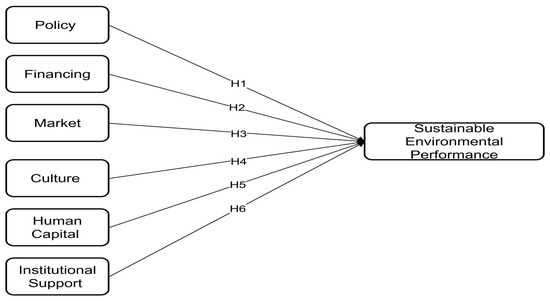
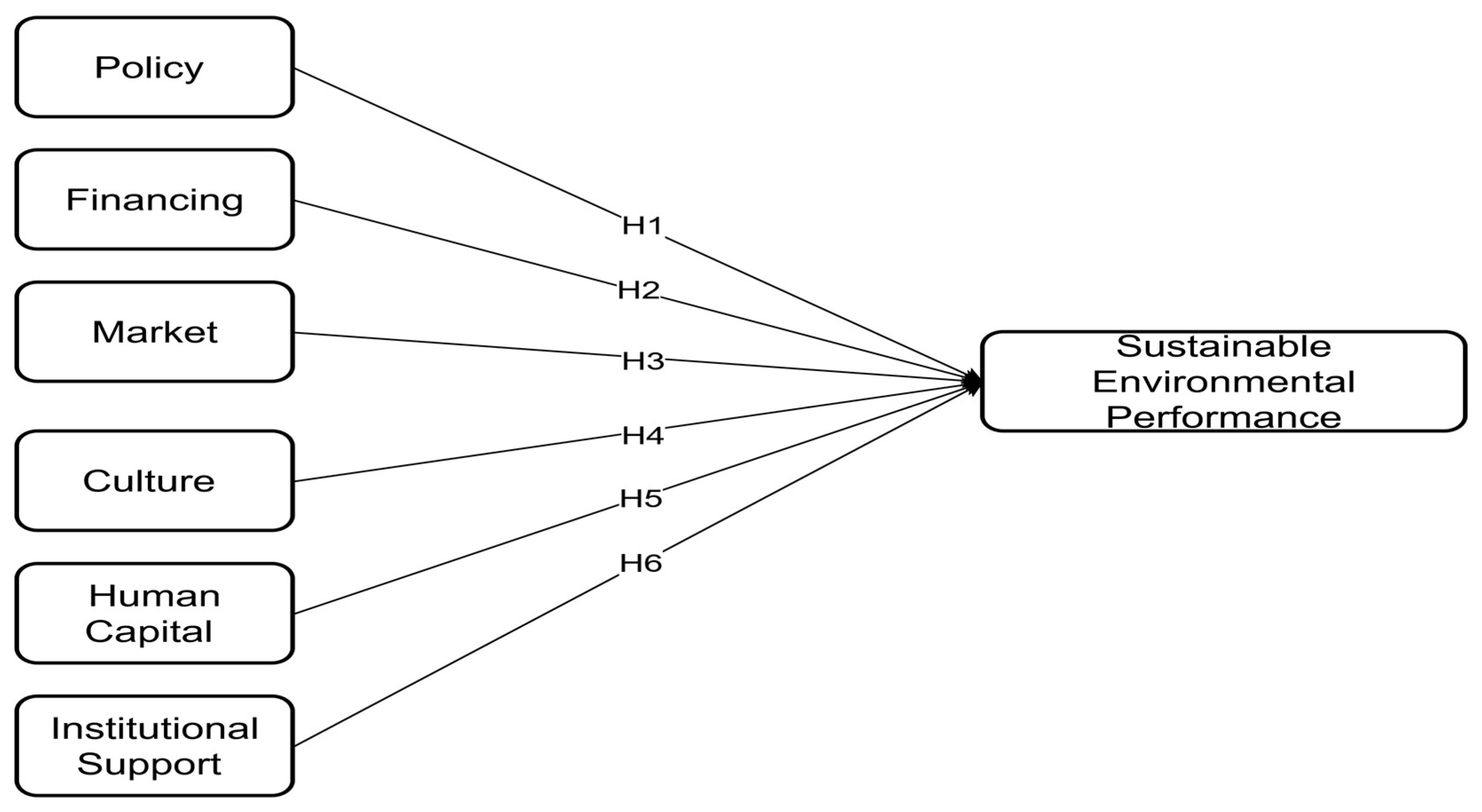
The conceptual framework is supported by the perspective that the entrepreneurial ecosystem (EE) influences the potential of SMEs to attain sustainable environmental performance (SEP). Entrepreneurial ecosystems are composed of policies, access to finance, markets, culture, human capital and support systems (Isenberg, 2016; Spigel et al., 2020; Stam et al., 2025). The dimensions make it possible to innovate and mobilize resources and exchange knowledge, which helps SMEs adopt green practices. The EE is represented as a second-order factor that impacts SEP by affecting resource efficiency, waste control, and environmental conformity (Genty et al., 2025; Reim et al., 2025). Therefore, the powerful EE has a positive impact on sustainable environmental performance and leads to the formulation of a hypothesis. This is illustrated in Figure 1.
Figure 1.
The relationship between external ecosystem resources and sustainable environmental performance.
Comprehensively, the theoretical construct assumes that an entrepreneurial ecosystem that is robust and supportive has a positive impact on sustainable environmental performance (see Figure 1). This steered the formulation of the hypotheses in the study and the choice of proper methodological procedures to be used to test the hypotheses.
2.2. Hypothesis Development
Sustainable environmental performance (SEP) has been a strategic need among small and medium-sized enterprises (SMEs), especially in the developing economies where the environmental degradation, poor regulatory framework and scarcity of resources continue to be a burning issue. With the world turning its focus to eco-innovation, circular production, and climate resilience, researchers begin to focus more on the fact that SMEs, in spite of their economic value, often fail to live up to the demands of sustainability due to the lack of financial resources, technical capabilities, and favorable institutional conditions (Obeng et al., 2020; Mensah & Awuah, 2019).
In an entrepreneurial ecosystem, government policies, financial systems, market dynamics, cultural values, human capital and institutional support are all factors that essentially determine how much SMEs embrace and practice environmentally responsible behaviors (Isenberg, 2016; Spigel et al., 2020). Empirical data indicate that when policies in the form of environmental regulations, subsidies, and green incentives are empowered, firms tend to install cleaner technologies (Porter & van der Linde, 1995; Amuah et al., 2025; Baxter et al., 2023), but when such measures are poorly implemented and stakeholders are not at all involved, the sustainability results are undermined (Bamfo et al., 2023; Amoako et al., 2021; Ackah & Boadu, 2025; Adjanor-Doku et al., 2025). The factor of financial availability is also decisive as affordable credits, green financing, and concessional funds help to decrease the initial costs of eco-innovation, but still, in emerging economies, SMEs have to deal with the high interest rates, compulsory collaterals, and the lack of facilities for green financing (Beck & Demirgüç-Kunt, 2006; Amuah et al., 2025; Quartey et al., 2017; Amoako et al., 2021; Mensah & Awuah, 2019). On the same note, consumer demand, green certifications, and export obligations define the market forces that draw firms towards environmentally friendly strategies (Dangelico & Vocalelli, 2017), yet the demand of eco-friendly products is rather low in emerging economies because of the lack of awareness and financial restrictions (Abor et al., 2024; Mugano & Dorasamy, 2024).
The adoption of sustainability is also influenced by cultural values: cultures with a higher focus on environmental responsibility and innovation tend to adopt green behavior (Schein, 2010; Hofstede, 2001; Jamali et al., 2017). However, there are still several emerging economies that focus on short-term survival rather than on sustainability (Hernández-Perlines et al., 2024; Vrontis et al., 2024; Kraus et al., 2019; Centobelli et al., 2025). SEP is also affected by human capital and institutional support, which provide skills, training, and enabling structures, which help in responsible practices. Based on this, the literature presents six hypotheses (H1–H6) of the relationship between government policies, financing, market conditions, culture, human capital and institutional support and sustainable environmental performance of SMEs. The researchers, therefore, propose the following hypothesis.
H1.
Government policies have significant positive effects on the sustainable environmental performance of SMEs.
H2.
Ecosystem financing has significant positive effects on the sustainable environmental performance of SMEs.
H3.
Ecosystem markets have significant positive effects on the sustainable environmental performance of SMEs.
H4.
Ecosystem culture has significant positive effects on the sustainable environmental performance of the SME.
H5.
Human capital has significant positive effects on the sustainable environmental performance of SMEs.
H6.
Institutional support has significant positive effects on the sustainable environmental performance of SMEs.
3. Research Methodology
The study follows a positivist paradigm, which presupposes that reality is objective, observable, and measurable in terms of the empirical study (Saunders et al., 2019). Such a philosophical stance complies with the objective of the study, which is to test theory-based correlations between the entrepreneurial ecosystem (EE) and sustainable environmental performance (SEP) of SMEs. The research is directed by positivism and adheres to a deductive research strategy whereby the hypotheses based on the current EE and sustainability theories are tested empirically. A quantitative approach was chosen since it will enable the utilization of structured tools, statistical processing, and generalization to the wider SME population. The research design was a cross-sectional survey. Cross-sectional surveys are only used when one wants to capture data at a given point in time and also when one wants to establish the relationship between the constructs within the large population. The design agrees with deductive and positivist position, and it allows testing the hypothesis on the basis of numerical data at the same time, and it is cost-effective (Hair et al., 2019).
This study was on the manufacturing and service businesses of the SMEs. Owners, senior managers, and managers were involved in the research. Participants were eligible if they operated as SMEs in the Ashanti region (1–249 employees), were formally registered with a recognized authority, had operated for at least one year, were willing to participate voluntarily, and were within the study’s geographic scope. Excluded were informal or unregistered businesses, those operating for less than one-year, unwilling participants, enterprises outside the selected locations, and duplicate or incomplete entries. The sampling frame was based on the current national business registry and database from Ghana Revenue Authority which lists 4847 registered SMEs for the Ashanti Region. Considering the scattered nature of the SMEs, a sample size of 386 SMEs was selected conveniently based on respondent availability and willingness to participate. Such a sample size is sufficient for structural equation modeling (SEM), specifically PLS-SEM. Hair et al. (2024) recommend at least ten times the greatest number of structural paths whereas Kline (2023) indicates that model stability requires at least 200 cases and Wolf et al. (2013) believes that samples of more than 300 are beneficial. Thus, the study sample of 386 increases statistical power and makes strong conclusions. One month was set for the completion of data collection from across the target population, relying on the help of research assistants who contacted participants at their various workplaces to provide responses to the questionnaire. To ensure supervision of the research assistants, they were first trained to appreciate the study and the variables under study.
3.1. Measurement and Scale Development
All study constructs were measured using scales adapted from established literature to ensure reliability and validity. Prior to full deployment, the instrument was reviewed for content validity and contextual relevance to Ghanaian SMEs to ensure conceptual equivalence of the adapted items. Items were contextualized to the SME environment and rated on a five-point Likert scale (1 = strongly disagree to 5 = strongly agree). Entrepreneurial ecosystems (EEs) were operationalized as a multidimensional construct, while sustainable environmental performance (SEP) was measured as a single-dimensional outcome. Consistent with prior research, EE comprised six dimensions: policy, 4 items; financing, 4 items; culture, 4 items; markets, 4 items; human capital, 4 items; and support system, 4 items (Isenberg, 2016; Stam et al., 2025; Adomako et al., 2016; Liguori et al., 2019; Sethar et al., 2022; Leendertse et al., 2022). The policy dimension served as a proxy for governance quality, capturing regulatory clarity, enforcement effectiveness, policy consistency, and environmental incentives. This is justified because SMEs experience governance primarily through regulatory predictability and incentive frameworks rather than macro-level governance indices. Financing reflected access to credit and green capital, while markets captured sustainability-related demand pressures. SEP measures were grounded in established literature (Hourneaux et al., 2014; Puig et al., 2014; Campos et al., 2015) and assessed environmental integrity, waste management, biodiversity protection, renewable energy adoption, emission reduction, and recycling. Perceptual indicators were used due to the limited availability of objective environmental data in SMEs and are widely validated as reliable proxies of eco-efficiency and compliance performance.
3.2. Demographic and Firm Characteristics of Participants
Descriptive analysis was conducted on the study participants’ data based on their demographics and firm characteristics of the participants. The demographic profile of the 386 respondents reflects an 88.1% male-dominated sample and 11.9% females, while 58.5% of the participants fall in the age category of 41–50 years. A total of 37.8% holds bachelor’s degrees and 29% master’s degrees. The majority, 60.9%, recorded 10–15 years of experience, showing considerable exposure to the industry. Managers recorded 60.4%, non-managers 22.5%, and owners/CEOs accounted for 17.1%. The firm characteristics of the 386 SMEs showed sole proprietorships were 60.4%, partnerships were 37.8% and limited liability companies were 1.8%. Participants in the manufacturing sector were 64.2%, service-oriented firms 32.6% and other activities 3.1%. Firm size of the participating SMEs were 21–30 workers (43.8%) and 31–40 workers (38.9%), with only a few that employed less than 20 or above 40 workers. Firm age was 6–10 years (46.4%), 11–15 years (34.2%), first years of operation (11.9%) and more than 20 years (7.5%).
4. Reliability and Validity
Cronbach’s alpha, rho_A, CR, and AVE were used to test the reliability and validity of the constructs. According to Table 1, Cronbach’s alpha values ranged from 0.705 to 0.838, outperforming the threshold of 0.70 for acceptability (Nunnally & Bernstein, 1994). Similarly, construct reliability was further supported by rho_A values of 0.718–0.855. Composite reliability values were all above the recommended threshold, ranging from 0.834 to 0.900 (Hair et al., 2024). Similarly, AVE values ranged from 0.599 to 0.819. These values surpass the 0.50 threshold (Fornell & Larcker, 1981), hence satisfying convergent validity. Variance inflation factor (VIF) values were between 1.166 and 2.172 (See Table 1), which are well below the thresholds, demonstrating no problem with multicollinearity Hair et al. (2024); Sarstedt et al. (2020).
Table 1.
Reliability and validity estimates.
4.1. Discriminant Validity
Discriminant validity was assessed using both the Fornell–Larcker and HTMT criteria. The Fornell–Lacker criterion compares the square root of AVE with inter-construct correlations (Fornell & Larcker, 1981). As shown in Table 2, all AVE roots exceeded corresponding correlations, confirming construct distinctiveness. Culture (0.905) exceeded its correlations with financing (0.517) and institutional support (0.706), while sustainable environmental performance (0.903) was higher than its correlations with financing (0.725) and human capital (0.401). HTMT values (Henseler et al., 2015) were mostly below 0.85 (Kline, 2023), including culture–finance (0.693). Two values, policy and finance (0.845), and markets and human capital (0.883), were below the 0.90 threshold, consistent with previous conclusions (see Voorhees et al., 2016; Rönkkö & Cho, 2022) (See Table 3).
Table 2.
Fornell–Larcker criterion.
Table 3.
Heterotrait–monotraitratio.
4.2. Model Fit
All model fit indices suggest that the structural model provides a good fit to the data. The model showed acceptable fit indices with SRMR = 0.069; χ2 = 248.316 and NFI = 0.90 (Hu & Bentler, 1999). d_ULS was equally low at 0.855; 0.871 and d_G was 0.534; 0.548, also supporting the acceptable threshold of the model. The result also showed R2 values of 0.85, which according to Hair et al. (2019) (https://link.springer.com/article/10.1186/s13731-024-00457-6#ref-CR40, accessed on 15 March 2026), exhibit strong explanatory power, suggesting that the predictors are highly relevant for SEP in this context. Although Chin et al. (2020), suggest that R2 must be interpreted in the context of the relevant field, 0.85 of the current study shows that about 85.5% of the variance in SEP is significantly explained by the predictor variables.
5. Findings and Discussion
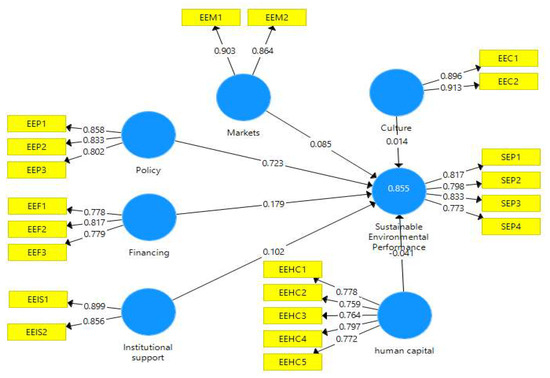
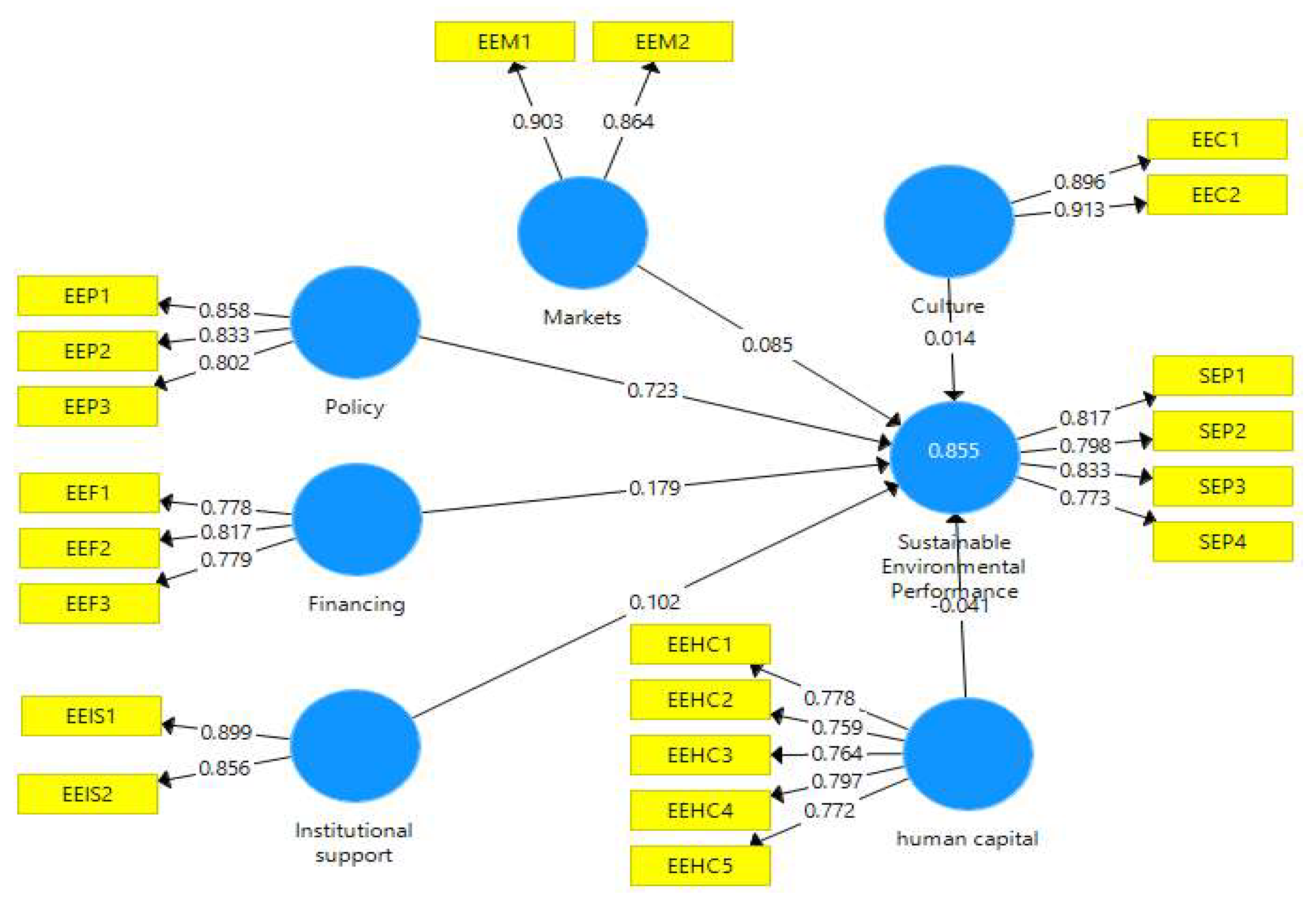
The study findings were analyzed using structural equation modelling (SEM) to identify the direct effects of entrepreneurial ecosystem dimensions on SEP. The results are presented in Table 4/Figure 2. From these results, it can be determined that EEP had the strongest and most significant positive influence on SEP (β = 0.723, p < 0.001). The coefficient’s magnitude indicates that clearer regulations, incentives, and innovation policies substantially boost SMEs’ environmental performance, making policy reforms transformational, not merely supportive, for sustainability outcomes. This finding reinforces prior studies highlighting government intervention as a central driver of sustainability outcomes (Darko & Koranteng, 2021; Amankwah-Amoah et al., 2018), while also demonstrating that in emerging economies, policy may outweigh other ecosystem components in shaping environmental results.
Table 4.
Path relationship.
Figure 2.
Path relationship establishing the relationship between external ecosystem and environmental performance.
EEF also had a significant positive impact on SEP (β = 0.179, p < 0.001). Although smaller than policy, the coefficient indicates a meaningful enabling role—access to finance appears to facilitate, rather than independently drive, green transformation by allowing SMEs to operationalize sustainability investments. Similarly, EEIS showed a positive and significant effect (β = 0.102, p = 0.005), underscoring the complementary role of support agencies in translating policy intentions into firm-level capabilities.
Entrepreneurial ecosystem markets (EEM) showed a weaker but statistically significant impact (β = 0.085, p = 0.046), suggesting that market pressures exert incremental rather than dominant influence. This contrasts with some market-driven sustainability arguments and may reflect relatively low green consumer activism in the study context. On the other hand, culture (EEC) (β = 0.014, p = 0.724) and human capital (EEHC) (β = −0.041, p = 0.319) were not significant (see Table 4/Figure 2). This contradicts innovation-based perspectives that emphasize skills and cultural orientation as primary sustainability drivers, likely because in resource-constrained environments, internal capabilities remain latent without strong policy incentives and financial support. The non-significant human capital result is particularly noteworthy, suggesting that workforce competencies alone are insufficient to produce measurable environmental outcomes without supportive structural conditions.
5.1. Discussion of the Results
The results of the present study offer meaningful insights regarding the effects of varying dimensions of entrepreneurial ecosystems on sustainable environmental performance (SEP) of the Ghanaian SMEs. It is important to note that, given the cross-sectional survey design, the results should be interpreted as empirical associations rather than definitive causal relationships. Out of the six EE constructs analyzed, policy, financing, and institutional support as well as markets were found to be important predictors of SEP, whereas culture and human capital did not have a direct impact. These findings therefore indicate statistically significant relationships between specific ecosystem conditions and SME environmental outcomes within the study context. These findings are consistent with and build on existing studies on the sustainability of SMEs and ecosystem development.
First, the policy of entrepreneurial ecosystem (EEP) positively impacted SEP to the largest extent, which emphasizes the importance of governmental regulatory and policy frameworks. This strong association suggests that supportive policy environments may create enabling conditions that encourage SMEs to adopt environmentally responsible practices. According to previous research, tax incentives, enforcement of regulations, and innovation-driven policies have a strong impact on increasing the sustainability rates of the SMEs (Bamfo et al., 2023; Amoako et al., 2021; Abor et al., 2024; Mugano & Dorasamy, 2024; Adjanor-Doku et al., 2025). This is in line with Liew et al. (2025), who suggest that robust policy mechanisms can minimize the institutional voids in emerging economies, as well as ensure alignment with SDGs, especially SDG 12 and SDG 13.
Second, there was also entrepreneurial ecosystem financing (EEF), which had a profound impact on SEP and, once again, made it clear that access to capital is a condition to follow environmentally responsible practices. More cautiously interpreted, the results indicate that SMEs with greater access to financing tend to report higher levels of environmental performance, likely because financial resources facilitate investments in cleaner technologies and sustainable production systems. According to Hernández-Perlines et al. (2024) and Kraus et al. (2019), one of the obstacles faced by SMEs in emerging economies is the lack of access to credit. SMEs can invest in green technologies and increase their efficiency using financial resources, which will contribute to SDG 9 on innovation and infrastructure (Vrontis et al., 2024; Centobelli et al., 2025).
Third, the institutional support (EEIS) proved to have a positive impact on SEP, which reflects the importance of development agencies, industry associations and capacity-building programs. This relationship indicates that SMEs embedded in ecosystems with stronger support institutions may be better positioned to access knowledge, training, and technical assistance related to sustainability practices. Empirical studies demonstrate that institutional support through structured training programs, capacity-building initiatives, and technical assistance significantly enhances SMEs’ ability to adopt and implement sustainability strategies, improving their environmental management practices and compliance with green standards (López-Gamero et al., 2024; Zhang et al., 2025; Singh & Gupta, 2024; Oliveira et al., 2025).
The fourth effect was of a lesser but significant impact on markets (EEM). This finding suggests that market conditions such as customer demand for environmentally responsible products may play a supportive, though comparatively weaker, role in shaping SME environmental behavior. According to Oliveira et al. (2025), the most effective way to harness sustainability through the market is through consumer action where they demand products that are environmentally responsible, which many emerging economies have yet to harness (see also Li et al., 2024; Park et al., 2024;Nguyen et al., 2025).
Although entrepreneurial behavior is shaped by cultural norms (Acquaah & Agyapong, 2015) and human capital is associated with innovation (Unger et al., 2011), neither factor exerts a direct effect on sustainable environmental performance (SEP) in this context. This does not necessarily imply that these factors are unimportant; rather, the results indicate that their influence may operate indirectly or through interaction with other ecosystem conditions. Theoretically, culture and human capital are valuable resources but require complementary capabilities like green innovation and environmental management systems to generate sustainable environmental performance (SEP) (Barney, 1991; Wang & Ahmed, 2007). RDT emphasizes responding to external pressures to leverage internal resources effectively (Pfeffer & Salancik, 1978), while Stakeholder Theory highlights that engagement with environmentally concerned stakeholders is critical, as internal resources alone may not drive SEP (Freeman, 1984; Clarkson, 1995).
All in all, these results demonstrate that external structural conditions, especially policy and financing, appear to be more strongly associated with SME sustainability outcomes than internal cultural or human resource strengths in this empirical setting (Zahra & Wright, 2011; Spigel et al., 2020; Centobelli et al., 2025; Vrontis et al., 2024). However, future longitudinal or mixed-method studies would be valuable in establishing the causal mechanisms through which ecosystem conditions influence SME environmental performance over time.
5.2. Conclusions
This paper has discussed the effect of entrepreneurial ecosystem on the sustainable environmental performance (SEP) of SMEs in Ghana in terms of policy, financing, markets, institutional support, human capital, and culture. The results indicate that policy, financing, markets and institutional support are strong aspirators of the environmental performance of SMEs, but culture and human capital have a weak or no effect. This underlines the necessity of the SMEs in exploiting the ecosystem resources effectively to adopt practices that are environmentally responsible. This research has a theoretical contribution as it has gone further than the literature on the entrepreneurial ecosystem and focuses on sustainability transitions. Based on the Resource-based View (RBV), Resource Dependency Theory (RDT), and Stakeholder Theory, the findings indicate that the external ecosystem resources and stakeholder networks can influence SMEs in producing environmental results in the emerging economy context. In practice, the results imply that policymakers need to reinforce ecosystem aspects, including enabling regulations, green financing systems, and sustainability-related market incentives to enhance responsible production (SDG 12) and climate action (SDG 13). Nonetheless, generalization is restricted because the study is focused on Ghana. The model should be applied in other emerging economies in the future, they should take a longitudinal approach, and they should study the moderators like adoption of technology and enforcement of regulations. In general, enhancing the entrepreneurship ecosystem in emerging economies is crucial not only to the development of SMEs but also the promotion of sustainable environmental performance and the developmental goals at large.
5.3. Theoretical Implications
This paper theoretically links the entrepreneurial ecosystem factors to SMEs’ SEP performance through a combination of the Resource-based View, Resource Dependency Theory, and Stakeholder Theory. From an RBV perspective, Barney et al. (2021) and Helfat et al. (2023) note that the ecosystem resources, herein financing, institutional support, market, human capital, and culture, function as valuable complementary assets that enhance SMEs’ capacity to operate in sustainable ways. Although RBV traditionally emphasizes capability issues inside the firm, this paper extends the theory by showing how ecosystem resources play a critical enabling role in contexts where firms’ internal resources are constrained, such as Ghana.
On RDT, Celtekligil (2020) and Öztürk and Bağış (2025) suggest that financing and institutional support exert strong influence because SMEs depend on external actors to overcome resource limitations and uncertainty. Beyond mitigating dependency, the significant influence of ecosystem policy indicates that regulatory frameworks actively shape SMEs’ strategic orientation toward sustainability. Thus, ecosystem governance systems reduce vulnerability while simultaneously creating environmental value. The study also extends Stakeholder Theory (Bridoux & Stoelhorst, 2022; Shah & Guild, 2022) by demonstrating that SME sustainability outcomes are primarily influenced by supply-side stakeholders, notably government agencies, financial institutions, and market actors. The relatively weak influence of culture and human capital suggests that in emerging economies, structural and regulative stakeholders are more influential than societal or skill-based forces. From the theoretical direction, the study makes an academic contribution to entrepreneurship and sustainability research by empirically integrating RBV, RDT, and Stakeholder Theory within a single ecosystem-based framework, offering researchers a multi-theoretical explanation of SME environmental performance in emerging economies (Kraus et al., 2019; Hernández-Perlines et al., 2024; Vrontis et al., 2024).
5.4. Managerial/Practical Implication
This paper has highlighted that the sustainable environmental performance of SMEs is greatly determined by the effectiveness of the interactions of firms in their respective entrepreneurial ecosystems. In the case of managers, sustainability is an undertaking that cannot be done in a vacuum but must exploit external support systems and align business operations with the overall ecosystem processes. To begin with, the high intensity of ecosystem policy implies that SME managers need to streamline the strategies concerning the environment with the regulations on the national and local level. By actively addressing environmental policy incentives, tax breaks, as well as compliance regimes, one can improve competitiveness and offer to the goal of sustainability. Establishing a friendship with regulatory bodies and industry bodies will ensure that SMEs expect policy changes and act accordingly. Importantly, the large policy coefficient indicates that managerial inaction in this domain may result in significant missed sustainability gains, making regulatory engagement a strategic priority rather than a compliance obligation.
Second, the importance of financing and institutional support emphasizes the importance of building networks, which can help in accessing green financing and technical advice. Partnerships with government bodies, developmental organizations as well as business support institutions may offer the necessary resources to embrace eco-friendly technologies. Partnerships should be aggressively sought by managers, where they gain both financial and capacity building support. Managers should therefore institutionalize external relationship management such as appointing sustainability liaisons or participating in formal support programs to systematically secure financial and technical resources.
Third, the effects of market-based ecosystem factors imply that SMEs ought to be able to tap new market segments that are sustainability-focused. Placing the products in the green value chains and communication of environmental responsibility can draw in eco-friendly customers and investors. However, given the modest market co-efficient, managers should not rely solely on consumer demand but combine market positioning with policy alignment and financial leverage to achieve measurable environmental improvements. On the whole, the entrepreneurial ecosystem should be perceived by SME managers as a strategic facilitator of sustainability, with the use of policy aspects, funding sources, and market opportunities to solve the problem of limited resources and increase the level of environmental performance.
5.5. Policy Implications
The results of the present study have important policy implications for the policymakers who are interested in increasing the role of SMEs in promoting environmental sustainability, especially in terms of contributing to SDG 12 (Responsible Consumption and Production) and SDG 13 (Climate Action). The high impact of the entrepreneurial ecosystem policy on sustainable environmental performance implies that regulatory frameworks and incentives should be established to motivate the SMEs to learn more about cleaner production, waste minimization, and energy-efficient production processes. Given the large policy coefficient observed in the model, reforms in regulatory clarity and enforcement are likely to yield proportionally significant improvements in SME environmental outcomes. Specific incentives like tax rebates on environmentally friendly investments, incentives on renewable energy technologies and preferential bidding of sustainability-focused SMEs can be used to minimize financial obstacles and encourage businesses to adopt greener practices. In addition, the findings also indicate that financing, institutional support, and market access play a vital role in helping SMEs to align themselves with climate objectives. Enhancing access to renewable technologies that are affordable and expanding green financing mechanisms, as well as enhancing capacity-building programs in the field of environmental management, will allow the SMEs to reduce emissions and enhance readiness for climate shock. The further implementation of climate resilience in the long-term and innovation can be done with the help of investment in green infrastructure and supply chain systems. The empirical evidence suggests that finance and support systems operate as enabling complements to policy; therefore, isolated regulatory mandates without financial backing may produce limited results. Lastly, disorganized or disjointed attempts at policy-making discourage the sustainability of SMEs. In such a manner, policymakers in emerging economies need to integrate a strategy of financial regulation, industrial development and environmental objectives via a coordinated ecosystem to empower quick-minded production and help the climate mitigation efforts. Such policy coherence is critical to translating sustainability goals into measurable SME-level environmental performance and long-term climate resilience.
5.6. Limitations and Future Research Suggestions
Though this research is important for understanding the role of the entrepreneurial ecosystem in sustainable environmental performance (SEP), several limitations must be acknowledged. To begin with, while the study analyzed ecosystem dimensions including policy, financing, markets, institutional support, culture, and human capital, other potentially relevant factors such as technological infrastructure, digital transformation, innovation networks, and informal institutional dynamics were not considered. The exclusion of these variables may have constrained the explanatory power of the model and limited a more holistic representation of ecosystem complexity. Future research should adopt broader ecosystem configurations to provide a more comprehensive understanding of SME environmental performance.
Second, culture and human capital demonstrated insignificant outcomes on SEP that could indicate measurement bias or situational features of the Ghanaian SME environment. It is possible that perceptual survey measures did not fully capture tacit cultural norms or the depth of workforce competencies, thereby introducing potential common method bias or construct under-specification. Future research could employ mixed-method or multi-source designs to explore these relationships more deeply. Third, the single-country focus limits generalizability, as entrepreneurial ecosystems differ across institutional contexts. Contextual factors such as regulatory maturity, financial market depth, and environmental enforcement intensity may moderate the observed relationships. Comparative cross-country studies would help identify universal versus context-bound patterns.
Moreover, the cross-sectional design does not allow one to capture the changes with time. A longitudinal study is necessary to determine the varying impact of changing policies, financial mechanisms, and institutional support on SEP. Lastly, the research failed to consider any moderating or mediating factors like firm size, industry, or the level of internationalization. Incorporating these contingencies could refine theoretical precision by identifying boundary conditions under which ecosystem factors exert stronger or weaker sustainability effects.
Author Contributions
Conceptualization, C.K.-K., D.Y.D. and V.Y.A.; methodology, C.K.-K., D.Y.D. and V.Y.A.; soft-ware, C.K.-K., D.Y.D. and V.Y.A.; validation, C.K.-K., D.Y.D. and V.Y.A.; formal analysis, C.K.-K., D.Y.D. and V.Y.A.; investigation, C.K.-K., D.Y.D. and V.Y.A.; resources, C.K.-K., D.Y.D. and V.Y.A.; data curation, C.K.-K.; writing—original draft preparation, C.K.-K.; writing—review and editing, C.K.-K.; visualization, C.K.-K.; supervision, D.Y.D. and V.Y.A.; project administration, D.Y.D.; funding acquisition, D.Y.D. All authors have read and agreed to the published version of the manuscript.
Funding
This research received no external funding.
Institutional Review Board Statement
The study was conducted in accordance with the Declaration of Helsinki and approved by the Ethics Committee of Faculty of Management Sciences, Central University of Technology, Free State, South (protocol code FMSEC11222 and 9 July 2025 of approval).
Informed Consent Statement
Informed consent was obtained from all subjects involved in the study.
Data Availability Statement
The datasets for the current study are not publicly available due to confidentiality agreements with research participants but are available from the corresponding author upon reasonable request.
Acknowledgments
This paper is based on the primary data collected during first author’s unpublished PhD thesis titled “Entrepreneurial marketing and sustainable business performance of SMEs in Ghana: mediating moderating role of entrepreneurial ecosystem”.
Conflicts of Interest
The authors declare no conflict of interest.
References
- Abor, J. Y., Quartey, P., Nellis, J. G., & Subramanian, L. (2024). Monetary economics in emerging and developing countries. Routledge. [Google Scholar] [CrossRef] [Scilit]
- Ackah, D., & Boadu, K. O. (2025). Entrepreneurship as a catalyst for innovation and economic growth in Ghana. Dama Academic Scholarly Journal of Researchers, 10(4), 28–47. [Google Scholar] [CrossRef] [Scilit]
- Acquaah, M., & Agyapong, A. (2015). The relationship between competitive strategy and firm performance in micro and small businesses in Ghana: The moderating role of managerial and marketing capabilities. Africa Journal of Management, 1(2), 172–193. [Google Scholar] [CrossRef] [Scilit]
- Adjanor-Doku, C., Ellis, F. Y., & Affum-Osei, E. (2025). Environmental performance: A systematic review of literature and directions for future studies. Corporate Social Responsibility and Environmental Management, 32(1), 71–87. [Google Scholar] [CrossRef] [Scilit]
- Adomako, S., Danso, A., Uddin, M., & Damoah, J. O. (2016). Entrepreneurs’ optimism, cognitive style and persistence. International Journal of Entrepreneurial Behavior & Research, 22(1), 84–108. [Google Scholar] [CrossRef] [Scilit]
- Agyapong, A., Acquaah, M., Abiew, G. E., & Zan, H. N. (2024). Dynamic pathways to SMEs performance: Unraveling the influence of organizational learning capability, innovation, market dynamism and market responsiveness in an African emerging economy. Africa Journal of Management, 10(1), 50–74. [Google Scholar] [CrossRef] [Scilit]
- Ahenkan, A., Boon, E., Akalibey, S., & Nordjo, E. (2025). Corporate environmentalism and business sustainability in Ghana: Prospects and challenges. Business Strategy & Development, 8(1), e70057. [Google Scholar] [CrossRef] [Scilit]
- Amankwah-Amoah, J., Boso, N., & Antwi-Agyei, I. (2018). The effects of business failure experience on successive entrepreneurial engagements: An evolutionary phase model. Group & Organization Management, 43(4), 648–682. [Google Scholar] [CrossRef] [Scilit]
- Amit, R., & Schoemaker, P. J. H. (1993). Strategic assets and organizational rent. Strategic Management Journal, 14(1), 33–46. [Google Scholar] [CrossRef] [Scilit]
- Amoako, G. K., Bonsu, G. A., Caesar, L. D., & Osei-Tete, F. (2021). Finding the nexus between green supply chain practices and sustainable business advantage: An emerging market perspective. Management of Environmental Quality, 32(6), 1133–1149. [Google Scholar] [CrossRef] [Scilit]
- Amuah, E. E. Y., Nandomah, S., Douti, N. B., Fei-Baffoe, B., Kazapoe, R. W., & Bentil, J. (2025). Reviewing the performance of environmental policies in addressing environmental and socio-economic issues and associated implementation challenges: Ghana’s perspective. Environmental Development, 56, 101288. [Google Scholar] [CrossRef] [Scilit]
- Balzano, M., Marzi, G., & Turzo, T. (2025). SMEs and institutional theory: Major inroads and opportunities ahead. Management Decision, 63(13), 1–27. [Google Scholar]
- Bamfo, B. A., Asiedu-Appiah, F., & Ameza-Xemalordzo, E. (2023). Developing a framework for entrepreneurship ecosystem for developing countries: The application of institutional theory. Cogent Business & Management, 10(2), 2195967. [Google Scholar] [CrossRef] [Scilit]
- Barney, J. B. (1991). The emergence of resource-based theory: A personal journey. Journal of Management, 47(7), 1663–1676. [Google Scholar] [CrossRef] [Scilit]
- Barney, J. B., Ketchen, D. J., & Wright, M. (2021). Resource-based theory and the value creation framework. Journal of Management, 47(7), 1936–1955. [Google Scholar] [CrossRef] [Scilit]
- Barney, J. B., Wright, M., & Ketchen, D. J. (2001). The resource-based view of the firm: Ten years after 1991. Journal of Management, 27(6), 625–641. [Google Scholar] [CrossRef]
- Basit, S. A., Gharleghi, B., Batool, K., Hassan, S. S., Jahanshahi, A. A., & Kliem, M. E. (2024). Review of enablers and barriers of sustainable business practices in SMEs. Journal of Economy and Technology, 2, 79–94. [Google Scholar] [CrossRef] [Scilit]
- Baxter, S., Barnes, A., Lee, C., Mead, R., & Clowes, M. (2023). Increasing public participation and influence in local decision-making to address social determinants of health: A systematic review examining initiatives and theories. Local Government Studies, 49(5), 861–887. [Google Scholar] [CrossRef] [Scilit]
- Beck, T., & Demirgüç-Kunt, A. (2006). Small and medium-size enterprises: Access to finance as a growth constraint. Journal of Banking & Finance, 30(11), 2931–2943. [Google Scholar] [CrossRef] [Scilit]
- Bindeeba, D. S., Bakashaba, R., Tukamushaba, E. K., & Atuhaire, S. (2025). From green HRM to sustainable business performance: A two-stage meta-analytic SEM of the mediating role of green innovation. Cogent Business & Management, 12(1), 2536678. [Google Scholar]
- Bridoux, F., & Stoelhorst, J. W. (2022). Stakeholder theory, strategy, and organization: Past, present, and future. Strategic Organization, 20(4), 797–809. [Google Scholar] [CrossRef] [Scilit]
- Campos, L. M. S., de Melo Heizen, D. A., Verdinelli, M. A., & Miguel, P. A. C. (2015). Environmental performance indicators: A study on ISO 14001 certified companies. Journal of Cleaner Production, 99, 286–296. [Google Scholar] [CrossRef] [Scilit]
- Cavallo, A., Ghezzi, A., & Rossi-Lamastra, C. (2021). Small-medium enterprises and innovative startups in entrepreneurial ecosystems: Exploring an under-remarked relation. International Entrepreneurship and Management Journal, 17(4), 1843–1866. [Google Scholar] [CrossRef] [Scilit]
- Cavicchi, C., Oppi, C., & Vagnoni, E. (2023). Mobilising management control systems to support sustainability strategy in SMEs: The case of a waste disposal firm. Meditari Accountancy Research, 31(4), 1015–1037. [Google Scholar] [CrossRef] [Scilit]
- Celtekligil, K. (2020). Resource dependence theory. In H. Dincer, & S. Yüksel (Eds.), Strategic outlook for innovative work behaviours. Contributions to Management Science. Springer. [Google Scholar] [CrossRef] [Scilit]
- Centobelli, P., Cerchione, R., & Del Vecchio, P. (2025). Organisational culture, digital transformation and sustainability performance: Evidence from SMEs. Business Strategy and the Environment, 34(1), 123–140. [Google Scholar] [CrossRef] [Scilit]
- Chin, W., Cheah, J., Liu, Y., Ting, H., Lim, X., & Cham, T. H. (2020). Demystifying the role of causal-predictive modeling using partial least squares structural equation modeling in information systems research. Industrial Management & Data Systems, 120(12), 2161–2209. [Google Scholar] [CrossRef] [Scilit]
- Clarkson, M. E. (1995). A stakeholder framework for analyzing and evaluating corporate social performance. Academy of Management Review, 20(1), 92–117. [Google Scholar] [CrossRef] [Scilit]
- Cunningham, J. A., Menter, M., & Wirsching, K. (2019). Entrepreneurial ecosystem governance: A principal investigator-centered governance framework. Small Business Economics, 52(2), 545–562. [Google Scholar] [CrossRef] [Scilit]
- Dangelico, R. M., & Vocalelli, D. (2017). “Green marketing”: An analysis of definitions, strategy steps, and tools through a systematic review of the literature. Journal of Cleaner Production, 165, 1263–1279. [Google Scholar] [CrossRef] [Scilit]
- Darko, A., & Koranteng, C. (2021). Ghana’s green building assessment journey: An appraisal of the thermal performance of an office building in Accra. Journal of Engineering, Design and Technology, 21(1), 188–205. [Google Scholar] [CrossRef] [Scilit]
- Donaldson, T., & Preston, L. E. (1995). The stakeholder theory of the corporation: Concepts, evidence, and implications. Academy of Management Review, 20(1), 65–91. [Google Scholar] [CrossRef] [Scilit]
- Drees, J. M., & Heugens, P. P. M. A. R. (2013). Synthesizing and extending resource dependence theory: A meta-analysis. Journal of Management, 39(6), 1666–1698. [Google Scholar] [CrossRef] [Scilit]
- Factor, A., Ulhøi, J. P., & Romm, N. (2021). Research on small and medium-sized enterprises and sustainability. In Sustainability and small and medium-sized enterprises: Lessons from mixed methods research (pp. 26–47). Routledge. [Google Scholar] [CrossRef] [Scilit]
- Ferreira, J. J., Fernandes, C. I., & Veiga, P. M. (2023). The role of entrepreneurial ecosystems in the SME internationalization. Journal of Business Research, 157, 113603. [Google Scholar] [CrossRef] [Scilit]
- Filippelli, S., Troise, C., Bigliardi, B., & Corvello, V. (2025). Examining the influence of entrepreneurial ecosystem pressure on the economic, social, and environmental orientation of startups. Technological Forecasting and Social Change, 210, 123900. [Google Scholar] [CrossRef] [Scilit]
- Florek-Paszkowska, A., & Ujwary-Gil, A. (2025). The digital-sustainability ecosystem: A conceptual framework for digital transformation and sustainable innovation. Journal of Entrepreneurship, Management and Innovation, 21(2), 116–137. [Google Scholar] [CrossRef] [Scilit]
- Fornell, C., & Larcker, D. F. (1981). Evaluating structural equation models with unobservable variables and measurement error. Journal of Marketing Research, 18(1), 39–50. [Google Scholar] [CrossRef] [Scilit]
- Freeman, R. E. (1984). Strategic management: A stakeholder approach. Pitman. [Google Scholar]
- Genty, K. I., Atiku, S. O., & Abata, A. M. (2025). Nexus between business ecosystem and micro, small and medium enterprises’ performance. Educational Administration: Theory & Practice, 31(1), 376–387. [Google Scholar] [CrossRef] [Scilit]
- Hair, J. F., Risher, J. J., Sarstedt, M., & Ringle, C. M. (2019). When to use and how to report the results of PLS-SEM. European Business Review, 31(1), 2–24. [Google Scholar] [CrossRef] [Scilit]
- Hair, J. F., Sharma, P. N., Sarstedt, M., Ringle, C. M., & Liengaard, B. D. (2024). The shortcomings of equal weights estimation and the composite equivalence index in PLS-SEM. European Journal of Marketing, 58(13), 30–55. [Google Scholar] [CrossRef] [Scilit]
- Helfat, C. E., Kaul, A., Ketchen, D. J., Jr., Barney, J. B., Chatain, O., & Singh, H. (2023). Renewing the resource based view: New contexts, new concepts, and new methods. Strategic Management Journal, 44(6), 1357–1390. [Google Scholar] [CrossRef] [Scilit]
- Henseler, J., Ringle, C. M., & Sarstedt, M. (2015). A new criterion for assessing discriminant validity in variance-based structural equation modeling. Journal of the Academy of Marketing Science, 43, 115–135. [Google Scholar] [CrossRef] [Scilit]
- Hernández-Perlines, F., Ariza-Montes, A., Han, H., & Law, R. (2024). Sustainability orientation, innovation culture and environmental performance in SMEs: A cross-country analysis. Journal of Business Research, 170, 114330. [Google Scholar] [CrossRef] [Scilit]
- Hillman, A. J., Withers, M. C., & Collins, B. J. (2009). Resource dependence theory: A review. Journal of Management, 35(6), 1404–1427. [Google Scholar] [CrossRef] [Scilit]
- Hofstede, G. (2001). Culture’s consequences: Comparing values, behaviors, institutions, and organizations across nations (2nd ed.). Sage. [Google Scholar] [CrossRef] [Scilit]
- Hourneaux, F., Jr., Hrdlicka, H. A., Gomes, C. M., & Kruglianskas, I. (2014). The use of environmental performance indicators and size effect: A study of industrial companies. Ecological Indicators, 36, 205–212. [Google Scholar] [CrossRef] [Scilit]
- Hu, L., & Bentler, P. M. (1999). Cutoff criteria for fit indexes in covariance structure analysis: Conventional criteria versus new alter natives. Structural Equation Modeling: A Multidisciplinary Journal, 6(1), 1–55. [Google Scholar] [CrossRef] [Scilit]
- Isenberg, D. J. (2016). Applying the ecosystem metaphor to entrepreneurship: Uses and abuses. The Antitrust Bulletin, 61(4), 564–573. [Google Scholar] [CrossRef] [Scilit]
- Jamali, D., Lund-Thomsen, P., & Jeppesen, S. (2017). SMEs and CSR in developing countries. Business & Society, 56(1), 11–22. [Google Scholar] [CrossRef] [Scilit]
- Journeault, M., Perron, A., & Vallières, L. (2021). The collaborative roles of stakeholders in supporting the adoption of sustainability in SMEs. Journal of Environmental Management, 287, 112349. [Google Scholar] [CrossRef] [Scilit]
- Kline, R. B. (2023). Principles and practice of structural equation modeling (5th ed.). Guilford Press. [Google Scholar]
- Kraus, S., Breier, M., Jones, P., & Hughes, M. (2019). Individual entrepreneurial orientation and intrapreneurship in the public sector. International Entrepreneurship Management Journal, 15, 1247–1268. [Google Scholar] [CrossRef] [Scilit]
- Leendertse, J., Schrijvers, M., & Stam, E. (2022). Measure twice, cut once: Entrepreneurial ecosystem metrics. Research Policy, 51(9), 104336. [Google Scholar] [CrossRef] [Scilit]
- Li, K., Du, L., Qin, C., Bolan, N., Wang, H., & Wang, H. (2024). Microplastic pollution as an environmental risk exacerbating the greenhouse effect and climate change: A review. Carbon Research, 3(1), 9. [Google Scholar] [CrossRef] [Scilit]
- Liew, M. X., Xavier, J. A., & Tehseen, S. (2025). Navigating institutional barriers and harnessing opportunities for SDG implementation and integration in emerging economies: A path toward sustainable transformation. In Advancing the SDGs in developing and emerging economies: Volume II: Sustainable development challenges (pp. 95–112). Springer. [Google Scholar] [CrossRef] [Scilit]
- Liguori, E., Bendickson, J., Solomon, S., & McDowell, W. C. (2019). Development of a multidimensional measure for assessing entrepreneurial ecosystems. Entrepreneurship & Regional Development, 31(1–2), 7–21. [Google Scholar] [CrossRef] [Scilit]
- López-Gamero, M. D., Molina-Azorín, J. F., Tarí, J. J., & Pertusa-Ortega, E. M. (2024). Interaction between sustainability practices and the mediating role of hotel performance. Journal of Sustainable Tourism, 32(5), 1027–1052. [Google Scholar] [CrossRef] [Scilit]
- Mensah, I. K., & Awuah, G. B. (2019). SMEs’ participation in sustainability practices: Evidence from an emerging economy. Sustainability, 11(18), 5049. [Google Scholar] [CrossRef] [Scilit]
- Mugano, G., & Dorasamy, N. (2024). SMEs perspective in Africa: Creating sustainable and resilient economies. Springer Books. [Google Scholar] [CrossRef] [Scilit]
- Nguyen, X. P., Le, N. D., Pham, V. V., Huynh, T. T., Dong, V. H., & Hoang, A. T. (2025). Mission, challenges, and prospects of renewable energy development in Vietnam. Energy Sources, Part A: Recovery, Utilization, and Environmental Effects, 47(1), 10367–10379. [Google Scholar] [CrossRef] [Scilit]
- Nunnally, J., & Bernstein, I. (1994). Psychometric theory (3rd ed.). MacGraw-Hill. [Google Scholar]
- Obeng, B. A., Robson, P., & Haugh, H. (2020). Strategic entrepreneurship and small firm growth in Ghana. International Small Business Journal, 38(2), 112–135. [Google Scholar] [CrossRef] [Scilit]
- Oliveira, W., Cruz-Neto, O., Silva, J. L., Tabarelli, M., Peres, C. A., & Lopes, A. V. (2025). Climate change will lead to local extinctions and mismatched range contractions disrupting bee-dependent crop pollination. Frontiers in Bee Science, 3, 1510451. [Google Scholar] [CrossRef] [Scilit]
- Öztürk, O., & Bağış, M. (2025). Bridging resource dependence theory and resource based view: A theoretical synthesis. Management Decision. [Google Scholar] [CrossRef] [Scilit]
- Park, B. Y., Campbell-Montalvo, R., Campbell, T., Cooke, H., Arnold, C., Chrysochoou, M., & Diplock, P. (2024). Instructors use of high leverage practices and tools in environmental service-learning courses. Cogent Education, 11(1), 2379674. [Google Scholar] [CrossRef] [Scilit]
- Pfeffer, J., & Salancik, G. R. (1978). The external control of organizations: A resource dependence perspective. Harper & Row. [Google Scholar]
- Porter, M. E., & van der Linde, C. (1995). Toward a new conception of the environment-competitiveness relationship. Journal of Economic Perspectives, 9(4), 97–118. [Google Scholar] [CrossRef] [Scilit]
- Puig, M., Wooldridge, C., & Darbra, R. M. (2014). Identification and selection of environmental performance indicators for sustainable port development. Marine Pollution Bulletin, 81(1), 124–130. [Google Scholar] [CrossRef] [Scilit]
- Quartey, P., Turkson, E., Abor, J. Y., & Iddrisu, A. M. (2017). Financing the growth of SMEs in Africa: What are the constraints to SME financing within ECOWAS? Review of Development Finance, 7(1), 18–28. [Google Scholar] [CrossRef] [Scilit]
- Reim, W., Tabares, S., & Parida, V. (2025). Small and medium-sized enterprises and the circular economy: Leveraging ecosystem strategies for circular business model implementation. Organization & Environment, 38(2), 257–283. [Google Scholar] [CrossRef] [Scilit]
- Rosário, A. T., & Boechat, A. C. (2025). How sustainable leadership can leverage sustainable development. Sustainability, 17(8), 3499. [Google Scholar] [CrossRef] [Scilit]
- Rönkkö, M., & Cho, E. (2022). An updated guideline for assessing discriminant validity. Organizational Research Methods, 25(1), 6–14. [Google Scholar] [CrossRef] [Scilit]
- Sarstedt, M., Ringle, C. M., Cheah, J. H., Ting, H., Moisescu, O. I., & Radomir, L. (2020). Structural model robustness checks in PLS-SEM. Tourism Economics, 26(4), 531–554. [Google Scholar] [CrossRef] [Scilit]
- Saunders, M. N. K., Lewis, P., & Thornhill, A. (2019). Research methods for business students (8th ed.). Pearson Education. [Google Scholar]
- Schein, E. H. (2010). Organizational culture and leadership (4th ed.). Jossey-Bass. [Google Scholar] [CrossRef] [Scilit]
- Sethar, W. A., Pitafi, A. H., Bhutto, A., Nassani, A. A., Haffar, M., & Kamran, S. M. (2022). Application of item response theory (IRT)-graded response model (GRM) to entrepreneurial ecosystem scale. Sustainability, 14(9), 5532. [Google Scholar] [CrossRef] [Scilit]
- Shah, M. U., & Guild, P. D. (2022). Stakeholder engagement strategy of technology firms: A review and applied view of stakeholder theory. Technovation, 114, 102460. [Google Scholar] [CrossRef] [Scilit]
- Shwetzer, C., Maritz, A., & Nguyen, Q. (2019). Entrepreneurial ecosystems: A holistic and dynamic approach. Journal of Industry-University Collaboration, 1(2), 79–95. [Google Scholar] [CrossRef] [Scilit]
- Singh, A., & Gupta, R. (2024). Green innovation, sustainability practices and firm performance: Evidence from emerging economies. Journal of Cleaner Production, 428, 139219. [Google Scholar] [CrossRef] [Scilit]
- Spigel, B., Kitagawa, F., & Mason, C. (2020). A manifesto for researching entrepreneurial ecosystems. Local Economy, 35(5), 482–495. [Google Scholar] [CrossRef] [Scilit]
- Spigel, B., & Stam, E. (2018). Entrepreneurial ecosystems. In R. Blackburn, D. De Clercq, & J. Heinonen (Eds.), SAGE handbook of entrepreneurship and small business (p. 21). Sage Publications. [Google Scholar] [CrossRef] [Scilit]
- Stam, E., Theodoraki, C., Bosma, N., Chabaud, D., & Guéneau, G. (2025). Opening entrepreneurial ecosystem black boxes. Small Business Economics, 65(3), 1535–1545. [Google Scholar] [CrossRef] [Scilit]
- Stam, E., & Van de Ven, A. (2021). Entrepreneurial ecosystem elements. Small Business Economics, 56(2), 809–832. [Google Scholar] [CrossRef] [Scilit]
- Unger, J. M., Rauch, A., Frese, M., & Rosenbusch, N. (2011). Human capital and entrepreneurial success: A meta-analytical review. Journal of Business Venturing, 26(3), 341–358. [Google Scholar] [CrossRef] [Scilit]
- Volkmann, C., Fichter, K., Klofsten, M., & Audretsch, D. B. (2021). Sustainable entrepreneurial ecosystems: An emerging field of research. Small Business Economics, 56(3), 1047–1055. [Google Scholar] [CrossRef] [Scilit]
- Voorhees, C. M., Brady, M. K., Calantone, R., & Ramirez, E. (2016). Discriminant validity testing in marketing: An analysis, causes for concern, and proposed remedies. Journal of the Academy of Marketing Science, 44(1), 119–134. [Google Scholar] [CrossRef] [Scilit]
- Vrontis, D., Christofi, M., Pereira, V., Tarba, S. Y., Makrides, A., & Sakka, G. (2024). Culture, innovation, and sustainability in SMEs: A strategic management perspective. Technological Forecasting and Social Change, 198, 123016. [Google Scholar] [CrossRef] [Scilit]
- Wang, C. L., & Ahmed, P. K. (2007). Dynamic capabilities: A review and research agenda. International Journal of Management Reviews, 9, 31–51. [Google Scholar] [CrossRef] [Scilit]
- Wolf, E. J., Harrington, K. M., Clark, S. L., & Miller, M. W. (2013). Sample size requirements for structural equation models: An evaluation of power, bias, and solution propriety. Educational and Psychological Measurement, 73(6), 913–934. [Google Scholar] [CrossRef] [Scilit] [PubMed]
- Zahra, S. A., & Wright, M. (2011). Entrepreneurship’s next act. Academy of Management Perspectives, 25(4), 67–83. [Google Scholar] [CrossRef] [Scilit]
- Zhang, X., Liu, Y., & Wang, H. (2025). Climate risk perception bias and corporate debt structure. Journal of International Money and Finance, 151, 103254. [Google Scholar] [CrossRef] [Scilit]

Disclaimer/Publisher’s Note: The statements, opinions and data contained in all publications are solely those of the individual author(s) and contributor(s) and not of MDPI and/or the editor(s). MDPI and/or the editor(s) disclaim responsibility for any injury to people or property resulting from any ideas, methods, instructions or products referred to in the content. |
© 2026 by the authors. Licensee MDPI, Basel, Switzerland. This article is an open access article distributed under the terms and conditions of the Creative Commons Attribution (CC BY) license.