Observing Entrepreneurial Opportunity in Entanglement


Abstract
1. Introduction
1.1. Background and Problematisation
1.2. Literature Identification and Screening Criteria
- (1)
- Conceptual centrality—the work provides a foundational mechanism relevant to opportunity emergence (e.g., propensities, enablers, affordances, judgement, or intentionality);
- (2)
- Scholarly influence—the work is highly cited or recognised as shaping contemporary debates in opportunity theory;
- (3)
- Theoretical complementarity—the work contributes a component that can be integrated within a relational, emergent, or intra-active understanding of entrepreneurial action.
1.3. Conceptual Positioning
- Lerner et al. (2018): Early-stage, intuitive venture actions.
- Pietersen and Botha (2021): Judgement-before-action approach.
- Lichtenstein (2009): Opportunity tension.
- S. D. Sarasvathy (2001): Effectuation.
- Lichtenstein et al. (2006): Non-linear and abrupt changes in the venture development process.
2. The Language of Opportunity and Its Gaps
3. Discussion
3.1. Entanglement, Interaction, and Intra-Action: Clarifying Relational Foundations
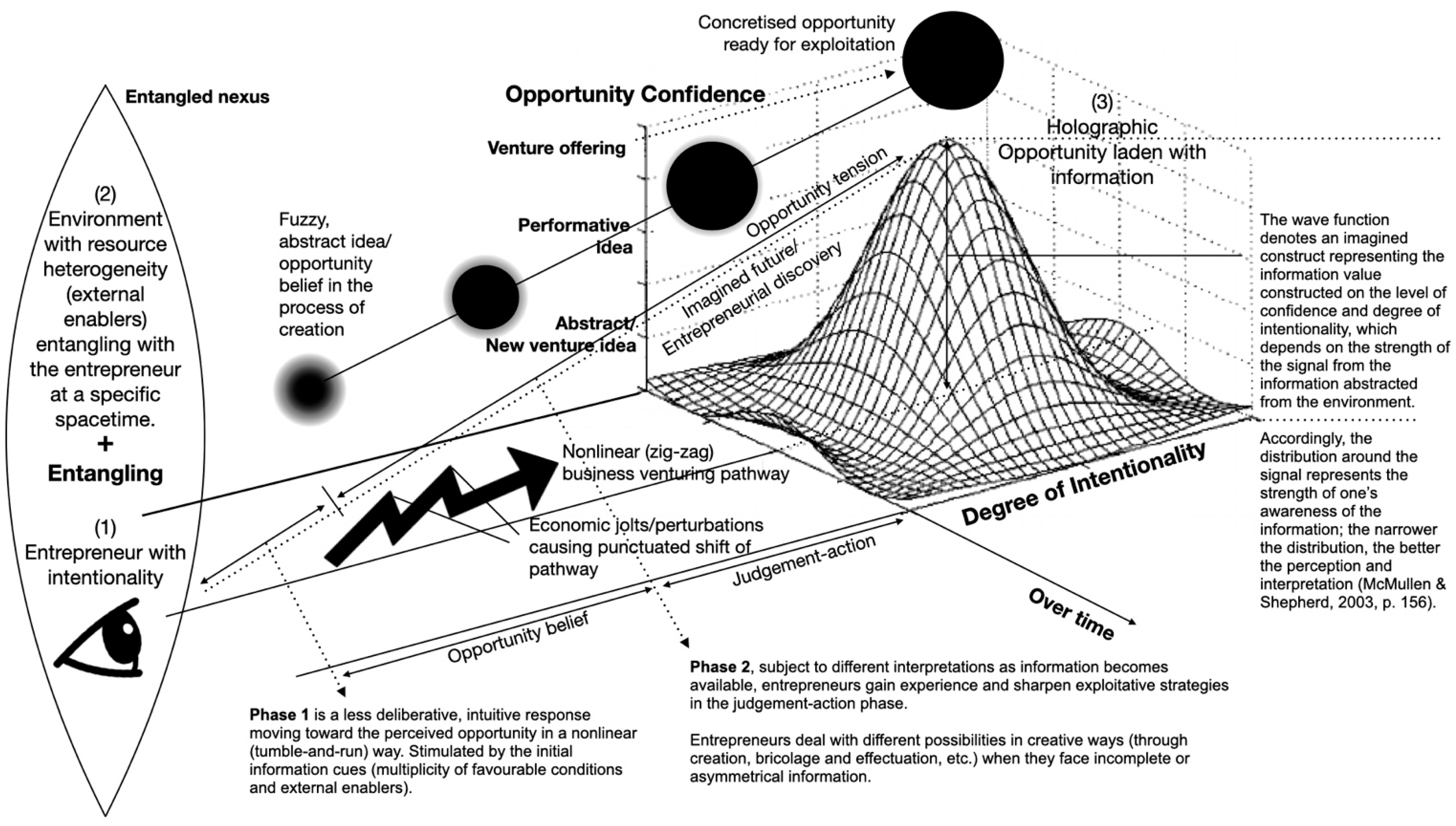
3.2. Explaining the Entangled Action Model
- Phase 1: Marked by non-rational behaviour, characterised by less deliberate impulsivity.
- Phase 2: Defined by rational, reflective logic, evolving into deliberate actions facilitated by sensemaking over time.
3.3. Contributions to Theory and Practice
4. Conclusions
Funding
Data Availability Statement
Conflicts of Interest
References
- Ahmadi, A., & Soga, L. R. (2022). To be or not to be: Latent entrepreneurship, the networked agent, and the fear factor. Technological Forecasting and Social Change, 174, 121281. [Google Scholar] [CrossRef]
- Alvarez, S., & Barney, J. B. (2020). Has the concept of opportunities been fruitful in the field of entrepreneurship? Academy of Management Perspectives, 34(3), 300–310. [Google Scholar] [CrossRef]
- Alvarez, S. A., & Barney, J. B. (2007). Discovery and creation: Alternative theories of entrepreneurial action. Strategic Entrepreneurship Journal, 1(1–2), 11–26. [Google Scholar] [CrossRef]
- Alvarez, S. A., & Barney, J. B. (2013). Epistemology, opportunities, and entrepreneurship: Comments on Venkataraman et al. (2012) and Shane (2012). Academy of Management Review, 38(1), 154–157. [Google Scholar] [CrossRef]
- Alvarez, S. A., Barney, J. B., & Anderson, P. (2013). Forming and exploiting opportunities: The implications of discovery and creation processes for entrepreneurial and organisational research. Organisation Science, 24(1), 301–317. [Google Scholar] [CrossRef]
- Arend, R. J. (2023). Entrepreneurship: A theory for no theory for now. Strategic Organization, 21(2), 403–415. [Google Scholar] [CrossRef]
- Baker, T., & Nelson, R. E. (2005). Creating Something from nothing: Resource construction through entrepreneurial bricolage. Administrative Science Quarterly, 50(3), 329–366. [Google Scholar]
- Barad, K. (2007). Meeting the universe halfway: Quantum physics and the entanglement of matter and meaning. Duke University Press. [Google Scholar]
- Berglund, H., & Korsgaard, S. (2017). Opportunities, time, and mechanisms in entrepreneurship: On the practical irrelevance of propensities. Academy of Management Review, 42(4), 730–733. [Google Scholar] [CrossRef]
- Bigelow, L. S., & Barney, J. B. (2021). What can strategy learn from the business model approach? Journal of Management Studies, 58(2), 528–539. [Google Scholar] [CrossRef]
- Bird, B. J. (1989). Entrepreneurial behavior. Scott Foresman & Company. [Google Scholar]
- Boyd, N. G., & Vozikis, G. S. (1994). The influence of self-efficacy on the development of entrepreneurial intentions and actions. Entrepreneurship Theory and Practice, 18(4), 63–77. [Google Scholar] [CrossRef]
- Clausen, T. H. (2020). Entrepreneurial thinking and action in opportunity development: A conceptual process model. International Small Business Journal: Researching Entrepreneurship, 38(1), 21–40. [Google Scholar] [CrossRef]
- Clydesdale, G. (2009). Entrepreneurial opportunity: The right place at the right time. Routledge. [Google Scholar] [CrossRef]
- Collins, O. F., Moore, D. G., & Unwalla, D. B. (1964). The enterprising man. Michigan State University Press. [Google Scholar]
- Cranford, S. (2021). Reducing the editorial observer effect. Matter, 4(8), 2571–2573. [Google Scholar] [CrossRef]
- Davidsson, P. (2015). Entrepreneurial opportunities and the entrepreneurship nexus: A re-conceptualization. Journal of Business Venturing, 30(5), 674–695. [Google Scholar] [CrossRef]
- Davidsson, P. (2017). Entrepreneurial opportunities as propensities: Do Ramoglou & Tsang move the field forward? Journal of Business Venturing Insights, 7, 82–85. [Google Scholar] [CrossRef]
- Davidsson, P., Gregoire, D. A., & Lex, M. (2018). Developing, validating and testing a new measure of opportunity confidence. Frontiers of Entrepreneurship Research. [Google Scholar]
- Davidsson, P., Recker, J., & von Briel, F. (2021). COVID-19 as external enabler of entrepreneurship practice and research. BRQ Business Research Quarterly, 24(3), 214–223. [Google Scholar] [CrossRef]
- Dimov, D. (2011). Grappling with the unbearable elusiveness of entrepreneurial opportunities. Entrepreneurship: Theory and Practice, 35(1), 57–81. [Google Scholar] [CrossRef]
- Eckhardt, J. T., & Shane, S. A. (2003). Opportunities and entrepreneurship. Journal of Management, 29(3), 333–349. [Google Scholar] [CrossRef]
- Evans, P. W. (2020). Perspectival objectivity. European Journal for Philosophy of Science, 10(2), 19. [Google Scholar] [CrossRef]
- Fisher, G. (2012). Effectuation, causation, and bricolage: A behavioral comparison of emerging theories in entrepreneurship research. Entrepreneurship: Theory and Practice, 36(5), 1019–1051. [Google Scholar] [CrossRef]
- Foss, N. J., & Klein, P. G. (2017). Entrepreneurial discovery or creation? In search of the middle ground. Academy of Management Review, 42(4), 733–736. [Google Scholar] [CrossRef]
- Foss, N. J., & Klein, P. G. (2020). Entrepreneurial opportunities: Who needs them? Academy of Management Perspectives, 34(3), 366–377. [Google Scholar] [CrossRef]
- França, A., & Rua, O. L. (2019). Entrepreneurship and chance: Evidence of happy coincidences, serendipity, synchronicity, black swan events, or the “Hand of god”? (pp. 119–135). IGI Global Scientific Publishing. [Google Scholar] [CrossRef]
- Garud, R., & Giuliani, A. P. (2013). A narrative perspective on entrepreneurial opportunities. Academy of Management Review, 38(1), 157–160. [Google Scholar] [CrossRef]
- Hebert, R. F., & Link, A. N. (1988). The entrepreneur: Main-stream views and radical critiques (2nd ed.). Praeger. [Google Scholar]
- Holcombe, R. G. (2003). The origins of entrepreneurial opportunities. In The review of Austrian economics (Vol. 16). Springer. [Google Scholar]
- Hunt, R. A., Lerner, D. A., Johnson, S. L., Badal, S., & Freeman, M. A. (2022a). Cracks in the wall: Entrepreneurial action theory and the weakening presumption of intended rationality. Journal of Business Venturing, 37(3), 106190. [Google Scholar] [CrossRef]
- Hunt, R. A., Lerner, D. A., & Ortiz-Hunt, A. (2022b). Lassie shrugged: The premise and importance of considering non-human entrepreneurial action. Journal of Business Venturing Insights, 17, e00298. [Google Scholar] [CrossRef]
- Joia, L. A., & Lorenzo, M. (2021). Zoom in, zoom out: The impact of the COVID-19 pandemic in the classroom. Sustainability, 13(5), 2531. [Google Scholar] [CrossRef]
- Kimjeon, J., & Davidsson, P. (2021). External enablers of entrepreneurship: A review and agenda for accumulation of strategically actionable knowledge. Entrepreneurship Theory and Practice, 46(3), 643–687. [Google Scholar] [CrossRef]
- Klein, P. G. (2008). Opportunity discovery, entrepreneurial action, and economic organization. Strategic Entrepreneurship Journal, 2(3), 175–190. [Google Scholar] [CrossRef]
- Korsgaard, S. (2011). Entrepreneurship as translation: Understanding entrepreneurial opportunities through actor-network theory. Entrepreneurship and Regional Development, 23(7–8), 661–680. [Google Scholar] [CrossRef]
- Korsgaard, S. (2013). It’s really out there: A review of the critique of the discovery view of opportunities. International Journal of Entrepreneurial Behavior & Research, 19(2), 130–148. [Google Scholar] [CrossRef]
- Krueger, N. F., Reilly, M. D., & Carsrud, A. L. (2000). Competing models of entrepreneurial intentions. Journal of Business Venturing, 15(5–6), 411–432. [Google Scholar] [CrossRef]
- Leong, D. (2021). Re-contextualizing opportunity as artifact signalling for entrepreneurial action. Journal of Developmental Entrepreneurship, 26, 2150021. [Google Scholar] [CrossRef]
- Leong, D. (2022). Probabilistic interpretation of observer effect on entrepreneurial opportunity. Organizacija, 55(4), 243–258. [Google Scholar] [CrossRef]
- Leong, D. (2023). Action in complexity: Entanglement and emergent order in entrepreneurship. The Journal of Entrepreneurship, 32(1), 182–217. [Google Scholar] [CrossRef]
- Leong, D. (2024). Probabilistic interpretation of entrepreneurial opportunity using the many-worlds model. Journal of Comprehensive Business Administration Research, 1(1), 36–45. [Google Scholar] [CrossRef]
- Lerner, D. A., Hunt, R. A., & Dimov, D. (2018). Action! Moving beyond the intendedly-rational logics of entrepreneurship. Journal of Business Venturing, 33(1), 52–69. [Google Scholar] [CrossRef]
- Lévesque, M., & Stephan, U. (2020). It’s time we talk about time in entrepreneurship. Entrepreneurship: Theory and Practice, 44(2), 163–184. [Google Scholar] [CrossRef]
- Lichtenstein, B. B. (2009). Moving far from far-from-equilibrium: Opportunity tension as the catalyst of emergence. E:CO, 11(4), 15–23. Available online: https://scholarworks.umb.edu/management_wp/13/ (accessed on 29 June 2024).
- Lichtenstein, B. B., Dooley, K. J., & Lumpkin, G. T. (2006). Measuring emergence in the dynamics of new venture creation. Journal of Business Venturing, 21(2), 153–175. [Google Scholar] [CrossRef]
- Magistretti, S., Sanasi, S., Dell’Era, C., & Ghezzi, A. (2022). Entrepreneurship as design: A design process for the emergence and development of entrepreneurial opportunities. Creativity and Innovation Management, 32(1), 5–21. [Google Scholar] [CrossRef]
- McKelvey, B. (2002). Emergent order in firms: Complexity science vs. the entanglement trap. In Complex systems and evolutionary perspectives of organizations: Applications of complexity theory to organizations. Elsevier. [Google Scholar]
- McMullen, J. S., & Dimov, D. (2013). Time and the entrepreneurial journey: The problems and promise of studying entrepreneurship as a process. Journal of Management Studies, 50(8), 1481–1512. [Google Scholar] [CrossRef]
- McMullen, J. S., & Shepherd, D. A. (2006). Entrepreneurial action and the role of uncertainty in the theory of the entrepreneur. Academy of Management Review, 31(1), 132–152. [Google Scholar] [CrossRef]
- Mishra, C. S., & Zachary, R. K. (2014). The theory of entrepreneurial intentionality. In The theory of entrepreneurship (pp. 21–48). Palgrave Macmillan US. [Google Scholar] [CrossRef]
- Nair, S., Gaim, M., & Dimov, D. (2022). Toward the emergence of entrepreneurial opportunities: Organizing early-phase new venture creation support systems. Academy of Management Review, 47(1), 162–183. [Google Scholar] [CrossRef]
- Paneru, D., Cohen, E., Fickler, R., Boyd, R. W., & Karimi, E. (2020). Entanglement: Quantum or classical? Reports on Progress in Physics, 83(6), 064001. [Google Scholar] [CrossRef]
- Pietersen, M. L., & Botha, M. (2021). Impulsivity and entrepreneurial behaviour: Exploring an unreasoned pathway. International Small Business Journal: Researching Entrepreneurship, 39(8), 755–780. [Google Scholar] [CrossRef]
- Platt, E., & Clarfelt, H. (2023). Warren Buffett followers contemplate Berkshire Hathaway without Charlie Munger. Financial Times. Available online: https://www.ft.com/content/959c8ab3-7783-40de-8f7a-4f31f0eddf0e (accessed on 29 June 2024).
- Ramoglou, S. (2021). Knowable opportunities in an unknowable future? On the epistemological paradoxes of entrepreneurship theory. Journal of Business Venturing, 36(2), 106090. [Google Scholar] [CrossRef]
- Ramoglou, S., & Gartner, W. B. (2022). A historical intervention in the “opportunity wars”: Forgotten scholarship, the discovery/creation disruption, and moving forward by looking backward. Entrepreneurship Theory and Practice, 47(4), 1521–1538. [Google Scholar] [CrossRef]
- Ramoglou, S., & McMullen, J. S. (2024). “What is an opportunity?”: From theoretical mystification to everyday understanding. Academy of Management Review, 49(2), 273–298. [Google Scholar] [CrossRef]
- Ramoglou, S., & Tsang, E. (2016). A realist perspective of entrepreneurship: Opportunities as propensities. Academy of Management Review, 41(3), 410–434. [Google Scholar] [CrossRef]
- Ramoglou, S., & Zyglidopoulos, S. C. (2015). The constructivist view of entrepreneurial opportunities: A critical analysis. Small Business Economics, 44(1), 71–78. [Google Scholar] [CrossRef]
- Renko, M., Shrader, R. C., & Simon, M. (2012). Perception of entrepreneurial opportunity: A general framework. Management Decision, 50(7), 1233–1251. [Google Scholar] [CrossRef]
- Sarasvathy, S. (2014). Toward causation and effectuation: A theoretical shift from inevitability to economic entrepreneurial. Academy of Management Journal, 26(2), 243–263. [Google Scholar] [CrossRef]
- Sarasvathy, S. D. (2001). Causation and effectuation: Toward a theoretical shift from economic inevitability to entrepreneurial contingency. Academy of Management Review, 26(2), 243–263. [Google Scholar] [CrossRef]
- Sarasvathy, S. D. (2009). Effectuation: Elements of entrepreneurial expertise. Edward Elgar Publishing. [Google Scholar]
- Shane, S., & Venkataraman, S. (2000). The promise of enterpreneurship as a field of research. The Academy of Management Review, 25(1), 217. [Google Scholar] [CrossRef]
- Townsend, D., Hunt, R., & Manocha, P. (2022). The path beyond the opportunity wars: Exploring the continued relevance of McMullen and Shepherd (2006) for the future of entrepreneurial action theory. In Modern classics in entrepreneurship studies (pp. 155–177). Springer International Publishing. [Google Scholar] [CrossRef]
- Townsend, D. M., Hunt, R. A., McMullen, J. S., & Sarasvathy, S. D. (2018). Uncertainty, knowledge problems, and entrepreneurial action. Academy of Management Annals, 12(2), 659–687. [Google Scholar] [CrossRef]
- Tsoukas, H., & Chia, R. (2002). On organizational becoming: Rethinking organizational change. Organization Science, 13(5), 567–582. [Google Scholar] [CrossRef]
- Umoh, R. (2018). The life-changing career advice that Warren Buffett gave Charlie Munger. CNBC. Available online: https://www.cnbc.com/2018/05/03/warren-buffett-gave-charlie-munger-this-life-changing-career-advice.html (accessed on 29 June 2024).
- Venkataraman, S., Sarasvathy, S. D., Dew, N., & Forster, W. R. (2012). Reflections on the 2010 AMR decade award: Whither the promise? Moving forward with entrepreneurship as a science of the artificial. Academy of Management Review, 37(1), 21–33. [Google Scholar] [CrossRef]
- Vilanova, L., & Vitanova, I. (2020). Unwrapping opportunity confidence: How do different types of feasibility beliefs affect venture emergence? Small Business Economics, 55(1), 215–236. [Google Scholar] [CrossRef]
- Wood, M. S. (2017). Misgivings about dismantling the opportunity construct. Journal of Business Venturing Insights, 7, 21–25. [Google Scholar] [CrossRef]
- Wood, M. S., Bakker, R. M., & Fisher, G. (2021). Back to the future: A time-calibrated theory of entrepreneurial action. Academy of Management Review, 46(1), 147–171. [Google Scholar] [CrossRef]


Disclaimer/Publisher’s Note: The statements, opinions and data contained in all publications are solely those of the individual author(s) and contributor(s) and not of MDPI and/or the editor(s). MDPI and/or the editor(s) disclaim responsibility for any injury to people or property resulting from any ideas, methods, instructions or products referred to in the content. |
© 2025 by the author. Licensee MDPI, Basel, Switzerland. This article is an open access article distributed under the terms and conditions of the Creative Commons Attribution (CC BY) license.
Share and Cite
Leong, D. Observing Entrepreneurial Opportunity in Entanglement. Businesses 2026, 6, 1. https://doi.org/10.3390/businesses6010001
Leong D. Observing Entrepreneurial Opportunity in Entanglement. Businesses. 2026; 6(1):1. https://doi.org/10.3390/businesses6010001
Chicago/Turabian StyleLeong, David. 2026. "Observing Entrepreneurial Opportunity in Entanglement" Businesses 6, no. 1: 1. https://doi.org/10.3390/businesses6010001
APA StyleLeong, D. (2026). Observing Entrepreneurial Opportunity in Entanglement. Businesses, 6(1), 1. https://doi.org/10.3390/businesses6010001