
Social Strategies for Business Success: The Key Role of Social Networks in SMEs



Abstract
1. Introduction
2. Literature Review
2.1. The Nature of a Social Network: A Conceptual Analysis
2.2. Influence of Social Networks on Performance Measurement
2.3. The Manager
2.4. The Theory of Structural Holes
3. Results—The Conceptual Model and Research Hypothesis
- Managers’ Social Networks: defined as both direct and indirect ties with other individuals and companies, they are hypothesized to positively influence corporate stability and performance. Managers with a greater number of social connections are expected to gain access to critical resources and information, enhancing the company’s resilience and effectiveness.
- Internal Company Variables: factors such as the number of employees and the labor productivity significantly impact corporate performance. As a matter of fact, this analysis explores how company size and internal productivity contribute to value generation and sustainable growth.
3.1. Explanation of Variables
3.2. Introduction to the Regression Model: The Dependent Variable
3.3. Choice of the Independent Variables
3.4. Regression Results and Considerations
3.5. Introduction to the Principal Component Analysis
3.6. Selection of the Principal Components
3.7. Factor Coordinates of Variables
3.8. Observations and Outliers: A Graphical Representation
3.9. Limitations and Future Research
4. Conclusions
Author Contributions
Funding
Institutional Review Board Statement
Informed Consent Statement
Data Availability Statement
Acknowledgments
Conflicts of Interest
Appendix A. Data Sources and Description

| Variable | Description | Source |
|---|---|---|
| Number of employees | A number between 5 and 50 for all companies. | Société.com |
| Company seniority | The number of years the company has been active since its founding. | Société.com |
| Revenues | The total revenue from the sale of goods or services during a fiscal year, excluding taxes. Revenue is a good indicator of a company’s activity and size. | Société.com |
| Added value | The difference between the value of produced goods and services and the costs incurred in their production. It measures the value created by the company in its production process. | Société.com |
| EBITDA | Earnings Before Interest, Taxes, Depreciation and Amortization: the company’s profit before deducting taxes, interest, depreciation and amortization. | Société.com |
| Net profit | The difference between a company’s total revenues and expenses. It represents the actual profit made after all production costs and expenses have been deducted. | Société.com |
| Number of indirect connections with other companies (for the company) | The number of indirect links the company has with other companies. | Société.com |
| Number of direct connections with individuals (for the company) | The number of direct links the company has with managers. | Société.com |
| Added value rate | The percentage efficiency of the company’s production tool, representing its contribution to the value of the production. | Société.com |
| Number of terms | The total number of mandates held by members of the Board of Directors. In case of multiple Board members, the number indicated will be the average for their mandates. | Dirigeant.com |
| Leader’s age | The age of the company’s manager. | Dirigeant.com |
| Number of direct connections with other companies (for the manager) | The number of direct links the manager has with other companies (manager-company connections). In the case of multiple board members, we considered shared activities only once. | Dirigeant.com |
| Number of indirect connections with individuals (for the manager) | The number of indirect links the manager has with individuals (manager-company-individual connections). These individuals are co-agents of the manager for companies they share. In the case of multiple board members, shared connections are counted only once. | Dirigeant.com |
| Number of total connections with other companies | The sum of all direct and indirect connections with companies. | Elaboration |
| Number of total (business) connections with individuals | The sum of all direct and indirect connections with individuals. | Elaboration |
| Number of total connections | The total sum of connections between companies and individuals. | Elaboration |
| ROA (Return on Asset) | The percentage ratio of net profit income to total assets. It is an indicator of the company’s profitability, showing its ability to generate profit using its total assets. | Elaboration |
| ROE (Return on Equity) | A measure of the company’s profitability, calculated as the ratio of net income to shareholder equity. | Elaboration |
| 1 | It is defined as the company’s contribution to the production value, in percentage terms. |
| 2 | Its definition would be as follows: it is the amount of goods or services produced per unit of input. |
| 3 | It calculates the ratio between net income and equity, measuring the company’s profitability. |
| 4 | Accounts receivable turnover ratio determines how efficiently a company collects payments from its customers and in turn pays its suppliers, while ROE illustrates how a company’s assets and operating revenues are related. |
| 5 | For clarity, the first three variables correspond to the ones illustrated in Section 3.1, respectively named “added value rate”, “number of employees” and “labour productivity rate”. The fourth indicator, more specifically, represents the number of social connections—both direct and indirect—that a firm’s executives have with other individuals. In detail, direct links capture formal relationships, such as shared positions or board memberships, while indirect links arise through connections with other executives who hold roles in common firms. The aggregate count of these links, adjusted for duplicates, provides a proxy for the firm’s managerial network density, reflecting its level of integration within the national professional and decision-making landscape. |
References
- Adams, M., Makramalla, M., & Miron, W. (2014). Down the rabbit hole: How structural holes in entrepreneurs’ social networks impact early venture growth. Technology Innovation Management Review, 4(9), 19–27. Available online: http://timreview.ca/article/828 (accessed on 6 May 2025). [CrossRef]
- Ahuja, G. (2000). Collaboration networks, structural holes, and innovation: A longitudinal study. Administrative Science Quarterly, 45(3), 425–455. [Google Scholar] [CrossRef]
- Aldrich, H. E., & Kim, P. H. (2007). Small worlds, infinite possibilities? How social networks affect entrepreneurial team formation and search. Strategic Entrepreneurship Journal, 1(1–2), 147–165. [Google Scholar] [CrossRef]
- Ali Qalati, S., Li, W., Ahmed, N., Ali Mirani, M., & Khan, A. (2021). Examining the factors affecting SME performance: The mediating role of social media adoption. Sustainability, 13(1), 75. [Google Scholar] [CrossRef]
- Amit, R., & Zott, C. (2001). Value creation in e-business. Strategic Management Journal, 22(6–7), 493–520. [Google Scholar] [CrossRef]
- Barnir, A., & Smith, K. A. (2002). Interfirm alliances in the small business: The role of social networks. Journal of Small Business Management, 40(3), 219–232. [Google Scholar] [CrossRef]
- Bartoloni, S. (2022). Social media marketing tra passato, presente e futuro. I risultati di una review sistematica. Giappichelli Editore. Available online: https://hdl.handle.net/11566/310092 (accessed on 3 March 2025).
- Baum, J. A., Calabrese, T., & Silverman, B. S. (2000). Don’t go it alone: Alliance network composition and startups’ performance in Canadian biotechnology. Strategic Management Journal, 21(3), 267–294. [Google Scholar] [CrossRef]
- Birley, S., Cromie, S., & Myers, A. (1990). Entrepreneurial networks: Their creation and development in different countries (Working Paper No. SWP 24/90). Cranfield School of Management. Available online: https://dspace.lib.cranfield.ac.uk/server/api/core/bitstreams/363173fc-f443-4b8f-9ab1-85fae3bda789/content (accessed on 17 March 2025).
- Brassett, J. (2013, December 1–2). Networks: Open, closed or complex. Connecting philosophy, design and innovation. 2013 IEEE Tsinghua International Design Management Symposium (pp. 1–11), Shenzhen, China. [Google Scholar] [CrossRef]
- Bruce, E., Keelson, S., Amoah, J., & Bankuoru Egala, S. (2023). Social media integration: An opportunity for SMEs sustainability. Cogent Business & Management, 10(1), 2173859. [Google Scholar] [CrossRef]
- Burt, R. S. (1992). Structural holes: The social structure of competition. University of Illinois at Urbana-Champaign’s Academy for Entrepreneurial Leadership Historical Research Reference in Entrepreneurship. Available online: https://ssrn.com/abstract=1496205 (accessed on 8 May 2025).
- Burt, R. S. (2004). Structural holes and good ideas. American Journal of Sociology, 110(2), 349–399. [Google Scholar] [CrossRef]
- Castellano, N. (2011). Misurazione di performance. Applicazioni per le piccole-medie aziende. Performance & Management, 3, 39–47. Available online: https://www.researchgate.net/publication/309201059_Misurazione_di_performance_Applicazioni_per_le_piccole-medie_aziende (accessed on 19 April 2025).
- Cho, D. S., Ryan, P., & Buciuni, G. (2022). Evolutionary entrepreneurial ecosystems: A research pathway. Small Business Economics, 58(4), 1865–1883. [Google Scholar] [CrossRef]
- Coviello, N. E., & Munro, H. J. (1995). Growing the entrepreneurial firm: Networking for international market development. European Journal of Marketing, 29(7), 49–61. [Google Scholar] [CrossRef]
- Cuomo, M. T., Metallo, G., & Tortora, D. (2011). Opportunità, limiti e criticità dei social network. Esperienze d’Impresa, 2, 25–48. Available online: https://hdl.handle.net/10281/218411 (accessed on 16 February 2025).
- Donckels, R., & Lambrecht, J. (1995). Networks and small business growth: An explanatory model. Small Business Economics, 7(4), 273–289. [Google Scholar] [CrossRef]
- Fafchamps, M., & Quinn, S. (2013). Social networks and business practices: Evidence from a randomized experiment with microentrepreneurs (Working paper). University of Oxford. Available online: https://web.stanford.edu/~fafchamp/GhanaNetworks.pdf (accessed on 21 February 2025).
- Fatima, T., & Bilal, A. R. (2020). Achieving SME performance through individual entrepreneurial orientation: An active social networking perspective. Journal of Entrepreneurship in Emerging Economies, 12(3), 399–411. [Google Scholar] [CrossRef]
- Furlani, A., & Lutman, F. (2012). Social innovation. Reti sociali: Le nuove protagoniste dell’innovazione. Una guida pratica per le aziende italiane: Reti sociali: Le nuove protagoniste dell’innovazione. Una guida pratica per le aziende italiane. FrancoAngeli. [Google Scholar]
- Gazzola, P. (2005). La comunicazione sociale nella creazione di valore sostenibile. Economia Aziendale Online, (2), 11–24. [Google Scholar] [CrossRef]
- Gharsalli, M. (2013). Social ties, trust and bank financing of SMEs: An exploratory study (Working paper). University of Southern Brittany. Available online: https://www.researchgate.net/publication/278645016_Social_ties_trust_and_bank_financing_of_SMEs_an_exploratory_study (accessed on 5 April 2025).
- Ghazwani, S. S., & Alzahrani, S. (2024). The use of social media platforms for competitive information and knowledge sharing and its effect on SMEs’ profitability and growth through innovation. Sustainability, 16(1), 106. [Google Scholar] [CrossRef]
- Gibson, C., Hardy, J. H., III, & Ronald Buckley, M. (2014). Understanding the role of networking in organizations. Career Development International, 19(2), 146–161. [Google Scholar] [CrossRef]
- Goetschalckx, M., & Fleischmann, B. (2005). Strategic network planning. In Supply chain management and advanced planning: Concepts, models, software and case studies (pp. 117–137). Springer. [Google Scholar] [CrossRef]
- Granovetter, M. (1983). The strength of weak ties: A network theory revisited. Sociological Theory, 1, 201–233. [Google Scholar] [CrossRef]
- He, J. (2022). Executive network centrality and corporate reporting. Management Science, 68(2), 1512–1536. [Google Scholar] [CrossRef]
- Hite, J. M. (2005). Evolutionary processes and paths of relationally embedded network ties in emerging entrepreneurial firms. Entrepreneurship Theory and Practice, 29(1), 113–144. [Google Scholar] [CrossRef]
- Hotelling, H. (1933). Analysis of a complex of statistical variables into principal components. Journal of Educational Psychology, 24(6), 417. [Google Scholar] [CrossRef]
- Hönigsberg, S., & Dinter, B. (2019, December 15–18). Toward a method to foster the digital transformation in SME networks. International Conference on Information Systems (ICIS), Munich, Germany. Available online: https://www.researchgate.net/profile/Sarah-Hoenigsberg/publication/336071185 (accessed on 17 June 2025).
- Konys, A. (2019). Towards sustainable entrepreneurship holistic construct. Sustainability, 11(23), 6749. [Google Scholar] [CrossRef]
- Mahmoud, M. A., Gli, D. D., Amoah, D., & Tweneboah-Koduah, E. Y. (2023). Entrepreneurial orientation and SMEs export performance: The role of social media capital and business network ties. The International Journal of Entrepreneurship and Innovation, 26(3), 184–196. [Google Scholar] [CrossRef]
- Martin-Rios, C., & Erhardt, N. (2017). Small business activity and knowledge exchange in informal interfirm networks. International Small Business Journal, 35(3), 285–305. [Google Scholar] [CrossRef]
- Muldoon, J., Bauman, A., & Lucy, C. (2018). Entrepreneurial ecosystem: Do you trust or distrust? Journal of Enterprising Communities: People and Places in the Global Economy, 12(2), 158–177. [Google Scholar] [CrossRef]
- Nahapiet, J., & Ghoshal, S. (1998). Social capital, intellectual capital, and the organizational advantage. Academy of Management Review, 23(2), 242–266. [Google Scholar] [CrossRef]
- Pearson, K. (1901). LIII. On lines and planes of closest fit to systems of points in space. The London, Edinburgh, and Dublin Philosophical Magazine and Journal of Science, 2(11), 559–572. [Google Scholar] [CrossRef]
- Penrose, E. T. (2009). The theory of the growth of the firm. Oxford University Press. [Google Scholar]
- Prior, D., Surroca, J., & Tribó, J. A. (2008). Are socially responsible managers really ethical? Exploring the relationship between earnings management and corporate social responsibility. Corporate Governance: An International Review, 16(3), 160–177. [Google Scholar] [CrossRef]
- Raihan, A. (2024). A review of the digitalization of the small and medium enterprises (SMEs) toward sustainability. Global Sustainability Research, 3(2), 1–16. [Google Scholar] [CrossRef]
- Russo, S., Schimperna, F., Lombardi, R., & Ruggiero, P. (2022). Sustainability performance and social media: An explorative analysis. Meditari Accountancy Research, 30(4), 1118–1140. [Google Scholar] [CrossRef]
- Sandefur, R. L., & Laumann, E. O. (2009). A paradigm for social capital. In Knowledge and social capital (pp. 69–87). Routledge. [Google Scholar] [CrossRef]
- Stuart, T. E., & Sorenson, O. (2005). Social networks and entrepreneurship. In S. A. Alvarez, R. Agarwal, & O. Sorenson (Eds.), Handbook of entrepreneurship research (Vol. 2). International Handbook Series on Entrepreneurship. Springer. [Google Scholar] [CrossRef]
- Szarka, J. (1990). Networking and small firms. International Small Business Journal, 8(2), 10–22. [Google Scholar] [CrossRef]
- Uzzi, B., & Gillespie, J. J. (1999). Interfirm ties and the organization of the firm’s capital structure in the middle financial market. In D. Knoke, & S. Andrews (Eds.), Research in the sociology of organizations (pp. 107–126). JAI Press. [Google Scholar]
- Uzzi, B., & Lancaster, R. (2003). Relational embeddedness and learning: The case of bank loan managers and their clients. Management Science, 49(4), 383–399. [Google Scholar] [CrossRef]
- Vrontis, D., Chaudhuri, R., & Chatterjee, S. (2022). Adoption of digital technologies by SMEs for sustainability and value creation: Moderating role of entrepreneurial orientation. Sustainability, 14(13), 7949. [Google Scholar] [CrossRef]
- Wang, H., Tian, L., & Li, Y. (2019). A tale of two cultures: Social networks and competitive advantage. Asia Pacific Journal of Management, 36(2), 321–347. [Google Scholar] [CrossRef]
- Wang, J., & Yang, N. (2019). Dynamics of collaboration network community and exploratory innovation: The moderation of knowledge networks. Scientometrics, 121(2), 1067–1084. [Google Scholar] [CrossRef]
- Wang, Y., Wang, C., Wang, W., & Sun, X. (2025). Formation of structural holes in R&D context: The effect of inventors’ knowledge abilities and patenting output. Journal of Knowledge Management, 29(3), 752–788. [Google Scholar] [CrossRef]
- Zahra, S. A., & George, G. (2002). Absorptive capacity: A review, reconceptualization, and extension. Academy of Management Review, 27(2), 185–203. [Google Scholar] [CrossRef]


| Number of observations | 12,341 |
| Residual standard error | 0.176 on 12,335 degrees of freedom |
| Multiple R2 | 0.736 |
| Adjusted R2 | 0.736 |
| F-statistic | 8596.7 on 4 and 12,335 degrees of freedom |
| p-value (F-test) | <0.001 |
| Variable | Coefficient | Std. Error | t Statistic | Pr (>|t|) |
|---|---|---|---|---|
| Added value | 2.49 × 10⁻⁸ | 7.38 × 10⁻¹⁰ | 33.695 | 3.49 × 10⁻²² |
| Number of employees | 4.91 × 10⁻³ | 6.04 × 10⁻⁵ | 81.213 | 2.35 × 10⁻³⁴ |
| Labor productivity rate | 8.11 × 10⁻⁷ | 6.65 × 10⁻⁹ | 121.915 | 2.47 × 10⁻²¹ |
| Number of links with individuals | 1.26 × 10⁻³ | 2.94 × 10⁻⁴ | 4.278 | 1.90 × 10⁻⁵ |
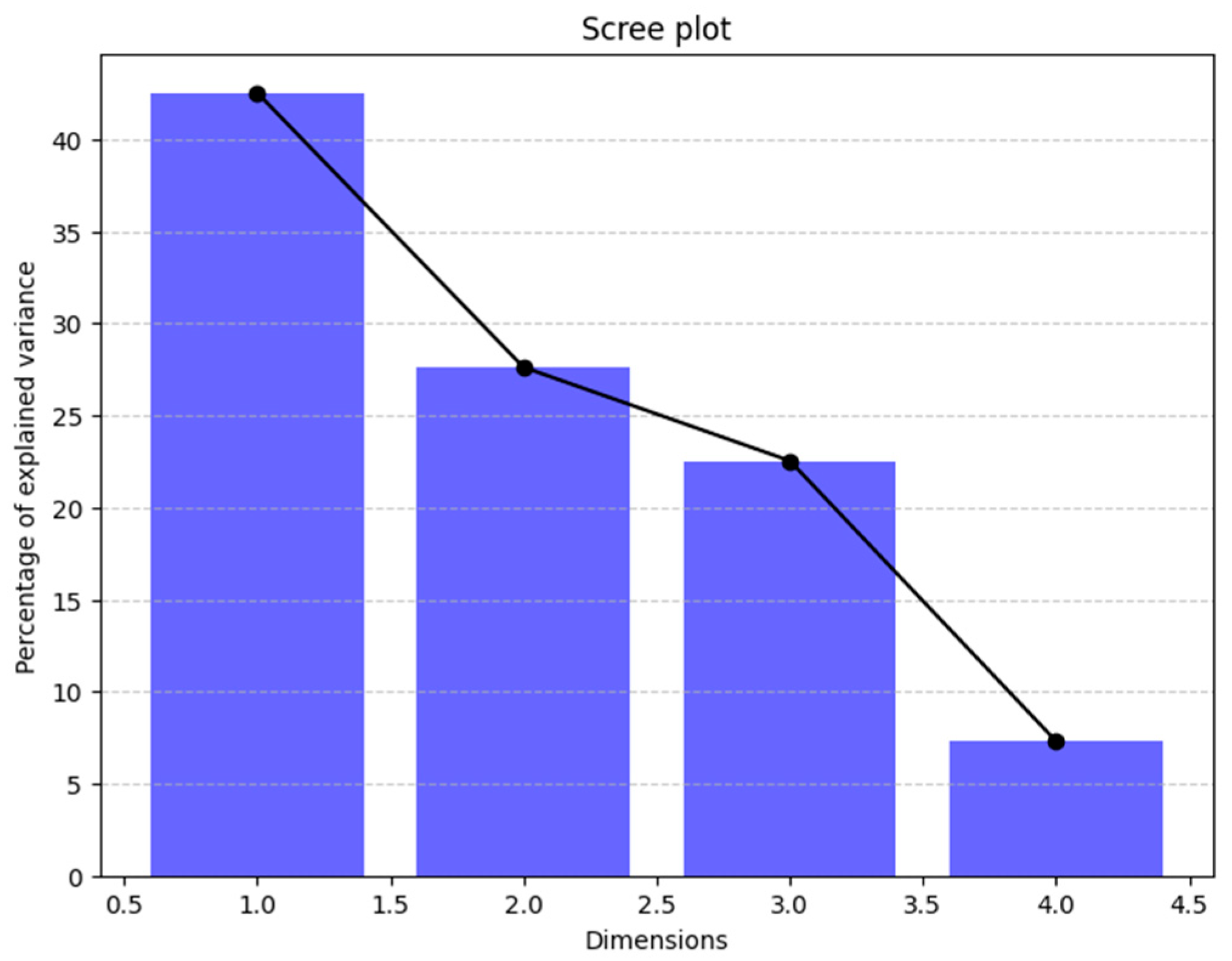
| Eigenvalue | Variance Percentage | Cumulative Variance Percentage | |
|---|---|---|---|
| Dim. 1 | 1.655 | 41.374 | 41.374 |
| Dim. 2 | 1.076 | 26.890 | 68.264 |
| Dim. 3 | 0.975 | 24.367 | 92.631 |
| Dim. 4 | 0.295 | 7.369 | 100.0 |
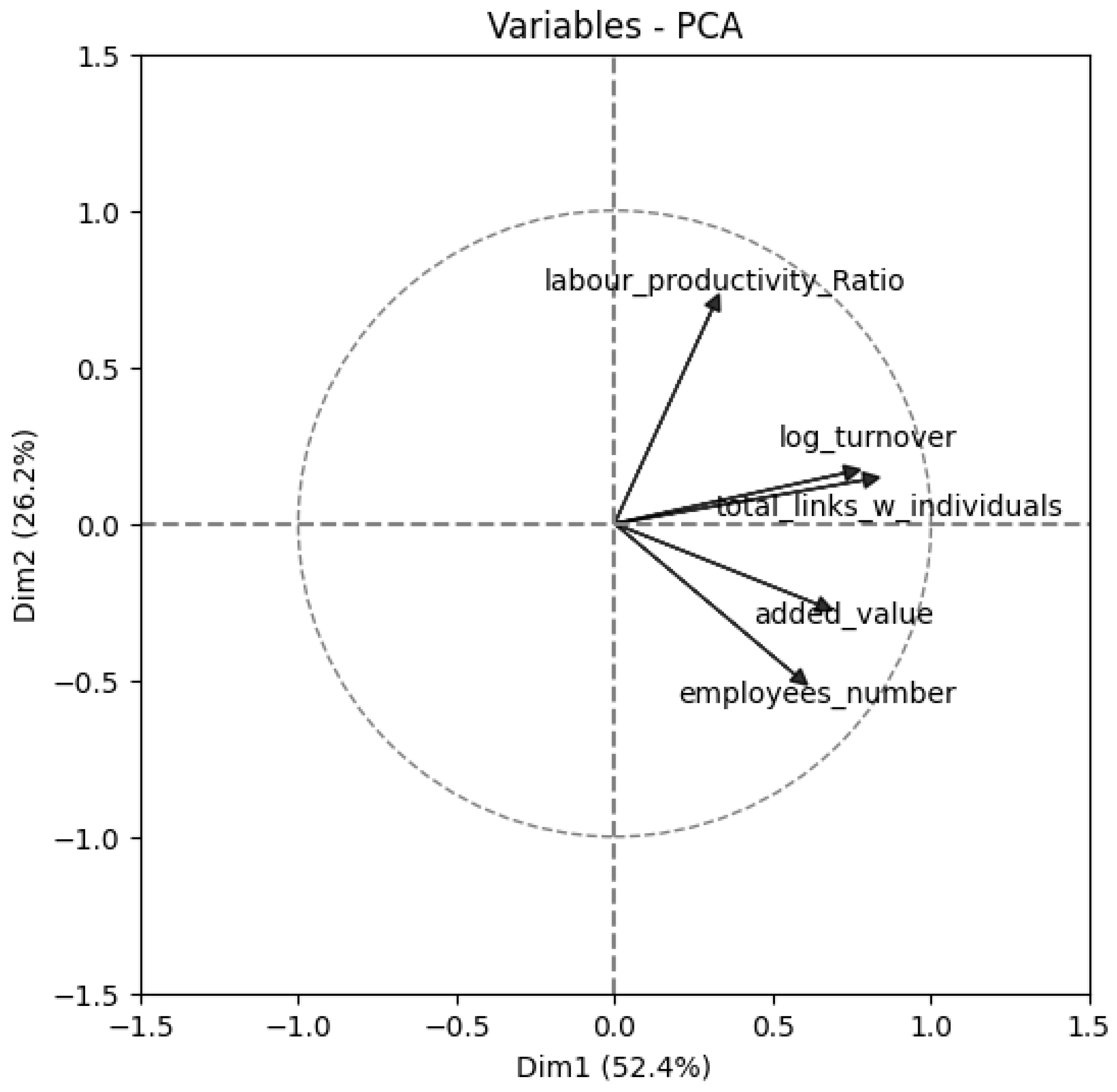
| Dim. 1 | Dim. 2 | Dim. 3 | Dim. 4 | |
|---|---|---|---|---|
| Added value | 0.971 | 0.095 | 0.045 | −0.209 |
| Number of Employees | 0.806 | −0.326 | −0.092 | 0.485 |
| Labour productivity rate | 0.039 | 0.917 | 0.331 | 0.218 |
| Number of links with individuals | 0.752 | 0.551 | 0.436 | 0.469 |
Disclaimer/Publisher’s Note: The statements, opinions and data contained in all publications are solely those of the individual author(s) and contributor(s) and not of MDPI and/or the editor(s). MDPI and/or the editor(s) disclaim responsibility for any injury to people or property resulting from any ideas, methods, instructions or products referred to in the content. |
© 2026 by the authors. Licensee MDPI, Basel, Switzerland. This article is an open access article distributed under the terms and conditions of the Creative Commons Attribution (CC BY) license.
Share and Cite
Capoani, L.; Martini, P.; Izzo, A.; Bincoletto, G. Social Strategies for Business Success: The Key Role of Social Networks in SMEs. Businesses 2026, 6, 2. https://doi.org/10.3390/businesses6010002
Capoani L, Martini P, Izzo A, Bincoletto G. Social Strategies for Business Success: The Key Role of Social Networks in SMEs. Businesses. 2026; 6(1):2. https://doi.org/10.3390/businesses6010002
Chicago/Turabian StyleCapoani, Luigi, Piergiorgio Martini, Andrea Izzo, and Giacomo Bincoletto. 2026. "Social Strategies for Business Success: The Key Role of Social Networks in SMEs" Businesses 6, no. 1: 2. https://doi.org/10.3390/businesses6010002
APA StyleCapoani, L., Martini, P., Izzo, A., & Bincoletto, G. (2026). Social Strategies for Business Success: The Key Role of Social Networks in SMEs. Businesses, 6(1), 2. https://doi.org/10.3390/businesses6010002