
The Inner Drive: Unpacking the Motivations for Consumer Participation as Sellers in Apparel Resale


Abstract
1. Introduction
2. Literature Review
2.1. A New Generation of Secondhand Consumers
2.2. Impact of Technology on CAC
2.3. Apparel Resale as a Vehicle for Sustainability
2.4. Branded Recommerce
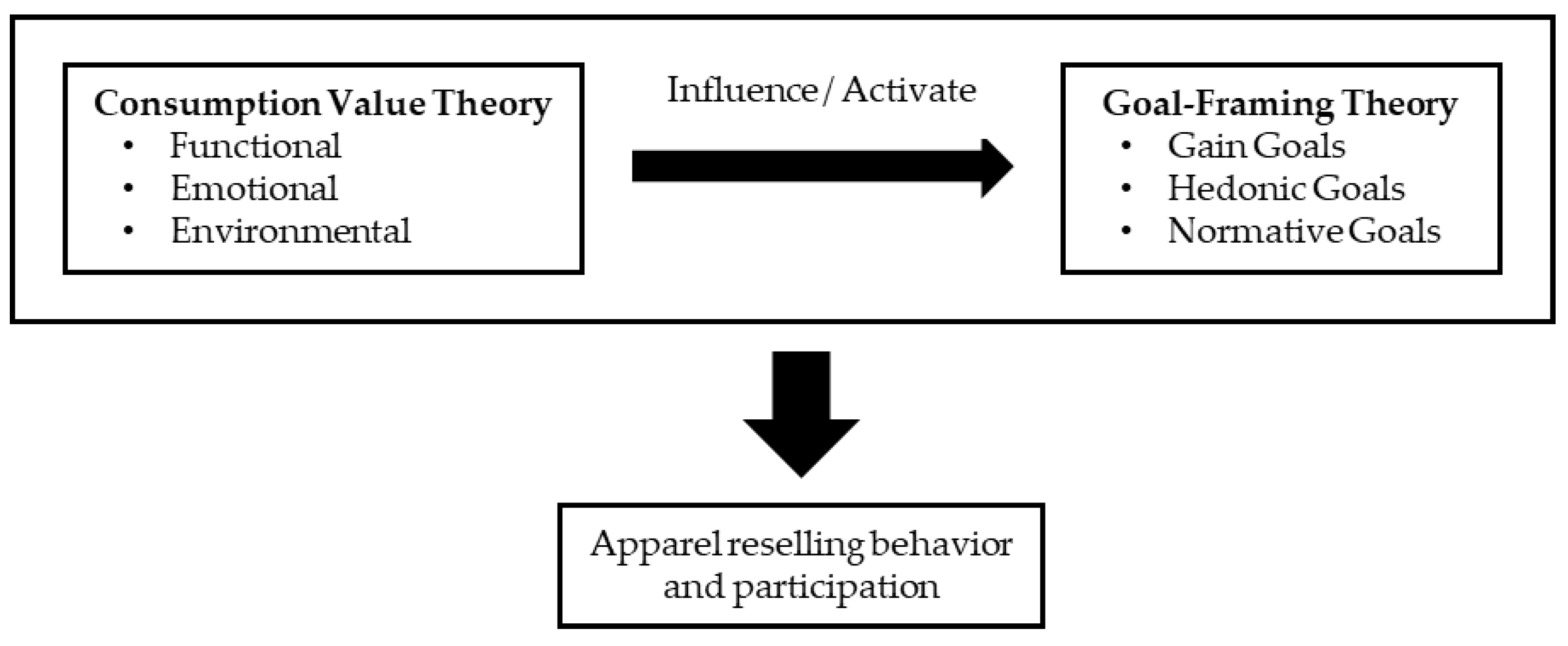
2.5. Theoretical Frameworks—How Values Impact Goals
3. Method
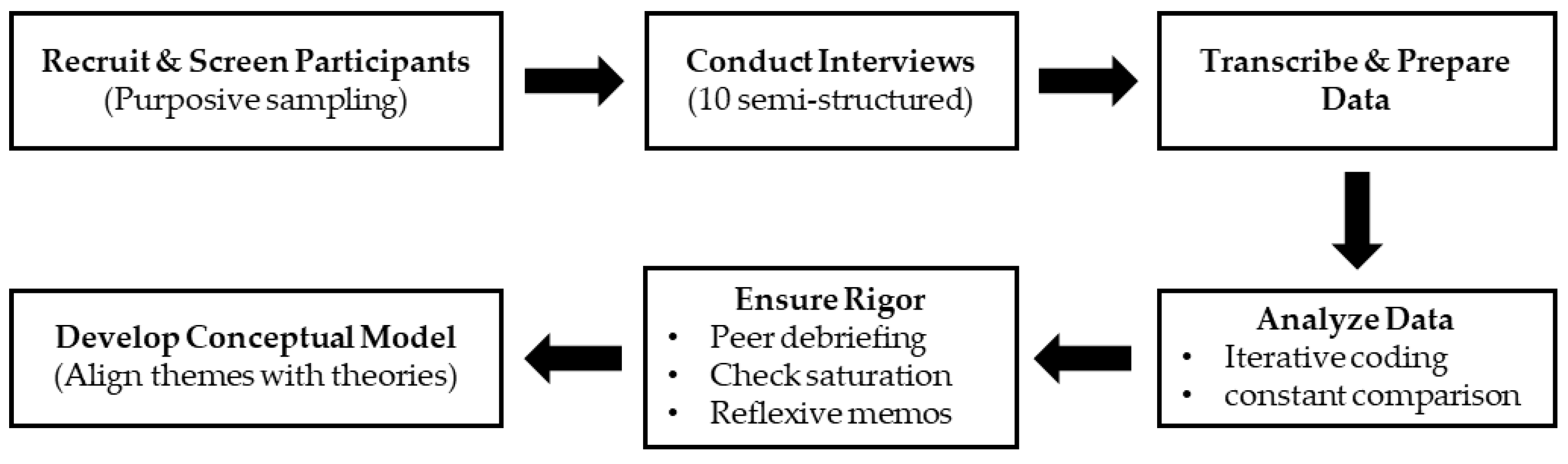
3.1. Data Collection
3.2. Data Analysis
4. Findings and Discussion
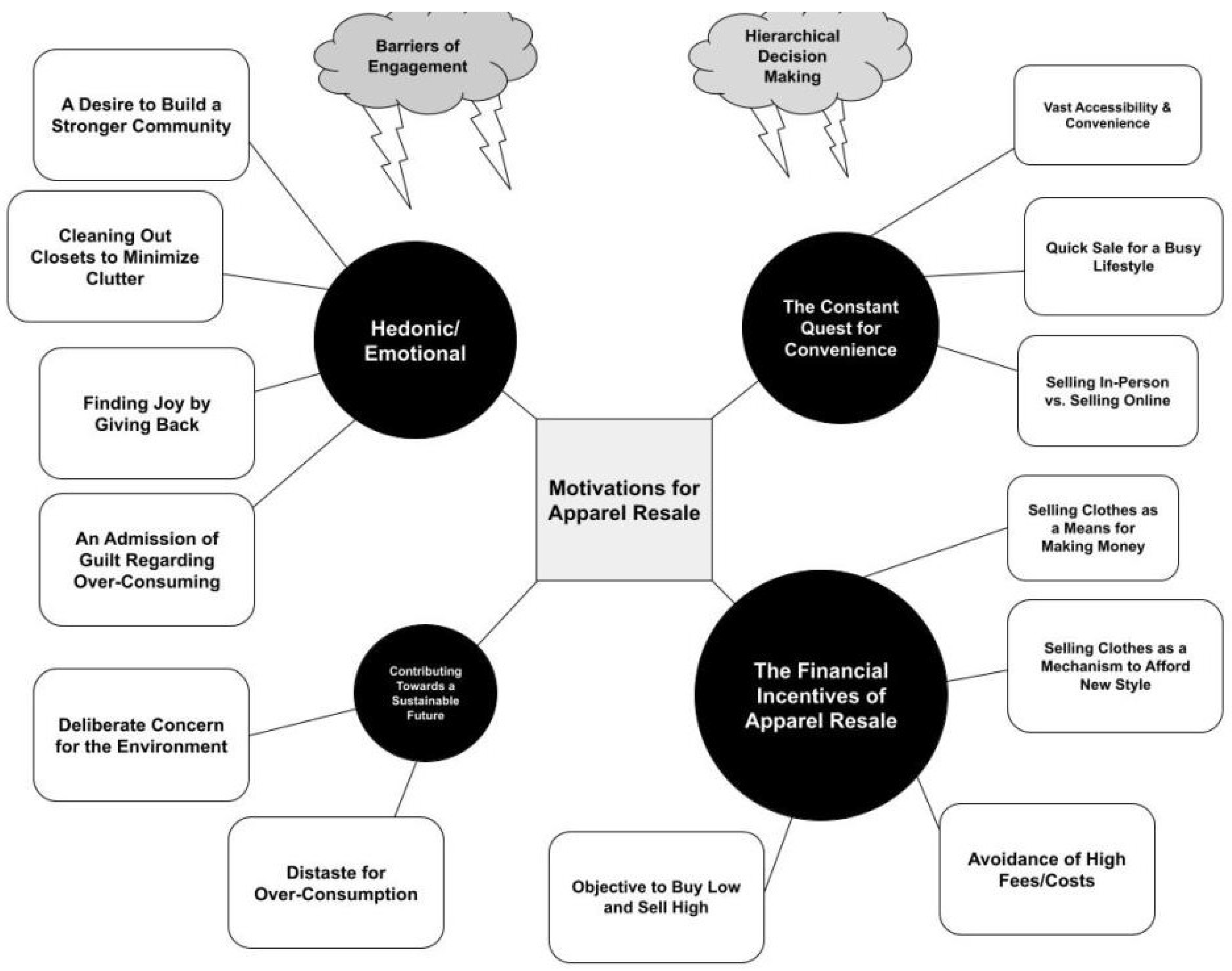
4.1. Financial Incentives of Apparel Resale
4.1.1. Objective to Buy Low and Sell High
4.1.2. Avoidance of High Fees/Costs
4.1.3. Selling Clothes as a Mechanism to Afford a New Style or to Make Money
4.2. Constant Quest for Convenience
Yeah. So, I mean, when you go to like a Plato’s Closet, they obviously don’t give you enough, you know, for what it’s worth. But you do get that immediate gratification. The eBay process is more (about) waiting to see if someone’s gonna buy it. And maybe haggling on price a little bit, and probably not getting exactly what you would like to get for it.(Mrs. Teitelbaum)
I mean, if everything was equal, I’d much rather do it in person. Just because you’re making one trip, you’re dropping everything off. You’re probably doing it in larger units. It’s not like you’re individually bringing one piece at a time. I feel like.(Ms. Teller, 25)
4.3. Hedonic and Emotional Motivations for Reselling Secondhand Apparel
4.3.1. A Desire to Build a Stronger Community
If you don’t have money for clothes or for other basic necessities like, you should totally be like “Here, you can just have the clothes”. I don’t want like, why would you spend money on something that isn’t like important [clothing], like it’s not as important as food or a roof over your head or gas or whatever is, what you need to, like support you and your family so.(Mr. Strauss, 25)
4.3.2. Cleaning Out Closets to Minimize Clutter
4.3.3. Finding Joy by Giving Back
I don’t want to have so much stuff, so like personally it feels good to be like more minimalistic, but then on like a wider scale, I know that people are in need of clothes, so if the thing that I never wore is something that someone else can benefit from then that’s also important.(Ms. Gonzales, 25)
4.3.4. Admission of Guilt Regarding Over-Consumption
Umm, it’s just like, I guess, the guilt. It’s actually very funny. My friend and I’s Depop store that we have is called Not Guilty At All. That’s the name. So I just kind of like play off the guiltiness of people and then of myself when I have to throw things out and don’t know what to do with it. So just kind of like, now that I’m reflecting back to it, it is kind of a little naive and like, to do that, like it’s kind of bad to do that. I feel like, I feel bad. But it just kind of like pushes the weight off yourself.(Ms. Lifshitz, 26)
4.4. Contribution Towards a Sustainable Future
I find that really intriguing, and throughout fashion production, another thing, like I said, is just being sustainable. There’s a ton of clothes on the planet. Fashion is one of the top three biggest polluting industries. It makes me feel good doing my part, knowing that I’m getting a good deal on something and also not creating more waste.(Mr. Hughes, 22)
5. Conclusions
6. Implications, Limitations, and Future Research
6.1. Implications for Educators and Scholars
6.2. Implications for the Resale Industry
6.3. Limitations and Future Research
Author Contributions
Funding
Institutional Review Board Statement
Informed Consent Statement
Data Availability Statement
Conflicts of Interest
References
- Ahmad, N., Salman, A., & Ashiq, R. (2015). The impact of social media on fashion industry: Empirical investigation from Karachiites. Journal of Resources Development and Management, 7, 1–8. Available online: https://www.iiste.org/Journals/index.php/JRDM/article/view/21748/21876 (accessed on 1 December 2021).
- Armour, M., Rivaux, S. L., & Bell, H. (2009). Using context to build rigor: Application to two hermeneutic phenomenological studies. Qualitative Social Work, 8(1), 101–122. [Google Scholar] [CrossRef]
- Awuni, J. A., & Du, J. (2016). Sustainable consumption in Chinese cities: Green purchasing intentions of young adults based on the theory of consumption values. Sustainable Development, 24(2), 124–135. [Google Scholar] [CrossRef]
- Barnes, S. J., & Mattsson, J. (2017). Understanding collaborative consumption: Test of a theoretical model. Technological Forecasting and Social Change, 118, 281–292. [Google Scholar] [CrossRef]
- Chu, H., & Liao, S. (2007). Exploring consumer resale behavior in C2C online auctions: Taxonomy and influences on consumer decisions. Academy of Marketing Science Review, 2007, 1. [Google Scholar]
- Chu, H., & Liao, S. (2010). Buying while expecting to sell: The economic psychology of online resale. Journal of Business Research, 63(9–10), 1073–1078. [Google Scholar] [CrossRef]
- Ellen MacArthur Foundation. (2017). ERP for textiles in the USA. Available online: https://www.ellenmacarthurfoundation.org/epr-for-textiles-in-the-usa#:~:text=As%20the%20rate%20at%20which,environmental%20impact%20of%20this%20waste (accessed on 2 December 2021).
- Ertz, M., Durif, F., & Arcand, M. (2016). Business in the hands of consumers: A scale for measuring online resale motivations. Expert Journal of Marketing, 4(2), 60–76. Available online: http://marketing.expertjournals.com/23446773-408/ (accessed on 13 November 2021). [CrossRef][Green Version]
- Etikan, I., Musa, S. A., & Alkassim, R. S. (2016). Comparison of convenience sampling and purposive sampling. American Journal of Theoretical and Applied Statistics, 5(1), 1–4. [Google Scholar] [CrossRef]
- Ferraro, C., Sands, S., & Brace-Govan, J. (2016). The role of fashionability in second-hand shopping motivations. Journal of Retailing and Consumer Services, 32, 262–268. [Google Scholar] [CrossRef]
- Gazzola, P., Pavione, E., Pezzetti, R., & Grechi, D. (2020). Trends in the fashion industry. The perception of sustainability and circular economy: A gender/generation quantitative approach. Sustainability, 12(7), 2809. [Google Scholar] [CrossRef]
- Given, L. M. (2008). Semi-structured interview. In L. M. Given (Ed.), The sage encyclopedia of qualitative research methods. Sage Publications. [Google Scholar]
- Gonçalves, H. M., Lourenço, T. F., & Silva, G. M. (2016). Green buying behavior and the theory of consumption values: A fuzzy-set approach. Journal of Business Research, 69(4), 1484–1491. [Google Scholar] [CrossRef]
- Guiot, D., & Roux, D. (2010). A second-hand shoppers’ motivation scale: Antecedents, consequences, and implications for retailers. Journal of Retailing, 86(4), 355–371. [Google Scholar] [CrossRef]
- Hamari, J., Sjöklint, M., & Ukkonen, A. (2016). The sharing economy: Why people participate in collaborative consumption. Journal of the Association for Information Science and Technology, 67(9), 2047–2059. [Google Scholar] [CrossRef]
- Hameed, I., & Khan, K. (2020). An extension of the goal-framing theory to predict consumer’s sustainable behavior for home appliances. Energy Efficiency, 13(7), 1441–1455. [Google Scholar] [CrossRef]
- Haws, K. L., Winterich, K. P., & Naylor, R. W. (2013). Seeing the world through GREEN-tinted glasses: Green consumption values and responses to environmentally friendly products. Journal of Consumer Psychology, 24(3), 336–354. [Google Scholar] [CrossRef]
- He, H., & Harris, L. (2020). The impact of COVID-19 pandemic on corporate social responsibility and marketing philosophy. Journal of Business Research, 116, 176–182. [Google Scholar] [CrossRef]
- Herman, J., & Kim-Vick, J. (2023). A state of fashion re-commerce: From operational perspectives. International Textile and Apparel Association Annual Conference Proceedings, 80(1). [Google Scholar] [CrossRef]
- Hur, W., Yoo, J., & Chung, T. (2012). The consumption values and consumer innovativeness on convergence products. Industrial Management & Data Systems, 112(5), 688–706. [Google Scholar] [CrossRef]
- Joung, H. M., & Park-Poaps, H. (2013). Factors motivating and influencing clothing disposal behaviours. International Journal of Consumer Studies, 37(1), 105–111. [Google Scholar] [CrossRef]
- Jung, S., & Jin, B. (2014). A theoretical investigation of slow fashion: Sustainable future of the apparel industry. International Journal of Consumer Studies, 38(5), 510–519. [Google Scholar] [CrossRef]
- Jung, S., & Jin, B. (2016). Sustainable development of slow fashion businesses: Customer value approach. Sustainability, 8(6), 540. [Google Scholar] [CrossRef]
- Kim, I., Jung, H. J., & Lee, Y. (2021). Consumers’ value and risk perceptions of circular fashion: Comparison between secondhand, upcycled, and recycled clothing. Sustainability, 13(3), 1208. [Google Scholar] [CrossRef]
- Kim, N. L., & Jin, B. E. (2020). Why buy new when one can share? Exploring collaborative consumption motivations for consumer goods. International Journal of Consumer Studies, 44(2), 122–130. [Google Scholar] [CrossRef]
- Kim-Vick, J., & Yu, U. J. (2023). Impact of digital resale platforms on brand new or second-hand luxury goods purchase intentions among US Gen Z consumers. International Journal of Fashion Design, Technology and Education, 16(1), 57–69. [Google Scholar] [CrossRef]
- Laitala, K. (2014). Consumers’ clothing disposal behaviour—A synthesis of research results. International Journal of Consumer Studies, 38(5), 444–457. [Google Scholar] [CrossRef]
- Lang, C., & Armstrong, C. M. J. (2018). Fashion leadership and intention toward clothing product-service retail models. Journal of Fashion Marketing and Management: An International Journal, 22(4), 571–587. [Google Scholar] [CrossRef]
- Lee, C. H., & Rhee, B.-D. (2021). Retailer-run resale market and supply chain coordination. International Journal of Production Economics, 235, 108089. [Google Scholar] [CrossRef]
- Lindenberg, S., & Steg, L. (2007). Normative, gain and hedonic goal frames guiding environmental behavior. Journal of Social Issues, 63(1), 117–137. [Google Scholar] [CrossRef]
- Mackey, J., & Sisodia, R. (2012). Conscious capitalism—Unleashing human energy and creativity for the greater good. DR Creative Intelligence. Available online: https://rajsisodia.com/wp-content/uploads/2023/08/Conscious-Capitalism-Unleashing-human-energy-and-creativity-for-the-greater-good.pdf (accessed on 7 May 2021).
- Marshall, B., Cardon, P., Poddar, A., & Fontenot, R. (2013). Does sample size matter in qualitative research? A review of qualitative interviews in IS research. Journal of Computer Information Systems, 54(1), 11–22. [Google Scholar] [CrossRef]
- Maxwell, J. A. (2008). Designing a qualitative study. In L. Bickman, & D. J. Rog (Eds.), The SAGE handbook of applied social research methods (pp. 214–253). Sage Publications. [Google Scholar] [CrossRef]
- Medalla, M. E., Yamagishi, K., Tiu, A. M., Tanaid, R. A., Abellana, D. P. M., Caballes, S. A., Jabilles, E. M., Himang, C., Bongo, M., & Ocampo, L. (2020). Modeling the hierarchical structure of secondhand clothing buying behavior antecedents of millennials. Journal of Modelling in Management, 15(4), 1679–1708. [Google Scholar] [CrossRef]
- Naeem, M., Ozuem, W., Howell, K., & Ranfagni, S. (2023). A step-by-step process of thematic analysis of a conceptual model in qualitative research. International Journal of Qualitative Methods, 22, 16094069231205789. [Google Scholar] [CrossRef]
- Park, H., & Joyner Armstrong, C. M. (2019). Is money the biggest driver? Uncovering motives for engaging in online collaborative consumption retail models for apparel. Journal of Retailing and Consumer Services, 51, 42–50. [Google Scholar] [CrossRef]
- Sandelowski, M. (1995). Sample size in qualitative research. Research in Nursing & Health, 18(2), 179–183. [Google Scholar] [CrossRef]
- Sheth, J. N., Newman, B. I., & Gross, B. L. (1991). Why we buy what we buy: A theory of consumption values. Journal of Business Research, 22(2), 159–170. [Google Scholar] [CrossRef]
- Shrivastava, A., Jain, G., Kamble, S. S., & Belhadi, A. (2021). Sustainability through online renting clothing: Circular fashion fueled by Instagram micro-celebrities. Journal of Cleaner Production, 278, 123772. [Google Scholar] [CrossRef]
- Shulman, J. D., & Coughlan, A. T. (2007). Used goods, not used bads: Profitable secondary market sales for a durable goods channel. Quantitative Marketing and Economics, 5, 191–210. [Google Scholar] [CrossRef]
- Statista Research Department. (2024, October 1). U.S. apparel and footwear resale market—Statistics & facts. Statista. Available online: https://www.statista.com/topics/5161/apparel-and-footwear-resale-in-the-us/#topicOverview (accessed on 1 March 2025).
- Steg, L., Bolderdijk, J. W., Keizer, K., & Perlaviciute, G. (2014). An Integrated Framework for Encouraging Pro-environmental Behaviour: The role of values, situational factors and goals. Journal of Environmental Psychology, 38, 104–115. [Google Scholar] [CrossRef]
- Styvén, E. M., & Mariani, M. M. (2020). Understanding the intention to buy secondhand clothing on sharing economy platforms: The influence of sustainability, distance from the consumption system, and economic motivations. Psychology & Marketing, 37(5), 724–739. [Google Scholar] [CrossRef]
- Thorisdottir, T. S., & Johannsdottir, L. (2020). Corporate social responsibility influencing sustainability within the fashion industry. A systematic review. Sustainability, 12(21), 9167. [Google Scholar] [CrossRef]
- ThredUp. (2025). ThredUp resale report 2025. Available online: https://cf-assets-tup.thredup.com/resale_report/2025/ThredUp_Resale_Report_2025.pdf (accessed on 1 September 2025).
- Turunen, L. L. M., Cervellon, M. C., & Carey, L. D. (2020). Selling second-hand luxury: Empowerment and enactment of social roles. Journal of Business Research, 116, 474–481. [Google Scholar] [CrossRef]
- Wang, B., Fu, Y., & Li, Y. (2022). Young consumers’ motivations and barriers to the purchase of second-hand clothes: An empirical study of China. Waste Management, 143, 157–167. [Google Scholar] [CrossRef]
- Wang, S., Mbanyele, W., Feng, T., Khan, S., & Fan, S. (2025). Bridging the knowledge-action divide: Environmental awareness and low-carbon behaviors of Chinese university students. Humanities & Social Sciences Communication, 12, 925. [Google Scholar] [CrossRef]
- Williams, C. C., & Paddock, C. (2003). The meanings of informal and second-hand retail channels: Some evidence from Leicester. The International Review of Retail, Distribution and Consumer Research, 13(3), 317–336. [Google Scholar] [CrossRef]
- Yan, L., Keh, H. T., & Wang, X. (2021). Powering sustainable consumption: The roles of green consumption values and power distance belief. Journal of Business Ethics, 169(3), 499–516. [Google Scholar] [CrossRef]



| Assigned # | Participant Pseudonyms | Year Born | Gender | Resale Experience | Preferred Resale Channel |
|---|---|---|---|---|---|
| 1 | Mrs. Marten | 1965 | Female | Occasional Seller (1–2/year) | Garage Sale |
| 2 | Mr. Lawrence | 1965 | Male | Dedicated Reseller (5+/year) | eBay |
| 3 | Ms. Gonzales | 1998 | Female | Occasional Reseller (1–2/year) | Consignment Store |
| 4 | Mr. Hughes | 2001 | Male | Dedicated Reseller (5+/year) | Grailed |
| 5 | Mr. Strauss | 1998 | Male | Occasional Reseller (1–2/year) | eBay |
| 6 | Mrs. Teitelbaum | 1968 | Female | Occasional Reseller (1–2/year) | Plato’s Closet |
| 7 | Ms. Lifshitz | 1997 | Female | Resale Entrepreneur (10+/year) | Depop |
| 8 | Ms. Teller | 1998 | Female | Dedicated Reseller (5+/year) | Mercari |
| 9 | Ms. Garcia | 1998 | Female | Dedicated Reseller (1–2/year) | Facebook Marketplace |
| 10 | Mr. Osborne | 1996 | Male | One-time | In-person |
Disclaimer/Publisher’s Note: The statements, opinions and data contained in all publications are solely those of the individual author(s) and contributor(s) and not of MDPI and/or the editor(s). MDPI and/or the editor(s) disclaim responsibility for any injury to people or property resulting from any ideas, methods, instructions or products referred to in the content. |
© 2025 by the authors. Licensee MDPI, Basel, Switzerland. This article is an open access article distributed under the terms and conditions of the Creative Commons Attribution (CC BY) license (https://creativecommons.org/licenses/by/4.0/).
Share and Cite
Herman, J.; Kim-Vick, J.; Hyun, J. The Inner Drive: Unpacking the Motivations for Consumer Participation as Sellers in Apparel Resale. Businesses 2025, 5, 53. https://doi.org/10.3390/businesses5040053
Herman J, Kim-Vick J, Hyun J. The Inner Drive: Unpacking the Motivations for Consumer Participation as Sellers in Apparel Resale. Businesses. 2025; 5(4):53. https://doi.org/10.3390/businesses5040053
Chicago/Turabian StyleHerman, Jack, Jihyun Kim-Vick, and Jonghan Hyun. 2025. "The Inner Drive: Unpacking the Motivations for Consumer Participation as Sellers in Apparel Resale" Businesses 5, no. 4: 53. https://doi.org/10.3390/businesses5040053
APA StyleHerman, J., Kim-Vick, J., & Hyun, J. (2025). The Inner Drive: Unpacking the Motivations for Consumer Participation as Sellers in Apparel Resale. Businesses, 5(4), 53. https://doi.org/10.3390/businesses5040053