


Abstract
Basalt-fiber-reinforced recycled aggregate concrete (BFRAC) produced with 100% recycled coarse aggregate is still constrained by the inferior quality of recycled aggregate and the difficulty of optimizing fiber reinforcement parameters. This study investigated the effects of basalt fiber length configuration and dosage on the mechanical performance and pore structure of recycled aggregate concrete incorporating recycled coarse aggregate subjected to two-step pretreatment with nano-silica and cement slurry. Four fiber length configurations, namely 6, 12, and 24 mm and a mixed-length system, were evaluated at volume fractions of 0.1, 0.2, and 0.3%. The reinforcing effect was assessed through compressive strength, splitting tensile strength, scanning electron microscopy, mercury intrusion porosimetry, and statistical analysis. The pretreatment improved recycled aggregate quality, reducing water absorption from 4.97% to 3.11% and crushing index from 20.5% to 13.4%. Basalt fiber incorporation generally enhanced mechanical performance, although the response depended on fiber length and dosage. At 28 days, BF24V1 achieved the highest compressive strength, whereas BFmixV1 exhibited the best overall performance by combining high compressive strength with the highest splitting tensile strength. Relative to the average performance of the corresponding single-length mixtures at the same dosage, the mixed-length system showed a positive synergistic effect. Microstructural observations indicated that this behavior was associated with more effective crack bridging and refinement of the pore-size distribution. The results demonstrate that a low-dosage mixed-length basalt fiber system provides an effective route for upgrading pretreated waste-derived aggregate into higher-performance recycled aggregate concrete.
1. Introduction
The accelerating pace of urbanization has generated large volumes of construction and demolition waste, with waste concrete constituting a major proportion of this stream [1]. Converting waste concrete into recycled coarse aggregate (RCA) for the production of recycled aggregate concrete (RAC) is therefore an important strategy for reducing landfill disposal, conserving natural aggregate resources, and supporting more sustainable construction practices [2]. However, the wider structural use of RAC remains constrained by the inferior quality of RCA compared with natural coarse aggregate. Residual adhered mortar on RCA surfaces weakens the interfacial transition zone (ITZ) between aggregate and new cement paste [3,4], while also increasing porosity and water absorption and reducing interfacial bonding quality [5]. As a result, RAC commonly exhibits lower compressive strength, lower elastic modulus, and poorer durability than conventional concrete [6]. In addition, RAC behavior may be sensitive to loading rate, with rate effects extending beyond strength to stiffness-related properties such as elastic, shear, and bulk moduli [7].
To address these limitations, previous studies have mainly focused on two approaches: improving RCA quality through physical or chemical pretreatment and enhancing the cementitious matrix by incorporating supplementary materials or fibers [6,8]. Appropriate RCA pretreatment can densify the adhered mortar layer, improve aggregate–mortar bonding, and allow RAC performance to approach that of conventional concrete under optimized conditions [5,9]. Among the available reinforcing materials, basalt fiber (BF) has attracted increasing attention because of its favorable mechanical properties, corrosion resistance, thermal stability, and relatively low production energy requirement [10]. Previous studies have shown that BF can improve the mechanical properties and durability of RAC [10]. Experimental results further indicate that suitable BF contents and fiber lengths can enhance compressive strength, tensile strength, and flexural performance [11,12], and that the addition of 0.3% BF can increase tensile strength by more than 15% compared with non-reinforced RAC [13]. These improvements are generally attributed to the formation of a three-dimensional fiber network that bridges cracks, redistributes stress, restrains crack propagation, and improves ductility and crack resistance [14].
At the microstructural level, BF incorporation can also improve the internal structure of RAC by refining pore characteristics and modifying the ITZ. Previous mechanistic studies have emphasized the importance of interfacial bonding and internal composite structure in governing the macroscopic response of RAC [9]. It has been reported that BF can strengthen the bond between aggregates and surrounding mortar, reduce ITZ voids and microcracks, and increase matrix compactness and integrity [15]. Synergistic modification strategies are of particular interest. Chen and Chen [16] have reported that the combined use of nano-silica and BF in RAC increased compressive, splitting tensile, and flexural strengths by 6.8%, 16.3%, and 32.7%, respectively. Beyond mechanical performance, BF has also been shown to improve the resistance of recycled concrete or related recycled cementitious systems under aggressive exposure conditions. For example, basalt-fiber-reinforced geopolymer recycled aggregate concrete exhibited lower strength loss than non-fiber specimens under marine sulfate attack after repeated wet–dry cycles [17]. Additional studies have confirmed the beneficial influence of BF on freeze–thaw resistance, chloride penetration resistance, and corrosion protection [18]. Furthermore, external confinement using basalt-fiber-reinforced polymer systems can improve the load capacity and ductility of RAC members [19].
Despite recent progress, two issues remain insufficiently clarified for the higher-value utilization of recycled aggregate derived from construction and demolition waste. First, fiber length has often been studied as an isolated parameter. However, mixed fiber lengths may provide crack control over multiple spatial scales and improve reinforcement efficiency in recycled aggregate systems. Second, limited information is available on the combined effect of fiber-length design and aggregate pretreatment in RAC made with 100% recycled coarse aggregate. Existing studies have mainly focused on aggregate pretreatment, fracture behavior, loading-rate effects, and constitutive or numerical modeling [5,7,9]. By comparison, hierarchical fiber-length design in pretreated full-RCA systems has received much less attention. This approach is particularly relevant in the context of circular construction materials. The combined use of short, medium, and long basalt fibers may produce a more balanced reinforcing mechanism. Smaller cracks can be restrained at early stages, whereas wider cracks can be bridged during later damage development. Therefore, this study investigates the effects of single and mixed basalt fiber lengths on the mechanical performance and pore structure of recycled aggregate concrete produced with pretreated 100% recycled coarse aggregate. The objective is to determine whether a mixed-length basalt fiber system can provide more balanced improvements in compressive strength, splitting tensile strength, and pore refinement than corresponding single-length systems at the same dosage. This study also seeks to support the upgrading of waste-derived aggregate into higher-performance concrete and more sustainable material recirculation in the construction sector. Beyond the present mixtures, recent studies on fiber-reinforced recycled aggregate and hybrid-fiber concretes provide useful mechanistic context. Comprehensive reviews of basalt-fiber recycled concrete report that an appropriate fiber content and length form a crack-bridging network that improves interfacial bonding and recovers the mechanical and durability performance lost through recycled aggregate substitution, with the most favourable behavior typically found at low fiber dosages and intermediate fiber lengths [10,20]. For other fiber systems, hybrid combinations of fibers of different scale or stiffness—such as steel–basalt or steel–synthetic blends—can enhance compressive and post-cracking performance beyond single-fiber systems, although the benefit is sensitive to fiber proportion, dispersion, and clumping [21,22]. Numerical and material-modelling approaches have further clarified how fiber content and distribution govern the load response and energy dissipation of fiber-reinforced concrete [23]. Collectively, these studies indicate that fiber length, distribution and dosage act non-linearly and that multi-scale fiber design can be advantageous. However, most prior mixed- or hybrid-fiber investigations have addressed natural-aggregate concrete or the hybridization of different fiber types rather than the systematic variation of a single fiber length at fixed dosage, and few couple mechanical and pore structure evidence in fully pretreated 100% recycled-aggregate systems—the gap addressed in this study. To the authors’ knowledge, this is the first study to systematically compare single (6, 12, and 24 mm) and mixed-length basalt-fiber configurations at matched dosages on a fully pretreated 100% recycled coarse-aggregate matrix, linking the mechanical response to quantified pore-structure refinement and to a statistically tested (confidence-interval-based) synergy assessment. The pretreatment is applied identically to all mixtures and is treated here as a fixed preparation step, so that the comparison isolates the effect of fiber-length configuration on a constant matrix.
2. Materials and Methods
2.1. Materials
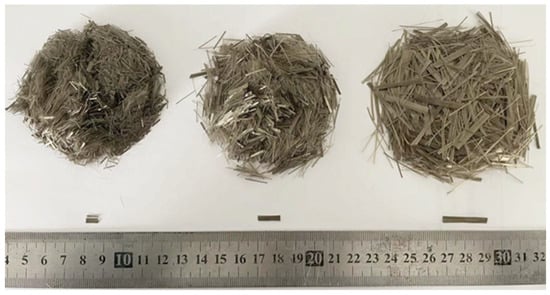
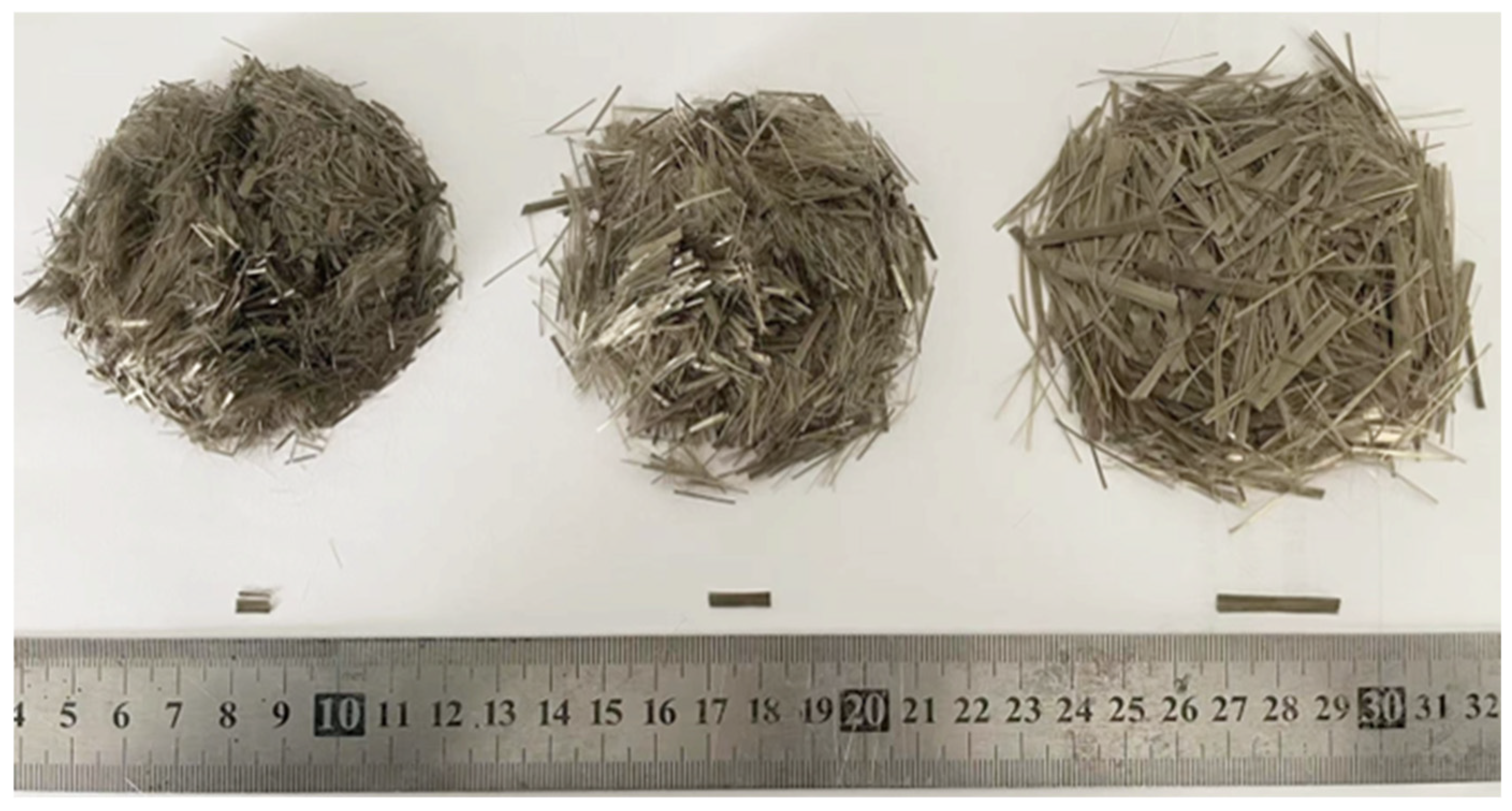
Ordinary Portland cement conforming to Chinese standard GB 175 [24], sourced from a local supplier in Suihua, Heilongjiang, China, was used throughout this study. Basalt fibers supplied by Haining Anjie Composite Materials, Jiaxing, China, were used as reinforcement. The fibers had a nominal diameter of 10 μm and were cut to three lengths: 6, 12, and 24 mm. The main physical and mechanical properties of the fibers are listed in Table 1, and their morphology is shown in Figure 1. The cement noted above was ordinary Portland cement of grade P.O 42.5 conforming to GB 175; representative oxide contents for this grade are CaO ≈ 63%, SiO2 ≈ 21%, Al2O3 ≈ 5%, Fe2O3 ≈ 3.5%, MgO ≈ 2%, and SO3 ≈ 2.5%.
Table 1.
Mechanical properties of basalt fiber [25].
Figure 1.
Basalt fiber morphology.
The fine aggregate was natural river sand conforming to GB/T 14684 [26] and JGJ 52 [27]. Its measured properties were as follows: apparent density 2590 kg/m3, bulk density 1730 kg/m3, moisture content 4.0%, clay content 1.6%, chloride ion content 0.28%, and fineness modulus 2.8, corresponding to Zone II medium sand. Before mixing, the field moisture content was measured and the mixing water was adjusted accordingly. All aggregates were prepared in a saturated surface dry (SSD) condition.
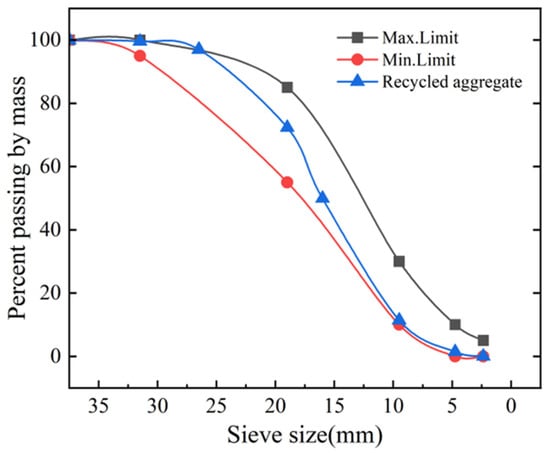
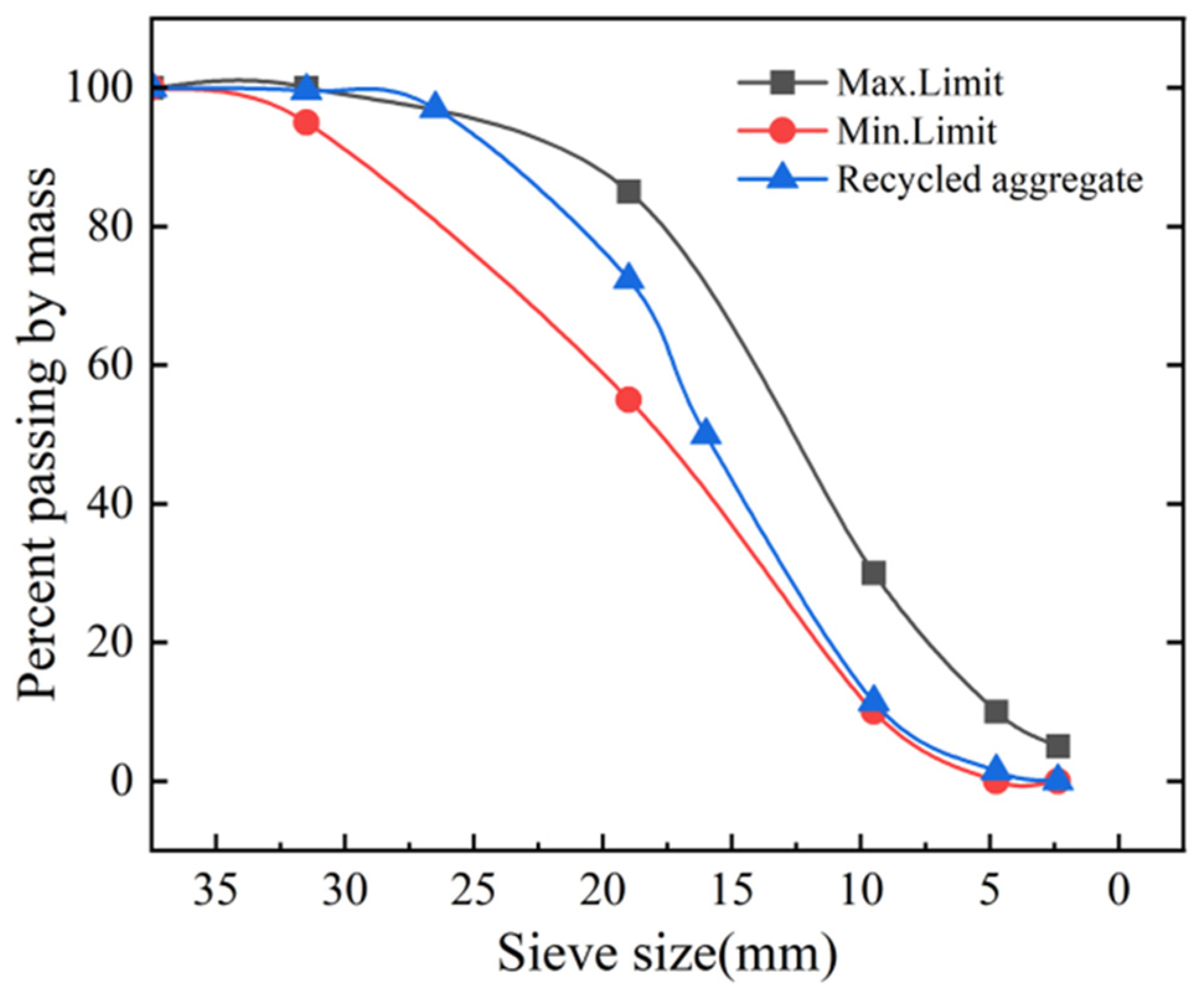
Recycled coarse aggregate (RCA) was used as a full replacement for natural coarse aggregate. The RCA was obtained from demolished road concrete, processed using a laboratory jaw crusher, and sieved to a continuous grading of 5–20 mm. The particle-size distribution is shown in Figure 2. The physical and mechanical properties of the RCA were determined in accordance with GB/T 25177 [28].
Figure 2.
Sieve analysis of RCA.
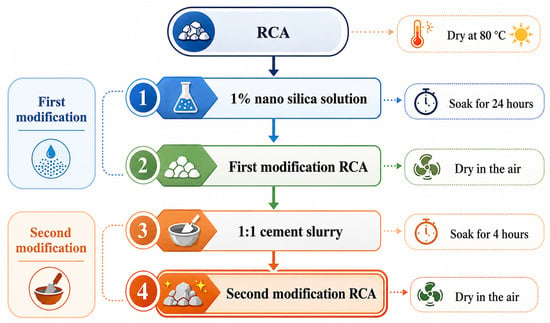
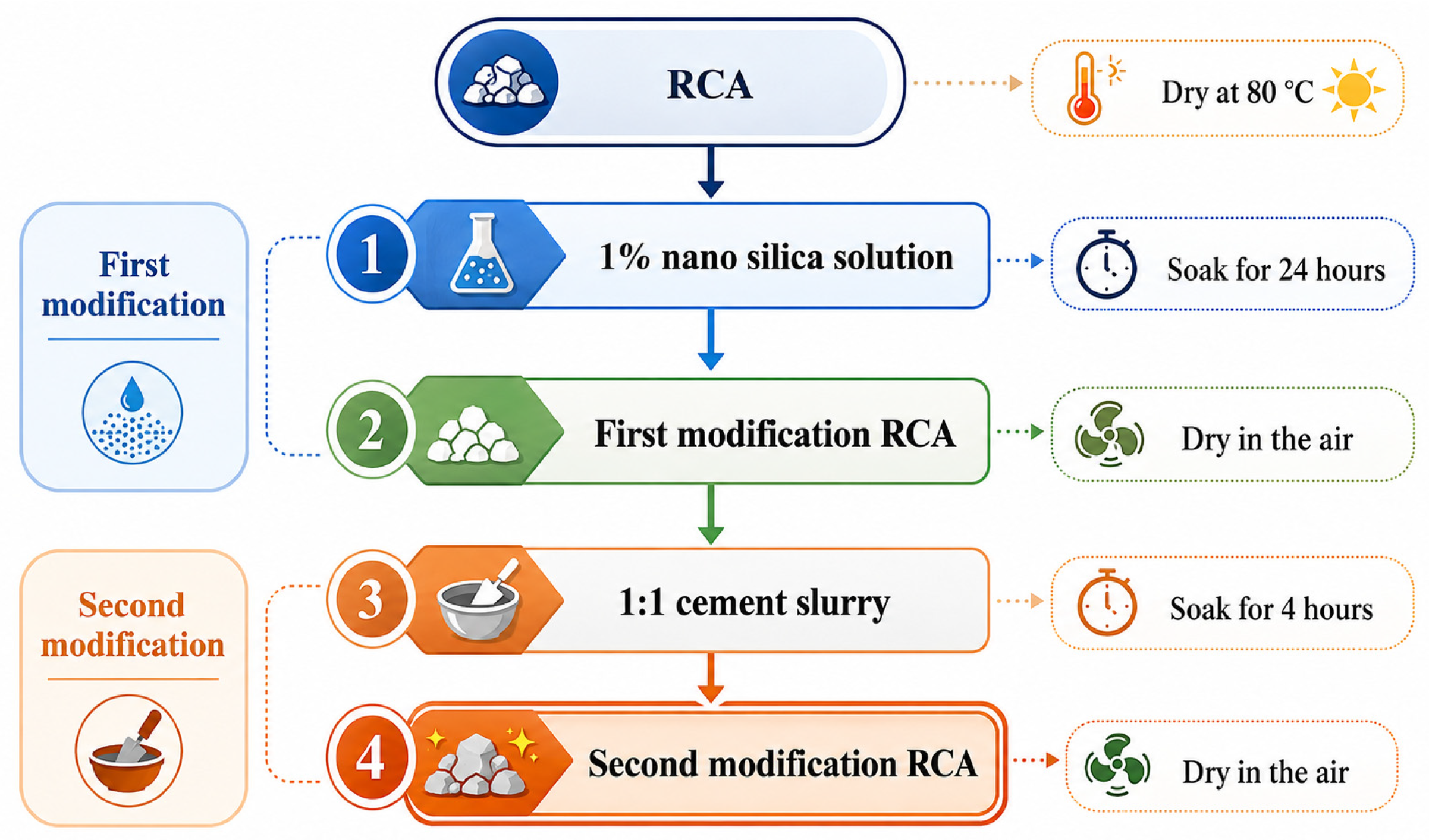
The RCA was subjected to a two-step surface pretreatment procedure [29]. First, the aggregates were oven-dried at 80 °C to remove residual moisture. They were then immersed for 24 h in a 1% nano-silica solution under continuous stirring to facilitate penetration into the adhered mortar. After drying at room temperature to a stable moisture state, the aggregates were immersed for 4 h in cement slurry with a water-to-cement ratio of 1:1. The complete pretreatment procedure is shown in Figure 3. Before batching, the treated RCA was reconditioned to SSD state to ensure consistent water accounting. The 1% nano-silica solution was prepared from a commercial aqueous colloidal nano-silica (an amorphous SiO2 suspension) sourced from a local supplier in Suihua, Heilongjiang, China, and the cement slurry (water-to-cement ratio of 1:1) was prepared with the same ordinary Portland cement (P.O 42.5) used for the concrete.
Figure 3.
Two-step modification process.
The pretreatment was intended to densify the adhered mortar and improve the aggregate surface condition. Nano-silica can penetrate the porous old mortar and react with calcium hydroxide to form additional calcium silicate hydrate (C–S–H), thereby refining the pore structure and strengthening the old mortar–new paste ITZ [29]. The pozzolanic reaction can be expressed as follows:
The strengthening effect of additional C–S–H can be connected to capillary pore reduction using the gel/space concept:
where is the volume of hydration products (dominated by C–S–H), is capillary pore volume, and and are empirical coefficients. This provides a foundational explanation for the observed reductions in water absorption and crushing index after treatment (Table 2). Equations (6)–(10) are of two types. The fiber-bridging and composite-strength relations are standard expressions adapted from established fiber-reinforced-composite mechanics, whereas the densification model (with empirical coefficients A and n), the power law relationship between compressive strength and most-probable pore size (Equation (9), with C = 47.12 MPa and the dimensionless exponent m = 0.07), and the unified strength expression are empirical fits obtained by least-squares regression on the present dataset. Because these fits are based on only five mixtures, their goodness-of-fit is modest and they are presented as descriptive relationships valid within the tested range of fiber length and dosage, not as validated predictive models.
Table 2.
Performance indicators of RCA.
The subsequent cement slurry coating further filled residual surface voids and formed a thin hydration layer on the aggregate surface, which reduced water absorption and improved aggregate integrity. Compared with the two-stage mixing approach (TSMA) [30], this pretreatment modifies the RCA before concrete mixing and stabilizes its moisture condition.
The main performance indicators of untreated and treated RCA are listed in Table 2.
As shown in Table 2, the pretreatment significantly improved the main quality indicators of the RCA. Water absorption decreased from 4.97% to 3.11%, and crushing index decreased from 20.5% to 13.4%. Apparent density and bulk density increased slightly, indicating a denser adhered mortar layer and improved aggregate surface condition. These changes are consistent with the intended function of the pretreatment. The apparent and bulk density, water absorption and crushing index of the aggregates were determined in accordance with the Chinese standard GB/T 14685 [31]; water absorption was measured on the 24 h saturated surface dry (SSD) basis, and each value was averaged over three determinations. The as-received (RCA) and pretreated (RCA*) properties are compared in Table 2, which characterizes the recycled coarse aggregate before and after the two-step treatment.
2.2. Mixed Proportions
The effects of basalt fiber on the mechanical performance of recycled aggregate concrete were investigated using mixtures containing 100% RCA. The experimental variables were fiber length and fiber volume fraction. Four fiber-length configurations were considered: 6 mm, 12 mm, 24 mm, and a mixed-length system composed of equal volume fractions of the three lengths. Three total fiber volume fractions were examined: 0.1, 0.2, and 0.3%. This range is consistent with dosages reported as workable and effective for basalt-fiber-reinforced recycled aggregate concrete [11,12,13,14,16,32,33,34]. A plain recycled aggregate concrete without fibers served as the control mixture, denoted as P. In total, 13 mixtures were prepared.
From a mechanical viewpoint, fiber effective length is governed by the critical fiber length required to mobilize fiber tensile capacity through interfacial bond: where is critical length, is fiber tensile strength, is fiber diameter, and is the average interfacial bond strength. A simple length efficiency factor can then be written as follows:
where is the actual fiber length. This formulation [35] explains why short fibers tend to fail by pull-out while longer fibers are more likely to rupture once a sufficient bond is achieved. Furthermore, it clarifies how mixed lengths can activate multiple crack-resisting mechanisms across different scales.
The contribution of fibers to tensile resistance can be estimated using a classical fiber-bridging/pull-out model adapted from [36,37];
where is the tensile strength of the plain RAC, is the fiber volume fraction, is the orientation factor (typically 0.33 for 3D random distribution), is the average interfacial bond strength, is the fiber length, and is the fiber diameter. In the present study, Equation (4) is used as a supporting framework for interpreting the tensile strength response of mixtures with different fiber lengths.
For specimen identification, BFxVy denotes a mixture reinforced with basalt fibers, where x represents fiber length in mm and y represents fiber volume fraction in %. For the mixed-length series, BFmixVy, y represents the total fiber volume fraction, with the 6, 12, and 24 mm fibers each contributing one-third of the total fiber volume. All mixtures had the same base composition: water 176 kg/m3, cement 352 kg/m3, natural sand 832 kg/m3, and recycled coarse aggregate 1040 kg/m3. Only the fiber content varied among the mixtures. The corresponding fiber dosages were 2.65, 5.30, and 7.95 kg/m3 for volume fractions of 0.1, 0.2, and 0.3%, respectively. The superplasticizer dosage was adjusted to limit workability variation among mixtures The superplasticizer was a commercial high-range water-reducing admixture sourced from a local supplier in Suihua, Heilongjiang, China, added in small amounts that were adjusted between mixtures to maintain comparable workability; the precise dosage of each mixture was not separately recorded. As noted in the limitations, fresh-state properties (slump, flow, air content, and density) were not measured, so any workability differences are discussed only in a qualitative manner [33,34].
2.3. Testing Procedures
The experimental program comprised mechanical testing and microstructural characterization. Mechanical performance was evaluated by compressive strength and splitting tensile strength tests. Microstructural characterization was conducted using scanning electron microscopy (SEM) and mercury intrusion porosimetry (MIP).
Cube specimens with nominal dimensions of 100 mm × 100 mm × 100 mm were prepared for both strength tests. All 13 mixtures were tested at curing ages of 7 and 28 days. Mechanical testing was carried out in accordance with GB/T 50081-2019 [38]. For each test condition, three replicate specimens were prepared, and the arithmetic mean was reported. After casting, the specimens were demolded after 24 h and then cured under controlled conditions at 20 ± 2 °C and relative humidity not less than 95% until testing.
For SEM analysis, small fragments were taken from the interior of representative specimens to minimize edge effects and surface carbonation. The observations focused on three aspects: fiber–matrix interfacial bonding, fiber bridging across microcracks, and the morphology of the ITZ between aggregate and cement paste.
For MIP analysis, representative specimens were selected according to the mechanical test results to clarify the pore structure differences associated with basalt fiber incorporation. The subsamples were subjected to solvent exchange and then dried before testing to reduce artifacts associated with direct oven drying. Cumulative and differential mercury intrusion curves were recorded to evaluate total porosity and pore-size distribution, with particular attention to the proportions of gel pores and capillary pores. The ore-size distribution follows the conventional scheme for cementitious materials, with gel pores defined as D < 10 nm, in accordance with the standard classification, while the capillary–macro boundary was taken at 5 µm. Because mercury intrusion porosimetry resolves pores only up to a few hundred micrometers, the larger air pores (10 µm–1 mm) and compaction pores (>1 mm) of the standard scheme lie outside its measurable range and are subsumed within the macro-pore fraction. Only the processed pore-size distribution was retained, so the original cumulative and differential intrusion curves are not reproduced.
2.4. Statistical Analysis
Statistical analysis was performed using Python 3.11 with the statsmodels 0.14 and scipy 1.11 packages. All strength tests were conducted with three replicate specimens per group. Descriptive statistics, including the mean, standard deviation, and coefficient of variation, were calculated for all measurements. One-way analysis of variance (ANOVA) was used to evaluate significant differences among groups, followed by Tukey’s honestly significant difference (HSD) post-hoc test for pairwise comparisons. Two-way ANOVA was conducted to assess the interaction effects between group and curing age (Group × Age). The assumptions of normality and homogeneity of variance were evaluated using the Shapiro–Wilk test and Levene’s test, respectively. Pearson correlation coefficients were calculated to examine the relationships between compressive and tensile strengths. Statistical significance was defined at α = 0.05, with significance levels denoted as * p < 0.05, ** p < 0.01, and *** p < 0.001.
3. Results and Discussion
3.1. Failure Pattern Analysis
3.1.1. Compressive Failure Characteristics
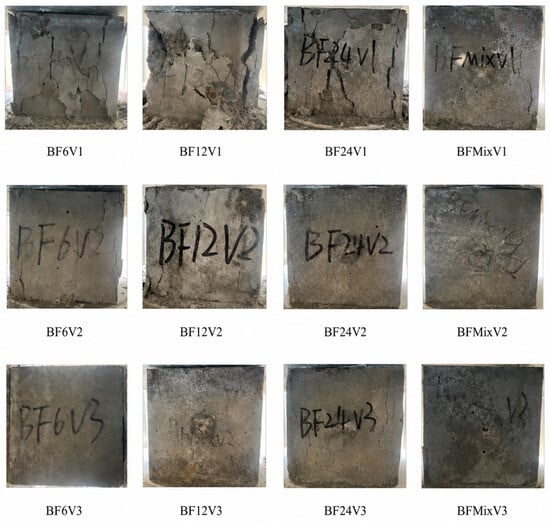
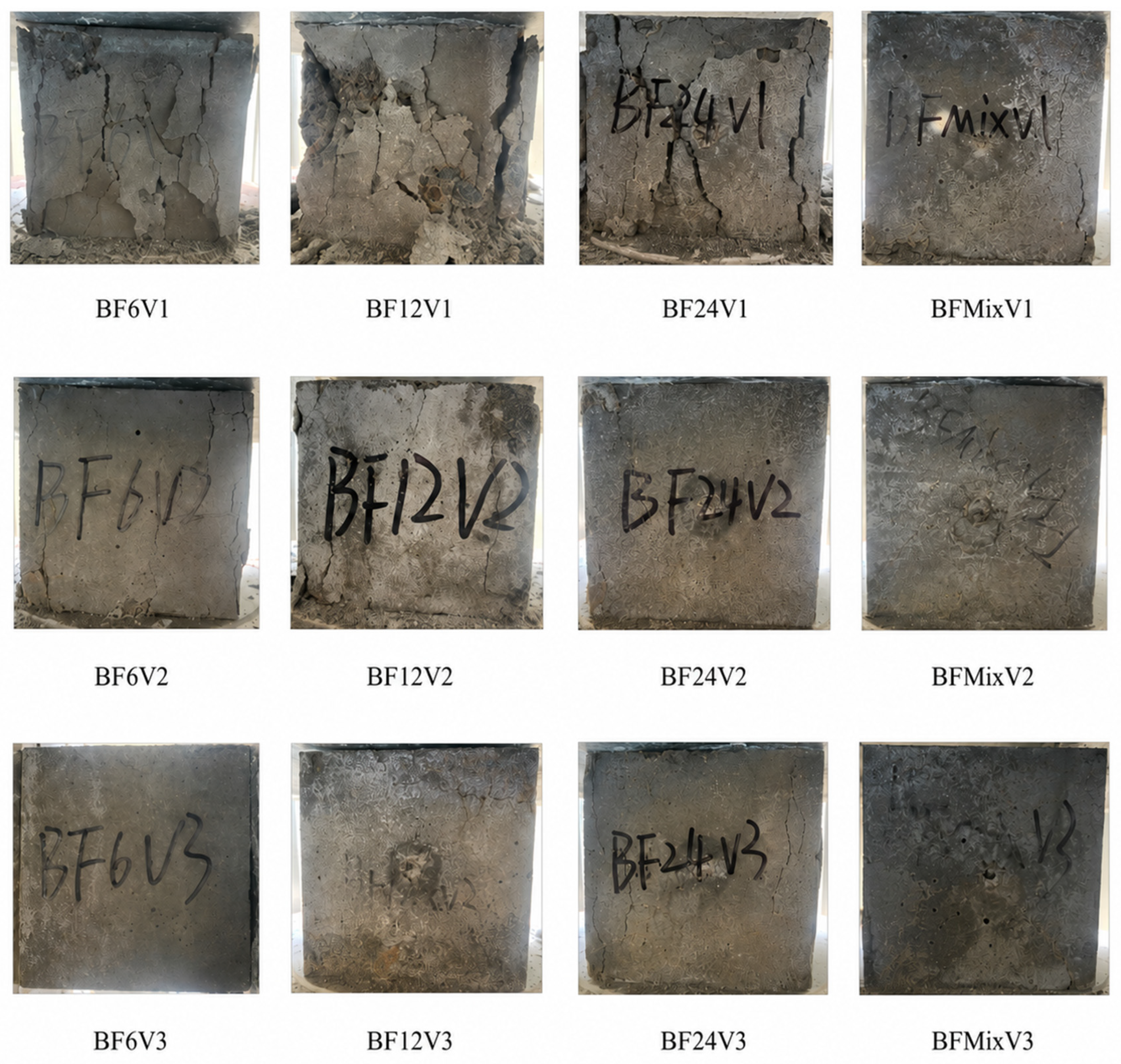
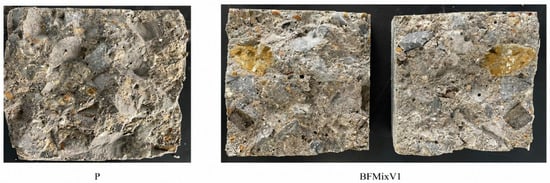
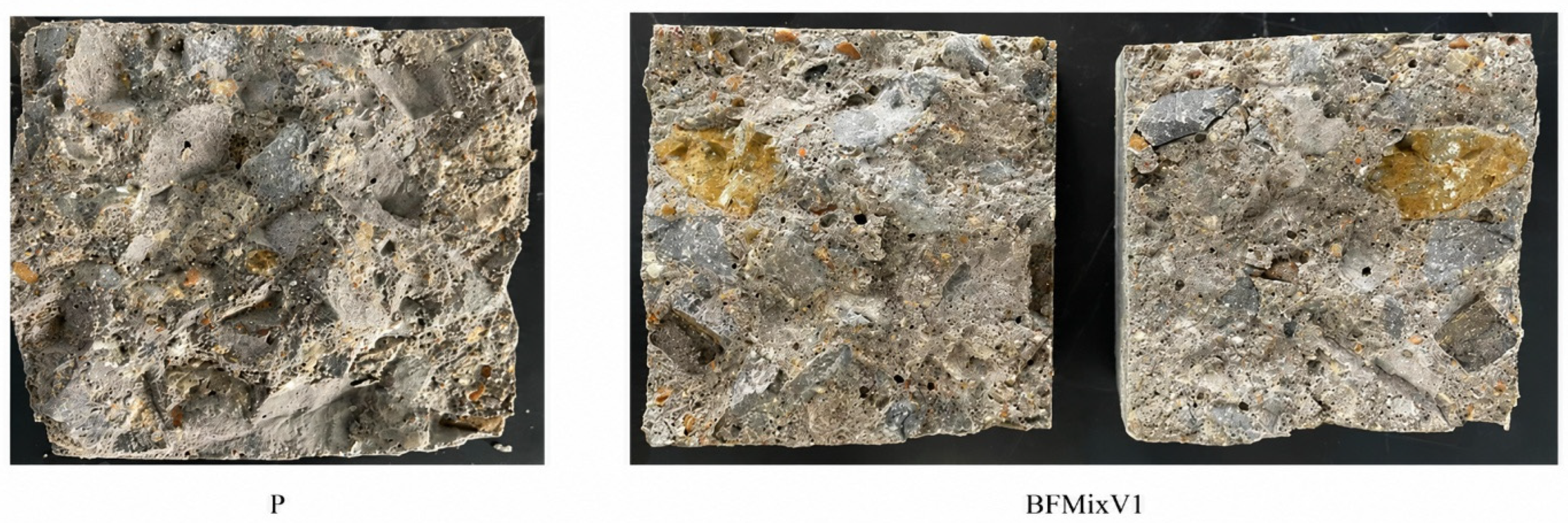
Concrete under uniaxial compression generally fails through a combination of interfacial debonding between aggregate and mortar, cracking of the mortar matrix, and local aggregate fracture. The observed compressive failure patterns of basalt-fiber-reinforced recycled aggregate concrete (BFRAC) are shown in Figure 4.
Figure 4.
Failure patterns of BFRAC under compression.
Compared with the plain recycled aggregate concrete specimen (P), the fiber-reinforced specimens generally exhibited a less abrupt failure process and more distributed cracking. The control specimen showed limited visible precursor cracking, followed by rapid loss of load-carrying capacity and the formation of a relatively localized failure surface. In contrast, the BFRAC specimens developed multiple visible cracks before final failure, indicating a more gradual damage evolution under compressive loading.
For the single-length fiber mixtures (BF6V1, BF12V1, and BF24V1), cracking generally initiated near the lower edges of the specimen and then propagated upward in the form of vertical and inclined cracks. As loading increased, these cracks widened and coalesced, accompanied by local surface spalling. Among the tested mixtures, the mixed-length specimen BFmixV1 exhibited the most stable compressive failure pattern. After the initiation of edge cracking, numerous fine cracks formed progressively and spread toward the central region, while major crack coalescence was delayed until loading approached the peak level. This behavior suggests more effective restraint of crack localization and more distributed internal damage development [39].
Fiber dosage also affected the failure morphology. At the 0.1% volume fraction, the crack pattern was generally finer and more dispersed, and damage accumulated more progressively. At higher dosages, although edge spalling was sometimes reduced, the specimens tended to approach peak load with a less stable failure mode. This trend is likely associated with reduced workability, local fiber agglomeration, and entrapped voids at higher fiber contents. These factors can introduce weak zones into the matrix and reduce the effectiveness of crack bridging once critical cracks begin to develop.
Differences were also observed among the fiber length series. The 24 mm fiber mixtures tended to show fewer but more extended cracks, consistent with stronger bridging of larger crack paths. In contrast, the 6 mm fiber mixtures exhibited denser but finer crack networks, indicating a stronger influence on microcrack development. The mixed-length system combined these characteristics and produced the most uniform crack distribution at low dosage. Overall, BFmixV1 showed the most favorable compressive failure mode among the tested groups.
The crack-bridging contribution can be expressed as an average bridging stress transmitted across a cracked plane:
where is fiber volume fraction, is an orientation factor reflecting non-parallel fiber alignment, and the last two terms represent the bond-controlled stress transfer capacity. Under reasonable dispersion, Equation (5) increases effective resistance to crack opening and delays damage localization, which matches the more stable failure patterns observed for BfmixV1.
3.1.2. Tensile Failure Characteristics
All mixtures exhibited brittle splitting failure under loading, but the crack development process and fracture morphology varied with basalt fiber incorporation, as shown in Figure 5.
Figure 5.
Failure patterns of BFRAC under tension.
The plain recycled aggregate concrete specimen developed a dominant crack rapidly along the loading diameter after crack initiation near the loading strip, resulting in sudden separation of the specimen into two parts. In contrast, the fiber-reinforced specimens showed a less abrupt failure process. Before the formation of the dominant splitting crack, multiple fine secondary cracks appeared near the main crack path. The primary crack remained narrower for a longer period, indicating that the presence of basalt fibers restrained crack opening and delayed crack localization.
Among the tested groups, BFmixV1 exhibited the most stable tensile failure pattern. The specimen developed a larger number of fine microcracks before the final splitting crack became dominant. This behavior is consistent with the effective crack bridging and pull-out resistance provided by the distributed fiber system [38,39,40,41,42]. The mixed-length configuration appears to have improved crack control over multiple scales, thereby delaying unstable crack propagation and enhancing the integrity of the specimen during loading.
Fiber dosage also influenced the tensile failure mode. As the fiber content increased, the failure process tended to become less stable. Although the fibers still contributed to restraining crack opening, higher dosages likely reduced dispersion quality and promoted local fiber clustering. This would reduce the number of effectively oriented fibers intersecting the critical crack plane and lower the net reinforcing efficiency. Nevertheless, the adverse effect of excessive fiber dosage was less pronounced in tension than in compression, which is consistent with the more direct contribution of fiber bridging to splitting resistance. The fracture surfaces after splitting are shown in Figure 6.
Figure 6.
Fracture morphology of BFRAC under tension.
The control specimen exhibited a relatively planar fracture surface, with visible aggregate imprints and regions indicative of interfacial debonding along the aggregate–mortar interface. In contrast, the fracture surface of BFmixV1 was rougher and showed more evidence of crack deflection, aggregate participation, and reduced interfacial separation. These features indicate improved stress transfer across the internal interfaces and a more tortuous crack path. Such characteristics are consistent with the higher splitting tensile strength measured for BFmixV1 [39,40,41].
Overall, the tensile failure observations indicate that basalt fibers improved performance mainly by restraining crack opening and delaying the formation of a single dominant crack. At low dosage, the mixed-length system provided the most favorable tensile failure mode by combining distributed microcracking with delayed crack localization. The observed failure characteristics are also consistent with the established splitting-fracture behavior of fiber-reinforced cementitious composites [18,42,43].
3.2. Mechanical Properties
Compressive and splitting tensile strengths were evaluated at 7 and 28 days for all BFRAC mixture configurations. The comprehensive test results are summarized in Table 3.
Table 3.
BFRAC mechanical properties.
One-way ANOVA was performed to assess differences among groups for each test condition. All groups showed highly significant differences in compressive strength at both 7 days (F = 55.36, p < 0.001) and 28 days (F = 4.71, p < 0.001). For tensile strength, significant differences were observed at 7 days (F = 5.97, p < 0.001), but not at 28 days (F = 1.51, p = 0.18).
Tukey’s honestly significant difference (HSD) tests revealed that all fiber-reinforced groups demonstrated significantly higher compressive strength than the plain control at 7 days (p < 0.001). At 28 days, plain control exhibited substantial strength gain, resulting in minor differences. A significant interaction was detected for both compressive (p = 0.005) and tensile strength (p = 0.031), indicating that different groups exhibited distinct strength development patterns for both ages.
3.2.1. Compressive Strength Development
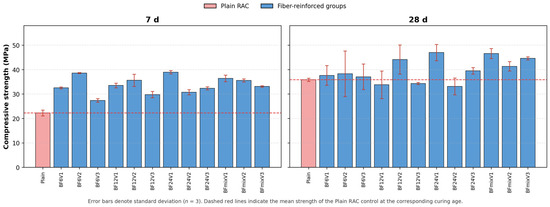
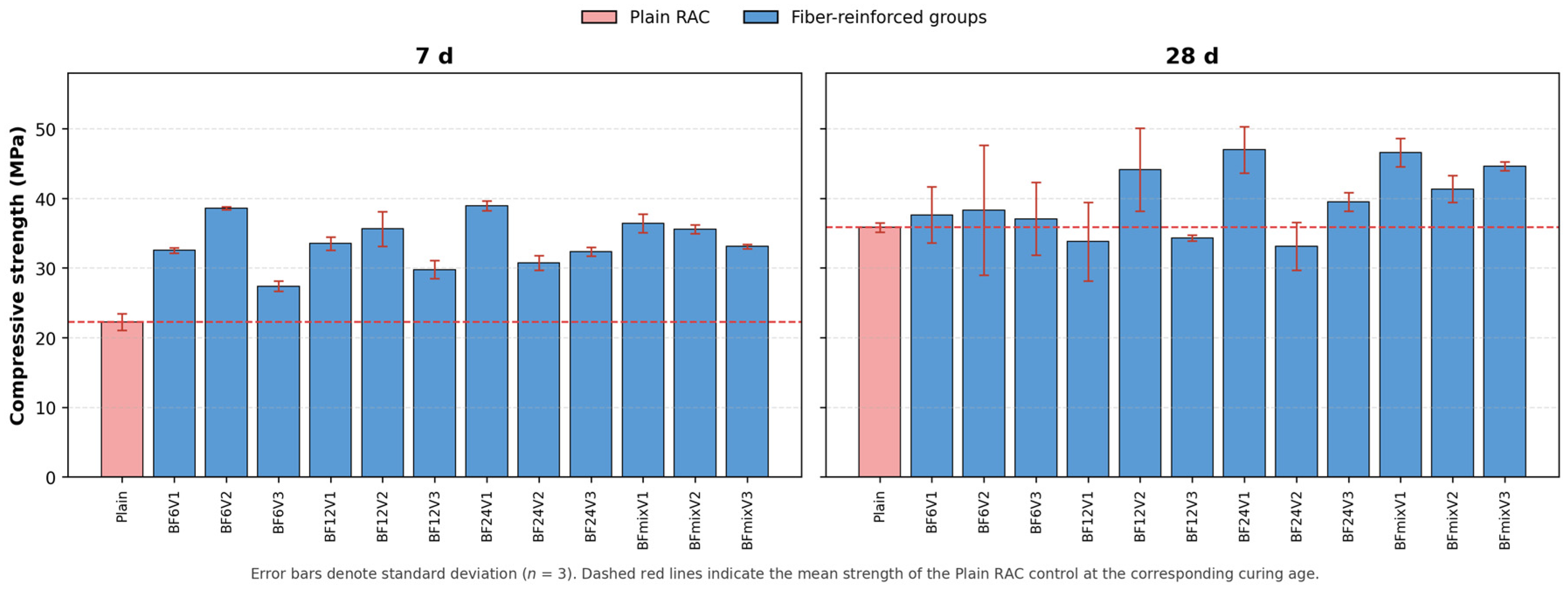
As shown in Figure 7, basalt fiber incorporation generally improved the compressive strength of recycled aggregate concrete, but the extent of improvement depended strongly on fiber length and fiber volume fraction. At 7 days, all fiber series contained mixtures with substantially higher compressive strength than the plain control. The highest early-age strengths were obtained for BF24V1 and BF6V2, followed by BFmixV1 and BF12V2. At 28 days, the response became more selective and showed a clearer dependence on the combined effects of fiber geometry and dosage. The highest compressive strength was recorded for BF24V1, followed closely by BFmixV1, BF12V2, and BFmixV3. Relative to the plain recycled aggregate concrete, these correspond to increases of 31.2, 30.0, 26.0, and 24.6%, respectively.
Figure 7.
Compressive strength development of BFRAC at 7 and 28 days.
Not all fiber-reinforced mixtures showed improved long-term compressive strength. Several mixtures, including BF6V1, BF6V3, BF12V1, BF12V3, and BF24V2, exhibited 28-day compressive strengths comparable to or lower than that of the plain control. This indicates that fiber addition did not produce a uniformly beneficial effect under compression and that the reinforcing efficiency was sensitive to fiber configuration and dispersion quality.
The more pronounced improvement at early age can be attributed to the crack-arresting role of basalt fibers within the relatively immature cementitious matrix. Because of their high tensile strength and elastic modulus, the fibers can restrain microcrack initiation and propagation and improve stress redistribution under compressive loading. At a later age, however, the strength contribution of the densified cementitious matrix becomes more dominant, and the influence of fiber distribution becomes increasingly important. When fiber dosage is excessive or dispersion is non-uniform, fiber agglomeration, entrapped voids, and weak local interfaces may develop, offsetting the beneficial crack-bridging effect and limiting later strength gain. This explains the non-monotonic compressive strength response observed in several series.
A non-monotonic relationship between compressive strength and fiber dosage was observed across most fiber-length groups, particularly at 28 days. At suitable dosages, the fibers enhanced matrix integrity and delayed crack localization. However, a further increase in dosage often reduced compressive strength because of reduced workability and greater clustering tendency. This trend can be expressed as a reinforcement contribution opposed by a dispersion-related defect penalty:
where is the compressive strength of plain RAC, is the reinforcement efficiency coefficient, is the fiber volume fraction, is the fiber-length efficiency factor, and represents the strength loss associated with workability reduction, fiber agglomeration, and entrapped voids at higher dosages. This expression captures the observed increase-then-decrease trend with increasing fiber content.
Comparison among the different fiber-length series further indicates that longer fibers were generally more effective than shorter fibers at low dosage, as shown by the superior performance of BF24V1. This suggests that, when adequately dispersed, longer fibers provide more efficient bridging of larger internal cracks and therefore better resistance to damage development under compression. The mixed-length system also showed excellent performance, particularly at low dosage, with BFmixV1 reaching a 28-day compressive strength very close to that of BF24V1. This result suggests that combining short, medium, and long fibers can improve the spatial distribution of reinforcement, allowing smaller defects and larger cracks to be restrained simultaneously.
To further evaluate the relative influence of fiber length and dosage, range analysis was conducted and the results are presented in Table 4.
Table 4.
Compressive strength range analysis.
As shown in Table 4, the range value for factor B (fiber dosage) was much larger than that for factor A (fiber length) at 7 days, indicating that dosage was the dominant factor affecting early-age compressive strength. At 28 days, the difference became smaller and the range value for fiber length slightly exceeded that for dosage. This suggests that the influence of fiber geometry became more important as the matrix matured. The mixed-length configuration gave the highest average value for factor A at both ages, while the optimal dosage level corresponded to 0.1% at 28 days. These results are consistent with the direct experimental observations and support the selection of BFmixV1 as one of the most effective compressive-strength configurations.
3.2.2. Tensile Strength Development
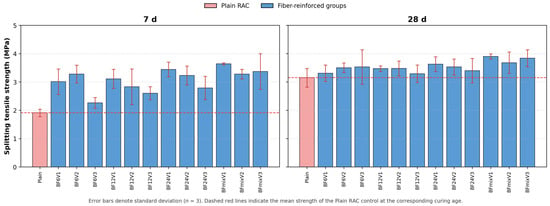
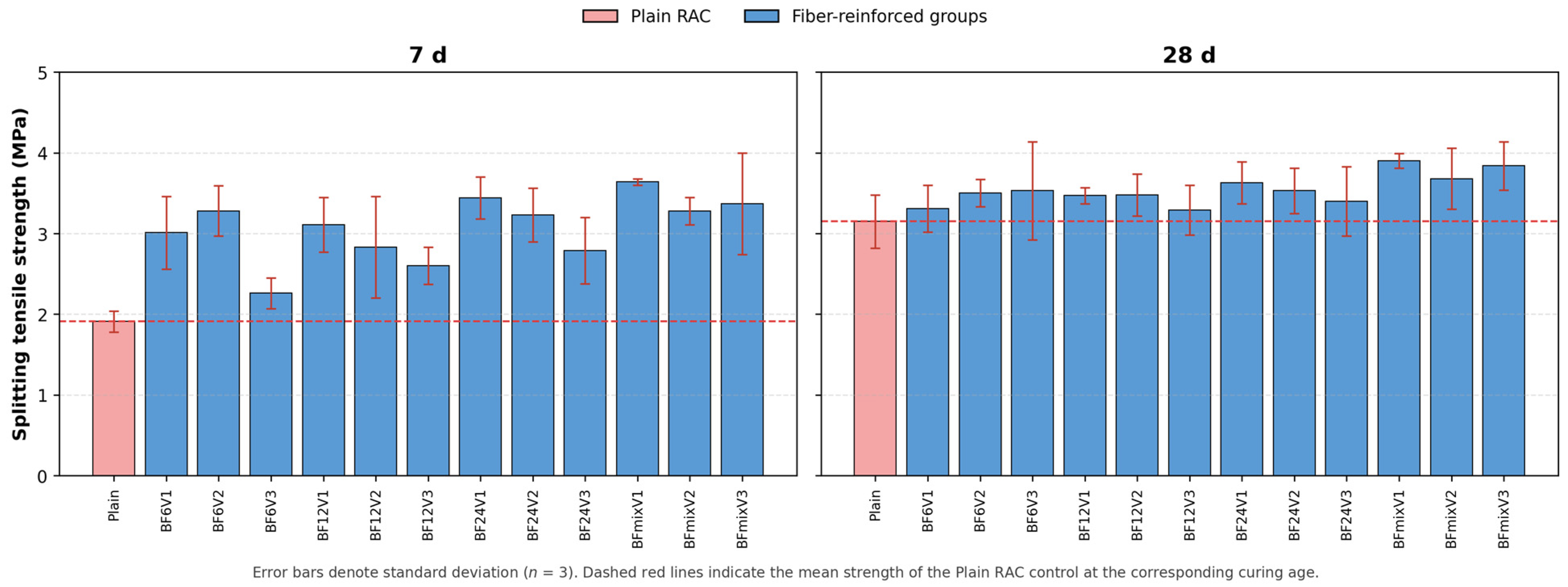
As shown in Figure 8, basalt fiber incorporation generally improved the splitting tensile strength of recycled aggregate concrete, and the improvement was more consistent than that observed for compressive strength. This indicates that fiber reinforcement was particularly effective in resisting tensile cracking. Similar to the compressive-strength results, the fiber-reinforced mixtures exhibited rapid early-age tensile strength development, followed by more moderate gains at 28 days.
Figure 8.
Tensile strength development of BFRAC at 7 and 28 days.
At 7 days, the highest tensile strengths in the 6, 12, 24 mm, and mixed-length series were 3.28 MPa for BF6V2, 3.02 MPa for BF12V1, 3.44 MPa for BF24V1, and 3.67 MPa for BFmixV3, respectively. These values correspond to increases of 71.7, 58.1, 80.1, and 92.1% relative to the plain control. At 28 days, the maximum tensile strengths were 3.76 MPa for BF6V3, 3.48 MPa for BF12V2, 3.63 MPa for BF24V1, and 3.90 MPa for BFmixV1, corresponding to increases of 19.4, 10.5, 15.2, and 23.8%, respectively. Among all mixtures, BFmixV1 achieved the highest 28-day splitting tensile strength, indicating that the mixed-length fiber system was especially effective in improving tensile crack resistance.
The enhancement in splitting tensile strength can be attributed mainly to the formation of a three-dimensional bridging network within the cementitious matrix. When fibers are reasonably well dispersed, they can transmit tensile stress across developing cracks and delay crack coalescence. As a result, the specimen can sustain higher tensile stress before unstable crack propagation occurs. The tensile-strength results also showed a non-monotonic dependence on fiber dosage, although this trend was less severe than that observed for compressive strength. In general, tensile strength increased initially and then declined at higher fiber contents, particularly for the longer-fiber series. This suggests that longer fibers can improve crack-bridging efficiency, but excessive fiber addition reduces dispersion quality and diminishes the effective reinforcing contribution.
For splitting tensile capacity, the response can be interpreted as the superposition of the tensile resistance of the RAC matrix and the contribution of fiber bridging:
where is tensile strength, is the tensile strength of the plain RAC matrix, and is the bridging stress (Equation (5)). Because scales approximately with fiber volume fraction under good dispersion conditions, this relation helps explain why tensile strength was more sensitive to fiber content than compressive strength in the range analysis. The range analysis results for tensile strength are summarized in Table 5.
Table 5.
Tensile strength range analysis.
As shown in Table 5, the average tensile strength associated with factor A (fiber length) first decreased slightly and then increased, with the highest average values obtained at the fourth level, corresponding to the mixed-length system, at both 7 and 28 days. For factor B (fiber dosage), the average tensile strength exhibited a clear increase–decrease trend, and the highest values were obtained at the second level (0.1%) at both ages. Comparison of the range values further showed that fiber dosage exerted a greater influence than fiber length on tensile strength at both 7 days () and 28 days (). This differs from the compressive strength results, where fiber length became slightly more influential at 28 days. The persistent dominance of fiber dosage in tensile behavior reflects the governing role of crack bridging. Tensile performance depends strongly on the number density of fibers intersecting the crack path. Based on the range analysis, BFmixV1 showed the highest mean splitting tensile strength; pairwise comparisons indicated that its advantage over the single-length mixtures was not statistically significant at n = 3 and is therefore reported as a trend.
3.2.3. Statistical Interpretation and Parameter Optimization
The results presented in Section 3.2.1 and Section 3.2.2 indicate that the mechanical behavior of BFRAC depended not only on the presence of fibers, but also on the interaction among curing age, fiber length, and fiber dosage. The two-way ANOVA results confirmed significant Group × Age interaction effects for both compressive and splitting tensile strength, indicating that different fiber systems followed different strength-development patterns from 7 to 28 days. In practical terms, the influence of basalt fibers was not constant over time but changed as the cementitious matrix matured.
For compressive strength, the experimental and statistical results indicate that fiber length and dosage acted in a coupled and non-monotonic manner. At low dosage, longer fibers and mixed-length systems generally provided more effective crack restraint and better load transfer, resulting in superior later-age compressive strength. This was evident in BF24V1 and BFmixV1. However, increasing the fiber dosage beyond the optimal level often reduced the benefit because of poorer workability, fiber agglomeration, and internal void formation. These effects introduced local defects that limited the contribution of crack bridging. As a result, fiber length alone did not produce a universally dominant effect, and its benefit depended on dosage level and dispersion quality.
For splitting tensile strength, the response was more directly governed by fiber bridging. Although fiber length still influenced performance, the statistical trends indicate that tensile behavior was more sensitive to fiber dosage than compressive behavior. This is reasonable because the number density of fibers crossing the critical crack path directly affects splitting resistance. The mixed-length system benefited from a multi-scale reinforcing mechanism in which shorter fibers could restrain early microcrack development while longer fibers bridged wider cracks at later stages. This produced a more efficient internal reinforcing network and explains the consistently favorable performance of BFmixV1.
Taken together, the statistical results, range analysis, and observed mechanical behavior indicate that BFmixV1 provided the most balanced performance among all tested mixtures. This mixture combined high compressive strength, the highest mean splitting tensile strength, and comparatively stable behavior without the penalty associated with excessive fiber dosage. Within the range investigated, it can therefore be regarded as the most balanced configuration; because the 28-day splitting-tensile differences among the fiber-reinforced mixtures were not statistically significant (n = 3), this designation reflects the highest mean performance rather than a statistically distinct tensile optimum.
3.2.4. Synergy Analysis of Mixed Length Systems
To quantify the effect of the mixed-length fiber system, a synergy analysis was conducted by comparing the measured performance of BFmixV1 with the theoretical additive performance of the corresponding single-length mixtures at the same total fiber volume fraction. The expected additive strength was calculated as the arithmetic mean of the strengths of BF6V1, BF12V1, and BF24V1. Based on this reference, the synergy gain of the mixed-length system was defined as follows:
where fmix, fsingle are the measured strengths of the mixed-length and single specimens, respectively and Isyn is the percentage synergy gain.
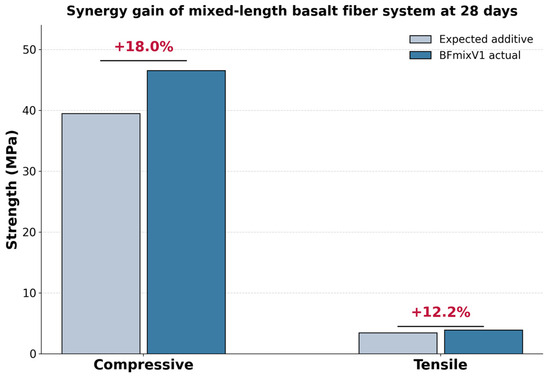
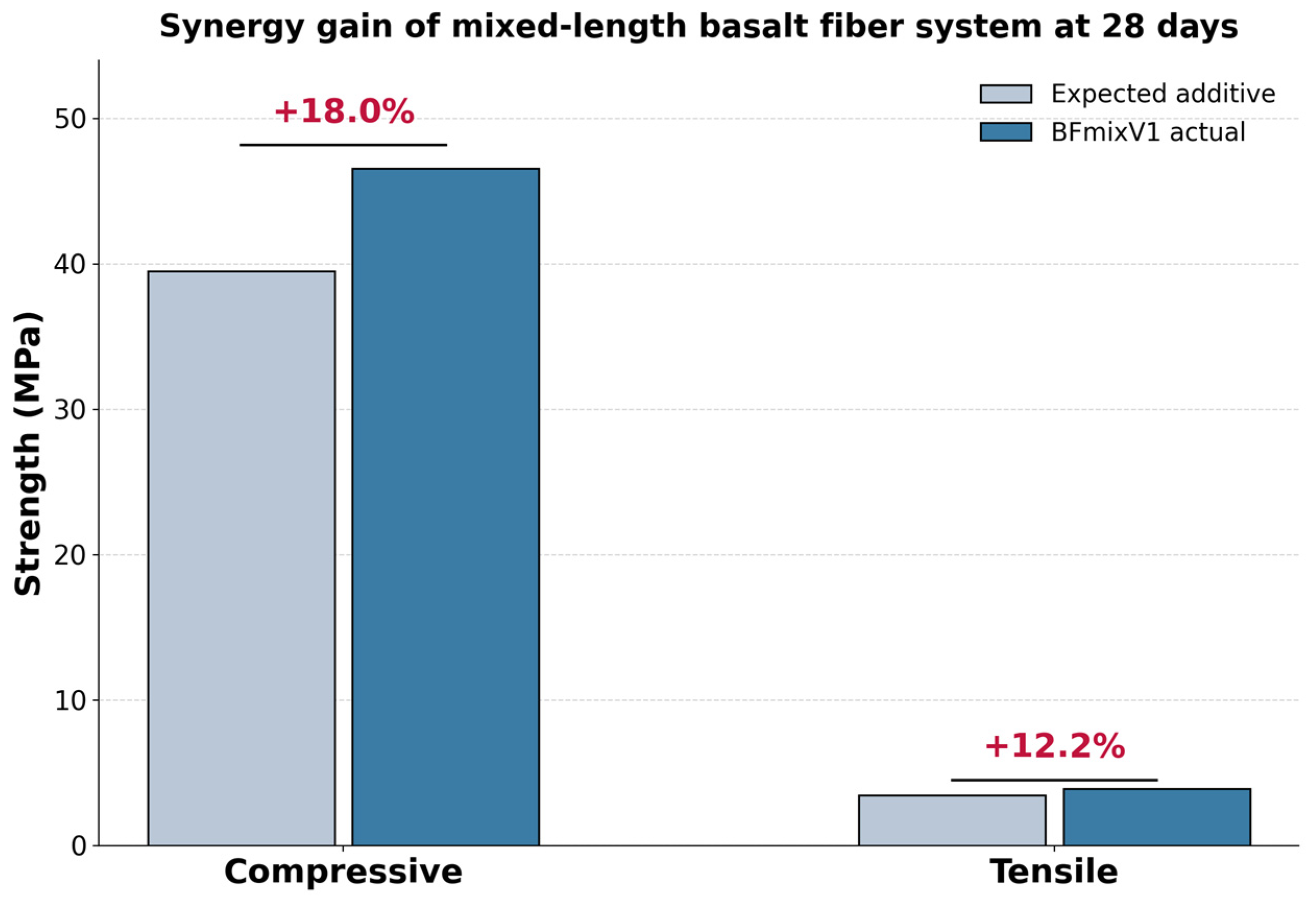
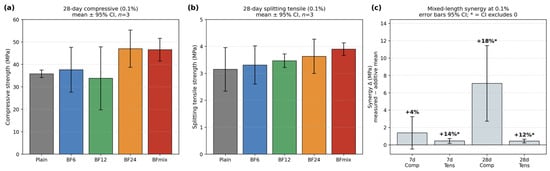
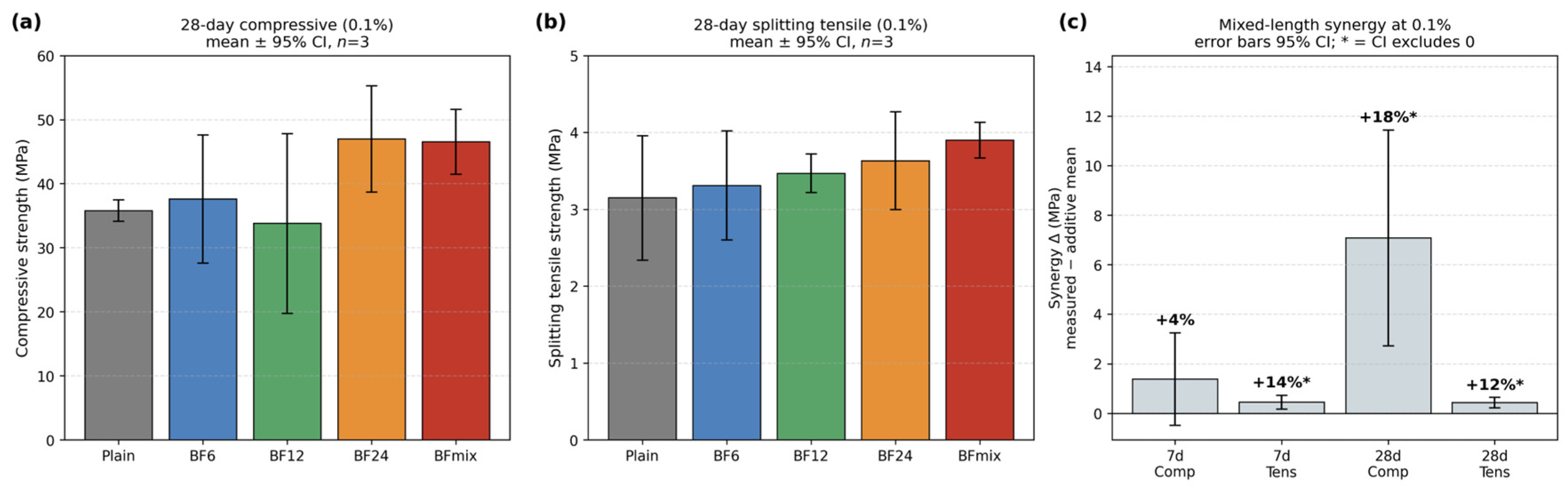
As shown in Figure 9, BFmixV1 exhibited a positive synergy at 28 days that was statistically significant for both properties. The synergy gain was defined as the difference between the measured BFmixV1 strength and the additive (arithmetic-mean) expectation of BF6V1, BF12V1 and BF24V1, with the standard error propagated from the individual specimen values. On this basis the expected additive strengths were 39.47 MPa (compressive) and 3.47 MPa (splitting tensile), whereas the measured BFmixV1 values reached 46.56 and 3.90 MPa, respectively. These correspond to synergy gains of +7.09 MPa (+18.0%; 95% CI [+2.5, +11.7] MPa) for compressive strength and +0.42 MPa (+12.2%; 95% CI [+0.20, +0.65] MPa) for splitting-tensile strength; in both cases the 95% confidence interval excludes zero. Therefore, the mixed-length system did not merely reproduce the average contribution of the three single-length systems but generated a statistically significant additional reinforcing effect. The 95% confidence intervals for the individual mixtures and the synergy gains with their confidence intervals are summarized in Figure 10.
Figure 9.
Comparison between the expected additive strength and the measured BFmixV1 strength.
Figure 10.
Statistical summary for the 0.1% mixtures at 28 days: 95% confidence intervals for (a) compressive strength and (b) splitting tensile strength (n = 3), and (c) the mixed-length synergy gain (measured minus additive-mean expectation) with 95% confidence intervals; an asterisk indicates that the confidence interval excludes zero.
This positive synergy can be explained by the more coordinated crack control function provided by fibers of different lengths. Short fibers are more effective in restraining small cracks and local defects, medium-length fibers improve stress transfer continuity, and longer fibers bridge wider cracks and delay macrocrack propagation. When combined at an appropriate dosage, these mechanisms operate in a complementary manner and generate a more efficient internal reinforcing network. This interpretation is consistent with the failure observations and the superior overall performance of BFmixV1.
3.3. Microstructure Characterization
3.3.1. Scanning Electron Microscopy Analysis
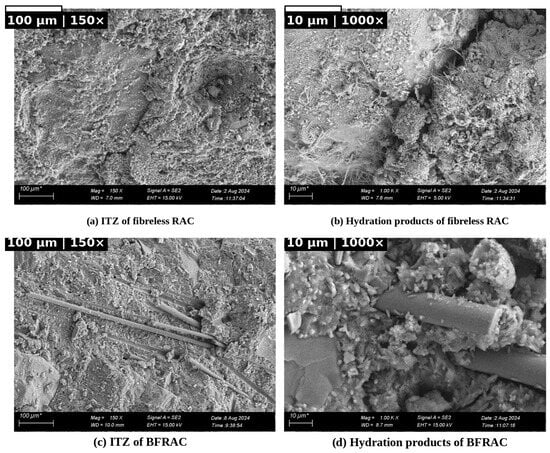
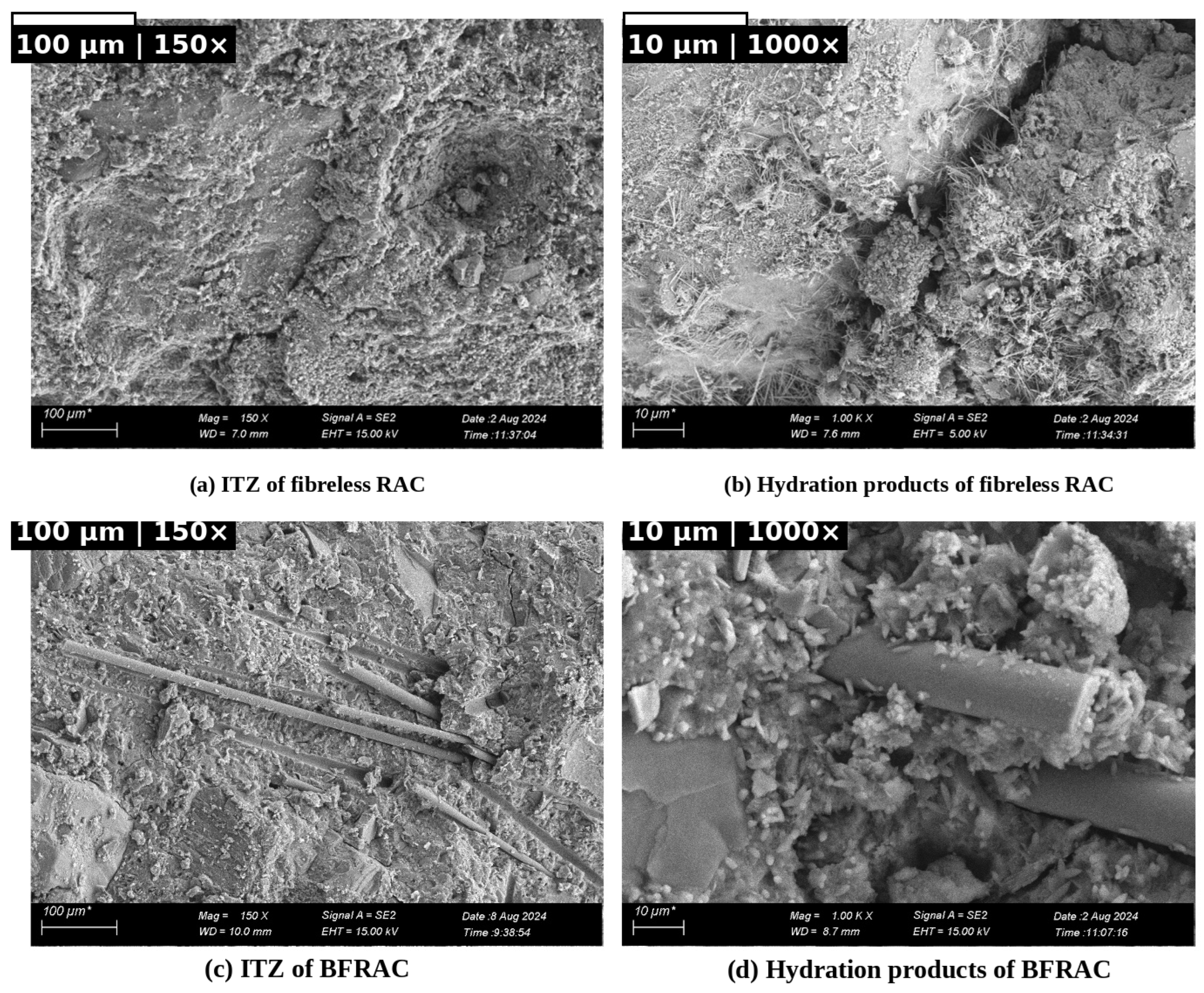
Scanning electron microscopy (SEM) was employed to investigate the microstructural morphology and fiber distribution characteristics within the ITZ of damaged recycled concrete specimens. Representative micrographs are presented in Figure 11a,b corresponding to RAC without fibers and (c) and (d) representing BF24V1. The phase identifications discussed in this section (such as C–S–H, ettringite, and calcium hydroxide) are based on characteristic SEM morphology and are therefore interpreted as indicative; they were not independently confirmed by EDS, XRD or TGA, as noted in the limitations.
Figure 11.
Microscopic morphology. SEM micrographs: (a) ITZ of fiberless RAC; (b) hydration products of fiberless RAC; (c) ITZ of BFRAC; and (d) hydration products of BFRAC. The scale bar, magnification (Mag), accelerating voltage (EHT), working distance (WD) and signal mode (SE2) are indicated in the data bar of each panel; panels (a,c) were acquired at 150× (scale bar 100 µm) and panels (b,d) at 1000× (scale bar 10 µm). The asterisk is defined as 95% confidence interval excludes zero.
As shown in Figure 11a,c, both the plain and fiber-reinforced mixtures exhibited pores, microcracks, and visible interfacial regions between the coarse aggregate and surrounding mortar. This indicates that basalt fiber incorporation did not eliminate internal defects but rather modified the way damage developed and propagated within the matrix. In Figure 11c, basalt fibers can be seen embedded in the cementitious matrix, together with imprints left by fiber pull-out. A visible gap remained locally between the fiber surface and the surrounding matrix, indicating that the fiber–matrix bond was governed mainly by physical adhesion and mechanical interlocking rather than chemical bonding. This observation is consistent with the inert character of basalt fibers in cementitious systems.
The micrographs also show that some fibers remained anchored across cracks after failure, indicating that they continued to transfer stress during crack opening. Such behavior supports the crack-bridging interpretation proposed in Section 3.1. and helps explain the improvement in tensile performance observed in the fiber-reinforced mixtures. When cracks formed within the recycled concrete matrix, the fibers bridged the crack faces, delayed crack widening, and increased the energy required for further propagation. These features are consistent with the superior mechanical performance obtained at suitable fiber dosages.
Higher-magnification SEM images of the plain concrete and BF24V1 are presented in Figure 11b,d. The plain recycled aggregate concrete showed abundant needle-like ettringite (AFt) and plate-like calcium hydroxide Ca (OH)2 within the ITZ. These products formed a relatively loose and porous microstructure, which is consistent with the known weakness of the ITZ in recycled aggregate concrete. In contrast, the fiber-reinforced specimen showed substantial calcium silicate hydrate (C–S–H) gel attached to the fiber surface, together with moderate amounts of AFt and Ca (OH)2 in the adjacent zone. This indicates that hydration products accumulated around the fibers and contributed to mechanical anchorage.
At the same time, the SEM images also suggest that the ITZ around the fibers remained locally porous. This can be attributed to the wall effect associated with elongated inclusions in fresh cementitious materials. During mixing and casting, a local water-rich zone can form around the fiber surface, leading to a higher local water-to-cement ratio and less compact hydration product growth. As a result, although basalt fibers improved macroscopic mechanical behavior through crack bridging, the surrounding fiber ITZ did not necessarily become denser than the bulk matrix. This observation helps explain why the reinforcing effect was beneficial but not unlimited, particularly at higher fiber dosages.
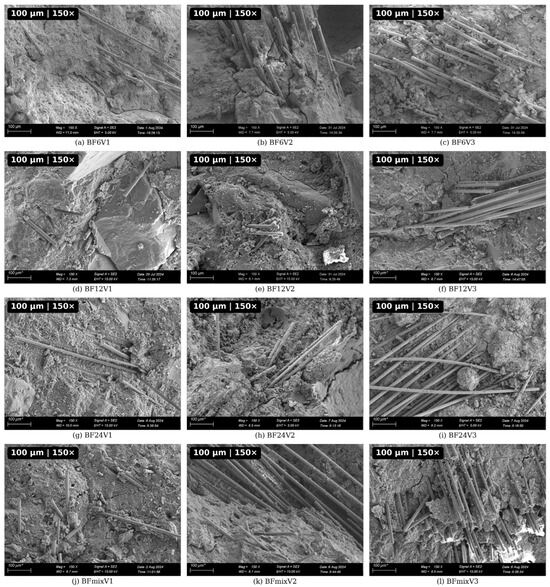
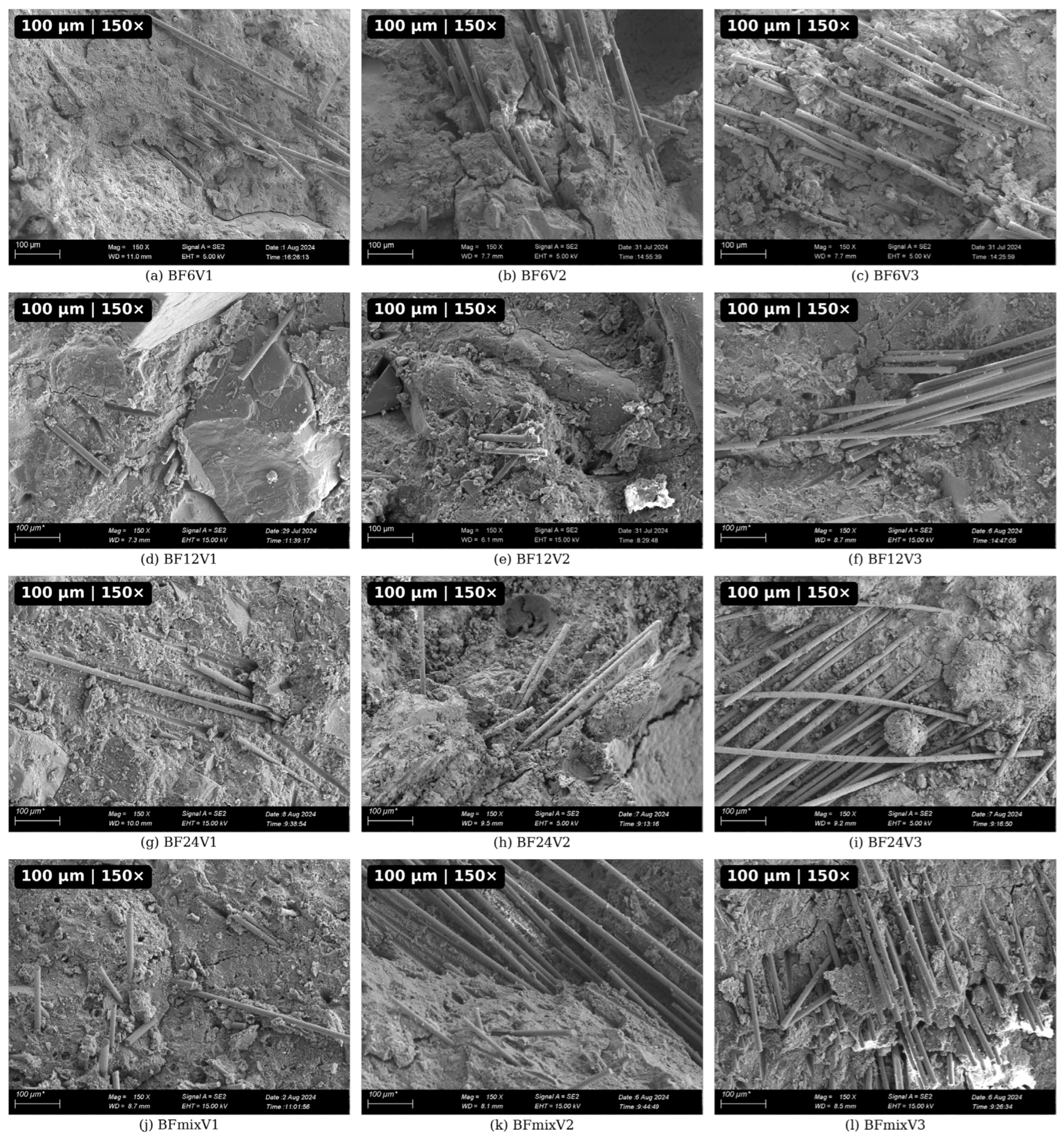
The SEM micrographs of all BFRAC mixtures at 28 days are shown in Figure 12.
Figure 12.
Microscopic morphology of BFRAC. SEM micrographs of the BFRAC mixtures; panels (a–l) correspond to BF6V1, BF6V2, BF6V3, BF12V1, BF12V2, BF12V3, BF24V1, BF24V2, BF24V3, BFmixV1, BFmixV2 and BFmixV3, respectively. All panels were acquired at 150× with a 100 µm scale bar; the magnification (Mag), accelerating voltage (EHT), working distance (WD) and signal mode (SE2) are indicated in the data bar of each panel. The asterisk is defined as 95% confidence interval excludes zero.
As shown in Figure 12, the interfacial microstructure varied systematically with fiber length and dosage. At the 0.1% volume fraction, the fibers were generally more uniformly distributed within the matrix, as seen in Figure 12a,d,g,j. These specimens exhibited fewer obvious clustered regions and lower local defect concentration. In contrast, the 0.3% mixtures, shown in Figure 12f,i,l, displayed more pronounced fiber agglomeration and higher local porosity. This observation is consistent with the reduced workability expected at higher fiber contents and supports the explanation for the non-monotonic mechanical response discussed in Section 3.2.
For the 6 mm fiber mixtures, the fibers were relatively easy to disperse, and the low-dosage specimen showed a comparatively uniform distribution. However, because of the short embedment length, these fibers were more likely to contribute through pull-out and microcrack restraint than through bridging of wider cracks. This is consistent with the dense fine-crack patterns observed in the failure analysis. With increasing dosage, the short fibers still dispersed better than the longer fibers, which helps explain why the reduction in tensile performance at higher dosage was less pronounced in the 6 mm series.
For the 24 mm fiber mixtures, the fibers were able to span larger internal defects and bridge wider crack paths, which is favorable for crack arrest and stress transfer. However, the longer fibers also showed a greater tendency to overlap and accumulate, especially at higher contents, as seen in Figure 12h,i. This reduced the uniformity of the reinforcing network and introduced local weak zones, which likely contributed to the decline in mechanical performance at excessive dosage.
The 12 mm fiber mixtures showed intermediate behavior between the short- and long-fiber systems. At low dosage, the fibers were reasonably well distributed, while at high dosage they began to show more obvious local accumulation. This is consistent with the mechanical results, where the 12 mm series showed an increase in strength at suitable dosage followed by a decline at higher dosage.
The mixed-length system showed the most favorable microstructural distribution at the 0.1% dosage. In Figure 12j, the fibers appear more uniformly arranged within the matrix, with less evidence of severe clustering. This suggests that combining different fiber lengths improved the internal packing of the reinforcing network and reduced the tendency of the longer fibers to accumulate locally. The shorter fibers likely acted within smaller voids and cracks, while the medium and longer fibers provided bridging across wider defects. As a result, the mixed-length system produced a more spatially coordinated reinforcing structure, which is consistent with its favorable compressive and tensile performance.
Overall, the SEM observations support three main points. First, basalt fibers improved crack resistance primarily through mechanical bridging and pull-out resistance rather than chemical bonding. Second, fiber dosage strongly influenced dispersion quality and local defect formation. Third, the mixed-length system at low dosage produced the most balanced internal reinforcing network among the tested mixtures. These observations are consistent with the mechanical results and provide microstructural support for the superior performance of BFmixV1.
3.3.2. Mercury Intrusion Porosimetry
Mercury intrusion porosimetry (MIP) was conducted on selected specimens to quantify the influence of basalt fibers on pore structure. The pore-analysis results are presented in Table 6, and the corresponding pore-size distribution is summarized in Table 7.
Table 6.
Pore analysis.
Table 7.
Pore size distribution.
As shown in Table 6, all fiber-reinforced mixtures exhibited higher total porosity than the plain recycled aggregate concrete, for which the measured porosity was 10.58%. Among the single-length mixtures, BF24V1 showed the highest porosity, reaching 13.04%, whereas BFmixV1 showed a more limited increase to 11.06%. This indicates that fiber incorporation did not simply densify the concrete matrix in terms of total pore volume. Instead, the effect of basalt fibers on pore structure depended on the balance between local interfacial disturbance and the modification of pore-size distribution.
The average pore diameter and most probable pore size of BF6V1 and BF12V1 were both larger than those of the plain concrete. In contrast, BF24V1 and BFmixV1 showed smaller average pore diameters and smaller most probable pore sizes than the plain specimen. This distinction is important because total porosity alone did not fully explain the observed mechanical performance. Although BF24V1 had the highest porosity among the tested mixtures, it still showed excellent compressive strength. This suggests that pore-size distribution and characteristic pore size were more influential than total porosity alone.
The pore-size distributions in Table 7 further support this interpretation. The 6 mm and 12 mm single-length mixtures showed higher proportions of macro-pores and capillary pores, indicating a shift toward a coarser pore structure. Such coarsening can intensify local stress concentration within the matrix and weaken resistance to compressive damage. By contrast, BF24V1 and especially BFmixV1 showed lower proportions of capillary pores and higher proportions of gel pores. BFmixV1 had the highest gel-pore proportion, reaching 30.81%, together with the lowest most probable pore size among the measured specimens. These features indicate a finer and more uniform pore structure.
The microstructural implication is that the mixed-length fiber system did not minimize total porosity absolutely, but it more effectively refined the internal pore system toward smaller characteristic sizes. This refinement is beneficial because smaller and more uniformly distributed pores are less detrimental to stress transfer than larger connected capillary voids. The results therefore suggest that the superior performance of BFmixV1 was associated more with pore structure refinement than with a simple reduction in total pore volume.
A simple way to relate mechanical performance to MIP outputs is to link strength to a characteristic pore size (e.g., most probable pore diameter ):
where and are fitted constants for a given binder–aggregate system. This representation supports the observation that mixes with smaller characteristic pore sizes (e.g., BFmixV1) can achieve higher strength even when total porosity does not decrease proportionally.
Together, the MIP results indicate that basalt fibers influenced pore structure in two competing ways. On the one hand, fiber addition could increase local porosity because of wall effects, disturbance of the fresh matrix, and reduced workability. On the other hand, at suitable length combinations and dosage, the fibers contributed to a more favorable pore-size distribution by restraining crack development and improving the internal organization of the matrix. The mixed-length system at 0.1% provided the best balance between these two effects, which is consistent with both the SEM observations and the mechanical test results.
3.4. Mechanistic Interpretation and Quantitative Modeling
To establish a quantitative link between the observed microstructure and mechanical performance, the 28-day experimental data were fitted to established micromechanical models. The relationship between and was modeled using a power law refinement, Equation (9). The fitting yielded = 47.12 and = 0.07, indicating that while pore refinement is a factor, it only partially explains the strength gains in the mixed fiber system. The tensile strength was further analyzed using a fiber bridging model, Equation (4). The model fitting resulted in an implied of 0.85 MPa. Notably, the mixed length system (BFmixV1) showed a positive residual of 11.7% above this linear bridging model confirming the synergy between short and long fibers. This quantitative evidence supports the conclusion that the multi-scale fiber network effectively bridges cracks across different scales from micro voids to macroscopic fracture planes.
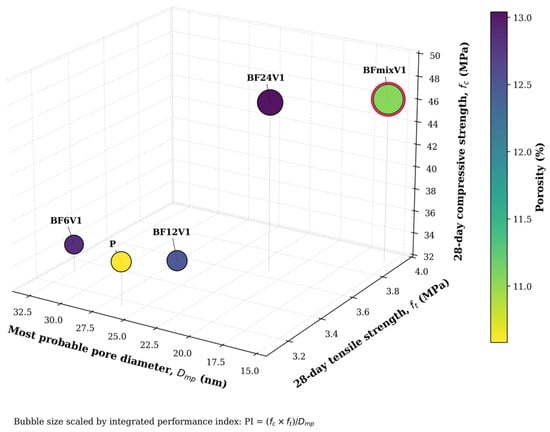
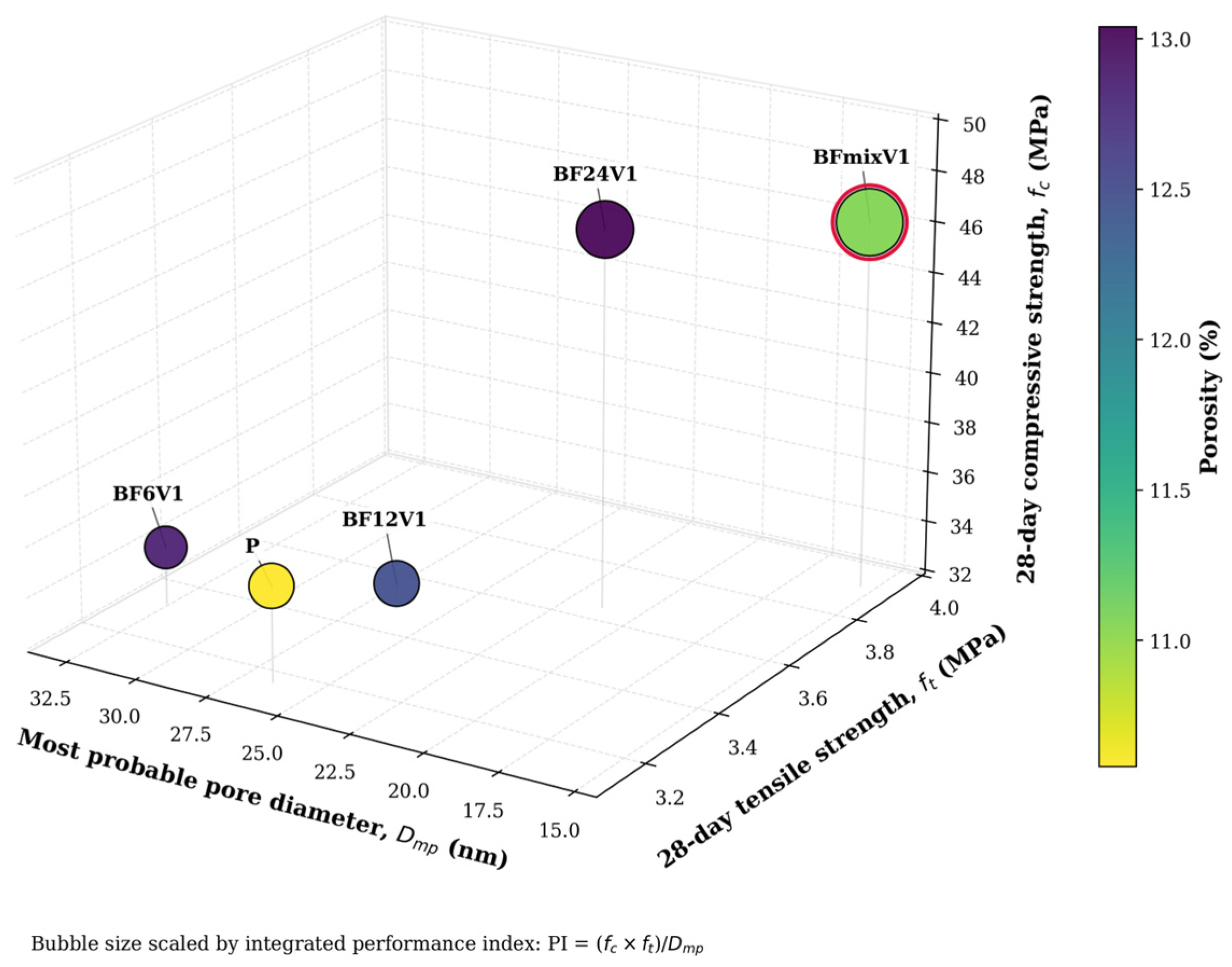
To further visualize the coupled relationship between pore structure refinement and mechanical performance, a three-dimensional synthesis graph was constructed for representative mixtures with both MIP and 28-day strength data. As shown in Figure 13, BFmixV1 is positioned in the most favorable region of the performance space. It exhibits the lowest most probable pore diameter, the highest splitting tensile strength, and near-maximum compressive strength. In contrast, BF24V1 achieved comparable compressive strength but with higher porosity and less balanced overall performance. This visualization provides direct evidence that the superior behavior of the mixed-length system results from the simultaneous optimization of pore structure and multi-scale crack-bridging efficiency.
Figure 13.
Three-dimensional synthesis graph of microstructure and mechanical performance of BFRAC mixtures at 28 days.
To provide a unified prediction of the mechanical behavior of BFRAC, a combined mechanistic model was developed. This model integrates the effects of pore structure refinement, fiber bridging, and the detrimental effects of fiber clustering at higher volume fractions:
where represents the matrix strength as a function of the most probable pore diameter (), is the strength contribution from the fiber bridging stress (), and is a penalty term representing the loss of workability and formation of voids due to fiber agglomeration. Fitting the 28-day experimental data to this model, the synergy of the BFmixV1 is validated. The model confirms that at low dosages, the bridging and pore refinement terms dominate, leading to the observed 30% strength enhancement. However, as increases, the quadratic penalty term () grows rapidly, explaining the “strength ceiling” and subsequent decline in performance observed in the high dosage groups. This unified expression is an empirical relationship that describes the observed trends within the tested range of fiber length and dosage; it was obtained by least-squares regression on the present dataset and has not been validated against independent data.
4. Conclusions
Based on the experimental, statistical, and microstructural results, the following conclusions can be drawn regarding the upgrading of waste-derived recycled aggregate into higher-performance concrete through aggregate pretreatment and basalt fiber reinforcement:
- (1)
- The two-step pretreatment of recycled coarse aggregate using nano-silica followed by cement slurry improved aggregate quality and enabled the production of recycled aggregate concrete with 100% recycled coarse aggregate and satisfactory mechanical performance.
- (2)
- Basalt fiber incorporation improved the mechanical behavior of the concrete, but the effect depended on fiber length, dosage, and curing age. The compressive strength response was non-monotonic, indicating that the benefit of fiber bridging and crack restraint at suitable dosage could be offset by reduced workability, local fiber agglomeration, and internal defects at higher dosage. In contrast, splitting tensile strength showed a more consistent benefit from fiber addition, reflecting the more direct role of fibers in crack bridging.
- (3)
- Among the investigated mixtures, BF24V1 and BFmixV1 showed the best compressive strength performance at 28 days, while BFmixV1 achieved the highest splitting tensile strength. This indicates that a mixed-length fiber system can provide a more balanced improvement in overall mechanical performance than single-length systems under the same dosage range.
- (4)
- The mixed-length system showed positive synergy relative to the corresponding single-length mixtures at the same total fiber volume fraction. This behavior is attributed to complementary crack-control actions at different scales, in which shorter fibers are more effective in restraining microcrack development and longer fibers are more effective in bridging wider cracks.
- (5)
- The SEM observations indicated that the reinforcing effect of basalt fibers was governed mainly by mechanical bridging, pull-out resistance, and crack deflection rather than by chemical bonding. The MIP results further showed that the superior performance of BFmixV1 was associated less with a reduction in total porosity than with a more favorable pore-size distribution, including a lower characteristic pore size and a higher proportion of fine pores.
- (6)
- Within the investigated parameter range, the mixed-length basalt fiber system at 0.1% volume fraction provided the most favorable overall balance of compressive strength, splitting tensile strength, crack control, and pore structure refinement. These results suggest that, for pretreated recycled aggregate concrete made with 100% recycled coarse aggregate, fiber-length design should be considered as a multi-scale reinforcement variable rather than as an isolated parameter.
- (7)
- The present findings are limited to compressive strength, splitting tensile strength, and selected microstructural observations under the investigated mixture conditions. Further work is still needed to evaluate durability, long-term deformation, flexural and fracture behavior, and structural-scale performance before broader engineering application is considered. Several specific limitations should be noted. Only three specimens were tested per condition, which limits statistical power; the reported differences should therefore be confirmed with larger samples. Fresh-state properties (slump, flow, air content, and fresh density) were not measured, so the link between workability and strength is not quantified. The post-cracking and crack-control behavior, where fiber length is most influential, requires load–displacement, flexural/toughness, and fracture energy (wedge-split, Tschegg) testing. Phase identification was based on SEM morphology and would benefit from EDS, XRD, and/or TGA confirmation. Mercury intrusion was performed on selected, non-replicated fragments and is therefore indicative of the matrix pore structure rather than bulk-representative. Finally, because all mixtures used pretreated recycled aggregate, control mixtures with untreated recycled aggregate and with natural aggregate are required to isolate the concrete-level effect of the pretreatment; these constitute the priority of ongoing work.
Author Contributions
Conceptualization, K.M.; Methodology, K.L. and K.M.; Validation, K.L., K.M., B.P. and S.P.; Formal analysis, K.M.; Investigation, K.L., K.M. and B.P.; Writing–original draft, K.L. and K.M.; Writing–review & editing, K.L., K.M., B.P. and S.P.; Visualization, K.M., B.P. and S.P.; Supervision, K.M. and B.P. All authors have read and agreed to the published version of the manuscript.
Funding
The authors would like to express their sincere gratitude to the 2025 Annual Support Program for Basic Research of Excellent Young Teachers in Heilongjiang Province (Grant No. YQJH2025293) for financial support.
Data Availability Statement
The data presented in this study are available on request from the corresponding author. The data are not publicly available because they form part of an ongoing research program.
Acknowledgments
The authors would like to express their sincere gratitude to Suihua University, Suihua, Heilongjiang, China, and Rajamangala University of Technology Thanyaburi (RMUTT), Thailand, for their invaluable institutional support and for providing the necessary facilities to conduct this research.
Conflicts of Interest
The authors declare that they have no known competing financial interests or personal relationships that could have appeared to influence the work reported in this paper.
References
- Wang, B.; Yan, L.; Fu, Q.; Kasal, B. A comprehensive review on recycled aggregate and recycled aggregate concrete. Resour. Conserv. Recycl. 2021, 171, 105565. [Google Scholar] [CrossRef] [Scilit]
- Alibeigibeni, A.; Stochino, F.; Zucca, M.; Gayarre, F.L. Enhancing concrete sustainability: A critical review of the performance of recycled concrete aggregates (RCAs) in structural concrete. Buildings 2025, 15, 1361. [Google Scholar] [CrossRef] [Scilit]
- McNeil, K.; Kang, T.H.K. Recycled concrete aggregates: A review. Int. J. Concr. Struct. Mater. 2013, 7, 61–69. [Google Scholar] [CrossRef] [Scilit]
- Verian, K.P.; Ashraf, W.; Cao, Y. Properties of recycled concrete aggregate and their influence in new concrete production. Resour. Conserv. Recycl. 2018, 133, 30–49. [Google Scholar] [CrossRef] [Scilit]
- Musiket, K.; Rosendahl, M.; Xi, Y. Fracture of recycled aggregate concrete under high loading rates. J. Mater. Civ. Eng. 2016, 28, 4016018. [Google Scholar] [CrossRef] [Scilit]
- Kisku, N.; Joshi, H.; Ansari, M.; Panda, S.K.; Nayak, S.; Dutta, S.C. A critical review and assessment for usage of recycled aggregate as sustainable construction material. Constr. Build. Mater. 2017, 131, 721–740. [Google Scholar] [CrossRef] [Scilit]
- Piyaphipat, S.; Phungpaingam, B.; Musiket, K.; Xi, Y. Computational viscoelastic modeling of strain rate effect on recycled aggregate concrete. Comput. Concr. 2023, 32, 383–392. [Google Scholar] [CrossRef]
- Altun, M.G.; Oltulu, M. Effect of different types of fiber utilization on mechanical properties of recycled aggregate concrete containing silica fume. J. Green Build. 2020, 15, 119–136. [Google Scholar] [CrossRef] [Scilit]
- Musiket, K.; Vernerey, F.; Xi, Y. Numeral modeling of fracture failure of recycled aggregate concrete beams under high loading rates. Int. J. Fract. 2017, 203, 263–276. [Google Scholar] [CrossRef] [Scilit]
- Yang, W.; Liu, L.; Wu, W.; Zhang, K.; Xiong, X.; Li, C.; Huang, Y.; Zhang, X.; Zhou, H. A review of the mechanical properties and durability of basalt fiber recycled concrete. Constr. Build. Mater. 2024, 412, 134882. [Google Scholar] [CrossRef] [Scilit]
- Zhang, C.; Wang, Y.; Zhang, X.; Ding, Y.; Xu, P. Mechanical properties and microstructure of basalt fiber-reinforced recycled concrete. J. Clean. Prod. 2021, 278, 123252. [Google Scholar] [CrossRef] [Scilit]
- Gogoi, R.; Dutta, B.; Mahakavi, P.; Chithra, R.; Surya, S. An experimental investigation on the impact of basalt fibres on recycled aggregate concrete. Int. J. Pavement Res. Technol. 2023, 16, 176–194. [Google Scholar] [CrossRef] [Scilit]
- Zhang, X.; Wang, J.; Lou, C. Experimental study on axial tensile properties of basalt fibre reinforced recycled aggregate concrete. Heliyon 2024, 10, e34208. [Google Scholar] [CrossRef] [Scilit] [PubMed]
- Al-Kharabsheh, B.N.; Arbili, M.M.; Majdi, A.; Alogla, S.M.; Hakamy, A.; Ahmad, J.; Deifalla, A.F. Basalt Fibers Reinforced Concrete: Strength and Failure Modes. Materials 2022, 15, 7350. [Google Scholar] [CrossRef] [Scilit] [PubMed]
- Zheng, Y.; Zhuo, J.; Zhang, P.; Ma, M. Mechanical properties and meso-microscopic mechanism of basalt fiber-reinforced recycled aggregate concrete. J. Clean. Prod. 2022, 370, 133555. [Google Scholar] [CrossRef] [Scilit]
- Chen, W.; Chen, Y. Effect of mixed basalt fibers and nano-silica on mechanical properties and microstructure of recycled aggregate concrete. AIP Adv. 2024, 14, 25219. [Google Scholar] [CrossRef] [Scilit]
- Zhang, Y.H.; Zhong, W.L.; Fan, L.F. Long-term durability investigation of basalt fiber-reinforced geopolymer concrete in marine environment. J. Mater. Res. Technol. 2024, 31, 593–605. [Google Scholar] [CrossRef] [Scilit]
- Al-Kharabsheh, B.N.; Arbili, M.M.; Majdi, A.; Alogla, S.M.; Hakamy, A.; Ahmad, J.; Deifalla, A.F. Basalt fibre reinforced concrete: A compressive review on durability aspects. Materials 2023, 16, 429. [Google Scholar] [CrossRef] [Scilit] [PubMed]
- Fan, Z.; Liu, H.; Liu, G.; Wang, X.; Cui, W. Compressive performance of fiber reinforced recycled aggregate concrete by basalt fibre-reinforced polymer-polyvinyl chloride composite jackets. J. Renew. Mater. 2023, 11, 1763–1791. [Google Scholar] [CrossRef] [Scilit]
- Bao, S.; Wang, S.; Xia, H.; Liu, K.; Tang, X.; Jin, P. Enhancing the mechanical properties of recycled aggregate concrete: A comparative study of basalt- and glass-fiber reinforcements. Buildings 2025, 15, 1718. [Google Scholar] [CrossRef] [Scilit]
- Khan, M.; Cao, M.; Xie, C.; Ali, M. Effectiveness of hybrid steel-basalt fiber reinforced concrete under compression. Case Stud. Constr. Mater. 2022, 16, e00941. [Google Scholar] [CrossRef] [Scilit]
- Akbulut, Z.F.; Tawfik, T.A.; Smarzewski, P.; Guler, S. Advancing hybrid fiber-reinforced concrete: Performance, crack resistance mechanism, and future innovations. Buildings 2025, 15, 1247. [Google Scholar] [CrossRef] [Scilit]
- Lifshitz Sherzer, G.; Ribakov, Y. Modeling complex material interactions to replicate and uncover mechanisms driving the performance of steel fiber-reinforced concrete cylinders. Appl. Sci. 2025, 15, 3445. [Google Scholar] [CrossRef] [Scilit]
- GB 175-2023; Common Portland Cement. China Architecture & Building Press: Beijing, China, 2023.
- Li, K.; Musiket, K.; Phungpaingam, B.; Pongsivasathit, S. Synergistic multi-scale reinforcement of recycled aggregate concrete with basalt fibers and calcium carbonate whiskers: From micro-filling to macro-bridging. Clean. Eng. Technol. 2026, 32, 101227. [Google Scholar] [CrossRef] [Scilit]
- GB/T 14684-2022; Construction Sand. China Architecture & Building Press: Beijing, China, 2022.
- JGJ 52-2006; Standard for Technical Requirements and Test Method of Sand and Crushed Stone for Ordinary Concrete. China Architecture & Building Press: Beijing, China, 2006.
- GB/T 25177-2010; Recycled Coarse Aggregate for Concrete. China Architecture & Building Press: Beijing, China, 2010.
- Xiao, J.; Li, B.; Zhang, K.; Su, Y.; Pan, Y. Dynamic Mechanical Properties of Nano-Silica Modified Recycled Aggregate Concrete under Uniaxial Compression. J. Tongji Univ. Nat. Sci. 2021, 49, 30–39. [Google Scholar] [CrossRef]
- Tam, V.W.Y.; Tam, C.M. Diversifying two-stage mixing approach (TSMA) for recycled aggregate concrete: TSMAs and TSMAsc. Constr. Build. Mater. 2008, 22, 2068–2077. [Google Scholar] [CrossRef] [Scilit]
- GB/T 14685-2022; Pebble and Crushed Stone for Construction. China Architecture & Building Press: Beijing, China, 2022.
- Dilbas, H.; Çakır, Ö. Influence of basalt fibre on physical and mechanical properties of treated recycled aggregate concrete. Constr. Build. Mater. 2020, 254, 119216. [Google Scholar] [CrossRef] [Scilit]
- ACI 211.1-91, Reapproved 2009; Standard Practice for Selecting Proportions for Normal, Heavyweight, and Mass Concrete. American Concrete Institute: Farmington Hills, MI, USA, 2009.
- JGJ/T 55-2011; Specification for Mix Proportion Design of Ordinary Concrete. China Architecture & Building Press: Beijing, China, 2011.
- Kelly, A.; Tyson, W.R. Tensile properties of fibre-reinforced metals: Copper/tungsten and copper/molybdenum. J. Mech. Phys. Solids 1965, 13, 329–350. [Google Scholar] [CrossRef] [Scilit]
- Oh, B.H. Flexural Analysis of Reinforced Concrete Beams Containing Steel Fibers. J. Struct. Eng. 1992, 118, 2821–2835. [Google Scholar] [CrossRef] [Scilit]
- Ahmed, H.I.; Pama, R.P. Ultimate flexural strength of reinforced concrete beams with large volumes of short randomly oriented steel fibres. In Fibre Reinforced Cement and Concrete; CRC Press: Boca Raton, FL, USA, 1992; pp. 467–485. [Google Scholar]
- GB/T 50081-2019; Regulation, Standard for Test Methods of Concrete Physical and Mechanical Properties. China Architecture & Building Press: Beijing, China, 2019.
- Bentur, A.; Mindess, S. Fibre Reinforced Cementitious Composites, 2nd ed.; Taylor & Francis: Abingdon, UK, 2006. [Google Scholar]
- Diamond, S. Mercury porosimetry: An inappropriate method for the measurement of pore size distributions in cement-based materials. Cem. Concr. Res. 2000, 30, 1517–1525. [Google Scholar] [CrossRef] [Scilit]
- Vandewalle, L.; Nemegeer, D.; Balazs, L.; Barr, B.; Barros, J.; Bartos, P.; Banthia, N.; Criswell, M.; Denarie, E.; Di Prisco, M.; et al. RILEM TC 162-TDF: Test and design methods for steel fibre reinforced concrete—Sigma-epsilon-design method—Final Recommendation. Mater. Struct. 2003, 36, 560–567. [Google Scholar]
- ACI 544.1R-96, Reapproved 2009; Report on Fiber-Reinforced Concrete. American Concrete Institute: Farmington Hills, MI, USA, 2009.
- Brandt, A.M. Cement-Based Composites: Materials, Mechanical Properties and Performance, 2nd ed.; Taylor & Francis: Abingdon, UK, 2009. [Google Scholar]



Disclaimer/Publisher’s Note: The statements, opinions and data contained in all publications are solely those of the individual author(s) and contributor(s) and not of MDPI and/or the editor(s). MDPI and/or the editor(s) disclaim responsibility for any injury to people or property resulting from any ideas, methods, instructions or products referred to in the content. |
© 2026 by the authors. Licensee MDPI, Basel, Switzerland. This article is an open access article distributed under the terms and conditions of the Creative Commons Attribution (CC BY) license.