Synergistic Effects of Multi-Walled Carbon Nanotubes and SBS on Asphalt Binder Performance

 ,
,  ,
,  ,
, 
 and
and
Abstract
1. Introduction
2. Research Novelty
3. Materials and Tests
3.1. Asphalt Cement
3.2. Modifiers
4. Testing Methods
4.1. Fundamental Properties
4.2. High Temperature PG
4.3. MSCR Test
4.4. LAS Test
- Frequency Sweep (undamaged condition): A low strain amplitude of 0.1% is applied across frequencies ranging from 0.2 to 30 Hz. This step is used to determine the undamaged α-parameter, which is essential for the Viscoelastic Continuum Damage (VECD) analysis.
- Amplitude Sweep: Performed at a constant frequency of 10 Hz, during which the strain amplitude is gradually increased from 0% to 30% over 3100 loading cycles.
4.5. Glover-Rowe Index
5. Asphalt Binder Modification Process
6. Results and Discussion
6.1. Fourier Transform Infrared Spectroscopy (FTIR)
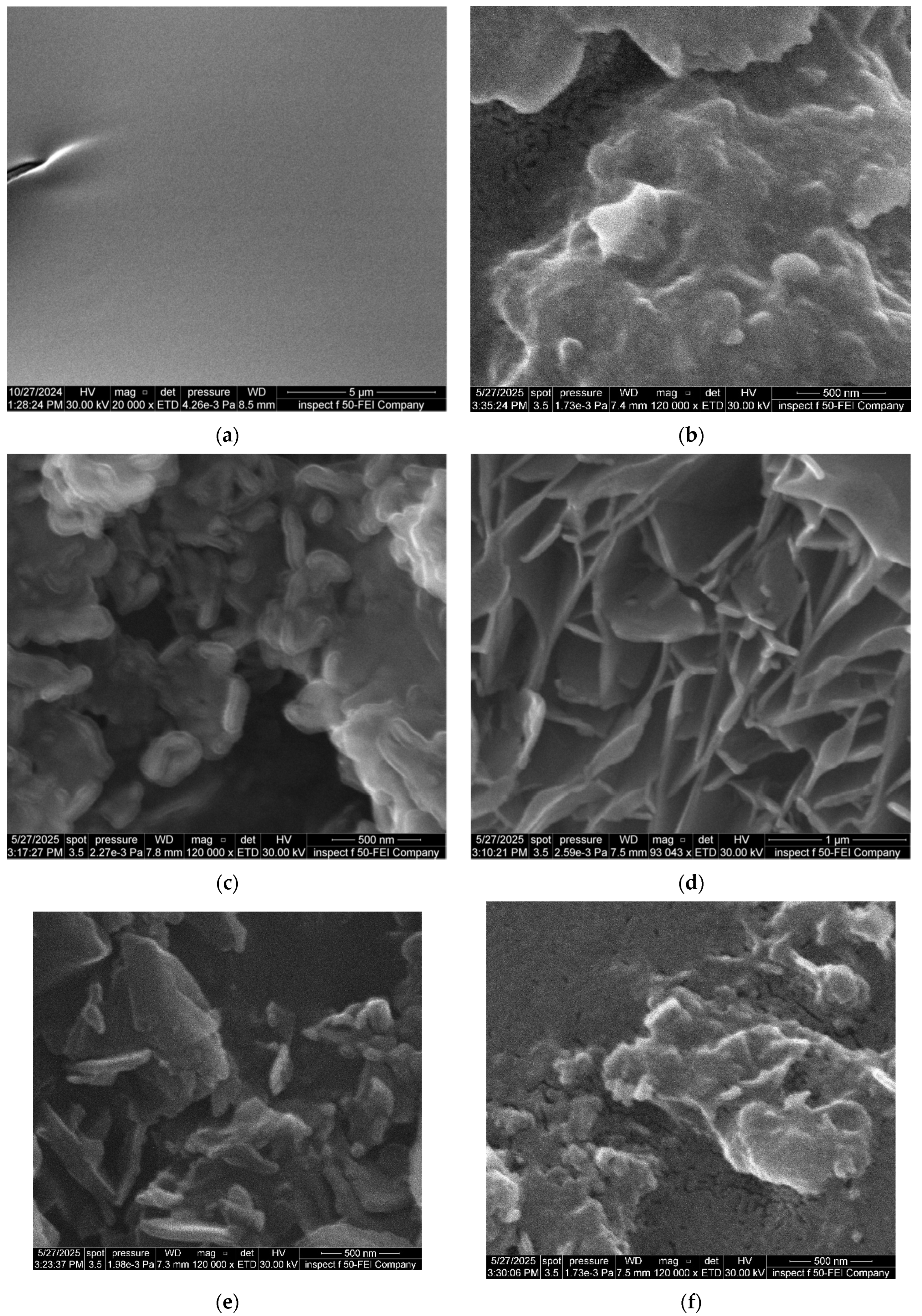
6.2. Morphological Characteristics
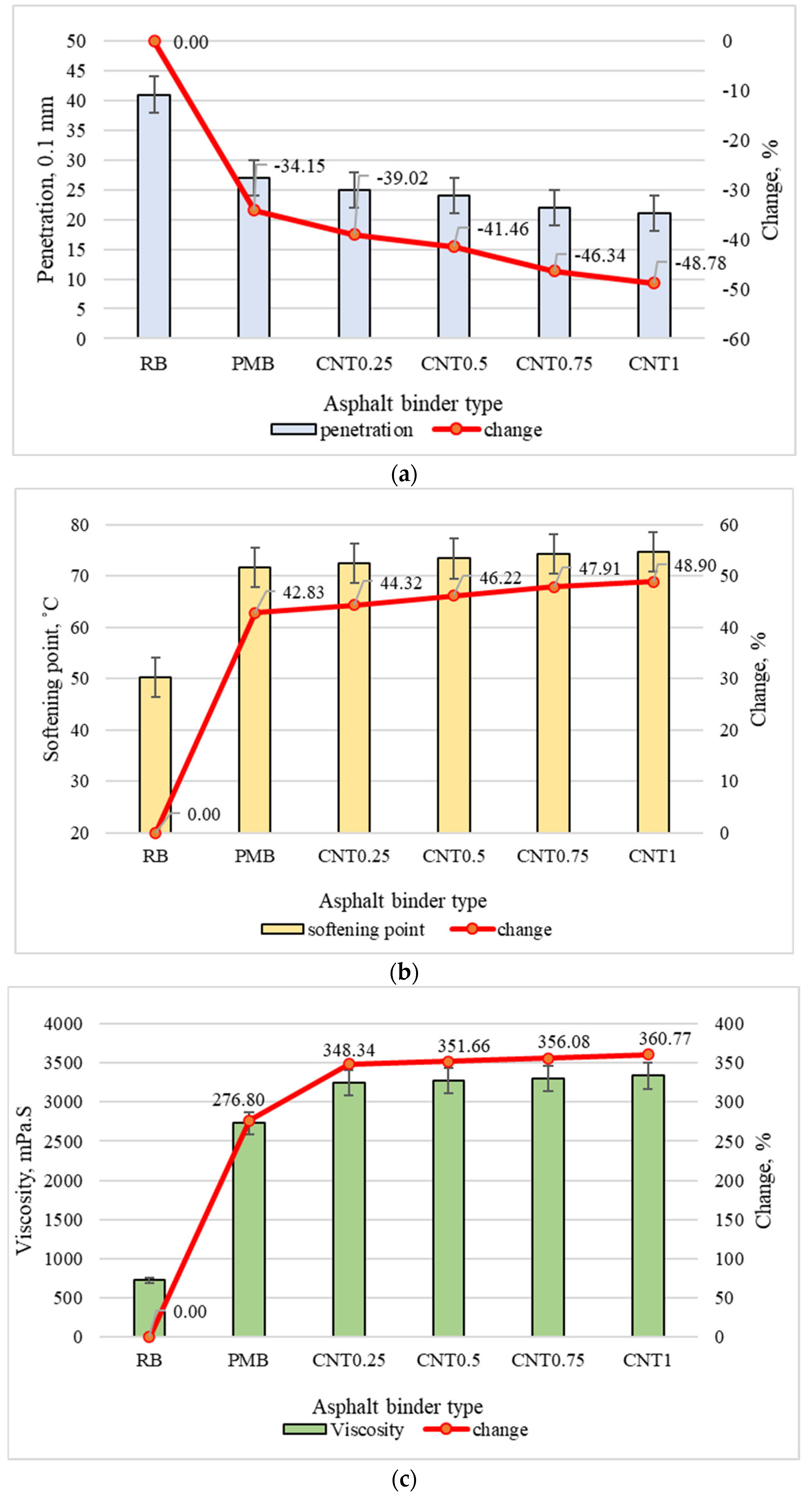
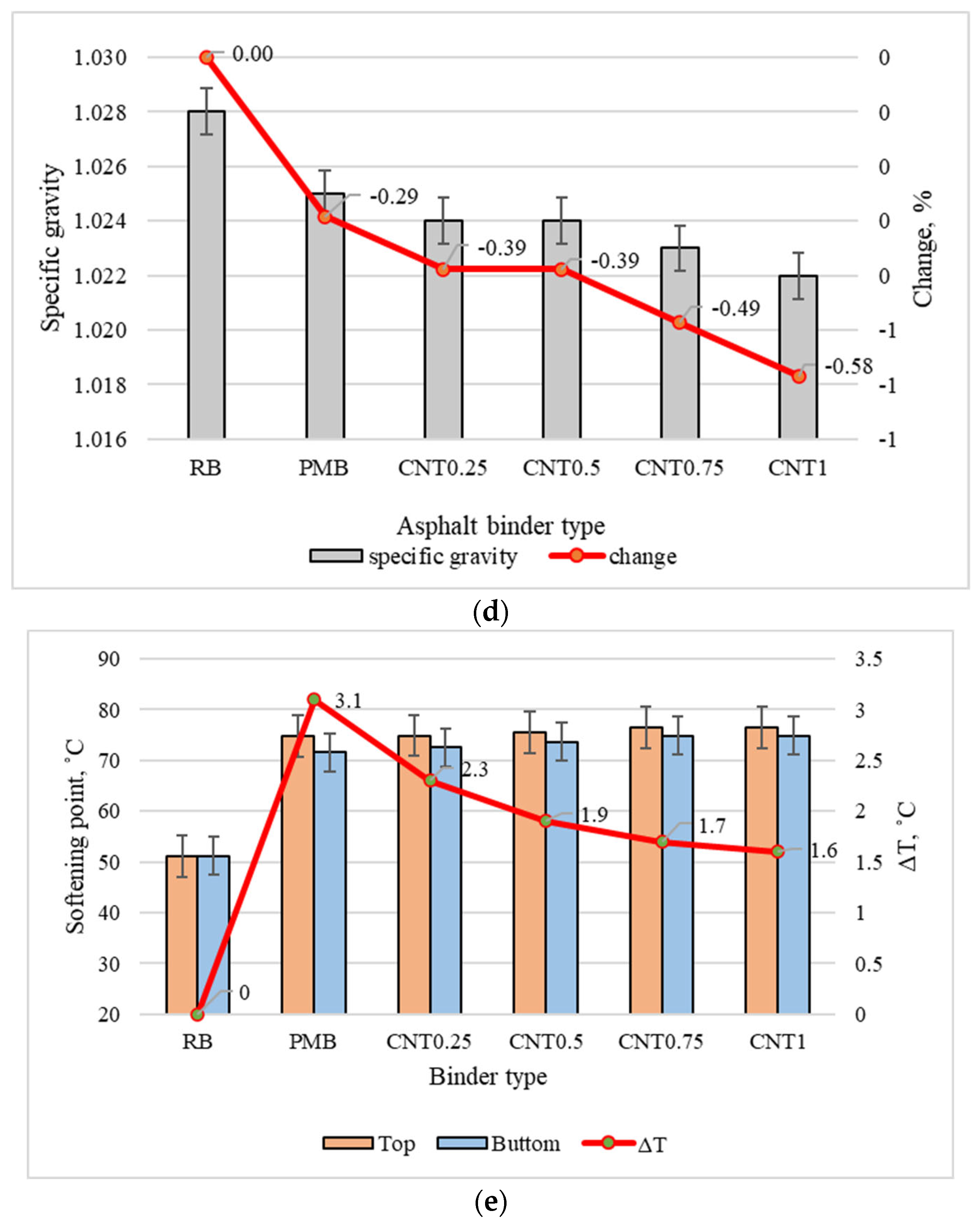
6.3. Basic Properties
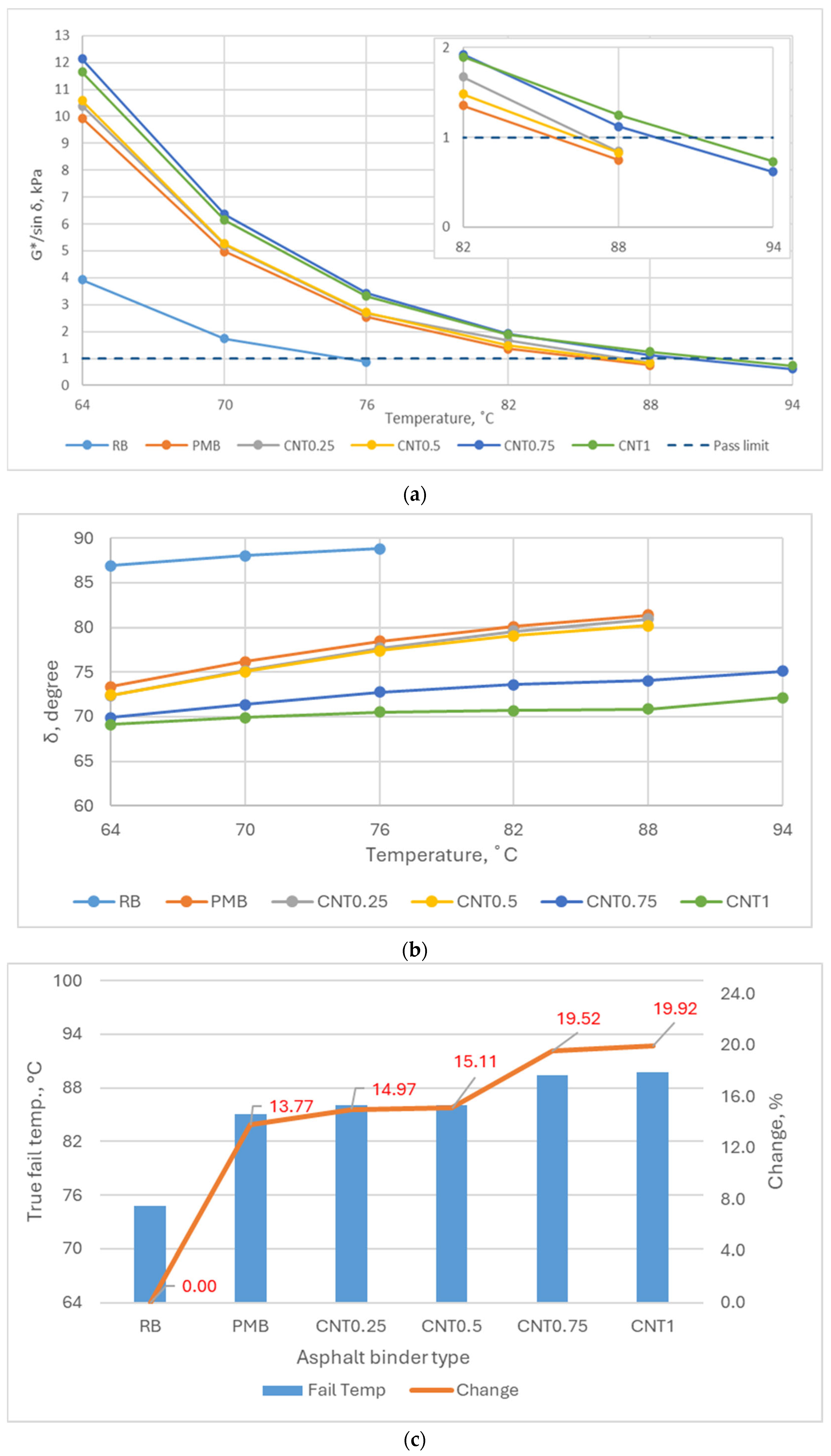
6.4. High Temperature PG
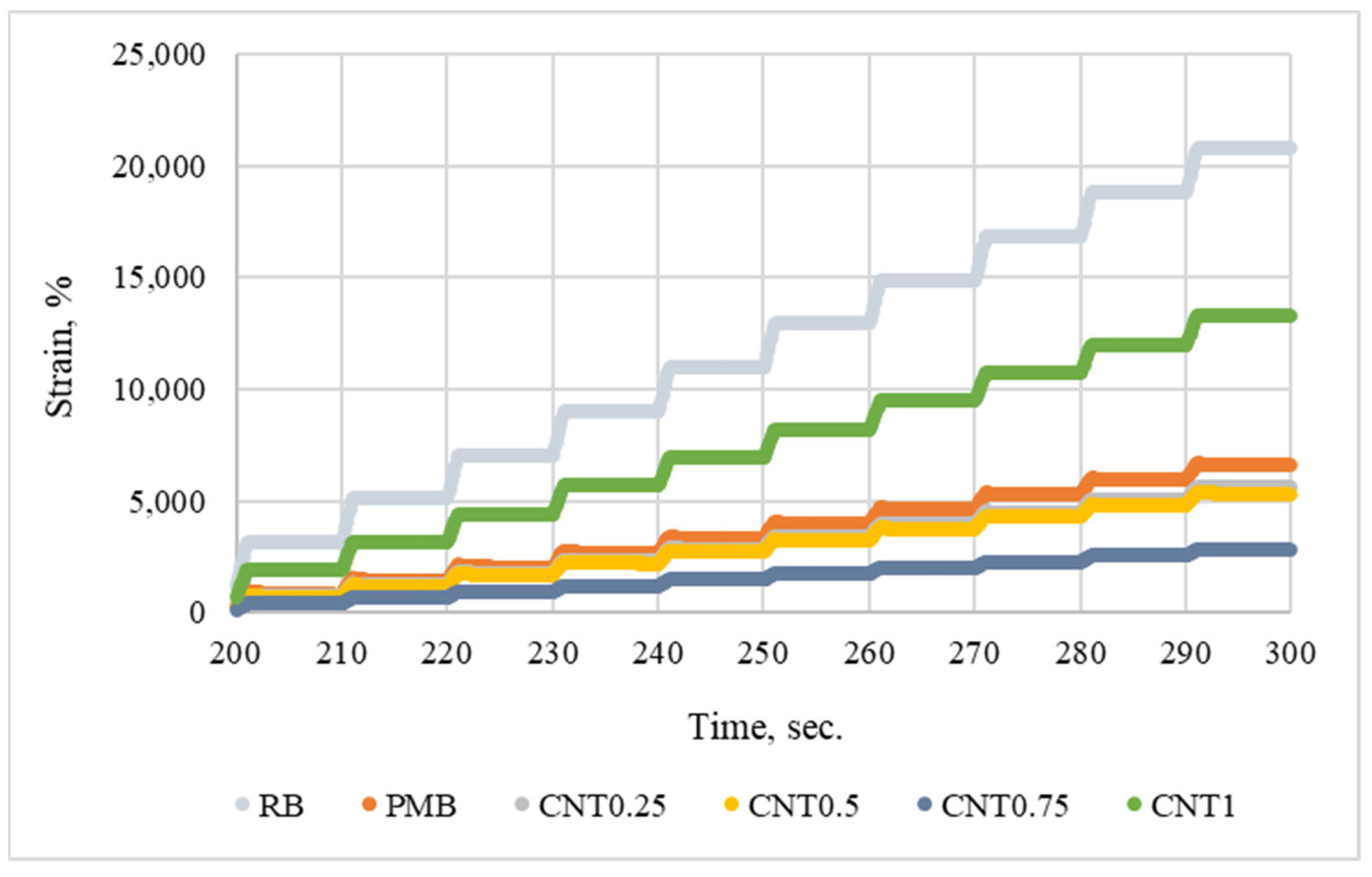
6.5. Discussion on MSCR Results
- RB and CNT1 fall into the S grade (standard traffic);
- PMB, CNT0.25, and CNT0.5 meet the H grade (heavy traffic);
- CNT0.75 achieves the more stringent V grade (very heavy traffic).
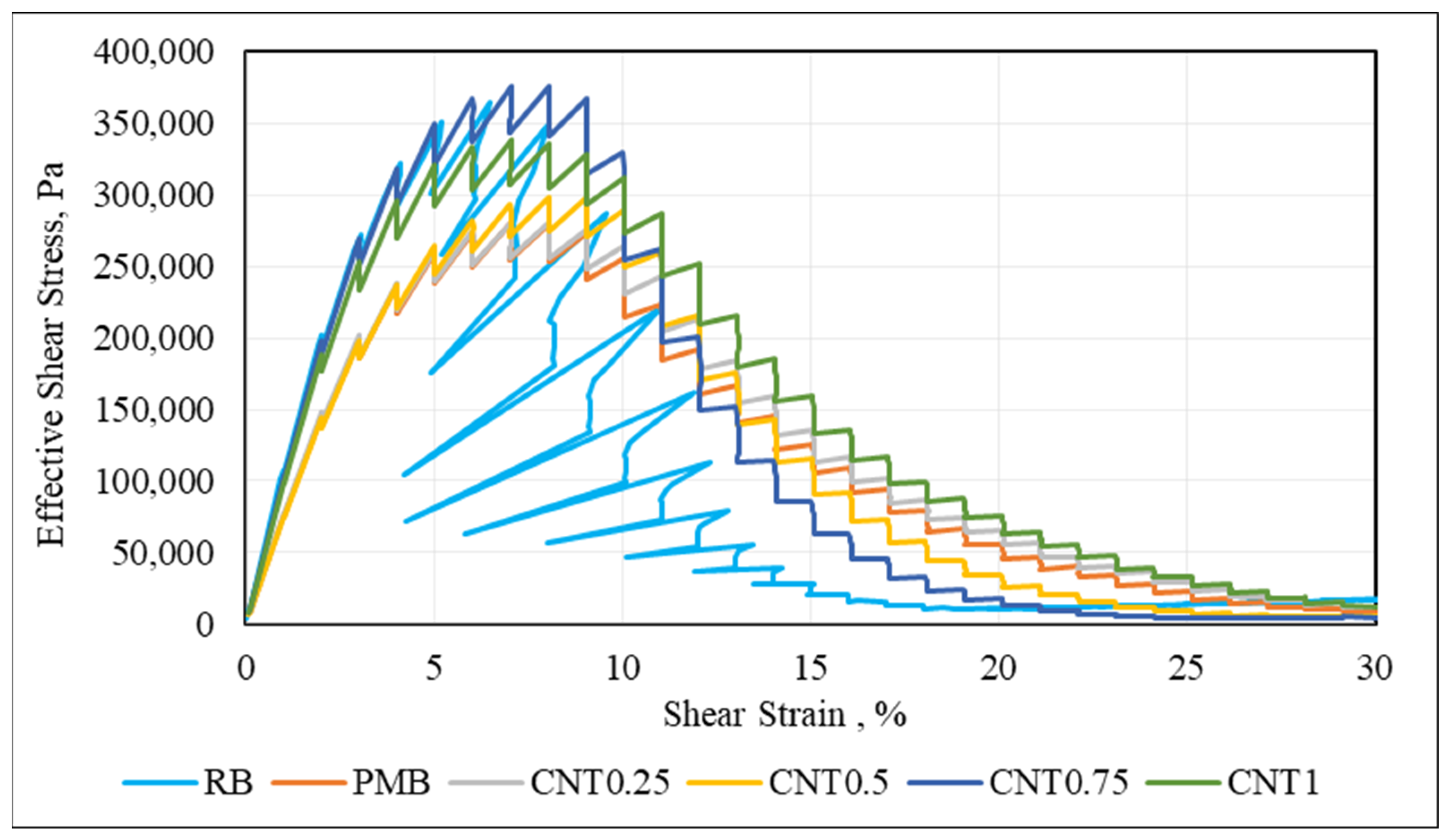
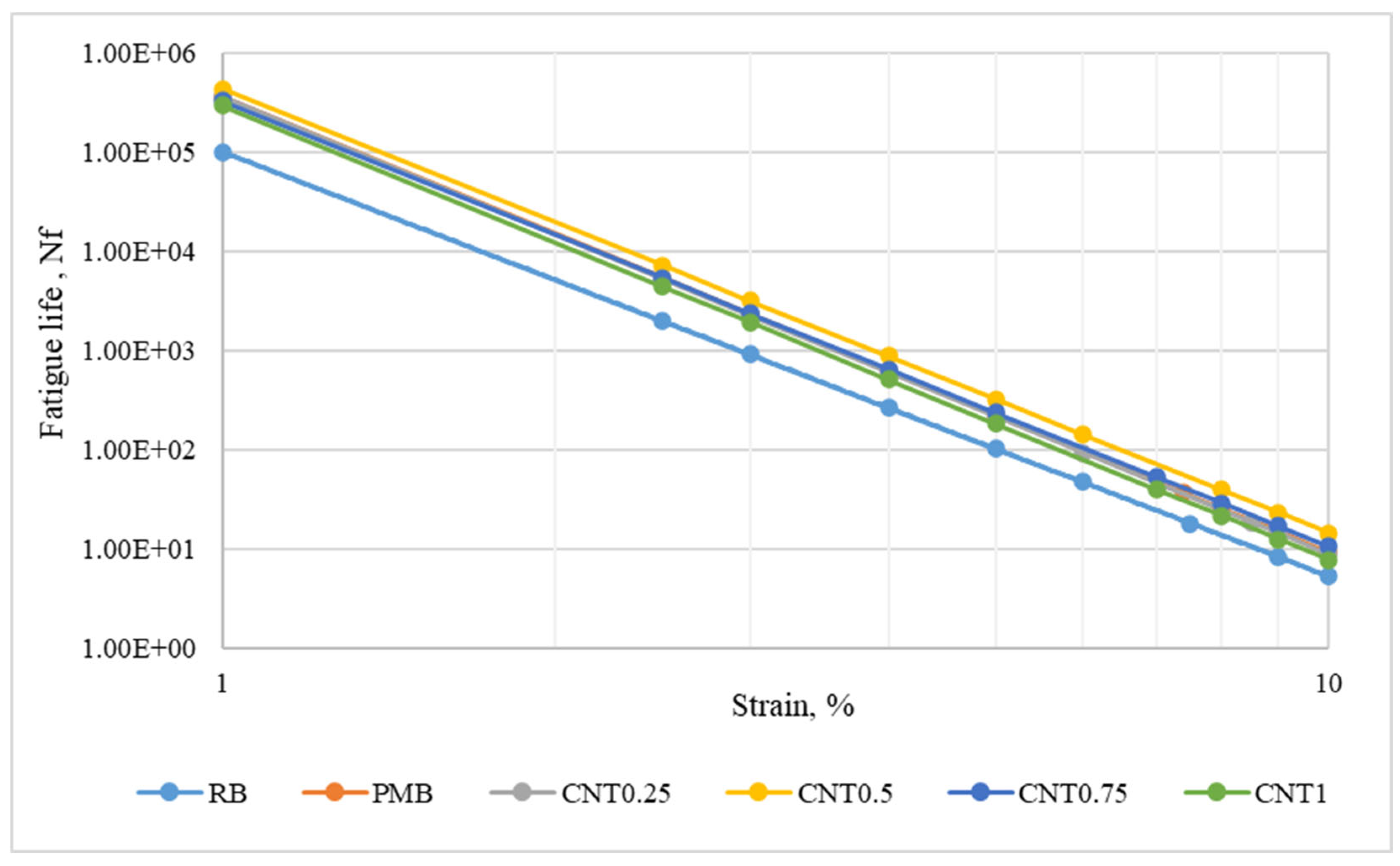
6.6. Discussion on LAS Results
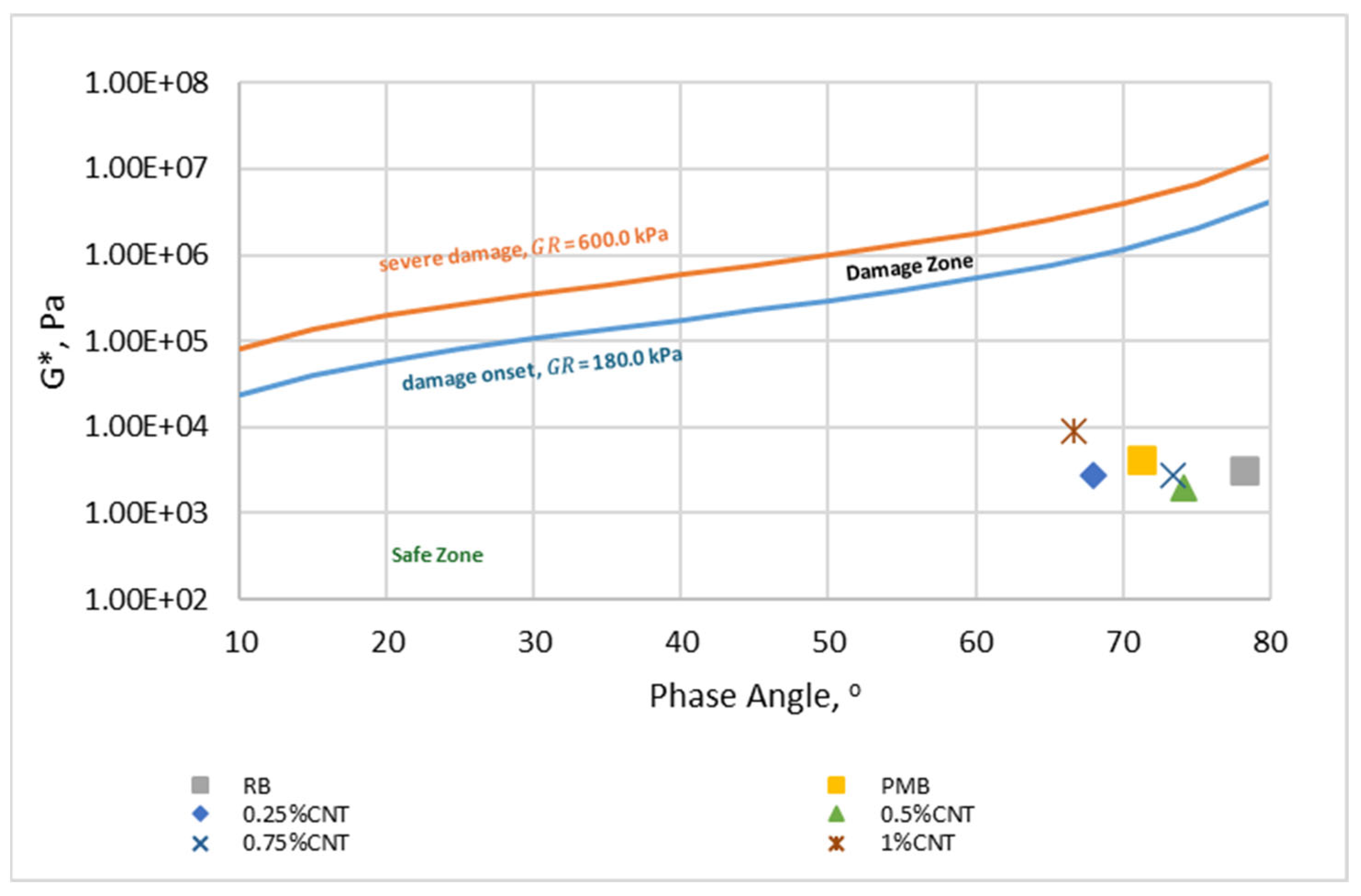
6.7. G-R Index
7. Statistical Inferences
8. Conclusions
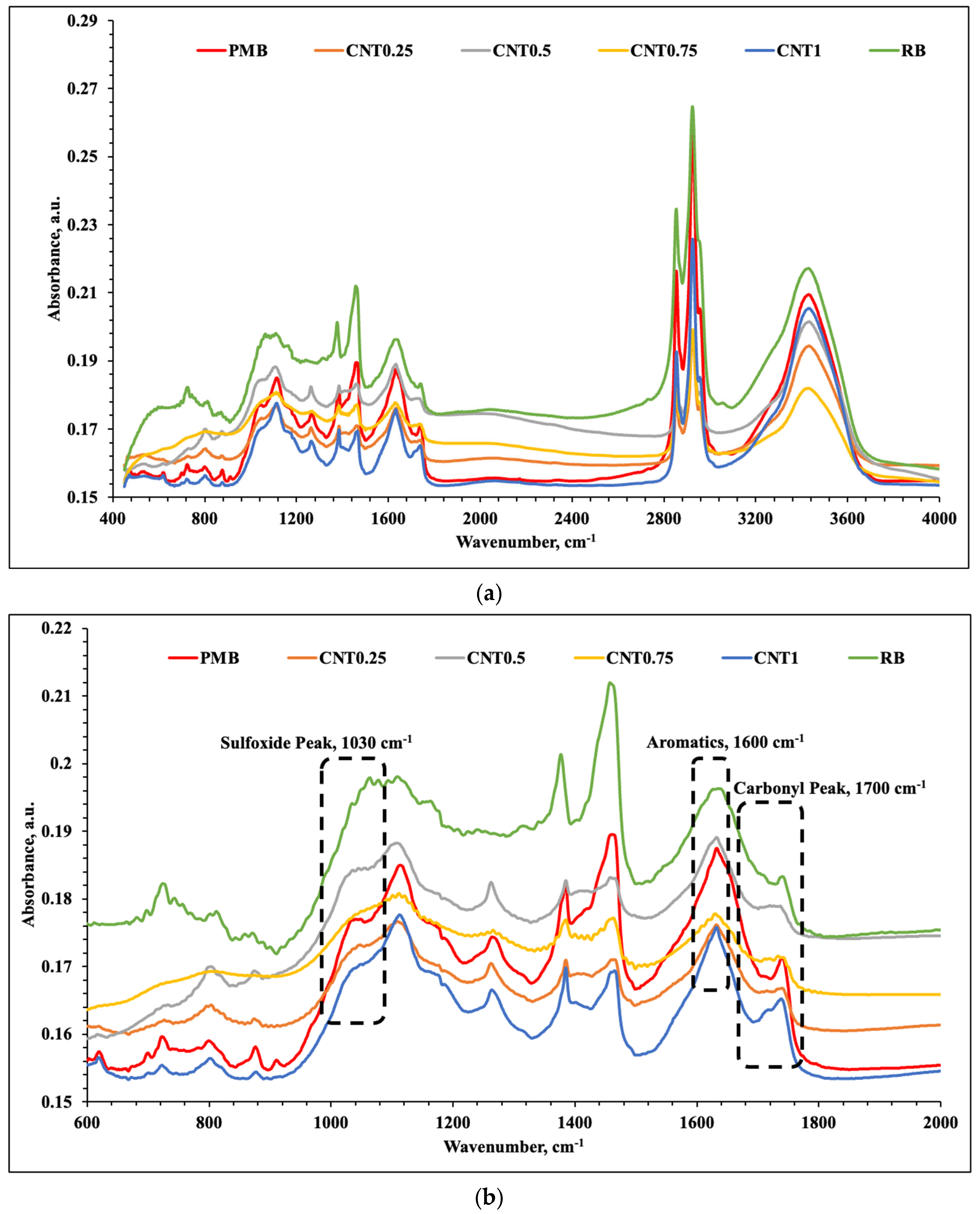
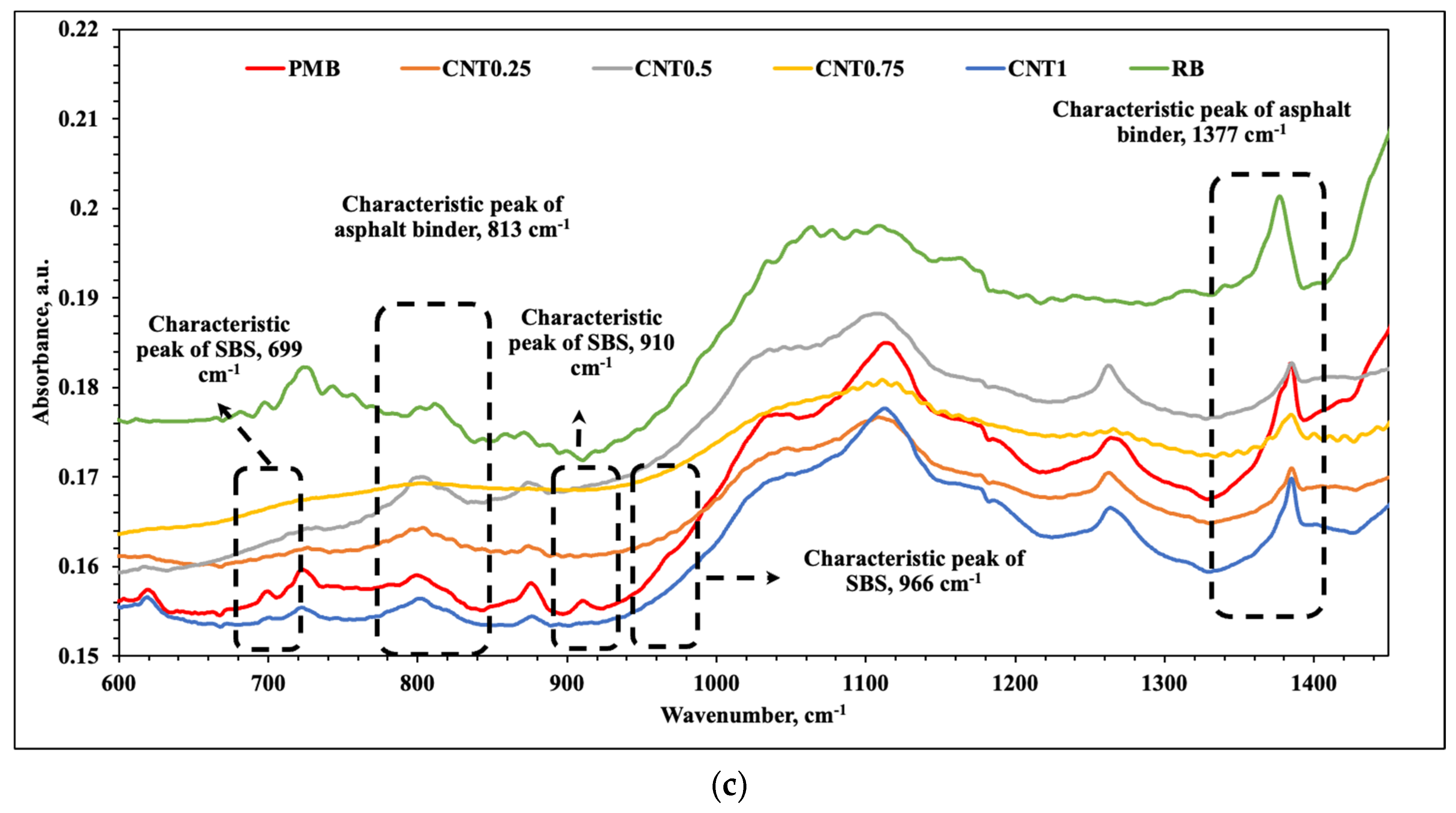
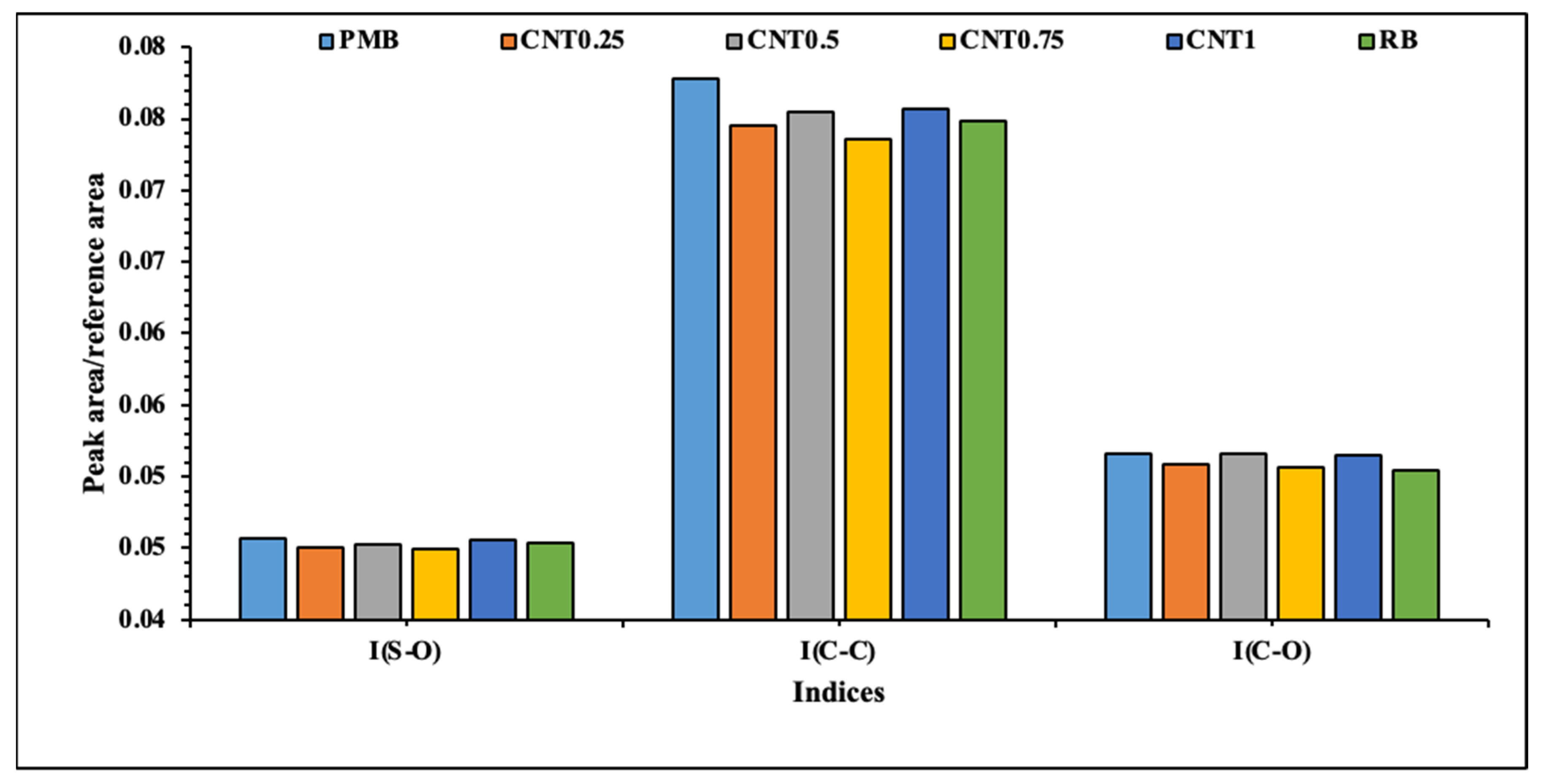
- FTIR analysis indicated beneficial molecular interactions between SBS, CNTs, and the binder, suggesting improved structural integrity. SEM images showed that the addition of CNTs strengthens the polymeric network of SBS binders, increasing stiffness up to an optimal dosage. At higher contents, CNTs form dense agglomerated clusters (notably at 1%).
- Basic physical tests indicated that adding CNTs to SBS-modified binders progressively increased stiffness, reflected by lower penetration, higher softening point, and increased viscosity. CNTs also improved storage stability by reducing phase separation, with the softening-point difference (ΔT) decreasing from 3.1 °C for the SBS-modified binder to 1.6 °C at 1% CNT.
- High-temperature PG results indicated that incorporating CNTs enhanced rutting resistance, with the 0.75% CNT formulation increasing the high-temperature PG from 82 °C for the SBS-modified binder to 88 °C. However, increasing CNT content to 1% did not yield further improvements in PG, suggesting a performance plateau at higher CNT dosages.
- MSCR results indicated an optimal CNT dosage of 0.75% for balancing stiffness and recovery, while LAS fatigue tests showed the best fatigue resistance at 0.5% CNT, highlighting a trade-off between stiffness and flexibility at higher dosages.
- Glover-Rowe index analysis and Black Space diagram confirmed that all binders remained within the safe zone for durability, with the 0.5% CNT binder exhibiting the lowest G-R index.
- A CNT dosage of 0.75% is recommended for improving rutting resistance in hot climates, while the 0.5% CNT formulation exhibited improved fatigue and cracking resistance under moderate-temperature conditions based on LAS and Glover-Rowe analyses. However, the high-temperature PG evaluation in this study was conducted mainly for comparative purposes using original binder measurements, and additional RTFO-aged evaluation, low-temperature characterization, workability assessment, and field validation are required to further assess the suitability of these binders under different climatic and construction conditions.
Author Contributions
Funding
Data Availability Statement
Conflicts of Interest
References
- Fang, C.; Yu, R.; Liu, S.; Li, Y. Nanomaterials Applied in Asphalt Modification: A Review. J. Mater. Sci. Technol. 2013, 29, 589–594. [Google Scholar] [CrossRef]
- Li, H.; Cui, C.; Temitope, A.A.; Feng, Z.; Zhao, G.; Guo, P. Effect of SBS and Crumb Rubber on Asphalt Modification: A Review of the Properties and Practical Application. J. Traffic Transp. Eng. 2022, 9, 836–863. [Google Scholar] [CrossRef]
- Albayati, A.H.; Al-Ani, A.F.; Byzyka, J.; Al-Kheetan, M.; Rahman, M. Enhancing Asphalt Performance and Its Long-Term Sustainability with Nano Calcium Carbonate and Nano Hydrated Lime. Sustainability 2024, 16, 1507. [Google Scholar] [CrossRef]
- Yan, X.; Wu, D.; Hu, K.; Zhang, W.; Xing, J.; Cui, L.; Shi, S.; Yang, J.; Yang, C. The Modification Mechanism, Evaluation Method, and Construction Technology of Direct-to-Plant SBS Modifiers in Asphalt Mixture: A Review. Polymers 2023, 15, 2768. [Google Scholar] [CrossRef]
- Dong, F.; Zhao, W.; Zhang, Y.; Wei, J.; Fan, W.; Yu, Y.; Wang, Z. Influence of SBS and asphalt on SBS dispersion and the performance of modified asphalt. Constr. Build. Mater. 2014, 62, 1–7. [Google Scholar] [CrossRef]
- Chen, M.; Geng, J.; Xia, C.; He, L.; Liu, Z. A review of phase structure of SBS modified asphalt: Affecting factors, analytical methods, phase models and improvements. Constr. Build. Mater. 2021, 294, 123610. [Google Scholar] [CrossRef]
- Liang, M.; Xin, X.; Fan, W.; Luo, H.; Wang, X.; Xing, B. Investigation of the rheological properties and storage stability of CR/SBS modified asphalt. Constr. Build. Mater. 2015, 74, 235–240. [Google Scholar] [CrossRef]
- Fu, H.; Xie, L.; Dou, D.; Li, L.; Yu, M.; Yao, S. Storage stability and compatibility of asphalt binder modified by SBS graft copolymer. Constr. Build. Mater. 2007, 21, 1528–1533. [Google Scholar] [CrossRef]
- Li, Y.; Ma, R.; Wang, X.; Cheng, P.; Chen, Y. Improvement effect of different modifiers on storage stability of high content SBS modified asphalt. Case Stud. Constr. Mater. 2024, 20, e02820. [Google Scholar] [CrossRef]
- Zhao, K.; Li, Y.; He, F.; Meng, Y.; Hu, C.; Ye, X.; Lin, P. A comprehensive study on the influence of Sasobit content on rheological properties and storage stability of CR/SBS composite-modified asphalt. Constr. Build. Mater. 2025, 463, 140066. [Google Scholar] [CrossRef]
- Zhang, S.; Zhang, X.; Wang, D.; Yu, J.; Wang, R.; Guo, Y. An experimental study of the viscoelastic characteristics and fatigue performance of asphalt binder modified by CNT nanoparticles. AIP Adv. 2025, 15, 105304. [Google Scholar] [CrossRef]
- Sukhija, M.; Saboo, N.; Yadav, A.K.; Rath, C. Laboratory study on the suitability of nano-silica as a modifier for asphalt binders. Constr. Build. Mater. 2021, 302, 124406. [Google Scholar] [CrossRef]
- Saboo, N.; Sukhija, M.; Singh, G. Effect of nanoclay on physical and rheological properties of waste cooking oil–modified asphalt binder. J. Mater. Civ. Eng. 2021, 33, 04020490. [Google Scholar] [CrossRef]
- Albayati, A.H.; Mustafa, F.S.; Al-ani, A.F.; Sukhija, M.; Moudhafar, M.M.; Maher, A.M. Advancing Asphalt Binder Performance through Nanomaterial and Polymer Modification: Experimental and Statistical Insights. Results Eng. 2025, 25, 104458. [Google Scholar] [CrossRef]
- vivek, A.k.; Sukhija, M.; Singh, K.L. Effect of montmorillonite nanoclay and sulphur-modified blends on the properties of bituminous mixes. Innov. Infrastruct. Solut. 2021, 6, 119. [Google Scholar] [CrossRef]
- Cadorin, N.D.A.; de Melo, J.V.S.; Broering, W.B.; Manfro, A.L.; Barra, B.S. Asphalt nanocomposite with titanium dioxide: Mechanical, rheological and photoactivity performance. Constr. Build. Mater. 2021, 289, 123178. [Google Scholar] [CrossRef]
- Guo, W.; Gu, K.; Li, Y.; Tian, W.; Wang, S.; Xu, H.; Chen, W. Enhancement of asphalt properties through SBS and CNT synergism: A comprehensive multi-scale analysis. Constr. Build. Mater. 2025, 505, 144747. [Google Scholar] [CrossRef]
- Al-Hamdou, A.M.; Albayati, A.H. Fatigue performance of asphalt binders modified with varying nanomaterials. Results Eng. 2025, 28, 107238. [Google Scholar] [CrossRef]
- Al-Hamdou, Y.M.; Albayati, A.H. The Influence of Nanomaterials on the Permanent Deformation of Hot Mix Asphalt. Eng. Technol. Appl. Sci. Res. 2025, 15, 25538–25544. [Google Scholar] [CrossRef]
- Nie, F.; Bie, Z.; Lin, H. Investigating the advanced thermomechanical properties of coiled carbon nanotube modified asphalt. Constr. Build. Mater. 2024, 441, 137512. [Google Scholar] [CrossRef]
- Ameri, M.; Nowbakht, S.; Molayem, M.; Aliha, M. Investigation of fatigue and fracture properties of asphalt mixtures modified with carbon nanotubes. Fatigue Fract. Eng. Mater. Struct. 2016, 39, 896–906. [Google Scholar] [CrossRef]
- Eisa, M.S.; Mohamady, A.; Basiouny, M.E.; Abdulhamid, A.; Kim, J.R. Mechanical properties of asphalt concrete modified with carbon nanotubes (CNTs). Case Stud. Constr. Mater. 2022, 16, e00930. [Google Scholar] [CrossRef]
- Shams, M.K.; Hilal, M.M.; Fattah, M.Y. Performance Evaluation of Hot-Climate Asphalt Binders Modified with Different Nano Materials. Results Mater. 2026, 30, 100920. [Google Scholar] [CrossRef]
- Tran, H.-B. Laboratory evaluation of resistance to moisture damage in carbon nanotubes modified hot mix asphalt mixtures. Transp. Res. Procedia 2025, 85, 185–190. [Google Scholar] [CrossRef]
- Abo-Qudais, S.A.; Irshidat, M.R. Performance Evaluation of Asphalt Binder Modified with Nanomaterials. J. Mater. Civ. Eng. 2025, 37, 4024547. [Google Scholar] [CrossRef]
- Liu, B.; Li, X.; Li, S. Pavement performance analysis of carbon nanotube/SBS composite modified asphalt. Carbon Lett. 2024, 34, 343–350. [Google Scholar] [CrossRef]
- Liu, P.; Niu, K.; Tian, B.; Wang, M.; Wan, J.; Gong, Y.; Wang, B. Improving the Compatibility of Epoxy Asphalt Based on Poly (styrene-butadiene-styrene)-Grafted Carbon Nanotubes. Coatings 2025, 15, 314. [Google Scholar] [CrossRef]
- Goli, A.; Ziari, H.; Amini, A. Influence of carbon nanotubes on performance properties and storage stability of SBS modified asphalt binders. J. Mater. Civ. Eng. 2017, 29, 4017070. [Google Scholar] [CrossRef]
- Chen, J.; Huang, Z.; Wang, H.; Yang, Z.; Zhang, T. Investigating the rheological properties of styrene-butadiene-styrene-based high-viscosity modified asphalt using carbon nanotubes. Sustainability 2022, 15, 71. [Google Scholar] [CrossRef]
- Santagata, E.; Baglieri, O.; Tsantilis, L.; Dalmazzo, D. Rheological characterization of bituminous binders modified with carbon nanotubes. Procedia-Soc. Behav. Sci. 2012, 53, 546–555. [Google Scholar] [CrossRef]
- Faramarzi, M.; Arabani, M.; Haghi, A.; Mottaghitalab, V. Carbon nanotubes-modified asphalt binder: Preparation and characterization. Int. J. Pavement Res. Technol. 2015, 8, 29. [Google Scholar]
- Galooyak, S.S.; Palassi, M.; Farahani, H.Z.; Goli, A. Effect of carbon nanotube on the rheological properties of bitumen. Pet. Coal 2015, 57, 556. [Google Scholar]
- Shu, B.; Wu, S.; Pang, L.; Javilla, B. The utilization of multiple-walled carbon nanotubes in polymer modified bitumen. Materials 2017, 10, 416. [Google Scholar] [CrossRef]
- ul Haq, M.F.; Ahmad, N.; Nasir, M.A.; Hafeez, M.; Rafi, J.; Zaidi, S.B.A.; Haroon, W. Carbon nanotubes (CNTs) in asphalt binder: Homogeneous dispersion and performance enhancement. Appl. Sci. 2018, 8, 2651. [Google Scholar] [CrossRef]
- Ziari, H.; Amini, A.; Goli, A.; Mirzaiyan, D. Predicting rutting performance of carbon nano tube (CNT) asphalt binders using regression models and neural networks. Constr. Build. Mater. 2018, 160, 415–426. [Google Scholar] [CrossRef]
- Brum, M.J.; Mogawer, W.S.; Stuart, K.D.; Austerman, A.J. Effect of Binder Modification and Recycled Asphalt Pavement on the Performance of Permeable Friction Course. Transp. Res. Rec. 2018, 2672, 119–129. [Google Scholar] [CrossRef]
- Bessa, I.S.; Vasconcelos, K.L.; Castelo Branco, V.T.; Bernucci, L.L. Fatigue resistance of asphalt binders and the correlation with asphalt mixture behaviour. Road Mater. Pavement Des. 2019, 20, S695–S709. [Google Scholar] [CrossRef]
- Liang, M.; Su, L.; Li, P.; Shi, J.; Yao, Z.; Zhang, J.; Jiang, H.; Luo, W. Investigating the rheological properties of carbon nanotubes/polymer composites modified asphalt. Materials 2020, 13, 4077. [Google Scholar] [CrossRef]
- Ismael, M.Q.; Fattah, M.Y.; Jasim, A.F. Improving the rutting resistance of asphalt pavement modified with the carbon nanotubes additive. Ain Shams Eng. J. 2021, 12, 3619–3627. [Google Scholar] [CrossRef]
- Gong, Y.; Pang, Y.; He, F.; Bi, H. Investigation on preparation and properties of crack sealants based on CNTs/SBS composite-modified asphalt. Materials 2021, 14, 4569. [Google Scholar] [CrossRef] [PubMed]
- Shah, P.M.; Mir, M.S. Investigating the influence of carbon nanotube on the performance of asphalt binder. Prog. Rubber Plast. Recycl. Technol. 2021, 37, 422–440. [Google Scholar] [CrossRef]
- Złotowska, M.; Nagórski, R.; Tutka, P. The influence of highly modified asphalt binder on pavement fatigue life prediction–selected problems. Arch. Civ. Eng. 2021, 67, 605–624. [Google Scholar]
- Ezzat, E.N.; Al-Saadi, I.F.; Jasim, A.F. Effect of Multiple-Walled Carbon Nanotubes (MWCNTs) on Asphalt Binder Rheological Properties and Performance. Adv. Civ. Eng. 2023, 2023, 3248035. [Google Scholar] [CrossRef]
- Gong, Y.; Wu, S.; Bi, H.; Tian, L. Study on thermal stability and fatigue properties of SBS/CNT-modified asphalt sealant. Polymers 2023, 15, 3968. [Google Scholar] [CrossRef] [PubMed]
- Tang, Y.; Fu, Z.; Ma, F.; Liu, J.; Sun, Q.; Li, C. Carbon nanotubes for improving rheological and chemical properties of styrene–butadiene–styrene modified asphalt binder. Int. J. Pavement Eng. 2023, 24, 2211212. [Google Scholar] [CrossRef]
- Devulapalli, L.; Madichetty, C.L.; Ghadyale, T.R.; Begum, A.; Dighe, S. Evaluation of the ageing characteristics of VG-30, RAP and HiMA using FTIR. Constr. Build. Mater. 2023, 366, 130185. [Google Scholar] [CrossRef]
- Nie, G.; Huang, W.; Wu, K.; Cai, X.; Huang, J.; Xie, J.; Zheng, Y. Modification Mechanism of MWCNTs and SBS Composite-Modified Asphalt Binder: Laboratory Investigation and Molecular Dynamic Simulation. J. Mater. Civ. Eng. 2024, 36, 4024279. [Google Scholar] [CrossRef]
- Feng, L.; Zhang, X.; Sha, T.; Wang, D.; Niu, B.; Wang, R.; Hou, X. A Rheological Study of the High-Temperature Properties of Fast-Melting SBS/Epoxy-Modified Asphalt Binders. Polymers 2025, 17, 581. [Google Scholar] [CrossRef]
- Su, M.; Ding, Q.; He, Z.; Huang, X.; He, L.; Zhao, E. Research on the Rheological Property and Modification Mechanism of MWCNTs-OH/SBS Modified Asphalt Binder. Coatings 2025, 15, 625. [Google Scholar] [CrossRef]
- Wang, F.; Ma, R.; Li, Y.; Sun, M.; Wang, Y.; Sun, Y.; Cheng, P. Weathering aging resistance in seasonal frozen regions: A comparative study of SBS- and SBR-modified asphalt binders through rheological and morphological characterization. Sci. Rep. 2025, 15, 13625. [Google Scholar] [CrossRef]
- Zhang, Z.; Yan, W.; Sun, H.; Ding, Y.; Dong, F. Evaluation on the interface characteristics, mechanism and performance of the dry modified SBS asphalt mixtures by multiscale methods. Sci. Rep. 2025, 15, 11393. [Google Scholar] [CrossRef] [PubMed]
- Nisar, J.; Mir, M.S. Aging behavior characteristics of LDPE-SBS composite modified asphalt binder: A study of plasto-elastomeric composite. Constr. Build. Mater. 2025, 458, 139506. [Google Scholar] [CrossRef]
- Baldino, N.; Marchesano, Y.; Mileti, O.; Lupi, F.; Gabriele, D. Thermo-rheological behaviour of styrene-butadiene-styrene, hard plastics with or without graphene oxide modified bitumens. Case Stud. Constr. Mater. 2024, 20, e03354. [Google Scholar] [CrossRef]
- Dong, F.; Jiang, Y.; Yu, X.; Jin, Y.; Lu, J.; Wan, L.; Li, Z. Performance restoration of aged SBS-modified asphalt in RAP via dry-process SBS modifier diffusion at the interface of aggregate-aged asphalt-virgin asphalt. Constr. Build. Mater. 2024, 453, 139022. [Google Scholar] [CrossRef]
- Albayati, A.H.; Mohammed, A.M.; Al-Ani, A.F.; Saboo, N.; Al-Kheetan, M.J.; Moudhafar, M.M.; Jweihan, Y.S. Polyalphaolefin as a potential modifying agent for hard asphalt cement: Physical, rheological, and chemical characterization. Constr. Build. Mater. 2025, 498, 144011. [Google Scholar] [CrossRef]
- Hu, Y.; Sreeram, A.; Al-Tabbaa, A.; Airey, G.D. Physicochemical compatibility assessment of bio-additives and bitumen using solubility science-based approaches. Fuel 2025, 387, 134361. [Google Scholar] [CrossRef]
- Anderson, R.M.; King, G.N.; Hanson, D.I.; Blankenship, P.B. Evaluation of the relationship between asphalt binder properties and non-load related cracking. J. Assoc. Asph. Paving Technol. 2011, 80, 615–664. [Google Scholar]
- Sukhija, M.; Saboo, N.; Pani, A. Effect of Warm Mix Additives on the Properties of Unmodified and Polymer Modified Asphalt Binders. Transp. Dev. Econ. 2025, 11, 16. [Google Scholar] [CrossRef]
- Sun, L.; Guan, H.; Ge, Q. Research on the performance of asphalt modified by SBS rubber and carbon nanotube. Appl. Mech. Mater. 2011, 99, 1243–1246. [Google Scholar] [CrossRef]
- Liu, X.-y.; Wang, P.; Lu, Y.; Zhang, T.-t.; Wang, L.-z.; Wang, T.-f. Identifying the Thermal Storage Stability of Polymer-Modified Asphalt with Carbon Nanotubes Based on Its Macroperformance and Micromorphology. Adv. Mater. Sci. Eng. 2021, 2021, 6637999. [Google Scholar] [CrossRef]
- Li, S.; Huang, Z.; Fan, J.; Zhang, J.; Li, Y. Multiscale Experimental Investigation on the Reinforcement Mechanism and Applications of Carbon Nanotube–Modified Asphalt. J. Mater. Civ. Eng. 2026, 38, 4026099. [Google Scholar] [CrossRef]
- He, Z.; Ou, J.; Xie, T.; Yang, F.; Li, Y. Evaluation of different functionalized multi-walled carbon nanotubes (MWCNTs) modified asphalts. Arch. Civ. Eng. 2024, 70, 307–322. [Google Scholar] [CrossRef]
- Eid, S.; Cherkaoui, A.; Ezzat, H.; Al-Khateeb, G.; Zeiada, W. Integration of titanium oxide nanoparticles and carbon nanotubes for enhancing asphalt binder properties. In AIP Conference Proceedings; AIP Publishing LLC: Melville, NY, USA, 2025. [Google Scholar]
- Wang, P.; Dong, Z.-j.; Tan, Y.-q.; Liu, Z.-y. Effect of multi-walled carbon nanotubes on the performance of styrene–butadiene–styrene copolymer modified asphalt. Mater. Struct. 2017, 50, 17. [Google Scholar] [CrossRef]



| Study | Year | Binder Type | CNT and SBS Ratio | Mixing Conditions | Main Findings | Mian Tests | ||||||
|---|---|---|---|---|---|---|---|---|---|---|---|---|
| Conventional Physical Tests | FTIR | SEM | GR | PG | MSCR | LAS | ||||||
| [30] | 2012 | 50/70 Pen. | 0.1, 0.5, 1% CNT | 1550 rpm, 40 min, 160 °C | Improves its rheological properties, enhances resistance to rutting and thermal cracking, and reduces oxidative aging. | ✓ | ✓ | |||||
| [31] | 2015 | 60/70 Pen. | 0.1, 0.5, 1.0% CNT | 1550 rpm, 160 °C, 40 min. | Improve rutting resistance and thermal cracking resistance. | ✓ | ✓ | ✓ | ||||
| [32] | 2015 | 60/70 Pen. | 0, 0.3, 0.6, 0.9, 1.2, 1.5% CNT | Three different kinds of mixers (mechanical mixer, high shear mixer, and ultrasonic device). | Improved bitumen’s high- and low-temperature performance by increasing stiffness and reducing phase angle. | ✓ | ✓ | |||||
| [21] | 2016 | 60/70 Pen. | 0.2–1.5% | ultrasonic 60 W | Improves fracture resistance and fatigue performance of asphalt mixtures. | ✓ | ✓ | |||||
| [28] | 2017 | 60/70 Pen. | CNT + SBS | Ultrasound 60 W, 15 Min, 120 °C | Improved storage stability and rheological performance | ✓ | ✓ | |||||
| [33] | 2017 | 90 A | 3.5% SBS+ 0.5–3% CNTs | 5000 rpm, 30 min, 160 °C | Improved thermal stability also improved SBS dispersion and binder storage stability with CNTs. | ✓ | ✓ | ✓ | ✓ | |||
| [34] | 2018 | 60/70 Pen. | 0.5, 1, 1.5, 3% CNT | 3000 rpm, 45 min, 158 ± 5 °C | Improved the higher temperature performance and permanent deformation resistance in both binder and mixtures. | ✓ | ✓ | ✓ | ✓ | |||
| [35] | 2018 | PG58-16 | (0.3, 0.6, 0.9, 1.2, 1.5)% CNT | 65-watt ultrasonic mixer, 160 °C | Enhanced the rutting performance and rheological behavior of the asphalt binder. | ✓ | ✓ | ✓ | ✓ | |||
| [36] | 2018 | 60/80 Pen. | 6% SBS | - | Improved rheological properties, as evidenced by an enhanced complex modulus and a reduced phase angle, indicate better viscoelastic behavior. | ✓ | ||||||
| [37] | 2019 | AC 30/45 | (1–5)% SBS | - | SBS was efficient in decreasing the creation of carbonyl and sulphoxide compounds at higher | ✓ | ✓ | ✓ | ||||
| [38] | 2020 | 50/70 Pen. | (0.5–1)% CNT (2–4)% HDPE | 4000 rpm, 30 min, 160 °C | Temperatures, chain segments of butadiene are reduced due to chain scission, resulting in degradation of binder properties. | ✓ | ✓ | ✓ | ✓ | |||
| [39] | 2021 | 40/50,60/70 Pen. | (0.5, 1, 1.5, 2)% CNT | 1500 rpm, 45 min, 163 °C | Significant enhancement in complex modulus, viscosity, and creep recovery of the binder at high temperatures and a great decrease in compliance, indicating great resistance to permanent deformation. | ✓ | ✓ | ✓ | ||||
| [40] | 2021 | 80/100 Pen. | 0.5–1% CNT + 3–5% SBS | 4000 rpm, 50 min, 180 °C | At 1.5% CNT, 40/50 grade bitumen improved rutting resistance by 61% and stability by 35%, while 60/70 grade bitumen needed 2.0% CNT for similar results. | ✓ | ✓ | ✓ | ||||
| [41] | 2021 | 80/100 Pen. | (0.5–2.5)% MWCNTs | 5000 rpm, 60 min, 155 °C | Higher viscosity, fatigue resistance, and thermal aging resistance. | ✓ | ✓ | ✓ | ||||
| [42] | 2021 | 35/50 Pen. | (6–8)% SBS | - | The modified binder is more rut-resistant. | ✓ | ||||||
| [22] | 2022 | 60/70 Pen. | (0.1, 0.5, 1)% CNT | high shear mechanical mixer, 1 h, 150 °C | CNTs added to the asphalt binder were found to be stable under high-temperature storage conditions. | ✓ | ||||||
| [43] | 2023 | 40/50 Pen. | 1, 3, 5% CNT 1, 3, 5% SBS | 2220 rpm, 3.5 h, 180 °C | Improved long-term performance and moisture resistance comparable to PMA-based PFC mixtures. | ✓ | ✓ | |||||
| [44] | 2023 | 90# | 0.5–1% CNT, 5% SBS, 5% furfural-extracted oil doping. | 4000 rpm, 50 min, 180 °C | Enhances pavement performance in both hot and cold conditions, extending service life and reducing maintenance costs. | ✓ | ✓ | ✓ | ✓ | |||
| [45] | 2023 | SK90# | 0.3, 0.6, 0.9, 1.2, 1.5% CNTs + 4% SBS. | 5000 rpm, 45 min for SBS followed by 3000 rpm, 45 min for CNT, both at 160 °C | The rutting parameter (G*/sin) increased by 10%, 73%, and 208% with 1%, 3%, and 5% SBS, and by 18% and 130% with 3% and 5% CNTs. | ✓ | ✓ | ✓ | ||||
| [46] | 2023 | VG-30 | 1.6 SBS | - | Enhances the fatigue resistance of asphalt sealants—also better relaxation properties, preventing secondary cracking, and excellent deformation resistance under heavy traffic. | ✓ | ✓ | |||||
| [47] | 2024 | - | (0.4–0.6)% CNTs SBS | - | CNTs enhanced the high-temperature performance and rutting resistance of SBS-modified asphalt. | ✓ | ✓ | |||||
| [48] | 2025 | 70# | (4, 6, 8)% SBS (4, 6, 8)% SBS-T (4, 6, 8, 10, 12)% ER-SBS-T | 4500 rpm, 30 min, 160 °C | Improving high-temperature performance, with the best results at a 5% doping level. | ✓ | ✓ | ✓ | ||||
| [49] | 2025 | PG64-16 | CNTSMA SBSMA CNTS/SBSMA | 5000 rpm, 50 min, 170 °C | CNTs enhanced interactions among components, with the effect most pronounced at a CNT content of 0.6%. | ✓ | ✓ | ✓ | ✓ | |||
| [50] | 2025 | AH-90 | (2–4)% SBS (3–5)% SBR | 5000 rpm, 40 min, 160 °C | Enhances the high-temperature behavior of the asphalt binder. The high-temperature properties of fast-melting SBS-T-modified asphalt are similar to those of conventional SBS-modified asphalt. Performance is further improved when the ER-SBS-T modifier content exceeds 6%. | ✓ | ✓ | ✓ | ✓ | |||
| [51] | 2025 | PG58-22 | (4, 6, 8)% SBS | 30 Min, 180 °C | Better complex modulus (G\*), phase angle (δ), rutting factor (G\*/sin δ), creep recovery rate (R), and non-recoverable compliance (Jnr), indicating that the synergy of SBS and carbon nanotubes enhanced the high-temperature properties of asphalt. | ✓ | ✓ | ✓ | ||||
| [52] | 2025 | VG 10 | %3 SBS (2, 4, 6)% LDPE | 2500 rpm, 90 min, 180 °C | SBS shows better resistance to aging compared to BA and SBR, with stiffness modulus increases of 21% for BA, 10% for SBS, and 39% for SBR after aging. | ✓ | ✓ | ✓ | ✓ | ✓ | ||
| Current study | 2025 | 40/50 Pen. | 4% SBS, (0.25–1%) CNT | 5000 rpm, 45 min for SBS followed by 3000 rpm, 45 min for CNT, both at 160 °C | ✓ | ✓ | ✓ | ✓ | ✓ | ✓ | ✓ | |
| Property | Original Binder | RTFO Aged Binder | ||||
|---|---|---|---|---|---|---|
| Penetration at 25 °C, 0.1 mm | Ductility at 25 °C, cm | Softening Point, °C | Specific Gravity | Retained Penetration, % | Ductility, cm | |
| Test Method | AASHTO T49 | AASHTO T51 | AASHTO T53 | ASTM D70 | AASHTO T49 | AASHTO T51 |
| Test Result | 42 | 110 | 50.2 | 1.028 | 61 | 70 |
| Specification Limit (ASTM D946) | 40–50 | ≥100 | - | - | ≥55 | ≥25 |
| Binder | Properties | Temp. Measured, °C | Measured Parameters | Specification Limits, AASHTO M320-05 |
|---|---|---|---|---|
| Original | DSR, G/sinδ at 10 rad/s (kPa) | 64 | 3.922 | |
| 70 | 1.738 | |||
| 76 | 0.879 | |||
| Viscosity at 135 °C (Pa.s) | - | 724 | 3000 m Pa.s, max | |
| Flash Point (°C) | - | 309 | 230 °C, min | |
| RTFO Aged | DSR, G/sinδ at 10 rad/s (kPa) | 64 | 6.488 | 2.2 kPa, min |
| 70 | 3.187 | |||
| 76 | 1.466 | |||
| Mass Loss (%) | - | 0.278 | 1%, max | |
| PAV Aged | DSR, G.sinδ at 10 rad/s (kPa) | 28 | 3420 | 5000 kPa, max |
| 25 | 5176 | |||
| BBR, Creep Stiffness (MPa) | −6 | 188 | 300 MPa, max | |
| Slope m-value | −6 | 0.324 | 0.3, min |
| Property | SBS (Kraton® D1192) | CNTs (Multi-Walled) |
|---|---|---|
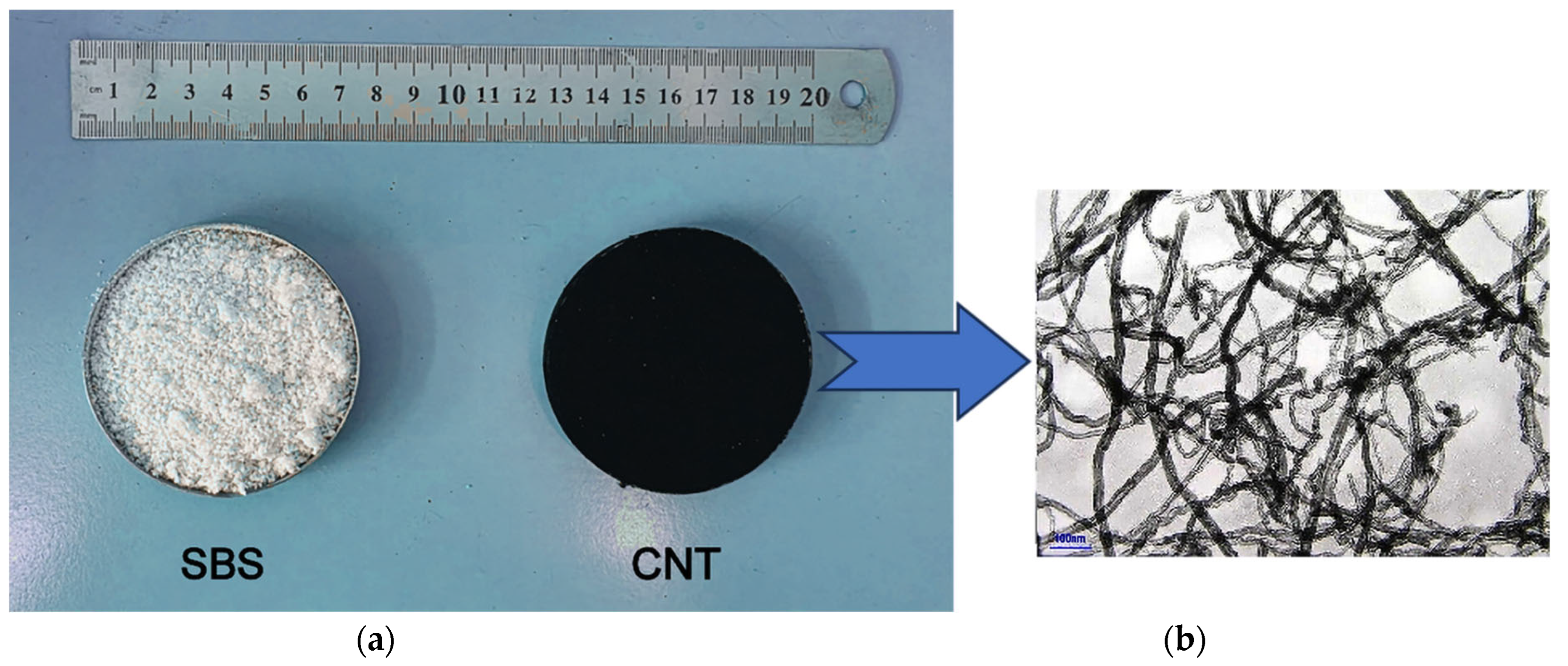
| Physical Form | Granular (white powder) | Black powder |
| Chemical Formula | (C8H8-C4H6)n | C |
| Bulk Density (25 °C, g/cm3) | 0.4 | 0.126 |
| Particle Size | 1.18–0.075 mm (dia.) | 20 nm (dia.), 10 µm length |
| Tensile Strength (MPa) | 33 | – |
| Elongation at Break (%) | 1000 | – |
| Hardness (Shore A) | 70 | – |
| Binder Code | Description |
|---|---|
| RB | Reference binder, unmodified AC40-50 |
| PMB | Polymer-modified binder (AC40-50 + 4% SBS) |
| CNT0.25 | AC40-50 + 4% SBS + 0.25% CNT |
| CNT0.5 | AC40-50 + 4% SBS + 0.5% CNT |
| CNT0.75 | AC40-50 + 4% SBS + 0.75% CNT |
| CNT1 | AC40-50 + 4% SBS + 1.0% CNT |
| Binder Type | Jnr, kPa−1 | R, % | ||
|---|---|---|---|---|
| 0.1 kPa | 3.2 kPa | 0.1 kPa | 3.2 kPa | |
| RB | 5.829 ± 0.11 | 6.018 ± 0.14 | 0.04 ± 0.01 | 0.00 ± 0.00 |
| PMB | 1.189 ± 0.05 | 1.977 ± 0.08 | 43.98 ± 1.25 | 17.85 ± 1.05 |
| CNT0.25 | 1.128 ± 0.06 | 1.675 ± 0.09 | 34.34 ± 1.41 | 10.12 ± 0.79 |
| CNT0.5 | 1.137 ± 0.05 | 1.592 ± 0.07 | 39.23 ± 1.18 | 10.85 ± 0.86 |
| CNT0.75 | 0.287 ± 0.02 | 0.863 ± 0.15 | 42.70 ± 1.36 | 22.33 ± 1.09 |
| CNT1 | 3.338 ± 0.13 | 3.939 ± 0.27 | 7.94 ± 0.48 | 0.02 ± 0.01 |
| Binder Type | Nf at the Strain Level of | |
|---|---|---|
| 2.5% | 5% | |
| RB | 1991 ± 84 | 102 ± 5 |
| PMB | 5387 ± 176 | 222 ± 16 |
| CNT0.25 | 5327 ± 171 | 216 ± 10 |
| CNT0.5 | 7172 ± 204 | 322 ± 19 |
| CNT0.75 | 5361 ± 171 | 237 ± 12 |
| CNT1 | 4437 ± 150 | 184 ± 8 |
| Binder Type | G-R Index, Pa |
|---|---|
| RB | 3228 ± 118 |
| PMB | 4287 ± 146 |
| CNT0.25 | 2801 ± 97 |
| CNT0.5 | 2026 ± 81 |
| CNT0.75 | 2776 ± 92 |
| CNT1 | 9011 ± 265 |
| Property | F-Statistic | p-Value | Significant Difference at α = 0.05, (Yes/No) |
|---|---|---|---|
| Softening point (°C) | 1054 | <0.0001 | Yes |
| Penetration | 89 | 0.0015 | Yes |
| Viscosity | 1861 | <0.0001 | Yes |
| GS | 0.36 | 0.867975 | No |
| Storage stability | 911 | 0.000041 | Yes |
| True failure temperature | 173 | 0.0001 | Yes |
| Jnr3.2 | 502 | 0.00013 | Yes |
| R3.2 | 408 | 0.00009 | Yes |
| Nf at 2.5% strain level | 324 | 0.00011 | Yes |
| G-R index, Pa | 904 | 0.00004 | Yes |
Disclaimer/Publisher’s Note: The statements, opinions and data contained in all publications are solely those of the individual author(s) and contributor(s) and not of MDPI and/or the editor(s). MDPI and/or the editor(s) disclaim responsibility for any injury to people or property resulting from any ideas, methods, instructions or products referred to in the content. |
© 2026 by the authors. Licensee MDPI, Basel, Switzerland. This article is an open access article distributed under the terms and conditions of the Creative Commons Attribution (CC BY) license.
Share and Cite
Albayati, A.H.; Al-Mosawe, H.M.; Mohammed, A.M.; Sukhija, M.; Al-ani, A.F.; Al-Kheetan, M.J.; Moudhafar, M.M. Synergistic Effects of Multi-Walled Carbon Nanotubes and SBS on Asphalt Binder Performance. Constr. Mater. 2026, 6, 34. https://doi.org/10.3390/constrmater6030034
Albayati AH, Al-Mosawe HM, Mohammed AM, Sukhija M, Al-ani AF, Al-Kheetan MJ, Moudhafar MM. Synergistic Effects of Multi-Walled Carbon Nanotubes and SBS on Asphalt Binder Performance. Construction Materials. 2026; 6(3):34. https://doi.org/10.3390/constrmater6030034
Chicago/Turabian StyleAlbayati, Amjad H., Hasan M. Al-Mosawe, Ahmed M. Mohammed, Mayank Sukhija, Aliaa F. Al-ani, Mazen J. Al-Kheetan, and Mustafa M. Moudhafar. 2026. "Synergistic Effects of Multi-Walled Carbon Nanotubes and SBS on Asphalt Binder Performance" Construction Materials 6, no. 3: 34. https://doi.org/10.3390/constrmater6030034
APA StyleAlbayati, A. H., Al-Mosawe, H. M., Mohammed, A. M., Sukhija, M., Al-ani, A. F., Al-Kheetan, M. J., & Moudhafar, M. M. (2026). Synergistic Effects of Multi-Walled Carbon Nanotubes and SBS on Asphalt Binder Performance. Construction Materials, 6(3), 34. https://doi.org/10.3390/constrmater6030034