Stress–Strain State and Strength of Fiber-Reinforced Concrete Beams with Basalt, Steel, and Polypropylene Fibers


Abstract
1. Introduction
2. Materials and Methods
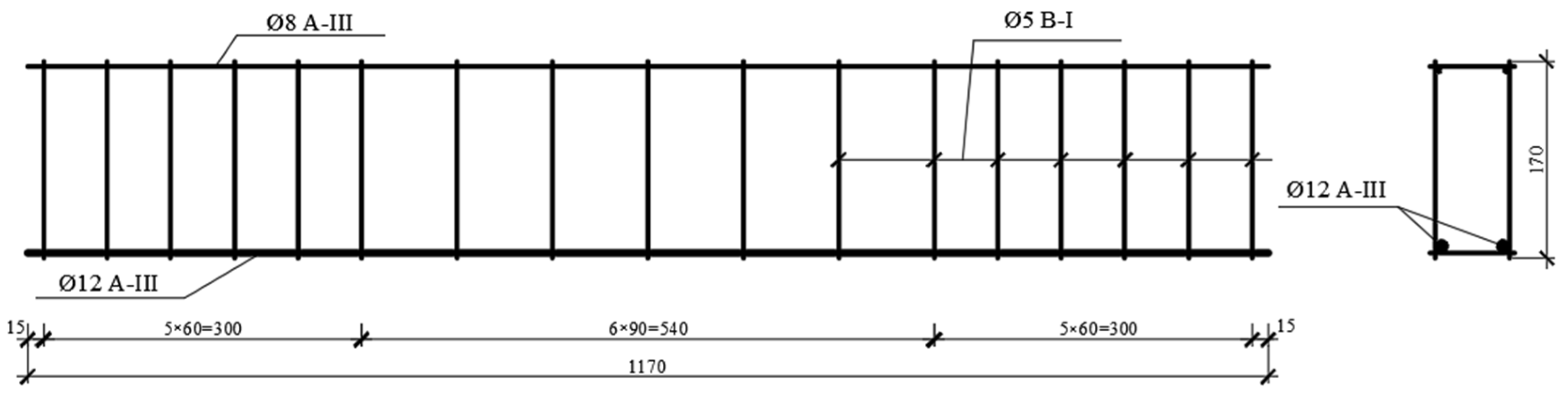
2.1. Construction of the Testing Samples
2.2. Materials
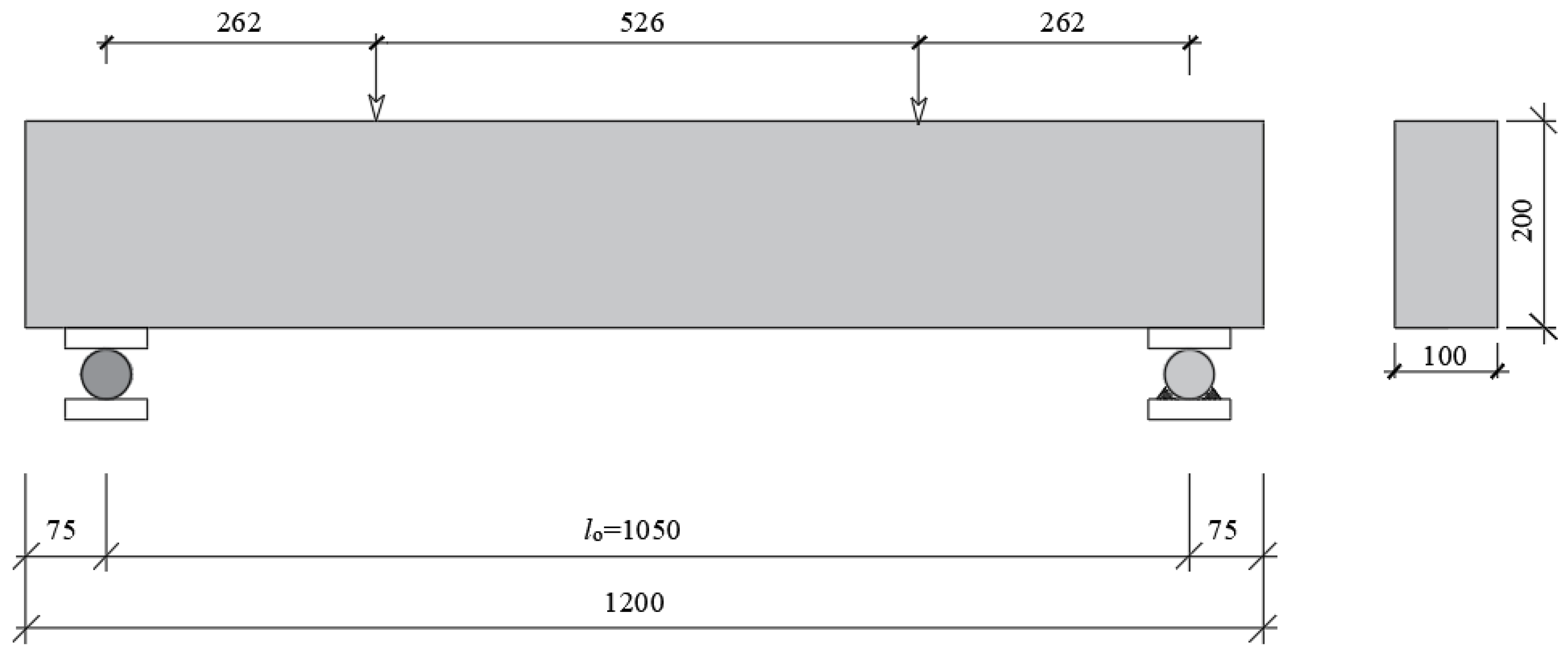
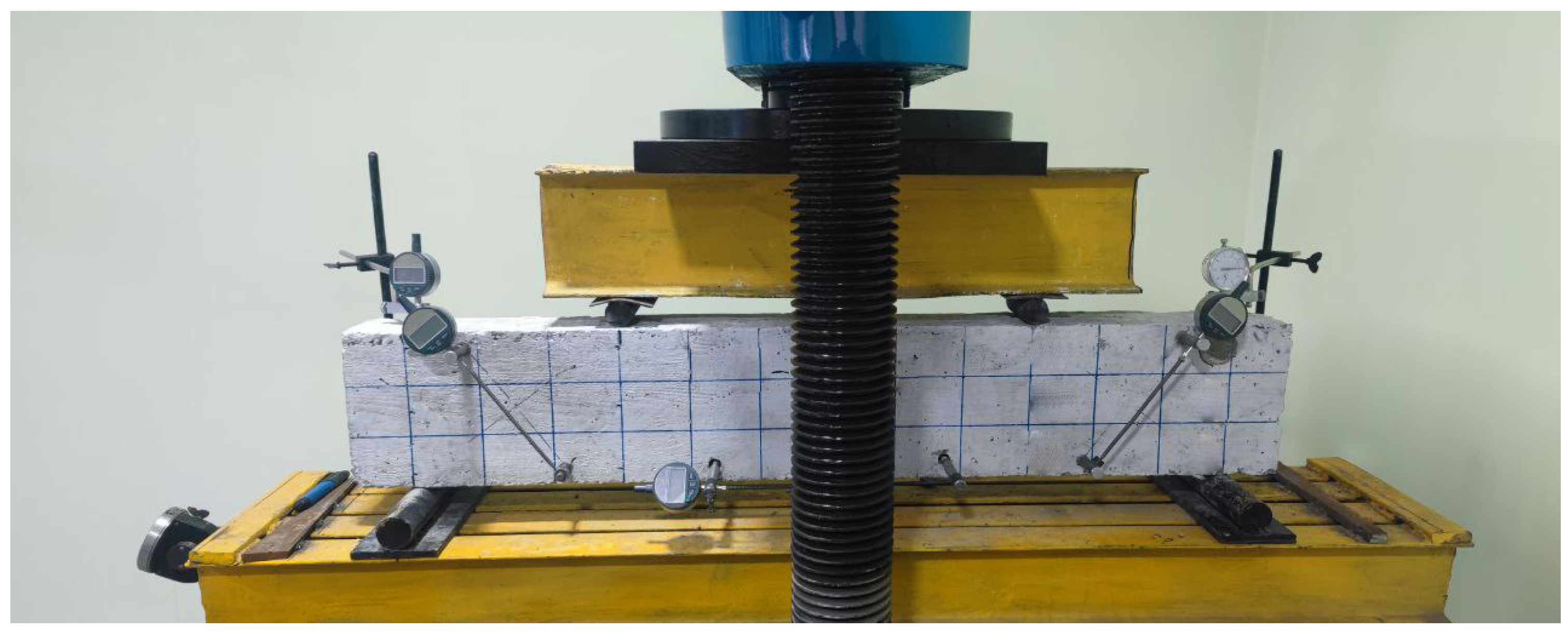
2.3. Testing Methodology
3. Results
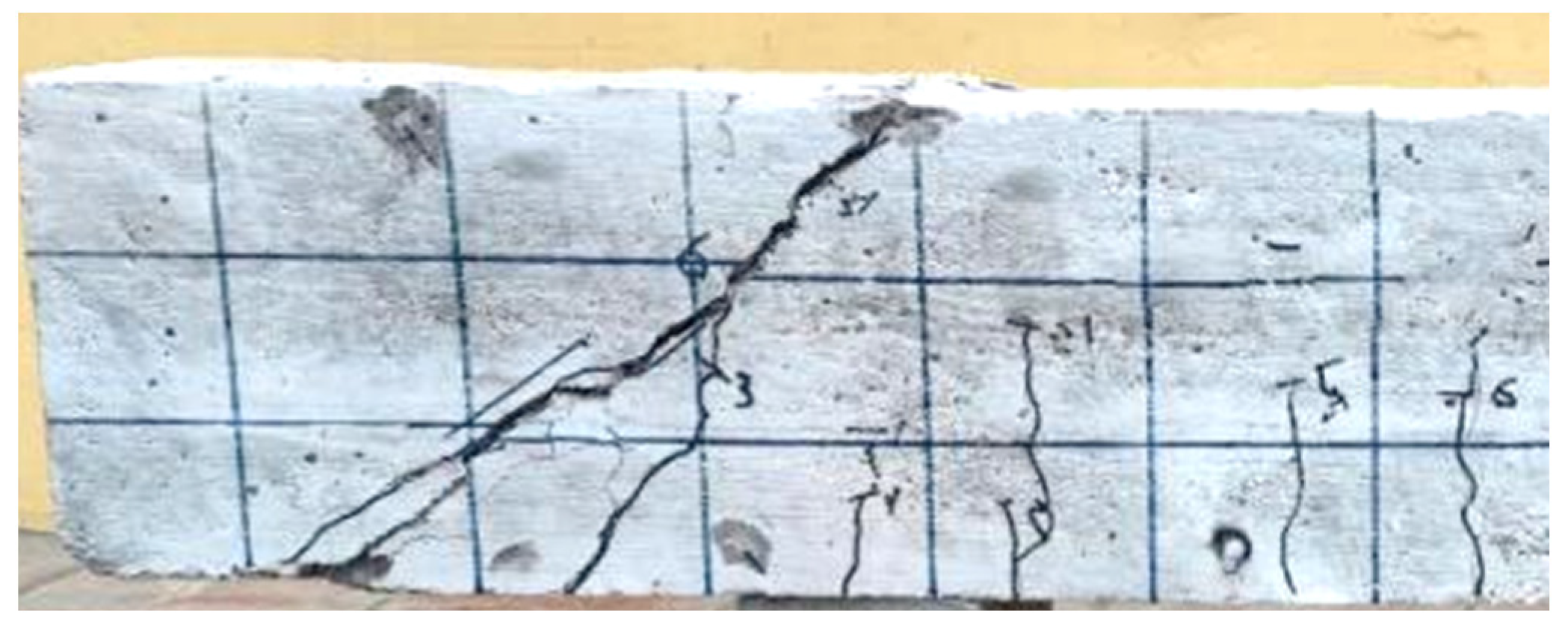
3.1. Formation and Development of Cracks in the Shear Section of Fiber-Reinforced Concrete Beams
3.2. Shearing Capacity of Fiber-Reinforced Concrete Beams
4. Discussion
5. Conclusions
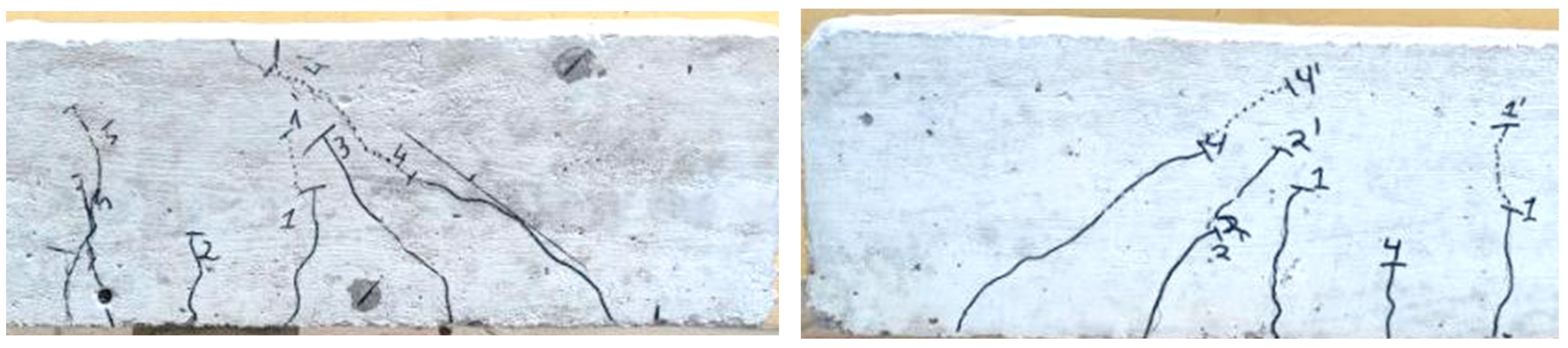
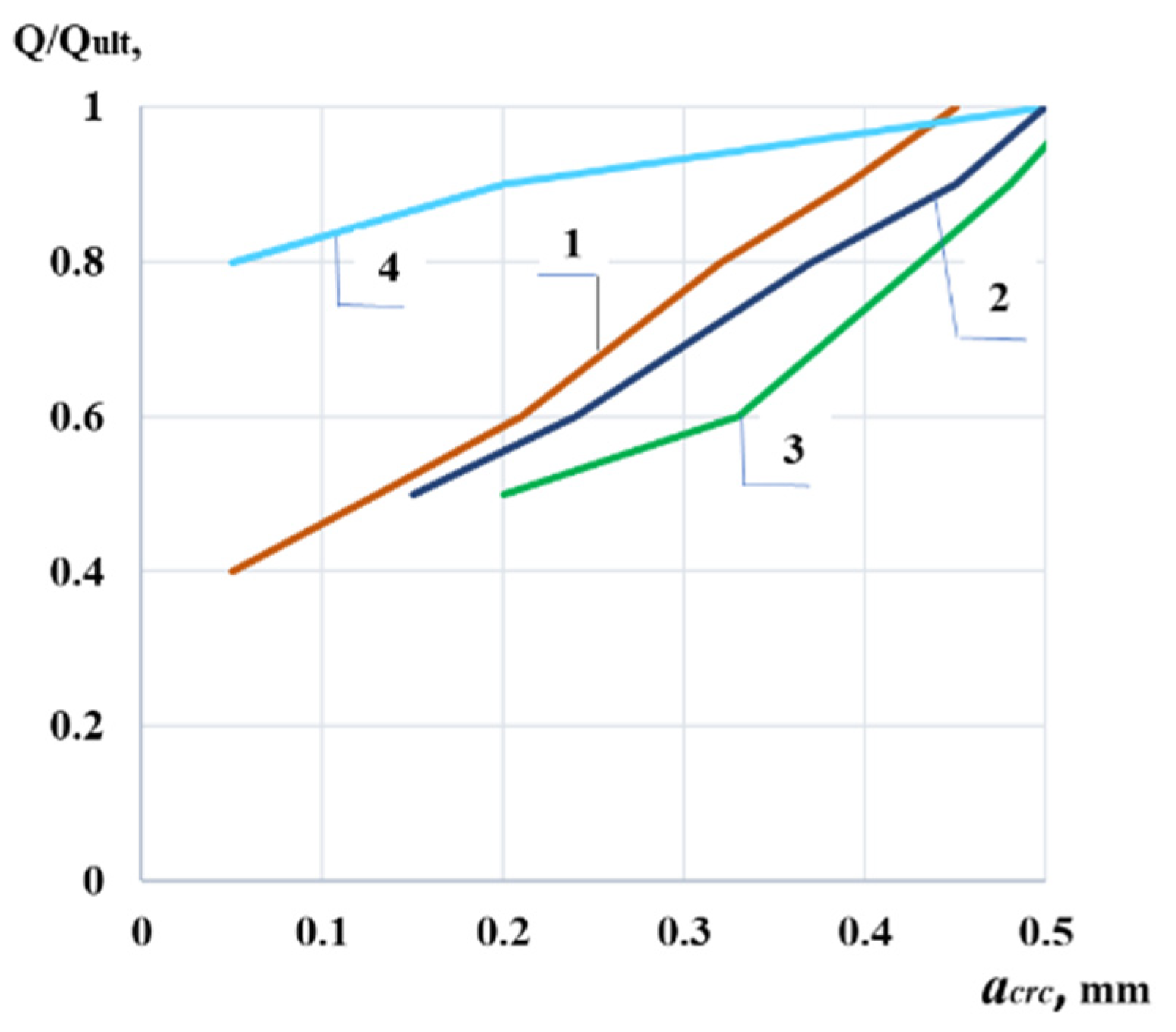
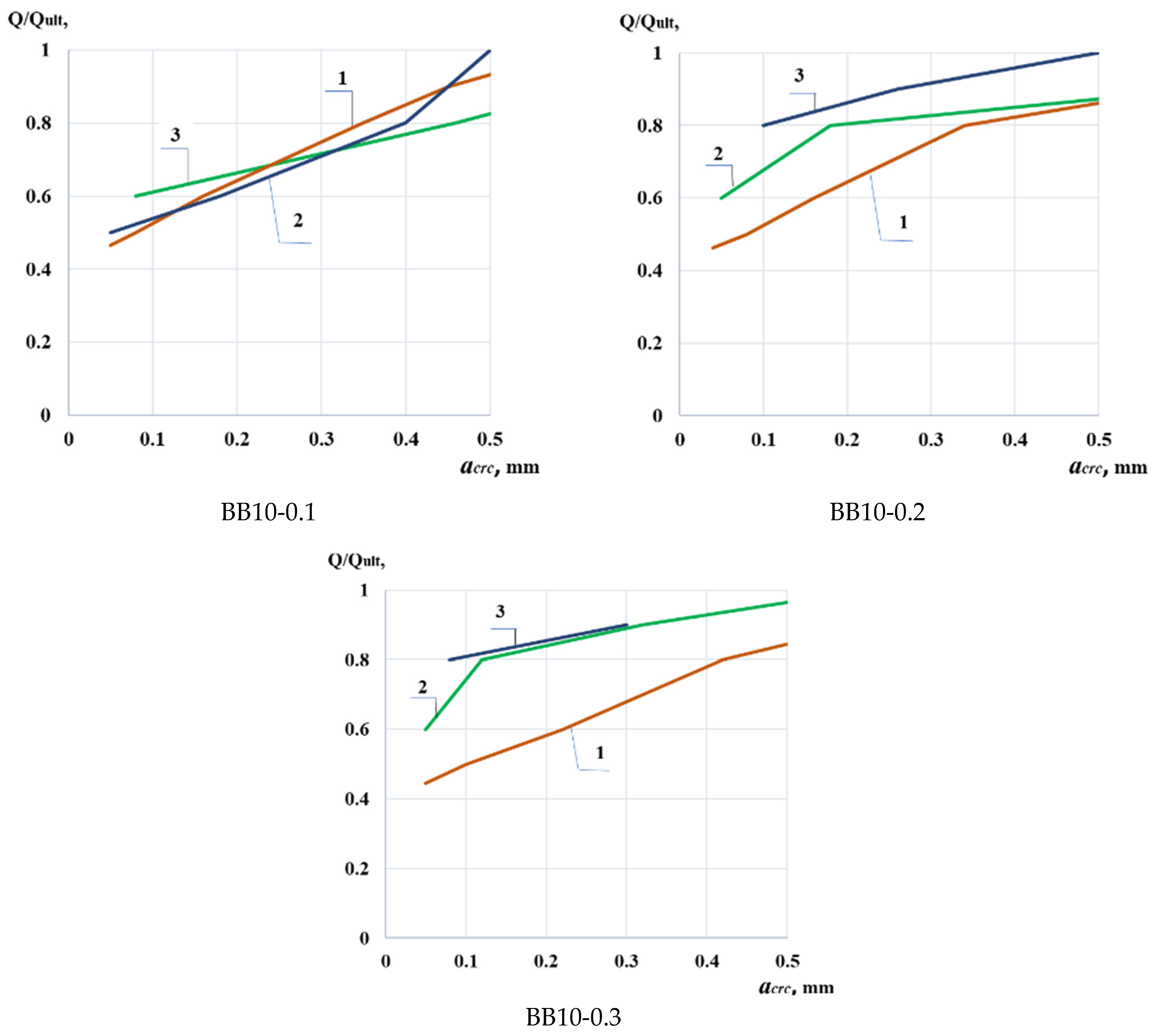
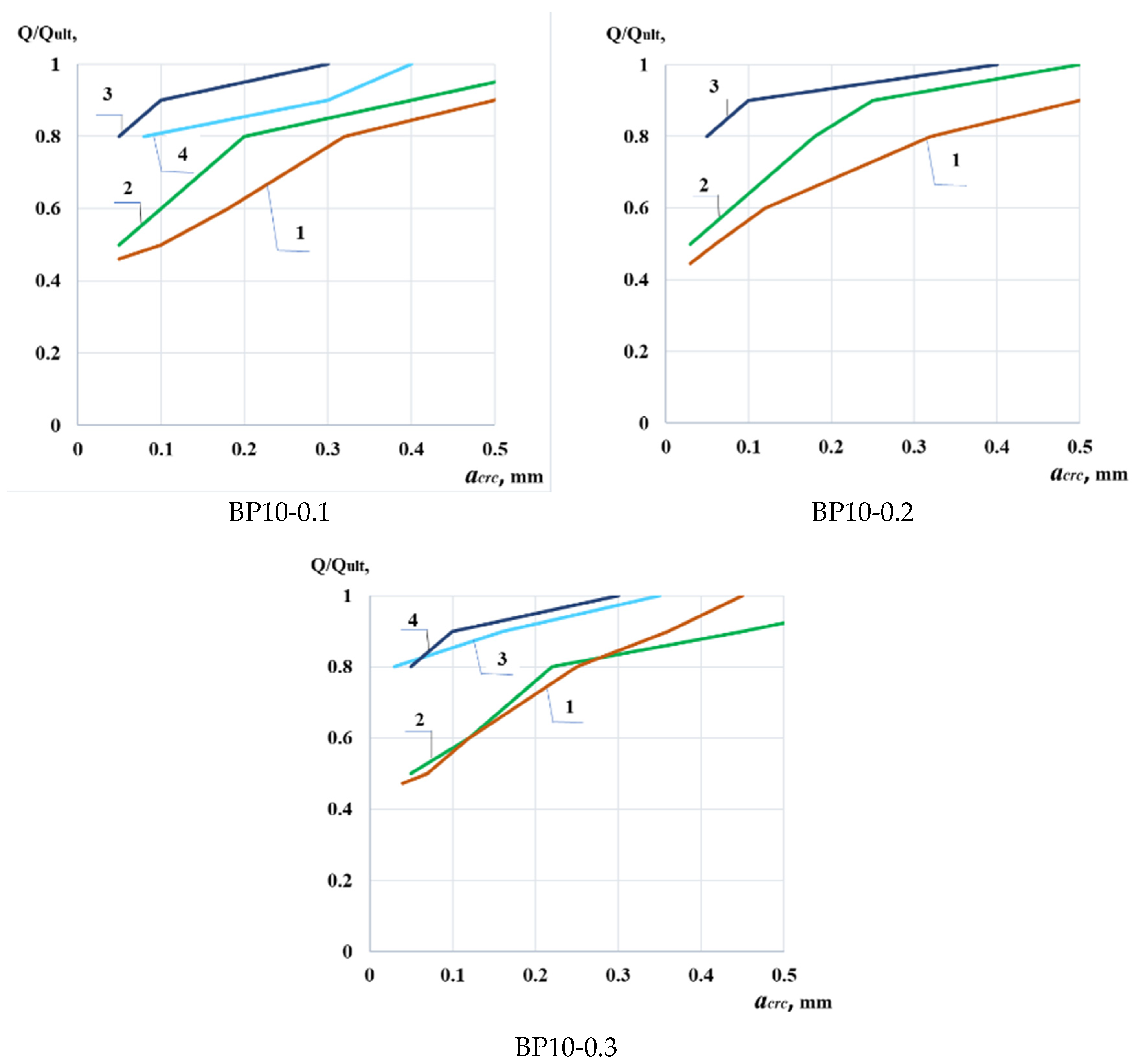
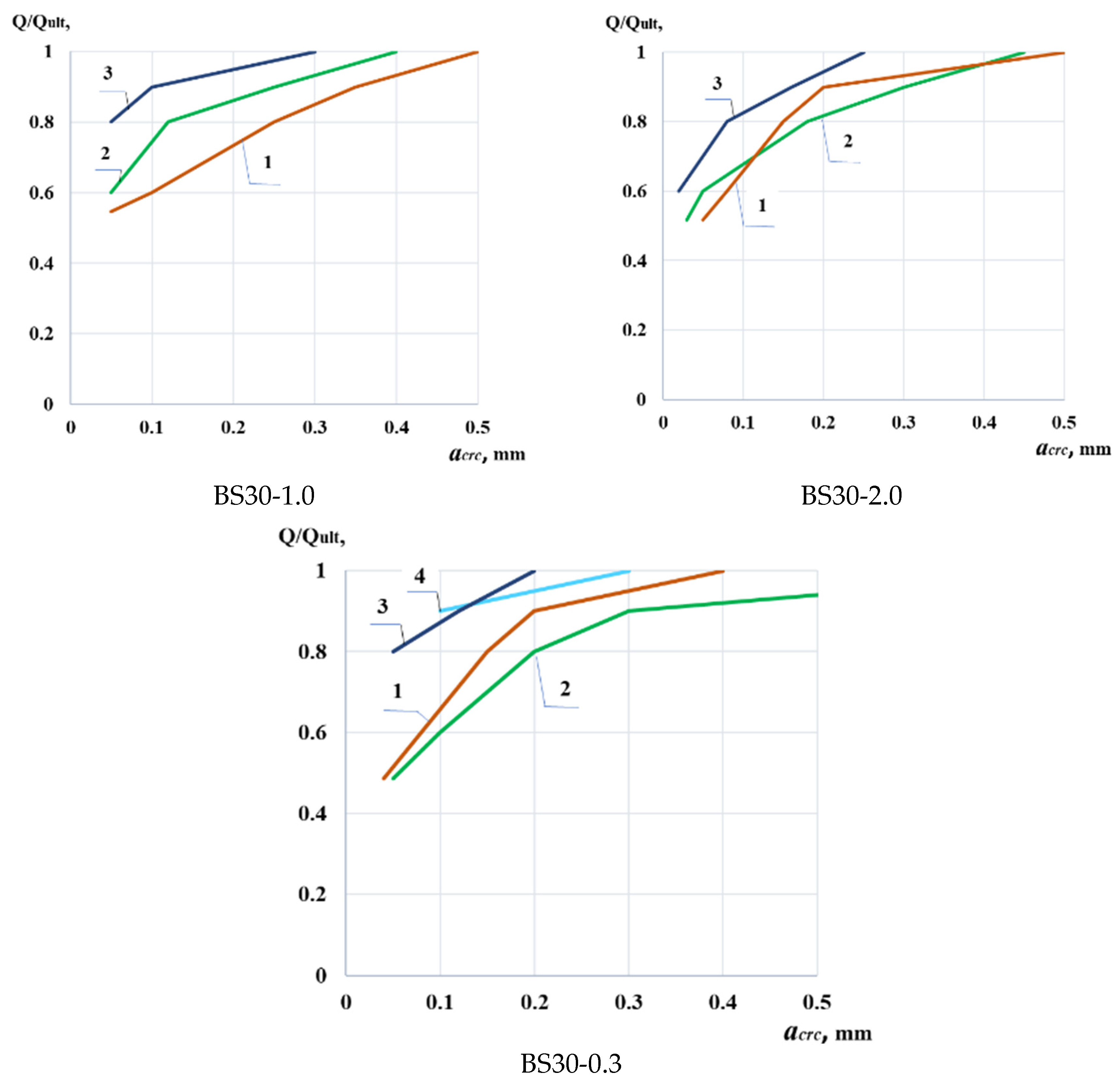
- The onset and propagation of oblique and normal cracks was greatly postponed with the use of fiber reinforcement. Where brittle failure of ordinary concrete beams occurred at the low loads, the introduction of fibers enabled the beams to maintain load-bearing capacity even after the cracks had been formed. Steel fibers were especially very successful and then were basalt and polypropylene fibers in bridging the cracks and controlling the width of the cracks.
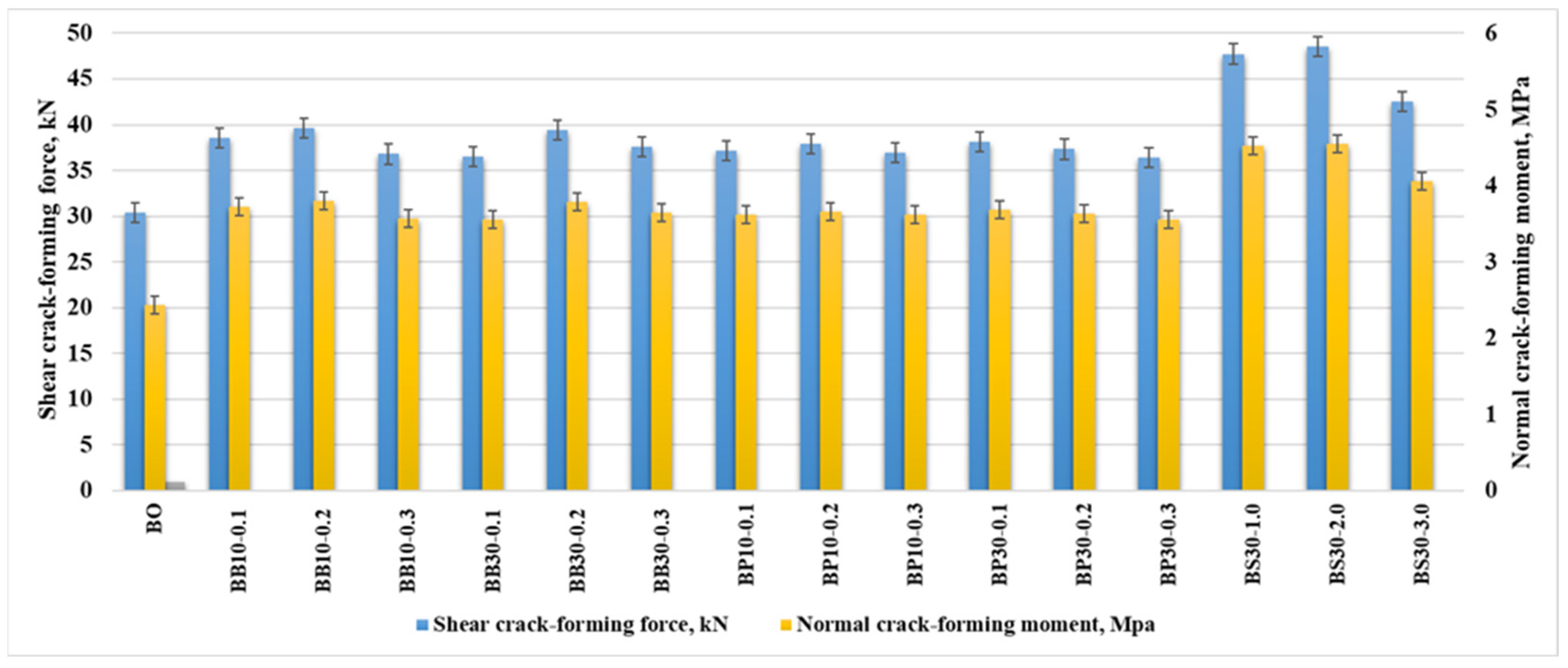
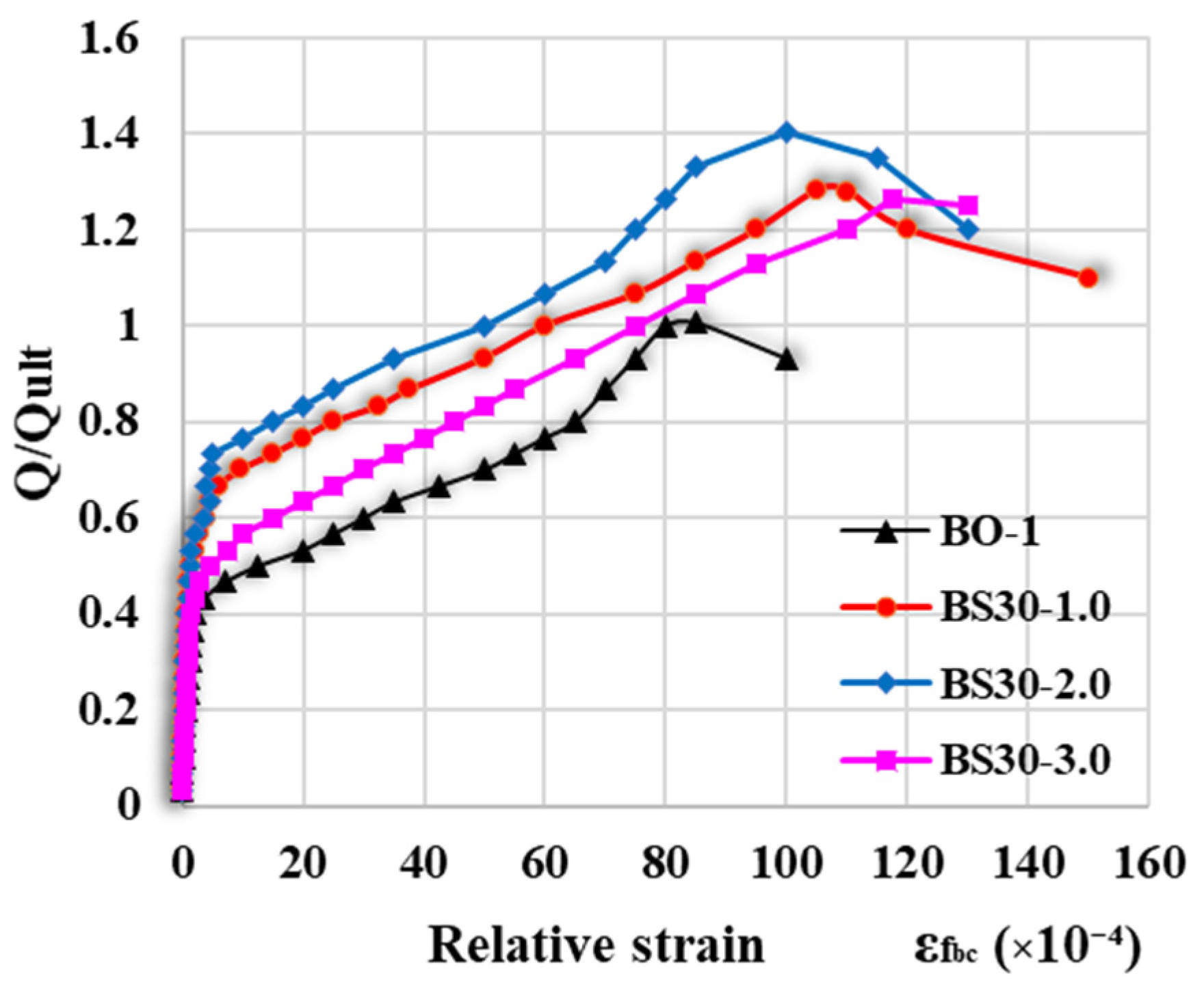
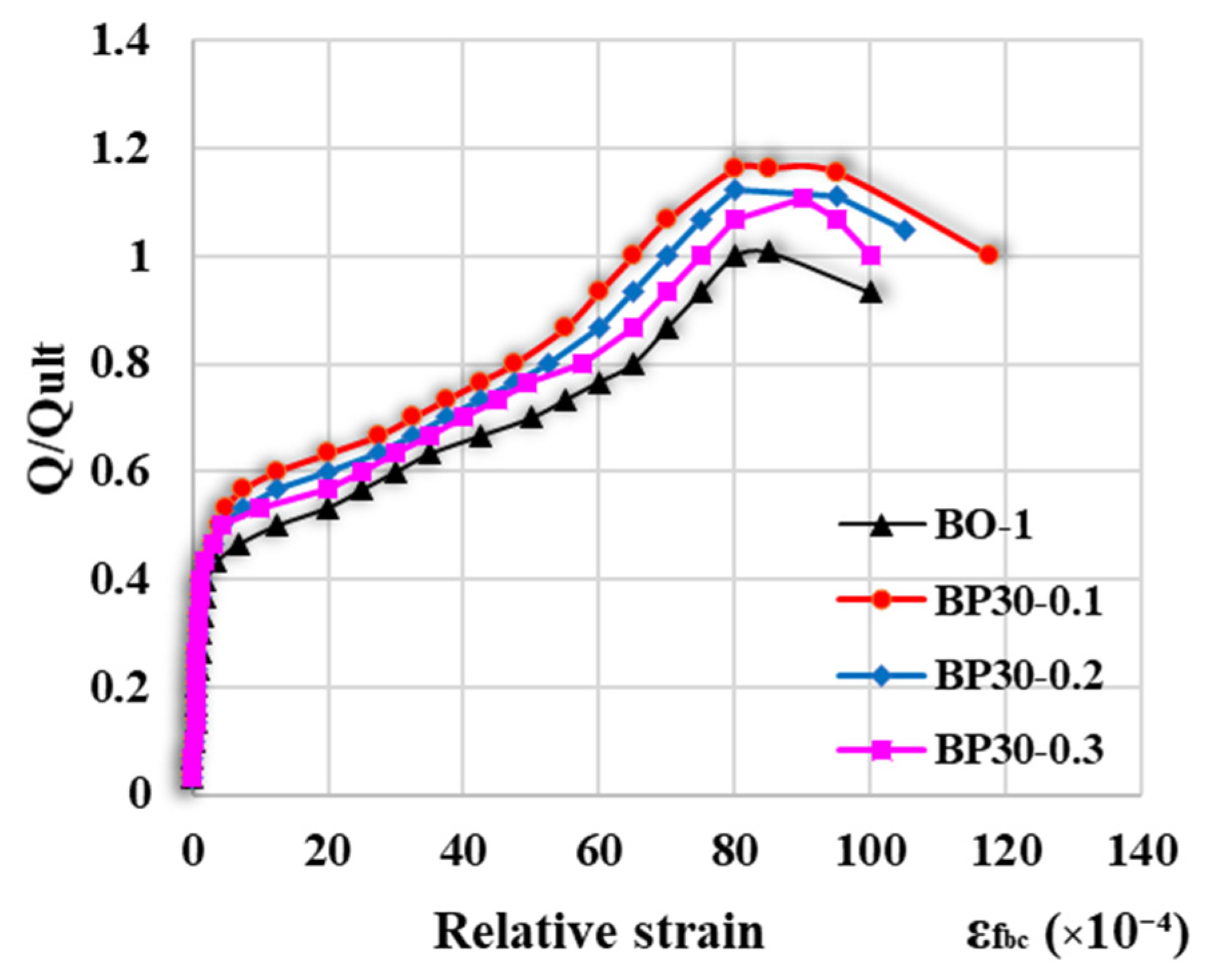
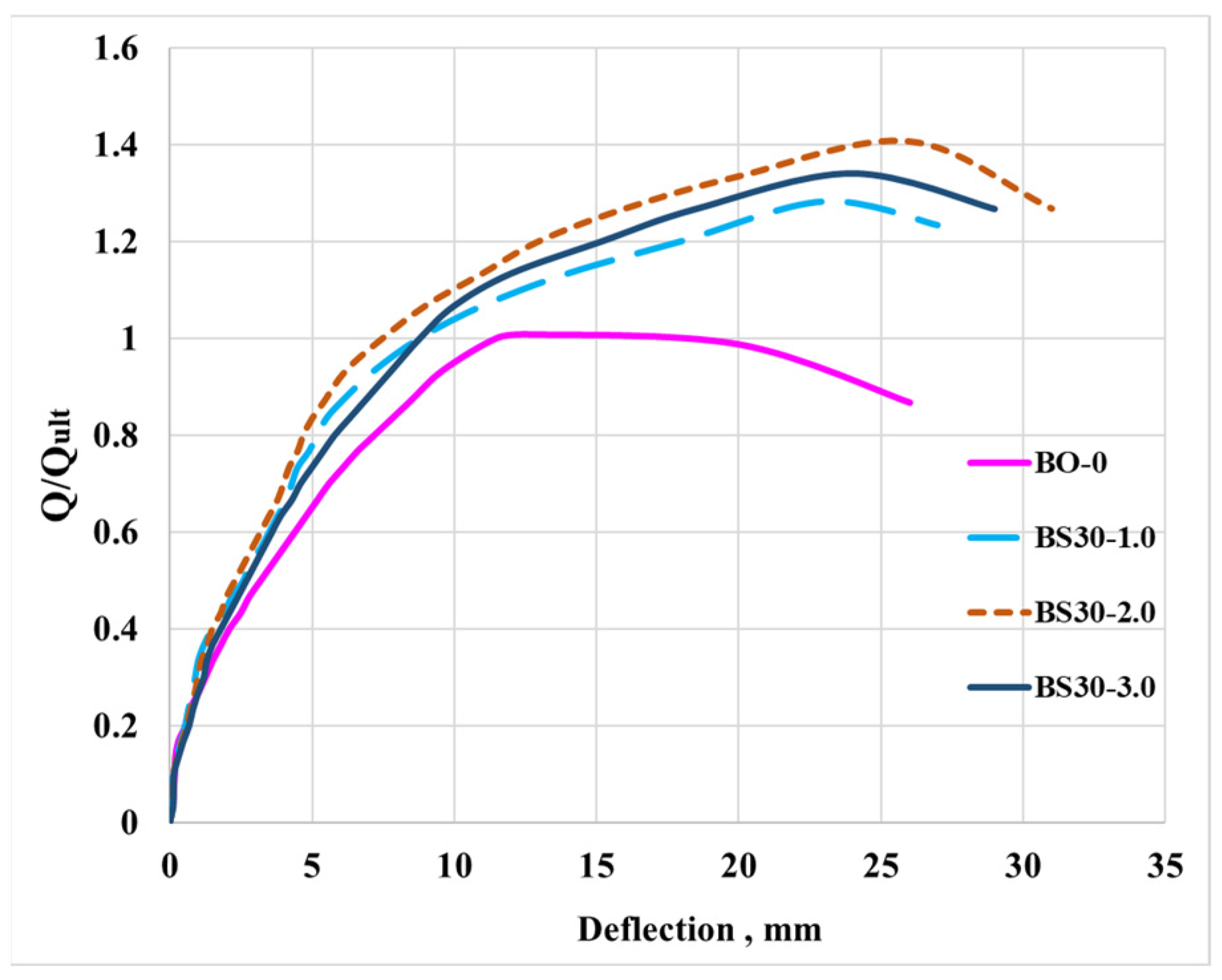
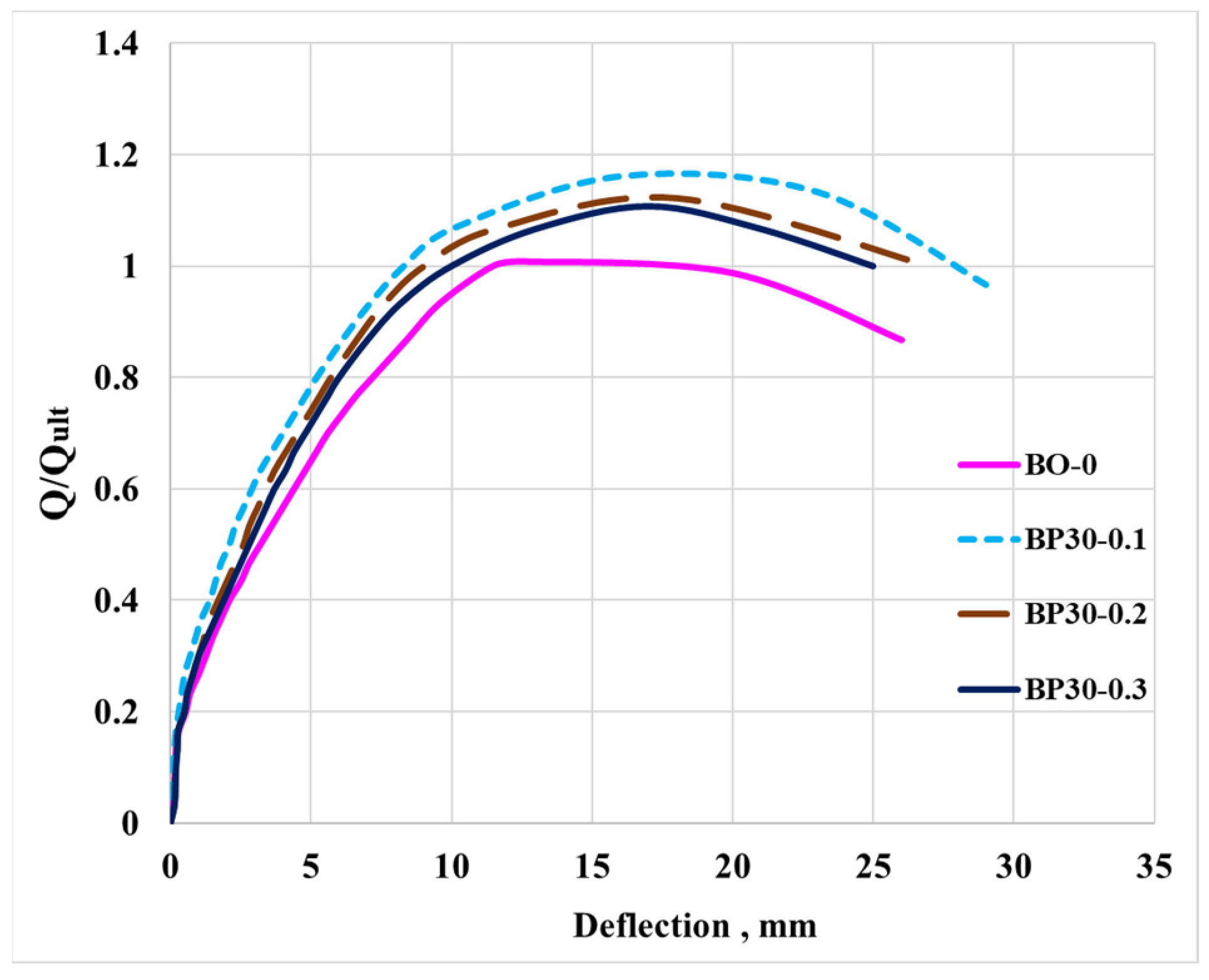
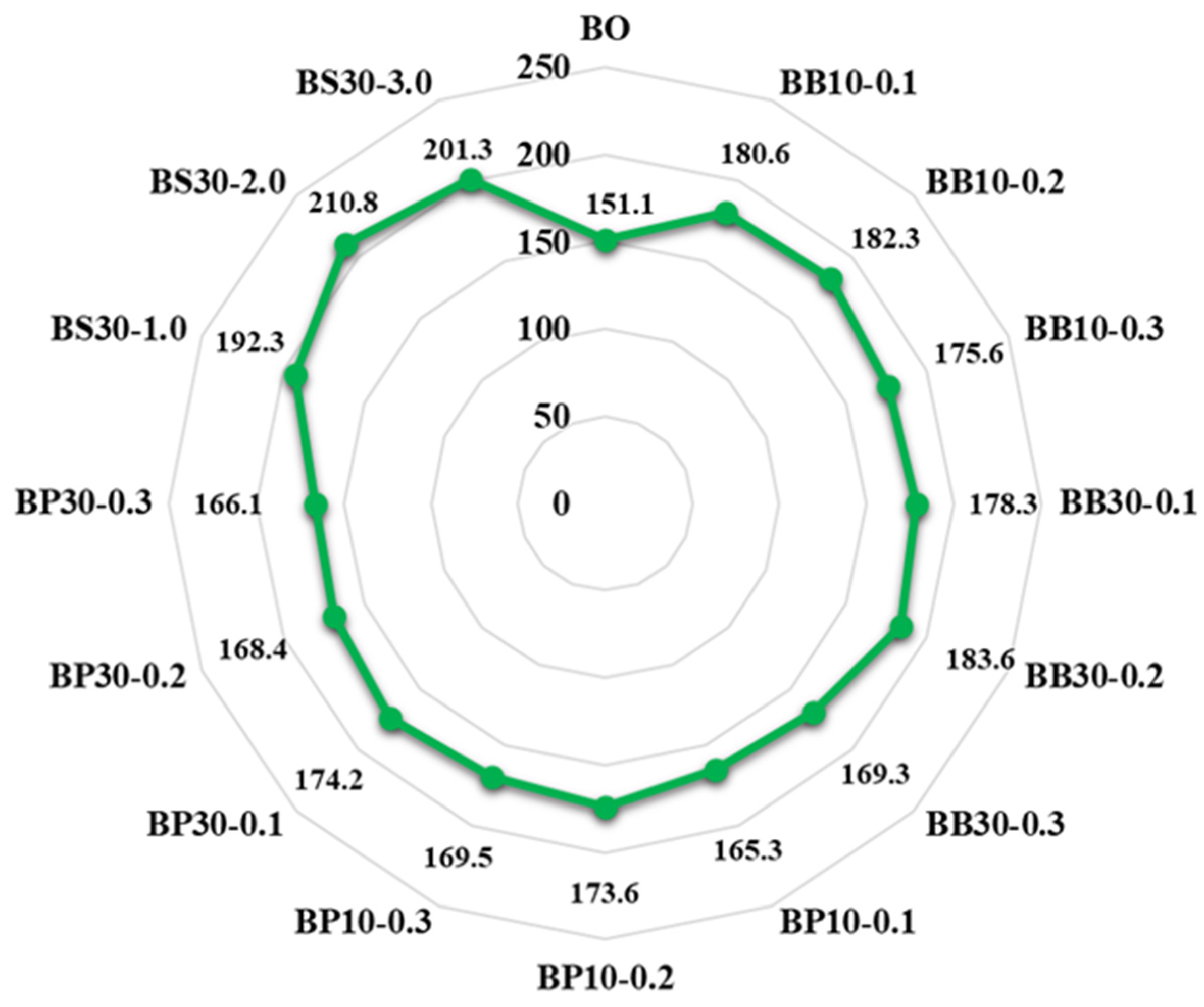
- Spread fibers enhanced weight carrying ability of beams in shear sections and minimized the chances of brittle failure of the beam that occurred abruptly. The basalt fibers contributed to the load capacity enhancement by 12–21 percent, polypropylene fibers by 9–15 percent, and steel fibers by 27–40 percent showing that fiber type, content and length appeared critical in increasing beam performance.
- The fibers served as micro-distribution of tensile stresses and retardation of crack coalescence, by the micro-bridging of developing cracks. This multiscale reinforcement mechanism resulted in slower degradation of stiffness, increased post-cracking ductility, and increased loading-absorption energy. Steel fibers were the most significant bridging and it is because of their high tensile strength and modulus which makes it superior compared to basalt fibers which offered durability and sustainability.
- The results substantiate that dispersed fiber reinforcement is a viable approach to improve the flexural and shear behavior of concrete beams especially in structures which are likely to be subjected to dynamic or high service loads. The choice of the type of fiber and dosage enables the engineer to balance the structural reliability and the service life and reduce the damage caused by cracks to the minimal.
- In case of moderate improvement of shear resistance, basalt fibers of 0.1–0.3 percent by volume and polypropylene ones of the same dosages may be employed. To achieve the maximum shear capacity enhancement, the steel fibers with 1.0–3.0% volume are suggested.
- Future studies should test the results at elevated temperatures. This will help to better understand how concrete and fiber mixtures behave under fire, the cracking and deformation processes, and the impact on the load-bearing capacity of the structure. This will allow the effectiveness of fiber type, length, and quantity in elevated temperatures to be evaluated and safe design recommendations to be developed.
- The present study was conducted on small-scale beams under static loading. Tests of full-sized beam and with cyclic loading are done to further verify the findings.
Author Contributions
Funding
Data Availability Statement
Conflicts of Interest
References
- Chia, E.; Nguyen, H.B.; Le, K.N.; Bi, K.; Pham, T.M. Performance of hybrid basalt-recycled polypropylene fibre reinforced concrete. Structures 2025, 75, 108711. [Google Scholar] [CrossRef]
- Hassan, M.J. Effect of basalt macro fiber on shear strength of high-strength concrete beams with web openings: A finite element parametric study. Case Stud. Constr. Mater. 2025, 23, e05088. [Google Scholar] [CrossRef]
- Liu, Q.; Cai, L.; Guo, R. Experimental study on the mechanical behaviour of short chopped basalt fibre reinforced concrete beams. Structures 2022, 45, 1110–1123. [Google Scholar] [CrossRef]
- Sheikh, N.A.; Katkhuda, H.; Shatarat, N. Effect of 3D, 4D, 5D steel fibers on the shear behavior of reinforced concrete beams made of recycled coarse aggregate. Constr. Build. Mater. 2025, 460, 139842. [Google Scholar] [CrossRef]
- Zheng, Y.; Zhang, Y.; Zhuo, J.; Zhang, Y.; Wan, C. A review of the mechanical properties and durability of basalt fiber-reinforced concrete. Constr. Build. Mater. 2022, 359, 129360. [Google Scholar] [CrossRef]
- Vairagade, V.S.; Dhale, S.A. Hybrid fibre reinforced concrete–A state of the art review. Hybrid Adv. 2023, 3, 100035. [Google Scholar] [CrossRef]
- Chen, X.-F.; Kou, S.-C.; Xing, F. Mechanical and durable properties of chopped basalt fiber reinforced recycled aggregate concrete and the mathematical modeling. Constr. Build. Mater. 2021, 298, 123901. [Google Scholar] [CrossRef]
- Jiang, C.; Fan, K.; Wu, F.; Chen, D. Experimental study on the mechanical properties and microstructure of chopped basalt fibre reinforced concrete. Mater. Des. 2014, 58, 187–193. [Google Scholar] [CrossRef]
- Vedhasakthi, K.; Chithra, R. Strength attributes and microstructural characterization of basalt fibre incorporated self-compacting concrete. J. Build. Eng. 2023, 78, 107592. [Google Scholar] [CrossRef]
- Mousavi, S.S.; Dehestani, M. Influence of mixture composition on the structural behaviour of reinforced concrete beam-column joints: A review. Structures 2022, 42, 29–52. [Google Scholar] [CrossRef]
- Ralegaonkar, R.; Gavali, H.; Aswath, P.; Abolmaali, S. Application of chopped basalt fibers in reinforced mortar: A review. Constr. Build. Mater. 2018, 164, 589–602. [Google Scholar] [CrossRef]
- Shyamala, G. Impact of reinforcement and geometry of deep beam–Research perspective. Mater. Today Proc. 2022, 68, 1556–1561. [Google Scholar] [CrossRef]
- Silva, D.B.; Pachla, E.C.; Bolina, F.L.; Graeff, Â.G.; Lorenzi, L.S.; da Silva Filho, L.C.P. Mechanical and chemical properties of cementitious composites with rice husk after natural polymer degradation at high temperatures. J. Build. Eng. 2024, 85, 108716. [Google Scholar] [CrossRef]
- Shi, K.; Gao, Z.; Kang, L. Flexural behavior of steel fiber-reinforced recycled aggregate concrete beam reinforced with hybrid steel and FRP bars. Structures 2025, 80, 109665. [Google Scholar] [CrossRef]
- Wang, H.; Zhou, M.; Wei, B.; Wu, C.; Tang, Z.; Zhang, S.; He, J. Study on flexural cracking characteristics of polypropylene fiber reinforced concrete beams with BFRP bars. Case Stud. Constr. Mater. 2025, 22, e04372. [Google Scholar] [CrossRef]
- Shabani, H.; Asadian, A.; Galal, K. Flexural and serviceability behaviour of macro-synthetic fibre-reinforced concrete beams reinforced with GFRP bars. Constr. Build. Mater. 2025, 494, 143217. [Google Scholar] [CrossRef]
- Lang, W.; Chen, W.; Xie, Q.; Wang, P.; Zhang, G. Flexural performance of basalt fiber reinforced recycled aggregate concrete subjected to sulfate corrosion. Case Stud. Constr. Mater. 2025, 23, e05156. [Google Scholar] [CrossRef]
- Zhou, Y.; Xiao, J.; Deng, Z.; Yang, H.; Mei, J.; Huang, J. Experimental and modelling investigation of stress-strain behavior of basalt fiber-reinforced coral aggregate concrete under uniaxial and triaxial compression. Constr. Build. Mater. 2025, 496, 143856. [Google Scholar] [CrossRef]
- Liu, Z.; Kong, D.; Wang, L.; Liu, A.; Xu, F.; Fang, Z.; Wang, S. Performance of red mud concrete reinforced with single and hybrid Polyvinyl alcohol and Basalt fibers. J. Build. Eng. 2025, 112, 113879. [Google Scholar] [CrossRef]
- Wei, J.; Li, J.; Liu, Z.; Wu, C.; Liu, J. Behaviour of hybrid polypropylene and steel fibre reinforced ultra-high performance concrete beams against single and repeated impact loading. Structures 2023, 55, 324–337. [Google Scholar] [CrossRef]
- Ye, Y.; Xie, T.; Guo, T.; Dong, B.; Zhao, J.; Feng, J. Durability evaluation and life prediction of basalt fiber reinforced aeolian sand concrete in different freeze-thaw media. J. Build. Eng. 2025, 117, 114924. [Google Scholar] [CrossRef]
- Esakki, A.K.D.K.; Dev, S.K.A.; Gomathy, T.; Chella Gifta, C. Influence of adding steel–glass–polypropylene fibers on the strength and flexural behaviour of hybrid fiber reinforced concrete. Mater. Today Proc. 2023; in press. [Google Scholar] [CrossRef]
- Yang, K.; Wu, Z.; Zheng, K.; Shi, J. Shear behavior of regular oriented steel fiber-reinforced concrete beams reinforced with glass fiber polymer (GFRP) bars. Structures 2024, 63, 106339. [Google Scholar] [CrossRef]
- Mashayekhi, A.; Hassanli, R.; Zhuge, Y.; Ma, X.; Chow, C.W.K.; Bazli, M.; Manalo, A. Shear performance of fibre-reinforced seawater sea-sand concrete–fibre hybridization and synergy effects. Constr. Build. Mater. 2025, 472, 140955. [Google Scholar] [CrossRef]
- Mirzaaghabeik, H.; Mashaan, N.S.; Shukla, S.K. Impact of geometrical dimensions on the shear behaviour of UHPC deep beams reinforced with steel and synthetic fibres. Structures 2025, 78, 109260. [Google Scholar] [CrossRef]
- Yu, J.; Yufeng, X.; Saijie, L.; Zhiqiang, X. Experimental study on shear performance of basalt fiber concrete beams without web reinforcement. Case Stud. Constr. Mater. 2022, 17, e01602. [Google Scholar] [CrossRef]
- Yan, X.; Wang, F.; Luo, Y.; Liu, X.; Yang, Z.; Mao, H. Mechanical performance study of basalt-polyethylene fiber reinforced concrete under dynamic compressive loading. Constr. Build. Mater. 2023, 409, 133935. [Google Scholar] [CrossRef]
- He, L.; Wu, F.; Ma, Y.; Li, Z.; Chen, A.; Zhao, B.; Cao, J. Flexural performance of steel fiber reinforced MPCC beams: Experimental study and theoretical analysis. Eng. Struct. 2025, 343, 121018. [Google Scholar] [CrossRef]
- Islam, S.U.; Waseem, S.A. An experimental study on mechanical and fracture characteristics of hybrid fibre reinforced concrete. Structures 2024, 68, 107053. [Google Scholar] [CrossRef]
- Cai, B.; Chen, H.; Xu, Y.; Fan, C.; Li, H.; Liu, D. Study on fracture characteristics of steel fiber reinforced manufactured sand concrete using DIC technique. Case Stud. Constr. Mater. 2024, 20, e03200. [Google Scholar] [CrossRef]
- Xiong, Z.; Li, H.; Pan, Z.; Li, X.; Lu, L.; He, M.; Li, H.; Liu, F.; Feng, P.; Li, L. Fracture properties and mechanisms of steel fiber and glass fiber reinforced rubberized concrete. J. Build. Eng. 2024, 86, 108866. [Google Scholar] [CrossRef]
- Al-Rousan, E.T.; Khalid, H.R.; Rahman, M.K. Fresh, mechanical, and durability properties of basalt fiber-reinforced concrete (BFRC): A review. Dev. Built Environ. 2023, 14, 100155. [Google Scholar] [CrossRef]
- Yousefi, M.; Khandestani, R.; Gharaei-Moghaddam, N. Flexural behavior of reinforced concrete beams made of normal and polypropylene fiber-reinforced concrete containing date palm leaf ash. Structures 2022, 37, 1053–1068. [Google Scholar] [CrossRef]
- Azandariani, M.G.; Vajdian, M.; Asghari, K.; Mehrabi, S. Mechanical properties of polyolefin and polypropylene fibers-reinforced concrete–An experimental study. Compos. Part C Open Access 2023, 12, 100410. [Google Scholar] [CrossRef]
- GOST 10180-2012; The Method of Determining the Accuracy of the Control Method. Standartinform: Moscow, Russia, 2018.
- DR297.1325800.2017; Fiber Reinforced Concrete Structures and Precast Products with Non-Steel Fibers. Design Rules. Ministry of Construction: Moscow, Russia, 2017.



| No. | Series | Designation | Fiber Type | Fiber Length (mm) | Fiber Content (%) | Number of Specimens |
|---|---|---|---|---|---|---|
| 1 | S1 (Control) | BO | (Plain concrete) | - | - | 3 |
| 2 | S2 | BB10-0.1 | Basalt | 10 | 0.1 | 3 |
| 3 | BB10-0.2 | Basalt | 10 | 0.2 | 3 | |
| 4 | BB10-0.3 | Basalt | 10 | 0.3 | 3 | |
| 5 | BB30-0.1 | Basalt | 30 | 0.1 | 3 | |
| 6 | BB30-0.2 | Basalt | 30 | 0.2 | 3 | |
| 7 | BB30-0.3 | Basalt | 30 | 0.3 | 3 | |
| 8 | S3 | BP10-0.1 | Polypropylene | 10 | 0.1 | 3 |
| 9 | BP10-0.2 | Polypropylene | 10 | 0.2 | 3 | |
| 10 | BP10-0.3 | Polypropylene | 10 | 0.3 | 3 | |
| 11 | BP30-0.1 | Polypropylene | 30 | 0.1 | 3 | |
| 12 | BP30-0.2 | Polypropylene | 30 | 0.2 | 3 | |
| 13 | BP30-0.3 | Polypropylene | 30 | 0.3 | 3 | |
| 14 | S4 | BS30-1.0 | Steel | 30 | 1.0 | 3 |
| 15 | BS30-2.0 | Steel | 30 | 2.0 | 3 | |
| 16 | BS30-3.0 | Steel | 30 | 3.0 | 3 |
| Fiber Type | Density (kg/m3) | Tensile Strength (MPa) | Elastic Modulus (GPa) | Fiber Length (mm) | Fiber Diameter (mm) |
|---|---|---|---|---|---|
| Basalt | 2650 | 3500 | 110 | 10, 30 | 0.017 |
| Polypropylene | 910 | 500 | 35 | 10, 30 | 0.018 |
| Steel | 7850 | 1100 | 200 | 30 | 0.3 |
| Designation | Compressive Strength (MPa) | Tensile Strength (MPa) | Residual Tensile Strength (MPa) | Flexural Strength (MPa) | Elastic Modulus (GPa) |
|---|---|---|---|---|---|
| BO | 34.6 | 2.21 | – | 4.41 | 30.91 |
| BB10-0.1 | 40.7 | 2.81 | 1.16 | 5.52 | 34.9 |
| BB10-0.2 | 41.8 | 2.89 | 1.29 | 5.81 | 35.4 |
| BB10-0.3 | 39.9 | 2.68 | 1.19 | 5.49 | 34.2 |
| BB30-0.1 | 39.8 | 2.66 | 1.21 | 5.61 | 33.7 |
| BB30-0.2 | 41.1 | 2.87 | 1.32 | 5.76 | 35.0 |
| BB30-0.3 | 40.2 | 2.74 | 1.26 | 5.68 | 34.1 |
| BP10-0.1 | 38.6 | 2.71 | 1.25 | 5.54 | 34.6 |
| BP10-0.2 | 39.9 | 2.76 | 1.20 | 5.73 | 34.8 |
| BP10-0.3 | 38.2 | 2.69 | 1.12 | 5.30 | 33.4 |
| BP30-0.1 | 39.7 | 2.78 | 1.23 | 5.62 | 35.1 |
| BP30-0.2 | 38.9 | 2.72 | 1.18 | 5.42 | 34.6 |
| BS30-0.3 | 38.1 | 2.65 | 1.10 | 5.31 | 34.1 |
| BS30-1.0 | 45.1 | 3.48 | 1.62 | 6.42 | 35.6 |
| BS30-2.0 | 47.2 | 3.54 | 1.75 | 6.56 | 36.8 |
| BS30-3.0 | 44.3 | 3.10 | 1.53 | 6.33 | 34.8 |
| Series | ID | Mcrc, (kN·m) | Qcrc, (kN) | Crack Width at 50% Qmax, (mm) |
|---|---|---|---|---|
| S1 (Control) | BO | 2.69 | 32.23 | 0.37 |
| S2 | BB10-0.1 | 4.37 | 41.97 | 0.21 |
| BB10-0.2 | 4.46 | 42.12 | 0.19 | |
| BB10-0.3 | 4.02 | 39.06 | 0.22 | |
| BB30-0.1 | 4.09 | 38.92 | 0.20 | |
| BB30-0.2 | 4.25 | 40.69 | 0.18 | |
| BB30-0.3 | 3.90 | 39.87 | 0.25 | |
| S3 | BP10-0.1 | 3.80 | 38.05 | 0.21 |
| BP10-0.2 | 3.99 | 41.14 | 0.24 | |
| BP10-0.3 | 3.92 | 38.28 | 0.26 | |
| BP30-0.1 | 4.01 | 40.49 | 0.20 | |
| BP30-0.2 | 3.87 | 39.10 | 0.25 | |
| BS30-0.3 | 3.81 | 38.56 | 0.20 | |
| S4 | BS30-1.0 | 4.60 | 52.59 | 0.15 |
| BS30-2.0 | 5.00 | 54.42 | 0.10 | |
| BS30-3.0 | 4.71 | 48.62 | 0.12 |
| Series | ID | Qthear, (kN) | Qexp, (kN) | |
|---|---|---|---|---|
| S1 (Control) | BO | 144.6 | 151.1 | 0.95 |
| S2 | BB10-0.1 | 171.08 | 180.6 | 9.52 |
| BB10-0.2 | 174.61 | 182.3 | 7.69 | |
| BB10-0.3 | 165.34 | 175.6 | 0.94 | |
| BB30-0.1 | 164.46 | 178.3 | 0.92 | |
| BB30-0.2 | 173.72 | 183.6 | 0.95 | |
| BB30-0.3 | 167.99 | 169.3 | 0.99 | |
| S3 | BP10-0.1 | 166.66 | 165.3 | 1.01 |
| BP10-0.2 | 168.87 | 173.6 | 0.97 | |
| BP10-0.3 | 165.78 | 169.5 | 0.98 | |
| BP30-0.1 | 169.75 | 174.2 | 0.97 | |
| BP30-0.2 | 167.10 | 168.4 | 0.99 | |
| BS30-0.3 | 164.02 | 166.1 | 0.99 | |
| S4 | BS30-1.0 | 200.64 | 192.3 | 1.04 |
| BS30-2.0 | 203.28 | 210.8 | 0.96 | |
| BS30-3.0 | 183.87 | 201.3 | 0.91 |
Disclaimer/Publisher’s Note: The statements, opinions and data contained in all publications are solely those of the individual author(s) and contributor(s) and not of MDPI and/or the editor(s). MDPI and/or the editor(s) disclaim responsibility for any injury to people or property resulting from any ideas, methods, instructions or products referred to in the content. |
© 2026 by the authors. Licensee MDPI, Basel, Switzerland. This article is an open access article distributed under the terms and conditions of the Creative Commons Attribution (CC BY) license.
Share and Cite
Martazaev, A.; Razzakov, S. Stress–Strain State and Strength of Fiber-Reinforced Concrete Beams with Basalt, Steel, and Polypropylene Fibers. Constr. Mater. 2026, 6, 19. https://doi.org/10.3390/constrmater6020019
Martazaev A, Razzakov S. Stress–Strain State and Strength of Fiber-Reinforced Concrete Beams with Basalt, Steel, and Polypropylene Fibers. Construction Materials. 2026; 6(2):19. https://doi.org/10.3390/constrmater6020019
Chicago/Turabian StyleMartazaev, Abdurasul, and Sobirjon Razzakov. 2026. "Stress–Strain State and Strength of Fiber-Reinforced Concrete Beams with Basalt, Steel, and Polypropylene Fibers" Construction Materials 6, no. 2: 19. https://doi.org/10.3390/constrmater6020019
APA StyleMartazaev, A., & Razzakov, S. (2026). Stress–Strain State and Strength of Fiber-Reinforced Concrete Beams with Basalt, Steel, and Polypropylene Fibers. Construction Materials, 6(2), 19. https://doi.org/10.3390/constrmater6020019