Article

A Laboratory-Scale Miniature Piezocone Framework for Investigating Rate-Dependent Partial Drainage in Intermediate-Permeability Soils

by
Henrique Milan
1,*,
André Luis Meier
1,
Gracieli Dienstmann
1,
Helena Paula Nierwinski
1,2,
Murilo da Silva Espindola
3,
Orlando Martini Oliveira
3 and
Rafael Augusto dos Reis Higashi
3
1
Postgraduate Program, Civil Engineering, Federal University of Santa Catarina (UFSC), Florianópolis 88040-900, SC, Brazil
2
Postgraduate Program, Civil Engineering, Santa Catarina State Universty (UDESC), Joinville 89219-710, SC, Brazil
3
Postgraduate Program, Geology, Federal University of Santa Catarina (UFSC), Florianópolis 88040-900, SC, Brazil
*
Author to whom correspondence should be addressed.
Geotechnics 2026, 6(2), 48; https://doi.org/10.3390/geotechnics6020048
Submission received: 15 March 2026 / Revised: 9 May 2026 / Accepted: 14 May 2026 / Published: 15 May 2026

Abstract

Penetration rate effects and partial drainage can govern piezocone (CPTu) response in intermediate permeability geomaterials, but field testing at a fixed standard rate limits systematic evaluation. This study presents the development and laboratory validation of a miniature piezocone system and testing framework to investigate rate-dependent penetration response in laboratory-prepared silty sand. Baseline dry and flooded specimens were tested using a triaxial-based configuration at penetration velocities of 9.6, 0.28, 0.10, and 0.03 mm/s, including selected holding periods for dissipation. A dedicated servo-controlled penetration system was then implemented for slurry-prepared specimens, enabling continuous constant-velocity penetration over a wider velocity range (0.004–15 mm/s). Cone resistance was interpreted using normalized net resistance (Q) and normalized velocity (Vh), and pore pressure using normalized excess pore pressure (Δu2/σv0). The results show a monotonic rate dependency, with Q increasing as Vh decreases, while Δu2/σv0 progressively decreases toward zero at intermediate-to-low Vh; at the lowest rates, pore-pressure readings were affected by instrument signal limitations. A hyperbolic-cosine backbone fitted to the normalized response provided good agreement for resistance (R2 = 0.99, RMSE = 3.41) and more limited agreement for pore pressure (R2 = 0.30, RMSE = 0.23). The drainage transition for the tested material occurs in an interval of approximately Vh ≈ 0.3~30. The study provides a reproducible laboratory approach—combining miniature instrumentation, controlled specimen preparation, and variable-rate penetration—to generate normalized drainage-transition trends for rate-effect investigations in intermediate geomaterials.

1. Introduction

Cone penetration testing with pore pressure measurements (CPTu) is one of the primary tools used in geotechnical investigation, allowing direct and continuous measurements of cone tip resistance (qc), sleeve friction (fs), and pore pressure (u2). Based on these measurements, strength and deformability parameters are commonly estimated using well-established empirical correlations. In standard practice, CPTu is performed at a penetration rate of 20 mm/s, and interpretation of the results is based on limiting drainage assumptions, namely drained behavior in coarse-grained soils and undrained behavior in fine-grained clays [1,2,3,4].
Although this framework is generally adequate for clean sands and low-permeability clays, it does not fully describe soils of intermediate permeability. In materials such as silts and fine-grained mine tailings, penetration may occur under partially drained conditions even at the standard rate. In these cases, the measured cone resistance and pore pressure response cannot be represented by the classical limiting conditions of fully drained or fully undrained behavior [5,6].
Partial drainage during penetration affects both the mobilized penetration resistance and the excess pore pressures generated around the cone, producing responses that fall between the fully drained and fully undrained limits [5,6,7,8]. Numerical investigations of cone penetration under these limiting conditions demonstrate that, when penetration occurs under partially drained regimes, both cone resistance and pore pressure tend to evolve toward intermediate values between these limits [9,10,11,12,13]. These findings highlight that, in soils of intermediate permeability, the interpretation of CPTu data cannot rely solely on the classical drained–undrained framework. Instead, it must explicitly account for the penetration rate and the time available for pore pressure dissipation during cone advancement, as both factors directly control the operative drainage condition governing the measured response [5,6,13].
An objective method to evaluate the operative drainage regimes in materials susceptible to partial drainage is the normalization of the penetration velocity. This approach was initially proposed by Finnie and Randolph [14], who defined a non-dimensional velocity (V) based on the vertical coefficient of consolidation (cv):
V   = v · d c v
where v is the penetration rate, D is a characteristic dimension of the penetrometer (e.g., cone diameter, Dc), and cv is the coefficient of vertical consolidation of the soil.
Subsequent developments recognized that, since consolidation around the probe is predominantly radial, it is more logical to employ a normalized velocity (Vh) based on the horizontal coefficient of consolidation (ch), as established by Randolph and Hope [7] in Equation 2 and further supported by Lehane et al. [15] and Mahmoodzadeh et al. [16], among others.
V h = v · d c h
The normalized horizontal velocity provides a physically consistent framework to characterize drainage conditions during penetration. In soils susceptible to partial drainage, penetration rate directly controls the balance between excess pore pressure generation and dissipation. As demonstrated by DeJong and Randolph [6], partial consolidation during cone advancement modifies the measured response and influences subsequent interpretation of CPTu data. Experimental studies have confirmed systematic variations in qc and u2 with penetration rate in silts and tailings [13,17,18,19], reinforcing the need for controlled investigations of rate-dependent behavior.
The conceptual framework for normalized penetration velocity and partial drainage has been extensively investigated in analytical, numerical, and experimental studies [6,7,8,9,10,11,12,13]. However, systematic evaluation of drainage transitions under controlled conditions remains challenging in field applications [17]. In situ CPTu testing is commonly performed at a standard penetration rate, which limits direct observation of continuous transitions between drainage regimes. Variable-rate testing in the field is feasible but operationally demanding and typically restricted to short depth intervals [17,18]. As a result, valuable field evidence exists, yet it remains difficult in routine practice to systematically isolate and quantify penetration rate effects across a wide range of drainage conditions [5]. Additionally, the natural variability of soil deposits further complicates the interpretation of field observations [20,21].
Laboratory testing offers a controlled alternative for investigating penetration rate effects. Calibration chamber testing and centrifuge modeling have been widely used to study penetration mechanisms under controlled stress states and boundary conditions [19,22,23]. These approaches enable systematic variation in penetration rate and stress level, but they generally require specialized equipment and relatively high operational costs [6,24]. More recently, miniature penetrometer systems have been developed to investigate penetration mechanisms at reduced scale [19,25], offering increased flexibility and experimental efficiency for controlled evaluation of rate effects in laboratory-prepared specimens. Depending on the configuration adopted, differences may arise in terms of stress confinement and boundary conditions, which can influence the stress path and pore pressure response around the probe. For this reason, careful interpretation and comparison with established experimental evidence remain essential when applying reduced-scale approaches.
Within this context, the present study develops and validates a miniature laboratory piezocone system combined with a controlled penetration apparatus and confined specimen preparation. Although the individual components of the system are not novel, their integration provides a flexible and relatively low-cost platform for performing penetration tests over a wide range of velocities in silty soils. This approach addresses the difficulty of obtaining controlled experimental data over a broad range of penetration rates in field CPTu testing, particularly at reduced velocities. The setup allows measurement of cone resistance and pore pressure under reproducible laboratory conditions, enabling systematic evaluation of penetration rate effects and drainage transitions. The objective of this study is to investigate the evolution of cone resistance and pore pressure response with penetration rate in a silty soil using a laboratory-scale CPTu system. The results are interpreted using normalized penetration velocity concepts and compared with drainage curves reported in the literature. The laboratory-derived relationships obtained in this work aim to support interpretation of field CPTu data in soils and tailings susceptible to partial drainage and may assist in the preliminary planning of field-testing campaigns by indicating expected drainage response over a range of penetration rates.

2. Equipment Description

2.1. Miniature Piezocone

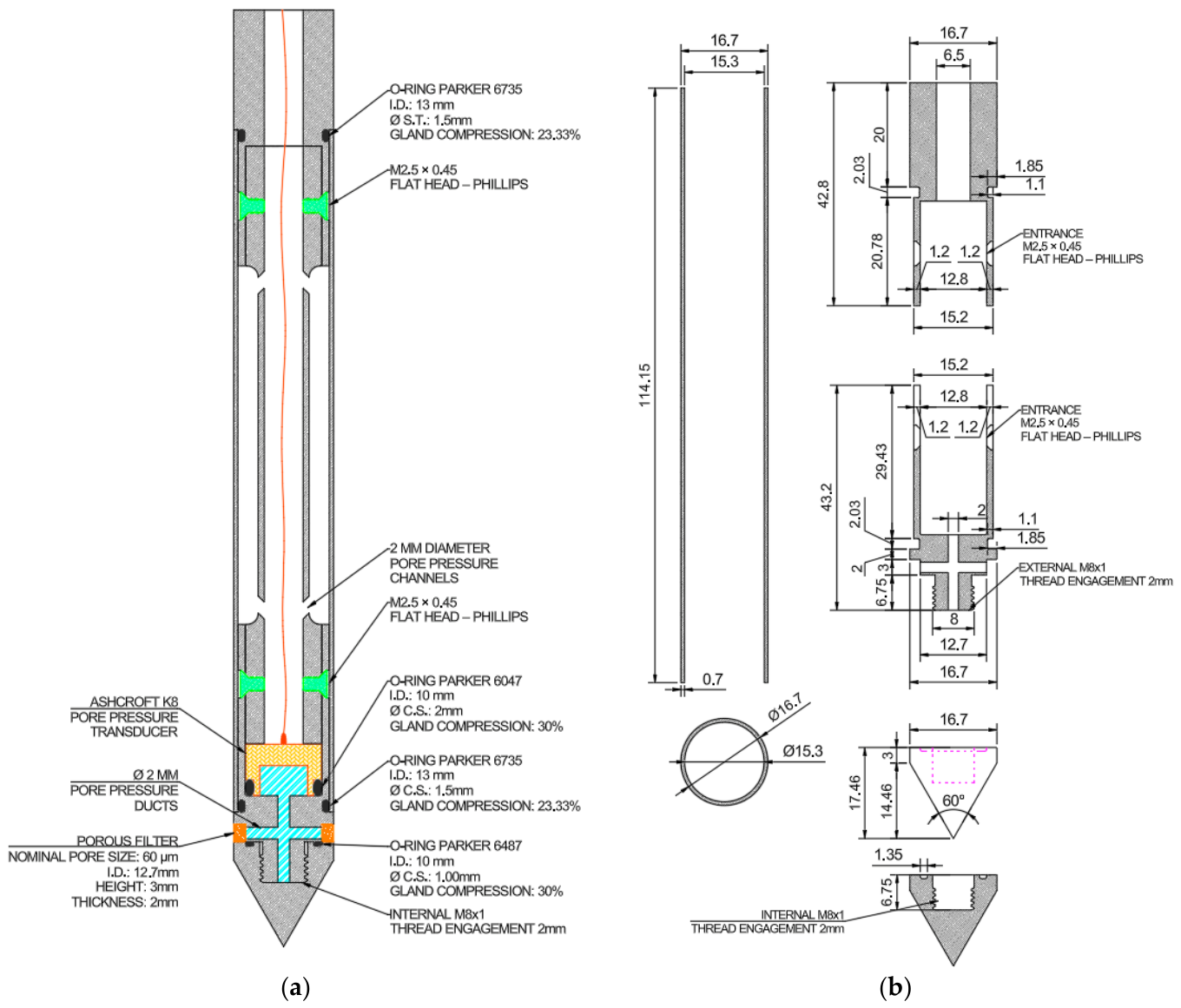
The miniature piezocone developed in this study was designed to measure cone resistance and pore pressure at the u2 position under controlled laboratory conditions. The device follows the conventional CPTu configuration, scaled to laboratory dimensions, and consists of a rigid metallic body housing a load cell for cone resistance measurement and a pore pressure transducer. The geometry and internal arrangement of the miniature piezocone are shown in Figure 1.
The cone body was manufactured from AISI 304 stainless steel. The external shaft diameter is 16.7 mm, corresponding to a projected cone area (projected base area) of approximately 2.19 cm2. The miniature cone tip has an apex angle of 60°, consistent with standard CPT geometry. This geometry provides adequate mechanical stiffness while enabling variable-rate penetration testing within the nominal axial capacity of the laboratory loading system (up to 2 kN). Although the miniature cone dimensions differ from those of standard field cones, previous studies have shown that normalized penetration responses remain comparable when interpreted using dimensionless parameters [15,22,24].
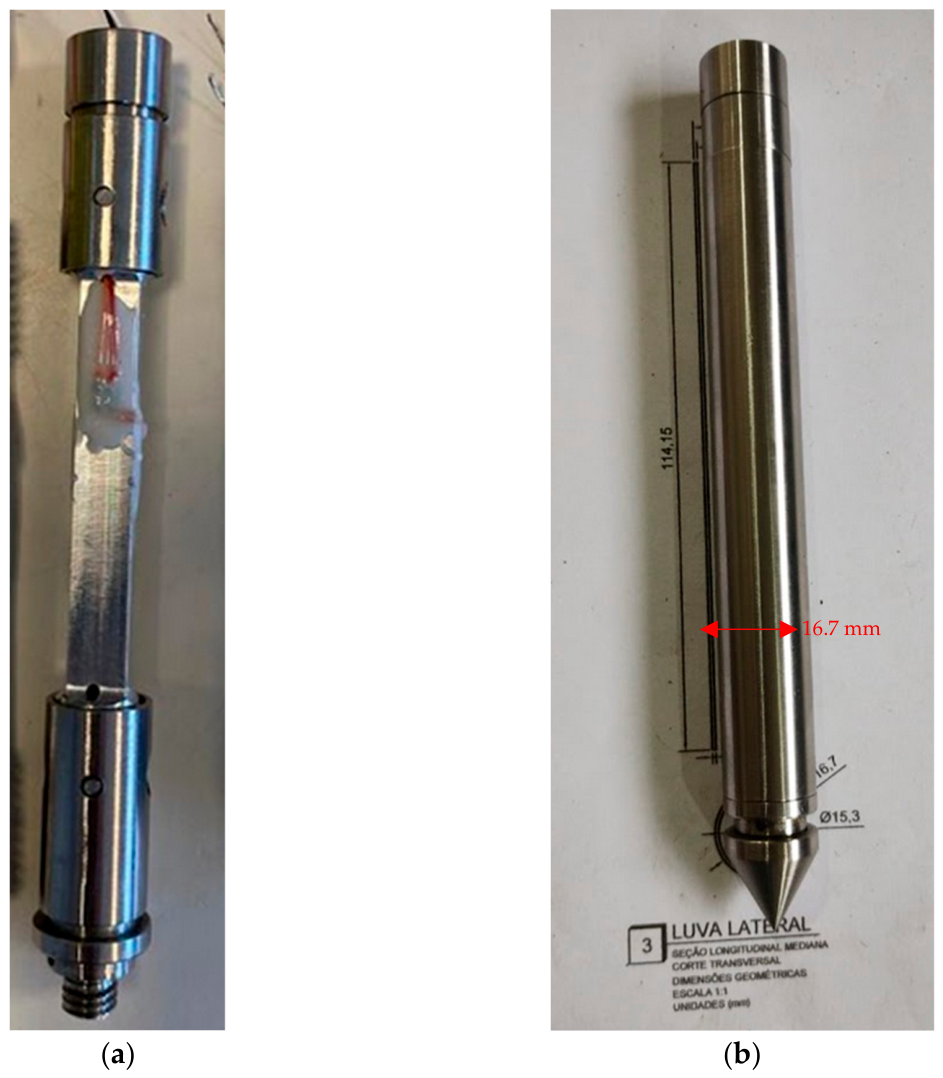
Cone resistance is measured using a custom-built load cell positioned directly behind the cone tip, ensuring predominantly axial load transfer. Sleeve friction was not measured in the present configuration, as the miniature penetrometer was not originally designed to accommodate an independent friction sleeve measurement system. The load cell was instrumented with strain gauges arranged to minimize sensitivity to eccentric and torsional loading. Figure 2a illustrates the strain gauge installation process on the internal metallic shaft, while Figure 2b shows the assembled cone without the porous filter element.
Pore pressure is measured at the u2 position using a miniature pressure transducer connected to a porous filter element with a nominal pore size of 60–80 μm. The hydraulic path between the porous element and the transducer was kept short to reduce response time. Elastomeric O-rings were used at all internal interfaces to ensure watertight sealing.
Prior to testing, the porous filter elements were saturated with glycerin to minimize air entrapment within the pore structure. Vacuum saturation procedures were also applied to ensure full saturation of the porous filter and hydraulic line. During assembly, the cone was submerged in water to prevent air entry into the hydraulic circuit while the porous filter and tip were installed. The assembled cone was then immediately positioned inside the calibration chamber, which contained the test specimen and a thin water layer at the surface to maintain hydraulic continuity at the onset of penetration.

2.2. Penetration Systems

Two penetration systems were designed during the development and testing of the miniature piezocone. These systems correspond to different stages of the experimental program and reflect the progressive refinement of penetration rate control.

2.2.1. Triaxial-Based Penetration System

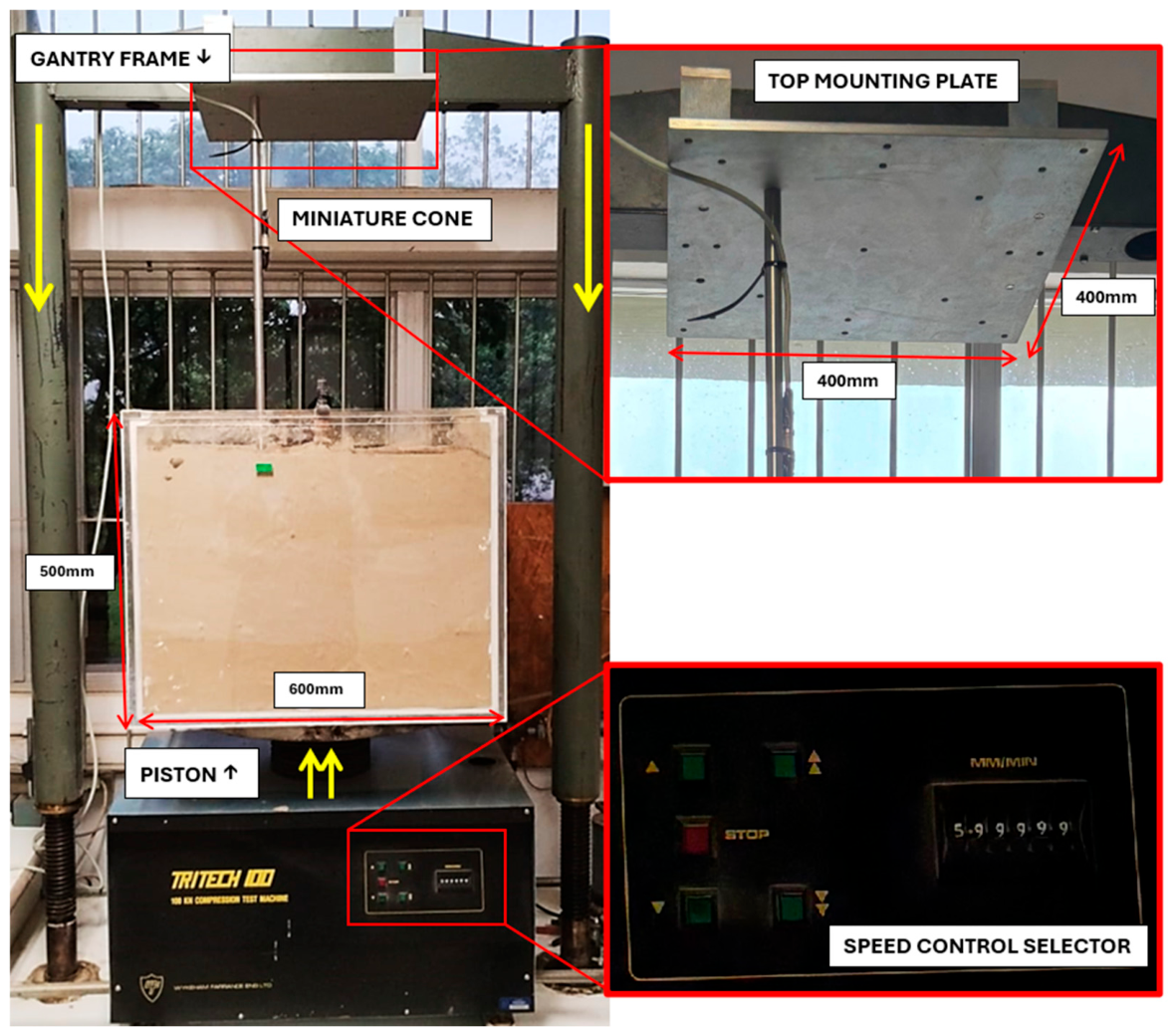
In the initial stage of the study, penetration tests were conducted using a triaxial press adapted for miniature piezocone testing. In this configuration, the miniature piezocone was rigidly fixed to a reaction frame through extension rods, while penetration was achieved by vertical displacement of the specimen relative to the cone. The overall arrangement of the triaxial-based penetration system is illustrated in Figure 3. The adapted configuration consisted of the fixed miniature piezocone, extension rods, an external gantry used for lateral positioning and initial cone advancement, and the triaxial piston used for controlled penetration over an approximate 100 mm stroke. The triaxial-based configuration was primarily used during the initial development stage to validate the miniature piezocone and to identify limitations related to penetration rate control.
The piezocone was connected to a rigid plate attached to an external gantry system (Figure 3), which allowed lateral repositioning of the cone and enabled multiple penetration tests to be performed within a single specimen. Prior to each test, the gantry system was used to position the cone at the target depth corresponding to the zone of interest, located at mid-height of the specimen (200–300 mm). This positioning stage was performed at a constant velocity of approximately 9.6 mm/s. Although penetration data were recorded during this stage, they were not used in the analyses and were excluded from further evaluation.
Controlled penetration was subsequently carried out using the piston over a stroke of approximately 100 mm. Three piston velocities were adopted: 0.03 mm/s and 0.10 mm/s under automatic displacement control, and 0.28 mm/s using the maximum available rate outside the automatic control range. These piston velocities were selected based on the operational limits of the triaxial-based system, with 0.10 and 0.03 mm/s obtained by progressively reducing the maximum piston velocity by a factor of approximately three. In selected tests, penetration was performed entirely using the gantry system at 9.6 mm/s to investigate faster penetration conditions. The resulting velocity range, from 0.03 to 9.6 mm/s, covered approximately 2.5 orders of magnitude and provided the initial reference for the broader servo-controlled testing program.
The transition between gantry-driven positioning and piston-controlled penetration involved an abrupt change in penetration mechanism and velocity, which introduced transient disturbances in both cone resistance and pore pressure measurements. Data affected by this transition, as well as by boundary effects near the beginning and end of penetration, were excluded from further analysis.

2.2.2. Servo-Controlled Penetration System

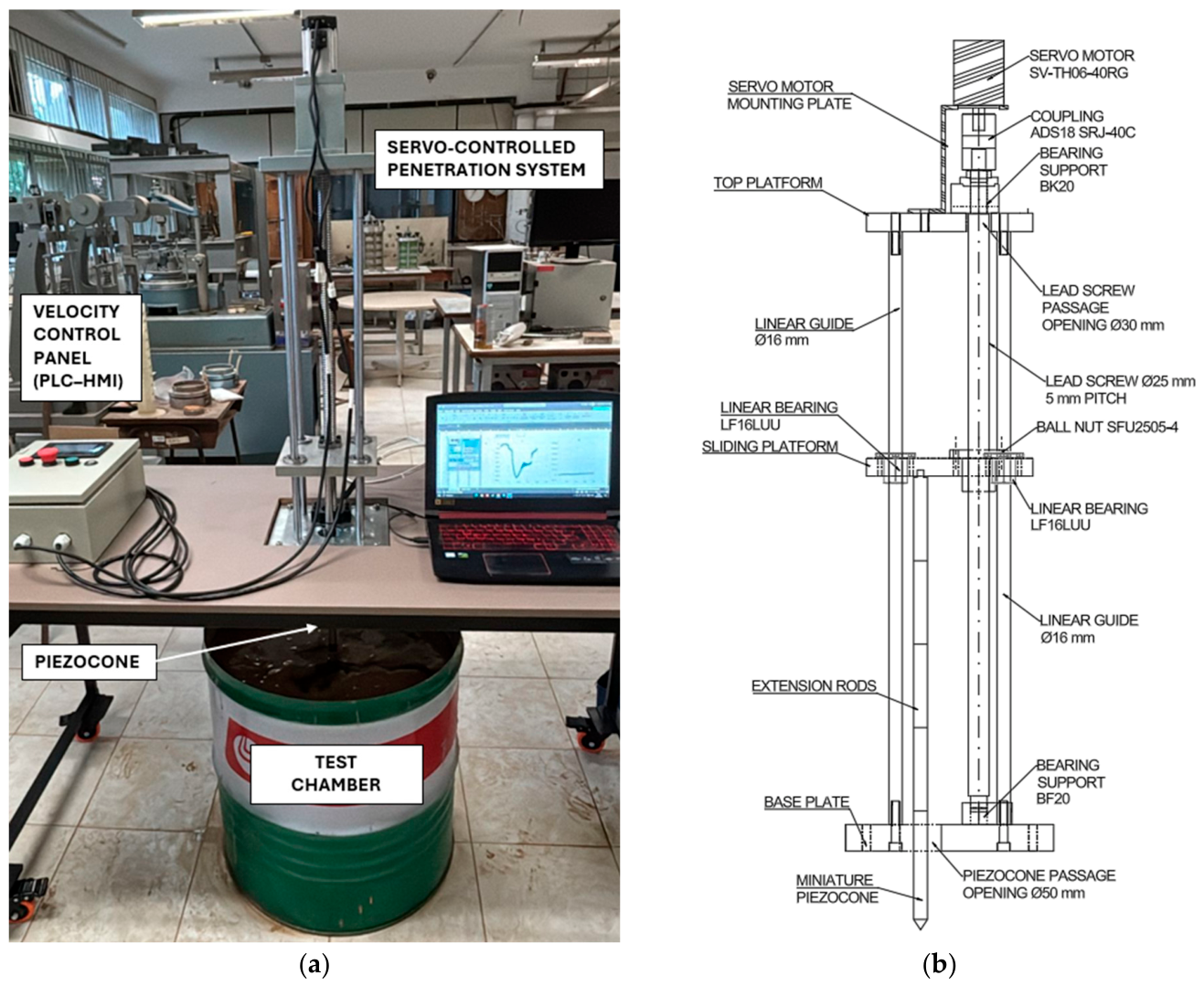
To address the limitations of the triaxial-based setup, a dedicated penetration system was subsequently developed. In this configuration, the miniature piezocone is driven vertically into the soil specimen by a servo-controlled electromechanical drive, while the soil container remains stationary, allowing continuous penetration at a prescribed velocity over the full penetration depth. The penetration system consists of a rigid vertical frame supporting a sliding carriage connected to a ball-screw transmission mechanism. The carriage motion is controlled by a servo motor, which enables precise regulation of penetration velocity over a wide range (0.005–500 mm/s). This arrangement allows penetration to be performed under constant velocity conditions without interruption or changes in penetration mechanism. The servo-controlled penetration system is shown in Figure 4.
The servo-controlled external penetration system enables continuous penetration over depths of approximately 500 mm while maintaining a constant penetration velocity throughout the test. Unlike the triaxial-based configuration, this system eliminates transitions between different loading mechanisms, thereby avoiding transient disturbances in cone resistance and pore pressure measurements.
This configuration was adopted for the slurry testing campaign, where uninterrupted velocity control over the full penetration depth was required for systematic investigation of penetration rate effects and drainage response.

2.3. Data Acquisition and Calibration

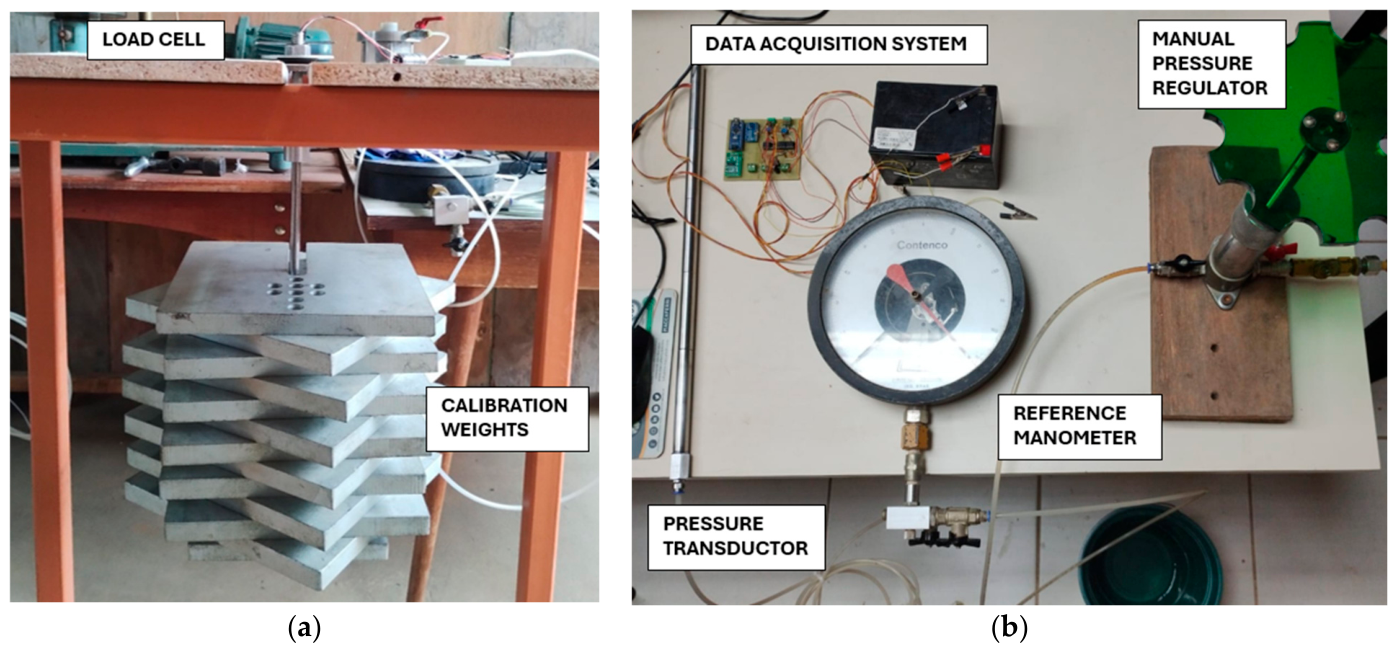
Cone resistance and pore pressure measurements were recorded using a microcontroller-based data acquisition system based on Arduino platform (Arduino, Italy). Sensor outputs were acquired as analog voltage signals and recorded synchronously during both penetration and dissipation phases, allowing direct correlation between mechanical response and pore pressure evolution. Prior to data interpretation, the recorded voltage signals were converted into force and pore-pressure values using sensor-specific calibration equations, with the corresponding calibration curves provided in Appendix A. An overview of the calibration setup is presented in Figure 5a.
Data acquisition was performed at a constant sampling frequency of 1 Hz, which is appropriate for the quasi-static penetration velocities adopted in this study and provides adequate temporal resolution of the measured signals. Data logging and real-time visualization were carried out using the PLX-DAQ interface linked to Microsoft Excel, enabling direct storage and monitoring of the measured signals.
The cone resistance measurement system was calibrated under controlled axial tensile loading, with known reference forces applied along the axis of the load cell (Figure 5a). Although penetration induces compressive forces, the sensing element operates within the linear elastic range and exhibits symmetric behavior in tension and compression. This was verified experimentally through additional compressive loading tests, which confirmed equivalent sensitivity in both loading directions. Calibration curves relating applied force to output voltage were established over the operating range of the system. Multiple loading and unloading cycles were performed to assess linearity, repeatability, and hysteresis. The response was found to be linear within the tested range, with no significant hysteresis observed.
Pore pressure measurements were obtained using an Ashcroft K8 (Ashcroft Inc., Stratford, CT, USA) pressure transducer with a full-scale range of 0–500 psi (approximately 3.45 MPa). The transducer was calibrated using a hydraulic pressure generation system (Figure 5b) and a previously calibrated reference manometer. Pressure was applied incrementally in 15 kPa steps up to 200 kPa, exceeding the maximum pore pressure levels mobilized during laboratory testing. Both loading and unloading cycles were performed to verify linearity and repeatability within the calibrated interval.
During penetration tests, measured pore pressures were typically below 10 kPa. As these values represent a small fraction of the transducer full-scale range, interpretation focuses on relative variations associated with penetration rate effects, rather than precise quantification of very small absolute pressure magnitudes.
Attention was given to ensuring full saturation of the pore pressure system prior to testing, as incomplete saturation may delay response and attenuate measured pore pressures.

3. Materials and Testing Methods

3.1. Materials

The tested soil is a silty sand produced by grinding sand collected from the Araquari experimental site, located in the municipality of Araquari, northern Santa Catarina, Brazil. This site has been extensively investigated in previous geotechnical studies [26,27,28]. The original sand was collected as a disturbed bulk sample from the superficial sandy layer of the site, at approximately 1 m depth, and was subsequently air-dried, disaggregated, sieved, and ground in a ball mill to obtain the target silty-sand gradation. The material was adopted as a representative intermediate-permeability geomaterial, allowing the experimental program to focus on penetration rate effects under partially drained conditions while limiting variability associated with different soil types.
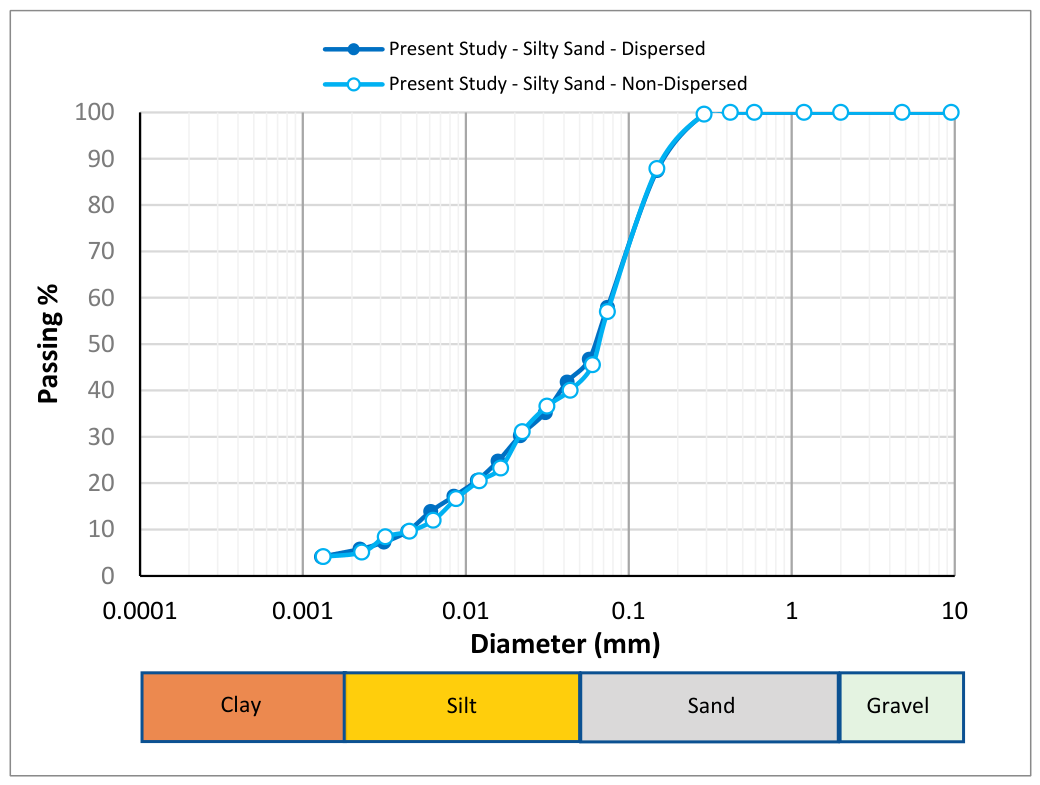
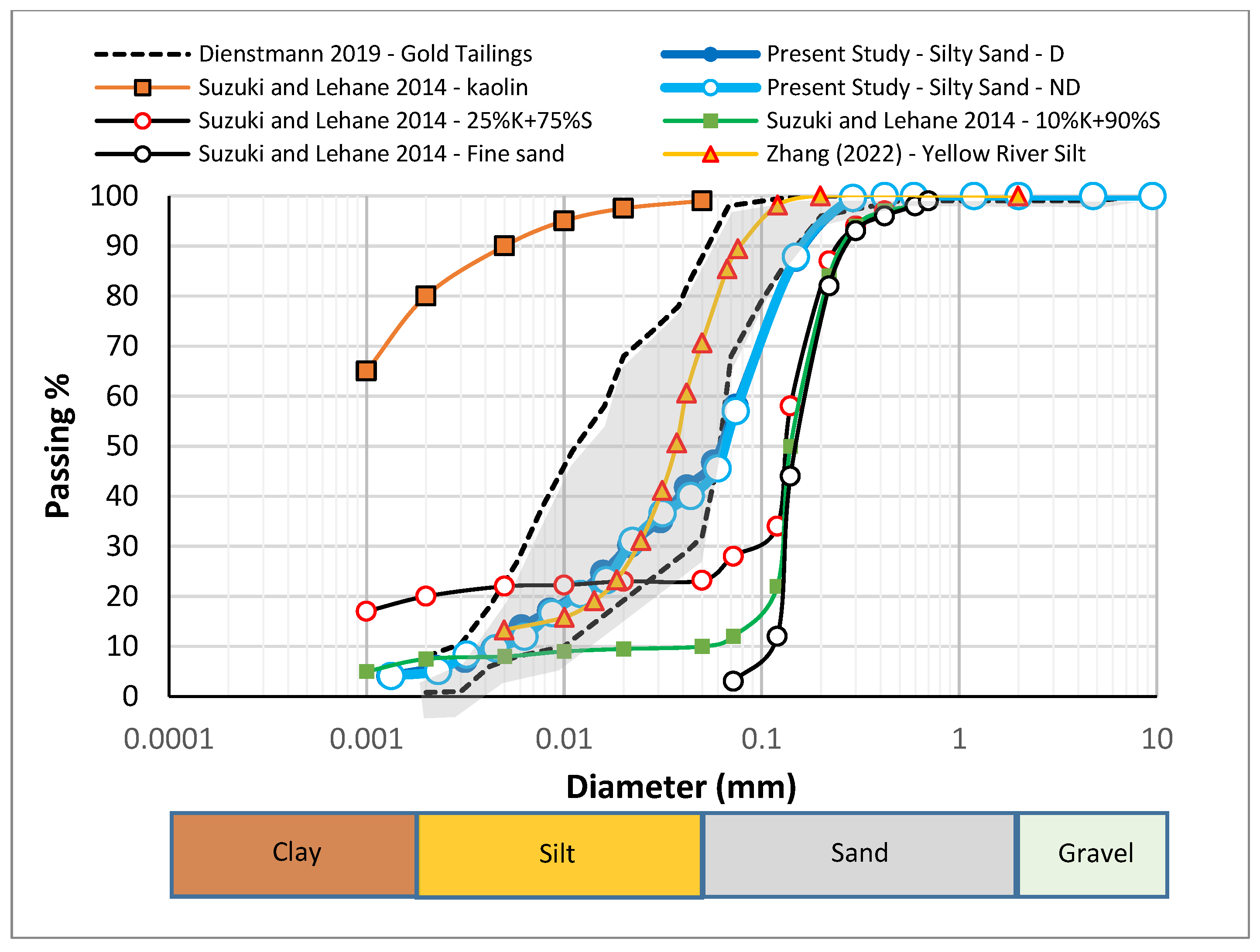
The particle size distribution is shown in Figure 6, with more than 50% of the mass within the silt–clay size range. The material is non-plastic based on Atterberg limits testing. The specific gravity of solids is Gs = 2.575, while the maximum and minimum void ratios are emax = 1.10 and emin = 0.36, respectively.

3.2. Specimen Preparation

Specimens were prepared under three conditions: dry, flooded, and slurry. Dry and flooded specimens correspond to the initial phase of the experimental program (triaxial-based penetration system), whereas slurry-prepared specimens were adopted in a subsequent phase to improve specimen homogeneity and repeatability under saturated conditions, in combination with the servo-controlled penetration system.

3.2.1. Dry Specimens

Two dry specimens were prepared at different target densities. The loose specimen was formed at hygroscopic water content using the air pluviation method, in which dry soil was deposited into the mold through a controlled nozzle system. In accordance with JGS 0520, the initial relative density was controlled by calibrating the nozzle opening and maintaining a constant drop height during deposition [29]. This technique, also referred to as dry funnel deposition, is widely recognized for reproducing soil structures representative of materials formed under low-energy depositional conditions and is particularly suitable for silts and silty sands [30,31]. Based on preliminary calibration tests relating drop height and resulting density, the adopted procedure resulted in a relative density of Dr = 16.4%.
The dense specimen was prepared using air pluviation followed by controlled layer-by-layer compaction. After deposition of each layer (approximately 50 mm thick), the soil surface was compacted using a square wooden tamper with a mass of approximately 2 kg and a contact area of 300 × 300 mm. Compaction energy was controlled by maintaining a drop height of approximately 150 mm.
Preliminary trials were conducted to determine the combination of drop height and number of blows required to achieve the target density. Based on these trials, approximately 20 blows were applied per tamper footprint for each layer. Care was taken to maintain uniform surface leveling between layers to minimize density variability along the specimen height. This procedure resulted in a relative density of Dr = 53.2%.
The initial state parameters for the dry specimens, including natural unit weight, dry unit weight, void ratio, and relative density, are reported in Table 1.

3.2.2. Flooded Specimens

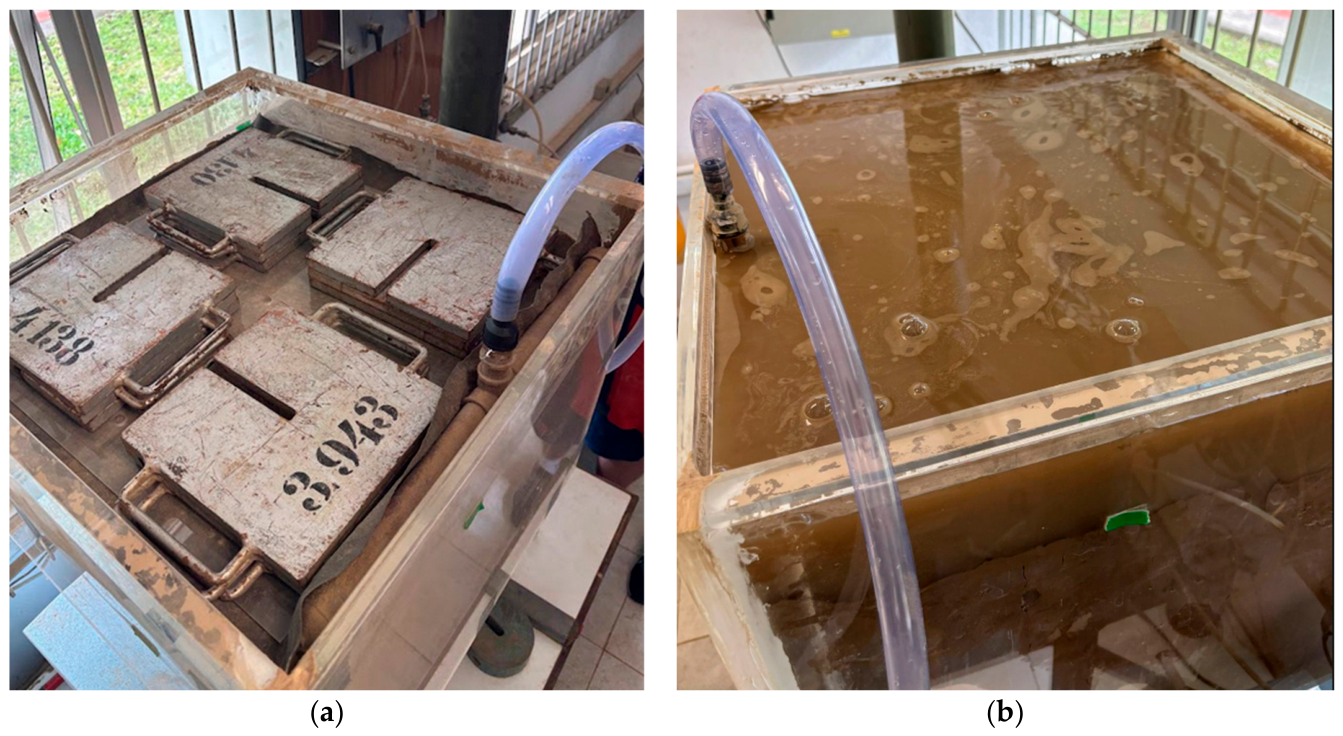
Flooded specimens were included as an intermediate validation stage between the dry baseline tests and the subsequent slurry testing campaign. They were initially prepared by air pluviation at hygroscopic water content and subsequently flooded by upward infiltration through pre-installed tubing (Figure 7a). Upward infiltration was adopted to promote progressive displacement of pore air and reduce the likelihood of air entrapment within the specimen. This condition allowed preliminary evaluation of pore-pressure measurements and penetration-rate effects.
To prevent soil heaves and disturbance during infiltration, a surcharge system was installed at the specimen surface. A geotextile layer was first placed directly over the soil surface to prevent particle migration. A perforated acrylic plate, approximately matching the cross-sectional dimensions of the specimen, was positioned above the geotextile to allow upward water flow while promoting uniform load transfer. Four rigid steel plates, each with a mass of approximately 12 kg, were then placed over the acrylic plate. The total surcharge mass of approximately 48 kg was distributed over an area of roughly 0.55 × 0.55 m, resulting in an estimated average vertical stress of approximately 1.6 kPa.
This light and uniformly distributed confinement were intended to counteract upward hydraulic forces during infiltration while preserving the initial fabric and density of the pluviated specimen. Following completion of infiltration, a water layer was maintained at the specimen surface for 48 h prior to testing, allowing hydraulic equilibrium and redistribution of pore pressures (Figure 7b).
Specimen height was monitored during infiltration to quantify volumetric change. As the specimens were laterally confined, the reduction in height was interpreted as a decrease in total volume under constant dry mass, allowing the updated dry unit weight to be determined. The initial and final void ratios were then computed from the corresponding dry unit weights and the specific gravity of solids. After saturation, the gravimetric water content was measured directly, and the degree of saturation was subsequently estimated using the phase relationship S = w G s / e , adopting the final void ratio. The resulting state parameters for both specimens are summarized in Table 2. Considering the intermediate permeability of the tested material and the focus of this study on penetration rate effects and drainage behavior rather than precise undrained strength quantification, the achieved degree of saturation (Table 2) was considered adequate for the objectives of the experimental program.

3.2.3. Unit Weight Control for Dry and Flooded Specimens

For both dry and flooded molding procedures, specimen unit weight was controlled and quantified during preparation using an embedded sampling insert of known volume. Once approximately half of the target specimen height was reached, a rigid square mold (50 × 50 × 25 mm) was inserted near the mid-height of the specimen within the acrylic container to obtain a representative estimate of the overall density. The preparation procedure (pluviation or pluviation followed by compaction) was then continued to completion.
After molding, the surrounding material was carefully excavated and the insert was retrieved, yielding a specimen of known volume for mass determination. The natural unit weight was calculated from the measured mass and known volume immediately after retrieval, and the dry unit weight was subsequently obtained from the measured water content. The procedure was repeated for different specimens to confirm consistency of the achieved density. This approach is analogous to the use of calibrated sampling boxes in large-scale physical modeling to verify the final dry unit weight of specimens prepared by pluviation [32].

3.2.4. Slurry Specimen

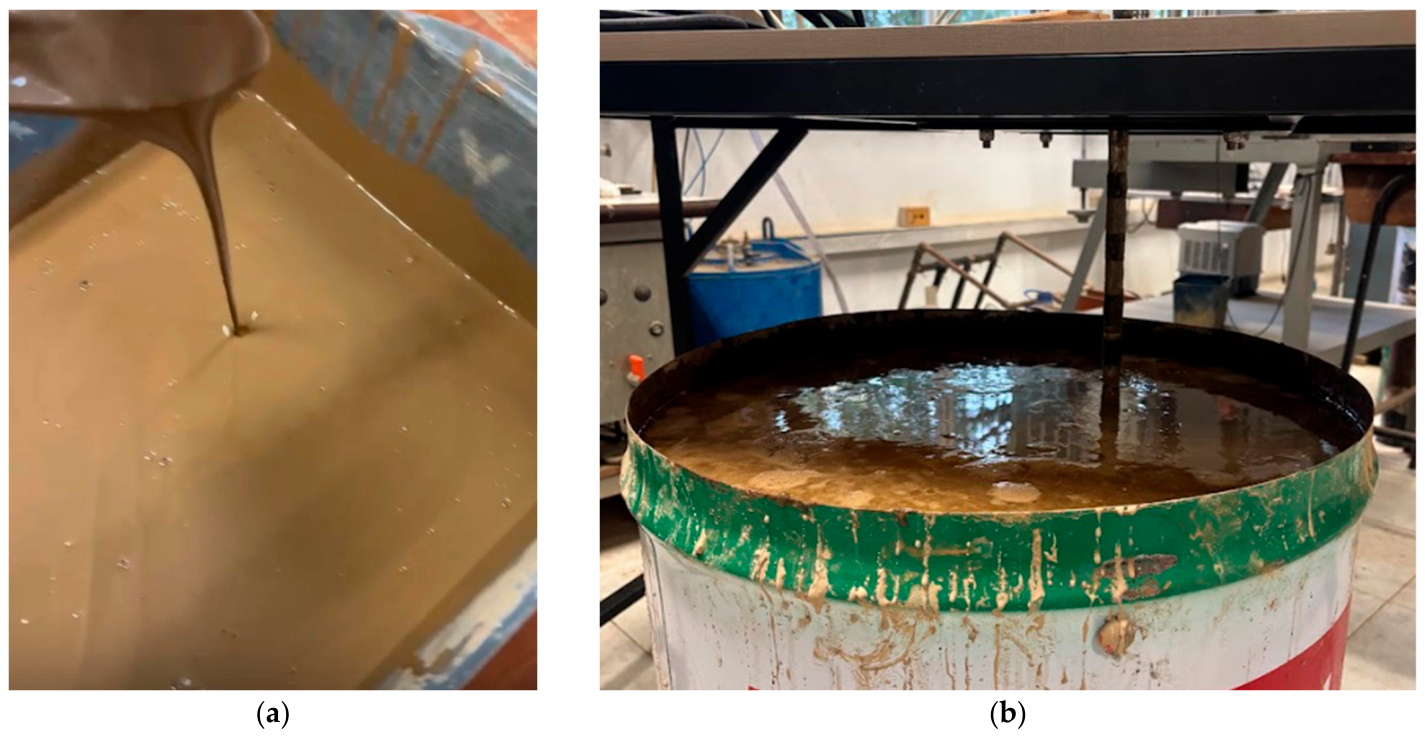
Slurry specimens were adopted to improve specimen homogeneity and repeatability under saturated conditions during the servo-controlled testing stage. Specimens were prepared at a target water content of w = 20% (observed range: 20–22%) by thoroughly mixing the material with water and depositing the resulting slurry into a cylindrical drum (diameter 580 mm, height 600 mm). The procedure follows principles similar to slurry deposition techniques described by Yamamuro and Wood [30], in which soil is mixed at elevated water contents to promote homogeneous particle distribution prior to placement. The mixing stage is illustrated in Figure 8a.
Preliminary mixing trials were conducted to define an appropriate water content for slurry preparation. It was observed that increasing the water content beyond approximately 22–24% did not result in further incorporation of water into the soil matrix; instead, excess water accumulated at the surface during mixing and deposition. Based on these observations, a target water content of approximately 21% was adopted to ensure adequate workability while maintaining mixture stability.
The slurry required to fill each specimen was produced in multiple pre-mixing batches to ensure uniform water content. Each batch was thoroughly homogenized prior to deposition. After placement, a water layer of approximately 50 mm was maintained at the surface, and the specimens were left undisturbed for 48 h before penetration testing. The prepared slurry specimen prior to testing is shown in Figure 8b. This waiting period was selected based on preliminary observations of self-weight settlement to avoid testing during the initial sedimentation stage, as supported by the unit weight monitoring procedure described below.
Successive slurry specimens were prepared using a reconditioning procedure. After each testing stage, the material was recovered, the container was cleaned, and the slurry was remixed to restore uniformity prior to preparing the next specimen. Water was added when required during remixing to maintain workability, and the resulting preparation was kept within the target water content range (20–22%).
Slurry unit weight was quantified for most preparations using a settling-cylinder procedure. A representative portion of slurry from one of the pre-mixing batches was transferred into graduated cylinders of known internal volume. The sample mass was measured, and the separation process was monitored daily for seven days. Each day, the mass was re-measured, and the volumes of the clear water layer and the total column (soil + water) were recorded. Natural unit weight was estimated from the measured mass and total volume at each observation. For consistency with the penetration testing schedule, slurry unit weight values reported in this study correspond to the measurements obtained after 48 h of deposition, which was the minimum waiting time adopted before starting penetration tests. The monitoring indicated that unit weight changes after 48 h were small, and this observation supported the adoption of 48 h as the standard minimum settling period for the experimental campaign. Unit weight measurements are reported where available in Table 3.

3.3. Test Program

A total of ten laboratory specimens were prepared during the experimental campaign. Baseline tests on dry and flooded specimens correspond to S01–S04, while slurry tests correspond to S05–S10. The specimen identification and corresponding preparation conditions are reported in Table 1, Table 2 and Table 3, separately for dry, flooded, and slurry specimens.
Penetration tests were performed using the two configurations described in Section 2. Baseline dry and flooded testing employed the triaxial-based penetration system, whereas the slurry phase used the dedicated servo-controlled external system to provide improved rate control over a wider range.
For the flooded specimens (S03–S04), penetrations were conducted at velocities of 9.6, 0.28, 0.10, and 0.03 mm/s. These tests followed a two-stage actuation sequence: (i) the gantry advanced the cone to 200 mm depth; (ii) penetration from 200 to 300 mm was then carried out using the piston-driven stage, with the gantry held stationary. Two transition protocols were adopted. For specimen S03, the piston-driven stage started immediately after the gantry stopped at 200 mm (no holding period). For specimen S04, a holding period of approximately 1 h was introduced at 200 mm prior to restarting penetration at the lower velocities to enable dissipation measurements; these penetrations are identified as “Dissip” in figures and tables. Dissipation stages were not performed after every penetration rate. They were conducted only in selected piezocone tests, with the purpose of estimating the horizontal coefficient of consolidation used in the normalized penetration velocity analysis.
For the slurry specimens (S05–S10), a broader range of velocities was investigated (15, 7.5, 5, 2.5, 1, 0.5, 0.2, 0.1, 0.04, 0.02, and 0.004 mm/s) to systematically evaluate rate effects over multiple drainage regimes. In the slurry program, the target penetration rate was applied from the start of the test and maintained throughout the entire penetration. The servo-controlled velocity range was defined based on the preliminary triaxial-based results and on the objective of covering the full drainage response, including high-rate, transitional, and low-rate penetration conditions.
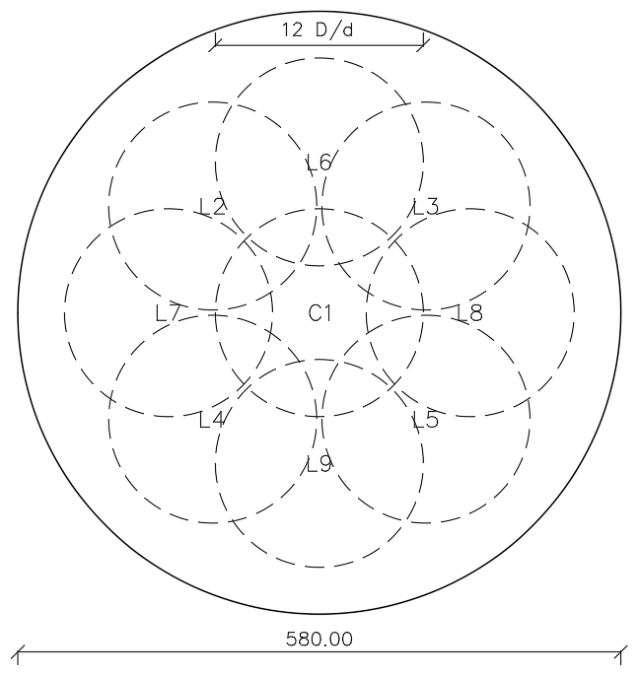
Within each specimen, multiple penetrations were conducted following a circular layout consisting of a central position (C1) and surrounding positions (L2–L9). The layout is shown in Figure 9. The minimum center-to-center spacing between successive penetrations satisfied D/d = 12, where D is the spacing and d is the cone diameter, to minimize overlap of the zone of influence between adjacent tests. This spacing criterion was adopted to minimize interaction between adjacent penetration zones and reduce overlaps of the stress and pore pressure influence regions, consistent with recommendations for variable-rate piezocone testing in laboratory conditions reported by Zhang et al. (D/d = 10) [19]. The test box imposed rigid lateral boundary conditions, with no independent lateral stress control. This configuration was selected to provide repeatable confinement for the laboratory-scale tests. Potential boundary effects were addressed by combining the spacing criterion, to limit interference between adjacent penetrations, with the use of central depth intervals for interpretation, to reduce the influence of the surface and base.
For data interpretation, representative values of cone resistance and pore pressure were extracted from a target depth interval defined for each penetration system. For the initial triaxial-based tests, the interval between 200 and 300 mm was adopted, consistent with the penetration depth range achievable under that configuration. For the slurry tests conducted using the servo-controlled system, the interval between 230 and 330 mm was adopted. In both cases, the selected interval was chosen to minimize boundary effects associated with the specimen surface and base, thereby focusing the analysis on the central zone of the specimen where the penetration response is more representative of the material.

3.4. Dissipation Tests

Dissipation stages were included only in selected piezocone tests, rather than after every penetration test, to estimate representative values of the horizontal coefficient of consolidation for the normalized velocity framework. Dissipation tests were interpreted using the analytical framework proposed by Teh and Houlsby [33], based on the time corresponding to 50% pore pressure dissipation (t50). The results are interpreted primarily as approximate indicators of consolidation behavior rather than precise determinations of consolidation parameters, given the reduced scale of the device and the laboratory-controlled testing conditions. This interpretation requires specification of the rigidity index, Ir, which was estimated as Ir = G0/Su. The small-strain shear modulus G0 was obtained using the correlation proposed by Tanaka et al. [34], expressed as G 0 =   50   ( q t σ v 0 ) , where σv0 is the total vertical stress. The undrained shear strength was estimated from cone measurements as S u = ( q t u 2 ) /   N k t , adopting Nkt = 8 [35]. Based on these estimates, representative values of Ir = 396 and Ir = 386 were adopted for the flooded and slurry specimens, respectively, and used in the dissipation interpretation.
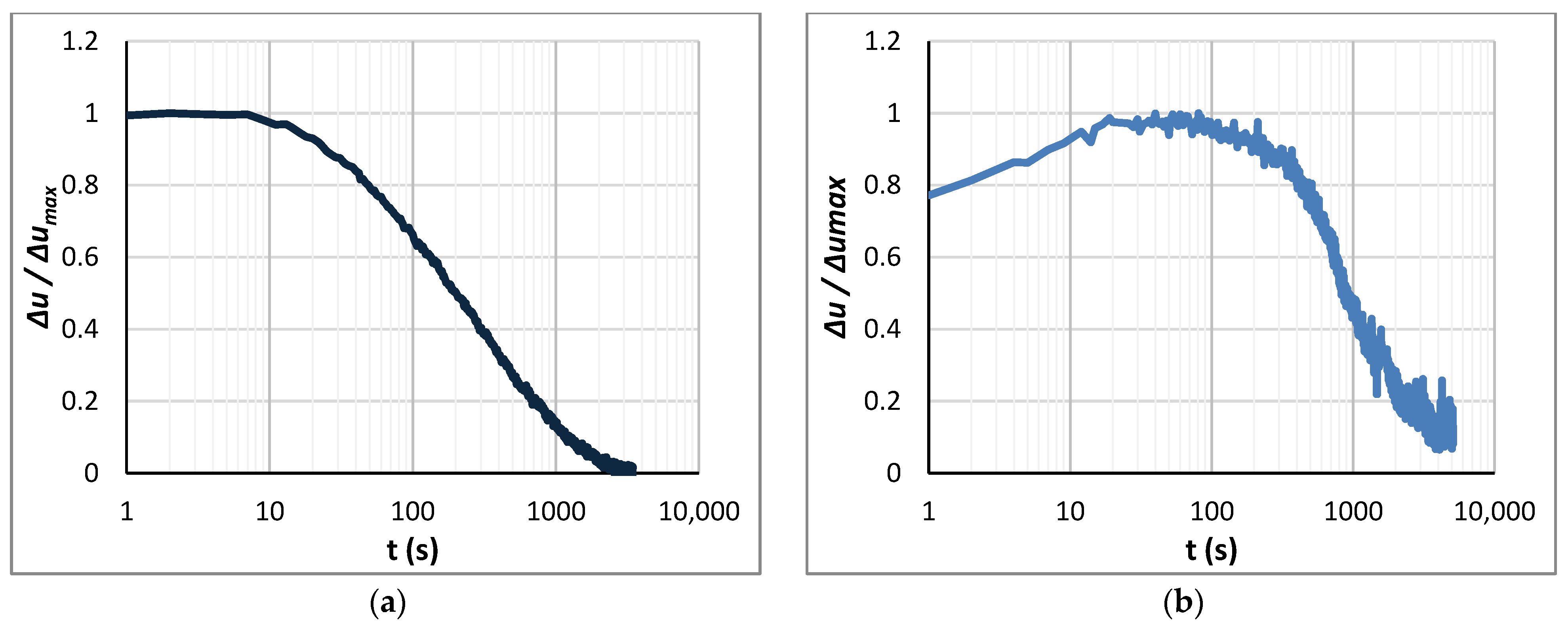
The selected dissipation tests are summarized in Table 4. Dissipation stages were not performed after every penetration rate; rather, they were included in selected piezocone penetrations to estimate representative values of the horizontal coefficient of consolidation used in the normalized velocity framework. The corresponding penetration rate, t50, and estimated ch values are reported in the table. The dissipation curve obtained for the flooded specimen is shown in Figure 10a, while Figure 10b presents an example of a dissipation curve obtained for a slurry specimen. For the construction of the drainage curves, ch values of 1.80 mm2/s and 0.50 mm2/s were adopted for the flooded and slurry specimens, respectively. The latter corresponds to the average value obtained from the selected dissipation tests.
Independent oedometer consolidation tests performed on slurry specimens under comparable low-stress conditions indicated a vertical consolidation coefficient cv of approximately 0.90 mm2/s. Although cv and ch are associated with different drainage directions, the values obtained are within the same order of magnitude, providing a useful consistency check for the consolidation parameters adopted in the normalized velocity analysis.

3.5. Data Processing and Corrections

Cone resistance measurements from flooded tests were post-processed to account for pore-pressure effects acting on the unequal areas of the miniature piezocone, following the standard net area correction procedure [2]. The correction was implemented using the net area ratio α , determined from the instrument geometry as the ratio between the shaft (or load-cell) cross-sectional area and the projected area of the cone tip. For the developed miniature cone, this procedure yielded α = 0.5783
To ensure consistent processing across all flooded and slurry condition penetrations, the hydrostatic pore pressure u0 was adopted as the pore-pressure input for the net area correction, rather than the measured u2. This approach reduces variability associated with very low-magnitude pore pressure readings relative to the sensor measurement range and provides a more stable basis for comparing resistance values across tests. It is acknowledged that using u0 does not account for penetration-induced excess pore pressure; however, given the small magnitude of measured pore-pressure during testing, the resulting influence of the corrected resistance is expected to be minor.
Unless otherwise stated, flooded and saturated resistances are reported as net cone resistance, qnet computed from the area-corrected tip resistance by removing the total vertical overburden stress, qnet = qtσv0. For depth-consistent comparisons, results are presented in normalized form as Q = qnet/σv0, where σv0 is the initial vertical effective stress evaluated as a function of depth.

4. Results

4.1. Penetration Response in Dry Specimens (Triaxial-Based System)

Penetration results obtained using the triaxial-based system are first presented to establish a reference response for the miniature piezocone under dry conditions, providing a baseline for comparison with the flooded and slurry tests presented subsequently.
For the dry specimens, penetration response is evaluated in terms of cone resistance only. Pore pressure measurements are not considered because the pore pressure system was intentionally disabled for dry testing, with the porous stone replaced by a metallic ring, preventing hydraulic communication with the soil.
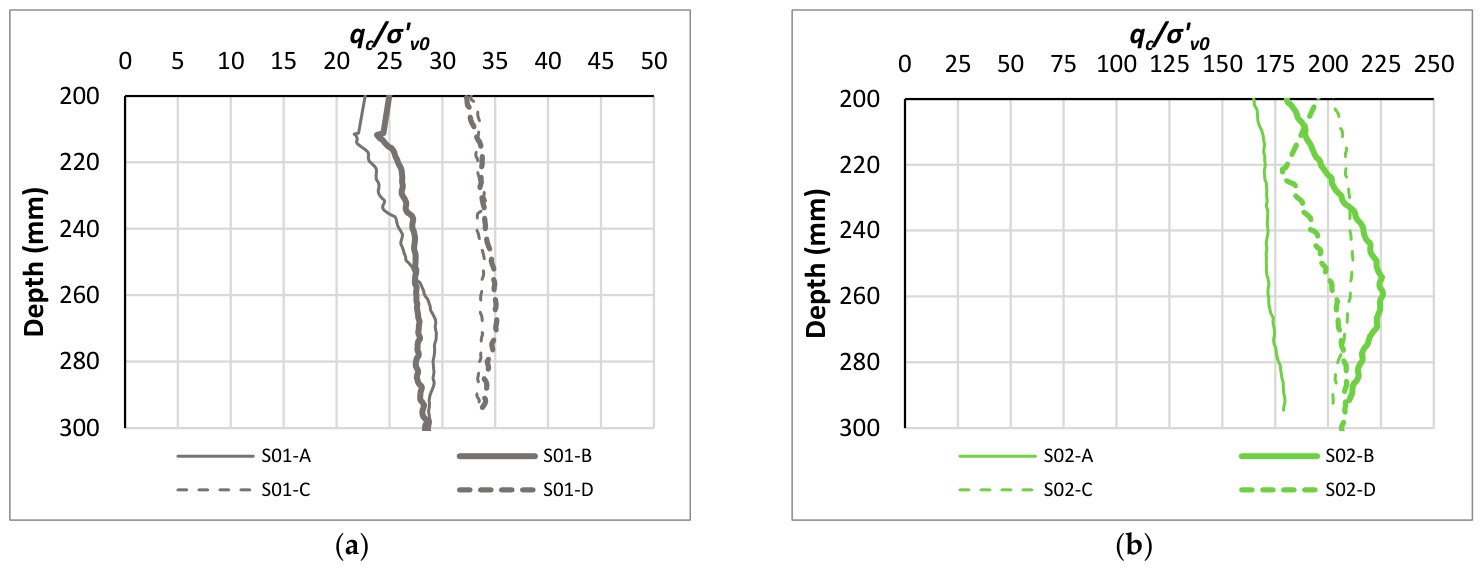
The normalized cone resistance profiles for the dry loose (S01) and dry dense (S02) specimens are shown in Figure 11. Both specimens exhibit a systematic increase in resistance with depth and a clear dependence on density, with substantially higher resistance mobilized in the dense specimen. To enable a consistent comparison, representative values were extracted from the central portion of the specimen, corresponding to the 200–300 mm depth interval adopted for the triaxial-based configuration. Table 5 summarizes the mean normalized resistance for each penetration (A–D) together with the overall statistics combining the four penetrations.
Within the selected interval, S01 shows relatively stable normalized resistance, with penetration-mean values clustered within a narrow range and low within-penetration variability. The four penetrations exhibit consistent response levels, supporting the repeatability of the miniature cone resistance measurements under dry conditions. In contrast, S02 mobilizes markedly higher normalized resistance, with penetration-mean values approximately one order of magnitude above those measured in S01. Despite the higher resistance level, the response in S02 remains consistent across the repeated penetrations, indicating that the observed density effect is robust and not controlled by local heterogeneity.
Overall, the close agreement among the four penetrations for each dry specimen confirms the repeatability of resistance measurements obtained with the miniature cone, establishing a reference condition for subsequent interpretation of flooded and slurry tests.

4.2. Penetration Response in Flooded Specimens (Triaxial-Based System)

Flooded miniature piezocone tests were performed on specimens S03 and S04 at four penetration velocities (9.6, 0.28, 0.10, and 0.03 mm/s), covering more than two orders of magnitude in normalized penetration velocity (Vh). At each velocity, two penetrations (penetrations A and B) were conducted to assess repeatability and specimen homogeneity within the triaxial-based configuration. Cone resistance is reported as the normalized net resistance Q, and representative values were extracted from the target interval (200–300 mm), corresponding to the piston-driven segment adopted for flooded testing. The extracted mean values are summarized in Table 6, together with coefficients of variation (COVs) computed over the same depth interval.
The Q–depth profiles (Figure 12) show a consistent penetration-rate dependency over the analyzed interval. For both specimens, Q increases systematically as Vh decreases, and the paired repeats at each rate preserve the same ordering and similar response levels. Minor deviations in profile shape occur in isolated penetrations but do not affect the overall trend; accordingly, rate dependency is quantified using mean Q values
In comparing Figure 12a,b, differences in the transition into the piston-driven segment are reflected in the profile presentation. In S03 (Figure 12a), penetration proceeded without a holding period, and the Q profiles exhibit a more pronounced depth trend, with Q continuing to increase across the target interval. In S04 (Figure 12b), the low-rate penetrations labeled “Dissip” include a holding period prior to restarting Stage 2, and the corresponding Q profiles begin at higher levels and appear more uniform within 200–300 mm. This distinction is relevant when comparing profile shape and pore-pressure data availability between the two flooded series; however, rate dependency is quantified consistently using mean Q values extracted from the same interval for all penetrations.
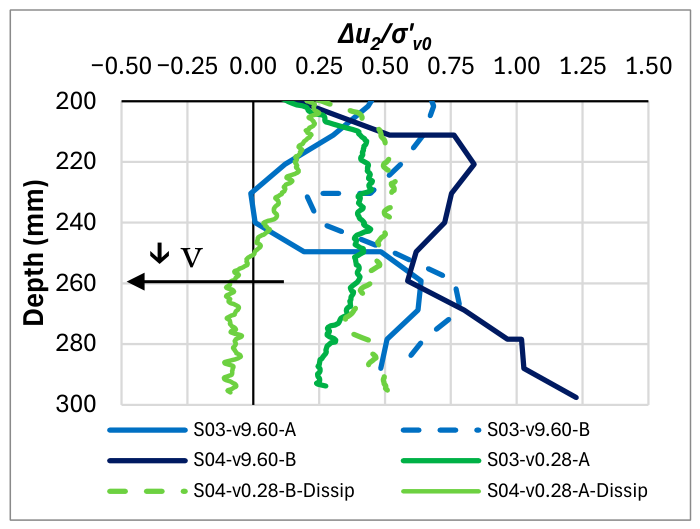
Pore pressure response is presented in terms of the normalized excess pore pressure, Δu2/σv0, in Figure 13. Profiles indicate a rate dependency in the level of excess pore pressure, with positive values at the highest penetration rate and responses that decrease toward zero at lower rates. Because the measured pore-pressure magnitudes are small relative to the full measurement range of the pressure transducer, Δu2/σv0 is interpreted primarily in terms of relative trends rather than absolute magnitude. In several tests, pore-pressure readings were partially or fully lost due to clogging of the porous filter element, which limited data continuity in some runs.
Table 6 summarizes mean values of Q and Δu2/σv0 extracted from the target region with the corresponding within-penetration COV. As expected, the data shows a systematic increase in Q as Vh decreases for both specimens, and the paired repeats (A/B) show comparable response levels at each rate. The within-penetration COV values for Q are generally low, supporting the use of a single representative mean value per penetration. Where available, Δu2/σv0 values provide qualitative support for a coupled rate-dependent response; however, pore-pressure availability is limited for some penetrations, and COV values can be comparatively high due to the low signal magnitude relative to the sensor operating range.
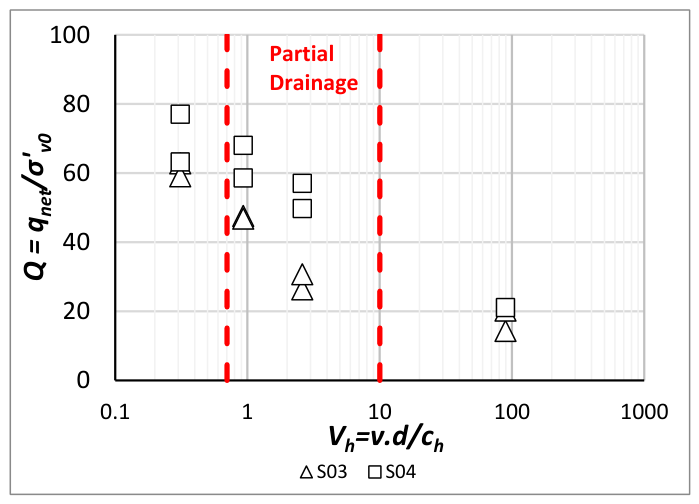
Figure 14 summarizes the flooded results in terms of the normalized net resistance Q plotted against the normalized penetration velocity Vh. The data show a clear and monotonic rate dependency: Q decreases systematically as Vh increases, with high Q values at low Vh, intermediate values at 0.5 < Vh < 10, and the lowest Q values at the highest Vh. Despite some scatter in the intermediate range, both specimens follow the same overall trend, while S04 generally plots at higher Q levels than S03 for comparable Vh. This normalized representation provides the basis for comparison with drainage-transition trends and for the interpretation developed in the following section.

4.3. Penetration Response in Slurry Specimens (Servo-Controlled System)

Slurry-prepared specimens (S05–S10) were tested using the servo-controlled penetration system, which maintained a constant prescribed velocity throughout the entire penetration depth. Unlike the triaxial-based configuration used for the flooded series, penetration was continuous and did not involve actuator transitions. Representative values were extracted from the target zone (230–330 mm) for all tests and are summarized in Table 7.
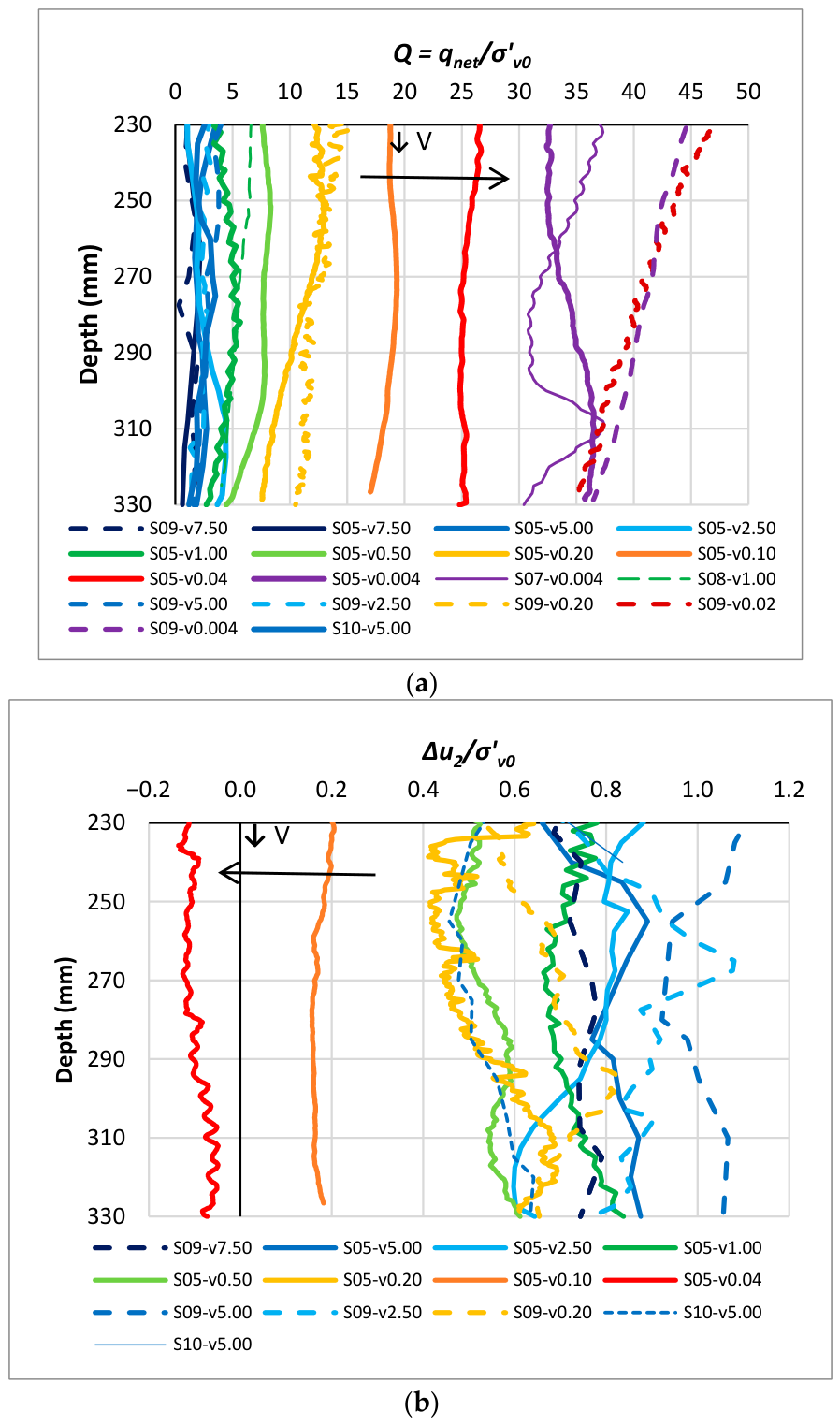
The normalized net cone resistance profiles (Figure 15a) show a clear and systematic penetration-rate dependency across the investigated range (0.004–15 mm/s). In the figure, warmer colors correspond to lower penetration rates and cooler colors to higher rates, emphasizing the progressive increase in Q as penetration rate decreases. Within the target zone, separation between curves associated with different penetration rates is more pronounced than the variation in Q with depth within a given penetration, indicating that penetration rate dominates the response in this interval. For specimens tested at multiple rates (e.g., S05 and S09), the ordering of the profiles is preserved across the full depth of the target zone, demonstrating internal consistency and repeatability within the slurry series.
The pore pressure response expressed as normalized excess pore pressure Δu2/σv0 exhibits a complementary trend (Figure 15b). Higher penetration velocities generate larger positive excess pore pressures, while decreasing velocity leads to progressively smaller values. At intermediate velocities, Δu2/σv0 approaches zero, indicating limited excess pressure generation during penetration. At the lowest velocities, pore pressure measurements were affected by time-dependent signal drift, and reliable values could not be consistently obtained; these limitations are treated as instrumentation constraints rather than intrinsic soil response features.
To quantify the observed trends, mean values of Q and Δu2/σv0 were computed within the target zone for each penetration. The corresponding within-penetration coefficients of variation (COV) are also reported in Table 7 to characterize signal stability along the selected interval.
Table 7 confirms the strong penetration-rate dependency observed in the profiles. Across specimens tested over multiple rates (notably S05 and S09), Q increases systematically as Vh decreases, spanning more than three orders of magnitude in normalized penetration rate. The within-penetration COV values for Q are generally below 20% and frequently below 10% at intermediate and low Vh, indicating stable resistance measurements within the target zone. Higher COV values are observed primarily at the highest penetration rates, where Q values are small and more sensitive to local variability. For Δu2/σ′v0, COV values are moderate to high when mean values approach zero, reflecting reduced signal-to-noise ratio rather than increased material variability.
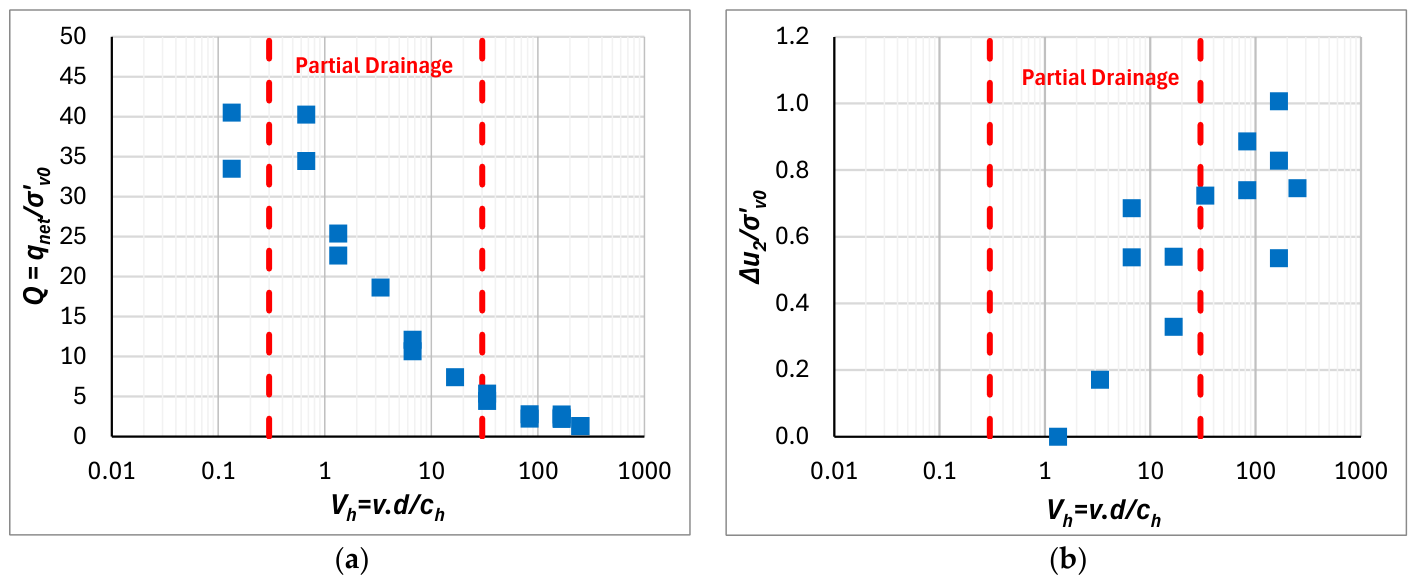
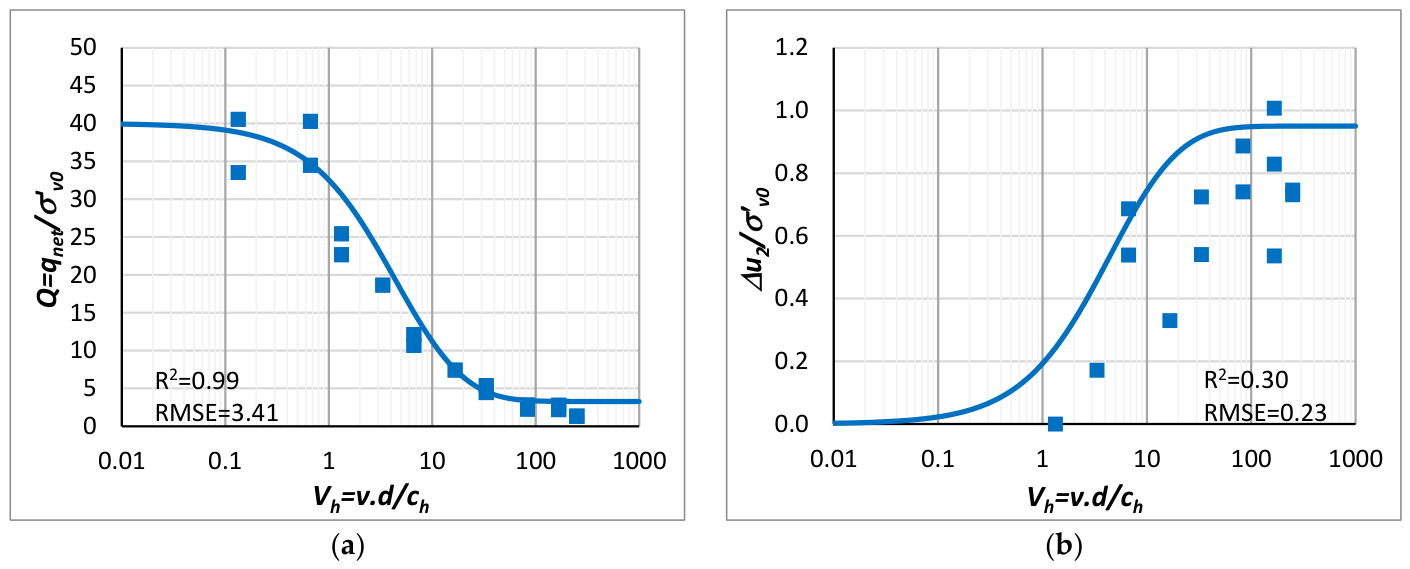
To consolidate the slurry dataset, the extracted mean values are presented as functions of normalized penetration rate Vh. Figure 16 shows Q vs. Vh, while Figure 16b presents Δu2/σv0 vs. Vh. Figure 16a consolidates the slurry results in a single normalized framework. The data define a continuous and well-ordered QVh relationship across the investigated range, with no discontinuities between specimens. The drainage transition occurs approximately within the interval 0.3 ≤ Vh ≤ 30. Within this range, penetration evolves from partially drained behavior toward drained conditions as Vh decreases. Figure 16b presents the corresponding variation in normalized excess pore pressure. Δu2/σv0 decreases progressively with decreasing Vh and approaches zero within the same intermediate interval identified in Figure 16a. Below this range, excess pore pressure remains small relative to measurement resolution.

5. Discussion

5.1. Material Characterization and Positioning Relative to Published Soils

The particle-size distribution (PSD) of the present material plots predominantly within the silt–sand size domain, consistent with its classification as a silty sand. The two PSD curves reported (Dispersor vs. Non-Dispersor) are very close to each other, indicating that the adopted dispersion protocol does not materially alter the overall grading description at the resolution represented in the plot (Figure 17). This comparison was included to verify whether aggregation of fine particles could affect the measured grain-size distribution; however, the similarity between the curves indicates that the material classification and interpretation are not sensitive to the dispersion procedure.
The PSD curves position the present soil within the same intermediate granulometric range occupied by published reference materials included in the comparison dataset, notably gold tailings [13] and Yellow River silt [19], and between the extremes represented by kaolin (finer) [36] and sand-dominated mixtures (coarser) [37]. This positioning is consistent with the expectation that penetration response is sensitive to drainage conditions, making the material suitable for analysis within a normalized rate framework.

5.2. Influence of Specimen Preparation and Testing Procedure

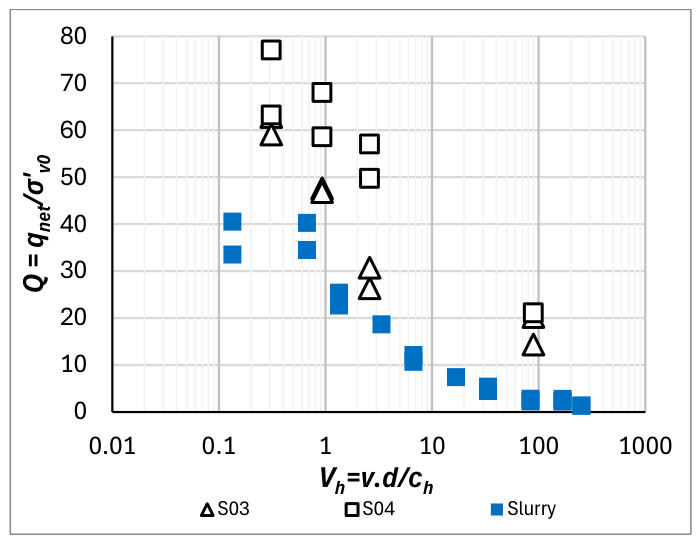
Figure 18 compares the QVh response obtained for slurry-prepared specimens and for flooded reconstituted samples (S03 and S04). A systematic difference is observed: for comparable normalized velocities, the flooded specimens exhibit higher Q values than the slurry specimens. This indicates a higher normalized resistance under similar drainage conditions.
This comparison, however, should be interpreted qualitatively. The specimen preparation methods differ (slurry deposition vs. flooded reconstitution), which may lead to differences in particle arrangement and initial structural condition. Furthermore, the testing configurations were not identical, particularly with respect to penetration control (gantry + piston stages vs. servo-controlled system, as described in Section 3.3). Such differences may affect loading continuity and rate control during penetration.
Despite these differences, both datasets indicate a comparable trend within the intermediate velocity range. In particular, between Vh ≈ 1 and Vh ≈ 10, the slurry and flooded datasets show a consistent decrease in normalized resistance with increasing penetration velocity. This interval therefore represents a common transition tendency between drainage conditions in both specimen types. Outside this range, direct comparison becomes less conclusive because the flooded tests cover a narrower range of penetration velocities, resulting in fewer data points at very low and very high Vh.

5.3. Normalized Rate Dependency and Transition Zone

The experimental results indicate that the drainage transition for the tested silty material occurs approximately within the interval 0.3 ≤ Vh ≤ 30, which defines the operational partially drained regime observed in the laboratory tests. To describe the rate dependency within this transition framework, the hyperbolic cosine rate law originally presented by Schnaid (2005) [38] was adopted herein in the same operational form used by Dienstmann et al. [13] to fit the Q-Vh and U-Vh backbone curves. In this approach, the normalized resistance Q = qnet/σv0 and the normalized excess pore pressure U = Δu2/σv0 are described by transition functions bounded by drained and undrained asymptotes. The fitted forms are written as:
Q = Q m i n + a + 1 a 1 cosh b V h c Q m a x Q m i n
U = U m a x a + ( 1 a ) 1 cosh b V h c U m a x U m i n
where a, b and c are fitting parameters. Parameter a controls the effective contrast between the drained and undrained limits, whereas b and c govern the rate and sharpness of the transition in Vh space. These coefficients should therefore be regarded as empirical fitting parameters that define the shape and position of the experimental backbone curve, rather than as independent intrinsic soil properties. In this definition, the partially drained regime is operationally identified as the finite range of Vh over which the fitted backbone departs from one asymptote and approaches the other, rather than a single critical value.
Using this formulation, a single representative backbone was fitted to the slurry dataset, with fitting coefficients a = 0.05, b = 0.7 and c = 0.5 and Qmax = 40, Qmin = 1.35, Umax = 1 and Umin = 0 (Figure 19). The goodness-of-fit was quantified against the fitted mean trend, resulting in R2 = 0.99 and RMSE = 3.41 for Q, and R2 = 0.30 and RMSE = 0.23 for U. These statistics indicate that the proposed normalization captures the rate dependency of Q with good consistency across the tested Vh range. In contrast, the fit for Δu2/σv0 is less satisfactory, which is consistent with the smaller number of pore-pressure data points, their higher dispersion, and the larger uncertainty associated with the pore-pressure transducer measurement margin.

5.4. Comparison with Published Drainage Curves

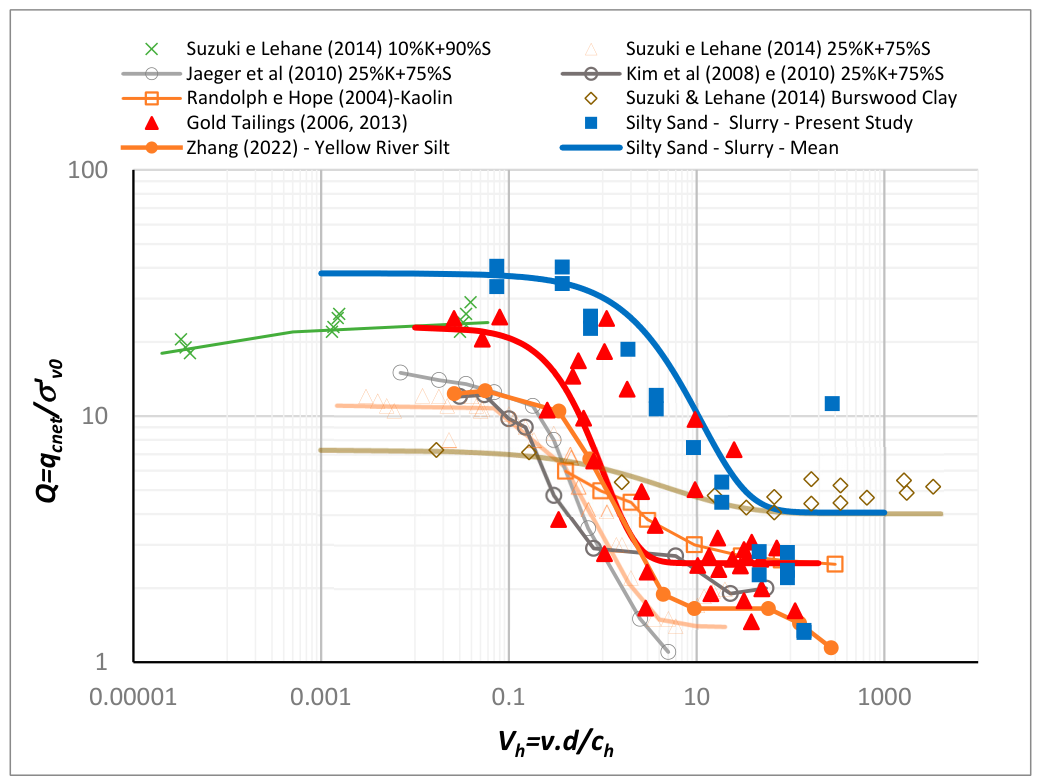
The QVh backbone obtained in the present study is compared with adapted published drainage curves for intermediate geomaterials, Figure 20 [13,19,36,37,38,39,40]. To ensure a consistent basis for comparison, the normalized velocity was expressed using ch, as adopted in the reference framework. For studies that report the normalized velocity in terms of cv (typically from oedometer tests in the normally consolidated range), the same operational conversion applied by Dienstmann et al. [13] was adopted, namely ch = 2cv, so that Vh = v·d/ch is consistent across datasets. This adjustment is not intended to redefine soil anisotropy or drainage physics for each material; rather, it provides practical normalization allowing disparate datasets to be compared on a common velocity scale, which is the main purpose of the published compilations on penetration-rate effects.
Figure 17. Particle-size distribution (PSD) comparison for the present silty sand positioned relative to reference materials [13,36,41].
Geotechnics 06 00048 g017
Figure 18. Normalized penetration rate response Q-Vh for flooded and slurry specimens.
Geotechnics 06 00048 g018
Figure 19. Normalized penetration rate response expressed in terms of dimensionless velocity: (a) Q = qnetv0 vs. Vh; (b) Δu2/σv0 vs. Vh.
Geotechnics 06 00048 g019
Figure 20. Comparison of normalized penetration resistance rate effects in the QVh space, including the present study slurry data and mean fitted backbone curve, together with backbone curves reported in the literature for reference [7,36,39,40,41].
Geotechnics 06 00048 g020
As shown in Figure 20, the mean backbone fitted for the present slurry is positioned above most published QVh curves over a broad portion of the normalized velocity range. This indicates higher normalized net resistance for a given normalized velocity. It is important to emphasize that Q is defined as Q = qnetv0; therefore, differences in the initial effective vertical stress directly influence the magnitude of the normalized response. In the present study, tests were conducted under relatively low initial stress levels (corresponding to a shallow overburden condition), whereas several of the reference datasets were obtained either from field tests at greater depths or from calibration chamber and centrifuge experiments under higher confining stresses. Consequently, stress-level effects may contribute to the vertical offset observed between the backbone curves.
Regarding drainage behavior, the present backbone indicates that the transition between drained and undrained conditions occurs approximately within 0.3 ≤ Vh ≤ 30. This interval is consistent with normalized velocity windows reported for intermediate soils. Dienstmann et al. [13] identified partial drainage within 0.01 ≤ Vh ≤ 10, while Zhang et al. [41] reported boundaries near Vv ≈ 0.3 (drained–partial) and Vv ≈ 30 (partial–undrained). The transition range observed in the present study lies within the same order of magnitude reported in the literature, although it appears slightly shifted toward higher Vh values relative to some reference datasets.
For additional context, Table 8 summarizes drained and undrained limits reported in selected CPTu and penetrometer rate-effect studies. The table shows that the transition interval identified in this study falls within the broad range of limits reported for intermediate permeability geomaterials in the literature.
The reliability of the experimental trends is supported by the repeatability observed in the dry and flooded tests, where repeated penetrations showed comparable resistance profiles within the interpreted depth intervals. In addition, the slurry campaign produced a continuous and well-ordered QVh response across the investigated velocity range. Together with the sensor calibration presented in Appendix A and the comparison with published transition limits summarized in Table 8, these results support the consistency of the measured rate-dependent response.
In summary, the laboratory results confirm that normalized penetration velocity provides a consistent framework to interpret drainage transitions in intermediate permeability geomaterials.

6. Conclusions

This study investigated penetration rate effects in a laboratory-prepared silty sand using a variable-rate testing approach and a normalized velocity framework. The main findings are summarized as follows:
  • The tested material, classified within the silt–sand domain, exhibits a clear rate-dependent penetration response when expressed in normalized velocity space.
  • Differences between slurry-prepared and flooded specimens indicate that specimen preparation method and testing configuration influence the measured rate response.
  • The transition between drained and undrained behavior occurs over a finite interval approximately between 0.3 ≤ Vh ≤30, which defines the operational partially drained regime for the tested material and is consistent in order of magnitude with published data for intermediate soils.
  • The hyperbolic cosine backbone fitting provided good agreement with normalized resistance data (R2 = 0.99; RMSE = 3.41), whereas pore-pressure fitting showed greater dispersion (R2 = 0.30; RMSE = 0.23), reflecting measurement uncertainty and pore-pressure data availability.
  • The normalized backbone is positioned above most published datasets, primarily reflecting differences in effective stress level and consolidation characteristics between the present laboratory conditions and previously reported field or calibration chamber datasets.
Beyond the material-specific findings, this work also contributes methodologically by presenting in detail a laboratory scale penetration testing framework, including the miniature piezocone, penetration system, and chamber configuration capable of reproducing characteristic drainage transitions in intermediate soils. The experimental configuration is relatively simple and cost-effective compared to large-scale calibration chambers or centrifuge facilities, providing a reproducible framework for systematic rate-effect investigations under controlled conditions.
Overall, the study demonstrates that controlled variable-rate laboratory testing, combined with normalized backbone interpretation, offers a practical and accessible approach for advancing the understanding of rate-dependent penetration behavior in intermediate geomaterials.
Future work is expected to extend the present approach to additional soil types, stress conditions, and penetrometer geometries. Ongoing research includes additional cone penetration campaigns with different cone tips, complementary triaxial testing to support interpretation of the material behavior, and numerical modeling studies to further evaluate drainage transitions and rate-dependent penetration response under controlled conditions.


Author Contributions

Conceptualization, H.M. and A.L.M.; methodology, H.M., A.L.M. and G.D.; software, H.M. and A.L.M.; validation, G.D. and H.M.; formal analysis, H.M. and G.D.; investigation, H.M., A.L.M. and G.D.; resources, G.D., H.P.N., M.d.S.E., O.M.O. and R.A.d.R.H.; data curation, H.M.; writing—original draft preparation, H.M.; writing—review and editing, G.D., H.P.N.; visualization, H.M. and G.D.; supervision, G.D.; project administration, G.D.; funding acquisition, G.D., H.P.N., M.d.S.E., O.M.O. and R.A.d.R.H. All authors have read and agreed to the published version of the manuscript.
Funding

This research was funded by the Coordenação de Aperfeiçoamento de Pessoal de Nível Superior (CAPES), by the Fundação de Amparo à Pesquisa e Inovação do Estado de Santa Catarina (FAPESC), and by the Conselho Nacional de Desenvolvimento Científico e Tecnológico (CNPq), project number 408889/2021-7.

Institutional Review Board Statement

Not applicable.

Informed Consent Statement

Not applicable.

Data Availability Statement

The data presented in this study are available on request from the corresponding author due to privacy.

Acknowledgments

The authors acknowledge the financial support provided by the Brazilian Federal Agency for Support and Evaluation of Graduate Education (CAPES),by the Foundation for the Support of Scientific and Technological Research of the State of Santa Catarina (FAPESC) and by the Conselho Nacional de Desenvolvimento Científico e Tecnológico (CNPq). The authors also acknowledge the Graduate Program in Civil Engineering (PPGEC) at the Federal University of Santa Catarina (UFSC) for the institutional and technical support provided during the development of this study. During the preparation of this manuscript, the authors used ChatGPT Version 5.5 (OpenAI) for language editing and translation purposes. The authors have reviewed and edited the generated content and take full responsibility for the final version of this publication.

Conflicts of Interest

The authors declare no conflicts of interest.

Abbreviations

The following abbreviations are used in this manuscript:
αNet area ratio
COVCoefficient of variation
CPTCone penetration test
CPTuPiezocone penetration test
chHorizontal coefficient of consolidation
cvVertical coefficient of consolidation
DrRelative density
eVoid ratio
emaxMaximum void ratio
eminMinimum void ratio
fsSleeve friction
GsSpecific gravity of solids
IrRigidity index
NktEmpirical cone factor
PSDParticle-size distribution
R2Coefficient of determination
RMSERoot Mean Square Error
QNormalized net cone resistance, dimensionless
qcCone tip resistance
qnetNet cone resistance
SDStandard deviation
t50Time to 50% pore pressure dissipation
u2Pore pressure measured at the u2 position
UNormalized excess pore pressure, dimensionless
vPenetration velocity (mm/s)
VhNormalized penetration velocity (based on ch), dimensionless
VvNormalized penetration velocity (based on cv), dimensionless
wWater content
γdDry unit weight
γnBulk (natural) unit weight
Δu2/σ′v0Normalized excess pore pressure, dimensionless
σ′v0Initial vertical effective stress (as used in normalization)

Appendix A

Sensor Calibration Curves

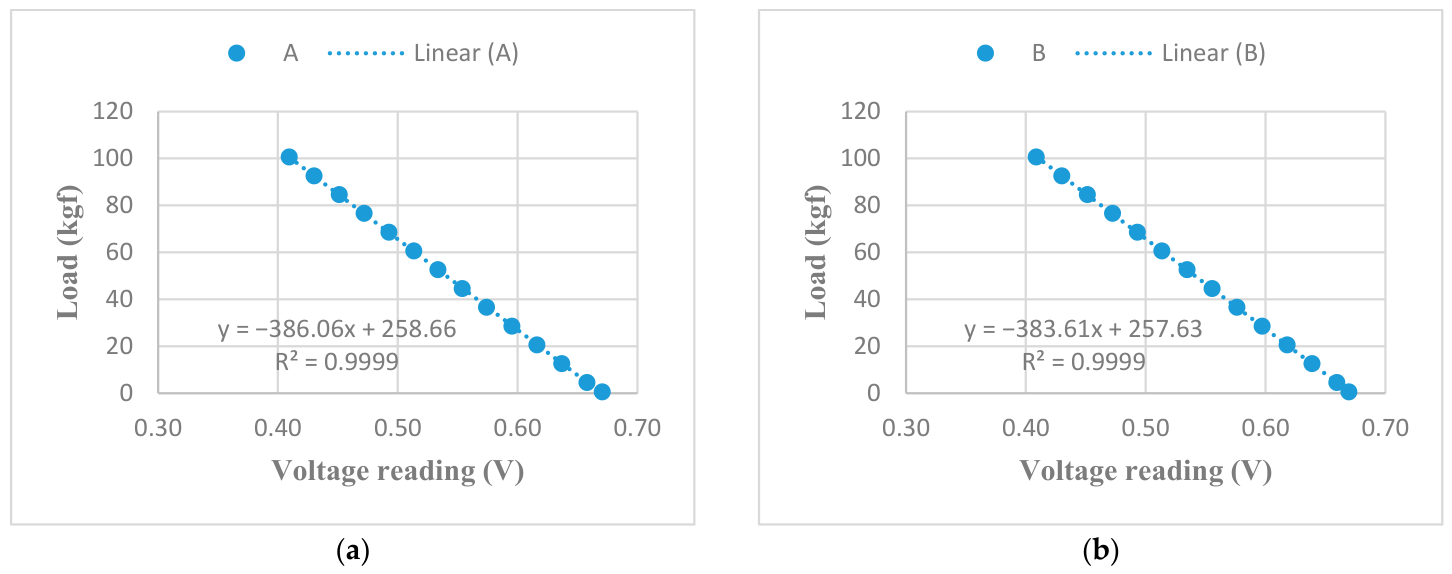
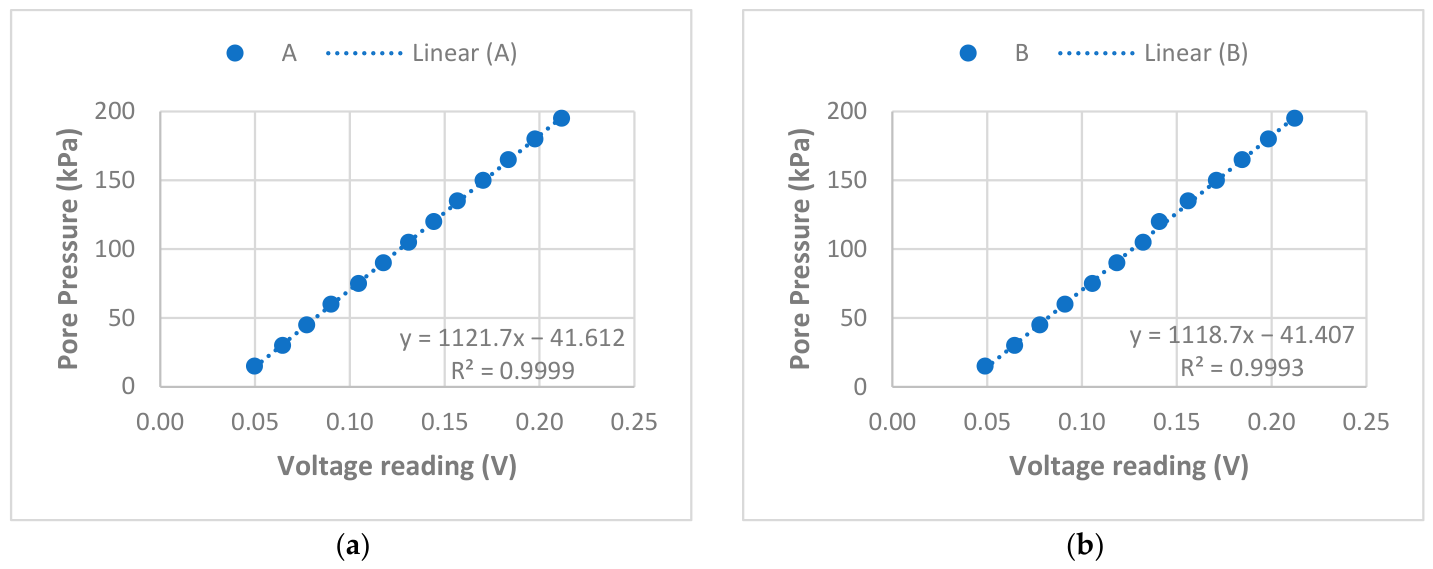
The sensors used in the miniature piezocone system were calibrated before data interpretation. Calibration curves were obtained for the axial load cell and the pore-pressure transducer by applying known reference loads or pressures and recording the corresponding voltage readings. Linear calibration equations were then used to convert the recorded voltage signals into load, expressed in kgf, and pore pressure, expressed in kPa.
The axial load cell was calibrated using a tensile loading and unloading procedure over a range of 0–100 kgf, approximately equivalent to 0–0.98 kN. The pore-pressure transducer was calibrated by applying known hydraulic pressure increments over the operating range used in the experimental program. For both sensors, two calibration series were considered to assess repeatability. The corresponding calibration curves are shown in Figure A1 and Figure A2, and the calibration equations are summarized in Table A1. In the calibration equations, V is the voltage reading. Load is expressed in kgf, and pore pressure is expressed in kPa.
Figure A1. Calibration curves for the axial load cell: (a) calibration series A; (b) calibration series B.
Geotechnics 06 00048 g0a1
Figure A2. Calibration curves for the pore-pressure transducer: (a) calibration series A; (b) calibration series B.
Geotechnics 06 00048 g0a2
Table A1. Calibration equations used for conversion of recorded voltage signals.
SensorRangeCalibration EquationR2
Axial load cell—Calib. A0–100 kgfLoad = −386.06 V + 258.660.9999
Axial load cell—Calib. B0–100 kgfLoad = −383.61 V + 257.63 0.9999
Pore pressure—Calib. A0–200 kPaPore pressure = 1121.7 V − 41.6120.9999
Pore pressure—Calib. B0–200 kPaPore pressure = 1118.7 V − 41.4070.9993

References

  1. Schnaid, F. In Situ Testing in Geomechanics: The Main Tests; CRC Press: Boca Raton, FL, USA, 2009. [Google Scholar]
  2. Jamiolkowski, M.; Ladd, C.C.; Germaine, J.T.; Lancellotta, R. New developments of field and laboratory testing of soils. In Proceedings of the 11th International Conference on Soil Mechanics and Foundation Engineering, San Francisco, CA, USA, 12–16 August 1985; Volume 1, pp. 57–153. [Google Scholar]
  3. Lunne, T.; Robertson, P.K.; Powell, J.J.M. Cone Penetration Testing in Geotechnical Practice; Blackie Academic & Professional: London, UK, 1997. [Google Scholar]
  4. ASTM D5778-12; Standard Test Method for Electronic Friction Cone and Piezocone Penetration Testing of Soils. ASTM International: West Conshohocken, PA, USA, 2012.
  5. Schnaid, F.; Dienstmann, G.; Odebrecht, E.; Maghous, S. A Simplified Approach to Normalisation of Piezocone Penetration Rate Effects. Géotechnique 2020, 70, 630–635. [Google Scholar] [CrossRef]
  6. DeJong, J.T.; Randolph, M.F. Influence of Partial Consolidation during Cone Penetration on Estimated Soil Behavior Type and Pore Pressure Dissipation Measurements. J. Geotech. Geoenviron. Eng. 2012, 138, 777–788. [Google Scholar] [CrossRef]
  7. Randolph, M.F.; Hope, S. Effect of cone velocity on cone resistance and excess pore pressures. In Proceedings of the IS Osaka Engineering Practice and Performance of Soft Deposits, Osaka, Japan, 2–4 June 2004; pp. 147–152. [Google Scholar]
  8. Silva, M.F.; White, D.J.; Bolton, M.D. An analytical study of the effect of penetration rate on piezocone tests in clay. Int. J. Numer. Anal. Methods Geomech. 2006, 30, 501–527. [Google Scholar] [CrossRef]
  9. Yi, J.T.; Goh, S.H.; Lee, F.H.; Randolph, M.F. A numerical study of cone penetration in fine-grained soils allowing for consolidation effects. Géotechnique 2012, 62, 707–719. [Google Scholar] [CrossRef]
  10. Wu, X.; Ghafghazi, M.; Liu, Z.; Tian, Y.; Chow, S.H. Numerical Modelling of Drained and Undrained Cone Penetration Tests. In Proceedings of the 10th NUMGE 2023: 10th European Conference on Numerical Methods in Geotechnical Engineering, London, UK, 26–28 June 2023. [Google Scholar] [CrossRef]
  11. Mafra, V.; Dienstmann, G. Cavity expansion solutions applied to help assess the partial drainage behavior characterization of the piezocone test. Comput. Geotech. 2022, 150, 105017. [Google Scholar] [CrossRef]
  12. Li, Y.-C.; Mo, P.-Q.; Cai, G.; Lu, Z.; Zhuang, Y.; Yu, H.-S. A CPTu-based method for evaluating consolidation characteristics of under-consolidated soils. Ocean. Eng. 2025, 349, 124151. [Google Scholar] [CrossRef]
  13. Dienstmann, G.; Schnaid, F.; Maghous, S.; DeJong, J.T. Piezocone penetration rate effects in transient gold tailings. J. Geotech. Geoenviron. Eng. 2018, 144, 04017116. [Google Scholar] [CrossRef]
  14. Finnie, I.M.S.; Randolph, M.F. Punch-through and liquefaction induced failure of shallow foundations on calcareous sediments. In Proceedings of the 7th International Conference on the Behaviour of Offshore Structures (BOSS ‘94); Pergamon: Oxford, UK, 1994; Volume 1, pp. 217–230. [Google Scholar]
  15. Lehane, B.M.; O’Loughlin, C.D.; Gaudin, C.; Randolph, M.F. Rate effects on penetrometer resistance in kaolin. Géotechnique 2009, 59, 41–52. [Google Scholar] [CrossRef]
  16. Mahmoodzadeh, H.; Wang, D.; Randolph, M.F. Interpretation of piezoball dissipation testing in clay. Géotechnique 2015, 65, 831–842. [Google Scholar] [CrossRef]
  17. García Martínez, M.F.; Tonni, L.; Gottardi, G.; Rocchi, I. Influence of penetration rate on CPTU measurements in saturated silty soils. In Proceedings of the 5th International Conference on Geotechnical and Geophysical Site Characterisation (ISC5), Sydney, Australia, 5–9 September 2016; pp. 473–478. [Google Scholar]
  18. Carroll, R.; Paniagua, P. Variable rate of penetration and dissipation test results in a natural silty soil. In Cone Penetration Testing 2018; Hicks, M.A., Pisanò, F., Peuchen, J., Eds.; Delft University of Technology: Delft, The Netherlands, 2018; pp. 207–212. [Google Scholar]
  19. Zhang, J.; Meng, Q.; Zhang, Y.; Feng, X.; Wei, G.; Su, X.; Liu, T. Effect of Penetration Rates on the Piezocone Penetration Test in the Yellow River Delta Silt. J. Ocean Univ. China 2022, 21, 361–374. [Google Scholar] [CrossRef]
  20. Dienstmann, G.; Perini, L.; Meier, A.L.; Ziesmann, N.; Campos, J.P. Incorporating inherited variability into the drainage effect analysis of piezocone tests in gold tailings. Proc. Inst. Civ. Eng.—Geotech. Eng. 2024, 178, 208–222. [Google Scholar] [CrossRef]
  21. Dienstmann, G.; Meier, A.L.; Campos, J.P.; Ziesmann, N. Incorporating inherent variability into numerical simulations of velocity effects: A behavior-based CPTu study on gold tailings. Soils Rocks 2026, 49, e2026013525. [Google Scholar] [CrossRef]
  22. Qi, Y.; Mozaffari, M.; Ghafghazi, M.; Talesnick, M. Calibration chamber testing on tailings for interpretation of partially drained CPT. In Proceedings of the 4th International Symposium on Cone Penetration Testing (CPT’24), Toronto, ON, Canada, 28 April–1 May 2024. [Google Scholar]
  23. Doan, L.V.; Lehane, B.M. Effects of partial drainage on the assessment of the soil behaviour type using the CPT. In Cone Penetration Testing 2018; Hicks, M.A., Pisanò, F., Peuchen, J., Eds.; Delft University of Technology: Delft, The Netherlands, 2018; pp. 275–280. [Google Scholar]
  24. Ayala, J.; Fourie, A.; Reid, D. A unified approach for the analysis of CPT partial drainage effects within a critical state soil mechanics framework in mine tailings. J. Geotech. Geoenviron. Eng. 2023, 149, 04023036. [Google Scholar] [CrossRef]
  25. Ads, A.; Iskander, M.; Bless, S. Shear Strength of a Synthetic Transparent Soft Clay Using a Miniature Ball Penetrometer Test. Geotech. Test. J. 2020, 43, 1248–1268. [Google Scholar] [CrossRef]
  26. Schnaid, F.; Odebrecht, E.; Sosnoski, J.; Robertson, P.K. Effects of test procedure on flat dilatometer test (DMT) results in intermediate soils. Can. Geotech. J. 2016, 53, 1270–1280. [Google Scholar] [CrossRef]
  27. Lavalle, L.V.A. Estudo da Interação Solo-Concreto Das Estacas Escavadas do Campo Experimental de Araquari. Master’s Thesis, Universidade Federal do Rio Grande do Sul, Porto Alegre, Brazil, 2017. [Google Scholar]
  28. Spricigo, B. Estudo do Comportamento de Monoestacas Executadas em Areia Submetidas a Carregamento Transversal: Campo Experimental de Araquari. Ph.D. Thesis, Universidade Federal do Rio Grande do Sul, Porto Alegre, Brazil, 2024. [Google Scholar]
  29. JGS 0520-2020; Preparation of Soil Specimens for Triaxial Tests. Japanese Geotechnical Society: Tokyo, Japan, 2020.
  30. Yamamuro, J.A.; Wood, F.M. Effect of depositional method on the undrained behavior of silty sand. Soil Dyn. Earthq. Eng. 2004, 24, 751–760. [Google Scholar] [CrossRef]
  31. Al-salih, O.; Al-abboodi, I. Assessment of a new pluviation system designed to prepare uniform samples of sand. J. King Saud Univ.–Eng. Sci. 2023, 38, 24. [Google Scholar] [CrossRef]
  32. Kabeta, W.F. Centrifuge Modelling of Tapered Pile Installation Effects in Sand. Ph.D. Thesis, Gdańsk University of Technology, Gdańsk, Poland, 2025. [Google Scholar]
  33. Teh, C.I.; Houlsby, G.T. An Analytical Study of the Cone Penetration Test in Clay. Géotechnique 1991, 41, 17–34. [Google Scholar] [CrossRef]
  34. Tanaka, H.; Tanaka, M.; Iguchi, H. Shear modulus of soft clay measured by various kinds of tests. In Proceedings of the Symposium on Pre-Failure Deformation of Geomaterials, Sapporo, Japan, 12–14 September 1994; Volume 1, pp. 235–240. [Google Scholar]
  35. Schnaid, F.; Lehane, B.M.; Fahey, M. In situ test characterization of unusual geomaterials. In Proceedings of the 2nd International Conference on Site Characterization, Rotterdam, The Netherlands, 19–22 September 2004. [Google Scholar]
  36. Suzuki, Y.; Lehane, B.M. Field observations of CPT penetration rate effects in Burswood clay. In Proceedings of the 3rd International Symposium on Cone Penetration Testing (CPT’14); Robertson, P.K., Cabal, K.L., Eds.; Omnipress: Madison, WI, USA, 2014; Volume 1, pp. 403–410. [Google Scholar]
  37. Suzuki, Y.; Lehane, B.M. Rate dependence of qc in two clayey sands. In Proceedings of the 3rd International Symposium on Cone Penetration Testing (CPT’14); Robertson, P.K., Cabal, K.L., Eds.; Omnipress: Madison, WI, USA, 2014; Volume 1, pp. 411–418. [Google Scholar]
  38. Schnaid, F. Geocharacterization and properties of natural soils by in situ tests. In Proceedings of the 16th International Conference on Soil Mechanics and Geotechnical Engineering; Millpress: Rotterdam, The Netherlands, 2005; Volume 1, pp. 3–46. [Google Scholar]
  39. Jaeger, R.; DeJong, J.T.; Boulanger, R.W.; Low, H.E.; Randolph, M.F. Variable penetration rate CPT in an intermediate soil. In Proceedings of the 2nd International Symposium on Cone Penetration Testing (CPT’10); Omnipress: Madison, WI, USA, 2010; Volume 1–3, p. 1371. [Google Scholar]
  40. Kim, K.; Prezzi, M.; Salgado, R.; Lee, W. Effect of penetration rate on cone penetration resistance in saturated clayey soils. J. Geotech. Geoenviron. Eng. 2008, 134, 1142–1153. [Google Scholar] [CrossRef]
  41. Zhang, Y.; Feng, X.; Ding, C.; Liu, Y.; Liu, T. Study of cone penetration rate effects in the Yellow River Delta silty soils with different clay contents and state parameters. Ocean Eng. 2022, 250, 110982. [Google Scholar] [CrossRef]
Figure 1. (a) Internal arrangement of the miniature piezocone. (b) Geometry (dimensions in mm).
Geotechnics 06 00048 g001
Figure 2. (a) Strain gauge bonding and wiring on the internal metallic shaft of the custom-built axial load cell. (b) Fully assembled miniature cone (Dimension in mm).
Geotechnics 06 00048 g002
Figure 3. Triaxial-based penetration system used in the initial testing stage performing a dry test.
Geotechnics 06 00048 g003
Figure 4. (a) Servo-controlled penetration system during laboratory testing. (b) Longitudinal section of the penetration system showing geometry and main components.
Geotechnics 06 00048 g004
Figure 5. (a) Load cell calibration. (b) Hydraulic calibration setup for the pore pressure transducer.
Geotechnics 06 00048 g005
Figure 6. Grain size distribution.
Geotechnics 06 00048 g006
Figure 7. (a) Upward infiltration arrangement with surcharge system installed at the specimen surface. (b) Specimen after saturation process with maintained surface water layer before testing.
Geotechnics 06 00048 g007
Figure 8. (a) Preparation of slurry material during mixing. (b) Slurry specimen after deposition and stabilization prior to testing.
Geotechnics 06 00048 g008
Figure 9. Penetration test layout and minimum spacing criterion within the slurry specimen (C1 and L2–L9; D/d = 12). Dimensions in mm.
Geotechnics 06 00048 g009
Figure 10. Examples of dissipation curves for selected piezocone tests used to estimate t50 and ch: (a) flooded specimen (S04) and (b) slurry specimen (S10).
Geotechnics 06 00048 g010
Figure 11. Profiles of normalized cone tip resistance for: (a) dry loose specimen (S01), (b) dry dense specimen (S02).
Geotechnics 06 00048 g011
Figure 12. Normalized net cone resistance profiles for (a) flooded specimen S03 and (b) S04.
Geotechnics 06 00048 g012
Figure 13. Normalized excess pore pressure profiles for flooded specimens S03–S04.
Geotechnics 06 00048 g013
Figure 14. Normalized net cone resistance (Q) vs. normalized penetration velocity (Vh) for flooded specimens S03–S04.
Geotechnics 06 00048 g014
Figure 15. (a) Normalized net cone resistance profiles for slurry specimens. (b) Normalized excess pore pressure profiles for slurry specimens.
Geotechnics 06 00048 g015
Figure 16. (a) Normalized net cone resistance (Q) vs. normalized penetration velocity (Vh) for slurry specimens. (b) Normalized excess pore pressure Δu2/σv0 vs. normalized penetration velocity (Vh) for slurry specimens.
Geotechnics 06 00048 g016
Table 1. Properties of baseline specimens (dry).
Specimenγd (kN/m3)w (%)e0S (%)Dr (%)
S0113.01.20.983.316.4
S0215.11.10.714.253.2
Table 2. Baseline specimens (flooded).
Specimenγdi (kN/m3)e0γdf (kN/m3)efw (%)S (%)Dr (%)
S0313.30.9314.80.7423.280.148.0
S0414.00.8415.20.7023.888.154.7
Table 3. Slurry specimen characteristics summary.
Specimenγd (kN/m3)w (%)γn (kN/m3)e
S05*20.4**
S0616.920.420.40.52
S0717.120.720.60.51
S0816.721.220.20.54
S0917.120.520.60.50
S1017.120.520.60.51
* Data are unavailable because the unit-weight control procedure had not yet been implemented at that stage of the experimental campaign.
Table 4. Summary of selected piezocone dissipation tests.
SpecimenPreparation Conditionv (mm/s)t50 (s)ch (mm2/s)
S04Flooded9.601911.80
S09Slurry5.007160.47
S10Slurry5.007240.46
S07Slurry1.0056460.52
Table 5. Normalized cone resistance in the target depth.
Specimenγn (kN/m3)Testqnet/σ′v0SDCOV
S0113.0A26.630.531.98%
B27.820.692.49%
C33.620.220.66%
D34.460.471.36%
Overall (A–D)30.633.8812.70%
S0215.1A173.903.071.77%
B217.665.952.73%
C208.073.231.55%
D227.934.562.00%
Overall (A–D)206.8924.1211.7%
Table 6. Flooded tests: Q and Δu2/σv0 in the target zone.
Specimenv (mm/s)VhPenetrationQΔu2/σv0Q COVΔu2/σ′v0 COV
S039.6140.63A14.360.3761.06%71.26%
B20.230.5421.09%37.47%
0.254.08A26.390.3525.10%17.29%
B30.740.37%
0.11.46A47.6412.04%
B46.8518.13%
0.030.49A62.8516.69%
B59.118.47%
S049.6140.63A0.80135.38%
B21.120.00%
0.254.08A49.752.99%
B57.070.465.78%12.77%
0.11.46A58.627.69%
B68.043.64%
0.030.49A63.245.67%
B77.072.25%
Table 7. Slurry penetrations: mean Q and Δu2/σ′v0 in the target zone (within-penetration COV).
Specimenv (mm/s)VhQΔu2/σ′v0Q COVΔu2/σ′v0 COV
S057.50178.931.34-38.4%-
5.00119.292.200.8315.1%5.61%
2.5059.642.810.7439.5%11.74%
1.0023.864.460.7215.8%6.10%
0.5011.937.430.5411.9%7.11%
0.204.7710.690.5417.4%17.23%
0.102.3918.650.173.4%9.66%
0.040.9525.410.002.1%-
0.020.4834.48-4.6%-
S060.5011.93-0.33 -
S070.0040.1033.52-6.6%-
S081.0023.865.38 16.3%-
S097.50178.931.320.7537.4%3.98%
5.00119.292.791.0125.1%5.81%
2.5059.642.260.8921.1%9.25%
0.204.7712.130.699.5%10.92%
0.040.9522.66 7.3%
0.020.4840.28 8.2%
0.0040.1040.53 7.4%
S105119.292.360.5434.1%11.49%
Table 8. Summary of published CPTu and penetrometer rate-effect studies used for comparison with the present results.
ReferenceTest TypeMaterialDrained LimitUndrained Limit
Finnie and Randolph [14]LaboratorySilt and silty sandV < 0.01V > 30
Martinez et al. [17]FieldClayey siltVh < 1Vh ≈ 30
Dienstmann et al. [13]FieldGold tailingsVh ≈ 0.01Vh ≈ 10
Zhang et al. [41]LaboratoryYellow River siltV ≈ 0.03–0.06V ≈ 10–30
Ayala et al. [24]LaboratoryPlatinum tailingsVh < 0.1Vh > 10
Qi et al. [22]LaboratoryGold tailingsV < 0.1V > 10
Present studyLaboratorySilty sandVh ≈ 0.3Vh ≈ 30
Disclaimer/Publisher’s Note: The statements, opinions and data contained in all publications are solely those of the individual author(s) and contributor(s) and not of MDPI and/or the editor(s). MDPI and/or the editor(s) disclaim responsibility for any injury to people or property resulting from any ideas, methods, instructions or products referred to in the content.