Article

Urban Expansion Trajectories and Landscape Ecological Risk in Terrain-Constrained Valley Cities: Evidence from Western China (1985–2023)


1
College of Earth and Environmental Sciences, Lanzhou University, Lanzhou 730000, China
2
Data Intelligence Laboratory of Tibetan Plateau Humanistic Environment, Lanzhou University, Lanzhou 730000, China
3
Center for Remote Sensing of Ecological Environments in Cold and Arid Regions, Lanzhou University, Lanzhou 730000, China
4
Faculty of Geomatics, Lanzhou Jiaotong University, Lanzhou 730070, China
5
Faculty of Geosciences and Engineering, Southwest Jiaotong University, Chengdu 611756, China
6
Henan Key Laboratory of Green Building Materials Manufacturing and Intelligent Equipment, Luoyang Institute of Science and Technology, Luoyang 471023, China
*
Author to whom correspondence should be addressed.
Geographies 2026, 6(1), 19; https://doi.org/10.3390/geographies6010019
Submission received: 10 January 2026 / Revised: 28 January 2026 / Accepted: 6 February 2026 / Published: 9 February 2026

Abstract

Urbanization in mountainous valley regions is constrained by rigid topography, generating complex correlations between spatial growth and ecological security. The coupling between urban expansion and landscape ecological risk (ERI) was evaluated for six representative valley cities in western China from 1985 to 2023. Annual land-cover data (CLCD) and fine-scale terrain models were integrated with expansion metrics, slope gradient analysis, and spatial statistics to identify growth trajectories and risk reorganization. Urban growth shifted from edge expansion to leapfrog development as valley floors became saturated. Two vertical trajectories emerged: a low-slope lock-in pattern (e.g., Lanzhou) where development remains largely on slopes < 6° and an uplift towards mid-slopes pattern (e.g., Chongqing), where expansion increasingly occurs on 6–25° terrain. ERI correspondingly showed three spatial typologies: valley contrast, heterogeneous mosaic, and high-risk background dominance. Although ERI generally declined, reflecting structural hardening with rising built-up land shares, the spatial clustering of risk remained stable. GeoDetector results indicate that terrain sets a baseline for ERI differentiation, but its explanatory power varies across cities and is often surpassed by land-cover composition. These findings support differentiated governance, requiring strict controls on slope disturbance in uplift cities and prioritizing corridor connectivity in lock-in cities.

1. Introduction

Global urbanization continues to accelerate land-use and land-cover change (LULC). This process reshapes landscape patterns, alters ecological processes, and changes relationships within interconnected human and environmental systems. These changes can affect regional ecological security and sustainable development [1,2,3,4,5]. For this reason, research in geography and GIS has increasingly focused on two tasks. One is to identify the spatial processes of urban expansion. The other is to assess how expansion influences landscape structure and ecological risk [6,7,8].
In relatively homogeneous plains, urban growth is often contiguous. It commonly appears as outward sprawl or concentric expansion. Under these conditions, links between growth processes and ecological effects are easier to detect and summarize [9]. In mountainous and valley regions, the situation is more complex. Rugged relief, valley corridors, river network segmentation, limited buildable land, and high hazard sensitivity impose strong constraints on urban growth. As a result, expansion is more likely to be corridor-oriented, clustered, or spatially discontinuous. Such forms can intensify landscape fragmentation and increase spatial heterogeneity in risk [10,11,12].
To support precise discussion, valley cities are defined as cities whose construction and spatial growth depend largely on buildable geomorphic units [10]. These units include valley terraces, platforms, and low-slope corridors. In addition, mountains and rivers impose rigid constraints on contiguous expansion [13]. In these cities, new construction land rarely advances evenly along the urban edge. Growth more often occupies discrete buildable patches, extends directionally along the main valley axis, and shows leapfrogging across topographic barriers. Risk patterns may also shift accordingly [14]. They can show strong contrasts between valley floors and surrounding areas. They can also reorganize as a mosaic among urban clusters [15]. Research that links expansion pathways with ecological risk in valley cities can extend urbanization theory for terrain-constrained settings. It can also inform spatial governance and ecological risk management in mountainous valley regions [16].
Research on mountainous and valley urbanization has expanded in recent years. However, several limitations still restrict cross-regional comparison and mechanism-based interpretation. First, many studies rely on single-city cases or short time periods. This limits the ability to identify long-term stage shifts in expansion intensity and expansion modes. It also weakens comparisons among cities under similar terrain constraints. Second, terrain is often treated as background context or represented by a single threshold. Evidence remains limited for joint analysis of expansion process types and slope-related vertical migration. Expansion process types include edge expansion, leapfrog expansion, and infilling. Vertical migration refers to shifts in the slope ranges where new development occurs. These gaps make it difficult to judge whether generalizable trajectories exist, such as low-slope lock-in or uplift toward mid-slopes. They also hinder explanations of why trajectories differ across cities [17]. Third, ecological risk assessment remains difficult to compare across studies. Data sources, evaluation scales, and classification thresholds often differ. These differences can introduce scale effects and inconsistent categorization in cross-city analysis. They can weaken robust explanations of risk-pattern differences. Overall, without unified data and a unified framework, the coupling among expansion, terrain, and risk remains difficult to verify and compare [18].
Valley cities in western China provide a suitable setting for addressing these issues. The region lies in a transition zone among the Qinghai–Tibet Plateau, the Loess Plateau, and the Sichuan Basin. It has strong topographic relief and relatively fragile ecosystems. Urban growth depends heavily on valley terraces and low-slope corridors. It also faces multiple constraints, including cropland protection, soil and water conservation, and hazard sensitivity [19]. Valley cities in the region also vary in natural background, development stage, and spatial structure. Linear corridor forms and polycentric cluster forms both occur. This diversity supports cross-city comparisons under consistent rules.
Four contributions are emphasized. (1) A unified protocol enables comparable analyses across cities and periods. The analysis links expansion processes, terrain gradients, and landscape ecological risk. This design supports reproducible comparison in terrain-constrained urbanization research. (2) Growth type identification is combined with slope-related vertical migration analysis. This integration supports a testable approach to expansion trajectories. It also provides process evidence for stage turning points and pathway divergence. (3) Ecological risk is characterized on a unified evaluation scale and with globally consistent classification. Clear conceptual boundaries are also defined for indicators. This approach reduces inconsistency across cities and lowers the chance that risk decline is misread as ecological improvement. (4) Multiple analytical views are applied. These include distributional co-occurrence, spatial clustering, and explanatory power assessment. This design helps reveal the general role of terrain constraints as an underlying spatial template, as well as the role of inter-city differences.
The study addresses three research questions.
(1)
How did the urban expansion intensity and process types change from 1985 to 2023 across the six valley cities, and do common phase transition signals emerge?
(2)
Do consistent slope-related vertical migration trajectories occur (low-slope lock-in vs. uplift toward mid-slopes), and how are trajectory differences explained by valley buildable-space configuration?
(3)
Under unified ERI indicators and classification criteria, how did ERI spatial patterns and clustering evolve, and why does the relative explanatory power of terrain vary among cities?
The ecological risk discussed here refers to landscape structural risk under a disturbance and vulnerability framework. It does not represent a direct evaluation of ecological quality or ecosystem service change.

2. Materials and Methods

2.1. Study Area

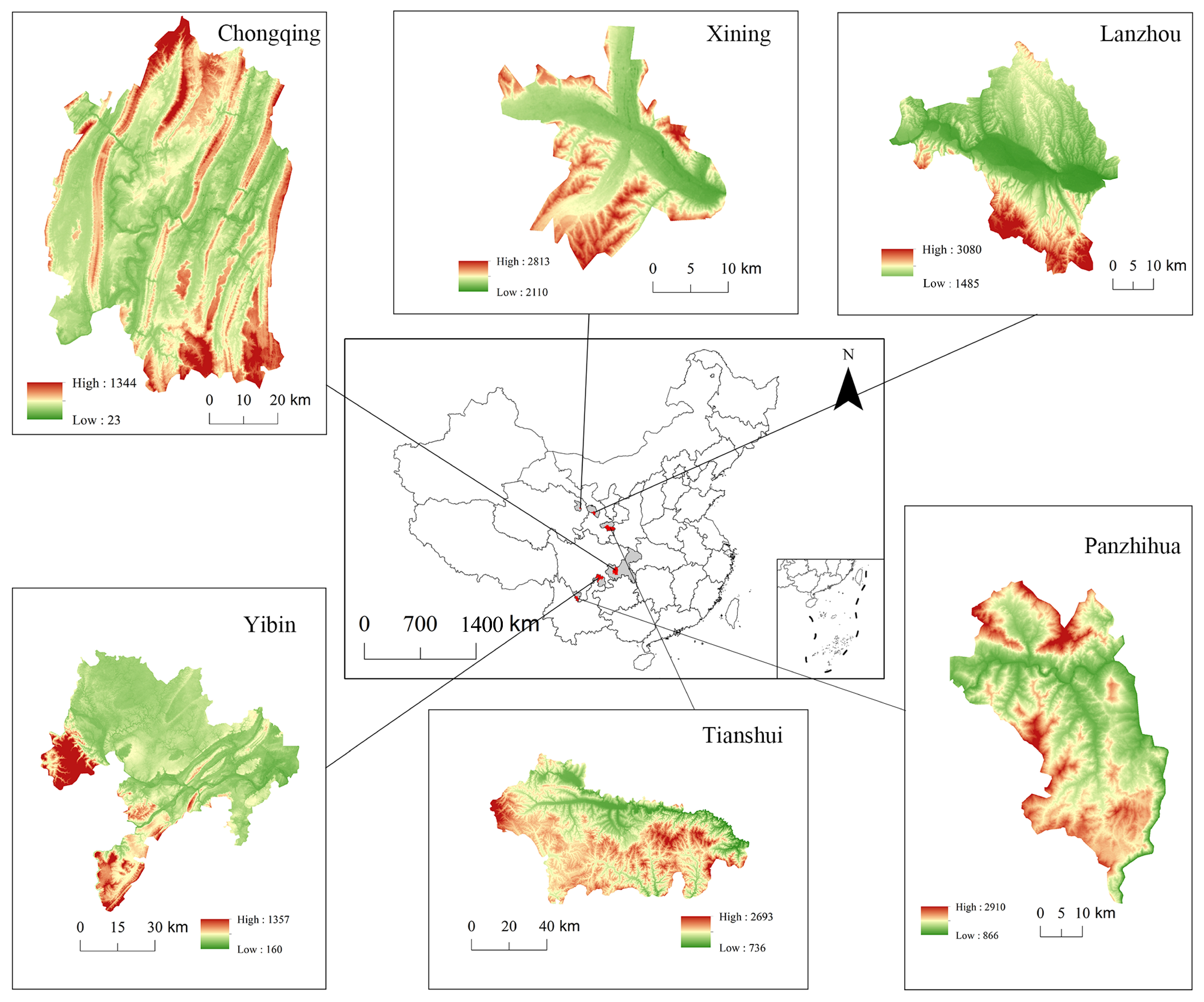
The analysis focuses on the central urban areas of six representative valley cities in western China: Lanzhou, Chongqing, Xining, Tianshui, Panzhihua (formerly known as Dukou), and Yibin (Figure 1). These cities lie in the transition zone among the Qinghai–Tibet Plateau, the Loess Plateau, and the Sichuan Basin. Strong topographic relief and fragile ecological conditions are common across the region.
Geologically, these cities are situated in complex tectonic zones. The northwestern cities (Lanzhou, Xining, Tianshui) are largely characterized by loess deposits and sedimentary rocks, which are susceptible to soil erosion. The southwestern cities (Chongqing, Yibin, Panzhihua) are typically underlain by folded sedimentary bedrock and karst formations. While local geological conditions (e.g., lithology and faults) critically influence specific engineering costs, this study focuses on surface topography (slope and elevation) as the primary macro-constraint determining the spatial feasibility of urban expansion.
To provide context for urbanization intensity, Table 1 summarizes the population growth of these six cities from 1985 to 2023. It should be noted that these figures represent the total population of the administrative municipality rather than the study area defined in this paper. Due to limitations in historical statistical standards, the 1985 data largely reflect the registered population, whereas the 2023 data refer to the permanent resident population.
Consequently, the urban form of the cities is tightly constrained by valley corridors and drainage networks, unlike in plains. Lanzhou and Tianshui show typical linear patterns confined between mountain ranges. Chongqing, a mountainous mega-city, shows a polycentric clustered structure shaped by parallel ridge and valley systems. The other three cities exhibit distinct variations of these patterns adapted to their specific hydro-topographic settings: Xining presents a cross-valley linear structure extending along the Huangshui River and its tributaries; Panzhihua features a multi-cluster chain pattern constrained by narrow river valleys; and Yibin displays a confluence-driven clustered morphology spanning multiple riverbanks. This mountain, water, and city configuration provides a suitable setting for examining links between terrain-constrained urbanization and ecological risk [15,20].
The central urban area is defined as a composite boundary encompassing the main built-up areas and valley corridors within the current (2023) municipal districts (Figure 1). To ensure spatiotemporal consistency, this 2023 boundary was applied as a fixed spatial mask for the entire study period (1985–2023).

2.2. Data Sources and Preprocessing

Two core datasets were used. (1) Land-cover data (CLCD): Urban expansion dynamics were derived from China’s annual land-cover dataset (CLCD) for 1985–2023 [21]. CLCD was produced on the Google Earth Engine platform (Google LLC, Mountain View, CA, USA) using Landsat time series imagery. Post-processing steps, including spatiotemporal filtering and logical consistency constraints, were applied to improve interannual consistency. The spatial resolution is 30 m, and the overall accuracy is about 80% [21]. The CLCD product released on Zenodo was used, and the version and DOI are provided in the References and the Data Availability Statement. The CLCD comprises nine original land-cover classes: cropland, forest, shrub, grassland, water, snow/ice, barren, impervious, and wetland. For the purpose of landscape ecological risk assessment and cross-city comparison, these classes were aggregated into six categories based on ecosystem similarity: cropland, forest (merging forest and shrub), grassland, water (integrating water bodies, snow/ice, and wetlands), bare land (derived from barren land), and built-up land (impervious surfaces). (2) Terrain data (FABDEM): Terrain analysis used the 30 m FABDEM product, which removes forest and building effects from the Copernicus DEM and supports digital terrain model applications [22]. This dataset reduces elevation artifacts from surface structures and canopy cover. It is well-suited for slope and relative elevation gradient analysis in densely built valley settings. This choice improves the physical consistency and interpretability of terrain derivatives.
All raster and vector datasets were clipped to the study boundary. Area and proportion metrics, including AI, AGR, and land source contributions, were calculated under an equal-area projection. The Albers equal-area conic projection provided in the CLCD products was applied, with units in meters. For operations that depend on neighborhood relations and spatial weights, data were projected to a city-specific UTM coordinate system (WGS 84, units in meters) using ArcGIS 10.8 (Esri, Redlands, CA, USA). The UTM zone was selected using the longitude of the city center. This step supports stable distance and adjacency calculations, including queen contiguity weights for Moran’s I and LISA [23,24].

2.3. Urban Expansion Metrics

The urban expansion intensity and its patterns were quantified using three indicators: annual increment (AI), annual growth rate (AGR), and the urban growth type index (S). AI and AGR describe the magnitude and speed of expansion [25,26,27]. The index S was used to identify spatial filling characteristics. It is defined as the ratio of the common boundary length (Lc) to the total perimeter (P) of a newly developed patch (S = Lc/P) [28]. Based on this topological relationship, new patches were classified into three growth types:
(1)
Infilling (S > 0.5): The new patch is largely surrounded by existing built-up land.
(2)
Edge expansion (0 < S ≤ 0.5): The new patch extends outward along the boundary of existing built-up land.
(3)
Leapfrog (S = 0): The new patch is fully separated from existing built-up land and forms an isolated enclave.

2.4. Landscape Ecological Risk Assessment

Landscape ecological risk was quantified using an ecological risk index (ERI). The index links landscape pattern to ecological vulnerability. It provides a spatially explicit description of ecological effects associated with land-use change [29,30].

2.4.1. Risk Evaluation Units and Characteristic Scale

A moving-window approach was used to define evaluation units [31]. This approach supports fine-scale sampling of landscape heterogeneity in valley cities. To reduce subjectivity in scale selection, a multi-scale semivariogram analysis was conducted for window sizes from 300 m to 2000 m (Table 2). Results show that the nugget-to-sill ratio of the ERI falls below 0.05 at a window size of 900 m, which indicates a stable spatial structure. A 1 km × 1 km window was selected as the evaluation unit. This scale is close to the stability threshold and retains local heterogeneity. It also supports computational efficiency.

2.4.2. ERI Construction

ERI was computed from the landscape disturbance index (Ei) and the landscape vulnerability index (Vi) [33,34]. The index was aggregated within each evaluation unit as shown in Equation (1).
E R I k = i = 1 n A k i A k × E i × V i × 100
where ERIk is the ecological risk index of evaluation unit k, Aki is the area of land-cover type i within unit k, and Ak is the total area of unit k. A multiplier of 100 is applied to scale the index values for better interpretability.
(1) Landscape disturbance index (Ei): The disturbance index describes the intensity of external disturbance acting on landscape pattern [35]. It was calculated using Equation (2).
E i = a C i + b S i + c D i
where Ci, Si, and Di represent fragmentation, separation, and dominance. These metrics were computed using FRAGSTATS 4.3 (University of Massachusetts, Amherst, MA, USA). To reduce subjectivity, weights were derived using the entropy weight method (EWM) implemented in Python 3.10 (Python Software Foundation, Wilmington, DE, USA) based on 11,924 random samples [36]. The weights were a = 0.5128, b = 0.3289, c = 0.1583. These correspond to fragmentation, separation, and dominance.
(2) Landscape vulnerability index (Vi): The vulnerability index describes sensitivity to further disturbance. It emphasizes potential ecological loss and susceptibility to additional disturbance. It does not represent current ecological quality. Following common practice in landscape ecological risk studies, vulnerability scores were assigned to the six land-cover types from high to low as: water (6), bare land (5), cropland (4), grassland (3), forest (2), and built-up land (1). Values were then normalized. Higher values indicate lower resistance and higher potential loss [33].
Built-up land was assigned the lowest vulnerability score. This choice reflects structural stability after intensive human modification. Under this definition, conversion from cropland to built-up land can reduce ERI values. This change indicates landscape structural hardening and stabilization. It does not indicate improvement in ecological functioning. The meaning of this indicator and related interpretation issues are addressed in the Discussion.
For mapping, ordinary kriging was applied to ERI values at evaluation-unit centroids using the Geostatistical Analyst extension in ArcGIS 10.8 to generate a continuous risk surface. This interpolation was used only for visualization. ERI classification, transition statistics, and spatial analyses such as Moran’s I and LISA used the original 1 km evaluation-unit ERI values.

2.4.3. ERI Classification

ERI is a continuous indicator. A global unified classification scheme was developed to support comparison across cities and periods. ERI grids from all cities and years were pooled. A representative global sample was then created using random sampling (N = 100,000). Jenks natural breaks were calculated from the global sample using the jenkspy library in Python 3.10 [37]. Breakpoints were adjusted and rounded to improve interpretability. Five classes were defined as: lowest risk (0–21.7), lower risk (21.7–25.2), medium risk (25.2–27.8), higher risk (27.8–30.8), and highest risk (>30.8). Rare extreme values above the upper limit were assigned to the highest risk class.

2.5. Terrain–Risk Spatial Analyses

2.5.1. Terrain Gradient Analysis

Slope data were derived from the FABDEM product. Slope calculations were performed in the city-specific UTM projection (WGS 84) to ensure geometric fidelity. Area statistics for newly developed built-up land were calculated under an Albers equal-area projection to ensure cross-city comparability. Slope was classified into five categories (<2°, 2–6°, 6–15°, 15–25°, and >25°) following a widely used slope gradient scheme adopted in recent studies [38]. The classes were interpreted as 0–2° (highly suitable), 2–6° (gentle slope), 6–15° (moderate slope), 15–25° (restricted), and >25° (prohibited/highly constrained). The vertical migration characteristics of urban growth, referred to as the “slope-climbing effect”, were quantified by overlaying expansion data with these slope intervals.

2.5.2. GeoDetector Factor Detection

The factor detector algorithm of the Geographical Detector model was applied to quantify the influence of terrain factors on ERI spatial differentiation. The q statistic ranges from 0 to 1. Larger values indicate stronger explanatory power [39]. Two terrain factors were selected: slope and relative elevation.
Slope used the same classes as in Section 2.5.1 to keep the logic consistent. Relative elevation was defined as elevation difference relative to the minimum elevation within the study area. It was discretized using 100 m equal-interval bins to capture vertical variation. GeoDetector can be sensitive to discretization. The selected bins support interpretability. Sensitivity tests of alternative binning schemes will be addressed in future work [40].
Terrain rasters were reprojected and resampled to match the ERI raster framework before q estimation. A stratified random sampling strategy was used to extract 200,000 sample points. The calculations of the q-statistic and significance assessments (based on 999 permutations) were implemented using custom scripts in Python 3.10 (relying on the NumPy and Pandas libraries). Significance was therefore reported as p ≤ 0.001 when the minimum occurred.

2.5.3. Spatial Autocorrelation

Spatial clustering of ERI was examined using global Moran’s I and LISA based on 1 km evaluation units. A queen contiguity weight matrix was constructed and row-standardized. Significance was tested using 999 Monte Carlo simulations via the esda and libpysal libraries in Python 3.10, with a threshold of p < 0.05. LISA classified units into five categories: high–high, low–low, low–high, high–low, and non-significant [23].

3. Results

3.1. Spatiotemporal Patterns of Urban Expansion

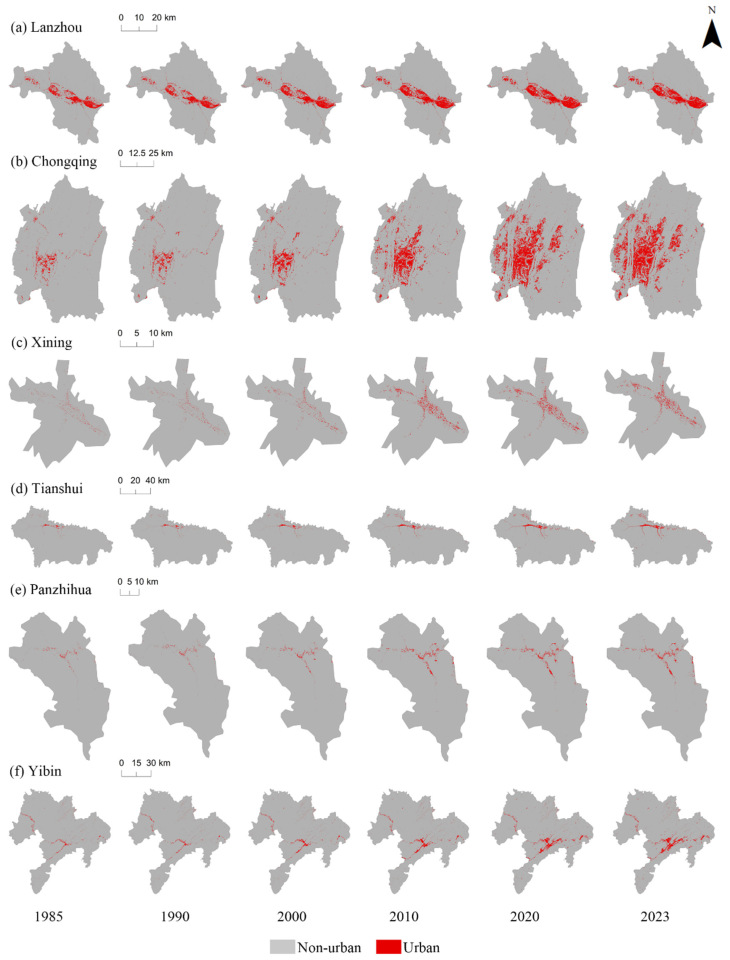
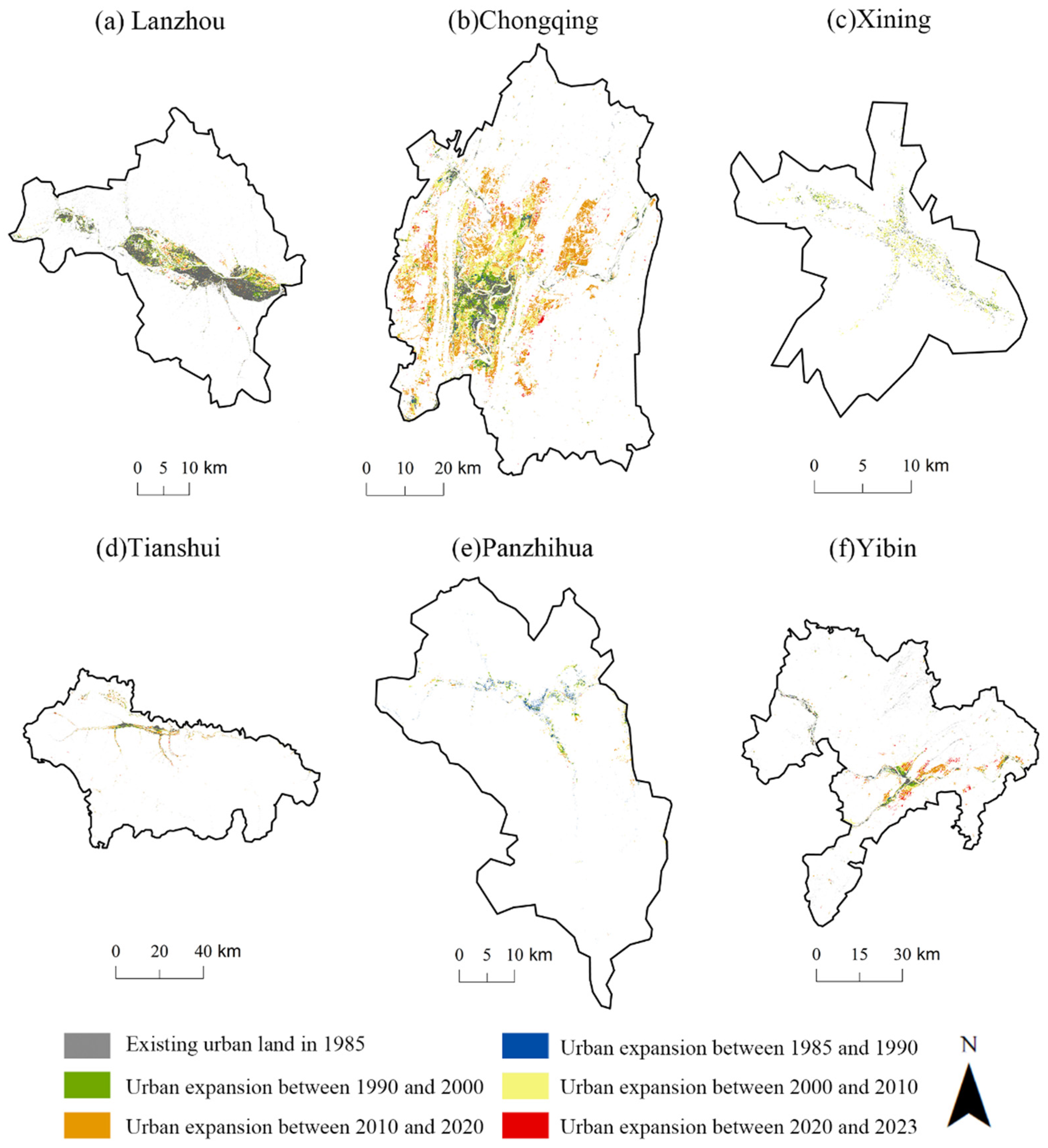
From 1985 to 2023, all six valley cities experienced substantial urban expansion. Expansion magnitude and pace differed across cities because of terrain constraints and development stages (Figure 2 and Figure 3). Chongqing expanded most rapidly. Built-up area increased from 91.29 km2 to 695.09 km2, which is nearly eight times larger. Annual increment (AI) reached a peak of 29.71 km2 during 2010–2020 (Table 3). Lanzhou and Yibin showed relatively steady growth. Lanzhou reached its expansion peak during 2000–2010. Xining and Panzhihua expanded more slowly. During 2020–2023, expansion was minimal in both cities, with AI close to 0.00. This pattern suggests that the built-up structure had largely stabilized.
Terrain configuration strongly shaped urban form. Lanzhou and Tianshui are confined by mountains on both sides. They show a linear strip pattern along the Yellow River and the Wei River. Chongqing is a mountainous mega-city. Parallel ridge and valley systems and major rivers divide the landscape. The city therefore shows a polycentric cluster structure. Yibin and Panzhihua are located near major river confluences. Their expansion radiates along tributary valleys.
Overall, expansion intensity differed strongly among the six cities. Expansion direction and urban form showed clear valley orientation. The following sections examine expansion processes and land sources. Terrain gradients are then used to interpret inter-city differences.

3.2. Expansion Modes and Land Sources

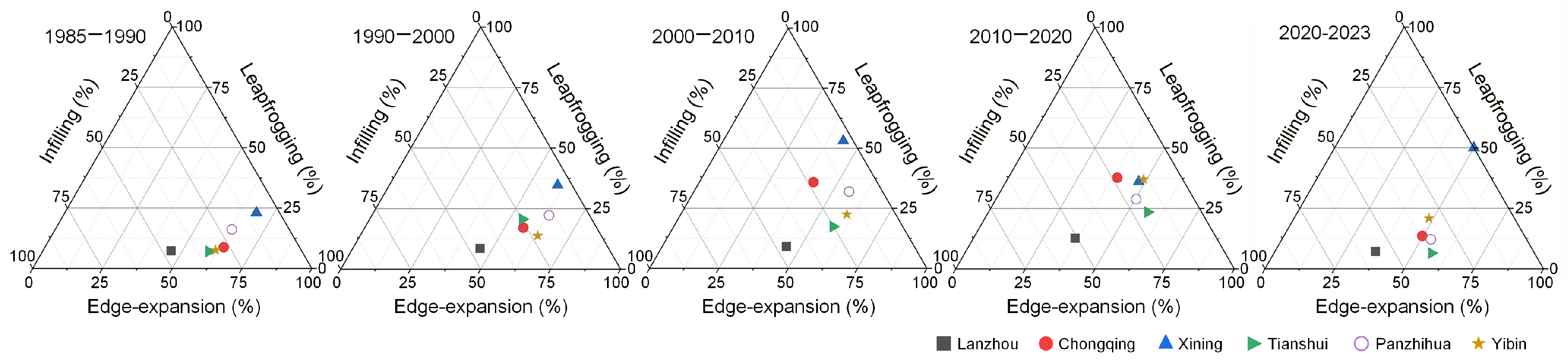
Changes in the urban growth type index (S) indicate stage shifts in expansion modes (Figure 4). During 1985–2000, edge expansion dominated in most cities. During 2000–2010, leapfrog growth increased sharply. This increase was strongest in Chongqing and Xining. In Xining, leapfrog patches accounted for 53.11% of new development during this period. Spatial patterns in Figure 3 show that many leapfrog patches were located on valley floors or terrace surfaces that were not contiguous with the main built-up area. This pattern suggests that topographic barriers encouraged the use of discrete buildable units rather than continuous fringe growth.
After 2010, expansion modes diverged. In Lanzhou, infilling increased and reached 56.75% during 2020–2023. This shift is consistent with the saturation of buildable valley space and increased the use of existing urban land. Chongqing continued to show strong outward expansion, whereas Xining’s expansion markedly weakened and approached a stable stage after 2010 (Table 3; Figure 3).
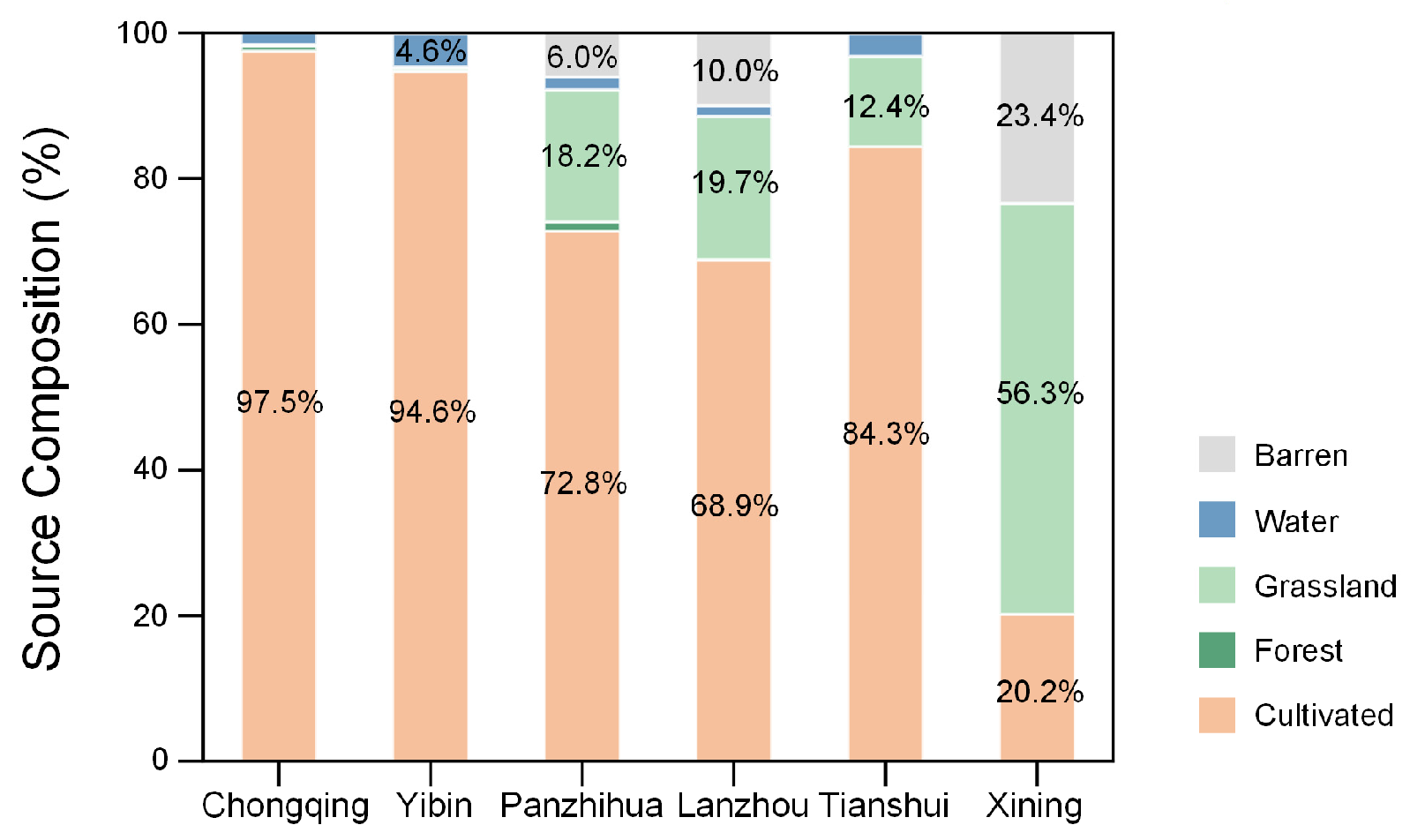
Land source composition was used to identify the land conversion pathways that supported expansion (Figure 5). The southwestern cities relied heavily on cropland conversion. Shares of land used for cropland exceeded 94% in Chongqing and Yibin. This result indicates strong competition between agricultural land and urban construction land in valley settings. The northwestern cities showed more diverse sources. Xining relied mainly on grassland and bare land. This pattern reflects an arid valley environment.
In the southwestern group, cropland contributed 97.5% of newly built-up land in Chongqing and 94.6% in Yibin. Panzhihua showed a mixed pattern; cropland contributed 72.8% and grassland contributed 18.2% of the total land. In the northwestern group, Tianshui still relied on cropland conversion, at 84.3% of the total area. Lanzhou showed a more diverse structure; cropland accounted for 68.9%, grassland for 19.7%, and bare land for 10.0% of the newly built-up area. Xining differed from the other cities. Areas of grassland, at 56.3%, and bare land, at 23.4%, exceeded cropland at 20.2%. Forest and water contributed only minor shares of the land in all six cities (Figure 5).

3.3. Terrain Gradient Effects of Urban Expansion

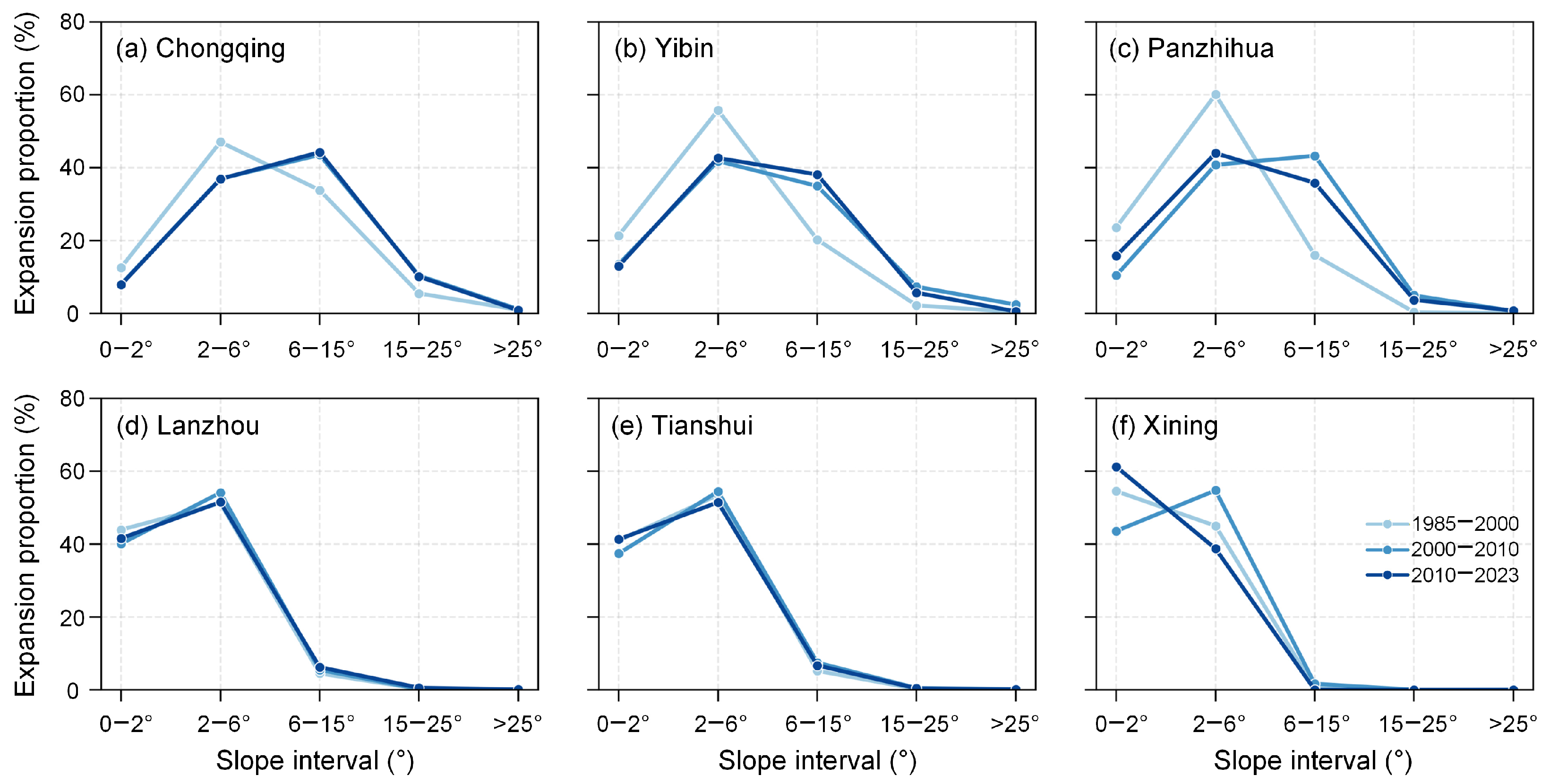
Slope class statistics from the CLCD and the DEM show clear differences among the six valley cities (Figure 6). In all cities and periods, most newly developed built-up land occurred on slopes of 15° or less. Shares on slopes > 15°, including 15–25° and >25°, were generally low. Even so, the relative importance of the 0–2°, 2–6°, and 6–15° classes varied strongly across cities.
In the southwestern cities with strong relief, the slope distribution shifted toward moderate slopes of 6–15° over time. Chongqing provides a clear example. The share of built-up areas on a 0 to 2° slope declined from 12.6% in 1985–2000 to 7.9% in 2010–2023. The share of built-up area on 6–15° slopes increased to 44.3% and became the main contributor; the share of built-up area on 15–25° land also increased in the later period. It remained much lower than the combined share of slopes of 15° or less. This pattern indicates a rising involvement of steeper terrain during expansion. Yibin and Panzhihua show a similar tendency. The land-use share of 6–15° slopes increased in the later two periods compared with 1985–2000. Panzhihua reached a high level in 2000–2010 and then declined slightly in 2010–2023. Despite these changes, the 2–6° slope class remained important across all periods. Therefore, expansion still relied mainly on low-to-moderate slopes.
Lanzhou and Tianshui show a different pattern. Their slope composition changed little across the three periods. Newly developed built-up land remained concentrated on low slopes of 0–6°. The 2–6° slope class contributed about 52%, and the 0–2° slope class also contributed a large share. Slopes > 15° contributed very little. This stable low-slope pattern supports the role of valley terraces and corridors as the main expansion space. It is also consistent with the infilling-dominant process reported in Section 3.1. Xining shows some shifts between the 0–2° and 2–6° slope classes. However, new development was almost entirely on slopes of 6° or less. Shares of the built-up area on 6–15° and steeper slopes were minimal. This result indicates strong dependence on low-slope terrain.
Overall, two slope trajectory types can be identified. The first is a low-slope lock-in pattern in Lanzhou, Tianshui, and Xining. Expansion remains concentrated on 0–6° slopes, and the contributions of slopes >15° are negligible. The second is a pattern of uplift towards mid-slopes, represented by Chongqing, with weaker expressions in Yibin and Panzhihua. In this type, the share of built-up areas on 6–15° slopes increases in later periods and then becomes the main contributor. The share of built-up area on 15–25° slopes also rises slightly. This trend suggests greater use of steeper terrain during expansion [41].

3.4. Spatiotemporal Dynamics of Landscape Ecological Risk

ERI represents relative risk under a landscape pattern and vulnerability framework. It is not a direct measure of ecological function recovery. Built-up land has a low vulnerability score in the index system. Built-up expansion can therefore reduce ERI values. A decline in ERI indicates structural stabilization within the index framework rather than an improvement in ecological functioning.

3.4.1. Spatial Reorganization of Landscape Ecological Risk

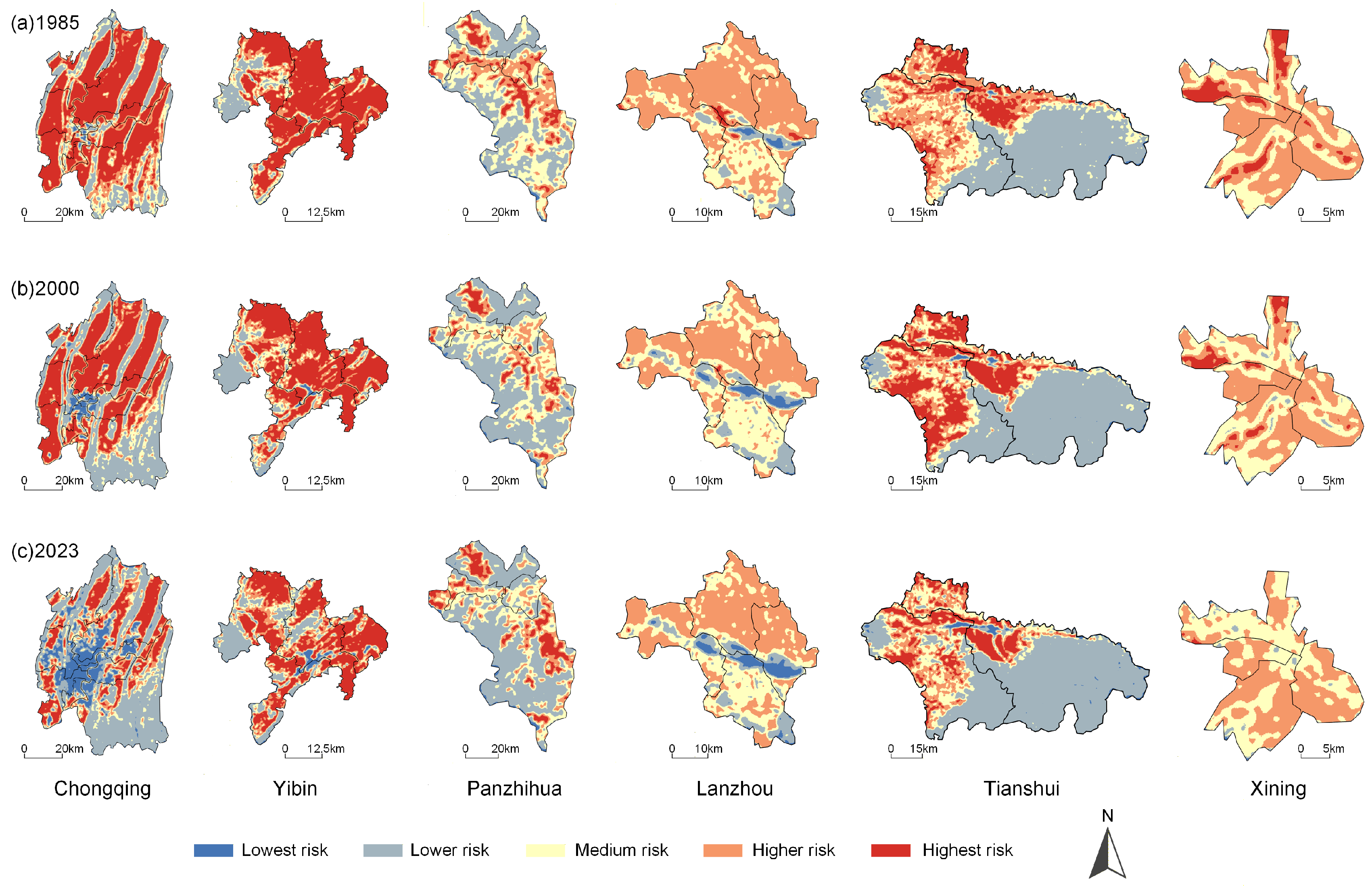
ERI maps for 1985, 2000, and 2023 show three types of spatial reorganization across the six valley cities (Figure 7).
The first type is a strengthened low-risk belt along the valley, with a strong contrast between the valley and surrounding areas. Chongqing and Yibin follow this type. Chongqing shows the clearest signal. The lowest- and lower-risk units expand along the main valley and around the urban core. They also became more connected over time. The higher- and highest-risk units were mainly outside the core. This pattern produces a clear contrast between low-risk areas along the valley and a higher-risk background in surrounding terrain units. Yibin shows stronger low-risk corridors and patches near the confluence area. However, the higher- and highest-risk units still dominate the overall structure. High-risk areas remain prominent outside the core areas.
The second type is a heterogeneous mosaic pattern, seen in Panzhihua and Tianshui. No dominant low-risk core formed in either city. In Panzhihua, higher- and highest-risk patches are fragmented. They are embedded within a matrix dominated by lower-to-medium risk. This pattern indicates strong landscape heterogeneity. In Tianshui, a stable contrast appears at a broader scale. Lower risk dominates on one side, while high-risk patches cluster on the other side. This contrast remains similar across the three time points.
The third type is a higher-risk background dominance pattern, seen in Lanzhou and Xining. Higher-risk areas, often with medium-risk areas, dominate in all three years. The lowest- and lower-risk units appear along the main river corridors as narrow bands or scattered patches. Their extent is limited and does not change the overall background. Xining shows the strongest persistence. Low-risk areas remain limited. Higher-risk areas dominate, while the highest-risk class is more common early and becomes less common later. The overall risk framework remains stable.

3.4.2. Quantified Transition Pathways of Ecological Risk

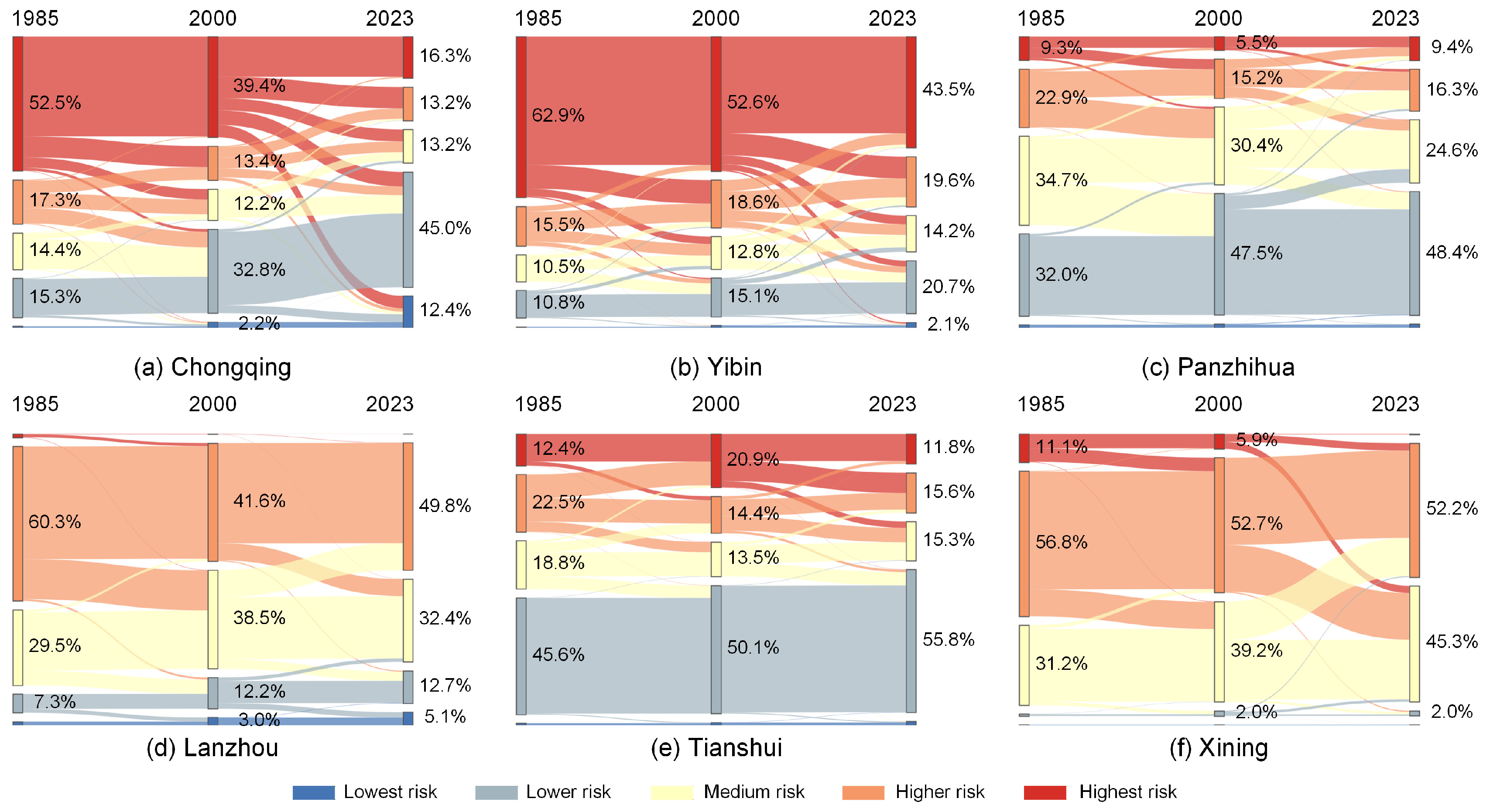
Sankey diagrams quantify transitions among the five ERI classes for 1985, 2000, and 2023 (Figure 8). The classes include the lowest-risk, lower-risk, medium-risk, higher-risk, and highest-risk classes. Percentages show the shares of valid risk units within each city. Two transition intervals are shown, 1985–2000 and 2000–2023.
In Chongqing and Yibin, the share of higher-risk areas decreases while the share of lower-risk areas increases. In Chongqing, the prevalence of the highest-risk class declines from 52.5% in 1985 to 39.4% in 2000 and to 16.3% in 2023. The prevalence of the lower-risk class rises from 15.3% in 1985 to 32.8% in 2000 and to 45.0% in 2023. The lowest-risk class reaches 12.4% of the overall structure in 2023. These changes indicate a shift toward lower risk levels within the index structure. Yibin shows smaller but similar shifts. The prevalence of the highest-risk class declines from 62.9% in 1985 to 43.5% in 2023. The prevalence of lower-risk areas increases from 10.8% to 20.7%.
In Panzhihua and Tianshui, transitions occur mainly among the intermediate classes. Panzhihua shows a stable lower-risk background after 2000. The lower-risk class accounts for 47.5% in 2000 and 48.4% in 2023. The highest-risk class changes in a nonmonotonic way. It declines from 9.3% in 1985 to 5.5% in 2000 and returns to 9.4% in 2023. In Tianshui, the prevalence of highest-risk areas increases from 12.4% in 1985 to 20.9% in 2000 and declines to 11.8% in 2023. These patterns indicate stage-specific redistribution within the risk structure.
In Lanzhou and Xining, the structure remains dominated by medium- and higher-risk areas. Shifts toward low risk are limited. In Lanzhou, levels of higher-risk areas remain high across the three years. Of the overall area, they form 60.3% in 1985, 41.6% in 2000, and 49.8% in 2023. Highest-risk areas are lower in prevalence and continue to decline. In Xining, medium-risk and higher-risk areas, together, account for about 97.5% of the overall area in 2023. Medium-risk areas form 45.3% and higher-risk areas 52.2%. Lower-risk areas are about 2.0%, and the prevalence of the lowest-risk class is very small. Therefore, these changes reflect redistribution within the medium- and higher-risk classes. Expansion of low-risk units is limited.

3.4.3. Spatial Clustering of Ecological Risk

Spatial dependence of ERI was assessed using global Moran’s I and local indicators of spatial association (LISAs) at the 1 km unit scale. Spatial weights were defined by queen contiguity and row standardization. Significance tests used 999 random permutations. For global Moran’s I, all simulated p values were 0.001. For the LISAs, the significance threshold was p < 0.05.
The global Moran’s I results (Table A1) show significant positive spatial autocorrelation in all six cities in both 1985 and 2023. This pattern indicates a persistent spatial clustering of ERI. In 1985, Moran’s I ranged from 0.5711 in Xining to 0.9073 in Tianshui. In 2023, values ranged from 0.4976 in Xining to 0.8863 in Tianshui. Most cities show only small changes between the two years. Chongqing increased from 0.8156 to 0.8164, and Panzhihua increased from 0.7254 to 0.7292. Lanzhou increased more, from 0.7584 to 0.8369, which indicates stronger overall clustering. Xining decreased from 0.5711 to 0.4976, which indicates weaker spatial autocorrelation.
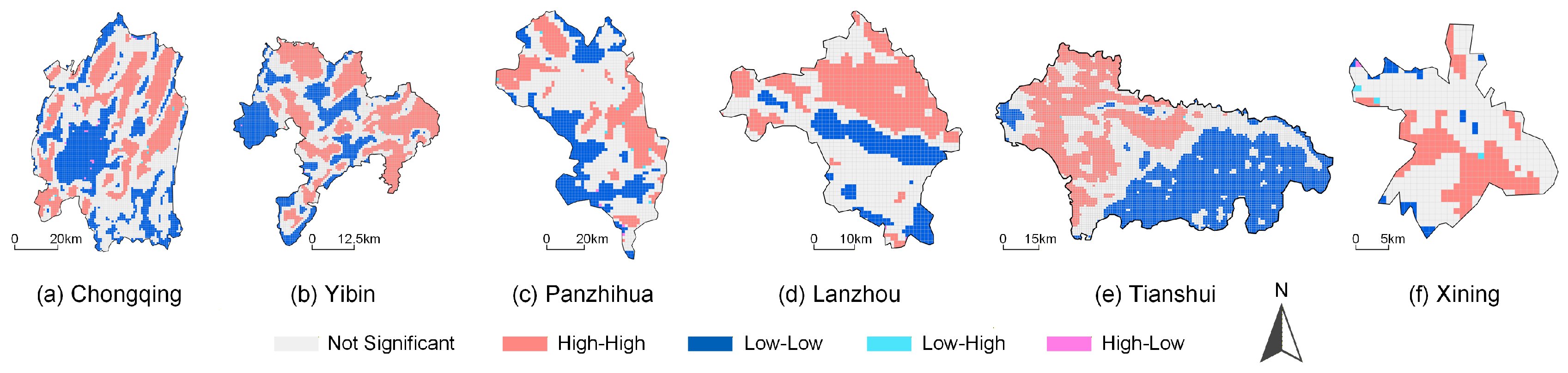
LISA maps for 2023 provide details of local clustering (Figure 9). The share of non-significant units is high in all cities, ranging from 29.28% to 63.59% (Table A1). Among significant units, high–high and low–low clusters dominate. Low–high and high–low outliers are rare. Their shares are below 1% in every city and they are not listed in the table. This pattern indicates that local clustering mainly reflects similarity among neighboring units.
Local patterns differ among cities. Chongqing shows similar shares of high–high and low–low clusters. High–high form 25.36% and low–low 24.91% of the overall area. Non-significant units account for 49.28%. High and low clusters alternate and are separated by many non-significant units. This arrangement indicates strong local contrasts. Yibin has the largest share of high–high clusters at 36.14%. Low–low clusters have a 25.62% share and non-significant clusters a 38.16% share. Cluster patches are more fragmented, and high and low clusters appear as dispersed mosaics. Panzhihua is dominated by non-significant units at 52.92%. High–high clusters form 21.50% of the overall area and low–low 25.15%. Significant clusters are limited in extent and show a mosaic pattern.
Tianshui shows strong low-value clustering. Low–low cluster prevalence reaches 41.51%. High–high are 29.15% and non-significant clusters 29.28% of the area. Large areas of similar values occur together and spatial differentiation is pronounced. Lanzhou shows 35.20% high–high clusters and 18.08% low–low clusters, with 46.53% of the area non-significant. Significant clusters show belt-like organization along the main urban axis. This pattern suggests directional clustering. Xining is dominated by non-significant units at 63.59%. Low–low clusters are 8.75% and high–high clusters are 26.72% of its area. Low-value clustering is limited and significant clusters cover a small area.

3.5. Terrain, Ecological Risk Coupling, and Explanatory Power

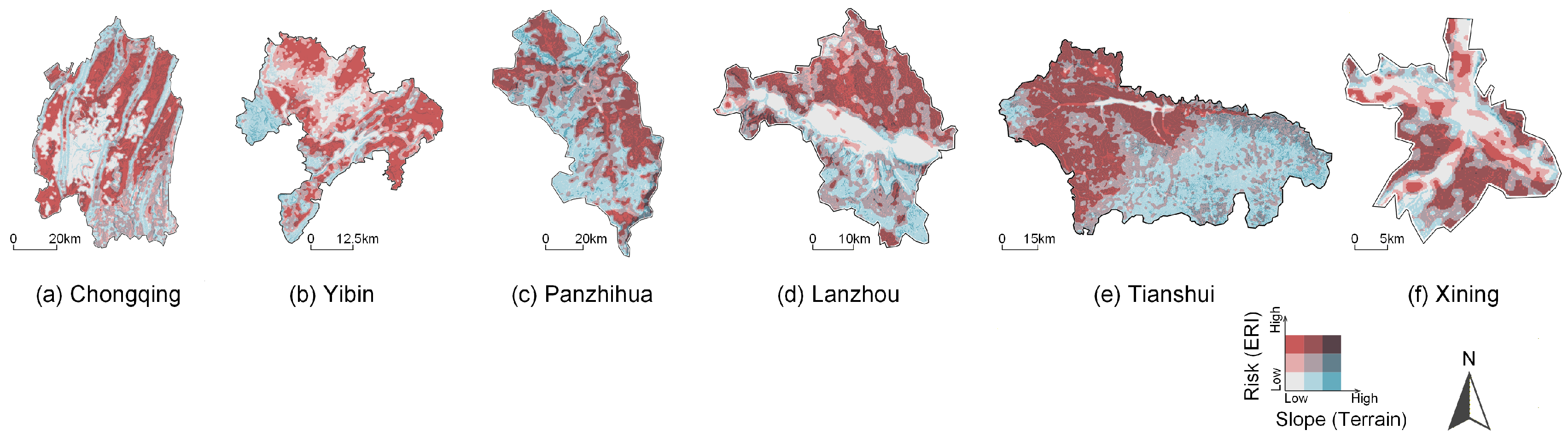
Bivariate maps (Figure 10) show a clear but nonlinear co-occurrence between slope classes and ERI classes. The low-slope category contains several combinations. These include low slope with low ERI and low slope with high ERI. This pattern indicates strong differentiation within low-slope terrain. In the high-slope category, low-to-moderate ERI is more common. High ERI also appears in some locations. This result shows that slope does not constrain ecological risk in a single direction.
Co-occurrence patterns differ by city. In Chongqing, bivariate classes alternate in belt-like bands along the main spatial direction. This pattern indicates strong spatial organization. In Yibin and Panzhihua, bivariate classes form patch-based mosaics. The slope risk relationship is therefore more fragmented at local scales. Lanzhou shows a clear banded structure. Low-ERI combinations form continuous or semi-continuous belts along the main urban axis. Higher-ERI combinations occur more often on the periphery. Tianshui shows clear internal zoning, with distinct separation among bivariate classes. Xining shows mixed patterns. Low-ERI combinations concentrate in the central corridor, while higher-ERI combinations occur as scattered patches. Overall, slope provides a basic constraint on ERI organization. Local expression also depends on terrain configuration and surface conditions within each city.
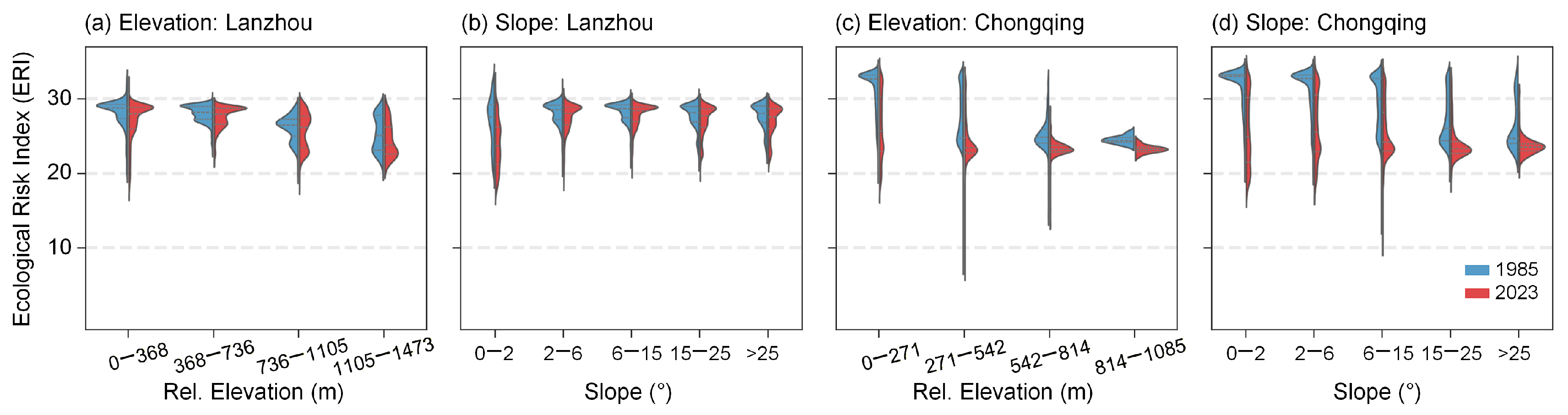
Violin plots describe ERI distributions across terrain categories for 1985 and 2023 (Figure 11 and Figure A1). For the slope groups of 0–2°, 2–6°, 6–15°, 15–25°, and >25°, a clearer gradient appears in 2023 in most cities. Higher density peaks and higher quantiles occur more often in the low-slope groups, especially 0–2° and 2–6°. In the 6–15° group and the steeper groups, the distribution centers are lower and more concentrated. This gradient is strongest in Chongqing, Yibin, and Panzhihua. Tianshui shows a similar but weaker pattern. Lanzhou shows small differences among slope groups, which suggests limited separation of ERI by slope. Xining has the narrowest ERI range and weak separation among slope groups. This pattern matches the limited extent of significant low-value clustering. In most cities, ERI distributions within low-slope groups are more concentrated in 2023 than in 1985. This result suggests lower dispersion within low-slope environments.
Along the relative elevation gradient, Chongqing and Yibin show the strongest change. ERI is higher in the lowest elevation band. Higher elevation bands show lower and more concentrated distributions in 2023. Panzhihua and Tianshui show the same direction of change but the shift is more gradual. Lanzhou and Xining remain relatively stable. These distribution patterns are consistent with the bivariate maps and support the role of terrain in shaping ERI. The strength of terrain-related differentiation still varies across cities.
Bivariate maps and violin plots describe spatial co-occurrence and distributional differences. GeoDetector q values quantify the explanatory power of the stratified spatial heterogeneity of ERI. These approaches describe different properties. Co-occurrence therefore does not always imply strong explanatory power. Low q values suggest that ERI is shaped by other drivers, such as land cover, landscape fragmentation, and human activity.
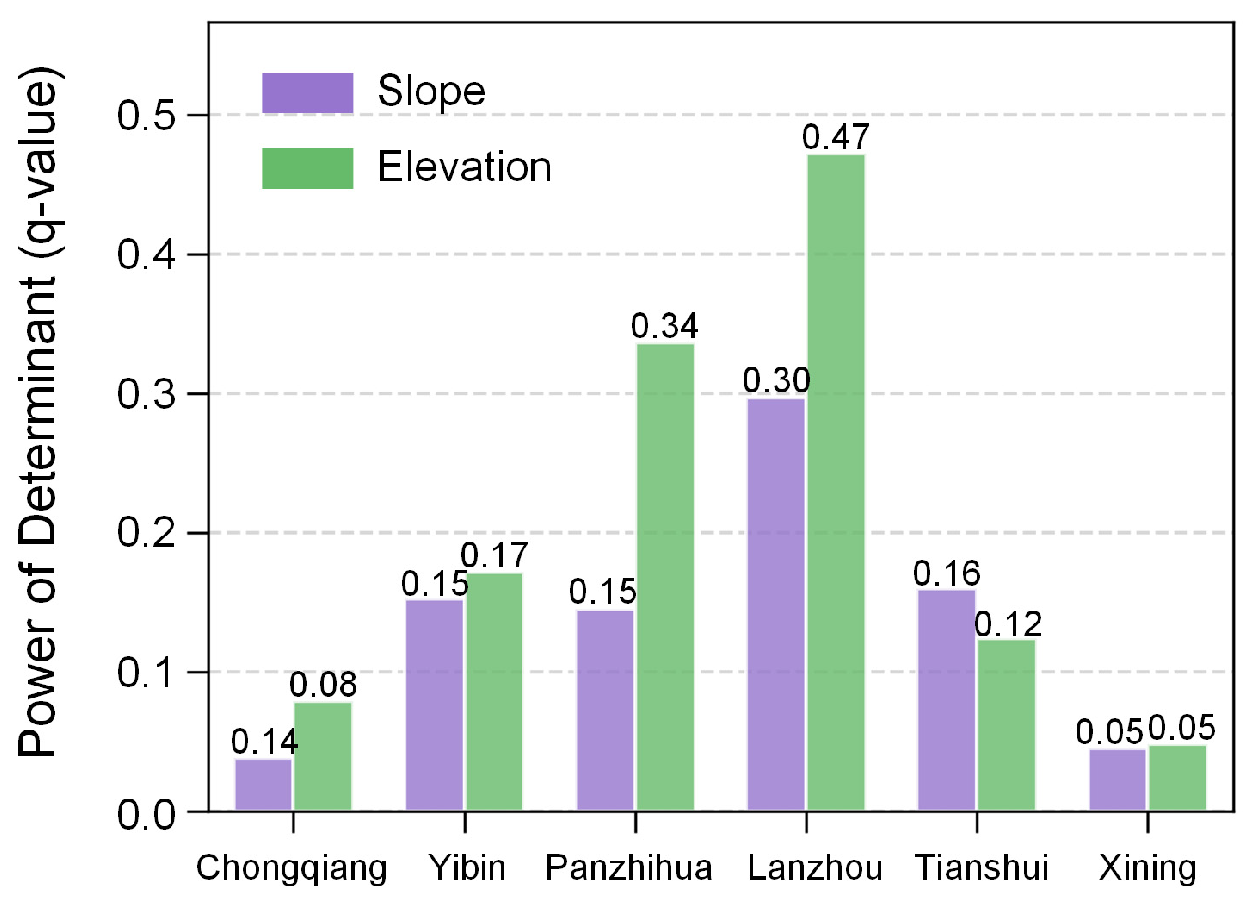
GeoDetector results for 2023 quantify the explanatory power of slope and relative elevation and show strong inter-city differences (Figure 12). Lanzhou and Panzhihua show higher terrain explanatory power, with a stronger contribution from relative elevation. Lanzhou has the highest elevation q value at 0.47. Its slope q value is also high at 0.30. This pattern indicates a strong link between ERI and vertical terrain differentiation. Panzhihua also shows a high elevation q value at 0.34. This value is higher than its slope q value of 0.15. Relative elevation therefore contributes more than slope.
Terrain explanatory power is lower in other cities. Chongqing has a low elevation q value at 0.08. Its slope q value is 0.14. This pattern indicates weak dependence on a single terrain gradient. Xining has low q values for both factors, with 0.05 for slope and 0.05 for elevation. Terrain therefore explains little of the ERI differentiation in Xining. The remaining cities show intermediate values. In Yibin, the slope and elevation q values are similar at 0.15 and 0.17. In Tianshui, the slope q value is slightly higher than that of elevation at 0.16 and 0.12. These results indicate that terrain constraints contribute differently across valley cities.
GeoDetector q values measure explanatory strength for stratified spatial heterogeneity. When terrain q values are low, ERI is likely influenced more by non-terrain factors. These factors include land-cover composition, landscape configuration, and human activity. These drivers require further testing with an expanded factor set.

4. Discussion

4.1. Direct Answers to the Three Questions Raised in the Introduction

A unified dataset and a consistent analytical protocol were used to compare expansion processes, terrain gradient effects, and landscape structural ecological risk across six valley cities in western China. The three research questions are addressed below.
For question (1), all six cities expanded substantially, but expansion intensity differed greatly among the cities (Table 3; Figure 2 and Figure 3). Expansion process types also changed over time. Edge expansion dominated during 1985–2000. Leapfrog expansion increased in many cities during 2000–2010. After 2010, trajectories diverged across cities, and infilling became more common in some cases (Figure 4).
For question (2), the slope distributions of newly developed built-up land fall into two trajectory types (Figure 6). The first is a low-slope lock-in pattern. Lanzhou, Tianshui, and Xining follow this pattern, with expansion concentrated on 0–6° slopes over the long term. The second is a pattern of uplift towards mid-slopes. Chongqing shows the strongest signal, while Yibin and Panzhihua show weaker signals. In this pattern, the share of built-up land on 6–15° slopes increases in later periods. Development also begins to involve 15–25° slopes in a limited way.
For question (3), ERI patterns can be grouped into three types of spatial reorganization (Figure 7 and Figure 8). Chongqing and Yibin show stronger valley-aligned low-risk belts and a clear contrast between valley areas and surrounding terrain. Panzhihua and Tianshui show a heterogeneous mosaic pattern. Lanzhou and Xining show a persistent higher-risk background. In all cities, ERI shows significant positive spatial autocorrelation in both 1985 and 2023, which indicates stable spatial organization (Table A1; Figure 9). Slope and relative elevation show systematic co-occurrence with ERI, but GeoDetector results show large differences among cities in terrain explanatory power (Figure 10, Figure 11 and Figure 12).

4.2. Differentiation of Expansion Pathways Under Valley Terrain Constraints

In valley cities, rugged terrain and river network segmentation reduce the continuity of outward growth. Expansion therefore often occurs through the use of discrete terraces and platforms. It also follows the main valley axis. Leapfrog growth can occur across terrain barriers [15,42]. The rise in leapfrog expansion during 2000–2010 in several cities supports this logic (Figure 4). When continuous low-slope land becomes limited, development shifts toward dispersed buildable patches. This shift leads to spatially discontinuous expansion.
Terrain constraints do not fully determine expansion pathways. Differences in expansion intensity (Table 3) and land source composition (Figure 5) show that land background and development stage also shape expansion. Chongqing and Yibin rely heavily on cropland conversion, with shares > 94%. This pattern indicates strong competition between valley cropland and construction land. This extensive loss of fertile valley floor farmland threatens regional food security under rapid urbanization pressures [17,43]. Furthermore, such investment-driven “de-peasantisation” processes can undermine the long-term resilience of local agricultural systems [44], necessitating stricter protection of high-quality valley resources. Xining relies mainly on grassland and bare land. This pattern matches its arid valley setting (Figure 5) [42]. After 2010, infilling increased in Lanzhou, while Chongqing continued outward expansion (Figure 4). This divergence is consistent with differences in the timing of terrain threshold constraints and the saturation of buildable valley land. Single-factor explanations are not supported without direct evidence.

4.3. Interpreting ERI Dynamics and Three Types of Risk Reorganization

ERI in this study represents landscape structural risk within a disturbance and vulnerability framework. It is not a direct measure of ecological quality or ecosystem services [33,45]. Built-up land has a low vulnerability score in the index system. Conversion from natural or semi-natural land covers to built-up land can therefore reduce ERI values. This decline indicates structural hardening and stabilization. It does not indicate improved ecological functioning [33].
Within this definition, three risk reorganization types can be interpreted as outcomes shaped by terrain conditions, expansion processes, and land conversion pathways (Figure 7 and Figure 8).
(1)
Valley and surrounding contrast type: Chongqing and Yibin. High expansion intensity and cropland conversion dominate land sources. Expansion is organized along the main valley axis. These conditions support the growth and connection of low-risk belts in core corridors. Peripheral terrain units retain a higher-risk background. This combination produces a strong spatial contrast (Figure 7 and Figure 8; Figure 5).
(2)
Heterogeneous mosaic type: Panzhihua and Tianshui. Risk transitions occur mainly among intermediate classes. The spatial pattern is fragmented and patch-based. This result suggests that local terrain settings and differences in surface structure become more important at the cluster scale (Figure 7 and Figure 8).
(3)
Higher-risk background dominance type: Lanzhou and Xining. Low-slope lock-in does not guarantee low risk. Development pressure can concentrate in limited low-slope space. Disturbance and fragmentation can remain high. A higher-risk background can therefore persist (Figure 6, Figure 7 and Figure 8). Terrain explanatory power differs between the two cities. Lanzhou shows higher values, while Xining shows lower values. Similar city types can therefore arise from different dominant controls. In Lanzhou, risk differences may relate more to vertical terrain gradients. In Xining, land-cover and landscape configuration may have stronger influence (Figure 12). This interpretation requires testing with a broader factor set.

4.4. Why Co-Occurrence Does Not Always Mean Strong Explanatory Power

Bivariate maps and distribution statistics show that higher ERI appears more often in low-slope classes (Figure 10 and Figure 11). The GeoDetector q values are not high for several cities (Figure 12). These results are consistent. Co-occurrence describes empirical tendencies. The q statistic measures explanatory strength after stratification. It compares between-group variance with within-group variance [46]. Low-slope classes can contain both low slope with a high ERI and low slope with a low ERI (Figure 10). This mix increases within-group variance and reduces q. Terrain therefore provides a spatial basis, but ERI patterns are often shaped by multiple drivers [47]. These drivers include land cover, fragmentation, and human activity.
GeoDetector results also depend on discretization. The slope classes used here have clear planning meaning and support policy translation. They may not be the most sensitive cut points for ERI [48]. Future work can test alternative schemes. Options include equal frequency bins, natural breaks, and optimized binning. Sensitivity tests can support more robust interpretation of inter-city differences in explanatory power.

4.5. Planning and Governance Implications for Valley Cities

ERI is not a direct ecological quality index, but it can support differentiated governance as a landscape structural risk diagnostic tool (mainly reflecting fragmentation/separation/dominance and vulnerability within the ERI logic). Therefore, the implications below target structural pattern optimization rather than direct claims about ecological quality improvement or geohazard risk reduction; hazard sensitivity should be assessed as a complementary layer [45]. Strategic decision-making must now operate under the conditions of the “anthropocene polycrisis,” where environmental and socio-economic risks are intricately intertwined [49]. This complexity necessitates a shift toward integrated ecological security frameworks [16], ensuring that spatial expansion does not amplify vulnerability to compound hazards.
(1)
Cities displaying uplift towards mid-slopes, represented by Chongqing. Later expansion occurs on 6–15° slopes and can extend into 15–25° slopes. New development on moderate and steep slopes should be treated as a priority area for risk spillover control. Slope disturbance controls and ecological buffer zones are needed. Redevelopment and infilling within existing built-up areas should be prioritized to reduce demand for upslope growth (Figure 6) [13,41].
(2)
Low-slope lock-in cities: Lanzhou, Tianshui, and Xining. Governance should not focus only on limiting upslope expansion. It should also improve land-use intensity and protect ecological baselines within low-slope corridors. Corridor connectivity is important. Continued subdivision of low-slope space can increase structural fragmentation risk (Figure 6, Figure 7, Figure 8 and Figure 9).
(3)
Governance based on risk reorganization types. Contrast-type cities require attention to the peripheral higher-risk background and edge zones. Mosaic-type cities require targeted management of local hotspots, such as LISA high–high clusters. Higher-risk background cities require structural optimization and improved connectivity of key low-risk corridors (Figure 7, Figure 8 and Figure 9).

4.6. Limitations and Future Directions

Four limitations should be noted. First, land-cover classification error and early image quality can affect the detection of small patches. Early disturbance and fragmentation can be underestimated. This uncertainty can affect local ERI and slope statistics [50]. Second, ERI describes structural risk and depends on vulnerability assignment. A low vulnerability score for built-up land can create an index-based risk paradox. Sensitivity tests should be conducted using alternative scores or corrections based on impervious surface proportion. Ecological function proxies can be used for cross-validation [45]. Third, characteristic scale selection improves comparability, but scale choice and mapping can still create smoothing effects [51,52]. Fourth, beyond biophysical constraints, urban trajectories are fundamentally driven by socio-economic dynamics and the pursuit of “quality of life” [53,54]. Future work should therefore compare multiple scales and integrate variables such as investment flows and population dynamics to clarify how human agency overrides terrain limitations in shaping landscape risk.

5. Conclusions

This study investigated the long-term urbanization and landscape ecological risk (ERI) evolution in six valley cities of western China from 1985 to 2023. We identified that urban expansion generally shifted from edge expansion to leapfrog growth, driven by the saturation of contiguous valley land. Crucially, two distinct vertical trajectories emerged: a “low-slope lock-in” pattern (e.g., Lanzhou, Tianshui, Xining), where development remains strictly confined to valley floors (<6°); and an “uplift toward mid-slopes” pattern (e.g., Chongqing), where expansion has significantly climbed onto steeper gradients (6–25°). These trajectories are shaped by the interplay between distinct topographic constraints and the availability of land resources, such as the competition with cropland in southwestern cities.
The reorganization of landscape ecological risk followed three spatial typologies corresponding to these expansion paths: (1) the valley contrast type, characterized by low-risk belts along core corridors contrasting with a high-risk periphery; (2) the heterogeneous mosaic type, featuring fragmented risk patches; and (3) high-risk background dominance, where low-risk zones remain limited. While spatial statistics confirmed stable clustering of risk patterns, GeoDetector results revealed that the explanatory power of terrain factors varies substantially across cities. This suggests that while topography provides the spatial “baseboard,” land-cover composition and anthropogenic modification intensity often override pure terrain constraints in shaping local risk heterogeneity.
From a governance perspective, it is vital to recognize that the observed decline in ERI values reflects structural hardening rather than ecological restoration. Planning strategies must therefore be differentiated: cities exhibiting the “uplift” trajectory require strict controls on slope disturbance (6–25°) to prevent risk spillover; conversely, “lock-in” cities must prioritize maintaining the connectivity of remaining ecological corridors within their narrow, densely built valley floors. Future research should integrate high-resolution human activity data to further decouple the complex interactions between terrain gradients and anthropogenic drivers.

Author Contributions

Conceptualization, Y.X.; methodology, Y.S. and B.M.; formal analysis, Y.S.; investigation, Y.S., B.M., Y.Y. and S.Z.; data curation, Y.S. and B.M.; writing—original draft preparation, Y.S. and B.M.; writing—review and editing, Y.X., W.H. and S.Z.; visualization, Y.S.; supervision, Y.X.; project administration, Y.X.; funding acquisition, Y.X. All authors have read and agreed to the published version of the manuscript.

Funding

This research was funded by the Data Intelligence Laboratory of Tibetan Plateau Humanistic Environment and the Gansu Provincial Department of Natural Resources Science and Technology Innovation Project, “Research on Ecosystem Evolution and Protection Governance in Gansu Province” (No. 202401).

Data Availability Statement

The land-cover dataset used in this study is the China annual land-cover dataset (CLCD, 1985–2023), which is publicly available on Zenodo (v1.0.3; DOI: 10.5281/zenodo.12779975) [21]. Terrain data were obtained from FABDEM (30 m digital terrain model, DTM), which is accessible through the Fathom data portal in accordance with its licensing and terms of use [22]. No new raw data were generated or uploaded in this study.

Acknowledgments

The authors thank all editors and reviewers for their valuable comments.

Conflicts of Interest

The authors declare no conflicts of interest.

Appendix A

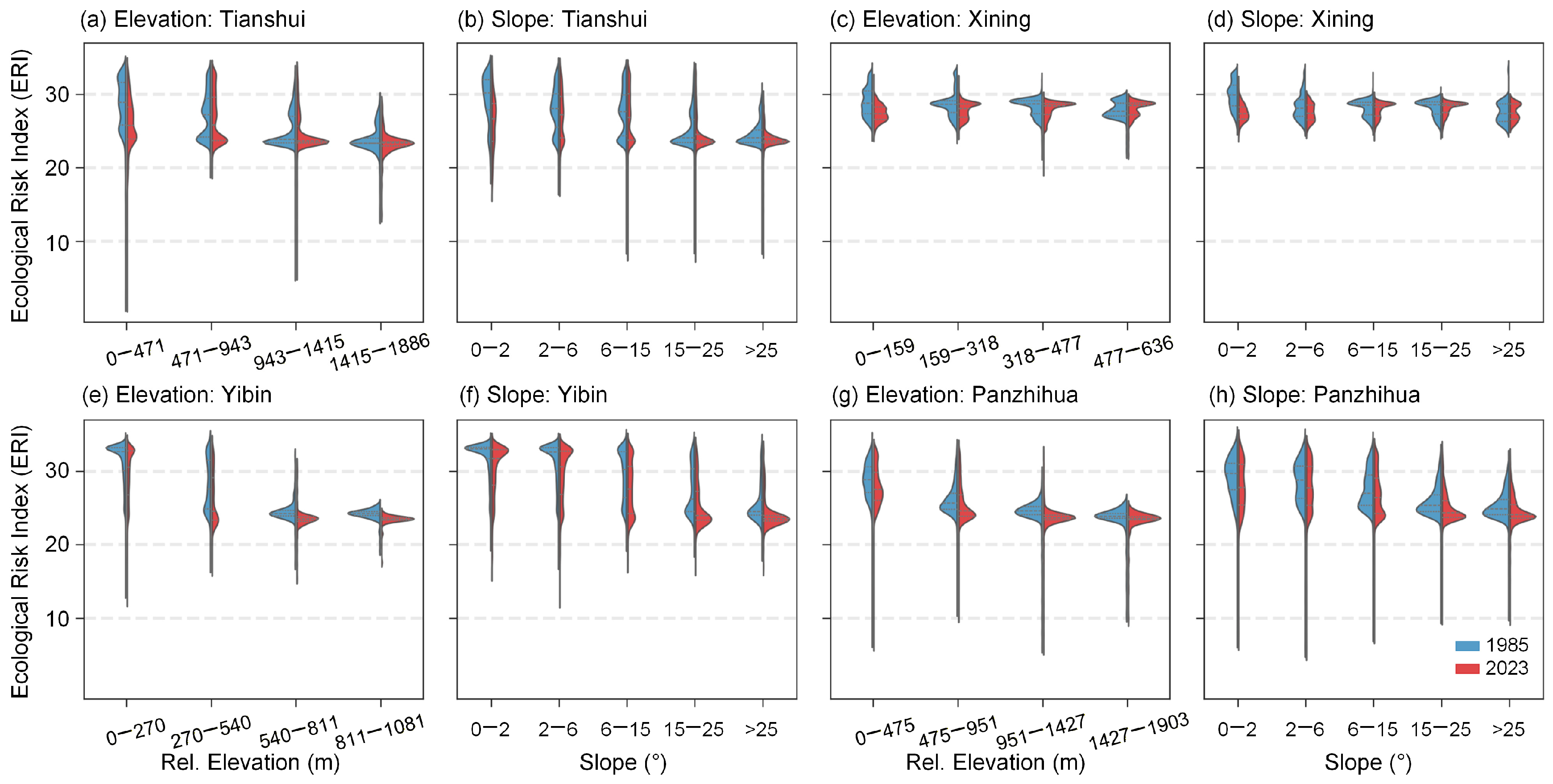
This appendix presents the detailed statistical results of the spatial clustering analysis and the distributional characteristics of the ecological risk index (ERI) along terrain gradients.
Table A1. Global Moran’s I (1985 and 2023) and LISA cluster composition in 2023 (1 km grids). Risk units were 1 km grids. Spatial weights were defined using queen contiguity and row standardization. Significance was assessed using 999 permutations; all global Moran’s I values were significant (p ≤ 0.001). LISA clusters were identified at p < 0.05. HH, high–high; LL, low–low; NS, non-significant. HL and LH outliers accounted for <1% in all cities and were omitted for brevity.
CityMoran’s I (1985)Moran’s I (2023)HH% (2023)LL% (2023)NS% (2023)
Chongqing0.81560.816425.3624.9149.28
Lanzhou0.75840.836935.2018.0846.53
Panzhihua0.72540.729221.5025.1552.92
Tianshui0.90730.886329.1541.5129.28
Xining0.57110.497626.728.7563.59
Yibin0.87290.865036.1425.6238.16
Figure A1. ERI distributions along terrain gradients in four valley cities (1985 and 2023): (a) Tianshui, (b) Xining, (c) Yibin, and (d) Panzhihua. Split violin plots represent kernel density estimates. The dashed lines within the violins mark quartiles, while the horizontal dashed lines indicate scale intervals.
Geographies 06 00019 g0a1

References

  1. Chinbat, Z.; Wei, Y.; Hiramatsu, K. Land Use Change and River Water Quality in a Rapidly Urbanizing Catchment: The Selbe River, Mongolia. Geographies 2026, 6, 3. [Google Scholar] [CrossRef]
  2. Li, C.; Xu, H.; Du, P.; Tang, F. Predicting land cover changes and carbon stock fluctuations in Fuzhou, China: A deep learning and InVEST approach. Ecol. Indic. 2024, 167, 112658. [Google Scholar] [CrossRef]
  3. Liu, J.; Dietz, T.; Carpenter, S.R.; Alberti, M.; Folke, C.; Moran, E.; Pell, A.N.; Deadman, P.; Kratz, T.; Lubchenco, J. Complexity of coupled human and natural systems. Science 2007, 317, 1513–1516. [Google Scholar] [CrossRef]
  4. Seto, K.C.; Güneralp, B.; Hutyra, L.R. Global forecasts of urban expansion to 2030 and direct impacts on biodiversity and carbon pools. Proc. Natl. Acad. Sci. USA 2012, 109, 16083–16088. [Google Scholar] [CrossRef]
  5. Stamou, A.; Stylianidis, E. Urban Monitoring from the Cloud: A Review of Google Earth Engine (GEE)-Based Approaches for Assessing Urban Environmental Indices. Geographies 2025, 5, 68. [Google Scholar] [CrossRef]
  6. Lan, Y.; Chen, J.; Yang, Y.; Ling, M.; You, H.; Han, X. Landscape pattern and ecological risk assessment in Guilin based on land use change. Int. J. Environ. Res. Public Health 2023, 20, 2045. [Google Scholar] [CrossRef]
  7. Zhang, X.; Arellano, B.; Roca, J. Delineating urban boundaries by integrating nighttime light data and spectral indices. Geographies 2025, 5, 49. [Google Scholar] [CrossRef]
  8. Zhao, S.; Zhou, D.; Zhu, C.; Qu, W.; Zhao, J.; Sun, Y.; Huang, D.; Wu, W.; Liu, S. Rates and patterns of urban expansion in China’s 32 major cities over the past three decades. Landsc. Ecol. 2015, 30, 1541–1559. [Google Scholar] [CrossRef]
  9. Yue, W.; Liu, Y.; Fan, P. Measuring urban sprawl and its drivers in large Chinese cities: The case of Hangzhou. Land Use Policy 2013, 31, 358–370. [Google Scholar] [CrossRef]
  10. He, S.; Wang, X.; Dong, J.; Wei, B.; Duan, H.; Jiao, J.; Xie, Y. Three-dimensional urban expansion analysis of valley-type cities: A case study of chengguan district, lanzhou, China. Sustainability 2019, 11, 5663. [Google Scholar] [CrossRef]
  11. Kanga, S.; Singh, S.K.; Meraj, G.; Kumar, A.; Parveen, R.; Kranjčić, N.; Đurin, B. Assessment of the impact of urbanization on geoenvironmental settings using geospatial techniques: A study of Panchkula District, Haryana. Geographies 2022, 2, 1–10. [Google Scholar] [CrossRef]
  12. Wang, Q.; Liu, S.; Liu, Y.; Wang, F.; Liu, H.; Yu, L. Effects of urban agglomeration and expansion on landscape connectivity in the river valley region, Qinghai-Tibet Plateau. Glob. Ecol. Conserv. 2022, 34, e02004. [Google Scholar] [CrossRef]
  13. Zhou, L.; Dang, X.; Mu, H.; Wang, B.; Wang, S. Cities are going uphill: Slope gradient analysis of urban expansion and its driving factors in China. Sci. Total Environ. 2021, 775, 145836. [Google Scholar] [CrossRef]
  14. Mishra, A.; Ohri, A.; Singh, P.K.; Singh, N.; Calay, R.K. Urban Rivers Under Pressure: Human-Induced Modifications, Pollution, and Prospects for Restoration—A Case Study of the Assi River, Varanasi. Geographies 2025, 5, 69. [Google Scholar] [CrossRef]
  15. Wang, Z.; Shi, P.; Shi, J.; Zhang, X.; Yao, L. Research on land use pattern and ecological risk of Lanzhou–Xining urban agglomeration from the perspective of terrain gradient. Land 2023, 12, 996. [Google Scholar] [CrossRef]
  16. Ouyang, Z.; Kong, L.; Huang, B.; Xu, W.; Fu, B. Science and technology support ecosystem protection and restoration in western China to ensure ecological security of the country. Bull. Chin. Acad. Sci. 2024, 40, 991–999. [Google Scholar] [CrossRef]
  17. Shi, K.; Wu, Y.; Liu, S. Slope climbing of urban expansion worldwide: Spatiotemporal characteristics, driving factors and implications for food security. J. Environ. Manag. 2022, 324, 116337. [Google Scholar] [CrossRef]
  18. Tuan, N.T. Longitudinal Assessment of Land Use Change Impacts on Carbon Services in the Southeast Region, Vietnam. Geographies 2025, 5, 62. [Google Scholar] [CrossRef]
  19. Bryan, B.A.; Gao, L.; Ye, Y.; Sun, X.; Connor, J.D.; Crossman, N.D.; Stafford-Smith, M.; Wu, J.; He, C.; Yu, D. China’s response to a national land-system sustainability emergency. Nature 2018, 559, 193–204. [Google Scholar] [CrossRef]
  20. Peng, J.; Pan, Y.; Liu, Y.; Zhao, H.; Wang, Y. Linking ecological degradation risk to identify ecological security patterns in a rapidly urbanizing landscape. Habitat Int. 2018, 71, 110–124. [Google Scholar] [CrossRef]
  21. Yang, J.; Huang, X. The 30 m annual land cover and its dynamics in China from 1990 to 2019. Earth Syst. Sci. Data 2021, 13, 3907–3925. [Google Scholar] [CrossRef]
  22. Hawker, L.; Uhe, P.; Paulo, L.; Sosa, J.; Savage, J.; Sampson, C.; Neal, J. A 30 m global map of elevation with forests and buildings removed. Environ. Res. Lett. 2022, 17, 024016. [Google Scholar] [CrossRef]
  23. Anselin, L. Local indicators of spatial association—LISA. Geogr. Anal. 1995, 27, 93–115. [Google Scholar] [CrossRef]
  24. Moran, P.A.P. Notes on continuous stochastic phenomena. Biometrika 1950, 37, 17–23. [Google Scholar] [CrossRef]
  25. Du, P.; Hou, X.; Xu, H. Dynamic expansion of urban land in China’s coastal zone since 2000. Remote Sens. 2022, 14, 916. [Google Scholar] [CrossRef]
  26. Liu, J.; Kuang, W.; Zhang, Z.; Xu, X.; Qin, Y.; Ning, J.; Zhou, W.; Zhang, S.; Li, R.; Yan, C. Spatiotemporal characteristics, patterns, and causes of land-use changes in China since the late 1980s. J. Geogr. Sci. 2014, 24, 195–210. [Google Scholar] [CrossRef]
  27. Seto, K.C.; Fragkias, M.; Güneralp, B.; Reilly, M.K. A meta-analysis of global urban land expansion. PLoS ONE 2011, 6, e23777. [Google Scholar] [CrossRef]
  28. Xu, C.; Liu, M.; Zhang, C.; An, S.; Yu, W.; Chen, J.M. The spatiotemporal dynamics of rapid urban growth in the Nanjing metropolitan region of China. Landsc. Ecol. 2007, 22, 925–937. [Google Scholar] [CrossRef]
  29. Xie, H.; Wang, P.; Huang, H. Ecological risk assessment of land use change in the Poyang Lake eco-economic zone, China. Int. J. Environ. Res. Public Health 2013, 10, 328–346. [Google Scholar] [CrossRef] [PubMed]
  30. Peng, J.; Liu, Y.; Li, T.; Wu, J. Regional ecosystem health response to rural land use change: A case study in Lijiang City, China. Ecol. Indic. 2017, 72, 399–410. [Google Scholar] [CrossRef]
  31. Yang, N.; Zhang, T.; Li, J.; Feng, P.; Yang, N. Landscape ecological risk assessment and driving factors analysis based on optimal spatial scales in Luan River Basin, China. Ecol. Indic. 2024, 169, 112821. [Google Scholar] [CrossRef]
  32. Cambardella, C.A.; Moorman, T.B.; Novak, J.; Parkin, T.; Karlen, D.; Turco, R.; Konopka, A. Field-scale variability of soil properties in central Iowa soils. Soil Sci. Soc. Am. J. 1994, 58, 1501–1511. [Google Scholar] [CrossRef]
  33. Gao, H.; Song, W. Assessing the landscape ecological risks of land-use change. Int. J. Environ. Res. Public Health 2022, 19, 13945. [Google Scholar] [CrossRef]
  34. Wang, Z.; Wang, B.; Zhang, Y.; Sa, R.; Zhang, Q.; Hao, S. Ecological zone construction and multi-scenario simulation in Western China combining landscape ecological risk and ecosystem service value. Sci. Rep. 2025, 15, 11297. [Google Scholar] [CrossRef]
  35. McGarigal, K. FRAGSTATS: Spatial Pattern Analysis Program for Quantifying Landscape Structure; US Department of Agriculture, Forest Service, Pacific Northwest Research Station: Corvallis, OR, USA, 1995; Volume 351. [Google Scholar]
  36. Yi, Y. Entropy method for determination of weight of evaluating indicators in fuzzy synthetic evaluation for water quality assessment. J. Environ. Sci. 2006, 18, 1020–1023. [Google Scholar] [CrossRef]
  37. Jenks, G.F. The Data Model Concept in Statistical Mapping. Int. Yearb. Cartogr. 1967, 7, 186–190. [Google Scholar]
  38. Su, M.; Cheng, N.; Wang, Y.; Cao, Y. Spatiotemporal Evolution and Differentiated Spatial Governance of Slope-Classified Cultivated Land Fragmentation in Rapid Urbanization: Machine Learning-Driven Insights from Guangdong Province. Remote Sens. 2025, 17, 2855. [Google Scholar] [CrossRef]
  39. Wang, J.; Xu, C. Geodetector: Principle and prospective. Acta Geogr. Sin. 2017, 72, 116–134. [Google Scholar] [CrossRef]
  40. Cao, F.; Ge, Y.; Wang, J. Optimal discretization for geographical detectors-based risk assessment. GIScience Remote Sens. 2013, 50, 78–92. [Google Scholar] [CrossRef]
  41. Shi, K.; Cui, Y.; Liu, S.; Wu, Y. Global urban land expansion tends to be slope climbing: A remotely sensed nighttime light approach. Earth’s Future 2023, 11, e2022EF003384. [Google Scholar] [CrossRef]
  42. Zhi, Z.; Liu, F.; Chen, Q.; Zhou, Q.; Ma, W. Study on the urban expansion of typical tibetan plateau valley cities and changes in their ecological service value: A case study of Xining, China. Sustainability 2024, 16, 4537. [Google Scholar] [CrossRef]
  43. Bren d’Amour, C.; Reitsma, F.; Baiocchi, G.; Barthel, S.; Güneralp, B.; Erb, K.-H.; Haberl, H.; Creutzig, F.; Seto, K.C. Future urban land expansion and implications for global croplands. Proc. Natl. Acad. Sci. USA 2017, 114, 8939–8944. [Google Scholar] [CrossRef] [PubMed]
  44. Karlin, M. The Future of Peasants: A Multidisciplinary Review of Culture, Systems, and Movements. Folia Geogr. 2025, 67. Available online: https://www.researchgate.net/publication/393795102_THE_FUTURE_OF_PEASANTS_A_MULTIDISCIPLINARY_REVIEW_OF_CULTURE_SYSTEMS_AND_MOVEMENTS (accessed on 27 January 2026).
  45. Zhang, D.; Jing, P.; Sun, P.; Ren, H.; Ai, Z. The non-significant correlation between landscape ecological risk and ecosystem services in Xi’an Metropolitan Area, China. Ecol. Indic. 2022, 141, 109118. [Google Scholar] [CrossRef]
  46. Wang, J.-F.; Zhang, T.-L.; Fu, B.-J. A measure of spatial stratified heterogeneity. Ecol. Indic. 2016, 67, 250–256. [Google Scholar] [CrossRef]
  47. Lin, X.; Wang, Z. Landscape ecological risk assessment and its driving factors of multi-mountainous city. Ecol. Indic. 2023, 146, 109823. [Google Scholar] [CrossRef]
  48. Meng, X.; Gao, X.; Lei, J.; Li, S. Development of a multiscale discretization method for the geographical detector model. Int. J. Geogr. Inf. Sci. 2021, 35, 1650–1675. [Google Scholar] [CrossRef]
  49. Matlovič, R.; Matlovičová, K. Polycrisis in the Anthropocene as a key research agenda for geography: Ontological delineation and the shift to a postdisciplinary approach. Folia Geogr. 2024, 66, 5. [Google Scholar]
  50. Olofsson, P.; Foody, G.M.; Herold, M.; Stehman, S.V.; Woodcock, C.E.; Wulder, M.A. Good practices for estimating area and assessing accuracy of land change. Remote Sens. Environ. 2014, 148, 42–57. [Google Scholar] [CrossRef]
  51. Wu, J. Effects of changing scale on landscape pattern analysis: Scaling relations. Landsc. Ecol. 2004, 19, 125–138. [Google Scholar] [CrossRef]
  52. Jelinski, D.E.; Wu, J. The modifiable areal unit problem and implications for landscape ecology. Landsc. Ecol. 1996, 11, 129–140. [Google Scholar] [CrossRef]
  53. Matlovič, R.; Matlovičová, K. The metamodern shift in geographical thought: Oscillatory ontology and epistemology, post-disciplinary and post-paradigmatic perspectives. Folia Geogr. 2025, 67, 22–69. [Google Scholar]
  54. Mouratidis, K. Urban planning and quality of life: A review of pathways linking the built environment to subjective well-being. Cities 2021, 115, 103229. [Google Scholar] [CrossRef]
Figure 1. Study area and topographic setting of the six valley cities (Chongqing, Lanzhou, Xining, Tianshui, Panzhihua, and Yibin) in western China. Solid lines represent terrestrial national boundaries, while the dashed lines in the inset map indicate maritime boundaries.
Geographies 06 00019 g001
Figure 2. Built-up area expansion from 1985 to 2023: (a) Lanzhou, (b) Chongqing, (c) Xining, (d) Tianshui, (e) Panzhihua, and (f) Yibin.
Geographies 06 00019 g002
Figure 3. Spatial distribution of existing built-up land (1985) and urban expansion across five periods (1985–1990, 1990–2000, 2000–2010, 2010–2020, and 2020–2023) in six valley cities: (a) Lanzhou, (b) Chongqing, (c) Xining, (d) Tianshui, (e) Panzhihua, and (f) Yibin.
Geographies 06 00019 g003
Figure 4. Composition of infilling, edge expansion, and leapfrog growth derived from newly developed built-up patches in six valley cities (1985–2023).
Geographies 06 00019 g004
Figure 5. Land source composition of newly developed built-up land in six valley cities (1985–2023).
Geographies 06 00019 g005
Figure 6. Distribution of newly developed built-up land across slope classes in six valley cities for three periods (1985–2000, 2000–2010, and 2010–2023).
Geographies 06 00019 g006
Figure 7. Spatial patterns of landscape ecological risk (ERI) in six valley cities in 1985, 2000, and 2023.
Geographies 06 00019 g007
Figure 8. Sankey diagrams showing transitions among five ERI classes in six valley cities for 1985–2000 and 2000–2023. Note: These transitions describe shifts in the ERI class structure. They should not be interpreted as direct recovery of ecosystem services or ecological functions.
Geographies 06 00019 g008
Figure 9. LISA cluster maps of ERI in 2023 for six valley cities based on local Moran’s I (1 km grids; p < 0.05). High–high and low–low indicate significant clusters of high- and low-ERI units; high–low and low–high indicate spatial outliers; gray indicates non-significant clusters.
Geographies 06 00019 g009
Figure 10. Bivariate maps of slope class and ERI class in 2023 for six valley cities. Colors indicate combined slope–ERI categories and their spatial co-occurrence. In general, higher ERI tends to occur more frequently on gentle slopes, whereas steeper slopes more often correspond to low-to-moderate ERI.
Geographies 06 00019 g010
Figure 11. ERI distributions along terrain gradients in Lanzhou and Chongqing for 1985 and 2023. Split violin plots show kernel density estimates. Dashed lines indicate quartiles. Blue represents 1985 and red represents 2023.
Geographies 06 00019 g011
Figure 12. GeoDetector q values of slope and relative elevation explaining ERI spatial differentiation in 2023 (999 permutations).
Geographies 06 00019 g012
Table 1. Population changes in the six valley cities (at the administrative municipality level) from 1985 to 2023.
City1985 Population (10,000)2023 Population (10,000)
Lanzhou228.71442.51
Chongqing2768.263191.43
Xining147.71248.10
Tianshui268.67290.72
Panzhihua84.91121.80
Yibin441.78462.80
Table 2. Multi-scale sensitivity analysis of ERI (illustrated using Chongqing and Lanzhou).
Moving-Window Size (m)Mean ERIStd. Dev.Nugget-to-Sill RatioSpatial Structure Characteristics
30038.486.310.268High noise (weak spatial autocorrelation)
60036.516.020.141Transition phase
90035.665.860.042Optimal stability (ratio < 0.05)
120035.155.760.033Stable structure
150034.805.690.023Over-smoothing
200034.405.580.020Homogenization
Note: ERI: Ecological Risk Index. The nugget-to-sill ratio represents the proportion of random spatial variance. A ratio below 0.25 indicates strong spatial dependence. A ratio below 0.05 indicates a stable landscape pattern. The 1 km scale is near the stability threshold and preserves local heterogeneity [32].
Table 3. Annual increment (AI, km2) and annual growth rate (AGR, %) of built-up area in six valley cities across five periods (1985–2023).
MetricsValley city1985–19901990–20002000–20102010–20202020–20231985–2023
AI (km2)Lanzhou0.201.881.930.950.661.12
Chongqing2.157.5119.0529.7110.1513.71
Xining0.040.100.640.030.000.16
Tianshui0.271.231.712.542.101.57
Panzhihua0.000.310.860.270.000.29
Yibin−0.121.782.034.055.612.67
AGR (%)Lanzhou0.252.101.780.770.511.08
Chongqing2.255.677.576.101.504.62
Xining1.493.1410.200.260.053.03
Tianshui0.873.263.293.502.352.65
Panzhihua0.023.846.461.37−0.012.34
Yibin−0.263.442.874.074.372.90
Disclaimer/Publisher’s Note: The statements, opinions and data contained in all publications are solely those of the individual author(s) and contributor(s) and not of MDPI and/or the editor(s). MDPI and/or the editor(s) disclaim responsibility for any injury to people or property resulting from any ideas, methods, instructions or products referred to in the content.