1. Introduction
In field-based team sports (e.g., soccer, rugby, and football codes), sprint acceleration is a fundamental motor ability that plays a critical role in both offensive and defensive actions. Achieving a high rate of change in velocity (i.e., acceleration) is often a decisive advantage in many competitive situations, making the assessment and enhancement of sprint acceleration a key focus for researchers and practitioners alike [
1]. Traditionally, sprint acceleration has been tested from a static start, with outcome measures such as split times and horizontal force (F
h) production used to identify deficiencies, assess competitive levels, and inform training [
2]. However, in most team sports, athletes frequently accelerate from non-stationary positions (often more frequently than from a static start), termed “pickup” acceleration, in which a submaximal entry velocity precedes maximal acceleration [
3,
4].
Pickup acceleration likely shares similarities with static-start acceleration while also imposing unique mechanical and technical demands [
5]. In static-start sprinting, superior acceleration is characterized by greater F
h and an optimal ratio of forces (ratio of vertical to horizontal force;
RF%) [
6,
7,
8], while excessive vertical force early in acceleration biases
RF% vertically, increasing flight time and step length at the expense of step frequency and horizontal propulsion [
9]. As velocity increases, the force vector progressively tilts more vertically as the athlete transitions from a forward-leaning posture toward upright sprinting, reducing F
h [
7,
10]. Similar mechanical principles may apply during rolling entries, where pickup acceleration studies show that
amax and split times decrease with faster entries [
8,
9,
10], likely because the athlete enters the acceleration continuum closer to maximal velocity. To manage these characteristics, pickup acceleration requires athletes to transition smoothly from a submaximal entry velocity to maximal acceleration, often over only a few steps. In the literature, steps have been labeled according to their proximity to the transition point: Approach steps −2 and −1 precede the Transition step (step 0), followed by Pickup steps 1 and 2 [
3,
11]. Analyzing step-specific features may provide insight into the effectiveness of force application, technical execution, and the progression of acceleration from initial entry to peak velocity; this approach is adopted by these authors for comparative purposes.
The body of pickup acceleration literature thus far has come from two disparate fields: gait analysis and human performance, encompassing walk-to-run gait analysis and jog/run-to-sprint research, respectively. Walk-to-run gait analysis from groups such as Segers, De Smet, and Caekenberghe [
6,
10,
11,
12] would be the closest proxy for walking entry pickup acceleration, but while useful in some respects, they have limitations. Typically, these studies used a steady increase in speed [
13,
14,
15] (with only a few [
6,
10,
11] using ‘spontaneous’ accelerations), have been conducted in a lab with lab-grade equipment [
11], used non-sporting populations [
6,
11], or reported only a select few comparable outputs [
10,
11]. Jakeman [
16], Kugler [
17], Young [
18], and Caekenberghe [
19] studied elements of pickup acceleration from jogging/running speeds. However, Jakeman collected only SL, step duration, and velocity change; Young used a non-standardized build-up; Kugler primarily studied component-level kinetics; and Caekenberghe detailed how segment orientations and ground reaction forces change per unit of acceleration. Sonderegger [
20] examined pickup acceleration from trotting through running entry velocities (1.6, 3, 4.1 m/s) but only examined the relationship between the entry velocity and
amax.
Given this research context, the authors developed a hypothesis predicated on their understanding that better static-start acceleration performance is likely associated with more effective initial acceleration, which in turn is associated with better F
h orientation in faster compared to slower athletes [
7,
8]. Cognizant of these findings from the static-start research, it was thought that F
h would be similarly important for pickup acceleration performance. Specifically, it was thought that athletes with better pickup capability would exhibit larger SF
h (estimated step horizontal force) outputs during initial acceleration (Transition and Pickup steps). The changes in these forces and associated kinematics, such as step length (SL) and step velocity (S
v), during pickup acceleration are the focus of this article. It was hypothesized that individuals with superior pickup ability would produce greater SF
h, resulting in longer SL, greater step acceleration (S
a), and higher step velocity (S
v) across different entry velocities.
2. Materials and Methods
Prior to data collection, all athletes were familiarized with the testing protocol. Forty-eight injury-free male team-sport athletes performed four 30 m maximal pickup accelerations, paced across two submaximal entry velocities (1.5 m/s and 3.0 m/s). Distance- and velocity–time measures were extracted for each trial using a linear position encoder (LPE; 1080 Sprint, 1080 Motion AB, Lidingö, Sweden) to capture spatiotemporal data at 333 Hz. Participants were divided above and below the mean
amax value for each entry velocity into equal fast and slow groups, and independent
t-tests were used to determine which variables of interest differed significantly at particular time points/steps. This approach was selected to enhance the interpretability of between-group comparisons and to facilitate the identification of practically meaningful biomechanical profiles associated with higher and lower pickup acceleration performance, consistent with applied performance analysis frameworks and prior methodological discussions on categorization of continuous variables [
21].
2.1. Participants
Forty-eight injury-free male team-sport athletes (age: 19.5 ± 4.8 years; height: 1.82 ± 0.08 m; body mass: 80.3 ± 15.69 kg) participated in this study. The group included athletes from baseball (n = 14), American football (n = 12), basketball (n = 10), soccer (n = 6), track and field (200 and 400 m; n = 3), professional ultimate frisbee (AUDL) (n = 1), Gaelic football (n = 1), and ice hockey (n = 1), all with more than one year of training experience. A variety of sporting backgrounds was chosen to broaden the potential applicability of results. Before testing, participants were instructed to avoid intense exercise for 24 h. Written informed consent was obtained from each athlete, and ethical approval was granted by the Auckland University of Technology’s ethics committee (Approval Number 21/437).
2.2. Procedures
Before beginning data collection, athletes were familiarized with the pacing system and required to match the prescribed entry velocity, completing four submaximal pickup acceleration warm-up repetitions (two at 1.5 m/s and two at 3.0 m/s) while remaining on target with the pacing and striding out submaximally during the warm-up. For data collection, athletes then performed two randomized 30 m pickups for each entry-velocity condition. Each athlete was connected to a linear position encoder (1080 Sprint, 1080 Motion AB, Lidingö, Sweden) via a tether and belt, while entry velocities were controlled using an LED system (LED Rabbit, BV Systems, LLC, Shawnee, KS, USA).
Sprint data were collected using the 1080 Sprint system, which recorded displacement and time-series data in isotonic mode (1 kg load) to minimize resistance and ensure consistent tension on the tether [
22,
23]. Trial allocation was randomized using an Excel spreadsheet (Microsoft Excel, Microsoft, Redmond, WA, USA). Participants were instructed as follows: “Once the LED Rabbit starts, match and maintain its pace until reaching the next set of cones. From there, accelerate maximally through the remaining cones.” To ensure the athlete matched the LED pacing system, after each trial during testing, the researcher inspected the entry velocity on the LPE tablet to ensure it was within 10% of the prescribed entry velocity. Based on pilot testing, 13 m was required to achieve a stable entry velocity before they accelerated. Trials that were more than 10% over the prescribed entry were discarded (n = 7) if an athlete failed to maintain the LED pace; the discarded trials were repeated following five minutes of passive recovery. Each athlete’s outputs were averaged before being used for subsequent analysis. The 50 m sprint setup (see
Figure 1) was divided into two distinct zones:
2.3. Data Analysis
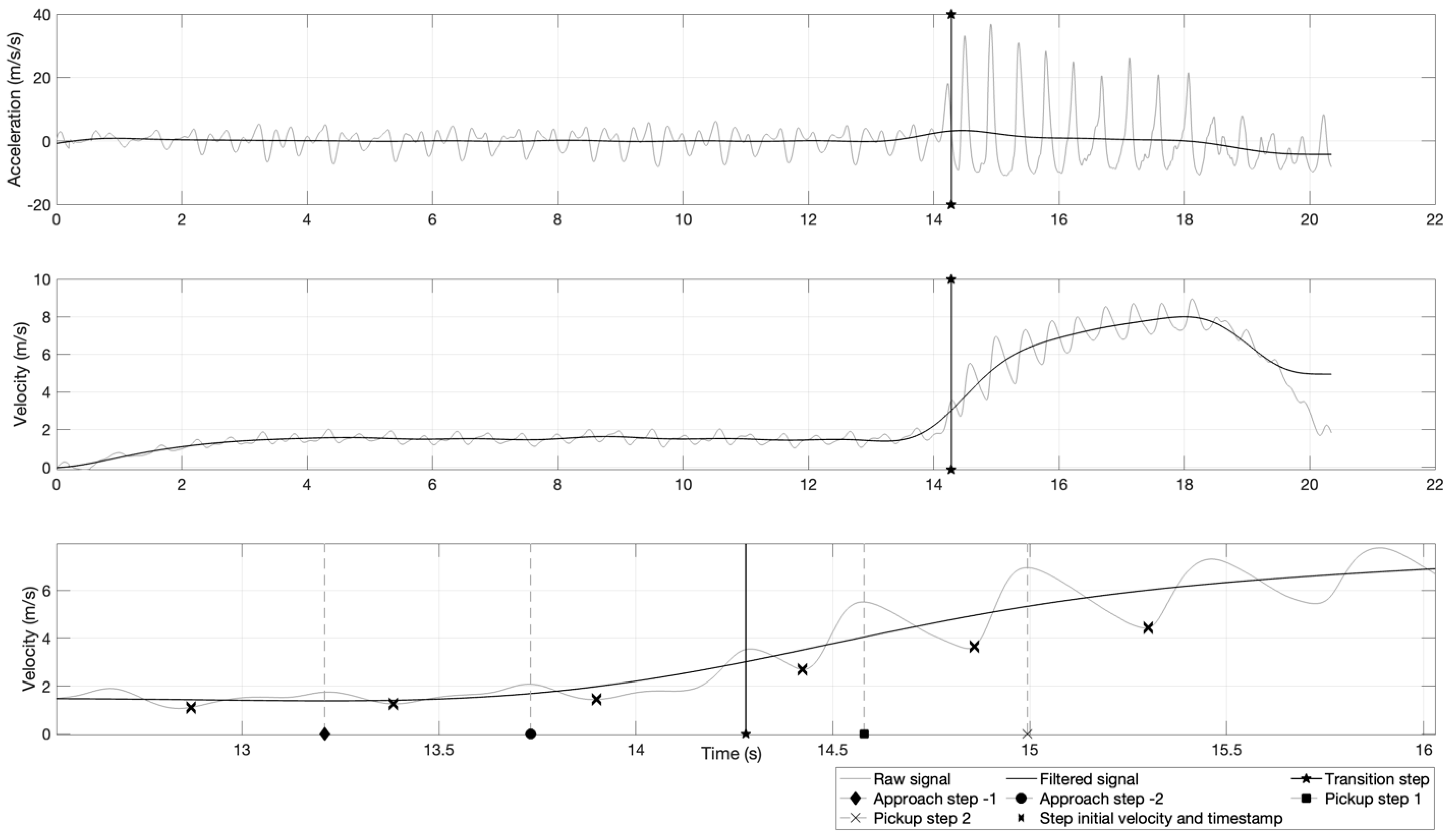
Raw velocity and time data from the 1080 Sprint were processed in MATLAB (MATLAB R2024b Update 3) using custom code to generate velocity–time, acceleration–time, and velocity–distance outputs. Within the raw velocity signal, ground contacts were identified as touchdowns and toe-offs from the troughs and peaks of the signal [
24,
25], allowing manual identification of individual steps (see
Figure 2). The pickup acceleration breakpoint was defined as the point at which a distinct increase (greater than 1 m/s, 1 m/s
2) in both velocity and acceleration occurred. Five steps were identified in total: Approach 2, Approach 1, Transition, Pickup 1, and Pickup 2. Analysis was anchored at the peak corresponding to the Transition step, from which MATLAB automatically estimated the most likely peaks and valleys for the surrounding steps. Only Approach 1 through Pickup 2 were included in the analysis, while Approach 2 was used solely to verify the consistency of the prescribed entry velocity. If necessary, the researcher adjusted selections forward or backward to align with the true signal valley or peak, ensuring accurate event identification. From the processed data, filtered
amax and
vmax were derived. Previously, the test–retest reliability for the step selection process and outputs
amax,
vmax, and split times was established over three testing occasions separated by at least seven days [
26]. Coefficients of variation were <5%, and the intraclass correlation coefficients were >0.99. The repeatability and accuracy for base measures, velocity, position, and time were found to have a low error rate (<1%) by the manufacturer, and low bias and low error rates for step length, step force, and step velocity were also reported by Sugisaki [
24]. Although reliability analyses were primarily performed on the step-selection process and broader acceleration outputs, the step-level variables examined in the present study were derived from the same measurement system and processing procedures.
Maximal acceleration was derived from a velocity signal filtered using a 0.5 Hz low-pass Butterworth filter and defined as the highest acceleration attained from trial onset to 95% of
vmax. This filtering approach reduced oscillations associated with tether motion during ground-contact and flight phases, thereby providing a more accurate estimate of CoM velocity and acceleration [
5,
24]. Maximal velocity was defined as the peak velocity recorded during the trial. All step-level variables were calculated from the unfiltered raw signal. S
v and step time (S
t) were calculated for the Approach, Transition, and Pickup steps. Selected toe-off and ground-contact distances and their corresponding timestamps were then used to compute SF
h, SL, and S
a.
Step acceleration was calculated as the average change in step velocity between consecutive steps by dividing the difference in step velocity values obtained from consecutive step peaks by the elapsed time between the corresponding consecutive valleys (S
a = (S
vy − S
vx)/(
ty −
tx)). The time change was calculated using the timestamps from each valley, immediately before and after the step (indicated by the black X in
Figure 2), using the formula S
t = (
ty −
tx). The step horizontal force was computed using SF
h = body mass × S
a. Due to the nature of the linear position encoder, SF
h represents an estimate based on acceleration and should be interpreted as a proxy measure rather than a direct measure of ground reaction force. Step length was measured as the distance between consecutive signal valleys (i.e., from ground contact to ground contact; SL = d
y − d
x/leg length). The athlete’s leg length was measured from the right ASIS to the bottom of the right medial malleolus [
27]. Step velocity was calculated as the change in step length position between consecutive steps divided by the time elapsed between those steps. Specifically, the SL measured at the signal valley for one step was subtracted from the SL of the subsequent step, and this displacement was divided by the difference in their corresponding times (S
v = (d
y − d
x)/(t
y − t
x)).
2.4. Statistical Analysis
An a priori power analysis was conducted using G*Power (3.1.9.6) to determine the required sample size to detect a between-group difference in amax using an independent-samples t-test. The analysis assumed a large effect size (Cohen’s d), a two-tailed alpha level of 0.05, and a desired power (1-β) of 0.80. The results indicated that a total sample size of 10 participants (5 per group) would be sufficient to detect a significant difference. Given a sample size of 48 participants (24 per group), the achieved power was 0.96, indicating that the study was well powered to detect the expected effect. Participants were divided above and below the mean amax into equal fast and slow groups for each entry velocity. Maximal acceleration represents a single instantaneous peak value of CoM acceleration and was used to define group membership. In contrast, the variables examined in this study (step acceleration, estimated step horizontal force, step length, and step velocity) are step-specific, phase-dependent measures quantified across the Approach, Transition, and Pickup steps. As such, amax reflects a global performance outcome, whereas the dependent variables provide a step-by-step description of the mechanical strategies underpinning that outcome, rather than independent measures of overall acceleration performance.
Independent t-tests with a significance level of p < 0.05 were used to determine which variables of interest differed significantly at particular time points/steps (Approach, Transition, and Pickup steps). Given multiple planned comparisons, a Bonferroni correction was applied to control the familywise Type I error rate. With four comparisons across variables, the adjusted alpha level was set at 0.01. This conservative approach was selected to minimize the likelihood of false-positive findings. It should be noted that, as differences in amax are inherently embedded within the grouping procedure, these comparisons are presented descriptively rather than interpreted inferentially.
Before analysis, the assumptions of normality (Shapiro–Wilk test) and homogeneity of variances (Levene’s test) were assessed. Data were presented as means ± standard deviations (SD) to represent measures of centrality and spread, respectively. In addition to
p-values, effect sizes (ES) were calculated using Cohen’s d to assess the practical significance of findings, with thresholds interpreted as trivial (<0.20), small (0.20–0.49), moderate (0.50–0.79), large (0.80–1.0), and very large (>1.0) [
28]. Between-group differences were calculated as symmetrical percent differences with the following formula: Fast − Slow/(Fast + Slow/2) × 100. Ninety-five percent confidence intervals (95% CI) around the mean differences were also reported to provide additional context regarding the precision of the estimates. All statistical analyses were performed using JASP (JASP 0.19.3, University of Amsterdam, Amsterdam, NL, USA).
4. Discussion
Given that pickup acceleration presents unique mechanical and technical demands compared to static-start acceleration [
5], it is important to identify which steps and mechanical variables best delineate pickup acceleration ability. The final Approach, the Transition, and the first two Pickup steps were of particular interest to the authors. When participants were divided into faster and slower groups based on
amax, several key findings emerged. At the 1.5 m/s (walking) entry velocity, faster athletes achieved significantly higher maximal acceleration and velocity (~12 and ~7%, respectively), potentially due to greater step force (SF
h) during the Transition and Pickup 1 steps (~33–34%), which likely led to higher step acceleration (S
a) on Pickup 1 and 2 and higher Pickup 1 step velocity (S
v), with only small-to-modest increases (~4–11%) in step length (SL). At the 3.0 m/s (jogging) entry velocity, faster athletes again achieved significantly higher
amax and
vmax (~16% and ~7%), appearing to be influenced by greater SF
h during the Transition and Pickup 1 steps (~21–34%), resulting in higher S
a across Pickup 1 and 2, despite minimal and non-significant differences in SL and only small differences in S
v for Pickup 1. Before discussing these results in detail, it is important to note that comparisons with existing research are problematic and should be interpreted cautiously, given differences in study design, training status of participants, variables collected, measurement technologies used, and overall study scope. Furthermore, the reader needs to be cognizant that differences in
amax are structurally embedded within the grouping procedure and therefore reflect descriptive rather than inferential comparisons.
4.1. Entry at 1.5 m/s
It was hypothesized that from a walking entry, greater SFh would lead to superior pickup acceleration step mechanics and performance outcomes. The findings support this contention, with the faster group demonstrating significantly greater force production across the Transition and Pickup steps, alongside higher amax and vmax values (~12% and ~7%, respectively). These differences may reflect an enhanced ability of the faster athletes to rapidly increase horizontal force on and immediately after the Transition, possibly through superior force-generating capacity or feasibly more effective technical execution.
To the authors’ knowledge, limited research has examined step-to-step differences in walking-entry SF
h. One research group [
11] reported a decrease in horizontal braking impulse during the Transition, followed by an increase at Pickup 1, with no change in propulsive force. While there were methodological and technological differences (participants were not divided by performance, and researchers used force plates rather than an LPE with force data separated into braking and propulsive components), the general trend of force modulation across steps is broadly consistent with the findings of this study, which showed an increase in SF
h during the Transition, followed by a slight reduction at Pickup 1. However, the use of an LPE in this study precludes detailed separation of braking and propulsive components.
Contrary to expectations, greater SF
h did not consistently translate to significantly longer step lengths (SL). The only difference was observed at Pickup 2, where the faster group exhibited a moderate but non-significantly longer (~11%) SL, while differences at earlier steps were small (<5%). Despite the small effect sizes, SL likely contributes to performance in a secondary capacity, potentially facilitating increases in CoM velocity. Previous researchers have reported similar SL values during gait transitions [
10,
29], with SL values observed here being similar to those reported there (Approach 1: 0.95 m vs. 0.83 m; Transition: 1.22 m vs. 1.01 m; Pickup 1: 1.17 m vs. 1.20 m). It was unclear, however, whether distances were reported relative to leg length, and Pickup 2 was not included. Furthermore, the authors did not examine how SL adapted to pickup acceleration, nor did they undertake a fast–slow comparison.
Step acceleration differed significantly between groups during the Pickup steps (~22–28%), which is consistent with the greater SF
h observed in the faster group. Given that acceleration is mechanically dependent on force production, this finding was expected, particularly as grouping was based on
amax. Acceleration is commonly reported as CoM acceleration in the gait transition literature, with values ranging widely (0.23–3.63 m/s
−2). Although step-specific acceleration measures have not previously been examined, one research group [
6] reported acceleration values within the range of those in this study (3.63 m/s
−2 vs. 3.56 m/s
−2 for our athletes); other researchers reported a gradual acceleration (0.23 m/s
−2) [
13], limiting direct comparison but highlighting the novelty of the present approach.
Finally, S
v was significantly greater in the faster group during Pickup 1 (~9%), quite likely reflecting the higher SF
h and S
a. However, this difference diminished by Pickup 2 (~4%), likely suggesting that the primary separation in pickup acceleration performance occurs within the first two steps. This aligns with the notion that early step execution is critical in determining overall pickup acceleration ability, although further investigation, including analyzing additional steps, is warranted. Previous authors [
10,
11,
29] have reported velocity measures for Approach 1 through Pickup 1, and the range of values was considerably lower (2.30 to 3.01 m/s vs. 1.98 to 5.60 m/s) than those reported in this study. This possibly reflects differences in protocols and the focus on spontaneous rather than maximal acceleration. Furthermore, comparisons to this research are problematic because these researchers used non-athletes, had sample sizes (n < 17), and employed different technologies (laser/Footscan insoles, cameras, and force plates) to collect data.
4.2. Entry at 3.0 m/s
As with the walking entry, it was hypothesized that greater SF
h from a jogging entry would result in superior pickup acceleration performance. This was partially supported, with the faster group producing significantly greater SF
h (averaged % difference = ~27%) during the Pickup 1 step, while the Transition and Pickup 2 exhibited moderate differences but did not reach the adjusted level of significance (averaged difference ~22%). Despite these differences, overall SF
h values were lower than those observed in the 1.5 m/s condition, suggesting that the higher entry velocity potentially imposed a greater velocity-oriented constraint on force production. This is consistent with the force–velocity relationship, whereby increasing velocity limits the magnitude of horizontally directed force that can be applied and reduces
RF% [
30]. Only two authors [
17,
19] have investigated F
h production during jogging pickup acceleration. Kugler [
17] examined acceleration from a 3.0 m/s entry but did not report step-specific data, instead presenting force measures separated into propulsive and braking impulses. Caekenberghe [
19] used multiple unspecified entry conditions and reported results per 1 m/s
2 of acceleration, showing that the ground reaction force vector was oriented 4 ± 1° more anterior per unit increase in acceleration. To the authors’ knowledge, this study is the first to examine stepwise changes in SF
h during pickup acceleration; however, the findings are consistent with static-start literature, highlighting the importance of SF
h [
30]. Salo [
31] reported SF
h values separated into propulsive and braking components, requiring net force to be calculated manually; aside from the first step (637 N), values were similar to those of this study and decreased with velocity (361 N at step 2 to 79 N at step 4). Other researchers [
32,
33,
34] have examined force, although values were typically reported as relative rather than absolute forces, limiting direct comparison.
No statistically significant differences in SL were observed between groups; however, small-to-moderate effect sizes (ES = −0.27 to 0.54) indicated that the faster group appeared to take slightly longer steps (~5–11%) during Pickup 1 and Pickup 2. Previous work by Jakeman et al. [
16] reported SLs of ~1.44 m during Approach 1, 1.12 m during the Transition step, and 1.27–1.42 m during the Pickup steps. Within that study, each step was significantly longer than the preceding step (
p ≤ 0.05). These values were very similar to those observed in this study (Approach 1: 1.16 m; Transition–Pickup 2: 1.25–1.42 m), despite the researchers using a faster entry velocity (4.0 m·s
−1) and a recreationally active population rather than team-sport athletes. Compared with the static-start literature, SLs also fell within the values reported in this work, ranging from 1.03 to 1.44 m over the first three steps [
35,
36,
37]. As with the walking condition, SL does not appear to be a primary differentiator of performance, although it likely contributes in some manner.
Consistent with the greater SF
h production, the faster group was observed to have moderately higher S
a for Pickup 1 (% difference of ~37%) despite not reaching the adjusted threshold of significance for the Transition and Pickup 2 steps. These differences may reflect more effective application of horizontal force at ground contact, likely enabling more rapid increases in velocity and contributing to the higher
amax observed in the faster group. As noted previously, step-specific acceleration measures have not been widely reported in the literature, limiting direct comparison but reinforcing the novelty of this approach. Step acceleration is not commonly measured in static-start sprinting, where it is typically reported as CoM acceleration or via profiling measures [
38,
39].
Step velocity differences between groups were minimal during the pickup phase. Consistent with this, during the later acceleration phases (Pickup 1 and 2), effect sizes were small (ES range = 0.36–0.45), with the faster group exhibiting slightly higher but non-significant S
v (~3%). Jakeman et al. [
15] were the only group to report S
v changes from a jogging entry, finding significant differences in velocity between steps; however, they implemented a faster entry velocity (4.0 m/s vs. 3.0 m/s). Additionally, the velocity increases observed in their study were more gradual than those reported here (ranging from 0.018 to 0.532 m/s), possibly due to the recreational population or the higher entry velocity, which may have constrained changes in S
v. It appears that at higher entry velocities, performance differentiation may be driven more by force application and acceleration capacity than by step velocity per se.
5. Limitations and Future Research Directions
The authors acknowledge several limitations that the reader should be aware of when reading this article. The main limitation is that participants were grouped according to maximal acceleration and then compared using acceleration-related variables, such as step acceleration and estimated step horizontal force, a derivative of acceleration. Given this grouping, the findings should be viewed as descriptive associations rather than true mechanical determinants.
Although between-group differences in SF
h were observed, the specific mechanisms underlying these differences cannot be definitively determined, as several unmeasured technical and physical factors may have contributed to the results. For example, the faster group may have oriented the body more quickly into a forward lean or adopted more favorable body angles to optimize the orientation of the horizontal force vector [
30]. Alternatively, superior strength qualities, such as greater plantar flexor range of motion or enhanced explosive force production, may have influenced performance. Future research incorporating additional technologies, including videography and force dynamometry, is needed to more comprehensively identify the technical and physical determinants of pickup acceleration and superior SF
h performance. Videography may clarify joint kinematics and segmental coordination during early acceleration, while dynamometry could quantify maximal force-producing capacity and further distinguish performance groups.
Additionally, although the 1080 Sprint provides valuable kinematic and kinetic insights, SF
h is derived from S
a, which is a second derivative of displacement, so successive differentiation amplifies any noise in the signal. In tethered sprint systems, minor belt and center-of-mass oscillations during ground contact and flight may therefore increase variability in acceleration- and force-based measures. Furthermore, given the technology used, it should be acknowledged that force measurements are proxies and that force plates in series would be needed to quantify the true orientation and magnitude of force production. However, such setups are outside the budget of most labs/researchers; thus, the approach taken in this paper. Previous researchers [
40], when comparing the 1080 Sprint to the gold standard force plates, identified a fixed bias of 16 N and recommended calibration against force plate data to ensure accuracy. Furthermore, the system’s inability to accurately quantify step frequency limited the analysis.
Finally, the scope of this study was informed by prior gait transition research [
10,
11,
12], which has primarily examined Approach 2 through Pickup 2; however, inclusion of additional pickup steps may have further clarified between-group differences. Studies using an LPE with 1 kg resistance [
22,
23,
41] have reported “false peaks” in the waveform, likely due to tether oscillations with each gait event, introducing minor signal irregularities that may affect the determination of step variables such as SL and S
t. The data processing methods employed here replicate those of Magnine [
23], including adjustments to account for line sway associated with the preceding step. Finally, although minimal, the 1 kg load does not fully replicate unresisted sprinting.
6. Conclusions
During pickup acceleration, an athlete must perform maximal acceleration from a non-static start; however, the qualities underlying this capability remain relatively unexplored. This is problematic, given that most understanding of positional demands and decisions around individualized programming occurs based on metrics extracted from static-start sprinting. Given the current state of the research, it was hypothesized that individuals with superior pickup ability would likely produce greater SFh, resulting in longer step length, greater step acceleration, and higher step velocity. This contention was partially supported: the effect of SFh on the Transition and Pickup SLs appeared minimal, and its impact on Sv potentially depended on the entry velocity. Given the limited research in this area, further applied investigation using video-based kinematic analysis is recommended to clarify the technical factors influencing pickup acceleration performance. Furthermore, profiling the athlete’s physical capabilities alongside videography should provide a better understanding of the determinants of pickup acceleration, which, in turn, should inform better exercise prescription to improve this motor quality. From a practical standpoint, the approach used in this study theoretically enables higher-level diagnostics and, therefore, a better understanding of the important characteristics of pickup acceleration. This, in turn, should enable more focused/targeted training interventions and performance profiling, particularly during the critical Transition and Pickup steps of pickup acceleration.




 ,
,