
The A-Palp: A Digitized Manual Palpation Method for Sagittal Spine Assessment—A Study of Reliability over Time and Between Operators

 , ,
, ,
Abstract
1. Introduction
2. Materials and Methods
2.1. Study Design
2.2. Hypothesis
2.3. Participants
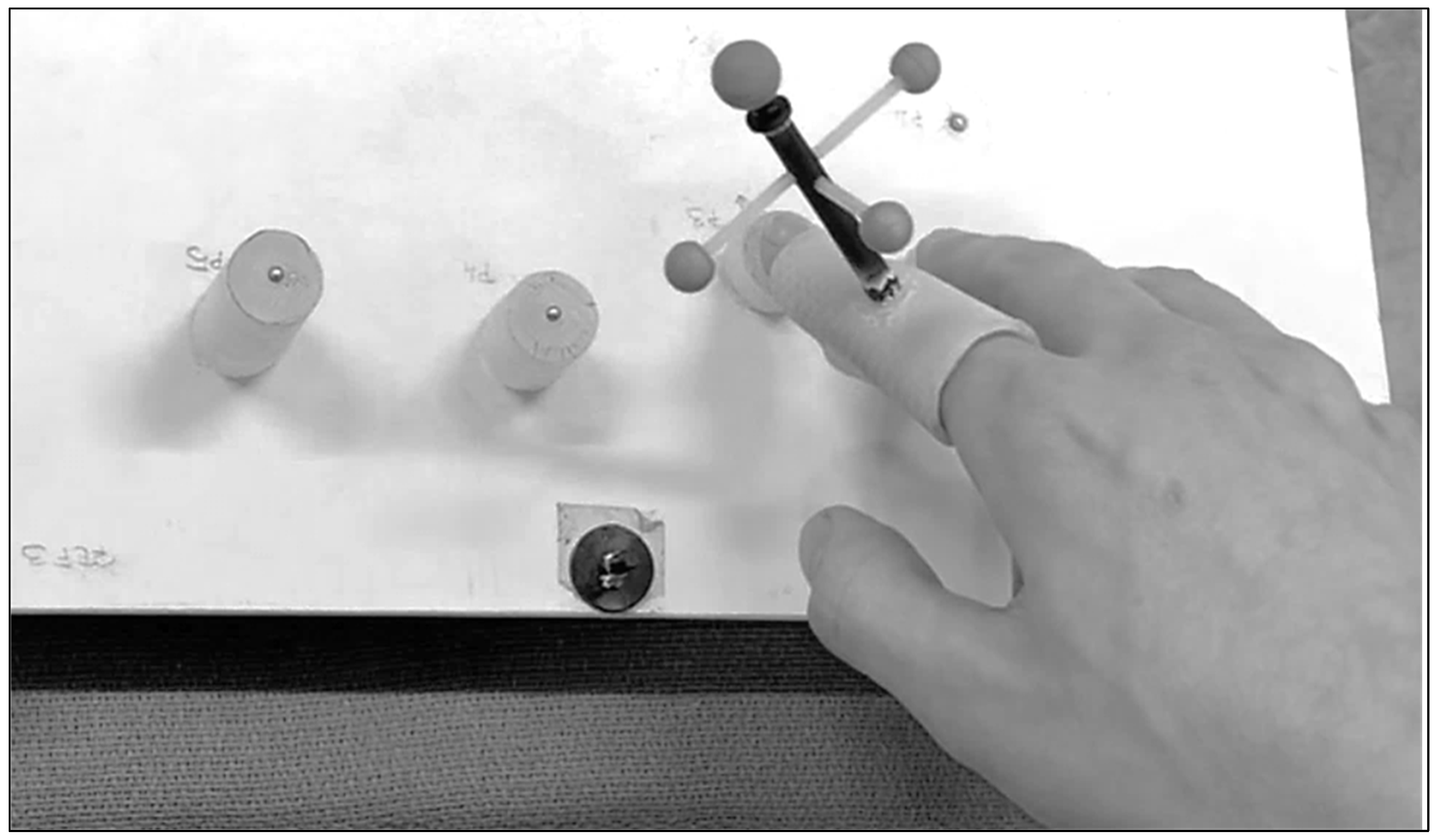
2.4. A-Palp Device
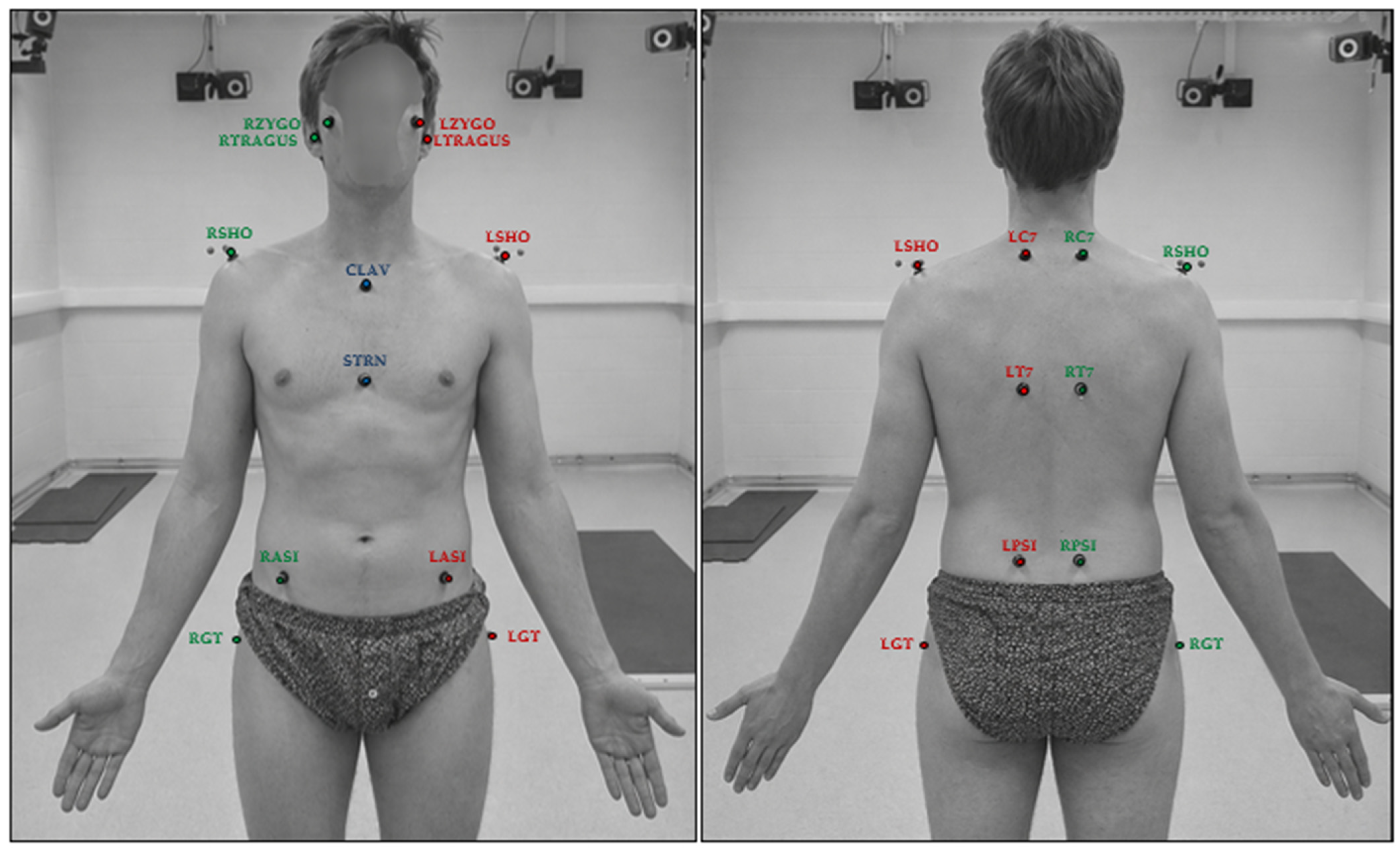
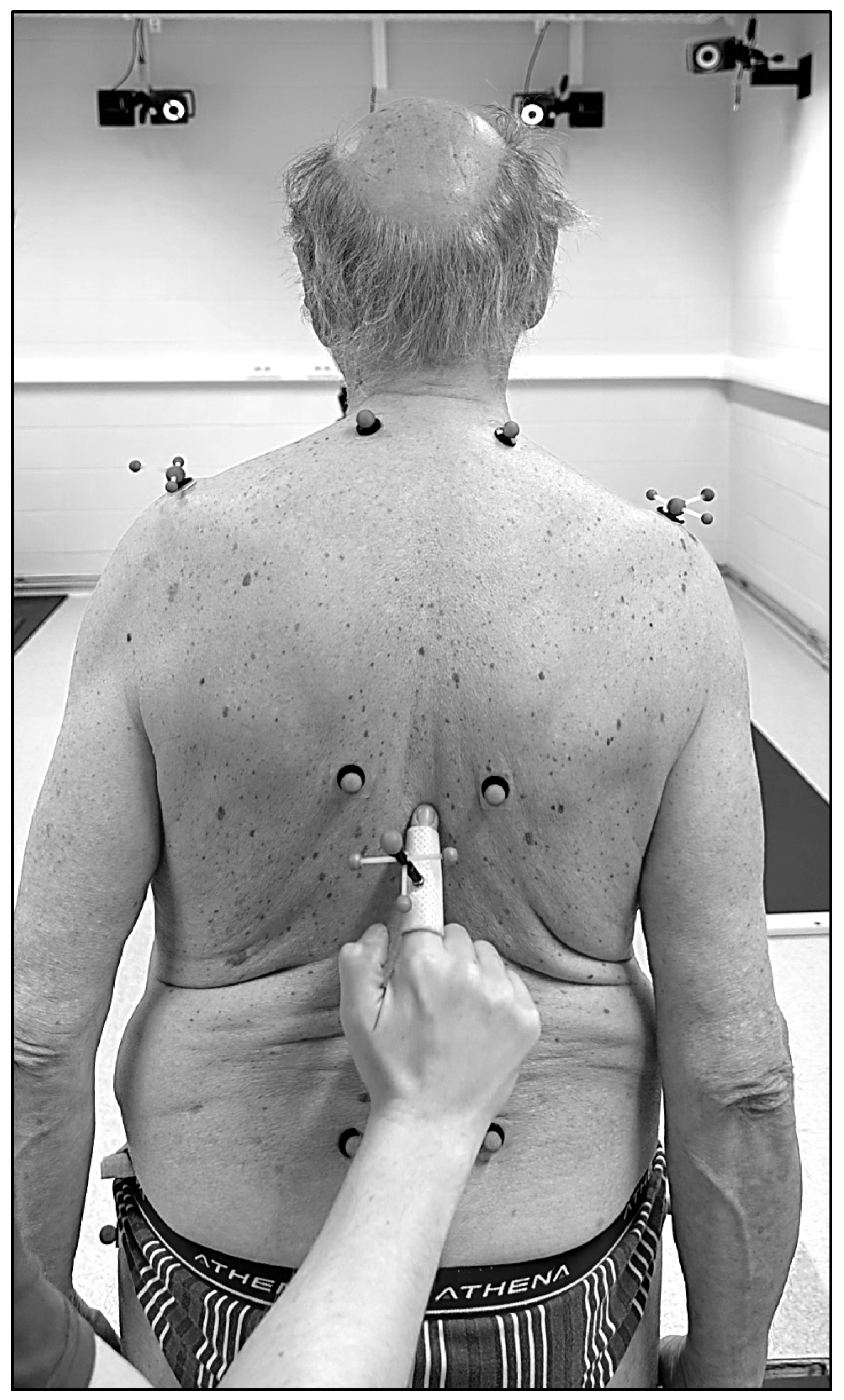
2.5. Data Collection
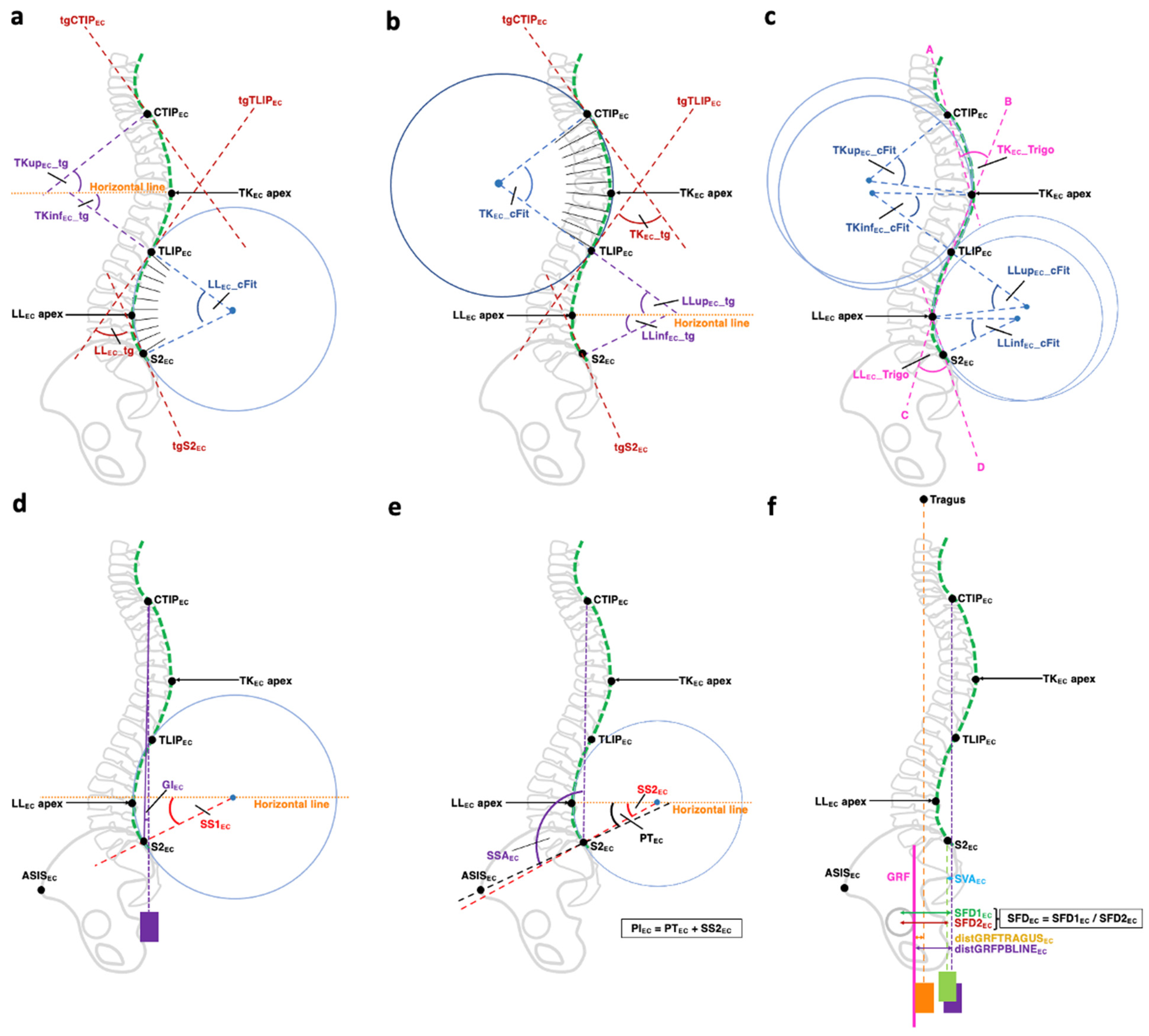
2.6. Data Processing
- -
- The tangent method: determined by the tangents at the extracorporeal inflection points and at the virtual marker placed on the S2 vertebra, using the Frenet frame tangents at these locations [20].
- -
- -
- The trigonometric method: defined by the apex point and its two-boundary points.
2.7. Evaluation Metrics
2.8. Statistical Analysis
- -
- For intra-operator reliability: ICC (3,k) was used, as it was based on the average of three repeated measurements obtained under fixed conditions by the same examiner.
- -
- For inter-operator and inter-session reliability: ICC (2,1) was used, as comparisons were performed between two averaged values, each derived from three repeated measurements per condition (operator or session), thereby reflecting absolute agreement between independent measurements.
3. Results
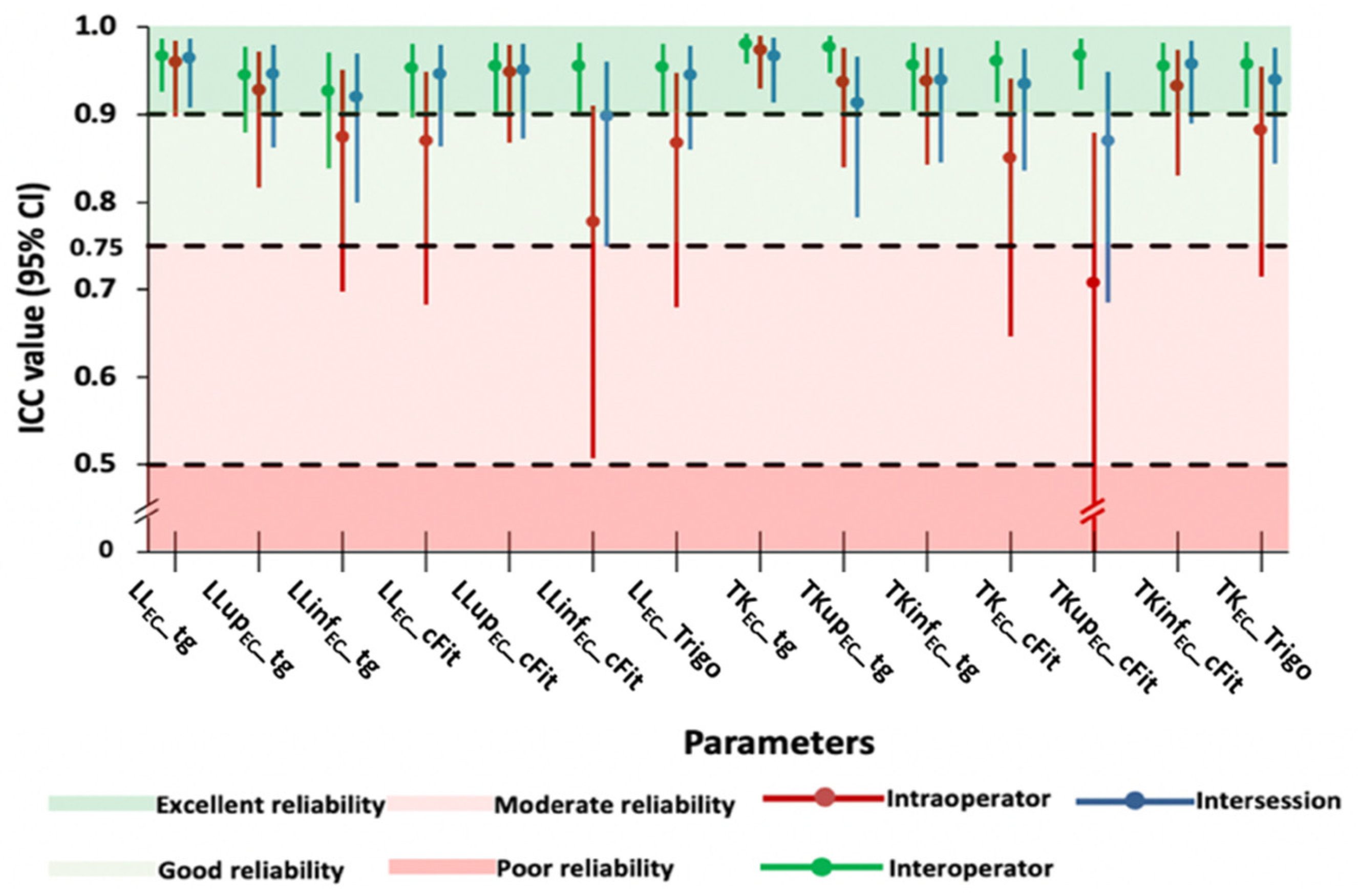
3.1. Reliability of Extracorporeal Spinal Curvature Angles
3.2. Reliability of Extracorporeal Spinopelvic Parameters
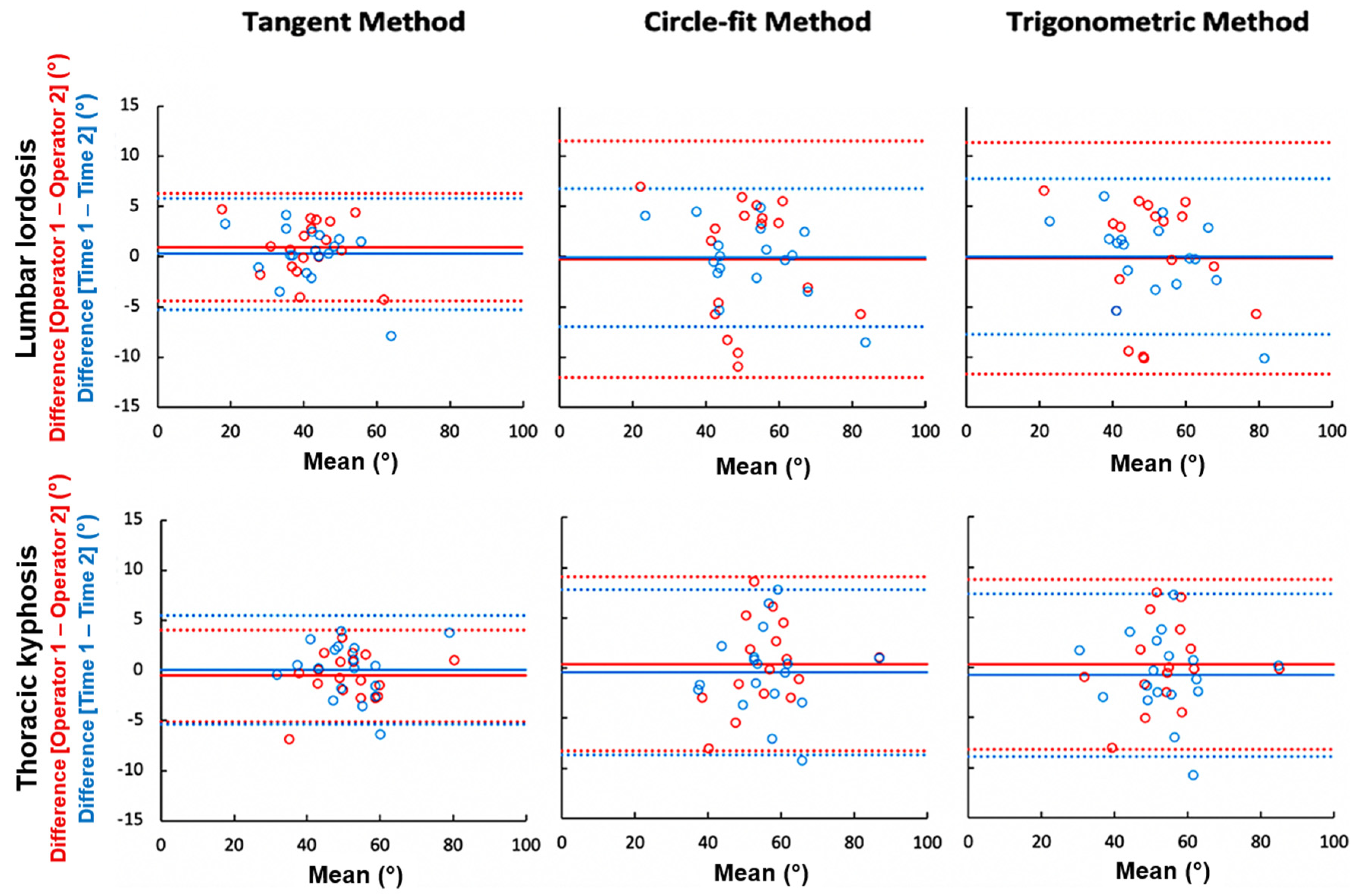
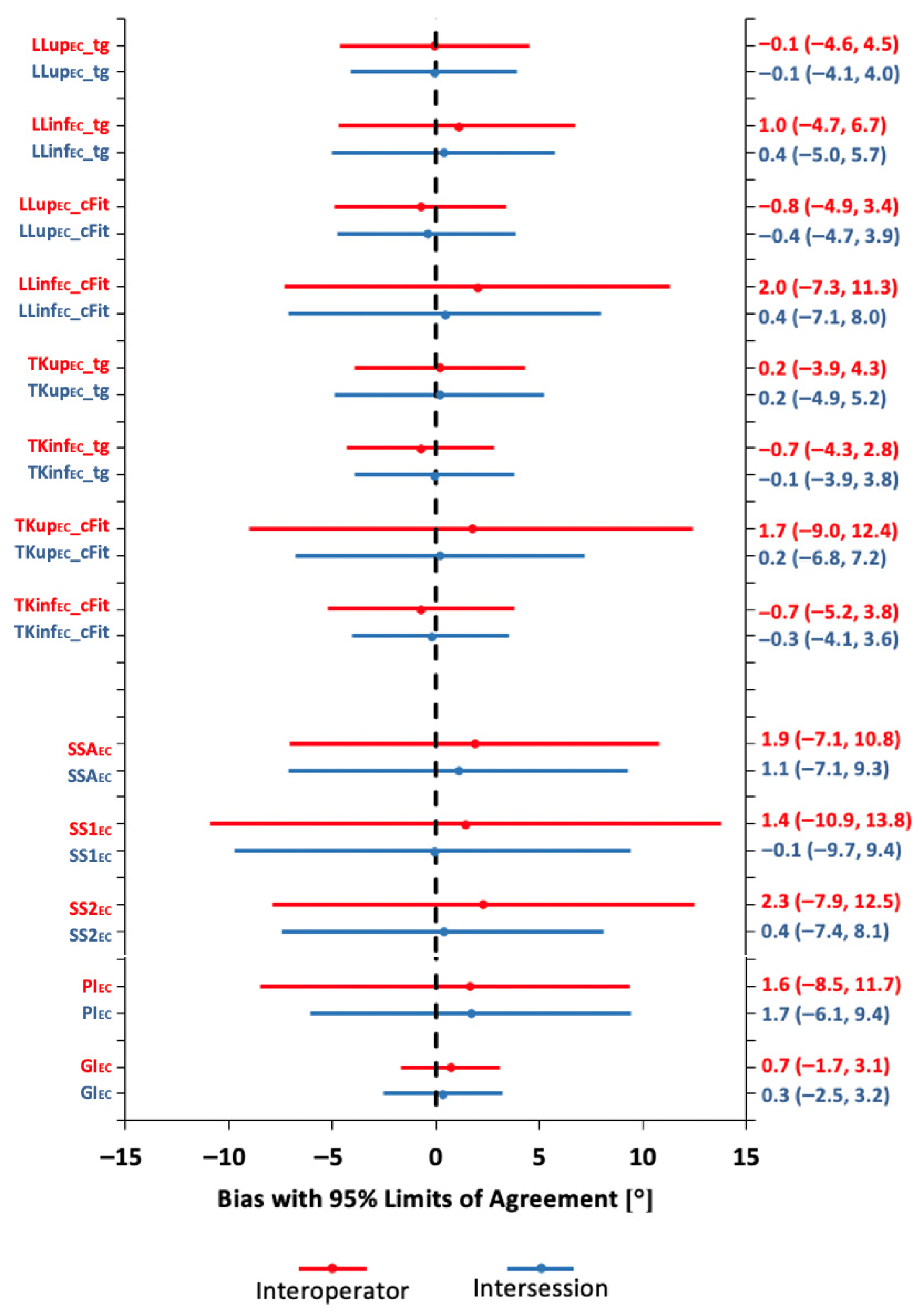
3.3. Agreement Analyses—Spinal and Spinopelvic Parameters
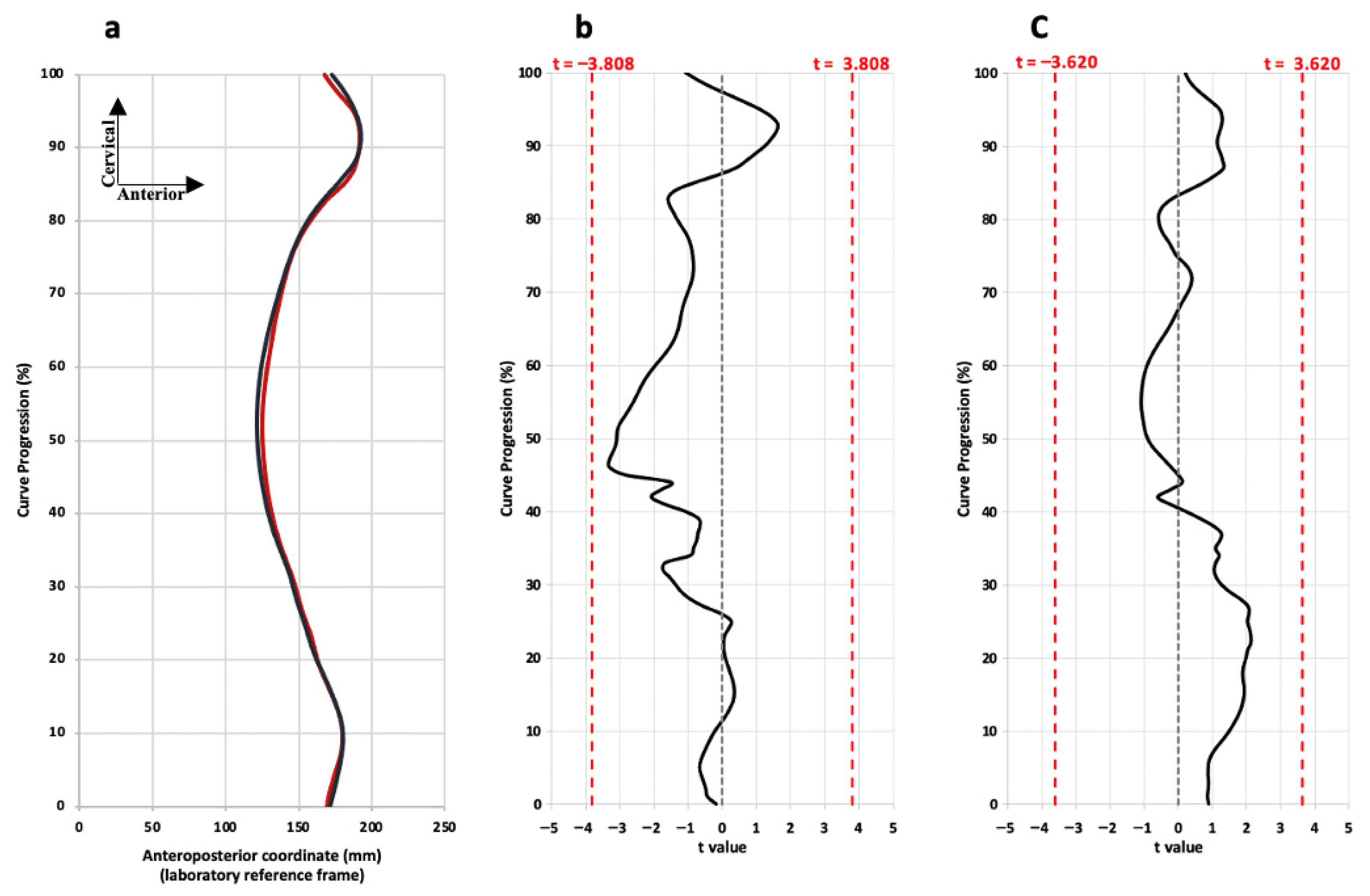
3.4. Extracorporeal Sagittal Spinal Profile Reliability
4. Discussion
5. Conclusions
Author Contributions
Funding
Institutional Review Board Statement
Informed Consent Statement
Data Availability Statement
Conflicts of Interest
References
- Knott, P.; Pappo, E.; Cameron, M.; Demauroy, J.; Rivard, C.; Kotwicki, T.; Zaina, F.; Wynne, J.; Stikeleather, L.; Bettany-Saltikov, J.; et al. SOSORT 2012 consensus paper: Reducing X-ray exposure in pediatric patients with scoliosis. Scoliosis 2014, 25, 4. [Google Scholar] [CrossRef]
- Nicol, V.; Verdaguer, C.; Daste, C.; Bisseriex, H.; Lapeyre, E.; Lefevre-Colau, M.M.; Rannou, F.; Roren, A.; Facione, J.; Nguyen, C. Chronic low back pain: A narrative review of recent international guidelines for diagnosis and conservative treatment. J. Clin. Med. 2023, 12, 1685. [Google Scholar] [CrossRef]
- Delitto, A.; George, S.Z.; Van Dillen, L.; Whitman, J.M.; Sowa, G.; Shekelle, P.; Denninger, T.R.; Godges, J.J. Low back pain. J. Orthop. Sports Phys. Ther. 2012, 42, A1–A57. [Google Scholar] [CrossRef]
- Glassman, S.D.; Bridwell, K.; Dimar, J.R.; Horton, W.; Bervens, S.; Schwab, F.J. The impact of positive sagittal balance in adult spinal deformity. Spine 2005, 30, 2024–2029. [Google Scholar] [CrossRef]
- Schwab, F.J.; Blondel, B.; Bess, S.; Hostin, R.; Shaffrey, C.I.; Smith, J.S.; Boachie-Adjei, O.; Burton, D.C.; Akbarnia, B.A.; Mundis, G.M.; et al. Radiographical spinopelvic parameters and disability in the setting of adult spinal deformity: A prospective multicenter analysis. Spine 2013, 38, E803–E812. [Google Scholar] [CrossRef] [PubMed]
- Chaléat-Valayer, E.; Mac-Thiong, J.M.; Paquet, J.; Berthonnaud, E.; Siani, F.; Roussouly, P. Sagittal spino-pelvic alignment in chronic low back pain. Eur. Spine J. 2011, 20, 634–640. [Google Scholar] [CrossRef]
- Seyedhoseinpoor, T.; Sanjari, M.A.; Taghipour, M.; Dadgoo, M.; Mousavi, S.J. Spinopelvic malalignment correlates to lumbar instability and lumbar musculature in chronic low back pain—An exploratory study. Sci. Rep. 2024, 14, 31974. [Google Scholar] [CrossRef]
- Yoon, S.G.; Lee, H.C.; Lee, S.M. Pelvic incidence-lumbar lordosis mismatch is predisposed to adjacent segment degeneration after single-level anterior lumbar interbody fusion: A retrospective case-control study. Neurospine 2023, 20, 301–307. [Google Scholar] [CrossRef] [PubMed]
- Tempel, Z.J.; Gandhoke, G.S.; Bolinger, B.D.; Khattar, N.K.; Parry, P.V.; Chang, Y.F.; Okonkwo, D.O.; Kanter, A.S. The influence of pelvic incidence and lumbar lordosis mismatch on development of symptomatic adjacent level disease following single-level transforaminal lumbar interbody fusion. Neurosurgery 2017, 80, 880–886. [Google Scholar] [CrossRef]
- Ronckers, C.M.; Land, C.E.; Miller, J.S.; Stovall, M.; Lonstein, J.E.; Doody, M.M. Cancer mortality among women frequently exposed to radiographic examinations for spinal disorders. Radiat. Res. 2010, 174, 83–90. [Google Scholar] [CrossRef] [PubMed]
- Su, X.; Dong, R.; Wen, Z.; Liu, Y. Reliability and validity of scoliosis measurements obtained with surface topography techniques: A systematic review. J. Clin. Med. 2022, 11, 6998. [Google Scholar] [CrossRef]
- Paloschi, D.; Bravi, M.; Schena, E.; Miccinilli, S.; Morrone, M.; Sterzi, S.; Saccomandi, P.; Massaroni, C. Validation and assessment of a posture measurement system with magneto-inertial measurement units. Sensors 2021, 21, 6610. [Google Scholar] [CrossRef] [PubMed]
- Salvia, P.; Jan, S.V.; Crouan, A.; Vanderkerken, L.; Moiseev, F.; Sholukha, V.; Mahieu, C.; Snoeck, O.; Rooze, M. Precision of shoulder anatomical landmark calibration by two approaches: A CAST-like protocol and a new anatomical palpator method. Gait Posture 2009, 29, 587–591. [Google Scholar] [CrossRef] [PubMed]
- Kottner, J.; Audigé, L.; Brorson, S.; Donner, A.; Gajewski, B.J.; Hróbjartsson, A.; Roberts, C.; Shoukri, M.; Streiner, D.L. Guidelines for reporting reliability and agreement studies (GRRAS) were proposed. J. Clin. Epidemiol. 2011, 64, 96–106. [Google Scholar] [CrossRef]
- Bonett, D.G. Sample size requirements for estimating intraclass correlations with desired precision. Stat. Med. 2002, 21, 1331–1335. [Google Scholar] [CrossRef] [PubMed]
- Shoukri, M.M.; Asyali, M.H.; Donner, A. Sample size requirements for the design of reliability study: Review and new results. Stat. Meth Med. Res. 2004, 13, 1–21. [Google Scholar] [CrossRef]
- Salvia, P.; Elbaum, R.; Bourgois, E.; Pech, S.; Feipel, V.; Beyer, B. Digitization of three-dimensional spine curvature profile in adolescent idiopathic scoliosis using anatomical palpation. Comput. Methods Biomech. Biomed. Eng. Imaging Vis. 2022, 11, 467–475. [Google Scholar] [CrossRef]
- Schwetlick, H.; Schütze, T. Least squares approximation by splines with free knots. BIT Numer. Math. 1995, 35, 361–384. [Google Scholar] [CrossRef]
- Taubin, G. Estimation of planar curves, surfaces, and nonplanar space curves defined by implicit equations with applications to edge and range image segmentation. IEEE Trans. Pattern Anal. Mach. Intell. 1991, 13, 1115–1138. [Google Scholar] [CrossRef]
- Berthonnaud, E.; Dimnet, J. Fast calculation of parameters of scoliosis in frontal view for clinical applications. ITBM-RBM 2006, 27, 56–66. [Google Scholar] [CrossRef]
- Schmid, S.; Studer, D.; Hasler, C.C.; Romkes, J.; Taylor, W.R.; Lorenzetti, S.; Brunner, R. Quantifying spinal gait kinematics using an enhanced optical motion capture approach in adolescent idiopathic scoliosis. Gait Posture 2016, 44, 231–237. [Google Scholar] [CrossRef]
- Koo, T.K.; Li, M.Y. A guideline of selecting and reporting intraclass correlation coefficients for reliability research. J. Chiropr. Med. 2016, 15, 155–163. [Google Scholar] [CrossRef]
- Bland, J.M.; Altman, D.G. Statistical methods for assessing agreement between two methods of clinical measurement. Lancet 1986, 1, 307–310. [Google Scholar] [CrossRef] [PubMed]
- Harrison, D.E.; Harrison, D.D.; Cailliet, R.; Troyanovich, S.J.; Janik, T.J.; Holland, B. Cobb method or Harrison posterior tangent method: Which to choose for lateral cervical radiographic analysis. Spine 2000, 25, 2072–2078. [Google Scholar] [CrossRef]
- Harrison, D.E.; Cailliet, R.; Harrison, D.D.; Janik, T.J.; Holland, B. Reliability of centroid, Cobb, and Harrison posterior tangent methods: Which to choose for analysis of thoracic kyphosis. Spine 2001, 26, E227–E234. [Google Scholar] [CrossRef] [PubMed]
- Vrtovec, T.; Pernuš, F.; Likar, B. A review of methods for quantitative evaluation of spinal curvature. Eur. Spine J. 2009, 18, 593–607. [Google Scholar] [CrossRef]
- Le Huec, J.C.; Saddiki, R.; Franke, J.; Rigal, J.; Aunoble, S. Equilibrium of the human body and the gravity line: The basics. Eur. Spine J. 2011, 20, 558–563. [Google Scholar] [CrossRef]
- Kyrölä, K.K.; Salme, J.; Tuija, J.; Tero, I.; Eero, K.; Arja, H. Intra- and interrater reliability of sagittal spinopelvic parameters on full-spine radiographs in adults with symptomatic spinal disorders. Neurospine 2018, 15, 175–181. [Google Scholar] [CrossRef] [PubMed]
- Roussouly, P.; Pinheiro-Franco, J.L. Sagittal parameters of the spine: Biomechanical approach. Eur. Spine J. 2011, 20, 578–585. [Google Scholar] [CrossRef]



| Parameter * | Definition |
|---|---|
| LLEC_tg | The angle between the tangents at the extracorporeal thoracolumbar inflection point (TLIPEC; tgTLIPEC) and the virtual marker on the vertebra S2 (S2EC; tgS2EC) (Figure 4a) |
| LLupEC_tg | The angle between the line perpendicular to the tangent at the extracorporeal thoracolumbar inflection point (TLIPEC; tgTLIPEC) and the horizontal line passing through the extracorporeal lumbar lordosis apex (LLEC apex) (Figure 4b) |
| LLinfEC_tg | The angle between the line perpendicular to the tangent at the virtual marker on the vertebra S2 (S2EC; tgS2EC) and the horizontal line passing through the extracorporeal lumbar lordosis apex (LLEC apex) (Figure 4b) |
| LLEC_cFit | The central angle at the center of the best-fit circle fitted between the extracorporeal thoracolumbar inflection point (TLIPEC) and the virtual marker on the vertebra S2 (S2EC) (Figure 4a) |
| LLupEC_cFit | The central angle at the center of the best-fit circle fitted between the extracorporeal thoracolumbar inflection point (TLIPEC) and the extracorporeal lumbar lordosis apex (LLEC apex) (Figure 4c) |
| LLinfEC_cFit | The central angle at the center of the best-fit circle fitted between the extracorporeal lumbar lordosis apex (LLEC apex) and the virtual marker on the vertebra S2 (S2EC) (Figure 4c) |
| LLEC_Trigo | The angle between the line from the extracorporeal thoracolumbar inflection point (TLIPEC) to the extracorporeal lumbar lordosis apex (LLEC apex) and the line from this apex to the virtual marker on the vertebra S2 (S2EC) (Figure 4c: between line C and line D) |
| TKEC_tg | The angle between the tangents at the extracorporeal cervicothoracic inflection point (CTIPEC; tgCTIPEC) and the extracorporeal thoracolumbar inflection point (TLIPEC; tgTLIPEC) (Figure 4b) |
| TKupEC_tg | The angle between the line perpendicular to the tangent at the extracorporeal cervicothoracic inflection point (CTIPEC; tgCTIPEC) and the horizontal line passing through the extracorporeal thoracic kyphosis apex (TKEC apex) (Figure 4a) |
| TKinfEC_tg | The angle between the line perpendicular to the tangent at the extracorporeal thoracolumbar inflection point (TLIPEC; tgTLIPEC) and the horizontal line passing through the extracorporeal thoracic kyphosis apex (TKEC apex) (Figure 4a) |
| TKEC_cFit | The central angle at the center of the best-fit circle fitted between the extracorporeal cervicothoracic inflection point (CTIPEC) and the extracorporeal thoracolumbar inflection point (TLIPEC) (Figure 4b) |
| TKupEC_cFit | The central angle at the center of the best-fit circle fitted between the extracorporeal cervicothoracic inflection point (CTIPEC) and the extracorporeal thoracic kyphosis apex (TKEC apex) (Figure 4) |
| TKinfEC_cFit | The central angle at the center of the best-fit circle fitted between the extracorporeal thoracic kyphosis apex (TKEC apex) and the extracorporeal thoracolumbar inflection point (TLIPEC) (Figure 4c) |
| TKEC_Trigo | The angle between the line from the extracorporeal cervicothoracic inflection point (CTIPEC) to the extracorporeal thoracic kyphosis apex (TKEC apex) and the line from this apex to the extracorporeal thoracolumbar inflection point (TLIPEC) (Figure 4c: between line A and line B) |
| SSAEC | The angle between the line from the virtual marker on the vertebra S2 (S2EC) to the extracorporeal cervicothoracic inflection point (CTIPEC) and the line from the virtual marker on the vertebra S2 (S2EC) and the center of the best-fit circle fitted between the extracorporeal lumbar lordosis apex (LLEC apex) and the virtual marker on the vertebra S2 (S2EC) (Figure 4e) |
| SS1EC | The angle between the horizontal and the line from the virtual marker on the vertebra S2 (S2EC) to the center of the best-fit circle fitted between the extracorporeal thoracolumbar inflection point (TLIPEC) and the virtual marker on the vertebra S2 (S2EC) (Figure 4d) |
| SS2EC | The angle between the horizontal and the line from the virtual marker on the vertebra S2 (S2EC) to the center of the best-fit circle fitted between the extracorporeal lumbar lordosis apex (LLEC apex) and the virtual marker on the vertebra S2 (S2EC) (Figure 4e) |
| PTEC | The angle between the horizontal and the line through the anterior and posterior superior iliac spines (ASIS-PSIS) (Figure 4e) |
| PIEC | Defined by PIEC = PTEC + SS2EC (Figure 4e) |
| GIEC | The angle between the line from the virtual marker on the vertebra S2 (S2EC) to the extracorporeal cervicothoracic inflection point (CTIPEC) and the vertical projection from this inflection point (CTIPEC) (Figure 4d) |
| distGRFTRAGUSEC | The horizontal distances from the ground reaction force (GRF) line to the vertical projection of the middle distance between the tragus (Figure 4f) |
| distGRFPBLINEEC | The horizontal distances from the ground reaction force (GRF) line to the vertical projection of the extracorporeal cervicothoracic inflection point (CTIPEC) (Figure 4f) |
| SFDEC | Defined by SFD = SFD1/SFD2, where SFD1 is the distance from the vertical projection of the extracorporeal cervicothoracic inflection point (CTIPEC) to the greater trochanter and SFD2 is the distance from the vertical projection of the virtual marker on the vertebra S2 (S2EC) to the greater trochanter (Figure 4f) |
| SVAEC | The horizontal distance between the virtual marker on the vertebra S2 (S2EC) and the vertical projections of the extracorporeal cervicothoracic inflection point (CTIPEC) (Figure 4f) |
| Intra-Operator | Inter-Operator | Inter-Session | ||||||||||||||||
|---|---|---|---|---|---|---|---|---|---|---|---|---|---|---|---|---|---|---|
| Parameter * | n | k | ICC3(K)95 | p-Value | SEM | MDC95 | n | k | ICC2(1)95 | p-Value | SEM | MDC95 | n | k | ICC2(1)95 | p-Value | SEM | MDC95 |
| LLEC_tg | 18 | 3 | 0.97 [0.93, 0.99] | 1.4 × 10⁻¹⁵ | 2.0 | 5.5 | 18 | 2 | 0.96 [0.90, 0.99] | 2.2 × 10⁻¹¹ | 1.9 | 5.3 | 18 | 2 | 0.96 [0.91, 0.99] | 2.2 × 10⁻¹¹ | 2.0 | 5.5 |
| LLupEC_tg | 18 | 3 | 0.95 [0.88, 0.98] | 2.4 × 10⁻¹² | 1.5 | 4.2 | 18 | 2 | 0.93 [0.82, 0.97] | 8.5 × 10⁻⁹ | 1.7 | 4.6 | 18 | 2 | 0.95 [0.86, 0.98] | 7.3 × 10⁻¹⁰ | 1.5 | 4.0 |
| LLinfEC_tg | 18 | 3 | 0.93 [0.84, 0.97] | 1.6 × 10⁻¹⁰ | 1.9 | 5.2 | 18 | 2 | 0.87 [0.70, 0.95] | 3.1 × 10⁻⁷ | 2.1 | 5.7 | 18 | 2 | 0.92 [0.80, 0.97] | 1.6 × 10⁻⁸ | 1.9 | 5.4 |
| LLEC_cFit | 18 | 3 | 0.95 [0.90, 0.98] | 2.8 × 10⁻¹³ | 3.3 | 9.1 | 18 | 2 | 0.87 [0.68, 0.95] | 9.6 × 10⁻⁷ | 4.9 | 13.4 | 18 | 2 | 0.95 [0.86, 0.98] | 5.3 × 10⁻¹⁰ | 3.3 | 9.1 |
| LLupEC_cFit | 18 | 3 | 0.96 [0.90, 0.98] | 1.1 × 10⁻¹³ | 1.5 | 4.2 | 18 | 2 | 0.95 [0.87, 0.98] | 1.9 × 10⁻¹⁰ | 1.5 | 4.2 | 18 | 2 | 0.95 [0.87, 0.98] | 2.7 × 10⁻¹⁰ | 1.6 | 4.3 |
| LLinfEC_cFit | 18 | 3 | 0.96 [0.90, 0.98] | 1.3 × 10⁻¹³ | 1.9 | 5.3 | 18 | 2 | 0.78 [0.51, 0.91] | 2.3 × 10⁻⁵ | 3.4 | 9.3 | 18 | 2 | 0.90 [0.75, 0.96] | 1.2 × 10⁻⁷ | 2.7 | 7.6 |
| LLEC_Trigo | 18 | 3 | 0.96 [0.90, 0.98] | 1.5 × 10⁻¹³ | 3.3 | 9.0 | 18 | 2 | 0.87 [0.68, 0.95] | 1.0 × 10⁻⁶ | 4.8 | 13.4 | 18 | 2 | 0.95 [0.86, 0.98] | 7.4 × 10⁻¹⁰ | 3.4 | 9.3 |
| TKEC_tg | 18 | 3 | 0.98 [0.96, 0.99] | 1.1 × 10⁻¹⁶ | 1.5 | 4.0 | 18 | 2 | 0.97 [0.93, 0.99] | 1.4 × 10⁻¹² | 1.7 | 4.6 | 18 | 2 | 0.97 [0.91, 0.99] | 1.3 × 10⁻¹¹ | 2.0 | 5.4 |
| TKupEC_tg | 18 | 3 | 0.98 [0.95, 0.99] | 1.1 × 10⁻¹⁶ | 0.9 | 2.5 | 18 | 2 | 0.94 [0.84, 0.98] | 2.5 × 10⁻⁹ | 1.5 | 4.1 | 18 | 2 | 0.91 [0.78, 0.97] | 3.7 × 10⁻⁸ | 1.8 | 5.1 |
| TKinfEC_tg | 18 | 3 | 0.96 [0.90, 0.98] | 8.1 × 10⁻¹⁴ | 1.2 | 3.3 | 18 | 2 | 0.94 [0.84, 0.98] | 7.1 × 10⁻¹⁰ | 1.3 | 3.6 | 18 | 2 | 0.94 [0.85, 0.98] | 2.0 × 10⁻⁹ | 1.4 | 3.9 |
| TKEC_cFit | 18 | 3 | 0.96 [0.91, 0.98] | 1.8 × 10⁻¹⁴ | 2.3 | 6.3 | 18 | 2 | 0.85 [0.65, 0.94] | 1.5 × 10⁻⁶ | 4.3 | 12.0 | 18 | 2 | 0.94 [0.84, 0.98] | 3.1 × 10⁻⁹ | 3.0 | 8.2 |
| TKupEC_cFit | 18 | 3 | 0.97 [0.93, 0.99] | 8.9 × 10⁻¹⁶ | 1.2 | 3.3 | 18 | 2 | 0.71 [0.38, 0.88] | 2.9 × 10⁻⁴ | 3.9 | 10.7 | 18 | 2 | 0.87 [0.69, 0.95] | 9.4 × 10⁻⁷ | 2.5 | 7.0 |
| TKinfEC_cFit | 18 | 3 | 0.96 [0.90, 0.98] | 1.0 × 10⁻¹³ | 1.4 | 3.9 | 18 | 2 | 0.93 [0.83, 0.97] | 2.2 × 10⁻⁹ | 1.6 | 4.5 | 18 | 2 | 0.96 [0.89, 0.98] | 9.1 × 10⁻¹¹ | 1.4 | 3.8 |
| TKEC_Trigo | 18 | 3 | 0.96 [0.91, 0.98] | 4.5 × 10⁻¹⁴ | 2.5 | 6.8 | 18 | 2 | 0.88 [0.72, 0.95] | 2.4 × 10⁻⁷ | 3.9 | 10.8 | 18 | 2 | 0.94 [0.85, 0.98] | 1.6 × 10⁻⁹ | 2.9 | 8.1 |
| Intra-Operator | Inter-Operator | Inter-Session | ||||||||||||||||
|---|---|---|---|---|---|---|---|---|---|---|---|---|---|---|---|---|---|---|
| Parameter * | n | k | ICC3(K)95 | p-Value | SEM | MDC95 | n | k | ICC2(1)95 | p-Value | SEM | MDC95 | n | k | ICC2(1)95 | p-Value | SEM | MDC95 |
| SSAEC | 18 | 3 | 0.93 [0.85, 0.97] | 5.5 × 10⁻¹¹ | 2.1 | 5.9 | 18 | 2 | 0.83 [0.61, 0.93] | 2.7 × 10⁻⁶ | 3.2 | 8.9 | 17 | 2 | 0.91 [0.76, 0.97] | 1.1 × 10⁻⁷ | 2.9 | 8.2 |
| SS1 EC | 18 | 3 | 0.88 [0.74, 0.95] | 7.3 × 10⁻⁸ | 2.8 | 7.7 | 18 | 2 | 0.65 [0.27, 0.85] | 1.4 × 10⁻³ | 4.5 | 12.4 | 17 | 2 | 0.85 [0.64, 0.94] | 5.0 × 10⁻⁶ | 3.4 | 9.6 |
| SS2 EC | 18 | 3 | 0.91 [0.81, 0.97] | 1.5 × 10⁻⁹ | 2.3 | 6.3 | 18 | 2 | 0.72 [0.41, 0.89] | 1.2 × 10⁻⁴ | 3.7 | 10.2 | 17 | 2 | 0.90 [0.74, 0.96] | 3.1 × 10⁻⁷ | 2.8 | 7.8 |
| PIEC | 18 | 3 | 0.98 [0.95, 0.99] | 1.1 × 10⁻¹⁶ | 2.3 | 6.3 | 16 | 2 | 0.84 [0.61, 0.94] | 6.5 × 10⁻⁸ | 4.4 | 12.1 | 17 | 2 | 0.87 [0.67, 0.95] | 1.9 × 10⁻⁶ | 2.7 | 7.5 |
| GIEC | 18 | 3 | 0.93 [0.85, 0.97] | 6.5 × 10⁻¹¹ | 2.3 | 6.3 | 18 | 2 | 0.87 [0.69, 0.95] | 3.0 × 10⁻⁶ | 0.8 | 2.3 | 16 | 2 | 0.86 [0.64, 0.95] | 5.0 × 10⁻⁶ | 1.0 | 2.9 |
| distGRFTRAGUSEC | 17 | 3 | 0.99 [0.99, 0.99] | 1.1 × 10⁻¹⁶ | 3.8 | 10.7 | 17 | 2 | 0.98 [0.95, 0.99] | 1.1 × 10⁻¹⁶ | 6.3 | 17.3 | 16 | 2 | 0.93 [0.81, 0.97] | 2.0 × 10⁻⁸ | 11.6 | 32.8 |
| distGRFPBLINEEC | 17 | 3 | 0.99 [0.99, 0.99] | 1.1 × 10⁻¹⁶ | 4.2 | 11.7 | 17 | 2 | 0.98 [0.96, 0.99] | 9.4 × 10⁻¹³ | 8.1 | 22.4 | 15 | 2 | 0.95 [0.85, 0.98] | 1.6 × 10⁻⁸ | 10.9 | 30.9 |
| SFDEC (SFD1/SFD2) | 18 | 3 | 0.95 [0.89, 0.98] | 9.7 × 10⁻¹³ | 0.0 | 0.1 | 18 | 2 | 0.29 [−0.16, 0.66] | 1.6 × 10⁻¹³ | 0.1 | 0.0 | 15 | 2 | 0.98 [0.94, 0.99] | 7.0 × 10⁻¹¹ | 0.1 | 0.2 |
| SVAEC | 18 | 3 | 0.96 [0.91, 0.98] | 4.8 × 10⁻¹⁴ | 4.8 | 13.4 | 18 | 2 | 0.94 [0.84, 0.98] | 0.1 | 5.5 | 15.2 | 17 | 2 | 0.90 [0.74, 0.96] | 2.8 × 10⁻⁷ | 10.3 | 28.6 |
| Parameter * | Bias with Limits of Agreement | |
|---|---|---|
| Inter-Operator | Inter-Session | |
| distGRFPBLINEEC (mm) | 0.1 [−23.8, 23.9] | 1.8 [−27.0, 30.6] |
| distGRFTRAGUSEC (mm) | 0.1 [−19.1, 21.0] | 4.4 [−27.7, 36.6] |
| SFDEC (SFD1EC/SFD2EC) | 0.1 [−0.3, 0.5] | 0.0 [−0.2, 0.1] |
| SVAEC (mm) | 3.5 [−12.1, 19.0] | −0.7 [−23.8, 22.4] |
Disclaimer/Publisher’s Note: The statements, opinions and data contained in all publications are solely those of the individual author(s) and contributor(s) and not of MDPI and/or the editor(s). MDPI and/or the editor(s) disclaim responsibility for any injury to people or property resulting from any ideas, methods, instructions or products referred to in the content. |
© 2026 by the authors. Licensee MDPI, Basel, Switzerland. This article is an open access article distributed under the terms and conditions of the Creative Commons Attribution (CC BY) license.
Share and Cite
Claus, G.; Abi Nader, J.; Fabeck, L.; Lubansu, A.; Salvia, P.; Beyer, B.; Feipel, V. The A-Palp: A Digitized Manual Palpation Method for Sagittal Spine Assessment—A Study of Reliability over Time and Between Operators. Biomechanics 2026, 6, 47. https://doi.org/10.3390/biomechanics6020047
Claus G, Abi Nader J, Fabeck L, Lubansu A, Salvia P, Beyer B, Feipel V. The A-Palp: A Digitized Manual Palpation Method for Sagittal Spine Assessment—A Study of Reliability over Time and Between Operators. Biomechanics. 2026; 6(2):47. https://doi.org/10.3390/biomechanics6020047
Chicago/Turabian StyleClaus, Guillaume, Joe Abi Nader, Laurent Fabeck, Alphonse Lubansu, Patrick Salvia, Benoit Beyer, and Véronique Feipel. 2026. "The A-Palp: A Digitized Manual Palpation Method for Sagittal Spine Assessment—A Study of Reliability over Time and Between Operators" Biomechanics 6, no. 2: 47. https://doi.org/10.3390/biomechanics6020047
APA StyleClaus, G., Abi Nader, J., Fabeck, L., Lubansu, A., Salvia, P., Beyer, B., & Feipel, V. (2026). The A-Palp: A Digitized Manual Palpation Method for Sagittal Spine Assessment—A Study of Reliability over Time and Between Operators. Biomechanics, 6(2), 47. https://doi.org/10.3390/biomechanics6020047