Article

The A-Palp: A Digitized Manual Palpation Method for Sagittal Spine Assessment—A Study of Reliability over Time and Between Operators


1
Laboratory of Functional Anatomy, Université Libre de Bruxelles (ULB), B-1070 Brussels, Belgium
2
Laboratory of Anatomy, Biomechanics and Organogenesis, Université Libre de Bruxelles (ULB), B-1070 Brussels, Belgium
3
Department of Neurosurgery, Hôpital Universitaire de Bruxelles, Université Libre de Bruxelles (ULB), B-1070 Brussels, Belgium
*
Author to whom correspondence should be addressed.
Biomechanics 2026, 6(2), 47; https://doi.org/10.3390/biomechanics6020047
Submission received: 27 March 2026 / Revised: 24 April 2026 / Accepted: 8 May 2026 / Published: 11 May 2026
(This article belongs to the Section Gait and Posture Biomechanics)

Abstract

Background/Objectives: The A-Palp enables a calibrated anatomical systems technique (CAST) approach. Previous studies have demonstrated repeatability and concurrent validity for selected spinal curvature angles in patients with scoliosis. However, the inter-operator reproducibility, temporal repeatability, and reliability of sagittal spinal curvature measurements and spinopelvic parameters remain to be established. Methods: Eighteen healthy adults without spinal pathology were assessed. Two operators sampled sagittal spinal profiles with the A-Palp in a 14-camera optoelectronic setup, applying reflective markers and palpating spinous processes. One operator repeated measurements after seven days. Marker data were processed in MATLAB (R2019b) to smooth trajectories, fit curvature arcs, and compute extracorporeal kyphosis, lordosis, and pelvic parameters. Reliability and repeatability were evaluated using Bland & Altman analysis, intraclass correlations (ICCs), standard error of measurement (SEM), mean detectable change (MDC95), root-mean-squared errors (RMSEs), and Statistical Parametric Mapping (SPM). Results: Reliability and repeatability were strong. For global spinal angles, ICCs exceeded 0.90 across operators and sessions. The tangent method yielded low SEM (1–2°) and MDC95 (3–6°) values, whereas the circle-fit/trigonometric methods showed larger errors. Most spinopelvic angles had moderate-to-excellent ICCs (0.65–0.98) with SEM/MDC95 values ≈2.1–4.5°/5.9–12.4°. Ground reaction force-referenced distances showed good ICCs and small intra-operator error (SEM: 3.8–4.8 mm; MDC95: 10.7–13.4 mm) but wider inter-session thresholds (SEM: 10.3–11.6 mm; MDC95: 28.6–32.8 mm). Bland & Altman biases were ~0, with narrower limits for the tangent (≈±5°) than circle-fit/trigonometric (≈±8–12°) methods. Curve tracking was consistent (RMSE: 2.7–3.7 mm, <5% amplitude), and SPM detected no point-wise differences. Conclusions: The A-Palp method demonstrated high reliability and repeatability for extracorporeal sagittal spinal and sacro-spinal evaluation. Variability was low across operators and sessions, supporting its use as a robust, non-invasive clinical and research tool.

1. Introduction

Longitudinal monitoring of spinal disorders—such as adolescent idiopathic scoliosis, chronic low back pain, and other postural conditions—requires evaluation of posture, spinopelvic alignment, and functional symptoms. In adolescent idiopathic scoliosis, radiographic follow-up is recommended every 6–12 months depending on growth and curve progression [1]. For chronic low back pain, routine imaging is discouraged without red flags [2]; instead, follow-up often relies on validated functional tools applied at 3–6-month intervals [3]. These tools are useful for symptom tracking but remain subjective and do not capture objective postural or alignment changes. In parallel, sagittal alignment has become a central biomechanical and clinical construct in spine care because positive sagittal imbalance and altered spinopelvic parameters have been associated with poorer health-related quality of life, pain and disability in adult spinal deformity and related conditions [4,5]. Beyond these surgical populations, certain subgroups of chronic low back pain patients also present sagittal alignment disorders similar to those in postoperative cases [6,7], which negatively affect functional prognosis [8,9]. Taken together, these findings highlight that sagittal alignment alterations are not limited to specific patient groups but represent a broader clinical issue, thereby underscoring the need for reliable tools to monitor postural changes over time. Consequently, both surgical and chronic back pain patients require longitudinal postural monitoring.
Despite its clinical importance, spinal alignment assessment still relies mainly on radiographic measurements. While considered the gold standard, these methods expose patients to ionizing radiation. In adolescent idiopathic scoliosis, repeated X-rays are associated with increased cancer risk, notably fertility concerns and breast cancer [10]. This limitation has led to the development of non-invasive alternatives. Surface topography systems have demonstrated good reliability for assessing trunk shape and spinal deformity, although their ability to accurately represent underlying vertebral alignment remains limited due to soft tissue artifacts [11]. Likewise, magneto-inertial measurement units have shown promising validity for posture and spinal angle assessment, but their performance remains dependent on calibration procedures and sensor placement [12]. In this context, a palpation-based digitization method such as the A-Palp may offer an interesting compromise between anatomical specificity, absence of radiation, and compatibility with motion analysis environments.
While the intra-rater repeatability and agreement of A-Palp measurements for selected spinal curvature angles in patients with scoliosis have been previously demonstrated [13], the inter-operator reproducibility, temporal repeatability, and performance of the A-Palp for a broader set of sagittal spinal and spinopelvic parameters remain insufficiently explored. The primary aim of this study was to assess the intra-operator repeatability, inter-operator reproducibility and between-session repeatability of the A-Palp over a one-week interval, extending the analysis to sagittal spinal curvature and spinopelvic parameters in healthy subjects. In addition, we set out to verify that the A-Palp reliably captures the full sagittal spine profile, yielding consistent curvature trajectories both between examiners and across repeated sessions. Validation against radiographic reference standards was beyond the scope of the present study. Establishing reliability and repeatability is a necessary prerequisite before meaningful validity studies can be undertaken.

2. Materials and Methods

2.1. Study Design

This study was designed as a reliability and reproducibility study in accordance with the Guidelines for Reporting Reliability and Agreement Studies (GRRAS) [14]. The protocol was structured to assess the intra-operator repeatability, inter-operator reproducibility, and inter-session repeatability of extracorporeal sagittal spinal curvature and spinopelvic measurements obtained with the A-Palp method.

2.2. Hypothesis

It was hypothesized that the A-Palp method would provide reliable and reproducible measurements of extracorporeal sagittal spinal and spinopelvic parameters in healthy adults.

2.3. Participants

The study cohort consisted of eighteen healthy volunteers (10 females, 8 males; mean age: 47 ± 11 years; BMI: 24.91 ± 3.63 kg/m2) with no history or clinical signs of spinal pathology or injury. Participants were recruited to provide an initial evaluation of the method reliability under controlled conditions, prior to future application in pathological populations. This sample size, although small, was consistent with estimates of intraclass correlation coefficient values and 95% confidence interval widths of 0.90 and 0.20 [15,16].

2.4. A-Palp Device

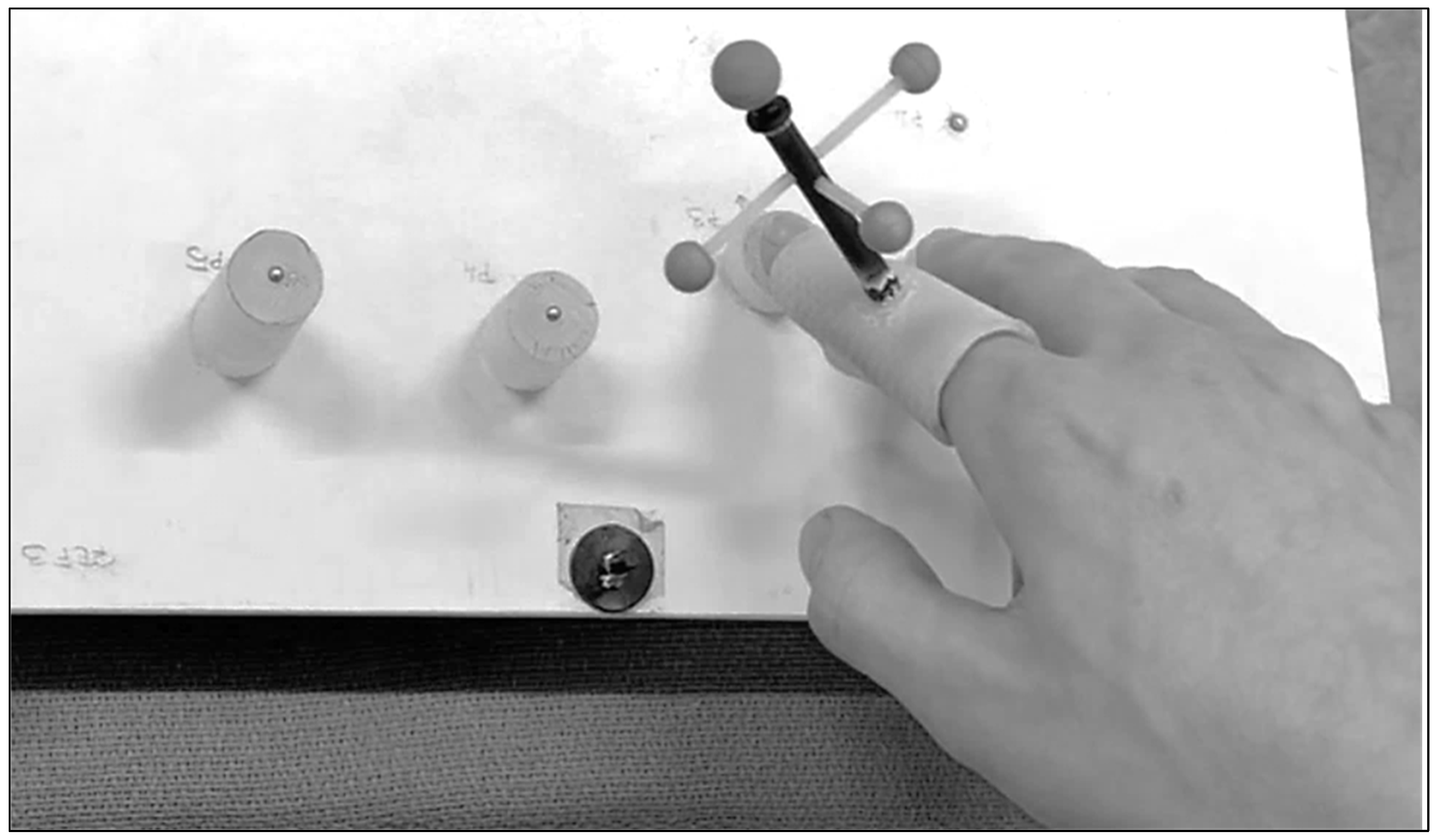
Originally developed for scapular kinematics, the A-Palp is a device employing the calibrated anatomical systems technique (CAST) (Figure 1). It consists of a finger-mounted reflective-marker cluster that allows for real-time tracking of the examiner’s fingertip within an optoelectronic motion capture environment [13,17]. Through calibration of the finger pulp using a specifically designed calibration plate, the device enables manual digitization of anatomical landmarks and reconstruction of continuous three-dimensional trajectories during palpation [13,17]. In the present study, the A-Palp was used to trace the spinous processes along the sagittal profile of the spine.

2.5. Data Collection

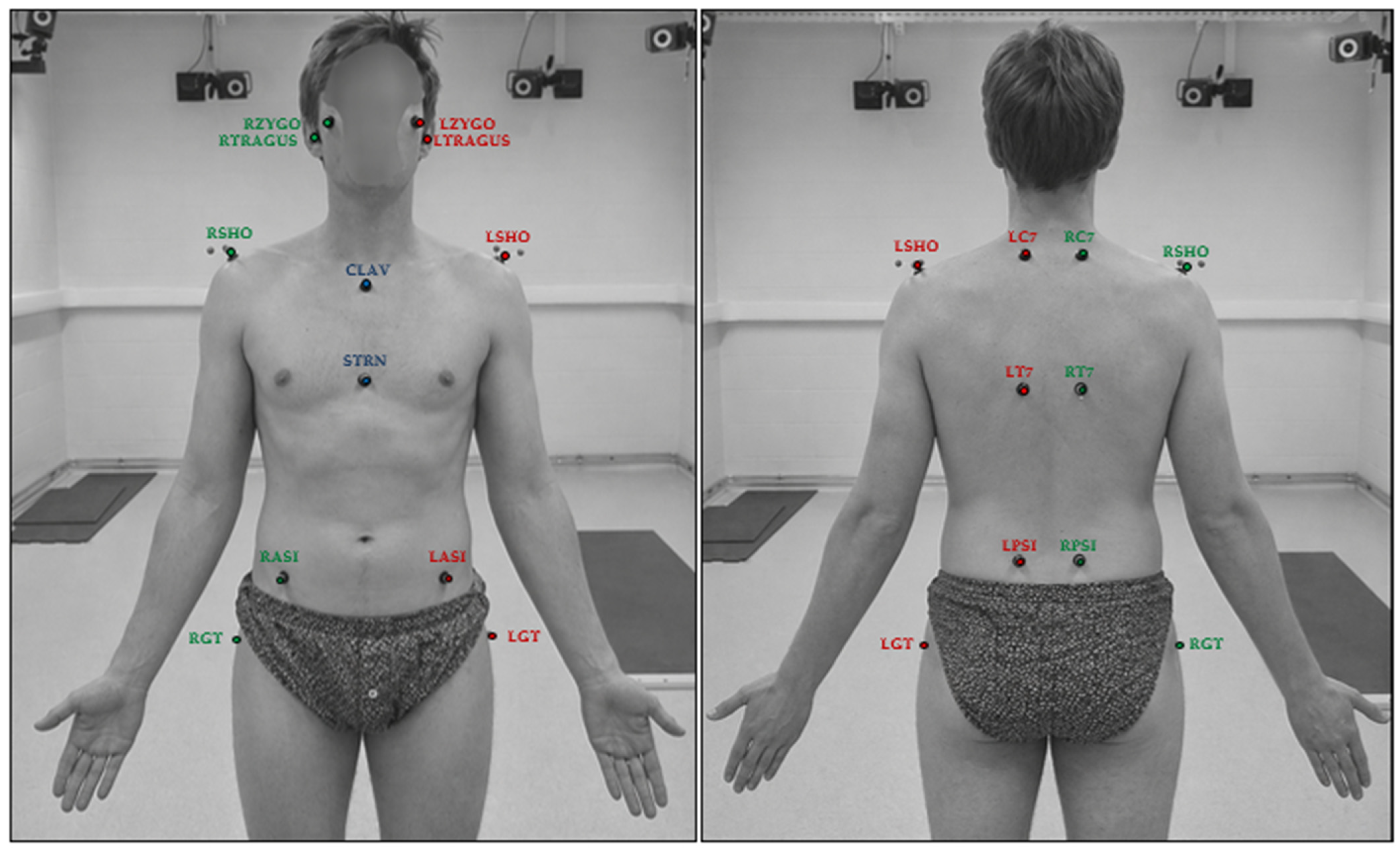
Data were collected by two operators using the A-Palp method [13,17] within a 14-camera VICON T40 s system (100 Hz, Vicon Motion Systems Ltd., Oxford, UK). Participants stood barefoot on an AMTI force plate (Advanced Mechanical Technology, Inc., Watertown, MA, USA) synchronized with VICON. Reflective markers were placed on anatomical landmarks of the lower limbs, pelvis, acromia, selected spinal segments, and head according to a custom-made biomechanical model (Figure 2). This study focused on static sagittal spinal profiles.
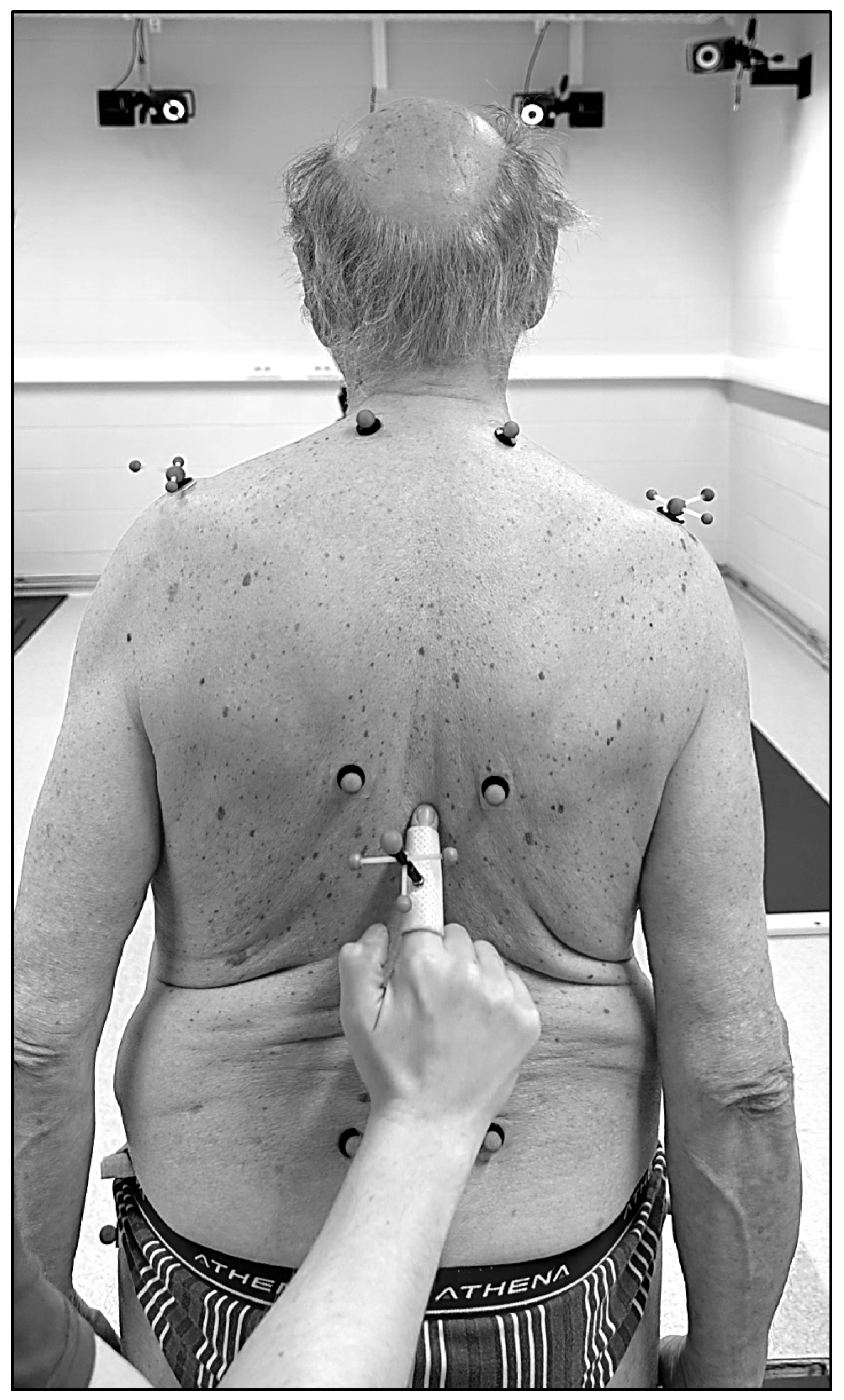
To ensure consistency, participants placed their hands under the chin with elbows slightly abducted and maintained a forward gaze. Two examiners with >2 years of palpation experience first calibrated the index fingertip on a reference plate [13] and then digitized six scapular landmarks: the inferior angle (apex), trigonum spinae, posterior and anterior acromial corners, acromioclavicular joint, and coracoid process. Spinal digitization followed: each examiner palpated the spine three times, tracing the spinous processes from the external occipital prominence to S2 (Figure 3). To assess between-session repeatability, one examiner repeated the entire protocol after seven days.
All measurements were performed with an identical material and laboratory environment, using standardized static conditions and instructions. This standardization was intended to reduce variability unrelated to the measurement procedure itself.

2.6. Data Processing

Reflective-marker trajectories were labeled and gap-filled in Nexus (2.11, Vicon Motion Systems Ltd., Oxford, UK) with the Woltring algorithm and then exported in C3D format. Files were processed with the Biomechanical Toolkit (BTK) and custom MATLAB scripts (R2019b, MathWorks, Natick, MA, USA) to isolate the 3D path of the calibrated index-finger pulp [13]. The raw trajectory was smoothed to 101 equidistant points using a free-knot B-spline [18]. Resampling to 101 points was performed to standardize the curve length and enable point-by-point comparison across repetitions, operators, and sessions. Virtual markers were positioned on the two spinous-process inflection points (curvature bounds), and an osculating circle was fitted between them via Taubin’s method [19]. The arc was re-interpolated into the full trajectory using a modified Akima spline. This processing pipeline was selected to reduce noise while preserving the global geometry of the traced spinal profile and ensuring reproducible curve reconstruction across trials.
From the resulting 3D coordinates, a bespoke MATLAB routine automatically calculated the extracorporeal thoracic kyphosis (TKEC: global, superior, inferior) and extracorporeal lumbar lordosis (LLEC: global, superior, inferior) in the sagittal plane with three computational methods:
-
The tangent method: determined by the tangents at the extracorporeal inflection points and at the virtual marker placed on the S2 vertebra, using the Frenet frame tangents at these locations [20].
-
The circle-fit method by Taubin [19]: calculated from the best-fit circle in accordance with the central angle theorem [21].
-
The trigonometric method: defined by the apex point and its two-boundary points.
The routine also computed spinopelvic parameters: the sacro-spinal angle (SSAEC), sacral slope (SS1EC, SS2EC), pelvic tilt (PTEC), pelvic incidence (PIEC), global inclination (GIEC), sacro-femoral distance ratio (SFDEC = SFD1EC/SFD2EC), horizontal distances from the ground reaction force (GRF) line to the cervicothoracic inflection point (CTIPEC; distGRFPBLINEEC) or to the tragus (distGRFTRAGUSEC), and sagittal vertical axis (SVAEC).
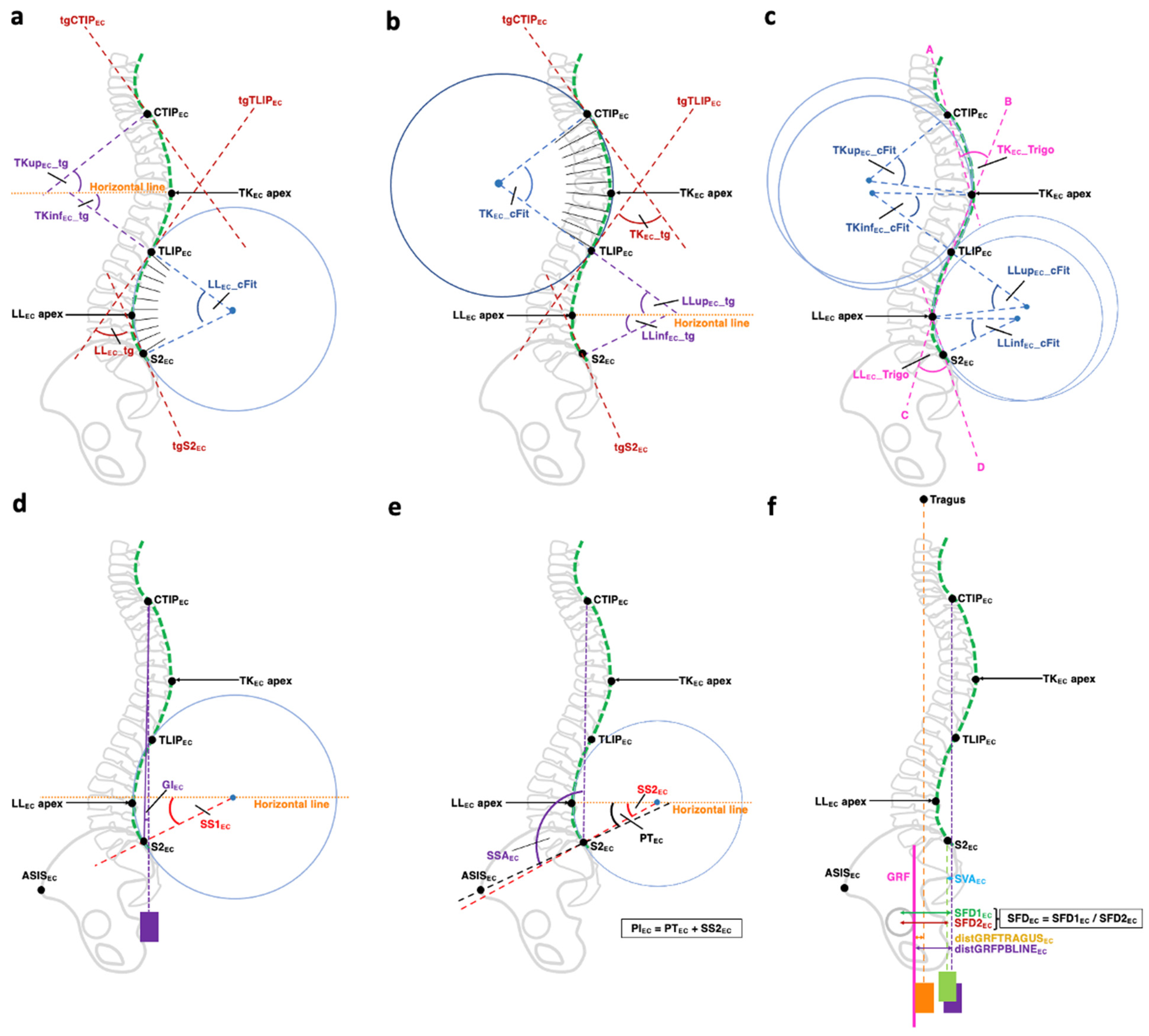
The TKEC and LLEC angles calculated with each method, along with the complete set of spinopelvic parameters, are described in detail in Table 1 below. For a complete understanding of the geometrical definitions of the different angles, Table 1 should be interpreted in conjunction with Figure 4.
The illustrations and abbreviations in Figure 4 should be interpreted in conjunction with the definitions provided in Table 1.

2.7. Evaluation Metrics

To comprehensively assess the reliability and agreement, several complementary outcome metrics were used. Intraclass correlation coefficients (ICCs) were used to quantify the relative reliability, that is, the extent to which subjects could be consistently distinguished despite measurement error. The standard error of measurement (SEM) and minimal detectable change at 95% confidence (MDC95) were used to quantify the absolute reliability and to provide clinically interpretable thresholds for change. Bland & Altman analysis was used to assess the agreement, systematic bias, and limits of agreement between operators and sessions. The root-mean-squared error (RMSE) was used to evaluate the similarity between reconstructed sagittal spinal profiles, and one-dimensional Statistical Parametric Mapping (SPM) was used to test for local differences along full spinal curves. The combined use of these indices follows methodological recommendations for reliability and agreement studies [14,22].

2.8. Statistical Analysis

Statistical analyses included intraclass correlation coefficients (ICCs) to assess intra-operator, inter-operator, and inter-session reliability of spinal angular and spinopelvic parameters:
-
For intra-operator reliability: ICC (3,k) was used, as it was based on the average of three repeated measurements obtained under fixed conditions by the same examiner.
-
For inter-operator and inter-session reliability: ICC (2,1) was used, as comparisons were performed between two averaged values, each derived from three repeated measurements per condition (operator or session), thereby reflecting absolute agreement between independent measurements.
ICCs were interpreted as <0.50 poor, 0.50–0.75 moderate, 0.75–0.90 good, and >0.90 excellent [22], with 95% confidence intervals reported. Absolute error was quantified with the standard error of measurement (SEM) and minimal detectable change at 95% confidence (MDC95), computed as MDC95 = 1.96 × √2 × SEM and expressed in native units (degrees or millimeters). Agreement between methods and operators was further assessed with Bland and Altman analyses (mean bias and 95% limits of agreement) [23].
For sagittal spinal profiles, raw curves were resampled into 101 points along the curve progression, enabling point-to-point comparisons. For each subject and operator, three repeated curves were acquired, superimposed to minimize distances, and averaged into a representative profile. Before root-mean-squared error (RMSE) computation, the mean curves to be compared were superimposed to reduce offsets. RMSE values were then calculated pairwise between operators or sessions, expressed in millimeters and percentages, and averaged across subjects to yield global indices of repeatability and reproducibility.
Finally, one-dimensional Statistical Parametric Mapping (SPM) was performed using the spm1d package in Python (3.14.4, Python Software Foundation, www.python.org, α = 5%, corrected for multiple comparisons) on the same mean curves used for the RMSE, testing for local differences along spinal profiles between operators and sessions. The correction for multiple comparisons was applied to control type I error across the spatial domain of the curves.

3. Results

3.1. Reliability of Extracorporeal Spinal Curvature Angles

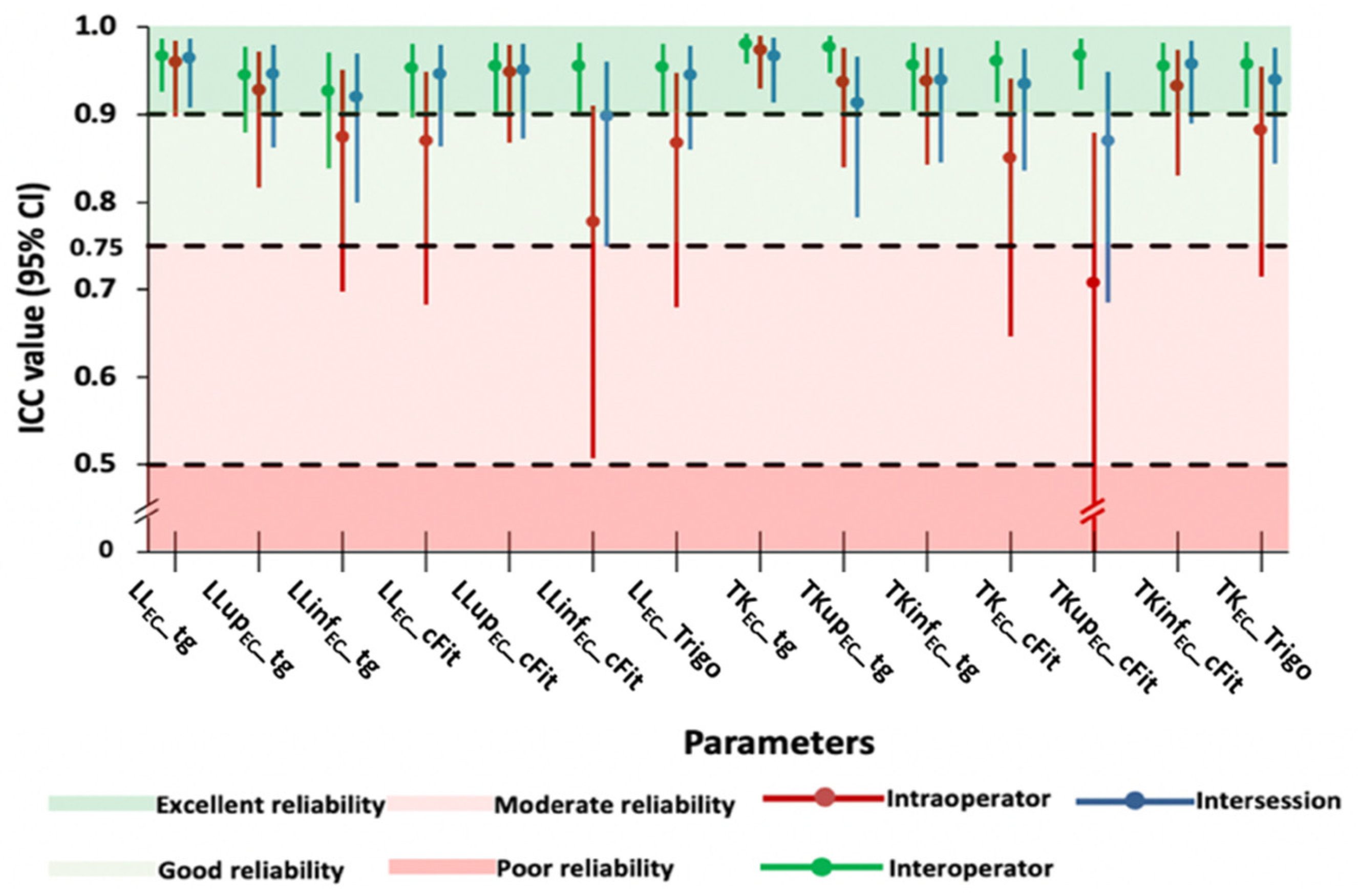
Intraclass correlation coefficients (ICCs) showed excellent reliability for thoracic and lumbar curvature angles across the tangent, circle-fit, and trigonometric methods (Figure 5, Table 2). Overall, intra-operator, inter-operator, and inter-session reliability remained high across all computational methods, with the tangent method consistently demonstrating the most stable performance.
Intra-operator reliability was systematically high (ICC: 0.93–0.98), with an SEM of 0.9–3.3° and MDC95 of 2.5–9.1°. Extracorporeal lumbar lordosis (LLEC) parameters had ICCs of 0.93–0.97, while extracorporeal thoracic kyphosis (TKEC) reached 0.98.
Inter-operator reliability was generally high (ICC: 0.71–0.97). Most parameters showed good-to-excellent reproducibility (ICC > 0.75), though upper TKEC with circle-fit (TKupEC_cFit) had the lowest ICC (0.71 [0.38–0.88]). SEMs for inter-operator comparisons ranged from 1.3° to 4.9°, with MDC95 values of 3.6–13.4°. Lower lumbar and thoracic parameters measured with circle-fit also showed slightly lower ICCs (0.78–0.85) and higher SEM/MDC95 values compared to the other methods.
Inter-session reliability remained high (ICC: 0.87–0.97) for lumbar and thoracic parameters, with an SEM of 1.4–3.4° and MDC95 of 3.8–9.3°.
Across all conditions, the absolute error remained the lowest for the tangent method, whereas the circle-fit and trigonometric approaches showed increased variability, particularly for sub-segmental parameters.

3.2. Reliability of Extracorporeal Spinopelvic Parameters

Intraclass correlation coefficients (ICCs) showed high reproducibility overall, with some variability by metric (Table 3). Reliability patterns differed between angular and distance-based parameters.
Intra-operator reliability was excellent (ICC: 0.88–0.99). Angular parameters were consistently strong: PIEC (SEM: 2.3°; MDC95: 6.3°); SSAEC (2.1°; 5.9°); SS1EC (2.8°; 7.7°); SS2EC (2.3°; 6.3°); and GIEC (2.3°; 6.3°). Distance-based measures also performed very well: distGRFTRAGUSEC (3.8 mm; 10.7 mm), distGRFPBLINEEC (4.2 mm; 11.7 mm), and SVAEC (4.8 mm; 13.4 mm). The SFDEC ratio likewise showed excellent agreement (0.0; 0.1).
Inter-operator reliability was the highest for distance-based parameters: distGRFTRAGUSEC (0.98; 6.3 mm; 17.3 mm), distGRFPBLINEEC (0.98; 8.1 mm; 22.4 mm), and SVAEC (0.93; 5.5 mm; 15.2 mm). Angular parameters were more variable: GIEC (0.87; 0.8°; 2.3°); PIEC (0.84; 4.4°; 12.1°); SSAEC (0.83; 3.2°; 8.9°); SS1EC (0.65; 4.5°; 12.4°); SS2EC (0.72; 3.7°; 10.2°). The SFDEC ratio showed poor inter-operator reliability (0.29; 0.1; 0.0).
Inter-session reliability was good-to-excellent (ICC: 0.82–0.98). Distances remained stable: distGRFTRAGUSEC (11.6 mm; 32.8 mm), distGRFPBLINEEC (10.9 mm; 30.9 mm), and SVAEC (10.3 mm; 28.6 mm). Angular measures were also robust: SSAEC (2.9°; 8.2°); SS1EC (3.4°; 9.6°); SS2EC (2.8°; 7.8°); GIEC (1.0°; 2.9°); and PIEC (2.7°; 7.5°). The SFDEC ratio displayed excellent stability (0.1; 0.2).
Overall, distance-based parameters exhibited higher inter-operator consistency, whereas some angular parameters showed greater sensitivity to examiner-dependent factors.

3.3. Agreement Analyses—Spinal and Spinopelvic Parameters

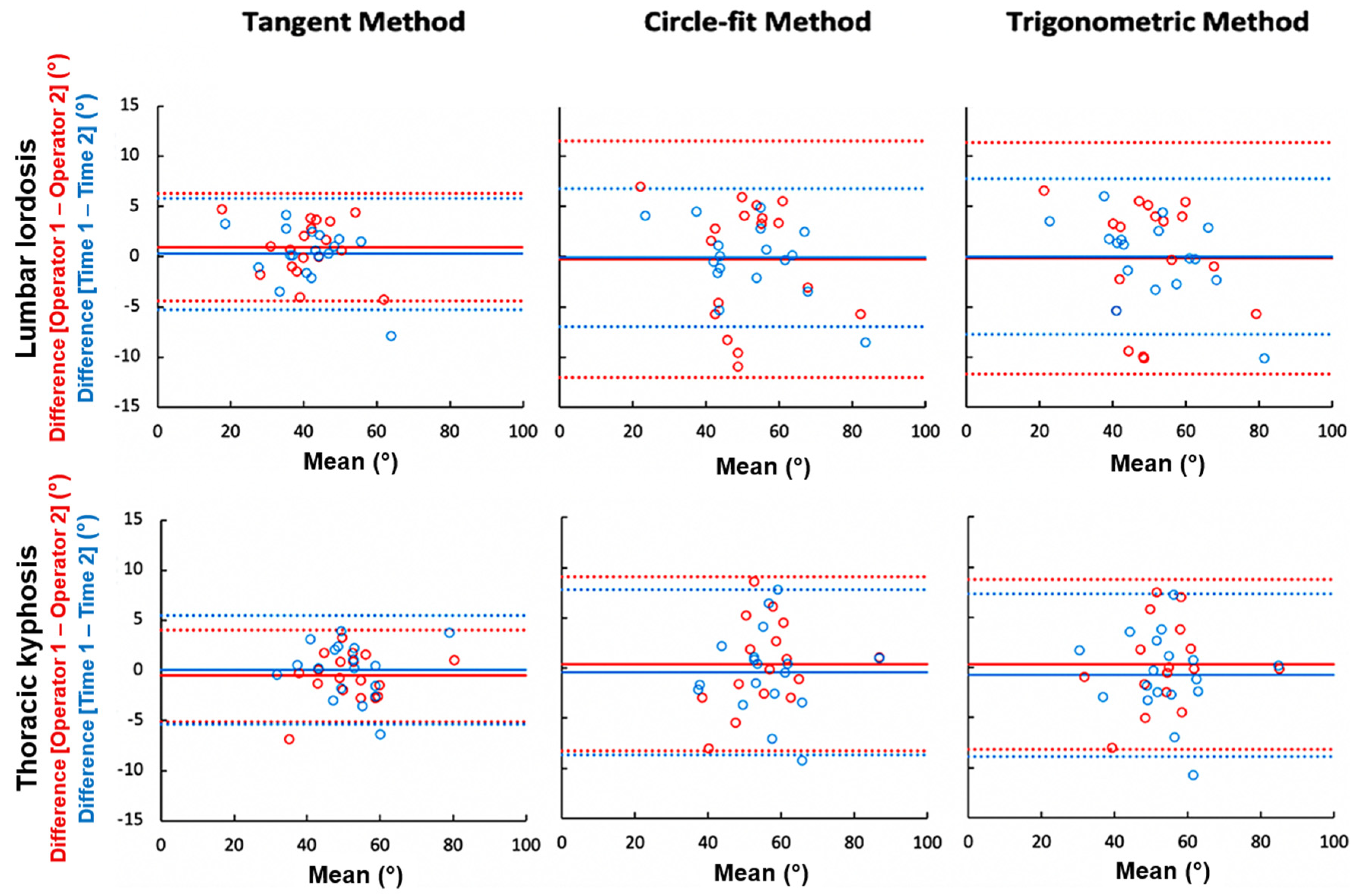
Bland & Altman analyses confirmed generally good agreement for both LLEC and TKEC angles across the three computational methods (Figure 6). Mean biases were consistently close to zero across all methods, indicating the absence of systematic measurement error. Limits of agreement (LoAs) are reported below.
For LLEC, inter-operator comparisons showed small biases near zero: tangent (+1.0°), circle-fit (−0.3°), and trigonometric (−0.2°). The tangent method yielded the narrowest LoAs (≈±5–6°), while the circle-fit and trigonometric methods had wider variability (≈±11–12°). Over time, reproducibility remained high with negligible biases (tangent: −0.3°; circle-fit: −0.1°; trigonometric: 0.0°) and relatively narrow LoAs (≈±6–8°).
For TKEC, inter-operator agreement was also strong with low biases: tangent (−0.5°), circle-fit (+0.4°), and trigonometric (+0.3°). Again, tangent provided the tightest LoAs (≈±5°), while circle-fit and trigonometric yielded broader ranges (≈±8–9°). Inter-session analyses confirmed this pattern, with minimal biases (tangent: +0.1°; circle-fit: −0.4°; trigonometric: −0.8°) and LoAs up to ±8–9° for circle-fit/trigonometric, versus ≈±5° for the tangent method.
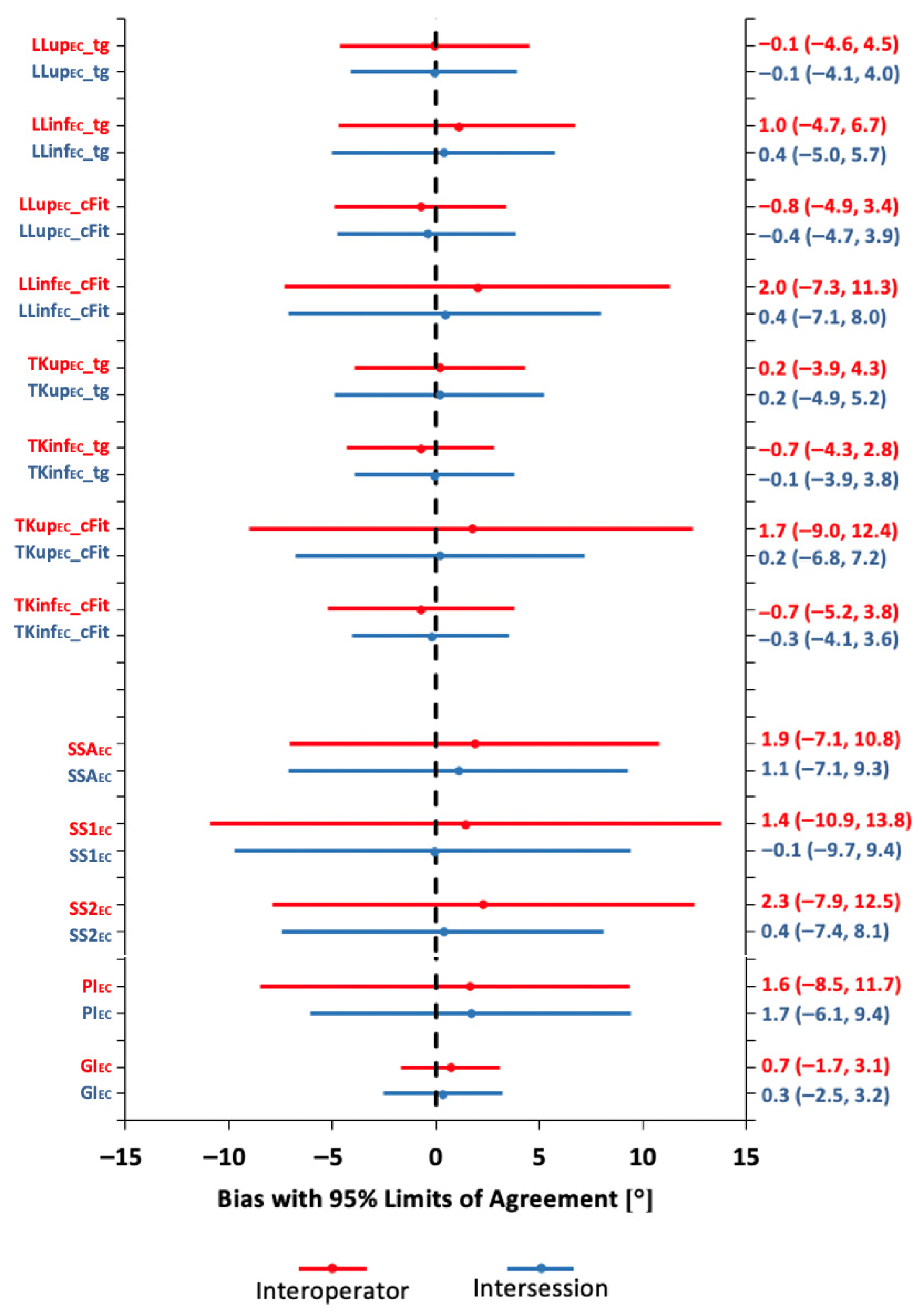
For extracorporeal sub-segmental curvatures (upper/lower lumbar, upper/lower thoracic), Bland & Altman analyses confirmed the global angle trends. Mean biases were near zero across methods. Limits of agreement were narrower with the tangent method (≈±4–6°) and wider with the circle-fit and trigonometric approaches (up to ±8–12°). Agreement was slightly lower for upper thoracic and lower lumbar segments, which showed broader limits than global angles (Figure 7).
Extracorporeal spinopelvic results were more heterogeneous. Angular measures such as the SS1 and PI showed small biases but wider limits (≈±7–10°). In contrast, horizontal distances between the GRF line and tragus or CTIPEC showed minimal bias but broader limits (≈±20–25 mm). The SFDEC ratio was the most consistent parameter, with mean differences near zero and very narrow limits (≤±0.5) (Figure 7, Table 4).

3.4. Extracorporeal Sagittal Spinal Profile Reliability

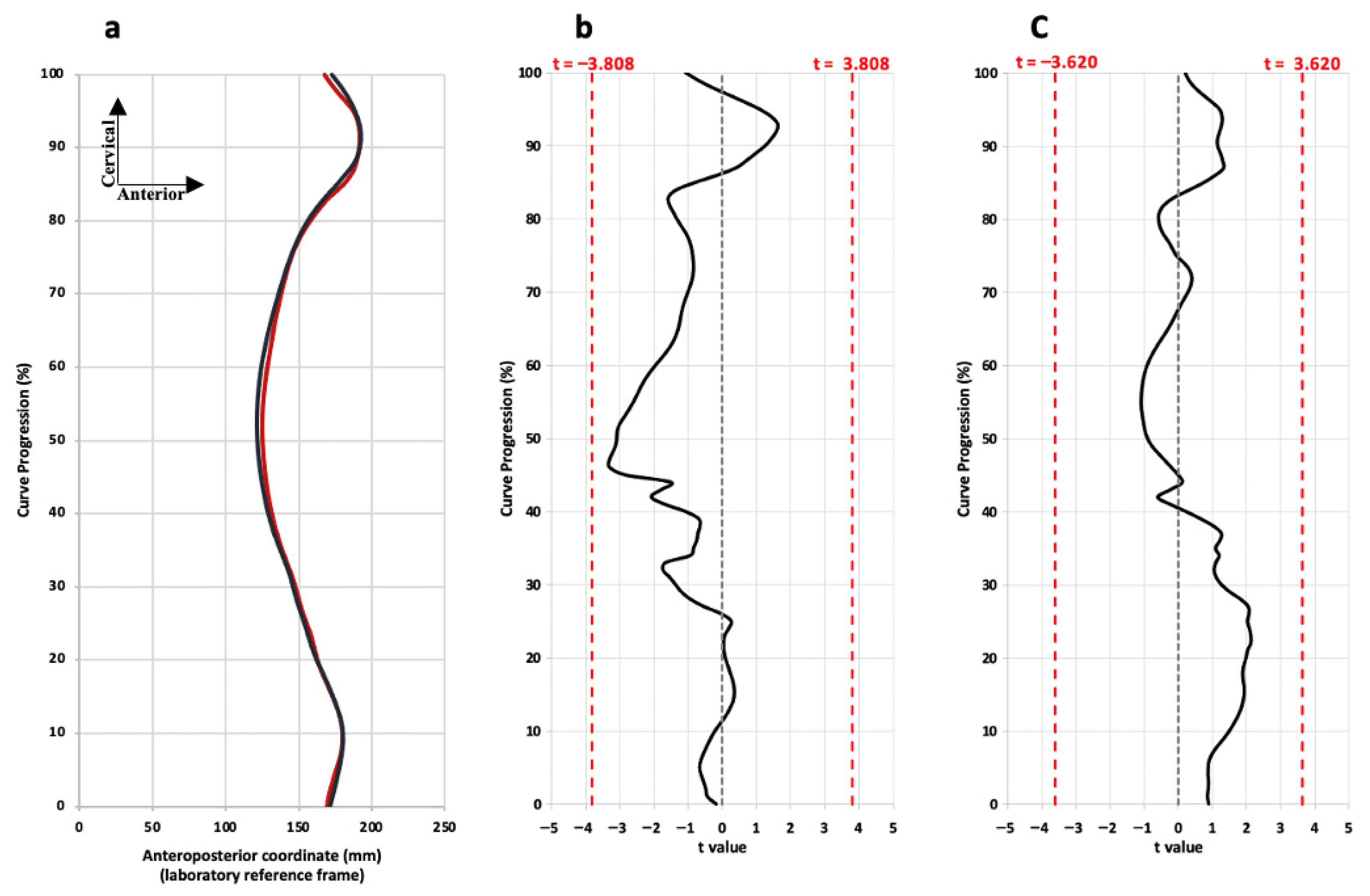
Extracorporeal sagittal spinal profiles were assessed with the RMSE and SPM{t}. The intra-operator RMSE was 3.7 ± 1.2 mm (4.5 ± 1.3%), the inter-operator RMSE was 2.7 ± 1.3 mm (4.6 ± 2.3%), and the inter-session RMSE was 3.1 ± 1.4 mm (4.5 ± 2.0%). Errors remained consistently <5% of curvature amplitude, confirming very good repeatability and reproducibility with the A-Palp. In both inter-operator and inter-session SPM{t} analyses, t-value trajectories stayed below critical thresholds, indicating no significant regional deviations (Figure 8). These findings demonstrate consistent reconstruction of the full sagittal spinal profile, with no statistically significant localized discrepancies detected between operators or sessions.

4. Discussion

The aim of this study was to investigate the repeatability and reproducibility of a radiation-free approach for sagittal balance assessment using the A-Palp method. Overall, the results demonstrated good-to-excellent reliability across most parameters, with consistent findings across operators and sessions, supporting the robustness of the A-Palp method under standardized experimental conditions.
Reliability of extracorporeal thoracolumbar curvature angles was high but method-dependent. The tangent definition was the most reliable (SEM: ≈ 1–2°; MDC95: ≈ 3–6°), with lower decision thresholds than the circle-fit or trigonometric methods between operators and sessions. Bland & Altman analyses confirmed negligible bias and tighter limits of agreement (LoAs) with the tangent method (LLEC: ±5–6°; TKEC: ±5°). The same hierarchy held across sub-segments and sessions. From a practical perspective, these lower SEM and MDC95 values indicate that the tangent method is more sensitive to detecting small but clinically meaningful changes over time, which is essential in longitudinal monitoring.
This hierarchy reflects the choice of angular algorithm. The tangent method, derived from Harrison [24,25], describes the local slope of the vertebral wall and has been reported to be more reliable than Cobb with lower measurement error under standardized procedures. The trigonometric method defines the angle from the posterior end-vertebrae corners and the point of maximum distance; it remains only slightly variable and is at least as reproducible as Cobb. The circle-fit angle captures global geometry but depends on convexity tracing and landmark selection; it correlates well with Cobb. Within this framework, our findings—tighter LoAs for the tangent method and broader LoAs for the circle-fit/trigonometric methods—while still clinically acceptable, are consistent with the reference methodological review [26]. These results highlight that the computational definition of curvature plays a critical role in measurement reliability, independently of the acquisition method itself.
The SSAEC/SS1EC/SS2EC reliability was acceptable for one operator but was more operator-sensitive; the GIEC was robust; the PIEC was more operator-dependent. For global balance, distances were referenced to the GRF line, defined as the vertical through the center of pressure (CoP) from the synchronized force plate; measures are horizontal offsets (distGRFTRAGUSEC, distGRFPBLINEEC) and include the SVAEC. Intra-operator repeatability was very good (≈4 mm, MDC95 ≈ 11–13 mm) and robust between operators (≈6–8 mm, ≈17–22 mm) but wider between sessions (≈10–12 mm, ≈29–33 mm); the SFDEC was the most stable parameter (MDC95 ≈ 0.2). These observations show that GRF-related parameters are relevant for the assessment of global balance, as previously demonstrated by Le Huec et al. [27].
In the present study, inter-operator ICC values were higher for distance-based parameters (≈0.93–0.98) than for some angular parameters, such as the SS1EC (ICC = 0.65) and SS2EC (ICC = 0.72). However, this does not necessarily indicate that angular measurements are inherently more difficult or that anatomical landmark identification differs between parameters. Rather, the observed variability likely reflects how measurement errors propagate through different mathematical formulations. Angular parameters involve combinations of multiple points and orientations, which may amplify small variations, whereas distance-based parameters correspond to more direct geometric relationships, which tend to limit this amplification. Importantly, several angular parameters in this study also demonstrated good-to-excellent reliability, indicating that variability is parameter-specific rather than inherent to the type of measurement. The increased variability observed between sessions may therefore reflect not only measurement variability but also natural day-to-day fluctuations in postural alignment and balance control.
RMSE values remained below 5% across all conditions, indicating high similarity between reconstructed spinal profiles. In addition, the absence of significant differences in the SPM analyses suggests that variability was not localized but remained uniformly low along the spinal curves. These findings support the ability of the A-Palp method to consistently reconstruct the full sagittal spinal profile.
Radiographic series report intra-rater SEMs of 0.8–5.0° and inter-rater SEMs of 2.5–6.2° for the SS, PI and TK, with SVA SEMs of 2.2–5.7/4.6–5.0 mm (intra-/inter-rater) and the typical MDC ≈ 7–17° for angles [24]. Against this benchmark, tangent-based angles remained within favorable radiographic thresholds, while circle-fit/trigonometric values approached the upper bound, consistent with landmarking sensitivity. For the SVA, our inter-operator metrics were similar to radiographic measurements [28], whereas between-session results likely reflect normal day-to-day postural variability. These comparisons suggest that the measurement precision obtained with the A-Palp is within the range reported for radiographic methods while avoiding exposure to ionizing radiation.
Integrating A-Palp measures into a global analysis of posture (PIEC, SS1EC/SS2EC, SSAEC, SVAEC, GIEC and distances to GRF line) is consistent with the current biomechanical models and classifications of sagittal balance (morphologic PI, compensatory PT/SS, lower-limb adaptations) [27,29]. In this perspective, our global measures (GIEC, SVAEC, distGRFTRAGUSEC, distGRFPBLINEEC, SFDEC) offer a radiation-free option suitable for longitudinal monitoring. Importantly, the parameters quantified by the A-Palp are conceptually aligned with those interpreted in orthopedics and spine surgery. Although not identical to radiographic definitions, these radiation-free equivalents map onto the same clinical constructs that support diagnosis, surgical planning, and postoperative follow-up.
More broadly, the A-Palp aligns with the emergence of non-ionizing external tools. Recent reviews of surface topography report good-to-excellent inter-/intra-examiner reliability, in line with our results, supporting clinical use for surveillance, risk stratification, and treatment evaluation, while acknowledging radiography as the reference [11]. In parallel, inertial measurement units (IMUs) show encouraging validity for spinal mobility and posture, provided rigorous calibration [12]. In clinical pathways equipped with inertial sensors, A-Palp metrics can be combined with robustly calibrated IMUs to document sagittal posture and mobility at higher frequency without exposure to ionizing radiation.
Several limitations should be acknowledged. The limited sample size (n = 18) may have widened confidence intervals and LoAs but was in line with guidelines reported in the literature [15,16]. In addition, only healthy subjects were included, which limits the generalizability of the findings to clinical populations. Some of the computed variables are based on the coordinates of external markers. Their reliability is thus also sensitive to external landmarking, independent of the A-Palp procedure, being the primary object of this study. Furthermore, the absence of direct comparison with radiographic measurements does not allow for assessment of the measurement accuracy, which should be addressed in future validation studies.
Prior work has established the feasibility and repeatability of palpation-based digitization in adolescents with idiopathic scoliosis [10]. Our study corroborates this performance in a non-scoliotic cohort and, crucially, adds the over-time dimension by quantifying the inter-session repeatability and sagittal profile stability—alongside the intra- and inter-operator reproducibility—thereby providing actionable MDC95 thresholds to interpret longitudinal change, although radiography remains the reference.

5. Conclusions

Taken together, the results confirm the reliability, repeatability, and reproducibility of the A-Palp approach for extracorporeal sagittal spinal and spinopelvic assessment while acknowledging some variability depending on the parameter and method used. High ICCs and Bland & Altman results (low bias, narrow LoAs) highlight robustness, with the tangent method consistently superior, while circle-fit (and to a lesser extent trigonometric) angles showed slightly greater variability. Extracorporeal spinopelvic parameters were generally reliable, though certain measures appeared more operator-sensitive for the SS1EC. At the profile level, RMSE < 5% and the absence of point-wise differences in SPM1D suggest regional stability. Overall, the A-Palp provides radiation-free clinical equivalents with actionable MDC95 thresholds, supporting safer longitudinal follow-up and postoperative surveillance in spine care while complementing radiography, although further studies are warranted to confirm these findings across broader populations and clinical settings.

Author Contributions

Conceptualization, G.C.; methodology, G.C. and V.F.; investigation, G.C. and J.A.N.; data curation, G.C.; formal analysis, G.C.; writing—original draft preparation, G.C.; writing—review and editing, A.L., V.F., B.B., P.S. and L.F.; supervision, V.F. All authors have read and agreed to the published version of the manuscript.

Funding

This research received no external funding.

Institutional Review Board Statement

This study was conducted in accordance with the Declaration of Helsinki and was approved by the Erasme Hospital ULB Ethics Committee (protocol code P2024/623; approved on 8 March 2024).

Informed Consent Statement

Informed consent was obtained from all subjects involved in this study.

Data Availability Statement

All data supporting the statistical analyses of this study are stored in an Excel file at the Laboratory of Functional Anatomy, Université libre de Bruxelles. Due to [participant confidentiality/institutional restrictions/the sensitive nature of the data], these data cannot be made publicly available. They are available from the corresponding author upon reasonable request.

Conflicts of Interest

The authors declare no conflicts of interest.

References

  1. Knott, P.; Pappo, E.; Cameron, M.; Demauroy, J.; Rivard, C.; Kotwicki, T.; Zaina, F.; Wynne, J.; Stikeleather, L.; Bettany-Saltikov, J.; et al. SOSORT 2012 consensus paper: Reducing X-ray exposure in pediatric patients with scoliosis. Scoliosis 2014, 25, 4. [Google Scholar] [CrossRef]
  2. Nicol, V.; Verdaguer, C.; Daste, C.; Bisseriex, H.; Lapeyre, E.; Lefevre-Colau, M.M.; Rannou, F.; Roren, A.; Facione, J.; Nguyen, C. Chronic low back pain: A narrative review of recent international guidelines for diagnosis and conservative treatment. J. Clin. Med. 2023, 12, 1685. [Google Scholar] [CrossRef]
  3. Delitto, A.; George, S.Z.; Van Dillen, L.; Whitman, J.M.; Sowa, G.; Shekelle, P.; Denninger, T.R.; Godges, J.J. Low back pain. J. Orthop. Sports Phys. Ther. 2012, 42, A1–A57. [Google Scholar] [CrossRef]
  4. Glassman, S.D.; Bridwell, K.; Dimar, J.R.; Horton, W.; Bervens, S.; Schwab, F.J. The impact of positive sagittal balance in adult spinal deformity. Spine 2005, 30, 2024–2029. [Google Scholar] [CrossRef]
  5. Schwab, F.J.; Blondel, B.; Bess, S.; Hostin, R.; Shaffrey, C.I.; Smith, J.S.; Boachie-Adjei, O.; Burton, D.C.; Akbarnia, B.A.; Mundis, G.M.; et al. Radiographical spinopelvic parameters and disability in the setting of adult spinal deformity: A prospective multicenter analysis. Spine 2013, 38, E803–E812. [Google Scholar] [CrossRef] [PubMed]
  6. Chaléat-Valayer, E.; Mac-Thiong, J.M.; Paquet, J.; Berthonnaud, E.; Siani, F.; Roussouly, P. Sagittal spino-pelvic alignment in chronic low back pain. Eur. Spine J. 2011, 20, 634–640. [Google Scholar] [CrossRef]
  7. Seyedhoseinpoor, T.; Sanjari, M.A.; Taghipour, M.; Dadgoo, M.; Mousavi, S.J. Spinopelvic malalignment correlates to lumbar instability and lumbar musculature in chronic low back pain—An exploratory study. Sci. Rep. 2024, 14, 31974. [Google Scholar] [CrossRef]
  8. Yoon, S.G.; Lee, H.C.; Lee, S.M. Pelvic incidence-lumbar lordosis mismatch is predisposed to adjacent segment degeneration after single-level anterior lumbar interbody fusion: A retrospective case-control study. Neurospine 2023, 20, 301–307. [Google Scholar] [CrossRef] [PubMed]
  9. Tempel, Z.J.; Gandhoke, G.S.; Bolinger, B.D.; Khattar, N.K.; Parry, P.V.; Chang, Y.F.; Okonkwo, D.O.; Kanter, A.S. The influence of pelvic incidence and lumbar lordosis mismatch on development of symptomatic adjacent level disease following single-level transforaminal lumbar interbody fusion. Neurosurgery 2017, 80, 880–886. [Google Scholar] [CrossRef]
  10. Ronckers, C.M.; Land, C.E.; Miller, J.S.; Stovall, M.; Lonstein, J.E.; Doody, M.M. Cancer mortality among women frequently exposed to radiographic examinations for spinal disorders. Radiat. Res. 2010, 174, 83–90. [Google Scholar] [CrossRef] [PubMed]
  11. Su, X.; Dong, R.; Wen, Z.; Liu, Y. Reliability and validity of scoliosis measurements obtained with surface topography techniques: A systematic review. J. Clin. Med. 2022, 11, 6998. [Google Scholar] [CrossRef]
  12. Paloschi, D.; Bravi, M.; Schena, E.; Miccinilli, S.; Morrone, M.; Sterzi, S.; Saccomandi, P.; Massaroni, C. Validation and assessment of a posture measurement system with magneto-inertial measurement units. Sensors 2021, 21, 6610. [Google Scholar] [CrossRef] [PubMed]
  13. Salvia, P.; Jan, S.V.; Crouan, A.; Vanderkerken, L.; Moiseev, F.; Sholukha, V.; Mahieu, C.; Snoeck, O.; Rooze, M. Precision of shoulder anatomical landmark calibration by two approaches: A CAST-like protocol and a new anatomical palpator method. Gait Posture 2009, 29, 587–591. [Google Scholar] [CrossRef] [PubMed]
  14. Kottner, J.; Audigé, L.; Brorson, S.; Donner, A.; Gajewski, B.J.; Hróbjartsson, A.; Roberts, C.; Shoukri, M.; Streiner, D.L. Guidelines for reporting reliability and agreement studies (GRRAS) were proposed. J. Clin. Epidemiol. 2011, 64, 96–106. [Google Scholar] [CrossRef]
  15. Bonett, D.G. Sample size requirements for estimating intraclass correlations with desired precision. Stat. Med. 2002, 21, 1331–1335. [Google Scholar] [CrossRef] [PubMed]
  16. Shoukri, M.M.; Asyali, M.H.; Donner, A. Sample size requirements for the design of reliability study: Review and new results. Stat. Meth Med. Res. 2004, 13, 1–21. [Google Scholar] [CrossRef]
  17. Salvia, P.; Elbaum, R.; Bourgois, E.; Pech, S.; Feipel, V.; Beyer, B. Digitization of three-dimensional spine curvature profile in adolescent idiopathic scoliosis using anatomical palpation. Comput. Methods Biomech. Biomed. Eng. Imaging Vis. 2022, 11, 467–475. [Google Scholar] [CrossRef]
  18. Schwetlick, H.; Schütze, T. Least squares approximation by splines with free knots. BIT Numer. Math. 1995, 35, 361–384. [Google Scholar] [CrossRef]
  19. Taubin, G. Estimation of planar curves, surfaces, and nonplanar space curves defined by implicit equations with applications to edge and range image segmentation. IEEE Trans. Pattern Anal. Mach. Intell. 1991, 13, 1115–1138. [Google Scholar] [CrossRef]
  20. Berthonnaud, E.; Dimnet, J. Fast calculation of parameters of scoliosis in frontal view for clinical applications. ITBM-RBM 2006, 27, 56–66. [Google Scholar] [CrossRef]
  21. Schmid, S.; Studer, D.; Hasler, C.C.; Romkes, J.; Taylor, W.R.; Lorenzetti, S.; Brunner, R. Quantifying spinal gait kinematics using an enhanced optical motion capture approach in adolescent idiopathic scoliosis. Gait Posture 2016, 44, 231–237. [Google Scholar] [CrossRef]
  22. Koo, T.K.; Li, M.Y. A guideline of selecting and reporting intraclass correlation coefficients for reliability research. J. Chiropr. Med. 2016, 15, 155–163. [Google Scholar] [CrossRef]
  23. Bland, J.M.; Altman, D.G. Statistical methods for assessing agreement between two methods of clinical measurement. Lancet 1986, 1, 307–310. [Google Scholar] [CrossRef] [PubMed]
  24. Harrison, D.E.; Harrison, D.D.; Cailliet, R.; Troyanovich, S.J.; Janik, T.J.; Holland, B. Cobb method or Harrison posterior tangent method: Which to choose for lateral cervical radiographic analysis. Spine 2000, 25, 2072–2078. [Google Scholar] [CrossRef]
  25. Harrison, D.E.; Cailliet, R.; Harrison, D.D.; Janik, T.J.; Holland, B. Reliability of centroid, Cobb, and Harrison posterior tangent methods: Which to choose for analysis of thoracic kyphosis. Spine 2001, 26, E227–E234. [Google Scholar] [CrossRef] [PubMed]
  26. Vrtovec, T.; Pernuš, F.; Likar, B. A review of methods for quantitative evaluation of spinal curvature. Eur. Spine J. 2009, 18, 593–607. [Google Scholar] [CrossRef]
  27. Le Huec, J.C.; Saddiki, R.; Franke, J.; Rigal, J.; Aunoble, S. Equilibrium of the human body and the gravity line: The basics. Eur. Spine J. 2011, 20, 558–563. [Google Scholar] [CrossRef]
  28. Kyrölä, K.K.; Salme, J.; Tuija, J.; Tero, I.; Eero, K.; Arja, H. Intra- and interrater reliability of sagittal spinopelvic parameters on full-spine radiographs in adults with symptomatic spinal disorders. Neurospine 2018, 15, 175–181. [Google Scholar] [CrossRef] [PubMed]
  29. Roussouly, P.; Pinheiro-Franco, J.L. Sagittal parameters of the spine: Biomechanical approach. Eur. Spine J. 2011, 20, 578–585. [Google Scholar] [CrossRef]
Figure 1. A-Palp device during calibration.
Biomechanics 06 00047 g001
Figure 2. Placement of reflective markers on anatomical landmarks, anterior (left) and posterior (right) views. Abbreviations: R/L = right/left; ZYGO = zygomatic; SHO = shoulder (acromion); CLAV = clavicle (supra-sternal notch); STRN = sternum; ASI/PSI = anterior/posterior superior iliac spine; T7 = bilateral markers at the level of the 7th thoracic vertebra; C7 = bilateral markers at the level of the 7th cervical vertebra; GT = greater trochanter.
Biomechanics 06 00047 g002
Figure 3. Spinal palpation by the A-Palp device.
Biomechanics 06 00047 g003
Figure 4. Illustrations of extracorporeal sagittal parameters.
Biomechanics 06 00047 g004
Figure 5. Intraclass correlation coefficients (ICCs) for extracorporeal thoracic (TKEC) and extracorporeal lumbar (LLEC) angles across tangent, circle-fit, and trigonometric methods. EC: extracorporeal; LL: lumbar lordosis; TK: thoracic kyphosis; up: superior segment; inf: inferior segment; tg: tangent method; cFit: circle-fit method; Trigo: trigonometric method.
Biomechanics 06 00047 g005
Figure 6. Bland & Altman plots of inter-operator (red) and inter-session (blue) agreement with bias and 95% limits of agreement for extracorporeal lumbar lordosis and thoracic kyphosis. Full lines indicate mean differences; dotted lines represent 95% Limits of Agreement.
Biomechanics 06 00047 g006
Figure 7. Forest plot of biases with 95% limits of agreement from Bland & Altman analyses for inter-operator and inter-session reliability of extracorporeal sub-segmental curvatures and spinopelvic parameters. EC: extracorporeal; LL: lumbar lordosis; TK: thoracic kyphosis; up: superior segment; inf: inferior segment; tg: tangent method; cFit: circle-fit method; SSA: spino-sacral angle; SS1: sacral-slope angle 1; SS2: sacral-slope angle 2; PI: pelvic incidence; GI: global inclination.
Biomechanics 06 00047 g007
Figure 8. Extracorporeal sagittal spinal profile measured by two examiners (a) and Statistical Parametric Mapping (SPM) of curve progression: inter-operator (b) and inter-session (c) analyses.
Biomechanics 06 00047 g008
Table 1. Definitions of extracorporeal sagittal parameters.
Parameter *Definition
LLEC_tgThe angle between the tangents at the extracorporeal thoracolumbar inflection point (TLIPEC; tgTLIPEC) and the virtual marker on the vertebra S2 (S2EC; tgS2EC) (Figure 4a)
LLupEC_tgThe angle between the line perpendicular to the tangent at the extracorporeal thoracolumbar inflection point (TLIPEC; tgTLIPEC) and the horizontal line passing through the extracorporeal lumbar lordosis apex (LLEC apex) (Figure 4b)
LLinfEC_tgThe angle between the line perpendicular to the tangent at the virtual marker on the vertebra S2 (S2EC; tgS2EC) and the horizontal line passing through the extracorporeal lumbar lordosis apex (LLEC apex) (Figure 4b)
LLEC_cFitThe central angle at the center of the best-fit circle fitted between the extracorporeal thoracolumbar inflection point (TLIPEC) and the virtual marker on the vertebra S2 (S2EC) (Figure 4a)
LLupEC_cFitThe central angle at the center of the best-fit circle fitted between the extracorporeal thoracolumbar inflection point (TLIPEC) and the extracorporeal lumbar lordosis apex (LLEC apex) (Figure 4c)
LLinfEC_cFitThe central angle at the center of the best-fit circle fitted between the extracorporeal lumbar lordosis apex (LLEC apex) and the virtual marker on the vertebra S2 (S2EC) (Figure 4c)
LLEC_TrigoThe angle between the line from the extracorporeal thoracolumbar inflection point (TLIPEC) to the extracorporeal lumbar lordosis apex (LLEC apex) and the line from this apex to the virtual marker on the vertebra S2 (S2EC) (Figure 4c: between line C and line D)
TKEC_tgThe angle between the tangents at the extracorporeal cervicothoracic inflection point (CTIPEC; tgCTIPEC) and the extracorporeal thoracolumbar inflection point (TLIPEC; tgTLIPEC) (Figure 4b)
TKupEC_tgThe angle between the line perpendicular to the tangent at the extracorporeal cervicothoracic inflection point (CTIPEC; tgCTIPEC) and the horizontal line passing through the extracorporeal thoracic kyphosis apex (TKEC apex) (Figure 4a)
TKinfEC_tgThe angle between the line perpendicular to the tangent at the extracorporeal thoracolumbar inflection point (TLIPEC; tgTLIPEC) and the horizontal line passing through the extracorporeal thoracic kyphosis apex (TKEC apex) (Figure 4a)
TKEC_cFitThe central angle at the center of the best-fit circle fitted between the extracorporeal cervicothoracic inflection point (CTIPEC) and the extracorporeal thoracolumbar inflection point (TLIPEC) (Figure 4b)
TKupEC_cFitThe central angle at the center of the best-fit circle fitted between the extracorporeal cervicothoracic inflection point (CTIPEC) and the extracorporeal thoracic kyphosis apex (TKEC apex) (Figure 4)
TKinfEC_cFitThe central angle at the center of the best-fit circle fitted between the extracorporeal thoracic kyphosis apex (TKEC apex) and the extracorporeal thoracolumbar inflection point (TLIPEC) (Figure 4c)
TKEC_TrigoThe angle between the line from the extracorporeal cervicothoracic inflection point (CTIPEC) to the extracorporeal thoracic kyphosis apex (TKEC apex) and the line from this apex to the extracorporeal thoracolumbar inflection point (TLIPEC) (Figure 4c: between line A and line B)
SSAECThe angle between the line from the virtual marker on the vertebra S2 (S2EC) to the extracorporeal cervicothoracic inflection point (CTIPEC) and the line from the virtual marker on the vertebra S2 (S2EC) and the center of the best-fit circle fitted between the extracorporeal lumbar lordosis apex (LLEC apex) and the virtual marker on the vertebra S2 (S2EC) (Figure 4e)
SS1ECThe angle between the horizontal and the line from the virtual marker on the vertebra S2 (S2EC) to the center of the best-fit circle fitted between the extracorporeal thoracolumbar inflection point (TLIPEC) and the virtual marker on the vertebra S2 (S2EC) (Figure 4d)
SS2ECThe angle between the horizontal and the line from the virtual marker on the vertebra S2 (S2EC) to the center of the best-fit circle fitted between the extracorporeal lumbar lordosis apex (LLEC apex) and the virtual marker on the vertebra S2 (S2EC) (Figure 4e)
PTECThe angle between the horizontal and the line through the anterior and posterior superior iliac spines (ASIS-PSIS) (Figure 4e)
PIECDefined by PIEC = PTEC + SS2EC (Figure 4e)
GIECThe angle between the line from the virtual marker on the vertebra S2 (S2EC) to the extracorporeal cervicothoracic inflection point (CTIPEC) and the vertical projection from this inflection point (CTIPEC) (Figure 4d)
distGRFTRAGUSECThe horizontal distances from the ground reaction force (GRF) line to the vertical projection of the middle distance between the tragus (Figure 4f)
distGRFPBLINEECThe horizontal distances from the ground reaction force (GRF) line to the vertical projection of the extracorporeal cervicothoracic inflection point (CTIPEC) (Figure 4f)
SFDECDefined by SFD = SFD1/SFD2, where SFD1 is the distance from the vertical projection of the extracorporeal cervicothoracic inflection point (CTIPEC) to the greater trochanter and SFD2 is the distance from the vertical projection of the virtual marker on the vertebra S2 (S2EC) to the greater trochanter (Figure 4f)
SVAECThe horizontal distance between the virtual marker on the vertebra S2 (S2EC) and the vertical projections of the extracorporeal cervicothoracic inflection point (CTIPEC) (Figure 4f)
*EC: extracorporeal; LL: lumbar lordosis; TK: thoracic kyphosis; up: superior segment; inf: inferior segment; tg: tangent method; cFit: circle-fit method; Trigo: trigonometric method; SSA: sacral-slope angle; SS: sacral slope; PI: pelvic incidence; PT: pelvic tilt; GI: global inclination; dist: distance; GRF: ground reaction force; TRAGUS: tragus landmarks; PBLINE: plumb line through cervicothoracic inflection point; SFD: sacro-femoral distance ratio; SVA: sagittal vertical axis.
Table 2. ICC (95% CI), SEM, and MDC95 values for intra-operator, inter-operator, and inter-session reliability of extracorporeal thoracolumbar curvature angles (LLEC/TKEC) across tangent, circle-fit, and trigonometric methods.
Intra-OperatorInter-OperatorInter-Session
Parameter *nkICC3(K)95p-ValueSEMMDC95nkICC2(1)95p-ValueSEMMDC95nkICC2(1)95p-ValueSEMMDC95
LLEC_tg1830.97 [0.93, 0.99]1.4 × 10−152.05.51820.96 [0.90, 0.99]2.2 × 10−111.95.31820.96 [0.91, 0.99]2.2 × 10−112.05.5
LLupEC_tg1830.95 [0.88, 0.98]2.4 × 10−121.54.21820.93 [0.82, 0.97]8.5 × 10−91.74.61820.95 [0.86, 0.98]7.3 × 10−101.54.0
LLinfEC_tg1830.93 [0.84, 0.97]1.6 × 10−101.95.21820.87 [0.70, 0.95]3.1 × 10−72.15.71820.92 [0.80, 0.97]1.6 × 10−81.95.4
LLEC_cFit1830.95 [0.90, 0.98]2.8 × 10−133.39.11820.87 [0.68, 0.95]9.6 × 10−74.913.41820.95 [0.86, 0.98]5.3 × 10−103.39.1
LLupEC_cFit1830.96 [0.90, 0.98]1.1 × 10−131.54.21820.95 [0.87, 0.98]1.9 × 10−101.54.21820.95 [0.87, 0.98]2.7 × 10−101.64.3
LLinfEC_cFit1830.96 [0.90, 0.98]1.3 × 10−131.95.31820.78 [0.51, 0.91]2.3 × 10−53.49.31820.90 [0.75, 0.96]1.2 × 10−72.77.6
LLEC_Trigo1830.96 [0.90, 0.98]1.5 × 10−133.39.01820.87 [0.68, 0.95]1.0 × 10−64.813.41820.95 [0.86, 0.98]7.4 × 10−103.49.3
TKEC_tg1830.98 [0.96, 0.99]1.1 × 10−161.54.01820.97 [0.93, 0.99]1.4 × 10−121.74.61820.97 [0.91, 0.99]1.3 × 10−112.05.4
TKupEC_tg1830.98 [0.95, 0.99]1.1 × 10−160.92.51820.94 [0.84, 0.98]2.5 × 10−91.54.11820.91 [0.78, 0.97]3.7 × 10−81.85.1
TKinfEC_tg1830.96 [0.90, 0.98]8.1 × 10−141.23.31820.94 [0.84, 0.98]7.1 × 10−101.33.61820.94 [0.85, 0.98]2.0 × 10−91.43.9
TKEC_cFit1830.96 [0.91, 0.98]1.8 × 10−142.36.31820.85 [0.65, 0.94]1.5 × 10−64.312.01820.94 [0.84, 0.98]3.1 × 10−93.08.2
TKupEC_cFit1830.97 [0.93, 0.99]8.9 × 10−161.23.31820.71 [0.38, 0.88]2.9 × 10−43.910.71820.87 [0.69, 0.95]9.4 × 10−72.57.0
TKinfEC_cFit1830.96 [0.90, 0.98]1.0 × 10−131.43.91820.93 [0.83, 0.97]2.2 × 10−91.64.51820.96 [0.89, 0.98]9.1 × 10−111.43.8
TKEC_Trigo1830.96 [0.91, 0.98]4.5 × 10−142.56.81820.88 [0.72, 0.95]2.4 × 10−73.910.81820.94 [0.85, 0.98]1.6 × 10−92.98.1
*EC: extracorporeal; LL: lumbar lordosis; TK: thoracic kyphosis; up: superior segment; inf: inferior segment; tg: tangent method; cFit: circle-fit method; Trigo: trigonometric method.
Table 3. ICC (95% CI), SEM, and MDC95 values for intra-operator, inter-operator, and inter-session reliability of extracorporeal spinopelvic parameters.
Intra-OperatorInter-OperatorInter-Session
Parameter *nkICC3(K)95p-ValueSEMMDC95nkICC2(1)95p-ValueSEMMDC95nkICC2(1)95p-ValueSEMMDC95
SSAEC1830.93 [0.85, 0.97]5.5 × 10−112.15.91820.83 [0.61, 0.93]2.7 × 10−63.28.91720.91 [0.76, 0.97]1.1 × 10−72.98.2
SS1 EC1830.88 [0.74, 0.95]7.3 × 10−82.87.71820.65 [0.27, 0.85]1.4 × 10−34.512.41720.85 [0.64, 0.94]5.0 × 10−63.49.6
SS2 EC1830.91 [0.81, 0.97]1.5 × 10−92.36.31820.72 [0.41, 0.89]1.2 × 10−43.710.21720.90 [0.74, 0.96]3.1 × 10−72.87.8
PIEC1830.98 [0.95, 0.99]1.1 × 10−162.36.31620.84 [0.61, 0.94]6.5 × 10−84.412.11720.87 [0.67, 0.95]1.9 × 10−62.77.5
GIEC1830.93 [0.85, 0.97]6.5 × 10−112.36.31820.87 [0.69, 0.95]3.0 × 10−60.82.31620.86 [0.64, 0.95]5.0 × 10−61.02.9
distGRFTRAGUSEC1730.99 [0.99, 0.99]1.1 × 10−163.810.71720.98 [0.95, 0.99]1.1 × 10−166.317.31620.93 [0.81, 0.97]2.0 × 10−811.632.8
distGRFPBLINEEC1730.99 [0.99, 0.99]1.1 × 10−164.211.71720.98 [0.96, 0.99]9.4 × 10−138.122.41520.95 [0.85, 0.98]1.6 × 10−810.930.9
SFDEC (SFD1/SFD2)1830.95 [0.89, 0.98]9.7 × 10−130.00.11820.29 [−0.16, 0.66]1.6 × 10−130.10.01520.98 [0.94, 0.99]7.0 × 10−110.10.2
SVAEC1830.96 [0.91, 0.98]4.8 × 10−144.813.41820.94 [0.84, 0.98]0.15.515.21720.90 [0.74, 0.96]2.8 × 10−710.328.6
*EC: extracorporeal; SSA: spino-sacral angle; SS1: sacral-slope angle 1; SS2: sacral-slope angle 2; PI: pelvic incidence; GI: global inclination; distGRFTRAGUS: horizontal distance between ground reaction force line and tragus; distGRFPBLINE: horizontal distance between ground reaction force line and extracorporeal cervicothoracic inflection point (CTIPEC); SFD = SFD1/SFD2 (SFD1: horizontal distance between CTIPEC and greater trochanter; SFD2: horizontal distance between virtual marker on vertebra S2 and greater trochanter); SVA: sagittal vertical axis.
Table 4. Bias with 95% limits of agreement for non-angular parameters—inter-operator and inter-session.
Parameter *Bias with Limits of Agreement
Inter-OperatorInter-Session
distGRFPBLINEEC (mm)0.1 [−23.8, 23.9]1.8 [−27.0, 30.6]
distGRFTRAGUSEC (mm)0.1 [−19.1, 21.0]4.4 [−27.7, 36.6]
SFDEC (SFD1EC/SFD2EC)0.1 [−0.3, 0.5]0.0 [−0.2, 0.1]
SVAEC (mm)3.5 [−12.1, 19.0]−0.7 [−23.8, 22.4]
*EC: extracorporeal; distGRFTRAGUS: horizontal distance between ground reaction force line and tragus; distGRFPBLINE: horizontal distance between ground reaction force line and cervicothoracic inflection point (CTIPEC); SFD = SFD1/SFD2 (SFD1: horizontal distance between CTIPEC and greater trochanter; SFD2: horizontal distance between virtual marker on S2 and greater trochanter); SVA: sagittal vertical axis.
Disclaimer/Publisher’s Note: The statements, opinions and data contained in all publications are solely those of the individual author(s) and contributor(s) and not of MDPI and/or the editor(s). MDPI and/or the editor(s) disclaim responsibility for any injury to people or property resulting from any ideas, methods, instructions or products referred to in the content.