1. Introduction
The athletic contests of the ancient Greeks held profound cultural relevance and remain a subject of academic interest today. They served as a mean for the Greeks to articulate their societal principles, playing an important role in their society [
1,
2].
In the ancient world, the three combat sports of wrestling, boxing, and Pankration were considered the most demanding. The Greeks called these sports “the heavy” sports/events, and they also included discus throwing in this category. The combat sports were invented, because they served military needs as first and foremost [
3]. According to Philostratus, boxing was used by the Spartans for their war preparation, while wrestling and Pankration were applied during battles. The association of these sports with war was the main reason for their popularity [
4].
Pankration was the most rigorous of these sports, requiring both exceptional physical endurance and agility [
5]. Even the most skilled competitors found it to be a challenging and demanding event [
3]. The skillset demanded in Pankration was wide-ranging, permitting the incorporation of boxing and striking techniques and wrestling holds. A distinct element of the sport was the employment of kicks [
6]. The remarkable prowess of these athletes alongside the renowned awards and distinguished honor that were bestowed on them inspired the creation of numerous artifacts [
7].
Archeological exploration suggests that scenes from athletic events were frequently depicted in their works, while ancient literature informs us about the prowess of notable athletes and offered valuable insights into the nature of these contests [
8]. A unique feature of Pankration was its adoption of kicks [
7,
9]. This information has not only been preserved in historical texts but is also visibly portrayed on pottery artifacts [
10,
11].
Participating in Pankration could have severe biomechanical effects on the human body [
12,
13]. As described in historical texts, it included acute injuries such as fractures, dislocations, and soft tissue damage, as well as chronic issues like deformity, disability, and osteoarthritis, indicating that the forces exerted on the body during this sport could lead to widespread and long-lasting damage [
13,
14].
Despite the sport’s richness, Pankration, as a discrete entity, fell into obsolescence over the ensuing centuries [
15]. The termination of the Olympic Games under the edict of the Byzantine Emperor Theodosius I signaled the cessation of Pankration [
16]. The resultant disengagement led to the gradual erasure of the sport’s distinct characteristics. While some aspects of athletic competition persisted, Pankration ceased to exist [
7,
16].
The history of modern Pankration starts at the end of the 20th century. It primarily took place in Greece, while primary efforts have been documented by Arvanitis too [
17]. In 1995, disciples of martial arts schools in Greece initiated an effort to reconstruct Pankration [
17]. This initiative aimed to reintroduce Pankration as “the ancient Greek martial art” [
18]. Their primary objective was to develop a modern instructional program [
19]. In an attempt to address the technical lacunae arising from the cessation of Pankration competition, a process of parallelization was undertaken, seeking to bridge the gap by drawing upon extant Eastern martial arts techniques [
20]. This approach reflected the acknowledgement that the precise kinematic characteristics of ancient Pankration were no longer fully recoverable [
21,
22].
It is important to focus on the fact that previous efforts to recreate the sport essentially sought to establish a correlation with martial arts, with the intention of positioning Pankration as the progenitor of Asian-origin combat systems [
23]. Even though this approach might initially offer a seemingly logical approach, drawing such parallels remains to be established [
24]. It is evident that each martial art has a rich history, both within its place of origin and beyond [
25], and the assertion of a direct lineage from Greek sports to Eastern martial arts lacks definitive historical verification.
Because drawing parallels between Pankration and Eastern martial arts may sound logical, it is important to recognize the distinct kinematic properties inherent to each discipline [
26]. For example, the kinematics of a Taekwondo kick exhibit different characteristics compared to a kick in Muay Thai. These differences are not merely superficial, but quantify fundamental variations in technique that, in turn, necessitate distinct biomechanical strategies [
27]. Even though Pankration and Eastern martial arts may share superficial similarities, a detailed analysis of their kinematics has revealed disparate biomechanical profiles even amongst the modern martial arts [
27].
At the present time, the term ‘Pankration’ is often invoked in discussions about mixed martial arts (MMA) [
28,
29], perhaps because the former’s combination of boxing and wrestling parallels the latter’s adoption of techniques from various systems [
3,
30]. Hence, drawing on this rationale, one might propose to refer to MMA as a form of Pankration [
31]. On the other hand, it is a fact that within the sphere of MMA, the techniques applied primarily originate from Asian martial arts traditions as it has evolved through a hybridization of Eastern and Western combat styles [
25,
31].
While earlier studies have extensively explored the cultural significance and injury profiles associated with ancient Greek combat sports such as wrestling, the constrained kinematic feasibility analysis of Pankration remains underexplored. Existing reconstructions based on Eastern martial arts interpretations do not fully capture the original kinematic characteristics evidenced by historical texts and archeological artifacts [
17,
18,
19]. Consequently, questions persist regarding the authentic biomechanical strategies and movement dynamics employed in ancient Pankration. Studying the old form of Pankration raises several important research questions that need to be addressed. The need arises to determine the kinematic and biomechanical characteristics of ancient sports in order to identify ancient techniques. This need naturally leads to the following inquiries: What insights about human biomechanics can be gained from ancient combat sports like Pankration? How can the kinematic feasibility analysis approach of ancient Pankration contribute to sports science and the design of novel athletic training movement protocols?
To answer these questions, this study intended to construct a humanoid robotic model using MATLAB Simulink [
32], which is a mathematical approach to decipher the kinematic patterns utilized by ancient Pankration athletes. This approach focuses on identifying the necessary configurations of a kinematic chain to reach a designated spatial position, a complexity encountered in fields beyond sports and biomechanics, such as robotics and computer graphics [
33].
Inverse kinematics (IK) has become a common computational approach in sports biomechanics for reconstructing human movement using articulated multisegment models of the body. In these terms, joint angles are estimated by fitting a mechanical representation of the human body to recorded motion trajectories that enable reconstruction of full-body kinematics and support further biomechanical analyses [
34]. Platforms such as OpenSim implement these pipelines and allow non-invasive estimation of biomechanical variables from motion capture data [
35]. At the same time, interactions between biomechanics and robotics have introduced humanoid modeling approaches for evaluating movement feasibility under mechanical constraints [
36]. While high-fidelity musculoskeletal simulations require extensive data and computational resources [
37], reduced-order biomechanical representations have been shown to provide efficient tools for testing geometric compatibility and movement feasibility. Within this methodological context, the present study employs a constrained IK approach to examine whether postural configurations derived from archeological artifacts admit a continuous sagittal-plane kinematic solution. So, the aim of the present study was not to reconstruct the full dynamics of the ancient combat sport technique but to test whether postural configurations depicted in archeological artifacts can be connected through a continuous and anatomically admissible sagittal-plane kinematic trajectory under a constrained inverse kinematics formulation. The study therefore evaluates geometric compatibility and human executability, rather than optimality, neuromuscular control or complete whole-body biomechanics. The current paper focuses on the front kick targeted at the upper abdomen, possibly delivered with the heel [
9,
38,
39].
This study addresses essential questions regarding the biomechanics of the front kick in ancient Pankration by employing a humanoid robotic model. Specifically, the model aimed to replicate the joint angles, limb trajectories, and coordination patterns characteristic of this technique. Through simulating the shifting center of CoG during the front kick, the model can analyze stability and balance, providing insights into how these factors may have contributed to effective force generation and control.
The contribution of this study lies in the formulation and evaluation of a constrained kinematic feasibility problem, in which artifact-derived postures are treated as boundary conditions within a reduced configuration space. The study determines whether these constraints admit at least one continuous anatomically admissible trajectory. The analysis is explicitly limited to existence and executability.
So, the primary hypothesis of this research proposes that archeologically inferred postural configurations associated with ancient Pankration can be evaluated for geometric compatibility using constrained biomechanical simulation. The study tests whether selected boundary conditions derived from historical and archeological sources admit a continuous, physiologically admissible kinematic solution without reliance on modern martial arts analogies.
The reconstruction of human movement from incomplete or indirect sources has been explored in fields such as computer animation, robotics and sports biomechanics studies [
40]. IK and constraint-based modeling have been employed to infer plausible joint configurations from sparse spatial information [
41]. Within biomechanics, reduced-order kinematic models have been used to assess movement feasibility and coordination structure when force data or three-dimensional recordings are unavailable [
42].
Accordingly, this work serves as an initial computational proof of concept to determine if a coherent and humanly executable motion manifold is achievable under the prescribed archeological parameters.
2. Methods
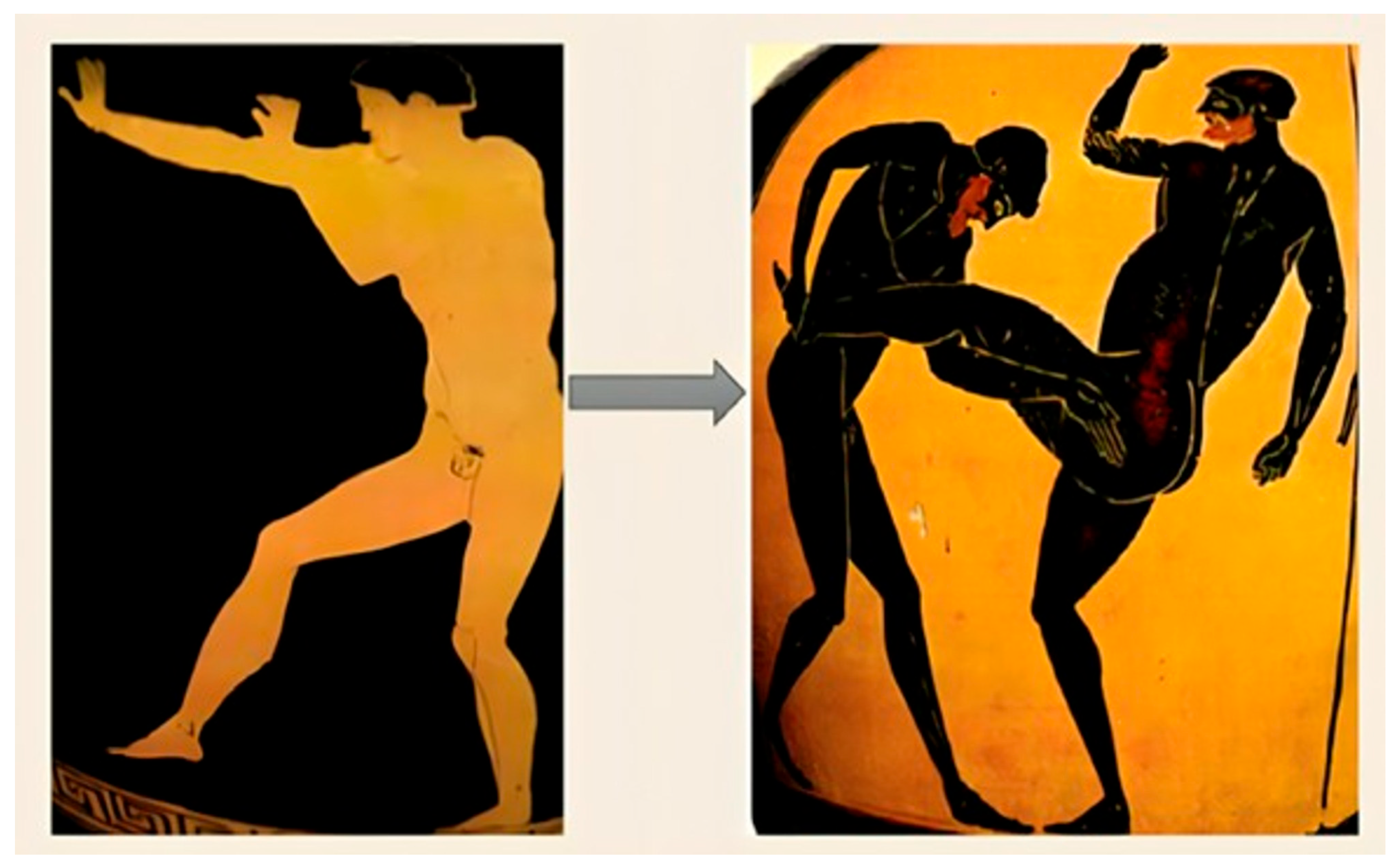
To achieve a quantitative analysis of the kicking technique, the approach was based on existing literature and archeological evidence (
Figure 1). Ancient texts indicate that matches commenced with competitors in a face-to-face stance, assuming preparatory postures in anticipation of the subsequent movements, as shown in
Figure 1. It was considered that the attacker must start from a defined position to deliver a strike. Therefore, the archeologically validated initial posture was linked to the final posture, which, in this study, corresponds to the delivery of the front kick to the stomach.
The front kick was selected for analysis due to its detailed documentation in historical texts and visual representation on pottery artifacts [
26]. The execution of a kick involves starting and ending phases, each defined by specific joint angles.
It should be noted that the depicted posture may also represent a defensive interaction in which the non-kicking arm intercepts or parries an opponent’s strike. Such an interpretation may slightly alter the final limb configuration and therefore introduces potential ambiguity in the exact biomechanical meaning of the posture. For this reason, the present study interprets the artifact strictly as a boundary posture constraint rather than as a definitive representation of a single combat action.
The approach of each posture as an articulated object with specific configurations (joint angles) that characterize it presents a well-established problem in engineering related to modeling articulated structures [
39]. Inverse kinematics is a mathematical method that determines the joint angles required to achieve a desired end effector, e.g., a limb position, and has found significant applications in sports biomechanics. By analyzing the desired movement of an athlete, such as the trajectory of a tennis swing or the arc of a basketball shot, inverse kinematics has been utilized to optimize athletes’ technique, prevent injuries, and enhance performance. The analysis of complex movements into precise joint angles that IK offers has provided data about the mechanics of athletic movement, and has been used to enhance athletic techniques and improve athletic skills.
The study employed a simplified humanoid robotic model with limited degrees of freedom (DoF)s to approach the kinematics of the front kick depicted in
Figure 1. This simplification was necessary to focus on the essential mechanics of the kicking motion without the complexity of a fully articulated human model, as the primary aim of the modeling was to determine the joint angles and limb trajectories that transition the model from the initial posture to the final kicking position. The articulated nature of the human body has been studied by scientists which lead to the utilization of IK to address the characteristics of human motion [
43]. It is logical that the transition of the body from one posture to another requires joint rotations that result in the attainment of the desired posture. This requirement constitutes the core of the IK problem [
44]. The kinematic relationships used in this study follow standard formulations of planar articulated chains widely described in biomechanics and robotics literature. Because these formulations are well established, the complete derivation of the forward and inverse kinematic equations is not reproduced here. Instead, the study focuses on applying these established formulations to the specific archeological boundary conditions investigated.
2.1. Model Degrees of Freedom
The humanoid system was implemented as a reduced kinematic chain to minimize redundancy and to prevent unconstrained insertion of modern combat sport motor solutions into an extinct technique. Only three active revolute degrees of freedom were retained (left hip, left shoulder, right shoulder), while the remaining joints were constrained. Distal joint trajectories were therefore induced by proximal rotations and did not constitute independent degrees of freedom.
IK was implemented within the MATLAB Simulink framework and a humanoid robotic model consisting of six articulated joints with three actively controlled rotational degrees of freedom was created [
33]. The computational model was implemented in the MATLAB/Simulink environment [
45]. The present implementation is strictly kinematic and uses interconnected functional blocks to enforce geometric constraints. Simulink is widely used in engineering and biomechanics for simulation of control systems, kinematic chains, and dynamic processes.
The anatomical architecture of the model is composed as follows: the trunk and the head are fixed and act as the base segment. The skeleton was subdivided into the arms and legs. The arms were divided into the forearm and upper arm, while the legs were composed of the femur, shank and foot segments. The joints capable of rotational movement were limited to the left hip joint and the shoulders. The elbows and the left knee were fixed from the beginning. The reduction of the system to three actively controlled rotational degrees of freedom was intentional. The objective of this reduction was not to reproduce full human locomotor control but to minimize redundancy and isolate whether the archeological boundary postures admit a continuous kinematic solution under constrained conditions. The model therefore functions as a reduced-order feasibility test, not as a full musculoskeletal representation of combat performance.
The decision to lock the supporting leg in the simulation was based on static analysis of the same pictures which focus on the stability mechanics of the front kick in Pankration [
46,
47]. Locking the support leg eliminates the possibility of modeling human balance regulation or locomotor adjustments. This constraint was introduced solely to stabilize the reduced kinematic chain and isolate the local geometry of the kicking motion. Consequently, the model cannot be interpreted as representing authentic balance strategies or full-body dynamics.
The contralateral (supporting) hip and knee joints were constrained to remain rigid throughout the simulation, in order to approximate postural configurations observed in archeological depictions of Pankration [
46,
48] and to facilitate computational tractability. This constraint enabled the use of a reduced kinematic chain solvable via closed-form analytical IK. The left knee was modeled as a dependent prismatic joint rather than an independent rotational degree of freedom. While the knee lacks active rotational control, its flexion angle and trajectory are passively determined by the hip rotation via the closed-form IK solution, allowing the shank to translate along a curved path consistent with the archeological end position (
Figure 1). The simplification assumes knee flexion is geometrically coupled to hip flexion during the chambering phase, rather than independently controlled.
Also, static moment reconstructions of those vases, conducted with digitization pipeline, yield mean stance-knee flexion angles [
46,
47].
The trajectory generator was not intended to represent a biologically optimal path. Instead, it serves as a parametric interpolation mechanism connecting the initial and final archeological postures while respecting anatomical joint limits. The purpose of this function is therefore computational feasibility testing rather than identification of natural motor control strategies.
Although the endpoints of the fixed segments exhibit 2D Cartesian trajectories during simulation, this motion is kinematically determined by the three proximal rotational joints and does not represent independent translational degrees of freedom [
33]. In rigid-body kinematics, biological joints such as the elbow and knee are modeled as revolute joints they do not possess (translational DoF unless explicitly designed as such (e.g., in prosthetics or soft robotics), which is not discussed in the present research [
34]. Assigning two DoF to fixed joints based on endpoint displacement conflates task-space coordinates with joint-space degrees of freedom, a distinction rigorously maintained in robotics and biomechanics [
35]. Therefore, the system’s DoF is set to three (3).
Finally, and most critically, this approach focused on the rationale of the present research, i.e., a descriptive ipsilateral limb coordination pattern emerging from the constrained kinematic solution. y, distinct from modern martial arts, could be identified even under a simplified, stable base condition. The model was designed not to replicate the full dynamism of a combat scenario, but to isolate and reconstruct a specific kinematic pattern evidenced by the historical record.
Thus, the imposed kinematic constraints aimed to approximate a possible neuromuscular strategy employed by ancient combatants when fighting in Pankration. This imposition finds congruence with contemporary biomechanical research on the role of proximal joint fixation in augmenting postural stability during dynamic motor tasks [
49,
50].
Therefore, the total system was set to degrees of freedom (DoF) (
Table 1).
Rotational movement was restricted to specific joints: both shoulders were capable only of rotational movement, while the elbows could perform translational movements only, guided by the rotation of the shoulders. Similarly, the left hip was restricted to rotation, and the knee performed only translational movement as dictated by the hip’s rotation. The humanoid model was constructed by integrating typical anthropometric parameters of a person with a total body mass of 100 kg and a height of 185 cm, to approximate human-like physical characteristics, as delineated in detail below (
Table 2) where the segment lengths and masses were referred to MATLAB’s Simulink Library.
Body proportions, segment lengths and joint centers were not estimated directly from the pottery imagery. Instead, the depictions were used exclusively to define relative joint configurations and postural constraints. This approach was used to avoid errors associated with scale ambiguity and perspective distortion inherent to 2D artistic representations, while allowing the reconstructed motion to remain anatomically plausible.
Joint configurations were interpreted manually from archeological depictions based on anatomical landmarks, rather than through automated pose estimation algorithms, due to the stylized nature of the artifacts.
The simulation procedure used a 2D trajectory function (1) to define the kick path, while IK calculated the joint angles required for the position. The proportional–integral–derivative (PID) controller adjusted the joint angles to match the desired position. The coefficients of the PID controller were set as Kp = 0.1, KI = 0.002 and Kd = 0.3.
In this simulation, the motion duration was set at 1.2 s. We adopted the duration of 1.2 s despite kinematic studies of Taekwondo and related striking techniques reporting mean front kick times of approximately 0.6 s [
51,
52,
53]. Although Pozo et al. (2011) demonstrated that elite karateka perform mae-geri in 0.99 s versus 1.14 s for regional athletes [
54], in IK analyses the governing equations are purely geometric (i.e., positions
velocities
, and accelerations
are solved without the mass-force terms that define dynamics), so any uniform time-scaling leaves the spatial trajectory invariant [
55,
56]. Also, the analysis is purely kinematic. By definition, kinematics addresses only geometry and timing of motion. Hence, extending the temporal envelope to 1.2 s does not alter the spatial path of the front kick but helps in providing a temporal coverage under a purely geometric approach.
So, it becomes clear that in the present kinematic analysis, speed does not affect the trajectory because the path is determined by geometric constraints and joint configurations [
56]. Speed influences only the rate at which the model traverses this path, not the path itself. For example, whether the kick takes 1.2 s or 0.6 s, the X-Y coordinates of the knee or elbows follow the same curve, as the IK solution ensures the end effectors reach the desired positions regardless of time scaling [
57].Consequently, considering the specific constraints established for the operational environment, the robotic system’s architecture was developed through a comprehensive analysis and integration of all requisite design parameters. Stability analysis of the model was performed by monitoring the CoG trajectory, which confirmed performance within experimentally determined operational boundaries.
The study evaluates the existence of a continuous admissible mapping under constraints. It does not characterize the full solution manifold nor its global mathematical properties. The inverse kinematics solution is not assumed to be unique, but it evaluates the existence of at least one continuous admissible trajectory under the imposed constraints.
Table 2.
Magnitude of the body segments/parts used in the simulation. Measurements produced based on the manuscript of Nigg & Herzog [
46,
58,
59,
60,
61].
Table 2.
Magnitude of the body segments/parts used in the simulation. Measurements produced based on the manuscript of Nigg & Herzog [
46,
58,
59,
60,
61].
| Body Parts | Length (cm) | Mass (kg) |
|---|
| Upper limb | 32 | 3.8 |
| Forearm | 16 | 2.7 |
| Trunk (head included) | 995 | 73 |
| Thigh | 46 | 8.1 |
| Shin | 39 | 4.6 |
Constraining the support leg and trunk reduced kinematic redundancy and enabled isolation of the coordination structure implied by the archeological depictions. This constraint necessarily biased whole-body mass displacement and limited the interpretability of CoG trajectories as a model of human balance control. For this reason, CoG trajectories were retained as diagnostic outputs indicating the limits of the reduced model rather than as validated estimates of human stability strategies. Axial pelvic rotation and trunk rotation were not represented because the reconstruction was restricted to a planar projection consistent with the two-dimensional constraints of the archeological material.
2.2. Reference System
To proceed with the analysis, a Cartesian coordinate system was elected for kinematic analysis. The origin of the coordinate axes is established at an arbitrary point, upon which subsequent spatial parameters are referenced. Initially, the trunk’s position is defined within the plane, followed by the characterization of the remaining limb segments in relation to the trunk.
The reference system used in the present simulation can be analyzed as follows:
Let represent the arbitrarily chosen origin of the global coordinate system, serving as the main reference point for all constituent elements of the robotic structure. The vectors delineating the positions and distances of various robotic components, including the main body, are explicitly defined in relation to . The CoG for each segment was parametrized within this global framework by a set of Cartesian coordinates and associated mass. The trajectory of individual body segments is expressed in a local coordinate system representing specific articulation points, such as the elbow and knee joints.
Now, let
be the origin of this local coordinate system, then the vectors x,y describe the time-dependent position of each segment relative to
. The trajectories generated describe the path of subsequent articulation points with respect to the localized coordinate system
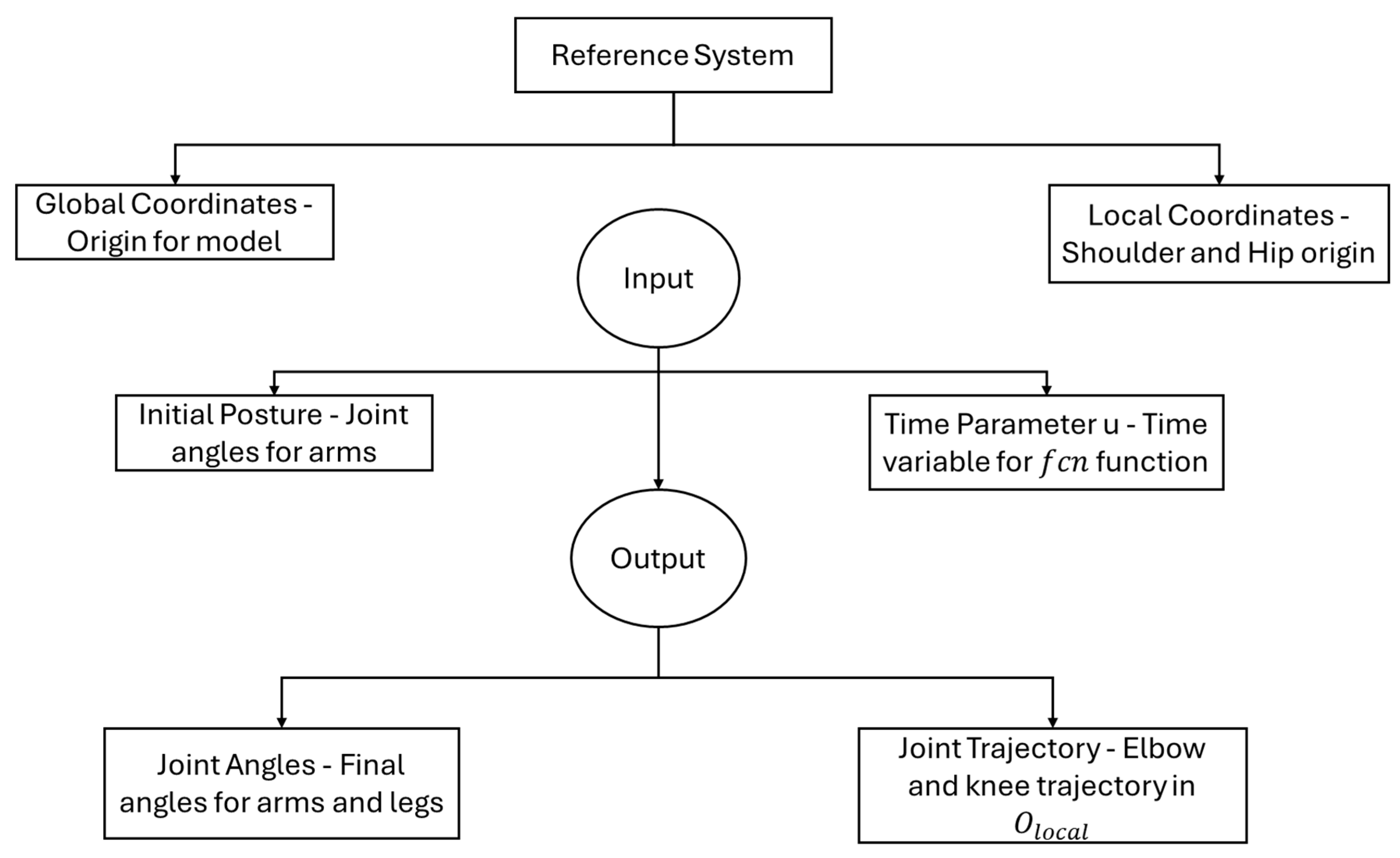
(
Figure 2). Obviously, the trajectories present the evolving spatial position of, for example, the elbow in relation to the shoulder joint and the knee in relation to the hip joint. The local refences system is opposite to the global system in axis, which means that when X value increases, the segment is moving to the left which is towards the opponent (target). In the context of the model’s rotational dynamics, it should be noted that the right-hand rule is not adhered to. This deviation is not an oversight, but a deliberate constraint imposed by the architectural design of the model itself.
2.3. Structure of the Model
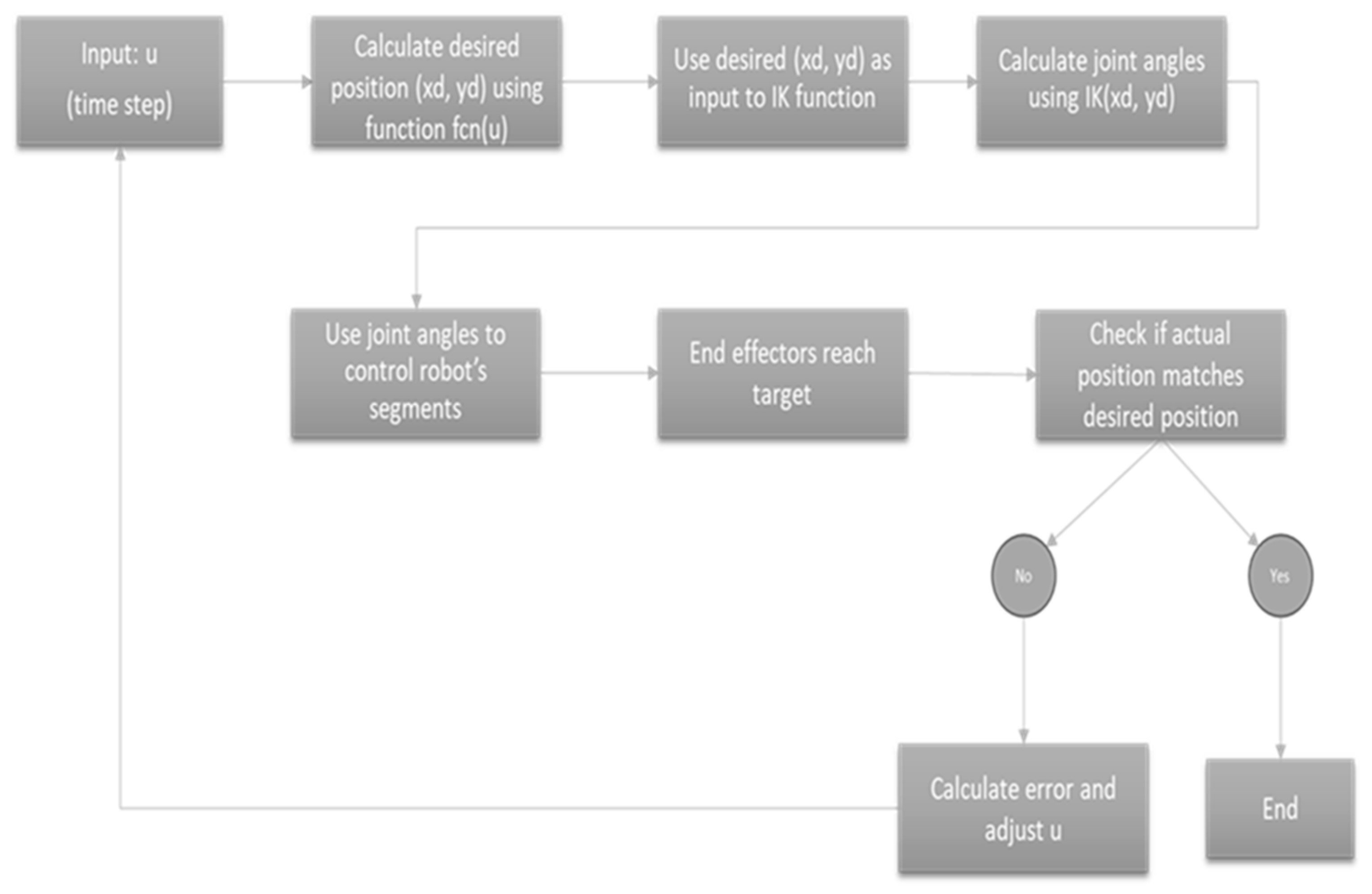
The following procedure was followed to move the robot’s end effectors the target:
The first function used,
contains a set of parametric equations that generates a circular trajectory in 2D space, rotated and translated according to the equations. This function takes
as input and calculates xd and yd, which represent the desired position of the robot’s end effector (
Table 3). The trajectory required to reach the target by the end effector is generated by fcn(u). It represents a custom MATLAB function that defines the parametric trajectory of the end effector as a function of the input variable u, which represents normalized time along the movement path.
The function takes an input
which in our case is time as a parameter, and calculates the desired Cartesian coordinates (xd and yd) for the end effector. The function uses trigonometric relations (specifically, the cosine and sine functions) to define the path. These coordinates are then forwarded to the next function. The MATLAB function used to move the segments is defined as
The function served as a parametric generator for the desired end-effector trajectory in 2D space. The cosine and sine components create the circular motion, while the phase shifts (i.e., for and ) adjust the starting position and orientation of the circle. Moreover, the constant offsets translate the trajectory repositioning the circle away from the origin to align with the model’s initial posture.
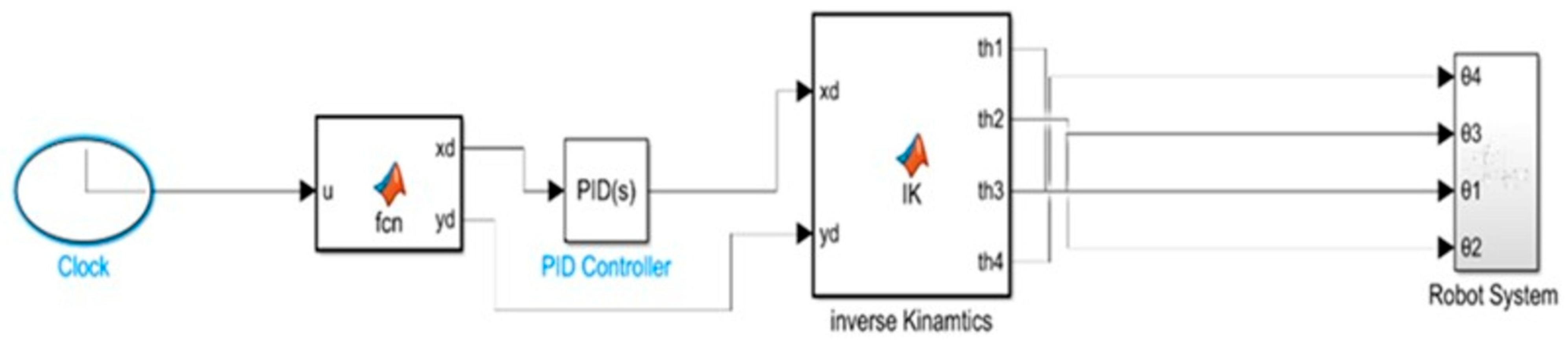
The next function is the inverse kinematics function (IK) which was used to calculate the joint parameters necessary to place the end effector in the desired position and orientation. The IK function was developed to directly compute the joint angles which resulted in the corresponding movement of the robot’s segments. The function receives target spatial coordinates (xd,yd) and computes the requisite angular configurations of the shoulder and hip joints (designated th1, th2, th3, th4) for these joints and with th4 corresponding to the static hip during the kicking phase. Subsequently, these calculated joint angles are utilized to actuate the robotic limb segments, moving the end effector to the specified target position. The connection between the functions and the model is illustrated in
Figure 3.
The PID controller adjusts the system to get it as close as possible to the desired setting. It uses the current error, sum of past errors, and the rate of change of error to do this adjustment and produces a control signal to correct the system’s behavior. The controller was employed exclusively as a numerical mechanism to ensure convergence of the inverse kinematics solution to the desired trajectory. The controller was not intended to represent biological motor control or to provide a novel control strategy. Consequently, issues related to nonlinear robotic control or advanced tuning procedures fall outside the scope of the present feasibility analysis. The PID controller parameters used are as follows:
Proportional gain (Kp): 0.1
Integral gain (Ki): 0.002
Derivative gain (Kd): 0.3
So, as the function
takes the input
and calculates xd and yd, while
varies,
generates a series of desired positions that form a trajectory in 2D space. This trajectory defines the path that the robot’s end effector should follow in the environment. Then, the IK function is used to calculate the corresponding trajectory in joint space (
Figure 4). IK takes the desired position (xd, yd) as input and calculates the joint angles necessary to reach each desired position. The joints have been set to within the physiological range of the corresponding joints of the human body. The joint angles are then used to control the robot’s joints and move the robot’s segments. This allows the robot to follow the specific path in the environment defined by
, while also considering the constraints and capabilities of its joints. The method used to solve the IK problem is analytical. Then, the use of a feedback loop with the PID controller further refines the robot’s movement by correcting the errors between the desired and actual positions (
Figure 4).
The PID controller minimizes the error between the desired positions and the actual positions, and the IK function calculates the joint angles needed to achieve these corrected positions outputting the corrected xd,yd. As time progresses, the system continually updates based on the cartesian coordinates generated by fcn(u). The methodology employed yields the coordinates for the joints under investigation, specifically the elbows and knees.
Because the present study evaluates geometric compatibility rather than dynamic behavior, the analysis is limited to positional kinematics. Differential kinematic formulations were therefore not required for the objectives of this work.
The Simulink model implemented in this study is a purely kinematic chain. It does not incorporate equations of motion, inertial matrices or Coriolis terms. No dynamic plant model is included in the simulation, as the analysis focuses exclusively on geometric kinematics. The PID block operates on the geometric positional error between desired and computed end-effector positions. This is architecturally equivalent to using Newton-Raphson iteration to solve a nonlinear algebraic equation: convergence is governed by numerical properties of the error signal, not by physical energy dynamics.
The PID block functions as a point-to-point position regulator in its discrete-time implementation within Simulink. The proportional term drives the position error toward zero; the integral term eliminates residual offset; and the derivative term provides damping on the error rate. No velocity state variable is independently tracked.
The inertia tensor provides a measure of an object’s resistance to rotational motion about different axes. The calculations are done automatically by Simulink since the geometric and mass properties of each component in the robot model are defined. The CoG is then exported as part of the simulation results in MATLAB’s workspace for further analysis (
Figure 5).
2.4. Simulation Validation
To evaluate the plausibility of the simulation results, a validation study was conducted in a controlled motion analysis laboratory. The validation objective was to establish biomechanical feasibility, i.e., whether the IK-derived joint angles produce a motion that humans can physically execute without injury, and to quantify the natural kinematic variance when multiple individuals interpret the same geometric targets. This feasibility check was a necessary precondition for any historical kinematic hypothesis, though it does not, by itself, validate the historical accuracy of the reconstruction.
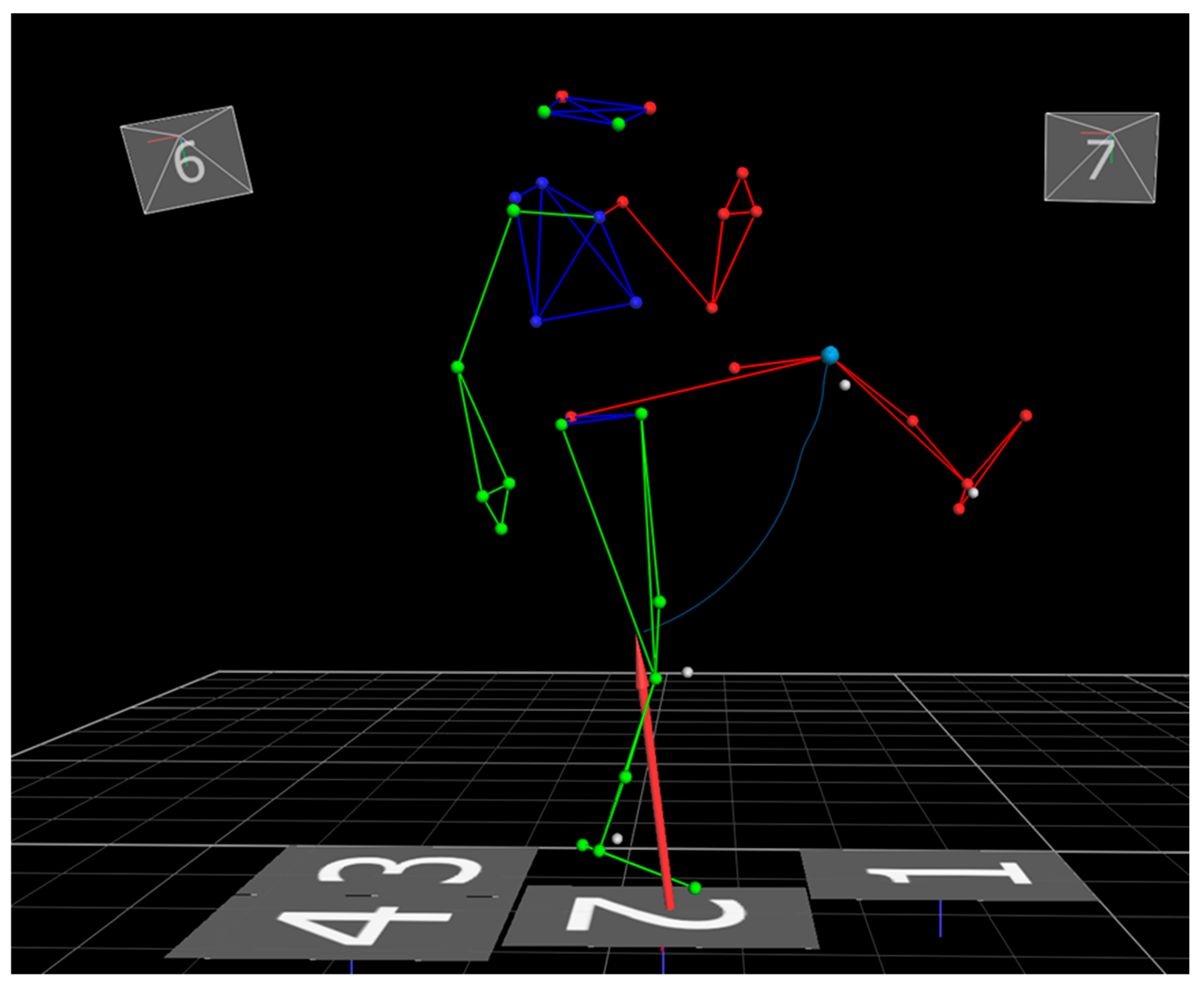
Motion capture data were obtained from ten healthy adult participants performing the instructed kicking motion. Video recordings were processed to extract the two-dimensional coordinates of selected anatomical landmarks corresponding to the simulated joints. The extracted coordinates were temporally normalized to a common movement duration using linear time normalization in order to allow comparison between trials. The trajectories were then filtered using a low-pass Butterworth filter to remove high-frequency noise associated with digitization. For each participant, landmark trajectories were aligned with the simulated coordinate system and rescaled to account for anthropometric differences. The resulting trajectories were averaged across participants and compared to the simulated motion using Pearson correlation coefficients and MAE metrics.
During each trial, the trajectories (specifically of the left knee, ipsilateral elbow and contralateral elbow) were recorded and compared against the corresponding outputs of the simulated model.
Because participants were instructed using the simulated movement pattern, the validation procedure does not constitute an independent confirmation of historical authenticity. Instead, it evaluates whether the kinematic solution generated by the constrained model is physically executable by human participants under controlled laboratory conditions.
Specifically, the goal of the validation was to determine whether the kinematic solution produced by the model can be realized by the human body.
Participants were provided with video simulations and historical depictions to replicate the inferred kinematic pattern as closely as possible, allowing assessment of whether the model’s output is biomechanically executable by humans under controlled conditions. This approach evaluates the plausibility of the simulated trajectory rather than independent interpretation, acknowledging potential bias toward the model.
2.5. Statistical Approach
To assess the agreement between simulated and experimental trajectories, multiple complementary statistical measures were employed. First, Pearson’s correlation coefficient (r) was calculated to evaluate the linear association between the simulated and real data across both horizontal (X) and vertical (Y) axes. Corresponding p-values were reported to determine the statistical significance of the observed correlations.
Second, error-based measures were computed to quantify the magnitude of deviations between simulation and experiment. These included the mean squared error (MSE), which penalizes larger deviations by squaring residuals, and the mean absolute error (MAE), which provides an interpretable measure of average deviation independent of sign.
Third, to capture similarity in temporal alignment between trajectories, the dynamic time warping (DTW) distance was calculated. DTW accommodates temporal shifts by allowing non-linear alignment of two time-series, thereby providing a robust measure of trajectory similarity even in the presence of small phase differences. All datasets were preprocessed by pairwise removal of missing values, followed by trimming to equal lengths to allow point-by-point comparisons. Analyses were performed separately for each joint trajectory (knee, falling arm, rising elbow) along both axes. This multi-metric approach ensured a balanced assessment of the fidelity of the kinematic simulations, with correlation reflecting shape similarity, error metrics quantifying absolute deviations, and DTW capturing temporal agreement.
3. Results
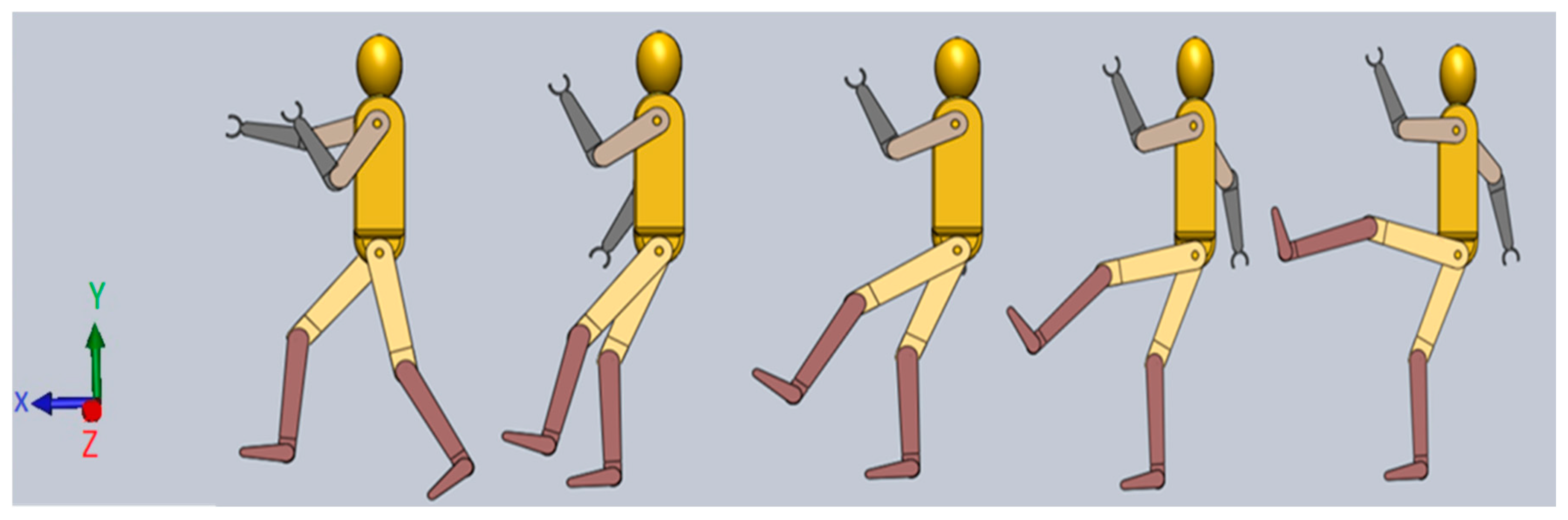
This study delivered an estimation of the kick, through the IK method providing parameters as the CoG and limbs’ trajectory. The model executed the kick at a constant velocity and used synchronous segment translations to approximate human kinematics, achieving continuity. Frames of the simulation are presented in
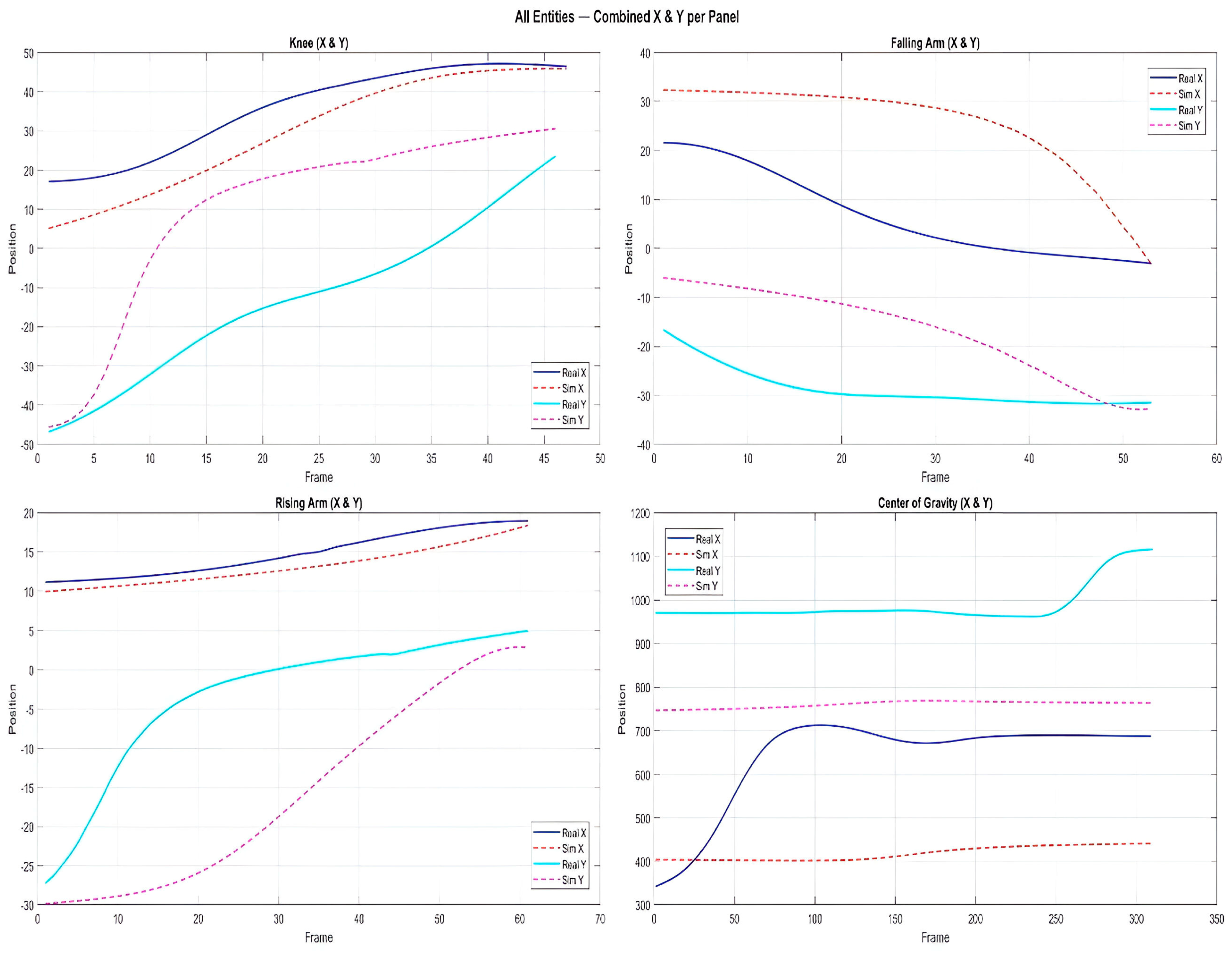
Figure 4. The validation analysis quantified the similarity between simulated trajectories and experimental recordings for the knee, falling arm, rising elbow, and CoG (
Table 4).
CoG correspondence remained weak with large absolute errors, which was consistent with the rigid base constraints of the reduced model and indicated that whole-body balance control was underrepresented. CoG results were therefore interpreted as evidence of model limitation rather than as evidence against the reconstructed local coordination pattern.
The trajectory of the kicking leg’s knee (left) is shown in
Figure 6. The leg’s ascension is quantified, consistent with the rest plots. The segment’s proximity to the opponent was indicated as a function of x-axis progression, with the axes’ origin centered at the adjacent joint.
The joint kinematics of the right arm and left leg revealed a degree of synchronization. For the knee joint, the horizontal trajectory demonstrated excellent agreement, with a perfect (almost) correlation (r = 0.99, p < 0.001), low error values (MSE = 47.91, MAE = 5.99), and a DTW distance of 105.11. The vertical trajectory also correlated strongly (r = 0.88, p < 0.001), although the associated errors were higher (MSE = 658.97, MAE = 23.22, DTW = 128.96), indicating greater variability in vertical displacement.
For the falling arm, both axes produced moderate to strong correlations (X: r = 0.70, p < 0.001; Y: r = 0.72, p < 0.001). However, error values were higher than those of the knee, particularly in the horizontal direction (MSE = 385.77, MAE = 18.36, DTW = 358.02), whereas the vertical direction showed lower error magnitudes (MSE = 181.57, MAE = 11.96, DTW = 208.32). The rising arm displayed highly accurate horizontal alignment (r = 0.98, p < 0.001; MSE = 2.87, MAE = 1.59, DTW = 16.10). The vertical trajectory, while still statistically significant (r = 0.77, p < 0.001), was associated with larger deviations (MSE = 215.02, MAE = 12.60, DTW = 58.12).
In contrast, the CoG trajectories exhibited weak correlations (X: r = 0.41, p < 0.001; Y: r = 0.20, p = 0.0004), with large error magnitudes (MSE > 53,000, MAE ≈ 228). Despite statistical significance, these results indicated limited fidelity in reproducing global body mass displacement, likely reflecting the simplifications imposed by the humanoid model and the constraints applied to the supporting leg.
However, as a whole, the statistical comparison indicates that several local joint trajectories generated by the model can be reproduced by human participants under controlled conditions, particularly for the knee and elbow in the horizontal plane. Larger discrepancies were observed in vertical trajectories, in the falling arm and in the global CoG (
Figure 7).
4. Discussion
Our analysis of a four-segment humanoid model performing a simulated kick evaluates the geometric relationships between joint kinematics, limb trajectories and CoG displacement under constrained IK conditions. The objective of the present study was not to develop a novel kinematic formulation or control algorithm. Instead, the work applies established IK principles to a new interpretive problem: testing whether archeological postural depictions are compatible with continuous human movement trajectories. The simplicity of the model is therefore intentional, allowing the study to isolate geometric feasibility without introducing unnecessary modeling assumptions.
The inverse kinematics problem considered in the present study is, in general, nonunique. Multiple joint configurations may correspond to the same end-effector trajectory. The present analysis does not attempt to enumerate or optimize among these solutions. Instead, it evaluates whether at least one continuous trajectory exists that satisfies the imposed boundary conditions and joint constraints. Kinematic singularities may arise in articulated systems when the Jacobian matrix loses rank. The present study does not perform a global singularity analysis. Instead, the evaluation is restricted to a bounded subset of the configuration space defined by anatomical joint limits and prescribed boundary conditions. Within this domain, the simulated trajectory remained continuous and did not encounter configurations associated with loss of controllability. The results are therefore valid locally within the evaluated motion range.
The results should therefore be interpreted as demonstrating feasibility of the specified configuration, rather than uniqueness or optimality of a movement solution.
As the study employs purely kinematic IK (solving for position q(t) without mass-force terms), we cannot address joint moments, ground reaction forces, or muscle power.
The validation results demonstrated that the simulated trajectories reproduced joint kinematics with high fidelity, particularly along the horizontal axis. This alignment reflects the geometric nature of inverse kinematics, which prioritizes accurate spatial positioning of end effectors under defined boundary constraints. In contrast, vertical trajectories exhibited larger errors, especially in the knee and elbow, likely due to simplifications in the model such as fixed joint constraints and the absence of detailed musculoskeletal dynamics that would capture subtle vertical displacements. The falling arm showed moderate agreement, showing that limb segments not directly driving the kick may be more sensitive to modeling assumptions.
Archeological depictions were treated as boundary constraints with uncertain mapping to instantaneous kinematic snapshots. Pottery compositions may have been influenced by artistic conventions (e.g., compositional completeness, stylization, representational priorities) and may not represent a literal frame of motion. The reconstruction was interpreted as a feasible movement solution consistent with the depictions, rather than as a definitive representation of in-competition technique.
The CoG trajectories, although statistically significant, exhibited weak correlations and high error magnitudes. This outcome possibly reflects the limitations of the simplified humanoid model, in which the supporting leg was constrained and the trunk treated as a rigid segment. These design choices stabilized the system for computational tractability but reduced the capacity to replicate whole-body mass shifts observed in experimental trials. From a biomechanical perspective, the discrepancies suggest that while local joint kinematics can be reconstructed with high accuracy, capturing whole-body mass redistribution requires additional model refinement including dynamic modeling and expanded DoF. The deviation report indicates that the reduced kinematic model (with a rigid base) does not capture whole-body mass shifts associated with active balance control.
The left arm moved forward alongside the left leg, performing an ipsilateral movement constituting a distinct coordination topology under the imposed kinematic constraints. In contrast, the right arm swung backwards, coordinating contralaterally with the leg performing the kick. The left leg’s motion formed part of the coordinated geometric solution linking initial and terminal boundary conditions. This configuration differs descriptively from the contralateral coupling commonly emphasized in many modern competitive striking paradigms.
A qualitative resemblance to ipsilateral coupling described in quadrupedal gait literature was observed; this resemblance was treated as descriptive rather than mechanistic, because neuromuscular control and stability constraints were not modeled [
62]. It is possible that synchronous movement of ipsilateral limbs was critical for the kick’s technique.
Through a more in-detail statistical comparison between simulated and experimental trajectories, a bimodal distribution of consensus was observed. The model demonstrated exceptional accuracy in replicating horizontal kinematics of the kicking limb and the ipsilateral rising arm, with errors remaining within single-digit millimeters. The results support the geometric consistency of the simulated trajectory under the imposed boundary conditions. However, vertical displacement accuracy was substantial and the falling arm exhibited moderate fidelity. Most critically, the whole-body CoG showed weak correlations with mean absolute errors exceeding 225 mm, approximately one-quarter of a meter deviation from experimental measurements. This divergence indicates that while the simplified model successfully captured the geometric trajectory and coordination pattern of the kick itself, it failed to replicate the complex postural adjustments and weight distribution strategies employed by human participants. These findings indicate that the ipsilateral coordination topology persisted under the present constraint structure, yet interpretations regarding balance mechanisms and CoG control should be approached with considerable caution.
Ipsilateral limb coordination, while less emphasized in modern competitive sport paradigms where contralateral arm leg coupling is frequently observed, has not been biomechanically anomalous nor historically absent in combat movement traditions. Under unilateral task constraints, ipsilateral coupling has been reported as a viable coordination solution when direct projection of the body toward a target and structural alignment were prioritized over rhythmic contralateral stabilization. In martial arts, analyses of Japanese classical systems have described ipsilateral hand foot coordination as a recurrent organizational principle in combat-oriented motor strategies [
63]. Zoughari’s work on bujutsu documented integrated whole-body actions in which the ipsilateral limb advanced with the striking limb as part of coordinated positional entry, emphasizing alignment and direct transmission rather than contralateral sport-style rhythm [
64]. On this basis, the ipsilateral coordination observed in the present constrained solution may be descriptively compared with historically documented martial practices, while remaining strictly within a kinematic interpretive framework.
Furthermore, the trajectories traced by the right arm and left leg further emphasized the potential roles in the coordination structure. The paths followed by these limbs were markedly different from those of the left arm, which seemed primarily involved in maintaining balance. The trajectories of the right arm and left leg permit speculation about the active involvement in the movement organization of the kick, contrary to the common belief that arms primarily enhance performance by assisting in coordinating multi-joint movements of the lower body. As already discussed, such synchronization of movement on one side of the body is a phenomenon observed in many terrestrial animals, underpinning the efficiency and effectiveness of their locomotion [
62], a concept identified in the front kick of Pankration.
Also, the analysis of the model’s CoG path revealed a bounded geometric displacement under fixed base constraints during the kick. Again, this is consistent with research on human and animal biomechanics. By moving the COG towards the opponent, the model moves more of its mass which could be consistent with increased impulse under dynamic conditions, which was not evaluated. Also, there are expected discrepancies in CoG due to rigid constraints, which highlight the model’s kinematic rather than dynamic scope; the >225 mm MAE suggests areas for future dynamic refinement but does not invalidate local trajectory accuracy.
Forward displacement of body mass could be consistent with increased impact impulse under dynamic conditions; however, because kinetics were not estimated, no force- or impulse-based inference was made in the present analysis.
But an interesting challenge was found, concerning the athlete’s balance, as shifting the CoG too far forward might compromise the overall stability. Therefore, it is crucial to carefully control the CoG movement to ensure both an effective kick and a stable posture.
This study generated a constrained sagittal-plane kinematic solution linking archeologically inferred postures using a simplified humanoid model. The simulation revealed a unique limb coordination pattern where the left arm moved ipsilaterally with the left leg demonstrating a specific coordination topology within the imposed kinematic structure. In contrast, the right arm swung contralaterally in coordination with the kicking leg, indicating a balancing role.
The study unveiled a distinctive limb coordination. The left arm and left leg moved ipsilaterally) during the kicking motion. This synchronization is atypical compared to modern combat sports, which generally employ contralateral movements of arms and legs to enhance balance and power.
Prior research on ancient Greek combat sports has predominantly focused on the cultural significance, training methodologies, and injury profiles associated with disciplines like wrestling and boxing [
12]. Previous studies of Pankration have so far remained at the level of discrete, non-continuous observations. One study has already applied a static analysis to isolated pottery postures [
46], estimating instantaneous joint forces, moments and weight distribution at a single frozen configuration. A subsequent study extracted two-frame displacement vectors of the striking-limb endpoint (wrist or ankle) from ancient depictions and from modern video and compared their magnitude and direction across eras; that analysis operated on endpoint coordinates in image space and did not employ an articulated kinematic chain, did not compute joint-angle trajectories over time, and did not evaluate whether the depicted postures admit a continuous, physically executable movement [
48]. Neither approach has therefore addressed the question of motion continuity. The present study closes precisely that gap: it introduces a time-continuous inverse kinematic simulation of a Pankration front kick that links the depicted boundary postures within a reduced articulated chain model, computes the full joint-angle, limb and CoG trajectories across the movement and tests the resulting trajectory against motion capture data from ten participants under quantitative agreement metrics.
Additionally, in comparison with modern reconstructions based on Eastern martial arts, which often result in hybridized techniques, the simulation offered a scientific representation of ancient Pankration’s kinematics. This approach set the foundation for bridging a great lacuna that exists in the current literature.
The use of IK as a method of controlling limb positions aligns with modern control strategies observed in biomechanics and robotics research. This approach could also be used in future robot designs that require precise control of complex movements, as well as in the design of new sports movements.
4.1. Limitations
Despite its contributions, this study has several limitations. The humanoid robotic model employed was simplified, utilizing only six active joints to replicate the complex movements involved in human biomechanics. This simplification may not capture all the nuances of muscle dynamics and joint constraints inherent in actual human movement. The model was constrained such that translational movement was not permitted, which limited its ability to walk or advance towards the opponent. This design allowed the model to execute kicking actions while maintaining a fixed position.
While a more realistic simulation would incorporate the capability for the model to move towards an opponent, the adopted constraint aligns with techniques observed in numerous modern combat styles, where direct kicks are often executed without forward motion. Additionally, the reconstruction was based on interpretations of historical texts and archeological artifacts, which may have introduced biases due to the limited and sometimes ambiguous nature of these sources. Furthermore, the study focused solely on the front kick technique, limiting the generalizability of the findings to other Pankration movements and techniques.
Also, instructional exposure to the simulated motion may have increased convergence between experimental trajectories and the simulation output; therefore, the validation supported executability and coherence rather than uniqueness or historical naturalness. The framework remained purely kinematic and did not incorporate ground reaction forces, joint moments, muscle activation, or stability constraints. Thereby force generation, angular momentum regulation and energetic efficiency could not be inferred. The 2D reconstruction imposed inherent constraints, including depth ambiguity, projection distortion and inability to resolve out of plane motion. Artistic stylization may further obscure instantaneous kinematic states. While these limitations restrict dynamic inference, the planar approach remains appropriate for evaluating coordination structure and kinematic feasibility under archeological constraints.
Furthermore, the study’s reliance on a purely kinematic (geometric) approach, without incorporating dynamic–neuromuscular components, limits its ability to infer force production, muscle activation patterns and energetic efficiency. Because IK determines how a movement can be achieved but not why a specific motor strategy was selected, the simulation cannot distinguish between biomechanically possible and historically probable movement solutions. Finally, the reconstruction hinges on static depictions from pottery and fragmented textual accounts, which inherently lack motion continuity and may represent stylized and symbolic poses rather than functional combat postures. This introduces uncertainty about whether the simulated motion truly reflects in-competition technique or an idealized or ceremonial form. The substantial mean absolute error in CoG reconstruction (MAE > 225 mm) indicates that the 3-DoF model fails to capture the dynamic postural adjustments humans employ to maintain balance during single-leg support. This confirms that the model is kinematically feasible but dynamically unstable, a limitation inherent in the simplified approach. The CoG trajectory should be interpreted as the geometric consequence of limb movement under fixed base constraints, not as evidence that ancient athletes balanced in this manner.
Finally, the Greek vase paintings employ artistic conventions including foreshortening, composite perspective and idealized proportions that may not adhere to biomechanical reality. Our method treats these depictions as hypothesized kinematic boundary conditions rather than photorealistic documentation. The IK simulation tests whether these hypothesized postures form a continuous, mathematically feasible trajectory. This approach cannot verify that the ancient athlete moved exactly as simulated, but only that the depicted poses are mechanically compatible as start/end points of a movement.
4.2. Practical Applications
The findings of this study have practical applications for sports science too. More in detail, the research provides information about the development of technically modified movement protocols. More in detail, the present work contributes to the intersection of computational methods and archeological movement interpretation through three specific elements. First, it establishes a computational procedure for testing whether postural configurations depicted in archeological artifacts are geometrically compatible with a continuous sagittal-plane kinematic trajectory under constrained inverse kinematics conditions. Second, it implements a reduced-order inverse kinematics approach that links artifact-derived boundary postures with experimentally reproducible human motion trajectories, allowing the physical executability of the generated kinematic solution to be examined within human joint limits. Third, the study explicitly documents the limitations of simplified biomechanical representations when applied to complex whole-body combat movements, thereby clarifying the methodological boundaries of reduced-order kinematic modeling in the interpretation of historical athletic practices.
The demonstrated importance of ipsilateral limb coordination suggests an alternative approach in the mechanics of combat sports. Additionally, the methodological approach of integrating historical data with modern simulation techniques establishes a framework for analyzing and reconstructing other ancient movement patterns. This can lead to a deeper understanding of human biomechanics, which is beneficial for designing more efficient techniques while it holds the potential to initiate a more sophisticated approach to modern combat sports.
4.3. Future Research
Building on the findings of this study, future research should seek to refine the humanoid robotic model by increasing its degrees of freedom and incorporating more detailed musculoskeletal dynamics. Additionally, expanding the simulation to include a broader range of Pankration techniques would provide a more comprehensive understanding of the sport’s biomechanics and assist in fully reconstructing the sport closer to its original form. Subsequent work could extend the reconstruction to three dimensions by introducing pelvic axial rotation and trunk rotation, followed by dynamic verification using inverse dynamics or forward dynamics and stability constraints, which would enable evaluation of force production and balance mechanisms beyond the present kinematic scope. Future studies could integrate three-dimensional photogrammetry of artifacts, AI-based pose reconstruction, and musculoskeletal modeling to extend the present kinematic framework toward dynamic analysis and force estimation.
Integrating advanced motion capture technology and machine learning algorithms could enhance the precision of movement reconstructions and facilitate comparative analyses with other combat sports. Furthermore, exploring the neurophysiological aspects of these movements could offer deeper insights into the motor control strategies employed by ancient athletes, potentially informing modern training practices.
Also, future work should extend the present framework to higher-dimensional models with increased degrees of freedom and incorporate forward/inverse dynamic analyses to evaluate force generation, stability and joint loading. Additionally, formal investigation of solution-space properties, including non-uniqueness and singularity behavior, is required to strengthen the mathematical characterization of artifact-derived movement reconstructions.
By addressing these areas, subsequent studies can further investigate the intricate biomechanical strategies of ancient Pankration and their relevance to contemporary sports science.
4.4. Scope and Contribution
This work does not propose a novel kinematic formulation or control algorithm. Its contribution is methodological, establishing a reproducible workflow for testing whether static archeological depictions admit continuous, anatomically plausible movement trajectories. This addresses a gap in computational archeology, where artifact interpretation often relies on qualitative analogy rather than geometric feasibility testing.
The contribution of the present study lies within three elements that are not present in the prior paper [
46,
48], as it provides a reduced-DoF articulated kinematic chain solved with a closed-form analytical inverse kinematics formulation, and provides continuous time-dependent trajectories of joint angles, limb paths and CoG for the full-movement duration and an experimental validation stage with ten healthy participants under motion capture instrumentation, with quantitative comparison between simulated and measured trajectories. In total, the three studies are therefore sequential and complementary.