1. Introduction
With the accelerating global transition toward clean energy and carbon neutrality, electric vehicle adoption is expanding rapidly, placing increasingly stringent demands on the energy density, safety, and cost-effectiveness of onboard battery systems. As the dominant commercial technology, lithium-ion batteries are gradually approaching their theoretical energy density limits, making it difficult for them to satisfy the growing demand for ultra-long-range electric vehicles. In this context, lithium–sulfur batteries have emerged as one of the most promising next-generation energy storage technologies due to their exceptionally high theoretical specific capacity and energy density. In addition, sulfur possesses significant advantages including natural abundance, low cost, and environmental sustainability, making lithium–sulfur batteries highly attractive for large-scale energy storage applications. Despite these advantages, the commercialization of lithium–sulfur batteries still faces substantial obstacles. Among these challenges, the polysulfide shuttle effect is one of the most critical issues. The dissolution and migration of lithium polysulfides lead to the loss of active sulfur species, rapid capacity fading, and low Coulombic efficiency, thereby severely compromising the electrochemical performance and practical applicability of lithium–sulfur batteries [
1].
In recent years, several reviews have summarized the modification strategies developed for separators in lithium–sulfur batteries. However, existing reviews have generally focused on specific aspects of the field, including general separator-design principles [
2], particular classes of materials such as metal–organic frameworks (MOFs) [
3] and heterostructures [
4,
5], or individual electrocatalytic mechanisms [
6]. A systematic framework that connects the microscopic mechanisms governing separator function, including physical confinement, pore sieving, chemical adsorption, electrocatalytic conversion, and ion-flux regulation, with macroscopic coating and fabrication methods is still lacking. In addition, a comprehensive assessment of the relevant materials and their practical applicability under realistic cell conditions remains necessary.
To resolve this limitation, this review delivers a highly inclusive, frontier-focused treatise capturing the rapid global developments up to 2026. Rather than restricting our scope to a single material system, we systematically classify and critically evaluate a comprehensive spectrum of materials. This starts from conventional carbonaceous matrices and functional (synthetic/natural) polymers, moving towards transition-metal compounds, MXenes, and extending further to cutting-edge high-entropy oxides (HEOs), single-atom catalysts (SACs), and state-of-the-art porous crystalline frameworks (MOFs and COFs). Within this framework, we provide a multi-dimensional analysis of our contributions: (1) we deeply deconstruct the blocking efficacy of modified separators from physical-confinement and pore-sieving perspectives across different geometric dimensions (e.g., 1D and 2D architectures), and (2) we clearly elucidate the mechanistic evolution of engineered layers—moving from singular passive restriction (physical/chemical adsorption or electrostatic repulsion) toward synergistic active promotion (adsorption–catalytic conversion and bilateral ion-flow regulation for dendrite mitigation). Consequently, this review establishes a cohesive “mechanism–methodology–material” guide, offering unique and highly relevant insights to accelerate the practical and high-loading deployment of Li–S batteries.
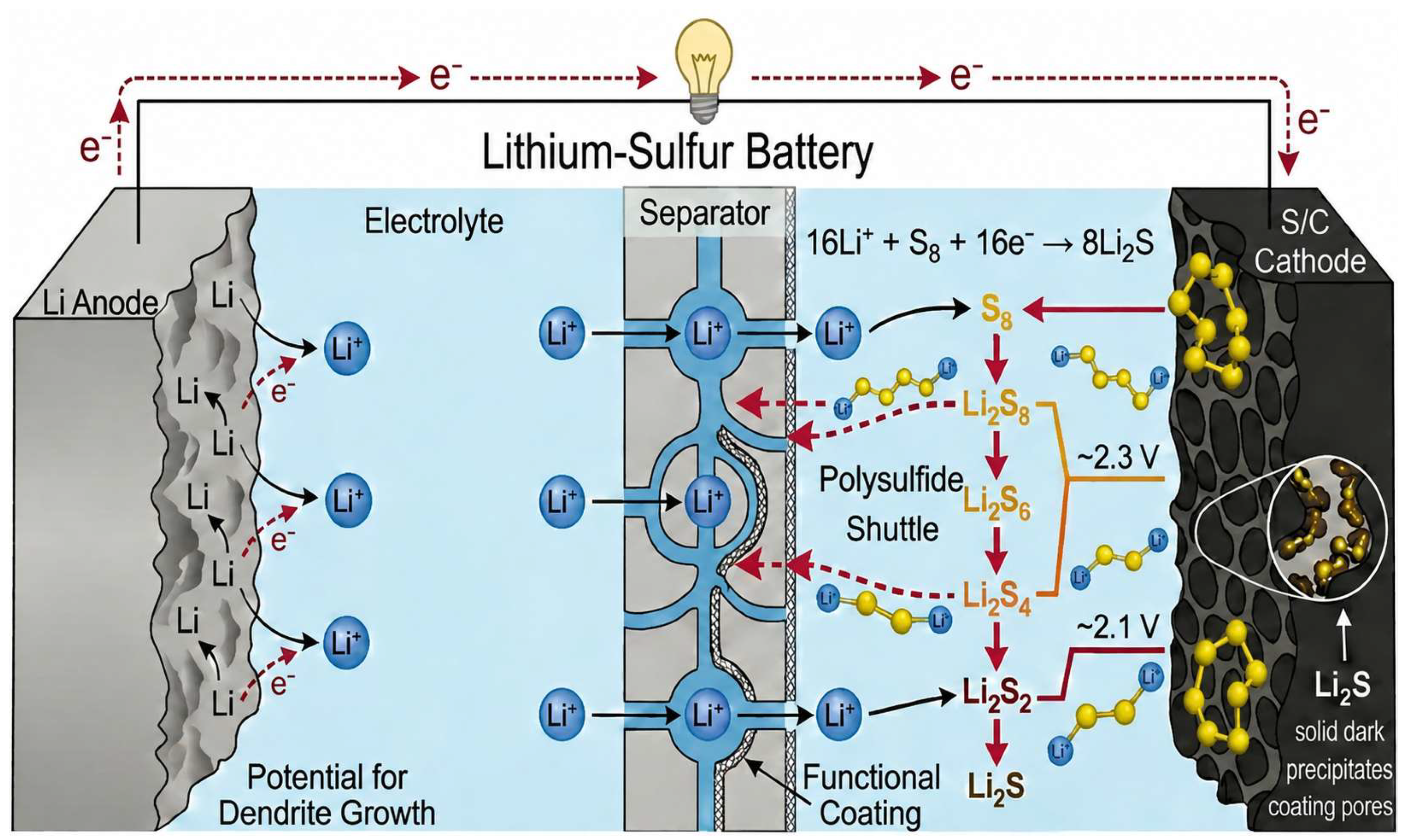
A schematic diagram of the working principle of lithium–sulfur batteries is shown in
Figure 1. Since the initial dissolution of Li
2S
n occurs at the cathode, the shuttle effect can be suppressed at multiple pathway nodes. For instance, cathode design strategies such as confining S
8 within specific cathode cavities or constructing metal–sulfur bonds can prevent Li
2S
n dissolution. Although these straightforward approaches can alleviate the polysulfide shuttle effect to some extent, they cannot completely suppress polysulfide shuttling, especially under high-sulfur-loading conditions.
To address this challenge, Su and Manthiram [
7] proposed a cathode-side configuration incorporating a microporous carbon paper interlayer. This interlayer provides both electronic and polysulfide-regulation functions. It can partially compensate for the intrinsically low electronic conductivity of sulfur cathodes, reduce charge-transfer resistance, and improve sulfur utilization. At the same time, its microporous structure can physically intercept and adsorb soluble polysulfides, thereby reducing active-material loss and facilitating their reutilization during subsequent cycles. This cathode-side configuration provided an important basis for subsequent developments in separator and interlayer modification.
Physical or chemical modification of separators to introduce multiple functions, including polysulfide confinement, adsorption, catalytic conversion, and ion-transport regulation, has become an important strategy for improving the performance of lithium–sulfur batteries [
8]. The porous separator positioned between the electrodes regulates the transport of lithium ions and soluble sulfur species. In addition to electrically insulating the electrodes, it plays an important role in mitigating polysulfide shuttling. Separator-modification strategies based on size exclusion, electrostatic repulsion, adsorption, and catalytic conversion have therefore been widely investigated to regulate the migration and redox conversion of Li
2S
n species.
This review aims to systematically summarize the recent advances in separator modification for lithium–sulfur batteries and to provide perspectives on the mechanisms, performance, and practical applicability of different modification strategies. Particular attention is given to the relationship between separator structure and function, the effects of coating and fabrication methods, and the influence of practical parameters such as coating thickness, areal loading, binder content, ionic resistance, and mechanical adhesion.
2. Design of Lithium–Sulfur Battery Separators
To mitigate polysulfide shuttling in lithium–sulfur batteries, separators can be modified to regulate the dissolution, migration, adsorption, and redox conversion of soluble lithium polysulfides. Based on their dominant functions, separator-modification strategies are generally classified into physical confinement, chemical adsorption, electrostatic regulation, and electrocatalytic conversion [
9,
10]. These mechanisms are not mutually exclusive and may operate synergistically within multifunctional separators. The representative materials, dominant functions, advantages, and limitations of these strategies are summarized in
Table 1.
Physical confinement employs a barrier layer to restrict polysulfide transport through steric hindrance, pore sieving, and physical adsorption. Porous carbon materials, such as graphene, carbon nanotubes, and porous carbon, are frequently used because of their high electrical conductivity, tunable pore structures, and good chemical stability. However, their weak affinity toward polar lithium polysulfides limits the effectiveness of physical confinement alone, particularly under high sulfur loading, lean-electrolyte conditions, or prolonged cycling.
Chemical adsorption immobilizes soluble lithium polysulfides through specific interactions between LiPSs and active sites on the separator modifier. Polar inorganic compounds, heteroatom-doped carbon materials, and functional polymers are commonly employed to introduce chemically active sites into separator coatings [
11]. Nevertheless, the adsorption strength must be balanced with polysulfide conversion kinetics, as excessively strong binding may hinder the subsequent redox conversion and reutilization of sulfur species.
Electrocatalytic conversion focuses on accelerating polysulfide redox reactions rather than merely immobilizing polysulfides. Catalytically active sites can reduce the activation energy and electrochemical polarization associated with liquid–liquid and liquid–solid conversion processes, particularly the transformation of long-chain polysulfides and the nucleation and decomposition of insulating Li
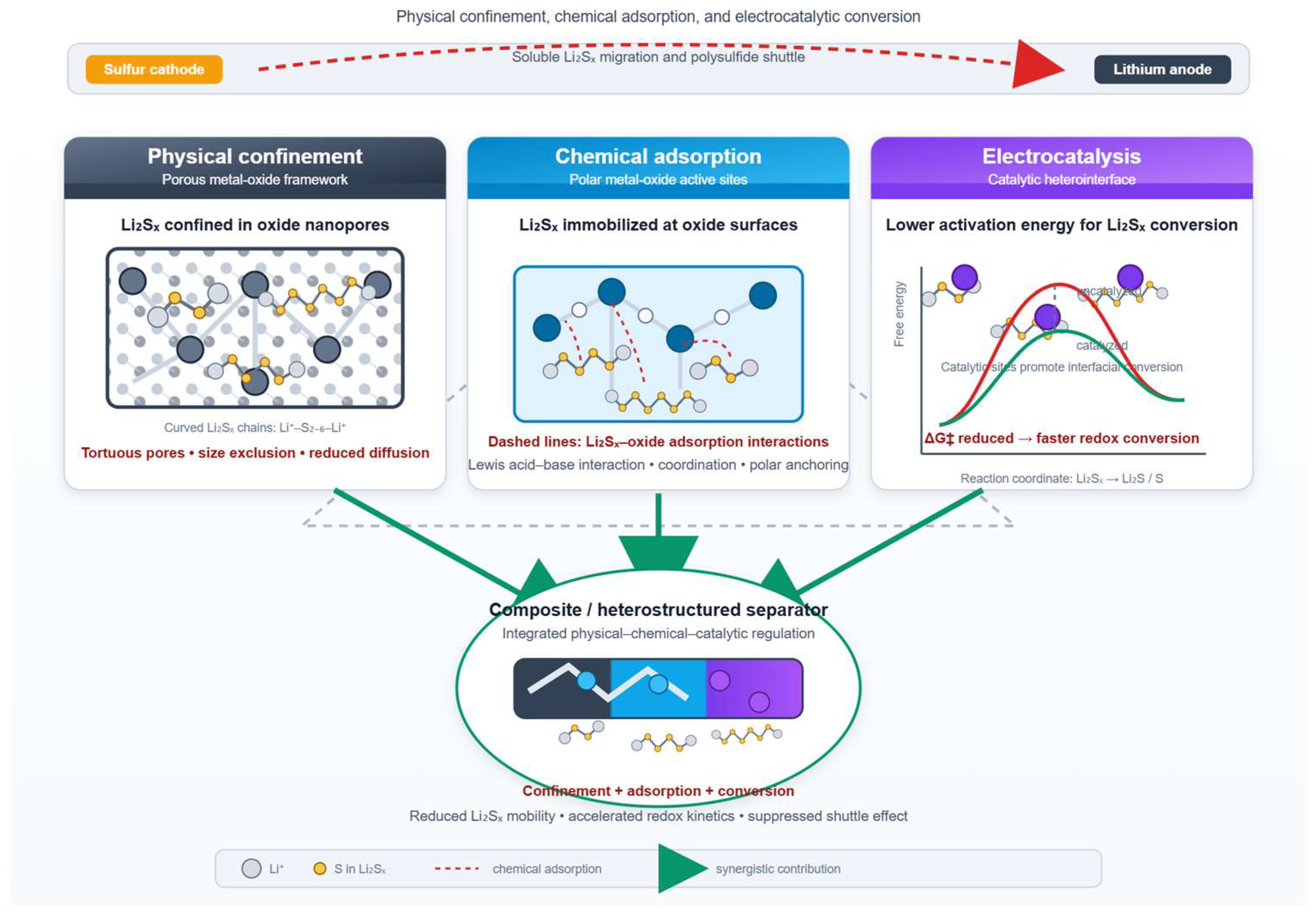
2S. Accordingly, transition-metal compounds, heterostructures, and heteroatom-doped carbon materials have been widely investigated as electrocatalytic separator modifiers. The synergistic regulation of polysulfide behavior through physical confinement, chemical adsorption, electrostatic regulation, and electrocatalytic conversion is schematically illustrated in
Figure 2.
To further clarify the differences and synergistic relationships among physical confinement, chemical adsorption, and electrocatalytic conversion,
Table 1 summarizes the representative materials, dominant functions, key advantages, inherent limitations, and practical considerations associated with each separator-modification strategy.
Given the limitations of relying solely on physical confinement, chemical adsorption, or conventional catalytic conversion, adsorption–catalysis coupling has emerged as an effective strategy for regulating polysulfide behavior. This strategy involves the sequential anchoring and conversion of polysulfides. Polar materials, such as heteroatom-doped carbons and metal oxides, can immobilize LiPSs through strong chemical interactions, while catalytic sites derived from single-atom catalysts, transition-metal phosphides, or nitrides accelerate their conversion into solid sulfur species and Li
2S [
12]. By coupling polysulfide retention with accelerated redox kinetics, this approach can reduce polysulfide diffusion, mitigate the shuttle effect, and improve sulfur utilization. Nevertheless, excessively strong adsorption may hinder subsequent polysulfide conversion and reutilization. Therefore, adsorption strength and catalytic activity should be carefully balanced.
The catalytic function of a separator should be considered in the context of its primary membrane functions. In addition to regulating polysulfide transport, a separator must maintain rapid lithium-ion conduction between the cathode and anode. An effective separator should therefore combine low polysulfide permeability with high lithium-ion conductivity while also promoting a relatively homogeneous Li
+ flux and, where possible, uniform lithium deposition on the anode [
9,
13]. These requirements highlight the importance of a porous and mechanically stable architecture that can retain soluble polysulfides without excessively blocking ion transport. Electronic conductivity may also be beneficial, particularly when the modified layer participates in polysulfide conversion; however, it should not be achieved at the expense of excessive coating mass or ionic resistance.
Vacuum filtration, blade coating, and in situ growth are the most widely used approaches for fabricating functionalized separators [
9]. Vacuum filtration enables precise control of coating loading and can produce binder-free functional layers, thereby minimizing additional mass and interfacial resistance [
14]. However, the process is less compatible with large-area continuous manufacturing. Blade coating is more readily scalable because functional materials can be deposited from a slurry, although binders and solvents may increase the inactive fraction of the coating and impede ion transport. Optimization of slurry rheology, solid content, and binder concentration is therefore essential for producing uniform coatings with reduced mass and acceptable adhesion [
15]. In situ growth can provide intimate contact between the functional layer and the separator substrate, thereby improving interfacial stability and reducing the risk of delamination. By controlling the reaction time, temperature, and precursor concentration, ultrathin and homogeneous layers can be obtained [
16]. However, the scalability, processing cost, and compatibility of in situ growth with large-area production require further consideration.
From the perspective of practical cell design, separator modification should be evaluated under conditions that reflect the requirements of high-energy-density Li–S batteries. High sulfur areal loading is essential for achieving high areal capacity, but it also increases the demand for efficient polysulfide regulation and ion transport. Under such conditions, a thick or heavily loaded coating may increase the inactive mass, reduce separator porosity, increase Li+ transport tortuosity, and occupy additional cell volume. These effects can offset the electrochemical benefits of improved polysulfide adsorption or catalytic conversion. In particular, high-density inorganic materials and coatings containing substantial amounts of binder may impose considerable penalties on both gravimetric and volumetric energy density.
The coating mass and volume can be approximately expressed as:
where
is the coating areal loading,
is the coating thickness, and
is the coated area. Accordingly, the practical value of a modified separator depends not only on its ability to suppress polysulfide shuttling, but also on its mass-to-function ratio, thickness, adhesion, porosity, and manufacturing compatibility. For a complete cell, gravimetric and volumetric energy densities should be calculated using the total cell mass and volume, respectively, including the cathode, anode, separator and functional coating, electrolyte, current collectors, and packaging:
Therefore, electrochemical evaluation based solely on sulfur-normalized capacity or cycling stability is insufficient. Separator-modification strategies should also be assessed under high sulfur loading, lean-electrolyte conditions, and realistic cell configurations, with coating thickness, areal loading, binder content, ionic resistance, adhesion, and full-cell energy density reported where possible. From an engineering perspective, coating thicknesses below approximately 2 μm and areal loadings below approximately 0.5 mg cm−2 could serve as useful target ranges for minimizing the mass and volume penalties of functionalized separators. These values should be regarded as practical design guidelines rather than universal limits because the appropriate values depend on coating density, porosity, functional efficiency, sulfur loading, electrolyte-to-sulfur ratio, and cell architecture.
3. Carbon-Modified Separators
Carbon-based materials, owing to their unique physicochemical properties, are widely regarded as ideal coating materials for modifying separators in lithium–sulfur batteries. Their primary advantage lies in their exceptional electrical conductivity, which provides efficient electron transport pathways for the sulfur cathode, thereby enhancing active material utilization and rate performance. In addition, their abundant porous structures can effectively block the migration of polysulfides through physical confinement, suppressing the shuttle effect [
17,
18]. More importantly, heteroatom doping (e.g., with nitrogen, sulfur, and boron) can introduce highly polar sites that enable the chemical adsorption of polysulfides, thereby transforming a simple physical barrier into a synergistic physicochemical confinement layer [
19,
20].
3.1. Graphene-Modified Separators
Graphene, as a two-dimensional material [
21,
22], offers a high specific surface area and high electrical conductivity, enabling effective polysulfide adsorption and efficient electron transport, thereby leading to higher capacities and improved rate performance. Moreover, the flexibility and mechanical strength of conjugated graphene sheets exhibit excellent compatibility with polypropylene (PP) separators. The research group led by Arumugam Manthiram first proposed and demonstrated the use of free-standing, polymer-free porous graphene films as “dual-functional” separators [
23]. By leveraging the physical confinement of nanochannels and reutilizing their excellent conductivity, the shuttle effect is effectively mitigated, laying the foundation for functionalized separators. Zhou et al. [
24] designed a sulfur-containing sandwich structure between two graphene membranes. One graphene membrane serves as the current collector (GCC), with sulfur coated on it as the active material, while the other graphene membrane is coated onto a commercial polymer separator. The flexibility of graphene provides buffering space for the substantial volume expansion of sulfur during reactions, ensuring the integrity of the electrode structure. Moreover, the graphene layers on both sides form an efficient three-dimensional conductive network, significantly reducing the internal resistance of the battery and promoting rapid transport of electrons and lithium ions. Under high current densities, the system exhibits excellent fast charge/discharge capabilities, retains high capacity after 100 cycles, and maintains a stable Coulombic efficiency above 97%, demonstrating its outstanding cycling stability. Zhai et al. [
25] proposed a simple, scalable, and green method to fabricate Janus-type porous-graphene (PG)-modified polypropylene (PP) separators for lithium–sulfur batteries. Large quantities of PG were obtained at low cost and high efficiency via fluidized-bed chemical vapor deposition (CVD). Meanwhile, an industry-compatible blade-coating process was employed to deposit the PG layer onto the PP membrane, replacing the conventional vacuum-filtration process. The resulting PG functional layer was approximately 10 μm thick, with an areal mass of 0.54 mg cm
−2. Compared with Li–S batteries using pristine PP separators, those employing PG-modified separators exhibited higher sulfur utilization, improved cycling stability, and superior rate performance. In coin-cell tests, the sulfur loading was 1.8–2.0 mg cm
−2, and the PG-modified separator enabled a sulfur utilization of 86.5% at 0.05 C. To demonstrate scalability at the pouch-cell level, Li–S pouch cells with a total sulfur loading of 7.8 mg cm
−2 across both sides of the cathode were assembled through separator engineering, delivering an initial discharge capacity of 1135 mA h g
−1 at 0.1 C and an overall capacity of 0.5 Ah. In another notable study, Ma et al. [
26] successfully synthesized sulfur-doped mesoporous graphene (SMG) via an innovative fluidized-bed chemical vapor deposition (CVD) approach using a MgSO
4@MgO composite as both the template and sulfur source, and employed it as a functional coating on commercial polypropylene separators. The areal mass loading of the SMG modifier on the PP separator was 0.154 mg cm
−2. This method enabled in situ, uniform doping of S atoms, allowing the resulting SMG to perfectly replicate the hexagonal morphology of the template while exhibiting a high specific surface area (1632 m
2 g
−1), abundant mesoporosity, and a moderate sulfur content. These structural features allow SMG to act as a physical barrier suppressing polysulfide migration, while the C–S–C and C=S bonds on its surface provide strong chemical adsorption sites.
For the standard coin-cell configuration with a sulfur areal loading of 1.5 mg cm−2, the total liquid electrolyte volume was fixed at 50 μL, yielding an electrolyte-to-sulfur (E/S) ratio of approximately 26.7 μL mg−1. Under such conditions, the lithium–sulfur batteries employing SMG-modified separators delivered a high average specific discharge capacity of 955.64 mA h g−1 at 1 C and maintained excellent stability over 300 cycles, with a low capacity decay rate of only 0.109% per cycle, outperforming both unmodified separators and those modified with undoped mesoporous graphene. Even at substantially higher sulfur loadings of 4.6 and 5.3 mg cm−2, the SMG/PP cells still exhibited very low cycle-averaged capacity decay rates of 0.13% and 0.14%, respectively.
Its excellent rate performance (744.67 mA h g−1 at 4 C) and reduced polarization voltage demonstrated that the SMG layer not only strongly anchors polysulfides through both physical confinement and strong polar chemical interaction, but also functions as a top current collector to lower interfacial charge-transfer resistance and enhance reaction kinetics. This work provides a simplified template-directed strategy for the scalable fabrication of S-doped carbon materials. Furthermore, through systematic DFT theoretical calculations, it elucidates, at the atomic level, the mechanism through which different sulfur bonding configurations (particularly C=S bonds) exhibit higher binding energies toward polysulfides, offering direct theoretical evidence for a synergistic “adsorption–catalysis” mechanism. Overall, this study proves that simple sulfur doping can significantly improve the confinement capability of carbon materials toward polysulfides, presenting new design concepts and robust experimental support for developing efficient, multifunctional carbon-based separator modifiers.
3.2. Carbon Nanotube-Modified Separators
Carbon nanotubes (CNTs), with their unique one-dimensional hollow structure, excellent electrical conductivity, and good mechanical flexibility, are an ideal modification material for enhancing the reaction kinetics of lithium–sulfur batteries, physically confining polysulfides and enabling catalytic activity. The Manthiram group [
27] first employed multi-walled carbon nanotubes (MWCNTs) as a flexible and mechanically robust scaffold for cathode-side separator modification. The resulting conductive MWCNT framework effectively suppressed polysulfide diffusion while promoting the reutilization of trapped sulfur species through its interconnected conductive network. Building on this concept, the group subsequently developed a novel “self-assembled” MWCNT interlayer strategy. Its key advantage lies in the simple and practical fabrication process: unlike conventional CNT-modified separators or interlayers that require separate preparation and transfer, MWCNT powder was directly dispersed in the electrolyte to form a slurry and then coated onto the sulfur cathode. During cell assembly, a dense functional MWCNT layer formed spontaneously in situ. This self-assembled layer established intimate, continuous contact with the sulfur cathode, thereby reducing interfacial resistance. Its dense structure also physically restricted polysulfide migration, while the highly conductive network functioned as a “top current collector” to reactivate trapped sulfur species and improve sulfur utilization. Batteries employing this self-assembled interlayer delivered an initial specific discharge capacity of 1112 mA h g
−1 at 0.1 C. At a relatively high sulfur loading of 3 mg cm
−2, the cells retained 95.8% of their capacity after 100 cycles at 0.5 C, with a rate performance substantially superior to that of conventional freestanding MWCNT interlayers. It should be noted that the electrolyte volume for this self-assembled configuration was not explicitly reported in the available experimental information. Accordingly, the electrolyte-to-sulfur ratio (E/S) should be listed as “not reported” and should not be calculated without additional data. This work introduces a low-cost, one-step MWCNT “self-assembly” strategy that optimizes the cathode–interlayer interface and provides a feasible route toward high-performance, practical lithium–sulfur batteries with simplified processing.
However, the surface of such pure carbon materials is nonpolar, resulting in insufficient chemical confinement of polar polysulfides. To address this, compositing heteroatom-doped carbon with highly conductive CNTs to achieve synergistic “adsorption–catalysis–conduction” has become a promising direction for further optimization. Zhu et al. [
28] synthesized a composite of melamine-derived nitrogen-doped carbon (NC) and carbon nanotubes (CNTs) via a one-step high-temperature calcination method. The porous structure and abundant nitrogen active sites of NC provide strong adsorption and catalytic functionality, while the CNTs construct a continuous conductive network, synergistically accelerating the conversion kinetics of polysulfides. This composite interlayer exhibits exceptional electrochemical performance. Batteries assembled with the NC/CNT interlayer retain a reversible capacity of 611.5 mAh g
−1 after 400 cycles at a high rate of 2 C, with a capacity decay rate as low as 0.07% per cycle. Rate capability tests demonstrate that across current densities ranging from 0.1 C to 2 C, the discharge capacities are significantly higher than those of the pure CNT control group, reflecting superior reaction kinetics and structural stability. According to the reported experimental details, the sulfur cathode was prepared using a CNT/S:Super P:PVDF mass ratio of 7:2:1. The electrolyte consisted of 1 mol L
−1 LiTFSI in DOL:DME (1:1 by volume), with 1 wt% LiNO
3. However, the paper did not explicitly report the actual electrolyte volume, the sulfur areal loading (mg cm
−2), or the corresponding electrolyte-to-sulfur ratio (E/S, μL mg
−1).
3.3. Heteroatom-Doped Carbon-Modified Separators
Although carbon materials such as graphene and carbon nanotubes exhibit tremendous potential as separator modifiers for lithium–sulfur batteries by constructing conductive networks and physically blocking polysulfide diffusion, their practical application still faces significant challenges. The core issue lies in the weak chemical affinity between nonpolar carbon surfaces and polar polysulfide intermediates, which hinders effective anchoring of these soluble species, leading to a pronounced “shuttle effect” during long-term cycling. Moreover, mere physical blocking offers limited catalytic activity for polysulfide conversion and fails to address sluggish reaction kinetics, making it difficult to simultaneously achieve high-rate performance and long-cycle stability. To address this problem, heteroatom doping (e.g., with nitrogen, sulfur, boron, or phosphorus) has been demonstrated to be an effective functionalization strategy [
29,
30]. The introduction of certain heteroatoms (such as N and S) can provide catalytically active sites, lowering the energy barriers for polysulfide-conversion reactions and thereby enhancing the kinetics of the “solid–liquid–solid” reactions, enabling a transition from passive interception to active catalytic conversion [
31].
Sun et al. [
32] employed an MOF self-sacrificing template strategy to construct a carbon-modified layer with gradient N,P co-doping (MC@CN@CNP). The electron cloud density differences induced by heteroatom doping establish a microscopic built-in electric field within the material, which effectively leverages electrostatic repulsion to suppress the diffusion of polysulfide anions toward the anode. Consequently, an ultralow capacity decay of only 0.034% per cycle was achieved over 500 cycles at a rate of 1 C. Li et al. [
33] prepared a meso-macroporous nitrogen-doped carbon material with a high specific surface area (999.37 m
2 g
−1) via a simple resin pyrolysis method and employed it to modify the separator in lithium–sulfur batteries, effectively suppressing the polysulfide shuttle effect. The material possessed a three-dimensional interconnected hierarchical porous architecture in which mesopores provided abundant physical adsorption sites for suppressing polysulfide diffusion, while macropores accommodated sulfur volume expansion during cycling and facilitated the deposition of discharge products. Furthermore, pyridinic and pyrrolic nitrogen species within the material enhance polysulfide conversion kinetics through chemical adsorption and catalytic effects. Cells employing this NC-modified separator exhibit outstanding electrochemical performance, delivering an initial discharge capacity of 839.2 mAh g
−1 at 0.5 C and retaining a discharge capacity of 643.5 mAh g
−1 after 200 cycles, corresponding to a capacity decay rate of only 0.11% per cycle. Even under low-temperature conditions (−10 °C) or with high sulfur loadings (5.6 mg cm
−2), the cells maintain excellent cycling stability and rate capability. However, although the paper reported the sulfur-loading range, it did not explicitly provide the electrolyte volume or the electrolyte-to-sulfur ratio (E/S).
Overall, heteroatom-doped carbon materials ingeniously integrate the high electrical conductivity and structural stability of carbon-based materials with the strong adsorption capability and high catalytic activity of doping sites, offering an effective solution to the intrinsic limitations of carbon materials in lithium–sulfur batteries. In the future, precise engineering of the types, configurations, and spatial distributions of dopant elements, along with the development of synergistic systems featuring multi-element co-doping or hybridization with metal compounds, will further advance high-performance lithium–sulfur battery separators toward practical application.
From a practical manufacturing perspective, carbon-based coatings are among the most readily scalable separator-modification strategies because carbon black, graphene, carbon nanotubes, and porous carbon can be processed using conventional slurry coating or spray-coating methods. However, high carbon loading may introduce considerable inactive mass and increase the tortuosity of Li+ transport pathways. In addition, purely nonpolar carbon layers mainly rely on physical confinement and may require thicker or denser coatings to effectively suppress polysulfide migration. Therefore, the practical design of carbon-modified separators should prioritize ultrathin conductive networks, a low binder content, and the introduction of heteroatoms or polar secondary phases to improve chemical polysulfide anchoring without substantially increasing areal loading. The use of aqueous dispersions and water-processable binders would further improve the environmental and economic feasibility of large-scale coating.
4. Polymer-Modified Separators
By constructing polymer functional coatings on conventional separator surfaces, multiple synergistic enhancements can be achieved. On the one hand, polymer coatings form a dense physical barrier that reduces the effective pore size and restricts polysulfide migration. On the other hand, polymers containing polar functional groups, such as carbonyl, amino, and ether groups, can interact strongly with polysulfides through polar interactions or Lewis acid–base interactions, thereby enabling their efficient chemical adsorption and anchoring. Representative examples include poly(vinylidene fluoride) (PVDF), polypyrrole (PPy), and polydopamine (PDA). Furthermore, certain functional polymers exhibit good electrolyte affinity, improved interfacial ion transport, or intrinsic conductivity (as in conductive polymers), allowing them to serve as secondary current collectors to enhance active material utilization. In recent research, polymers commonly employed for separator modification in lithium–sulfur batteries are primarily categorized into two types based on their origin: synthetic polymers and natural polymers.
In lithium–sulfur batteries, conductive polymers employed as separator modifiers or functional interlayers can effectively suppress the polysulfide shuttle effect and enhance cycling stability. Synthetic polymers such as polyaniline (PANI), polypyrrole (PPy), and polythiophene (PTh), along with their derivatives, exhibit considerable potential in this field because of their favorable electrical conductivity and chemical adsorption capabilities [
34]. Chang et al. [
35] coated a commercial polypropylene separator with a composite of PANI nanofibers and multi-walled carbon nanotubes, which markedly improved electronic conductivity and inhibited polysulfide migration, enabling the battery to retain a reversible capacity of 709 mAh g
−1 after 100 cycles at 0.2 C. Ma et al. [
36] utilized a PPy nanotube film as an interlayer in conjunction with a Ketjen Black/S cathode, achieving a retained capacity of 712 mAh g
−1 after 300 cycles at 0.5 C, demonstrating excellent cycling stability. Ma et al. [
37] constructed a PPy functional interlayer on the surface of a CMK-8/S cathode via in situ polymerization, retaining discharge capacities of 703 and 533 mAh g
−1 after 300 cycles at 1 C and 2 C, respectively. PANI-, PPy-, and PTh-based materials, when used as separator modifiers or interlayers, not only enhance electrode conductivity but also synergistically suppress polysulfide shuttling through combined physical blocking and chemical adsorption, thereby significantly improving the electrochemical performance of lithium–sulfur batteries.
Meanwhile, natural biopolymers, with their environmentally benign attributes and intrinsic polar adsorption sites, offer a new pathway for developing green lithium–sulfur batteries. Such materials are typically rich in hydroxyl or amino groups, enabling strong hydrogen bonding or chemical interactions with polysulfides. Chen et al. [
38] ingeniously constructed a Janus protein-based nanofabric layer using gelatin. This heterogeneous structure consists of gelatin-coated conductive nanofibers, which serve as an interception layer, and a pure gelatin nanofabric, which acts as an ion-regulation layer. It not only achieves efficient polysulfide capture through strong interactions between protein molecular chains and polysulfides, but also effectively balances ion flux owing to gelatin’s inherently excellent wettability and its exceptionally high lithium-ion transference number (0.73). It should be noted that the paper did not explicitly report the sulfur areal loading (mg cm
−2) or the electrolyte volume used in the Li–S cells. Consequently, while mitigating the shuttle effect, it significantly suppresses lithium dendrite growth on the anode side, enabling symmetric cells to maintain stability over an ultralong cycling duration of 1000 h. Extending this concept of using polar biopolymers to regulate polysulfide transport, Xie et al. [
39] developed a carrageenan–acetylene black (CG–AB) composite coating on a polypropylene separator through a simple slurry-coating process. Carrageenan, which contains abundant hydroxyl and ether groups, interacts strongly with soluble lithium polysulfides, whereas the acetylene black network improves electronic transport across the separator. The optimized 10% CG–AB/PP separator had a coating thickness of approximately 20 μm and an areal coating loading of 0.75 mg cm
−2. The CG component suppressed polysulfide permeation, while the conductive AB framework enhanced sulfur utilization and accelerated cathode redox kinetics. The resulting cell delivered a reversible capacity of 1258 mA h g
−1 at 0.2 C and retained a capacity of 733 mA h g
−1 at 6 C. It also exhibited a low capacity-decay rate of only 0.042% per cycle at 2 C. Even at a high sulfur loading of 3.2 mg cm
−2, the cell maintained a reversible capacity of approximately 805 mA h g
−1. The cathode contained 70 wt% sulfur, 20 wt% Super P, and 10 wt% PVDF. However, the actual electrolyte volume was not explicitly reported; therefore, the electrolyte-to-sulfur ratio (E/S, μL mg
−1) was not reported and cannot be reliably calculated. These results demonstrate that combining natural polymers with conductive carbon additives can provide environmentally compatible polysulfide adsorption, improved electron transport, and enhanced sulfur utilization. Compared with the structurally sophisticated Janus gelatin layer, the CG–AB separator relies on a simpler and potentially more scalable coating process, although its ability to regulate lithium-ion flux and stabilize the lithium-metal anode requires further investigation.
Polymer-based separator coatings offer several practical advantages, including low density, good flexibility, strong interfacial adhesion, and compatibility with solution processing. Natural polymers such as cellulose, gelatin, and lignin-derived materials are particularly attractive for aqueous coating and low-cost manufacturing [
40]. Nevertheless, an overly dense polymer layer may reduce separator porosity and increase Li
+ transport resistance, whereas excessive swelling in the electrolyte can compromise dimensional stability. Conductive polymers may also require oxidative polymerization, specialized monomers, or additional conductive additives, which can increase process complexity and cost. Accordingly, polymer-modified separators should be designed as thin porous networks rather than continuous dense films, with the polymer fraction and coating loading optimized to maintain electrolyte wettability, mechanical integrity, and acceptable ionic resistance.
5. Inorganic Material-Modified Separators
In the field of separator modification for lithium–sulfur batteries, beyond the aforementioned carbon-based materials and polymer coatings, inorganic materials, owing to their unique physicochemical properties, also demonstrate considerable application potential, offering another effective pathway to suppress the polysulfide shuttle effect. Compared with organic materials, inorganic materials generally exhibit higher thermal stability and mechanical strength, thereby effectively enhancing battery safety. More importantly, many inorganic materials possess an abundance of highly polar surface sites (such as unsaturated metal sites and oxygen vacancies), which can form strong Lewis acid–base interactions or chemical bonds with polysulfides, thereby enabling highly efficient chemisorption that is superior to mere physical blocking. Furthermore, certain inorganic materials display excellent catalytic activity toward polysulfide conversion, significantly accelerating reaction kinetics and effectively mitigating the shuttle effect.
Currently, inorganic materials used for separator modification can be broadly classified into the following categories.
5.1. Metal Oxides
In the field of separator modification for lithium–sulfur (Li–S) batteries, metal oxides such as titanium dioxide (TiO
2), manganese dioxide (MnO
2) [
41], aluminum oxide (Al
2O
3), and cerium dioxide (CeO
2) leverage their abundant polar surface sites, such as unsaturated metal sites and oxygen vacancies, to achieve efficient chemical adsorption of lithium polysulfides (LiPSs), thereby effectively suppressing polysulfide migration [
42]. Liu et al. [
43] reported that the polar surfaces of metal oxides such as TiO
2 and MnO
2 can effectively adsorb LiPSs. Moreover, the combination of a moderate binding energy and a low Li
+ diffusion barrier facilitates the migration of LiPSs to the conductive substrate, where they can participate in subsequent reactions. Yang et al. [
42] systematically investigated rutile-phase MO
2 compounds (M = Ti, Sn, and Ru) using first-principles calculations. They found that although SnO
2 and RuO
2 exhibit the strongest adsorption affinity, they readily induce the decomposition of LiPSs, whereas TiO
2 combines strong chemical anchoring with an ultralow Li
+ diffusion barrier of 0.33 eV. Based on these findings, they proposed a synergistic “adsorption–diffusion” criterion for screening polar host materials, requiring binding energies in the range of 3–5 eV and diffusion barriers below 0.4 eV. This criterion underscores the importance of balancing robust anchoring with efficient mass transport, providing quantitative, atomistic guidance for the rational design of polar materials for separator modification. The ion diffusion barriers and lithium/polysulfide binding energies of common metal oxides are shown in
Table 2.
To mitigate the shuttle effect of LiPSs, researchers have developed composite modified layers based on the synergy between single-metal oxides and carbon materials. For instance, Xiao et al. [
50] constructed a graphene/TiO
2 film as a selective interlayer on the cathode surface, effectively suppressing LiPS diffusion. Chen et al. [
51] coated the separator with a TiO
2 nanotube/carbon nanotube (CNT) composite, which anchored LiPSs through dual physical–chemical adsorption and accelerated electron transport via the CNT network. Tian et al. [
52] fabricated an ultralight MnO
2 functional coating on both sides of a polypropylene (PP) separator through a simple in situ chemical-oxidation process. The MnO
2 coating had an exceptionally low areal loading of only 0.007 mg cm
−2. The polar MnO
2 layer chemically adsorbed polysulfides to suppress the shuttle effect, while its improved electrolyte wettability promoted uniform Li
+ flux and inhibited lithium-dendrite growth. The Li–S cells employed a pure-sulfur cathode with a sulfur loading of 2.5 mg cm
−2 and an electrolyte dosage of 15 μL mg
−1 based on the cathode mass, corresponding to an electrolyte-to-sulfur ratio (E/S) of 15 μL mg
−1. With the modified separator, the cell retained a discharge capacity of 665 mA h g
−1 after 1000 cycles at 1 C, corresponding to an extremely low capacity-decay rate of only 0.028% per cycle. This bifunctional MnO
2 separator combines polysulfide confinement with lithium-anode stabilization while imposing a minimal mass penalty, thereby benefiting the energy density of Li–S batteries.
Compared with single-metal oxides, multi-metal oxides, by introducing multiple metal sites and tunable oxygen vacancies, offer stronger chemical affinity and enhanced electrocatalytic activity. For example, Cheng et al. [
53] integrated a three-dimensionally ordered FeVO
4 bimetallic oxide with CNTs for separator modification, achieving efficient LiPS conversion under harsh conditions such as lean-electrolyte and high-sulfur-loading (6.1 mg cm
−2) conditions; the assembled pouch cells delivered an energy density of 341 Wh kg
−1. Liu et al. [
54] prepared a flower-like high-entropy oxide (HEO-BiSbWVMoO) electrocatalyst featuring a crystalline–amorphous heterophase structure. Benefiting from high-density grain boundaries and strong d–p orbital coupling, the catalyst greatly enhanced lithium-polysulfide (LiPS) adsorption and catalytic conversion, thereby suppressing the polysulfide shuttle effect. Li–S cells equipped with the HEO-BiSbWVMoO-modified separator retained a discharge capacity of 504.0 mA h g
−1 after 1000 cycles at 1 C, corresponding to a low capacity-decay rate of only 0.053% per cycle. Under more practically relevant conditions, the cell operated with a high sulfur loading of 4.9 mg cm
−2 and a low electrolyte-to-sulfur ratio (E/S) of 8.2 μL mg
−1, delivering an areal capacity of 5.1 mA h cm
−2 and an initial discharge capacity of 1046.1 mA h g
−1 at 0.2 C. After 40 cycles, it still retained a discharge capacity of 853.6 mA h g
−1. These results demonstrate that the HEO-BiSbWVMoO-modified separator promotes LiPS conversion through the synergistic effects of abundant active sites and crystalline–amorphous interfaces while enabling stable operation under high sulfur loading and lean-electrolyte conditions.
Metal oxides are relatively attractive for scale-up because many of them are inexpensive, thermally stable, and compatible with conventional slurry processing. However, their high density and intrinsically low electronic conductivity require careful control of coating loading and thickness. An excessive oxide content may improve LiPS adsorption but simultaneously reduce the cell-level energy density and increase polarization. Therefore, nanoscale oxide coatings, oxide–carbon composites, and in situ-grown ultrathin oxide layers are more promising than thick oxide films for practical separator applications.
5.2. Metal Sulfides
Metal sulfides (e.g., MoS
2, CoS
2, and SnS
2) exhibit strong chemical adsorption toward lithium polysulfides (LiPSs) via Lewis acid–base interactions or S–S bond formation, owing to the homophilic affinity between their surface sulfur atoms and LiPSs [
55]. Moreover, many transition-metal sulfides possess excellent electrocatalytic activity, which significantly lowers reaction energy barriers and accelerates the redox kinetics of LiPSs [
56,
57,
58]. Incorporating metal sulfides for separator modification not only establishes a dual “physical interception–chemical adsorption” barrier, but also regulates the lithium-ion flux, thereby suppressing lithium-dendrite formation and enhancing battery cycle life.
In practical applications, researchers strive to overcome the intrinsic limitations of metal sulfides through structural and phase engineering. For instance, addressing the low conductivity of MoS
2, Ghazi et al. [
59] employed a lithium-ion intercalation method to fabricate highly ion-conductive MoS
2 nanosheets and construct efficient transport pathways, effectively mitigating the shuttle effect. To further increase the density of active sites, Manthiram et al. [
60] synthesized few-layer MoS
2 nanoparticles via a solvothermal method, featuring a mixed 1T/2H phase with superior conductivity and abundant edge defects, which exhibited remarkable synergistic anchoring effects under high sulfur loading.
Furthermore, constructing nanocomposite structures and heterogeneous interfaces can further enhance the combined polysulfide storage and catalytic-conversion capability. Zhu et al. [
56] utilized a CoS
2/CNT composite network to achieve a balance between the high electrical conductivity of the CNT network and the anchoring activity of CoS
2. Building on this concept, Jin et al. [
61] integrated a hollow architecture with a bimetallic sulfide/carbon composite to develop a MoS
2/Co
9S
8/C (HMCC)-coated separator. The outer MoS
2 layer provides abundant active sites and facilitates Li
+ transport, while the polar Co
9S
8 phase and the carbon matrix synergistically enhance polysulfide chemisorption, electronic conduction, and catalytic conversion. Meanwhile, the hollow structure serves as a “storage space” for polysulfides, enabling coordinated adsorption, storage, and catalytic transformation. Benefiting from this structure–composition synergy, the HMCC-based cell retained a capacity of 670.4 mAh g
−1 after 400 cycles at 0.5 C, highlighting the effectiveness of nanocomposite heterointerfaces in suppressing polysulfide shuttling and accelerating redox kinetics.
5.3. Metal Selenides
Compared to traditional metal oxides (which exhibit strong surface polarity but poor conductivity [
42]) and metal sulfides (which possess homophilic affinity and moderate electrical conductivity [
55]), metal selenides (such as CoSe
2, WSe
2, etc.) demonstrate uniquely superior high-rate kinetic advantages in the modification of lithium–sulfur battery separators. Due to the lower electronegativity of selenium (Se) relative to oxygen (O) and sulfur (S), metal–selenium bonds exhibit stronger covalent character, endowing metal selenides with exceptionally high intrinsic electronic conductivity and narrower bandgaps. This outstanding intrinsic conductivity, combined with their powerful polar chemisorption capability, enables them to not only effectively suppress the shuttle effect of lithium polysulfides (LiPSs), but to also serve as highly efficient electrocatalytic active sites. Consequently, they significantly reduce the activation energy barrier for the solid–liquid–solid conversion reactions of polysulfides, thereby fundamentally accelerating the bidirectional reaction kinetics at the sulfur electrode interface [
62]. (High-efficiency metal selenide can serve as an electrocatalyst in a separator for lithium–sulfur batteries).
In practical applications, Lu et al. [
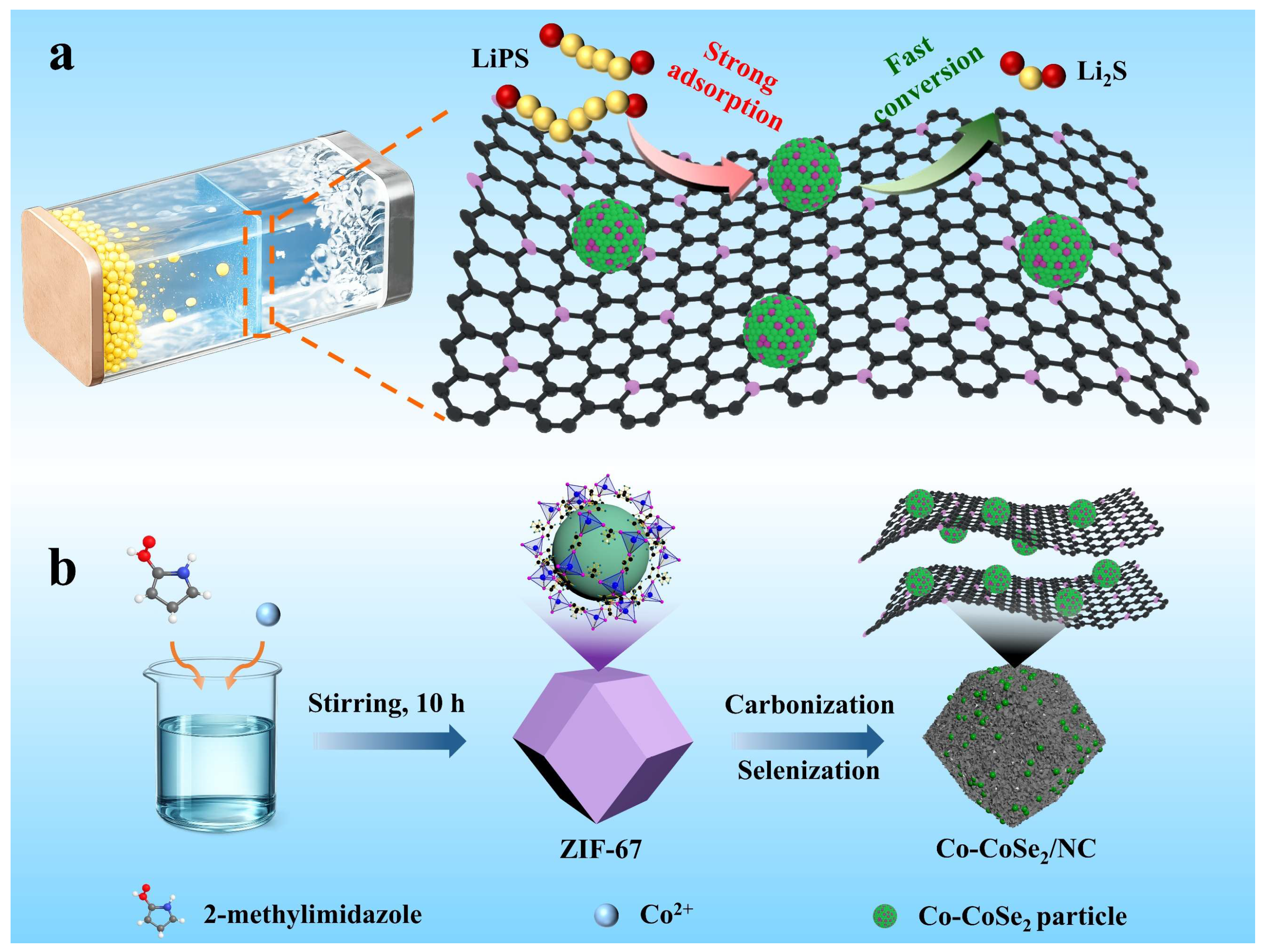
63] designed and fabricated a coherent cobalt–cobalt selenide heterostructure embedded within nitrogen-rich porous carbon (Co–CoSe
2/NC) as a composite-modified separator (as shown in
Figure 3). By constructing a tight heterointerface between the metallic conductive phase (Co) and the catalytically active semiconductor phase (CoSe
2), the electronegativity difference between the two phases induces local charge redistribution, thereby generating a strong built-in electric field at the nanoscale. This built-in electric field, acting synergistically with the nitrogen-rich carbon (NC) support, not only substantially enhances the adsorption and immobilization capability for LiPSs, but also provides rapid pathways for their catalytic capture and subsequent electrochemical conversion. Electrochemical tests revealed that lithium–sulfur batteries employing the Co–CoSe
2/NC-modified separator achieved an initial discharge capacity of 1159.3 mAh g
−1 at 0.5 C. Even after 500 cycles at a high current density of 2 C, the average capacity decay per cycle remained as low as 0.057%, demonstrating exceptional rate performance and ultra-long cycle life. Under the conventional test conditions, the sulfur loading was 1–1.2 mg cm
−2, and approximately 30 μL of electrolyte was added to each cell, corresponding to an E/S ratio of approximately 25–30 μL mg
−1. More importantly, under practically relevant lean-electrolyte conditions, the cell operated with a high sulfur loading of 3.6 mg cm
−2 and a low E/S ratio of 5.44 μL mg
−1, delivering an initial discharge capacity of 1081.6 mA h g
−1 at 0.2 C and retaining a capacity of 753.2 mA h g
−1 after 80 cycles, demonstrating good tolerance to high sulfur loading and a limited electrolyte content.
Based on this principle, Sun et al. [
64] combined ZnSe with N-doped carbon and reduced graphene oxide to construct a ZnSe/NC@rGO separator modifier. Polar ZnSe enhanced the chemical adsorption of LiPSs, while the N-doped carbon and rGO network provided continuous electron-transport pathways and improved active-site utilization, thereby promoting polysulfide confinement and interfacial redox kinetics. The corresponding cell employed a sulfur cathode with a sulfur loading of approximately 1.2 mg cm
−2 and 15 μL of electrolyte, corresponding to an E/S ratio of 10.7 μL mg
−1. It retained a capacity of 1057 mA h g
−1 after 100 cycles at 0.2 C and delivered 685 mA h g
−1 at 3 C. In a high-loading test, the sulfur loading was increased to 4.3 mg cm
−2, and the cell maintained an areal capacity of 2.69 mA h cm
−2 after 200 cycles at 0.5 C; however, the E/S ratio under this condition was not explicitly reported. Wang et al. [
65] subsequently extended the heterostructure strategy by constructing a Ni–CoSe
2/NC heterojunction coated with nitrogen-doped carbon. The interfacial interaction and charge redistribution between metallic Ni and CoSe
2 increased the polarity of the composite, thereby promoting LiPS adsorption and bidirectional polysulfide conversion. Its porous structure further improved electrolyte wetting and Li+ transport. Li–S cells employing the Ni–CoSe
2/NC-modified separator were tested with a sulfur loading of 2.4 mg cm
−2, delivering discharge capacities of 930.3, 725.3, 507.7, 365.8, and 242.8 mA h g
−1 at 0.2, 0.5, 1, 2, and 3 C, respectively. Thus, the cell still delivered a discharge capacity of 242.8 mA h g
−1 at 3 C.
More recently, Li et al. [
66] introduced PMo
12 nanoclusters onto a CoSe
2@NC/CNT framework to fabricate a multifunctional PMo
12/CoSe
2@NC/CNT separator. In this architecture, CoSe
2 primarily anchors soluble LiPSs, PMo
12 catalyzes the bidirectional conversion of sulfur species, and the interconnected NC/CNT network facilitates rapid electron and Li
+ transport, thereby establishing an integrated adsorption–catalysis–transport mechanism. The cell delivered an initial discharge capacity of 1263.79 mA h g
−1 at 0.1 C and retained a discharge capacity of approximately 635.77 mA h g
−1 after 500 cycles at 3 C, with a capacity-decay rate of only 0.06% per cycle. The sulfur loading was approximately 1.2 mg cm
−2 under the conventional electrochemical tests, while additional rate and cycling tests were conducted at a high sulfur loading of 3.2 mg cm
−2. However, the corresponding electrolyte volume was not explicitly reported; therefore, the E/S ratio (μL mg
−1) was not reported and cannot be reliably calculated. Collectively, these studies demonstrate the progressive evolution of metal-selenide-based separator modifiers, from exploiting intrinsic conductivity and polarity to employing heterointerface-induced charge regulation and multicomponent catalytic cooperation, thereby suppressing LiPS shuttling and accelerating sulfur redox kinetics.
Despite these encouraging results, direct comparisons among the reported systems should be made with caution. The sulfur loading, electrolyte-to-sulfur ratio, areal loading of the separator coating, areal capacity, and applied current rate vary considerably across studies. Therefore, the reported capacity-retention and capacity-decay data should not be used to establish a rigorous performance ranking. In addition, although multicomponent systems can exhibit synergistic effects, their compositional complexity can make it difficult to determine the individual contribution of each component. In some studies, systematic control experiments to quantitatively distinguish the respective roles of the metal selenide, the heterointerface, the carbon framework, and auxiliary catalytic components were lacking.
Future research should place greater emphasis on evaluating the practical performance of these functional separators under conditions involving high sulfur loading, lean electrolyte, and high areal capacity. In parallel, in situ or operando spectroscopic techniques should be combined with theoretical calculations and post-cycling interfacial analyses to clarify the dynamic evolution of the active sites and heterointerfaces during prolonged cycling. Furthermore, the preparation cost, environmental impact, coating mass, coating uniformity, and scalability of selenide-based separator coatings should be comprehensively evaluated. Only by simultaneously addressing catalytic activity, structural stability, mass efficiency, and manufacturing feasibility can these materials be reliably assessed for practical lithium–sulfur battery applications.
Metal sulfides and metal selenides can accelerate polysulfide conversion owing to their favorable electronic structures and catalytic activities. However, their relatively high density, possible surface oxidation, and potential structural reconstruction during cycling may hinder their large-scale implementation. In particular, increasing the loading of a sulfide- or selenide-based coating does not necessarily result in proportional improvements in electrochemical performance and may instead increase the inactive mass and resistance to Li+ transport. Future studies should therefore report the coating loading, thickness, binder content, and adhesion strength, and should compare these materials under identical high-loading and lean-electrolyte conditions.
5.4. Metal Nitrides/Carbides (MXenes)
Metal nitrides and carbides, including titanium nitride (TiN) and titanium carbide MXenes (e.g., Ti
3C
2T
x), combine metal-like electrical conductivity with abundant polar surface termination groups. They can serve as conductive networks to facilitate electron transport, while their polar interfaces strongly anchor polysulfides and catalyze their conversion [
67,
68,
69]. MXenes are an emerging class of two-dimensional transition metal carbides, nitrides, or carbonitrides, with a general chemical formula of
M: early transition metal elements (such as Ti, V, Cr, Nb, Mo, etc.).
X: carbon (C) or nitrogen (N) elements.
Tx: surface functional groups on the material, primarily consisting of O, OH, and F, which endow MXenes with unique surface chemical properties.
n: typically takes values of 1, 2, or 3. The distinctiveness of MXene materials lies in their two-dimensional layered structure, similar to graphene, which imparts a high specific surface area, a high aspect ratio, excellent electrical conductivity, and tunable surface chemistry.
Liang et al. [
67] first employed MXene-phase Ti
2C as a sulfur-host material in lithium–sulfur batteries and demonstrated its effectiveness. Using highly conductive two-dimensional MXene nanosheets (Ti
3C
2) as the sulfur host, they assembled cells for electrochemical testing and demonstrated excellent cycling stability at both 5 C and 2 C. Specifically, the capacity retention reached 80% after 400 cycles at 2 C, while the capacity decay rate was only 0.05% per cycle over 650 cycles. This performance enhancement was primarily attributed to the abundant hydroxyl groups and titanium active sites on the MXene surface, which promoted the chemisorption of polysulfides through the formation of Ti–S bonds, thereby effectively suppressing the polysulfide shuttle effect. Meanwhile, the intrinsically high conductivity of MXenes accelerated the redox kinetics of sulfur species. This work also laid the foundation for applying MXene materials to separator modification in lithium–sulfur batteries.
5.4.1. MXene-Modified Separators
MXene materials commonly used for separator modification, such as Ti
3C
2T
x and V
2CT
x, are primarily deposited onto separator substrates by coating or filtration. Their functions can be attributed to two main aspects. On the one hand, the transition-metal atoms and polar functional groups, such as –OH and –O, on the MXene surface form strong M–S bonds with LiPSs. On the other hand, the highly conductive MXene network facilitates electron transfer and serves as an auxiliary current collector, thereby enhancing sulfur utilization [
68]. Wang et al. [
69] pioneered the construction of MXene-modified separators, fabricating an ultrathin Ti
3C
2T
x functional layer with a thickness of only 522 nm and an ultralow mass loading of 0.1 mg cm
−2. This effectively reduced the charge transfer resistance of the battery, maintaining excellent reversible capacity after 500 cycles at 0.5 C. To address the need for wider interlayer channels, Yan et al. [
70] developed a two-dimensional V
2CT
x-modified separator, achieving a sulfur utilization rate as high as 89.02%. Furthermore, its exceptional polar interface significantly enhanced the lithium-ion diffusion coefficient to 3.916 × 10
−10 cm
2 s
−1, substantially improving its high-rate kinetics.
However, MXene nanosheets tend to restack due to van der Waals forces and hydrogen bonding, generating numerous confined active centers that limit the battery’s electrochemical performance. Reducing restacking and exposing more active sites constitute effective strategies for achieving high utilization efficiency [
4]. Approaches such as chemical exfoliation, construction of three-dimensional architectures, and heteroatom doping can be employed to tune the interlayer spacing, thereby enhancing the effectiveness of MXene materials as separator modifiers.
5.4.2. MXene/Carbon Composites
Incorporating carbon-based materials, such as graphene oxide and carbon nanotubes, into MXene to construct composite interlayers can effectively suppress the restacking of two-dimensional nanosheets while preserving a high electrical conductivity and strong affinity for lithium polysulfides. Guo et al. [
71] reported a CNT/MXene-coated polypropylene (PP) separator, referred to as CMP, which was fabricated by vacuum-filtering a CNT/MXene composite onto one side of a PP separator to mitigate polysulfide shuttling. In a related design, polyethyleneimine-functionalized carbon nanotubes (CNT–PEIs) were self-assembled onto titanium carbide nanosheets to form a CNT–PEI/titanium carbide composite. The CNT–PEI component helped construct an interconnected conductive network and provided additional polar sites for polysulfide adsorption. Graphene-based materials are attractive for constructing MXene/carbon composites because of their high mechanical strength and abundant surface functional groups. Liang et al. [
72] proposed a high-entropy MXene-doped graphene composite containing multiple elemental quasi-atoms (HE-MXene/G@PP). Owing to the abundant metallic active sites, high electrical conductivity, and synergistic adsorption–catalysis capability of the high-entropy MXene toward LiPSs, batteries equipped with the HE-MXene/G@PP-modified separator exhibited capacity-decay rates of only 0.026% per cycle at 1 C and 0.031% per cycle at 2 C over 1200 cycles. Moreover, under practically relevant conditions, the cell employed a high sulfur loading of 7.8 mg cm
−2 and a low E/S ratio of 5.6 μL mg
−1 while still maintaining excellent cycling stability, highlighting the potential of the HE-MXene-modified separator for high-areal-loading and lean-electrolyte Li–S batteries. Sultanov et al. [
73] compounded carbon nanotubes, iron-based Prussian blue (PB), and MXene, leveraging the three-dimensional channels of PB for physical adsorption and utilizing MXene nanosheets to achieve outer-layer encapsulation via electrostatic interactions, thereby forming a synergistic barrier with robust blocking capability that delivers excellent cycling stability at a high sulfur loading of 6.1 mg cm
−2. Furthermore, Wang et al. [
74] synthesized a biomass-derived porous carbon-supported titanium nitride composite (GPC–TiN) via carbothermal nitridation. The combination of GPC’s physical confinement and TiN’s strong chemisorption and catalytic activity toward LiPSs enabled the cell, tested with a sulfur loading of 1.4–1.5 mg cm
−2 and an E/S ratio of approximately 20 μL mg
−1, to deliver an exceptionally high initial discharge capacity of 1651 mA h g
−1 at 0.2 C, with a capacity-decay rate of only 0.059% per cycle over 1000 cycles at 1 C. Under more demanding conditions with a high sulfur loading of 4.1 mg cm
−2 and a lean E/S ratio of approximately 6.0 μL mg
−1, the cell still retained a discharge capacity of about 833 mA h g
−1 after 100 cycles at 0.2 C, highlighting the potential of the GPC–TiN-modified separator for high-loading and lean-electrolyte Li–S batteries.
5.4.3. MXene/Inorganic Metal Composites
Forming composites with inorganic compounds is an effective strategy for increasing the density of adsorption sites and suppressing MXene restacking. By integrating MXene with inorganic compounds to construct composite separator-modifying layers, this approach exploits the Lewis acid–base sites and, where applicable, unpaired electrons provided by the inorganic components to enhance the chemisorption of LiPSs, thereby suppressing their shuttle effect. Meanwhile, inorganic nanoparticles or layered structures can act as “spacers” inserted between or anchored onto MXene nanosheets. This configuration inhibits MXene restacking and helps preserve the high specific surface area of MXenes and their open ion-transport channels. The synergistic combination of MXenes’ excellent electrical conductivity and the chemical adsorption characteristics of the inorganic metals not only accelerates charge and ion transport and promotes LiPS conversion reactions, but also markedly improves sulfur utilization, rate capability, and cycling stability of lithium–sulfur batteries at the macroscopic level, representing an effective pathway for optimizing Li–S battery performance. Jiao et al. [
75] fabricated a TiO
2–MXene heterostructure through the in situ partial oxidation of titanium carbide nanosheets and used it to modify a polypropylene (PP) separator. Electrochemical tests showed that a cell with a multi-walled carbon nanotube–sulfur cathode and a sulfur loading of 5.1 mg cm
−2 delivered 662 mA h g
−1 after 200 cycles at 0.5 C, corresponding to a capacity retention of 93%. When the sulfur loading was increased to 7.3 mg cm
−2, the cell still maintained a capacity retention of 57.7% after 200 cycles at 0.2 C. Zhou et al. [
76] fabricated a composite consisting of Fe
3Se
4/FeSe heterostructures encapsulated within MXene nanosheets through an in situ growth–selenization strategy and used it as a separator-modification layer for lithium–sulfur batteries. Using MXene as a conductive scaffold, Fe
3+ ions were first adsorbed, followed by in situ growth of Fe-MOF and subsequent selenization to form uniformly distributed Fe
3Se
4/FeSe heterojunctions. The cell with the modified separator delivered an initial specific capacity of 1104.2 mA h g
−1 at 0.2 C and retained a specific capacity of 758.8 mA h g
−1 at 4 C. Even at a high sulfur loading of 5.8 mg cm
−2, it delivered a specific capacity of 862.6 mA h g
−1 at 0.2 C after 120 cycles, corresponding to a capacity retention of 92.3%. This study demonstrates that interface engineering effectively enhances the conversion kinetics of polysulfides and improves cycling stability.
5.4.4. MXene/Organic Composites
In addition to forming composites with various inorganic materials, MXenes can also be combined with organic materials. In particular, integrating MXenes with structurally tunable organic materials, such as covalent organic frameworks (COFs), has emerged as a promising strategy for achieving more precise chemical control in separator design. COFs are an emerging class of crystalline porous materials that have been widely investigated for adsorption-based separation, energy storage, and catalysis [
5]. Owing to their tunable pore structures and high specific surface areas, COFs can provide abundant electrode–electrolyte interfaces that facilitate the redox conversion of lithium polysulfides (LiPSs). Their adjustable pore architectures can also regulate lithium-ion flux, suppress lithium dendrite growth, and reduce polysulfide shuttling. COFs are generally constructed from light elements, such as C, H, O, N, and B, linked by strong covalent bonds. A defining feature of COFs is the rational molecular design of their precursor building blocks, which enables the atomically precise assembly of crystalline frameworks with highly ordered nanochannels. The pore sizes of these channels can typically be tuned within the 1–3 nm range, while the frameworks exhibit exceptionally high specific surface areas. This rationally designed pore environment, together with functionalizable pore walls, makes COFs effective molecular-scale “adsorbents” and “sieves” for the selective regulation of key species during battery operation.
Constructing an integrated “conductive–adsorptive” coating by combining MXenes with COFs can exploit the complementary advantages of both components. MXenes provide a highly conductive scaffold for electron transport, while the spatial integration of MXene nanosheets with the rigid COF can help suppress MXene restacking and increase the effective adsorption area. The suppression of polysulfide shuttling in this composite system can be understood as a multilevel synergistic process. First, the uniform nanoporous windows of the COF provide a molecular-sieving effect and physically confine polysulfides. Second, polar functional groups within the pores, such as C=O and C=N groups, provide Lewis basic sites for chemical anchoring. Finally, the highly conductive MXene network facilitates the rapid electrochemical conversion of the anchored polysulfides. These combined effects can suppress the shuttle effect and improve both cycling stability and Coulombic efficiency. Ke Yang and his team [
77] grew two covalent organic frameworks (COFs) with complementary pore sizes in situ on a MXene surface through Ti–N covalent bonding, thereby constructing an MCOF organic–inorganic hybrid separator. The separator integrates the polysulfide adsorption–catalysis of MXenes with the ion-sieving capability of COFs, accelerating polysulfide conversion, guiding uniform lithium deposition, and suppressing lithium dendrite growth; Li||Li symmetric cells achieved stable cycling for 4750 h at 10 mA cm
−2. In Li–S cells, the MCOF2- and MCOF3-modified separators exhibited exceptionally low capacity-decay rates of only 0.042% and 0.048% per cycle, respectively, after 1000 cycles at 1 C. Although the long-cycle tests were conducted at a sulfur loading of 3.3 mg cm
−2, the modified cell maintained good performance at a high sulfur loading of 5.4 mg cm
−2.
Although organic–inorganic composites such as MXene/COF hybrids can combine strong chemical functionality with low density, the inorganic component may still introduce practical challenges. In general, many inorganic materials provide stronger polysulfide chemisorption and higher thermal stability than nonpolar carbon materials; however, their relatively high density can increase the inactive mass of the separator coating when thick or heavily loaded layers are used. In addition, nanoparticles and two-dimensional inorganic flakes may aggregate during slurry preparation, causing nonuniform coating morphology, pore blockage, or localized increases in ionic resistance. Practical implementation therefore requires the development of ultrathin inorganic layers with low areal loading and good mechanical integration. Conductive scaffolds, in situ growth, water-processable binders, and hybrid organic–inorganic networks may improve dispersion and adhesion while reducing the amount of inactive material. The electrochemical benefits of these coating architectures should be validated under high sulfur loading and lean-electrolyte conditions rather than only under conventional laboratory conditions with excess electrolyte.
MXene-based coatings are advantageous for separator modification because their two-dimensional morphology enables the construction of thin conductive and polar interfacial layers. Nevertheless, restacking, oxidation during storage or processing, and the use of fluorine-containing etchants in conventional preparation routes may affect their cost, environmental profile, and long-term stability. For scalable production, aqueous dispersion, surface stabilization, and roll-to-roll-compatible deposition should be prioritized. The use of MXene composites with carbon, polymers, or metal compounds may reduce restacking and improve mechanical integrity, but the additional components should be included when evaluating the total coating mass and manufacturing complexity.
6. Metal–Organic Framework (MOF) Materials
Metal–organic frameworks (MOFs) are an emerging class of porous crystalline materials formed through the coordination-driven self-assembly of metal ions or clusters with organic ligands. They typically possess highly ordered network structures, exceptionally high specific surface areas, tunable pore sizes, and abundant surface functional groups, making them promising candidates for applications in lithium–sulfur (Li–S) batteries [
78]. Their porous architectures provide abundant space for polysulfide confinement and adsorption and facilitate lithium-ion transport during electrochemical cycling. Furthermore, the uniformly distributed metal nodes within the microporous frameworks can promote the effective confinement of LiPSs [
79]. In Li–S batteries, the polysulfide shuttle effect is one of the major factors responsible for rapid capacity fading and poor long-term cycling stability. The outstanding structural attributes of MOFs enable effective suppression of this shuttle phenomenon. Specifically, the finely tuned pore channels of MOFs can physically confine higher-order polysulfides (Li
2S
x, x > 4), preventing their diffusion toward the lithium anode [
80]. MOFs also offer considerable structural and chemical tunability, allowing for the precise regulation of pore environments, including pore size, surface chemistry, and local charge distribution. In the context of separator modification for Li–S batteries, MOF-modified separators can not only restrict polysulfide migration through optimized pore structures, but also provide specific active sites that strengthen host–guest interactions with polysulfides [
81]. More importantly, both the metal nodes and functionalized organic linkers in MOFs can provide active sites for capturing and immobilizing polysulfides through specific interactions, including Lewis acid–base interactions, hydrogen bonding, and coordination bonding. These interactions can reduce polysulfide dissolution and accelerate the redox conversion of sulfur species [
82].
In the modification of separators for Li-S batteries, common MOF types include the ZIF series (e.g., ZIF-8, ZIF-67) [
83], the UiO series (e.g., UiO-66) [
84], and the MIL series (e.g., MIL-101) [
85]. These materials are extensively studied due to their high structural stability and ease of functionalization. For instance, nitrogen-rich MOFs (such as ZIFs) or MOFs containing specific metal centers (e.g., Co, Ni, and Ti) are favored for their stronger chemical affinity toward polysulfides [
86]. Zhou et al. [
87] conducted a comparative study on the adsorption and catalytic capabilities of different metal centers in MOFs using DFT calculations and controlled experiments. Both theoretical calculations and experimental results consistently indicate that zinc and bismuth metal centers exhibit superior adsorption and catalytic performance, respectively.
MOFs, with their abundant porosity and tunable framework structures, demonstrate significant potential for suppressing the shuttle effect in lithium–sulfur batteries. However, conventional MOF materials generally suffer from low electrical conductivity, leading to increased interfacial resistance between the separator and the cathode [
88]. Therefore, the development of highly conductive MOFs as functional modifiers has become a research hotspot in recent years [
89,
90]. Wang et al. [
91] developed a highly conductive MOF-derived material by anchoring iron single-atom catalysts onto nitrogen-rich MOF-derived carbon nanocages (Fe SAs/NCNC) to accelerate polysulfide redox conversion. Using ZIF-8 as the precursor, carbonization produced hollow nanocages with a high specific surface area and good electronic conductivity, together with in situ formed Fe–N
4 catalytic centers. At a sulfur loading of 1.4 mg cm
−2, the Fe SAs/NCNC/S electrode delivered an initial discharge capacity of 1123 mA h g
−1 at 0.2 C, retained a discharge capacity of 605 mA h g
−1 at 4 C, and exhibited an ultralow capacity-decay rate of only 0.06% per cycle over 500 cycles at 4 C. This modified layer serves a dual function: it acts as a physical barrier to restrict polysulfide migration toward the anode while significantly reducing the interfacial impedance of the modified layer and accelerating the reaction kinetics [
92].
In addition to enhancing electrical conductivity, defect engineering strategies, such as introducing unsaturated metal sites and ligand vacancies, can significantly strengthen the chemical anchoring and bidirectional catalytic activity toward polysulfides [
93]. Lu et al. [
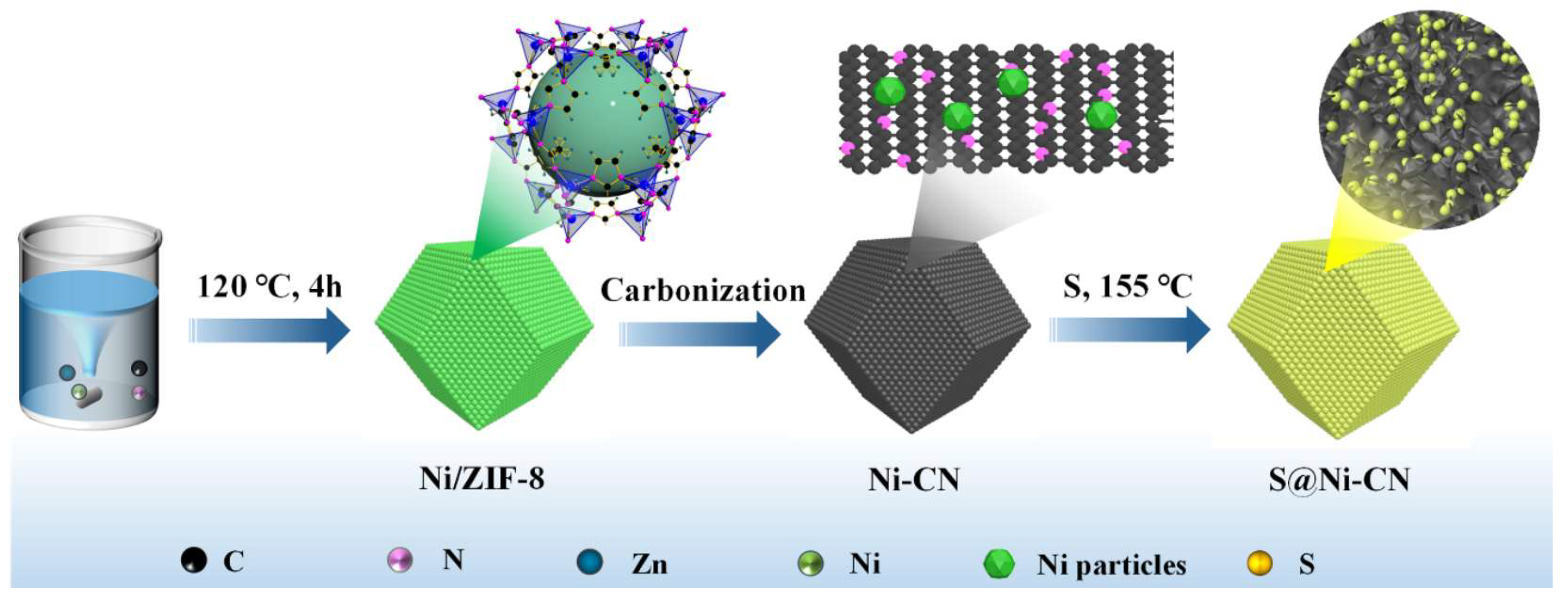
94] constructed embedded nickel nanoparticle-decorated carbon nanododecahedra (Ni-CNs) by precisely tuning the in situ alloying/reduction process on a ZIF-8-derived carbon framework. This architecture retains the excellent porosity and ion channels of ZIF-8 (see
Figure 4), while the incorporation of Ni nanoparticles overcomes the catalytic inertness of pure carbon supports. The interface between Ni nanoparticles and nitrogen-doped carbon (CN) rapidly catalyzes the conversion of trapped polysulfides into harmless solid lithium sulfide, thereby minimizing dead sulfur accumulation caused by the shuttle effect. In this system, the battery exhibits exceptional structural stability and a long cycle life. Song et al. [
95] utilized ZIF-8 as a precursor to synthesize a nitrogen-rich porous carbon material embedded with Fe-Co dual-atom sites (FeCoDA-CN) via in situ doping and high-temperature pyrolysis, which was subsequently employed for separator modification. This MOF-derived dodecahedral structure not only inherits a highly developed microporous network to ensure high Li-ion flux, but its uniformly distributed Fe-Co bimetallic centers also exhibit stronger polar adsorption capacity and synergistic catalytic activity compared to single-metal centers (FeSA or CoSA). Benefiting from this atomic-level synergistic effect, batteries equipped with this separator achieved a high initial capacity of 1404 mAh g
−1 at 0.1 C, and demonstrated an average capacity decay of only 0.08% per cycle after 500 cycles at a 1 C rate.
Integrating metal–organic frameworks (MOFs) with carbon materials or polymers has emerged as a promising strategy. MOFs can be integrated with carbon materials to construct self-supporting composite architectures [
96]. Such structures preserve the characteristic porosity and chemical functionality of MOFs while leveraging the high electrical conductivity, adsorption capability, and mechanical flexibility of carbon materials, thereby improving structural stability during charge–discharge cycling [
97]. Bai et al. [
8] selected the MOF HKUST
−1, which features highly ordered microporous windows, and composited it with graphene oxide (GO) to fabricate a composite separator. Lithium–sulfur batteries equipped with the HKUST
−1@GO composite separator retained a discharge capacity of 855 mAh g
−1 after 1500 cycles, demonstrating outstanding cycling stability. Carbon nanotubes, utilizing their one-dimensional tubular structure, construct interconnected three-dimensional electron-transport networks between particles, significantly enhancing conductivity while imparting greater mechanical flexibility to the modified layer. Wu et al. [
98] designed a CNT@ZIF composite by introducing a large number of ZIF-8 nanocrystals onto the surface of multi-walled carbon nanotubes (MWCNTs). This architecture isolates dissolved polysulfides via Lewis acid–base interactions between the polysulfides and the ZIF-8 framework while leveraging the conductive enhancement and synergistic effects provided by the CNTs. Compared with lithium–sulfur batteries employing conventional polypropylene (PP) separators, the capacity retention after 100 cycles was improved by 36.2%. Furthermore, composites of metal–organic frameworks (MOFs) with organic polymers (such as PVDF-HFP and aramid nanofibers) fully exploit the polymers’ advantages, including wide availability, ease of processing, and excellent toughness. Through mixed-matrix membrane (MMM) fabrication or electrospinning techniques, the polymer phase can firmly immobilize MOF particles while simultaneously utilizing its abundant functional groups to synergistically suppress polysulfide shuttling. At the same time, polymer matrices help maintain excellent electrolyte wettability and rapid ion transport. Gao et al. [
99] described an in situ thermally assisted solvent evaporation method for the facile fabrication of MOF-based mixed matrix membranes (MMMs) characterized by uniformity, stability, high loading, and controllable thickness. The resulting separator exhibited a high specific capacity of 1163.7 mAh g
−1 at 0.5 C and maintained an average capacity decay rate of only 0.08% per cycle over 700 cycles, demonstrating relatively superior performance. This type of rapid-production strategy is particularly relevant to industrial implementation because it addresses the otherwise significant synthesis-time and throughput limitations of conventional MOF preparation. Liu et al. [
16] directly grew ZIF-L(Co) on electrospun PMIA nanofibers to fabricate an aramid-nanofiber-based Z-PMIA separator. Under the standard test conditions, the electrolyte amount was 10–12 μL mg
−1 (E/S). The separator delivered an initial discharge capacity of 1391.2 mA h g
−1 (approximately 83% of the theoretical capacity) and retained a discharge capacity of 961.1 mA h g
−1 after 350 cycles at 0.2 C, corresponding to a low capacity-decay rate of only 0.033% per cycle. At a high sulfur loading of 6.82 mg cm
−2, the cell achieved an initial areal capacity of 6.18 mA h cm
−2. Even at a 9.23 mg cm
−2 sulfur loading under lean-electrolyte conditions (E/S = 8 μL mg
−1), it maintained excellent charge/discharge performance. The high thermal stability and mechanical strength of PMIA also enabled the Z-PMIA separator to operate reliably at 80 °C. Overall, this multicomponent synergistic design not only addresses the poor film-forming ability of MOFs, but also comprehensively enhances the electrochemical performance of lithium–sulfur batteries across multiple dimensions, including chemical adsorption, physical blockade, conductivity enhancement, and mechanical optimization [
92].
MOF-based separators provide highly tunable pore structures and chemical functionalities but their practical deployment is constrained by precursor cost, solvent consumption, synthesis time, and the mechanical stability of the deposited framework. In situ growth on polyolefin or polymeric substrates can improve interfacial adhesion and reduce delamination, whereas direct deposition or slurry processing may be more suitable for high-throughput manufacturing if the MOF particles can be uniformly dispersed. The practical performance of MOF coatings should therefore be assessed by considering not only pore size and polysulfide adsorption, but also coating yield, areal loading, solvent recovery, process time, and the stability of the framework under electrolyte exposure. Lightweight MOFs and MOF–polymer or MOF–carbon composites may offer a more favorable balance between functional performance and cell-level energy density.
7. Covalent Organic Framework (COF) Materials
Covalent organic frameworks (COFs) are crystalline porous polymers formed from organic monomers linked by covalent bonds. They feature predictable geometries and highly tunable structures that can be designed with molecular precision [
99]. In terms of elemental composition, COFs are primarily composed of light elements, such as C, H, N, B, and O, connected by strong covalent bonds or linkages, including imine, boronate ester, and triazine linkages. The use of light elements, together with the formation of highly porous frameworks, contributes to low material densities, high specific surface areas, and well-defined pore architectures, which may help reduce the mass penalty of separator coatings [
100]. Structurally, COFs are generally classified as two-dimensional (2D) or three-dimensional (3D) frameworks. In 2D COFs, π–π stacking between adjacent layers can generate one-dimensional channels, often oriented perpendicular to the framework layers, whereas 3D COFs contain interconnected three-dimensional pore networks. These ordered porous frameworks provide molecularly defined environments for selective separation and ion transport in electrochemical systems [
101].
In Li–S batteries, the structural and chemical features of COFs can contribute to polysulfide suppression by providing physical confinement and specific host–guest interactions. First, the ordered and tunable nanoscale channels of COFs provide the structural basis for molecular or ion sieving. Because solvated lithium polysulfides generally possess larger effective hydrodynamic dimensions than Li
+, appropriately designed COF pores can exploit size-exclusion effects to restrict polysulfide migration across the separator while maintaining lithium-ion transport [
102,
103]. The pore size of COFs can be tuned within an appropriate range, with values of approximately 1–4 nm reported for certain COF systems. However, the optimal pore size depends on the framework structure, electrolyte composition, and solvation environment. Second, the COF can be functionalized with polar groups, such as carbonyl, triazine, and imine groups, which provide abundant sites for specific chemical interactions. These sites can chemically anchor dissolved or migrating polysulfides at the pore walls, thereby reducing the loss of soluble sulfur species through Lewis acid–base interactions, hydrogen bonding, and other host–guest interactions [
104,
105,
106]. Furthermore, the development of ionic COFs exploits electrostatic repulsion principles: their negatively charged backbones (e.g., containing sulfonate or borate groups) generate an electric field within the pores that forcibly blocks negatively charged polysulfide anions through like-charge repulsion, substantially enhancing interception efficiency without compromising lithium-ion flux [
6].
Despite these advantages, pristine covalent organic frameworks (COFs) are not ideal for direct use as lithium–sulfur battery separator modifiers. Many pristine COFs exhibit limited electronic delocalization and consequently possess low electrical conductivity, with insulating or semiconducting behavior. During charge–discharge cycling, polysulfides retained at the separator surface may not be rapidly converted in the absence of sufficient electronic conductivity and catalytic activity, leading to their accumulation and possible diffusion across the separator. Electrical conductivity is therefore an important parameter for evaluating COF-based separator coatings. An effective separator coating should not only physically and chemically regulate polysulfide transport, but also provide continuous electron-transport pathways and catalytically active sites for polysulfide conversion. Accordingly, one effective strategy is to construct COF-based hybrid architectures by integrating COFs with conductive supports. COFs have been grown in situ on carbon nanotubes (CNTs) [
6], graphene [
100], MXenes [
77], and conductive carbon black. These conductive components can establish continuous three-dimensional electron-transport pathways and improve the utilization of COF active sites.
For example, Wu et al. [
107] developed a multifunctional Ni-COF featuring an extended π–d conjugated framework. The combination of an electronically delocalized framework and catalytically active Ni centers provided enhanced electron transport and a high density of catalytic sites. The resulting material chemically anchored lithium polysulfides (LiPSs) through N/O-rich sites within the framework and significantly accelerated their conversion kinetics. The corresponding cell delivered a specific capacity of 719 mAh g
−1 at 4 C, indicating favorable high-rate performance.
Beyond electronic conductivity, precise molecular engineering of the framework’s polarity and ionic environment is crucial for selective transport. Xu et al. [
108] demonstrated that incorporating highly electronegative triazine and salen moieties (N– and O–rich groups) into the COF provides a dual-function barrier: the ordered pores physically sieve LiPSs while the polar sites provide strong chemical anchoring. Building on this ion-regulation principle, Liu et al. [
109] synthesized a lithium sulfonylimide-functionalized COF (COF-LiSTFSI). By tethering sulfonylimide anions directly to the pore walls, they created a highly electronegative environment that effectively repelled polysulfide anions through electrostatic interactions while facilitating rapid Li
+ transport. This selective ion-sieving mechanism resulted in an ionic conductivity of 1.50 mS cm
−1 and a Li
+ transference number of 0.68, with a low capacity-decay rate of only 0.042% per cycle over 1000 cycles at 1 C. The cells employed a conventional sulfur loading of 0.8–1.2 mg cm
−2; even at a high sulfur loading of 3.44 mg cm
−2, an initial capacity of 944.1 mA h g
−1 at 0.2 C was achieved.
Ultimately, research is shifting toward systemic integration to address the cathode shuttle effect and anode instability simultaneously. Wu et al. [
110] proposed an “all-in-one” Janus COF separator strategy using a dual-functional coating to decouple the requirements of the two electrodes. On the cathode side, the COF layer acts as a chemical trap and catalyst for LiPSs, whereas on the anode side, it functions as a lithiophilic nucleator to regulate uniform Li deposition and suppress dendrite growth. In their Li–S cells, the sulfur loading was 1.0–1.5 mg cm
−2, increasing to 2.0 mg cm
−2 in the pouch cell; however, the electrolyte-to-sulfur (E/S) ratio was not explicitly reported, preventing a direct assessment under lean-electrolyte conditions. These strategies—from π–d conjugated electronic optimization and anionic ion-selective channels to Janus multifunctional integration—provide a comprehensive toolkit for mitigating the shuttle effect and advancing high-energy-density Li–S batteries.
The low density and high structural tunability of COFs are favorable attributes for minimizing the mass penalty of separator coatings. However, many COFs are electrically insulating, and their synthesis may involve expensive monomers, organic solvents, elevated temperatures, or long reaction times. These factors can hinder large-area and high-throughput production. In situ growth, interfacial polymerization, and aqueous or solvent-reduced synthesis could improve process scalability, while integration with CNTs, graphene, MXenes, or conductive polymers may reduce the need for thick COF layers. For practical applications, future reports should provide the COF coating thickness, areal loading, synthesis yield, solvent consumption, and mechanical adhesion, in addition to electrochemical performance.
8. Conclusions
Lithium–sulfur batteries are promising next-generation energy-storage systems because of their high theoretical specific capacity, low cost, abundant sulfur resources, and environmental compatibility. However, poor sulfur conductivity, electrode volume expansion, the polysulfide shuttle effect, and lithium-dendrite growth continue to limit their practical application. Functionalized separators have therefore attracted considerable attention because they can regulate polysulfide dissolution, migration, adsorption, and redox conversion while maintaining lithium-ion transport. As summarized in this review, carbon materials, graphene, carbon nanotubes, heteroatom-doped carbons, polymers, transition-metal compounds, MOFs, and COFs can suppress polysulfide shuttling through physical confinement, chemical adsorption, electrostatic regulation, and electrocatalytic conversion. The research focus has gradually shifted from passive blocking toward multifunctional designs that integrate polysulfide adsorption, catalytic conversion, electronic conduction, and ion-flux regulation. Nevertheless, excessive adsorption may hinder polysulfide conversion, while thick or high-loading coatings can increase inactive mass, ionic resistance, and separator tortuosity. Thus, future separator designs should balance adsorption strength, catalytic activity, ionic transport, mechanical stability, and coating mass.
The practical development of modified separators requires evaluation under conditions closer to real cells, including a high sulfur loading, lean electrolyte, a high areal capacity, wide temperature ranges, and prolonged cycling. In addition to capacity and cycle life, coating thickness, areal loading, binder content, adhesion, ionic resistance, and their effects on the gravimetric and volumetric energy densities of full cells should be systematically reported. From a manufacturing perspective, laboratory-scale vacuum filtration should gradually be replaced by scalable processes such as roll-to-roll blade coating, slot-die coating, or gravure coating. Aqueous formulations, low-cost natural precursors such as lignin and cellulose, and low-binder or solvent-reduced processes should be further developed to reduce manufacturing costs and environmental impacts. Thin and uniform coatings, preferably with a thickness and areal loading below approximately 2 μm and 0.5 mg cm−2, respectively, should be pursued as practical engineering targets. In addition, flexible cross-linked networks could improve coating adhesion and resistance to cracking or delamination caused by sulfur volume changes. Bifunctional Janus separators, combining polysulfide blocking and catalysis on the cathode side with ion-flux regulation and dendrite suppression on the anode side, could further enhance the stability of both electrodes and accelerate the transition of Li–S batteries toward practical applications.




 ,
,