1. Introduction
The increasing demand for cost-effective and sustainable energy storage technologies has accelerated the development of sodium-ion batteries (SIBs) as promising alternatives to lithium-ion batteries, particularly for large-scale grid storage and stationary applications [
1,
2,
3]. The natural abundance and wide geographic distribution of sodium resources provide clear economic and strategic advantages over lithium-based systems. However, the practical implementation of SIBs is still limited by the lack of suitable anode materials that can simultaneously deliver high reversible capacity, fast reaction kinetics, long-term cycling stability, and compatibility with realistic electrode configurations [
2,
3]. Compared with Li
+, the larger ionic radius and higher mass of Na
+ often result in sluggish diffusion, larger structural strain, and less favorable interfacial reaction kinetics, making anode design a central bottleneck in the development of practical SIBs [
4,
5].
In recent years, research on SIB anodes has gradually shifted from the simple discovery of high-capacity active materials toward the rational design of multifunctional composite electrodes with improved ion/electron transport and interfacial stability. Conventional SIB anodes, including carbonaceous materials (hard carbon, soft carbon, graphene), alloying-type materials (Sn, Sb, phosphorus, Si), and conversion-type compounds (metal oxides, sulfides, phosphides, and selenides), have each shown promising sodium-storage capability. However, hard carbon typically suffers from limited rate capability and low initial Coulombic efficiency, alloying-type materials undergo severe volume expansion during cycling, and conversion-type compounds often exhibit poor electronic conductivity and sluggish reaction kinetics [
1,
2,
3,
4,
6,
7,
8]. To overcome these limitations, increasing attention has been directed toward composite engineering approaches that integrate active materials with conductive frameworks, interfacial modifiers, and porous architectures to simultaneously improve structural stability, charge-transfer kinetics, and electrochemical reversibility. This shift highlights the importance of multifunctional electrode platforms rather than single-component active materials [
4].
MXenes, a family of two-dimensional (2D) transition metal carbides, nitrides, and carbonitrides, have attracted considerable attention as anode materials for SIBs because of their metallic conductivity, hydrophilic surface chemistry, tunable surface terminations, and layered structures that can accommodate ion intercalation [
9,
10,
11,
12,
13]. Among various MXenes, Ti
3C
2T
x (T
x = –OH, –O, –F, etc.) has been widely investigated as a representative sodium-storage material, showing rapid charge transport and pseudocapacitive behavior [
11,
14,
15,
16]. These characteristics make MXenes attractive not only as active sodium-storage materials but also as conductive and interfacial scaffolds for designing hybrid electrodes. In particular, the combination of high electronic conductivity and chemically active surfaces enables MXenes to bridge the gap between structural support, charge transport, and interfacial ion storage [
17].
Despite these advantages, pristine MXenes alone are not sufficient for practical SIB anodes. Strong interlayer interactions induce nanosheet restacking, which reduces accessible surface area and blocks Na
+ transport pathways [
9,
18]. In addition, MXenes are vulnerable to oxidation under ambient and electrochemical environments, leading to structural degradation and conductivity loss [
19,
20]. Their surface terminations, including –O, –OH, and –F groups, strongly influence Na
+ adsorption, diffusion, and interfacial reaction energetics, but uncontrolled surface chemistry can also generate non-uniform electrochemical environments [
11,
21]. These intrinsic limitations are further amplified under practical electrode conditions, where high-mass-loading, dense electrode packing, and long-term cycling demand robust ion/electron transport networks and stable interfaces.
Previous reviews have provided valuable insights into the fundamental chemistry, synthesis strategies, and sodium-storage behavior of MXenes [
22]. More recently, however, research has evolved beyond pristine MXenes toward multifunctional composite architectures that integrate carbon materials, metal compounds, and polymers while emphasizing interfacial engineering and practical electrode design. Accordingly, recent studies increasingly view MXenes not simply as pristine 2D anode materials but as versatile building blocks for composite electrode architectures. By integrating MXenes with carbon frameworks, metal compounds, and polymers, particularly within three-dimensional (3D) porous architectures, researchers have sought to suppress restacking, stabilize interfaces, introduce additional redox-active sites, and construct continuous ion/electron transport pathways [
23,
24,
25,
26]. More importantly, composite engineering can alter the dominant sodium-storage behavior of MXene-based electrodes, shifting it from diffusion-limited intercalation toward hybrid charge-storage mechanisms involving interfacial adsorption, surface-controlled reactions, and pseudocapacitive contributions [
14,
27]. Recent efforts have also emphasized interfacial processes such as ion desolvation and solid-electrolyte interphase formation, suggesting that future MXene-based anodes should be designed from an interface-aware and electrode-level perspective rather than solely from a material-level viewpoint [
28,
29].Furthermore, increasing attention has been devoted to practical considerations, including scalable synthesis, high-mass-loading electrodes, full-cell validation, and long-term cycling stability, reflecting the transition of MXene research from fundamental materials development toward practical SIB applications.
In this perspective, we discuss recent progress in MXene-based composite anodes for SIBs, with particular emphasis on how composite design can address the intrinsic limitations of pristine MXenes and enable more practical sodium-storage behavior. Rather than treating MXenes as isolated active materials, we highlight their role as multifunctional platforms for structural stabilization, interfacial regulation, and kinetic enhancement. We further discuss key challenges, including oxidation stability, initial Coulombic efficiency, high-mass-loading electrode design, scalable synthesis, and full-cell validation.
2. MXene Structure, Synthesis, and Physicochemical Properties
MXenes are a family of 2D transition metal carbides and nitrides generally represented by the formula M
n+1X
nT
x (n = 1–4), where M is an early transition metal, X is carbon and/or nitrogen, and T
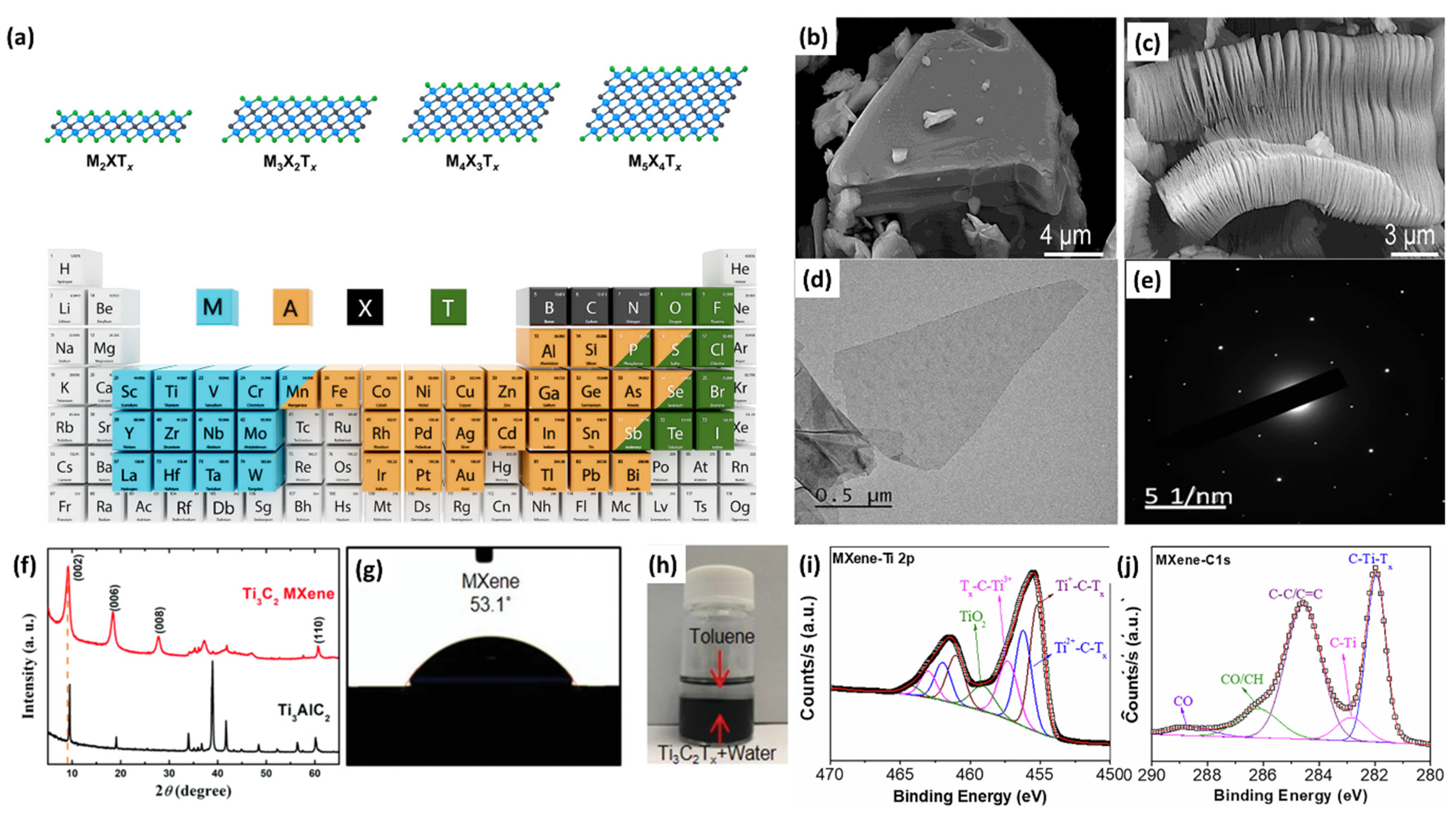
x denotes surface terminations such as –O, –OH, and –F. MXenes are typically synthesized through selective etching of the A-layer from layered MAX phases, producing conductive 2D nanosheets with enlarged interlayer spacing and chemically active surfaces, as illustrated in
Figure 1a. The structural diversity of MXenes, together with tunable surface chemistry, provides broad opportunities for tailoring ion-storage behavior and interfacial properties in SIBs [
9,
10,
11,
30,
31,
32,
33,
34].
Among various MXenes, Ti
3C
2T
x has been the most extensively studied for sodium-ion storage because of its well-established synthesis protocols, metallic conductivity, hydrophilic surface chemistry, and fast charge-transfer characteristics [
11,
14,
15]. Ti
3C
2T
x is typically synthesized by selectively etching the Al atomic layers from Ti
3AlC
2 MAX phases using either direct HF or in situ HF-generating etchants. Alternative etching systems, including fluoride salt/acid mixtures and fluoroboric acid, have also been developed to improve the safety, sustainability, and controllability of the synthesis process while maintaining the structural and electrochemical characteristics of MXenes [
35]. Despite these advances, most currently reported etching methods still rely on highly corrosive fluorine-containing chemicals, which pose challenges related to operator safety, environmental impact, waste management, and large-scale production. Moreover, the etching chemistry strongly influences the surface terminations, defect density, and oxidation resistance of the resulting MXenes, thereby affecting their electrochemical performance. Therefore, the development of safer, environmentally benign, and scalable etching strategies remains an important research direction for the practical commercialization of MXene-based SIBs. Selective etching of MAX phases produces accordion-like multilayered MXene structures with enlarged interlayer spacing and chemically active surfaces (
Figure 1b–f). As shown in
Figure 1f, the shift in the characteristic (002) peak toward lower 2θ angles indicates interlayer expansion after etching and surface functionalization, which is highly beneficial for SIBs because enlarged interlayer galleries facilitate Na
+ intercalation and reduce diffusion resistance associated with the large ionic radius of sodium ions [
36]. Delaminated Ti
3C
2T
x further exhibits ultrathin few-layer nanosheets with high crystallinity and structural integrity (
Figure 1d,e). Such ultrathin conductive nanosheets shorten ion/electron transport pathways, expose abundant electrochemically active sites, and promote pseudocapacitive sodium-storage behavior [
15,
37,
38,
39,
40,
41].
In addition, MXenes exhibit strong hydrophilicity and good colloidal stability owing to their abundant surface terminations (
Figure 1g,h). The relatively low contact angle reflects excellent electrolyte wettability, which facilitates electrolyte infiltration and interfacial Na
+ transport during electrochemical cycling, while stable dispersion behavior is advantageous for scalable slurry processing and homogeneous electrode fabrication. The coexistence of Ti species with different oxidation states together with oxygen-containing functional groups further highlights the chemically active nature of MXene surfaces (
Figure 1i,j). These surface environments can facilitate interfacial charge transfer, enhance Na
+ adsorption, and promote pseudocapacitive sodium-storage behavior. Surface terminations also strongly influence Na
+ diffusion barriers, electrolyte interactions, and solid-electrolyte interphase (SEI) formation. Therefore, the unique structural and physicochemical properties of MXenes make them highly attractive as multifunctional platforms for SIB anodes [
37,
38,
40,
42,
43,
44].
Figure 1.
(
a) Structural models of representative MXene phases (M
2XT
x, M
3X
2T
x, M
4X
3T
x, and M
5X
4T
x), together with a periodic table highlighting the compositional elements of MAX phases and MXenes. Reprinted with permission from Ref. [
30]. Copyright 2025, John Wiley and Sons. SEM images of (
b) Ti
3AlC
2 MAX phase and (
c) multilayer Ti
3C
2T
x MXene. Reprinted with permission from Ref. [
31]. Copyright 2012, American Chemical Society. (
d) TEM image and (
e) corresponding SAED pattern of monolayer Ti
3C
2T
x MXene [
41]. (
f) XRD patterns of Ti
3AlC
2 and Ti
3C
2T
x MXene [
36]. (
g) Water contact-angle image and (
h) colloidal dispersion behavior of Ti
3C
2T
x MXene. Reprinted with permission from Ref. [
45], Copyright 2020, John Wiley and Sons. High-resolution XPS spectra of (
i) Ti 2p and (
j) C 1s for Ti
3C
2T
x MXene [
41].
Figure 1.
(
a) Structural models of representative MXene phases (M
2XT
x, M
3X
2T
x, M
4X
3T
x, and M
5X
4T
x), together with a periodic table highlighting the compositional elements of MAX phases and MXenes. Reprinted with permission from Ref. [
30]. Copyright 2025, John Wiley and Sons. SEM images of (
b) Ti
3AlC
2 MAX phase and (
c) multilayer Ti
3C
2T
x MXene. Reprinted with permission from Ref. [
31]. Copyright 2012, American Chemical Society. (
d) TEM image and (
e) corresponding SAED pattern of monolayer Ti
3C
2T
x MXene [
41]. (
f) XRD patterns of Ti
3AlC
2 and Ti
3C
2T
x MXene [
36]. (
g) Water contact-angle image and (
h) colloidal dispersion behavior of Ti
3C
2T
x MXene. Reprinted with permission from Ref. [
45], Copyright 2020, John Wiley and Sons. High-resolution XPS spectra of (
i) Ti 2p and (
j) C 1s for Ti
3C
2T
x MXene [
41].
3. Limitations of Pristine MXenes for Sodium Storage
Despite their promising physicochemical properties, pristine MXenes face fundamental limitations that restrict their direct use as practical anode materials for SIBs. These limitations are not limited to intrinsic material instability but are closely associated with the mismatch between the ideal 2D structure of MXenes and the requirements of realistic sodium-storage electrodes. In practical SIB anodes, efficient charge storage requires open ion-accessible pathways, continuous electron transport, stable electrode-electrolyte interfaces, and structural integrity under repeated cycling. Pristine MXenes struggle to satisfy these requirements simultaneously because their layered nanosheets are highly susceptible to restacking, oxidation, surface-chemistry heterogeneity, and irreversible interfacial reactions [
9,
11,
18,
19,
21,
24].
The most widely recognized limitation of pristine MXenes is nanosheet restacking. Although delaminated MXene sheets possess large theoretical surface areas, strong van der Waals interactions and hydrogen bonding between adjacent layers drive the reassembly of nanosheets into densely packed structures [
9,
18,
46]. This restacking reduces accessible surface area, narrows interlayer galleries, and increases ion-transport tortuosity. For sodium storage, this issue is particularly critical because Na
+ diffusion is more kinetically demanding than Li
+ diffusion due to its larger ionic radius. As a result, restacked MXene electrodes may retain high electronic conductivity but lose a significant fraction of electrochemically accessible sites, leading to limited capacity utilization and poor rate performance [
15,
27].
Another serious limitation is the poor oxidation stability of MXenes. Ti
3C
2T
x and related MXenes are vulnerable to oxidation during storage, processing, and electrochemical operation, especially in the presence of oxygen, water, or reactive electrolyte species [
19,
47]. Oxidation can generate TiO
2-like species and disrupt the conductive carbide framework, thereby reducing electrical conductivity and degrading the layered structure. This degradation is especially problematic for practical electrode fabrication because slurry processing, drying, calendaring, and long-term storage may expose MXenes to conditions that accelerate oxidation. Therefore, oxidation instability should not be regarded only as a storage issue; it directly affects reproducibility, electrode integrity, and long-term cycling stability.
Surface chemistry represents another double-edged feature of pristine MXenes. Surface terminations such as –O, –OH, and –F provide hydrophilicity and enable interactions with electrolyte ions, but they also strongly influence Na
+ adsorption energy, diffusion barriers, and interfacial charge-transfer behavior [
11,
21,
27]. In principle, suitable surface terminations can promote sodium adsorption and pseudocapacitive storage. However, in chemically etched MXenes, the distribution and composition of surface terminations are often non-uniform and difficult to precisely control. This can create heterogeneous local electrochemical environments, leading to uneven Na
+ adsorption, sluggish interfacial kinetics, and unstable solid-electrolyte interphase formation.
Pristine MXenes also tend to suffer from low initial Coulombic efficiency, which remains a major barrier for practical SIB anodes. Their high surface area and chemically active surfaces can promote irreversible electrolyte decomposition and excessive SEI formation during the initial cycles [
24,
28]. While surface-driven charge storage is beneficial for rate capability, uncontrolled interfacial reactivity consumes sodium inventory and lowers the energy efficiency of full-cell systems. This issue becomes more serious when MXene electrodes are evaluated under realistic full-cell conditions, where sodium supply is limited compared with half-cell configurations using excess sodium metal.
These limitations become even more pronounced under practical electrode conditions. Many MXene-based anodes are evaluated at low-mass-loading, where short ion-diffusion distances and excess electrolyte can mask transport limitations. However, increasing mass-loading or electrode density can intensify restacking, reduce electrolyte penetration, and amplify ion-transport resistance [
29]. Therefore, the intrinsic advantages of pristine MXenes observed in model electrodes do not automatically translate into practical high-loading electrodes. This gap between material-level performance and electrode-level performance is one of the key reasons why pristine MXenes alone are insufficient for practical sodium storage.
Taken together, pristine MXenes should be viewed not as complete anode materials but as functional building blocks that require structural and interfacial engineering. Their conductivity, layered structure, and surface activity remain highly valuable, but these advantages must be integrated with strategies that suppress restacking, stabilize surface chemistry, regulate SEI formation, and maintain ion-accessible architectures under realistic electrode conditions. This perspective provides the rationale for composite engineering as a necessary direction for advancing MXene-based SIB anodes.
4. Composite Design Strategies
Composite engineering has become a central strategy for translating MXenes from model 2D materials into practical sodium-storage electrodes. The key objective is not simply to combine MXenes with other active materials, but to construct electrode architectures in which ion transport, electron conduction, interfacial stability, and mechanical integrity are simultaneously optimized. In recent studies, MXene-based composites have increasingly been designed through controlled self-assembly, interfacial bonding, in situ nucleation, surface functionalization, and 3D architecture formation. These approaches enable MXenes to function as conductive scaffolds, interfacial regulators, structural buffers, and pseudocapacitive components rather than as isolated active materials [
24,
25,
26,
29,
48].
4.1. MXene/Carbon Composites
Carbon integration is one of the most established strategies for improving the sodium-storage performance of MXene-based anodes. Carbon materials such as hard carbon, graphene, carbon nanotubes, reduced graphene oxide, porous carbon, and carbon nanofibers can be incorporated into MXene electrodes as conductive spacers, mechanical buffers, and ion-accessible frameworks [
23,
25,
49]. The fundamental principle is to prevent face-to-face restacking of MXene nanosheets while maintaining continuous electron pathways throughout the electrode. In this regard, carbon materials act as “structural pillars” or “conductive bridges” that separate adjacent MXene layers and reduce ion-transport tortuosity.
Early MXene/carbon designs demonstrated the value of constructing porous heterostructures. For example, MXene/CNT composite papers provided interconnected conductive networks and open ion-accessible pores for sodium-based energy storage, showing that one-dimensional carbon nanotubes can effectively separate 2D MXene layers while preserving high volumetric capacity [
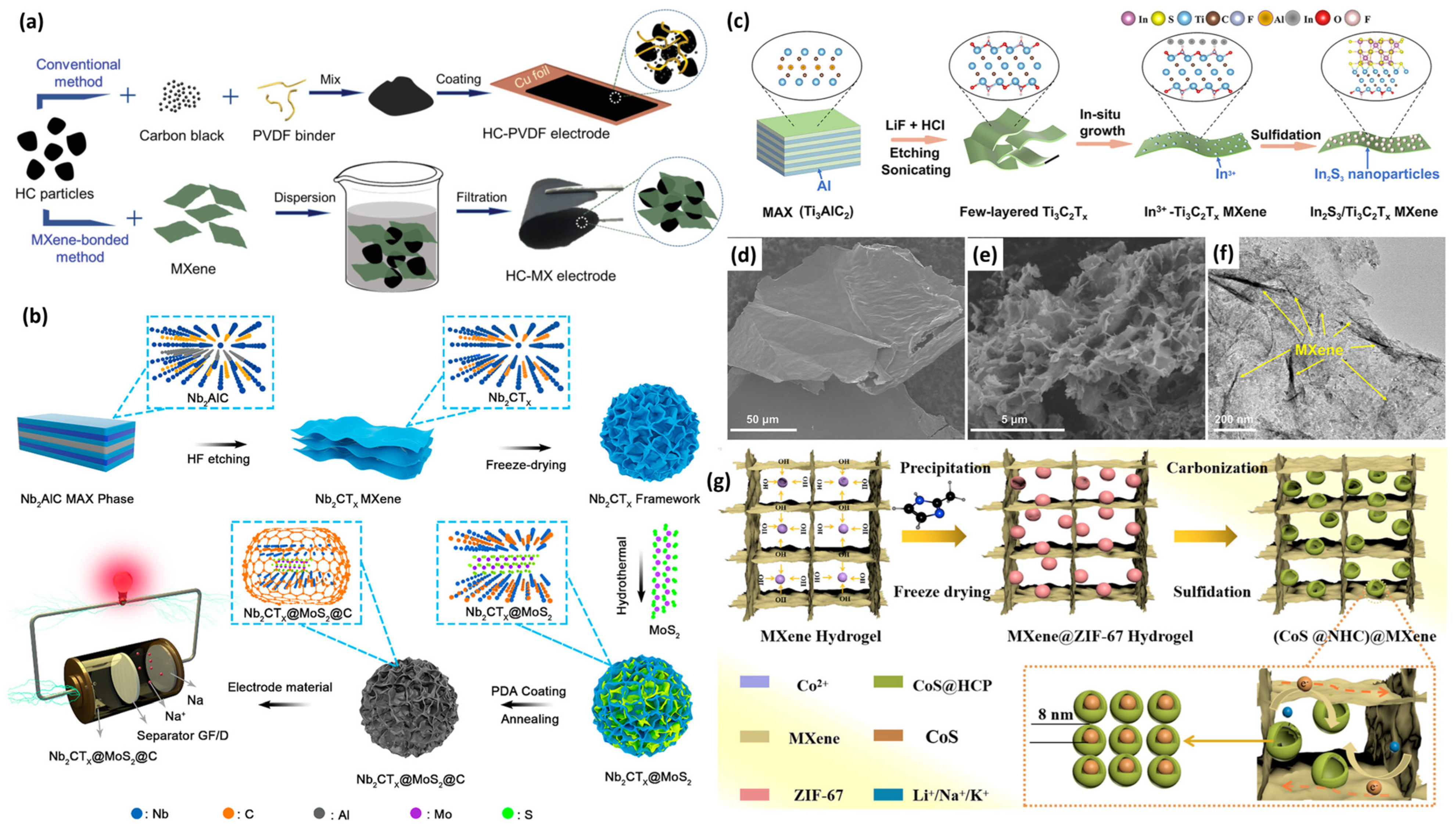
49]. Similarly, MXene-bonded hard carbon films demonstrated that MXenes can act as conductive binders and flexible current-collecting networks for carbonaceous sodium-storage materials (
Figure 2a) [
23]. These examples illustrate two different but complementary roles of MXenes: as active pseudocapacitive components and as conductive interfacial binders for carbon-based anodes.
Recently, MXene/carbon composites have moved beyond simple physical mixing toward more controlled architectures, such as MXene-bonded hard carbon films, CNT-intercalated MXene papers, MXene/graphene lamellar networks, and porous carbon-supported MXene frameworks [
23,
25,
26,
49]. These structures are typically fabricated through vacuum-assisted filtration, electrostatic self-assembly, solution casting, freeze-drying, or carbonization-assisted integration. During these processes, negatively charged MXene nanosheets can interact with carbonaceous components through electrostatic interactions, hydrogen bonding, van der Waals interactions, or physical entanglement. When properly assembled, the resulting composite forms a percolated conductive network that supports fast electron transport while preserving open channels for Na
+ diffusion.
From an electrochemical perspective, the role of carbon is twofold. First, carbon frameworks improve electrode-level conductivity and mechanical flexibility, thereby reducing polarization during fast charge/discharge. Second, porous or disordered carbon domains can provide additional sodium-storage sites through adsorption, defect-related storage, and interlayer insertion [
50]. Therefore, MXene/carbon composites often exhibit improved rate capability and cycling stability compared with pristine MXenes. However, future MXene/carbon designs should carefully balance carbon content, pore structure, MXene exposure, and electrode density. Excessive carbon may dilute the contribution of MXenes and reduce volumetric energy density, whereas insufficient carbon may fail to suppress restacking or maintain ion-accessible pathways.
4.2. MXene/Metal Compound Composites
Metal compounds, including oxides, sulfides, selenides, phosphides, phosphates, and alloying-type compounds, are attractive partners for MXenes because they can provide high theoretical capacity through conversion, alloying, or multi-electron redox reactions [
26,
27,
51,
52,
53,
54,
55,
56,
57,
58,
59]. Many metal compounds suffer from intrinsically poor electronic conductivity, large volume changes, particle aggregation, and sluggish reaction kinetics during repeated sodiation/desodiation. MXenes can address these limitations by serving as conductive matrices and mechanically robust supports that anchor redox-active nanoparticles, nanoflowers, nanosheets, or hollow structures [
41,
60].
The formation of MXene/metal compound composites generally relies on in situ nucleation, hydrothermal/solvothermal growth, electrostatic self-assembly, surface adsorption followed by thermal conversion, or post-synthetic phosphidation/sulfidation/selenization. In these processes, the abundant surface terminations of MXenes, such as -O, -OH, and -F, provide nucleation sites for metal ions or precursor species. This enables metal compounds to grow directly on MXene surfaces rather than forming isolated aggregates. Such interfacial coupling is critical because intimate contact between MXenes and metal compounds reduces charge-transfer resistance and improves utilization of redox-active sites.
Transition-metal sulfides are representative conversion-type components for MXene composites. MoS
2-based structures, for example, have been integrated with MXenes in several forms, including Nb
2CT
x/MoS
2 nanosheet hybrids, interlayer-expanded MoS
2 nanoflowers vertically aligned on MXene@TiO
2, and MoS
2 spheres covered with few-layer MXene (
Figure 2b) [
54,
55,
57,
61]. These structures share a common design logic: MoS
2 provides high sodium-storage capacity through layered sulfide chemistry, while MXene improves electronic conductivity, suppresses structural pulverization, and shortens ion/electron transport distances. In vertically aligned or sphere-coated structures, MXene also helps regulate the spatial distribution of MoS
2, preventing excessive aggregation and enhancing electrolyte accessibility.
Metal phosphide-based MXene composites represent another important class. For example, NiCoP nanoparticles supported on alkali-induced crinkled porous Ti
3C
2 MXene architectures provide rich redox-active sites, while the MXene framework supplies conductive pathways, open pores, and mechanical buffering during Na
+ insertion/extraction [
52]. Phosphides generally offer higher electrical conductivity than many oxides and sulfides, but they still require structural buffering and interfacial stabilization during repeated cycling. MXenes are therefore particularly useful as conductive and flexible scaffolds for phosphide nanoparticles.
Hybrid systems combining MXenes with multiple active phases have also been reported. A quasi-3D Sb
2S
3/reduced graphene oxide/MXene hybrid demonstrates how MXenes can be incorporated into multi-component conductive networks, where Sb
2S
3 contributes conversion/alloying-type capacity, reduced graphene oxide improves structural flexibility, and MXene enhances electronic transport and interfacial charge transfer [
56]. Such multi-phase designs are increasingly important because a single component rarely satisfies all requirements for practical sodium storage.
The key scientific issue in MXene/metal compound composites is controlling the balance between faradaic capacity and structural stability. If metal compound loading is too high, particle aggregation and volume expansion can disrupt the electrode. If MXene content is too high, total capacity may be limited. Therefore, ideal MXene/metal compound composites should have uniformly distributed nanoscale active phases, strong interfacial bonding, short ion-diffusion lengths, and sufficient void space for volume accommodation. Future studies should also focus on identifying how specific heterointerfaces between MXenes and metal compounds modify Na+ adsorption energy, charge redistribution, reaction reversibility, and SEI chemistry.
4.3. Polymer-Assisted Composites
Polymer-assisted engineering has recently become an important approach for improving the structural and interfacial stability of MXene-based sodium-storage electrodes. Unlike carbon or metal compounds, polymers do not necessarily contribute high capacity. Instead, their main roles are to regulate interfacial chemistry, suppress oxidation, reinforce nanosheet assembly, improve electrolyte compatibility, and stabilize SEI formation [
41,
57,
62]. This is particularly important for MXenes because their surface chemistry is highly reactive and strongly influences both oxidation behavior and electrochemical side reactions.
Polymer-assisted MXene composites can be formed through hydrogen bonding, electrostatic assembly, coordination bonding, covalent grafting, or ligand functionalization. Nitrogen-rich polymers, catechol-containing ligands, polyvinylpyrrolidone-based chains, conductive polymers, and polymeric binders can interact with MXene surfaces through Ti–O coordination, hydrogen bonding with surface terminations, electrostatic attraction, or adsorption onto defect sites [
41,
62,
63]. These interactions can enlarge interlayer spacing, reduce nanosheet restacking, and create flexible organic–inorganic interfaces that accommodate repeated ion insertion and extraction.
Recent studies illustrate the importance of this approach. A nitrogen-rich polymer network has been used to construct sandwich-like MXene structures with tunable interlayer spacing, where polymer-mediated interfacial self-assembly suppresses MXene self-stacking and enhances sodium-storage kinetics [
62]. More recently, polymer-ligand functionalized MXene combined with hollow silica nanoparticles demonstrated that ligand modification can improve MXene dispersion, interfacial compatibility, electron/ion transport pathways, and SEI stability [
41]. These examples show that polymer integration is no longer merely a mechanical binding strategy but an interfacial design tool.
The underlying principle is that polymer layers can act as chemically adaptive interfaces. They can moderate direct contact between reactive MXene surfaces and electrolyte, reduce uncontrolled electrolyte decomposition, suppress oxidation, and promote more uniform SEI formation. At the same time, polymer chains can provide mechanical compliance, helping the electrode tolerate stress accumulation during cycling. Polymer or ligand layers can also introduce specific chemical interactions that regulate Na+ adsorption and local solvation/desolvation behavior at the electrode-electrolyte interface.
However, polymer-assisted designs must avoid excessive insulating layers that block electron transport. Thick polymer coatings can suppress side reactions but may also reduce rate capability by increasing electronic resistance or ion-diffusion barriers. Therefore, future polymer/MXene composites should focus on thin, ion-permeable, electronically compatible, and chemically stable interfacial layers rather than thick passive coatings. In this sense, the ideal polymer-assisted MXene composite is not simply protected by a polymer; it is interfacially programmed by the polymer to balance charge transport, ion access, and chemical stability.
4.4. 3D Structured MXene Composites
3D structural engineering directly addresses one of the most important limitations of MXenes: the collapse of 2D nanosheets into densely stacked films. While compact MXene films can provide high electronic conductivity, they often suffer from limited electrolyte penetration and slow through-plane ion transport. 3D MXene architectures are designed to overcome this issue by creating interconnected pores, expanded channels, and continuous conductive frameworks [
25,
49,
52,
56,
64].
3D MXene structures can be produced through several approaches, including alkali-induced crinkling, freeze-drying, template-assisted assembly, gas-foaming, hydrothermal reconstruction, chemical etching, and hybrid assembly with carbon or active nanoparticles [
52,
65,
66,
67,
68,
69]. Alkali treatment can induce nanosheet curling and crumpling, generating crinkled MXene frameworks with open pores and high surface area [
52]. Mild oxidative or pore-forming treatments can generate porous Ti
3C
2 structures with enlarged ion-accessible regions and improved reaction kinetics [
64]. Freeze-drying and aerogel formation can preserve a low-density interconnected network by preventing capillary-force-driven collapse during solvent removal. In each case, the goal is to transform MXene from a stacked lamellar solid into an ion-permeable conductive scaffold (
Figure 2g) [
70,
71].
The electrochemical advantage of 3D MXene architectures arises from their simultaneous control over ion transport and electron transport. Open pores improve electrolyte infiltration and shorten Na+ diffusion pathways, while interconnected MXene sheets maintain conductive highways for electron transfer. This architecture is especially important under high-mass-loading conditions, where dense electrodes typically suffer from severe concentration polarization and limited active-site utilization. In addition, 3D frameworks can accommodate volume changes in active components, such as metal phosphides, sulfides, or oxides, thereby improving cycling stability.
Representative 3D designs include crinkled porous Ti
3C
2/NiCoP frameworks, porous Ti
3C
2 nanosheet architectures, porous MXene/CNT composite papers, and quasi-3D Sb
2S
3/rGO/MXene hybrids [
49,
52,
56,
64]. Although these systems differ in composition, they follow a similar architectural principle: the 3D network provides interconnected ion channels, conductive pathways, and internal void space. This is particularly important for conversion- or alloying-type active materials, where large volume changes and sluggish charge transport often limit cycling stability.
A recent example is the defective 3D In
2S
3/MXene nanostructure developed by Hu et al. [
72]. As illustrated in
Figure 2c–f, In
3+ ions were first adsorbed onto delaminated Ti
3C
2T
x nanosheets and subsequently converted into In
2S
3 nanoparticles through in situ sulfurization. Compared with the relatively flat pristine MXene sheets, the resulting composite exhibited a highly wrinkled, three-dimensional morphology, with approximately 20 nm In
2S
3 nanoparticles distributed uniformly over the MXene surface. This architecture increased the accessible surface area and pore volume, enhanced electrode-electrolyte contact, and provided short Na
+ transport pathways, while the MXene framework maintained electronic conductivity. Strong Ti-S interfacial bonding and the intrinsic vacancies of In
2S
3 further stabilized the heterostructure and accelerated charge-transfer and Na
+-diffusion kinetics.
However, 3D structuring alone is not sufficient. Highly porous electrodes may suffer from low tap density, reduced volumetric capacity, or mechanical fragility. Therefore, future 3D MXene composite designs should aim for hierarchical porosity rather than uncontrolled macroporosity. An ideal architecture would combine nanoscale channels for rapid ion diffusion, mesoscale pores for electrolyte buffering, and macroscale continuity for mechanical robustness and electron transport. Such hierarchical electrode design will be essential for translating MXene-based composites from low-loading laboratory electrodes to practical SIB anodes.
Overall, composite design should be understood as a multiscale engineering strategy rather than a simple material-blending approach. Carbon frameworks mainly regulate conductivity and restacking; metal compounds introduce redox-active capacity; polymers stabilize interfaces and surface chemistry; and 3D architectures control electrode-level ion transport. The next stage of MXene-based SIB research should integrate these strategies into multifunctional composite electrodes that simultaneously satisfy material-level activity, interface-level stability, and electrode-level practicality.
Figure 2.
Representative structural design strategies for MXene-based composite anodes. (
a) Schematic illustration comparing the fabrication of a conventional PVDF-bonded hard carbon (HC) electrode and a multifunctional MXene-bonded HC electrode (structural design schematic). Reprinted with permission from Ref. [
23]. Copyright 2019, John Wiley and Sons. (
b) Schematic illustration of the synthesis process for the Nb
2CT
x@MoS
2@C composite (structural design schematic). Reprinted with permission from Ref. [
61]. Copyright 2022, John Wiley and Sons. (
c) Schematic fabrication of the defective 3D In
2S
3/Ti
3C
2T
x MXene heterostructure through MXene etching, In
3+ adsorption, and in situ sulfurization; (
d) SEM image of few-layer Ti
3C
2T
x MXene; (
e) SEM image of the wrinkled 3D In
2S
3/MXene heterostructure; and (
f) TEM image showing In
2S
3 nanoparticles distributed on the MXene nanosheets. Reprinted with permission from Ref. [
72]. Copyright 2025, John Wiley and Sons. (
g) Schematic illustration of the fabrication process for the (CoS NP@NHC)@MXene composite (structural design schematic). Reprinted with permission from Ref. [
70]. Copyright 2021, American Chemical Society.
Figure 2.
Representative structural design strategies for MXene-based composite anodes. (
a) Schematic illustration comparing the fabrication of a conventional PVDF-bonded hard carbon (HC) electrode and a multifunctional MXene-bonded HC electrode (structural design schematic). Reprinted with permission from Ref. [
23]. Copyright 2019, John Wiley and Sons. (
b) Schematic illustration of the synthesis process for the Nb
2CT
x@MoS
2@C composite (structural design schematic). Reprinted with permission from Ref. [
61]. Copyright 2022, John Wiley and Sons. (
c) Schematic fabrication of the defective 3D In
2S
3/Ti
3C
2T
x MXene heterostructure through MXene etching, In
3+ adsorption, and in situ sulfurization; (
d) SEM image of few-layer Ti
3C
2T
x MXene; (
e) SEM image of the wrinkled 3D In
2S
3/MXene heterostructure; and (
f) TEM image showing In
2S
3 nanoparticles distributed on the MXene nanosheets. Reprinted with permission from Ref. [
72]. Copyright 2025, John Wiley and Sons. (
g) Schematic illustration of the fabrication process for the (CoS NP@NHC)@MXene composite (structural design schematic). Reprinted with permission from Ref. [
70]. Copyright 2021, American Chemical Society.

To facilitate a direct comparison of the representative MXene-based composite anodes discussed in this section, a comprehensive summary is provided in
Table 1. The table compares the different composite design strategies, the primary role of MXene, sodium-storage mechanisms, and electrochemical performance. This comparison highlights the distinct structure-performance relationships of various MXene-based composite architectures and provides guidance for the rational design of next-generation SIB anodes.
5. Evolution of Sodium Storage Mechanisms
Beyond structural stabilization, composite engineering fundamentally reshapes how Na
+ ions are stored in MXene-based electrodes. In pristine MXenes, sodium storage is generally initiated by Na
+ intercalation into interlayer galleries, accompanied by surface redox reactions and pseudocapacitive contributions depending on the MXene composition, surface terminations, and electrolyte environment [
14,
15,
27]. However, this storage process is strongly constrained by restacked nanosheets, limited interlayer accessibility, and heterogeneous surface chemistry. As a result, pristine MXenes often exhibit rapid charge-transfer characteristics at the nanosheet surface but limited utilization of internal active sites under practical electrode conditions.
The first mechanistic change induced by composite engineering is the transition from diffusion-limited intercalation to more accessible interfacial sodium storage. In restacked MXene electrodes, Na
+ transport mainly relies on narrow interlayer diffusion pathways, which can become kinetically sluggish as electrode thickness or mass-loading increases. In contrast, carbon frameworks, polymer spacers, and metal compounds architectures can expand interlayer spacing, prevent nanosheet collapse, and expose additional surface and edge sites [
23,
24,
25,
26,
41,
52,
62,
64]. This structural opening reduces ion-transport tortuosity and allows Na
+ to access both basal-plane and edge-related storage sites more effectively. Therefore, composite design does not merely improve capacity; it changes where sodium ions are stored and how rapidly they can reach electrochemically active regions.
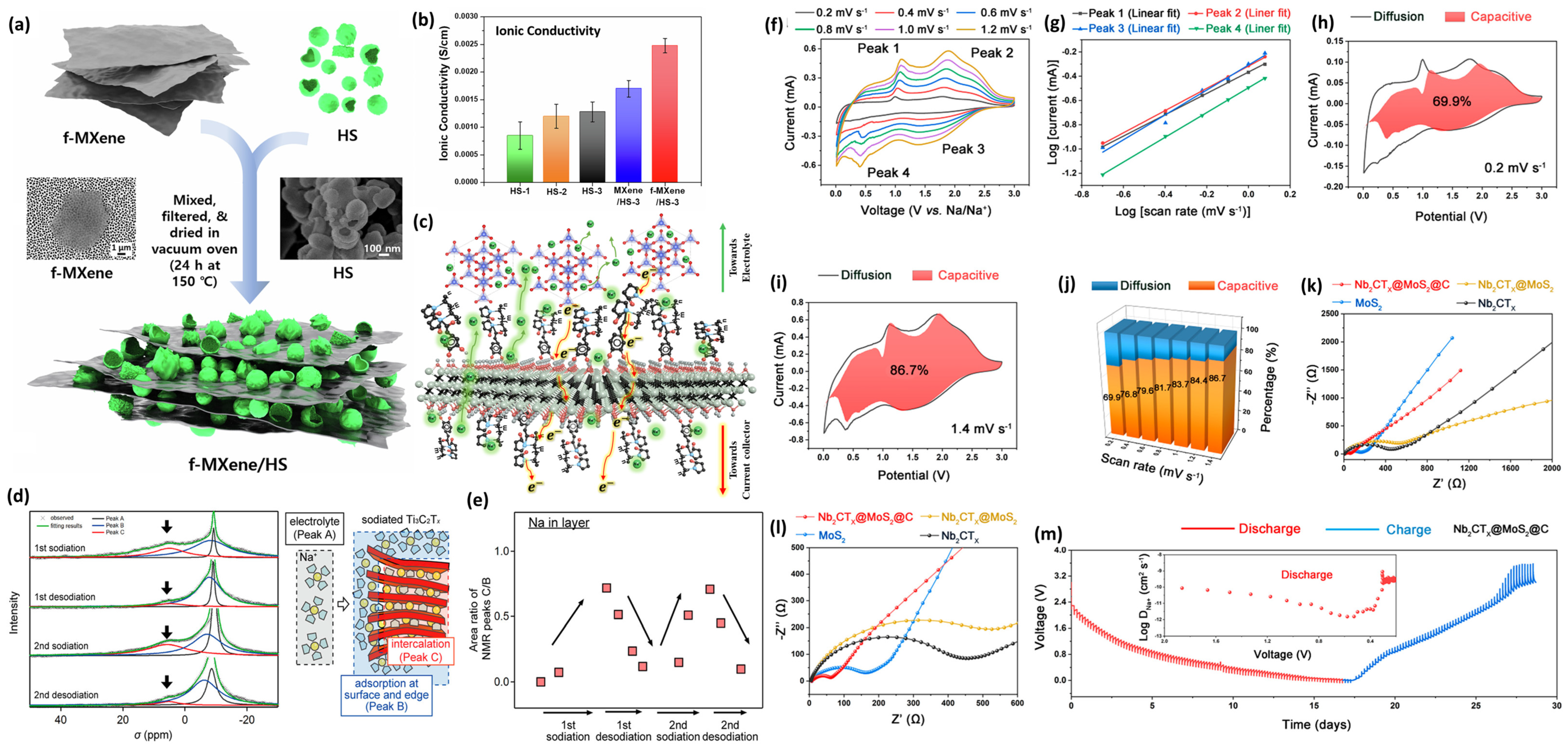
A second important change is the increased contribution of surface-controlled and pseudocapacitive storage. MXenes are known to exhibit pseudocapacitive behavior because their conductive layers and redox-active transition metal sites can support fast charge storage without requiring long-range solid-state diffusion (
Figure 3d–m) [
14,
15,
54]. Composite architectures amplify this behavior by increasing electrolyte-accessible surface area and shortening ion-diffusion distances. In MXene/carbon or porous MXene systems, for example, Na
+ adsorption/desorption at exposed interfaces and defect-rich regions can become more dominant, leading to fast charge–discharge behavior and improved rate capability [
23,
25,
64]. From a kinetic perspective, this means that the sodium-storage process gradually shifts from a semi-infinite diffusion-controlled response toward a surface-controlled capacitive response. Such a shift is particularly valuable for SIBs because Na
+ diffusion is intrinsically slower than Li
+ diffusion.
Metal compound integration introduces another storage pathway through conversion, alloying, or multi-electron redox reactions. Oxides, sulfides, phosphides, and related compounds can provide higher theoretical capacities than pristine MXenes, but they often suffer from poor electrical conductivity and large volume changes during cycling [
25,
26,
51,
52,
53]. When coupled with MXenes, these active phases can participate in faradaic Na-storage reactions, while the MXene matrix maintains electronic connectivity and buffers mechanical stress. In this case, the sodium-storage mechanism becomes a coupled process: metal compounds supply redox-active capacity, whereas MXenes regulate electron transport, particle dispersion, and structural reversibility. The heterointerface between MXenes and metal compounds can also influence local charge distribution, Na
+ adsorption energy, and reaction reversibility, although this interfacial effect remains insufficiently understood and requires more systematic mechanistic study.
Polymer-assisted and ligand-functionalized MXene composites further modify sodium storage by regulating the electrode-electrolyte interface. Unlike carbon or metal compounds, polymers may not directly contribute substantial capacity, but they can control the chemical environment surrounding MXene surfaces [
41,
62,
63]. Thin polymeric or ligand-derived interfacial layers can reduce uncontrolled electrolyte decomposition, suppress direct exposure of reactive MXene surfaces, and promote more uniform SEI formation. In addition, polymer-mediated spacing or interfacial self-assembly can improve Na
+ transport pathways by preventing dense restacking (
Figure 3a–c) [
41,
62]. Therefore, polymer-assisted composites should be understood as interface-regulating systems rather than simple binder-like additives. Their mechanistic value lies in controlling irreversible reactions and enabling more stable sodium-storage kinetics over repeated cycling.
Another increasingly important mechanism governing sodium storage is Na
+ desolvation at the electrode-electrolyte interface. Before Na
+ ions can be stored within MXene interlayers, they must partially or completely shed their solvation shell, making desolvation a critical kinetic step during charge storage. Recent computational studies combining molecular dynamics (MD) simulations and density functional theory (DFT) calculations have demonstrated that the interfacial solvation environment in Ti
3C
2T
x MXene plays a decisive role in regulating Na
+ intercalation and transport kinetics. In particular, electrolyte chemistry, ion-pair interactions, and confined water within MXene nanochannels significantly influence the desolvation process by modifying the local interfacial environment and facilitating charge transfer. These findings highlight that optimizing electrolyte composition together with the unique surface chemistry and confined structure of MXenes provides an effective strategy for accelerating Na
+ transport and improving sodium-storage performance [
73]. In composite electrodes, local polarity, surface terminations, pore confinement, and interfacial functional groups may collectively alter the desolvation environment. This perspective is important because fast sodium storage cannot be explained only by electronic conductivity or surface area; the electrolyte-side interfacial process also plays a decisive role.
SEI formation is closely connected to these interfacial processes. In pristine MXenes, the high surface activity and large interfacial area can trigger excessive electrolyte decomposition, leading to low initial Coulombic efficiency and unstable cycling [
24,
28]. Composite engineering can moderate this issue by redistributing reaction sites, limiting direct electrolyte attack, and promoting more stable interphase formation. For example, polymer-modified MXenes and hollow-structure-assisted composites can improve interfacial stability by physically and chemically regulating the contact between MXene surfaces and electrolyte species [
41,
62]. A stable SEI is especially important in full-cell SIBs because irreversible sodium consumption directly lowers practical energy density. Therefore, the storage mechanism of MXene composites should be evaluated not only by capacity and rate performance but also by the reversibility of interfacial reactions.
Overall, composite engineering transforms sodium storage in MXene-based electrodes from a primarily intercalation-limited process into a hybrid mechanism involving interlayer insertion, interfacial adsorption, pseudocapacitive charge storage, heterointerface-driven redox reactions, desolvation regulation, and SEI stabilization. This mechanistic evolution explains why well-designed MXene composites often show better rate capability, cycling stability, and practical potential than pristine MXenes. However, future studies should move beyond empirical performance comparison and quantitatively distinguish the contributions of diffusion-controlled intercalation, surface-controlled capacitance, conversion/alloying reactions, and irreversible interfacial processes. Techniques such as kinetic analysis from cyclic voltammetry, operando structural characterization, electrochemical impedance spectroscopy, in situ spectroscopy, and advanced surface analysis will be essential for clarifying how composite architecture governs sodium-storage behavior.
6. Challenges Toward Practical Application
Despite substantial progress in MXene-based composite anodes, their transition from laboratory-scale materials to practical SIB components remains challenging. The main difficulty is that electrochemical performance reported in model half-cells does not necessarily translate into practical full-cell systems. For MXene composites, practical viability depends not only on reversible capacity or rate capability but also on oxidation stability, initial Coulombic efficiency, electrode mass-loading, areal capacity, volumetric energy density, processing compatibility, and long-term interfacial stability. Therefore, the key challenge is no longer simply whether MXenes can store sodium ions, but whether MXene-based composite electrodes can satisfy realistic battery-level requirements under scalable manufacturing and full-cell operating conditions [
1,
2,
3,
24,
25,
26].
First, oxidation instability remains one of the most fundamental barriers. MXenes, particularly Ti
3C
2T
x, are susceptible to oxidation during synthesis, washing, dispersion, drying, electrode fabrication, and storage [
19]. Even partial oxidation can disrupt the conductive carbide framework, generate electrochemically less conductive oxide species, and alter surface chemistry. This issue becomes more serious during practical electrode processing, where MXene dispersions may be exposed to water, oxygen, solvent residues, binders, and thermal drying conditions. Although polymer coatings, carbon integration, antioxidant additives, and surface functionalization can partially suppress oxidation, long-term stability under realistic manufacturing and storage environments remains insufficiently established [
19,
41,
63]. Future studies should therefore evaluate MXene composites not only immediately after synthesis but also after controlled aging, slurry processing, electrode drying, and prolonged storage.
Second, low initial Coulombic efficiency remains a critical obstacle for practical SIB full-cells. Many MXene-based electrodes possess large surface areas and chemically active surfaces, which can accelerate electrolyte decomposition and excessive SEI formation during the initial cycles [
26,
73]. In half-cell tests using excess sodium metal, this irreversible sodium consumption can be partly masked. However, in full-cells, the sodium inventory is limited by the cathode; therefore, low ICE directly reduces usable capacity and energy density. This issue is particularly important for MXene composites with highly porous structures or abundant interfacial sites, because the same features that promote fast kinetics may also increase parasitic reactions. Practical MXene-based anodes should therefore be designed to balance interfacial activity and interfacial passivation. Strategies such as controlled surface functionalization, artificial SEI design, electrolyte optimization, and presodiation may become necessary for achieving acceptable full-cell efficiency.
Third, electrode-level performance under high-mass-loading remains underdeveloped. Many MXene-based anodes are still evaluated at relatively low active-material loading, where short diffusion distances, abundant electrolyte, and thin electrodes can artificially enhance rate performance. However, practical electrodes require sufficient areal capacity and controlled electrode density. Increasing mass-loading can intensify nanosheet restacking, reduce electrolyte penetration, increase ion-transport tortuosity, and generate larger concentration gradients through the electrode thickness [
24,
25]. This is particularly problematic for MXene films or densely packed composites, where high electronic conductivity does not automatically guarantee efficient through-plane Na
+ transport. Therefore, future work should report not only gravimetric capacity but also areal capacity, electrode thickness, loading level, porosity, tap density, and electrolyte-to-active-material ratio. Without these parameters, it is difficult to judge whether a reported MXene composite is genuinely practical.
Fourth, the trade-off between gravimetric performance and volumetric performance needs greater attention. 3D porous MXene architectures and carbon-rich composites often improve electrolyte accessibility and rate capability, but excessive porosity or low-density carbon content can reduce volumetric energy density. This trade-off is especially important for stationary or commercial battery systems, where electrode packing density and areal capacity strongly affect cell-level performance. An ideal MXene composite should not simply maximize surface area; it should provide hierarchical ion pathways while maintaining sufficient electrode density and mechanical robustness. Therefore, the design target should shift from “highly porous” electrodes to “transport-optimized” electrodes with balanced nanoscale, mesoscale, and macroscale architectures.
Fifth, scalable and environmentally benign synthesis remains a major challenge. Conventional MXene synthesis often involves hazardous etchants, complex washing steps, long processing times, and batch-to-batch variability [
11]. For laboratory studies, small variations in surface termination, flake size, oxidation degree, or residual ions may be acceptable. However, for practical battery manufacturing, these variations can strongly affect slurry rheology, electrode uniformity, conductivity, SEI chemistry, and cycling performance. Composite fabrication methods such as hydrothermal growth, freeze-drying, ligand functionalization, and multi-step thermal conversion may further increase complexity and cost [
41,
52,
62,
64]. Future synthesis strategies should therefore prioritize reproducibility, safer etching routes, aqueous or low-toxicity processing, scalable dispersion control, and compatibility with conventional electrode fabrication.
Sixth, techno-economic feasibility is a critical consideration for the practical commercialization of MXene-based SIBs. At present, large-scale MXene production remains relatively expensive because of the cost of MAX-phase precursors, the use of fluorine-containing etchants, extensive washing and purification steps, long processing times, and often limited production yields. In addition, wastewater treatment, chemical recycling, and quality control introduce further manufacturing costs that may hinder industrial implementation. Therefore, future research should focus not only on improving electrochemical performance but also on reducing manufacturing costs through lower-cost precursor materials, safer and recyclable etching chemistries, continuous manufacturing processes, solvent recovery strategies, and scalable quality-control methods. Such advances will be essential for accelerating the practical deployment of MXene-based SIBs [
35,
74].
Seventh, full-cell validation remains insufficient. Many MXene-based anodes are evaluated in half-cells with sodium metal counter electrodes, which are useful for mechanistic screening but do not reflect practical SIB operation. In full-cells, electrode balancing, cathode compatibility, limited sodium inventory, electrolyte stability, voltage window, and long-term cycling behavior become decisive factors [
1,
2,
3,
24]. MXene composites that perform well in half-cells may show reduced capacity retention or poor energy efficiency in full-cells if ICE is low or SEI formation is unstable. Therefore, future studies should include full-cell tests with practical cathodes, controlled N/P ratios, realistic mass-loadings, lean electrolyte conditions, and long-term cycling protocols.
Finally, mechanistic evaluation must be linked more closely with practical metrics. High rate capability or long cycling stability alone is insufficient if the electrode operates at low loading, uses excess electrolyte, or relies on complex synthesis. Similarly, improved pseudocapacitive behavior should be interpreted together with ICE, SEI stability, and volumetric performance. To bridge the gap between fundamental research and practical application, MXene composite studies should increasingly adopt standardized reporting protocols, including active-material loading, areal capacity, electrode thickness, electrolyte amount, current collector type, full-cell configuration, and post-cycling structural analysis. Such reporting will make it easier to compare MXene composites across different studies and identify which design principles are truly transferable.
Overall, the practical application of MXene-based composite anodes requires a shift from material-level optimization to electrode- and cell-level engineering. Oxidation control, interfacial stabilization, high-loading electrode design, scalable synthesis, and full-cell validation must be addressed simultaneously rather than independently. Only through this integrated approach can MXene composites move beyond promising laboratory materials and become realistic anode platforms for SIBs.
7. Outlook
MXene-based materials have progressed from model 2D sodium-storage materials to multifunctional platforms for composite anode design. Their high electronic conductivity, tunable surface chemistry, and layered structures provide clear advantages for fast charge transport and interfacial sodium storage. However, as discussed in this perspective, the practical value of MXenes cannot be fully realized by using pristine nanosheets alone. Restacking, oxidation, uncontrolled surface chemistry, low initial Coulombic efficiency, and electrode-level transport limitations collectively indicate that future MXene-based anodes must be designed as integrated composite systems rather than as single-component active materials [
9,
11,
19,
24,
25,
26].
A central direction for future research is the rational control of MXene surface chemistry. Surface terminations strongly influence Na
+ adsorption, ion diffusion, interfacial charge transfer, electrolyte decomposition, and SEI formation [
11,
21,
27,
73]. However, most MXene synthesis routes still produce mixed and non-uniform surface terminations, making it difficult to establish clear structure-property relationships. Future studies should therefore move toward termination-controlled MXene synthesis, post-synthetic surface regulation, and ligand-assisted interface design. Such approaches will be important for identifying which surface chemistries promote reversible sodium storage while suppressing irreversible side reactions. In this context, MXenes should be treated not only as conductive hosts but also as chemically active interfaces that can be deliberately engineered.
Another important research direction is the design of stable electrode-electrolyte interfaces. For practical SIBs, fast sodium storage must be accompanied by high initial Coulombic efficiency and stable long-term cycling. This requires simultaneous control of ion desolvation, SEI formation, and electrolyte compatibility [
26,
73]. Recent studies suggest that engineered MXene interfaces, including polymer-modified surfaces, ligand-functionalized structures, and hollow or porous composites, can regulate electrolyte contact and improve interfacial stability [
41,
62]. Future work should further clarify how local polarity, surface functional groups, pore confinement, and composite heterointerfaces influence Na
+ desolvation and SEI chemistry. This knowledge will be essential for converting high-rate MXene electrodes into practical full-cell anodes.
The next stage of MXene composite design should also emphasize multiscale architecture engineering. At the nanoscale, MXene sheets must be separated or functionalized to expose ion-accessible sites and suppress restacking. At the mesoscale, pores and channels should be constructed to promote electrolyte penetration and reduce ion-transport tortuosity. At the electrode scale, mass-loading, electrode thickness, porosity, and density must be optimized to achieve practical areal and volumetric capacities [
25,
29,
52,
64]. Therefore, future MXene composites should not simply maximize surface area or porosity. Instead, they should pursue transport-optimized hierarchical architectures that balance gravimetric capacity, volumetric energy density, mechanical robustness, and manufacturability.
Scalable and reproducible synthesis will be equally important. Many high-performance MXene composites rely on multi-step processes, including chemical etching, delamination, hydrothermal growth, freeze-drying, polymer functionalization, or post-synthetic conversion [
11,
41,
52,
62,
64]. Although these methods are effective for laboratory-scale demonstrations, their scalability, cost, environmental impact, and batch-to-batch reproducibility remain uncertain. Future studies should prioritize safer etching chemistries, oxidation-resistant processing, aqueous or low-toxicity fabrication routes, and compatibility with conventional slurry casting or roll-to-roll electrode manufacturing. Without such process-level considerations, even highly active MXene composites may remain difficult to translate into practical battery technologies.
Another critical issue is the development of realistic evaluation protocols. MXene-based anodes are often evaluated in half-cells under conditions that favor high apparent performance, such as low-mass-loading, excess electrolyte, and sodium metal counter electrodes. However, practical SIB performance must be verified in full-cells with limited sodium inventory, controlled N/P ratios, realistic cathodes, lean electrolyte conditions, and long-term cycling protocols [
1,
2,
3,
24,
29]. Future reports should routinely include areal capacity, electrode loading, electrode thickness, electrolyte amount, Coulombic efficiency, full-cell energy density, and post-cycling structural analysis. These parameters are essential for determining whether MXene composites are genuinely practical or only effective under idealized laboratory conditions.
Mechanistic understanding should also become more quantitative. Many studies attribute improved performance to enhanced conductivity, enlarged interlayer spacing, or increased pseudocapacitive contribution, but the relative contributions of intercalation, adsorption, conversion/alloying reactions, surface capacitance, desolvation, and SEI stabilization are often not clearly separated. Future work should combine electrochemical kinetic analysis, operando X-ray diffraction, in situ Raman spectroscopy, X-ray photoelectron spectroscopy, electron microscopy, electrochemical impedance spectroscopy, and theoretical calculations to establish direct links among composite structure, interfacial chemistry, and sodium-storage behavior. Such mechanistic clarity will help identify transferable design principles rather than case-specific performance improvements.
Overall, the future of MXene-based composite anodes for SIBs will depend on the integration of materials chemistry, interfacial science, architecture engineering, and cell-level validation. The most promising MXene composites will likely be those that simultaneously satisfy four requirements: oxidation-resistant and controllable surface chemistry, stable and ion-permeable interfaces, hierarchical transport pathways under high-mass-loading, and compatibility with scalable electrode manufacturing. By shifting from material-level optimization to integrated electrode and cell design, MXene composites can move beyond promising laboratory demonstrations and become realistic anode platforms for next-generation SIBs.
8. Conclusions
MXene-based composites have emerged as promising anode platforms for SIBs because they combine high conductivity, tunable surface chemistry, and layered ion-transport pathways. However, pristine MXenes suffer from restacking, oxidation instability, heterogeneous surface chemistry, and poor electrode-level ion accessibility, limiting their practical application. As discussed in this perspective, composite engineering with carbon frameworks, metal compounds, polymers, and three-dimensionally structured MXene composites can effectively regulate interfacial chemistry, improve structural stability, and enhance sodium-storage kinetics. More importantly, these strategies transform sodium storage from diffusion-limited intercalation toward hybrid mechanisms involving pseudocapacitive storage, interfacial adsorption, and heterointerface-driven reactions. Despite significant progress, practical implementation still requires improvements in oxidation stability, initial Coulombic efficiency, scalable synthesis, and high-mass-loading electrode design. Future advances will therefore depend on integrating materials chemistry, interface engineering, and realistic cell-level evaluation to develop practical MXene-based anodes for next-generation SIBs.



 ,
,